America’s grand anniversary
The rise of the Indispensable Nation
A MIDWEEK SYMPOSIUM IN BATH 9–11 MARCH 2026
Why travel with us? Leading expertise
Privileged access
Since 1988 we have been the most influential organisation in the field of cultural travel, offering an unequalled range of tours and events. Pioneering and innovative, we have led the way with ideas and itineraries and by setting the benchmarks for customer service and administration.
Special arrangements are a feature of our tours – for admission to places not generally open to travellers, for access outside public hours, for private concerts and extraordinary events. In innumerable ways, we lift our clients’ experience far above standards which are regarded as normal for tourists.
First-rate speakers
Holiday protection
Expert speakers are a key ingredient in our tours. Academics, curators, writers, broadcasters and researchers, they are selected not only for their knowledge but also for their ability to communicate clearly and engagingly to a lay audience. Their brief is to enlighten and stimulate, not merely to inform.
We provide full financial protection for our package holidays which include international flights, by way of our Air Travel Organiser’s Licence (ATOL); and for those that do not include a flight, by way of a bond held by ABTOT – The Association of Bonded Travel Organisers Trust Limited.
Personal service
Award-winning
We aim for faultless administration from your first encounter with us to the end of the holiday, and beyond. We want you to come back again and again – as most of our clients do. We can provide options without international travel if you prefer to make your own arrangements.
Five consecutive years as Best Special Interest Holiday Company at the British Travel Awards (2015–19) reflects our commitment to excellence. With a remarkable 99% satisfaction rating from more than 1,100 independent reviews, our attention to detail and client care is unmatched.
Congenial company
Value for money
Our travellers are self-selected by common interests and an endorsement of our ethos. You are highly likely to find yourself among like-minded companions, whether travelling solo (as 50% of our clients do) or with a travel partner.
The price includes nearly everything, not only the major ingredients such as hotel, transport and the costs of the lecturer and manager but also tips, drinks with meals, and airport taxes. The price published is the price you pay.
Find out more about us at martinrandall.com/about
How to book
Contents
Either: on our website
Introduction ......................................................4 The talks ............................................................6 The speakers ....................................................10
Click ‘Book now’ on any tour page. Fill in your details, consent to the booking conditions, and pay the deposit (15% of the total booking price) or full balance if booking within 12 weeks of departure.
Or: by telephone or e-mail Call or e-mail us to make a provisional booking, which we hold for up to 72 hours. Within that time, we require you pay the deposit, or full balance if booking within 12 weeks of departure.
Confirming your booking Once you have completed the above, we will send a formal confirmation. Your deposit is then nonrefundable except under the special circumstances mentioned in our booking conditions.
Booking conditions It is important that you read these before committing to a booking. We will direct you to these when you book, but you can also find them online: www.martinrandall.com/terms
Fitness Ensure also that you have read ‘How strenuous’ in the ‘Practicalities’ section of the tour description – and that you have taken our fitness tests, available at martinrandall.com/about under ‘Fitness’.
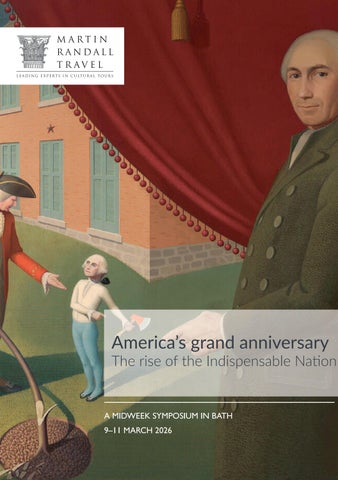
Front cover: Illustration: ‘Parson Weems’ Fable’, Grant Wood, 1939 © Amon Carter Museum of American Art
Scan the QR code to view full details Above: ‘Chimney and Water Tower’, Charles Demuth, 1931, © Amon Carter Museum of Art
Martin Randall Travel Ltd 10 Barley Mow Passage, London W4 4PH Tel +44 (0)20 8742 3355 info@martinrandall.co.uk From North America: Tel 1 800 988 6168 (toll-free) usa@martinrandall.com ATOL 3622 | ABTOT 5468 | AITO 5085
www.martinrandall.com
Introduction America’s grand anniversary: the rise of the Indispensable Nation 9–11 March 2026 (mm 941) Esteemed historians and commentators mark the 250th anniversary of the signing of the American Declaration of Independence. Ten 40-minute talks, followed by Q&As, Monday afternoon to Wednesday morning. Based at the Macdonald Bath Spa Hotel for two nights, Monday to Wednesday, with dinner both evenings. Includes afternoon tea with curator talk and visit to the American Museum, Bath. A mere 250 years ago in the summer of 1776, after a series of colonial conflicts and the Revolutionary War between the American colonies and the British government, the Declaration of Independence was signed by the Thirteen Colonies. The United States of America as an entity was born. The ideals enshrined in the Declaration: equality, rights, liberty, opportunity and democracy, became the watchwords that underpinned American governance and Western ideology – at least in theory – as the United States reached the apex of world power over the next two centuries. More recently, the economic and political tectonics have shifted. The 10 talks we present here offer history, insight and analysis, as we consider America and what it signifies for the rest of us – past, present and future. We venture to the leafy fringes of Bath for this symposium. Our venue is the MacDonald Bath Spa, a comfortable, traditional hotel set in beautiful grounds a mile outside the town centre, with free parking, a pool and spa facilities. Sequoyah, Native American polymath, Bowen, John T, 1838 © Library of Congress
4
Contact us: +44 (0)20 8742 3355 | info@martinrandall.co.uk
Included: – Hotel accommodation for two nights. – Breakfasts and two dinners with wine. – Admission to the talks. – A drinks reception and refreshments during breaks. – Visit and afternoon tea at the American Museum. – Gratuities for hotel staff. Accomodation: The Macdonald Bath Spa Hotel, Sydney Road, Bath, BA2 6NS A 4-star level hotel (although rated 5 star) set amid landscaped gardens, on a quiet hillside on the fringes of Bath, a short taxi ride or walk (0.7 miles) from the heart of the historic town centre. Bedrooms are comfortable and spacious, with good-sized bathrooms. The overall feel is traditional rather than contemporary; there are no telephones in the rooms, however, but a barcode via your mobile phone accesses services.
Most bathrooms have a bath with shower attachment, with a few only having a shower only. There is an indoor pool and spa, as well as a bar, lounge and restaurant. Free onsite car parking is available to all guests with electric vehicle charging points. WiFi is free throughout the building; lifts grant access to all floors. If you have a medical condition or a disability which may affect your holiday or necessitate special arrangements being made for you, please discuss these with us before booking - or, if the condition develops or changes subsequently, as soon as possible before departure.
The Talks David Armitage (by Zoom) An “Impudent, False and Atrocious Proclamation”? British Responses to the Declaration of Independence in 1776. Americans revere their Declaration of Independence but often forget it was also of great interest in Britain in 1776. This lecture tells the little known story of how the Declaration reached Britain in the summer of 1776 and what happened when it got there. Some supporters of the American cause cheered it; many recipients reviled it; and the British ministry wanted urgently to refute it. If the British had won, would we still remember the Declaration the same way today? Nigel Bowles Truman and Eisenhower: Two Presidents who remade America Presidents Harry S. Truman and Dwight D. Eisenhower changed the American Presidency,
American politics, and America’s place in the world. Both contributed significantly to America’s modernisation. From unprivileged mid-western backgrounds, both men developed a clear sense of duty and public purpose. Intelligent, resilient under pressure, each acquired an acute feel for political power. Their contrasting experiences of life before the Presidency informed their different approaches to leadership of a political system that the Constitution’s framers designed to make governing difficult but possible. Kathleen Burk 1783–1945: the great shift in power between the Lion and the Eagle Over the period from 1783 to 1945 there was a total switch in the international positions of the US and the UK. In the 19th century the UK was economically and imperially the most powerful nation in the world. The US was dependent in many ways on the UK. It was tacitly protected by the Royal Navy; it was dependent on London for investment; and Britain constrained some of its more buoyant attempts at expansion into British territory, such as Canada. Americans looked to Great Britain for cultural links, too. But Americans resented what they saw as British contempt for their mores. The First World War was a turning point: the UK became much weaker. Indeed, Britain and the US in 1919 exchanged positions as the dominant international financial power. World War II made manifest the reality of the changed power dynamic. Mario Del Pero The fear of (inter)dependence: The US and the world in the long aftermath of the 2008 crisis
‘The Magnet’, Puck, 1911 © Library of Congress
6
The United States must defend its “sovereignty without apology,” proclaimed Donald Trump’s first – and, to date, only – National Security Strategy in December 2017. The possibility
Contact us: +44 (0)20 8742 3355 | info@martinrandall.co.uk
‘Men and Wheat’ (mural study, Seneca, Kansas, Post Office), Joe Jones, 1939 © Smithsonian American Art Museum
of regaining this supposedly lost sovereignty has been at the heart of Trump’s rhetoric and political posture. But from nuclear deterrence to the circulation of commodities, from trade to investments, is it really possible – even for the world’s leading superpower – to escape the reality of global interdependence and the constraints it imposes on sovereignty, including that of the United States itself? Gareth Davies Nature and the American Dream U.S. environmental history has been determined by the ongoing tension between two very different attitudes. First has been the belief that the problems of scarcity associated with
Old World conditions did not exist in the New World: European settlers in North America could exploit its abundant natural resources indefinitely without exhausting them. Since the mid-nineteenth century this attitude has coexisted with a second and contrasting view: nature is precious and finite, and must be actively conserved for future generations. At the time of the American bicentennial in 1976, it appeared that the second attitude was becoming dominant – environmentalism had emerged as a powerful cause and enjoyed broad support across the political spectrum. As the United States approaches its 250th birthday, however, the bipartisan environmentalist legacy of the ‘Great Society’ era is under sustained attack, as a new generation of conservatives present
Subscribe to our weekly e-newsletter at www.martinrandall.com
7
The Talks
environmental regulation and climate change activism as un-American. This lecture explores the deep historical roots of this polarised discourse, as well as offering some ideas about how it might be overcome. David W. Ellwood The American Century: hard power, soft power “The world of the 20th century, if it is to come to life in any nobility of health and vigor, must be to a significant degree an American Century...” famously wrote Henry Luce, founder of ‘Time’, ‘Time’ ‘Life’ etc. in 1941, before the US had entered World War II. This talk will examine the rise and fall of this vision, exploring American designs for the postwar order: collective security, free trade, 8
raising living standards “everywhere” and their implementation in the Marshall Plan; then the following decades of American missionary effort culminating in their high point, the 1990s era of globalisation. But it will also highlight the range of responses all this triggered, emphasising the fracture lines of sovereignty, identity and modernity that opened up in Europe – including Britain – more than any other part of the world. Jacqueline Fear-Segal Native Americans and the USA: from “merciless Indian Savages” to American citizens and Native Nations The American Declaration of Independence doomed the Indigenous peoples of North
Contact us: +44 (0)20 8742 3355 | info@martinrandall.co.uk
America. The population of the new nation rapidly expanded westward, slowly but surely subjugating Native peoples. Designated as “merciless Indian Savages” in the Declaration, Indigenous populations constantly struggled to retain their own separate lands, cultures, and sovereignties. This talk will outline how Native peoples were progressively overwhelmed by America’s industrial power, military might, demographic growth, and confident ideology of “manifest destiny”. Yet, although dispossessed and confined to small reservation areas, the Indigenous populations were not eliminated. Today, there are 574 sovereign Native Nations spread across the United States, each maintaining distinct governments and traditions.
Elizabeth Ingleson Beyond the Trade War: US-China Relations from Truman and Mao to Trump and Xi More than any other bilateral relationship, the US-China relationship has been a core shaper of international relations and trade in the last few decades. This talk looks at how US-China relations have shaped the global economic and geopolitical environment and the implications of this for the international order. Taking a big-picture view of the relationship since the end of the Second World War, it considers how this history might help us think about future directions in the bilateral relationship and how they might have a bearing on the wider world.
Susan-Mary Grant Look Back in Anger: The Emotional Evolution of the American Republic Former Washington Post journalist Bob Woodward, famous for his part in uncovering the Watergate scandal, wrote three best-selling books during the first Trump administration: Fear (2018); Rage (2020); and Peril (2021). What can the field of emotional history tell us about America today? This talk tracks the important role that both fear and anger have played in the evolution of the Republic over the course of its 250 year history. It considers the fear that accompanied the Puritans on their ‘errand into the wilderness’ in the 17th century, through the anger of the Revolution that founded the nation, and that of the Civil War that almost tore it apart, to the fear and anger of the Red Scare and the McCarthy Years of the 1950s; echoes that resonate across America today.
Left: ‘American Progress’, John Gast, 1872 © Autry Museum of the American West; Right: ‘Burning Oil Well at Night, near Rouseville, Pennsylvania’, James Hamilton, 1861, © Smithsonian American Art Museum
Subscribe to our weekly e-newsletter at www.martinrandall.com
9
The speakers David Armitage is the Lloyd C. Blankfein Professor of History and former Chair of the Department of History at Harvard University, where he teaches intellectual history and international history. He is also an Affi liated Professor in the Harvard Department of Government and an Affi liated Faculty Member at Harvard Law School. Before joining Harvard in 2004, he taught for eleven years at Columbia University. His books include The Declaration of Independence: A Global History (2007), which was chosen as a Times Literary Supplement Book of the Year. In 2015, he received Cambridge University’s highest degree, the LittD, for “distinction by some original contribution to the advancement of science or of learning”. Nigel Bowles is a former Director of the Rothermere American Institute; Senior Research Fellow, Corpus Christi College, Oxford. He was Tutorial Fellow in Politics at St Anne’s College, Oxford for over 20 years. He was previously a staff member in the House of Commons before being appointed a Lecturer in Politics at the University of Edinburgh. His intellectual interests lie in American political history and, in particular, in the history of the US Presidency. Among his publications are The White House and Capitol Hill, an exploration of the politics of presidential lobbying; and Nixon’s Business: Authority and Power in Presidential Politics. Kathleen Burk. Professor Emerita of Modern and Contemporary History at UCL. Her general field is international history, concentrating especially on politics, diplomacy and finance. Kathleen specialises in the 20th century, although also publishes on earlier periods. Her primary area of research is Anglo-American relations, on which she has published three books and a number of articles. Her most recent history book is The Lion & The Eagle: The Interaction of the British and American Empires 1783-1972, (2018). Kathleen 10
also writes and lectures on wine and its history. Gareth Davies, Professor of American History, University College London, Institute of the Americas. An environmental and political historian, Gareth Davies first two books explored the political legacy of the 1960s, the first in relation to Lyndon Johnson’s ‘War on Poverty’, the second with respect to the federal role in education. As with much of his research, each book sought to understand the circumstances under which governmental power increases in American political culture, despite the persistence of a strong tradition of anti-statism. Mario Del Pero is Professor of International History at the Center for History at Sciences Po–Paris (CHSP), where he teaches courses on global history, transatlantic relations, and the United States in the world. A historian of the Cold War and US foreign relations, he is the author of numerous articles and books. His most recent works are Buio Americano. Gli Stati Uniti e il Mondo nell’era Trump (Il Mulino) and In the Shadow of the Vatican: Texan Evangelical Missionaries in Cold War Italy (Cambridge University Press). David W. Ellwood is a Senior Associate Fellow at the Bologna campus of the Johns Hopkins School of Advanced international Studies. He was Associate Professor of International History at the University of Bologna until 2012. His most ambitious book is The Shock of America. Europe and the Challenge of the Century, (Oxford 2012). Today he studies the impact of ‘soft’ American power, hence his latest article: ‘The politics of food in Italy’ Modern Italy, (Nov.2025). Jacqueline Fear-Segal is Emeritus Professor of American and Indigenous Histories at the University of East Anglia. She specialises in
Contact us: +44 (0)20 8742 3355 | info@martinrandall.co.uk
the social history of the United States in the 19th and 20th centuries, and is the co-founder and co-director of the Native Studies Research Network UK. With postgraduate degrees from University College London and Harvard, she has been a visiting lecturer at the Sorbonne Nouvelle in Paris, and Dickinson College in Carlisle, Pennsylvania. Susan-Mary Grant is Professor of American History at Newcastle University. She is the author of several books, including a study of nationalism in pre-civil war America – North over South: Northern Nationalism and American Identity in the Antebellum Era – a biography of Supreme Court Justice Oliver Wendell Holmes, Jr., and the Cambridge Concise History of the United States of America. She is an expert on the American Civil War and the emotional and medical history of the conflict, and is a Fellow of the Massachusetts Historical Society.
Elizabeth Ingleson is an Associate Professor of International History at the London School of Economics. She specialises in the histories of US foreign relations, US-China relations, capitalism, and labour. Her first book, Made in China: When US-China Interests Converged to Transform Global Trade, was published in 2024 by Harvard University Press. She is currently writing her next book with Bloomsbury Academic entitled, China and the United States since 1949: From Cold War to Trade War.
Left: ‘End of the Trail’, James Earle Fraser, 1918 © The Met
Subscribe to our weekly e-newsletter at www.martinrandall.com
11
Martin Randall Travel Tours in the USA ART IN TEXAS
25 February–7 March 2026
FRANK LLOYD WRIGHT 4 –14 September 2026
CONNOISSEUR’S NEW YORK 3–10 November 2026
Martin Randall Travel Ltd 10 Barley Mow Passage, London W4 4PH Tel +44 (0)20 8742 3355 info@martinrandall.co.uk From North America: Tel 1 800 988 6168 (toll-free) usa@martinrandall.com ATOL 3622 | ABTOT 5468 | AITO 5085
www.martinrandall.com