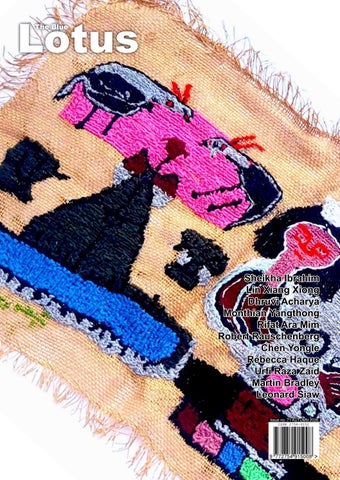
Lotus The Blue
Sheikha Ibrahim Lin Xiang Xiong Dhruvi Acharya Monthian Yangthong Rifat Ara Mim Robert Rauschenberg Chen Yongle Rebecca Haque Urfi Raza Zaid Martin Bradley Leonard Siaw Issue no. 71 AUTUMN 2026
1
2
3
Image © by Martin Bradley
contents p6
p8
p22
p38
p50
p62
p78
p90
p104
4
A Quick Word
Editor’s comments
Sheikha Ibrahim
Textile emotional traces
Lin Xiang Xiong Art Gallery
Penang, Malaysia
Dhruvi Acharya Indian artist
Monthian Yangthong
Woodcuts from Phuket, Thailand
Ngura Pulka
Epic Country artworks from Australia’s First Nations
Rifat Ara Mim
Charcoal drawings from Bangladesh
Robert Rauschenberg and Malaysia
Exhibition at Ilham Gallery, Kuala Lumpur, Malaysia
Chen Yongle
Yunnan artist from China
Cover: Sheikha Ibrahim, Sisters 2
p118
Tiger and Torma
Timeless tales of Nepal, Bangkok, Thailand
p134 Rebecca Haque
Poem, Gondoal Glide
p136
p142
p148
p162
Urfi Raza Zaid
The Kala Imambara of Lucknow, Northern India
moist
Moist
A novel in parts by Martin Bradley
Anak Alam
Remembering one of Malaysia’s innovative Arts collectives
Leonard Siaw
Malaysian Mural street art depicting local delicacies
https://issuu.com/martinabradley/docs/one_man_s_bangladesh
https://issuu.com/martinabradley/docs/samphire_island
ISSN 2754-9151 • NO. 71 • AUTUMN ISSUE • 2026 • THE BLUE LOTUS Published quarterly by The Blue Lotus Publishing (M.A.Bradley), Colchester, Essex, England, UK. © 2026 M.A.Bradley. All rights reserved. FIND MORE ONLINE: ……
facebook.com/bluelotusartsmagazine
5
Lotus The Blue
A quick word Welcome to the 71 st issue of The Blue Lotus Modern and Contemporary Asian arts and cultures e-magazine. In this issue, we step a little to one side of Asia, to the Middle East and the beautiful woven works of Sheikha Ibrahim. Sheikha was initially from the West Bank, Palestine, and now lives in Amman, Jordan, creating her personal textiles. We look at artworks from Australia again, this time with a focus upon First Nation artists. That is as well as works of art from India, Malaysia and Thailand. We thank you all for following The Blue Lotus magazine, as we welcome new readers too. We wish you all peace, compassion, enlightenment, freedom from suffering, inner tranquility, and mindfulness through troubles both personal and worldly. Submissions for this magazine of Modern and Contemporary Asian arts and cultures are encouraged to be sent to... martinabradley@gmail.com May you be happy, well, safe, peaceful and at ease
Martin (Martin A Bradley, Founding Editor, UK.)
6
7
Image © by Martin Bradley
Sheikha Ibrahim
8
sisters 1
9
Sheikha Ibrahim I was born in 1942 in Wadi al-Hawaerth, Tulkarem, and lost my mother when I was only four months old. My father, a Sufi, raised me, and his spiritual presence continues to echo through the symbolic depth of my work. In 1948, my family was displaced from our homeland, eventually settling in Amman. I later married in Iraq and spent years traveling, carrying fragments of memory across borders. Living among artists in different cities quietly nourished my creative instincts, though I did not pick up a brush until 2008, at the age of sixty-six. From that moment until 2020, painting became my daily ritual of expression. When the COVID-19 pandemic made art supplies scarce, I turned to whatever I could find at home—thread, fabric, and the humble remnants of domestic life. My work is built from dots and organic shapes, rendered in a mix of bold colours that refuse to be subdued. These hues do not sit in silence; instead, they enter into a restless dialogue—with one another, with memory, and with the raw textures of my materials. The colours speak of joy and grief, of land and loss, often clashing yet somehow finding harmony. These forms carry the imprint of my homeland: olive trees, farming rituals, wedding ceremonies that once lasted for days. They are not literal depictions but emotional traces, drawn from a vivid childhood and a hard upbringing shaped by a turbulent geopolitical landscape. Through my art, I commune with my inner child—the one who witnessed loss, resilience, and the slow erosion of a world that existed before exile. I never completed a formal education, yet that absence became a quiet freedom. My visual language emerged not from learned technique, but from memory, necessity, and the urgent need to create every day. In the face of displacement, scarcity, and a lifetime of change, I weave memory into matter—proving that art is not a luxury, but a form of survival.
10
Harvest day in Wadi al-Hawaerth, homeland series.
11
Sisters 2
12
13
Untitled
14
Untitled
15
Untitled
16
Untitled
17
Untitled
18
A day in the orchard
19
Letter to Homeland
20
21
Lin Xiang Xiong Art Gallery Penang, Malaysia.
22
Photo: Chin Siang,The Lin Xiang Xiong Gallery Staircase 23
Making a living planting rice seeding
Lin Xiang Xiong Art Gallery Penang, Malaysia
The world's first over-water art gallery, dedicated to Art for Peace. It showcases the works of Professor Lin Xiang Xiong while welcoming artists from around the world, serving as an international platform for cultural exchange and peace dialogue. Rising eight stories above the sea, this gallery is dedicated to the mission of ""Art for Peace"" and is open to the global public. In addition to the permanent display of over 400 paintings by Professor Lin Xiang Xiong across four major themes, it will continuously introduce international artists and curatorial projects to promote East-West cultural dialogue. The gallery also houses an education center, special exhibition gallery, and an international conference hall, aiming to make art a common language that connects the world and explores peace.
24
Story of the Lin Xiang Xiong Art Gallery The Story of the Lin Xiang Xiong Art Gallery presents a retrospective of Professor Lin Xiang Xiong's artistic journey. From his early sketches to later anti-war works, the series spans more than six decades of creation and social reflection. Together, these works offer insight into the artist's inner world, where art emerges as both a bridge between cultures and a voice for peace.
Helpless Yet Knowing Fate
Story of Nanyang The Story of Nanyang gallery captures the vibrant spirit of Southeast Asia through Professor Lin Xiang Xiong's delicate brushwork and vivid colours. His depictions of fishing villages, markets and rural landscapes reveal the warmth and diversity of Nanyang culture. Blending traditional Chinese techniques with modern styles, these works reflect the unique stories and human spirit of the region.
25
26
Photo: Chin Siang,The Lin Xiang Xiong Gallery 27
The Vicissitudes of Life The Vicissitudes of Life gallery showcases a series of emotionally powerful works by Professor Lin Xiang Xiong. Confronting the realities of war. poverty and environmental destruction. the paintings function as both social critique and moral reflection. Together, they reflect the artist's enduring call for peace and invite contemplation on humanity's struggles and shared future.
Photo: Chin Siang,The Lin Xiang Xiong Gallery
The Story of Nature gallery The Story of Nature gallery is a tribute to the beauty of the natural world. Through refined brushwork, Professor Lin Xiang Xiong portrays mountains, birds and blossoms, celebrating the harmony and grandeur of the earth. Beyond a poetic homage to nature, the works also reflect an enduring awareness of humanity's responsibility to protect the living planet. In addition to its permanent thematic presentation, Level 6 also functions as a flexible international exhibition platform. Designed to accommodate rotating exhibitions and curated projects, the space will progressively introduce artists and collaborations from around the world, supporting cross-cultural dialogue and artistic exchange. 28
Walking In The Woods
29
Photo: 30Chin Siang,The Lin Xiang Xiong Gallery
31
Harvest but what about life
32
Story of Professor Lin Xiang Xiong Professor Lin Xiang Xiong is an internationally renowned artist and cultural ambassador. Born in Shantou, Guangdong, China in 1945. he moved to Singapore in 1956. After receiving formal training at the Singapore Academy of Arts and furthering his studies in Paris. Professor Lin developed a distinctive style that merges Eastern and Western techniques. pioneering what is now recognised as the New Nanyang School of Painting.
Photo: Chin Siang,The Lin Xiang Xiong Gallery
Rooted in Southeast Asian culture. his works vividly portray the lives of local communities while engaging deeply with themes such as war, poverty, and environmental degradation reftecting his profound humanistic concern and the spirit of the times. His art has been exhibited globally, including at the National Art Museum of China and UNESCO Headquarters in Paris, earning widespread acclaim. As both an artist and a scholar, Professor Lin has not only created a significant body of work, but has also fostered East-West cultural exchange through founding the Global Chinese Arts & Culture Society. His lifelong artistic journey and societal contributions are embodied in the Lin Xiang Xiong Art Gallery: a culmination of his life’s dedication to using art as a bridge to promote peace and the power of culture. 33
A long, long way to go
34
Hunger Still Can’t Be Cured With High Technology And Civilisation?
35
Photo: 36 Chin Siang,The Lin Xiang Xiong Gallery
37
dhruvi acharya
38
Lockdown
39
dhruvi acharya
My work focuses on the psychological and emotional aspects of an urban woman’s life in a world teeming with discord, inequalities, gender disparities, violence and environmental catastrophes. Often utilizing a subtle, dark and wry humour to address these troubling issues, I also reflect on the hope, empathy and courage that exist in our minds, creating works that are visually and psychologically layered.
Baltimore, USA in 1998, and completed her Post Baccalaureate in 1996 from the same college. Acharya began exhibiting her works professionally in 1998 in the USA where she spent 10 years.
Acharya has held solo exhibitions with Chemould Prescott Road in Mumbai, Nature Morte in New Delhi, Gomez Gallery in Baltimore and Kravets/Wehby in New York. Her selected My work is based on my drawings, and my participations include shows at the San Jose sketch books are like a daily journal – a chronicle Museum of Art, Griffith University in Brisbane, of my thoughts, observations, emotions and BosePacia Modern in New York, National experiences. In my work I create a world where Gallery of Modern Art in Mumbai and Queens thoughts are as visible as “reality”, where Museum of Art in New York. human forms morph to match their mental state, and comic book-inspired empty thought Acharya has been the recipient of the FICCI and speech bubbles convey ineffable emotions. Young Woman Achievers award in 2013, and The protagonists in my work populate a world was featured on the cover of India Today in 2005. where past memories, the present, and imagined The artist lives and works in Mumbai. futures can all coexist. However when the works are viewed, I hope that the myriad detailing lures viewers to reflect on their own experiences and sentiments, making the specifics of the stories and the meaning of each image unimportant and allowing for the contemplation of our shared human existence. Dhruvi Acharya received her Master of Fine Arts Degree from the Hoffberger School of Painting, Maryland Institute, College of Art,
40
Third exclusive recess
41
Fifth exclusive recess
42
43
Melt
44
Meditate
45
Twelfth exclusive recess
46
Lockdown day 26.
47
Sixth exclusive recess
48
49
Monthian Yangthong
50
51
Monthian Yangthong Monthian Yangthong is a Neo-Expressionist Thai Woodcut artist, perhaps inspired by the modern woodcut movement in China, during the 1930s. It was then that Lu Xun led a revival of woodblock printing as a tool for social revolution. He introduced young artists to European Expressionists like Käthe Kollwitz and Frans Masereel, whose stark, emotional styles heavily influenced the "raw" aesthetic of early Chinese modernists. Monthian is an alumnus of the Department of Art Studies, Faculty of Education, Prince of Songkla University, Pattani Campus in the South of Thailand. He now provides lectures and workshops about art, and can be found at his own art gallery - I Mon Art Gallery, in the old town of Phuket, Thailand, where he has a half studio - half art gallery. It is there that he welcomes people who are also fascinated by woodcut art. His striking works have been seen in 60 group exhibitions and four solo exhibitions. After receiving his degree in Applied Arts, in 1991, he applied for a Bachelor’s degree at the Department of Art Studies, Faculty of Education, Prince of Songkla University, Pattani Campus. Monthian later worked in the art department of a hotel in PattaniProvince, then moved away from paintng in oil colours to select woodcut printmaking instead. Over 10 years, he has created many black and white prints and colour prints, this led to his first solo exhibition, in 2006, in Phuket Province. Monthian works every day and has, in time, discovered a better woodcut technique for making his woodcuts. In 2017, he bought a relief printing press to apply woodcut printmaking onto paper. Now also an art teacher, Monthian teaches face to face and on social media. As of now, he is still the only woodcut printmaking artist in Phuket. He wishes to help Thai artists to be on par with other international artists, and believes that Thai artists are more than able to compete with artists from around the world.
52
53
54
55
56
57
58
59
60
61
Ngura Puḻka Epic Country
62
Installation view, Ngura Pulka – Epic Country, National Gallery of Australia, Kamberri/Canberra, 2026
63
National Gallery of Australia
Ngura Puḻka Epic Country “Ngayulu
kulipai cavespangka painting palyara mununa mukuringkupai pulkangka palyatjikitjacanvas. Panya caves pulkangku culture-wanangku Nyara paluru ngayuku room pulka ngaranyitjukurpa, walka walkatjukuntjaku, Ngura kulu pulka ngaranyi puklka nyara palula-ngurunguyulu kulira mukuringkupai pulkamunlata palyatjikitja ngura ngayuku-tjara tjukurpa-wanu.” “Our ancestors painted on the caves. This is where I learned my story as a child through the cave paintings around Cave Hill. I think about these caves when I am making a major work. The larger scale[canvases] allow me to invoke the cave as a celebration of my culture. They allow me the room I need to share my story. Ours is a big and important country, I need a canvas that will support me to share that.” Yaritji Young, 2020 Ngura Puḻka - Epic Country is an artist-led project, showcasing major works by senior First Nations artists and collectives from the Anangu Pitjantjatjara Yankunytjatjara (APY) Lands, Coober Pedy and Tarntanya/Adelaide, in South Australia. These ambitious works depict Country while celebrating the powerful Tjukurpa (Anangu law/cultural stories) that lies within. An epic project both in scale and scope, the creation of large-scale paintings reinforces artists’ connection to Country. Through stories and distinctive designs, they continue to strengthen their cultural knowledge,and knowledge of their homelands. Individual artists and women’s and men’s collectives bring their Tjukurpa to life on canvas – sometimes through explosions of colour, sometimes in a muted palette.
64
Nyunmiti Burton, Pitjantjatjara people, Seven Sisters Tjukurpa 2021 © the artist
65
Jeannie Minunga,Yankunytjatjara people, Kay Finn, Pitjantjatjara/Yankunytjatjara peoples and Myra Kumantjara, Pitjantjatjara/Yankunytjatjara peoples, in the APY ArtCentre Collective studio on Kaurna Country/Adelaide, South Australia, with their work Nganampa Ngura – Our Country © the artists / Umoona Arts / APY ArCentre Collective, image courtesy APY Art Centre Collective, photo: Andy Francis
PY ART CENTRECOLLECTIVE
IWANTJA ARTS
A group of Indigenous-owned and governed art centres and individual artists based across the APY Lands, regional South Australia and Adelaide, that work together on innovative artistic projects.
Established in the early1980s by founding artists and directors Alec Baker and Sadie Singer, Iwantja Arts now supports the artistic careers of over 40predominantlyYankunytjatjara artist members.
(https://nga.gov.auhttps://apyartcentre collective.com/)
(https://nga.gov.auhttps://www.iwantja arts.com.au/)
KALTJITI ARTS At the heart of the remote community of Kaltjiti/Fregon in the APY Lands of South Australia,the art centre is a place of inspiration, dynamism anda cultural focal point. (https://nga.gov.auhttps://kaltjitiarts.co m.au/)
Sylvia Ken, Pitjantjatjara people, in the APY Art Centre Collective studio on Kaurna Country/Adelaide, South Australia, 2022, with her work Seven Sisters © the artist
66
Leah Brady, Pitjantjatjara people, in the APY Art Centre Collective studio on Kaurna Country/Adelaide, South Australia, with her work Piltati © the artist / APYArt Centre Collective, image courtesy APY Art Centre Collective
TJALA ARTS Supporting established,mid-career and emergingartists known for theirvibrant use of colour andenergetic mark making,Tjala Arts is an Aboriginalowned and managedcorporation in Amatacommunity. (https://nga.gov.auhttps://tjalaarts.com. au/)
UMOONA COMMUNITYART CENTRE Located in Umoonacommunity, Coober Pedy,in South Australia,Umoona Art Centrefeatures artists fromdiff erent language groupsacross the centraldesert alongside thosewho have always calledUmoona home. (https://nga.gov.auhttps://www.apygall ery.com/pages/umoona-art-centre)
MIMILI MAKU ARTS A vibrant contemporary art studio and cultural centre founded and governed by a strong board of Anangu directors, located in Mimili Community on the APY Lands in South Australia.
Iluwanti Ken Pitjantjatjara people Walawuru nguynytju munu mama kukaku ananyi Mother and father eagles going hunting
67
Installation view, Ngura Pulka – Epic Country, National Gallery of Australia, Kamberri/Canberra, 2026,
68
69
70
APY Women's Regional Collaborative, Ngura Pulka – Epic Country 2022 © the artists / APY Art Centre Collective, image courtesy APY Art Centre Collective
71
72
Yaritji Young, Pitjantjatjara people, Tjaḻa Tjukurpa 2021 © the artist / Tjala Arts / APY Art Centre Collective, image courtesy APY Art Centre Collective
73
74
Zaachariaha Fielding, Pitjantjatjara people, Inma 2022 © the artist / APY Art Centre Collective, image courtesy APY Art Centre Collective, photo: Andy Francis
75
Installation view, Ngura Pulka – Epic Country, National Gallery of Australia, Kamberri/Canberra, 2026, featuring: (left to right) Tjungkara Ken, Ngayuka Ngura (My Country) 2023; Ken Sisters Collaborative, Tjala and Seven Sisters 2025 © the artists / Tjala Arts / APY Art Centre Collective
76
77
Rifat Ara Mim charcoal
78
79
Rifat Ara Mim charcoal
since I can remember, I have enjoyed drawing. For me, using art “ Ever to depict the behaviours and feelings that precede disaster is crucial. The line where safety and dread coexist is what I'm searching for.
I was born and raised in Bogura,Bangladesh. After completing my predegree program in Bachelor of Art at Bogura Art College, I embarked on a journey of self-discovery as a self-taught artist. This path led me to explore various styles and techniques, allowing me to carve my unique niche in the art world. Embracing the freedom of freelancing, I immersed myself in the art community and actively participated in numerous group shows. Recently, my artistic focus has shifted towards the theme of sisterhood. Growing up as a single mother's child, I hold a profound belief in the empowering dynamics between women. Through my work, I strive to depict the strength and resilience inherent in the bond shared by sisters. Each stroke of my brush is a testament to the interconnectedness of women, their shared experiences, and the support they provide one another. As I continue to explore the realms of art, my goal remains to convey the intricate stories of human relationships, emotions, and the fine line between security and apprehension. My journey as an artist is a continuous evolution, driven by a deep-seated passion for capturing the complexities of the human experience through the lens of creativity.
“
80
81
82
83
84
85
86
87
88
89
Robert Rauschenberg and Malaysia
90
View of the interior
91
Robert Rauschenberg and Malaysia Rauschenberg and Malaysia Ilham Gallery, Level 5, Ilham Tower no 8, Jalan Binjai 50450 Kuala Lumpur 16 June -1 November 2026
Robert Rauschenberg
At the Ilham Gallery this year, if you are of a Black Mountain College outside of Asheville, North certain age you might be forgiven if you were Carolina, where the artist and former Bauhaus instructor Josef Albers was his teacher. There, his experiencing a distinct sense of deja vu. mentors and collaborators included the composer John Ilham’s current exhibition - Rauschenberg Cage, the artist Cy Twombly, and the choreographer and Asia, to some extent, had been seen in Merce Cunningham, with whom he would collaborate Malaysia before, at the ‘Balai Seni Lukus Negara on more than twenty dance compositions.” (National Art Gallery), 1990, as part of Robert MoMA,11 11 West 53 Street, Manhattan New York, New Rauschenberg’s ROCI (Rauschenberg Overseas York. Culture Interchange, a multi-venue travelling exhibition running from 1984-1991). The recent I was there, at the exhibition Rauschenberg and collection, some 36 years later, is both a stripped Asia, in Malaysia, June 16th, 2026, for the first down version and an extension of the original. day the exhibition was open to the public. We live in conundrums. Sans water bottle (not allowed) I, defeated, In 1997, Rauschenberg travelled back to Malaysia mooched into the Ilham Gallery at Level 5. I’d to attend the opening of new work, at Gallerie honestly expected to be WOWED, but really TAKSU, Kuala Lumpur. felt assailed with notices warning me of camera surveillance, to keep my dirty mitts off the “Born in Port Arthur, Texas, Rauschenberg studied artworks and not to use flash photography. at a variety of art schools including the experimental 92
Ilham, RR Poster 2026
93
94
‘Perarakan Iban’ (Iban Parade)
95
ROCI Malaysia, 1990 catalogue
96
This was Robert Rauschenberg (1925–2008) artist hero, keen Modern and Post-Modern artist, after all. Sadly the layout was a tad pedestrian and sucked all the joy out of the viewing, or maybe that was because of my initial disappointment with being lectured. I felt that Rauschenberg’s initial joyous intentions with his ROCI had lost the battle with the presenting, very staid, layout. The lighting caused ‘bars’ on the photos I was trying to take, which again was disappointing and (literally) overshadowed my photography.
There, Rauschenberg…
“Traveling between the capital and the state of Sarawak, he followed both ceremonial pageantry, such as the inauguration of the new king, and grassroots activism around environmental and indigenous rights. In Sarawak, on the island of Borneo, he encountered a “Save the Forest” campaign centered on the rapid destruction of rain forests and the impact on local hunters and indigenous communities. There, he purchased hundreds of T‑shirts and bamboo bracelets produced to support the movement, small objects that embodied a local struggle over land, labor, NB; I take photos in exhibitions to help me recall the and resources and which would later feed into his thinking in the studio.” exhibits, their names and any details that strike me at From Robert Rauschenberg Foundation the time. It helps with my writing. At the invitation of Malaysia’s renown artist Syed Ahmad Jamal (1929 - 2011, and director of Balai Seni Lukis Negara, the National Art In 1984 (a most Orwellian year) Robert Gallery, from 1983 to 1991), the ROCI integration Rauschenberg announced his Overseas Culture in Malaysia culminated with the 1990 exhibition Interchange (ROCI, named after Rauschenberg’s being set up at that National Art Gallery, in Kuala pet turtle Rocky) with the then United Nations Lumpur, May 1990. Secretary Javier Pérez de Cuéllar, at the UN Chosen works had reflected the tension between headquarters. The concept was indigenous traditions and rapid urbanisation “…making and exchanging art and facts around the of cultures in Malaysia with Rauschenberg world…If the attitude of ROCI is going to work, we using local fabrics, patterned textiles, and found are dependent on a one-to-one contact with as many materials creating works such as ‘Home Run’, people as possible because the most dangerous weapon ‘Yang Teragong’ (Malaysian King), ‘Iban Pak Tanah’ (Iban Landmark), ‘Bunga Kuil’ (Flower Temple), we have is a lack of understanding”. From Robert Rauschenberg Foundation ‘Mangosteen Flower’ (Bunga Manggis)’, ’Iban Parade’ (Perarakan Iban), ‘Rice Wine Dog’ (Tuak Eleven countries had been chosen where Hudok-Iban), ‘Virgin Forest’ (Hutan Belantara), freedom of artistic expression could, at the time, ‘Pasar’ (Market) ‘Malaysian Flower Cave’, and have been seen as being restricted: Mexico, ‘Poster for ROCI Malaysia’. Chile, Venezuela, China, Tibet, Japan, Cuba, the Soviet Union, Germany (Berlin) and Malaysia, Back at the Ilham exhibition (2026) concluding with an exhibition in the United States at the National Gallery of Art in Washington, As a sense of deja vu, reminiscing about the 1990 D.C. The last of the countries on Rauschenberg’s Malaysian Balai Seni Lukis Negara presentation list was Malaysia. of ROCI, the 2026 Ilham poster for ‘Rauschenberg and Asia’ uses the original 1990 ‘ROCI/ Rauschenberg underwent research travels Malaysia Poster’ as its central image, slightly throughout Malaysia in 1989, where he attended over-set with the text ‘Robert Rauschenberg and the inauguration ceremony of Sultan Azlan Shah Asia’. Perhaps it’s a nice idea, no matter how (the Sultan of Perak) the new King (Yang di- predictable. However any other image from that Pertuan Agong), visited local tribes in Sarawak, first exhibition might have held a more subtle Kuching and Miri, on Malaysia’s section of the reference while also seeming fresher and bolder, island of Borneo, as well as Kuala Lumpur, such as Rauschenberg’s ‘Hutan Belantara’ (Virgin Melaka, Penang, Kota Bharu, and Kuala Forest). However, it is what it is. Terengganu, Enough moaning.
97
I can’t help but compare the differences between these last two exhibitions that I’ve visited in Malaysia - the Lin Xiang Xiong Gallery in Penang, and the Ilham ‘Rauschenberg and Asia’ in Kuala Lumpur. The former was stunning all the way through, leaving me exhausted, true, but wanting to go back as soon as possible (even with the lengthy train rides). The Latter, not so much. Ed
‘Hutan Belantara’ (Virgin Forest)
Rice Wine Dog, ‘Tuak Hudok Iban’
98
Original Art - ROCI / Malaysia Poster
Malaysian Flower Cave
99
‘Iban Pak Tanah’ (Iban Landmark)
100
101
‘Bunga Kuil’ (Flower Temple)
‘Pasar’ (Market)
102
Mangosteen Flower, ‘Bunga Manggis’
Home Run
103
Chen Yongle 104
Wa Ethnic Girl
105
Chen Yongle 陳永樂 Chen Yongle was born in Chongqing, China in 1944. He uses reduction woodblock printing the Yunnan Art School style, applying heavy oil-based colours to the intricately carved lines to produce amazingly textured prints, and is the father of Chen Li . Chen Yongle is one of the most established Yunnan art/heavy color painters currently living in the Yunnan province. He is currently the president of the Yunnan Research Institute, and is a member of the Chinese Artists Association, Chinese Graphic Artists Association, and the Association of Artists of Chinese Craft and Art. He has exhibited international including: China, Japan, Hong Kong, Taiwan, United States, France, Belgium, Holland and Germany.
106
June
107
Remembering
108
On the way
109
Wild fruit
110
Spring
111
Tomb sweeping
112
Combing
113
Spring warmth
114
Shepherdess
115
116
Country sounds
117
118
119
Though separated by geography, different worlds can be connected through faith, art, and compassion. "Tiger and Torma: Timeless Tales of Nepal" invites visitors on a journey from the Himalayas to Thailand through an exhibition that brings together art, Buddhist philosophy, and contemporary craftsmanship. At its heart are two timeless values that have long guided human existence: Prajña (wisdom) and Karuna (compassion). Curated by internationally acclaimed Thai artist and floral designer Sakul Intakul, the exhibition is created in collaboration with Nepalese artists and artisans including Tenzin Norbu, Chunu Bastola, Kumbeshwar Technical School, and Master Weaver. Together, they weave the cultural wisdom of the Himalayas into a contemporary artistic language through works crafted from natural materials, handwoven textiles, floral sculpture, and immersive installations. Each piece reflects not only the beauty of traditional craftsmanship but also a shared commitment to sustainability and cultural preservation. The exhibition unfolds through four immersive experiences. Visitors will encounter contemporary Tibetan carpets and paintings inspired by Torma, the ceremonial ritual offering in Tibetan Buddhism; floral sculptures incorporating Allo, a natural Himalayan fibre; Pink Tiger Temple, an installation created from handwoven Dhaka textiles; and a monumental centrepiece that unites the symbolic forms of the tiger and the torma. Together, these works explore the relationship between wisdom, compassion, and living in harmony with the natural world. "Tiger and Torma: Timeless Tales of Nepal" celebrates the strength of local communities, the enduring knowledge of traditional artisans, and an economy shaped by the contributions of women. It invites visitors to reflect on the idea that true strength is not measured by the power to conquer, but by the ability to protect, nurture, and extend compassion to others. 120
Sakul Intakul,
121
Sakul Intakul,
122
123
Sakul Intakul,
124
Sakul Intakul,
125
126
Sakul Intakul,
127
Tiger and Torma: Timeless Tales of Nepal
128
Sacred Buddhist ceremonial tapestry
129
130
131
132
133
Gondola Glide
Rebecca Haque
Gliding on the sinewy canal, fingers lightly trailing Venice topsy-turvy, undulatingly reflected on the canal. Gondolier's song, operatic tenor quasi-Pavarotti, "Ave Maria Aria" takes my breath away as it ricochets in surround sound and holds me in a symphonic sway. Then, a soft breeze, and a smooth gondola lilt and flow with the current Under the Bridge of Sighs.
134
The cool breeze tingles my nostrils, with the sharp scent of baking cheese,onion, tomato. Sprouting hunger pangs shoot in my belly. Pizzerias all around me. Surround sound replaced with warm tangy taste on my tongue, and strong sweet, vibrating sensation in my brain's synaptic tissue.
© Rebecca Haque 31 July 2026 [Rebecca Haque is a Writer, Poet, Translator, and former Professor and Chairperson (2009-2012) Dept. of English, University of Dhaka, Bangladesh]
135
The of Kala I Luc
Architecture, Lineage,
136
Imambara cknow
, and Sacred Memory
Kala Imambara (also known as the Black Imambara) located in the Peer Bukhara area of Lucknow, India
137
The of Kala Imambara Lucknow Architecture, Lineage, and Sacred Memory Urfi Raza Zaidi Lucknow is renowned worldwide for its culture and Azadari (mourning traditions for the martyrdom of the Ahl al-Bayt, peace be upon them). Its Imambaras hold special significance across the world. These Imambaras have not only spread the message of Hussainiyat but have also promoted religious harmony and brotherhood. For centuries, these Imambaras and rauzas (shrines) have conveyed messages of love and peace. Regarding the Imambaras of Lucknow, it is said that the first Imambara was the Agha Abu Talib Imambara, whose remains have now disappeared. The second was the Agha Baqar Imambara, followed by the Kala (Black) Imambara. After this, Nawab Asaf-ud-Daula built the Asifi Imambara.
The Kala (Black) Imambara, aptly named for its dark hue, stands as an edifice reminiscent of a blackened palace, reflecting both architectural grandeur and historical depth. Its walls and arches are entirely black. Verses from the Qur’an are inscribed in white stone with intricate designs and patterns by calligraphers from Delhi. One of the most remarkable features of this Imambara is its marble plaster made of shell lime, showcasing exceptional ancient craftsmanship.
According to local history, a saint from Bukhara once came to Lucknow, and the area came to be known as Shah Peer Bukhara. Over time, the tomb of Shah Peer Bukhara was lost beneath debris. In 1958, a map and an amulet were discovered, believed to indicate the location of a hidden treasure. However, when excavation was The Imambara under discussion is the Kala carried out, no treasure was found; instead, the (Black) Imambara, located in Shah Peer Bukhara, grave of Shah Peer Bukhara was uncovered. an old neighborhood of Lucknow. It was built by Nawab Mirza Qasim Ali Khan Bahadur This Imambara has a unique Sufi atmosphere Qayam Jung, the eldest son of Nawab Mirza that attracts visitors. It is said that Mir Anees, Muhammad Ali Khan Bahadur Salar Jung, often called the Shakespeare of Urdu poetry, who was the maternal uncle of Nawab Asaf- frequently visited this place in search of ud-Daula. The Imambara was constructed over spiritual solace. In the Indian subcontinent, the graves of his parents. Over time, the city’s Imambaras are generally built facing south, landscape has changed, but many historically as the city of Karbala lies south of Mecca. For significant Imambaras remain, and the Kala this reason, most Imambaras in Lucknow face south. However, there are exceptions, including (Black) Imambara is one of them. It is said that the black stones used in the the Kala Imambara and Saudagar’s Imambara, construction of the Kala (Black) Imambara were both of which face east, while Nazim Sahib’s imported from distant regions, including parts Imambara faces west. of India, Afghanistan, and Iran. Nawab Asafud-Daula Bahadur performed Azadari in this We now turn to the historic lineage and domestic Imambara for five years before shifting to the affairs of Nawab Qayam Jung, the distinguished patron and architect of the Imambara, tracing Asifi Imambara after its construction. the historical evolution of his family across 138
Mausoleum of Mirza Qasim Ali Khan
139
140
Ornate gate of the Kala Imambara located in the Peer Bukhara area of Lucknow, India.
This Imambara is a waqf alal aulad and is managed by the Wasiqa Office. The current Mutmin-ud-Daula Muhammad Ishaq Khan, a mutawalli (caretaker) is Syed Mohammad mansabdar in the Mughal court whose lineage Ammar Rizvi. traces back to Malik al-Ashtar al-Nakha‘i, a commander of Hazrat Ali (peace be upon him), was appointed governor of Gujarat. He had three sons—Nawab Mirza Muhammad Ali Khan Bahadur Salar Jung, Nawab Iftekhar-ud-Daula Mirza Ali Khan Dilawar Jung (Takht-e-Taous), and Nawab Najm-ud-Daula Mirza Muhammad Khan Bahadur—and two daughters, Ummat-uzZahra Bahu Begum and Razia Begum. He passed away on 18 April 1740, leaving his children orphaned at a young age. generations.
After their father’s death, Emperor Muhammad Shah adopted Ummat-uz-Zahra as a foster daughter and arranged her marriage into the Awadh ruling family. In 1745, she married Jalalud-Din Haidar, later known as Nawab Shujaud-Daula. Bahu Begum was deeply attached to her brothers; therefore, after the death of Nawab Najm-ud-Daula in Delhi in 1750, Nawab Salar Jung and Nawab Iftekhar-ud-Daula moved to Lucknow at her invitation. Bahu Begum was known for her beauty and literary talent; she composed ghazals as well as nauhas and marsiyas. Her husband, Nawab Shuja-ud-Daula, passed away in 1775 at the age of 44. Thereafter, Bahu Begum and the senior Begum continued to maintain the grandeur of Faizabad. Asaf-ud-Daula was Bahu Begum’s only son, though their relationship remained strained. She would visit Lucknow during Muharram and reside in her palace, Sunhara Burj, located on the eastern bank of the Gomti River near Kudiaghat. Today, no trace of this magnificent palace remains. In 1797, her only son, Asaf-udDaula, also passed away. The founder of this Kala (Black) Imambara, Nawab Qasim Ali Mirza, died in 1818. His domed tomb, once located within the Imambara premises, has now collapsed.
inside hall of Black Imambara
141
142
moist
A novel in parts by Martin A Bradley
Spars After their lovemaking, Jen has begun an oil- self in the mirror, saying to his reflection… paint sketch of Brian. She uses classical brown tones on raw, unprimed, jute. “Spar - you must be joking!” “Jen, how much longer? My body is killing me” Brian hesitates at the concept of a health Brian complains. and wellness tour, briefly, then considers the adventure and remuneration (but not necessarily “Bri-an better go. Finish another day.” in that order). Brian rides back to his nest in Malaysia’s Brian “ums” and “ahs” just like he had that Wangsa Maju, thoughtful and grinning madly. cold, March, day in England’s Kent, when faced He’s got a lot to be thinking about... with certain (imagined) death falling from an all-metal cage, some 300 feet above the ground, There’s a few good things to be said about with a bungee rope tied around his ankles. being a freelance writer - very few. However, on this one, singular, occasion an email arrives on Just like that day, eventually Brian girds his Brian’s smart-phone and, just when he’s thinking loins, takes a deep breath and finally takes the that Malaysia has nothing left to surprise him plunge - figuratively and eventually literally (in with, up pops the offer of a three-day, two-night the case of the bungee jump (he’d been pushed tour of Perak State’s spas, gratis. by a rather loud and assertive New Zealander). It’s a good opportunity for Brian to muse upon Like the man from Del Monte – eventually what happened with Jen at Rimbun Dahan. The Brian says - yes. text from Alistair Pringle (Brian Holland’s friend and editor of a local expatriate magazine) runs… “Jen, it’s Brian” “Brian, I’ve just been notified by Malaysian Tourism that they are looking for someone to review a ‘Health & Wellness’ Spar trip to Perak. It’s part of their Perak promotion this year. I thought of you. If you are interested in a 3 day 2 night break away, do let me know and I’ll send the details. If you agree, don’t worry, you’ll get a byline. Let us know ASAP. Alistair. BTW - it pays.” This offer comes courtesy of Malaysian Tourism. Brian turns and looks at his ‘pregnant’
“Hearing soon after make love, good sign. “I’ve just had an offer to go on a short trip, in Malaysia, and write about it.” “Good, people appreciate you, good.” “I’ll be gone just a few days”. “Have news too.” “Oh”. 143
“Have back Xian. Academy offer Professorship, through and into the more northern State of Perak but have be there ceremony.” where controversial brick structures containing swiftlets and their imprisoned (prized edible) “Wow that’s so good. You have to go now?” nests drift by the coach windows. “After finish Rimbun Dahan, use portfolio The ‘expert’ Tourist Guide has taken them to proof Professor and Masters. So happy Xiao Bri-an.” the wrong jetty. “Great then you must go, and I’ll see you when In sleepy rurality the coach driver has missed you get back. How long will you be?” the public ferry at the seaside town of Lamut and they all have to wait for a private launch to “Bri-an, don’t know. See how…” collect them and transport Brian and the (much younger) eager tourist-press to Pulau Laut Biru. Day one It’s a place Brian is particularly keen on visiting. He’d seen the TV adverts and is entirely taken in Imagining that he’s on his own magically with the tales of exotica, luxury and bellowing mysterious tour, Brian navigates the city’s light Italian tenors. rail transport (LRT) system from Wangsa Maju to to the Putra World Trade Centre (where the Eventually, having sampled the low end of the meet and greet is due to take place amongst tourist spectrum, the pranked merry makers are fellow writers and Malaysia Tourism). herded into a launch and, pretty soon, are flying over gentle waves to where the Andaman Sea Unfortunately, the Putra World Trade Centre abuts the Melaka Straits. They head for one of has no clear directions to the meeting room the most exotic, and luxurious, islands Malaysia where Brian is due to be seated. He wastes half- has to offer which is, supposedly, everyone’s an-hour seeking any sign of Malaysian Tourism. cultural wet dream fantasy. Eventually there are hail-fellow-well-met greetings, a cold Malaysian breakfast of sardine The boat manoeuvres its nautical sandwiches, bottled water and a half-hearted manoeuvrings, and edges up to a once distant attempt at brown-paper wrapped Nasi Lemak. small jetty. They (the tourism press) are expected to indulge in them while a Tourism official talks at them. “What’s all this? We disturbing some sort of function?” Brian idly wonders There’s the prospective Tour Guide’s incessant boasting about the delights of the spars. There’s A wooden jetty is full of beige and white the beauty of the beautiful countryside etc etc costumed Pulau Laut Biru staff waiting in a and ad nauseam. Eventually, reluctantly, and drizzle of rain. They have an appropriate number barely still awake the collective they (ie. Brian, of umbrellas proclaiming the name of the resort. the only ‘foreigner’, with Chinese Malaysian, It turns out that the staff are awaiting for Brian’s Indian Malaysia and Malay ‘writers’) trundle delayed group of journalistic gawkers. down multiple stairs and exit into a car park. “An inspection? OMG I’m going to be rejected A yellow and blue coach awaits. They board for being being too old and too weighty for all that and, after yet more speechifying on board, they waiting luxury” Thinks Brian. are eventually off. Obviously, Brian starts to sing a pertinent Beatles song to himself (Cliff But no, he and the writers are being welcomed, Richard’s ‘Summer Holiday’ somehow didn’t with a little propaganda, before getting too far quite fit). onto the island. On that air-con coach, an already sleepy Brian After copious handshakes the scribes are is lulled into a dreamless asleep. While he’s ushered, in a not unpleasant way, to the reception slumbering the coach edges itself out from Kuala and further inculcated into the ways of the white Lumpur and into the nearby State of Selangor, sand and green sea island resort. 144
Pulau Laut Biru, in its South East Asian jungle reality, is every bit as plush as it appears in the glossy tourist magazines - and then some. It’s a well-appointed wellness resort and, yes, the journalists are told - oh so many times, that Tenore di Forza had stayed there and, just in case they didn’t get the message, there’s his chalet as proof.
weather. Day Two
And after a reasonably comfortable night’s stay listening to the rain, Brian’s room-mate’s snores and, no doubt, Brian’s snores too, with equatorial insects harmonising - Brian heads for a continental/Malaysian style breakfast with Apart from the exotic location, the fitting pastries of a Danish inclination galore, and local architecture of wooden chalets on stilts above delicacies too. enticing waters and the well-planned nature of the resort, it’s the staff, their individual With ‘roti jala’ and Malaysian chicken curry characters, which leap out at Brian - not literally under Brian’s expanding belt, he’s again, you understand. scudding over the barely existent waves to the mainland. They all head to The Golf Resort and Of all the ‘characters’ Brian meets in his brief Spa near Lamut. stay on Pulau Laut Biru, is one Chinese naturalist (Ah Chin) who stands out most. He and his They disembark and stand, or rather try to knowledge and experience is worth his (slight) stand as many are slowly recovering their landweight in hornbill feathers and fruit-bat guano. legs, and gaze at the acres of rolling golf greens and smooth, but not very inviting, golf grass. Brian’s luggage disappears as if by magic. It, The golden lawn begs them to T-off post-haste and the assembly of visitors, are well taken care and take the gentle but effective modern exercise of by the Pulau Laut Biru staff, even when Brian which P.G Wodehouse took so seriously when he enquiries about having to spend the night in a wrote… king size bed with another man – something he’s not at all used to doing. The staff take his concern “After all, golf is only a game’ said Millicent. on their collective chins and arrange for another Women say these things without thinking. It does room – one with two single beds, so technically not mean that there is a kink in their character. They Brian still spends the night with another man – simply don’t realise what they are saying.” just not in the same bed. “I cannot quite see the point of knocking a small Overall, the staff are warm, friendly and all- white ball around a green, and then having to chase smiles - in a ‘Stepford Wives’ kind of way. There’s after it – why not just put it in your pocket to begin fine dining - which seems a little lost on some, with and take a wander? But then I am no sportsand the type of herbal massage that instantly person”. Muses Brian to himself. converts dyed-in-the-wool spa abstainers, like Brian, into passionate believers. Brian has never Waters of the Melaka Straits wash The Golf really felt comfortable with 6 star luxury - the and Spa Country Resort. Some might say that kowtowing and the sheer sumptuousness, but resort …’is blessed with blue inviting skies, and is Pulau Laut Biru does 6 star with ease and is cooled by the luxuriant greens of the golf resort’, putting him at his ease too. but Brian probably wouldn’t be so eloquent. You might also want to describe the white sands as Visiting a luxury island without visiting one ‘…pleasantly shadowed by picturesque coconut of the silvery sand beaches would have been a palms, graced with stunning bougainvillea’ - or sin. The overcast threat of rain barely takes away not, as the mood takes you. the magic of a path guarded by gigantic tree ferns, leading the troop to slight waves, with the Lunch is a buffet. Disappointing after the overall ambiance of a previously deserted beach, gourmet offerings of Pulau Laut Biru. Then briefly marred by wooden deckchairs, heavy there’s a lightning tour of The Golf and Spa wooden chairs and tables attesting to the beach’s Resort and the Spa’s spa. An anti-climax as tours popularity at others times, and in more clement go. Then the ensemble gladly climb back aboard 145
the waiting (Kiffah Travel) tour coach. They amble towards Ipoh from Lumut - amble because the appointed guide doesn’t have a clue where he is, or where he is going – Brian could tell by the guide’s reliance on Google Maps, GPS and constant phone-calls to base. They bypass various purveyors of some of the most delicious ‘Dodol’ the west coast of Malaysia has to offer. Brian’d rather not to have bypassed those purveyors of dodol, but instead stop and buy a few kilos – just in case there was a nuclear war or something. “Ok, yes, it’s a health and wellness tour now – but, good grief, what about after the tour?” Brian muses. Still on day two, the coach-bound writers skirt around the old tin-mining city of Ipoh, known for its superb Cantonese Chinese food (including its scrumptious roasted duck). They edge down a tiny, practically minuscule, lane - and before them lays the Pusat Perangian Bukit hot springs retreat at the bottom of a mountain in the northern Malaysian Titiwangsa Mountain range. From the outset, it’s obvious that Pusat Perangian Bukit hot springs values privacy. Not to mention a certain degree of luxuriating at its high-end hot springs retreat. Pusat Perangian Bukit hot springs is secluded, ringed partially by the mountains that give the retreat its name and festooned with bubbling, steaming naturally hot springs. There is little doubt that Pusat Perangian Bukit hot springs is a wellness centre (a term Brian would oft hear on the tour), and is targeted towards the very well-heeled and, no doubt, later also healed well clientele if the staff at Pusat Perangian Bukit hot springs have their way). It’s a chic resort, proffering a multiplicity of modes to achieve a certain degree of wellness, including the olfactory with avenues of lemongrass bushes to brush by day and night-scented jasmine by night. There’s a meditative crystal cave (worthy of Merlin himself) with ample space conducive to meditation. There’s a dead-skin nibbling fish pond and individual therapy rooms all geared to improve varieties of health - whether you want to or not. Maybe Brian’s awkwardness at Pulau Laut Biru has flown ahead, or maybe it’s divine providence, but he is given a whole chalet to himself at Pusat Perangian Bukit hot springs. It’s here that Brian recalls how to swim - in his small but intimate swimming pool, and learns how to relax in his, secluded, hot spring Jacuzzi. The large flat screen HD television in his king size bedroom, however, remains off. Turning it on would break the all-enchanting spell Pusat Perangian Bukit hot springs is weaving around him. But tempus does indeed fugit, and the next day fairly rushes to greet the group of touring journalists. Day three The intrepid journiers climb, once more, onto the jolly tour bus, perhaps a tad chummier than when they had begun, and they journey out of Ipoh towards Air Suci Golf Resort. Said resort is famed (unsurisingly) for its golfing. It also has a nature reserve, which the touring group never got to see. Meeting an Italian Londoner Chef is the highlight of Brian’s visit to said resort. Then, just like that (with apologies to the British comedian Tommy Cooper), it’s all over bar the shouting (there’s no shouting either). Business cards are given (in the honest expectation of hearing from fellow travellers) , and the wellness spar tour is finished. The coach speeds off. Brian is back home at Wangsa Maju with some very pleasant memories and a distinct yearning to see Jen again.
146
147
148
149
150
children of nature This exhibition brings together the works of twelve Anak Alam artists, including pioneering figures Latiff Mohidin, Mustapa Hj Ibrahim, Ali Mabuha Rahamad, Zulkifli Dahlan, and Maryam Abdullah, alongside Siti Zainon Ismail, Ismail Abdullah, Abdul Ghafar Ibrahim,Yusof Gajah, Mad Anuar Ismail, Abdul Mansoor Ibrahim, and Mazlan Noor. Founded in 1974, Anak Alam emerged as an alternative arts collective that united painters, sculptors, poets, writers, musicians, theatre practifioners, and cultural thinkers. Guided by a spirit of creative freedom, the collective embraced experimentation across disciplines while fostering meaningful connections between art, nature, society, and spirituality. Over the past five decades, Anak Alam has become one of the most influential collectives in the history of modern and contemporary Malaysian art. Presented in conjunction with Anak Alam's 50th anniversary (1974-2024), this exhibition celebrates the collective's enduring legacy and invites visitors to reflect on how its values of community, artistic freedom, and creativity continue to inspire Malaysia's cultural landscape today.
151
152
153
154
155
156
157
Latiff Mohidin
158
Abdul Mansoor Ibrahim, Loneliness in Mystery
159
160
161
leonard siaw
The Curry Mee (noodle) Ah Ma
162
163
leonard siaw Since 2012, Lithuanian artist Ernest Zacharevic, who trained at the Art Academy in Vilnius and at Middlesex University in London, has been credited with the popularity of Malaysian ‘street art’. His works, such as ‘Children on a Bicycle’, and ‘Boy On A Bike’ had been created for Penang’s George Town Festival, while ‘Barrel full of monkeys’ had been created in,Sarawak’s Kuching (2014). While smaller murals from Ernest Zacharevic exist in Kuching, Sarawak, since 2016 the local born artist Leonard Siaw (born Siaw Quan Cheng) has enlivened that city with his own profusion of large scale mural street art depicting historical themes and local well-known characters such as the ‘last ring ladies’ from the Bidayuh sub-tribe of Semban, Sarawak. Not just portraiture, but local crafts, tradespeople and their renown trades have become featured by Leonard Siaw as ‘History on the wall’. He captures history and presents large scale imagery presenting iconic Sarawakian foodstuffs and makers. The mural projects had been proposed and initiated by Mayor Wee Hong Seng of the Kuching South City Council (MBKS), and feature (predominately) the work of Leonard Siaw, “whose art serves as a visual archive of the city's heritage and community stories. by ‘History on the wall art proposal initiation’ by Mayor Wee Hong Seng”. Siaw has rendered images such as ‘The Everlasting Shape of Joy’, a large image of traditional ‘Ang Ku Kueh’ featuring Aunty Goh, an 80 year old artisanal pastry maker, “A cup passed down’ - an image of ‘Liang teh’ (traditional herbal tea) and ‘Moon cakes’ which celebrates the art of Malaysian confectionery making for the Mid-Autumn Festival as well as images of Kuching’s old Kai Joo Lane and a ‘Laksa House . Siaw has also created ‘Kuching Flavour’ at the Vivacity mall, depicting ‘Laksa’, Kueh chup, Fried mee, Kueh tiaw, and Bihun etc., selling from stalls. On Malaysia’s island of Penang Siaw has created ‘The Taste of Nostalgia The Curry Mee (noodle) Ah Ma’ in honour of “The Siam Sisters” (暹罗姐 妹), who had assisted their mother at their ‘curry mee’ hawker stall since the passing of their father at their very young age.
164
The original flame
165
Ang ku kueh - Red tortoise cake
166
167
168
Liang Teh Brewing
169
Laksa house, kuching
170
Sotong (squid)
171
Moon cake
172
173
THE BLUE LOTU
https://issuu.com/martinabradley/docs/one_man_s_bangladesh
https://issuu.com/martinabradley/docs/lotus
174
https://issuu.com/martinabradley/docs/samphire_island
https://issuu.com/martinabradley/docs/being_here_now_
https://issuu.com/martinabradle
US CHAPBOOKS
https://issuu.com/martinabradley/docs/love_s_texture
ey/docs/malim_nawar_morning
https://issuu.com/martinabradley/docs/on_the_island
https://issuu.com/martinabradley/docs/cambodia_chill_re-issue
https://issuu.com/martinabradley/docs/remembering_whiteness_booklet
175
Martin Bradley Martin Bradley is the author of a collection of poetry Remembering Whiteness and Other Poems (2012, Bougainvillea Press); a charity travelogue - A Story of Colours of Cambodia, which he also designed (2012, EverDay and Educare); a collection of his writings for various magazines called Buffalo and Breadfruit (2012, Monsoon Book)s; an art book for the Philippine artist Toro, called Uniquely Toro (2013), which he also designed, also has written a history of pharmacy for Malaysia, The Journey and Beyond (2014, Caring Pharmacy). Martin has written two books about Modern Chinese Art with Chinese artist Luo Qi, Luo Qi and Calligraphyism and Commentary by Humanists Canada and China (2017 and 2022), and has had his book about Bangladesh artist Farida Zaman For the Love of Country published in Dhaka in December 2019.
Canada 2022
Singapore 2012
176
Malaysia 2012
Ph
Bangladesh 2019
hilippines 2013
China 2017
Malaysia 2014
177
THE BLUE LOTU
The Blue Lotus magazine has been published by Martin A Bradley (
178
US BACK ISSUES
(The Blue Lotus Publishing), in Colchester, England, UK, since 2011
...a selection
179
Lotus The Blue
Issue no. 71 AUTUMN 2026
180
ISSN 2754-9151 • NO. 71 • AUTUMN issue • 2026 • THE BLUE LOTUS. Published quarterly by The Blue Lotus Publishing (M. A. Bradley), Colchester, Essex, England, UK. © 2026 M.A.Bradley. All rights reserved.