dusun quarterly
Summer 2015
second edition
e-journal of Asian Arts and Culture
Khchao Touch Poonan Chandrika Tyagi Vinita Agrawal Sura Adanan Joseph Chiang 1
Dusun remains an entirely free and non-associated publication concerned with bringing Asian arts and culture to everyone
2
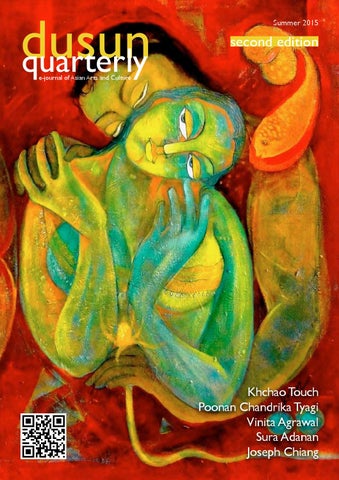
Dusun Quarterly Summer 2015 cover: Poonam Chandrika Tyagi
Editor: Martin A Bradley
email: martinabradley@gmail.com
Dusun TM Published June 2015
3
inside....
06 18 38 50
Editorial
Women by Women, Cambodian artists
10
China Diary
24
Xi Tang Art Gallery
40
Khchao Touch, Cambodian artist
China Poems by Martin Bradley
Hoolo TV, Hangzhou, China, interview with artist Luo Qi
Chennai, short story by Martin Bradley
4
58
Summer 2015
66
Poonam Chandrika Tyagi, Art from New Delhi, India
Poems by Vinita Agrawal, Mumbai, India
96
90
Sura Ardana, artist from Bali, Indonesia
Inai, Malaysian Tamil Film
116
Kita, Philippines, Malaysian & Indonesia Art Exchange
Joseph Chiang, The Logic of Dreams, Singapore
142
108 136
Street Food China, Xi Tang and Hangzhou
5
dusun quarterly e-journal of Asian Arts and Culture
Summer is virtually upon us. While we at Dusun Quarterly head off to Spain, land of Dali, Gaudi and Miro, we present you with the Summer issue spanning six succulent Asian countries, and visual delights untold. Much has happened with Dusun this year. We were invited to support and participate in an exhibition in the town of Xi Tang, China, while our editor (me) appeared on Chinese television (Hoolo TV) interviewing the Chinese artist Luo Qi. Dusun supported Kita, in the Philippines, helping to bring together artists from the Philippines, Malaysia and Indonesia. Dusun artist Honey Khor sold one painting at the opening, to the Philippine Ambassador to Malaysia, and another to a local businessman later. It was a busy, but immensely pleasurable, half year. We hope that you enjoy the mÊlange of artworks from the countries selected to bring you the latest from Asia. This is a second edition of Dusun Quarterly Summer 2015, after a complaint from Mr Patrice Vallette of Vallette Gallery, Kuala Lumpur, for Dusun Quarterly’s handling of the article for the Art and Economy Conference held in March 2015. The offending article has been removed. as has the Dusun logo from the AEC website. Dusun no longer associates itself with the Art and Economy Conference 2015. Read Dusun four times a year for the very best of Asian Arts and Culture. Now read on................
Martin Bradley (Founding Editor). 6
7
C
ambodia
8
Artist Anna Malgorzata De Nogales Sudra
9
Artist Anna Malgorzata De Nogales Sudra 10
women by women Anna Sudra Dina Chhan Bernadette Vincent "Three women tied by their friendship and passion, and all living in Cambodia present to you their Women. Portraits inspired by their own stories and infused with what they see, feel and live everyday. A homage to their inner selves and to all women from Cambodia and afar. A salute to their beauty, strength and resilience."
11
Artist Anna Malgorzata De Nogales Sudra
12
Artist Anna Malgorzata De Nogales Sudra
13
Artist Dina Chhan
14
Artist Dina Chhan
15
Artist Dina Chhan
16
Artist Bernadette Vincent
17
Khchao Touch
Inside you
18
Yellow Flower
19
first t e h t r o f r , o a i h K ambod y C e f o n s r o o l o H C t
s i t harity r c a e h t r w o f o r l e l fohe sets out to volunte as s
roject p a s e t a n i and illum s l a s is a hi e i v h e T r . t k a o h o t b is such a k appears ’ o a i o d b er enco o a h b f n e o m t a f y C o e f l o o d s a Ever y ld: ‘Colors ed by Pei Yeou Br r o awn int w r e d d i s s a t t w u a r o e t e by th and illus d how sh y n e a l , d a a i r d B o b n by Marti ap in Cam e R m e i S d and aroun oject exists. pr whom the ales 2012 yce, Artist, Richard No
20
W
time
m o r f e l b a l i ava gmail.com k@
coctheboo
w.fac
https://ww
88849/
384028462
/groups/1 ebook.com /
mbodia.org
rsofca http://colo
unknown y l e g r a l n i wise rema account written r e h t o t h that mig ssionate a p d oject in n r a p l a d n e o s s a r ighly pe kable art-b r a m dren for l e i r h a c e h t h i t w ounter ment with e v l o v n i l a to practic
proceeds from all sales go to the education of children in Siem Reap, Cambodia 21
C
hina
22
23
Lotus in the Breeze at Crooked Courtyard
china diary by Martin Bradley
China my China After a smooth landing, there are brief moments of beauty while we are whisked from the airport to Hangzhou city, capital of Zhejiang province, China. Travelling through the dense, new, city, suddenly, unexpectedly, an ancient bridge looms from out of the traffic hustle. It is not the only surprise. In small parks, silent statuary stands, surrounded by city hustle bustle. A half naked man, no flasher, practises silent Kung Fu. He kicks bare naked legs, waist high, thrusting a deadly foot into yielding air, as if in readiness for some Jackie Chan film role or some age old battle, yet to be won. Curiously large pansies accompany early spring roads which remain winter grey; bystanders are clothed in black, human crows waiting for city carrion, on Huangcheng Road (South). All is well. Bright orange marigolds, symbols of death in Mexico, are a mere decoration in China’s Hangzhou. They shine from green leaves by multiple traffic lights, the stark contrast between man and nature made all the more apparent. The German made vehicle glides along cherry blossom laden Baochu Road and, eventually, after some debate with uninformed uniform clad officials, to the hotel. Huang Binhong plaque The hotel, in reality, are rooms normally reserved for Chinese upper echelon civil servants, situated amidst the West Lake Botanical gardens, the magnolias, Japonica and calming cherry blossom. Hangzhou Botanical Garden can be found at the foot of Jade Spring Hill in the northwest end of West Lake. Hostile Mandarin is exchanged at the gate, 24
for few are honoured with a stay in this park of peace. The guards persuaded, and the room shines with antique wood and Hungzhou welcome. Only the marble's icy floor punishes a wayward step, an acute reminder of the cool season. At night, as temperature drops, there is no sound. As darkness envelopes the gardens, silence too descends.
Huang Binhong
Ancient storage jars
In the darkening, and before the evening repast, we are guided to the original site of what eventually became the China Academy of Art. Beside the West Lake itself. Yet before we are able to reflect upon those buildings (one time housing a small zoo), we are taken to see the original house of seals, the gate of which was torn down in the zeal of the Cultural Revolution, but has since been rebuilt. I am in awe at the sheer beauty and curvatures of the ancient Chinese script adorning standing stones, and carved into pillars. Seals, the red oil and silk marks frequently seen adorning Chinese ink and brush paintings, hold a unique importance in Chinese society. In antiquity everyone, and especially the illiterate, had to have a seal as their signature. A elder identity card. Seals are still revered, especially for Chinese artists, adding a red grace to ink and brush paintings, stamping both identity and heritage in a silent 25
West Lake Botanical Gardens Rest House
West Lake Botanical Gardens 26
West Lake Botanical Gardens Rest House 27
proclamation of ancestry. Our day is not done, but just begun. After a late dinner of Hangzhou regional delicacies, surrounded by notable Chinese cinematographers, film producers et al, but no duck tongues at 'Grandma's Home', we are swept off to the Shan Tan Museum of Modern Art, where an interview is to be recorded. Tracked by careful cameras, we discuss creative artworks. We ponder the immediateness of brush stroke versus the planned painting, of Chinese ink and of oil, of Shuen paper and of canvas, of Abstract Expressionism and of China's Neo Literati. In that exhibition, an especial hanging for the documentary being shot, we smile, discuss, debate. We point pseudo-intellectually at painterly expressions, grimace where needed, gesticulate. We mock argue on cue and delight in the play acting like two naughty school boys, one an artist/ intellectual, the other a writer. 'Take one' evolves into a multiplicity of takes. The ever polite producer coaxes artist and interviewer until her almost sensual satisfaction is reached. More smiles. Another, brief, interview - me this time. The charming producer solicits the final words on my interaction with the painter, my interest in his painting, and in China. It's a wrap. Multiple thank you(s), and the 28
Grandma’s House authentic restaurant
West Lake Hangzhou, China, boating
evening finished. Time to wrangle, once more, with officious officials at the gates to the Botanical Gardens. Hangzhou Morning In the chill of the Spring morning we awaken, stretch, gain our bearings. Abandoning the luxury apartment, its silence and its abundance of wood, and lack of breakfast, we saunter a few kilometres to the nearest promise of food. Our park wonderland, that oasis of botanical calm, provides the means to work up an appetite, denies the means to satiate it. We walk through the park, marvelling at yet more magnolia, head towards the West Lake (Xi Hu) proper, and eventually seek morning sustenance in a very small eatery. It is not the epicurean delight we had expected. Soggy Chinese filled bun (Pau) with a meat filling was all we could manage. The meat could have been anything, but we hope is an animal normally domesticated for such purposes, though recent stories of China tell us it could be otherwise. For the second day running, we discover that the Chinese really are not a nation of coffee drinkers. All manner of teas are available. Simple teas, which involve no more effort than the placing of leaves in a receptacle, are drunk with hot water. No milk, no sugar. Coffee is not on offer. Coffee is for foreigners and, like the English language, is not to be encouraged. Why then, I hear you ask, does Starbucks exist just across the road. It is the very same argument. Starbucks is for foreigners, tourists and their ilk, not for the average Chinese. Only Chinese middle class, men of the extreme short back and sides hair styles leaving a carefully coiffured mop on top variety, and women in the oh-so-cute short fur jackets, frequent those relatively expensive watering holes. Starbucks is a place to be seen drinking, egoistically,Western coffee in. And they are the sort of Chinese who not only purchase, but use, a 'selfie stick' with their mobile phone. Tea is the Chinese drink. West Lake, Hangzhou, teems with nearly as many visitors per annum, as it does fish. The three major causeways across the impressively ostentatious lake, resound to the tramping of footwear from the young and the elderly, but not infirm. Rented bicycles threaten the slower pedestrians, and wind enraged kites, others. Tai Chi practitioners earnestly perform their gentle exercise to the sound of high flying birds and the rustle of winter dried lotus plants. Children are not overtly in abundance. Twenty and thirty something's are. Aged Chinese smoke their much slower way over the waters, while one exuberant selfie 29
China Academy of Art new premises
proponent asks, in broken English, if she could take a photo with me. I answer in the affirmative, she clicks and is away with a big grin. Moments later she collars an elderly gentleman and is back, thrusting her mobile phone at him, requesting more photos. She settles for a picture of the two of us, elder gentleman's thumb included. The 1928 Academy, at one remove Outside Hangzhou, the China Central Academy of Art sprawls amidst a variety of trees, shrubs and flowering plants. Although I remain unimpressed by Brut architecture, I have to admit that the art school has made many attempts to romanticise the singularly functional nature of my least favourite building material. There are interesting shaped 'cutouts' from the concrete, with others unfortunately reminiscent of World War Two, British, bunkers. Bamboo and wood have been manipulated to great effect, but this casual visitor is less impressed with the buildings than with the surroundings. Perennial young students, on practically silent electric scooters, passively ride from lesson to lesson with no sign of a rebellious spirit. Their hair and body shapes are almost interchangeable, one with the other. In China's Brave New World, graffiti has limited itself to the odd stencil of Youtube, mainly on footpath lights. It is a token, a brief candle of rebellion. Buildings remain free of any sign of a rebellious art spirit. The majority of everything is in Chinese, and few speak English.The interesting 30
art bookshop sells books only in Chinese. It is frustrating, but entirely understandable. This is, after all, China, where I and my language are foreigners. Boating Away
Curious ecological architecture
Today is devoted to strolling and boating.We ramble to a small island inhabited, seemingly, by the elderly and young lovers.The young arm in arm, short fur jackets nestling heavy, old fashioned, wooden overcoats. Freshly permed hair briefly brushes partly shaven male heads, brief longing looks exchanged but no smooching. In public, China's young remains chaste. The not so young brush the air with arms and legs in movements of Tai Chi and Chi Gong, begun centuries before. Slowing, the property's of this gentle exercise move in a circle, scarcely more ambient than the statues on other parts of the island. One permed elder looks up from her ethereal dance, glances at the foreigner, me. For a moment she continues to glide caught in my glance, but quickly the spell is broken, and she returns to her meditative movement. A couple alight from a small ferry craft, at the side of the lake, just near to where we stand. We debate, hurriedly, as whether we should walk or float. We opted to float. The river Styx, Yannis Markopoulos and “Who Pays The Ferryman� comes to mind, but the boatman is pleasant enough as his one oar slaps the water and we are guided through one if China's most beautiful lakes.
ZZ-14 Upstream Steam Locomotive 31
Leisurely boating across West Lake
32
33
Rubbish collection in Xi Tang
Another Morning in Hangzhou While Hangzhou, and its surrounds, is known for a myriad culinary delights, this fact has not reached the cooks at Hotel Huabei. The obligatory breakfast, which began our stay as mediocre, has quickly descended into inedible. This morning I seek refuge in KFC, and tackle a flaky pastry bun wrapped around bacon, egg, Mayonnaise and lettuce. It comes as a set with the long, deep fried, dough, which in Malaysia is known as Char Kuay and in China ‘youtiao’, and the usual fast-food-joint coffee. This is in marked contrast to the creative gastronomic delights we have been savouring, curtesy of our hosts, at various well-appointed restaurants around the city of Hangzhou. The hawker foods too radiate with oriental mystery, and delectability. Yesterday's mid-morning repast consisted of Beggars's Chicken,Tea Chicken, battered, deep fried crabs and strangely conical steamed dumplings resembling nothing more than miniature pastry wine carafes. These were but a fraction of the interesting foods available. 34
Xi Tang old town
Xi Tang Book Cafe
The weak Chinese sun, which has played hide and go seek since the begging of our stay, remains hidden today. My wife, is sick, in the hotel room. I am alone, ordering Chinese food, in China, without the luxury of the local language. It has become a matter of 'smile', 'point', 'smile', 'pay', 'utter something which might pass as thank you in Mandarin' and collect what is given. Overall, staying in China continues to be an interesting experience. Old Town Blues The journey from Hangzhou West Lake, to the antique town of Xi Tang was largely grey and mist enveloped. Unimpressive small holding buildings, long clotches of vegetables and partially mist shrouded fields made the arrival to the town all the more special. Aside from a momentary wrangle regarding tickets, of which we had none (being guests of the preserved town's director, Zhong Xiao Sheng) the entry to Xi Tang town was as interesting as it was painless. The walk through the tourist crowds was immediately reminiscent of Malaysia's Malacca, on a very busy weekend. It is a dilemma, this ancient town needs tourists to survive, but the very same tourists hail the town's demise. Zhong Xiao Seng mentioned that a future plan is to limit the amount of tourists, leaving just enough to provide the much needed finance, while reducing the amount of feet tramping over the old stone bridge and, hopefully, reducing the sticky fingers wearing away the Han Dynasty walls. As evening brightens the lights and darkens the buildings, I sit on an old stone wall eating fresh strawberries watching tourists, of which there are plenty. The cold of the stone wall seeps through my Marks and Sparks cargo pants and reminds me that I must move. Honey Khor finishes yet another sketch of water and buildings. Early morning, at least early for me. Seven am, the smell of yesterday's strawberries permeates the Kai Xun Boutique Hotel room. In Xi Tang old town the tourist cameras are already clicking. Hordes of early birds tote weighty zoom lenses, or simple iPads/iPhones, pointing and shooting at Xi Tang day begins anything that doesn't move, alleyways, walls, each other and themselves. 35
Trishaws are popular transport
Most especially themselves, for this is the age of the ubiquitous selfie and unashamed narcissistic self promotion on WeChat, even in China. While boatmen cleanse the various rivers of the previous day's tourist discards, camera clicking tourists snap the men working. After the comparative silence of an early breakfast of Chinese buns (Pau), softly lilting songs by some Chinese songstresses drift above the rasping of the ever present renovation, and the toot tooting of hard working motorcycle vans. It is a chill day in March, but the dark clothed Chinese tourists are not deterred from their tourism, not even by the exorbitant prices for a humble cup of coffee (Y38...Rm19). Perhaps coffee has become a symbol of status in China. Bourgeois replaced by beanois. A living, breathing, brown, young llama is tethered to a pillar in the centre of Xi Tang Mei Shi Guan Restaurant, where we, like Hobbits, eat a second breakfast. Customers in winter clothing drink watery soya bean in small bowls, eat fried dumplings with piquant chilli, unperturbed by the presence of the llama or the background of contemporary Chinese Muzak. I want someone to say "Mind my llama, no he isn't called Dalai, excuse me I have a cold." It would sound like an old skit from Monty Python's Flying Circus, perhaps with John Cleese and Michael Palin or, in another age, Pete & Dud. I absently wonder, are Chinese food and hygiene regulations so very different from other country's then. For a brief moment the restaurant is lively as the llama escapes his tether and goes off in search of food. He (I presume it is he) trots behind the tea counter seeking what - the every elusive and much over priced coffee, perhaps. The llama makes a dash A llama not called Dalai for the door. Recaptured, it is fed grass in the centre of the restaurant 36
Xi Tang One of China’s older towns surviving through mass tourism and settles, as does the restaurant and its customers. On the drive over to Xi Tang, I had wondered where all the local inhabitant had gone. Few people were seen in the fields along the way. I found them. They had quite obviously split themselves between the ancient town of Xi Tang, and Hangzhou's West Lake. Towards lunchtime the small cobble streets of Xi Tang thronged with myriad Chinese, and a smattering of foreign visitors. The crowds so dense that it was a struggle to pull through them, to reach my hotel. The following day I sit on my favourite Chinese island (for now), and encounter the second half of the Chinese population. They are led, frequently by orange hatted ladies carrying flags and shouting orders, commands, or other instructions into head strapped microphones. These groups roll in and roll out if the park, like human waves crashing against the park's antique standing stones, bearing poetry. It is the last day. The calm before the storm of the Kuala Lumpur conference. I sit alone, once more, in the island park,watching locals take endless mobile phone photos, and I am tired. New takes on old Cultural Revolution posters
37
Martin Bradley - China Poems
walk me to the end of Xi Tang town where moon faced children float bubbles which fly pearlescent over ancient bridges dispersing on persistent chiselled rock of memory.
38
air pearls in West Lake (Hangzhou) fish released floating like ferrymen pop before my eyes sad brown lotus bows its winter head. pagoda silhouetted sunday visitors witness green flecks burgeoning Spring permeating heat cherry blossom parades Against weeping willow green at half moon stone bridge I am alone with no one to tell.
39
XI TANG ART GALLERY featuring artworks from Chang An and Nanyang
40
Nanyang Art sharing with Martin Bradley, Honey Khor, Chinese Associate Professors and Malaysian artists
41
Paintings by Chinese Associate Professors
42
43
Paintings by Chinese Associate Professors
44
45
Loving Kindness by Malaysian artist Honey Khor
46
Moon Light by Malaysian artist Honey Khor
47
Malaysian artist Honey Khor with her painting A Midsummer Night’s Dream
48
Angkor Wat by Malaysian artist Chay Hwa Chua
49
Angkor Wat by Malaysian artist Yeo Eng Hin
50
Angkor Wat by Malaysian artist Yeo Eng Hin
51
caligrap on TV Martin Bradley art writer
52
phyism on TV Luo Qi artist
53
Celia Chen
Celia Chen of Hoolo TV approached me to take part in a video she was making about the Chinese artist Luo Qi. It was part of her Around Hangzhou series. Ms Chen was focussing on the new exhibition Luo Qi had constructed, in his art museum and of his own Calligraphyism work, in preparation for his Italian and Australian exhibitions later in the year. The Luo Qi segment was approximately half an hour long, and I was asked to interview Luo Qi, about his work, in the museum, as part of the video, which has been aired on HTV 1, in Hangzhou, China. Ed.
54
55
56
Back to back they faced each other
57
chennai a short story by Martin Bradley
The day pressed dull Essex grey over the university's Art Brut architecture. It was a place where once, in the 1960s, innocently hopeful students had rebelled, sloganeering with the fire of youth. Now, in more sober times, strait-laced students studied to gain that all important place on the shaky greased ladder of success. Shivering Rabbits, no longer threatened by the horrors of myxomatosis, huddled deep underground, withdrawn from cold gusts and the threat of wetted fur. So rabbit strewn were the rolling hillocks of those university grounds, that they could have been mistaken for the fictional paddocks of Watership Down. Conscientious students hurried like their damp cony brethren either into, or past, the bright new coffee house with the tubular furniture and lackluster menus.The cold damp was far too bitter to linger in those windswept squares, so crammed with young life in summer, yet so deserted during winter. I raised my rounded spectacles, rubbed my right eye and turned away from those half-remembered memories. I turned towards James Claybourne, a thousand more thoughts in my head; fragments of metamorphosing walls, threats of barely sharp razors and young flesh. I recalled slim, tall, Welsh wizards baring names from Macbeth, long deceased standing gesticulating, or sitting majestically. I recalled laughing, marijuana fogged, owl eyes. James and I had met by the old fountain, once crowded with student bodies, but now planted with shrubs to remove all temptation of memories from tamed youth. It was becoming a habit, the meetings, time between meetings, his and my greying, the place and the space between us, bound perhaps only by our recollections of what we once were in the days of free concerts, beads, bells and kaftans. "It was a sundering heat. Even in the early morning. It was a clear, brutal, punishing heat. Evil, skinny, black crows cawed. Dusty South Asian traffic snarled. Screeching horns tooted with frustration, the horror the heat brings, adding to our discomfort. The antique Toyota which had been continually threatening to break down, had broken down at the road junction. There had been a loud mysterious clunk. The car refused to budge. We tried everything and, eventually, I helped push that monstrous dead weight down the road, for safety. Cars were tooting everywhere. People were too quick to curse and not quick enough to help. After numerous frantic phone calls, the tow-truck finally arrived outside the eatery where we sat eating Thosai. I waited with her. She in turn waited for the tow-truck and for the car to be fixed. She waited to resume her Coromandel life; visiting her daughter and her inappropriate son-in-law, Lattif. Rupa, the Hindu daughter, had dared to marry a Muslim, much to Indira's chagrin. It was a constant source of tension between us. Smiles to Lattif’s face, but anger and scowls behind his back. I though Lattif OK. I had no problem with his religion.Why would I have. Indira greeted the tow truck driver, climbed into the ancient cab, adjusted her sari, turned as it moved off, waved without smiling. 58
59
60
I sat for a while, called her cell phone and got no reply. I guess I thought she was busy. Perhaps she was busy making arrangements for the tow. Maybe accompanying the truck back to the showroom garage.Who knows what I thought. I kept calling her cell. No answer, no messages. I finished breakfast. Paid. That was the last, literally, I ever saw of her. I finished eating, hailed a taxi, and headed for what is loosely a mall in central Chennai. And, by the time I got back to the place we called home, her bags were gone. All trace of her had gone. No note. Nothing. To say that I was stunned would be an understatement. I was bloody frantic. All kinds of crazy thoughts ran through my head. Abduction etc.. Then I calmed down, realised that everything of hers was missing. I mean everything. Even her wet panties put out to dry earlier. I mean what kind of abductor does that, remembers to grab drying knickers, just in case the abductee might need them later "Peter, you didn't tell me about her" "I'm sure I did" "You didn't" "Sorry" And I was sorry. Sorry about the whole damn sad affair. I had come from a vulnerable place after the horrendous divorce back in England. All that wrangling about who gets what. I'd had enough and, I suppose, that I just wanted someone to be there for me. Yes I know it was too soon. But I was alone, frightened to be single again after 10 years. I decided to open up to James. We had weathered life together for over four decades and, well, it didn't seem right to hold anything back. "It was a whole silly, stupid few months of my life. I thought that it was going to solve all my problems. It just caused more!." He laughed. His owl eyes flashed just as they had back then, back in the university towers. "Sorry, look you don't really have to tell me, it's not that important." "But I want to........It was in Chennai, what had been Madras. I turned and looked at the older, slim, mahogany Indian woman laying next to me. Her long, black, crinkly hair, streaking with white, had snaked its way over her pillow Medusa like and had began to attack my pillow too. Despite the air conditioning going full blast the air was still rabidly hot. Stifling, suffocating. Sunlight blasted at the curtains trying to gain access to the small room which barely contained a bed. I eased myself off and gently opened the door to the hallway. 61
She still slept as I closed the door behind me and sat, for a blessedly peaceful moment, on an ageing wooden teak sofa. I could only just bear to sleep in that room. Much longer than that and an uncommon claustrophobia would begin to niggle. I was normally fine. Lifts were OK, as long as they kept moving, and small rooms, as long as I knew it was temporary. The bedroom was for sleeping in, not for staying in. She slept on. Chennai was hot under the hallway's wooden ceiling fan. The hallway had no air conditioning, but that was fine in the early morning. The morning was bright, in a vaguely golden romantic way. Outside, across the red dirt track - what passed as a road, I could hear the bagged milk sellers setting up their shop. The old couple sold as much as they could, of whatever they could, to local residents. I was lucky to have them opposite, selling water(Tannir) and milk (Pal). I'd have to go there to get the morning milk, to boil for my tea. Indira preferred me to go, it was some caste thing I'd never heard of. There were so many caste things that I had not heard of, living in Anna Nagar, West End Colony, Chennai. It was my third month in India. It was no less hot, no less dusty, no less brown or bloody irritating at that time than it was when I had arrived. I had to wait, dripping with sweat, that seemingly endless hour for her flight from Singapore.We had met 'online'. For some unknown subterfuge she had called herself Geetha then. She had pursued me from the start. Oh, OK, go ahead laugh, but this is my story, OK." "Sorry, go ahead, don't mind me." "It was a friendship which had led, quite naturally I had thought, to her instigation of phone sex. It was a new experience for me. Not unpleasant, but also not terribly satisfying either. Indira was married, phoning me using a phone card to mask her illicit calls. Her husband was a retired Malaysian police inspector who, according to Indira, was constantly being arrested by a string of younger women, and had been throughout their 30 year marriage. Indira had had enough. She also began looking around for younger, but whiter flesh.We 'met' on Soon to be Friends, an international, online, dating service. It was not quite love at first email, but a growing infectious affection which eventually led me to jack in my job at Blicton Designs (all your designing in one place), Beach Road, Blicton-on-sea, sell my Indiana red, second-hand Rover 200 and purchase the fateful air ticket which took me the ten hour flight (one stop over) to Chennai, (formerly Madras) southern India. I'm not always quite so dumb as I look. Some months before purchasing that fateful air ticket, I had purchased another. To Singapore. I am not one to leap without first having spied a possible landing. No sooner had I arrived at Changi airport, than I phoned Indira to meet. She was busy that evening, could we meet up for lunch in Little India. She suggested an Indian banana leaf eating house near the Sri Veeramakaliamman Temple.The following day I walked growing in the heat, 62
63
64
from the Santa Grand Hotel, through the back streets into Singapore's Little India. Walking in foreign climes was always a challenge. I planned my route carefully, taking note of the roads needed for the short cut, and was there, outside the temple, well within time. For a while I stood gawping at the traffic's bustle, almost tasting the air thick with the scent of a myriad incense sticks. I admit to being beguiled. I remember looking at her, through the restaurant window, noticing that she was with someone. Her dark hair waved around her head, her eyes offset with thick black liner, like some Indian Cleopatra. Sonnets thick with Baudelairian symbolism came to mind.To see her was to be intoxicated as by that poet's heady lines. She sat draped in her temple sari. I waited a while to gather courage, then gently tapped on the restaurant window. It took a moment or two. Eventually she turned to the window, looked directly at me. She took my breath away with her smile. (I went back there you know, ten years later. I just happened to be staying nearby, down Dickson Road.That Indian eatery, where we had first met, had gone. Boarded up. Sad, but somehow fitting, considering what had happened between us.) Her companion must have said something. Indira walked out to greet me. The words from all our correspondence rushed into my head. She smiled again and took my hand, led me to the table where her older daughter waited. They ordered for me. Idli, Thosai, tea. We chatted small talk until her daughter, Laksmi, gave her apologies and left. As she did, Indira grasped my hand under the table, in reassurance of all that we had become to each other, and all we had promised to be. “Did you have a good flight Lovely to see you here” It was all the usual chit chat. I ate, she had finished. We walked out into the Singapore evening. We walked and talked. The night sparkled with myriad colourful lights as we walked. She hailed a cab and ushered me inside. I heard her say Woodlands, to the driver. It was half an hour. The roads, as we moved out of Little India, became darker, the streetlight sparse. Before long she tapped the driver on her shoulder, edged towards him, gave clearer instructions. A few minutes later and she was welcoming me into her condo. She drew the curtains, “shutting out spying eyes of security guards”, she told me. She offered tea. Of course she was offering more, much more. Her husband was away in Malaysia. On the pretext of showing me around, she led me to her bedroom. She took piles of saris from her bed, touched me, kissed me. In the morning, after an adventurous and tiring night, she suggested I leave early, before the neighbours were about. She walked me across the road, hailed a taxi, and we parted, smiling. 65
The second time we met, was at Chennai airport. I arrived early, was met by Rupa, her younger daughter, and Mohammad, a driver. We waited the extra hour for her to fly in from Singapore. They drove us straight to a hotel, dropped us, and she and I picked up from where we had left off in Singapore, all passion and energy, like teenagers. Almost from the following morning you could see cracks appearing. What had been a very passionate night, turned into a much cooler day. Mohammad, the driver, waited for us outside the hotel. He took us south, into the heart of Chennai. It turned out that we were visiting Rupa and Lattif. I was given no choice. I wasn't used to that. She nearly snapped my head off when I mentioned about being asked, not told.That was the first time. I took a deep breath and thought no more about it. Rupa was a little more like her mother than she cared to admit. We soon had disagreements. She had spent three years in London cultivating a law degree. She imagined those three years gave her the all the authority she believed she needed to talk about the English character. I objected, in nice enough way. She became stubborn and I reminded her of my half century of experience in my own country. It set the trend between us. She sulked. Her mother, of course, took her daughter's side. Lattif remained neutral. We tried to rub along. Lattif was working on film music with A.R.Rahman (the Indian film music director), at the time. Lattif spent hours composing on his computer system, working with layers of sound and eventually dropping it all onto a large hard drive which he sent to his maestro, who was then in America. It was fascinating. I was used to manipulating images in Photoshop, but never guessed that you could do the same with music. That was the saving grace of me being there, I think, learning about modern Indian film music in that way, seeing how Lattif created the background music right onto a film sound track. Outside of that tiny padded music studio, each day was walking on eggshells. We tried. I think all of us tried. But it was never going to work. There was too much against the relationship and not enough for. We began doing more apart. The ferocity of our sex life dwindled to practically nothing. That is always a bad sign. Then came that fateful day with the car. It was Friday. Mohammad had a day off. She drove, it stopped, and what happened, happened. 'And you never saw her again.' 'That's right. Not from that day to this. I always wondered what had been the final straw.The next day, half expecting her to come back at night, I grabbed a Bajaj and went to the son-in-law’s place, in central Chennai. Once I had bullied my way past the security kiosk, I fairly flew up those steps. The grill and the metal door were closed. I knocked politely, then, when that failed, knocked more vigorously. The next door neighbour poked her nose out at all the noise. 66
67
68
“They’ve gone away, wont be back for a few months, he told me. Asked me to keep an eye out for an Englishman, you him?” It seems that I was indeed, “him”. The three of them Indira, Rupa and Lattif, had gone to the airport, heading, it was supposed, back to Singapore. But I shall never know. Out of sheer curiosity I flew to Sri Lanka, spent a few days there, then it was back to England. I never saw her again. It was as if she had never existed. She just vanished. And that, my friend, was the whole sorry story. Now, strangely, it feels as if it had never happened.” I left James there, amidst the grey concrete. I haven’t yet told James, but I received an email from Indira, only this morning. I’ll tell him, when I am good and ready to go back to those grey towers, those dank furred, multiplying, cony and the memories I thought that I had left there.
photographics by Martin A Bradley
69
I ndia
70
Unsung Stories
71
Poonam Chandrika Tyagi
Wait 72
Quilt 73
Poonam Chandrika Tyagi was born in 1964. She attained her Master of Arts (in Drawings and Paintings) from R. G. College, Meerut, Uttar Pradesh, India. Since the commencement of her artistic journey, she has emerged as one of the most significant of Indian painters skilfully using a neo-Symbolist style infused with Fauvist coloration. Poonam Chandrika Tyagi reveals an entirely unforced, gracefully natural, voluptuous imagery which entirely suits her subject matter, and manner of painterly execution. Her manner, coloration and subjects draw the observer into a deeply passionate symbolic world of rotund women, leaving the observer breathless at the artist’s imagination and craftsmanship. The Rubénesque qualities of Poonam Chandrika Tyagi’s work echo back to the sensuousness and overwhelmingly beautiful erotica of Madhya Pradesh's Khajuraho statuary (10th to 12th century, India), and the long obscured world of Indian female sensuality. Though Poonam Chandrika Tyagi paints large, voluptuous, women there is not the comical grotesqueness of Colombia’s Fernando Botero, nor the naive quality of Britain’s Beryl Cook’s, often comedic, rumbustious females. Poonam Chandrika Tyagi’s paintings frequently burst with a sensuousness frequently entwined with an inspirational tantric spirituality, having more in common with the French artist Raoul Dufy’s colourful depiction of Indian women (1928/1930), than with those I have mention above. Poonam Chandrika Tyagi’s blending of yellow/oranges, balanced by a splash of purple, blues, the green of hair and moments of pink are reminiscent of both Marc Chagall and Raoul Dufy. Dr Kailash K.Mishra, an anthropologist, has said (in The History of Mithila Paintings), that “Mithila painting, also known as Madhubani painting, is in its originality an art form practiced by the women of all castes and communities of the region. The women of this country from time immemorial have been involving themselves in the various forms of creativity. The best one can find in their creativity is the relationship between nature, culture and human psyche”. The age old imagery of Mithila, images of gods and their lives, is still perpetuated in the Bihar State, in India. That is in a country which continues its subjugation and oppression of the female into the 21st century and in so doing denies, of course, the ultimate power of the female (Devi, Lakshmi, Parvati, Kali/Durga) within the theological structure of the country's largest indigenous religion. Modern artist Poonam Chandrika Tyagi, dares imbue the discourse of India's Modern Art with her own narrative on female eroticism, aside from the Mithila narrative, and creates her unique relationship “between nature, culture and human psyche”. In a painting (three feet by four feet) which might be considered to be “Muses Whispering”, Poonam Chandrika Tyagi posits a central figure
74
Birth of a Poem
of a nude woman. She is either in emulation of Lord Shiva, dancing with one leg raised in the cosmic dance (Nataraja), or held in a yogic position. Around her are four (Chatur) etherial female figures which might be a depiction of Santana Dharma.The four are sublime, may be even tenuous and unearthly, flying, Chagall-like. Their lips are open. They whisper, or sing to the main subject who has hair of green. Is this Matangi, who is frequently depicted as green; the tantric form of Sarasvati, empowering speech, music and an overall knowledge of the arts? The painting exudes movement, dynamism and sensuality. This is perhaps heightened by the two peaches on the red and yellow table, which in some cultures represent longevity, while in others fertility or the feminine sex (particularly in Japan known as Momo, which can either mean peach or thighs). Peaches (originally from China) can symbolise the buttocks, and were also considered a standard symbol of female genitalia (the vulva), connected with Taoist sexual mysticism.A half peach might be considered to be a yoni (female organ), depicted also as an oil lamp, opposite to the male equivalent (the lingam). In a variety of paintings, carefully created by Poonam Chandrika Tyagi, larger women meditate, converse, hold lotus buds, play with cats, birds and in one is being seduced by a Zeus-like swan. In the painting “Flourishing Beauty” the central figure is a Poonam Chandrika Tyagi’s, by now characteristic, curvaceous female figure. Her body is toned in warm colours, contrasted by the background’s blue. Her head is wistfully tilted, as if in thought, considering, remembering, her eyes neither sad nor happy, but large. Nestled against her breasts is a lotus seedpod, the seed-germ of the fully opened lotus - the atman or higher self having been achieved. The symbolic lotus is intertwined with the growth of spirituality, from its humble beginning amidst the mud and water, to its striving through water to reach the surface. From their the lotus buds, flowers, gracefully unfolds its petals and presents its seeds. It is the journey to the higher self, the ”Lotus of Truth”. Two fish, one hued green the other reddened (reminiscent of 3D drawings), are perhaps representatives of the Indian god Matsya (an avatar of Vishnu) who is attributed with saving the first man from a great deluge (the Indian version of great flood of Babylonian Atra-Hasis and Gilamesh myths perhaps).The fish nestle against the woman’s buttocks.There is an indication that the woman is with seed, pregnant, as the warm paint hue thins to show a germination taking place. Behind the woman, coloured green, is what appears to be a lingam (also called linga). According to the Sanskrit lingam means sign, or distinguishing symbol. It is the god Shiva, represented through the symbol of a phallus (erect man penis). One reading of the lingam has it as “Prakrit”, or nature itself. It may be seen as
75
Birth of a Poem
76
Song of Life
77
an egg which takes its colour from whichever it contacts, it is the 'Nirguna Brahman’, or formless Shiva. In the painting, above the lingam and above the head of the central figure is a green semicircle. Central to that hemisphere is a flower shape which could also be read as a vulva, and the semicircle as buttocks. The painting speaks of impregnation, of fecundity, of sensual unions bringing forth germination, spiritual as well as physical.
Soul Mate
78
Flourishing Beauty 1 79
Flourishing Beauty 2
80
Woman in Gold
81
Friends
There is no hint of pornography or licentiousness in the paintings of Poonam Chandrika Tyagi. But neither would I hint that they are completely innocent either. Sensuality and erotica charge her paintings with visual emotive and symbolic dynamism. There are narratives within narratives which are entirely personal (of which I have not touched upon) and those which speak of theology, mythology and spirituality. In many respects the paintings of Poonam Chandrika Tyagi are tantric, the sexual and spiritual woven together. 82
With me Always 83
Dance of Love
84
Portrait of a Woman
85
ebook
From Britain’s unsunny East Coast to the pounding heat of the jungles of South East Asia, surprises were in store for this author as he naively attempted the rural life amidst sand, sun and slithering snakes. It is the tale of a seven year journey. A journey into the mind and soul of one deluded Englishman trying desperately to do the right thing, and be the right person, in the wrong place amidst the wrong things.
http://www.amazon.com/Buffalo-Breadfruit-Unwary-Malaysia-ebook/dp/B008BHM91C
86
new pocket poetry ebook
ebook
in pdf
Dusun publications 87
In Unknown City
88
In a Dark Room
89
Vinita Agrawal - Poems
Far Longings You who follow me for my smiles know nothing of the sad edges like lines that my heart naturally follows and the fascinating flow of form hidden in warm longings that shapes my breaths. Know nothing of the floodlight of noon in which I bury the children I never had or the backlight of evening that scrims my womb and frees their tiny souls in the carnival of my restless arms. You don't know that I dream of clear yellow Black-eyed Susans at night and feel the rhythm of the universe in a cradle. And in the movement of light from a morning slant to noon's erect arbor to the supine rays of dusk the mother in me feels an eternity.
Author of Words Not Spoken, Vinita Agrawal is a Mumbai based, award winning poet and writer. Her poems have appeared in Asiancha, Constellations, The Fox Chase Review, Pea River Journal, Open Road Review, Stockholm Literary Review, Poetry Pacific among others. She was nominated for the Best of the Net Awards 2011, awarded first prize in the Wordweavers Contest 2014, commendation prize in the All India Poetry Competition 2014 and won the 2014 Hour of Writes Contest thrice. Her poems have found a place in several international anthologies. Her current manuscript of poems has been accepted by the Finishing Line Press, Kentucky, USA and is due to be published this year. She was co judge for the Asian Cha Poetry Contest 2015. She has an M.A. in political science with a gold medal. She can be reached at www.vinitawords.com 90
Broken This broken home is like a chopped tree trunk Showing rings of life ruthlessly axed Leaving behind an upturned patellar face of pain Breath broken in a cinch Its lode of warmth is plundered Rime's leftovers straggle the trashcan like cold meat I sense the condors circling above, in my bones As they scavenge for the rich, juicy morsels of a home, now dead The aged wind is weary of reviving fires so often doused It's shoulders too weak to carry ashes heavy with severing So this is how things break in this world This is how hope loses altitude There must be someone to blame There must also be someone who will lead me back to myself
91
remembering whiteness & other poems by martin bradley downloadable as a free pdf from http://correspondences-martin.blogspot.com
a Dusun publication 92
ebook
Zhe Xuan Fine Art Gallery D-60-2 Jalan C180/1 Dataran C180 43200 Cheras Selangor Malaysia contact May Lai 016 605 5592 email maylai69@outlook.com
93
I
ndonesia
94
Guratan Makna Series 95
Abdi Dalem 96
97
Grandmother
98
99
Guratan Makna Series
100
101
Guratan Makna Series
102
Guratan Makna Series
103
Guratan Makna Series 104
105
M
alaysia
106
107
108
Shalini Balasundaram is the young director of Inai (a short Tamil film from Malaysia). She graduated in 2014, and Inai was her final year project. It is 28 minutes and carries a strong human message. In Tamil INAI means parallel lines, never meeting. The film depicts two characters, and how their life will be after the death of both. It is an everyday story, inspired by a true incident which Ms Balasundaram read about in a newspaper, 4 years before. One character was inspired by the characters seen daily, inspiring the director. The theme of the film is that a person's death resembles how he has lived during his life. Show your love to everyone in your life, that would be the moral of the story. First Tamil short film shot in 4K resolution First tamil short film in 5.1 sound mixing First Tamil short film went through sensor board and got P13 First Tamil short film previewed in Cinema First Tamil short film in DI color grading Magendran Raman a popular Malaysian Indian Host/Actor, appears in the film Director: Shalini Balasundaram Director of photography: Sathish Natarajan Editor and DI Colourist: Sathish Natarajan BGM composer: Satish Raj 109
110
111
112
113
P hilippines
114
Ross Capili, Fel
John Dinglasa, A
Ong, Radel Pared
Lucilo Jo Jo Sag
Janiz Chan
Khor, Debora Te I Gusti Nengah
Kenyem, Diyano P
lix Catarata, Buds Convocar, Joel Cristobel,
Anthony Fermin, Jose Madrilejos, Joseph
des, Celso Duazo Pepito, Fe Madrid Pepito,
gayno and Angeliko Villanueva.
n, Queenie Chow, Susanna Hernesniemi, Honey
eo Linang, Elle Ng and Maxine Xie Xian Xin. Sura Ardana, Antonius Kho, Nyoman Sujana
Purwadi and Lekung Sugantika.
115
116
117
Maxine drifting Sculptured Magenta locks Medusa swaying Leans into Recumbent Hard Young body
118
Floating Sleeping off blooded Piglet Red horses Celso hospitality Antonious Hatless In vanguard Skirting Baudelairian passionate Isle
Honey, so swe Half asleep Rocking wit rolls Sea teasing Snatches of b Promises of s and Whale sh And all you n is..... Paint.
eet
Tropical Spring Sun th Caressing Cebu Kita creatives blue Envisioning sea sand Bejewelled sand harks Bright need watercolour solace
In sketching evening Intense Cebuan squid hunters Lamp dance Under Bright Complete Moon.
Yoga beach Spiritual stretch Counter balances Driven painterly passion Embracing Sand, sea and.... Maxine sublimely drifting. 119
120
T r i u n it y t h r o u g h K it a “There are three classes of people: those who see. Those who see when they are shown. Those who do not see.” Leonardo da Vinci
According to one online (Urban) Dictionary, Kita means “the most beautiful person on this earth (or any other)”, and “the one who you can never help but come back to”. In the Filipino language (Tagalog), Kita also means to show. The Kita, Philippines, Malaysia and Indonesia Art Exchange Project, an exhibition of work by artists of three South East Asian countries, was held in the Philippines. More specifically at Qube gallery, Cebu City, Cebu island, which is part of the Visayas group of islands. The Kita Art Exchange was open from 3rd to 17th May, 2015. The week of Kita activities was concerned with the bringing back together, at least artistically, of those three countries which, in the past had a common heritage through the Sri Vijaya and Majapahit kingdoms and ancient trade routes between Banda (Indonesia) Cebu (The Philippines) and Melaka (Malaysia). And which, through colonisation by Britain,The Netherlands, Portugal and Spain have, historically, been made separate. Thus were my thoughts as the early morning Malaysian cab arrived on time. Careful not to step in fresh dog effluence, the taxi driver (Roy) loaded the square box containing Honey Khor’s paintings onto the back seat of his cab. Roy drove us, post haste, onto the first leg of our journey towards the Filipino island of Cebu (Capital of the Philippines from 1565, until a Spanish transfer of power to Manila in 1574). Some anticipatory hours later and the flight (Airbus A320 - ETOPS) took us through pale-blue Asian skies, over slightly darker waters and islands which appeared like acid stains on an etching plate. Clouds, sculptured by some celestial artist's hand, became prominently displayed in the ever changing sky gallery. Thoughts of a South Seas Gauguin/ Robert Louis Stevenson, prodded me to ponder the realities of an island life. A life, perhaps, sketched with silver sand beaches, eager nymphets, and an endless supply of indigenous alcohol or, more likely, plagued with mosquitos, hurricanes and harridans. For a moment I considered whether I could exist without high speed wifi internet. Probably not. Travelling was a good time to reflect on the similarities between the three countries represented at Kita. I have spent a decade looking at Malaysian art, with scant glances toward neighbouring countries. My 121
His Excellency Ambassador J. Eduardo Malaya, Ambassador of the Republic of The Philippines to Malaysia opening the exhibition
magazine (Dusun Quarterly) is ever aiming to represent a wider artistic Asia, yet my involvement with art from the Philippines had previously been limited to writing for one Chinese Filipino artist, over the course of one year, and those few artists I have been able to feature in the magazine. Kita was to give me the opportunity to learn a little more about both Indonesian and Filipino art. Subjectively, Cebu presented as a smaller version of Manila, only a tad more spacious. Brightly coloured, and mostly crowded, Jeepneys carried local workers back and forth, past tooting Toyota vans, Jollibee fast food restaurants and signs advertising Tarzan Boy. Men, wrapped to keep from ingesting diesel and petrol fumes, plied the streets selling Batman kites, while lycra clad dancers break-danced between streams of static traffic. That first evening, battered red Swiss Polo suitcase sprung open, our host, renown Filipino artist Celso Pepito and his artist wife (Fe Madrid Pepito), treated we travel weary travellers to a most welcome, welcoming meal. It was during the eating of superbly cooked roast pork, a curious but tasty dish of pig's blood (Dinuguan), and a variety of seafood dishes, that talk eventually turned to Filipino art. I was reminded that the art of the Philippines had ecclesiastical roots. Quite early on, Catholic priests had brought visual materials to the Philippines, encouraging a local workforce to tackle the task of decorating church interiors (in appropriate Spanish mural styles, of course). In discussion, we acknowledged Filipino film's French influences, the films of the Malaysian film maker P. Ramlee and, inevitably, Filipino comic books. It was noted that, for a while, the major American comic book industry had thrived due to the input of a handful of very talented Filipino artists like Tony DeZuniga; Alfredo Alcala; Nestor Redondo and Alex Niùo. One day on and a priestly troubadour, prominent crucifix worn exterior to his shirt, sat singing Spanish under cobalt skies. He regaled us with gentle guitar, those sweet lilting sounds drifting across naturegraced West 35 Eco Mountain Resort, Balamban, on Cebu’s Central Mountain Range. His melodic airs escaped through mottled shadows and away across sapphire seas. Artists from the Philippines, Lucilo "Jojo" Sagayno, and Joel Cristobal, joined Malaysian artists Janiz Chan, Queenie Chow, Susanna Hernesniemi, Honey Khor, Debora Teo Linang, Ellie Ng and Maxine Xie Xian Xin as they brushed pan colour with water, put brushes to paper, spread coloured oil on canvas board, or sketched the very essence and spirit of Cebu's nurturing hills, on a day which was either romantically watercolour misty, or annoyingly gouache opaque, 122
123
124
125
Angeliko Villanueva Thy Will Be Done
126
with a promise of rain. An early mist had crept to enhance the inherent spirituality of that sublime mountain. The Haven Cafe, which between waves of wispy lowflying cloud, provided views over the hills, also provided the means to satiate our palates with local rice cakes (Bingka), and a most especial cocoa (Tablea Tsokolate) . We were not to meet the full contingent of Philippine artists until that evening. It was then that we were surprised at a well-laid dinner table, at the Golden Cowrie restaurant . Opposite to the Malaysian delegation sat Ross Capili, Felix Catarata, Buds Convocar, Joel Cristobal, John Dinglasa, Anthony Fermin, Jose Madrilejos, Joseph Ong, Radel Paredes, Lucilo Sagayno, Angeliko Villanueva, Celsp Pepito and his artist wife Fe Madrid Pepito. The next day, all artists met for a preview at the Henry Hotel branch of the Qube gallery. Wine flowed as artworks from three nations shared wall space in a surprisingly well constructed exhibition. It was a heady mix of styles from Finnish abstract (curtesy of Malaysian resident Susanna Hernesniemi) to well crafted statuary from Filipino artist Angeliko "Jik" A.Villanueva , and Malaysian artist Maxine Xie Xian Xin. Cebu is, like most of the Philippines, religiously Catholic. Angeliko Villanueva's Christ on the cross (Thy Will Be Done, [a Lord’s Prayer quote]), is a stunning bronze and copper construction. It not only shone with its own inner radiance, but had all the appearance of blessing the show. As the statue was high on the wall, I gazed up with the memory of Salvador Dali's 1954 perspective of the crucifixion (Crucifixion - Corpus Hypercubus), and a small smile upon my face. Ross Capili (from Manila) presented multi-textured abstracts while his countrymen Joel Cristobal and Celso Pepito have developed a contemporary Cebuan Cubism. Photography was featured in the stunning mixed media canvases of Joseph Ong. One of Ong's canvases (El Toro) depicted two images of an androgynous naked woman, back to back; seen together they were reminiscent of a bull's head, her legs as horns. Due to a contractual agreement Ong was unable to show the woman's head. Ong's second canvas (Contortion Love) was black and white. It featured a kissing (naked) couple, clinging together to form the shape of Eve's apple, it brought to mind John Lennon and Yoko Ono. Both canvases had white, hand-painted borders. There was a nod to Surrealism as Cebuano artist/lecturer (Department of Fine Arts at the University of San Carlos) Radel Paredes presented a 127
varied shaped triptych entitled Ang Makina Ni Monika (Monika's sewing machine - Minikaniko ni Monico ang makina ng Minica ni Monica - is a tongue twister in Tagalog)). The triptych featured a chance meeting, not this time of Comte de Lautréamont’s dissecting-table, sewing-machine and an umbrella, but between that infamous sewing machine, a garment and Picassoesque tortured soul (Ingmar Bergman’s or Roger McGough’s Monika?). A small organic form, emulating Miro, made an appearance on the side of the green sewing machine. Later, I was reminded of that great Belgium Surrealist Rene Magritte and his love of painting apples and bowler hatted men. I was gazing at lesson 6 by Felix Catarata; a canvas of three young girls seated next to a large realistically painted red apple. In that painting, another realistically painted apple is gliding down from a green sky, while behind (the astute visitor could note) was the logo of Apple (the computer company). One of the three girls holds not an apple, as you might have come to expect, but a yellow Filipino mango. One of the many delights of the show was the artworks of I Gusti Nengah Sura Ardana (Sura Adana). Once again he held us all in rapture with his superbly painstakingly executed portraits of Balinese people. His work has been labelled as “Realist”, by some art writers, but I would argue that the revealing brushstrokes and painterly texture of this artists’s works brings a personal touch that is so frequently missing from “Realist” or “Hyper-Realist” works. Ardana not only captures the innermost essence of his subjects but reveals his tenderness for them. “Realist” works have been criticised for being cold, silent and sterile, but there is none of that negativity in those works of Ardana which have featured in the Kita exhibition, at the Qube Gallery. During the show’s opening by her husband, His Excellency Ambassador J. Eduardo Malaya, Ambassador of the Republic of The Philippines to Malaysia, Dr. Rena Cristina Koa-Malaya, asked me which I considered to be the best artworks at the exhibition. Without pause, I pointed to two blue, square works, behind the Qube concrete bar. “I have to say those” I quickly added, “they are by my wife.” She laughed, and bought one (Nurturing by Honey Khor). Another day, and four hours away from the ancient city of Cebu, the triunity of artists were regaled by the sight of squid fishers walking by the full moon’s light, across soft sands. The company took turns in sketching each other, alternatively sitting still, pensive, or feverishly working. In the serene light of the next day, hammocks were watercolour painted. 128
Joseph Ong Contortion Love 129
130
131
Cebu Sand Wet Winking Squid lamps Pearlescent Sea stars Dance Under May moon. She Stirs Awake Her Scent Musk Beguiling Enticing Seductive Blue Lotus Becoming Sweet Ancient Soul
132
There was more sketching - resplendent cockerels, small eyed piglets and, towards the end of yet another day, a blue and golden hued sunset splashing over the Cebu Strait, at Samboan. It heralded the group’s departure from Cebu, and the oldest city in the Philippines. Kita, the Philippines, Malaysia and Indonesia Art Exchange Project, May 2015 featured….. From the Philippines Ross Capili, Felix Catarata, Buds Convocar, Joel Cristobel, John Dinglasa, Anthony Fermin, Jose Madrilejos, Joseph Ong, Radel Paredes, Celso Duazo Pepeito, Fe Madrid Pepito, Lucilo ‘Jo Jo’ Sagayno and Angeliko Villanueva. From Malaysia Janiz Chan, Queenie Chow, Susanna Hernesniemi, Honey Khor, Debora Teo Linang, Elle Ng and Maxine Xie Xian Xin. From Indonesia I Gusti Nengah Sura Ardana, Antonius Kho, Nyoman Sujana Kenyem, Diyano Purwadi and Lekung Sugantika.
133
S
ingapore
134
Chase
135
Conversation 136
Joseph Chiang
Dream 137
Joseph Chiang is an artistprintmaker. The founder of the printmaking studio Monster Gallery, his works have been exhibited both internationally and in Singapore. Alternating between printmaking and drawing, Joseph will be showing his linocut and graphite works in a one-man show at Mulan Gallery in September.
Jungle 138
Monster Gallery Monster Gallery is a creative printmaking studio founded by Joseph Chiang, a Singapore-based, self-taught artist known for his retro-pop-culture-inspired art and prints. Started in 2007, Monster Gallery’s aim is to make art accessible to the masses through various channels, which includes running an online gallery, staging it’s own exhibitions and organizing printmaking workshops.
Flight 139
Ride
Seduction 140
Smoke
Time Machine 141
street food China part two Xitang by Martin Bradley Fine rock pooling coast this starfish on the toast the men in the crabbing boats they cry Donovan Phillips Leitch, 1967
I have eaten all manner of delicacies in my time while wandering a wonderland of world’s eateries. I have suspiciously supped Malaysian Bull Penis soup, devoured Cambodian Desiccated Snake and was far from perk when peckishly downing Pong Tea Khon (fertilised duck egg), and thought there cannot be any foods that I would not try, at least once. I was wrong.
Many who have travelled to China, and many who have not, have warned of the Chinese propensity to ingest the unfamiliar as well as the familiar. On only my second journey to China I was, surprisingly, to come upon that which I just could not, morally, eat, and the mere thought of which made me balk. It was seeing those seemingly gentle reflections of our heavens, the oh so serene Starfish (aka Sea Stars), deep fried and skewered on kebab sticks, in a small eatery in Xi Tang, which so affected my senses.
142
Mu Mu in Xitang is a bookstore cafe, designed to relax in
143
144
“sweetmeats shaped as chickens”
“but more frequently pigs or money”
145
“wondrously with herbs
Xi Tang lays between Hangzhou and Shanghai. It is a venerable town, now preserved mostly as a Chinese tourist haven. It is also a niche for myriad Chinese street foods. Earlier, in Hangzhou, I had unwrapped the aromatic Beggar's Chicken and licentiously licked the phallic shaped glacé strawberries on sticks (a Chinese variation of the British Toffee Apple). I had toyed, but not necessarily enjoyed, quivering Pig's Blood, Eels and Sea Cucumber; supped at emporiums fit for Grandmas and pawed at breakfast Pau (buns) made edible only by lashings of chilli sauce. Xi Tang was to prove a little more exciting, and a tad more daunting, as I wandered ancient cobble streets beset with all manner of food scents, smells and likely edible enticements. Down those ancient alleyways I had seen trays of chilli drenched Snails, black impaled Scorpions, their dead arms raised in surrender, crispy Crickets and speared Centipedes. I have become cynical of cooked Chicken’s Feet, whether steamed or not, bored with beans and sniffy at snails, and totally unperturbed at lashings of pulpy Pork, but those stuck Starfish were an echinoderm sight too far. Xi Tang’s red lantern lined passageways fairly reeked of cigarette smoke, winter clothing and Stinky Tofu (chòu dòufu, a fermented tofu) in an altogether not unpleasant way. They beckoned me on to witness small bright red chillies stir fried and for sale in small jars, wondrously large unleavened Muslim bread with herbs, resembling large Indian Naan, and varieties of sweetmeats shaped as chickens, but more frequently pigs or money. 146
y large unleavened Muslim bread s, resembling large Indian Naan�
147
“bored with beans”
“I have become cynical o whether stea 148
“sniffy at snails”
of cooked Chicken’s Feet, amed or not” 149
dusun nurture yourself with
asian arts and culture emagazine
150
dusun e-journal of Asian Arts and Culture
June/July 2013 Ridiculously Free
13
space gambus experiment jaysen yeoh koh teng huat madhuchhanda karmakar albert ashok
Dusun publications 151
“pawed at break made edible only by
152
kfast Pau (buns) lashings of chilli oil�
153
“small bright red chillies stir fried and for sale in small jars�
154
“those stuck Starfish were an echinoderm sight too far”
155
CAMBODIA CHINA
WITH MARTIN BRADLEY
MALAYSIA PHILIPPINES SPAIN 156