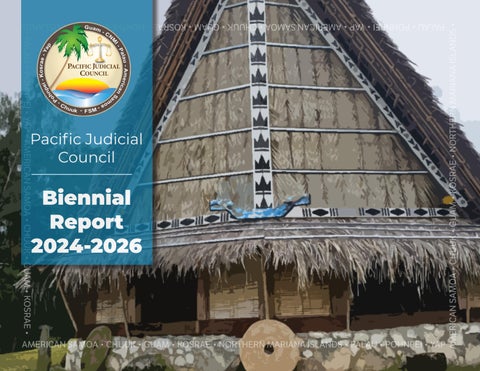
Biennial Report 2024-2026
AMERICAN SAMOA • CHUUK • GUAM • KOSRAE • NORTHERN MARIANA ISLANDS • PALAU • POHNPEI • YAP
AMERICAN SAMOA • CHUUK • GUAM • KOSRAE • NORTHERN MARIANA ISLANDS •
PALAU • POHNPEI • YAP • AMERICAN SAMOA • CHUUK • GUAM • KOSRAE • NORTHERN MARIANA ISLANDS • PALAU • POHNPEI • YAP • AMERICAN SAMOA • CHUUK • GUAM • KOSRAE •
Pacific Judicial Council
Contents 1
A Message from the Officers
3
From the Education Chair
5
Board of Governors
8
2024–2026 Conferences and Trainings
22
In Memoriam
2
A Message from the Officers Håfa Adai, Mogethin, Alii, Kaselehlie, Ran Anim, Lenwo, Talofa, and Kamorale! As we close this biennium, we reflect with gratitude on two years of shared accomplishment. Together, we have strengthened judicial education, deepened friendships across our member jurisdictions, and advanced our common commitment to justice. We hope you enjoy this 2024–2026 Biennial Report and the achievements it celebrates. Our education programs spanned the Pacific: environmental law and science in Palau; enhancing judicial performance and focused decisionmaking in Yap; case management and emerging technology in Kosrae; and trial advocacy in Pohnpei with the American College of Trial Lawyers. In Saipan, our Mid-Year Conference featured Ninth Circuit oral arguments and distinguished jurists exploring statutory and constitutional interpretation, while clerk training strengthened court operations. “Echoes of the Law” in the Philippines explored our shared judicial heritage, and digital evidence training in Guam addressed evolving challenges in technology and privacy. The education summaries that follow describe these programs in greater detail. We look forward to gathering in Palau this September for our 2026 Biennial Conference, with sessions on procedural fairness, judicial ethics in the digital age, judicial writing, and courthouse security. We are also investing in the Council’s future. Our officers and Education Committee have welcomed more docents from member jurisdictions to help plan conferences and trainings. Working with faculty and organizers, these judges and court staff are gaining valuable experience in curriculum design, faculty selection, and logistics–experience that will serve them and the Council for years to come. We thank them for stepping forward. Good governance has been another priority. The Board of Governors now meets three times a year rather than annually. We launched a digital member directory and upgraded our website with secure member access to conference materials and the directory. We have strengthened financial transparency and reduced costs, including advance conference travel expenses, by partnering directly with local jurisdictions on conference coordination. This term also marked a historic step toward broader participation: formal recognition of Associate Members in the Council’s governance structure. Regular Members elected an Associate Member as Vice President, and Associate Members elected two representatives to the Education Committee. With nearly 25 Associate Members, our Council continues to grow in strength and inclusiveness. None of this would have been possible without the partnership and trust of our member jurisdictions. Thank you for your cooperation, dedication, and friendship over these past two years. We are grateful to serve alongside you and look forward to building on this foundation together. Thank you for helping us navigate this journey. We invite you to review the Biennial Report, celebrating how far we have sailed together.
Justice Robert J. Torres President Supreme Court of Guam
Justice John A. Manglona Vice President Supreme Court of the Northern Mariana Islands
Chief Justice Cyprian Manmaw Secretary Yap State Supreme Court
Presiding Judge Alberto C. Lamorena III Treasurer Superior Court of Guam
1
2
From the Education Committee Chair Hafa Adai, Board of Governors, Officers, and Members of the Education Committee of the Pacific Judicial Council, As the 2026 PJC Education Programming Season nears its end, I want to thank you for your continued leadership and support of our shared education mission. The 2024 to 2025 Biennial Report includes a summary of our programs, reflecting a productive cycle and a strong pipeline for the year ahead. The Report reviews 2025 offerings in judicial wellness, case management, the joint NMI District Court and PJC mid‑year conference, and trial practice, highlights 2026 programs including the Court Clerk Training in Saipan, Digital Evidence for Judges in Guam, the 2026 Biennial Conference in Palau, and the upcoming Leadership Training in Guam. In addition, the report provides a look forward to our 2027 initiatives, including proposed marshal training, a seminar on Pacific Island constitutional frameworks, court interpreter training, the mid‑year family law program, the Yap ethics and jurisdiction program, and Basic Judging 101 and Boot Camp planning to close out 2027 or ring in 2027. Looking ahead to 2027 (and 2028), the Education Committee welcomes your guidance on priorities, faculty, venues, and any adjustments needed to align our programs with resource realities and jurisdictional needs. Your feedback will help us finalize schedules, secure presenters, and ensure that evaluations, materials, and logistics continue to meet the Council’s needs and expectations. I look forward to assisting, in any way I am able, the continued progress of the PJC’s mission, as stated in the Amended Articles of Association of the Pacific Judicial Council (Jan. 9, 2025), to provide continuing legal education, preserve custom and tradition within the confines of existing judicial systems, coordination with law enforcement agencies, provide public education in the areas of substance abuse and domestic community relations and judicial administration through educational programming, as approved by the PJC Education Committee and Board of Governors. It has been my honor and privilege to have served the PJC as its Education Chairperson, and I thank you for your confidence.
Judge Maria T. Cenzon Education Committee Chair Superior Court of Guam
3
4
Board of Governors Robert J. Torres President JUSTICE Supreme Court of Guam
Justice John A. Manglona Vice President JUSTICE Supreme Court of the Northern Mariana Islands
Cyprian J. Manmaw Secretary CHIEF JUSTICE Yap State Court
Alberto C. Lamorena III Treasurer PRESIDING JUDGE Superior Court of Guam
Joseph N. Camacho PRESIDING JUDGE Superior Court of the Northern Mariana Islands
Beauleen Carl-Worswick ACTING CHIEF JUSTICE FSM Supreme Court
Alexandro C. Castro CHIEF JUSTICE Supreme Court of the Northern Mariana Islands
Nelson A. Joseph CHIEF JUSTICE Pohnpei State Supreme Court
F. Michael Kruse CHIEF JUSTICE High Court of American Samoa
Ramona V. Manglona CHIEF JUDGE U.S. District Court for the Northern Mariana Islands
Katherine A. Maraman CHIEF JUSTICE Supreme Court of Guam
Oldiais Ngiraikelau CHIEF JUSTICE Republic of Palau Supreme Court, Appellate Division
Jayson Robert CHIEF JUSTICE Chuuk State Supreme Court
Kathleen M. Salii PRESIDING JUSTICE Republic of Palau Supreme Court, Trial Division
Edmond H. Salik CHIEF JUSTICE Kosrae State Judiciary
Frances Tydingco-Gatewood CHIEF JUDGE District Court of Guam
5
6
7
2024 – 2026 Pacific Judicial Council Biennial Report 2024–2026
Conferences/Trainings August–September 2024: New PJC Leadership and Education Committee At the 2024 Biennial Meeting, the Pacific Judicial Council elected a new slate of officers to lead the organization for the 2024–2026 term. Guam Chief Justice Robert J. Torres was elected President; Northern Mariana Islands Justice John A. Manglona, Vice President; Yap Chief Justice Cyprian Manmaw, Secretary; and Guam Presiding Judge Alberto C. Lamorena III, Treasurer. Following the Biennial Meeting, the PJC Education Committee was constituted in accordance with the Council’s Articles. In addition to members serving by virtue of their positions as chief or presiding judicial officers, the Committee included representatives appointed by their respective Chief Justices or Presiding Judges and representatives elected by the PJC Associate Members. The Education Committee was charged with helping shape the Council’s educational priorities and programs for the 2024–2026 biennium.
The 2024–2026 Education Committee members include: • Justice Robert J. Torres, Supreme Court of Guam — PJC President • Acting Chief Justice Beauleen Carl-Worswick, Supreme Court of the Federated States of Micronesia • Chief Justice Nelson A. Joseph, Pohnpei State Supreme Court • Chief Judge Ramona V. Manglona, U.S. District Court for the Northern Mariana Islands • Chief Justice Cyprian Manmaw, Yap State Court • Chief Justice Oldiais Ngiraikelau, Supreme Court of the Republic of Palau • , Chief Justice Jayson Robert, Chuuk State Supreme Court • Presiding Justice Kathleen M. Salii, Trial Division, Supreme Court of the Republic of Palau • Chief Justice Edmond Salik, Kosrae State Judiciary • Chief Judge Frances M. Tydingco-Gatewood, U.S. District Court of Guam • Justice John A. Manglona, Supreme Court of the Commonwealth of the Northern Mariana Islands — elected by the PJC Associate Members • Judge Elvis R. Pila Patea, High Court of American Samoa — appointed by Chief Justice F. Michael Kruse • Justice F. Philip Carbullido, Supreme Court of Guam — designated by Chief Justice Robert J. Torres • Judge Maria T. Cenzon, Superior Court of Guam — designated by Presiding Judge Alberto C. Lamorena III, • Judge Teresa Kim-Tenorio, Superior Court of the Commonwealth of the Northern Mariana Islands — designated by Presiding Judge Roberto C. Naraja, September 18, 2024 • Judge Arthur R. Barcinas, Superior Court of Guam — elected by the PJC Associate Members, September 13, 2024 8
BIENNIAL REPORT 2024–2026 2024 Education Programs October 18 – 31, 2024 (Palau) Environmental Law & Science Conference The Pacific Judicial Council Environmental Law & Science Conference was held from October 28-31, 2024, at the Ngarachamayong Cultural Center in Koror, Palau. The four-day conference brought together judges, attorneys, policymakers, scientists, and environmental experts to examine the intersection of environmental law, climate science, and Pacific Island sustainability. Topics included marine pollution laws and international conventions, climate science, ocean governance, climate change adaptation, indigenous rights, environmental economics, fisheries management, land-use practices, coral reef decline, environmental litigation, and recent U.S. Supreme Court environmental decisions affecting Pacific Island jurisdictions. The program featured keynote addresses from Surangel S. Whipps, Jr., President of the Republic of Palau, and Joshua “Josh” Franquez Tenorio, Lieutenant Governor of Guam, as well as presentations by distinguished judges, legal scholars, and scientific experts. The conference concluded with optional immersive learning experiences, including a resilient reefs excursion and a cultural tour, providing participants with firsthand exposure to environmental and cultural issues in Palau.
October 2024: Environmental Law & Science Conference
9
BIENNIAL REPORT 2024–2026
2025 Education Programs March 19 – 22, 2025 (Yap, FSM) Enhancing Judicial Performance Through Stress Management and Focused DecisionMaking The Enhancing Judicial Performance Through Stress Management and Focused Decision-Making program, held March 19–22, 2025, in Colonia, Yap, delivered a comprehensive, evidence‑based curriculum designed to strengthen wellness, resilience, and decision-making capacity among judges. Led by M. Lauren Lemmon (Ret.) and Yvonne Stedham, PhD., both nationally recognized faculty in judicial mindfulness and leadership, the four-day program combined scientific foundations with intensive practical exercises that directly support judicial performance. Through structured mindfulness practices, stress‑reactivity training, trauma‑informed decision March: Enhancing Judicial Performance frameworks, and facilitated small‑group reflections, participants engaged in hands‑on methods to improve focus, regulate stress, enhance communication, and cultivate compassion—skills essential for high‑stakes judicial environments. A full‑day silent mindfulness retreat provided deep immersion, allowing judges to reset cognitively and emotionally. Feedback throughout the program indicated high participant satisfaction, strong perceived relevance to judicial work, and immediate applicability of the techniques learned. Judges reported increased clarity, improved stress management, and strengthened decision‑making readiness. Faculty expertise, practical exercises, and the supportive peer environment were consistently praised. Participants especially enjoyed the exercises in the community cultural house and described the experience as “uplifting” and “transformational.” This program advances the PJC’s commitment to wellness, professional excellence, and evidence‑based judicial education. The training’s success underscores the value of continued investment in mindfulness‑based and resilience‑building initiatives for judicial officers.
10
BIENNIAL REPORT 2024–2026 August 5 – 7, 2025 (Kosrae, FSM) PJC Case Management for Judges and Chief Clerks The PJC Case Management Training Program provided judges, clerks, and court staff with a comprehensive three‑day learning experience focused on strengthening case flow practices, improving courtroom efficiency, and integrating modern tools— including AI—to support judicial administration. The curriculum blended foundational instruction, advanced management techniques, and interactive simulations to reinforce practical skills. Day 1 introduced essential case management principles, emphasizing the roles of August: Case Management for Judges and Chief Clerks judges and clerks, early case assessment, discovery management, and effective motion practice. Day 2 expanded into challenging case scenarios, trial management strategies, ethical considerations, ADR, and judicial wellness. Day 3 shifted to hands‑on exercises using case management technology, advanced tracking systems, and AI‑supported tools, culminating in scenario‑based group discussions that encouraged collaboration and problem‑solving across jurisdictions. Evaluations reflect strong engagement and consistently high satisfaction. Across all days, most participants rated the training as “Excellent,” “Very Good,” or “Very Effective,” with many noting they planned to use the information immediately in their work. Comments praise the knowledgeable presenters, interactive exercises, and practical relevance to daily responsibilities. Several clerks highlighted how the training improved their understanding of case tracking and their role in supporting judges. Judges and clerks alike valued hearing perspectives from other jurisdictions, describing it as “very helpful” and “eye‑opening.” Many cited case flow management, managing difficult litigants, and AI demonstrations as especially impactful components. Participants frequently requested additional trainings, longer sessions, and expanded coverage of ethical responsibilities, translation needs, and AI risks. Others emphasized the value of continued collaboration and more time for sharing experiences across courts. Overall, the program strongly met or exceeded expectations, offering practical tools that participants described as “essential,” “intriguing,” and “very informative,” with several noting it would “improve my knowledge,” “help me handle cases better,” and “support improvements in our court systems.”
11
BIENNIAL REPORT 2024–2026 September 24 –26, 2025 (Saipan, NMI) Joint Annual NMI District Court Conference and Pacific Judicial Council Mid-Year Conference The 2025 Joint Annual NMI District Court Conference and Pacific Judicial Council Mid-Year Conference convened judges, attorneys, court administrators, and clerks from across the region for three days of substantive legal education and professional development. The agenda featured a diverse array of sessions, including Ninth Circuit oral arguments held at the NMI District Court, panels on statutory and constitutional interpretation, discussions on artificial intelligence in the judiciary, and reviews of constitutional frameworks across Pacific jurisdictions. The conference also included networking events, CLE credit opportunities, and collaborative discussions on best practices in pretrial reform and judicial conduct. Attendees represented a broad spectrum of roles, with a majority being justices/judges, followed by clerks, administrators, attorneys, and other legal professionals. This diversity contributed to rich dialogue and a wide range of perspectives in both formal sessions and informal exchanges. Over 60% of participants consistently rated the information presented as “Excellent” or “Very Good” in relation to their job functions. Sessions on statutory interpretation, constitutional review, and artificial intelligence were particularly valued for their practical applicability and intellectual rigor. A majority indicated a strong likelihood of applying the knowledge gained in their daily work, especially in areas such as statutory construction, judicial conduct, and the use of AI in legal research and analysis. Across all days, more than 70% of respondents rated the training as “Very Effective” or “Moderately Effective.” The pragmatic and functional nature of the topics, as well as the quality of presenters, were frequently cited as strengths. Participants praised the variety and depth of content,
12
September: Joint Annual NMI District Court Conference and PJC Mid-Year Conference
the expertise and engagement of presenters, and the opportunity to observe Ninth Circuit oral arguments. Sessions on statutory and constitutional interpretation, AI, and judicial conduct were repeatedly mentioned as most useful. Networking and collegiality were also valued, with attendees noting the benefit of building professional bonds across jurisdictions. The vast majority reported that the conference met or exceeded their learning requirements, with many expressing appreciation for the engaging content and the opportunity to learn from distinguished judges and legal scholars. Individual sessions received high marks, especially those focused on constitutional interpretation, statutory construction, and AI developments.
BIENNIAL REPORT 2024–2026 Presenters such as Chief Judge Sutton, Dean Chemerinsky, and Judge McKeown were singled out for their outstanding contributions. The 2025 Joint Annual NMI District Court Conference & Pacific Judicial Council Mid-Year Conference was a resounding success, delivering highquality legal education, fostering regional collaboration, and advancing professional development for judicial officers and legal practitioners. Participant feedback underscores the value of the program’s content, the expertise of its presenters, and the importance of continued innovation and responsiveness to attendee needs. Recommendations for future conferences include enhancing interactivity, diversifying topics and speakers, and improving logistical support to further enrich the learning experience.
October 5 – 9, 2025 (Manila, Philippines) Supreme Court of the Philippines, Philippine Judicial Academy, and Pacific Judicial Council Echoes of the Law: Reawakening Judicial Heritage Across Cultures The “Echoes of the Law: Reawakening Judicial Heritage Across Cultures” program was held from October 5-9, 2025, in Manila, Tagaytay City, and Taal, Philippines. The program began on October 5 with a welcome reception hosted by the Supreme Court of the Philippines and the Philippine Judicial Academy (PHILJA). On October 6, participants attended opening ceremonies, a keynote address by the Chief Justice of the Philippines, and educational sessions on comparative colonial history, judicial leadership, global citizenship, and justice, followed by a gala dinner. On October 7, participants toured the Manila American Cemetery and Memorial, explored Intramuros through a guided historical walking tour, visited the Supreme Court of the Philippines, and traveled to The Judicial Academy Philippines (TJAP) in Tagaytay City. On October 8, participants attended sessions on ethics, culture, and national identity before taking part in a cultural tour of Taal Heritage Town. The program concluded on October 9 with presentations on leadership,
October 2025: Echoes of the Law: Reawakening Judicial Heritage Across
environmental justice, women’s suffrage, indigenous traditions, and cultural heritage, followed by a closing ceremony and a farewell dinner featuring a Philippine Fiesta Night. November 4 – 7, 2025 (Pohnpei, FSM) PJC American College of Trial Lawyers Training for Lawyers and Judges The 2025 PJC/ACTL Trial Practice Training delivered a comprehensive four‑day program in Pohnpei, offering 24 CLE credits and covering essential trial‑practice topics including Artificial Intelligence in legal work, complex litigation, constitutional and statutory interpretation, criminal‑justice reform, jury selection, evidentiary updates, ethics, procedural fairness, family‑law persuasion, and juvenile‑justice reform. 13
BIENNIAL REPORT 2024–2026 Evaluations from the four days of training show strong satisfaction among judges, attorneys, and court administrators, most of whom rated relevance, effectiveness, and likelihood of use as “Excellent” or “Very Good”. AI‑related sessions were consistently cited as standout components; participants emphasized learning “how AI can assist me in formulating my brief,” recognized its practical value for discovery and motion practice, and appreciated guidance on addressing concerns such as AI “hallucinations.” Ethics training—especially “Zealous Advocacy vs. Civility”—also resonated deeply, helping attendees clarify expectations of civility, professionalism, and practical judgment. Participants praised the presenters’ expertise, describing them as “knowledgeable,” “engaging,” and “very well prepared,” and valued practical insights on proportionate discovery, expert‑witness preparation, and constitutional interpretation. Group discussions and hypothetical exercises were frequently cited as high points, with one attendee noting that small‑group reporting “applying the skills…using the laws and practical knowledge” was the best part of Day 4. Participants also noted that evidentiary rule updates, jury‑selection techniques, damages presentation, family‑law persuasion strategies, and juvenile‑justice reforms were all directly applicable to their daily practice, with many stating that “all topics were useful” and “highly relevant.”
November 2025: ACTL Training for Lawyers and Judges
Suggestions for improvement focused on pacing and delivery, including shortening sessions, incorporating more breaks, improving audio/visual clarity, providing materials in advance, increasing interactive components, and expanding content tailored to Pacific jurisdictions, particularly where U.S.‑specific topics such as class actions have limited regional applicability. Despite these suggestions, evaluations overwhelmingly reflect that the training met or exceeded expectations, with comments such as “Exceeded expectations,” “Beyond expectations,” “Very well,” and “This training is the gold standard.” Overall, the program provided high‑quality, practical, and forward‑looking instruction that strengthened trial‑practice competencies across the Pacific. Participants’ feedback suggests clear priorities for future trainings: integrating more region‑specific case studies relevant to Micronesia, expanding hands‑on AI demonstrations, increasing opportunities for group exercises and audience participation, improving presentation
14
BIENNIAL REPORT 2024–2026 delivery mechanics (sound, visuals, pacing), and continuing to develop ethical and practical modules that speak to everyday courtroom challenges. These enhancements would build on an already successful program and further align future offerings with the evolving needs of Pacific judicial professionals.
2026 Education Programs January 28 – 30, 2026 (Saipan, NMI) PJC Court Clerk Training The Pacific Judicial Council Court Clerk Training, held January 28–30, 2026 in Saipan, delivered a structured three‑day program designed to enhance clerks’ professional competencies across the region. The agenda covered the fundamentals of legal procedures, ethics, professionalism, courtroom etiquette, communication skills, leadership development, caseflow management, and the integration of technology within judicial workflow. Sessions were facilitated by Kelly Hutton, Danielle Rosete, Judge Maria T. Cenzon, and Magistrate Judge Heather Kennedy. Day 1 emphasized legal terminology, procedural justice, leadership, and professional conduct. Evaluations showed 77% rated the content “Excellent,” and 74% rated training effectiveness as “Very Effective.” Participants praised leadership instruction, engagement, and cross‑jurisdiction learning. Day 2 focused on ethics, including distinguishing legal information from legal advice, assisting self‑represented litigants, customer service techniques, and courtroom decorum. Satisfaction remained high, with 75% rating information “Excellent” and 95% rating the day’s sessions “Very Effective.” Attendees noted role‑playing and hypothetical scenarios improved their confidence in applying ethical principles. Day 3 concentrated on caseflow, workflow, and integrating technology in case management. Evaluations remained strong, with 86% rating content “Excellent”
January 2026: Court Clerk Training
and 82% rating the day “Very Effective.” Participants highlighted caseflow mapping and discussions on improving time standards and incorporating AI responsibly. 15
BIENNIAL REPORT 2024–2026 Key participant comments included: “The training enhanced my knowledge of courtroom procedures and reminded me of the importance of ethics,” and “The case management activity helped us see where we can improve to lessen time of case disposition.” Attendees also appreciated the customer service and communication skills workshops and the hypothetical scenarios and role‑play activities were very well received. The evaluations provided qualitative evidence of impact, including ethics improvement, stronger case management skills, and better understanding of court processes. These outcomes demonstrate strong participant engagement, high instructional quality, and clear evidence of knowledge transfer—key indicators of program success for this education program
Although delayed, the conference remains a key initiative supporting regional efforts to integrate restorative justice principles into court practices, community partnerships, and long‑term rehabilitation frameworks. The Pacific Judicial Council continues preparations to deliver this comprehensive program when rescheduled in 2027. June 24 – 26, 2026 (Guam) Digital Evidence for Judges The PJC’s Digital Evidence for Judges program, held at the Westin Resort
April 14 – 16, 2026 (Pohnpei, FSM) – Postponed Restorative Justice Restitution, Rehabilitation, Reconciliation The Restorative Justice Conference—originally scheduled for April 14–16, 2026, in Pohnpei—was postponed to 2027 due to the severe regional impacts of Super Typhoon Sinlaku. The program was designed to strengthen judicial leadership in restorative justice through a three‑day curriculum emphasizing cultural responsiveness, community collaboration, and practical implementation across Pacific jurisdictions. The agenda featured contributions from judicial leaders and restorative justice practitioners, including sessions led by Judge Rohanee Zapanta and Collective Justice co‑founders Martina Kartman and Matt Kama’aina Murphy. Core program components included foundational instruction, experiential learning, panels on cultural practice and legal tensions, juvenile and family‑focused restorative strategies, correctional‑based applications, and jurisdiction‑specific action planning. 16
Guam, brought together judges and legal professionals from across the region for three days of intensive instruction on the evolving landscape of digital evidence, technology, and artificial intelligence in judicial practice. The agenda featured a comprehensive curriculum, including legal frameworks for technology, Fourth and Fifth Amendment analysis, search warrant best practices, geofence warrants, motion practice, admissibility of digital evidence, expert testimony, e-discovery, privacy, and AI applications for judges. Across all instructional sessions, participants consistently rated the
BIENNIAL REPORT 2024–2026 IN REVIEW program as highly relevant, effective, and directly applicable to their judicial roles. The majority of attendees were judges, with attorneys and staff attorneys also represented. Most participants described the information as “excellent” or “very good,” noting its practical relevance and immediate applicability to their work. The frameworks for Fourth and Fifth Amendment analysis, search warrant review, and digital evidence admissibility were repeatedly cited as especially valuable. Attendees praised the interactive nature of the sessions, highlighting case studies, real-life scenarios, and lively discussions. Presenters were commended for their expertise, flexibility, and willingness to address questions as they arose. The inclusion of AI demonstrations and practical exercises was particularly well received, with several participants noting increased comfort and understanding of AI’s role in judicial tasks. The frameworks for constitutional analysis, search warrant procedures, and AI applications were identified as the most useful elements. Participants appreciated the focus on practical tools, best practices, and current legal issues, including geofence warrants, authenticity challenges, and privacy concerns. Nearly all respondents indicated the training met or exceeded their expectations, with many expressing enthusiasm for future sessions and ongoing education in digital evidence and AI. The program was described as engaging, informative, and essential for adapting to technological advancements in the judiciary. The Digital Evidence for Judges program delivered a robust, practical, and forward-looking educational experience. Participant comments underscore the value of interactive instruction, real-world examples, and frameworks that empower judges to navigate complex digital evidence issues confidently. Participant feedback strongly supports the Pacific Judicial Council’s commitment to ongoing education in this
area and calls for continued training, expanded content, and enhanced resources for judicial professionals.
Upcoming Education Programs September 13 – 16, 2026 (Palau) – Upcoming 2026 Pacific Judicial Council Biennial Conference The Pacific Judicial Council 2026 Biennial Conference, taking place September 13-16, 2026, in Koror, Republic of Palau, promises a rich and engaging program for judicial leaders across the Pacific. The event opens with business meetings and a welcome dinner, setting the stage for three days of substantive sessions. On Day 1, participants will be greeted by distinguished hosts and enjoy welcoming remarks from regional judicial leaders. The highlight is the keynote address by Angel A. Demapan, Deputy Assistant Secretary for Insular, International and Ocean Affairs at the U.S. Department of the Interior. Demapan brings deep expertise in public policy, legislative affairs, and regional advocacy, and his address will focus on strengthening federal partnerships and advancing progress in the insular areas. Following the keynote, Day 1 features sessions on procedural fairness led by Kevin S. Burke, exploring public perceptions of courts, the mental aspects of judging, and practical steps to enhance fairness. Ethics in the digital world will be tackled by M. Margaret McKeown, Senior Judge of the U.S. Court of Appeals for the Ninth Circuit, addressing new challenges and solutions. The day concludes with a workshop on narrative precision in judicial writing by Professor Michael A. Blasie, emphasizing concise storytelling and logical flow. Day 2 continues with Professor Blasie’s sessions on plain language and judicial design, focusing on clarity as a cornerstone of the rule of law. Burke returns to wrap up procedural fairness and access to justice, highlighting strategies to reduce barriers and improve public 17
BIENNIAL REPORT 2024–2026 trust. Lunch includes a brief history of the Pacific Judicial Council by Alberto C. Lamorena, followed by Chief Justice and Chief Judge reports. The afternoon offers workshops on persuasive logic, global court communications, and editing protocols for high-impact judicial drafting. Day 3, hosted at the Palau Supreme Court, centers on judicial security. Sessions led by Guam Marshal of the Courts Leo S. Diaz, along side Deputy Marshals Cameron P. Mantanona, and Ryan T. Balajadia as well as members of the United States Marshal Service will cover best practices for securing judges and courthouses, emergency protocols, and scenario-based exercises to strengthen safety and preparedness. Throughout the conference, participants will benefit from expertled discussions, practical workshops, and opportunities for regional collaboration. The keynote by Angel Demapan stands out as a pivotal moment, offering insights into federal partnerships and regional progress. The agenda is designed to foster excellence, innovation, and security in Pacific judicial systems. PJC Leadership Training for Judges: Purposes and Responsibilities for Judicial Officers and Court Administrators, December 11-12, 2026, Guam. The Pacific Judicial Council Leadership Training for Judges, scheduled for December 11–12, 2026, in Guam, brings together judicial officers and court administrators for an intensive two-day program focused on leadership, values, communication, and ethical decision-making. Faculty for this program includes Scott A. Westfahl of Harvard Law School and David Hagmann of Hong Kong University of Science and Technology. Day One features a case study on leadership challenges, followed by an interactive “Value X-Change” exercise that surfaces differences in values and the complexities of conflict. Participants then engage in a 18
lecture on motivating professionals and building inclusive teams, and analyze the Google LLC case to explore organizational values, dissent, and preventive leadership. The afternoon concludes with a design thinking workshop, where judges collaborate to generate innovative solutions to challenges such as building public trust in the judiciary, before reflecting and adjourning. Day Two begins with a reflection and a response email exercise, prompting teams to craft replies to leadership criticism and explore the nuances of communication. Sessions continue with a focus on empowering leaders through AI-driven communication, examining how generative AI can enhance clarity and receptiveness in feedback and self-promotion. Participants then rank email responses for conversational receptiveness, learning the HEAR framework and the importance of managing emotions and problem-solving. After lunch, the program shifts to adaptive leadership principles, behavioral ethics, and motivated reasoning, helping judges understand why good people sometimes fall short of their standards and how to safeguard against ethical lapses. The final session explores neuroscience research on spiritual practices, introducing a moral compass framework for complex decision-making, and closes with reflection, evaluation, and remarks. Throughout, the agenda blends case studies, interactive exercises, and evidence-based lectures led by distinguished faculty, equipping judicial leaders with practical tools for navigating the evolving demands of their roles.
BIENNIAL REPORT 2024–2026 IN REVIEW 2027 Education Programs *All venues are tentative.
1. Court Marshal Training: Tactical and Non-Tactical Processes. February, 2027. Guam. Docents: Chief Judge TydingcoGatewood/Judge Barcinas.
Association—arose from the United States’ territorial expansion and continue to shape governance in Pacific jurisdictions. The training examines the constitutional and statutory relationships between the United States and Pacific island governments, focusing on the distribution of authority, the applicability of federal law, and the scope and limitations of constitutional rights.
The proposed marshal training curriculum is designed to build comprehensive expertise in both tactical and non-tactical (substantive legal) processes. The tactical component covers courtroom security protocols, prisoner transport procedures, emergency response actions, and effective communication during high-risk situations. Trainees learn to assess threats, maintain order, and collaborate with law enforcement agencies, with practical exercises in conflict deescalation and situational awareness. The non-tactical component focuses on foundational legal principles relevant to court marshals, including an overview of court structures, roles and responsibilities, and procedural rules. Modules address due process, rights of defendants, evidence handling, jury security, and ethical standards. Participants engage in case studies and scenario-based learning to reinforce understanding of legal fundamentals and the importance of impartiality and professionalism in judicial environments. Ongoing evaluation ensures skill mastery in both operational and legal aspects, preparing marshals for effective service in Pacific Island court jurisdictions.
Participants will explore how these historical and contemporary frameworks influence judicial decision‑making today, while also comparing the varying legal statuses of territories, commonwealths, and freely associated states to assess their impact on courts, governance, and individual rights. In addition, the program highlights emerging legal and policy debates surrounding territorial rights and the evolving relevance of the Insular Cases. Ultimately, the conference equips judges with the historical and constitutional context needed to effectively apply these principles to real-world cases involving federal– local relationships in Pacific courts.
2. Evolving Constitutional Frameworks in the Pacific: Governance, Autonomy, and the Legacy of Territorial, Commonwealth and Compact Agreements. April 19-23, 2027. Saipan. Docents: Justice Torres/Justice Manglona.
3. Court Interpreter Training: Basic and Intermediate Interpreting. June 14-18, 2027. Pohnpei. Docents: Danielle Rosete/David Welle/Judge Cenzon.
The PJC Conference on Evolving Constitutional Frameworks in the Pacific aims to deepen judicial understanding of how foundational legal structures—such as the Organic Acts, the Insular Cases, the Covenant of the Northern Mariana Islands, and the Compacts of Free
Proposed faculty for this conference includes distinguished academics including Rutgers Professor Rose Villazor, Columbia Univeristy Professor Kristina Ponsa Kraus and Neil Weare, co-director of Right to Democracy, which works to advance democracy, equity and selfdetermination across U.S. Territories.
The curriculum for court interpreter training is structured to address both foundational and advanced competencies, ensuring interpreters are equipped to facilitate accurate and impartial communication in judicial settings. The basic level covers essential topics including court terminology, interpreter ethics, modes of interpretation (consecutive 19
BIENNIAL REPORT 2024–2026 and simultaneous), and an introduction to legal procedures. Candidates practice interpreting in mock courtroom scenarios, focusing on developing listening comprehension and memory skills. The intermediate curriculum builds on these fundamentals by introducing more complex legal concepts, specialized vocabulary, and advanced interpreting techniques. Participants engage in simulated proceedings involving witness testimony, legal argumentation, and multi-party interactions. The program also includes modules on cultural competency, handling ethical dilemmas, and navigating procedural challenges unique to Pacific island jurisdictions. Ongoing assessment and feedback support skill refinement and professional development, preparing interpreters to serve effectively in diverse court environments. Proposed trainers include Dr. Suzanne Zhang, Debbie de Silva and Elena Langdon. Additional faculty are being proposed. 4. Mid-Year Meeting: Family Law Topics. September 14-18, 2027. Palau/Guam/Saipan. Docents: Judge Elyze Iriarte/Judge Lillian Tenorio. The 2027 Mid‑Year Meeting on Family Law brings together judges and justice‑system partners to examine cutting‑edge research and judicial practices affecting high‑risk youth and complex family‑law matters. Led by Judge Iriarte and Judge Lillian Tenorio, the program integrates evidence‑based interventions, structured juvenile‑justice practices, and newly developed judicial benchcards to strengthen case outcomes and judicial decision‑making. Sessions explore the realities of adolescent development, the profound influence of digital culture on youth behavior, and practical strategies for transforming probation and diversion systems in resource‑limited jurisdictions. Additional programming addresses domestic‑violence cases, including treatment approaches and ways courts can actively reduce recidivism. With featured faculty Dr. Keith Cruise, a national expert 20
on adolescent development, and Dr. Eve Brank, a leading scholar in parental‑responsibility law and the psychology of family law, the conference offers a comprehensive, research‑driven curriculum designed to equip judges with modern tools for supporting vulnerable youth and strengthening family‑court responses. 5. Realities of Judging, Judicial Ethics in Close-Knit Communities and Personal Jurisdiction in the Digital Age. November 8-10, 2027. Yap. Docents: CJ Manmaw/Justice Torres. This program offers judges a focused exploration of two interconnected dimensions of modern judicial service: the everyday realities of judging in close‑knit communities and the evolving doctrines of personal jurisdiction in the digital era. Participants will examine practical strategies for managing courtroom dynamics, maintaining ethical boundaries, and sustaining well‑being amid the pressures of heavy dockets and community expectations. The program also addresses new jurisdictional challenges arising from online commerce, remote employment, social media activity, and multinational digital platforms. The learning objectives of this conference include: recognizing ethical risks unique to smaller jurisdictions; how to apply recusal standards in close or ambiguous situations; how to balance transparency with practical court administration; and strengthen public confidence in judicial impartiality. Through a blend of practical guidance and doctrinal analysis, the course equips judges with tools to navigate ethical dilemmas, adopt effective leadership practices, and apply modern jurisdictional standards—including purposeful availment and online targeting—in an increasingly interconnected world. Proposed faculty includes members of the American Institute for Justice.
BIENNIAL REPORT 2024–2026 IN REVIEW 6. Basic Judging 101/Boot Camp: Basic Court Operations Training. December 2026/January 2027. Hawaii East-West Center (Tentative). Docents: Justice Torres, Judge Barcinas, Judge Cenzon. Basic Judging 101/Boot Camp: Basic Court Operations Training provides a comprehensive foundation for newly appointed judges and a valuable refresher for experienced jurists seeking to enhance and modernize their judicial practice. The program focuses on core courtroom operations, judicial ethics, caseflow management, and effective decision‑making—equipping participants with essential tools for consistent, confident, and efficient performance on the bench. The East-West Center is currently the proposed tentative site for the program. Planning is ongoing.
21
IN MEMORIAM 2024 The Honorable John K. Rechucher Associate Justice, Palau Supreme Court Appellate Division
In remembrance and appreciation of his dedicated public service as Associate Justice of the Palau Supreme Court. The Pacific Judicial Council extends our deepest sympathy to his wife, Bessie, and their children, Medaliual and Mereuir, and his extended family. We deeply appreciate his contributions to the legal profession and the meaningful friendship he shared with us. 22
IN MEMORIAM 2025 The Honorable Jonathan M. Tun Associate Justice, Yap State Court
R CE
TIFICATE O F
n d o l e nce o C is Presented to the Family of the Late
Honorable Jonathan M. Tun Associate Justice of Yap State Court The Pacific Judicial Council mourns the passing of a devoted jurist and dear friend. We extend our deepest sympathies to his wife Teresa Fagaltinan and his children Joshua Terence Libyanfinelab Tun and Jenesha Lee Ligorad Tun, and all his loved ones. His legacy of public service, integrity, and commitment to the rule of law will endure as an inspiration to us all.
Presented this 18th day of December, 2025. /s/
HON. ROBERT J. TORRES President Chief Justice, Supreme Court of Guam
HON. JOHN A. MANGLONA Vice President Associate Justice, Supreme Court of the Northern Mariana Islands
HON. ALBERTO C. LAMORENA III Treasurer Presiding Judge, Supreme Court of Guam
HON. CYPRIAN J. MANMAW Secretary Chief Justice, Yap State court
Published by the Pacific Judicial Council c/o Guam Judicial Center 120 West O’Brien Drive Hagåtña, Guam 96910
pacificjudicialcouncil.org