(Ebook) The Pocket Atlas of Human Anatomy: A Reference for Students of Physical Therapy, Medicine, Sports, and Bodywork by Chris Jarmey ISBN 9781623172527, 1623172527
(Ebook) The Pocket Atlas of Human Anatomy: A Reference for Students of Physical Therapy, Medicine, Sports, and Bodywork by Chris Jarmey ISBN 9781623177355, 9781913088316, 9781623177348, 1623177359, 1913088316, 1623177340, 2021039177
This fourth edition published in 2024 by Lotus Publishing
Apple Tree Cottage, Inlands Road, Nutbourne, Chichester, PO18 8RJ, and Human Kinetics
1607 N. Market Street, Champaign, Illinois 61820
United States and International
Website: US.HumanKinetics.com
Email: info@hkusa.com
Phone: 1-800-747-4457
Canada
Website: Canada.HumanKinetics.com
Email: info@hkcanada.com
Disclaimer
This publication is written and published to provide accurate and authoritative information relevant to the subject matter presented. It is published and sold with the understanding that the author and publisher are not engaged in rendering legal, medical, or other professional services by reason of their authorship or publication of this work. If medical or other expert assistance is required, the services of a competent professional person should be sought.
Drawings Bryan Nuttall
Text Design Medlar Publishing Solutions Pvt Ltd., India
Cover Design Chris Fulcher
Printed and Bound Kultur Sanat Printing House, Turkey
British Library Cataloguing-in-Publication Data
A CIP record for this book is available from the British Library
Library of Congress Cataloging-in-Publication Data
Names: Jarmey, Chris, author.
Title: The theory and practice of taiji qigong / Chris Jarmey.
Description: Fourth edition. | Champaign, Illinois : Human Kinetics, 2024.
Identifiers: LCCN 2023030193 (print) | LCCN 2023030194 (ebook) | ISBN 9781718231009 (paperback) | ISBN 9781718231016 (epub) | ISBN 9781718231023 (pdf)
LC record available at https://lccn.loc.gov/2023030193
LC ebook record available at https://lccn.loc.gov/2023030194
ISBN: 978-1-7182-3100-9 10 9 8 7 6 5 4 3 2 1
5. Arm Rolling (...in Fixed Stance) (sometimes called “Back Swinging Monkey”)
6. Rowing a Boat (...in the Middle of a Lake)
7. Lifting the Ball (sometimes called “Holding a Ball in Front of the Shoulders”)
9. (Turning Waist and...) Pushing Palm
(...in Horse Stance)
Scooping the Sea (...and Viewing the Sky)
Pushing Waves (sometimes called “Playing With Waves” or “Reinforcing Waves”)
Flying Dove (...Spreads its Wings)
Charging Fists (...With Outstretched Arms)
Bouncing a Ball (...While Stepping)
Calming Qi (sometimes called “Balancing Qi” or “Pressing the Palms for Calming”)
About the Author
Chris Jarmey, who tragically died prematurely in 2008, first became interested in Oriental philosophies at the age of 9, being particularly drawn to Buddhist and Daoist practices. This led him at the age of 14 into the exploration and practice of b oth Indian yoga and a Chinese martial art known as Kenpo.
His interest in practices that enhance or restore health was catalyzed at the age of 11, when he suffered a serious fall from a cliff face, damaging his pelvis and thoracic spine. This caused serious pain and mobility problems by the time he was 18, at which time he applied his budding understanding and experience of yoga and Qigong to successfully correct the problem. From then onwards his interest in the healing arts developed and he embarked upon a search for those who could teach him more about oriental healing methods.
Throughout the next 30 plus years, Chris Jarmey spent his time researching and practicing bodywork-based healing methods alongside the extensive practice of Buddhist and Daoist Qigong, yoga, and meditation methods. He was taught by several teachers, but considered himself particularly fortunate to have studied under Geshe Damcho Yonten (Tibetan Buddhism and meditation); Mother Sayama (Theravadan Vipassana meditation); Masahiro Oki (Dao-Yinn, Qigong, Shiatsu and Zen meditation); BKS Iyengar (Hatha Yoga); Okudo Roshi (Zen meditation); Dr Norman Allen (Ashtanga Yoga) and Pauline Sasaki (Shiatsu). Also of great value was information and insight gained at courses given by Dr. Shen Hongxun (Buqi and Qigong); Dr. Yang Jwing-Ming (Qigong); Master Mantak Chia (Qigong); and Dr. John Peacock (Kum Nye: Tibetan Yoga / Qigong).
In 1975, Chris began his study of Western approaches to healing and rehabilitation, as a means to contrast and supplement his experience of Eastern methods. He qualified as a state registered physiotherapist in 1978, with a special interest in therapeutic exercise systems. Shortly afterwards he embarked upon extensive study and research into osteopathic methodology. This was followed up with a training given by Carlo Depaoli in Western herbal medicine based on Traditional Chinese Medicine principles.
Concurrent with the above studies, from 1978 to 1981 he researched and evaluated the healing effects of yoga, shiatsu, and Qigong within NHS hospitals and medical rehabilitation centers, with good results.
Between 1981 and 1985 Chris lived and studied in a number of yoga centers and ashrams in India, the UK, and the USA, to broaden and deepen his experience of Indian Hatha Yoga and related arts, such as the ancient and comprehensive Indian medicine system known as Yoga Chikitsa. Then, in late 1985 he founded The European Shiatsu School to offer a comprehensive practitioner training course in this effective form of bodywork.
Acknowledgements
Firstly, I would like to express my gratitude to all the teacher s and practitioners of Qigong, meditation, and the healing arts who have positively influenced my understanding and practice of those disciplines. I would like to thank Bryan Nuttall for the drawings; Jane Pollard for her insights into Yin-Yang theory and for allowing the use of some of her collated material on that subject; Liz Welch, Isabelle Mazille and Bryan Nuttall for modeling the Qigong exercises; also Liz Welch, and Bryan Nuttall for offering their constructive views on some of the nuances and contradictions within Qigong theory.
In addition I wish to thank George Dellar; Debbie Jarmey; Susan Millington Ph.D., Bryan Nuttall; Jane Pollard; Andrea Smith Ph.D., and Liz Welch for proof reading the manuscript.
How to Use This Book
This book acts as an in-depth instruction manual for the practice of the 18 Stances of Taiji Qigong (Taiji Qigong Shibashi), which is widely practiced throughout the Far East and increasingly throughout the Western world. Many of the exercises are loosely based on the movements and stances of Taiji Quan. However, it is not to be confused with Qigong exercises for Taiji Quan, although it could be used as such.
Methods of Qigong are many, and the variations within these methods are endless. Even within Taiji Qigong Shibashi there are at least six different “styles” that I have come across; which means there must be even more. Generally though, this method of Qigong and its variations are practiced as a very simple, easy to learn system that is ideal for beginners. However, many people also use it as a serious core practice, or as an adjunct to yet deeper methods.
This book is written with all levels and depths of practice in mind. It is constructed so that you can take from it the necessary information and techniques to suit your goals. If you want to use it as a basic Qigong health and well-being maintenance program, you can largely ignore Part 1 and go straight to Parts 2 and 3.
If you want to practice with a view to really experiencing your internal energy, read Part 1, but understand that some theories and practices described belong to deeper levels of Qigong and are mentioned purely to put this level of training into context and give a broad overview. If you are an experienced practitioner of the deeper internal methods of Qigong, Part 1 may serve to clarify certain concepts for you, and enable you to apply some of those internal methods to Taiji Qigong. The so-called “levels” or
depths of practice are not meant to imply a greater or lesser quality of practice. They simply relate to one’s goals. There are many benefits to be gained from practicing what appears to be a more external, simple system, and many pitfalls to practicing more complex or deeper techniques. This is because the consequences of practicing incorrectly are greater; which can easily happen without a good teacher monitoring your work.
So, when you get to Part 3, follow the general instructions, but when you get to mental focus, choose either basic, intermediate, or advanced focus according to your experience and aspirations. Basic focus represents the focus used by the vast majority of people who do these exercises. Intermediate focus is for those who want to explore the power of their visualization skills within the exercises. Advanced focus is for experienced Qigong practitioners who are at least competent with reverse abdominal breathing (see page 62), and who wish to experience their internal movement and distribution of Qi at a deeper level.
Although the 18 stances are presented and commonly practiced as a unified set or “form”, any of the exercises can be done in isolation or grouped together in smaller sets of your choice. However, if you find that you are consistently abandoning a particular exercise, just be aware that it is human nature to avoid the things that may ultimately allow us to grow.
It may be that you flick through this book and wonder why it has to be so detailed and “wordy”. Is it not better to lean towards minimalism with regard to theory and instruction when dealing with what is essentially an experiential art? Shouldn’t the individual be left to discover the effects, benefits, and effective mental focus through their own diligent practice? In a way, yes; and you can still take that approach with this book by simply following the instructions on how to move during each exercise.
However, the detail given beyond that is designed to offer ideas and indications that will speed up your progress. Believe nothing until you have tried it; and once you have experienced the subtleties for yourself, feel free to modify it, so long as you stay within the principles of Qi and Yin-Yang, which themselves have been tested and refined over many thousands of years.
PART I
The Theory of Qi and Qigong
Taiji Qigong is an easy-to-learn system of energy enhancing exercises that co-ordinates movement with breathing and inner concentration. If practiced regularly, it will give you more energy, improve health, and help prevent illness. The primary aim of practicing this Qigong is to gently build and regulate your vitality by enhancing your Qi.
This method is uncomplicated to learn so most people should be able to master the basic movements within a week or so of regular practice. Mastering the subtleties and nuances will take considerably longer, but are well within the grasp of the keen student living the modern pace of life.
Within the full spectrum of possible Qigong methods, Taiji Qigong Shibashi has often been described as a relatively superficial system. However, if the nuances and subtleties are understood and practiced correctly, this Qigong becomes an ideal intermediate method of Qigong for anyone willing to do it on a daily basis. It is not one of the deeper internal methods fraught with life threatening consequences if mistakes are made; neither is it just a physical exercise. I would describe it as a realistic method for those who must practice largely unsupervised, but who wish to make real progress in the enhancement of their vitality.
If you work within any of the healing professions you will find Taiji Qigong an excellent adjunct to your work, because you will be giving out a lot of your energy in the form of compassion, concentration, and intent to heal when dealing with the illnesses of your patients. Taiji Qigong is particularly effective in helping to replenish that “giving” energy. It will also build energy (Qi) in your hands, which is particularly useful if you are a bodywork therapist. Taiji Qigong is also an excellent self-healing system to recommend to those you are trying to help.
What Is Qi?
Qi as a Universal Concept
Qi as a broad concept is the sub-strata of the entire universe. It includes everything in the universe from the most material to the immaterial. Therefore, within its broadest possible definition, we can consider a rock as Qi and we can consider an individual thought to be Qi. However, in practice, Qi is generally thought of as the invisible factors that bind matter together and activate all things, including those that are tangible but invisible to our senses. Visible and palpable things such as rocks are collectively known as Xing, whereas amorphous invisible phenomena such as wind, smell, heat, movement, or even happiness all fall under the general heading of Qi. Therefore to physically exist requires Qi, to move and feel requires Qi, and to think requires Qi.
You could say that Xing are all those things you can perceive and count, whereas Qi is all that which you cannot see or count. Another angle on this way of perceiving the universe is to consider that initially, things in the Xing category seem permanent, but the fact that all things are impermanent shows that they are constantly subject to change, however imperceptible that change may seem. The agents of change are those invisible factors called Qi.
Traditional Chinese philosophy considers the universe to be driven by three manifestations of Qi: Heaven Qi (Tian Qi), Earth Qi (Di Qi), and Human Qi (Ren Qi). Heaven Qi is the largest and most powerful of these forces, because it contains Earth Qi within it (the Earth itself being a planet within the heavens). Earth Qi is regarded as the aggregate of the earth’s magnetic field and underground heat, which is believed to produce a matrix of energy lines and zones across and through the
The Theory of Qi and Qigong
planet. Earthquakes and volcanic activity are thus seen as the Earth Qi re-balancing itself.
From our point of view, i.e., as beings standing upon this planet, Heaven Qi is considered to be the combined forces from above that exert influence upon the earth. This includes energy, gravity, and light from the sun, moon, and stars; forces which in turn govern climate. Climate, like everything else, is subject to fluctuation. So extremes of weather, including tornadoes, torrential rain, and so on are seen as Heaven Qi trying to restore balance.
The interaction of Heaven Qi with Earth Qi can be observed in other examples, such as too much heat from the sun and too little rain causing crops to fail in a drought. Thus it can be said that Earth Qi absorbs Heaven Qi and is influenced by it. Human Qi (and also Animal Qi) is seen as a melding of the forces of Heaven Qi and Earth Qi (Figure 1). Human Qi is HeavenQi
Earth Qi
Human Qi
Figure 1: Human Qi as a melding of Heaven Qi and Earth Qi.
The
a type of energy field that draws Heaven Qi downward from above and Earth Qi upward from below. The balance of our Human Qi is therefore strongly influenced by the natural cycles of Heaven Qi and Earth Qi.
Harmonizing ourselves with the forces and cycles of Heaven and Earth is the core philosophy of Daoism from which Qigong developed. Daoists have observed that nature is a process of perpetual decay and renewal, and if you carefully observe nature, you can gain insight into the way nature cyclically re-balances its Qi. Daoist philosophy, within which the bulk of oriental medicine is rooted, is basically a way of describing and understanding how we harmonize with our environment. It is to do with understanding how all things are ultimately striving to maintain a level of inter-dependence.
Qigong therefore directly influences our Human Qi, which permeates and animates our body and mind, by way of harmonizing the entry and exit of both Heaven and Earth Qi, and by regulating the flow of Qi within us. Astrology and various forms of divination are attempts to explain the effects of Heaven and Earth Qi upon Human Qi. Qigong is an experiential realization and manipulation of the effects of those same external forces at work within us.
Qi as “Life Force”
In terms of our health, we can consider Qi to be that factor which animates us into life. Therefore, our vitality and “aliveness” is a reflection of our level and internal distribution of Qi. If we lack Qi, or its flow is impeded in some way, then we lack vitality and may become ill. Within this narrower definition of Qi, we can equate it to our “life force.” Thus, we can simply say that the difference between that which is alive and that which is not alive is the presence or absence of “aliveness,” called Qi in Chinese (also Chi in Chinese and Ki in Japanese).
Western traditions view our “life force” as an esoteric phenomenon generally accepted by us as a gift from greater powers. As such, westerners have not tried to understand it to the extent that their Oriental counterparts have. The Oriental traditions see our “aliveness” and therefore our energy and vitality as much more to do with our interaction with nature’s cycles.
While we are alive, Qi or “aliveness” permeates every part of our body, keeping each cell and every bodily function alive. Although cells are dying throughout our body, they are being constantly replaced. The replacement of cells declines as we get older until not enough of the essential ones required for correct organic functioning are replaced. At that time we malfunction and die. The more Qi that reaches the cells, the less prone to decay they will be, so that an abundant supply of Qi to a cell means a healthier cell. However, it is not simply a question of quantity, but also of movement. All living things exhibit more activity than their dead counterparts. Qi is flowing smoothly and abundantly in a cycle within healthy vibrant creatures. Unhealthy creatures are not vibrant, because their Qi is not flowing smoothly.
It may be that Qi is not present in adequate quantity to generate sufficient momentum to allow for a smooth flow, resulting in areas being starved of vitality while other areas stagnate and accumulate waste products; rather like insufficient water failing to flush debris from a drainage pipe. Alternatively, it may be that too much Qi is accumulating in a particular area of the body, causing stagnation or hyper-activity there. This is rather like too many cars on a constricted road, resulting in no cars moving, in turn causing potential for actual irritation and aggression (e.g., road rage in traffic jams).
So, to remain healthy or to regain health, Qi must be:
• Restored if it is deficient.
• Unblocked if it is stuck.
• Calmed if it is irritated.
• One way or another it must be kept moving.
Such imbalances in the quantity and circulation of Qi have many causes, which include the effect of emotional disturbance, shock, unbalanced mental attitude, excessive heat or cold, extreme assault from virulent organisms, poisons, poor diet, incorrect use of the body (creating postural and/or organ stress), accidents, and so on.
Qi Within Qigong
All Qigong methods aim to develop your Qi so that it can more effectively work for you. Therefore, it is worth noting that the original Chinese written character for Qi translates as “no fire.” This expression at face value seems hard to understand. However, when we consider that a major goal of the Qigong practitioner is to harmonize the flow of Qi to prevent disease within the internal organs, it becomes clear. Dis-ease means the opposite of “ease” which reflects the fact that if an organ receives an improper amount of Qi (especially too much), it will become agitated, like fire, causing it to malfunction. Thus, the goal of the Qigong practitioner is to reach a state of “no fire” or ease rather than dis-ease.
The later and current written character for Qi translates as air or steam rising up from rice. This elucidates the notion that the Qi circulating in your body is enhanced by the inhalation of air and the digestion of food. Air is considered the most material form of Heaven Qi which we as humans can absorb, while the energy we get from food is the most material form of Earth Qi available to us. Qigong systems that emphasize refined breathing methods therefore aim to extract and utilize maximum Heaven Qi in the form of oxygen. Methods such as Taiji Qigong, which maintain awareness of the ground by “grounding” the feet through stance and movement, whilst encouraging regular and mindful breathing, aim to absorb both Heaven and Earth Qi. To illustrate the diversity of Qigong practice, there are also Qigong methods based around chewing food, which strongly emphasize the direct absorption of Earth Qi (in the form of Food Qi).
However, an understanding of how Qi interrelates with your mind and with your constitutional strength will help you understand how and why you should spend time building your reserves of Qi through Qigong.
The Three Treasures
Qi has already been discussed at some length, so you know that we must have Qi to live and more Qi to move. However, living involves a process of organic change ranging from birth and growth towards eventual decay. The underlying factor enabling birth, growth and reproduction is known as Jing (pronounced “Ching”) which translates as Essence. Jing determines your constitutional strength and is the blueprint for your individual characteristics.
In western physiological terms it roughly equates to your hormonal system insofar as it is your hormones that regulate growth, reproduction, and decay and other changes in your body.* However, in traditional Daoist philosophy, the definition of Jing would encapsulate more than the physical hormonal system, although there is no need to get into such nuances here.
However, an organism can exist with sufficient Jing to fulfil the involuntary process of growth and reproduction without exhibiting an indication of consciousness. Consciousness signifies the presence of Shen, which is the energy behind the power to think and discriminate, to rationalize, and to self reflect. Without Shen there can be no personality. Qi, Jing, and Shen are known in traditional oriental thinking as the “Three Treasures” (San Bao). So in summary, we can say that everything has some degree of Qi. Only that which is “living” in the sense that it is subject to growth, reproduction and decay has Jing. Only creatures that are conscious and can self-reflect (e.g. humans) have Shen.** It is important to remember though, that Jing and Shen are limited aspects or special manifestations of Qi, as is everything else that exists. They are not really isolated in separate “boxes” and in practice, the borders between them can overlap somewhat.
How this information relates to you practicing Qigong is that the main goal of all Qigong training is to learn how to retain your Jing, strengthen and regulate your Qi flow, and illuminate your Shen.
More About Jing (Essence)
There are two sources of Jing or “Essence:” that acquired before birth, known as Pre-Heaven Essence, Pre-Birth Essence, or Original Essence (Yuan Jing), and that acquired after birth, called Post-Heaven Essence or Post-Birth Essence (Hou Tian Jing). Jing is a sort of concentrated Qi awaiting mobilization. In its Pre-Heaven form, it is passed onto us during conception as a union between the Jing stored in the sperm of your father and Jing
*Your hormonal efficiency is largely determined by the genetic characteristics passed onto you from your parents, and thereafter influenced by the way you live and the substances you ingest. Similarly, the concept of Jing is such that you have a supply inherited from your parents that is supplemented from a supply extracted from food and to some extent, air. **That is the traditional Daoist view. It could be that other animals do have Shen. We don’t really know.
The
stored in the ovum of your mother. In the Chinese language, sperm is called “Jing Zi,” which means “Essence of the Son,” because it contains the Jing passed from father to child. So once again we see the parallel between genetics and Jing. After conception, while the foetus is in the womb, it continues to receive Pre-Birth Jing from the mother through the umbilical cord. Thus, it follows that if your parents were healthy at the time of your conception, and your mother lived a healthy lifestyle throughout your time in her womb, then your Pre-Birth Essence will be strong.
Pre-Birth Essence is stored in the Kidneys and is largely fixed in quantity and quality at birth, being slowly consumed during the normal process of living, until death from old age signifies its final depletion. However, overwork, poor diet, and excessive sexual activity over a prolonged period accelerate its depletion. On the other hand, its quality can be increased and its depletion significantly slowed down through the practice of Qigong, Taiji Quan, and certain types of yoga.
The term Post-Birth Essence is given to the Jing that is extracted from food and refined by your digestive system once you have been born and thereafter throughout life. It supplements the Pre-Birth Essence, and together they form a generalized Essence that underpins the functioning of your body/mind. This generalized Essence is stored in your Kidneys, thus it is referred to as Kidney-Essence.
Interestingly, the stronger your Pre-Birth Essence, the stronger your constitution, which usually means your digestive system is stronger. This in turn means that you are naturally more efficient at extracting Post-Birth Essence from food.
Thus, Jing is rather like a powerful battery, whereas Qi is like electricity formed in that battery and which subsequently circulates to “electrify” us into activity and growth. The Pre-Birth component of your Jing is also like an inheritance of cash invested for you to get you off to a good start in life. The Post-Birth component is like the interest earned from your investment plus the money you earn from day-to-day employment. If you withdraw your monetary investment and spend it, you will have no reserves and no more interest accruing. Therefore, you will have to work harder to maintain your comforts. Similarly, if you squander your Pre-Birth Essence, you will
become progressively less robust, have less resistance to disease, and you will need to take much more care about how you live and what you eat. In other words, you will have to work hard to hold onto your health.
Therefore, Jing has various functions, all concerned with growth, development, sexual maturation, and conception. It is said to fill “The Sea of Marrow,” which is a generic term for the bones, brain, spinal cord, all other nerve tissue, and teeth. Your Jing therefore determines your proper growth and development and provides the basis for normal brain development.
Original Qi
There are several types of Qi that animate your body and mind, all basically the same but varying between more “dense” and more “rarified” in quality, and labelled according to the specific job it does. For example, one type of Qi is called Defensive Qi (Wei Qi), which is Qi in a more yang form, because it circulates quite rapidly on the exterior of your body (a yang position compared to your body’s interior, which is a yin position by contrast (see Yin-Yang, page 32). The deepest, most fundamental manifestation of Qi in your body is known as Original Qi (Yuan Qi), which is simply Jing in a more dynamic phase. Compared to Defensive Qi, it moves more slowly and circulates at a predominately deeper level.
So, whereas Jing mostly resides in the Kidneys and circulates extremely slowly through the body, metaphorically like a viscous fluid, to provide the impetus for our physical growth, Original Qi is more energy-like and flows everywhere. However, it is still in a more fluid-like manner than Defensive Qi, which is more like a gas in the way it spreads.
Original Qi can therefore be seen as the link between Jing, which is more fluid-like and related to slow, long-term cycles and changes, and the day-today Qi, which is energy-like and related to short-term cycles and changes.
The importance of Jing and Original Qi to the Qigong practitioner is the crux of the practice. Qigong aims to conserve and improve the quality of the Jing stored in the Kidneys, and by so doing improve the quantity and quality of Original Qi, so that all the organs and functions of the body can be imbued with life-enhancing vitality at a deep and sustained level.
In a nutshell we can say that our level of Original Qi (Yuan Qi) in circulation directly relates to our level of vitality; so having little means we will be constantly tired and having a lot means we will have more energy to get on with life.
The Gate of Vitality
Your ultimate source of internal warmth and bodily functions emanates from an area deep in your abdomen, more or less between your kidneys. This area is known as the Gate of Vitality (Mingmen) within which a heating factor known as “Minister Fire” or “Life Gate Fire” transforms your Jing (Essence) into Original Qi. Within Qigong practice, the Gate of Vitality can be considered an aspect of your Lower Dantian. Focusing on and moving from your Lower Dantian during Qigong practice will naturally help keep this Life Gate Fire burning. This is a good thing because if this Fire declines, all the bodily functions will decline, causing tiredness, mental depression, and a general feeling of cold. Healthy sexual function and fertility is also dependant on the warmth of the Gate of Vitality, as is the warmth required by your digestive organs to properly break down and assimilate food.
The Lower Dantian is an area in your lower abdomen that is like a vast sea of Qi that ensures the filling of various reservoirs of Qi within your body. One way of looking at the relationship between the Gate of Vitality and the Lower Dantian is to think of the Lower Dantian as a Sea of Jing which is acted upon by the “Life Gate Fire.” This causes some evaporation of that Jing into a more active, yang state, called Original Qi (Yuan Qi), which then enlivens all the organs and functions of your body via the Channels of Qi.
More About Shen (Mind)
Shen is usually translated as Mind or Spirit. It is your raw consciousness; in other words, the “you” which looks out at the world and wonders at it. It basically refers to your higher consciousness, so it is that “ingredient” which makes you human. Consequently, it can control other aspects of your mind, for example, by giving you the ability to override your basic instincts, rather than always succumbing to them. As a result, it gives us the faculties of free will, consideration, and contemplative thought.
In a way, it is like a control tower that directs other facets of your mind, such as your willpower, ability to plan and decide, and your capacity to think. In its role as a control tower, your Shen, through your Yi, has the power to direct your Qi to fulfil your intent.
The aspect of your mind that enables you to think with clarity and intent is called “Yi.” Therefore, when doing a meditation that involves focusing your attention clearly upon a function such as your breathing, or a concept such as compassion, the success with which you can maintain clarity of thought and mental focus is dependant on the strength of your Yi. Similarly, Qigong exercises which involve you using your mind to influence a movement of Qi somewhere in your body is an example of your Yi leading your Qi.
Because your Yi is your conscious thought process, it requires a wellnourished and energized brain to manifest itself. The brain is nerve tissue, which in Chinese medicine and Qigong theory is an aspect of “marrow.” The proper development of the marrow, and therefore the brain, depends upon the Kidney-Essence. Thus, it is clear that the clarity and proper functioning of your thoughts depends on the quality of your Jing.
Jing, Qi, and Shen therefore refer to three different levels of “condensation” of Qi. Jing is the most coarse and dense; Qi is more rarefied than Jing; Shen is the most subtle and immaterial. In normal living, if your Jing and Qi are depleted, your Shen will be dull. The core concept of the Three Treasures can be summarized in the following table:
Enriching and Utilizing the Three Treasures Through Qigong
So, let us come back to the purpose of Qigong. We can now see from the above explanation of the Three Treasures, that it would be a good idea to look after those treasures and utilize them for maximum benefit. After all, there is no point in allowing any type of treasure to just disappear, or in hoarding it away and never benefiting from it.
The
The reasons for diligent Qigong practice are:
• To help protect and maintain the quality of your Jing, and thus extend the length and quality of your life.
• To strengthen your Kidneys, because that is where your Jing is rooted and stored, and from where your Original Qi emanates after its conversion from Jing (a process which takes place within the Gate of Vitality).
• To keep your Shen strong so that you can maintain sustained concentration without distraction, and thus “feel” and direct your Qi.
• To naturally encourage a more efficient circulation of Qi, which will, to a degree, result in a more efficient conversion of Original Qi from Jing, through the practice of Wai Dan (External Elixir) Qigong methods.
• At a more advanced level, to enable the practitioner to control the generation of Original Qi from Jing in a smooth, continuous stream, through Nei Dan (Internal Elixir) Qigong methods.
To summarize the importance of the Three Treasures, we should remember that Qi, Jing, and Shen are inter-dependent. When your Shen is weak, your Qi will also be weak and lack force and direction, leading to accelerated degeneration of your body. Likewise, your Qi energizes your Shen and your Jing ultimately nourishes it, so Qi and Jing keep your Shen strong and sharp. Therefore if any of the Three Treasures are weak, the others will be weakened and your whole body and mind will pay the price.
Channels of Qi
To further understand the essence of Qigong, you should know that Qi is flowing everywhere throughout the living body, but aggregates into “channels” of more concentrated Qi flow. As an analogy: Just as no part of your living body can be without Qi, likewise no part of a sea can be without water. Some areas of the sea will have stronger currents, resulting from the dynamic movement and interaction of the sea and of the planet as a whole. Many of these currents can be charted (such as the Gulf Stream). Likewise, within a human or animal body, the general dynamic of being alive will result in Qi aggregating along discernible courses. Over many millennia, the Chinese have mapped out these channels (or “meridians”). During that time
they have noticed what happens when a channel does not flow in the way it should. Consequently, they devised ways of restoring the correct “attitude” of the channels and the Qi within them, which include all the methods of Qigong and the Oriental healing arts.
The channels run like rivers all over the surface of the body, continuing like subterranean rivers deep into the interior of the body, directing Qi into and away from all the internal organs. Where one channel begins and ends, it flows into another, so that you have a continuous circuit. Sometimes a channel will also connect with other channels elsewhere along its course. From the main or “primary” channels, stream-like branches divide off at intervals, which themselves sub-divide into more streams to supply Qi to all the bodily structures, such as muscles, fascia, bone, and so on.
The channel system is like a vast matrix supplying Qi to all areas and functions of the body, allowing interaction throughout all aspects of the body and mind, not dissimilar to the ever dividing and spreading profile of our nervous system and circulatory system.
Specifically, we have twelve pairs of primary channels (Jing) that, via surface and internal pathways, connect the extremities of our bodies to our internal organs, and by way of millions of tiny secondary offshoots (Luo), to all other areas of the body (Figures 2 to 13).
In addition to the twelve primary channels, there are eight reservoirs of Qi known as extraordinary vessels (Ba Mai), which top up the Qi in the primary channels, or drain off excess Qi from those channels, thus regulating the distribution and circulation of Qi in your body.
Two of these reservoirs have particular significance within the practice of Qigong. These are the Front Mai, which runs down the vertical midline of your body on the front of your torso, and the Back Mai, which runs up the posterior midline of your body in two branches. One branch is called the fire path (Figure 14). This connects Ren-1 (Huiyin) to Du-1 at the base of the coccyx, then runs up the posterior border of your spinal column, over the Baihui
Huiyin
Figure 14: The Fire Path Qi circulation up the Back Mai and down the Front Mai.
midline of your cranium and down the front of your face into your palate to connect with the Front Mai, as the tongue touches the palate.
The other branch, called the water path, diverges from the fire path at the base of the coccyx and runs through the marrow of your spinal cord, then through your brain into the Upper Dantian, re-connecting with the fire path slightly anterior to Du-20 (Baihui), Figure 15.
Cultivating Qi along the fire path represents the basic Nei Dan practice. Conversely, developing the water path represents one of the deepest Nei Dan practices. There is also a direction of Qi flow that can be developed, known as the wind path (Figure 16) Qi flow along the wind path runs
Upper Dantian
Back Mai
Fire Path
Water Path
Lower Dantian
Front Mai
Middle Dantian
Middle Mai
Figure 15: Front Mai, Back Mai, and Middle Mai, including the Fire Path and Water Path.
up the Front Mai and down the Back Mai, i.e., in precisely the opposite direction to the fire path. Cultivating Qi flow along the wind path is not such a common practice as encouraging Qi to flow along the fire path.
The Front Mai is approximately equivalent to what in Chinese medicine is called the Ren Mai or Conception Vessel (or Directing Vessel). The Back Mai is approximately equivalent to the Du Mai or Governing Vessel. However, for the purposes of Qigong practice and theory, it is better to use the terms Front Mai and Back Mai to avoid confusion, because the Back Mai contains aspects of the Ren Mai’s deep pathway, and the Front Mai contains aspects of the Du Mai’s deep pathway. In reality it is all linked together, so the different terminology merely reflects differences in the way these Qi pathways are mapped out for the sake of labelling. Hence, the
Figure 16: The Wind Path Qi circulation up the Front Mai and Down the Back Mai.
division and therefore the labelling is slightly different within the context of Qigong compared to that for acupuncture.
As a Qigong practitioner, another important vessel or Mai to be aware of is the Middle Mai. This, for the purpose of Qigong practice, can be simply experienced and visualized as a vertical route of Qi through the center of your torso and head, just in front of your spine, linking the Lower, Middle, and Upper Dantians. Within sitting Nei Dan practice, the Middle Mai can actually be experienced as Qi that moves vertically upward from the Lower Dantian to just above the head, and moves downward from the Lower Dantian to Ren-1 (Huiyin). Some practitioners experience it as a sky-blue light.
Note that the Middle Mai is depicted in many Qigong diagrams as the Chong Mai or Penetrating Vessel. However, the Chong Mai has deep pathways through the spinal cord and elsewhere which can cause confusion with the Front Mai and Back Mai, hence it lends clarity to call it the Middle Mai in this context.
Dantian
There are areas within the head and torso which are pierced centrally by the Middle Mai and intersect with the Front Mai and Back Mai which have especially abundant Qi, and are collectively known as Dantian or “Seas of Qi.” Dantian literally translates as “Elixir Field,” so named because the quality and level of Qi that resides within these areas are considered the key to a long and healthy life. The Elixir Fields can therefore be thought of as oceans that supply the reservoirs (Extraordinary Vessels). The purpose of Qigong is to add more Qi to these Elixir Fields so that you can have a virtually unlimited resource of Qi for the purpose of extending your life as the most vibrant person possible in order to achieve your highest goals.
By far the most important of the three Dantians (Figure 17) is the Lower Dantian (Xia Dantian). The front “shore” of this “sea” or “field” is situated behind Ren-4 (Guanyuan) and Ren-6 (Qihai), specifically about 1 ¾ in. (4 cm) below your umbilicus and about 1 ¾ in. (4 cm) deep. Remember that Dantian is a “sea” of Qi, so you shouldn’t think of it as just a small point in the body. However, the epicenter of this lower sea is the center of your energy from a number of perspectives, as will become clear from reading
Shang
Dantian
Shang Dantian Zhong Dantian
Xia Dantian
Zhong Dantian
Xia Dantian
through this book. For now, remember it as that area where you focus your mind whenever you want to “center” your thoughts, emotions, and postural balance. It is also the point from which all efficient movements are rooted and pivot around. Therefore, the physical movements and the mental focus within Taiji Qigong use the Lower Dantian as an anchor. A sort of base to move out from and to come back to.
The other two Dantians are the Middle Dantian (Zhong Dantian) situated within the center of your chest, and the Upper Dantian (Shang Dantian) situated in the region of your forehead within the frontal lobes of your brain.
NOTE: It is important not to get chilled around your lower abdomen, which includes the Lower Dantian and your lower back. This is because the source of warmth and therefore of activity for your entire body emanates from the Gate of Vitality; that area deep in your abdomen, more or less
Figure 17: Location of the Lower, Middle, and Upper Dantian.
between your kidneys (see page 18). If practicing Qigong outside, make sure your lower belly and lower back do not get exposed to a chilly draught.
Energy Points or “Qi Vortices” Along the Qi Channels
At specific locations along the Qi channels there are “gateways” or “cavities” (translated from Xue in Chinese, or Tsubo in Japanese) where Qi can open to the surface (Figure 18). These cavities are essentially points where Qi can:
a) Enter the channel from outside the body;
b) Leave the channel to connect with the outside world; or
c) Represent distortions in the channel flow, so that when “activated” (for example by pressure, needles, or in the case of Qigong, by focusing the mind with unwavering attention upon them) can affect the channel and therefore affect specific aspects of our body/mind function.
Some cavities do all of the above, whilst others only do one or two.
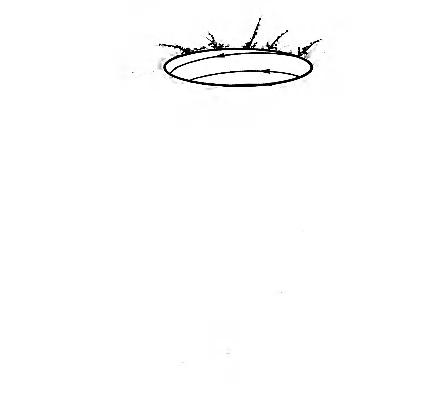
A cavity is a vortex of Qi that, if you could see it, would look like a vase-shaped swirl of energy with a mouth leading into a narrower neck, widening into a broader belly. The word “cavity” depicts a rather dead space, but these vortices are very much “alive.” For that reason, I prefer to call them “Qi vortices.”
Figure 18: Representation of the “Qi vortex” or “cavity.”