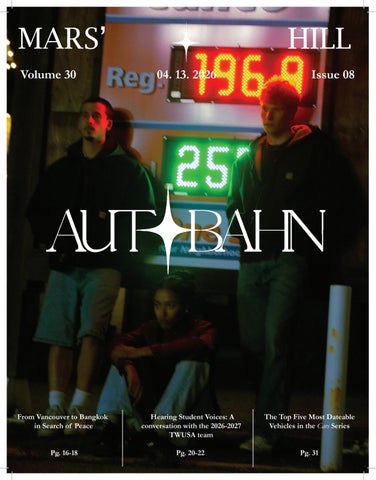
[VOLUME 30] - ISSUE 08 AUTOBAHN

Page 1


From Vancouver to Bangkok in Search of Peace

Pg. 16-18

Hearing Student Voices: A conversation with the 2026-2027

TWUSA team

Pg. 20-22

The Top Five Most Dateable Vehicles in the Cars Series

Pg. 31

From The Editor

Dear Reader,

I find it hard to believe that another school year is coming to a close, and that this is the final issue of Volume 30. As I, and many others, look forward to crossing the stage at graduation and anticipate the adventures yet to come, I am reminded of an open road.

The theme of this issue is “Autobahn” in reference to the German highway infamous for having no posted speed limit, meaning that, on certain sections, drivers can travel at speeds up to 322 km/h. As we race toward final exam season, staff explore Autobahn in literal and not-so-literal ways in our last print issue. In the Community Living section, readers hear from TWU students Lyndsey Darichuk and Samuel Gokul, who attended the Global Peace Summit in Bangkok, Thailand, where they heard stories of peacebuilding around the world, including those of Sulaiman Khatib and Chen Alon, co-founders of Combatants for Peace.

Mars’ Hill looks ahead to the 2026-2027 academic year in this issue’s feature, introducing the new TWUSA executive team

Mars’ Hill

Mars’ Hill is a student publication of Trinity Western University located on the traditional ancestral territory of the Stó:lō people. Floated with funds raised by the Student Association, Mars’ Hill seeks to be a professional and relevant student publication, reflecting and challenging the TWU community, while intentionally addressing local, national and international issues.

Mission to Mars

The mission of Mars’ Hill, as the official student magazine of Trinity Western University, is to inform and entertain its readers, cultivate awareness of issues concerning the TWU community and provide a forum for purposeful, constructive discussion among its members in accordance with the Community Covenant, Statement of Faith and Core Values of the university.

and the ways that they will ensure students’ voices are heard. Over in the Humour section, Staff Writer Adriana Feria-Estrada ranks the top five most dateable vehicles in Disney/Pixar’s Cars franchise.

It has been an honour to serve as the Editor-in-Chief of Mars’ Hill, and it has been the highlight of my university experience working on staff for the last four years. I am grateful to my wonderful team of talented writers, editors, artists and designers for producing an incredible magazine, and I am thankful for every contributor who submitted their work for publication.

I have loved hearing your stories. Thank you for sharing them so they could positively impact our community as much as they have impacted me.

Sincerely,

Editorial Policy

Mars’ Hill encourages submissions and Letters to the Editor. Mars’ Hill reserves the right to edit submissions for style, brevity, and compatibility with the Mission, the Statement of Faith, the Student Handbook and the Core Values of the University. Anonymous authorship of any material may be granted at the discretion of the Editor-in-Chief. Opinions expressed in Mars’ Hill belong to the individual authors and do not necessarily reflect those of the editorial board, Trinity Western University, its officials or its Student Association.

Contibutors

DECLASSIFIEDS

Too scared to ask out that hot girl from RELS class? Have a thought you’re dying to share? Did a professor say something strange or funny? Do you have some information that you want to get out to the student body? Whatever it is, the declassifieds are here for you.

Submit yours at www.marshillmagazine.com/declassifieds-section

Please don’t tell anyone how I live.

It’s March, you know what that means.

RESPECT MAH AUTHORITAH!

EXCUSE ME!!!!

This is what you call . . . A PARADIGM SHIFT

See? I just kicked STAN!

What are you doing in my room? I SAID WHAT ARE YOU DOING IN MY ROOM?!!!!

Stop falling in the DEATH WATER.

Aeiou

OH WENDY!!!!!!

AAAAAAAAAAAAAAHHHHHHHHHHHHHH!!!!!!

If you ever want to get a guy talking ask him his dream car

rip Poopa Stinka ��

Hydration galore ;)

“Nothing is more sexy than seeing my wife preach in the pulpit” - Some TWU prof

Just ask her out bro

Can we normalize people admitting they like us than just being friends and acting really weird?

“Submit a declassified right now” - Julia Jordan

Is that an earthquake? No, it’s just the train.

WHY WOULD YOU PLAY GAMES WITH ME?!

Yes baby yes

Slay baby slay DEBT!

pineapple on pizza is cruel

Sharlotte Neilson is the best volleyball player in the world

Sofia is sooooooooooooooooooooo cool!��

goodbye Mars’ Hill 2026

Mars’ Hill reserves the right to edit or reject submissions based on content and/or length. A printed submission does not reflect an endorsement of any kind, nor does it reflect the opinions of Mars’ Hill or its staff, the student association or Trinity Western University.

ARTS & CULTURE

AUTOBAHN

a curated playlist

Real Gone — Sheryl Crow

Life is a Highway — Rascal Flatts

409 — The Beach Boys

Sh-Boom — The Chords

Take Me Home, Country Roads — John Denver

Everybody’s Changing — Keane

Graceland Too — Phoebe Bridgers

Route 66 — Chuck Berry

Chateau (Feel Alright) — Djo

Uptown Girl — Billy Joel

Flying Car — Headhaunter

Car’s Outside — James Arthur

I Get Around — The Beach Boys

Drive My Car - Remastered 2009 — The Beatles

Moonlight Drive — The Doors

Getaway Car — Taylor Swift

Driving Song — Jethro Tull

Mercedes Benz — Janis Joplin

Rockin’ Down the Highway — The Doobie Brothers

Stuck In My Car — The Go-Go’s

Where The Streets Have No Name — U2

Artist Spotlight: Oli Nicholson

Have you ever scrolled past a Career Centre post on Instagram or gotten your photo taken by Pillar Yearbook and wondered who is behind it? That is Oli Nicholson. She is a creative force at TWU, connecting people through social media, design and photography. Oli shows us that it is okay to have fun and be happy in the pursuit of success. She is also TWU’s dream student—someone who tries everything and is not afraid to put herself out there. She has played rugby at TWU, started out in education, is the editor-in-chief of Pillar, works at the Centre for Calling & Career Development and even walks dogs and cuts hair on the side. Is this what social media means when they talk about “side quests?” Because if a side quest were a person, it would be Oli Nicholson. We could all learn a lesson from her: there are no losses when you are playing for experiences.

MH: Can you tell us your major and year at TWU?

ON: I am a fourth-year student, majoring in media and communication. I have one more semester left after this.

MH: Why did you decide to take your degree at this pace?

ON: In my first year I only took three courses each semester because I was not planning on graduating—I just wanted to do two years for fun. I saw it as character development; I was looking for something consistent but not a full-time job. Having classes gave me community and structure, which was amazing at the time. It has obviously worked out as I am still here!

MH: Where did your creativity first spark?

ON: I grew up in a tiny town two hours outside Victoria, so I did not have easy access to art materials. I often found myself improvising and making things from

what I had. This fundamentally shaped my creative mindset.

“If I wanted something, I would figure out how to make it myself.”

When I got to university, I took a graphic design course— ART 250 with John Wang—and I realized that it was what I wanted to do for a living. I fell in love with it and started taking more media and communication courses. I have been stuck with that for the past three years.

MH: You are a commuter, yet you can be spotted all over campus as if you live here. How are you involved on campus?

ON: I am editor-in-chief for Pillar and work at the Career Centre. I am also a content creator for SAMC and I do photography for the Spartans. I do freelance work as well.

Oli’s favourite colour is green, she LOVES food (of all kinds!) and she loves riding and racing her dirtbike.

MH: Within your work, you do a great deal of creative decision making. How do you see yourself as an artist?

ON: I see myself more as a content creator than a traditional artist. My focus is on communicating messages that others give me. Instead of expressing personal emotion or vision, I translate ideas for clients and organizations into accessible, engaging content. I thrive in collaborative environments where I can make creativity practical. That is why, to me, art is about connection and communication, not just self-expression.

MH: You do not see yourself as a traditional artist, yet you have worked with those mediums before. What kinds of art have you done and how did you learn your

skills?

ON: My creative journey has been really varied. In high school, I painted with acrylics and watercolours. Watercolours especially stuck with me throughout the years, as I find it so unpredictable compared to digital design. I love the feeling of letting go and not being in total control of my art. I also draw. In fact, my notebooks are filled with line art. When it comes to digital art, I learned graphic design, animation and some social media skills through courses at TWU. However, photography and videography are completely self-taught. Overall, I like experimenting and teaching myself new techniques as I enjoy the freedom that comes with working across different mediums.

MH: What is your favourite medium or project to work on?

ON: My favourite thing is always my own projects— whether it is crocheting, drawing or reading comics. When I have a lot of energy, I love dirt biking, which is another creative outlet for me. My dad got me into the sport, and I now teach at events for women on the island. I love the balance between hands-on crafts, digital work and physical activities. I think the opportunity to do everything keeps me from burning out.

“I am a translator, taking big ideas and breaking them down into bite-sized visuals that people can understand.”

MH: How do you approach creating messages in your art?

ON: Art is about communication. When I work for clients, my goal is to make their message accessible and engaging. Whether that is through branding, social media posts or graphic design, I see it as my job. Even when I am working on personal projects, I am thinking about how to connect with others. For instance, there is a family-owned dirt bike shop that I visit all the time. I would end up chatting with the owner’s wife for 20 minutes and just connecting with everyone there. One day, I decided to design a logo for their shop and used my Cricut machine to put it on a hoodie. They loved it, and before I knew it, I was making merch for them. It was such a cool way to combine my design skills with my love for community.

MH: Is there anything else you would like to share with readers?

ON: Everyone needs to find their own way to be creative, even if it is not in the stereotypical sense. Creativity is not just about making art; it is about problem solving and fulfillment in small things, like picking out jewelry or dyeing your hair. Even business majors are creative in their own way. Maximizing creativity in your life, even in small doses, makes you feel more interesting and fulfilled. We are all creative beings, and it is important to find ways to express that.

All My Puny Sorrows: A Book Review

All My Puny Sorrows, written by Canadian Mennonite author Miriam Toews, was published in 2014 by Alfred A. Knopf Inc. It is her sixth novel. Her other works have received much acclaim, particularly A Complicated Kindness (2004) and Women Talking (2018). Women Talking was adapted for the screen in 2022, just as All My Puny Sorrows was in 2021. Toews has received numerous literary awards, such as the Governor General’s Award for A Complicated Kindness, as well as multiple Canadian honours, including receiving an honorary Doctor of Literature degree from Brandon University and appointment as an Officer of the Order of Canada. Toews most frequently writes realist fiction inspired by her own life experiences growing up in a conservative Mennonite community and dealing with the mental health struggles of her father and sister. All My Puny Sorrows is no different; it is grounded in Toews’ familial past to the point that it borders on autobiography. Due to the weighty subject matter, the novel is likely intended for adults and should be approached with caution by those with a history of mental illness and suicidal ideation.

The novel follows sisters Yolandi (Yoli) and Elfrieda (Elf) from their childhood in an isolated Mennonite community to their adulthood in their careers as a supposedly failing author and a world-famous pianist, respectively. Despite her successful life and loving husband, Elf is chronically depressed and suicidal, as was her late father who died by suicide via a train. After Elf’s most recent suicide attempt, Yoli must either support her sister through her recovery and attempt to convince her that life is worth living or heed Elf’s wishes to fly to Switzerland for a medically-assisted suicide.

I found myself feeling very empathetic towards both Yoli and Elf. Both women are incredibly realistic, three-dimensional characters—perhaps due to their autobiographical influence—and their tight sisterly bond carries All My Puny Sorrows forward through its quieter scenes. While the novel feels as if it were written in a single sitting, it is evident how much thought was put into every page as Toews skillfully moves between the past and present with ease, every past detail bringing the reader back to the main conflict between Elf’s desire to die and Yoli’s desire to keep her alive.

“Toews weaves together literary allusions and philosophical reflections without coming across as pretentious and offers an ethical conclusion without straying into sermonic territory.”

On multiple occasions, I was brought to tears by the frank yet devastating displays of grief Yoli experienced after Elf’s death, specifically Yoli’s final look at her sister’s body where she thinks: “I felt a powerful, oceanic feeling of gratitude towards the funeral director who had tried so hard to restore my sister’s beauty for one last look from her mother” (271).

At its core, the novel tells two stories. The first is the universal struggle of life. All the members of the Von Riesen family deal with suffering caused by both external and internal forces associated with the sorrow of their wronged Russian ancestors, and inherited like original sin. Much like the struggle of Sisyphus described by Camus in The Myth of Sisyphus, the question of life’s meaning and thoughts of ending it are explored through Elf’s mental health crises and through Yoli’s struggle to decide whether or not to “kill” her sister by taking her to Switzerland. These philosophical questions are not new in literature. In the past decade alone, novels such as Jay Asher’s 13 Reasons Why and Hanya Yanagihara’s A Little Life have captured the public’s attention with their narratives surrounding suicide, specifically in connection with teens and young adults.

The themes of mental health and medically-assisted suicide in All My Puny Sorrows are even more relevant now than they did when the novel was published in 2014, as Canada has since legalised Medical Assistance in Dying (MAID), and

is currently considering mental illness alone as a qualifying condition. However, unlike these other works, All My Puny Sorrows delivers a far more nuanced depiction of mental health and the tragedy of suicide, balancing sympathy for Elf’s situation with the intense grief that her suicide causes her family and friends. Elf does not want to die because of any explicit traumatic event, but because of a deep-seated, unexplainable mental illness. It is not only Elf who is suffering from her suicidal ideation and attempts, but her entire family and community, who have to put aside their lives to fly across the country and visit her in the hospital, and plan how to watch her constantly when she is let out.

On one hand, as the story unfolds, Toews appears to support medically-assisted dying by seeming to suggest that some individuals—such as Elf and their father—have a “deadline” on

their life before they self-implode, illustrated by the imaginary fragile “glass piano” that resides in Elf’s stomach. Yet Toews makes no attempt to diminish the agonizing aftermath of a family member’s death by suicide, medically assisted or not. Yoli, her mom and the rest of her family are still devastated and tormented by Elf’s suicide many months after it has happened, Yoli descending into alcoholism and harassing the hospital she believes failed to save her sister’s life.

“And yet, Yoli—and Toews, through her—concludes that medically-assisted suicide in her sister’s case would have been the better of two evils because, while it would not have prevented the pain of losing Elf, it would have offered her a more peaceful, dignified death.”

Although mental health and suicide are the main themes of All My Puny Sorrows, another is the love between two sisters. Elf and Yoli’s bond speaks to the complexity and power of sibling relationships, and how they often overshadow other forms of connection. While Elf has a loving husband, it is her sister whom she trusts with the secret of her desire to go to Switzerland. And while Yoli states she “lives hopefully” for the “completely unattainable” desire for “true love,” the narrative implicitly suggests that Elf herself is the love of Yoli’s life (164). However, like most siblings, they also spend a lot of their time together arguing and even insisting they hate one another due to their fundamental disagreement over Elf’s desire to commit suicide: “She wanted to die and I wanted her to live and we were enemies who loved each other” (37-38).

Despite the anguish I felt when reading the novel, I would recommend All My Puny Sorrows to others. Its accessible yet profound prose, realistic familial relationships and reflections on universal questions about life and death delivered through a narrative of the lives of one Canadian family make it an extremely emotional but rewarding read.

Fellow Artists,

Beyond the Artist’s Art

As the academic year wraps up, I want to express my deepest apologies to those I could not interview. I hope, however, to share my experience of the arts through the lens of Pink Chen’s art exhibition, 云山

图卷 (The Scroll of Cloud & Mountain) held on March 19, 2026. From the moment I entered the exhibition, I was enveloped in a world of soft pink, purples and yellows—a colour palette that breathed life into the SAMC Gallery. At the heart of the installation stood the artist himself, a figure of unique serenity. As he walked in a circle around the sheer curtains, describing his artwork, I found myself more drawn to him as a person—not just his art.

As the smoke in Pink’s exhibition settled, it revealed a truth: there is far more to creation than the finished product. It is about the artist’s journey, identity and the connections forged through their artwork. This realization has inspired me to highlight the names of artists whose artwork deserves just as much recognition. Their art will not be forgotten; it will be printed onto the pages of Mars’ Hill magazine, a testament to their presence, forever captured in ink.

What you do matters—more than any of us can truly comprehend. Each brushstroke, each sculpture, each piece of art contributes to a larger narrative that resonates with others. During 云山图卷 (The Scroll of Cloud & Mountain), I saw that synergy between the artist and his work. Yet after the show, Pink stepped away from the spotlight, enjoying a midnight Big Way Hot Pot run with friends. I invite readers to take

solace in that moment after a big show, after a finished project. You are so much more than what you create, and yet, at the same time, you are everything you create. It is a beautiful paradox that often leaves us artists feeling chained, bound by the weight of our own expectations.

Perhaps one day, dear reader, I will pursue my own art degree, inspired by the journeys of artists Kyle Jin, Ben Kim, Hanna Berg, Alanna Yujie, Lola Loveday, Naomi Jacob and Oli Nicholson, who may one day achieve their own international acclaim. And maybe, just maybe, an artist reading this will feel grateful for our art department and the foundation it continues to provide.

If not then, let it be now.

Thank you, SAMC, for supporting artists throughout this term and for nurturing the creative spirit within all of us.

by Elisabeth Menary
by Esther Okebie
by Emma Helgason
by Emma Baias

by Elise Coutts
by Geneva Schut
by Eva Agbonkhese
by Lola Loveday

COMMUNITY LIVING

From Vancouver to Bangkok in Search of Peace

In a world that feels more divided than ever, the need for peace has never been more urgent. I had the opportunity to sit down with two inspiring TWU students, Lyndsey Darichuk and Samuel Gokul, who are already making waves of change throughout our community. These two students are only in the third year of their undergraduate degrees and have already travelled all the way from Vancouver to Bangkok, Thailand to attend the Global Peace Summit. This event was held at the United Nations Conference Centre in Bangkok over three days. Individuals from around the world gathered to further learn about the need for lasting peace.

MH: Can you share about your experiences attending the Global Peace Summit and what motivated you to attend?

LD: Attending the Global Peace Summit was an incredible experience. It gathered around 400 to 450 individuals from many different backgrounds, all passionate about peacebuilding. I was motivated to attend because I aspire to work in global human rights, particularly for women in conflict zones. The lineup of speakers, the women from these areas of conflict, was something I felt I needed to learn

from.

SG: For me, this summit was something unique. It was an opportunity to engage with people who have faced unimaginable challenges. Hearing their stories provided me with perspectives on real issues that I never would have imagined.

MH: What was it like stepping into the United Nations Conference Centre on the first day?

LD: The moment we arrived at the summit, I was struck by the environment. Being escorted by police to the United Nations Conference Centre was surreal. The security checks and the grandeur of the venue really set the tone for the gravity of the discussion we were about to engage in. It truly was a mixture of excitement and intimidation.

MH: What was one of the most impactful stories you heard during the summit?

SG: There was the story of two speakers from the organization Combatants for Peace. One man was an Israeli soldier and the other man was a Palestinian soldier. They almost shot each other but chose

peace instead. Their journey of starting a peace movement together was incredibly powerful to me.

LD: One story that stood out to me was from Lejla Damon, who was born because of wartime sexual assault in Bosnia. Hearing her talk about the stigma she faced and how it affected her relationship with her mother was heartbreaking. Her story is inspiring and further reinforces my commitment to global human rights, especially regarding women’s rights.

MH: What were some other conversations that took place?

SG: Over the three days, the United Nations Conference Centre was filled with testimonies from various speakers. The main goal was to discuss how to engage with peacebuilding efforts and the importance of understanding different perspectives. I made friends with a genocide survivor who is now a speaker. We exchanged contact information, and it was remarkable to hear his stories firsthand.

LD: I met many interesting people, including students from Singapore who were very curious about Canada. I also connected with a roommate from Abu Dhabi, which was a great opportunity to learn about her culture. As for the sessions, there were many key figures, such as professors who shared their insights on creating lasting peace.

“What I learned is that every small action contributes to a larger movement.”

MH: How do you see this experience impacting your future careers?

SG: This summit reinforced the idea that peacebuilding is a collective effort that transcends individual disciplines. Thus, it is important for everyone regardless of their background to en-

gage with global issues.

LD: Hearing these stories has given me a face to connect with conflicts that I want to address. It motivates me to focus on women’s issues in my career and reminds me of the importance of understanding the human side of these challenges.

MH: What advice would you give to students at TWU regarding engagement with global issues?

SG: You do not need to be in international studies to be involved in peacebuilding. Everyone can contribute through their own fields, whether it is art, nursing or any other discipline.

LD: I encourage students to take the time to read and stay informed about what is happening in the world. Even small actions can lead to major changes in any community.

Lyndsey and Samuel remind us that you do not have to study international relations to contribute to lasting peace. Their experiences at the summit show that anyone can play a role in creating a better world. As they share their stories, I encourage readers to reflect on how they, too, can help foster peace in their own communities. After all, the next generation of leaders is ready to step up and inspire change, and in times like these, the voices of Lyndsey and Samuel are not just important—they are essential.

FEATURE

Hearing Student Voices: A conversation with the 2026-2027 TWUSA team

Sadie McDonald

You may know Senater (Sena) Tese by her warm smile or welcoming nature. Perhaps you have met her in the Trinity Western University Student Association (TWUSA) lounge, as Sena is the vice president of student relations (VPSR) for the 2025-2026 academic year. Regardless of whether or not you have had the privilege of meeting the fourth-year business administration student, you have likely seen the “Vote for Sena” signs across campus.

This year’s TWUSA executive elections began when applications opened on January 12 and ended with voting from January 21 to 23. President-elect candidates Sena Tese and Tunu Kibe were closely matched, with Tunu receiving 45.8 percent of the votes and Sena receiving 48.8 percent of the votes. The remaining 5.4 percent of votes were for no candidate.

New and returning TWUSA members making up the 2026-2027 executive team include Executive Vice President Shalom Obakin, Vice President of Finance Arturo Lombardo, Vice President of Academic Relations Brooklynn Delainey and Vice President of Student Relations Calista Chung.

Alongside the executive team are the newly appointed faculty representatives: Diana Chakharian (Business), Yasas Sritharan (HKIN), David Kim (FHSS), Spencer Dyck (SAMC), Lily Liu (Education), Shaurya Dewani (FNAS) and Savreet Kaur (Nursing).

Mars’ Hill asked the members of the TWUSA 2026-2027 executive team to answer: How will you ensure that students’ voices are heard?

President Senater (Sena) Tese

“It’s not just about how students’ voices are being heard, but also how they are being understood,” clarified Sena. “Both staff and students need to continuously work together to bridge understanding. There are realities that we are not exposed to as students that limit us from fully understanding what is taking place. In a similar manner, I think it is easy to not fully note how students might

receive changes taking place.”

As this is her primary goal for next year, Sena aspires for this understanding to go both ways. “I hope we can work together and build more unity within our community regardless of what happens,” she said. According to Sena, TWUSA is here to figure out what the students need to know, the best ways to communicate that information and how to help students so that they can have a better TWU experience.

“I’m really excited for next year. I think a lot of this year was listening and also trying to understand and finding methods that work. Next year, it’s still continuing, . . . but we also want to make sure that [students are] being understood, and decisions are being made with that in mind,” said Sena. It is important to note that Sena does not think that students are going unheard; rather, she feels that students need to know that their voices are heard, and what changes take place from the feedback they provide. “We’re still trying to figure out what really works for us as a community,” she concluded.

“What we’re trying to do is be open and listen to students [by] putting ourselves in their positions,” said Arturo. “[Since] we are in different years, majors and situations, our goal should be [to understand] what they’re going through, what is happening and how we can be of support.”

Now in charge of TWUSA’s finances, Arturo is determined to understand how he can be the best bridge between the student body and TWU, particularly when it comes to how money is allocated. For him, listening to students’ voices is not simply pouring money into advance; rather, he intends to create value by strategically investing in different faculties.

“As vice president, my role is to make sure that the team is set up in a way that students can engage with the different people on the team,” said Shalom. “For me, it just looks like [being] able to respond to any student’s question, . . . even if they have to be directed to the right person or [if I need to say], ‘Okay, I don’t have this answer right now, but I will go find an answer for you and work something out.’” Shalom intends for each member of TWUSA to incorporate student engagement into their roles. She will also be sitting on the TWU Senate, and will ensure that students’ perspectives are taken into account before the senate’s final decisions are made.

Vice President of Finance Arturo Lombardo
Executive Vice President Shalom Obakin

“We are here to be the voice of students. We are here to make sure that faculty and the Executive Leadership Team (ELT) understand what students are feeling and are trying to say, and present that in a manner that faculty and the ELT can also understand,” Shalom elaborated. In doing so, Shalom hopes that the information provided to faculty and the ELT becomes something tangible that they can work on and proceed with.

Vice President of Academic Relations Brooklynn Delainey

Brooklynn intends to work with faculty representatives to support students and their decisions relating to clubs and academics. “This is important to me because students are so often overlooked when standing alone,” she said. “I aim to promote club ratification and potential club ideas so students have a wider variety of clubs they can join and express themselves through, [and that] way students feel heard and seen through both their passions and academics.”

Vice President of Student Relations Calista Chung

Calista believes that having student voices be heard is a given and hopes to create a space where all feel welcome. “Although I cannot ensure perfection in my role, whatever that may truly look like, I can ensure that I act, speak, and think in a way that allows students to feel comfortable enough to come to me with the issues they are facing,” she said, emphasizing that TWUSA is a space where students are ready to serve. “We are not some prestigious club; we are servants of the student body.”

Above all, the executive team is determined to

best empower the students they serve, supporting them through advocacy, opportunity and community.

Sena is most excited about seeing what the Lord will do within TWUSA and TWU. “I feel like there’s a powerful thing that’s going to happen next school year. There seems to be such a shift and somehow an understanding of that shift because I’m starting to see a lot more people involved in prayer or discipleship,” she said.

“The beautiful thing about our institution is that we really do care for every person. And for those who don’t feel that, that is so fair. But I just hope that people understand that we’re all working together to make this experience a great one for each and every person.”

Ultimately, Sena’s hope is for TWUSA to do things for the Lord. “At the end of the day, if the name of the Lord is not glorified, then I do not know what I’m doing. And what does that look like? That means we are intentional in love; we’re intentional in service. We’re intentional in saying sorry when we’ve done wrong, and we’re intentional in humility,” she concluded. “It’s not gonna be easy, but I think it’s going to be something so beautiful.”

OPINIONS

A Love Letter To Slowness

There is this weird pressure to always be moving.

Not just doing things, but doing them faster. Finishing your degree quickly. Building a resume early. Replying right away. Figuring out your life before you have even had time to experience it. And if you are not keeping up, it feels like you are doing something wrong.

Slowness does not really exist in that environment. Or if it does, it is framed as failure. You took too long. You fell behind. You “wasted time.” There is always a better, faster, more efficient way you could have done it.

Even rest is not really rest anymore. It is “recharging,” meant to get you back to being productive. It is scheduled, justified, optimized. You are not supposed to simply stop but to recover quickly and keep going. Eventually, it starts to feel off.

You can be constantly busy and still feel like nothing is sticking. Like you are moving through things but not really processing any of it. It all kind of blurs together. That is the part no one really talks about.

“Speed promises more life but often delivers less of it”

We have built this version of life where everything moves quickly and there are not many natural points to slow down. No real limits. You just keep going because you can. Because everyone else is. And yeah, that sounds like freedom. No one is stopping you. No one is setting the pace. But it also means you are the one responsible for knowing when to slow down. And most of us are bad at that.

So things speed up without us really choosing it. You take on more. You say yes to everything. You move from one thing to the next without much space in between. Not because you decided to but because that is just the default. And yes, I am talking to myself here. We have learned how to move quickly but forgotten how to arrive. Slowness, at that point, starts to feel uncomfortable. Even a bit wrong.

Like when you have a free afternoon and do not know what to do with it. Or when you are walking somewhere without checking your phone. Or when a conversation does not have a clear point or outcome. It feels unproductive. Pointless, even. But those are usually the moments that actually stick.

That is when you notice things. That is when conversations become real instead of just efficient. That is when you actually have time to think instead of just reacting. Slowness is not about doing nothing. It is about not rushing everything. In other words, slowness is not the absence of motion; it is the presence of attention.

And that is harder than it sounds because everything around us is built to keep us moving. There is always something next. Another deadline, another email waiting, another thing you could be doing. So choosing to slow down is not natural but intentional.

It might look like taking longer to figure things out instead of forcing a decision. Letting a conversation go on instead of checking your phone. Not filling every gap in your day just because you can. Small stuff, but it changes how things feel. Because the goal probably is not to move as fast as possible through everything. It is to not burn out halfway through. It is to actually remember what you did, who you were with, what mattered to you at the

Winding Path

If there was ever one warning I would have loved to have before I grew up, it would have been: it is going to be tough. When I was young, I was that starry-eyed kid with steadfast determination for whatever I wanted to be at the time: designer, photographer, actress. Every new idea for my future was immensely interesting and deserved the utmost attention. But as I grow up, I find that this determination hides away, too scared to hold onto anything because now I have to think of something fiveyear-old me never had to consider: the job market.

There is a suffocating feeling that swallows me whole when I think about the future. Every time I feel like I am doing too much while simultaneously being 10 steps behind everyone else. The quarter-life crisis arrives earlier than expected. AI, the economy and global news do not create a very inviting environment for young people, and even though we may not talk about it, we feel it. We feel it every time we see more troubling news, every time AI improves, every time we talk about what the future has in store for us.

And yes, this uncertainty may be paralyzing. But it does not have to be permanent. The fear is real, and so are the possibilities. Even within all the unknown that lies beyond the confines of the classroom, new paths are emerging. Although it may feel overwhelming to look into the sea of possibilities, to turn to the next chapter, there are amazing things to be discovered. Nihilism in our day and age may feel all too powerful in its pull, but the flowers blossoming all around as spring comes to greet us show that there is always beauty waiting for us after the dark.

You deserve to look forward to what comes next. It is undeniably tough, but it is also incredible to see that so much of the story is still unwritten. So take a breath and do it scared. Apply for that opportunity, even if you believe you are not ready. Stick to your path, even if it was not the original plan. Be determined and attentive to what comes next in your story. Come up for air and dive back into the possibilities. You can do it.

SPORTS

Spartan Spotlight: Yemane Muguleta

Hamdan Sadiq Chaudhry

MH: What is your year, team, position and major?

YM: I’m in my second year at TWU, competing with the track and field and cross-country team as a distance runner. I’m majoring in human kinetics.

MH: How did you first get involved with running?

YM: I first got involved with running through school and local meets when I was younger. As I kept improving, I started taking it more seriously and realized I had potential. From there, it became something I really committed to.

MH: Tell us about your favourite track and field moment.

YM: One of my favourite moments was hitting a personal best and seeing all the hard work come together. It showed me that consistency and discipline really pay off.

MH: What are you most looking forward to for next season?

YM: I’m looking forward to improving my times, competing at a higher level and helping the team succeed. I know I still have another level to reach and I’m excited to chase it.

MH: What does your time after TWU look like, both for running and a career?

YM: After TWU, I want to continue competing at a high level in running and see how far I can go. With my human kinetics background, I also want to stay involved in sports through training, coaching or performance work.

HUMOUR

The Top Five Most Dateable Vehicles in the Cars Series

Have you ever found yourself attracted to an animated character? If so, don’t worry—you’re not the only one. These characters often possess qualities that are considered attractive, and I’d like to explore a few examples from the Pixar animated series, Cars.

Finn McMissile: A car who lives up to his name. McMissile is a British espionage agent with the gadgets and skills to escape any situation. He’s confident, charismatic and pulls off a moustache— which is no easy feat. However, he has plenty of enemies and dat ing him likely comes with the risk of mid-dinner ambushes.

Tow Mater: Mater is loyal, adventurous and unapologetically him self. He’s not the most attractive or sophisticated tow truck—and he once mistook wasabi for pistachio ice cream—but he’s got a great heart.

Red: Red has a gentle soul. He waters flowers, cares for his com munity and isn’t afraid to show his emotions. While this is import ant, his tendency to have dramatic meltdowns might be too intense for some.

Lightning McQueen: At first glance, McQueen has it all. He’s young, fast, confident and determined to become a champion. However, his self-centredness and arrogance make him less attractive. Fortunately, McQueen redeems himself and learns the value of community and sportsmanship, so some might consider him the full package.

Doc Hudson: The legendary “Hudson Hornet” is the classic retired racer with a guarded past. He may not be flashy, but some are attracted to older partners. As an experienced car, he’s reliable, judicious and wise.

These are just a few of the most dateable vehicles in the popular Pixar series. However, attraction is subjective, and if none of these vehicles appeal to you, there are plenty of other options to choose from.

Cami Lavender’s Advice Corner

Cami Lavender

With the help of the lovely Mars’ Hill team, I received a list of questions from the TWU student body asking for some kind of advice. I am Cami Lavender, and welcome back to Cami Lavender’s Advice Corner!

From: Car Guy What car is the best to turn into a flying car?

Forget cars. Let’s go back to the old school: wagons, buggies, chariots. Let’s take a cue from Santa and Apollo and let mythical flying creatures carry us across the sky, instead of pistons and batteries dragging us across the concrete.

If I were given a wish, I’d wish for more working Canadians to commute by mystical flying creatures: pegasi, unicorns, griffins, dragons and the like. Emissions would drop, traffic might finally improve and the morning commute would become at least a little more beautiful.

I like to imagine my little sister turning 16, my parents leading her into the garage and her opening her eyes to find not a car but an ornate stagecoach pulled by golden geese. Honestly, I think she’d like that more.

So my response to you, Car Guy, is this: forget the flying car. What mythical beast would you ride to class?

Thoughts on Cybertrucks?

I think it’s incredible that in 2026 we’ve collectively agreed it’s normal to drive around in what looks like a low-poly video game asset. The Cybertruck is less a vehicle and more a statement, like someone took modern art, gave it wheels and said, “Yes, this will survive potholes.” It’s bold, and it refuses to look like anything else on the road. And that’s kind of the point. It’s fun to look at. Marketed as tough, resilient, even bulletproof, this eraser-looking vehicle somehow also comes with electrical quirks and panels that make it look like a temperamental refrigerator. Maybe that’s where the appeal is. It’s unfinished and experimental, and if they keep pushing it, there’s a version of this thing in the future that might actually live up to the vision.

From: Matcha

Please help me: give me breakfast ideas. I never eat breakfast.

Let’s take the pressure off. You don’t need a “proper” breakfast, you need a gentle start. If you’re not hungry, breakfast will always feel like a chore. Don’t force it. Build something light, consistent, and easy to return to.

Start with fruit, add a warm drink, and layer in a little protein later. If solid food feels like too much, go liquid. A blender opens up a lot—smoothies, shakes, whatever works! And if you don’t want the effort, even milk or a simple protein drink gets the job done. The goal isn’t perfection, it’s fuel. Something small that tells your body and brain the day has started.

Thank you so much to the mysterious strangers who submitted these questions, and thank you for reading the final chapter of Cami Lavender’s Advice Corner!

With much love and many waffles, Cami Lavender

Mars’ Hill Is Hiring!

Are you an artistically-or creatively-minded person? Do you want a place to work on your design skills? Mars’ Hill wants you!

Apply to be on the 2026/2027 Team!

Email marshill@gmail.com for more information or apply using the QR code below! We’d love to have you.

Turn static files into dynamic content formats.

Create a flipbook