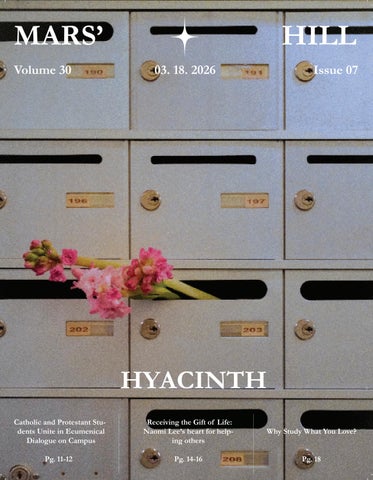
Catholic and Protestant Students Unite in Ecumenical Dialogue on Campus
Pg. 11-12

03. 18. 2026
![]()
Catholic and Protestant Students Unite in Ecumenical Dialogue on Campus
Pg. 11-12

03. 18. 2026
Receiving the Gift of Life: Naomi Lee’s heart for helping others
Pg. 14-16
Why Study What You Love?
Pg. 18


Dear Reader,
As the days stay lighter for longer and purple crocuses and yellow daffodils bloom, I find it easy to feel joyous that spring is coming. For British Columbians, this March marks the last time that the clocks will spring forward, marking a year-round daylight saving time. Reminiscent of spring, the theme of issue seven is “Hyacinth.”
In Flora Symbolica , John Henry Ingram writes that the hyacinth was “the floral hieroglyph of play ” (126). However, the mythological origin of this “fairy-like fragile flower” (126) comes from the death of the Spartan prince Hyacinthus, who was loved by the sun god Apollo. Zephyrus, the god of the west wind, was so jealous of Hyacinthus that when Apollo and Hyacinthus were playing discus, Zephyrus sent a wind that made Apollo’s disc strike Hyacinthus in the head, killing him instantly. Unable to save him, Apollo created the flower Hyacinth, which sprang up from his blood. From this, a three-day festival called Hyacinthia was born, both grieving the death of Hyacinthus and celebrating his rebirth as a flower.
Mars’ Hill is a student publication of Trinity Western University located on the traditional ancestral territory of the Stó:lō people. Floated with funds raised by the Student Association, Mars’ Hill seeks to be a professional and relevant student publication, reflecting and challenging the TWU community, while intentionally addressing local, national and international issues.
The mission of Mars’ Hill, as the official student magazine of Trinity Western University, is to inform and entertain its readers, cultivate awareness of issues concerning the TWU community and provide a forum for purposeful, constructive discussion among its members in accordance with the Community Covenant, Statement of Faith and Core Values of the university.

Staff and contributors explore new life and play in this issue of Mars’ Hill . In a new installment of Cami Lavender’s Advice Corner, Cami tackles relationship advice, from asking someone out to making friends. Over in the Opinions section, Staff Writer Adriana Feria-Estrada reminds us of the importance of a liberal arts education and following your passions. In this issue’s feature, Mars’ Hill interviews third-year nursing student Naomi Lee on her gift of life after receiving a heart transplant, and her desire to make a difference in the lives of others.
I hope you feel encouraged while reading this issue of Mars’ Hill and are reminded of the beauty that life holds. New beginnings are all around us, some instantaneous, some gradual and some we purposely have to search for.
Sincerely,

Mars’ Hill encourages submissions and Letters to the Editor. Mars’ Hill reserves the right to edit submissions for style, brevity, and compatibility with the Mission, the Statement of Faith, the Student Handbook and the Core Values of the University. Anonymous authorship of any material may be granted at the discretion of the Editor-in-Chief. Opinions expressed in Mars’ Hill belong to the individual authors and do not necessarily reflect those of the editorial board, Trinity Western University, its officials or its Student Association.
Cami Lavender (Cameron Lebold) Centre for Calling & Career Development
Orion Snow
Parnika Trivedi
Too scared to ask out that hot girl from RELS class? Have a thought you’re dying to share? Did a professor say something strange or funny? Do you have some information that you want to get out to the student body? Whatever it is, the declassifieds are here for you.
Submit yours at www.marshillmagazine.com/declassifieds-section

When will it stop raining…..
If you have a crush on someone you see around but haven’t met, and don’t know how to approach him/her try this! “Hey I’ve seen you around, but I don’t think we’ve properly met before, my name is (your name). Whats your name?” That simple! You got this!
People need to stop laughing at 67 in classes.
CAN SPRING COME?
I can’t believe we got teased with one day of sunshine only for it to rain the rest of the week.
I’M NOT FINISHED WITH YOU!!!!
Come to 7:07-ish Improv workshops every Monday night at 9 p.m. in RNT 237!
Jesus loves you
I hate celebrities. Boycott celebrities!!!!
There’s a cute guy in my public speaking class, can someone introduce us?
How y’all aren’t more mad about the Epstein files is absolutely baffling to me.
Mars’ Hill reserves the right to edit or reject submissions based on content and/or length. A printed submission does not reflect an endorsement of any kind, nor does it reflect the opinions of Mars’ Hill or its staff, the student association or Trinity Western University.

Hyacinth a curated playlist
bundle of hyacinths — Field Medic
Flowers In December — Mazzy Star
Flowers In Your Hair — The Lumineers
Hyacinth House — The Doors
Monochrome — Mumford & Sons
Bumblebee — ABBA
Imitation Of Life — R.E.M.
Sunflower, Vol. 6 — Harry Styles
WILDFLOWER — Billie Eilish


Faith Nelson
Sea of Tranquility, authored by Emily St. John Mandel, was published in 2022 by Alfred A. Knopf. A Canadian author born and raised in British Columbia, Mandel has published numerous short stories, essays and six novels, Sea of Tranquility being the most recent. Mandel is the recipient of five awards, including the coveted Arthur C. Clarke Award for her 2014 novel Station Eleven. Her first three novels, which are less popular, skewed towards the mystery and crime fiction genre, while Station Eleven and Sea of Tranquility align more with science fiction. The intended audience of Sea of Tranquility appears to be adults, though I imagine a well-read teenager could understand it. The novel would best be enjoyed by readers already interested in science fiction or time travel novels, as those unfamiliar with the tropes and conventions associated with these genres might become confused by the non-chronological plot.
The novel primarily follows four characters in four distinct times and places: the exiled remittance man Edwin St. John St. Andrew in the fictional Caiette on Vancouver Island in 1912; the modern widow Mirella Kessler in New York City in 2020; the moon colonist author Olive Llewellyn visiting Earth for a book tour in 2203; and the Time Institute employee Gaspery-Jacques Roberts on the moon colony in 2401, a time traveller who interferes in the other three characters’ lives in search of answers about an unexplained “anomaly” that spans the timeline and may reveal that the universe is nothing more than a simulation.


Following a chiastic-like structure, the unfolding of the plot slowly reveals the mystery of what ties these characters together, revealing what life truly means in a possibly illusory world in which a never-ending story always appears to be ending. As Mandel writes, “as a species, we have a desire to believe that we’re living at the climax of the story … We want to believe that we’re uniquely important, that we’re living at the end of history … [b] ut all of this raises an interesting question … what if it always is the end of the world? ... [b]ecause we might reasonably think of the end of the world … as a continuous and never-ending process” (189-90).
Unlike hard science fiction, the novel is less concerned with the technical mechanics, structure and traversing of the space-time continuum than it is with the philosophical implications of humans and their relationship to time. Witnessing the protagonists struggle with their spatial and temporal existence is more relatable thanks to Mandel’s appeal to universal human experience rather than to futuristic, speculative imaginings.
“Just like Kazuo Ishiguro’s Never Let Me Go, Mandel’s Sea of Tranquility does not rely on technical jargon or obscure scientific thought experiments to
convey its philosophical musings and message; in her story, time travel acts as a vehicle of the affective experiences of its pro
tagonists.”
The scientific background becomes a way for Mandel to reflect on how individuals choose to live based on their relationship to time. This novelistic theme calls to mind Martin Heidegger’s theory of being-unto-death, in which confronting our own morality should cause individuals to live more authentically and abundantly. However, in Sea of Tranquility, Mandel is more interested in the collective experience of the human race when they perceive the end times are near.

Despite its innovative theme, intricate plot and engaging prose, the novel is not without its flaws. If the reader is familiar with science fiction conventions, especially with other intertwining, temporally and spatially complex, multi-narrative novels like Cloud Atlas, they might find Sea of Tranquility’s conclusion predictable, as it ties together four seemingly unrelated narratives in a somewhat contrived fashion. Further, the storylines of some secondary characters do not have satisfying endings, such as that of Vincent Smith, whose life and death are covered in fuller detail in Mandel’s previous novel, The Glass Hotel, which many readers might not have known was a companion story. Another apparent weakness of the novel is that the introduction of Gaspery at its midpoint renders many of the other characters’ stories less relevant and their plotlines are hastily wrapped up or left unfinished.
However, Mandel does successfully convey the key moral or message of the novel through Gaspery’s character. Gaspery is the one who comes to realize the futility of his desire for and fear of time when he reaches the end of his narrative arc. At this point, he recognizes that he, in his pursuit of excitement and knowledge, had “moved too fast” and “too far,” losing much of his life in the process, and realizing in his newfound wisdom that he “wished to travel no further” and decides to be “a still point in the ceaseless rush.”
Mandel, therefore, appears in Sea of Tranquility to encourage readers to slow down, move through our existence at a calm and steady pace and experience life in its fullness as it stands before us. This, she suggests, is necessary, whether we are living during “the end of the world” or not.


Justin Namoro
On March 2, 2026, students from Catholic Pacific College and Trinity Western University gathered in the DeVries Auditorium for a night of ecumenical dialogue between Catholic and Protestant traditions to foster Christian unity. Hosted by TWUSA and CPCSA, this event served as a space for students to hear theological topics in a respectful and open environment, allowing them to reflect on their own beliefs and the beliefs of those in other Christian traditions.
The dialogue had a panel of four theology professors: Dr. Craig Allert and Dr. Kent Clarke of TWU and Dr. David Henderson and Dr. Andrew Kaethler of CPC. Each professor talked about their own perspectives rooted in their respective traditions and offered students a few insights on how Catholic and Protestant theology intersect and differ on various issues of faith.
Topics throughout the evening were centred on three aspects of the Christian faith: sacramentality, spirituality and salvation. The panelists discussed what it means to be “saved” from both Catholic and Protestant viewpoints. The discussion then carried on to baptism, where the professors looked at when a person should be baptized according to their respective denomination.
The Eucharist was another topic that brought up similarities and differences in understanding the presence of Christ in communal bread and

wine. The panel then engaged in the topic of Scripture, looking at how Catholics and Protestants approach interpretation, the role of tradition and the importance of context in understanding God’s Word. Following the panel discussion, students were invited to directly ask the professors questions. The Q&A session became a fruitful exchange where students sought to explore and understand differences and agreements in faith.
The night ended beautifully, with all the attendees joining together to sing the Doxology. This shared worship experience created a sense of unity among all Christians present. Despite the differences in theology, practice and authority, all present were united in their devotion to Christ.
Events like this bring out the importance of ecumenical dialogue between Christians of various denominations on campus.
“Although both Catholicism and Protestantism have doctrinal differences, open conversation that comes from a place of understanding, respect and curiosity can bring unity to the body of Christ.”
The ecumenical dialogue at the DeVries Centre Auditorium brought both the CPC and TWU communities together and fostered meaningful engagement across both Christian traditions.


Sadie McDonald
Third-year nursing student

Naomi Lee never intended to pursue a career in healthcare. That was until June 2020, when the then-19-yearold and her siblings caught the flu. While they recovered, Naomi ended up with pneumonia and viral myocarditis, which is inflammation of the heart muscle caused by a viral infection. According to Emergency Care B.C., symptoms of myocarditis include chest pain, palpitations and fatigue. It was during that first hospital admission when Naomi was told she had congestive heart failure (CHF)—news that came as a complete shock to the previously healthy teenager.
Sent home on medication and a salt and fluid-restricted diet, Naomi lived with heart failure for two months. Unfortunately, she did not respond to the medications and her CHF worsened. When Naomi returned to the hospital, ventricular fibrillation sent her into cardiac arrest; she was defibrillated and CPR was performed for 20 minutes before she was put on life support. Six days later, Naomi underwent an emergency surgery to have a left ventricular assist device (LVAD) implanted in order to help her heart pump blood to the rest of her body.
“Recovering from the LVAD surgery was one of


the most difficult and painful experiences of my life in every way—physically, emotionally, spiritually and mentally,” she recalled. “I was honestly still in denial. I was only 19. This [didn’t] make any sense. . . . I didn’t get a say in that surgery because it was an emergency, and I wasn’t conscious for that decision.”
Naomi’s doctors had hope that her heart would recover on the LVAD, avoiding the need for a transplant; however, an echocardiogram performed six months post-emergency surgery determined that her heart muscle would never recover, making a heart transplant Naomi’s only option. In total, Naomi lived with an LVAD for 10 months, and fortunately, she only had to wait three and a half months before she got the call that a donor heart was available. Naomi received her heart transplant on July 17, 2021, and her surgery was complication-free, resulting in only a 10-day hospital stay. She is required to take immunosuppressants to prevent her body from recognizing her donor heart as foreign and rejecting it. “I have to take a big handful of pills twice a day, 12 hours apart. My anti-rejection medications are for the rest of my life, and that is what is keeping me alive. I regularly drive out to St. Paul’s Hospital to get a four-month supply,” Naomi said.
Unfortunately, these medications are not without side effects, including a decreased ability to fight off infections and an increased risk of developing cancer, especially skin cancer. “I am also really careful about germs because my immune system is suppressed, so I get sick a lot more easily,” Naomi explained. “I get sick for longer, and then sometimes it hits me harder. I’m mindful about [hanging out with] my friends if they’re not feeling well.”
It was difficult for Naomi to articulate all the ways her life has changed since her transplant, but two of the biggest changes include her decision to study nursing and a new perspective on life.
“I was in education, and I love working with kids. I was really excited to be a teacher, honestly,” she recalled. “But then, after my transplant, I felt that I really needed to try nursing. Being a nurse was never something that I wanted to do, or thought that I was capable of doing. I had to start from scratch, [but] I’m very happy with my decision.”
Now close to five years post-transplant, Naomi’s positive outlook on life has decreased her anxiety. “I can absolutely see how going through a crisis like I did can make somebody very afraid, and there are aspects of my life where I am very afraid. But in terms of like mental health, I actually have changed for the better,” she said.
“I don’t have anxiety about all the things that I used to have anxiety about. . . . I can’t care as much about what people think [because] at the end of the day, I know it’s not the end of the world.”

Currently working as an employed student nurse on a medicine unit, Naomi has also given back to the community through volunteering with B.C. Transplant (BCT) by sharing her story with classes at Douglas College and being a member of BCT’s Social Media Ambassador Program.
According to BCT, an organ donor can save up to eight lives. When asked what she wanted readers to know about organ donation, Naomi said, “Anyone can be an organ donor. It’s really easy, and it only takes two minutes to register. I want people to know that it doesn’t affect doctors trying to save you ifyou’re in an accident. There’s truly nothing else that can be done when you get to the point where your organs are able to be donated.”
However, Naomi also acknowledged that this is not always a straightforward decision. “I think it’s always hard to talk about death, and I want to be sensitive because the reality is that somebody’s loved one is dying in a sudden and tragic way,” she said.
“I just want to acknowledge that even though we don’t talk about death specifically when we say be an organ donor, we are. It is absolutely life-changing and life-saving. There are people who have very little quality of life without a healthy organ, and I wouldn’t be here if I hadn’t gotten a heart transplant. You’re saving someone’s life.”
It is because of this gift of life that Naomi is now looking forward to her future nursing career after graduating from TWU. “I know that I want to help people, and I know that nursing makes a really big impact because I’ve experienced that. I’m really excited to make a positive impact in people’s lives,” she told Mars’ Hill. “When a nurse walks in, doesn’t acknowledge you, and just pokes, prods and moves on, that feels really bad. It’s not that hard for a nurse to walk in, . . . look you in the eye and put their hand on your shoulder. It’s not that hard to be kind, and it makes a big difference. I know the power of a wonderful nurse, and I want to be that for people.”
To register your organ donation decision in the B.C. Organ Donor Registry, please visit https://register.transplant.bc.ca/.

Adriana Feria-Estrada

On my first day at TWU, a pre-engineering student asked me what I was studying. I said English, and he said, “Oh,” as if disappointed with my response. However, when I added that I would like to become a lawyer, he said, “Wow, that’s so impressive,” and proceeded to ask follow-up questions. I think it is fair to assume a few things from this interaction. First, that students often compare sciences and humanities instead of regarding both faculties with respect. Second, that most students in the humanities have had similar conversations where they feel judged or interrogated by others. Third, that several students experience a crisis where they wonder if they made a mistake by choosing to study the humanities.
My goal is to reassure these students that they did not.
A few weeks into my first year, I listened to Fareed Zakaria’s commencement speech, “The Importance of the Liberal Arts.” In it he states that this education is at the centre of what it means to be human because it teaches students how to develop arguments, express their ideas and write well. Zakaria demonstrates that a liberal arts education provides students with the opportunity to expand their knowledge and develop skills that are necessary for any profession.
I understand that students are concerned with job opportunities; however, employers do not simply determine an applicant’s employability by their degree. They also consider their skills and professional experiences, both of which students can develop throughout university. The job market is competitive, and even for those who opted to work in technology or other in-demand industries, job security is not guaranteed. Therefore, if “you can fail at what you don’t like, you might as well take a chance on doing what you love” (Jim Carrey). For one, I loved studying the humanities, and I hope that this article reassures other students that they made the right choice.

Cristina Pedraza
If you are unfamiliar with the term, interventionism occurs when a state or group of states interfere with the domestic issues of a nation. It is a tool that has been widely used to manipulate states’ actions and future directions. While some people rally in support of this measure, it has often proved to be quite unsuccessful at actually bettering the lives of the citizens it swears to defend.
We often sit on one side of the news. One narrative. One idea. It is this maneuver that makes us think that ultimately, when there are complicated situations in global affairs tied to unfit rulers, the solutions and responses are simple. Intervention should take place. A true and infallible way for nations to finally do better. But, with interventionist measures being taken for the second time in the first two months of the year, where are we heading? And what happens to the people left behind?
We like to think politics are simple, a jigsaw puzzle that will be clear as soon as you place just one piece in it. But the reality is that politics encompasses far too many moving, complicated pieces for it to ever be that simple. One measure, like intervention, is often insufficient to achieve lasting stability and thinking it will is misguided.
In January, Venezuelan President Nicolás Maduro was removed from power and taken into custody justified by the regime’s connections to drug trafficking. Later on, at the end of February, military strikes against Iran shook the nation and killed Supreme Leader Ayatollah Ali. This attack came with shifting justifications ranging from preemptive action against threats to the need for a different regime. In the case of both nations, it appears that little consideration was given to the institutional frameworks these na-tions
will need to rebuild. Both were branded as security threats, subjected to intervention and, as a result, their citizens now face highly uncertain futures.
This pattern is not new. If we consider the interventions in Afghanistan, Iraq and Libya during this millennium, even though their regimes were quite different from Venezuela’s and Iran’s, the approach was similar. These nations are a testament to what happens when these interventionist measures are not taken seriously or handled with the care that they require. When there are no functioning bureaucratic, fiscal and security institutions during and after interventions, instability reigns supreme and reconstruction becomes nearly impossible. Afghanistan, Iraq and Libya were all left to collapse in the aftermath of interventionism. For both Venezuela and Iran, the main question now is whether these nations and their citizens will be able to rebuild without the guardrails needed to weather this instability.
National support for interventions is divided; some welcome an overdue change in their country while others fear for their future and the future of the nation. The idea that a state is abandoned without support and left to fend for itself after the actions of another continues to trouble many onlookers. Displaced families, collapsed economies and prolonged conflict are just some of the consequences that come with interventions—consequences that are evident but rarely acknowledged in our media narratives. I, like many, do not know where we are heading in international politics, but we should demand more from those who make these decisions: more accountability, better plans, genuine commitment to rebuilding. We owe this and more to the people whose lives are disrupted in the process.

Hamdan Sadiq Chaudhry
MH: What is your year, team, position and major?
AH: I’m a final year student and I play on the men’s soccer team. My position is centre-back and my major is human kinetics.
MH: How did you first get involved with soccer?
AH: I started playing soccer at a really young age, around Grade 1, thanks to my parents. They were the ones who first introduced me to the sport and signed me up to play. What started as something fun quickly became something I was truly passionate about and really loved and became obsessed with. I loved being on the field, learning new skills and being part of a team. My entire youth was with Surrey United Soccer Club, where I had the opportunity to compete at a high level.
MH: Tell us about your favourite soccer moment.
AH: I’ve had so many great moments through my soccer journey, but one that really sticks out was the year we got to play against the University of Victoria at ThunderFest. The game was at their stadium, and there were over 3,000 people packed into the stands. I had never experienced anything like that before. Walking out and seeing a full crowd, hearing the noise from the fans and feeling that energy was incredible. Even though we ended up drawing the game, it’s the atmosphere that I remember the most. It was one of those moments that reminded me why I love the game so much.
MH: What are you most looking forward to for next season?
AH: I am graduating soon and have some important decisions to make in the coming months.
“No matter what path I choose, my main goal is to continue improving and becoming the best version of myself, both as a person and as an athlete, because I still have so much more room to grow.”
Ultimately, I’m working toward earning an opportunity to compete at the next level professionally.
MH: What does your time after TWU look like, both for soccer and a career?
AH: I’m hoping to play professionally either this upcoming fall or at the beginning of the next year, whether that opportunity is here close to home or overseas. It will ultimately depend on where I’m able to earn a chance to sign a professional contract. Playing pro has been a dream of mine since I was a little kid, and I want to pursue it and play for as long as my body physically allows me to. I think also getting the opportunity to see different parts of the world through the sport I grew up playing is a bonus. Once I’m finished playing, I still see myself being involved in soccer. Coaching is something that really interests me because it would keep me connected to the game while helping it grow for the younger generation. I’m also passionate about fitness, so becoming a personal trainer for young athletes is something I would love to do as well.

Orion Snow

I want to show you all the beautiful places
On this spinning blue planet we call home— Mountains that rise like ancient dreams, Seas that whisper poems in languages lost.
But more than that— I want to see you seeing them. Your eyes lighting up like first dawn
As cherry blossoms fall across Kyoto streets, As the northern lights waltz in Iceland’s sky.
I want to see your breath catch When we stand at the edge of the Grand Canyon, And hear your laughter echo Through the alleys of a sleepy town in Italy.
I want to watch you take the world in One breathtaking moment at a time—
Your smile, More beautiful than anything I could show you.
Because in the end,
No view, no wonder, No sunrise or skyline, Will ever be as beautiful
As watching you fall in love With the world.
Parnika Trivedi
I never used to like sunsets. They reminded me of unfinished movies paused right before the credits roll, books left as the pages turned to epilogue, hoping the story could live forever, running away from goodbyes. They proved I never liked endings. It remained beyond me how we could place memories in a box so neatly, keep them safe for years, only to tuck them away one day.
How can we flip through the familiar pages of a once-loved book, breathe in that warm scent of memory and then just shut it close?
I used to hold my fist tightly closed, never letting things go. And loved waking early to watch the sunrise, the quiet before the rush of the day takes over.
Full–and still incomplete.

They say time brings wisdom. And now I chase sunsets.
I let my fist unfurl. I open my palm— there is nothing there. Because things end, And we must let them, So something new can grow.
It feels surreal to see light resting on the trees, the tips of branches bright red, everything washed in gold, honouring the day’s last breath as if the sky itself is learning to let go.
The world slows for a heartbeat. Things ineffable glimmer in the hush of evening.
I look at it in awe now, a soft smile resting on my lips, my heart full peaceful as the sun sets.


With the help of the lovely Mars’ Hill team, I received a list of questions from the TWU student body asking for some kind of advice. I am Cami Lavender, and welcome back to Cami Lavender’s Advice Corner! If you’d like me to answer your question in the next issue, just pop it over to me using the QR code below.
There’s a really cute girl in my RELS class: how do I ask her out? God told me that she is my future wife.
Method proven to never fail: write a poem on some poster boards, get your best Bluetooth speaker and approach your crush in a public setting of some kind. The location is the most important part of this approach. The more bystanders present to witness your grand gesture, the better. Trust me.
This is the next step: play your song and proudly display your poem to your crush. While I won’t dictate the content of your poem, I would recommend ending it with “a call to action,” something that encourages a response from your wife-to-be. Something like, “Will you be my girlfriend?”
I’m sure your RELS girl will love the opportunity to get all the attention. This puts you in a perfect position to win her over.

From: CoCo Puffs
What do I do if my boyfriend just farts wayyyy too much? They’re also silent which makes it 10 times worse.

Perhaps I can relieve your situation with a few suggestions. What follows will be five suggestions varying in drasticness.
1. Put him on a vegetarian diet, girlie! According to my biology assistant, a vegetarian diet may lead to a reduction of the chemicals that make farts smell. Over time, the microbiome inside your boyfriend’s gut will change and will lead to less noticeable acts of flatulence. Although my biology assistant states that for some, the vegetarian diet causes one to pass gas more. So, consider the trade-off before taking this action.
2. Dump him?
3. Make him promise to warn you from henceforth. Better yet, write up a binding contract. You deserve the courtesy of a siren so that you may prepare for the chemical bomb. This may compensate for your boyfriend’s silent cheek-slapping style, as there is no audible cue for you to make your escape. This will not stop the farting, but at least you are legally protected from any crop-dusting henceforth.
4.Fart back. If all else fails, fight flatulence with flatulence. If you can’t beat ‘em, join ‘em. Deliver a mighty blow to his morale by serving a taste of his own medicine. Establish dominance by defeating your boyfriend at his own game.

From: Miss Marmalade
I have trouble making friends. What would be your top three suggestions to help me?
Put yourself into situations that force repetition. Classes at TWU are one example: try joining a club, volunteering somewhere or visiting the collegium/atrium at the same time every day. Try to step out of your comfort zone if you can, do something strange—something you never considered. By doing this, you will be in regular contact with a group of people. The key here is consistency; friendships are built brick by brick. With moments of vulnerability and kindness over time, a friendship can bloom.
Be the one to take the next step, to push the interaction one step further. Keep the stakes low, but extend an opportunity. Invite someone to join you for coffee after class, sit together at the cafeteria, whatever. This can be super intimidating, but more often than not, it’s worth overcoming the feeling of discomfort. Good friendships form when someone takes that chance, and that could be you.
Ask good questions and listen like you mean it. Forget the generic icebreakers, and really dig for something more interesting. Everyone is unique, and how you approach a friendship will be different each time. So, listen well. If a friend is worried about an exam, excited for a holiday or heartbroken, be the friend who can follow up and ask about how they are doing.
Thank you so much to the mysterious strangers who submitted these questions, and thank you for reading! If you’ve got something on your mind for next time, send it my way!

Mars’ Hill Is Hiring!
Are you an artistically-or creatively-minded person? Do you want a place to work on your design skills? Mars’ Hill wants you!
Apply to be on the 2026/2027 Team!
Email marshill@gmail.com for more information or apply using the QR code below! We’d love to have you.


Alpha Ministries Canada seeking Support Workers & Leadership role. May-Jul. Paid. Apply: Organization's website.
DeVry Greenhouses looking for Internship/Co-op (paid); Summer Employment; Full-Time; Field Placement (unpaid). Contact employer
Focus on the Family Canada seeking IT, marketing, and graphic design intern, bilingual assistant. May-Jul. Paid. Apply via LinkedIn, Indeed, or website.
Hope for Women seeking volunteers. Unpaid. Apply: Organization's website.
MCC and SALT seeking Third Shop Assistants, HR, Fundraising & Marketing, Indigenous Program Asst. Paid. Apply: Organization's website.
Big Brothers and Big Sisters seeking Summer Camp Coordinators & Program Sta . Jun-Aug. Paid. Apply: Organization's website.
ELIC accepting applications for Field Placement or Practicum (unpaid); Short term teaching programs. Contact employer.
Vancouver FC seeking Street Team Representatives. Apr-Oct. Paid. Apply: Organization's website and social media.
Inclusion Langley Society accepting applications. Contact employer for opportunities.
Mennonite Central Committee (MCC) looking for Summer Employment; Field Placement (unpaid); International service. Contact employer.
Caliber Project seeking Wood Working Assistant and Recreational Counselling Support. Unpaid. Apply: Organization's website.
Enterprise Mobility seeking Management Intern (Customer Service & Sales). May-Aug. Paid. Apply: Organization's website.
Horizon Contracting Group seeking Landscape Maintenance & Tree Watering. May-Jul. Paid. Apply: Organization's website.
Kawkawa Camp & Retreat Center accepting applications for Summer Employment; Part-Time Job. Contact employer for speci c roles.
Mission Community Services Society seeking Administrative, Filing, Driver, HW Club Assistant. Unpaid. Apply: Organization's website.
New Hope Community Services seeking Programs Intern - Supporting Newcomer Children. Paid. Apply: Organization's website.
Trinity Rangers seeking Practicum only (no summer employment). 2 month placements. Unpaid. Email awolf@younglife.ca
Stable Harvest Farm accepting applications for Summer Employment. Contact employer for speci c roles.
O cial Languages Programs accepting applications. Contact employer for opportunities.
Ridge Meadows Association seeking Community and Residential Support roles. Paid. Apply via Indeed or Company website.
Statistics Canada seeking Supervisor and non-Supervisor positions. May-Aug. Paid. Apply: Organization's website.
Career Connect – Log in, update your profile, check out the resources and helpful handbooks. Then start applying for jobs that fit your summer goals.
Quinncia – Upload your resume and let the AI coach help polish it! Then, ace your mock interviews with instant feedback.
Join a Workshop or Event – Learn insider tips on job hunting, networking, and discovering your calling.
For links to part time, full time, or summer opprutunitues, scan the QR code to learn more and apply.
PNE seeking Concession Attendants, Food Runners, Maintenance, Security, IT Seasonal, CSR's. May-Aug. Paid. Apply: Organization's website.
SOLAHIS (Seeds of Love and Hope International Society) accepting applications. Contact employer for opportunities.
Surrey Urban Mission Society applications for Field Placement or Practicum (unpaid); Summer Employment. Contact employer for speci c roles.
Know Your Strengths - The CCCD’s Discover tools help you figure out your skills, values, and calling so you can apply for jobs that fit.
Use Every Experience - Don’t overlook school projects, volunteering, or part-time work.
Apply Smart on Career Connect - Search TWU’s job board for summer roles made for students! Tailor your resume and cover letter to match what the employer’s looking for.
Questions? Email us at Career@twu.ca or come by our office in the Reimer Student Centre.
Write for Mars’ Hill!
Is there a story you’ve been wanting to tell? Are you looking for an opportunity to share your writing with a larger audience? Send your pitches or articles to us by emailing marshill@gmail.com.
Sections: Arts & Culture Community Living
Creative Writing
Feature Opinions
Sports Humour

22500 University Drive, marshill@gmail.com Langley Twp, marshillmagazine.com/ British Columbia, IG: @marshillmagazine Canada X: @marshillnews V2Y 1Y1