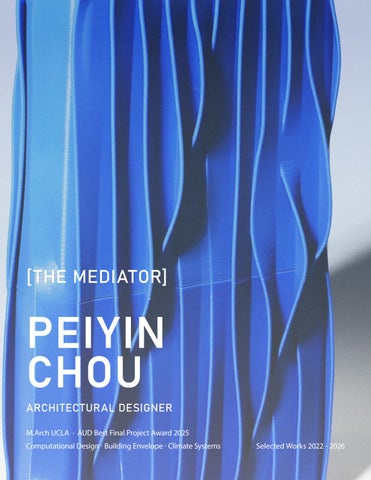
PEIYIN CHOU
ARCHITECTURAL DESIGNER
M.Arch UCLA · AUD Best Final Project Award 2025
Computational Design · Building Envelope · Climate Systems Selected Works 2022 - 2026


PEIYIN CHOU
LinkedIn | pzxcv0204@gmail.com
I work at the intersection of performance and form — designing systems where environmental data drives both geometry and material behaviour. From parametric façade retrofits to adaptive housing, my projects move between computational analysis and construction detail, treating the building envelope not as enclosure, but as an active mediating layer.
EDUCATION
University of California, Los Angeles
Master of Architecture, 2022-2025
(RIBA Part 2 Equivalent)
Shih Chien University
Bachelor of Architecture, 2014-2019
EXPERIENCE
Variation Design
Architectural Designer (Project Lead)
MNOffice
Architectural Intern
IMO Architecture + Design
Architectural Designer
C.T.Chen & Partners Architects
Junior Designer
SUEP / Hirokazu + Yoko Suemitsu
Architectural Intern
CREDENTIALS
LEED Green Associate
∙ Graduated with Distinction (Top 10%)
∙ AUD Best Final Project Award (2025)
∙ UCLA AUD Fellowship (2022-2025), Wendell Scholarship (2024), John V. Mutlow Scholarship (2023)
∙ Judges Award, IEAGD (2019)
∙ Published in Taiwan Architect (TA) Magazine, Vol. 290
∙ First Place, Architecture Student Competition (2015)
Remote (US-based contract)
Sep 2025 - Present
Los Angeles, CA
Aug 2023 - Dec 2023
Taipei, Taiwan
Feb 2022 - Aug 2022
Taipei, Taiwan
Mar 2020 - Dec 2021
Tokyo, Japan
Jul 2016 - Sep 2016
Credential ID. 11694734, Sep 2025 - Sep 2027
THERMAL SPIRALS
Façade retrofit · Parametric system
Housing prototype · Density strategy
Adaptive reuse · Structural transformation
10/2024-12/2024 10/2024-06/2025 10/2023-03/2024 09/2025-12/2025
Modular housing · Prefabrication system
BIM · Façade detailing · CD delivery

THERMAL SPIRALS
Climate-responsive retrofit system reducing solar gain by 45% through material intelligence.
Overview
A parametric façade retrofit drawing on the Nautilus shell's geometry as a design system — translating solar exposure data into differentiated lamella depth and density across the building skin.
Applied to LA's Trust Building, the system reduces solar heat gain by 45% while transforming environmental data into a dynamic visual interface.
FDM-printed without support material, the self-supporting geometry achieves zero-waste fabrication. Thermochromic PLA shifts from blue to white at 31°C, making thermal response visible in real-time.
Designer | Individual Project
Concept Design – Technical Development
Building Retrofit | Façade System
Los Angeles, CA (Trust Building)
Rhino, Grasshopper, Ladybug, FDM 3D Printing, Adobe Suite
Parametric façade system + Full-Scale Prototype
Winner of the AUD Best Final Project Award (Class of 2025) Role
45% reduction in solar heat gain | Self-supporting geometry enabling zero-support fabrication
Julia Koerner | UCLA M.Arch Research Studio | Fall 2024 - Spring 2025


Study of Repetition
Material Research


Study of Rhythm


Study of Resonance
Thermochromic PLA shifts from blue to white at 31°C, making solar response visible on the surface.

Typology of Vertical Lamella Systems
Seven lamella typologies function as combinatorial units — grouped in sets of five and varied through mirroring and rotation to generate the full façade composition in response to solar exposure.


Low Efficiency
Solar Exposure Mapped to Façade Performance


Climate-Responsive Retrofit
The façade system adapts to solar exposure, reducing heat gain by up to 45% while maintaining daylight access and views.


High Efficiency
Solar analysis directly informs lamella density and depth, increasing shading on highexposure façades while maintaining openness and visibility elsewhere.


Programmatic Interface
Facade system integrated at ground level to mediate between public street and interior workspace, maintaining visual permeability while providing solar shading.
Tectonic Assembly
Cable Tension System — A standardized cable tension system anchors lightweight 3D-printed panels directly to existing floor slabs, reducing load on the original structure while accommodating construction tolerances.
Dry-Joint Assembly — Rapid on-site installation without wet trades. Designed for Disassembly (DfD), components can be individually unmounted for maintenance or recycling — aligning with circular economy principles.
FLOOR SURFACE MATERIAL AIR BARRIER / GAP
CONCRETE SLAB
STEEL DECK
STEEL BEAMS
GYPSUM BOARD
SHEATHING
BRICK WALL
SHEATHING
CONCRETE WALL
SHEATHING CBU BOND COAT
FLOOR SURFACE MATERIAL AIR BARRIER / GAP
CONCRETE SLAB
STEEL DECK
STEEL BEAMS
GYPSUM BOARD
Wall Section Detail
WALL FIXTURE
CABLE STRUCTURE
3D PRINT PANEL
Assembly Detail

BRICK WALL
3D PRINT PANEL
SHEATHING
CABLE SUPPORT STRUCTURE
CONCRETE WALL
WALL FIXTURE
3D PRINT PANEL
CABLE SUPPORT STRUCTURE
WALL FIXTURE
Geometry & Efficiency
Lamella depth tapers vertically with structural load, eliminating printing supports and reducing filament waste by 30% while maintaining lateral stability.


Material Fabrication Logic
FDM-printed panel designed as a self-supporting façade component, reducing material waste while maintaining structural performance.

Material Behavior & Tactile Response Test
The thermochromic PLA skin acts as a tactile interface, visually shifting from blue to white at 31°C. This passive reaction visualizes thermal transfer in real-time.
HOUSE OF FEATHERED EDGES
Interlocking housing system increasing density while preserving spatial quality and open space.
Overview
A housing prototype rethinking the LA row house — where unit boundaries dissolve into curved, feathered edges that soften the threshold between urban density and domestic retreat, generating shared light wells and double-height volumes in the gaps between.
The system increases density fivefold while expanding open space from 45% to 65%, generating double-height volumes and shared light wells without compromising spatial quality.
Instructor
Designer | Group Project with Fengqian, Xing
Concept Design
Housing Prototype
Los Angeles, CA
Rhino, D5 render, Adobe Suite
Architectural proposal + Physical Model
Open space expanded from 45% to 65% | Density ×5
Miroslava Brooks | UCLA M.Arch Advanced Topic Studio | Winter 2025

FAR: 0.55 | Open Space: 45%
Proposed Prototype
FAR: 0.35 | Open Space: 65%
Urban Density StrategyDensity Without Bulk
Massing Evolution
Extrusion
Defining Buildable Envelope
This proposal increases density fivefold — from 1 to 5 units — while expanding open space from 45% to 65% with a lower FAR (0.35 vs 0.55).
GROUND DIAGRAM
Erosion
Curving Edges to Soften Boundaries
Modulation
Varying Roof Heights for Rhythm
Recesses for Solar Access & Privacy
Duplication
Mirror Units to Form a Cluster
Prototype Final Interlocking Form
Interlocking System
Unit A and Unit B interlock in section — shared light wells and double-height volumes emerge from the structural weaving between units.
1FUnitA

Thresholds in Motion
Circulation acts as the connective tissue of the housing system, weaving through interlocked units to create transitions and encounters. Beyond access, it operates as a threshold — where public and private begin to overlap, transforming movement into a catalyst for exchange.


Unit A_Kitchen
Unit A_Living Room
Unit A_Powder Room
Unit B_Dining Space
Unit B_Kitchen
Unit B_Living Room
Unit B_Courtyard
Studio_Kitchen
Studio_Living Room
Studio_Bathroom
Studio_Bedroom
Unit B_Master Bedroom
Unit B_Bedroom
Unit B_Bathroom
Unit A_Master Bedroom
Unit A_Workspace
Unit A_Balcony
Unit A_Master Bedroom


DYNAMIC AXES
Reorienting industrial structure through rotational massing and sectional intervention.
Overview
An adaptive reuse project transforming a former industrial warehouse into a High School for Design and Innovation in Downtown LA's Art District.
Retaining the historic north facade and structural trusses reduces embodied carbon while the rotational massing breaks the warehouse's linearity — generating a sunfilled central courtyard as the social heart of the school.
Designer | Group Project with Soe Naing Win
Concept Design – Schematic Development
Adaptive Reuse / Educational Building
Art District, Downtown LA
Rhino, D5 render, V-Ray, Adobe Suite
Architectural Proposal + Physical Model
Adaptive reuse proposal retaining historic trusses as primary structur | CD-level wall sections resolving façade-to-structure interfaces.
Miroslava Brooks | UCLA M.Arch Major Building Design Studio | Winter 2024 - Spring 2024

Truss Diagram
Preservation as Framework
Instead of demolition, the design treats the existing industrial shell as a protective wrapper. The historic north facade and rhythm of the steel trusses are preserved — reducing embodied carbon while maintaining the site’s industrial memory.
Massing Diagram
Centripetal Organization
The new massing rotates to mediate between the orthogonal city grid and a focused learning environment, breaking the linearity of the warehouse and generating a sun-filled central courtyard as the social heart of the school.


GYPSUM


DUAL SEASON
Transformable housing system adapting to seasonal migration and changing modes of living.
Overview
Role
A housing prototype addressing the crisis facing 400,000 migrant farmworkers in California's Central Valley.
A transformable “L-Module” shifts between seasonal residential and commercial use — negotiating between mobility, permanence, and environmental responsiveness through adaptable envelopes and off-grid systems.
Output
Outcome
Duration
Designer | Group work with Emalee Davidson, Pan Nga Chan, Weihan Zheng
Concept Design – Prototype Development
Small-Scale Housing | Modular System
Fresno, California's Central Valley
Rhino, D5 render, V-Ray, Adobe Suite
Architectural proposal + 400 sq.ft. Prototype + Site Planning
Competition entry · 10th Microhome Architecture Competition |
Modular housing prototype + off-grid self-sufficiency system
Sep 2025 - Nov 2025


Proto-typical Site Plan


Between Seasons — From Isolation to Community
California’s Central Valley feeds a nation, yet 400,000 farmworkers lack adequate housing. Replacing scattered seasonal cottages with a prototypical cluster model, the proposal minimizes infrastructure sprawl while fostering the community network essential for migrant worker resilience.
Kinetic Infrastructure “The L-Module”
A transformable “L-Module” consolidates all domestic utilities — sleeping, hygiene, and storage — allowing the interior to expand for habitation or compress for commerce. No heavy machinery required; users reconfigure their environment entirely based on seasonal needs.


Prefabrication & Logistics
Components are prefabricated and designed to fit within a single standard shipping container. This flat-pack strategy reduces transport costs and enables rapid assembly on sites.


Cast-in-place concrete foundation
Foldable casework core
Moisture barrier
Timber framing with wood fiber insulation
Sheathing
Timber rafters
Metal roof panel with gutter
Skylight system (north-facing)
Perforated aluminum panel
Exterior wall assembly with insulation
Corrugated metal panel
Windows and doors
Rainwater storage tank

Rainwater Harvesting System
Integrated into roof geometry

Renewable Energy System
Supporting off-grid operation

Skylight System
Optimizing daylight penetration

WENZHOU INSTITUTE
High-Rise Residential Façade Development & BIM Coordination.
Role Overview
Key Contributions
Architectural Designer | Façade & BIM
Delivered construction-ready façade detailing and BIM coordination for a 19-storey luxury residential tower — resolving wall assemblies, façade-to-structure junctions, and coordinating across structural and consultant teams from SD to CD.
Impact
Project
Practice
Duration
Tools
• Developed façade wall sections and construction detailing
• Produced Revit BIM models for coordination across consultant packages
• Resolved façade-to-structure junctions for buildability
• Coordinated with structural engineers and consultant teams
Coordinated construction-ready façade details across structural and consultant teams, enabling buildability on a 19-storey tower from SD to CD.
Luxury high-rise residential tower, 19 storeys
C.T. Chen & Partners Architects | Taipei, Taiwan
2020 - 2021
Revit (BIM), AutoCAD


EMBRACE LIGHT
Residential Project Delivery & Construction Coordination.
Role Overview
Architectural Designer | Project Delivery & Coordination
Led material selection and on-site mock-up review for curved stone cladding, verifying buildability against 3D models prior to installation. Developed and coordinated CD drawing packages, and site execution through construction administration.
Key Contributions
• Curved stone cladding mock-up review and buildability verification
• CD drawing sets covering façade, interior finishes, and carpark
• Coordinated floor-to-floor height conflicts with structural engineer
• Exterior detailing and interior public space design
Verified buildability of curved stone cladding prior to installation, preventing onsite conflicts through mock-up review and 3D model coordination.
High-end residential tower, 14 storeys
IMO Architecture + Design | Taipei, Taiwan
Feb 2022 – Aug 2022
Rhino, AutoCAD, D5 Render

COAF SMART CENTER
International Competition & Visualization including Site Strategy and Spatial Planning.
Role Overview
Key Contributions
Architectural Intern | Schematic Design & Visualization
Developed spatial planning and site strategy for an international competition project in Goris, Armenia — integrating program organisation, circulation, and building form with a steeply sloped landscape.
Impact Project Practice Duration Tools
• Developed site planning and spatial strategies
• Produced plans, sections, and diagrams
• Created high-quality renderings for design communication
• Developed Rhino + V-Ray visualization workflow for competition submission
Contributed to full competition submission integrating site strategy, circulation, and visualization across a steeply sloped landscape; supported team's international competition entry from concept to presentation package.
Cultural and Educational Campus Competition
MNOffice | Los Angeles, CA, USA
2023
Rhino, V-Ray, Adobe Suite


www.linkedin.com/in/pei-yin-chou
pzxcv0204@gmail.com