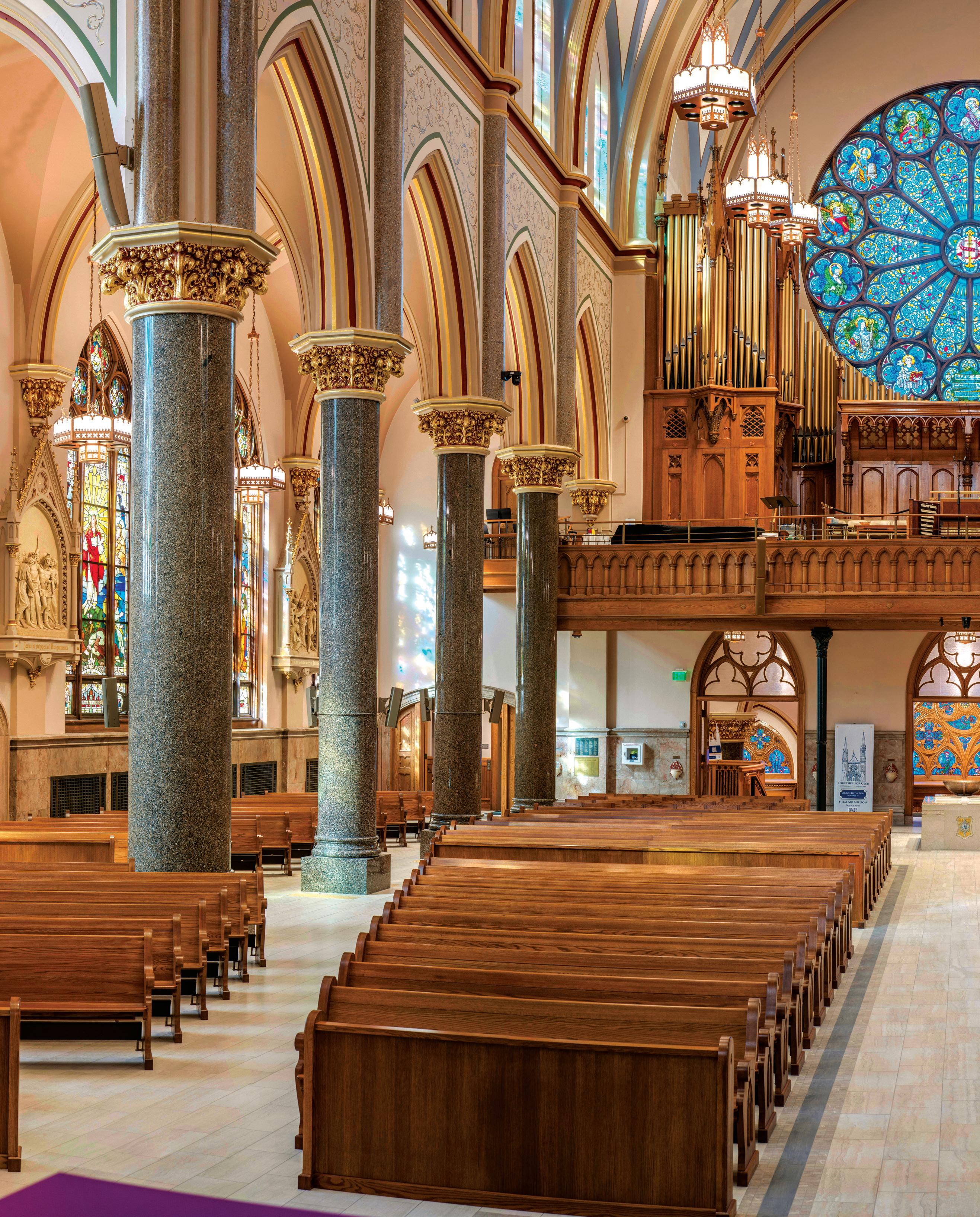
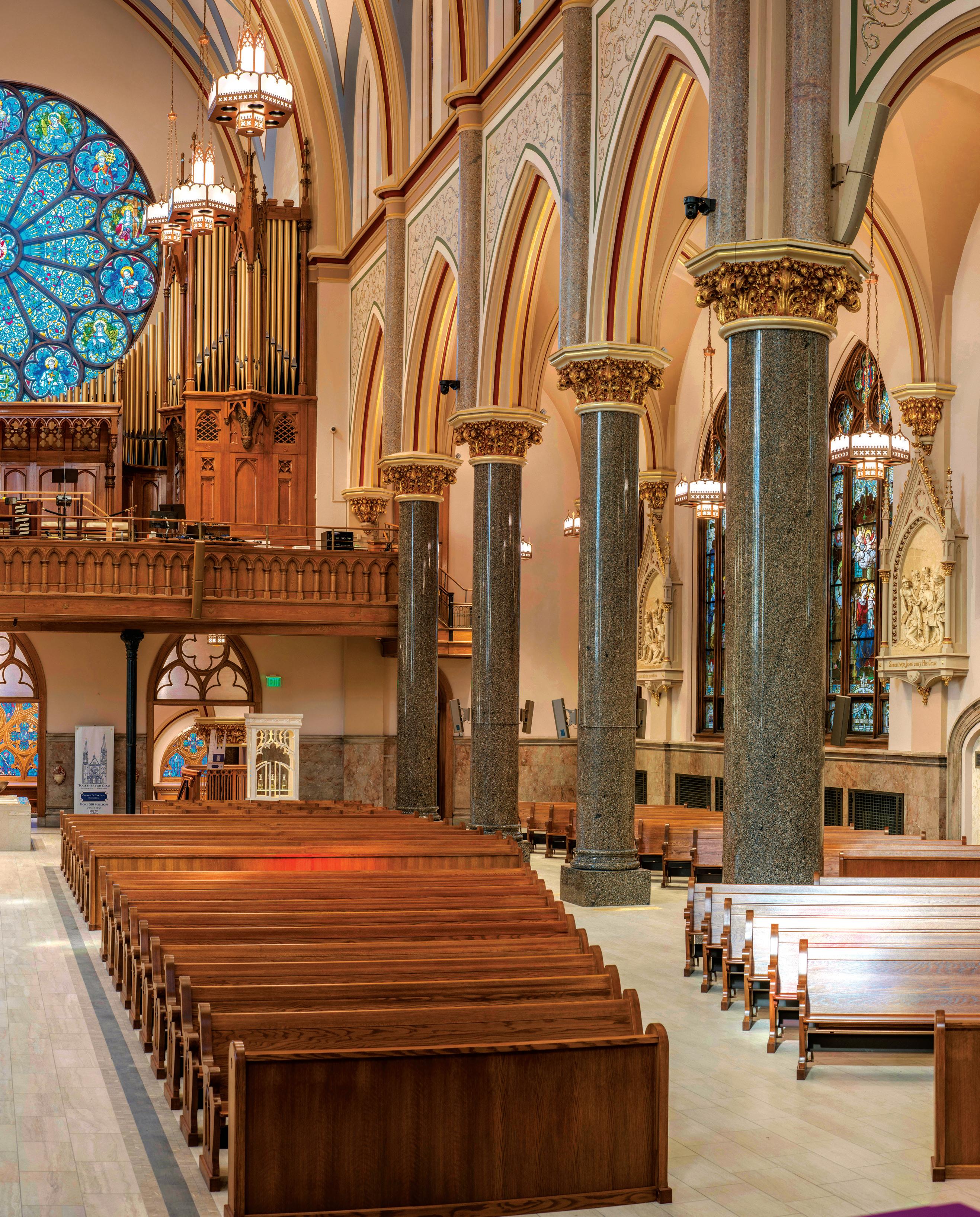
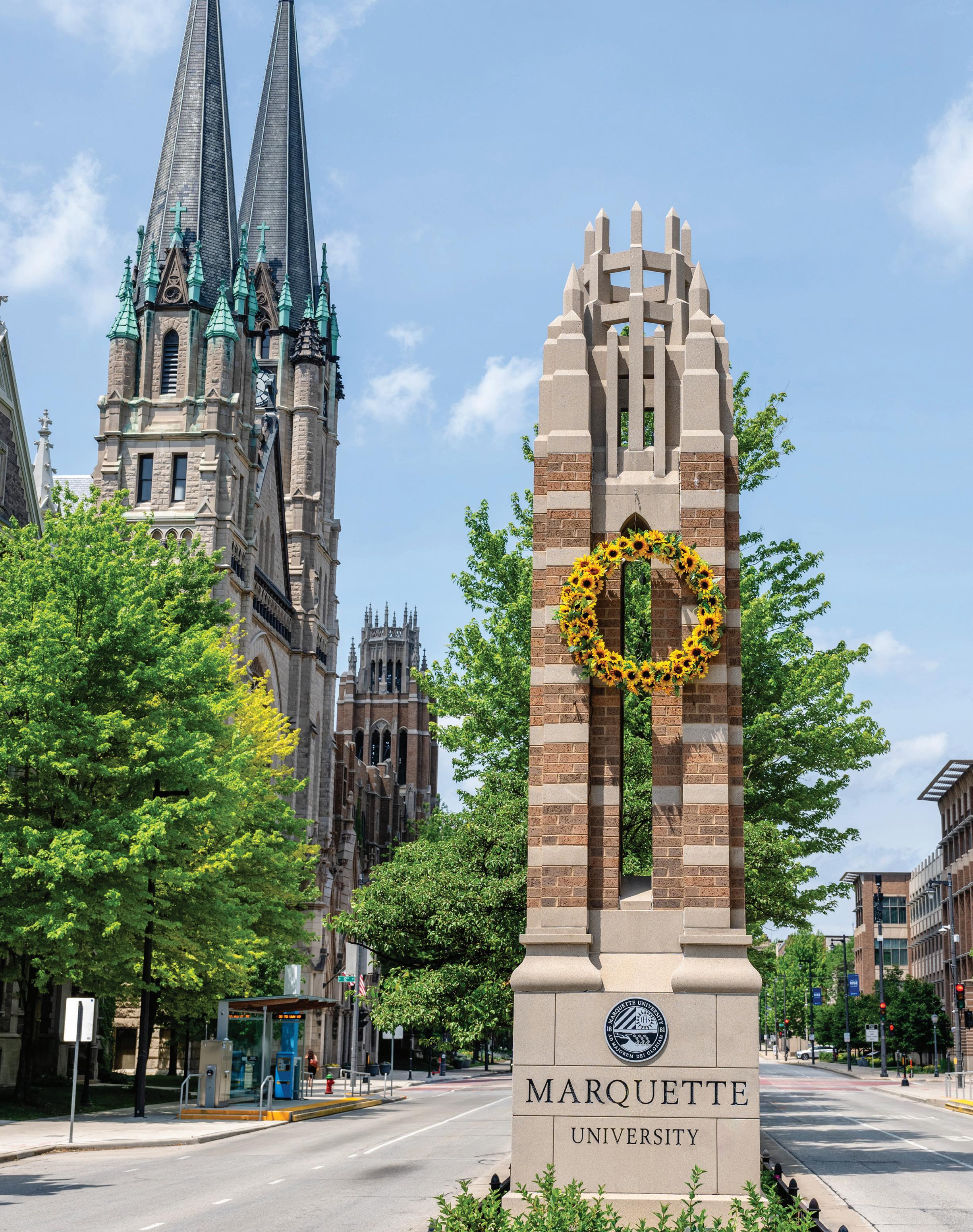
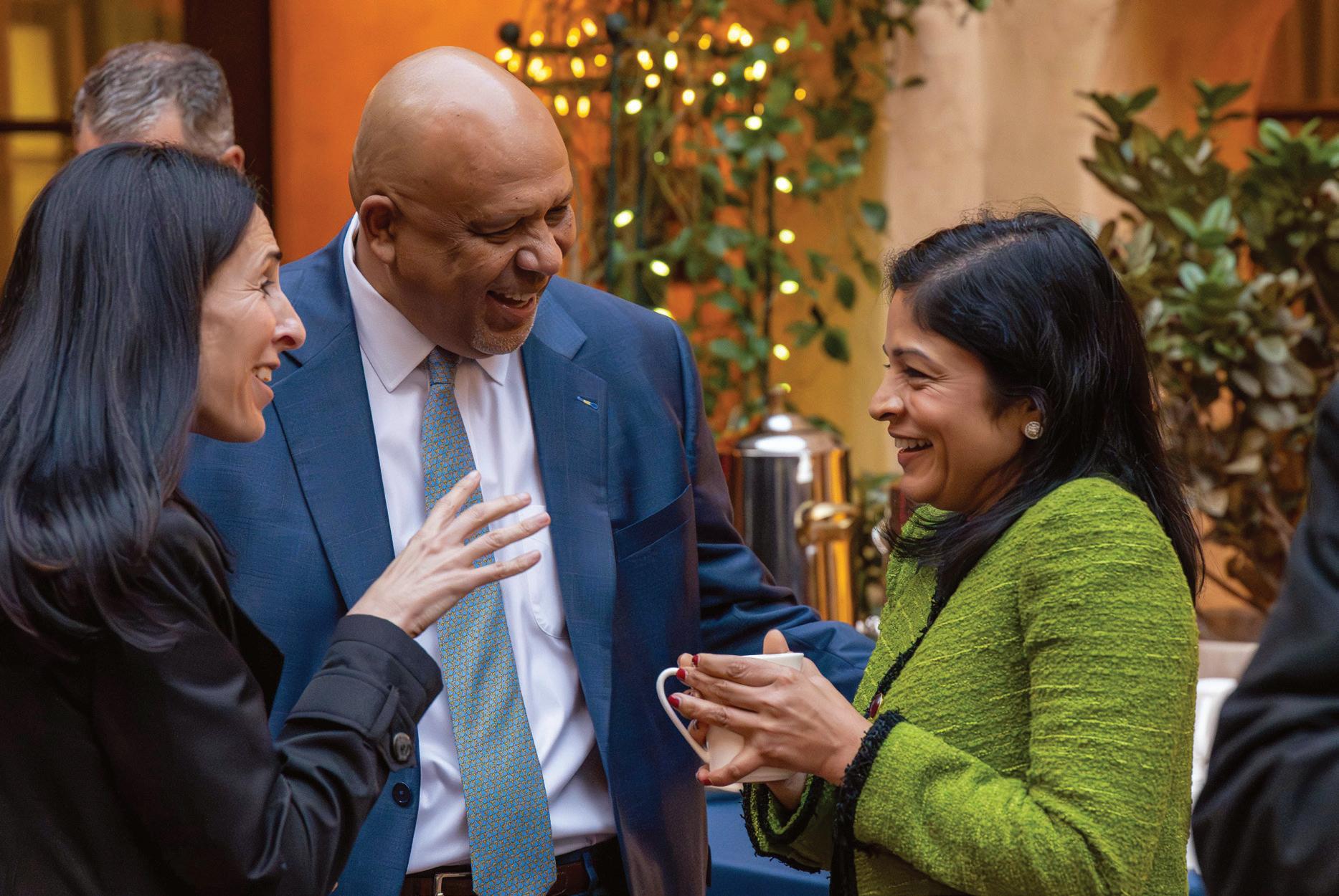
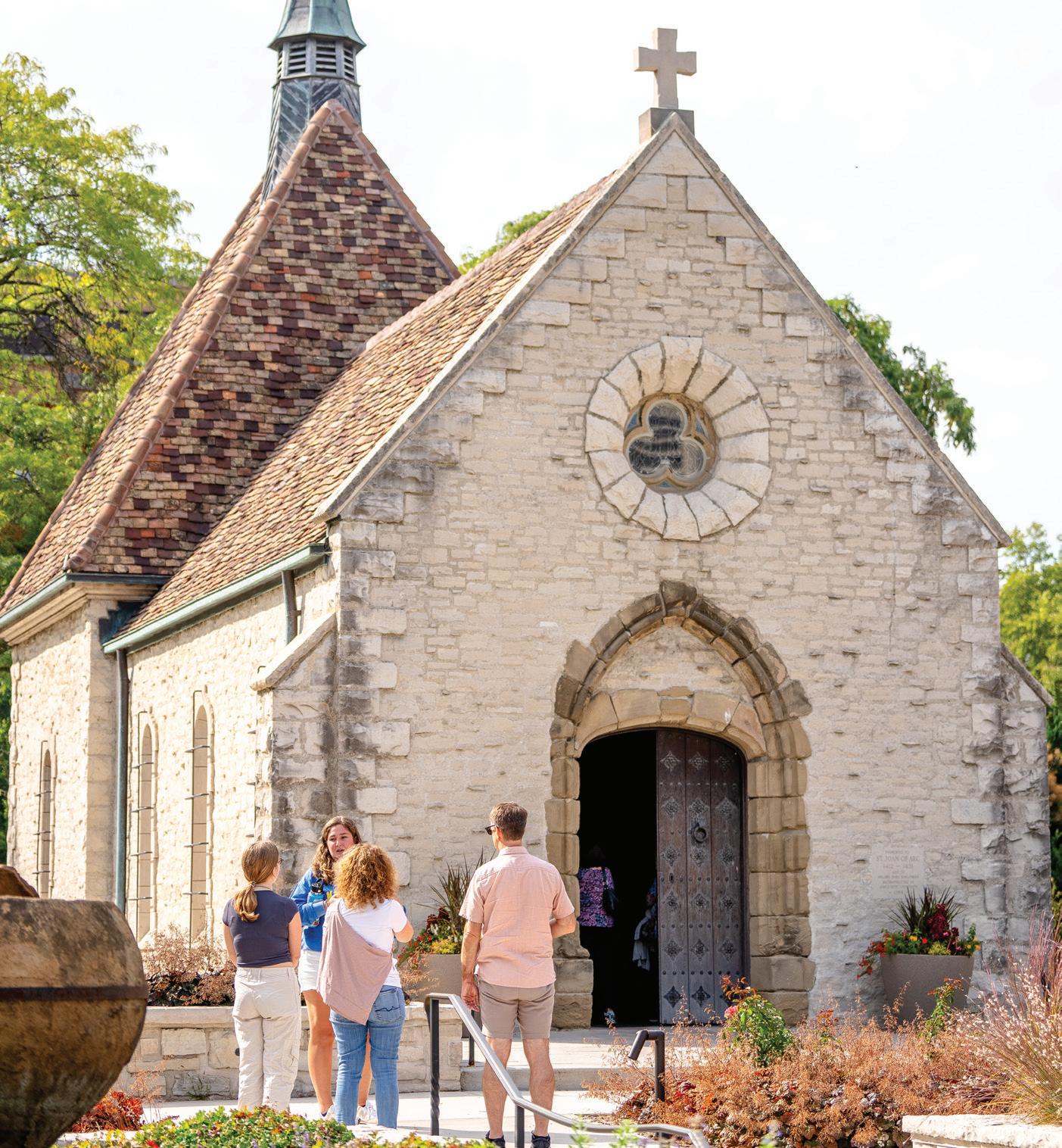
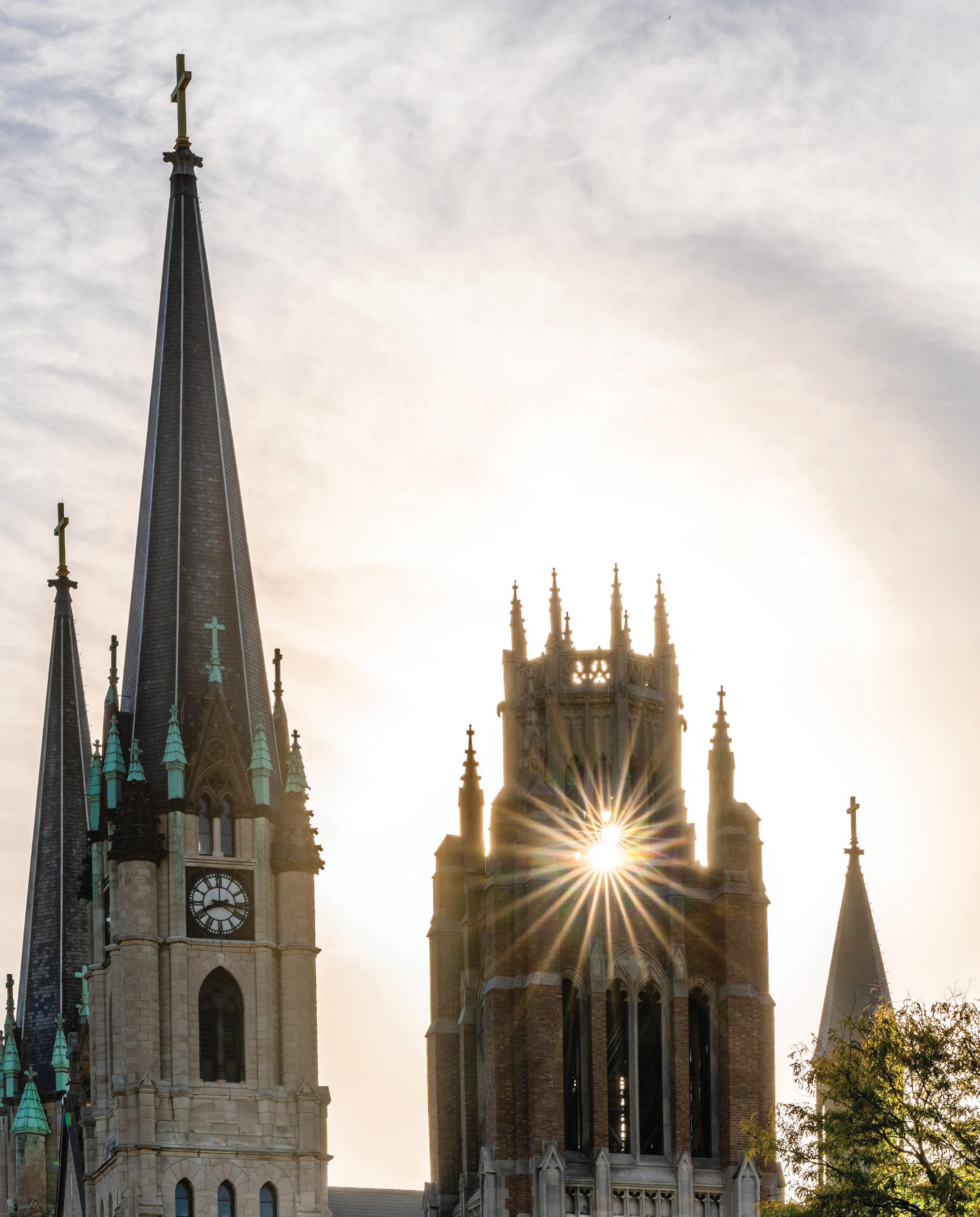
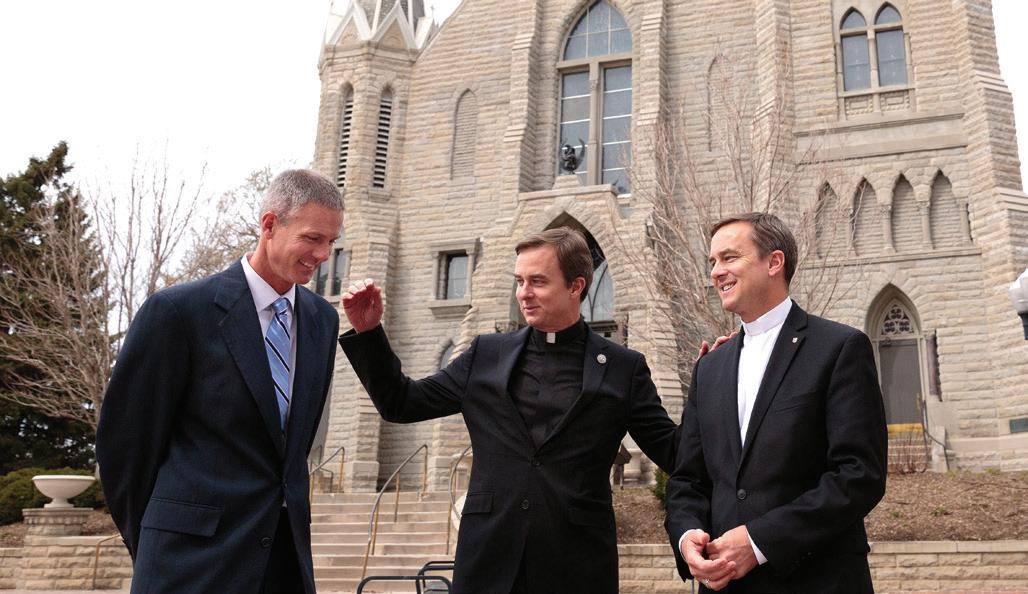
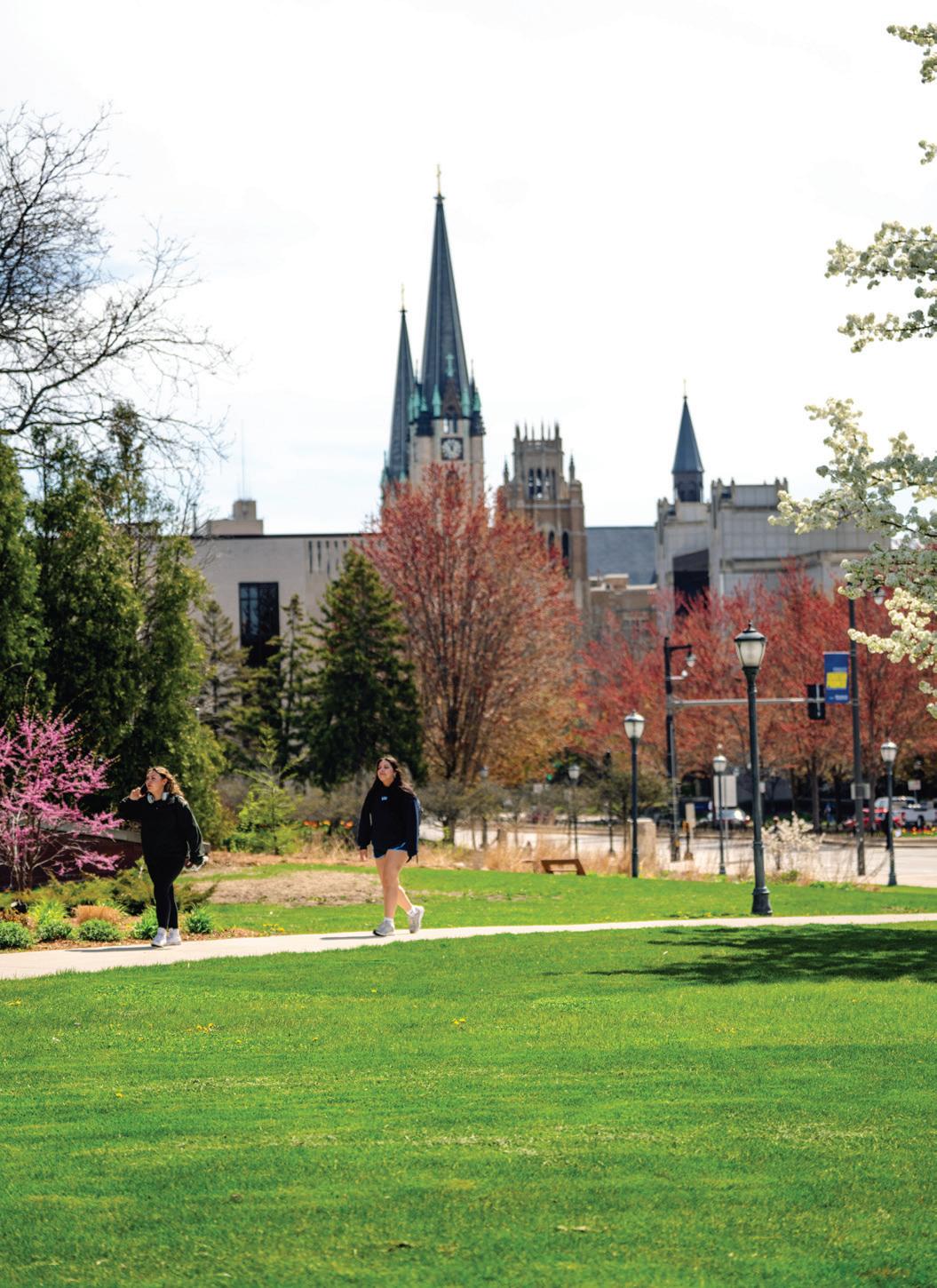
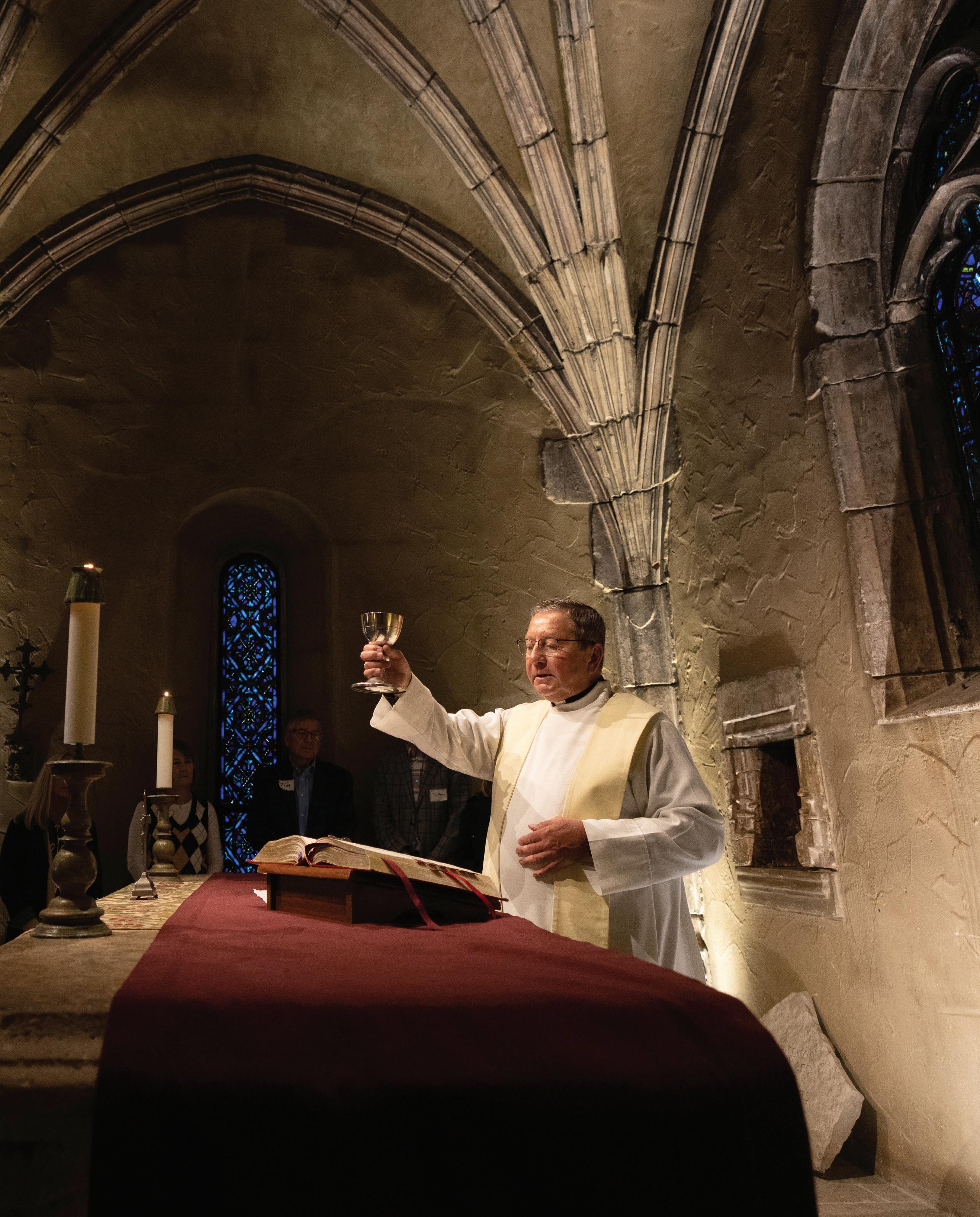
With its beauty restored and its doors open wide again, the Church of the Gesu is welcoming people back to an inspiring sacred space that has long been near and dear to the Marquette community. A multimillion-dollar overhaul that kept Gesu’s main sanctuary closed for nearly a year covered everything from a repaired roof to a new sound system with special benefits for people who are hard of hearing, plus new flooring, pews, lighting and freshly painted walls and ceiling. The result is a sparkling renewal, just in time for phase two of the parish’s fundraising campaign focused on outreach to youth, seniors and the poor. “I need a place that’s beautiful when I pray to help me pray in places that aren’t beautiful,” says Rev. Michael Simone, S.J., pastor of Gesu Parish, shedding light on the overall campaign’s synergy. “When I can spend at least part of my day in some place that just fills me up spiritually, then it’s much easier to pray when I’m in tough or dangerous situations. I think a lot of people experience that.”
Seen & Heard
Snooze, Don’t Lose
Pocket Treasures
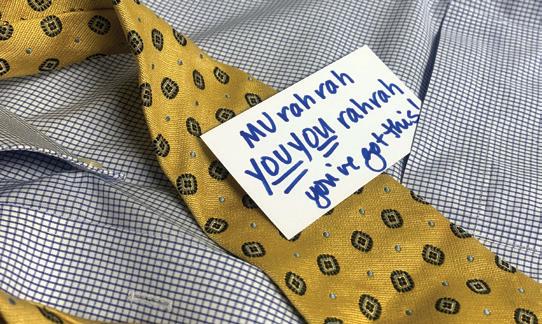
In Iggy’s Market in Holthusen Hall, students pick out donated career-wear to help them make a great impression at networking events and interviews. Many also stumble across tiny notes of encouragement stuffed in pockets of their blazers, skirts or button-ups. With every “You got this!” or “I said a prayer for you as I wrote this” from a kind stranger (including Marquette University Alumni Association board members), students take that next step with a confidence boost.
Editor: Stephen Filmanowicz
Assistant Writer/Editor: Rachel Gintner Orlando
Leadership Team: Lynn Griffith, Comm ’09, Grad ’15; Thomas Pionek, Grad ’98
Art Director: Chelsea Mamerow
Editorial Team: Sarah Koziol, Arts ’92; Jennifer Russell; Karen Samelson; Stacy Tuchel; Kasie Van Sistine Cover Illustration: SHOUT
Marquette Magazine (Spring 2026, Vol. 44, Issue No. 1), for and about alumni and friends of Marquette, is published two times a year by Marquette University, 1250 W. Wisconsin Ave., Milwaukee, WI 53233
This issue’s contents are current as of March 1, 2026. For up-to-date Marquette news, visit today.marquette.edu
Postage paid at Milwaukee, WI
Address correspondence to Marquette Magazine, P.O. Box 1881, Milwaukee, WI 53201-1881 USA mumagazine@marquette.edu. Phone: (414) 288-7448
Publications Agreement No. 1496964
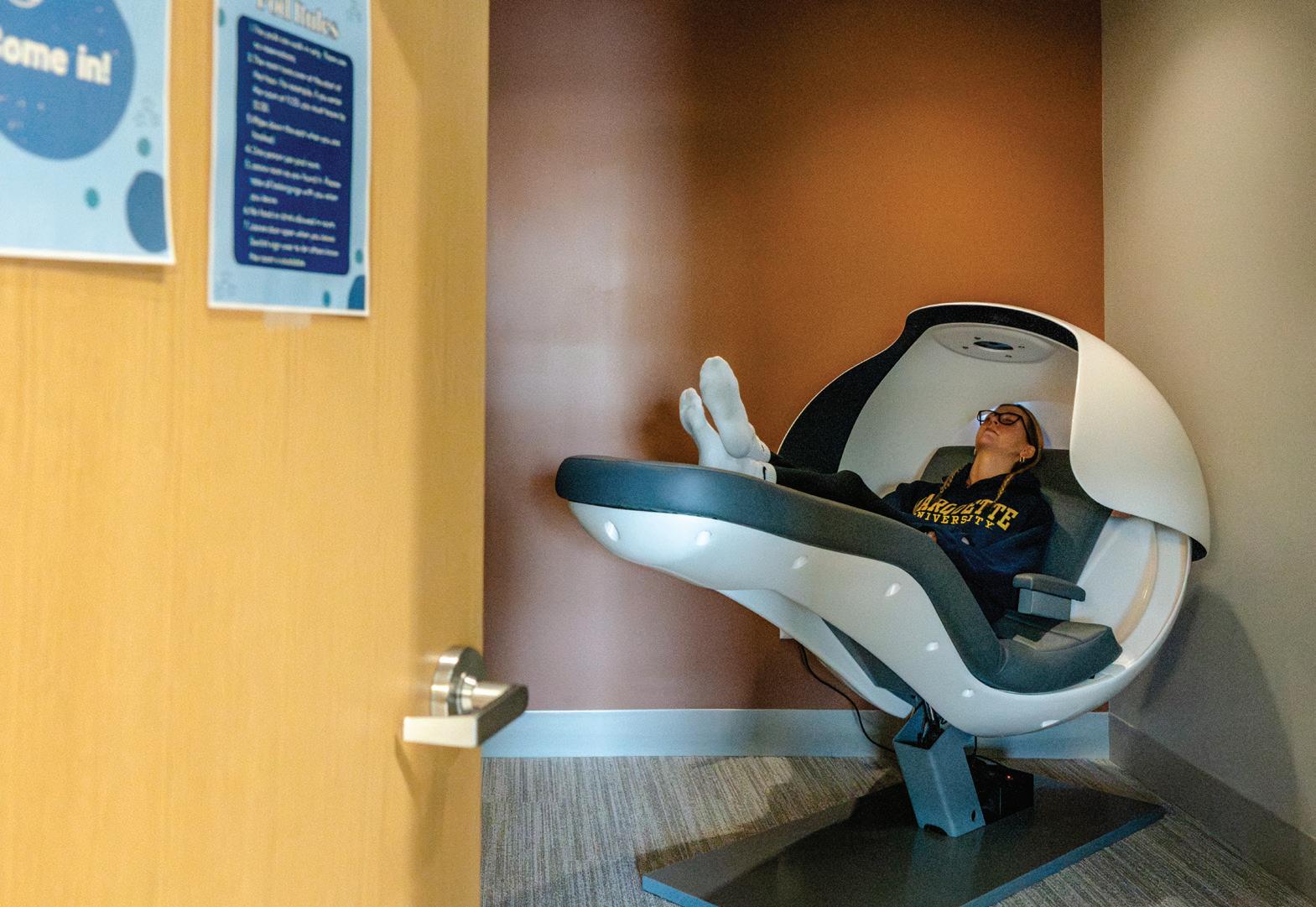
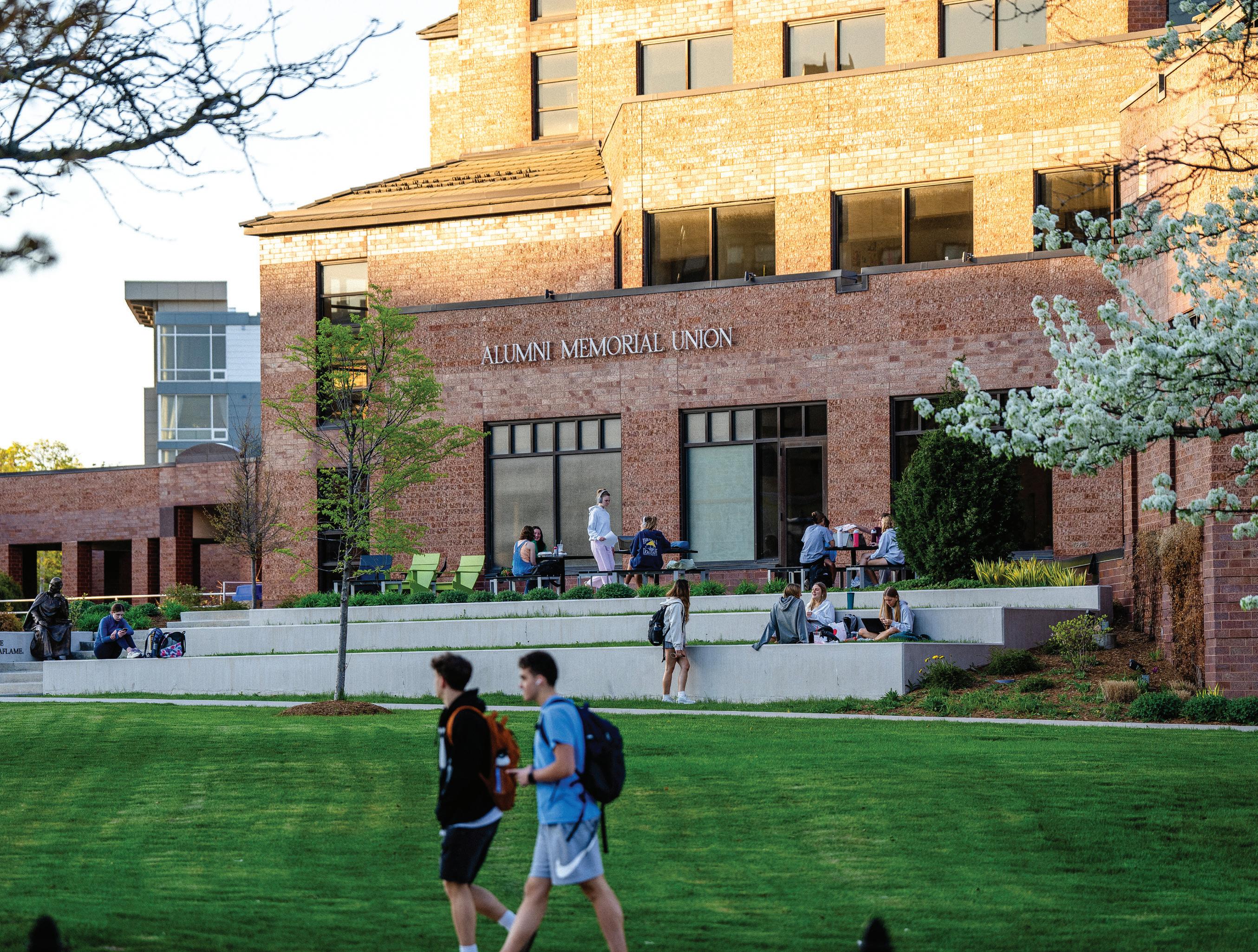
The hustle and bustle of campus melts away quickly when students climb into a sleep pod between classes. Two pods now reside in Alumni Memorial Union, and two more in Wellness + Helfaer Recreation, encouraging students to embrace a special form of wellness: the well-timed nap. Furnished through a gift from Amy Lovell, mental health advocate and wife of late President Michael R. Lovell, the installation gives special consideration to commuter students who may lack easy access to areas of respite. In recouping “sleep debt,” the pods boost brain power too — for every hour of sleep regained, studies show students achieving GPA increases of 0.07.
Hurrah from His Holiness
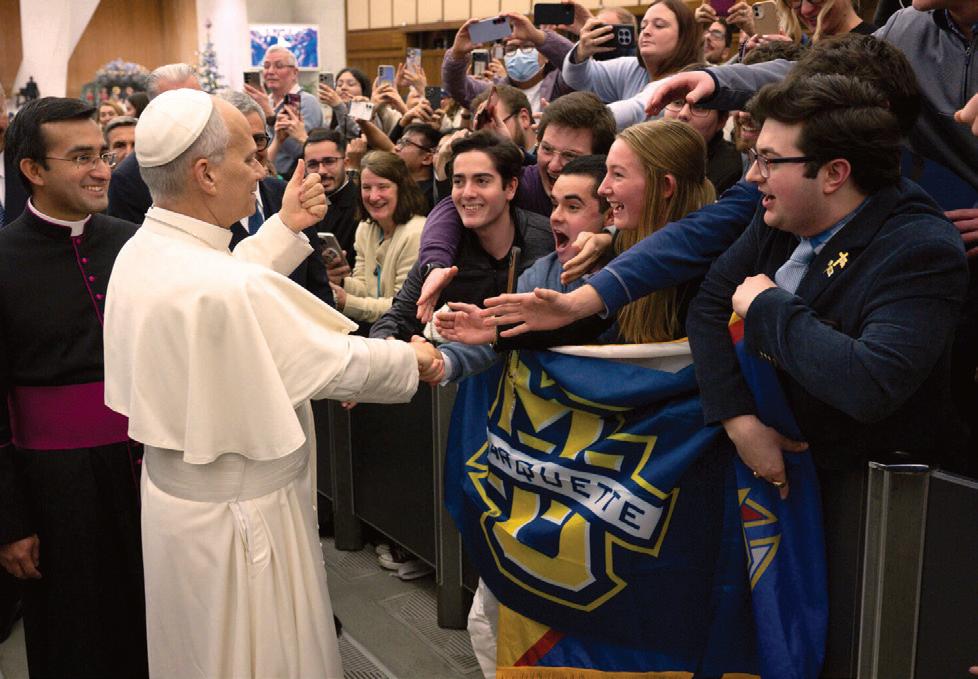
It started with members of Marquette’s Knights of Columbus chapter joining Rev. Michael Maher, S.J., on a January pilgrimage to the Vatican. There, they received coveted tickets to a general audience with Pope Leo XIV and found themselves lining the pontiff’s pathway as he greeted worshippers on his way out. A decision to hang a Marquette flag over a safety fence made all the difference. Clearly tickled to see students from a familiar Catholic university in his native Midwest, Leo shook hands with the students and gave them a hearty “Go Marquette” and thumbs up. “We were on a faith high,” says sophomore Nick Gross. “Our hope is to bring that joy back home to Milwaukee and Marquette.”
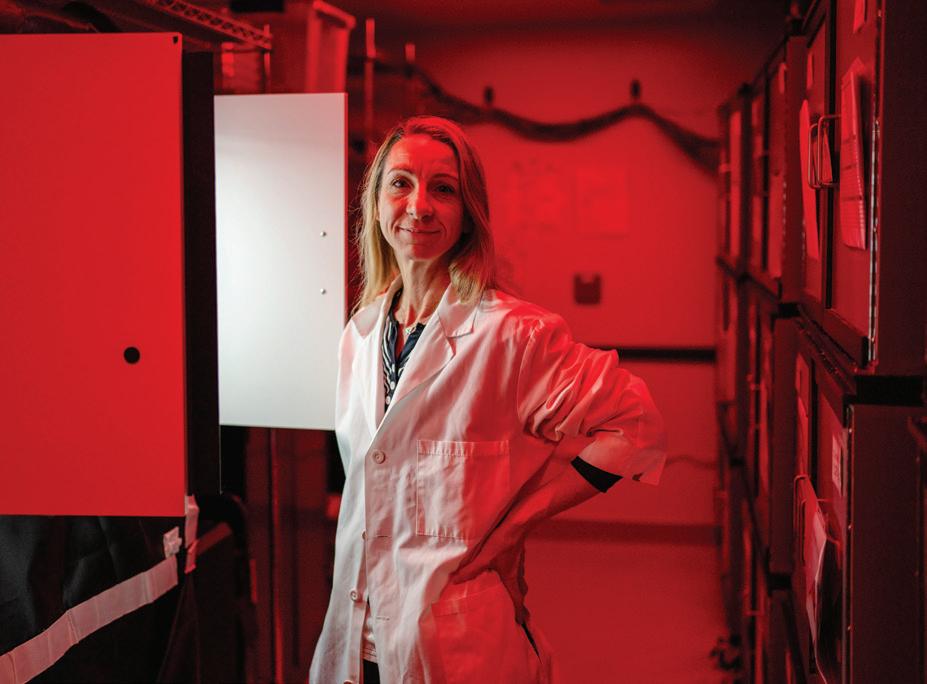
“In my proudest moments, I can remember the light of first insight in my former students’ eyes, the smile of joy during that first discovery ... in the lab.”
DR. JENNIFER EVANS, PROFESSOR OF BIOMEDICAL SCIENCES, PAGE 38
Service That Shines
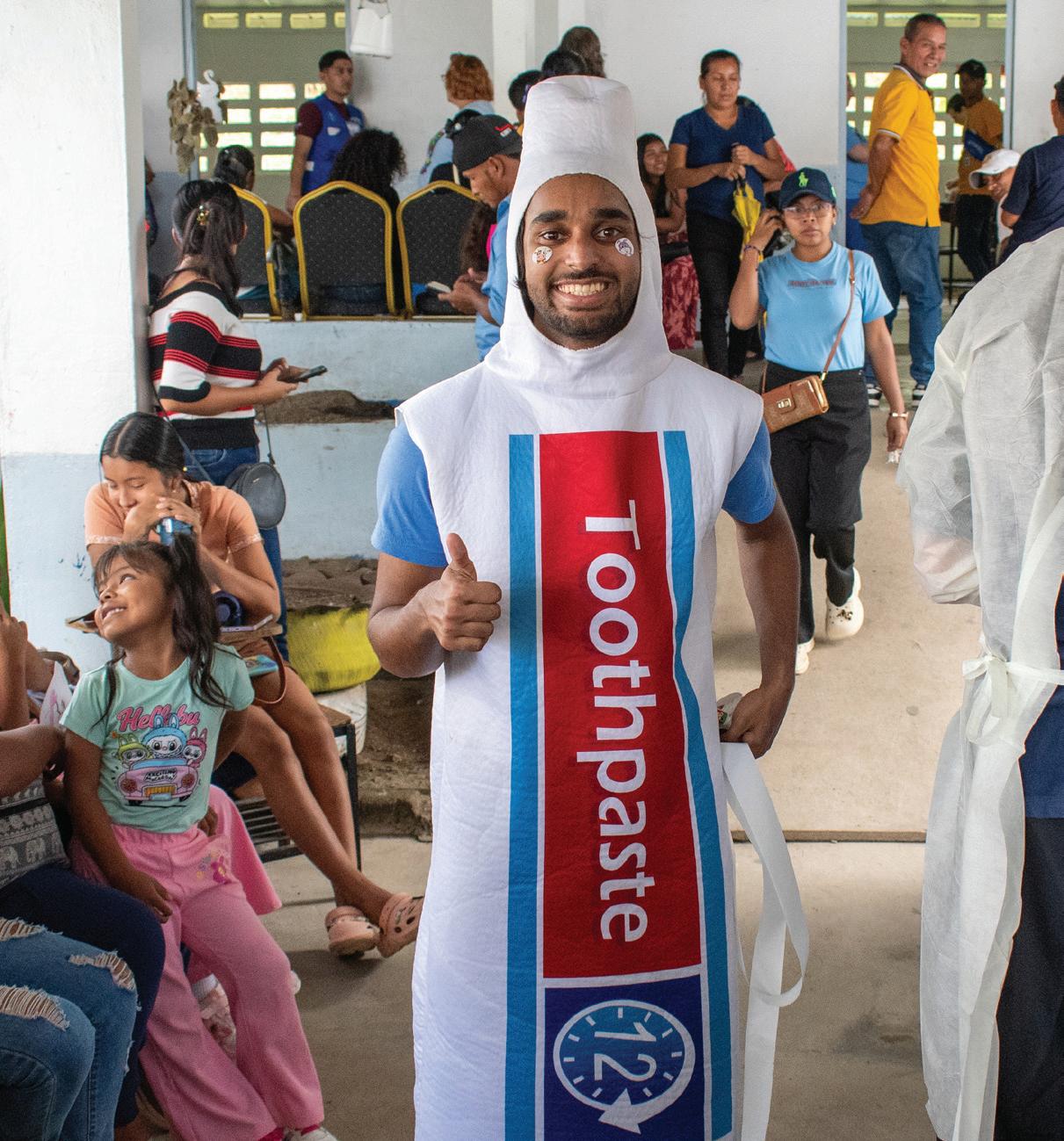
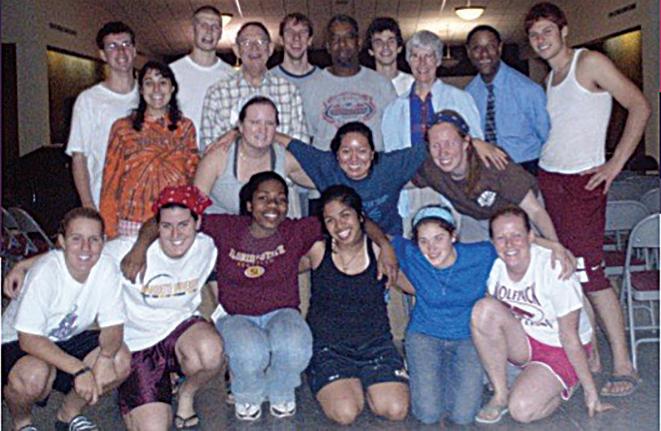
In addition to shadowing physicians and dentists and working on basic triaging skills, Marquette students on Global Brigades trips — including the 40 who served in Panama in January — commit to supporting the sustainable health of local communities. At clinic sites, the waiting room becomes a place for charla, or friendly and informative conversation. It’s about meeting people where they are in their own language, engaging in health education, and sometimes dressing up as a toothpaste tube to help children better understand dental hygiene. Fun aside, Niraj Abraham (below) says, “Charla has taught me that compassion must be at the heart of any interaction between provider and patient.”
FEATURES
The Bonds Katrina Built
Twenty years after Marquette welcomed students displaced by the hurricane, alumni and staff recall acts of service and lasting bonds with New Orleans. Page 24
Leading by Example
Leadership, Service, Faith, Excellence. These Alumni National Award winners embody the Marquette mission in notable and inspiring ways. Page 28
Honoring a Hollywood Pioneer
Prolific film and TV director Michael Schultz, alumnus and Milwaukee native, is the inspiration behind a new award for luminary Black filmmakers. Page 32
Finding God Here
A Jesuit educator accompanies students as they search for authenticity, journey in faith and encounter God all around them. Page 36
Discoveries That Heal
On the frontier of human health research, Marquette faculty pursue life-changing breakthroughs with students by their sides. Page 38
Join the momentum for Marquette’s first national, full tuition, housing and fees presidential scholarship program: the Michael R. Lovell Presidential Scholarship. Your support is an investment in the lives of outstanding students grounded in humility and the values lived by late university President Michael R. Lovell. The Parkinson Family has generously committed to match donations to the Lovell Scholars Fund up to $250,000.
Help Marquette students and honor President Lovell’s legacy with your gift today.
Scan to support Lovell Scholars and join the match or visit: mu.edu/lovell-scholars. SUPPORT THE
One of the great joys of serving as Marquette University’s 25th president is telling the Marquette story and hearing many personal stories from our graduates.
Since September, the Charting Our Course initiative has given me the opportunity to travel across the United States to gather with our alumni, friends and parents of current and future students.
I have enjoyed hearing our alumni’s fond memories of faculty and staff members who had an impact on their Marquette education and experience, and who helped create a sense of belonging on campus. It is evident Marquette helped them find their purpose and propelled them to be better versions of themselves and make a difference in the world.
At each Charting Our Course visit, I detail the momentum we are experiencing across the university and share how our students bring the Marquette mission to life; I also highlight faculty scholarship and research that advance
knowledge and benefit society.
Perhaps the most enthusiastically wellreceived bit of news I share is our latest Princeton Review ranking: For the second straight year, the publication has named Marquette the No. 1 university in the nation for student engagement in community service. This ranking is a direct reflection of the type of students who are drawn to our campus — passionate and compassionate agents of change who want to create a more just world by opening their hearts and serving those around them.
Further underscoring our commitment to the world around us, we learned in January that the university’s application for the 2026 Carnegie Community Engagement Classification had been accepted. This prestigious recognition, which the university also received in 2015, affirms that our students, faculty and staff play a vital role in society by collaborating with partners to uplift our community and address emerging challenges in an ever-changing world.
As a Catholic, Jesuit university community of women and men for and with others, we pursue these efforts toward a more hope-filled future, not for rankings and recognition but for the greater glory of God.
We Are Marquette!
Dr. Kimo Ah Yun President
What’s new on campus & beyond
Hoan Again
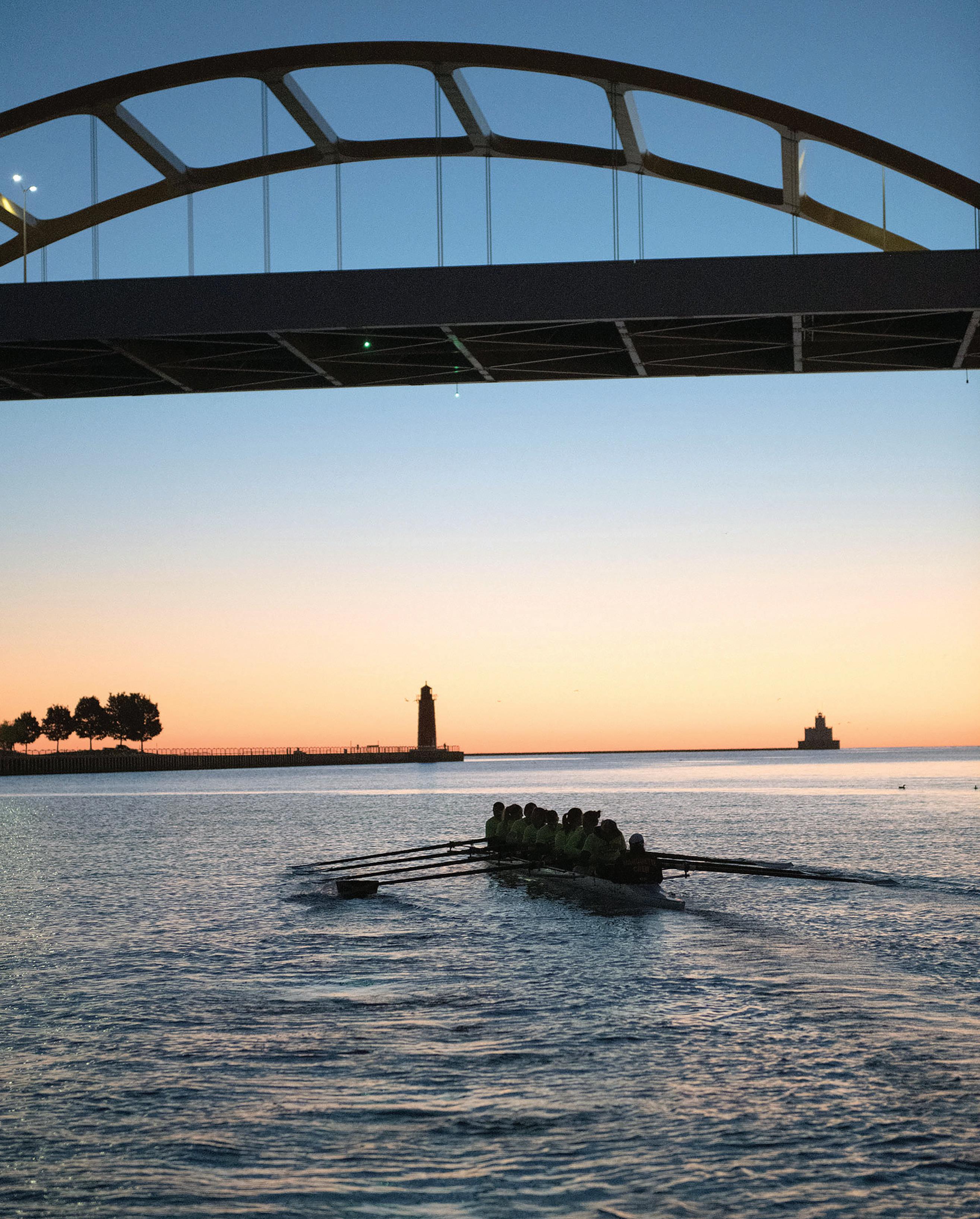
In early March, Marquette Crew members dropped their dock into the Menomonee River and got rowing. It’s a picturesque sight that looked bleak months earlier, when unprecedented August flooding caused the river to rise 10 feet and rip the dock from its foundation, carrying it downstream. Thanks to $20,000 raised with the help of alumni and supporters, a crane was commissioned to retrieve the battered but salvageable dock and get the grateful club team competing again.
BY
PHOTO
DAN MCMAHON
Marquette’s Story Renewed
In a new online learning series, experts guide participants through the university’s history, buildings, trailblazers and more.
BY NICOLE SINGER, CO MM ’06
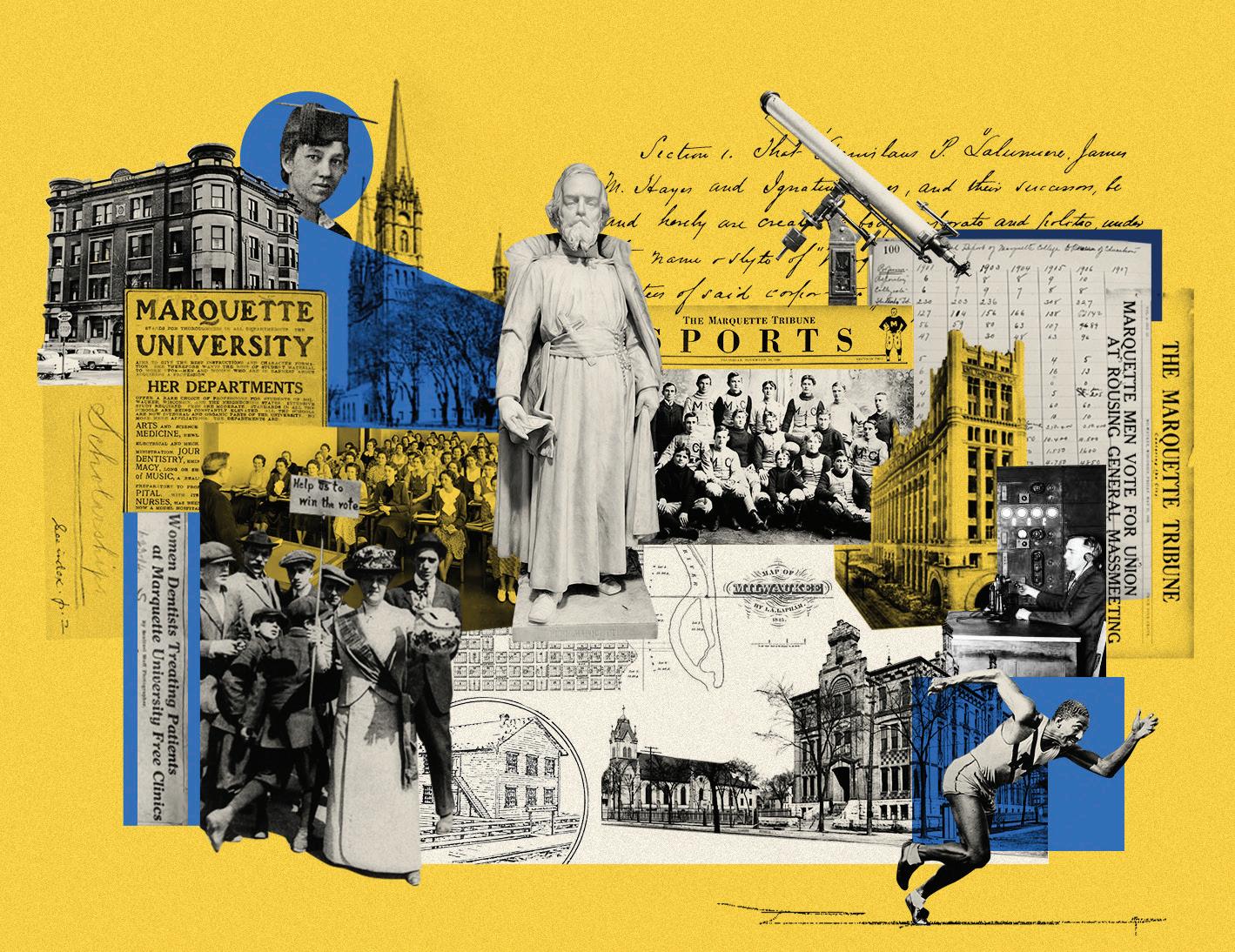
If you enjoy historical documentaries with rich vintage photography and warm expert narration — and you relish your connection to Marquette — you will want to check out the Lalumiere Project, an exclusive online learning series designed for Marquette alumni and others who love the university.
Named for Rev. Stanislaus Lalumiere, S.J., one of Marquette’s earliest presidents, this three-part video series transforms history into an interactive journey. Session one covers Marquette’s first 50 years with esteemed history faculty members as guides. Session two features campus’ architectural evolution and sacred spaces. And the third explores Marquette as a trailblazer, including the university’s leadership in Catholic higher education in coeducating women with men.
“In conversations with alumni, we are often struck by the individual and collective stories that make up our university heritage and history,” says Tim McMahon, vice president for university advance-
ment. “Marquette began as a dream for founder Archbishop John Martin Henni and, as we dug deeper, we wanted to bring that remarkable story to life through the Lalumiere Project.”
Each session features brief narrated video modules with archival photos and embedded trivia. What was Marquette’s first organized sport? Which day of the week was “Recreation Day” for early students? The learning experience mirrors the feel of an academic course — without the exams or papers.
Alumni have called the series “endearingly informative” and “an unexpectedly wonderful way to broaden awareness of Marquette’s storied history.”
At marquette.edu/lalumiere-project, viewers can dive into one session or explore the entire series. Along the way, you’ll engage with historical content, test your knowledge and even earn a certificate of completion. As the university marks its 145th anniversary, watch Marquette’s earliest days come alive in this bold new way.
LEADERSHIP
New Provost, Deep Jesuit Roots
President Kimo Ah Yun was dean of the Diederich College of Communication in 2017 when he met Dr. Debbie Tahmassebi, then the dean of the College of Arts and Sciences at Santa Clara University. The Ignatian Colleagues Program, a mission-centric formation program for Jesuit higher education leaders, brought them together.
Just under a decade later, after a national search, President Ah Yun named Tahmassebi Marquette’s newest provost and executive vice president for academic affairs. Tahmassebi joined Marquette this spring after serving as provost at Westminster University since 2019. In a letter to the campus community, Tahmassebi (“tah-MAHS-ahbee”) wrote: “Please know what an honor and a privilege it is to join this university — Marquette has an inspirational mission, extraordinary history and strong reputation on which we can continue to build together.”
— Christopher Stolarski
ADMISSIONS
Ignatian Pipeline
Why Marquette is a top destination for Jesuit high school graduates.
BY DAN REINER, CO MM ’16
Year after year, class after class, students from Jesuit high schools across the country flock to Marquette.
A top destination in the Ignatian pipeline from secondary to higher education, Marquette consistently places in the top three (along with Boston College and Georgetown University) among the 28 institutions in the Association of Jesuit Colleges and Universities in both applications and enrollment from Jesuit high school students. In recent years, Jesuit school graduates have represented nearly 10 percent of each incoming Marquette class.
As Marquette Admissions prioritizes connecting with prospective students and building trust with counselors nationally, these high schools have been fruitful sources of future students. “This work is often anchored in places where there are students who understand the value of Jesuit education — that’s our partner Jesuit high schools coast-to-coast,” says Brian Troyer, vice president for enrollment management.
When the staff of about 25 admissions “territory managers” reach out in regions across the continental U.S. and Puerto Rico — describing how Marquette’s mission and values are woven into academics and campus life — there is an element of reassurance for Jesuiteducated students. “Students and their families already know what to expect,” Troyer says. “Everything from the pedagogy in the classroom to living out cura personalis, and the way in which students from all faith traditions can see themselves in a Catholic and Jesuit educational tradition. Those things help make Marquette a natural fit for many Jesuit high school students.”
During his search, Zoran Vignjevic, a junior business major from Brophy College Preparatory, a Jesuit school in Phoenix, considered school size, academic opportunities and, especially, sense of community. He found it early: at Marquette’s summer SPARK program for incoming freshmen, where he met some of his best friends and future roommates. “Community and culture have always been big for me,” Vignjevic says. “Marquette offers opportunities on campus and in Milwaukee to meet people and find activities that I
didn’t see at other colleges.”
Along with academic rigor and reputation, high schoolers often seek a sense of belonging built into the college experience, says Liz Riggs, a college counselor at Loyola Academy in Wilmette, Illinois, a top “feeder” high school to Marquette. “It’s the intentionality around everything that Marquette does to help students find a sense of belonging: O-Fest, faculty mentorship, the hands-on learning experience,” Riggs explains. “It truly is the best fit if the student wants a continuation of their time at Loyola Academy and also to push themselves out of their comfort zone.” Riggs’ own daughter, Emma, came to a similar conclusion during her college search as a transfer student; she graduates in May as a Golden Eagle.
Valeria Chavez, a junior majoring in cognitive science, left her comfort zone after graduating from Cristo Rey Jesuit High School in Chicago, choosing to attend Marquette rather than a school closer to her family. Once in Milwaukee,
she was drawn to the Delta Xi Phi sorority because of its commitment to community service. “I’ve always been the type of person who wants to give back to the community,” Chavez says. “That’s what I like a lot about Marquette, that it takes service very seriously.”
As the college demographic landscape shifts and students apply to more schools than ever, Troyer believes a strong admissions foundation begins with established connections and sharing the experiences that set Marquette apart, like those of Vignjevic and Chavez. “The great thing about Marquette is that we’ve attracted students from all over — urban, rural and everywhere in between — so we can tell authentic stories of students’ familiarity with Marquette,” Troyer says. “Our admissions counselors can say, ‘This graduate of your high school came here and thrived, and now I want you to consider how you might pursue your own transformation and your own future at Marquette.’”
PHOTO BY PATRICK M ANNING
Curated
Faculty Office Finds
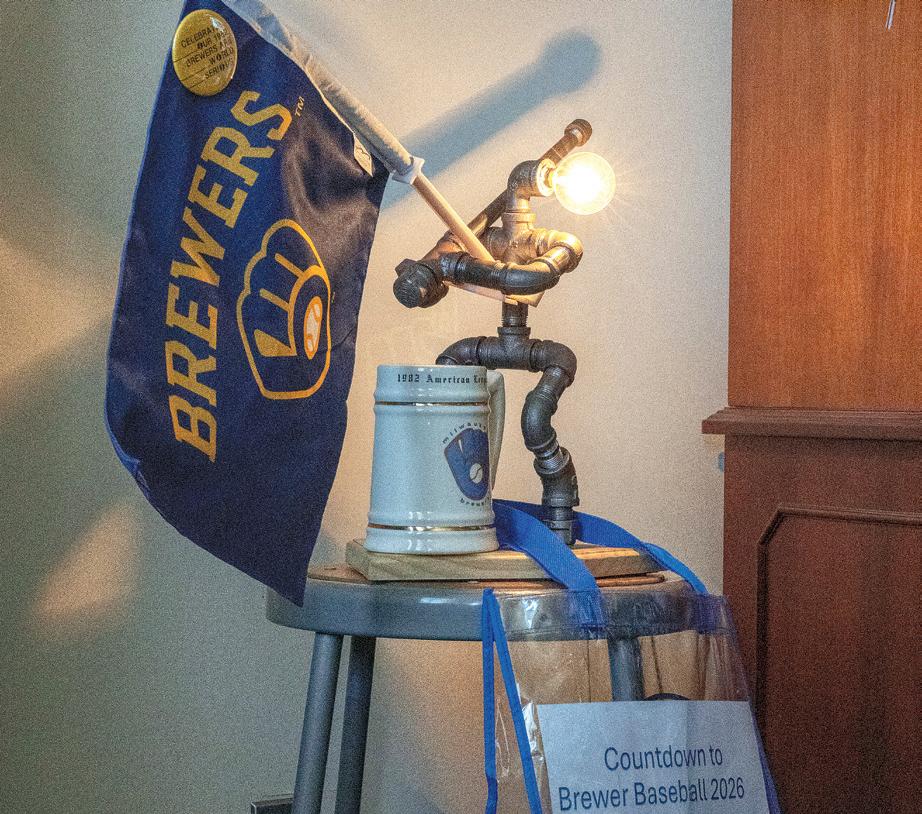
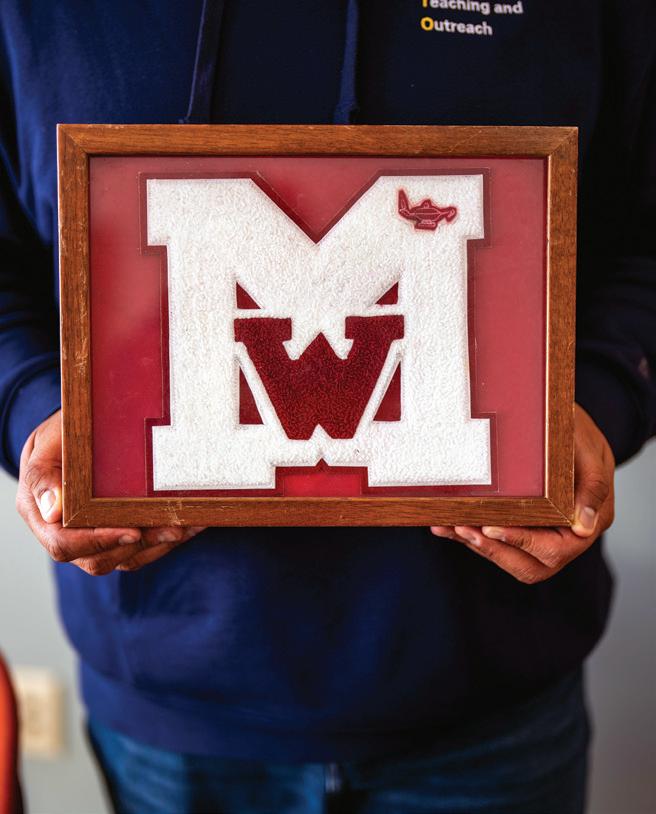
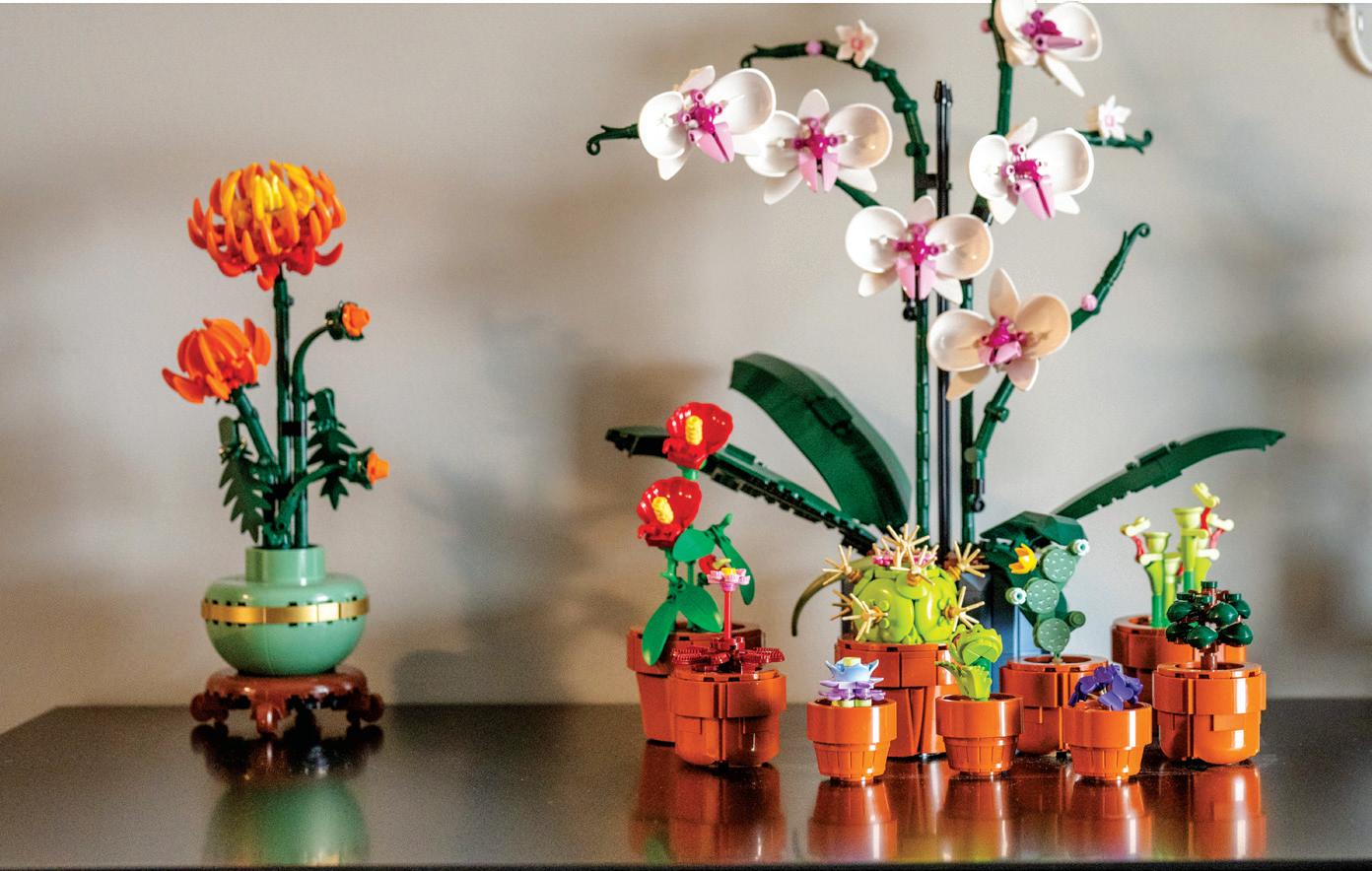
You knock at the door, take the open seat and settle in: You’re in your professor’s office, maybe a bit nervous. But then a curious object on the desk or a shelf draws your attention, reminding you that your professors are not just professors — they’re personalities beyond the classroom. Whether Lego flowers or a staff from Guatemala, the glimpse inside their wider lives offers a welcome form of human connection. — Rachel Gintner Orlando
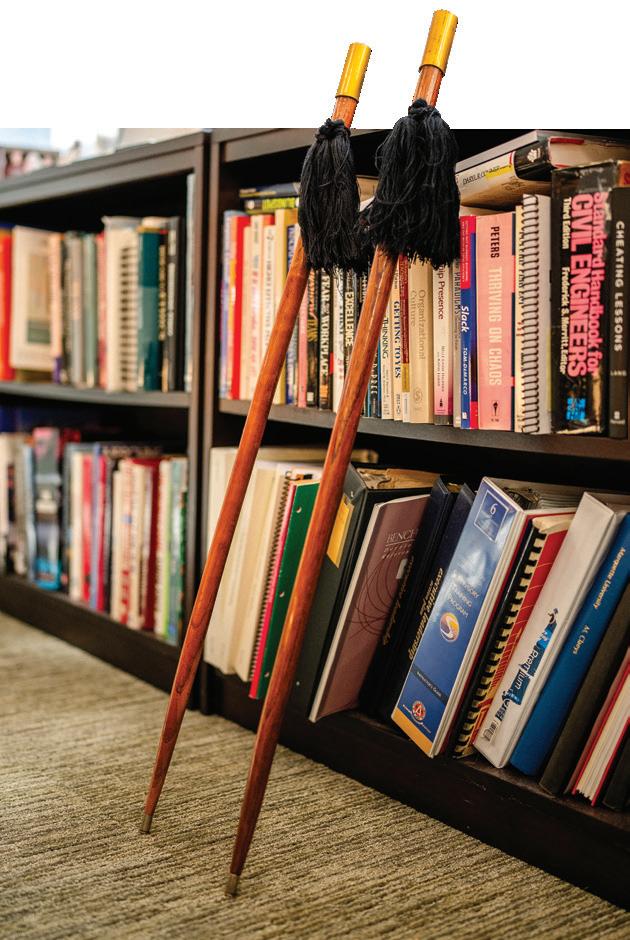
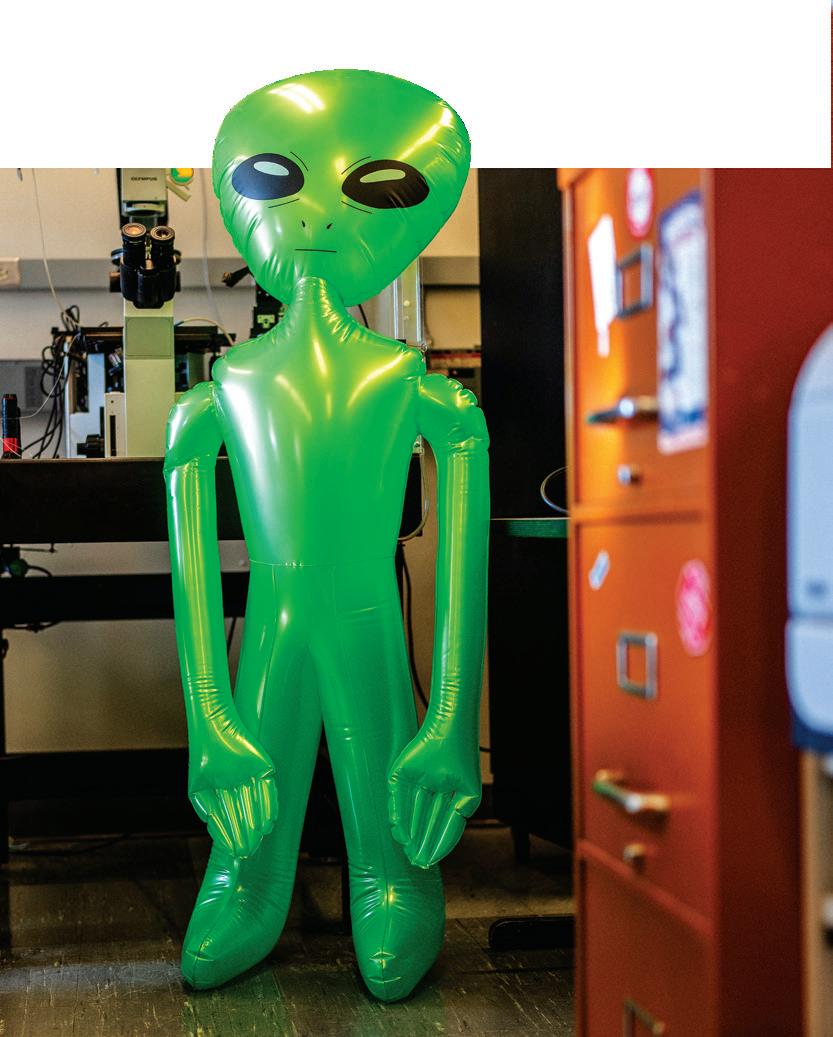
Clockwise, from top left: COCODE CEREMONIAL STAFF from Guatemala, Dr. Mark Federle of engineering: “A cocode is similar to the mayor — a gift from our Engineers Without Borders community.” PIPE DREAMS, Michelle Schuh of health sciences: “Dean Cullinan found him at a garage sale. We light him up when the Brewers win.” MABEL WATSON RAIMEY, LAW 1926, VARSITY LETTER , Dr. Rob Smith of history: “It was presented to her by West Division High School as a special alumni award. She was Wisconsin’s first Black female lawyer.” LEGO FLOWERS, Dr. Brian Spaid of business: “Lego is one of my favorite businesses. They’re innovative and know how to connect with customers.” YELLOW BUTTON , President Kimo Ah Yun: “This was given to me by Diederich College of Communication Dean Sarah Feldner. It creates an instant dance party to lighten the mood. Thankfully, I have not had to use it too often, but appreciate knowing it is within reach!” THE ALIEN , Dr. Michelle Mynlieff of biological sciences: “Four students pooled their tickets to buy it at FunZone. Their enthusiasm for science and friendship with each other was phenomenal.”
CO MM UNICATION
Partnering for Strong Journalism
Four months in, a new investigative reporting bureau in Johnston Hall is going strong. ICT, formerly Indian Country Today, has partnered with the Diederich College of Communication to bring Indigenous storylines to the fore through ICT’s first Midwest office. “This is one of my whys,” says Dr. Patrick Johnson, Ed ’11, Grad ’13, assistant professor of journalism, who helped nurture the bureau and a yearlong student internship. Senior Nareh Vartanian joined ICT correspondent Amelia Schafer as the inaugural reporting team. “Being Armenian, I spent my youth learning how my ancestors passed down our culture despite a genocide. I feel a strong connection to amplifying Native American culture that has persevered and survived,” Vartanian says. “It’s an honor.” In joining with the largest U.S. news organization covering these issues, Johnson agrees, saying, “We’re growing something special here.”
—Rachel Gintner Orlando
OFF-CAMPUS LIFE
Students Among Seniors
An intergenerational partnership brings students to live and brighten life at a senior community with strong Marquette ties.
BY M ARY SCHMITT BOYER, JOUR ’77
Trudy Goller’s face lights up when she answers a knock to find Sam Samson at her doorstep. The vivacious octogenarian swings open the door and ushers in Samson, a native of India in his 20s who is studying for his master’s in criminal justice data analytics at Marquette.
The two are neighbors and fast friends at St. Camillus, Milwaukee’s largest senior community and a Catholic institution with strong ties to the archdiocese and Milwaukee’s Jesuit community. Former Marquette Presidents Robert Wild, S.J., and Albert DiUlio, S.J., live there, and President Kimo Ah Yun recently visited to connect with them and speak with residents, including many alumni. After reading about a similar program in the Netherlands and then researching nonfamilial intergenerational housing in the U.S., Dr. Stacy Barnes, Grad ’14, a nursing professor of practice who specializes in geriatrics, saw St. Camillus as a natural place for a new Marquette
partnership. She launched the Students in Residence Program there in 2022. It’s open to students who agree to devote eight hours each week interacting with the senior residents in return for reduced rent at the facility about eight miles west of campus.
One of five student residents this year, Samson uses his interactions to improve his English, saying, “It’s a way of giving, but I also receive. I feel happy every day when I wake up.’’
Janie Schulz, a doctoral student in clinical psychology, has lived at St. Camillus for two years and helps host Golden Eagles basketball watch parties. She loves the energy and sense of community. “I seriously cannot imagine living anywhere else,’’ she says.
As chair of St. Camillus’ 100-plus member strong Marquette Club for alumni, David Krill, Bus Ad ’64, has co-hosted many events with Samson and Schulz. “This partnership with Marquette is a win-win situation,’’ he says.
Part of the St. Camillus family, graduate students Sam Samson (l) and Janie Schulz.
Saintly Grace
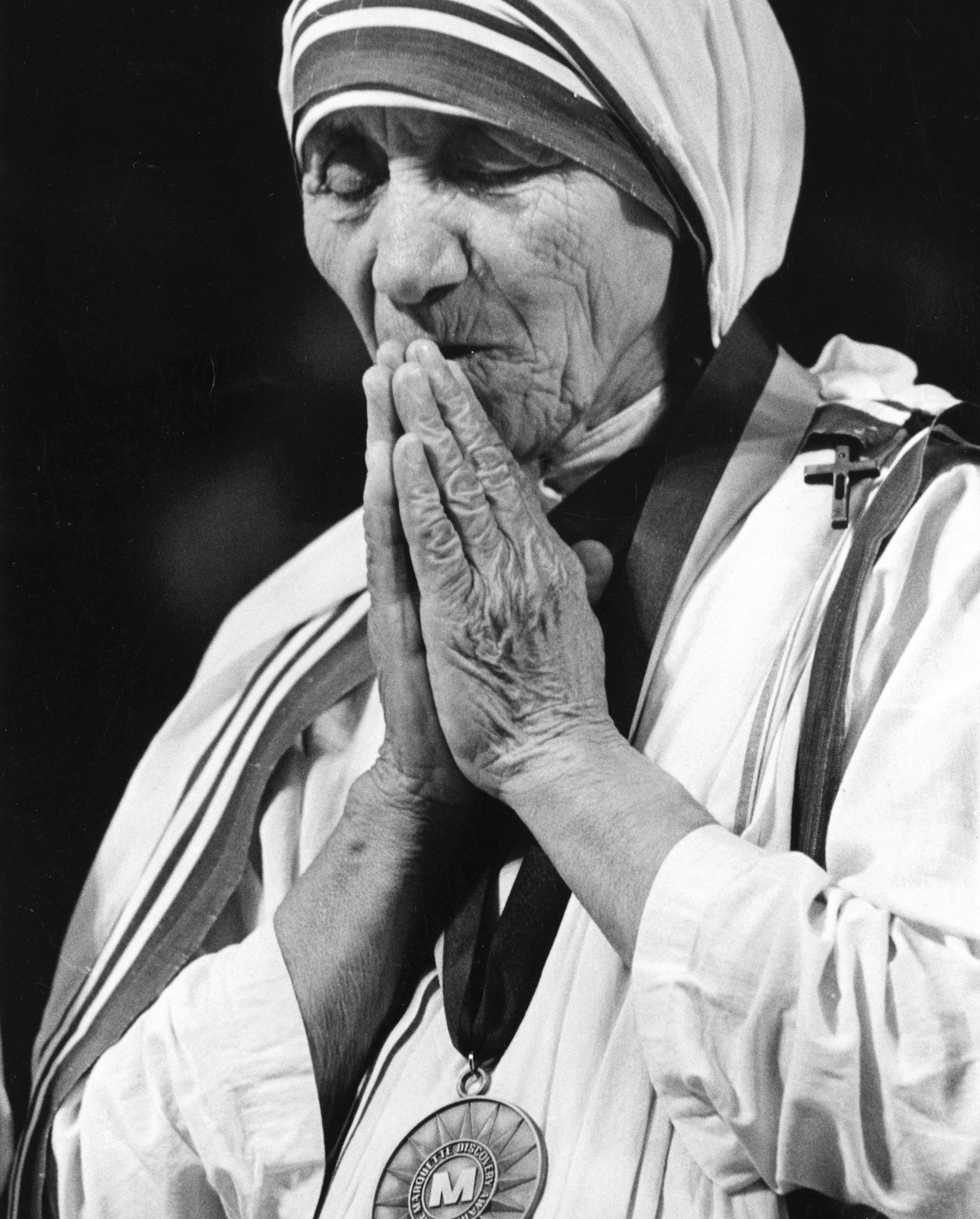
On a special day in June 1981, while on a U.S. tour, Mother Teresa came to Marquette to receive the Père Marquette Discovery Award in a ceremony so large it was moved from campus to the MECCA Arena. Then-President John P. Raynor, S.J., presided and Mother Teresa called on the wider Marquette community to see Jesus embodied in the poor and the gift of humanity in every child. Born in Macedonia and canonized by Pope Francis, this saint known for her closeness with the poor, first in India and then globally, was recognized by Marquette in 2009 with a statue showing her holding a child. It occupies a spot near St. Joan of Arc Chapel in the heart of campus.
Class Act
Fair Winds Ahead
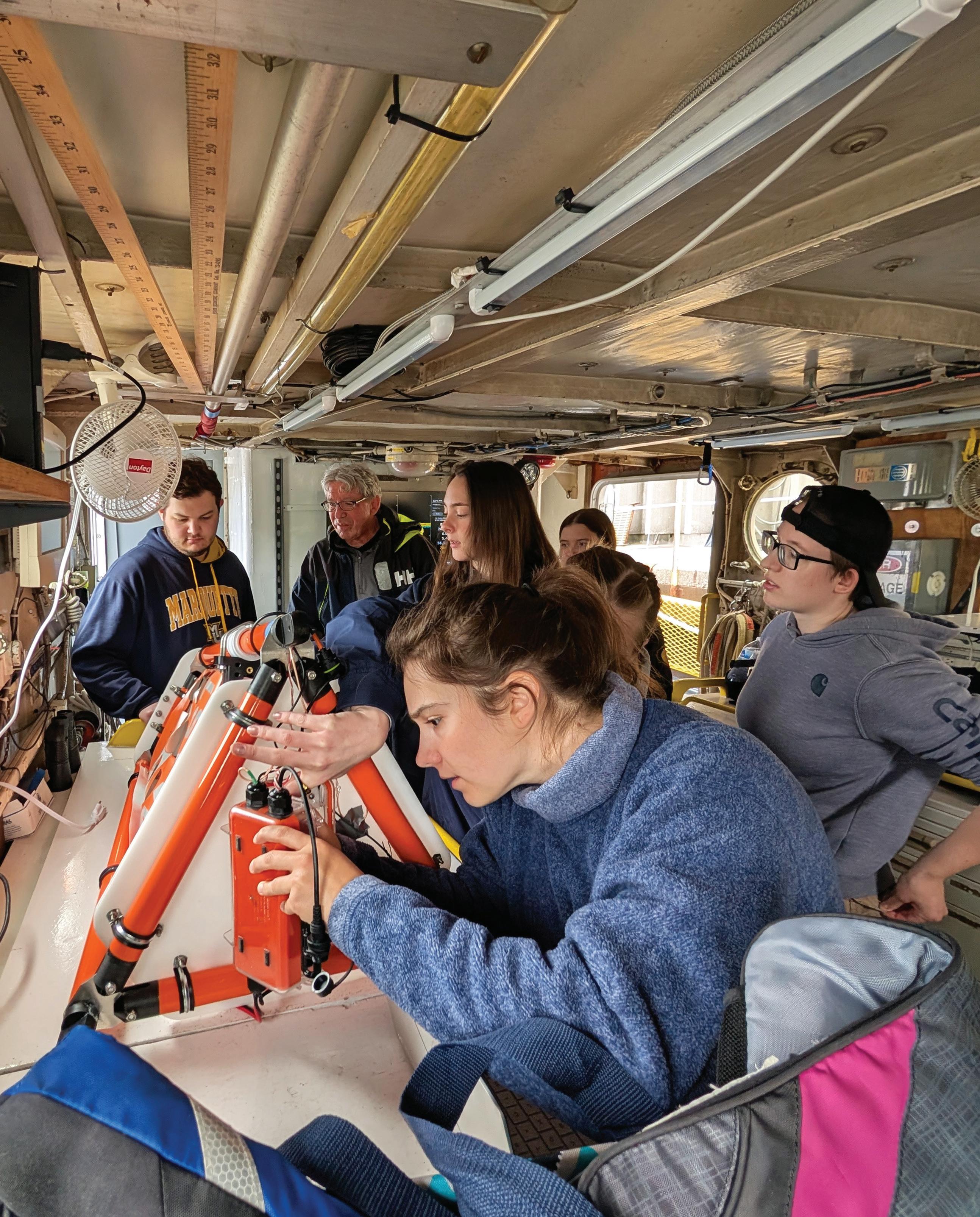
Across several seasons, a unique buoy has bobbed brightly in Milwaukee’s harbor, computing real-time weather and wave data for local sailors, boaters, anglers and kayakers. It’s been engineered and built by Marquette students, who keep improving upon the design. In Engineering Hall and aboard a research vessel, the Neeskay (shown here), they’ve worked intently on this senior design project, passing it from one graduating group to the next. Dr. Tony Bowman, research assistant professor of engineering and one of two project advisers, says: “It’s a great opportunity. Students learn how to revamp a design structure and its electronics.”
“I handled power management,” says senior Anna LoFaro. “The challenge was using solar energy and batteries to keep the buoy reporting out data.” Calibrating sensors to track humidity, wave height and water currents, the team carefully handled soldering, wiring and prototyping to ensure this miniature weather station kept afloat — and kept the seafaring community safe. — Rachel Gintner Orlando
ALU M NI STORIES
Prayers of a Clown
Words from a beloved and jolly Marquette figure carried actor and alumnus Pat Finn across his life — and perhaps a bit further.
BY STEPHEN FIL M ANOWICZ
As he built a career as a comedic actor, first at Second City in Chicago and then in Hollywood, Pat Finn, Sp ’87, carried a piece of Marquette with him.
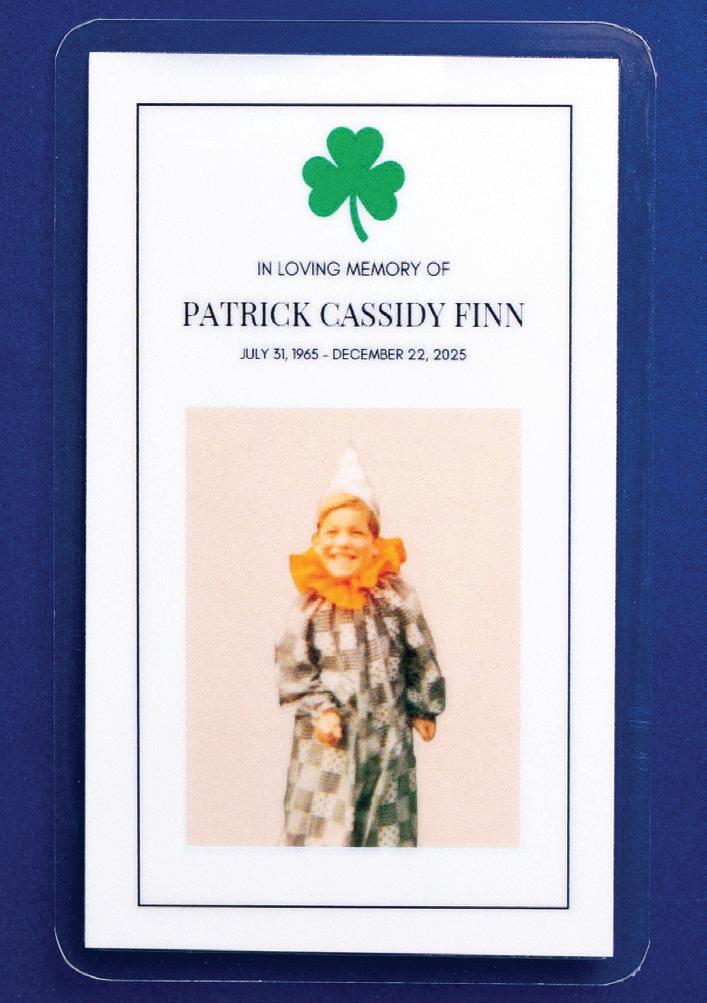
It was a slip of paper — in time, a tattered scrap — bearing words shared by a favorite Marquette priest and professor. Finn would pull it out of his wallet and read it before big auditions, as did his friend and fellow comedian Chris Farley, Sp ’86. “As I stumble through life,” Finn prayed, “help me to create more laughter than tears, dispense more happiness than gloom, spread more cheer than despair ... .”
In this way, he read A Clown’s Prayer en route to many fondly remembered roles: Jerry’s friend Joe Mayo on Seinfeld, Monica’s boyfriend Dr. Roger on Friends and genial neighbor Bill Norwood on The Middle from 2011 through the show’s finale in 2018. And the prayer was with him to the
end, which came too early, in late December after a struggle with bladder cancer.
No average prayer, this one had been shared by no average priest-professor either. Alumni from many generations will recognize in it the hand of Rev. John Naus, S.J., who was legendary across a half century for contributions including leading Tuesday night Masses in St. Joan of Arc Chapel, teaching philosophy courses to packed classrooms and dispensing big-hearted advice to students to treat everyone they met as if the phrase “Make me feel important” were imprinted on their foreheads. Father Naus worked tirelessly to light up others’ lives and, it should not be overlooked, appeared regularly on campus in a clown suit. He attended the Ringling Brothers and Barnum & Bailey Clown College in Florida and “could make a mean balloon animal,” one student noted amid a
flurry of tributes published in this magazine when he passed away in 2013 at 89, a year into his retirement.
As a student, Finn took Father Naus’ Philosophy of Humor course with Farley and found out on his report card that it was no laughing matter. For his trouble, though, Finn received not just a petition to raise to a Higher Power, but words that resonated in his life with wife Donna, family and friends.
Spread more cheer than despair? He achieved that by a lopsided margin. “I’ve never met a single person who had a bad thing to say about my dad,” his daughter Cassidy wrote after his passing. “The least surprising thing was hearing the nurses say they have never seen so many people show up at a hospital for someone.”
“A good way to say it is that in all things, Pat led with positivity and joy. He wasn’t a skeptic or a cynic,” says his friend and former roommate Mike Brennan, Arts ’87. “His first instinct was to expect that any person he ran into was good, and certainly worthy of sharing a smile and a joke.”
Finn’s generosity brought him home to Marquette to teach a course, Improvisation and Communication, as part of the Diederich Learning Labs. He mentored 10 students through Marquette Mentors.
At his visitation in January, Finn lay dressed in a Marquette pullover and Chicago Bears hat. Father Naus’ meditation was on the prayer card. Finn’s children — Cassidy, Caitlin and Ryan, Comm ’25 — read it at the end of a memorial Mass attended by 50 Marquette friends.
“Never let me forget that my total effort is to cheer people ... and make them forget — at least momentarily — all the unpleasantness in their lives,” they said, as their father had. Then came a closing line suggesting a meetup with an approving Creator (in this case, joined just maybe by a saintly figure dressed for a celestial circus): “And in my final moment, may I hear You whisper, ‘When you made My people smile, you made Me smile.’”
To read the full prayer, visit mu.edu/ prayers-of-a-clown.
Where Marquette leads in ideas, innovation and research
Dr. Michael Olson was on the hunt for a book from the 1700s — an essay by the French scientist Maupertuis. But the original text no longer existed.
“The Latin original has been lost,” says Olson, teaching associate professor of philosophy. “There are only two known copies of the German translation, though there is also a French translation.” In the end, Olson was able to create an English translation by accessing those texts, including a rare French translation found at the Newberry Library in Chicago, a treasured home for scholarly resources. Marquette has long been a member of the prestigious Newberry Center for Renaissance Studies Consortium, which offers funding and fellowship opportunities.
Olson’s insights from both the German and French texts serve as key source material for a forthcoming anthology of early German writings about heredity, science and race. The book is among many Marquette-affiliated projects
that have seen a boost from the Newberry’s priceless collection. Since the 1980s, Marquette researchers from the humanities have trekked to Chicago to work among the stacks, access workshops and courses, and deepen their knowledge alongside worldclass experts.
Workshops open doors for students too. After participating in Newberry programs on medieval topics in New York City and Chicago, graduate student Julia Salkind is helping to organize the library’s next graduate student conference, where classmate Veronica Arntz will present her research. Meanwhile, undergraduate Holly Schmid gained admission to the consortium’s undergraduate course, The World in Books, 1100–1800, this spring.
For Olson, attending a seminar on the global Enlightenment in December with consortium funding was just one of many visits. He regularly checks out new exhibitions or shows a friend around the library. “Whenever I’m in Chicago,” he says, “I stop by.”
When Dr. Emily Cramer, Comm ’02, developed preeclampsia, she was frustrated by vague and inconsistent communication from her health providers. Characterized by high blood pressure during pregnancy and afterward, preeclampsia is a leading cause of maternal death worldwide.
If she, an associate professor of health communication, struggled with a lack of answers, women from marginalized backgrounds could face greater risks. Black women, for example, are 60 percent more likely to develop preeclampsia.
To support better outcomes, Cramer is leading a study using input from survivors to develop a mobile app geared toward Black women with preeclampsia. The anticipated $450,000 subaward from an NIH R01 grant comes from partners at Howard University.
Cramer’s work contributes to Marquette’s Women and Family Health Research Community initiative, which she lauds as an “opportunity to build synergy around women’s health at Marquette and crystallize our focus on advocating for women throughout their lifespan.”
Shannon Shelton Miller
5% TOP
Marquette’s rank nationally for median reported salaries four years after undergraduate graduation ($79,500), according to U.S Department of Education data.
ENGINEERING
Stepping Up for Pediatric Flat Feet
Clinicians rely on traditional X-rays to evaluate children for potential flat foot diagnoses — with limited insights. Families may be missing out on an early step that could prevent gait irregularities, chronic pain and orthopedic challenges, says Dr. Karen Kruger, co-director of the Marquette and Medical College of Wisconsin Orthopaedic and Rehabilitation Engineering Center and the Motion Analysis Center at Shriners Children’s. A weight-bearing computed tomography device (WBCT), a newer technology widely adopted in adult care, could offer advanced insights for children, giving a more complete scan when patients stand on the platform. With pediatric flat
NURSING
The Economic Impact of Nurses
“Historically, nurses have been undervalued by health care organizations. We wanted to put a new lens on that,” says Dr. Marianne Weiss, professor emerita of nursing, who has long partnered with
foot incidence reaching as high as 44 percent in children and often not addressed until adulthood, Kruger knows more can be done.
Supported by a $3.2 million grant from the National Institutes of Health, Kruger and collaborators across the country are collecting data from 100 pediatric patients over a three-year period using WBCT scans and motion capture to better understand flat foot structure and function through early growth. With their study, they’ll determine how WBCT technology may predict worsening symptoms, help inform treatment and become a more common practice to make a difference for thousands of children each year. — Matt Curran
colleagues and students to document nursing’s influence on patient outcomes. That career-long work has evolved into the development of a groundbreaking model meant to shift the paradigm on nursing’s economic value.
Weiss and team developed this framework for health care leaders to rethink nursing’s value. Their article in The Journal of Nursing Administration outlines ways to measure, define and communicate complex services and nursing’s full impact. Nurses are defined as a business asset to cultivate, instead of a cost to cut. “It’s received a lot of traction internationally,” Weiss says.
Years of collaboration with research partner and co-author Dr. Olga Yakusheva, an economist Weiss met at Marquette who is now at Johns Hopkins, were instrumental in redefining the nursing profession as a value-generating asset within the health care economy. “It took small ideas building on each other,” Weiss says, “to get to the big ideas.” — Diane Bacha
in understanding the under pinnings of autism. But more than 1,000 genes may be involved and many remain elusive. To pin them down, Dr. Shengtong Han, assistant professor of biostatistics in the School of Dentistry, is widening his field of view to include gene expression and protein interactions to tease out hidden genetic connections that may confer autism risk.
In new research supported by the Northwestern Mutual Data Science Institute, Han and collaborators are wielding sophisticated statistical methods and a custom-trained deep learning model. Where previous genetic sequencing efforts have been stymied by the sheer complexity of sifting through high-dimensional data, Han’s multiomic approach has already uncovered over 400 genes potentially linked to autism, including some never before connected to the condition.
“This is a big step in discovering autism risk genes,” he says. With his statistical methods validated, Han aims to apply them to other conditions next, such as schizophrenia. Nate Scharping
Marquette’s D.C. Campus Broadens Its Scope
Just a few blocks from the U.S. Capitol, the Les Aspin Center immerses all types of students in the D.C. experience.
BY TREE M EINCH
While most of Susannah Antlept’s classmates watched history’s longest U.S. government shutdown via push alerts and digital headlines in Milwaukee last fall, the Marquette sophomore was living in the heart of the unprecedented political moment. Her fall 2025 home base for living and learning was Marquette’s Les Aspin Center for Government, just a few blocks from the U.S. Supreme Court and the Capitol. The rare vantage point shifted how she sees politics and policy. “I’ve always read about events like this in the news. But I was living through them,” Antlept says, referencing the disruptive shutdown and the rollout of National Guard patrols on city streets. “It felt like witnessing history up close.”
The unique Marquette-in-D.C. study and internship program allowed Antlept, who is studying economics and international affairs, to spend her fall semester not only living on Capitol Hill but working as an intern in the anti-trafficking department of the U.S. Committee for Refugees and Immigrants. She also enriched her Washington semester with courses led by Marquette faculty members on subjects such as the politics of climate change and corporate lobbying.
Antlept’s diverse experiences offer one glimpse of the vast offerings of the Aspin Center. The distinguished program for immersive education is evolving and expanding after more than 35 years of success. “We are really establishing the Aspin Center as Marquette’s campus in Washington, D.C.,” says Dr. Paul Nolette, professor of political science and the center’s director.
Part of the shift will make the center more relevant to students across all departments and disciplines. Business students are taking short-term roles with national economic agencies, and Marquette nursing students spend summer terms interning with D.C. nonprofits advocating for public health policy.
M ARQUETTE’S D.C. LEGACY
The Les Aspin Center launched as an extension of Marquette in 1988 under the leadership of Rev. Timothy O’Brien. In 2023, Nolette became the second director
of the center, which was named after former Marquette economics professor Les Aspin who went on to serve in Congress and as defense secretary under President Bill Clinton. To date roughly 3,000 students have participated in its programs, and many of them have moved on to careers serving in Congress, government agencies, public service agencies and private firms.
Marquette nursing student Allison Monty is one of those Aspin participants finding opportunities beyond traditional politics. While living and taking classes at the center last summer, she interned with an advocacy-oriented nonprofit, creating materials for Congress members on how large hospitals have exploited a federal drug-pricing program intended to reduce drug costs for low-income hospital patients. It’s an issue championed by Dr. Lisa Grabert, Grad ’25, visiting research professor of nursing and frequent provider of congressional testimony on health policy, who guided Monty’s D.C. experience in collaboration with center staff. “I feel like I was actually doing something and making change,” Monty says.
The D.C. campus includes two Marquette-owned buildings on Capitol Hill with space to house up to 24 students. The historic main building combines classrooms and offices, a lounge and event space to host guest speakers, students, faculty and D.C.-based alumni.
NEW PROGRA MM ING AT LES ASPIN
Changes are making this D.C. hub more versatile, relevant and accessible than ever. “Public policy affects every single discipline,” Nolette says. “We’re encouraging students from different fields and backgrounds to utilize the center and help them grow as professionals.”
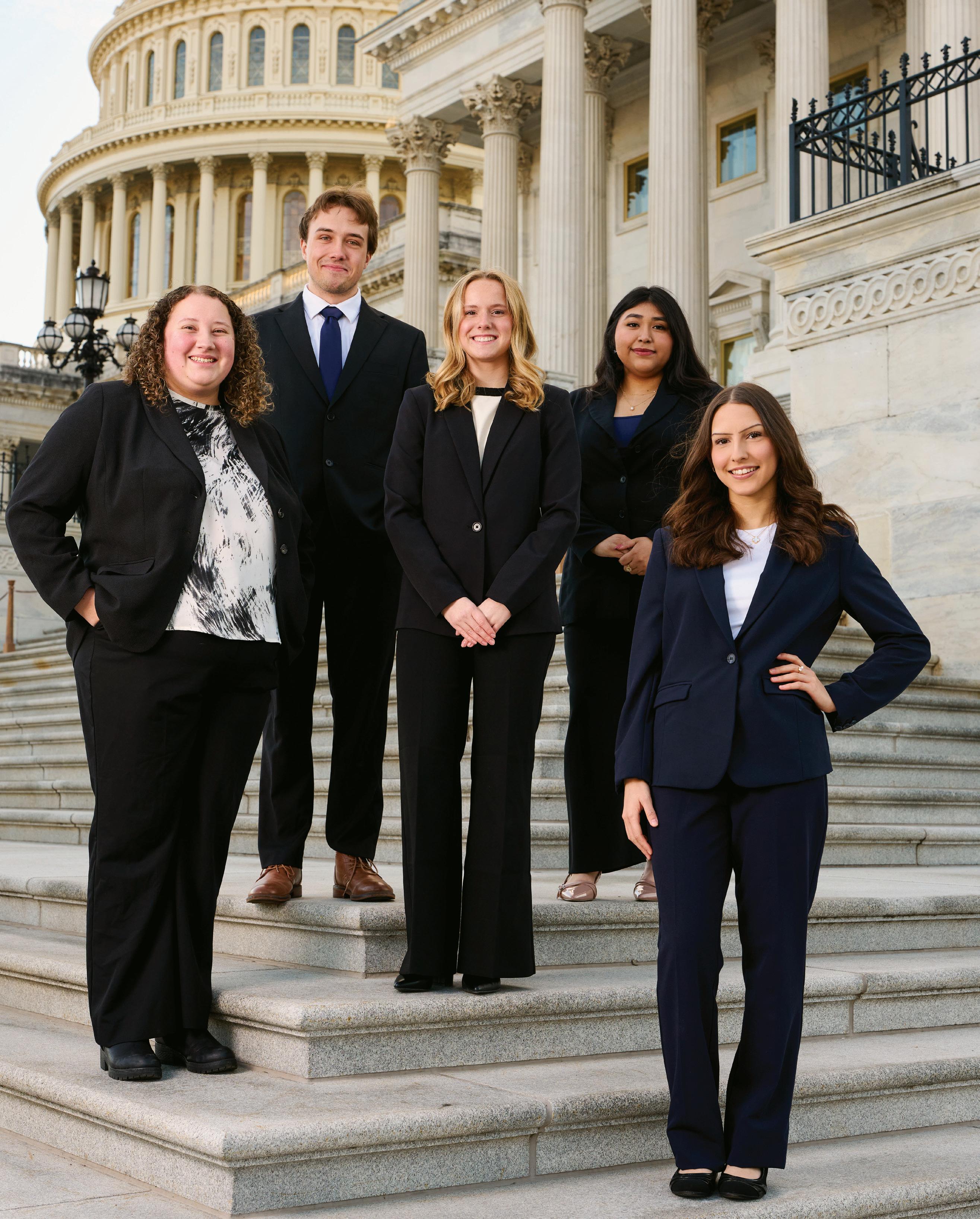
The Capitol is their backyard:
Aspin Center students (l to r)
Hannah Maschmann, Acey Smentek, Ella Olas, Giselle Morelos Balbuena and Miriam Contreras.
Upcoming themed semesters will shape programming and align with key world events. “Communications, Journalism and Media” in fall 2026 will coincide with mid-term elections. “Sports and Public Policy” will lead into the U.S.-hosted 2028 Olympic Games.
Another big change: short courses and specialized programming, including weeklong courses in December and January between typical semesters. A new “Maymester” will also offer a full three-credit-hour course over the span of just two weeks, with rotating offerings. This May, students can enroll in “The Politics of the American Revolution” to coincide with the 250th anniversary of the signing of the Declaration of Independence. Future courses will dive deeper into cultural issues. Offerings in English may leverage D.C.’s Folger Shakespeare Library, with its world-class collection of Shakespeare works, to launch into current social concerns. “No part of Marquette is untouched by public policy,” Nolette says. “This center is for the whole campus.”
Dr.
Amelia Zurcher professor of English and director, University Honors Program
Across the Ideological Divide
Professors from 3 fields discuss their experiences helping students disagree respectfully — and constructively.
Dr. Manoj Babu, Grad ’02
assistant professor of practice — management
Dr. Christine Schindler, Nurs ’97, Grad ’11, ’24
clinical professor of nursing
BY STEPHEN FIL M ANOWICZ
As our public sphere becomes defined by deep divisions and warring approaches to shared challenges, Marquette has experience guiding students in a better way. For nearly a decade, the Civic Dialogues Project has brought students together for events such as Dialogue Dinners where they learn to engage in honest, respectful discussions on difficult issues. More recently, this approach has been at the center of a course in the Marquette Core Curriculum — Civic Discussion, Democracy and Collaborative Problem-Solving — that’s taken by about 600 students each year in sections co-taught by faculty members from diverse disciplines. In this Q&A, professors from nursing and business who taught a section together, and one from English who developed the course, talk about students’ experiences with civic dialogue and what we can all learn from them.
Describe the journey students take in this course — where they started and how they progressed?
Dr. Christine Schindler: When we started, students were pretty quiet. It was a big class, and we really had to encourage people to speak up. As expected, people came with very different perspectives, but by the end, they were much more engaged and better able to talk. It gave me hope because what I see in public now, particularly in the political space, is a lot of shouting of opinions and
people hardly listening to each other. But our students did a much better job of deeply listening to one another, respecting one another and building relationships. They’re understanding this point as coming from a person who is the sum of more than just some disparate opinions. And not to wear rose-colored glasses, but I feel that if this could be duplicated — if we had young people who knew how to disagree but still respect one another — maybe we could start working on problems collaboratively again.
Dr. Manoj Babu: Our specific section handled gun violence, corporate social responsibility and ethics, and AI integration as a final module. These are pivotal and very sensitive topics that people have opinions on. But the civic dialogue course teaches students not just to rush to an opinion, but instead to see all sides of an issue. In our smaller groups, we actually asked people to debate the opposite of the side they would normally take. That was such a learning point. It requires students, or anyone, to look at other angles before forming an opinion. As Christine said, rather than just shouting out whatever you think, there has to be rhyme, reason and logic behind it. This is essentially how communities and societies are built, respectful dialogue. Getting students to consider the opposite side of whatever they are comfortable with — and it was very uncomfortable — that was part of the journey and growth.
Dr. Amelia Zurcher: I love listening to Manoj and Chris. Those are outcomes that I am hoping for. For me, one of the things that we found initially, at least in my sections, is that students are very reluctant to disagree openly. So, if they do disagree, they just kind of sit back (with arms crossed). As the course proceeds, they become much more comfortable, realizing that disagreeing is not the end of the world. Watching those small groups
cohere to the point where they are having a real discussion about different opinions is really cool. And I would affirm the point that Manoj made about asking them to imagine that they hold a different perspective. How would they argue the other side? That’s been huge for us. It helps students realize, as Chris says, that people aren’t just accumulations of different opinions; they contain a lot of potential and a lot of experience. Students start to learn that sound bites aren’t who we are.
What have you learned that might apply to a broader audience and provide value beyond the course?
CS: One of the things we really emphasized — and kept linking back to with students — was how this approach related to being Jesuit educated: We’re not teaching them what to think, but how to think. So, I think it would be incredible if this model could be shared throughout the AJCU (Association of Jesuit Colleges and Universities) as a real marker of depth of thought and being able to communicate in a meaningful way.
AZ: Right now, we’re at 600 students a year and it’s required for students in the University Honors Program. But I would love to see this become the model for the whole core curriculum. As a course for all undergrads, this would be a foundation for a very big group of people. Our students are telling us how they can bring it into other spaces on campus and into their professional lives.
MB: This class truly teaches students to form an opinion that they can support with facts, while also understanding the opinions on the other side. The whole idea of being very aware and taking a total perspective assessment before jumping to a conclusion, or defending a point, that’s key. Even simple things like taking notes about facts on the other side: It encour-
ages students to start thinking beyond themselves. That’s what we need in the business field as well. We’re in a global society, so you have to understand how China markets their products versus how the U.S. markets their products. You have to see multiple sides of the same issue.
Any final thoughts on your hopes for students and where they’ll take the skills they developed in class?
MB: I would hope students use this skill set — deliberate, discuss, debate — not just in academia. They should be able to use it in their normal lives as well. It can be as simple as picking a place to eat with friends or deciding which job to take once graduated. This trained mindset can bloom into providing leadership on issues like gun violence and world peace. I’m hoping students can take that experience and be model citizens using the Jesuit values that we teach them. I’m hoping these students come into the business field, and they’re able to take things logically and discern what’s going on before forming an opinion. Making an educated decision is a much better method of being business leaders.
CS: One thing I would like to see is students being leaders where they are, where they stand. Civic dialogue is such a leadership competency. They don’t have to be the CEO of a hospital or the charge nurse to use these skills. I do think if they use these skills, it really can change conversations. Whether it’s in a cocurricular activity or in their first job, they can lead in communication and influence those around them.
AZ: I have just one word, and I mean it very broadly: peacemaking. I think if we use these skills for peace rather than conflict and violence, both in the course material and on social media, that’s my hope. We need to respect each other.
ARTS AND SCIENCES
Everyday Patriots (and Loyalists)
As
our nation turns 250, a Marquette historian finds meaning in the passionate political messages colonists expressed through their cherished objects.
BY LOUISA KAMPS
As a conventionally trained early American historian, Dr. J. Patrick Mullins pores over the writings of Jefferson, Paine, Hamilton, Franklin and other prominent politicians and thinkers of the period. But watching students stand rapt before artifacts on field trips to museums and historical sites convinced the associate professor of history that studying the things ordinary people treasured could also enrich our understanding of the past.
In a new exhibition he curated at the Haggerty Museum of Art in collaboration with Milwaukee’s Chipstone Foundation, Mullins presents a variety of 18th and early-19th century
objects adorned with political slogans and imagery — including popular prints, printed teapots and hand-painted pottery — to show how invested everyday men and women were in the fight to break from England or, vice versa, to keep the empire intact. Marquette’s director of public history, Mullins hopes viewers come away with a richer picture of how people flashed these pieces to show their allegiances — and how even the most ardent Patriots drew on “a very British tradition of popular protests” stretching back to the Middle Ages. It’s visual history, he adds, that also provides good training for decoding the symbolism and slant of today’s political discourse.
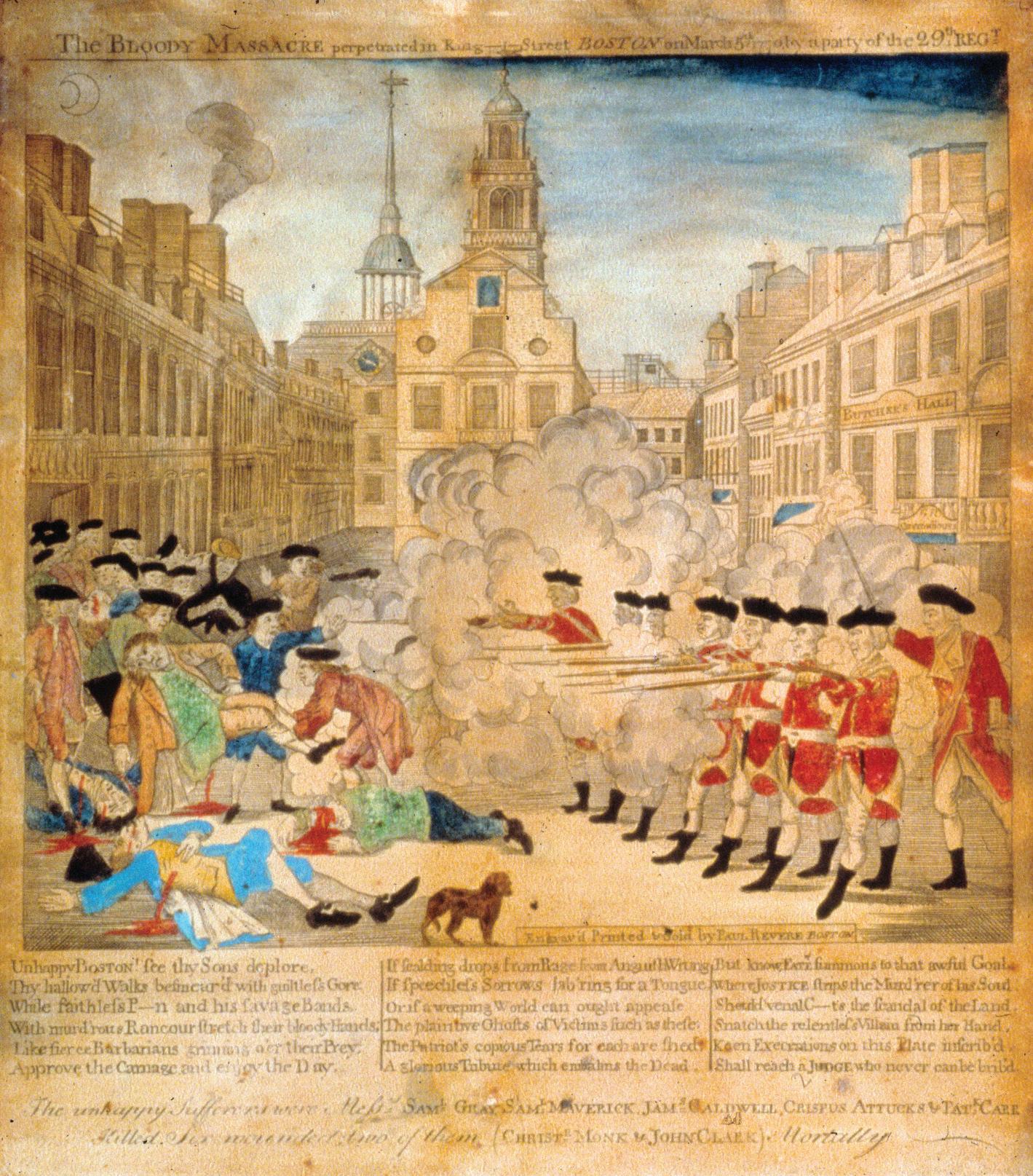
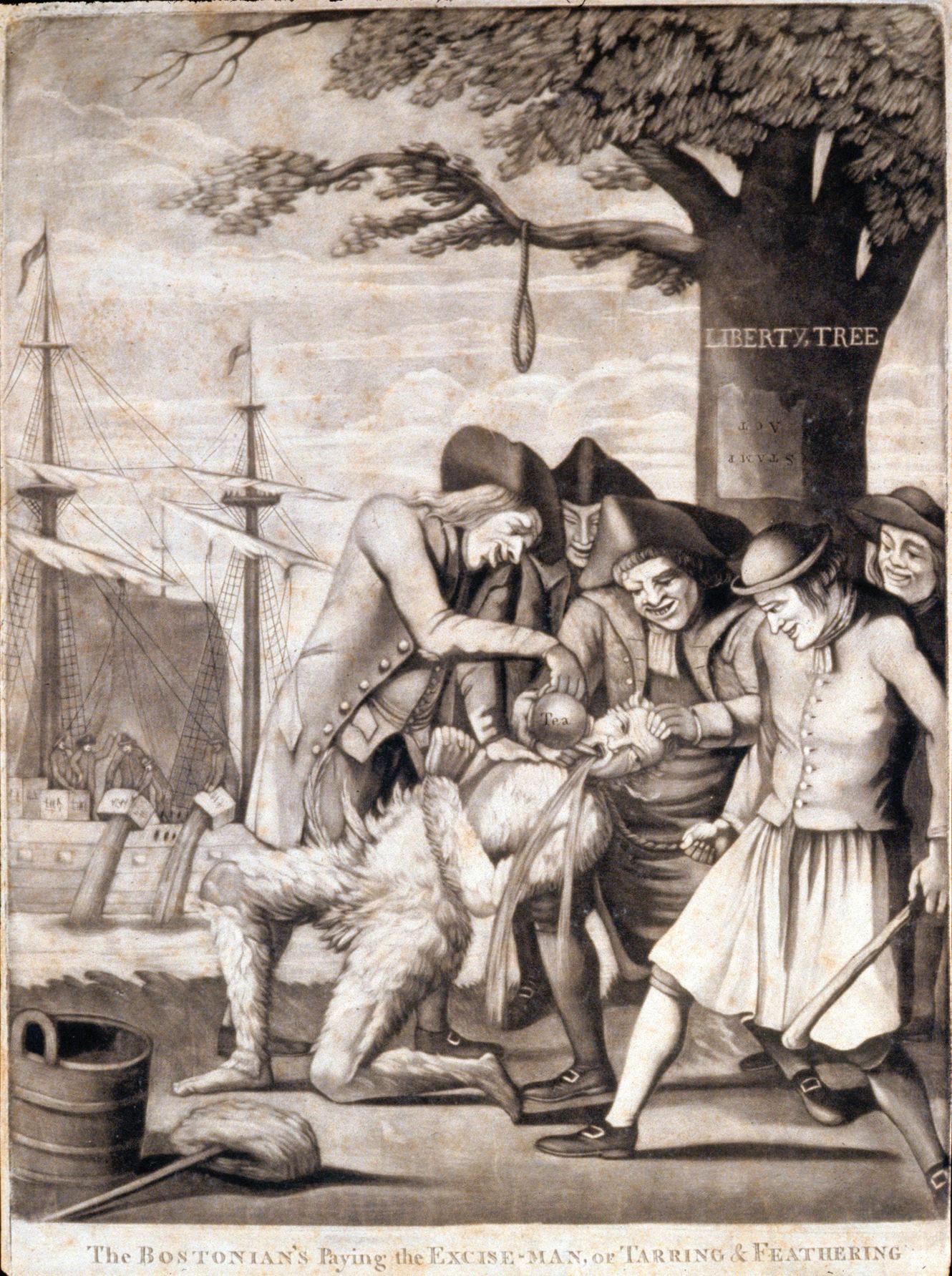
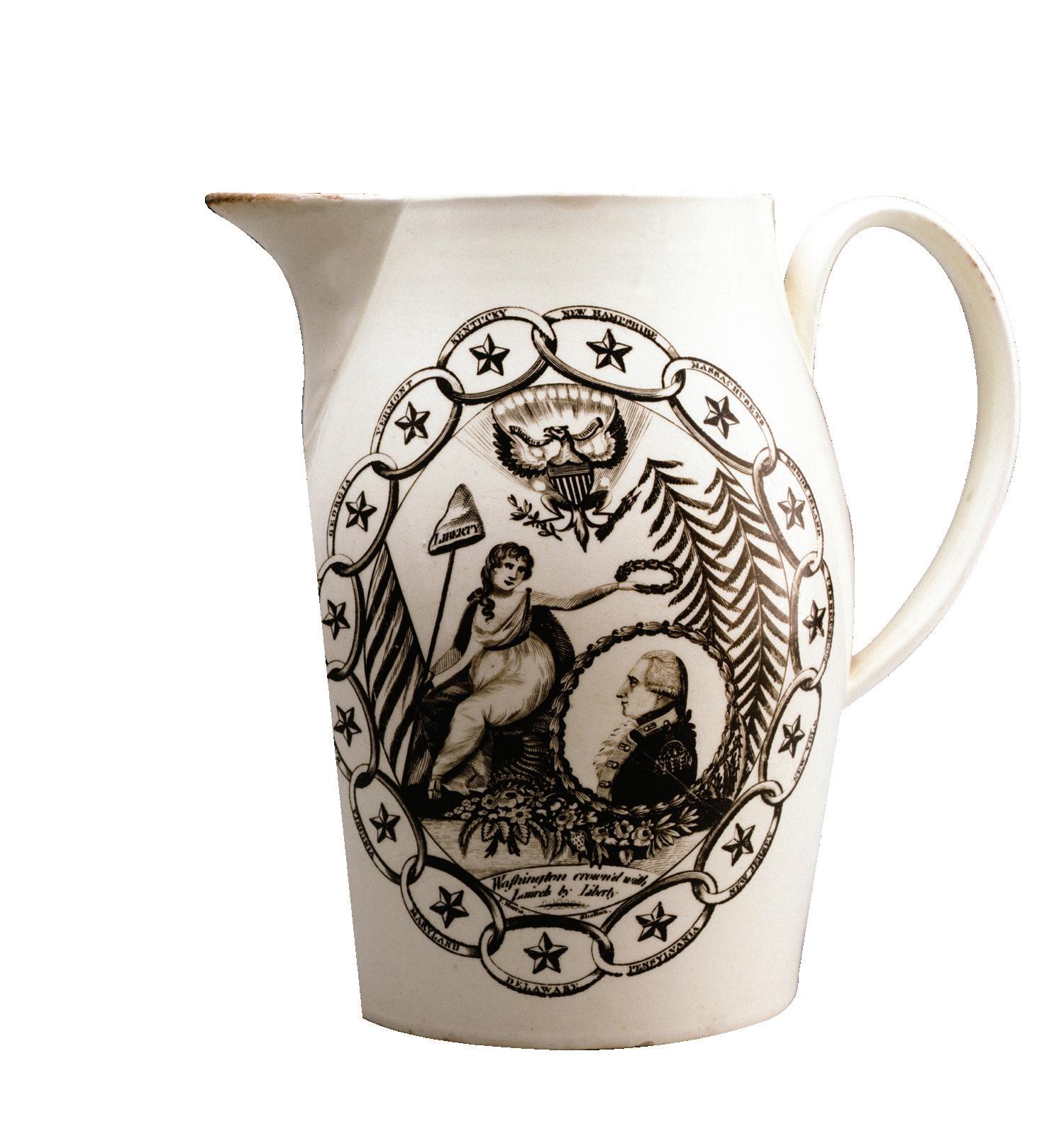
Historic objects from the Chipstone Foundation, photographed by Gavin Ashworth (clockwise from top left): Paul Revere (American, 1735–1818), Bloody Massacre , 1770, engraving with hand coloring, 1969.7; Attributed to Philip Dawe (English, ca. 1745–1809), The Bostonians Paying the Excise-Man or Tarring and Feathering 1774, mezzotint with engraving, 1985.11; Plate, ca. 1765, Delftware, 1964.41; Jug, 1803-1805, creamware with transfer printing and painted decoration, 1956.2; Punch bowl, ca. 1770, porcelain, 1956.8.
PRINTS AND THE REVOLUTION
Even a glance at the prints on the opposite page — on loan from Chipstone and originally hung in taverns to signal Patriot or Loyalist sympathies, Mullins suspects — can knock you back with the violence of our nation’s founding days. At far left is The Bloody Massacre, a hand-painted engraving showing British soldiers firing into a crowd of unarmed Bostonians. Produced by Paul Revere three weeks after the March 1770 event, it memorializes the killing of five civilians, including Crispus Attucks, a dockworker of African and Native American descent, often considered the first person killed in the American Revolution. To its right, The Bostonians Paying the Excise-Man or Tarring and Feathering, printed in London in 1774 and likely engraved by British satirist Philip Dawe, depicts a ghoulish pack of Colonials. They are pouring tea down the throat of John Malcolm, an American-born tax collector loyal to the Crown who had already been tarred and feathered in another New England town because “he was that hated,” Mullins says.
PERSUASIVE POTTERY
Women, so often left out of historical accounts and barred from spaces where men convened, telegraphed their opinions through their household pieces. The Delftware plate (c. 1765) below, with peg marks on its backside suggesting it served as wall art, and the porcelain punchbowl below it (c. 1770) would have told house guests that their hostess admired puckish John Wilkes, a British parliamentarian and journalist boldly critical of government corruption. Wilkes furthered his renown on both sides of the Atlantic with issue 45 of his pamphlet, The North Briton, featuring a scathing article accusing King George III of oppressive policies. Among both British radicals and American Patriots, “Wilkes & Liberty No. 45” (and its variants) went viral, “like a celebrity meme,” Mullins says, becoming “a communal way for non-literate people to express views on politics and society” because everyone knew the code.
And with its inscription, “Washington crown’d with/Laurels by Liberty,” the creamware jug below, produced in Staffordshire, England, around 1805, gives “insight into the political beliefs, motivations and actions” of its owner.
How HurricaneKatrin a forgeda20-yearbond
BY ANDREW GOLDSTEIN, CO MM ’18, GRAD ’25 ILLUSTRATION BY JAS M INE HORTOP
Big Ripples
For members of the Marquette community with deep ties to New Orleans, their relationship to the Crescent City is often a romantic one.
The city quickly — and enduringly — captured the imagination of Dr. Stephanie Quade, Arts ’84, Grad ’94, filling her head with visions of Tennessee Williams plays.
“A small town in a big city,” Richard Duplantier, Sp ’84, a native son and longtime resident, says approvingly.
Nick Karel visited more than a dozen times before moving there shortly after his years at Marquette in the mid-2000s, convinced it’s where he belonged.
And Stephanie Lumpkin, M.D., H Sci ’10, first discovered the city while “falling in love” with the Loyola New Orleans campus.
Twenty years ago, Hurricane Katrina ravaged the city these people loved. The events
of August 28-30, 2005, and their aftermath created shocks and ripples that extended far beyond the flooded neighborhoods such as Gentilly and the Ninth Ward. For the four alumni, what followed the hurricane created a link between Marquette University and New Orleans that has persisted for two decades.
THE LOO M ING M ENACE
“We’ve had these before, we’ll lose power for a few days, but we’ll be fine.”
Lumpkin still remembers those words from her resident assistant, delivered soon after she’d arrived at Loyola’s campus for freshman move-in week from her home in Milwaukee. She and friends went to Target to stock up on snacks before the storm’s landfall. The RA told her to fill her bathtub with water so she could flush the toilet if power went out. Hurricane Katrina seemed like nothing more than an inconvenience.
“We bunkered down, and every six to 12 hours it got more serious,” Lumpkin recalls.
“All the airlines started canceling flights and there were no buses leaving the city anymore. Nobody could get into the city because they started contraflow on the highways.”
On August 28, the day before the storm hit and shortly after the mayor declared New Orleans’ first-ever mandatory evacuations, Lumpkin found a classmate packing up her van to leave the city. Lumpkin hopped in the van, joining a cascade of vehicles driving north on I-10 away from New Orleans.
A HO M E AWAY FRO M HO M E
Hurricane Katrina claimed more than 1,800 lives, most of them in southeastern Louisiana, with hundreds more missing. Over 1 million people were displaced from their homes, the largest such displacement in American history. Thousands in that diaspora were college students, their lives left in limbo as their universities ceased operations for a semester, sometimes longer.
Quade, then the associate dean of student development at Marquette after starting her career at Loyola University New Orleans, knew that her university had to do something to help. “It just so happened that we had a good amount of residence hall space open, and a lot of other universities did not,” Quade says. “We saw that we had some ability to take students from Loyola, from Tulane and from Xavier University, too.”
In the end, Marquette enrolled 69 undergraduate students from New Orleans schools. Some just stayed for a semester, others much
longer. The student development staff, including Quade, tackled mountains of paperwork to get their credits transferred and their financial aid secured. Families of Marquette students donated money, helping the university form an emergency fund to buy textbooks and other essentials for the affected students. An alumni group knitted scarves for them.
Amid the despair and the hope sat Lumpkin, a first-year student trying to get her life reassembled. When the spring semester came around, she tried going back to Loyola, but she grappled with survivor’s guilt the entire time. She couldn’t escape feeling that she wasn’t helping a city in need. “Marquette had opened a whole new way of seeing the world for me; it made me feel like there was something more I could do,” Lumpkin says. Recognizing that she loved both universities, she decided to return to Marquette for her sophomore year, in part based on the advantages it offered in pre-med study, but she was still searching for that something more.
“YOU’RE WHEELING M Y LIFE AWAY”
Two decades later, Nick Karel still remembers wheeling a chest of Warren and Anita Williams’ Mardi Gras beads to the curb. The Williams were the “sweetest older couple you can imagine,” Karel recalls. They lived in the Gentilly neighborhood near Lake Pontchartrain, the water from which breached the walls of the London Avenue Canal and consumed their home.
As the chest of beads passed Warren, tears welled in his eyes. “You’re wheeling my life away,” Karel recalls him saying.
It was fall of 2006 and Karel, then a freshman from St. Paul, Minnesota, was volunteering on a Marquette Action Program trip to New Orleans. For over three decades, Marquette students working in partnership with Campus Ministry have traveled across the country with M.A.P., performing service projects to alleviate urban poverty, build communities, and improve local health and education.
The residents of New Orleans, however, were dealing with a situation significantly more dire than the typical M.A.P. site. Only 60 percent of inhabitable homes had electricity. Half the hospitals in town had not reopened. Conditions for nonwhite residents, who made up 80 percent of the population in the most flooded areas of the city, were even worse.
That fact did not escape Lumpkin’s notice, who joined Karel on that same 2006 trip. “Watching the coverage of Katrina afterward was infuriating because you saw which areas the government seemed to care more about, and people making assumptions about who brought their conditions on themselves. It was infuriating.”
That impulse turned into action, fueling plans she’d been forming with fellow students even before the trip for a new organization dedicated to helping New Orleans get back on its feet and creating enduring support. That organization was Making A Real Difference in the Gulf Region and Areas Surrounding. Marquette’s MARDI GRAS was born.
Marquette students embraced chances to help New Orleans recover and rebuild, which grew into the 20-year MARDI GRAS tradition.
THE LONG REBUILD
Less than 15 months after a van carried Lumpkin away from Loyola and 69 students from New Orleans came to Marquette, a fleet of vans carried an even larger number of Marquette students — 100 — toward the city for the first major MARDI GRAS service trip. MARDI GRAS partnered with Common Ground Relief, a grassroots organization dedicated to rebuilding their city. They were initially wary of the Marquette group.
“Nobody was going to give us an award for showing up; we were going to have to prove that we had some kind of value to add,” Lumpkin says. “That first trip, we stayed in an abandoned elementary school in the Ninth Ward. We proved that we were willing to work no matter what the conditions were and that brought us a lot of street cred.”
MARDI GRAS showed up again and again in New Orleans, gutting house after flood-afflicted house. Once the recovery efforts had shifted toward building from gutting, MARDI GRAS bought drywall and trained student volunteers to properly install it. Each summer, fall, winter and spring break, a caravan of rented vans would make the 32-hour round trip drive from Milwaukee to New Orleans, making a new mark on the city’s rebirth each time.
On one such trip, the group connected with Richard Duplantier, a Marquette alum who worked in New Orleans as a lawyer. Duplantier had lost his home in Katrina and was rebuilding on the same spot in Lakeview, a neighborhood 3 miles west of the Williams home. As soon as he heard what MARDI GRAS was doing, he scraped together as much food as he could and sent it over.
“They brought a little bit of hope and shined a light on us when we really needed it,” says Duplantier, Sp ’84. “They were willing to sleep on floors and take showers with a hose to be where they were needed most.”
When Duplantier’s house was rebuilt, he began hosting MARDI GRAS students each year, all 90 to 100 of them at once. They piled into his pool, ate crawfish pasta and jambalaya for dinner, and took the one decent shower of their time in New Orleans in his backyard. Then they packed up and headed back to their original accommodations, ready to continue the work. “Life is all about what you can do to give back and make a difference, whether it’s a small one or a large one. The best footprint you could leave behind is one of service and community,” Duplantier says.
AFTER M ATH
Duplantier still lives in New Orleans, among a rebuilt block of homes that show few hints of Katrina. Karel works in hospitality there and is still involved with Common Ground Relief, even serving a term as board president.
After a career spanning more than three decades, Quade retired from Marquette. She still visits New Orleans regularly.
Lumpkin is now a trauma surgeon in Kansas City, practicing the same principles of servant leadership and reverence for humanity that she cultivated on the streets of those flooded neighborhoods. “I learned through my time in New Orleans that I don’t ever want to be in a situation where I’m unable to contribute,” she says.
MARDI GRAS has sent over 3,500 students to the Gulf region in its 20 years of existence. They’ve taken on natural disaster recovery projects in Florida, Texas and North Carolina, among other locations.
In 2018, Lumpkin returned to Marquette to receive an Alumni National Award from the College of Health Sciences. While in Milwaukee, she got to meet the students carrying on the organization she founded. She was delighted to feel like she was talking to younger versions of herself.
“These students were young kids when Katrina hit, but they were just as passionate about healing the racial divides that the storm uncovered and how social justice shapes your vision of vocation,” Lumpkin says. “They are willing to push their own limits and that’s what has kept this going for so long.”
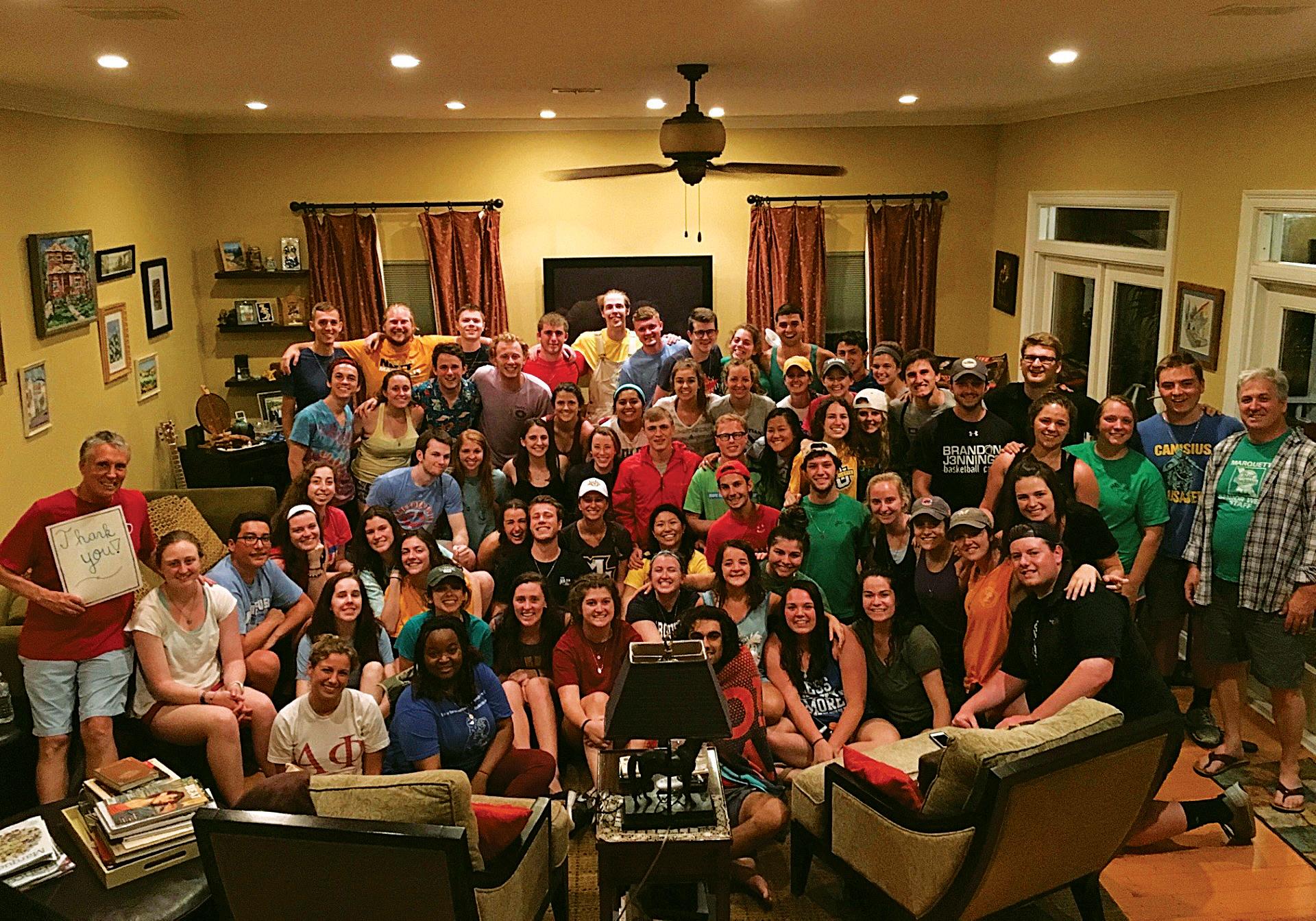
Marquette MARDI GRAS volunteers gather at the New Orleans home of Richard Duplantier, Sp ’84.
EXA Leading by
M PLE
HONORING RECIPIENTS of the 2026 ALU M NI NATIONAL AWARDS
for their lives embodying Marquette’s mission of excellence, faith, leadership and service.
Marquette’s Alumni National Awards annually recognize distinguished alumni, parents and friends who represent the university’s true spirit and mission. This year, recipients of the All-University Awards will be celebrated on Friday, May 29, and awards from five of Marquette’s colleges and affinity groups will be presented in separate ceremonies. (The remaining colleges and affinity groups will present awards in 2027.) In these pages, we introduce you to this year’s All-University Award recipients.
ALU M NI of the YEAR AWARD
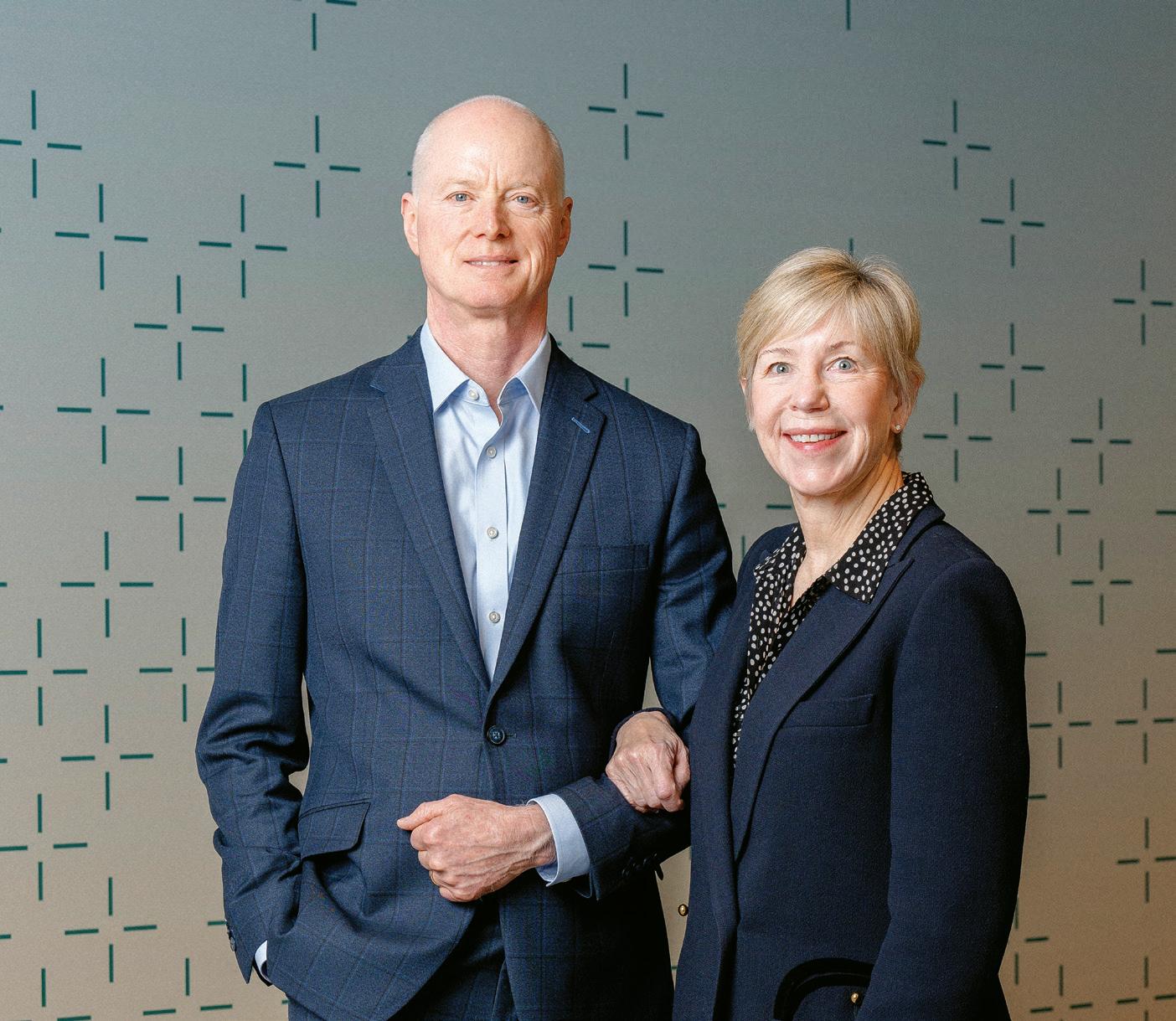
KIMBERLY WEST ECK, COMM ’13, and ROBERT J. ECK, ARTS ’80 WISCONSIN
Some experiences reveal their full impact only over time. For Kimberly West Eck and Robert Eck, Marquette University is one of them. Bob discovered early that leadership is rooted in respect and mentorship, which became an ethos that shaped his global business career (including 10 years as CEO of Anixter International), board service and philanthropy. Kim’s Marquette journey was interrupted by illness, but returning decades later to finish her degree gave her a deep appreciation for the power of empathy and perseverance. The Ecks have continued to live Marquette’s mission, often in ways they only fully recognize in retrospect.
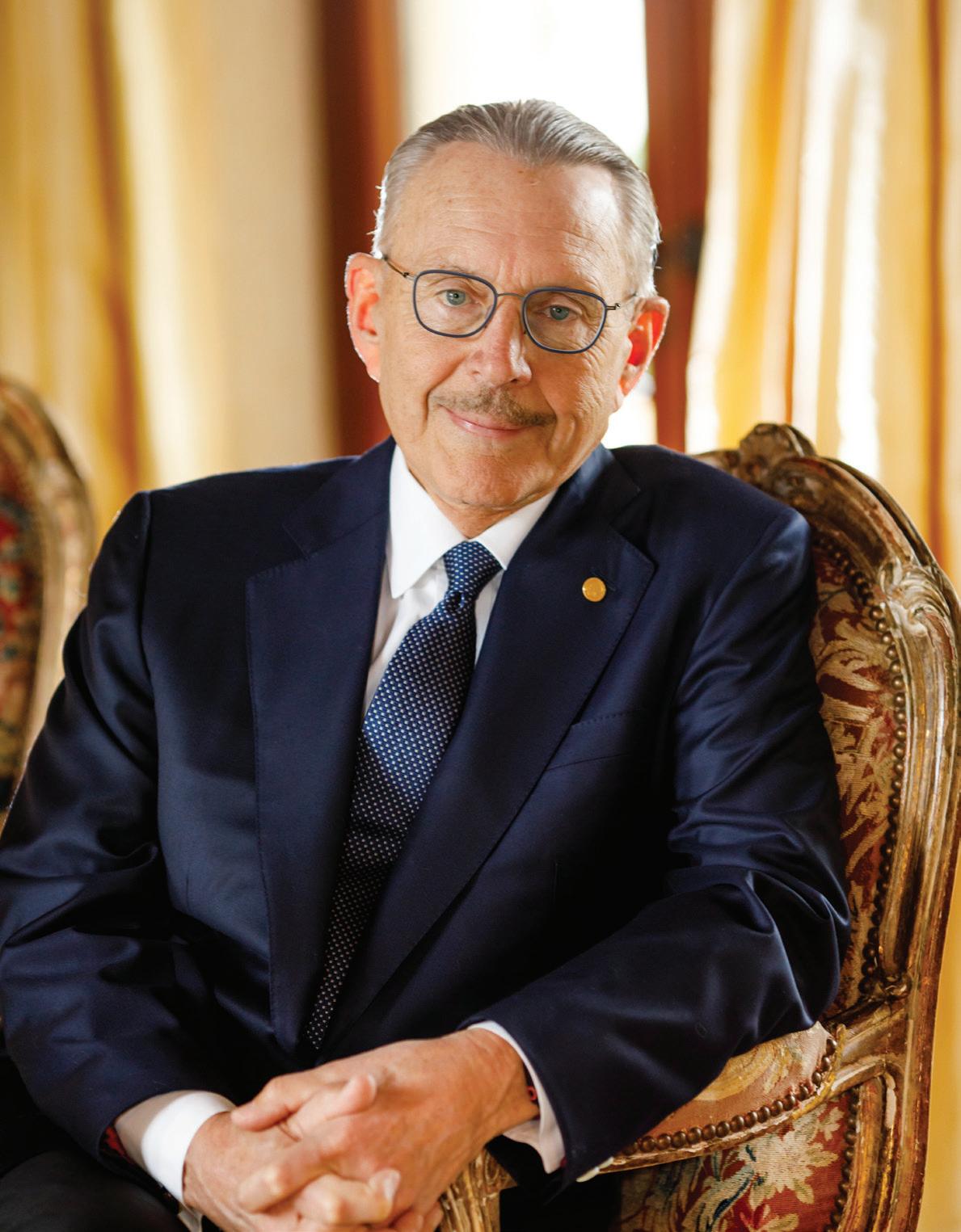
John Rakolta, Jr., believes leadership requires stepping into difficult situations when outcomes matter. Shaped by Jesuit formation at Marquette, he has consistently intervened across business, civic life, diplomacy and culture to face risks and address complex challenges. From leading Walbridge, one of America’s largest privately held construction companies, to serving as U.S. ambassador to the United Arab Emirates, his career reflects a conviction that values, integrity and responsibility demand action, not distance.
Professional ACHIEVE M ENT AWARD
AMBASSADOR
JOHN RAKOLTA, JR., ENG ’70
MICHIGAN
SPIRIT of Marquette AWARD
(ACHIEVEMENT BEFORE AGE 40)
TIMOTHY M. KUMMER, M.D., NURS ’07 MINNESOTA
“When you pray, move your feet.” This African proverb has shaped Dr. Tim Kummer’s life and service. As an emergency physician, EMS system medical director and advocate for systems-level change, Kummer has consistently stepped toward suffering and responded with dignity rather than judgment. His commitment took root at Marquette, where a formative service experience in Kenya clarified his purpose and led him to a career in medicine and a lifelong commitment to service. Today, his work spans efforts to address the opioid crisis, prevent gun violence and build emergency medical services in Tanzania. His guiding principle is simple: Meet people where they are.
SERVICE AWARD
KRISTINA ARRIAGA DE BUCHOLZ, ARTS ’86 VIRGINIA
For Kristina Arriaga de Bucholz, service means showing up — across borders and belief systems and in moments of personal risk. As a communicator and advocate, she has stepped into high-stakes situations to defend liberties that are due everyone: free speech, religious freedom and the rights of women and girls. In past roles such as vice chair of the U.S. Commission on International Religious Freedom and currently as CEO of Intrinsic Communications, Arriaga de Bucholz is guided by conviction rather than comfort. She uses her voice and influence to serve the values of justice, courage and service that took shape during her years at Marquette.
A Hollywood Homecoming
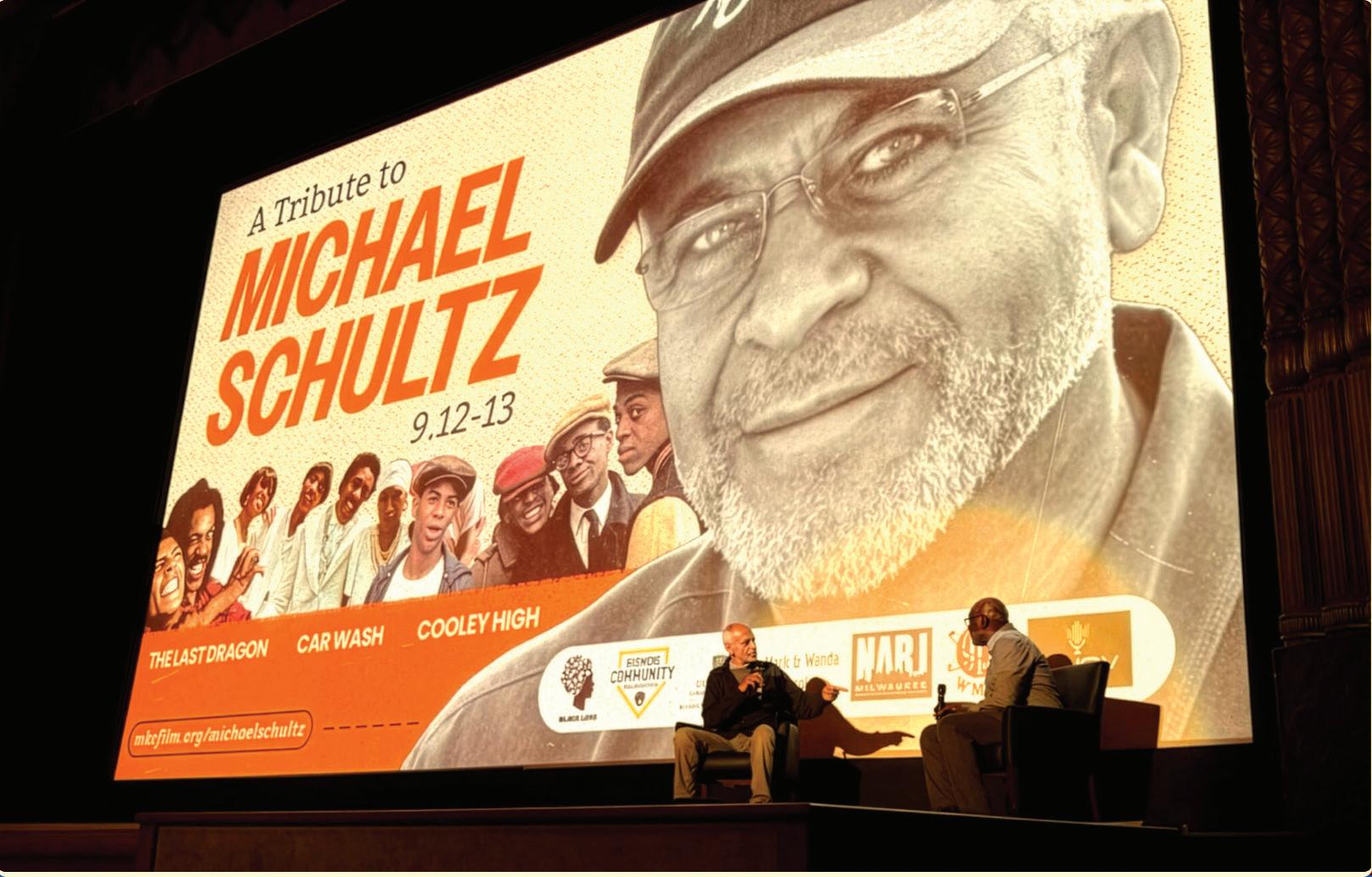
Veteran director Michael Schultz, Sp ’64, is one of Hollywood’s most prolific directors. Fifty years after his last trip home, the Milwaukee native returned for a tribute weekend in his honor.
BY ALEX ORLANDO
PHOTO BY NATHAN BAJAR
WHEN FILMMAKER MICHAEL
SCHULTZ walked down the aisle at the Oriental Theatre last September, the audience erupted in cheers. Kicking off Milwaukee Film’s tribute weekend in his honor, Schultz introduced the first of three of his films being screened that weekend — the much-loved martial-arts musical
The Last Dragon.
“I had to say, ‘OK, calm down,’” Schultz says with a laugh. “I’m not one for reveling in that kind of stuff. I wanted them to enjoy the movie.”
Schultz’s easygoing humility might seem at odds with his trailblazing career.
A native Milwaukeean, Schultz, Sp ’64, began his career in theatre at Marquette and in New York before becoming one of
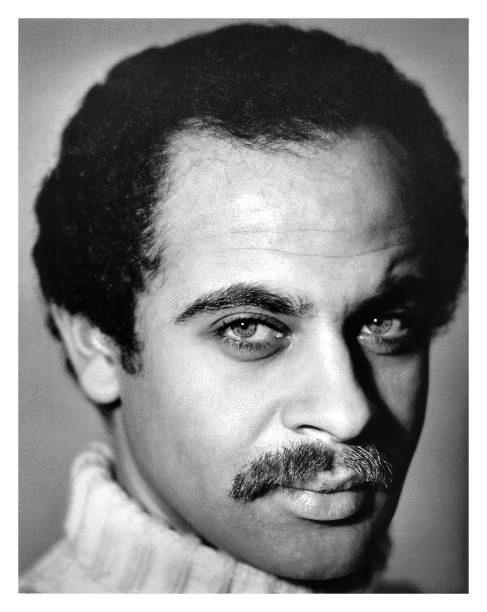
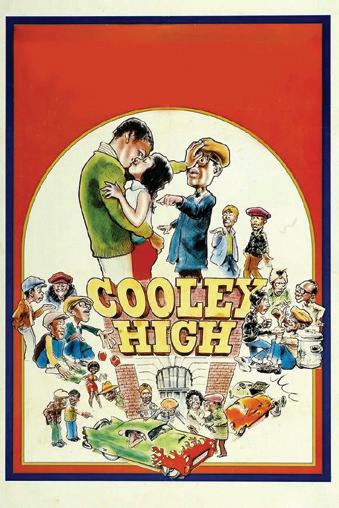
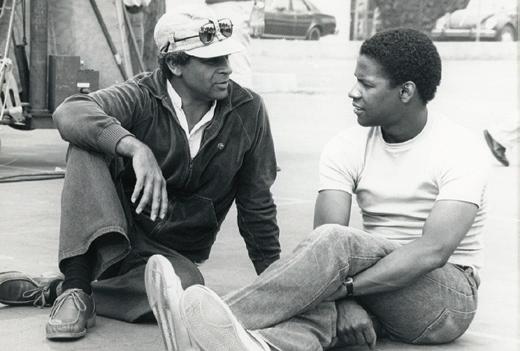
the first Black artists to regularly direct film and television productions. Since the 1970s, Schultz has directed more than a dozen films — including classics like the coming-of-age drama Cooley High and the star-studded comedy Car Wash — and worked on more than 100 TV shows. He also helped launch the careers of Samuel L. Jackson and Denzel Washington, directing both in their first feature films.
In short, he’s among Hollywood’s most prolific and longest-working directors. And at 87, Schultz shows no signs of slowing down. Last fall, he directed two episodes of All American, a drama on the CW that he’s worked on for eight seasons.
Yet despite his busy schedule, when Schultz was invited by Milwaukee Film
to receive the inaugural Michael Schultz Award, conceived as an annual award given to a luminary Black filmmaker, he accepted. It had been exactly a half-century since Schultz had been back to his hometown; he had last returned to teach a theatre workshop at Marquette in 1975.
“I was very honored to have the red carpet rolled out over the weekend,” Schultz says.
THE PATH that would come to include more than five decades in Hollywood started with a childhood on Vine Street in Milwaukee — and, crucially, four years at Riverside High School. Balancing his interests in athletics, arts and academics, Schultz played baseball and football, ran the school’s 16mm film projector and participated in student theatre productions, sowing the seeds for his future creative pursuits.
After graduating, Schultz’s dreams of studying aerospace engineering and becoming an astronaut quickly flamed out when he got a D in calculus during his first semester at the University of Wisconsin–Madison. He stayed there only two years, but the experience was still formative: While sampling other subjects, Schultz spent most of his free time in a local movie theatre, immersing himself in the films of Ingmar Bergman and Federico Fellini. “I was getting my own film school
education,” he says. “I remember thinking, ‘Man, I would love to be able to tell stories like these guys.’”
Eventually, after dropping out of UW–Madison and briefly working the night shift at a steel mill, a friend suggested Schultz apply to Marquette’s theatre program. “I said, ‘I’m trying to get out of Milwaukee,’” he says. But then he met with Rev. John J. Walsh, S.J., the longtime director of the program, who told Schultz, “You’re going to live, eat and breathe theatre.”
After enrolling, Schultz did exactly that. Under Father Walsh’s stewardship, he became the program’s lighting designer, where he got a front-row seat to watch student actors perform Shakespeare and other classics. Beyond the technical skills he gained, Schultz absorbed long-lasting lessons from Father Walsh, whose vision for theatre at Marquette was steeped in Ignatian humanism. “I learned that the real reason for doing this was not about making money [or] getting famous,” he says. “It was about uplifting the audience so the people who came into the theatre were different people when they came out.”
When he graduated in 1964, Schultz was eager to get started in New York; in fact, he skipped graduation to go straight there. He then nabbed a role in an award-winning production of Melville’s Benito Cereno, where he focused more on his peers than his own performance.
“I’m not really acting,” he recalls. “I’m looking at the other actors saying, ‘Well, you shouldn’t say the line this way.’ I’m directing.”
Soon, Schultz was directing, from an initial gig directing an off-Broadway play to bigger theatrical productions. His first Broadway play, Does a Tiger Wear a Necktie?, was initially written for then-budding actor Jon Voight. But then, an actor Schultz had bumped into at an awards ceremony came to audition: a young Al Pacino.
“I’m sitting next to the playwright and I said, ‘I don’t care what you wrote. That’s the guy,’” Schultz recalls. “So, we cast Al to play the part.” Pacino won a Tony Award for his performance — and Schultz’s ability to recognize emerging talent would continue throughout his career.
IN THE EARLY 1970s, Schultz fulfilled his dream of working in film. After directing To Be Young, Gifted and Black, a stage play turned TV movie, he went on to direct Cooley High. The film, which follows a group of high schoolers in 1964 Chicago, broke new ground in its authentic depiction of the young Black experience in movies. “At the time, there was no film like it,” Schultz says. “I knew that if I made it so true to the Black experience, it would transcend color.”
Decades later, in 2021, Cooley High was
A STORIED CAREER
Over 60 years, Michael Schultz has left a lasting imprint on the American cinema and television landscape.
COOLEY HIGH IS RELEASED AND GROSSES OVER $13 MILLION AT THE BOX OFFICE. The critically acclaimed film marked the start of Schultz’s ascent in Hollywood and has been recognized as a classic of Black cinema.
selected for preservation in the National Film Registry by the Library of Congress for its cultural significance. It’s also been cited as a touchstone for filmmakers such as John Singleton and Spike Lee — even making the list of essential movies that Lee shares with his students at NYU. “It’s exactly what should happen with all filmmakers,” Schultz says. “Just like I was inspired by Fellini and Luc Besson. I’m happy my work has had that effect on people.”
There have been other ripple effects of Schultz’s work. He cast Denzel Washington, then 26, to play the Black son of a white corporate executive in 1981’s Carbon Copy. The role was Washington’s movie debut. “He was sitting out in the hallway waiting to audition, and he just had a striking energy,” Schultz recalls. “He came in and read, and I knew instantly that he was the guy to play
Milwaukee Film screened three of Schultz’s breakout films at the Oriental Theatre last fall as part of a two-day salute to the filmmaker.
that part.”
Schultz’s feature films range dramatically in genre and scale, from the ensemble comedy Car Wash to the big-budget Beatles-themed musical Sgt. Pepper’s Lonely Hearts Club Band (starring the Bee Gees, no less). But since the 1990s, Schultz has largely worked as a television director. “I hated sitting at a desk after one feature was done,” he says. “So instead of waiting for some executive to give me the green light, I would go back and do television.”
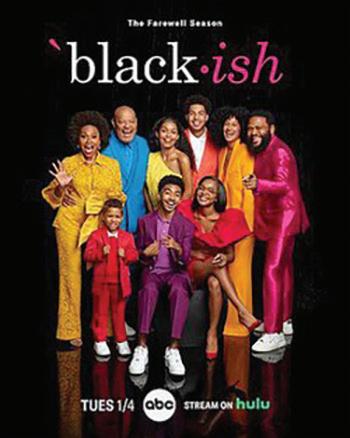
Schultz’s work in TV is also impressively far-ranging. He’s directed episodes of The Rockford Files, Ally McBeal, New Girl, Arrow and many more. His work on many shows — including All American and Blackish — spans multiple seasons. For Schultz, the medium presents the opportunity to reach millions of people while honing his creative skills. “It’s like a sharpening stone,” he says. “The more you work under the pressure of television, the sharper you get in terms of decision-making.”
THE LAST DRAGON GROSSES $26 MILLION AT THE BOX OFFICE. Blending elements of musicals and martial-arts films, it has become a cult classic.
WHEN SCHULTZ returned to Milwaukee in September, it had been a while since he had thought about his native city. After his last visit to Marquette in 1975, his mother — the last relative Schultz had in Milwaukee — moved to New Mexico. “There was no reason for me to go back,” Schultz says. “So, I was very excited when Milwaukee Film invited me to come; it turned out to be a great deal of fun.”
After beginning the weekend with screenings of The Last Dragon and Car Wash , Milwaukee Film presented Schultz with the Michael Schultz Award before a screening of Cooley High the next evening. Going forward, the award will be given annually to an extraordinary Black filmmaker. “I guess I have to keep doing really good work,” says Schultz with a laugh. “Just so those young filmmakers say, ‘Oh, that’s the guy. I want to be like that.’”
Since wrapping on All American last fall, Schultz has no immediate plans for his next project. Still, the Hollywood veteran is having too much fun to suspect it will be long before he’s back in the director’s chair. “It’s like being a cook in the kitchen,” Schultz says. “Your ingredients are your creative collaborators and they’re all coming together. Seeing those scenes come to life and the actors give it their all, that is what gives me a lot of satisfaction.”
DIRECTS SEVEN EPISODES OF ALLY M CBEAL , in a TV career ranging from The Rockford Files to Gilmore Girls
DIRECTS SIX EPISODES OF BLACKISH AND 15 EPISODES OF CW’S ALL AMERICAN, AMONG OTHER CREDITS M ILWAUKEE FILM HONORS SCHULTZ WITH AN AWARD IN HIS NAME
BY STEVE BLAHA, ARTS ’96, DIRECTOR OF CAMPUS M INISTRY
Finding God Here
A Jesuit educator guides students as they search for authenticity, journey in faith and encounter God all around them.
“Who would make a great speaker at Ignite?” I pose this question multiple times a year to the Ignite student team as we brainstorm whom to invite to offer words of inspiration and faith to their peers at this weekly Catholic community gathering at Marquette.
Invariably one of the team members will say: “Someone authentic.” All heads in the room immediately nod. Verbal affirmations leap forward: Definitely. Yes, authenticity!
“What do you mean by authentic?” is oftentimes my next question.
A fascinating conversation usually follows. What emerges is the strong desire and felt need in students to meet people of consistency and integrity — folks striving to practice what they preach. Perfection is not desired. Our students long for real people who struggle, make mistakes and yet, day in and day out, strive to live a life of faith dedicated to loving God and loving their neighbor.
At the heart of their hunger lies the question: Is living fully as human beings possible? Do I have it in me to live such a life?
This desire for authenticity may be found in the Gospels too. In John 1:37-38, Andrew and a friend begin following Jesus, to which Jesus asks: “What are you looking for?” They respond by asking him where he is staying. Jesus says: “Come and you will see.” Andrew and his friend take Jesus up on that invitation to encounter him, his friends and family members, and his way of being in the world. As their relationship unfolds, Jesus’ disciples find in him the answer to their hopes and a resounding affirmative answer to his question.
I have also witnessed this innate human hunger inside the classroom. As part of my section and other sections of THEO
1001, Finding God in All Things, the foundations course for theology, students read Laudato Si’, Pope Francis’ encyclical on caring for creation. For many students, this is their first time reading an official document from the Catholic Church and first time engaging Catholic thought in a systematic way. Francis’ tour de force resonates deeply with them, especially his challenge to Christians to follow God’s call by being good stewards of the earth. Students express a kind of joy filled with awe in what they discover.
To be authentic, belief needs to be lived and tried in the real world. As students in class express, there is a deep resonance when a community proclaiming to follow the God of love embodies this love on important issues of our day. Or as St. Ignatius reflects in the Spiritual Exercises, “Love ought to be shown more in deeds than words.” Francis’ encouragement buoys students in seeing their own environmental efforts as part of a worldwide movement.
On Monday nights, Midnight Run site coordinators gather to reflect on the past week. A Campus Ministry program led by students, Midnight Run is Marquette’s largest weekly service group and is focused on supporting neighbors experiencing food insecurity. During the meeting, student leaders name moments where their hearts were broken and where they were invited to expand and grow. They discuss how their eyes are becoming acclimated to seeing a new world in the making — where economic stability, immigration status, race, education and employment level are superseded by our common humanity; where what divides us as members of the human family gives way over a shared meal, in a shared space, at a shared table. They see life anew even if these movements at times seem to come in fits and starts.
To be in the room with students as they unpack their experiences, savor the consolations and wrestle with important questions is an incredible gift. Their own process of “coming and seeing” through their day-to-day lives at Marquette is inspiring.
Throughout the world, Jesuit educators, including us at Marquette, are called to “accompany young people in the creation of a hope-filled future.” As we face a world with many grave challenges and I listen to students naming and identifying concrete ways that God’s dream continues to unfold, find expression and give them hope, I am reminded that God very much continues the good work that has begun in my life, students’ lives and throughout our world.
Thinking back to my question posed to the Ignite team: “What do you mean by authentic?” I am struck by students’ resilience in naming their sources of hope, their desire to seek this out in community, and the way that faith illumines the journey. All of that is a way of leaning into the lifelong process of Finding God in All Things.
QUEST for
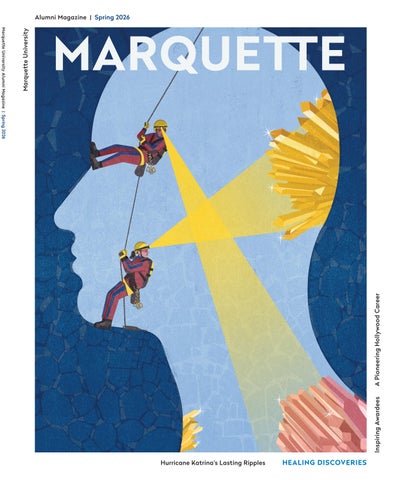
HEALING DISCOVERIES
With students by their side, Marquette faculty researchers reach for breakthroughs to improve your physical and mental health.
By STEPHEN FILMANOWICZ, RACHEL GINTNER ORLANDO, ANNA FUNK and CARRIE ARNOLD
Illustration by SHOUT
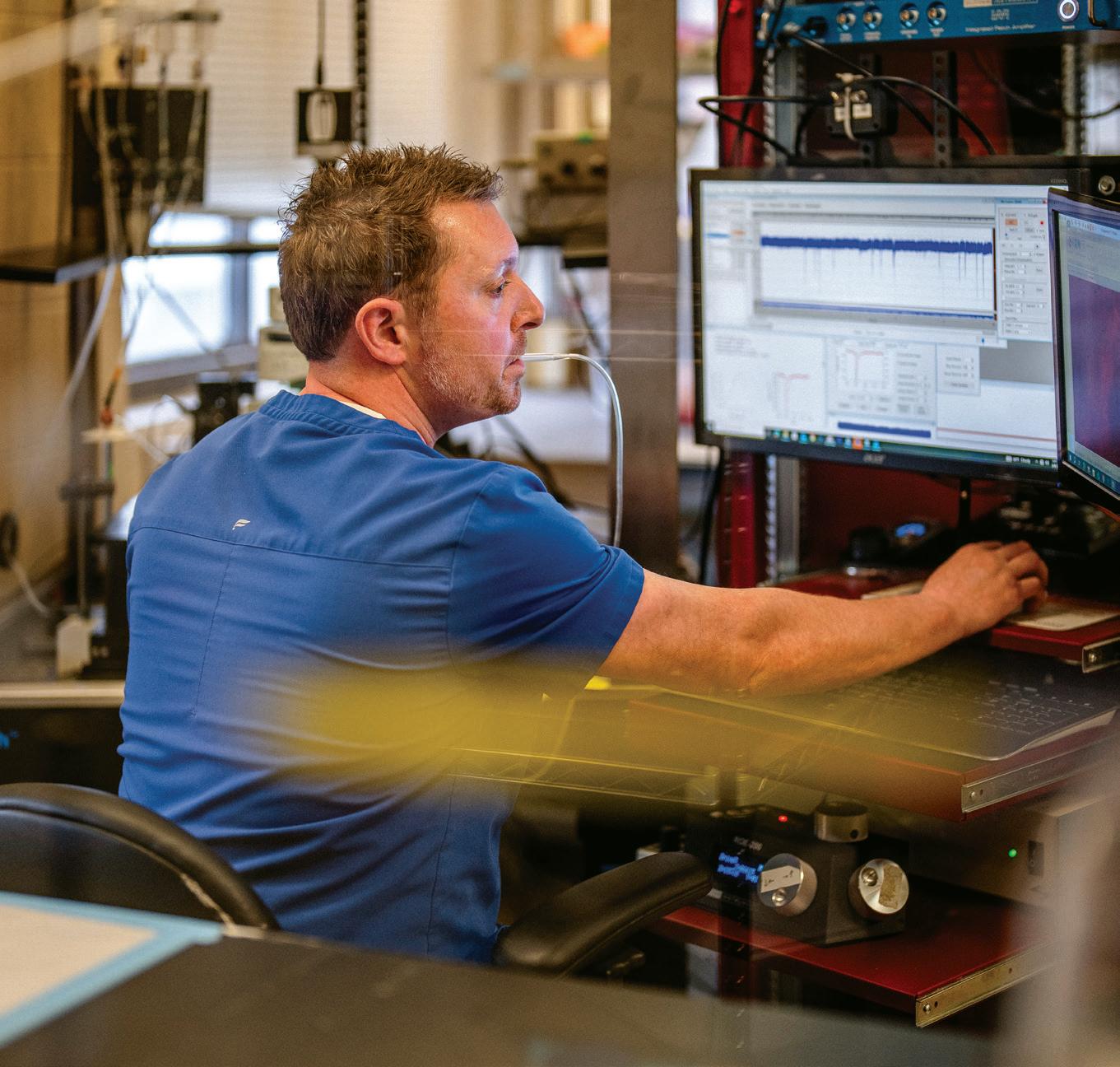
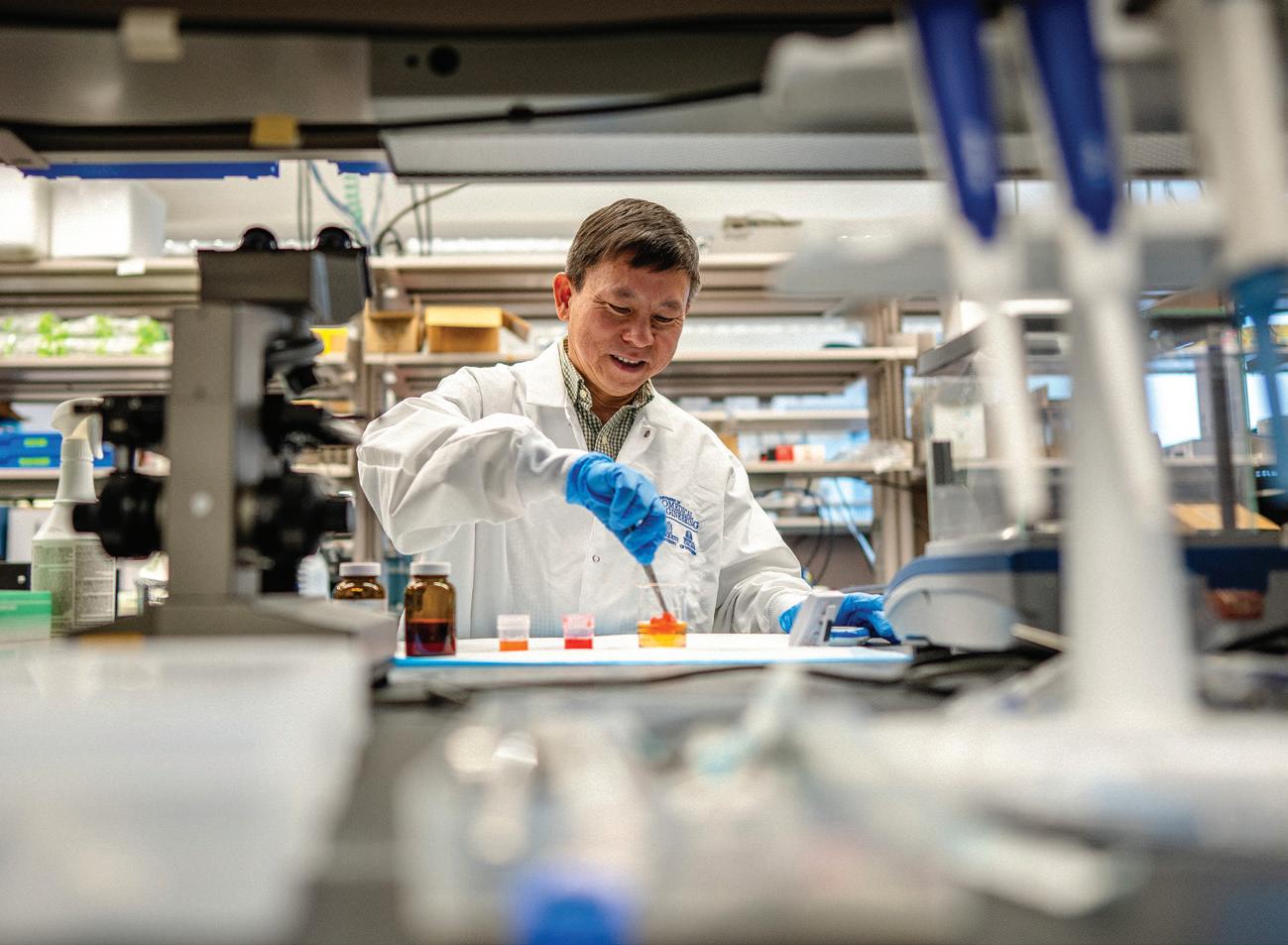
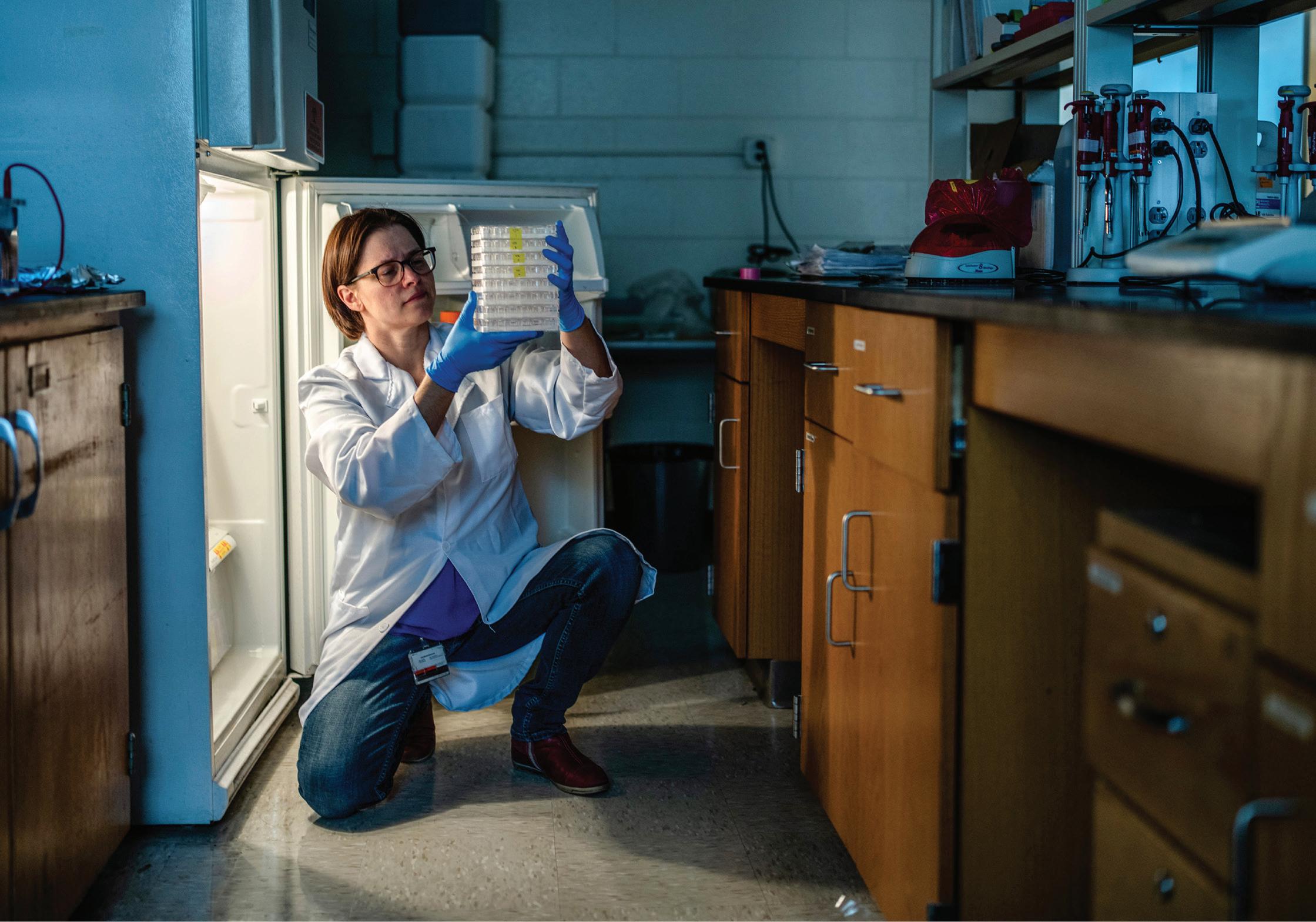
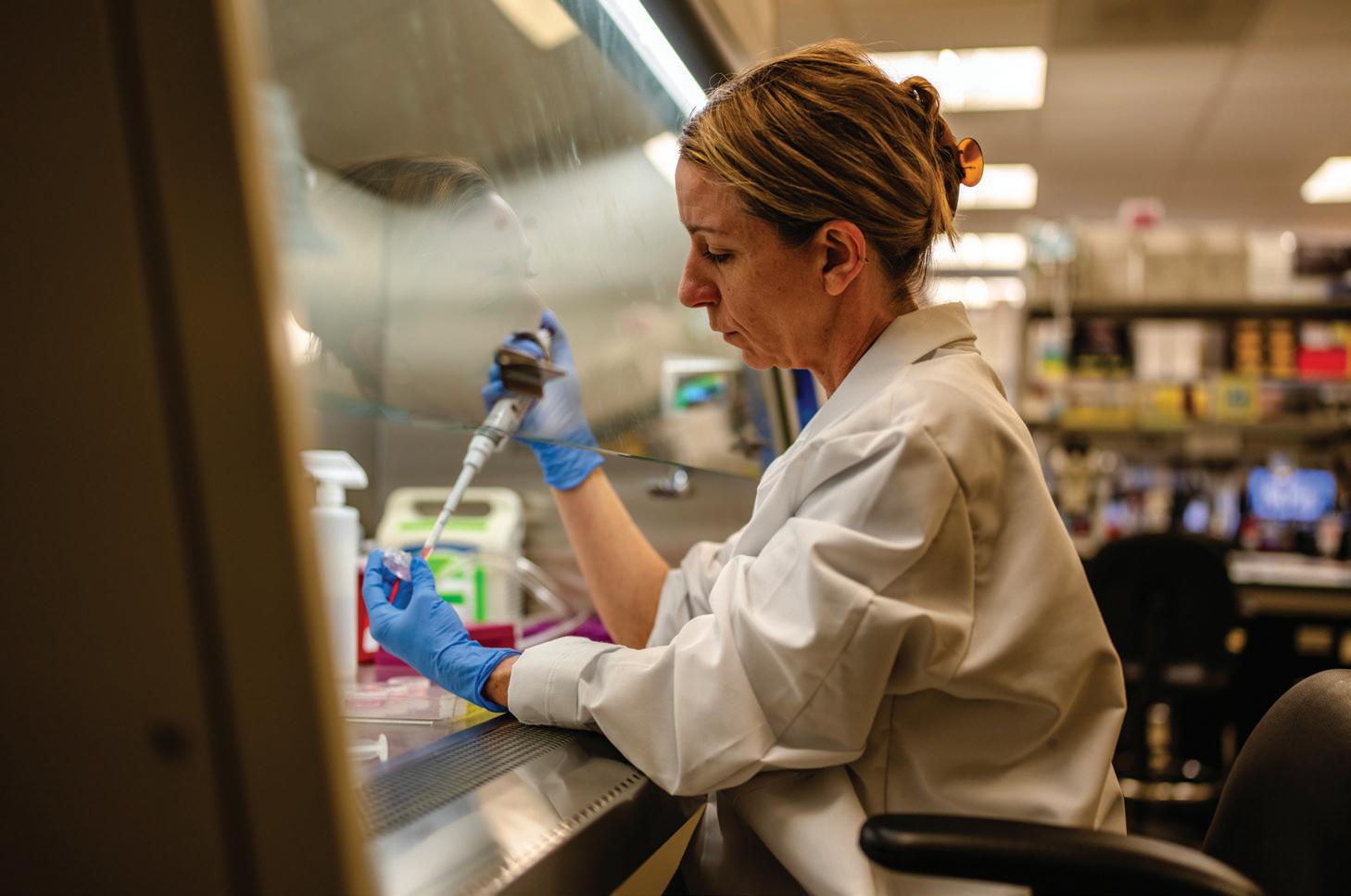
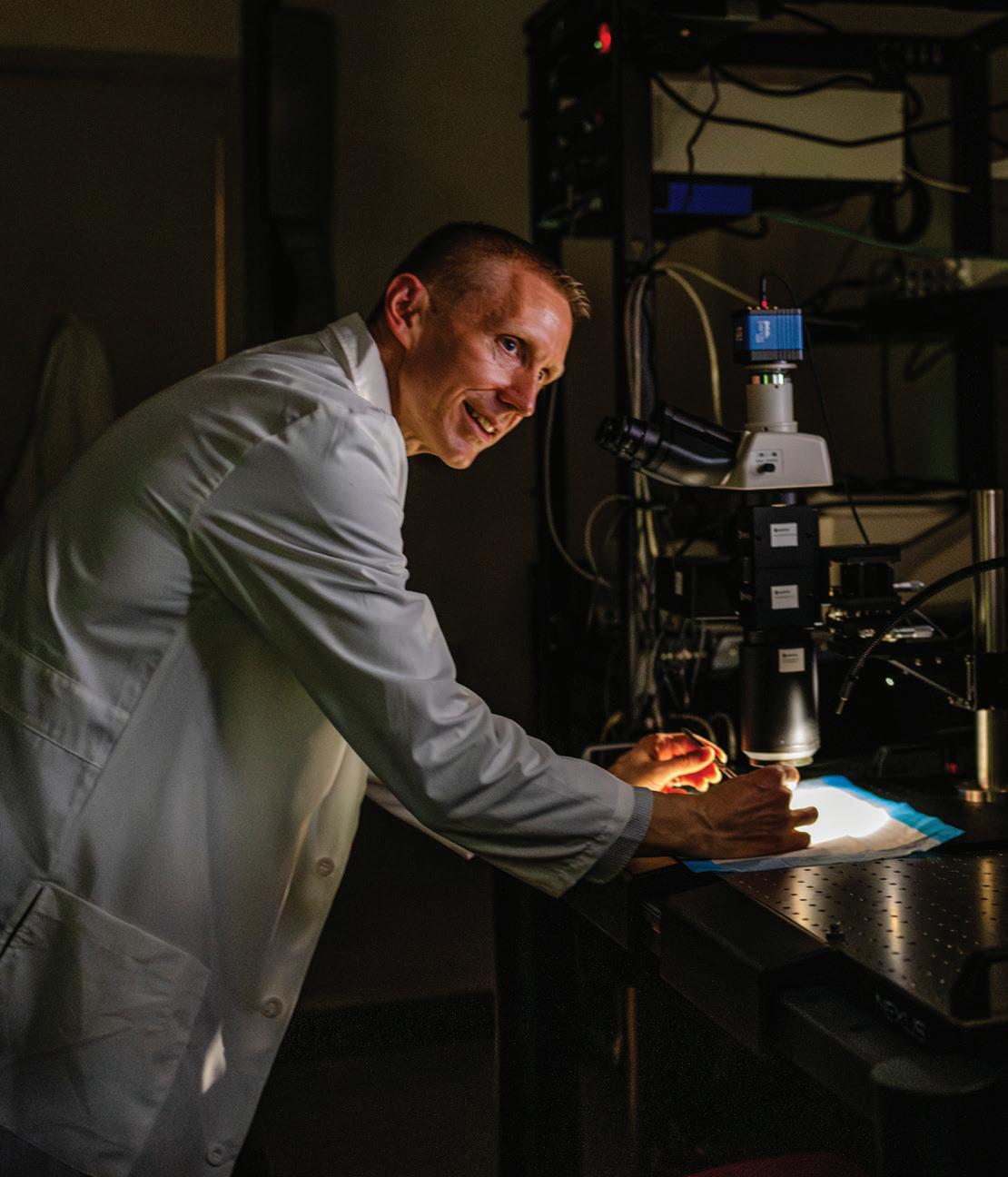
Scientists. Groundbreakers. Teacher-scholars. As they work on the frontiers of human health and performance, Marquette professors inhabit all of these roles at once.
In doing so, they achieve amazing results. Think of serious conditions that can affect any of our families: cancer, addiction, depression, stroke, multiple sclerosis, spinal cord injuries, obesity, diabetes and heart disease. Faculty research impacts all of them — revealing inner workings and root causes, pointing the way to improved therapies and healthier outcomes. “Identifying and solving challenging human-health problems is embedded within the Jesuit tradition,” says Dr. Nicholas Reiter, professor of chemistry, whose research on enzyme structure is unlocking keys to cancer therapies.
Yet life-altering results are only part of the story. As determined as they are in driving science forward, these faculty members are just as committed to engaging students — undergraduate and graduate — in this work. “In my proudest moments, I can remember the light of first insight in my former students’ eyes, the smile of joy during that first discovery and the new connections they made during their time in the lab,” says Dr. Jennifer Evans, professor of biomedical sciences, describing alumni who have progressed to careers of their own in medicine, dentistry and genetic counseling. In these ways, she and her many colleagues help transform lives and seed the breakthroughs of the future.
Turn the page to learn about several of these professors, their groundbreaking projects and their students (and go online for even more impact).
HEALTH SCIENCES
UNDERSTANDING ADDICTION’S
DIFFERING GRIP ON MEN AND WOMEN — AND HOW TO EASE IT
ON THE ROAD TO ADDICTION, repeated drug use has long been suspected of disrupting — and even physically changing — connections in the prefrontal cortex, the brain region involved in decision-making and impulse control. It’s also been generally assumed that male and female brains experience these changes similarly.
With a $2.07 million R01 grant from the National Institutes of Health, Dr. Matthew Hearing, H Sci
’03, associate professor of biomedical sciences, has created a window into this process and discovered something surprising: Not only do females show neurological impairment from opioid use in half the time as males, but the physiological changes themselves are different.
By better understanding these differences, Hearing and his team hope to find insights on how sextailored therapies could ease the grip of these addictions.
THE BIRTH OF A NEUROSCIENTIST
As a biomedical sciences undergraduate, Hearing volunteered in the lab of a new faculty member, Dr. David Baker, and found his calling in neuroscience. After earning his doctorate, Hearing returned to the College of Health Sciences “to work with colleagues who shared his enthusiasm for research aimed at uncovering how the brain changes during learning and disease.” Today, Baker is chair of the department, an accomplished researcher on the neurological processes involved in addiction and now a colleague of Hearing.
In the meantime, Marquette has built a reputation for strength in neuroscience research focused on addiction and broader mental health, bolstered by support from the Charles E. Kubly Mental Health Research Center, established in 2015, and ongoing support from the Kubly family and other donors. Hearing’s lab embodies that dual focus: With his second R01 grant, worth $2.4 million, his team is investigating the impact of chronic stress on the brain.
Two graduate and 12 undergraduate students currently work in Hearing’s lab, and he supports 30 to 40 more each year as director of the College of Health Sciences’ summer research program.
FINDING A BETTER FIX
In collaboration with Dr. Robert Wheeler, professor of biomedical sciences, Hearing uses advanced imaging technology that allows his team to watch individual neurons “turn on” in real time as mice use a lever to self-administer opioids. To do so, the team uses genetically modified mice with neurons that produce a fluorescent protein that glows whenever the cells fire. A tiny camera implanted in the brain allows them to “film” patterns
To understand how a protein functions, scientists need to understand a protein’s 3D shape. Proteins acquire their complex structure by folding, a process based on the physical laws governing interactions between a protein’s sequence of amino acid building blocks. A misfolded protein, then, can’t function properly. If lots of misfolded proteins build up in the cell, they can form large clumps called inclusions that the cell can’t break down. Dr. Emily Sontag, assistant professor of biological sciences, is studying how the cell copes with these misfolded proteins and is now working to understand whether promoting the cellular recycling of these misfolded proteins may help prevent cell death in neurodegenerative diseases such as Huntington’s, Parkinson’s and Alzheimer’s.
Dr. Matthew Hearing
of brain activity. The researchers can track the same neurons over weeks, allowing them to pinpoint precisely when dysfunction begins and how it aligns with behavioral changes.
By combining this live imaging with analysis of how opioids change neuron physiology, the team revealed that opioids impact female and male brains differently. In females, opioid use reduces glutamate, a neurotransmitter that activates neurons in the prefrontal cortex. In males, it increases GABA, a neurotransmitter that suppresses neuron firing. Both changes disrupt the prefrontal cortex’s ability to control decision-making — but through opposite mechanisms.
Hearing’s interest in the neuroscience of addiction stems from a family history of substance use disorders. “The cognitive aspect of addiction is the most debilitating component,” he says. “Quality of life is severely impacted because people know something is wrong, but they can’t do anything about it. That touches home with me.”
“It highlights that we should really consider not treating sexes or even individuals in the same way when we treat substance use disorders,” says Hearing. Pharmaceutical treatments target specific brain mechanisms, so if males and females reach use disorders through different pathways, they’ll need different drugs to reverse it.
With the U.S. experiencing 900,000 deaths from opioid overdoses in the last 25 years, Hearing’s findings, as they unfold, could bring new effectiveness to the way we treat addiction.
— Anna Funk
Consulting with colleague Dr. Anita Manogaran, associate professor of biological sciences, Grad ’03, has had “a huge benefit. It provides another expert to bounce ideas off of,” Sontag says, “and makes things more stimulating and, honestly, much more fun.” — Carrie Arnold
ENGINEERING
DETECTING THE CANCER THAT CAN LURK AFTER SURGERIES
Genna Walton, a senior majoring in biomedical engineering, developed a special cuvette that allows lumpectomy specimens to be held, rotated and squeezed within a glass box, so additional sides of the tumor can be scanned. It’s an essential part of the promise Yu’s system offers for ensuring full tumor removal before surgeries end.
SHORTLY AFTER JOINING the Marquette University and Medical College of Wisconsin Joint Department of Biomedical Engineering in 2017, Dr. Bing Yu discovered a breakthrough technology to help solve a thorny clinical problem he’d been working on for years. He also found expert Marquette and MCW colleagues to help him harness that technology.
In Yu’s sights were the many cases of breast-conserving lumpectomy surgeries that leave behind traces of tumors in patients’ bodies. Since these cases are typically caught in post-surgical pathology reports, about 20 percent of lumpectomy patients return for
follow-up surgeries to remove the remaining cancer. “These additional surgeries can lead to significant emotional, cosmetic and financial burdens for patients and their caregivers,” says Yu, associate professor of biomedical engineering.
At previous stops in his career, Yu had made intriguing but unfulfilling progress on methods to quickly scan tumor margins of lumpectomy specimens in operating rooms, allowing medical teams to remove tumor remains immediately. His best effort, which obtained simultaneous spectroscopy readings using 49 fiber-optic pinpoints, successfully surveyed large tissue areas quickly, but spacing between data points left gaps where cancer could lurk.
HARNESSING A DISCOVERY
Then in 2017, a webinar introduced Yu to that breakthrough technology — an ultraviolet microscope that produces vivid images of tissue treated with fluorescent dyes. He determined that
Dr. Bing Yu
the scans could reveal variations in cell size and structure to enable detection of cancer in margins, with effectively no gap in coverage. But this high resolution was a mixed blessing — yielding a flood of visual information exceeding what could normally be processed during surgeries.
As he sought a machine-learning expert with experience building algorithms that automate and accelerate such massive processing tasks, Dr. Dong Hye Ye joined Marquette’s Electrical and Computer Engineering Department. “He had that expertise,” Yu says. “He came at the right time.”
Since joining forces, Yu, Ye (who has since moved to Georgia State University) and partners from MCW have made great strides with a diagnostic tool that offers real hope for improved outcomes for breast cancer patients. With support from a $1.54 million R01 grant from the National Institutes of Health, the team developed a portable system that can be wheeled in and out of surgical rooms. They have determined the device could achieve 96.5 percent accuracy detecting cancer cells in margins of tissue-bank specimens up to 80 square centimeters in surface area — all in 10 minutes or less.
Yu has several student research assistants contributing to his cancer imaging project: one undergraduate student, two doctoral students and one halftime doctoral candidate.
As they develop a next-generation device to extend those rapid results to larger specimens, the team sees more progress ahead. With team members from MCW — breast surgeon Tina Yen, M.D., and pathologist Julie Jorns, M.D. — Yu is writing a grant application that would green-light a clinical trial to test the device in hospitals. And a Way Klingler Research Fellowship is helping him develop a new use for the deep learning-enabled microscope — identifying the presence, and type, of cancer in fresh biopsy samples, without the need for a traditional pathology report. “Many developing countries don’t have access to pathology,” Yu says. “This tool has the potential to lead doctors to a much-needed diagnosis.” — Stephen Filmanowicz
ARTS
AND SCIENCES AND HEALTH SCIENCES
DECODING THE BODY’S CIRCADIAN CLOCK — AND ITS MANY CONNECTIONS
TO OUR PHYSICAL AND MENTAL HEALTH
IT’S A SUBLIMINAL TRUTH we all know — we can’t function very well with less sleep or unpredictable schedules. Repeated enough, such changes have bigger effects — disrupting our bodily rhythms and contributing to alarming health consequences.
Evans has mentored 60 undergraduate and 14 postgraduate students in her lab over 12 years at Marquette.
Undergraduate students have co-authored 50 percent of Arble’s published papers and have been presenting authors on 11 abstracts (averaging two per year).
Marquette is fortunate to have two faculty experts in circadian rhythms, each with distinct but complementary perspectives. Dr. Jennifer Evans, professor of biomedical sciences, is most interested in the effect of body clock disruptions on the nervous system and mental health. Dr. Deanna Arble, associate professor of biological sciences, focuses on circadian implications for conditions such as obesity, respiratory distress and sleep apnea. While independently making
influential health discoveries, they’re also preparing to work together on forthcoming research, exploring how the body clock connects physical and mental health conditions — as rarely studied before.
MEET MARQUETTE’S CIRCADIAN SCIENTISTS
Evans is a classically trained “rhythmist” whose background lies in psychology and behavioral neuroscience — think mental health, motivation and mood. Arble studies neurology’s influence on physiological systems — respiration, metabolism and sleep. Each oversees prominent research contributing to circadian science, with Evans stewarding a $1.8 million National Institutes of Health R01 grant on how light is processed by the brain, which presents differently in men and women and leads to important implications for seasonal affective disorder. A sepa-
Dr. Deanna Arble
rate NIH grant investigates how mutations in circadian clock genes influence brain processing of light; it suggests exposure from nightly screen use likely increases the risk of cancer, impaired cognition and severe immunodeficiency.
Arble recently won a prestigious $1.25 million CAREER grant from the National Science Foundation, recognizing high-achieving early career faculty. With it, she is mapping the circuitry light follows from the eye to the suprachiasmatic nucleus, the body’s master clock. Unique nationally in their focus on this area, Arble and team track light disruptions at night and measure breathing suppression, collecting key data on respiratory patterns and susceptibility to illness and obesity.
Focusing on topics that touch all of us such as sleep, eating patterns and what to do with each to be healthier, “Deanna has an especially winning model in the field by integrating two areas — biological clocks and a clinical condition,” explains Evans. Typically, researching body clocks and obesity would require two experts from different fields, she says. “But Deanna is an expert in both those things, contained in the same person — that’s rare.”
DAILY LIGHT, RHYTHMS AND CIRCUITRY
Evans and Arble are building on the discovery that every cell in the body retains its own daily clock — a genetic expression of the larger one. Since the master and cellular clocks share messaging, the SCN influences every system in the body. “Hormone expression, body temperature, metabolism, and sleep are all rhythmic,” Evans says.
Dhruvaa Shroff, H Sci ’23, Grad ’24, overcame initial apprehension and developed confidence performing animal brain surgeries in the Arble lab. She is now a doctoral student at Georgia State University’s Neuroscience Institute.
As clinicians catch on to circadian research — how time matters as a factor in our health — drug dosing and therapies can become more effective. “A drug is supposed to attach to a receptor. That drug better be in your body at the right time of day to attach,” says Evans. Most major FDA-approved drugs on the market have a dosing-time target, informed by circadian rhythms. Yet patients are often not informed about dosing time. They risk not hitting the right time frame to reap the drug’s therapeutic benefits — and
risk experiencing unwanted side effects.
Arble sees similar risks with sick patients being cared for in aggressively lit ICUs that disrupt their body clocks. “You’re taking someone with breathing depression and increasing their chances for respiratory distress,” she says.
“While we work to shorten the gap from research to clinical findings, it’s been extremely rewarding to see circadian rhythms capture public attention,” Evans says. Integrating circadian and clinical medicine is closer than ever before.
“We’re at the tip of the iceberg,” says Arble. “There’s only progress from here.” — Rachel Gintner Orlando
Improving Mobility
Funded by a $3.2 million NIH R01 grant, Dr. Allison Hyngstrom, professor and chair of physical therapy, targets the stubborn muscle fatigue that often limits mobility after stroke with investigations that span both the brain and the vascular system. Her team — including Dr. Brian Schmit, Eng ’88, the Hammes Family Chair of Biomedical Engineering — examines how improving blood flow could boost endurance and amplify the gains of physical therapy. Across campus, yet still collaborating with Hyngstrom, Schmit leads a $3.3 million NIH R01-funded project that combines high-intensity exercise and unpredictable balance challenges to improve walking in people with multiple sclerosis. His team aims to reduce falls while strengthening overall mobility.
“Like so much research at Marquette, these projects benefit from being multidisciplinary,” says Hyngstrom of her work, which also features close collaboration with Dr. Matthew Durand, associate professor of physical medicine and rehabilitation at the Medical College of Wisconsin. “We are shedding light on how the cardiovascular system and neuromuscular system work together during exercise, and that will open the door to more targeted therapies to improve stroke outcomes.” — Stephen Filmanowicz
Dr. Jennifer Evans
ENGINEERING AND HEALTH SCIENCES
LIGHT AFTER SPINAL CORD INJURIES
SPINAL CORD INJURIES can be devastating, compromising people’s ability to walk, talk, breathe efficiently and complete daily tasks. Dr. Jordan Williams — assistant professor of biomedical engineering and one of several Marquette faculty members tackling the challenge of restoring lost function — is encouraged that scientists can now stimulate meaningful activity in muscles of individuals with injured spinal cords. But that’s just a first step. Stimulation alone does not produce the precise coordination of multiple muscle groups that allows someone to pick up a coffee cup or walk to the door. Enabling those movements, Williams says, will require bioengineers to choreograph specific nerves firing in specific sequences for various muscles to contract and relax, each at the right moment.
Emma Moravec, Eng ’21, first worked in Williams’ lab as an undergraduate and now works there as a doctoral student. Described as a “fixture and driving force” in the lab, Moravec was selected to deliver a 15-minute main stage presentation at the International Conference on Neural Engineering last fall. She spoke on a submitted paper that also received a second-place prize. “It was a full-circle ‘proud-PI’ moment, to be sure,” Williams says.
In August 2025, Williams received a $400,000 award from the Craig H. Neilsen Foundation to test the use of an emerging approach, optogenetic nerve stimulation, to facilitate this complicated dance. This method uses virus-delivered gene therapy to modify neurons to respond to pulses of light, rather than electric signals. This therapy allows Williams to target individual neurons or nerve types, offering a layer of specificity that other methods lack. Different viruses coded to different wavelengths of light allow different muscle groups to be stimulated independently of one another. Creating coordinated, complex movements requires this level of specificity and differentiation, Williams says.
“It sounds very sci-fi,” Williams confesses, but his project is an important next step in the quest to help people resume daily tasks after spinal cord injuries. While testing this approach in rodent subjects, Williams is anticipating a future phase incorporating an implanted brain-computer interface to help decode task-related brain signals and translate them into the coordinated
light pulses that make those actions happen. The hope is for the system to bypass the injury and allow neurons to talk to muscles as before.
Williams has two doctoral students working on the spinal cord injury project, three undergraduates working on related projects, and a medical student from MCW.
In the College of Health Sciences, Dr. Kristi Streeter, assistant professor of physical therapy, has a $2.7 million R01 award from NIH to target the breathing impairments that are a primary cause of death in those with injured spinal cords. By activating sensory neurons carrying sensory information from the diaphragm, she and her team aim to strengthen feedback loops, using the body’s neuroplasticity to restore respiratory neural function and improve breathing. And her colleague, Dr. Murray Blackmore, professor of biomedical sciences, has had support from multiple NIH R01 grants to investigate stimulating regrowth of damaged spinal cord neurons through viral-delivered gene therapy.
“Marquette is a relatively small research institution, but we’re showing that we can examine these cutting-edge technologies and really bring them to the forefront,” Williams says. — Carrie Arnold
Last fall, Dr. Nicholas Reiter received a grant from the National Institutes of Health worth nearly $1.68 million to study how a protein known as LSD1 helps stabilize chromosome structure. Chromosome fusions have been shown to play a significant role in certain types of cancer, driving uncontrolled cell growth. Previous work in the Reiter lab showed that LSD1 may promote chromosome fusion. “If we can understand exactly how LSD1 interacts with its environment, we can develop a therapy that targets this protein and helps the cell degrade it, which seems like a very effective strategy,” Reiter says.
Reiter hopes that the study will allow him to create RNA-based therapeutics that can kill cancer cells in diseases such as Ewing’s sarcoma, a bone cancer that disproportionately affects young people. — Carrie Arnold
Dr. Jordan Williams
Marquette Magazine and the Alumni Association accept submissions of news of personal and professional achievements and celebrations for inclusion in “Class Notes.” Visit classnotes. marquette.edu/submit to share your news or milestones photo. For this issue, the editorial team considered notes submitted on or before January 15, 2026, editing them for length and clarity. Publication of the news, events and milestones of our alumni does not constitute endorsement by Marquette University.
REUNION YEAR
Alumni Reunion Weekend is May 29–31, 2026. We celebrate undergraduate class years ending in a 1 or 6, our First Reunion (Class of 2025) and the Black Alumni Association’s 25th anniversary. Get connected at marquette.edu/ reunion.
REUNION YEAR
61
Dennis Ferriter, Arts ’61, and his late wife, Marcyanna (Wills) Ferriter, Sp ’61, received the 2024 Hunger and Poverty Prevention Honorary Award recognizing 20 years serving the Portage County community. PartnersHP honored their leadership, which continues to shape the work of the Mobile Pantry, an organization of volunteers delivering supplemental food to residents in need.
REUNION YEAR
66
Joseph W. Wippl, Arts ’66, was
elected vice chairman of the Boston University Council.
67
Robert E. Smith, D.D.S., Dent, ’67, received a silver EVVY Award from the Collective of Independent Publishers and Authors in the romance novel category. At 83, he competed with seasoned authors and won for his first novel, Rapture River, in which a Labrador retriever and her 89-year-old owner guide two young lovers in a Michigan outback tale of new beginnings.
68
Francis Rutkowski, Eng ’68, and Rosalie (Beck) Rutkowski, celebrated their 65th wedding anniversary in June 2025. Francis is retired from Milwaukee’s Department of Public Works.
70
Kevin Fitch, Arts ’70, and Peter Regnier, Arts ’70, who went through the Naval Reserve Officer Training Corps at Marquette and became Navy officers, flew to Washington, D.C., in September 2025 on the Honor Flight Chicago. They had the experience of a lifetime visiting the memorials in the nation’s capital.
REUNION YEAR
71
Rhaoul Guillaume, Sr., Eng ’71, president and CEO of GOTECH Inc., was named a 2025 Urban League of Louisiana Empowerment and Policy Conference Gala Honoree in October. The award recognizes extraordinary leadership, professional achievements and civic contributions.
From L-R: Kathleen (Simmons) Olson, Arts ’73, Grad ’78, and sisters Jeanne Simmons, Bus Ad ’88, Grad ’88, Grad ’90; Carol (Simmons) Chilson; Mary (Simmons) Radke, Sp ’80; Margie (Simmons) Kitzke, Nurs ’74; Susan (Simmons) Wucherer, Comm ’97, Grad ’99; Patty (Simmons) Connery, Sp ’77, Grad ’78; and Martha Simmons, Arts ’84, had a sisters’ weekend in Milwaukee. Seven graduated from Marquette and Chilson has been working at Marquette since 1982.
News from fellow alumni
Guillaume, a Fellow of the American Society of Civil Engineers, advocates for the engineering profession and STEM education. The Louisiana Department of Transportation and Development congratulated him as a pioneering engineer responsible for design and construction of the Superdome, which marked its 50th anniversary.
Christopher Nemeth, Arts ’71, released Comity, his debut album of 12 original jazz compositions, recorded in 2024 at Van Gelder Studio.
72
Martin Menez, Arts ’72, retired Navy captain and member of the board of directors of the U.S. Navy Memorial Foundation in Washington, D.C., was elected treasurer, effective December 2025.
73
James P. Hoynes, Jour ’73, is the 2026 recipient of the Career Excellence Award from the Baseball Writers Association of America and will be inducted into the Baseball Hall of Fame this summer. The Cleveland native, widely known as “Hoynsie,’’ has been a beat writer for the Indians/ Guardians for 43 years. He has more bylines in the Cleveland Plain Dealer than any other individual.
74
Jerome Rau, Eng ’74, worked in the energy pipeline business for more than 45 years. He is
Building a Pope’s Legacy
As a student, Jennifer Parks, Arts ’93, was moved by Ignatian values: “Women and men for others became a guiding principle in my life.” The idea also shaped her career, beginning with a volunteer role at Habitat for Humanity in Philadelphia and ultimately bringing her back to her hometown as executive director of Habitat for Humanity Chicago. That mission-driven journey now culminates in Pope Leo Village, a bold initiative inspired by Chicago-born Pope Leo’s legacy of service. The project launches with a 20-unit townhome development in West Pullman, on Chicago’s South Side, with planned expansion to 15 cities nationwide. Parks hopes the project will “inspire young people to serve their community because serving young leads to a lifetime of service.” — Guy Fiorita
Alumni are encouraged to volunteer with a Pope Leo Village in their city, including Chicago, Milwaukee, St. Louis and Cincinnati.
semi-retired and published two books related to pipeline engineering for young people joining the industry, By God If I Were In Charge and, published January 2026, Now That I Have Your Attention
75
James Rice, Arts ’75, Grad ’85, a sports historian and speaker, compiled Packers Century: Every Game & More, a database collection of Green Bay Packers football from 1919-2024, at PackersCentury.com.
77
Dennis Skelley, PT ’77, president and CEO of Georgia Rehabilitation Institute, was recognized as a 2025 recipient of the Governor’s Awards for the Arts and Humanities, a statewide honor recognizing individuals and organizations that have made significant contributions to Georgia’s cultural and community well-being. Under his leadership, Augusta’s first Public Art Master Plan was completed. Skelley was instrumental in establishing the 523 Gallery, a
public exhibit space featuring work by artists with disabilities.
78
Anthony V. Crivello, Sp ’78, produced and starred in The Omro Heist as Police Chief D.W. Johnson. This independent crime thriller has Wisconsin roots and is available on streaming. Crivello also created voiceover roles in the animated film Batman: Knightfall Part 1 and the International Harry Potter Quidditch game as narrator and Quidditch expert Kennilworthy Whisp.
Jackie (Hirth) Leupold, Jour ’78, Grad ’80, was named the 2025 Wisconsin Youth Soccer Association Administrator of the Year. She has been committed to and an advocate for youth soccer for more than 25 years. Most recently she worked as executive director of the Elmbrook Soccer Club, a nonprofit dedicated to youth sports and education in Brookfield, Wisconsin.
Mary Ellen Stanek, Arts ’78, was honored with a 2026 Lifetime Achievement Award by the Museum of American Finance. The honor recognizes financial leaders who have transformed the financial services industry and demonstrated outstanding achievements in advancing entrepreneurship and free enterprise. Stanek is an advocate and champion for many in the industry, as well as for her Milwaukee and Marquette communities. She serves as chief investment officer emerita of Baird Advisors and president of Baird Funds.
79
Lori (Kelly) Botel, PT ’79, and Bill Botel, Arts ’77, celebrated their 45th wedding anniversary. They met in September 1975, just two weeks after Lori arrived on campus.
80
Thomas Fessler, Arts ’80, formerly the chief legal officer and general counsel of VSP Global, was named the 2026 distinguished alumnus of the year for the Pepperdine University Caruso School of Law. He played soccer for Marquette from 1976-79.
82
Michael Bednarek, Eng ’82, is the founder of Bednarek Legal in Washington, D.C., which specializes in global intellectual property strategy, prosecution, counseling and litigation. He has more than 30 years of experience in IP law and is listed in Chambers Global as a Leader in Their Field.
83
Ann (Bonness) Angel, Grad ’83, was awarded the 2025 Jubilarian of the Year from Divine Savior Holy Angels High School for helping to make the world a better place. Angel taught English at Mount Mary for over 30 years and published books including John Glenn: Space Pioneer, Silent Embrace: Perspectives on Birth and Adoption with her daughter, Amanda Angel, and Janis Joplin: Rise Up Singing Angel is working on a book about female photojournalists who changed the face of war.
Right Up His Alley
A young entrepreneur’s hard work in a new industry lands a lucky strike.
BY DREW DAWSON, COMM
’16
Yianni Mavrakis’ entrepreneurial spirit arose early. By 15, he was selling T-shirts to classmates. At 19, he put those T-shirt profits to use purchasing his first home: a $25,000 property on Chicago’s South Side. As a Marquette sophomore, he was flipping real estate and building a portfolio.
So when Dolton Bowl, a 60-yearold neighborhood staple, hit the market in suburban Chicago, Mavrakis followed the same instinct and took a gamble. “I put myself in this business knowing nothing about bowling,” says Mavrakis, Bus Ad ’22. “But as someone who loved business, and loved an idea enough to chase it, I trusted I’d figure it out. I jumped on this chance to grow.”
For over a year, he worked seven days a week, 14 hours a day. He ran the counter, fixed machines, tended bar, managed staff and launched marketing efforts to bring people in. He wanted Dolton Bowl to feel like a community hub — somewhere schools, clubs, sports teams, families and friends could gather.
The business needed to generate $45,000 each month to break even. The grind was intense, but it paid off. Within two years, Mavrakis had turned the alley around — and bought a second one. Now 25, his ambition grows with every achievement, which he documents on social media. There, you and his 1.1 million Instagram followers (@yohnmav), plus 250,000 more on TikTok, will see what he’s up to — and what he’ll chase next.
“Anything I can spend my time researching, diving into, I love it,” Mavrakis says. “When the next lucrative deal comes my way, I’ll be ready.”
Alumna Spotlight
REVITALIZING COMMUNITY
Turnaround Stories
Amelia Mitcham, Arts ’14, is restoring a sense of community to her neighborhood’s formerly blighted blocks.
BY TRACY STAEDTER
Mitcham in her new gallery space: “Delayed, not denied” is the motto keeping her grounded.
As a teenager, Amelia Mitcham, Arts ’14, and her mother lived in what she describes as “unacceptable conditions.” The landlord ignored interior repairs that her mother ended up paying for, and the yard was overrun with trash and mice. Mitcham vowed that, if she ever could, she would “be better” as a landlord.
Today, Mitcham owns four previously blighted multifamily properties in Milwaukee’s Merrill Park neighborhood — where she also lives — including the newly opened Third Space Collective MKE at 500 N. 29th St. This once neglected and fire-damaged tavern is now a spacious, light-drenched gallery and event venue, with a two-story apartment above.
Like all of Mitcham’s projects, this one came with major problems. It needed all new electrical wiring, flooring and windows, and the building’s bowing structure required specialty-ordered support beams. Still, she has a knack for rolling with setbacks, summing up her approach as “delayed, not denied.”
Mitcham is an optimistic problem solver, guided by her father’s journey from poverty in St. Kitts and the “greater sense of appreciation” it gives her for what’s possible. By doing some rehab work herself, sourcing materials and negotiating costs, Mitcham can offer rents low enough for families to live in safe, quality units. She says making change locally, touching “one person, one life” is something she learned at Marquette.
With the Collective, Mitcham offers an affordable home upstairs and a gathering place downstairs that’s also a showcase for Milwaukee artists — such as photographer Eryn Victoria Turner — to help rebuild Merrill Park as a place to live, create and belong.
PHOTO BY ALIZA BARAN
Julie (Whelan) Capell, Arts ’83, Ruth (DeAmico) Shafovaloff, Arts ’83, and Margaret (Cataldi) Bercovitz, Arts ’82, traveled together through Andalusia, Spain, re-creating their travels in the region when they were undergraduates in the Marquette in Madrid program 45 years earlier.
87
Michael P. Boyle, Arts ’87, recently retired after 28 years at Securian Financial Group, where he served as second vice president, law. He also served on the board of directors of the State of Minnesota Guarantee Association; and served as chief legal officer and board member for Securian Trust Company, N.A.
Fred Bricca, Jour ’87, is a senior international line check captain for Delta Air Lines. He flies the Airbus 330 worldwide and is based in New York.
Joseph Janowicz, Eng ’87, retired after a 38-year career at Boeing, Procter & Gamble and American Transmission Co. His mechanical engineering degree served him well and allowed for early retirement.
Michael Jortberg, Jour ’87, and Jane (Luthy) Walsh, Arts ’94, teamed up to demonstrate Marquette’s mission. Walsh is executive vice president and chief advancement officer at the Network for Teaching Entrepreneurship, which serves young people in under-resourced communities. Jortberg is a senior global sales director at Slalom Chicago and an NFTE Midwest Board member. Over a decade, their efforts
have helped NFTE Midwest reach more than 5,000 students annually, with 96% of seniors on track to graduate from high school on time. Jortberg also has provided used computers from Slalom.
88
Jean (Crnkovich) Beatty, Nurs ’88, and her team of real estate agents, The Jean Beatty Group, were named as one of the top 1,000 small teams nationwide by Real Trends.
Michel DeLisle, Sp ’88, received the 2025 American Volleyball Coaches Association/Marine Corps Battles Won award in December, which recognizes a volleyball coach and athlete who overcame significant obstacles this past year. In 2025, she also reached 100 victories at Milwaukee Area Technical College.
Pat Harris, Arts ’88, had his debut novel published in 2025. A Season on the Drink is based on a true story of hope and resilience at the St. Anthony Residence in St. Paul, Minnesota.
89
Sabina Bhatia, Grad ’89, was appointed director of the International Monetary Fund’s corporate services and facilities department in 2025. She joined the IMF in 1994 and has been the deputy secretary.
Paul Slomski, Comm ’89, was named director of development for the Serra International Foundation, the only organization sanctioned by the Vatican to raise funds
that fosters vocations within the Catholic Church.
90
Meghan G. Kennedy, Arts ’90, co-founded the All Abilities Interest Group of the California Library Association. The group serves library staff with disabilities and staff assisting customers with disabilities.
Travis Keshemberg, Bus Ad ’90, Grad ’12, earned his Ph.D. in 2025 from EDHEC Business School. His dissertation was on “Beyond Headline Inflation: A Components Approach to Risk Premia with PCA Extensions.”
REUNION YEAR
91
Audra (Schmidkonz) Santucci, Arts ’91, Law ’00, and Chris Santucci, Eng’ 93, celebrated their 30th wedding anniversary on July 29, 2025. Audra is adjunct faculty at DePaul Law School as part of the Asylum and Immigration Law Legal Clinic. Chris is senior technical adviser for product compliance and homologation at Traton Group, which
Leadership Runs in the Family
For any family, having a university president in its midst would be worth celebrating. For the Hendricksons, the pleasure is thrice as nice. When Dr. Ryan Hendrickson, Arts ’91, was named president of the University of St. Francis in Joliet, Illinois, last June, he became the second sibling at the helm of a Catholic University. His younger brother and fellow Marquette alumnus, Rev. Daniel Hendrickson, S.J., Arts ’93, has been president of Creighton University since 2015. In July, Rev. Scott Hendrickson, S.J. — Father Daniel’s twin — became interim president of Jesuit-led Regis College.
“We have wonderful parents who believed in Catholic education from the onset,” Ryan says in explaining the pattern. “Marquette was transformative in multiple ways for me, in that I was introduced to Ignatian spirituality, and I developed a love of learning and scholarship.”
— Sam Arco, Comm ’22
The brothers Hendrickson: Ryan, Arts ’91; Rev. Daniel, Arts ’93; and Rev. Scott.
Honor Role
“For me,” says Belton Flournoy III, Bus Ad ’03, “leadership is about creating space for others to succeed.” That approach has brought Flournoy success and led to some notable news from across the pond: Powerlist Magazine has named him to its 2026 list of the 100 most influential people of African, African Caribbean, and African American heritage in the United Kingdom. Based in London, Flournoy is a managing director at Protiviti, where he leads consulting work spanning technology, analytics, risk and compliance. He’s also the founder of Pride in the City, a mayor-backed initiative to advance diversity and inclusion across the U.K. “If you’re not lifting other people up as you move forward,” he adds, “you’re missing the point.”
– Lindsay Anderson Rios
includes commercial vehicle manufacturers Scania, Man and International Motors. They live in Naperville, Illinois, with their three children. Their daughter, Madeleine, is a Marquette senior in engineering, following Chris’ father, Joseph Santucci, Eng ’58.
92
Timothy Jacobson, Law ’92, is a filmmaker and leads a nonprofit, Sustainable Driftless, that released its latest film, Spirit of the Driftless: Preserving Our Legacy, in 2025. The film follows on the success of Decoding the Driftless and Mysteries of the Driftless, both of which earned regional Emmy Awards. An attorney in La Crosse, Jacobson represents victims of PFAS pollution in drinking water and frac sand mining in Wisconsin.
Yogi Mueller, Comm ’92, has published his first book, The Great Slapping: The Power of Mentorship. Drawing on two decades of experience in leadership and talent development, Mueller explores how growth often requires candor, grit and a willingness to be challenged. Through his company, Craft Leadership, Mueller helps individuals unlock their potential.
93
Thomas S. Weber, M.D., Arts ’93, launched the digital orthopedic telemedicine company MD Ortho Systems in 2023.
94
Laura (Wake) Bray, Comm ’94, Grad ’03, was appointed
president of the University of Wisconsin-Milwaukee Foundation. She most recently served as a vice president at the Milwaukee Area Technical College and as the leader of the MATC Foundation.
Jennifer Lay-Riske, Comm ’94, executive producer for NBC Chicago, won two Midwest Regional Emmy Awards in November 2025: best breaking news coverage for a high-speed car chase and best evening newscast for coverage of Pope Leo XIV’s election.
Daniel Magestro, Arts ’94, was named the chief AI officer at Unify Consulting, where he leads AI strategy and planning, AI capabilities and skills development, client solutions and AI thought leadership. He is based in Chicago.
95
Donna (Schnur) Birkholz, Arts ’95, joined the Powder River Basin Resource Council as its new executive director. The council is a nonprofit grassroots organization serving the people of Wyoming. It was founded over 50 years ago by ranchers and community members concerned about coal strip mining and continues to work with members to advocate for responsible environmental and economic practices.
REUNION YEAR
96
Andrew P. Rajec, Bus Ad ’96, had the honor of meeting former Polish President, Nobel Peace Prize winner and Cold War hero Lech Walesa.
97
Joshua Keleske, Bus Ad ’97, Law ’99, Grad ’99, was ordained to the permanent diaconate by the Most Reverend Gregory Parkes for the Diocese of St. Petersburg, Florida. His wife, Dawn (Dlugi) Keleske, Bus Ad ’97, and daughters, Sydney and Melanie, were in attendance.
Timothy Lyons, Grad ’97, founded the nonprofit SoberAwakening after overcoming severe alcohol addiction. Its mission is to provide wellness and spiritual development resources to sober individuals and mindful drinkers to help them become more aware of their relationship with alcohol, and help them better connect with their inner divinity.
Rob Slocum, Grad ’97, published a devotional journal, Joy to the World! Devotions for Advent, Christmas, and Epiphany. Each devotion includes a scriptural passage, reflection, questions to ponder and a prayer.
99
Dr. Amy Estlund, H Sci ’99, an associate professor of public health at Lindenwood University, received a Fulbright U.S. Scholar Award for fall 2025 to Bosnia and Herzegovina. She taught classes to medical, veterinary and undergraduate students at two universities in Sarajevo while her daughter attended eighth grade at an international school.
John Young, Comm ’99, was awarded the Lou Czech Award by the Missouri Municipal
PHOTO BY
Attorneys Association in recognition of his ethics, professionalism and public service. He is the managing partner at Hamilton Weber LLC in St. Charles, Illinois, and focuses his practice on the representation of local governments.
00
Lindsay M. Morris, Comm ’00, celebrated the release of her second historical novel, Beneath the Sicilian Stars, (Storm Publishing, July 2025), a World War II-era story rooted in her Italian heritage and set in Sicily and California.
REUNION YEAR
01
Dr. James P. Keane, Grad ’01, executive director of the Boston Bulldogs Running Club, received the Graymoor Award in September from the Rev. Emil Tomaskovic, SA, Minister General of the Franciscan Friars of the Atonement, in New York City.
03
Zachary Dooley, Eng ’03, was named a Fellow of the Biomedical Engineering Society. He is co-chair of a subcommittee for spinal standards and a registered expert with the American National Standards Institute.
Belton Flournoy III, Bus Ad ’03, has been recognized by Powerlist Magazine in England. See more on page 50.
Nicole (Noet) Vele, Prof St ’03, joined GrayRobinson as a shareholder in its Washington,
D.C., office. She is a U.S. Air Force judge advocate general veteran.
04
Amelia C. Drozda, Bus Ad ’04, was recognized by Chicago Business Journal as a 2025 Woman of Influence.
Kevin Ratay, Comm ’04, wrote College to Corporate, a practical crash course on the workforce. Written for college students and recent graduates, it shares the intangibles of the workforce difficult to teach, to better prepare for entry-level roles. It is available on Amazon and other stores.
John Schulze, Law ’04, completed six years on the board of directors of Villa St. Francis CBRF and has been elected to the board of Forward Literacy, a nonprofit that exclusively advocates for literacy education reform and results in Wisconsin.
REUNION YEAR
06
John Dupree, Eng ’06, manager of integrated vehicle testing for Blue Origin, attended the launch at Cape Canaveral, Florida, of the New Glenn rocket to send satellites to Mars. The New Glenn booster landed on the Blue Origin barge in the Atlantic Ocean.
❤ Michael Krynski, Eng ’06, and Julie Brkljacich, wed in The Woodlands, Texas, with Matt Van Hoven, Comm ’06,; Sarah Van Hoven, Comm ’06; Martin Hopkins, H Sci ’06, PT ’11; Dan Garbacz, H Sci ’06, PT ’09; Lauren Garbacz, Arts ’09,
PT ’12; and Patrick Helwig, Arts ’07.
Charlie Weber, Bus Ad ’06, Grad ’09, started a new position as prospect development manager for Children’s Wisconsin Foundation. He and wife, Maggie (Seeler) Weber, Arts ’07, live in Brookfield, Wisconsin, with their five children.
09
�� Taylor (Hanson) Cummings, Comm ’09, and Dan Cummings: son William James born Oct. 30, 2025.
Colleen M. Farrelly, Arts ’09, was awarded a confluence poetry fellowship and featured on Rattlecast for her STEM poetry. She’s chief mathematician at Post Urban Ventures pursuing poetry as a secondary career.
Jonathan H. Shaw, Eng ’09, was named a 2025 Best of Florida winner in orthope-
dic surgery by The Guide to Florida.
�� Emily (Gahn) Verre, Arts ’09, and John Verre, Arts ’09: daughter Eliza Norma born Feb. 20, 2024. She joins siblings Juliet, Adeline, Thea and Aidan.
10
Kaley Mullin, Arts ’10, founded Cool Shiny Insights, a market research consultancy specializing in helping brands achieve cultural relevance and understand culture today. She lives in Chicagoland with her husband, Michael Rook, Bus Ad ’10.
Anne (Mongoven) Sample, Bus Ad ’10, was named one of The Bond Buyer’s 2025 Rising Stars. The award recognizes municipal finance professionals under 40 who have contributed meaningfully to their communities and shown exceptional leadership, collaboration and innovation in their
Jessica Lomibao , Arts ’17, and Sushil Patel , Nurs ’18, wed in September 2025. They fell in love at Marquette, surrounded by a community that helped shape them, and feel fortunate that many close college friends have witnessed their journey.
Deeds Not Words
Meals With Meaning
The Marquette Alumni Club of Chicago rallied a strong showing of alumni, families and friends for a day of service at the Greater Chicago Food Depository, one of several events scheduled around the men’s basketball game against DePaul earlier this year. Volunteers repacked, sorted and inspected 10,000 pounds of food, helping prepare essential shipments to pantries, soup kitchens and shelters across Cook County.
Blue and gold filled the warehouse as alumni transformed bulk donations into ready-to-distribute meals for the equivalent of 6,000 households experiencing food insecurity. “This event showed the true heart of our Marquette community,” says the club’s volunteer co-leader, Bob Musinski, Comm ’89. “When we come together in service, our impact reaches far beyond one afternoon.” WHAT’S SHA
roles. Sample is managing director, municipal underwriter, on Baird’s Negotiated Underwriting team.
REUNION YEAR
11
❤ Bradley Johnson, Arts ’11, and Lacey Weber wed on Aug. 30, 2025, in Kewaskum, Wisconsin. Many alumni were present, and Iggy made an appearance on the dance floor.
�� Kate (Merrill) Kros, Arts ’11, and Grant Kros, Arts ’15:
daughter Mary Kate born May 13, 2025, in Washington, D.C. She joins brother Teddy, 3.
Kelsey Wipper, H Sci ’11, PT ’14, was voted Best Physical Therapist in Shelby County, Indiana, by the Shelbyville News.
13
�� Adriana (Saia) Humbert, Comm ’13, and Benjamin Humbert: daughter Talia Rose born June 9, 2025. She joins brother Grant, 2.
�� Jim Love, Comm ’13,
Find a club near you today! Explore regional clubs: alumni.marquette.edu/regional-clubs-and-chapters
and Erin (Shea) Love, Nurs ’16: daughter Eleanor born Oct. 7, 2025.
14
Dr. Joseph Correa-Volkman, H Sci ’14, PT ’16, received the Caring Heart award from St. Luke’s hospital in Boise, Idaho.
❤ Emma (Johnson) Creegan, Bus Ad ’14, and Nick Creegan, wed June 7, 2025.
Rebecca N. (Bradley) Klein, Arts ’14, was sworn in as the first female, and youngest ever, Rock Island (Illinois) County public defender by Chief Judge Clarence M. Darrow, Arts ’92, on Sept. 29, 2025.
Lauren Larosa, Nurs ’14, received the Nurse Exemplar Innovator Award at Lurie Children’s Hospital of Chicago for designing an IV pole storage device that improves supply access, patient safety and outcomes. She also won the hospital’s Funding Our Future contest for reducing waste and increasing cost-effectiveness. Most recently, she was honored with the Ace Hardware Helpful Hero Award improving ICU data metrics to provide a clearer picture of patient status and early risk factors.
Lt. Cmdr. Matthew N. Phillips IV, Arts ’14, is serving his third Pacific deployment aboard the USS Abraham Lincoln as part of Carrier Strike Group 3. Phillips flies the F/A-18F Super Hornet with Strike Fighter Squadron 41, the Black Aces. Matthew and his wife, Emily, are stationed
at Naval Air Station Lemoore in California.
REUNION YEAR 16
�� Philip Batzner, Comm ’16, and Meredith (Behm) Batzner, PA ’20: son Elliott James Batzner born July 11, 2025.
❤ Avery Flyte, Bus Ad ’16, and Andrea Lorenz wed May 30, 2025, in a Denver ceremony overlooking the Rocky Mountains. Several of Avery’s classmates stood as groomsmen, and more traveled from across the country for the celebration.
❤ Alexander Isken, Bus Ad ’16, and Eunice Ong, Comm ’16, wed on Oct. 10, 2025. They met in 2023 and learned both lived in Mashuda Hall in 2013.
❤ Ryan J. Pawlowski, Bus Ad ’16, and Austin (Baldwin) Pawlowski wed on Sept. 20, 2025. Alumni in attendance included best man Samuel Polhemus, Arts ’16; groomsman Francis Landoy-Fitch, H Sci ’15; groomswomen Christine Schlundt, H Sci ’15, Grad ’18; Allyssa Eicher, Arts ’15; and Odessa Peters, Arts ’15; and guests Mark Wendtland, Eng ’15; Jeffrey de Ropp, Comm ’15; Jeffrey Pawlowski, Bus Ad ’04; Emil Ovbiagele, Arts ’11, Law ’14, Grad ’17; Kate Goodhart, Law ’23; Connor Dartt, Law ’23; and Samantha H. Baker, Law ’18.
Kelsey (Maruska) Chadwick, D.D.S., Dent ’17, completed a year as a Rural Oral Health Fellow in Eau Claire, Wisconsin.
❤ Clare Lefaivre, H Sci ’17, and Brady Panis, Eng ’17, wed in May 2024, surrounded by many Marquette family members and friends.
❤ Jessica Lomibao, Arts ’17, and Sushil Patel, Nurs ’18, wed in 2025. See page 51.
�� Kathryn (Flanagin) McDonald, Comm ’17, and Ryan McDonald, Bus Ad ’16: daughter Reynolds, or “Renny,” born on Halloween.
18
�� Caitlin (De Bruin) Singler, Bus Ad ’18, Grad ’19, and Tim Singler: son Jack born in June 2025.
19
❤ Dr. Jamie (Koch) Kunda, H Sci ’19, PT ’21, and Joseph Kunda wed in October 2024. They played Thunderstruck during the picture-taking, of course.
20
❤ Patrick Blaha, Arts ’20, and Tracy Le, H Sci ’21, wed in August 2025. They met at the Marquette club hockey game on Sept. 21, 2018, and always remember that date.
❤ Allison (Barrett) Smerz, H Sci ’20, Grad ’21, and Daniel Smerz, Bus Ad ’20, wed on Sept. 20, 2025, joined by more than 35 alumni.
❤ Aileen Stanton, Comm ’20, and Jack Lawder, Bus Ad ’20, wed on Aug. 2, 2025, at Old St. Mary’s in Milwaukee, with a reception at the Pfister Hotel. Alumni in attendance includ-
ed parents Meggan (Conway) Stanton, Comm ’91, and John Stanton, Arts ’91; and Teresa (Traxler) Lawder, Bus Ad ’88, and Joe Lawder, Bus Ad ’88.
REUNION YEAR
21
❤ Rachel Laska, Nurs ’21, Grad ’25, and Tyler Killion, Eng ’21, wed in August 2025. They were sophomore-year Straz Hall neighbors. Rachel studied in the common room and Tyler helped her study to get to know her better. Two floormates were in the wedding party.
❤ Adam Ratini, H Sci ’21, and Vanessa Rivera, Comm ’22, Grad ’24, wed June 29 in Plainfield, Illinois. They met in 2020 outside the AMU, went on a date and soon became official. They live in Wisconsin.
24
John Graham, Grad ’24, is helping lead the North American launch of The White Hag brewery, an acclaimed Irish craft brewer. He specializes in building brand awareness and developing distributor partnerships across the U.S.
REUNION YEAR
25
Jolan Kruse, Comm ’25, is a reporter at Buffalo’s Fire, an online publication based in Bismarck, North Dakota, a member of the Indigenous Media Freedom Alliance network. Her beat is covering missing and murdered Indigenous people in the Northern Plains. Kruse’s two-year position is partly funded by Report for America.
Kitchen Collaboration
Twelve-year-old Carly Van Pelt may not be a Marquette student (yet!), but a university connection helped her build a business and compete on the Food Network.
In 2023, Carly combined two passions, baking and animals, and created VP’s Treats to sell goodies for people and their pets. After seeing Carly put in so much work, her mother, Tricia (Smith) Van Pelt, Comm ’03, contacted the Diederich College of Communication, hoping to hire a student to design a logo. Then-senior Erin Schneider, Comm ’25, did that and more, helping Carly bring her branding to life. “As a Marquette alum, I knew the right connection could make a real difference,” mom says. “And it absolutely did.”
The assist helped Carly sell her baked goods more widely, which in turn boosted her confidence in applying for Food Network’s Kids Baking Championship. After impressing the producers during her interviews, she was flown to Los Angeles to compete alongside a dozen talented bakers, ultimately making it to the semifinals on Season 13. “Filming was awesome,” Carly says. “And I’m really grateful to everyone who helped me along the way.” – Lindsay Anderson Rios
Follow Carly on Instagram @vpstreatsbycarly.
Impact Player
GOLDEN EAGLES
Hoop Dreams, Realized Alumna Katherine Plouffe
and her twin sister rolled up their sleeves and turned Team Canada into a powerhouse in a new Olympic sport.
BY JACK GOODS, COMM ’17
In 2019, Katherine Plouffe, Comm ’14, her twin sister Michelle, and a teammate approached the Canadian basketball federation with an audacious pitch: Let us build a new program from scratch.
The trio, who had each represented their country internationally, had been tracking the rise of 3x3, a quick, half-court version of basketball featuring three players per side. The international federation FIBA was launching a women’s world tour, with the sport’s Olympic debut on the horizon at the 2020 Tokyo Games.
Canada Basketball gave its blessing, but the onus was on the players. Plouffe and her teammates paid their own way. “We were a startup,” Plouffe recalls. “We had never played a 3x3 tournament. We were just willing and excited to do something that had potential — to get Canada to the Olympics in 3x3.”
By the end of that season, they were ranked in the top three on the world tour, proof enough for Canada to establish a fully funded program. As for Plouffe (shown celebrating, far left), the experience helped her fall back in love with the sport, rediscovering the joy and camaraderie she felt while earning First Team All-Big East and Big East Scholar Athlete of the Year honors for the Golden Eagles.
“In pursuing excellence, there has to be a focus on the process and not the outcome,” Plouffe says. “3x3 was a vehicle for me to embrace that philosophy. We were starting from the literal ground. We had to be openhanded.”
Just a few years later, Canada is considered one of the powers in the sport. The Plouffe twins have been central to that rise, helping their country secure a silver medal at the 2022 FIBA 3x3 World Cup and a spot at the 2024 Olympics in Paris. Katherine has won FIBA 3x3 Women’s Series titles in 2022, 2023 and 2025 — twice with her sister by her side. “There are not a lot of twins who get to compete together,” Plouffe says. “Especially in a team sport — it’s rare. It’s special to share the journey together.”
In Memoriam
Recognizing Marquette alumni who have passed away (as of January 15, 2026).
40s
Ann F. (McDonald) Helfer, Jour ’46; Evelyn D. (Gregorski) Kaczmarek, Arts ’47; Elaine F. (Berg) Mozina, Nurs ’47; Patricia (Cohan) Reuter, Arts ’47; Eleanor (Skemp) Sullivan, Jour ’47; Marjorie I. (Warmie) Jothen, Nurs ’48; Walter A. Ritke, Bus Ad ’48; Elizabeth A. (Beyers) Anthony, Arts ’49; Margaret M. (Rumbach) Higgins, Jour ’49; Richard E. Klokow, Eng ’49
50s
Jerald E. Hall, Eng ’50; Louis E. Williams, Arts ’50, Dent ’55; Mary L. (Heinz) Levin, Arts ’51; Rev. Walter W. Mayer, Arts ’51; Clarice J. (Sowle) Pahle, Nurs ’51; Joan M. (Fencl) Reddin, Arts ’51; Mary Ann (Mancel) Bartol, Arts ’52; Alana E. Branick, Arts ’52; Glenn R. Detrie, Bus Ad ’52; Joseph T. Hanley, Eng ’52; George J. Kerkorian, Arts ’52, Dent ’55; Peter F. McNamee, Bus Ad ’52, Law ’54; Robert G. Pribyl, Arts ’52, Grad ’63; Eugene J. Schramka, Bus Ad ’52; Robert E. Well, Bus Ad ’52; Mary E. (O’Connor) Balestrieri, Sp ’53; Paul A. Capelli, Arts ’53, Med ’56; Joella M. (Zillig) Cramblit, Arts ’53; Mary M. Derse, Arts ’53; John R. Harter, Bus Ad ’53; Carol J. (Hanauer) Koch, Med Tech ’53; Leonard E. Walecka, Bus Ad ’53; Ann (Hart) Dodds, Arts ’54; Thomas G. Dolan, Arts ’54, Grad ’63; Calvin J. Gander, Dent ’54; Shirley (Jaskulski) Louthan, Nurs ’54; Joanne K. McCarthy, Arts ’54; Jerome Motz, Eng ’54; Robert J. McWilliam, Arts ’54; Mary P. (Boyle) Radford, Nurs ’54; Philip M. Selgren, Dent ’54; Thomas J. Wanta, Bus Ad ’54; Ralph C. Yob, Dent ’54; Mary Ann (Gehrke) Chirichigno, Nurs ’55; Lea T. (Berg) Doucette, Sp ’55; Alfred G. Eberle, Jour ’55; Mary Ann (Rohan) Garrity, Sp ’55; Dorothy H. Heinrich, Nurs ’55; Raymond L. Jackson, Eng ’55; Julianne (Rolla) Lovejoy, Jour ’55; Michael W. MacKedon, Bus Ad ’55; John A. McFarland, Bus Ad ’55, Law ’57; Janet L. (Rufflo) Mross, Nurs ’55; Dale E. Sevcik, Bus Ad ’55; Tom F. Willow, Jour ’55; Donna K. (Voell) Bieser, Nurs ’56; Joan M. (Wolski) Buehler, Arts ’56; Thomas F. Gengler, Dent ’56; Patricia A. (Miller) Isham, Sp ’56; Thomas A. Kegel, Arts ’56, Med ’60; William F. Schneider, Arts ’56, Med ’60; William R. Taylor, Eng ’56; Charles S. Wendelberger, Bus Ad ’56; Lois C. (Werner) Blinkhorn, Jour ’57; Harry Y. Chinchinian, Grad ’57, Med ’59; John E. Clarke, Arts ’57, Law ’62; Laurance J. Geldermann, Eng ’57; Alvin A. Kopania, Eng ’57; William J. Longtine, Bus Ad ’57; Alfred M. Mattaliano, Bus Ad ’57, Grad ’63; Donald J. Mayek, Dent ’57; William E. Palzkill, Bus Ad ’57; William A. Schmidt, Bus Ad ’57; John H. Sullivan, Jour ’57, Grad ’60; Daniel P. Urban, Dent ’57; Robert A. Walczak, Arts
’57; George B. Wilson, Eng ’57; Robert T. Witt, Eng ’57; James W. Amstadt, Bus Ad ’58; Ralph J. Beiermeister, Eng ’58; Arthur B. Conrad, Med ’58; Keith P. DeVillers, Dent ’58; Nancy M. (Punicki) Doyle, Arts ’58; Terrance N. Fisher, Arts ’58, Med ’62; Richard J. Funck, Arts ’58; Ronald A. Huiras, Bus Ad ’58; Sr. Mary Kelly, Nurs ’58; Michael J. Kupper, Jour ’58; Richard W. Mattes, Eng ’58; Burton A. Meldman, Law ’58; Eugene J. Miller, Bus Ad ’58; Kenneth G. Nuss, Arts ’58; William J. O’Malley, Bus Ad ’58; Larry W. Rader, Arts ’58, Law ’60; Rae (Schwanke) Rees, Arts ’58; Robert P. Riordan, Jour ’58; James J. Stracka, Arts ’58; Frank A. Szelicki, Arts ’58; Roger J. Wierman, Arts ’58; Robert J. Cassell, Bus Ad ’59; J. Paul Dittrich, Med ’59; Natalie K. (Darguzis) Docter, Sp ’59; Nancy E. Filip, Arts ’59; Robert F. Jenner, Eng ’59; Joline N. (McCarthy) Jonaus, Nurs ’59; John D. Michl, Eng ’59; Armin J. Nyffeler, Dent ’59; Thomas A. Salzsieder, Bus Ad ’59; Kenneth E. Schmuck, Dent ’59; Francis U. Seroogy, Law ’59; Clifford J. Simske, Arts ’59, Med ’63; James C. Skroski, Eng ’59; Richard A. Sonnenshein, Arts ’59; John P. Steger, Eng ’59; George A. Wall, Jour ’59
60s
H. David Bright, Bus Ad ’60; William J. Egan, Dent ’60; James F. Fons, Arts ’60; Camille M. (Dembowiak) Kegel, PT ’60; Thomas D. Lynch, Eng ’60; Rev. Harry P. Malone, Eng ’60; Rev. Erwin H. Matt, Grad ’60; Richard R. Meierotto, Grad ’60; Louis J. Peeters, Eng ’60; Magdalene T. (Press) Rabby, Grad ’60; William T. Schemmel, Arts ’60; Louise M. (Obenchain) Schumock, PT ’60; Eugene R. Weber, Dent ’60; Anne E. (Haertel) Weyker, Jour ’60; A. Stephen Woo, Arts ’60, Med ’64; Edward A. Zanoni, Eng ’60; Barry F. Fleming, Eng ’61; Beverly (Lockbaum) Flynn, Jour ’61; Judith A. (Popek) Grady, Arts ’61; Frank K. Guttman, Dent ’61; Jonathan M. Harper, Bus Ad ’61; Joseph T. Makarewicz, Grad ’61; Robert T. Metz, Jour ’61, Grad ’66; Michael J. Pfau, Bus Ad ’61, Law ’64; David J. Pfeffer, Bus Ad ’61; Nicholas F. Pier, Eng ’61; F. Fred Powell, Bus Ad ’61; Jan M. Van Den Kieboom, Eng ’61, Grad ’66; Duane J. Venner, Eng ’61; Malcolm V. Vye, Med ’61; Catherine J. (Rehbein) Williams, Nurs ’61; Edmund M. Barbour, Arts ’62, Med ’66; Michael J. Capek, Arts ’62, Grad ’63; Michael H. Didier, Eng ’62; Richard A. Giangiorgi, Eng ’62; Robert P. Kult, Bus Ad ’62, Grad ’65; Michael J. Mollerus, Eng ’62; Galen R. Price, Bus Ad ’62; Kathleen (Schwentner) Reynolds, Nurs ’62; Richard P. Scherer, Eng ’62; Ronald V. Schwartzburg, Bus Ad ’62; Elizabeth J. (Mathers) Vonachen, Arts ’62; Dennis M. Bell, Arts ’63; Sharon K. Everett, Arts ’63; Barbara (Engelhardt) Mattaliano, Grad ’63; Eugene F. Migely, Eng ’63; August W. Neverman, Eng ’63; Robert V. Seitz, Eng ’63; Richard J. Venezia, Dent ’63; Barbara L. Witkiewicz, Arts ’63; Paul T. Wrobel, Dent ’63; Karen M. (Frymark) Baemmert, Bus Ad ’64; Penny (Alex) Bellin, Dent Hy ’64; Ronald W. Bregenzer, Dent ’64; Kathleen M. (Kenefick) Brennan, Arts ’64; Vito F. Caroselli, Bus Ad ’64; Mary A. (Egenes) Howery, Arts ’64; Roderick J. King, Arts ’64; Thomas N. Klug, Law ’64; Ronald J. Leggio, Eng ’64; Kathleen E. (Wartha) Muller, Nurs ’64; Robert J. Robinson, Grad ’64; Theodore J. Russell, Arts ’64; Sr. Miriam T. Sheehan, Nurs ’64; John A. Stone, Jour ’64; Patricia A. Tyler,
Arts ’64; Allen L. Van Ert, Arts ’64; Francis T. Wasielewski, Arts ’64; Anthony J. Cavataio, Arts ’65, Grad ’67; Patricia J. Gorence, Jour ’65, Law ’77; Alan J. Kastelic, Bus Ad ’65; Michael P. Kress, Eng ’65; Richard J. Lesniak, Sp ’65; Antonio E. Passarelli, Jour ’65; Marlene H. (Buchholz) Pettit-Bott, PT ’65; Joel W. Plinska, Arts ’65; Mary Ann (Feser) Trumble, Nurs ’65; Sr. M. Roberta Zelhofer, Grad ’65; Louis J. Andrew, Law ’66; Marie R. (Drechsler) Feigel, PT ’66; Harley D. Frank, Eng ’66; Wayne T. Harris, Grad ’66; Gilbert J. Henke, Grad ’66; Joanne I. (Wielinski) Kegel, Bus Ad ’66; Arnold H. Koonin, Bus Ad ’66; David L. Lindstrom, Arts ’66; Una M. Marcotte, Arts ’66; Gloriann N. Marguglio, Grad ’66; Lynne A. (Dillon) Marko, Bus Ad ’66; Joseph J. Nowak, Dent ’66; James L. Pansch, Dent ’66; Judith F. Plummer, Grad ’66; Eugene M. Riedl, Grad ’66; Carol M. (Doyle) Roche, Arts ’66; Michael C. Rolewic, Eng ’66; Thomas R. Wagner, Med ’66; Edward F. Zappen, Arts ’66, Law ’73; Harriet L. (Liljegren) Basel, Dent Hy ’67; Lee J. Bordenave, Eng ’67; George W. D’Amour, Arts ’67; Kenneth W. Forbeck, Arts ’67, Law ’70; Paul B. Jacobson, Bus Ad ’67; Richard P. Kaczmarowski, Eng ’67; Barbara A. Keck, Arts ’67; Richard A. Komorowski, Med ’67; Edward S. Kraemer, Eng ’67; Peter P. La Torre, Med ’67; Judith A. (Whitelock) McInerney, Jour ’67; Gregory G. Nelson, Eng ’67; Susan M. (Stangl) Newell, Arts ’67; Thomas A. Reilly, Arts ’67; Joseph V. Vattamattam, Eng ’67; George C. Vena, Arts ’67; Bette A. (Tarte) Worley, Grad ’67; Judith A. (Roesch) Deysach, Arts ’68; James M. Foley, Grad ’68; Robert L. Hodgson, Eng ’68; Priscilla A. (Lambert) Mortland, Arts ’68; Charles C. Pfannerstill, Bus Ad ’68; William P. Roberts, Grad ’68; Joseph P. Savarino, Grad ’68; Mary L. (Thielen) Tokuza, Arts ’68; Sr. Catherine M. Belongia, Grad ’69; Thomas R. Brown, Bus Ad ’69, Grad ’70; Glenn E. Bultman, Arts ’69, Law ’73; Michael F. Dubis, Arts ’69, Law ’72; Lawrence J. Fedewa, Grad ’69; Barbara J. (Hanson) Franecki, Arts ’69; Michael P. Grimmer, Arts ’69; Daniel J. Haislmaier, Arts ’69; Susan M. (Helbert) Jarosz, Arts ’69; Walter W. Keyes, Med ’69; Joseph R. Kovacich, Bus Ad ’69; James J. Kujawa, Eng ’69; Susan A. (Satrum) Lueneburg, Arts ’69; John D. MacDougal, Bus Ad ’69; Richard F. Murphy, Grad ’69; Paul F. Niebler, Arts ’69; James A. Runde, Eng ’69; Walter P. Schearer, Grad ’69; Maryann M. (Gialanella) Valiulis, Arts ’69, Grad ’71; Jon P. Weber, Bus Ad ’69
70s
Marcia (Lombardi) Caputo, Arts ’70; Mary E. (Conover) Hansen, Sp ’70; John M. Kondrakiewicz, Arts ’70; Richard J. Rakita, Law ’70; Elaine C. Savick, Nurs ’70; Gary L. Wood, Dent ’70; Mary M. Adams-Pirtz, Arts ’71; Rev. John J. Comerford, Sp ’71; Roberto J. Escobar, Sp ’71; Byron M. Kirkpatrick, Arts ’71; John E. Tyrrell, Sp ’71; Raymond H. Hannula, Eng ’72; Peter G. Leider, Bus Ad ’72; William J. McDonough, Arts ’72, Grad ’84; Christian F. Midelfort, Grad ’72; Abraham I. Niravath, Grad ’72; John M. Perry, Grad ’72; John C. Schiek, Bus Ad ’72; Lee J. Siudzinski, Grad ’72; Gretchen M. Stein Levezow, Sp ’72; William C. Tier, Arts ’72; John P. Brady, Law ’73; Myron J. Colbreuner, Arts ’73; Marilyn J. (Thompson) Hill, Grad ’73; Gerald K. Kuhn, Grad ’73; Mary L. Leisen, Grad ’73;
Diane J. (Edwards) Loftus, Grad ’73, Law ’83; Dean A. Schoen, Bus Ad ’73; Noreen S. Schwartz, Grad ’73; Albert T. Twesme, Dent ’73; Leonard A. D’Orazio, Bus Ad ’74; Robert W. Eiden, Arts ’74; Timothy L. Galow, Dent ’74; Sue M. (Roettgers) Gerard, Nurs ’74; Patricia R. (Morgan) Kilian, Nurs ’74; Joseph E. Lombardi, Bus Ad ’74; Michael P. Mullen, Dent ’74; Carolyn A. (Coenen) Saperstein, Nurs ’74; Eva M. Soeka, Arts ’74, Law ’77; Ronald W. Spiers, Bus Ad ’74; John A. Cimermancic, Eng ’75; Jeffrey J. Davison, Arts ’75, Law ’78; Catherine J. (Hirt) Eidel, Arts ’75, Grad ’77; Mary E. (Wolff) Jensen, Arts ’75; Robert J. Linhardt, Arts ’75; Vy J. Kotlewski, Dent ’75; Alice J. (Skorusa) Michalowski, Grad ’75; Scott D. Soldon, Arts ’75; John F. Waldschmidt, Law ’75; Michelle M. (Terrien) Adams, Bus Ad ’76; Deborah T. (Osgood) Baginski, Bus Ad ’76; Deborah A. (Pahlisch) Burke-Bushlen, Nurs ’76; Robert M. Deboer, Dent ’76; Dennis J. Higgins, Sp ’76; Debra A. (Sullivan) Hogan, Sp ’76; Keith D. Johnson, Arts ’76; Pamela D. Leonard, Nurs ’76; Robert R. Maccani, Grad ’76; Gary P. Nunn, Arts ’76; John M. Peri, Dent ’76; James L. Persohn, Eng ’76; George P. St. Aubin, Arts ’76; Sean T. Benham, Arts ’77; Nancy L. (Scharschmidt) Coppaway, Bus Ad ’77; Gary R. Mintz, Dent ’77; Lynn Romenesko-Linssen, Grad ’77; Jeffrey T. Slavik, Dent ’77; Virginia A. (Cassabaum) Bourne, Grad ’78; Frank A. Juliano, Jour ’78; Thomas M. Mayhew, Dent ’78; Dan W. Rajek, Dent ’78; Thomas P. Walz, Arts ’78; Susan M. (Tabbert) Aluce, Nurs ’79; Joan M. (Degnan) Barth, Arts ’79; Thomas W. Davis, Bus Ad ’79, Law ’82; Matthew H. Huppertz, Arts ’79, Law ’82; Patrick J. Knight, Law ’79; Peter A. Loehr, Bus Ad ’79; John P. Morro, Arts ’79; Elizabeth R. Thill, Bus Ad ’79
80s
Audrey T. (Turek) Jans, PT ’80; Suzanne J. (Brings) Nowotny, Grad ’80; Rev. Nicholas F. Pope, Grad ’80; Robert M. Sukalich, Bus Ad ’80; Stephen A. Szymanski, Grad ’80; Salvatore Bellomo, Arts ’81; Mary A. (Lubinski) Klass, Law ’81; Gregory J. Moser, Bus Ad ’81; Bradley D. Wessels, Dent ’81; Jacques Mann, Arts ’82; Gerald T. Mazza, Jour ’82; Robin L. (Rosentreter) Wetherbee, Jour ’82; Kimberly De Mary, Sp ’83; Michael J. Skerry, Sp ’83; Charles N. Nelson, Grad ’84; Paul A. Nikolay, Law ’84; Margaret W. (Woo) Donnelly, Bus Ad ’85; Jay W. Endress, Law ’85; Thomas H. Gietman, Dent ’85; Monica A. Glembin, Eng ’85; Thomas M. Long, Grad ’85; Branko Savic, Eng ’86; David M. Wimsatt, Jour ’86; Andrew P. Dretzka, Eng ’87, Grad ’95; Patrick C. Finn, Sp ’87; James I. Midtling, Dent ’87; Patricia (Harrigan) Mills, Jour ’87; Edward W. Reger, Grad ’87; David M. Edmier, Eng ’88; Debra D. Fabrycki, Grad ’88; Earl J. Karp, Law ’88; Gregory A. Morse, Bus Ad ’88; Ruth M. Wucherer, Grad ’88; Brendan J. McGrath, Arts ’89, Grad ’93, Law ’93; Daniel G. Wisniewski, Comm ’89
90s
Brian L. Amore, Bus Ad ’90, Grad ’06; Shawn Benavides, Arts ’90; Douglas A. Eayrs, Grad ’90; Jodi L. (Dolbeare) Shakin, Comm ’90; Maureen F. Lipton, Grad ’91; David J. Sobczak, Grad ’91; Jerome
R. Ballschmider, Bus Ad ’92; Nancy E. (Gerke) Cervenansky, Grad ’93; Dorothy J. Sonntag, Grad ’93; Yanning Liu, Grad ’94; James J. Mackey, Bus Ad ’94; Mary K. Hintermeyer, Grad ’96; John R. Lagowski, Law ’96; Angela M. Ewald, Comm ’98; Nancy L. Guarascio, Grad ’98; Robert W. Wenner, Grad ’98
00s
Peter E. O’Brien, Bus Ad ’02; Patrick J. Fleis, Law ’03; Maria Kotlarz, Arts ’05; Samantha M. (Gorny) La Nuez, Bus Ad ’05, Grad ’06; Anthony J. Arenas, Bus Ad ’07; Michael A. Wellman, Eng ’07; Nicholas R. Burns, Bus Ad ’09; Aaron B. Salmon, Dent ’09
10s
Elizabeth A. Wendelberger, Bus Ad ’14; Alexis W. Worden, Arts ’17; Brielle E. Richmond, Comm ’19
20s
Sr. Josephe Marie Flynn, Hon Deg ’ 21; Charlotte I. Martin, Comm ’24
Championing Opportunity for Students and Communities.
Hundreds of students are pursuing bright futures at Marquette and in their communities after graduation, thanks to life-changing scholarship from the Wintrust Ignatian Promise Scholarship Fund
Scan the code to learn how Wintrust is being the difference as Marquette’s commercial banking partner, proud supporter and community leader.
Father, Friend
To the multitudes who knew and loved him, Rev. Fred Zagone, S.J., was “Father Fred,” the university chaplain with a special and close bond with the Marquette community.
A native of Chicago who joined the Society of Jesus in the 1980s, he served the Marquette community tirelessly for almost three decades. At Marquette, he was appreciated for thoughtful invocations at campus gatherings and warm celebrations of Mass at St. Joan of Arc Chapel and Church of the Gesu. And as a man of God and people person, his ministry extended coast to coast, as he traveled to celebrate Marquette weddings, baptize alumni babies, offer anniversary blessings and serve as a comforting presence and presider at funerals with grieving alumni families. “We have often said that Father Fred was always where you needed him most,” said Vice President for University Advancement Tim McMahon, as the university mourned Zagone’s passing from cancer in March. “We will miss his honesty, his wisdom and will never forget his faith in Marquette and what makes our community unlike any other.”
Phi Kappa Theta brothers and longtime volunteers in Marquette Mentors (l to r) Tim Blair, Arts ’91; Tom Smith, Comm ’93; and John McCarty, Eng ’92, travel across the country to reunite at National Marquette Day each year.