Performers grapple with changes to show spaces

last school year, limiting groups to a primary and secondary show.
performances,” Lee said. “There are just not enough weeks in a year.”
By Lance Schulteis lance.schulteis@marquette.edu
Wisconsin FoodShare benefits were reinstated overnight on Nov. 7, six days after nationwide Supplemental Nutrition Assistance Program funding went on a temporary pause. The initial expiration of benefits came on the 32nd day of the federal government shutdown, leaving families struggling to afford the food they need.
SNAP benefits provide qualifying families financial help in purchasing groceries and meals. Following the suspension of benefits on Nov. 1, food banks around the country have felt the pressure of making up the difference.
Among those pantries is the Backpack Program at Marquette University, which provides free groceries to students in need each week. Housed in Holthusen Hall, the program’s pantry is stocked with non-perishable goods, as well as produce and refrigerated items.
“We’ve definitely seen a little bit of an uptick [since the shutdown],” Christine Little,
assistant director of the Arrupe Center for Community Service and Social Responsibility, said.
After seeing 80-100 students per month last year, over 140 students visited in September and October.
Students can register in Iggy’s Market in Holthusen Hall, where the Backpack Program is housed. No requirements need to be met to register.
Across town at the University of Wisconsin-Milwaukee, the UWM Food Center and Pantry has also seen a recent increase in need, with student visits jumping from 761 in September to 1,078 in October.
In 2024, 52% of UWM students were found to be food insecure, with over 25% of students experiencing very high food insecurity.
The biggest link between Marquette and UWM’s programs is Feeding America Eastern Wisconsin, which provides the majority of products to both university pantries. The national organization’s Milwaukee chapter provides over 30 million pounds of food to families in need each year.
However, large food banks nationwide are facing the same escalation in demand.
By MaryKate Stepchuck
Performance groups on campus are facing up to $4,000 to perform under a newly revised Practice Space and Show Policy. Student organizations are allotted one show a year, and if they want a second, the pricing for tech and other expenses has to come out of their own pockets.
Several of those groups are preparing for their semesterly shows. This year, these groups felt the effects of the Alumni Memorial Union’s revised policies, which changed

The office originally developed the policy to ensure an equal distribution of practice spaces. The decision to revise the policy came after the AMU saw an uptick in performance groups requesting shows in recent years.
Linda Lee, the assistant director for the AMU Events Service Office, said the revision process began in spring 2024 and had a “soft launch” in fall 2024, as some groups had already booked shows.
“When you look at a calendar, and when everybody wants to do their shows on Friday, Saturday and some on Thursdays, we only have some venues appropriate for their
After creating a policy draft for the soft launch in fall 2024, AMU Services held meetings with impacted student organizations to inform them of the revised policy. Lee said that at these meetings, organizations were encouraged to ask questions and voice concerns, but they received little feedback.
A primary show involves audio visual resources and equipment, which include a technician, stage lights, music and a projector. A secondary show — if a group chooses to have one — does not have any of those resources. Groups can bring outside suppliers for lighting, sound

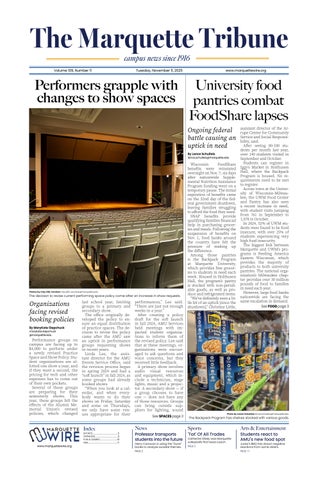
The decision to revise current performing space policy came after an increase in show requests.
Photos by Clay Ellis-Escobar clay.ellis-escobar@marquette.edu
Tuesday, November 11, 2025
The MarqueTTe Tribune
Managing Editor of The Marquette Tribune Sophia Tiedge
NEWS Executive News Editor Mia Thurow
Assistant Editors Lance Schulteis, Lilly Peacock
Reporters Sahil Gupta, Elena Metinidis, Mina Marsolek-Bonnet, Jaylen Hill, Daria Stepanich
ARTS & ENTERTAINMENT
Executive Arts & Entertainment Editor MaryKate Stepchuk
Assistant Editor Joseph Schamber
Reporters Elise Emery, Allison Scherquist, Annie Goode
OPINIONS
Executive Opinions
SPORTS
Assistant Editors Matthew Baltz, Raquel Ruiz
Reporters Benjamin Hanson, Mikey Severson, Sofie Hanrahan, Ben Ward, Eamon Bevan, Conor McPherson
COPY
VISUAL CONTENT
A&E
Photo Chief Clay Ellis-Escobar Photographer Lily Wooten, Owen Weis
HAVE A TIP FOR US?
Have you seen something that you think should be a story? Do you have a tip about something we should be looking into? Do you have documents or other materials that we should see? We want to hear from you.
If you have documents you'd like to send us, you can send anything to wiretips@marquette.edu.

'Dune' class connects fiction, reality
English professor teaches students with sci-fi series
By Mia Thurow mia.thurow@marquette.edu
Every Monday, Wednesday and Friday afternoon in Johnston Hall, around 50 Marquette University students travel 20,000 years into the future.
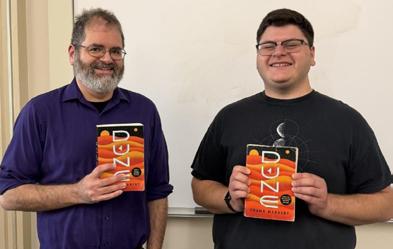
Gerry Canavan, an English professor and department chair, is the one doing the transporting. Through his science fiction-themed class, ENGL 4716, Canavan and his students analyze current societal themes through the lens of Frank Herbert’s “Dune” book series, set in a futuristic environment where humans have colonized the entire galaxy and no longer maintain democracy or equality.
“When you give [students] an object like ‘Dune,’ it’s different than giving them ‘Hamlet’ because they know what they’re supposed to say about ‘Hamlet,’” Canavan said. “You don’t know what you’re supposed to say about ‘Dune,’ so it opens the door to different kinds of conversations.”
The class was created for the book’s 60th anniversary and because of how popular “Dune” is thanks to the recent movie adaptions, Canavan said. Most literature courses at Marquette allow for about 20-30 students, he explained, but this class was opened to over 50 students this semester, with a few even left on the waitlist.
Canavan also teaches an English course about the works of J.R.R. Tolkien, author of “The Hobbit” and “The Lord of the Rings.” However, he said, the “Dune” class has superseded the popularity of his Tolkien class.
“In part, that’s just the interest in ‘Dune,’ and this sense that ‘Dune’ speaks to our moment – despite being so old – in a really interesting way,” Canavan said.
The class, while appealing to English majors, also includes students from majors like engineering who have never opened the book.
But one student, a fifthyear physics and mechanical engineering major, has read the entirety of the first “Dune” novel and is knowledgeable about the rest of the series.
Leo Ruffolo wanted to be part of Canavan’s “Dune”
class so badly that he sidelined a course for his physics degree this semester. He first became interested in the science fiction series while working on an AP English Literature and Composition project in high school.
“What would I want more than to take a class about a book that I love?” Ruffolo said.
Students like Ruffolo divide into breakout groups to discuss different themes and moments in the “Dune” books, including politics and religion, the cerebral effect of drugs, gender issues and the environment. Canavan and his students explore how relevant — and often prophetic — the series is considered to be, despite being first written in 1965.
Canavan said Herbert, the author, foresaw how society was going to evolve around issues like global colonization and hallucinogenic drugs that are increasingly relevant today.
“There’s something of value to just sit in a class with all these people and a really smart professor and actually talk about these things,” Ryan Smith, a sophomore in the College of Communication, said. “We’ve had crazy conversations in that class.”
Smith, who had already read “Dune” and wanted a chance to analyze it in greater depth, enjoys discussing topics like quantum theory and drug addiction through a science fiction lens. Both he and Ruffolo are in the breakout group that focuses on religion and politics, where they read literary theory and analyze how the books relate to current policy or how it draws on history.
One parallel Smith sees between “Dune” and
modern reality is addiction to harmful resources. In the books, civilization harvests a hallucinogenic drug called “the spice” from oil reserves to make interstellar commerce possible.
“In the story, people are addicted to spice, and in the real world we’re sort of addicted to drilling oil even though we know it’s going to kill us, kill our planet and run out eventually,” Smith said.
Discussing “Dune” themes like addiction in a group setting is much different than having to analyze the books alone, Ruffolo said. He added that there are many lessons in Herbert’s writing that are timeless and can be applied now more than ever.
Throughout the semester, Canavan’s students will read the entirety of the first and second “Dune” books, as well as excerpts from the third and fourth books. The class will likely be offered every other year, though Canavan said he wants to make sure to do more before the
“Dune: Part Three” movie comes out in late 2026.
For now, students are focused on their open-ended final projects, which can be anything from an illustrated comic to a screenplay about “Dune.”
Canavan, who has seen how much his students have engaged in the class so far, is also enjoying the class on a personal level. He said teaching such a course has helped him understand the “Dune” books in a way he hasn’t before.
“It’s just a very strange text that seems to be taking you in one direction and then pulls the rug out from under you,” Canavan said. “It’s fascinating.”
Students cope with seasonal affective disorder
Campus resources are available for those struggling
By Elena Metinidis elena.metinidis@marquette.edu
Clocks turned back earlier this month, and like clockwork, the winter blues are back for some. The shorter, colder days trigger seasonal affective disorder, a cyclical mental health condition.
SAD is a type of depression most commonly found in 18–30–year–olds. Beginning in fall and running through winter every year, SAD is different from depression, which persists year-round.
While the “winter blues” are milder and more common, SAD symptoms include low energy, excessive sleeping, social withdrawal, sadness, hopelessness, loss
of interest, carbohydrate cravings, difficulty concentrating and irritability.
These symptoms can affect the academics, social life and motivation of college students, psychiatrist Tom Wright, who has private practices in Milwaukee and Traverse City, said. College students commonly lack a structured routine, which can be a contributing factor to SAD.
“Don’t slow down, make sure there’s activity in your schedule,” Wright said. Exercise, sunlight, consistent sleep, a balanced diet and connection with others can be helpful habits, especially during winter months.
While keeping good habits, Wright said, monitoring symptoms and other life factors is also important. Understanding the degree

Gerry Canavan (left) with his English student Leo Ruffolo (right).
Photo courtesy of Leo Ruffolo
The marqueTTe TribuNe
Tuesday, November 11, 2025
FOOD: Benefits redistributed in Wisconsin
Continued from page 1
“What I’m worried about is the bigger picture of how this is going to affect Milwaukee and surrounding areas, because we all use Feeding America and/ or Hunger Task Force,” Little said.
For college students that rely on the pantries, some aren’t just shopping for themselves. Commuter students whose families rely on FoodShare benefits may
need to take groceries home.
“We have had students express concerns about how they’re going to feed their families,” Allie Martinez, UWM’s basic needs coordinator, said.
While both Marquette’s and UWM’s pantries face added pressure to meet student needs, they are also seeing an increase in donations from alumni and the local community.
Little said she has
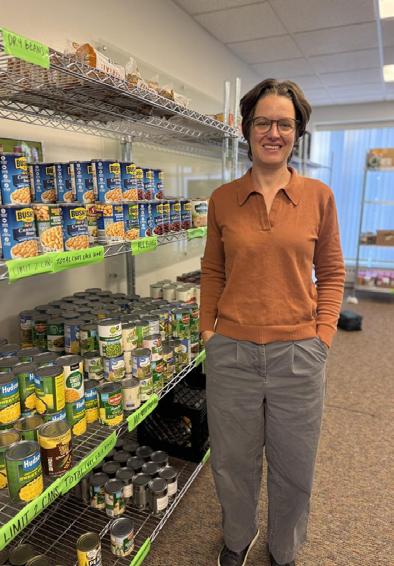
Photo by Lance Schulteis lance.schulteis@marquette.edu
been receiving a greater number of inquiries about what items the pantry needs on its shelves, as the program is in the closing stages of a food drive. To see the drop-off locations across campus, click here.
At UWM, the pantry has a partnership with Feeding America that gives it $10 to purchase groceries for every $1 it receives in donations.
Following the start of a fundraising effort on Nov. 3, the program raised $19,000 in under a week.
“That’s a recent campaign in response to the critical need that we’re facing right now,” Luella Dooley-Menet, UWM’s public relations manager, said.
Little likened the heightened pressures to stock food to the COVID-19 pandemic, which left local communities in desperate need of food pantries. In both cases, she said, food assistance programs met the demand as best they could.
On college campuses, Little said, that demand can be especially intensified. A 2019 study by the National Library of Medicine found that food insecurity can affect student health and academic performance, potentially leading to increased levels of anxiety and stress.
Given that possible aftermath, university pantries like the Backpack Program and UWM Food Center strive to satisfy a need, especially in times of added uncertainty.
“I feel like almost every student shows appreciation
and gratitude,” Little said. “It’s so good to know that this exists, especially for the ones who are losing SNAP in some form.”
Redistribution of Wisconsin FoodShare benefits
Six days following the expiration of SNAP funding, Evers announced his expectation that payments in the state would be reinstated overnight on Nov. 7.
At midnight, over $104 million was given out across the state in FoodShare benefits, the state’s food assistance program. FoodShare serves roughly 700,000 Wisconsin residents, including about 270,000 children.
The announcement followed U.S. District Judge John McConnell’s Nov. 6 order for President Donald Trump’s administration to give full funding to food assistance programs. The ruling closed a weeklong battle over mid-shutdown funding, as the administration originally intended to only give out partial SNAP payments for November.
The Trump administration appealed the order Nov. 7, requesting the funding be revoked. The administration said it does not have the funds needed to give out full benefits. A federal judge temporarily blocked the appeal on Nov. 10.
A spokesperson for the Evers administration said the appeal should not affect the payments released on Nov. 7.
The payments load on to electronic benefit transfer cards for FoodShare
recipients to use at local establishments. Without federal funding, however, local grocers have not yet been reimbursed for November transactions.
Additional resources for Marquette students
In addition to the Backpack Program, another resource at Marquette is MarqEats. Students can sign up for email or text alerts to be notified when there’s leftover food in the Alumni Memorial Union after events. The alert will include what’s available and for how long.
To sign up for MarqEats, students can navigate to the SMS alert page in their CheckMarq account.
Off campus, House of Peace’s food pantry, located near campus on 1702 W. Walnut St., is open five days a week. They accept donations from 1-3 p.m. Monday-Thursday.
NourishMKE also has a food center on 1230 W. Cherry St. Anyone can visit once per month, and the center is open Wednesday, Thursday and Friday from 9 a.m. to noon.
St. Rose’s Food Pantry, on 3005 W. Michigan St., is open on the second and fourth Tuesdays of every month at 4:00 p.m.
Feeding America Eastern Wisconsin also offers volunteer and donation resources on their website.
The City of Milwaukee, in response to the federal shutdown, is hosting a food drive with drop-off centers. Accepted food items are listed on its website.
SPACES: Groups face $4,000 in tech fees
Continued from page 1
and other assets, but AMU Services will only unlock the space and turn on the lights.
More shows also require more employees, especially in the technical department. Lee said student technical employees and AMU technical staff were often overbooked and could not manage multiple shows between Weasler Auditorium and Varsity Theatre.
“I think students are working, but I don’t think they are working as many hours as they worked 10 years ago,” Lee said. “But that’s not just tech employees, that’s everywhere [at Marquette].”
Along with students working fewer hours, AMU Services put A new emphasis on preventing overbooking shows. Teddy Gustafson, a junior in the College of Arts & Sciences and president of the all-male a cappella group The Naturals, said he has seen the list of dates
available for performances significantly decrease since his first year at Marquette.
In past years, the group had its show at the end of April or the beginning of May. This year, the show is earlier than normal on April 10.
“Performances are ideal at the end of the semester, whether you are in dance or whether you are doing a cappella,” Gustafson said. “It’s now being spread out so much that people are having to perform in unrealistic time frames.”
Additionally, Gustafson said the “one size fits all” policy puts a cappella groups at a disadvantage because they need technical assistance to mix their voices with microphones. Performance groups submit a form to AMU Services for their preferred performance venue and dates. For the fall semester, groups submit the form in late April or early May, and for the spring semester, groups submit it
in November.
Since the policy changes, the three a cappella groups on campus — The Meladies, Naturals and Gold ‘n Blues — have created a combined secondary fall show in a lecture hall with an outside vendor for
"We just want to be able to share our love of dance..."
Avril Beesley Junior in the College of Communication
technical assistance.
Along with a cappella groups, Pure Dance has struggled with putting on a show this semester under the new policy.
Avril Beesley, a junior in the College of Communication and junior co-president of Pure Dance, said since Pure’s inception in 2007 all shows have
occurred on Sundays. This year, due to the limited availability of performance spaces and dates, its secondary show will be on a Friday.
Additionally, AMU Services will not open the tech booth for the secondary show, where the lighting and sound boards are located. Pure will have to bring in outside vendors, which will need to provide their own lighting. When adding the other show expenses, the cost of an outside vendor adds up to $4,000.
Student organizations can request funds from the Marquette University Student Government by attending one of their meetings. Requests are subject to approval or denial depending on the student organization’s situation. This money comes from the $40 semester activity fee students pay in their tuition, which goes to the Student Organization Fund in MUSG.
Pure even looked at performing at the off-campus
Marcus Performing Arts Center instead to have access to a full tech booth — but to rent it out for a day for a tech rehearsal and show would cost around $2,000.
Beesley said she feared Pure Dance may have to add dues and other costs to members if it wanted to continue shows with the same performance quality as years past.
“I hope the show ends up being like how it feels when I started as a freshman,” Beesley said. “We just want to be able to share our love of dance and continue doing what we do.”
Lee said AMU Services will continually take feedback from clubs on the practice and show space policy to make it as fair and equitable for student organizations as possible. At the end of each academic year, AMU Services plans to meet with the student organizations to listen for potential policy adjustments for the following year.
Arrupe Center assistant director Christine Little in the food pantry.
The marqueTTe TribuNe
Tuesday, November 11, 2025
SAD: Marquette offers winter wellness events
Continued from page 2
of depression and time of year is critical to differentiating SAD from depression.
Journaling is a tool Wright recommends for noticing patterns.
“Look back at entries and talk to people that have known you for years and see if this is a pattern you’ve
seen consistently that went unnoticed,” he said. SAD may affect some of the Marquette University community, as 52% of Midwesterners report a decline in mood during the fall and winter, 36% of which feel depressed. Out-of-state students from warmer climates are also susceptible

to SAD.
“It can make people’s dayto-day life feel harder or heavier,” Emilia Jakel, a junior in the College of Arts & Sciences, said. “Know that [your] mood might be affected by the changes and give [yourself] grace and more time for self-care.”
As a Peer Wellness Educator, Jakel and her colleagues promote healthy choices and decision-making that improve students’ wellbeing. As students themselves, Jakel said her team offers a unique perspective on maintaining wellness in college.
“Don’t hesitate to reach out for help,” Jakel said. “Students experience SAD every year, so there are so many resources that are equipped to help you.”
Marquette University’s Wellness + Helfaer Recreation Center boasts a counseling center, medical clinic, peer coaching and
recovery center that are always available on the 3rd and 4th floors of the Wellness Center. Events and classes are also hosted throughout the year, like the “Scaling Wellness In Milwaukee” classes from 4-5 p.m. every weekday and events as-scheduled with the Campus Activities Board.
Light boxes are also a common tool to combat SAD. They can imitate the sun and trick the brain into thinking it’s a different season, igniting a chemical reaction in the brain. Sitting in front of a light box for 30 minutes within the first hour of waking up is shown to improveone’s mood and ease symptoms. Light boxes typically cost between $20$200, depending on the style and brand.
“When it’s sunny, I’m always happy,” Carli Filek, a first-year in the College of Communication, said.
“When it’s cold, I feel more unmotivated and just want to stay inside.”
Light boxes can come out of hibernation once daylight savings ends and can be traded for real sunlight once clocks spring forward again in March. Students can also bundle up and sit on benches around campus or keep curtains open to soak up as much sunlight as possible.
Like a broken leg that can’t simply be ignored, Wright said there are evidence-based treatments for mental health that help students bounce back.
With the winter months ahead, students will see changes in the environment and may, consequently, feel changes in themselves. No matter the struggle, various resources are available to students at the Wellness Center as support throughout the year — not just when the seasons or clocks change.
International activist Pia Klemp visits campus
German biologist led conversation on political topics
By Sahil Gupta sahil.gupta@marquette.edu
A Wehr Physics lecture hall became a venue for political discourse on Nov. 5 when German biologist and human rights activist Pia Klemp came to visit Marquette University. The event, sponsored by the Marquette Democracy Project, facilitated conversation on immigration, human rights and other high-profile issues in global politics. While Klemp may not be a familiar name in the U.S., her work is well-known on the other side of the Atlantic Ocean.
Like the United States, Europe has faced an ongoing influx of migrants in the last decade. Many are refugees fleeing ongoing conflicts in the Middle East and northern Africa and seeking asylum is Western countries such as Germany, France and the United Kingdom. In 2023, more than 385,000 such migrants entered Europe seeking a better life outside zones of conflict.
The journey to seek asylum in Europe is dangerous. Smugglers based in North African countries such as Libya and Tunisia take what little money that migrants have and pack them into small rubber boats to cross the Mediterranean Sea.
The crossings are often fatal for refugees. A report by the United Nations found that more than 20,000 people have died or disappeared over the central
Mediterranean in the last decade, including around 3,500 children.
Klemp’s work sought to ease these dangers for those seeking a better life in the European Union. Her non-governmental organization “Sea Watches Fleet” has been credited with saving more than 14,000 migrant lives from the dangerous and deadly crossings of the Mediterranean Sea.
She also faced up to 20 years in prison after the Italian government accused her of aiding in human trafficking and illegal immigration. After a years long legal fight, the charges were eventually dropped.
Noelle Brigden, professor of political science, introduced Klemp to the audience, highlighting some of her achievements and commending her for her bravery.
“I will call Captain Klemp a hero,” Brigden said. “She saves lives at the risk of her own liberty.”
While Klemp’s work is more Eurocentric, her remarks touched on issues relevant in American political discourse. She spoke with students about the importance of accounting for nuances when talking about politics, citing the word “freedom” as an example.
“[Freedom] is such an easy word to say. But what are we actually talking about?”
Klemp said. “Are we talking about freedom as individual personal possession, or are we talking about freedom as a communal way of living together? It’s two very different things.”
Klemp focused much of her remarks on the

importance of productively channeling emotions in order to foster change. These sentiments resonated with some students in attendance, including Val Martinez, a senior in the College of Arts & Sciences.
“Knowing how to identify certain emotions and recognize them is one of the best ways to engage in activism,” Martinez said.
One emotion Klemp specifically mentioned was anger. She talked about the power that anger can have in motivating someone to act against injustice.
When asked by students to distinguish between anger and hate, Klemp explained that the difference comes in the form of action.
“Hate is an emotion of death and destruction,
and anger is a motivator,” Klemp said.
The event was hosted by the Marquette Democracy Project, an initiative led by Jessica Rich, professor of political science. The initiative is designed to teach students how to be engaged global citizens and make an impact in the world.
“Activism is essential for democracy to thrive,” Rich said in her opening remarks. “Our mission is to Marquette’s call to ‘Be the Difference’ into practice— helping students take what they learn inside the classroom and carry it out into the world.”
Rich hopes to continue working on the initiative every fall semester. In practice, that will depend on whether they receive
future funding from the university. This semester they received a one-time Teaching Enhancement Grant from the College of Arts & Sciences to fund activities related to the three courses being taught through the Marquette Democracy Project.
While the future of the Marquette Democracy Project may be uncertain, Klemp left students with parting words about the future, reminding them to think about creating solutions to problems in addition to eliminating the problems themselves.
“We need visions and stories of the future,” Klemp said. “We can think about the negative narratives, but we also need ideas of how we want the world to be.”
Pia Klemp has been credited with saving more than 14,000 migrant lives in the Mediterranean Sea.
Photo courtesy of Marquette University
52% of Midwesterners feel a decline in mood during fall and winter.
Photos by Clay Ellis-Escobar clay.ellis-escobar@marquette.edu

'TAT' OF ALL TRADES
Inaugural Marquette volleyball head coach founded program in 1975
By Rachel Lopera rachel.lopera@marquette.edu
Catherine Shiely does not like to reminisce about the glory days, but she returned to the place where they all started.
Known better as “Tat,” Shiely returned to her former stomping grounds for the Marquette Women’s Volleyball 50th Anniversary Celebration & Alumni Weekend. Family, friends, alumni and players gathered to celebrate the
program that Shiely founded back in 1975.
Considering what it took to start the program, the event was much more meaningful to Shiely. Inspired by her high school coach, she realized coaching was something she wanted to do and earned a degree in physical education. She got hired at Marquette and went on to create opportunities for women in sports.
“The best thing about being the first one to do a
job is that nobody knows what you’re supposed to do,” Shiely said. “So, you just get to do it whatever way you want, and if you’re successful, you’ll still be there.”
However, the process was by no means a cakewalk. Without long-established club volleyball at the time, Shiely’s recruitment process was a bit unconventional. Instead of scouting at games, she went to the admissions
Forbes' late-game heroics 'not a surprise'
Forward scored 18 points in final 15 minutes in win
By Jake Dale jacob.dale@marquette.edu
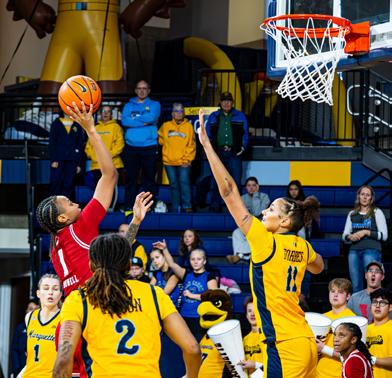
Early Saturday morning, at 7:30 a.m., seven hours before Marquette women's basketball's first game against in-state rival Wisconsin in eight years, Skylar Forbes was the first player at the Al McGuire Center, getting shots up.
Late Saturday afternoon, at 5:00 p.m., after the Golden Eagles' 65-62 thrilling overtime comeback victory, she was sitting at a press conference table, basking in the glory of her
late-game, win-sparking scoring burst to cap off a 19-point day.
Much happened to Forbes in the 9-and-a-half hours between when she conducted her morning pregame duties and when she conducted her evening postgame ones. A lot of upand-down. A tale of two parts.
Twenty-five minutes before the end of the game, Forbes was skulking back into the locker room with only one point to her name and Marquette trailing 33-26. She had only taken two shots, both missed threes — a troublingly little amount of production for last season's highest-scoring Golden Eagle. Her lone
point came from the charity stripe.
“In the first half, we really didn’t do much of anything we wanted to do,” Marquette head coach Cara Consuegra said. Fifteen minutes before the final buzzer was more of the same, for both Forbes and her team. The Golden Eagles finished the third quarter trailing seven points, 42-35, and Forbes finished the 10 minutes with a stat line of one rebound, 0-for-1 shooting and two turnovers, still sitting on one meager point. After 30 minutes of basketball, the person who dropped 19 points six days prior was stuck with 18
Photos courtesy of Marquette University Acrchives
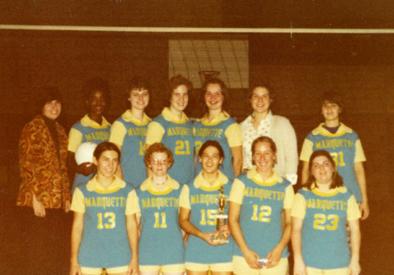
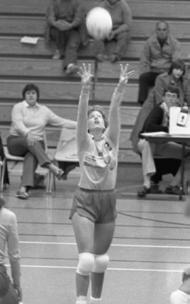
Catherine "Tat" Shiely helped found the Marquette volleyball program in 1975, recruiting players through on-campus flyers and hand-written letters to students.
WOMEN'S BASKETBALL
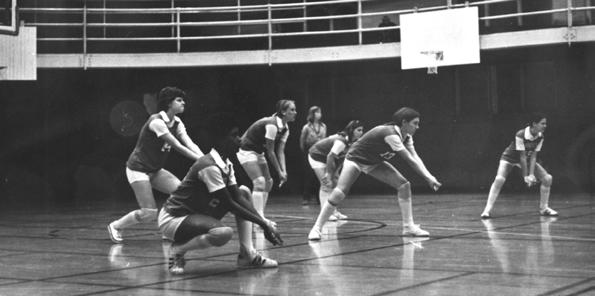
The first Marquette volleyball team poses for a photo in 1975.
Photo by Clay Ellis-Escobar clay.ellis-escobar@marquette.edu
The marqueTTe TribuNe
WOMEN'S SOCCER
Ten days of disaster killed postseason hopes
Golden Eagles outscored 18-1 in three losses
By Ben Hanson benjamin.hanson@marquette.edu
Four Big East games, or more fittingly, gut punches, in 10 days.
That’s what killed Marquette women’s soccer’s chances at exorcising postseason demons in 2025, leading to another missed conference tournament. Four gut punches that came quicker than the Golden Eagles knew how to respond.
Marquette hasn’t played in the postseason since 2017 and this year, almost every player on the team said either winning or simply making it was their biggest goal for the season. That desire in early conference play put it on the right path leading towards the postseason. Or at least what it thought was the right path.
The Golden Eagles — who went 7-7-4 on the season — went beguilingly undefeated through its first five matchups (two wins and three ties).
Amid this, head coach
Chris Allen boiled down their run at the tournament to a science. It’s the high school biology teacher in him. He constantly reminded his players of how many points they sat at compared to other teams in the conference.
But combining science and sport — the controllable and the unpredictable — isn’t always possible.
“We started to make it very heavy on the numbers,” Allen portended.
After Marquette’s fifth game, it traveled to Villanova, sitting fourth in the Big East standings tied at nine points with the Wildcats. Before the match, the Golden Eagles were happy to look at Big East points.
Though eerily similar to last season, a critical game against Villanova ended with a 3-0 loss for the Golden Eagles. After that, maybe they weren’t so keen.
“Probably too much was put on the Villanova game,” Allen said. “That was a first domino that started to fall.”
Marquette began lagging behind the points standard it set for itself.
Next, it lost to No. 13 Georgetown, Providence and No. 19 Xavier by a -14 total goal differential.
During its four-game, 10day run from Villanova to Xavier, the Golden Eagles were outscored 18-1, outshot 45-23 and dropped to eighth in the Big East — mathematically eliminated from conference tournament contention.
“It unfortunately really changed the narrative of the season,” Allen said about those 10 trajectory-defining days. “The team’s scouting got better (and they) were able to neutralize our attack.”
Marquette was playing from behind in the Big East standings, but the same was also true in the four games that condemned the season. The first goal in each of these matchups, which was never scored by the Golden Eagles, came at an average of 11 and a half minutes.
“When you’re constantly playing from behind, you’re going to get found out,” Allen said. “All of a sudden you have to make formational adjustments and whatnot. We put ourselves a little bit in compromised positions. We did not do a very good job of working through the level of adversity that all programs face.”
MEN'S SOCCER
The points standing, which kept being brought up, turned from a point of pride to a constant reminder of mistakes.
“It’s part of my responsibility to remove those dark clouds,” Allen said. “Not inadvertently insert them into our environment.”
The skies began to clear with Marquette’s final game of the season against Seton Hall, who finished at the bottom of the Big East. The win against the Pirates—its first senior night victory since 2021—gave the Golden Eagles two more conference points than they ended with last year.
But the team won’t forget about the laden 10 days of
overcast sky. It’s what will bring back the crew strong and hungry.
“That’s what brings about a team,” Allen admitted.
“You have to be there during the tough times.”
As Marquette sat in Milwaukee, it watched the Xavier women hoist the Big East tournament trophy above their ‘Big East Champions’ hats. Countless emotions could have been running through the Golden Eagles’ heads. But there is one, that ensures a fiery motivation for next season, of which Allen is certain.
“We have a team that’s pissed off now.”
Marquette falls short of Big East tournament
All Golden Eagles' losses were by two goals or fewer
By Eamon Bevan eamon.bevan@marquette.edu
The Marquette men’s soccer team spent much of its 2025 season walking the line between promise and frustration.
Despite a tactful style of play and several key contributors’ efforts, many poor spells of form saw the Golden Eagles finish with a 7-7-2 record and miss the Big East tournament for the fifth straight year.
“Definitely a really crazy ride of emotions, but I wouldn’t trade it in for
anything in the world,” senior captain Justin Milovanov said.
Trips to Big East opponents told the story best, as they rarely ended in celebration. Marquette stayed competitive, but finishing chances — and games — became the difference between what was and what could have been.
Despite two red cards in their first three matchups, the Golden Eagles established a 3-0-2 record after their opening quintet of games.
With key comebacks against the likes of North Florida and Drake, as well as unimpeded performances against Chicago State

and Lipscomb, Marquette looked poised to make serious shockwaves in the Big East in their second season under head coach David Korn.
Their undefeated start entirely taking place at Valley Fields, it was once the Golden Eagles hit the road and simultaneously started conference play that bumps started to form in their results, a 1-0 defeat at Creighton was the starting gun.
After defeating UW-Milwaukee and taking home the Milwaukee Cup in late September, a stretch of key conference losses followed. Close losses to Seton Hall and Xavier followed, leaving the Golden Eagles at the bottom of their Big East division by the start of October. For the second straight year under Korn’s tenure, they were on the outside of the playoffs looking in — with a lot of work to do.
“The gap between the number one college team and the last ranked college team is not as big as people might seem to believe,” Milovanov said, “during those [tough stretches], we just had to believe in our ability.”
In several of these matches, the Golden Eagles found themselves trailing after strong starts, unable to convert possession into goals. The narrow losses highlighted the challenge of carrying home form into conference venues.
At this point in the season, Korn began to make significant changes to what was a clear-cut 4-3-3 system during his opening almost 20 games at the helm.
Placing faith in players such as Milovanov and sophomore Bryce Richards to make notable shifts to more defensive positions, they continued the rest of the campaign in a defensively-sound 3-5-2, while sticking to their possession-based offensive philosophy.
“You know, we had some injuries in the back, we were looking to generate more of an offensive spark,” Korn said. “So I’m super pleased with the way they adapted to it.”
After this major shift, key performances from Nico Pendleton, Mads Horgoien and Mateo Stoka on the offensive end saw goals fly in three wins.
Despite those performances, momentum didn’t quite carry over into the remainder of conference play, and they lost three more matches to Butler, Providence and Akron, continuing their woes in those closely-decided Big East road matches.
Rounding out the season on Nov. 7 with yet another 1-0 conference loss — this time at the hands of Villanova — Marquette concluded Big East play with six more defeats than victories, all of which came by two goals or less.
Coming short of early-season expectations, the experience of fighting for the program every week established relationships and created memories for players and coaches alike.
“The environment and training, the way the guys got along, [it was] a lot of fun to work with them, I was really pleased,” Korn said. “The biggest thing will be continuing to build relationships with them [the players], try to help them grow to be the best version of themselves that they can be, and for us to be the strongest team we can be.”
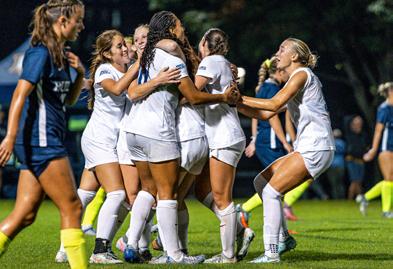
Marquette women's soccer finished 2025 with a 7-7-4 record.
Photo courtesy of Marquette Athletics
Marquette men's soccer went 1-7 in Big East play in 2025.
Photo by Clay Ellis-Escobar clay.ellis-escobar@marquette.edu
VOLLEYBALL
TAT: Shiely coached both VB and WBB
Continued from page 5
office and combed through every incoming female first-year who had a sports background and sent them a letter. She also put up notices around campus to advertise tryouts.
“I was at Cobeen Hall when I saw there was tryouts,” said Angie Kvidera, an outside hitter on Marquette’s first volleyball team from 1975-1979. “I wanted to play basketball, but I thought I’d try out for [volleyball].”
Once the team was rallied up, practices began — which were not for the weak. The players practiced in the ROTC gym, and because they didn’t have any equipment, Shiely had to engineer a volleyball net with a pulley system. The net was connected to poles attached to tires, so there was no way to get it taut enough.
The lack of air conditioning in the gym didn’t help either. Some girls went through two practice shirts because they were drenched in sweat.
The long hours in the hot gym paid off, though, when the team won their conference championship the first year, playing against Mount Mary University, St. Norbert College and Milwaukee Area Technical College. But it wasn’t what
Shiely was looking for.
“We brought the trophy home, but it wasn’t as competitive as I wanted our program,” Shiely said. “So, the next year we went into what was called the Wisconsin Women’s Intercollegiate Athletic Conference… and we got killed.”
The setback didn’t stop her, though. Shiely said she wanted to help make her players competitive, competent people who could transfer those qualities to their own life ambitions.
People like Karen Weir Binash, who played middle blocker from 1980-1984.
“She [Shiely] definitely demanded,” Binash said.
“But when all was said and done with my four years of playing, she certainly made me a better player. She certainly made me a better person.”
After her time playing for Marquette, Binash became an integral part of the program as she went on to coach with Shiely from 1989-1994.
“When she asked me to coach with her as an assistant, I definitely got a better appreciation of how kind and very passionate she was about the game of volleyball,” Binash said.
Shiely poured her dedication into her players and emphasized the impor-
tance of being a teammate — something she wants the current players to practice as well.
“Give 100% every day,” she said. “It doesn’t matter whether you start or whether you’re subbed in or not because your teammates are counting on you, so you have to be a dependable person. You have to be someone that they trust.”
"That first team is so important because it was the building block..."
Catherine "Tat" Shiely First Marquette volleyball head coach
Shiely coached Marquette Women’s Volleyball from 1975-1999, and she also coached Marquette women’s basketball from 1975-1985. At one point, she was the only woman in the nation to be head coach of women’s volleyball and basketball programs simultaneously.
“It was hard because the seasons overlap,” Shiely WOMEN'S BASKETBALL
said. “I’d have one practice at like, 6-8, and then a practice from 8-10, so it took a lot of time.”
She was inducted into the Marquette “M Club” Hall of Fame in 2004, named Volleyball Coach of the year in 1980 by the WWIAC and was also named the Great Midwest Conference Volleyball Coach of the Year in 1992.
But her proudest accomplishment isn’t an award, championship win or season highlight; it’s the work she did as an American Volleyball Coaches Association board member to prevent coaching abuses.
“There were some complaints about abuse of athletes, and nothing was being done about it,” Shiely said. “So, we created a legal system, put together a legal document so that students had some way to express their problems and concerns about coaches and… every coach had to sign the document.”
Now, thanks to Shiely’s work, the AVCA works with USA Volleyball and the U.S. Center for SafeSport to promote abuse prevention across the country.
Shiely’s commitment to sports was unwavering, and it’s what led to the creation of Marquette women’s athletics. She was
instrumental to the volleyball program, and has seen many changes over the years.
“I don’t think the current athletes realize where the program has come from. I don’t think they have a clue,” Shiely said. “That first team is so important because it was the building block for everything that they have now. And those people now stand on the shoulders of the 10 people that were the first ones that played for Marquette.”
Kvidera also sees a shift in how the sport has changed since she has played on the university’s first team.
“Tat did a hell of a lot to get this going and fought for anything she got… I mean, it’s such a different era now,” Kvidera said.
“Besides having full scholarships and travel and recruitment, I mean, everything is different. It’s like crawling and now running.”
Starting out in a gym without A/C or equipment, Marquette women’s volleyball has evolved. When Shiely reflects on her contributions to the athletics program, she keeps a humble mindset.
“When you leave, somebody’s always there who can take your place,” Shiely said. “You can’t ever say ‘you can’t do this without me,’ because somebody can come in right after you and do it just as good or maybe even better.”
Shiely’s glory days aren’t so glorious in her eyes. She came to do a job, and now, she’s embracing life — playing golf and spending time with her great nieces and nephews.
“I mean, I could walk off the curb tomorrow and get hit by a car,” she said. “So, I think that today is the most important, and what you do every day is what’s going to guide you in your life.”
HEROICS: Skylar sparked MU's comeback
Continued from page 5
less. Uncharacteristic to say the least.
“It's bigger than me. As a collective, we emphasize how important it is to show up for each other, regardless of if you had a bad moment, 10 minutes, 30 minutes,” she said. “It was less about me, more about showing up for my teammates.”
And show up she did, even if it took three full quarters. The Canadian native Forbes, a unanimous All Big East Preseason selection, unfazed despite the ugly start, came alive in the fourth.
"I don't know how much of a flip of the switch it was," Forbes said. "Kind of reiterating Coach, just staying in the moment. Just making sure that I'm there for my teammates and knowing my teammates are there for me.
"So just being able to get the spots that I know I can get to."
Forbes scored 12 points in the 10 minutes, shooting 4-of-5 overall, 1-of-1 from deep and 3-for-4 from the line. Most of the 12 points, eight to be exact, came from the game-turning 10-0 run with two minutes remaining in regulation
that she both started with a three and capped off with a free throw.
“The way they were playing Skylar on the ball screen is they weren’t coming off of her. So we really started to use her as a decoy, and we did such a good job of that that they had to start to adjust," Consuegra said.
"Then we were able to get her on some pops, pull them out and give her some space to operate, which got her going. And then I think our team just fed off that."
Five minutes before the final buzzer, now in overtime, she scored all
of Marquette's six points, culminating with the game-sealing, go-ahead, frenzy-inducing 3-pointer with nine seconds remaining. The same kind of shot she practiced earlier that morning, when she was the first person in the gym.
"I rep that shot a lot in my individuals," Forbes said.
"We rep it in practice. My preparation, that was the one thing (that gave her confidence)."
And, just two possessions prior, with Wisconsin looking for a go-ahead bucket of their own, Forbes came up with a major block on Badger forward Gift Uchenna
that ultimately tipped the scales in Marquette’s favor.
When the final buzzer sounded, with the double-digit comeback complete and the Al McGuire Center lit blue & gold, Forbes and the rest of her teammates embraced, jumping and hugging and cheering. Due in no small part to her, her 18 points in the final 15 minutes and, what started it all, her morning solo shooting drills.
"Not a surprise," Consuegra said about her Naismith watchlist honoree's late-game heroics.
Marquette volleyball won its conference championship in the program's inaugural season.
Photos courtesy of Marquette University Archives
MEN'S BASKETBALL
The man mapping Marquette's movements
Kiely was hired in 2024 to optimize team's athleticism
By Jack Albright jack.albright@marquette.edu
On the second floor of Schroeder Complex is wing 248: the athletic training laboratory. Through one metal door at the wing’s entrance, 15 feet down the hall, is the second office on the right: 248B.
Here, on the other side of one wooden door, tucked far away in the maze that is Schroeder Complex, is what Marquette men’s basketball players hope will help them bound around the court better.
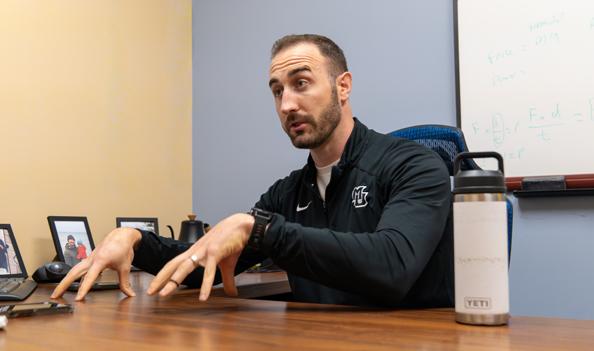
It is the lab analysis hub of Michael Kiely, a sports scientist at Marquette tasked with optimizing the team’s injury recovery and individualized bodily movements. It’s a humble space. The room is no bigger than 200 square feet, less than half the size of a studio apartment. It has no windows — not even on the door — one small white board, a bookshelf, a desk and three chairs.
But, most importantly, he has two computer monitors. That’s where the real magic happens.
In this rather unassuming room, Kiely takes raw data from workouts, analyzes it, then helps coaches and players understand how to optimize their movement in practices and games. He
essentially builds them a map, one that, if all goes to plan, will lead to the NCAA tournament.
“My role as a sports scientist is to hear what [performance coaches] Todd (Smith) and Matotggie (Smith) are seeing and thinking, hear what the assistant coaches and coaches are looking for, specifically with regards to movement,” Kiely said. “And try and turn that into a way that we can objectify.”
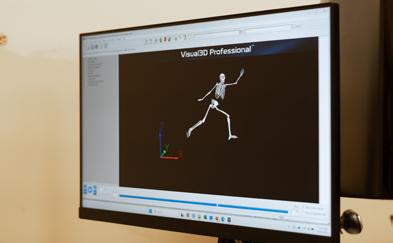
To do that, Kiely set up a motion capture lab twice during the offseason, first in April and again in July, and had men’s basketball players conduct on camera in-game movements — including closeouts, drives, rebounds and dunks — largely centered around acceleration and
de-acceleration.
Both Marquette and Kiely are familiar with the technology, just not for this purpose. The Golden Eagles have worked with it in the past to improve shooting mechanics. Kiely used it to help athletes recover from injuries in his previous job in Minnesota, where he worked closely with the Vikings.
“My goal was to bring it to Marquette and see what we can do with optimizing athleticism,” Kiely said. Kiely needs about an hour and a half to set up his motion lab, 30 minutes to run through the data collection drills and a week to get the results. Once they come in, he is able to watch on his computer in Schroeder Complex how players’ skeletons move. It provides a different picture, allowing for a much more detailed understanding of what a basketball player’s body is doing when on the court.
“A lot of time we’re just watching film on ourselves,” senior forward Ben Gold said. “You can see it in the moment, but once you actually break it down and see how your body moves, there’s sometimes limitations to what your body can do.
“And you can see that
more in a skeleton instead of just watching film.”
By the time Kiely set up the motion lab for the second time in late July, and had the players conduct the same movements, he said they quantifiably improved. Especially the bigs.
“Ben’s become a better mover with some of the coaching that Todd Smith and Michael Kiely have provided just through movement,” Marquette head coach Shaka Smart said.
It helped Gold, who said improving balance was a priority this summer, understand how his hips move.
“I’ve always had really tight hips due to a big growth spurt when I was younger,” Gold said. “So, I was trying to work on how to get lower on defense.”
Hired by the university in 2024 after a phone call with Todd Smith, Kiely’s moving to Milwaukee was a reunion with both the place and the people who sparked his sports science journey.
He got his bachelor’s and master’s degrees from Marquette, graduating in 2016. His junior and senior years of undergrad, Kiely worked for Smith as a strength coach intern. Once he
started graduate school, he kept working with the strength team, helping the volleyball and both basketball programs.
Now he is in his second year back.
With his program, Kiely is able to go through every moment of, say, a closeout, down to the millisecond, and watch what someone’s hips, knees, feet and elbows are doing at the same time. He then adds his own twist to the program, putting measurable numbers to the unmeasurable visuals.
After the first test in April, along with player and coaches meetings, he sat down with both Smiths bi-weekly to curate and adapt a summer workout progression for the men’s basketball team, centered around improving starting and stopping mechanics.
“We started with, ‘Hey, these are our three movements we’re going to do today. And then we’re do this every day for two weeks.’ And then we built the next level, the next level,” Kiely said.
“And we kept adding speed, context, decision-making to see… how are we going to train it to be a habit?”
Kiely is not sure whether he will be setting up the motion capture lab again — it’s up to the team, not him. He’s also not entirely sure his numerical algorithm will yield useful results on the court, the world of movement science is too new for anything to be conclusive. This summer was about giving wisdom, not answers.
“It’s really a frontier,” Kiely said.
But, if Marquette proves its doubters wrong, some of the credit should go to the man in the windowless office on the Schroeder Complex second floor, in wing 248, office B, working out of sight and mind.
NEWS

Kiely analyzes Marquette men's basketball's workout data in his Schroeder Complex office.
Kiely's software shows how a body moves at the skeletal level.
Photos by Leo Stallings leo.stallings@marquette.edu
Opinions
Right-wing podcasters hinder progress
By Lexi Childers alexandria.childers@marquette.edu
Through the rise of social media, the evolution of new conservative podcasters has become prevalent. Their hateful content is far more damaging to marginalized communities than the likes of Joe Rogan and the podcasters of the previous generation. This degradation of progress is something that we cannot allow. We must push back.
On Halloween, conservative podcaster Lilly Gaddis dressed in blackface, describing her costume as “the scariest thing [she] could think of: a Black woman” in a YouTube video entitled “I am not apologizing.” Her actions were intentional, purposefully hurting the Black community.
While other content creators are challenging her actions on social media, her own comments section shows little to no qualms about her blatantly racist actions, which is profoundly disturbing. Just a few years ago, doing blackface as a social figure could have ended an individual’s career.
This is where the idea of “cancel culture” comes
from. If one commits a cancelable offense, such as blackface, they lose their ability to have a social platform. However, there has been no pushback from YouTube as her video still remains on the platform, with reposts of her content going viral on countless other social media platforms. This gross lack of action from social media platforms is obviously wrong, and action must be taken. Not only does Gaddis spread extremely racist stereotypes surrounding Black Americans, but she also actively mocks and belittles them.
People sharing their political beliefs is not inherently a bad thing. However, individuals spreading hateful rhetoric may normalize this behavior, systematically deconstructing progress.
Along with Gaddis, many other conservative podcasters are continuing to influence millions of Americans.
Nick Fuentes is a popular content creator who self-identifies as a white Christian nationalist and a fascist. He believes in the “Great Replacement Theory,” spreads antisemitic conspiracy theories and believes in
“anti-women” rhetoric. Fuentes’ first claim to fame came from his participation in the Charlottesville white supremacist protest in 2017 where he was interviewed by many and began to grow his political audience.
Creators like Fuentes have grown in popularity, especially following recent Supreme Court cases overturning protective policies for women and people of color under the second Trump administration.
Surrounding the overturning of Roe v. Wade and shortly after the 2024 election, Fuentes started a social media trend by posting the phrase “Your body, my choice. Forever”on X, a play on the activist slogan of “my body, my choice.” This phrase blew up on numerous social media platforms and led to a massive change within the conservative movement.
Quiet hatred turned to action. Women were demeaned and targeted with harassment following the trend. There were also profound calls from many followers of Fuentes for the ending of the 19th Amendment, the Constitutional
Amendment that allows women the right to vote.
These issues are appalling, yet there was little to no response from social media companies following these incidents. While Fuentes was banned on YouTube prior to this issue, he still has an account on X and has faced no repercussions from Rumble, his current streaming platform.
Much of this issue surrounds the normalized hatred towards women and people of color. People are now more willing to harass these groups, encouraging racism and sexism in U.S. politics.
Since 2018, the Republican Party has seen sloughs of young men, particularly white men, entering the party. This is also when the majority of Gen Z first began to enter the political sphere. In turn, new content creators were chosen to lead them.
Throughout the past 50 years, massive social progress for marginalized communities was made. Through the passing of Roe v. Wade, Obergefell v. Hodges and more, countless Americans were supported
Gen Z turns to resurfaced trends

By Amelia Lerret amelia.lerret@marquette.edu
With the return of old fashion and technological trends, Gen Z is seeking comfort and an escape to simpler and nostalgic times. Gen Z, those born between 1997 and 2012, have experienced the pioneering times of social media and the COVID-19 pandemic. Through the popularity of digital cameras and baggy jeans, Gen Z displays their desire to get away from these troubles.
Considering they were the first to grow up with technology, Gen Z has encountered the detrimental effects of social media like no other generation. Some of these effects include depressive symptoms, body image issues and sleep loss.
When the pandemic hit in 2020, Gen Z was between 8 and 23 years old, which are
very formative ages. Many schools moved education online, increasing isolation and technology use, especially social media.
The consequences of the pandemic are still present today, causing Gen Z to struggle socially and mentally. According to the Associated Press-National Opinion Research Center, 49% of Gen Z find it difficult to maintain good mental health, and 55% find it hard to have fun.
Given they were the only generation to experience that unique impact from the pandemic, Gen Z is turning to other generations to experience pre-pandemic life. Particularly, they take trends from millennials, those born between 1981 and 1996.
These trends involve rejecting new technology,
and instead mimicking millennials’ teenage years. Gen Z is gravitating toward a time when people weren’t overly consumed by phones and social media, finding a sense of stability and security.
Despite common assumptions about young adults being addicted to their phones, they are actually fighting against this notion and working to be more present. This can be conscious or subconscious, but Gen Z is turning away from modern technology, nonetheless.
Cal Newport, a computer science professor at Georgetown University, described this idea as “digital minimalism” — a concept that we are aware of our technology use and are working to reduce it.
This is evident through young adults’ use of digital cameras. Despite its quality being considerably lower than an iPhone camera, teenagers persist in its usage to document experiences. This displays Gen Z’s attempt to combat the lasting difficulties of their generation.
Digital cameras not only reduce iPhone use, but they provide comfort and nostalgia. Digital cameras were popular in the 1990s, bringing people back to
those times.
Another tangible item with increasing popularity is vinyl records. Music is more accessible than ever through platforms like Apple Music, Spotify and YouTube, yet Gen Z is still choosing to buy vinyl records. These old-school music items were prominent in the 1950s and 1960s, giving Gen Z a taste of the technologies of their parents or grandparents.
Resurfaced trends are also demonstrated through fashion.
Each decade had a style of jeans that was popular: mom jeans in the 80s, baggy jeans in the 90s and skinny jeans in the 2000s. Currently, baggy and skinny jeans are back in style.
Gen Z is reverting to comfortable ideas as a means of escapism. By simply using a digital camera or wearing clothes from the 90s, Gen Z gets a taste of what life was like without the pandemic or the rise of social media that disrupted their generation. While that coping mechanism is beneficial, it signifies Gen Z’s struggle to face those challenges.
Lerret is an opinions columnist. She is a first-year studying journalism and sports communication.
and uplifted.
These extremely loud, popular and hateful conservative podcasters are actively socializing the youngest generation of voters to believe vile things about women and people of color. They are showing the youngest generation that there are no meaningful negative consequences to being hateful.
We need pushback from more than just other content creators on these damaging figures. Social media companies need to take more action, but users also should minimize interacting with this content. We should not be contributing to the monetization of these individuals. By protecting and reinforcing racist and sexist behavior, it will only continue.
We cannot allow this bigotry to come to the forefront of American politics. We cannot undo the crucial progress we have made.
Statement of Opinion Policy
The opinions expressed on the Opinions page reflect the opinions of the Opinions staff. The editorials do not represent the opinions of Marquette University nor its administrators, but those of the editorial board.
The Marquette Tribune prints guest submissions at its discretion. The Tribune strives to give all sides of an issue an equal voice over the course of a reasonable time period. An author’s contribution will not be published more than once in a fourweek period. Submissions with obvious relevance to the Marquette community will be given priority consideration.
Full Opinions submissions should be limited to 600 words. Letters to the editor should be between 150 to 300 words. The Tribune reserves the right to edit submissions for length and content.
Please e-mail submissions to: rachel.lopera@marquette. edu. If you are a current student, include the college in which you are enrolled and your year in school. If not, please note any affliations to Marquette or your current city of residence.
Amelia
Photo by Rachel Lopera rachel.lopera@marquette.edu Gen Z has been using digital cameras despite the lower quality.
Lexi Childers is an opinions columnist. She is a sophomore studying political science and international affairs.
Fun & Games
Things in Nature

Types of Candy

A candy you might
Chewy version of an animal.
Trademark Christmas treat.
Stretchy candy that sticks to your teeth.
Something a baseball player may chew.
Bar consisting of chocolate, peanuts, peanut butter, caramel and pretzels.
"Taste the Rainbow" slogan.
Gummy candy involving the antonym of sweet.
Trademark Halloween treat. 9. Chocolate bar with nougat and caramel.
Clouds Grass Moon Rain Snow Sun
Flowers Lake Ocean Rocks Soil Trees
Forest Leaves Plants Sky Stars
Arts & Entertainment
Junior's BBQ draws negative reactions
By Annie Goode annie.goode@marquette.edu
The Alumni Memorial Union has welcomed Junior’s Smoked BBQ to the group of restaurants available with a meal swipe at Marquette Place, and students have mixed feelings about the change.
Melanie Vianes, general manager of Marquette Dining Services, said this is the second of four restaurants that will be at Marquette Place’s popup station this year. For the first six weeks of the year, this spot has been taken up by Forage Kitchen, which offered salads and wraps.
Junior’s Smoked BBQ is a small business originally located in Roosevelt Grove, Milwaukee. On a meal swipe, students can get the pulled pork sandwich, smoked chicken sandwich, smoked beef sloppy joe or loaded mac and cheese bowl, with a side of potato salad or chips.
“The goal in the begin-
ning was to have rotating concepts and then we stuck with one per year, and so now to add variety back in, we’re moving to four per year,” Vianes said.
Vianes said the process of picking a vendor for Marquette Place is a collaboration between her, the Marquette Dining Culinary Director Gary Schrubbe and District Manager Abdullah Burks.
“We talk to the teams about if they can have staff available, if they can meet the operating expectations, because not everybody can come on site and do a lot of meals in a short period of time,” Vianes said.
Bennett Chapman and Brooke Everson, both sophomores in the College of Communication, were surprised and disappointed to see the switch from Forage Kitchen to Junior’s Smoked BBQ when they returned from fall break. Forage Kitchen offered two different types
of bowls, both packed with grains, vegetables and the option of added protein and a Chicken Bacon Caesar Wrap.
“I was really upset when they took out Forage, because not only was it the only objectively healthiest option in Marquette Place, but it was also easily the most accommodating,” Chapman said.
Chapman, who is a vegetarian, and Everson, who has Celiac disease, both felt their dietary restrictions make it difficult to find a variety in meals at Marquette Dining.
Erbert’s and Gerbert’s in Marquette Place does offer gluten-free bread, but Everson still feels that there is a lot of room for cross-contamination that would result in her getting sick. Marquette Place is also home to the Grill, which serves burgers, chicken tenders, fries and more; Taqueria, Marquette Place’s spin-off Chipotle; Einstein Bros Bagels and Ian’s Pizza.
“It’s really hard to find options where there isn’t intense [gluten] cross-contamination,” Everson said. “Especially from someone who has intense food anxiety, anyone touching bread and the ingredients for sandwiches, then handling something that is gluten-free, it becomes really difficult [to find food options], and that’s not something a lot of people think about.” Chapman also said that he wished there had been more notice given before the removal of Forage Kitchen.
“That would have been nice to know, because as someone who’s planning out their meals, we have to have that meal planned, or there’s no other option for us,” Chapman said.
Vianes regularly looks at feedback about the dining halls through the satisfaction survey [found in the bio of their Instagram, [@ marquette_dining], website, dining advisory board and sales.
After hearing feedback about Junior’s, Vianes said they are being asked to provide a gluten-free option.
“[Forage Kitchen] was a really solid option when you get so used to—and I’m not even trying to be that person—but with all the carbs and all the sodium, [Forage Kitchen] was a nice fresh option,” Chapman said.
Vianes said they are working to decide on the next pop-up station and considering what foods would be good in the colder season.
“I think there should be an option in Marquette Place that is healthier,” Chapman said. “I honestly think that they should have an option there that is 100% vegetarian and gluten-free.”
You can visit Sodexo’s website to learn more about Marquette Dining Services and to provide feedback about dining.
PREVIEW: MUPS presents 'Fire Exit'
By Allison Scherquist allison.scherquist@marquette.edu
The Marquette University Players Society (MUPS) is getting ready for its first play of the year, “Fire Exit.”
The play—written by Stacie Lents—tells the story of Westfield High School in the aftermath of a fire. After the tragedy, the students gather together, sharing their theories on what caused the incident. As the story unfolds, they learn the truth is far more complicated than any one of them could have imagined.
The show is being produced by MUPS, a student-led theater group where students direct, act and produce their own shows. The society offers all Marquette students—whether or not they are theatre arts majors—the opportunity to participate.
Kendall Syslack, a sophomore in the College of Communication, is directing the show. Auditions were held on Oct. 28 in Straz Tower Theatre, where actors performed two monologues in 15 minutes followed by an interview with Syslack.
“The cast has been great,” Syslack said. “I’ve never directed my peers before, and everyone has been so
flexible with my vision for the show.”
The cast is halfway through their rehearsals, which started on Oct. 30.
Syslack said, as a new director, the process taught her the importance of trusting her actors when it comes to making her vision come to fruition.
She spoke of an instance when an actor suggested ending his monologue on the floor.
“At first, I was a little hesitant, I didn’t see it going that way. But then I took a step back and said, ‘Go for it, if that’s what you think your character should do,'” Syslack said. “It’s important to give them space to make their characters their own.”
Syslack believes directing is a collaborative task, and while she handles the organization and blocking, she often trusts her actors to portray their characters as they see fit. She acted in “Fire Exit” herself in high school and liked how the play gave equal opportunity for all actors in the production.
“I love the show because it’s short and condensed, and every character is a lead,” Syslack said. “Every character has their own contribution to the play and it’s not just one person’s story, it’s all of
[theirs].”
Elisabeth Draper— a first-year in the School of Education—plays Jenks in “Fire Exit. She’s appreciated Syslack’s approach to directing.
“Kendall stated she didn’t want this just to be her show,” Draper said. “She wanted to work with us and really hear out our ideas and the thoughts we had on the project as a whole, which is very different from many productions I’ve been part of, where the director runs the show.”
“Fire Exit” deals with themes of friendships, facades and the consequences of tragedy. Draper said that, while “Fire Exit” is technically a comedy, she hopes audiences will be able to uncover the show’s deeper themes and see how people can come together in a time of loss.
“I hope the audience really takes away that many people, specifically students of all ages, put on faces to cover up their stresses, whether it be school, family or friend-related stress,” Draper said. “As a society, we need to pay more attention to these students before the tragedy strikes.”
So far, through the first four rehearsals, Draper has enjoyed getting to

know her castmates and her character alike.
“This cast is truly an amazing group to work with,” Draper said. “What makes it so unique is that it ranges from people who do theater consistently with the program, [to] people who don’t, and they are all truly wonderful
people who are there because they are willing to put in the work and create a great show.”
“Fire Exit” will be performed at Straz Theatre on Nov. 17-18 at 7:30 p.m. The show is free to the public.
"Fire Exit" is student-directed by MUPS member Kendall Syslack.
Graphic courtesy of Draylin Pickett
Tuesday, November 11, 2025
REVIEW: Kurtis Conner comes to MKE
By Elise Emery elise.emery@marquette.edu
Downtown Milwaukee briefly became “KurtisTown” on Nov. 8, as YouTube personality and self-proclaimed “mayor of KurtisTown” Kurtis Conner brought his Goodfellow World Tour to the Riverside Theater.
The Goodfellow World Tour is a stand-up comedy show named after Conner’s
gaining over five million subscribers. Before this show, I had never seen a live standup performance, so I wasn’t entirely sure what to expect. Being relatively familiar with the entertaining and creative nature of Conner’s YouTube content, I was also curious as to how his comedy would translate into a stand-up format.

childhood neighborhood. Conner has made his mark as an internet comedy celebrity throughout his 10year YouTube career. From commentary to product testing videos, Conner’s comedic wit has resonated with a mass audience, with his YouTube channel
Although I think Conner’s comedy on YouTube is successful for the platform, much of his content follows a skit-like format, utilizing video editing and characters to convey his jokes. So, I was a little doubtful that he would be able to replicate that sort
of humor in an hour-long stand-up comedy special.
From the beginning, I realized that the Goodfellow tour would continue to surprise me. Upon arriving, the merch line was my first indicator of the crowd’s character. Spanning three floors, fans crowded the Riverside Theater an hour before the show in hopes of buying a souvenir to remember the night. The variety of the pre-show playlist also set the tone for the show, as it featured both Conner’s comedy songs and mainstream music.
The show opened with Conner’s good friend and frequent collaborator, Jacob Sharpe. Much of Sharpe’s set consisted of how he navigates and views the world as a bald man. After beating his battle with brain cancer, Sharpe has found the comedy in his situation and observed some hilarious moments surrounding bald men. Sharpe had plenty of examples of the interesting variety of bald people he’s interacted with, which further supported his claim of how he’s “not like other bald guys.”
Though I occasionally laughed at some of these anecdotes from Sharpe’s life, the bald theme started to get old after a couple of minutes. I found myself consistently waiting for Sharpe to change topics, but somehow it always circled back to being bald.
The best moment from Sharpe’s set was his ending skit, which simulated a date between Sharpe and the crowd. This part of his act by far got the best response from the crowd, as its creativity and goofiness were a much-needed change of pace.
After finishing up, Sharpe then enthusiastically introduced the show’s main act, Kurtis Conner.
Conner’s set really caught me by surprise in terms of

talent and comedic timing. Each of Conner’s talking points flowed seamlessly into one another and allowed for witty callbacks to previous jokes made in the show.
Conner began his set by talking about his phone addiction, which further led him to discuss his experience with hate comments. Specifically, he mentioned a tweet he had seen that described him as looking like “the final boss of lesbians,” which spiraled into a long bit surrounding a lesbian centered video game that he creatively titled “The Lesbian of Zelda,” a play on “The Legend of Zelda.” I find that sometimes these long-winded and multifaceted bits can get tiring and go on longer than needed, but for Conner, each addition to the joke brought something more dynamic.
Throughout his set, his many anecdotes were intelligently constructed to be consistently hilarious. His many stories about his childhood past of being a compulsive liar really illustrated this ability. Conner was able to take these unique sto-
ries and beef them up to make even the mundane details interesting.
In addition to these silly life stories, Conner was able to tackle sensitive topics in a way that was relatable and funny without crossing the line of being offensive or going “too far.” Conner spoke about his grief that came with the death of his stepdad and still demonstrated the love and respect he has for his stepdad, despite him occasionally poking fun at the situation.
The methodical structure of the show made Conner’s 90-minute set fly by, and it felt more like a conversation with a friend than a performance. After the show, I felt like I learned so much about Conner, and I gained a greater appreciation for his work.
At the end of the show, Conner called Sharpe back on stage to thank the audience, and in doing so, named Milwaukee as the best show of the entire tour. Overall, it was definitely a celebratory and heartwarming way to end my night.

The marqueTTe TribuNe
"Goodfellow World Tour" occurred at the Riverside Theater.
Photo courtesy of Josie Leigh Johnson
Conner's YouTube page has over five million subscribers.
Photo by Elise Emery elise.emery@marquette.edu