Anumber of Marquette University students simultaneously experienced a “slap in the face” Feb. 23 when the university announced Chris Duffey, alumnus and artificial intelligence leader, will be the 2026 commencement speaker.
Though Marquette has remained steadfast in its decision despite backlash, some students and alumni are voicing their concerns.
Tyler Hegdahl, a junior in the College of Business Administration, felt the decision goes against the university’s mantra of “being the difference.”
“When you choose someone like this, it’s so disappointing,” Hegdahl said.
Some students and alumni are disheartened about the decision; others are outright furious.
The comment section under the commencement speaker announcement post on Marquette’s Instagram page — which features an AI-adapted photo of Duffey — is filled
with over 200 accounts expressing disapproval.
Duffey is recognized as a pioneer in the design, strategy and standards of AI systems. He’s currently the global executive for AI and agentic systems at Adobe. His book, “Superhuman Innovation: Transforming Business with Artificial Intelligence,” was the first book about AI to have artificial intelligence as a co-author.
Selection contradicts Jesuit values
The university selected Duffy because his leadership in AI aligns with Marquette’s Catholic, Jesuit mission, university spokesperson Kevin Conway told the Marquette Wire. Catholic, Jesuit teaching revolves around being “men and women for others,” and Marquette’s goal is to create students who are “transformed by their education and who will transform the world in which they live,” according to the university website.
Kiley Brockway, a senior in the College of Arts & Sciences, said she thinks the
commencement speaker doesn’t encompass those values and even took her concerns to then-Acting Provost Sarah Feldner.
“It’s completely hypocritical of Jesuit values and the liberal arts education,” she said.
Hegdahl called the decision a blow to Marquette’s reputation as a Jesuit university.
“The supposed belief of leadership and service; those missions seem performative now,” he said.
Ryan Smith, a sophomore in the College of Communication, said, if anything, AI is something Jesuit universities should be skeptical of.
“It’s pretty insulting to everyone graduating who had four years of higher education and worked hard and struggled, just to have their speaker be platforming AI,” Smith said.
Gigi Martin, a senior in the College of Arts & Sciences, has a major in computer science — a field threatened by AI.
“It’s a tone-deaf choice
By Rachel Lopera rachel.lopera@marquette.edu
Marquette University announced its 2026 undergraduate commencement speaker on Feb. 23 — alumnus Chris Duffey, an author and leader in artificial intelligence. With large disapproval immediately coming from students and faculty, the university needs to listen to our voices.
Duffey is the global head of AI & Agentic Systems at Adobe and manages AI system behavior to support the platform. He is recognized as a global leader in AI and Agentic products and was named the 2025 Fluxx Visionary of the Year in Tech & AI. His experience is a main reason why Marquette President Kimo Ah Yun chose him as this year’s speaker.
“He will bring a unique perspective to our graduates as they leave Marquette, facing an unprecedented landscape of technological advancement and ethical dilemma,” Ah Yun said.
While Duffey has the qualifications to discuss
AI, it is not the motivational pep talk the graduating class wants to hear.
A speech about the technology that is predicted to take over 300 million jobs and impact 25% of the global labor market is extremely tone-deaf. Having a speaker badgering students about how to ethically use AI while it is stealing career opportunities from them is insensitive.
Many students have worked hard — relentlessly studying, facing financial burdens and managing family matters — to receive a quality liberal arts education. To end such a journey by being preached at by someone who works with a technology that can easily replace one’s years of dedication is a tremendous disappointment. As our new graduates enter the workforce, they should leave with enlightenment, not a sense of impending doom.
Compared to past commencement speakers, this year’s decision is a letdown. Marquette has had a
Marquette University announced on Feb. 23 that Chris Duffey, alumnus and leader in the field of artificial intelligence, will serve as the 2026 commencement speaker.
Graphic by Allegra Delli Carpini allegra.dellicarpini@marquette.edu
Two people shot inside hospital near campus
No MUPD safety alert was sent out after the incident
By Mia Thurow mia.thurow@marquette.edu
Two people were shot inside Aurora Sinai Medical Center — a hospital just steps from Marquette University’s campus and surrounded by student housing — around 2:15 a.m. on March 2. One victim, a 40-year-old, sustained a life-threatening gunshot wound and is being treated at the hospital. A 38-year-old victim was also shot and is being treated.
The Marquette University Police Department did not send out a safety alert, nor any other university-wide communication, following the shooting near campus.
Milwaukee police say they apprehended a 37-yearold in connection with the
shooting, though neither the victims nor the person apprehended have been identified yet.
“Safety Alerts are issued for incidents where there is an ongoing threat to campus. Aurora Sinai Medical Center is not within the MUPD patrol zone,” University spokesperson Kevin Conway told the Marquette Wire in an email.
“The Milwaukee Police Department had officers on site who immediately took the suspect into custody without contacting MUPD for assistance.”
Aurora and Milwaukee police did not clarify how a firearm got into the hospital, the Milwaukee Journal Sentinel reported. No information has been made available about the type of gun used in the shooting.
Aurora Sinai uses metal detectors at it both its main entrance and emergency
room entrance.
“We are grateful for [the Milwaukee Police Department’s] rapid response and their continued partnership,” the hospital told the Journal Sentinel in a statement. “Care is being provided for those affected, and there is no ongoing risk to the public.”
According to MUPD’s website, campus police issues safety alerts through text messages and emails to students, faculty and staff in compliance with the Jeanne Clery Act, which requires universities to report campus crime data. Safety alert messages are only sent if there is an active threat to campus or a significant police presence.
Not all safety incidents warrant a notification, the department’s website says. MUPD does not typically issue a safety alert if a subject is apprehended, though
an exception may be made when there is a significant police presence or an area the public is asked to avoid. MUPD keeps a daily log of all crimes or incidents that occur within its patrol boundaries around Marquette’s campus. This story has been updated with new information.
Newest law poll shows national polarization
Immigration, the economy continue to divide voters
By Sahil Gupta sahil.gupta@marquette.edu
High voter apathy toward Wisconsin politics along with continued polarization over national issues are the biggest takeaways from the recent Marquette Law School Poll.
Marquette Law Poll Director Charles Franklin broke down the results in a presentation at the Lubar Center for Public Policy Research and Civic Education on Feb. 25. The poll results show that nearly two-thirds of Wisconsin’s electorate are not tuned into the upcoming elections. They also shed light on other issues concerning both statewide and national politics.
Here is a breakdown of the results.
Many undecided in Wisconsin Supreme Court race
Data from the survey found that while over twothirds of all documented political groups say they are “almost certain” to vote in the April 7 State Supreme Court election, 66% remain undecided on their candidate to replace retiring Justice Rebecca Bradley.
Registered voters have a 9% favorable and 13% unfavorable view of conservative candidate, appeals court judge Maria Lazar. They also viewed the liberal candidate, appeals court judge Chris Taylor with a 15% favorable and 10% unfavorable view. No clear Democratic frontrunner in governor’s primary U.S. representative Tom
Tiffany is widely expected to be the Republican nominee for Wisconsin governor after Washington County executive Josh Schoemann dropped out of the race at the end of January. While Andy Manske of Franklin, WI is also running, Tiffany was 33 points ahead of him in this latest poll.
“Since Schoemann dropped out of the race, this is sort of Tiffany’s race,” Franklin said.
The Democratic race is significantly more crowded. Former lieutenant governor and 2022 Senate candidate Mandela Barnes was nearly tied with State Assembly Representative Francesca Hong at the top, with 10% and 11% of respondents expressing their support for Barnes and Hong, respectively. Current Lieutenant Governor Sara Rodriguez
came in third with 6% of respondents indicating their support for her.
Franklin emphasized 65% of Democratic primary voters remain undecided, with months to go before primary votes are cast on Aug. 11.
“People haven’t made up their mind,” Franklin said. “They’re not paying a lot of attention to the race.”
Strong opposition to data centers in Wisconsin
The poll also showed significant opposition to the continued development of data centers in Wisconsin.
70% of registered voters said the costs of data centers outweigh the benefits. This number represents an increase from the previous Marquette Law School Poll released in October 2025, when only 55% of registered voters said that costs outweigh the benefits.
Franklin noted the large partisan divide over data centers that has emerged since the October poll. While opinions among Republicans remain relatively unchanged, opposition among independents and Democrats has increased 21% and 29%, respectively.
“In October, I said this was a new issue and that we may see partisan differences emerge,” Franklin said. “I now rest my case.”
Voters mentioned several reasons for their opposition to data centers. High water usage was a top concern, with electricity costs and overall energy consumption also cited as concerns in the latest poll. Supporters also highlighted several benefits, including job creation and the added tax revenue for the state.
Immigration, economy
continue to polarize voters
Partisan divides remain over hot button national issues like approval of U.S. Immigration and Customs Enforcement with 44% approval and 56% disapproval. 87% of Republicans support ICE, and 76% of independents and 97% of Democrats disapprove.
Franklin said the partisan split over ICE is not unexpected, however it is notable that Republicans remain steadfast in their support for ICE even after recent acts of violence.
“There’s been a lot of talk that the events in Minneapolis would change the country’s opinions,” Franklin said. “I think it probably does change some independents, but it’s certainly not evaporating support for ICE among Republicans.”
Graphic by Evelyn Riordan evelyn.riordan@marquette.edu
The recent Marquette Law School Poll found high voter apathy toward politics and strong opposition to data centers in Wisconsin.
Photo by Clay Ellis-Escobar clay.ellis-escobar@marquette.edu
The Aurora Sinai Medical Center is steps away from campus.
Tuesday, March 3, 2026 The MarqueTTe Tribune
'Staff oasis' opens in AMU NMD numbers
Faculty lounge offers space for rest, relaxation
By Lance Schulteis lance.schulteis@marquette.edu
Makinster worked on the room conversion with Jen Reed, former director of the AMU. The two worked to determine what spaces in the AMU were the least used and settled on a thirdfloor meeting room as the eventual destination.
The inspiration for the project came from Scaling Wellness in Milwaukee, a community wellness course Makinster took in partnership with the university. As
Once a meeting room in the Alumni Memorial Union, Marquette faculty and staff have a new space to decompress and relax, known as the “Faculty and Staff Oasis.” The relaxation area, in AMU 368, opened Feb. 16. In the reimagined space, Marquette faculty and staff can scan their IDs to access a zero-gravity massage chair, oil diffuser, yoga mats, kinetic wall art and a salt lamp. “We really wanted to make sure that we can have a space where faculty and staff can go and take time to collect themselves,” Maddie Makinster, AMU event planner, said.
part of the course, participants learned about trauma-informed workspaces and were encouraged to implement a related project.
“We talked in our SWIM course about employee burnout and we just want to prevent that in as many ways as we can,” Makinster said.
Makinster said between the course ending in Jan. 2025 and the space opening in Feb. 2026, she and Reed worked with the Division of Belonging and Student Affairs for funding. In the four-month trial run preceding the official opening, Makinster said, around 200 people swiped into the oasis.
Faculty and staff who enter the space can swipe a slider outside the door to read “in use.” Upon preparing to exit the room, users are asked to limit their trips to 30 minutes at a time and keep the space clean.
“Faculty and staff have very hard jobs,” Makinster said. “There are a lot of wellness spaces for our students on campus, but there aren’t very many wellness spaces for just faculty and staff.”
Second-most alcohol-related calls in 2026
By Lilly Peacock lilly.peacock@marquette.edu
National Marquette Day 2025 saw a record-setting 29 alcohol-related calls to the Marquette University Police Department, the most seen on NMD in Marquette’s history. This year, 24 calls were made regarding alcohol, a decrease of 17% since the previous year.
NMD 2025 was characterized by university officials as one of the university’s worst days of excess alcohol consumption in recent history. Despite focused reinforcements to discourage alcohol consumption this year, 2026 saw the second-highest number of calls on NMD across the last seven years, as far back as MUPD call log data goes.
MUPD call logs from Feb. 7 show that 19 alcohol-related citations were given over the course of the day, with the first three calls taking place at midnight.
The data only accounts for calls made to MUPD and
the nature of the call. This does not include calls to outside emergency departments or in-person encounters by MUPD. Additionally, the data does not include responses that were not initiated with a phone call.
Last year’s influx of emergency calls has been partially attributed to the men’s basketball team’s 7 p.m. tipoff against the University of Connecticut. The late start time gave students more time to drink during the day, an issue anticipated to be resolved by this year’s 1 p.m. game start time.
In addition to the earlier start time, MUPD Assistant Chief Jeff Kranz said in a statement to the Marquette Wire that there would be an increased police presence on campus, with officers addressing any illegal behavior they observe.
This year, instead of the typical crowd usually found at the annual party in the alley at the 800 block of 17th Street — an estimated 1,000 students attended last year — MUPD officers were stationed around the block, deterring any participation in pre-game activities.
COMMENCEMENT: Students push back
Continued from page 1
from Marquette,” she said. Marquette defends its stance
In the university announcement, Ah Yun said Duffey will bring a unique perspective to graduates entering an “unprecedented landscape of technological advancement and ethical dilemma.” He praised what he called Duffey’s ethical use of AI, saying it will inspire graduates to use the technology in a responsible way.
Conway said in a statement that speakers are nominated on the basis of their impact on society and engagement with Marquette.
Honorary degrees given to commencement speakers are selected by the Marquette University Committee on Honors, which includes two students from Marquette University Student Government. The decision is ultimately reviewed by the Board of Trustees. Some students pushing back
A number of students feel unsupported by the university’s lack of reception to their feedback. The commencement speaker reveal is something students look forward to, but this year, Amy Henry, a senior in the College of Communication, said it led to disappointment.
“We’re the future
workforce and so many of our careers are at risk from AI, and for our speaker to have a career in AI is appalling,” she said.
50-60% of entry-level job tasks can be executed by AI, according to Harvard Business Impact. Further, postings for entry-level jobs in the U.S. have dropped 35% since January 2023.
“There are tons of people who are super passionate and talented about to graduate, so it felt like a slap in the face to see that the school chose a leader in AI to give a speech to us,” Erin Cavender, a senior in the College of Communication, said. Feelings of misrepresentation
Several students said the choice doesn’t accurately reflect how students and professors feel about AI in higher education.
Marquette hasn’t published a university-wide policy on AI, leaving each professor to decide their own guidelines.
“[Professors] say not to use it, but the commencement speaker is actively promoting it for the last decade,” Hegdahl said.
Students see a contradiction between how AI is penalized in the classroom yet is at the forefront of Duffey’s career. Some students find the university’s decision a hard pill to swallow.
“AI is a wonderful tool that’s going to help the
world, but it has no place in higher education because it diminishes the value of the school itself,” Kian Howe, a senior in the College of Arts & Sciences, said.
Higher education institutions around the nation have grappled with AI usage in the classroom, and a number of Marquette students hope the university will create a clear policy. Others feel fatigued
hearing about the topic on a daily basis.
“I feel like there is so much more we can talk about instead of AI over and over again,” Brockway said.
A commencement speaker choice is a statement, Brockway said. She hopes Marquette administration has a better idea of where the student body stands in future decisions.
Brockway thinks the
next step should be open dialogue so university administrators understand how students want to be represented.
“We’re told to be the good we want to see in the world; to resist harm and not fold within it,” she said. “If we’re living by what Marquette has taught us, that comes with using our voice.”
President Kimo Ah Yun defended the speaker choice, praising what he called Duffey's ethical use of AI.
Photo courtesy of Marquette Today
The new "oasis" includes a massage chair, oil diffusers and more.
Photo courtesy of Marquette Today
Tuesday, March 3, 2026
The MarqueTTe Tribune
Managing Editor of The Marquette Tribune Sophia Tiedge
NEWS
Executive News Editor Mia Thurow
Assistant Editors Lance Schulteis, Lilly Peacock
Reporters Sahil Gupta, Elena Metinidis, Mina Marsolek-Bonnet, Lillie Martin
Reporters Benjamin Hanson, Mikey Severson, Ben Ward, Eamon Bevan, Conor McPherson, Lukas Schulze
COPY
Copy Chief Emma Fishback
Copy Editors Elizabeth Belmont, Shea Lancaster
VISUAL CONTENT
Design Chief Murphy Lealos
A&E Designer Evelyn Riordan
Sports Designer Amery Thompson
Opinions Designer Allegra Delli Carpini
Photo Chief Clay Ellis-Escobar
Photographers Lily Wooten, Owen Weis, Leo Stallings
HAVE A TIP FOR US?
Have you seen something that you think should be a story? Do you have a tip about something we should be looking into? Do you have documents or other materials that we should see? We want to hear from you.
If you have documents you'd like to send us, you can send anything to wiretips@marquette.edu.
Best of the Brews: students weigh in
The four cafés serve students across campus
By Lillie Martin lillie.martin@marquette.edu
Throughout the day, Marquette University students make pit stops at the Brew Cafés. To some students, the coffee shops offer more than just caffeinated drinks; they offer convenience, comfort and conversation.
The four on-campus Brews — which serve Starbucks drinks and more — are located at the Alumni Memorial Union, O’Brien Hall, the Raynor Bridge and the Dental School. Marquette students have different opinions on which Brew is the best of all.
Katherine Rogers, a junior in the College of Arts & Sciences, said which Brew she goes to depends on her mood or the time of day.
“I like the one at the library just to hang out at if it’s later, but if it’s during the day, I prefer the one at the AMU,” she said.
Convenience is also a big factor in Rogers’ choices about where to go. She said the O’Brien Brew is nice, as her classes are there. Her go-to drink order is a sugar-free vanilla latte.
The O’Brien Brew has a modern feel and is open on weekdays from 7:30 a.m. to 4:30 p.m. for students to fit in a sip before or after classes.
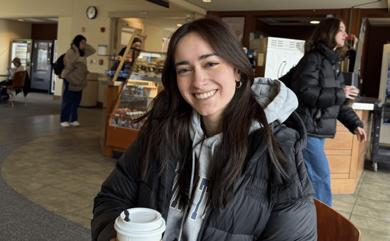
Danika Castellino, a firstyear student in the College of Nursing, said her decision lies between the Brew in the AMU or Raynor. While drinking her light roast coffee with creamer, she said — like Rogers — her café choice depends on the time of day.
“This one closes at 9 p.m., so if I need a pick-me-up at 8:30 p.m., then I’ll be able to go,” Castellino said about the Brew at the Bridge.
The Brew at the AMU is open most frequently from 7 a.m. to 10:30 p.m. Monday through Thursday and is open on the weekends.
Castellino enjoys the “cute coffee shop vibe” of the AMU and the late-night
studying refreshments of the Raynor Brew. Her go-to orders are a simple coffee with light cream or mint tea with a chocolate croissant.
Overall, Castellino says the AMU is better for aesthetics, and the Bridge is better for studying purposes.
Manaal Nasir, a second-year dental student, says she goes to the Brew in the School of Dentistry the most because it’s the most convenient for her.
“It’s nice in between classes and stuff to grab coffee and things,” Nasir said.
Being that the Brew in the Dental school is open from 7:30 a.m. to 2:30 p.m. most days, it is convenient for students. This Brew is built on the side of a large hallway that gets plenty of foot traffic, making it a quick graband-go area.
Nasir loves the seasonal drinks like the pistachio latte. She said that although she goes to the Dental School Brew the most, the atmosphere of the O’Brien Brew and the coziness of the AMU are honorable mentions.
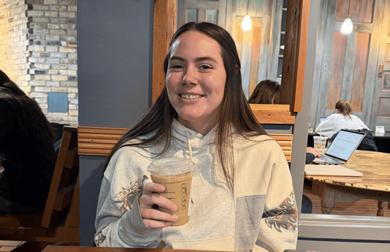
Erin Hickey, a first-year student in the College of Health Sciences, was enjoying an iced caramel latte, which she says is ordered almost every time. Her favorite Brew is the one in the AMU.
Hickey says that the Brew in the AMU is convenient, always open and welcoming. The large space with diverse seating makes it a hub for students.
“You can come here and study with headphones, or you can talk to people; it’s kind of universal,” she said. Hickey said the Brew on the Bridge is too unreliable and that the hours are inconsistent.
The Brew in Raynor is open from 9 a.m. to 1:30 p.m. and 5 p.m. to 9 p.m. It’s also closed on the weekends, making it accommodating for weekday study sessions only.
While the choice of café often comes down to convenience and time of day for students, one location stood out for having the best atmosphere on campus — the AMU Brew.
Civil Dialogues hosts grading-focused dinner
Discussion was based on research done by a student
By Mina Marsolek-Bonnet wilhelmina.marsolek-bonnet@ marquette.edu
Marquette University’s Civil Dialogues and Honors Programs hosted a dinner Feb. 24 in Sensenbrenner Hall focused on the grading system in higher education.
The discussion was based on research done by Loriann Chávez, a junior in the College of Arts & Sciences. Her study uncovered perceptions of the grading system on Marquette’s campus and how it contributes to relationships between students and faculty.
The guided conversation began with reflection on the presented study and later moved into the discussion of broader concepts like the use of AI in classes, academic motivation and alternatives to the current grading system.
Chávez surveyed 218 stu-
dents and 63 faculty members. When asked, “What do grades measure?” 68% of respondents agreed their grades should accurately measure their learning of course content. But, only 16% thought grades actually measure their learning of course content.
“Grades measure my ability to meet the professors’ expectations, but the grades do not always convey my level of understanding,” an anonymous student survey participant said in Chávez’s slide presentation that accompanied her research.
Another anonymous student participant said in STEM courses, grades are dependent on a student’s ability to regurgitate material. However, in humanities courses, grades are more reflective of a student’s perceived ability to understand the course material and critically think about it.
The survey also found that 65% of respondents said they disagree or somewhat disagree that Marquette’s grading system encourag-
es creativity. 81% said they agree or somewhat agree that the grading system discourages academic and intellectual risks.
The study also measured the effect of grades on mental health, finding that 73% of respondents agreed grades have harmed or somewhat harmed their mental health. When connected to gender, the study found 79% of women state their grades have decreased or somewhat decreased their mental health, compared to 58% of men.
Gitte Frandsen, an English professor at Marquette, mentioned it’s hard to change the grading system as an individual instructor, as it’s an industry standard.
“To participate in a system that you know is doing harm to students,” Frandsen said regarding grades and mental health. “That gives me a really icky feeling.”
32% of respondents stated that an A or A- were the lowest grades that constituted a “good” grade.
“I would have to say
grades put a lot of pressure to succeed, especially when others inquire about them because I’m known as a 4.0 student, so I worry about losing that,” one anonymous student respondent said.
Both faculty and students said having all of their efforts narrowed down to one letter grade is where much of the issue with the grading system lies.
“It’s very stressful because you have to give one grade … and you have to encapsulate in that number all that student has done throughout the semester,” Pilar Bellver, a Spanish professor, said. “How do you represent the whole student in one grade?”
Amelia Zurcher, professor and director of the honors program, said grades become a currency to students, limiting their value to something students exchange for scholarships or applications, making the end goal about the grade rather than the learning.
The study found 83% of respondents agreed that Mar-
quette’s grading system, as it currently exists, encourages people to cheat using AI.
“Cheating with AI has just become a major headache for all teachers. You have to constantly think about how you design your assignments,” Frandsen said.
In addition to the study, civil dialogue dinner attendees were asked to discuss alternatives to the current grading system.
Isabella Dover, a first-year student in the College of Health Sciences, recalled doing correction questions on tests in high school, which offer students the ability to earn back credit.
“It helped me feel better about the grade because I was working towards that better grade as well,” Dover said.
Both Bellver and Frandsen agreed that giving feedback on assignments is a much more valuable way to support learning than solely assigning a grade in accordance with the current grading system.
Erin Hickey has an iced coffee at the Brew café inside the AMU.
Photos by Lillie Martin lillie.martin@marquette.edu
Danika Castellino enjoys her coffee at the Raynor Library Brew.
Photos by Lillie Martin lillie.martin@marquette.edu
A SILVER-TINTED SMILE
Marquette alum speed skater Lehman finished second in the team pursuit
By Ben Hanson benjamin.hanson@marquette.edu
Emery Lehman doesn’t remember some of his speed skating races very well.
Given how the Marquette alumni’s gold medal race against Italy in the 2026 Winter Olympics unfolded, it could have joined that pile. Feeling fatigued going into the race, he and his teammates used their energy too quickly and, most painfully, lost.
Entering the race as gold medal favorites and world record holders, they exited
Milano Speed Skating Stadium second-best.
Still, Lehman will always remember the rematch against Italy on Feb. 17. Because, he doesn’t view it as ‘what could have been.’ He sees it as ‘what was.’
“I think it’s the first and only time I’ve ever gotten to race for a gold medal,” Lehman said. “So it’s a pretty tough thing to forget.”
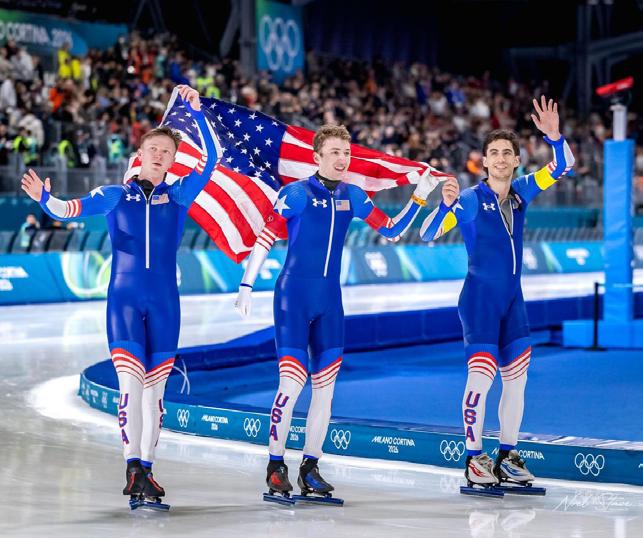
While the four-time Olympian stood on the second step of the podium with his two teammates in all white, he patted them on the back and as they received their silver medals, Lehman smiled.
“At the end of the day, it’s an Olympic silver medal,” Lehman said with conviction. “I always try and give a big smile because I know how many other people would kill to be on that podium in the position I’m in.
“How fortunate I felt on a bad day for us to be second in the world.”
Italy, which beat Lehman and Team USA to win gold, wasn’t a new opponent.
Lehman and his teammates won last year’s world championships, while the Italians finished in second. The year before that, Italy grabbed the title and the United States didn’t
TRACK & FIELD
podium. To get to the Olympic finals, the Americans had to make it through two rounds: qualifiers and semifinals. In the former, which was run on Feb. 15, they were pit against the Italians. Team USA lost this race and were given the second seed.
Marcia Lehman, Emery’s mother, was most worried about this first race because if Team USA didn’t finish in the top four, they wouldn’t have been able to compete for a medal.
Two days later they raced twice in two hours. First, in the semifinals, the red, white and blue faced No.
3 China. By the fourth lap, the Chinese had lost a significant enough amount of time, they backed off to save their stamina for the bronze race, which they won.
While the Americans only skated half a race, Italy raced eight hard go-arounds against the Netherlands, winning by 1.8 seconds.
After the semifinals, again, Lehman and Team USA faced Italy. Now, in the gold matchup. On the stage. For world glory.
“It did end up being a pretty big, pretty heavy
Olsen sets program records in championships
Junior had new MU bests in every solo race he ran
By Lukas Schulze lukas.schulze@marquette.edu
Marquette track & field finished the season off by breaking two indoor records in the Big East Championships, momentum the Golden Eagles look to carry into the outdoor season.
The men placed fifth with 77 points — their highest finish and point total since 2023 — and the women came in eighth with 23 points. Helping the men achieve their best result
in three years was Danny Olsen, the junior sprinter who broke two program records — one in each individual race he ran.
In the 400m preliminaries on Friday, Olsen ran an all-time best 47.39, a number he beat on Saturday to earn a silver medal with a time of 47.14. Olsen also broke the indoor record for the 200m with a time of 21.29 on Friday and then yet again broke the record on Saturday, making him the second Golden Eagle sprinter to become a Big East champion in the 200m (21.25).
“It was a terrific weekend, and I was really proud of how we competed,”
director of track and field & cross country Bert Rogers said in a release from Marquette athletics.
“Danny had a historic weekend, setting new team records in every individual race he ran, and came home with his second individual Big East title.”
But despite all his success, there is one record that both he and his teammate sophomore sprinter Frankie McGee desired the most: the indoor school record in the 4×400 relay.
“There is just a list of all the names on there,” Olsen said. “So just knowing that your name will be on
Marquette alum speed skater Emery Lehman beat his previous best finish by earning a silver medal in the team pursuit event at the 2026 Winter Olympics.
Photos by Noel Stave, courtesy of Emery Lehman
Danny Olsen (left) celebrates as he crosses the finish line in first.
Photo courtesy Marquette athletics
Tuesday, March 3, 2026
Meet the men behind the madness
Male practice players help WBB prepare for games
By Ben Ward benjamin.ward@marquette.edu
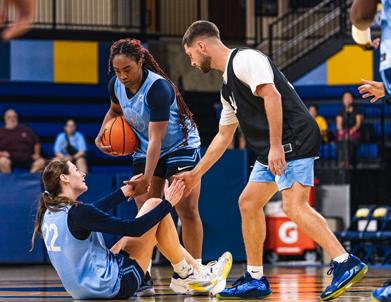
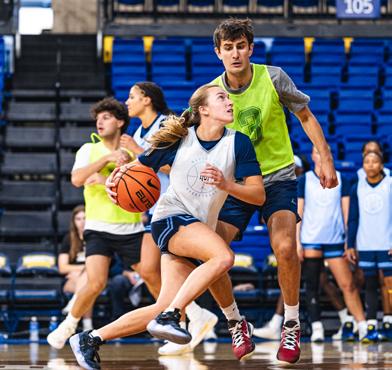
Not every player at Marquette women's basketball practices wears blue & white pennies. A couple participants don black jerseys with white numbers. They aren't your average Division I college hoops athletes. They are one of the driving forces of success for the women's basketball program — male practice players.
Obligated to study opposing team's film and players' tendencies so they can replicate it in practice, the male practice players help prepare the women's scholarship players for every game.
"We wouldn't be able to win without them," head coach Cara Consuegra said.
Not to be confused with normal managers, who spend practice passing out water bottles or towels, the male practice players actually participate in offensive and defensive drills. During a defensive drill at practice last Friday, Jack DeGeorge, a senior in the College of Business Administration, caught fire.
"I was just on an absolute heater," said DeGeorge. "Coach [Deont'a McChester] was hyping them up to stop me," said DeGeorge.
DeGeorge found his way onto the practice team through the men's club basketball team. He connected with Mikey Garven, an assistant coach on the women's basketball team and manager of the practice players.
Garven, a former practice player himself, asked DeGeorge if he would be interested in becoming a practice player, who saw it as an opportunity to keep playing the sport he grew up on.
"It's something I love being around," DeGeorge said.
The club team is just one way Garven finds practice players. Some are found out and about on campus, while others are emailed through club basketball or chosen through a private tryout. The team accounts for 12 players currently.
Cohen Reetz, a sophomore in the College of Business Administration, was approached by Consuegra at a home men's soccer game. She asked him if he was interested in being a practice player.
"Me and coach always talk about how it was fate. It sounded exciting af-
SETS:
Continued from page 5 that plaque… just the idea of having someone walk down the same stairs you walked and being able to look at it.”
The 4×400 relay that consists of Olsen, McGee, first-year Bobby King and first-year Blake Frea were just one second behind the school record set back in 2000 (3:14.42) going into the Big East Championships.
“Our biggest thing is we just want to take it down, get our names on there,” McGee said.
ter playing basketball my whole life," said Reetz, who is also a manager for the team. "This experience is really invaluable."
For Reetz, DeGeorge and the rest of the students wearing off-colored jerseys, practices start earlier than the women in blue and white.
It's a process Garven has participated in hundreds, if not thousands, of times. First as a student in 2022 before he became a manager and then an official program assistant the same year. Soon after, he took over managing the male practice players. To Garven, it's like managing a real team.
"You still have players, you have to teach them all
"We wouldn't be able to win without them."
Cara Consuegra Marquette women's basketball head coach
the plays, teach them all new tendencies," said Garven. It's necessary for them to have the Golden Eagles' opponents' movements and sets down pat in order for the women to prepare effectively.
"I like watching the other Big East women's games to see what we're going up against and getting the extra knowledge outside of practice," said DeGeorge.
A typical practice day begins with the practice players showing up to practice 30 minutes early, playing one-on-one or doing anything to help themselves warm up. Garven then shows up, providing the plays and run through of what the team needs to memorize and how practice will go.
Garven explained that the main purpose of prac-
TRACK & FIELD
tice players is to make the women better and be focused in on opposing teams' film.
"You're not trying to get a highlight tape," he said. "You're here to help the girls."
Despite the differences in size, the practice players and women's team are even matched.
"It's a real challenge dayin and day-out," said Reetz. "It's real competition and you're working."
Senior guard Kennedi Perkins believes the only difference is the athleticism.
"They only jump higher and run faster and that's about it," said Perkins.
Come game time, the women's players have spent days in practices playing against the boys. It is why Consuegra, who is a huge believer in male practice players and has used them her entire coaching career, utilizes them in every facet of practice.
"I don't really know how you can win at this level without them," said Consuegra. "There's a very high standard for what they do and the guys make them stronger and faster even if it's a bad practice."
The male players don't just help out during official practice, though, sometimes assisting the women's players during individual workouts.
"They're available anytime we need them, which we really appreciate," said senior forward Ayuen Akot. Even though it is a hefty time commitment and a lot of responsibility, Reetz would not have it any other way, "The season can get long, but it's really rewarding at the end of the day," said Reetz. "Playing manager games are fun, experiencing the game atmospheres like the UConn game and the different environments you get to see is awesome."
DeGeorge values the knowledge he gains from being able to watch film and having the opportunity to play with a Division I program.
Male practice players play a pivotal role behind closed doors. Staff and players cherish the work they put in and what they mean to the program as a unique fragment that helps the wheel turn.
"They don't get enough credit," said Consuegra.
Men placed fifth, women eighth
The Golden Eagle 4×400 group came up just short in Saturday’s race finishing in fifth place with a time of 3:15.11, less than one second away from the record. McGee had quite the indoor season himself outside of competing for the 4×400 record.
Last weekend, he recorded a new personal best at the Panther Tune-Up in the 60m with a time of 7.02.
Then, at the championships, McGee ran a 21.63 in 200m — good for fifth place in the event and third alltime in Marquette indoor
school history.
The Big East Championships are special for Olsen and McGee, who are both Illinois natives.
McGee grew up in the Chicago area, living just 20 minutes away from the host of the tournament at the Dr. Conrad Worrill Track and Field Center at Gately Park.
“The biggest thing is my family gets to come out,” McGee said. “Being able to run there while I have the biggest supporters… that’s the coolest thing about going back home.”
Family is also a huge part for Olsen. He grew up in Evergreen Park, Ill. — just 15 minutes away from Gately Park — and attended Marist High School in Chicago, making him very familiar with the championships’ host city.
“It’s really nice to see my parents here and have them cheer us on,” Olsen said. “The experience for us and knowing that it’s a hometown experience is something great.”
Three other Golden Eagles placed on Friday, including last week’s two Big
East field athletes of the week.
Junior Henrik Rosario earned bronze in the long jump (6.96m), and junior Megan White earned bronze in the women’s weight throw (16.73m).
Graduate student Kaitlyn Huebner received bronze in the pole vault (3.65m), the ninth best indoor mark in school history.
Also on Saturday, sophomore Russell Czerwinski received a bronze medal in the men’s high jump.
Practice player Jack DeGeorge defends guard Bridget Utberg.
Photos courtesy Marquette athletics
Mikey Garven went from a practice player to their coach.
Men's lacrosse sideline full of familiarity
By Raquel Ruiz raquel.ruiz@marquette.edu
Three people received the same call. Three people gave the same response.
When Jake Richard, Mason Woodward and Andrew Smistad were asked if they would accept a Marquette men's lacrosse coaching position, not a single one of them hesitated to say, "Yes."
But what makes this group so special isn't just that they all had the same response to the call — their connection runs deeper.
These three coaches, out of the four on the Golden Eagles' coaching staff, once wore jerseys with "Marquette" striped across their chests. They know what it is like to play at Valley Fields. Together, the three of them are in a position to bring a shared experience back to the program that once shaped them.
"We are all passionate about Marquette because it allowed us to push ourselves and support us in all the right ways," head coach Richard said. "We stick around because we believe in the Marquette mission."
Richard got his coaching call back in 2016, just shortly after walking the stage at graduation. From 2017 until last season, he served as the program's assistant coach/defensive coordinator. After former head coach Andrew Stimmel left the program, Richard was called up to the head coaching position.
Aside from his gold medalist title, Richard was a two-time team captain during his Marquette playing career and led the Golden Eagles to their first Big East title and NCAA Championship appearance in 2016. Richard was
drafted in 2016 to the Major Lacrosse League before joining the PLL in 2019.
"Jake always had his head on pretty straight and knew what he wanted," offensive coordinator Smistad said.
Smistad would know, as he was in his final year as a Golden Eagles when Richard was in his first during the 2013 season.
"As a player, he was more of a mentor than anything," Richard said. "He was great at being one of the guys, bringing levity to situations, but also really great at accountability and authority when it was necessary."
Smistad got his call over FaceTime this past summer. It was Richard — his old teammate — on the other end who said he'd hope to have Smistad come back to Marquette and coordinate the Golden Eagles' attack.
Smistad served as the first
team captain during Marquette's first two seasons of intercollegiate competition (2013-14). He was selected 54th overall by the Calgary Roughnecks in the 2014 NLL Draft, becoming just the second player in Marquette lacrosse history to be drafted professionally at the time.
Even though he always thought he would coach, the former midfielder never thought it would be at his old stomping grounds.
"For him coming back for a year, having [been] away from Marquette for 10 years, it's pretty cool to see," assistant coach Woodward said. "[It allows you] to step back and be like, 'Wow, this place (Marquette) is really truly special.'"
Woodward said he's taken that feeling for granted sincebeing part of the Marquette lacrosse program for over seven years.
He received his call
from Richard in 2024 as well, which was especially unique considering it was Richard who had recruited him in his sophomore year of high school.
"He (Richard) is the reason that I'm here, well, because he recruited me, but also [because of] the type of person and coach he was to me and for this Marquette program," Woodward said. "It's really easy coming to work when he's your boss."
Woodward was the first Marquette player selected in the first round of the Premier Lacrosse League College Draft in 2024. The four-time USILA All-American recorded a program-record 265 ground balls and ranks second in program history with 84 caused turnovers.
"Mason being an elite player has just had a super high level of credibility when it comes to talking
to our guys because he's only a few years removed," Richard said. "And they all got to see his excellence up close and personal."
The three former players all bring different coaching perspectives to the team.
Woodward said Richard, ever the head coach, "demands a level of excellence." Smistad said the young Woodward brings a level of "maturity" and "detail." Richard said Smistad brings the humor, and Woodward noted his compassion and role as the team's "head chef."
Together, they all have the emotional intelligence to reach their players when and wherever.
"I trust their people skills," Richard said.
The three may have come to Milwaukee to play lacrosse, but this move wasn't anywhere close to home for them. Smistad hails from Calgary, Alberta, just over 1,600 miles northwest of Marquette's campus. Woodward is a native of Towson, Maryland, and Richard, whose hometown is also out east, comes from just outside Philadelphia. What makes these three so unique, what makes them keep coming back and what makes them want to see their alma mater succeed is Marquette itself. The university, what it embodies, what it teaches students and, most importantly, what it taught them.
"It just speaks to the experience that you have at Marquette, our belief in this program and our desire to continue the experience and to bring success to the school," Richard said. "We just all are really grateful for what the university has provided for us and we aim to give back as much as we can."
It's why all three answered the call with an immediate "Yes."
SMILE: Grad set to retire, begin coaching
Continued from page 5
day,” Lehman said.
This finals was portended by the face off between USA and the Italians in the qualifiers. An eerily similar fate met the Americans in both. They started out very strong. But that was the issue. They started out very strong.
“We kind of reverted to the strategy that we’ve always done, which is fly out, go out hard — fly and die…” Lehman said. “And we definitely died off a little bit.
“(It was) the only (way)
that we were gonna probably have a chance of beating the Italians on that day.”
In the qualifiers, by lap five, Lehman and Team USA had a second over Italy and ended up losing by around a second. In the finals, by lap four, they were six tenths up and finished just over four and a half seconds behind.
“These guys weren’t going to die,” Emery’s father David Lehman said disappointingly. “They’re home, they’re going for it. For something we just
"I don't think it's something that I'll ever want to forget."
Emery Lehman Olympic speed skating Marquette alum
didn’t have.”
But still — Lehman smiled about the result. And so did his parents.
“We were just incredibly
thrilled,” Marcia said.
That night, Lehman and his parents went out for dinner to, of course, an Italian restaurant. He talked about his future with a smile on his face.
He gets to find a place to hang up his silver medal (likely next to his bronze), but more than anything, he is able to give to the sport he loves. After he moves back to Chicago soon, he’ll take the head coach position at the Franklin Park speed skating club: where he trained as a kid. The place he used to gawk
at Olympians, he will walk into with two medals. Lehman hasn’t rewatched the finals race back yet and he doesn’t know if he ever will. For him, there’s no reason to. He remembers it so well.
“It was one that I was really trying to be present for,” Lehman said while packing his bags in his room at the Olympic Village in preparation to head back home.
“I don’t think it’s something that I’ll ever want to forget.”
Three of four coaches played at Marquette
Jake Richard (top), Mason Woodward (left) and Andrew Smistad (right) all played at Marquette.
Photos by Owen Weis, Marquette athletics
WOMEN'S LACROSSE
A 'fun, but quiet competition' in the net
Three women's lacrosse goalies compete to start
By Eamon Bevan eamon.bevan@marquette.edu
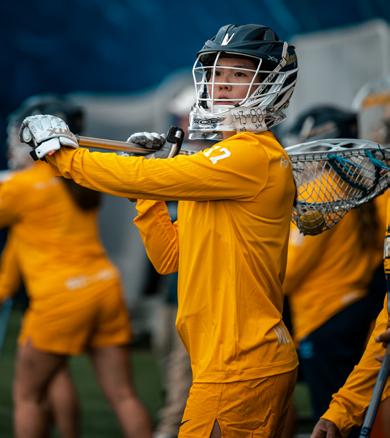
The ends of Marquette women’s lacrosse practices often consist of loud, physical scrimmages between half the roster in blue and the other half in white.
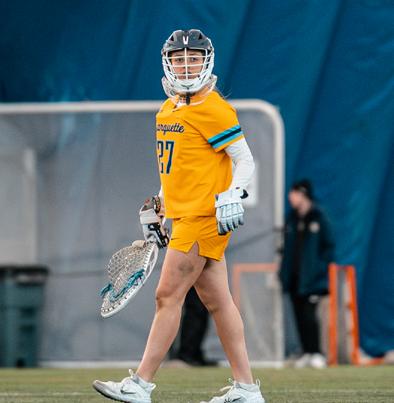
As the rest of the divided team bark and cheer over the result of each possession, the three goalkeepers — Mikayla Yang, Zoey Gottlieb and Jillian Howell — will gather in a quiet, multi-shade huddle, share a laugh, and send one forward to take her turn in the net.
Sitting 3-3 through 6 games, the Golden Eagles’ goalkeeping room has been as collaborative as it has been fluid, with an even mix of minutes from exciting youth and a reliable veteran presence.
But just as important as the on-field results is the relationship within the unit.
“They’re like three peas
in a pod,” head coach Meredith Black said. “They compete, but they always have each other’s backs.”
Yang, a junior from California, in her third season with the program, has featured in eight games during the 2025 season behind the tutelage of then-starter Brynna Nixon.
Gottlieb is a sophomore from Ohio and has been praised by her coaches and peers as a constant competitor and leader since joining the program last season.
Howell is the freshest face to the unit, and one of the many cogs in Black’s highly emphasized firstyear class.
Thus far in the 2026 campaign, minutes have been split nearly even between Yang (five games played in, 150 minutes) and Howell (six games played in, 210 minutes), while Gottlieb remains a steady presence in training as she still seeks her first appearance.
Black described preseason practices as ‘neck and neck,’ with Yang and Howell standing out in stacking saves. Rather than rush to name a permanent starter,
the staff leaned into competition and found two players who were both prepared for and capable of handling the moment.
“Mikyala’s an awesome goalie,” Black said. “Starting her early made sense with her experience, but Jilly pushed the envelope and earned that time too.”
After spending her first two years behind veteran starters, Yang stepped into a different kind of spotlight this spring. The transition required composure — not just in the cage, but in the locker room and during drills, where younger teammates now look to her for cues and consistency.
"It's easy to feel separated. So we make sure we stay connected."
Zoey Gottlieb Marquette women's lacrosse goalkeeper
“The dynamic has stayed the same,” Yang said. “We’re super supportive and play for each other.”
Leadership, she explained, is centered on selflessness. Being able to embrace the rotation rather than resist it has allowed her to focus on preparation and communication instead of ownership.
“Everyone brings a different asset,” Yang said. “Knowing your role helps the team.”
Black has noticed that evolution in real time, particularly in how Yang balances a quieter demeanor with steady direction during defensive sets.
“She’s done an amazing job,” Black said. “She’s supportive and has taken them under her wing.”
While Yang brought experience, Howell brought an immediate poise and
decisiveness that opened the eyes of every player and staff member around her. The first-year arrived in the fall and quickly closed any perceived developmental gap, earning trust from her peers and defenders.
“She’s playing at a very non-freshman level,” Black said. “She keeps a cool head no matter the score.”
Howell credits her fellow goalkeepers for easing her adjustment to the college pace. Rather than feeling pressure to claim the crease, her ever-supportive teammates have allowed her to focus on daily improvement and shared accountability.
“I came in just trying to do what I can,” Howell said. “Having that goalie support system has been awesome.”
Where Black often sees a trio of quiet contributors, the goalie room runs on an unseen and emotional competitiveness in the cage.
“Fun and well balanced,” Gottlieb described it. “We compete, but friendships matter just as much.”
For the sophomore, the unit’s evolution has been
seriously meaningful.
A year ago, she absorbed guidance from her predecessor Nixon. Now, she helps cultivate connections within a position group that can easily drift into isolation. Inside jokes, extra reps and intentional check-ins have strengthened the trio’s bond beyond weekly rotations.
“It’s easy to feel separated,” Gottlieb said. “So we make sure we stay connected.”
In goalkeeper-only sessions and those breaks in between scrimmage plays, the trio blends productivity with personality. They make a point of celebrating saves together and supporting from the sideline regardless of who makes the play — reinforcing just how much of a team effort goes into the momentum that keeps the Marquette goal spotless.
“Everyone has unique qualities, even at the same position,” Yang said.
“It’s about applying your strengths and working on your weaknesses together, because we’re all geared to help each other get better.”
Fiserv
First-year Jillian Howell leads the goalies with 210 minutes.
Photos courtesy of Marquette athletics
Uncasville, CT
Opinions
SPEAKER: We don't want a leader in AI
Continued from page 1
commendable run of choosing creative, inspiring people with human-driven focuses as its undergraduate speakers. Former Marquette basketball player and NBA legend Dwyane Wade was chosen in 2022; Academy Award-winning actress Marlee Matlin in 2023; Global Brigades CEO and co-founder Shital Vora in 2024 and Diane Foley — mother of alumnus and slain journalist James Foley — most recently in 2025. All these speakers had meaningful stories to tell based on visionary and artistic experiences. Students could relate to their anecdotes. A speech given by a leader in AI — a technology that strips originality and remains monotonous — does not emanate the same level of expressiveness.
Every major and career path at Marquette involves a degree of imagination, innovation and human connection — traits that
AI will never have. We are taught to be inventive and resourceful, but a commencement speech about a lifeless, non-tangible technology takes those lessons away.
Students should be excited and look forward to their commencement speech, but this year, they have expressed strong dissatisfaction and even infuriation.
Many blatantly called the decision “a slap in the face.”
It is also worth mentioning the repetitiveness of AI discourse as well. Our academics are saturated with talk about AI, mainly alluding to why it is bad and should not be used.
Marquette does not have a unified AI policy; use of the technology is up to the discretion of each professor. The university does this to provide “instructional flexibility,” but there are different guidelines for each department or professor, sending conflicting messages about AI.
While it is an important subject to discuss, it is, once again, not the motivational, inspiring monologue the students want to hear — especially when the majority of them are discouraged or outright banned from using AI in the classroom at Marquette.
If the need to discuss ethical AI use in the workforce is so dire, it should be more consistently implemented throughout our academics instead of being lectured to us at the very end, upon our graduation.
The nature of AI also strongly contradicts Marquette’s core beliefs and Jesuit values.
The university’s tagline is “Be the Difference,” but this encouragement falls short when we are constantly told about the prospect of AI taking our jobs and consuming the world. The inspiration is lost and is, instead, replaced with dread.
Along with the lack of
creativity involved, AI poses many environmental concerns and threats. The data centers required to run AI increase energy usage, carbon emissions and can waste up to 1.8 billion gallons of water annually. These statistics go against Marquette’s “Laudato Si’” mission which aims to expand campus sustainability efforts in response to Pope Francis’ 2015 encyclical letter. Subtitled “On Care for Our Common Home,” the Pope addresses environmental degradation and calls for everyone, not only Catholics, to take global action in the letter. We must take care of the world where we so graciously live.
In 2023, former Marquette University President Michael Lovell announced the formation of the Laudato Si’ Action Plan Task Force, a group made to develop campus-wide sustainability goals.
Marquette wants to
instill environmental awareness and action but then chooses a commencement speaker who specializes in AI — technology that is actively damaging our planet. Additionally, there have not been updates on the task force’s progress since its formation.
Between contradicting university values and showing little to no response to student backlash, it seems as though Marquette’s mission of serving God and its students is just a performative act. This commencement speaker decision denounces the values that the university claims to strive for.
Marquette, listen to your students.
A Silicon Valley lecture is not what the Class of ’26 deserves as its parting goodbye.
LA will suffer from hosting 2028 Olympics
By Bella Gruber isabella.gruber@marquette.edu
Following the 2026 men’s FIFA World Cup and the 2027 Super Bowl, the 2028 Summer Olympics will be held across over 80 venues in Los Angeles, with an expected attendance of over 10,000 athletes and millions of spectators. As people’s attention turns to this upcoming historical event, the detrimental impacts on LA’s people and environment must be considered.
Olympic host cities are chosen through an extensive process involving National and International Olympic Committees holding continuous dialogue for typically two years. Cities begin by applying to be a host city, then an Evaluation Commission rigorously evaluates the applicant cities and the final choice is elected by the International Olympic Committee. As a former host city in 1932 and 1984, LA was chosen to host the 2028 games because of its advanced infrastructure and history of being a host city for major sporting events.
On the surface, hosting the Olympics seems like a sensible idea for LA. As the second largest city in the U.S., it has everything an internationally renowned city could offer — it is a cultural hub and notorious for its film and technology industries. LA will benefit from the games’ grand profit, currently
predicted to be between $13 and $17 billion. However, by hosting the Olympics, LA’s environment and people risk experiencing dire consequences.
The American Lung Association ranks LA as the smoggiest city in the U.S. Smog is formed by ozone and particulate matter from vehicle emissions, as well as synthetic emissions from volatile organic compounds. This combination forms the ground-level haze that LA is susceptible to due to its positioning in a valley surrounded by mountains.
During the peak time of the Olympics, extreme heat, high levels of urbanization and the risk of wildfires will increase ozone levels and particle concentrations. People are still experiencing impacts from the lingering heavy metals in the air from the Eaton and Palisades fires in January 2025. This means visitors will be subject to smog’s health consequences, ranging from minor lung irritation to coughing and wheezing attacks. If the Olympics were chosen in a city without a history of extreme air pollution, athletes and visitors would not have to put their health in danger to attend. Transportation will also influence the environment during the Olympics. This international event
will span across the entire state, requiring many to use individual transportation to attend events. The city’s notoriously gridlocked traffic — severe traffic congestion— on sprawling highways will only increase smog congestion.
Initiatives to improve LA’s mass transit systems will be crucial to sustaining the quality of LA’s air rather than allowing the high levels of traffic to worsen the air quality. Without improved bus lanes and air taxis to reduce the amount of on-ground emissions, LA will experience extreme traffic congestion and increased air pollution during the Olympics.
Instead of relying on individual vehicle transportation, LA’s Metro bus lines must follow through in carrying out its 15 Olympic projects to make its lines more efficient and accessible to spectators. These projects range from expanding route networks to the Olympic venues to reaching zero bus emissions.
Alternatively, LA’s Olympic Committee has partnered with Archer, an air-taxi service that will transport participants and spectators across the city. These all-electric taxis will be effective in reducing noise and emissions as people travel across venues to take part in the games. Alongside environmen-
tal challenges, LA already struggles to efficiently house its population, and millions of spectators entering the city will only make its dire situation worse. With nearly 72,000 homeless people, the city’s homeless shelters struggle with an overcrowding rate that is four times the national average.
This means unhoused people will have no place to go if displaced by the 2028 Olympics, putting them at risk of health issues, violence and loss of connection to support services.
During the 1984 Olympics, over 30 police officers were deployed to “sanitize the area.” If LA forces unhoused residents to be displaced prior to the 2028 Olympics, the city risks increasing the economic gap between its poorest residents and those able to afford expensive housing costs. In the past year, Gov. Gavin Newsom has urged cities to ban encampments entirely, which is predicted to only intensify the issue of overcrowding and economic disparity as the Olympics approach.
Continue reading this story at marquettewire. org.
Statement
of Opinion Policy
The opinions expressed on the Opinions page reflect the opinions of the Opinions staff. The editorials do not represent the opinions of Marquette University nor its administrators, but those of the editorial board.
Our editorial board consists of the managing editor of the Marquette Tribune and all executive editors including news, sports arts & entertainment and opinions.
The Marquette Tribune prints guest submissions at its discretion. The Tribune strives to give all sides of an issue an equal voice over the course of a reasonable time period. An author’s contribution will not be published more than once in a fourweek period. Submissions with obvious relevance to the Marquette community will be given priority consideration.
Full Opinions submissions should be limited to 600 words. Letters to the editor should be between 150 to 300 words. The Tribune reserves the right to edit submissions for length and content.
Please e-mail submissions to: rachel.lopera@marquette. edu. If you are a current student, include the college in which you are enrolled and your year in school. If not, please note any affliations to Marquette or your current city of residence.
Rachel Lopera is the executive opinions editor. She is a sophomore studying journalism.
Bella Gruber is an opinions columnist. She is a sophomore studying public relations.
Fun & Games
Big East Men's Teams
Spring Break Destinations
2. Shares a name with a mythical bird creature.
4. The only major U.S. city founded by a woman.
7. Host city of the 2028 Summer Olympics.
9. "America's First City of Opera."
10. This U.S. city has the highest number of restaurants per capita.
11. City where Disney World is located.
1. Taylor Swift moved here to pursue her music career.
3. Morgan Freeman is known to spend a lot of time in this city.
4. The mini golf capital of the world.
6. _________ cream pie.
8. This city's name translates to "Nest of Snakes."
11. Name of the demigod in "Moana."
Submit finished puzzles to sophia.tiedge@marquette.edu by May 7. Most accurate crossword submissions wins a grand prize.
Arts & Entertainment
Filmmakers bring creative outlet to campus
By Elise Emery elise.emery@marquette.edu
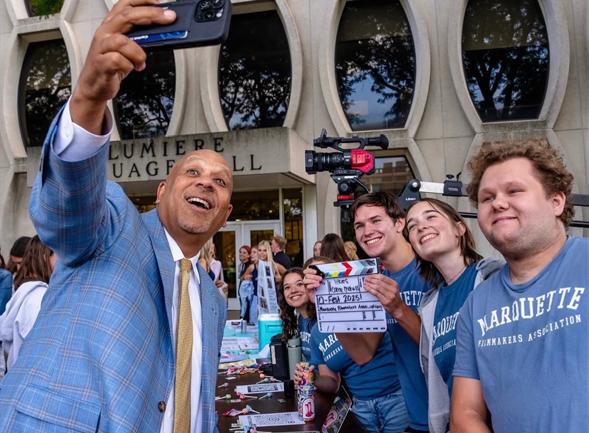
While Johnston Hall 005 may appear to some as just another computer lab, to the Marquette Filmmakers Association, it’s a place where creativity thrives, ideas are shared and valuable experience in the film industry is gained.
The Marquette Filmmakers Association, more commonly known as Marquette Filmmakers, is a student-run organization that helps pave the way for students by providing opportunities to practice pitching, directing, acting, scriptwriting, lighting, editing and sound design. Students write, produce and share their own films with other members of the group, and there is no prior experience required to join.
Originally called “Film Club,” the Marquette Filmmakers Association of today is the result of a major rebrand. In addition to the name change, the atmosphere, aspirations and goals changed as well. Joining in 2016, Kris Holodak, Marquette Filmmakers’ faculty advisor, noticed that the original film club was lacking a spark.
“It didn’t have a lot of energy, it didn’t have a lot of momentum,” Holodak said. “It was mostly a thing the faculty wanted. So, like, some years it would be active and some years not.”
However, the group finally got the inspiration it needed between 2021 and 2022, thanks to the ambition of the aspiring student filmmaker, Julia Jarman. Because of the work of dedicated students, Marquette Filmmakers
was given the legs it needed to draw people in and generate excitement about being creative.
And the organization is continuing to better itself.
The group currently sits at around 40 members, with students coming in and out, but a goal of President Kathryn Lazich, a junior in the College of Communication, is to further emphasize that the group’s doors are open to anyone who wants a creative outlet.
“There are so many creative students here throughout Marquette’s campus, not just within communications,” Lazich said. “They should know that they can be welcomed in this space too.”
Marquette Filmmakers mainly focuses on the projects that its members are able to share and assist with throughout the semester.
“Pitch Night,” one of the organization’s events, occurs once a semester and allows club members to pitch ideas for their films and gain assistance from other members on projects. Then, at the end of the year, the group hosts a showcase to present the student films that members have been working on.
In addition to “Pitch Night,” one of Filmmakers’ most popular events is its 24-hour Film Race, where groups are instructed to write, record and edit a short film in 24 hours.
These opportunities to create, practice and share these films are a great way to push students further in the direction of career success, as she has too experienced this benefit, Holodak said.
“I was able to become a le-
gitimate real filmmaker because I spent years making short films and practicing it, and so I know that that works,” Holodak said.
While these events help build students’ technical and creative skills in film, they also improve team building and management skills. They help students practice the skills they will need when working in the field, including the capability to convince people to work with them and work in a way that makes people want to come back.
“Those kinds of soft skills are every bit as if not more important than the technical things,” Holodak said.
Attendance for Marquette Filmmakers is not required to be a member, which allows for flexibility in membership. While this
flexibility could be seen as a weak spot as it doesn’t instill an incentive or necessity to come back, Marquette Filmmakers still has its committed members.
Lazich said the organization’s environment attracts people, as the continuous creative energy at meetings draws people in, forming friendships.
“The energy of the people and the community that we built is just something you want to be around,” Lazich said. “[Students] come back because they want to continue fostering those relationships and be there for their community and their friends.”
Additionally, those growing relationships are not only beneficial emotionally but also assist in that passion to keep being creative
and building a portfolio.
“If you have your people, you’re way more likely to keep being creative and keep practicing and getting better at what you do,” Holodak said.
Even though Marquette Filmmakers has grown to be a strong student community, that foundation cannot sustain itself without members continually pushing for success as time passes and members graduate.
Because of this, Holodak sees the value in “feeding the pipeline” by incentivizing the newer classes to be engaged and excited about filmmaking. If new members continue to share that passion that Marquette Filmmakers has established, the organization will only further push students to accomplish their dreams.
BSNA celebrates Black History Month
By Allison Scherquist allison.scherquist@marquette.edu
Marquette University’s Black Student Nursing Association hosted its first cookout on Feb. 27 in the Alumni Memorial Union in celebration of Black History Month. Students were treated to music, fun and a whole lot of food.
The MUBSNA executive board began to pile into AMU room 227 at 6:30 p.m. in order to set up for the cookout. They plugged in the speaker, pulled in the chairs and Amaia Magee, a sophomore in the College of Nursing and MUBNSA’s event coordinator, brought foiled-wrapped trays full of food. Packed inside was fried chicken, collard greens, steamed sweet potatoes and a crowd favorite dish, mac and cheese — all
made by Magee.
“Food brings people together,” Magee said. “Students, they move away from home, so having them have a home-cooked meal was exactly what inspired me to do this cookout.”
The cookout began as a joint effort throughout MUBSNA, but Magee was the one who pitched the idea during a Teams meeting earlier in the semester. She began food prep on Feb. 25, only two days before the event. Knowing she was responsible for feeding the over 50 people who RSVPed to the event, Magee enlisted the help of her mom and grandmother, the very same people who first taught her how to cook.
“I grew up living with my grandma, so I used to always ask to help,” Magee
said. “So, a lot of these recipes were handed down from her mom, and now they’re handed down to me.”
Magee placed the food out at 7 p.m. and by the end of the event, barely any of it was left over. Throughout the night, students chatted, listened to music and enjoyed all the delicious food.
MUBSNA was established at the beginning of the 2025 fall semester with the hope of providing a community for Black nursing students at Marquette. Olivia Williams, a sophomore in the College of Nursing, is the vice president and co-founder of MUBSNA, and when she noticed the absence of spaces made for Black students, she knew she wanted to make a change.
“Marquette has been around for so many years,
and to not have a Black student nursing association is kind of astonishing,” Williams said. “We want to make sure that we’re seen and heard, and to show [our members] that [they are] valued.”
So far, MUBSNA has hosted study groups, a bake sale and prepared hygiene kits for different Milwaukee shelters. Every month, the executive board sits down and prepares a club event for the month. Previously, they’ve planned a pancake breakfast and cultural trivia night.
MUBSNA President Chloe Jordan, a junior in the College of Arts & Sciences, was glad to see the cookout providing a safe space and is hopeful it will get the word out about MUBSNA.
“My main goal for creating
this association is to build community here on campus,” Jordan said. “Being a minority and in the College of Nursing brings its own challenges that everyone cannot relate to. I wanted this club to be relatable and real.”
Jordan said that this time of the school year can be difficult. Whether that is because of academics, missing home or just being in a weird funk, MUBSNA wants to be the one to bring joy to their community.
“We care about our journey. We care about nursing as a whole,” Williams said. “We want to make sure that we’re helping others and playing events that others can join — not just nursing students.”
The club hosts an annual 24-hour film race, where students have 24 hours to shoot and edit a film.