
New MUSG leadership
Social Justice Committee.
By Lance Schulteis lance.schulteis@marquette.edu
Following an inauguration ceremony on April 7, Marquette University Student Government will officially have new leadership.
Jacob Ricard and Rae Dakins were named the organization’s incoming president and executive vice president with 54% of the vote in the 2026 MUSG spring election. MUSG announced the results in a March 27 press conference after a 23-hour voting period.
“I’m super excited to be able to put all the things that I’ve been saying into actual action,” Ricard said after the announcement.
The election’s voter turnout included 25% of the student body, which Ricard and Dakins won over juniors Hawo Mohamed and Aya Khayati.
Ricard, a junior in the College of Business Administration, will assume the presidency after spending three years as a part of MUSG. He currently serves on seven committees, including the Student Engagement Committee and the Diversity, Equity and

Dakins, a junior in the College of Arts & Sciences, is a member of ROTC and a resident assistant in Schroeder Hall. She has also spent three years with MUSG, including two years as the Arts & Sciences senator. Additionally, she previously worked on a bill offering increased access to menstrual products as the Community Engagement Committee coordinator.
Now, the pair will have the opportunity to be a voice on campus in MUSG’s highest roles. As part of the ticket’s campaign platforms, Ricard and Dakins said they will spend their term improving campus life and access to student resources.
“I need to be able to serve my fellow Marquette peers,” Dakins said. “When Jacob asked me to run with him, I thought this was the prime opportunity to be able to work together to make sure that things get done, because we need action — not just ideas.”
Changes to organizational funding
Among those intended actions, the incoming president and executive vice president expect to overhaul Student Organizational Funding over the next year, modernizing the system while making it easier to use. SOF is a process where clubs and

organizations can apply to receive funding for events, made possible by the annual activity fee Marquette students pay.
Funding currently runs on the Presence system, which Ricard described as “outdated.” His administration plans to introduce an online training course to teach student leaders how to use the system, he said, as the current structure has led to SOF workers fielding an influx of emails about how to solve funding problems.
“It’s complicated; it’s not intuitive for people who are not specifically trained on it,” he said. “We really want this thing to be accessible for everybody to be able to use.”
With the overhauled system, Ricard and Dakins also plan to launch a public FAQ page to clarify details about how to access funding. Legislation to change the system is ongoing, Ricard said.
Improved student wellness policies
The two also intend to make changes to the student experience, adjusting policies for students to take sick days and increasing access to sexual health resources.
Marquette’s current attendance policy does not excuse student absences
With spring officially upon Wisconsinites, some say love is in the air. But Marquette students have differing thoughts on the campus dating culture at a Catholic, Jesuit university.
The university promotes “cura personalis,” or care for the whole person, but some students say navigating dating and relationships often reflects the opposite. Casual encounters, social media and party culture play a significant role in forming relationships at Marquette.
Hookup culture, defined by students as casual relationships, sexual encounters and dating, has become a big part of campus life.
“I feel our campus isn’t as bad as a state school or some bigger universities, being a Jesuit college, but we still definitely have a lot of hookup culture prevalent on campus,” Aaron Hunter, a sophomore in the College of Engineering, said.
Hunter describes Marquette’s dating culture as mixed, with students having different intentions
based on why they chose to attend the university. Some are drawn to the Jesuit identity, others come for the campus social life or academics, which Hunter said is reflected in how they approach dating.
Jake Green, a first-year student in the College of Arts & Sciences, sees the culture somewhat differently, describing campus as having a more casual relationship scene.
“There are definitely some serious relationships, but I would say the majority of them have to land on the sexual side,” he said.
Arya Jennens, a sophomore in the College of Arts & Sciences, mirrored Green’s opinion. She described hookup culture as prevalent among her fellow Golden Eagles.
Jennens added that many students, specifically women, have to navigate wanting a serious, meaningful relationship while adapting to a more casual relationship culture.
“A lot of girls that I know pretend they don’t want something more because a lot of guys they interact with don’t,” she said.
Some students like Jennens, Green and Hunter feel like this culture stems from places like
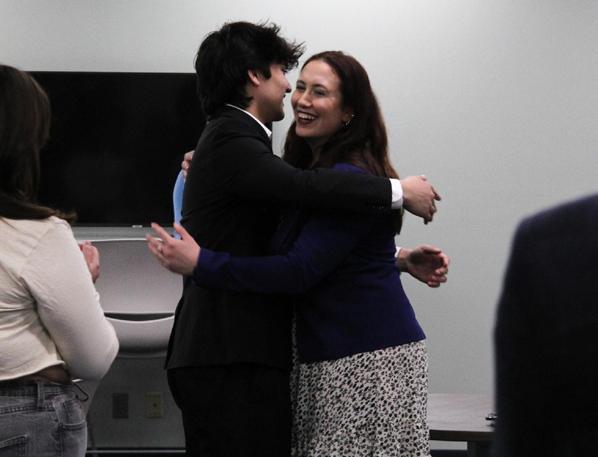
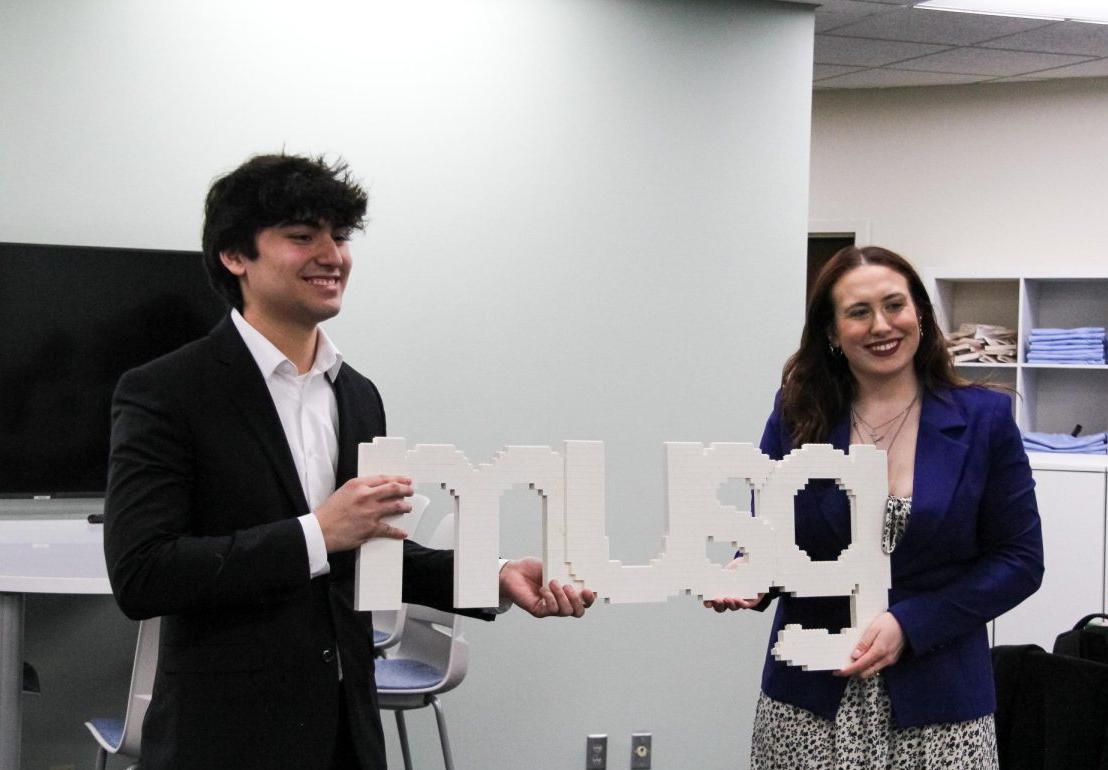
Jacob Ricard (left) and Rae Dakins (right) embrace after being named MUSG president and VP.
Photo by Lily Wooten lily.wooten@marquette.edu
Tuesday, March 31, 2026
How does road salt affect Milwaukee's water?
Key ingredient, chloride, harms freshwater areas
By Lilly Peacock lilly.peacock@marquette.edu
Year after year, Milwaukee is hit with snowy and icy winters that temporarily send the city into disarray — slush-covered roads, skidding cars and slippery sidewalks adding difficulties to daily commutes. The city responds with plows and road salt to make driving conditions more manageable, but there’s a cost to clearing the roads.
This winter, Milwaukee has experienced over 40 accumulated inches of snowfall throughout the season, with the highest snowfall occurring on Nov. 29.
The key element in road salt, chloride, is harmful to freshwater and the environment. When snow and ice melt and mix with the salt, the brine flows into Milwaukee’s freshwater sources and pollutes them with the chemical.
The Wisconsin DNR monitors chloride levels in Wisconsin’s rivers and has found that long-term quality trends are showing increases in chloride, with 50 rivers and a lake in the state having been affected by large concentrations of
the chemical. It takes one teaspoon of salt to make five gallons of water toxic to native aquatic ecosystems, according to Wisconsin Salt Wise. As of 2023, the Department of Public Works used over 35,000 tons of salt annually on roads in the winter.
The Marquette Wire reached out to the campus facilities department about the use of road salt on the university’s campus and did not receive a response.
David Strifling, associate professor of law and director of Marquette’s Water Law & Policy Initiative, said the university signed a pledge in 2015 that symbolized a commitment to caring for the earth — the Saint Francis Pledge, developed by the U.S. Catholic Bishops. The pledge emphasizes a moral responsibility to take part in preventing climate change through sustainable living.
“Reducing salt use could be one aspect of this,” Strifling told the Wire in an email.
He explained that liquid brine — which Marquette often uses in place of rock salt — is used to pre-treat travel surfaces before winter weather and uses less salt than the road salt that is typically used.
The Milwaukee County Department of Transportation Highway Maintenance
Division also uses brine to pretreat roads before snowfall and are partnered with Salt Wise to receive annual training on strategies to reduce salt use.
The Conservation Foundation, an Illinois-based nonprofit dedicated to environmental preservation, says brine is a better alternative because of its water content, which allows it to stick to the pavement and stop snow from binding to the road. Brine is 23% rock salt, meaning it uses less salt on roads compared to rock salt alone.
Legal regulation and responsibility are murky when it comes to salt use, Sarah Fox, associate professor of law, said.
Fox said it’s easier to monitor point source pollution — contamination from a singular entity or location. But, she said, non-point source pollution — which includes anything that comes from excess runoff of residential and agricultural material such as fertilizers and road salt — is harder to navigate because of the lack of a single source.
“If private institutions like Marquette wanted to, they could impose self-regulation on salt use,” Fox said.
Shannon Haydin, storm water section manager for the Wisconsin Department of Natural Resources, said

in an email to the Wire that road salt is likely the highest contributor to non-point source pollution in urban areas. She added that elevated chloride levels in freshwater are causing some waterways in the Milwaukee area to become increasingly high in salt content.
“Salt is a ‘forever chemical,'” Haydin said in an email. “There are no best management practices that can remove the salt without a significant investment in money.”
Desalination, the process of removing salt from water to make it drinkable, is costly both financially and environmentally. A plant can cost millions of dollars to build, requires large amounts of energy and produces a waste product with a higher salt content
than the water prior to its treatment.
Fox believes most of the responsibility for environmental protection falls on federal and state government agencies, which have the most control over water quality laws.
“They might be able to impose more stringent standards about non-point source pollution and runoff,” she said.
Similarly, Strifling said placing legal responsibility on private corporations for salt use is unlikely, so long as the salt is serving its intended purpose.
“Road salt never goes away,” Haydin said in an email. “There is nothing that will break it down and eliminate it from the environment.”
Students frustrated by residence hall policies
The restrictions dictate check-ins, overnight guests
By Lillie Martin lillie.martin@marquette.edu
Designed with safety in mind, Marquette University’s residence hall visitation policies have left some students feeling frustrated and restricted.
The policies dictate how, when and with whom students can spend their time in residence halls. The restrictions, including guidelines on overnight guests, check-ins and gender, have some questioning how much control the university should have.
“It feels like I’m being babysat when I’m 20 years old,” Jenna Sherman, a sophomore in the College of Arts & Sciences, said.
In each hall, residents

are allowed to host up to three visitors at a time from 9 a.m. to 1 a.m. Sunday through Thursday and 9 a.m. to 2 a.m. Friday and Saturday. Guests have to give their ID to the front desk of each building while visiting.
Residents can host up to two non-family guests overnight if they are of the same gender. Immediate family members can stay for up to two nights, and gender does not matter. Guests under 18 need parental consent.
“I’m in a long-term relationship, so for dating, it’s been a bit annoying because I have friends whose partners are the same gender and they get to have them spend the night all the time,” Sherman said.
Sherman lives in Humphrey Hall and has felt some frustration with Marquette’s policies. She says Humphrey is more of a quiet dorm, not overly social and feels strict.
She said Resident Assistants have knocked on her door for playing music, and that even when it’s not quiet hours, she has received noise complaints.
“I feel on edge and like I’m being watched,” Sherman said.
Now, she feels hesitant about having her friends over.
Overnight visitation is also restricted for certain holidays and events and often prohibited during exam weeks and holidays.
Michael Lillie, a junior in the College of Communication, lived in Mashuda Hall his sophomore year. He said he followed the rules but found them annoying.
"It feels like I'm being babysat when I'm 20 years old."
Jenna Sherman Sophomore in Arts & Sciences
There were times when he wanted to have people over to his dorm room but could not check in more than two or three guests, making it hard for a large group hangout.
“I think the policies are too restrictive. I get we live in a city, so we have to be more cautious about that; however, sometimes students just want to have friends over,” Lillie said.
Jasmine Baptiste, a sophomore in the College of
Communication, lived in Humphrey Hall her first year and now resides in Mashuda Hall. She said she has enjoyed her time in the buildings, but some of her experience has been limited by visitation policies.
“Friends want to get together and be able to hang out without having to worry about how they’re going to get home or where they’re going to stay,” Baptiste said.
Baptiste said she wishes she had more time with her friends and feels bad asking them to leave when the night is still young.
“People can’t stay the night because of the rules implied here. It’s not so much boyfriends or girlfriends but genuine friendships we want to stay the night,” Baptiste said.
Compared to some other schools, Baptiste said Marquette is much more restrictive.
“At Carthage College, you do have to use your ID to get in and out of the dorms, but when it comes to checking people in, they don’t care about those types of things,” Baptiste said.
Lillie, who attended the University of Missouri before coming to Marquette, pointed out a difference in overnight visitation and

check-in policies. Students needed identification to enter buildings and rooms at Mizzou but faced no restrictions on visitation.
“Mizzou’s policies weren’t there; I never had to check anyone in, I could leave and go with as many people as I wanted,” Lillie said.
Loyola University of Chicago is a Jesuit university that has similar visitation policies to Marquette; however, Loyola students are not restricted to a certain gender of guests who can visit overnight.
According to the Marquette, the purpose of the university’s policies are to encourage everyone to be respectful, safe, accountable and inclusive. However, several students who expressed frustration toward the visitation policies are requesting more freedom and flexibility, they say.
“Let us live,” Baptiste said.
In Milwaukee, there is an environmental cost to clearing the roads.
Photo courtesy of Marquette Wire
Sherman lives in Humphrey Hall.
Photo courtesy of Jenna Sherman
Baptiste lives in Mashuda Hall.
Photo courtesy of Jasmine Baptiste
MUSG: 2026 ticket seeks to improve safety
Continued from page 1
for sickness. That standard, Dakins said, does not benefit students or professors. The ticket does not yet have a clear plan for how to revise the policy, but over the past month has been communicating with Marquette’s wellness center, which Ricard called “very productive.”
At the MUSG presidential debate on March 23, Ricard described a “sexual health crisis” on Marquette’s campus, based on a 2016 study which ruled Marquette the least sexually healthy college in the nation. For Ricard and Dakins, potential solutions include low-cost contraceptives and takehome STI kits.
Greater local
access to groceries
Additionally, the pair hopes to start a new tradition on campus, “Market Mondays.” Sponsored by MUSG, the weekly market would bring vendors to campus to combat disparities in food access, lowering prices while decreasing student reliance on the 16th Street Sendik’s location for groceries.
The administration plans to target vendors that attend MUSG’s Earth Day Farmer’s Market on April 22. Those willing to return to Marquette would likely sell produce, baked goods, clothing and more on the grass between the Alumni Memorial Union and Schroeder Hall. However, the location is still being
finalized, Ricard said.
Alongside Market Mondays, Ricard and Dakins hope to partner with Sodexo, Marquette’s dining services provider, to give students access to a greater variety of food products.
“It’s not practical to ask them to build a grocery store on campus,” Ricard said. “So, we’re looking for solutions that are manageable and are at low cost of the university.”
Other goals for safety, inclusion Ricard and Dakins have also been in communication with Marquette University Police Chief Edith Hudson and are in talks of funding an additional Eagle Express shuttle, expanding the fleet in the interest of
campus safety.
The two have also expressed interest in initiatives like a composting project, increasing prayer spaces on campus and working with more local businesses and museums to give students free or discounted admission.
Mohamed and Khayati campaigned on a similar platform, seeking to revise Marquette’s attendance policy, prayer spaces and the SOF allocation process. Additionally, they aimed to increase wages for student workers.
Following the announcement of the winning ticket on March 27, all four candidates exchanged pleasantries and congratulations. After trading hugs with
others in the MUSG office, Ricard pulled his cell phone from his pocket and began to call family members to share the election results.
“It was a really good moment to be able to tell them that all that hard work paid off,” he said.
With the election complete, Ricard and Dakins will turn the page to a new chapter. Upon their inauguration on April 7, the pair will transition from campaigning to working on the initiatives that won them a seat atop MUSG.
“It’s been amazing to be able to talk to so many different students about so many different issues,” Ricard said. “Students want change, and we want to be their voice.”
DATING: Social norms can influence actions
Continued from page 1
fraternity parties, bars and social settings, since it’s where many students meet.
“I think Greek life is where it starts, especially if you’re in a frat, that’s definitely the vibe, like, ‘Hook up with as many women as you can,’” Hunter said as someone with friends in fraternities.
Dating apps also play a role, students say. Green said platforms like Tinder and Grindr are common
ways students connect, and Green noted many users on these apps are typically only interested in casual relationships.
“I feel that a lot of dating apps nowadays really have changed our perspective on dating,” he said. “It makes it a little more difficult because it’s just there — your whole profile — and it’s like you know the person [already]. There’s not the fun of getting to know them.”
The university’s Jesu-
it identity, students say, has little influence on how relationships on campus work.
Jennens added that campus policies, like residence hall visitation rules, have more of an effect on dating than religious identity does.
While none of the students who spoke with the Wire reported feeling strong personal pressure to participate in casual dating, they said social expectations can still affect
students’ behavior based on their individual beliefs.
Jennens said women often face more judgment than men for following hookup culture, and that some LGBTQ+ students may find it harder to meet partners.
While the university openly supports queer students, Jennens said navigating the dating scene for people in the community is hard, especially for one of her friends.
“It’s not a common
demographic here, she doesn’t know a lot of events or people who are interested in that,” Jennens said.
Even though there’s no singular definition of dating at Marquette, students say it depends on people’s reasoning for attending Marquette, mixed with their own values about dating in college.
“In college or on your own, you’ve got to feel that out for yourself,” Hunter said.
Ricard (left) and Dakins (right) said they have been in touch with the Marquette University Police Department in the interest of improving safety on the university's campus.
Photo by Lily Wooten lily.wooten@marquette.edu
The MarqueTTe Tribune
Managing
Tiedge
Assistant Editors Lance Schulteis, Lilly Peacock Reporters Sahil Gupta, Elena Metinidis, Mina Marsolek-Bonnet, Lillie Martin
ARTS & ENTERTAINMENT
Executive Arts & Entertainment Editor MaryKate Stepchuk
Assistant Editor Joseph Schamber
Reporters Elise Emery, Allison Scherquist, Annie Goode
OPINIONS
Executive Opinions Editor Rachel Lopera Assistant Opinions Editor Isabella Gruber Columnist Amelia
Lancaster
VISUAL CONTENT
Design Chief Murphy Lealos
A&E Designer Evelyn Riordan
Sports Designer Amery Thompson
Opinions Designer Allegra Delli Carpini
Photo Chief Clay Ellis-Escobar
Photographers Lily Wooten, Leo Stallings
HAVE A TIP FOR US?
Have you seen something that you think should be a story? Do you have a tip about something we should be looking into? Do you have documents or other materials that we should see? We want to hear from you.
If you have documents you'd like to send us, you can send anything to wiretips@marquette.edu.

Tuesday, March 31, 2026
Meet WI Supreme Court candidates
Chris Taylor and Maria Lazar on the April ballot
By Sahil Gupta sahil.gupta@marquette.edu
As Wisconsin is less than two weeks away from yet another election, appeals court judges Chris Taylor and Maria Lazar are both vying to replace retiring conservative State Supreme Court Justice Rebecca Bradley.
The two candidates were scheduled to debate March 25 at the Marquette University Law School, but the debate was rescheduled that morning after Taylor’s campaign reported that she was ill. It was later confirmed Taylor was admitted to the hospital, where she was diagnosed with kidney stones. She has since been discharged and will take a few days to rest, her campaign said. WISN 12 announced the
debate has been rescheduled for April 2. The debate will be held at the news station’s studio with no in-person audience.
“We wish Chris Taylor a speedy recovery and look forward to a robust debate as soon as possible for the voters of Wisconsin,” Lazar’s campaign said in a statement.
Candidate backgrounds
Taylor was elected to the Wisconsin Court of Appeals in 2023 after being appointed judge of the Dane County Circuit Court by Gov. Tony Evers in 2020. Before her judicial career, she served in the Wisconsin State Assembly from 2011 to 2020 and was the public policy director for Planned Parenthood of Wisconsin.
Lazar worked in civil litigation for the first 20 years of her career before serving as an assistant attorney general at the Wisconsin Department of Justice in 2010. During her
tenure, she was tasked with defending policies from the administration of then-governor Scott Walker, including the controversial Act 10 and a 2011 Republican redistricting law that implemented one of the most aggressive legislative gerrymanders in the country.
A quieter campaign
Anyone who has been watching local television or driving through Wisconsin neighborhoods may notice that this year’s campaign has been relatively quiet compared to the highly contested 2025 race.
Last year, Wisconsin circuit court judges Brad Schimel and Susan Crawford sparred in the first statewide race since Donald Trump was elected president in 2024. Headlines were frequently dominated by monetary issues, and both candidates received millions of dollars from ideological Super PACs — Crawford from
billionaires like George Soros and JB Pritzker, and Schimel from Elon Musk. Spending in the 2026 race has been substantially lower than its predecessor. Campaign finance records show Taylor’s campaign has taken in around $4.26 million in contributions, while Lazar has taken in less than $700,000.
Voters still undecided
A March 24 Marquette Law School poll showed Wisconsin voters are still not highly tuned into the race, with 53% of registered voters saying they have yet to decide who they will be voting for. Of the rest of respondents, 23% indicated they would be supporting Taylor and 17% said they would support Lazar.
Eligible voters can visit myvote.wi.gov for any information about how and where to vote, either on Election Day or earlier.

Newest MU Law poll shows voter indecision
Public interest in supreme court race has declined
By Mina Marsolek-Bonnet
wilhelmina.marsolek-bonnet@ marquette.edu
A March 24 Marquette University Law School poll found as the April 7 Wisconsin Supreme Court election draws closer, 53% of voters still remain undecided. Chris Taylor is leading Maria Lazar among likely voters, according to the poll. Taylor’s support is 6% higher, with 23% of likely voters indicating their support for her and 17% indicating support for her opponent, Lazar. An additional 7% said they won’t vote in the election.
In February, 22% of likely voters supported Taylor and 15% supported
Lazar, while 62% said they were undecided.
According to the law poll, Republicans largely prefer Lazar and Democrats sway in favor of Taylor. However, among registered voters, more Republicans than Democrats remain undecided. While independents lean toward Taylor, a sizable group said they will not vote in this election.
Among registered voters, only 25% have a clear idea what Lazar stands for and 28% understand what Taylor stands for.
Although there has been an increase in the percentage of registered voters who say they have read or heard a lot about the Supreme Court race since February, the number still doesn’t compare to the attention gained by the 2025 State Supreme Court race.
According to the poll results, there is a large Democratic advantage in engagement with the election. 77% said they are certain to vote while 59% of Republicans followed by 53% of independents are certain to vote.
Additionally, Democrats expressed more enthusiasm for voting in the election, with 51% saying they are very enthusiastic to vote in April. In comparison, 32% of Republicans and 19% of independents feel similarly. Among Democrats, Republicans and independents, 65%, 46% and 24%, respectively, say the outcome of the State Supreme Court election is very important to them.
Despite an ideological difference in voting attitudes, 75% of registered voters incorrectly believe
this election can change the ideological balance on the current court. The current court makeup is a 4-3 liberal majority. With a conservative justice retiring, the majority will either stay unchanged or increase to five liberals with a Taylor victory.
In comparison, in 2025, a retiring liberal justice on the 4-3 court signified the ideological balance on the court could have changed if the conservative candidate had won.
Trump’s approval rating
This survey also found that among registered voters, President Donald Trump’s job approval rating is 42%, with a 56% disapproval rating. His approval rating has dropped two points since the last Law School poll in February. Overall, Trump’s approv-
al rating has been steadily dropping since the release of a Law School poll in February 2025.
Opinions on Iran attacks
Additionally, the poll surveyed opinions of registered voters on the attacks in Iran. On Feb. 28, the United States and Israel launched surprise attacks across Iran, killing the supreme leader and other Iranian officials. Iran responded with attacks against U.S. bases, Israel and U.S. allies in the Middle East.
The issue is politically divisive, with an approval rate of 3% among Democrats, a 75% approval rating among Republicans and a 27% approval rating with independents. As a majority, 61% of respondents said they disapproved of the U.S. military attacks on Iran.
Graphic by Mia Thurow mia.thurow@marquette.edu
Appeals court judges Chris Taylor (left) and Maria Lazar (right) are the two candidates vying for a seat on the state supreme court.
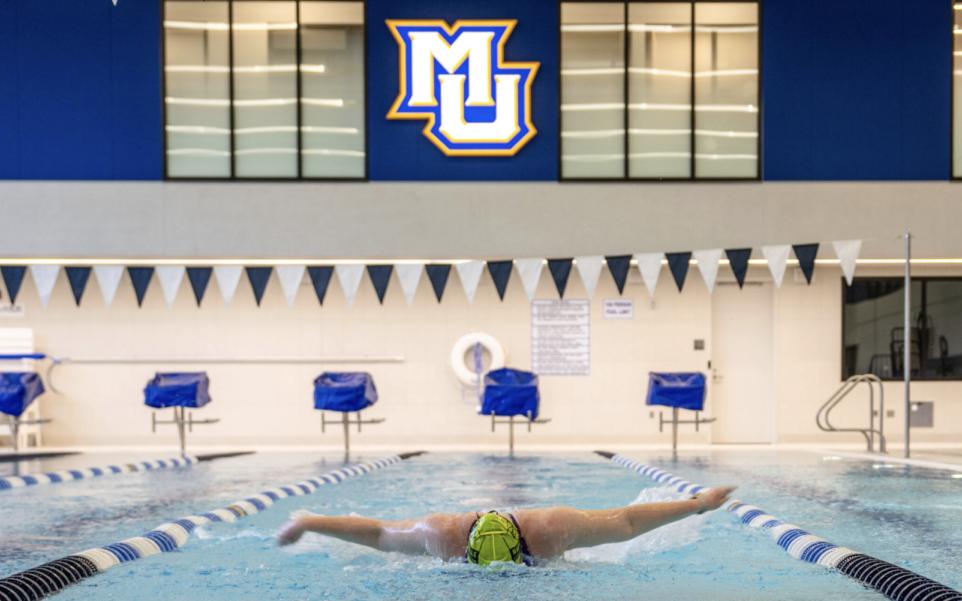
Marquette announced the addition of women's swimming in spring 2025 and hired Joel Rollings as head coach one year before they start competing in the fall.
New swim coach ready to make a splash
Joel Rollings comes to Marquette with experience in founding swimming programs
By Lilly Peacock lilly.peacock@marquette.edu
For the first time in its 143-year existence, Marquette University is introducing a Division I women’s swim team.
Announced May 2025, it will be Marquette’s 17th Division I sport and the first new program on campus since men’s and women’s lacrosse in 2013. The team starts competition in the fall.
At the helm is Joel Rollings, who’s no stranger to collegiate swimming in the state of Wisconsin. Announced as head coach on Sept. 15, Rollings is responsible for building the team from nothing and laying the program’s foundation.
It’s something he has experience in. Before Marquette, Rollings was the inaugural swimming coach across town at the Milwaukee School of Engineering for two seasons. “To begin something
new is such a great honor,” he said.
Hired by MSOE in 2023, Rollings was recognized as one of the most improved coaches in NCAA Division III after the 20242025 season, also being named Men’s Coach of the Year in the Liberal Arts Conference.
Before MSOE, he coached for one season at the University of Wisconsin-Milwaukee after 12 years at UW-Whitewater. At Whitewater, Rollings worked
MEN'S LACROSSE
with NCAA champions and All-American swimmers, breaking 92 school records from 2006-18.
His coaching journey started at Texas Christian University, where he worked as a graduate assistant coach for swimming. Then he went back to Milwaukee, where he studied kinesiology and participated as a student athlete at UWM.
levels, including some who went on to become Olympic qualifiers. One was Alex Dionne, a Paralympic athlete who swam record times in the 500 and 1650yard freestyle events.
The architect
The sport and city isn’t the only thing Rollings has experience with. He is also familiar with Marquette, as his father taught in the psychology department
Over the past 20 years, Rollings has worked with athletes across multiple See SWIM page 7
A second chance for Tucker Mullen
Junior transferred to MLAX after several surgeries
By Raquel Ruiz raquel.ruiz@marquette.edu
Thanks to injuries, Tucker Mullen knew after four years on the men’s lacrosse team at the University of Virginia he still had two more years of eligibility remaining.
What he was unsure about, at least for a while, was whether to use them.
After much deliberation, Mullen decided he would.
“I thought to myself, ‘Alright, I’ll at least enter the
[transfer] portal and see what happens,'” he said. Off the bat, Mullen said there were several teams who were interested in him, but, not wanting to rush the process, he decided to wait through the summer to make a decision.
It wasn’t until a former teammate of his reached out to Mullen telling him to give head coach Jake Richard a chance. This former teammate, Xander Dickson, also played with Richard on the PLL’s New York Atlas.
“I was really close with Xander, so, obviously, I respected his opinion,” Mullen said.
Finally in contact with Richard after trying to be recruited by him, Mullen made the trip to Milwaukee. Just two days after his visit, he committed to Marquette in early August and decided to continue his education on a two-year graduate program.
“In any case like that, there is a gamble in the transfer portal for both sides,” offensive coordinator Andrew Smistad said.
”Tucker, he doesn’t know anybody here, so he’s taking a bit of a gamble and like, ‘Will this be a good fit?'”
But since putting on the
Photo courtesy Marquette athletics
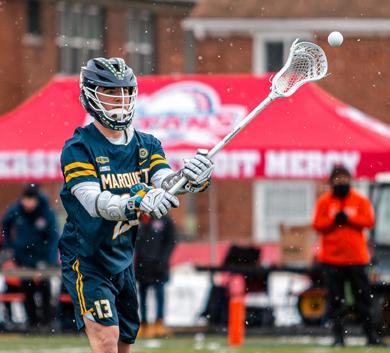
Tucker Mullen came to Marquette after four years at Virginia.
Photo courtesy of Marquette athletics
The
MarqueTTe Tribune
Tuesday, March 31, 2026
MEN'S LACROSSE
Overtime goal helps MU stun Providence
13 14
By Matthew Baltz matthew.baltz@marquette.edu
In the minutes following Marquette men’s lacrosse’s 14-13 win in overtime over Providence on Saturday, lyrics to “I Gotta Feeling” by the Black Eyed Peas could be heard bouncing off the inflated walls of the “bubble” at Valley Fields.
The music served as background noise for what was a celebratory scene on the field following junior midfielder Ethan Salvia’s game-winning goal 1:30 into the extra period.
“It’s pretty surreal,” Salvia said. “Getting a home game to start off Big East play was huge for us, and
we were super excited for it. Our fans were awesome today, it was a soldout crowd, so that was pretty cool.”
Salvia’s game-winner was the exclamation point on what was a career day for him. The Gibsonia, Pa. native finished with a career-high six points, scoring three goals and dishing out three assists.
“[Salvia] has been dreaming for so long about what it looks like to play in these moments that when it finally became his turn,” head coach Jake Richard said. “He’s seen it in his mind, and then brought it to reality. It’s really special to see.”
The Golden Eagles (5-4, 1-0 Big East) found themselves trailing 12-8 with
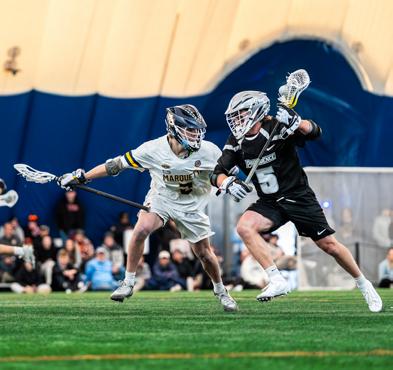
13:24 remaining after junior attacker Matt Lazzaro snuck one past senior goalkeeper Lucas Lawas to extend Providence’s lead.
Marquette was without starting attacker Tucker Mullen and starting defenseman Mike Piraino heading into the day. Things got even worse for the Golden Eagles when senior attacker Matt Caputo went down with a lower-body injury just minutes into the game.
Despite being down three key players and trailing by four goals, the blue & gold never wavered. Salvia scored a goal with 11:52 remaining to cut the lead to three, then added another 45 seconds later to cut the deficit to two.
After graduate attacker Nolan Rappis scored his fourth goal of the day to cut the Friars’ lead to one, sophomore attacker Chris Matia made it a two-goal game once again with 3:11 to play.
That was the last time Providence would score, as the Golden Eagles finished the game on a 6-1 run to stun the Friars (4-7, 0-1) in their Big East opener.
“I’m really proud of our team for staying focused on the task at hand and the plays that need to be made while we manage the rest of the game,” Richard said. “Our players not getting sucked into the other stuff shows really good resilience and focus
MEN'S LACROSSE
from them.”
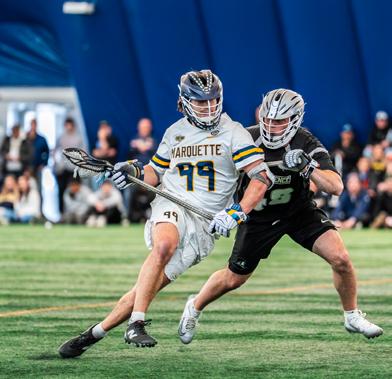
Marquette sent the game to overtime after junior midfielder Beau Westphal scored with five seconds remaining. Westphal scooped up a ground ball and rattled the cage after junior attacker Carsen Brandt’s shot went wide.
“The play went a little bit rogue,” Westphal said. “Carsen threw the ball over his shoulder and I was there to have his back.”
Marquette is 1-0 in Big East play for the second straight year. The last time the Golden Eagles won their Big East opener in back-to-back seasons was in 2018 and 2019.
The blue & gold will
hit the road to take on St. John’s (2-8, 0-1 Big East) in Queens, New York, next Saturday.
But first, the Golden Eagles will enjoy the taste of beating Providence for the first time since 2022.
“We’ve had to [win close games] a lot this year in particular,” Richard said.
“So, this team is uniquely prepared for things like this. And to see it come to fruition on the lacrosse field, where they love to be together, is really special. So, when you put it all together, the whole year, this one means a whole lot.”
They’ve got a feeling it’s going to be a good night in Milwaukee.
CHANCE: Attacker fuels offensive success
Continued from page 5 blue & gold, Mullen has proved he fits right in on the field, establishing consistency in the Golden Eagles’ first eight games of the season.
Mullen’s 13 goals tie for third on the team with Beau Westphal behind Carsen Brandt’s 21 and Nolan Rappis’ 19.
So far, in Marquette’s eight of nine games, he’s totaled 17 points, has 26 shots on goal, four assists and two hat tricks.
“He helps to add to our overall skill and our ability to finish the ball and find some soft spots,” Smistad said. “He’s not a guy that’s going to demand the ball a ton in his stick, which is a good thing because you don’t want to have six guys that all want the ball in their stick and can’t do anything off the ball.”
Smistad said that Mullen’s experiences with the Cavaliers bring a level of maturity to the team. He can share previous experiences and how they helped his game,
passing on that wisdom to younger players.
Mullen wasn’t always a standout player. At UVA, he was seen on the field nine times. At Marquette, he’s played in all but one.
Despite being a No. 55 overall prospect and No. 14 attacker in the nation (InsideLacrosse) in high school, his years at Virginia were different.
So different, in fact, his junior year he said he had to ask himself, “Is it just going to be time to hang it up?”
After getting hit at a practice in 2022, he dislocated his shoulder, ultimately tearing his labrum. That led to surgery number one.
Then, his junior year, he woke up one day with a chest pain.
“I went to a million different doctors in a month span, and they were like, ‘You’re totally fine,'” Mullen said. “I was like, ‘No, I’m not fine. I can’t even do a lap around the field.'”
Further testing showed that Mullen had been
born with an anomalous coronary artery, which meant his coronary artery had abnormalities.
"I haven't played a ton in the past. Hopefully, we have a lot more lacrosse left to play."
Tucker Mullen Marquette men's lacrosse attacker
“The guy was like, ‘If you want to play sports again, you, like, need to get this surgery.’ So I was like, ‘Okay, I’m gonna get it,'” said Mullen.
That marked surgery number two, but he wasn’t done yet.
Mullen then got pericarditis, a swelling that forms around the heart after the
sac is filled with fluid. The pericarditis came back four different times after the initial open heart surgery, leading to no physical activity for what Mullen said was about a month.
After medication and MRIs, Mullen was cleared to play again, leading him to his senior year at UVA.
“I finally felt like I was out of it,” he said.
Warming up before a match against Maryland, he planted his foot “weird.” He knew something wasn’t right, but continued to rehab and play. He then found out he had torn his hip labrum. That led to surgery number three.
However despite getting knocked down time and time again, there was only one thing he could do.
“If I can’t do anything about it, time’s gonna fix it,” Mullen said. “You can either make that time more miserable, or you could choose to throw a smile on your face and figure it out.”
For the next two
seasons with the Golden Eagles, Mullen is focusing on getting his confidence back — something he lacked post-injury.
“You gain a great perspective for the game and a lot of gratitude for it when you have it taken away from you a couple times,” Smistad said. “I think it gives him a new lease on life with the sport and just enjoying being around the guys, being on a team, playing the sport and throwing the ball in the net.”
Mullen now has the opportunity to play consistently, whereas his previous seasons were on and off. While he doesn’t have any individual goals set for himself this season, he’s mainly focused on team success.
“I haven’t played a ton in the past,” Mullen said. “Hopefully, we have a lot more lacrosse left to play. I want to be a team that makes the tournament and wins the Big East.”
Photos courtesy of Marquette athletics Marquette trailed 12-8 in the fourth before coming back in OT.
MEN'S TENNIS
Coppage 'hungry' for new opportunities
Sophomore plays crucial role in singles rotation
By Mikey Severson michael.severson@marquette.edu
Luke Coppage is in a new team and city this year.
Starting his collegiate tennis career at Queens University of Charlotte, a 30-minute drive from his home, the 800-mile trip north to Milwaukee marked his first time living away from his hometown.
But it’s been a welcome and enjoyable adjustment, even the Wisconsin winters, Coppage said.
“It’s definitely been fun. Being here was a change, being away from home, but it was good to become more independent and explore a new city,” Coppage said. “It’s been a little bit of an adjustment to the cold, but Coach (Jud Shaufler) gives us nice parkas, so I’ve been pretty warm — and I’ve enjoyed it a lot.”
Coaching and financial changes prompted Coppage to change his scenery, and he traded in the navy & white for the blue & gold over the summer.
Coppage entered the transfer portal hungry for a new adventure. He signed with Marquette because of the opportunity to play in the Big East, and the Golden Eagles’ legacy on the courts.
“(Marquette’s) always been a school that I’ve looked at with a lot of respect for, and the history

of the tennis program,” Coppage said. “So, coming here was a no brainer.”
Following the loss of three first-years from the 2024-25 season, including two to the transfer portal, the team was looking to rebuild.
Marquette men’s tennis head coach Jud Shaufler said that Coppage’s drive and humility stood out to him in the recruitment process.
“He recruited us, I didn’t know that much about him at first, he asked for an opportunity, and so I gave it to him,” Shaufler said. “He didn’t come in with a lot of demands, and all the things you hear about in college athletics right now.
“There was no price tag on him or anything like that, he was just a hungry guy who wanted to be in a good situation for himself.”
Helping Coppage adjust to his new living and playing situation is his roommate and doubles partner Hugh Perrill. Together, they have played in six doubles matches this season and have utilized their inherent chemistry.
“Luke and I have a really good relationship on court, so we know how to work together,” Perrill said. “I feel like doubles is a big team game, and I think how close we are, it really helps us in the tough moments in doubles.”
Coppage started the season rotating between the No. 5 and No. 6 singles spots but has found his footing with four-straight singles victories at No. 5 in 11 days against Chicago State and Xavier. He then pulled off two close ones against Fairfield and UNC-Asheville to celebrate spring break at
the USTA National Campus in Orlando.
Because Marquette has just four tennis courts, the No. 5 and 6 spots play after the first four are finished in competitive matches. It means they are often prime candidates to determine whether the Golden Eagles win or lose.
“At five and six, it comes with a big responsibility, especially on our courts,” Perrill said. “You have to come in with a lot of energy and be a stabilizer out there.
Coppage’s personal interests are helping him adjust — and win. He hopes to get an accelerated master’s degree in the accounting analytics program and is passionate about computers and data analytics, two things he said lead to better shot selection on the court.
“We have in our heads, with the split second when the ball is coming to us, we have to make a decision and think of the percentages,” Coppage said. “Am I going to hit this more defensive cross court, hit it down the line, hit a slice, or what serve should I hit?”
“It’s thinking analytically and trying to detach from the emotions as much as you can — a lot of the time in pressure situations it’s really important.”
Sophomore Kristian Blagoev said that Coppage’s composed and bright attitude has been a positive addition to the team that complements the existing core group that came in as first-years in 2024-25.
“You watch him play, and he’s not going to be one of those guys that’s going to be losing his mind,” Blagoev said. “I’d say he’s there for everybody; he’s always going to be someone that you can rely on. He’ll lose a tough match, and then he’ll go right to cheering for the next guy, which I think is huge.”
Perrill said that Coppage came to Marquette at just the right time for himself and the rest of the team, with the timing of his move to Marquette.
“I think that experience (in Charlotte) has really helped him, and it helps us as a team,” Perrill said. “He comes out there and does his job, which really helps our team and confidence.”
SWIM: Team begins competition in fall 2026
Continued from page 5 from 1973-1980.
It’s why he lives in Wisconsin, and why he is proud to be a part of the Golden Eagles community.
“The chance to work at Marquette was just a dream,” Rollings said, “to come back to where my father was.”
And since being hired, he’s making the dream come to life. While an intimidating feat, Rollings is figuring out where he wants to go with the team. Most importantly, though, are athletes who love Marquette.
“It’s a little bit simpler as far as recruiting goes because people know the name and want to be part of the community,” he said. Finding all the pieces to make a team is overwhelming, but Rollings is only focused on what he’s trying to build; the rest will fall into place as the process continues.
“Going through things at MSOE helped also as far as knowing some of the pitfalls that come and how to prepare for them,” Rollings said.
Finding the right vendors for swim suits, getting the budget set and creating a competition schedule are all part of this, he said, but when things get overwhelming, focusing on what they’re trying to build makes the process feel easier.
The individual nature of swimming places importance on finding athletes who are looking to contribute to the wider team, Rollings said. To do this, he taps into Marquette’s reputation and shows them what they can be part of.
He highlights the high academic and athletic standards, complimenting the student body and referring to campus as “one of the friendliest he’s ever been on.” So much so that the
school starts to sell itself.
“We’re looking for those people that love Marquette and pitching them on my vision of what the team is going to be like next year,” Rollings said. “And them being a part of a legacy, something bigger than themselves.”
The build Rollings envisions the first month of the season being dedicated to team-building.
With a young group, laying out what the team will look like in four years is essential. This means establishing leaders and figuring out the team dynamic. The problem, however, is that most of his recruits are coming from team captain positions.
“We don’t have to have everyone be the strong voice,” he said. “We need people who are going to have belief in the vision that we’re trying to get to.”
He hopes that team hab-
its developed in the formative years will carry down the line, showing up in future rosters as a traditional practice.
“It’s not just about the outcome or final performance,” Rollings said. “It’s about creating that culture and environment that everyone wants to be a part of.”
Rollings has already acquired 15 signees, 10 of which will be part of the inaugural class.
“This group will forever be remembered as the first,” Rollings said. “They’re hungry, committed, and ready to set the tone for what Marquette swimming will stand for.”
The future
With so much of swimming falling on results and individual times, Rollings is emphasizing individual improvement and looking beyond the outcome of a race.
To Rollings, this means
having athletes who are proud to be at Marquette and want to work with one another. Athletes who make practice the best part of their day and always want to get better.
“It’s unfair to set the standard as far as ‘You have to win a national championship,’” Rollings said. “The standard has to be that you win that practice that day, and then if you keep building on that, all of the other outcomes will fall into place.”
While an obvious desire is to move up in the Big East, individual work and team collaboration will be foundational to the team’s overall performance and culture.
“On your own, there aren’t a lot of accolades that come with [swimming],” Rollings said. “It’s the drive and determination that I admire.”
Photo courtesy of Marquette athletics
Luke Coppage occupies a critical role for Marquette men's tennis as the No. 5 or 6 single.
WOMEN'S SWIMMING
WOMEN'S LACROSSE
The 50-50 battle behind the ball
MU
ranks 60th in country in draw control percentage
By Eamon Bevan eamon.bevan@marquette.edu
Possession is never a guarantee in lacrosse.
For Marquette women’s lacrosse, that battle has proved definitive in not only their last few games, but in the entire season.
That battle starts after every goal, or the start of a period when the field resets into a 50-50 scrap at the draw circle, where control can dictate the match’s momentum, pace and ultimate outcome. Not as flashy as goals and assists, these ‘draw controls’ are sometimes overlooked statistic in the grand scheme of lacrosse, particularly to casual viewers.
But the players and coaches involved know its impact has no limits.
“If we have more draw controls than the other team, we typically win the game,” senior midfielder Hanna Bodner said.
At Marquette, first-year Gabby Windesheim exclusively serves the team as a drawer, initiating the play at the center of the draw circle with quick wrists and varied techniques.
“Speed of your wrists and
being dynamic are essential to win draws,” head coach Meredith Black said.
Bodner, the reigning Big East midfielder of the year, also plays a vital role in the draw control process as a ‘circle player’, boxing out opponents and securing loose balls. She is one of a handful of Golden Eagles around the circle who support the drawer through razor sharp instinct and an ever-present physicality.
“They [midfielders] are the worker bees, trusting the drawer and executing immediately,” Black said.
Despite her significant impact all over the field as a standout midfielder, Bodner still stresses just how difficult draw controls can be, as well as how much technique goes into claiming the ball.
“You have to read your opponent and know where the ball is going before it leaves,” Bodner said.
Together, the Bodner and Windesheim’s coordination, as well as their communication with the handful of other Golden Eagles around the circle, determines whether Marquette will be attacking or defending.
“Gabby takes the draw, but I can’t do my job unless she tells me what her plan is,” Bodner said. “As long as we’re all on the same page,
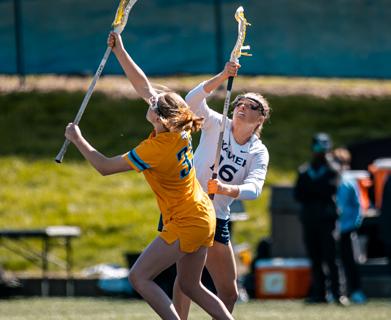
we normally would be successful.”
The Golden Eagles are currently 60th in the country in draw control percentage (51.5%) and fifth in the Big East in draw controls per game (12.33).
Having spent the majority of the season as the primary drawer, Windesheim prioritized the importance of ongoing communication and adjustment over all else during games.
“The score of the game is pretty close to the score of the draw control,” Black said.
And that statement holds plenty of truth. In seven of Marquette’s 11 games so far this season, the team with the most draw controls has gone on to win.
"The score of the game is pretty close to the score of the draw control."
Meredith Black Marquette women's lacrosse head coach
One of the only games in which that stat has gone the other way was in their loss to No. 23 Georgetown, who bested the Golden Eagles in their conference opener.
With Marquette able to claim a majority of possession, it took a sizable effort in the second half for the Hoyas to escape an upset, ultimately winning by one goal.
In the Golden Eagles’ games both before and after that affair, Marquette won the draw control battle and claimed one-goal wins over Niagara and UC-Davis, which Bodner and Windesheim concurred on coming down their unit.
“We could be win-
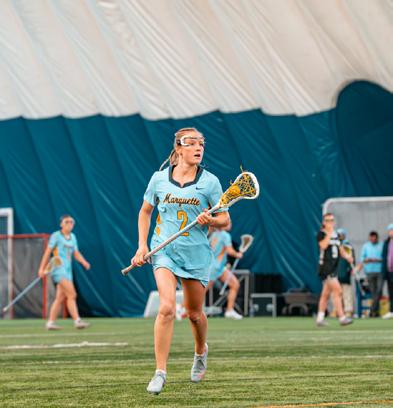
ning draws all game, but things can still go bad if you’re not winning the crucial ones at the end,” Windesheim said.
Gabby Windesheim described a strong drawing unit as combining grit, high lacrosse IQ and effective communication. While their unit has proved reliable thus far, the Golden Eagles also have to plan for contingencies when this vital phase of the game isn’t going their way.
“We’ll change up our drawer, try our second and third drawers, and if that doesn’t work, then we go defensive,” Black said.
It’s why only the 4th ranked Northwestern Wildcats have held Marquette to under 10 draw controls won.
The physical demands of draw control are also significant, especially given Marquette’s schedule and the volume of draws faced.
In fact, the Golden Eagles currently sit 32nd in the nation in draw controls faced at 152.
“We see a lot of different drawers and scenarios,” Black said. “That helps us adjust in-game because we’ve practiced and been
through the ringer on it.”
Considering the physical toll and immense emphasis on technique which goes into the draw control process, practicing every possible scenario in the circle has been an emphasis for the particular group of Golden Eagles.
Alongside the technicalities of the game, the 2026 roster is comprised of young and plentiful draw control group, giving veteran players like Bodner a particularly exciting oppurtunity.
“The fall is the biggest learning opportunity for us to learn how each of our freshman take the draw,” Windesheim said. “Even now, I’m still learning more things about Gabby and how she plays.”
Continuous practice has helped refine both individual skills and unit coordination, and for Windesheim, it helps overcome the jitters of taking on the brunt of drawing responsibility in her rookie season.
“Every day at practice, I’m trying to get better, get faster at my own draw,” Windesheim said. We’re trying to become a better unit together.”


Bodner
Wellness + Helfaer Rec. Center
Photo by Clay Ellis-Escobar clay.ellis-escobar@marquette.edu
Opinions
Trump is ruining decades of U.S. tradition

By Rachel Lopera rachel.lopera@marquette.edu
The U.S. Department of the Treasury announced on March 26 that President Donald Trump is adding his signature to U.S. dollar bills — the first time a sitting president’s signature will go on paper currency. This decision is unnecessary and blurs the line between institutional function and personal political promotion.
The purpose of putting Trump’s name on the bills is to honor America’s 250th anniversary, but the currency has had the signatures of the treasury secretary and the treasurer since 1861.
In a statement, Treasury Secretary Scott Bessent called Trump the “architect of America’s Golden Age economic revival” and said putting his name on the bills is appropriate and well-deserved. However, this decision breaks years of tradition and serves as an unwarranted endorsement of the current president. U.S. paper currency is a major national symbol that is circulated daily. It is a reflection of how our institution functions, not an item to politically validate a current leader. By tying his identity to the currency, he’s politicizing
something that should always remain neutral.
According to Reuters, the first bills with Trump’s signature will be $100 bills and will be printed in June.
The decision has drawn public criticism, along with a federal commission’s approval to design a 24-karat commemorative gold coin with Trump’s image on it. The Commission of Fine Arts, consisting of all Trump-appointed members, voted on March 19 to approve the design, which, once again, intends to honor the 250th anniversary.
Both cases raise legal concerns, considering how federal law prohibits the depiction of a sitting or living president on U.S. currency. The 1866 Thayer Amendment prohibits the use of any living person’s image on “the bonds, securities, notes or postal currency of the United States.” However, the treasury secretary may have the authority to bypass and allow Trump’s signature
on bills.
Additionally, the 2005 Presidential $1 Coin Act states that coins cannot have an image “of a living former or current president, or of any deceased former President during the 2-year period following the date of the death of that President.”
Federal laws have set clear boundaries, and Trump is overstepping them.
He’s already renamed federal buildings and institutions after himself, such as the U.S. Institute of Peace — now the Donald J. Trump Institute of Peace — and The Kennedy Center — now The Donald J. Trump and the John F. Kennedy Memorial Center for the Performing Arts.
Honoring figures in such a way comes from respecting a historical legacy, after they have passed. It should not be used as an opportunity to promote one’s political power.
Putting Trump’s signature on U.S. currency is just
another self-aggrandizing action and one that would set an upsetting precedent.
Personalizing currency could carry on into future presidencies and would turn a national symbol into a reflection of whoever is in power. Theoretically, the signature could just change with each new president. It would undermine our stability as a country and negatively impact public trust.
The role as president is not supposed to be treated as a business model, trying to mark everything with one’s personal branding, name, image or likeness. Trump’s ego does not give him an excuse to ruin 165 years of U.S. tradition. Our government is not considering the serious implications these decisions could have.
Some lines — especially the ones on our money — should not be crossed.
MLB broadcast blackouts are outdated
By Owen Parker owen.parker@marquette.edu
The first pitch of the 150th Major League Baseball season was thrown on March 25. Fans in stadiums cheered, hot dogs in hand, as “Take Me Out to the Ball Game” echoed throughout.
But outside the stadiums, thousands of fans sat as they were unable to watch their favorite team due to MLB enforced blackouts — an outdated sports practice.
A broadcast blackout is a restriction set by broadcasting organizations that limit viewing of specific streams in fixed geographic areas. In sports, this limits viewings of national broadcasts if the stream is on the teams’ regional network and serves to encourage greater in-person attendance at games.
The National Football League established the first official sport broadcasting blackout rules in 1975 with the intent to boost ticket sales. Broadcasts would be blocked, or “blacked out,” for local viewers if certain ticket sale requirements were not met.
Later, the MLB adopted this strategy to filter money to local broadcasts. The league later launched MLB. tv, an all-inclusive streaming service that allows fans to watch all out-of-market games. However, local in-market games are blacked out in this package, pushing viewers towards the local streaming service or cable broadcasts and forcing the public to purchase multiple subscriptions just to watch
the games they want.
While the purpose of these blackouts is logical, the implementation is an archaic way of dividing up media rights, pushing fans from the sport.
Every state in the United States has local blackouts, even Hawaii and Alaska.
States like Iowa and cities like Las Vegas with (currently) no MLB teams are subject to large form blackouts on MLB.tv even without access to a team’s local broadcast or streaming service. For example, a Milwaukee Brewers fan living in Iowa in 2025 would be unable to watch a Brewer game on their MLB.tv account due to the entire state having an in-market blackout for Brewers games. They would also be unable to purchase a monthly subscription to the team’s streaming service because the streaming service doesn’t describe their ZIP code as in-market.
The standards of streaming services and the MLB contradict each other, creating difficult-to-navigate situations to watch the game. Additionally, it is more expensive to watch a game in person than ever. Median ticket prices have increased 44 percent since last year’s Opening Day, up to $154 compared to 2025’s $107. This value is almost double the median of the 2019 season, which was $82 a ticket. However, change is inevitable. The bankruptcy of Diamond Sports Group, now known as Main Stream

Sports Group which owns and operates FanDuel Sports Network, has forced teams to look at other potential streaming providers for local viewers.
The Brewers are one of the organizations pioneering this change.
As of the 2026 season, they left FanDuel Sports Network and partnered with MLB. tv to create Brewers.tv. This streaming service costs $99.99 a season, giving customers access to all Brewers games — that are not exclusive to nationally televised games — completely blackout–free regardless of region in the United States.
This new service is a cheaper alternative to a local streaming provider that doesn’t allow out–of–market purchasers, and it comes with bonus content related to the organization’s minor league affiliates. It is a work around to blackouts and costly streaming packages, and more organizations should follow suit. Although a cheaper alternative, this is still inaccessible to those who can’t or aren’t willing to pay for an extra streaming service.
The Brewers are one of 14 organizations to partner with MLB.tv and no longer be affiliated with a regional sports network.
The fact that organizations need a workaround at all highlights the issue. The original intent of broadcasting blackouts was to drive fans towards the stadium, but it is now driving fans away from the sport entirely.
It is harder to support the local team than ever before. Ticket prices are rising, youth programs are reaching unprecedented prices and people can be blacked out from watching their team if not living in the right area.
This system is obsolete, and more fans everyday are skipping past the MLB because they don’t have access to a game’s broadcast. MLB executives need to work to fix these restrictions so the game can adjust to the modern streaming era and welcome a new array of fandom.
Statement of Opinion Policy
The opinions expressed on the Opinions page reflect the opinions of the Opinions staff. The editorials do not represent the opinions of Marquette University nor its administrators, but those of the editorial board.
Our editorial board consists of the managing editor of the Marquette Tribune and all executive editors including news, sports arts & entertainment and opinions.
The Marquette Tribune prints guest submissions at its discretion. The Tribune strives to give all sides of an issue an equal voice over the course of a reasonable time period. An author’s contribution will not be published more than once in a fourweek period. Submissions with obvious relevance to the Marquette community will be given priority consideration.
Full Opinions submissions should be limited to 600 words. Letters to the editor should be between 150 to 300 words. The Tribune reserves the right to edit submissions for length and content.
Please e-mail submissions to: rachel.lopera@marquette. edu. If you are a current student, include the college in which you are enrolled and your year in school. If not, please note any affliations to Marquette or your current city of residence.
Photo by REUTERS U.S. dollar banknotes are seen in this illustration taken March 26.
Rachel Lopera is the executive opinions editor. She is a sophomore studying journalism.
Photo by REUTERS
MKE Brewers starting pitcher Jacob Misiorowski throws a pitch.
Owen Parker is an opinions columnist. He is a sophomore studying journalism.
Fun & Games
Happy Easter

Women's History Month

Across
4. First lady and public engagement activist.
6. Scientist who studied primates.
8. Trailblazer of the Civil Rights Movement.
9. Painter known for her vibrant folk art.
10. American poet who wrote on resilience and racial equality.
12. First woman to win a Nobel Prize.
Down
1. "Conductor" of the Underground Railroad.
2. Advocate for female education.
3. Egyptian ruler.
5. 15th century French military leader and saint.
11. First woman to fly solo across the Atlantic Ocean.
Bunny Eggs Egg hunt
Glazed ham Carrots Chicks
Jelly beans Good Friday Passover
Palm Sunday Jerusalem Maundy Thursday
Arts & Entertainment
MU Alumna to direct play in Milwaukee

By MaryKate Stepchuk marykate.stepchuk@marquette.edu
Two Marquette alumni are making their mark on the Milwaukee theater scene this spring in the play “Dinner with the Duchess.”
The 90-minute personal drama — a play that tells a personal story at the intersection between a comedy and tragedy — will take place at Next Act Theatre starting on April 22. The director, Samantha Martinson, is a 2012 alumna from the College of Arts & Sciences and the lighting designer, Maaz Ahmed, graduated from the College of Communication in 2022.
Although neither graduate majored or minored in theatre arts at Marquette, both have been involved with the theatre program during and after their time at the university.
Marquette connections Martinson participated in acting classes and the Marquette University Players’ Society — MUPS — during her time at Marquette and directed the oneact play “The Wolves” in December 2022.
She said her majors in writing intensive English and education sparked her passion for directing theater, leading her to direct “Twelfth Night” at Mil-
waukee Youth Theatre in April 2016.
“I think my background [in education] has led me to a place that utilizes the same skills that I learned as an educator,” she said.
Ahmed became interested in lighting design in middle school and said he carried his passion to Marquette by working on lighting design with Marquette Theatre during his undergraduate career.
After his lighting design professor was let go due to the pandemic budget cuts, Ahmed found himself running the lighting design and electricity for many shows, from Marquette Theatre to MUPS.
“At the time, I was the only student who knew how to program the light board and efficiently hang and circuit a show,” he said.
Ahmed continued to help with lighting design after he was hired by Marquette but moved to New York City in December 2025 to further pursue lighting design. He is now going to be in Milwaukee temporarily for "Dinner with the Duchess."
Developing the show
Martinson discovered the script for “Dinner with the Duchess” in June 2024 and then sought out Next Act Theatre and actress Laura Gordon, who plays the lead,
Margaret.
Show development then began in September 2025.
Ahmed said directors usually bring a crew with them, but Martinson did not have a lighting designer picked out. The artistic designer at Next Act, Cody Estle, connected the two former Golden Eagles.
“[Martinson] brings such a metered and unique approach to this text,” Ahmed said. “She has a clear vision walking into the process, which I find a lot of directors don’t.”
Throughout the directing process, Martinson has had to learn how to stage consumables — real food to eat on stage — and direct a show in real-time, meaning there are no time jumps.
“Dinner with the Duchess” follows violin virtuoso Margaret at the end of her career, facing arthritis and giving her final interview to a young reporter. When secrets arise, Margaret is forced to confront the truth on a chaotic night.
While Gordon developed Margaret’s character, she said, she found herself personally connecting with Margaret’s character. Gordon reflected on various questions about her personal theatre career while developing Margaret, from “Has it been worth it?” to
“What do I want them [the public] to remember?”
“All those questions about legacy and purpose and a life in the arts all resonate for me,” she said.
“Dinner with the Duchess” will take place at Next Act Theatre on 225 S. Water St. and run from April 22 to May 17. *
On May 11, Next Act Theatre is offering a special “pay-what-you-can” show, allowing anyone who cannot afford regular admission to purchase a ticket at a price of their choosing. Tickets will go on sale at the box office at 6:30 p.m. on the day of the show.
Additionally, students can purchase $20 tickets — which includes fees — for all showings of “Dinner with the Duchess” by showing their MUID at the ticket office.

Purple Door: MKE's quirky ice cream shop
By Elise Emery elise.emery@marquette.edu
In a town dominated by and known for its frozen custard, this ice cream shop is now considered one of the best spots for a frozen treat in the Cream City.
Founded in 2011, Purple Door Ice Cream is a Wisconsin-based ice cream shop that uses locally sourced ingredients to create a variety of unique flavors that can be customized in shakes, sundaes and cones. With over 200+ flavors in its catalogue, Purple Door is consistently switching up its 20-flavor “dipping cabinet.”
Purple Door is owned by partners Lauren and Steven Schultz, with the business beginning on their first date.
“When Steve and I went on our first date, I told him about this crazy idea to open an ice cream shop someday,” Lauren said. “He was the motivator to say, ‘We should give this a try’ –and so we did.”
The two were educators before their business partnership. Lauren worked in the Edina Public Schools
District in Minnesota while Steven was a school counselor at a few high schools in the Minnesota and Wisconsin area.
The name “Purple Door” came from middle schoolaged Lauren’s imagination. Her idea of opening an ice cream shop was a childhood dream, and she once discussed good business names with her friends.
“At that time, purple was my favorite color,” Lauren said. “Collectively, we all thought the name Purple Door sounded like a fun, welcoming place to have ice cream.”
The Purple Door of today took years of imagination, trying out flavors in their home kitchen and thinking about a storefront and design for the brand.
It began as a wholesale business, selling containers of ice cream to local grocers and restaurants. To run their operations, the couple used a rented-out kitchen space from Skyline Catering. The two would make ice cream at night and on the weekends while still juggling careers as ed-
ucators and caring for their young children.
Lauren said that there was definitely a learning curve involved while the two continued to build the business.
“Neither Steve or myself had a business background, so we were learning things each step of the way,” Lauren said.
After about two years of establishing the brand and product through their wholesale business, the couple finally gained the funding they needed to begin production for their Walker’s Point location.
Purple Door’s continuous cycles of flavors make each visit for customers a surprise. While the shop has a few reliable flavors that stay in the case, such as vanilla, chocolate, mint chip and salted caramel, other flavors rotate throughout the month.
In the midst of Purple Door’s wide catalogue of flavors, exotic flavors like balsamic vinegar and butternut squash immediately stick out. Lauren Schultz said the inspiration for
these new flavors often comes from staff, customers or local producers and chefs.
“Sometimes flavors are inspired by customers, who share with us a story about a flavor they tried in their childhood and how much they still think of that flavor,” Lauren Schultz said.
Purple Door’s website tracks the current flavors available at Walker’s Point and lists its entire catalogue. These flavors are marked with the tags “Usually Available,” “Sometimes Available,” “Limited Availability” and “Currently Unavailable.”
In addition to creativity and quality, Purple Door also prioritizes supporting the Milwaukee community and protecting the earth through its business. Whether it be through locally sourced ingredients or using compostable materials, Purple Door keeps community and sustainability at the forefront of its priorities.
One of Purple Door’s initiatives, Milk for Milwaukee, contributes 10 cents
from every pint purchase and a portion of profits from other ice cream sales to provide local homeless shelters with fresh milk.
“Purple Door operates with what is called a triple bottom line,” Lauren said. “What this means is that with our business decision making, we look at three aspects – financial, environmental and social.”
It’s now been over 10 years since Purple Door’s initial launch, and those small beginnings have grown into two storefront shops, with its products being sold in local grocery stores to loyal fanbase.
“Perhaps what we are most proud of is the staff we get to work with and the community components of our business,” Lauren said.
“We are certainly proud of the product we make, also, and we hope to keep producing great ice cream for Milwaukee for years to come.”
Visit Purple Door at its storefront at 205 S 2nd St. in Walker’s Point and at its location in the Mequon Public Market.
Martinson is a 2012 graduate.
Photo courtesy of A.J. Magoon
"Dinner with the Duchess" will take place at the Next Act Theatre.
Graphic courtesy of A.J. Magoon
REVIEW: Pure Dance's 'Memories' show
By Allison Scherquist allison.scherquist@marquette.edu
It was a full house at Weasler Auditorium on March 27. At 7:30 p.m., the room went dark, the audience cheered and the Marquette Pure Dance Team swept across the stage as “So Long, London” by Taylor Swift played, marking the start of the dance team’s spring show.
As you entered the auditorium, Polaroid photos of the dancers greeted audience members, each one connected by strands of yarn that wove through-
our memories as a team and how prevalent dance has been in all of our lives,”
Weast said. “Many of the seniors have been dancing for almost 19 years, and this is the perfect way to end this journey.”
34 dancers took the stage on Friday night and performed to 10 different songs. One dance included all 34 members, while others had as few as eight.
The team faced several setbacks while preparing for their spring show, including issues with the rehearsal space, an earlier

out the hall. On a desk lay the show’s programs, while the title “Memories” — the show’s theme — hung on the wall in blue and gold letters. Pure’s Publicity Coordinator Olive Weber, a sophomore in the College of Communication, explained how the theme was chosen.
“Each choreographer got to pick their own song, then based on the songs they chose, we went and found an overall consistent theme,” Weber said.
Following the opening number, Co-Presidents Avril Beesley, a senior in the College of Communication, and Ally Weast, a senior in the College of Nursing, took the stage and introduced the show.
“This show is all about
performance date and budgeting challenges. However, the audience wouldn’t have been able to tell from the performance. Pure’s social chair and senior in the College of Communication, Mariah Olson, spoke of the team’s effort in preparing for the showcase.
“All the dances are so challenging, and we are doing really good with them,” Olson said. “I’m proud of all the work we put into [the show].”
The team performed an array of lyrical, jazz and contemporary numbers.
Dancers were adorned in eye-catching costumes that alternated for each song.
Each dance was compelling in its own right, and watching these talented girls leap, bend and sway
By Annie Goode annie.goode@marquette.edu
Natalia Theodoridou visited Marquette virtually to share a few words of wisdom with young writers on March 23.
Theodoridou has been publishing short stories since 2013 and started making choose your own adventure-style video games in 2015, with his game “Sleepless.” He has racked up literary awards, some being Moniack Mhor’s 2022 Emerging Writer Award, the 2018 World Fantasy Award for Short Fiction and a 2025 Nebula Award. Ben Pladek, an associate professor in the English department, organized the event. He is a friend of Theodoridou through their education at Clarion West,
together in simultaneity was engrossing.
Olson explained that Pure’s dancers did not undergo a formal audition process for the show. Instead, dancers were selected to perform in pieces that fit their schedules and aligned with the choreographer’s vision— the dances with solos were assigned to members who had a skillset that suited the part.
After the speeches came another two dances to “Haunted” by Beyoncé and “Certain Kind of Love” by Jessie Murph. HYPE Marquette then took the stage for a guest performance and danced to a short — but electric — hip-hop mashup before Pure reclaimed the stage to dance to “Maps” by Maroon 5.
Intermission came after a speech from Pure Treasurer Kaitlyn Chervenka, a junior in the College of Business Administration, who detailed the financial struggles the team has been facing. During the intermission, the dancers came out to greet their friends and family and gathered donations for their 2026 fall show.
The show took off again as the lights came on to the starting notes of “Oh My God” by Adele. Some dancers leaped across the stage and dropped to the floor as other dancers moved in and out in synchronized waves across the stage, creating a captivating resumption to the show.
They then transitioned to a more serene dance, “What Happened to Your Heart” by Bing & Ruth and Peter Broderick. The dancers fluttered across the stage to this emotional ballad as their costumes glistened in the stage light.
The next guest perfor-
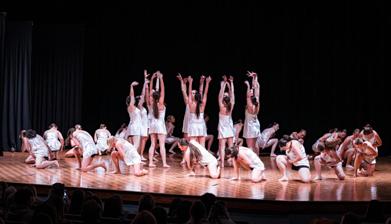
mance arrived as the Marquette Naturals took the stage to much applause. The group sang an a cappella rendition of “Jessie” by Joshua Kadison and “Call Me When You’re Sober” by Evanescence. The Pure dancers then rejoined the stage for their final dances. First, an airy performance to “Wildflower” by Billie Eilish, and then they exploded with energy as they danced to “Memories“ by Conan Gray and “Blank White Pages“ by Mumford & Sons — both highlights of the show.
Finally, the lights dimmed once more as the dancers took the stage, and a screen descended in front of the curtain. A video tribute to the senior dancers played, featuring childhood photos and backstage footage set to “Where’d All the Time Go?” by Dr. Dog and “Stand by Me” by Ben E. King. The
show concluded fittingly with a tender seniors-only dance set to “Sweet Disposition” by The Temper Trap, making for an emotional end for the night.
“I am feeling a little bit emotional when I think about my dance journey coming to an end,” said Weast. “But I really couldn’t imagine being surrounded by a better team.”
As the curtains fell, the dancers came racing back on stage once again, with hands interlocked as they took their final bow.
“I am so proud of all these dances and all our dancers who have worked so hard,” Weast said. “They have made being president as a senior so rewarding. I [am so proud] of what we’ve been working on and have so much fun along the way.”

a non-profit writing organization based out of Seattle that offers workshops and classes. Students in Pladek’s Writing Science Fiction and Fantasy class could attend the event for extra credit.
“I think it’s always helpful for newer writers to get as broad of a range as possible of approaches to their own fiction,” Pladek said.
“It’s also very valuable to hear from people who’ve been doing it for a very long time.”
Theodoridou’s debut novel, “Sour Cherry,” came out in April 2025 and is a modern retelling of the story of “BlueBeard,” where a woman finds out her husband has killed and kept the bodies of all the wives before her. Theodoridou
made this classic gothic story into a tale about the struggle to escape from an abusive relationship.
Pladek began the discussion by asking Theodoridou what his process was for beginning to write a story.
“I’m one of those writers who have a lot of story ideas, many more than I will ever be able to write, and I get story ideas everywhere,” Theodoridou said. “And then my process would be to ask questions.”
Pladek continued asking about the process of revision in a story, the importance of prose and basic sentences in relation to the bigger elements of a story and the differences between writing a novel, short story or video game.
“What I find really intriguing is the way that the process of building fiction maintains echoes of all the different paths that are not chosen in the non-interactive version of the story,” Theodoridou said.
“So, the non-interactive story is haunted by all its different versions; all the ‘what might have been’ if the characters had made different choices.”
One piece of advice Pladek and Theodoridou agreed on is the importance of having a circle of writer friends to turn to for revisions or help with a piece.
Pladek’s class read one of Theodoridou’s short stories, “Every Ghost Story,” prior to the talk, and Pladek said he would be interested in teaching “Sour Cherry” in his own curriculum.
“[Theodoridou] is a really good example for students of a principle that I believe is fundamentally true, which is that if you want to write well in any genre, you must read outside of it, and his stories reflect that breadth of influence,” Pladek said.
“I do have a group of trusted readers and writers… that read and offer feedback,” Theodoridou said. “What that does for me is, I pay attention to gaps in understanding or things that are obvious to me, sometimes are not obvious to my readers.”
The opening dance was to "So Long, London" by Taylor Swift.
Photo by Clay Ellis-Escobar
Pure has 34 members and the showcase had 10 dances.
Photo by Clay Ellis-Escobar
All dances are choreographed by Pure Dance members.
Photo by Clay Ellis-Escobar