Tony Everard is betting against all odds
watches the tournament his own way.
By Lance Schulteis lance.schulteis@marquette.edu
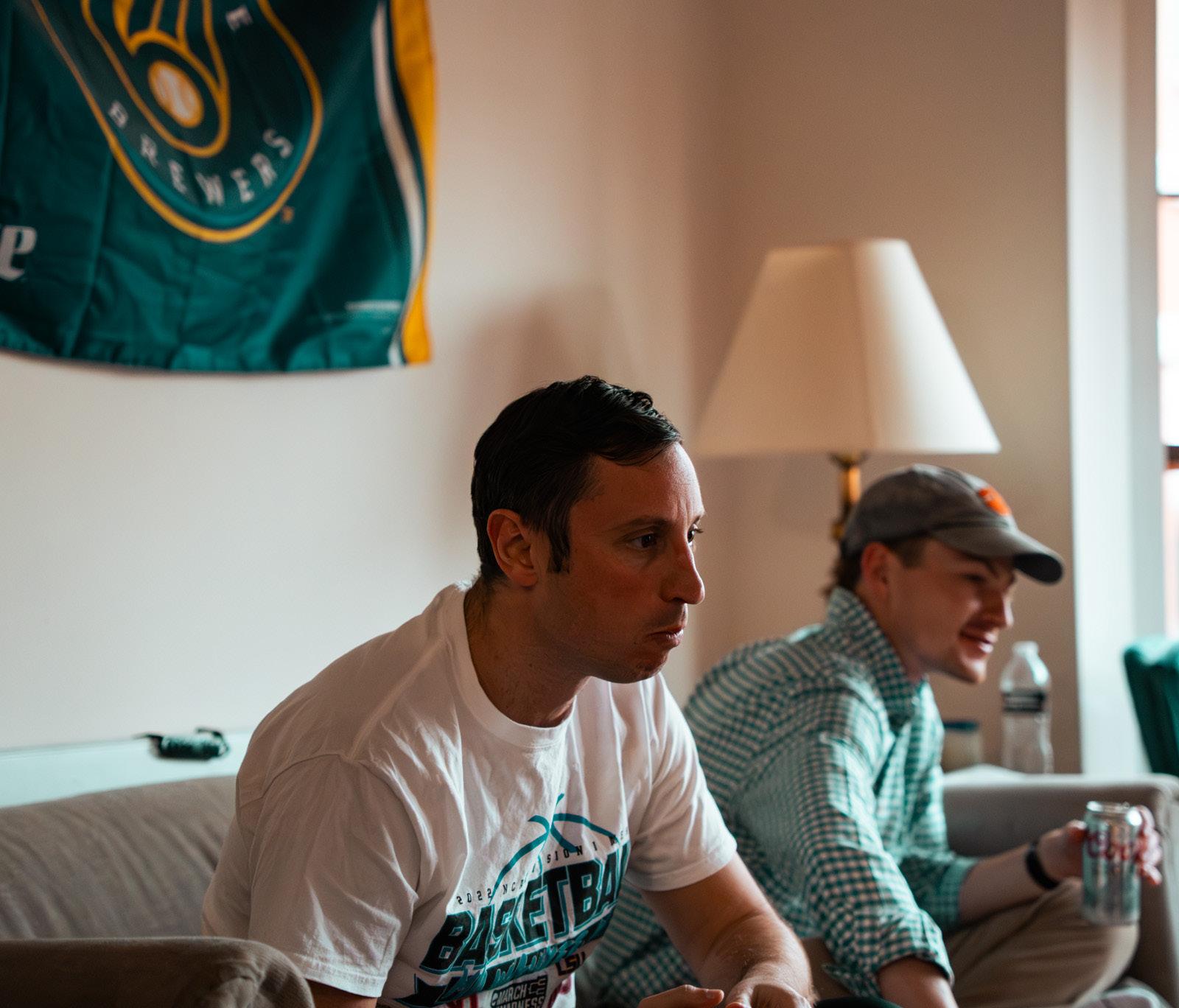
At his apartment near Seventh Street and Wisconsin Avenue, Tony Everard spends the end of March no differently than many college students across the country. He fills out NCAA men’s basketball tournament brackets and watches March Madness games, eagerly awaiting the next upset.
But Everard isn’t like most college students — and he
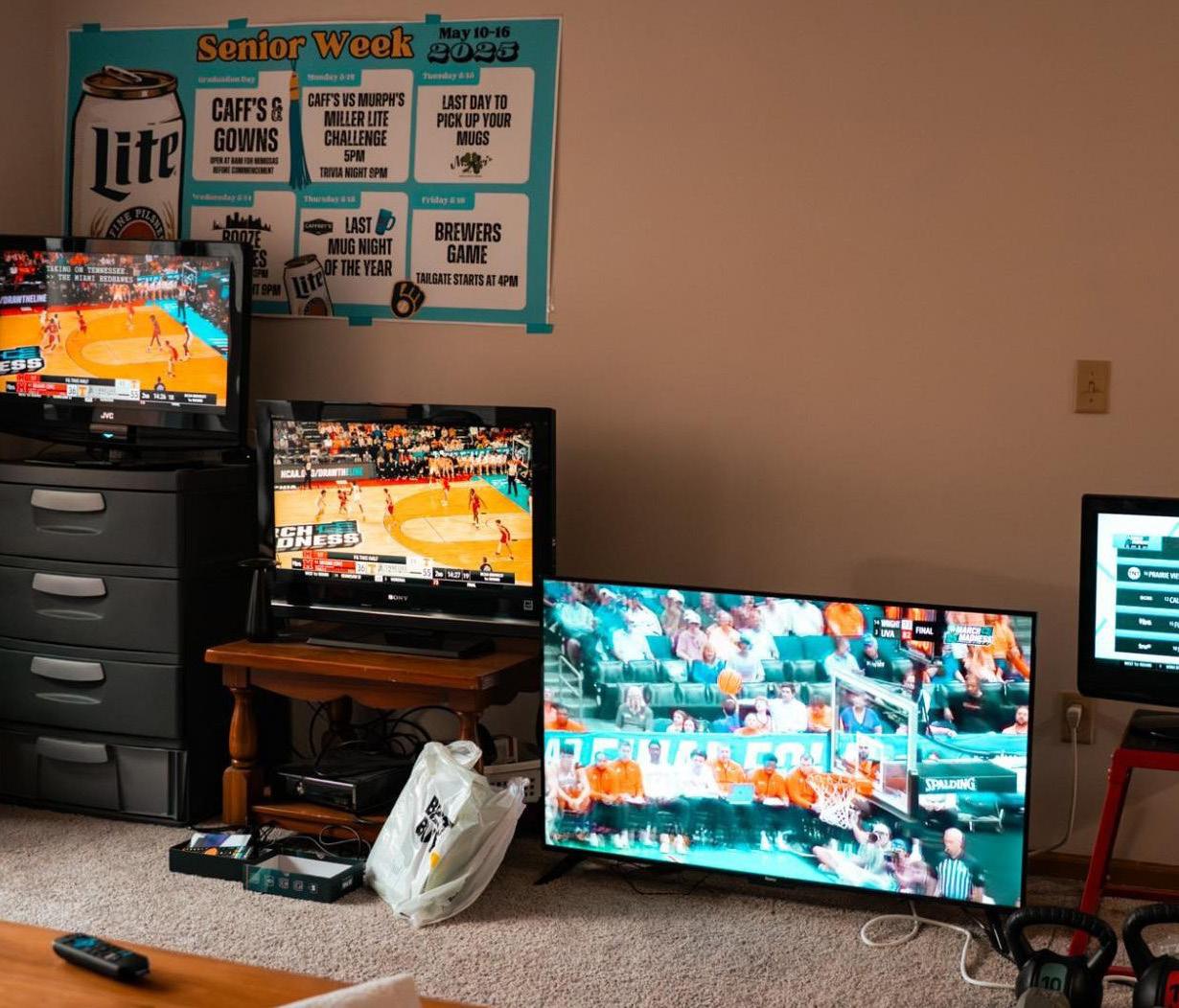
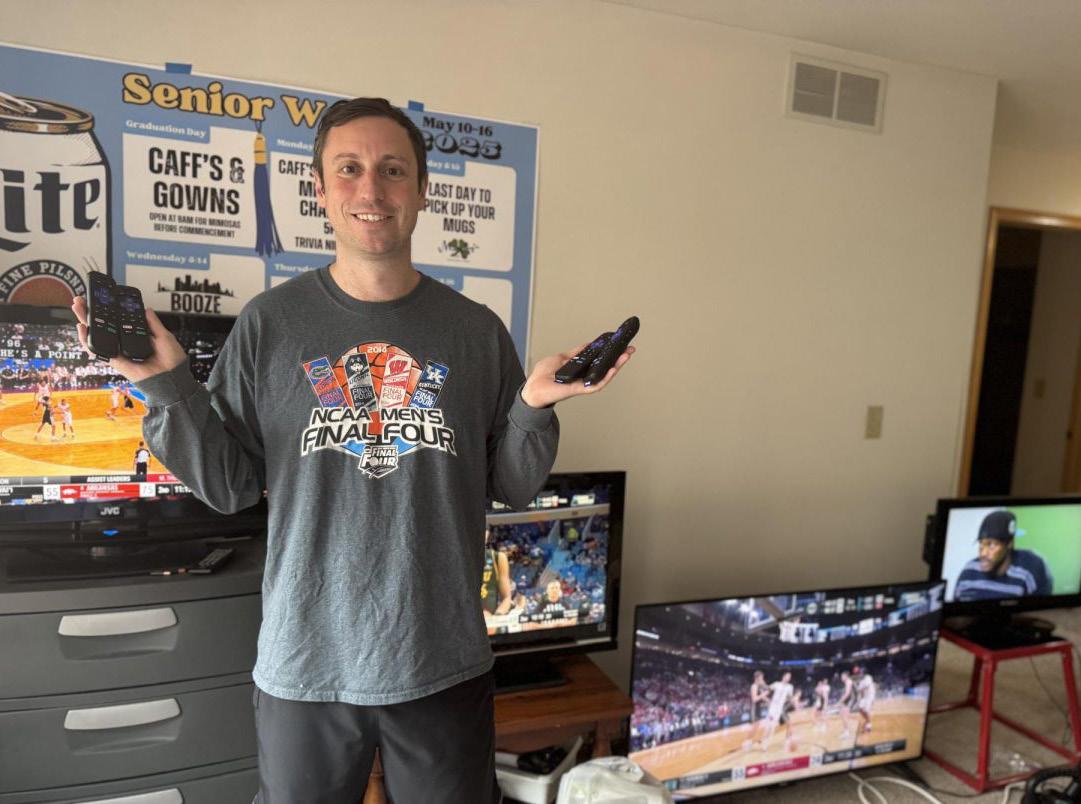
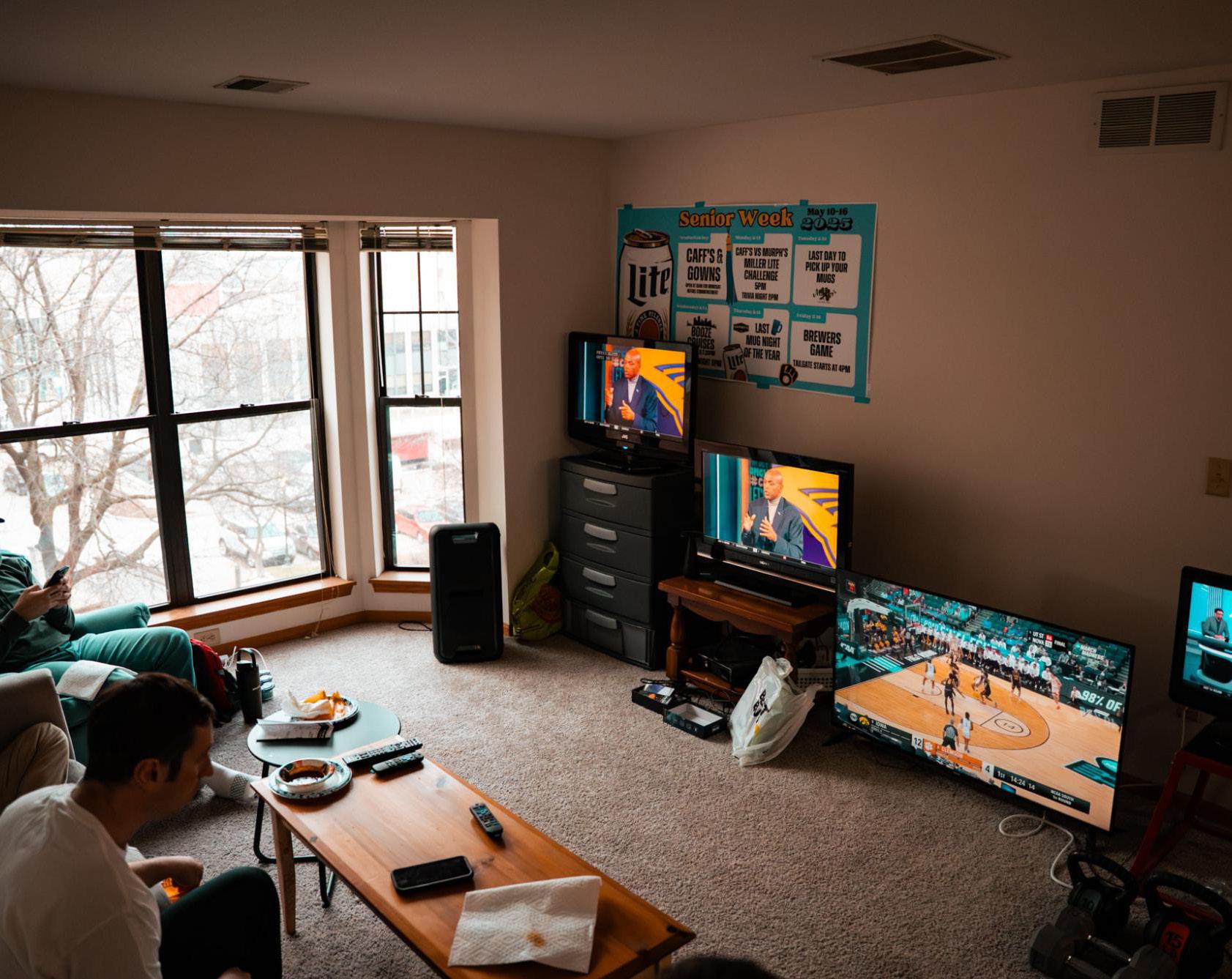
The 33-year-old Ph.D. student has four televisions facing his couch, and he watches them all while guarding an army of remote controls on his coffee table.
To an untrained eye, the remotes would look nearly identical. But Everard keeps track of them all.
One remote has buttons that stick. That remote goes to TV No. 3, which hosts what Everard deems the third-best game on air. It is often a high seed against a low seed, games which many analysts declare over before they start.
“It’s good to look at the schedule for each TV
window to prep and see what games you want,” he said.
Another remote is a bit thicker and heftier than the rest. That one matches with the primary TV. The 56inch flatscreen, which sits on the floor, commands the best game, the closest game or the game with a fan in the room.
As guests walk through Everard’s door, most of them arrive with loyalties. Over the years, friends from undergraduate and graduate school have fixated on TV No. 1 to watch their alma maters from across the country play. In 2026, Everard put Clemson, Miami (Ohio) and
Wisconsin on the big screen for his affiliated guests.
Of the 64 teams in the first round of the 2026 NCAA Tournament, Everard said he has friends that graduated from, attend or work for 41 of them. From national champion favorites like Duke and Arizona to lower seeds such as Furman or Long Island, he holds a connection to nearly every game on the screen. And the screen beside it. And the screens next to them.
When those connections aren’t in his living room, they’re still there in spirit. On opening night of the Round of 64, the St. Mary’s Gaels battled the Texas A&M Aggies. Everard texted
back and forth with friends from both schools.
But midway through his first day of hosting, March 19, the Ph.D. student in the College of Business Administration panned over his control room. His last guest had left, and as he prepared for the next wave of visitors, he leaned back into the couch and said, “I’m very lucky to be sitting here.” Ten years ago, Everard was enjoying the final semester of his undergraduate career at Marquette. He was studying for the Graduate Management Admission Test while fervently participating in club and intramural basketball.
By Sophia Tiedge sophia.tiedge@marquette.edu
Since U.S. Immigration and Customs Enforcement detained and released a Columbia University student Feb. 26, conversations about ICE activity on college campuses have intensified nationwide.
At a March 23 University Academic Senate meeting, Marquette University Police Chief Edith Hudson and

Assistant Chief Jeff Kranz outlined how MUPD would respond in a similar situation and what steps Marquette would take to secure campus buildings.
Hudson said if outside law enforcement agents were on campus, MUPD would respond and ask about their objective. In the event that the officials have a judicial warrant signed by a judge, MUPD’s hands would be tied. Hudson said at that point, the department has “very little input.”
ICE agents arrested Elmina Aghayeva at her university-owned residence.
University officials at Columbia claimed ICE agents were disguised as New York Police. The Department of Homeland Security has denied these claims.
DHS said it detained Aghayeva because her visa was terminated by the Obama Administration in 2016 for failing to attend classes. While ICE officers executed the arrest, Claire Shipman, Columbia’s president, said they gained access to her apartment building by saying they were looking for a “missing person.”
Since the Feb. 26 arrest
Tony Everard
who previously suffered
serious health scare — spends March Madness like other college students, hosting elaborate watch parties for his friends.
Photos by Clay Ellis-Escobar clay.ellis-escobar@marquette.edu
The MarqueTTe Tribune
Managing Editor of The Marquette
Sophia Tiedge
NEWS
Executive News Editor Mia Thurow
Assistant Editors Lance Schulteis, Lilly Peacock
Reporters Sahil Gupta, Elena Metinidis, Mina Marsolek-Bonnet, Lillie Martin
ARTS & ENTERTAINMENT
Executive Arts & Entertainment Editor
MaryKate Stepchuk
Assistant Editor Joseph Schamber
Reporters Elise Emery, Allison Scherquist, Annie Goode
OPINIONS
Executive Opinions Editor Rachel Lopera
Assistant Opinions Editor Isabella Gruber
Columnist Amelia Lerret
SPORTS
Executive Sports Editor Jack Albright
Assistant Editors Matthew Baltz, Raquel Ruiz
Reporters Benjamin Hanson, Mikey Severson, Ben Ward, Eamon Bevan, Conor McPherson, Lukas Schulze
COPY
Copy Chief Emma Fishback
Copy Editors Elizabeth Belmont, Shea Lancaster
VISUAL CONTENT
Design Chief Murphy Lealos
A&E Designer Evelyn Riordan
Sports Designer Amery Thompson
Opinions Designer Allegra Delli Carpini
Photo Chief Clay Ellis-Escobar
Photographers Lily Wooten, Leo Stallings
HAVE A TIP FOR US?
Have you seen something that you think should be a story? Do you have a tip about something we should be looking into? Do you have documents or other materials that we should see? We want to hear from you.
If you have documents you'd like to send us, you can send anything to wiretips@marquette.edu.

ICE: Officials discuss locking doors
Continued from page 1
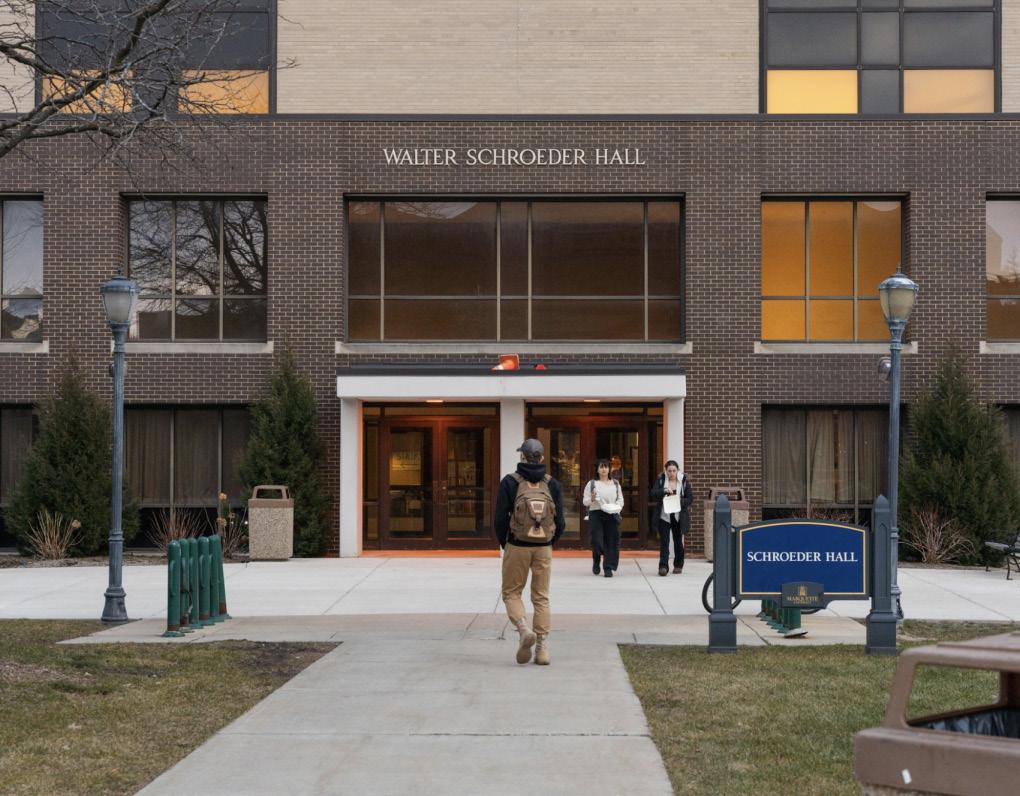
at Columbia, Hudson and Kranz have been thinking about how to secure academic and residential buildings on campus. In 2022, Marquette started locking all residence hall doors, requiring students use their MUID to get in. Since then, Hudson said,
MUPD has seen a decline in unauthorized individuals entering dorms. However, academic buildings are only locked during certain weekend and nighttime hours when classes aren’t in session. If university leadership, UAS members and the Marquette community show interest, Hudson
said, locking the buildings during the day could be a topic of discussion.
“I think that this is really a time where we should continue to consider that and lock as many doors as possible,” Hudson said. “Because there’s a reasonable expectation of privacy on the other side of that space.”
UAS members appeared eager to start a committee to explore locking the doors to academic building during the day. In the meantime, Hudson suggested faculty keep doors locked on campus when they can.
Man charged in Gesu vandalization
Estimated total cost of damage was $25,000
By Elena Metinidis elena.metinidis@marquette.edu
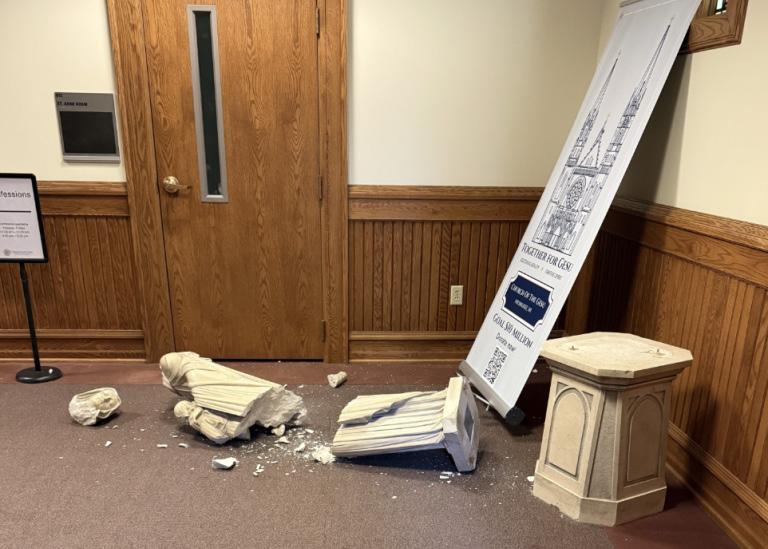
Parishioners praying at the Church of the Gesu — in the heart of Marquette University’s campus — the morning of March 18 were interrupted by a crashing sound.
Someone was vandalizing the church.
Demetres Xaviar Martece Henderson, 29, was charged with vandalizing the parish, causing an estimated $25,000 worth of damage inside the newly renovated church.
If charged, Milwaukee County determined on March 20 that Henderson could face up to 3.5 years in prison and $10,000 in fines, per Class I felonies in Wisconsin. His cash bond is set at $1,000.
One individual attempted
to intervene and a custodian contacted the Marquette University Police Department, who apprehended the suspect at the scene around 8 a.m.
Fr. Michael R. Simone, Gesu’s pastor, arrived shortly after police arrested the vandal. He said parishioners expressed sadness and concern about the loss of some sentimental items.
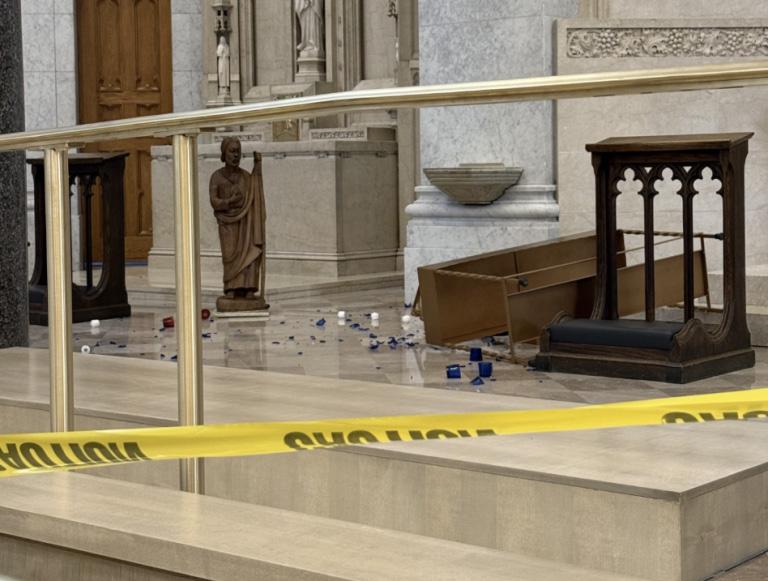
Nine statues in the lower church, along with four vigil candle holders, a statue, two wooden chairs and four kneelers in the upper church were damaged, per the criminal complaint acquired by the Marquette Wire.
But Simone is ready to forgive, and he’s calling on others to do the same.
“If I ever have the opportunity to talk to [the suspect] I’d say ‘Get yourself sorted out and come back and join the parish,’” he said.
To Simone’s understanding, the individual was experiencing a mental health
crisis and wasn’t violent towards parishioners. He believes this was not an anti-Catholic attack.
“He needs our prayers,” he said. “He needs our help.”
If anything, Simone said this incident has renewed his commitment to partnering with local mental health organizations.
The Gesu Parish underwent a $10.1 million renovation and reopened in November 2025. Upgrades included new flooring and pews, improved lighting and sound systems and a new baptismal font. Gesu also extended their hours to include more time for prayer during daytime hours.
Included in those renovations were security cameras and hotlines in the church that connect with MUPD.
In addition to heightened security technology, officers do a sweep of the church every hour during operational hours, Simone said.
Most of the damaged
items were from the 1960s and 1970s, aside from a statue of St. Anne which is over a century old. The church, Simone said, will look for someone to reconstruct this statue.
The other items, mostly made of plaster and wood, will be retired and buried, as is tradition in the Catholic church. Other repairs will be paid for if Gesu gets an insurance payout, Simone said.
University spokesperson Kevin Conway said even though Marquette isn’t directly affiliated with the Church of Gesu, MUPD is investigating the incident.
“Marquette University was saddened to learn that early this morning, an individual not affiliated with the university vandalized and damaged property inside the Church of the Gesu, a sacred space for many in the Marquette community,” Conway said in a statement.
MU responds to report of pushing risky loans
University leaders denied allegations at UAS meeting
By Sophia Tiedge sophia.tiedge@marquette.edu
Two faculty members from the Office of Student Financial Aid addressed University Academic Senate March 23 about the Feb. 23
New America report accusing Marquette University of pushing low-income families into high-risk loans.
“It’s just not something we do,” Brian Troyer, vice president for
enrollment management, said at the meeting.
Rather than offering more money in scholarships to students with financial need, study author Stephen Burd said, the money is being offered to wealthier, high-achieving students to boost the university’s rankings. To fill this gap, the study said, Marquette is pushing lower-income families to take out Parent PLUS Loans — a federal loan option with no borrowing limits, minimal requirements and higher interest rates.
But Troyer pushed back, defending the financial aid
office’s process.
“We actually take a couple additional steps to ensure that students — particularly low-income students — aren’t feeling like they’re being pressured into a particular decision,” he said.
Among those best practices, Troyer said, Marquette doesn’t immediately show families what loans could do for the total cost of attendance. Instead, families are shown the tuition after scholarships and aid, but before loans.
The bottom line is that the financial aid office isn’t training or telling
admissions counselors to push high-risk loans to low income families and parents, Troyer said.
Zack Goodwin, assistant vice president of student financial aid, said while the study accused Marquette of prioritizing merit aid for medium to high-income students, leaving less resourced families with a heavier financial burden, the university’s data shows a different trend.
“Our least resourced families, on average, borrow about 40% less than our other families,” he said. Goodwin also said low-
er-income students are able to recoup what they paid for their education in less than two years post-graduation.
Troyer added that the financial aid office is looking to make long-term changes to the the amount of unmet financial need. Goodwin also said Marquette has been able to meet about 85% of financial need for families of enrolled students.
When Troyer was asked if there’s been any fallout from the report, Troyer responded, “I would say no. Not that I’m aware of.”
Photo by Nick Gross nicholas.gross@marquette.edu
Nine statues in the church were damaged, among other items.
Photo by Nick Gross nick.gross@marquette.edu
The suspect was believed to be having a mental health
ODDS: Ph.D. student faced high death risk
Shortly after, he was preparing for his second heart surgery in four months. And as he was readying to face the anesthesia, Everard said seven words to the doctors:
“If you kill me, you kill me.”
Midway through the Fall 2016 semester, Everard came down with an illness. Barely able to eat or drink, he was given antibiotics to no avail, ultimately needing surgery to get his tonsils removed.
"'Am I gonna live a long life?' — no one at a young age should have to consider that."
Tony Everard Ph.D. student
While getting ready for the procedure, Everard took an electrocardiogram test to monitor his heart activity. The anesthesiologist told him there was something wrong and encouraged him to go for further testing after healing from his surgery.
The results showed he was born with a heart condition. He went in for surgery in January 2017.
“I basically put my life on hold,” he said. With Wolff-Parkinson-White syndrome, Everard had a second electrical pathway in his heart, which sent extra signals between the heart’s upper and lower chambers. The surge would often kick his heart into overdrive, causing an elevated heart rate. Over 99% of WPW cases are
non-life threatening.
But after eight hours in surgery, doctors discovered Everard had been in the other 1%. He was within the death risk — in any of his basketball games, he could have collapsed on the court.
“’You are damn lucky to be alive,’” Everard recalled doctors telling him.
Months after the surgery, he stepped onto a court again to play basketball, testing if his heart could handle the activity. His heart rate reached 250 beats per minute before he took off his monitor to play for another hour. Though he was unaffected by his heart rate, it was a signal that there was still work to be done.
So, Everard went in for a second surgery — which came with an added risk.
The procedure involved the burning of the extra electrical pathway, which surgeons did not complete during the first operation after nearly putting a hole in Everard’s heart. But, not wanting to live a limited life, he wanted to have the procedure anyway.
“I had to tell my parents goodbye,” Everard said. “When you’re 22, 23, telling your parents that — you grow up fast.”
Following the surgery, Everard spent a year undergoing testing to make sure his heart was functioning properly. Then, he went back to school to get his master’s degree. And the lifelong Wisconsinite returned to the school he once called home: Marquette.
Now, MBA in hand, Everard is pursuing a Ph.D. in business, researching the effects of mobile ticketing on consumers at sporting events. And he’s doing it with ten years’ worth of perspective.
“I have a different outlook
as guests come and go to watch the games while talking about basketball, life and stories from years past. Some have known him since grade school, others he befriended during his first stint at Marquette and others have become close friends during graduate school.
Despite their variance in connection, they share the same focus, watching the games under Everard’s meticulous planning. Just as the teams on the court have depth charts, he has his own in the living room, moving games to and from TVs depending on their magnitude. If a game comes down to the wire, it gets promoted to a bigger screen. If it’s a blowout, it gets relegated to the corner.
on life than most people,” he said. “When you’re crying yourself to sleep, like, ‘Am I gonna live? Am I gonna live a normal life? Am I gonna live a long life?’ — no one at a young age should have to consider that.”
While pushing for his Ph.D., Everard also runs his own business: Ticket Professor LLC. In addition to studying ticketing, he also sells them and is a consultant for ticket brokers.
His work and research have allowed him to watch live sports from coast to coast, attending the College Football Playoff, scouting teams for the Pop-Tarts and Citrus Bowls and stopping at March Madness games across the country.
But in 2026, as he does most years, Everard watched the first round in full from his own apartment, surrounded by friends.
Everard’s door swings open throughout the day,
But the planning doesn’t stop at the screen. Prior to the opening weekend of March Madness, Everard bought six pounds of chicken wings to serve — a more-cost efficient way to feed his friends than takeout. He also bought tamales and chips with salsa, which he said he knew his visitors would like.
Alex Grych, a 2016 graduate from the College of Business Administration, met Everard in 2011 on their floor in Mashuda Hall. The two have stayed in touch ever since, and Grych made sure to stop by for one final March Madness before moving to New York next month.
“Tony’s probably the most passionate sports fan I’ve ever met.” Grych said. “Nobody is even remotely close to the setup he has.”
Jake Dufresne met Everard playing baseball in Madison. The University of Wisconsin-Madison graduate moved to Milwaukee two years ago, and, like Grych, has kept in touch
with Everard.
“Pretty much all we do, whenever we text, it’s about college sports,” Dufresne said. “Tony’s just a good friend to have.”
Everard stays in touch with as many people as he can. His network, in all its expanse, comes with perks. When he travels for his ticketing adventures, he has a friend to stay with in nearly every major city.
It’s that commitment to friendship and connection that, for many, makes Everard an anchor for March Madness every year. The four TVs, chicken wings and beverage refrigerator all greet guests at the door, along with an open seat in the living room.
The watch parties’ purpose is threefold for Everard. He gets to watch basketball, spend time with friends and save them the expense of going to restaurants and bars to watch the games. Naturally, he spent the days leading up to the tournament texting as many friends, students and even neighbors as he could, inviting them to experience the madness together.
For Everard, gathering with friends is a reminder that life — in all its preciousness and unpredictability — means the most when it’s spent with others. When sitting around the living room, the group often throws out statistics, like shooting percentages and offensive efficiency. After all, with Everard’s background analyzing business, tickets and sports, he has learned how to interpret data.
But despite his experience crunching numbers, he doesn’t always listen to what they say — even when the odds are stacked against him.
“I’m lucky,” he said.
Everard also runs his own business while pursuing his Ph.D. in the College of Business Administration.
Photo by Lance Schulteis lance.schulteis@marquette.edu
Everard gets to watch basketball, spend time with friends and save them the expense of dining out.
Photo by Clay Ellis-Escobar clay.ellis-escobar@marquette.edu
Meet MU's new provost, Debbie Tahmassebi
She came to the university from Salt Lake City
By Sahil Gupta sahil.gupta@marquette.edu
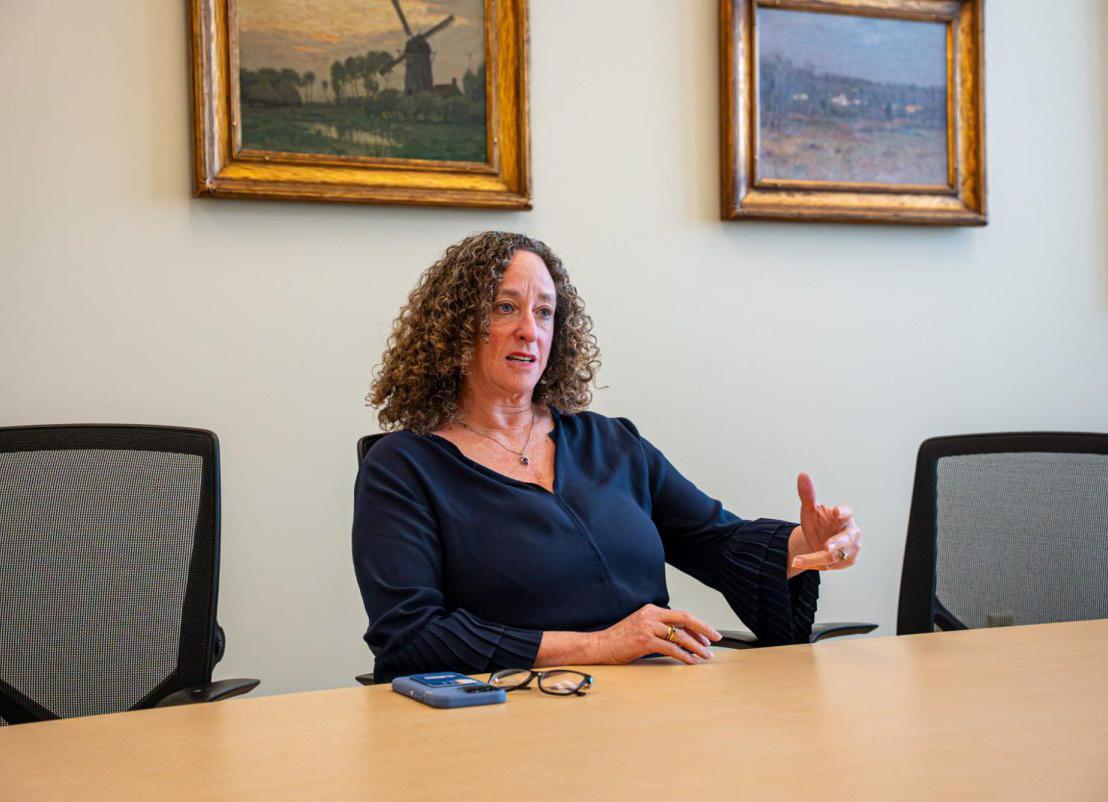
Marquette University’s newest provost, Debbie Tahmassebi, is diving headfirst into her new job.
After serving in the role for less than a month, Tahmassebi has already engaged in several notable university activities, including attending the Big East Research Symposium in New York City.
The provost attends every University Academic Senate meeting, and Tahmassebi made her first appearance March 23.
“If you see me across campus, please say hi,” she said during her senate remarks. “I do look forward to learning more about Marquette and all the wonderful things that are going on here.”
Tahmassebi came to Marquette from Westmin-
ster University, a Jesuit institution in Salt Lake City, Utah, where she served as provost since 2019. Before her career in educational leadership, she was a chemistry professor for nearly 16 years at the University of San Diego.
She said the transition from teaching and research to leadership was gradual.
Tahmassebi took on service jobs leading various university-wide initiatives, in addition to her work as a professor, discovering a passion for helping her university grow.
“When you’re a faculty member, you have a service component to your job,” she said. “I was just drawn to things that I thought were going to be beneficial for the entire university.”
Now, when she is not attending events, Tahmassebi has spent most of her time at Marquette exploring campus and getting to know the campus community. She plans to build trust with the community by talking with
people and engaging with campus stakeholders.
As head of academic affairs, the provost oversees an array of senior university leaders. This includes Marquette’s 10 academic deans, along with officials in research, enrollment and student affairs. Tahmassebi said her current focus is not necessarily action, but rather familiarizing herself with the topics and issues most relevant to Marquette.
“There is a pretty large portfolio with a lot of people to understand and know,” she said. “Right now, the work is not ‘Let me give you an answer,’ but rather ‘Let me learn more and let me take some time to be thoughtful about this.’”
Tahmassebi declined to indicate any specific projects that she plans to lead in her new role, saying she has not been at Marquette long enough to have a clear idea.
When asked about the college restructuring initiative spearheaded by former Acting Provost Sarah Feld-
ner, Tahmassebi said conversations are ongoing and task forces are convening to discuss the previously proposed measures that relate to research, pre-med advising and financial reporting.
Tahmassebi will also be in charge of leading other projects related to the 2031 Securing our Future initiative.
“I would expect to have that information in a few months, but that work is all getting started,” she said.
Tahmassebi said her primary goal is to always be thoughtful about how her actions and decisions as provost affect the campus community, something she said aligns with Marquette’s Jesuit values.
“I’m more focused on what it is that you’re going to do, and what value are you bringing back into your community,” she said.
Students react to limited counseling resources
Care services are determined on a case-by-case basis
By Elena Metinidis elena.metinidis@marquette.edu
The counseling center at Marquette University operates on individualized care. This means the resources for students, number of sessions and frequency of care are determined on a case-by-case basis. Some students say this model works for them, others expect more.
“The one thing people need to be mindful of is your expectation can’t be too high with counseling,” Eli Hincapie, a junior in the College of Communication, said, having heard mixed opinions from students.
The center’s service model is “time-limited,” which Brenda Lenz, licensed professional counselor and director of Marquette’s Counseling Center, said can be hard to define across every student, but can be understood as a temporary period of counseling sessions.
Some students can have their needs met in three or four sessions, while some spend weeks working with counselors.
“If we can accommodate [a student], we will,” Lenz said. “If we are unable to accommodate [them], then we’ll have a conversation about figuring out the best way to get that need met.”
Marquette’s center is unique, as its services are only available while students are in school.
Lenz pointed out that a lot of students seek counseling for stress management and short-term situations, which can be resolved with a low number of sessions. She emphasized, though, that students can always return to the center even after their previous needs were met or if a new problem arises that the center can assist with.
First appointments at the center are dedicated to an assessment of needs and exploring what students can accomplish with a counselor. Lenz said counselors are trained to recognize if a student needs something more than what the center can
provide. When students are referred to outside therapy, it’s often for cases of more severe or ongoing mental health concerns, or if committing to routine, longterm therapy would better serve a student, Lenz said.
“We prioritize the finite amount of resources that we have,” Lenz said.
The team of clinicians — who are all licensed counselors, psychologists, social workers and certified substance use professionals — continue treating students until an appropriate outside referral is made. They provide coping tools and mental health resources until a student is linked to services that match their needs and insurance benefits.
Eliza Weiss, a junior in the College of Communication, said she appreciated her counselor’s early clarification that her services would be limited to one semester. She said transparency allows students to be cognizant when nearing the end of their sessions so there is ample time to find outside resources.
That said, students who feel they would benefit from the Counseling Center don’t usually face any obstacles deterring them from finding or continuing services.
Appointments can always be made online, over the phone, or by walking into the Center, located on the 4th floor of the Wellness + Helfaer Recreation Center. There are never waitlists for accessing care, something Lenz said the Center has always prioritized, and students can book anywhere
from a few days to two weeks in advance.
“We want to be available when students need us,” Lenz said. “We want to be busy. We are built to manage busy.”
The Center operates from 8 a.m. to 4:30 p.m. on weekdays but also provides an emergency hotline available 24/7 year-round.
“Free counseling seemed like a convenient opportunity and amenity that Marquette offers,” Hincapie said.
While students don’t have to pay anything when they visit, $210 for a health services fee is included in Marquette’s cost of attendance. Most private Jesuit universities and colleges offer free counseling services to students, serving as part of the Jesuit principle of “cura personalis” (care for the whole person). Support is provided for stress, anxiety and mental health by professional clinicians.
In his first year at Marquette, Hincapie gave the center a shot after always wanting to try counseling, saying he made sure his expectations weren’t unrealistic.
“It’s not therapy,” he said. “Maybe some people expect more.”
Hincapie urges students not to blur the lines between counseling — a space to simply freely talk and receive comments — and therapy, which can offer “breakthroughs,” exercises, programs and psychological evaluations.
Hincapie transitioned from using the Counseling
Center to attending therapy at Marquette’s Center for Psychological Services earlier this school year.
If students want something more in-depth than counseling, Hincapie recommends looking into this therapy resource at Marquette. Each visit costs $25, which he said is cheaper than outside services while also having a significantly shorter waitlist.
The Counseling Center team admits they can’t meet every need. They do, however, understand the value of a well-rounded approach to emotional well-being and psychological health.
The Center has partners on and off campus that can provide additional resources, acknowledging that counseling is only a small part of strengthening mental health. A full list of support services is available online, which includes Campus Ministry, Victim Advocacy Services, Active Minds and Aurora Health Care Healing & Advocacy Services.
Outreach to student organizations is also a way the center remains connected and receives feedback.
“If we’re not in our community, there can be lots of assumptions about who we are and what we do,” Lenz said. “We want to be approachable.”
Lenz encourages students to seek what the center offers and to understand on-campus counseling can be a resource for “time-limited” situations that arise throughout students’ college journey.
Tahmassebi has spent her time meeting the campus community.
Photo by Clay Ellis-Escobar clay.ellis-escobar@marquette.edu
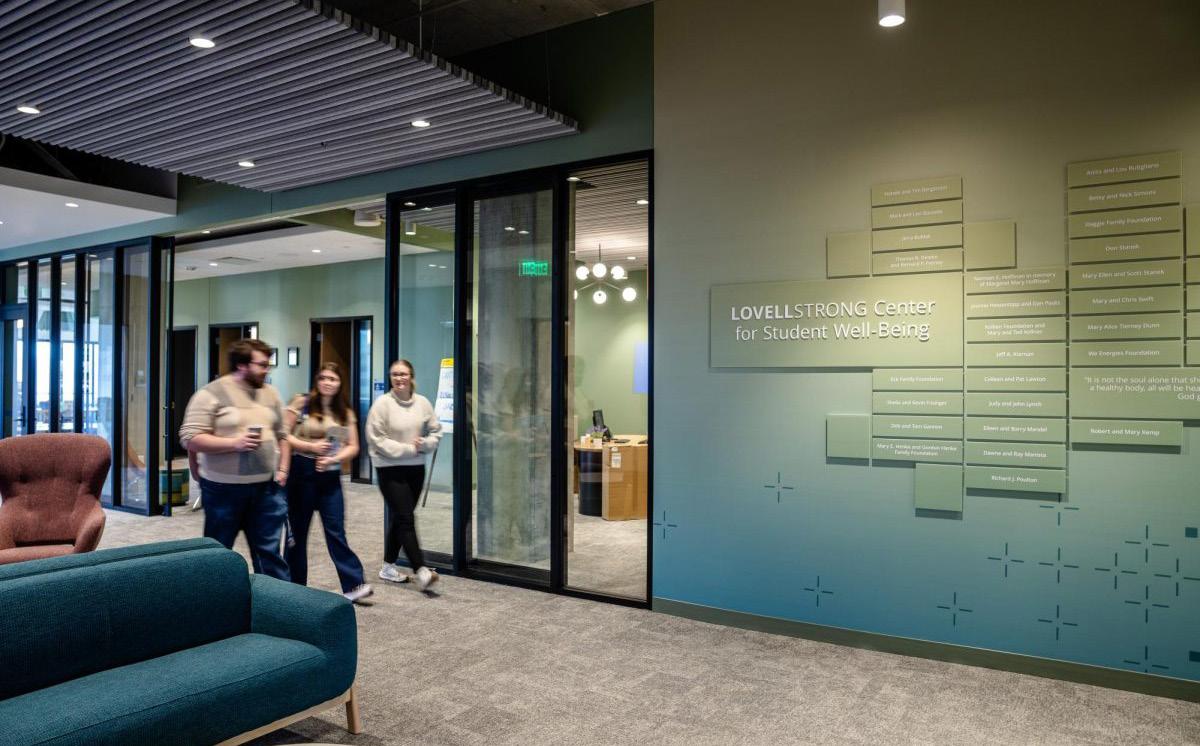
The Counseling Center refers students to off-campus resources.
Photo courtesy of Marquette University
After originally planning to leave Marquette, Nolan Rappis decided to return for his final year on
Back in the blue & gold
Rappis returned to MLAX team for graduate season
By Matthew Baltz matthew.baltz@marquette.edu
Standing in the woods, in front of his Marquette men’s lacrosse teammates, Nolan Rappis finally got to say what he had been wrestling with for months.
After an offseason of going back and forth between entering the workforce or
returning to Valley Fields for a fifth season, the attacker was in for one last ride with the Golden Eagles. But it wasn’t a decision he made overnight.
During a team retreat at the start of the spring semester, Rappis finally shared why the decision was such a difficult one for him.
“It was a moment that really felt impactful, as everyone got to listen to why he made such a big decision,” head coach Jake Richard said. “They were all pretty energized to make it a
great thing for him.”
Although Rappis was honored on senior day last season, he had another year of eligibility because of a medical redshirt he took after suffering a season-ending knee injury in his first year at Marquette.
After graduating in May with a Corporate Communications degree, Rappis was at a crossroads in life. He was unsure what the next step looked like for himself.
“At that point in the summer I was looking for jobs,” Rappis said. “But then
thinking like, ‘Why am I looking? Because I might play.’ And then I was like, ‘I should be looking for jobs because I might not play.’ It was kind of a weird spot to be in.”
Along the way, Rappis had several voices in his ear helping him make the decision, including newly hired offensive coordinator Andrew Smistad.
Two days after Smistad got the job, he made his first recruiting pitch to Rappis.
“We talked for over an
See BACK page 6
MUVB VB returns to Fiserv
Golden Eagles open 2026 season at NBA arena
By Jack Albright jack.albright@marquette.edu
Marquette volleyball is going back to Fiserv Forum, this time against a different powerhouse.
The Golden Eagles will return to the NBA arena for the third time for their season-opener against Texas on Aug. 24. Marquette played in-state rival Wisconsin in its two previous matches at Fiserv, in 2023 and 2025, losing both times.
The Longhorns are coming to Milwaukee for the American Volleyball Coaches Association (AVCA) first serve event, and will play MU in the final day of the competition. Texas was a No. 1 seed in the 2025 NCAA tournament and lost to the Badgers in the Elite Eight.
“We chose Marquette because of the culture of the university and athletic department but also for this program to compete at the highest level, so playing Texas at Fiserv Forum is the type of match that our players came from around the Midwest and world to play,” head coach Tom Mendoza said in a release.
“Our team is training incredibly hard this spring to have a great season in the fall, so to have an exciting match and environment
See FISERV page 7 WOMEN'S
Young stars 'don't care that they're freshmen'
First-years have earned multiple Big East awards
By Ben Hanson benjamin.hanson@marquette.edu
Head coach Meredith Black knew almost immediately she had something special.
This past summer, the Marquette women’s lacrosse team’s incoming first-years competed in a tournament against other Division I teams’ newcomers.
They almost won the whole thing.
“Who didn’t we win
against?” first-year Gabbi Perino said while trying to remember the games.
One game into Big East play, many of Marquette’s 12 first-years have flaunted their dominance while adopting critical roles and replacing empty ones from last season’s departures.
“They don’t care that they’re freshmen,” Black said. “They’re like ‘We’ll lead if you need us to lead, we’ll play hard if you need us to play hard, we’ll set the tone if you need us to set the tone.’
“This freshman class is better than any other freshman class we’ve ever had.”
See YOUNG page 6
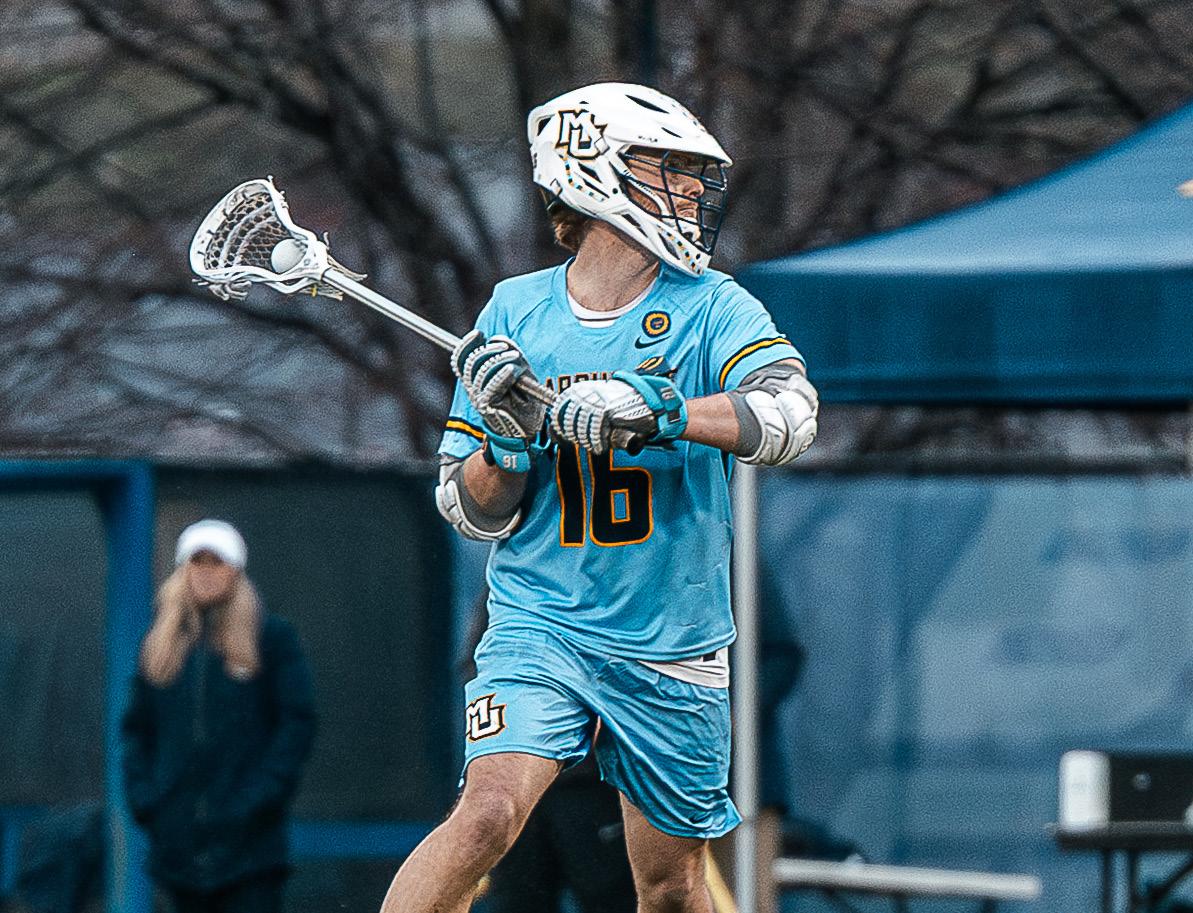
the men's lacrosse team.
Photo courtesy Marquette athletics
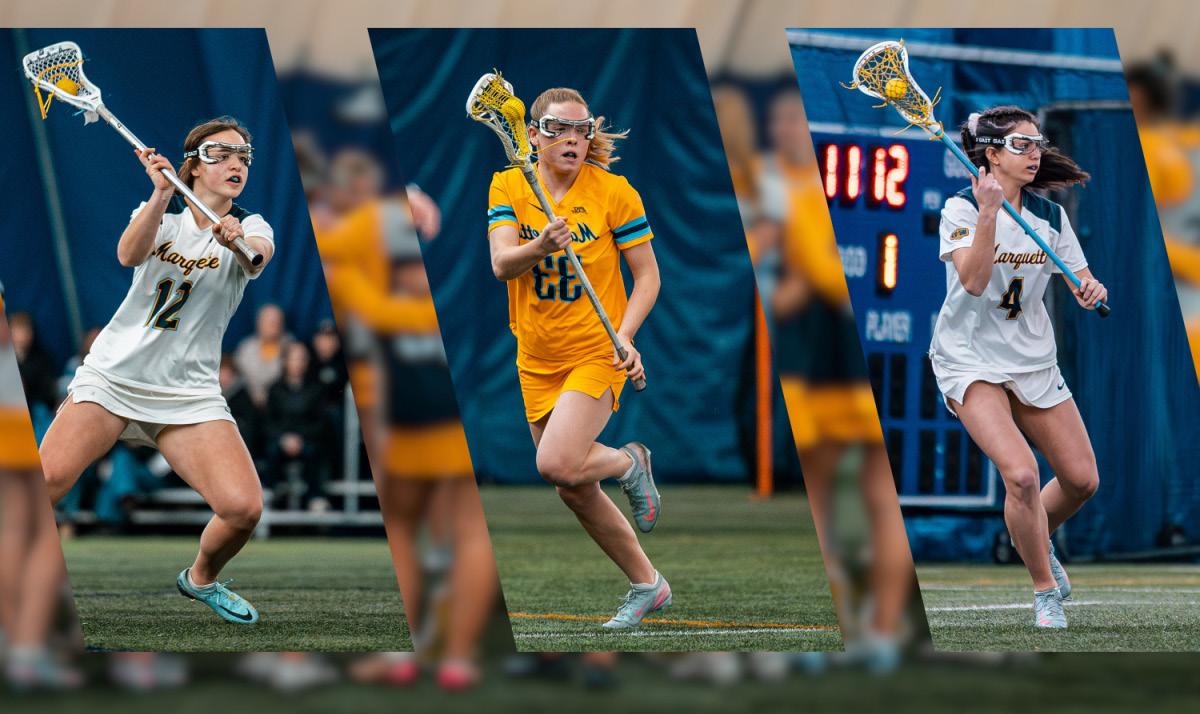
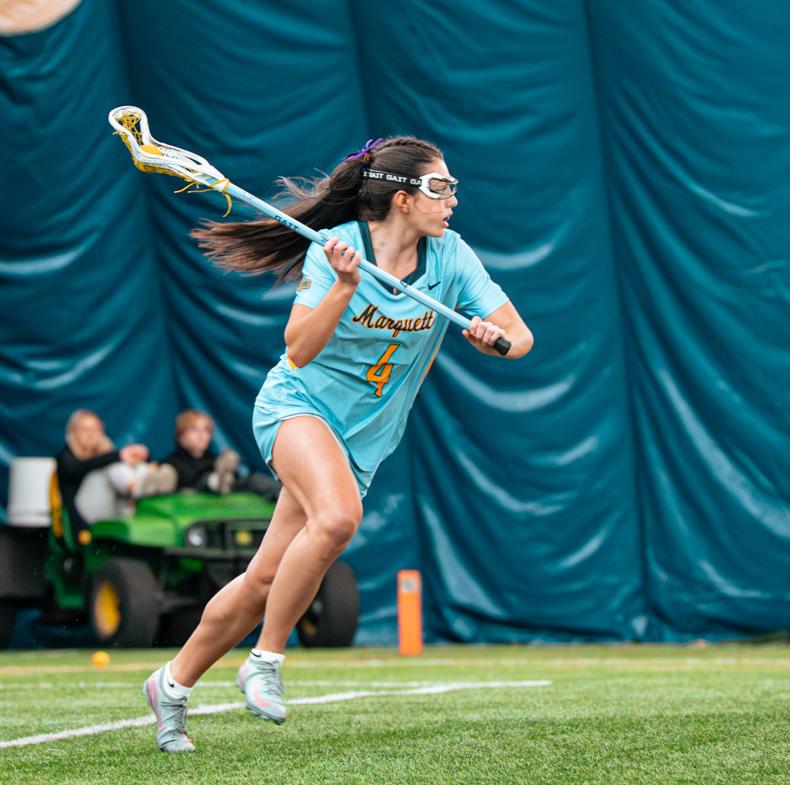
Women's lacrosse first-years Ella Mautz (left), Gabby Windesheim (center) and Dani Serrano.
Photos courtesy of Marquette athletics
Graphic by Ben Hanson
YOUNG: Serrano leads team in points
Continued from page 5
This group comes from the recruiting that followed the Golden Eagles’ historic 2023 season, in which they earned their first NCAA tournament bid in program history and earned a record 15 wins.
One new face from that pool is already showing flashes of history-making skill.
Dani Serrano is on track to finish the season as the points leader on the team, a feat no first-year has ever achieved.
This team-leading performance has come from Serrano’s ability to score and assist. She currently has 46 points, followed by senior attacker Tess Osburn’s 36 and graduate midfielder Hanna Bodner’s 26. Against Central Michigan, Serrano tallied nine points: a firstyear single game program record. The only other player on the team to strike the balance of helping and doing has been first-year attacker Ella Mautz: fourth on the team in points.
Regardless of their collegiate inexperience, Black has made a point of continuing to give them minutes on the field.
“Every game you’re going to experience something new and you’re going to have a new challenge,” Black recounted telling Serrano. “Now she’s on everyone’s scouting report
already, so she’s going to have to manage that.
“That lack of experience is the tough part about having solid freshmen.”
Serrano’s determination to exceed expectations comes from her time in high school. She was placed on her lacrosse club’s B-team despite setting a single season assist record at Our Lady of Good Counsel High School which was No. 2 in the country at the time.
"This freshman class is better than any other freshman class we've ever had."
Meredith Black Marquette women's lacrosse head coach
“I know what I want to do with the ball, I want to be the best and everyone can tell and I push myself,”
Serrano said, insisting prior that she is very humble.
“It’s that confidence that sets me aside from everyone else.”
On Feb. 16 and March 2, the Boyds, Maryland native received Big East Freshman of the Week.
But, naturally with this class, she wasn’t the only one garnering conference attention.
Last week, Gabby Windesheim also grabbed the honor, in part because of her career-high nine draw controls in the Golden Eagles’ 6-5 win over Niagara. As one of the primary draw control specialists, she sits second on the team in the stat (26).
The duo’s accolades mark the first time in program history two different Marquette players earned this award in the same season.
“It’s so cool,” Windesheim said of first-years finding success so early in her collegiate career. “It gets me excited for the next year and everything in store for us.”
The bond this group shares extends well off the field, as well.
Every first-year on the team lives in Humphrey Hall, many of them roommates. As roommates, Serrano and Windesheim watch film together and whenever one goes to train early in the morning, they bring the other along.
“We each push each other to be better,” Windesheim said.
As a group, the loss of Marquette men’s lacrosse’s Noah Snyder and Scott Michaud in September brought them even closer. This happened only a few months into them knowing
MEN'S LACROSSE
each other.
“We all had to rely on each other and be each other’s support system,” Serrano said. “We were coming into a new environment and we all loved each other right away.”
History has shown — as it did with this first-year class — successful seasons can mean better recruits. But Black continues to focus on what they have now, not what they can get in the future. Especially as they get further into Big East play, they’re hungry for success in their conference.
Marquette hasn’t made the Big East tournament since its notable 2023 season and has never
earned a conference regular season or tournament title. The highest it has finished in the Big East is second, losing out to perennial power Denver.
Bodner, one of the oldest on the Marquette roster, led a team meeting earlier last week to inform the first-years what to expect from conference play. She detailed how hard these games are going to be, especially their first against Georgetown on March 21.
“They’ve never backed down from a challenge yet,” Black said before their matchup against the Hoyas. And this is only year one.
BACK: Attacker returned for late players
Continued from page 5 hour in the summer, and I just kind of gave him my vision,” Smistad said. “I gave him my thoughts on him as a player, where I thought he’d fit. And then
I left the ball in his court.” Rappis kept in contact with Smistad and Richard throughout the summer and in the fall. Rappis didn’t know it at the time, but if he didn’t enroll in the
fall semester, the spring semester would still be an option.
“I knew he was still on the fence, he wasn’t sure,” Smistad said. “He was leaning towards not coming back.”
In early September, Rappis, along with former teammates Bobby O’Grady, Will Foster and others, made a sudden, unexpected trip back to Marquette’s campus after Noah Snyder and Scott Michaud had been killed in a car accident.
It left everyone who knew Snyder and Michaud devastated, including Rappis — who was close with both after sharing the field with them last season. But it meant he re-immersed himself with the program in the immediate aftermath.
At the time, he was leaning even further towards not coming back for a grad year. He then had a conversation with Richard that changed the course of his entire decision-making process.
“Coach Richard had talked to me and was like ‘If you want to come back, we can still make it work for the spring,'” Rappis said. “I was like ‘Oh, really.’
“I didn’t know that was going to be a possibility at all.”
After months of uncertainty, the time Rappis spent with his teammates and the conversations he had with coaches provided him the clarity he needed to make his decision.
He wanted to play again.
“I was wanting to play for [Snyder and Michaud] more than anything,” Rappis said. “I wanted to do whatever I could to help.
“Just not being [at Marquette], I felt helpless. I know a lot of alumni felt that way, but a lot of alumni didn’t have the option to do anything about it, and I did. So, I was kind of just like, ‘Why would you not do that?'”
Rappis began taking the final steps towards officially returning to the Golden Eagles around Thanksgiving and returned to
campus during winter break to work out by himself and get ready for the season.
Not only did the Golden Eagles get a player back that was tied for the teamhigh in points last season and a unanimous preseason All-Big East team selection, but also a guy whose character they value. Over the past two seasons, Rappis has quickly turned into a leader for Marquette.
“When your best players are also your best people,” Smistad said, “that’s a cool thing to have.”
Rappis may have missed the fall season, but you wouldn’t know it by the way he’s playing.
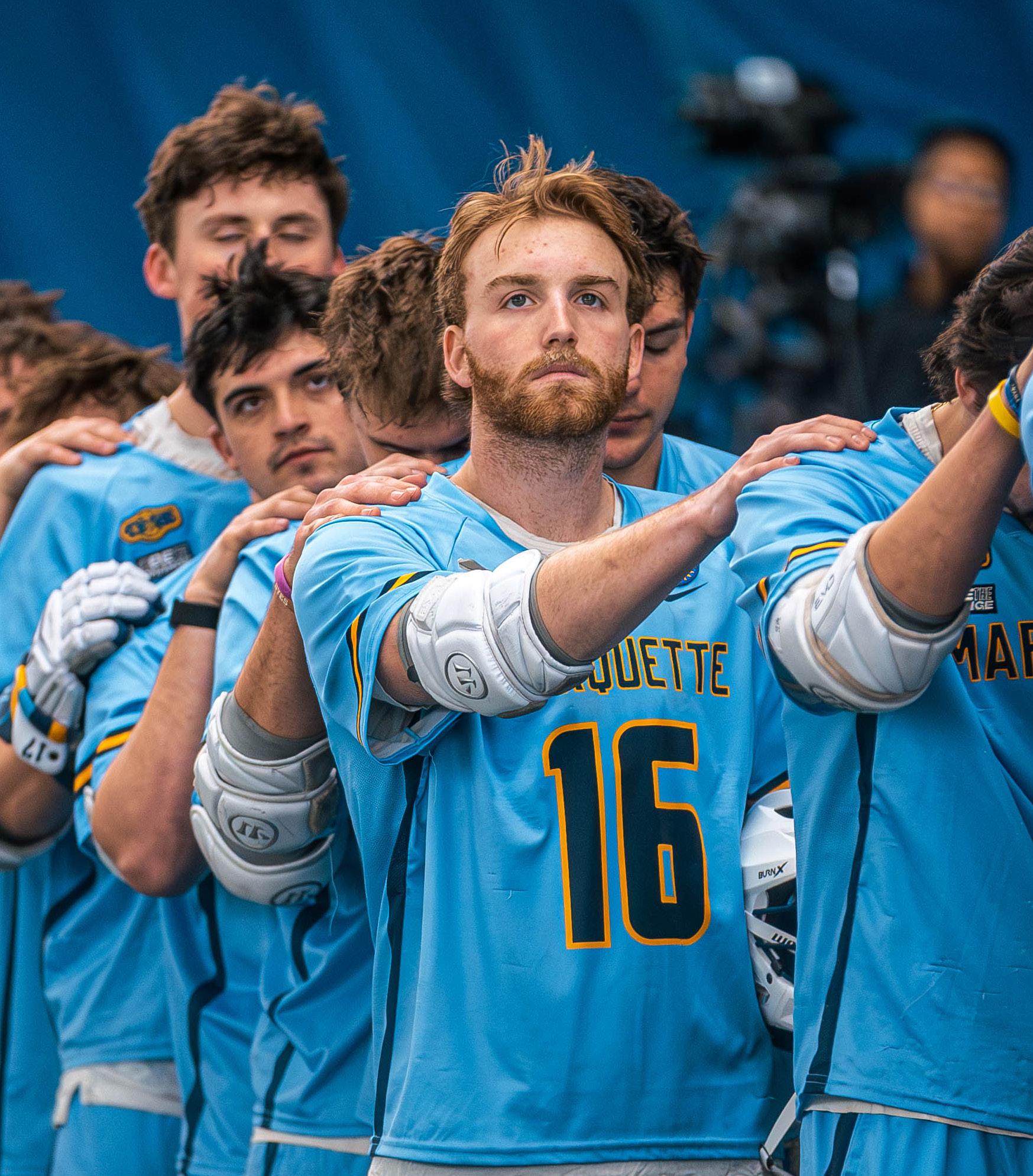
Rappis’ 26 points rank second on the team behind Carsen Brandt’s 29. The 11 assists he’s tallied are a team-high.
He most recently recorded a season-high seven points in Marquette’s 1510 win over Bellarmine on Saturday. Rappis has scored three or more goals in half of the Golden Eagles’ contests this year.
First-year attacker Dani Serrano leads Marquette with 46 points
Rappis earned a spot on this week's Big East weekly honor roll.
Photos courtesy Marquette athletics
Photo by Clay Ellis-Escobar clay.ellis-escobar@marquette.edu
TRACK & FIELD
White, Broaddus post career-bests
Weight throwers end indoor season with top-10 scores
By Lukas Schulze lukas.schulze@marquette.edu
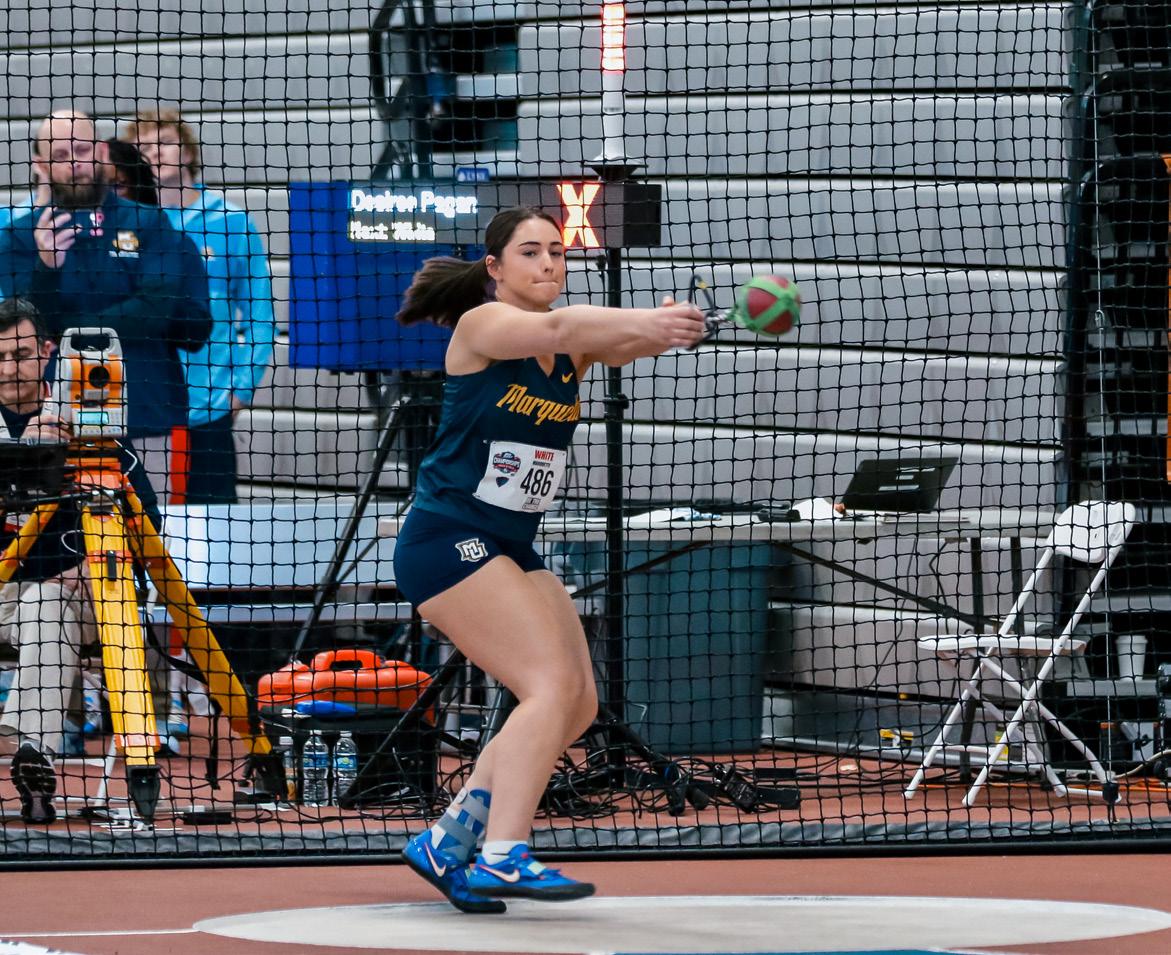
Junior thrower Megan White capped off an accolade heavy indoor season with a bronze medal in the women’s weight throw at the Big East Championships.
But that medal was just a glimpse into the career indoor season that White had. A campaign that also included making an appearance on the All-Big East team and recording a top 10 throw all-time in the indoor women’s weight throw.
She stamped her name in the history books by increasing her personal best throw to 17.81m, which moved her to eighth alltime in program history, a feat she claims wouldn’t be possible without the help from her teammates.
“Having my teammates around, they’re my best friends,” White said. “They were hyping me up.”
One of those teammates that also finds herself on Marquette’s all-time top 10 list for the women’s weight throw is sophomore
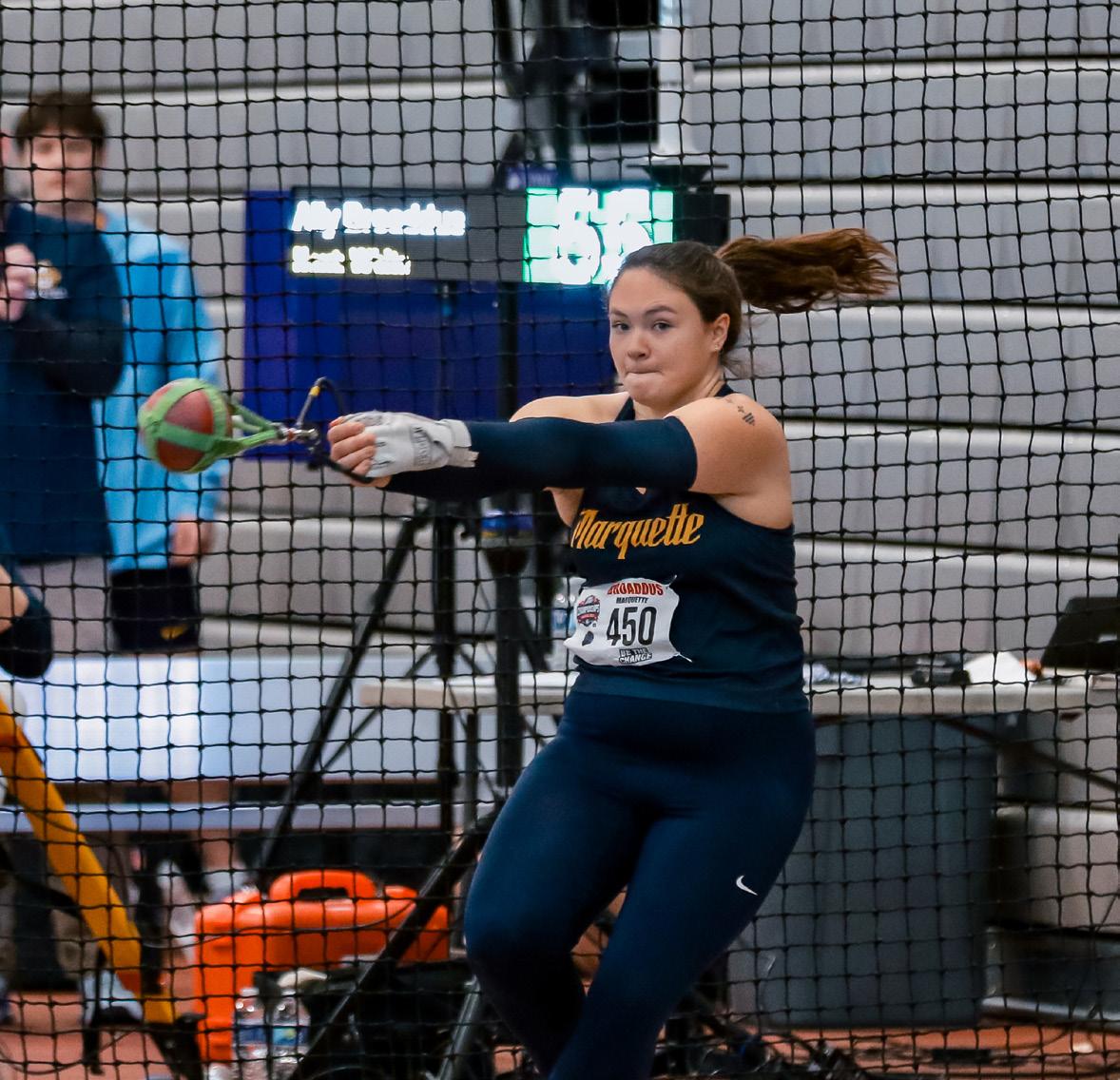
thrower Ally Broaddus. Broaddus has seen a stark increase in her distance, going from a personal best of 15.31m in her firstyear campaign to 17.57m in 2026, the 10th longest indoor women’s weight throw in program history.
Broaddus said her improvement has come in large part to practicing with White throughout their two seasons as teammates.
“In high school, I never had anyone to look to on how it’s done,” Broaddus
said. “Megan especially, I’ll watch her throw and be like, ‘Oh that’s what it looks like.’”
The thing that stands out the most to Broaddus about White is how consistent her technique is, especially when it comes to her posture, something necessary to throwing well.
“She is so consistent in every turn in the ring,” Broaddus said. “If I feel like I’m falling out of the throw, I’ll kind of watch how she does it.”
Like Broaddus, White has seen a significant jump in production since stepping on Marquette’s campus in 2023. After a first year that saw her personal best sit at 14.99m, White found nearly three more meters to achieve the 17.81 PR.
White’s summer training has been key to the improvement that she has seen in her throwing distances over the course of her college career.
Using the training that her coaches have provided for her, while also going back to throw at her high school, in Ohio, White has continued to see her numbers rise.
“Lifting has the biggest impact (in the offseason),” White said. “As long as I stay strong over the summer it works out.”
All the summer workouts, practices and meets built up to the Big East Championships in Chicago, where White was able to cap off the indoor season with a bronze medal in the women’s weight throw.
“It feels great,” White said. “I walked out of there
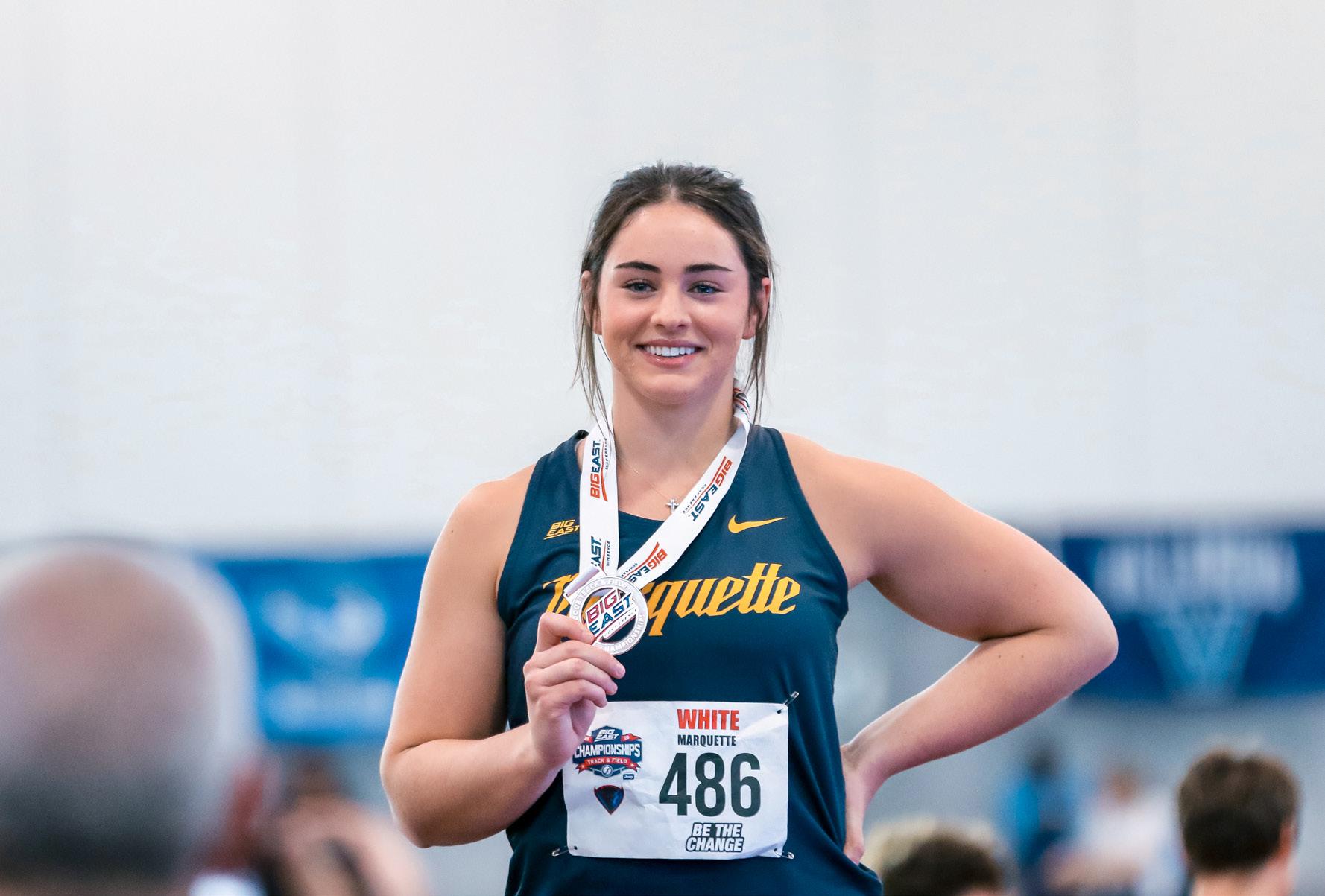
feeling really happy.”
But White’s goal wasn’t bronze; it was gold. Falling short gave her all the motivation that she needed as the Golden Eagles head into the outdoor season this week.
“The practice coming back after Big East, I was ready to actually kill it,” White said. “I’m really motivated this year, probably the most out of my last two years.”
But White again credits her teammates and fans for helping her stay confident even when things don’t go as planned. That’s part of the reason why both White and Broaddus agree that they are the most tight knit team in the Big East.
“We are very close; we have a lot of positive energy for everybody,” White said. “We kind of just always sit together whenever we have free time.”
The comradery of the Golden Eagle track team has helped both athletes achieve their career best season in 2025-26. A campaign they will look to build from as they head to St. Louis this Thursday for the beginning of the outdoor season.
FISERV: Marquette faces powerhouse Texas
Continued from page 5
to start the season brings a level of tangibility to preparation from now until Aug. 24.”
The Golden Eagles enter their second season under Mendoza, who made it to the Round of 32 of the NCAA tournament in his first year at the helm, nearly upsetting No. 2 seed Louisville in a five set thriller.
But, Marquette lost all three of its 2025 AllBig East and AVCA AllNorth Region honorees, along with starting libero Adriana Studer.
Middle blocker Hattie Bray graduated after becoming the first player in program history to ever be drafted into Major League Volleyball. Outside hitter Natalie Ring transferred to Texas A&M after her career season, and setter Isabela Haggard went to Baylor. Mendoza acquired four new players to replenish the losses.
In lieu of Ring, he got outside hitter Carson Tyler from Ball State, who won MAC player of the year after posting 506 kills, 321 digs and 43 aces during her
sophomore season.
To make up for Haggard’s departure, Mendoza grabbed setter Luanna Markus as a late addition to their 2026 recruiting class, joining three other previously signed Golden Eagles Molly Welge, Caydence Doolan and Allie Beers.
Then, in early March, Marquette signed Slovenian twins Emi and Tani Juric. The libero Emi and outside hitter Tani were teammates on OK Ankaran Hrvatini from 2023-26.
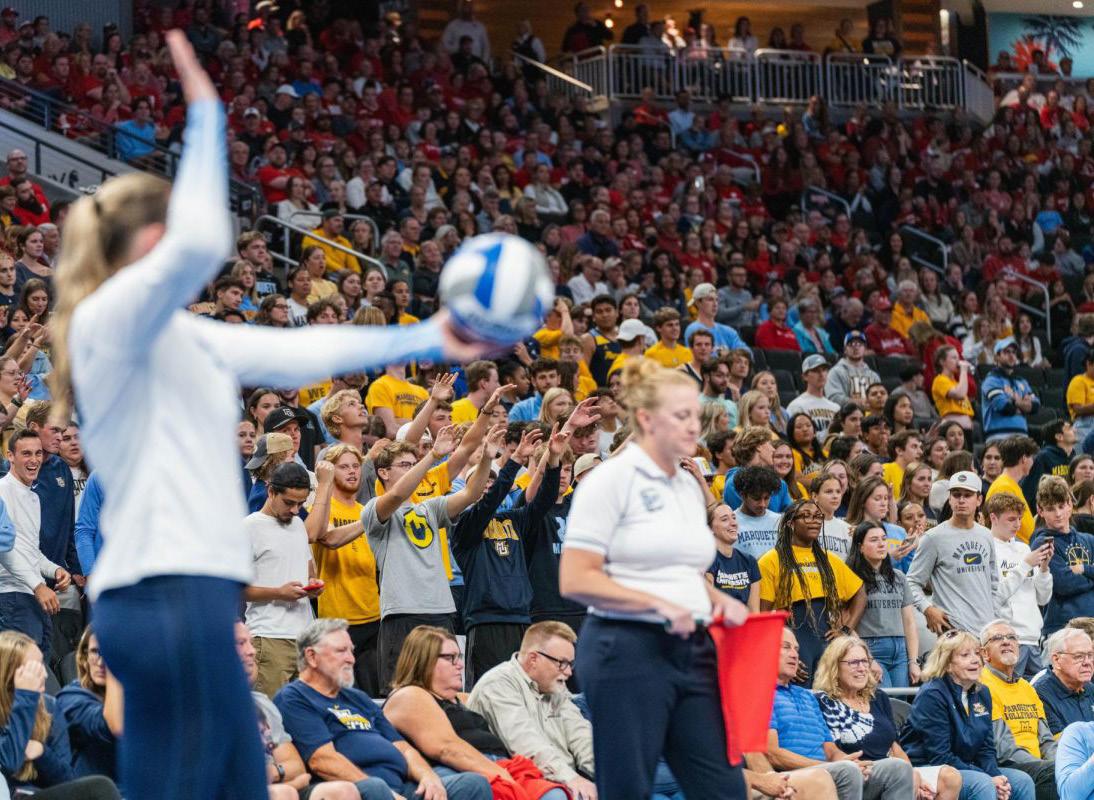
Marquette volleyball has played in Fiserv Forum twice before.
Marquette Wire Stock Photo
WOMEN'S VOLLEYBALL
Megan White finished the indoor Big East championships weight throw in third place (16.73m).
Ally Broaddus improved her throw from 15.31m to 17.57m.
Junior thrower Megan White earned indoor All-Big East honors.
Photos courtesy Marquette athletics
Blagoev reinvigorated by summer regimen
Sophomore moved up to No. 2 singles spot since Feb. 11
By Mikey Severson michael.severson@marquette.edu
Kristian Blagoev knew how important last summer would be.
After his fluctuating first year on the Marquette men’s tennis team ended anticlimactically, Blagoev went into the break hoping to find his form again.
He needed to tap into the skill that lifted him from the No. 6 singles spot in his collegiate debut to the No. 2 individual Golden Eagle against North Dakota in just over one month.
The ability that allowed him to keep pace in that match with Fighting Hawk Leandro Zgraggen — who served as North Dakota’s top singles player in every other match in UND’s 202425 season — in a close 5-7, 4-6 loss that showcased his ability to compete against
high-level talent early on. Blagoev temporarily lost his shape after missing nearly a month of his rookie season because of mono. When he returned for the last three matches in April, he couldn’t shake the rust that came with his extended time off and fell short in all of them.
“When I came back from (being sick), I wasn’t playing very good, but, in general, I don’t think I was performing the way I wanted to the expectations I had, which is partly because college tennis is totally different,” Blagoev said. “These guys are older, they’re more mature, play better and it’s tough.
“I knew this past summer was going to be huge for my development.”
Back in his hometown last summer, with the sun shining on the offseason, he instructed junior tennis players at the College Park Athletic Club across the border in Bannockburn, Ill. After teaching, he

would hit with his coach, and sprinkled in some friendly singles exhibitions with his friends, an intense approach that helped him stay in peak playing form.
He targeted five hours of court time a day through his job and practicing, along with going to the gym, cardio and refueling as part of his regimen.
“It’s like as many hours on the court as I can, I was going until I couldn’t feel my legs anymore,” Blagoev said. “It was just constant; you really have to push yourself hard. I felt the more I get out of that, the more it will come in the season, I thought that paid off dividends.”
That determination served Blagoev well going into his sophomore year.
"I knew this past summer was going to be huge for my development."
Kristian Blagoev Marquette men's tennis sophomore
Starting at the No. 4 singles spot, he got into a rhythm and started as the No. 2 singles in his first home match against Illinois State.
His second time out against the Broncos in Kalamazoo — this time playing four spots higher than his MU debut — Blagoev saved Marquette from a sweep by hanging tough. He was down 4-5 in the second set and needed to grit out three games to force a 10-point tiebreak.
He did just that, and then only gave up two points in the tiebreaker.
“It’s all about trusting yourself and really committing,” Blagoev said.
Marquette men’s
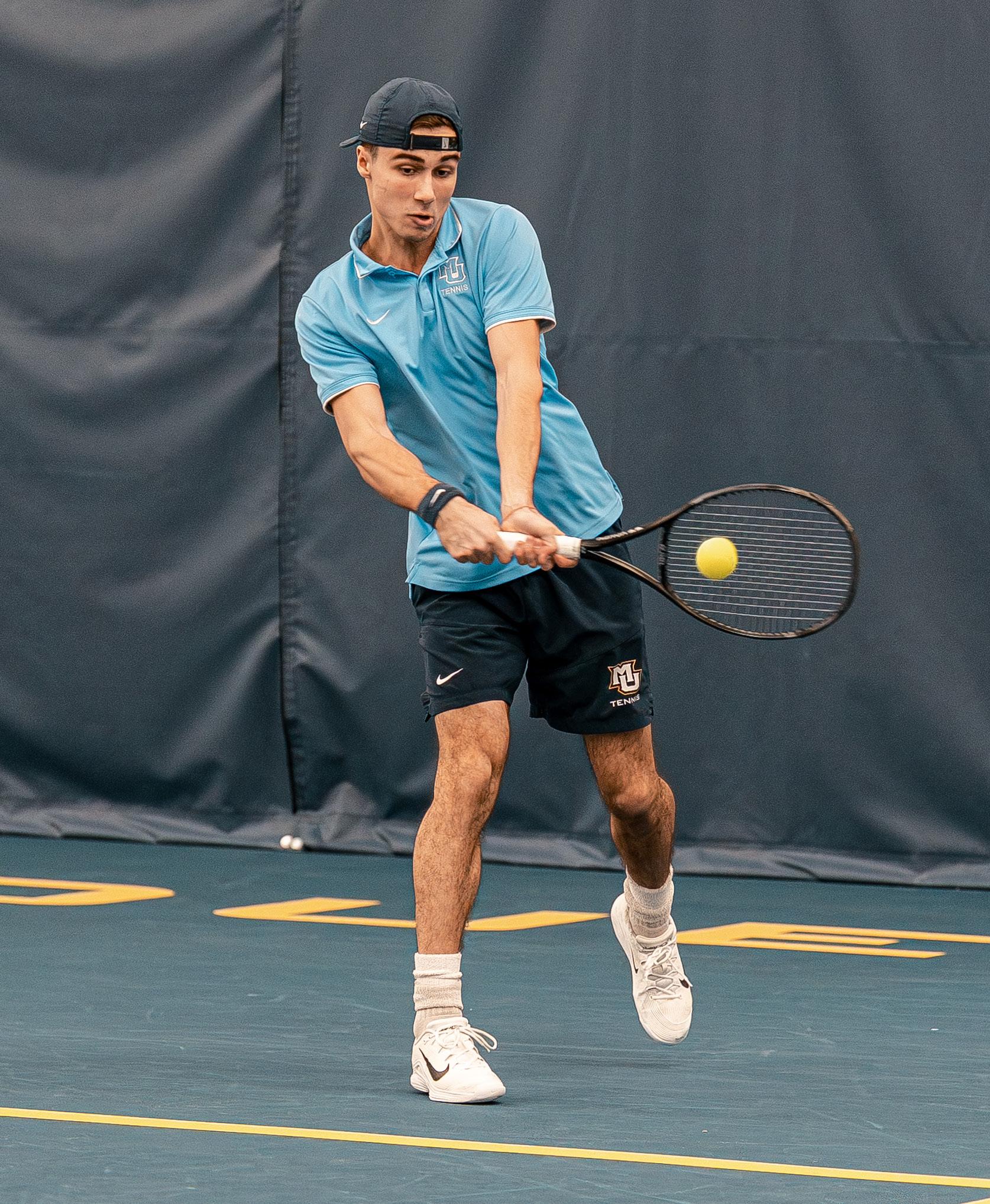
tennis head coach Jud Shaufler said that Blagoev had “earned” his midseason climb up the Marquette lineup behind a reinvigorated sense of focus.
“If things don’t go so well, he stays the course a little bit, keeps probing, thinking and competing, where sometimes early on in the past he might get a little frazzled,” Shaufler said. “I think he’s growing into it a little bit in terms of his tolerance, and that’s been part of the process for him.”
The sophomore has since won No. 2 singles matches against Chicago State, Xavier, Georgetown and Villanova. His March 20 victory against the Hoyas, even after a 1-6 loss in the first set, stopped another sweep of the Golden Eagles — this one by the slimmest margin in tennis, two points.
Senior Blake Roegner, who has played at the top singles position for the blue & gold in the past two years, said that Blagoev’s never-quit mentality is
reflective of his motivation and continued learning.
“When (Blagoev) walks out there, I see him, and he’s going to battle no matter what,” Roegner said. “Not a lot of people like to play opponents the way that he plays. I would hate playing against him in an actual match, just because I know I have to hit so many balls into the court and that’s where I think he has improved a ton; he’s forced these other players to play like that.”
Blagoev said that he has learned a lot from watching and practicing with Roegner.
“Blake (Roegner) is kind of my second coach at this point, he’s been in this same position that I’m trying to get to, and that I’m currently playing in right now,” Blagoev said.
“He’s played these guys more than I have, and it’s been great having him here,” Blagoev said. “We had seven freshmen last year and seven sophomores this year, I don’t know what we would do without him.”


Marquette women's basketball junior forward Charia Smith announced on Instagram she is leaving the Golden Eagles.
Blagoev began the year at No. 4 singles before moving to 2nd.
Photos courtesy of Marquette athletics
Opinions
Cancel Cesar Chavez but don't erase him
By Rachel Lopera rachel.lopera@marquette.edu
Milwaukee canceled its Cesar Chavez Day event in response to the March 18 New York Times report accusing Chavez of sexually abusing women and girls. While it is a serious matter to contemplate, we cannot simply erase history.
Chavez was a Latino civil rights activist and helped co-found what is now the United Farm Workers labor union. He advocated for farm workers’ rights, led strikes and boycotts and cultivated a legacy of social justice. He passed away in 1993 at age 66.
The New York Times in-
terviewed several women about their interactions with Chavez, revealing multiple sexually inappropriate encounters. The women recalled Chavez molesting them and non-consensually touching and kissing them as minors and carrying into their adulthood. They spoke of disgusting, traumatizing experiences that no woman should ever go through.
Among the victims was Ana Murguia, who was 13 years old when Chavez would summon her for sexual encounters. He was 45 years old.
After the allegations surfaced, the UFW Foundation released a statement announcing the cancellation of all Cesar Chavez Day activities this month. Many states are debating how to proceed with the holiday, which takes place on the namesake’s birthday, March 31. Cities including Lansing, Mich., San Jose, Calif. and Milwaukee, Wis. have cancelled their annual celebrations.
The decision to rescind the yearly event is within good judgment and acknowledges the severity of the accusations. However, Chavez’s work as an advocate for farmers’ rights should not be forgotten.
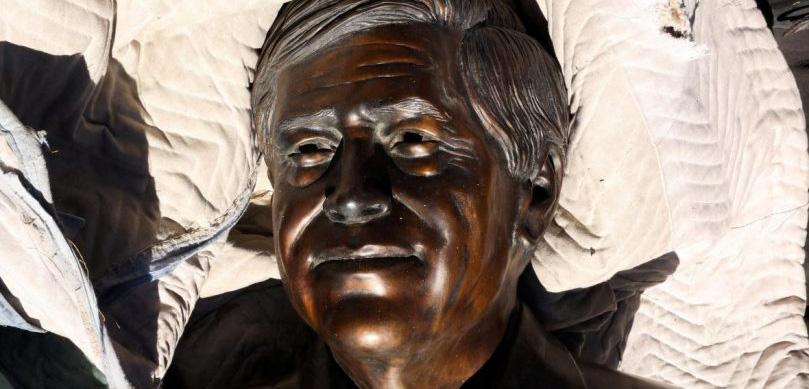
The City of Milwaukee has murals and statues honoring Chavez’s legacy. It even renamed part of 16th Street as South Cesar E. Chavez Drive in 1996. It is unclear as to whether the city will rename these landmarks, but it is something important to consider. A statue of Chavez on Cesar Chavez Drive and Mineral Street was taken down on March
20 and will supposedly be replaced with a statue of a migrant family.
Additionally, County supervisor and labor organizer Juan Miguel Martinez has called for the road to be renamed after Dolores Huerta, a victim of Chavez and a co-founder of the National Farm Workers Association.
“Too often, men of status abuse their power and use it for heinous acts towards women, and especially toward defenseless children,” Martinez said in a Facebook post. “A union is built by people, not one person.”
We cannot completely remove Chavez from history but instead recognize his integral work in a movement that was much bigger than himself.
There is no denying that these women’s stories should be taken seriously, and consequences should be dealt with, but they are also a part of the education process. Many past leaders and those we have deemed as “icons,” like Elvis
Presley, have had egregious allegations surface, altering public perception. While it can be difficult, it is in our best interest to incorporate the harsh realities with the positive outcomes of their work.
It may taint a historical figure’s legacy, but it gives the public what they deserve — the truth.
Completely erasing Chavez includes erasing the changes he made, which is something we must avoid. He was a pioneer for the Latino community and American farm workers. It is still important to remember him — just not in the same way we have been. We can still celebrate historical progress without upholding one specific person.
While we can no longer bring ourselves to honor Chavez as a man, we must still honor the causes he fought for.
Empower women on the silver screen
By Bella Gruber isabella.gruber@marquette.edu
As International Women’s History Month closes, it is crucial to recognize the recent strides of women in the entertainment industry. Historical barriers in Hollywood have posed challenges for women to rise to fame at the same rate as men. However, the female nominees and Oscar recipients made history at the 2026 Oscar Awards.
Glass ceilings are unofficial, systemic barriers preventing women from succeeding after a certain point in their profession. Historically, women working behind the scenes of films have faced challenges such as financing their projects, staff budgets and discrimination against their male counterparts.
While the number of women in executive positions in film has risen since 1980, they are still vastly outnumbered by men. Women only make up 15% of all show creators, with Black, Indigenous and women of color representing only 11-12.2%.
Onscreen stories have historically been told from a white male’s perspective, which shapes the public’s perception of film immensely. More women in high-level entertainment roles leads to more female representation on
screen, dismantling the stereotypes pushed by male filmmakers.
It also encourages other women to pursue their dreams in the entertainment industry by breaking down past structural barriers.
These progressive steps have proved to be true with the results of this year’s Oscars.
Marquette Alumna Amy Madigan, (Arts ‘72) won her first Oscar at 75 years old, proving it is never too late to achieve your dreams. She told ABC she has been acting since she was 19 years old.
“K-pop Demon Hunters” also had a groundbreaking night. The film’s co-directors Maggie Kang and Michelle Wong became the first women of Southeast Asian descent to win Best Animated Film, and one of its songs —”Golden” — sung by EJAE, Audrey Nuna and REI AMI, became the first K-pop song to win Best Original Song.
Autumn Durald Arkapaw became the first woman to take home an Oscar for Best Cinematographer for her work in “Sinners.” She was also the first woman of color to be nominated for this award.
“I have felt so much love from all the women on this whole campaign,” Arkapaw said in her acceptance speech. “I feel

like moments like this happen because of people like you guys.”
For Chloé Zhao, an award-winning director from Beijing, her film “Hamnet” marked its eighth Academy Award nomination. Her 2021 Oscar win for “Nomadland” made her the second woman and first woman of color to win the prestigious award. Despite her success, Zhao addressed that the work cycle of the entertainment industry is not structured to favor women, as it prioritizes high productivity in short periods of time. Zhao says this constant work cycle is not compatible with women’s bodies, making it difficult for women to thrive in high-level positions in the industry. Women in high-level roles — directors, executive producers, cinematographers and more — are finally starting to receive
recognition for their success after years of facing systemic barriers. Awarding women in high-level positions has been instrumental in dismantling the glass ceilings of the entertainment industry. It is important that people continue to empower women in entertainment, as it serves as a form of escapism and inspiration for many. For all people, regardless of their gender or cultural background, entertainment forms how people understand identities besides their own. When powerful female identities are put in the spotlight of the silver screen, they empower all women.
Statement of Opinion Policy
The opinions expressed on the Opinions page reflect the opinions of the Opinions staff. The editorials do not represent the opinions of Marquette University nor its administrators, but those of the editorial board.
Our editorial board consists of the managing editor of the Marquette Tribune and all executive editors including news, sports arts & entertainment and opinions.
The Marquette Tribune prints guest submissions at its discretion. The Tribune strives to give all sides of an issue an equal voice over the course of a reasonable time period. An author’s contribution will not be published more than once in a fourweek period. Submissions with obvious relevance to the Marquette community will be given priority consideration.
Full Opinions submissions should be limited to 600 words. Letters to the editor should be between 150 to 300 words. The Tribune reserves the right to edit submissions for length and content.
Please e-mail submissions to: rachel.lopera@marquette. edu. If you are a current student, include the college in which you are enrolled and your year in school. If not, please note any affliations to Marquette or your current city of residence.
Photo by REUTERS A bust of Chavez removed from Cesar Chavez Park in Denver.
Rachel Lopera is the executive opinions editor. She is a sophomore studying journalism.
Bella Gruber is an opinions columnist. She is a sophomore studying public relations.
Photo by REUTERS
Jessie Buckley, winner of the Oscar for Best Actress for "Hamnet."
Fun & Games
March Madness

Sweet Sixteen Mascots
Arts & Entertainment
Pure Dance faces obstacles for spring show
By MaryKate Stepchuk marykate.stepchuk@marquette.edu
After Pure Dance recruited friends to run sound and video for their December show due to the Alumni Memorial Union’s new Practice and Show Policy and lack of funding, they hoped to have a smoother spring rehearsal and performance process for their primary show.
But with a show a month earlier than last year, the rehearsal process became rushed, shortened from 12 to nine rehearsals.
The policy went into full effect this academic year — after a soft launch last year — and changed student performance groups’ access to technical support from one performance per semester to only one performance per academic year, calling it a “primary show.”
If groups choose to have another performance it is called their “secondary show,” and they are responsible for providing all tech,
as they do not have access to the technical booth.
Pure Dance held its secondary show in the fall, using speakers borrowed from a local dance studio, had friends controlling the lights and classmates with minimal video experience streaming the show on YouTube.
“They had no experience, but they did a great job,”
Pure Dance President Ally Weast, a senior in the College of Nursing, said. “They were running all of the lights, sound, and curtain.”
With their dedication to maintaining free admission to shows, the group had no funds to cover a secondary show with professional technicians, which would have cost around $4,000.
After adjusting to these new changes last semester, Weast received a phone call on Dec. 18 from the AMU offices.
The group’s Wednesday night rehearsal space in
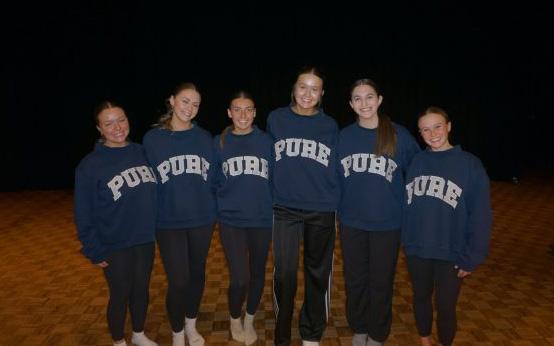
Weasler Auditorium — requested for the 2025-2026 academic year in summer 2025 — was scheduled for other events on all Wednesdays leading up to their show, except for two, forcing them to move rehearsals to Tuesday nights to maintain the Weasler Auditorium space.
They were offered an AMU room, but it was too difficult to dance on carpet in a room not big enough for the entire group, Weast said. Some dancers couldn’t make the Wednesday practices, so
"We want people to come and love art for free'"
Avril Beesley Junior President of Pure Dance
they are now left out of larger group numbers.
“[It] has been sad, because it’s my last semester, and I don’t even see some people as often, or really at all,” Weast said.
With four weeks less to rehearse, Pure lost three hours per dance, leaving them with six hours and 45 minutes. Additionally, the group had to add a rehearsal during midterms week, when they usually give dancers a break to focus on their studies. Avril Beesley,
junior Pure President and a junior in the College of Communication, said adding the extra practice was the only way to make sure dancers were prepared.
With a show scheduled a month earlier than usual, Pure also grappled with another challenge this year: Friday shows.
Pure historically held Sunday shows to allow for parents, families and friends to travel to Milwaukee. Friday shows limit people’s ability to attend between school and work schedules, especially for families traveling from out-of-state, Beesley said.
The Friday shows also limit the group’s ability to recover from its final Tuesday rehearsal, which is multiple full run-throughs of the show with hair, makeup and costumes.
“First off, rehearsals are a lot of work,” Social Chair
Mariah Olson, a senior in the College of Communication, said. “Then, two days out, you are dancing full out again. The week, in general, is a lot.”
Olson, Beesley and Weast all said that this year has been more stressful to coordinate rehearsals and shows compared to their previous year. Even with increased stress and financial restraints on the group, they are dedicated to maintaining free admission for all shows.
“We want people to come and love art for free,” Beesley said.
The AMU did not respond for comment.
Pure Dance’s spring show will take place on March 27, starting at 7:30 p.m., in Weasler Auditorium. Admission is free to the public.
PREVIEW: MU Theatre's "Noises Off"
The show will act as a play within a play
By Annie Goode annie.goode@marquette.edu
Marquette Theatre is bringing what many have called “the funniest farce ever written” to the stage this spring with their production of “Noises Off.”
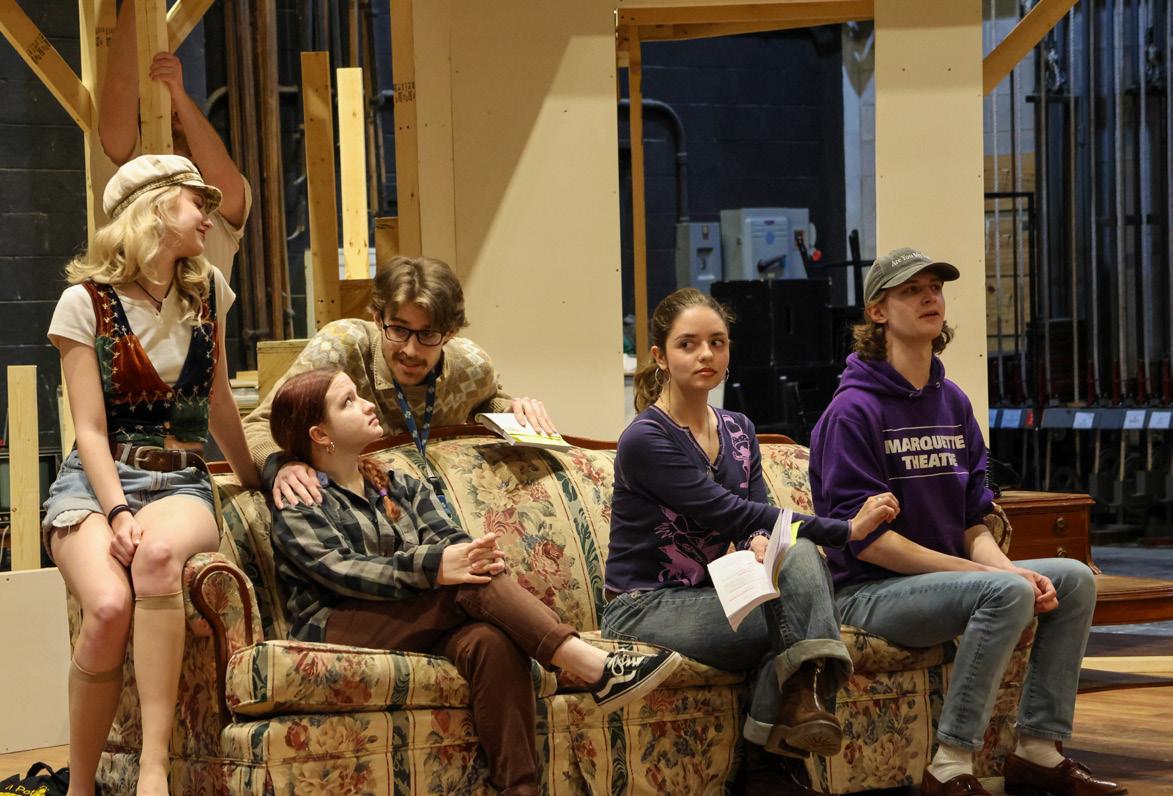
The cast of nine began rehearsals on March 3, and things have only gotten more hectic and livelier as they are deeper into the rehearsal process of this play-within-a-play.
“A farce is a play in which the situation starts to spiral out of control, so that all the characters are trapped in this snowballing avalanche of catastrophe,” Jamie Cheatham, Director and Head of Acting, said.
Not only is “Noises Off” a play inside of a play – more specifically, it’s a farce inside of a farce. The first
act follows the production team in their preparation of the show, and the second act happens in two halves of the stage, one half showing the actors on stage, and one half showing the team backstage.
Whether it’s love triangles, British accents, missing flower bouquets or fire axes, “Noises Off” is jampacked with action and shenanigans between the nine characters.
Kendall Syslack, a sophomore in the College of Communication, plays the anxious Poppy, who is the assistant stage manager. Syslack said the most difficult part of the show has been blocking, or the movement of the actors on stage.
“It’s so complicated to make sure that we’re getting the lines right backstage while also getting the lines right on stage,” Syslack said. Since the show is a play inside of a play, Stephen Hudson-Mairet, scenic
designer and professor of theatre arts, has had to work hard to create a set that reflects both backstage and frontstage.
“It’s one of those bucket list sets for a lot of theatre people,” Hudson-Mairet said.
Hudson-Mairet works with part-time shop supervisor and Marquette faculty member Peter O’Neill and a mix of students, some of whom work 5-10 paid hours a week building the set, while others are a part of the stagecraft class.
To follow tradition for “Noises Off,” Hudson-Mairet and the rest of the set crew built a 24-footwide revolving stage. The design that the set designers originally looked at for building the stage had to be reworked, since it was for a 20-foot revolving stage, and theirs had to be 24 feet.
“When we finally got the stage to revolve, we knew it would work, but it was one of those, ‘I hope this
works,’ moments,” Hudson-Mairet said. “It was quite exciting.”
As they move into rehearsing the second act, Syslack said she is excited for audiences to see the show, even though it may be stressful to watch.
“I think it’s going to hopefully bring people a lot of joy,” Syslack said.
“It’s this hilarious love note to the theatre,” Cheatham said. “Anyone who’s had any experience on stage deeply sympathizes with the chaos.”
“Noises Off” will take place April 17-19 and 23-26 in the Helfaer Theatre.
Syslack also said the cast is hoping to practice on stage at the Helfaer Theatre sometime in the next week. They have not been able to because of the set design taking place, so they have been rehearsing in the dance studio next to the stage.
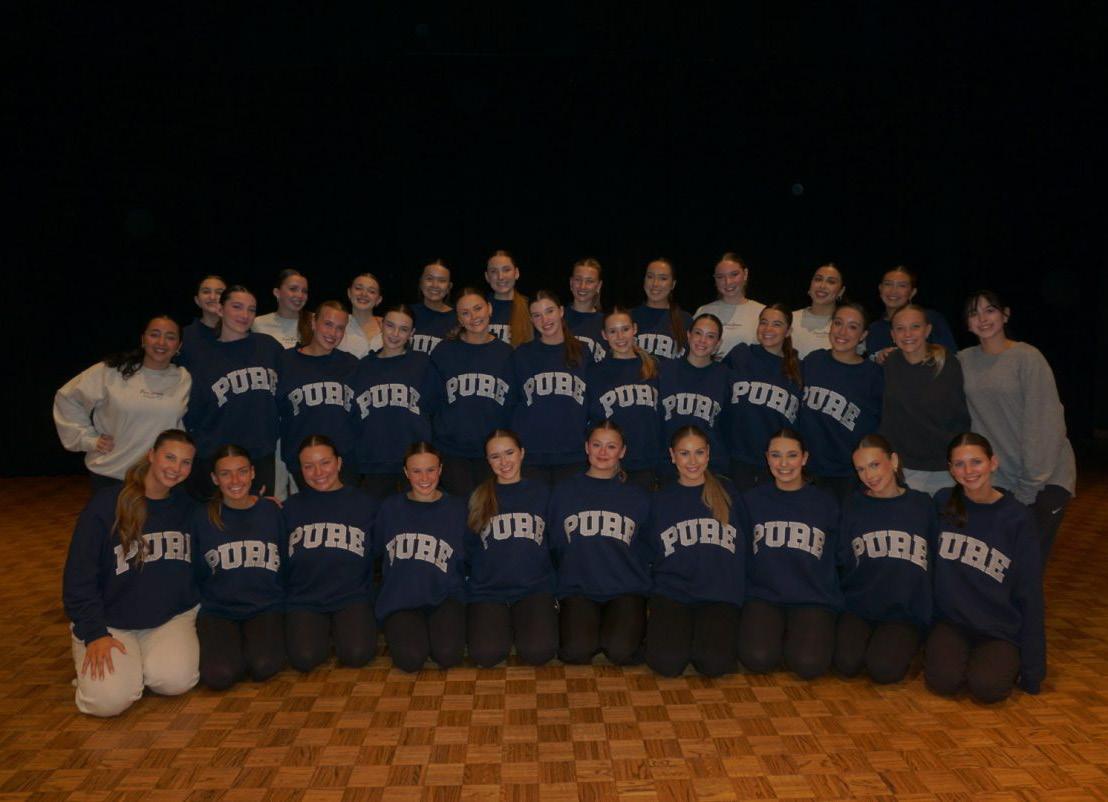
Friends of Pure members ran sound and lights at their fall show.
Photo courtesy of Ally Weast
Seniors found Pure Dance more stressful than previous years.
Photo courtesy of Ally Weast
The play's set will consist of a 24-foot revolving stage.
Photo courtesy of Draylin Pickett
Haggerty's zine day highlights political art
By Elise Emery elise.emery@marquette.edu
The Haggerty Museum of Art hosted an afternoon of creativity and discourse with “Community Zine Day: Declarations in print” on March 21. Attendants learned not only how to make their own zine but also how the medium has shaped the cultural and political landscape.
A zine is a self-published physical or online booklet that uses art and the written word to convey a message. They are often produced in small quantities and focus on personal expression and activism. While zines are usually characterized by a smaller page count, they can be as long or as short as the author desires. Zines can be about a multitude of things, but their core purpose is artistic and free expression.
The medium originated from 1930s science fiction fanzines, which were created to build a sense of community among sci-fi fans. Zines then diverged into social commentary in the 1990s, when zines were used to speak out against sexism.
Today, there are all kinds of zines, but they are most known to be a popular medium for political activism.
For each new exhibition, the Haggerty hosts a community event that correlates with what the museum is showing at that time. For the 2026 spring semester, the Haggerty is hosting an exhibition of art that commemorates the 250th anniversary of the signing of the Declaration of Independence, which includes the exhibits “Declaration of ___,” “Defying Empire” and “Let the Real World In.”
Dean McBride, the Haggerty’s Event Associate, said that zine making seemed like a fitting activity to do in correlation with these exhibits, as pamphlet making was a major component in spreading the idea of independence during the Revolutionary period.
“[The exhibits] just naturally drew to zine making and sort of art as social activism,” McBride said.
The afternoon opened with a panel featuring the curator of “Defying Empire,”
J. Patrick Mullins, Milo Miller—the co-founder of the

Queer Zine Archive Project – and Melissa Mursch-Rodriguez— the founder of Moody, a zine consisting of the work of queer and BIPOC creatives. Topics of conversation included the origins of zines in the science fiction world, how zines contribute to personal expression and zines’ role in activism.
Because of the diverse applications that zines can be used for, Mullins encouraged people to pay attention to how they can build communities and make change.
“The world should really pay attention to what’s happening in the zine world,” Mullins said. “Because the zine underground today can sometimes be the top character tomorrow.”
Attendants for the event included people who made or knew about zines and people that have never interacted with zines before. Nevertheless, attendants engaged intently with the panel and were intrigued by the idea of learning about and creating their own zine.
“I feel like there’s a really diverse crowd here, which is great,” Abby Bunch, a sophomore in the College of Engineering, said. “I feel like that’s a big thing about zines is bringing people together and crossing boundaries.”
After the panel, attendants were given three opportunities to contribute to and create their own zines in an activity called “Declare your Page.” Attendants could screen print their own “declaration page” and decorate it with whatever message they were passion-

ate about. The sheet had “Declaration of___” printed at the top, and attendees used markers, pastels and paint to illustrate a message. The sheets would then be compiled into a community zine and displayed in the Haggerty.
In one of the featured Haggerty exhibits, “Let the Real World In,” young adults Hannah Plevin, Iman Fatmi, Alanis Salgado and Kam Pickett use zines to speak out about the conflicts in Palestine and other social issues.
However, Plevin said, zines don’t need to be political. They’re simply a way to be expressive.
“It’s just a creative way to get your feelings out there, no matter what they are,”
Plevin said. “Zines can be about anything.”
Additionally, attendants had the opportunity to create augmented reality zines in “Declare your CARE,” where attendants would create a two to three-word message explaining what they cared for, which would then be transformed into AR experiences that were
accessible via QR codes.
The final event, “Rage. Grieve. Heal. Protest.” allowed guests to add their own messages and artwork to four large-scale banners that represented each emotion, which would later be displayed in the Haggerty. Attendants were able to paint and draw any messages that they felt resonated with these emotions. The “Rage” banner has words like “WHY?” and “WTF” with drawings of fire, while the “Protest” poster has messages like “Antifascism is self-defense” and “Protect the Dolls.”
Bunch said that zines, as a form of media, are making these conversations accessible, comfortable and efficient so that the public can become more knowledgeable about certain issues.
“Even though society really tries to push these more scientific, super formal ways of presenting politics and stuff, we should really be open to these more casual conversations that zines are trying to have with people,” Bunch said.
Art Club offers safe space for creativity
The group meets every Friday to create projects
By Annie Goode annie.goode@marquette.edu
Every week, the Haggerty Museum of Art opens its doors and art materials to students who are ready to collage, decorate ornaments and participate in various activities on the agenda for Art Club that week.
Art Club was founded around 24 years ago, according to the Haggerty’s curator for academic engagement and Art Club advisor Lynne Shumow. While Shumow assists with gathering materials and coming up with meeting ideas, she said it is a student-run organization. The club meets on Fridays from 2:30-4:00 p.m.
Sophomore in the College of Arts & Sciences and College of Education and
Art Club President Eric Vacek took over this semester for the last president, Lucy McGovern — a junior in the College of Arts & Sciences — who is currently studying abroad.
“I thought it would be cool to help facilitate the activities… I thought the last president did a really good job,” Vacek said. “I wanted to keep it going with someone who had seen what she had done and knew how to replicate it.”
Last semester, Art Club hosted a variety of meetings with different, unique activities every time. Students could make clay magnets, felt crafts and gratitude cards.
Vacek said art is his hobby and started attending Art Club second semester of his first-year. He said he thought about making an art club at his high school but never did, so when he found one here, it was perfect.
“I just really enjoyed the
atmosphere of being provided art materials to work with, because I did not have a lot in my dorm and it was kind of hard to bring them from home,” Vacek said. “It’s really nice because it’s a soft start to the weekend, or a wind-down from the week.”
Vacek said the materials for the meetings come from the Haggerty’s own stash of art supplies, occasionally dipping into the student government fund or the Haggerty’s funding when needed.
Recently, Art Club offered a Stamp Printmaking Workshop, where students learned how to make their own stamps using linoleum blocks. Other events include zine-making, felt crafts and clay magnets. Students are welcome to take their work home after they complete it.
“Some people will bring their own little sketchbook and do that every week, even during other
events… some people will sit quietly with their headphones on, some people will go with their friends,” Vacek said. “It’s a good way to get a break from academic work.”
The only visual art-related field of studies Marquette offers is a Graphic Design Minor or a Fine Studio Arts minor, which students can complete in collaboration with the Milwaukee Institute of Art & Design.
“It’s a really cool way to
get involved with the art community at Marquette because I’m not necessarily in that academic space,” Vacek said.
Shumow said Art Club is open to all students, regardless of experience.
“You don’t have to be a great artist or anything like that, but just to have an interest in creativity and meeting new people,” Shumow said. “Our club is open to anyone.”

The Zine Day was in collaboration with the current exhibits.
Photo by Lily Wooten
Attendees could make physical or digital zines during the event
Photo by Lily Wooten
Art club made stamps out of linoleum blocks last month..
Photo courtesy of Anna Heffernan