
Report accuses MU of pushing risky loans
Administrator called the recent study misleading
By Sophia Tiedge sophia.tiedge@marquette.edu
Marquette University was accused of pushing low-income families into high-risk loans in a study released Feb. 12 by the left-leaning think tank New America. Zack Goodwin, assistant vice president of student financial aid, believes the results are misleading.
“It’s not true,” he said. “The main insinuation of that report is that somehow we are literally pushing lower-income — or just otherwise less-resourced — families into these loans, which we are absolutely not doing.”
Marquette is the only university in Wisconsin and one of five Jesuit universities on the list.
Rather than offering more money in scholarships to

a study from
students with financial need, study author Stephen Burd said, the money is being offered to wealthier, high-achieving students to boost the university’s rankings. To fill this gap, the study said, Marquette is pushing lower-income families to take out Parent PLUS Loans — a federal loan
Calling for safety
Students voiced concerns after Feb. 18 assault
By Sophia Tiedge sophia.tiedge@marquette.edu
Rachael Meldman placed her keys between two fingers as she walked out of Schroeder Hall at 7:15 p.m. on Feb. 18.
“Head on a swivel,” she reminded herself.
The first-year student had a short walk from the residence hall to the library,

but hours earlier — just one block away near the 900 block of 14th street — a female Marquette student was approached with a weapon, robbed and sexually assaulted.
“I don’t usually do that when walking around campus at night,” Meldman said of carrying her keys for self-defense. “But this time I was very, very alert. Especially since they hadn’t caught the guy.”
Around 4:30 a.m. that day, Meldman woke up to a Marquette University
option with no borrowing limits, minimal requirements and higher interest rates.
Currently, Goodwin said, 10-15% of Marquette students’ parents have taken out this type of loan.
“While the universities are wooing wealthy students, many of them are
pushing the families of low- and lower-middle-income students into economic peril by pressuring them to take on heavy debt loads they are unlikely to be able to repay,” Burd said in the study.
Conversely, Pell Grants are given to low-income families and don’t need to
be repaid. The study found 34% of Pell Grant recipients at Marquette who graduated or left the university in 2020 or 2021 also had Parent PLUS Loans. The average total in loans after graduation for those families was around $30,000. Marquette’s tuition for
Arrests at vacant property
Warrant links man to armed robbery, assault
By Mia Thurow mia.thurow@marquette.edu
A 28-year-old man suspected of sexually assaulting and robbing a Marquette University student at gunpoint has been taken into custody nearly a week after the Feb. 18 incident on unrelated warrants, according to reports from TMJ4 and WISN12. The man had two open arrest warrants issued in 2023 and 2022.
The suspect is being held in the Milwaukee County Jail, according to records from the Milwaukee County Sheriff’s Office. He has been named in a search warrant, though not charged with any crime. The Marquette Wire is working on independently verifying this information.
anything, I am going to pull the trigger.” The student was robbed and sexually assaulted while walking home around 2 a.m. on the 900 block of 14th Street.
The armed suspect was then seen fleeing on foot heading northbound on 14th Street after the assault.
Marquette police released video footage and photos from a security camera Feb. 19, asking for the public’s help in locating the suspect.
Police say the male suspect is a 6-foot-tall skinny Black male between the ages of 20-30. He has shoulder-length locks or twists in his hair and was wearing a beige hoodie, light colored pants and white shoes. He was also wearing a blue hospital mask and a black backpack.
TMJ4 cited Ring doorbell footage showing investigators at a house on Highland Avenue on Feb. 20. Marquette University Police detained a man inside the home when officers found a tan coat and gun underneath the porch. The
man who was detained also matched the victim’s physical description of the suspect, police told TMJ4.
The same day, WISN12 reported witnessing three men being taken into custody. At the time, campus police said the men were suspected of trespassing and arrested them on unrelated warrants, though no charges or official arrest have been confirmed.
The university declined to comment on the matter, but sent out a clarification Feb. 23 to students saying no suspect is in custody for the robbery and sexual assault.
This is a developing story that may be updated with new information.
According to the search warrant, the victim said the suspect pointed a gun at her and said, “If you say
leo.stallings@marquette.edu
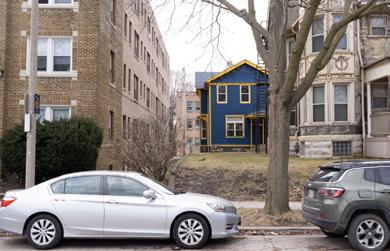
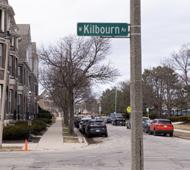
900 block of 14th Street.
See SAFETY page 3 See LOANS page 2
Opinions
EDITORIAL: Protect our people, Marquette MUPD should prioritize year-round campus safety measures.
In
left-leaning think tank New America, Marquette was accused of pushing low-income families into high-risk loans.
Graphic by Allegra Delli Carpini allegra.dellicarpini@marquette.edu
An alleyway between apartments and housing on 14th Street.
Photo by Leo Stallings leo.stallings@marquette.edu
Photo by Leo Stallings
February 24, 2026
LOANS: No changes coming to scholarships
Continued from page 1
the 2025-26 year, including room and board, is around $70,000.
The university said 99% of students received financial aid last year and the university gave out $170 million in scholarships. In 2025, Marquette’s endowment was valued at $1.13 billion, $15 million of which is used on scholarships yearly depending on the endowment value, Goodwin said.
Goodwin said when
Marquette parents receive financial advising, going into loan debt is always a last resort. If it’s the only option, he said, the university tells families what risks are involved.
“This can happen in a presentation setting or one-onone to talk to them about what those options are — risks, what repayment really looks like — so they understand what this means and whether that’s really something they can handle.”
Goodwin said. If the family decides to take out a Parent PLUS Loan, the university offers financial counseling through the Bursar’s Office. Goodwin said his colleagues are available to helps students during their time at Marquette.
But, upon seeing the report, Goodwin said he was disappointed and felt like it misrepresented Marquette’s enrollment strategies. For the past few years, he said, the university
has been able to give out more aid.
“It paints us in a light of us generally mistreating our less resourced families,” he said.
Goodwin was also worried the study would diminish the accomplishment of students receiving a merit scholarship, as there is overlap between needing aid and earning it.
“What that missed a little bit is also (merit aid) helps a lot of our lower income
students attend,” he said.
Moving forward, Goodwin said, the university won’t be making any sweeping changes to their scholarship process.
“Conversations about how we can do more are very much a regular and ongoing part of our conversations in enrollment management at the university,” he said. “Every week, we are meeting about ways we can strategize better about helping students.”
Political organizations host "Dialogue Night"
Event promoted conversation with structured format
By Mina Marsolek-Bonnet wilhelmina.marsolek-bonnet@
marquette.edu
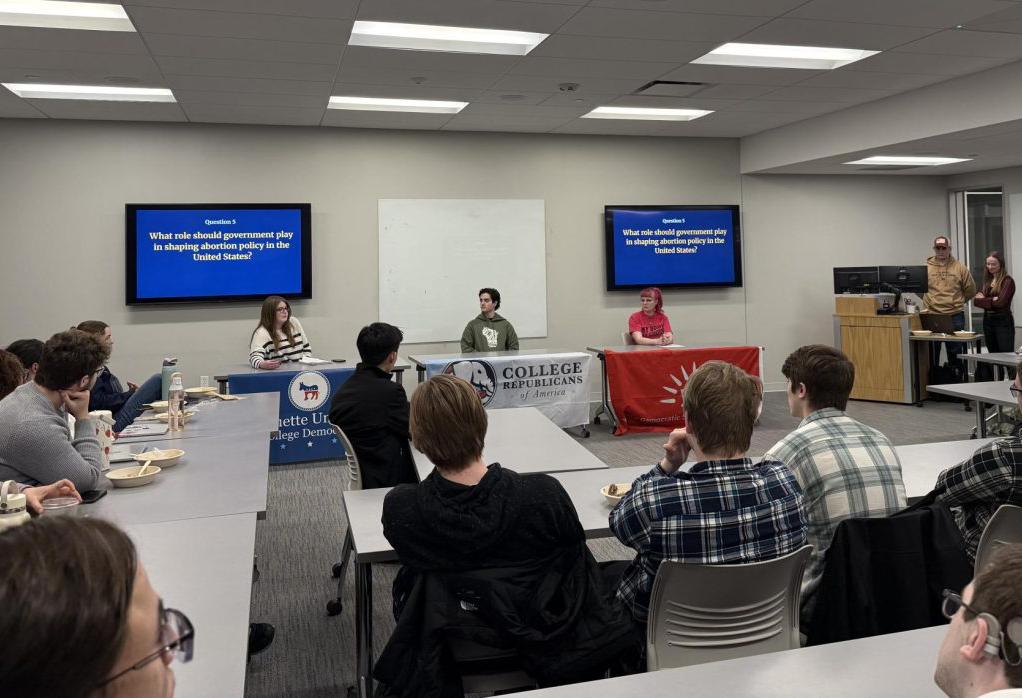
Three of Marquette University’s political student groups came together the evening of Feb. 19 to converse about gun rights, abortion rights, artificial intelligence and immigration policies without debating amongst each other.
College Republicans, Marquette’s Young Democratic Socialists of America chapter and the College Democrats shared their thoughts on six previously agreed upon political topics at an event in O’Brien Hall deemed “Dialogue Night.”
The structured nature of the event, organized by Elliot Sgrignuoli, head of the College Republicans, allowed for one representative in each group to give an answer per question. Each representative was
given a fixed three-minute speaking time, moderated by the executive boards or steering committees of each organization.
Speakers were allowed notes while presenting their arguments.
“It’s trying to get a taste of the different ideologies that exist on campus and giving people the opportunity to speak their mind and show their passion, to a reasonable degree,” Natalie Gazzana, a junior in the College of Arts & Sciences and chair of the College Democrats, said.
The goal of this event was to get individuals out of their echo chambers, the heads of the three organizations said. Despite this, some attendees exchanged loaded glances, whispers and laughs as participants of opposing organizations spoke about the most contentious topics, namely abortion rights, gun laws and immigration policies.
It was firmly established that the dialogue was not a debate, and there would be no space for rebuttals of any
kind. Instead, the intended outcome of the event was to foster conversations between individuals.
“The process for me is really about humanizing one another,” Alannah Gallagher, a sophomore in the College of Arts & Sciences and head of YDSA Marquette, said.
The previously agreed-upon questions were:
- What does America look like in 10 years?
- How should Americans think about affordability?
- How will artificial intelligence impact the 2026 election and beyond?
- How do we address gun violence in and toward schools?
- What role should government play in shaping abortion policy in the United States?
- Is current immigration policy sufficient or too extreme?
After representatives answered the six questions, the floor opened up allowing attendees to talk amongst themselves and digest what was discussed.
“I hope we’re in a place where we can actually have real productive conversations,” Elliot Sgrignuoli, a senior in the College of Arts & Sciences, said in response to the question about what America will look like in 10 years. “We need to get America working together.”
When Sgrignuoli first thought to have “Dialogue Night,” he only had plans for it to remain within his organization.
Leading up to the 2024 presidential election, the three groups attempted to schedule a dialogue, but due to scheduling conflicts and miscommunication, Sgrignuoli said, the idea never took hold.
Now, Gazzana said, the student organizations were excited for the opportunity to collaborate with the other groups.
For YDSA Marquette, which officially became a campus organization at the end of spring 2025, “Dialogue Night” served as an opportunity to introduce socialism to the campus
political space.
Gallagher said YDSA thinks of themselves as an organization rather than a party, focusing on grassroots campus organization and policies.
“What we’re seeing right now in the wider political context is the process of dehumanization, and not just amongst political ideologies,” Gallagher said.
“It becomes very easy to stop seeing each other as actual people, unless you can sit down and talk with one another.”
The forum also allowed participants to share the human side of political issues. For example, Alivia Allen, a sophomore in the College of Arts & Sciences and member of College Democrats, spoke about her experience as a student at the 2023 Milwaukee Lutheran High School shooting.
“This is an issue that’s extremely personal to me,” she said.
Marquette already hosts civic dialogues — structured conversations facilitated by moderators. At these events, Sgrignuoli found that tables are usually dominated by one person, knowledgeable and excited about the topic, while the other participants are only there to get the extra credit points their professors promised.
“What we’re doing [with Dialogue Night], you’re getting people who already care about politics, which means coming in with more knowledge,”
Sgrignuoli said. “It’s going to challenge your current ideas.”
After the cross-organizational event, Sgrignuoli is looking to the future — specifically the 2026 midterm elections — and said he hopes the clubs can continue growing and continuing the conversation. Gazzana and Gallagher share that sentiment.
“Our doors are always open for any involvement from either of the clubs,” she said.
Photo by Sahil Gupta sahil.gupta@marquette.edu College Republicans, College Democrats and Young Democratic Socialists of America at Marquette brought students together.
Tuesday, February 24, 2026 The MarqueTTe Tribune
The MarqueTTe Tribune
Managing Editor of The Marquette Tribune
Sophia Tiedge
NEWS Executive News Editor Mia Thurow
Assistant Editors Lance Schulteis, Lilly Peacock
Reporters Sahil Gupta, Elena Metinidis, Mina Marsolek-Bonnet, Lillie Martin
ARTS & ENTERTAINMENT
Executive Arts & Entertainment Editor
MaryKate Stepchuk
Assistant Editor Joseph Schamber
Reporters Elise Emery, Allison Scherquist, Annie Goode
OPINIONS
Executive Opinions Editor Rachel Lopera
Assistant Opinions Editor Isabella Gruber
Columnist Amelia Lerret
SPORTS Executive Sports Editor Jack Albright
Assistant Editors Matthew Baltz, Raquel Ruiz
Reporters Benjamin Hanson, Mikey Severson, Ben Ward, Eamon Bevan, Conor McPherson, Lukas Schulze
COPY
Copy Chief Emma Fishback
Copy Editors Elizabeth Belmont, Shea Lancaster
VISUAL CONTENT
Design Chief Murphy Lealos
A&E Designer Evelyn Riordan
Sports Designer Amery Thompson
Opinions Designer Allegra Delli Carpini
Photo Chief Clay Ellis-Escobar
Photographers Lily Wooten, Owen Weis, Leo Stallings
HAVE A TIP FOR US?
Have you seen something that you think should be a story? Do you have a tip about something we should be looking into? Do you have documents or other materials that we should see? We want to hear from you.
If you have documents you'd like to send us, you can send anything to wiretips@marquette.edu.

Climate change creates "false spring"
Milwaukeeans
witnessed recordhigh temperatures
By Elena Metinidis elena.metinidis@marquette.edu
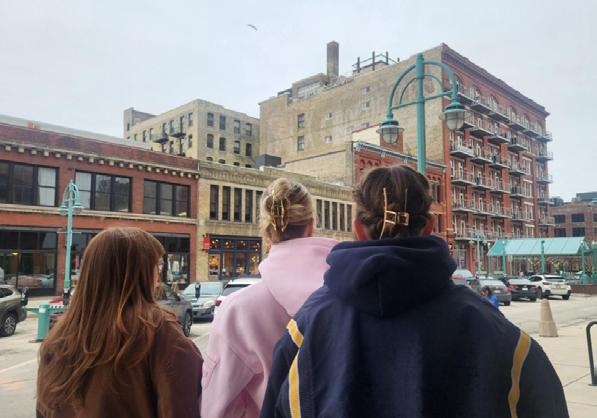
Students reading in hammocks, doing homework and eating lunch on picnic tables and friends playing football are all signs of a nice day on Marquette University’s campus. A record-high temperature of 63 degrees on Feb. 16 gave Milwaukeeans — including college students — a taste of a false spring. Set in 1921, the previous temperature highfor Feb. 16 was 56 degrees. The record for Milwaukee’s warmest February day was set on Feb. 27, 2024, at 74 degrees, breaking the 1882 record.
“Everyone says, ‘I want to live during exciting times,’”
Stefan Schnitzer, director of environmental science/studies at Marquette, said. “Well, these are exciting times.”
As it turns out, the term “fool’s spring” actually has some merit. Schnitzer said it’s common for southernly winds to pull warmer air off of the Gulf of Mexico all the way to Wisconsin.
Later in the week, though, average February temperatures returned.
The swing in temperatures is something a number of Marquette students have become accustomed to.
“It’s a great part of [Marquette’s] culture,” Schnitzer said. “Everyone is suffering for three weeks, and then you get this and everyone’s
out on the quad playing football and all the faculty are walking around in the sun.”
Max Sawyer, a senior in the College of Business Administration, took advantage of the warm weather by taking a walk.
“It really brings out Marquette’s campus,” Sawyer said. “The sun makes everyone happier.”
Calvin Whitney, a junior in the College of Arts & Sciences, also enjoyed a walk to the Historic Third Ward and the Summerfest Grounds. His warm-weather surprise was spotting a pack of foxes living on the grounds.
Even before Marquette opened its doors, Milwaukeeans have experienced record-high temperatures for over a century. Milwaukee has seen 25 record-high
days since 1871. “This is a natural phenomenon that always happens and that’s then accentuated by climate change,” he said. Climate change has been detected for decades, Schnitzer said, and has huge implications for the entire ecosystem.
Local plants develop systems over time to calculate the number of warm days and angle of the sun, which Schnitzer said is to guard themselves against putting up their leaves too early. Due to climate change, plants are experiencing “bud break” — the opening of their buds for new leaves and flowers — much earlier than normal.
This invites bees to pollinate sooner and requires hibernated animals to become active sooner.
Schnitzer said the process of phenology, often called “nature’s calendar,” allows scientists to monitor how ecosystems respond to climate change.
“The whole ecosystem is changing in front of our eyes,” Schnitzer said. “All of these things have pretty big ramifications.”
Despite climate change being well underway, Schnitzer is still fascinated by how the ecosystem is creating a new cycle for itself that creeps up earlier each year.
“It’s all been predicted,” he said.
Though temperatures have dropped back to normal for February in Wisconsin, Marquette students and faculty can look forward to the first day of spring on March 20.
SAFETY: Students seek improved measures
Continued from page 1
Police Department safety alert informing students of the crime and that the female victim had been taken to the hospital.
“I was just horrified,” she recalled.
Alyssa Kave, a sophomore, saw the alert around the same time.
“I felt sick,” she said.
Twelve hours later, MUPD released photos and videos from a security camera, asking for the public’s help in locating the suspect. As of Feb. 23, a suspect has been linked to the crime and was taken into custody on unrelated warrants. No charges have been filed in this case.
Kave and Meldman described the campus environment on Feb. 18 as “uneasy” and “anxious.”
Kave, a survivor of sexual assault, said hearing it happened to someone else on campus — despite the safeguards meant to deter this kind of crime —
was heartbreaking.
Even though Marquette has its own police department, blue light phones, EagleExpress vans, safety text alert system and video cameras, Kave and Meldman feel improvements can be made.
Meldman is frustrated by the long waits for EagleExpress vans. She realizes factors like staffing or the number of vans available can contribute to problem, but she said a 40-minute wait isn’t feasible when students are trying to get somewhere quickly.
“It’s honestly worth it at that point to walk,” she said.
Trisha Batra, a junior, said sometimes the EagleExpress app won’t let her book a ride or says the queue is too long.
But Batra’s biggest concern is the counseling services mentioned as a resource in the email sent to students. She went to the Counseling Center a few weeks ago hoping to work through a recent trauma and was left with a
bad taste in her mouth.
“I expected them in my head to try to help me deal with it, and they were like, ‘Oh yeah, I’m sorry that happened, here’s an email of other places you can go,'” Batra said. “That’s not what I wanted to hear.”
This experience made Batra worry about who at Marquette would support the victim of the Feb. 18 assault.
“I’m sure that she’s probably looking for help, and I’m not sure that she’s going to find it here, honestly,” she said.
Other students are taking a closer look at communication from MUPD about crimes and available resources. Kave hopes to see improvement to make students feel safer.
This National Marquette Day, police cracked down on drinking and partying after the number of alcohol-related calls increased on NMD 2025. Officers patrolled the area on foot and gave citations
to students who were publicly drinking.
“Many are expressing frustration that students seem to receive more warning not to publicly party or drink on campus than they do to stay safe from violent crime,” Kave said.
Rather, Kave wishes MUPD sent out more text alerts about crimes she sees on their logbook. She questions which cases campus police determine to be “bad enough” to communicate and which are not.
MUPD sends out text alerts to comply with the Clery Act, which requires that colleges that receive federal financial aid report campus crime data.
The department updates a daily crime log but doesn’t send out alerts for all incidents; rather, alerts are “only sent if there is an active threat to campus or of there is a significant police presence.”
Moving forward from Feb. 18, students are rethinking
the best ways to stay safe walking on campus at night.
Batra feels like something has to be done, and she’s taking matters into her own hands. She wants to start a women-only club where students can message a social media account for a walking buddy if they don’t want to walk alone or can’t get an EagleExpress.
Meldman is considering how to protect herself when walking at night.
“I’m going to be more reluctant to stay out later studying and stuff, because it’s safer in my dorm room,” she said.
Kave said she’s been threatened walking through campus at 5 a.m. and heard of co-workers getting mugged.
“From the perspective of a young woman, we are alone,” she said. “Our next walk home could be the next safety alert.”
This story was updated to add new information.
Some Marquette University students took advantage of the unusually warm February temperatures.
Photo by Elena Metinidis elena.metinidis@marquette.edu
Historic theater's future uncertain
Miller High Life venue proposed to be demolished
By Lilly Peacock lilly.peacock@marquette.edu
Gary Witt, president and CEO of the Pabst Theater Group, feels that not enough youth are going out and meeting each other.
“In a world of digital isolation, people actually coming together for a live experience is becoming a miracle,” he said. “The live experience isn’t about your smartphone, it’s about the person standing next to you.”
One of those places for young people to come together, Witt believes, is the Miller High Life Theatre — built in 1909 and one of 11 live show venues in Milwaukee’s Theatre District.
But now, the future of the High Life Theatre could be at stake.
On behalf of the Wisconsin Center District, owner of the High Life Theatre, a Chicago-based consulting firm conducted a study suggesting its demolition. Hunden Partners, which specializes in tourism and placemaking, recommended a 650room hotel to accommodate convention traffic brought in by events at the Baird Center, also a WCD property, in its place.
"...it's about the person standing next to you."
Gary Witt Pabst Theater Group CEO
Hunden Partners’ research also found that many potential Baird Center events were lost due to insufficient hotel inventory and room availability. Inadequate hotel space has forced high-volume conventions to competitor cities, including Columbus, Ohio and Indianapolis. The events that replaced them, the study said, generate lower demand.
“A modern headquarters hotel is critical to capturing these high-value citywide events,” the study said.
The proposal has caused public outcry, with a number of Wisconsinites responding to official social media posts from the Pabst Theater Group’s online platforms.
One post explained that the theatre is the only seated venue in Wisconsin with a 4,000-capacity, aside from the newly opened Landmark Credit Union Live, a 4,500-capacity general-admission standing room venue in the Deer District.
“There can be more than
one theatre and more than one act of a similar caliber in town at a time,” a LinkedIn user commented.
The Hunden Partners study used the new venue as a reason for demolishing the Miller High Life Theatre. Released in January 2026, the study states the new concert venue will create competition for events and that the High Life Theatre “is in need of capital improvement to remain relevant and up to industry standard.”
Hunden Partners also suggests there is already a sufficient supply of theatres for the size of Milwaukee‘s population.
The Wire reached out to Landmark Credit Union Live and was denied an interview request. WCD was also contacted with no response.
Witt told the Wire in an email that he found out about the results of the study at the same time as the public.
“The day the study was released to the press, the Executive Director of the WCD, Marty Brooks, stopped returning our calls and texts,” he said.
WCD requested the study from Hunden Partners in July 2025, where backlash initially began at the mention of demolishing both Panther Arena and the High Life Theatre. When the results of the study were presented last month, the focus was on the theatre.
“Although aged, the Panther Arena induces significant visitation to the district, serves the local community and fills the mid-sized arena market space,” the study said.
Following initial conversations about the properties included in the study, both Panther Arena and High Life received historical designation from the city’s historical preservation committee last December, creating protective barriers around their futures.
“This gave much-needed oversight by the preservation committee, who have a greater responsibility to maintain our city’s soul and integrity,” Witt said. If the High Life Theatre is demolished, Witt said in an email, a unique venue with a rich performance history would be eliminated, taking performers like David Byrne, Kevin Hart and Nikki Glaser with it.
“Claiming that a standing room, general admission club ‘replaces’ the only 4,000-seat theater in Milwaukee and the state of Wisconsin is not progress,” Witt said.
Tuesday, February 24, 2026
First-generation successes
Students navigate college with help from university
Over a fifth of Marquette University’s student body are first-generation students, who have to learn and navigate college without the help of parents who previously attended a higher education institution.
Some first-generation students — like Titus Konley and Emmanuel Arevalo — attribute their success to the resources Marquette offers through the Office of Inclusion and Belonging. These campus programs, teachers and student organizations have allowed them to make connections and progress through college, they said.

Konley, a sophomore in the College of Engineering studying mechanical engineering, from Waukesha and is the middle child of his family. He has dreams of working in the Navy as a nuclear engineer.
Coming to Marquette, his dad was against the idea of college and pushed him to go to trade school. His mom told him to do what would make him happy.
“I didn’t want to do a trade my whole life,” Konley said. “I need to develop some technology; I really wanted to do something.”
Entering his first year, he began to find clubs and people he enjoyed. He joined the Marquette Symphonic Band and has played the tuba for the group since.
Some of Konley’s high school friends initially helped him find his footing on campus, he said. Now, he’s found additional friendships through studying engineering.
“It’s been a learning process,” Konley said.
Konley also talked about his first-generation struggles with finding the right
schedule. He took 20 credits a semester and tried to participate in Track & Field. After learning to create a schedule that worked for him, he became a resident hall assistant at Wells Hall and found more time to focus on academics and band.
Arevalo, a junior in the College of Communication, is pursuing a major in advertising and hopes to work in a comfortable position at a firm in the future.
He was born and raised in Milwaukee and comes from a Mexican immigrant family where his parents’ encouragement was strong.
“I think that’s what really inspired me. From a young age, they always pushed me and told me to pursue an education and get a career,” Arevalo said.
In addition to the advertising program and proximity to home, Arevalo was also drawn to Marquette’s Jesuit values, which aligned with his religious beliefs.
When discussing the university’s role in his success on campus, he pointed to his first year of college. The summer before starting at Marquette, he and a group of students came to live in the dorms, take classes and see what the campus had to offer, like the Educational Opportunity Program. The EOP aims to motivate and support low-income and first-gen students.
“We already started off with a couple of credits,” Arevalo said. “A little head start.”
Arevalo keeps himself busy on campus with intramural soccer and the EOP. He said the program has given him a leg up in academics.
One of his biggest motivators is his professors, who he said inspire him, push him to do better and give space for mistakes.
“We can always ask questions or if we need help; we can always go to their office hours,” Arevalo said. Arevalo also holds himself to a high standard — he wants to succeed and feels the only way to do that is to have the desire to better himself and accomplish big things.
He also acknowledged a change in himself over time. He said he was quiet and kept to himself his first year and has since opened up a lot, enjoying meeting new people.
“Keep working hard, because everyone feels alone at times and feels like they’re the only one going through it, but at the end of the day, everyone’s going through the same thing,” Arevalo said as a message
to incoming first-year and first-generation students.
Sarah Piñón, director of the Office of Inclusion and Belonging at Marquette, said her purpose is to make campus a place where all students belong. Though she focuses on underrepresented student populations, the office’s programming is accessible to all students.
“When we benefit one population, that benefits everybody,” Piñón said.
According to Piñón, just over 20% of the student body are first-gen students who come from diverse backgrounds. She said some students proudly claim their identity, while others don’t. Because of that, she said, OIB’s goal is to create a space where students can get support without publicly disclosing their status.
OIB has several programs geared toward first-gen students, like RISE, a program where students receive upper-level student mentors to help navigate campus early during firstyear orientation.
The office also does a monthly series that brings together students, faculty and staff for different educational topics, called the First Gen Collective. Areas of focus have included time management, and mixer events.
Spaces like the Center for Engagement and Inclusion and the LGBTQ+ Resource Center offer students spaces to study, eat, access support or even just relax, Piñón said.
“Those are also spaces we want first-gen students, all students, to be able to just hang out,” Piñón said.
Konley and Arevalo said the mix of these resources and their own perseverance has helped them make it at Marquette.
“This place is telling me that I am meant to be here.
I am a representation of this place too,” Piñón said of how she hopes first-generation students feel at Marquette.
Konley plays in the MU band.
Photo courtesy of Titus Konley
Arevalo is part of the EOP.
Photo courtesy of Emmanuel Arevalo

Brothers in life and tennis
Vazquez duo came to Marquette from Cidra, Puerto Rico
By Mikey Severson michael.severson@marquette.edu
One could say Ivan and Marcos Vazquez were born to play tennis together.
The brothers on Marquette men’s tennis spent their childhoods watching their father, Juan Vazquez play tennis matches. Not long after, Ivan started
taking lessons, and Marcos, who is two years younger, followed suit. Now, Ivan is wrapping up his senior season at Marquette, and Marcos is in his sophomore year.
Not many tennis players end up playing at the Division I level, let alone with their sibling. They competed in multiple sports together growing up, from baseball, basketball and even ping-pong.
“I remember looking to the side of the court and seeing (Ivan and Marcos) there, wide-eyed,
absorbing everything,” Juan wrote in an email. “They didn’t fall in love with tennis because I told them to. They fell in love with it because they experienced it — the energy, the discipline, the passion.”
As Ivan and Marcos started competing in junior tournaments, parental support and family time didn’t waver.
Early in the morning, their mom, Janahaie Cintron, would help them get up early to eat breakfast and spend time together. She took pride in
making sure that their tennis essentials were ready for match days. Both parents’ influences on their sons’ efforts, on and off the court, helped them big time on their road to Marquette for the Cidra, Puerto Rico natives.
“Seeing them represent not only their university but also their Puerto Rican roots fills my heart with so much joy,” Cintron wrote in an email. “They’ve worked so hard to get there, supporting each other as brothers every step of the See BROTHERS page 6
MUBB
Will MU dip into portal?
Smart 'evolving' transfer strategy after sordid year
By Jack Albright jack.albright@marquette.edu
Nobody needs to tell Shaka Smart this year has been a major letdown.
Marquette men’s basketball is 9-18 overall and 4-12 in conference play. The Golden Eagles have lost all 12 of their games outside of Fiserv Forum. Barring a miracle Big East tournament title run, they will easily miss the Big Dance for the first time since Smart took over. He knows just as well as anyone Marquette’s 2025-26 has not been up to standard, and fans, administrators and boosters alike all demand more. Understanding that, Smart appears to be making changes to his roster construction methods. This off-season could very well be the first time Smart adds a transfer since April 2022, after spurning it four consecutive years to prioritize internal development. It is a change of

Golden Eagles routed in fourth-straight loss
By Raquel Ruiz raquel.ruiz@marquette.edu
Marquette women’s basketball never saw a lead Sunday afternoon.
A series of scoring droughts and unmade baskets meant the Golden Eagles (16-11, 10-8 Big East) handily lost their fourthstraight game, 64-39, to Villanova (22-7, 15-4), the same team they trounced at the start of the new year at the Al McGuire Center. Marquette’s 39 points mark a new scoring low this season, and the
fourth consecutive defeat is the program’s first losing streak of that degree since the start of the 2015-16 season.
Starting it off for the Golden Eagles was senior guard Kennedi Perkins, finding her way inside the paint at the 8:48 mark of the first quarter. But overwhelming Marquette with their defense, the Wildcats found their way to a 12-0 run across seven minutes, leaving Perkins’ points to linger on the scoreboard. Snapping their scoring drought was a shot from downtown by graduate guard Lee Volker. That shot would be the only 3-pointer drilled for the Golden
Eagles in the first half, as they went 1-for-7. Volker finished as the team’s leader with 11 points. It was remarkably different than the last time these two teams faced each other at the Al McGuire Center on Jan. 4. Of their 18 attempts from beyond the arc, 11 were successful. Finishing off the afternoon 2-for-13 from deep, it marked the lowest 3-point shooting percentage this season for the blue & gold. Villanova knew Marquette’s game plan, and the pick-and-roll offense was eliminated. Open look shots were nowhere near connecting all game long. For every missed attempt
made by the Golden Eagles, the Wildcats made sure to attack. Heading into the locker room, Marquette trailed Villanova by 11, searching for a way to get their groove back. For a team that averages 16.5 turnovers per game, the Marquette had turned the ball over 14 times by the end of the half and 22 total to Villanova’s 9. However, of those 22, the Wildcats took little advantage, only scoring eight points. Disrupted and uncomfortable, the Golden Eagles tried to chip away at the deficit, and when it seemed hopeful, the Wildcats did everything possible to pull away. Villanova
held MU scoreless from the field in the last three minutes of the match, forcing a 25-point difference in the end.
Pressure isn’t something new to Marquette. The Golden Eagles have faced it all season long, and with postseason play just around the corner, how they learn to deal with it will be their key to success. Marquette will look to rest and restructure before returning home to the Al McGuire Center for their last home match against Xavier. Tip-off is scheduled for 6:30 p.m. CST.
Sophomore Marcos Vazquez (left) followed his older brother senior Ivan Vazquez to Marquette men's tennis from Puerto Rico.
WOMEN'S BASKETBALL
Photo courtesy Marquette athletics
Photo by Clay Ellis-Escobar
MARQUETTE at Villanova
The MarqueTTe Tribune MEN'S LACROSSE
Tuesday, February 24, 2026
Eight second half goals give MU first win
By Raquel Ruiz raquel.ruiz@marquette.edu
Marquette men’s lacrosse was searching for its first win of the season Saturday afternoon at Cleveland State. After two losses on their home turf at Valley Fields, it seems like all they needed was a change of scenery, as the Golden Eagles (1-2) clinched their first victory against the Vikings (0-4) 9-7.
From the opening faceoff, there was no question that either side would let up their pressure.
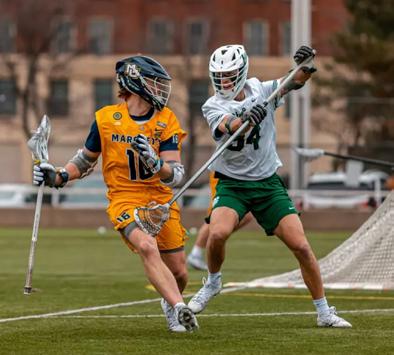
Setting the tone early with its defense, Marquette held Cleveland State to a shot clock violation on the Vikings’ first possession. Trading shot attempts, junior attacker Carsen Brandt found the look he needed to boost the momentum at the 7:42 mark of the match, marking his sixth goal of the season. But it wasn’t long after that that the Vikings saw the back of the net twice in a row, closing out the quarter just one goal ahead of the Golden Eagles. Both teams remained scoreless in the second frame after saves from both goalies kept the scoring to
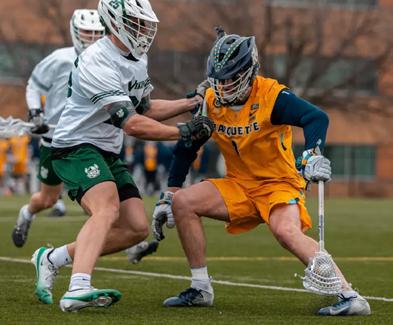
a minimum. Marquette’s senior goalie Lucas Lawas finished the afternoon with 13 saves, while Cleveland State’s Justin Dalum closed it out with 18. Athleticism from both goalies’ abilities to block shots built up immense pressure for both teams throughout the match.
Marquette’s senior midfielder Jake Bair made his way across the field, looking for open shots. He could not find his way around Dalum. Just when Marquette thought they were in the clear to head into the locker room at half, sophomore midfielder Adam Van Voorhis snuck in a goal with four seconds on the clock to extend the Vikings’ lead by two.
The Golden Eagles were hoping to find some kind of momentum in the third frame. That hope was quickly shut down after goals from Van Voorhin and junior midfielder Layton Speer quickly extended a five-goal run.
Down by four, it was Brandt once again to spark the momentum. Charging toward the leftside alley, Brandt tossed the ball over the crease to graduate attacker Nolan Rappis for a goal at the 8:40 mark. Now, it was clear that
MEN'S TENNIS
Marquette was playing with more urgency. A shot from junior longstick midfielder Jackson Nichols went wide. Then a shot from senior attacker Matt Caputo was blocked. Brandt shot wide, but it didn’t matter. The Golden Eagles were getting better looks than they did in the first half.
Continuing the fire that was ignited, Marquette’s offense put on a show in the back half of the third quarter, making it a 4-5 game. The spark was there; it just needed to be fueled even more.
And it was, as the Golden Eagles found their way to a seven-goal run between the end of the third frame and the beginning of the fourth.
Up by three, two back-toback Vikings’ goals forced pressure on Marquette, but it was junior attacker Tucker Mullen who sealed the deal with a minute to go in the match. It was a rapid defense, a controlled offensive looks and a hat trick from Rappis allowed the Golden Eagles to get out of Cleveland alive.
BROTHERS: Pair started on the club team
Continued from page 5 way, and that makes it even more special. Watching them chase their dreams together reminds me that all the sacrifices were worth it. My heart is full every time I think about them out on that court.”
Despite being close, the two siblings’ contrasting personalities strike a balance on the tennis team.
“I talk too much, sometimes, he’s the opposite, so I feel like for the guys, it was refreshing seeing a Vazquez that doesn’t talk so much,” Ivan said. “It’s a great team chemistry and I feel like he can complement that.”
The wrinkle in both the Vazquezes’ college tennis journey has been that neither played at the Division I level in their first year at Marquette. Instead, they competed on the club team before making the leap to the next level and adjusting to the speed, intensity and pacing of Division I college tennis in their second years as Golden Eagles.
Teddy Wong, a senior from River Hills, Wisconsin – who also made the jump from club to Division I alongside Ivan — said that
those extra reps gave their experience a boos.
“The competition level was always high with Ivan and I always playing together, getting better with each other, then we got on the (Division I) team and kept improving more,” Wong said. “Ivan was able to help Marcos train a little bit, and Marcos is a really good player, he’s super competitive and that helps
"We've been together our whole lives, and we've got a special bond..."
Ivan
Vazquez Marquette men's tennis senior
a lot.”
Despite their personality differences, Marquette head coach Jud Shaufler said that both brothers have improved their ability to deal with feisty competition and have a similar energy about each other.
“They don’t get too high, too low, they’re evenkeel guys, as it spills over into the competitive part, they’re learning when they come up against strong personalities, that you can’t back down,” Shaufler said. “Marcos is learning what this whole thing’s about, and how you’ve got to hold up to those strong personalities, so I would say that there’s some parallels too.”
The brothers furthered their chemistry by participating in a few beach tennis tournaments together back home in Puerto Rico during Marquette’s offseason. It provided a literal sandbox spin on their favorite sport.
“That was a pretty cool experience to do, we did two or three tournaments together and we did decently good, even though it ain’t our main sport,” Marcos said.
Marcos said that reuniting with Ivan has helped make his game more well-rounded in addition to acclimating to a new team and coaching staff.
“He’s been really helpful during the process, like keeping me stable, what to do or not to do around Coach (Shaufler); so, he
has helped me out a lot,” Marcos said.
To Ivan, Marcos joining the Golden Eagles did two things, filling a void while also making their childhood dreams come true.
“Growing up, this is what we dreamt of doing, we wanted to get academics while also playing the sport we love,” Ivan said. “When I joined, that was really fulfilling for me, but it was just missing that other component.”
The brothers have cherished the time and experiences they’ve cultivated after their reunion at Marquette.
As Marquette progresses through its season, there is something special to be said about the power of family, on and off the court, as Ivan closes out his last season of his collegiate career.
“We like to help each other out with whatever we need. If it’s school, a meal swipe I need, I know he’s always there for me, vice versa, and the same deal with tennis,” Ivan said.
“We’ve been together our whole lives, and we’ve got a special bond — it’s how family goes.”
“Being far from (your parents) is hard, but they’re always going to be there for you,” Marcos said. “These are unforgettable moments that I’m never going to take for granted, because I’m always going to be learning.”
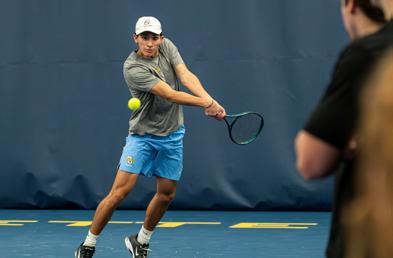
Ivan felt a "void" being at Marquette without his brother Marcos.
Marquette scored eight of its nine goals in the second half.
Photos courtesy Marquette athletics
Photo courtesy Marquette athletics
Carsen Brandt scored MU's first goal and assisted three others.
TRACK & FIELD
MU wraps up regular indoor season
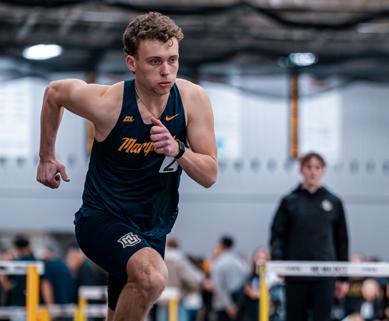
By Lukas Schulze lukas.schulze@marquette.edu
Panther Tune-Up features over 30 personal bests
Marquette wrapped up its regular indoor track season with Sunday’s meet at the Klotsche Center, right in their home city of Milwaukee at the Panther Tune-Up for the second time this season. The Golden Eagles used their final meet in preparation for the Big East Championships next week in Chicago.
“We’re using this weekend just to be down and recover,” Marquette head coach Bert Rogers said. “Any of those aches and pains, taken care of.”
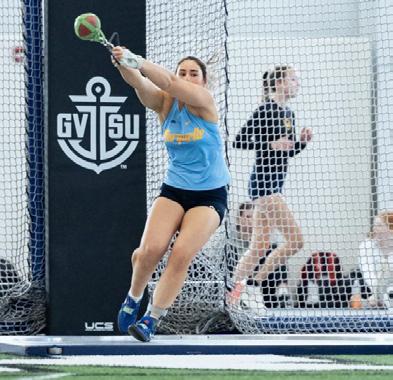
Even with some of the athletes resting, it was still a record setting day for one Marquette athlete. Junior thrower Megan White, moved into the all-time top 10 list for the indoor weight throw with a throw of 17.81m.
Despite White’s career day, Wisconsin took control of the women’s weight throw with both of their athletes Nora Skoraczewski and Morgan Flaska finishing first and second respectively. Both Badgers
recorded PR’s and top 100 distances in division 1.
Marquette did take home one of the field events, courtesy of a first-place finish in the men’s pole vault from first-year jumper Mason Cornwell with a jump of 4.45m. “The pole vault being such a technical event,” Rogers said, “he’s really making some nice progress.”
Another athlete that made progress was Junior Distance Runner Will Allen. Allen was trailing
University of Wisconsin-Milwaukee distance runner Sam Schreiber for the first four laps of the eight lap, one-mile run event.
But at the beginning of the fifth lap, the gap started to close, and once the bell rang for the race’s final lap, Allen and Schreiber were going step for step. Shortly after the first turn, the Marquette fans roared as Allen took the lead, one he would not give back. Allen finished the race with a victory and personal record, with a time of 4:13.
“It was great,” Rogers said. “It was good to see where he was at especially headed into next week with Big East (Championships).”
The success on the track echoed to the women’s side as well with Marquette first-year sprinter Kieran Petrie taking home the Golden Eagles’ lone victory in the women’s side of the running events, winning the 400m with a season best time of 59.69.
The Golden Eagles dominated the men’s 800m, finishing with the top two finishers and, if not for a late trip from
first-year distance runner Jack Chadwick, he would have joined teammates Charlie Richardson (1st) and Edgar Valles (2nd) as a top three finisher. They were performances Rogers was looking for from his runners in preparation for the Big East Championships.
“Anybody else that needed to compete,” Rogers said, “competed today to kind of get ready.”
weight throw list.
Back on the field, the University of WisconsinMilwaukee reigned supreme just as they did the last time Marquette competed against them in the Klotsche Center. The Panthers were victorious in over half of the field events, winning seven of 12.
The Panther athlete that stole the show was junior Anna Szepieniec. Szepieniec won three events on Sunday, one in the field and two on the track. She dominated the women’s 60m hurdles with a time of 8.53 over a half second faster than second place finisher senior Lilly Hamacher of the University of Wisconsin club, helping the Panthers take home six track events. Szepieniec also was victorious in both the women’s long jump and triple jump.
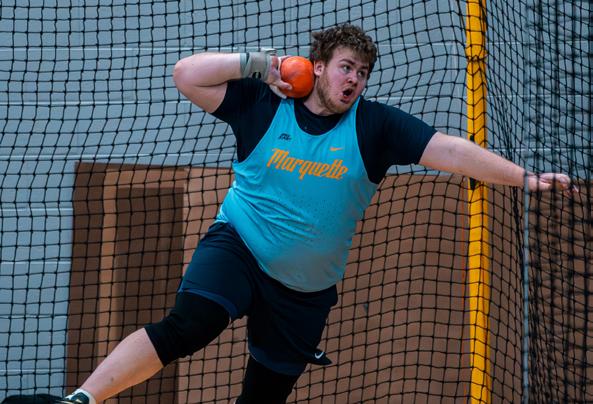
The Golden Eagles saw two of their athletes place in both the shot-put and men’s weight throw. In the shot-put, first-year Alex Matzke (2nd – 14.89m) and sophomore Charlie Smith (3rd – 14.75m). The weight throw saw junior Sebastian Kubas (2nd – 15.78m) and first-year Sam Crane (3rd – 15.61m).
PORTAL: Marquette set to miss Big Dance
Continued from page 5
tune for the portal-dodging Smart, who has famously zagged while the college basketball world zigged.
“I said evolving because it’s not a thing in the future, it’s right now,” Smart said Wednesday after Marquette’s 76-70 loss to St. John’s. “And I think part of that evolution is understanding that rosters are just built differently — even two, three years ago — than they have in the past.”
Smart has never explicitly stated that he is
anti-portal, just that he prefers to reward players who have worn ‘Marquette’ across their chests.
“We made a decision four years ago, after my first season here, to not take any Division I transfers,” Smart said. “Obviously, it went the worst this year of the four.”
This season, those rewards have not led to enough wins.
“To be 100% honest, we had some older guys we thought would maybe be able to do more for various reasons,” Smart said.
Assuming
Smart does dip into the portal, he will be looking for players to complement the Golden Eagles’
"...we have to look at what's best for Marquette basketball..."
Shaka Smart Marquette men's basketball head coach
promising young core of first-years Nigel James Jr. and Adrien Stevens, and sophomore Royce Parham. Marquette has been plagued by its inability to perform in clutch-time situations, so adding older, more experienced players who can better handle those high-pressure moments should help the budding youngsters.
“One thing that as we evolve does not change, our biggest emphasis is the really talented, high-character young guys on our team, retention of them,”
Smart said. “That’s the most important thing. But, then certainly around them, we have to look at what’s best for Marquette basketball and our roster.
“I’m actually excited about that now.”
The Golden Eagles have one open scholarship position next year after the mid-season departure of Zaide Lowery, and more spots could open up with departures.
“I’m excited to see how we can continue to improve our team in different ways,” Smart said.
MEN'S BASKETBALL
Sophomore Charlie Smith earned third place in the shot-put with a 14.75 meter throw.
Megan White entered the all-time top 10 indoor
Junior Charlie Richardson finished the 800 meter in first place.
Photos courtesy Marquette athletics
Replacing Bireley not an issue for efficient MU
Golden Eagles' scoring offense top 10 in Division I
By Eamon Bevan eamon.bevan@marquette.edu
The start to the 2026 season for Marquette women’s lacrosse has been just as unlikely as it has been prolific.
Last season, nearly all of the production ran through Meg Bireley, Marquette’s all-time points leader, who scored 63 goals after setting a single season program record with 69 the year prior. That team relied heavily on its top three scorers, who combined for 65% of their total points.
After Bireley’s graduation, many wondered if and how subsequent teams could hold up offensively.
“Last year, we all relied on Meg, which was good and bad,” senior attacker Tess Osburn said.
Through their first three games, however, the Golden Eagles are 3-1, currently boasting the best offense in the country, with two players (Tess Osburn, Dani Serrano) ranked among the top scorers nationwide.
Marquette ranks No. 9 in Division I with an average of 15.75 goals per
game, a sharp rise from last season’s 13.94. Its .549 shooting percentage ranks among the top 10 nationally and reflects a more efficient attack from nearly every spot on the field.
The Golden Eagles have surged to this nearly flawless start to the season in a three-game homestead at Valley Fields, a stretch in which they outscored opponents 56-25 and converted nearly 55% percent of their attempted shots, placing top-10 nationally.
The season began Feb. 6 with a 20–9 win over Eastern Michigan, tying a program record for goals in a season opener. Marquette followed with a 17–10 victory against Cincinnati after falling behind 4-2 early, then closed the stretch with a 19-6 win over Central Michigan fueled by a 7-0 third-quarter run.
Scoring by Committee
The broader transformation lies in how Marquette generates offense. A year ago, possessions often funneled toward a single dominant option with a few key others getting involved; this season, touches are dispersed across the formation and pace is a priority.
“When one person has an off day, it’s okay, because
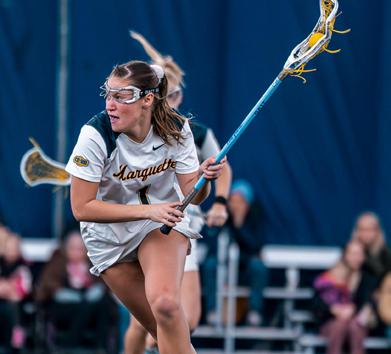
everyone else does their role,” Osburn said.
The shift was deliberate during fall practices. Coaches rotated players through feeder, cutter and shooter responsibilities to ensure each attacker could initiate or finish depending on the situation.
“We want every player on offense to be able to score at any moment,” head coach Meredith Black said.
With eight different players having already recorded at least four points, the Golden Eagles have made it difficult for opponents to key in on one primary threat.
"We want every player on offense to be able to score at any moment."
Meredith Black Marquette women's lacrosse head coach
Osburn is among the many veterans who have taken on a larger leadership role in Bireley’s departure, and currently sits at No. 11 in goals scored nationwide with 13.
Even then, Black emphasizes that the goal isn’t to lead the nation in scoring or get a certain amount of goals per game, but rather to play the game to their style.
“We’re putting the ball in the back of the net nicely, which has been good, but I think it’s just been organic,” Black said.
Another key factor — whom players and coaches have echoed praise for — is assistant coach Chrissy Thomas. When she was brought on to the staff over the summer, Black emphasized how her IQ was the key to elevating the
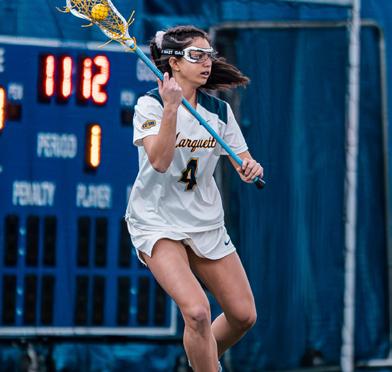
offensive unit, and since then, players like Osburn have begun to appreciate her positive effect on their approach.
“The style of play has changed a lot with Chrissy coming in,” Osburn said. “I’m more of a feeder, but with her we have more feeders and cutters, so we all get to look for those open looks.”
Serrano Spectacle Highlights Youth Movement
The matchup with Central Michigan stood out substantially as it emphasized the program’s current prioritization of the current first-year class, with the victory built off of first year attacker Dani Serrano’s 9-point performance, a Marquette first-year record.
A factor that Black stressed throughout the preseason was implementing a substantial batch of fresh faces into a roster littered with highly-acclaimed veterans. So far, the execution has been more seamless than anyone could have predicted.
“As a freshman coming in, I didn’t even expect playing time,” Serrano said. “It means a lot for the coaches to have so much
faith in me, and the girls on the team have so much trust and faith for me to go and let me play how I play.”
Nonetheless, Serrano has spearheaded the Golden Eagles’ youth movement, currently tied for the most points on the team and standing top 25 in goals scored nationwide.
Her emergence as well as that of other first years has not come at the expense of locker room hierarchy. Instead, players describe a culture where class distinction feels secondary to collective execution, with seniors encouraging younger teammates to assert themselves in live-game situations.
“The seniors allow the freshmen to talk and have a role, and it’s not seniors versus freshmen,” Serrano said.
With five more non-conference games before Big East play commences in late March, everyone involved in Marquette women’s lacrosse is hoping for the program’s positive development both on and off the field to continue.
There is plenty of time left in the 2026 campaign, and the Golden Eagles are aiming to finish just as strong as they have started.


Al McGuire Center Follow
Dani Serrano earned a MU first-year record nine points Feb. 13.
Photo courtesy of Marquette athletics
Opinions
EDITORIAL: protect our people, MU
By Rachel Lopera rachel.lopera@marquette.edu
A female Marquette University student was robbed and sexually assaulted on Marquette’s campus on Feb. 18, sparking university-wide concern for safety.
The male suspect fled northbound on 14th Street after the attack, and the Marquette University Police Department released security footage of the suspect alongside a request to the public to help locate the offender. As of Feb. 23, a suspect was taken into custody on an unrelated warrant.
The incident raises the question: what steps could Marquette have taken to prevent the incident and prioritize student safety?
MUPD claims to have a vision to use “innovative police practices that foster a safe environment in which to live, work and learn,” but more needs to be done. The university has had a strong focus on regulating public and underage drinking recently, but it is not directing enough
attention to daily student protection. All-encompassing student safety must always be at the forefront of the department’s agenda.
Not all students have experienced city living or encountered the possible dangers that come with it, something the university needs to acknowledge.
Marquette requires all first-year and transfer students to complete Red Watch Band training, a bystander intervention program that teaches students the symptoms of alcohol intoxication and how to seek help. Failure to complete the training re sults in a hold on the student’s CheckMarq account, preventing them from registering for classes.
The university also offers free self-defense classes for students, faculty and staff, which teach “simple strategies for escaping potentially dangerous situations.”
While this option is available to students, it is not required like RWB training, further emphasizing Mar-
quette’s prioritization of alcohol-related matters.
Additionally, for National Marquette Day 2026, MUPD planned for the university event by bringing in additional uniformed and non-uniformed officers to monitor campus drinking activity. It was in response to last year’s NMD, which yielded 29 alcohol-related calls and 14 hospitalized students. The department made a proactive decision with planning for this year’s NMD, but that dedication is not applied to year-round campus safety.
The matter of student safety — an everyday concern — deserves the same level of recognition and commitment that NMD — a single day of the year — received.
In 2022, under the leadership of President Michael Lovell, the President’s Task Force on Community Safety approved 12 proposals to implement safety solutions, but there has not been reported progress. The website has not
had any updates, news or announcements since then.
Students, especially women, have shared concerns about their personal safety around campus. They are told to walk in pairs, but a walking buddy is not enough at times. Marquette’s free ride service, EagleExpress, operates from 5 p.m. to 3 a.m. daily and is an alternative to walking alone at night. However, its effectiveness diminishes when the wait time to receive a ride can exceed 30 minutes.
The lack of campus safety and security is causing fear — a real fear that is weakening student trust in our police department. We need reassurance, and we need change. It may be a matter of transparency. MUPD only sends safety alert text messages “if there is an active threat to campus or if there is a significant police presence.” A higher level of communication about dangerous or crime-related matters of any capacity may strengthen stu-
dent confidence in MUPD carrying out its mission. The department should also consider increasing the physical presence of officers on campus — not just on NMD. The university has over 450 Blue Light phones located across campus that immediately connect callers with MUPD. However, instead of relying mainly on electronic communication, more officers should be stationed across campus, ready to respond to a scene.
Whether it is increased patrolling, higher officer presence or additional training, initiative must be taken. With an endowment worth over $1 billion and rising tuition, Marquette should consider dedicating more funds to campus police.
Marquette University, protect our campus; protect our students; protect our people.
Olympians destigmatize mental health

By Amelia Lerret amelia.lerret@marquette.edu
Mental health has historically been stigmatized, averting people from seeking help to improve their well-being. However, the rise of Olympians speaking up about their struggles brings awareness, dismantling negative stereotypes and encouraging people to prioritize mind wellness. Mental health describes emotional, psychological and social well-being that impacts how a person thinks, feels and acts. While it may be overlooked, it is just as important as physical health and crucial to people’s quality of life.
According to the World Health Organization, more than a billion people globally live with a mental health condition. This prevalence highlights the
need for its destigmatization as the public must understand that living with these struggles is not something to be ashamed or embarrassed of.
Mental health conditions have commonly been associated with weakness, but Olympians Ilia Malinin and Simone Biles are switching the narrative to signal strength.
Malinin is an American figure skater in the 2026 Winter Olympics who was expected to win gold in the men’s figure skating individual event. He showed outstanding promise and dominated the event internationally over the past few years.
However, a devastating free skate performance, including two falls, dropped him off the podium, leaving commentators,
fans and himself in shock.
Malinin has disclosed the cause of his poor execution to be purely mental, and he had not anticipated how the immense pressure would impact him.
Not only does his vocality aid in destigmatizing mental health, but his agent Ari Zakarian revealed Malinin is receiving professional help. Asking for help can be a daunting but effective task, making Malinin’s disclosure impactful in advancing the acceptance of mental health.
This is not the first time an Olympian has spoken up about emotional well-being. Simone Biles was an expert gymnast in the 2020 Summer Olympics who withdrew from her team competition due to mental health obstacles. Like Malinin, Biles was a remarkable athlete who was highly expected to win gold in
her events.
Her actions revealed the importance of self-awareness and care, and prioritizing oneself over judgment from others. Though her withdrawal sparked some negative reactions from the public, it was monumental for the destigmatization of mental health.
Malinin and Biles’ actions were not only impactful because of their large platform and outreach, but also because Olympians are resilient and strong. This breaks down the notion that mental conditions signal weakness as Malinin and Biles fought them while at the top of their game.
Mental health conditions can impact the world’s most elite athletes, causing them to stumble under the immense pressure, but making the decision to step back is not a sign of weakness. Instead, battling and admitting these struggles takes great courage and strength.
Olympians’ impacts go beyond physical strength as they advocate for mental wellness and validate a condition that negatively affects people across the world.
Statement of Opinion Policy
The opinions expressed on the Opinions page reflect the opinions of the Opinions staff. The editorials do not represent the opinions of Marquette University nor its administrators, but those of the editorial board.
Our editorial board consists of the managing editor of the Marquette Tribune and all executive editors including news, sports arts & entertainment and opinions.
The Marquette Tribune prints guest submissions at its discretion. The Tribune strives to give all sides of an issue an equal voice over the course of a reasonable time period. An author’s contribution will not be published more than once in a fourweek period. Submissions with obvious relevance to the Marquette community will be given priority consideration.
Full Opinions submissions should be limited to 600 words. Letters to the editor should be between 150 to 300 words. The Tribune reserves the right to edit submissions for length and content.
Please e-mail submissions to: rachel.lopera@marquette. edu. If you are a current student, include the college in which you are enrolled and your year in school. If not, please note any affliations to Marquette or your current city of residence.
Photo by REUTERS Gold medalist Ilia Malinin celebrates after winning Team Event.
Rachel Lopera is the executive opinions editor. She is a sophomore studying journalism.
Amelia Lerret is an opinions columnist. She is a first-year studying journalism.
Fun & Games
Winter Olympians

Lindsey Vonn
Alysa Liu
Jordan Stolz
Jack Hughes
Hilary Knight
Chloe Kim
Alex Ferreira
Kaila Kuhn
Mikaela Shiffrin
Connor Hellebuyck
Chris Lillis
Jessie Diggins
Winter Olympic Events

4. Canadian team was accused of cheating in this sport.
5. Long distance event where participants race to the finish.
7. "Cool Runnings" is based on the 1988 Jamaican team.
9. Skiers and snowboarders show off their moves in this event.
10. The United States' men's and women's teams both won gold medals in this sport.
12. Alysa Liu won gold after not doing this sport since she was 16.
1. Participants try to fly as far through the air as they can in this event.
2. Newest skiing event where participants have to take their skis on and off.
3. Downhill event where participants do jumps and tricks.
6. Chloe Kim, Mark McMorris and Shaun White have done this sport.
8. Jordan Stolz won two gold medals for the United States in this sport.
11. Participants lay face-up on a sled and cruise at over 96mph.
Arts & Entertainment
Professional musician solos in MU concert
By Allison Scherquist allison.scherquist@marquette.edu
The Marquette Wind Ensemble performed its annual winter concert on Feb. 22 in Varsity Theatre alongside Rex Richardson, a globally renowned concert trumpet soloist and professor at the University of South Carolina.
Erik Janners, Wind Ensemble director and Digital Media & Performing Arts professor, brought Richardson on as a soloist. Janners knew of Richardson professionally for years and reached out to him for the first time in 2024 after that year’s soloist — euphonium player Adam Frey — suggested the pair connect. However, Frey mistakenly passed on the wrong email address to Janners and the inadvertent recipient did not show.
“He thought I blew him off,” Richardson said. “And a couple years later, [Janners] reached out and I said ‘Yeah, let’s do it.’”
Richardson is a trumpet virtuoso; he has toured globally and has been critically acclaimed for his musical recordings. As a music educator, he has played alongside several university bands, but he never stops learning from his students. He arrived on Feb 15. and joined in on the students’rehearsal.
“I love when [students] deliver their questions because it shows you what’s on people’s mind,” Richardson said. “You learn what they think about musically and what they think about in terms of their own dealings with the instruments. And to me, that feels like a kind of privilege to be led into and to be given those insights.”
Richardson arrived only a week before the concert, but the ensemble had been rehearsing for the performance since the start of the 2026 semester. Before he arrived, they would play an audio recording of his work
in the background.
“Preparing for the piece Rex [played was] a little challenging,” Janners said. “It’s kind of like all the supporting actors in a movie rehearsing without a lead.”
While everyone in the wind ensemble played in the concert, auditions were held for principal players— the leading player of a musical section. Leo Ruffolo, a fifth–year student in the College of Engineering, was a principal player and led the euphonium section. He said he came into auditions with an open mind and chose to play etudes and a passage from euphonium solos.
Ruffolo said one of his favorite parts of the musical process is being able to learn from the masters, like Rex Richardson.
“I spoke to him during [rehearsal] and afterwards,” Ruffolo said. “It was nice to ask for tips and to just learn how to practice certain advanced techniques. It’s just really nice to learn from
somebody who’s doing that full time.”
At 2 p.m. in Varsity Theater, Ruffolo, Richardson and the rest of the Marquette Wind Ensemble took the stage to perform.
The concert began with the fanfare opening of Randall Standridge’s “Utopia.”
The band then transitioned into Ralph Hultgren’s “Masada,” a symphonic tone poem telling the story of the siege of the Jewish fortress of Masada. The piece is played in two contrasting themes, the woodwinds and high brass playing the part of the Jewish defenders and the low brass and percussion playing the Roman army.
The piece then ends with the two parts coming together in unison to create a layered melody.
The band then played the slow and smooth “Rippling Watercolors” by Brian Balmages before performing “Joropo”— a traditional Venezuelan folk song composed by Moisés Moleiro.
Next came “Three World Winds” for Solo Trumpet and Wind ensemble composed by Alex Vizzutti, where Richardson performed his trumpet solo alongside each of the song’s three movements. The concert ended with a performance of “Libertadores” by Óscar Navarro.
Diana Moses, an oboe player and junior in the College of Engineering, performed at the concert. Like Ruffolo, she’s been playing in her school band since fifth grade. She loves the mental escape playing provides her and hopes to share that with audiences.
“It’s an hour and a half where I literally can’t worry about anything else or focus on anything except the beautiful atmosphere and music that we’re around,” Moses said. “I hope [the concert] gives the same opportunity to the audience.”
REVIEW: Allie Boy's on National Avenue
By Elise Emery elise.emery@marquette.edu
Ever since May of 2020, Allie Boy’s Bagelry & Luncheonette has taken Milwaukee residents on a trip to the East Coast, bringing New York-style bagels to the Midwest.
With locations at 135 E National Ave and 2100 N Farwell Ave, Allie Boy’s specializes in its hand-rolled bagels, which bakers begin to prepare at around 2 to 3 a.m. and bake fresh every day. These bagels can be paired with one of their many options of schmears, including whipped honey butter, pesto and garden veggie, or as the vessel for a delicious bagel sandwich.
The luncheonette was originally supposed to operate primarily as a sit-down experience for customers. But, because of the impact of the pandemic on opening the first location on National Avenue, Allie Boy’s was forced to restructure as a to-go model restaurant to adhere to health and safety restrictions. Despite this, over the past couple of years, the shop has attempted to create that sit-down environment.
Some of the eatery’s many bagel sandwiches include the Egg and Cheese (herbed omelet, American cheese, aged cheddar, salt, pepper and ketchup) and the Veg Head (avocado, raw crunchy veggies, lemon vinaigrette and pesto cream cheese schmear). However,
the spot also has an array of “noshes,” as they are named on the menu, such as matzo ball soup and a latke waffle.
Allie Boy’s also has plenty of beverage options to pair with these bagels. Along with regularly changing drink specials, the National and Farwell locations offer various coffee drinks, teas and non-alcoholic beverages. The National location also offers alcoholic beverages.
One thing Allie Boy’s does best is creating opportunities for customization and experimentation. The shop has a bagel of the day and frequently cycles through specials, whether it’s a seasonal or spontaneous addition. This adds an element of surprise to the Allie Boy’s experience, knowing that there will always be something new to try.
The name Allie Boy’s came from co-owner Staci Lopez’s father, Allan, who was given the nickname when the two of them would travel to New York City together. With both the inspiration from her father and her craving for a good bagel in the Milwaukee area, Lopez and her husband, Ben Nerenhausen, decided to “revive the deli movement” and give Milwaukee residents a taste of what a real bagel is like.
I visited Allie Boy’s on a drab Friday morning, hoping the warmth of a bagel and the caffeine from an
iced coffee would help lift my spirits on a rainy day. Having been to Allie Boy’s before, I knew what to expect. I scheduled my visit to be pretty soon after they open, which ended up being around 9:30 a.m. I knew I had to get an early start because around 11 a.m., you’ll find the line extending outside the door of both locations.
The smell of fresh-baked bagels and everything bagel seasoning filled the air upon walking in. I was immediately greeted by staff as I browsed the menu for something that sparked my interest.
I decided on the egg and cheese sandwich with bacon on a plain bagel, with an iced vanilla latte to wash it all down.
The coffee was ready before my bagel sandwich, giving me time to truly analyze its flavor without the savory disruption. First, the latte was ice cold, which surprised me, as I am used to a lukewarm iced coffee, as the hot espresso usually melts the ice before it gets to me. The shop uses anodyne beans in their coffee, which made for a brew that was sweet and smooth, and complemented the additional vanilla flavor. As for the vanilla flavoring, it wasn’t overpowering, so it brought a delicate sweetness to the overall experience.
Once my bagel sandwich was ready, my appetite had
grown so much that I was truly looking forward to that first bite. The square egg on the sandwich is always a bit of a surprise, as the yellow egg and green herbs make it look a bit sponge-like, which was a little off-putting at first. Don’t let its appearance fool you, as the egg is arguably the foundation of the whole sandwich. The egg patty is made with cream, salt, sugar, MSG, eggs, chives and parsley. The egg was buttery and had a bouncy texture to it. It added a slight sponginess to the sandwich itself, which didn’t provide much texture-wise, but it contributed an herby and peppery flavor. The bacon—as bacon usually does—added a
crunch and a savory smokiness to the sandwich. The two cheeses added depth, with a sharpness and tanginess blending into the already savory flavors of the sandwich. The bagel, of course, was warm and soft, with a crisp outside. The inside of the bagel was plush and perfectly hot, with the exterior adding a desirable crunch to every bite. While some bagels I’ve had in the past have been too tough, requiring me to rip each piece off, each bite from this Allie Boy’s sandwich came with ease. Although the bagel itself didn’t have a distinct flavor, it was the perfect foundation for a savory breakfast sandwich.

Allie Boy's salty bagel sandwich paired with a sweet iced latte.
Photo by Elise Emery elise.emery@marquette.edu
Tuesday, February 24, 2026
Art therapy arrives at Counseling Center
The new service allows students to destress
By Annie Goode annie.goode@marquette.edu
Colored pencils, crayons, magazine clippings, paint, glue sticks, construction paper, scissors and all the art supplies one could imagine filled several tables. Calming music played softly from a speaker as students took a break from their busy Wednesdays to relax with some art therapy.
Marquette’s Counseling Center, located on the fourth floor of the Wellness + Helfaer Recreation Facility, is collaborating with Bloom Art and Integrated Therapies – a non-profit art therapy-focused mental health clinic located in Walker’s Point, Milwaukee – on two art therapy open studios this semester. The first of these clinics took place on Feb. 18 from 2 p.m. to 4 p.m. in Room 326 of the Wellness + Helfaer Recreation Facility.
“[Art] is an extremely powerful tool that allows us to get out of our head and into our body or into our expression a little bit more,” Emily Drenovsky,
a counselor and coordinator for mental health advocacy at Marquette, said. Drenovsky was the only Marquette Counselor present and is also a registered art therapist.
This was the first art therapy clinic the Counseling Center has offered, Drenovsky said. “I think that especially for students, you’re doing so much that’s cognitive or being expected to understand concepts…and this is like the flip side of that,” Drenovsky said. “This is saying, ‘You don’t have to be perfect.’”
According to the National Library of Medicine, art therapy, “uses integrative techniques to captivate the soul, body and mind in ways that verbal expression alone doesn’t appear to.” The same article references a study that found introducing art therapy in patients being treated for major depressive disorder improved their depression and anxiety symptoms.
Drenovsky said her favorite medium to use with students or her coworkers is collage. Collage is a medium that typically involves gluing or taping pictures, stickers or other cutouts, sometimes from
REVIEW:
The hour-long show involved jokes about love
By MaryKate Stepchuk marykate.stepchuk@marquette.edu
Marquette University’s hottest venue on the evening of Feb. 20 was the Fugees’ improv show, “Fly Me to the Benson Boone,” in Marquette Hall 100.
The Valentine’s Daythemed show mixed with Benson Boone references brought everything from improvised dating shows to love advice, keeping the crowd on the edge of their seats, wondering if the next joke would be crude or wholesome.
Before I walked in, I was expecting a small crowd for the gloomy, cold February night. Surprisingly enough, it seemed Marquette students ventured out of their dorms, apartments and houses for an improv comedy show that warmed the soul.
The hour-long show carried energy from beginning to end, with it being broken into eight fast-paced scenes, never leaving the audience bored.
The first scene, called “Dating Game,” roped the audience in with three
newspapers or magazines, together to create a piece of art.
“You don’t always have to have a vision in mind, you can find that [vision] and pull it together, which can be a really great way of building that creative muscle,” Drenovsky said.
Two interns from Bloom Art and Integrated Therapies were also at the event. Bloom offers free open studios every Thursday from 4 p.m. to 6 p.m., located at 700 West Virginia Street #203. Students can get there from Marquette’s campus by taking the 19 or 80 bus southbound from 6th & Wisconsin until 6th & Virginia.
Jia Kamin and Sofia Belgin, both sophomores in the College of Arts & Sciences, attended the event. While only Kamin identified herself as an artist, they both found art therapy to be beneficial.
“Usually when I do art, I’m trying to get my mind off of things, or I’m really stressed with work or classes,” Kamin said. “I like to just decompress by doing some artwork, and it really helps.”
Belgin and Kamin were both working on drawings using markers, and said they wanted to come back
for the next art therapy clinic, which will happen April 14, also from 2 p.m. to 4 p.m.
“I think it’s just calming and something to do to keep you occupied,” Belgin said.
The Counseling Center is also collaborating with the Office of Inclusion & Belonging for “Crafting with Counselors,” on Feb. 24 in the AMU, Room 111 and April 14 from 2 – 4 p.m. in AMU Room 140. Similarly, this event will offer students a space to express their creativity while also engaging in discussion surrounding mental health and self-care.
“You can just create,” Drenovsky said. “You can do something with your hands or make something that feels like it helps you express yourself.”

'Fly Me to the Benson Boone'
contrasting contestants, with each character picked based on audience input after being asked for a historical figure, celebrity and fictional character.
The three final contestants were Abraham Lincoln, — played by Calvin Whitney, a sophomore in the College of Arts & Sciences — Billie Eilish — played by Maria Valdes, a senior in the College of Engineering — and Flat Stanley — played by Ben Shields, a junior in the College of Communication.
The man looking for love through “Dating Game” was named Dr. Visigoth — Carter Empen, a senior inplayed by the School of Education — who asked questions about the contestant’s questions, allowing him to quickly find hate for Flat Stanley and love for Billie Eilish.
This was the perfect warm-up act, as the simplicity and comfort of the game show setting allowed the audience to clearly follow jokes and take note of any conflicts between characters. The initial game set up the plot for the remainder of their relationship.
Billie Eilish and Dr. Visigoth’s relationship continues in “Double Date,” displaying interesting dynamics and topics between fellow couple Lucy — played by
Sam Woodward, a senior in the College of Arts & Sciences — and Amia — played by Zachary Hanson, a sophomore in the College of Communication.
Lucy and Amia were inspired by random audience members’ loved ones after Fugees asked the crowd for descriptions of loved ones and what they are like upon first interaction. This required the Fugees to quickly develop a character with little background, hoping the character’s personality would land.
I expected it to be a simple bingo and scones night for the couples, but I was soon surprised after discovering the double date was set up on Craigslist.
The game exhibited how unpredictable places like Craigslist can be. Billie Eilish received a rug made out of human flesh, prompting her to sing an original improvised song titled “Fleshy Time.” My ribs hurt from laughing at the widely uncomfortable bit.
In a mid-show pick-me-up, the group switched to “Irish Drinking Game,” consisting of a tap-a-foot rhythm song accompanied by “hi-de-ho” lyrics.
In between the “hi-de-ho” lyrics, four members of the group attempted to keep up
a rhyme while following the phrase said before them, keeping the crowd engaged as everyone clapped to keep the members on beat while they quickly spit out ridiculous phrases about love.
In a quick transition to a game called “Pick Up Line,” pieces of paper were scattered across the floor, and if a member did not have a line, they had to pick up a piece of paper and deliver it as a pickup line to the other character in the scene.
It started off wholesome, with “You waddle like a penguin, and I like it,” but as the scene progressed, the penguin narrative continued and flirting became hostile. The scene ended with, “Anyone who waddles like that has other objectives, b*tch” leaving the crowd with shocked gasps at the scene’s quick mood change.
Nevertheless, the love returned quickly with “An Educational Lesson from Dr. Love,” which was five boys — Shields, Hanson, Whitney, Mason McCarthy, a sophomore in the College of Arts & Sciences, and Woodward.
The group asked the audience questions like “Is love real?” and “How do we pick the next TV show to watch?” and used their one-word answers to form random love advice. Sometimes the an-
swers made sense, but other times they didn’t. Looping back to the beginning of the show, Billie Eilish and Dr. Visigoth finally tie the knot in “Cutback,” allowing for a dual-timeline scene.
As Billie Eilish and Dr. Visigoth reflected on their relationship, every time a member screamed “cutback,” they had to exit their conversation and reenact the flashback they had been describing, ultimately resulting in the end of their relationship, drawing shock and applause from the audience.
Last but certainly not least, the night ended with a bang, with a scene called “Sex with Me,” requiring every Fugee member to begin the joke with “Sex with me is like *noun shouted from an audience member*.” As a crowd favorite, this is the only game that the Fugees play at every show. This was by far the best part of the show and elicited the most laughter, presenting an array of crude jokes that parents would never want to hear.
What I expected to be an average college improv show left me with my stomach hurting from laughter as I marked my calendar for their next show.
The event collaborated with Bloom Art and Integrated Therapies.
Photo by Owen Weis owen.weis@marquette.edu