Staff recounts flooding in Johnston Hall
flooding. The first step was to locate the source and stop the leak, but Jahner said the task proved harder than just following the water trail.
By Lance Schulteis lance.schulteis@marquette.edu
After a weekend stamped by a building-wide flood, Johnston Hall closed from Feb. 2 to Feb. 6, canceling in-person classes. The following week, the building reopened — though with a few new additions since students last walked the hallways.
Fans set to maximum amps sit as fixtures on
Water poured from the ceiling near two stairwells on opposite sides of the building. Unlike most newer buildings where water will level in a single location, Jahner said, the floors in 118-year-old Johnston Hall aren’t perfectly even, causing water to pool in more than one spot.
With more standing water on each ascending floor, the fifth floor became the focus. Facilities services then narrowed its search to the

the floor, whirring in the background of lectures. Ceilings look like checkerboards with over 100 missing tiles, revealing the vents and pipes above. Contractors roam the building while continuing to fix the damage on floors above.
Here’s everything that happened since the flooding first started.
Saturday, Jan. 31
4:30 p.m.
Mike Jahner, director of facilities management, said his team was notified of a flood by the Marquette University Police Department.
5 p.m.
Facilities staff arrived at Johnston Hall to assess the

Johnston Hall attic, which is only accessible through a fifth-floor crawl space and has a catwalk-like layout, Jahner said.
However, even after checking the attic, the team was still unable to locate the leak. Jahner was not on campus, instead lending his expertise after being sent photos and videos.
Still, the source of the leak wasn’t found.
“The pictures I was getting, it wasn’t making sense,” Jahner said. So, Jahner went to Johnston Hall to investigate in-person.
5:30 p.m
With water still pouring
down, Kati Berg, acting dean of the College of Communication, first received word of the flood from faculty over text. Berg was out of town at her daughter’s basketball tournament and didn’t have her computer on hand, so she had to manage the flood response on her cell phone.
“We had just sat down to have dinner with the team,” Berg said. “And then I got videos of the water coming through faculty offices.”
Berg got to work, calling faculty with offices on the fifth floor where the water was at its deepest. Among them was Larry Zhiming Xu, an assistant professor in the College of Communication who works out of Room 530 — right next to the still-unknown source of the flood.
Water destroyed the drywall in his office, pouring out of the ceiling like a showerhead and creeping through walls before trickling to the floor.
Xu said faculty in the college often joke about him being a minimalist, which ultimately worked in his favor.
“In this case, it helps,” Xu said. “If you don’t have much stuff in your office, nothing can be destroyed.”
6:30 p.m.
Once Jahner decided to check on Johnston Hall in-person, facilities services finally put a stop to the waterfall, though not in the way it initially wanted.
“We ended up just shutting the water off in the building,” Jahner said. “Generally, we try to avoid doing that only because we don’t want to shut the heat off for the building, too. Once you shut the water off, you lose heat.”
With the water shut off, the team finally located the culprit of the leak: a halfinch split in a copper pipe that was ¾ of an inch thick. The pipe was tucked away in a corner of the attic, frozen by the January air.
Not only was the pipe obscured from view, but it was also hidden from the building plans. The pipe, Jahner said, was a domestic water line that was no longer in use.
“We didn’t even know it was there,” Jahner said.
With the source of the leak shut off, the flood
assessment began. The facilities services team opened the doors to every classroom and office in the building, wading through water that covered their feet to determine the extent of the damage.
Water pooled on every floor, ceiling tiles caved in under their own weight and crashed to the ground and offices — including Xu’s — had fallen into disrepair.
With the flood stopped and standing water left in its wake, facilities services rushed to get the water cleaned up as quickly as possible. However,
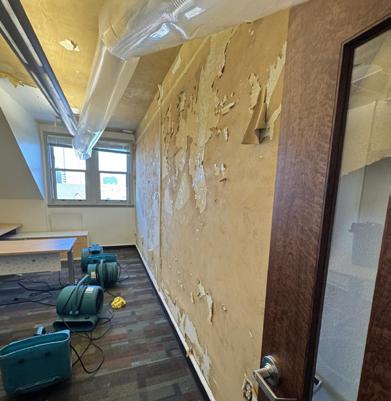
Marquette did it with the help of a contractor, which was already on campus to repair a broken pipe in the Alumni Memorial Union. Due to the age of the building, most of the walls in Johnston Hall are made of plaster rather than drywall. As a result, the fans were positioned to dry out the water that would have otherwise stayed in the wall. Jahner said baseboards were pulled off of the walls and fans were blown upwards to dry the plaster.
The following morning, the contractor brought a
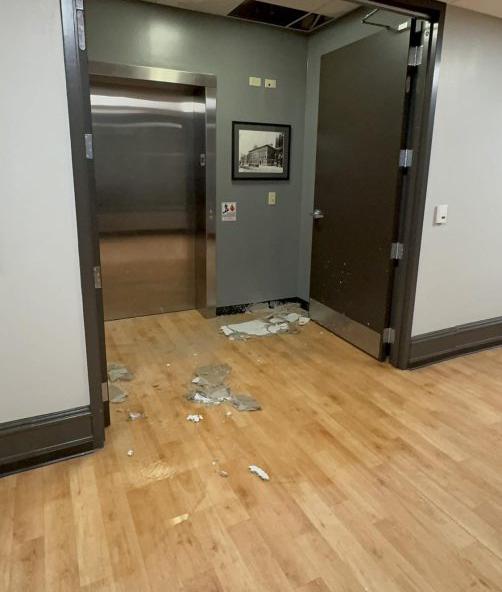
Larry Zhiming Xu's office suffered water damage from the flood.
Photo by Lance Schulteis lance.schulteis@marquette.edu
Fans are set to the highest setting to aleviate lingering moisture.
Photos by Lance Schulteis lance.schulteis@marquette.edu
College of Business adds pair of new minors
Programs in real estate, analytics to start next fall
By Sophia Tiedge sophia.tiedge@marquette.edu
The University Board of Undergraduate Studies has added minors in business analytics and real estate to the College of Business Administration. The college already has a business analytics major, so students would take existing classes in the subject to count toward their minor.
The proposal for the minor said students entering the workforce are required to be proficient in data analysis skills — even those outside of the College of Business Administration — which was a driving force for the added minor. It will launch for the fall 2026 semester.
Staff within the college hope students from programs like
The MarqueTTe Tribune
Managing Editor of The Marquette Tribune Sophia Tiedge
NEWS
Executive News Editor Mia Thurow
Assistant Editors Lance Schulteis, Lilly Peacock
Reporters Sahil Gupta, Elena Metinidis, Mina Marsolek-Bonnet, Lillie Martin
ARTS & ENTERTAINMENT
Executive Arts & Entertainment Editor MaryKate Stepchuk
Assistant Editor Joseph Schamber
Reporters Elise Emery, Allison Scherquist, Annie Goode
OPINIONS
Executive Opinions Editor Rachel Lopera
Columnists Isabella Gruber, Amelia Lerret
SPORTS Executive Sports Editor Jack Albright
Assistant Editors Matthew Baltz, Raquel Ruiz
Reporters Benjamin Hanson, Mikey Severson, Ben Ward, Eamon Bevan, Conor McPherson, Lukas Schulze
COPY
Copy Chief Emma Fishback
Copy Editors Elizabeth Belmont, Shea Lancaster
VISUAL CONTENT
Design Chief Murphy Lealos
A&E Designer Evelyn Riordan
Sports Designer Amery Thompson
Opinions Designer Allegra Delli Carpini
Photo Chief Clay Ellis-Escobar
Photographers Lily Wooten, Owen Weis, Leo Stallings
HAVE A TIP FOR US?
Have you seen something that you think should be a story? Do you have a tip about something we should be looking into? Do you have documents or other materials that we should see? We want to hear from you.
If you have documents you'd like to send us, you can send anything to wiretips@marquette.edu.

criminology, biomedical sciences, psychology, engineering, computer science, environmental studies and communication will be interested in the program. They hope to have a cohort of 8-10 students by the first year.
Those in the College of Business Administration also hope to recruit non-business students to the real estate minor. According to the proposal, students will “engage critically with real estate’s ethical, social and economic dimensions.”
The college hopes to launch the program in fall 2026 and reach 20-30 enrolled students by year five. Eighteen credits will be required to fulfill the minor. A real estate minor already exists, so new classes wouldn’t be required, and faculty won’t need to be hired.
According to the U.S. Bureau of Labor Statistics, employment for real estate brokers and sales agents is projected to grow 3% from 2024-2034. Business and management analyst jobs are expected to grow by 9% in the same period. To declare either minor, students can submit a declaration form through CheckMarq or their academic advisor.
Faculty reflect on restructuring plans
Some expressed optimism for the updated ideas
By Sahil Gupta sahil.gupta@marquette.edu
When Acting Provost Sarah Feldner announced her updated college restructuring plans at the Jan. 26 University Academic Senate meeting, she was met with both silence and nods from senators. It was a stark contrast from the Nov. 17 meeting where the same senators expressed clear
"...they didn't think that the plans on offer made any good changes."
Ben Pladek English professor
and vocal opposition to the plan during an extended conversation period.
English professor Ben Pladek was a leading voice during initial restructuring conversations. In an interview with the Marquette Wire, he said he and his colleagues across the College of Arts & Sciences were largely united in their opposition.
“I can say very firmly that faculty across most units of the College of Arts & Sciences opposed the restructuring plans on offer,”
Pladek said. “They didn’t oppose the idea that things needed changing, but they didn’t think that the plans on offer made any good changes.”
While the initial proposal outlined large-scale restructuring of entire colleges at Marquette, the new plans unveiled on Jan. 26 take smaller steps to restructure locally within various departments and colleges, in addition to reevaluating financial reporting procedures.
Some faculty have expressed cautious but strong optimism for the new proposed plans, even saying they agree with many of them. Pladek said specifically that the initiative highlighted that there is currently no consistent method to evaluate and allocate finances across the university.
“Departments and colleges are reporting their fiscals differently, and so it’s really hard to compare them,” Pladek said.
He also thinks university leaders are currently measuring the success of academic units (colleges, departments, programs, etc.) based on whether their financials were “in the black,” meaning they are focusing only on if they are generating more revenue than expenses.
Pladek argues that in addition to Marquette being a non-profit institution, there are several units that, while expensive, provide great value to the university’s reputation.
“Physics uses expensive
lasers that they have to run [in labs], but they also take students to [the Large Hadron Collider in Switzerland],” Pladek said. “Those students generally make Marquette look good and are mission-critical.”
Theology professor Andrew Blosser echoed Pladek’s sentiments, saying he felt the current financial system causes different units within the university to compete with one another to keep students within their units.
He compared it to the 2004 NBA finals, during which the Detroit Pistons
"This is something we cannot rush through...we have to take our time."
Ben Pladek English professor
defeated the heavily favored Los Angeles Lakers.
“[Shaquille O’Neal] and Kobe [Bryant] were superstars, and they were allegedly competing with each other to the detriment of the team,” Blosser said. “It seems that different schools in the university are competing with each other like Shaq and Kobe, rather than collaborating. That is toxic.”
Another step outlined during the Jan. 26 meeting involved proposed partnerships between the
department of Biological Sciences and the Opus College of Engineering. Martin St. Maurice, chair of the department of Biological Sciences, said he is open to seeing what concrete steps are taken from the conversations surrounding the new ideas.
“It’s never a bad idea to ask ourselves whether there are new ways of doing things, so long as our search for answers is analytical and objective,” St. Maurice said in an email.
While Blosser is optimistic about the new, more granular proposals, he expressed concerns about the university not articulating a clear goal for the restructuring initiative.
“I definitely think that the scalpel approach is far superior,” Blosser said. “But I hope that at some point someone would articulate, ‘This is exactly the goal we have. This is what success will look like for us.’”
Incoming Provost Debbie Tahmassebi will lead the pursuit of the new proposed steps when she assumes the role on March 1. Pladek said any changes that are made must be done with care and patience, arguing that only then will any changes truly benefit the university.
“This is something we cannot rush through,” Pladek said. “A number of these are really good ideas, but we can’t expect to do the work to make them happen in a year. We have to take our time.”
Photo by Clay Ellis-Escobar clay.ellis-escobar@marquette.edu
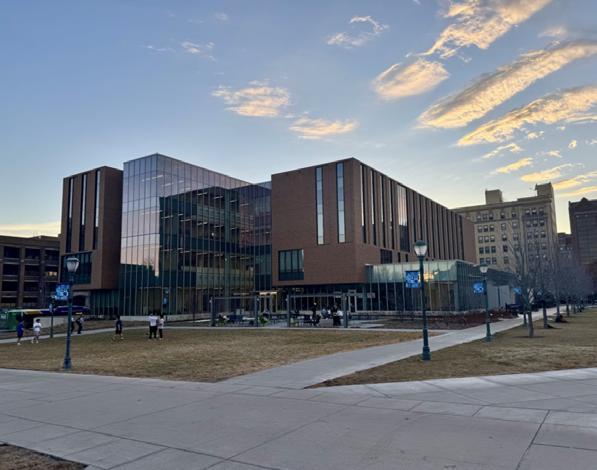
The College of Business Administration is hoping to recruit non-business students with the minors.
New organizations recruit at Winter O-Fest
Student clubs crowded the AMU rotunda
By Lilly Peacock lilly.peacock@marquette.edu
As the new semester continues, new and preexisting student organizations on Marquette’s campus are working to recruit more participants.
On the second floor of the Alumni Memorial Union, student organizations lined the lobby as the Marquette Place lunch rush came to a close. Located by the entrance of the cafeteria, it would’ve been hard for passing students to miss the happenings of Winter Organization Fest, taking place from Feb. 9 to Feb. 13.
Held twice a year, O-Fest is Marquette University’s way of introducing on-campus organizations to its student body.
Fall O-Fest was on the Central Mall between Raynor Library and Lalumiere Hall in early September, where over 100 campus organizations and programs tabled to recruit new members as the semester began.
Winter O-Fest looked a bit different. With temperatures hovering around the 20s and 30s, the event was held indoors and broken up into different organizational categories, with specific days dedicated to tabling.
Each day ran from 2 p.m. to 4 p.m., with sorority and fraternity organizations tabling from noon to 2 p.m. on Feb. 9. Other categories included performing arts, club and recreational sports, social awareness and service organizations.
On Feb. 12, academic and professional groups tabled, spanning across disciplines that ranged from nursing to business.
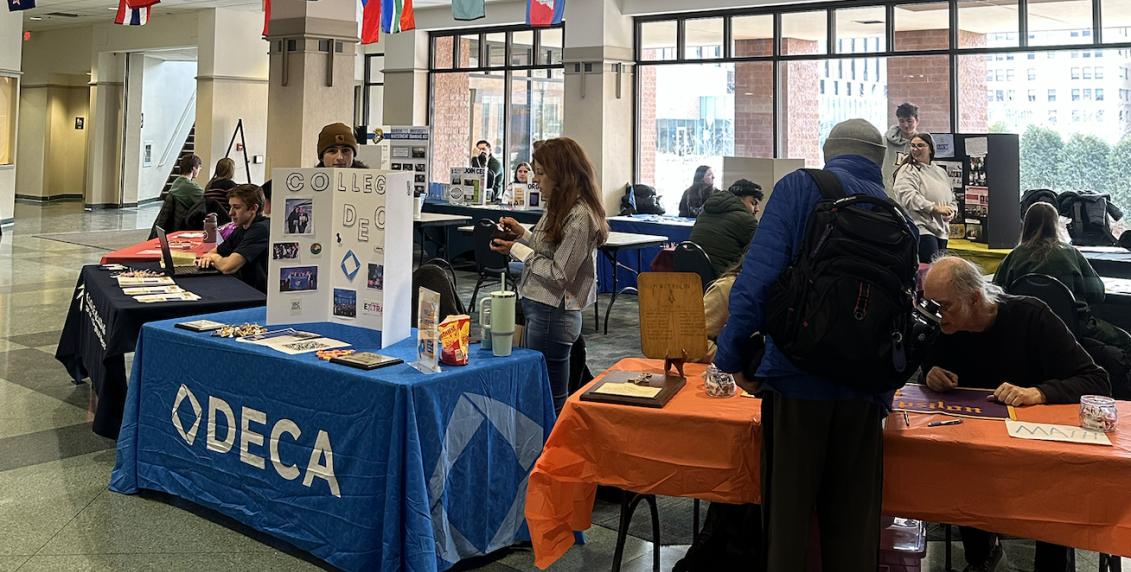
Katie Leuchtmann, a sophomore in the College of Health Sciences, came to Winter O-Fest to see all that Marquette has to offer.
“I think it’s a great opportunity to see all of the organizations and the diverse aspects of community here,” she said.
Leuchtmann also went to O-Fest in the fall, where she signed up for Marquette’s Coffee Club and signed her friend, Ellie Mast, up for Run Club.
Mast, also a sophomore in the College of Health Sciences, is the founder of Women in Medicine, a new club dedicated to women pursuing careers in the healthcare track. Her main goal for Winter O-Fest was to spread the message that the club exists.
“I’m hopeful,” she said. “I made my organization this semester, so we’re just looking for new members.”
Down the line of tables from Women in Medicine sat Marquette CEO, short for Collegiate Entrepreneurs’ Organization. Marquette
CEO is also new this year, founded by Sarah Sanchez, a senior in the College of Business Administration.
“I started it myself in the fall semester and I recruited an E-board, so we’re kind of just figuring everything out now,” she said.
Despite its affiliation with the business school, CEO is open to students in any major, Sanchez said, and provides an outlet for members to connect with other aspiring entrepreneurs.
The national organization has chapters at several different universities across the country.
Across the second-floor lobby, just outside the entrance to Marquette Place, was the Professional Association for Latino Medical Advancement, PALMA for short.
PALMA also tabled at O-Fest in the fall, co-CEO Dafne Mancilla, a senior in the College of Health Sciences, said. It used the second event to continue recruiting members and spread awareness of the organization.
Mancilla and her co-CEO, Alyssa Ruiz Rodriguez, a junior in the College of Health Sciences, run the organization with a mission to support Latino students at Marquette in their studies and career pursuits in the health sciences industry.
As of 2023, only six percent of physicians in the US are Latino, according to the American Association of Medical Colleges.
“We’re going to give our 100% to cater to [members] and make sure that they get help to support their career,” Ruiz said.
PALMA was first created in 2022, using events like O-Fest to attract new members and spread its mission. Winter O-Fest focused on students who weren’t able to attend in the fall, Mancilla said.
While Marquette CEO used Fall O-Fest to bring in as many members as possible, Sanchez said, the winter festival homed in on solidifying commitments.
Sanchez said she has an email list of over 100 people
currently, unsure of who is ready to start paying dues and attending events consistently. Her main priority is figuring out who’s committed to attending the organization’s weekly meetings.
Mancilla said PALMA is focused on growing together, as a group, while forming connections and inspiring future healthcare providers.
O-Fest allows students to learn about organizations and speak directly with members and leadership about involvement. For organizations like Women in Medicine, PALMA and Marquette CEO, the event served to introduce their mission and connect with interested students.
Leuchtmann, the student attendee, recalled her experience at O-Fest as a freshman, mentioning how she joined several different clubs to become familiar with the university.
She found “a lot of things that helped me find my place at Marquette.”
FLOODING: Cost of cleanup still unknown
Continued from page 1
dehumidifier system on a truck to flush the moisture out of the building. Heavy-duty fans filled the upper floors while plastic tubes ran across the ceiling and through each room for ventilation.
Sunday, Feb. 1
2:04 p.m.
Less than 24 hours after the leak sprung, Berg sent out a statement that Johnston Hall would be fully closed for a week. Anyone needing access to the building would need to coordinate with Berg and MUPD and swipe access to the building were disabled.
The statement instructed students to prepare for virtual classes, though some professors worked with the Registrar’s Office to
move their classes to other buildings. Among them were theater classes that relocated to the Helfaer Theatre.
“I appreciated how quickly the university and also the college were reacting, to inform us and to actually develop an action plan,” Xu said. At the time, there was no estimate for reopening, though Johnston Hall was expected to be closed for “at least a week.”
Monday, Feb. 2
8:30 a.m. and 3 p.m.
Berg and other College of Communication faculty went into the building to gather any necessary materials from their offices to prepare for a week of remote learning. As part of the recovery effort, Berg asked Xu the day prior if
there were any valuables in his office he would like to have cleared out.
“The only thing that is valuable would be my diplomas,” Xu told her.
The diplomas happened to be on the wall opposite the damage, and Berg was able to take them off the wall, dry, safe and sound.
Tuesday, Feb. 3
2 p.m.
Xu and his Johnston Hall neighbor, Virginia Sánchez, assistant professor in the College of Communication, relocated to new, temporary offices on the fourth floor. The two cleared out all of their belongings, which included waterlogged books and papers.
To the beat of humming fans and dehumidifiers, their offices were packed onto carts and transported
a floor below for the indefinite future.
“The day that I was packing up in that office, [I could] see the damage, which is pretty sad and heartbreaking,” Xu said.
Wednesday, Feb. 4
4:33 p.m.
Berg sent out a second email to College of Communication students, faculty and staff, saying the building would reopen sooner than expected. While classes remained online for the week, the second floor, first floor and basement reopened the following day, Feb. 5.
The third, fourth and most of the fifth floor needed a few extra days to dry, but reopened Feb. 9.
Flooding aftermath
Four rooms on the fifth floor, including Xu’s office,
will be closed long-term to address the damages. That grouping includes two additional offices and a conference room, which Berg said will likely need a new screen and projector.
However, the damage was minimal compared to Berg’s biggest worry, which was damage to video and audio equipment on the second floor. After the cleanup, the equipment was marked safe, and the building was deemed habitable for classes.
“We have great team of people across the university,” Berg said. “We made it work, but it was a little stressful.”
Jahner said the university does not yet know the total cost of the cleanup.
Photo by Lilly Peacock lilly.peacock@marquette.edu
Held twice a year, Organization Fest is Marquette University's way of introducing campus organizations to student body members

Answering Cara's call
Marquette holds No. 1 UConn to season-low points
By Eamon Bevan eamon.bevan@marquette.edu
Cara Consuegra understands what it means to play UConn. To see a roster full of five stars led by a legendary head coach with a pedigree with which nobody else in college basketball can compete.
Those feelings are even more prevalent this season, as the Huskies have not lost a game in over a full calendar year and have
won all but one game by double digits. Taking down No. 1 ranked UConn — especially right now — is a virtually insurmountable feat in the college realm.
After Marquette women’s basketball got trounced by the Huskies in Hartford on Dec. 17, 89-53, Consuegra noted improvement was the key when facing the stars from Storrs.
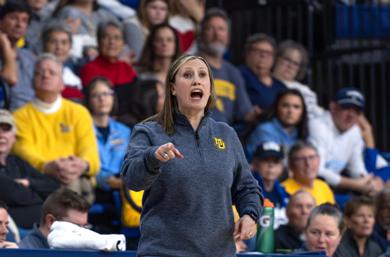
“When we play UConn, we have to just chip away, and at one point we’re going to beat them,” the Golden Eagles head coach said outside the visiting locker room at PeoplesBank Arena. “That wasn’t today, obviously, and that point might not be in February,
and that point might not be for five years, but every time we play them, our goal is to play them better.”
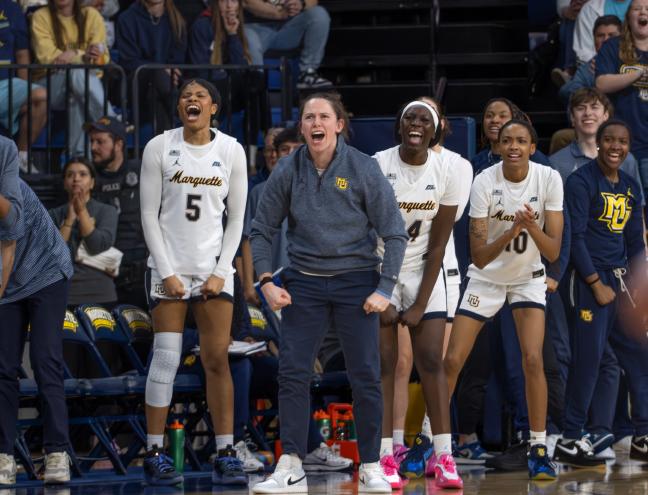
In the programs’ rematch at the Al McGuire Center on Saturday, in which Marquette kept the 71-56 defeat competitive for most of the matinee, that philosophy was evident from the opening tip.
The December game opened with the Huskies scoring the first four points and forcing a five second violation on the Golden Eagles’ second inbound. Feb. 14, it was the blue & gold who took a 5-0 lead and trailed only three points after the first quarter, UConn’s smallest advantage
TRACK AND FIELD
after the opening period all season.
Marquette’s defensive discipline carried into the second quarter, forcing UConn into longer possessions and limiting transition opportunities.
The effort resulted in the Huskies’ lowest-scoring first half of the season (36 points) and ultimately their lowest scoring output overall, one less than their previous low of 72 against then-No. 6 Michigan.
“The game was being played at their pace,” UConn head coach Geno Auriemma said. “When we played them two months
From the hardwood to the track
Sanai Baker is forming her own path at Marquette
By Lukas Schulze lukas.schulze@marquette.edu
Only 2.5% of high school athletes out of the over eight million move on to compete at the Division I level each year. But for the Baker family, the odds look a lot better than that.
Milwaukee Bucks assistant coach Vin Baker graduated from Hartford
University in 1993, with the school’s all-time scoring record of 2,238 points. His basketball career continued as a first-round selection in the 1993 NBA draft by the Milwaukee Bucks where he would become a three-time all-star, which familiarized him with not only the city of Milwaukee but also Marquette.
“I’m very familiar with a lot of people who’ve… gone there,” Baker said. “It’s a great university.”
Vin’s son, Vin Baker Jr.,
OLYMPICS
Lehman, USA advance
MU speed skating alum competes in semifinals Feb. 17
By Ben Hanson benjamin.hanson@marquette.edu
After four years of thinking about Olympic gold in team pursuit speed skating, it was finally time for Marquette alumni Emery Lehman and Team USA — the event favorites — to show how hard they had been working.
But in its qualifying race against Italy, the red, white and blue fell apart in the last three laps.
Out of the gates, it looked as if Team USA and Lehman were going to have no problem against the home team. They began strong.
After two laps, USA was a little over eight tenths of a second in front of Italy and 1.7 seconds in front of Germany: the fastest team in qualifiers up until that point.
“And in a way, (Team USA) really is a true American underdog story,” NBC commentator Bill Spaulding said during the event. “As three individuals were not individual medal favorites, but together, they are better than any team of all-stars.”
Team USA kept growing the lead and on the completion of the very next lap, they led by almost a second. They maintained this margin for two laps until Italy started creeping back. On the penultimate go-around, Italy was only four hundredths behind.
When the home team crossed the line, they finished almost a second ahead of Team USA.
Around two seconds were lost by Lehman and his teammates in three laps.
“It wasn’t their cleanest race, it wasn’t their prettiest, but in prime position to still fight for a medal,” Spaulding said.
Lehman and Team USA will compete again on Tuesday in the semifinals against China. The winner of that one race will compete later on in the day in the gold medal match against the winner of the Netherlands and Italy. The loser will be relegated to the bronze medal race.
Visit marquettewire.org for coverage of Lehman's semifinals performance.
Marquette women's basketball held the undefeated, No. 1 ranked UConn Huskies to their season-low scoring mark of 71 points.
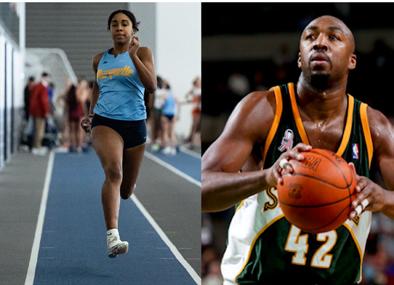
Sanai Baker (left) is former NBA all-star Vin Baker's daughter.
Photos courtesy Marquette athletics, Wikimedia Commons
Photo by Leo Stallings leo.stallings@marquette.edu
Tuesday, February 17, 2026
Olivia Porter will miss rest of season
Senior point guard suffered knee injury Feb. 1
By Jack Albright jack.albright@marquette.edu
The last thing Olivia Porter did in her collegiate career was assist a 3-pointer.
With five minutes remaining in the first half of Marquette women’s basketball’s Feb. 1 visit to Georgetown, the senior point guard dished the ball to Lee Volker, who drilled the shot. One second later, she was helped off the court and limped to the Golden Eagles’ bench, where she has spent all three games since, and will spend every game this season to come.
Marquette on Wednesday announced Porter was done for the year with a lower leg injury from the game at the Hoyas, and head coach Cara Consuegra confirmed in her postgame presser it was Porter’s knee. As a senior who a team spokesperson confirmed has no more eligibility, she will never take the floor in a Division I basketball game again.
“We’re without our point guard,” Consuegra said when asked about the Golden Eagles’ second half struggles in the disappointing 70-58 home loss to Seton Hall.
The same point guard who followed Consuegra to Marquette from Charlotte two years ago. The Golden Eagles’ imperturbable force, who Consuegra
called their “Steady Eddie.”
“I think with Liv, a lot of people don’t give her the credit that she deserves,” Consuegra said. “[She] rights the ship, makes the right play, gets people in the right spot.”
The Golden Eagles (169, 10-6) have lost three of the four games since Porter’s injury, the lone win — a tenser-than-the-scorewould-suggest 78-61 win — coming at home against the 5-10 in Big East play Providence Friars.
Three days before Wednesday’s loss to Seton Hall, Marquette fell 80-74 at Creighton after squandering a 12-point lead in
the fourth quarter and losing in overtime.
Then, the Golden Eagles did not score a field goal for the final 7:17 against the Pirates, missing all nine of their final shot attempts and falling by double-digits.
“I think it’s very obvious that we’re missing her,” Consuegra said. “I’m missing her.”
Porter’s season-ending knock is the program’s third this year, on top of a handful of other minor injuries and illnesses that have wrenched rotations.
As she joins two other Golden Eagles in whiling away the 2025-26 campaign
"It's very obvious that we're missing her. I'm missing her."
on chairs, Marquette’s already short bench becomes even smaller.
The number of reserves cut once again, leaving Consuegra tinkering to find a winning recipe.
“This year has been extremely frustrating with our injuries,” Consuegra said. “And so all we can do is continue to learn and grow and try to get better.”
The loss of Porter makes that task of learning and growing even more difficult.
She started the Golden Eagles’ first 22 games, averaging still the fourthmost number of minutes per game (27). She had Marquette bests in shooting percentage (43.3%), along with more assists and points per game. Not to mention, Porter had 11 more steals in one less appearance.
Porter remains fifth on the team in points per game (5.6) and third in 3-point percentage (39.1%). Her 30 steals are good enough to rank second-best, and her 58 rebounds are top 5.
“[Porter’s injury] is certainly a huge void that we’ve got to try to figure out to fill,” Consuegra said.
Marquette is running out of time to do so.
After being bested by the Pirates for the second time this season, the Golden Eagles — who were picked second in the Big East preseason poll — sit in fourth place with more conference losses than all of last season with three more games on the horizon.
And Marquette has to brave those matches and then the Big East tournament — completely devoid of its senior point guard.
CALL: Golden Eagles 'chip away' at Huskies
Continued from page 5 ago, it was at our pace.”
That shift in tempo forced the Huskies to operate deeper into their offensive sets rather than relying on early transition looks, a change in the Huskies’ rythym which Auriemma credited to Marquette’s atmosphere and approach.
“This is one of the more difficult places to play in our league,” Auriemma said. “Their style of play is really good: very smart, very methodical, but physical.”
Marquette’s ability to keep UConn uncomfortable extended beyond pace control. After forcing UConn to turn the ball over five times in the opening five minutes, the Golden Eagles prevented the Huskies from turning defense into instant offense, a rarity against a program that thrives on both speed and depth.
"...if we play like that, we can write our own story on how we want to finish this season."
Cara Consuegra Marquette women's basketball head coach
“The difference this game was they felt like they were in the game,” Auriemma said. “In Hartford, by the end of the first quarter, it felt like the game was over. Today, they were in it.”
Despite UConn asserting itself in the second half, Marquette remained
competitive well into the third quarter. The Golden Eagles continued to contest shots and rebound physically, requiring UConn to make rare lineup and play adjustments.
Marquette’s performance also reflected an improved ability to adjust to UConn’s defensive scheme, even as the Huskies forced 22 turnovers on the afternoon.
“When you do a good job taking care of the ball against them, then you force them to run more offense,” Consuegra said. “Today they were running plays that we didn’t go over in scout because we forced them deeper into their playbook.”
The competitive showing against the most dominant program in women’s college basketball came after a difficult stretch the week prior. The Golden Eagles lost two games in a row — at Creighton and at home
against Seton Hall — in disappointing fashion to tie their total number of Big East losses all of last season with four regular season games remaining. Saturday, though, was a step in the right direction.
“I told our team in the huddle after the game that if we play like that,” Consuegra said, “we can write our own story on how we want to finish this season.”
Now, with the Big East tournament drawing every closer, Marquette faces a critical stretch in determining postseason positioning and momentum.
While the 16-10 overall and 10-7 Big East record reflects recent struggles, Saturday’s performance offered a clear benchmark for how the Golden Eagles can play entering March — by continuing to “chip away.”
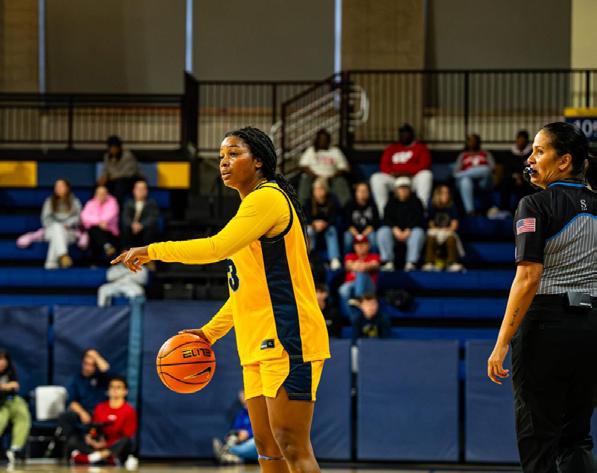
Senior guard Olivia Porter suffered a season-ending knee injury in Marquette's visit to Georgetown
WOMEN'S BASKETBALL
Cara Consuegra Marquette women's basketball head coach
Photo by Clay Ellis-Escobar clay.ellis-escobar@marquette.edu
Consuegra tells her team to "chip away" when playing UConn.
Photo by Leo Stallings leo.stallings@marquette.edu
Golden Eagles' comeback falls short
By Jack Albright jack.albright@marquette.edu
It’s moments like this, after a second half storming so ferocious in nature it seemed the dam would finally break on the 12th wave, that can be the toughest to swallow.
When two double-doubles from a first-year point guard and sophomore forward are not enough. Neither is a hounding defense that dropped an opponent from infallible to addled shooting. Same with five more made baskets and a final 20 minutes dominant enough to make road fans believe and home fans question. Doubt, even.
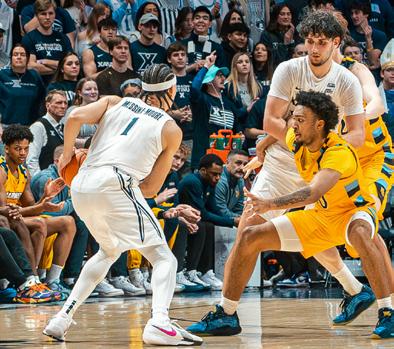
Marquette men’s basketball, when rematching the first Big East team it beat this season in Xavier, had the chance — perhaps its best chance all season — to finally win in enemy territory on Saturday afternoon.
Alas, despite everything that could have led to victory, it again was not enough and the Golden Eagles (9-17, 4-11 Big East) dropped to 0-12 outside
of Fiserv Forum in a 9688 defeat. They could not get over the hump, just as Sisyphus never reached the mountaintop. Like the punished king in Greek mythology got close to changing destiny, so too did the blue & gold.
Oh, so close.
“Way too many threes [for Xavier] and too big of a hole that we created for ourselves in the first half,”
Marquette head coach Shaka Smart said in his postgame radio interview.
“Our defensive effort was better in the second half. And obviously offensively, we were able to get a lot of things going in the second half. But way too big of a hole.”
Marquette went into the locker room down 16 with two timeouts spent after Xavier (13-12, 5-9) shot the lights out of the Cintas Center in the first half. The Musketeers were 11-of-22 from deep and 18-of-36 from the field, compiling basket upon basket into an advantage as large as 21 points.
In less than five minutes of second half play, that lead was whittled to 10.
After another six, it was five points. Xavier in that time had gone from three
timeouts at the start of the half to zero in that time, burning two in zero seconds after Marquette’s inbound press forced the Musketeers to call their final long before they wanted to.
With no timeouts in its pocket for the final 13:37, Xavier lasted six more minutes before it became a one-possession game, 72-69, with 7:27 remaining. The Golden Eagles had outscored the reeling Musketeers 21-12 in the half, carried all the momentum they could ask for and looked poised to pull the sword from the stone and drive it through the heart of the X at center court.
Three points would be the closest Marquette got.
“You got to go put two, three, four stops in a row, and that puts real pressure on that other team,” Smart said.
The Golden Eagles were not able to do that.
With four minutes and change left, the Musketeers extended their lead back to double-digits, necessary breathing room before the blue & gold made it 85-80 at the final commercial break.
Marquette got back within four, but Xavier’s free
TRACK AND FIELD
throw shooting coupled with the blue & gold’s misses in the dying minutes were enough for the Golden Eagles’ pattern exiting a road arena not sipping milkshakes to continue.
“Certainly, there’s a couple of those offensive possessions late that we’d love to have back to finish or get the call or not turn the ball over,” Smart said. “But, too many of their shots they made. We got to make them miss.”
Nigel James Jr.’s 30 points — his third time this season achieving that
mark — and career-high 12 assists; Royce Parham’s 24 points and 10 rebounds; Marquette’s 56-24 paint points advantage; and Xavier’s 41% second half shooting (from both the field and beyond the 3-point line) were not enough. Not to overcome the first half from hell. Or the four Musketeers in double digits — Jovan Milicevic (23), All Wright (19), Tre Carroll (18) and Filip Borovicanin (15). Or, most of all, fate.
Fate had the last laugh on this Valentine’s Day date.
TRACK: Sprinter her father Vin's 'hero'
Continued from page 5
also played basketball at both Boston College University and the University of Wisconsin-Milwaukee.
But for Vin’s daughter Sanai Baker, her Division I talent took a different path.
Coming from a basketball family, track wasn’t originally the top option for the now sophomore sprinter.
With her basketball career already underway, Sanai Baker began running track during 5th grade. But she still credits the days spent in the gym watching her dad train with her older brother, Vin Jr. as a huge part to her success.
“There was definitely a strong sense of discipline,” Sanai said. “My brother spent so much time training.”
The biggest lesson that Sanai took away from both her trainings with her dad and watching her brother’s workouts was the phrase “If you’re going to start it, you need to finish it.”
A phrase that her dad Vin created to help deal with the obstacles of life.
“We are going to do our very best to complete what we started,” Vin said. “We don’t want to quit or give up.”
This phrase meant a lot to the entire Baker family, but especially to Sanai. It helped keep her motivated, especially on her rigorous track training. Whether it be the long distance runs or the sprint mechanics she would work on with her trainer, the phrase always stuck with her.
“The workouts are definitely difficult,” Sanai said. “When it’s longer distances… you really need to be disciplined and motivated enough to finish it.”
When it came time for high school, Sanai followed in not only her sibling’s footsteps but also her father’s by attending Old Saybrook High School in Connecticut.
“To see them go to that school and walk in the same hallways that I did,” Vin said. “It’s really cool beyond words.”
Having an athletic facility named after him at Old Saybrook, Vin was reminded of the legacy that he left not only at the school but also on his family.
“Even when I wasn’t there,” Vin said. “Them (his kids) being able to walk by a room that has their dad’s name on it, how that
empowers them.”
Sanai carried out that accolade-heavy legacy, but this time in the form of track & field.
After finishing her sophomore season as an allstate selection in Connecticut, Sanai knew she could take her running abilities a step further.
"I have a ton of videos in my phone of her meets."
Vin Baker Milwaukee Bucks assistant coach
“Sophomore year is when I wanted to advance into college doing track,” Sanai said.
The accomplishments didn’t stop there. In her junior and senior seasons, she became a two-time All-American sprinter and earned the school record in the 4×100 with a time of 48.16. When it came time for the college search, Marquette wasn’t initially on the radar.
“It was kind of confusing at first,” Sanai said.
“Originally I thought I wanted to go somewhere south.”
Those ideas shifted after visiting her dad in Milwaukee for a Bucks game. That’s when he asked her if she had ever considered going to a Wisconsin school.
Sanai originally couldn’t see herself running in Wisconsin, but the family ties came calling; Sanai wanted to run track, but she also wanted to move closer to her dad in Milwaukee. So, she decided to send an email to Marquette University.
That email to Marquette led to a campus visit with Marquette head coach Bert Rogers; a visit that immediately moved Marquette to the top of Sanai’s list.
“I really liked the atmosphere, and it was super welcoming,” Sanai said.
Vin couldn’t be happier of his daughter’s early success not only on the track but also in the classroom.
“I’m super happy for her,” Vin said. “I don’t think she could have picked a better university.”
With the Bucks’ deep playoff runs in recent years, their season didn’t end until early May or
even July in the championship-winning 2021 campaign. These conflicts made it very difficult for Vin to make out to any of his daughter’s meets, but that didn’t mean he didn’t get to see his daughter run.
“I have a ton of videos in my phone of her meets,” Vin said. “She keeps me in the loop of how well she’s doing.”
The relationships that Sanai has made at Marquette have helped her through the difficult situations like her hamstring injury that caused her to miss most of the indoor season of her first year.
“I would definitely say that I have great supportive teammates,” Sanai said. “Sitting down with teammates and talking it through and understanding I wasn’t going to be out for the whole year.”
Sanai, now fully healthy, is looking to improve her times and working with her teammates in relays to help the team improve overall, while her father is excited to see what she does next.
“My daughter is so amazing,” Vin said. “She is my hero.”
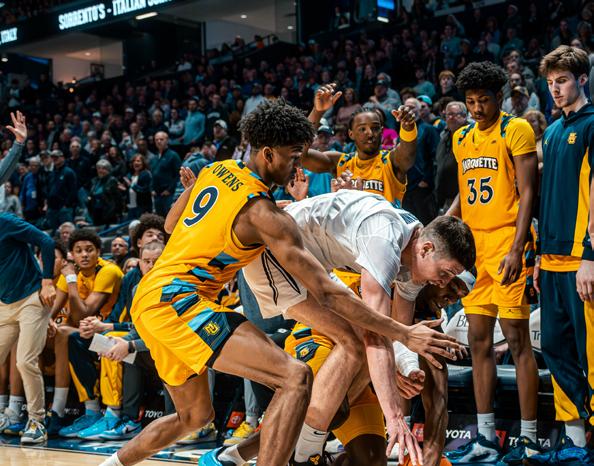
Adrien Stevens defends Xavier in the Golden Eagles' 96-88 loss.
Photo courtesy Marquette athletics
Parham soars, Marquette struggles on the road
By Matthew Baltz matthew.baltz@marquette.edu
Marquette men’s basketball (9-17, 4-11 Big East) has been — for lack of a better term — a homebody, for almost a year now.
When the Golden Eagles topped Xavier on March 13 last year at Madison Square Garden in the Big East tournament quarterfinals, nobody thought another 340+ days would pass before they’d win outside of Fiserv Forum again.
However, 10 road and two neutral site losses later here Marquette stands, 0-12 on courts not named after Al McGuire.
But aside from suffering losses to Villanova and the Musketeers last week, there is still plenty of silver lining to examine in a season that by winning percentage, is lining up to be MU’s first under .400 since 1990-91.
Here are some takeaways from the winless week:
Royce Parham is becoming a star
If the college basketball season would have
started a month ago, not only would sophomore Royce Parham be a serious contender to be named a first team All-Big East selection, but he’d have a case for an All-American candidacy too.
Over his last eight games, the Pittsburgh native is averaging 18 points on an absurdly efficient 66% shooting from the field. Parham is also pulling down 5.6
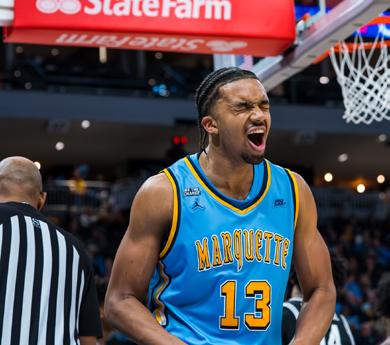
Photo by Clay Ellis-Escobar clay.ellis-escobar@marquette.edu
rebounds per game during that stretch, and is coming off of back-to-back double-doubles last week, the firsts of his career.
He’s also been getting it done on the defensive side of the ball, tallying 1.8 blocks per game.
“I like Royce’s confidence and his aggressiveness right now,” Marquette head coach Shaka Smart said after the Golden Eagles’ win over Creighton Jan. 27.
Parham nearly willed Marquette to its first road victory of the season on Tuesday with his career-high 26-point, 11-rebound performance in Philadelphia. The Golden Eagles were widely competitive with the Wildcats through the first 36 minutes before falling short in the final 3-plus minutes.
His career night was hampered by calf cramps towards the end, which limited both his mobility and playing time.
Four days later, the 6-foot-8 forward followed up his career-best performance with another strong outing in Cincinnati,
scoring 24 points and grabbing 10 boards in the loss.
"I like Royce's confidence and his aggressiveness right now."
Shaka
Smart Marquette men's basketball head coach
All in all, Parham averaged 25 points and 10.5 rebounds on the week.
Road struggles mask some underlying improvements
The Golden Eagles have often been on the wrong side of games that come down to the final few possessions this season, a sentiment reinforced by some of their latest road results.
Four of Marquette’s last five road losses have come by eight points or fewer.
On Jan. 16, the Golden Eagles fell by five at DePaul in
a game where they led by as much as 11. On Jan. 31, MU lost by five at Seton Hall in a match that was tied with under two minutes to play. Nearly two weeks later on Feb. 10, Marquette lost by three at Villanova, and then by eight at Xavier on Saturday.
While none of those stats will make MU’s conference record look any better, it does illustrate that it is in games until the very end, in large part thanks to its improved offensive efficiency.
Marquette only shot better than 42% from the field three times during its non-conference schedule, all of which came in buy games. The Golden Eagles’ offense would hum at times, but completely fizzle out at others.
But over the last eight games, MU is shooting 50.2% from the field. That is up nine percentage points from the 40.8% that it shot in the previous 16 games.
The Golden Eagles have also been much more effective from beyond the arc over the past eight games, shooting 37.8% as a team. In keeping with the trending theme, it’s no surprise that number is up from the 29.9% Marquette shot over its first 16 games.
The Golden Eagles have become much more efficient on offense, leading to more competitive bouts on the road and a even three game win streak at home. They have a ways to go on defense, but with the emergence of first-year guards Nigel James Jr., Adrien Stevens and Parham, a clear core of young players has begun its formation.
What’s on tap?
Marquette’s aforementioned three-game home win streak will be put to the test when No. 17 St. John’s comes to town on Wednesday. Tip-off is set for 8 p.m. CST.


Marquette men's basketball fell to 0-12 outside of Fiserv Forum after its 96-88 loss at Xavier.
Photo courtesy of Marquette athletics
Detroit, MI
Opinions
MPD should not use facial recognition
By Bella Gruber isabella.gruber@marquette.edu
The Milwaukee Police Department will no longer consider acquiring facial recognition technology Chief Jeffrey Norman announced on Feb. 6. Despite proponents who believe its efficiency will benefit MPD’s policing and investigative processes, this choice will ensure fair leads and convictions of criminals, ultimately maintaining public trust.
MPD planned to partner with Biometrica, a FRT database that would identify an individual they are pursuing based on a single frame of video surveillance to match them to millions of identities in its database. In exchange for over 2.5 million mugshots, Biometrica offered MPD years of access to its software.
Anti-FRT activists spoke out at a Fire and Police Commission meeting on Feb. 5, one attendee telling WISN-12, “This is a direct attack on our civil liberties, and it impacts our right to speak out.”
Regulations can be implemented to prevent FRT from being misused, but MPD cannot control the system’s
identification deficiencies and algorithmic errors.
The Facial Recognition and Biometric Technology Moratorium Act was proposed in 2021 to regulate FRT in federal law enforcement, but states and municipalities must take individual action to create guardrails for its use. For example, Maryland’s law, being enacted in Oct. 2026, will put limits on what instances FRT can be used for in investigations. Montana and Utah also enacted laws that require a warrant for biometric data to be obtained from perpetrators, victims or witnesses.
AI is a significant component of FRT, which analyzes millions of identities by using individuals’ biometric templates — detailed outlines of facial features — in the database’s video surveillance records. The system commonly matches the selected individual to all other images in the database, which can be millions at a time.
The DOJ reported that some developers of FRT technology have addressed the issue of bias by improving their systems, finding lower false matches across
gender, age and race demographics from these improvements. Despite these improvements, an individual’s trajectory in the justice system should not be determined by AI — it should remain a human responsibility of law enforcement.
This algorithm may make investigations more efficient and less costly, but compared to traditional methods, its frequent errors and breach of privacy pose a danger to citizens.
Biases in FRT have been prevalent across many police department’s uses of the technology. When the technology fails to accurately identify marginalized groups, it can contribute to law enforcement’s conviction of the wrong person, when used for arrests and convictions. This means that errors directly violate the fundamental right against unlawful search and seizures.
The U.S. Department of Justice reported that there have been at least seven mistake arrests as of 2024 due to FRT, most of which were Black men. Scientific American suggests that these false matches are

due to FRT’s lack of diverse data sets in its training algorithms, paired with police officers’ own biases.
In terms of privacy, the American Civil Liberties Union of Minnesota argues FRT can track people’s personal movements in images and video without consent, violating individuals’ fundamental right to privacy. This expands the threat FRT poses to every individual regardless of demographics. Milwaukee County ranks 15th in the nation for exoneration rates, with 2.59 per 100,000 citizens being exonerated, or wrongfully convicted, each year. The
city should not let AI or unreliable technology increase this rate. Instead, MPD should rely on traditional practices that ensure fair convictions.
Creating adequate regulations for FRT’s use will allow law enforcement officers to utilize its capabilities while preventing unlawful arrests and convictions. While technology will continue to advance in law enforcement, Milwaukee made a wise decision in keeping FRT out of its investigative practices.
Resist the desensitization to breaking news

By Amelia Lerret amelia.lerret@marquette.edu
The abundance of breaking news in media has desensitized people, hindering emotional responses alongside the opportunity for positive change.
Today’s primary purpose of consuming news is to stay informed on the world around us. While this is important and beneficial, people should also practice empathy for those involved in tragedies.
Former CEO of CNN, Chris Licht, spoke to how the overuse of “breaking news” has made the term ineffective as it does not spark as much emotion from people as it used to. The overexposure to negative content can lead to feelings of numbness or indifference, but it is essential that people fight against that reaction.
Robert T. Muller, a psychology professor at York University, describes how people’s feelings toward a particular subject change after encountering it even once before. For example, the first time someone sees a story covering a wrongdoing, they are likely to respond with anger. However, the second time they encounter a similar headline, their reaction is likely to be less intense. With how frequently misfortunes are covered in the news, it is understandable for people to form indifferent emotional responses. However, this lowers people’s ability to learn and grow from the full weight of tragedies.
This is evident in the ongoing investigation to find Nancy Guthrie, mother of Today Show anchor Savan-
nah Guthrie. She was taken against her will from her home in Tucson, Arizona on the night of Jan. 31 and has not been seen since.
This is a very public case covered by many of the nation’s largest outlets, and every update is a breaking news headline. Additionally, Nancy’s children are making the case wellknown through shared videos on social media, urging prayers and action if any suspicious activity is sighted.
This exemplifies the volume of “breaking news” that can cause numbness to the information, which also hinders emotional responses.
Empathy is needed by the public to fully understand the effect this tragedy has on not only Nancy, but also her children, family and community. Savannah’s public-figure status also expands the community this case has impacted.
Emotional responses signal that people are engaged with the news, and they understand that there are real people experiencing real tragedies. On the other hand, when people dismiss the news, they lack an empathetic reaction. People need to know
about what is happening to make informed decisions and promote a participatory society.
When we continuously consume breaking news at a surface level, we do not grasp the emotion and depth of the situation. This cycle hinders action and change, and the immense number of tragedies covered in the news highlight the crucial need for just that.
To combat numbness to the news, people can limit media exposure, listen to credible sources and be critical of the information available. These tools should be utilized because avoiding the news inhibits community involvement and action.
People’s desensitization to the overload of breaking news is justifiable, but it must be resisted.
Don’t let the abundance of negative content weaken your emotional responses. Empathy and consideration are necessary to achieve and maintain high moral standards in society.
Statement of Opinion Policy
The opinions expressed on the Opinions page reflect the opinions of the Opinions staff. The editorials do not represent the opinions of Marquette University nor its administrators, but those of the editorial board.
The Marquette Tribune prints guest submissions at its discretion. The Tribune strives to give all sides of an issue an equal voice over the course of a reasonable time period. An author’s contribution will not be published more than once in a fourweek period. Submissions with obvious relevance to the Marquette community will be given priority consideration.
Full Opinions submissions should be limited to 600 words. Letters to the editor should be between 150 to 300 words. The Tribune reserves the right to edit submissions for length and content.
Please e-mail submissions to: rachel.lopera@marquette. edu. If you are a current student, include the college in which you are enrolled and your year in school. If not, please note any affliations to Marquette or your current city of residence.
Photo by Rachel Lopera
The overuse of "breaking news" has made the term ineffective.
Bella Gruber is an opinions columnist. She is a sophomore studying public relations.
Marquette Wire stock photo MPD will not consider getting any facial recognition technology
Amelia Lerret is an opinions columnist. She is a first-year studying journalism.
Fun & Games
Happy Lunar New Year

Presidents' Day

3. Known for his environmental preservation efforts.
5. The first president to die in office.
7. Only president who served more than two terms.
8. The first president to live in the White House.
9. First Roman Catholic president.
11. Had a "Fourteen Points" plan.
12. The president whose birthday falls on Presidents' Day.
1. Famously owned a peanut farm prior to becoming president.
2. Launched AmeriCorps.
4. Facilitated the Louisiana Purchase.
6. Nicknamed "The Great Communicator."
10. Only U.S. president that resigned.
Submit finished puzzles to sophia.tiedge@marquette.edu by
Arts & Entertainment
MU a cappella groups compete at ICCA
By Annie Goode annie.goode@marquette.edu
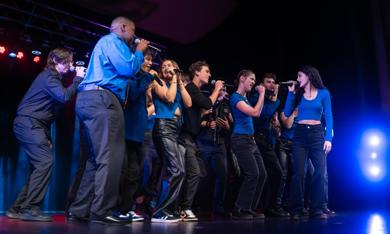
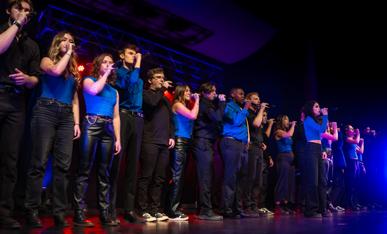
Two of Marquette’s a cappella groups, the Naturals and the Gold ‘n Blues, competed in the International Championship of Collegiate A Cappella (ICCA) quarterfinals this weekend in Madison, Wisconsin. Neither group placed in the top three.
The Gold ‘n Blues ranked fourth in the competition, just missing the placement in the top three.
The competition took place in the University of Wisconsin-Madison’s student union and consisted of 10 different teams from the Great Lakes area performing their 10-minute-long showcases.
The event started with each group drawing the order in which they would
compete. The Naturals performed fifth, and the Gold ‘n Blues performed last.
“A huge thing about the competition is memorability, and remaining memorable in the judges' eyes, and so we were like, ‘We get to go tenth, we are the last thing on their brain before they’re making these decisions,’ and so we were really happy with closing out the show,” sophomore in the College of Communication and Gold ‘n Blues Creative Director Bennett Chapman said.
After drawing the competition order, each group was able to do a sound check and block choreography. The competition then started at 7 p.m.
The Naturals performed ‘Hard Run’ by the Zac Brown Band, ‘Over My Head (Cable
Car)’ by the Fray and an Icelandic electronic song.
“I think we were all really happy about [the performance] …we had a lot of energy we definitely brought to the stage,” Naturals President and junior in the College of Arts & Sciences Teddy Gustafson said. “This year, one thing we really wanted to emphasize was smiling, having fun on stage and bringing emotion to all the songs, so I think we did that successfully.”
This was the third time the Naturals have competed in ICCA — the previous two times were in 2022 and 2023.
“The Marquette groups are fairly new to competing, especially our group,” said Chapman. “So, we were like ‘Let’s just get a feel of it, and let’s just have fun.’”
The Gold ‘n Blues performed “Training Season” by Dua Lipa, “Biting My Tongue” by Duncan Laurence and “Holding out for a Hero” by Bonnie Tyler.
“We’ve been working so hard on it, everything feels polished, and we were honestly more excited to perform it than nervous,” Chapman said.
7Days A Cappella from the University of Minnesota and Under A-Rest from the University of
Wisconsin-Madison went home with first and second place, respectively, and will be the only groups from the competition moving on to the semifinals.
“Regardless of what happened this year, it’s a really good setup year for the next couple of years,” Chapman said. “It gives us a pep in our step, and it helps us set goals because now we know what we need to do.”
Gustafson said this was a learning experience for the team.
“There’s always some good creativity that I think we can learn from other groups, especially from choreography – unique movements we can keep in our back pockets,” Gustafson said.
Reed Hoegler, junior in the College of Arts and
Sciences and the Naturals’ Music Director, made mental notes about the group’s performance.
“We had a lot of energy at the end of our set, but having a lot more energy in the beginning to get the crowd more involved and get ourselves a little more pumped up would be nice,” Hoegler said.
The Gold 'n Blues will have their final show of the semester on April 25, and the Naturals will perform at the Mels After Dark show the last weekend of February. The Naturals will also have their spring show on April 10.
The ICCA semifinals will take place at the Pabst Theatre in Milwaukee on March 28.
REVIEW: Sooshibay in downtown MKE
By Elise Emery elise.emery@marquette.edu
This January, the lively Water Street strip welcomed Milwaukee’s first rotary-style sushi restaurant, Sooshibay, to its many iconic storefronts.
Located at 1154 N. Water St. in Milwaukee School of Engineering’s Grohmann Tower, a quick five-minute drive from campus, Sooshibay’s conveyor-belt-style service adds a little bit of charm to the traditional sushi experience. The restaurant offers an array of Asian cuisine, including poke bowls and ramen. However, its sushi is what the restaurant truly emphasizes.
Spanning across four pages of its eight-page menu, Sooshibay’s sushi selection is quite extensive, offering everything from classic traditional rolls, like spicy tuna, to experimental signature rolls, like the Broadway Maki (cream cheese, spicy octopus, crabmeat, avocado, sesame seeds, scallions and spicy mayo).
At a rotary sushi restaurant, customers are seated next to a continuous conveyor belt that cycles through a constant stream of menu
offerings. Customers pay by the plate—with the varying colors of plates indicating the price of the sushi—and can pick as much as they desire off the conveyor belt at any time.
Upon entering the restaurant, I was greeted by a few sushi-themed mascots, creatively styled with nigiri rolls as hair. As the twinkling lights over the windows and warm overhead lighting filled the room, I felt immediately welcomed into the space. Once at my table, I sat directly next to the sushi conveyor belt, as I knew I had to monitor the stream of sushi and be prepared to act quickly.
The belt didn’t have many options I was initially interested in, but once more sushi started coming towards our table, it was a hustle against the clock. Quickly, my friends were clamoring over one another. “Grab that one!” “Grab it, grab it!”
I became the designated server for our table while also consistently keeping an eye out for anything that interested me.
A few of the standout rolls were the Yellowstone Maki (shrimp tempura, crab
meat, avocado, mango, red tobiko, scallions and spicy mayo) and the Volcano Maki (spicy salmon, avocado, cucumber, spicy crabmeat, Flamin’ Hot Cheetos and sesame seeds with sriracha).
The Yellowstone Maki was immediately striking because of its bright yellow color. The contrasting colors from the mango and spicy mayo, with the red of the tobiko and green of the scallions, were especially eye-catching.
First tasting it, the sweet mango was the first thing that I recognized. It honestly caught me by surprise, as I don’t think I have had a sushi roll that incorporated fruit. Despite it being a prominent inclusion, it wasn’t overpowering and allowed for the remaining flavors to peek through. The subtle kick from the mayo and crunch from the shrimp provided an array of textures and flavors that kept each bite interesting.
The Volcano Maki was especially intriguing to me, as the Flamin’ Hot Cheetos delicately placed on top of the roll were both intriguing and slightly hilarious.
One might suspect from
the name that this roll would be an intense heat experience, but in all actuality, the spiciest part of the roll actually ended up being the Flamin’ Hot Cheeto. The spicy salmon and spicy crabmeat weren’t groundbreaking and didn’t contribute much to each other flavor-wise. A fun idea, but not exactly the explosion of flavors like the name might suggest.
In addition to my adventurous choices, I also tried a simple salmon nigiri. The fish was tender, fresh and buttery, with a mild soy flavor that added an appreciated saltiness to the sushi. The thin slice of salmon was placed on top of a mound of soft and perfectly sticky white rice, which evened out the flavors from the fish with a neutral yet mildly savory taste.
Although the continuous stream of sushi stationed conveniently next to your table is the overall draw of the place, customers still receive regular service by wait staff and can order customarily through the tablet placed at each table. Even though the experience of ordering on the tablet might
be less thrilling than the unexpected nature of the belt, customers can still expect a surprise regardless.
Not being a huge sushi fan, one of my friends ordered gyoza from the tablet. A few short minutes later, I was startled to hear a small beeping sound to my right. As I looked to see what was causing the noise, a small train car positioned right above the conveyor belt carrying my friend’s gyoza was politely stopping by to make the delivery. In addition to this train car, another member of the wait staff was a small robot who would make delivery rounds to tables. Rolling around to each table and occasionally asking customers and employees to move out of the way, this little robot was providing surprisingly commendable service.
Overall, my experience at Sooshibay was both fun and simply delicious. After a long week, it was enjoyable to sit back and be immersed in delicious food and a good evening with friends. In short, Sooshibay will definitely be seeing my face again in the near future.
Neither of the a cappella groups placed in the top three.
Photo courtesy of the Marquette Gold 'n Blues
Both groups sang three songs in a 10-minute performance.
Photo courtesy of the Marquette Gold 'n Blues
Tuesday, February 17, 2026
Arabic Club hosts a cultural celebration
They returned to campus after a short hiatus
By MaryKate Stepchuk marykate.stepchuk@marquette.edu
The Arabic Language and Culture Club had a roaring return to campus on Feb. 13 with “Passport to the Arab World,” after tabling at Winter O-Fest earlier last week.
The club took a short hiatus in 2025 due to conflicting commitments among club members. This was its first large event back.
The Arabic Language and Culture Club serves as an extension of the Arabic Language Studies and Culture minor, but this event was open to all, with the intention of educating the public after receiving a grant from the Arrupe Center.
The Arab nations extend beyond the Middle East, reaching to North Africa and influencing Latin and Spanish cultures. Although the cultures share some similarities, many regional differences exist, from traditional clothing to language dialects.
“We really just want to show how much richness the Arabic culture and language have, and how it has expanded all over the world,” Samera Osman, a first-year in the College of Arts & Sciences and President of the Arabic Language and Culture Club, said.
From walking into the event, even after a delayed start, attendees were hit with the welcoming and woody scent of Bkhour — a traditional Arabic incense used to welcome individuals into a person’s
home — and were handed a “passport” for the night.
The passport contained blank pages, and at every station throughout the room attendees could earn a sticker by participating in activities that emphasized regional differences in Arab nations.
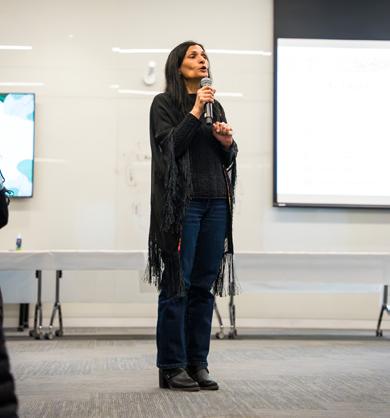
After taking in the initial stations — including a Kahoot on Arabic language and culture and a photobooth to document the night —a short panel was given by two Marquette professors, Enaya Othman and Majeed Hayat. They spoke about their immigration experiences from their respective Arab nations, the benefits of learning Arabic and sharing the culture.
Othman, a professor of Arabic, Middle Eastern and Cultural Studies, specifically advocated for the broader importance of adding a minor in Arabic and a major/ minor in Middle East and North Africa studies — also known as MNE.
“It is a part of our mission as American citizens, the Arab community, the Muslim community, the Marquette community to advocate for the Arabic language and for the MNE major,” Othman said. “It is super important, especially during these hard times.”
A strong silence continued to fall over the room as Othman spoke about her stories
Feb. 17
MUSG Senatorial Tabling
Details: - 3:30-5 p.m. - Lalumiere Hall
Valentine's Day Trivia
Details: - 5-6 p.m. - Wehr Life Sciences 111
Feb. 18
Biology Colloquium with James Mouton
Details: - 3-4 p.m. - Wehr Life Sciences 111
Ash Wednesday Mass
Details: - 10 p.m. - St. Joan of Arc Chapel
as a Palestinian immigrant, with people heavily invested in her part in the panel.
Once the panel concluded and attendees devoured a dinner consisting of bariis (rice) and chicken or hilib (beef), then attendees were free to roam the event as they wished.
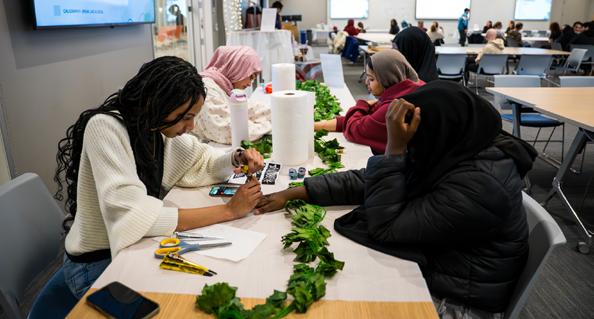
The station drawing most people was the henna station, which never had an empty seat throughout the night.
Henna is a form of body decoration typically used in Arabic and Indian cultures for wedding ceremonies, but in Arabic culture, they use a style called “khaleeji,” which features more flowy designs.
The henna paste is kept in a cone-shaped bag and applied to the skin in intricate designs. After drying for about an hour, the paste is wiped off, and the temporary design remains on the skin.
Besides the henna station, attendees could visit the “Language & Calligraphy Station ‘Speak & Script’” where participants could learn how to write and pronounce their name in three different Arab dialects — Gulf, Levantine and North
African — all taught by members of the club.
Arab dialects can sometimes sound like different languages. A focus of the event was to emphasize the differences, Osman said.
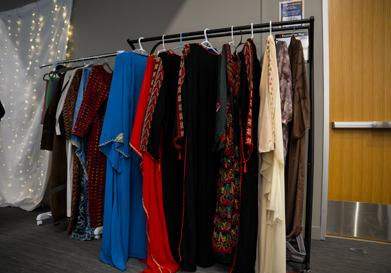
Another way the Arabic Language and Culture Club displayed regional differences in Arab nations was through the “Rhythms and Threads,” station which allowed people to try on different regional clothing on loan from club members and some professors. By observing clothing, it is easy to see clear differences in styles. For example, Gulf countries tend to have simpler designs on their clothing than North African countries, but in both regions, women wear more colorful clothing than men. As people participated in the events, from trying on clothes to learning their names in a new dialect, the sound of laughter carried through the room. The event was a safe space for all in attendance to explore the culture through a “Passport to the Arab World.”
“We need to be proud of who we are, and we need to contribute to our home here,” Othman said.
Feb. 19
Psychology Colloquium
Details: - 2-3:30 p.m. - Cramer Hall 042
A Celebration Of Research Poster Session
Details: - 11 a.m. - 2 p.m. - AMU Monaghan Ballrooms
Feb. 20
Ebony Ball
Details: - 7-10 p.m. - AMU Monaghan Ballrooms
Free Ramadan Iftar Dinner
Details: - 5:30 p.m. - O'Brien Hall 150 Weekend
Engineering Ball
Details: - Feb. 21 - 7-11 p.m. - Turner Hall Ballroom
Brew, Brunch, & Bracelets
Details: - Feb. 22 - 10:30 a.m. - 1 p.m. - Marquette Place
The Arabic Club serves as an extension of the major and minor.
Photo by Clay Ellis-Escobar clay.ellis-escobar@marquette.edu
Professors Enaya Othman and Majeed Hayat spoke at the panel.
Photo by Clay Ellis-Escobar clay.ellis-escobar@marquette.edu
Henna was offered at the event, allowing attendees to suggest inspiration for designs.
Photo by Clay Ellis-Escobar clay.ellis-escobar@marquette.edu