Dozens protest for student union
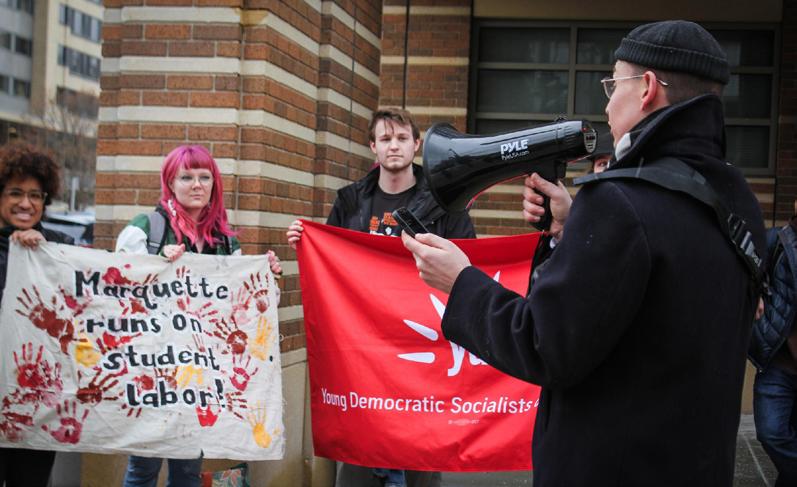
Group demanded wage increases for campus workers
By Mia Thurow mia.thurow@marquette.edu
When Alannah Gallagher took to the Marquette University streets on Feb. 6, she donned a black newsboy cap — an article of clothing not often seen on a college student.
But that day, the hat represented so much more to her than a personal fashion
preference. That’s because it belonged to her grandfather, who always encouraged her to make her voice heard and uplift those around her. Gallagher’s grandfather passed away in November, but she’s making sure to keep his spirit alive.
“I’m really carrying that with me right now and hoping to spread it through the rest of the student body,” Gallagher, a sophomore in the College of Arts & Sciences, said as she stood outside of Zilber Hall with roughly 40 other protesters rallying for a student union.
The group gathered to demand wage increases and better working conditions for student workers at Marquette on Feb. 6. The average student wage at Marquette is $11.88 an hour — a slightly higher wage scale than other private, nonprofit universities in Wisconsin, university spokesperson Kevin Conway told the Marquette Wire.
On the corner of 13th Street and Wisconsin Avenue, students, a handful of faculty and other adults were making their voices heard. Megaphones and
6.
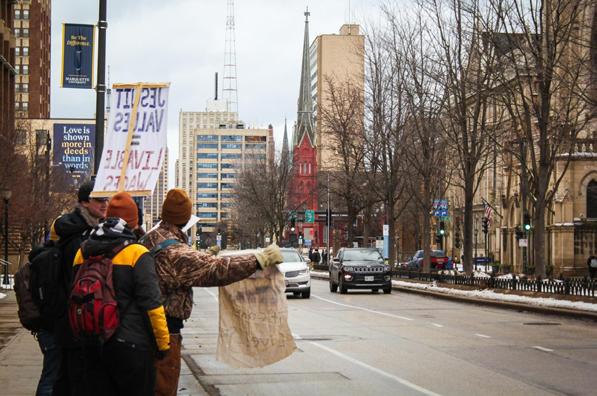
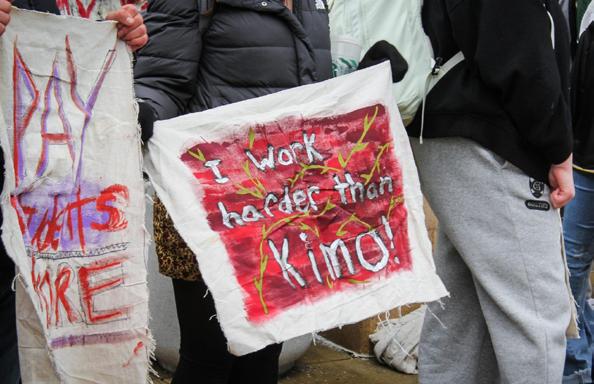
signs in hand, members of the rally could be heard and seen for blocks, with messages like “Marquette runs on student labor,” “Pay students more” and “I work harder than Kimo!”
Most students showed up with backpacks on, either coming from or preparing to leave for class. Some mentioned they were skipping it altogether. The crowd, which formed in the middle of a bustling campus the day before National Marquette Day, received mixed reactions from
See PROTEST page 3
Custodial staff contract outsourced
National service provider assumes management role
By Lance Schulteis lance.schulteis@marquette.edu
After years of Marquette University managing its custodial staff, the responsibilities have now been outsourced to Aramark, a food service and facilities services provider. The multi-year agreement will give Aramark the responsibility to oversee staff employment and management on campus.

Aramark took over managing Marquette’s custodial staff after the expiration of the university’s previous contract. The Marquette Wire reached out to the university seeking contract details — including start and end dates — and has yet to receive the information.
As part of the transition, over half of the university’s custodial staff accepted offers from Aramark.
“Partnering with Aramark allows Marquette to focus on our core educational mission and provides increased leadership opportunities, better training and
comparable pay and benefits for our custodians who accepted job offers from Aramark,” university spokesperson Kevin Conway told the Wire in a statement.
Under the previous contract run through Marquette, custodial staff members had the opportunity to utilize a benefit for tuition remission. Conway said the benefit will be honored for staff members who were using it at the time of the transition.
Additionally, union jobs have been retained under the new deal due to Aramark’s recognition of
News
Abraham Lincoln spoke on MU campus The former president delivered a speech near now-Schroeder Hall.
Wisconsin’s chapter of the Service Employees International Union as custodial staff representatives.
In transitioning to Aramark, the university likened the contract to a “successful” decision to outsource its food service to Sodexo, a global management company.
“Staffing and managing a custodial workforce is not Marquette’s core area of expertise, but it is Aramark’s core expertise,” Conway told the Wire in a statement.
This is a developing story that may be updated with new information.
Sports Lehman's last ride 2026 Winter Games are Marquette alum's last chance at a gold medal.
Ex-track athlete facing four more criminal charges
By Jack Albright & Sophia Tiedge jack.albright@marquette.edu sophia.tiedge@marquette.edu
William Waterstradt was charged with four more counts of child sex crimes on Jan. 28 in Sheboygan County, meaning the ex-Marquette track athlete has a total of 16 sex crimes — in addition to the 12 from Langlade County — in two different Wisconsin counties.
The new counts, all connected to an offense from July 2025, include: second degree sexual assault of a child, using a computer to facilitate a child sex crime, exposing genitals to a child and possession of child pornography.
Including the Langlade County offense, Waterstradt now has four counts of second degree sexual assault of a child, using a computer to facilitate a child sex crime and exposing genitals to a child. His first child pornography charge was in Sheboygan County.
The count of sexual assault of a child alone holds a prison sentence of up to 40 years and/or a $100,000 fine.
The 21-year-old from Green Bay plead not guilty to the first 12 counts in Langlade County and was bound over for trial Jan. 21. He’s being held in Langlade County Jail with a cash bond set at $500,000, according to online court records.
The Marquette Wire is working on acquiring the newest criminal complaint and reached out to Waterstradt’s lawyer for comment.
According to the complaint from Langlade County, police found that Waterstradt was using a fake identity on eight different Snapchat accounts, claiming to be 16-17 years old.
Arts & Entertainment Al McGuire biopic to begin filming in 2026 The movie will cover the men's basketball team from 1974-77.
Grant Gosizk, teaching assistant professor, delivers a message to students outside of Zilber Hall at the student labor rally on Feb.
Photo by Lily Wooten lily.wooten@marquette.edu
Tuesday, February 10, 2026
The MarqueTTe Tribune
Managing Editor of The Marquette
Tribune Sophia Tiedge
NEWS
Executive News Editor Mia Thurow
Assistant Editors Lance Schulteis, Lilly Peacock
Reporters Sahil Gupta, Elena Metinidis, Mina Marsolek-Bonnet, Lillie Martin
ARTS & ENTERTAINMENT
Executive Arts & Entertainment Editor
MaryKate Stepchuk
Assistant Editor Joseph Schamber
Reporters Elise Emery, Allison Scherquist, Annie Goode
OPINIONS
Executive Opinions Editor Rachel Lopera Columnists Isabella Gruber, Amelia Lerret
SPORTS
Executive Sports Editor Jack Albright
Assistant Editors Matthew Baltz, Raquel Ruiz
Reporters Benjamin Hanson, Mikey Severson, Ben Ward, Eamon Bevan, Conor McPherson, Lukas Schulze
COPY
Copy Chief Emma Fishback
Copy Editors Elizabeth Belmont, Shea Lancaster
VISUAL CONTENT
Design Chief Murphy Lealos
A&E Designer Evelyn Riordan
Sports Designer Amery Thompson
Opinions Designer Allegra Delli Carpini
Photo Chief Clay Ellis-Escobar
Photographers Lily Wooten, Owen Weis, Leo Stallings
HAVE A TIP FOR US?
Have you seen something that you think should be a story? Do you have a tip about something we should be looking into? Do you have documents or other materials that we should see? We want to hear from you.
If you have documents you'd like to send us, you can send anything to wiretips@marquette.edu.

New chaplain emphasizes humanity
Fatih Harpci is advocating for Muslim students
By Sahil Gupta sahil.gupta@marquette.edu
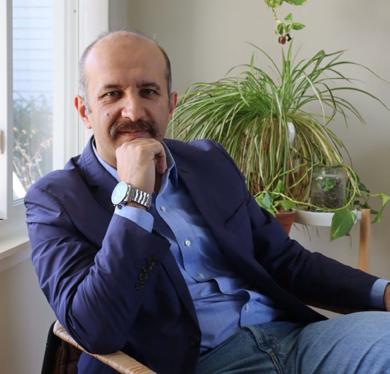
Fatih Harpci, Marquette University’s new Muslim chaplain, did not grow up wanting to be a theologian. Quite the opposite — he wanted to be a doctor.
Religion was the last thing he wanted to study or pursue a career in, but politicians in his home country had other plans.
Harpci grew up in Turkey, a country which, up until recently, was known for its strict secular laws. These laws, known as laïcité, meant that men who the state identified as “too religious” were penalized with decreased GPAs if they pursued education in fields such as medicine, law or engineering. Conversely, people in this group were rewarded with increased GPAs if they studied religion in their postsecondary endeavors.
“I sort of accepted the idea that this was my destiny,” Harpci said. “And I have enjoyed studying and learning theology since then.”
Harpci joined the Campus Ministry staff in the summer of 2025. In addition to his role at Marquette, he is an associate professor of religion at Carthage College in Kenosha, Wisconsin.
He received his bachelor’s degree from Marmara University, Turkey’s most prestigious school for religious studies, before coming to the United States to pursue post-graduate education.
He received his PhD from Temple University, where he studied Hadith scriptures concerning attitudes the Prophet Mohammed had toward Jesus.
In an interview with the Marquette Wire, Harpci talked about how his primary goal as the new Muslim chaplain is to guide stu-
dents along their academic and spiritual pathways.
“I cannot put [students] in a certain shape. I cannot mold them,” Harpci said. “They have struggles, they have needs, they have stories to tell me. My primary purpose is to listen.”
While he is not helping students one-on-one, Harpci advocates for Muslim students on campus. This comes amid continued conversations surrounding issues like halal dining options and access to prayer spaces.
The Marquette Muslim community has spent over a decade advocating for larger prayer spaces on campus. While there is a designated Muslim prayer room in the Alumni Memorial Union, Harpci said it is not big enough to accommodate the number of students who gather every Friday to attend the weekly Jumuah prayer service.
“Considering the size of Marquette’s Muslim community, [a larger prayer space] is an essential need,” Harpci said. “Currently, we keep changing venues every week.”
While talks are ongoing with university officials regarding a larger prayer space, he said, he does not believe a decision will be made on the issue in the near future. Marquette University Student Government passed a resolution during the spring 2025 semester inviting the university to collaborate with them in creating a larger Muslim prayer space.
In an email statement to the Marquette Wire, Julianne Browne, MUSG President and a senior in the College of Arts & Sciences, said student government has formed a workgroup with the goal of creating a new, larger interfaith prayer space.
“The group is working to identify and bring together student representatives from each faith commu-
nity who are interested in beginning conversations of a shared, interfaith prayer space on campus,” she said.
In addition to serving the Muslim community, Harpci works with partners on campus to promote interfaith dialogue. He emphasizes the overlapping values between Islam and the Jesuit Order, specifically the “human first” visions the two share.
“The primary teaching in the Jesuit tradition is seeing the humanness in others,” Harpci said. “This is very much an Islamic idea. God speaks in the Quran saying that we have created you in different nations, in different societies, in different groups so that you can get to know one another.”
Harpci is working with other campus organizations to organize events that promote these interfaith values. He attended the university’s interfaith dinner on Jan. 26 and will speak at “Soup with Substance” on Feb. 16. He is also working with the Muslim Student Association to organize an Iftar dinner during the month of Ramadan.
Iftar occurs every day at sunset during Ramadan,
when millions of Muslims around the world break the obligatory fast from dawn to sunset. While MSA has hosted Iftar dinners on campus in previous years, they are not usually attended by students of non-Muslim faiths. He says that this dialogue is key to helping people see the humanity in people of different faiths.
“[Seeing humanity] might seem very simple to some people, but it is very crucial at the same time,” Harpci said. “Understand that the person you are talking to is a human. They have feelings. They have times when they get angry, there are times that they laugh, there are times that they smile.”
While Harpci is working on his own initiatives, he is always happy to assist students with their own ideas to foster interfaith dialogue and collaboration on Marquette’s campus.
“My doors are open, so when I’m here, students can show up anytime,” Harpci said. Harpci is on campus Mondays and Fridays from 9 a.m. to 2 p.m. His office is located in Campus Ministry, AMU 236F. He can be reached anytime at fatih. harpci@marquette.edu.
MU Law Poll reveals public opinions of ICE
Views are sharply divided between political parties
By Mina Marsolek-Bonnet wilhelmina.marsolek-bonnet@ marquette.edu
Results from a national Marquette University Law School poll about the public’s opinions of U.S. Immigration and Customs Enforcement and the agency’s work were published Feb 4. The poll was conducted between Jan. 21 and Jan. 28, surveying roughly 1,003 adults across the country. The law poll found that
views are sharply divided among political parties, with 80% of Republicans supporting ICE’s actions versus 23% of independents and 5% of Democrats.
The death of Renee Nicole Good —who was shot in the head by an ICE agent in Minneapolis on Jan. 7 — is considered highly visible to the public as reflected in the poll, with 76% of respondents reporting they had heard or read “a lot” about it.
37% said the shooting of Good was justified, while 62% said it was not. 76% of Republicans, 21% of independents and 5% of
Democrats considered it to be justified.
In comparison to a Marquette Law Poll from November, opinions on deportations have hardly changed. When asked if they approved the deportation of “immigrants who are living in the United States illegally” in the February poll, 56% of respondents agreed and 44% opposed. In November, 58% favored and 42% opposed these deportations.
Similarly, when asked about deporting those who “have lived [in the U.S.] for a number of years, have jobs and no criminal
record,” support dropped to 44% while 56% showed opposition. These findings have not changed since November.
Regarding ICE’s handling of immigration — out of those who approve deportations — 35% disapproved of ICE’s conduct and 65% approved. Those who disapprove of deportations showed a 96% disapproval rating of ICE’s handling of immigration.
President Donald Trump’s handling of immigration earned a 44% approval rating and 56% disapproval rating, according to the law poll. In November, the
same ratings were 45% and 55% respectively.
52% of respondents believed the U.S. is mostly deporting immigrants without a criminal record and 47% say they are mostly deporting those with a criminal record. When it comes to the partisan divide, 83% of Republicans believed most deportees do have criminal records, while 57% of independents and 86% of Democrats believed most have no criminal record.
More about the Feb. 4 survey can be found on the Marquette Law Poll website.
Photo courtesy of Fatih Harpci
Fatih Harpci is Marquette University's newest Muslim chaplain.
February 10, 2026 The MarqueTTe Tribune
PROTEST: Group seeks $15 minimum wage
Continued from page 1
onlookers — a city bus, green taco truck and semitruck offered honks of support, while a man in a black truck sped by with his middle finger raised.
The protest, deemed a student worker labor rally, was organized by Marquette’s Young Democratic Socialists of America chapter and supported by the United Campus Workers of Wisconsin.
Gallagher serves as co-chair of YDSA Marquette along with Kenny MacAskill, a junior in the College of Arts & Sciences.
MacAskill said organizing the rally required turning his beliefs into action, despite the initial nervousness he felt.
“I’m on the street, publicly proclaiming what I believe in and fighting for it,” he said.
YDSA Marquette had been working on the rally for months, Gallagher said. After helping a faculty union at Marquette protest last year, students in the group reached out to their professors and mentors to propose the idea of fighting for a student workers’ union.
Depending on who is asked, the reasoning behind needing this type of union at Marquette varies.
For Gallagher and MacAskill, it doesn’t stem from a place of personal desperation — both acknowledged they have the financial support systems in place to get through college worry-free. But others working in campus employment roles don’t share the same luxury.
“I’ve met a lot of people who’ve had to rely on these sorts of jobs to help pay rent and for groceries,” Gallagher said.
Student employment wages at Marquette range from $7.25 an hour to $18.75 an hour, depending on the skill and responsibility of the job.
According to the MIT Living Wage Calculator, the living wage estimate for someone in Milwaukee County is
$20.09 an hour. “Most students on this campus are not making that, and I think it’s really important that we make a community on this campus where students can actually thrive,” Gallagher said. “I don’t think anybody can thrive when they’re only making eight dollars an hour.”
Luke Syverud, a recently graduated Golden Eagle and founder of YDSA Marquette, said he had to work three jobs as a full-time student to cover his bills. Spending that much time working only added to the existing stress of being in college, he said.
“I know many other students feel the same way,” he said in an address to fellow protesters.“So, for anyone who wants to see change being made on campus, now is that time.”
Long term, the group’s goal is to achieve the unionization of student workers on campus and secure a $15 minimum wage for all student employees. Additionally, Syverud said, YDSA Marquette hopes to earn the ability to bargain for improved working conditions for all undergraduate student workers.
To some, it can feel like Marquette only believes in carrying out their Jesuit mission if it doesn’t cost them anything, Chris Gooding, theology teaching assistant professor and UCW – WI member, said. As a result, he said, student financial struggles can be invisible battles at the university.
“They only show up in the classroom, halfway through the semester when a student sheepishly tells me that she had to make a decision between paying for books and paying for rent,” he said. “It only shows up in the email I get from a student halfway through the semester to let me know that he’s unhoused and can’t make it to the next several class sessions.”
Gallagher said the Feb. 6
rally — and more generally, bringing the idea of higher student worker wages to the university — should be a wake-up call for Marquette that it isn’t delivering on its promise of “Cura Personalis,” or care for the whole person.
The next step, she said, is for YDSA Marquette to
"...I genuinely think as a collective unit we have the power to make positive change."
Alannah Gallagher Co-chair of YDSA Marquette
keep up its current momentum and put pressure on the university.
“What we are asking for today is not radical. We are asking for a living wage, safer working conditions and a university that works with us rather than against us,” Gallagher said.“There is nothing just about a
university that pays its student workers below a living wageand yet simultaneously pays its president roughly $1 million a year.”
According to ProPublica’s Nonprofit Explorer, Ah Yun earned $527,380 in Fiscal Year 2024. Michael Lovell, the former university president, earned $902,977 the same year. Ah Yun’s salary has not become publicly available since he inherited the presidential role.
Under University President Kimo Ah Yun, Marquette cites a religious exemption in the federal labor law that allows private sector employees to form unions. In April 2025, prounion protesters — many of which attended the student worker labor rally — protested the university administration and Ah Yun outside of his inauguration in the Al McGuire Center.
Grant Gosizk, English teaching assistant professor and UCW – WI member, said the protest was part of a public pressure campaign after Marquette refused to honor the national standards for labor negotiations. Through legal processes, widespread discourse and media coverage, the faculty group put heat on the university to negotiate on collective bargaining.
Not long after, the lowest-paid full-time faculty members in the College of Arts & Sciences received a 25% increase in salary — though the university didn’t directly attribute it to union efforts.
“The lesson that we should take forward with us is that when we fight together, we win,” Gosizk said to student protesters.
With the support of students and faculty, Gallagher is using what she’s learned — from her college classes, from her Jesuit classes in high school and from her grandfather whose cap she wears proudly — to go out and take a physical stand. But the rallies and efforts
aren’t just about her, she said; they’re about the cause worth fighting for.
“We can make things better,” she said. “It takes a lot of people — and maybe it’s just naive to think this — but I genuinely think as a collective unit we have the power to make positive change.”
In response to the Feb. 6 rally outside of Zilber Hall, Conway, the university spokesperson, said Marquette respects students’ first amendment right to peacefully assemble and have their voices heard. He also mentioned that in 2023, the university conducted a student wage study and implemented an updated student employee wage structure focused on “equitable compensation and market competitiveness.”
“Currently, no Marquette student employee is being paid as low as the Wisconsin minimum wage, and our highest earners are paid $18.75+,” he told the Wire in an email.
Additionally, Conway said Marquette’s allocation for Federal Work Study — a Title IV federal aid program that encourages students with financial need to find parttime jobs — has increased approximately 50% since 2019-20 and now stands at $2.4 million.
But some students aren’t done fighting for wage increases on campus, and don’t plan to be done anytime soon. Many of those students were the same ones outside of Zilber Hall in the middle of February, yelling into a bullhorn while flecks of snow fell from the sky or skipping class to hold a sign in protest.
“This is not the culmination of a campaign; it’s just the kickoff,” MacAskill said. “This is going to be a long fight, but one day it’s going to be so notorious that the administration cannot even possibly refuse to come to the bargaining table with us.”
Photo by Lily Wooten lily.wooten@marquette.edu
Dozens of students lined Wisconsin Avenue, donning megaphones and waving handmade signs.
A protester holds a sign that reads, "I work harder than Kimo!" referring to the university president.
Photo by Lily Wooten lily.wooten@marquette.edu
Tuesday, February 10, 2026
Lincoln leaves legacy behind on MU campus
Former president spoke at 12th and Wisconsin Avenue
By Lance Schulteis lance.schulteis@marquette.edu
Abraham Lincoln, the 16th president of the United States, is often immortalized by two famous speeches: The Gettysburg Address and Emancipation Proclamation. But among Lincoln’s catalog of vocal performances is a speech that he gave in Milwaukee, just under a year before he won a seat in the White House.
Before Lincoln ran for president, abolished slavery in the U.S. and graced the penny, he stepped onto a platform on what is now Marquette University’s campus. At the 1859 Wisconsin State Agricultural Fair — 21 years before Marquette opened its doors — Lincoln addressed a crowd at what is now 12th Street and Wisconsin Avenue, clean-shaven and largely unknown.
With his 1860 presidential campaign still a few months away, Lincoln’s appearance at the fair was one of his last before his name went down in history — the Milwaukee Sentinel reported the address as given by “Abram Lincoln.”
In what the Daily News called a “stentorian voice,” Lincoln took to the Brockway fairgrounds and addressed the “mudsill theory” of mid-1800s American politics. James H. Hammond, a South Carolina senator, coined the theory to affirm slavery, claiming that the United States depended on a social structure with a lower class for stability.
“That’s what got Lincoln roused up into politics — to argue otherwise,” Orville Vernon Burton, a historian and author of “The Age of Lincoln,” said.
In his address, Lincoln countered the idea of laboring classes in the United States. Instead, he laid out
his preference for a different social order, based on free labor, education and the pursuit of knowledge.
Dan Blinka, a professor of law at Marquette, described Lincoln’s approach to social issues, including slavery, as based on “human improvement.”
“Lincoln rejects mudsill theory and believes in moral uplift,” Blinka said.
The “mudsill speech” lasted for around an hour. Within earshot were masses of students and teachers, who were released from Milwaukee schools to attend the fair on a Friday afternoon, only to hear from a future president in the process.
“Let us hope, rather, that by the best cultivation of the physical world, beneath and around us; and the intellectual and moral world within us, we shall secure an individual, social and political prosperity and happiness,” Lincoln said in his closing remarks.
And after Lincoln stepped
his 6-foot-4 frame off the platform, he slipped back into the crowd. In his final months before eternal fame, “Abram” spent his hours in Milwaukee as did every other attendee at the Wisconsin State Agricultural Fair, reveling in the festival’s races and fireman’s parade.
“Mr. Lincoln was royally entertained that afternoon,” J.E. Moriarty wrote for the Milwaukee Free Press in the early 1900s. “It is said he enjoyed the attractions as much as any man at the fair.”
The speech and trip would be Lincoln’s last in Milwaukee, as Wisconsin’s support for the abolition of slavery meant he didn’t need to target the Badger State on the campaign trail. Lincoln and the fairgrounds went their separate ways, but over 165 years later, a small, engraved plaque stands in his place.
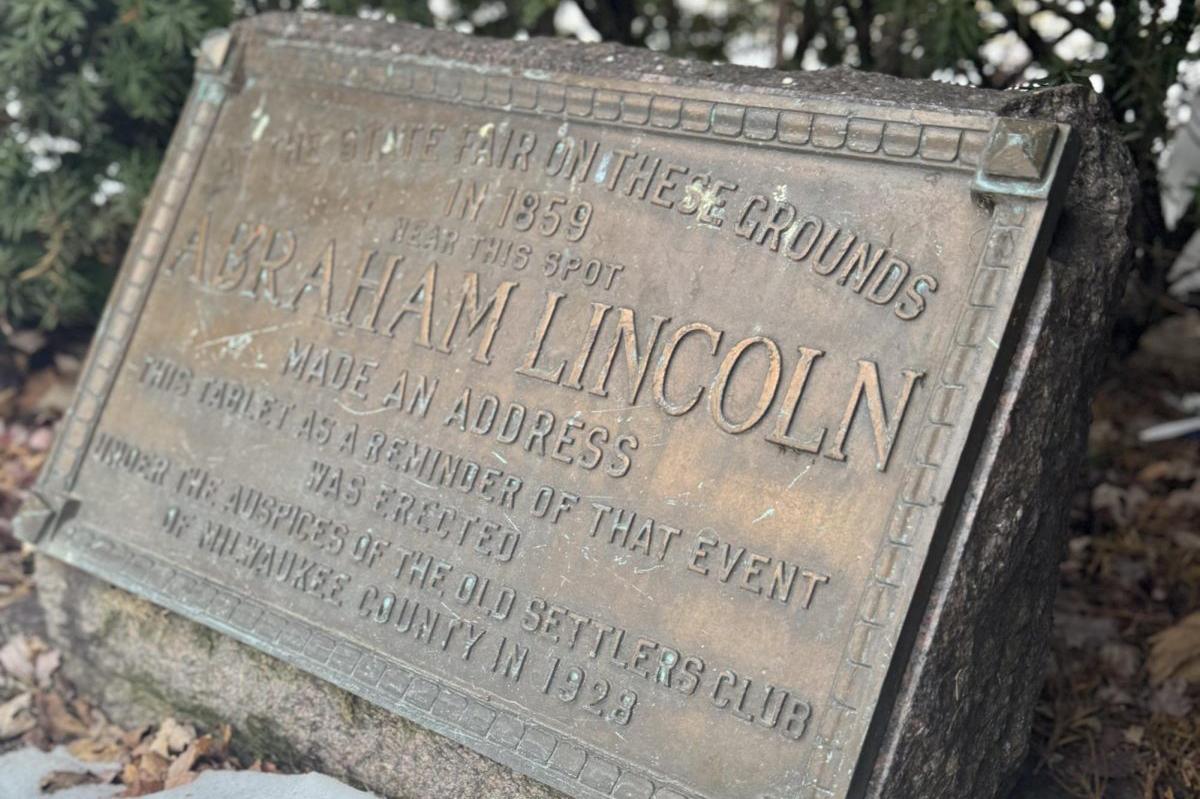
Surrounded by bushes on the corner of 13th Street and Wells Street, the
marker lists Abraham — not Abram — Lincoln’s name larger than any other word on the tablet. But just above the serif-printed name read the words, “near this spot.”
In the years since 1859, the Brockway Fairgrounds land, once Milwaukee’s city limit, has added streets, buildings and a university. So, even though Lincoln is memorialized just outside Schroeder Hall, the exact ground where he stood has been lost to history.
In 2009, 150 years after the speech, the Marquette University Law School celebrated Lincoln with a commission, which organized commemorative meetings and events. The commission’s keynote speaker was Burton, a then-emeritus professor of history at the University of Illinois and winner of the Chicago Tribune’s Heartland Literary Award for Nonfiction with his book, “The Age of Lincoln.”
Among Burton’s other
works, he compiled in 2009
“The Essential Lincoln,” a collection of what he deemed to be Lincoln’s 29 most significant speeches and correspondences. Burton placed Lincoln’s Wisconsin speech within the same ranks as the Gettysburg Address and Emancipation Proclamation.
“It’s one of his defining speeches of all time,” Burton said. And while the physical reminder of that speech sits just a foot above the ground, some say Lincoln’s words still linger in the air.
Burton said Lincoln’s speech remains applicable by calling out classism in American society — breaking down walls between the elite and the other side of the mudsill. Lincoln’s push for education, Blinka said, is a call for critical thinking in an era captivated by artificial intelligence.
“That’s as current now in 2026 as it was in 1859,” Blinka said.
27th Street Bridge closure affects commuters
Overpass will be inaccessible until at least late 2026
By Lilly Peacock lilly.peacock@marquette.edu
As part of the Interstate-94 East-West Project, the 27th Street Bridge has closed until at least late 2026, affecting commutes for some near Marquette University. Following the closure, which began Feb. 2, the commute to Marquette may be slightly more complicated over the course of the long-term I-94 construction. The bridge,
which is close to Marquette’s campus, is relied upon for entering the westbound expressway.
Projected to last eight years, construction on the main expressway in and out of the city has already caused significant disruptions.
The 16th Street viaduct, spanning from West Clybourn Street to West Pierce Street, has been closed since December to receive necessary repairs. Both of these structures — on 16th and 27th Streets — are vital to highway travel. The closure forces drivers to use either the Sixth Street or 35th Street Bridges, over a
mile away from each other, to travel in the north and south directions.
Robert Bauman, City Alderman for the 4th District in which Marquette exists, expressed his dissatisfaction with the project in a press release published Jan. 27. He noted that an average of 22,000 vehicles use the 27th Street Bridge every week, all of which are now constrained to using alternative routes.
“The current closure plan is unacceptable, and I am calling for a delay on the closure of the 27th Street viaduct until the 16th Street viaduct is back open,”
Bauman said. He referred to the construction project as “a dysfunction” and a “nightmare” that will “make life miserable” for the thousands of commuters who travel daily from the north and south sides of the city. Additionally, the I-94 project will cost Milwaukee $1.7 billion. There has also been a long-term closure of the eastbound exit to 26th Street and St. Paul Avenue that will last through summer 2026. The combination of these closures is expected to cause gridlocked traffic on various east-west
roads, including Wisconsin and St. Paul Avenues, Bauman said.
Current detours include using Wisconsin Avenue, 35th Street or Greenfield Avenue for the 27th Street closure, as well as the eastbound exits at 13th Street or 35th Street. Construction on the I-94 East-West project is expected to last through 2033, with other closures occurring in phases as the project continues. Marquette students may be dealing with traffic backups and longer commute times for years to come.
Photo by Lance Schulteis lance.schulteis@marquette.edu
A plaque commemorating Abraham Lincoln's speech at the 1859 Wisconsin State Agricultural Fair sits just outside of Schroeder Hall.

LEHMAN'S LAST RIDE
2026 Winter Games Marquette alum's final chance at Olympic Gold Medal
By Ben Hanson benjamin.hanson@marquette.edu
While Emery Lehman — a fourtime Olympic speed skater and bronze medalist — attended Marquette, he didn’t like going to the recreation center on campus in the morning.
It was too far of a walk and took up time in his already packed schedule. He would simply stay inside his dorm, Carpenter Tower, before his 8 a.m. classes.
But he’d be damned if he wasted that time sleeping.
When his alarm went off at 6 a.m., he got up to run the 16 flights of stairs a couple times, then, sweating, went back to his dorm room. Though — that was too easy for Lehman. He hopped on the bike mounted on rollers by his couch or practiced his speed skating form on the slide board by his bed or sat in his altitude tent to train his lungs for when he regularly competes in Salt Lake City.
“He’s an animal,” one of Lehman’s close Marquette buddies, Colin Redman, said.
By the time Lehman came to Marquette in 2014, he had already been on the U.S. Junior World speed skating team for three years and competed in his first Olympics in 2014 at
17 years old: the youngest U.S. Olympic speed skater in history. This year, he’s in Milan, Italy to compete in his fourth.
In between that time, he won a World Speed Skating Championship, competed in two more winter Olympics (winning a bronze medal in 2022) and grabbed the world record in the team pursuit event. For this Winter Games, he is competing in the 1500-meter race and the team pursuit. Lehman will race in the former on Feb. 19 and first round of the latter on Feb. 15.
Lehman’s mother, Marcia Lehman, remembers the first time she was told her son was special at speed skating. It happened when Emery was 10 years old.
While talking with Emery’s coach at a hotel during a speed skating competition in Milwaukee, the coach put it plainly.
“Your son is going to be in the Olympics.”
She reminded the coach of her son’s age with a dead pan face, but he was serious.
“You watch.”
Even though Lehman still has the energy of a young man — he surely trained like one for Italy — he’s the oldest male on the U.S. speed skating team at 29 years old.
“Maybe when I was younger and a little more cocky, I took things for granted,” Lehman said. “Whereas now it’s just, holy sh—t, the level of competition is just insane.
“Times that were winning World Cups maybe 12 years ago are now just the bare minimum to get into the Olympics.”
When he steps off the ice for the last time in Milan, his Olympic career will be finished. After spending the majority of his life training for the next winter games, he still hasn’t gotten to stand atop the podium with a gold medal around his neck and hear “The Star-Spangled Banner” play for the world.
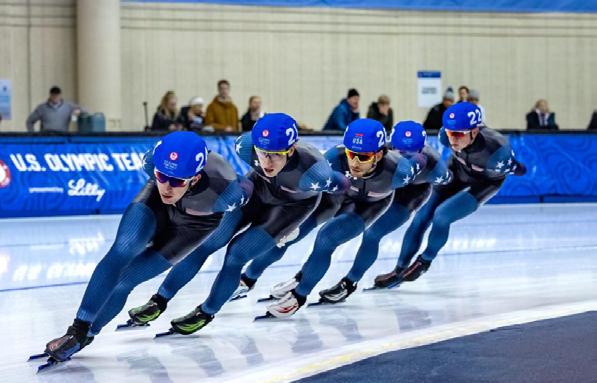
This year, given that his team pursuit squad — comprised of him, Casey Dawson and Ethan Cepuran — is the current world record holders and World Champions, he knows people expect that to change.
“We like the pressure,” Lehman said. “We’ve been on the good side of it. We’ve been on the bad side of it. We’ve been the favorites. We’ve been the underdogs. We’ve faced a lot and we’re ready to face whatever happens here.”
He lived by that mentality while he was a civil engineering student at Marquette.
It took him six years to get his degree, changing his enrollment status depending on the speed skating competitions happening during a given year. Three of those were full time, two were part time and he took the 2017-18 school year off to train and compete in the PyeongChang, South Korea Winter Games.
During his education, he often kept his mind on training, no matter the high demand that came with his engineering courses. If he wasn’t in class or doing homework, he would exercise at the Pettit National Ice Center next to the Wisconsin State Fair Grounds in Milwaukee, one of only
two facilities with a long track speed skating oval in the U.S.
There, he would train twice a day, between two and a half to three hours each day, six days a week. Besides on-ice time, this included weightlifting, endurance workouts and perfecting his skating form on the slide board.
“Going to school full-time and training was some of the toughest things that I’ve ever had to do,” Lehman said.
The juggling act became even more difficult when he got a serious case of mono in his second year
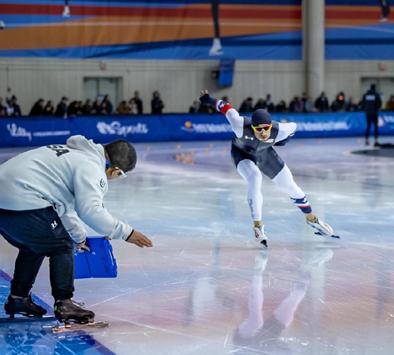
Marquette alumnus speed skater Emery Lehman is in Milan to compete in his fourth Olympics. Lehman is the favorite to get gold in the team pursuit event.
Photos courtesy of Emery Lehman
Lehman qualified for his fourth and final Olympics this winter.
Graphic by Benjamin Hanson benjamin.hanson@marquette.edu
The
Tuesday, February 10, 2026
Marquette keeping late 'brothers' present
MLAX played first game without Noah and Scott
By Jack Albright jack.albright@marquette.edu
There’s a hole that can’t be filled. Two, actually. They gape across the locker room, where a pair of helmets and pads remain on shelves. And over on the sideline, where the pile of extra sticks is two short its normal amount. And on the bench, where the number of reserves have been trimmed.
The holes appeared Sept. 5, and have followed the Marquette men’s lacrosse team’s every waking moment since. Every workout, practice, film review, fall scrimmage and preseason exhibition, they have existed. It was no different on Saturday, when Marquette opened its 2026 season against No. 20 Michigan.
It was the program’s first actual game since Scott Michaud and Noah Snyder died in a car crash, five months and one day since the accident.
“I just know those guys
are looking down,” sophomore long stick man Brady Nicholas said. “Cheering for us and rooting for us, and hopefully we can make them proud throughout this year.”
"We just want people to remember them and how great those guys were."
Brady Nicholas Marquette men's lacrosse sophomore long stick man
Even though the two former Golden Eagles were not physically inside the Valley Fields dome, tributes kept the late sophomores in the forefront of the minds of everyone who was. Their earthly lives ended at the intersection of 27th Street and St. Paul Avenue, but they continue to exist in the team they would be playing for.
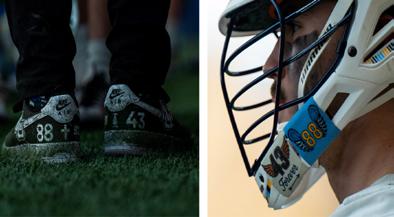
Like on the Golden Eagles’ jerseys, where a patch with their numbers, helmets and initials is stitched onto the right shoulders. And the backs of their helmets, where players display a variety of stickers for both of their fallen teammates. Not to mention the fronts of helmets as well, where straps with their numbers and angel wings wrap around the bottom of cages.
“Anything we can do to help the community remember those guys,” Nicholas said. “We just want people to remember them and how great those guys were. They’re all brothers to us.”
The sophomores remained on those not playing, too.
Anyone injured wore a long sleeve shirt with the same visual as the jersey patches. Defensive coordinator Will Roberts donned a sweatshirt with the goalkeeper Michaud’s No. 88 in large numbers on the front and a black pin on his shoulder. Assistant coach Mason Woodward chose the t-shirt with a lacrosse stick splitting Michaud and Snyder’s numbers.
Head coach Jake Richard was covered head to toe in tributes — literally. His sweatshirt had the attacker Snyder’s No. 43. The bracelet on his right wrist had both players’ initials. On his feet was a special pair of shoes with the two players’ names and outlines, their numbers still distinguishable despite the many green turf flakes covering the leather.
Even two blue plastic chairs bore Michaud and Snyder’s likeness. To the right of the bench, draped over seats, both of their jerseys faced the field, the Nos. 43 & 88 visible to everyone inside the dome.
“We want people to remember them,” Nicholas added, “so anything little like that means the world to us.”
As the rest of the roster
Both uniforms made and jerseys with us,” Hamill said. “Pretty emotional, but overall good to have.”
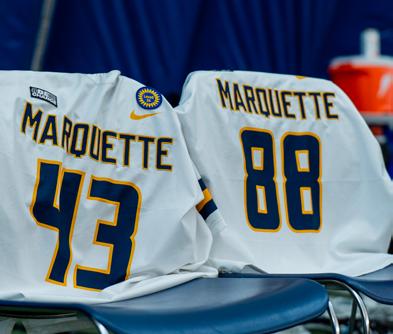
will continue to make the same journey from the locker room to the field every game this year, exactly like they would if their owners put them on.
From the pregame walkout to the anthem to then being on the sidelines, Michaud and Snyder will always be with the team.
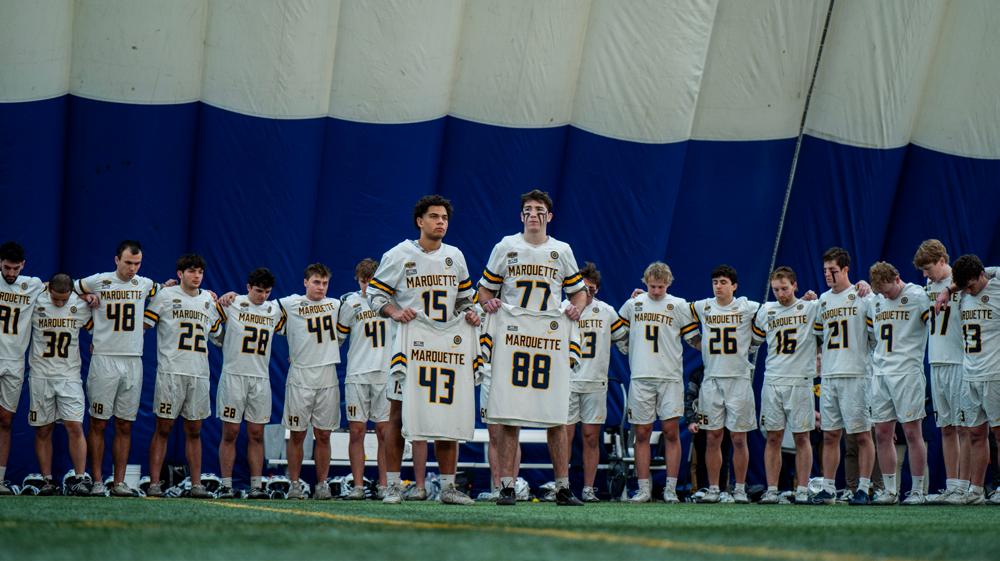
Saturday morning, Nicholas carried Michaud’s jersey while Matt Hamill held his fellow attacker Snyder’s. The two jerseybearers led Marquette’s walkout and held the uniforms during the anthem and moment of silence.
“First game back without those guys. It means a lot to just be able to have their
formed a ring, Nicholas and Hamill stood in the center, proudly displaying Snyder and Michaud’s jerseys for the entire moment of silence. Then the two went to the chairs, lay both jerseys over them and picked up their gloves and sticks.
It was time to honor Snyder and Michaud in the best way possible: by playing the game they loved most.
“It was definitely hard for all of us, for sure, but we know we have a job to do,” Hamill said. “And this would make those guys proud.”
MULAX will display Michaud and Snyder's jerseys at each game.
Photos by Owen Weis owen.weis@marquette.edu
Richard's shoes and players' straps honored Noah and Scott.
Marquette honored Noah Snyder (No. 43) and Scott Michaud (No. 88) at its season-opener, five months and one day after the sophomores died in a car accident.
OLYMPICS
RIDE: Speed skater competing in Milan
Continued from page 5 at Marquette. It lasted 15 months and set him back a significant amount in his training and physicality. In the later stages of recovery, he could only produce skate times he posted when he was 14 years old. There were a couple days when Lehman called his mom to contemplate continuing to speed skate.
“I remember even where I was standing,” Marcia recalled. “I just said, ‘Emery, if you make a decision not to do this, you’re going to look back, and I think you’re going to regret it. You’re gonna get through it.'”
To take his mind away from the situation, Lehman reined back his training, took a full course load at Marquette and joined the club hockey team, a sport that he played before he ever put on a speed skate.
Lehman arrived at tryouts, never mentioning his speed skating career or acting like the ‘big Olympian in town.’ Conor Coyne — one of Lehman’s eventual lifelong friends from Marquette who was already on the team — walked up to Lehman in the locker room and introduced himself. After a couple practices of Lehman being on the roster, Coyne suggested that they carpool. For the rest of their time at Marquette, there were few days they wouldn’t hang out with each other.
“He’s just…” Coyne said while trying to grasp the words, “…one of the coolest guys.”
Even though Lehman was a world-class speed skater, his hockey skills didn’t come back to him immediately. The team always joked that he could only ever turn left: the only turn made on a speed skating oval. But rustiness didn’t stop him from having fun and forming
strong relationships.
“He was one of the guys from the beginning,” Colin Redman, another lifelong friend from the hockey team, said.
Right turns or not, Lehman sure didn’t lose his quickness on the rink.
During one of their tryouts, the team had to skate killers. Basically, skating as fast as they can, back and forth across the rink until they finish or throw up.
When Lehman completed the round of killers, he stood alone at one end of the ice, long before anyone else finished. The coaches stared at him in disbelief, not knowing at the time he was a two-time speed skating Olympian. Of course, he made the team.
Outside of practice up to five times a week and games twice a week, the team — especially Lehman — loved hanging out with one another. They would go over to Redman’s to watch the final season of "Game of Thrones" as it was coming out or watch late night "Scooby-Doo" marathons, usually before they had to leave early the next morning for a game.
“I think we all miss (those moments),” Lehman said.
“It was a really good time.”
He’d also have some of his friends on the team over to his apartment to hang out, but of course, instead of sitting on the couch with them, he’d talk while he rode his stationary bike.
Redman and Coyne stay in close contact with Lehman, even being at each other’s weddings. They stay up-to-date with Lehman’s races, attend as many as they can across the world, spend time with him, call him often and are both traveling to Milan to cheer him on for his final Olympics.
“I’ve had my flights booked since probably about March of last year, probably as early as you could have booked them,”
Redman said. “I just booked it and told him ‘no pressure (on qualifying for the Olympics).'”
After graduating in 2020, Lehman moved to Salt Lake City, Utah to train at the Utah Olympic Oval with Team USA while also getting an online masters degree. Coyne visited Lehman in April and was reminded of how seriously he takes his training. The visit was meant to be a golf trip and Lehman technically wasn’t even supposed to be training.
That didn’t stop Lehman from biking up to five hours every morning. And this was during their offseason.
“He’s one of the hardest working people I’ve ever met,” Coyne said.
To prepare for the Olympics, Lehman and his teammates will train three days on, one day off, with two sessions a day that are anywhere from 90 minutes to three and a half hours.
At this point in his career, he isn’t taking anything for granted. He focuses on what’s immediately in front of him because looking too far into the future could be detrimental. Not only for the Olympics, but for everything leading up to it.
“What’s at stake right now is really what’s most important,” Lehman said. “I had to go into some of those races at trials like ‘This could be my last race of the season.'”
His never quit mentality has been with him since the beginning.
At his first trials for the 2014 Olympics, Lehman attempted to qualify for the 10,000-meter race against Jonathan Kuck, who had finished eighth in the event at the 2010 Vancouver games.
With only three laps to go in the 25-lap race, Lehman was four seconds behind Kuck; an eternity in speed
skating. Lehman turned the burners on and by the final lap, was caught up. He pushed up the inside lane past Kuck, but Kuck switched back in the final turn to retake the lead. Lehman pumped his arms hard to the line, stuck his right skate out and finished two blade lengths ahead of Kuck.
The 17-year-old stuck his finger up in the air, claiming the win before the official times were posted. He erased seven seconds of his personal best to qualify for his first Olympics.
“I never quite died, I guess,” he said after the race.
Now, 12 years after Lehman pointed to the heavens for the first time, his family and high school friends will join Coyne and Redman in Italy to watch his final races on the world stage.
"I've had some great parties with him. That'd be the greatest party I've ever had."
Conor Coyne Lehman's friend from Marquette
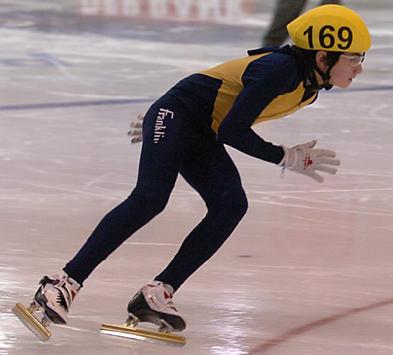
After he takes off his Team USA speed suit for the final time, Lehman is going to give back to his sport. He plans to move to Chicago and coach young speed skaters at the Franklin Park Speed Skating Club, the arena he competed when his coach first predicted he was going to be an Olympian.
“I love showing up and volunteering my time and doing all that,” Lehman said. “It’s just weird to me because I can vividly remember not so long ago
being that little kid looking up to them.”
With the whirlwind of emotions that Lehman could be feeling less than a week away from Olympic competition, he feels content with where he has put himself.
“I’ve had a really good career,” Lehman said. “I’ve accomplished a lot both team and individually. I’ll retire and look back fondly on the years I had as a speed skater.”
There will be a lot of talk from both the media and Lehman’s family and friends; but what happens if he does win gold?
“Boy, a lot of people ask that question,” Lehman’s mom said with a tone of anxiety in her voice. She doesn’t even watch Lehman’s races because she becomes too nervous.
“And I hate the word gold. I’m beginning to hate that word a lot.
“I think it would be great, but I think he would be satisfied no matter what happens.”
Although Lehman certainly agrees with his mother, he looks at it a bit differently. It’s a question he has struggled to answer in every Olympics lead-up interview. Instead of answering, he offers a reflection.
The team pursuit is a little longer than three and a half minutes. It’s such a quick moment for the never-ending hours he has put into the sport he loves.
“We remember a lot more the memories you make along the way and the teammates and the struggles and stuff,” Lehman said. “I think that’s much more memorable than the actual race itself.”
But for Coyne, the answer is obvious. Heck, they went to college together.
“‘I’ve had some great parties with him,” Coyne said.
“That’d be the greatest party I’ve ever had.”
Lehman's old coach quickly knew he would be an Olympian.
Photos courtesy of Emery Lehman
Emery Lehman, Casey Dawson and Ethan Cepuran hold the world record in the team pursuit.
MEN'S BASKETBALL
Marquette pulls away in second half to win
By Mikey Severson michael.severson@marquette.edu
MARQUETTE vs Butler
Bulldogs
GOLDEN EAGLES 55 70
With three minutes left in the first half of Marquette men’s basketball’s matchup with Butler, Golden Eagles head coach Shaka Smart called a quick timeout as the visiting Bulldogs were ahead by four points and looked to potentially add to their lead.
“We needed to recommit to ball movement and getting a Marquette team score on the offensive end,” Smart told his team. “That’s the goal.”
It’s safe to say that the Golden Eagles took those words to heart. From the first inbound out of Smart’s timeout, sophomore forward Royce Parham and first-year guard Adrien Stevens connected on back-toback 3-pointers. Plus, firstyear guard Nigel James Jr. converted both of his free throws from the line.
That tallied up to an 8-0 run to end the first 20 minutes of basketball on National Marquette Day and the Golden Eagles heading
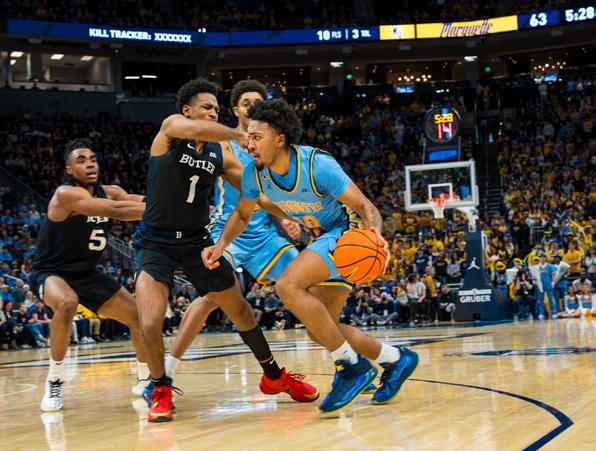
into the intermission now sporting a 32-28 advantage. Marquette (9-15, 4-9 Big East) would then continue to roll past Butler (13-11, 4-9), 70-55, behind red-hot perimeter shooting and efficiency. Despite being out-rebounded by 13 when it was all said and done at Fiserv Forum, MU shot 45.2% from 3-point land
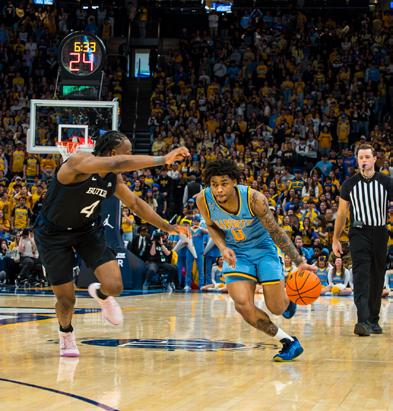
(14-of-31), with Stevens racking up six of them on the afternoon. Parham chipped in three as well, including one to set the tone of the second half.
Butler junior guard Finley Bizjack once again gave Marquette fits, racking up 23 of Butler’s 55 points, a game high. He had a big evening in the first matchup in which the Bulldogs emerged victorious in Indianapolis, going for 28 points on 46% shooting.
But Bizjack’s outing did not result in a spoiled National Marquette Day for the blue & gold this year.
Butler graduate student forward Michael Ajayi was held to just three baskets on 15 attempts, while collecting 19 rebounds as the Bulldogs shot a tad south of 33% from the field. MU’s defense forced eight turnovers from Ajayi and Bizjack combined, and scored 21 points off 16 turnovers by Butler.
“We had 9 [kills] today, which is top 10 in history for us here,” Parham said. “Basically, staying together and trusting your brother behind you to help if
you get beat or not in the right spot.” Smart said that being able to make the Butler offensive attack one-dimensional was a key part of Marquette’s game plan to how they flipped the script from the first meeting at Hinkle.
"Our guys have found a much better ability to play for one another."
Shaka Smart Marquette men's basketball head coach
“Ajayi’s a really good player, so the ability to make him go 3-for-15 was big,” Smart said. “Between him and Bizjack, if both have big days, then those guys are hard to beat. But if you can make one or two of them very inefficient, it really improves your chances.”
For senior guard Chase Ross, he was celebrating two holidays in one with National Marquette Day coincidentally falling on his birthday.
The Dallas, Texas native found an extra gear, scoring 17 points in the last 20 minutes, tallying both a 3-pointer and a threepoint play before the under-16 media timeout as Marquette kept building its lead. He would convert three more from beyond the arc and fittingly ended the afternoon with a jam.
“Man, just to get a win for him. I mean, everyone wants to win on their birthday, it’s National Marquette Day too, so that put some more on that, so it’s great to win on his birthday,” Parham said. It was a career afternoon for Stevens in his first NMD, as his 18 points all came from an efficient 6-of-9 perimeter shooting. He succinctly summarized the day’s emotions in a single sentence in reference to Ross’ special day.
“What a day to have a birthday,” Stevens said.
Marquette will go back out east for a rematch with Villanova (17-5, 8-3 Big East) Tuesday night. The Wildcats won the first meeting a month prior, 7673, in Milwaukee. Tip-off is set for 6:30 p.m. CST from Finneran Pavilion.
“We really value growth,” Smart said. “Our guys have found a much better ability to play for one another. We’re getting better in a lot of different basketball areas, defensively and offensively. We still have a long way to go, but we’re getting better.
“Then you can go down the roster, we have a lot of young guys that are getting valuable experience. With that experience, you just see their confidence going up.”


First-year Adrien Stevens scored a career-high 18 points on an efficient 6-of-9 3-point shooting.
Photos by Clay Ellis-Escobar clay.ellis-escobar@marquette.edu
Al McGuire Center
Opinions
Milwaukee's alarming food desert crisis

By Rachel Lopera rachel.lopera@marquette.edu
The food desert crisis in Milwaukee expands as various grocery stores and pharmacies continue to close. Many residents no longer have nearby access to fresh food and medical prescriptions, emphasizing the need for change. Milwaukee must take legislative action in order to maintain the health and well-being of its citizens.
Food deserts are geographic areas, neighborhoods or communities that have little to no access to affordable fresh food and
are often low-income. People in these areas are more likely to suffer from health problems like diabetes and obesity due to the lack of accessible healthy food.
In recent years, many major grocery chain stores have closed in Milwaukee, including Pick ‘n Save, Aldi and Walmart. At least seven full-service grocery stores have closed within the past year in Milwaukee County. Multiple Walgreens and CVS Pharmacies have shut down as well. The closings have raised concerns about how residents will get their essential items.
Many locals do not have personal transportation, so having the ability to walk to a nearby store is extremely convenient. However, walking is not a favorable option when the closest store is miles away, during adverse weather or if one has a physical disability that prevents them from walking long distances.
When Milwaukee’s northwest side lost its Sentry Foods on 64th and Silver Spring — which was open for less than three years — residents were upset because the neighborhood would no longer have a grocery store within a mile.
The closing, especially, came as a disappointment because, prior to Sentry’s opening in 2023, residents of the area had been asking for a quality grocery store for more than 15 years.
A Sentry customer, Mike B., told WISN-12, “I gotta go elsewhere. I don’t know where I’m going to go.”
The city’s growing food desert crisis is becoming increasingly more imperative. In order to buy food,
residents have to pay higher prices at convenience stores or face transportation costs as they shop at stores further away. While these options may work, they are not the most sustainable for working families or low-income citizens.
Many of these store shutdowns are due to rising food costs, thin profit margins, staffing issues, theft or even the ongoing aftermath of flood-related damages from August. Some store owners like Maurice Wince — owner of Sherman Park Grocery Store — are worried that they will be next to close.
“There’s more going out than there is coming in monetarily,” Wince said to WISN-12. “We can’t sustain ourselves without enough cash flow right here at the register.”
It is the city’s responsibility to ensure that citizens can get the food and supplies they need from reliable grocery stores.
Some Milwaukee Common Council members have proposed a new ordinance involving the Department of
City Development working with the health department and other agencies to create a plan that would recruit and keep grocery stores and pharmacies in the city.
“People need access to good, healthy, fresh foods in order to survive. So yes, there is a moral responsibility there,” Milwaukee Mayor Cavalier Johnson said.
Milwaukee County Executive David Crowley believes that working with local entrepreneurs could help address the issue by expanding their capacity and increasing people’s access to food.
While city officials are discussing possible solutions, the gravity of the situation calls for something more urgent.
The rising food desert crisis in Milwaukee demands a solution, and it needs one now. Action must be taken in order to protect and provide for the city’s residents.
Valentine's Day is not just for romantic love
By Amelia Lerret amelia.lerret@marquette.edu
As the holiday of love comes around each February, it fills people with one of two things: excitement or dread. Those in relationships are eager to spend time with their significant other, but it often leaves single people feeling lonely and upset. Valentine’s Day should recognize more than just romantic love, as platonic and self-love are more than worthy of being celebrated.
A study conducted by the dating app “Plenty of Fish” concluded that 60% of Gen Z and 43% of people of all generations find Valentine’s Day to bring immense pressure. The study found that common influences on negative emotions about the holiday came from social media, advertising and societal expectations. However, the holiday should not evoke pessimism. Valentine’s Day is an opportunity to appreciate what people have, not what they don’t. Despite one’s relationship status, there are more ways to celebrate devotion.
A forgotten beneficial relationship is platonic love, which describes close, non-romantic connections. These come in the form of bonds with friends or family, and they are incredibly advantageous. Platonic love improves
mental and physical health. According to the world’s largest online therapy service, BetterHelp, these relationships provide emotional support, higher resilience and increased moods. Especially in a time when loneliness is heavily prevalent, friendships and social connections are exactly what people need. According to the Newport Institute, 1 in every 3 adults aged 1825 report feeling lonely. This issue plants deeper problems, as isolation is linked to depression and other negative health effects, according to the American Psychological Association. However, platonic relationships can help minimize loneliness by serving as an outlet for comfort, laughter and joy.
Improved physical health also highlights how much platonic love truly impacts a person’s life. For example, sharing stressors with a supportive friend helps decrease blood pressure, and even completing hard tasks with another person helps reduce heart rate reactivity, according to the American Psychological Association. Just as anxiety and depression can cause heart issues, insomnia and a weakened immune system, the absence of those problems promotes a thriving, healthy body.
The Newport Institute study also found that 44% of

young adults feel they matter little or not at all to people. This emphasizes the importance of expressing love for friends and family, so that they know they are valued and cared for — an opportunity that Valentine’s Day provides.
Another kind of love that can be celebrated is self-love. Like platonic friendships, positive internal relationships promote better mental and physical well-being, including reducedanxiety and depression.
According to clinical psychologist Diana Hill, inner kindness encourages people to make decisions that promote the formation of healthy habits. People want to take care of those they love, and the same goes for themselves.
More importantly, selflove is the base that all other relationships grow
from. It’s hard for a person to prioritize their platonic or romantic relationships if they don’t take care of themselves first.
If romance is present in a person’s life, Valentine’s Day is the perfect opportunity to show love and appreciation for a significant other. However, romantic love is not the only kind that poses benefits and is not the only kind that should be celebrated on Valentine’s Day. Friendships and inner relationships are more than worthy of being recognized, so make sure those are not forgotten this year.
Don’t let societal expectations bring you down this holiday, instead celebrate the love you already have.
Statement of Opinion Policy
The opinions expressed on the Opinions page reflect the opinions of the Opinions staff. The editorials do not represent the opinions of Marquette University nor its administrators, but those of the editorial board.
The Marquette Tribune prints guest submissions at its discretion. The Tribune strives to give all sides of an issue an equal voice over the course of a reasonable time period. An author’s contribution will not be published more than once in a fourweek period. Submissions with obvious relevance to the Marquette community will be given priority consideration.
Full Opinions submissions should be limited to 600 words. Letters to the editor should be between 150 to 300 words. The Tribune reserves the right to edit submissions for length and content.
Please e-mail submissions to: rachel.lopera@marquette. edu. If you are a current student, include the college in which you are enrolled and your year in school. If not, please note any affliations to Marquette or your current city of residence.
Marquette Wire stock photo
Platonic and self-love should be celebrated on Valentine's Day.
Rachel Lopera is the executive opinions editor. She is a sophomore studying journalism.
Marquette Wire stock photo
Many residents don't have access to nearby fresh, healthy food.
Amelia Lerret is an opinions columnist. She is a first-year studying journalism.
Fun & Games
Valentine's Day

Celebrity Breakups
3. Recently had a breakup with Olivia Rodrigo.
7. Was married to the actor of Thor's brother.
8. Had a famous legal dispute with the main "Pirates of the Caribbean" actor.
9. Brad Pitt had six children with her.
11. She was seen dancing after divorcing Tom Cruise.
12. An American comedian who dated Kim Kardashian.
1. "La La Land" star who dated Spider-Man.
2. Separated from Orlando Bloom this past summer.
4. Famous ex of Justin Bieber.
5. Kylie Jenner used to date this American rapper.
6. Taylor Swift's album "Reputation" is about him.
10. Famously dated two women named "Jennifer."

Arts & Entertainment
Al McGuire film to start production in 2026
The biopic will follow his life from 1974-77
By Annie Goode annie.goode@marquette.edu
The story of legendary Marquette men’s basketball head coach Al McGuire will be taking its place next to other iconic sports biopics like “Rudy” and “Money-
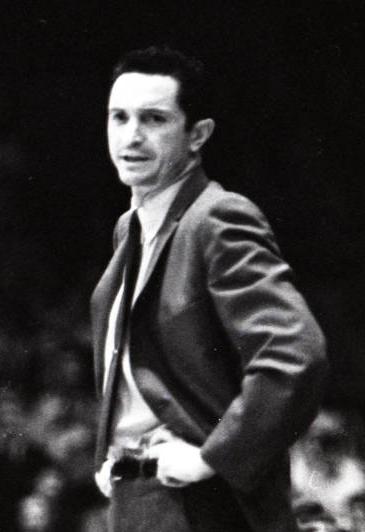
en Eagles for 13 seasons (1964-77) and was elected to the Naismith Memorial Basketball Hall of Fame in 1992. He was known for his eccentric personality, spunky vocabulary and incessant charisma.
“[McGuire] had this New York swagger, and obnoxious, arrogant approach… and you loved him or hated him for that, but he really put Marquette on
ball” with "The Confessions of Al McGuire,” which is expected to begin filming in Milwaukee this year.
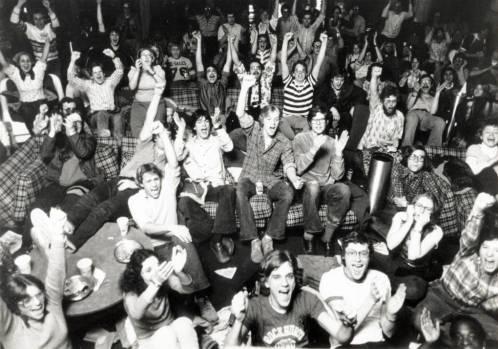
The film will follow the Marquette men's basketball team from 1974— when they made it to the national championship game and lost to North Carolina State after McGuire received two technical fouls — to another national championship three years later, where they beat the North Carolina Tarheels in 1977.
Originally from New York, McGuire coached the Gold-
"It's a redemption story because he had to learn that his worst enemy was himself..."
Michael Angeli Executive Producer and Screenwriter
the map,” Producer and Marquette alumnus Jamie Dyckes said.
Dyckes originally became involved with the film after seeing an advertisement on Facebook, then contacted executive producer and investor Eric Schnabel, and eventually joined the team.
“It’s a redemption story because he had to learn that his worst enemy was himself,” Executive producer and screenwriter Michael Angeli said. “He was such a great performer, but he got into it with the refs – the zebras, he called them – and that was what made them lose the 1974 championship.”
Angeli was raised in Milwaukee and is known for his work on TV shows like “Battlestar Galactica,” “Law & Order: Criminal Intent” and “Monk.”
“My dad graduated from Marquette…he just had the games on all the time, and Al McGuire – I was just entranced by him,” Angeli said. “I just waited for him to do something cool, something different, which he always did.”
Both Dyckes and Angeli mentioned McGuire’s fight for equal rights on the court and in the press room.
“He fought for race relations…when he found out that women at the time were not allowed in the press room,” Angeli said. “He said, ‘I’m not doing any more press until you allow women in the room,’ so that’s in our movie, obviously.”
Dyckes said they are still in the process of revising the script and in negotiations with an actor to play McGuire.
“The story sort of tells
"He said, 'I'm not doing any more press until you allow women in the room...'"
Michael
Angeli Executive Producer and Screenwriter
itself; we just need the right people to make it come alive on the screen,” Dyckes said.
The film will be directed by Anthony Hemingway, best known for his work on
“Red Tails” with George Lucas and HBO’s “The Wire.” Hemingway will also work as the executive producer. The rest of the creative team consists of Kim Taylor-Coleman and Josh Green as producers. Angeli said they are also in the process of scouting filming locations and gaining capital for the film, hoping to raise six million dollars through investors.
According to the film’s website, “The Confessions of Al McGuire” is potentially set to be released in March of 2027, which would be the 50th anniversary of McGuire and Marquette’s national championship win.
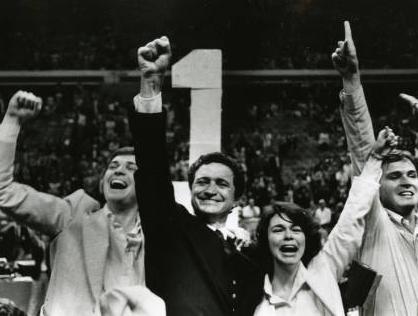
Al McGuire celebrates Marquette's championship win in 1977.
Photo courtesy of the Marquette University Archives
Coach Al McGuire stands on the sidelines during a game.
Photo courtesy of the Marquette University Archives
Marquette University students celebrate the 1977 NCAA championship win against North Carolina.
Photo courtesy of the Marquette University Archives
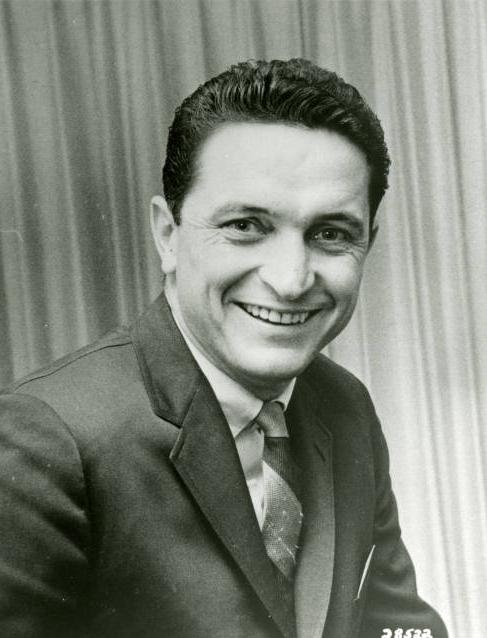
Al McGuire's official men's basketball portrait photograph.
Photo courtesy of the Marquette University Archives
The MU Gold 'n Blues prepare for ICCA

By Allison Scherquist
allison.scherquist@marquette.edu
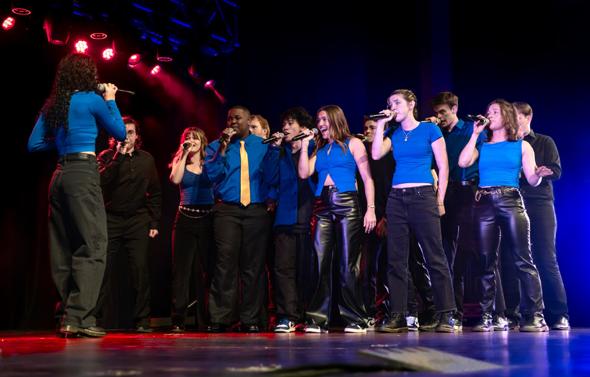
Marquette’s only co-ed a cappella group, the Gold ‘n Blues, is getting ready for the biggest competition in collegiate a cappella— the International Championship of Collegiate A Cappella (ICCA). The tournament, known by some from the “Pitch Perfect” movie franchise, will be held this year on Valentine’s Day, and the Gold ‘n Blues are deep in their preparations.
A cappella groups interested in competing at ICCA apply to compete in quarterfinals through a video audition, where six to ten groups are selected in their respective region. Then the top two groups advance to their region’s semifinal. The semifinal winners then advance to the finals in New York City. The Gold ‘n Blues, along with the Marquette Naturals, are headed to the quarterfinal competition in Madison on Feb. 14 and will be competing in the Great Lakes Division alongside the University of Minnesota and the
University of Wisconsin at Madison, Eau Claire and Stevens Point.
The group will be performing a selection of three songs— “Training Season” by Dua Lipa, “Biting My Tongue” by Duncan Laurence and “Holding Out for a Hero” by Bonnie Tyler. Gold ‘n Blues Creative Director Bennett Chapman — a sophomore in the College of Communication — spoke of the song selection process
“When [picking the song] we approached it as a full set [and focused] on how each song flows into the next,” Chapman said. “Being really intentional with how we went about [the setlist] this time around was a big focus.”
The songs are selected from group submissions; members submitted a recording of themselves singing and e-board decided on the final setlist. The students whose samples were selected were also assigned a solo. Chapman has a solo in this year’s competition as will
Moira Sagon, a sophomore in the College of Nursing, and McKinnley Marks, a senior in the College of Health Sciences.
“I’m really excited to turn over that new leaf for this group and expose everyone to the competitive environment,” Chapman said. “So far it’s been really good, we’ve had a really great dynamic in our rehearsals, and I think [it] will be really fun to put our work on blast and show off what we’ve been working super hard for.”
This is the first time the Gold ‘n Blues have competed at ICCA since 2023. Last year, the Gold ‘n Blues planned to compete after a year off in 2024 but opted out due to the competition’s conflict with National Marquette Day.
Jonah Zhungu, a senior in the College of Business Administration, is

ready to get back into the competitive atmosphere.
“We haven’t competed since my freshman year. We had a great time, it was a great experience,” Zhungu said. “[I’m excited] to
reap the benefits of a lot of the work that we have put in the past few years and approach [ICCA] with a new mindset and be a lot more intentional with our performance.”
PREVIEW: 'Are You Coming, Oliver?'
By MaryKate Stepchuk
marykate.stepchuk@marquette.edu
Marquette University
Players Society — MUPS — will return to the stage with a student-directed show titled “Are You Coming, Oliver?”
“Are You Coming, Oliver?” is a one-act drama that follows a young man named Oliver through a late-night NYC Subway station. As he waits for his train, he interacts with strangers who represent different family members in his life, while they all teach him valuable life lessons.
The play is directed by Dylan Guiliano — a firsttime director and sophomore in the School of Education — who aspired to direct a show in college. As an education major, Guiliano hopes to become a high school theater director and history teacher.
The show was written by
Guiliano’s friend, Ethan Drover, in the fall of 2024.
The show was first performed in Drover’s backyard, with Guiliano acting in it, but directing the show has changed his perspective.
“Being able to put it on the mainstage, with a whole different cast, and being able to envision everything differently has been an awesome process,”
Guiliano said. “I’m glad I’m able to do it.”
Even with Guiliano’s excitement surrounding directing his first show, scheduling has been an issue with the eight-person cast.
Many actors and actresses have other commitments outside of MUPS, as many cast members are not theatre arts majors. Between academics, work and other clubs, Giuliano spent five hours creating a
rehearsal schedule that he and Vince Parente, a firstyear in the College of Arts & Sciences who plays Oliver, could both attend.
Oliver appears in every scene, each focusing on meeting a different character at the subway station. The characters are each battling something different, from alcoholism to PTSD, but all teach Oliver lessons, making him understand life is worth living even with the struggles that can come with it.
As Parente has developed Oliver’s character, he wanted to ensure the character felt real.
“What from my history and my life can I connect to this that really fleshes it out and makes it believable for an audience?”
Parente asked himself.
Parente was not the only cast member who spent extra thought into
developing the character. Olivia and Ace are both played by Erin Cavender — a senior in the College of Communication — meaning she has to learn two drastically different roles at once.
Olivia is a younger female bartender who has a bubbly personality and helps Oliver figure out the point of life, while Ace is a young androgynous person with the stereotypical stoner personality, but helps Oliver understand love. As she developed these characters, Cavender struggled to create a distinct voice for the two different gender identities.
“I’m trying not to sound like my usual voice, which is a lot higher pitched,” Cavender said. “But I’m also trying not to sound super manly.”
“Are You Coming, Oliver?” may have some comedic
elements throughout the show, but it is a very heavy drama. Audience members should tread with caution when going into the show, but Giuliano wants them to understand that the themes in the show are real and important to hear.
“I want people to walk out and be more knowledgeable on these topics of hope, faith, addiction and stuff like that, that these characters bring to life,” Giuliano said. “[These characters] show how they struggle through and push through these topics.”
“Are You Coming, Oliver?” will take place on March 1-2 in Straz Theatre, with exact times yet to be announced.
*The show will have a complete list of the trigger warnings prior to the show.
The group will return to ICCA after not competing in 2025 due to National Marquette Day conflicts.
Photo courtesy of the Marquette Gold 'n Blues
The Gold 'n Blues will perform in Madison, Wisconsin on Feb. 14.
Photo courtesy of the Marquette Gold 'n Blues
The Gold 'n Blues setlist will include "Holding Out for a Hero."
Photo courtesy of the Marquette Gold 'n Blues