Former MUSG president facing allegations
Julianne Browne was accused of misconduct
By Sophia Tiedge sophia.tiedge@marquette.edu
Marquette University Student Government’s 2025-26 President Julianne Browne stepped down from her position as a result of misconduct allegations.
MUSG Communications
Vice President Catherine Sherman said she cannot disclose specifics or comment on the allegations.
The Marquette Wire asked Sherman when Browne officially stepped down, but did not receive a response.
According to Browne’s LinkedIn profile, she held the position until March.
University Spokesperson Kevin Conway said information about the investigation is protected by FERPA — a federal law which protects students’ privacy.
When asked about the alleged misconduct, Conway told the Wire any actions against Marquette’s Standards of Conduct are addressed through the student conduct process.
The Wire also reached out to Browne directly for comment, who directed staff to Jacob McInnis, a third-year Marquette Law student who advised Browne during the process. McInnis told the Wire the investigation is complete. He could not disclose whether the mis-
conduct allegations were found to be true, but confirmed it was the reason for her departure.
After Browne stepped down, Executive Vice President Adam Brzezinski fulfilled her duties, Sherman said. The Wire reached out to Brzezinski but did not receive a response.
The Wire also reached out to the individual who was the alleged subject of misconduct and did not receive a response.
Before the new student
government leaders assumed their roles, Browne’s position was listed as vacant on the MUSG website.
Browne is a senior in the College of Arts & Sciences and planned to heighten awareness of the student organization funding process and expand office hours for MUSG senators during her campaign for president.
New MUSG leadership, Jacob Ricard and Rae Dakins, took office on April 24.
Student targeted in campus stabbing attempt

clay.ellis-escobar@marquette.edu
Female victim exiting the store was uninjured
By
Mia Thurow, MaryKate Stepchuk, & Sophia Tiedge mia.thurow@marquette.edu marykate.stepchuk@marquette.edu sophia.tiedge@marquette.edu
A man attempted to stab a female Marquette University student at the entrance of Sendik’s Fresh2GO the morning of April 15, according to university spokesperson Kevin Conway and one employee who witnessed the incident. The student, who was exiting the grocery store at that time, was not injured and was offered

support from the CARE Team, Conway told the Marquette Wire. At 10:56 a.m., the store’s security cameras caught a man attempting to stab the student with a knife at the entrance of the grocery store, a Sendik’s employee who asked to remain unnamed said. A separate employee said they saw the suspect flee to the parking lot after attempting to stab the student twice, where two university workers then contacted the Marquette University Police Department.
Campus police arrived at the scene within two minutes to arrest the subject,
Conway told the Marquette Wire. A Sendik’s employee said the man was pacing back and forth in the parking lot before police arrived. According to a university statement, the man was not affiliated with the university and was exhibiting “signs of severe mental distress.”
According to the MUPD crime log, the suspect was also bail jumping — a criminal offense when a defendant on bail intentionally fails to appear at a mandatory court hearing.
The Wire requested the police report and call data from the Marquette University Police Department. Campus police denied the
request, stating the investigation is ongoing.
The university did not send out a safety alert — a message sent if there is an active threat to campus — at the time of the incident. Conway said this was because the suspect was taken into custody within minutes and remains in custody.
University leaders are assessing strategies to address mental health crises on campus, Conway said.
The attempted stabbing follows a Feb. 18 robbery and sexual assault of a female Marquette student on the 900 block of 14th Street, just blocks away from the Sendik’s grocery
store. 34-year-old Tedrick A. Boone was charged with the assault and pleaded not guilty on April 19. One month later, on March 18, there was a vandalization incident at the Church of the Gesu, a man claiming to be God caused $50,000 of damage to the church’s doors on April 5. Both incidents happened within six months of the church reopening after a yearlong renovation, which included new flooring, a new baptismal font and upgraded security measures. This is a developing story that has been updated with new information.
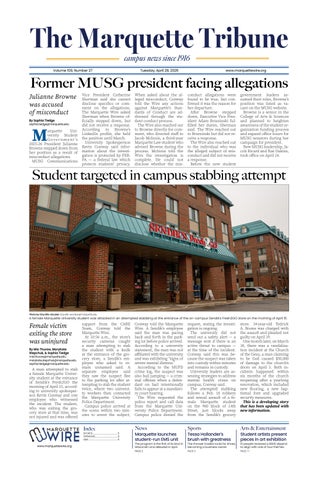
A female Marquette University student was attacked in an attempted stabbing at the entrance of the on-campus Sendik's Fresh2GO store on the morning of April 15.
Photo by Clay Ellis-Escobar
MU communication professor dies
David Fantle taught more than 1,200 students
By Mia Thurow
mia.thurow@marquette.edu
David Fantle, adjunct professor in the College of Communication, died after a medical incident suffered on April 21, College of Communication Dean Sarah Feldner announced in an email.
Fantle had been with Marquette University since 2008, teaching media writing and film and popular culture classes. During his time as an adjunct professor, he taught over 1,200 students across dozens of classes.
Mimi Attard, a senior in the College of Arts & Sciences who took a film class with Fantle, said his passion for Hollywood was deeply impactful in the way that he made every student feel engaged by bringing movies to life.
“It’s rare to encounter someone who cares so much about both their subject and their students, and his enthusiasm created an environment where learning felt exciting,” she said. “He will be remembered not just for what he taught, but for how he made people feel in his classroom.”
In addition to teaching at Marquette, Fantle worked in marketing and communication for four decades at organizations like Visit Milwaukee, the Wisconsin Department of Tourism
and the United Performing Arts Fund.
During his time at Visit Milwaukee, he led a campaign to create the statue of the “Happy Days” TV show character Arthur Fonzarelli — better know as The Fonz — on the downtown RiverWalk. Fantle also co-authored the 2018 book “Hollywood Heyday: 75 Candid Interviews with Golden Age Legends.” He earned his bachelor of arts degree in journalism from the University of Minnesota in 1983. Feldner asked that the campus community pray
The following resources are available to support anyone who is grieving:
Pastoral support: Visit Campus Ministry at AMU 236, call (414) 288-6873 or contact a specific campus minister to set up a time to meet. Hall ministers and affiliated ministersare also available to talk.
Counseling support: The Counseling Center in Wellness + Helfaer Recreation provides support services for students coping with loss, with services available
on a walk-in basis or by calling (414) 288-7172.
Student development: The Office of Student Development in AMU 329 also offers support resources.
“This is obviously a shock to all of us,” Feldner said in her email. “Many of you knew David from your time in his classes. His absence will no doubt be deeply felt over the weeks and months to come.”
This is a developing story that will be updated with new information.
Mashuda RHD leaves
By Lilly Peacock lilly.peacock@marquette.edu
A Marquette University Residence Hall Director is no longer working at Mashuda Hall, a first-year student in the College of Arts & Sciences who asked to remain unnamed told the Marquette Wire.
Larniecia Smith began as a hall director in Mashuda at the beginning of the 2024-2025 school year and worked in the role until early 2026, though her final working date and reason for departure are unconfirmed.
Smith’s profile no longer exists on the residence life staff list. According to internet archives, she was last confirmed to be included on the list in January. The exact date of removal is unknown to the Wire.
The Wire reached out to numerous resident assistants, desk receptionists and residents in Mashuda Hall, who all declined to comment. The Wire also contacted University Spokesperson Kevin Conway and Senior Director of Residence Life Mary Janz, and both said they were unable to provide comment on personnel manners.
The Wire also reached out to formerly employed Mashuda Hall resident assistants, and either didn’t receive a response or was denied a request to interview.
State's first student-run EMS unit launches
On-call workers respond to health crises in their van
By Elena Metinidis
elena.metinidis@marquette.edu
What started as a far-off dream quickly escalated into a passion project built to serve students for years to come.
When Avary Benavides Shefland, a senior in the College of Nursing, told a friend in passing that she liked the idea of a student-run emergency medical services unit, she never imagined Marquette University would yield a 20-person crew just over a year later. It all started at a Marquette University Student Government constituent dinner in February 2025, where former MUSG Vice President Logan Meyer gathered ideas to improve campus. Benavides Shefland’s friend, who attended the dinner, remembered their prior conversation and suggested an EMS service to MUSG.
Apparently student government liked the idea,
Benavides Shefland said, because it wasn’t long before she met with MUSG, the director of Marquette’s Medical Clinic and the Marquette University Police Department. From there, she met with other university officials and Aurora Sinai medical directors to write policies and procedures for the EMS service.
“It was amazing to see everybody work together for this,” she said.
Benavides Shefland spent nearly eight months developing the program. She scheduled meetings, planned operations and conducted research, all while being a student and working a full-time job.
The unit officially hit the ground running earlier this month.
“I can’t even describe the feeling of when we took our first run,” Benavides Shefland said. “I cried after because it was just that cool.”
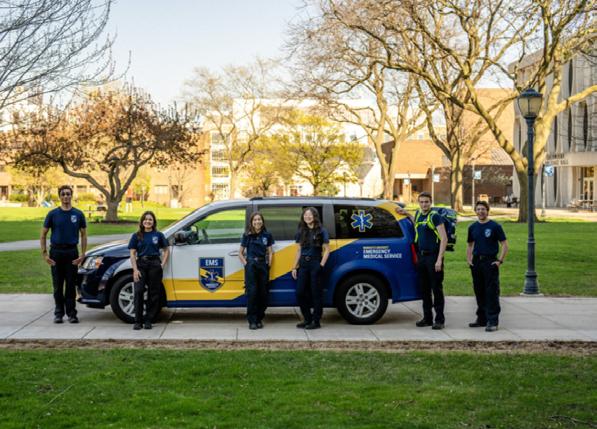
With the inception of the unit, on-call Marquette students are available to respond in their EMS van to immediate medical needs until an ambulance arrives. Benavides Shefland said the team can handle almost anything, from stopping bleeding to delivering a baby. They have responded to approximately 16 calls within the last few weeks. She and the university are also committed to keeping
services free for students, she said.
To first assess how to make the program possible, Benavides Shefland packed her car and drove across the country. She spent nights with the students running university EMS units at Villanova and Georgetown Universities. She shadowed them on call, spent hours speaking with them and even stayed the night at their houses.
After that, she was hooked, she said.
for Fantle’s wife, Cathy, and children Grace, Maddie and Max.
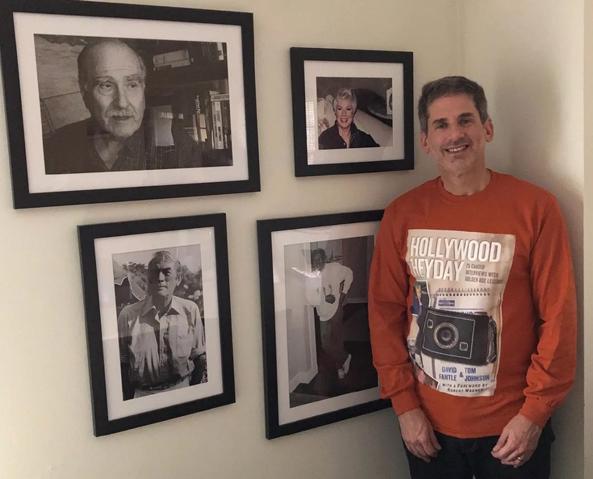
David Fantle had been with Marquette since 2008, teaching various pop culture and media classes.
Photo courtesy of davidfantle.com
The student-run unit at Marquette — the first of its kind in Wisconsin — hit the ground running in April.
Photo courtesy of Kasie Van Sistine
The MarqueTTe Tribune
Managing Editor of The Marquette Tribune Sophia Tiedge
NEWS Executive News Editor Mia Thurow
Assistant Editors Lance Schulteis, Lilly Peacock
Reporters Sahil Gupta, Elena Metinidis, Mina Marsolek-Bonnet, Lillie Martin
ARTS & ENTERTAINMENT
Executive Arts & Entertainment Editor MaryKate Stepchuk
Assistant Editor Joseph Schamber
Reporters Elise Emery, Allison Scherquist, Annie Goode
OPINIONS
Executive Opinions Editor Rachel Lopera
Assistant Opinions Editor Isabella Gruber
Columnist Amelia Lerret, Owen Parker
SPORTS Executive Sports Editor Jack Albright
Assistant Editors Matthew Baltz, Raquel Ruiz
Reporters Benjamin Hanson, Mikey Severson, Ben Ward, Eamon Bevan, Conor McPherson, Lukas Schulze
COPY
Copy Chief Emma Fishback
Copy Editors Elizabeth Belmont, Shea Lancaster
VISUAL CONTENT
Design Chief Murphy Lealos
A&E Designer Evelyn Riordan
Sports Designer Amery Thompson
Opinions Designer Allegra Delli Carpini
Photo Chief Clay Ellis-Escobar
Photographers Lily Wooten, Leo Stallings
HAVE A TIP FOR US?
Have you seen something that you think should be a story? Do you have a tip about something we should be looking into? Do you have documents or other materials that we should see? We want to hear from you.
If you have documents you'd like to send us, you can send anything to wiretips@marquette.edu.

'Noon hoops': A basketball tradition
Several players have gathered for nearly 40 years
By Lance Schulteis lance.schulteis@marquette.edu
In 1932, as New York City was being built into a metropolis, a photographer snapped the image known as “Lunch Atop a Skyscraper.” The shot captures eleven ironworkers spending their lunch break on a steel beam suspended over 800 feet from the ground.
From high-rise towers to surface level buildings, not all lunch breaks are the same. Some are on the clock. Others are off. Many are taken in a breakroom, and some are a getaway from the office.
At Marquette University, one lunch break habit is nearly as timeless as a 94-year-old photograph. Every Monday and Thursday at lunchtime, a group of professors, lawyers, alumni and students gather at the Straz Rec Plex for “Noon Hoops,” a midday basketball tradition that has lasted for nearly 40 years.
“I’ve always enjoyed playing with them,” Tom Lonzo, Arts and Sciences ’84, said. “Although people have come and gone, it’s been a good group of guys. We’ve all gotten along together.”
Unlike some college-based activities that evolve over time and face student turnover every four years, the Noon Hoops team has a longstanding roster. Take Lonzo, for example, who has been playing pickup basketball since his undergraduate days at Marquette. And Cy Cullen, who at 67 years old still sprints up and down the court to hit game-winning shots.
Or even 66-year-old Jeff Jensen, who was at Noon Hoops when Marquette men’s basketball players used to stop by and compete in the 1980s.
“I was in a noon ball game with Doc Rivers one time,” he said.
Noon Hoops is exactly what its name implies. When the minute and hour hands both face up, the basketball starts. It’s not an organized league with a winner and a trophy. It’s just hoops — what the self-proclaimed “old-timers” consider to be basketball in its purest form.
“We’d like to say that we’re more traditional,” Lonzo said. “We set picks and we get rebounds and are not real flashy with driving to the basket.”
They don’t bring the latest and greatest equipment. They don’t keep track of statistics. They didn’t even have their own jerseys until November 2025 — it was only after 40-plus years that campus recreation put a stop to their “shirts vs. skins” tradition.
The apparel adjustment is just one of several changes that the Noon Hoops group has faced over the years. They used to play every Monday, Wednesday and Friday. They played at Helfaer Recreation before tightened guest policies made it more difficult for everyone to attend — most players are no longer directly affiliated with the university.
Participants themselves have changed over time. Though the core group has remained, some have moved away. Others have graduated. That’s why younger Noon Hoops players have joined the fold; to fill in what was once a roster of about 30 players and provide extra competition.
“Three years ago or so, there was a group of people playing and they needed one more,” Mehrzad Moin, a graduate student in the College of Arts & Sciences, said. “One of them came over and invited me, and then I found out it’s a recurring group.”
He’s been playing with the group nearly every week since then.
At each meetup, Jerry
Grzeca, a 1988 graduate of the Marquette Law School, crafts teams with an expert hand. As the unofficial legislator, he divvies up the old guard with the younger players that have quicker movement. To Grzeca, it’s important to make sure the teams aren’t just fair, but are fun for everyone each time.
“The old guys are limited in their capabilities, and it’s okay to understand that,” he said. “It‘s no fun, frankly, for a bunch of old guys to play against each other. We need the young guys.”
But in a group that’s as time-tested and familiar with one another as Noon Hoops, nothing — even team selection — comes without controversy.
“Cy keeps thinking I’m cheating,” Grzeca said.
After all, because Noon Hoops keeps score, roster selection is vital. Teams play to 15 points before Grzeca mixes them into new groupings for the next game and the cycle repeats once more. Cullen said the group can usually get three or four games in during the lunch break.
Each age group has its own role. The younger teammates will battle on fast breaks and dive into padding for balls. The elder statesmen will defend, pass and shoot from the perimeter. With 40 years of synergy under their belts, some consider their camaraderie the most important asset on the court.
No errant passes. No miscommunications. Just machines in fluid motion, repeating the same motions as they have for decades.
“Years ago, there’d be students that showed up and wanted to play the regulars,” Joe Schimmels, a professor in the College of Engineering, said. “They were significantly more athletic than we were, but we still beat them because I think we play better team basketball. It’s not an individual game. It’s a team game.”
One of the group’s original players, Mike Hawthorne, passed away two months ago after a battle with cancer. Affectionately known as “Iron Mike,” Lonzo said he was “built like a fireplug.”
For the Noon Hoops crew, Hawthorne wasn’t just another face on the team. He was part of a circle of friends that spent their lunch breaks together twice a week. And as the friends he spent every Monday and Thursday with, his Noon Hoops teammates attended his funeral on March 5.
Though the group has returned to playing, Hawthorne’s absence still looms in the gym. Games remain five-on-five with their share of fill-ins, but there’s a void in the room. With camaraderie defining Noon Hoops, the death of a team legend changed the game forever.
“We had this set play where I would take the ball out, he would set a pick, he would throw it to me behind the three-point line and I take the shot,” Lonzo said. “We had an unspoken nod and we knew that was the play. I miss him.”
For those that still fill the Rec Plex twice a week, there are a few different motivations for playing basketball. First, it’s a midday getaway from jobs that can be demanding.
“The way I look at it is, it’s either take the time to go to Noon Ball or have a heart attack from the stress and anxiety of practicing law,” Jensen said.
For others, it’s a way of staying in shape and getting exercise. That’s why some have started playing pickleball as an add-0n to basketball.
And for someone like Cullen, who grew up on 14th and Capitol Drive and graduated from Marquette in the 1980s, it’s a way to stay connected to his university.
But for all of the Noon Hoops players, playing midday basketball twice a week isn’t about wins, rosters or stats — though there are several players that claim to be the group’s all-time scoring leader. Noon Hoops is built on tradition. Like New York City ironworkers sitting on a beam, it’s a timeless story of an afternoon spent with teammates.
“If you can find something like this in your life and sustain it, it’s a gift,” Grzeca said.
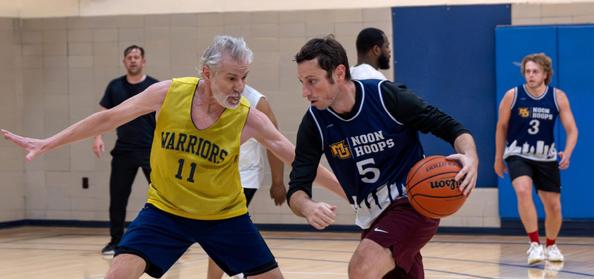
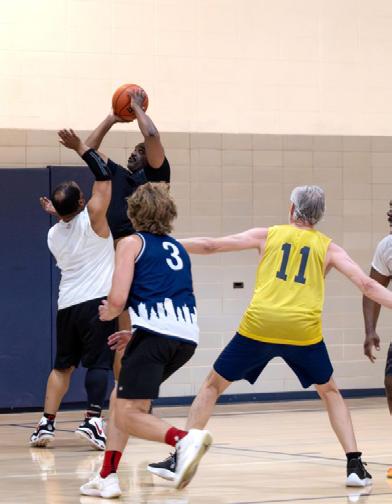
Every Monday and Thursday at lunchtime, a group of professors, lawyers, alumni and students gather at the Straz Hall Rec Plex for "Noon Hoops" basketball games.
Photos by Leo Stallings leo.stallings@marquette.edu
EMS: Students of all majors can join program
Continued from page 2
“This is what we could be,” she said to herself, impressed by what she observed. “They’re students, just like us, but they’re running full blown emergency services.”
Marquette’s student EMS program is the only one in the state of Wisconsin.
“[It’s] a group of students who put forth a grassroots effort to just do something good and to help the campus and community,” Assistant Police Chief Jeff Kranz, said. “When you bring that attitude to the table, you can’t help but succeed.”
Kranz accompanied Benavides Shefland to the annual Milwaukee Ambulance Service Board meeting in the fall where they proposed the idea of starting an EMS unit run by nationally registered EMTs who are also full-time students. If the plan didn’t get approved, she would’ve had to wait another year.
But after receiving the green light at the meeting, Benavides Shefland was able to start bringing people onto the team.
The EMS unit operates in the MUPD patrol zone Thursday through Saturday from 5 p.m. to 3 a.m.,
but hours will be extended once the crew expands and has more experience on Marquette’s unit.
The unit currently operates at an emergency medical responder level — one below emergency medical technician. Benavides Shefland said the team is working towards operating at the EMT level and certifying students to train each other.
Because students with any major and career path can join, those currently on the unit encourage others to earn their EMT license to gain valuable experiences through this job.
Jackson Fogarty, a junior in the College of Nursing, said having an EMT skillset is something that can be useful in everyday life, even if a student’s dream isn’t to work in an ambulance full time.
“The more people that are trained, the better outcomes we’re going to have,” he said.
Benavides Shefland said being able to respond to high-stress situations calmly, making decisions quickly and communicating effectively “even when your heart is racing and pounding in your ears” are all skills someone can learn
from the job.
Something special about Marquette’s EMS program, Fogarty said, is knowing students are helping people in the same community as them. The team feels its “by students, for students” model adds a level of meaning and comfortability.
Though Benavides Shefland is graduating this May, she plans to stay connected to the EMS unit at least during the summer to keep the ball rolling.
“I think it’s fair to say that at some point, we’ll save some lives, which is a cool thing to imagine,” she said.
MU celebrates Earth Day at farmers market
20 local vendors participated in the outdoor event
By Lillie Martin lillie.martin@marquette.edu
The sun was shining with some heavy wind, but the breeze didn’t stop the Marquette University Sustainability and Student Government from hosting their Earth Day farmers market. Dozens of students filled the space to see what was happening and celebrate the holiday.
Students gathered between the Alumni Memorial Union Building and Schroeder Hall from 11 a.m. to 3 p.m. April 22 for 20 different vendors, compared to just five when the event began three years ago.
“We’ve had a line over there since 9 a.m.,” Abbi Thompson, a junior in the College of Arts & Sciences, said about the Wake n Brew Coffee Co. truck.
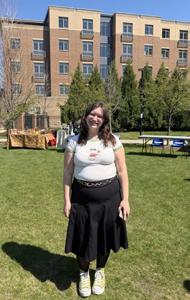
Thompson is the Sustainability Committee Coordinator for MUSG, who, with the help of her colleagues and the 10 people on her committee, planned the event.
MUSG was able to secure enough funding for the first 100 people to receive free coffee from the Wake N Brew Coffee Co. truck and a free plant, Thompson said.
Another vendor also served $350 worth of free crepes.
“I just love providing free things for students,” she said.
As an environmental studies major, Thompson has a passion for sustainability and Earth Day.
The holiday is especially relevant to her because it was created in Wisconsin.
In the 1970s, U.S. Senator Gaylord Nelson and young environmental activists worked with schools to raise awareness and create Earth Day.
Marquette is also committed to sustainability, as they believe Jesuit values compel them to care for the environment.
“I feel like it’s a tradition we need to show as Marquette, and as a Jesuit institution,” Thompson said, “We need to care for our common home and give back.”
Kian Howe, a senior in the College of Arts & Sciences, is the president of Students for an Environmentally
Active Campus. The club had a booth at the market to give out reusable cups with a 10% discount at the Brew Cafés and seed bombs for students to plant around campus.
Howe said growing up with an environmentally conscious mother gave him a strong love of nature.
“It means connecting to the world around you, with the beauty of nature and really understanding our place in the world and working as a collective to keep it healthy,” Howe said.
In addition to his involvement in SEAC, Howe stays mindful of where he gets his resources from. He makes an effort to ensure his clothes and food are sustainably sourced.
Macy Schmitt, a firstyear student in the College of Communication who stopped by to enjoy the market, shares similar beliefs.
She said she makes sure to help the Earth by picking up trash she sees on the
ground and not littering. She was also happy to be out in the sun and spend time with friends.
“It’s a great opportunity to get outside, have fun and celebrate all the amazing nature,” Schmitt said.
While some students enjoyed the event and noted the importance of sustainability, local vendors played a key role in promoting environmentally conscious products.
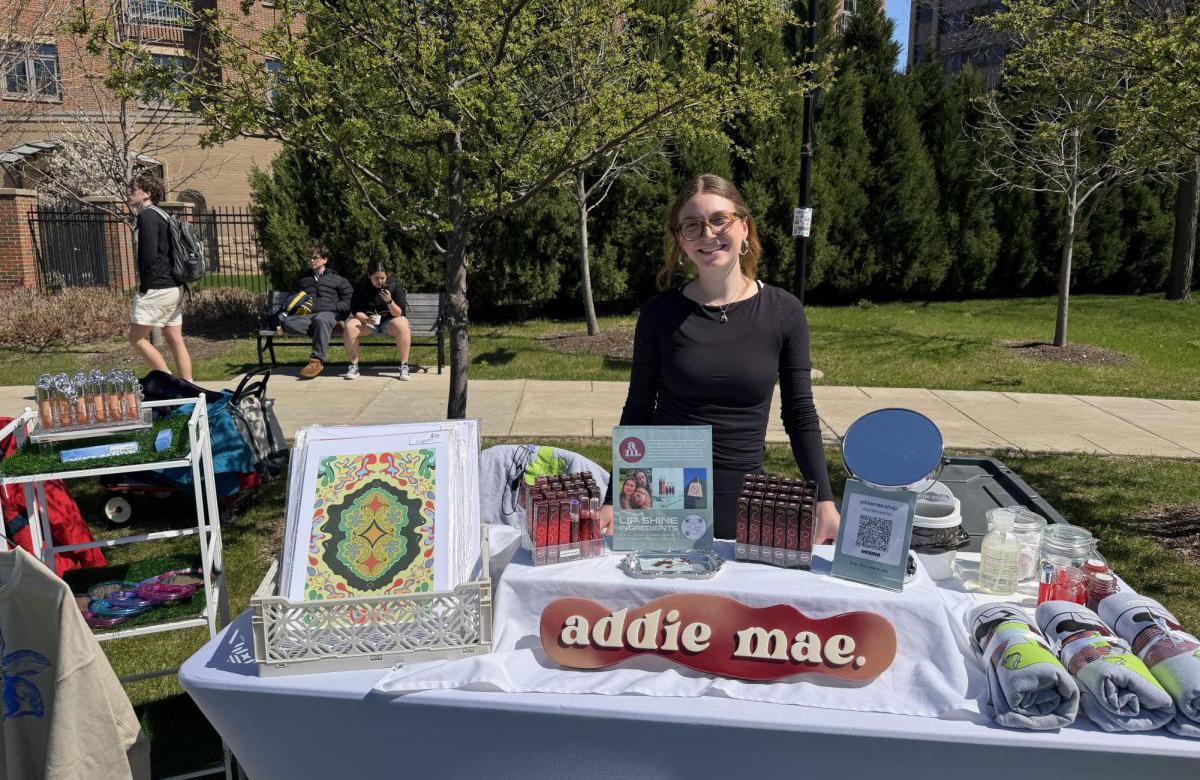
Addie Hurley is a recent University of Wisconsin-Milwaukee graduate and business owner of Addie Mae. She was invited to be a vendor at the market, where she sold her clean, vegan, gluten-free, all-natural lip oils.
She urged people to support local businesses and to stay away from contributing to large companies on Earth Day.
“Earth Day to me is about treating the Earth with respect, trying to minimize your carbon footprint and doing the best you can on
a personal level, even if sometimes things are out of your control,” Hurley said. Music and chatter filled the market, which stayed busy throughout the afternoon as students visited booths and spoke with the vendors. As the event was nearing an end some students headed home with coffee, purchases and plants in hand.
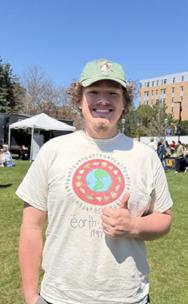
Photo by Lillie Martin lillie.martin@marquette.edu
Addie Hurley, owner of Addie Mae, was invited to be a vendor at the market, where she sold her clean, vegan, all-natural lip oils.
Photo by Lillie Martin
lillie.martin@marquette.edu MU senior Abbi Thompson.
Photo by Lillie Martin
lillie.martin@marquette.edu
Marquette senior Kian Howe.

A BRUSH WITH GREATNESS
Marquette javelin thrower Tessa Hollander traded rocks for shoes, and became a business owner
By Jack Albright jack.albright@marquette.edu
Five years ago, scrolling social media, Courtney, a marketing strategist and the eldest Hollander daughter, had an epiphany.
She'd long known her youngest sister Tessa, way before an award-winning, record-holding javelin thrower at Marquette, was really, truly, deep down, an artist. In every sense of the word.
Growing up, Tessa's goto gifts were handmade paintings, primarily on rocks. Tiny, flat stones she'd find in her front yard or at the river near her home, no bigger than a couple square inches. She would cover the dull, credit-card-sized mineral slate with bright, elaborate, meaningful designs.
Tessa's cousin got one as a wedding gift, which showed the bride and groom, with the church at which they got married in the background. Her grandparents have received many, including one of their family home in Montana when they moved. All her sisters have them.
She poured her soul into each. And she wasn't doing that for just anybody. The lucky few to get her best were exactly that — the
lucky few.
"She was pretty stingy with them," Tessa's mom, Kristen Hollander, says. As nice as Courtney knew this was, she also knew her little sibling could do more. Gifting rocks was a good start, but not enough.
Tessa had the potential to create real demand for her talents outside of her orbit. Perhaps even turn her skill into a legitimate business. All she needed was to paint something everyone could get excited about, but Courtney didn't know what.
Until one random day, browsing her feed, she was let down by what she saw. Tons of posts flaunting the very trendy custom shoes, but none all that impressive. That was her ah-ha moment. When the lightbulb above her head clicked, and the clouds parted to reveal a clear path forward. "I was like, [Tessa] could do a better job than this," Courtney says. So, Courtney had her product. Now came time for the rest. She created a private Instagram account, naming it @tailormadebytessa. She ordered leather paints and a pair of Nikes. She caught her two other sisters, Haley and Tara, up to speed. With everyone on board,
all that was left to do was inform Tessa. How do you tell someone they are running a business they don't know exists? Duh. You make it their 16th birthday present. Obviously.
The three sisters hatched a plan. They lured Tessa to a hotel about an hour from their house in Lynden, Wash., masking the trip as nothing more than a birthday getaway. A staycation, Courtney called it. Their mom, Kristen, drove Tessa down while they decked out the room. Tessa walked in for the first time, saw all three sisters standing, sweet 16 birthday decorations hanging — and became an entrepreneur.
The bedroom's walls were once blank, its furniture empty. Then Tessa moved in, and made it her own. The space pops with color and teems with life.
Paintings, plants, pictures. A map of the world, punctured by 58 pins in all the places Tessa has visited. Well, the ones she's remembered to mark. Medals from track meets hang over ribbons from track meets.
A vintage camera from the early-1900s, unearthed from a random box in their house last summer, sits on
an end table. Her desk epitomizes organized chaos. Set up to show the visiting inkstained wretch what it looks like when she's painting, art supplies cover everything. Brushes of all sizes complement paints of all colors. Bottles of leather deglazer sit next to bottles of acrylic finisher, the alpha and omega of the shoe-painting process.
In the center of it all is a completed pair of Nike Air Force 1s with Marquette's logo and outlines of javelin throwers mid-launch, situated to look as though the equipment form a protective ring around the shoes. The prize protected by
its gear.
This is where Tessa Hollander is herself. Her real self. Not the junior Marquette athlete who holds a program record or the engineering student stressfully cramming for tests. Rather, the artist at peace. "That's my relax time," Tessa says. She's most comfortable with the brush in her hand. It's when she can finally breathe. By the time she sits down at her desk, Tessa has been constantly moving. Her morning alarm blares as the sun rises for team lift at 6:30 a.m., and followed by dinner
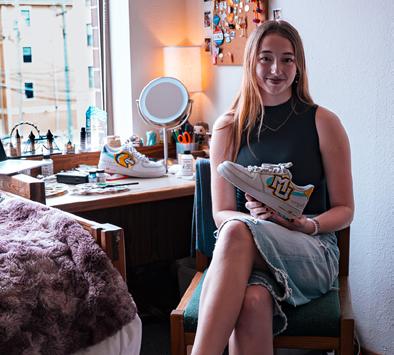
Marquette junior track & field javelin thrower Tessa Hollander has always painted. Her older sister Courtney gave her shoes — and a business — for her 16th birthday.
Photos by Clay Ellis-Escobar clay.ellis-escobar@marquette.edu
Tessa started painting shoes at 16, and hasn't looked back.
Graphic by Allegra Delli Carpini allegra.dellicarpini@marquette.edu
See BRUSH page 7
Marquette soars into postseason
The Golden Eagles faceoff against Denver Friday
By Ben Hanson benjamin.hanson@marquette.edu
About a year ago, Marquette women’s lacrosse head coach Meredith Black sat with her team in the film room disappointed.
It wasn’t because they were rewatching a mistake on an offensive break or a defense they should have read better — it was because of where they weren’t: at the Big East tournament.
“We shouldn’t be sitting here in our street clothes,” Black said, reflecting on that time. “We need to do everything we can from this moment till next year to make sure that we’re not sitting in the same seat.”
With three conference wins, one over a ranked opponent, Marquette clinched a spot to the conference tournament after its 20-6 win over Butler two weeks ago.
“It’s where we’re supposed to be,” Black said. Making the Big East tournament was Black’s old standard. Now, she wants winning a game in the tournament to be the new one.
Marquette’s matchup in the first round of the tournament will be the Big East regular season champion Denver: a foe the Golden Eagles have never won against. Marquette’s loss 15-9 against the then No. 19-ranked Pioneers in April was the closest final score between the two since 2021 (13-12 in double overtime).
Denver has climbed two ranks in the top-25 since and went undefeated in conference play. It won against Georgetown in the game to crown the regular season champ 11-5. In March, Marquette lost to the Hoyas by one (11-10).
Following that loss to the
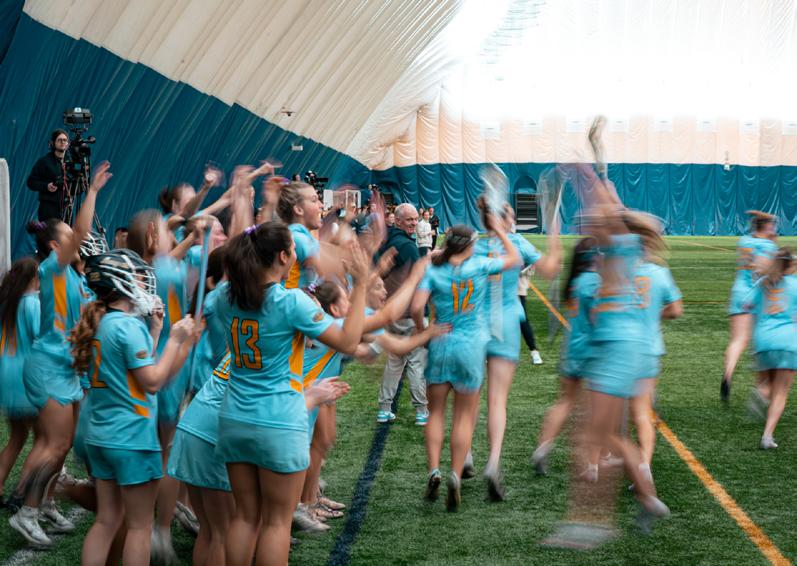
Pioneers in April, everyone on Marquette has wanted the matchup back.
“Our goal as a team is to try to stay pretty steady, pretty even-keeled, and not get too high and not get too low on the things that go wrong,” Black said about playing Denver in the first round of the conference tournament Thursday.
“We want to be living in the present.”
This has been her mentality since a few games into the 2026 campaign and one philosophy she attributes the team’s success.
In the first couple games, she and the team were focused on wins. While those sure help a team gain notoriety, Black soon shifted focus toward the process of bettering the record. And even when the outcome of a game in the postseason means continuing to play or going home, she believes living in the “power
of the now.”
Black has every reason to focus on winning. Marquette has never won a Big East tournament game and hasn’t played in one since 2023. Out of the program’s 13 seasons before this year’s, the Golden Eagles have only made the postseason four times. But still, she keeps her and her team’s eye on the ball, “focusing on the opportunity rather than the pressure — the process over the outcome.”
She applies this by treating the team’s practices the same as they would a preseason one.
“You can never stop learning. You never stop getting better,” Black said. “We have to continue to focus on (how) those are the things that got us in this position in the first place.”
When Tess Osburn, a senior attacker, was a firstyear in the 2023 season,
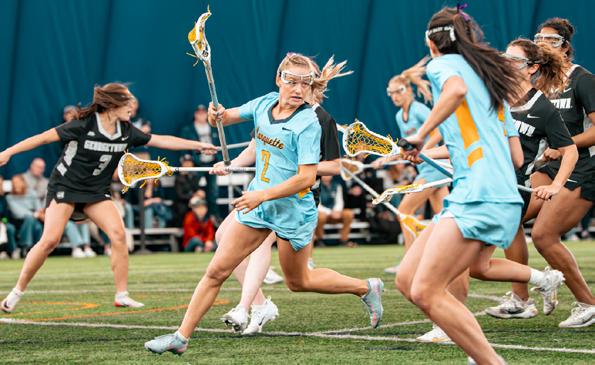
she thought making the Big East tournament was normal. The time away from the postseason has not only made her hungrier, but also the younger players who look up to her.
"Our goal as a team is to stay pretty steady, pretty even-keeled."
Denver scored every shot on the cage. The Pioneers outscored the Golden Eagles in every quarter but the third.
This time around, Black is emphasizing playing full throttle no matter the situation, if things are going well or not.
Marquette did this in late February against Arizona State when, despite losing, brought the final score within three after ending the first quarter down 4-1. And again against UC Davis by winning 13-12 despite the Aggies’ late comeback in the fourth.
Osburn reminds those younger players to not take this upcoming time for granted. She sure as heck won’t.
“I don’t want to leave anything on the field and have regrets about that,” Osburn said.
The Golden Eagles continue to work through a couple kinks before they take the field against the Hoyas: Slowing their fast breaks and the smaller details of their offensive setups.
It’s going to take quite an effort to take down the Pioneers, though. They are averaging 18 goals per game, almost five more than Marquette (13.67).
In the regular season, the Golden Eagles are shooting on goal just as efficiently as Denver, but in their game against the Pioneers earlier this month, they only shot .529 and
Obviously, Marquette is playing with an end goal to hoist the Big East tournament trophy. But Osburn, as with probably many other seniors, is also fighting for a simpler thing: additional time with their teammates.
“I get super upset thinking about it because I’m definitely not ready. And thinking about leaving is like… I get…” Osburn took a deep breath, wiped some tears away and continued.
“It’s just hard.”
Whether it’s for a chance at the program’s first tournament win or for Osburn, another game, another warmup, another meal with teammates — nay, lifelong friends — the psyche that got the Golden Eagles to this point remains the same.
“Focus on us,” Black said. “Focus on 60 minutes. Focus on living in the present.”
Marquette women's lacrosse was named the No. 4 seed after its 12-10 loss to UConn Saturday.
Meredith Black Marquette women's lacrosse head coach
No. 4 seed Marquette faces top-seeded hosts Denver in the Big East tournament Thursday evening at Peter Barton Stadium.
Photos by Clay Ellis-Escobar clay.ellis-escobar@marquette.edu
TRACK & FIELD
BRUSH: 'She's giving you a piece of her heart'

Continued from page 5
and hours of homework and studying, she often doesn't find herself back in the comfort of her room until 10 p.m.
Over 12 hours on-the-go would drain most people. Make them susceptible to mistakes, especially with the finer details. Not Tessa, a self-described night owl who prefers to paint while her world rests. She thrives in the nitty-gritty. Her hand is surgeon steady. No margin is too tight, no space too small. Minor brushstrokes trump major. Always.
Every speck, like on each of her shoes, are placed entirely by hand, unassisted by tools. You can find a lot of gizmos on Tessa's desk, but not a stencil or paint pens. Using one would defeat the purpose. It's in the minutiae Tessa escapes.
Aides prevent that. It's how she goes from planning to paint for two hours, to looking at her clock and learning she's been going twice as long.
"I'll just lose track of time," Tessa says. "Just because I get so into it and I love it so much that I'll be painting, and then I'll check the time, and I'm like, 'Oh, I have to wake up in four hours.'"
Painting sessions that start at night frequently end in the wee hours of the morning. Kristen has repeatedly walked in on her daughter, head tilted, examining what appears to be — what should be — a finished product, in search of something to improve. Anything.
"Her mind is like, 'What can I do? Something's wrong, something's missing. What is it?'" Kristen says. "Her mind, I don't know how that mind works, but she sees something in her mind, and what she's looking at is not it. So she's got to keep trying."
Leaving orders unfinished until the last minute became a habit of Tessa's. Kristen has had to overnight ship many shoes so they got delivered on time. Once, she even flew to Colorado to get pairs in a customer's hands on schedule. Perfection has a price, and that time, it was a plane ticket. More often than not, though, the biggest cost is sleep deprivation. "I love how much it tests you, and how hard it can be at times," Tessa says. "It's interesting, but it's also so, so rewarding."
One of the payoffs is real, physical money. But, beyond that, opportunities and experiences.
At Marquette, Tessa completed a pair of shoes for former men's basketball guards Kam Jones and Stevie Mitchell for their podcast, "The K1 And Stewie Show." She also painted ceramic, 3D-printed minions for the men's lacrosse team in honor of Noah Snyder and Scott Michaud, who died in a car crash last September. For men's lacrosse head coach Jake Richard specifically, she surprised him with a special pair showing the late sophomores' names and likeness. He wore the shoes to every game last year.
Every opportunity has helped Tessa gain more confidence. Owning a business is scary for anyone, let alone a teenager. Starting out, only getting orders from friends and family, was great. But a pit sat in her stomach. Selfdoubt crept into her mind. Do people want my art because I'm Tessa or because I'm a Hollander?
People say comparison is the thief of joy, and Tessa began robbing herself.
"I'll see other people painting out there, and I like to compare my design to their design," she says. "'Wow, I would love to be at their level,' thinking that
as it sounds — in fact, it's become one of her favorite parts of the business.
"I love communicating with people on designs and meeting all these new people," Tessa says. "Then, slowly, I've, become more confident in my skills, and I know how to value my skills now a lot better."
She started her business with the small set of brushes she had since she was a child, long before her art cost money. Now, she has 36. While she was given a few leather paints on her 16th birthday, she is up to 32 total.
mine isn't as good."
Then people trust her with important projects. A company flies her out to work one of the world's most premier fashion events. Athletes go to her to commemorate their college playing days before turning pro. A team relies on her multiple times to honor their fallen brothers' legacies.
"And then I do realize how much even my skills are appreciated," she says, "and my specific style is appreciated by these certain people. So that helps to get rid of the imposter syndrome feelings."
But not all of them. Tessa still deals with these thoughts. Maybe she always will.
To this day, after five years and dozens of deliveries, when dropping off a completed pair, Tessa still worries whether the customer will like it. She knows she put as much skill and effort into the design as possible. What if it's not enough? What if they're still disappointed?
"But...," she says reassuringly, half to a reporter and half to herself. "...Everyone has liked them so far."
Tessa estimates she has completed 80-100 shoes for her business, to people in places as far away as Texas and as close as home. They've all taught her certain things. Some about painting, some about life. She knows how to prioritize her time better — there are far fewer 3:30 a.m. bed tucks now than in the past. On the shoe, paint will chip off the rubber midsole first. It's okay to advocate for fair compensation. The hardest part of an Air Force 1 to paint is anything around the swoosh — it's putting a 2D object on a 3D surface. Reaching out to people is not as scary
Some things do remain the same, though. Like the motivations of the person wielding the brush and crunching the numbers. While the supplies and ability have improved over the years, the drive hasn't needed to.
She's still that same person at heart. If you think a little money jaded her perspective, you're wrong. The passion remains in every pair, paid or not.
"She's giving you a piece of her heart, because she just really is trying to think of you and what would make you happy," Kristen says. "Each shoe is made specifically for you. She wants to know who you are. She wants to know what you like. She wants to know everything so that the shoe is perfect, just for you.
"It just makes you feel special."
After two hours spent talking about the many things Hollander holds — brushes, javelins, her bright pink graphing calculator — it was time to address perhaps the big-
gest question. What is she reaching for first, metaphorically and literally? With which does she most identify?
"For sure, artist first," Tessa says. It’s how she differentiates herself. Flexes her creativity. It's why she inscribed her signature on her old javelin spikes, because it adds her personality to contrast the uniformity of uniforms. There are a lot of Golden Eagles, but only one Tessa Hollander.
And if art is how she distinguishes herself, doing it for others is how she is herself.
There's a reason shoes stuck in a way other mediums didn't. Shoes have a purpose. Not just to protect feet from blistering pavement, but more. They are a form of expression. A window into a person. Their likes, dislikes, general vibe.
To Tessa, the best feeling in the world is seeing her art utilized. On people's feet, transporting them from one place to the next. A part of their daily lives.
"How many people want [shoes] really helps keep me motivated," she says. "I love shoes because I know they're being used, that people are actually wearing my shoes versus some other artwork."
When Courtney gave Tessa that 16th birthday present, she had no idea if her little sister would see it through. That wasn't the point. The gift was not a shoe-painting business, but an outlet. As a professional marketer, Courtney gets paid to find potential channels for people to capitalize on their abilities. She just happens to be good at her job.
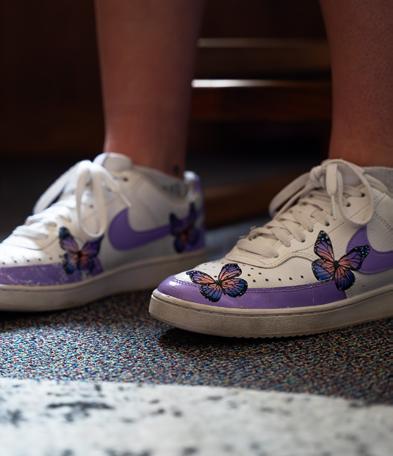
Tessa still has and wears the first pair of shoes she ever painted.
Tessa Hollander has always dealt with self-doubt as a painter. Each shoe helps her overcome it.
Photos by Jack Albright and Tessa Hollander
TRACK & FIELD
The friendly rivalry rewriting history
Hollander, Ward trade farthest throws this season
By Lukas Schulze lukas.schulze@marquette.edu
It was March 28, at the Joyce Morton-Kief Invite at Illinois State University.
Junior thrower Riley Ward sprinted down the 100-foot-long runway, reared back and launched the seven-foot javelin spear into the chilly Illinois sky. The spear split the air and then finally pierced the ground after it fell from its apex, which left Ward with one option.
Wait to see if she made history.
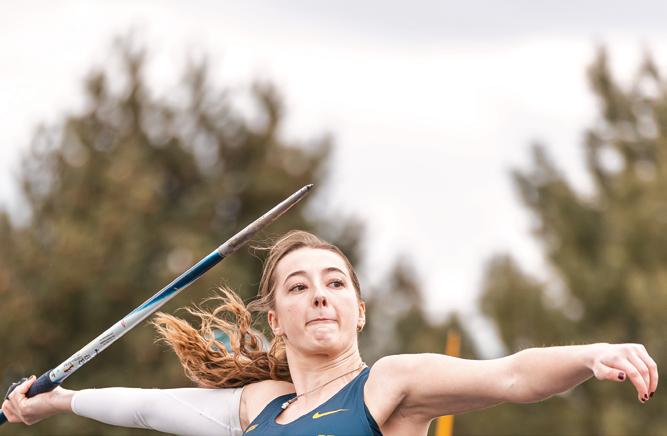
A few seconds later, the field judge reported a final distance of 42.68m.
It was a new Marquette record. Ward just passed her teammate junior thrower Tessa Hollander for the best women’s javelin throw in Marquette history.
However, the record wouldn’t last very long.
The very next meet one week later, Hollander took back control of the top spot at the Marquette Invite, heaving a throw of 43.74m.
But yet again, Hollander couldn’t celebrate for very long.
One week later at the next meet, Ward broke the
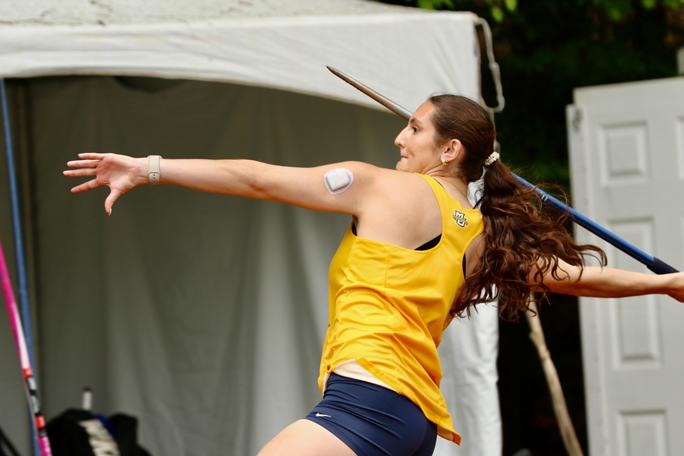
record once again at the Georgia Tech Invite, with a throw of 45.22m, the third consecutive meet where it switched hands.
“My favorite is the first time breaking it,” Hollander said. “Now every time we PR it’s now the record.”
While both Hollander and Ward want to be the Marquette record holder, that doesn’t mean they aren’t going to cheer each other on. Their competitiveness only adds to their friendship.
“We both want the school record, and we both want

to win,” Ward said. “We are the loudest people cheering for each other.”
Ward calls it friendly competition. But their competitive spirits aren’t just limited to the field. They are also training partners while lifting.
“I want (Tessa) to PR, I want her to get better,” Ward said. “Even lifting, there’s always friendly competition.”
Ward and Hollander became not only friends, but also roommates, before they were even on the track team. When searching for roommates before their first year at Marquette, they both noticed they threw javelin in high school, which they instantly bonded over.
“We both knew we threw javelin in high school,” Hollander said. “We were both like ‘Oh, that’s cool.’”
During the summer they both found out that they had made the team but didn’t tell the other right away. It wasn’t until associate head coach Mike Koenning called them individually that they realized they wouldn’t only be roommates but also teammates.
“It was so random,” Ward said. “It was a mere coincidence.”
It didn’t take long for them to connect. Beyond having the javelin in common, they also grew up over 1,800 miles away from the school whose history books have their name.
Hollander from Washington and Ward from Arizona, being so far away from home was something both could relate to.
“It’s something we bonded over very quickly,” Ward said. “We can’t go home every weekend, some holidays we’re still hanging out together.”
While them being roommates was a coincidence, what isn’t is the amount of trial and error it takes to become a record holder in an event that requires such precise mechanics.
“Even from speed to strength that we do in lifts, and just the technical stuff,” Ward said. “You can have a great full run-up and then at that last throw, you move your shoulder the wrong direction, you just ruined the whole throw.”
Watching film during and after the meet has been a
huge part in helping them notice the minute details they messed up throughout the throw.
“I really like watching the videos right after I throw,” Hollander said. “I can recognize what I messed up.”
Ward finds them just as important to her success.
“I rely on the videos so much,” Ward said. “In my head I thought it was great, then I’ll watch it and see I didn’t do this one thing.”
Despite their record-setting performances, Hollander and Ward have different approaches when it comes to the mechanically heavy event.
Hollander relies on her height, which allows her to hold her arm further back and for a longer amount of time when throwing.
“Being able to hold my arm back for a really long time is the best for Javelin,” Hollander said. “When I can really use that skill of mine is when I’m going to have a good throw.”
While Ward relies more on her speed on the runway, which allows for her to get more power behind her throws.
“I rely on my legs, I’m a little faster on the runway,” Ward said. “To try and have more power going in.”
But the competition for the record is nowhere near as important to Hollander and Ward as making sure that each other is at their best.
“Being able to give each other advice at practice,” Hollander said. “We are so in tune with each other’s personalities, that it helps a lot.”
The competitive advantage both Hollander and Ward give each other just means the record is about to switch hands again sometime soon.


Photos courtesy of Marquette Athletics
Roommates Tessa Hollander (left) and Riley Ward battle for the longest throw at Marquette.
Opinions
'Finn's Rule' justly reinforces bus safety
By Rachel Lopera rachel.lopera@marquette.edu
Student Transportation of America will adopt “Finn’s Rule,” an initiative that will reinforce bus driver trainings and require drivers to check bus danger zones. As a routine mode of transportation for 26 million students in the U.S., school bus drivers must follow the necessary safety measures to protect children.
“Finn’s Rule” is named after Finn Katona, a 5-yearold boy who was killed by a school bus at Silver Spring Intermediate School in Sussex, Wisc. in January 2025. As he was transferring buses, he tripped and fell in a danger zone — high-risk areas around a school bus — and was run over by a bus that was pulling away.
Finn’s parents, Ally and Zach Katona, sued STA, the bus driver and the Hamilton School District. They recently reached a settlement — announced April 22 — which includes new safety requirements.
STA’s 23,000 drivers will undergo training that
incorporates “Finn’s Rule,” which mandates drivers to check bus danger zones before pulling away. Additionally, reminder cards with a diagram and a photo of Finn will also be distributed to over 130,000 drivers nationwide.
The back of the cards read:
1. Count your kids to ensure all students are safe and accounted for and in your line of sight.
2. ALWAYS be aware of the dangerous zones! “Rock and Roll” in your seat to ensure all blind spots are clear.
3. Proceed with caution and always expect the unexpected.
Bus safety is of the utmost importance. Millions of parents and guardians rely on this transportation to safely get their children to and from school. It’s appalling that it takes a tragic incident to incite safety measures that should have already been implemented.
Before Finn’s death, 4K students had to switch buses at SSI to go to Willow Springs Learning Center. The day after this incident, Hamilton
School District changed its bus policy to eliminate K-4 bus transfers; implementing direct routes to Willow Springs Learning Center in Sussex. The district also ended its “bus buddy” system where 5th and 6th grade students were in charge of escorting a 4K student from their bus to the next.
The Katonas told WISN12 that the district should have been aware of the possible dangers.
“We never envisioned moving buses as those young kids were being transitioned,” Zach said. “We imagined static buses, plenty of staff around, a bus buddy holding their hand. That’s not what happened.”
“Finn’s Rule” promotes and strengthens bus safety to protect children and their families. The Katonas’ attorney, Timothy Trecek, said it will most likely go into effect in fall of the next school year. The family hopes the initiative will remind those who work with schoolkids that safety measures matter.
My own family experienced a horrifying

incident when my older brother — who’s on the autism spectrum — was left and forgotten on a school bus when he was 4 years old. That event triggered severe emotional distress for him and my parents, and my brother refused to ride the bus afterward.
My parents sued Johnson School Bus Service and called for preventative measures. As a result, the company installed alarms in several of its buses, which stop the bus from starting unless the driver walks to the back of the bus to disable them. With physically walking to the back, the driver sees if
any students remain in the seats to ensure that each one departed the vehicle. Cases like the Katonas’ and my family’s stress the importance of bus safety. These consequences can be avoided with more care, effort and initiative. Protecting children should be a bus service’s number one priority, and action must be taken to uphold it.
Families should not have to worry about whether their child gets to school safely; it should be a given.
Expand substance abuse recovery programs
By Bella Gruber isabella.gruber@marquette.edu
College students inevitably face challenges and undergo different experiences throughout their academic careers. For students in recovery from substance addiction, collegiate recovery programs are integral in promoting sober lifestyles in an inclusive community. It is imperative that these programs continue to be researched and funded to ensure schools can effectively meet the needs of students in recovery.
Unlike external recovery resources, CRPs are unique because they specialize in assisting students. Many offer sober living spaces, a drop-in facility, 12-step meetings and full-time staff dedicated to meeting their needs.
CRPs play an essential role in dismantling stigmas against substance use disorders and receiving treatment for them. These may include negative attitudes toward how recovering people attend social events or assuming that they are mentally weak. In turn, these stigmas may induce exclusion and feelings of shame.
Many college experiences foster a culture of heavy substance use, normalizing excessive drinking or drug use as a rite of passage
at college events. In turn, substance-free environments are often looked down upon, creating an extra layer of challenges for students seeking treatment.
Recovery at Marquette hosts its own community space on the third floor of Wellness + Helfaer Recreation. With comfortable seating, games and a student-selected Anodyne coffee blend, this space welcomes students at any point in their recovery journey. In addition to this space, their coffee bike outside of the Wellness + Helfaer Recreation center has served over 5,000 cups of coffee this year, and their four sober tailgates in Milwaukee have attracted 1,500 attendees.
At other local CRPs, such as Club Soda at the University of Wisconsin-Milwaukee and Badger Recovery at the University of Wisconsin-Madison, sober events such as sports, shared meals and movie nights combat this stigma. These events promote positive norming, the reinforcement of healthy behaviors as a standard. In college culture, positive norming is critical to removing the perceived need to use substances to have fun.
For Bret Frazier, technical assistance and outreach manager at the Associa-
tion of Recovery in Higher Education, his experience in a CRP guided his academic success.
“People led by example for me, teaching me how to thrive,” Frazier said. “They showed me how to become involved, how to connect with your professors. I was able to learn and apply these skills in my own studies and relationships.”
Many CRPs hold both recovery-focused meetings and social meetings where sobriety is a collective factor that brings their members together. Others acknowledge treatments for recovery but ultimately serve as a space for students to connect through their similar lifestyle choices in their own time.
“We can offer resources around Milwaukee or Marquette, but we’re just here for fun,” Grace Alvarez, program coordinator of Recovery at Marquette, said. “We want to set students up for life outside of campus.”
Providing a haven for students is important in breaking down barriers that many students face when seeking recovery. According to an Ohio State University study, recovering students struggled with mental health.
No one should have to choose between their health and education. These barriers can be mit-
igated through the support ive network provided by CRPs.
It is important to recognize how sobriety is a lifestyle for many students, both recovering and not. There is an increasing prevalence of students staying sober to improve their health, well-being, social support and participation in society, according to the Ohio State University study. When sobriety is framed as a supportive social network rather than a minority choice, students and community members can unite to embrace their sober lifestyles.
“For a lot of our students, recovery is a way of life,” Dante Lucchesi, program coordinator at Badger Recovery, said. “It’s about providing a space where they feel like they belong.”
While the number of CRPs has grown from 29 to 179 since 2015, there are still thousands of universities without CRPs. ARHE receives funding through the Center for Addiction Support under Substance Abuse and Mental Health Services Administration, but the current federal administration has made significant cuts to mental health initiatives. SAMHSA has cut $1 billion in grant funding this year, and the Department of Health Services has pro-
posed a restructuring of the department which would dissolve SAMHSA into a larger administration. ARHE risks loss of significant funds due to these changes, which would result in major losses for young people’s access to recovery resources, finding sober communities and the research into their operations. Universities and federal agencies must recognize this risk by prioritizing CRPs’ funding as equally as any other health resource to help them develop into universal organizations on campuses. Without CRPs, students lose major health opportunities on campus. The expansive effects on students who seek sober communities where they can authentically express themselves cannot be ignored. CRPs are non-negotiable organizations that require persistent funding and support, even as federal agencies make changes that put their existence on the line. Supporting students’ roads to recovery and guidance to success must be viewed as a necessity to ensure students feel supported and healthy on campus.
Rachel Lopera is the executive opinions editor. She is a sophomore studying journalism.
Bella Gruber is an opinions columnist. She is a sophomore studying public relations.
Photo by REUTERS
School bus driver navigates while driving through downtown LA.
TIEDGE: A bright future for journalism
By Sophia Tiedge sophia.tiedge@marquette.edu
One of my first assignments as a news reporter was to cover a graduate school keynote speaker event. I went to the basement of Raynor Library and listened to a speech, trying to pick out bits and pieces that sounded interesting. I stood outside the room after, sweating, nervous to walk up to strangers and ask them to be interviewed.
It wasn’t until I went upstairs, set up my computer at a table and began to write when something unexpected happened. As soon as my fingers touched the keys the story just came out. Within an hour I was done and I’d realized something: I think I might be good at this.
I’ve sat down to write many stories since then, and each time that feeling of accomplishment and passion returns. In my first few weeks of college I had complete confidence that I knew what I wanted to do for the rest of my career.
It’s safe to say I’m luckier than most.
While serving as a news reporter, assistant news editor, executive news editor and this year, the managing editor of the Marquette Tribune, I’ve learned many lessons, made mistakes and taken chances. I’ve covered a university budget shortfall, faculty’s attempts to unionize, crime on campus and some of my most favorite stories: ones about the people who make Marquette such a special place. With each lengthy interview or breaking news story my passion for writing only grows.
I was always told from the moment I picked journalism as my major that I wasn’t going to make it, that I wouldn’t make money or that no matter how good I was, jobs in journalism just don’t exist anymore.
Even though to some extent, those sentiments are true, I knew something they didn’t: Gen Z wants to hear stories
(maybe just not from a print newspaper).
I whole-heartedly believe my generation cares about their communities and craves good, true and relatable local news. This year alone, the Wire’s Instagram account’s following has skyrocketed, we receive emails and posts on anonymous social media apps about potential stories and people are sharing our work. It’s encouraging.
I’m looking forward to experiencing the future of journalism. In just less than two months, I’ll be moving to Knoxville, Tennessee, to work for the Knoxville News Sentinel as their growth and development reporter. It really is a dream come true.
Even though I’ll be far from home and away from my friends and family, one thing will remain true. In the company of a good story, I’ll never be truly alone.
Thank you to my family, friends, professors, mentors and colleagues and to
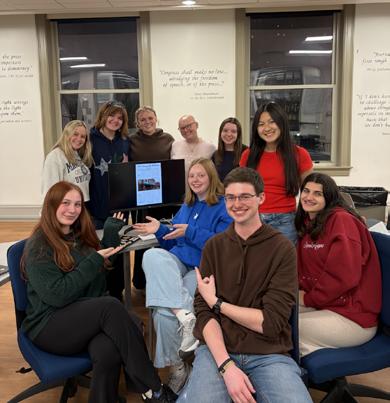
everyone who has helped me get to this point. It wouldn’t have been possible without you.
But maybe most importantly, thank you to all of the managing editors that came before me. Your hard work and dedication is why the Marquette Tribune is such an integral part of the Marquette community. Long live the Trib!!
THUROW: Learning to live in the present
By Mia Thurow mia.thurow@marquette.edu
All my life, I’ve been too focused on the future to actually live in the present.
In high school, I counted down the days until graduation, because all I cared about then was going to college and starting the next chapter of my life.
Again, in my first years at Marquette, I couldn’t wait for the future — getting my own apartment, moving up in student organizations and becoming an upperclassman.
But now, as I count down the days until my college graduation (11, as I write this), the sinking feeling in my chest only grows.
After an advising meeting last semester, I realized I was set to graduate this spring, an entire year earlier than I had originally anticipated. Since then, countless people have expressed their excitement for me, telling me how great it is to be able to graduate college early and how I must be excited to enter the professional workforce — my future. In many cases, I agree with them.
But what not everyone knows is how devastating it will be for me to leave this place.
Quite a few students I know chose this university for a somewhat impersonal reason. In many cases, it wasn’t even a top choice for them.
Not me. As someone
raised by a proud Marquette graduate (my mom), the campus between Clybourn Street and Kilbourn Avenue always felt like home to me in a way — somewhere comfortable and welcoming.
And actually, that’s what almost led me away from it in the first place. I thought my familiarity with Marquette represented settling; merely attending a college close to home because I was too scared to be the student who moved across the country and went somewhere completely new.
But now, I know I couldn’t have been more wrong to have thought that.
Marquette — specifically the College of Communication and the Wire — has been the place where I’ve met and grown close to my best friends, got journalism opportunities I couldn’t get anywhere else across the country and developed as a person.
It’s also the place where — especially in this final year of college — I’ve finally learned to start living in the present. I’ve stopped trying to fast-track to the future and have spent my last days here focusing on the little moments: late-night trips to Gordo’s and Yo Factory with friends, Taco Tuesdays at Oscar’s, ventures to the lakefront on warm days and girl’s nights at different apartments. So, as I close out this in-
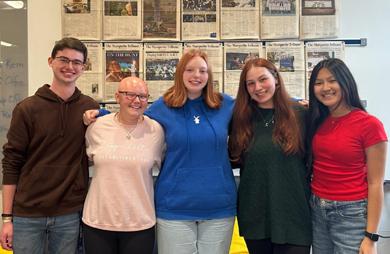
credible chapter, I feel the need to offer gratitude to everyone who makes it so painful for me to leave Marquette.
Firstly, to my fellow seniors on the Wire, congratulations on an incredible run. You all have such bright futures, and I hope our paths cross again in a newsroom someday.
To the editors and reporters I spent all my Monday evenings in the newsroom with this year, thank you for bringing back the joy in Late Night. I’m so grateful to call you all my friends, and I’m so excited to see what you do next year. I’ll be supporting you from afar (well, maybe not too far).
To everyone else who has supported me along the way — my amazing family, my best friend Alison, and the many others — thank you. I wouldn’t be where I am without your love
and dedication.
Finally, thank you to the faculty and staff in the College of Communication and beyond who have made this chapter in my life. It’s impossible to fit all of your names into one story but just know I’m endlessly grateful for every single one of you.
In the end, my time at Marquette has helped me put more focus on the present while still looking forward to the future. I’m heartbroken to have to leave this place I’ve called home for three years, but I’m certain May 9 won’t be the last time I step foot on campus.
For now, I’m excited to turn the page and write the next chapter in my story — starting in Indianapolis!
Statement of Opinion Policy
The opinions expressed on the Opinions page reflect the opinions of the Opinions staff. The editorials do not represent the opinions of Marquette University nor its administrators, but those of the editorial board.
Our editorial board consists of the managing editor of the Marquette Tribune and all executive editors including news, sports arts & entertainment and opinions.
The Marquette Tribune prints guest submissions at its discretion. The Tribune strives to give all sides of an issue an equal voice over the course of a reasonable time period. An author’s contribution will not be published more than once in a fourweek period. Submissions with obvious relevance to the Marquette community will be given priority consideration.
Full Opinions submissions should be limited to 600 words. Letters to the editor should be between 150 to 300 words. The Tribune reserves the right to edit submissions for length and content.
Please e-mail submissions to: rachel.lopera@marquette. edu. If you are a current student, include the college in which you are enrolled and your year in school. If not, please note any affliations to Marquette or your current city of residence.
Photo by Ruby Mulvaney
The Marquette Tribune staff at the last late night on April 27.
Photo by Sofie Hanrahan
Mia Thurow (center) in the newsroom with her fellow Wire editors.
Sophia Tiedge is the managing editor of the Marquette Tribune. She is a senior studying journalism.
Mia Thurow is the executive news editor. She is a senior studying journalism.
Arts & Entertainment
10 student artists featured in exhibition

Participants got a $500 stipend for their project
By Annie Goode annie.goode@marquette.edu
On April 23 from 2 p.m. to 4 p.m., the western wall of Marquette’s Lemonis Center for Student Success was lined with ten different pieces of student art. The pieces related to various themes regarding student success and
experiences at Marquette for the annual Student Art Exhibition.
This year’s themes were "Culture & Career," "Defining Success," "Belonging at Marquette" and "Expanding Horizons." The event was sponsored by the Career Center, the Division of Belonging and Student Affairs, the Lemonis Center, Raynor Library and Enterprise Mobility.
Courtney Hanson, the director of the Career Cen-
ter, organized and hosted the event for the fourth year. The event also provided snacks and drinks to exhibition goers.
“The reason we started [the Student Art Exhibition] is because we wanted students to see themselves on campus,” Hanson said.
Applications to be a fea-
"This piece acts as a portal connecting my culture and career..."
a large canvas, which depicts the back side of a graduate donning their cap and gown, looking into the mirror at what appears to be her younger self.
“By making the child the focal point, [this piece] suggests that success is measured by the validation of our younger selves and becoming someone they would admire and feel proud of,” Wrobel wrote in a blurb about her work.
Another artist, Salo Aristizabal, a sophomore in
at the door.
“This piece acts as a portal connecting my culture and career, because I get to share my roots with my school and my future,” Aristizabal wrote in a blurb about her piece. “In Columbia, we celebrate life by sharing what we love.”
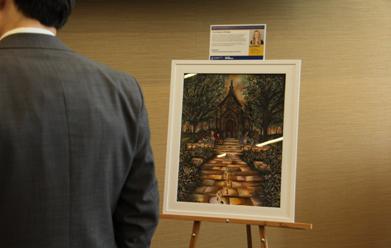
Other pieces displayed images central to the Marquette experience, like the walk to Olin Engineering, or the St. Joan of Arc chapel.
These ten pieces will join the rest of the student
tured artist in this year’s exhibition were due on Feb. 20, and each artist was given a $500 stipend to create their piece.
Hanson said the sponsors of this event have expanded since last year, including Raynor Library and some of the student art will be displayed there permanently.
The student art ranged in topic depending on the theme the artist chose.
Jessica Wrobel, a sophomore in the College of Nursing, chose the theme “Defining Success.”
Wrobel created “Reflections of the Girl Who Believed in Me,” a painting on

the College of Health Sciences, chose to revolve her piece around the theme of Culture & Career.
Titled “Tierra Querida,” – meaning “dear land” in Spanish – Aristizabal used layered textures, including paint, beads and bright colors to portray her grandparents‘ house, two hours from Bogotá, Colombia. A rainbow shines above the house, and a leopard lies peacefully
art displayed around the Lemonis Center and in Raynor Library.
“We wanted students to feel like they belonged,” Hanson said. “I think the more art we get, the more that students can look around the Lemonis Center and see something that resonates with them, and it makes them feel like they belong here.”
MU Orchestra closes year with a symphony
Other concerts had only strings, no percussion
By Allison Scherquist allison.scherquist@marquette.edu
This past Sunday, the Marquette Orchestra walked on the stage of Varsity Theatre to perform its final concert of the school year.
April 6 was the orchestra’s first time this year performing as a symphony orchestra — a large ensemble consisting of musicians who play strings, woodwinds, brass and percussion — for the three-song concert.
In previous orchestra concerts, the performances have included only a string orchestra, which refers exclusively to string instruments such as the viola, violin, cello and double bass.
The show began with Sinfonia Veneziana by Antonio Salieri, a three-movement
piece composed for chamber orchestra before transitioning to Franz Schubert’s “Unfinished Symphony.”
The concert ended with a performance of Mozart’s 38th Symphony, “Prague.”
The program music was selected by Erik Janners, a professor of practice at Marquette and the director of the Marquette Orchestra, who also directed and organized last week’s band concert.
Janners selected the works to highlight three musical pieces from the most influential composers of the late classical period, which refers to the period of classical music made between 1790 and 1820.
“It will be my first time conducting the Mozart Symphony, so that’s always exciting, when you get to perform a piece for the first time,” Janners said.
Sofia Stenberg, a sophomore in the College of Arts
& Sciences, plays the viola with the Marquette Orches-
"I think that live music is especially important nowadays, as it's so easy to watch or listen to music online."
Sofia Stenberg Sophomore College of Arts & Sciences
tra. As a first-year, Stenberg was not sure if she’d be able to manage both orchestra and her studies, she said.
But, after a lifetime playing
in different orchestras, Stenberg realized she missed music and reached out to Janners to join at the beginning of her sophomore year.
“My favorite part of being a member of the Marquette Orchestra is that we are all in it together,” Stenberg said.
“No matter what instrument you play, the level that you’re at, we are telling a story, not in words, but interpreting the notes into emotions and feelings.”
The Marquette String Orchestra began rehearsals after its winter concert. They met every Tuesday and Thursday for an hour and 15 minutes. Seven days before the show, wind and percussion players from the band program came in, and the group began rehearsing as a full symphony orchestra.
“Bringing in the winds and percussion the week of the concert to join them up with the strings is always a challenge, but they did great
with it,” Janners said.
Stenberg said that the inclusion of a symphony orchestra helps elevate the songs.
“These pieces wouldn’t be complete or have as much of a dramatic effect without them,” Stenberg said. “I am very excited for those that have come to our previous performances to see the dramatic effect all instruments have to offer and not just us strings.”
Stenberg said she hopes students walked away from the concert feeling more connected to the Marquette community.
“I think that live music is especially important nowadays as it’s so easy to watch or listen to music online,” said Stenberg. “I feel that live music connects you on a more personal level to what you are listening to as you are truly in the moment, not on a phone, but simply just feeling it and seeing it.”
Wrobel's piece, "Reflections of the Girl Who Believed in Me" (left)
Photo by Lily Wooten lily.wooten@marquette.edu
All student art pieces will be displayed in Lemonis and Raynor.
Photo by Lily Wooten lily.wooten@marquette.edu
Salo Aristizabal Student Artist "Tierra Querida"
Four themes were picked this year, including "Culture & Career.
Photo by Lily Wooten lily.wooten@marquette.edu