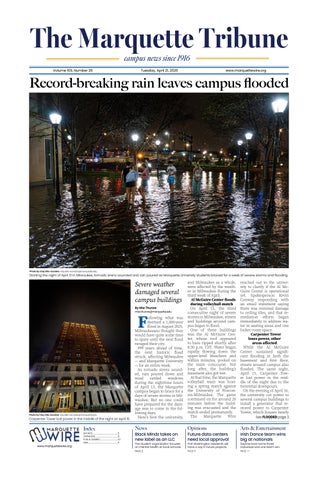
Record-breaking rain leaves campus flooded



Following what was deemed a 1,000-year flood in August 2025, Milwaukeeans thought they would have quite some time to spare until the next flood ravaged their city.
999 years ahead of time, the next historic flood struck, affecting Milwaukee — and Marquette University — for an entire week.
As tornado sirens sounded, rain poured down and wind rattled windows during the nighttime hours of April 13, the Marquette campus began to brace for a days of severe storms in Milwaukee. But no one could have prepared for the damage was to come in the following days.
Here’s how the university,
and Milwaukee as a whole, were affected by the weather in Milwaukee during the third week of April.
Al McGuire Center floods during volleyball match
On April 15, the third consecutive night of severe storms in Milwaukee, streets and buildings around campus began to flood.
One of these buildings was the Al McGuire Center, whose roof appeared to have ripped shortly after 8:30 p.m. CST. Water began rapidly flowing down the upper-level bleachers and within minutes, pooled on the main concourse. Not long after, the building’s basement also got wet.
At that time, the Marquette volleyball team was hosting a spring match against the University of Wisconsin-Milwaukee. The game continued on for around 20 minutes before the building was evacuated and the match ended prematurely.
The Marquette Wire
reached out to the university to clarify if the Al McGuire Center is operational yet. Spokesperson Kevin Conway responding with an email statement saying there was minimal damage to ceiling tiles, and that remediation efforts began immediately to address water in seating areas and one locker room space. Carpenter Tower loses power, other areas affected
While the Al McGuire Center sustained significant flooding in both the basement and first floor, streets around campus also flooded. The same night, April 15, Carpenter Tower lost power in the middle of the night due to the torrential downpours.
On the evening of April 16, the university cut power to several campus buildings to install a generator that restored power to Carpenter Tower, which houses nearly
Starting the night of April 13 in Milwaukee, tornado sirens sounded and rain poured as Marquette University students braced for a week of severe storms and flooding.
Photo by Clay Ellis-Escobar clay.ellis-escobar@marquette.edu
Carpenter Tower lost power in the middle of the night
Photo by Clay Ellis-Escobar
The MarqueTTe Tribune
Managing Editor of The Marquette Tribune Sophia Tiedge
NEWS
Executive News Editor Mia Thurow
Assistant Editors Lance Schulteis, Lilly Peacock
Reporters Sahil Gupta, Elena Metinidis, Mina Marsolek-Bonnet, Lillie Martin
ARTS & ENTERTAINMENT
Executive Arts & Entertainment Editor
MaryKate Stepchuk
Assistant Editor Joseph Schamber
Reporters Elise Emery, Allison Scherquist, Annie Goode
OPINIONS
Executive Opinions Editor Rachel Lopera
Assistant Opinions Editor Isabella Gruber
Columnist Amelia Lerret, Owen Parker
SPORTS Executive Sports Editor Jack Albright
Assistant Editors Matthew Baltz, Raquel Ruiz
Reporters Benjamin Hanson, Mikey Severson, Ben Ward, Eamon Bevan, Conor McPherson, Lukas Schulze
COPY
Copy Chief Emma Fishback
Copy Editors Elizabeth Belmont, Shea Lancaster
VISUAL CONTENT
Design Chief Murphy Lealos
A&E Designer Evelyn Riordan
Sports Designer Amery Thompson
Opinions Designer Allegra Delli Carpini
Photo Chief Clay Ellis-Escobar
Photographers Lily Wooten, Leo Stallings
HAVE A TIP FOR US?
Have you seen something that you think should be a story? Do you have a tip about something we should be looking into? Do you have documents or other materials that we should see? We want to hear from you.
If you have documents you'd like to send us, you can send anything to wiretips@marquette.edu.

MUSG loses club funding requests
Some groups have been left without reimbursement
By Mia Thurow mia.thurow@marquette.edu
Marquette University Student Government has been unable to fulfill funding for some student organizations due to an increase in lost reimbursement requests over the past few months, according to an April 17 email obtained by the Marquette Wire.
The email, sent by MUSG Communications Vice President Catherine Sherman, was sent to student organization leaders and club presidents to offer an apology to clubs waiting for their approved reimbursements and demonstrate the next steps for funds to be fulfilled.
“The situation is what it is — there are students who oversee thousands of dollars, understandably frustrated clubs, and communication mistakes,” Sherman told the Marquette Wire in an email. “Simply
put, we saw an increase in inquiries from last fall and put the puzzle pieces together. MUSG takes full responsibility.”
Student Organization Funding is a process where organizations and club sports teams can apply to receive funding for events and initiatives. Funded in part by the student activity fee paid by all full-time undergraduates, SOF is made available every academic year to help alleviate any financial burdens organizations may have.
“In the past few months, our Finance team has noticed an increase in lost reimbursement requests, which has made it impossible to fulfill funding,” Sherman said in the email. “We understand funding is imperative for your organizations to thrive.”
Due to these lost requests, which are made through an online portal, some student organizations still have not been reimbursed from the Fall 2025 semester.
The SOF process can be long, Sherman said, but MUSG’s financial team is
working to complete any outstanding funding requests with the goal of reimbursing all organizations by the end of the Spring 2026 semester.
All organization and club leaders who have not been reimbursed should reach out to MUSG Financial Vice President Allan Fox via the FVP email no later than 5 p.m. on April 27, Sherman said. Emails should include the name of the club or organization, an approved
allocation letter, event information, the amount of funding requested and the date of submission.
“MUSG is, has been, and will continue to be a trusted ‘backer’ for clubs,” Sherman told the Wire in an email.
“Our student engagement is what makes this campus feel like home. We ask for patience and understanding from students to students.”
This is a developing story that may be updated with new information.
Black Mindz gets LLC certification
Group focuses on improving mental health
locally
By Mina Marsolek-Bonnet wilhelmina.marsolek-bonnet@ marquette.edu
Since its founding in 2020, Black Mindz — a student organization centered around mental health — has spread its programming at and around Marquette University. But now, as of April 10, the group dedicated to serving students of color at local high schools, campuses and companies has taken on a
new label: LLC.
The organization hosted their LLC launch party in the 707 Hub on April 10.
Gabby Shoulders, a senior in the College of Arts & Sciences and director of corporate partners for Black Mindz, was a first-year student when she first got involved. She said it was difficult to feel like she belonged at Marquette, in a space when few people looked like her.
“It’s very easy for people like us, students of color, to be pushed back,” she said. “We wanted to create a space where students of color could know that they matter, that their mental health matters, and that we see them and we know what they’re going through.”
In 2023, Maiya Campbell (Arts & Sciences ’23) was joined by Jasmine Scott, India Lock and Shoulders to revive the Black Mindz organization on campus. As the current leaders of the club were graduating, Scott, Lock and Shoulders — all first-year students — could be the fresh start Black Mindz needed.
Though Lock, Shoulders and Scott are now seniors, they spent their years at Marquette reestablishing Black Mindz as an organization, as well as helping it grow into an LLC.
“We really are not doing this for ourselves,” Shoulders said. “We are doing this because we see what people need.”
Black Mindz holds
meetings in the Arrupe Center and the Alumni Memorial Union once a month. Each meeting has an agenda which consists of introducing and informing members on a mental health topic followed by an open floorstyle conversation with an activity.
Because the organization only exists at Marquette, its four co-founders were inspired to pursue the Brewed Ideas Challenge to turn their campus club into a business. The Brewed Ideas Challenge, in partnership with the Brady Corporation, is a pitch competition that gives students the opportunity to turn their ideas into real business ventures.
Finalists participate in the Brewed Ideas Bootcamp, receiving one-on-one mentoring from an expert and honing their skills to compete for a share of $27,000 in seed funding, money used to develop a start-up. In 2024, Black Mindz LLC won $7,500 to start their business and work to break the stigma around mental health through open dialogue among students.
Outside of their budding business, they have created a space for people to feel safe and be seen.
“I think they’ve stayed true to their core and what they wanted their impact to be as an organization,” Olivia Stieber, a senior in the College of Nursing and roommate of Shoulders and Scott, said. “I’m excited to see all the things that they
have in store.”
Now, the group is looking to expand locally by opening a Black Mindz chapter at the University of Wisconsin-Milwaukee. Additionally, leaders have spoken with Milwaukee Public Schools administrators to launch their program in high schools.
The co-founders of Black Mindz LLC also hope to create a non-profit and sell merchandise to sustain themselves financially. So far, the group has been operating through the award winnings, pocket money and community support.
As a non-profit, Black Mindz would be able to fund their organization without requiring club members to pay a fee, Campbell said. The group wishes to continue having free membership so students can be a part of the organization without having to pay.
Flashback three years to 2023, and the 707 Hub is where the four co-founders, mentor and advisors started planning their business model for the Brewed Ideas Challenge. In 2024 it was where the group first won the challenge. Now, in 2026, with friends, family and supporters in the crowd holding back tears, it’s also where they launched their Black women-owned LLC and business.
“We thought it made sense to come back to this space now to celebrate how far we came,” Campbell said.
MUSG's goal is to reimburse all groups by the end of the semester.
Photo courtesy of Marquette Wire
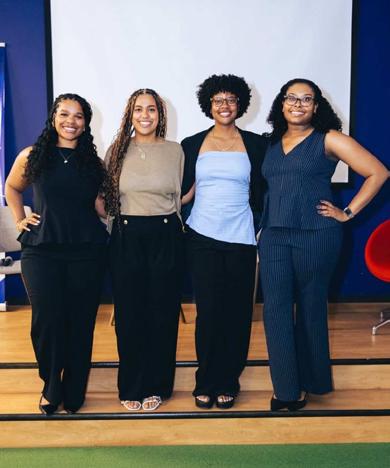
The Black Mindz co-founders launched their LLC in the 707 Hub.
Photo courtesy of Black Mindz
The MarqueTTe Tribune
Tuesday, april 21, 2026
FLOODED: Year of campus water damage
300 students. Several buildings and residence halls on campus were affected by the outage.
Conway, the university spokesperson, told the Wire the university needed to get power back to fix any existing water damage.
The basement of Schroeder Hall also sustained water damage, Conway said. Late on the night of April 15, the Marquette University Police Department wrote in an email laundry facilities were partly affected, but campus remained open and operational.
Students react to extreme weather conditions
Some students were quick to congregate outside to get a first-hand view of the
historic weather.
“I’ve never seen rain like that in my life,” Neve Cavalier, a sophomore in the College of Nursing who walked down Wisconsin Avenue through ankle-deep water, told the Wire on April 15.
At 9:02 p.m. the university sent out a safety alert about flooding in the area of 15th Street and Kilbourn Avenue. Garbage floated freely throughout the intersection, cars were submerged up to their wheels and buildings — mainly houses and apartments — all along the block had standing water inside.
“It’s 15th River, not 15th Street,” Kelly Gill, a senior in the College of Communication who lives in a sorority house on the corner told the Wire on April 15. Instead of remaining

inside, some students flocked to 15th street in swimsuits — and even swim caps — to wade in the water. Videos posted to social media showed students pushing cars off the street as they filled with flood water.
The intersection remained flooded the longest of any on campus, not draining until the morning April 16. All street floodwaters have since receded.
Theater production delayed during tornado warning
The Marquette campus still wasn’t out of the clear following the events April 15 and 16. On April 17, another tornado warning was issued in the area, prompting everyone to shelter in place — including those at the Helfaer Theatre.
Marquette Theatre’s final show of the 2025-2026 season, “Noises Off,” was halted just 20 minutes into the show. For about 45 minutes, actors receded to their dressing room and the audience sought shelter in a backstage hallway — built into the ground and with no windows — until the tornado warning was called off. Afterward, the production carried on, and the audience was able to see the full show.
A record-breaking week for weather in Milwaukee
With a little under two weeks left in the month, Milwaukee has already recorded its rainiest April of all time, according to National Weather Service data logging back to 1871. The metropolitan area has seen
9.01 inches of rain so far this month, beating 2013’s previous record of 7.31 inches. Additionally, from April 13 through April 19, the Milwaukee NWS station issued 43 tornado warnings.
Marquette campus deals with a year of water damage
Last week’s severe weather was not the first time Marquette has dealt with flooding this school year.
The historic 1,000-year flood in August damaged a slew of campus buildings, including the Valley Fields pavilion and grandstand. Then, on Jan. 31, a pipe burst in the attic of Johnston Hall, causing extensive damage and closing the building from Feb. 2-6.
MU police, Gesu working to improve security
Parish has been vandalized twice in three weeks
By Lance Schulteis lance.schulteis@marquette.edu
Just weeks after a March 18 vandalization incident at the Church of the Gesu, a man claiming to be God caused $50,000 of damage to the church’s doors on April 5. Both incidents happened within six months of the church reopening after a yearlong renovation, which included new flooring, a new baptismal font and upgraded security
measures.
In response to the crimes, the Marquette University Police Department is currently working with Gesu to determine potential next steps for added security. Fr. Michael Simone, S.J., the church’s pastor, told parishioners in a letter following the first vandalism that there would be increased MUPD patrols and more attention given to security cameras.
Assistant Chief Jeff Kranz said discussions about how to improve security are still in their early stages. The first step, he said, is learning what Gesu’s
security system looks like. From there, MUPD will recommend upgrades to the church’s day-to-day operations.
“We don’t want to step in and start dictating how people operate in their spaces,” he said.
After the first vandalism on March 18, a custodian contacted MUPD, who arrested the suspect after he had damaged several wood and plaster items, as well as a century-old statue of St. Anne. The parish estimated $25,000 in damage from the incident.
On April 5, officers were notified of the distur-
bance after a suspect had already forcefully entered the church with an ax. They arrived to find him armed and sitting on the steps to the church’s altar and — following a 20-minute discussion — took him into custody.
Simone told the Marquette Wire in March that the church had implemented added security measures in its recent $10.1 million renovation. Those improvements included security cameras and hotlines that connect callers with MUPD. Additionally, officers have been sweeping the building every hour
while the church is open. Ray Ellingen, the parish’s director of operations and administration, said it will be a few weeks before any plans are finalized.
“We’re going to give them suggestions and processes that will keep them safer, but what they choose to implement and how they do it is going to be up to them,” Kranz said.
The Church of the Gesu did not respond to the Wire’s request for comment on this story before publication.
This is a developing story that may be updated with new information.
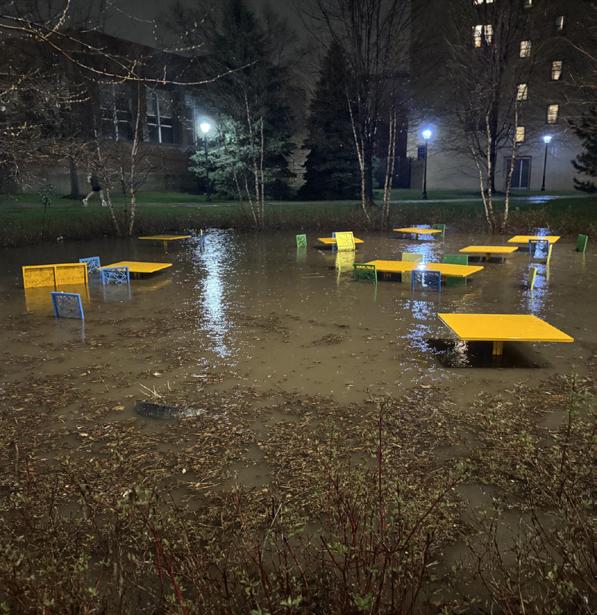
An outdoor recreation area near the 707 Building flooded, leaving chairs and tables under the water.
Photo by Lance Schulteis
The area near 15th Street and Kilbourn Avenue sustained flooding
Photo courtesy of Cate Connor
MU seniors stress about uncertain job market
Students struggle to secure work, gain experience
By Lillie Martin lillie.martin@marquette.edu
As final exams approach, students are making summer plans. Some finding an internship or even their first full-time job.
Some Marquette University students are excited about new opportunities, while others feel growing pressure.
On March 16, Marquette reported an 87% career outcomes rate for students within six months of graduating. This measures the number of graduates that are employed, continuing education or part of postgrad opportunities.
As part of the annual Undergraduate First Destination Survey, the university reported 53% of recent graduates had full-time employment and 26% continued their education.
Nationally, post-graduation outcomes in 2024 displayed 69.9% out of 1.2 million people were employed within six months of
graduating. 25.2% of these graduates were continuing their education.
What those numbers don’t reflect, some students say, is the stress behind that process.
“You need to find a well-paying job, especially in the economy we’re in right now, so the pressures have been really hitting hard,” Bella Flores, a senior in the College of Communication, said.
Flores is studying journalism and has a job in social media marketing lined up for after graduation. Her goals are to get a full-time position in Chicago and work in marketing for the beauty and fashion industry. For Flores, salary and location are important, but so is the company.
The process of applying and networking can feel awkward or difficult, Flores said, but she found platforms like Handshake and LinkedIn helpful.
“Take the opportunity; it doesn’t hurt to email somebody, it doesn’t hurt to reach out, go outside of your comfort zone,” Flores said.
While graduating seniors like Flores are
preparing for full-time jobs, younger students are still working to get experience through internships.
Sarita Retana, a sophomore in the College of Nursing, wants to become a nurse practitioner and work in healthcare policy and administration. Her goal is to have a health policy internship and work in a clinic of her own one day.
Retana said internships play a big role in the success of students, but applying for them can be taxing.
“It’s a lot of time writing cover letters, trying to explain the more in-depth side of you and it can be very time-consuming,” Retana said.
Retana said her classes have prepared her well. She appreciates the opportunity she’s had to learn from diverse perspectives, which has added to her decision-making when looking for an internship. Retana cares more about the workplace’s environment and values than anything else.
For other students, the challenge goes beyond securing a position and is more about feeling prepared for future jobs.
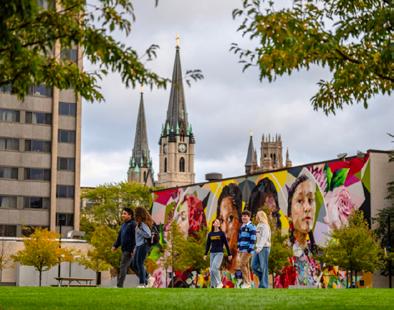
Avery Cmiel, a senior in the College of Communication, is a public relations major who wants to do team operations in professional sports.
“I feel like I have good experience and knowledge, but I feel like I don’t necessarily have real practice of things I’d be doing,” Cmiel said.
Cmiel said her hands-on experience as an intern for Marquette’s women’s basketball team has been more beneficial than what she’s learned academically.
While that opportunity has helped her, she said, she feels the most pressure from comparing herself to her peers — such as her roommate, who has interned at the place where she will be working post-graduation.
“She’s making $80,000 next year, and I’ll be lucky if I’m making anything,” she said.
While nearly every student with fears has a different set of struggles, most agree that the path to a career is a winding road.
“There is no one right path,” Cmiel said.
A weeklong celebration for student employees
Victoria Tatum wins worker of the year award
By Elena Metinidis elena.metinidis@marquette.edu
Last week, Marquette University celebrated Student Employment Appreciation Week as part of National Student Employment Appreciation Week.
“We appreciate student employees 365 days of the year,” Eric Wolffersdorff, student employment manager, said.
April 12 through April 18, however, provided the university an opportunity to highlight how important student employee roles are to everyone at Marquette, Wolffersdorff said.
Throughout the week, various celebratory events were held for students. Free bowling at the Annex, an annual game-themed event, a “thank you” message outside Varsity Theatre and 25% off at the Marquette Spirit Shop were all ways Marquette showed gratitude to its student employees.
There were also various prizes involved with the games, including signed basketballs from the men’s and women’s basketball teams, a 50-minute massage and an office chair.
The events and prizes were made possible because of donations made by
departments and supervisors. A committee made up of about 10 volunteers from Marquette’s staff assist in coordinating the week each year.
“[The volunteers] want to share their love,” Wolffersdorff said. “It’s just cool that they’re taking time out of their lives and busy schedules to make this a priority.”
Outside of these organized efforts, Wolffersdorff said it’s powerful when students receive thanks directly from the departments or offices they work in. Departments were encouraged to go one step further during the week to show appreciation.
For one particular student, there was even a surprise department party.
Each year, several Marquette students are nominated by supervisors for the Student Employee of the Year Award. This year’s recipient was Victoria Tatum, a senior in the College of Arts & Sciences. Tatum works as a student director for event logistics of major university events like SPARK and orientation week, as well as an office assistant for the Office of Student Development.
The volunteer committee, who works closely with Wolffersdorff, accepts nominations usually starting in December. They read and evaluate letters based on a rubric, which contains categories like leadership, impact on belonging,
innovation and community service.
Wolffersdorff visited Tatum during her shift last Friday afternoon, where all of her supervisors also congregated.
Seeing everyone from the separate offices she works at join to celebrate her accomplishment made her feel supported and allowed her to visualize the impact she had on the office, Tatum said.
“It made me feel blessed that the work I did was important enough to deserve the award,” she said.
Nyima Khasse, a sophomore in the College of Health Sciences and student director of new student programs, said she feels thankful to have worked alongside Tatum.
“She is so dedicated, welcoming and determined in everything she does,” Khasse said in an email. “I can see how she puts 100% of her efforts in everything whether in office or elsewhere, and she inspires me and many others to put our best foot forward!”
Tatum highly recommended that students get involved with employment programs during their time in college and leave an impact on campus.
“Working at the Office of Student Development has been my favorite memory at Marquette,” she said.
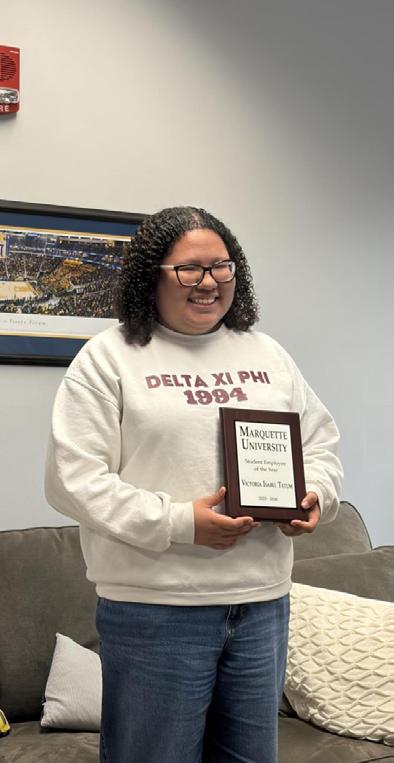
Photo courtesy of Marquette University
As finals approach, some students are making summer plans.
Photo courtesy of Eric Wolffersdorff
Victoria Tatum earned the Student Employee of the Year award.
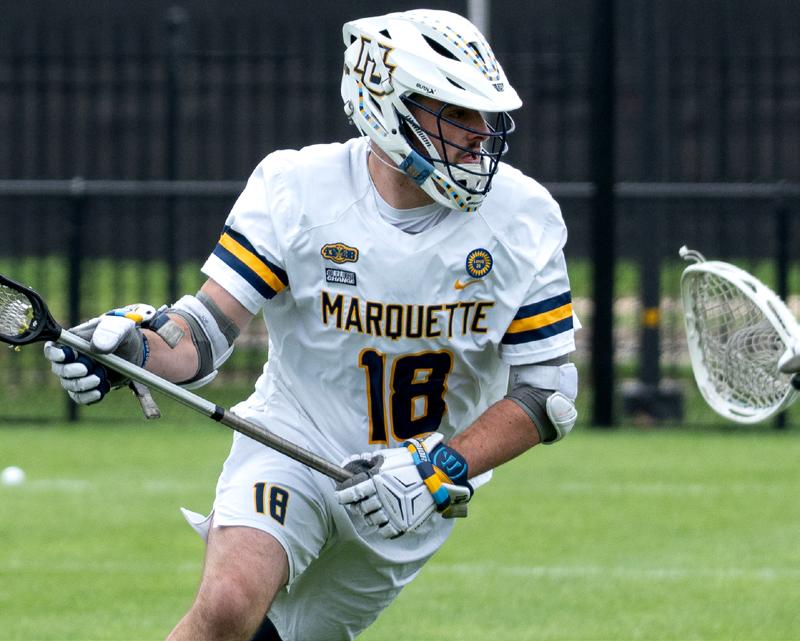
Ethan Salvia's second chance
Junior back on the field after multiple years injured
By Raquel Ruiz raquel.ruiz@marquette.edu
Ethan Salvia lay in his bed on Friday, Feb. 6, struggling to fall asleep.
He knew that when he woke up the next day, it would be game day for Marquette men’s lacrosse — the start of the 2026 season. A
big matchup but not only because it was versus No.
20 Michigan.
For Salvia, it would be the first lacrosse game he’s played in three years, since his junior year of high school.
After two years spent sidelined because of injuries, the junior midfielder was about to get the chance he had been patiently waiting for.
“I was definitely super nervous,” Salvia said. “Part of me was like, ‘Yeah, I’m playing lacrosse again, this
is awesome.’ But then you also have that pressure of, ‘Gotta play well.'”
Despite losing 14-7, to Salvia, finally playing the sport he’s loved since the second grade meant more than the result.
The Gibsonia, Pa. native became interested in the sport after watching his cousin play. Once he picked up the stick, it was love at first touch.
He played basketball and ran cross country, but as his passion for lacrosse grew, so did his skill. It became a
MEN'S BASKETBALL
love that carried him all the way through high school, where he became a U.S. Lacrosse All-American and committed to Marquette in his junior year.
By committing, he fulfilled a goal of nearly 10 years: playing Division I lacrosse. Everything was lining up for Salvia, until it wasn’t. All it took was one indoor lacrosse tournament prior to his senior season. While running down the field, he was on his way to plant his
See CHANCE page 6
WBB
Roster rebuild in motion
Marquette signed four new players to fill many gaps
By
Six days, four players.
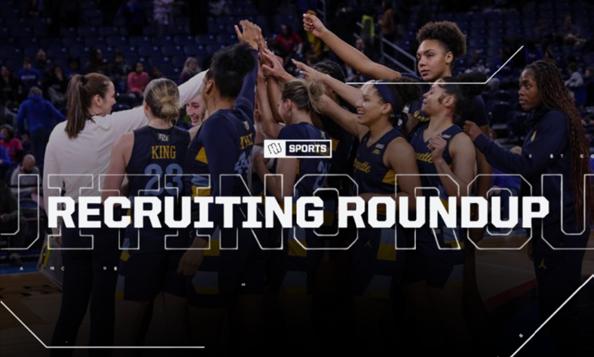
Marquette women’s basketball made its first offseason acquisitions, signing Kinley Asp, Brooklyn Hall, Yu Han Lin and Kayl Petersen. The Golden Eagles are up to nine players on the roster next season, with six open scholarship spots remaining.
Here’s a breakdown of all four:
Kinley Asp
The Golden Eagles’ first signee was incoming firstyear point guard Kinley Asp, who announced her commitment last Tuesday morning.
Originally committing to Boston College last September, Asp reopened her recruitment on March 23 after a coaching change. Asp averaged a career-high 25.9 points, 7.1 rebounds, 3.5 assists and 4.4 steals in her final year with Colorado Springs Christian. Across her four years in high school, Asp won two state championships (as a first-year and sophomore) and went to the semifinals as a junior.
Brooklyn Hall
One day after Asp, the Golden Eagles made
See ROSTER page 7
Nolan Minessale transfers to Marquette
Guard averaged 19.8 points on 50.6% shooting
By Jack Albright jack.albright@marquette.edu
Nolan Minessale is coming back to Marquette — only this time, in college.
After spending two seasons at St. Thomas, the former Marquette University High School guard is becoming a Golden Eagle, Ben Steele of the Milwaukee Journal Sentinel reported Monday.
Minessale is a desperately needed pure shooter, averaging 19.8 points per game — the No.
34 highest scorer in the country — on an elite 50.6% shooting clip. Last year, the Golden Eagles shot 43.8% from the floor and were only 118th in offensive efficiency on KenPom.com — the team’s worst mark in Shaka Smart’s five years at the helm.
The 6-foot-5 guard is the 14th best shooting guard in the transfer portal on 247Sports, joining sophomore floor general Nigel James Jr. and his partner in crime Adrien Stevens in Marquette’s back court.
Minessale will have two years of eligibility remaining.
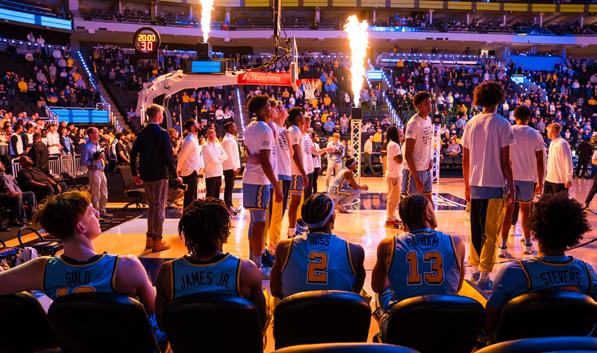
Photo by Clay Ellis-Escobar clay.ellis-escobar@marquette.edu
Junior midfielder Ethan Salvia spent his first two years at Marquette on the bench after tearing his ACL, meniscus and cartilage
Nolan Minessale is Marquette's second portal acquisition this offseason alongside Sananda Fru.
Eamon Bevan, Raquel Ruiz, Mikey Severson, Ben Ward
Photo by Leo Stallings leo.stallings@marquette.edu
MEN'S LACROSSE
Overtime magic runs out in Villanova loss
By Matthew Baltz matthew.baltz@marquette.edu
vs Villanova 16 15
The magic ran out on Saturday.
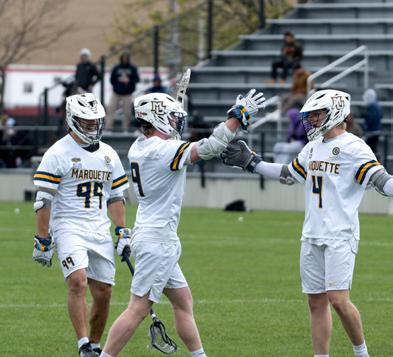
After two overtime victories across the last three weeks, Marquette men’s lacrosse (6-6, 2-2 Big East) came up just short in an another extra period thriller against Villanova (6-6, 3-1 Big East), falling 16-15 at Valley Fields.
“Overall, I’m proud of our group for the resilience they showed,” Golden Eagles head coach Jake Richard said. “I think a lot of things that game were working against us, and they stayed the
course, stayed focused and controlled as much as they could.”
While 60 minutes weren’t enough to decide a winner, Wildcat junior midfielder Nick Lucchesi made sure 65 would be. After senior faceoff specialist Adam Slager was called for a faceoff violation on the opening draw of OT, Villanova was awarded possession.
Lucchesi made a move that sophomore defender Colin Maloney stumbled just enough to open up the shooting lane. Lucchesi’s shot found its way past senior netminder Lucas Lawas, and the celebration was on for Villanova.
The goal was Lucchesi’s first point of the day. Senior attacker Colin Michener led the way for
Villanova with a career-high seven goals while first-year attack/midfielder Kessy Cox contributed two goals and an assist and first-year attack/midfielder Lachlan Moffatt added a pair of scores. A bounceback second quarter was what allowed the Golden Eagles to take control of the game initially. After a sluggish first quarter featuring three penalties, seven turnovers and only four shots on goal, Marquette was lucky to find itself only down a pair of goals.
But in the second 15 minutes, the blue & gold shook off the cobwebs. In the opening seconds of the period, Slager won the faceoff clean and strutted right down broadway before finding Rappis for a score eight seconds in.
The Golden Eagles would dominate the rest of the quarter, outscoring the Wildcats 7-3, outshooting them 12-7 and winning the turnover battle, forcing six and only giving away four. Rappis scored four of his team-high five goals in the first half. The only other MU player to have more than one goal was junior midfielder Beau Westphal.
Villanova made things interesting with a 4-0 run that temporarily gave it an 11-10 lead with 3:15 to play in the third quarter. But Maquette responded a 5-1 run of its own to give itself
MEN'S LACROSSE
a three-goal cushion midway through the fourth.
A pair of Marquette penalties on the same play that gave Villanova a two-man up advantage kickstarted the 3-0 run that sent the game to overtime.
“I think it’s really important to play fundamental and disciplined, and I thought our guys did a really good job of that over the course of the game,” Richard said. “I’m not sure there should have been as many calls as there were.”
First-year attack/midfielder Kessy Cox fired home the goal that tied the game with 1:14 to play in regulation as the shot clock winded down. Had
Marquette found a way to retain possession, it could’ve ran out the clock. Instead, the game went to a fifth period.
“I think some of our inexperience showed down the stretch, and they made just one more play than us,” Richard said.
With Providence’s win over Denver, Marquette is now in a tie for third place in the Big East standings. If the Golden Eagles win Friday at Denver, they will clinch a spot in the Big East tournament.
However, if they lose, they’ll be in danger of missing the tournament. Opening faceoff is scheduled for 7 p.m. CST.
CHANCE: Midfielder keeps growing confident
Continued from page 5 feet and cut back. That’s when he felt it.
“Pop.”
Barely walking, doctors determined he tore his ACL and meniscus.
After a year of rehab, learning how to adjust to collegiate play and getting back on his feet for a few months, Salvia readied himself to actually play Division I lacrosse.
And then history repeated itself.
The same knee, the same “popping” noise. The only difference was that in addition to his meniscus, he had also torn the cartilage in his knee.
“You practice and play your whole life to get to college and play,” Salvia said. “Missing the first year and then going into my second year already being injured, you’re just like, ‘Is this gonna end, or is this just going to keep happening to me?'”
But these defining setbacks are only part of his story. Since that first moment stepping on the field
against Michigan, Salvia’s presence has added to the depth shown in Marquette’s strong Big East start.
Seeing gameplay from the sideline, Salvia said, contributed to his confidence level, since he was able to watch his teammates and adapt his own style of lacrosse.
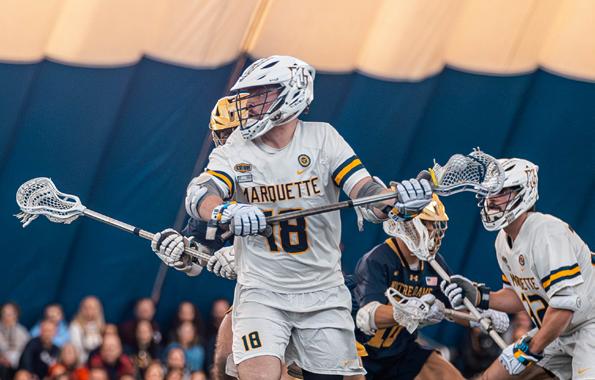
Against Providence, Salvia stepped up to the task, netting two goals when the Golden Eagles were down four scores with 13 minutes left in the game. Tallying his career-high sixth point of the day, he scored the overtime game-winner.
“Adversity is a really great gift, and nobody really asks
for it or wants it, but it’s a great gift when you come out the other end of it,”
head coach Jake Richard said. “To see it all come together against Providence was really cool.”
Through his first 10 collegiate games, Salvia has totaled nine goals, seven assists, 23 shots and
16 points.
But there’s something a stat sheet doesn’t show improvement in. Confidence. Something he has continuously worked on since his injuries.
“With the ebbs and the flows of the season, you have good games and you have bad games,” Salvia said. “Being able to shrug off some bad plays, just be confident every time you go out there, it’s definitely something I’ve been able to improve week to week this year.”
Salvia’s gradual improvement doesn’t go unnoticed by the coaching staff.
“He’s becoming closer with his teammates and becoming more outspoken, allowing him to make a bigger impact on the team on and off the field,” Richard said. “He’s always had the same heart, and now more people are getting to see it.”
Two years ago, Salvia was asking himself if he would ever get back to playing.
The questioning period is over. No more watching from the sideline.
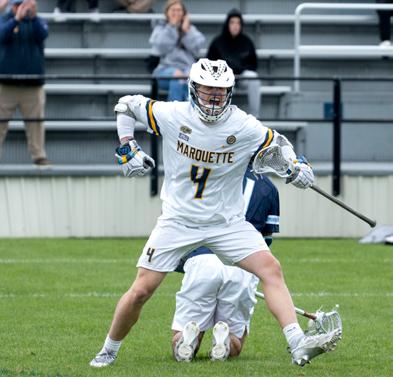
Bol Scherman scored two goals in Marquette's 16-15 loss.
Marquette ceded the final four goals before losing in overtime.
Midfielder Ethan Salvia scored two crucial goals in Marquette's overtime win over Providence.
Photos by Leo Stallings leo.stallings@marquette.edu
MARQUETTE
Photo courtesy of Marquette athletics
TRACK & FIELD
Justin Juniel a blink away from relay record
Senior sprinter is chasing one more milestone
By Lukas Schulze lukas.schulze@marquette.edu
Thirty-three hundredths of a second. The time it takes to blink.
That’s how close senior sprinter Justin Juniel and the 4x100m relay team came to beating the Marquette all-time record of 40.71 seconds at the outdoor Big East championships last season.
This season, after Big East champion sprinter Aaron Hughes graduated, first-year sprinter Bobby King is the one running in his place. But Juniel is confident the record is still well within reach.
“We’ve had conversations amongst ourselves, and we really feel like we can do some damage,” Juniel said. “All of us collectively have gotten faster as a group.”
Indeed, they have.
A relay team that also includes junior sprinter Danny Olsen and sophomore sprinter Frankie McGee, two guys who have had record-setting campaigns thus far.
Olsen is coming off an indoor season where he became the second Golden Eagle sprinter in a row to be a Big East champion
in the 200m with a time of 21.25.
McGee and Juniel both ran their personal best in the 100m at the Joyce Morton-Kief Invite on March 28. After the meet, Juniel’s new PR now sits at 10.86, nearly 0.5 seconds faster than when he was a member of his lone All-Big East outdoor team in 2022-23.
Juniel says this is the best he’s felt in his career.
“I’ve been very intentional with my training, with my eating, and my recovery,” Juniel said. “I just wanted to go out and not have any regrets.”
For King, learning from an experienced runner like Juniel has made a huge difference early in his college career. Helping him run his new personal best in the 400m at the Marquette Invitational with a time of 48.17.
“He is very supportive, very timely, makes sure everything goes smooth,” King said. “He’s never late to anything, great role model for everybody.”
While having a leader like Juniel around has helped King grow as a runner, it has also had a huge impact on the way both he and the team practice.
“He’s always pushing me, no extra rest,” King said.
“Get right to it.”
Without the senior leadership from Hughes this season, it’s Juniel who has
become both a leader for the sprint group and one of the team’s captains. This includes not only overseeing the sprint group, but also the entire team.
“Especially with this group of guys, they are incredibly talented,” Juniel said. “For me, it was just a matter of trying to make sure we can have our interests align, so that we can achieve big things.”
Juniel knows he’s working with a special group, and with his career at Marquette winding down, there aren’t any other guys he would rather spend his time with.
“Those guys are all awesome personalities to have on the team,” Juniel said. “They are making my last year incredibly fun.”
Trying to break a school record doesn’t come without its challenges, though. Nagging injuries have plagued the 4×100 squad.
Olsen has dealt with a hamstring injury, and King just returned after sitting out five weeks with an arm injury, which caused him to miss the Big East Indoor Championships. King said that having his teammates around eased the pain.
“I couldn’t swing my arms, I couldn’t run, I basically couldn’t do any lifting,” King said. “I think our team chemistry…it’s pretty ridiculous…everyone is so supportive.”
WOMEN'S BASKETBALL

Like King, Juniel is grateful for all the people that he has been able to meet as a member of the Marquette program, something he will take with him well past college.
“I think just the connections, the relationships, the friendships that I have been able to build,” Juniel said. “I can carry those relationships with me for the rest of my life.”
Those connections that Juniel has made with his teammates, especially the sprinters, make their quest for the record that much easier.
The meet that Juniel is looking forward to the most is the historic Drake Relays next week. A meet with so much history and high-level talent, it’s the
perfect time for him to showcase his skills.
“I’m incredibly excited, this is one of the meets I look forward to every year,” Juniel said. “I feel like we have a lot of momentum.”
Although his success on the track is what brought him to Marquette, for Juniel, the people he’s met and the relationships that he’s made are what he’ll leave with.
“Whenever I think about my career as a whole,” Juniel said. “Typically, it’s the people that I’ve met, the experiences that I’ve been able to have with those people, more so than the success on the track.”
A school record would put the cherry on top, though.
ROSTER: WBB has six remaining openings
Continued from page 5
their first dip into the transfer portal.
Former South Florida wing Brooklyn Hall, the younger sister of WNBA draftee Bree Hall, announced her commitment to Marquette via Instagram on Thursday afternoon.
Originally a four-star recruit in the class of 2026, Hall reclassified and redshirted last season, coming to the Golden Eagles with all four years of eligibility remaining. She followed newly hired assistant coach and recruiting coordinator Sheila Boykin from South Florida to Marquette.
In her last high school season at Western Reserve Academy, in 2024-25, Hall averaged 18.9 points, 6.1 rebounds, 2.6 assists and 2.0 rebounds per game. She joined the Pioneers’ 1,000-point club in just three years.
Yu Han Lin
The Hualien, Taiwan native, Yu Han Lin, announced her commitment to the Golden Eagles
Monday afternoon. Her signing comes etched in history, as Consuegra signed the program’s first Asian player since at least 2006-07.
Last season at Middle Tennessee, the 5-foot-9 Lin averaged 4.7 points per game while shooting 53-for-132 from the field (40%) and 10-for-41 from beyond the arc (24%). She
also totaled 41 assists and 35 rebounds.
The sophomore guard competed in all five games during the 2024 FIBA U18 Women’s Asia Cup, representing Chinese Taipei. She also played in all seven games for Chinese Taipei at the 2024 FBIA U17 Women’s Basketball World Cup. Lin is the second point guard to join Marquette
this offseason alongside incoming first-year Kinley Asp. Getting a floor general was important for the Golden Eagles, who were stuck in the mud offensively for the final month of last season after losing Olivia Porter.
Kayl Petersen
Kayl Petersen is finally putting on a Marquette
jersey — three years later than originally intended.
Petersen, a member of the Golden Eagles’ 2024 recruiting class, followed former head coach Megan Duffy from Milwaukee to Virginia Tech, where she played the last two seasons.
Friday morning, Petersen announced her commitment to Marquette for the 2026-27 season with an Instagram post captioned: “God’s timing > my timing. Back where I belong.”
The 6-foot-0 forward is Consuegra’s first frontcourt signee this offseason, a much-needed addition after she lost all her post players — including last year’s leading scorer Skylar Forbes. In her first season as a Hokie, Petersen averaged 4.2 points and 2.9 rebounds per game. But, both of those statistics decreased in her sophomore season, so 2.2 points and 2.8 boards. Over both years, Petersen averaged just over 13 minutes per game.
Graphic by Jack Albright
Marquette women's basketball has six open scholarship spots after signing four newcomers.
Justin Juniel is trying to break the program 4x100 relay record.
Photo courtesy of Marquette athletics
WOMEN'S LACROSSE
Hannah Bodner leaves legacy of leadership
Graduate student returned for final lacrosse season
By Eamon Bevan eamon.bevan@marquette.edu
In mere weeks, at the end of Marquette women’s lacrosse’s season, graduate midfielder Hanna Bodner will hang up her No. 2 jersey for the final time.
Having been with the Golden Eagles since 2022, Bodner has not only been a program-changing player, but has recently gotten the time to reflect on how the program has changed her for the better.
“I’ve learned so much from freshman to senior year about being a leader and how to lead those who are younger than me,” Bodner said.
What started as a quiet presence has evolved into a central voice on and off the field. The Haverford, Pa. native has grown into one of the team’s most
experienced players.
That growth did not happen in a linear fashion by any means.
Like many first-year athletes, Bodner entered Marquette still adjusting to the speed, physicality and expectations of Division I lacrosse. That naïveté, head coach Meredith Black says, was a major test for the midfielder.
“Over the years, she’s learned the level of dedication required,” Black said. “Now she truly understands it — she’s grown tremendously as a leader.”
On top of those first-year jitters, a major injury in her sophomore year set back her early development even further. When Bodner returned to the field, her development did not immediately translate, requiring her to be even more patient.
Eventually, the numbers really started to shine through in her senior campaign.
In 2025, Bodner
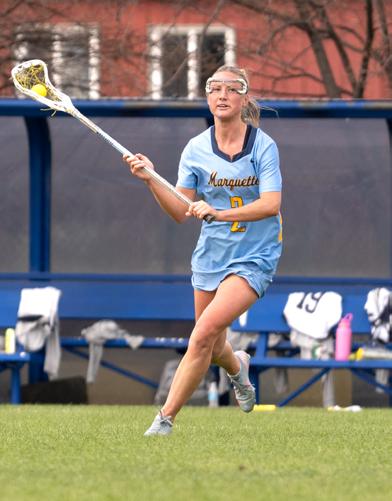
accumulated 45 goals and 12 assists en route to her being named the Big East midfielder of the year and a unanimous All-Big East first team selection.
Black highlighted her versatility as one of her greatest strengths, noting her ability to contribute in nearly every phase of play without sacrificing consistency or efficiency.
“You can count on her to get a draw, get a turnover, score a goal, make an assist,” Black said.
Even after that significant a season, she still believed she had more to offer as a Golden Eagle and successfully appealed for a fifth year of eligibility.
“It was a celebration,” Black said.
Her return immediately reinforced her importance within the roster, both as a top performer and as a veteran voice.
"You can count on her to get a draw, get a turnover, score a goal, make an assist."
Meredith Black Marquette women's lacrosse head coach
Currently sitting third on the team in both points and goals, Bodner also leads the team in both ground balls and draw controls as the Golden Eagles sit at 3rd in the Big East.
As she has gotten more experience on the field, what was once a quieter role has evolved into one where her voice carries weight in huddles, practices and game situations.
As four first-year classes have come into the program since her arrival, Bodner has been in a
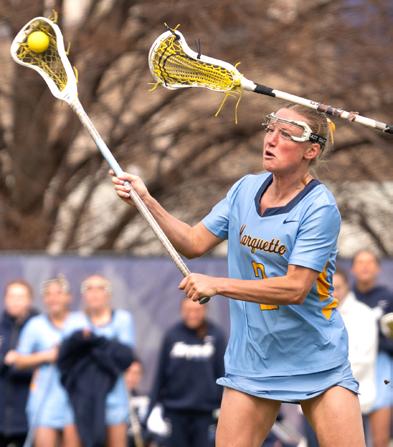
unique position of veteran leadership for almost her entire Marquette career.
“Mentoring the younger girls, and worrying about them and having them become better players, has just kind of got me to where I am now and playing better,” Bodner said.
Her growth as a leader has come not only through personal performance but through how she elevates teammates in practices and games. She has helped set the tone for the program’s culture over the last couple of seasons, as according to Black, she has consistently emphasized team development and shared success.
“I’ve just tried my best to worry about everyone around me,” Bodner said. “And that just makes myself a better player.”
That team-first mentality has been reflected in her preparation and consistency, which have become defining traits of her game. Her off-the-field approach extends beyond competition, showing up in the daily habits that shape her performance over time.
“She’s willing to do
whatever it takes,” Black said.
According to her coach and teammates, that willingness shows up on the field, on the sidelines, on the weight room and even in her diet. Her habits have helped her build a reputation as one of the most dependable players in the program, in more than statistics and accolades. Those tendencies have shaped how others approach their own development, something that coach Black has noticed throughout the last few seasons.
“It’s the leadership, her determination, her work ethic,” Black said. “She represents working your hardest to be your very best.”
As her final season comes to a close, Bodner and Black both see her legacy as defined not only by her production, but by the standard she helped establish within the program.
“I would love to be remembered as a great player,” Bodner said, “but more as a good leader and good person.”

WLAX @ UConn 04/25 Storrs, CT

Former Marquette women's basketball head coach Jim Jabir died on April 16 after a two-year bout with pancreatic cancer. He was 63. Jabir led the Golden Eagles to 94 wins in six years, and three-straight postseason
Bodner is second on MU with 32 goals, and third in points (39).
Photos by Leo Stallings
Opinions
Public libraries should act as third spaces
By Amelia Lerret amelia.lerret@marquette.edu
As we celebrate National Library Week this week, we should reflect on how libraries can better serve their communities. Public libraries used to be visited for their resources, like books, movies or computer access. Nowadays, those items are easily accessible, leaving people with minimal reasons to visit these important institutions. Instead of providing resources, they should reprioritize and focus on promoting fellowship. Library resources have become irrelevant because of modern technology, like phones, iPads and computers. Websites and e-books have replaced physical books, and internet access and streaming services have replaced movies and audiobooks. People no longer need to go to a physical place to get access to information and entertainment. However, a big gap in society today is loneliness and a lack of community.
According to a 2025 American Psychological Association study, at least 50% of adults feel isolated, left out and like they are lacking companionship. Additionally, 17% of children and teenagers aged11-15 also feel highly disconnected and alone.
To an individual, isolation can lead to depression, anxiety and drug or alcohol addiction. For communities, consequences can include polarization and increased stereotyping and bias.
When these feelings become very strong, they can lead to anomie, which is a concept that describes strong feelings of isolation and alienation. This disconnectedness to others can result in a lost sense of purpose and even contribute to harmful social issues, like crime and suicide.
To facilitate real-world connections, libraries can implement more events to increase engagement and create opportunities for
community members to build relationships with one another. Library-hosted events are not a new idea, but their execution should continue and occur more often.
For example, the Milwaukee Public Library has events nearly every day on its main campus. Notably, they will host “Story Time” for children and “Job Search and Resume Assistance” for adults on April 23.
These events are impactful not only because they bring people together, but because they are specifically tailored to the community. Children and adults are given opportunities to connect with peers, and the activities are relevant to them and the stages of their lives.
When libraries are more engaged with their communities, they recognize common needs, allowing them to help fill necessary gaps to better serve the neighborhood.
To increase awareness,
they could produce more promotional content that alerts people of upcoming events and start local partnerships with neighboring businesses and communities.
Additionally, libraries can implement more study and communal rooms in their buildings to provide meeting spaces for groups of people. These allow for more in-person meet-ups, encouraging social connections to form and grow.
For example, the Brookfield Public Library lets people reserve a study room from their website. The capacities range from 8 to 130 people, allowing people to choose the option that works best for them.
People need fellowship because it is essential to their health and well-being. Friendships and a sense of belonging minimize stress, boost moods and reduce risks for chronic illnesses.
The benefits of social connection are not limited
to the individual. According to the World Health Organization, communities with strong fellowship tend to be safer, healthier and more resilient.
As society evolves, it is essential that public institutions progress as well. Libraries are neighborhood spaces meant to serve the needs of citizens, and today, they need companionship and fellowship. Like many things in life, libraries’ purposes can change and evolve overtime.
By providing more opportunities for people to gather and connect, libraries can help facilitate a healthy and thriving community.
As National Library Week kicks off, we must remember the importance of public libraries and the resources they provide to communities — beyond books and media.
Future data centers need local approval
By Rachel Lopera rachel.lopera@marquette.edu
Port Washington, a small city located about 30 minutes north of Milwaukee, passed the nation’s first anti-data center referendum on April 7. It requires future projects to receive approval from local voters before getting large tax incentives, setting an important precedent for other communities. Port Washington residents will get the chance to express their input, a step in the right direction.
Over 1,500 data centers are being developed nationwide and are a source of concern for many. They are facilities that house computing infrastructure to support digital services such as the internet and artificial intelligence.
The Port Washington data center campus, named “Lighthouse,” will span 672 acres and is scheduled for completion in 2028. Its developer, Vantage Data Centers, is partnered with OpenAI and Oracle with the aim of expanding the U.S.’ Artificial Intelligence capacity.
The Port Washington location is part of a $500 billion initiative announced earlier this year by President Donald Trump to expand AI through more data centers. However, the project received immense backlash from residents and neighboring communities wor-
ried about its financial and environmental implications. Data centers drive up electricity and energy bills, and the cost is only expected to increase. They can also consume up to about 5 million gallons of water per day, which equates to 1.8 billion per year — an irresponsible waste of water.
Port Washington resident Tim Klein told TMJ4 that environmental change is inevitable but cannot happen in the presence of a data center.
Several community members expressed concern and protested the decision, explaining why cities should consider their citizens’ voices before pursuing projects.
Residents should have a say in where their tax dollars are going, especially if the money is going to a cause that may negatively affect them.
Great Lakes Neighbors United is a nonprofit group that was founded last year to resist the data center project. The group of Port Washington residents behind the movement had connected via Facebook and started protesting the AI center development at city council meetings.
GLNU placed the data center measure on the city’s ballot after gaining the roughly 1,000 signatures needed to qualify it.

Carrie Prom, a former nurse practitioner and mom of three, is one of the GLNU co-founders and told Politico about the nonprofit’s motivations.
“None of us are specifically anti-development,” Prom said. “We’re not even really anti-tech. It’s just that we want responsible development, and we want responsible tech moving forward.”
About 66% of voters approved the data center-related measure, which gives residents a say in approving tax incremental financing that cost more than $10 million. TIFs use taxes to pay for new infrastructure or improvement projects, and Port Washington approved a $458 million TIF for the data center.
While the referendum does not affect Lighthouse, which is already under construction, it gives the community the necessary power to raise concerns for future projects that would use
lucrative tax dollars.
Now, other cities could follow suit and put the issue of data centers on their ballots to ensure their communities are heard and informed on the decisions made in their city. A potential referendum can stop unwanted projects before it’s too late.
Monterey Park, Calif., Augusta Township, Mich. and Janesville, Wisc. are all expected to have data center-related measures on their 2026 ballots. It is important to give the people a say in where their tax dollars are going because they are the ones experiencing the consequences. Referendums like these will help cities better serve their communities because projects that can affect residents’ quality of life need the weight of public opinion. Communities deserve to be heard.
Statement of Opinion Policy
The opinions expressed on the Opinions page reflect the opinions of the Opinions staff. The editorials do not represent the opinions of Marquette University nor its administrators, but those of the editorial board.
Our editorial board consists of the managing editor of the Marquette Tribune and all executive editors including news, sports arts & entertainment and opinions.
The Marquette Tribune prints guest submissions at its discretion. The Tribune strives to give all sides of an issue an equal voice over the course of a reasonable time period. An author’s contribution will not be published more than once in a fourweek period. Submissions with obvious relevance to the Marquette community will be given priority consideration.
Full Opinions submissions should be limited to 600 words. Letters to the editor should be between 150 to 300 words. The Tribune reserves the right to edit submissions for length and content.
Please e-mail submissions to: rachel.lopera@marquette. edu. If you are a current student, include the college in which you are enrolled and your year in school. If not, please note any affliations to Marquette or your current city of residence.
Rachel Lopera is the executive opinions editor. She is a sophomore studying journalism.
Photo by REUTERS
A sign that reads "No data center" sits outside of Indiana home.
Amelia Lerret is an opinions columnist. She is a first-year studying journalism.
Fun & Games
Endangered Species

Earth Day

2. Level of the atmosphere which we live in.
4. Transforming waste materials into a new product.
6. Home to species.
9. To maintain in its current state.
11. Gases put into the atmosphere by industrial processes, energy generation and vehicle usage.
12. The study of organisms' relationships with their ecosystem.
1. Process in which light is converted into chemical energy.
3. No longer a species.
5. Released by landfills, fossil fuel extraction and dairy farms.
7. Decayed organic matter.
8. Not for single-use.
10. Heat-trapping greenhouse gas.
Submit finished puzzles to sophia.tiedge@marquette.edu by May 7. Most accurate crossword submissions wins a grand prize.
Bottleflip
Challenge
Musically
Butterflies DOWN
Harambe 3.) Lemonade 4.) Vine
Kylie Lip Kit 6.) Fidget Spinner
Tigers Red Pandas Dugongs
Orangutans Rhinos Gorillas
Snow Leopards Sea Lions Belugas
Plains Bison Whale Sharks Spider Monkeys
Arts & Entertainment
Saoirse wins in four categories at nationals
By Annie Goode annie.goode@marquette.edu
Marquette’s Irish Dance team, Saoirse, won several categories at the Collegiate National Irish Dance Championships this past weekend, becoming national champions in four categories.
The event was held in Madison, Wisc., and 13 universities competed. Saoirse won in one team dance, the Eight Hand Ceili, which is a group dance consisting of eight of the team’s sixteen total members, and in three solo categories determined by grade level. Liam Toomey, a first-year student in the
College of Arts & Sciences, won as the freshman solo national champion. Elise Weske, a sophomore in the College of Health Sciences, won the sophomore national championship, and Callie Johnson, a senior in the College of Health Sciences, won the senior national championship.
“It was really exciting, I wasn’t expecting anything super big,” Toomey said about his national champion award. “Just hearing all my friends and teammates cheer from the side and be just as excited, if not more excited for me, was really special.”
Saoirse President Brig-

id Gannon, a senior in the College of Arts & Sciences, said the team was happily surprised by their big wins, especially for the Eight Hand Ceili. Weske agreed, saying in an email she was happier with the group win than her own solo win.
“We did not go into the competition expecting to win, so we were really shocked and happy about that moment,” Gannon said.
Gannon said this year is an improvement from their performance last year, where they took home only one win in the solo competition.
The day consisted of each grade’s solo competition, the Four Hand Ceili — meaning there were four dancers — and the Eight Hand Ceili in the morning, and the Fun Number Competition in the afternoon, where each school got to pick their own theme and music. For the Fun Number Competition, Saoirse chose an Alvin & the Chipmunks mashup. Their costumes consisted of sparkly skirts, chipmunk ears and drawn-on whiskers.
“Last year, we had done a ‘Hamilton’ theme, and we were like, ‘I don’t know how we’re gonna top it,’ and so we spent pretty much the entire summer run-

ning around ideas…and finally we had that idea,” Gannon said. Toomey also thought that the Fun Number was a highlight of the competition.
“I feel like that was one of the best times we’ve ever done it, and I was so happy with seeing all our hard work that we put in pay off on stage, and the judges and the audience really liked it too,” Toomey said.
Saoirse came in third place for the Fun Number Competition, which Gannon said they were happy with.
Weske said her favorite part of the day was watching the other team’s performances.
“Everyone was very supportive and cheered each other on,” Weske said. “Seeing the creativity in the selection of a theme as well as the choreography was also really cool.”
Saoirse had their endof-year showcase on April 17 in Weasler Auditorium, with special acts from Marquette Bhangra Academy (MUBA), which is traditional Punjabi dance, and the Naturals, Marquette’s male a cappella group.
“This is our showcase of everything we’ve done over the whole year, so I think it’s going to be really cool to see everyone on stage together,” Toomey said leading up to the show.
MU band concert mixes tango and jazz
By Allison Scherquist allison.scherquist@marquette.edu
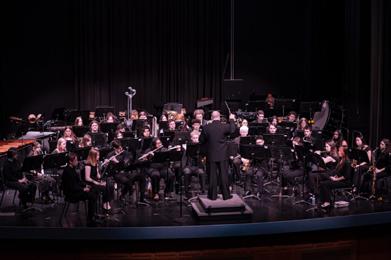
Last Sunday in Varsity Theatre the Marquette Wind Ensemble took the stage to perform its final concert of the year at 2.p.m on April 17. The ensemble consists of 55 Marquette students who exclusively play stringless instruments, such as woodwind, percussion and brass.
Band Director and Professor of Practice Erik Janners was responsible for selecting the program music for the concert.
“When I put this concert together, I wanted it to be a nice mix of things,” Janners said. “Some easier works,
some works that would really challenge the group at the end of the year, and all of them of course have appeal to an audience.”
The band performed
“Viento y Tangos” , a tango-inspired piece by Michael Gandolfi, as well as “Roma,” composed by Valerie Coleman. The piece utilizes five themes —”Romani Woman,”
“Mystic,” “Youth,” “Trickster” and “History”— and fuses styles such as the Argentine Tango, the Spanish malagueña—a traditional Andalusian flamenco style originating from Málaga, Spain—and jazz. The song was composed as a tribute
to Romani culture.
One of the performance’s most difficult pieces was Adam Gorb’s “Dances from Crete,” a four-movement piece blending modern composition with traditional Cretan folk melodies.
Saxophonist Jakita Fleck, a senior in the College of Arts & Sciences, explained the hurdles the band faced while learning the song in rehearsals.
“Each of the four movements differ in their time signature and in their musical technicalities. We have a young band, so because it’s a more challenging piece, we’ve struggled with it,” Fleck said. “But it’s also been really interesting learning it and trying to get it under our feet, even with the challenges it brings.”
The band has been rehearsing since the end of its Winter Concert in February. In order to ensure members have each song mastered before their performance, they rehearse together three times a week. Kian Howe, a senior in the College of Arts & Sciences, plays the bass trombone in the concert. He has found the rehearsal pro-
cess a constructive way to improve the band’s sound.
“Making sure that you balance your sound appropriately in different sections is really important,” Howe said, “There are times where I’ll be playing a sustained note and I have to make sure that I’m playing quieter so the flutes can be heard better. There’s a lot of moving parts.”
The spring concert was the final performance with the Wind Ensemble for 19 Marquette seniors. Fleck said they will miss the camaraderie they found in the ensemble, performing
with their talented bandmates under the guidance of Janners.
“He had so much knowledge,” Fleck said. “I’m really going to miss getting to see him and chatting about [music].”
Janners hopes students who came to the spring concert experienced the joy of music and felt a connection to the Marquette community.
“I’m extremely proud of the amount of musical growth this group has made since September, and I think this concert really highlights that,” Janners said.

Saoirse won in the Freshman, Sophomore and Senior categories.
Photo courtesy of Brigid Gannon
The team placed first in the Eight Hand Ceili over 13 universities.
Photo courtesy of Brigid Gannon
The wind ensemble consists of 55 Marquette students.
Photo by Clay Ellis-Escobar
Erik Janners arranged and directed the Wind Ensemble concert.
Photo by Clay Ellis-Escobar
april
REVIEW: MU Theatre's 'Noises Off'
By Elise Emery elise.emery@marquette.edu
Marquette Theatre has rounded out its 2025-2026 season “Viewpoints” with its final show, “Noises Off,” opening on April 17 at the Helfaer Theatre.
“Noises Off,” written by English playwright Michael Frayn, follows the cast and production team of a play titled “Nothing On,” and the mishaps and chaos that ensue as a result of the cast’s consistent forgetfulness and personal drama. All three acts of the play showcase the same first act of “Nothing On” from different perspectives and points in time, and how the cast slowly spirals as tensions heighten.
“Nothing On” is a comedy that takes place in an old country home owned by Philip and Flavia Brent, where various characters, including a real estate agent and his romantic rendezvous, the Brent family and a burglar, all enter the house under the assumption that they are the only ones there. The housemaid, Mrs. Clackett, does her best to keep the guests from running into one another, but by the end of the play, mayhem rises as they all become quickly aware of one another.
It’s characterized by a typical slapstick and physical comedic style, where characters run around in
their underwear, get things glued to their hands and continuously slam doors. Sardines are also a constant motif throughout the play, which later becomes a main source of much of the confusion.
A play where everything goes wrong is a great way to describe this show, as it was apparent before the actors entered the stage.
The typical pre-show announcements were scrambled, as multiple variations of the same announcement played before quickly being turned off, as if the button was pressed by accident. This was shortly followed by an unsure-sounding overhead announcement giving stage cues for lights and curtains.
Because I wasn’t entirely sure of what was to come for the rest of this play, these mishaps seemed genuinely unintentional. I came to find out that what appears to be natural chaos is surprisingly expertly calculated.
That being said, some of the chaos that came with my experience watching the show was genuine, as we were met with a tornado warning that halted the show for 45 minutes. It was a hilariously fitting circumstance to be in, considering the premise of the show.
The first act of “Noises Off” is set at midnight during the

final dress rehearsal before opening night, hinting that no characters are prepared for opening night. Dotty, played by Erin Cavender, a senior in the College of Communication, plays Mrs. Clackett in “Nothing On.” She cannot figure out what props to take with her as she leaves her scene, specifically when and where to take the plate of sardines, and the director, Lloyd, played by Michael Kratzer, a junior in the College of Communication, shouts at her from overhead.
The audience is then gradually introduced to the remaining members of the cast as the rehearsal progresses.
Garry, played by Peter Neugent, a sophomore in the College of Arts & Sciences, plays real estate agent Roger, and his character didn’t even know today was a dress rehearsal. Brooke, played by Kynkade McLachlan, a senior in the College of Communication, plays Roger’s romantic fling, Vicki.
Despite McLachlan’s intentionally flat delivery in Brooke’s role as Vicki, she was a standout. McLachlan was able to perfect this “Schitt’s Creek” Moira Rose-esque accent, which was slightly British and transatlantic, with her ditsy personality bringing an innocence to the character.
Brooke came across as though she thought she was doing top-notch acting, attempting to compensate for her dry delivery with unnecessarily large movements, which was hilarious to watch. It takes a good actor to act poorly, and man, was Brooke’s acting poor.
As the cast runs through the act, the scene is stopped more often because characters forget a prop or a line,

frustrating Lloyd.
From the characters’ responses to Lloyd’s constant badgering, you could tell that this kind of behavior might have been common throughout the rehearsal process. The cast often spoke to Lloyd as if he were their friend, which later caused characters to take his critiques more as a personal attack rather than a constructive comment.
The act ends with Selsdon, played by Draylin Pickett, a senior in the College of Communication, forgetting the very last line of the act, which was the cherry on top of this already disastrous rehearsal.
Act 2 began with the crew turning around the set so the audience could see the back of the on-stage house.
Being exposed to something that is meant to be kept hidden was a fitting choice for how this act unfolded and coincided with how the characters were deconstructed into more vulnerable parts for the entire audience to see.
The entire act takes place behind the set as Act 1 of “Nothing On” continues in the background. However, the personal relationships and dilemmas between the characters come into full swing. But they have to hash these out quietly, as the play is still going on, so
a majority of the act has almost no dialogue when they are behind the set, with actors relying on exaggerated expressions and gestures.
As we get to the final act of the play, what began as a show where some things were messed up turned into a play where nothing goes right.
Act 3 takes place at one of the final performances in the cast’s 10-week run of the show. Tim, the stage manager played by Michael Mingus, a senior in the College of Communication, begrudgingly welcomes the audience to the show, notifying us that the “tour is on its very last legs.” Which, once the play begins, becomes very apparent.
The audience now observes the first act of “Nothing On” from the front of the set, but you can tell that each character has completely given up. Dotty continues to be frazzled by her props, especially the infamous plate of sardines, and Brooke runs the scene as scripted. By the middle of the play, the characters, specifically Belinda, played by Patricia León de la Barra, a senior in the College of Arts & Sciences, are grasping at straws as to how to keep this show afloat.
Visit marquettewire.org to read the rest of the story.
MUPS to close school year with a radio play
By MaryKate Stepchuk marykate.stepchuk@marquette.edu
For its final show of the year, the Marquette University Players’ Society — MUPS — is trying something different.
MUPS will present “Twisted Tales of Poe,” a horror radio play intertwining four of Edgar Allan Poe’s stories: “The TellTale Heart,” “The Cask of Amontillado,” “The Black Cat” and “The Raven.” Radio plays were originally developed in the 1940s, focusing on audio and sound effects due to no visual components. MUPS last completed a radio play in fall 2024 in collaboration with Marquette Radio. This year’s story involves four prisoners in the “Death Warrant Divi-
sion,” each describing — in graphic detail — the murder that landed them in jail. The four characters turn out to be murderers from one of Poe’s stories.
This radio play will take place on stage, and although it will not be broadcast on the radio, the cast and crew still intend to uphold the base values of a radio play, specifically focusing on live Foley –on-stage sound effects.
“It’s such a horror-oriented show, which I feel like isn’t as common with theatrical productions in general,” Betsy Brill, a sophomore in the College of Arts & Sciences and co-director of the show, said. “It adds a weird challenge of ‘How do you make the noises of being murdered?'”
Brill and Rory Dwyer, a sophomore in the College of Arts & Sciences, took over the directing after the original director had to step down after casting. This is the first show Brill has ever acted and directed in.
According to Brill and Dwyer, directing for “Twisted Tales of Poe” looks different than most shows.
There is a lack of “blocking” — when actors are directed to their location and movement onstage — needed, as the actors are standing in front of a musical stand for the majority of the show. This allows them to focus more on vocal inflections and emotional moments.
“There’s not much of ‘I
am the director, you are the actor, here’s what to do,'” Brill said. “It’s kind of a ‘Hey, what do we think, together, about this?'”
After the cast list was announced on April 6, it gave the cast and crew exactly three weeks to put together a show. Official rehearsals began on April 14, leaving 10 days for rehearsals, with some of the cast also participating in MU Theatre’s spring play, “Noises Off,” limiting rehearsal times.
“Getting everyone’s schedules aligned is the biggest challenge,” Dwyer said.
Additionally, with it being a radio play, there’s one less thing actors and actresses need to be worried about: memorizing their lines.
Since a radio play usually focuses on audio, actors aim to focus on their voice’s tone and inflection more than anything else. With a script on a musical stand in front of them, they can focus more on delivering the lines rather than reciting them.
“I think it is important to dive into the dialogue and do a deeper dive into what words would be emphasized,” Erin Fricker, a senior in the College of Communication and who plays the Caretaker, said. “Which syllable and word you emphasize changes its meaning.”
“Twisted Tales of Poe” will take place on April 27 at 8:30 p.m. in Straz Theatre.
The show had a 45-minute hiatus due to a tornado warning.
Photo courtesy of Kendall Syslack
The set involved a 24-foot wide revolving stage for various acts.
Photo courtesy of Kendall Syslack