
BY ISAAC FICK ihfick@vwu.edu
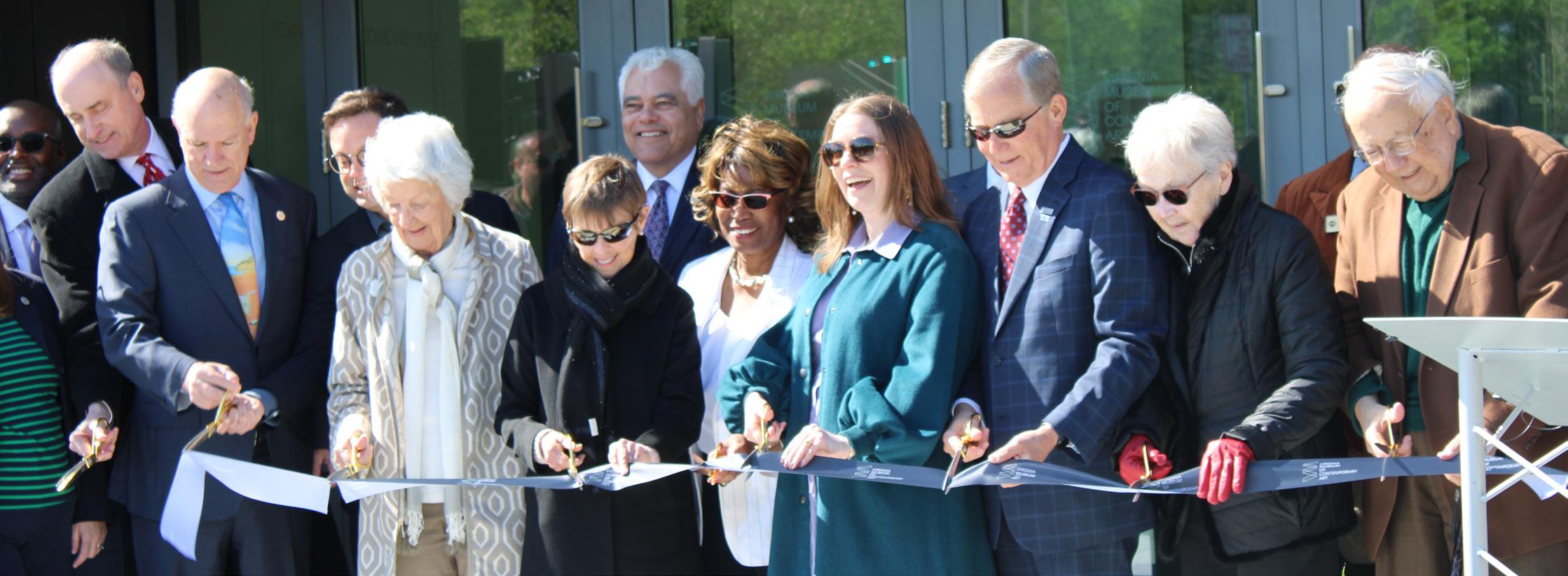
The Virginia Museum of Contemporary Art (MOCA) opened the doors of its new location on VWU’s campus.
“I’m hoping it creates more opportunities for students, especially with things like internships for seniors and chances for students to have their work featured in a gallery setting,” senior art major Ava Stauch said.
Stauch said she thinks MOCA will be a great addition to the campus.
MOCA Visitor Experience Associate Jennifer Wong said the new location gives students the opportunity to experience contemporary art from Hampton Roads and across the country.
“There is a great art program here, but we also have a lot of great studio classes that students would be able to experience,” Wong said.
The building features a sunlit atrium leading to art studios, art-handling spaces and several galleries, including an interactive ARTLab gallery.
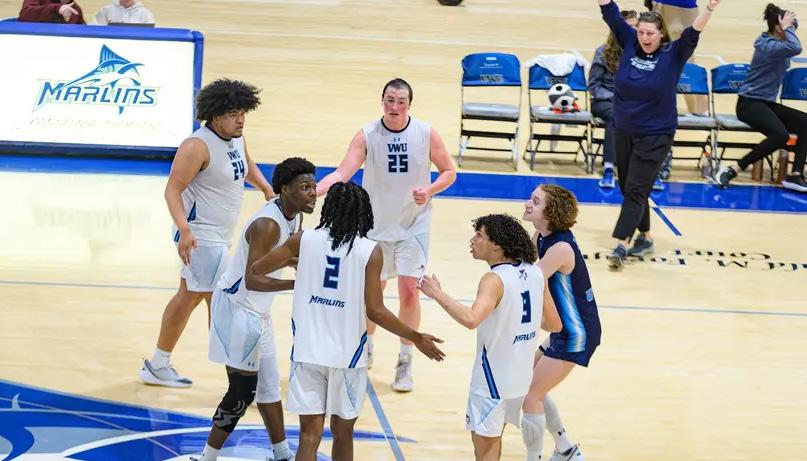
The Marlins set many program and individual records this season. Not only is this season the winningest season in program history with 22 wins, but it also ties the program loss record with last year at only 10 losses.
The first-ever ODAC Conference Tournament win came from a hard-fought 3-set upset sweep of the no. 4 seed
This year, the Men’s Volleyball team completed their most successful season yet, with an overall record of 22-10. The Marlins made it to the semifinal of the ODAC Championship Tournament, winning the first-ever ODAC playoff game in the program’s history. They would eventually fall to the no. 10 ranked and eventual tournament champion, Randolph-Macon.
‘Come
Randolph College on their home court in
This historic win comes after just three seasons of being a program at VWU. The team reached the conference tournament in the 2025 season but lost in the first round to the same college that ended their season this year, Randolph-Macon, in a 3-set, hard-fought loss.
BY KAMI WHISENHUNT kjwhisenhunt@vwu.edu
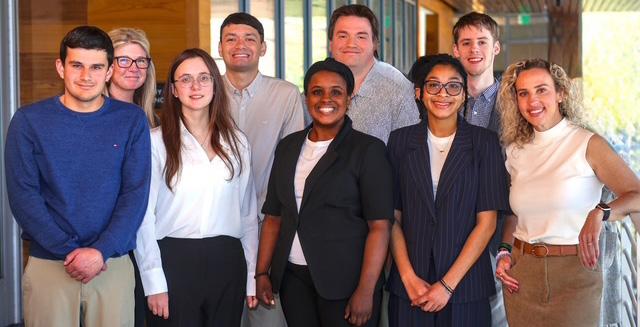
The Center for Neurodiversity and Career Development (CNCD) launched a partnership with the Come As You Are (CAYA) project this year. A $625,000 grant from the U.S. Department of Labor enabled the CNCD to start. Neurodiversity resource specialists Meghan Ashburn and Jules Edwards created CNCD in October 2025. Ashburn said Dr. David Black, executive-in-
residence, and Jenn Kaluza, founder and executive director of CAYA, discussed the partnership before she was hired.
“There were just so many synergies, so I reached out and asked if Virginia Wesleyan was interested in a partnership and working together. Once Meghan and Jules got hired, we have been working together ever since,” Kaluza said.
In January, some VWU students enrolled in CAYA’s programming, which includes
a workforce readiness program called Ready and a life skills program called Bridge.
CAYA plans to offer program graduates internships that would provide roles in website support, marketing, grant writing and program assistance. Kaluza said they hope to involve more students as interns and continue hosting social events to keep CAYA involved in the university’s student “ecosystem.”

BY OMARI JONES ozjones@vwu.edu
Students reported concerns regarding employment opportunities immediately following graduation due to developments such as increased competition with fewer entry-level opportunities and a fastchanging job market.
“The overall job market is shifting toward techdriven and sustainabilityfocused industries,” freshman Max Palaza said. “Traditional roles are still around, but companies increasingly want people with hybrid skills: design, engineering and software.”
According to a 2025 Gallup report, 28% of U.S. workers said it was a good time to find a quality job, while 72% said it was a bad time. 19% of collegeeducated workers said they felt confident about finding a job.
According to an April 3 USA Today report, unemployment peaked at 5.8% in 2025. The overall unemployment rate dropped slightly from 4.4% in February 2026 to 4.3% in March.
Director of Career Development Alice Jones said that, while unemployment is slowly going down, it has not
returned to pre-pandemic levels yet. She said that job trends can vary depending on the field, with areas such as healthcare growing while others, such as manufacturing, are declining.
Because of this, she said students should pay attention to trends in their specific field instead of just looking at national numbers.
“There’s also more contract and freelance work and global competition, meaning you’re not just competing locally anymore,” Palaza said.
Although he views the job market as challenging, Palaza said he still sees positives. “What makes it exciting is the field of vehicle design is growing and evolving, especially with EVs and new tech,” he said. “But success depends on how well you adapt. If you build a strong portfolio, learn industry software and stay on top of trends, you’ll be in a much better position than most.”
Junior Leul Getachew said it is especially hard to find entry-level jobs right now. His experience reflects a broader trend, as a 2025 report from Randstad found that entry-level job postings have dropped by about 29% since early
Two exhibition galleries at 6,640 square feet mark an overall increased square footage and a 21% increase over the previous building’s exhibition space, according to the MOCA website.
Stauch said she is concerned
2024, showing how opportunities for recent graduates are shrinking.
Getachew said he has specific concerns regarding AI in his field of business and finance.
“It’s kind of concerning since AI didn’t replace it yet, which is pretty good,” he said. “Meanwhile, if it’s unlikely to get any concerns, people might be choosing this career field, which will make it harder to find jobs.”
Senior Isaac Samuel said he has noticed difficulty regarding hiring processes.
“You have to have a certain place in your education or have lots of connections, and getting into those can be very difficult,” Samuel said.
He said he has also seen recruiters ignore applicants. “A lot of companies will say they are looking for people, but when you send them your resume and experience, it isn’t enough; they want more, even if you’ve done internships,” Samuel said.
Samuel said he feels hopeful about his future employment regardless. As a music major focusing on choral/vocal music, he plans to become a choir teacher. “We need a lot of those people now,” he said. “There is a huge teacher shortage, so I don’t think
previously available to students.
As of Jan. 1, 2026, the David R. Goode Arts Complex parking lot is reserved for faculty, staff, visitors and campus events.
VWU President Dr. Scott Miller, MOCA Executive Director Alison Byrne, Virginia Beach Mayor Bobby Dyer and Chair of MOCA’s Board of Trustees Bruce Berlin spoke before the ribbon-cutting
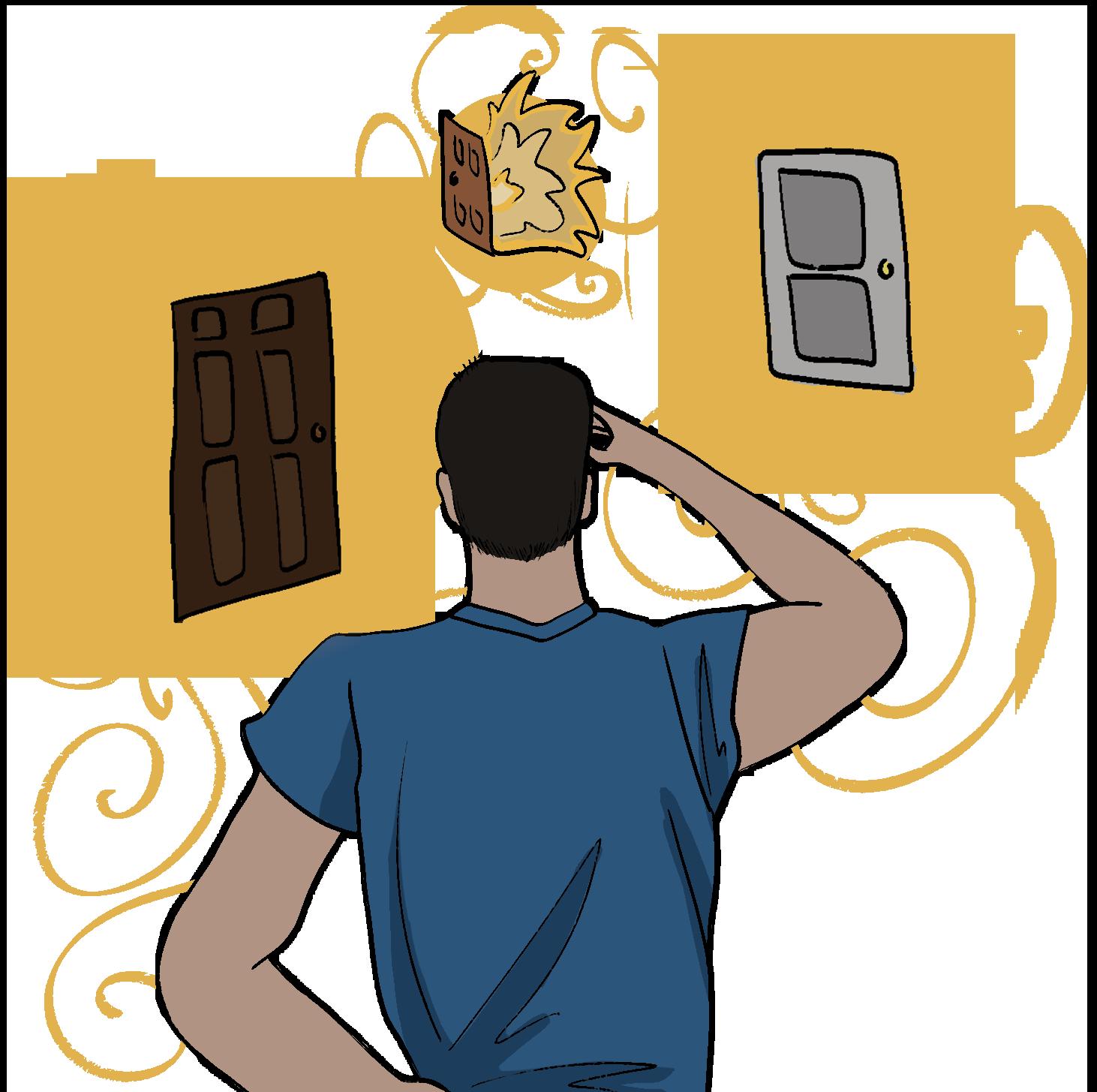
it’ll be hard for me to find a job.”
Jones said many students have expressed similar concerns. “Many students come to our pop-up tables or events and share their struggles with finding job opportunities or jobs that fit their needs,” Jones said. Jones said there are resources in place to help students, such
an educational resource and one of the largest classrooms in the region. “It’ll serve our students, our faculty, K-12 learners and the broader community through exhibitions, programs and handson experiences that inspire curiosity and innovation,” Miller said.
Wong said MOCA will host events that cater to all age groups.
as Handshake, an app designed to support college students’ efforts toward entry-level jobs. She said students need to stay flexible as the job market continues to change, especially with the rise of AI.
“As we continue to adapt and learn about the everchanging job market, we are finding more ways to
valuable and inspiring space.”
Stauch said she is especially excited to see how MOCA will bring the community together. “It could give non-art majors a chance to experience and appreciate art in a more accessible way, while also potentially highlighting the work of art students at VWU,” she said.
The MOCA website says
help our students navigate it,” Jones said. She said her goal is to help students feel more hopeful about their futures. She said she believes students preparing to graduate should start early, use all available resources, keep options open and stay patient and persistent.
The MOCA website says the new building and location allow for future growth and greater accessibility.
Dyer said MOCA has enriched the Hampton Roads community since its original launch. Proclaiming April 8 as Virginia MOCA Day, he said this partnership and relocation further establishes it as the leading destination for contemporary art


BY HANA MCCAIN hemccain@vwu.edu
Campus community members
said VWU and the affiliated United Methodist Church (UMC) continue to uphold diversity, equity and inclusion (DEI) values, following political pushback against the DEI term.
In April 2025, VWU renamed the Diversity, Equity and Inclusion Council (DEIC) to the President’s Council for Inclusive Communities (PCIC), reversing a name change that took place in 2022.
This change was accompanied by the removal of DEI labelling from other campus policies and groups, although President Dr. Scott Miller said that the changes would not impact policy.
Additionally, VWU has maintained its affiliation with UMC, which faced controversy in 2020 regarding views on LGBTQ+ rights such as samesex marriages, leading churches across the country to disaffiliate with UMC.
A year on from this vocabulary change, students and professors agree that VWU is maintaining their commitment to diversity, equity and inclusion, despite moving away from the DEI acronym.
Dr. Tyler Lehrer, member of PCIC and assistant professor of history said conversations and political commitments toward social justice have shifted dramatically in recent years.
He said UMC has made strides to refashion itself as a more proactively welcoming denomination for Christians who otherwise felt left out of congregational life.
“The Methodist Church has always been grounded in inclusivity,” Kelly Jackson,
associate director of the Robert Nusbaum Center, said.
“Terminology surrounding diversity, equity and inclusion in higher education, as in many other facets of public life, has come under practically microscopic scrutiny in recent months both culturally and, of course, politically,” Lehrer said.
The term has been under scrutiny by the Trump administration and some state governments, which worry that these programs promote racism against white people.
Lehrer said at VWU, efforts to maintain the campus community as a place in which everyone is welcome and has a voice are shared by every member of the community, whether explicitly framed as DEI or not.
“From the classroom to the field, to the dining hall to the event stage and beyond, I think upholding the spirit and intent of DEI values is a shared responsibility,” Lehrer said.
Lehrer and Jackson said VWU upholds DEI values in many ways.
“We were the very first higher education institution in this area that expanded our statement to include gender identity and gender expression,” Jackson said.
Sophomore Amya Lynch said she has not seen any resistance towards LGBTQ+ students on campus. “I think the campus, or VWU in itself, is very openminded,” Lynch said.
Jackson said the Nusbaum Center hosts lectures, panel discussions, workshops and deliberate dialogs that focus on bringing people of different perspectives together to civilly discuss divisive topics.
In addition to the Nusbaum Center, Lehrer said PCIC, Campus Ministries, Campus

Life and Student Engagement all provide various opportunities throughout the year to honor and explore diversity and discuss equity and inclusion.
Miller introduced PCIC in 2016 to commit support to all faculty, students and staff through programs that create purposeful dialogue and celebration of difference, according to VWU’s website. While it was called DEIC from 2022 to 2025, it has served similar functions for the last decade.
“Dr. Miller was always steadfast in our support of LGBTQ+ students and he flies the pride flag every June, the whole month,” Jackson said.
Jackson said VWU has a partnership with the Virginia Center for Inclusive Communities (VCIC), a statewide organization that works with businesses, schools and institutions of higher education to promote inclusivity, diversity and understanding.
"I am proud to belong to a university affiliated with a
denomination that has taken, and continues to take, really meaningful steps to include and celebrate queer, LGBTQIA+ and other groups marginalized both in the past and today,” Lehrer said.
“I applaud the UMC’s demonstrable efforts in recent years to reckon with past silences, to have hard conversations about making itself more equitable and to engage in proactive outreach to marginalized communities,” Lehrer said.
He said UMC’s current and historical interpretations of doctrine have little bearing on what he teaches, how he interacts with students or how they should be allowed to show up in his classroom.
“I think belonging is at the heart of what ministry ought to mean,” Lehrer said. Lehrer said that the hearing part is easy, while letting people know they belong and making it true is hard. “I think belonging is not a destination we can ever arrive at, but something we need to constantly work at in
innumerable ways big and small.
“As a gay man who, as a child, had a family that struggled financially, who worked a fulltime job all throughout my own undergraduate years, I find myself especially empathetic to students who share some of those same experiences and demands,” Lehrer said.
Lehrer said students bring competing demands on their time and attention to the classroom. “I want my classroom to be a space where all of these are allowed, where all of these and more are part of what it means to be part of an academic and intellectual community of thoughtful, engaged global citizens,” Lehrer said.
Lehrer said empathy makes us hyper-attuned to the identities, experiences, commitments and challenges that shape us and sometimes makes it harder to pay attention to others that show up every day in the classroom.
BY CARL SWORD cmsword@vwu.edu
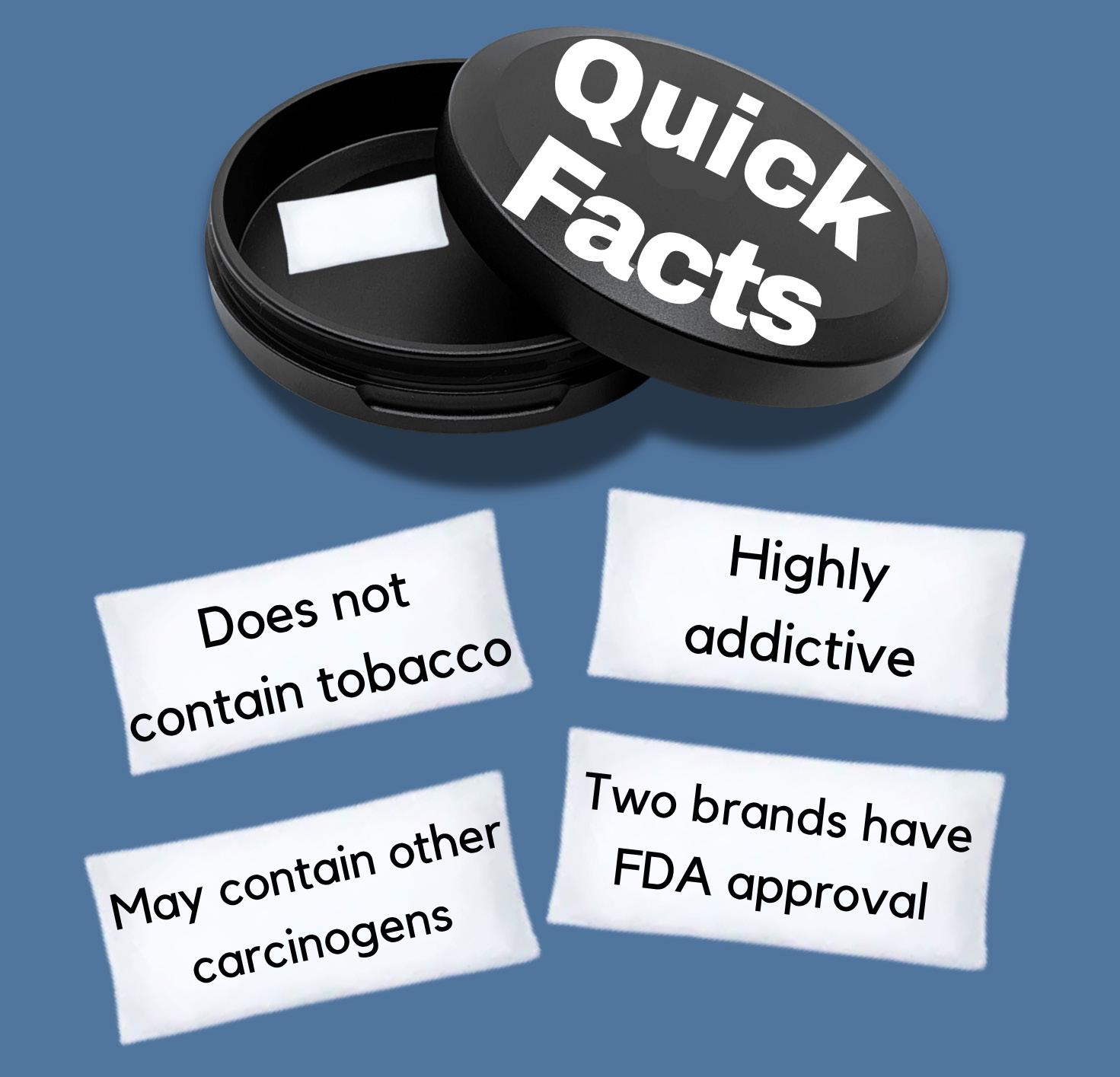
No smoke, no vapor and no smell, yet nicotine use among college students is still on the rise thanks to products such as Zyn. Students suggest that this trend is both widespread and misunderstood.
“Oral nicotine pouches are small white pouches, containing nicotine powder and flavorings, that are inserted into the mouth,” Truth Initiative,
a nonprofit public health organization dedicated to preventing nicotine addiction, said.
According to Truth Initiative, nicotine pouches are often referred to as a “lip pillow” or "upper decky,” which along with being a smokeless nicotine product is how they got their fame.
Junior Josh Jones said nicotine pouch use is common for both him and the people around him.
According to Virginia Tech junior Eli Druiett,
nicotine pouch use is closely tied to convenience and social influence. “Me and my friends use several nicotine pouch brands like Zyn, Velo and ON,” Druiett said.
Jones said many begin to use it through social influence. He said the products are appealing because you can use them during class and it helps people focus and relax.
Junior Mason Sylvest said nicotine pouches are popular due to their convenience because,
“you can put one in during classes to ease your mind and relax.”
Truth Initiative found that nicotine pouch sales increased from 126 million units in late 2019 to more than 808 million units by early 2022.
Researchers believe part of that growth comes from advertising that emphasizes flavors and the ability to use the product discreetly in places where smoking or vaping would be obvious.
Druiett said his use began when “a friend had some and told me to try it.”
Druiett said their discreet nature is a major reason for their popularity, explaining that they “allow students to use nicotine during class without drawing attention to themselves” unlike vaping, which is more noticeable.
Sylvest said he has seen people he knows use nicotine pouches as an alternative to vaping and dips.
Druiett said nicotine pouch products are a safer alternative to vaping and smoking, partially due to fewer ingredients. “Nicotine pouches, from my experience, have never shown any signs of physical or mental side effects compared to vaping or smoking,” he said.
Sylvest said nicotine pouches are significantly safer, yet “quitting nicotine is difficult because it is an addictive chemical.” He
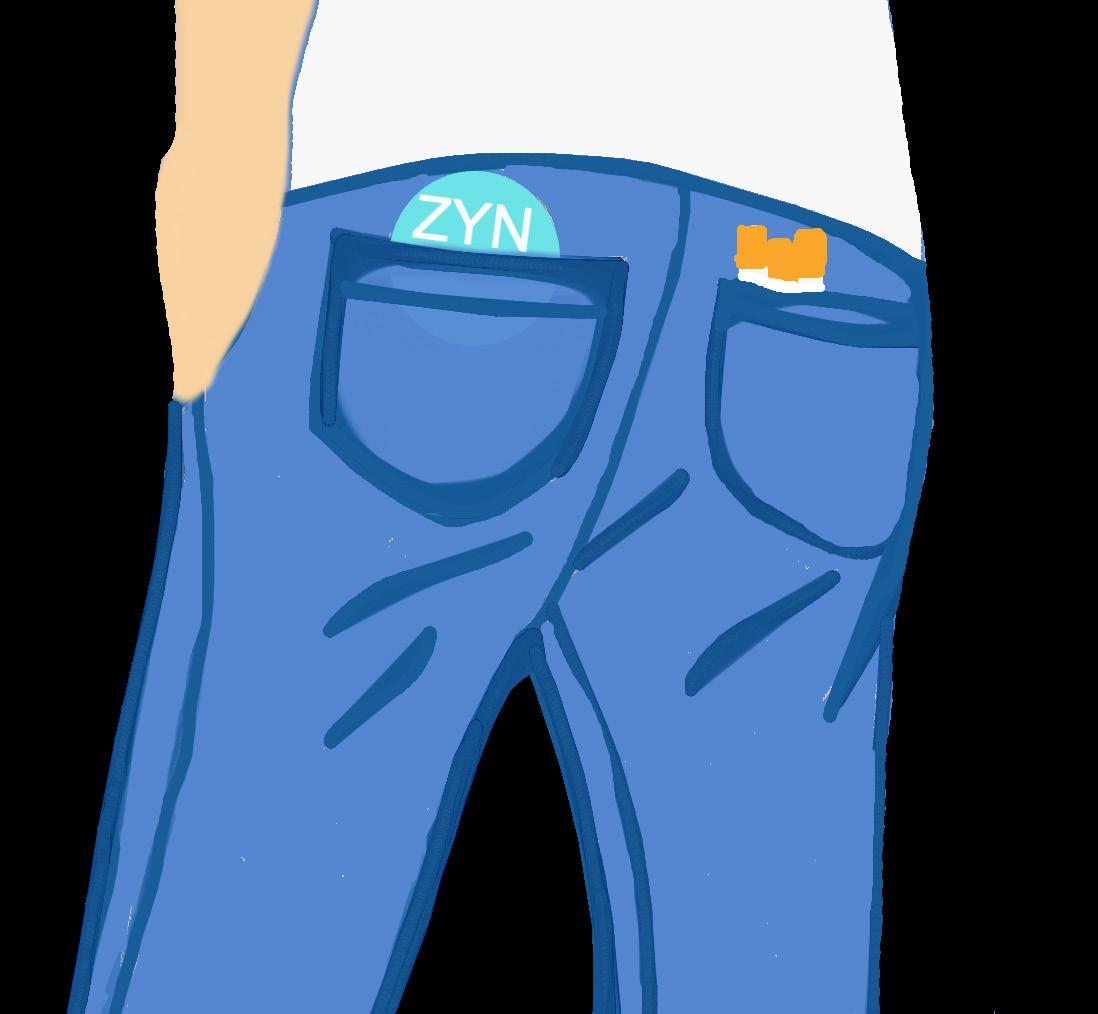
said people who try to quit find replacements.
Health organizations caution that nicotine pouch products carry risks. Truth Initiative says “nicotine in any form is harmful to young people,” particularly because it can affect brain development and attention and cause long-term addiction.
Jones said many students may not fully understand the risks, pointing to social media as a major influence because students hear people online say they aren’t negatively impactful.
Druiett said nicotine use is a way to manage stress.
“The biggest examples are before a presentation or when I’m stressing over a test or a last-minute
assignment. Using nicotine pouches in those moments has proven to help,” he said.
Sylvest said using nicotine pouches lowers stress and anxiety levels and “makes me not think as much and just go with the flow.” Jones said using nicotine pouches makes him relaxed, calm and more focused while studying. Because the pouches are easy to conceal and marketed as cleaner alternatives, some health professionals, like those from the CDC, worry that students may underestimate how often they are using nicotine and how easily people can depend on it.
Editor-in-Chief
Lily Reslink lbreslink@vwu.edu
Managing Editors
Victoria Haneline vfhaneline1@vwu.edu
Isaac Fick ihfick@vwu.edu
News Editors
Isaac Fick ihfick@vwu.edu
Aiden Croghan accroghan@vwu.edu
Community Editor
Kami Whisenhunt kjwhisenhunt@vwu.edu
Opinions Editors
Victoria Haneline vfhaneline1@vwu.edu
Elena Lichtenwalner eclichtenwalner@vwu.edu
Sports Editors
Coy Camiscioli clcamiscioli@vwu.edu
Eli Casey emcasey@vwu.edu
Bailey Gray bcgray@vwu.edu
Weekender Editors
Calee Lukowski crlukowski@vwu.edu
Gabrielle Barnett gabarnett@vwu.edu
Photo Editor
Laila Jones ljjones1@vwu.edu
Online Editor
Lillian Glenn adglenn@vwu.edu
Copy Editors
Victoria Haneline vfhaneline1@vwu.edu
Elena Lichtenwalner eclichtenwalner@vwu.edu
Julia Ware jpware@vwu.edu
Phoenyx Clifton tclifton@vwu.edu
PR Director
Isabella Grosswiler idgrosswiler@vwu.edu
Marketing Coordinator
Bryant Cotterell bccotterell@vwu.edu
Engagement Editor
Sarah Czapp sczapp@vwu.edu
Adviser
Dr. Lisa Lyon Payne lpayne@vwu.edu

BY ABEE CASSIDY arcassidy@vwu.edu
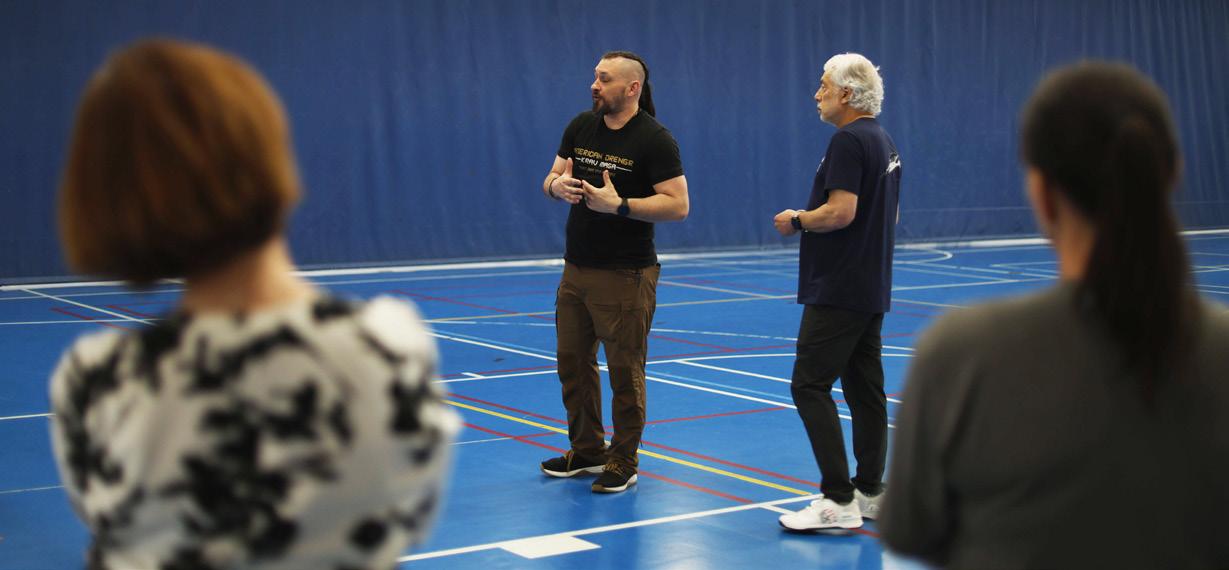
Founder of American Drengr Krav Maga in Manassas, Virginia
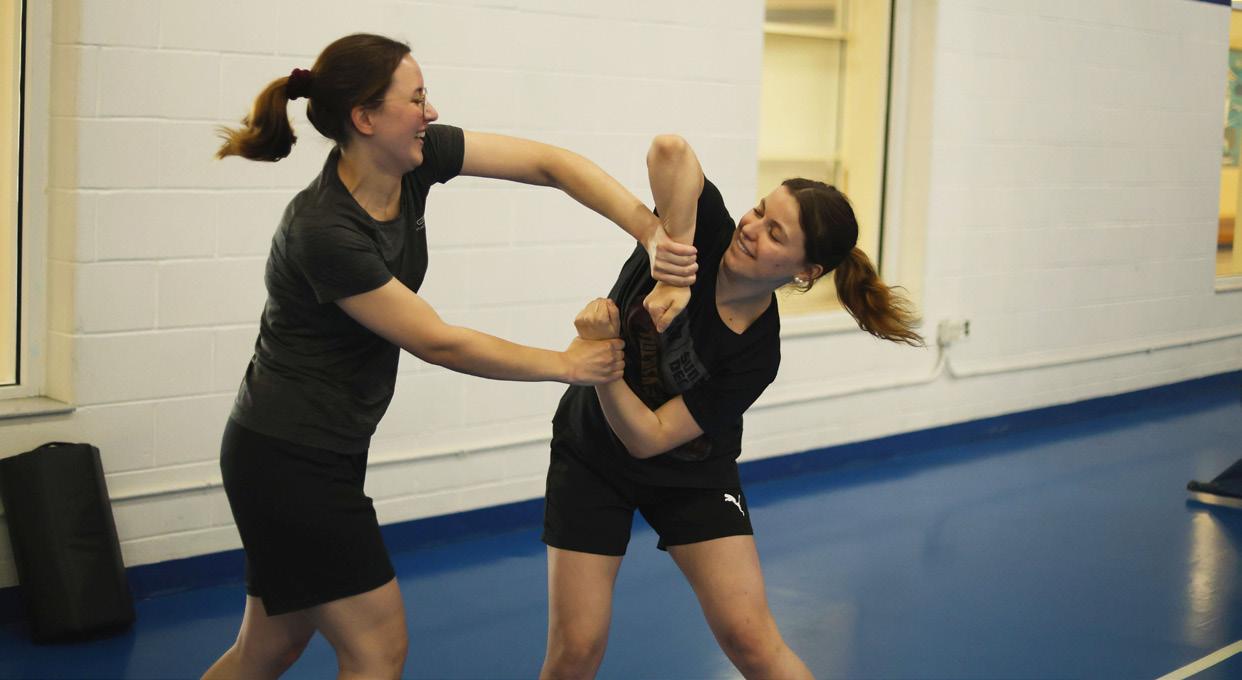
Greg Mills taught campus community members selfdefense for free. Trustee Chip Tsantes ‘83 coordinated the two sessions held in the CMAC.
On April 2, sessions were held from noon-1:30 p.m. and from 2-3:30 p.m.
“I’ve been doing martial arts my whole life, and I started teaching because it was fun and it was something my instructor asked me to do,” Mills said.
Tsantes reached out to VWU staff to put the program together for students on campus. Not only did he want to bring Mills to teach Krav Maga, but he is also a sidekick for Mills.
“Being on the board, I am getting what I get out of my learning from Greg, and I wanted to bring that here and bring that awareness,” Tsantes said.
Mills said this is his first time teaching on a college campus, but he carries the same mission wherever he teaches: to help others know they are someone worth defending and to build
skills to protect themselves.
Mills said he has taught for workplace violence prevention at hospitals, Girl Scout groups, city council programs and women’s shelters in California, where he worked with survivors of abuse to help them build confidence and heal from past trauma.
He also regularly partners with the Manassas Police Department to assist with their Rape Aggression Defense course, which he said differs from his own approach.
Mills said violence can affect anyone, even those who do all the right things.
“They have decided to stop seeing you as a human being, and you are now an object,” Mills said.
After being in a life-threatening situation, Mills became more passionate about teaching individuals to defend themselves.
Mills said he wants his students to take away that they should take accountability for their own safety. “We kind of put that responsibility off onto other people, like the police,” Mills said.
Sophomore Alonso Abram said the biggest takeaway was how
Mills emphasized that violence is not gentle.
“The only kind of self-defense I ever tried was boxing, so it was honestly really interesting to try,” Abram said.
Abram said he took a whole new mindset from this class, “You gotta get out of that mindset of ‘oh I’m scared to hurt this person,’ because they’re not scared to hurt you,” Abram said.
“It’s a lot of the awareness and attitude and turning the attack into you being the aggressor, instead of letting that person,” Tsantes said.
“It actually really opened my eyes to what things could happen,”Abram said.
Abram said it was surprising to learn how to get out of somebody’s grip, which wasn’t as challenging as he thought.
Abram shared the technique he learned for when someone grabs your wrist: “turn your thumb to where the gap is between their thumb and index finger meet and push.”
Mills said that because violence is unexpected, it’s better to be prepared with self-defense tactics rather than relying on someone or something else to defend you.
“A gun, a knife, mace, a shot
baton, a batarang: they’re all just a tool, and they come with responsibility, and you should train to make sure you use that and follow the laws as best as you can,” Mills said.
Abram said violence is a reality that college students face, so it’s best to know how to defend yourself if you ever need it.
“It’s actually really helpful for learning how to get out of certain situations in real-life scenarios,” Abram said.
For students who want to learn more about self-defense and Krav Maga, Mills recommended reading or listening to “When Violence is the Answer” by Tim Larken.
Tsantes explained that the book is about “a young woman who was a college student who was attacked in her dorm, and the basic training she had like this served her well,” Tsantes said.
Mills said he encourages taking self-defense classes in a studio or learning online, and if you’re not sure where to start, Mills said he can help. He can be found as American Drengr on all social media. Mills said he posts a lot of free information and clips from classes.
After four years of sleeping out, student leaders of the campus program prepare for a transfer in leadership to continue their mission.
BY LILY RESLINK lbreslink@vwu.edu
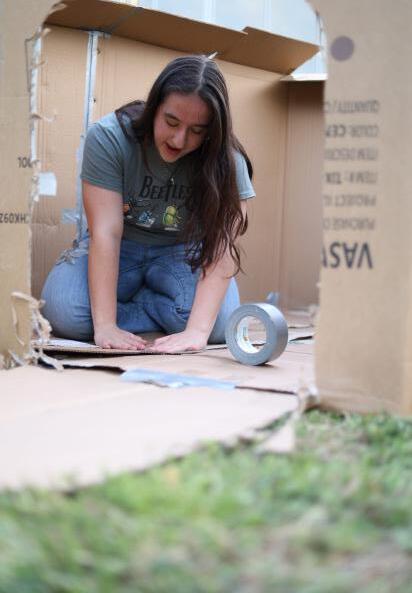
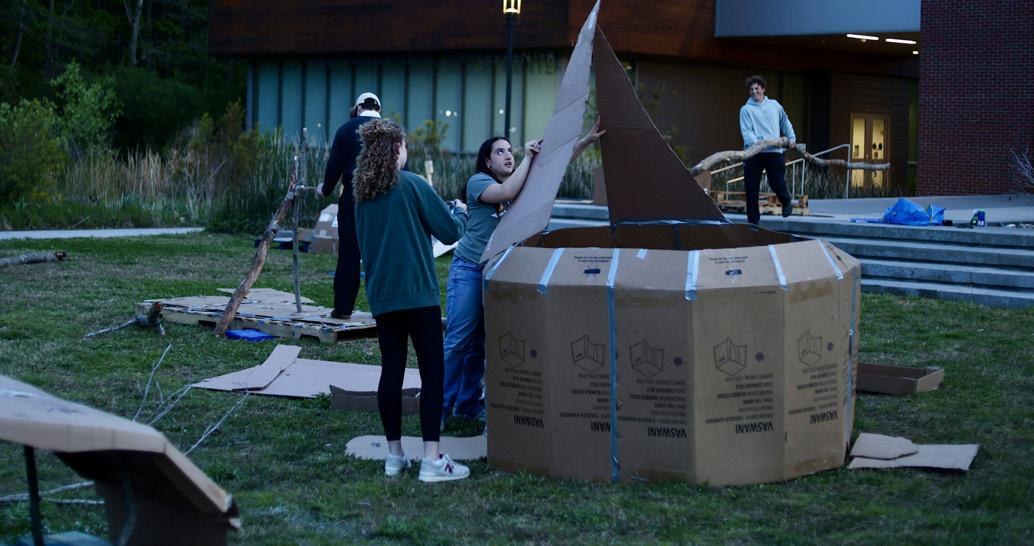
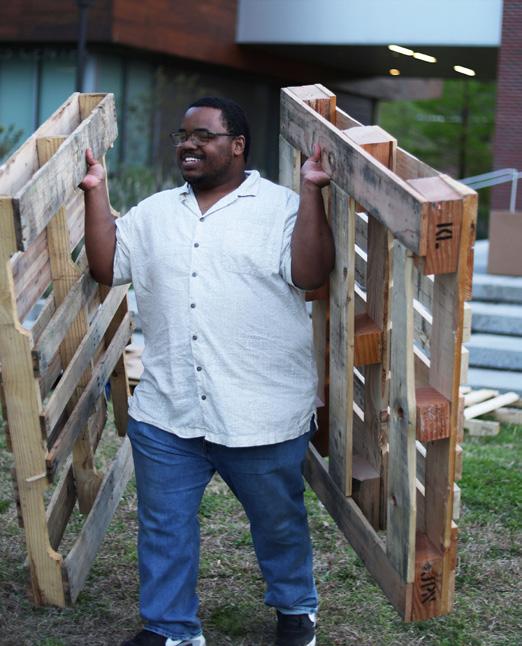
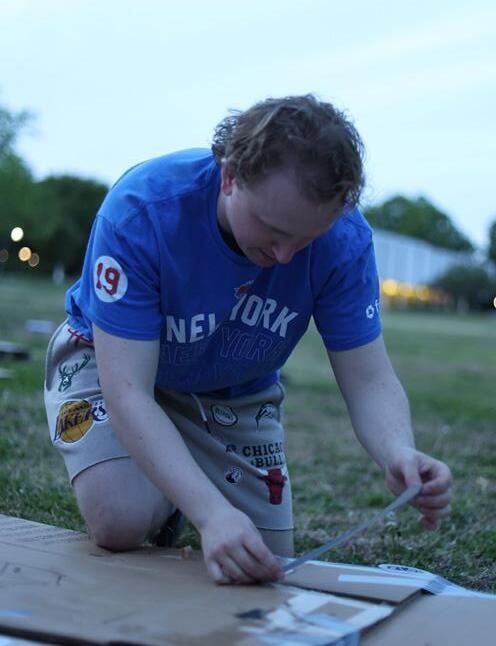
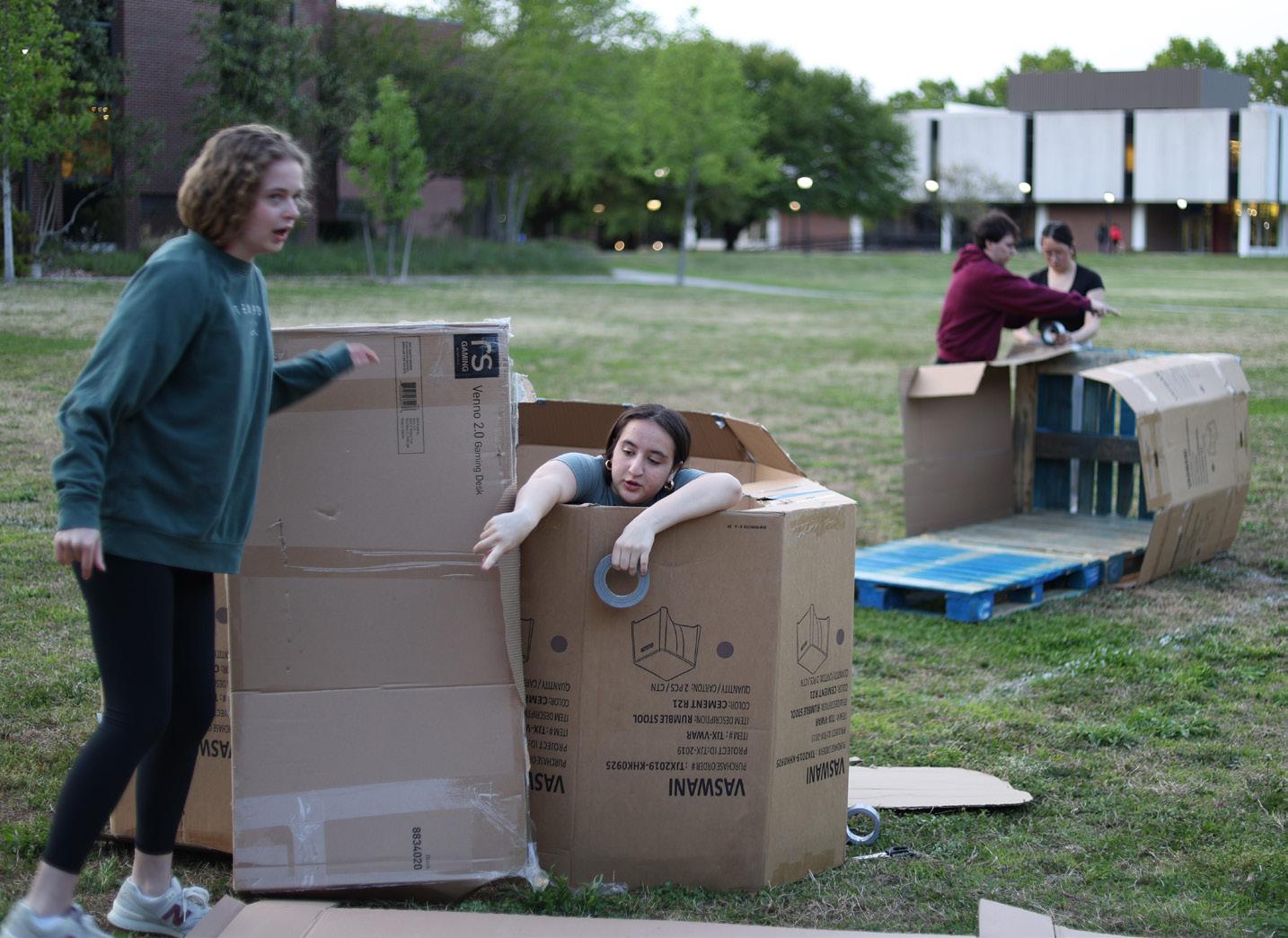
The founders of Students Against Continued Homelessness (SACH) slept outside on campus in cardboard box shacks for the last time during 2026’s annual Shack-A-Thon.
Seniors Aiden Foley and Isaac Samuel started the student organization four years ago to promote solidarity with people experiencing housing insecurity.
“We have dorms with beds that we can sleep in, and we’re choosing to sleep out, because there’s about 600,000 Americans who do not have that choice,” Foley said.
Samuel said the program has received critiques of “cosplaying homelessness,” but the purpose of Shack-A-Thon is for people to recognize what they take for granted and to increase empathy for those without secure housing.
“I think when you put yourselves in a position that you’re not in, then you’re able to appreciate it more and appreciate the things that you have in your life,” Samuel said.
Junior Rashad Hulev-Morris slept out for the first time this year. On his first night, he said he woke up freezing and returned to his room before the morning. “I didn’t think it
would be easy, but I didn’t expect it to be that hard,” Hulev-Morris said.
Foley said a group of freshmen is prepared to take the reins and continue hosting Shacka-Thon. “Everyone’s been so optimistic and it’s been so easy to talk to them,” Foley said.
Freshman Julianna Austin will be SACH’s president next year. She shared intended areas of growth: more education on SACH’s cause, more community service opportunities and seeking sponsorship to fundraise for related local organizations.
Aside from the milestone of year four, the 2026 Shack-A-Thon was set apart by the majority of its participants coming off a weekend of performances in VWU’s production of “Avenue Q.”
After striking the set, which resembled cheap apartments the main characters lived in as neighbors, many cast members jumped into constructing new temporary houses on the Greer Environmental Sciences Center lawn for the nights of April 11 and 12.
While this was Foley’s last time sleeping out in the cardboard-constructed shacks, he said it’s important to remember this is an ongoing reality for many.
“The first step to supporting the humanity of people in other countries is supporting the
humanity of people here at home,” Foley said.
“A lot of people get apathetic about the way things are,” Foley said. “But I think events like this and other instances of activism and progressive politicians can start to give people hope that we can make change in the system.
“We’re all closer to the streets than we are to the penthouse,” Foley said. “So if we all fought for the interests of the people on the streets, we’d all be a little better off.”
Foley said the organization feels most meaningful when people express gratitude for SACH’s programming because of their own experiences with housing insecurity.
Freshman Tiffanie Heng, participant and future executive member, said her personal experiences are tied to her investment in SACH and belief in its impact.
“I feel like something small like this really sends a message,” Heng said.
For those interested in joining, connect with Austin, Heng or freshman Gavin Wehr who will form the organization’s executive board starting next year. Wehr said to get involved, reach out to Austin or himself in person, by email, Instagram (@sach_marlins) or by connecting with them through campus ministries.
BY ABIGAIL CULLEY ahculley@vwu.edu
Sororities within the Panhellenic Council at VWU, including Alpha Sigma Alpha (ASA) and Sigma Sigma Sigma, said they strive to build community through volunteer work.
“Greek Life is special to all of us because it helps us find community and strength within each other,” Katie Martin, a freshman in ASA, said.
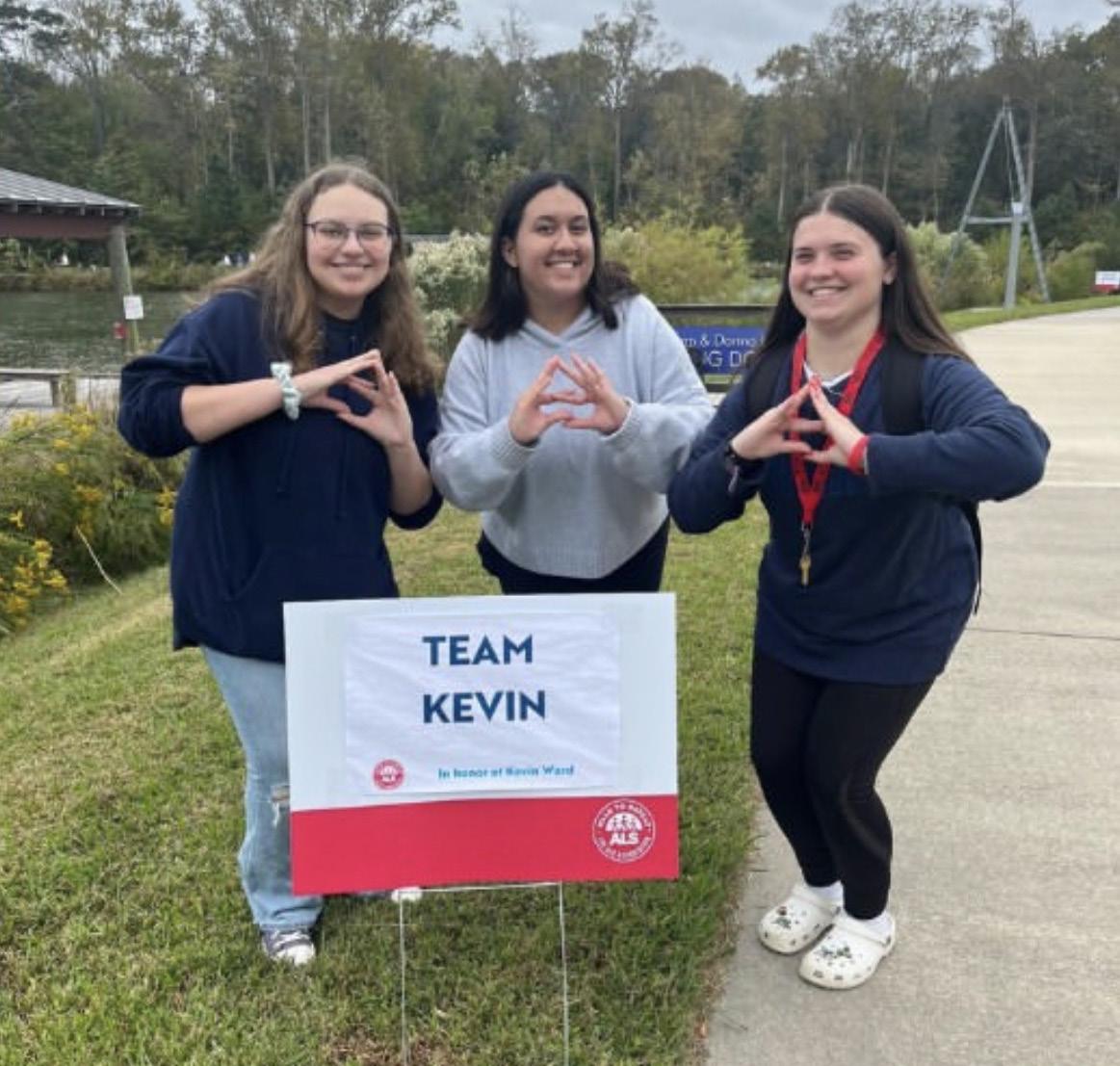
Sigma Sigma Sigma is also involved in the Cystic Fibrosis Walk and the Amyotrophic Lateral Sclerosis (ALS) Walk. The ALS Walk has a deep significance to the sorority, as an VWU alumna’s father suffers from ALS. This inspired the sorority to “Support Team Kevin” and do the yearly ALS walk with him.
For Valentine’s Day, Sigma wrote heartfelt messages to children in the Intensive Care Unit at The Children’s Hospital of The King’s Daughters.
“That’s who we are as people, and that’s the heart of Sigma,” Sisi Mateo, junior Honor Council chairwoman and member retention officer of Sigma, said.
ASA supports Girls on the Run, an organization with an office on campus dedicated to supporting young girls socially, emotionally and physically by establishing healthy life habits.
“Doing events helps us spread the female empowerment that we try to create within our chapter in the local area,” Martin said.
ASA also does work with the local Special Olympics. Every year, members raise $100 each to participate in the Virginia Beach Polar Plunge held by the Special Olympics.
This year, ASA began participating in the Hampton Roads Breast Cancer Walk. ASA President and junior Ally Mortenson said they will continue to support this cause in future years by providing goodie bags with heartfelt notes for breast cancer survivors and passing out water on the beach. Mortenson also has a close family tie with the Love the Tree of Life organization, a nonprofit dedicated to providing equitable access to health care.
ASA participates in a Prom Dress Giveaway, which gives girls from low socioeconomic backgrounds a chance to select from thousands of dresses and feel confident.
“Our goal really is to help people and to volunteer,” Mortenson said. Mortenson challenged the notion that “sororities are just paying for fun and for friends.”
“To feel so welcomed by people that greet you with such open arms is astonishing,” Gianna Holt, junior and restorative justice officer of Sigma Sigma Sigma, said.
“The purpose is not to join for your own benefit. We want to help each other build on our own growth and each other’s growth so we can progress as a community,” Mateo said.
Connection and community are common themes in the Greek Life experience.
“We all want to have a sisterhood on campus. To me, the house is a safe place where we are free to be ourselves and have a group of women that support each other through
everything without worrying about judgment,” Martin said.
“This is not just a collegiate experience either. This is for life. These girls are really like my sisters, and some are even going to be my bridesmaids,” Mateo said.
For the Panhellenic Council, their S’mores and Open Doors event was an opportunity for the members of both sororities to bond.
Kaluza said CAYA participants will gain experience in interviewing, managing job responsibilities and navigating the workplace, which builds skills and confidence.
“Through our programs and through our social events, people are meeting like people, and they feel understood and they feel welcomed, and we want to continue building that strong community, not only at Virginia Wesleyan, not only at CAYA, but throughout Hampton Roads,” Kaluza said.
Neurodivergence can include autism, dyslexia and ADHD. Kaluza said that neurodiversity refers to the natural differences in how people’s brains think, learn and experience the world.
“You have a class, and it’s neurodiverse just by having multiple people in the room,” Kaluza said.
She also said CAYA’s resources are designed to promote success in the classroom, such as with accommodation requests and self-advocacy.
The CNCD at VWU falls under the Student Success umbrella. Hannah Carmona, student success administrative assistant and testing center coordinator, works closely with the CNCD and Disability Services to support students who need academic accommodations.
“We’re very accommodating to people with autism, with ADHD, with dyslexia, anything like that,” Carmona said.
Carmona said the testing center offers a range of accommodations that
neurodivergent students use. These include reading tests aloud, extended time and access to quiet testing rooms. Students can also receive support in processing coursework, such as talking through homework questions or reviewing their syllabus.
Carmona said CAYA’s workshops are beneficial to both students and the community by helping them get jobs that they actually like and want to do and supporting them in their careers.
put on by CAYA include a job fair on March 21 with employers committed to inclusive hiring, which Ashburn said about 50 young adults attended. A Disney trivia night was held on March 13 in Greer.
A U.S. state trivia night will be held on May 29 at 5:30 p.m. in the Greer Environmental Sciences Center. Dinner, drinks, raffles and prizes will be provided, and participants can register individually or as a team. Ashburn said all CAYA
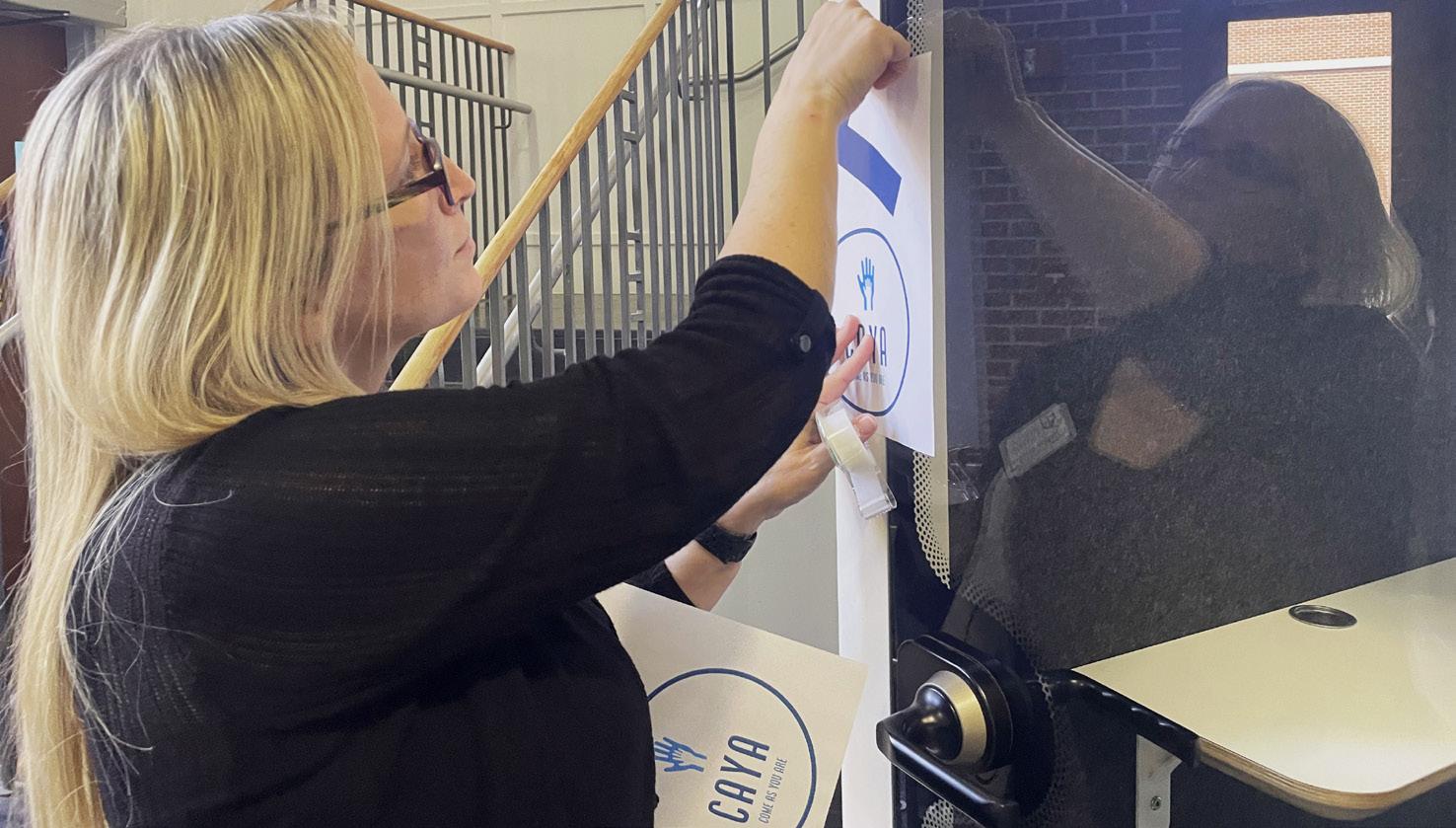
“It’s for neurodivergent people, by neurodivergent people, and CAYA is in line with that as well. We want to make sure the programming that we offer is something that they want and they find valuable and that will help them in the ways they want to be helped,” Ashburn said.
Recent professional and social events
events on campus are open to students, and if needed, any fees will be covered by the CNCD.
“We definitely want it to be more of an inclusive structure,” Ashburn said.
Ashburn said college is about having a balance of academic and social life activities, and this is especially important for neurodivergent students and students
with disabilities. Rather than getting the same chance to have a fun college experience, Ashburn said neurodivergent students and students with disabilities are often pushed to focus only on “catching up.”
“Often, all they do is work on goals in the school system. Nobody wants to live like that. Everybody wants to have fun. You all are of an age where you want to explore different things,” Ashburn said.
CAYA began because Kaluza said she saw a gap in the support available for neurodivergent individuals as they transition into adulthood. She has learned from lived experience with her son, who has autism.
“One in five people are neurodivergent, and not every neurodivergent qualifies for services through Medicaid or other supports, so this population is what I call kind of slipping through the cracks, where they’re not disabled enough for Medicaid, but they need support, and there’s nothing like CAYA that exists,” Kaluza said.
“The shared vision is rewarding. It’s not easy to find people that are doing work that’s in line with the disability justice community and making sure that what we do presumes competence and integrates the feedback and priorities of the people we’re serving,” Ashburn said.
Kaluza said she appreciates how Edwards describes the mission as helping people live their best lives because this means everyone deserves the opportunity to build a life they are proud of and that brings them dignity. She said that with the right support, people can achieve their personal and professional goals and create lives they enjoy.
BY MIA DIEHL mjdiehl@vwu.edu
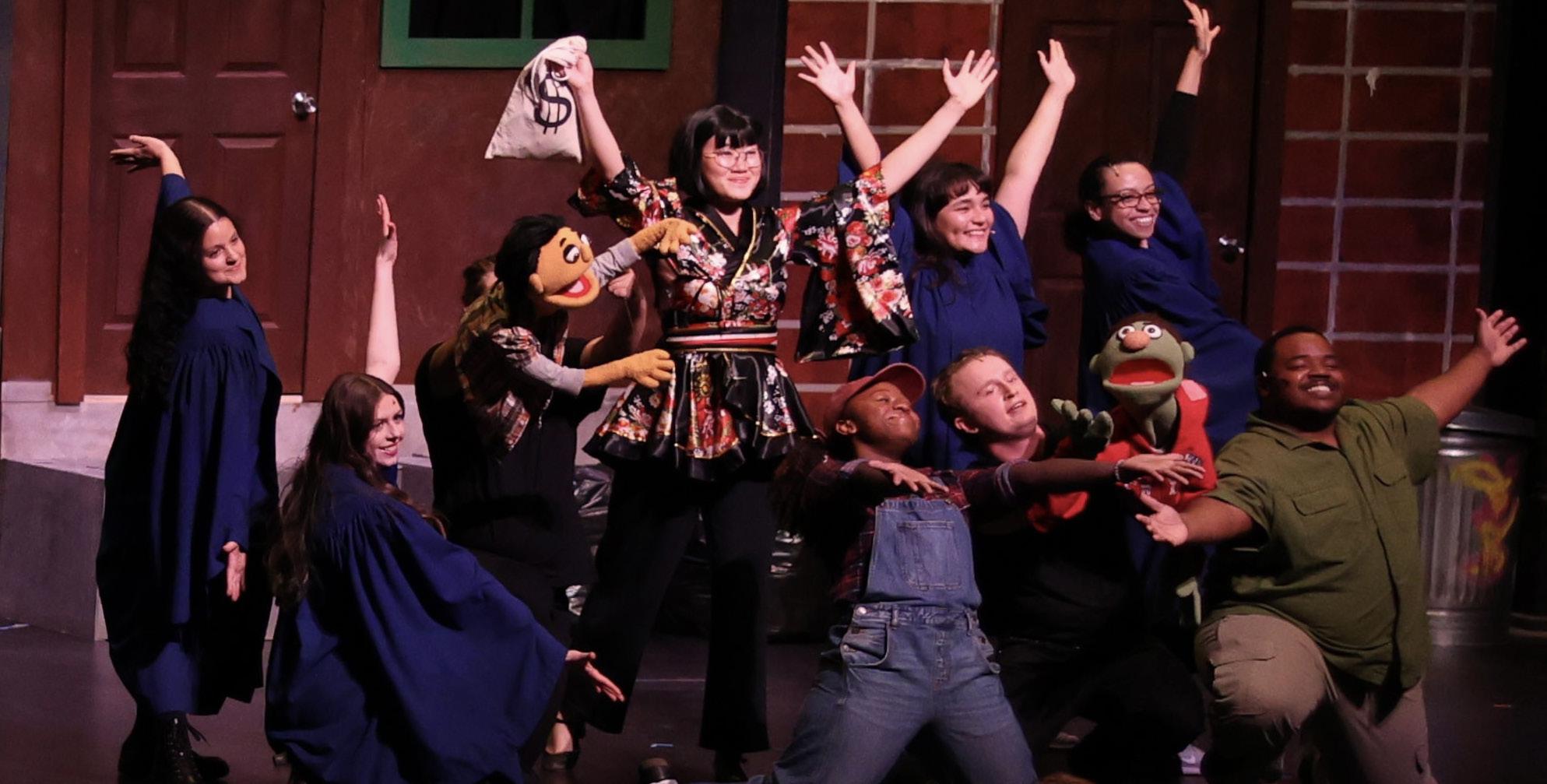
“Avenue Q,” an adult-only parody of Sesame Street, brought humans and puppets together for commiseration and celebration. It was directed by the Dean of the Batten Honors College and Professor of Theatre Dr. Travis Malone.
Acting, music, puppetry and interactive media entertained audiences from April 9 to 12. The musical included the comedic songs “The Internet is For Porn,” “You Can Be As Loud As The Hell You Want (When You’re Making Love)” and “If You Were Gay.”
On either side of the stage, screens showed simple videos between songs to move the plot forward and aid in comedic context.
The show features provocative content and uses puppets to tackle mature, sensitive and taboo subjects. It debuted at the John Golden Theater in 2003 and ran for 2,500 performances on Broadway.
The show was the recipient of the Tony Awards Triple Crown, winning Best Musical, Best Book and Best Original Score. According to Better Marketing, this win is notable as one of Broadway’s biggest upsets because it beat out the Broadway hit and favored winner “Wicked” that year.
“Avenue Q” is currently in revival in the West End in London but was last performed in the Hampton Roads area 10 years ago.
At an April 9 Nusbaum Center event, “Freedom to Laugh: Comedy, Taboo, and the Line Between Humor and Harm in the Theatre,” Malone discussed the controversial show and the preparation going into it.
“I believe in full transparency. Know what you’re getting into before you commit to something,” Malone said.
Malone discussed the roles of Christmas Eve, a human who is a Japanese immigrant and therapist with a heavy accent; Kate Monster, a puppet who is a kindergarten teacher; and Princeton, the lead of the show, a puppet who just graduated with an English degree and moved to Avenue Q.
“We always come back to some really important things.
Comedy is not for all people, not everyone loves this show,” Malone said. “Art is not a safe space, and it is incredibly brave of performers to want to do this and then thinking about why they’re portraying these characters.”
Freshman Tiffanie Heng, who played Christmas Eve, said preparing mentally was a big part of the role as the show requires overacting and high energy throughout.
“It’s more of a mental prep for the show, because it is a very mentally draining show,” Heng said.
Heng said her favorite part of the musical was the number “You Can Be As Loud As The Hell You Want (When You’re Making Love).”
“It’s fun, it’s weird and it literally just hits you in the face; you don’t expect it,” Heng said.
Isaac Samuel played Rod, a puppet who is a republican, investment banker and closeted homosexual.
“I had to kind of add that nasally puppet voice into my singing, I think that was the most challenging part for me,” Samuel said. “When I sang up higher, it got harder for me
to use my nasal and I wanted to switch.”
Samuel said the audience’s reaction created a challenge for keeping in character during highly comedic scenes.
“It’s different when you have an audience laughing at things you didn’t expect them to laugh at as much,” Samuel said. “I have to stay in that character so I can keep delivering that same energy.”
Although the show is rooted in comedy, it presents deeper messages of finding purpose through characters embarking on post-college journeys of adulthood.
“It’s a coming-of-age story where students are walking out into the world and have to ask yourself: ‘What now? What is my role? What is my purpose? How do I find that?’ because now there’s no syllabus to life,” Malone said.
Upcoming events at the Susan S. Goode Fine and Performing Arts Center include “Footprints” on April 24, a performance by the VWU Camerata and Bravura choirs and “Concert Jazz Series” on May 1, a performance by the Marlins Jazz Ensemble.
BY HANNAH ROSE ahrose@vwu.edu
Hannah Rose|Courtesy
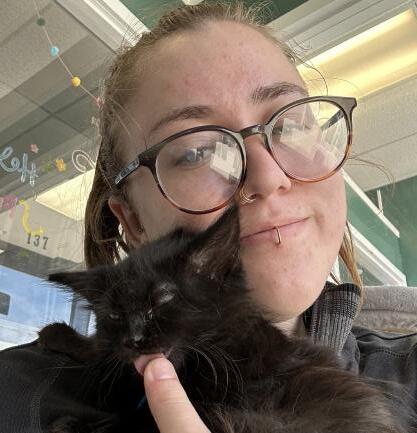
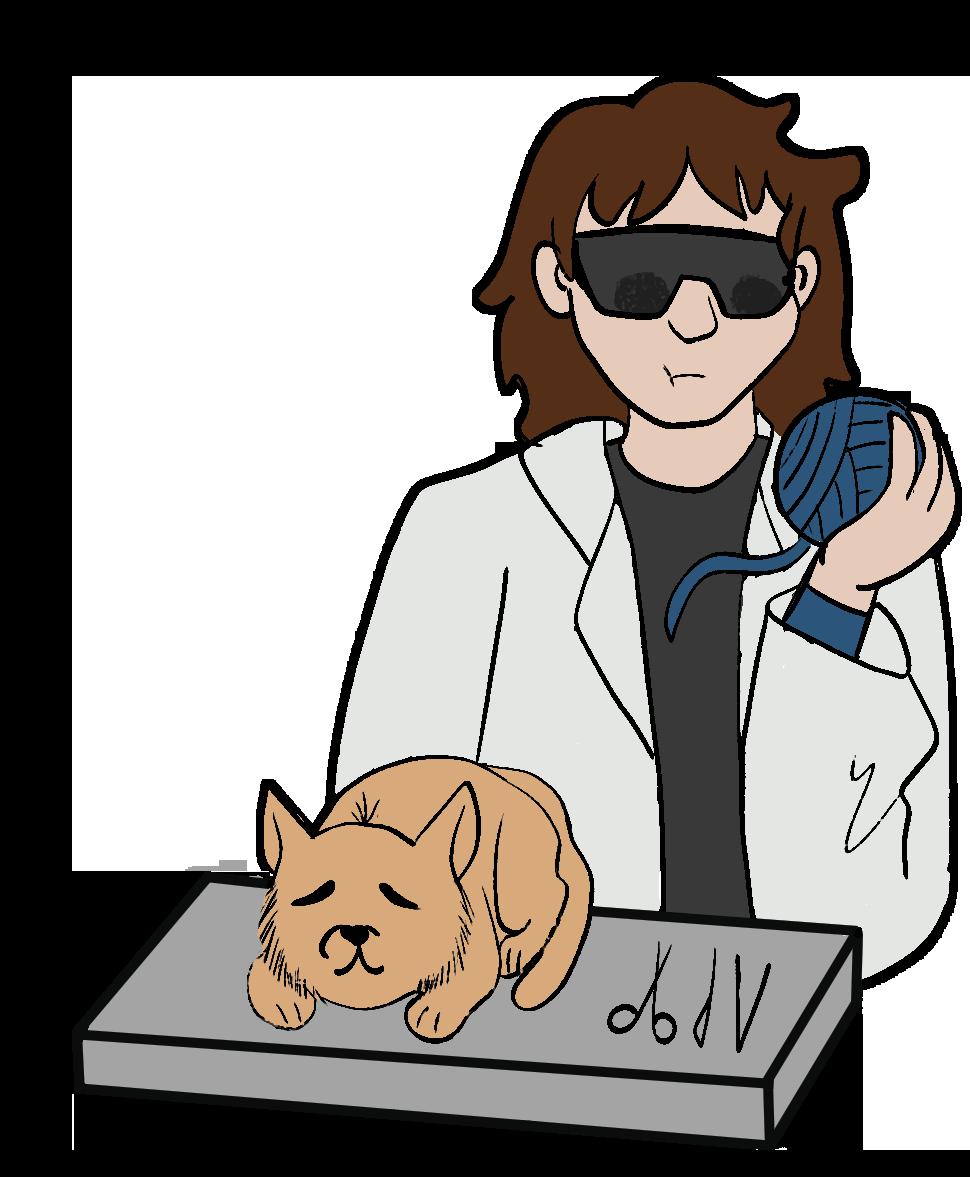
Hannah is a junior majoring in Earth and Environmental Science and Recreational Therapy. She works at First Landing State Park as a park ranger. Visit her website at www. managingferalcats.org for more information on feral cat control.
From the warmth of a mother’s side and a belly full of milk, life for most kittens begins in comfort. Adoption promises even more: steady meals, soft beds and gentle hands that lift and cradle. But for some cats, that promise shatters without warning. The hands disappear. The meals stop. Concrete replaces carpet, and the roar of passing cars drowns out the quiet safety of home. Nights grow longer and harsher; hunger drives desperate scavenging through overflowing trash bins, where the scent of rot and bacteria lingers. Shadows flicker in the underbrush as small native animals scatter, their habitats no longer safe from new predators. What begins as a story of individual abandonment unfolds into a wider, interconnected crisis, one that entangles animal welfare, public health, conservation and financial strain in a problem with no simple solution.
While feral cat colonies are often viewed in a positive light, even, in certain cases,
being labeled as a group of “community cats,” they often cause harm that isn’t immediately obvious to the general public. In some instances, there are emotional connections to feral cats in communities which can blind community members to the damage inflicted by and on unowned cats.
Not only are free-roaming cats a risk to human health, sanitization and generally harmful to institutional success and perception, they also contribute to an incredible amount of damage to local ecosystems. Given our understanding of the multifaceted nature of the issue and complexity of coming to a solution, it is clear that colleges and other institutions must move beyond passive compassion and adopt coordinated, evidence-based strategies to manage feral cat colonies.
One question that was constantly brought up throughout the process of creating an action plan proposal for addressing the feral cat colony on VWU’s campus was, “Why should I care?” One of the most fascinating things I learned while studying the effects of feral cats on their environment and those they share it with was that their impacts were incredibly far-reaching. The presence of feral cats causes harm at so many levels that it seems impossible for anyone to oppose finding a solution, even those who I encountered that had no interest in animal welfare or the environment.
While one of the clearest and often most compelling arguments for modifying policy around feral cats was the welfare of the cats themselves, there are a number of other issues to consider. For myself as a student of environmental science, one of my highest priorities with this project was to begin to restore the native bird and small mammal populations on and around campus.
Feral cats are considered an invasive species, with some lists noting them as being within the top 100 most damaging and widespread invasive species globally. A single free-roaming cat can decimate their prey’s population, especially in urban areas where that ecosystem is already impacted. Just imagine the damage an
entire colony of ferals can do.
However, this isn’t just a topic that concerns other organisms. Proximity to feral cats has a measurable impact on us humans as well. Since they are considered pests in many places across the globe, their presence is often seen as an indicator of poor management and sanitization, which has a negative impact on an institution’s financial growth.
Even beyond impacting the institutions and corporations we are part of, they can transmit deadly diseases to humans. Most people know to be wary of wildlife given the possibility of rabies transmission, but fewer people would pass up a chance to pet a seemingly harmless and friendly cat in the early stages of a rabies infection.
This separation in perception of freeroaming animals and wildlife has the potential to cause devastating effects on public health. Even if only from a perspective of self-preservation, there is not a single person who should disagree with the necessity of addressing feral cat colonies in our community.
There is of course, a need to acknowledge and address the reason this issue is so prevalent on college campuses. While part of what makes feral cats such an invasive species is their ability to reproduce at high rates, this doesn’t account for how the colony began and how it has continued to grow despite high mortality rates for kittens.
The most common way that unowned cats appear on college campuses is through abandonment by students. Many students try to hide pets in their dorms and upon realizing that they may be caught “turn them loose.” But domestic cats are not wild animals, and neglecting a cat through releasing it outdoors is unequivocally a form of abuse.
Even beyond this more direct contribution to the growth of a feral cat colony, many people feed feral cats in an attempt to better their lives.
What this inadvertently does, however, is support cats in their ability to reproduce, inevitably causing more suffering in entire new generations.
Beyond that, causing a feral cat to become trusting of humans introduces them to the unfortunately common reality of malicious animal abuse. It can be hard for us to stomach that ourselves and the people we know may be contributing to this issue, but without recognizing that we as a student body are the source of the problem, we are complacent in its continuance.
BY GRACE HARRIMAN geharriman@vwu.edu
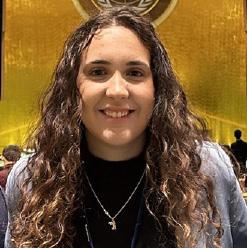
Working at a wedding venue, I have repeatedly watched trays of untouched, freshly prepared food being thrown away at the end of events. This food is not spoiled or unsafe; it is simply surplus. Over time, what initially felt shocking became routine. That normalization is what pushed me to ask why this is happening and, more importantly, why it isn’t being fixed.
I am aware that food insecurity exists within my own community. Over 14% of households struggle to access consistent, nutritious meals, even as large amounts of
edible food are discarded. This statistic highlights the current disconnect between surplus food and those suffering from food insecurity. What made this issue even more compelling is that solutions already exist. Organizations like Food Rescue US provide systems to redistribute food. In addition, there are federal protections under the Bill Emerson Good Samaritan Act that limit liability for donors. Yet, despite these tools, many businesses still choose not to donate because of a lack of knowledge about the benefits, proper safety practices and liability. From a business perspective,


the hesitation is understandable. Donation requires extra steps such as labeling, storing and coordinating pickups. In a fastpaced hospitality environment, those steps can feel like an unnecessary burden. When staff are focused on cleaning up and resetting for the next event, throwing food away is often the quickest and easiest option.
However, I argued that this mindset is short-sighted. The issue is not that the donation isn’t worth the effort; it’s that it isn’t made accessible enough.
Through my paper and multiple deliverables, I provide businesses with a step-by-step guide to safety practices, a list of incentives (tax
deductions) and a guide to their liability protections to encourage them to switch their waste to donation. So far, I have been able to encourage the Virginia Beach Sports Center to switch to food donation. With the help of Food Rescue US in Virginia Beach, we are working to establish a system for the Sportscenter to put in place so that donations can become a routine part of operations rather than an added inconvenience.
Ultimately, I chose this topic because it reflects a problem I have personally contributed to without realizing it. It is about rethinking what responsibility looks like in an industry built around abundance.





work ethic and respect. One concept she emphasized was “Kaizen,” meaning steady, incremental growth.
Despite those challenges, Hoover has built a department grounded in the Division III philosophy of putting academics first.
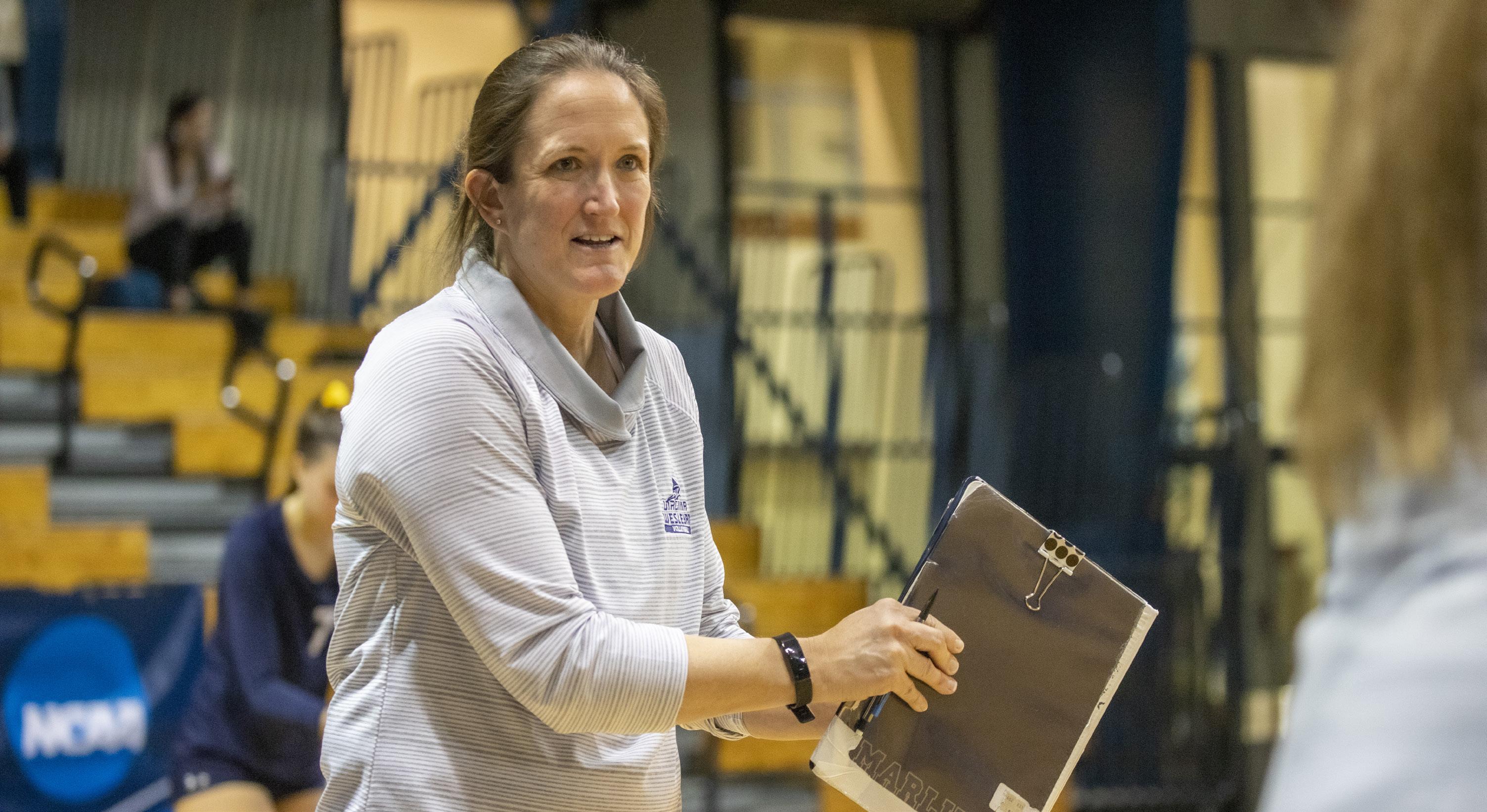
VWU is celebrating a major milestone as Athletic Director (AD) Andrea Hoover marks 20 years of helping shape Marlins athletics into a culture built on growth, relationships and student-athlete success.
Over the past two decades Hoover has developed VWU Athletics into an environment where student-athletes and coaches can succeed on and off the field
Hoover has helped keep the Marlin’s at the forefront of division three athletics, culminating in three NCAA DIII Softball World Series appearances, one national finalist and one national championship in 2021.
Hoover’s journey into athletics began with her passion for education and sports. After earning a degree in health and physical education and working in public schools, she transitioned into collegiate athletics while pursuing her graduate degree and coaching volleyball.
“I’m really passionate about education and sports,” Hoover said. “I just really loved going to work every day, … being around student-athletes and helping them pursue their education.”
That passion led her to VWU, where she built a volleyball program centered on key values like continuous improvement,
“When you walk into the gym every day … you should want to improve,” Hoover said. “Sometimes it’s big improvements, sometimes it’s small ones.”
Those values have carried into her role as AD, where she now oversees 26 sports and focuses on developing both programs and people. However, the transition from coach to administrator came with challenges.
“She gave me an opportunity ... and has believed in me every second since then.”
Women’s Basketball Head Coach Megan Belo
“You’re going from managing 18 to 22-year-olds to managing an entire department,” Hoover said. “Facilities was a huge learning curve for me … there was a lot to learn.”
wanted it to be,” Wills said.
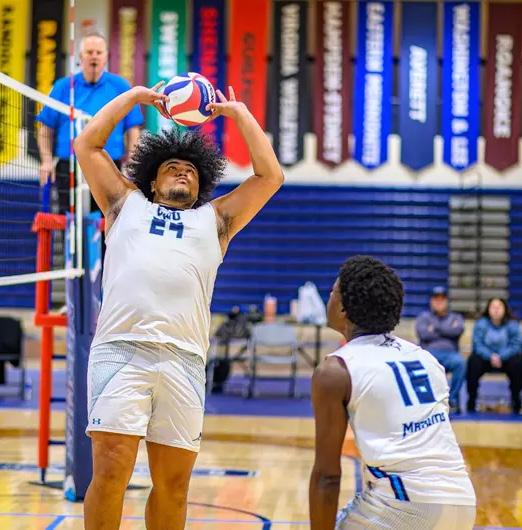
Individual success was also recognized with three AllConference selections: JaMarhe Wills earning First-Team All-ODAC honors, Ajaye Davis was named Second-Team, and Grant Younie was given Third-Team recognition.
Wills led the Marlins on the court with one of the most dominant performances in the ODAC, boasting an impressive 4.35 kills per set. With a 0.325 hitting percentage to match, the centerpiece of the Marlin offense contributed across the board.
“I was always just looking to be better as a teammate and as a team,” Wills said. With 203 digs and 40 total blocks, Wills finished the season with a team-leading 521 points. In the 2025 season, Wills was awarded Second-Team All-ODAC. “This season was different; it was everything I
“At Division III, you’re a student first,” Hoover said. “Athletics is a privilege … the goal is to make sure our student-athletes understand the value of their education.”
Her leadership style has made a lasting impression on coaches, including Women’s Basketball Head Coach Megan Belo, who credits Hoover as a major reason she joined VWU.
“A big reason why I’m here is because I wanted to work for an AD that I believed in, who believed in me,” Belo said. “She gave me an opportunity … and has believed in me every second since then.”
Belo recalled how Hoover supported her during difficult moments, especially while rebuilding the program.
“She just knew what I needed in that moment,” Belo said. “She put her arm around me and said, ‘I believe in you.’ That meant everything.”
Hoover’s consistency stands out to those around her, as she provides the same level of support regardless of wins or losses.
“Win or lose, she’s the same,” Belo said. “She’s there for you, and that speaks to her character.”
Beyond supporting coaches, Hoover is known for building strong relationships with student-athletes. She regularly attends
Wills also earned an All-ODAC Third Team award for his play and leadership on the soccer field in the 2023 season. “My goal this year was to lead the team and be a better teammate and role model,” Wills said.
Davis is the team’s primary setter and instrumental to the Marlins’ offensive system’s success, recording 1,094 assists and averaging almost 10 assists per set.
His defense isn’t lackluster either, with 183 digs and 22 total blocks; Davis’s hard work demonstrates his AllODAC recognition.
Younie earned Third Team All-ODAC recognition with an all-around strong performance as a senior opposite hitter, transitioning from an outside hitter role last year. “Being able to come in and find a role for me this season was awesome,” Younie said.
With 258 kills and averaging 2.30 kills per set, Younie
games, stays visible and makes an effort to connect with athletes across all programs.
“She knows everyone’s name,” Belo said. “She shows up, she supports and she makes you feel like you matter.”
Hoover believes those relationships are essential, especially during a transformative time in students’ lives.
“This is such an important time … from when students arrive to when they graduate, the growth you see is amazing,” Hoover said.
One of her proudest accomplishments is the culture she has helped build within VWU athletics.
“We’ve brought together a group of coaches who are helping student-athletes become better people, not just better players,” Hoover said.
With 26 sports and continued growth across programs, VWU athletics continues to evolve under her leadership.
“It’s a really special place,” she said. “I’ve been really thankful to be part of it.” For those who work alongside her, Hoover’s impact goes far beyond her title. “There’s no AD in the country I’d rather work for,” Belo said. “She’s someone you want to win for.”
As VWU celebrates this milestone, Hoover’s legacy continues to grow through the coaches she leads, the athletes she supports and the culture she has built.
stood as a strong front for the Marlins’ offense. On the defensive side, Younie wasn’t a slouch. With 186 digs and 28 total blocks, he was a reliable option in both front and back rows.
The Marlins opened the year going 11-1, besting their first two ODAC opponents, Shenandoah and Bridgewater, while only dropping a single set. The next two conference opponents the team had to face were top-ranked Roanoke and Randolph-Macon. “We had a rough point in the middle of the season,” Younie said.
After the two losses, bringing the year to 11-3, the Marlins came together and “cut it off,” Younie said.
“28 kills against Eastern was something special,” Wills said. “Being able to step up and be the leader I knew I could be for this team is something I won’t forget,” Younie said.
Both Wills and Younie mentioned the van and bus trips as fond memories from their times at VWU.
The freshman broke a school record by two minutes and 36 seconds.
BY CASTON CHRISTMAN cbchristman@vwu.edu
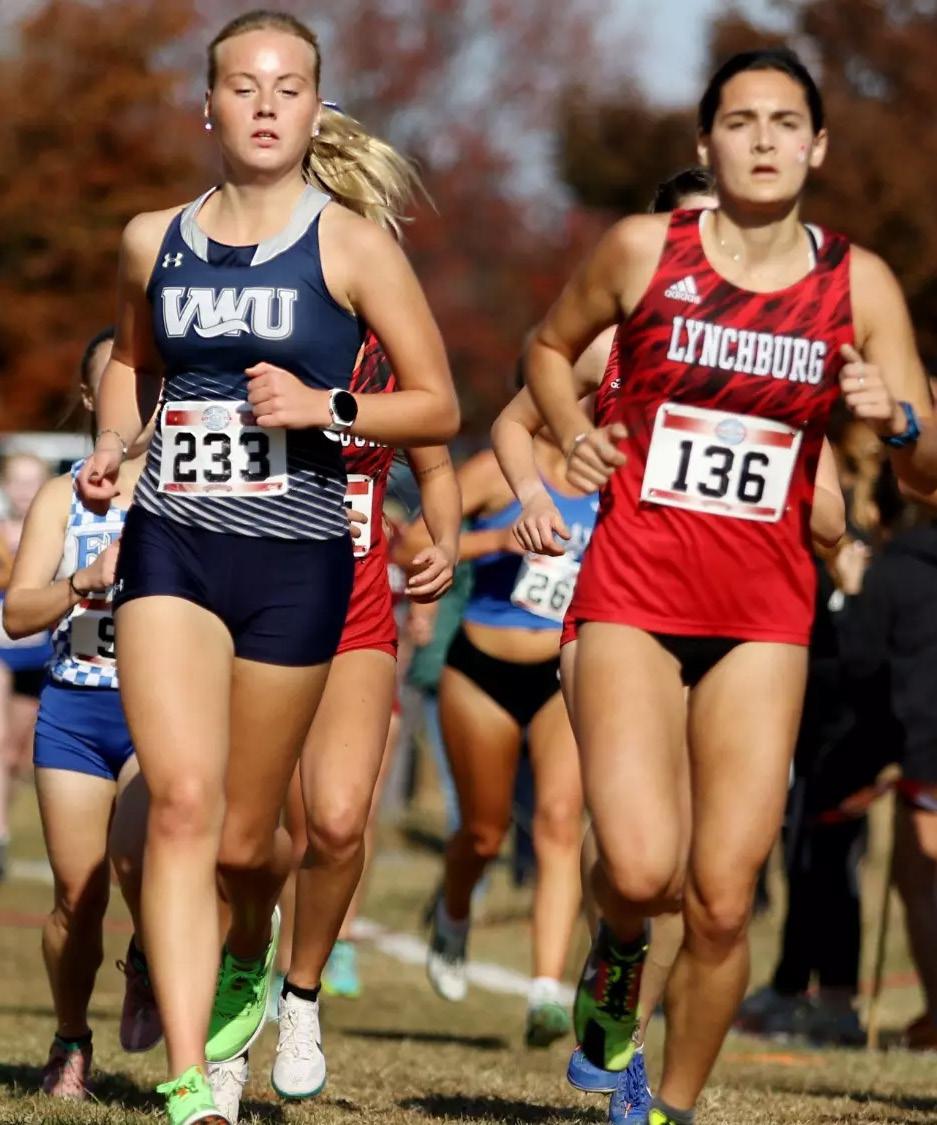
Ester Zar, a freshman hailing from Jönköping, Sweden, has been making history at VWU. She’s set three team records and won the ODAC Championship in the 5000-meter event.
Her school accolades include records in the Outdoor and Indoor 5K and the 10K events.
She beat the previous record holder for the 10K by nearly three minutes and being the first Marlin selected All-Region since Marissa Coombs was selected in 2017.
Ester originally came to VWU as a tennis commit, having never competed on the track before. She decided to become a walk-on for the cross-country program and fell in love with it instantly.
“I initially came here to play tennis, but after I got here and joined the track and cross country teams, I decided to quit tennis and focus fully on running,” Zar said.
“It was my decision, but I had a lot of support. My coach never pushed me to quit tennis, which meant a lot to me,” Zar said.
She has impacted the team since joining it even in quiet ways.
“Since day one, she’s really bought into what we’re trying to build. From a leadership standpoint, she leads by example. She does everything right, on and off the track, and that’s been inspiring for everyone on the team. She’s shown everyone that it’s possible,” Cross-Country Head Coach Jacob Balot said.
Having to go through school in another country with different cultures and traditions can be challenging, but Zar said she enjoys the new experiences at VWU.
“It’s great. It feels like a community, and we get a lot of help from the faculty. Even though it’s far from home, it still feels like
home and it means a lot to me,” Zar said.
Zar is known for more than just her speed on the track. Her teammates said she is known for her positive attitude and caring personality.
She checks on everyone after races, no matter the outcome of their performance.
The coaching staff wanted Zar to prioritize the 10k as her main event, even though she had never run it before she set that record.
“She ran a 36:34 in her first 10K, which broke the school record by almost three minutes. That was her first 10K, but she ran like it was her tenth. She competed really well against high-level athletes and held her own,” Balot said.
Her teammates spoke highly of Zar on the track and as a person. “Ester is someone who is always smiling and has such a great attitude about everything. On and off the track, she pays attention to everyone and makes sure to check up on us. She has helped bring the team together more by just going out there, having fun and breaking records,” junior Zantia Durand said.
“It might be her first time running, but it’s not her first time competing,” Balot said.
Zar’s teammates and coaching staff said she can compete at the national level to bring another championship home to VWU.
“She’s currently sitting around no. 35 in the country. The goal now is to drop more time in the 10K and put her in contention to qualify for nationals,” Balot said.
Zar said she encourages international students to athletically branch out. “My advice to international students thinking about playing sports in college would be to just do it, believe in yourself and what you can do,” Zar said.
Ester leads by example on the track
with her work ethic and her determination during practices and meets.
“Her strength is being able to keep such a fast pace with great endurance and still get faster. Her strengths are also always being early to practice and getting the job
For some, double the practice is double the reward.
BY BAILEY GRAY AND JAIDEN MITCHELL bcgray@vwu.edu and jimitchell@vwu.edu
VWU is home to many dual-sport athletes, especially those having track and field as their secondary sport. Because it is an individual sport, it is easier to organize an alternate practice schedule with a coach, according to senior Mackenzie Swanson, a member of the track and field team and the softball team.
“Track and field gives athletes an opportunity to specialize in what they are good at,” Swanson said.
Swanson said many athletes use track and field as a conditioner for their other sport. “I decided to throw just to keep myself active for softball and I loved it,” Swanson said.
Swanson said she loves everything about both sports, and she doesn’t think she could do one without the other. According to Swanson, both sports give her a place to “push herself to be the best that she can.”
For dual-sport athletes, balancing athletic life and education is key. Swanson said that once you understand your schedule, it is very manageable. These athletes must have good time management skills and be communicative with coaches.
“I send a schedule to all of my coaches every Sunday to let them know what is going on. Having a set plan for the week helps me know when I will have time to get school assignments done,” Swanson said.
Junior Ella Clingenpeel participates in track and field and cheerleading. “My sports do overlap sometimes, but both of my coaches are super flexible,” Clingenpeel said.
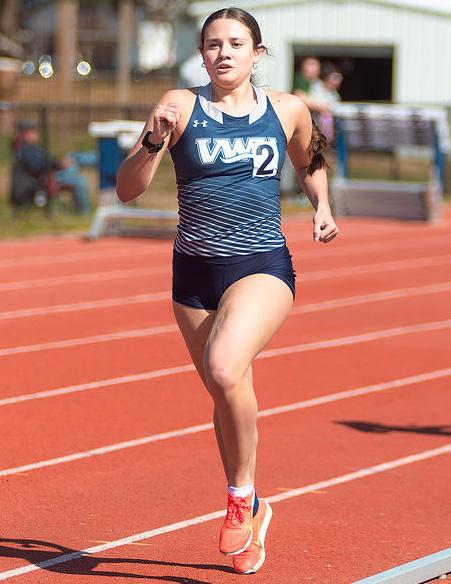

Clingenpeel said she always puts grades and academics first because it is a huge priority.
Time management is the main concern for these athletes, as the time commitment threatens sleep and coursework.
“If you want to be successful and healthy, you have to take your training and your recovery seriously,” Swanson said.
This lifestyle forces athletes to prioritize performance. Swanson said she does not sacrifice sleep because it is too important to her performance on the field, track and in the classroom.
Freshman Abbey Samples competes in track and field and volleyball. She has been playing volleyball since seventh grade, and running track and field since her junior year of high school.
Similar to Swanson, Samples said some aspects of volleyball help with her abilities in track and field, such as her jump start and endurance.
To avoid overworking her body and being too tired to perform both sports, Samples said she practices active recovery. This means doing low-intensity movements such as light stretches or walking to reduce muscle soreness. Most dual-sport athletes participate in active recovery because they may not always have time for complete rest during the season.
Regarding full-out cheer competitions, Clingenpeel said she notices the benefits from pushing herself during the track season. “The endurance for track helps the endurance for cheer,” Clingenpeel said.
She said she enjoys the challenge of pushing her body to its limits for track and cheer. She loves performing in front of a crowd, and it’s overall fun being around the other girls.
Although these athletes’ seasons overlap and their workloads increase, they all enjoy participating in multiple sports.
Swanson and Samples said they love participating in both sports because they enjoy being with their teammates,
competing and building relationships throughout the seasons.
Clingenpeel said she is always working toward a new goal in both her athletic and academic life. “If you don’t procrastinate on anything, you can find a healthy balance between academics and sports,” Clingenpeel said.
Being a dual-sport athlete is challenging in terms of time commitment and physical demands, but these athletes think that managing these challenges is worth the benefits.
BY BRYANT COTTERELL bccotterell@vwu.edu
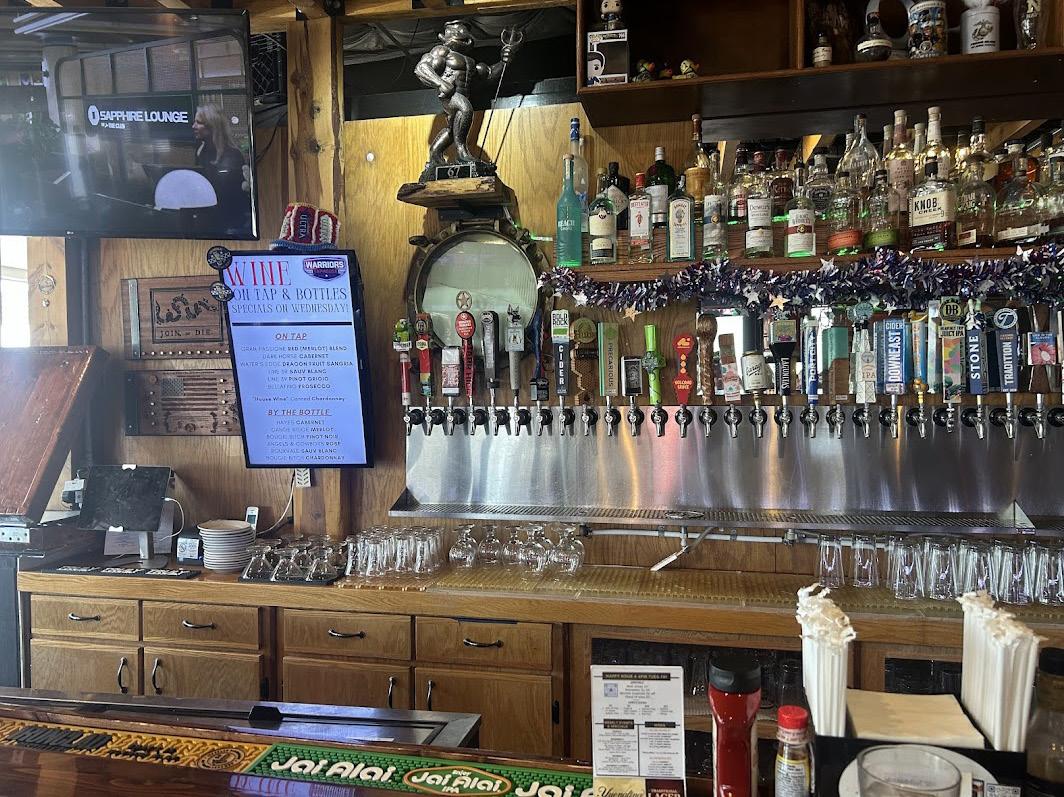
On a weekend afternoon, Warriors Taphouse carried a steady, easy energy. It was busy, but not crowded. The space itself was split in two, with a dining room tucked to one side for those settling in for a full meal, and a bar area on the other where most of the movement and noise happened. Behind the bar, servers and bartenders leaned into casual conversations with guests, creating an atmosphere that felt more familiar than formal. Most of the crowd watched the Masters golf tournament on the TVs, drawing small clusters of fans into quiet and shared focus.
Outside, patrons occupied a handful of tables. Guests sat beneath umbrellas, taking advantage of the shade in the sunny weather. The whole scene created a balance: part neighborhood hangout, part sports bar and part laid-back dining spot. Rather than relying solely on typical
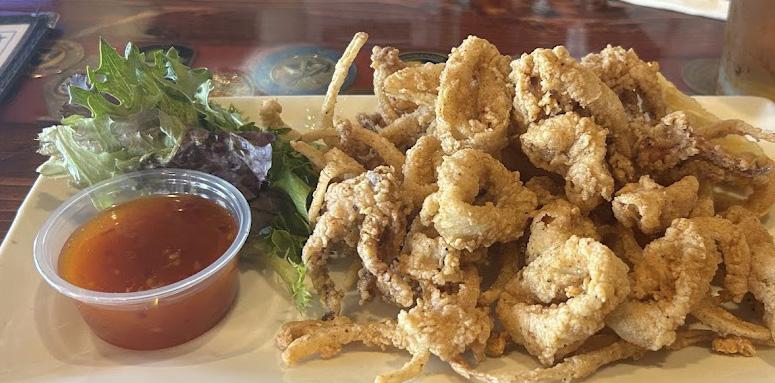
bar food, the menu had a noticeable influence of home-cooked meals, offering dishes that felt a step above what you might expect. That said, the classics were still there, giving the menu a familiar foundation. Some of the items include the calamari, which arrived hot and crispy and went well with the Thai chili sauce. The bourbon chicken stood out as a clear favorite, offering a balance of sweetness and savoriness that felt both comforting and carefully prepared. The Warriors Craft Burger also delivered, with first-time patron Logan Cotterell describing it as “a top-ten burger I’ve had around here. Bacon jam is something I never knew I needed in my life.”
As expected from a taphouse, the beer selection was extensive. A selection of IPAs from the bar paired well with the meal, and rounded out the dining experience.
The atmosphere at Warriors Taphouse was shaped largely by a crowd that seemed older and familiar with the space. Many of the patrons appeared to be regulars,
creating a sense of routine and community.
One of the regulars, David Brock, said, “I’m usually in here at least once a week,” adding that, while the location is convenient, “service and beer are the real reason I keep coming back.”
That sense of consistency was reinforced by the staff, who remained attentive without being overbearing. Servers moved easily between tables and the bar, adding to an environment that felt relaxed and personable.
The space carried a strong military bar influence, with memorabilia displayed throughout, representing the veteran service of the owners.
The most memorable feature was the bartop itself, which showcased hundreds of embedded badges, giving the room a distinct character and a sense of history that regulars and newcomers alike could take in while they sat and talked.
While the owners were not available for direct comment, much of Warriors Taphouse’s identity could be gathered through the space itself. Located in Virginia Beach, an area with a large military population, the bar’s focus on military imagery felt intentional and connected to the local community.
According to the restaurant’s website, all three owners have strong military ties. Their interest in craft beer is not just
about the menu, but also part of a broader effort to give back, with support directed toward organizations that help fallen and combat-wounded veterans, along with their families.
That sense of purpose also came through in how patrons experience the space.
“I rarely ever have a drink, but the food here is good enough,” said former Marine and patron Mike McInnis. “It gives me peace of mind knowing that the money I spend here is going to causes that support veterans like me.”
From the badge-covered bartop to the star-spangled banners across the walls, the design feels personal and adds character to the space.
What ultimately defined Warriors Taphouse was not any single aspect, but the way all of them settled together over time. It felt like the kind of place that revealed itself gradually; less about making a strong first impression and more about becoming familiar with each visit.
The steady presence of regulars, the ease of conversation between staff and guests and the small details built into the space all point toward something built for consistency rather than spectacle.
For those passing through, it offers a solid meal and a comfortable place to sit. For those nearby, it seems to offer a place that fits easily into a lasting routine.
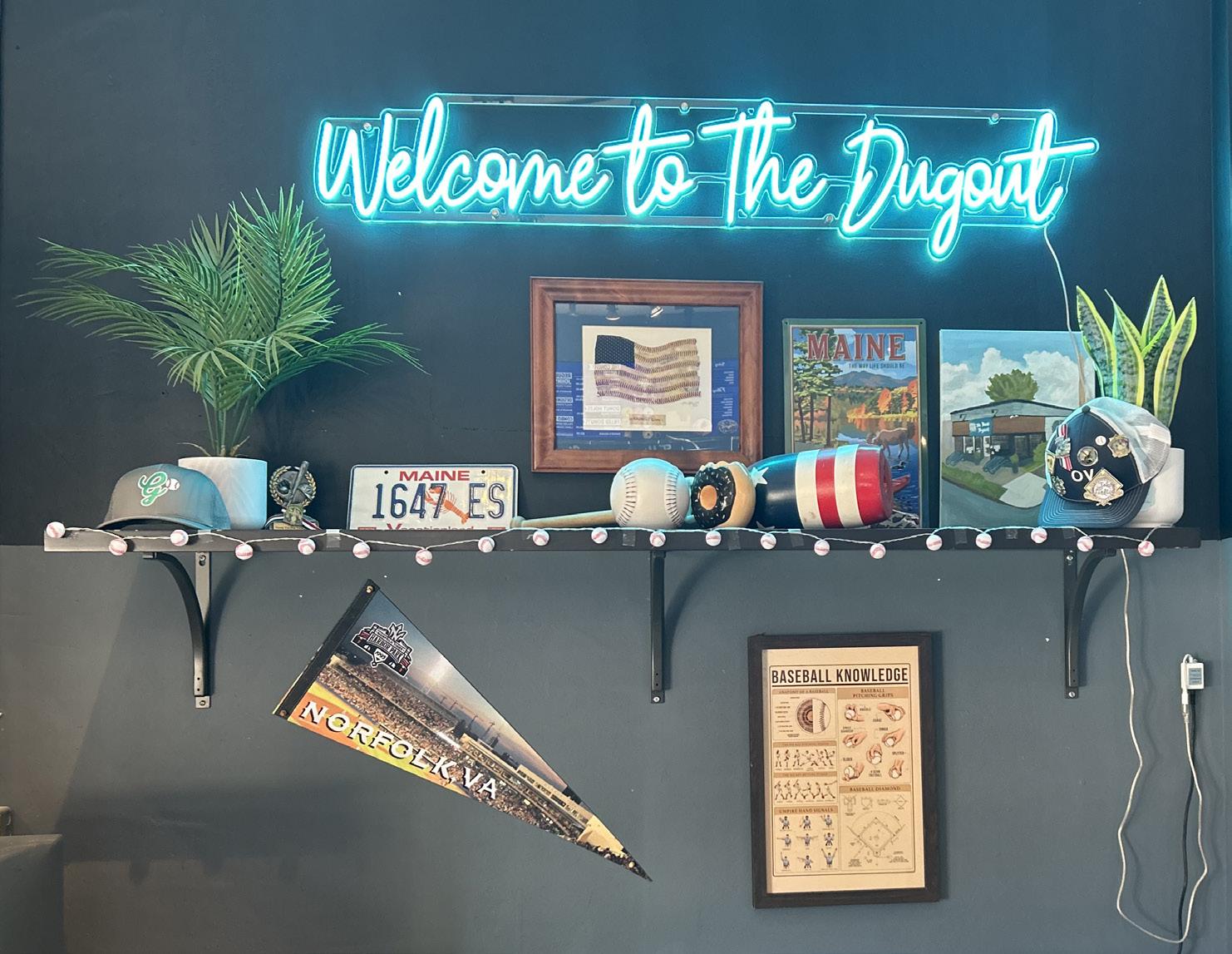
baseball being such a big theme for a lot of people who come in, like locals.”
BY MARS SMITH rssmith@vwu.edu
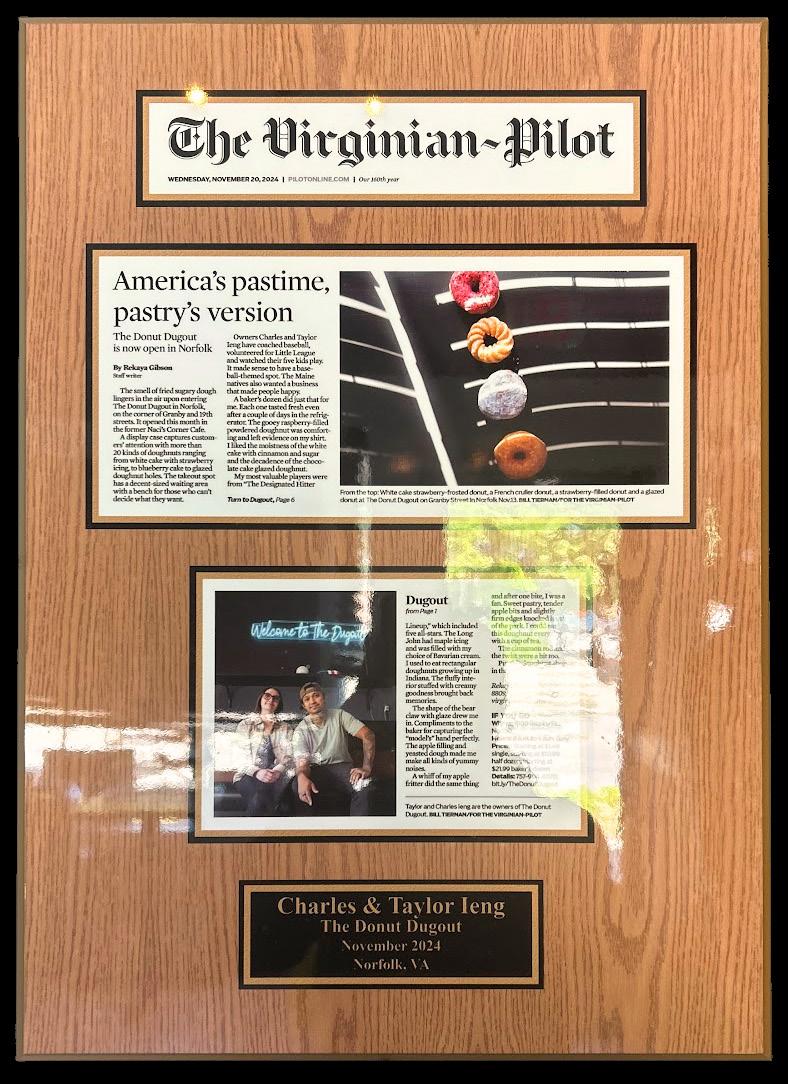
Located on Granby Street in Norfolk, The Donut Dugout is a family-owned and operated donut shop that places baseball as the main theme of its business. The staff there are warm and highly informative. Upon arrival, the owner’s brother, Nate Ieng, was more than willing to help.
“The shop is baseballthemed because Charles and Taylor’s children play baseball, so it’s a way to represent them,” Ieng said.
According to Ieng, donuts are made in-house because “it’s nice and fresh. The process typically starts around 9 p.m. and it can end as late as 5 a.m.”
“What stands out most to me is that they have donuts and baseball,” freshman Fatima Ibrahim said. “Especially with
“It’s nice being centered in Norfolk,” Ieng said. “The connection with the community makes it worth it.” Ieng pointed out Donna Smith, a Norfolk local and The Donut Dugout regular.
“The taste and quality is good,” Smith said.
“Nate was so nice. He was so open, talked to us, got to know us, even asked our names,” freshman Caddy Lang said. “He gave us a good overview of everything in the store without seeming irritated or anything of the sort.”
“I think it was really yummy. I really like the jelly filled donuts,” Ibrahim said, adding that she liked the flavor balance of the filling. “I think the lemon filling had a
really good tang, and especially with the raspberry filling, you can really taste that it was made fresh.”
“It literally melted in my mouth,” Lang said. The Donut Dugout’s Facebook page advertises their variety, “from cake style to
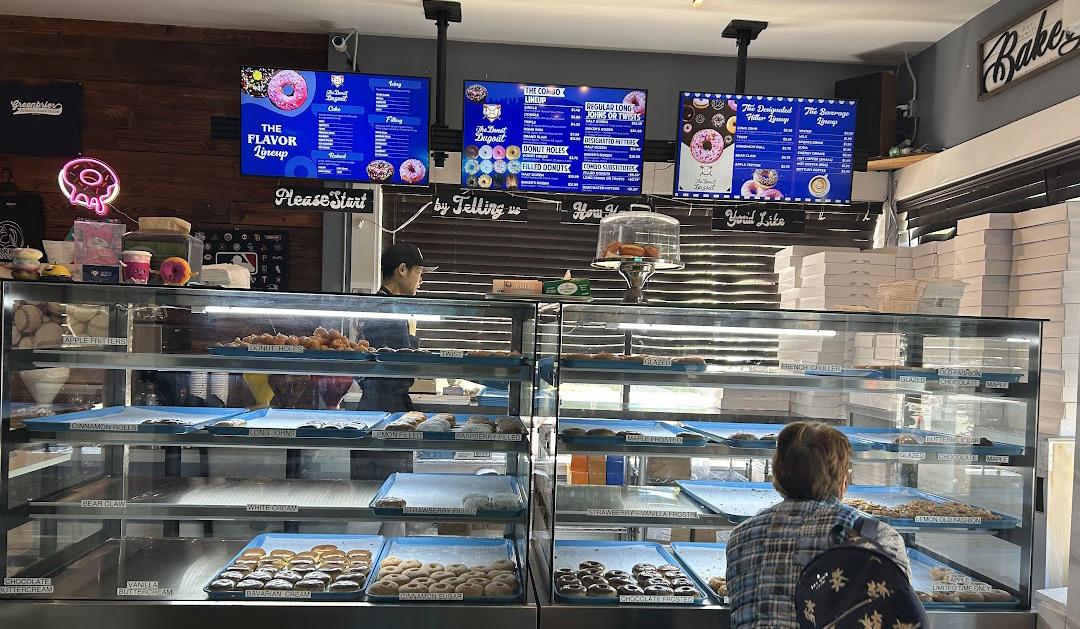
light n’ fluffy yeast.”
“It was fluffy and, overall, a delightful experience,” Lang said.
Lang agreed that there was ample variety.
“I feel like I can be kind of stingy, sometimes. But I immediately recognized a multitude of things that I personally would like,” Lang said. “And there were things that my friends liked as well, such as the jelly filled donuts and their blueberry donuts. They had some exclusives, it was nice. I really liked it. It was a really cozy shop.”
The variety wasn’t the only thing that customers enjoyed.
“I think the pricing was really amazing. If you go to Krispy Kreme, you’re not gonna get a donut for $1.50,” Ibrahim said. “I got three donuts and a soda for $7 which is a pretty good price and that’s pretty cool.”
“You can’t get a donut for $1.50 anywhere else,” Smith said. However, Smith added, “It sucked a little because the one [flavor of donut] we came here for was gone by the time we got here.”
The Donut Dugout is open everyday from 6:00 a.m. to 4:00 p.m. On their Facebook page, it’s stated that they may sell out of donuts. The current exclusive being sold is the apple donut. The Donut Dugout is a solid Norfolk staple with fresh donuts to support the newest baseball games.
BY LORA YOUNG llyoung@vwu.edu
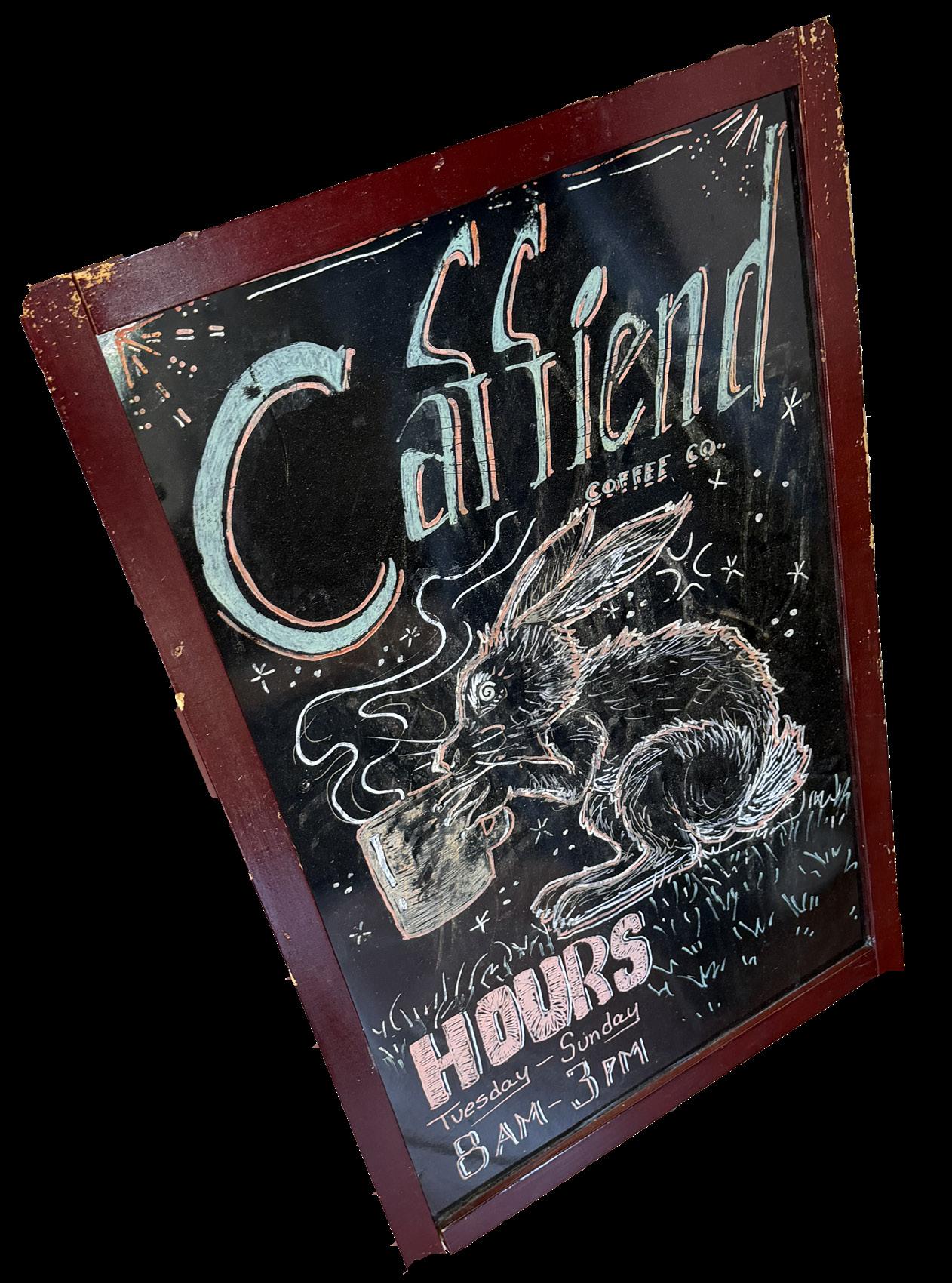
On a warm Friday morning in Ghent, a line stretched out the door at Caffiend Coffee Company, a local coffee shop that opened last May. Caffiend Coffee Company is a family business owned by Jaclyn Martinez and her husband Brandon.
Martinez’ dream began in 2019. “I thought, ‘let me just do something silly,’” Martinez said. She decided to look up coffee shops for sale in Ghent.
She discovered a cafe venue that was previously known as “May’s Parlor.” The shop came with equipment from the previous tenant. This allowed her to get right to work on making her dream come to life.
“We are proudly black-owned, woman-owned,” Martinez said.
For Martinez, opening a coffee shop was within the larger mission of creating something meaningful for the community and for her family.
“I did it to show that it’s possible,” Martinez said. Martinez said that she wants her children to know that they can do things like this. The community recognizes this representation and its impact.
“Norfolk is a historically black built city, so I think it’s really important to support businesses like this here,” customer Mandi Pesha said. The coffee shop is somewhere people can be comfortable and feel supported by the community.
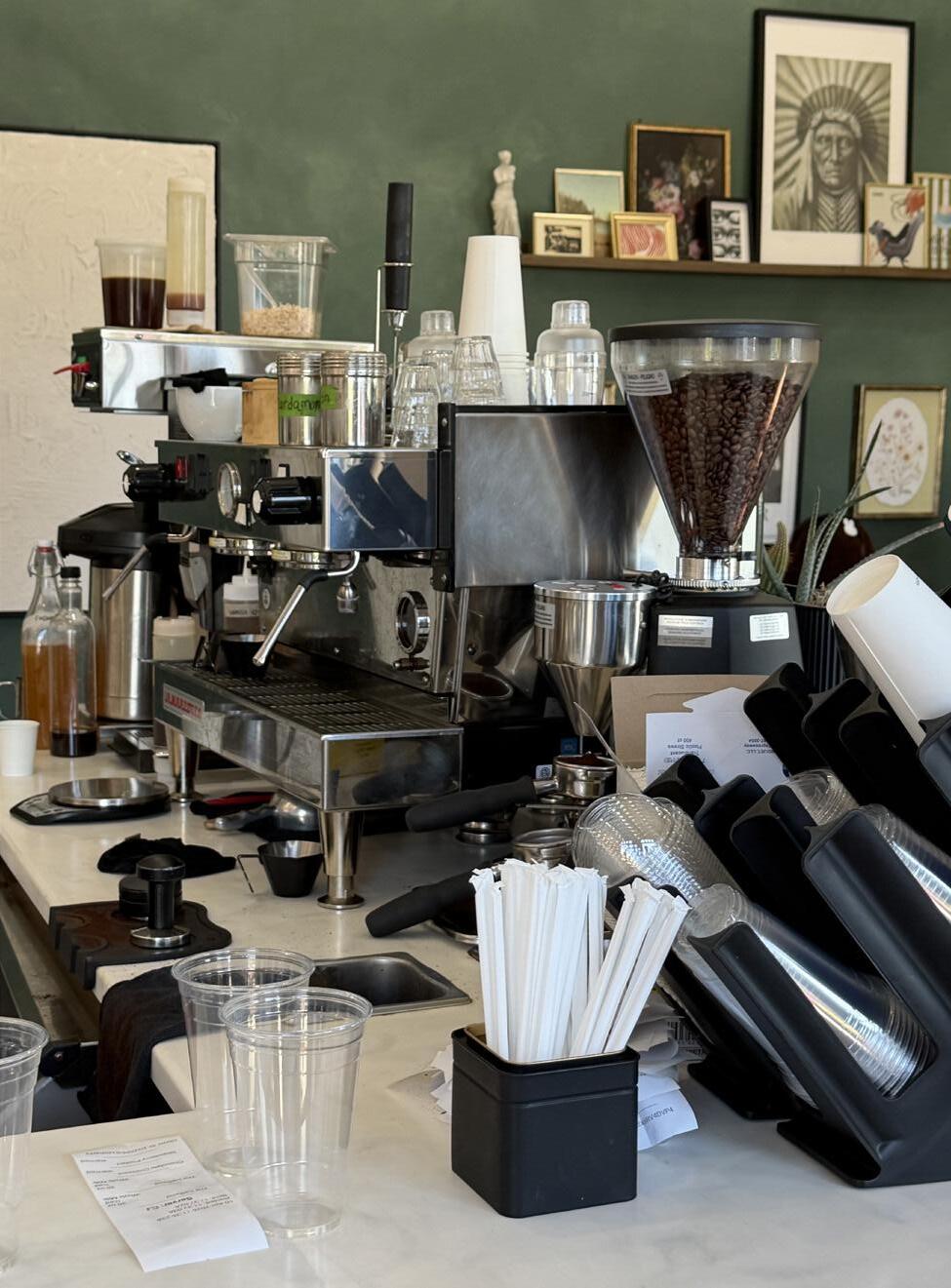
Pulling into the parking lot, customers are greeted by a comforting setup of picnic tables and hanging lights outside the shop. The interior is a bright, inviting space, with abstract landscape paintings and vintage prints that
give the shop a cozy feel.
“I just want it to feel like a home away from home,” Martinez said.
The shop’s interior is limited to a few tables, but on warmer days, there are tables outside to dine on.
“It’s a small shop, but it feels really personal and welcoming,” Pesha said.
The shop is often busy, especially in the mornings. During these peak hours, the owners step in and support the staff.
“Even if we’re jam-packed with a line out the door, every single person should feel like we want them there,” Martinez said.
The customer experience is delightful. The baristas are quick, moving pastries in and out of the oven, mixing and pouring drinks and ringing up orders.
The baristas make the drinks right in front of you, showcasing the process for the customers. The countertops are open and visible for everyone to see, wrapping around the room for full visibility.
“There were two employees working when I arrived, and they instantly looked up and greeted me with a smile,” junior Suzanna Fernandez said.
Martinez said that consistency is something she is very passionate about. The baristas use a scale to weigh everything put in the drinks, such as matcha powder and syrups. Everything is made to be high quality.
“One time, I wanted to design my own drink. The barista mixed syrups for me to taste before making my drink to make sure I liked it,” Pesha said.
Due to few staff, it can be a long wait for drinks while orders rack up. Despite this, the employees apologize for the wait and work to create beautiful, flavorful drinks.
The shop has seasonal menu items throughout the year. The spring lineup includes the salted maple banana latte, the blushing bloom matcha and the coconut cloud latte. The menu also includes signature lattes with one being named after the shop itself, “The Caffiend.”
The shop’s pastries include homemade toaster pastries, croissants and empanadas.
“It definitely tasted like the food was freshly made today. I got the cinnamon crumb cake and it was so moist and flavorful,” Fernandez said.
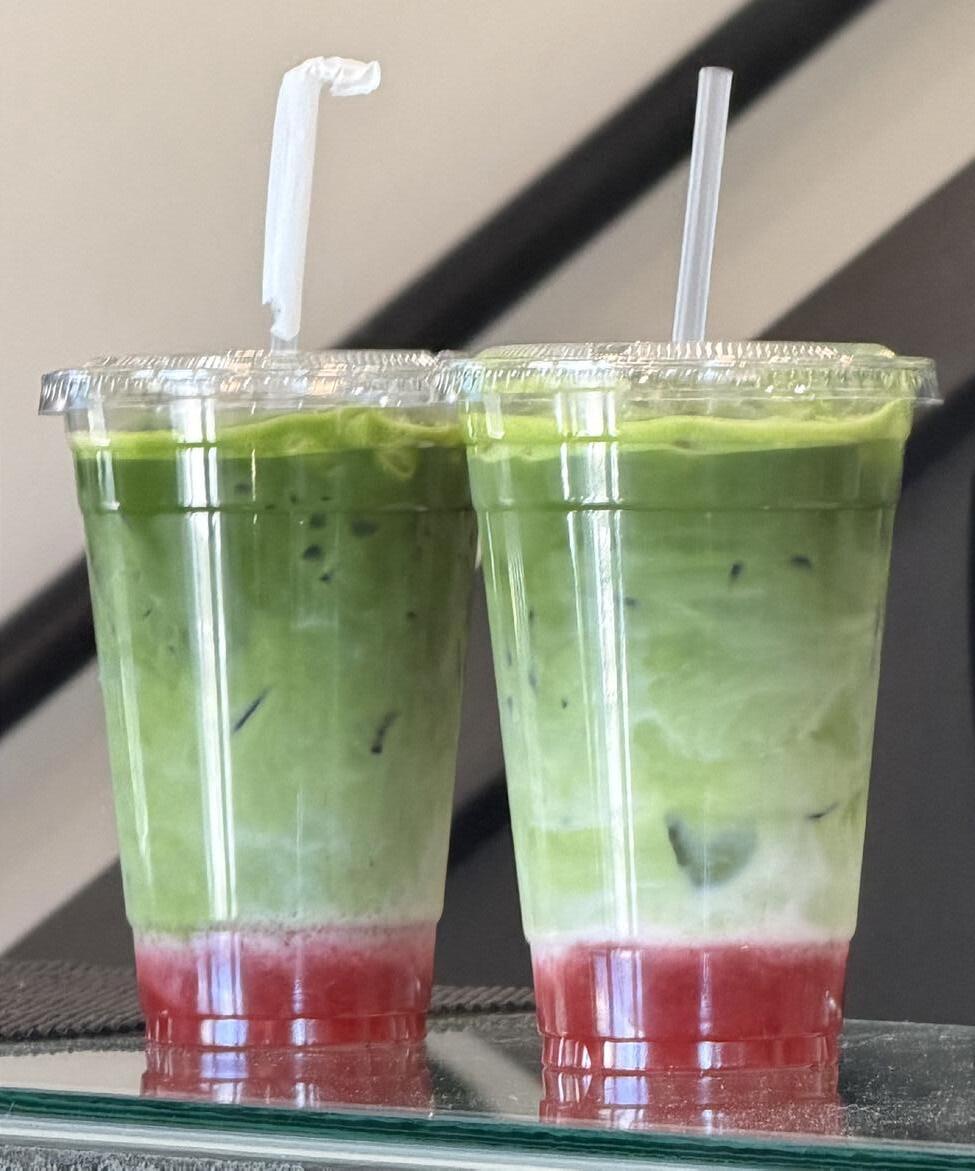
As drinks were presented on the counter, it was hard not to be in awe. The matcha drinks were visually
stunning and vibrant in color. One featured red syrup on the bottom and a perfect layer of green matcha on top. Almost everyone took pictures of their drinks before they touched them.
“I want to stay small and do it right for a few years,” Martinez said.
She hopes that word of mouth will continue to keep the business busy in the future. The shop hosts pop ups for small businesses in the area. Martinez wants to support local vendors and bring people together from different backgrounds.
“I wanted to build the shop on being interconnected within the community,” Martinez said.
For those looking for affordable coffee and a welcoming community, Caffiend Coffee Company is worth a visit.