Gross foreign reserve increased by USD 6.1 Bn in Sep'25 compared to Jan'25
E-Commerce Transaction
(In BDT Millions) (In BDT Millions) (In USD Billions)
E-Commerce transaction has increased by 29% compared to August 2024. Transaction value has been over BDT 20,000 million since December 2024.
Net foreign reserve (IMF Formula) increased by USD 6.6 Bn in Sep'25 compared to Jan'25
MFS Transaction Net Foreign Reserve
MFS transaction keeps on rising as it increased by 9.6% YoY in August 2025. Transaction volume of August 2025 is 3.5 times greater than of August 2020.
Internet Banking Customers
(In Millions)
Internet Banking customers is increasing rapidly as it increased by 32% YoY in August 2025. Internet Banking customers increased by 4.1 times in just 5 years.
Internet Banking Transaction
(In BDT Millions)
With the rise in Internet Banking users, the transaction volume of internet banking is also seeing the same trend. In August 2025, the transaction volume increased by 47% YoY.
Telco Subscribers
In September 2025 (Millions)
GP remains the market leader in the telco sector with 46% of the market share.
Internet Subscribers
In September 2025 (Millions)
Compared to Jan'25, Mobile internet users increased by 3.68 Mn and ISP & PSTN users increased by 0.42 Mn.
When the Product Is the Message:
Why Mamdani’s Victory Isn’t a Marketing Triumph, but a Systemic Shift
This wasn’t about great marketing. It was about a great product.
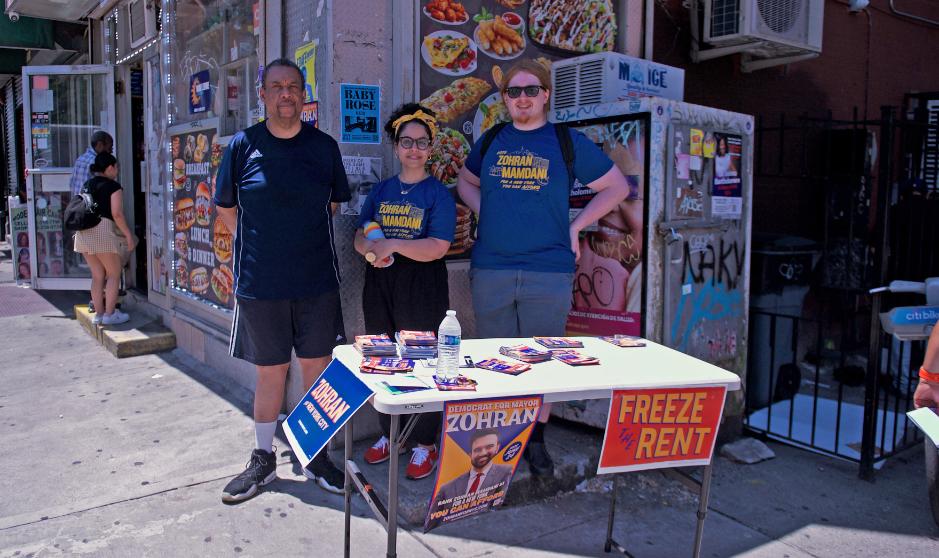
When Zohran Mamdani swept through New York’s political stage, many called it a communications masterpiece. But beneath the well-crafted campaign lies something far more profound: a systemic success rooted in leftist, people-centric ideals that resonated with a society hungry for change.
Because at the end of the day, when a product, whether it’s a service, an idea, or a person - aligns perfectly with public sentiment and addresses real pain-points, marketing becomes a natural extension rather than the primary driver of success. Mamdani’s victory wasn’t a play of slogans or social media strategy. It was the inevitable outcome of a societal moment centered on a city leaning on empathy over efficiency, community over capitalism, and authenticity over artifice.
The Candidate as Product
Zohran Mamdani, a 34-year-old progressive with immigrant roots, entered the race not with cor-
porate backing nor with legacy networks. It was about conviction. His vision centred on rent freezes, fair taxation, city-run services, and accessible housing. He stood firmly with LGBTQIA+ communities, championed public welfare, and positioned himself as standing against the machinery of capital-driven governance.
In marketing terms, he wasn’t just another candidate. He was a product-market fit.
New York was exhausted. Soaring rents, widening income inequality, and years of political theatre had left citizens yearning for something real. Mamdani didn’t invent that desire; he simply embodied it. His campaign tapped into the collective exhaustion of a working class crushed under corporate priorities and soaring inequalities.
That’s where the deeper lesson lies for marketers. The campaign didn’t create demand; it responded to it.
When the product (in this case, the candidate and his values) fits the existing system’s needs, communication ceases to be a matter of persuasive convincing and instead becomes amplification.
The Systemic Context: People-Centrism vs. Capital-Centrism
To understand the scale of his victory, it’s essential to step back from the headlines and look at context. Mamdani’s rise wasn’t a personal phenomenon; it was part of a larger ideological tide.
The world, especially post-Trump, has witnessed a growing rejection of unchecked capitalism and performative leadership. From Alexandria
Ocasio-Cortez in the U.S. to Jeremy Corbyn in the U.K. to grassroots movements across Latin America, a new brand of politics has come to being: one that centres on the citizen, not the shareholder.
Mamdani’s campaign thrived because it aligned with that paradigm shift. The systemic frustrations - inequality, elitism, climate anxiety, disenfranchisement which had already reached boiling point.
The marketing team didn’t manufacture belief; they mirrored the collective pulse.
And that distinction changes everything for marketing professionals. It suggests that the next wave of brand success stories won’t be those that shout the loudest, but those that listen the closest.
When Substance Drives Story
Martin Luther King Jr. didn’t move a nation because of clever branding. His message - civil rights, dignity, equality - resonated because the substance was real and the system was ready.
Nelson Mandela’s story wasn’t an exercise in public relations; it was an authentic struggle that matched a societal necessity.
Even closer to the modern era, leaders like Bernie Sanders and movements like Greta Thunberg’s climate activism found their traction not through marketing budgets, but through the undeniable truth of their messages.
Mamdani belongs to that lineage of figures whose success emerged from alignment between product and problem.
The insight for marketers here is simple: no amount of creative strategy can compensate for a product that lacks resonance or authenticity. Communication can amplify a product, but it cannot fabricate meaning or purpose.
Authenticity as Architecture
Mamdani’s campaign functioned less like a sales pitch and more like an ecosystem. Every touchpoint from community events to social media posts, echoed his principles. The tone was not “vote for me”; it was “stand with us.”
That distinction carved a subtle, yet relevant impact. It replaced transactional marketing with participatory identity.
Authenticity wasn’t a tactic. It was a devised form of communications architecture.
This approach mirrors what modern consumers increasingly expect from brands. Audiences, whether voters or customers, can sense disconnect instantly. When actions align with promises, engagement comes organically.
Marketing professionals who treat authenticity as a brand’s infrastructure and not an accessory, will naturally find themselves building loyalty and advocacy, not just awareness.
The Anti-Trump Undercurrent
Another undeniable factor in Mamdani’s rise was the anti-Trump sentiment that reshaped American political psychology. Years of polarization and populist posturing had made citizens tired of selfcentred leadership.
Mamdani
represented
the antithesis: humility, inclusion, and collective progress.
In branding terms, he was the counter-brand to Trumpism. Where Trump symbolized self-glorification and spectacle, Mamdani offered community and conscience.
For marketers, this reflects a crucial pattern: when a dominant brand (or ideology) overplays its hand, the market naturally hungers for its opposite. That’s how disruption happens. Not through novelty alone, but through tactical-emotional counterbalance.
Brands that understand this find themselves creating more than just campaigns; they create corrections.
Why This Isn’t a “Marketing Success Story”
From the outside, Mamdani’s campaign looked polished: the visuals, language, and timing were all on point. But to frame the victory as a marketing feat would be to misunderstand its essence.
The true power behind his success was systemic readiness. The market (voters) was prepared for a product (candidate) that reflected their aspirations.
The communications only worked because the core offering - the vision - was real, relevant, and resonating.
This challenges a core assumption in marketing: that storytelling alone can drive success. In truth, storytelling without substance is just theatre. Mamdani’s win highlights the reversal that substance creates the story.
The Takeaway for Marketing Professionals
Mamdani’s rise holds a mirror to the marketing industry. It challenges professionals to think beyond virality and aesthetics, toward systems and substance.
1. Product Before Promotion
Great campaigns start with real solutions, not taglines. Fix a genuine problem first—marketing follows naturally.
2. Read the System, Not Just the Audience
Modern marketing demands sociological insight. Grasp the ecosystem’s mood—its hopes, frustrations, and inequalities. When products align with these currents, they persuade themselves.
3. Authenticity Is a Design Element
Every expression: tone, action, visual, must stem from realism. Mamdani’s authenticity wasn’t scripted. It was structural. Brands can achieve similar coherence when internal culture matches external messaging.
4. Counter-Branding Works
When an industry or ideology saturates the market, the next big thing often emerges as its opposite. Be alert to what people are rejectingthat’s often the biggest clue to what they’re ready to embrace next.
5. Marketing Is Amplification, Not Invention
No campaign, however brilliant, can invent belief. Marketing amplifies truths that already exist. Mamdani’s team amplified a belief system of fairness, dignity, equality - the one that people were already longing to hear articulated.
A New Lens for Success
In a world obsessed with metrics, clicks, and impressions, Mamdani’s victory offers a refreshing reminder that communication works best when it serves meaning, not when it replaces it.
His campaign’s strength wasn’t in slogans and was more in contextual sincerity: the need of steering a fractured society toward inclusion and empathy.
For marketing professionals, that’s the real case study: success born not of surface polish, but of systemic alignment.
The next era of marketing leans towards those who understand systems, not just slogans and to those who can read culture, not just manipulate it.
Mamdani’s victory is proof that when the product is right, the people know. Marketing just helps them find their way to it.
Telecom Industry in Transition
From Connectivity to Digital Convergence
A decade ago, Bangladesh’s telecom landscape was straightforward — four operators focused on coverage and voice minutes. Today, it’s almost unrecognizable. These companies have transformed into full digital ecosystems, offering everything from value-added services and smart-home solutions to cybersecurity and even stepping into the challenge of financial inclusion.
The evolution has been profound. Between 2015 and 2025, Bangladesh added nearly 60 million mobile internet users, reaching 119.70 million mobile internet subscribers by September 2025. Total internet connections, including ISP and PSTN, climbed to 134.16 million. But beyond the numbers lies a deeper truth: this industry hasn’t just grown — it has reinvented itself.
The 10-Year Transformation: 2015-2025 Timeline
The 2015–2025 decade transformed Bangladesh’s telecom sector from a voice-driven industry into a data-centric digital ecosystem. Regulatory reforms, new spectrum, rapid network expansion, and the rollout of 4G and early 5G fundamentally reshaped connectivity and digital services.
2015–2017: The Foundation
Regulators prepared key spectrum for 4G, data usage grew steadily, and operators positioned themselves for the major 2018 auctions — laying the
groundwork for the shift to data.
2018–2019: Data Breakthrough
With smartphone penetration reaching almost half of the population, data consumption surged. Operators ramped up 4G sites, voice revenue saw a major dip for the first time.
2020–2021: Digital Adoption Spike
COVID-19 accelerated digital behaviour. MFS volumes soared, and operators began building digital service platforms like MyGP, MyBL, and early payment pilots.
2022-2023: Strategic Pivot
These years marked a clear shift from simply providing connectivity to building digital ecosystems. Grameenphone launched its “alo” IoT product line comprising eight smart devices and a companion app. Robi Axiata obtained Bangladesh Bank approval for its SmartPay digital payment service. Banglalink further advanced its MyBL digital platform, and Teletalk began exploratory work on 5G readiness.
2024-2025: Convergence and Banking Play
The industry entered its most
transformative phase. In November 2025, Bangladesh Bank received 13 applications for digital banking licenses, including from bKash, Robi (proposing "Boost Digital Bank"), and a BanglalinkVEON-Square Group consortium (proposing "Nova Digital Bank"). Data now commands almost 1/3rd of mobile communication revenue.
Total mobile subscribers reached 187.97 million by September 2025, with Grameenphone leading at 85.85 million, followed by Robi at 57.52 million, Banglalink at 37.93 million, and Teletalk at 6.67 million. The sector contributes approximately 1% to Bangladesh's GDP while shouldering 5% of total government tax revenues, evidence to both its scale and the regulatory burden it carries.
Market Snapshot 2025: A Four-Player Tussle
Bangladesh's telecommunications market has achieved a remarkable equilibrium. Between 2017 and 2023, market share among the big three, Grameenphone, Robi, and Banglalink, remained remarkably stable despite fierce competition. But 2025 reveals stress fractures beneath the surface.
Grameenphone leads the market with 85.85 million users
and a 45.7% share as of September 2025, but its revenue slipped 1.3% YoY to BDT 119.5 billion in the first nine months of the year.
The challenge is clear: revenues are softening while investment needs rise. In 2024, GP expanded its 4G network to 22,991 sites covering 97.9% of the population and still paid BDT 123.2 billion to the National Exchequer — a striking 77.8% of its total revenue.
Robi Axiata, the second-largest operator with 57.52 million users and a 30.6% market share, shows a different trajectory. Revenue fell 2.4% YoY to BDT 74.1 billion in the first nine months of 2025, yet profit jumped 55% to BDT 6.3 billion. The reason is clear: aggressive cost optimization. Robi cut sales and distribution expenses by 31% in Q2 2025 while still adding 1 million new customers. Its data-first strategy also paid off, with 77.9% of users on data packs and 69% on 4G — the highest ratios in the industry.
Banglalink, the third-largest operator with 37.93 million users (20.2% share), faced a tough 2024–2025 as political unrest and a new telecom services tax cut industry revenues by about 5%. Its own revenues fell 8.9% YoY in the first nine months of 2025, though September saw its first YoY growth in 14 months (+1.2%), limiting Q3’s overall decline to 2.4%.
Despite the challenges, Banglalink doubled down on digital innovation. Its MyBL super app now has 8.3 million monthly active users across telecom, healthcare, entertainment, and bill payments, while its TikTok presence set new industry benchmarks. State-owned Teletalk, the smallest operator with 6.67 million subscribers (3.5% market share), plays a strategic role. In November 2023, it partnered with Banglalink on Bangladesh's first National Roaming Network, linking approximately 20,600 towers. Teletalk also pioneered 5G trials, signing agreements with Huawei in April 2023 for rural coverage and 5G preparation.
The Strategic Pivot:
Building Digital Ecosystems
From 2023 to 2025, Bangladesh’s telecom operators accelerated their shift from pure connectivity providers to full digital ecosystem players. Grameenphone led with its Alo IoT platform (eight smart devices for tracking, energy management, and safety), expanded GP Fibre, opened a Tier III Data Centre in Sylhet, and grew MyGP to 20.2 million monthly active users by 2024. In 2025, it introduced Grameenphone One, combining GP Shield cybersecurity, Bioscope+ OTT content from 11 platforms, and One Games with 5,000+ titles. Data revenue hit 28% of mobile communication earnings in 2024. Robi advanced under Axiata’s “Triple Core Business” strategy, securing Bangladesh Bank approval in 2024 for SmartPay. With 77.9% data users and 69% 4G penetration—the highest in the country—Robi is positioned to rapidly scale digital financial services. The launch of Axentec PLC offers a clear glimpse into Robi’s wider ambition—building an integrated technology ecosystem for en-
terprises and strengthening its position in Bangladesh’s evolving digital landscape.
Banglalink pushed forward with MyBL, built on its 6C framework, reaching 7.6 million MAUs by Q3 2024 and ranking as Bangladesh’s top lifestyle app. Its ecosystem spans Toffee—Bangladesh’s leading OTT platform with exclusive ICC rights through 2025—and services in health, music, education, and bill payments. In 2025, it launched bCloud, addressing low enterprise cloud adoption (below 7% between 2019–2022).
Collectively, these moves signal the industry’s decisive shift beyond connectivity into fintech, OTT, cloud, IoT, and integrated digital platforms.
The Next Frontier: Telecoms Meet Banking
In November 2025, Bangladesh Bank received 13 applications for digital banking licenses, a watershed moment revealing the telecom industry's ultimate strategic ambition. Among applicants: bKash (the MFS giant), Robi (proposing "Boost Digital Bank"), and a Banglalink-VEON-Square Group consortium (proposing "Nova Digital Bank"). The digital banking initiative, relaunched after political transition and regulatory reforms,
represents telecoms' most audacious convergence play yet. Bangladesh Bank increased minimum paid-up capital requirements from BDT 125 crore to BDT 300 crore, ensuring only serious players survive scrutiny.
Why Telecoms Are Positioned to Make The Financial Market Better
Three factors make mobile operators natural digital banking contenders:
First, massive user bases and distribution networks: Grameenphone alone reaches 85.85 million customers. Robi's 57.52 million users include extensive agent networks for financial services distribution. Banglalink's MyBL already handles utility payments and commerce transactions for millions. The telecommunications infrastructure provides instant reach to populations underserved by traditional banking.
Second, proven digital infrastructure: Operators possess nationwide payment rails, customer authentication systems, KYC databases, and mobile money integration capabilities.
VEON’s JazzCash is widely regarded as Pakistan’s benchmark for digital financial services. The platform processes annual transaction volumes equivalent to around 9–10% of Pakistan’s
Industry
GDP and serves over 40 million customers. It also issues approximately 200,000 digital loans per day, reflecting the scale and maturity of its mobile-first credit ecosystem. This operational proof-of-concept demonstrates that telco-led digital banking can achieve massive scale.
Third, regulatory credibility: Telecom operators already navigate complex regulatory frameworks, maintain stringent security standards, and operate under central bank supervision for mobile financial services. They understand compliance, consumer protection, and systemic risk management, critical prerequisites for banking licenses.
The Convergence Accelerates
As Bangladesh’s telecom industry looks toward 2030, the convergence of networks, digital services, and regulation is intensifying. While 4G now reaches most of the population, 5G adoption remains limited, with the BTRC estimating only 6% coverage by 2025. Operators remain cautious, given high deployment costs and uncertain ARPU, and early trials by Teletalk have yet to translate into wider rollout. Meaningful 5G growth is expected to come from enterprise use-cases—smart manufacturing, remote healthcare, precision agricul-
ture, and large-scale IoT— rather than consumer demand. Mobile subscriptions are projected to grow modestly, while fixed broadband expands faster as usage needs diversify.
Spectrum strategy will shape the next wave of competition. Upcoming auctions for key bands, including 700 MHz, 800/900 MHz, and 2.6 GHz, will influence both coverage economics and digital-service capacity. At the same time, IoT adoption is rising at a projected CAGR of around 4%, led by operator platforms such as GP’s Alo and enterprise-focused solutions from Robi and Banglalink. These services promise higher ARPU and stronger customer stickiness. AI is becoming central to network optimisation, fraud detection, and predictive maintenance. Operators like GP already use real-time AI systems to improve service quality and reduce operational costs, accelerating the shift from pure connectivity to intelligent digital infrastructure.
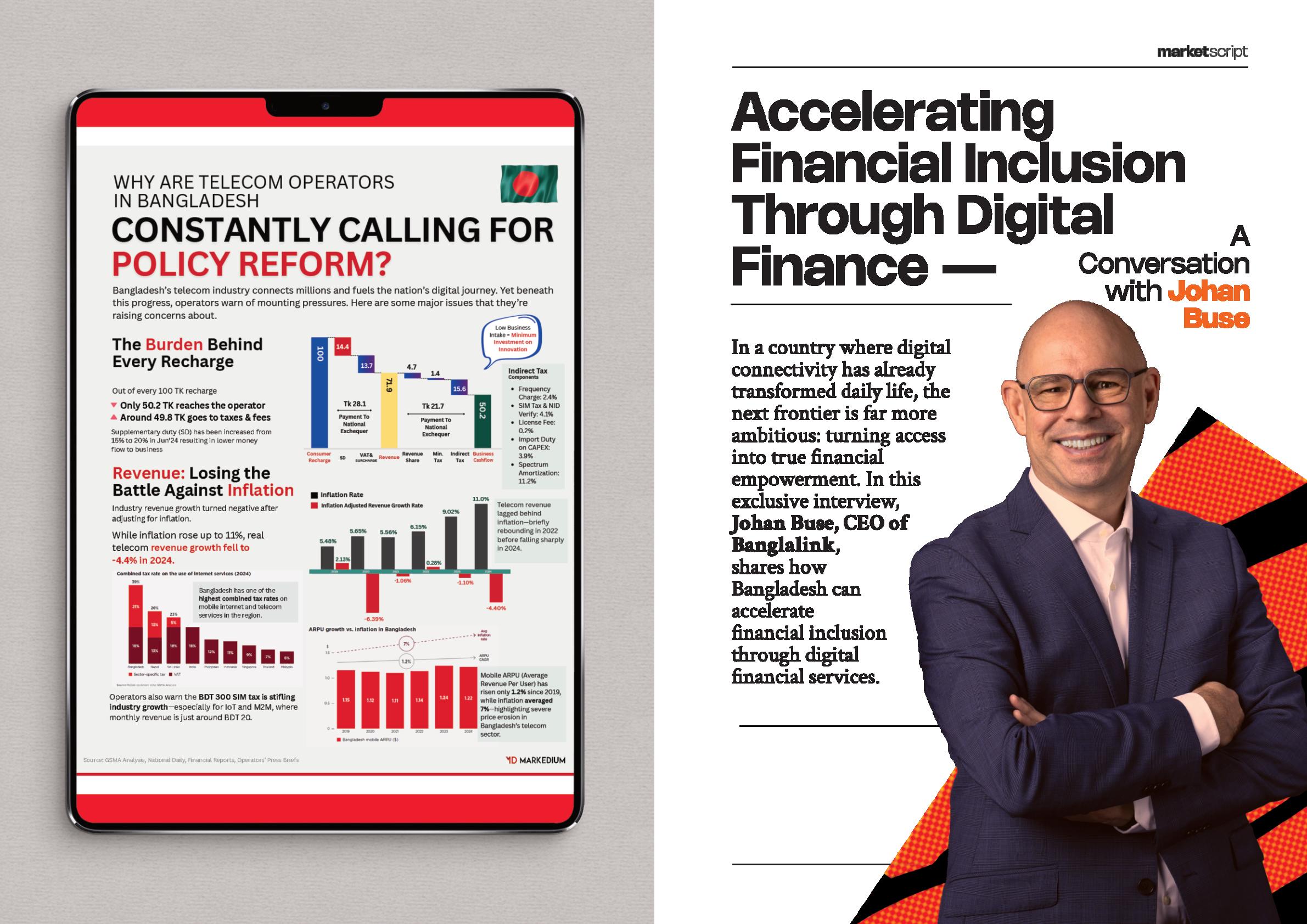
Regulatory pressures persist. Bangladesh’s telecom sector carries one of the world’s heaviest tax burdens, losing nearly half its revenue to taxes—over twice the global average. Operators also face a corporate tax rate of 45% (40% if listed), the highestintheregion.Key policy needs include transparent spectrum allocation, tax
reform, a clear digital-banking framework, and stronger dataprotection laws.
The strategic outlook is clear: operators must build diversified digital ecosystems, policymakers must enable investment, and investors must look beyond ARPU to platformlevel value. The next decade will belong to telcos that transform, not just connect.
From Connectivity to Convergence
Bangladesh’s telecom evolution from 2015 to 2025 was only the beginning. The next five years will decide whether operators become powerful digitalecosystem leaders or slide into utility status. With digitalbanking ambitions, heavy infrastructure investment, super apps and IoT platforms, the industry is clearly pushing toward full convergence across telecom, finance, commerce, entertainment and public services.
For 180 million citizens, this shift promises unprecedented access and convenience. But success will depend on sustained investment, smarter regulation and healthy competition. The sector already contributes 1% of GDP while carrying a heavy tax burden. The race is underway—and the winners will define Bangladesh’s digital future.
Current Industry Snapshot
Drawing from VEON’s global success and Banglalink’s nationwide reach, he lays out a vision where mobile phones become gateways to savings, credit, entrepreneurship, and economic opportunity — especially for women, rural communities, and the unbanked.
The conversation explores the policies, partnerships, and innovations needed to shape a more inclusive digital economy for Bangladesh.
Bangladesh has made remarkable progress in connectivity — what do you see as the next big opportunity in this journey toward inclusion?
Bangladesh has come so far in connecting people nationwide; now the real opportunity lies in turning that connectivity into something meaningful. Having access isn’t enough anymore; people need to actually use these networks to improve their lives.
Digital banking seems like the next natural step in this journey towards inclusion. It is something that can bring every citizen into the formal financial system and transform their mobile phones into gateways for savings, payment, and entrepreneurship.
The thing is, the next phase of progress will not be measured by how many towers are built, but by how many lives are changed.
You often say the next phase of progress is about inclusion, not infrastructure. How does digital banking fit into that vision?
Digital banking easily fits into that vision because it’s the bridge between connectivity and empowerment. When people can save, borrow, and transact digitally, they can participate fully in Bangladesh’s economic future. By turning mobile access into financial inclusion, we can empower these communities, uplift small businesses, promote entrepreneurship, and accelerate national growth and the digital economy.
VEON’s Digital Financial Services (DFS) success in Pakistan, Uzbekistan, and Kazakhstan has empowered millions. What lessons from those markets can guide Bangladesh’s digital financial journey?
line Fintech empowers entrepreneurs through AI-driven micro-lending, digital payments, and mobile wallets. In Kazakhstan, digital wallets have reduced cash dependency and built trust among people. What we've learned across all these markets is: when digital finance is simple and trusted, people use it every day.
With over 40 million monthly users across VEON markets in financial platform, what are the key factors behind scaling digital finance responsibly and inclusively — and can Bangladesh replicate that success soon?
To scale digital finance responsibly and inclusively, the most important thing is to build services that are based on trust, data, and accessibility. Like I’ve said before, digital finance only takes off when it is intuitive and reliable.
the model works. Leveraging Banglalink’s strong local presence and customer trust, I believe, Bangladesh can be the next success story in VEON’s financial inclusion journey.
Nearly half of Bangladesh’s adults remain unbanked. How can Banglalink, through its platforms and partnerships, bring more people, especially women and rural communities, into the formal financial system?
At Banglalink, we want to reach the unbanked through digital innovation and mobile technology. The goal is simple: we want to make digital finance as seamless, trusted, and empowering as a conversation. We are turning phones into digital wallets so that people can save, make payments, get micro-credits, and receive remittances without needing a conventional bank account. This is especially important for women and rural communities because it opens doors to economic participation, entrepreneurship, and a stable future.
Beyond access, how do you plan to build financial literacy and digital confidence among new users so that inclusion becomes powerment?
Financial inclusion and literacy in hand, as access means little understanding. That’s why, bejust giving people access, we foeducating them through our inguidance and awareness camWe want our users to feel conabout saving, spending, and in-
responsibly. VEON’s experience in other markets shows that these programs actually work. Our goal is not just to connect people to financial systems, but to equip them with the knowledge to thrive within them.
You often describe the ‘digital divide’ as more than a connectivity gap. How do you see digital access translating into real social and economic progress for communities?
Exactly - the digital divide isn’t just about connectivity, it’s about opportunity. When digital services reach every village, they act as economic equalizers. By extending platforms like MyBL, Toffee, and RYZE beyond the cities into rural communities, we’re creating real paths towards entrepreneurship, education, and growth, which in turn will translate into real social and economic progress.
You’ve spoken about fair spectrum pricing and the USD 45 billion economic potential it could unlock by 2035. What kind of policy reforms or collaborations are needed to achieve that?
Mobile connectivity is the oxygen of Bangladesh’s digital ambition — but oxygen must flow freely to keep the nation growing. Right now, telecomspecific taxes and spectrum fees nearly 56 percent of operators’ market revenue in Bangladesh. That's among the highest in the world, and it's not exactly an environment that encourages investment. But with balanced spectrum pricing and fair taxation, we can unlock USD 45 billion in new economic value and accelerate the country’s digital future.
While many countries race toward 5G, Banglalink is strengthening 4G first. Why this pragmatic approach — and how are you preparing for 5G and even 6G in the long term?
Like I said before, progress is all about inclusion. It isn’t measured by speed – it’s measured by reach. With only 6.6 percent of devices 5G-ready, expanding 4G for all, rather than 5G for a few, is how we can make technology meaningful for everyone. We are focusing on meaningful applications like telemedicine, smart classrooms, and e-commerce while preparing for 6G. We are not chasing headlines – we are building impact, connecting people to possibilities that improve daily life.
Banglalink is nurturing young digital talent through initiatives like RYZE and skills programs. What’s your message to the next generation — and what kind of Bangladesh do you envision five years from now, digitally and economically?
"Young people are the architects of
Bangladesh’s digital future."
My message to the next generation is this: don’t just be a part of Bangladesh’s digital journey –lead it. At Banglalink, we are running programs like SAP (Strategic Assistance Program), Ennovators, and Womentor, which can equip these young leaders with the practical skills they need to thrive in this digital economy. In five years, with tools like these, I see a Bangladesh where technology truly empowers learning, entrepreneurship, and economic growth; a nation where progress is purposeful, connecting people not just to the internet but to opportunity.
The modern workplace in Bangladesh is at a pivotal crossroads. While most employees appear satisfied, a deep disconnect remains—a gap between contentment and true loyalty. This “Loyalty Chasm” threatens productivity, retention, and leadership credibility across industries.
The 2025 Employee Benefit Trends Study (EBTS) exposes this divide: although 78% of employees are happy with their current roles and 73% feel holistically well, only 42% would recommend their employer. The problem isn’t pay—it’s the lack of perceived Care and Financial Security.
The Loyalty Chasm—High Satisfaction, Low Advocacy
For senior leaders rethinking human capital, the numbers reveal an uncomfortable contradiction: employees in Bangladesh say they’re largely content—78% enjoy their roles and 73% feel generally well—but only 42% are willing to vouch for their workplace. This steep drop-off exposes a Loyalty Chasm where people stay, but don’t stand behind the organization. What bridges this gap isn’t perks or policy—it's the felt sense that the employer genuinely stands by its people. When employees believe their organization truly cares, every major indicator lifts: well-being climbs to 83% from 56%, engagement rises sharply to 84% from 61%, and advocacy leaps from a negligible 8% to 42%.
Care, however, isn’t abstract. The data points to exact moments when employees look to their employer. The biggest pain point isn’t illness, parenthood, or retirement—it’s financial shocks. Seventy-five percent say unexpected expenses are the moment that defines whether an employer cares or not. And support isn’t only about money. Workers want room to breathe during crises: 29% expect flexible leave, while 26% want their workload eased temporarily. The generational gap is stark—83% of Gen Z see flexibility as essential, compared to 60% of Millennials.
The message is unmistakable: loyalty grows when employers step in at the right moments, with the right kind of support, delivered with empathy and adaptability—not when everything is fine, but when life suddenly isn’t.
The Financial Wellness Imperative—
The Crisis Undermining Productivity
Financial health has become a core workplace imperative, and the EBTS findings reveal it is the single biggest drag on productivity in Bangladesh.
Over 56% of employees say financial worries directly reduce their performance, while 41% link these concerns to poor mental health—unsurprising given that only 69% feel satisfied with their financial situation. The primary drivers of this stress are rising living costs, a lack of emergency funds, and heavy family responsibilities, but the anxiety runs deeper than monthly expenses. Employees are most worried about long-term stability: saving for major needs (70%), securing their families against unexpected events (69%), and managing out-of-pocket medical costs (65%).
Yet preparedness remains alarmingly low—only 29% feel in control of their finances, 28% live paycheck to paycheck, and just 15% have a threemonth savings cushion. This vulnerability, combined with low financial literacy, underscores the urgent need for stronger employer-led financial education and clearer benefits communication. With 69% of employees believing their employer is responsible for their financial well-being, the traditional employer-employee relationship is shifting from purely transactional to one built on security and partnership. Workers want both immediate uplift—higher salaries and bonuses— and future protection through personalized financial planning, Income Protection and TPD Insurance, and structured retirement support. Notably, 67% expect help with retirement savings, a critical gap as 52% of employees aged 40 and above have no retirement plan at all. Together, these insights call for organizations to step up with comprehensive programs that build financial resilience, confidence, and long-term stability across the workforce.
Workers want room to breathe during crises
Benefit Dynamics—The Gap Between Need and Provision
Employers in Bangladesh recognize the need to respond to these challenges. 51% of employers have increased investments in benefits over the last 12 months, primarily motivated by the desire to increase employee productivity (61%) and retain existing talent (59%). Yet, the benefits currently offered often miss the mark, particularly in the realm of long-term protection.
The Insurance Provision Deficit
Employees who are satisfied with their benefits report dramatically higher loyalty (87% versus 58% for those not satisfied) and advocacy (46% versus 27%). This makes benefits a critical lever for organizational success.
However, there are "must-have" benefits that employees prioritize, but which employers are drastically under-providing:
While employers perform well in areas like leave (76% vs. 55%) and training (66% vs. 55%), major gaps remain in essential insurance benefits— Health, Life, TPD, and Income Protection—leaving employees exposed and creating significant human capital risk.
Only 59% feel secure with their current benefits, yet the upside is undeniable: 78% say access to strong insurance and wellness programs would greatly increase their loyalty. The real failure, however, lies not only in benefit design but in communication and complexity. Many employees don’t use key benefits simply because they don’t understand them or don’t see their relevance— Life Insurance is often dismissed as unnecessary, Critical Illness coverage is viewed as too complex, and benefits like Childcare or Carer’s Leave suffer from low awareness.
The data is clear: better communication is the fastest path to higher benefit satisfaction. Employees say they would use offerings more if they knew how peers used them (70%), want information tailored to their personal needs (26%), and expect ongoing updates beyond annual enrollment (20%). Without simplifying and personalizing benefits communication, even well-designed programs will continue to go underutilized.
The Strategic Roadmap—Five Imperatives for Executive Action
The 2025 EBTS makes it clear: organizational success in Bangladesh hinges on the financial and emotional well-being of employees. To turn satisfaction into advocacy and boost productivity, leaders must focus on five priorities:
1. Close the Insurance Gap
Employees face 18–22% gaps in Health, Income Protection, and TPD coverage. Strengthen protection benefits and explain them with simple, relatable examples—70% would use Life
Insurance more if they understood its real impact.
2. Tackle Financial Stress Holistically
With 56% losing productivity due to money worries and 69% expecting employer support, companies must go beyond pay raises. Offer personalized financial planning (requested by 25%) and targeted financial education for employees lacking savings resilience.
3. Personalize & Digitize benefits
Employees want tailored support—65% expect individualized benefits—and 58% are open to buying non-medical benefits themselves. Use clear, digital communication instead of a generic benefits approach.
4. Respond to Life Events with Empathy
Support during crises drives loyalty. Employees expect help during financial shocks, including flexible leave (29%) and temporary workload relief (26%). A caring culture is non-negotiable.
5. Strengthen Retirement Readiness
With 52% of workers 40+ lacking a retirement plan, employers must build long-term financial stability through structured contributions and clear guidance.
The New Mandate for Leadership
The Employee Benefit Trends Study 2025 provides an urgent and decisive mandate for executive leadership in Bangladesh. The data confirms that traditional performance management struggles, such as low productivity (56%) and low engagement (49%), are symptoms of deeper, unaddressed vulnerabilities—specifically, pervasive financial stress and a fundamental deficit in organizational protection.
The future of workforce success hinges on a
shift in perspective: treating benefits not as cost centers or compliance hurdles, but as strategic investments in human capital. By closing the identified gaps in core insurance protection, empowering employees with personalized financial education, and delivering empathetic flexibility during crises, organizations can fundamentally transform their employees from merely satisfied workers into resilient, engaged, and loyal advocates.
So the Billion Dollar question stands:
Will organizational leaders simply manage compliance, or will they seize this moment to build a truly protected, productive, and future-ready workforce?
Rethinking NEIR — A Call for Sensible, Inclusive Policy
The proposal to implement NEIR — barring imported, undeclared smartphones from accessing local networks — is not just flawed; it’s deeply disconnected from the realities of our people.
Let’s be clear: these are not “illegal handsets.” They are imported, undeclared
over 10 million Bangladeshis living abroad. For many, gifting a smartphone to loved ones back home is a gesture of care, connection, and pride. These are not smugglers — they’re everyday heroes who often don’t even know how to fill out immigration forms, yet work tirelessly to support their families and fuel our economy with remittances. How can we justify penalizing them for bringing home one of the most cherished items of modern
This policy won’t affect the affluent. They buy from official stores, have the paperwork, and know how to navigate registration. Instead, it
targets the very people who feed the nation — those whose hard-earned foreign currency is used to import components for the so-called “official” phones.
Where Is the Accountability?
Before imposing restrictions, has BTRC asked official manufacturers:
• Why they release only a limited number of models?
• What their stance is on enabling access to the latest technology?
• Whether their import, pricing, and profit structures are transparent?
Have we investigated whether over- or under-invoicing is being used to manipulate margins or evade duties?
Crime, Convenience, and Common Sense
The term “illegal import” carries weight. If we’re serious about curbing crime, let’s talk about gold — most of it enters the country unofficially, yet it fuels social and domestic issues. Are we ready to tackle that too?
"We need inclusive, thoughtful design, not top-down regulation."
IMEI cloning is a real concern, but mostly for outdated feature phones. Modern smartphones are far more secure. Blanket policies won’t solve this; smart regulation will.
Bangladesh Deserves Better
We are a nation with growing aspirations but limited purchasing power. This has naturally created a thriving market for used devices. So how do we plan to implement SIM–handset–NID matching without alienating millions?
We know how this plays out: every new policy creates loopholes, and new “services” will emerge — charging people to register their phones through unofficial channels. Another way to exploit the masses.
In the process, we risk:
• Losing SMEs who rely on this business
• Alienating our NRBs
• Stifling a growing community of tech enthusiasts
• Depriving consumers of choice
Let’s Design, Not Dictate
This is not the time to close doors — it’s the time to open them. We need inclusive, thoughtful design, not topdown regulation. Let’s build a system that empowers users, respects contributors, and reflects the aspirations of a modern Bangladesh.
TAREQ ISLAM SHUVO Head of Retail, United Finance
Silence speaks volumes in times of crisis —
Is staying quiet no longer an option?
Silence has always had its own hierarchy in Bangladesh.
We were raised on the wisdom that a person who talks too much loses their face value — “Beshi kotha bola manusher weight kome jai. (a bengali rhetoric)” Our culture favored restraint over rhetoric. Dignity came from listening more than speaking.
But the corporate and communication ecosystem we inhabit today runs on a very different rhythm. Presence equals power. Visibility is validation. Silence — once seen as strength — can now appear suspicious.
In Bangladesh’s corporate world, silence has become a tug-of-war: a constant push and pull between the urge to speak and the wisdom to wait.
The Push: A World That Demands a Voice
Walk into any boardroom or marketing meeting in Dhaka and you’ll feel it — the pressure to speak, to react, to post.
A CEO’s silence during a crisis becomes a headline. A brand’s lack of comment on a trending topic becomes a thread on social media.
We live in an age of constant communication, where every stakeholder expects a voice. Employees want transparency. Customers want empathy. The public wants accountability.
For brands, this creates a push
— a near-reflexive need to fill every silence with a statement.
When a competitor missteps, we issue comments. When a crisis hits, we post blanket statements. When an issue trends, we weigh in — often before we’ve had time to think.
It’s a world that rewards visibility, even when visibility costs us perspective.
“People don’t just want to know what you’re doing,” one communications director at a local conglomerate told me. “They want to know what you’re saying about what you’re doing.”
In this push to always be
present, many organizations lose their poise. They speak not to clarify, but to comply with the tempo of the crowd.
The Pull: The Wisdom of Holding Back
Yet the other force — the pull — still matters.
Some of the most seasoned leaders in corporate Bangladesh quietly practice the art of waiting. They know that silence, used well, can be a strategy.
Globally, many organizations institutionalize this. At Amazon, new managers spend their
first weeks in “silent shadowing,” observing meetings before contributing. At Google, leaders go on “listening tours” to understand culture before reshaping it.
Japanese companies formalize this through mokumoku — a period dedicated solely to listening and learning.
The same principle applies at home. Many Bangladeshi conglomerates advise newcomers to remain observant for their first two months. “Don’t rush to have an opinion,” HR manuals whisper. “First understand the rhythm.”
That advice isn’t about submission — it’s about calibration. In communication, as in leadership, you cannot speak with
The Crisis Paradox
Every brand eventually faces a crisis — and here the push and pull collide most violently.
When public outrage flares, silence feels dangerous. When misinformation spreads, words feel inadequate. The instinct is to respond quickly, to “get ahead of the story.” But haste can hollow credibility.
A Bangladeshi consumer brand once issued a midnight apology during a social backlash — only to retract it the next day after discovering the complaint was misdirected. The retraction caused more damage than the original incident.
Meanwhile, another conglomerate waited two days before addressing a labor-related rumor. Their eventual statement — calm, detailed, factual — not only defused the crisis but earned respect.
Silence can protect — or it can poison. Speech can clarify — or it can cloud.
The wisdom lies in balancing the two.
The Social MediaMultiplier
Social media has rewritten the script entirely.
Bangladesh’s digital audience is loud, emotional, and instantaneous. Facebook alone shapes public sentiment faster than press releases ever could. Brands now live under a microscope where every pause is dissected.
The communications dilemma is relentless:
• Do we respond instantly and risk error?
• Do we stay quiet and risk misinterpretation?
Neither path is safe. That’s why silence today must be active, not passive — a decision informed by data, monitoring, and timing.
The smartest companies in Bangladesh are learning that not every crisis deserves a comment. Competitor-induced or fake viral controversies often resolve themselves if monitored intelligently and addressed only if necessary. The real skill lies in knowing when to hold your ground and when to enter the conversation.
When Silence Becomes Brand Language
Some of Bangladesh’s most trusted brands have turned silence into part of their identity.
They speak through consistency, not commentary. They show reliability through delivery, not declarations.
A major FMCG player rarely engages in online spats or public debates, yet its brand remains synonymous
with quality and reliability. The absence of noise has become a form of confidence.
Globally, brands like Apple and Patagonia use silence as a design principle — communicating more through what they don’t say. In Bangladesh, the same restraint appears in companies like Grameenphone or Apex: calm, clear, measured.
Silence, used this way, is not emptiness — it’s elegance.
The Corporate Crossroads
Bangladesh’s corporate culture is at a crossroads. Our heritage values restraint; our marketplace rewards reaction. Every professional now operates in this tension. The push of instant communication collides with the pull of thoughtful silence. The modern communicator must be fluent in both languages.
The new model of leadership emerging in our boardrooms isn’t about volume — it’s about timing.
A leader who speaks too soon sounds impulsive; one who waits too long seems detached. The sweet spot lies in considered communication: saying what needs to be said, when it truly needs to be said — and
nothing more.
As one senior executive in the banking sector recently told me:
“In our market, silence can feel risky — but silence can also make you sound like you actually know what you’re doing.”
Every Word Must Earn Its Way
In this new era of transparency and turbulence, every word must earn its place.
A public statement isn’t just information — it’s positioning. A social-media post isn’t just engagement — it’s an editorial choice. This means the challenge for Bangladesh’s corporate communicators is no longer what to say, but why to say it.
Because sometimes, what we don’t say speaks louder about who we are.
The Language of Balance
Silence isn’t the opposite of communication — it’s part of it.
It’s the pause before the mes-
sage that gives it meaning. It’s the breath between statements that creates credibility. In Bangladesh’s evolving corporate and brand landscape, learning this rhythm — when to push forward with words and when to pull back into stillness — will define the next generation of leadership.
Too much noise erodes weight. Too much quiet erodes relevance.
The art lies in the balance.
Remember — Silence without strategy is apathy. Silence with purpose is authority.
TASMIA AHMED Director of Strategy & Planning at MastheadPR
Brand Guidelines Aren’t Limiting Creativity — They’re What Make Creativity Work
A few days ago, one of the country’s most viral content creators, Rakin Absar, posted a Facebook status where he declared:
“Dear brands, Nobody cares about strict brand guidelines anymore. Audiences want unique, out of the box experiences. People our age now have the buying power, while those who cared or cares deeply about traditional brand rules are in nursing homes. Take Disney for example. They are now
He pointed to Disney as an example and wrapped it up by telling brands to adapt or become obsolete.
producing the Kardashians’ reality show, which once went against their core brand values. I could list many more examples, but my fingers hurt. Adapt to new generation, go beyond your imagination otherwise you’ll become obsolete.
Thank you.”
The post went viral, and many people cheered.
But as someone who has spent years inside agencies—building brand architecture, studying consumer behavior, and working within the invisible structures that make brands recognizable—I immediately felt there were some fundamental misunderstandings in his argument.
This article isn’t about proving anyone wrong—it’s about clarifying why brand guidelines matter, and why the most powerful “out-ofthe-box” ideas in the world actually come from within guidelines, not outside them.
“Nobody cares about brand guidelines anymore.”
Who exactly is this “nobody”?
When Rakin wrote that line, my first reaction was simple: Who are these people? Because it is definitely not the audience.
Walk into a small mobile recharge shop. You’ll instantly recognize five different brands from five different colors. One color means recharge, another means cashout, another signals taking money in, and so on. People know these things subconsciously—not because they studied marketing, but because brand guidelines have shaped these associations over years.
Walk into a supermarket. Without any signboards, you know where the shampoos are,
where the biscuits are, where the tissues are. Why?
Because packaging architecture and color codes guide your eyes.
The audience may not use the term “brand guideline,” but their behavior is entirely shaped by it.
So yes—the audience cares. They just don’t articulate it the way brand managers do.
No, audio-visual guidelines don’t mean “paint the sky orange”
Many creators joke that if a brand color is orange, you must turn the whole world orange.
That’s a myth.
Today, most modern brands don’t even care if the protago-
nist wears brand colors. Audiovisual guidelines are more flexible now than ever before. The only real restriction that remains is logo placement—and even that is adjusted around TV logos, screen formats, and digital platforms.
So honestly, audio-visual guidelines hardly block creativity anymore.
The problem isn’t the guidelines. The problem is misunderstanding what guidelines are. Out-of-the-box does NOT mean out-ofguideline
This is where I think many young creators get it wrong.
Rakin wrote that audiences want out-of-the-box experiences, Absolutely true!
bKash app gets a new refreshing update
With human-centric design, customizable themes, and tailored rewards, the new bKash app puts control, clarity, and convenience directly in the hands of 82 million verified users.
United Finance PLC partners with IFC to strengthen affordable housing and SME financing
This collaboration aims to enhance United Finance's capabilities in Affordable Home Loans and SME Financing through a comprehensive diagnostic assessment led by IFC.
Grameenphone has officially unveiled Bioscope+
Designed to redefine the country’s digital entertainment experience, Bioscope+ brings together over 5,000 titles from leading local and international OTT services, including Chorki, Hoichoi, Sony LIV, Lionsgate, and more—all within a single, seamless platform.
Pathao introduces CNG rides
Bangladesh’s leading homegrown super app Pathao has introduced a brand-new ride option: Pathao CNG, marking its 10th anniversary.
Grameenphone Introduces ‘GP Shield’ for Safer Digital Experiences
Grameenphone, the country’s leading telecommunication services provider, has launched ‘GP Shield’, a next-generation, Cisco-powered DNS-layer security solution designed to protect customers from rising online threats such as malware, ransomware, and phishing attacks.
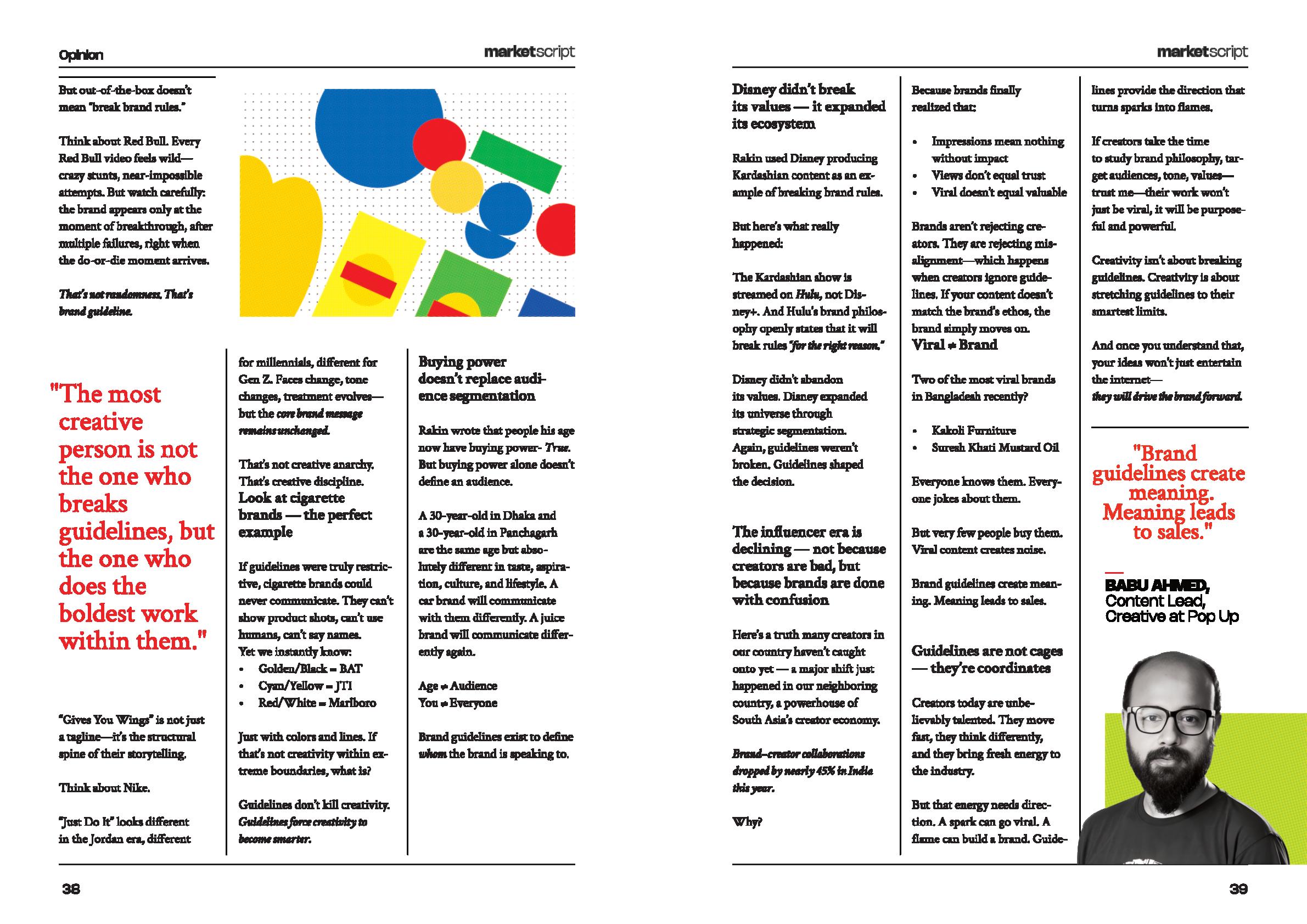
Female painters now part of Berger Paints’ workforce
Berger Paints Bangladesh Limited has introduced female painters to its Express Painting service under the Berger Experience Zone. This inclusion aims to provide families—especially women and children—with greater comfort and ease during home painting projects.
Hamza becomes brand ambassador of Robi
England-born international midfielder Hamza Choudhury has become the brand ambassador for mobile operator Robi. The announcement was made on Tuesday at a press conference at Robi's corporate headquarters in Dhaka.
ACI Motors en route to Guinness World Record
ACI Motors Limited held a major tractor handover event in Dinajpur under the theme “Sonalikar Bisshojoy,” where 350 Sonalika tractors were delivered to farmers at once—aiming for a Guinness World Record for the largest singleevent tractor handover.
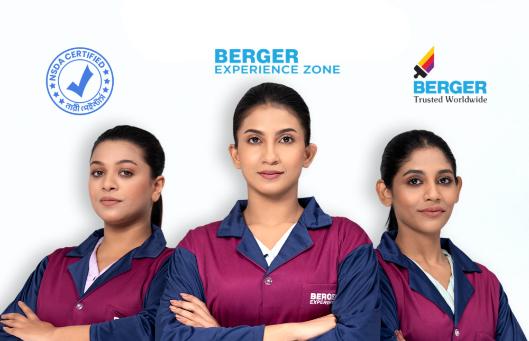
City Bank partners with UNICEF to empower youth with green skills
City Bank and UNICEF have announced a new partnership to equip marginalised adolescents and young people—particularly girls—with green and entrepreneurial skills under a pilot project entitled Skills4Youth.
bKash and 10 Minute School join forces to empower a financially informed nation
bKash Limited and 10 Minute School have launched a free online course titled “MoneyGyani: Digital Financial Mastery” to help people—especially the youth—build smart money habits.
In Conversation with Mukit Anis
Creating Next-Gen Marketing Curriculum to Prepare Bangladeshi Future Marketers
As Bangladesh embraces a digital-first economy, the need for marketing graduates who can blend creativity with data and technology has never been greater.
In an insightful conversation with Markedium, Mr. Mukit Anis, Lecturer at BRAC University, shares his
Are university marketing curricula evolving fast enough for the shift to datadriven, digital-first marketing?
perspective on how universities can close the gap between theory and practice. From modernizing curricula to fostering hands-on learning, he outlines what it will take to shape the next generation of adaptive, ethical, and industry-ready marketers.
We’ve made visible progress, but honestly, not fast enough to match how rapidly the industry is changing. Many universities have updated course outlines to mention analytics, social media strategy, or digital communication, but there’s a gap between what’s written and what’s actually experienced in class. Students still learn marketing in
disconnected silos—branding in one course, research in another, digital in a third—while the real world works through integrated growth teams. To truly evolve, our curriculum needs to bring creativity, data, and technology together. I’d love to see students working with live datasets, campaign dashboards, and consumer
analytics—not just PowerPoint decks.
What are the biggest gaps between industry needs and fresh-graduate capabilities?
Three things stand out. First, applied analytics—students can interpret data in theory, but few know how to design experiments, run A/B tests, or translate metrics into decisions. Second, content-commerce integration—many can make attractive visuals but struggle to connect that creativity to conversion or sales impact. And third, professional readiness— communication, stakeholder handling, teamwork, and accountability are often missing. These “soft” skills end up being the hardest barrier to entry for fresh grads.
Is the gap due to outdated curricula, or is it about how marketing is taught?
It’s both—and they feed off each other. When syllabi lag behind, teachers rely on lectures instead of labs; when teaching remains lectureheavy, the curriculum feels stale. The fix isn’t just rewriting course outlines—it’s changing how we teach. If we start using problem-based learning, simulations, and live brand projects, the content will naturally modernize. Modern pedagogy forces modern curricula.
If you were to redesign Bangladesh’s marketing curriculum for the next decade, which emerging domains would you prioritize—and why?
I’d start with growth analytics
ethics, sustainability, and brand legitimacy—because tomorrow’s marketers must be accountable to both performance and society.
How can universities make marketing more “experiential” and less textbook-based?
We can start with semesterlong live briefs from real organizations—NGOs, startups, or SMEs—where students are accountable for results, not just grades. Set up Marketing Labs on campus that manage the university’s own digital channels. Rotate students as brand managers, analysts, and content leads. Create Data Studios where they analyze real consumer datasets or run sentiment analysis projects. Also, integrate certifications— Google Analytics, Meta Blueprint, or HubSpot—as part of grading. The point is: let learning be lived, not lectured.
How can educators themselves stay updated and relevant to industry needs?
Teachers need a feedback loop with industry. A short annual residency in an agency or company should be normal, not exceptional. Co-teaching with practitioners—like having a digital strategist lead a few classes—keeps courses grounded. And universities
should recognize applied work, like case studies or open data labs, as legitimate academic contributions. If we want students to learn dynamically, educators must model lifelong learning.
What kind of university–industry partnerships are needed to bridge the skill gap? What should industry contribute?
We need structured partnerships, not occasional seminars. Imagine a national brief exchange, where companies post marketing challenges that universities pick up as semester projects. Industry can share anonymized datasets, mentorship hours, and tool access— these are more valuable than sponsorships. In return, universities must deliver measurable insights. The outcome should be mutual value: industry gets fresh ideas; students get portfolio-worthy work.
How can we systematically nurture creativity, strategic thinking, and adaptability in marketing students?
By teaching process instead of just output. For example, every course could revolve around creative briefs with constraints—because constraints fuel creativity.
Encourage divergent and con-
vergent thinking—brainstorm widely, then use data or logic to refine. Require reflection journals so students can track how their thinking evolves. And create a “maker culture”: let students build quick prototypes—mock ads, micro-campaigns, or landing pages—so they see creativity as iteration, not inspiration.
What would the ideal marketing graduate of 2030 look like?
A blend of artist, analyst, and activist. They’d understand how data translates to human insight, how culture shapes strategy, and how technology scales both. They’d be fluent in dashboards and storytelling alike. And they’d value integrity, inclusivity, and sustainability as much as ROI. In short —someone who can do the math, make the meme, and mind the ethics.
Finally, what’s your message to educators, industry leaders, and policymakers?
To educators: focus on what students can build, not just what they can recall. To industry: treat universities as talent incubators, not resume suppliers. Share your data and your mentorship; it will pay off in better hires. And to policymakers: fund digital labs, data trusts, and SME–university collaborations. Recognize practice-based learning as legiti-
mate academic output. We’re on the edge of a new marketing frontier—one that’s datadriven but deeply human. Our graduates can lead that future if we align vision, method, and courage today.
“The next decade belongs to marketers who can connect insight, imagination, and impact— responsibly."
Beyond the Soda:
Decoding PepsiCo's Landmark Corporate Rebranding
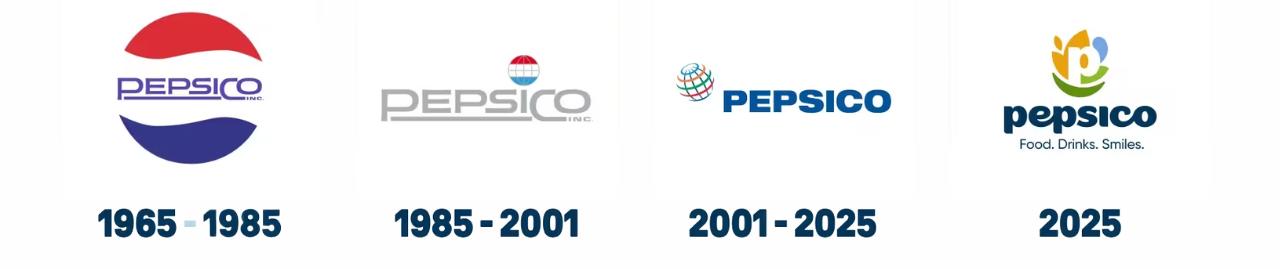
In a move signaling a definitive pivot toward its diverse, global empire, PepsiCo has unveiled its first new corporate brand identity in nearly 25 years. This dramatic overhaul goes far beyond cosmetic changes; it is a strategic repositioning designed to address a critical internal
awareness problem, meet external investor pressure, and visually reinforce the company's vast portfolio of food and beverage offerings. The resulting visual identity, featuring softer tones, lowercase typography, and a new tagline, aims to "boldly reflect who we are in 2025".
The Imperative for Change: A Portfolio Lost in Translation
The fundamental driving force behind PepsiCo’s comprehensive rebrand is a striking and longstanding awareness problem among consumers. Despite owning a vast family of over 500 brands, the company has struggled for decades to be recognized as anything other than its flagship soda. Survey data highlights this challenge starkly: only 21% of surveyed consumers can identify a brand under the PepsiCo umbrella that is not its namesake soda.
Previous corporate visual identities, including the logo implemented in 2001, have historically "hewn closer to the branding for flagship soda Pepsi," utilizing the beverage’s signature globe icon and distinctive blue-and-red color schemes. This alignment, while capitalizing on the soda’s global recognition, failed to acknowledge, let alone celebrate, the massive scope of products including Quaker, Frito-Lay, and various high-growth acquisitions. The new identity marks a decisive break from this history, attempting to shift the emphasis away from the single soda brand.
3. Leaf-like green shape: Symbolizing the Pep+ sustainability program.
These elements are positioned above a deeper green slash, which is designed to represent a smile. This smile ties directly into the company’s new tagline: “Food. Drinks. Smiles.”. This focus on smiles is meant to communicate PepsiCo’s “obsession with consumers,” indicating an intent to reach them during new occasions and through various new channels, including when they are away from home.
A Visual Language Focused on Portfolio Breadth
The immediate change noticeable in the overhaul is the departure from the traditional blue-and-red motif. The new corporate branding employs softer, earthier colors, rooted in what PepsiCo describes as the "real world," with more muted tones. This palette is chosen to grant equal emphasis to the varied pillars of the business.
Central to the updated iconography is a white "P," which is strategically encircled by various symbols representing the company’s focus. Specifically, the elements include:
1. Earthy orange symbol: Representing food and grains.
2. Blue drop: Representing drinks and water.
Furthermore, the typography itself reinforces a strategic shift in tone. The new custom typeface is rendered entirely in lowercase letters, which is intended to convey approachability. As CEO Ramon Laguarta noted in a press statement, the new identity is a bold reflection of the company in 2025, highlighting its expansive reach, aim for positive global impact, and "unmatched family of beloved food and drink brands".
Addressing External Pressure and Strategic Headwinds
The timing of this significant makeover is not arbitrary; PepsiCo has been facing greater pressure to shake up the business amid growth struggles. CEO Ramon Laguarta has been under stress due to declining sales and market share for certain brands within the company. A clear example of this is the full-sugar (blue can) variant of Pepsi, which has dropped from holding the No. 2 spot by volume
in the U.S. to fourth place in just a few years.
Adding to the urgency, activist investor Elliott Investment Management acquired a nearly $4 billion stake in PepsiCo in September. This activist involvement was specifically aimed at urging the food and beverage giant to revamp its bottling network and shed low-performing offerings. The rebrand, therefore, serves as a visible demonstration that the company is taking proactive steps to overhaul its image and business focus in response to market demands.
Reinforcing the Future Growth Strategy
Beyond solving the perception problem, the refreshed look is instrumental in reinforcing several specific business initiatives outlined by Laguarta. The visual identity is designed to help prop up high-growth brands in the portfolio, specifically calling out names like Lay’s and Tostitos.
The rebrand also spotlights newer, high-growth acquisitions, emphasizing the company’s commitment to evolving consumer tastes. For example, recent additions such as the prebiotic soda brand
Poppi (acquired earlier this year for nearly $2 billion) and the Mexican-American food label Siete both received a specific callout in the corporate rebranding announcement.
Moreover, the initiatives the rebrand supports include:
• Health and Wellness: Stripping artificial colors and ingredients out of major products, such as Gatorade and Doritos, in response to the "Make America Healthy Again movement".
• Operational Modernization: Internally, • the company is streamlining operations and committing more investment to artificial intelligence (AI) to achieve greater "precision and impact".
The new identity, which is already visible on the marketer’s social media and digital channels, will begin appearing on packaging early next year and will be phased into different markets over time. This ambitious change serves as a comprehensive visual statement that PepsiCo is no longer defined by a single sugary drink, but rather by its expansive global footprint across food, hydration, and sustainability goals.
Sustainability
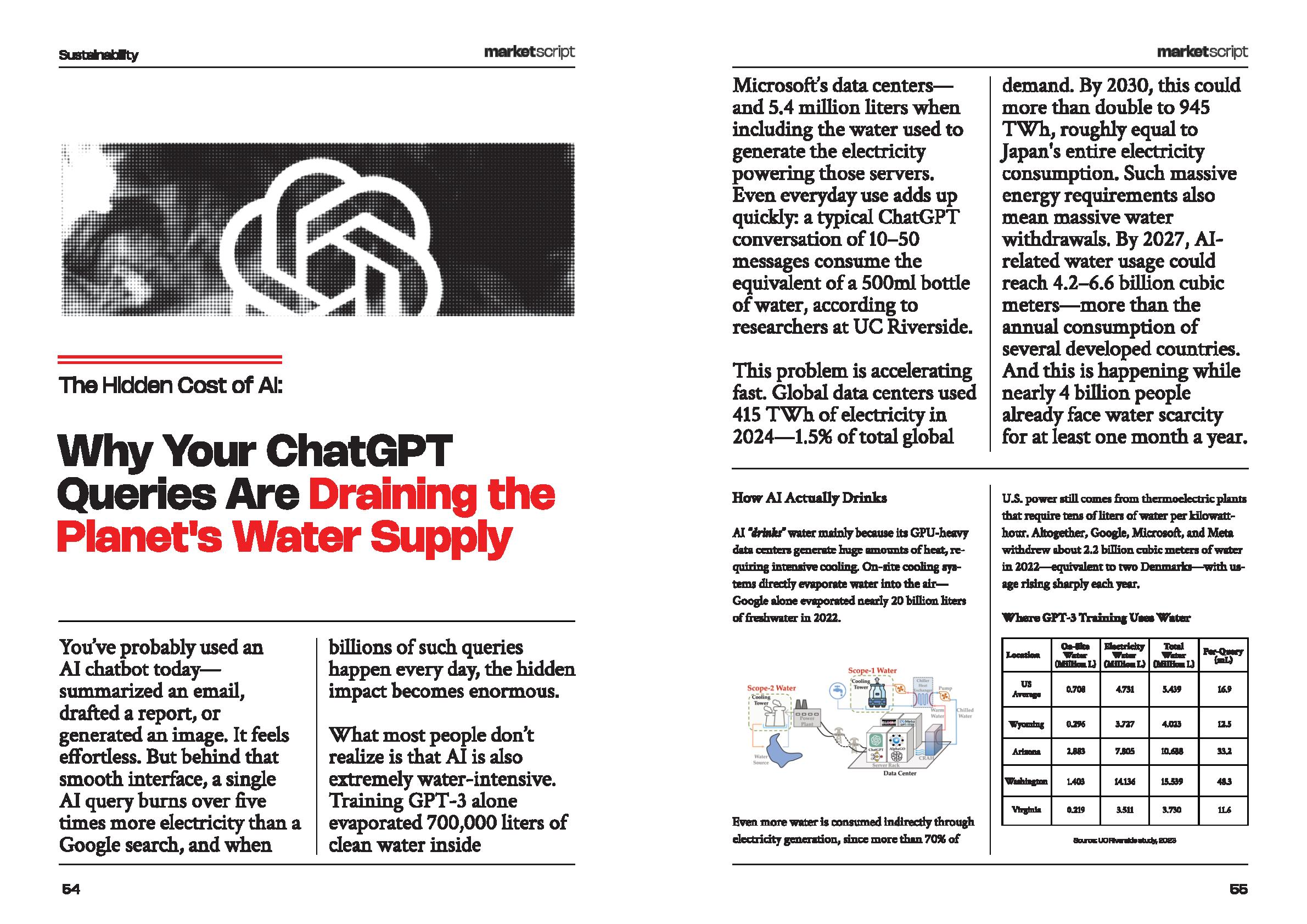
Big tech companies claim progress, and some of it is real. Google has drastically improved efficiency, and Microsoft has introduced zero-water cooling using closed-loop liquid systems that never evaporate water once installed. Yet despite these innovations, absolute water consumption keeps rising because AI infrastructure is expanding faster than efficiency improvements can compensate. At the same time, transparency is poor. No major AI model—including GPT-4 or Gemini—discloses its water footprint in its model card. Companies don’t separate AI water use from general cloud operations. Many AI workloads run in third-party centers with worse efficiency but no reporting obligations.
Microsoft's Water Paradox (FY20-FY24)How
The Carbon-Water Paradox Nobody's Talking About
The challenge is further complicated by a carbon–water tradeoff: the regions with cleanest electricity do not always have the best water efficiency, and cooling needs are highest during sunny hours when solar energy peaks. In some cases, training at night drastically lowers water use but increases carbon emissions. Even geography matters— training GPT-3 in Washington state uses four times more water than training it in Virginia due to differences in power generation.
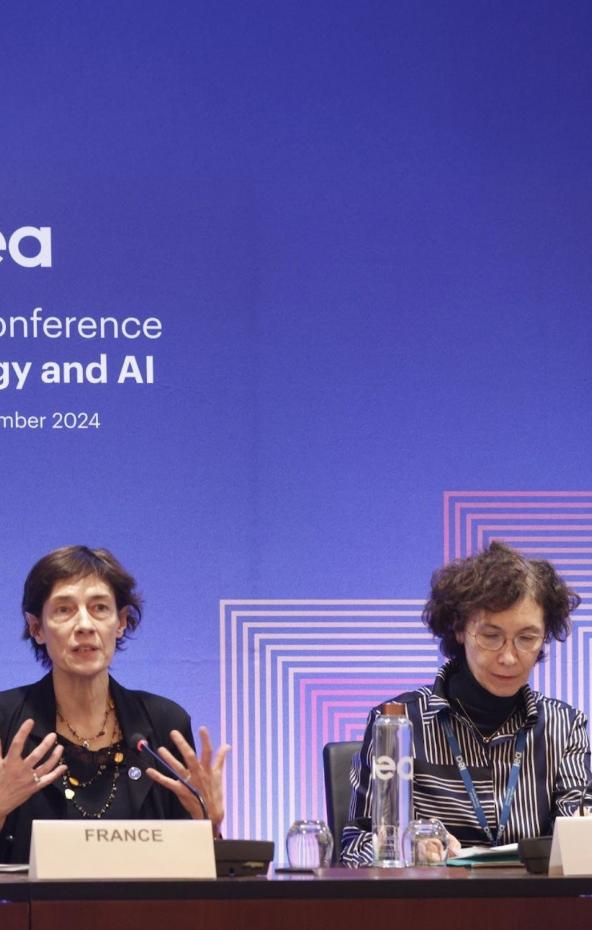
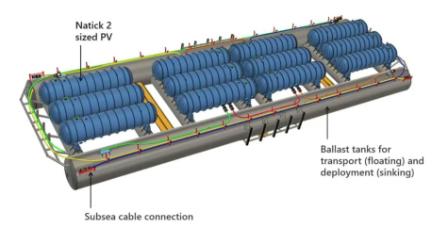
Governments are slowly responding. The International Energy Agency’s landmark analysis warns that meeting AI-driven demand will require hundreds of terawatt-hours of new renewable energy, massive grid upgrades, and closer cooperation between tech companies and energy providers. Meanwhile, China is moving in a radically different direction—building commercial underwater data centers cooled naturally by seawater and powered by offshore wind, based on concepts Microsoft tested years ago but never scaled. Other countries in Asia are explor-
Source: Microsoft Environmental Sustainability Reports Global Conference on Energy and AI.
Collected
ing similar approaches.
Ironically, AI itself could help solve the crisis it fuels. The IEA finds that AI-optimized power grids could unlock 175 gigawatts of transmission capacity without building new lines, and predictive algorithms could cut outage durations by as much as half. But unless the industry changes how and where it deploys AI, these potential benefits will be overshadowed by rapidly growing water consumption.
The solution is obvious
AI companies must disclose water use, optimize when and where they run intensive workloads, prioritize zero-water cooling in new facilities, and stop building in water-stressed regions. Policymakers must push for transparency, smarter infrastructure, and long-term planning. And the public must understand that every AI query carries an unseen water cost.
The technology to fix this exists—Microsoft proved zero-water cooling works, China is scaling underwater centers, and international agencies have mapped out the energy roadmap.
Source: Microsoft
What’s missing is the willingness to deploy these solutions as quickly as AI itself is growing.
The researchers’ warning is blunt: AI’s water footprint can no longer stay hidden. If we fail to address it now, the technology meant to solve humanity’s problems may deepen one of our most urgent ones.
Can American Eagle's Sydney Sweeney Controversy Boost Brand Value?
The summer 2025 launch of American Eagle's "Sydney Sweeney Has Great Jeans" campaign fractured the internet, turning a major celebrity endorsement into a full-blown cultural controversy. While critics denounced the campaign— which employed the provocative wordplay "genes/jeans"—as a eugenic dog whistle and oversexualized marketing, the
financial outcomes suggest that the resulting uproar delivered a massive, albeit risky, boost to the brand.
The
campaign raises a crucial question for marketers globally: Can controversy actually enhance brand value?
The Anatomy of the Backlash and American Eagle's Response
The campaign, American Eagle's biggest advertising spend to date, featured Euphoria star Sydney Sweeney in a denim ad with a sultry voice-over playing on the words "genes" (heredity) and "jeans" (the apparel). Critics immediately spotted the connection, leading to an explosion of criticism across social media. The controversy gained significant cultural traction, drawing commentary from the White House and being analyzed by major news organizations like NPR.
Crucially, American Eagle stood firm amidst the chaos. Instead of issuing a retraction or apology, the brand defended its message, stating, "'Sydney Sweeney Has Great Jeans' is and always was about the jeans." They then doubled down on the strategy, announcing more Sweeney content. This commitment to their position was a key factor in how the brand navigated the crisis.
Financial Impact: Translating Controversy into Value
The controversial American Eagle campaign featuring Sydney Sweeney effectively translated social uproar into tangible financial value, demonstrating how the high-risk strategy of controversy marketing can yield significant rewards. Financially, the brand saw a remarkable surge, with its stock price jumping 38% immediately following earnings, substantially outperforming many retail competitors. Crucially, the noise surround-
ing the "Sydney Sweeney Has Great Jeans" ad delivered what the CMO termed "unprecedented new customer acquisition," adding over 700,000 customers and generating an astonishing 40 billion total impressions. This massive, organic reach served as millions of dollars in free publicity, and the immediate sell-out of the featured jeans highlighted a direct link between the controversy and purchase behavior. Despite a brief period of potential store traffic decline, the overall business impact was positive, evidenced by a smaller-thanexpected Q2 sales decrease and a 2% increase in operating profit, suggesting the controversy set a strong foundation for the subsequent back-toschool season.
Why the Strategy Worked for American Eagle
American Eagle's strategy succeeded primarily by leveraging the dynamics of modern media consumption and audience psychology. Firstly, in a hyper-saturated marketplace, the controversy exploited attention economics, cutting through the noise faster and generating more intense discussion than any safe, traditional campaign could. Secondly, the backlash led to viral amplification, where both critics and supporters shared the campaign, creating exponential, zero-cost reach. Thirdly, the polarizing nature of the ad created a polarization benefit: while detractors provided free publicity through their criticism, core supporters became more intensely loyal. Finally, the campaign resonated with the brand's key demographic of younger consumers, who often view brands that create a discussion—even a controversial one—as more authentic and culturally relevant than those that play it safe, reinforcing the message that the brand was intentionally engaging with the broader cultural conversation. American Eagle's quick, consistent defense of its message allowed it to harness these dynamics and withstand the initial backlash.
The Double-Edged Sword
While the American Eagle case study appears to be a clear win, it highlights that controversy remains a double-edged sword. The success factors included a strong financial position to withstand initial boycotts, deep knowledge of their target audience's values, and a prepared, consistent crisis management strategy.
For most brands, especially those in markets like Bangladesh with distinct cultural sensitivities, smaller marketing budgets, and different regulatory environments, the risks of reputation damage and a permanently alienated customer base likely outweigh the potential rewards. The
lesson from American Eagle is not that controversy is universally good, but that when a brand has the resources, audience alignment, and conviction to double down on a polarizing message, the results can temporarily boost brand value and capture market share by dominating the cultural conversation. However, the line between authentic provocation and a tone-deaf failure (like the infamous Pepsi-Kendall Jenner ad) remains razor-thin.
When a brand has the resources, audience alignment, and conviction to double down on a polarizing message, the results can temporarily boost brand value and capture market share by dominating the cultural conversation.
When $600 Billion in Spending Meets $3 Billion in Revenue
Something unusual is happening in the global economy. The richest companies in history are pouring money into a technology that—so far—refuses to pay for itself.
According to Gartner’s September 2025 forecast, global AI spending will reach $1.5 trillion next year. A staggering $400 billion of that is dedicated solely to infrastructure: the servers, chips, and energy systems required to run modern AI models. To put that in perspective, the Apollo program—humanity’s greatest engineering triumph—cost about $300 billion in today’s dollars over ten years.
The AI industry is burning the same amount every ten months.
And yet, the return is nowhere close.
Sequoia Capital estimates that in 2024 the industry invested $50 billion in the chips that power AI training, while revenues from generative-AI startups totaled just $3 billion.
That’s not a margin. That’s a 94% loss.
A Boom Holding Up an Economy
In the first half of 2025, AI-related investment accounted for most of the United States’ economic growth. Strip out AI construction, AI hardware, and AI-driven capital expenditure, and the U.S. economy may already have slipped toward recession. Deutsche Bank made the point bluntly: if the spending slows, the floor drops.
The numbers behind this frenzy are breathtaking. IDC reports that in Q2 of this year, organizations increased AI infrastructure spending by 166% year-on-year, hitting $82 billion in a single quarter.
And the tech titans have committed to a scale of spending rarely seen in corporate history:
• Amazon: $125B (2025)
• Microsoft: $94B+ (FY 2026)
• Meta: $70–72B (2025)
• Alphabet: $91–93B (2025) Together, that’s nearly $380 billion—the annual GDP of Singapore.
"94% Loss"
The $600 Billion Gap That Won’t Go Away
Sequoia partner David Cahn did the uncomfortable math:
1. Nvidia’s projected revenue $150B
2. Double it for energy costs → $300B
3. Double again to reflect end-user margins → $600B in required annual revenue
The industry is nowhere near that number.
Even if tech’s biggest players each generate billions in AI revenue, the market still sits half a trillion dollars short of what is required just to keep the current build-out afloat.
The problem is not that AI isn’t useful. The problem is that the economics don’t work— not yet.
OpenAI’s numbers illustrate the tension perfectly. By mid2025, the company was generating $3.4 billion in revenue.
In that same period, it lost $13.5 billion.
Every ChatGPT query is a tiny loss added to an already enormous deficit.
A Massachusetts Institute of Technology study found that 95% of organizations see no financial return on AI investments despite spending tens of billions collectively. AI, at this moment, is an expense—not a generator of productivity or profit.
A Market That Began to Crack
In November 2025, Nvidia became the first company to hit a $5 trillion valuation, representing 8% of the S&P 500 by itself. But the signs of excess were impossible to ignore.
Palantir’s valuation bordered on surreal:
• P/E ratio: 523.32
• Price-to-sales ratio: 152 For comparison, the dot-com bubble peaked around 31–43.
Michael Burry—the investor who foresaw the 2008 collapse—took notice. In Q3 2025, he placed $1.1 billion in put options against Nvidia and Palantir.
The market flinched.
One week in November wiped out $820 billion in market value:
• Nvidia: –7.1%
• Palantir: –11.2% to –15.5%
• AMD & Oracle: –8.8% each
A Bank of America survey revealed that 54% of professional investors now believe AI stocks are in a bubble.
The Human Fallout
While companies spent aggressively, they cut aggressively too.
October 2025 saw:
• 153,074 job cuts — triple the previous year
• 1.1 million job losses in 2025 — the fastest climb since the pandemic
AI was cited as the reason behind:
• 31,039 layoffs in October
• 48,414 year-to-date
Major cuts included:
• Microsoft: 15,000 roles
• Amazon: 14,000 (expected 30,000)
• Intel: 24,000–25,000
• Meta: 600 AI-infrastructure positions
The irony is hard to miss: workers are being laid off to fund investments that produce no returns.
When Prices Warp and Capital Dries Up
The AI boom is reshaping the economy in ways that go far beyond the tech sector:
• Electricity Prices: massive data centers are straining grids, driving up household and industrial energy costs.
• Capital Scarcity: nearly $400 billion moving into AI leaves other sectors starved. Non-AI startups struggle to raise funds.
Manufacturers can’t secure loans.
• Chip Inflation: GPUs that cost $18 to make and sell for $100 at retail are reselling for $1,800.
• Wage Pressure: AI engineers are in chronic shortage, pushing salaries to extremes and intensifying competition between firms.
The IMF's chief economist has already compared this period to the late-1990s tech bubble.
The China Question
While Western firms race to outspend each other, China is taking a different route—scale, patents, and state direction.
By 2023:
• China accounted for 69.7% of all AI patents globally
• China produced 22.6% of all AI academic citations (U.S.: 13%)
With massive Huawei-led clusters and cheaper renewable en-
ergy, China may end up building the more sustainable AI architecture—even if the Western bubble deflates.
The Revolution Is Real. The Risks Are Too.
AI will transform industries. But revolutions often begin with exuberance, and exuberance often ends in correction.
This moment is not defined by whether AI is “the future”— that part is certain.
What remains uncertain is whether the financial structure supporting the AI boom can withstand its own weight.
A bubble doesn’t need disbelief to form. It needs belief—too much of it, in too short a time.
And right now, belief is the most expensive commodity in the world.
Are we prepared for what happens when the bill comes due?
Rangpur Goli: The Night Lane That Rewired
Gulshan’s Rhythm
Some neighborhoods follow city rules. Others quietly rewrite them. By day, Gulshan-2 behaves exactly as its design intended— orderly avenues, glass façades, diplomatic calm, and the kind of hush that signals “premium residential.” But after dark, a particular side lane tucked
Photo Credit: Faiyaz Ahnaf Samin, The Business Standard
behind the roundabout starts humming with an entirely different energy. A lane now known simply, affectionately, as Rangpur Goli.
To understand its rise, you don’t need a market report. You need to stand there at 11 PM and breathe it in—tea
The Tea Stall That Stayed Awake
Fifteen years ago, a modest tea stand run by Abu Sayed Selim set up camp near the Gulshan-2 circle. He named it after his hometown, Rangpur. No neon signs. No strategy. Just warm milk tea, a glowing lamp, and—crucially—a willingness to stay open while the rest of the neighborhood closed.
Cities notice light before anything else. People gather where warmth collects. And entrepreneurs follow where people gather- aka the Rangpur Goli
Fuchka carts started to drift in. Then kebab grills. Then dessert cups. A simple late-night tea stop slowly became a cluster of micro-businesses, and eventually, the lane earned a name that now appears on blogs, vlogs, and food maps: Rangpur Goli.
This wasn’t nostalgia; it was urban economics at its simplest. One stall reduced two frictions—where to eat late and where to be safe late. When those barriers vanished, demand rushed in, and supply followed.
steam, grills on fire, car trunks flipping open like makeshift storefronts, crowds arriving in waves. It feels less like a street and more like an evolving idea.
And like most good ideas in cities, it started with something very small.
A Marketplace Built from Trunks and Trolleys
Walk the lane between 8 PM and 2 AM and you’ll witness Dhaka’s most fascinating entrepreneurial experiment—the trunk economy
Sedans turn into mini-kitchens. SUVs become dessert stations. Folding chairs become cafés. Every vendor is essentially a one-person startup with a portable brand and a business cycle measured not in quarters, but in evenings resulting from:
• Micro-capital
• Rapid iteration
• Direct customer feedback
• Zero bureaucracy
A raised eyebrow tweaks a recipe. A TikTok trend tweaks a menu. A viral food vlog increases footfall by the hour.
Some vendors reportedly make impressive nightly earnings—numbers that would surprise many sitting in formal offices just a lane away. And unlike those offices, these businesses have no rent, no decor budget, no HR, no polished presentation decks. Just grit, timing, and a stove
small enough to fit in a hatchback.
Well, it might not have a structural business outline so that we could call it a startup like business but for the time being for some extra fun and some extra bucks, the model fits pretty well.
The Data Hiding in Plain Sight
There is no official ledger for Rangpur Goli. But clues speak loudly:
• Fuchka stalls clearing tens of thousands on peak nights
• Saffron tea priced like a boutique beverage
• Crowds spilling in from universities, offices, expat homes, cafés
With every plate sold comes a cluster of secondary spending—bottled drinks, cigarettes, rideshare trips, impulse snacks. Economists call this the multiplier effect, but here it happens in real time, on plastic stools and car bumpers.
Why Here? Why Now?
Gulshan is a rare cultural intersection: night-shift workers, freelancers, students, diplomats, young professionals—all with late schedules and disposable income. Add Dhaka’s booming food-centric social media ecosystem and you get the perfect petri dish for a night economy.
A single Instagram reel of a flaming kebab can turn the lane into a pilgrimage point by evening. Vendors, fluid and fearless, adapt instantly. They do not scale through corporate training—they scale through instinct.
A Street that Also Serves the Soul
Beyond economics, Rangpur Goli has a softer role.
For security guards ending shifts, students escaping assignments, delivery workers resting their backs, and drivers waiting for last calls—it is a place to sit, eat, talk, exist.
Notably, several women run kiosks here—juice stands, dessert counters, small setups carved through creativity and necessity. In a city where formal employment often comes wrapped in barriers, the lane gives them entrepreneurship without permission slips.
The Fragile Edge of Informality
Every thriving informal market walks a thin line. Waste. Traffic. Fire risk. Regulatory uncertainty. These are real challenges. But none are irreversible.
Smart municipal intervention—trash points, minimal licensing, lighting, safety training— could turn Rangpur Goli into a model for microretail in dense urban zones. Not a crackdown. A calibration.
A Final Sip
Rangpur Goli didn’t emerge from strategy documents, feasibility studies or stakeholder workshops. It grew from a man who kept his kettle hot past midnight. And from countless others who sensed possibility in that glow and built something around it.
In a district defined by polished exteriors and structured order, the lane stands as a quiet reminder: cities evolve when small experiments are allowed to breathe
If you want to understand Dhaka’s next generation of commerce, don’t just study the towers.