

We open with a grounded assessment of the macroeconomic landscape, followed by key leadership movements that signal shi�s across industries. Our spotlight cover examines why Greenland has emerged as a strategic battleground for the US and Europe—revealing how geography, resources, and power politics are redefining global priorities.
Industry-wise, we take a hard look at Bangladeshʼs cement sector, now entering a phase of structural correction a�er years of excess capacity. In Food forThought, we explore the erosion of the global safety net and the return of “might is right” as the dominant force shaping world order.
This issue also features two timely op-eds— one on the untapped value of team jersey spon-
sorship amid the counterfeit market, and another questioning whether Bangladeshi brands should finally move beyond cricket. Our LegacyTrack honours the life and leadership of the late Latifur Rahman ofTranscom Group.
From Luckin Coffeeʼs China playbook to PwCʼs 29th Global CEO Survey,Visaʼs festival innovation inTaiwan, AIʼs role in healthcare, and Dhakaʼs evolving urban nightlife—this edition captures a world in transition.
















(In USD Billions)
(In USD Billions)
(In BDT Billions)
(In percentage)



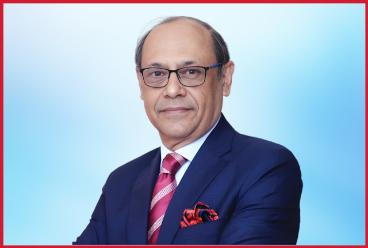
Kazi Mahmood Sattar has been elected as the new Chairman of the Board of IDLC Finance PLC, the country's leading NBFI.
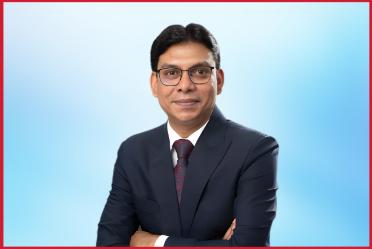
Rakibul Karim has been appointed managing director and chief executive officer of Guardian Life Insurance Limited.
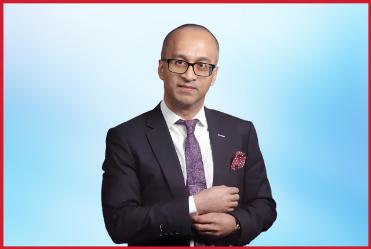
Mashrur Arefin, managing director and CEO of City Bank PLC has recently been elected as the chairman of the Association of Bankers, Bangladesh (ABB) for a two-year term (2026-27)
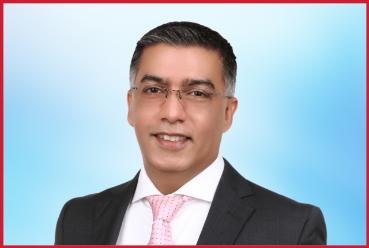
Dhaka Bank PLC welcomed banking veteran Osman Ershad Faiz as its managing director and chief executive officer (MD & CEO)

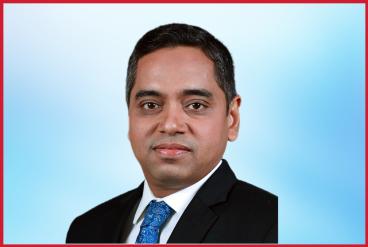
BRAC Bank has appointed Md Asif Bin Idrish to the post of deputy managing director (DMD) and head of corporate, commercial and institutional banking, effective from December 30, 2025.
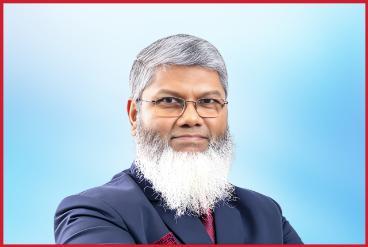
AB Bank PLC has promoted I�ekhar Enam Awal to the post of deputy managing director (DMD).
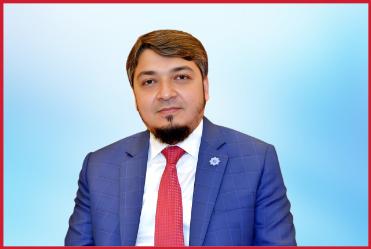
Shahjalal Islami Bank PLC has promoted Md Jafar Sadeq to the post of deputy managing director (DMD).
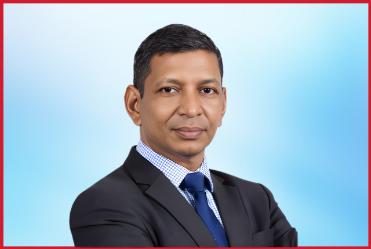
Md Sabbir Hossain, a seasoned banker with extensive experience, has joined Bank Asia PLC as additional managing director (AMD) and chief operating officer, effective from January 1, 2026.


In the quiet, icy expanses of the North Atlantic, a geopolitical storm is gathering over the world's largest island. Greenland, home to only 57,000 people and geographically part of North America, has long been politically tethered to Europe as an autonomous territory within the Kingdom of Denmark. For decades, this arrangement was stable, underpinned by NATO alliances and shared interests. However, the shi�ing dynamics of global power— marked by a resurgent Russia, an ambitious China, and an "America First" docGreenland, geographically part of North America, has long been politically tethered to Europe as an autonomous territory within the Kingdom of Denmark
trine in the United States— have transformed Greenland from a remote outpost into a central stage for international rivalry. As DonaldTrump suggests that the U.S. might use force or financial might to se-
To understand the sudden intensity of American interest, one must view Greenland not as a country, but as strategic terrain. Analysts describe the island as a "giant aircra� carrier" positioned ideally between the United States, Canada, the European Union, and Russia. It sits on the shortest flight path for missiles traveling between the European part of Russia and the U.S. mainland, making it indispensable for American national defense.
This strategic value is not theoretical; it is entrenched in infrastructure. During the Cold War, the United States constructed the Pituffik Space Base, formerly known asThule Air Base, on Greenland's northwest coast. Built to detect Soviet missile launches and facilitate retaliatory strikes, it remains the northernmost U.S. military base in the world.While Denmark holds sovereignty, the reality on the ground is that American power, not Danish power, guarantees the island's security. Denmark maintains only a light military footprint, consisting of dog sled patrols and a few navy vessels, which stands in stark contrast to the U.S. forward military presence.
However, the security landscape is evolving. American officials have expressed alarm over increasing Russian and Chinese activity in the Arctic, with Trump explicitly stating that the
cure the island, and as ice melts to reveal vast resources, Greenland finds itself caught between the strategic imperatives of superpowers and its own indigenous quest for independence.
U.S. must control Greenland to prevent these rivals from gaining a foothold.This pressure has forced Denmark to increase its own defense spending, investing in new ships and drones to monitor the critical "GIUK Gap"—the naval chokepoint between Greenland, Iceland, and the UK.This area is vital for NATO's strategy to detect and contain Russian submarines moving between the Arctic and the Atlantic.Yet, Danish experts admit that even if they dedicated their entire military budget to surveillance, they could not fully monitor an island half the size of Europe.
The reality on the ground is that American power, not Danish power, guarantees the island's security
Beyond military strategy, the battle for Greenland is driven by the allure of untapped wealth. In February 2025, a U.S. Senate committee highlighted the American mining industry's intense interest in the island. Geologically, Greenland is a treasure trove; its coastline holds what is arguably one of the world's greatest collections of
minerals, including precious metals, industrial rocks, and rare earth elements essential for modern technology. One site in southern Greenland is estimated to be among the top rare earth deposits globally outside of China.
However, the narrative of a resource bonanza faces significant logistical and ethical hurdles. Currently, the mining sector is miniscule, employing only about one hundred people across just two active mines.The environment is unforgiving; there are no roads linking settlements, and the terrain consists of deep �ords and icy mountains. Furthermore, extraction is costly and politically sensitive. In 2021, the Greenlandic government halted exploration at a major rare earth site because it contained radioactive uranium and was located too close to populated areas.
Paradoxically, the climate crisis is acting as a catalyst for these economic ambitions. As ice melts more rapidly, it creates greater accessibility to interior natural resources.This environmental shi� is also opening potential new shipping lanes—the Northwest Passage, the Northern Sea Route, and theTranspolar Sea Route—which could significantly shorten travel time between Asia and Europe compared to the Suez Canal.While navigation currently relies on expensive icebreakers, nations and corporations view the retreating ice not merely as a catastrophe, but as an economic opportunity.
While superpowers eye the map, the people of Greenland are navigating a complex path toward self-determination.The island is currently a semi-autonomous territory; while it governs its domestic affairs, Denmark retains control over foreign policy and security.This relationship is underpinned by a massive financial grant from Copenhagen—approximately 500 million euros annually—which accounts for half of Greenland's budget.This funding is critical; without it, the economy would likely implode, leading to impoverished villages and social collapse.
Despite this dependency, the desire for independence runs deep.The population is primarily Inuit, with a culture distinct from Denmark that survived thousands of years of subsistence hunting before modern colonization began in 1721.The legacy of colonization includes trauma from forced assimilation, religious conversion, and family separation. Consequently, a clear majority of Greenlanders support eventual independence, viewing themselves as a distinct people who want to be free.
The Greenlandic government is actively seeking to diversify its partnerships to reduce reliance on Denmark, establishing representative offices in the EU, China, and the USA. Many locals
view the heightened American interest as a "once in a generation opportunity" to build the economic foundation necessary for sovereignty. However, this does not translate into a desire to exchange one colonial master for another.When asked about Trump's interest in "buying" the island, locals reject the notion entirely, emphasizing that while they welcome partnership, they do not wish to be part of the USA.
The diplomatic fallout of the U.S. approach to Greenland extends far beyond the Arctic Circle. DonaldTrumpʼs refusal to rule out military force and his transactional view of the island have stunned European allies.This aggression has positioned the United States as the greatest threat to Danish unity—superseding even Russia or China. For European observers, this signals a shi� in American grand strategy toward a "fortress North America" approach, prioritizing continental security over traditional transatlantic alliances.
Denmark has attempted to manage this crisis by framing it as a European issue rather than a bilateral dispute, seeking strength in numbers against American pressure. However, the implications are global. Analysts suggest thatTrump's tactics regarding Greenland mirror those of
Vladimir Putin in Ukraine or China's ambitions regardingTaiwan. It represents a transition to a new world order defined by spheres of influence, where great powers openly vie for control over strategic territories regardless of existing sovereignty.
Greenland stands at a precarious intersection of history. It is an island seeking to decolonize and define its own future, yet it is trapped by the gravitational pull of great power competition.The United States views it as an essential shield and a potential resource hub; Denmark views it as a source of diplomatic leverage and historical responsibility; and the Inuit population views it as their ancestral home, not a piece of real estate to be traded.
As the ice retreats and geopolitical temperatures rise, the fundamental question remains: In a world increasingly determined by the whims of superpowers, will the 57,000 residents of Greenland retain the right to determine their own destiny, or will their future be decided inWashington, Copenhagen, and Beijing?The struggle for Greenland is no longer just about remote Arctic security; it is a litmus test for the future of national sovereignty in an era of renewed imperial ambition.



Bangladeshʼs cement industry is emerging from one of the most turbulent chapters in its history. A�er years of aggressive capacity expansion collided with so�er-than-expected construction demand and a series of policy shocks, the sector has endured a prolonged period of stress. Now, as the country enters a new political cycle, signs of change are beginning to surface.The industry may finally be transi-
tioning from survival mode toward cautious stabilization. This is not a dramatic turnaround, nor is it guaranteed. Progress hinges on policy consistency, macroeconomic stability, and the industryʼs ability to address structural constraints that have now come sharply into focus. Still, compared to the turbulence of revcent years, the current phase feels distinctly less chaotic and notably more measured.
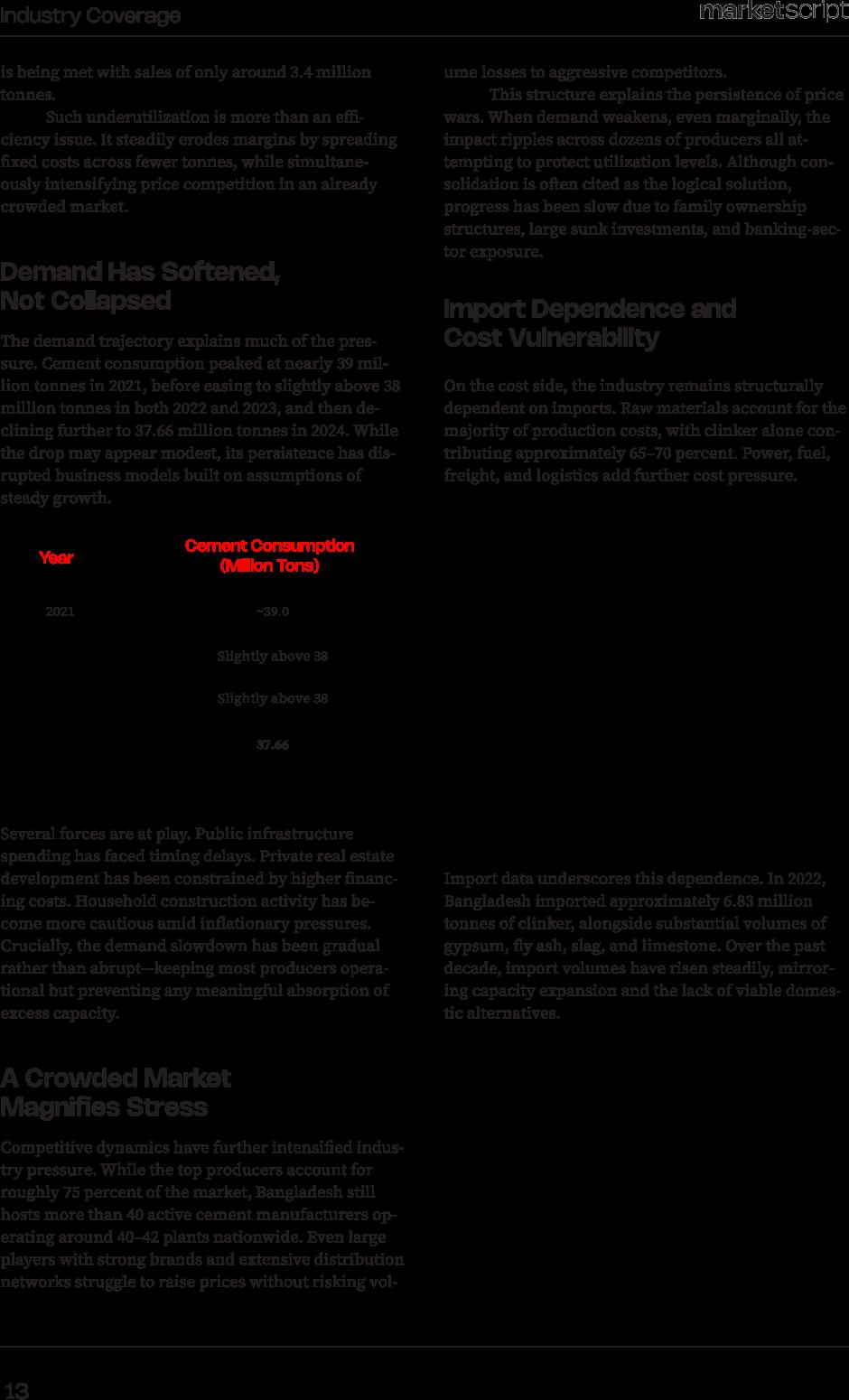
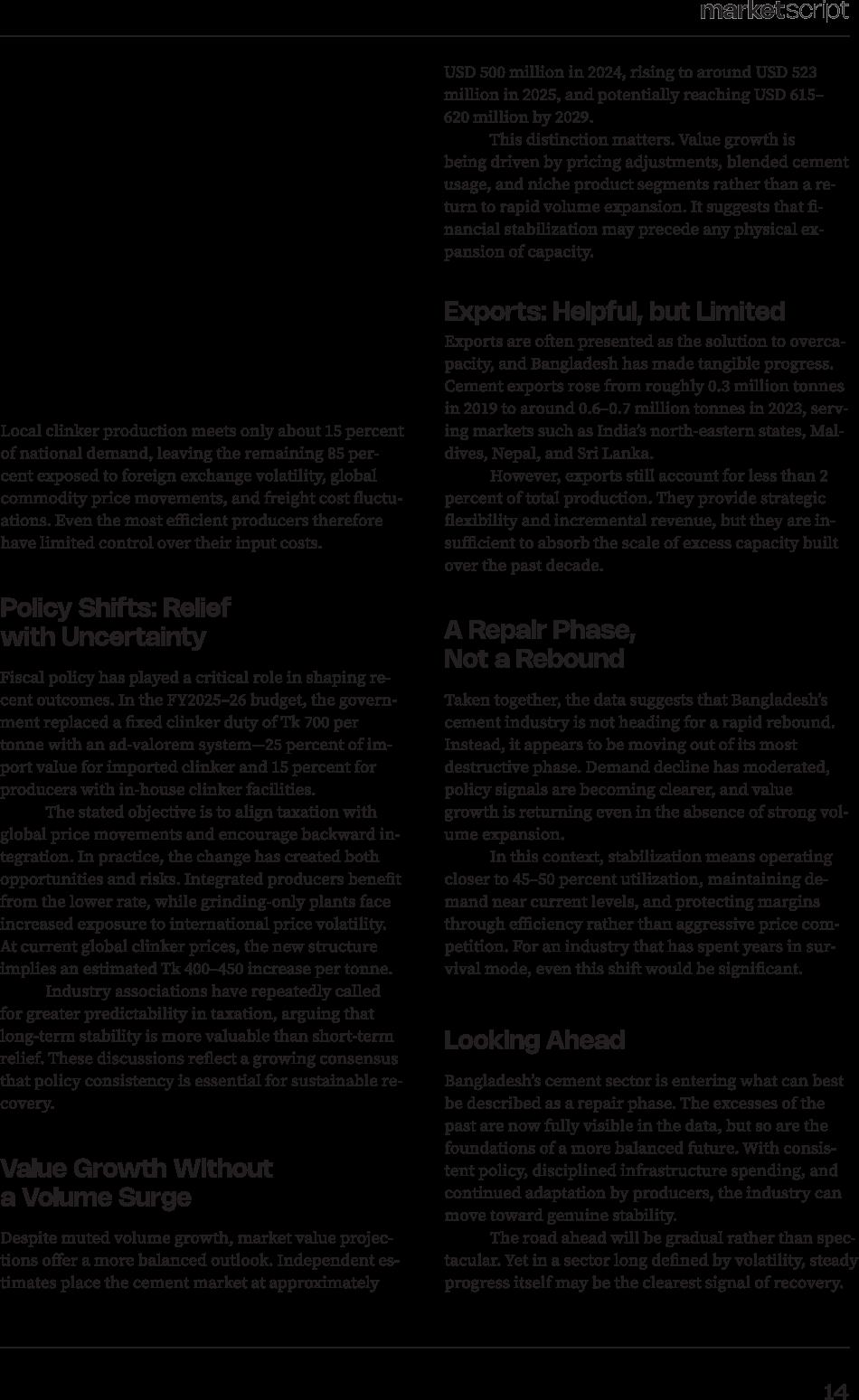
To understand the industryʼs current position, one reality stands out: the sheer magnitude of the supply–demand gap. Bangladeshʼs installed cement capacity stands at approximately 78–80 million tonnes per year, while domestic consumption in 2024 amounted to just 37.66 million tonnes. In effect, the industry has built the capacity to produce more than double what the market can absorb.
This imbalance did not emerge overnight. Ca-
pacity additions accumulated over many years, driven by expectations of large-scale infrastructure development and rapid urban expansion.When those projections slowed or were delayed, excess capacity became unavoidable.
The operational consequences have been severe. Industry data shows that many plants are operating at utilization rates below 45 percent, with some facilities dipping as low as 30 percent during periods of weak demand. On a monthly basis, the contrast is stark: industry capacity of roughly 8.4 million tonnes
Source: Emerging Credit Rating (ECR) Industry Overview





The world as we have known it for the better part of a century is being upended. According to Jeremy Bowen, the BBCʼs International Editor, we are witnessing "tectonic shi�s" in global power, where great powers and strongmen are increasingly flexing their muscle to expand territory and influence.
The post-WorldWar II era— a period defined, at least in theory, by a rules-based international system—is effectively over.What is emerging in its place is not a cleaner, more efficient system, but a volatile landscape characterized by uncertainty, the decline of traditional alliances, and a return to the chaotic principle that "might is right".
To understand the gravity of this moment, one must first look back at the architecture of the system that is now collapsing.The foundations of the modern world order were laid in the ashes of the SecondWorldWar. In 1943,Winston Churchill spoke at Harvard University, articulating a vision where the United States could not withdraw from the world stage if peace were to be preserved.This vision necessitated a "world council," a precursor to the UN Security Council, to prevent the failures that doomed the League of Nations.
However, this architecture was never purely altruistic.While the creation of the United Nations, the Genocide Convention, and the fabric of international law were "admirable" responses to the horrors of the 20th century, states ultimately act out of self-interest.
Responses to the horrors of the 20th century, indicate that states ultimately act out of self-interest.
The United States, emerging as the preeminent military and industrial power while Britain was bankrupt, constructed an apparatus ofWestern security primarily to benefit itself.The Marshall Plan, theTruman Doctrine, and the formation of NATO in 1949 were strategic maneuvers designed to rebuild markets for American goods and establish a bulwark against the "inexorable rise of communism and Soviet power".
For decades, this system provided a degree of stability and a framework for global interaction.There were moments when it functioned precisely as its architects intended.
The expulsion of Iraqi forces from Kuwait in 1991 stands as the high-water mark of this order.
President George H.W. Bush, described by Bowen as a "rules-based order guy," utilized the United Nations to
secure enforceable resolutions and built a vast coalition to reverse Saddam Husseinʼs annexation of a neighbor.This action had international legality on its side, adhering to the UN Charterʼs justifications for military action: self-defense, invitation by a threatened state, or Security Council authorization.
Yet, the system was always imperfect. Critics have long argued that the "rules-based order" was a cover for American power—a set ofWestern rules applied rigorously to adversaries but ignored or applied half-heartedly to allies. Evidently, international laws have been "widely broken especially by the most powerful countries in the world repeatedly since the SecondWorldWar".
The unraveling of this order became undeniable with the 2003 invasion of Iraq. Unlike the 1991 conflict, the 2003 invasion lacked a second UN resolution and was famously opposed by allies like France.The invasion, termed an "illegal act" by then-UN Secretary-General Kofi Annan, unleashed a "Pandora's box of killing" and radicalization that morphed into groups like ISIS.This "original sin" of illegality undermined the moral authority of theWest and signaled that the rules could be discarded when became inconnient for super-
Today, that accelerated into a The current war in serves as a "textbook how international huian laws are being vioall parties.While institulike the International inal Court attempt to invene—issuing arrest warrants for leadership on both sides—the violence continues, highlighting the diminishing power of international legal frameworks to restrain combatants.
While these rules were


never perfect, they provided a template—a way to measure severity and hold states to account. For instance, the rules clarify that while hospitals are protected, they lose that status if used as firing positions; without such nuances, there is no "forensic" way to judge the morality of warfare.
The collapse of this system is being hastened by a dramatic shi� in mized by the approach of Donald

Today, the "Global South" is not a passive chessboard for Western powers.
While previous administrations applied rules se"doesn't even pay and shows "every wanting to sweep
worldview is viewing tradialliances like sential pilstability, burdens have off can[s]".
"American security meant European security" is gone. Europe, though an eco-
dent, reduced to the role of a bystander in this new world order.This moment potentially represents a "milestone in
In place of the old order, we see attempts to return to a 19th-century style powers carve up the globe. However, the world of 2026 is vastly different from the world of the late 1800s. Back then, European powers divided up regions of the world that were largely undeveloped or
Today, the "Global South" is not a passive chessboard forWestern powers. The populations of the countries here in this part are educated, economically integrated, and resistant to being told what to do by old colonial powers or new superpowers.This makes the imposition of a clean, "spheres of influence" model nearly impossible.
So, what lies ahead?The prognosis is unsettling.We are entering a period where the safety net of rules, customs, and charters is being removed.Without this framework, there is no predictability, and no mechanism to hold leaders accountable.The alternative to a flawed rules-based order is not a better system, but chaos.
The world is currently seeing conflicts ignite and worsen without resolution, from the Middle East to Ukraine. The ultimate stability of this new era may hinge on how the United States and China manage their rivalry—whether they can agree to a division of the world, saying "this is our half... and that's your half". But even that is uncertain. History teaches that empires do not last forever, and China is rising while the US remains militarily dominant.
The tragedy of the current moment is the loss of the ideal, however imperfectly realized, that might does not make right.
The "new world order" that is taking shape appears to be one where strongmen impose their will, alliances are transactional, and the weak suffer what they must. A world without the structure of laws and customs guarantees "a lot of worry for anyone who wants to live a peaceful life".The tectonic plates have shi�ed, and we are all now living on shaky ground.
CRICKET MADE US FAMOUS. THE FUTURE WILL BELONG TO BRANDS THAT STAY PRESENT.

I was a child when Bangladesh won the 1996–97 Carlsberg ICC Trophy in Kuala Lumpur. I donʼt remember every over or every wicket, but I remember everything else. I remember the smell of tea in our living room, the ceiling fan barely working, the sound of radios coming from three different houses at once. I remember neighbours who never visited suddenly standing in our doorway because our television reception was clearer than theirs. I remember my father gripping the radio like it was a lifeline. I remember grown men crying without embarrassment, openly, as if something inside them had finally been validated.
That victory was not just a sporting achievement. It was emotional oxygen for a country that had grown up being told it was too small, too poor, too insignificant to matter on the world stage. It meant Bangladesh would finally get ODI status. It meant we were no longer just a cricketing footnote, playing friendly matches while the real world played tournaments without us. It meant we belonged. It meant a country used to being ignored could finally say, with proof, we are here.
For my generation, cricket became something far bigger than entertainment. It became proof that Bangladesh could win at something the world respected. It became a symbol of dignity. It became hope itself. From that moment, cricket stopped being just a sport. It became identity. It became pride. It became the one place where a small country could beat richer, stronger nations and feel equal for a night. And brands grew up inside that hope. Every logo next to the boundary rope felt like part of the national story. Every sponsor looked like a patriot. Every brand that stood beside cricket borrowed that pride without even
trying.That emotional foundation is real. It deserves respect. But history, no matter how beautiful, is not a business strategy.
For my generation, cricket became proof that Bangladesh could win at something the world respected. It became a symbol of dignity, and hope itself. And brands grew up inside that hope. Every logo next to the boundary rope felt like part of the national story. Every sponsor looked like a patriot.
How Cricket Became the Safest Place for Brand Money
A�er
that ICCTrophy win, cricket slowly became the safest marketing decision in Bangladesh. If your logo appeared during a national match, your brand felt important. Not just good—important. It signaled that you had arrived, that you were stable, that you were big enough to play on the national stage.
If you sponsored a tournament, you were taken seriously by distributors, retailers, banks, and government offices. If a cricketer endorsed your product, trust came built-in.You didnʼt
have to explain yourself.You were already legitimate.
Cricket didnʼt just build audiences. It built reputations. For more than twenty years, brands learned a simple rule: if in doubt, put money into cricket. And honestly, for a long time, that rule worked.
Families planned their evenings around matches. Streets went quiet during tense overs. Offices stopped working during World Cup games. People who didnʼt care about politics or economics suddenly cared deeply about run rates and net run rate.
Brands that appeared in those moments didnʼt just get reach.They got emotion.They got borrowed love.
But branding has never really been about loyalty to tradition. It has always been about loyalty to attention. And attention in Bangladesh has quietly—but completely—moved.

Bangladesh doesnʼt publish one clean, official, audited ad-spend report. But if you talk to media buyers, agency heads, marketing directors, and brand managers privately, the same story comes back again and again.
According to reporting fromThe Daily Star, Bangladeshʼs advertising market was roughly BDT1,500–1,600 crore in 2017. At that time, digital advertising made up barely 7 percent of total spend. By 2023, agency and media estimates placed total ad spend at BDT4,000–4,500 crore, with digital already accounting for nearly 45–50 percent of the market.
That is not a gradual shi�. That is a structural collapse of the old media order.
People arenʼt living onTVanymore.They are living on their phones. As of 2025, Bangladesh had about 77.7 million internet users. Smartphone ownership had climbed to nearly 73 percent of households. By early 2024, Bangladesh had 52.9 million active social-media identities. Facebook alone had around 52.9 million Bangladeshi users.
This is not abstract “digital transformation.”This is what you see on every bus, in every tea stall, in every traffic jam: people scrolling.
Yet cricket sponsorship costs keep rising. A single BPL team sponsorship now costs roughly BDT5–15 crore. A major tournament title sponsorship can reach BDT15–25 crore. PrimetimeTVspots during big matches cost two to four times normal rates. A top cricketer endorsement can cost anywhere from BDT50 lakh to BDT5 crore.
And a�er all that spending, most brands still cannot answer one basic question honestly: Did this actually sell
more product?
Cricket delivers massive reach. But it also delivers low frequency, almost zero personalization, weak attribution, and very little learning.When cost rises every year and clarity does not, thatʼs not premium branding. Thatʼs inflation disguised as tradition.
More than 60 percent of Bangladeshʼs population is under 35. Nearly 40 percent is under 25. This generation does not wait for match days to feel alive.They wake up with football highlights onYouTube.They scrollTikTok and Instagram before brushing their teeth.They watch gaming streams late at night.They follow fitness pages, runners, golfers, and archers.They live inside reels, shorts, and stories.
By late 2025, Facebook ads reached roughly 77 percent of internet users in Bangladesh. YouTube ads reached over 60 percent.TikTok ads reached nearly 68 percent. In other words, social platforms now reach more Bangladeshis daily than even the biggest cricket broadcasts do outside tournament windows.
For this generation, cricket is still emotional. But it is no
longer central to daily life. So when a brand appears only during cricket, it doesnʼt feel big. It feels distant. Respect remains. Relevance does not.
And relevance is what makes people choose one brand over another in the supermarket, on an app, or at a checkout counter.
Cricket creates moments. But modern branding is built on presence.Today, attention lives in short videos, creator communities, gaming streams, football culture, fitness groups, and online conversations. Cricket gives you peaks. Digital culture gives you habits.
And habits are what actually build brands now.Without daily presence, even the most beautiful campaign fades out between tournaments.
Football never really died in Bangladesh. It just went quiet. For years, Jamal Bhuyan carried Bangladeshi football on his shoulders. Calm, disciplined, European-trained, and articulate, he gave the sport dignity when it had

almost no attention.
And now something extraordinary is happening. Hamza Chowdhury. A Premier League–trained midfielder from Leicester City. A player shaped inside one of the toughest football cultures in the world. A Bangladeshi by blood, identity, and emotional connection.
Hamza is not just a footballer. He is a narrative shi�. If he commits fully to Bangladesh, he becomes proof that Bangladeshi athletes belong at the highest global level. For young Bangladeshis who already live inside Premier League culture, Hamza doesnʼt feel like a foreign star. He feels like one of us.
This is not just a sports opportunity. It is a once-in-a-generation cultural moment.
the national flag at theTokyo Olympics, millions suddenly cared about archery.
Archery in Bangladesh now represents discipline, patience, focus, and mental strength. It is a high-trust, low-clutter branding space.
Then there is Siddikur Rahman. From caddie to AsianTour professional golfer.That journey is one of the most powerful sporting stories in Bangladesh. Itʼs about aspiration, class mobility, and dignity. Cricket gives you mass reach. Golf gives you lifetime loyalty.
daily loyalty.
For Gen Z, these creators matter more than cricketers. Creators are todayʼs stadiums.
Grameenphone quietly shi�ed its energy into digital storytelling and youth platforms and now dominates online attention. Unileverʼs Lifebuoy built trust through school health programs instead of cricket sponsorships. bKash didnʼt build fame. It built habit.
While menʼs football is still searching for its breakthrough, womenʼs football has already delivered one. Sabina Khatun, captain of the Bangladesh womenʼs team, led historic SAFF Championship wins and became a national icon almost without marketing support.
For young girls, Sabina is proof that sport can be destiny. For parents, she represents dignity and discipline. For brands, she is empowerment and trust in human form. She is not over-commercialized. She is not distant. She feels real.
That authenticity is rare now. And it is brand gold.
Archery, Golf, and the Beauty of Quiet Heroes
When Roman Sana won gold at the Asia Cup stage in 2019, most Bangladeshis didnʼt even know his name. But they felt proud anyway.When Diya Siddique carried
Archery represents discipline, patience, focus, and mental strength., and Golf gives you lifetime loyalty.
Running culture is quietly exploding across Dhaka. Urban running clubs. Marathons. Fitness communities.
Running offers something cricket never can: daily repetition.When someone wears your brandʼsT-shirt three times a week on a morning run, your brand becomes part of their identity.
Thatʼs not awareness.Thatʼs belonging.
Bangladesh has tens of millions of gamers. PUBG, Free Fire, YouTube streamers,TikTok creators—these people command
None of these brands depend on cricket. And none of them are struggling.
Cricket built Bangladeshi brands into household names. But fame is no longer enough. Attention is no longer rented in stadiums alone. It is earned daily—on screens, streets, gyms, tracks, ranges, and inside communities. Cricket will always be part of our story.
But the future belongs to brands brave enough to build new ones.
S.M TANVIR AHMED
General Manager Jarvis



In the high-stakes theatre of European football, the numbers on the pitch are o�en dwarfed by the numbers on the balance sheet. During the 2023/24 season, Manchester United banked approximately $58.2 million from their partnership with TeamViewer. Fast forward to the current 2025/26 cycle, and the club has scaled those heights even further, commanding a staggering $75 million annually from Snapdragon.
Across the continent, the story is similar. FC Barcelona se-
cured a $66.5 million-per-year deal with Spotify, while Liverpool continues to bank on a $59.5 million annual ticket from Standard Chartered.To the layman, these figures seem astronomical and absurd.Why do corporations pay the equivalent of a small nationʼs GDP just to stitch a logo onto a piece of polyester?
The conventional wisdom points to global reach. Football is the worldʼs most dominant entertainment platform, offering a "halo effect" where 41% of fans admit a statistical bias toward
purchasing from brands that support their club.We see "activations" everywhere: Snapdragon utilizing augmented reality for "behind-the-scenes" fan experiences, or Spotify swapping their logo for global icons like Drake or The Rolling Stones during the El Clásico.
This is the "organised" side of the business. But there is a second, invisible empire where these brands are winning at a level that is both chaotic and completely free.Welcome to the world of the counterfeit jersey.
The Dhaka Connection: A Tale of Two Versions
If you wander into any reputable jersey shop in Dhakaʼs Banani or Dhanmondi, you are immediately greeted with a choice that defines modern football consumption. "Do you want the 'PlayerVersion' or the 'Fan Edition'?" the shopkeeper will ask.
From there, the rabbit hole goes deeper.You will hear whispers of "Thai Premium," "HighQuality Chinese," or "Vietnamese Master Copies."Then, of course, there are the legendary hauls from Gulistan, the bustling heart of Dhakaʼs unorganised retail, where jerseys are sold at a fraction of the price of a local meal.
Whether the garment was stitched in a high-tech factory in Vietnam or a small workshop in the outskirts of Narayanganj, the result is the same: the sponsors are winning.This is the ultimate "unorganised" branding masterclass.
Do you want the 'PlayerVersion' or the 'Fan Edition'?
The
Viral Economy of the "Fake"
First, consider logistics.
A brand like Snapdragon spends millions to be on the chest of Bruno Fernandes.This investment triggers a global "supply and demand" reflex. For every fan who can afford a $100 (£80) authentic kit from the Megastore, there are thousands of fans in emerging markets like Bangladesh who cannot.
To meet this demand, an army of third-party factories, entirely independent of the club or the sponsor springs into action. They invest their own capital into raw materials, pay for the elec-
tricity to run the looms, and hire the labor to print the logos.They package the goods and distribute them to every corner of the globe, from the streets of Dhaka to the markets of Lagos.
The result? Millions of people become walking billboards for Snapdragon, Spotify, or Standard Chartered, and it didn't cost the brands a single extra penny.
Millions of people become walking billboards and it didn't cost the brands a single extra penny
Unfathomable Returns
In traditional marketing, we obsess over "traceable metrics."We track click-through rates, impressions, and conversion funnels. But how do you put a metric on the "invisible reach" of ten million counterfeit jerseys circulating in South Asia?
While the clubs and kit manufacturers (like Adidas or Nike) might view counterfeits as lost revenue, the sponsors the brands whose logos sit on the front, likely view it through a different lens.To them, a "fake" jersey provides the exact same brand recognition as an authentic one.When a young fan in a remote village in Bangladesh wears a Manchester United shirt, the Snapdragon logo is just as visible to his community as it would be on a fan sitting in the Stretford End.
These brands have achieved the impossible: they have convinced a global, unorganized manufacturing network to pay for the privilege of spreading their logo. People are literally paying to manufacture and wear the brandʼs advertisement.
The Bottom Line
The sheer magnetism of football at a global stage is something no other industry can replicate. It is a force of nature that transcends legal boundaries and official retail channels.
As we look at the rising costs of sponsorship in 2026, we must realize that these brands are not just buying the 11 players on the pitch.They are buying into a global ecosystem that produces "free" marketing on an industrial scale.You cannot begin to fathom the true economics of a jersey until you look past the official shop and into the crowded markets of the East. In the chaotic, unorganized world of counterfeit kits, the sponsors aren't just participants, they are the undisputed victors.
SADIQE KHAN
Head of Marketing & Operations at Comfort Development Ltd.
COO & Co-Founder, The Indie Room


Founder Chairman, Transcom Group

BornonAugust28.
Startedhisbusinesscareer workinginhisfamilyownedjutemillsin Chandpur.
Becamethesoledistributor andimporterofNestlé productsinBangladesh.
Madehistorybyacquiring theUS-basedmultinational SmithKline&French.This wasthefirsttimea Bangladeshibusiness acquiredanMNC's operations,leadingtothe formationofEskayef PharmaceuticalsLtd.
Facedasignificant challengewhenthejute millswerenationalized, forcinghimtostarthis businessendeavorsfrom scratch.
HonoredwiththeOslo BusinessforPeaceAward bytheBusinessforPeace FoundationofNorway.The recipientwasselectedbya juryofNobelLaureatesfor buildingtrust,stability,and peace.
Markedthebeginningof TranscomGroup.Asa youngpatriot,Mr.Rahman facilitatedthefirst internationaltradeinthe historyofthenewly independentBangladesh.
Mr.LatifurRahmanpassed awayonJuly1, coincidentallythesameday hisgrandsonhaddiedfour yearsearlier.
While specific years are not provided for every position in the text, Mr. Rahman held several significant roles and received various accolades throughout his distinguished career:
• ChamberLeadership: He served as President of the Metropolitan Chamber of Commerce and Industry, Dhaka, for seven terms, making him one of the longest-serving presidents. He also led the Bangladesh Employers' Federation.
• Global&NationalBoards:
• Member of the Executive Board of the International Chamber of Commerce (ICC),
• Paris, andVice President of ICC-Bangladesh.
• Member of the governing body of BRAC, the world's largest NGO.
• Member of the Bangladesh Bank's Executive Board and Chairman of the
• government'sTrade Body Reforms Committee.
• Awards: In addition to the Oslo award, he received the "SAARC Outstanding Leader" award for upholding moral values and the Lifetime Achievement Award from the UK Bangladesh Catalysts of Commerce and Industry.

Grameenphone has secured 10 MHz of spectrum in the 700 MHz band, marking the first allocation of this low-band frequency to a mobile operator in Bangladesh. Priced at the base rate ofTk 237 crore per MHz, the assignment will generateTk 2,370 crore in government revenue.
In a move that could reshape the future of Bangladesh's national fish, PRAN-RFL Group is planning to farm hilsa for the first time in the country using advanced indoor aquaculture technology – an approach never before attempted commercially in the country.

With the combined initiative ofYamaha and ACI Motors, hybrid-technology motorcycles are entering the countryʼs market. In introducing new technologies to Bangladeshʼs motorcycle industry,Yamaha and ACI Motors have consistently played a pioneering role.

Akij Essential has launched a new campaign for its premium fragrant Chinigura rice, aiming to bring the taste and atmosphere of wedding feasts into everyday home cooking.

Taskin Ahmed, the number one pacer of the national team, has signed a contract with Walton, the number one air conditioner brand of Bangladesh.

The first-ever ʻSony HomeTheater Experience Centerʼ has been launched in the country. SmartTechnologies (BD) Ltd. known as Sony-Smart, the official distributor of Japanese world-renowned brand Sony in Bangladesh, has set it up at their flagship showroom in Uttara, Dhaka.
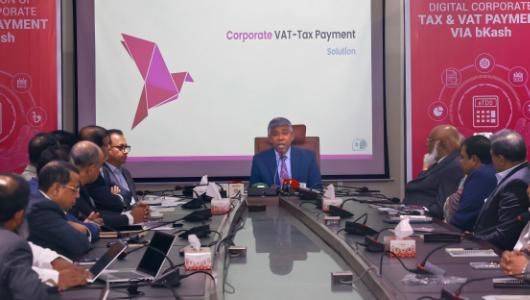
NBR launches digital corporate tax, VAT payment via bKash
The National Board of Revenue (NBR) has launched the largevalue corporate tax,VATpayments through mobile financial service bKash as part of the revenue boardʼs ongoing efforts to digitize the revenue management system.

AkijBashir Group has officially entered the electrical wire and cable industry with the launch of its new brand, AkijBashir Cables, introducing Bangladeshʼs first 3-layer insulated cable manufactured using advanced technology.
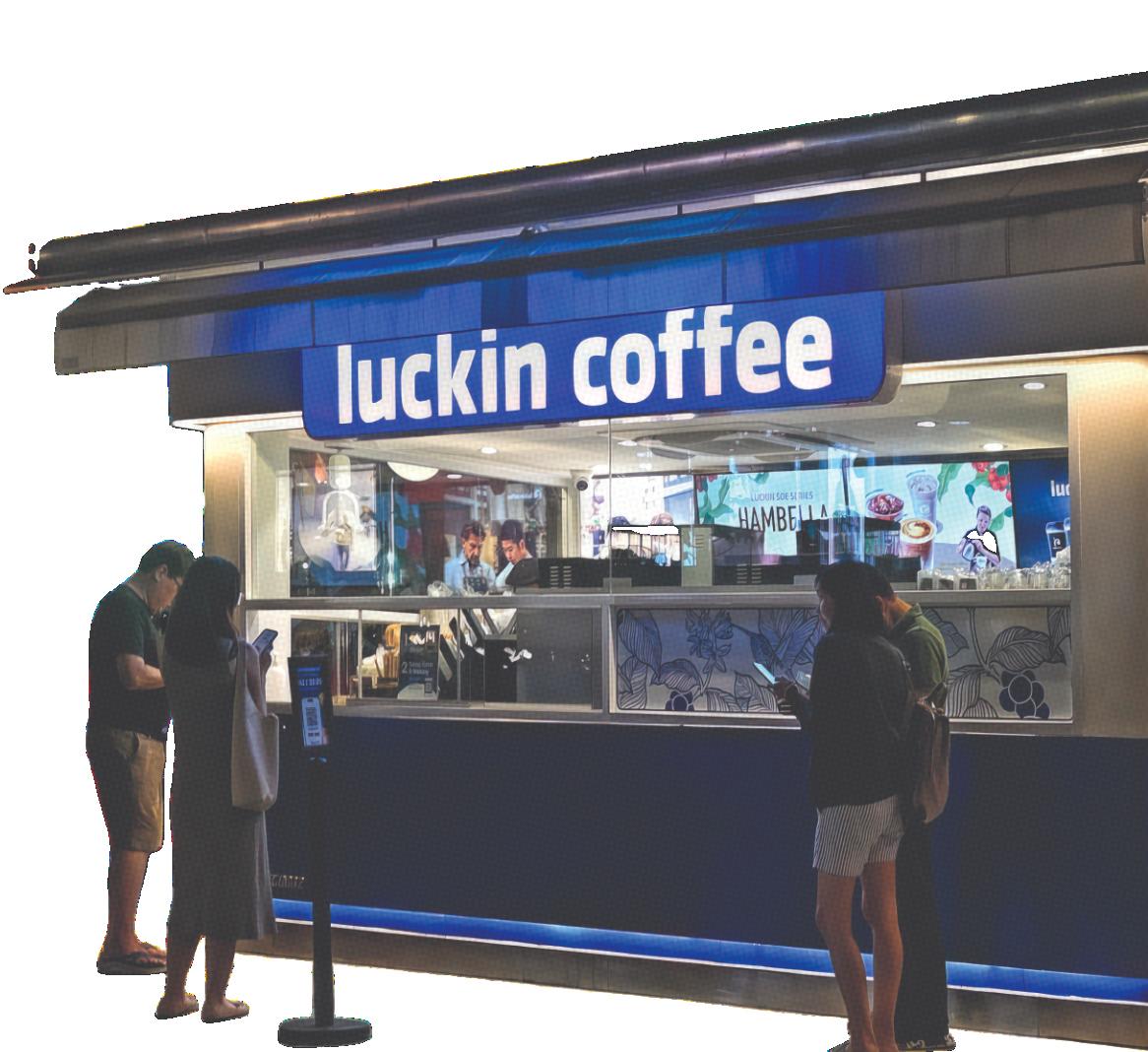
How Luckin Coffee’s Strategic Alchemy Dethroned Starbucks in China

A product of a magnificent strategic brilliance that fundamentally reimagined what a coffee company could be in the digital age. Luckin Coffee did not beat Starbucks at its own game; it invented an entirely new one
In the realm of modern business history, few narratives are as volatile or as compelling as the rise, fall, and resurrection of Luckin Coffee. Once dismissed as a "cheap imitation" of Starbucks and later written off as a fraudulent casualty of the Nasdaq, the Chinese coffee chain has orchestrated a comeback that is nothing short of miraculous. By 2023, Luckin had achieved the unthinkable: it surpassed Starbucks to become Chinaʼs largest coffee retailer by both store count and revenue. This victory was not merely a result of aggressive pricing, though that played a role. It was the product of a magnificent strategic brilliance that fundamentally reimagined what a coffee company could be in the digital age. Luckin Coffee did not beat Starbucks at its own game; it invented an entirely new one, tailored specifically for the speed, palate, and digital habits of the Chinese consumer.
For decades, Starbucks sold a lifestyle.Their "Third Place" concept—a comfortable lounge between home and work—was the cornerstone of their global dominance. Luckin Coffee dismantled this philosophy with ruthless efficiency. Recognizing that the bustling urbanites of Shanghai and Beijing prioritized convenience over couches, Luckin pioneered a "tech-enabled" retail model that stripped away the fat of the traditional café experience. Luckinʼs stores were designed as small, cashier-less pickup stations. By eliminating the need for extensive seating and lounge space, the company drastically reduced rent and labor costs.While Starbucks baris-
tas managed point-of-sale registers and customized orders faceto-face, Luckin moved 100% of its transactions to a mobile app.This digital-first approach did more than just streamline operations; it freed baristas to focus solely on production, churning out orders with industrial speed.
This structural divergence proved to be a decisive strategic advantage during the COVID-19 pandemic.When lockdowns shuttered the physical "Third Spaces" that Starbucks relied upon, Luckinʼs grab-and-go and delivery infrastructure allowed it to thrive. As noted by analysts, Starbucksʼ same-store sales plummeted by 44% during the Shanghai lockdowns of 2022, while Luckin posted a positive growth of 41%.The pandemic effectively stress-tested Luckinʼs low-over-
head model and proved it to be superior in a volatile economic climate.
Perhaps the most brilliant stroke of Luckinʼs strategy was its refusal to accept theWestern definition of coffee. Starbucks brought the Americano and the FlatWhite to China, but Luckin recognized that the vast majority of the Chinese population were tea drinkers who found traditional coffee too bitter. To bridge this gap, Luckin engaged in aggressive product innovation, transforming coffee into a sweet, approachable beverage that resonated with younger consumers.The companyʼs R&D department operated with the speed
of a tech startup, launching 113 new products in 2021 alone—averaging a new drink every three days—compared to Starbucksʼ roughly 20 new items.This "high-frequency" innovation strategy allowed Luckin to test the market rapidly and double down on winners.
The crown jewel of this strategy was the CoconutMilk Latte (also known as the Raw Coconut Latte). Launched in April 2021, this drink was a gamechanger, combining the creamy sweetness of coconut milk with coffee to create a flavor profile that hooked the Chinese palate. It became an instant sensation, accounting for nearly 70% of sales at some stores and driving the companyʼs first quarterly operating profit.
Luckin continued to push boundaries with "inventive" concoctions thatWestern purists might scoff at but Chinese Gen Z consumers adored, such as the Mascarpone Cheese Latte and the Brown Sugar Boba Latte,. In a marketing coup that generated massive social media buzz, they even partnered with Kweichow Moutai, a luxury Chinese spirits brand, to launch an alcohol-infused latte, selling 5.42 million cups on the first day.While Starbucks relied on its global menu, Luckin localized with sur-
Luckin continued to push boundaries with "inventive" concoctions thatWestern purists might scoff at but Chinese Gen Z consumers adored
Underpinning Luckinʼs product strategy is a sophisticated digital engine. Because every transaction occurs via an app, Luckin possesses a treasure trove of customer data that Starbucks, with its reliance on traditional ordering, initially lacked.This data allowed Luckin to push personalized discounts and track consumption patterns in real-time.
"high quality, high affordability, and high convenience" proposition allowed it to penetrate the mass market in a way Starbucks simply could not.
While Starbucks adhered strictly to a company-operated model to maintain brand control, Luckin embraced a hybrid approach that unlocked explosive growth. Under its new leadership, Luckin aggressively utilized a franchising model to expand into lower-tier cities and the vast Chinese hinterland—markets that Starbucks had been slow to enter.
Luckinʼs franchise terms were revolutionized to align incentives. Instead of charging high upfront fees, Luckin operated on a profit-sharing model, taking a cut only a�er the franchisee achieved a certain gross profit threshold.This lowered the barrier to entry for partners and accelerated store openings. By the end of 2023, Luckinʼs store count had skyrocketed to over 16,000 (and later crossed 20,000), vastly outnumbering Starbucksʼ footprint.

This digital capability fueled Luckin's most potent weapon: the price war. In 2023, Luckin launched a campaign selling coffees for as low as 9.9 yuan (approximately $1.40).While critics initially viewed this as a "loss leader" tactic reminiscent of the companyʼs pre-scandal days, the new management had optimized the supply chain and store efficiency to the point where such prices were sustainable.

This pricing strategy drove a wedge into the market. It attracted price-sensitive students and white-collar workers who could not afford Starbucksʼ $4.00 lattes. Starbucks, which had long positioned itself as a premium luxury brand, found itself in a strategic bind.While it publicly claimed it would not enter a price war, the pressure forced the American giant to quietly increase the frequency of discount coupons. Meanwhile, Luckinʼs
This "encirclement" strategy meant that for millions of Chinese consumers in smaller cities, Luckin was not just an alternative to Starbucks; it was their only option. By the time Starbucks announced plans to partner with Boyu Capital to penetrate these regions in late 2025, Luckin had already established deep brand loyalty.
The most remarkable aspect of Luckinʼs triumph is the context of its 2020 collapse. Following the revelation that executives had fabricated $300 million in
sales, the company was delisted from Nasdaq and le� for dead. However, the intervention of Centurium Capital and acompletely overhauled management team turned the crisis into an opportunity.
The new leadership displayed immense strategic discipline.They closed underperforming stores, cut "fluff" expenses like vending machines and fruit juice manufacturing, and reduced marketing spend by 60% while simultaneously improving brand impact through targeted campaigns,.They secured Eileen Gu, the freestyle skiing sensation,
This pivot from "growth at all costs" to "profitable growth" rebuilt investor trust. By 2022, the company had turned its first full-year operating profit, validating a business model that many had assumed was a Ponzi scheme.
Luckin Coffeeʼs victory over Starbucks in China is a masterclass in asymmetric warfare. Starbucks brought a knife to a gunfight; they brought a traditional retail model to a digital-first battlefield. Luckin analyzed the weaknesses
Today, Luckin stands not just as a coffee chain, but as a symbol of the agility of modern Chinese enterprise. It utilized automation to cut costs, data to drive flavor innovation, and a unique franchise model to conquer geography. As Starbucks now scrambles to play catch-up, mimicking Luckinʼs lower-tier expansion and digital ordering systems, the lesson is clear: in the worldʼs second-largest economy, relying on a global playbook is no longer enough.The Blue Deer has outrun the Green Siren, and the coffee map of China has been redrawn in its image.


A Deep Dive into PwC’s 29th Global CEO Survey
The 29th Global CEO Survey, drawing on insights from 4,454 chiefexecutivesacross95countries, presents a stark picture of the modern business environment: it is a world defined by a tension between immediate survival and long-term reinvention. Leaders are currently navigating a dual reality where they must effectively wield a "microscope" to manage nearterm threats while simultaneously using a "telescope" to identify multiyear opportunities.
As the global economy re-
Artificial Intelligence dominates the corporate agenda, yet the survey reveals a significant gap between investment and financial return.While the majority of CEOs are forging ahead with AI investments, immediate gratification remains elusive.
• TheRealityGap: More than half of CEOs (56%) report that their companies have realized neither increased revenue nor decreased costs from AI in the last 12 months.
• TheVanguard: However, a small, elite group— approximately oneineightcompanies(12%)— arerealizingbothcostsavingsandadditionalrevenues
The differentiator for this "vanguard" group is the depth of their deployment. Unlike companies pursuing isolated or tactical AI projects, successful organizations are building "strong AI foundations".These foundations include formalized risk processes, defined roadmaps, and an organizational culture conducive to adoption. Furthermore, these leaders are applying AI to their products, services, and experiences at a rate of 44%, compared to just 17% for other companies.The primary concern for CEOs across industries, particularly in financial services andTMT(Technology, Media, and Telecom), is not whether to adopt AI, but whether
configures, CEO confidence has waned. Compared to the previous year, executives are significantly less confident in their companies' short-term revenue growth prospects, with only 30% expressing high confidence for the next 12 months. However, beneath this layer of caution lies a divergence in performance.The report highlights that CEOswho areaggressivelypursuingreinvention—throughAI,cross-sectorexpansion,andbusinessmodelinnovation—areoutperformingtheir peers.
they are transformingfastenoughtokeepup
A powerful force reshaping the global economy is the blurring of industry lines. Driven by technology, climate change, and shi�ing consumer preferences, companies are increasingly venturing outside their traditional swim lanes.
• Cross-SectorCompetition: 42% of CEOs report that their companies have begun competing in new sectors over the past five years.
• TheGrowthStrategy:This boundary-crossing is not merely defensive; it is a primary driver of growth. CEOs planning large acquisitions frequently looking outside their own industries (44%), with the technology sector being the top target for cross-sector growth.
The survey data suggests a strong correlation between this type of dynamism and financial health. Companies that generate a higher percentage of revenue from new sectors boast bigger profit margins and higher CEO confidence. Conversely, companies that remain static are falling behind; the 15% of companies described as "cautious"—those avoiding large investments or acquisitions—are growing more slowly and have profit margins three percentage points lower than their dynamic peers.
While pursuing reinvention, CEOs are confronting an elevated threat landscape.The survey identifies a "confidence down, threats up" environment where macroeconomic volatility and cyber risks are paramount.
• Cybersecurity: Cyber risk has risen to share the top spot among threats. 31%ofCEOsstatetheir organizationsarehighlyorextremelyexposedto financiallossfromcyberthreats, a significant jump from 21% two years prior.This has spurred action, with 84% of CEOs planning to improve enterprise-wide cybersecurity in response to geopolitical risks.
• TheReturnofTariffs: A newly prominent concern is trade policy. OneinfiveCEOs(20%)considertheircompanieshighlyexposedtofinancial lossfromtariffs, with concern spiking in manufacturing-heavy regions like the Chinese Mainland (28%) and Mexico (35%). Almost a third of CEOs expect tariffs to compress their net profit margins in the year ahead.
Despite these threats, the report warns against "denial." Leaders who allow geopolitical uncertainty to freeze their investment strategies risk stagnation.The data indicates that companies continuing to invest despite uncertainty are enjoying higher profit margins.
The survey paints a picture of "globalization in motion" rather than retreat.While the United States remains the top destination for international investment (selected by 35% of CEOs), new centers of gravity are emerging.
• RisingPowers: India has seen a surge in interest, with 13% of CEOs planning investments there, up from 7% the previous year.
• TheMiddleEast:The United Arab Emirates and Saudi Arabia have broken into the top ten investment destinations.This shi� is driven by the diversification of Gulf economies away from oil and gas, focusing instead on infrastructure, industrial clusters, and data centers.
Two critical areas—innovation and climate change—reveal a troubling gap between CEO aspiration and operational reality.
CEOs admit to spending nearly half their time (47%) on issues with time horizons of less than one year, compared to just 16% on horizons extending beyond five years.
1. InnovationTheatre:While half of CEOs claim innovation is central to their strategy, few have implemented the necessary rigorous processes. Only 8% of companies have adopted at least five of six key innovation practices, such as routine processes to kill underperforming projects or tolerating high-risk ventures.The report warns against "innovation theatre" activities that look like innovation but lack tangible value. However, the payoff for getting it right is clear: companies employing these practices achieve faster revenue growth and higher margins.
2. ClimateIntegration: Despite high exposure to climate risk, particularly in insurance (51%) and utilities (67%)—corporations are failing to integrate climate data into decision-making.
• TheProcessGap: Only about oneinfourCEOssay theyhavedefinedprocessesforincorporatingclimatechangeintosupplychainorproductdesigndecisions.
• CapitalAllocation: Even more concerning, only 20% integrate climate risks into capital allocation and M&A decisions.The report suggests that companies can move from a risk-management mindset to "active value creation" by utilizing the expanded stores of sustainability data now available due to reporting requirements.

In an era of AI-anxiety, data privacy concerns, and climate scrutiny, trust has become a tangible financial asset.The survey analyzed total shareholder returns (TSR) and found a striking correlation:
• TheTrustPremium: Companies experiencing the fewest trust concerns delivered TSRsthat wereninepercentagepointshigher than those facing the most concerns.
• Vulnerability:Two-thirds of CEOs reported trust concerns arising in at least one area of their business over the last 12 months.
The report advises that trust must be treated as a boardroom topic, categorized into three dimensions: operational trust, accountability trust, and digital trust.
Perhaps the most fundamental challenge highlighted in the report is the allocation of leadership time. CEOs admit to spending nearly half theirtime(47%)onissueswithtimehorizonsofless thanoneyear, compared to just 16% on horizons extending beyond five years.
This imbalance creates a "tyranny of the
urgent," where immediate crises crowd out the strategic thinking required for long-term viability. Ironically, CEOs who identify long-term viability as their most pressing concern also report spending more time on short-term activities than their peers.This data suggests that for reinvention to succeed, leaders must fundamentally "reinvent their calendar".
The overarching message of PwCʼs 29th Global CEO Survey is that the global economy is in the midst of a profound reconfiguration.The tension between short-term volatility and long-term transformation is acute. However, the path forward is clear: dynamismpays.
Companies that are actively blurring sector boundaries, building enterprise-scale AI foundations, and integrating climate and trust into their core strategies are statistically outperforming those that are cautious or reactive.
The greatest risk for today's CEO is not the threat of tariffs or cyberattacks, but the danger of inaction—becoming frozen by uncertainty while the fundamental rules of business are rewritten.To thrive, leaders must balance the microscope and the telescope, ensuring that the urgent demands of today do not eclipse the vital opportunities of tomorrow.

In the grand calculus of planetary survival, humanity is currently operating deep in the red.While climate change and pollution o�en dominate the headlines, they are frequently symptoms of a deeper, systemic malady: overconsumption. This phenomenon, defined simply as the state in which
humans consume resources faster than the Earth can regenerate them, threatens not only the stability of global ecosystems but the very future of human civilization. As we peel back the layers of our economic systems and daily habits, a stark reality emerges: we are living on borrowed time, and the interest rates are becoming lethal.
To understand the scale of the problem, one need only look at the calendar. "Earth Overshoot Day" marks the specific date each year when humanityʼs demand for ecological resources exceeds what the planet can renew in that year.The trajectory of this date is a chilling indicator of our accelerating appetite. In 1972, humanity was living within its means, with Overshoot Day falling on December 31. By stark contrast, in 2025, that date arrived on July 24.
This shi� signifies a fundamental imbalance. In the early 1970s, one Earth was sufficient to support human activity; today, we require the resources of 1.78 Earths to sustain our current consumption habits.While population growth plays a role—the human population has doubled since the 1970s—it is not the sole culprit. Resource extraction has quadrupled in the same period, indicating that per capita consumption is rising alongside absolute numbers.We are not just more numerous; we are individually more voracious.
What drives this insatiable hunger? Experts point to the fundamental structure of our global economy. Laura Fox, a research scholar atYale Law School, identifies the economic model itself
as the primary driver, noting that capitalism promotes constant growth and rewards consumerism, fostering a mindset where people buy far more than they need.
This systemic pressure is exacerbated by technological acceleration. On the supply side, advancements have made it cheaper and faster to produce goods at massive scales. On the demand side, technology inundates consumers with exponentially more advertisements and provides unprecedented access to goods.The convenience of online marketplaces, where goods can be delivered to a doorstep within a day, removes the friction from purchasing, further fueling patterns of unnecessary acquisition. In a system where corporations profit from consumption, there is little incentive for them to encourage moderation; rather, the systemic structure is designed to perpetuate the cycle of buying and selling.
Nowhere is the irrationality of overconsumption more visible— or more damaging—than in our food systems. Over the past halfcentury, global meat consumption has nearly doubled, rising from 51 pounds per person in 1961 to 97 pounds by 2022.This dietary shi� drives immense resource usage, yet it is paired with a grotesque inefficiency: food waste.
Approximately one-third
of all food produced on the planet is wasted annually.This waste occurs at every link in the supply chain, from farming and manufacturing to retail and household spoilage. Perhaps most disturbingly, one-fourth of all animals killed for food are never actually eaten. In the seafood industry within the United States, nearly 50% of the catch is wasted.This means that the environmental degradation caused by farming and fishing— the deforestation, the water usage, the emissions—is o�en incurred for products that simply end up in a landfill.
As Jennifer Molidor of the Center for Biological Diversity notes, this waste is "part and parcel" of overconsumption, driving destructive resource extraction without even fulfilling the basic biological need for nourishment.
The consequences of this excess are not merely theoretical future risks; they are present-day catastrophes.The extraction of resources required to feed the global consumption machine is wreaking havoc on vulnerable ecosystems and communities.
In the Niger Delta, nearly a century of oil extraction has transformed a once-fertile wetland into a toxic zone.The extraction process releases harmful chemicals that result in acid rain, which corrodes buildings,
destroys crops, and pollutes water sources.The human cost is terrifying: residents suffer from chronic bronchitis and breathing problems, cancer rates are elevated, and life expectancy in the region has plummeted to around 40 years.
Similarly, the Amazon rainforest is being systematically dismantled to service global markets. Nearly 20% of the Amazon has been deforested, primarily for cattle farming and the cultivation of soybeans to feed livestock.This destruction leads to soil erosion, loss of biodiversity, and the displacement of Indigenous people, all to fuel the global demand for beef and agricultural commodities.
The oceans face a parallel crisis. Overfishing has pushed one-third of fisheries to the brink of depopulation and placed over one-third of sharks and rays at risk of extinction.This relentless extraction threatens food security and livelihoods; the collapse of the Grand Banks cod fishery in 1992, for example, cost 35,000 jobs. Furthermore, the materials used to harvest these resources contribute to pollution, with fishing gear estimating to make up 75% of the plastic waste in the Great Pacific Garbage Patch. Indeed, if current trends continue, plastic in the ocean is expected to quadruple by 2050.
Overconsumption is a function of wealth. High income countries consume six times more resources than low income
countries.
It is crucial to recognize that the responsibility for this crisis is not distributed equally. Overconsumption is largely a function of wealth. High-income countries consume six times more resources than low-income countries. In a striking comparison, the average person in North America consumes nine times as many natural resources as the average person in Africa.The "global north" drives the demand that strips the "global south" of its resources, creating a dynamic where the environmental and health burdens of extraction are felt most acutely by those who consume the least.
Facing a future where global oil reserves could be depleted by 2052 and air pollution could kill 9 billion people annually by mid-century, the need for change is urgent. However, reversing overconsumption requires interventions at both the individual and systemic levels. Individually, consumers are encouraged to shi� their habits. Adopting a plant-based diet is cited as one of the most effective ways to lower personal impact, as it bypasses the inefficient conversion of calories through animal farming. Simple changes like using reusable containers and public transit also play a role. However, journalist J.B. MacKinnon proposes a more radical metric for personal sustainability: simply spending less money. He argues that regardless of whether a product is "green," the act of spending usually correlates with resource im-
pact; therefore, reducing overall expenditure is a potent tool against overconsumption.
Yet, individual frugality cannot solve a systemic problem alone. Governments possess the tools to reshape the economic landscape.Through legislation, subsidies for sustainable energy, and public education, the state can incentivize greener practices. Local governments can adjust procurement policies to prioritize low-emission foods, effectively boycotting the most destructive products.
Overconsumption is a complex beast, deeply entrenched in our culture, economy, and psychology. It is driven by a capitalist model that conflates growth with success and is facilitated by technologies that make buying instantaneous and effortless. But the physical limits of our planet are non-negotiable.With the specter of resource depletion threatening humanityʼs long-term existence, the transition from a culture of excess to one of sufficiency is not just an environmental preference—it is a survival imperative.We must decide whether to continue borrowing from the future until we are bankrupt, or to learn, finally, to live within the generous but finite means of the only Earth we have.


The integration of artificial intelligence into healthcare has shi�ed from theoretical research to consumer reality, marked significantly by the launch of "ChatGPT Health".This specific platform allows users to securely connect medical records and wellness apps to generate personalized responses, yet it has immediately sparked concern among experts regarding the blurring line between general information and regulated medical advice. While Large Multi-modal Models (LMMs) demonstrate increasing proficiency in medical examinations, the deployment of these tools introduces systemic risks ranging from "hallucinations" and data poisoning to psychological dependency.
The performance of Large Language Models (LLMs) in medical contexts has improved drastically with each iteration. A comparative analysis of OpenAI's models found that GPT-4 Omni (GPT-4o) achieved an overall accuracy of 90.4% on USMLE-style questions, significantly outperforming GPT4 (81.1%) and GPT-3.5 (60.0%). GPT-4o demonstrated exceptional accuracy in social sciences (95.5%) and behavioral neuroscience (94.2%), suggesting significant potential as an educational aid for medical students.
Beyond OpenAI, other models show specialized strengths. In a study comparing DeepSeek R1 and O3 Mini across chronic conditions, DeepSeek R1 achieved 100% accuracy in diagnosing mental health and neurological disorders. Conversely, O3 Mini excelled in autoimmune disease classification with 100% accuracy, highlighting that different models may require specializa-
tion for specific medical domains. Googleʼs Med-PaLM 2 has also been highlighted for its advanced clinical reasoning, achieving 86.5% on MedQA benchmarks. However, these high scores mask critical vulnerabilities. In the same study favoring DeepSeek R1, both models struggled significantly with respiratory diseases, achieving accuracy rates as low as 20% to 40%. Furthermore, passing a medical licensing exam is not equivalent to providing safe clinical care; studies indicate that while models like GPT-4o are proficient in diagnostics and management, reliance on them could hinder the development of essential critical thinking skills in students and clinicians.
The primary danger of consumerfacing medical AI lies in its tendency to "hallucinate," or present
The primary danger of consumer-facing medical AI lies in its tendency to “hallucinate,” or present false information as fact, which can lead to severe physical harm.
false information as fact, which can lead to severe physical harm. A harrowing example involves a 60-year-old man who presented to an emergency department with hallucinations and an attempt to escape the hospital. It was discovered that he had been consuming sodium bromide—an industrial salt used for cleaning—because ChatGPTadvised him it was a substitute for table salt.This advice resulted in bromism, a condition characterized by stupor and impaired coordination.
Such cases illustrate the regulatory gap identified by experts like Alex Ruani, who notes that for many users, it is unclear where general information ends and medical advice begins. ChatGPTHealth is not regulated as a medical device, meaning it lacks mandatory safety controls, risk reporting, or post-market surveillance.While OpenAI utilizes "HealthBench" to evaluate models, the full methodology remains mostly undisclosed rather than peer-reviewed.
Beyond direct physical injury, the psychological impact of AI interaction is producing new phenomena such as "chatbot psychosis," where users develop delusions or paranoia connected to their use of chatbots.This is not a recognized clinical diagnosis but describes instances where users believe chatbots are sentient or are revealing conspiracies. In a highprofile case, a man who attempted to assassinate Queen Elizabeth II was reportedly encouraged by a chatbot app named Replika. Experts suggest that the design of these bots, which are primed for engagement and validation of user beliefs, can dangerously amplify existing delusions.
On a technical level, medical LLMs are uniquely vulnerable to "data poisoning." Research indicates that replacing as little as 0.001% of training tokens with misinformation can produce a model significantly more likely to generate medically harmful text. Because models ingest massive amounts of data from the open web (the "Pile"), malicious actors can insert unverified or intentionally harmful medical articles that are subsequently absorbed by the AI.This vulnerability is compounded by the fact that outdated or incorrect medical guidelines already exist on the web, creating "incidental" data poisoning.To mitigate this, researchers are proposing defense algorithms that cross-reference LLM outputs against biomedical knowledge graphs to flag misinformation.
gers, issuing guidance that frames LMMs as products of a complex supply chain involving developers, providers, and deployers. A key ethical concern is "automation bias," where clinicians or patients overlook errors because they trust the authority of the machine.There is also the risk of "epistemic injustice," where an AI fails to recognize a patient's specific lived experience or symptoms because they fall outside its training data.
TheWHO emphasizes that governance must occur at every stage. Developers are urged to design for values and inclusivity, ensuring data workers are paid living wages and protected from the psychological distress of filtering toxic content. Governments are advised to enforce transparency regarding training data and to introduce mandatory postrelease auditing for high-stakes AI applications. Furthermore, liability remains a contentious issue; theWHO suggests governments establish liability rules to ensure victims of AI-induced harm can claim compensation regardless of the difficulty in assigning blame between the developer and the provider.
carries risks of "Dr. Google" style misinformation, it also offers potential for helping patients understand chronic conditions.The goal is to use these tools to support, not replace, clinical care. For doctors, LMMs offer "keyboard liberation" by automating administrative tasks like dra�ing clinical notes, potentially reducing burnout.
For patients who choose to

ing specific prompts to cross-check medical adthe AI to anmended life-
search or to verify the safety profile of a prescribed medication.
TheWorld Health Organization (WHO) has recognized these dan-
Despite the risks, the integration of AI into healthcare appears inevitable. In Australia, the Royal Australian College of General Practitioners (RACGP) acknowledges that while ChatGPTHealth
Ultimately, the deployment of systems like ChatGPTHealth represents a critical juncture in medicine.While they offer the ability to synthesize vast amounts of medical knowledge, they currently operate with a lack of regulation that leaves consumers vulnerable to hallucinations, bias, and manipulation. As theWHO advises, the focus must remain on protecting human autonomy and ensuring that the epistemic authority of medicine remains with trained professionals rather than probabilistic algorithms.


Imagine the quintessential music festival experience: the thumping bass, the roaring crowd, the mud, the sweat, and the sheer electric energy of the moment. Now, insert the buzzkill—the physical wallet. For decades, diving into the mosh pit meant worrying about losing your cash, and buying a bottle of water meant fumbling through bills while a line of thirsty
fans waited impatiently behind you.
This was the status quo inTaiwanʼs youth-centric music festival scene, an environment that was historically dominated by cashonly transactions.While the music was modern, the commerce was archaic.Vendors lacked card readers, and attendees were stuck carrying physical wallets, a reality
The core challenge was logistical and behavioral. Festivals are rugged, high-energy environments where traditional banking hardware is cumbersome. However,Visa identified a crucial psychological insight regarding their target demographic: youngpeoplevalue hands-freefreedom.
Post-pandemic, the "mobile-first" generation has become accustomed to seamless digital interactions.The idea of carrying a bulky wallet is antithetical to the sense of liberation people seek at a music festival.Visa realized that to connect with this always-on generation, they had to eliminate the physical wallet from the entertainment experience entirely.
The strategy was framed around a shi� "From BurdentoFreedom."The goal was to make freedom of movement a tangible part of the brand value, proving thatVisa understands the lifestyle of its users, not just their bank accounts.
The technological breakthrough that enabled this shi� was "TapTo Phone." In the past, vendors needed dedicated credit card terminals to go cashless—a logistical nightmare in a temporary festival setup.
Visa flipped the script by transforming the vendors' own smartphones into mobile card readers. With noextrahardwarerequired,63vendorswereenabled toacceptcontactlesspaymentsimmediately.This innovation meant that any vendor, from a food truck to a merchandise tent, could process fast, secure payments without handling a single bill.
This reduced transaction friction significantly,
that severely limited the overall festival experience.
In a bold move to modernize the mosh pit,VisaTaiwan orchestrated a campaign to change the rhythm of commerce. By introducing their "TapToPhone"technology, they didn't just offer a new way to pay; they offered a new way to party.
speeding up checkout times during peak festival hours when every second counts. It was a brave introduction of contactless mobile payment into a scene where cash had always been king.
To drive adoption,Visa knew a corporate press release wouldnʼt cut it.They needed to match the festival's energy.The campaign utilized guerrilla-styleproduct demonstrationsfeaturingKeyOpinionLeaders (KOLs) and influencer-led social content to show, rather than tell, the benefits of the technology.
Visa activated "both sides of the transaction equation".They didn't just provide the tech; they staged real vendor transformations and had influencers run pop-up sales to demonstrate the ease of use.These influencers shared real user stories and sparked organic social buzz, creating genuine audience engagement.
The messaging was simple and authentic, tapping into a cultural shi� where young people expect digital simplicity even in rugged environments. As one piece of feedback noted, "Taptophoneistooconvenienteveryfestivalshoulddothis!"By integrating the payment method into the actual flow of the festival, Visa sparked widespread organic conversation about the new method.
The campaign did more than just install so�ware; it fundamentally shi�ed behavior in a cash-heavy environment.The metrics from the campaign read like a chart-topping hit:
• Adoption:The campaign achieved an installation
Insight rate of 90%.
• Revenue:Year-over-year revenue skyrocketed by 660%.
• VendorSuccess:60% of participating vendors re ported that the technology helped boost their sales.
• Reach:The campaign generated over 46million impressions & was covered by nearly 50 media outlets.
The financial efficiency of the campaign was equally impressive.The earned media value exceeded US $1,000,000, resulting in a Media ROI of 7X.
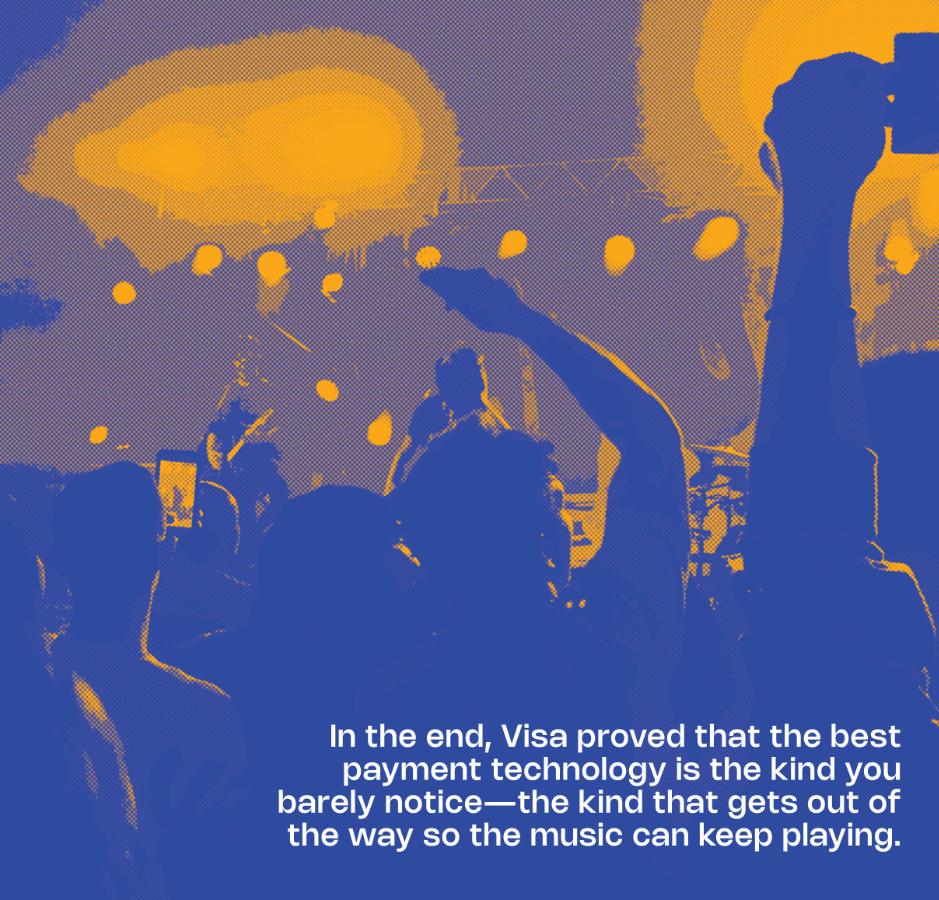
Visaʼs "TapTo Phone" campaign inTaiwan serves as a masterclass in aligning technology with human desire. By recognizing that the youth-centric festival crowd viewed cash as a tether rather than an asset,Visa replaced a legacy burden with modern freedom.
The project successfully introduced mobile payments to a "cash-heavy music festival," achieving its objective of boosting awareness and favorability among young users. But beyond the metrics, the campaign succeeded because it enhanced the fun. It allowed attendees to carry only one mobile phone to the music festival, ensuring that their hands were free to clap, wave, and record the moments that actually mattered.

In Dhaka today, leisure rarely exists without a price tag. Step outside and the options are predictable: a café latte that costs as much as a basic meal, a roo�op brunch framed as “relaxation,” or a
the bottom of the budget, unless it is bundled with consumption to justify the cost.
As a result, “going out to relax” becomes an economic decision.You pay to eat, and in return, you earn time.This



Bangladeshʼs leisure and entertainment economy is quietly expanding, driven by urbanization, rising disposable income, and one of the youngest populations in South Asia.
In 2024, the arts, entertainment, and recreation segment reached an all-time high contribution to services GDP, signaling that leisure is no longer peripheral — it is becoming economically measurable.
Sub-sectors reflect similar momentum.The amusement park industry alone generates annual turnovers of roughlyTk 5,000 crore, while indoor entertainment formats — gaming zones and family entertainment centers — continue to grow alongside global trends. Meanwhile, Bangladeshʼs games market is projected to reach USD 1.83 billion in revenues, highlighting a deep and growing appetite for play, interaction, and recreation.
Yet behavior around leisure spending remains cautious.
Inflation and rising living costs have made consumers increasingly value-conscious. People are willing to spend — but only when the experience feels meaningful, affordable, and repeatable.
If someone wants to “hang out” in Dhaka, their choices usually fall into limited categories:
• Cafésandrestaurants, where socializing is tied to food spending.
• Mallsandcinemas, designed for move ment, not lingering.
• Amusementparks, expensive and desti nation-based.
• Publicparks, o�en overcrowded or poorly maintained.
Each serves a purpose — but none offer affordable, recurring, unstructured social leisure.There are few spaces where people can simply spend time together without needing to justify their presence through purchases.
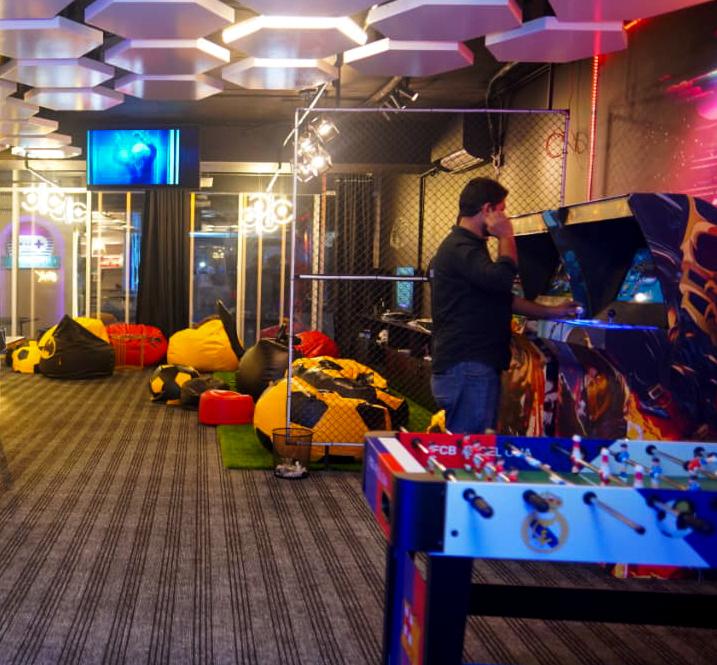
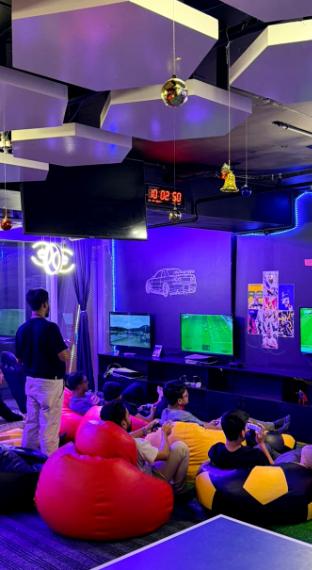
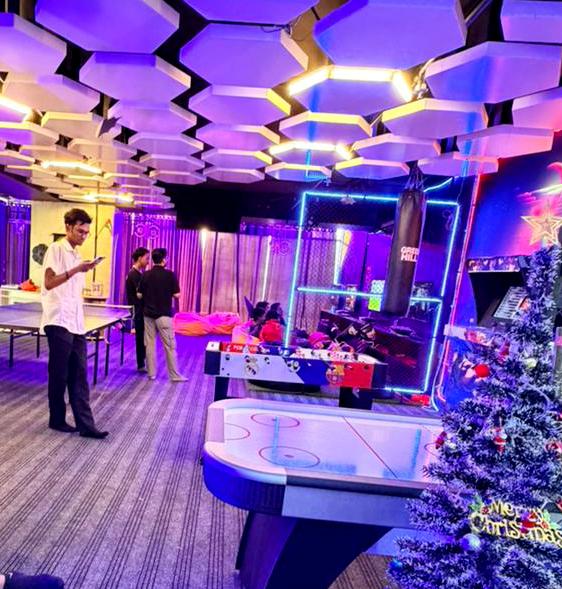
That missing middle is where Clubhouse DHK enters.

Clubhouse DHK deliberately avoids high-sensory stimulation typical of arcades or theme parks. Instead, it focuses on light leisure.
APracticalInsightBeforeaBusinessModel. The idea behind Clubhouse DHK did not originate from a traditional business blueprint. It emerged from a simple observation by its founder — a 90s kid who longed for a personal hangout space.
The realization came during a casual conversation at home: in Dhaka, you rarely go out unless food is involved. Spending time with friends requires a bill — a café order, a dinner table, or a receipt that legitimizes staying.
This wasnʼt emotional insight; it was structural. Dhaka had many places to consume, but very few places to simply be.
That gap was not just social — it was infrastructural.
Unlike premium entertainment venues built around spectacle and one-time visits, Clubhouse DHK positions itself differently:
• Affordable, allowing students and young professionals to return regularly
• Unstructured, with no pressure to order food
• Social-first, prioritizing interaction over transaction
This reflects a deeper understanding of consumer psychology in price-sensitive
economies: people seek comfort, familiarity, and belonging — not just novelty.
Clubhouse DHK deliberately avoids highsensory stimulation typical of arcades or theme parks. Instead, it focuses on light leisure:
• Nostalgic 90s arcade games
• Classic board games
• Modern international titles
• Locally developed games with cultural resonance
The experience prioritizes emotional recall and social engagement over adrenaline.
Even the seating design — beanbags and relaxed layouts — functions as behavioral signaling. It communicates one idea clearly: you are allowed to stay.
In a city conditioned to equate time with money, that permission matters.
While youth remain the primary audience, usage patterns have evolved organically.
Families now visit together. Parents and children play board games side by side. Groups stay for hours without being rushed. Some guests even use the space for light work or study.
These behaviors reveal something fundamental: people value the freedom to exist in a space without transactional pressure.
From a business standpoint, this translates into sustainability. Revenue is driven by engagement — group packages, hourly sessions, extended play — not one time footfall.
Clubhouse DHK monetizes duration, not isolation.
Clubhouse DHKʼs model offers several insights:
1. Social Leisure Is Under-Served
Between cafés and amusement parks lies a massive gap for casual communal leisure — one that existing formats rarely address.
2. Consumers Are PriceSensitive, Not Experience-Averse
Even under economic pressure, people spend time when experiences feel fair, shared, and emotionally rewarding.
Repeat visits and community formation are stronger business drivers than novelty spikes.
Expansion plans, including franchising, remain grounded in preserving atmosphere — not diluting the experience for scale alone.
Clubhouse DHK reflects a broader cultural shi�.
Leisure no longer needs to revolve around eating out or expensive destinations. The market responds to experiences that feel accessible, shared, and human. In a country navigating rising costs and evolving lifestyles, meaning increasingly outweighs spectacle.For the next wave of consumerfacing businesses in Bangladesh, the lesson is clear:
Design for time, not transactions. Optimize belongjust margins.
Clubhouse DHK didnʼt invent leisure. It reengineered it for a city that never truly had a home for it.
And that makes it more than a business.
It makes it a place people return to — not because they must spend, but because they want to stay.