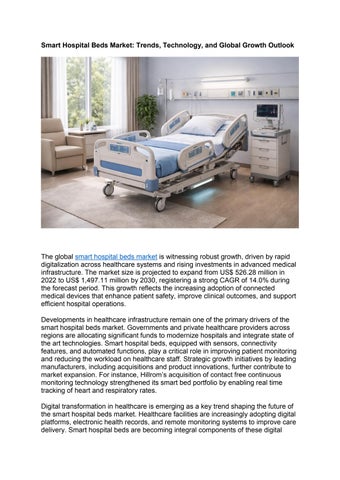
Smart Hospital Beds Market: Trends, Technology, and Global Growth Outlook
The global smart hospital beds market is witnessing robust growth, driven by rapid digitalization across healthcare systems and rising investments in advanced medical infrastructure. The market size is projected to expand from US$ 526.28 million in 2022 to US$ 1,497.11 million by 2030, registering a strong CAGR of 14.0% during the forecast period. This growth reflects the increasing adoption of connected medical devices that enhance patient safety, improve clinical outcomes, and support efficient hospital operations.
Developments in healthcare infrastructure remain one of the primary drivers of the smart hospital beds market. Governments and private healthcare providers across regions are allocating significant funds to modernize hospitals and integrate state of the art technologies. Smart hospital beds, equipped with sensors, connectivity features, and automated functions, play a critical role in improving patient monitoring and reducing the workload on healthcare staff. Strategic growth initiatives by leading manufacturers, including acquisitions and product innovations, further contribute to market expansion. For instance, Hillrom’s acquisition of contact free continuous monitoring technology strengthened its smart bed portfolio by enabling real time tracking of heart and respiratory rates.
Digital transformation in healthcare is emerging as a key trend shaping the future of the smart hospital beds market. Healthcare facilities are increasingly adopting digital platforms, electronic health records, and remote monitoring systems to improve care delivery. Smart hospital beds are becoming integral components of these digital
ecosystems by enabling seamless data sharing with hospital information systems. The integration of telemedicine capabilities with smart beds allows physicians to remotely assess patient conditions, making these beds suitable not only for hospitals but also for homecare and community based healthcare settings.
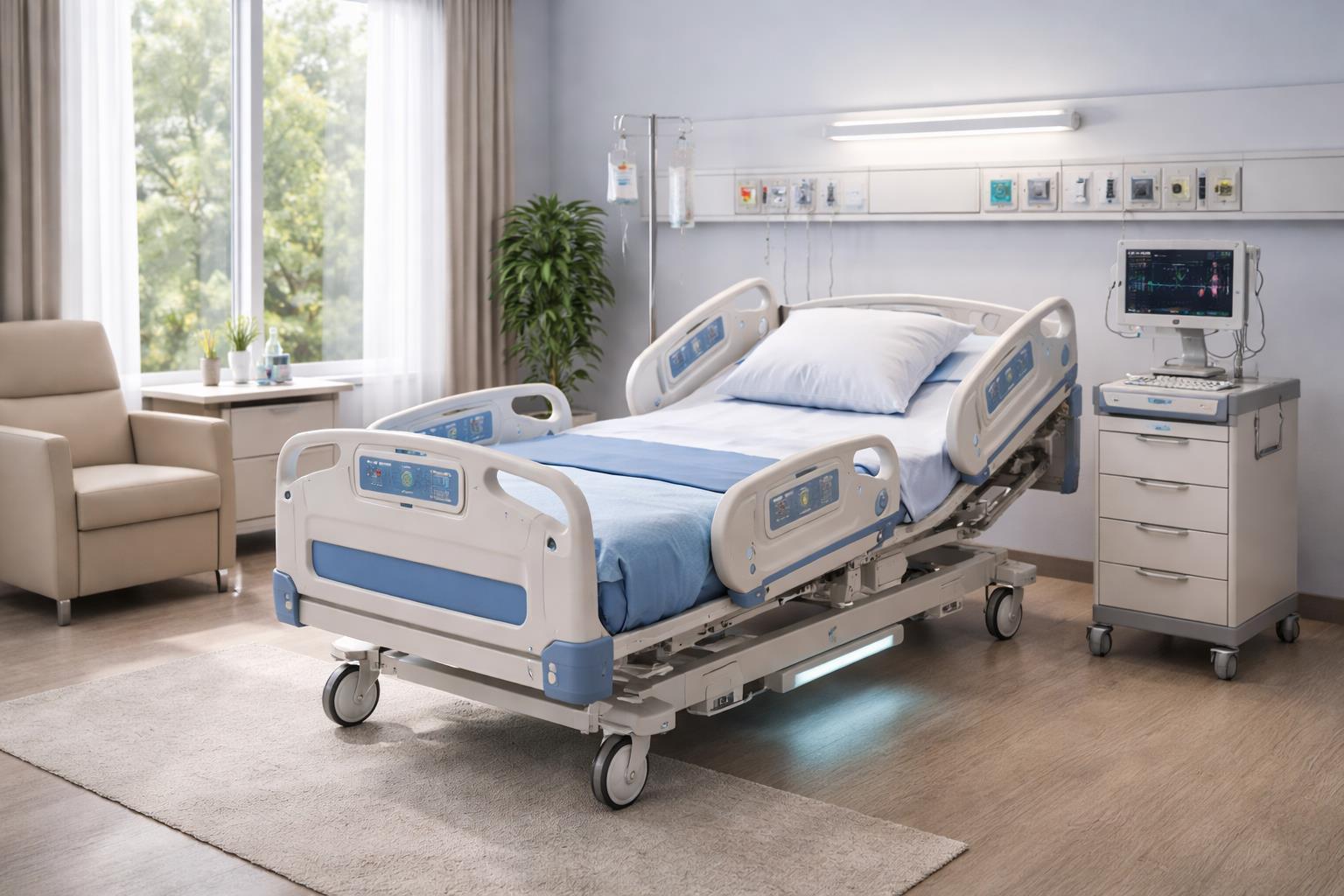
Technologically advanced smart beds offer features such as automated positioning, pressure redistribution, fall detection, and real time patient monitoring. These capabilities help reduce hospital acquired injuries, improve patient comfort, and support faster recovery. Alerts and notifications generated by smart beds enable nursing staff to respond promptly to patient needs, thereby enhancing operational efficiency. As hospitals face increasing patient volumes and staff shortages, the demand for intelligent beds that support remote monitoring and automation is expected to rise significantly.
Robotic hospital beds present a lucrative growth opportunity within the market. Research initiatives supported by government funding, such as the AdaMeKoR project in Germany, highlight growing interest in robotic systems designed to reduce physical strain on healthcare workers. Robotic beds equipped with sensors and automated movement functions can assist in patient repositioning and mobility, improving staff wellbeing and reducing workplace injuries. As these technologies mature, robotic smart beds are expected to gain wider acceptance across advanced healthcare systems.
Request to sample Reporthttps://www.theinsightpartners.com/sample/TIPRE00011950
Market Segmentation
From a segmentation perspective, the market is analyzed based on patient weight, offering, application, and end user. The less than 70 lb patient weight segment held the largest market share in 2022, reflecting strong demand in pediatric care settings. By offering, software and solutions accounted for the largest share, driven by the growing importance of data analytics, connectivity, and integrated monitoring platforms. Fall prevention emerged as the leading application segment, supported by the need to minimize patient falls and related complications. Hospitals represented the largest end user segment, owing to higher budgets and early adoption of advanced healthcare technologies.
Geographically, North America dominates the smart hospital beds market, with the United States accounting for the largest share. The presence of major manufacturers, strong healthcare infrastructure, and high adoption of advanced medical devices contribute to regional leadership. Asia Pacific is expected to witness the fastest growth rate during the forecast period, supported by expanding healthcare facilities, rising healthcare expenditure, and increasing awareness of smart medical solutions.
Key Players in the Smart Hospital Beds Market
• Hill-Rom Holdings Inc.
• Stryker Corp
• B. Braun SE
• Arjo AB
• Invacare Corp
• Paramount Bed Co. Ltd
• Linet Spol
• Malvestio SpA
• Stiegelmeyer GmbH and Co. KG
• Baxter
Future Outlook
The future of the smart hospital beds market appears highly promising, supported by continuous technological innovation and the global push toward digital healthcare. Increasing integration of artificial intelligence, predictive analytics, and remote monitoring capabilities is expected to further enhance the value proposition of smart beds. Expansion into homecare and long term care settings will open new revenue streams for market players. As healthcare systems focus on patient safety, operational efficiency, and staff wellbeing, smart hospital beds are likely to become a standard component of modern care environments worldwide.
Related Report:-
Hospital Beds Market
Automated Hospital Beds Market