The Ultimate Penny Black Collection
A once-in-a-generation opportunity to own the world’s most important postage stamp. Few objects in history can claim to have transformed the world.
The 1840 Penny Black, the first adhesive postage stamp ever issued, is one of them.
Introduced under the revolutionary postal reforms of Sir Rowland Hill, the Penny Black fundamentally changed how humanity communicated. For the first time in history, postage could be prepaid by the sender, making correspondence affordable and accessible to everyone.
Within ten years of its introduction, postal traffic in Britain increased from 75 million letters per year to more than 410 million.
Commerce accelerated. Literacy increased. Banking, trade and industry expanded.
The humble Penny Black became the catalyst for a communications revolution whose effects still shape our world today.
It is therefore unsurprising that the Penny Black has become the most famous stamp in the world and the cornerstone of the world’s most prestigious collections.
The finest private Penny Black collection assembled in modern times.
The collection we proudly present represents the culmination of more than a decade of specialist research, sourcing and acquisition by our philatelic team.
Our objective was simple in concept, yet extraordinarily difficult in execution:
To assemble the finest private collection dedicated exclusively to the Penny Black and its earliest postal history.
To achieve this, we travelled internationally, working closely with leading collectors, dealers, auction houses and philatelic scholars to secure some of the most historically important and visually impressive Penny Black artefacts still available in private hands.
The result is a collection that would be virtually impossible to replicate today
Many of the items are unique, while others have appeared on the market only once or twice in the past half century. Several originate from some of the most celebrated collections in philatelic history.
Together they form a coherent, museumquality narrative documenting the birth of the modern postal system.
A museum-level narrative of the birth of modern communication
Within this collection are many of the key artefacts marking the dawn of prepaid postage, including:
• The accepted master die proof used to finalise the design of the world’s first postage stamp
• First day covers dated 6 May 1840, the first day of official postal use
• Major surviving mint multiples and exhibition blocks of Penny Blacks
• Some of the largest surviving multiples on cover from the earliest days of use
These are the types of pieces normally encountered only in major international exhibitions or institutional collections.
Each item represents an important historical moment. Together they form something far greater:
A curated masterpiece documenting the moment global communication changed forever. Authenticity and provenance were paramount in assembling a collection of this significance.
Every item is accompanied by independent certificates issued by the world’s most respected philatelic expert committees, including:
• The Royal Philatelic Society London
• The British Philatelic Association
In addition, every item is supplied with our own Paul Fraser Collectibles Certificate of Authenticity, backed by a lifetime contractual money-back guarantee of authenticity.
The Trophy Collection
- more than the sum of its parts
Mike Hall CEO | Paul Fraser Collectibles
“This collection is not only a world first, it is a culmination of a combined 120 years of experience and dedication to this historic pastime, taking over a decade to build into a singular definitive collection.”
The process of building a collection such as this becomes increasingly challenging as more and more of the most important philatelic historical artefacts are taken out of the market by museums and other institutions.
It is more than a collection of some of the rarest British philatelic treasures still available to own privately. It tells a story, preserving history and curating a personal legacy.
Each piece of the collection holds individual value, but together, they create something far greater; a window into a time, culture and a permanent marker of mankind’s progress.
The opportunity to become a custodian of the definitive collection tracking the birth and early history of the humble postage stamp is, without exaggeration, an opportunity which may never come by again.
Beyond its historical significance, collections of this calibre have also long proven to be a powerful store of wealth. Rare philatelic masterpieces possess qualities increasingly sought by sophisticated investors: scarcity, global demand, portability and discretion. They can form an important component of long-term wealth planning, offering potential tax advantages in many jurisdictions, as well as opportunities for legacy creation through future gifts or donations to museums and institutions, often accompanied by significant tax relief.
In this sense, the custodian of such a collection does not merely acquire rare objects. You become part of a continuum of preservation, investment and cultural stewardship that can extend far beyond a single lifetime.
Mike Hall CEO | Paul Fraser Collectibles
A short history of the 1840 Penny Blackthe world’s first postage stamp
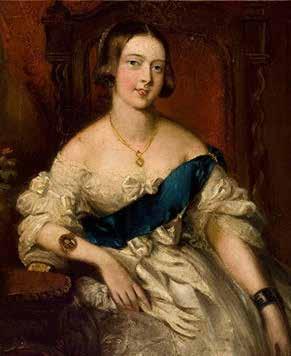
The Penny Black was the world’s first adhesive postage stamp and marked the beginning of a communications revolution that changed the world. As the world’s first, it is the stamp all collectors aspire to own and is without a doubt the most famous stamp in the world. Featuring a portrait of Queen Victoria, its beauty rests in its classic simplicity and fine engraving.
Prior to its introduction, postage was very expensive and was paid by the recipient not the sender. Delivery was charged based on the miles travelled and the number of sheets of paper used. The recipient would typically be stung by a charge of several pounds. It was not unusual for delivery to fail because the recipient could not afford to pay.
The penny black changed all this and made sending letters affordable to everyone. It revolutionised worldwide communication.
At the time, many Victorians were illiterate. The penny black incentivised an entire generation to want to read and write. It also led to the expansion of commerce, banking and industry from which we all still benefit today.
The result was an increase in postal traffic from 75 million to 410 million in under 10 years.
It also marked the beginning of one of the biggest and most absorbing hobbies ever to captivate the world.
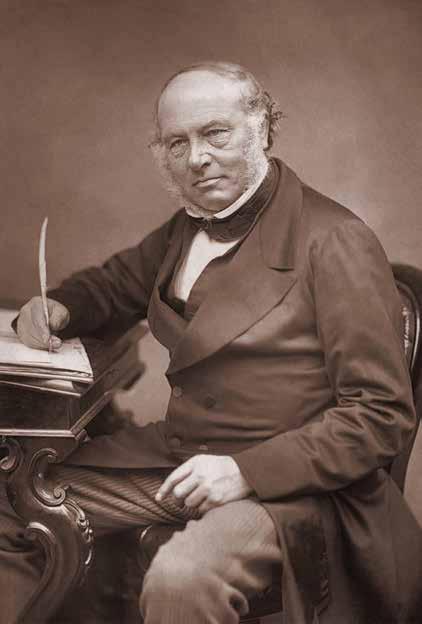
A man named Rowland Hill was the driving force behind the introduction of the world’s first postage stamp. He wrote extensively on the need for postal reform in the belief that a cheaper system would mean more people would use it and overall profits would increase.
After a national competition in 1939, Rowland Hill rejected all of the designs in favour of his own: a concept he had devised in 1837 for “a bit of paper just large enough to bear the stamp, and covered at the back with a glutinous wash…”
On 20th February, 1840 Queen Victoria approved the finished design for the Penny Black.
The stamps went on sale on the 1st May 1840 but were not authorised for postal usage until 6th May 1840.
The Penny Black represents a real landmark in British and worldwide history.
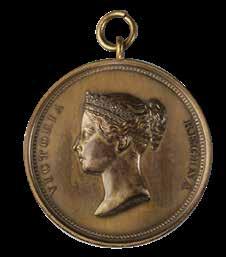
was based on a medal, showing her at the age of 15.
Victoria lived until she was 81 but, throughout her life, her portrait on British stamps never changed.
A portrait was chosen for the first stamp, as it was believed by Rowland Hill and others that a face would be difficult to forge. Queen Victoria’s image
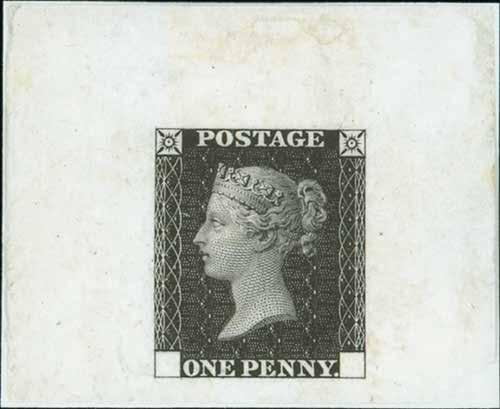
1840 1d Master Die Proof of the accepted die, SGDP17b
The first accepted printer die proof of the penny black. A major rarity being one of only 4 examples in private hands.
The Accepted Die for the One Penny Stamp, Die I March 1840, with “postage” and “one penny” and upper corner stars added, die proof in black on India paper.
The original proof is reduced and with the backing card (affixed with hinge).
There are some slight peripheral faults, well away from the design, and in no way detracting from the fine appearance of this pivotal proof which had reached the stage where official approval could be given to the final design for the world’s first Postage Stamp, the one penny black.
A highly important exhibition piece of exceptional rarity and one of the most important historical pieces of paper you can own to mark the dawn of the postage stamp and subsequent communications revolution.
GB Specialised Catalogue No: DP17b, Provenance: ex Collection “TES”, Christies Robson Lowe, October 1995 and Chartwell Collection Spink sale (June 2011) where it realised £235,000, including premium.
The accepted die represented the finalised design of the penny black approved for production. The addition of “POSTAGE” at the top and “ONE PENNY” at the bottom was pivotal as this is what differentiated the new concept to prepay postage, which was revolutionary at the time.
The India paper used was a high quality thin paper used for proofs because of its ability to capture fine detail.
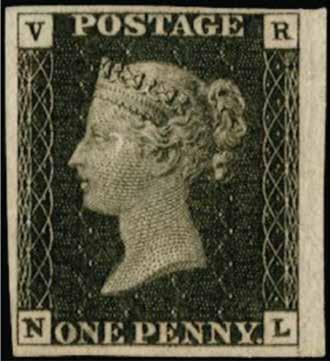
1840 1d Black, “VR Official” Imprimatur, SGV1var
A spectacular and very rare marginal example from the first approved printing sheet of the important V.R. Official penny black.
A very fine and fresh unused imperforate imprimatur lettered “NL” from the second registration sheet (before hardening).
There are only 27 examples possible which were removed from the imprimatur sheet (the very first approved printing sheet), many of which are in institutional collections.
The V.R. Official penny blacks have always been considered extremely important in the world of early British stamp collecting. The imprimatur, being the equivalent to the first edition, is a major trophy asset of British postal history.
Provenance: Accompanied with a Royal Philatelic Society (RPS) 2010 certificate of authenticity.
The penny black VR Official was issued in May 1840 exclusively for use on official correspondence between government departments. The design is the same as the penny black in all respects other than the letters “VR” at the top of the stamp.
Because the Mulready was so disliked by the general public, it ended up being used by the government instead of the VR Official stamp. As a result, the stamp was abandoned and nearly all the supplies which had been printed were destroyed on 25th January, 1843.
1840 1d Black, Plate 1a, SG2
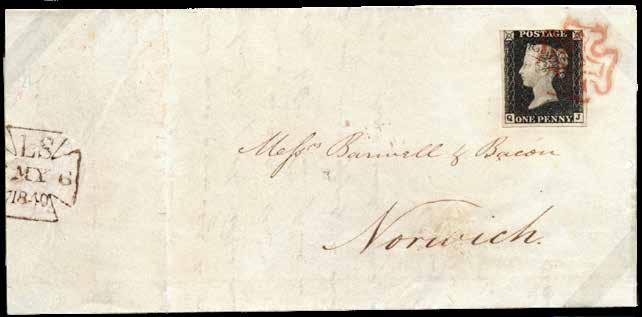
The “Sandeman Port” penny black first day cover
Widely considered to be the finest quality single Penny Black first day cover in existence described as such in the “Collectors Club Philatelist” July-August 2006 edition.
May 6th, 1840, the first day of issue, “Sandeman Port” letter and invoice from Sandeman, Forster & Co. sent from Lombard Street to Norwich bearing a 1d black plate 1a lettered “QJ”, tied by a complete Maltese Cross cancellation and with Lombard Street Maltese Cross type “6 MY 6/1840” datestamp on reverse.
A stunning quality first day cover of the world’s first postage stamp marking the dawn of prepaid postage and spawning a communications revolution. Widely considered to be the finest quality single Penny Black first day cover in existence described as such in the “Collectors Club Philatelist” July-August 2006 edition.
A beautiful exhibition display piece of the ultimate trophy asset in philately.
Accompanied with two independent certificates of authenticity from the British Philatelic Association (BPA), the most recent dated 2002.
Provenance: Ex. Alan Holyoake Grand Prix Gold Medal Winning Collection “Mayflower”. Featured in “The World’s First Postage Stamp” book by Alan Holyoake published by the Royal Philatelic Society in 2013.
The Stanley Gibbons specialised catalogue (2011) listed a penny black 6th May cover at a price of £160,000.
GB Specialised Catalogue Number: A1ta.
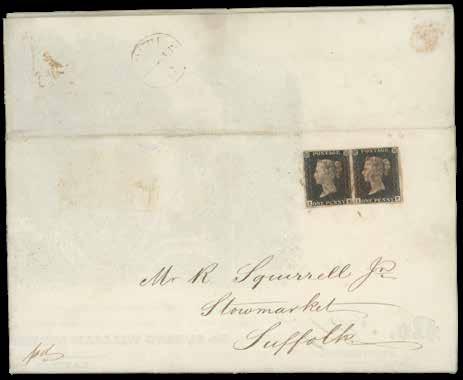
1840 1d Black, Plate 1a, pair on first day cover, SG2
Unique as the only known legal contract penny black first day cover benefiting further from including a pair of penny blacks. A world-famous cover and one of the most important pieces of British philately.
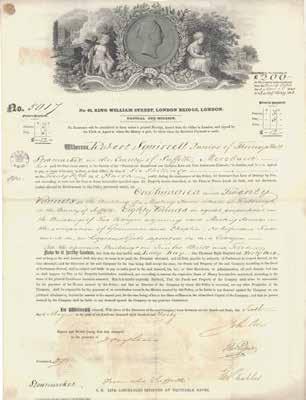
Great Britain 1840 (6th May) complete “Protestant Dissenters Assurance Company” insurance document sent from London to Stowmarket, Suffolk, franked with horizontal pair of 1840 1d black, plate 1a, lettered ‘ID-IF’ used to pay the 2d postage rate for an item weighing in excess of ½oz but below 1oz, SG2.
Cancelled by light red Maltese Crosses, handstamped with a London Chief Office circular datestamp of dispatch of “C/MY6/1840” on the reverse (the time code “C” indicates the evening duty) and dated within “In witness... this sixth day of May 1840, First Day of Official Use.”
The document is a magnificently engraved Insurance Certificate issued by the “Protestant Dissenters & General Life & Fire Insurance Company” for loss or damage by fire up to an
amount of £200, covering a Meeting House and two adjoining Cottages at Stowmarket, built of timber and tiles and owned by Robert Squirrell, Junior, and clearly officially signed, sealed and dated on 6th May 1840.
This is believed to be unique as the only known legal contract 1d black first day cover. A worldfamous cover and one of the most important pieces of British philately.
Accompanied with a British Philatelic Association (BPA) certificate of authenticity, dated 3rd December 2001 and a David Brandon Expert Committee certificate of authenticity dated 22nd December 2001.
Provenance: Ex Alan Holyoake RDP FRPSL Grand Prix Collection, featuring on page 79 of his book, “The World’s First Postage Stamp” published in 2013.
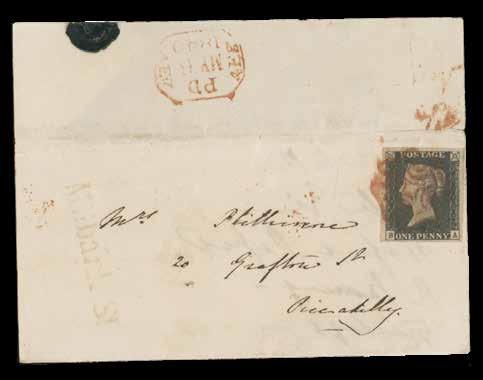
1840 1d Intense Black Plate 1a 6th May first day cover, SG1
First day of issue of the penny black cover with deep black impression including letter with important philatelic historical content.
A very fine used large four margin example neatly tied to small clean cover by a red Maltese Cross with an octagonal London datestamp on reverse for the first day of issue ‘MY.6.1840’.
The cover was sent locally within London and comes complete with original contents referring to the newly introduced stamps: “The stationers are furious at the Government allowing them so little profit on the new stamps”.
Wonderful quality for a penny black first day cover and a major rarity in this quality as
penny black first day covers are mainly in poorer condition. The historical relevance of the letter contained within the cover is quite exceptional adding considerable value to a postal historian.
An exhibition item of the highest quality marking the dawn of the prepaid postal system.
Accompanied by a 2003 Royal Philatelic Society (RPS) Certificate of Authenticity.
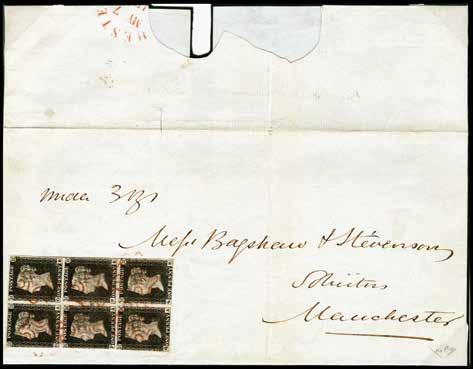
1840 1d Black, Plate 1a, block of six on 7th of May cover (second day of issue), SG2
One of the largest multiples of penny black on cover and one of only two in existence from the first 4 days of use.
A very fine used block of six lettered ‘OA-QB’ just touched at left, but with good to large margins on other sides.
The cover was used on a large solicitors entire letter from Chester to Manchester, neatly tied by crisp red Maltese Crosses with a red Chester circular date stamp on the reverse for ‘MY.7.1840’. The cover being also endorsed at the upper left “Under 3oz”.
Irrespective of a few minor faults, as to be expected, including the block has been lifted and pressed, it is nevertheless a spectacular and important philatelic showpiece.
Only two such covers now survive in private hands bearing large multiples from the first four days of use. This cover is from the second official day of use.
Provenance: Ex. Guggenheim, Griffiths and the “Mayflower” Grand Prix Gold Medal Collection.
Accompanied with a 1974 Royal Philatelic Society (RPS) Certificate of Authenticity.
1840 1d Black, Plate 1a, 7th May cover, SG2
A beautiful exhibition quality display cover from the second day of issue. The first time this cover has appeared on the market in over 50 years.
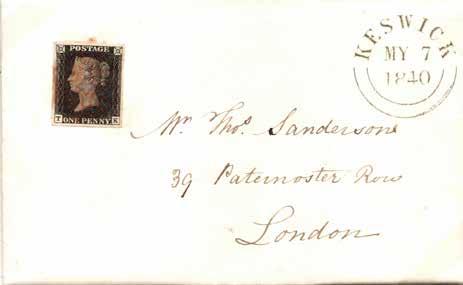
May 7th, 1840, the second day of issue, lettersheet sent from Keswick to London bearing a 1d black plate 1a lettered “TK” with very large margins, with Maltese Cross cancellation, and Keswick circular date stamp “MY 7 1840” on front.
A beautiful exhibition quality display cover bearing the world’s first postage stamp marking the dawn of prepaid postage and spawning a communications revolution.
This is the first time this cover has appeared on the market in over 50 years.
Accompanied with a 1994 Royal Philatelic Society (RPS) Certificate of Authenticity.
1840
1d Grey-Black, Plate 1a, 10th May cover, SG3
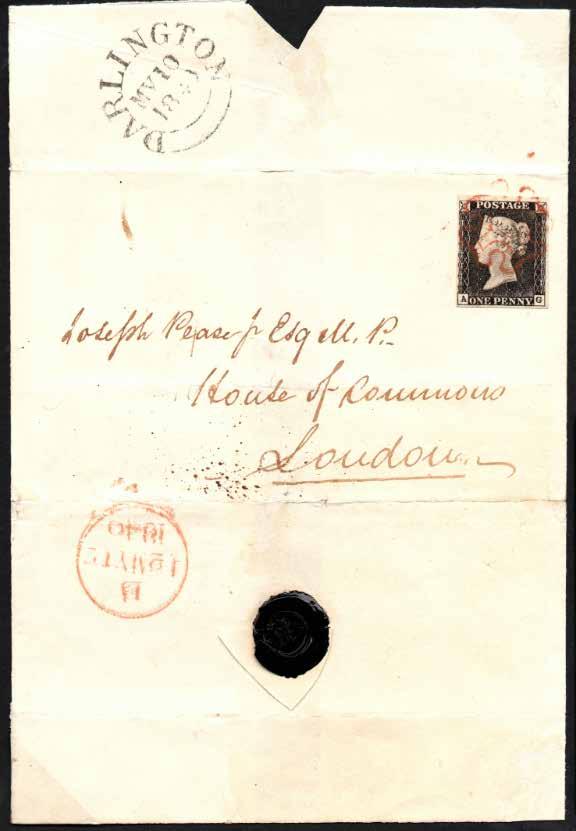
An entire letter from Darlington on first Sunday May date, May 10th, to House of Commons bearing an 1840 1d grey-black, plate 1a, lettered “AG” tied by Maltese Cross obliteration in red, backstamped Darlington 10.5.40 and 12.5.40.
A superb quality example used on cover to the House of Commons on Sunday May 10th 1840, the first Sunday of postal use. Recognised as one of the great rarities of early GB philately.
The finest example of the few 10th May (first Sunday of the month) penny black covers known.
This is the finest example of the few 10th May 1d black covers known.
Accompanied with a 1992 British Philatelic Association (BPA) Certificate of Authenticity.
1840 1d Grey Black, Plate 1a
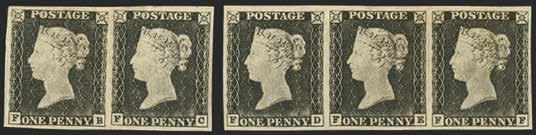
Reformed mint strip of five, SG3
Believed to be one of the largest surviving worn plate multiples from the first printing plate.
A superb mint horizontal pair lettered FB-FC and a strip of three lettered FD-FF reforming an original strip of five, with original gum and all with four large margins, almost never seen.
Despite a light diagonal crease crossing the FB-FC it is nevertheless a stunning multiple with fresh gum and a magnificent grey-black worn impression. The strip of five is believed to be one of the largest surviving worn plate multiples from this printing plate.
Provenance: Ex. Percy de Worms & Grand Prix Gold Medal Winning Collection “Mayflower”.
Accompanied with two certificates of authenticity from the British Philatelic Society (BPA) from 2006 & 2010.
The Stanley Gibbons Great Britain Queen Victoria Specialised Catalogue lists the value of a block of four at a value of £160,000 and a pair at £48,000.
The first printing plate of the penny black was registered on 15 April 1840. As the plate had not been hardened it soon showed signs of wear. The plate was withdrawn due to the wear and extensive repairs were undertaken. The first printings prior to repairs are referred to as Plate 1a and the repaired state as Plate 1b.
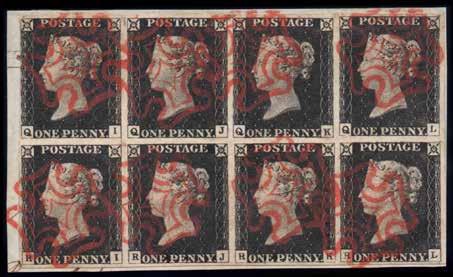
1840 1d Black, Plate 2, used block of eight
Regarded as the finest used multiple of the penny black from this plate or any other plate.
Great Britain 1840 1d black plate 2, block of eight lettered ‘QI-RL’, beautifully tied to a small piece, each stamp with a crisp and perfectly struck scarlet-vermilion Maltese Cross, SG2.
A magnificent block featuring the world’s first postage stamp. Widely regarded as the finest used multiple of the penny black from this plate or any other plate.
Without a doubt, the most visually appealing used block of penny blacks we have ever handled and a magnificent exhibition piece.
This iconic philatelic gem last appeared for sale on the market when it was offered by Stanley Gibbons in their monthly price list in 2010 for a price of £225,000.
Plate 2 was first registered on 22 April 1840 and was therefore amongst the first penny blacks issued on 6th May 1840.
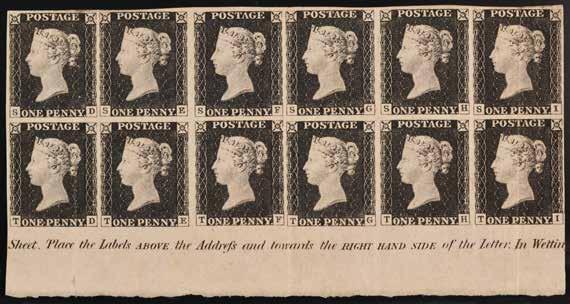
1840 1d Black, Plate 3, SG2 mint block of 12 - known as The Black Dozen
One of the crown jewels of Great Britain philately - the largest known multiple from Plate 3 in private hands. Plate 3 is recognised as the printing plate which produced the finest impressions of the penny black.
• This mint block of 12 Penny Black stamps is the largest known multiple from Plate 3 in private hands
• Provenance from the esteemed Chartwell Collection
• Accompanied by a 2012 British Philatelic Association (BPA) certificate
The magnificent unused original gum, bottom marginal block of 12 is lettered SD-TI, with rare full deckle edge selvedge, four good margins, deep colour and sheet inscription.
Vertical creasing in “D” and “I” columns does not detract from this being one of the great mint multiples of this issue.
This is an extremely rare opportunity to own a sizable, mint condition multiple from the original stamp issue, which continues to be one of the most widely collected in the world.
Plate 3 was the first to be hardened before being put into press, resulting in stamps that were notably stable in printing, with even colour, and showing the deepest shades of black.
Providing some of the finest stamps of the issue, it soon became worn and was the first plate of the issue to be destroyed. As such, good quality stamps from this plate are a rarity.
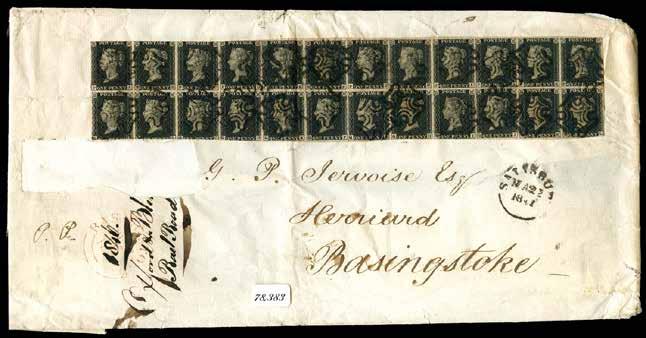
The largest surviving multiple of penny blacks from any plate in private hands either mint, used or on or off cover.
A unique legal wrapper bearing a spectacular block of twenty four 1d blacks (‘PA-QL’ in two complete rows) each neatly cancelled by a black Maltese Cross, with a Salisbury dispatch date stamp for ‘MR.22.1841’ and a Basingstoke arrival circular date stamp for the same day below.
A commanding quality penny black cover despite some slight toning and minor creasing as to be expected on such a large block. There is also a small tear to the top of the ‘PE’ stamp. Such minor imperfections are superficial when comparing to the quality of comparable rarities.
A small portion of the wrapper has been cut away, presumably bearing four further 1d blacks to make up the 2s4d rate as seen on a similar cover bearing fourteen 2d blues from the same correspondence.
A spectacular exhibition showpiece bearing the largest surviving multiple of 1d blacks from any plate in private hands either mint, used or on or off cover.
Accompanied with a 2011 British Philatelic Association (BPA) Certificate of Authenticity.
1840 1d Black, Plate 9, block of 24 cover, SG2
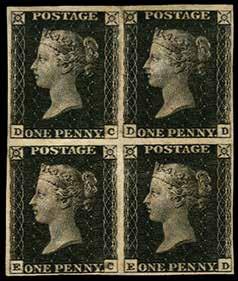
1840 1d Black, Plate 11, mint block of 4, SG2
The rarest printing plate of the penny black in a mint block of four; a magnificent exhibition piece.
A very fine unused good to large four margin block of four lettered ‘DC-ED’ with original gum. Also, showing double “D” check letter on DD.
Light corner crease at bottom left of ‘EC’, which barely detracts from perfection and a magnificent exhibition piece with excellent colour and gum.
Plate 11, the elusive last printing plate, is considered the holy grail of penny black collecting. Only 168,000 were printed from this plate, representing a mere fraction of the total number of penny blacks printed of 68 million. Very few have survived from this plate number.
Very few mint blocks of the plate 11 penny black exist in private hands and this is the first we have ever handled.
Provenance: Ex. Largentiere Maximus (1970).
GB Specialised Catalogue No: AS73.
Accompanied with a 2012 British Philatelic Association (BPA) Certificate of Authenticity.
The printing plate 11 was originally created to print the new penny red stamps to replace the penny black. Its use for printing penny blacks was therefore severely limited.
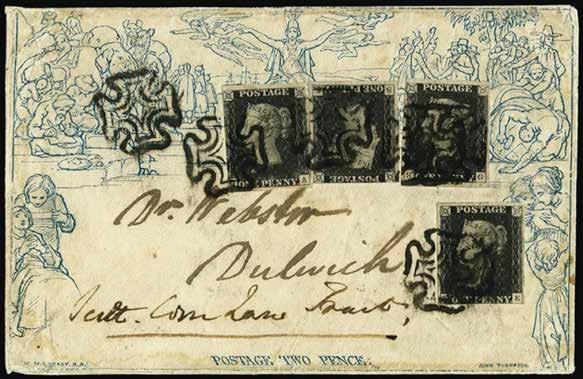
A spectacular uprated franking of the ill-fated Mulready cover, one of only two recorded 6d frankings prepaid with four additional 1d blacks.
A very fine used example uprated to the 6d per 3oz rate with four additional 1d blacks from plate 8 lettered ‘QA’, ‘SE’, ‘SG’ & ‘SJ’ (SE & SG State 2 provisional printing) all neatly cancelled by crisp black Maltese Crosses.
Sent from London to Dulwich with a “T.P./Chief Office” handstamp and circular date stamp on reverse for ‘AU.19.1841;.
Despite some trivial soiling, this is, nevertheless, a spectacular uprated franking, one of only two recorded 6d frankings prepaid with four additional 1d blacks.
Provenance: Ex Yates & “Mayflower” Collections.
Accompanied by a 1996 British Philatelic Association (BPA) Certificate of Authenticity.
One of the great rarities of Great Britain Philately.
An ex Stanley Gibbons stock item.
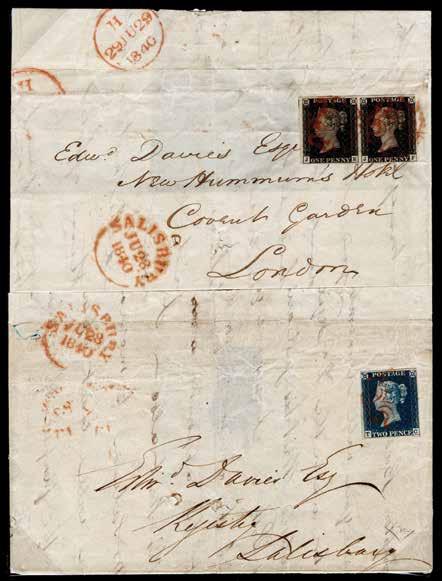
1840 2d blue plate 1/1d black combination cover, SG2,5
A very fine entire envelope sent from Devises to Salisbury bearing a close to large four margin 2d blue Plate 1 lettered, ‘TC’ and tied by a red Maltese Cross with a Salisbury arrival circular date stamp at left for ‘JU.28.1840’.
Turned and forwarded to London on the same day, bearing a close to huge four margin horizontal pair of 1d black’s, Plate 2, lettered ‘JE-JF’ cancelled by red Maltese Crosses with a Salisbury dispatch circular date stamp for ‘JU.28.1840’.
Backstamped by a London arrival circular date stamp for ‘JU.29.1840’.
One of the finest recorded examples of an early cover including horizontal pair of penny blacks and a 2d blue.
A light horizontal filing crease through the 1d black pair is the only condition issue of note and does not detract from this magnificent “turned cover”.
A spectacular exhibition piece of significant postal history interest and without doubt one of the finest recorded examples.
Accompanied with a 2008 British Philatelic Association (BPA) Certificate of Authenticity.
Provenance: Ex. “Mayflower” Grand Prix Gold Medal Collection.
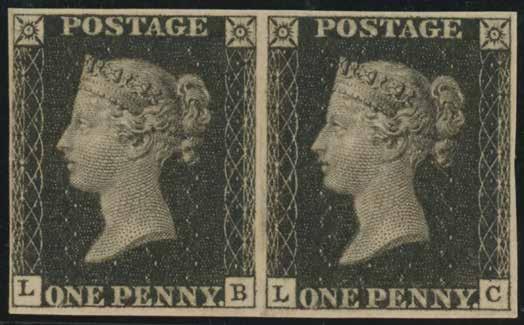
1840 1d black Plate 8, SG2.
A superb unmounted mint, with full original gum, four margin pair lettered ‘LB-LC’, beautiful deep impression and pristine gum.
A very rare multiple in this quality. It is most certainly one of the finest pairs of the world’s first postage stamp we have ever handled.
A very difficult printing plate to find in mint condition, never mind unmounted mint as a pair! Stanley Gibbons catalogue value: £45,000. Plate 8 was put to press on 31 July 1840.