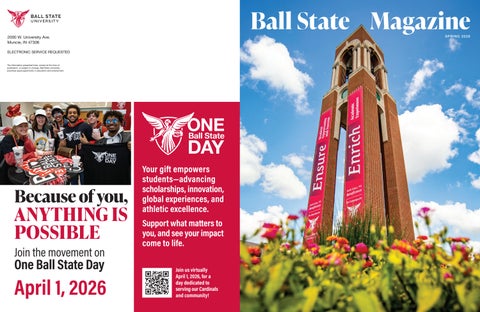
Ball State Magazine Spring 2026

Page 1


Hugh Jackman, Sutton Foster Support Students

Award-winning actor Hugh Jackman speaks with students in the College of Communication, Information, and Media (CCIM) during his campus residency last Fall. Mr. Jackman and actor Sutton Foster, DA ’12, a Ball State instructor of theatre, spent four days on campus, engaging with more than 600 students through classes, rehearsals, and performances. Highlights included a department-wide Q&A, attending Songs for a New World and a run-through of Romeo and Juliet, and conversations with College of Fine Arts and CCIM students involved in Radiance Cinema.

Mr. Jackman was also a guest on an episode of President Geoffrey S. Mearns’ podcast, Our Call to Beneficence. Listen wherever you get podcasts or at bsu.edu/ president/podcast

Photo by Kip Shawger

The Spirit of Beneficence is All Around Us

Dear Alumni and Friends:

Our comprehensive fundraising campaign supports our vital mission and celebrates the enduring values represented by Beneficence. The spirit of Beneficence defines the character of our people and the distinctive culture of our University.

Throughout this issue, the spirit of Beneficence is on display, beginning with a feature about David Owsley, HHD ’05, (pg. 26), who passed away last year at age 96. Mr. Owsley was an art historian and collector—and a very generous philanthropist. His legacy endures in the variety and beauty of his many gifts to our University. Because of his generosity, we provide our faculty, staff, and students, along with friends and neighbors across East Central Indiana, the opportunity to experience a world-class art museum right here on our campus.

I am very grateful to Mr. Owsley, whose contributions embody the Ball family’s exceptional commitment to philanthropy. I am also grateful to all of our benefactors whose support allows us to deliver on the promise of a premier education. A series of six narratives featuring current students and recent graduates (page 38) offers compelling stories behind what our Carnegie recognition as an “Opportunity College and University” looks like in practice.

For Kahmara Munn, her undergraduate education is giving her confidence to walk into any room and trust herself “to do the work well.” And for Cam West, ’22, his Ball State degree provided valuable connections that helped him land his first job. Kahmara and Cam’s stories— along with other narratives in this feature—illustrate how our faculty and staff provide support that translates into purpose, impact, and opportunities for all students who attend our University.

Becoming the only public college or university in Indiana to receive this new Carnegie designation was a highlight of 2025. Another highlight was the unveiling last Fall of our expanded Honors House (page 4). This expansion was made possible with philanthropic support from loyal benefactors and friends, including Rich and Linda Berthy, who provided the lead gift for the project. The Honors House expansion allows us to serve our growing enrollment of honors students while strengthening the college’s connection to campus and to The Village, which continues to transform through our ongoing revitalization efforts (page 8).

As you come to the final pages of this issue, I hope that you are inspired by the significant progress of our capital campaign. I am grateful to the graduates, benefactors, and friends who continue to answer Our Call to Beneficence. And I am confident that these gifts will continue to carry meaningful impact into the bright future ahead for our next generation of Cardinals.

Sincerely,

Cardinals fly everywhere. Ball State Magazine is the official publication for alumni, employees, students, friends, and fans located near, far, and wide.

Ball State Magazine is published twice yearly.

University Marketing and Communications Muncie, IN 47306 765-285-1560

Printed by EP Graphics, Berne, Ind. Printer uses ink with soy oil, and all wastepaper and solvents are recycled.

Greg Fallon, ’04 Editor; Associate Vice President of University Communications and Digital Strategy gmfallon@bsu.edu

Elizabeth Brooks, ’95

Art and Production Director; Senior Graphic Designer

President’s Cabinet

Charlene Alexander Chief Strategy Officer

Jean Kramer Crosby, ’96 President of Ball State Foundation and Alumni Association, Vice President for University Advancement

Deedie Dowdle

Vice President for Marketing and Communications

Ro-Anne Royer Engle, ’18 EdD ’25

Vice President for Student Affairs

Sali Falling, MA ’88

Vice President and General Counsel

Michael Fowler

Vice President for Business Affairs and Treasurer

Mark Liebling

Vice President for People and Culture

Paula Luff

Vice President for Enrollment Planning and Management

Loren Malm, ’86

Vice President for Information Technology and Chief Information Officer

Anand Marri

Provost and Executive Vice President for Academic Affairs

Jeff Mitchell Director of Athletics

Becca Polcz Rice

Vice President for Governmental Relations and Industry Engagement

Philanthropic support helps the Pride of Mid-America Marching Band grow with new facilities, expanded travel opportunities, and investments that give back to dedicated student performers.

FEATURES

26 The Curator of a Legacy

Building on the civic foundation laid by his family, David T. Owsley, HHD ’05, spent 60 years as a scholar and benefactor transforming a campus gallery into a museum of international stature.

32 A Place to Breathe and a Plan to Persist

From an empty room in North Quad to a bustling CSH Success Hub, the College of Sciences and Humanities is pairing data-driven course redesign with everyday care to keep more students on track.

38 From Classroom to Career

Real stories behind Ball State’s Carnegie recognition as an Opportunity College and R2 research university. Six narratives illustrate how access, support, and hands-on learning translate into purpose, impact, fulfilling careers, and meaningful lives.

the Cover

blooms frame Shafer Tower, which currently features four banners highlighting the University’s Our Call to Beneficence campaign—Ensure Student Opportunity and Success; Enrich Academic Experiences; Expand our Impact; and Answer the Call.

Historic Ball Honors House expands to meet Honors College growth

Privately funded enhancements to the historic Edmund F. and Virginia B. Ball home add classrooms, collaboration space, and new Berthy Wing, advancing Our Call to Beneficence campaign priorities

When honors students step through the front door of the Edmund F. and Virginia B. Ball Honors House, they’re walking into more than a beautifully restored home—they’re entering a space that continues to grow alongside Ball State’s Honors College.

This Fall, the University celebrated a major expansion of the historic house at 1707 W. Riverside Ave., adding new classrooms, offices, and collaboration spaces while preserving the character of the former Ball family residence.

The project adds about 1,750 square feet of new educational space and renovates another 840 square feet. The expansion includes a modern

classroom, three new faculty offices, and a student collaboration area with soft seating, a display case, and a donor recognition wall. Outside, a redesigned gathering space—anchored by a paved labyrinth and garden—offers a quiet setting for reflection, conversation, and honors programming.

Funded entirely through private support, the project was made possible by more than 30 donors. The principal donors are Rich and Linda Berthy, whose lead gift supported the expansion and established the new Charles J. and Erika A. Berthy Wing, named in honor of Mr. Berthy’s parents. The Edmund & Virginia Ball Foundation also provided

“Thanks to our donors, we now have the space to welcome even more honors students into our community and give them a place where their curiosity, character, and ambitions can flourish.” — Dr. Jim Buss, Honors College Dean

a $100,000 grant toward the renovation and expansion. Philanthropic support accounted for the full cost of the project, totaling more than $1.5 million.

“I am grateful to all of the donors to this project, especially Rich and Linda, for making this expansion possible,” said Ball State President Geoffrey S. Mearns.

“The enhanced Ball Honors House strengthens our University’s mission to provide our students with fulfilling careers and meaningful lives. These modernized spaces will foster collaboration, inspire creativity, and deepen connections among students, faculty, and the broader community.”

The expansion comes at a pivotal moment for the Honors College. Building on years of steady growth, the college recently welcomed about 620 new freshmen, bringing total enrollment to more than 1,600 students—the largest in its history. The Ball Honors House is also home to the Virginia B. Ball Center for Creative Inquiry and the Office of Nationally Competitive Scholarships, which serve students and alumni from across campus.

“With more students and programs than ever before, this expansion was

essential to meet the needs of our growing honors community,” said Honors College Dean Dr. Jim Buss.

“The additional classrooms, offices, and collaboration spaces provide the environment our students deserve to pursue academic excellence and innovative research. We are grateful to our alumni, friends, and donors who supported this vision.”

Honors students now study, write, and meet in rooms that once hosted a different kind of gathering. The two-story colonial structure was the longtime home of Edmund F., LLD ’67, and Virginia B. Ball, HHD ’86, whose philanthropy helped shape Ball State and the Muncie community. In 2009, following a $1.3 million renovation supported in part by the Edmund & Virginia Ball Foundation, the house was transformed into the headquarters of the Honors College, preserving its architectural character— gracious center hall, white spindle stairway, and arched doorways—while adapting it for academic life.

Today’s project extends that legacy. As part of Our Call to Beneficence, Ball State’s comprehensive fundraising campaign, enhancements to the Ball Honors House and the development of an Honors College Student Success Hub have been identified as key priorities for supporting high-impact learning and student success.

The expanded house will help the Honors College continue to serve as a campus crossroads—linking highachieving students with faculty mentors, national scholarship opportunities, creative inquiry projects, and communityengaged learning. It also strengthens the college’s physical connection to the

nearby Village revitalization efforts along Riverside Avenue and McKinley Avenue. For current and future students, the result is a space that feels both historic and forward-looking—a house built by one Ball State family, renewed by the generosity of many others, and dedicated to helping honors students imagine what’s possible in their own lives.

“This house began as a family home, and in many ways, it still is,” Dr. Buss said. “Thanks to our donors, we now have the space to welcome even more honors students into our community and give them a place where their curiosity, character, and ambitions can flourish.”

—By Andrew Walker, ’14

Philanthropic support from more than 30 donors— including lead donors Rich and Linda Berthy (above)—accounted for the $1.5 million cost of the Ball Honors House expansion.
Opposite page: New collaboration space inside the expanded Ball Honors House gives honors students more room to meet, study, and connect. Left: A paved walkway and garden anchor the home’s redesigned outdoor gathering space for reflection, conversation, and honors programming.
Photos by Samantha (Blankenship) Ellis, ’15

Miller Leadership Academy prepares business students to lead and serve

Backed by an endowment from Wallace T. Miller Jr., the program supports high-achieving business students with financial aid, professional development, and a tight-knit community of peers and advisors

Support for student success comes from across Ball State University’s campus. In the Miller College of Business, one standout example is the Miller Leadership Academy (MLA), which supports meritorious students financially, academically, and holistically. The academy, an opportunity open to all Ball State students who meet eligibility requirements, offers transformative programming that fosters responsible leadership and a commitment to serving others.

“Students selected for the Miller Leadership Academy have grit and a genuine desire to pursue excellence,” said Dr. Cathy DuBois, Bryan Dean of Miller College. “They become polished professionals with clear direction, ready to take on the world.”

“My MLA cohort is 10 students, and we did the Jump Start program in which we got to know nine other MLA scholars. So, that was 18 amazing relationships created with people I felt I could go to for anything: advice, help, or whatever,” Ms. Milton explained. “Having those connections meant a lot to me as a freshman transitioning into college life.”

She also points to the support and mentoring from members of the academy’s advisory board, which is comprised of successful business leaders—many of them Miller College graduates. Ms. Milton notes that numerous workshops, on topics such as résumé-building and maximizing LinkedIn, are valuable professional development opportunities.

MLA scholar Kieran “Kiki” Rodriguez, a senior majoring in human resources management and minoring in quality management, said she is grateful that advisory board members invest their time in students. She also appreciates the chance to grow as a leader while mentoring younger MLA scholars.

MLA scholar Janiya Milton (inset), a junior double-majoring in risk management and insurance, and business administration, said two of the best parts of the program are the opportunities to bond with other Miller College students and to participate in professional development.

“Miller Leadership Academy teaches us not just to solve problems for other people, but to help people solve problems on their own,” Ms. Rodriguez explained. “We develop critical-thinking skills and look at ways to be there for others as servant leaders. That’s what helps make you a good leader.”

Each year, MLA accepts approximately 10-12 students. Those students receive an MLA scholarship, a renewable award of up to $11,000 that can be used for tuition, housing, and other expenses related to the cost of attendance.

Yet another example of philanthropic support directly helping students at Ball State, the academy is supported by a generous endowment from Wallace T. Miller Jr., the late successful businessman after whom Miller College and the academy were named. —By Landa Bagley

Miller Leadership Academy (MLA) scholar Kieran “Kiki” Rodriguez shares her experiences and insights with her MLA cohorts during one of the academy’s workshops last semester. Ms. Rodriguez was one of several MLA scholars who spoke during this workshop, which was focused on internships.

Bridging campus and community

Through the County Ambassador Program and the new Talent Pipeline Toolkit, Ball State is connecting Indiana communities, employers, and future graduates

When Ella Flanagan (above) talks about Madison County and her hometown of Elwood, her enthusiasm is contagious. As a senior construction management major, she describes her home as “so close knit,” with the kind of support that still feels like a “small hometown community.”

Across the state, chemistry senior Anastasia Faddis (right) says her time at Ball State has deepened her appreciation for Switzerland County. “There is really something to be said for being in a small community where everybody knows everybody and everyone is supporting everybody,” she says. “I love this place.”

Ms. Flanagan and Ms. Faddis are part of Ball State’s Indiana County Ambassador Program, introduced in Fall 2023 as a student-to-student initiative that helps Indiana counties encourage Cardinals to consider living and working in their communities after graduation. County Ambassadors share information about their communities with peers—through social media, classroom conversations, and campus events—while participating in professional development training and representing their counties at Ball State Day at the Indiana Statehouse.

To strengthen these connections even further, Ball State recently launched the Talent Pipeline Toolkit—a user-friendly, digital “one-stop shop” that helps local leaders more easily access University resources supporting workforce development and economic growth. The toolkit centralizes programs like the County Ambassador initiative, the Indiana Connection Lounge, immersive learning projects, and faculty externships.

“Our goal with this toolkit is to demonstrate how attainable and valuable these partnerships can be,” said Becca Rice, vice president for governmental relations and industry engagement. “By putting these opportunities in one place, we hope to break down barriers, encourage collaboration, and strengthen local talent pipelines.”

These efforts align with Ball State’s Our Call to Beneficence campaign, particularly the University’s commitment to serving Indiana and making a positive impact on communities statewide. Ball State President Geoffrey S. Mearns notes that approximately 80 percent of graduates entering the workforce choose to do so in Indiana, adding, “This toolkit

builds on that commitment by connecting communities and employers with programs, partnerships, and talent pipelines that strengthen our economy.”

For Ms. Flanagan, that commitment has become personal. She’s already accepted a position with Compass Commercial Construction Group in Indianapolis and plans to stay in Indiana— possibly even Madison County.

“I’ve made so many connections through my internships and different events that it just feels like it makes the most sense,” she said. “I really do love it here.” —By Andrew Walker, ’14

The Talent Pipeline Toolkit is available at bsu.edu/industry/engage
Photo by Bobby Ellis, ’13
Photo by Samantha (Blankenship) Ellis, ’15

Village projects near completion

With the Performing Arts Center, Cantio Hotel, and Center for Innovation and Collaboration scheduled to open this Fall, three additional Village sites are making meaningful progress

After years of planning, property acquisition, and community partnership, Ball State’s $195 million Village Revitalization Plan is approaching its most visible milestone: new facilities that will soon open their doors. The work has been strengthened by private philanthropy through the Our Call to Beneficence comprehensive campaign. Almost $55 million was raised for Village projects as of the end of 2025, accounting for more than 15 percent of the campaign’s $350 million goal with the University surpassing $340 million overall. Here’s an update on each site:

Site 1: Performing Arts Center and Cantio Hotel

At McKinley and University Avenues, the new Performing Arts Center and adjacent 97-room Cantio Hotel anchor Site 1. The center will provide modern venues for the School of Music and the Department of Theatre and Dance and is nearing completion, with tenant move-in planned for this Summer and performances slated to begin in the Fall.

The Cantio, part of Hilton’s Tapestry Collection, is scheduled to open by Homecoming 2026 with three dining concepts: Believe You Me’s, a Bob Ross–inspired restaurant; Beeman’s Corner, an artisan coffeehouse; and The Broken Record, a rooftop restaurant and lounge.

Site 2: Mixed-Use Development

South of the Performing Arts Center, planning continues for a mixed-use building that will house the Campus and Community Bookstore—a 15,600-squarefoot Barnes & Noble—plus apartments above designed with University and IU Health Ball Memorial Hospital employees in mind. Completion is currently targeted for Summer 2028.

Site 3: Center for Innovation and Collaboration

At the southeast corner of Ashland Avenue and Martin Street, the Center for Innovation and Collaboration (CIC) is on track for tenant move-in by this Summer and a grand opening this Fall. The 31,000-plus-square-foot facility will host collaboration spaces, labs, and studios where students, faculty, community organizations, and industry partners can develop ideas and launch projects. Director Bette Smith, who began in January, will guide the center’s strategic direction and programming.

Site 4: Village Green

One block south of the CIC, Village Green will take shape at the southwest corner of Martin Street and University Avenue, strengthening the pedestrian link between The Village and campus. In Fall 2025, Estopinal College of Architecture and Planning students led a design competition with 54 submissions and nearly 2,000 public votes, helping shape the concept. Plans include a flexible lawn, gateway public art, shaded seating, game-ready hardscape, food-truck staging, and enhanced lighting. Completion is estimated for Fall 2027.

Site 5: Village South Residential Development

Just southeast of The Village, the Village South Residential Development is bringing new housing options to the neighborhood, with plans for 17 attached townhomes and eight single-family homes. Five townhomes are under construction; nine homes in Phase 1 are scheduled to be finished this Fall, with a second phase of nine homes expected to begin this Summer. —By Andrew Walker, ’14

THE MILTENBERGER FAMILY MILITARY SCHOLARSHIP

Created by Doug and Devonna Miltenberger and their family, this scholarship honors Ball State students with military connections— active duty, veterans, National Guard, ROTC, and their spouses or children.

Inspired by Doug’s service in the Marines and the family’s deep respect for those who serve, the scholarship reflects their gratitude for the opportunities they’ve received and their desire to give back. It provides both meaningful financial support and heartfelt recognition for the sacrifices made by students and their families.

“Our time at Ball State shaped us in so many positive ways, and we continue to carry those values of kindness, generosity, and service with us. Creating the Miltenberger Family Military Scholarship allows us to combine two things we love—Ball State and the military— and to give back in gratitude for all that we’ve been blessed with.”

— Doug, ’99, and Devonna, ’97, Miltenberger

A gift of gratitude. A legacy of service.

Visit our website to learn more about the campaign and the many ways you, too, can Answer the Call.

Performing Arts Center Rendering provided by RATIO Architects
Cantio Hotel Lobby Lounge | Rendering provided by Schahet Hotels
Center for Innovation and Collaboration Lab Rendering provided by RATIO Architects
Village South Residential Development Townhomes | Rendering provided by Trademark Construction
Cantio Hotel Rooftop Bar Rendering provided by Schahet Hotels

Downtown studio connects Ball State design students with the Muncie community

Students in architecture, landscape architecture, and urban planning use historic downtown Muncie space for immersive learning and community-focused projects during renovations

Opportunities for community engagement and collaboration can arise in unexpected places.

For Ball State University’s Estopinal College of Architecture and Planning (ECAP), one of those places is the first floor of a historic downtown Muncie theater.

When the University’s Architecture Building began a major renovation in May 2025—work that will continue through December 2026—ECAP needed an alternate studio space for some of its architecture, landscape architecture, and urban planning undergraduate and graduate students. The college secured nearly 5,000 square feet on the first floor of the historic Columbia Theater Building at 306 S. Walnut St. in Muncie.

The space is a dynamic hub for student learning and for community events, collaborations, and joint initiatives.

As of mid-October 2025, ECAP had 44 students learning and working in the hub. Those students have been actively engaged in local design and planning projects that will help Muncie and East

Students collab with ecoREHAB on Muncie housing

Central Indiana evolve, ECAP Dean David Ferguson, ’78, said.

The downtown studio has given students such as Daniel Van Dyke a new perspective on their work.

“This studio allows my classmates and me to see that planning isn’t just theory; it’s about real spaces with real challenges,” Mr. Van Dyke said. “I am grateful for the hands-on experience that this program and this downtown studio have given me.”

Other ECAP students have been attending classes at various sites on campus during the renovation period, with a long-term goal of bringing more of the college’s students into the downtown space over time.

The Columbia Theater hub includes flexible studio zones, a gallery and event venue, the Center for Historic Preservation, a planning library, and a new GIS-driven Urban Planning Discovery Center. ECAP also hosts community outreach activities there in partnership with Ball State’s College of Health. —By Landa Bagley

Recently, students in Ball State’s Estopinal College of Architecture and Planning (ECAP) partnered with ecoREHAB, a Muncie nonprofit, on infill housing plans for the city’s historic Old West End neighborhood. Neighborhoodplanning studio courses in the Department of Urban Planning gathered data, engaged residents, and developed block-level strategies to guide future development, and undergraduate fourth-year architecture students designed infill housing proposals. ECAP also played a leading role in creating the communitybased housing strategy that helped Muncie secure $6.75 million in READI 2.0 state funding to revitalize downtown and the Old West End. The funding will support construction of a fourstory, 54-unit apartment building across from City Hall and 34 additional homes in the Old West End, including 30 new singlefamily houses and four rehabilitated historic properties. ECAP students and faculty will work with ecoREHAB on the construction of one of these houses.

“I strongly believe that the growth and development of the child is built on the foundation of the parents and the caregivers,” says Dr. Lina Burkhart (left), Counseling Practicum Clinic director and facilitator of Baby and Me classes.

‘Baby and Me’ connects new parents with early support, guidance

Ball State’s Counseling Practicum Clinic offers a free course that provides infant and young children’s development, caregiver well-being, and immersive training for counseling psychology students

Ball State University’s Counseling Practicum Clinic (CPC) has launched a new initiative to support families with newborns and young children in the local community.

Baby and Me, a multi-month course that meets once per week, helps caregivers support the growth and development of their children.

“The ultimate goal is to support families with children,” said Dr. Lina Burkhart, CPC director and facilitator of the classes.

Made possible through generous funding from the Delaware County Health Department, the free course supports new families through the first few months of their baby’s life. Participants learn about the baby’s whole being and receive education on topics such as the relationship between the caregiver and the child, developmental milestones, and more. Additional classes support families through the first three years of a child’s life.

The sessions also focus on the mental well-being of caregivers, offering space for support and connection as they navigate a new relationship with their baby.

“I strongly believe that the growth and development of the child is built on the foundation of the parents and the caregivers,” Dr. Burkhart said. “If you think about a foundation for a house, the foundation has to be strong and sturdy. We want to strengthen, support, nurture, and build confidence in caregivers

so that the baby ‘house’ that’s built upon that foundation can thrive and be strong, healthy, and well.”

While Dr. Burkhart has taken a lead role in this endeavor, she has also involved Ball State doctoral students in the College of Health’s counseling psychology doctoral program, creating an immersive learning opportunity.

“This is a unique opportunity for our graduate students to gain direct clinical group experience in the field of infant and early childhood mental health, working with families with young children,” Dr. Burkhart said.

Through its early success and a clear need in the community, Baby and Me has expanded its reach by adding a Spanishspeaking class.

“We don’t just talk about the importance of outreach or the importance of engaging the community,” Dr. Burkhart said. “We’re walking the walk. The community gets to see, experience, and benefit from it. This is incredibly important to our training program.” —By Cody Voga

Plenty of spaces are available for Baby and Me courses. Groups are designed to be a safe, welcoming space where parents can connect, learn, and grow together. For information and how to register, call 765-285-8047.

Photos by Bobby Ellis, ’13

AI tools help Ball State clinics put patients first

At the Interprofessional Community Clinics, students use artificial intelligence to ease documentation, support Spanishspeaking patients, and spend more time in front of those they serve

At Ball State University’s Interprofessional Community Clinics (ICC), artificial intelligence (AI) is reshaping how patients are cared for and how future healthcare providers are trained. By weaving AI tools into everyday clinical practice, the ICC is reducing administrative burdens, expanding access for Spanishspeaking patients, and giving students more time to focus on the people in front of them.

“If you look at some of the data with AI, what it’s allowing clinicians to do in real time is to spend a little less time on the administrative piece, such as documentation, and to give them a little more face-to-face time with the actual patient,” said Dr. Blair Mattern, ’06 MS ’10, associate dean for clinical affairs and clinical professor of audiology. “You think about AI being a technical tool, but it actually will increase the humanistic side of healthcare, because we’re putting our clinicians in front of people more often.”

At the ICC, AI is being utilized in various ways, including automatically transcribing patient-provider conversations, structuring documentation, and providing language translations, which significantly benefits the ICC’s growing Spanish-speaking patient base. Additionally, AI can offer healthcare providers real-time recommendations for diagnosis, treatment, and referrals, adding another layer of critical thinking for the clinician. This innovative approach to healthcare—used ethically, legally, and responsibly—allows students to see how emerging

Dr. Rylee Ellett, ’21 AuD ’25, (left) consults with a patient at Ball State’s Interprofessional Community Clinics, where AI tools help streamline documentation and support communication, allowing clinicians to focus more on patient care.

technologies can support compassionate, community-focused care. For students, it’s a hands-on lesson in how emerging technology can enhance compassionate, community-focused healthcare.

Dr. Mattern has spearheaded the effort to incorporate AI into the ICC, doing so in a measured and focused way.

“We’re taking it step by step,” Dr. Mattern said. “We want to make sure that we, as faculty and administrators, have a firm grasp on AI, particularly in healthcare. We’re embracing AI because it’s here, and if our students are not going to learn it here, they will probably learn it within 12 months of being out in the field when they’re licensed practitioners.”

Ball State’s College of Health has been thoughtful about the use of AI. The adoption of this technology demonstrates to students and partners that it is preparing future graduates for successful practice in the years to come.

For Ball State, the use of AI in its clinics directly correlates to its strategic plan, Destination 2040: Our Flight Path, through its community engagement and societal impact.

“Ultimately, our students are better prepared, and our patients are better cared for because we’re using it,” Dr. Mattern said.

Only 11 colleges in America hold

Carnegie’s “Triple Crown” of classifications for excellence. Ball State University is one of them— and the only one in Indiana.
Only 11 colleges in America hold Carnegie’s “Triple Crown” of classifications for excellence. Ball State University is one of them— and the only one in Indiana.

With three top distinctions in the 2025 Carnegie Classifications*, Ball State stands among a select group of institutions nationwide. Together, these recognitions reflect our commitment to student success, academic excellence, and real-world impact.

With three top distinctions in the 2025 Carnegie Classifications*, Ball State stands among a select group of institutions nationwide. Together, these recognitions reflect our commitment to student success, academic excellence, and real-world impact.

Opportunity College and University

Opportunity College and University

This new designation recognizes Ball State as a national model for access, outcomes, and economic mobility. Our student body reflects Indiana’s demographics—including many first-generation and Pell-eligible students— and eight years after graduating, they earn at least 50 percent more than other people in our state who don’t have a college degree.

This new designation recognizes Ball State as a national model for access, outcomes, and economic mobility. Our student body reflects Indiana’s demographics—including many first-generation and Pell-eligible students— and eight years after graduating, they earn at least 50 percent more than other people in our state who don’t have a college degree.

High Research Activity (R2)

High Research Activity (R2)

As a Carnegie-classified R2 doctoral university, Ball State advances research, scholarship, and graduate education. Our faculty and students work together to discover new knowledge, enhance teaching, and improve lives through innovative research and creative endeavors.

As a Carnegie-classified R2 doctoral university, Ball State advances research, scholarship, and graduate education. Our faculty and students work together to discover new knowledge, enhance teaching, and improve lives through innovative research and creative endeavors.

Community Engagement

Community Engagement

Carnegie’s Community Engagement classification affirms Ball State’s commitment to public service, civic involvement, and deep partnerships with the communities we serve. Our students, faculty, and staff collaborate with leaders to address critical needs and create lasting impact.

Carnegie’s Community Engagement classification affirms Ball State’s commitment to public service, civic involvement, and deep partnerships with the communities we serve. Our students, faculty, and staff collaborate with leaders to address critical needs and create lasting impact.

These Carnegie classifications confirm Ball State’s strength across all aspects of our mission. We make a high-quality education accessible and affordable for students from a variety of backgrounds and prepare them to excel in fulfilling careers—providing a strong return on investment and delivering on the promise of higher education.

These Carnegie classifications confirm Ball State’s strength across all aspects of our mission. We make a high-quality education accessible and affordable for students from a variety of backgrounds and prepare them to excel in fulfilling careers—providing a strong return on investment and delivering on the promise of higher education.

When we lead,

Honored for a legacy of giving back

Honorary Alumni and Distinguished Alumni awards recognize Steve Anderson and Ron Fauquher for their decades of support for the University, the Muncie community, and the Our Call to Beneficence campaign

For decades, Stefan “Steve” Anderson, HHD ’93, and Ronald K. Fauquher, MA ’78, have invested their time, talent, and resources into Ball State University and the Muncie community. In recognition of that service, the University recently presented them with two of its most prestigious honors.

At Ball State’s “Power of Beneficence” awards celebration during Homecoming weekend, Mr. Anderson received the Honorary Alumni Award, while Mr. Fauquher received the Distinguished Alumni Award—Ball State’s highest recognition for graduates whose character and contributions have made the world better.

“Steve and Ron are extraordinary leaders who embody Beneficence in their character and in their abiding commitment to our University and our community,”

President Geoffrey S. Mearns said at the event. “For many years, their courageous and compassionate leadership and their selfless spirit have made them role models for all of us.”

Mr. Anderson, retired chairman and CEO of First Merchants Corporation, has been a central figure in the economic and philanthropic life of Muncie and East Central Indiana. A graduate of Harvard University and the University of Chicago Booth Graduate School of Business, he led First Merchants through two decades of strategic growth while championing community investment and regional development. He served as chair of the civic committee which founded Muncie’s Community Foundation. His service to Ball State includes chairing Wings of the Future, Ball State’s first capital campaign, leading the campaign for the Ball Honors House, and chairing the Ball State University Foundation Board of Directors. He was a cofounder of the Miller College Executive Advisory Board and served as its first chair. He also played leadership

roles in subsequent Ball State campaigns and continues his involvement with Our Call to Beneficence: The Campaign for Ball State University as a trusted advisor and advocate.

“Receiving this recognition is so meaningful to me because of the great esteem I have for Ball State,” Anderson says. “The University has been a center in my life for 50 years, a gift to our family, and a reason we are in Muncie today.”

Mr. Fauquher’s path to the Distinguished Alumni Award began when he earned his master’s degree in management, finance, and economics from Ball State in 1978. He went on to co-found Ontario Systems, which grew

into one of Indiana’s largest software companies, employing hundreds and setting a national standard for accounts receivable management software. Later, he helped lead the acquisition and growth of Boyce Systems, extending his impact on technology and local government services across the state.

Just as significant is Mr. Fauquher’s record of service. He has held key leadership roles with the Community Foundation of Muncie & Delaware County, the George and Frances Ball Foundation, the Muncie Innovation Connector, Westminster Village, Ivy Tech Community College, A Better Way, Meridian Health Services, and many other organizations. His volunteer leadership has earned recognition, including The Star Press Person of the Year award, the David Sursa Leadership Award, and the John and Janice Fisher Governance Award from Ball Brothers Foundation.

“I marvel that anyone would put me on a list with the remarkable people who have received this award,” Mr. Fauquher said. “I am deeply appreciative to be among them. Whatever I’ve been able to do has always been about serving this community and helping others succeed.”

Together, Mr. Anderson and Mr. Fauquher illustrate the spirit of Our Call to Beneficence, a comprehensive effort to expand student opportunity, enhance academic excellence, and strengthen the University’s impact in Indiana and beyond. Their leadership, mentorship, and philanthropy—on campus and across the region—continue to open doors for future Cardinals.

“As we advance Our Call to Beneficence, Steve and Ron remind us what it looks like when talent, generosity, and a deep sense of responsibility come together,” President Mearns said. “Their lives are a powerful testament to the difference our graduates and friends can make.” —By Andrew Walker, ’14

The Speaking Center helps Cardinals gain skills and confidence

Blending expert guidance with new VR tools, the center offers a supportive, hands-on way to build public speaking skills

After years of quiet development, Ball State University has officially launched The Speaking Center, a campus-wide resource designed to help students, faculty, and staff strengthen their public speaking and presentation skills.

Housed within the Department of Communication Studies in the College of Communication, Information, and Media, the center was initially designed to support students enrolled in COMM 210, a University Core Curriculum course. Now, the center invites students and employees alike to schedule individualized coaching appointments to prepare for class presentations, interviews, conference talks, or public speaking engagements.

“Public speaking is something everyone encounters—whether it’s in a classroom, a meeting, or a conference,” said Spencer Coile, MA ’17, director of The Speaking Center. “We wanted to create a supportive space where anyone at Ball State can practice, get feedback, and gain confidence.”

The center is staffed by up to six communication studies graduate students. They serve as coaches from 11 a.m. to 3 p.m., Monday through Thursday. In addition to one-on-one coaching, the center offers classroom workshops for faculty who want to help students in their classes build stronger presentation skills.

“We’ll go to classes across campus— from English to environmental science—

to teach strategies tailored to their specific assignments,” said Hayden Adams, ’25, assistant director of The Speaking Center and graduate assistant.

“It’s about giving students tools to speak with confidence in any discipline.”

A highlight of the center is the introduction of virtual reality (VR) coaching powered by Ovation software. Students can choose the size and type of audience, upload slides, and practice with real-time analytics on pacing, use of filler words, and delivery.

“It’s fascinating software,” Mr. Adams said. “The AI even generates audience questions based on your speech content. It’s like a flight simulator for public speaking.”

Students are already enjoying the benefits. Charlotte Jons, a member of Ball State’s competitive speech team, shared how the center has supported her growth and development. The program has a long record of success at the state and national levels, including 15 consecutive team championships at the Indiana Forensic Association (IFA) State Tournament.

“The Speaking Center excels at both preparation and delivery coaching,” Ms. Jons said. “I love bouncing ideas off my coach and getting feedback before I present. It’s an awesome resource that everyone should take advantage of.”

Staff members also praise the center’s supportive approach. In her role as administrative coordinator in the communication studies department, Christine Sprunger is typically behind the scenes. Still, when offered the opportunity to speak on camera about her department, she jumped at the chance.

However, doing something so outside her comfort zone was intimidating and made her feel anxious, so she sought help.

“I was relieved to learn that The Speaking Center is now a resource that staff can also use for one-on-one coaching,” Ms. Sprunger said. “My coach, Alex Rapp, was very encouraging and empathetically addressed my insecurities, while also offering feedback that gave me focus and helped me gain confidence. felt considerably better after my session and knew how to prepare.” —By Jennifer Criss, ’98 MA ’23

Steve Anderson, HHD ’93
Ron Fauquher, MA ’78
Student speech coach Paige Gregory, ’25, listens as Carissa Dawson practices, offering real-time guidance and feedback at Ball State’s new Speaking Center, which helps students, faculty, and staff clarify messages, strengthen delivery, and build confidence.

Pride of Mid-America Marching Band builds on a legacy of connection and belonging

The ensemble unites generations of Cardinals through music, mentorship, and shared Ball State pride

Caitlin Hummer says the Pride of Mid-America Marching Band (POMA) has been more than a performance group during her time at Ball State—it’s been a family. The sense of belonging the senior color guard captain found in POMA, she said, has defined her Ball State experience.

“Choosing to perform with POMA has undoubtedly been one of the best decisions I have made in my college career,” explained Ms. Hummer, a secondary education mathematics major. “This program has given me opportunities to join school events and find real purpose in doing what I love, with people I have grown to love.”

That sense of family is shared by students throughout the band. Senior drum major Solomon Dixon, a secondary social studies education major, said that same feeling of connection and belonging has shaped his Ball State path.

Mr. Dixon’s most rewarding moments with POMA come from seeing audience reactions. Each performance, he said, is an opportunity to be part of something larger than himself, to bring joy to others, and to connect through music.

Whether it’s inspiring a child who’s seeing a marching band for the first time or uniting a family for a special occasion, those shared moments capture the spirit of community that defines POMA.

“POMA has, without a doubt, been the most important factor in my sense of belonging at Ball State and keeps my love of music alive even after switching majors away from music education,” Mr. Dixon said.

That culture of belonging is exactly what Dr. Jeremy Harmon, who joined Ball State four years ago, works to cultivate. Under his leadership, the Pride of Mid-America Marching Band—an integral part of campus spirit since 1926—has grown in both musicianship and camaraderie.

“Many times, with college and high school marching bands, you’ll hear the word ‘family’ used frequently,” Dr. Harmon said. “Here at Ball State, the band members are very much a family to one another.”

Investing in the future

POMA’s growth continues under Dr. Harmon’s direction, most visibly through the construction of a new conductor’s tower funded by a major grant from the John W. Anderson Foundation. The upgraded structure will improve safety and visibility for directors and students while serving as a visual centerpiece for the program.

The project aligns with Ball State’s commitment to engaging student experiences, fostering community partnerships, and investing in facilities that reflect institutional excellence.

Keep the music playing

Each Spring, One Ball State Day (OBSD)— Ball State’s 24-hour online fundraising event—rallies Cardinals everywhere to support the programs they love. This year’s OBSD on April 1 will spotlight the Pride of Mid-America Marching Band’s fundraising goals for field improvements and travel.

Supporters, including Lindsay Donaldson, ’07, and her family, play a key role. After the death of her father, John Scheumann, ’71—the namesake of Scheumann Stadium whose family’s lead gift also created the Scheumann Family Indoor Practice Facility, an all-weather training space for football, softball, baseball, soccer, and the Pride of Mid-America Marching Band—they broadened their giving from athletics to include education and the arts.

“Music and education are so meaningful to my mother, June,” Ms. Donaldson said. “We saw a need with the marching band and stepped in to fill it.” June Scheumann was awarded an honorary degree from Ball State in 2024.

Although the Anderson Foundation grant covers the cost of the tower itself, Dr. Harmon said additional funding is needed for installation and future upgrades—particularly the band’s practice field, which needs leveling and resurfacing.

Travel opportunities are another top priority. Dr. Harmon hopes to expand performance experiences beyond Muncie, from regional parades to national stages. While recent gifts and facility improvements have built momentum, Dr. Harmon said continued support remains vital.

“Our band students give so much to the University,” Dr. Harmon said. “They represent Ball State with pride, paying out-of-pocket for uniforms and equipment. It means the world when donors help us give back to them.”

Giving back where music began

That ongoing support is evident in alumni like Robert “Bob” Kaspar, ’81, who served as assistant drum major before earning degrees in accounting and management. He saw his experience come full circle when he returned to conduct POMA during Homecoming 2025, and he considers being asked to conduct the National Anthem one of his highest honors.

“I didn’t come to Ball State with a career plan, but I did arrive with a clarinet,” Mr. Kaspar said. “Music gave me discipline and teamwork. Being on the football field was a terrific way to embrace campus culture.”

Opposite page: Bob Kaspar, '81, was honored to conduct POMA at Homecoming this past Fall, the first alum invited back to do so under Dr. Jeremy Harmon’s leadership. Left: Senior Caitlin Hummer hopes to continue her love of color guard as a high school color guard director.

Although his professional life led him into finance, he credits the lessons of the band room with shaping his success. Mr. Kaspar and his wife, Rhonda Newport Kaspar, ’81, remain deeply involved with Ball State. He serves as chairman of the Ball State University Foundation’s Finance and Investment Committee, and together they have supported scholarships for students in Miller College of Business and the College of Fine Arts—the Robert S. Kaspar Business Scholarship and the Rhonda Newport Kaspar Dance Scholarship—as well as the University’s new Performing Arts Center, where the main theatre stage will be named the Rhonda Newport Kaspar Stage when the facility opens in Fall 2026.

“Our continued involvement is how we honor where our story began,” he said. “To return as the first alum to conduct under Dr. Harmon’s leadership was a memory I’ll never forget.”

—By Jennifer Criss, ’98 MA ’23

POMA matters so much to Solomon Dixon that he changed instruments to remain involved after a facial injury nearly derailed him. He aspires to become a high school band director.
Photo by Samantha (Blankenship) Ellis, ’15
Photo courtesy of Caitlin Hummer
Photo courtesy of Solomon Dixon

Shaping Ball State’s future through alumni leadership

Alumni leaders John and Dr. Damita Williams draw on their student experiences in health and athletics to champion the Our Call to Beneficence campaign and encourage fellow Cardinals to stay engaged

There are numerous ways alumni can help Ball State and the next generation of Cardinal students and graduates. Learn more at bsu.edu/ giving/getinvolved

John and Dr. Damita Williams’ Ball State stories did not end when they graduated. The husband and wife have been actively engaged with the University for several years.

John Williams, ’82 MA ’86, serves on the Campaign Advisory Council for Ball State’s Our Call to Beneficence capital campaign. Dr. Williams, ’84, has served on the Ball State University Foundation Board of Directors since 2022 and on the University’s Black Alumni Council since 2020.

Additionally, each of them encourages fellow Cardinal alumni to reestablish or maintain their connections with the University. That encouragement, they said, is an organic part of authentic conversations—never pressure.

Mr. Williams was a three-year captain on the Ball State men’s basketball team and was inducted into the Ball State Athletics Hall of Fame in 1992. He helped the Cardinals capture their first-ever Mid-American Conference (MAC) Championship and earn a trip to the NCAA Tournament in 1981. The lessons he learned as a Cardinals student-athlete, as well as in the classroom, made a lasting difference in his life.

“Going to school at Ball State and playing on the basketball team helped me become a better leader,” Mr. Williams explained. “Keeping a relationship with the University is about giving back to an institution I believe in and that believed in me.”

Mr. Williams earned his bachelor of science in physical education and his master of arts in physical education, both programs now offered by the College of Health. He retired in March 2025 from the Big 12 Conference, where he was the vice president of men’s basketball.

Dr. Williams is also inspired by her Ball State experience.

“I wouldn’t be able to do the work I do today if it were not for Ball State. The College of Health’s nursing program played a big part in the realization of my initial dream of becoming a pediatric nurse,” said Dr. Williams, who earned her bachelor of science in nursing. She went on to complete several advanced degrees, including a doctorate in education and organizational leadership from Indiana Wesleyan University.

Now the national senior director for nursing quality at Ascension, a non-profit health system, Dr. Williams remains inspired by Ball State’s leadership.

“I believe in President Geoffrey Mearns’ vision for, and commitment to, the University,” she said. “I want to see him and the leadership team get as much support from alumni as possible.”

Writing for Change links students with Muncie community

First-year composition students turn words into action, partnering with Muncie organizations to write stories that build empathy and strengthen community

Students at Ball State University are learning that writing can do far more than earn a grade—it can create understanding, build relationships, and spark change.

Through Writing for Change, students step beyond the page and into the community, discovering how language can shape lives and strengthen connections between campus and Muncie.

Created in 2020 by Dr. Jennifer Grouling Snider, professor of English and former director of the Writing Program, Writing for Change was built on the belief that meaningful community engagement can strengthen student success and belonging.

“I came across an article about how important community engagement is for retaining students,” Dr. Grouling Snider said.

“I was intrigued by a model for basic writing and connected it to Ball State’s immersive learning efforts. I also wondered why immersive learning seemed focused on upper-level students rather than being incorporated into the core curriculum.”

Dr. Grouling Snider envisioned a composition course that met core English requirements while connecting students with community partners for an entire academic year. The program launched with support from faculty including Drs. Laura Romano, PhD ’14, Kathryn Ludwig, and Lyn Jones, EdD ’11 (now retired).

Now in its fifth year, Writing for Change continues under the leadership of Drs. Romano and Ludwig and Mary Lowry, ’21 MA ’23. Each class partners with a local organization, allowing

students to apply rhetorical skills while serving Muncie residents.

This year, Dr. Romano’s students are working with Westminster Village, an independent and assisted living facility in Muncie, to explore ageism and foster intergenerational connection through oral histories and digital storytelling. Dr. Ludwig’s class collaborates with Recovery Café Muncie, a peer-based community in downtown Muncie that provides a safe, supportive space for people recovering from homelessness, substance use, mental health challenges, and trauma.

“Because of these immersive projects, our members have had their voices heard and their recovery journeys respected,” said Abby Gluvna, Recovery Café’s executive director. “Dr. Ludwig and her students bring compassion, authenticity, and an excited spirit that uplifts our community.”

Ms. Lowry’s students partner with the Muncie Mission, strengthening outreach and promoting its annual Walk a Mile in My Shoes fundraiser each February.

Across all sections, Writing for Change deepens students’ sense of purpose.

“It’s not just about essays,” Dr. Romano said. “To me, the single most meaningful thing about Writing for Change is that it makes our students think about who they want to be—as a citizen, as a person. It gets them thinking about being productive, someone who helps others, and leaves a positive mark on this world.” —By Jennifer Criss, ’98 MA ’23

Photo by Robbie Mehling, ’11 MA ’14
Visual art major Maria Roa Cristancho captures the story of a Westminster Village resident, preserving her lived experience.
Photo by Jordan Kartholl, ’10

Lou Hensley, ’91 (left), president and CEO of Aspida

Ltd., hired Caleb Murray, ’22, a few years ago. Today, Mr. Murray is a senior actuarial analyst at Aspida—and building momentum early in his career.

Believing in Ball State—and in the students who follow

Aspida CEO Lou Hensley, ’91, supports his alma mater through giving, service, and hiring Cardinals

When Lou Hensley, ’91, believes in something or someone, he goes all in.

As a high school student, he decided he wanted to become an actuary and set out to find one of the few universities in the nation with an actuarial science program. That search led him to Ball State University, where he earned his degree in actuarial science from the College of Sciences and Humanities. Today, he is president and CEO of Aspida Holdings Ltd., a life insurance and annuity company headquartered in Durham, N.C., with more than $25 billion in assets.

Mr. Hensley later circled back to Ball State with that same all-in mentality, making his first gift to the University in 2019 during One Ball State Day. Five years later, he joined the Board of Directors of the Ball State University Foundation. He has mentored students and assisted in the selection process for Ball State’s Top 100 Student Awards.

“I got so much out of my experience at Ball State, and I feel a responsibility to give back," he said. "Growing up in a blue-collar town and being a first-generation college kid in my family, it was eye-opening to come to Ball State and be around people with different backgrounds, perspectives, and ambitions. It

broadened my world, and I had professors who genuinely invested in me.”

He also frequently recruits Ball State students and graduates for internships and employment. A few years ago, Mr. Hensley came across actuarial science graduate Caleb Murray, ’22, who hadn’t completed an internship—often a must-have for landing that first post-college job. Mr. Murray had spent his time balancing college football, off-season training, and actuarial exam preparation.

Nonetheless, Mr. Hensley was all in on Mr. Murray.

“He had a 4.0 GPA, a great demeanor, and a strong work ethic,” Mr. Hensley explained. “We made him a job offer right out of college. He took the job, and Caleb has been a superstar.”

Now a senior actuarial analyst at Aspida, Mr. Murray said he is grateful for the opportunity and inspired by Mr. Hensley’s ongoing commitment to Ball State.

“Lou’s investment in Ball State demonstrates his genuine belief in the quality of the education provided there and the caliber of graduates the University produces,” Mr. Murray added. “I would love to stay connected with Ball State and give back like Lou has.” —By Landa Bagley

Finding a path at Ball State was ‘meant to happen’

First-generation graduate and Army National Guard member Josselline Valdez Salinas, ’25, turns family challenges into motivation as she prepares for a career as a bilingual elementary educator

Ball State University graduate Josselline Valdez Salinas, ’25, overcame every obstacle between her and the college education she wanted. And there were plenty.

Although her mother hoped she would pursue a college degree, the family’s financial situation made college seem out of reach. To help fund her education, Ms. Valdez joined the Army National Guard and successfully pursued scholarships, including the prestigious Michelle A. and James T. Ryan Family Scholarship from Ball State’s Teachers College.

While she was in college, she experienced significant family challenges. It would have been understandable if she had left campus to return home permanently. Instead, she found a way to support her family and continue her education—the launchpad for her dream of becoming a bilingual educator.

Even when things began to stabilize at home, Ms. Valdez—a first-generation

college student—faced difficulty adjusting to campus life. She pushed herself to get involved, attending events, joining organizations, making friends, and connecting with professors and staff who sincerely cared about her success.

“There were a lot of times when I felt like giving up, especially when was having family issues,” Ms. Valdez said.

“But I really think Ball State was just meant to happen for me. Everything worked out so I could afford college.

The rest was up to me to do the work and graduate.”

That work included seizing opportunities such as observing educators at Ball State’s Burris Laboratory School, teaching in dual-language classrooms, and student-teaching in Houston.

Also contributing to her success was the culture of Teachers College and the broader campus community.

“Honestly, I haven’t had one professor who has not cared about the growth of

my classmates and me,” she said. “I also like how most of the Teachers College classes were more like collaborative work and less like lectures. I felt that our professors were more engaged, which encouraged us students to engage more.

“All over campus, everybody was really welcoming. Campus felt like a warm home,” she added.

Ms. Valdez earned her bachelor’s degree in elementary education from Teachers College, graduating in December. Read more about Ms. Valdez in this Teachers College blog at bsu.edu/ TC/Josselline. —By Landa Bagley

The Michelle A. and James T. Ryan Family Scholarship covers all costs—including tuition, fees, and room and board—for approximately 20 students. Learn more about Ryan Family Scholarships online at bsu.edu/TC/ RyanFamilyScholarship

Holdings
Photo by Natalia Weedy
Photos by Samantha (Blankenship) Ellis, ’15

Preserving the past, inspiring the future

Ball State’s Center for Historic Preservation has become a statewide leader in revitalizing communities by blending faculty expertise, student talent, and local vision

In Sheridan, Ind., a row of 24 historic facades tells a new story—one of fresh paint, restored storefronts, renewed community pride, and a Main Street that connects the past to the future.

For more than three years, Ball State University’s Center for Historic Preservation (CHP) partnered with Sheridan leaders to imagine and implement Main Street improvements and strengthen the town’s legacy in ways that cultivate opportunities for prosperity. Sheridan is one of many communities across Indiana and beyond where CHP blends faculty expertise, student talent, and local vision to preserve history while shaping tomorrow.

“Our goal is always the same,” said J.P. Hall, ’09, director of CHP and associate professor of historic preservation at Ball State. “We want to help communities protect the character that makes them unique, while giving them practical tools to thrive in the future.”

A statewide resource with national impact

Founded in 2004, the Center for Historic Preservation is part of the Estopinal College of Architecture and Planning. Its mission is to advance preservation education while providing

professionallevel design assistance to communities.

Projects range from historic district documentation and façade improvement plans to building condition assessments and public history initiatives. Through immersive learning, students work alongside faculty and community partners to develop design solutions grounded in best practices for historic preservation.

The ‘Sheridan Model’

Through its work in the community, Professor Hall has established what he calls “The Sheridan Model,” a process to help towns preserve and revitalize their communities.

“We work with the Main Street organization, we work with property owners, and then we offer them design assistance. It’s a very engaged process,” Prof. Hall said. “We meet with them in person or on Zoom, and we’re very interested in what they want. We also propose our recommendations based on best preservation practices.”

Cindy Keever, president of Sheridan Main Street and a two-time graduate of Ball State University, knew her town could serve as a model for other communities.

“Sheridan, Ind., is a small town—not deep pockets, not deep resources,” she said.

Working with graduate students in the program provided Ms. Keever, ’72 MA ’93, and the building owners with added comfort.

“We came to understand these students’ level of expertise and understanding of the preservation and revitalization process,” she said. “It was a rich, evolving experience with total support and respect for what we needed.”

For students, the work is transformative, offering immersive learning opportunities that prepare them for fulfilling careers in preservation while leaving a lasting mark across Indiana and beyond.

Elizabeth Wickware, ’23 MS ’25, was one of the graduate students who spent countless hours helping revitalize the Sheridan community. While collaborating with three building owners, she developed a pattern book—a conceptual document for downtown and adjacent neighborhoods to recognize characteristics and how new development can work to preserve them—to give Sheridan its small-town charm.

“Being engaged in a real project has shown me the value of recognizing what I don’t know and being willing to ask people who do, and going into situations humbly and open to learning,” Ms. Wickware said. “I feel much more confident going into my career through these experiences.”

A significant learning experience

These projects are more than preservation plans—they’re immersive learning experiences that shape the next generation of professionals. For students in Ball State’s Master of Science in Historic Preservation program, CHP work delivers portfolio-ready designs, hands-on field experience, and a deep understanding of how preservation can drive community revitalization.

“These are real clients, real deadlines, and real communities,” Professor Hall said. “Our students leave here knowing how to navigate the challenges of preservation work and how to make a tangible difference.”

New leaders strengthen Ball State’s business and innovation

MICHAEL FOWLER was selected as Ball State University’s new vice president for business affairs and treasurer. In this role, Mr. Fowler serves as a key strategic partner and trusted adviser to the president, senior leadership, and the Board of Trustees. Also in this role, he oversees the University’s financial, operational, and facilities functions. Mr. Fowler joins Ball State after more than a decade of leadership at Indiana University Bloomington, serving in multiple senior financial roles, including assistant dean of finance and administration for the College of Arts and Sciences and assistant vice provost for finance and budget for the Bloomington campus.

The Center’s portfolio includes work in more than 100 Indiana communities and in multiple states, making it a recognized leader in preservationbased community revitalization.

Partnerships with the Indiana Office of Community and Rural Affairs (OCRA) and Indiana Main Street have made CHP a go-to source for design and planning assistance statewide. Indiana Main Street is a network of passionate advocates, dedicated volunteers, influential stakeholders, and community organizers who encourage communitydriven revitalization of downtown areas in Indiana cities and towns.

An illustration of historic downtown Sheridan, Ind., and a Ball State student façade recommendation highlight how thoughtful preservation can guide Main Street improvements—pairing research, local context, and best-practice design details to help property owners envision updates that respect the town’s character while supporting reinvestment and long-term vitality.

Professor Hall is himself a graduate of Ball State’s master’s program in historic preservation, making him a direct example of the program’s influence.

Faculty mentors like Prof. Hall ensure students gain experience presenting to stakeholders, responding to feedback, and tailoring design recommendations to each community’s needs. Many graduates go on to careers in preservation planning, architecture, cultural resource management, and related fields, often citing their CHP experience as the turning point in their professional preparation.

The work continues

From downtown revitalization in small towns to comprehensive preservation plans for historic districts, Ball State’s Center for Historic Preservation proves that protecting the past can be a powerful tool for shaping the future.

Back in Sheridan, the transformation is ongoing. As new projects take shape and community members gather along Main Street, the town’s historic buildings are no longer just remnants of the past—they’re cornerstones of what’s to come.

“When we do this work well, everyone benefits,” Prof. Hall said. “Communities get the tools they need to preserve what matters most to them, and our students leave with the skills and confidence to build fulfilling careers and meaningful lives that make a difference.” —By

BETTE SMITH was named executive director of Ball State’s Center for Innovation and Collaboration (CIC), a three-story facility in The Village scheduled to open in Fall 2026 as a cornerstone of the University’s revitalization of the district. Ms. Smith brings more than 20 years of experience as a management consultant and as owner and principal of Destra Consulting Group, partnering with nonprofits, public agencies, and Fortune 500 companies. In her new role, she oversees the CIC’s strategic direction and emerging programs, fosters cross-campus collaboration, and builds partnerships that connect student and faculty expertise with regional workforce, innovation, and entrepreneurship needs.

—By Jennifer Criss, ’98 MA ’23

Fifty years of access, advocacy, and support

Ball State’s Office of Disability Services supports students with accommodations and mentoring that make campus feel like home

Providing students with the resources they need to succeed in college begins with ensuring that all students have access to education. That means offering accommodations, tools, and support that help them excel academically and feel a sense of belonging on campus.

Ball State’s Office of Disability Services (DS) plays a vital role in that work. Disability Services strives to foster an accessible, opportunity-rich environment for students with disabilities. The office’s staff supports more than 5,100 students with disabilities as they pursue their academic and professional goals, often through strategic collaborations and partnerships across campus.

Assistance that empowers

Ball State junior Amelia Stirm, who has cerebral palsy and uses a power wheelchair to get around campus, uses essential DS-facilitated accommodations—including the on-demand shuttle, flexibility with class arrival times, access to a reader and scribe for tests, extra time for assignments and tests, and the option to take tests in a separate room, as needed.

Having this support, Ms. Stirm said, gives her access to education, an inclusive college experience, and something else she values: independence.

“I love being independent,” Ms. Stirm said, with a burst of enthusiasm. “DS provides me with the appropriate accommodations I need for my classes and everything—and I am grateful for that. But I do the classwork and projects, and take tests, just like other students.

“Still, I keep in touch with my parents every day so they know I’m doing well,” she added. “I’m 60 miles away from them, and I know they can’t just hop in a car and get to me quickly. But I’m doing fine.”

Other services and accommodations offered through or facilitated by DS include note-taking technology or scribes, and sign language interpreting and/ or captioning services.

Decades of service, impactful collaborations

During the 2023-24 academic year, the Office of Disability Services celebrated its 50th anniversary— a testament to Ball State’s longstanding commitment to students and their success. The office has a long history of contributing to the University’s mission to provide students with the foundation for fulfilling careers and meaningful lives.

One important collaboration, with Ball State’s Office of Student Life, resulted in CARDS, a Summer Bridge program designed to ease the transition to college life for students with disabilities. CARDS stands for Connecting Accessible Resources with Disability Services. August 2025 marked CARDS’ third year. Ms. Stirm was among the student participants in the program’s pilot year.

“I’m grateful for the CARDS program,” she said. “That’s when started meeting people and was able to adjust to life as a college student, which was big for me.”

Another successful collaboration is with faculty across campus on Disability Services’ Faculty Mentorship Program, which makes one-on-one connections between incoming students with disabilities and a faculty member in the student’s major. In its 16 years of existence, the program has served more than 700 students.

“I am incredibly proud of the work we do,” said Dr. Courtney Jarrett, ’04 MA ’07 EDD ’12, director of the Office of Disability Services. “And, I am grateful for our campus partners who collaborate

with the DS office to support these students in the classroom and beyond.”

Students being seen, celebrated

Each year, DS hosts an awards program that recognizes students with disabilities who have made exceptional achievements. For example, the Markle Award is given to a student who is excelling at Ball State and has completed an internship at Eskenazi Health through the Fehribach Center.

During the 2024-25 academic year, Taylor Bowen, ’24, was the recipient of the Markle Award.

Additionally, DS acknowledges faculty and staff whose efforts contribute to Ball State being a disability-friendly campus. The Accessible Teacher Award recipients for 2024-25 were Becky Satterfield, ’99 MAE ’19, from the Department of Family Studies and Gracie Sherrow, ’23 MA ’25, from the Department of Media, recognized for their efforts to ensure student access. That same year, four staff members received Access Awards for going above and beyond in promoting disability access on campus.

Another way DS shows students they and their needs are being seen is through the connection and trust they build with students.

“If I have an issue DS can help me with, I know I can go to the people there and they will help me,” Ms. Stirm said. “I know the people there. I feel comfortable with them. I trust them.”

Office of Disability Services during the 2024-25 academic year:

5,104 students served

3,189 students verified and utilizing accommodations

78% of 2023 first-year students retained in 2024 (529 of 680)

47% four-year graduate rate, 67% six-year graduate rate

You can help the Office of Disability Services by supporting the Harris Disability Fund A key initiative supported by this fund is staff training for the Faculty Mentorship Program. The one-on-one program assigns faculty mentors to first-semester freshmen with disabilities.

Above: Amelia Stirm (left) meets with a student Learning Center proctor for a test-taking session. Below: Ms. Stirm boards an on-demand shuttle bus to get to locations around campus.
Photos by Bobby Ellis, ’13

THE CURATOR OF A LEGACY

Building on the civic foundation laid by his family, David T. Owsley spent 60 years as a scholar and benefactor

transforming a campus gallery into a museum of international stature

David T. Owsley, HHD ’05, was known professionally as a man of reserve.

As a curator and appraiser, he built a reputation on exacting standards and serious scholarship—traits that defined his 60-year relationship with Ball State University. Through thousands of gifts, he quietly elevated a modest campus art gallery into a museum of global breadth.

But underneath the formal exterior lay a vibrant zest for life that occasionally took everyone by surprise.

At the museum’s 75th anniversary gala in 2011, Mr. Owsley stepped out of his role as the distinguished benefactor and onto the dance floor.

Approaching Dr. Jo Ann Gora, then the University’s president, he led her to the center of the room.

To the delight of those who knew him primarily as a serious scholar, Mr. Owsley proved to be a masterful ballroom dancer, moving with practiced ease and sweeping the president across the floor in a moment of public, unforced joy. Dr. Gora later described it as an expression of Mr. Owsley’s “total comfort” and “pleasure in being there.”

It’s the kind of detail people cling to after someone is gone—not because it is grand, but because it is human. Mr. Owsley died in August 2025 at age 96, and in the months since, memories like that have returned time and time again—small moments that hint at the full, complicated life behind a name on a campus building.

Friends and family describe a man of striking contrasts. He could be quirky and exacting, worldly and intensely loyal. Mikael Darmanie, a pianist and close friend, called Mr. Owsley simply a “powerhouse” who “really liked to live.” Others recall a humor that could be sharp, even risqué— a wit that could see a situation and cut right to the heart of it. He loved a good party, yet lived in privacy.

And then there was his scholarly approach. Mr. Owsley was a scholar of decorative arts who resisted the idea that a university museum should be boxed into a single tradition. University leaders once assumed a smaller museum ought to focus; Mr. Owsley argued the opposite. The museum was “an educational program,” and range was the

David T. Owsley, HHD ’05, stands inside the Ball State University art museum that bears his name in a 2016 portrait. Mr. Owsley died in August 2025 at the age of 96; his gifts continue to define the museum’s reach and ambitions.

Photo by Domenic Centofanti

point. His commitment to the University’s mission was formally recognized in 2005, when Ball State awarded him an honorary Doctor of Humanities.

People who worked closely with Mr. Owsley described a vision that ranged widely; an ability to recognize quality across eras and cultures in a way most collectors never try to claim. You can see the results of his vision all over the David Owsley Museum of Art (DOMA) now: on label after label, the credit line repeats: “Gift of David T. Owsley.” In the galleries that broadened the museum’s reach— well beyond its traditional strengths in European and American art—his fingerprints are everywhere.

That story—how a boy with Ball family roots became a global traveler, curator, appraiser, collector, and finally the museum’s most consequential benefactor—doesn’t begin in Muncie. But it ends there, and it continues there, in gifts already on the walls and in others still making their way home.

A Life Shaped Elsewhere

David T. Owsley’s story carries the Ball family name, but it doesn’t move in a straight line.

Through his mother, Lucy Ball, he was the grandson of Frank C. Ball, one of the five Ball brothers whose industry and philanthropy shaped the University. His grandparents were lovingly “Nana” and “Grandfather Ball,” and the pull of Muncie starts there.

Mr. Owsley was born in Dallas in 1929, but much of his childhood unfolded far from Texas. His father, Alvin Mansfield Owsley, served in diplomatic posts in Europe, and the family lived abroad through the 1930s. These early years sparked a lifelong interest in places like Romania, Ireland, and Denmark. When the family returned to the United States as war approached, they moved closer to his mother’s side. For Mr. Owsley, that meant Muncie—Sunday dinners at Minnetrista (his grandparents’ former estate along the White River in Muncie), weekends with cousins, and long stays with the grandparents who anchored him. For one year in high

school, he even attended Burris Laboratory School on Ball State’s campus.

“Until I was 15, thought more of Muncie as home than Dallas because Mother and I had stayed with Nana and Grandfather Ball … during several visits to the States,” Mr. Owsley wrote in his memoir.

That sense of home—tied to people, not geography—helps explain why a man who lived much of his adult life elsewhere, building his career and collection far from Indiana, continued to circle back to Muncie in memory and commitment.

From Madison Avenue to a Big Shift

After graduating from Phillips Academy and Harvard, where he earned a degree in English literature, Mr. Owsley enrolled at Harvard Business School with the expectation—his own and his family’s— that he would step into the Ball glass business. He even spent a summer in Muncie as a timekeeper at Ball Corp. Then the draft notice arrived. In 1951, Mr. Owsley was drafted into the U.S. Air Force during the Korean War. He taught in Air Force Intelligence and became a pilot, using his leave to fly himself to Mexico and California to buy art that caught his eye.

When he returned to civilian life, he took one more run at the “expected” version of his future, Stanford Law School, but left when the relentless reading brought on headaches. He pivoted again, landing at McCann-Erickson in New York, the global advertising firm.

He stayed long enough to become good at it—and long enough to feel uneasy about what he was selling. By the early 1960s, that discomfort sharpened into a decision. Mr. Owsley didn’t want a life built around persuading people. He wanted a life built around seeing; acquiring art, putting it in front of people, and giving it context. Dr. Robert La France, DOMA director, described it as a “crisis of conscience” that ended with Mr. Owsley choosing to become a curator. At home, the choice landed unevenly. “She encouraged me and everything I

ever did,” he said of his mother. Yet, his father was “opposed” to art as a career, telling his son, “Art is something to have once you’ve made your fortune.”

David Owsley went anyway. He trained formally at New York University’s Institute of Fine Arts and began building the life he wanted. In one of the family stories he liked to repeat, even his father’s resistance eventually thawed— helped along by a photograph from London: Mr. Owsley, in his museum work, pictured with Queen Elizabeth II.

The Making of an Eye

If Mr. Owsley was going to leave Madison Avenue for the museum world, he wasn’t going to do it halfway.

At NYU, he studied with major art historians and earned his master’s degree in 1964. From there, the résumé reads like a tour through institutions that shaped American collecting. A fellowship at the Metropolitan Museum of Art placed him alongside Philippe de Montebello, who would later lead the Met. A post at the Museum of Fine Arts, Boston, put him in charge of period rooms. Then came London and the Victoria and Albert Museum.

By 1968, he was in Pittsburgh at the Carnegie Institute Museum of Art as curator of antiquities, Oriental art, and decorative arts—a sweep of responsibility that helps explain why so many people later struggled to pin him down as a “type” of collector.

The work wasn’t polite desk duty. It meant estates, travel, auctions, installations—the hunt and the judgment call.

One of his most significant achievements there came through the estate of Ailsa Mellon Bruce, where he secured decorative arts for the Carnegie while paintings went to the National Gallery of Art.

In 1978, another turn: he stepped away from a curatorial post and bought an apartment near Park Avenue, starting a new chapter as a fine arts appraiser. His client list included actor Christopher Plummer and the contents of Oakhurst, the charming Muncie home inherited by his cousin Elisabeth Woodworth Ball. But more telling is what

Top: The Ball family at Minnetrista, July 1932. David T. Owsley (front, third from left) sits with parents Alvin Sr. and Lucy Ball Owsley at the Muncie home where he shared formative dinners with “Nana” (Elizabeth, back row) and “Grandfather Ball” (Frank C., seated center).

Bottom left: Mr. Owsley, 9, and grandfather Frank C. Ball aboard the Gripsholm, 1938. Frank, one of five Ball brothers who founded Ball State, represented a legacy of civic duty David later fulfilled through his commitment to the University’s art museum. Bottom right: Mr. Owsley with his mother, Lucy Ball Owsley, in 1983. She championed his artistic ambitions; following her death in 1990, he honored her memory through his dedication to the University their family founded.

Photos courtesy of Minnetrista Heritage Collection

that work allowed him to build in parallel: a private collection layered with preColumbian, African, Asian, European, and American art.

Years later, when Ball State President Geoffrey S. Mearns visited Mr. Owsley’s home, he recalled seeing paintings covering “virtually every inch” of wall space. Dr. Gora remembered the apartment as “like a museum in itself,” joking that Mr. Owsley had more art in his bathroom than many people had in their homes.

The point isn’t that he lived grandly (even though, at times, he did). It’s that the same habits show up everywhere: the close looking, the appetite for range, the insistence on quality. This wasn’t about price tags. Mr. Darmanie recalled that Mr. Owsley would happily wear a pair of $5 thrift store shoes over a $2,000 designer pair if the quality and look were right. It was about the quality, not the status.

Finding, Valuing, Studying

The first time David T. Owsley gave to Ball State, the museum didn’t carry his name. It was 1963, and the University’s collection was still known as the Ball State Teachers College Art Gallery.

In memory of his grandparents, Mr. Owsley donated a small group of works.

At that point, he was still building the life that would make the rest possible. Over the years he would move comfortably between curatorial and appraisal work, gaining access to dealers and private collections. That blend mattered for Ball State.

Dr. La France describes Mr. Owsley as something rarer than a donor: a “curatorial partner” with the knowledge and means to shape a collection in real time. He could look at an object the way a curator does, talk about it the way an appraiser does, and, when it mattered, act decisively.

Dr. La France tells one story that captures the advantage. An Old Master painting came on the market, drawing interest from major institutions like the Met and the Getty. But while those museums had to convene committees and secure approvals, Mr. Owsley simply pulled out his checkbook. He bought it immediately, then sent it on loan to Ball State.

This efficiency extended to his communication. Dr. La France noted, with a laugh, that Mr. Owsley was famous for his phone habits: he rarely said hello, and never said goodbye. When the business was done, when the decision was made, he simply hung up. The work was what mattered.

Reshaping a Museum

By the time Ball State began receiving major works from Mr. Owsley, he already knew what a museum could do in a

person’s life. He had trained seriously and lived for decades in a city where museums were part of the daily landscape. That perspective shaped what he wanted for Ball State. Dr. Gora remembers arriving in 2004 with a common assumption about smaller museums: pick a lane, build a specialty. Mr. Owsley pushed back. He saw the museum as part of a university’s teaching mission— “an educational program,” in Dr. Gora’s words—and he wanted it to offer students more than one tradition or region. He backed this vision with action. Dr. Gora recalled that Mr. Owsley and thendirector Peter Blume developed a close working partnership that often involved going shopping together. “Whatever caught David’s eye, he would buy, and then he would give it to the museum,” she said. It was a partnership built on a specific, curated intentionality—a level of professional trust that extended to Dr. La France when he took the helm in 2014, ensuring the museum’s growth remained both ambitious and deeply personal.

President Mearns calls the museum one of Ball State’s distinguishing assets; few universities of its size and age have a collection as high-quality and as broad in scope. And he connects Mr. Owsley’s generosity to a principle that’s easy to overlook: the museum remains free of charge.

None of that existed in isolation from Mr. Owsley’s own history. Karen Vincent, ’87 AA ’87, former director of collections at Minnetrista Museum and Gardens, places his commitment inside a longer Ball family tradition—one that includes deep support for the arts across generations. For Mr. Owsley, the museum became a place where those threads met: family, education, community, and the lifelong practice of looking closely.

A Museum That Could Hold the World

By the time the Museum of Art carried Mr. Owsley’s name in 2011, it already had a long memory. A gallery space first opened on campus in the former library (now the West Quad Building) in 1927, followed by a more permanent home in the Fine Arts Building in 1935. Over the decades, directors and champions kept

pushing the collection forward, building credibility and expanding what a campus museum in Muncie could be.

Mr. Owsley simply encountered something already underway, then used a lifetime of training and a collector’s stubborn patience to accelerate it.

Dr. La France describes the throughline as a simple ambition: bring art of the caliber found in major cities to the students and people in Muncie. The museum’s best-case moment is when a Ball State student stands in a museum in New York or Chicago and says, almost casually, “We have one of those in Muncie.”

You can point to objects that make that sentence plausible. Dr. La France mentions a Jacques Lipchitz sculpture added in 2013, or a Lee Krasner painting important enough that the Metropolitan Museum of Art plans to borrow it for an exhibition this Fall. In that kind of moment, the museum stops feeling “regional.” It becomes part of a national—and even international—conversation that invokes the museums, countries, and cultures that Mr. Owsley studied.

Generosity that Lasts

By the time of Mr. Owsley’s passing last August, his relationship with Ball State’s museum spanned more than six decades, from his first gift in 1963 to thousands of donations that steadily reshaped what the museum could teach.

The story doesn’t end with what is already on the walls. Dr. La France said the “lion’s share” of what remained in Mr. Owsley’s New York apartment is coming to Ball State, along with his library and

David T. Owsley and former Ball State President Dr. Jo Ann Gora (left) at the 2011 ceremony renaming the University’s Museum of Art in his honor. Once housed in high school corridors, the collection moved to campus in 1918. After major expansions in 2002 and 2013, the museum now occupies a world-class footprint—a transformation Dr. Gora credited to Mr. Owsley’s “extraordinary expertise” and lifelong generosity.

documents. These materials matter for the museum’s next chapter: the ability to build exhibitions from depth and to place works in context for students who will never have met the man who chose them.

Taken together, it means the museum will keep changing in visible ways: new objects entering the collection, new research made possible, new exhibitions shaped by the materials he left behind. Mr. Owsley spent a lifetime bringing the museum closer to the standard he carried with him. The collection he built for Ball State will keep arriving, and the museum will keep building from it.

In a sense, these final shipments represent a homecoming. While Mr. Owsley spent his life in the global centers of the art world, he often invoked his mother’s voice and the principles she taught him. The values that guided his decisions in New York were rooted in the Ball family legacy he first encountered at Sunday dinners with his grandparents at Minnetrista.

To understand why Ball State was never a side note in his life—why it kept drawing him back—those who were close to him point to this interior map. For Mr. Owsley, what mattered was where the work landed. And what it made possible.

“There’s a lot to say about David, but even though he traveled around the world, moved in important circles, and studied at places like Harvard and Stanford, he kept coming back here,” Dr. La France said. “They say home is where your heart is, and Muncie was where David’s heart was. He’s given us a gift that will last for generations. I appreciate that—and I think we all should.” ✦

Left: Hiram Powers’ marble bust Proserpine (1844/49) was gifted by David Owsley in honor of Dr. Thomas and Frances Petty Sargent. Its Neoclassical style reflects the Greco-Roman and Italian Renaissance traditions long favored by Mr. Owsley’s family. Center: Gilbert Stuart’s Portrait of Anne Eliza Allston (c. 1808) is a centerpiece of the Elisabeth Ball Collection. Gifted by the George and Frances Ball Foundation, it reflects the family’s early impact on the museum’s permanent holdings. Right: A plaster cast of the esquisse for Antonin Mercié’s Gloria Victis! (1872) was the museum’s first acquisition through the Lucy Ball Owsley Memorial Fund (pictured). Mr. Owsley later bought a bronze replica for the museum, dedicating it to director Dr. Robert La France.
Photos by Samantha (Blankenship) Ellis, ’15

A Place to Breathe and a Plan to Persist

From an empty room in North Quad to a bustling Success Hub, the College of Sciences and Humanities is pairing data-driven course redesign with everyday care to keep more students on track

When Caroline Erny, a senior psychological science major, first stepped into the College of Sciences and Humanities Success Hub in North Quad, she wasn’t looking for help in the traditional sense. She was between classes and curious about the space she kept passing every day.

“I wandered in one day because it felt like a comfortable place to sit and work,” Ms. Erny said. “I didn’t really know what Success Hub was or what they did.”

While spending time in the hub, Ms. Erny struck up a conversation with Dr. Melisa Ellis Stevens, ’91 MA ’98, assistant dean and director of student success for the College of Sciences and Humanities. What began as an informal chat soon evolved into a more in-depth conversation about life after graduation.

“At the time, I was set on pursuing a PhD and becoming a professor,” Ms. Erny said. “Dr. Stevens asked me about my goals, what I liked about my major, and what I wanted my life to look like after college. It didn’t feel like a formal appointment, but it ended up being exactly the guidance I needed.”

Later, when Ms. Erny began to question whether a doctoral program was the right path, she returned to the hub for another conversation. This time, Dr. Stevens helped her think through alternative options that aligned with her interests—particularly her growing enthusiasm for statistics, research, and data visualization.

“She helped me connect the dots,” Ms. Erny said. “I realized I love analyzing data and presenting research in ways that could help organizations make decisions. That sounds more like the career I want. I probably wouldn’t have put that together on my own.”

Now, Ms. Erny spends even more time in the hub working as a student success ambassador, where she sees students studying between classes, checking in for appointments, needing directions to an office, or stopping by between commitments.

“A lot of students come in casually, just like I did,” she said. “But once the staff gets to know you, they check in. It’s informal, which makes it less intimidating.”

Dr. Melisa Ellis Stevens, ’91 MA ’98, (left) and Sarah Sager (right) meet with senior Caroline Erny in the CSH Success Hub housed in North Quad—an approachable entry point to personalized support across the College of Sciences and Humanities.
Photo by Samantha (Blankenship) Ellis, ’15

A Place to Breathe and a Plan to Persist

“There’s this idea that college is supposed to be completely on your own,” she said. “But at Ball State, it doesn’t feel that way. I feel like a lot of times, students just don’t know where to go, and that’s okay. The success team can figure it out with you. There’s always someone you can reach out to, and that makes a huge difference.”

Ms. Erny’s experience reflects a broader focus on student success that Ball State University has advanced since 2022 through coordination by the Student Success Initiatives team in University College, providing personalized support, targeted outreach, and practical resources to students across every major and every college. Each college has its own student success staff, ensuring students can access consistent support, while also allowing colleges to develop initiatives that meet the unique needs of their students.

More than a study space, the CSH Success Hub (below) is where early outreach, questions, and conversations help students address challenges before they derail progress in demanding majors.

In the College of Sciences and Humanities (CSH), that focus has a central home: the CSH Success Hub in North Quad. The hub is a welcoming space that serves as a daily home base for students. It’s a place to regroup, connect to resources, receive support, and keep moving forward in demanding academic programs, including many of the University’s most rigorous science pathways.

How the CSH Hub Began

When Dr. Stevens arrived at Ball State in late 2022, she was shown an empty room in North Quad and given a bold charge: build something that could transform how CSH supports students.

“It had some old chairs and bare walls,”

Dr. Stevens said. “But it was a space and an opportunity. wanted to create a place where students could walk in, take a breath, and know they belong.”

Opening in August 2023, the CSH Success Hub has become a bustling gathering place, with more than 5,500 student visits during the last academic year. Appointments scheduled through the University’s Navigate system grew by 300 percent, and daily traffic doubled from the previous year.

Dr. Stevens leads the hub alongside Sarah Sager, assistant director; two graduate assistants; and three undergraduate student workers. With this small team, the hub runs what Ms. Sager calls “an academic emergency room.”

“Students come in with all kinds of needs,” Ms. Sager said. “We may not know everything, but we know everybody. We listen and figure out what kind of help they need, whether that’s academic

support, counseling, or just someone to remind them they’re doing better than they think.”

Sometimes that help means connecting a student to tutoring or counseling. Other times, it means helping them untangle a schedule, figure out how to communicate with a professor, or talk through a problem.

Unlike traditional academic advising, which Ms. Erny described as goaloriented and transactional, student success appointments are more personal and exploratory.

“With advising, there’s usually a specific outcome—registering for classes or changing a major, which is also very helpful,” she said. “Appointments with staff in the CSH Success Hub, though, it’s more like, ‘What are you struggling with?’ or ‘What are you unsure about?’ It goes deeper.”

The hub’s rapid growth reflects a University-wide commitment to student opportunity and success, a pillar of the Our Call to Beneficence campaign. Through Student Success Centers such as the CSH Success Hub—along with expanded scholarships, microgrants, advising, and coaching—the campaign reinforces a simple belief: access to higher education should be driven by students’ potential, and every student deserves steady, personalized support to thrive at Ball State.

“The CSH Success Hub shows exactly what we mean when we talk about student opportunity and student success,” said Tiffany S. Barnes, ’94, director of development for the College of Sciences and Humanities. “The campaign helps ensure that centers like this, and the people who run them, have the resources to assist students every step of the way.”

Results that Speak for Themselves

From the start, the hub’s mission has been practical and compassionate. Leadership within the College of Sciences and Humanities wanted success to be measurable, especially

in high-impact gateway courses that can determine whether students persist in STEM pathways.

The college has targeted introductory courses where failure and withdrawal rates once hovered around 30 percent. Focused collaborations between faculty, department leaders, and the dean’s office are producing measurable gains in key gateway courses.

Drop/Fail/Withdraw (DFW) rates in MATH 125 fell from 30 to 21 percent, and in ANAT 201 from 28 to 22 percent. Biology courses also improved through a pilot outreach that identifies struggling students early. Together, these efforts represent a CSH-wide approach to student success, strengthening retention, redesigning high-impact courses, and rethinking teaching practices to better meet student needs.

The point, Dr. Stevens says, isn’t to “make things easier.” It’s to make success more attainable through earlier intervention, clearer course design, and teaching that recognizes the skill sets students have.

Rethinking Teaching

The progress in assisting students is also tied to a shift in perspective.

“We’ve moved away from that old mindset of ‘look to your left, look to your right—one of you won’t be here next semester,’” Dr. Stevens said. “That was never kind or productive. We owe it to our students to meet them where they are and help them move forward.”

CSH has supported a change in philosophy through the Pedagogy Fellows Program, which empowers outstanding faculty to lead teaching innovation across 14 departments. The Fellows host workshops, maintain a faculty learning network on Canvas, and encourage instructors to share strategies. Their work helps ensure that teaching excellence remains a central component of student success.

The work also reflects who CSH students are today. Many arrive academically capable, but they are still learning how to navigate college life, particularly in demanding majors.

STEM Education Center expands pathways for future teachers

Officially launched Jan. 14 to coincide with Ball State Day at the Statehouse, the Ball State University STEM Education Center is a new hub for advancing STEM teaching and learning across Indiana. Housed in the College of Sciences and Humanities, the center was developed through collaboration among Associate Dean Dr. Richard Petts and Center Director Dr. Andrew Gatza.

The center’s mission is to expand access to high-quality STEM instruction, grow the pipeline of future STEM teachers, and position Ball State as a state and national leader in STEM education. It serves as a central point for youth programs, school and community partnerships, and faculty-led research, creating pathways that connect elementary through college students with meaningful STEM experiences.

Core goals include increasing the number of science education majors at Ball State, redesigning teacher preparation to emphasize hands-on learning and classroom innovation, and strengthening collaborations with K-12 schools through initiatives such as summer STEM camps, family STEM nights, and professional development workshops for educators.

The center also supports an interdisciplinary network of faculty whose research shapes evidencebased STEM teaching practices. By securing external funding and translating scholarship into classroom strategies, the STEM Education Center helps ensure that teachers, schools, and communities have the tools they need to prepare the next generation of STEM-ready graduates.

Photo by Bobby Ellis, ’13

In addition to the Success Hub, the CSH library is available for study and collaboration, making success more attainable while maintaining strong academic expectations.

“We’re seeing a generation that’s academically strong but sometimes underprepared for the social and logistical parts of college life,” Dr. Stevens said. “They’ve learned in very different ways. Our job is to help them build confidence, community, and balance.”

Approximately 40 percent of CSH students are Pell-eligible, and nearly 38 percent are first-generation college students. Those realities can change the kinds of support students need and when they need it.

“Not every student has someone at home who knows what FAFSA (Free Application for Federal Student Aid) is or how to talk to a professor,” Ms. Sager said. “So, we help fill in those gaps.”

Sometimes outreach begins with an attendance alert through Navigate from an instructor. Sometimes it’s a student who wanders in after getting a nudge email.

“Sometimes students will walk by the hub and say, ‘Oh, you emailed me. Can we talk?’” Ms. Sager said. “That’s where we can intervene and try to set them on the right path again.”

The CSH Success Hub has been a great place for mentorship and advice, as well as a reliable study spot during my time in college. It’s a really comfortable area to de-stress and study, and I like the smaller size because it fosters a sense of community. This sense of community is also strengthened by the truly amazing staff who are just steps away from any given seat.
— JARED TANGLERTPAIBUL, SOPHOMORE, ENGLISH/LANGUAGE ARTS TEACHING

Events that Open Doors

The hub is intentionally communal. It’s a place to study, meet with advisors, or connect with classmates and student organizations.

“Cardinal Classics has been grateful to use the CSH Success Hub,” said senior creative writing major Ruth Hartje. “The space was incredibly comfortable and welcoming—perfect for our book discussions and meeting activities. The staff at the hub were extremely helpful, even assisting us with setting up the technology to support our presentations. It’s truly a great resource.”

The hub coordinates events that tie academic work to life after graduation and help students visualize pathways for their degrees. Events include the Star Party for humanities and social science majors, the Midwest Actuarial Science Student Conference, the Central Indiana Severe Weather Symposium, and the annual Outdoor Career and Internship Fair, which connects students to employers in natural resources, conservation, and emergency management fields.

“We wanted to spotlight careers where individuals work outdoors—careers that students don’t automatically think of,” Ms. Sager said. “And it’s become one of our most popular events.”

The hub also partners with the Department of Political Science for the Law School Exploration Series, featuring admissions representatives and alumni from Indiana University’s Maurer and McKinney schools of law. Other events, such as Careers with Meaning, which showcases alumni working in nonprofits and community service, help humanities and social science students see the broad value of their degrees.

Sustaining Momentum for Students

The hub team plans to deepen partnerships across campus and expand peer-mentoring opportunities, allowing students to see themselves in others who have navigated similar challenges. The long-term goal is to provide seamless support from the day they arrive on campus to graduation day.

For Dr. Stevens, the work remains rooted in the simple belief that when students feel seen, heard, and supported, they do better, even in the most demanding majors.

“We have incredible students,” she said. “They come with so many different experiences, and sometimes they just need someone to walk alongside them. Our academic programs are challenging—but our students are up for the task. They’re resilient, determined, and capable. We’re just here to remind them of that when they forget.

“If we want to grow our communities and strengthen our state, we have to help students achieve their goals,” Dr. Stevens added. “That’s what this work is really about: investing in people who will lead Indiana’s future.” ✦

BUILDING COLLABORATION INTO CSH’S STRUCTURE

The student success mindset is now shaping how the College of Sciences and Humanities (CSH) organizes itself. In Fall 2025, CSH launched the School of Earth, Atmosphere, and Sustainability (SEAS), merging geography and meteorology with environmental science, geology, and natural resources, and created the Department of Anthropology and Sociology. Classical cultures and religious studies programs moved into the Department of History, resulting in updated department names in Modern Languages and Cultures and Philosophy.

The reorganizations aren’t cosmetic. They centralize resources, make interdisciplinary teaching more natural, and expand real-world, workforce-aligned learning opportunities— especially in science and environmental fields, where collaboration mirrors professional practice.

Dr. Petra Zimmermann (above), inaugural director of SEAS and former chair of the merged departments, said the goal is to connect faculty, researchers, and students with shared questions and complementary strengths.

“We’re bringing together scientists, researchers, and students who have many shared interests to develop innovative programs, collaborative projects, and to give students more opportunities to grow as they work towards their fulfilling careers and meaningful lives,” Dr. Zimmermann said.

Meteorology students analyze weather patterns within the School of Earth, Atmosphere, and Sustainability.

Photo by Samantha (Blankenship) Ellis, ’15

FROM CLASSROOM TO CAREER

Real stories epitomize Ball State’s Carnegie recognitions as an Opportunity College and University, an R2 research university, and a community-engaged institution

Kahmara Munn

Junior, media major | College of Communication, Information, and Media

I came to Ball State knowing I wanted to tell stories—but not fully realizing how quickly I’d be trusted to do that work for real.

I’m from Indianapolis, and I went to Cathedral High School, where I first discovered broadcasting through a live student show. I liked being on camera, but more than that, I liked asking questions. I’ve always been curious—about people, about what’s happening beneath the surface—and that curiosity is what pulled me toward journalism. When I first visited Ball State and stepped inside the Unified Media Lab, everything clicked. It felt like a place where I could belong and grow.

I didn’t ease into reporting here. jumped in. I joined NewsLink Indiana my freshman year, and almost immediately, I was out in the field—setting up my own equipment, traveling around Muncie, interviewing people I’d never met, and figuring things out as I went. It was overwhelming at times, but I never felt alone. My peers, student leaders, and faculty supported me, even when the work pushed me far outside my comfort zone.

One of the most challenging, and affirming, moments for me came while covering a campus protest at Peace Plaza. Protests can be unpredictable, and as a Black woman reporting on sensitive issues, had to stay aware of my surroundings while staying focused on the story. People were willing to talk, and they trusted me to tell their perspectives accurately. That responsibility mattered to me. It reminded me why I want to do

this work: to give people space to be heard and to help others understand what’s really happening.

Ball State has also helped me grow beyond the newsroom. As president of Success in Sisterhood, I work to create safe spaces for women, especially women of color, to connect, support one another, and grow professionally and personally. As a first-generation college student, I know how intimidating higher education can feel. Being part of organizations like this has helped me find my voice and use it with purpose.

What Ball State has given me is confidence—confidence to walk into any room, whether it’s a community meeting or an interview with a public figure, and trust myself to do the work well. Faculty mentors like Michael Jefferson and Michael Brouder, MA ’16, along with my peers, have helped me think critically, ask better questions, and stay true to who I am as a reporter.

If I were talking to a high school student who’s curious about media but unsure of their path, I’d tell them this: at Ball State, you don’t wait years to get real experience. You start now. And if you’re willing to work hard, ask questions, and take the leap, this place will meet you with opportunity.

Cam West, ’22

Bachelor of Science, Computer Information Systems | Miller College of Business

I knew Ball State was the college for me because it was the right size, right price, and gave me that “away at college” experience while only being a couple of hours away from home.

When I got to Ball State, I started at the Miller College of Business with a pretty generic plan: business administration major, with a sales minor. This helped keep my options open since I knew I wanted something related to business. Everything changed because of one class during my sophomore year. It was a computer information systems course with Dr. Fred Kitchens. It was the first time I saw how business and

Sunnie Berning, ’23

Bachelor of Fine Arts, Visual Communications | College of Fine Arts

I didn’t come to Ball State knowing exactly what wanted to do. I’m from Evansville, Ind., and like a lot of students—especially first-generation students— I knew college was important, but I didn’t yet have a clear picture of what my future looked like.

Ball State was actually the first campus I ever visited. I visited again my senior year of high school just to be sure, but kept comparing every other school back to it. Something about the campus felt right—even though it rained or snowed both times visited. I decided to power through that omen, and it turned out to be one of the best decisions I’ve made.

I started college thinking about science education and art, but I hadn’t found the right fit. Then, during an Art 100 class, Professor Shantanu Suman came in to talk about visual communication. I remember thinking, “Why is this not my major?” I switched immediately—and then, almost right after, we were sent home for COVID-19. It was a stressful time to change direction, but the grace was given from advisors and faculty made all the difference. They didn’t treat the switch like a setback. They treated it like part of the process.

At Ball State, I said yes to a lot of opportunities—sometimes more than I probably should have. I was involved with Studio 165+, worked as a graphic design intern with the Ball State University Foundation, served as chair of One Ball State Day, and held leadership roles in student organizations. It was exhausting at times, but it taught me how to collaborate, manage deadlines, take feedback, and lead teams—skills use every day now.

After graduating, I moved to Charlotte, N.C., without a full-time job lined up. That might sound scary, but Ball State had given me the confidence to trust myself. I freelanced, kept applying, and eventually landed a role as an associate web designer at carbonhouse. Today, design websites for arenas, theaters, and stadiums all over the world. My job is hybrid, collaborative, and fast-paced—and it mirrors the way I learned to work in college.

I still stay connected to Ball State through the One Creative Mentorship Program, where I mentor current students. Giving back my time feels just as meaningful as anything else I could do. If I could give advice to a high school student who feels unsure the way I once did, it would be this: say yes. Ball State is a place where you can explore, change your mind, and grow into who you’re meant to be. And if, by the time you graduate, you feel ready to move on—that’s how you know you made the most of it.

Ball State is a place where you can explore, change your mind, and grow into who you’re meant to be. — SUNNIE BERNING, ’23

technology fit together. And I realized that’s exactly where I wanted to be. Not buried in code all day, but also not completely removed from how things actually work. I wanted to be the person in between, talking with clients and developers, making sure everyone’s on the same page.

So, I switched to computer information systems as my major. It felt like a risk at the time because I didn’t know much about the field, but the more I learned, the more I knew it was a good fit for me.

Fast forward to today, I’m a business analyst at Accutech Systems, working on their flagship software program, Cheetah. I work with clients, gathering requirements for their custom projects, and then communicate those requirements back to our development team so they can build it in Cheetah.

Ball State prepared me for a meaningful career after graduation. My capstone course was an immersive learning project that lasted a full year, working with the Indianapolis International

Airport as our client. I was the project manager, which helped me learn how to lead a team, communicate with stakeholders, and handle obstacles when they didn’t go according to plan. That experience was instrumental in helping prepare me for my career.

Joining advisory boards and student organizations helped me build a network of people. When a position opened at Accutech Systems, someone I knew from my network reached out and said I’d be a good fit. The job posting asked for more experience than I had in that field, but my employer saw the experience Ball State gave me and decided to hire me. If you’re in high school right now trying to figure out where to go or what to study, here’s my advice: you don’t need to have it all mapped out. You just have to be willing to get uncomfortable. Start by doing a campus visit; ask lots of questions; and understand all the options that are available. It’s the only way to truly find what fits you.

Trey Koch, ’24

Bachelor of Science, Psychology | Graduate student, Applied Behavior Analysis | College of Sciences and Humanities and Teachers College

I almost didn’t stay at Ball State.

I started college in the Fall of 2020, right in the middle of the COVID-19 pandemic. Classes looked different, campus felt quieter than I expected, and after my first semester, I genuinely considered transferring. I wasn’t sure yet who I was or what I wanted my future to look like. What ultimately kept me in Muncie wasn’t a single class or career plan—it was people. Specifically, it was the Ball State Ultimate Frisbee team.

Joining the Wizardz gave me a sense of belonging when I needed it most. Through that team, I found community, structure, and a reason to stay engaged at a time when everything else felt uncertain. I played all four years, eventually competing at the professional level, and today I’m proud to be back as the team’s head coach—still connected to the University that gave me my start in the sport.

Academically, I earned my bachelor’s degree in psychology in 2024, and along the way, Ball State opened doors I never would have known to knock on. Through an internship connected to the University, began working at a local autism center. From day one, I knew I had found something meaningful. The combination of research, direct impact, and human connection felt right. That experience ultimately led me to pursue a master’s degree in applied behavior analysis,

where I’m now completing my graduate studies with an assistantship that made continuing my education financially possible.

Faculty mentorship played a critical role in that journey. Professors like Dr. Daniele Nardi encouraged me to explore research deeply as an undergraduate, while my graduate assistantship supervisor, Dr. Shannon Dieringer, helped me learn how to balance academic rigor with real-world responsibility. Those relationships taught me how to communicate clearly, meet people where they are, and apply evidence-based practices in ways that truly help families and clients.

Outside the classroom, Ball State also shaped my life in unexpected ways.

I met my partner, Maddy Fenton, ’23, a Ball State alum working in social work, and together we’ve built a shared commitment to service and community that grew directly from our time on campus.

If I could offer advice to a high school student standing where I once stood, unsure whether to commit, I’d say this: choose something you can care about even on your hardest days. Ball State gave me space to figure that out—and the support to turn uncertainty into opportunity.

Mitchell Giesting, ’25

Bachelor of Urban Planning | Estopinal College of Architecture and Planning

I’ve always been fascinated by cities—how they grow, how people move through them, and how decisions made on paper shape real lives. Growing up in Fishers, Ind., I spent a lot of time visiting places like Chicago, taking in the grid, the buildings, the transit systems. I didn’t know it at the time, but those trips planted the seed for what would become my career.

By high school, I realized urban planning was more than an interest—it was a profession. When I started researching programs, Ball State stood out immediately. Its Estopinal College of Architecture and Planning is nationally recognized, and I knew I wanted a program that didn’t just talk about cities, but actively worked in them. That’s exactly what I found in Muncie.

At Ball State, learning never stayed in the classroom. Through studio courses and immersive projects, I was working with real data, real neighborhoods, and real stakeholders early on. One of the most meaningful experiences came during a third-year studio project partnering with the Muncie Land Bank. My classmates and I collected housing condition data in Muncie’s Old West End and Industry neighborhoods, mapped it using GIS, and helped identify where reinvestment could make the biggest difference. Seeing that work later inform millions of dollars in grants and redevelopment funding was eye-opening. It showed me that research, done well, can lead directly to change.

Faculty members pushed us to think beyond theory and ask harder questions. They encouraged us to be curious, to challenge assumptions, and to connect our work to broader systems. That mindset followed me into internships with the City of Fishers, where I learned how planning functions inside local government—balancing vision, bureaucracy, and public input. Those experiences taught me things textbooks couldn’t.

This past Fall, I graduated with honors from Ball State—and stepped directly into a full-time role as a Planner I with the Town of Brownsburg. Making that transition so quickly feels surreal, especially in a tough job

more higher earnings than peers without college degrees within 10 years 50%

Anne Mei McClain, ’22 MA ’24

Bachelor of Science and Master of Arts, Speech Language Pathology | College of Health

I grew up in Muncie, in the Delta High School district, so Ball State always felt close to home. Campus was part of my life long before I became a student—dance recitals at Emens, trips through campus with my family, and a sense that this place already felt familiar. When it came time to choose a college, staying close to home wasn’t about convenience. It was about opportunity. I knew early on that I wanted to pursue speechlanguage pathology. I was internationally adopted from China as an infant and experienced early language delays myself, so speech therapy was part of my own story. That personal connection, combined with my love of working with people,

market. But I know how much my education prepared me for this moment. A Ball State planning degree carries weight because it represents real experience, applied research, and the ability to think critically about communities. For students considering Ball State, my advice is simple: lean into what excites you. Reach out to people. Ask questions. Don’t be afraid to dream big. The opportunities here are real—but you have to take them. If you do, Ball State will meet you there.

Students translate classroom learning into meaningful community impact

especially children, made the field feel like a natural fit. Ball State stood out because it offered both a strong undergraduate foundation and a nationally respected graduate program in speechlanguage pathology. I didn’t need to leave my community to receive an exceptional education.

What I didn’t expect was how quickly Ball State would move me from student to clinician. As an undergraduate, I was already gaining hands-on experience through immersive learning courses that connected classroom learning with real needs in the Muncie community. I worked on early language and literacy initiatives, collaborated with community partners, and learned how research, service, and practice intersect. Those experiences helped me see speech-language pathology not just as a job, but to make a meaningful difference.

Graduate school accelerated that growth. Ball State’s on-campus clinics and off-campus externships gave me direct experience with patients across the lifespan—children, adults,

Graduate placement rate—employed or pursuing further education 94 %

and medically complex populations. I entered the workforce having already assessed clients, developed treatment plans, collaborated with interdisciplinary teams, and worked under licensed supervisors. That preparation made the transition to professional practice feel natural rather than overwhelming. Today, I work as a speech-language pathologist with Community Health Network, primarily in acute care. I see infants in the NICU, adults recovering from strokes, and patients navigating swallowing, communication, and cognitive challenges. Every day, I draw on the clinical training, critical thinking, and collaboration skills I developed at Ball State.

For students considering Ball State, especially those from nearby communities like mine, my advice is simple: take advantage of what’s here. Say yes to opportunities, get involved early, and don’t underestimate how powerful hands-on learning can be. Ball State didn’t just prepare me for a career. It helped me discover the kind of professional—and person—I wanted to be. ✦

Launching a new era in college athletics

Director of Athletics Jeff Mitchell shares how Ball State Athletics is adapting to the House v. NCAA settlement and preparing to compete in a new era of revenue sharing

The ever-evolving landscape of college athletics presents new challenges and opportunities each year. The latest transformational shift came in the Summer of 2025 with a landmark class-action antitrust lawsuit, House v. NCAA, which permits the NCAA to allow schools to share revenue directly with student-athletes.

How does this affect Ball State University and its student-athletes?

Learn more in this Q&A with Director of Athletics Jeff Mitchell:

How does this settlement affect how Ball State Athletics does business?

The House v. NCAA settlement formalizes a shift that has been steadily developing as intercollegiate athletics modernizes. This new model allows student-athletes to benefit from additional financial resources through revenue sharing, and it challenges all of us to be even more disciplined, strategic, and intentional in how we operate.

We view this as an opportunity to advance. This adjustment requires us to sharpen our focus on resource alignment, budget planning, and long-term decisionmaking across the department. While the structure is changing, our core priorities are not. We remain unwavering in our commitment to support student-athlete success by prioritizing academic excellence, competitive integrity, and responsible stewardship of our resources.

How are teams approaching roster construction with this settlement?

Roster construction has become more intentional and strategic than ever before. With roster limits in place for many sports, our coaches are carefully balancing development, retention, and recruitment while navigating an increasingly active transfer portal environment.

We continue to value development of the student-athlete and the significance of creating a positive culture for our teams. This framework reinforces the importance of clear communication with student-athletes about the expectations of Division I student-athletes and our commitment to student success. applaud our coaches who have worked diligently to understand and adapt to this new model.

How important is private philanthropy in this new endeavor?

Private philanthropy always has been essential to our success, and its impact has never been more critical than it is today.

Philanthropic support fuels our competitive excellence in three powerful ways:

• It empowers our student-athletes to achieve academic success. Your generosity helps our student-athletes earn a Ball State degree while preparing them for fulfilling careers and meaningful lives.

• It strengthens our rosters. Donor support allows us to recruit exceptional talent, retain emerging stars, and sustain competitive excellence.

• It elevates our ability to compete for championships. Philanthropy directly influences our ability to compete for and win conference championships, reinforcing Ball State’s position as a premier Mid-American Conference institution.

How is Ball State Athletics positioning itself for success in this new era?

Ball State Athletics enters this new era from a position of strength. Over the past five years, our Cardinals have captured 16 conference championships while achieving record-high graduation rates, academic progress

rates, and cumulative grade point averages. In 2025, we were honored with the prestigious Cartwright Award as the MAC’s top overall athletics department for competitive success, academic achievement, and civic engagement.

This momentum fuels our confidence.

Our athletics administration continues to work collaboratively with campus partners to invest in student-athlete success. We are leveraging the power of the Ball State brand and the pride of our alumni, friends, and fans to thrive in this evolving environment.

Sustainable success, especially for our revenue-generating sports including football, men’s and women’s basketball, and women’s volleyball, depends on growth in two key areas:

• We must increase individual fan support. In the heart of East Central Indiana, we offer amazing entertainment for our communities with the

drama and energy of competitive Division athletics! I invite our alumni, friends, and fans to make a commitment to buy season tickets to every ticketed sport and make a charitable donation to the Cardinal Excellence Fund or the sport fund of your choice.

• We must increase corporate support. Peak Sports MGMT is our new multimedia rights team dedicated to corporate sponsorships. We’re seeing an increase in revenue from this new relationship already in the first year of this partnership. We are bullish on the advancement we can make in this category. We value corporate involvement not only for the financial support, but also for the professional connections it creates for our studentathletes across Indiana and beyond.

Members of Ball State Athletics’ administration, left to right: Dr. Lindsey Blom, senior associate athletic director for championship performance; Emma Kumar, senior associate athletic director for revenue generation/senior woman administrator; Matt Brown, associate athletic director for competitive strategy & personnel; Jeff Mitchell, director of athletics; Dr. Lauren Rhodes, deputy athletics director/chief operating officer; and Ryne Hillenberg, ’08, senior associate athletic director for compliance and student-athlete development.
Photo by Jordan Kartholl, ’10
Photo by Don L. Rogers, ’77

Winning together: competition powers

One Ball State Day

Ball State athletic teams channel its competitive spirit into One Ball State Day donor engagement and support for student-athletes

On One Ball State Day this April 1, Ball State Athletics will undoubtedly bring the same edge it shows in competition to the University’s annual 24-hour fundraising event.

Over the last five years, Ball State Athletics has increased its annual amount of donations by 390 percent. In that same timeframe, the department has received 9,247 gifts, including a record 1,844 donations in 2025.

“When we look at One Ball State Day, we talk about how we provide an opportunity for so many people to be able to be part of our program, and more people that we can reach,” gymnastics coach Joanna Saleem said. “Every little contribution obviously helps, but also that engagement—that’s the part that we try to embrace.”

That engagement is amplified by a simple motivator: a de facto scoreboard that updates online in real time. For teams used to chasing goals, seeing donor totals climb online at

oneballstate.bsu.edu—and watching where they land on the leaderboard—adds energy to the day.

“Internally, we ask our team, ‘Can we have more donors than some of the other teams?’ and ‘Where do you guys want to see yourself on the leaderboard?’” Coach Saleem said. “We have a pretty competitive group, so it’s fun when you can be competitive within your own department because, in this case, we’re all winning.”

Men’s golf coach Mike Fleck, ’98, sees the competitive element differently. For his program, the challenge is less about other teams and more about alumni reconnecting with one another and rallying around the Cardinals.

“The competition for us is internal with our alumni, and it happens organically with different members stepping up and challenging former teammates to support the program,” he said.

“All of our generous donations allow our student-athletes to experience what it is like to compete at the highest level of Division I golf.”

Regardless of the arena—on the field or online—One Ball State Day gives Ball State’s athletics programs a shared way to build momentum together.

“Donor and alumni engagement is vital in the ability to continue to move our programs forward,” Coach Fleck said.

“It allows us to create unique opportunities to do things that enhance the student-athlete experience.”—By Cody Voga

Ball State earns MAC’s top honor for academic, athletic, and civic excellence

The Mid-American Conference (MAC) presented the Dr. Carol A. Cartwright Award to Ball State University for its overall program excellence in academics, athletics, and citizenship during the 2024-25 school year, marking the first time in program history that the Cardinals have earned this honor since its inception in 2008.

“To be recognized by our peers as the top athletics department in the Mid-American Conference is an incredible honor,” Ball State Director of Athletics Jeff Mitchell said. “I am ecstatic for our athletics department to be recognized for excellence in academics, athletics, and citizenship. I credit our studentathletes and the devoted coaches, staff, and community members who serve and mentor them.”

All 19 Ball State Athletics programs recorded a team GPA above 3.0 in both semesters, with the department achieving its highest spring semester GPA (3.487) and its best full-year GPA in 10 years (3.46). Additionally, the department maintained an overall Academic Progress Rate (APR) of 992, with five programs earning perfect scores of 1,000.

On the field, Ball State programs delivered standout performances across numerous sports, including a MAC championship in women's basketball and strong seasons for baseball, softball, men's golf, and women's volleyball. Track

and Field’s Jenelle Rogers, ’25, collected her fourth All-America honor, while Kenli Nettles advanced to the NCAA Championships.

Gymnastics had two individual NCAA qualifiers, women’s golfer Jasmine Driscoll won a MAC title and competed in the NCAA regional, and men’s golfer Ali Khan, ’25, qualified for the PGA WORKS Collegiate Championship.

Beyond academics and athletics, Ball State student-athletes contributed more than 4,200 hours of service throughout Muncie and Delaware County. Their efforts included food drives that provided over 1,000 pounds of donations, volunteering with local senior living centers and adaptive sports programs, and environmental initiatives such as a river clean-up.

Photo by Bobby Ellis, ’13

Ball State Alumni and Friends,

When people think of Ball State Athletics, they often picture the roar of Scheumann Stadium on a Saturday afternoon or the electric energy inside Worthen Arena on game night. They remember unforgettable plays, proud traditions, and student-athletes representing the Cardinals at a national level. Yet behind every jersey, every scholarship, and every state-of-the-art facility is something deeper: a dedicated community of supporters who make those moments possible. Many of these champions are part of Ball State’s alumni and donor community. Their generosity creates opportunities that shape the studentathlete experience. Because fundraising for athletics is about much more than money—it’s about people, potential, and making sure each student who wears the Cardinal uniform has what they need to succeed. This belief motivated supporters like my husband, Todd, ’95 EDD ’25, and me to designate one of our gifts to the Cardinal Excellence Fund, supporting the Our Call to Beneficence campaign and providing unrestricted resources to help athletics meet its most urgent needs. For many, athletics is more than entertainment—it’s a classroom for life lessons, leadership, and resilience.

health support, and extensive travel all require significant investment. Facilities are also important. When recruits visit campus, they see the locker rooms, training spaces, and the energy of our community. These environments send a clear message: You matter, and we’re investing in your success.

While many donors are passionate about specific sports, the true impact comes from unrestricted giving. It is the cornerstone of Ball State Athletics and touches every student-athlete. Not every sport generates revenue, but each uniquely enhances Ball State’s spirit, identity, and excellence. From women’s volleyball to men’s tennis, soccer to gymnastics, every team exemplifies the University’s values both in competition and in the classroom. Philanthropy helps fill financial gaps, ensuring that all programs can compete at the highest level. Athletics teaches skills that extend beyond the game—such as teamwork, perseverance, and handling adversity.

Let’s make certain future Cardinals know they have our full support. I encourage you to invest in our student-athletes by giving to the Cardinal Excellence Fund. Visit bsu.edu/ answerthecall to learn more.

Shaping a legacy of purposeful giving

Kelli, ’01, and Russell Lawrence, ’94, leverage their professional success to open doors for firstgeneration students and future philanthropists

When Kelli, ’01, and Russell Lawrence, ’94, talk about Ball State University, the Muncie campus shaped far more than their careers—it shaped their lives. Both first-generation students, they came seeking opportunity and left with a lifelong connection that inspires their commitment to giving back.

Paying it forward

Gratitude drives the Lawrences’ philanthropy. They established the Lawrence Family Scholarship to support students with financial need.

Ball State’s history demonstrates this growth in support. From establishing the Cardinal Varsity Club (CVC) in 1959 to launching the Cardinal Excellence Fund in 2021, the University’s fundraising efforts have steadily expanded to support today’s studentathletes. The CVC is no longer just a membership program; it now functions as a way to honor alumni, fans, and friends whose passion drives the future of Ball State Athletics. That support truly matters. With nearly 500 student-athletes competing across 19 Division I programs, the demands are high—and so are the expectations. Scholarships, academic services, nutrition programs, strength and conditioning, mental

Because when we come together—through giving and engagement—we strengthen not only Athletics but the entire Ball State community.

Chirp! Chirp!

Jean Kramer Crosby, ’96

President of the Ball State University Foundation & Alumni Association, Vice President of University Advancement

Contact Us

2800 W. Bethel Ave. Muncie, IN 47304

765-285-1080

bsualumni@bsu.edu

ballstatealumni

The Alumni Council is the voice of Ball State’s more than 220,000 living alumni. Learn more at bsu.edu/alumni/council

BallStateAlumni

BSUFoundation

Visit Ball State bsu.edu/discover

Join Cardinals Connect cardinalsconnect.com

Attend an Alumni Event bsu.edu/alumni/events

Join an Alumni Club bsu.edu/alumniclubs

Submit Class Notes and In Memoriam bsu.edu/forms/alumni/ submitclassnote

Update Your Information bsu.edu/alumni—click “Alumni Directory” or email bsuupdate@bsu.edu

“I looked at schools all around the country,” said Ms. Lawrence, an urban planning graduate from the Estopinal College of Architecture and Planning. “But Ball State just felt like home. I appreciated that the program combined policy, law, design, and community development. It opened my eyes to how planning touches everything.”

Mr. Lawrence, a journalism graduate, worked for the Alumni Association as a student—where Ms. Lawrence later volunteered for the Homecoming Steering Committee and Student Alumni Relations Team.

“Those experiences gave us such respect for Ball State alumni,” Ms. Lawrence said. “We met people who stayed involved and gave back. So, when we became alumni, we knew we wanted to do the same.”

After graduation, Ms. Lawrence became a city planner in Carmel, Ind., shaping redevelopment projects like the Arts and Design District and the city’s roundabouts. This work led to an unexpected path into private development.

“I thought I’d stay in public service or consulting,” she said. “But I met developers who encouraged me to join their company— and said yes. I tell my kids all the time: ‘Say yes, because you never know where it’ll lead.’”

It led to her current role as CEO of Onyx+East, a homebuilding firm founded by alumni operating in Indiana, Florida, and Ohio. Meanwhile, Mr. Lawrence built a successful Indianapolis real estate career, strengthened by his Ball State connections.

The Lawrences support Our Call to Beneficence with giving. Learn how you can positively impact students at bsu.edu/answerthecall

“As first-generation students, scholarships meant everything to us,” Ms. Lawrence said. “Being able to help students like us is deeply meaningful.”

Recipient Juliana Hgay, a first-year architecture student, said the scholarship allows her to focus on coursework and join clubs like National Organization of Minority Architecture Students (NOMAS) and The Way International.

“Without this scholarship, I may not have had the opportunities to use my time for more school-related activities,” Ms. Hgay said. “Because of alumni donors like the Lawrences, there are more opportunities for scholarship recipients. I am so grateful for their support.”

Cultivating a culture of philanthropy

The Lawrences also provided seed funding for the Student Philanthropy Pilot Program, integrating giving into coursework. Students allocate real dollars to local nonprofits, learning to give with purpose.

“It’s about helping students think early about giving back,” Ms. Lawrence said. “They learn how philanthropy can shape communities—especially right here in Muncie.”

Supporting the pilot was a natural fit.

“We were excited by President Mearns’ vision,” she said. “It connects Ball State’s mission to enrich lives with hands-on opportunities for students to make a difference.”

Ms. Lawrence also serves on the Ball State University Foundation Board of Directors.

“Every step of our careers has a Ball State connection. It’s been the catalyst for so much—personally and professionally,” she said. “Supporting the University is our way of saying thank you.” —By Jennifer Criss, ’98 MA ’23

Photo courtesy of Kelli Lawrence

1950s

Jane (LaRowe) Hamilton-Merritt, ’58 MA ’62, Redding Ridge, Conn., is a journalist, photographer, war correspondent, historian, human rights advocate, and expert on Southeast Asia. As a member of The Explorers Club since 1998, Ms. HamiltonMerritt recently had an adventure featured in the organization’s new publication, Letters from the Edge. The editor selected her eyewitness account of the massacre of Hmong refugees on the Mekong River along the Thai-Lao border.

The Explorers Club, founded in the early 1900s, is an international society dedicated to promoting scientific exploration, with notable members including Neil Armstrong, Jane Goodall, and Teddy Roosevelt. The story also appears in Ms. Hamilton-Merritt's award-winning book Tragic Mountains: The Hmong, the Americans, and the Secret Wars for Laos, 1942-1992, written in memory of those lost.

1960s

James D. Yunker ’69 MA ’74, Cincinnati, was honored with the Lifetime Achievement in Fundraising Award by the Cincinnati

chapter of the Association of Fundraising Professionals as part of National Philanthropy Day 2025. Founder of The Yunker Group, a national fundraising and executive search firm, Mr. Yunker has led campaigns for organizations such as the Museum of Contemporary Art Chicago and the Capital Humane Society. A longtime volunteer and past chair of the Giving USA Foundation, he continues to advance the fundraising profession and community service from his home in Cincinnati.

1970s

Alan J. McPherson, ’70 MA ’74, Kewanna, Ind., publishes Star Light * Star Bright: A Guide to Astronomy Resources of Indiana. Mr. McPherson is a prolific author of books about Indiana’s nature and history. His latest serves as a guide for those interested in astronomy in Indiana, listing observatories, planetariums, museums, and other resources.

Reta J. (Kirkpatrick) Williams, ’72 MAE ’75, Frankfort, Ind., published Echoes from the Gym. She spent 18 months digging through archives, yearbooks, and community

collections to piece together the fight songs of Indiana high schools lost to consolidation in the 1950s and 1960s. Of the 718 institutions that once dotted the state, Ms. Williams managed to recover 643 of their songs.

Deborah Taylor Givens, ’74, Morgantown, Ky., (right) received the Don Brod Award from the International Society of Weekly Newspaper Editors (ISWNE), which recognizes significant contributions from its members. Ms. Givens has been a member of the organization since 2007, serving two terms as its president, and has helped plan conferences and launch a college version of the Golden Quill, a contest—hosted by ISWNE—that acknowledges outstanding editorial writing about community issues.

John R. Van Atta, ’75, Northampton, Mass., published The Day They Hanged Old Brown: The Making of Celebrity and Martyrdom in the Civil War Era. Mr. Van Atta taught for 36 years at Hiram College in Ohio before accepting a position at Brunswick School of Greenwich, Conn. He retired in 2020.

Ron L. Breymier ’76 MPA ’79, Indianapolis, is executive director of the Indiana Manufactured Housing Association–Recreation Vehicle Indiana Council. He received the David J. Humphreys RV Industry Unity Award for his longstanding leadership in the RV industry. A partner at LegisGroup, he has strengthened state and federal relationships, guided critical legislative efforts, and played a key role in keeping RV manufacturers, dealers, and campgrounds operating during the COVID outbreak. Mr. Breymier was also inducted into the RV/MH Hall of Fame in recognition of his decades of service, advocacy, and board leadership within Indiana and the national industry.

1980s

Steven T. Folgate, ’81, Yorktown, Ind., owns and operates two Allstate Insurance agencies. The Miller College of Business graduate recently published The Triangle Effect: Your Incredible Journey to Power, Balance, and Energy through Archway Publishing. The book is a blend of memoir and inspirational reading, sharing stories of lessons learned throughout his 40-year career.

Timothy D. Woods ’83, Huntington, Ind., is a deacon at St. Andrew’s Ukrainian Catholic parish in Fort Wayne and is the founder and director of Lincoln Chamber Productions, producing small ensemble concerts with professionals in the Fort Wayne/Huntington area. In March 2025, Tim conducted the Fort Wayne Philharmonic at the Conductor’s Guild conducting workshop. He also has a

new position as a custodian for St. Mary’s Catholic Church in Huntington.

Amy J. (Bube) Nall, ’87, Louisville, who earned her degree in English education, was promoted to superintendent of schools in the Archdiocese of Louisville after serving four years as assistant superintendent.

David M. Jessup, ’88 MAE ’07, Brownsburg, Ind., retired at the end of May 2025 after 37 years as an athletic trainer. Mr. Jessup worked most recently for Franciscan Health Sports Medicine in Indianapolis and provided athletic healthcare at Brebeuf Jesuit Preparatory School for the past 10 years.

1990s

Twanda E. Young, MA ’92, Charlotte, N.C., (above) a retired Brigadier General in the U.S. Army, was named to the Claflin University Board of Trustees. Ms. Young earned her master’s degree in adult education and executive development for public service from Ball State.

Sam Criss ’94, Indianapolis, was appointed to the board of the Greater Indianapolis chapter of the American Red Cross. Mr. Criss is president and CEO of Tangram, Inc., a nonprofit organization that serves individuals with disabilities and provides a range of services to help meet their specific needs. Mr. Criss has more than 25 years of experience in child welfare and disability services, serving in key leadership roles with the Indiana Department of Child Services and as the founding president and CEO of Indianapolis-based Foster Success. This nonprofit organization serves teens and

young adults in the foster care system. He earned his bachelor’s degree in criminal justice and criminology from Ball State.

William K. Turner, ’95 MA ’03, Indianapolis, (above) was the recipient of the 2025 Thomas J. Brennan Award for Excellence from the Astronomical Society of the Pacific. This award recognizes excellence in the teaching of astronomy at the high school level in North America. Mr. Turner is a teacher and planetarium director at Carmel High School in Carmel, Ind. Mr. Turner worked at the Charles W. Brown Planetarium while a student at Ball State, and his sons currently attend the University.

Joel A. Edwards, ’96, New Braunfels, Texas, was named chief business officer for U.K.based Maxion Therapeutics, a biotechnology company developing antibody-based KnotBody® drugs for ion channel and G protein-coupled receptor-driven diseases. Mr. Edwards earned his bachelor’s degree in psychological science at Ball State.

John C. Cate, ’97, Carmel, Ind., was named to the 2025 Forbes “Best-in-State Wealth Advisors” list for more than two decades of trusted leadership and client-focused service. He has also been recognized on the 2025 Barron’s “Top 100 Financial Advisors” and “Institutional Consulting Teams” lists. Mr. Cate is a financial advisor with the Cate Brunton Luc Group.

Lisa M. (Gebken) Thibault, MA ’98, Indianapolis, who earned her master’s degree in journalism at Ball State, was named member services director at Kappa Alpha Theta. Ms. Thibault has been with the organization for more than 18 years, holding various content and digital engagement roles.

2000s

Julie E. Goodspeed-Chadwick, MA ’02, PhD ’07, Indianapolis, is an Indiana University-Columbus Chancellor’s Professor of English and author. Her work focuses on feminist biography and trauma studies. Dr. Goodspeed-Chadwick released Lives Revised: Assia Wevill, Ted Hughes, and Sylvia Plath, published by LSU Press. The book was named the winner of the 2025 Lewis P. Simpson Award for outstanding literary scholarship.

Leah C. (Boehme) Marone, ’04, Tega Cay, S.C., is a licensed clinical social worker, wellness consultant, and speaker. She published Serial Fixer: Break Free from the Habit of Solving Other People’s Problems. The book explores important themes, including wellness, boundary-setting, and leadership.

Miriam E. (Brack) Webber, ’07, Bemidji, Minn., and many others from Ball State’s Bassoon Studio attended and performed at the International Double Reed Society in Indianapolis. Among the other Ball State alumni are Sarah Lee, ’10, Erie, Penn.; Michael Majors, ’14 MM ’16, Fishers, Ind.; Cameron L. Keenan, ’17, Yorktown, Ind.; Erin B. Gehlbach, ’20, Auburn, Calif.; Lindsey L. Wiehl, ’20, Augusta, Maine; Sierra R. Watson, ’21, West Chester, Ohio; Kirsten Kennedy, MM ’21, Bonney Lake, Wash.; Jacob Fernandez ’21, Spring, Texas; Susan L. McCardell, MM ’22, Appleton, Wis.; and Samuel K. Peters, ’23, Portage, Ind.

At age 95, Nancy K. (Marvin) Turner, ’82 MLS ’84 MA ’88, Muncie, has never missed a Homecoming Parade since becoming a Cardinal. In 1976, after raising eight children, she began attending Ball State as a non-traditional student, earning a bachelor’s degree and two master’s degrees—history and library science. She later served for many years as an archivist at Bracken Library. She retired in 1998 as head of archives and special collections with emeritus status.
Deborah Taylor Givens ’74
Twanda E. Young, MA ’92
William K. Turner ’95 MA ’03

Read more about Ms. Johnson’s story at blogs.bsu.edu/teachers-college

elementary classrooms, Ms. Johnson is passionate about ensuring her students develop strong literacy foundations needed for lifelong success.

Innovators and Leaders: Ball State Alumni Shaping the Future

Meet the visionaries driving change in their industries. Discover their inspiring stories online.

“Your path may not look straight, but every experience prepares you for the impact you’re meant to make.”

Kirsten Norwood, ’16, Executive Director and Chief People Officer, Greene Thumb Landscape, Inc. and 2025 GOLD Award winner

Kirsten Davenport-Norwood’s journey to Ball State began with a proud father’s dream—captured on a single sticky note. When tragedy struck, that dream became her mission: to honor her father and become who she was meant to be.

At Ball State, Kirsten built the foundation to adapt, lead, and thrive. Today, she’s an acclaimed entrepreneur whose voice drives change in healthcare and advocacy for vulnerable communities.

2010s

Kyle M. Utter, ’10, Indianapolis, (right) who earned his degree in architecture, was elected to serve on the board of the Greater Indianapolis Chapter of the American Red Cross. Mr. Utter is the director of the central region for Western Governors University (WGU) and specializes in strategic leadership and partnership development, driving organizational growth through innovative strategies, cross-functional collaboration, and strong stakeholder engagement.

T.J. Harris ’11, Los Angeles, is an actor and the founder and CEO of InstinctiVision Films. His short film, Cottage Grove, was nominated for a 2025 Chicago/Midwest Regional Emmy® Award for Outstanding Achievement in Arts/Entertainment. The film has screened across the country, won two Telly Awards, and is now streaming worldwide on AMC+.

Jeffrey E. Mittman, MA ’11 MBA ’13, New Palestine, Ind., is the CEO of Bosma Enterprises. He was appointed by President Donald Trump to the U.S. AbilityOne Commission, the federal agency responsible for overseeing programs that create employment opportunities for individuals who are blind or have significant disabilities. Mr. Mittman is a U.S. Army veteran who lost his vision after a 2005 injury in Iraq. Bosma is Indiana’s largest employer of people who are blind.

Kirsten Norwood, ’16, with her husband, Darius, ’16

Discover the full, inspiring story of how Kirsten turned heartbreak into impact, and why she established the Ronald Davenport Orientation Support Fund in her father’s honor.

Zachary T. Barnes, MA ’12, Clarksville, Tenn., was granted tenure and was promoted to associate professor of literacy at Austin Peay State University in Clarksville, Tenn. He earned his master’s in educational psychology at Ball State.

Stephanie L. (Ferro) Sczepankiewicz, ’13 BGS ’13, South Bend, Ind., (above) is a manager of the Radiology Department at South Bend Orthopedics. She was recognized in Michiana’s 40 Under 40 Class of 2025, an award that celebrates 40 remarkable young professionals and leaders, under the age of 40, who excel in their respective fields and have a strong commitment to making a difference in their communities.

Gunnar R. Kennedy, ’15, Lexington, Ky., an informatics epidemiologist at the Kentucky Department of Public Health, was inducted into the University of Kentucky’s 2025 Public Health Hall of Fame with the Promising Leader Award. This award honors alumni and leaders whose innovation and service have advanced public health in Kentucky and the nation.

Austin M. Glaub, ’18 MA ’22, Columbus, Ind., was named assistant principal at Batesville Middle School in Batesville, Ind. Mr. Glaub earned his bachelor’s degree in social studies teaching and his master’s degree in educational administration from Ball State.

Malachi H. Henry, ’18 MA ’20, Bloomington, Ind., (above) was named a Distinguished Early Career Professional by the American Speech-Language-Hearing Association. This award recognizes early-career professionals in the fields of audiology and speechlanguage pathology who are making a

significant impact in areas such as leadership, volunteering, or advocacy at the local, state, and/or national level.

Robyn L. Spoon, MA ’18 PhD ’25, Columbus, Ind., CEO of Elevate Childhood Cancer Research and Advocacy, Inc., was appointed to the Indiana State Rare Disease Advisory Council. The council serves as an advisory body to the Indiana Department of Health and the General Assembly, identifying policy and research opportunities to improve diagnosis, care, and treatment for individuals with rare diseases. Dr. Spoon’s appointment runs until June 2029.

Joseph M. McFerren, ’19, Liberty Center, Ind., joined First Bank of Berne as a human resources manager. He has worked in the human resources field for more than 20 years. Mr. McFerren has a bachelor’s degree in journalism from Ball State and is currently working on a master’s in business administration and management.

Lauren Karwoski, MA ’21, Tampa, Fla., was cast to star alongside Jimmy Fallon in the reality TV program On Brand with Jimmy Fallon. On the show, Ms. Karwoski competed against nine other contestants in a branding competition, vying for $100,000 and the title of “Innovator of the Year,” while working with top companies such as Pillsbury, KitchenAid, Sonic, and Dunkin’ Donuts. Ms. Karwoski earned a master’s degree from Ball State in journalism.

Learn more about Ms. Karwoski and her journey on the show at blogs.bsu.edu

2020s

Bradford N. Peace, MA ’20 MA ’24 MBA ’24, Parkville, Mo., was appointed as the director of residence life and education at Park University in Parkville. In this role, Mr. Peace will manage all Park University residential buildings and oversee live-in paraprofessional and student staff, housing assignments, student housing accounts, maintenance needs, Summer conferences and events, and related budgets. Mr. Peace formerly worked for Ball State as a residential coordinator.

Katlyn B. Cale, ’23, Muncie, accepted a position as ceramics specialist at Arts Place in Blackford County and Jay County, running the ceramics departments at both locations. In 2026, she plans to expand program offerings to include wheel throwing and surface design classes.

Megan A. Johnson, ’07, Plainfield, Ind., a fourth-grade teacher at Central Elementary School in Plainfield, has been named the 2026 Indiana Teacher of the Year by the Indiana Department of Education (IDOE). With 18 years of experience in upper
Kyle M. Utter ’10
Malachi H. Henry, ’18 MA ’20
Stephanie L. (Ferro) Sczepankiewicz, ’13 BGS ’13

Turn static files into dynamic content formats.

Create a flipbook