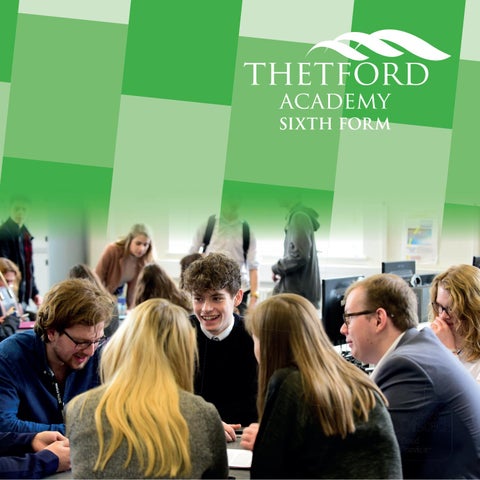
SIXTH FORM
Welcome to your sixth form We have a clear aim for our sixth form students: to be happy, safe, and successful. To help achieve that, we have the highest expectations for our students and we are utterly committed to providing a stimulating, supportive, and personalised learning environment. Our sixth form is an exciting and engaging place to study: a step up from the challenges of GCSE but with all the familiarity and support of a high school environment. We pride ourselves on our personalised approach and pastoral care – our students become part of a tight-knit community, not just a face or name among many. Sixth form is a fantastic bridge into the world of work or further study at university and we are rightly ambitious for our students. Our award-winning careers provision enables all of our students to be guided towards the most appropriate destinations, be that employment or university. We are committed to going beyond academic qualifications. We will develop your life skills through our extra-curricular pathways. We will challenge you and give you responsibility, for example through our active students’ union and societies or via work experience. We have cutting-edge facilities and offer the best extra-curricular activities – drama, dance, art, and sport – with dedicated sessions for our sixth formers and opportunities to work with younger pupils in the school. Our experienced, dedicated staff will support you every step of the way, with expert teaching, personal support and encouragement, and through a shared passion for helping you succeed. This prospectus gives you an overview of life at Thetford Academy Sixth Form, but we would love to welcome you in to see it for yourself. Get in touch or visit our website for details of our open evening or to arrange a chat about how you can plan your future with us. Dan Carter Principal
Sixth form life The move to sixth form is all about you starting to take more responsibility for your own studies, your choices, and your future. We will encourage you to be more independent – but we’ll also be on hand to support you when you need it. You will still get detailed expert teaching, but increasingly you’ll be expected to research and study for yourself. Sixth formers are expected to be on site for the whole academy day, with a mix of teaching sessions, independent study, and extracurricular activities. We also expect you to come to school smartly dressed, in business-style clothes. We want younger students to see you as role models and aspire to be like you. There are a variety of opportunities for you to run clubs, help out in classes, and mentor students, giving you the opportunity to support the lower school community. You’ll spend less time in classes than at GCSE, instead having study periods where you’ll be expected to carry out work set by your subject teachers. You will need to be disciplined and self-motivated. We appreciate that some students find this harder to adapt to than others, and so we look to support you with additional lessons in study skills and pastoral support so that you stay on the right track. We closely monitor your progress during the course, so that we can give you extra support if needed and ensure that you get the most out of your sixth form years. We also offer a range of life skills courses that give you experience in managing your finances and the world of work, and the chance to take part in a varied programme of trips and events.
What we offer • • • •
• • •
• •
•
A wide range of A Level and BTEC subjects arranged in combinations to suit the needs of students Extended Project Qualification – a qualification respected by universities which develops the research and evaluation skills needed for further study Highly qualified specialist teachers committed to achieving the best possible results Full advice and guidance on careers and higher education in Year 12 followed by expert assistance with presenting your university application in Year 13 or making your first steps into work Opportunity for private study and research using the well-resourced collegestyle Library and the Sixth Form Centre Access to the expertise and resources of other schools in the Inspiration Trust Enrichment lectures by a wide range of guest speakers from a variety of backgrounds and careers – guest visitors have included politicians such as Liz Truss, Norfolk Police Ambassadors, The BBC - Question Time, local business and community representatives. Broadening your horizons: we offer the opportunities of trips and expeditions, social events, Duke of Edinburgh’s Award, Arts Award, and work experience Leadership opportunities through mentoring younger students, representing your fellow sixth formers, and working with our subject departments as a subject leader Enrichment activities in the larger life of the academy or by becoming involved in activities within the local community such as charity projects and our work with primary schools
Choosing your future It’s really important to make informed decisions when you choose subjects for sixth form, both when it comes to the courses themselves and the doors they can open for later life. You also need to choose subjects which you are going to enjoy studying and subjects which you know you will do well in – after all, you’ll be studying them for the next two years. The following pages give an overview of the subjects we offer. We’re always happy to talk through subject choices with students who need further guidance and advice, so get in touch if you need some help. You will normally take three subjects. As well as our main courses, you also have the option to take the Extended Project Qualification and core maths as additional qualifications.
How to apply To study with us, you should normally have at least five GCSEs at grade 4 or above, including a grade 5 in both English and mathematics, and grade 6 in the subjects closest to the courses you have chosen to study. You can apply online by visiting helpyouchoose.org or the academy website. If you’re not sure about which courses are best for you, please get in touch to discuss your options. Course details are correct at time of publication but may be subject to change
Core mathematics Core maths is an excellent choice for students wanting to support the mathematical concepts needed for other courses such as psychology, sciences, and geography. It is designed for students who want to continue to study mathematics after GCSE, but not take a full A Level course. It carries up to 20 UCAS points, and is taken alongside your three main subjects. The course includes statistics of real data, financial mathematics, drawing and interpreting graphs, estimation and standard form, presentation of logical and reasoned arguments, communicating mathematical approaches and solutions, critical analysis of solutions and methods, and statistical analysis techniques. AQA Level 3 Mathematical Studies
Extended project qualification Taken alongside your three main subjects, this qualification develops and demonstrates your ability to independently plan and organise a research project, obtain and analyse relevant data or evidence, use and develop skills to achieve planned outcomes, and evaluate those outcomes at the end of the project. It’s a great opportunity to experience university-style study, and expand your knowledge in an area of interest. It shows employers and universities what your personal passion and interests are, and shows that you can self-manage, self-direct, and set ambitious goals for yourself. It is equivalent to an AS Level and carries up to 28 UCAS points if an A* is achieved. The finished project will consist of a written report and may include work in other media such as journals, models, or audio files.
Applied science
Art and design
This BTEC course offers a broad scope of scientific study and provides an excellent basis for access to many science-related higher education courses or careers such as lab technician. It can also be used to enhance knowledge before progressing to a full A Level course in an individual science. The course offers a one-year National Certificate course (equivalent to half an A Level), comprising two units: Principles and Applications of Science I (assessed by an external exam), and Practical Scientific Procedures and Techniques (assessed by coursework). Students then have the opportunity to progress to an Extended Certificate (equivalent to an A Level). This is made up of four units, three of which are mandatory. Two of these units are assessed by external exam, the other by coursework. Level 3 BTEC
Over this two-year A Level course students will study a wide range of topics including painting, drawing, textiles, fashion, sculpture, digital art, and printmaking. You will develop your personal responses to ideas, observations, experiences, environments, and cultures in practical, critical, and contextual forms. The course, assessed by a coursework portfolio and final exam, will help you develop skills including: independence of mind in developing your own ideas; an interest and enthusiasm for art and design; the experience of working with a range of media, including traditional and new media and technologies; and an awareness of the different roles, functions, audiences, and consumers of art and design. There will be a range of lesson styles and activities, including practical hands-on workshops where new techniques and processes are taught. Both collaborative and individual work are encouraged to give a taster for university and workplace life. Workshops led by artists will help develop your independent practice, and you will have the opportunity to visit exhibitions and see first-hand the work of other artists. Students will create a portfolio of work using sketchbooks and folders. A starter pack is purchased from school and all further materials are provided by the academy. AQA GCE A Level
Biology
Business marketing
This A Level course will give you an exciting insight into the contemporary world of biology. It combines academic challenge with a practical focus as you study the core concepts of biology, the impact of biological research, and how it links to everyday life. You will learn to apply your knowledge, investigate, and solve problems in a range of contexts. You will study a wide range of topics over the two years including development of practical skills in biology; foundations in biology; exchange and transport; biodiversity, evolution, and disease; communication, homeostasis, and energy; genetics, evolution, and ecosystems. There’s an emphasis throughout the course on increasing your knowledge, developing competence and confidence in practical skills, and developing problem-solving skills. You will learn how society makes decisions about scientific issues and how science contributes to the success of the economy and society. There will be a range of lesson styles and activities, including practical and investigative work, group and individual presentations, lectures, small group seminars, practice with problem solving, and exam questions. OCR(A) A Level
This exciting course will introduce you to the world of business marketing and give you a ‘Tech Level’ qualification, equivalent to an A Level, highly valued by employers and professional bodies. You will study an introduction to the establishment, growth, and survival of a business; key concepts and terminology of marketing and how it fits within an organisation; the main elements of marketing communications, customer relationship management, communications methods and tools, and development of an outline marketing communications campaign; and key concepts associated with digital marketing. Developed in collaboration with the Chartered Institute of Marketing, employers, and universities, this course provides a fantastic basis to progress to higher education, apprenticeships, or work within the marketing sector. AQA Level 3 Foundation Technical Level Business: Marketing Communications
Chemistry
Criminology
Studying chemistry at A Level will give you a strong grounding in the key concepts of the science, increasing your knowledge while developing your competence and confidence in practical skills. Developed with industry experts including the Royal Society of Chemistry and GlaxoSmithKline, the course comprises six modules: development of practical skills in chemistry; foundations in chemistry; the periodic table and energy; core organic chemistry and analysis; physical chemistry and transition elements; and organic chemistry and analysis. Lessons will include practical and investigative work, group and individual presentations, lectures, and small group seminars. The course will be assessed through three written exams. OCR(A) A Level
Criminology is the study of the reasons why individuals commit crimes. By understanding why a person commits a crime, we can develop ways to control crime or rehabilitate the criminal. There are many theories in criminology. Some theories attribute crime to the individual, who makes a conscious choice whether or not to commit a crime. Others believe it is the community’s responsibility to ensure that their citizens do not commit any crime. A third group believes that some individuals have latent traits that will determine how they will react when put in certain situations. This course will enable you to use theories of criminality to analyse criminal situations and make recommendations for policy. You will also develop the knowledge and skills to research policy in practice, assess campaigns for changes in awareness and examine information to review verdicts in criminal cases. This course is equivalent to one A level. Year 1: Unit 1 is a controlled assessment. Unit 2 is an external exam. Year 2: Unit 3 is a controlled assessment. Unit 4 is an external exam. WJEC
Dance Equivalent to one A Level, this course is ideal for students who are interested in learning about the performing arts sector with a view to progressing to a wide range of higher education courses. You will spend time investigating practitioners’ work, developing skills and techniques for live performance, and taking part in a group performance workshop. There are also options to study classic and contemporary dance styles. Independent study, paired work, group work, and hands-on practical experiences will give you the chance to present your work in a variety of ways. As well as practical performance there is a large emphasis on evaluation and written work. Students are required to demonstrate that they can identify and use effectively, in an integrated way, an appropriate selection of skills, techniques, concepts, theories, and knowledge. Pearson BTEC Level 3 National Extended Certificate in Performing Arts
English language and English literature Studying the integrated English Language and Literature course allows students to engage creatively and independently with a variety of spoken, written and multimodal texts. Students explore how linguistic and literary methods are related and to explore these links in their work. Offering clear skills progression from GCSE, this course allows students to build on the skills and knowledge already gained and prepare for their next step. The variety of assessment styles used, such as re-creative writing, commentary writing, discursive essays and research-based investigative writing, allows students to develop a wide range of skills. These include the ability to read critically, analyse, evaluate and undertake independent research, which are invaluable for both further study and future employment. AQA
French
Further mathematics
Studying French at A Level will give you a broad range of knowledge and skills in French language and culture, providing a strong foundation for studying languages at university or entering the workplace. A Level French is regarded by many universities as a ‘facilitating subject’ and can make a significant difference in UCAS applications. This varied and interesting course will give you an insight into social and political issues in the French-speaking world, such as the changing nature of the family, politics and immigration, and how criminals are treated. Students will delve into the country’s art and culture by studying literary texts, music, and films, and hone their language skills through a focus on grammar and translation. AQA A Level
A Level further maths goes deeper into mathematics than A Level maths, which it may be studied alongside. You will investigate where elements of mathematics come from and gain a rich understanding of complex concepts in the mathematical world. The course will include both pure and applied maths and statistics, covering topics including linear algebra, differential equations, numerical methods, graph theory, network theory, critical path analysis, probability distributions, and hypothesis testing. Students will be able to apply complex mathematical ideas and concepts to real-life situations, such as in business and finance. Students are given a great deal of responsibility over their learning and are expected to study and revise in their own time. You’ll have plenty of opportunities to add to your knowledge with maths trips and competitions. AQA A Level
Geography
Health and social care
There has never been a more relevant time to study geography, as barely a day passes without news linked to geographic themes: climate change, housing shortages, water conflict, energy security, and international political agreements. Geographers have a vital role to play in managing the major global challenges of the future. During this A Level course students will get to grips with major themes in geography including tectonic processes, globalisation, landscape systems, the water and carbon cycles, climate change, and global development. Field work is an important and exciting part of the geography syllabus, allowing you to develop real-world skills and analytical techniques that can be applied in future research, study, or employment. Edexcel A Level
This ‘Tech Level’ diploma course gives students the skills, knowledge, and understanding to progress to higher education on programme such as health and social care, nursing, social work, or early childhood studies. Students will learn by applying their skills, knowledge, and understanding to tasks directly relevant to health, social care, and childcare workplaces. The course covers a wide range of topics including building positive relationships; equality, diversity and rights; health, safety, and security; and anatomy and physiology. The curriculum has been put together with universities and employers, giving students the transferable skills, knowledge, and understanding that they are looking for in prospective applicants. The course involves independent study, paired work, group work, role play, and hands-on practical experiences. Cambridge Technical Extended Certificate in Health and Social Care
History
Information technology
Studying history at A Level will allow you to develop your interest in and enthusiasm for history and an understanding of its intrinsic value and significance. Students will build on their understanding of the past through a broad and balanced course of study, acquiring an understanding of different identities within society and an appreciation of aspects such as social, cultural, religious, and ethnic diversity. You’ll study various periods and aspects of history, developing your historical and research skills in order to ask relevant and significant questions about the past, and make links and draw comparisons across different periods. In Year 12 students will learn about Britain from 1625-1701, covering the reign of Charles I, the English Civil War, and the restoration of the monarchy; and Russia from 1894, investigating the Russian revolution and its causes and consequences. Year 13 will cover civil rights and race relations in the USA from 1850-2009, looking at the issues of slavery and emancipation, the US Civil War, segregation, the civil rights movement, and present-day race relations. This topic will include a coursework unit. Edexcel A Level
This ‘Tech Level’ course will give students an insight into the IT sector as they investigate the pace of technological change, IT infrastructure, the flow of information on a global scale, and how IT is being applied to our everyday lives. You’ll acquire a broad base of knowledge and skills ideally suited to further study or entering the workplace in the IT sector. You will begin by studying the fundamentals of IT and global information, giving you an insight into the IT sector and its rapid growth in the 21st century. Further units will cover virtual and augmented reality, the internet of everything, and developing a smarter planet. Students will learn through a mixture of traditional classroom-based learning and hands-on application, gaining strong theoretical and practical skills. OCR Level 3 Cambridge Introductory Diploma in IT
Mathematics
Media Studies
A Level mathematics provides students with a thorough grounding in mathematical skills and techniques. This is an interesting and challenging course that will develop your logic and reasoning skills. Maths qualifications are highly regarded by universities and employers, and this course complements a wide range of subject areas including the sciences, IT, programming, geography, and business. Up to two thirds of the course will be pure material, and the other third applied. Topics will include: calculus; functions, series, and limits; algebraic and graphing skills; numerical methods; exponentials and logarithms; coordinate geometry; probability and statistics; and mechanics. AQA A Level
Studying Media Studies at A Level will give you the opportunity to explore and develop ideas within different genres of media from TV series’ and YouTube channels to documentaries and Radio productions. As well as this we explore the world of gaming and music videos to look at the representation of gender and other representations, whilst investigating many other aspects from media industry to audience reaction. Combined with the audio visual side we look at print based media; newspapers, magazines, adverts etc. For the coursework section of the course, students are given the opportunity to pick from a wide range of medium; music videos, magazine’s, Television, Radio and Film. They have the chance to do both an Audio-Visual piece and print based to reflect the skills they have been discussing and analysis through their exam set works. Media Studies gives students the chance to question everything about society and how the media really does influence a wide range of generations. After taking this course there are many chances to pursue at university or beyond including journalism, investigative journalism, media design, graphic design - the list is endless. AQA A Level Media
Performing arts Equivalent to an A Level, this BTEC course will develop your practical skills and techniques in a range of performing arts disciplines, critical analysis, and contextual understanding of practitioners’ work. Students will gain a taste and an appreciation of performing arts, through knowledge and experience of the performance process. The course involves a wide range of study techniques as you develop and apply your theatrical styles and knowledge. You’ll carry out research, take in part teacher-led and student-led workshops, prepare and deliver presentations, and develop a written portfolio. You will also devise your own scripted work, participate in rehearsals, and perform to a public audience. Edexcel BTEC National Extended Certificate in Performing Arts - Acting
Photography
Physics
A Level photography provides students with opportunities to develop personal responses to ideas, observations, experiences, environments, and cultures in practical, critical, and contextual forms. This course, assessed by a coursework portfolio and exam, requires students to develop their ability to show a range of skills. These include independence of mind in developing their own ideas; an interest and enthusiasm for art and design; the experience of working with a range of media, including traditional and new media and technologies; and an awareness of the different roles, functions, audiences, and consumers of art and design practice. You will study a wide range of topics over the two years including digital manipulation, traditional black and white photography, and animation. You will also analyse the work of other photographers and artists. There will be a range of lesson styles and activities, including practical hands-on workshops where new techniques and processes are taught. Collaborative and individual work are encouraged to give a taster for university and workplace life. Workshops led by photographers will help develop your independent practice. Pupils will be required to create a portfolio of work using sketchbooks and digital software. A starter pack will need to be purchased from school; all further materials are provided by the school. You will have the chance to be inspired by the work of other photographers with visits to exhibitions. AQA GCE A Level
This A Level covers the key concepts of physics, increasing your knowledge and developing your practical skills and awareness of the practical application of physics in the real world. As you progress through the course, you’ll study the fundamental laws of physics, applying your understanding to areas from sub-atomic particles to the entire universe. You will cover a range of topics including: development of practical skills in physics; foundations of physics; forces and motion; electrons, waves and photons; Newtonian world and astrophysics; and particles and medical physics. Emphasis throughout the course is on increasing knowledge, developing competence and confidence in practical skills, and developing problem-solving skills. There will be a range of lesson styles and activities, including practical and investigative work, group and individual presentations, lectures, small group seminars, problem solving, and exam questions. OCR (A) A Level
Politics
Portuguese
This course has been designed to encourage an interest in and enthusiasm for the study of government and politics, and will enable students to develop an insight into political beliefs central to an understanding of the modern world. During Year 12 you will learn about UK government and politics, covering concepts such as democracy and participation, political parties, Parliament, voting behaviour, and concepts such as liberalism, conservatism, socialism, feminism, anarchism, and multiculturalism. During Year 13 you will study the government and politics of the USA. During the course you will develop your reasoning, debating, and analytical skills by taking part in seminars, class debates, and knowledge tests, alongside independent study and essay writing. Edexcel A Level
Studying Portuguese at A Level will give you a broad range of knowledge and skills in Portuguese language and culture, providing a strong foundation for studying languages at university or entering the workplace. A Level Portuguese is regarded by many universities as a ‘facilitating subject’ and can make a significant difference in UCAS applications. This varied and interesting course will give you an insight into social and political issues in the Portuguese-speaking world, such as the changing nature of the family, the world of work, multiculturalism, and the media. Students will delve into the country’s art and culture and hone their language skills through a focus on grammar and translation. AQA A Level
Psychology
Spanish
A Level psychology offers students an engaging and stimulating introduction to the study of psychology, combined with the academic integrity and skills that higher education and employers value. The course has a strong element of statistics and scientific research and evaluation. The course covers the core elements of psychology: social influence, attachment, memory, psychopathology, approaches in psychology, research methods, and biopsychology. Students will learn about the major psychology theorists and their work through textbook analysis and group discussions, producing and presenting their own written work. A good standard of spoken and written communication is needed. AQA A Level
Studying Spanish at A Level will give you a broad range of knowledge and skills in Spanish language and culture, providing a strong foundation for studying languages at university or entering the workplace. A Level Spanish is regarded by many universities as a ‘facilitating subject’ and can make a significant difference in UCAS applications. This varied and interesting course will give you an insight into social and political issues in the Spanish-speaking world, including modern and traditional values, immigration and integration, Spanish regional identity, and political life in the Spanish-speaking world. Students will delve into the country’s art and culture and hone their language skills through a focus on grammar and translation. AQA A Level
Sport This BTEC course has been designed alongside universities, employers, and professional bodies to support progression to higher education or employment in the sporting sector. You will gain a strong foundation in the theory and practice of sport, including anatomy and physiology; fitness training and programming for health, sport, and wellbeing; and professional development in the sport industry. You will also study a further unit that will be chosen with your individual career path in mind. Learning will be through theoretical and practical-based lessons, which will be supported by students completing individual research tasks. The broad and balanced curriculum will give you the knowledge, understanding, and skills you need to follow a fulfilling career in the sporting industry. Pearson BTEC Level 3 National Extended Certificate in Sport
Web and Mobile App Development Web and Mobile App Programming is technical level course developed with industry specialists; designed to prepare you professionally and academically for careers and degrees in software engineering, web & mobile app development, and computer science. Previous students have progressed to Level 4 Apprenticeships in Software Development, BSc in computer science, and internships in the IT industry. Students will learn how to develop web and mobile apps; the fundamentals of programming and computer science; how to program and code in HTML, CSS, PHP, and C#, using event driven and object-oriented models; and what it means to be an agile software developer. The course is assessed through a mix of exams and coursework. There is a strong focus on practical application of theory; students will take part in traditional classroom-based learning alongside practical application and ‘in the field’ exercises with local employers and industry specialists. We work with key industry partners including Aviva Digital Foundry in Norwich. AQA Level 3 Foundation Technical Level IT: Scripting and App Programming (360 GLH)
Thetford Academy is part of the Inspiration Trust, a not-for-profit charity whose mission is to transform the lives of young people in Norfolk and Suffolk through education. The Trust believes that all children deserve the chance to achieve academic excellence. We also offer the widest range of sporting and cultural opportunities to our young people, and encourage them to play an active role in their school and the wider community. Our family of schools work together to ensure that all pupils have access to the very best teaching expertise, exceptional facilities, and extracurricular activities that excite and broaden their minds.
Croxton Road Thetford IP24 1LH 01842 754875 info@thetfordacademy.org.uk www.thetfordacademy.org.uk @ThetfordAcadUK ThetfordAcademyUK