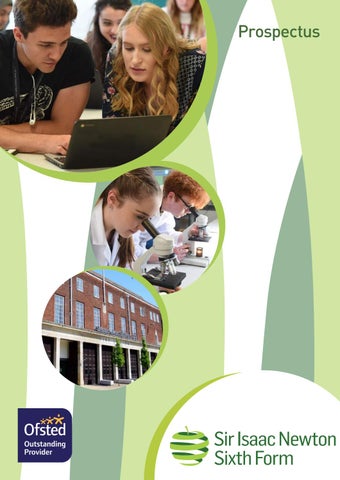
Prospectus
Sir Isaac Newton Sixth Form is part of the Inspiration Trust, a not-for-profit charity whose mission is to transform the lives of young people in Norfolk and Suffolk through education. We believe that everyone deserves the chance to achieve academic excellence. We offer a wide range of sporting and cultural opportunities to our young people, and encourage them to play an active role in their school and the wider community. Our family of schools work together to ensure that all students have access to the very best teaching expertise, exceptional facilities, and extracurricular activities that excite and broaden their minds.
Welcome to your sixth form Welcome to Sir Isaac Newton Sixth Form, an outstanding specialist maths and science sixth form in the heart of Norwich. Choosing the right sixth form is one of the most exciting and important decisions you will make. Here at Sir Isaac Newton our ethos is focused on high aspirations, academic excellence, and support and guidance. We are dedicated to providing the very best learning opportunities for our students, ensuring that you meet your potential in both exam results and in the skills that will help you develop into the next generation of leaders within science, technology, engineering, and mathematics. We lead in developing the teaching of maths and science in the UK both regionally and nationally. We are joint leads of the Norfolk & Suffolk Maths Hub, are a key partner in the Norwich Science Festival, and have recently been recognised as the leading sixth form for STEM in East Anglia by the Government-backed Your Life campaign. Our students have extensive opportunities through work experience, our external speaker programme, and our elective and Vitae life experience programmes. We have high expectations of every student, and ensure that every student receives the individual support they require to develop into both accomplished scholars and well-rounded and happy individuals. I encourage you to visit our state of the art, fantastically renovated former fire station in the heart of Norwich city centre. Its mix of tradition and forward-thinking reflects our ethos perfectly. Our facilities are custom-designed to support exceptional learning, and we have deliberately included open-plan spaces for independent study, to give the sixth form a university campus feel. I am proud to lead an outstanding and ambitious sixth form that has high aspirations for all its students, and I look forward to welcoming you. Chris Jennings Principal
TOP STEM SIXTH FORM IN EAST ANGLIA Your Life rankings 2017
Sixth form life A focus on learning Sir Isaac Newton Sixth Form is a specialist science and maths sixth form and we take pride in delivering the highest quality teaching and learning in both fields. Our staff are fully qualified teachers and experts in their subjects. Our innovative, evidence-based approaches help all students achieve their potential and ensure that all students thoroughly enjoy learning with us. Our curriculum ensures that students take part in significant practical work in the fields of
biology, chemistry, physics, and computing. Students are encouraged to read around their subject, supported by regular seminars and lectures from industry experts and academics. Our learning spaces have been designed with effective pedagogy in mind. Our labs enable students to become familiar with specialist scientific equipment and procedures in preparation for higher education.
STUDENT PROGRESS IN TOP 10% NATIONALLY Department for Education 2017
Supporting our students Through our pastoral system students are fully supported by a team including form tutors, academic and pastoral mentors to make sure all our students’ needs are met. Support is available for students with special educational needs. When joining Sir Isaac Newton, all students are assigned a tutor who supports them throughout their time at the school. All students have regular one to one meetings with their form tutor to reflect on their academic and personal goals.
Tutor time is also used to support students’ progress in all areas of their curriculum and future opportunities, including UCAS applications, apprenticeships, employability, and life skills. Getting university applications right is vital if students are to attend their first choice university and so a great deal of time is spent focussing on this. Students are encouraged to explore beyond the curriculum through work experience and extracurricular qualifications such as FutureLearn online courses.
“SIR ISAAC FOSTERED IN ME THE AMBITION AND PASSION TO SUCCEED” Jed de Ruiter-Swain Oxford undergraduate Biochemistry
Educating the whole person Alongside our curriculum we have many extracurricular opportunities for students via our electives programme. Electives are an opportunity for students to participate in a wide variety of extra activities, from highly academic activities such as a STEP maths support program to sports such as table tennis and football. Electives are designed to boost a student’s university application, provide academic and work experience opportunities, and offer fun activities and an environment in which to relax and meet new friends. Experts are invited in regularly to support and guide our students through our guest speaker programme.
We encourage our students to play a full part in our local community. Opportunities include reading or maths support with secondary school students, learning how to work with primary age children with special educational needs, and organising charity events. Additional qualifications such as the Extended Project Qualification (EPQ) and online FutureLearn programmes are also available for students to utilise. Recognised by universities, these courses offer the chance of further individual study and exploration of new subjects.
A personalised study experience
n n,
o
at a D w
Scientist,
Avi v
Z a k C an n o n
‘Sir Isaac enabled me to reach my full potential; challenging and nurturing my analytical skills in pursuit of excellence’ Sir Isaac Student 2014 – 2016
“Sir Isaac’s incredible teaching gave me the passion I have for the sciences” Sir Isaac Student 2016 – 2018, now studying Natural Sciences at Cambridge
“The STEM mindset at Sir Isaac excellently prepared me for life at a Science and Technology university.” Sir Isaac Student 2014 – 2016, now studying Materials Science and Engineering at Imperial College London.
n
d
Lee
Alongside traditional A Levels, students can build in electives, study skills sessions, and additional learning, and volunteering opportunities to create their own bespoke timetable.
a
Su
t to
All our students are able to create their own personalised study programmes, meaning that their studies are perfectly matched to their interests, strengths, and future career plans.
Ro
b er t C a n d
el a
Ready for work We enjoy warm and growing links with local employers, organisations, and higher education institutions, all aimed at providing you with valuable work-related opportunities and work experience. We also offer regular careers advice and guidance for all our students. Our external speaker programme is an opportunity for you to attend seminars led by local
and national professionals and experts. These sessions provide an insight into potential careers and are also an opportunity for you to question professionals in the sectors that interest you. These sessions, on a range of changing topics, also offer an additional opportunity for you to widen your knowledge and experience of the world around you.
Preparing for university We run a series of seminars and events, aimed at students who want to apply to the UK’s top universities. This enables students and parents to meet staff members and alumni from high-ranking universities such as Oxford and Cambridge. In tutorial sessions you will focus on writing personal statements,
the skills required for university interviews, and university life, all matched with expert advice and feedback. Our Oxbridge Society is also a chance for like-minded individuals to get together to discuss their aspirations, share ideas on applications, and support each other through the application process.
FIVE TIMES MORE RUSSELL GROUP PLACES THAN NORFOLK AVERAGE DFE 2015 DESTINATIONS
Our curriculum A central aspect of the curriculum at Sir Isaac Newton Sixth Form is that all students study at least two of the following subjects: • Biology • Chemistry • Computing • Further mathematics • Mathematics • Physics • Psychology Students also have the opportunity to study the arts, English, and humanities at our partner specialist school, Jane Austen College – situated just a few minutes’ walk away on its own Norwich city centre campus.
This partnership of two specialist schools ensures that every student receives the best possible tuition in whatever subject combination they wish to take, and ensures all our students experience the widest range of interests and ideas. In addition to A Levels, Sir Isaac Newton students may choose to complete an Extended Project Qualification (EPQ). The EPQ introduces students to the rigorous process of research and allows them to apply these skills in a subject area of their choice. It is an excellent qualification, providing a superb grounding for the research demands faced as an undergraduate.
‘‘Sir Isaac Newton has helped me to achieve by providing me with the skills I need for study and research and a strong knowledge base for my degree.’’ Maria Staines,Environmental Science graduate, Portsmouth University. Sir Isaac Newton student 2014-2016
Experts in teaching Our students benefit from being at the cutting edge of maths teaching in the UK. Sir Isaac Newton Sixth Form is the lead school for the Angles Maths Hub. We lead positive change in the teaching of mathematics in both Norfolk and Suffolk. The hub works to support teachers of students from early years to post-16.
The hub focuses on developing the mathematics curriculum, raising participation in post-16 mathematics, and increasing the number of mathematics teachers through subject knowledge enhancement courses for non-specialists. We are also an Advanced Mathematics Support Program (AMSP) Partner School with the remit of training and developing A Level mathematics teaching throughout the region.
MathsHUBS Angles
Choosing the right subjects It’s really important to make informed decisions when choosing subjects for A Level study. Choosing certain subjects can give an advantage when it comes to university applications and being successful in a chosen career. The UK’s top universities often prefer students to have studied particular subjects at A Level. These are known as facilitating subjects. The facilitating subjects are: • maths and further mathematics • English literature • physics • biology • chemistry • geography • history
• languages (modern or classical) We recommend that you choose at least two subjects from the list if you want to give yourself the best chance of securing a place at a top university. It’s also a good idea to research future university courses and check their entrance requirements. Students also need to choose subjects which they are going to enjoy studying for the next two years, and subjects that they are likely to do well in. We’re always happy to talk through subject choices with students who need further guidance and advice. Course details are given on the following pages. Subjects with headings in red are taught by our sister institution, Jane Austen College.
At Sir Isaac Newton, you can study the following subjects: Mathematics Mathematics continues to be the most popular A Level subject choice because it is accessible, enjoyable, and challenging, with applications and use across many other subjects. The new A Level maths curriculum introduced in 2017 has a strong emphasis on deeper understanding and problem solving, which prepares students well for work or study beyond A Level. As well as being essential for studying any mathematics-based subject at degree level, A Level mathematics is required by many universities for students studying subjects such as chemistry, biology, or economics. Our A Level maths students study a broad curriculum, including richer topics such as calculus from first principles, alongside the traditional ones, such as quadratics, trigonometry, and sequences. Applied mathematics forms roughly one third of the course, and comprises mechanics and statistics. As they learn each topic students are encouraged to apply these new skills to difficult problems to help build vital problem-solving skills and make links to other topics. (OCR-A)
Biology All living organisms have similarities in cellular structure, biochemistry and function; an understanding of these similarities is fundamental to the study of biology. You will enjoy a flexible approach to the study of this diverse subject. You will use microscopy to study the cell structure of a variety of organisms. Biologically important molecules such as carbohydrates, proteins, water, and carbohydrates, proteins, water, and nucleic acids are studied with respect to their structure and function. You will also study the structure and function of gas exchange and transport systems in a range of animals and in terrestrial plants. Heredity and the mechanisms of evolution and speciation are also covered. Some of the practical techniques used to manipulate DNA such as sequencing and amplification are applied and their therapeutic medical use considered. Through this, you will
develop a balanced understanding of the issues surrounding biotechnology. Assessment at the end of Year 13 takes the form of three written papers, one of which is a synoptic paper covering content from both years. (OCR)
Chemistry Chemistry is a practical subject and the development of practical skills is fundamental to understanding the nature of chemistry. You will be given many opportunities to develop the expertise needed to collect and analyse empirical data. Important skills are developed, including writing chemical formulae, constructing equations, and calculating chemical quantities using the concept of amount of substance. The role of acids, bases, and salts in chemistry is investigated, and the central role of electrons in ionic and covalent bonding is studied. You will explore periodic trends to extend their understanding of structure and bonding. Group properties are studied using Group 2 and the halogens allowing students to further develop their understanding of redox reactions. The importance of organic chemistry in everyday life is explored, placing chemistry in context. Assessment at the end of Year 13 takes the form of three written papers, one of which is a synoptic paper covering content from both years. (OCR)
Physics During this course you will build on your knowledge of the laws of physics, applying your understanding to solve problems on topics ranging from sub-atomic particles to the entire universe. Practical skills are embedded throughout all the content of the course, ensuring you develop a range of practical skills in preparation for the written examinations. You will be introduced to the important conventions and ideas that permeate the fabric of physics. Understanding of physical quantities, S.I. units, scalars and vectors help our physicists to effectively communicate their ideas and to model the motion of objects using mathematics. You will also learn about the important connection between force and energy, appreciate how forces cause deformation, and understand the importance of
Newton’s laws of motion. You will apply the important principle of conservation of energy to a range of situations. Electrons, electric current, electrical circuits, wave properties, electromagnetic waves and, of course, quantum physics are studied together with the fields of astrophysics and cosmology. Assessment at the end of Year 13 takes the form of three written papers, one of which is a synoptic paper covering content from both years. (OCR)
Computer science During this course you will be encouraged to develop a broad range of knowledge, understanding, and skills in computing, as a basis for progression into further learning and/ or employment. A significant part of computer science involves programming to an advanced level, although no previous programming experience is required. You will develop: •
•
•
• •
An understanding of, and the ability to apply, the fundamental principles and concepts of computer science, including abstraction, decomposition, logic, algorithms, and data representation. The ability to analyse problems in computational terms through practical experience of solving such problems, including writing programs to do so. The capacity for thinking creatively, innovatively, analytically, logically, and critically. The capacity to see relationships between different aspects of computer science. Maths skills related to Boolean algebra, comparison and complexity of algorithms, and number representations and bases.
•
The ability to articulate the individual (moral), social (ethical), legal, and cultural opportunities and risks of digital technology. Assessment is via one computerbased practical exam, one written exam, and an extensive computing project. (AQA)
Further mathematics Further mathematics is a second full A Level in mathematics, useful for students considering mathematics at university, but also for students going on to study subjects that have a very high mathematical content, such as physics, engineering, or economics. In further maths, students study additional pure mathematics topics, such as complex numbers, matrices, and proof; there is a strong emphasis on problem solving. The topics studied in further maths are at least as stretching as those in A Level maths; students are expected to build a deeper understanding so they can make links between all the content studied, and apply their knowledge effectively when solving difficult problems. Our further maths students study A Level further maths as a full timetabled subject alongside their other subjects. For students considering studying maths at Oxbridge we provide support to develop the deeper problem-solving skills required for the MAT and STEP entrance exams. (OCR-A)
Psychology In this course you will develop a knowledge and understanding of psychological concepts, theories, research studies and their ethical implications. You will evaluate therapies and treatments including in terms of their appropriateness and effectiveness. Explanations for conformity and the impact of social influence are considered alongside the role of social influence processes in social change. You will consider the works and theories of psychologists such as Schaffer, Bowlby, Pavlov, and Skinner. Psychopathology is explored including deviation from social norms; failure to function adequately; and the behavioural, emotional, and cognitive characteristics of phobias, depression, and obsessive compulsive disorder (OCD). Psychology is placed in context through the evaluation of case studies and research methods; scientific processes and techniques of data handling and analysis are critiqued for their application, strengths and limitations.
Assessment at the end of Year 13 takes the form of three written papers which include shorter written answers, longer essay questions, and data handling. (AQA)
Core Maths Core Maths is a level 3 maths qualification equivalent to an AS level qualification in terms of demand and carrying the same number of UCAS tariff points; it is delivered in Year 12 only. Our students study Core Maths as a compliment to their other three A levels. It is ideal for students who choose to study A levels involving significant mathematical content but who do not wish to study A level Mathematics; for those students wishing to study physics without A level maths, Core Maths is compulsory. In term one all Core Maths students cover the fundamentals of the course including Analysis of Data, Personal Finance and Estimation. There are two options available in term two; for those studying biology, psychology or geography we recommend mathematical modelling whilst chemists and physicists apply mathematical modelling to the solution of problems. Assessment is at the end of Year 12 and takes the form of two written papers. Many universities have shown their support for Core Maths by offering reduced entry criteria for students who study this qualification. (AQA)
At Jane Austen College you can study the following subjects: English literature Over the course of the two years, you will study a variety of different texts (poetry, prose and drama), connected through either a theme (love through the ages) or the time in which they were written (either WW1 and its aftermath, or modern times: literature from 1945 to the present day). As part of the course, you will study a Shakespeare play, a core literary heritage novel, a pre-1900 text, and
a contemporary (post2000) text. The majority of assessment is through examination at the end of the A Level course. In the second year you will have the opportunity to complete an independent critical study into texts across time using text chosen by you and driven by your own individual interests, though it must include some material written pre-1900. (AQA)
Linguistics (English language) You will study the ways in which language varies, depending on the contexts of production and reception, and explore and critically evaluate how language choices can create personal identities, as well as how language varies over time. In addition, you will study the development of both speech and writing in children from birth to eight years old. The course focuses on the spoken language acquisition of children and how children learn to write. You will undertake your own language investigation, focusing on specific research topics, and also look at the craft of language and produce your own original writing piece. The course is assessed through both coursework and examination. (Edexcel)
Geography This course will help you develop knowledge about locations, places, processes, and environments, at all geographical scales from local to global. You will investigate physical processes such as water and carbon cycles, coastal systems, and landscapes. You will explore human processes like global systems and governance, population, and environments. You will also conduct a geographical investigation where you collect data in the field and conduct your own research based on a question or issue related to any part of the A Level. (AQA)
Philosophy The word ‘Philosophy’ is defined as the ‘love of wisdom’ and thus the subject will appeal to any student with an enquiring mind and a love of debate. It deals with fundamental questions about meaning, morality, and existence. It tackles questions such as: Can we trust our perception of the world? How should we make ethical decisions? Is the concept of God coherent? What is the mind? Through an engaging mixture of practise-driven lessons, debates and textual analysis; students of A Level Philosophy will learn how to precisely pick apart scholarly assertions, identify the soundness of ideas and critically evaluate arguments. There are no specific requirements for studying Philosophy; however, as it requires confident writing skills some proficiency subjects such as Religious Studies, History or English would be beneficial. You will sit the following exams: • •
Paper 1: Epistemology (Theories of knowledge) & Moral Philosophy (50%) Paper 2: Metaphysics of God & Metaphysics of Mind (50%)
History George Santayana famously said “Those who do not learn History are doomed to repeat it.” It is through studying the past that we truly understand the political, economic and social problems of our world today, and our course has been chosen to examine and analyse three significant events in recent History that have contributed to the current events we read about on a regular basis. Studying history allows students to study change, continuity, cause and consequence in a pivotal century in British History and the world. We also include an in depth study of the evolving course of international relations during the Cold War, an era of tension between communist and capitalist powers which threatened nuclear Armageddon. We teach the following A-Level components: • •
Paper 1 (1F): Industrialisation and the People: Britain c1783 to 1885 (40%) Paper 2 (2R): The Cold War c.1945-1991 (40%)
Students also undertake an independent historical investigation connected to the topic of AfricanAmerican Civil Rights in the United States c.1860-1965 (20%). It is preferable to have studied History at GCSE; to take History A Level, students should have a grade 5 in History, or in other subjects where students must construct a reasoned argument.
Classics The study of ancient civilisations opens a window to a world thousands of years old and yet which remains completely relevant to our lives today. Classical Civilisation focuses on the civilisations of Greece and Rome, and is a wide-ranging subject involving the study of literature, material culture, ancient thought and ideas, and the ancient historical context, all of which remain apparent in our culture and society. Due to the diverse nature of the course it is a perfect complement for those students studying English Literature, Art, Drama, Politics, History and Philosophy. We teach the following A-Level components: •
•
•
Paper 1: The World of the Hero. In this unit students will be studying two of the greatest epics ever written: Homers Odyssey and Virgil’s Aeneid. Paper 2: Imperial Image. This unit allows students to assess the effectiveness of the first Roman Emperor, Augustus Caesar’s self-presentation, as well as the effectiveness of his public image. Paper 3: Love and Relationships. This unit generates interesting and important discussions about love, desire, sexuality and the institution of marriage from the viewpoints of the Greeks and Romans.
Due to the heavy source/ literature based nature of the course, students applying for Classical Civilisations A-level are recommended to have a Grade 5 in English Literature and/or History.
Sociology Ever wondered how we developed into the society we are today? How the way you see yourself determines the way people identify
you? Whether men or women are more likely to commit a crime? Sociology is relevant to the society you live in so you are bound to enjoy learning about topics that are relevant to everyday life; plus it opens the door to a fantastic range of interesting careers. This course will help you make sense of the society we live in and understand the cultural and identity issues which affect us all. We study sociological approaches that help us understand the functions of education, families, and religion, as well as criminological approaches that explain why some people commit crimes and others do not. We study the following topics: • • •
Paper 1: Education and Sociological Research Methods (33%) Paper 2: Topics in Sociology (Families and Households/Beliefs in Society) (33%) Paper 3: Crime & Deviance, and Sociological Theory (33%)
There are no specific entry requirements for Jane Austen College, although a GCSE in a Humanities subject is a strong indicator.
Politics In Politics we focus on how power is distributed through government and within society. Students have the opportunity to develop their own knowledge of the UK and US political systems, whilst thinking critically and analytically about the ideologies and actions of modern politicians and political parties. We look in depth at the politics of the UK and the US, as well as the core political ideas
We study the following topics: • Paper 1: The English Legal System and Criminal Law (33%) • Paper 2: Law making and the law of Tort (33%) • Paper 3: Further law - Human Rights Law (33%)
French
that have shaped the UK. Each year, we have a trip to the Houses of Parliament, where in the past we have seen ministers questioned by backbenchers and have met with MPs. We study the following topics on the Politics course: • • •
Paper 1: UK Politics and Core Political Ideas (33%) Paper 2: UK Government and Core Political Ideas (33%) Paper 3: US Government and Politics (33%)
There are no specific course requirements to study Politics at Jane Austen, although a GCSE in a Humanities subject is a strong indicator.
Law The study of Law is hugely important for many reasons. Whilst students will be able to use their analytical and critical thinking skills, they will also be challenged to think about the many different spheres of law that exists, as well as whether law exists to serve public morality, whether laws should be made or simply interpreted by judges, and how justice is achieved in the English Legal System. We study many fascinating topics throughout this course, and many of our students choose to study Law at universities, including some of the best universities in the country. Modules focus on criminal, tort and human rights law, whilst also examining the philosophical and historical underpinnings of UK Law.
This course will not only help you to develop confident, effective communication skills in this important world language, but also give you a thorough understanding of the culture, and an opportunity to study the geography, history, and literature of countries and communities where French is spoken. It will develop your interest in, and enthusiasm for language learning and will encourage you to consider your study of the language in a broader context. By the end of the course you will be confident in discussing in French your thoughts and opinions on changing trends in the media, popular culture, the causes and effects of immigration, and questions regarding fundamental global concerns such as the fair distribution of wealth and the justice system. You will also study a book and a film in depth. You will sit the following exams: • • •
Paper 1: Listening, reading and writing (50%) Paper 2: Writing (20%) Paper 3: Speaking (30%)
To study languages, Jane Austen College requires students to have a Grade 5 in the language of their choice at GCSE.
German This course will give you an opportunity to develop effective and confident communication skills as well as foster your interest in and enthusiasm for language learning, giving you a solid foundation for further study of this highly valued world language. By the end of the course you will be confident discussing in German your thoughts and opinions on current trends and issues in German-speaking societies, such as multiculturalism and crime and punishment. Political and artistic culture forms a large part of the course and you will be able to debate topics such as teenagers and the right to vote and the politics of immigration.
You will also study a book and a film in depth. You will sit the following exams: • • •
Paper 1: Listening, reading and writing (50%) Paper 2: Writing (20%) Paper 3: Speaking (30%)
To study languages, Jane Austen College requires students to have a Grade 5 in the language of their choice at GCSE.
Spanish A-Level Spanish will not only help you to develop confident and effective communication skills, but also a detailed understanding of the culture of countries and communities where Spanish is spoken. By the end of the course you will be confident discussing in Spanish your thoughts and opinions on current trends and issues in Hispanic societies, such as multiculturalism and crime and punishment.Political and artistic culture forms a large part of the course and you will be able to to debate topics such as the media, equal rights, the politics of immigration, as well as studying a book and a film in depth. You will sit the following exams: • • •
Paper 1: Listening, reading and writing (50%) Paper 2: Writing (20%) Paper 3: Speaking (30%)
To study languages, Jane Austen College requires students to have a Grade 5 in the language of their choice at GCSE.
Fine art The main purpose of this course is to develop your ability to appreciate and respond to the visual world in a creative way. You will further develop and master skills learnt at GCSE and encounter new media, techniques, and methods of working. You will build on your knowledge of materials and practices, develop further your interpretative and analytical powers, and explore your imaginative and creative potential. You will also develop a specialist vocabulary and increase your knowledge and understanding of art, craft, and design. Underpinning all work will be the use of sketchbooks and the exploration of ideas through drawing and other research media such as photography. You will study the following disciplines in individual projects at the beginning of the A Level course – fine art, photography, graphic communications, textiles, and
3D design, before specialising in at least one as an extended project. The broad nature of this course makes it well suited to students who have studied any of these creative disciplines at GCSE. (AQA)
Drama and theatre Our course engages students through encouraging creativity, focusing on practical work which reflects 21st century theatre practice, and developing skills that will support progression to further study of drama and a wide range of other subjects. The course focuses on the practical exploration of performance texts, including exploring them in light of the work of theatre practitioners. The course is assessed across three examined components. • • •
Component one: you will devise your own performance. Component two: you will give a performance of a text. Component three: you will be assessed on your knowledge of theatre makers in practice.
A GCSE in drama is not essential for this course. (Edexcel)
Music This course builds on students’ understanding of the key areas explored in GCSE music: listening and appraising, composition, and performance. •
•
•
Component 1: Performance (assessed in school). Students will prepare for a public performance of three pieces, lasting for a duration of 10-12 minutes. This will be performed as a recital to an examiner from the exam board. The required standard of performance is grade 6 minimum. Component 2: Composition (completed in school and externally assessed). Students will learn how to create and develop musical ideas with technical control and expressive understanding. Students will create two compositions; one will be in response to an externally set brief and the other a free composition. Component 3: Appraising (examination and externally assessed). Students will develop an understanding of the organisation of sounds (form, harmony, instrumentation and timbre, melody, rhythm and
metre, texture and tonality), the context of music (composer, performer, audience, occasion, time and place) and musical styles and genres. The unit includes in-depth study of set works from the Western Classical tradition, popular music, musical theatre and jazz/blues. The exam will assess students through listening questions and essay questions. (Eduqas)
Music technology This course gives students an understanding of use and application of production techniques through the following components: Component 1: Recording; assessing skills in capturing, editing and mixing sounds required to produce an audio recording. Students will develop the skills to capture and manipulate sounds in corrective and creative ways in order to communicate effectively. • Component 2: Technology-based composition; covering editing and structuring sounds to develop a technology-based composition. Students will develop the skills to create and manipulate sounds in imaginative and creative ways in order to communicate effectively with listeners. • Component 3: Listening and analysing, developing listening and analysing skills through the study of a range of music production techniques used in unfamiliar commercial recordings. The production stages of capture and creating sounds, editing and arranging sounds and mixing will be covered in the examination. • Component 4: Producing and analysing; assessing knowledge of the techniques and principles of music technology through a series of written and practical tasks. The production stages of sound creation, audio editing and mixing will be covered. (Edexcel)
and culminating in your own extended design project. You will study the work of leading graphic designers and will be encouraged to use a range of media for 2D, 3D, hand, and digital work. You will develop your abilities to use both freehand and CAD software to communicate your ideas. In the second half of the course you will build upon the techniques learnt and will have the freedom to explore your own project work. This course is highly regarded by the universities as an excellent foundation for degree study in any design field. However, it is particularly useful to those considering advertising, animation, art foundation, graphics, illustration, multimedia, and digital design. (AQA)
•
Graphic communications The course is centred on the following design areas: branding/logo, illustration, multimedia, packaging, and typography. In the first half of the course we will develop your skills and capabilities to use graphical techniques through a series of teacher-led short projects
Additional Qualification EPQ The Extended Project Qualification (EPQ) is an additional qualification students complete in addition to their A-Levels. Students choose a topic to research and either write an essay around this topic or create some form of product. Many universities, including those in the top 30 in the UK, offer reduced entry grades for those who have completed an EPQ. It’s also a great opportunity for students to diversify their skills and knowledge. Previous projects have included the study into whether a dog’s breed will determine it’s behaviour more so than it’s upbringing and whether farming methods affect the vulnerability of cattle to different diseases.
A few words from Abdullah Agela, a Year 13 student from 2019-20: ‘‘I am studying A levels in chemistry, biology and mathematics. I aspire to study dentistry at university because I like to help people smileeither with my terrible jokes or with their beautiful teeth. To get a place on a dentistry degree I will need three As. I’m currently on target to get these grades but my English
language GCSE was not strong enough for dentistry and I needed to retake this. Teachers at Sir Isaac were really good at helping me to re-enter and prepare for the exam. Studying at Sir Isaac as taught me a lot about myself and I believe that I will go to be a better university student thanks to the support and encouragement I have had.’’
Entry requirements Our core entry requirements are six or more GCSEs at grade 5+, including 5+ in English and mathematics. Students who get a 4 in English will still be considered for a place providing they can show a strong aptitude for mathematics and science. You will also need to achieve 5+ in the subjects you wish to study at A Level. If you are new to a subject we will consider achievement in the GCSE that most closely corresponds. For further maths you should hold grade 8+ at
GCSE maths. Interviews are an important part of our application process, giving the opportunity to discuss your strengths and interests and provide advice and guidance to help you choose the best courses for you. We will apply some flexibility with students who demonstrate aptitude and enthusiasm for their chosen subject, yet may not fully match our base entry requirements. More information about our admission policy can be found at sirisaac.org.uk
Summer BBQ at Sir Isaac Newton
Sir Isaac Newton Sixth Form The Old Fire Station 30 Bethel Street Norwich NR2 1NR 01603 280940 sirisaac@inspirationtrust.org sirisaac.org.uk