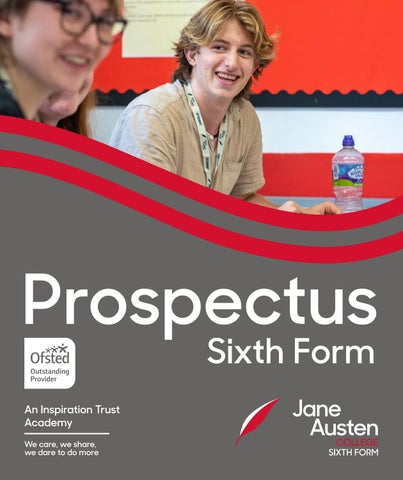
Prospectus Sixth Form
An Inspiration Trust Academy We care, we share, we dare to do more
SIXTH FORM
Welcome An introduction from the Jane Austen College sixth form team. Jane Austen College offers a sixth form experience that we’re really proud of. We’re focused on humanities, English and the arts, whilst offering a diverse curriculum across many different subjects and departments. Lessons are taught by experts and our teachers will guide you through success for whatever path you choose after your time with us. We have established ourselves as one of Norfolk’s top sixth forms, with our students consistently achieving some of the country’s leading results. Our students come to Jane Austen College Sixth Form because of our academic focus, our city centre feel, and our expert teachers, but we aren’t just an academic school. We have an outstanding pastoral team who can help you through challenging times. We have an amazing set of students, including our sixth form student leadership team, who have a role in steering the college into the future. Students get the opportunity to experience independence at the sixth form. Outside of lesson time, your time is your own: you can study on site, in the city, or at home. We trust our students to make the best decisions for themselves. We hope you will join us at Jane Austen College Sixth Form and help to build a community for the future.
What Can We Offer You? Jane Austen College Sixth Form is based in an impressive historic building: Claxton House, on Colegate. An important part of Norfolk’s heritage, the former shoe factory has been sensitively refurbished to house everything a modern school needs. This includes our highly regarded music, art and drama studios, as well as a sixth form study and common room. Located next to the Guildhall, and right in the heart of the city centre, we have our new beautifully repurposed building that hosts a range of classrooms just for our sixth form students.
Contents Sixth Form Life
4
Lessons and Typical Day 5 Supporting You Through Every Step 6 Preparing You For Post-18
7
Extra-Curricular Activities
8
Basketball Academy
9
Our Partnership with Sir Isaac Newton Sixth Form
10
Our Courses 11 SEND Support 18 Financial Support 18 Entry Requirements 19 How To Apply 19
Sixth Form Life Jane Austen College Sixth Form specialises in the arts, English and humanities. This means that our teachers are experts within these fields, and students that enrol with us share our passion for these subjects.
In addition to this, we have a unique partnership with Sir Isaac Newton Sixth Form, specialising in Science and Maths subjects. This means that students have access to the very best teaching and learning experiences on both sites.
Most of our students will continue to study one of our specialist subjects at university. We prepare students for this through a range of opportunities and experiences, such as trips and lectures from university professors.
Both sixth forms are based in the city centre, providing a straightforward commute from across the county. For this reason, our students come from a wide variety of secondary schools. With easy access to shops, cafés and restaurants, students at our sixth form have the benefit of greater independence than experienced at a typical sixth form.
We have the best facilities to support sixth form study. Our study hubs, on both sites, provide great environments for learning and our breakout areas are lively social spaces. 4
Lessons Whether reading feminist texts, studying Roman emperors, delving into the minds of criminals, or becoming the next Banksy; our lessons are exciting and inspiring and delivered by passionate advocates of our subjects. Regardless of the subjects you choose, you can expect a similar structure each lesson. Most lessons begin with a recap quiz, followed by teacher explanation and opportunities for discussion, debate and practice of new knowledge. Lessons are designed to challenge you to achieve the very best you can. Your teachers will also support you with study skills, exam practice and guided independent study. For more subject-specific information, see ‘Sixth Form Subjects’ on our website.
Typical Day Across the week, students have five hours of lessons for each of their three subjects. For each subject there are two double lessons and one single lesson. As our timetable is based on a blocking structure, each student’s timetable is unique to them. An example of this can be seen below. All students have the opportunity to take part in enrichment activities which are scheduled on Wednesday and Friday afternoon.
Monday
Tuesday
Period 1
Wednesday
Thursday
Friday
Biology
Law
History
Law
History
Period 2
Form Time
Biology
Period 3
History
Law
Biology
Period 4
History
Law
Biology
Period 5
Biology
Enrichment
Enrichment
Period 5
Law History
5
Supporting You Through Every Step At our sixth form, you will be supported every step of the way, from the application process through to gaining your qualifications and beyond. Transition and Taster Days
Form Group and Tutorials
To support applicants with making their decisions, we provide transition opportunities throughout the year. Rather than conducting interviews, applicants can find out more information about our sixth form at recruitment events, such as our Open Day in the autumn term, and our taster day in the spring term.
All students will be allocated to a form group at enrolment and they will meet their form tutor on the induction day. Our form tutor is an experienced sixth form teacher and tutor with a clear understanding of how to inspire tutees to make the most out of their time at sixth form and prepare them for their next steps.
As part of our taster day, we introduce key members of the sixth form leadership team, review information about the application process and student life, and answer questions from our applicants. Prospective students will also attend subject seminars and can have a tour of the building.
All students have one tutorial session a week with the form tutor. These sessions cover:
In the summer term, after the GCSE exams have finished, applicants are invited to our familiarisation day. This is a joint event with Sir Isaac Newton Sixth Form. As part of this event, applicants will have the opportunity to try a variety of subject sessions and meet teachers, current students and other applicants on both sites.
6
Mentoring and advice Study skills Applications for university, apprenticeships and the workplace Discussion of topical issues through our PSHE curriculum.
“
It’s great to be in a place full of likeminded people, feels like everyone, including the teachers are on the same journey. Alumni: John W
Preparing You For Post-18 Employability We enjoy warm and growing links with local employers, organisations, and higher education institutions, all aimed at providing you with valuable work-related opportunities and work experience. We also offer independent careers advice and guidance for all our students. Our external speaker programme is an opportunity for you to attend seminars led by local professionals and experts. These sessions provide an insight into potential careers and are also an opportunity for you to question professionals in the sectors that interest you. Recent speakers include a correspondent from the Economist, a former government advisor, and representatives from the legal sector.
University We run a series of seminars and events aimed at students who want to apply to the UK’s top universities. In these seminars you will focus on writing personal statements, the skills required for university interviews, and university life, all matched with expert advice and feedback. Our Oxbridge Society is also a chance for like-minded individuals to get together to discuss their aspirations, share ideas on applications, and support each other through the application process. For the past few years, all of our Year 13 students that attended an interview at Oxford or Cambridge university were offered places.
Many students find the gap between sixth form study and university a large one and feel unprepared for the transition. We help you develop independent study and life skills to make that transition smoother.
Academic and Pastoral Support We put our students first by providing them with bespoke academic and pastoral support. As part of our Personal Development Programme, students are provided with support from tutors, teachers and the Sixth Form Leadership Team. We provide personalised advice and guidance about careers and higher education, and our dedicated sixth form pastoral mentoring team ensure you have the support you need to achieve your goals. We prioritise the mental wellbeing of our students and are proud to have two pastoral mentors as part of our staff. They both work exclusively with sixth form students providing one-to-one mentoring and also support our student leaders running a wellbeing group within the sixth form.
7
Extra-Curricular Activities Electives Between Jane Austen College and Sir Isaac Newton, we offer a range of extra-curricular activities through our electives programme. Students can set up their own elective for their peers based on their area of interest. Alternatively, students have the opportunity to support with an elective that is run for the lower school such as dance, politics or music. Students will also have the opportunity to volunteer their time to support others, for example, through reading with Year 7 students, peer mentoring, or visiting the residents at local care homes. We encourage and support all of our students to take part in work experience.
Opportunities Jane Austen College Sixth Form has offered many trips to enhance students’ experiences and widen their options after their exams. We intend to continue running our regular trips to Washington DC, where we visit the chambers of government and the monuments to the people that built the USA. Additionally, there are regular trips to Berlin, where students learn about the history and culture of Germany, and the Classics department have led a trip to Rome. Additionally, there are regular trips to Rome, run by the Classics department, and we have run trips to Berlin, where students learn about the history and culture of Germany.
8
Basketball Academy The Inspiration Trust Basketball Academy aims to provide a firstclass basketball programme that runs alongside outstanding academic education to young adults aged 16 to 19, encouraging you to set your aspirations high and supporting you in reaching your goals. Established in 2023, the Inspiration Trust Basketball Academy has a focus on academic and basketball excellence, providing access to modern sports facilities, an elite strength and conditioning suite, and team classroom. The Inspiration Trust is dedicated to developing the student athlete as a whole, with the aim that the basketball academy can instil attitudes and values such as; respect,
integrity, hard work, and perseverance – all attributes needed to be successful in any walk of life. High-quality coaching, supporting athletes with technical skills and tactical awareness Two team training sessions per week Compete in Regional and National competitions Small group/1:1 skill development session Access to elite strength and conditioning suite Strength and conditioning programmes delivered by qualified instructors VEO video analysis of games and training Basketball England-approved court
For more information visit: inspirationtrust.org/basketballacademy or scan below.
9
Our Partnership with Sir Isaac Newton Sixth Form Jane Austen College Sixth Form is partnered with Sir Isaac Newton Sixth Form, enabling students to study from a wider range of subjects. Sir Isaac Newton Sixth Form is a specialist maths and science sixth form. The teachers are STEM experts and will inspire you throughout your A-Level studies. The results reflect their ambitious academic expectations, with over half of grades awarded at A or A*. This coupled with exceptional pastoral and careers support, as well as subject mentor seminars, ensure that students reach their full potential. Jane Austen College Sixth Form students can choose to study one subject at Sir Isaac Newton Sixth Form. 10
The courses on offer are: Biology Chemistry Computer science Environmental science Mathematics Physics. You can find out more information about these subjects on their website: www.isaacnewtonsixthform.org.
Our Courses
Art (AQA)
Classics (OCR)
As part of the Fine Art A-Level course, the skills learnt at GCSE will be further developed and new media, techniques and methods of working will be encountered. The course includes the following disciplines in individual projects at the beginning of the A-Level course: traditional and digital drawing, painting, print-making, photography and sculpture.
Classical Civilisation focuses on the civilisations of Greece and Rome, and is a wide-ranging subject involving the study of literature, material culture, ancient thought and ideas, and the ancient historical context, all of which remain apparent in our culture and society.
The course is structured through workshops, projects, personal investigations and an externally set assignment.
“
The art department was like a second home to me. Fantastic teachers and support staff that went out of their way to help me. Zoe H
The course is examined through three papers. The first paper focuses on ‘The World of the Hero’ by examining the epics Homer’s Odyssey and Virgil’s Aeneid. The second paper allows students to assess the effectiveness of the first Roman Emperor, Augustus Caesar’s self-presentation, as well as the effectiveness of his public image. The final paper generates interesting and important discussions about love, desire, sexuality and the institution of marriage from the viewpoints of the Greeks and Romans.
For more information on entry requirements, please visit our website: janeaustencollege.org/sixthform
Drama (Edexcel) This course engages students through encouraging creativity, focusing on practical work which reflects the 21st century theatre practice, and developing skills that will support progression to further study of drama and a range of other subjects. The course focuses on the practical exploration of performance texts, including analysing them in light of the work of theatre practitioners. The course is assessed through devising a performance and writing a portfolio about the process, performing script extracts, and a written examination assessing knowledge of theatre makers in practice.
English Language (Edexcel) This course focuses on linguistics, and is therefore different from English language as studied at GCSE. The course covers the ways in which language varies, depending on the contexts of production and reception. It also explores and critically evaluates how language choices can create personal identities, as well as how language varies over time. In addition, the course covers the development of both speech and writing in children from birth to eight years old. As part of the course, students will undertake a language investigation, focusing on specific research topics, and they will produce their own original writing piece. 12
English Literature (AQA) To study English literature is really an exploration of what it means to be human: the texts we study explore human experience and social influences over the years. A-Level literature will challenge you to widen your own reading, consider texts in context and to critically engage with different interpretations. Students will study a variety of different texts (poetry, prose and drama). The course is assessed through both coursework and examination. There are two exam papers: paper one covers literary texts from the 16th to 20th century with a thematic focus on ‘Love through the Ages’; paper two looks at a variety of issues relevant to life and literature post-1945. The coursework involves an independent critical study into texts across time using a text chosen by the student and directed by their own individual interests.
French (AQA)
Geography (AQA)
This course will not only help students to develop confident, effective communication skills in this important world language, but also gives them a thorough understanding of the culture, and an opportunity to study the geography, history, and literature of countries and communities where French is spoken. It will develop interest in, and enthusiasm for language learning and will encourage the study of the language in a broader context.
This course will help students develop knowledge about locations, places, processes and environments, at all geographical scales from local to global. The course covers physical processes such as water and carbon cycles, coastal systems, and landscapes. The course also explores human processes like global systems and governance, population and environments. Students will also conduct a geographical investigation where they will collect data in the field and conduct their own research based on a question or issue.
By the end of the course students will be confident in discussing in French their thoughts and opinions on changing trends in the media, popular culture, the causes and effects of immigration, and questions regarding fundamental global concerns such as the fair distribution of wealth and the justice system. As part of the course, a book and a film will be studied in depth. The course is examined through listening, reading, writing and speaking exams with an independent research project.
“
My time at Jane Austen College has been fantastic, and a very fruitful time of my life. George G
German (AQA) This course will give students an opportunity to develop effective and confident communication skills as well as foster interest in and enthusiasm for language learning, giving a solid foundation for further study of this highly valued world language. By the end of the course students will be confident discussing in German their thoughts and opinions on current trends and issues in German-speaking societies, such as multiculturalism and crime and punishment. Political and artistic culture forms a large part of the course and students will be able to debate topics such as teenagers and the right to vote and the politics of immigration. As part of the course, a book and a film will be studied in depth. The course is examined through listening, reading, writing and speaking exams with an independent research project. 13
Graphic Communications (AQA) The course is centred around the following design areas: branding/logo, illustration, multimedia, packaging, and typography. In the first half of the course, skills will be developed through a series of teacher-led short projects and culminating in an extended design project. The course covers the work of leading graphics designers and students are encouraged to use a range of media for 2D, 3D, hand, and digital work. The course is highly regarded by universities as an excellent foundation for degree study in any design field.
History (AQA) The A-Level history course examines and analyses three significant events in recent history that have contributed to current events. Studying history allows students to study change, continuity, cause and consequence in a pivotal century in British history and the world. We also include an indepth study of evolving international relations during the Cold War, an era of tension between communist and capitalist powers which threatened nuclear armageddon. The course is assessed through two examinations at the end of the course and an independent historical investigation connected to the topic of African-American civil rights in the United States. 14
Law (OCR) The study of law is hugely important for many reasons. Whilst students will be able to use their analytical and critical thinking skills, they will also be challenged to think about the many different spheres of law that exists, as well as whether law exists to serve public morality, whether laws should be made or simply interpreted by judges, and how justice is achieved in the English legal system. Modules focus on criminal, tort and human rights law, whilst also exploring the philosophical and historical underpinnings of UK law. All of these modules are assessed through examinations at the end of the course.
Music (Eduqas) This course builds on students’ understanding of the key areas explored in GCSE music: listening and appraising, composition and performance. The appraising component allows students to develop an understanding of the organisation of sounds, the context of music and musical styles and genres. The unit includes in-depth study of set works from western classical symphony, rock and pop music from 1960-2000, and early 20th Century music. The exam will assess students through listening questions and one essay question. Students will create two compositions; one in response to a brief and the other a free composition. Students will also prepare a public performance of two or three pieces. The required standard of performance is grade 6 (or equivalent) minimum.
Music Technology (Edexcel) This course gives students an understanding of the use of production techniques through recording, technology-based composition, listening and analysing, and producing and analysing. The composition component covers editing and structuring sounds to develop technology-based composition. Through the listening and analysing component, students will cover a variety of music production techniques used in unfamiliar commercial recordings. The production stages of capture and creating sounds, editing and arranging sounds and mixing will be covered.
PE (AQA)
Philosophy (AQA) The word ‘Philosophy’ is defined as the ‘love of wisdom’ and thus the subject will appeal to any student with an enquiring mind and a love of debate. It deals with fundamental questions about meaning, morality, and existence. It tackles questions such as: Can we trust our perception of the world? How should we make ethical decisions? Is the concept of God coherent? What is the mind? Through an engaging mixture of practicedriven lessons, debates and textual analysis; students of A-Level philosophy will learn how to precisely pick apart scholarly assertions, identify the soundness of ideas and critically evaluate arguments.
Politics (AQA)
Our A Level Physical Education course offers a dynamic and multidisciplinary approach to the study of sport, combining theory and practice to prepare students for further education or careers in the sports industry.
The focus of the politics course is how power is distributed through government and within society. Students have the opportunity to develop their own knowledge of the UK and US political systems, whilst thinking critically and analytically about the ideologies and actions of modern politicians and political parties.
Whether you’re an aspiring athlete, coach, or sports scientist, this course allows you to play to your strengths while developing a deep understanding of the physical, psychological, and social aspects of sport.
The politics of the UK and the US are studied in depth, as well as the core political ideas that have shaped the UK. To gain greater insight, our students visit the Houses of Parliament and meet MPs.
15
Psychology (AQA)
Spanish (AQA)
A-Level psychology aims to explain why people behave the way they do. Various explanations linked to an individual’s genetics and neurology are considered alongside environmental influences. By analysing the influence of both nature and nurture, complex behaviours can be explained and practical applications to real life can be made. Psychology students analyse and evaluate the validity of these explanations.
A-Level Spanish will not only help students develop confident and effective communication skills, but also provide a detailed understanding of the culture of countries and communities where Spanish is spoken.
Assessment at the end of Year 13 takes the form of three written papers which include shorter written answers, longer essay questions and data handling. Examples of topics we study are memory, attachment, schizophrenia and relationships.
Sociology (AQA) This course will help students to make sense of the society they live in and understand the cultural and identity issues which affect people. The course covers sociological approaches that help explain the functions of education, families, and religion, as well as criminological approaches that explain why some people commit crimes and others do not. The course is assessed through three written examinations. These cover education, research methods, family, and deviance.
16
By the end of the course students will be confident discussing, in Spanish, their thoughts and opinions on current trends and issues in Hispanic societies, such as multiculturalism and crime and punishment. Political and artistic culture forms a large part of the course and students will be able to debate topics such as the media, equal rights, the politics of immigration, as well as studying a book and a film in depth. The course is examined through listening, reading, writing and speaking exams with an independent research project.
Additional Qualification Core Maths
The core maths course is designed to teach students real-life, practical applications of maths which are not covered in GCSE maths. These include income tax/National Insurance calculations, student loan repayments, mortgages, and more. The core maths course also gives students taking a subject with a mathematical component (e.g. psychology, geography) an advantage with data handling. The core maths course is a oneyear course, worth UCAS points equivalent to half an A-Level. The course is assessed with two exam papers.
“
The atmosphere is friendly and inviting, and the teacher values our potential. Amarah H
” 17
SEND Support Our vision is for all of our students with special educational needs and disabilities (SEND) to be integrated fully into the life of the college, and that all students have access to high-quality teaching. At Jane Austen College Sixth Form we aim to ensure that all members of the college community support students with special educational needs and disabilities. Our SENDCO works alongside our pastoral and academic support team to ensure all students identified as having SEND, as far as possible, have equal access to all aspects of the curriculum.
Financial Support We want as many students as possible to experience the benefit of learning at Jane Austen College, and we encourage students who are eligible to apply to our bursary scheme. The 16-19 Bursary Fund offers help to students at the Sixth Form to support students in overcoming specific financial barriers to participation. Students are encouraged to apply if they have extenuating circumstances leading to a financial need in attending and participating in sixth form. Further details can be found on our website.
“
I’ve enjoyed the freedom that came with the Sixth Form, the ability to determine my own life.
18
Spike P
Entry Requirements Our core entry requirements are six or more GCSEs at grade 5+ including maths, English literature and English language. Students must achieve at least a grade 6 in either English literature or English language. You will also need to achieve at least a grade 5 in the subjects you wish to study at A-Level. If you are new to a subject we will consider achievement in the GCSE that most closely corresponds. To study a language (French, German or Spanish) students must achieve at least a grade 6 in the corresponding language at GCSE. We expect our students to study at least three A-Levels and will support you to achieve the highest grades. If you’re not sure about which courses are best for you, please get in touch to discuss your options.
How to Apply You can apply online by visiting helpyouchoose.org or the Jane Austen College Sixth Form website janeaustencollege.org/apply. If you have any questions or issues with your application, please contact our Administration Officer at jac6thform@janeaustencollege.co.uk.
19`
SIXTH FORM
Duke Street
Jane Austen College Sixth Form Claxton House Norwich NR3 1DD
Jane Austen College Tombland
St Andrew’s Car Park
JAC Norwich Guildhall
Prince of Wales Road
Sir Isaac Newton Sixth Form
Castle Meadow
Rose Lane
Norwich Train Station
JAC Surrey Street
To Grapes Hill
Rouen Road
To Carrow Road
Norwich Bus Station
Stay Connected
Follow Jane Austen College to keep up to date with our latest news and events. @JaneAustenCollege @JaneAusten_Coll
Tel: 01603 463800 Email: jac6thform@janeaustencollege.co.uk
www.janeaustencollege.org/sixthform