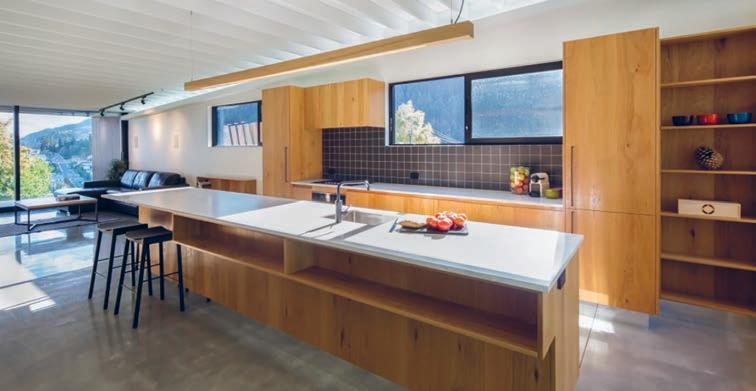
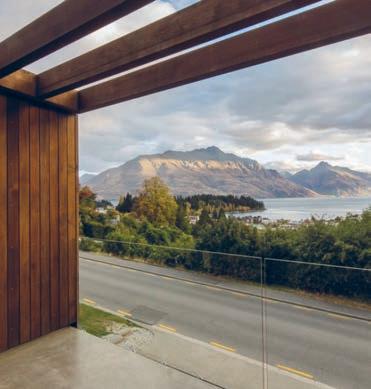
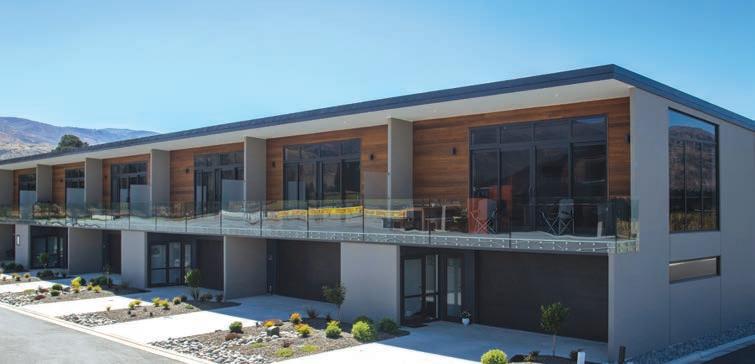
The benefits of building with sustainability in mind
Risk allocation in infrastructure projects
PRECAST NZ looks to the future
How to resolve stalemates in low value building disputes
Build the complete picture.
Strandsarking ®
High density panels specifically formulated for use as a roof sarking substrate. BRANZ appraised.
Strandfloor ® Structural flooring panels including an H3.1 option and a 50 year warranty. BRANZ appraised.
OVERAROUND
UNDER
Strandboard ® Versatile panel for use in a wide range of interior applications.
The Strand range from Laminex New Zealand® includes solutions for structural flooring, roof sarking, building, furniture and joinery applications. Strandfloor, StrandfloorH3.1 and Strandboard have Red List Free certification. The whole range is manufactured in our own backyard from the strands of New Zealand Radiata Pine.
A subcontractor’s perspective: Managing growth
Subcontractors play an important role in the growth of the construction industry, often making a significant contribution to the success or failure of projects. How subcontractors manage growth is a difficult but vital element for sustainable business success.
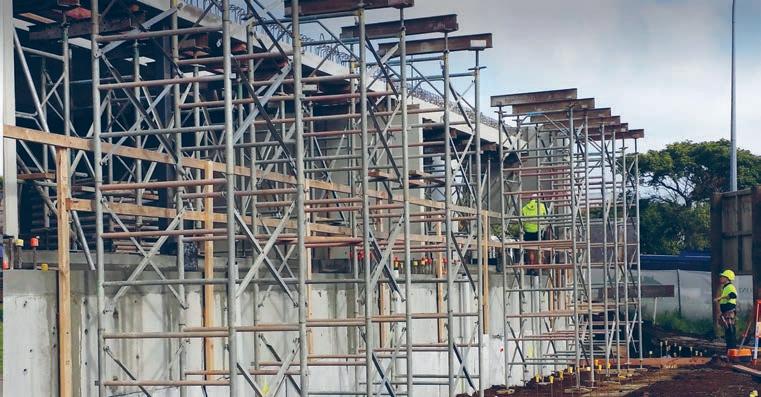
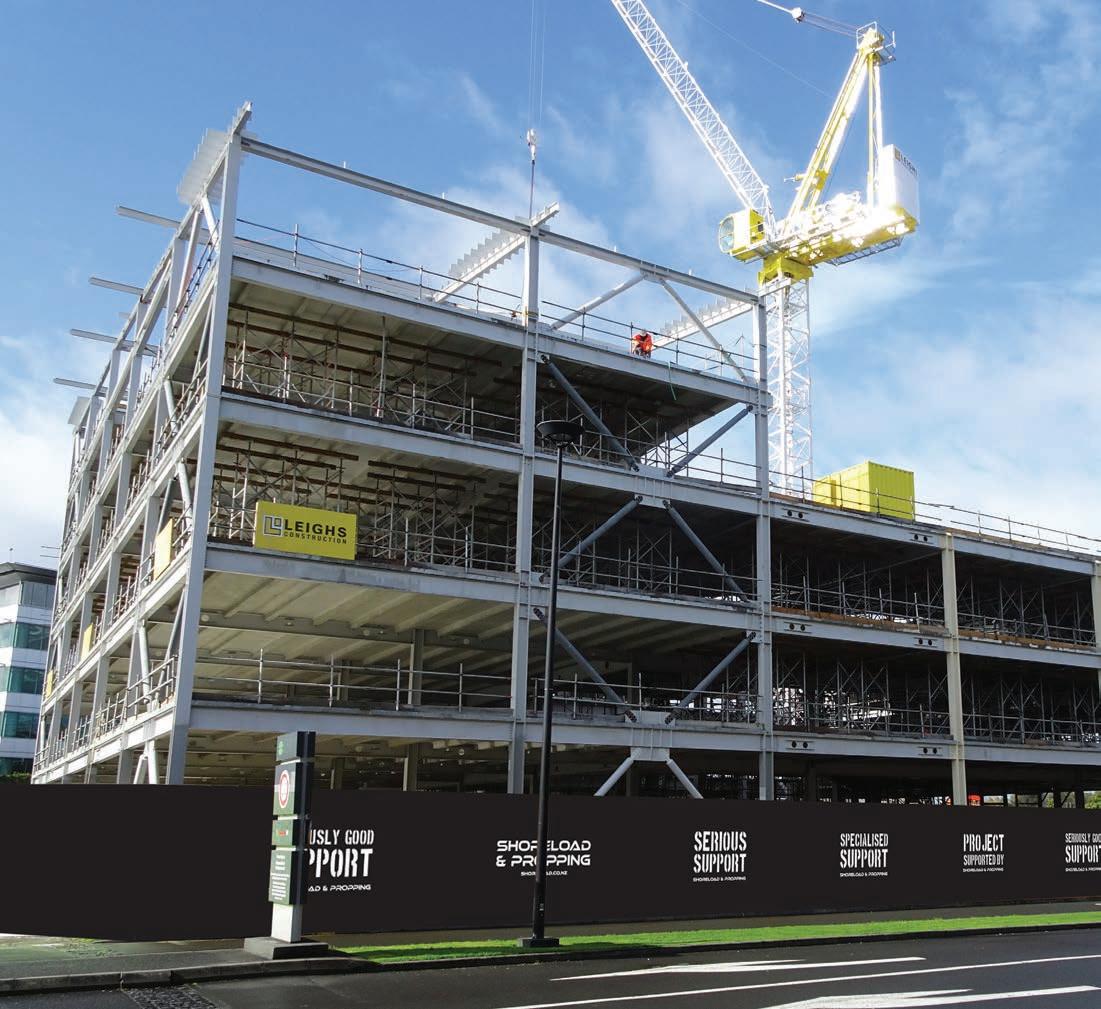
As a niche provider of falsework (temporary support solutions) to the construction industry in the Greater Auckland region, Shoreload and Propping Limited has experienced three-fold growth over the last three years.
“We are confident that our positive reputation and customer-focused approach has contributed strongly to our success – it’s backed up through our customer surveys after all – but we would be naïve to think that the rising tide of the construction industry has not also been a major factor in our success.”
Whilst it might be easy to think that success in a rising market is easy, it is in fact a difficult task to manage this growth for sustainable financial success.
According to the recent MBIE/BRANZ/ Pacificon National Construction Pipeline
Report 2017 – 5th edition, growth is around for us for the foreseeable future.
Three strategies for growth management:
Shoreload and Propping has developed a range of business strategies to help achieve sustained business success in a growth environment. Here are 3 strategies for you to consider:
1. Less can be more – stay focused
“In a rising market, it is far too easy to overextend ourselves as we seek greater revenue or profit.
“Sometimes this means we move ourselves too fast into adjacent trades or skills, or maybe we just try to grab as much market
share as we possibly can. Don’t get us wrong, managed well this is a great strategy. The issue however is when we move too quickly or too far away from our core business and things start to be compromised.
“Often the best investment is to stick to your knitting and to look to optimise your current capability. For many subcontractors, successfully executing a strategy to increase profit in our current capability will deliver a much more fulfilling (financial and business) outcome.
2. Don’t lose sight of your customers’ needs
“Our customers are also likely to be struggling with the challenges of managing growth and the volume of activity required
to deliver successful projects and financial outcomes. As subcontractors, we should build and maintain relationships with our key customers so we understand how we influence their success and how we can continue to add value.”
Take the time to sit down with your customers regularly to discuss their business, their challenges and how you can help them. Alternatively set up a regular feedback mechanism such as a satisfaction survey. You will be surprised how few others are doing this, and what a difference it can make to your own relationship and value with your customers.
3.Invest in your people and capability
“When we are frantically busy, it is very easy to forget to invest in your existing people. The demands on the business means that there is little opportunity to take them away from the day to day activity.
“We have developed a structured employee pathway programme that allows us to deliver training, knowledge, capability and skill improvement through on the job training and structured external learning.”
There is obviously a lot more to sustainable success for a subcontractor but these are three key focus points.
To find out more about Shoreload and Propping, phone 09-829-2514 or visit www.shoreloadandpropping.co.nz.
14
5: Commercial lawyer Geoff Hardy explains how to resolve stalemates in low value building disputes
10: The International Construction Measurement Standards' global framework for measuring, costing and reporting
This issue of Builders & Contractors is packed with information you can apply to daily operations.
Commercial lawyer Geoff Hardy explains how to resolve stalemates in low value building disputes, Tina Hwang and Marcus Beveridge from Queen City Law discuss the termination of a construction contract, and Kevin Everitt from Building Recruitment asks why local experience is deemed so vital in today’s building sector.
Craig Hudson from Xero New Zealand talks about the impending payroll changes for SMEs, Daniel Fitzpatrick explains how to price jobs to make a profit, and we delve into changing the perceived value of tradies.
Samuel Buchan, a solicitor at Anderson Lloyd, and David Holden, a partner at Anderson Lloyd, discuss the issue of risk allocation in infrastructure projects.
We also look at the multi-faceted benefits of building with sustainability in mind, Concrete New Zealand’s strong and unified voice for the concrete industry, all you need to know about asbestos, and the ongoing battle to ensure safety while working at heights.
6: Tina Hwang and Marcus Beveridge from Queen City Law discuss the ter mination of a construction contract
6: Craig Hudson from Xero New Zealand talks about the impending payroll changes for SMEs
7: Building Recruitment’s Kevin Everitt questions why local experience is deemed so vital in today’s building sector
7: Cuesko director Kean Mitchell discusses the dream of affordable housing
8: Daniel Fitzpatrick explains how to price jobs to make a profit
9: Non-invasive ground improvement solutions can fortify foundations for new builds and renovations
9: New civil contractors’ subcontract designed to boost industry efficiency
11: Concrete and seismic design
12: Changing the perceived value of tradies
13: A young Rotorua plumber proves he’s at the top of his game
14: Hire industry in strong growth mode
26: The ongoing battle to ensure safety while working at heights
36: Custom Construction’s haul of awards reveals a slick operation
38: The multi-faceted benefits of building with sustainability in mind
47: Concrete New Zealand - a strong and unified voice for the concrete industry
56: Despite the HVAC&R being hugely vital, it remains the “invisible industry”
60: Precast NZ looks to the future
62: Toi Ohomai’s ethos of providing students with hands-on lear ning opportunities
64: Regeneration is ripe in post-quake Rangiora and Kaiapoi
72: All you need to know about asbestos
76: Commenting on the plight of Fletcher Building, Master Electricians CEO, Neville Simpson says you should check the mirror before blaming subcontractors
80: Creating buildings as resilient as the people who inhabit them
82: Floor New Zealand is putting together a set of best practice guidelines to cover the timber floor industry
83: How Tru-Line Civil has reaped the benefits of the experience its gained in Christchurch’s rebuild
84: A Risk allocation in infrastructure projects
Nationwide Distribution: Mailed directly to a carefully maintained list of decision makers and subscribers for 25 years.
Builders and Contractors, a national trade newspaper targeted directly at New Zealand's building and construction industry. For some time we were aware that, although the building and related trades were generally covered individually by some trade journals, there was no amalgamated news link for trades as a whole, especially on a nationwide basis.
This void has been successfully filled by Builders & Contractors. Distribution is by way of various outlets: PlaceMakers, Mitre 10, Builders Hardware, I.T.M., Carters, Site Safe Members, Home Ideas Centre, timber companies, hire companies, together with our database direct mail drop to architects, draughting professionals, consulting engineers, building consultants, designers and local Councils. By these means we aim to reach one of the most powerful buying groups in the industry.
How to resolve stalemates in low value building disputes
By Geoff Hardy, commercial lawyer for Auckland-based firm Martelli McKegg
Sooner or later every tradesman is going to have a dispute with a client that can’t be resolved by negotiation.
You can debate the issues until you’re blue in the face, but one or both of you is going to remain obstinate or is going to be unable or unwilling to see the other party’s point of view.
In those situations, people don’t act rationally, especially when they are stressed or emotionally charged. They’re not about to compromise or meet you in the middle. They feel a deep sense of injustice, regardless of whether they are right or wrong, and all they care about is to inflict more pain on you than the pain they believe you are inflicting on them.
So it’s pointless continuing the argument, and what you need to do is refer the dispute to an independent third party, as quickly as you possibly can.
A lot of well-intended people will try to dissuade you from doing this. They will encourage you to try things like mediation, which involves sitting around a table while a mediator tries to get the parties to reach agreement between themselves.
Although in some situations they are right, there are some major disadvantages to mediation.
First, the parties have to pay the mediator’s fees and expenses, which can amount to several thousand dollars.
Secondly, if one of the parties isn’t going to budge, then the end result will be that you have wasted hours and hours of pointless discussion and you are back to square one.
Thirdly, a mediation can take up to a month or two to organise and complete, which is precious time you could have used to get the dispute resolved in some other way.
Mediation works in situations where both parties have an equal amount to lose, and an equal incentive to compromise so as to avoid the cost and delay of the dispute dragging on. For that reason, it is very effective in leaky home claims, most of which are settled either in mediation or shortly afterwards.
But in normal building disputes, typically one party has no incentive to resolve the dispute at all, because they are already in a winning position. For example, where the property owner has unilaterally withheld payment from the builder as compensation for an alleged failure on the builder’s part. Or the builder has been paid in full on completion of the project and refuses to acknowledge or respond to a later claim from the owner about some latent defect that has emerged.
In those situations, the faster the aggrieved party can refer the dispute to an independent expert who has power to make a binding ruling, the better. In the construction industry, there are at least five ways of doing
that. Three you can do as of right, and the other two you can do if the other party agrees or has already agreed (for example, in the building contract).
The three dispute-resolution methods that you can use, regardless of whether the other party agrees or not, are the Disputes Tribunals (our small claims courts), adjudication under the Construction Contracts Act, and the Courts. The two that you can use only if the other party has agreed, are arbitration, and referral to an expert or panel of experts (which is an informal process that is not governed by an Act of Parliament and the rules of engagement have to be agreed).
Recently we have seen the emergence of new methods of dispute-resolution like CODR (Complete Online Dispute Resolution) which is like a short-form arbitration where you simply file written arguments and supporting documents on-line, and you usually never get to meet the arbitrator.
In the large commercial construction projects where the parties have big budgets, you typically see much greater use of dispute resolution boards, formal arbitration and litigation in the courts. In the smaller construction projects where the disputes are generally low value (for example, $10,000$250,000), and the parties have very modest budgets, you see much greater use of the Disputes Tribunals, short-form arbitrations and adjudication under the Construction Contracts Act, all of which are quicker and more cost-effective.
In the low-value disputes the emphasis is on affordability and practicality. The exorbitant cost, complex procedures and inordinate delays that you get in the courts (or for that matter, formal arbitration), are out of the question.
You want “quick and dirty” justice because that is all you can afford. As long as the outcome is reasonably fair, it does not matter whether it is 100 percent accurate because at least it enables the parties to put the dispute behind them and move on.
There are however, certain important factors that can make all the difference between a reasonably fair outcome and a major miscarriage of justice.
First, it is important that the disputed amount is paid into a trust account or secured in some other way so that both parties are deprived of the use of the money. Only in this way can you make it an even contest, and create an equal incentive for each party to participate in the disputeresolution process.
If one of the parties is holding the money and is free to spend it, then in their minds they
have already “won” the dispute, and their incentive is to throw as many obstacles in the way of the dispute-resolution process as they possibly can.
Secondly, you want the dispute resolved by a genuine expert, not someone who has never been exposed to a construction project before, or whose career has focused on tenancy disputes or marriage break-ups in the past.
That is one of the reasons why the Disputes Tribunals are not ideally suited to handling construction disputes. Apart from the fact that their jurisdiction is limited to claims of up to $15,000, the Referees in the Disputes Tribunals don’t have to follow the strict letter of the law, and unless they have the benefit of independent experts’ reports, their rulings can be a bit hit and miss.
Thirdly, the outcome is going to be far more reliable if the independent expert actually gets to meet the parties, and does a site inspection. Any badly-adjusted home-owner or builder can make themselves out to be
a paragon of virtue if they stay hidden in the background and simply file written arguments, especially if written by someone else.
Similarly, on the basis that a picture paints a thousand words, a site inspection is invaluable for putting things in context and countering exaggeration.
Finally, you ideally want both parties bound by the rules of engagement and by the outcome, with very little opportunity to appeal the decision or re-litigate the dispute. Only then can you contain the cost, resolve the dispute quickly, and put it behind you and move on.
Geoff Hardy has 42 years’ experience as a commercial lawyer and is a partner in the Auckland firm Martelli McKegg. He guarantees personal attention to new clients at competitive rates. His phone number is (09) 379 0700, and e-mail geoff@martellimckegg.co.nz. This article is not intended to be relied upon as legal advice.
Geoff Hardy, a commercial lawyer based in Auckland
Termination of a construction contract
By Marcus Beveridge and Tina Hwang
When can a party cancel a construction contract?
Termination is a serious step. The options will depend on the type of contract the parties signed and the applicable terms and conditions.
Typically, one can cancel a contract if a party is in serious breach or a party becomes insolvent. The Contractual Remedies Act 1979 also allows parties to cancel a contract when there has been repudiation by the other side, or where misrepresentation of an essential term to the contract has been established.
Termination clauses
The standard Master Build Contract provides the master builder with a stronger power to cancel than the owner. The master builder can cancel, suspend, or take further legal action where the owner has failed to perform their obligation under the contract, and has failed to rectify the default despite a notice to rectify within five working days.
Standard bankruptcy/liquidation options are also available. Section 24A of the Construction Contracts Act 2002 will always apply by default however, which requires the contractor to issue a notice specifically threatening to suspend works if payment is not made within a further five working days.
In practice we often encounter contractors simply “walking off site” without having served this compulsory notice or waiting the requisite timeframe.
The owner in the Master Build Contract conversely requires a higher onus of a “persistent, flagrant, or wilfully neglected” conduct by the master builder and a failure to rectify the breach within ten working days (contrary to the five working days).
The standard bankruptcy/liquidation options are also available, but requires 10 working days’ notice.
The standard SA subcontracts allow the contractor to terminate the subcontract with the subcontractor based on wide discretionary powers within three working days of issuing the notice.
The subcontractor on the other hand has a limited power of cancellation, only in cases where the contractor becomes insolvent, the headcontract is cancelled, or the contractor fails to rectify a substantial breach.
The breach must be “substantial” and the subcontractor has to wait ten working days compared to the contractor who can cancel if the subcontractor “fails to proceed... with reasonable diligence” or “is unable to complete the amount of work reasonably required by the Contractor…” and only has to wait three working days from the notice.
The standard NZS 3910:2013 allows parties to cancel when there is frustration where “the contract has become impossible
Small businesses set for payroll changes
By Craig Hudson
Tina Hwang & Marcus Beveridge
of performance or has been other-wise frustrated.”
The clauses for arbitration and mediation then apply. The NZS terms tend to be more balanced empowering the principal to terminate where the contractor fails to provide the bond, the contractor sublets the whole or substantial works out without principal’s consent, or abandonment.
The standard bankruptcy/liquidation options are also available. The contractor can also terminate where the principal fails to provide the principal’s bond, fails to pay, obstructs the issue of any payment schedules or certificates, becomes insolvent, abandons the contract, or “persistently, flagrantly, or wilfully neglecting to carry out its obligations under the contract.”
Many versions of construction contracts fail to account for cases of abandonment which can require urgent termination, but if there is no contractual basis to terminate for abandonment, this can leave the abandoned party in a difficult position.
Dispute
resolution terms
Parties need to be weary of dispute resolution clauses under their construction contract which often obliges the parties to attempt to resolve any disputes in good faith. This may or may not be mandatory. Following a failure to negotiate, the contract often provides a mandatory mediation clause followed by adjudication and arbitration.
Consequences
The practical issues associated with termination are often far more important than the legal implications. This is because the terminating contractor may not be paid unless further legal action is taken following termination and the terminating owner may not receive their vital documents (such as “as built” plans, consultant contacts and producer statements) required for CCC unless further legal action is taken. The two conflicting needs often drives a settlement between the terminating parties which may necessitate concessions from both parties. The above should not be taken as legal advice. If you have any queries regarding construction contracts, please feel free to contact Tina Hwang or Marcus Beveridge of Queen City Law.
In just a few months, New Zealand businesses are going to experience some major changes to the way they look after paying their staff.
Inland Revenue’s systems and processes are being modernised so that businesses can manage payroll in the digital age.
Tax reporting and compliance will soon become much easier for businesses, but that doesn’t mean it’ll happen without payroll administrators subscribing to a new way of doing things.
Whether you’sre the one in charge of a business, or you’re an advisor helping with the accounting side of things, chances are you’ve been frustrated with PAYE in the past.
Every organisation’s payroll needs to not only be accurate and flexible, but also account for annual leave, seasonal work, contractors, variable rates, and more.
Running a business in the cloud is becoming the norm; especially when it comes to managing finances and accounts.
Inland Revenue is changing with the times to suit the new reality of integrated pay-roll systems.
This is a throw-back to the first few years of online tax filing, where PAYE information was assured by using a listed payroll intermediary. Removing the subsidy confirms there is no longer a case to subsidise one type of payroll service over others.
If you are one of those receiving that subsidy, do your homework and plan ahead for your next financial year so you’re not caught short.
Start researching online tools that can help you get the most out of your current accounting software.
Now is the time for enterprises to plan for the change to the payroll status quo that’s coming their way on April 1, 2018.
- Craig Hudson
These software and accounting programmes mean information is now flowing seamlessly between the business, the bank, the accounting system and the employee, enabling small businesses and their advisors the possibility of reconciling in real-time.
And, specifically when it comes to Inland Revenue, online reporting and filing.
Now is the time for enterprises to plan for the change to the payroll status quo that’s coming their way on April 1, 2018.
First thing first: finish all your pay runs for the financial year. Get things squared up and in check, so that you’re not fussing with old accounts that need reconciling as you and your advisor navigate the 2018 changes.
The most significant change to be aware of is the removal of the payroll subsidy.
Currently the business cost of a PAYE intermediary is partly or fully subsidised for small businesses.
All of the best apps and online services integrate with software that is easily connected to, like cloud-based accounting options like Xero.
Once you’re connected to the cloud, there are a whole bunch of options that become open to you now that your accounts are no longer tied to a desktop.
Whatever you choose to implement in the next financial year, plan for the transition now so there are no PAYE hiccups.
Craig Hudson, country manager at Xero New Zealand www.xero.com/nz
Why is NZ experience so vital in today’s building sector?
By Kevin Everett
I am working with some amazing project managers from South Africa who are looking to move to New Zealand.
These guys are experienced in commercial projects and interior fitouts. They have longevity in their careers and have the personality type that will ensure they settle well to the NZ way of life.
They can be here within four weeks (dependent on NZ Immigration processing times) and have their paperwork completed and are only waiting on a job offer.
References are completed and there’s nothing more to do apart from getting them a job offer.
Sounds fantastic, especially when we are in need of such skills.
But wait… I hear constantly that companies are struggling for good project managers, yet every day I am getting the same rejection; "No NZ experience".
In one case, I spoke with a company who is building a new building as part of an international re-branding exercise for a worldwide super brand.
One of our candidates did all this rebuild across South Africa for this same internationally-acclaimed company. Each new build or revamp of existing buildings are specified and designed the same across the world.
Logically you would think that the construction company who were actively looking for a project manager for this $15m new build would be interested to get someone with such vast experience.
Low and behold they didn't even want to interview him for the very reason I am highlighting: "No NZ experience".
I am getting companies declining these people for this same reason - no NZ experience - not even interviewing them.
These people have come to New Zealand at their cost in the hope of gaining job interviews to show what they can bring to the business and left with a heavy heart.
They are being told we have a shortage of such skills across New Zealand. But do we?
If we do, why are we allowing such skills to leave without even an interview, or because of companies having blinkered vision?
So, it got me thinking! What does ‘NZ experience’ actually mean?
Kevin Everett, managing director of Building Recruitment
The most highlighted reasons when asked are:
1. Construction methods
Surely construction methods can be taught, and if in drawings, they can be understood. There are various construction methods between regions in NZ and between various construction companies too. So why is this unique to overseas applicants?
2. Our codes
Most of our NZ-trained builders don’t know the codes, but do know where to source the information when needed. Why can’t an international project manager?
3. Our networks
Not knowing who is who in the building sector. Can’t this be taught? Do companies not have databases of their sub-contractors and suppliers? How long would it take to get up to speed here? Not long in my opinion.
4. Our pricing/materials
Again not too much of a learning curve – two to three months maybe?
5. Our culture on site
What is it that makes NZ experience so vital and essential? How much NZ experience is needed to become someone with NZ experience? Would that be 1-3 months, 6 months, 12 months, more than 12 months? And experienced in what exactly?
I am hoping someone here can help me understand, as I cannot seem to get my head around this.
How long would it take a highly experienced project manager from South Africa, the UK, or anywhere else overseas to gain enough NZ experience to become a valued member of your team?
Are we being too short sighted?
The dream of affordable housing
By Kean Mitchell
Low cost housing is not a real thing. The measure we truly need to look at in regard to housing is affordability – how much people can pay for their accommodation.
The ‘30 percent rule’ of disposable income is used universally and it happens to be how Ministry of Social Development (MSD) measures how much you should be paying from your salary earnings towards rent, with the balance being a subsidy.
In Auckland, affordable means $600,000 for a new house.
The 30 percent of disposable income can be calculated as 3.5x salary for an individual and 2.9x combined salary for a couple or family.
Generally, lending rules mean you will need a 10 percent deposit, or 20 percent in some cases, and 40 percent if you are an investor.
Let’s assume a 10 percent deposit, which means $540,000 in borrowings. At 3.5x you need to earn $154,286 p.a. or circa $110,000 disposable income. At 2.9x, a combined income of $186,207 p.a. or circa $133,000 disposable income is required.
So, what is affordable?
Current reported median income levels of household disposable income is $73,500; at 2.9x a loan amount of $213,150 + deposit is affordable. Or if we adopt the current trend of banks allowing 4.5x salary, this works out to be $330,750 + deposit.
Let’s assume $350,000 is the affordable number based on the median, and this means 50 percent can’t afford this, as it is a median, and this percentage is a lot higher because the median is pushed up by the 10 percent of very higher earners.
What measures can we introduce to increase that percentage?
The main one is lowering the expenses through better quality homes. This is associated with running costs of a household leaving more than 30 percent available, i.e. more affordable. Affordable is therefore also about balancing monthly outgoings and the 30 percent magic rent/mortgage number.
Following current forecasts the population will be at circa 5,700,000 within 30 years from now. With the aging population changing by a further 10 percent, circa 25 percent of the population will be over the age of 65, which equates to circa double the current population over the age of 65 today.
How does this impact affordability?
HNZ had 69,600 houses in March 2006 that steadily dropped to 65,500 in March 2013, and as of September 30 2017 they have 68,800.
If the circa 10,000 HNZ houses that are missing had kept pace with the market, we would have a smaller problem than we do today. As we would have 78,825 HNZ houses.
When you consider during the circa 375,000 population growth that 216,400 houses have been built, this equates to only 1.74 people per house, which is well below the national and international averages of 2.1 – 2.5 persons per household. Auckland has currently got 3.15 per house and growing. If population growth is not the issue as we have built enough houses to more than cater for the additional population, it must be the HNZ issue that is a larger fault, and this is what impacts the lower earners as we know.
Building cost increasing
The building cost is going up – well above inflation – but as we noted earlier, affordability is around disposable income, which is increasing at around two percent – well below the cost of building increases. So housing is effectively getting less affordable. Reinforcing supplied by Fletchers is set to increase by 14 percent in January 2018. So material costs are increasing too.
What is the solution?
If we look at our aging population and additional population numbers, along with the lack of HNZ properties, isn’t the solution to build not family houses, but medium-density aged-care related housing in city and city-fringe areas that cater for the older population moving out of the existing housing stock HNZ has, and into better designed housing stock for their use?
This shift in demographics, a major shift in affordability, and an increasing cost of building will not change. In short we need to consider all of them to manage the long term efficiently, and cost effectively.
But let’s be clear – it is not the population entering the country that is the problem, they are part of the solution, as they are building and helping fund new housing.
Kean Mitchell, Director at Cuesko (CHCH) www.cuesko.co.nz
Charging ahead How to price your jobs to make a profit
By Daniel Fitzpatrick
Chris sits nervously waiting for Alex, his accountant, to report if it was a successful year this time. Or whether, despite his best efforts, he is still looking for the elusive “extra profit”.
He’s really worked hard and was proud to have finally hit the two million dollar mark for sales.
But deep down, in his gut, he’s just a little worried.
The bank account has been a bit tight lately.
"Some of our clients have been shopping around, comparing prices with other competitors. I’ve had to sharpen the pencil a few times.
"There were also a few surprises on some jobs I suspect we lost money on.
"But hey – we’ve been really busy… So with all the extra work, it should make up for it – right?"
Alex puts on his accounting voice; not a great sign. “I see you’ve billed a lot more this year. In fact, 32 percent more. That’s good. But I see your margins have slipped.”
Okay, so what does that mean?
“You’ve made another $10,000 extra profit compared to last year, but that’s it. I think you might be pricing too low on your work.”
"Bugger. Those extra guys I took on last year. And all those late nights and weekends. With nothing to show for it but a measly extra 10 grand!"
Chris heads home angry, frustrated and discouraged.
"I can’t do another year like this. There has to be a better way."
If this sounds all too familiar, the first place to start is with your pricing.
As a builder or contractor, the labour allowance you include when pricing jobs (made up of the number of hours allocated to the job – and the actual cost per hour), will be essential in determining how much profit you make this year.
And also the long term success of your business.
If these allowances are too low, no matter what else you do, you won’t be able to make good profits. A sign of this is that cashflow will always be tight, most noticeably at peak times during the month, and also when work starts to slow up.
You’ll find yourself sweating it out. Hoping there will be enough money in the bank to pay staff and suppliers. Ultimately, you’ll find yourself frustrated that profits are disappointing year after year.
Alternatively, if your pricing is too high, you could be losing too many jobs to your competitors.
So how do you work out your labour allowance accurately?
Some base their allowances relative to the experience and skill level of their team, or what they think the market will pay.
Others go on gut feel and adjust pricing according to how much work they have.
Some even guess what their competitors’ rates might be and base it on that.
These are factors you should be aware of, but this is not the right way to price and will get you into trouble. Use these calculations instead:
1. Actual-cost-per-hour calculation
To get this right, you first need to start with your actual costs.
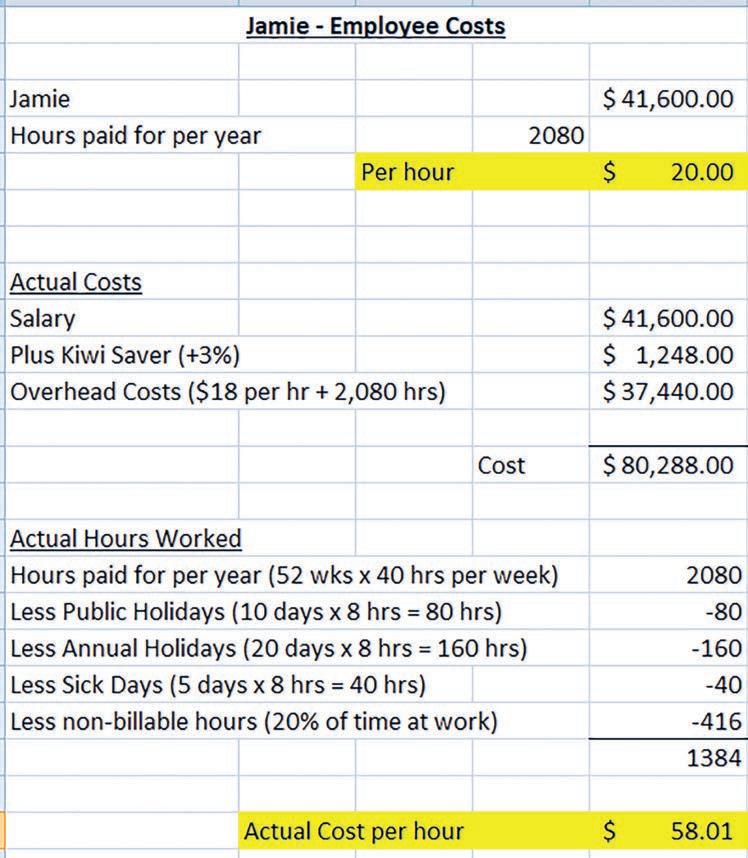
Let’s take a look at Jamie, who has been working for Chris, as an example.
Jamie is a good, reliable, hard worker and gets the jobs done quickly and efficiently.
Jamie works on average 40 hours per week at an hourly rate of $20 per hour which is $41,600 per year.
Chris believes Jamie costs $20 per hour and some extras.
Here is a breakdown of actual costs for Jamie:
divided by total hours spent on the jobs to get an hourly rate. This can range somewhere between $15 - $25 per hour, depending on the size of your company.
Non-billable hours: Hours not directly related to the job itself (toolbox talks, training, health and safety documentation, onsite
Overhead cost calculation: Costs that are not directly related to the jobs (ACC, administration staff, rent, office expenses, advertising, vehicle expenses, etc).
To calculate this accurately for your business, take all overhead expenses for the year
meetings, delays in start times and dates where your team is less productive, weather stoppages, material supply delays, etc).
Although Chris initially thought Jamie cost $20.00 per hour + extras, to his surprise the actual costs are $58.01 per hour.
2. Number of hours allocated to the job
Estimating accurately how long a job will take is also essential to making profit. Every hour worked over the estimated time eats into profit.
Unless hours worked are tracked against the estimated hours for each job, time blowouts are usually not seen (aka backcosting). This is often where tradies get tripped up.
As a business coach, many tradies I work with have significantly increased their profits by getting control of their hours worked on the job, and quoting based on newfound understanding of how many hours a job actually takes (as opposed to how long you think it takes).
So check times on every job compared against your time estimates to see how accurate you have been. Then use this history as a guide for quoting for new work.
Putting it all together: Mark up and profit
Now that Chris understands his labour allowance, he is in a better position to price the job. Here are the calculations:
• Actual cost per hour per employee x number of hours allocated to the job = labour allowance.1
• Labour allowance + materials costs = total cost.
• Total cost x mark up = total price to quote client.
So start with actual costs and make sure you are pricing right – it will be the difference between being successful – or frustrated with nothing in the bank.
Once you allow for your labour allowance, check your mark up – is it enough? If it’s too low, then it’s time to starting increasing prices and making decent money.
If you need a hand with this, grab a free strategy session with me and we will go through your situation to make sure you are pricing for profit. Go here: www.successfultradie.co.nz/bandc.
Daniel Fitzpatrick
Non-invasive ground improvement
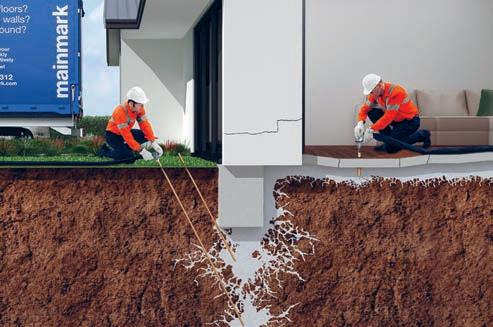
Non-invasive ground improvement solutions can fortify foundations for new builds and renovations.
Advances in re-levelling products and processes for buildings have created cost-effective and less invasive alternatives to traditional underpinning methods.
For builders and developers, innovative solutions such as Teretek® engineered resin from ground engineering specialist Mainmark can also increase the ground’s bearing capacity.
This ground treatment can help to re-level and re-support an existing structure and avoid the need to replace foundations, or rebuild sections of a dwelling when renovating or adding the extra load of an extension.
Extreme weather events including periods of drought followed by heavy storms can affect the ground on which a house sits, with changing levels of moisture causing soils to contract and expand.
Many buildings in coastal areas also sit on sandy, shifting soils. These are just some of the environmental factors that can contribute to ground instability and weakness, leading to building subsidence.
The resulting damage this can cause to a home, including uneven floors and cracks starting to appear in the structure, is often a catalyst for property owners to decide to undertake a renovation or extension.
Teretek engineered resin is injected into the foundation soils beneath a structure’s footings, in a process likened to keyhole surgery.
The unique two-in-one solution delivers both ground improvement and re-levelling of the building by increasing
ground bearing capacity, filling voids, and minimising soil deformation, at a significantly lower cost than traditional underpinning.
Mainmark technicians inject the resin beneath the sunken sections of the affected structure using their fast, precise and controlled method.
It’s possible to raise and re-level strip footings, raft slabs, and ‘waffle-pod’ slabs, as well as infilling slabs and driveways, using Teretek.
“We have seen the issues that can arise when building works, from single dwellings to multi-residential and commercial developments, are carried out without the appropriate foundation ground support,” says James O’Grady, Mainmark’s regional sales manager NZ.
“Defects such as cracks in walls and sinking foundations are likely signs of serious structural issues that may present, or be exacerbated, if ground bearing capacity is not addressed prior to adding a second storey or an extension to an existing structure.
“Despite extensive use in a range of environments, including resolving complex ground engineering problems for civil infrastructure, residential, mining, commercial and industrial sectors, engineered resin is still an unfamiliar solution to some in the building industry.
“Resins have been used for more than 25 years and have a proven performance history.
“This is now internationally recognised as one of the most advanced ways to improve ground bearing capacity and re-level structures and a highly effective way to resolve issues quickly.”
New civil contractors’ subcontract to boost industry efficiency
In a bid to reduce costly paperwork and legal advice, and address concerns about risk allocation, Civil Contractors NZ (CCNZ) has developed a new standard subcontract form.
CEO Peter Silcock says the CCNZ Subcontract, developed with Kensington Swan, was in response to CCNZ member requests for an industry standard subcontract that could be used across a wide range of civil projects.
The new document follows a similar format to NZS 3910, but can be used with other forms of head contract.
Peter says that, compared to other industries, the construction industry often had complex contractual arrangements between contractors and was subject to more risks, given the nature of the work.
The lack of subcontract standardisation added significant costs because both parties needed to get legal advice each time one-off documents were used, he says.
“By adopting standard documents, everyone saves money and time.
“It’s very difficult for subcontractors to bid for work if the contract process has poor documentation, too tight timeframes, unrealistic conditions or transfers too much risk. We’ve tried to address all that.”
CCNZ and Kensington Swan received extensive feedback from both head contractors and subcontractors in the development process.
The new document had to be flexible enough to reflect the realities of individual projects, plus present a consistent and fair allocation of risk between the parties.
"The result is a subcontract that promotes fairness across all areas of the industry, is easy to understand with legal jargon kept to a minimum, and can be used on a range of project types.
“The CCNZ Subcontract is also one of the few contracts to actively promote a discussion as to whether there should be a cap on the subcontractor’s liability; an issue of huge importance to the industry.”
It was hoped that contractors across the industry would adopt the new subcontract form.
Peter says an electronic version of the sub contract was available to CCNZ members free of change and for a small cost to non-members.
Civil Contractors New Zealand (CCNZ) represents the interests of the civil construction sector. Its 600 members include large, medium-sized and small businesses in civil construction and general contracting.
An international measurement standard in construction
The New Zealand Institute of Quantity Surveyors (QS) has signed up to an international standard that provides consistency in classifying, defining, measuring, analysing and presenting construction industry costs.
The International Construction Measurement Standards (ICMS) provides a global framework for measuring, costing and reporting, so that governments and investors can compare construction costs like with like.
Previously there was no universal standard and, internationally, the construction industry used different methods of measurements, nor was there any commonality in terms of costs and construction reporting.
The ICMS coalition was formed to address these issues, and the New Zealand Institute of Quantity Surveyors (NZIQS) joined as a trustee member 18 months ago.
NZIQS president Barry Calvert says New Zealand is pleased that ICMS is very similar to the standard already in place here.
“NZIQS now has training in place for their members to become familiar with the ICMS format and we will be encouraging QSs to use it for both public and private sector projects going forward.
“With ICMS in place, construction agencies and their clients will be able to compare the cost of a building in New Zealand to any other country in the world and know that the costs and the standards of the building will be equal.”
According to ICMS, the standard allows:
• The cause of differences in costs between projects to be identified
• Construction costs to be consistent
• More informed decision-making about the design and location of construction projects
• Data to be used with confidence for construction financing and investment, decision-making, and related purposes.
Registered valuer at North Harbour Valuers, John Darroch, is a member of the Property Institute of New Zealand, who is also a member of the coalition, and says the ICMS will mean the public will have more confidence in costs that are quoted to them.
“ICMS will standardise how construction costs are reported. This will assist in evaluating properties and the public will know they are receiving accurate information.”
The ICMS coalition is a group of not-forprofit organisations and professionals who research, develop, publicise and implement the ICMS.
Coalition organisations in the ICMS have each signed a declaration of commitment and support for the standard and the high quality of maintenance and creativity it involves.
They also encourage world markets to embrace and implement the new standard. As well as this, companies associated with the construction industry can sign up as partners, meaning they agree to register their support in establishing the standard across the construction and infrastructure professions.
Exactal develops estimating software for the construction industry internationally, their Auckland office was established in 2008. They are also the first ‘Platinum Partner’ of NZIQS. They signed on as an ICMS partner in mid-August.
CEO of Exactal, Murray Freeman, says that as a partner, they will be able to ensure their product range is well prepared for ICMS, which will be a great benefit to their global customer base.
“Exactal will play an important role in ensuring any standards developed, enhance the user experience of our clients.
“An international measurement standard will ensure that it’s easier to benchmark, measure and report on construction project costs, and see how they compare in various countries around the world.”
Concrete and seismic design
The 7.8 Mw Kaikoura earthquake of 14 November 2016 - a complex multi-fault rupture with prolonged ground shaking – was a wake-up call for Wellington.
As a result of 25-30 seconds of strong motion in the CBD, with localised amplification on deep deposits near the waterfront, structural damage tended to be concentrated on moment-resisting concrete frame buildings between six and 15 storeys.
The outcome has been a number of official recommendations intended to ensure more rigorous regulations and address public safety concerns.
Issues with the performance of precast concrete floor systems are reflected in these recommendations.
Precast concrete floors
While the spotlight is warranted to a degree, it is important to consider some qualifying factors.
For instance, the codes in force at the time a number of these buildings were designed (e.g. NZS 3101:1995 Concrete Structures Standard) did not account for the unique nature of the earthquake. These codes have been, or are in the process of being, updated with total concrete industry support.
Moment-resisting, concrete frame, multi-storey buildings comprise a significant proportion of the Wellington CBD, and would therefore inevitably be amongst any damaged stock by sheer volume.
Also, attention must not be drawn away from the more pressing challenge posed by unstrengthened unreinforced masonry buildings.
Another outcome of the Kaikoura earthquake from which valuable lessons can be learnt is the debate around safety vs. amenity. It seems that although, with the odd exception, our buildings perform as designed, public expectations are not being met.
The disruption caused by building repair or demolition has seen a growing call for damage resistant design, an approach which allows for ‘life safety’ as well as ‘building survivability’.
Through Precast Seismic Structural System (PRESSS) and base isolation, concrete is ideally positioned to help meet this demand.
Kaikoura earthquake
Post-quake discussion has focussed on two areas. Firstly, a Ministry of Building, Innovation and Employment (MBIE) investigation into Statistics House - a six storey reinforced concrete office building built in the CentrePort Harbour Quays
business park in 2005 - which suffered the partial collapse of two floors.
Secondly, Wellington City Council’s (WCC) Targeted Assessment Programme, which sought to address public safety issues by confirming the structural integrity of multi-storey buildings that had experienced significant shaking in the Kaikoura earthquake.
The resulting reports are available for download from the MBIE and WCC websites.
Recommendations
The MBIE investigation into Statistics House made four key recommendations: investigate similar buildings in the Wellington region, notify industry about issues with existing buildings with precast floor systems and frames that may be affected by beam elongation, access expertise to consider the implications for this type of design for new buildings, and undertake research into standards to ensure they reflect current best practice.
The MBIE report noted that the combination of the causal factors in the partial floor collapses of Statistics House was not foreseen by Standards when the building was designed.
As such, NZS1170.5 – Earthquake Actions Standard and NZS3101 were identified as requiring review.
The WCC report offers nine recommendations in such areas as building owner responsibility and postearthquake assessment . A number of the recommendations also relate to precast floors, including the call for a testing regime, standardised details and guidance for practitioners.
However, the report mentions that while the focus of the assessment programme was on buildings most affected in this earthquake, it is important that structures vulnerable in earthquakes, such as unstrengthened unreinforced masonry buildings, remain on the radar.
Moving forward
These reports set a path forward for the wider Wellington region, one which will require collective buy-in from all stakeholders if the recommendations are to ensure a more robust building regulatory system and address public safety issues.
The concrete industry is fully committed to this process; participating in technical discussions, driving standards revision and exploring new low damage approaches to seismic design.
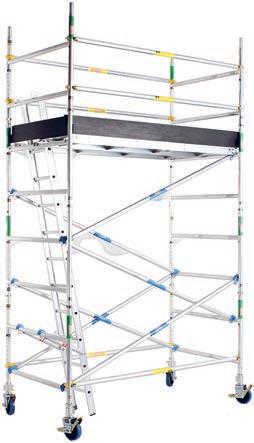
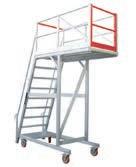
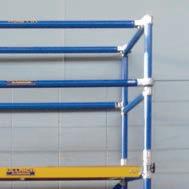
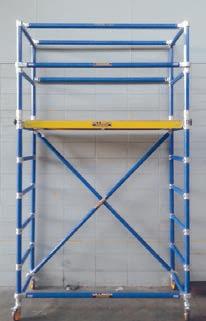
tower with fully adjustable levels 12m long, 0.8m wide and a reach height of 7m. Worksafe Compliant. Metal walkboards not included.
Changing the perceived value of tradies
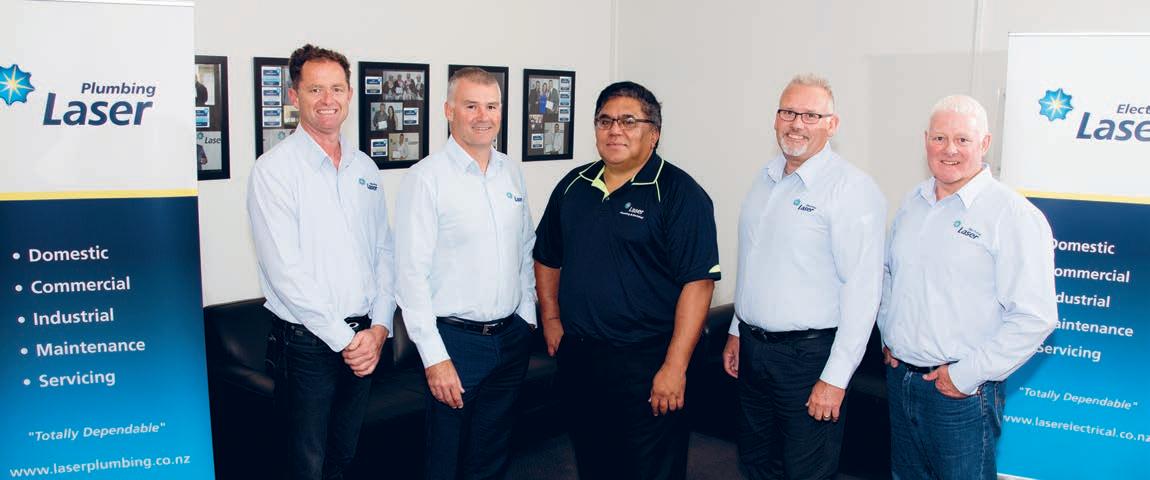
As industry searches for a solution to the current shortage of tradies, New Zealand's largest network of plumbers and electricians has called for a change in the perception of trades as a career choice, and greater support from the government for employers.
Laser Plumbing & Electrical general manager, Scott Carr believes that the practice of promoting university education as being more valuable than an apprenticeship has to be addressed and the Government needs to be a part of changing the current mindset.
“There is a growing number of young people leaving university with a significant student loan and no job, yet, the school system continues to promote tertiary education as the primary option for our youth,” Scott says.
“At the same time, those bucking the trend and taking on an apprenticeship are being paid to learn on the job, and after three to four years, have a qualification in a buoyant market.
“The current skills shortage is seeing pressure placed on training organisations to increase the numbers of apprentices in the system but, support from the Government to promote the trades as a worthwhile option is lacking, as is Government support for the small businesses hiring apprentices.
“Government also needs to identify ways to support the many small businesses that hire the apprentices and teach them the trades, ensuring the industry continues to grow into the future.”
Laser Electrical Auckland Central’s Terry Bluck agrees, saying “Training institutes collect the students’ fees and gain funding and subsidies from the Government, yet it is the employer who wears the brunt of the cost in managing and training an apprentice.”
For many businesses, it is not until the third or fourth year of the apprenticeship that the employee starts to cover their costs and offer a return on the investment.
Having trained in excess of 25 apprentices through his business, Terry also wants to see a change in the attitudes towards tradies.
“We need a society where tradesmen are appreciated and valued rather than being set up in TV programmes like
‘Target’. Like any industry, you may find a bad egg, but, where are all the good stories?”
While New Zealand has seen an increase in apprenticeship numbers to 42,000, there is still a significant shortage with a recent article estimating an additional 2,000 plumbers alone were required to keep up with the current construction boom.
Owner of Laser Plumbing Grey Lynn, Sarah Bowie is focussed on creating her own solutions to the employment shortage, ensuring her customers continue to receive the high level of service they are used to.
“Our focus around recruitment has changed and now we look for the right attitude. We know plumbing is not a sexy industry but it is an important one that is undervalued.
“Recent experience is showing us that adult apprentices are more diligent on the job and motivated to learn. They have generally taken a pay cut to take on the apprenticeship and so want their investment to pay off. They see it as a career, not just a job.”
Like Scott and Terry, Sarah would like to see the perceptions of trades as a career change but, also acknowledges the bottleneck which is the cost.
“As well as the costs associated with the training, there are the additional costs including of having the apprentice fully supervised for the first year.
“The risk of another business poaching your apprentice also increases by the time they reach their third or fourth year with many companies not willing to take on the cost of training someone from scratch. For many small businesses, the overheads and risk add up and prove too costly.”
Scott added that “Now, more than ever, it’s time for our Government to engage with trades businesses and work with them to ensure that the shortage does not grow. These businesses are training our tradies of tomorrow and should be supported.”
Online building consents a step in the right direction
Building consents in Wellington can now be handled through an easy, streamlined online application service, Wellington Mayor Justin Lester has announced.
After a successful trial, that involved six other councils, the service will be available to all Wellington City Council building consent customers. The Palmerston North City Council has been issuing online consents since June.
The Wellington service allows applicants to submit their building consent applications via an online portal.
Justin Lester says this is a goal the council has been pursuing for some time. “Simplifying our building consents process is a huge priority for our Council. A simple, easy to use online portal will allow people to track their applications and make the process easier.
“This is going to be an enormous win for Wellington – it will make it easier to do business in the city, and take a big hassle out of building new homes. For a Council focused on affordable housing and boosting economic growth, this is a no-brainer.
“As someone who’s set up my own business, I know what a difference this would have made.”
The Mayor said public feedback from the trial had been extremely positive. "Customers are finding the service quicker and easier to use," he said. “They also love being able to track progress online.”
The online service is being provided by GoCouncil, a partnership between Master Business Systems (MBS) the developers of GoGet and Nuwave. MBS has more than 20 years of experience working with council building departments.
Wellington City Council is part of GoShift, an initiative involving more than 20 councils, from Western Bay of Plenty to Nelson, which aims to improve the building consents process.
Standardised processing checklists have been developed and, in the future, inspection checklists will also be standardised and there will be a single, best practice quality management system.
“Wellington City Council have taken a huge step forward in the right direction with this end-to-end online consenting portal,” says John Milford, Wellington Chamber of Commerce chief executive.
“The ultimate goal must be a one-stop-shop for all council consenting and regulatory processes that are efficient, reliable, cost-effective and that work for the user.”
Rotorua plumber takes out top title
The Plumbing World Young Plumber of the Year 2017 has been won by a Rotorua tradie.
Ten regional finalists from across New Zealand competed in a series of practical tests, alongside a written test, to determine who would come out on top.
Judged upon their workmanship, accuracy and speed, the finalists competed in plumbing and gasfitting tests based on everyday requirements of the job.
Taking out the competition on the night was Julian Parker, 25, from Lewis Plumbing in Rotorua. Parker has been working as a plumber since age 16, and says that the standard of competition was high.
“There were nine other guys there and I had no idea what they were like but I could see they were all pretty onto it,” Parker says.
“I was surprised to win to be honest, there were a couple things I wasn’t happy with but to win was great.”
Parker says of the $12,000 worth of prizes he picked up on the night, he’s most excited for the trip to Fiji and mentoring sessions with industry experts.
This inaugural competition was spearheaded by Plumbing World to address the growing
shortage of qualified local plumbers, gasfitters and drainlayers in the New Zealand market.
Rob Kidd, Plumbing World general manager, says the competition was a fantastic success and it was heart-warming to see the camaraderie among fellow plumbers.
“All of the finalists did a fantastic job, I highly commend each one of them. A huge congratulations has to go to the winner, Julian Parker. His results showed excellent standards and passion for the work.
“We hope that this event will show the fantastic opportunities available in the plumbing industry. Plumbing World is excited to see the next generation of plumbers enter apprenticeships and enter the industry.”
According to recent research by MBIE, the demand for plumbers is expected to experience the largest growth of any construction trade over the next five years.
This equates to 1,622 more plumbers needed to service the construction sector.
The annual Plumbing World Young Plumber of the Year event aims to raise the profile of plumbing as a career choice for young Kiwis, while lifting the standards of young professionals across the industry.
Wintec is also on-board, having developed a solution-based training programme to support plumbing apprenticeships.
This year’s event was hosted by two of New Zealand’s most high-profile plumbers, Logan Dodds and Jesse James Cassrels, whose adventures have amassed a substantial online following. They were joined on the night by Plumbing World ambassador, All Black captain Kieran Read.
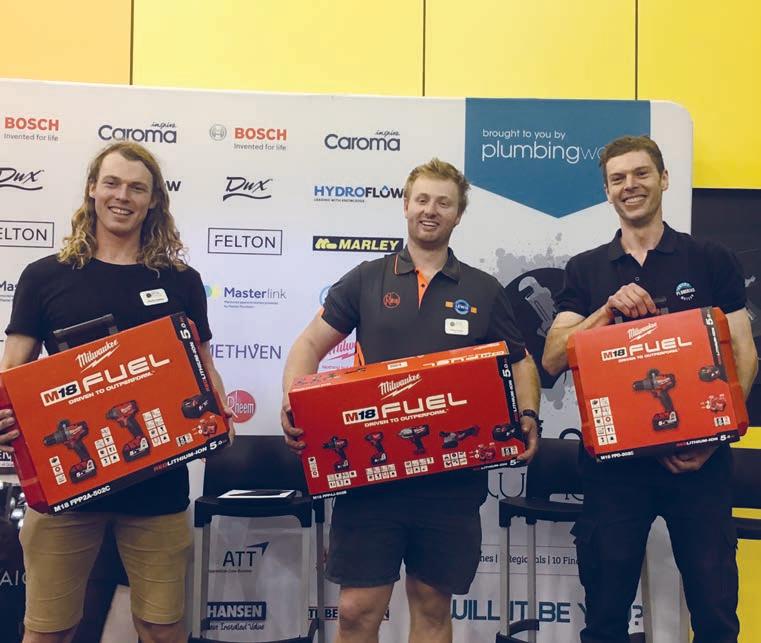
From left are: Second place getter Hayden Findlay, the winner Julian Parker, and third place getter, Josh Raton
Hire industry in hot demand
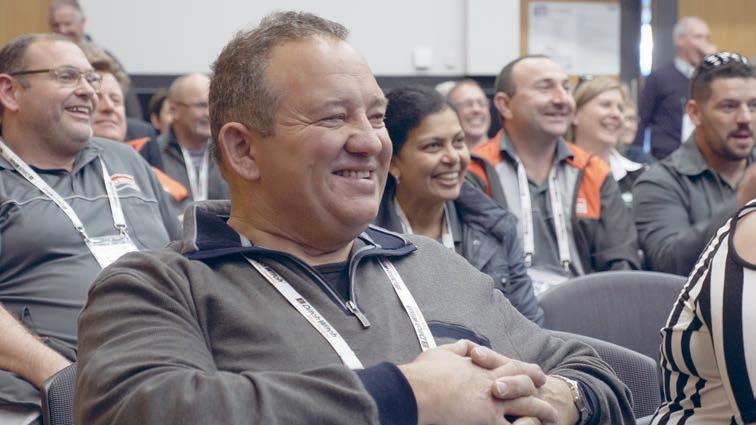
This year’s Hire Industry Association of New Zealand (HIANZ) conference clocked up record attendance, with the industry having enjoyed many positive years and strong growth.
A total of 270 hire company owners, managers and staff, as well as equipment and service suppliers to the industry from New Zealand and Australia attended the stimulating and informative event held in Blenheim in late July. Attendees enjoyed an extensive programme of workshops, guest speakers, trade show, and networking opportunities.
The conference was an opportunity for business owners, CEOs, senior managers and employees to get together in a neutral, fun environment to discuss industry trends and legislative issues, talk with suppliers, attend workshops and catch up with old friends.
The conference also provided hire company delegates with educational material and an overview of the Association’s current and future initiatives.
It was held at the Marlborough Events Centre, in Blenheim, a purpose built facility, amidst world-class scenery, and an excellent, spacious venue for the conference. Organisers were thrilled at the record turnout, which reflects the strength of the hire industry and the relevance of trade organisations, says HIANZ CEO, Phil Tindle.
“The value of trade associations is hugely significant. Increased workload often
results in less time for businesses to focus on planning and administrative functions. Less time can also make it difficult to access reliable and relevant industry support and services. HIANZ are dedicated, providing valued resources to the industry.
“Our industry sector is still small enough to be very personal and members form lasting friendships. It’s very much like joining a large family - everybody gets on well and all our events offer members a congenial and relaxed environment to come together to share in the network.”
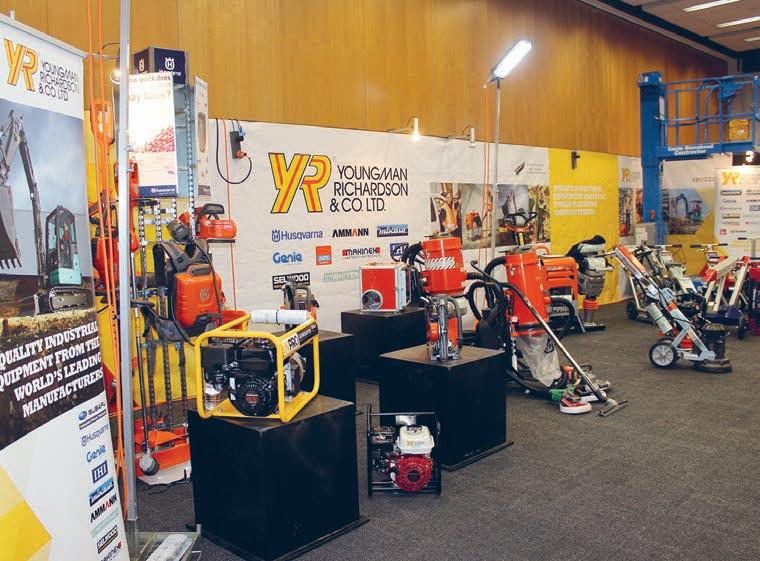
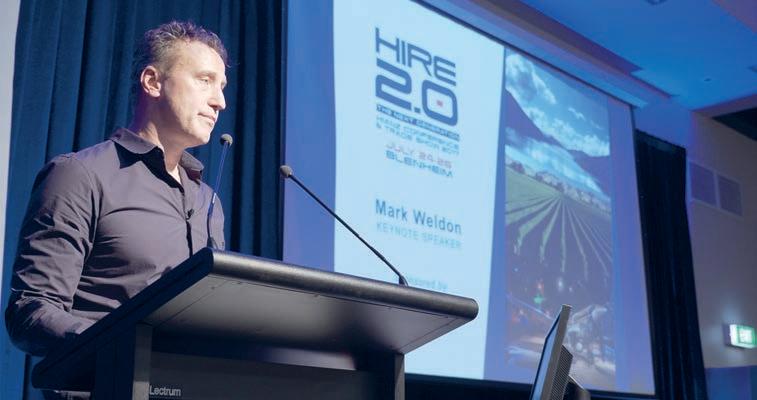
The ever-popular trade show was a sellout event, and comprised of 57 exhibitor companies, displaying a good range of products and equipment. This year, there were a lot of new members at the trade show with new supplier companies impressing delegates with innovative enhancements to products in existing equipment categories. Guest speakers at the conference included business leader and sportsman Mark Weldon, and television personality and stand-up comedian Ben Hurley.
Business sessions and workshops were presented by Lucy MacLean on Recruiting, Motivating and Retaining teams; Westpac chief economist Michael Gordon, on State
the of the Nation; Stewart Kearney from “Good for Business” on return on your investment; and Claire O’Connell from “The Classroom” on social media in business.
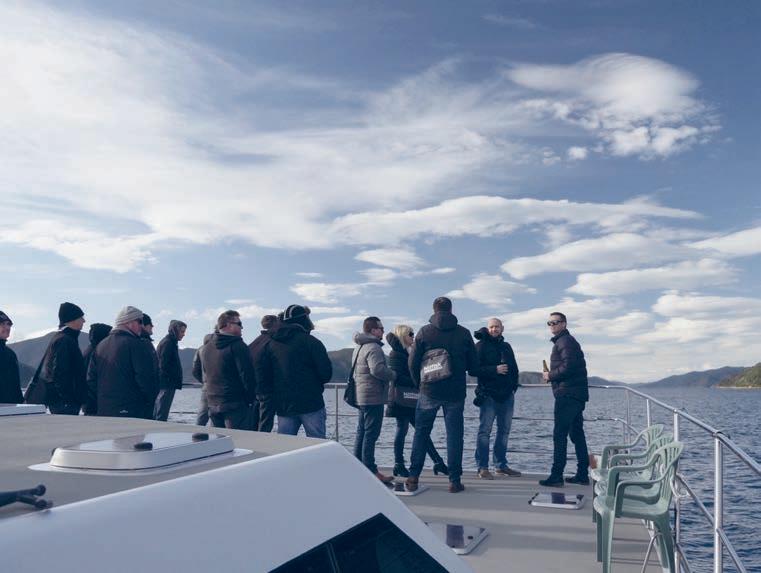
Amongst all the hard work and business networking, there was plenty of time for fun, and the pre-conference Marlborough Sounds cruise was a stunning success. “It brought delegates and suppliers together for a wonderful afternoon of spectacular sightseeing, seafood and wine tasting. It was an absolutely stunning event.”
The Hire Excellence Awards Dinner & Show is an important part of every HIANZ conference. Hosted by principal sponsor Youngman Richardson & Co, and held at the
Omaka Airfield’s Aviation Heritage Centre, which features vintage aeroplanes and exhibits from World War II. “Holding this event amongst the vintage aeroplanes and war exhibits was just magic. It was a very special place to be.”
Also very popular was a fancy dress event sponsored by Skyjack and held in the magnificent location of the Wither Hills winery.
Life membership award – Mike O’Neill
Mike O'Neill began his commitment to the HIANZ board in 1998 as Zone 2 director. His tenure spanned 11 years until 2009. Mike was instrumental at the time the Association
"
Our industry sector is still small enough to be very personal and members form lasting friendships. It’s very much like joining a large family.
- Phil Tindle
moved from volunteer zone committees to the recruitment of a full time CEO.
Giving freely of his time and with the wellbeing of the association always front of mind, he, along with the help of a business colleague, ran the financial affairs of the association after losing three CEOs in a very short space of time. Thanks to his commitment, dedication and optimism, he was a prime mover in assuring the association remained operational and financially viable during those tough times.
"He gave so much time and energy to the association and worked hard to stimulate
our industry at every opportunity. All of this while still managing his own hire company in Cambridge," said HIANZ past president, Wayne Hood.
"Mike's optimism, passion and commitment to the industry over the years has simply been infectious, and it is little wonder that he is held in such high regard amongst our industry peers. Mike has been the “go to” man for industry knowledge and foresight for many years now. I must also acknowledge the support of Mike's wife, Carol. As we all know, it is the support and understanding of those close to us that help people achieve great things," said HIANZ president, Tim Mikkelsen.
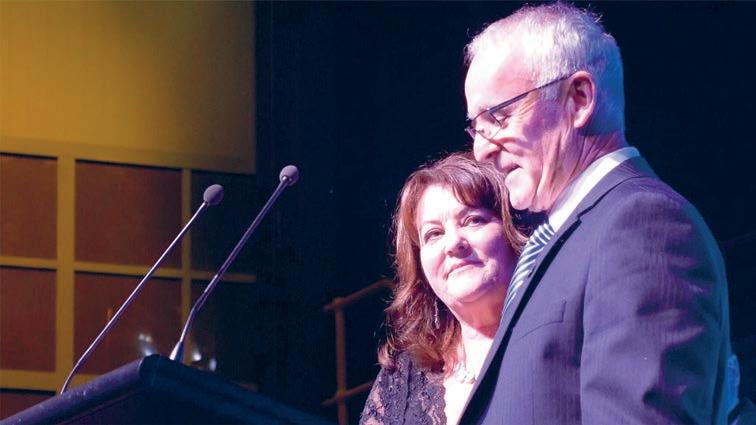
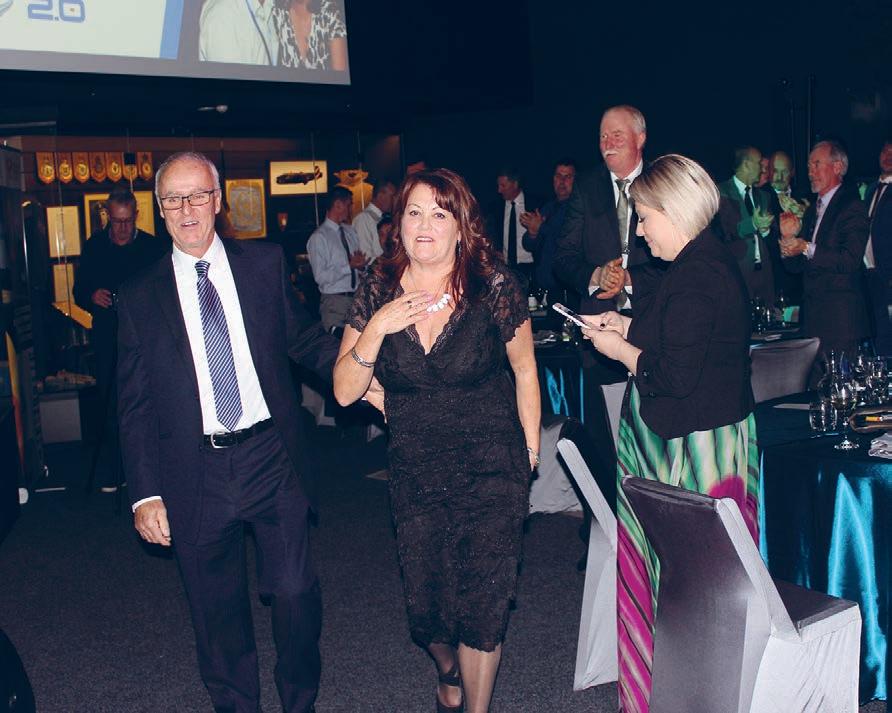
Mike O’Neill was awarded life membership. The contribution of Carol, his wife, was also acknowledged.
Excellence Awards
Awards recipients were recognised for their outstanding contributions to the industry.
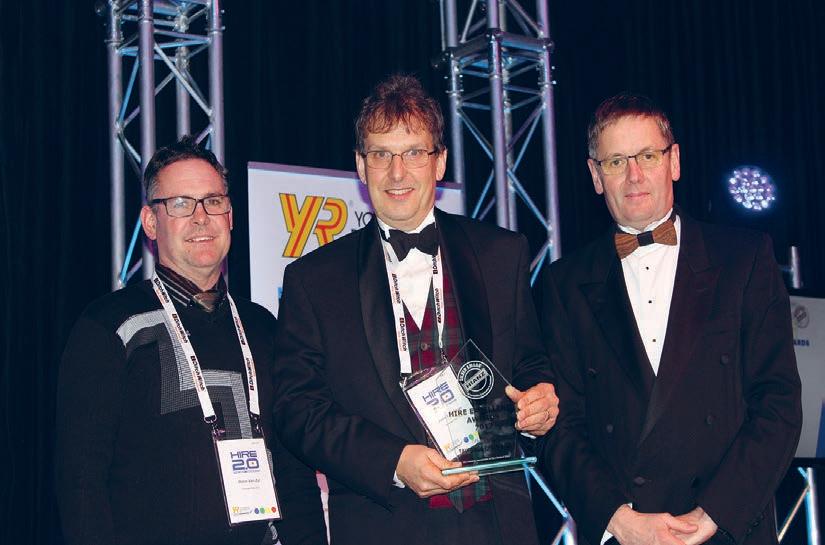
Congratulations to all 2017 award recipients: Gold award, Kennards Hire Hamilton; Silver
Award, Tauranga Party Hire; Silver Award, Party Warehouse Christchurch; Silver Award, HIREKING Christchurch; Bronze Award, Taupo Hire.
The Hire Excellence Awards provide a platform for assessing, recognising and
rewarding excellence within hire companies who operate within various sectors of the hire industry.
“Businesses who feel they have a good team, and a good solid reputable business will put themselves forward. Feedback confirms it
is a very rewarding experience. Businesses undergo a comprehensive audit, they receive feedback from judges, and well deserved recognition from the industry sector and their respective communities. “At the end of the day it takes quite a bit of conviction to
0800 470 370
enter, so the rewards and benefits need to stack up,” says HIANZ CEO Phil Tindle. Areas of focus include presentation of premises and staff, security, product and services, marketing, customer service, adherence to industry best practices, H&S, policies, compliance and overall operational efficiencies. Judging includes onsite visits and mystery shopper.
There are many benefits to be enjoyed by taking part in the Hire Excellence Awards: The application process helps businesses to realise their achievements to date and objectives for the future.
Accolades will give customers extra confidence in products and services provided, and will also help attract new customers.
Hire Excellence Awards recipients have exclusive use of Awards logos to display on their websites, email signatures and company stationery.
Award recipients gain useful media interest and publicity, using this to help raise their profile among some of the most influential people in their communities and the public as well as private and voluntary sectors.
When the efforts of a team are recognised and applauded, it has a positive effect on staff morale and employee development. It gives the business the opportunity to reflect back and consider what and who contributed to its success and how this may be built upon in the future.
What did attendees say about the 2017 conference?
to find out about new innovative products that companies have. The whole event was just wonderful and it is hard for me to pinpoint specific highlights. I thought the food and workshop sessions were fabulous, well thought out and organised. I thought the Trade Show was fantastic and the opportunity to mingle with suppliers on a more relaxed basis was invaluable as is mixing with other hire company owners and staff. A well run event, thoroughly enjoyable and we will be back next year!"
"The high calibre of the workshop speakers was awesome, in particular Mark Weldon and the return on investment workshop. The ‘careers in hire’ seminar very interesting and well presented. Cruising the Sounds on Monday was a fantastic way to kick off the week!"
"Networking with other managers and business owners. Talking to suppliers about new products that can help grow the business. Trip away from home always good."
"There's always something that we learn from the HIANZ conference, from both speakers and fellow delegates. These are all things you can't get from your computer. Strongly recommend attendance."
- Attendee Testimonial
"A well run event with lots of opportunity to network, learn, be reminded and also
"I have been coming to the HIRE conferences for several years and this year it was good to see a range of new faces. A couple of these new attendees came and spoke to me about how our business does things and was looking for new ideas - I also did the same thing with another business. For me, this is one of the most valuable benefits that the event has to offer and an opportunity to share information with industry peers. Apart from showcasing new product, the ability to share and impart knowledge with each other is invaluable."
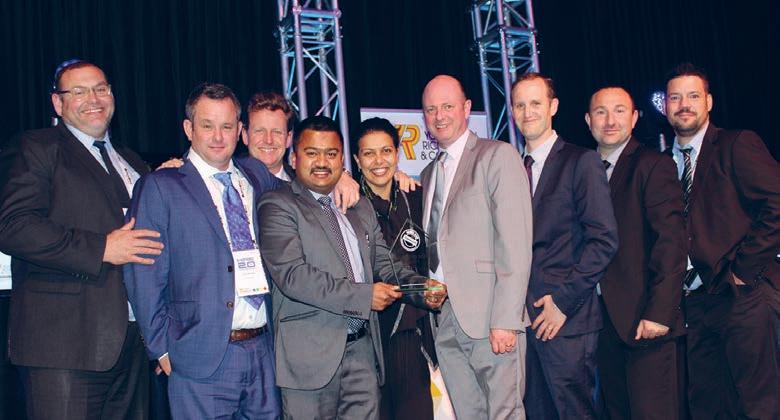
From left: Taupo Hire, bronze award, Tim Mikkelsen (HIANZ president), Taupo Hire owners Tracey Thompson and Dave Nicol.
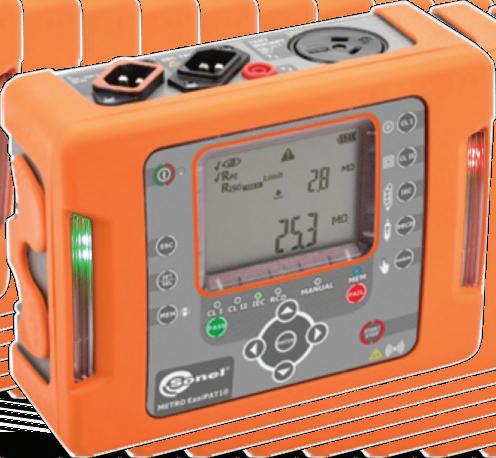
DOES TEST AND TAG COST TOO MUCH?
"Being a member of HIANZ not only has its professional attributes, it also feels like a family. All working together to improve and grow our industry. Striving for the one goal. The friendships made are forever."
About HIANZ
The Hire Industry Association of New Zealand is an Incorporated Society registered in New Zealand.
There are many reasons why hiring tools and equipment, rather than buying, is a great option for businesses.
- Phil Tindle
The Association's activities are governed by a Constitution that has been approved by the members. The prime objective is to “Promote and safeguard the interests of the members and others involved in the hire industry”. In order to achieve this objective the Association undertakes a large number of activities that are designed to improve the commercial wellbeing and public perception of all the hire industry.
The members are predominantly hire companies situated throughout New Zealand. Associate members equate to a third of our membership with some based in Australia. The Hire Industry Association of New Zealand respects the views and opinions of its membership in determining policy and direction. The Association promotes and encourages communication from members to ensure continuous
improvement in today’s ever changing business environment.
HIANZ Mission
To collectively represent the Hire & Rental Industry, by using the strength and diversity of our membership.
To be advocates of fair play and sustainable business growth through education, training and development.
HIANZ Vision
Consumers choose HIRE as the solution to their equipment needs.
HIANZ Core Purpose
To advance and grow the NZ hire & rental industry by assisting in the success of its members.
Specialists in Sales, Erection and Hire of Mobile and Aluminium
Scaffolding
With a wide selection of scaffolding solutions in both aluminium and fibreglass, we are the only official New Zealand Distributors for Oldfields Scaffolds Advance Scaffold – The Access Specialists 0800 (TOWERS) 869 377
Representation, Education & Training, Communications, Sustainability, Industry Image
Why hire?
There are many reasons why hiring tools and equipment, rather than buying, is a great option for businesses from small enterprises through to large multi-national organisations, says HIANZ CEO, Phil Tindle.
“Hirers can access quality, reliable equipment with the latest technology without having to make a capital investment upfront. The benefits are obviously even greater with some of the larger more expensive equipment, as it frees up cash flow to be used for core business activities instead.”
Hiring leads to additional cost savings including registration fees, storage, maintenance and repairs, which are all part of owning expensive tools or equipment.
“The tax savings can also be significant. Any capital purchase goes straight onto the balance sheet and depreciated over time, whereas hiring equipment is 100 percent tax deductible.”
Flexibility is also an advantage, giving businesses the opportunity to hire specialist gear only when they need it rather than making it part of their regular fleet.
“Sometimes businesses have their own equipment but during busy times might need extra gear to keep up with work demands. It makes sense to hire rather than invest in new gear that has to be stored and maintained, and that may only be needed for a set time period. Hiring is so convenient. Customers simply pick the gear up, and deliver it back when the job is done.”
"
Hirers
can access quality, reliable equipment with the latest technology without having to make a capital investment upfront.
- Phil Tindle
“The ability to access the latest technology is another plus," says Phil.
“Technology is advancing at such a rate these days that hiring, rather than buying, allows customers to keep ahead of the pack. Reputable hire companies are continually reinvesting and upgrading their fleet to ensure they are offering the latest equipment with the newest technology.”
He says, “anyone hiring equipment should expect it to be clean, serviced, reliable and fit for purpose”.
“Hire companies’ customer service teams can offer expert advice on the right equipment for the job. This is particularly important when it comes to specialist equipment that with the right advice, may help improve on job productivity and financial efficiencies.”
With no time-consuming servicing or maintenance to worry about, hired gear provides savings in time as well as costs.
“Hire companies take these hassles away and help to avoid potential delays on the worksite, which is critical in today’s market,” says Phil.
Hiring also provides companies with a ‘try before they buy’ opportunity as they can
test a brand and model they are interested in without any obligation to purchase. During the hire period customers can get a feel for the frequency in which they use the equipment, its versatility and productivity, before making the all important decision whether or not to make a capital purchase.
“Whether customers are supplementing their existing fleet during peak periods, sourcing specialist equipment, or trying something new before making the decision whether to invest or not, hiring equipment from a HIANZ member is an easy, cost-effective solution,” says Phil.
Hiring is so convenient. Customers simply pick the gear up, and deliver it back when the job is done.
- Phil Tindle
‘Careers in Hire’ website
One of New Zealand’s best kept secrets is out. HIANZ are proud to announce the launch of a dedicated website to promote careers in the hire industry. Almost no other industry can offer the diversity of options from sales and customer service, through mechanical trades and logistics and onto helping create some of the biggest events in the country.
The website will act as a hub and includes a series of video interviews to promote different roles that exist in this great industry and how people can navigate their way through careers paths into various positions.
Getting people interested in joining the hire industry is the key objective. The “Careers in Hire” website provides students and young people with real-life examples of what is possible in this diverse industry. Coupled with a marketing strategy, HIANZ will strive to attract people who are keen to develop themselves, contribute to the business, and help create the next generation of leaders in hire.
The website is a self-contained promotional vehicle that HIANZ, member companies, and key stakeholders can utilise to promote this dynamic industry. The site will feature a strong use of social media tools and have
NOW IN CHRISTCHURCH
HIANZ are proud to announce the launch of a dedicated website to promote careers in the Hire Industry
Understanding that no organisation stands alone, HIANZ would like to thank those it enjoys close working relationships with, particularly:
• Principal Sponsor Youngman Richardson and Co Ltd
• Gold Sponsor Skyjack And support sponsors:
• Haulotte
• NZI
• JLG
• ICIB
• Good for Business
• Westpac
• Grays Online
• Hitachi
• Ditchwitch
• Snorkel
• PolyJohn
• Niftylift.
regular updates from HIANZ members, and from people who are making their mark in the industry.
Special thanks to all featured participants, Hirepool, Access Solutions, Kennard’s Hire, Continental Events, Tool Hire Taranaki, Rangiora Hire, Tauranga Party Hire and Hireace, for actively supporting this project. Hire Industry Association of NZ (HIANZ) PO Box 90744 Auckland (07) 575 2563 phil.tindle@hianz.net.nz www.hianz.net.nz
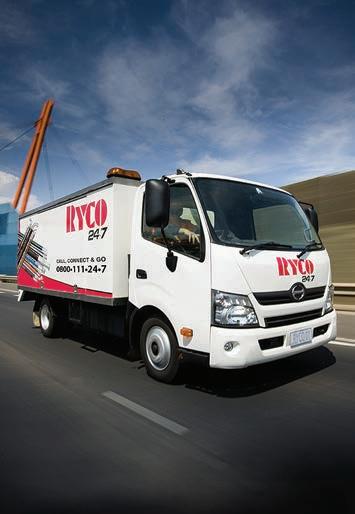
Who are RYCO?
When you hear RYCO think quality high pressure hydraulic hose and fittings.
RYCO Hydraulics started manufacturing hoses and fittings in 1946 in Melbourne Australia, forging their name amongst the world's leading high pressure hydraulic; hose and fittings manufacture and suppliers with the belief that “Higher Technology Equals Greater Performance". Who can buy RYCO?
RYCO quality range of hydraulic hose and fittings are supported by a network of loyal and committed distributors worldwide.
Hoseman are the RYCO 24•7 franchise and distributor for RYCO through Christchurch.
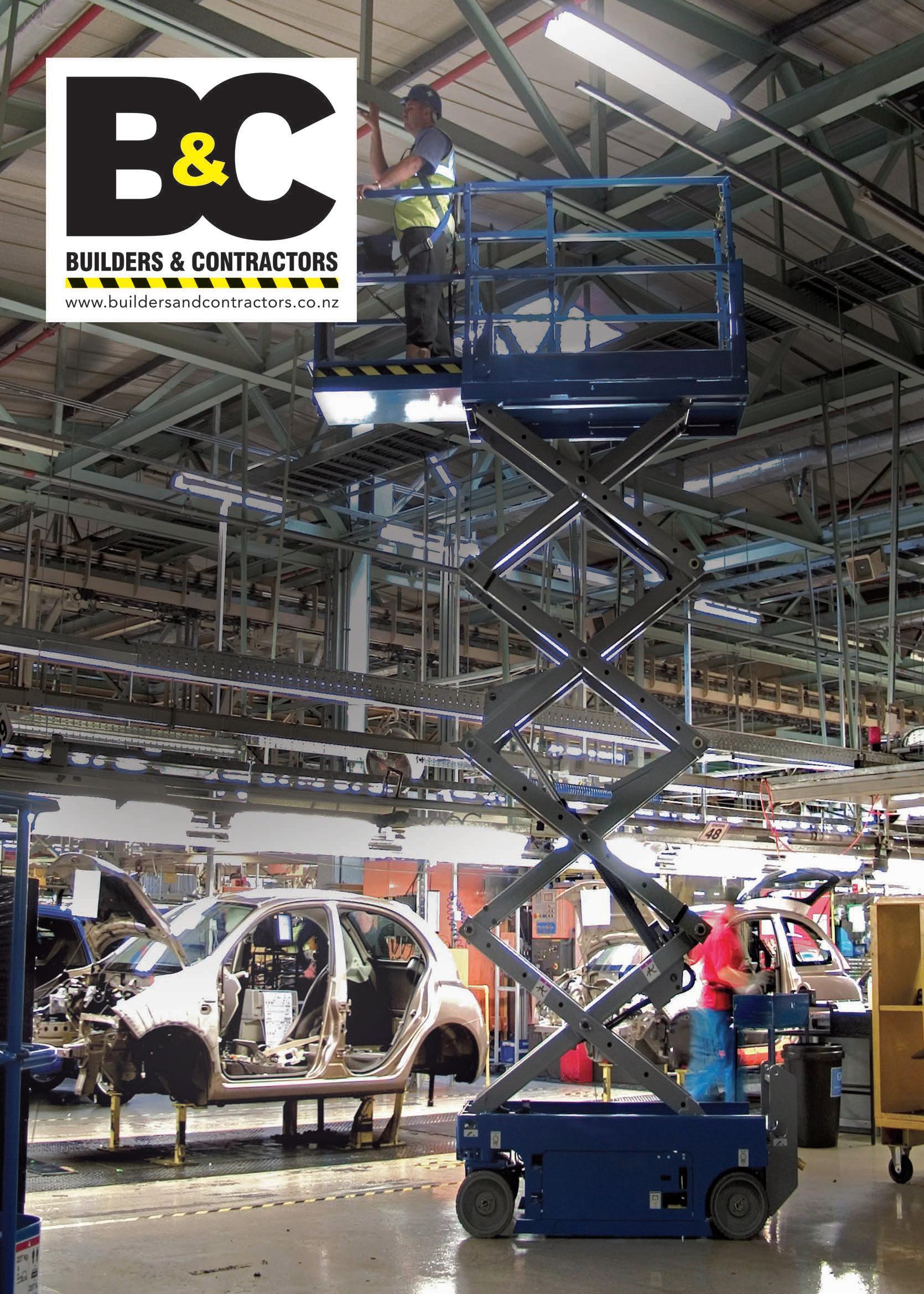
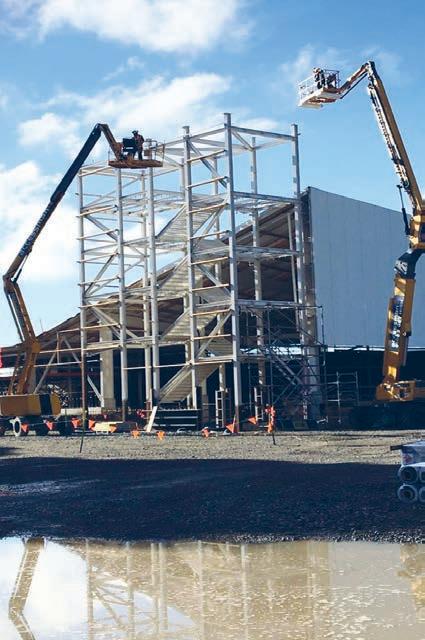
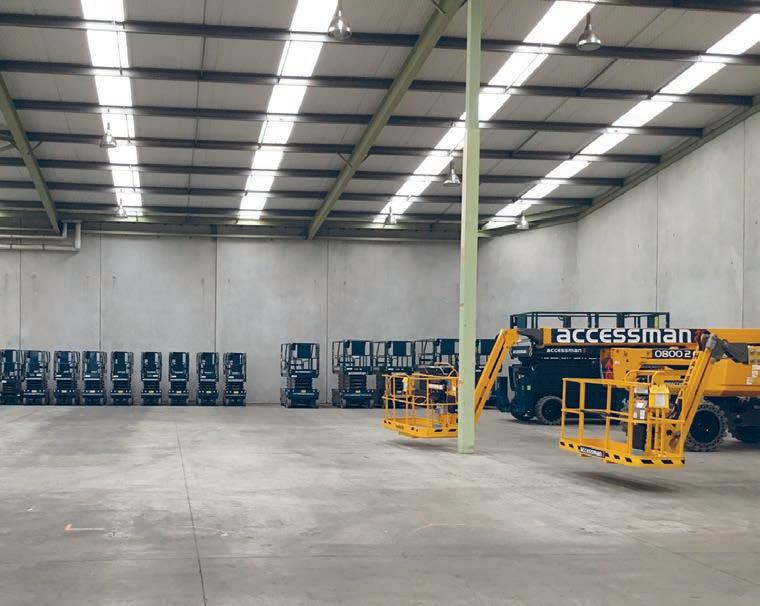
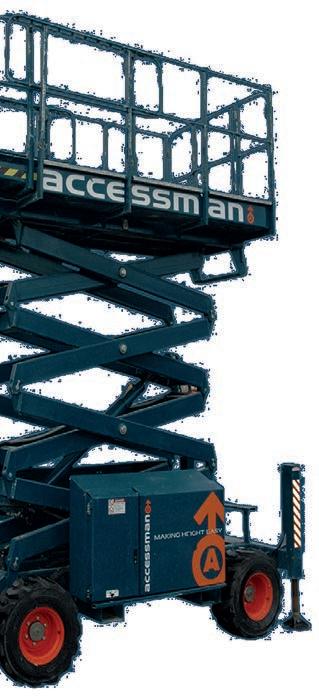
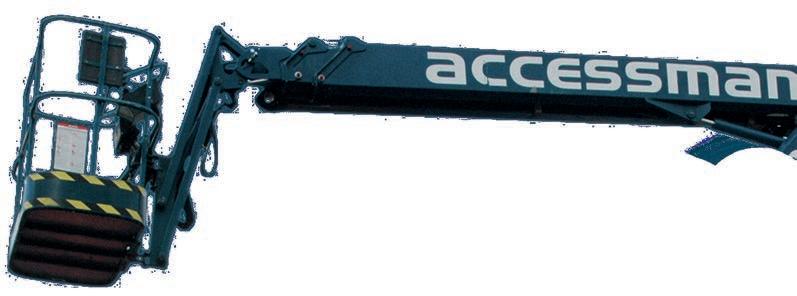
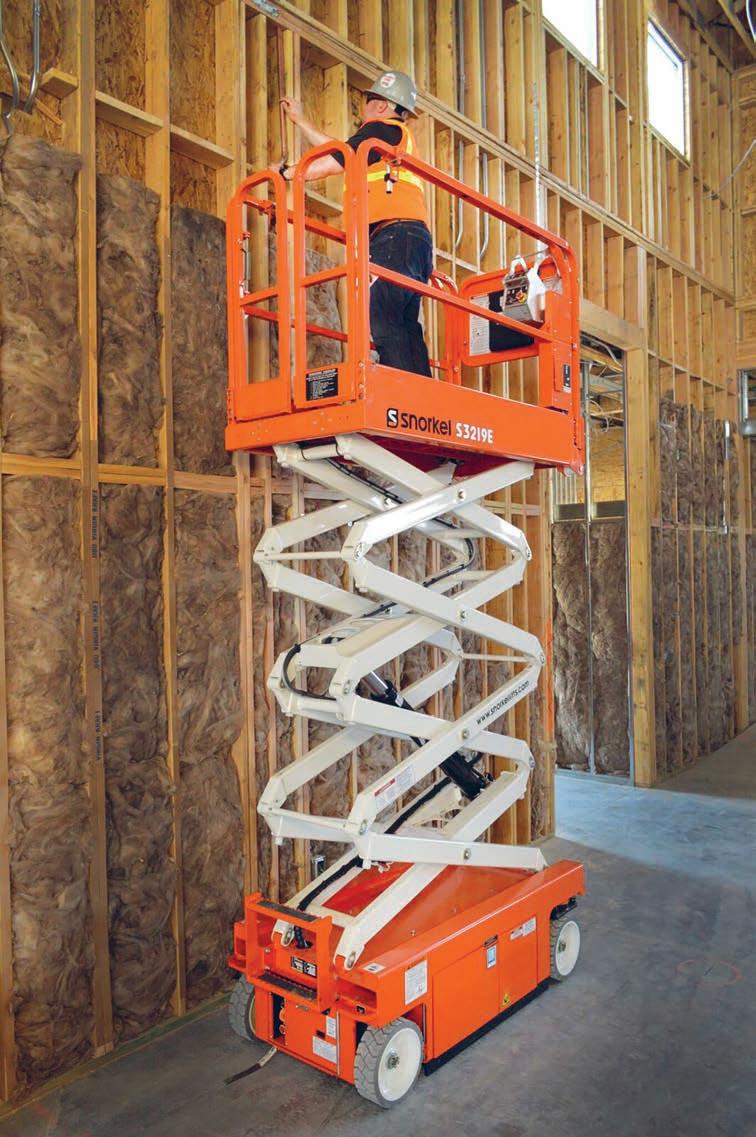
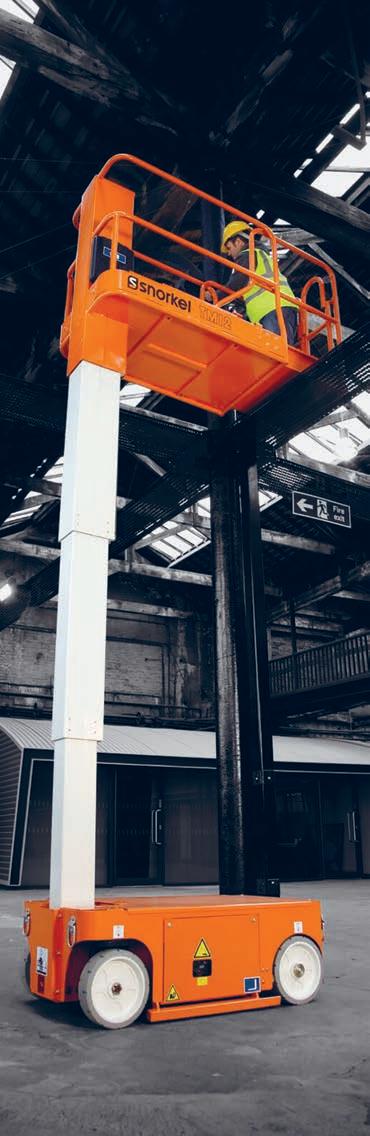
The South Island’s iconic access company – Accessman, who specialises in the hire of scissor lifts, cherry pickers and knuckle booms – has recently opened its first branch in the North Island, located in New Lynn Auckland.
With more than a 20 year history of “making height easy” Accessman’s solid reputation is one based on integrity and delivering as promised. The service that’s synonymous with the Accessman brand is now to be rolled out via their franchise system throughout the north.
Accessman Group's general manager, Lena Harrington, says the expansion into the North Island is a logical step and with an existing fleet of over 800 machines, the move will provide a nationwide supply to meet the demand of a number of large commercial clients operating throughout the country.
Accessman operates a mix of companyowned and franchised branches, with a strong focus on the growth of the franchise side of the business over the next two years.
“Our well-proven franchise model has been operating for over 15 years and with some recent enhancement to provide for the anticipated growth, we have a very well structured potential investment opportunity for the right person."
Prospective franchisees are subject to a selection process, Lena advises. They need to meet the required criteria to become part of the successful brand. “The opportunity is not simply granted based on their ability to secure the capital required,” she says.
“Franchise owners become part of a proven business,” Lena says. “It’s a competitive market but one in which we’re very experienced in. We know what works and
have developed systems to ensure our processes are replicated in every location – a vital prerequisite for any successful franchise.”
All franchises open with new fleets of the latest equipment, boasting tried and tested brands such as Nifty, Haulotte, Dingli & Mec. With health and safety being first and foremost, all booms are fitted with anticrushing devices, with all machines being
subject to stringent de-hire checks as per best practice.
Following on from the opening of a branch in New Lynn, Accessman is now seeking serious and substantial investors looking to establish and operate a successful business backed by Accessman systems and support, alongside being part of a true Kiwi success story. For further information contact franchises@accessman.co.nz.
Wired for hire
Electric aerial lifts provide the ultimate solution for low-level work at height.
To ensure safe work at height on the jobsite, there are many equipment solutions available to contractors for purchase and hire. In the aerial lift industry, manufacturers are focused on designing products that deliver operator safety, jobsite productivity and a return on investment to both the contractor and the hire company.
While larger aerial lifts such as dieselpowered boom lifts are more commonly hired than purchased, there is a growing demand for smaller lifts on the jobsite that can deliver the same safety and productivity benefits as large aerial lifts. Many hire companies in New Zealand now carry a range of ‘low-level’ aerial lifts, designed for working indoors at height of less than 6.0m.
As a leading global manufacturer of aerial work platforms, Snorkel™ produces one of the largest ranges of simple, reliable and robust lifts, including a line of low-level access products. These low level lifts are either self-propelled or push-around models, which are powered by batteries and therefore emit zero emissions.
Built to Snorkel’s high build quality utilizing steel fabrications, these lifts are commonly used for internal construction applications, often in the fit-out phase for the installation of cabling, lighting, ductwork, décor elements and signage. They are also popular for internal maintenance applications, such as changing a light bulb, cleaning, or switching out signage and promotional materials.
The Snorkel low-level product line includes three push-around mini scissor lifts, a mini self-propelled scissor lift, and two selfpropelled telescopic mast lifts; all of which have working heights of less than 5.7m. For tasks that require a little more reach, Snorkel also offers a range of six electric slab scissor lifts with a working range from 6.6m to 11.8m.
Snorkel Mini Scissor Lifts
Snorkel mini scissor lifts are designed to provide a safe solution to low level working at height, with lift capacities of up to 240kg and a working height range of up to 5.0m. They offer an alternative to traditional lowlevel solutions such as ladders, scaffolding towers and podiums, delivering many additional safety and productivity benefits.
Available in three heights, the Snorkel S3006P, S3008P, and S3010P are simple, push-around mini scissor lifts that can be easily transported around multi-story buildings in passenger elevators. These lightweight, all-steel lifts can pass through a single interior doorway and are fitted with non-marking casters for easy movement. An auto-brake system secures the lift when working at height, and saloon-door style entry gates provide easy access to the platform, even when carrying tools.
A self-propelled version of the Snorkel S3010P is also available as the Snorkel
S3010E. Fitted with non-marking tyres and saloon-style platform entry gates, this highly maneuverable mini lift has a zero inside turning radius and ‘point-and-go’ proportional joystick controls.
Snorkel Telescopic Mast Lifts
Designed for contractors and facilities maintenance professionals, Snorkel electric telescopic mast lifts are lightweight, portable work platforms. Where the convenience of a self-propelled unit is preferred, the Snorkel TM12 provides the ideal telescopic mast lift solution for most applications. Popular around the world for its versatility and durability, this self-propelled lift weighs in at 830kg and can lift up to 227kg at a working height of 5.6m. It features a 0.5m roll-out deck extension for additional reach over obstacles. The Snorkel TM12 can be driven through standard interior doorways and carried in passenger elevators – yet will still lift two people with tools.
In 2018 Snorkel will introduce its new TM12E, an electric drive version of the popular TM12 telescopic mast lift. Offering a working height of up to 5.65m, the Snorkel TM12E features a 0.45m roll-out extension as standard and utilizes an electric drive system that delivers longer duty cycles and greater efficiency on the jobsite. This lightweight, portable work platform weighs in at just 884kg and can lift up to 227kg.
Snorkel Electric Slab Scissor Lifts
Built to handle the toughest job sites, the compact Snorkel S3219E electric scissor lift
delivers a working height of 7.79m and a lift capacity of up to 250kg. Designed with a focus on low total ownership costs, this lift can be driven through a standard doorway and can be used outdoors by one person.
The Snorkel S3219E is packed with features that benefit both the owner and operator.
A dual shear scissor stack and upsized pins provide rigidity, and the all-steel construction is robust and durable for a long working life. High quality components increase machine reliability, and upsized kingpins minimize the risk of damage on-site. A fixed upper control box reduces the risk of theft or damage, and includes an integrated power outlet for hand tools.
Sharing the same features, the smaller Snorkel S3215E offers a working height of 6.6m and a lift capacity of up to 272kg, while the higher capacity S3220E offers a working height of 8.1m and a lift capacity of up to 408kg. Snorkel also offers the 9.9m working height S3226E, and the wider S4726E and S4732E models.
All Snorkel products come with a five year structural warranty plus a two year warranty for parts and labour. Snorkel is proud to manufacture in Levin and offers factorybacked sales, service and parts across New Zealand. For more information on Snorkel, visit www.snorkellifts.com.
JOBSITE
The Snorkel™ S3219E is far from ordinary. This 5.79m electric slab scissor lift was designed to take everything a jobsite can throw at it — and more. Its super-heavy-duty steel construction and over-engineered components, maximize up time and minimize ownership costs. Plus, everything is easy to get to, which really cuts down on maintenance time. After all, the most valuable scissor lift on your jobsite is the one that’s actually working.
Quick Lift mini scissor lifts are steadily replacing ladders on sites across NZ.
With very few moving parts, their simplistic design delivers uncompromised safety and easy operation.
The vast majority of falls occur at less than three metres. While this doesn’t sound all that high, it is how you land and what you fall onto that will determine the outcome. Falls from height remain one of the most common causes of worker injuries that require at least a week off work in the construction and building sector.
Each year over 1000 people are seriously injured on sites when they fall. This is a well-known risk in the building and construction industry that must be managed, and while we have seen changes to practices – for example, scaffolding is now commonplace – too many people are still getting hurt.
What’s my duty under the law?
The Health and Safety at Work Act 2015 places a duty on businesses to eliminate risks where reasonably practicable, and where this is not practicable risks must be minimised.
The point of this law change is to drive change within New Zealand to lift our health and safety performance, which presently is at the bottom end of the OECD.
Targets such as the Government's target of reducing injuries by 25 percent by 2020 are important, but this is really about protecting people – ensuring that they can go home at the end of the day healthy and safe.
Climbing the ladder
Ladders have become somewhat of a dirty word when it comes to working at height. We’ve even heard talk that WorkSafe has banned them!
The key point for businesses is to always do a risk assessment and then choose the right tool for the job.
In many cases, scaffolding is the right tool once the level of risk and the duration of the job have been considered. If you are at height and painting a whole house, a ladder would not be considered appropriate. But in the case of replacing a
The
For example, if you are using a ladder you might need to think about how you will hold the tools you need and how you will manage the stability of the ladder while you do the job. It could be that you need a second pair of hands to help hold the ladder and or pass up the tools you need.
in the
the owner, which means you receive a superior and speedy service – every time.
Our extensive construction knowledge ensures we understand local compliance issues and we realise how critical your deadlines are and we guarantee to be on time – check out our Secureguarantee.
• We guarantee to beat any written quote by 10%
• We guarantee to return all quotes within 48 hours otherwise you will receive the first week rental FREE of charge!
Securescaffold covers all NEW WorkSafe working height requirements providing fall protection for
and
and
Nets for your safety
Once your workers are at height, have you considered what would happen if one of them were to fall? The tool to address this risk may be safety nets.
Safety nets are designed to stretch and absorb the energy of a fall, so a falling person is less likely to be injured. The greater the fall height, the greater the impact; so the net’s deflection must also be greater. The safety net must be able to deform or deflect enough to absorb all of the energy when someone falls – up to the maximum fall height for the design.
However, for nets to protect workers from falls they must be set up correctly. WorkSafe inspectors have witnessed several cases where the net setup was well below what was required, thereby offering no protection to the risk of falling. The design and setup of safety nets is crucial to their ability to function, especially if they are coupled together to span large rooms.
To help raise standards, WorkSafe recently released an alert to industry that highlighted some of the poor practices related to safety nets. This alert is available in the news section of WorkSafe’s website. When it comes to suppliers, you must ensure that any nets and associated fitting
More than training, AMS delivers peace of mind
A leading Private Training Establishment (PTE), AMS Group specialises in driver training, machinery operator training and workplace health and safety training.
Managing director Kevin Wall has watched the New Zealand owned and operated company grow from its original site in Huntly, to seven branches in the North Island and one in the South Island, with additional locations being added all the time.
The Group’s promise to its customers –delivering peace of mind through the best in industrial training – has seen it establish a reputation as a PPE who doesn’t just deliver a requirement, but truly sharpens employees’ skills and awareness for when they’re on the job.
It does this by offering high-quality programmes with learnings that are long lasting, taught by credible instructors who are proven in their respective industries and able to engage well with the participants of the course.
AMS group works with government, industry and business to provide leading training that equips its learners with valuable industry skills.
It is NZQA accredited and a NZTA licence provider.
AMS Group specialises in offering training and courses for the industrial sectors:
• Workplace health and safety
• Machinery operation including forklift licences, truck licences and crane courses
• Scaffolding
• Working at heights
• Dangerous goods
• Driver training and more.
WorkSafe recently released an alert to industry that highlighted some of the poor practices related to safety nets. This alert is available in the news section of WorkSafe’s website.
equipment that you supply meets the appropriate standards for New Zealand. When nets are installed onsite it should be done following the manufacturer’s guidance and industry best practice. We suggest that you ensure the correct use of anchorages, ties and foundations so that the nets will not fail if someone needs fall protection.
In addition, safety nets are not a place to store your site rubbish, or for bouncing or standing on. Unfortunately, we have seen instances of nets being used for these purposes.
While it may be tempting to unscrew the nets if you need to get things up through them, this
can lead to net failure. We have seen several instances where tek screws have failed because they have been reused. Safety nets should always be reinstated by a competent person after an alteration or fall.
Working at height carries inherent risks which must be managed. Safety nets are just one solution to help minimise the impact of a fall, don’t be afraid to look at other options if they suit your requirements and site better. Innovative solutions are popping up to help manage these risks, but always ensure that they are fit to manage the risk of any fall on site.
Safety industry pioneer Safety Nets NZ has developed national standards to ensure that risk of injury from falls is minimised for your construction workforce.
• New Zealand owned and operated
• Cost effective fall protection solution with no impact on build time
• Specially developed debris/asbestos containment and fall protection systems - ideal for re roofing works
• Nationwide network of local installers
• Dedicated to building site safety
Onsite ladder safety a concern across the Tasman
The safety of workers onsite is becoming more of a focus in construction in New Zealand – and rightly so if we are to reduce New Zealand’s regrettable workplace injury statistics. Worksafe reports that falls from heights of three metres or less off roofs and from ladders account for most of the serious harm incidents reported from the construction sector.
Our Australian colleagues are facing a similar challenge, where falls from ladders caused an average of 23 deaths a year over the decade to 2012. It may be one thing to recognise that height safety is a big issue for worker welfare, but quite another to also discover that traditional ladders may in fact be adversely affecting site productivity.
In response to this insight, Australian construction giant Icon Co contacted SafeSmart Access to help them to make their sites safer, easier to navigate on foot, and
to create a more efficient flow of workers moving around the site.
Icon Co’s Height Access Challenge
Icon’s contractors faced a challenge for egress between floors not suited to either scaffolding or extension ladders. They required a solution for foot traffic to travel in both directions – up and down – to avoid congestion and waiting times at the top and bottom of ladders.
The access solution needed to be easily transported and hand manoeuvred to save time and money on potential craneage. Ideally they needed a unit that could be easily repositioned for use in different positions on the site, and adjustable for use at different height variances. While SafeSmart Access has a standard range of aluminium height adjustable portable stairs called AdjustaStair, Icon needed a wider stair for two-way access for multiple workers to use concurrently.
Made from high-grade aluminium, a customised AdjustaStair was designed in-house at SafeSmart Access’s Northland manufacturing facility according to stringent regulatory standards, and according to the specific needs of the worksite. The 500kg load capacity allows for approximately
• REMOVES RISK FROM FALLING WHILE WORKING WITHIN A BUILDING
• INCREASES WORKERS SAFETY AND CONFIDENCE - AND THEREBY EFFICIENCY
• UNIQUE EASY-BRACKET FIXES BELOW THE TOP PLATE, SO NO INTERFERENCE WHILE PLACING ROOF TRUSSES
• QUICK AND EASY TO INSTALL
• MANUFACTURED IN SPAIN AND COMPLIANT TO EN1263-1 STANDARDS
• 4 YEAR LIFESPAN *
• EACH NET COMES WITH THREE TEST MESHES ATTACHED*
four or five people including tools, with crane lifting lugs and easy foldability for transporting. Manufactured in New Zealand by SafeSmart Access to ISO9001 standards, the stairs were delivered to site within a very short turnaround time.
The results were immediate. Workers could use the stairs simultaneously, with the added benefit of a free hand to carry tools, thanks to a 1200mm stair width. All queues formed due to standard ladders were eliminated, and workers are now able to get more done during the shift. Height adjustability for access between variance of formwork deck heights makes the unit flexible from project to project, especially with the inclusion of
self-levelling stairs that accommodate several pitch placements.
SafeSmart Access’ Nathan Joyce has heard nothing but great reports since commissioning.
“Icon are integrating the use of products like this into the project plan of every subsequent site now,” Nathan says. “They see custom platforms and stairs as an asset that helps them meet deadlines and budgets, as well as providing heightened safety for their most important asset, human staff.”
The extra-wide Adjustastair Maxi is now part of the SafeSmart Access standard range globally.
must be tested once in the first 2 years of use and then annually thereafter. In the event of a net being used to arrest a fall, it should be inspected for deformation and deemed to remain effective by a competent person before ongoing use.
INTAKS NZ
With a busy construction industry nationwide and high demands on the allocation of scaffolding and edge protection, as well as the labour to install it, the award-winning modular INTAKS system improves safety on site while also reducing labour costs and improving efficiencies.
Started in 1997 as an idea by a Kiwi bloke in his shed, INTAKS has evolved into a multi-configurable system which is not only lightweight in design but is also extremely tough and robust.
Veteran of the New Zealand scaffolding and building industries, Lew Cleveland, designed and developed INTAKS in response to the challenges and shortcomings of traditional scaffold systems and increasingly rigorous health and safety legislation.
The recipient of multiple health and safety and design awards, INTAKS has become a highly recognised and sought after scaffolding and edge protection system to provide solutions for working at height on residential and commercial sites.
INTAKS NZ general manager Joel Warren says INTAKS offers industry-leading levels of safety for end users and installers alike.
“Our interlocking planks are an integral component to the system and are just one of the ways that allows our customers to deliver a competitive advantage. Our planks can be joined mid span which allows the installer to have more options on where standards are to be erected.
“Once installed they create a trip free platform and are extremely strong, boasting a four metre span for heavy duty. Along with this they are quick and easy to carry around site, a six metre plank weighing in less than 21 foot scaffold tube”.
Components are designed to be faster and simpler to install. The INTAKS Spring Clips quickly lock directly onto the handrail tube for a safer, completely tool-less handrail installation that’s 15 times faster than the traditional coupler method.
Being approximately 20 percent the weight of steel scaffolding, the aluminium INTAKS system takes far less time, truck tonnage, and manpower to put up, pack down and transport.
INTAKS saves time, labour costs and manpower on site.
The INTAKS system provides more than 30 different multi-functional configurations for scaffolding and/or roof edge protection.
Innovative suspended design allows for ground space and lower walls to be kept clear, enabling multiple trades to work simultaneously.
Site progress is uninterrupted, and tighter build schedules can be achieved, significantly expediting build progress - faster builds, less team downtime, more jobs.
In the commercial sector INTAKS is quickly becoming the preferred solution provider for edge protection and is involved with quite a few projects around the country, including the NZ International Convention Centre, which is under construction in Auckland.
“INTAKS offers a multitude of features for enhanced safety, including reduced trip hazards, tool-less installation of many components, and the ability to install planks
Want a scaffold & edge protection system that has more solutions?
and advance guardrail handrails on the level above without leaving the safety of the existing level,” he says
With a range of interconnecting components, these components can be used in many ways, adapting to virtually any job or terrain, and minimising the amount of equipment required on-site.
“Every component is manufactured in New Zealand to the highest quality standards and rigorously tested and certified to NZ/AU Safety Standards.”
INTAKS is certified as complying with AS/NZ 1576.1, AS/NZ 1576.3, AS/NZ 4994 .1
Working from Height
Preventing falls is a number one priority in all construction workplaces.
Everybody working in the construction industry needs to be vigilant about working from height – from the builder working for himself, repairing roofs and building fences, to the big industry firms with thousands of employees. The cost of estimated falls in New Zealand is around $24 million a year.
But while it’s vital to provide safeguards for people working at great heights on multistorey buildings, it’s just as important when working at lower heights. People don’t have to fall far to hurt themselves.
“In fact, 50 percent of falls are currently from less than three metres,” says Vertical Horizonz training manager Marcus Bathan.
“It’s important to acknowledge that working from heights isn’t just relating to big heights. At the low level falls, approximately 70 percent of falls are from ladders or roofs. ”
In recognition of this, the Working at Height Good Practice Guidelines from Worksafe New Zealand do not mention a set height.
“It is mistakenly believed that no controls are needed where a person faces a fall of less than three metres. That belief is wrong and ignores the overarching duties in the Health and Safety at Work Act (HSWA). The HSWA requires that if there is a potential for a person at work to fall from any height, reasonable and practicable steps must be
taken to prevent harm from resulting. Doing nothing is not an option.”
The Good Practice Guidelines (http://construction.worksafe.govt.nz/ guides/working-at-height-in-new-zealand/_) provide excellent information on working at height for everyone working in the construction industry.
Techniques to eliminate and minimise risk are proving effective. Elimination techniques start right back in the design stages of a project – things such as installing air conditioners on ground level, so that maintenance is a lot safer and easier, and pre painting fixtures/roofs before installation so as to minimise work at height .
Minimisation techniques include scaffolding and edge protection, and focus on providing safety easily for a group of people. “What we want to provide ideally are group controls, rather than individual controls. With group control, where you get a number of people working at height together, you provide features that protect them all, such as hand rails that are easy to use and don’t rely on an individual’s knowledge.” Individual controls such as a safety harness are still however incredibly valuable, for example in the set up of group controls or for short duration work, but they are reliant on specialised knowledge.
Vertical Horizonz specialises in the delivery of practical workplace safety training. With over 65 expert industry trainers, they offer
a number of effective courses nationwide on the techniques of working at height, including a one-day introductory course and
a popular two-day course which provides competence for all working at height applications in industry.
An edge above in height protection
With the building and construction industry booming as well as reroofing, roof coating and the ever increasing popularity of retro fit solar energy, the need for safe yet cost-effective alternatives to traditional scaffolding is at an all time high.
Edge Protection NZ Ltd offers tradesmen the ability to achieve compliance with health and safety legislation whilst gaining superior site efficiency and getting an edge on the competition.
With the first “E Bracket” developed for use on residential construction in 2012 by builder and now EPNZ director Karl Emslie, the company now offers an array of brackets to suit all building types, both new and existing.
“Initially the focus for us was to create a product that was safe and would achieve compliance whilst remaining simple and above all, cost effective” Karl says.
“With a Government-led campaign focusing on working at heights, we as an industry were tasked with finding solutions to keep workers safe whilst working on roofs. With scaffolding being the only real solution available to us, we soon figured that it just wasn’t a viable option on many projects.
“After testing our first bracket type and basically proving the concept of a builder installing their own temporary guardrails, we soon found that there was an enormous gap in the market across the board with builders, roofers, roof coaters, solar energy installers and other specialist trades all looking for solutions for their particular building types.
“The message we were hearing from all sides was that the tremendous cost of scaffolding on basic jobs like recoating a roof or installing solar panels was pushing the overall cost of the job up by a significant amount.
“We listened to the industry and after considerable consultation with different trades and collaboration with designers, business owners and engineers, we now
provide compliant and versatile systems for every conceivable building out there.
“Although there is no silver bullet solution for every building type, we have developed our products so that the basic concept of a lightweight yet strong aluminium guardrail system can be adapted to differing structures by way of simply changing the connecting bracket.”
The E Brackets® themselves are able to be used with aluminium as well as timber guardrails in most circumstances. This gives the end user multiple options when choosing a system to suit their project.
As well as E Bracket® types to suit new housing, alterations, re-roofing and roof coating, there are variants suitable for commercial buildings in both tilt panel, structural steel and timber as well as timber-framed garages, pole sheds and lightweight steel-framed buildings.
“One of the reasons tradesmen prefer our product over others is the simplicity in its design. We have engineered pre-set rail heights into each system which is basically a bulletproof built in time-saving safety feature whereby the installer is able to progressively fit the guardrails whilst remaining in the safe zone behind the previously installed bay, or
even from the ground. Our re-roof system is fast becoming industry standard for existing buildings as it is able to be adapted to suit basically any roof edge. The fact that the bulk of the system can be set up and installed from the ground leaving no damage to the building is a huge bonus for our customers.
“Our commercial E Bracket® is now being snapped up by larger construction companies as well as scaffolders, as they see the sense in fitting a proprietary system engineered to be connected to different substrates at the roof edge, rather than the traditional and costly option of a scaffolder building from the ground up, or fixing tube and clip based arrangements to building components that were never designed to take the load of heavy steel scaffold tube.”
Inward opening, self-closing safety gates can easily be incorporated into the E Bracket® systems with both timber or tube rails.
What really appeals about the range of systems from EPNZ is the cost. Although the system uses a premium grade of steel and aluminium, Edge Protection NZ Ltd has not lost sight of its initial objective of ensuring a cost-effective solution for its customers.
“The real plus is that in most cases, the system pays itself off in the first three to four jobs, and then you have the option of continuing to charge a reasonable lineal metre rate for your edge protection or simply apply a small charge for the labour content and be happy in the fact your price is competitive against your opposition who are still paying for scaffolding!”
Construction your way
Custom Construction’s recent awards in the Registered Master Builders House of the Year 2017 competition tops off a successful year for the building company, says director Nathan Mumby.
The New Plymouth independent building company won five awards, including the Taranaki Supreme Award, a Gold Award and the Category Win for New Home $1 million to $2 million.
Nathan says the awards reflect the entire team’s hard work, attention to detail and commitment to building homes that deliver true value for money for the client.
The first-time entrants won the supreme award with a four-bedroom, three-bathroom Opunake farm house with a 499sqm footprint.
We were glad to work with Custom Construction on this project installing the Grid tied Solar and audio visual equipment
The home was constructed using a corrugated iron and stone exterior, giving a modern design but with a rugged feel inspired by the family’s vocation – farming.
The interior spaces were designed in line with the owners’ other passion – baking. The kitchen is a cook’s dream, with double ovens, a social central island, and walk in pantry with generous storage, including a dedicated drinks fridge and chest freezer.
Glazing frames extensive views of Mt Taranaki in one direction and the coast in the other. Separate living quarters serve guests or farm staff.
Outdoor living was important to the owners, and includes a life-sized game board designed into the paving and a woodburning pizza oven.
Judges said from the moment they walked through the winning house it was obvious it was built with passion.
Nathan says the owners initially wanted to do a renovation on an old farm house, but due to some of their requirements it wasn’t the best option.
He suggested they build on another part of the family farm which the owners loved, and it all started from there.
Nathan says as with all houses built by Custom Construction, this award-winning house was a collaborative effort. “You can’t do a project like this without everyone getting on board.”
He says the team loved working on the house and were very impressed by the finished home. Nathan says he particularly liked the crisp lines of the house, the way it was set into the landscape to make the most of the incredible views, and the guys were all envious of the amount of garaging.
“We’re also really happy for the owners,” Nathan says. “And stoked we were part of the project.”
We're committed to providing our clients with the best building experience they can have, and we do this by being the most reliable, most communicative, most friendly, most available, most understanding, most creative, and above all the most professional construction company they will meet.
- Nathan Mumby
Custom Construction provides a complete construction management package for clients, including design, estimating/quantity surveying and project management, as well as the full build service.
The company works for commercial and residential clients in providing new builds and renovations along with prefab homes.
New Homes
Custom Construction builds dream homes throughout Taranaki. Beginning with a structured process the team assist the client through all stages of the process, from the dream and conception to handing over the keys to the new home.
“As experienced new home builders based in New Plymouth we understand how daunting it can be trying to get on top of all the different hurdles, from planning and compliance to organising subcontractors,” Nathan says.
“So we offer a complete management service to give our clients peace of mind that everything is going to plan.”
Commercial Building
Custom Construction embraces all areas of commercial construction, including new builds, renovations and project management.
“We have been established in Taranaki for many years now and have grown to become one of the largest and most respected commercial builders in the region,” Nathan says.
Among Custom Construction’s diverse commercial building portfolio are Marbles
Buffet, Mangati Bridge, the YMCA’s Childcare Centre, and the New Plymouth Airport Jetstar Terminal.
Renovations
Custom Construction has considerable experience renovating homes and commercial buildings and prides itself on being able to think outside the box and find solutions to difficult problems.
Nathan says when planning renovations there are three main things to consider: lifestyle, retrofitting, and maintenance and repair.
Renovations to suit a changing lifestyle might include adding an ensuite, extending a
living area or kitchen, or basically improving functionality.
Retrofitting might involve adding insulation, adding windows or external doors, or upgrading heating systems. Maintenance and repair can include areas such as resealing windows, upgrading guttering or redoing your roof.
The team at Custom Construction help clients work out what it is they require so they get the most out of the renovation process.
Prefab Homes – Metrapanel
Custom Construction is the Taranaki’s sole Approved Gold Installer for Metrapanel Prefab Homes NZ. Metrapanel prefab homes
are a fast and cost-effective way to build a new home.
Metrapanel is an alternative construction system that has improved conventional building methods and speed of construction, is cost saving and durable.
Its proven 25-year track record spans the residential, commercial, retirement and educational areas.
Showroom
Visiting Custom Construction’s showroom gives clients the opportunity to see their workmanship firsthand, to talk to the experts, and discuss the design and construction process.
The showroom is at 361 Tukapa St, New Plymouth.
Nathan says while the Registered Builders House of the Year award was a great honour, the team brings the same high level of craftsmanship and professionalism to every job they undertake.
“We're committed to providing our clients with the best building experience they can have, and we do this by being the most reliable, most communicative, most friendly, most available, most understanding, most creative, and above all the most professional construction company they will meet.”
Rivet Sheetmetal, Engineering and Manufacturing Ltd
In business since 1991, Rivet (previously Scott Sheetmetal) has built up an enviable reputation for service, quality and outside-the-box designs and fabrications.
Rivet has 50 highly skilled, experienced staff shared between two different branches, both conveniently located in New Plymouth.
ISO9001-accredited with professional services and solutions on offer, you will have the assurance that your next project can be successfully completed with safety and functionality to meet your demands.
Rivet Engineering, through its purpose-built building on Swans Rd, offers a complete engineering service to industrial and commercial clients North Island-wide.
Its scope of service includes structural, seismic strengthening, petrochemical and skids, staircases/access platforms, transformer tanks and general/specialist engineering; Rivet can manage it from concept to completion.
Notable projects it has been involved with include DOF Subsea rebuild, the Vero Building in Auckland, the Ravensdown building in New Plymouth and SH3 Corten fencing for NZTA.
Situated on Devon St, Rivet Fabrication offers a diverse range of sheetmetal and manufacturing capabilities, including but not limited to aluminium boats, benching (commercial and domestic), cabinets, handrails, rangehoods, tanks, trolleys and of course architectural.
“Our design team have been entrusted and commissioned to develop and fabricate artistic sculptures, functional facades and alluring office spaces.”
You will see these structures decorating motorways, corporate buildings and walkways throughout New Zealand.
Rivet has helped bring to life many artwork projects including the Len Lye façade, Light on the Land foreshore sculpture, St Andrew copper Spier, Juno Gin distillery, Giltrap Motors, Auckland Ferrari office space, and Maari Platform Helideck Firewater tank.
Building for good
A growing number of companies in the building and construction industry are realising the benefits of sustainability. It’s good for your bottom line, it’s good for the environment, and it’s good for people.
It is estimated that construction and demolition waste accounts for 50 percent of all waste generated in New Zealand, so focusing on waste is a good place to start.
James Griffin heads up the Sustainable Business Network’s (SBN) project work on demolition and deconstruction waste. He says: “The traditional way of operating in the building and construction industry is the ‘take-make-waste’ model. However, cutting waste and re-using resources is far more efficient.
“We’re focusing our efforts on growing a more circular economy in New Zealand, where resources are kept in circulation as long as possible.”
SBN has produced a Circular Economy Model Office Guide. It explains the what, why and how of designing-out waste in refurbishments and new builds.
“This approach can save money,” James says. “You don’t need to buy as many new materials and it saves on disposal costs. There is also the opportunity to make money by selling unwanted materials, rather than disposing of them.
“It’s obviously good for the environment. You can also help out local charities and community groups, for example by donating products and materials.”
Sustainability is all about ensuring your business can respond to the challenges and opportunities of tomorrow, to make sure it remains successful in the future. Younger people are increasingly seeking work that is meaningful and demonstrates value to
society. Embracing sustainability means you are more likely to attract and retain staff. It’s great for your brand reputation, which is one of the most valuable assets a business can have.
Some construction companies are ahead of the pack on this. For inspiration, check out the following finalists in the 2017 NZI Sustainable Business Network Awards, New Zealand’s leading sustainability awards:
TROW Group specialises in civil contracting and machinery hire. The firm is committed to deconstruction and salvaging material. In the past year, it has provided more than 1,000 tonnes of fixtures, fittings and furniture to community organisations that would have
Timber, historical features, and fixtures and fittings that can be reused are salvaged by Clearsite Demolition, a company which specialises in deconstruction of houses rather than demolition.
otherwise gone to landfill. It’s also begun exporting good-quality used furniture to schools in Tonga. TROW Group helps provide a career for people who could be lost in the system. It has trained, improved literacy skills and provided employment for more than 1,000 people.
Kiwi Property Group aims to make its building portfolio the most sustainable in New Zealand. Its focus on improving efficiency since 2008 has seen reductions in its carbon footprint by 34 percent, energy by 30 percent, waste by 24 percent, and water by 21 percent. Since 2003, all new builds have either included sustainable design as one of the guiding principles or achieved 5 Green Star ratings. The company has also partnered with ECOLight to develop LED lights that save 50-80 percent on lighting costs and can be retrofitted.
We’re focusing our efforts on growing a more circular economy in New Zealand, where resources are kept in circulation as long as possible.
- James Griffin, SBN
Superhome Movement shares ideas to facilitate sustainable best practice. Its flagship campaign is the annual Exemplar Homes Tours in Christchurch. This opens environmentally-sound private homes to the public every weekend for a month.
These homes have low or no power bills, collect and reuse water, and use solar energy to power the house.
Clearsite Demolition deconstructs houses rather than demolishing them. It salvages timber, historical features, and fixtures and fittings that can be reused, repurposed or recycled. This significantly reduces the quantity of demolition waste. In trying to find
a way to repurpose everything it recovers, Clearsite has developed relationships with flooring businesses, furniture makers, woodworkers/craftsmen, salvage yards, Habitat for Humanity and timber recyclers.
For more information on applying circular economy thinking, contact james@sustainable.org.nz.
Auckland (09) 281 4671 www.sustainable.org.nz
ACO Drain Sustainable Drainage Solutions
ACO is the world leader in surface drainage. Products for tomorrow’s Living Building Challenge and SUDS project are available today. ACO KlassikDrain was used at the Living House, and other LBC projects around New Zealand.
Article provided by Fiona Stephenson, national communications manager, Sustainable Business Network.
SCNZ Excellence in Steel Awards show an impressive array of skills in NZ
The award winners at this year’s SCNZ Excellence in Steel Awards demonstrated exceptional design and execution in projects throughout New Zealand, illustrating the high calibre of expertise present in the industry and underpinning steel’s place in modern construction.
Steel has been a significant part of New Zealand’s industrial development and has been produced from local ironsand (titanomagnetite) since 1969.
While it hasn’t always been the preferred primary material for construction, it’s popularity has surged of late due to advancements in manufacturing capabilities and innovative examples worldwide of sustainable, aesthetically-wowing building and infrastructure projects using steel as the principal construction material.
With a commitment to improved steel solutions and the help of HERA to keep it’s finger on the pulse of the latest research and development, the New Zealand steel
industry works tirelessly to vindicate steel as a confident choice of primary construction material.
2017 SCNZ Excellence in Steel Awards
The SCNZ Excellence in Steel Awards gives prominence to the capabilities of steel as a leading construction material in New Zealand and recognises those achieving excellence within the industry.
Now held annually, the Awards are divided into four categories based on contract value from under $500K to over $3m.
Entrants’ projects are judged on their demonstration of best practice, outstanding teamwork, application of sustainability principles, great safety management, and innovation.
Under $500k Category Winner
Project: Bishop Selwyn Chapel
The Bishop Selwyn Chapel is situated in a tight garden setting which made access problematic, requiring the roof to be erected on an adjacent site and walked across.
“The innovative use of structural steel is intrinsic to the outstanding design of the Bishop Selwyn Chapel – an elegant, gravity defying structure,” the judges said of project.
“The services have been cleverly integrated into the building fabric to create a very slim structure.
Developer/owner: Anglican Diocese of Auckland
Value: $450,000
Steel Contractor: D&H Steel Construction
Steel Modeller: D&H Steel Construction
Structural Engineers: Holmes Consulting Group
Builder: Aspec Construction
Architect: Fearon Hay Architects
“The Chapel harnessed the material’s benefits: steel’s light weight enabled large spans; and steel’s speed of erection meant the steelwork was swiftly constructed on site and lifted into position in one go.”
$500k - $1.5m Category Winner
Project: Sky City Atrium Fitout
Developer/owner: Sky City Entertainment Group
Value: $1,360,000
Steel Contractor: D&H Steel Construction
Steel Modeller: Sunrise Developing Co. Ltd
Structural Engineers: BECA
Builder: Naylor Love
Architect: Moller Architects
The completion of the Sky City Atrium fit out was all that more impressive knowing the space had remained open to the public throughout.
Clever reconfiguration of an existing space made possible with the use of structural steel made the Atrium stand out, the judges said.
“Contributing factors to the project’s success included the considerable up-front planning involved and having a smart fabricator on the team whose early input made the complex structure easier to build,” they added.
$1.5m - $3m Category Winner
Project: Mason Bros
Developer/owner: Precinct Properties
Value: $2,300,000
Steel Contractor: D&H Steel Construction
Steel Modeller: D&H Steel Construction
Structural Engineers: Holmes
Consulting Group
Builder: NZ Strong
Architect: Warren & Mahoney
The judges spoke of the Mason Bros development as a skilful and sympathetic adaptation and retention of a heritage building, which turned the shell of a shed into an iconic piece of real estate on Auckland’s waterfront.
“Technology played a pivotal role, including image scanning to create a precision 3D model of the existing building.
“The project highlights structural steel’s impressive sustainability credentials – the existing primary steel structure was reused, which also allowed the facades to be retained.”
Over $3m Category Winner
Project: Canada Street Bridge
Developer/owner: New Zealand Transport Agency
Value: $3,627,000
Steel Contractor: PFS Engineering
Steel Modeller: PFS Engineering
Structural Engineers: Novare Design
Builder: Hawkins
Architect: Monk Mackenzie
Constructed within six months, the Canada Street Bridge is a 160 metre steel cycleway structure comprised of 300 tonnes of steel and spanning 54 metres across the southern motorway in Hamilton.
Highly impressed with the execution and delivery of this complex and striking structure, the judges said the Canada Street Bridge does the industry proud.
“The iconic Canada Street Bridge is a fantastic reflection of the versatility of steel in building and infrastructure projects, and illustrates the skill and expertise that we have
in New Zealand to produce a project of this high calibre.”
Overall Supreme Winner
Company: PFS Engineering
Project: Canada Street Bridge
The judges commented that the well thought through project ticked multiple boxes, including its speed of construction, cost effectiveness and minimal impact on the environment.
“To achieve the overall aesthetics of this geometrically complex bridge dictated virtually zero tolerance,” says PSF Engineering commercial manager Graham McKelvey.
For Steel Professionals
TRUST BLUE
Worlds first curved triangular orthotropic bridge wows industry
The Canada Street Cycle Bridge project is recognised as a pillar of what can be achieved within the New Zealand steel industry.
So much so, it inspired regulatory administration Steel Construction New Zealand (SCNZ) to create a supreme award in recognition of what was achieved by those involved.
Commissioned by NZTA, the Canada Street Bridge project refers to a comprehensive 160 metre steel bridge structure, made up of 300 tonnes of steel and spanning 54 metres across the southern motorway in Hamilton, which had to be constructed within in six months.
As the steel contractor and modeller for the contract, PFS Engineering was honoured with the SCNZ Supreme Award at the 2017 Excellence in Steel Awards for its exemplary involvement.
Commercial manager at PFS Engineering, Graham McKelvey, says the skill shown by teams on the floor and the teams out on the site to create such a high-calibre project – the
only curved triangular orthotropic bridge in the world – still takes his breath away.
“To achieve the overall aesthetics of this geometrically complex bridge dictated virtually zero tolerance," Graham says.
Geometry of the bridge includes horizontal and vertical curves, haunching, pre-cambers and changing gradients along with changing spans and supports.
Fabrication of beams was dictated by what could be transported down the motorway –the longest being 33metres, which was then joined in a prepared platform next to SH1, to create a 54-metre long beam weighing 109 tonnes. PFS was totally reliant on 3D modelling to cut every piece of steel.
“The Canada Street Bridge’s sinuous, elegant and simple aesthetic belies the technical complexity in its design, fabrication and construction. The well thought through project ticked multiple boxes, including its speed of construction, cost effectiveness and minimal impact on the environment,” designer Duncan Bridges says.
The impression left on those who encounter the bridge is far from a biased one. The judges were too blown away with the
execution and delivery of the complex and striking structure.
“The iconic Canada Street Bridge is a fantastic reflection of the versatility of steel in building and infrastructure projects, and illustrates the skill and expertise that we have in New Zealand to produce a project of this high calibre. The Canada Street Bridge does the industry proud,” they said.
Then Transport Minister Simon Bridges hailed the cycleway as “a Jewel in the Auckland crown, in fact more than that, it is the most ambitious cycle project ever to open”.
PFS Engineering is a multifaceted company who deliberately accepts a variety of work in order to expand its repertoire of expertise, specialising however in stainless steel and carbon steel projects, site services and energy.
The Canada Street Bridge project was a comprehensive development that has become the beacon for achievement within the steel industry:
Value: $3,627,000
Steel Tonnage: 300T
Steel Contractor: PFS Engineering
Steel Modeller: PFS Engineering
Structural Engineer: Novare Design
Builder: Novare Design
Architect: Monk Mackenzie
Developer/owner: New Zealand Transport Authority
Performance when performance counts
A quadruple success for D&H Steel Construction at the 2017 SCNZ Excellence in Steel Awards recognised the company’s ability to use steel as a construction material.
D&H managing director Mike Sullivan steers the company’s vision to be the best steelwork constructor in the South Pacific, leading the industry and providing professional project management with outstanding quality, service and value for money.
This unwavering commitment over its almost 50-year history has seen the company develop an unparalleled arsenal of expertise that cater to a variety of unique projects.
Out of its “state of the art” purpose-built building, D&H is capable of all functions from automated beamline and cleat processing, welded beam manufacture, fabrication and welding, to abrasive blasting and painting.
D&H Steel Construction has been a driving force behind the steel industry efforts tol unblock the impediments towards steel as the preferred choice of material and lift standards industry-wide, to give clients confidence in steel as a construction material.
“Steel wasn’t the preferred choice of structural material during the 1970s/80s/90s but it’s risen from a five percent market share, to a 90 percent market share in the
Christchurch rebuild and about 50 percent in Auckland, due to its superior seismic performance, its adaptability for future proofing or altering building design, and its architectural freedom,” John Frederickson says.
At this year’s Excellence in Steel Awards, D&H received three accolades for three separate but equally challenging projects, as well as the Industry Distinguished Service award – success indicative of D&H’s role as industry leaders.
Under $500k Category Winner
D&H was awarded the steel subcontract for the Bishop Selwyn Chapel; a chapel small in stature and situated at the back of the cathedral.
Access was the most challenging factor and meant D&H had to establish a methodology
that would allow the team to complete their work without disrupting the garden setting the chapel sits within. The solution was erecting the roof in an adjacent car park and walking it in one piece to the site.
The judges remarked, “The innovative use of structural steel is intrinsic to the outstanding design of the Bishop Selwyn Chapel – an elegant, gravity-defying structure. The services have been cleverly integrated into
the building fabric to create a very slim structure.”
$500k - $1.5m Category Winner
Completing the Sky City Atrium Upgrade was most difficult due to the fact the atrium remained open to the public for the entirety of the renovation.
The judges were taken aback by the “clever reconfiguration of an existing space made possible by structural steel”.
“Contributing factor’s to the project’s success included the considerable upfront planning involved and having a smart fabricator on the team whose early input made the complex structure easier to build,” they said.
$1.5m - $3m Category Winner
D&H received this award for its involvement in transforming the protected Mason Bros building on the Wynyard Quarter from a gutted 1920s shed, to a state of the art, niche office building showcasing many of its original features.
“A skilful and sympathetic adaptation and retention of a heritage building,” the judges said of the transformation. “Technology played a pivotal role, including image scanning to create a precision 3D model of the existing building.
“The project highlight’s structural steel’s impressive sustainability credentials – the existing primary steel structure was reused, which also allowed the facades to be retained.”
Metal Industry Distinguished Service Award Presentation
The supreme honour of the night, D&H’s managing director Mike Sullivan received the Keith Smith Memorial Award for distinguished service to the industry.
Longstanding history of excellence
D&H has served New Zealand’s construction industry for nearly 50 years. Its beginnings stretch back to 1972 – the year Barry
" "
Steel wasn’t the preferred choice of structural material during the 1970s/80s/90s but it’s risen from a five percent market share, to a 90 percent market share in the Christchurch rebuild and about 50 percent in Auckland.
- John Frederickson
Dixon and Bob Haddon formed Dixon & Haddon Ltd.
The company grew to become one of the largest structural steel fabricators in Auckland providing structural steel for a variety of large and complex projects, and in 2004 was renamed D&H Steel Construction to reflect its capabilities in composite structural steel and concrete structures in conjunction with associate company Clearwater Construction Ltd.
It has provided structural steel for multilevel buildings and high rises, warehouses and light industrial projects, retail spaces, commercial and public amenities, industrial plant and platform, bridge and more.
The first company in New Zealand to be awarded Steel Fabrication Certification (SFC) and AS/NZS ISO 3834, D&H Steel is held in
Steel Construction
high regard as an industry leader promoting higher quality standards in steel fabrication.
In 2015 D&H acquired a 50 percent strategic shareholding in Waikato Steel Fabricators (WSF); thus providing additional capabilities to both companies and greatly enhancing servicing ability clients in the Waikato and BOP regions.
form of advertising you can measure, then increase or decrease, so you can manage your workflow accordingly!
You’ve probably heard people talk about digital marketing, Google AdWords, online traffic, SEO and social media. Then on top of all that, you need to have a lead generating web presence with good traffic etc.
This can sound complicated – but it doesn’t have to if you talk to the right people.
Let’s start with the basics
Right now there are people looking for a business just like yours. However, if you don’t have AdWords, there’s a very good chance they’ve just clicked one of your competitors’ websites.
Most businesses would benefit from Google AdWords. It’s simple to set up, it’s fast, you set the monthly budget, and you can see the results immediately.
Included is a complimentary call tracking service to measure daily results, plus you get a monthly report that’s explained in as much detail as you like.
We have many success stories where people have thought marketing is a waste of money, but have finally found something that gives them a transparent Return on Investment.
If you would like to be our next success story, please call or email: enquires@fatweb.co.nz
We have offices in Auckland and Christchurch and can discuss your needs over the phone or by Skype.
Don’t let another year go by without truly discovering what digital marketing can do for your business.
With years’ of experience and having delivered outstanding results, we have some of the best digital experts in the business.
We are so confident, that if you aren’t 100% happy after the first month, you won’t pay a cent for the management fee. And if you mention this ad, set-up is free – a service other companies charge up to $3,000 for.
FREE call tracking, which means you can actually hear recordings of the phone calls coming into your business to see if your staff are doing things correctly or if they need more training. This tool can make a massive difference to the FAT on your bottom line.
Available to the first 25 people who book a consultation.
With 15 years’ experience - we know what we’re doing.
2 Ivan Jamieson Place, Christchurch 8053 , New Zealand
Level 1, 112 Buchan Street, Sydenham, Christchurch 8024, New Zealand Level 6, 10 Scotia Place, Auckland 1010 , New Zealand.
Call 0800 FATWEB, or email enquires@fatweb.co.nz to book a FREE consultation.
New chapter ahead for concrete contractors
In a period of almost unprecedented construction activity, the New Zealand Master Concrete Placers Association (NZMCPA) is entering a new and exciting phase; rebranding and welcoming more concrete industry trades to broaden and strengthen its membership.
2017
-
The Association’s core ethos will remain however, providing its members - companies who work with concrete - with leadership, advocacy, professional development and training.
New chapter begins
The recent Annual General Meeting ushered in a new chapter, when members voted to change the Association’s name to the New Zealand Concrete Contractors Association (NZCAA), and at the same time expand its area of focus.
The Association’s president Brad Robertson says, “The new name better reflects the
activities and scope of the work that our current members carry out. Many are not only concrete placers but also offer concrete pumping, grinding, polishing, finishing, sawing and drilling services.”
“Another benefit of this change is that the Association is now accessible to a wider group of tradespeople,” says Brad. “This will enable all concrete contractors to access support services that will help them produce a consistently high standard of professional work.”
Membership benefits
Founding Association and current board member Martin Black, a 30-year veteran of the industry, says the Association has played a hugely valuable role in providing support to its members.
Formed in 1998 to raise concrete placing standards in what was an industry of hundreds of small operators, the Association has been tireless in advancing the interests of its members.
“In addition to the business and technical material on offer, and the discounts with organisations such as Site Safe, one of the biggest benefits for me has been the networking opportunities,” says Martin. “You are able to share concrete-related ideas and solutions with your fellow contractors to the benefit of you and your customers.”
Customer expectations
To become a member of the Association, concrete contractors have to demonstrate a high level of competency in concrete work and are required to adhere to a code of conduct.
Members also place a premium on clear communication. Customers can expect a professional approach throughout any job, from initial consultation through to project completion.
“The Association does not offer any guarantees on behalf of its members,” says Brad.
“As a variable product, comprised of naturally occurring materials, concrete has the potential to exhibit inconsistencies in terms of finish and colour.
“However, members are encouraged to discuss all possible outcomes during the planning stage of a project, and are educated in good practice steps to reduce the likelihood of defects.”
Current work programme
As 2018 approaches, the Association will look to introduce a new brand across its suite of communications tools, although Brad is keen to point out that this will not distract from executing a wide-ranging work programme.
“The Association remains committed to providing value,” Brad says. “Over the next twelve months we will look to meet our objectives across strategically important areas.
“For instance, we are working with ready mixed concrete suppliers to ease the current supply issues in Auckland, which have proved frustrating for our members over recent months.
“Our relationship with the Building and Construction Industry Training Organisation (BCITO) is strong, with Association representatives sitting on their Concrete National Advisory Group.”
saw the achievement of a major milestone with the release of our Code of Practice for Concrete Placement of Domestic Driveways
Brad Robertson " "
The New Zealand Concrete Contractors Association has released this year a Code of Practice for Concrete Placement of Domestic Driveways.
“Also in this space, the Association’s inaugural scholarship was recently awarded to an apprentice from Whanganui, who will now have his BCITO tuition fees paid for by the Association as he completes a National Certificate in Placing and Finishing.”
Promoting technical capability is a key imperative for the Association, with regular good practice material circulated to members.
“2017 saw the achievement of a major milestone with the release of our Code of Practice for Concrete Placement of Domestic Driveways,” Brad says. “This publication will go a long way in helping minimise residential concrete driveway defects.”
In addition to being an excellent opportunity for networking and socialising, the Association’s annual conference is crucial in addressing issues of concern to members.
“With the Health & Safety at Work Act coming into force 18-months ago, this year’s conference was perfectly timed for WorkSafe to answer questions about this important piece of legislation,” Brad says.
Moving forward
The emergence of the New Zealand Concrete Contractors Association into a thriving construction sector is an exciting proposition.
With an emphasis on increasing membership, the Association will reach out to all concrete industry trades, offering co-ordinated support with the aim of enhancing the profile of the trade.
New Zealand Concrete Contractors Association office@mcpa.org.nz www.mcpa.org.nz
The New Zealand Concrete Contractors Association is committed to providing members with professional development and training so they produce work clients are satisfied with.
Heralding a new spirit of strength and unity
A strong and unified voice for the concrete industry is at the heart of Concrete New Zealand (NZ), the new association which consolidates several associations into one organisation.
The launch of this pan-industry group comes amid unprecedented construction activity with work across the residential, commercial and infrastructure sectors forecast to remain healthy for the immediate future.
Concrete NZ’s chief executive Rob Gaimster says Concrete NZ is well placed to support industry in positioning concrete as the construction material of choice for a modern New Zealand.
“The idea of a single, consolidated association for the concrete industry emerged several years ago, and I am very pleased that we have been able to realise that vision,” Rob says.
Participating organisations
• NZ Ready Mixed Concrete Association (NZRMCA), now Concrete NZ Readymix Sector Group, whose members are manufacturers of ready mixed concrete
• NZ Concrete Masonry Association (NZCMA), now Concrete NZ Masonry Mixed Sector Group, whose members are manufacturers of concrete masonry
• NZ Portland Cement Association, which was wound up prior to consolidation and is now Concrete NZ Cement Sector Group, whose members are manufacturers and importers of cement
• Precast NZ, which is now Concrete NZ Precast Sector Group, whose members are manufacturers of precast concrete
members are Individual professionals, mainly engineers in the industry
• The Cement and Concrete Association of NZ (CCANZ), whose members are leading industry companies.
Launched at an event in Parliament’s Grand Smith, the former Minister for building and construction, the new organisation has approximately 150 company memberships, 665 individual members and 55 associate members.
The associations represent specific concrete
The launch of Concrete NZ at the Grand Hall in Parliament in late August hosted by Hon. Dr Nick Smith, the former Minister of Building and Construction (centre). With him is Concrete NZ Chief Executive Rob Gaimster and Concrete NZ Chair Glenda Harvey.
My Concrete App
The all new My Concrete app enables users throughout New Zealand to streamline and manage all aspects of their concrete requirements from their mobile device
View past, current and future jobs
Display important details for each job
Receive notifications when trucks are dispatched
Monitor truck location and delivery progress in real time
Display site weather information to determine optimal pouring conditions
Share jobs with sub contractors, placers etc
in the industry. With people and financial capital increasingly limited, the question asked by the participating associations was, “Can we do better?”
The process started in early 2015 when an industry working group was set up and tasked with developing a proposition for a single association. Major milestones were: the signing in July 2016 of Memoranda of Understanding (MOUs) between each of the participating associations and Concrete NZ, then the unanimous passing of a remit to consolidate into Concrete NZ at the associations’ AGMs in late 2016.
Rob says with this number of organisations, it was not surprising that there was duplication of services. Furthermore, each association competed for membership, sponsorship and event registrations in what is a small market.
- Concrete CEO, Rob Gaimster "
The idea of a single, consolidated association for the concrete industry emerged several years ago, and I am very pleased that we have been able to realise that vision
EA Networks Centre in Ashburton is a concrete industry award winning multipurpose indoor sports and aquatics complex that reflects the region’s commitment to leisure and community facilities. Completed by Warren and Mahoney Architects, Naylor Love Construction and McIntosh Precast. David Higgins Photography.
The ‘participating’ associations will continue to exist until their members decide to windup. This decision will most likely take place at either an AGM or Special General Meeting within the next two years. Members of these associations will hold ‘dual’ membership with Concrete NZ, at no additional fee.
Through a co-ordinated work programme, Concrete NZ will strive to improve perceptions of the industry, raise standards and promote quality through its consolidated voice.
Key challenges
Rob says priorities are:
• Establishing Concrete NZ as the single authoritative voice that speaks on behalf of the entire industry
• Shining a spotlight on health & safety in the industry following the recent introduction of the Health & Safety at Work Act
• Focusing on quality assurance; There are excellent quality assurance programmes operating for ready mixed concrete and precast concrete
• Reviewing and developing standards to ensure a more current suite of concrete standards
• Addressing skills shortages; as like other areas in the construction sector, the concrete industry is struggling with a lack of skilled workers.
Concrete NZ PO Box 448 Level 4 / 70 The Terrace Wellington 6140 P +64 4 499 8820 F +64 4 499 7760 admin@concretenz.org.nz www.concretenz.org.nz
IN SITU CONCRETE CORING AND STRENGTH TESTING
Got suspect concrete on your site?
Stevenson Construction Materials is your all-in-one provider of concrete core drilling and strength testing services.
The Laboratory is equipped with the latest Hilti concrete drilling equipment for safe and accurate extraction.
Our set up caters for remote sites with no water or power.
We have rebar locating equipment and both mechanical and vacuum anchoring systems.
We are equipped to provide horizontal, vertical, angled and inverted drilling.
The Laboratory is IANZ accredited for strength and density tests on hardened concrete as per NZS 3112 and uses the most up to date automatic testing equipment.
WHY JOIN CONCRETE NZ?
• A strong identity
• Robust advocacy
• Unified voice
• Single point for stakeholder and Government contact
• Effective sector collaboration
• An efficient operation
• Less duplication of support services and administration
• Reduced compliance costs and auditing
• Eliminates costs of inter-association liaison
• Succession planning
• Pooled resources
• Better access to industry knowledge
• Enhanced provision of education and training
• Co-ordinated research framework
• Amalgamated awards
• Greater prestige
• Improved stakeholder recognition
• Wider media coverage
• Better value for members, associate members
• Equitable representation
• Balanced project schedule and budget allocation (short and long term) for concrete based industry
• Future proofing
• Take ownership of standards development
• Larger, more secure association better able to attract and retain skilled staff
• Identify and develop leaders of tomorrow
• Secure ongoing secretariat capability
Through a co-ordinated work programme Concrete NZ will strive to improve perceptions of the industry, raise standards and promote quality through its consolidated voice.
Re:Inforce
Inforce might be a new name in the construction industry but it has a proven track record stretching back 20 years.
Inforce was born out of combining the fibre division of Markham Global and the K-Form division of Fieldwork Group, two companies with long histories in the construction industry.
Directors Tom and Finn McGaveston recently sold part of their company Fieldwork Group, retaining the K-Form agency and acquiring the Markham Global concrete fibre division.
Finn McGaveston says Inforce brings together under one brand a highly specialised service helping constructions companies make concrete simpler through using unique formwork systems and utilising concrete reinforcing fibre to make placing faster and easier.
“A key part of what we do is the support around design, so the construction industry can be confident in specifying or utilizing fibre in their next project. Simplify with confidence underpins all we do. We want to be able to give the industry confidence in our products and provide the technical support to simplify their projects.
“Fibre-reinforced concrete has been used for over 3000 years so is well proven and along with further international development and testing. We can draw on that to not only make life easier onsite but also bring longer lasting and better-quality slabs to NZ.
“We have the experience of our team who have been involved with constructing and design of fibre reinforced yard slabs in NZ since 1997 to do that. If we can achieve that, we are well on our way to achieving the company’s long-term vision.”
Home for Tom and Finn is Westport, on the rugged West Coast, and both are
passionate about supporting the small, regional economy. While head office is there, warehouses in Auckland, Napier and Christchurch ensure that orders are fulfilled quickly.
Tom says one of the company’s key drivers is to add value to the economy of Westport.
“Living on the Coast offers a fantastic lifestyle and the company’s bigger purpose of supporting our local community makes it a whole lot more meaningful than just existing for the profits."
Inforce supplies and supports the full range of concrete reinforcing fibres, and the innovative K-Form jointing system for concrete slabs.
Inforce helps engineers, builders and concrete layers place larger, stronger
concrete slabs – achieving maximum long-term durability by offering design recommendations and technical support.
“The team continually researches innovative products and systems that are cost effective, more environmentally friendly, and of course, easier to use,” Tom says.
Inforce’s range includes steel fibre for large commercial slabs, structural synthetic fibre for heavy duty exterior yards and rural applications, polypropylene fibre for light commercial and residential applications, and cellulose fibre for decorative concrete.
The K-Form slab jointing system is made from durable uPVC. It is a lightweight cast-in-place permanent form, strong enough to handle all types of conventional mechanical screeds.
“It’s fast and easy to set up – in other words, you set up, place, and walk away,” Tom says.
There are multiple benefits to using Inforce-designed slabs:
• Removes the labour, cartage and wastage of steel mesh
• Stronger slab with top to bottom reinforcement
• Greatly reduced risk of cracking
• Higher impact and abrasion resistance
• Increased tensile strength.
Inforce’s projects
Inforce has completed a wealth of projects for diverse clients in New Zealand and Oceania. The company’s many projects include:
• Heavy yard slabs
• Container port projects
• Driveways
• Commercial warehouses
• Thermal cladding on residential housing
• Precast
• National cycleways
• Playground and open space areas
• High and heavy traffic turning bays.
Lapatasi Port, Vanuatu with Fletcher Construction
Heavy-duty yard slab, Stonehill Industrial Park, Auckland
Victoria Square Rebuild project, Christchurch.
Prepared are you for an emergency?
New Zealanders are most commonly affected by earthquakes, flooding and super storms. Usually the first service to fail in such events is mains power, meaning power supply relies on a backup source. But even traditional back up power sources aren’t fail safe.
Mike Dimond of Ecoglo International Ltd meets with building owners, managers and consultants to promote the awareness and benefits of photoluminescent lighting solutions for emergency preparedness.
Ecoglo provides the market with failsafe lighting solutions that innovatively absorb the existing light in a building to be fully charged within minutes. Tests have proven them to operate instantly, every time the power fails.
The fundamental measure taken to lessen the impact of an emergency is an emergency plan including basic first aid skills and survival items such as food, water and medication to last a minimum of three days.
What should be included within that emergency plan especially for business owners and property owners, but is often overlooked, is an effective back up lighting source.
Unparalleled
product range
For some years Ecoglo has designed and manufactured Alternative Solutions to meet F8 Signs and F6 Visibility in Escape Routes. Responding to the April 2012 update to NZBC F8, a new range of signs has been released to meet the acceptable solution of the building code.
Ecoglo's patented manufacturing process produces highly durable photoluminescent
materials that are then incorporated in sustainable and fail safe emergency lighting and signage systems.
Ecoglo’s research and development has focused on developing products that have superior durability and predictable visibility and that are financially and environmentally friendly.
As well as emergency products the range covers step products, to reduce slips and falls, as well as specialised products for sports and performance facilities.
Virtually maintenance-free, Ecoglo signs and products will continue to generate savings.
• F8/AS1 Emergency signs
Ecoglo's Emergency Exit Signs are manufactured and tested to comply with F8/AS1. They are also designed to be used in engineered solutions to meet building codes in Australia, New Zealand and any performance-based jurisdiction around the world.
Ecoglo products’ high visibility and durability ensure that signs can be installed in any environment, indoors or outdoors. As long as there is sufficient natural or artificial light to charge the signs then a system can be engineered to meet building code performance specifications.
Signs using "EXIT" and pictogram graphics are available and custom graphics can be supplied to meet regional code variations. Prices are exclusive of GST and indicative of 16 metre viewing distance signs. Contact Ecoglo for volume pricing & technical help.
• F6 Emergency Visibility
NZBC Clause F6 'Visibility in Escape Routes' no longer requires the use of an emergency light in escape routes, but states that specified features such as steps, ramps, handrails, corridors and pathways are reasonably visible.
Ecoglo’s products are designed to ensure visibility of specified features in escape
What should be included within an emergency plan, especially for business owners and property owners, but is often overlooked, is an effective back up lighting source.
routes. They will be effective in all light conditions including during failure of the main lighting at which point Ecoglo PL products remain luminous and therefore clearly visible, meeting the requirements of F6. The floor-mounted products can be used for multipurpose code compliance, i.e. F6; D1 “Access” and B2 “Durabillity”.
All products have been independently tested in accordance with UL1994 for 10 metre visibility to meet NZBC Clause F6.
• Architectural range
Ecoglo offers an ever-evolving range of signs and products to meet NZBC F8 and F6 as it endeavours to design and manufacture quality products which are not only costeffective and sustainable, but which are also aesthetically appealing.
The sleek design of its signs and products allows them to be highly effective without being obtrusive.
So confident is Ecoglo in its products that it also provides a 30 year warranty* to cover the photoluminescent properties of signs and products positioned indoors. *Warranty excludes electronic components in the recently-released “hybrid” mains powered photoluminescent sign .
Ecoglo has a range of signs to complement any environment. For the full range of its products, see the Products section on the website.
Design and consultancy services
Ecoglo designs solutions for emergency lighting and signs.
Simply email the project report to an Ecoglo engineer (engineer@ecoglo.com), who will draw up a design and prepare the producer statement as required by the BCA.
Once consented and installed, Ecoglo will inspect the work and providing the installation has been carried out as per the PS1 design, a PS4 will be issued by Ecoglo’s IPENZ Registered Engineer.
There may be other documents required but Ecoglo will advise if this is the case.
Ecoglo
348 3781
www.ecoglo.co.nz
Ecoglohotoluminescent ign p emergency ss
Be prepared in an emergency with Ecoglo photoluminescent solutions
In December, the Ministry of Business, Innova�on and (MBIE) released an update to Employment NZBCClause F8/AS1 which allows, with effect from 1 January 2017, the use of suitableLEDligh�ng as an acceptable means of charging for photoluminescent signs.
predominantly recycled aluminium and are incredibly sustainable. No replacement parts means no ba�eries or lamps to be disposed of, and therefore no hazardous waste such as cadmium or mercury contribu�ng to New Zealand's landfill issues.
and mechanical breakdown, are just a few of the other many and varied reasons.
Even when the power supply to emergency lighting doesn’t rely on a generator, such as in the case of emergency exit signs, there can be issues.
LEDligh�ng is now widely used and by making provision for the use of such ligh�ng as a charging source MBIE has expedited the acceptance of , photoluminescent technology as a significant contender where signage is required.
Are you confident that in an emergency your back up lighting system will operate without fail, allowing occupants in your building to clearly identify escape routes and exit safely? Have you considered the consequences if it doesn’t?
No-one expects their back up power supply to fail but, unfortunately, this happens all too frequently - we’ve all heard about the hospitals in New Zealand where this has occurred in recent years. What causes this failure?
As an architect, builder or owner with responsibility for installing exit signageit is important to consider , all the op�ons carefully. Unfortunately, for some it is all too easy to simply opt for electrical signage without giving any thought to the photoluminescent alterna�ve. They may well be doing themselves or their clients a disservice. Forward-thinking designers have already recognised the manifold benefits to be reaped by choosing Ecoglo photoluminescent signs.
Emergency exit signs powered by integral batteries are not failsafe either. Batteries and/or lamps which passed a routine test may have failed between completion of the test and the power outage. With warranties on some electrical exit sign batteries as short as one year, this is not an uncommon scenario.
requirements of F6 ‘Visibility in Escape Routes’.
NZBCClause B2 requires that the durability of such building elements as signs is 5 years, however, the warran�es provided by some manufacturers of electrical exit signs are shorter thanfive years, with a few offering only a meagre 1 year warranty. Compare this to Ecoglo signs which well exceed the requirement ofNZBCClause B2 with a minimum life expectancy of thirty years - a claim which is backed up by Ecoglo's 30 year warranty (for indoor signs).
Absorbing only the existing light in a building in most cases, Ecoglo photoluminescent signs and path markers are fully charged within minutes and operate instantly when the power fails…every time!
Fail-safe, with no replacement parts, negligible maintenance, and minimal, if any, power usage, the opera�ng costs associated with Ecoglo signs are virtually non-existent. If this is not enough to \ convince designers that Ecoglo photoluminescent signs should be considered, then perhaps the low capital costs might provide further assurance.
will be huge). Virtually maintenance-free, Ecoglo signs and products will continue to generate savings.
Furthermore, the only maintenance required of Ecoglo signs is merely a periodic wipedown to ensure they remain clearly visible.
Not only are Ecoglo photoluminescent signs and path markers failsafe, but they are also highly sustainable. Manufactured in NZ using a patented process developed by Ecoglo over 20 years ago, none of our standard signs or markers require replacement parts, so no trips to landfill with hazardous waste. Utilising ambient light means little to no power usage. In addition, being extremely durable, Ecoglo signs and markers will easily last the life of a facility and when they need to be disposed of, can be readily recycled.
Failsafe, sustainable, durable and cost-effective, Ecoglo photoluminescent solutions give you peace of mind, knowing that the ability of occupants to safely exit your building in an emergency has not been compromised.
Be prepared! Choose Ecoglo. It couldn’t be easier – see details below.
Obtaining a Design:
Most importantly, as safety is of prime concern, it is worth no�ng - photoluminescent signs don't fail.
Furthermore, power may be disrupted more than once over several hours. This can result in back up batteries not having enough time to recharge after the first interruption of power. Many buildings in Hawkes Bay experienced this during a recent storm, the outcome being that the emergency exit lighting was rendered ineffective during the second outage.
What’s the solution?
Sustainability, however, is also a huge concern not only globally, but also at a local level as New Zealand's 'clean and green' image has been much ques�oned lately. Ecoglo photoluminescent exit signs are manufactured in New Zealand using
NZ is prone to natural disasters – from earthquakes to storms to flooding – and even volcanic activity. In such events (as was shown during the Christchurch earthquakes), if power to emergency lighting is supplied by a back-up generator this can fail due to the fuel stored to operate the generator being affected by movement and/or flooding. However, natural events are not the only causes of generator failure. Battery problems, low fuel, main switch not reset
Being extremely durable, Ecoglo signs will easily last the life of a facility and when they need to be disposed of, can be readily recycled. Consider how many electrical signs and components may be discarded during this�me–the monetary and the environmental costs will be huge.
The cost benefits speak for themselves.
The cost to produce a photoluminescent sign is significantly less than that of an electrical sign, therefore large savings can be made simply by choosing photoluminescent signs. However, addi�onal savings are to be made when installing photoluminescent signs as they need no wiring, are versa�le and unobtrusive, and easy to install. An example of how much savings can be realised is evident in the case of a client with whom Ecoglo is currently working on a project. With over 800 signs required, a saving of more than $400,000 in capital costs is being made by op�ng for photoluminescent signs rather than electrical signs.
NZBC-compliant Ecoglo photoluminescent emergency lighting and signage systems.
All Ecoglo Exit Signs meet the requirements of NZBC F8 ‘Signs’ and all Ecoglo Escape Route Products (path markers) meet the
To further a�est to their sustainability, Ecoglo signs, in most cases, u�lise the exis�ng light in a building, whether daylight or electrical, and so generate li�le to no power usage.
With Ecoglo photoluminescent signs and markers costing a fraction of any electrical alternative, enormous savings in capital costs can be made. Add to this, the negligible ongoing costs. Ecoglo standard indoor signs and markers have a minimum life expectancy of 30 years – a claim which is backed up by Ecoglo’s 30-year warranty (consider how many electrical signs, lamps and other components may be discarded during this time – the monetary and environmental costs
For an Ecoglo design for emergency lighting and/or signs, simply email the project fire report to the Ecoglo Engineer (engineer@ ecoglo.com), who will draw up a design and prepare the producer statement as required by the BCA. Once consented and installed, Ecoglo will inspect the work, and providing the installation has been carried out as per the PS1 design, a PS4 will be issued by Ecoglo’s IPENZ Registered Engineer. There may be other documents required but the Ecoglo engineer will advise.
Ecoglo photoluminescent signs are manufactured in New Zealand using a patented process developed by Ecoglo almost 20 years ago. Ecoglo signs are reliable, sustainable, low maintenance, and cost-effec�ve.
For more informa�on contacton Ecoglo www.ecoglo.co.nzinfo@ecoglo.com. or email
For more information, you can call us on +64 3 348 3781, email info@ecoglo.com or visit www.ecoglo.co.nz.
Lifting the veil on the invisible industry
From keeping food cool in supermarkets and cafes, to providing warmth in offices and homes, the refrigeration, heating, ventilation, and air-conditioning (HVAC&R) industry is hugely vital.
The industry, however, is often known as the “invisible industry”, says the new general manager of the Institute of Refrigeration, Heating and Air Conditioning Engineers (IRHACE) New Zealand, Christine Johnston.
“We are in fact everywhere and make people’s life better in so many ways,” says Christine.
Like many industries, it does have its challenges, and IRHACE provides support and benefits to all people working in refrigeration, heating and air conditioning.
“The main aims of IRHACE are to promote the advancement, practice, education and technology of refrigeration, heating, ventilation and air conditioning in New Zealand.”
IRHACE represents individual technicians and engineers, while CCCANZ – Climate Control Companies Association New Zealand – represents companies with a focus to establish and promote high standards of business competence and industry conduct for companies engaged in the climate controlled environment industry.
A charitable trust, Refrigerant Licensing NZ, administers training courses to the industry.
Organisational Background: On 29 June 1933
The NZ Society of Refrigeration was formed. On 16th July 1945 it changed its name to the NZ Institute of Refrigeration. In 1961 it was again renamed and became the NZ Institute of Refrigeration and Air conditioning Engineers (NZIRACE) in order to include the air-conditioning sector. At the time, it was the only learned society devoted exclusively to those employed in RAC (Refrigeration and Air conditioning).
On 23rd March 1985 the Refrigeration Air conditioning Companies Association (RACCA) was formed to provide a recognised body that would lobby government on industry matters and who the public could identify with when looking for reputable servicing companies.
Due to the changing needs in the sector and obvious overlaps servicing this niche market, on 11th May 1989 the Building Services Group of Institute of Professional Engineers
of NZ (BSG) and the New Zealand Institute of Heating & Ventilating Engineers (NZIHVE est 1954) were merged with NZIRACE. In November 1989 the Institute of Refrigeration, Heating Air-conditioning Engineers of New Zealand (IRHACE) was officially born. This resulted in the formation of a strong industry body which was devoted solely to servicing the needs of individuals employed in the HVACR industry in New Zealand.
The benefits of belonging to IRHACE and CCCANZ are many, and they include being part of a community of likeminded industry professionals, having outstanding training, access to technical excellence, fellowship, events and of course the credentials of IRHACE and CCCANZ membership.
Christine was appointed general manager two months ago. With a varied work background, including leadership roles in retail, franchise, operations and merchandise, online retail to commercial furniture, Christine says she was hired to make a difference, and has been formulating new plans for the past eight weeks, which are being implemented with the support of the council and boards.
“There are a myriad of opportunities for these organisations along with some key priorities which have been identified. Changes include, but aren’t limited to, better caring for our membership, ensuring we are relevant to and attract new membership. Communications, events, the challenges that the HFC Phasedown presents, training and CPD, futureproofing our membership, as well as the changes that our new Government brings are just some of the other considerations,” says Christine.
“As I have learned more about this industry I see the opportunities are endless. Certainly, like all industry, there will be massive change with digitisation, artificial intelligences and automation, which are impacting all construction related businesses. Having come from retail and consumer industries, I feel we are blessed as we aren’t threatened by the arrival of Amazon, which is radically changing the retail and distributor landscape and threatening business internationally. Certainly our industry is competitive and needs to be, but I see so many of the challenges as real opportunities.”
For more information please visit: www.irhace.org.nz / www.cccanz.org.nz
- Christine Johnstone " "
The main aims of IRHACE are to promote the advancement, practice, education and technology of refrigeration, heating, ventilation and air conditioning in New Zealand.
HARTNELL COOLHEAT
Benefits of being an IRHACE member include:
● IRHACE Journal and electronic member updates
● Member events such as trade nights, technical tours, and social events
● Discounts to events such as the annual HVAC&R Conference and the Industrial Ammonia Plant Operations course
● Access to free publications such as the Hygiene Guide
● Having an industry voice with government
● Use of the IIR Freedoc database for members
● Having strategic relationships at a national and international level with other HVAC&R organisations
● Free membership for apprentices and students studying towards HVAC&R qualification.
We are an award-winning air-conditioning, heating and ventilation company for a range of both residential and commercial clients.
IRHACE general manager Christine Johnstone
Crighton ITM Levin
Crighton ITM Levin, your local building supplies specialists, is part of the Crighton ITM Group – New Zealand’s largest group of independent timber, hardware and building supply merchants.
Although a local, family-operated firm, staffed by an experienced team with local knowledge, customers at ITM Levin know they are also dealing with a company that can offer the promotions, products and services you expect from a large company.
The Levin branch is one of three strategically placed stores located in the lower North Island, along with Greytown and Seaview in Wellington.
The three branches are part of a nationwide group, all of which are independently owned by people experienced at working hands-on in the business. They know the building industry inside and out and their success is totally dependent on having happy customers, so they really do go the extra mile.
The Crighton ITM Group has been servicing the retail and trade building industry since its inception as a building centre in 1994, when it aligned itself with Independent Timber Merchants, known as ITM.
Local ITM outlets, such as Crighton ITM Levin, are part of a 90-store nationwide co-operative with the buying power to ensure customers get the best brands and materials at today’s most competitive prices. The company takes pride in its ability to offer a whole of house’ building solution for new builds, alterations or extensions. From the start of the foundations right to when the home owner turns the key in the door, Crighton ITM can be with you every step of the way. The dedicated sales team are committed to offering practical solutions to make your dream home come to fruition.
Crighton ITM offers no obligation, free quotes on building materials, frames and trusses, installed roofing, kitchen cabinetry, home appliances, bath, shower, sanitaryware and vanity units, tapware, installed insulation, installed aluminium joinery, interior doors, and much, much more.
Just bring in your plans to Crighton ITM and leave the rest to the experienced team.
See Crighton ITM when you’re:
• Building a house (or a number of them)
• Building a commercial property
• Building a farm property or outbuildings
• Renovating
• Landscaping
• Building retaining walls
• Fencing
• Building a deck.
You can depend on Crighton ITM to ‘see you right’ for all your building needs.
Build the Bennie way
Scooping three awards including two gold medals at the Southern Region Registered Master Builders House of the Year competition has been hugely satisfying for Arrowtown-based husband and wife team, James and Mia Bennie.
The award-winning property is the threelevel Queenstown duplex on Hallenstein Street, built for private clients, known as ‘Binocular House’ to locals.
These two stunning apartments look over the town centre, towards Lake Wakatipu and the mountains beyond and make quite an architectural statement in the international tourist town.
Bennie Builders won a Gold Award in the Multi-Unit category - a new category this year open to the whole industry, not just Registered Master Builders - a Gold Reserve Award and were winners of the Local Category Award for the apartments.
“Because the Multi-Unit category was open to all builders it was a good opportunity for us to measure our workmanship against not just Master Builders but the wider residential building industry,” co-director Mia Bennie says.
Architecturally-designed, the ‘lock up and leave’ apartments offer those staying at the property a feeling of sophisticated solitude, even though they are just a stone’s throw from the buzzing town centre. Features
- James Bennie "
in the open plan interior include tongue and groove ceilings, honed block work and polished concrete floors.
Bennie Builders director James Bennie has 17 years’ experience in the building trade and
Master Builders House of the Year is a longstanding and tough competition, and it’s also great recognition for the client that Bennie Builders has delivered an award-winning product
S
tylish Tiles Want style? We can do it!
We work on all types of internal and external tiles, including stone and porcelain, and also specialise in swimming pools.
Our team can provide a range of luxury wall and flooring finishes and take pride in the satisfaction of our customers.
Phone: 0800 442 6525
www.stylishtiles.co.nz
info@stylishtiles.co.nz
has worked on large commercial projects and residential builds in Queenstown for 13 years.
Mia specialises in the company’s resource management and consent
processes including procurement of land for spec builds.
“Master Builders House of the Year is a longstanding and tough competition, and it’s also great recognition for the client that Bennie Builders has delivered an awardwinning product,” James says.
“It was technically a very difficult build made more demanding with the tight and busy location. There are many bespoke elements of the steel and timber finishings which have been handcrafted specially for their spaces.”
Bennie Builders www.benniebuilders.co.nz
These two stunning architecturally-designed apartments in Queenstown won Arrowtown-based Bennie Builders three awards in the Southern Region Master Builders House of the Year competition.
Good things take time
The saying ‘Good things take time’ is a particularly apt summation when applied to the evolution of Misco Joinery in Kaiapoi.
In fact, the more suitable quote would be ‘great things take time’ when describing the phenomenal achievements of this highly-respected specialist.
Misco Joinery designs, manufactures and installs all of its own work, namely kitchens, laundries, wardrobes and study areas throughout Christchurch, North and South Canterbury, and the West Coast of New Zealand.
A small team boasting huge capabilities, no project is too big or small, difficult or simple.
In fact one project the team is proud to have just completed, after being 12-years-in-the-making, is finally having its moment: A 3,500 square metre area is the manifestation of the hard-work and expertise Misco is renowned and respected for across New Zealand.
An asset to its industry and also the rapidly growing commercial scene in North Canterbury, the business’ exciting milestone was recently acknowledged and celebrated with a visit from then Prime Minister Bill English, who
personally spent time with each member of staff.
With 25 years’ experience, this family firm offers on-site kitchen designers who work with clients to make their dream kitchen a reality.
Looking at Property InDepth
Property InDepth is an independent valuation and property consultancy company with a network of registered valuers throughout New Zealand. Adrienne Mikkelsen covers the Bay of Plenty and Coromandel areas.
Property InDepth operates using the latest software and equipment for onsite data collection and electronic reporting, which is accepted by all major banks, lending institutions and insurance providers.
Specialising in the valuation of residential and lifestyle property the company has been kept busy since its inception in 2004.
Across the country they have more than 30 experienced registered valuers, each specialising in their own geographical localities.
Property InDepth will provide you with valuable information that you need to complete your due diligence when buying
a home or lifestyle block, and you’ll be impressed by what the web-style Smart Reports offer. The reports are available as an online web version, and can easily be forwarded to your trusted mortgage brokers, bank manager and lawyer.
As well as the property’s assessment of current market value the reports include: legal information regarding titles, zone and resource management and how these impact on value and saleability; condition of individual assets within the property; risk factors both property and market related that could affect the property in future; up to date market commentary; sale prices and similar commentary of nearby properties; and photos of the property.
Property InDepth provides a suite of property valuation services:
• Market and finance valuations
• Insurance valuations
• Rental assessments
• Construction progress payments.
Casting to the future
Precast NZ, the body representing the interests of the off-site precast industry, has participated in a consolidation
The organisation continues to promote the benefits of plant certification to both precast manufacturers and precast users.
Established in 1999 as a national industry association of precast concrete manufacturers, its members supply around 80 percent of the off-site national precast concrete market.
It represents about 20 precast concrete companies operating around 30 precast concrete factories nationwide, producing precast concrete for the residential, commercial, industrial and infrastructure markets.
Worth the effort
Concrete NZ – Precast executive director Rod Fulford says when the market is buoyant and construction projects are going gangbusters, it’s hard to convince precast concrete plant owners of the benefits of plant certification because the work is flowing in.
Precast concrete is produced by casting concrete in reusable moulds which are then cured in a specialised factory-controlled environment, transported to the construction site and lifted into place. In contrast, in-situ concrete is cast on site as part of a general
construction process without the benefits of specialisation in an indoor environment.
Rod says one of the critical benefits of plant certification is that it provides the customer with assurance that they are dealing with an established and reputable operator with independently audited quality procedures. Plant certification is not a quick process, but it confers a lot of credibility on the precast concrete operation.
Unfortunately, the construction industry in New Zealand so often works on the basis of lowest price tenders which does not always provide the best-quality outcome.
There is no compulsion in New Zealand for a precast concrete factory to have certification. There are a lot of small operators in provincial regions who are neither members of Precast NZ nor have plant certification.
Rod says many of the small rural operators are servicing the farming industry who are seeking a different range of precast concrete products.
In Christchurch, after the destructive 2011 earthquakes, several new precast concrete plants were started. Rod is often asked to help resolve disputes in the industry and he has been in more in Christchurch than the rest of the country.
Achieving plant certification requires the precast concrete manufacturer to develop quality control systems that comply with the international ISO 9001 Standard. All the systems in the company and the plant must be documented, then the system audited by an independent third party to ISO 9001 requirements. Following that process the plant undergoes a further check by Concrete NZ – Precast.
“Certification is a cost, but those who have been through the process have almost unanimously said the benefits to their operation outweighed the cost,” Rod says.
Consult precasters early
Concrete NZ – Precast is hearing talk in some quarters that there is considerable delay in supply of precast concrete products, but a recent survey of members about lead times does not support that, Rod says. In the main centres there are operators who are able to commence supply within about 4 weeks of obtaining final details. Precasters are finding significant delays due to incomplete or insufficiently detailed information which then leads to delivery delays and program issues.
So often customers think the tender drawings are all the precaster requires, not realising the amount of further detail that is necessary to ensure the precast product will meet the requirements for incorporation into the finished structure, Rod says.
Concrete NZ - Precast advises constructors to involve the precaster early in the
What are the benefits of membership?
• Market information on quarterly precast sales statistics by regions
• Common issues and concerns can be addressed at a national level
• Credibility as a member of the industry body and access to “Certified Plant” status
• Use of the Concrete NZ Logo on correspondence and publications
• Updates of relevant industry news via email alerts
• Participation in Concrete NZ promotions and inclusion on its website
• Promotion and protection of industry interests and exerting influence in many forums.
design process to ensure economical and workable designs. Consultation should cover component size for handling and transport, fixing and jointing details, and architectural finishes.
Early consultation helps eliminate redesign after tender and consideration of non-conforming alternatives, thereby reducing costs. And, early consultation allows accurate pre-tender estimates and reduces post-tender budget problems.
Adequate lead time is probably the most important single factor in ensuring problem-free execution of the contract. It allows for production scheduling, preparation of shop drawings, resolving contract documentation, approvals, sourcing castin hardware and steel reinforcing, mould preparation, approval of prototypes or samples and manufacture and storage of units ahead of delivery.
The completeness and accuracy of documentation provided to the precaster at the beginning of the process has a major bearing on the timely delivery of quality products.
Seismic issues
Rod says Concrete NZ - Precast has been involved in updating building design codes for safer buildings following the earthquakes in Christchurch and Wellington.
It is also working closely with the University of Auckland and the University of Canterbury on research projects to provide better and safer structures.
While many buildings in Christchurch, and some in Wellington, were demolished following earthquakes; they were not designed to the latest design standards that have incorporated lessons learned from those events.
Rod says a big challenge he sees facing the whole construction industry is its extreme cyclical nature.
“In boom times, how many are prepared to spend on employing and training staff and investing in expensive production facilities when they will have to reduce staff and be left with underutilised plant when the next downturn comes?”
- Rod Fulford "
Certification is a cost, but those who have been through the process have almost unanimously said the benefits to their operation outweighed the cost
Industry voice and input
Rod says Concrete NZ – Precast is very active and involved with other organisations, advising, influencing and debating concrete industry issues.
It is represented on the executive of the Specialist Trade Contractors Federation and through them on bodies of importance to the subcontracting and construction industries.
It also has representation on the board of Concrete NZ which has influence on many matters affecting members, including promotion of damage minimisation structural systems which include the use of precast concrete.
Wilco will soon be converting all of their precast production to incorporate HR Cement’s Eco-cem - which has a 15% pozzolan replacement - thus offering considerable carbon emission savings and Green Star points . . . all at no extra cost!
It also has input into industry documents and standards including NZS3101 Concrete Structures, SA-2017 Joint Subcontract Agreement which is soon to be released, and Worksafe’s Good Practice Guide for Handling Transportation and Erection of Precast Concrete, and others.
And, it is involved with industry training organisation BCITO to ensure appropriate training and qualifications are available for the precast concrete workforce.
Concrete NZ – Precast Sector Group
P O Box 448
Wellington
Email: precast@concretenz.org.nz
Website: precastnz.org.nz
What are the advantages of precast concrete over onsite manufacturing?
• Certainty of quality –dimensions, strength, durability and appearance
• Reduced construction times
• Co-ordinated on-time delivery
• Firm prices for project evaluation and tender
• Specialist skills and expertise to overcome on site difficulties
• Reduced need for onsite skilled labour
• Reduced site congestion
• Reduced onsite environmental risk
• Reduced wastage and environmental impact.
Building for charity
Based in the Bay of Plenty, Toi Ohomai Institute of Technology’s annual Charity House Project is an integral part of the institution’s ethos of providing students with hands-on learning opportunities while benefitting the wider community.
Built on the institute’s main Rotorua Campus, by supervised carpentry, electrical and interior design students, each Charity House is then auctioned, with the resulting proceeds going to local community groups.
Toi Ohomai partnered with Rotary Rotorua Sunrise Charitable Trust to launch the project, and the organisations worked in collaboration to gain support from local building trade suppliers such as Mitre 10 Mega, as well as 26 other construction, media, trade and professional partners.
These local businesses donated time, expertise and products to support the ongoing success of the initiative.
“The Charity House project promotes Lee Brothers Cabinets and Joinery as a career option to the interior design and carpentry students, and our team take pride in being involved in such a community project,” says Lee Brothers director, Paul Ingram.
Programme Area Lead, Carpentry & Electrical at Toi Ohomai, AJ Smith, says the Charity House is a unique project in the tertiary education sector.
“Students have gained employment, apprenticeships and internships through the Charity House. Since 2013, 36 local charities have benefited from $94,125 in proceeds generated by four Charity House auctions.”
He says the Charity House will continue to partner with iwi, industry and communities to deliver innovation in education, empowering people and their communities.
“We believe the Charity House is a sustainable and socially responsible community organisation. A learner-centred initiative, supportive of research and development, made possible through partnerships.”
• Provide full-time pre-employment students with a realistic, commercially compliant residential building project
• To demonstrate and publicise the quality of the education students receive at Toi Ohomai
• To distribute the proceeds from the sale of the Charity House back to the local Rotorua community that has supported Waiariki Institute of Technology/Toi Ohomai over the past 30 years
• To embed sustainability and leading-edge technology into transportable homes
• To produce a thermally efficient, well-insulated and healthy residential dwelling
• To construct a high-quality family home that is exceptionally good value for money
• To provide a means of doing research into:
• The thermal insulation properties of a residential dwelling
• The percentage of product wastage and amount of landfill produced from the construction of a three-bedroom residential dwelling.
Toi Ohomai acknowledges that the Charity House is made possible by the support of the various project partners whose generosity and ongoing enthusiasm has made it such a rewarding community project.
- AJ Smith
Carpentry students
Charity house cheque presentations
What could make a building more resilient to climate change and environmental challenges? Resilience is more than making the structure earthquake-strong and weather-tight.
Dry or Rain on the Plains?
Resilient building in North Canterbury
Placing carpets over insulated floors does not work: floor surfaces such as tiles or polished concrete will let solar energy flow in by day and the stored warmth flow out at night.
A gradually warming climate brings greater rain carrying capacity in the atmosphere, so we can expect heavier winter snow on higher ground and more frequent heavy rain storms than this region experienced last century, even if the average annual rainfall goes down. Drains could be overloaded, as what was 50 year flood frequency becomes perhaps ten year frequency. House and garden designs will need to adapt in order to stay water-tight.
What could make a building more resilient to climate change and environmental changes?
Resilience is more than making the structure earthquake strong and weather tight.
Dry or rain on the plains?
In the east of New Zealand climate change may mean the year’s rain falling in uneven bursts between periods of drought, so rainwater storage is part of resilient buildings as well as relevant for farmers. Tank water storage is also really useful in civil emergency such as after earthquakes. Garden watering and toilet flushing are good uses for stored rainwater, preserving treated and piped supplies for essential uses. As water supply costs rise, designing-in efficiency will pay for itself.
What’s that buzz?
A gradually warming climate brings greater rain-carrying capacity in the atmosphere, so we can expect heavier winter snow on higher ground and more frequent heavy rain storms than this region experienced last century, even if the average annual rainfall goes down.
Warmer average temperatures and dwindling frost nights may allow mosquitoes to spread their living space southwards in New Zealand, boosting demand for insect screens on opening Windows. Longer growing seasons may favour home food production, and fashionable edible ‘potager’ gardens with smaller lawns. The resilient home need space for raised garden beds and must have healthy soil left on the site after construction, preferably free from lead paint scrapings or construction debris.
Drains could be overloaded, as what was 50-year flood frequency becomes perhaps 10-year frequency. House and garden designs will need to adapt in order to stay water tight.
Warming to these ideas.
Climate change may also mean the year’s rain falling in uneven bursts. Having both rainwater and tank water storage is an important component of resilient buildings.
What’s that buzz?
Sunshine is the free heat input that a resilient house design incorporates, even in winter, by increasing North-facing glazing whilst reducing glazing area on the South. This requires the structure to have internal thermal mass to absorb heat by day and release it overnight to achieve temperature stability. External shading from Midsummer heat is important too, especially at the north-west, to prevent summer overheating. Wall and ceiling insulation needs to be extensive and be placed outside the thermal mass of the floor or sunlit walls, for that thermal mass to work.
Warmer average temperatures and dwindling frost nights may allow mosquitoes to spread southwards, as well as see longer growing seasons, favouring home food production.
The resilient home needs insect screens for living areas, and space for raised garden beds with healthy soil left on the site after construction.
Warming to these ideas?
Warmer (but sufficiently ventilated) homes at night are better for our health, allowing good sleep and fewer doctor visits - which improves productivity work and success at school. A quarter of a million homes in New Zealand still have no or little insulation in their roofs and three times that number have little or no wall insulation, so there is scope for considerable improvement to existing homes. Building standards in Europe and North America are running well ahead of ours.
Sunshine is free heat input that a resilient house incorporates.
A resilient house can do this by increasing north-facing glazing, reducing south-facing glazing and having internal thermal mass to absorb heat by day and release it overnight.
Photovoltaic panels are most useful on buildings where the largest power use is 9.30 AM to 4 PM such as at schools, factories and offices, although fast developing technology may soon make on-site power storage cost-effective. Decentralised power production increases resilience by reducing reliance on distant generators linked to us by the National Grid, and it saves carbon if those distant generators are still burning coal or gas.
Future Living Skills.
External shading from midsummer heat is also important, as is wall and ceiling insulation placed outside the thermal mass for it to work.
Photovoltaic panels are most useful on buildings where the largest power use is between 9:30am and 4:00pm.
A resource-efficient, less polluting future will call on new life skills from us as building users as well as the building designers and constructors. We may need to know about local food production, low carbon transport, waste and water minimisation, re-use and community resilience. These topics feature alongside energy and eco-design in a local-government backed programme which is now available free in Christchurch, Waimakariri and Timaru Districts. For details see Future Living Skills at www.sustainableliving.org.nz
Warmer, sufficiently ventilated homes are better for our health, better for the environment, and better on the bank account.
Visit the website for a page of local sustainability links, information on occasional courses and Facebook links. You can download learning guides once registered, free for your use at home or with friends.
A resource-efficient, less polluting future will call on new life skills from us as building users as well as building designers and contractors.
Additional advice on bringing sustainability awareness into new building and home renovations appears at: www.ccc.govt.nz/environment/sustainability/ buildback-smarter and at www.ecodesignadvisor.org.nz
Visit www.sustainableliving.org.nz for local sustainability information and advice.
Rhys Taylor is the National Coordinator of Sustainable Living Education Trust. He lives in Geraldine.
The
way of learning future living
to become more resilient and to reduce your environmental impacts at home
On-line materials are free to residents of this district because the Waimakariri District Council subscribes to the Sustainable Living Programme: to access the learning guides and see more District-specific information, register now at sustainableliving.org.nz
Longstanding contractors you can trust
Mike Mckay has been part of Canterbury’s residential and commercial construction landscapes for more than 30 years.
Through his company, M A McKay
Building Contractors Ltd, Mike’s become accustomed to handing over projects to happy clients.
The family-owned operation has found success on family-like principals. Its commitment to its core values of honesty and integrity have kept people returning for additional work as well as giving word of mouth referrals.
Based in the Waimakariri District M A McKay has a front-row seat to much
residential and commercial construction in the region, which keeps it at the forefront of the industry.
M A McKay offers professional and reliable building services for:
• Commercial and residential
• New builds
• Home renovations
Sustainable Living Programme is a practical, fun
skills
Regeneration ripe in post-quakes Rangiora and Kaiapoi
The town centres of both Rangiora and Kaiapoi have plenty to be positive about, six years on from Canterbury’s destructive earthquakes.
The Waimakariri District Council, local businesses and property owners have worked together since the 2010 and 2011 earthquakes to revitalise and strengthen the town centres.
Rangiora Town Centre received a major boost with the opening of Farmers in High Street in 2016. The store was demolished in 2012 due to ongoing safety concerns following the quakes. The new Farmers store was twice the size of its predecessor and provided a signal of confidence in the town and a celebration of recovery and regeneration led by the council with strong support of property and business owners.
“The town is absolutely buzzing – the vibrancy, both during the daytime and with the amount of restaurants opening now, at night-time as well, the town has really come alive,” says Ross Ditmer, speaking on behalf of the Rangiora Promotion Association.
Although the Rangiora Town Centre largely survived the quake, ongoing shaking together with tougher building standards led to a
trading,”
- Ross Ditmer
“If the council hadn’t stepped in to help us, firstly; secure the premises temporarily, and secondly; give us a medium-term option while the pharmacy was rebuilt on its old site, we possibly would have had to go out of business. Instead we were able to keep
The north of High Street precinct plan involved a new public laneway and redevelopment, which was far beyond what could have been achieved by private parties or council acting independently.
“I thought they had done remarkably well
the front lawn outside the offices of the council.
says Rangiora Life Pharmacy owner Graeme Smith.
at actually trying to go for a good outcome, given all the factors going on rather than just going for the quick outcome. I think that’s been really important,” says local developer Andrew Wenborn.
The strategy also planned for a complete upgrade of the public space along High Street. The council worked closely with owners to ensure that all buildings, including council facilities such as the Oxford Town Hall, were upgraded to at least 67 percent of the revised building code. Perhaps most symbolic of all was the $12 million strengthening and expansion of the Rangiora Town Hall. The new building, complete with cinema, was a statement of the confidence of the future of the Rangiora Town Centre.
Kaiapoi also has plenty to be positive about, with the town centre having undergone a reinvention. Just 10 kilometres away down the road from Rangiora, Kaiapoi was more affected by the quake, which ultimately destroyed 40 percent of the town centre’s retail space. The main street was cordoned off and patrolled by the military, and over 1,000 homes were eventually red-zoned. Not only were stores shut, but shoppers were moving away and the future of the town centre was at risk. In response, the council undertook a two-year programme to support businesses and fast-track the town’s recovery.
“They were great – anything we’ve had queries on, they got it sorted out very quickly and they helped fast-track the plans through so we could get up and running as quickly as possible in very difficult circumstances,” says Blackwells Department Store General Manager Andrew Blackwell.
The initiatives for Kaiapoi included: accelerated development in 2011 of the Kaiapoi Town Centre Plan for the
re-establishment of the town centre; a complete upgrade and beautification of Kaiapoi’s Williams Street partnering with private owners to strengthen or replace buildings; and complete replacement of the badly damaged library and service centre. The $13.5 million Ruataniwha Kaiapoi Civic Centre has won numerous awards and incorporates a museum and an art's space.
Taking the Risk Out of Development
Davis Ogilvie and Partners provides a complete range of multi-disciplinary engineering, surveying, and planning services.
Established in 1932 the company is proud to have been contracted for many projects notable in both difficulty and scale throughout the South Island.
Residential and commercial subdivisions
Davis Ogilvie has considerable experience with land development having worked on projects ranging in size from a 2 lot rural subdivision to a 1500 lot high-density residential developments.
Through its highly experienced team of surveyors, engineers and planners the company assists clients and delivers successful projects.
Building and renovating
Getting the fundamentals right when building or renovating will add value to your project, and Davis Ogilvie uses its expertise to achieve maximum value.
The survey and geotechnical teams help to answer important questions like where is the right place to build? What are the ground conditions like, and what foundation solutions are needed?
Do you need to manage wastewater or storm water onsite? Are you building close
to a boundary or through a recession plane? The experienced team at Davis Ogilvie deal with these issues daily.
Commercial property
Owning commercial property means you must understand your obligations under the both the Health and Safety and Building Acts.
Davis Ogilvie can help by undertaking a Detailed Structural Assessment (DSA) to examine the strength of your building and assess where any critical structural weaknesses may be.
For leasing or subdividing property, Davis Ogilvie can assist with leasehold properties, BOMA surveys, unit titles or fee simple subdivision as required.
Davis Ogilvie offers a suite of services across the areas of:
• Surveying
• Environmental science
• Geotechnical engineering
• Planning
• Structural engineering
• Civil engineering.
“We’ve had a whole re-invention of the town centre, if you like, and it’s looking fantastic,” Andrew says.
The result is a practical demonstration of a build back better approach to economic development with council working alongside business and developers to solve problems. As council plans for the next five to 10
Building consents in the Waimakariri post the 2010-2011 earthquakes is as follows:
years, now more than ever, they value the comprehensive local government New Zealand framework that has proven its worth as the district flourishes post-quakes.
Advanced, large-scale sound systems
Communities at Woodend Beach, Waikuku Beach and The Pines/Kairaki Beach have a significant advantage in the event of an emergency.
A public warning system installed by Bartons Sound Systems in 2014 provides official warnings in the event of an emergency such as a tsunami, river flooding, sea surge or vegetation fire.
The system uses a combination of a loud siren sound, pre-recorded emergency voice messages and, if appropriate, live voice messages to warn the public.
Bartons Sound Systems, an Auckland-based company, won a Waimakariri District Council tender to design and install a live voicecapable public warning siren system for their beach communities in 2014.
“This was (and still is as far as I’m aware) the first voice capable coastal siren network in New Zealand,” says Bartons Sound Systems operations manager Tony Wehner.
The manufacturer of the siren is American Signal Corporation (ASC), which is a mass notification specialist with worldwide experience: https://www.americansignal.com/.
Bartons Sound Systems acts as the local agent for ASC. “We look after projects from early planning stages, through
procurement, install, commissioning, training and maintenance.”
There is a cluster of three to four sirens (EC-3 or EC-4) on a custom-built lamp post at a strategic site in each of the Waikuku Beach, Woodend Beach and Pines/Kairaki Beach communities. These siren configurations are designed to emit sound in a controlled pattern to each locality. MainPower NZ Ltd kindly supported the installation work of the sirens and connection to their electricity network.
PROFESSIONAL SOUND ENGINEERS
This public siren warning system is only one layer of the council’s public warning system. Others include the use of television (for national warnings from the Ministry of Civil Defence Emergency Management), radio, website, social media, and emergency services staff and vehicles going door-to-door when necessary.
The council carries out live testing of the sirens twice a year, the first working day after every daylight savings changeover, and will always give lots of public warning in the weeks and days leading up to those tests.
For more than 30 years, Bartons Sound Systems has been involved in the design, supply, installation, and maintenance of large-scale sound systems, both permanent and temporary, in many locations including stadiums, tunnels, education settings, petro chemical and mining industry worksites, industrial sites, theatres, churches, courtrooms and mass transport centres.
Projects have included Auckland airport terminal-wide PA, Auckland Rail Network PA systems, technical infrastructure and audio systems for the ASB Waterfront Theatre in Auckland and ASB Theatre Marlborough, the design, supply and installation of emergency PA and Radio Rebroadcast systems at the Victoria Park, Mount Victoria and Arras Road Tunnels, interactive Audio Visual at Auckland Zoo 2010-2017, and an audio upgrade in 2016/17 for the New Zealand Parliament debating chamber.
The company provides high-level technical design of sound systems, which includes 3D Acoustic Modelling and CAD Design. An in house installation team are fully equipped and trained, and is Site Safe and Construct Safe registered, and work nationwide and offshore.
Nationwide support is provided by a network of professional technicians, and includes scheduled preventative maintenance, staff training and documentation, remote monitoring and diagnosis, and IQP (Independent Qualified Persons) registered for Hearing Assistance Systems.
Infrastructure Built on Trust
‘Infrastructure Built on Trust’ is at the heart of SICON’s work delivery. Since the earthquakes 6 years ago, SICON has been working hard to repair and maintain key infrastructure assets within the Canterbury region.
SICON’s vision is to ‘build and preserve the foundations for communities to thrive’, and the company has seen, and worked through, the devastation that the earthquakes caused. It has also seen the way local communities have constructively reacted and thrived through this adversity.
SICON is accredited to AS/NZS ISO 9001:2008 quality management for the supply of civil construction, maintenance and related services for the servicing and maintenance of public utilities and is committed, through the training and development of its staff, to provide quality contracting services which meet the needs of all its clients.
The team fully acknowledges the huge effort of their subcontract partners who have also played a part in the rebuild of North Canterbury. SICON works collaboratively with many subcontract partners to ensure the best service and quality is delivered.
SICON has worked in the North Canterbury Region for the past 23 years. Its team live and
breathe the region and feel that as they are part of the local community, they are owned by everyone who lives in it. The company employs a loyal, committed and hard-working workforce, who are a key asset for maintenance operations and enable an enhanced level of co-operation from the community and any potentially affected parties.
SICON is proud of the work it does in North Canterbury and feels very privileged to have
been a part of helping this region not only get back on its feet, but to contribute to the thriving and growing communities that have risen from the devastation caused six years ago.
Not to be forgotten are the teams at the Waimakariri and Hurunui District Councils. The staff and councillors should be commended for their leadership throughout these testing times. The councils have a real heart for the community they work for, and
INFRASTRUCTURE BUILT ON TRUST
SICON appreciates the pressure to balance the needs of the community and the budget to be distributed. It is not an easy task and often a thankless one.
SICON is excited about the future of North Canterbury. It is a beautiful part of the country and offers so much to those who live in and visit the area. The company looks forward to playing its part in helping communities to thrive.
Sicon Ltd currently carries out work throughout Canterbury, holding major maintenance contracts with Hurunui District Council, Selwyn District Council, Waimakariri District Council, Timaru District Council and NZ Transport Authority.
We are ISO9001 accredited, ensuring our focus is on quality, the environment and health and safety. Our core business includes:
• Road and bridge maintenance and construction
• Water and wastewater maintenance and construction
• Parks and reserves maintenance and landscaping (including arboriculture work)
• Gravel extraction
• Landfill management and maintenance
Our Mission is to build and preserve the foundations for communities to thrive.
CENTRAL CANTERBURY
Head Office
3 South Terrace PO Box 40, Darfield Canterbury 7541
Phone: 03 318 8320 Fax: 03 318 8578
Email: sicon@sicon.co.nz
SOUTH CANTERBURY
Daniel Perham
22 Martin Street, Washdyke
PO Box 515, Timaru Canterbury 7940
Phone: 03 684 9804 Fax: 03 688 7110
Email: danielp@sicon.co.nz
NORTH CANTERBURY
Brendon Ryder
36 Newnham Street, Rangiora
PO Box 602, Rangiora Canterbury 7440
Phone: 03 313 4739 Fax: 03 311 8104
Email: brendonr@sicon.co.nz
For all your earthmoving requirements
When it comes to excavation and earthworks, Gemmell Contracting director Murray Gemmell says they can do the lot, from start to finish, and that’s what sets them apart as a leading contracting firm in the North Canterbury area.
“We can do the whole nine yards, from crushing the aggregate to laying the product, through to getting it ready for sealing. We organise all aspects of the job,” Murray says. Based in Waikuku, Gemmell Contracting provides products and services for contractors, builders, developers, farmers and tradesmen through its sales yard.
Its products and equipment are used in diverse projects including subdivisions, quarrying, drainage, roading, farm
installations, horse tracks and arenas, ponds and bulk earthmoving.
Gemmell Contracting has all the big equipment necessary, including four 20-tonne excavators, two 30-tonne Cat dump trucks, a range of rollers from four to 8 tonne, loaders, and a grader. The grader is set up with the Trimble laser system for complete precision and is ideal for all
earthworks, roading and car parks, as well as tracks and driveways.
Gemmell has a team of fifteen guys with the experience to work efficiently and to the highest standard. “The team members all have at least fifteen years’ experience. They’re pretty experienced and certainly know what they’re doing.”
The company provides a plant hire service for excavators, graders and dump trucks, as well as experienced operators to get the job done.
It also stocks all aggregates, from sand through to boulders and any size in between.
A family business, Gemmell Contracting was started in 2005 by Murray and his wife Carolyn. They both still work in the company, which has grown substantially, so it now supplies the entire North Canterbury area. The retail side of the business began in 2009 and offers a range of aggregates, coal and pipes to the local market.
Murray says, for him, the industry is in his blood. He grew up around large machinery and had amassed 20 years in the contracting industry before going out on his own.
Gemmell Contracting has worked on many major contracts over the years, including:
• Installation of 66kv underground power cable network by Orion which stretched from one side of Christchurch to the other
• Roading and drainage projects in the Pegusus Bay subdivision
• The on-ramp on SH1 near Kaiapoi
• The inland route near Mt Lyford
• SH1 in Kaikoura.
Murray says this is proof, if proof was needed, that Gemmell Contracting has the expertise, experience, equipment and the team to undertake major projects.
“Our motto has always been ‘For all your earthmoving requirements’, so we have everything necessary to undertake all earthmoving work.
“Plus we have the team with unbeatable experience and we stand behind everything we supply.”
Gemmell Contracting
1418 Main North Road Waikuku RD 3, Rangiora (03) 312 2009
With over 20 years of industry experience, Industrial Floor Care provides the Wellington region with unrivalled reliable and professional flooring services.
“Catering to both commercial and industrial markets, we guarantee all our workmanship.”
IFC has your solution for floor grinding and floor resurfacing. Its comprehensive range of services includes floor polishing, floor levelling, floor painting, floor crack injections, floor scrubbing and floor water proofing.
Whether your floor needs a crack repaired, needs resurfacing or a needs a complete overhaul, IFC’s qualified team
completes every job to highest of standards.
It doesn’t matter the size or scope of the job, the team at IFC approach every job with the same commitment to excellence.
Contact Industrial Floor Care today for more information.
Interior Joinery & Installations
No matter how unique or grand your request for joinery; supplying and installing specially-tailored cabinetry is Interior Joinery and Installations Ltd’s forte.
Though only established in 2012 the company has built a strong reputation on delivering exceptional results in home renovations for all scopes and sizes, from new kitchens, laundries and wardrobes to simply refreshing or updating existing cabinetry.
In addition to home renovations, it also offers commercial and shop fitting through its team of trade-qualified shop fitters.
Director Dean Delore is proud to lead a professional team of tradesmen who utilise their skillsets to deliver excellence on every job.
Their portfolio of work speaks for itself: a range of cabinetry that is not only aesthetically impressive, but also finished and functional to an exceptional standard.
From clean, modern designs to the more bespoke and traditional, the team are well practised at their trade and equipped with the knowledge and experience to master any request.
Interior Joinery and Installations’ services extend Canterbury-wide and the company is proud to be lifting the standard of excellence in the Canterbury Rebuild.
Interior Joinery & Installations can help with all your cabinetry supply and installation requests:
• Commercial fit outs
• Retail fit outs
• Kitchens
• Laundries
• Wardrobes
• Benchtops
• Vanities
Specially tailored joinery and cabinetry to meet our client’s needs.
Whether it be a new kitchen, a custom made vanity to match an existing bathroom, built-in wardrobes for additional storage or a television cabinet to fit an unconventional space.
All you need to know about asbestos
Asbestos exposure is the number one workplace killer in New Zealand. Each year around 170 New Zealanders die from asbestos-related diseases, such as mesothelioma and lung cancer.
In 2016 new regulations were introduced with the goal of improving the practices of people working in and around asbestos leading to a reduction in the number of people exposed to airborne asbestos fibres.
What is Asbestos?
Asbestos is a naturally occurring fibre that is found in rock and is today still mined in Russia and Canada. Canada actually has a town named Asbestos.
Asbestos is a group term that refers to a set of six naturally occurring fibrous minerals: chrysotile, crocidolite, amosite, anthophyllite, tremolite, and actinolite.
Due to its thermal properties, asbestos was used in cement sheeting products, vinyl flooring, textured coatings, asbestos insulation boards, decramastic roofing, damp proof membrane/bitumen products, and window putty.
Asbestos is banned in New Zealand and it was taken out of most construction products around 20 years ago. However, due to its popularity and versatility, it was widely used and can, therefore, be found in a high proportion of buildings and structures in New Zealand. On its own (when in good condition) the risk is low, but when people disturb it during works, it can easily become airborne. For tradies in New Zealand it is viewed as not a matter of if you will be exposed to asbestos, but when. In recognition of this, the asbestos regulations introduced a duty for workers who are likely to be exposed to asbestos in their work to get awareness training.
Awareness of the risk
Asbestos awareness training is designed to equip tradies with the skills to identify and safely handle asbestos. There is a range of readily available courses across the country. They take a few hours and should be eligible for evidence of continued professional development. Do your research to ensure that the course you choose provides enough detail for your circumstances.
Proactive management of asbestos
One of the key requirements of the new regulations is that any business where asbestos is, or is likely to be, must develop an asbestos management plan by 4 April 2018.
An asbestos management plan helps businesses prevent exposure to airborne asbestos fibres by their staff and site visitors. The plan should set out where the asbestos is within the work environment, what state it is in and what is going to be done with it, when it is going to be done, and how it is going to be done.
Requesting a copy of the asbestos management plan is a quick and easy way for contractors carrying out minor work to
For tradies in New Zealand it is viewed as; not a matter of if you will be exposed to asbestos, but when. In recognition of this, the asbestos regulations introduced a duty for workers who are likely to be exposed to asbestos in their work to get awareness training.
When you select Fibresafe Training Ltd as your training partner you know your training will be delivered by fully qualified Cert 4 Training Evaluation & Assessment (TAE) and NZQA qualified assessors and trainer’s (Unit standards 4098, 11281 and 18203). This ensures that Fibresafe Training Ltd maintains the highest standards in assessment and continue to lead the way for asbestos knowledge delivery in New Zealand. When you learn with Fibresafe Training Ltd, you can expect knowledgeable, professional tutors who possess extensive experience in asbestos removal, supervision, surveying and assessment. We are accredited trainers of Australian units of competency which are recognised by The Skills Organisation and WorkSafe New Zealand as being equivalent in knowledge and skill to NZQA registered unit standards. With qualified equipment engineers and in-house training facilities for enhanced real time practical training, Fibresafe Training NZ have got all the classes you need to keep yourself, your workmates, and your whanau safe.
• Remove Non Friable Asbestos (B Class) - 1 Day - $500.00 plus GST
• Remove Friable Asbestos (A Class) - 2 Days - $608.70 plus GST • Supervise Asbestos Removal - 2 Days - $650.00 plus GST
• BOHS IP402 Surveying & Sampling Strategies for Asbestos in Buildings - 4 Days - $2082.61 plus GST
• BOHS IP404 Air Monitoring, Clearance Inspections and Reoccupation Following the Removal of Asbestos - 3 days - $2100 +GST
find out where asbestos is hiding. This allows work to be planned accordingly.
The plan is your tool – if done well – to stay safe from exposure to airborne asbestos when you do maintenance work at a workplace. Obviously, if a plan has not been done, you should carry out a survey before starting the job.
The plan is also your way of avoiding serious contamination at a site, placing yourself at risk and potentially risking a considerable clean-up operation.
If you need a survey, there is a guidance document on WorkSafe’s website which will help suitably competent people identify the presence of asbestos or asbestos-containing material (ACM).
Refurbishment or demolition
The regulations call out refurbishment and demolition work specifically, adding some additional requirements.
Specifically, if the structure was constructed or installed before 1 January 2000 or where asbestos has been identified, or is likely to be from time to time, then it must be identified. We recommend that you have a survey conducted to determine whether asbestos is present, which must be done before works commencing that may disturb it.
The only way to identify asbestos is to have a sample analysed by an IANZ-accredited lab.
If asbestos is discovered during the survey, the regulations require that it is removed prior to either the demolition or refurbishment work starting.
The broader question is what refurbishment is. If you are doing minor maintenance work on a kitchen such as fixing a
plumbing fixture this would not be considered as refurbishment. However, if you are ripping cabinetry or flooring out for replacement then this would be considered as refurbishment.
Small quantities of non-friable asbestos
If the quantity of non-friable asbestos is small and you have been trained to manage the risks, it’s possible that you can remove it without using a licenced removalist. The regulations state that removal of less than ten square meters of non-friable asbestos can be done without hiring a licenced removalist, but you must do it safely.
In this case, the removal work must be done in a way that avoids the release of airborne fibres and prevents the site becoming contaminated
If in doubt, hire a specialist. There is a register of licenced removalists available on the WorkSafe website.
No power tools
The other crucial thing to know is that power tools are generally not permitted when it comes to dealing with asbestos. Wherever possible, we’d recommend that you do not work on dry asbestos. Consider wetting the asbestos, or using surfactants or wetting agents if you must, this keeps the dust down. Note though; that the regulations also restrict the use of high-pressure, which rules out the use of water blasters.
Clearing the air
If you have engaged a removalist to remove friable asbestos from a building or structure, you must ensure that an independent, competent person carries out an inspection
Dowdell and Associates Ltd are the longest established IANZ accredited asbestos identification and fibre counting laboratory in New Zealand. We are a trusted authority and a recognised industry leader in asbestos and occupational hygiene related fields. We pride ourselves in our quality, timely service in all occupational hygiene aspects including:
• Asbestos Materials Identification and Fibre Counting
of the removal area to verify it is safe, and from 4th April 2018, this person must be a licenced assessor. You must also ensure that you obtain the certificate of clearance before anyone enters the removal area.
In short, make sure you have done awareness training so that you know how to stay safe and avoid very costly cleanups for you and potentially your client.
Health & Safety at Work (Asbestos) Regulations 2016Clause 13
If asbestos or ACM is identified at (or likely to be present at) a workplace, the PCBU with management of control of the workplace must ensure that -
• A written Asbestos Management Plan is prepared for the workplace
can receive fines up to $50,000 PCBUs have a duty under HSW Regulations to prepare an Asbestos Management Plan
• Information in the Asbestos Management Plan is kept up to date
New Safety ‘n Action asbestos removal course
Asbestos was widely used in building products and materials up to the 1990s due to its inherent strength, durability and resistance to fire and water. However, asbestos is now New Zealand’s number one killer in the workplace with approximately 170 people dying each year from asbestos-related diseases.
Government regulations for working with asbestos changed with the Asbestos Regulations 2016, designed to protect New Zealanders from exposure to asbestos fibres. In April 2018 new licensing and training requirements will be introduced for the safer removal of asbestos. There are new classes of licensing with different Unit standards attached to each.
The Class A licence deals with the removal of any amount of friable and non- friable asbestos or ACM (Asbestos containing material), including asbestos-contaminated dust or debris (ACD). The Class B licence deals with the removal of any amount of non-friable asbestos or ACM, ACD
associated with removing of non-friable asbestos or ACM. Safety 'n Action have a new course for removing Class B Asbestos as this is the most common form of the hazardous material found in New Zealand environments.
All asbestos removal work needs to be performed safely. The mineral can easily be breathed in and the fibers are so miniscule they cannot be seen with the naked eye.
Suitable controls need to be in place to ensure the risks from asbestos have been minimised, including correct use of Personal Protective Equipment (PPE), Respiratory Protective Equipment (RPE), safe methods of work, decontamination facilities and
the disposal of all asbestos waste in a licensed landfill.
This can be a very dangerous and expensive exercise for many construction companies, especially those involved in renovation work. Dangerous because of the product itself and the minute amounts that could develop devastating health problems, and expensive due to the down time of untrained staff to wait until licensed practitioners are able to remove the non-friable asbestos.
“Our experienced team will train attendees to achieve the Class B license with NZQA Unit standard 29765, for carrying out the removal of any amount of non-friable Asbestos. With this training, you no longer have to go to the expense of contracting in specialist asbestos removers,” said Safety’n Action CEO, Annemarie Browne.
Course attendees will also achieve the NZQA unit standard 2138 to be able to demonstrate knowledge of asbestos use and health hazards and describe the range of safety procedures to follow when asbestos is present and safely removed.
Safety'n Action's expert staff are trained and specialised in all areas of health and safety and can offer training at either the location of your choice or at one of their purpose built training centres nationwide.
For more information about the new Asbestos Removal Course call Safety ‘n Action or to learn more about the new licencing law head to WorkSafe.govt.nz.
0800 222 388
safetynaction.co.nz
We provide the BEST solution, not the easiest.
Green Way Environmental are an environmental consultancy company offering professional advice on hazardous materials and asbestos management.
We undertake testing on all types of asbestos containing materials (ACMs), including full surveys and site management of most hazardous materials and contamination.
There are two survey types, Refurbishment and Demolition Survey, and Asbestos Management Survey, which are required under the Health and Works Act (asbestos), which is fully coming into effect 4 April 2018.
ASBESTOS MANAGEMENT SURVEY
Asbestos Management Surveys are used to record and document visible and accessible suspected ACMs which may get disturbed during normal occupancy, including minor maintenance and installation. This particular type of survey is used to establish an asbestos register which can then be used to formulate an asbestos management plan, material assessment and priority assessment.
Following completion of your survey you will receive a comprehensive and detailed report detailing the location, condition, and amount of asbestos found or presumed.
REFURBISHMENT AND DEMOLITION SURVEY
A Refurbishment and Demolition Survey must be carried out before refurbishment or demolition works are commenced on all buildings built before 2000, and on buildings built after this period if there is due cause to believe asbestos may be or has been present.
The purpose of the R & D Survey is to locate as far as is reasonably practicable the location, amount, condition and extent of all asbestos within the building.
Asbestos R & D surveys are fully intrusive and involve destructive inspection methods to inspect normally inaccessible areas such as under carpets, floors, wall cavities and ceiling voids.
THE BEST PEOPLE FOR THE JOB
At Green Way Environmental we understand how important it is to employ professionals with the right credentials and experience to supply a compliant and robust survey, which includes good records and solid recommendations. Our survey methodology complies fully with New Zealand standard Good Practice in Conducting Asbestos Surveys (NZ) and all our surveyors are qualified to a minimum of (BOHS P402 standard).
TAILORED SOFTWARE
Green Way Environmental utilises tailored software that allows our clients to gain web portal access, so they can easily manage and monitor asbestos in their portfolio of properties through an easy-to-use dashboard.
WE OFFER THE FOLLOWING SERVICES:
Asbestos management surveys
Refurbishment and demolition surveys
Asbestos air monitoring and clearances
Background monitoring, leak testing, personal exposure monitoring, four stage clearance and re-assurance sampling
Asbestos site inspection and audit
Asbestos management plans
Asbestos hazard registers
Lead paint sampling and clearance
Green Way Environmental General Manager David Young feels very strongly that everyone must be kept safe through fully-compliant site-specific surveys.
Don’t blame sub-contractors for your woes
Article provided by CEO of Master Electricians, Neville Simpson.
The country’s largest construction company – Fletcher Building – is facing a challenging few months ahead.
In announcing its second profit downgrade as a result of budget overruns, the company has been beset by issues such as misquoting, shortages in labour and or materials, design changes and taking on too much work.
In spite of this, Fletcher Building strongly hinted that sub-contractors are a big part of the problem. A company representative suggested Fletchers could have applied liquidated damages to subcontractors and they would have failed.
He added that although they were minor in a dollar sense, they can have an impact on jobs. He also predicted that the country is going to experience more stress in the industry with smaller subcontractors.
These comments are extremely frustrating for an organisation such as ours, which represents the electrical contractors in New Zealand.
Subcontractors used to be an easy target for industry failures, however perhaps before blaming “subbies”, Fletcher should check the mirror and reflect on its own inadequacies.
Let us consider the current issues impacting the construction industry. Subcontractors acknowledge there are shortages of skilled labour, it is a very competitive market and this does lead to restraints for all involved, but don’t paint all subcontractors with the Fletcher brush.
We are talking about the largest construction company in New Zealand which is dominant when dealing with subcontractors. It sets the terms and conditions and more often the fixed price. Fletcher is in a position where it can drive the prices of subcontractors down.
Fletcher has changed in the past five years. It has lost a lot of its experienced estimators, project managers and quality surveyors in an effort to make itself more competitive.
- Neville Simpson " "
Perhaps before blaming “subbies”, Fletcher should check the mirror and reflect on its own inadequacies.
However, there is no substitute for experience. Anecdotally, subcontractors are dealing with changing high-level managers on projects which causes continuity problems as the others have left to work for competitors.
Pre-qualification does not appear to apply anymore. Subbies should be judged on past performance, quality and recourse, not just price.
The ‘lowest price’ mentality leads to main contractors working with subcontractors who can neither deliver on price nor performance.
Subcontractors’ experience is that many main contractors will get a number of tenders from subcontractors for a project. There might be a group together and one 20 – 30 percent cheaper. However, the lowest price mentality kicks in and they win the project.
Unfortunately, it will catch up with both the subcontractor and the main contractor and they will be left with a problem of their own making.
Due to the inexperience, it is not uncommon for subcontractors to be faced with
Subbies should be judged on past performance, quality
programming and design details on projects which are out of time and out of sequence, therefore costing the subcontractor money.
Trying to claim this back from a main contractor is impossible. This piecemeal approach, to works which subcontractors need to do to keep up with programme, costs subcontractors dearly.
Flaws in the design and contract documentation and introducing “weasel” words in the specification puts all onus back on the subcontract to verify and take responsibility for – this is grossly unfair.
Examples of main contractors’ senior staff cutting percentages off a subcontractor’s budget within a bid, in order to secure a contract once again, demonstrates price mentality, inexperience and puts pressure on the project.
Given a need to increase labour on jobs and a tight competitive market, wage rates are only slowly rising. However, as new labour commences, existing labour rates will have to increase to match.
Increased wages do not translate into increased productivity, just increased costs to the industry.
As an industry, all the parties need to make good money to succeed, this means better
LOOKING FOR STAFF, LAUNCH YOUR
Master Electricians' CEO Neville Simpson Partofthe
GAIN BUSINESS EFFICIENCY BY USING TIMESAVING PRODUCTS, THAT’S THE KEY.
While Fletchers predicts challenges ahead, New Zealand electrical contractors can combat labour shortages by utilising products that reduce time to install thus improving overall business efficiencies. One product that is sure to save you time is the revolutionary new Blind Snake™, the world’s fastest installed, totally tool-free plug base which is available exclusively through Ideal Electrical Supplies.
Blind Snake has an average install time of no more than 4-8 seconds, significantly faster than the minute or longer it can take to install other quick connectors on the market. It’s easy to see why the product is creating such a paradigm shift within the industry.
The secret is Blind Snake’s patented FANG™ technology, which is hidden inside the mechanism. When the lid closes on the fire-retardant polycarbonate shell, wings inside the device force the copper ‘fangs’ to pierce the outer shell of a TPS cable, intersect the copper strands, and create a solid, robust and insulated connection, all while not damaging or destroying the outer sheath. This exciting new technology makes the task of installing the plug base ultra fast, and with
rigorous testing and the backing of full SAA and Global Mark accreditation, along with being AS and NZS Standards approved, Blind Snake is ultra safe as well.
Scott Bremner, Head of Brand at M-Elec, the innovative Australian company that spent 18 months developing Blind Snake, says the response has been ‘phenomenal’ since it was launched at a Pulse Event in Australia in early September.
“The uptake has been incredible with our entire first shipment selling out within one day and thousands of the product now installed across Australia. We’ve had some great feedback from customers and there is a real buzz on social media. Electricians are saying the old products they used to favour are installed at a snail’s pace compared to Blind Snake.”
Scott says polarity assurance has always been a major part of the product’s design brief so installations meet local compliance guidelines. “In addition to ease and safety of use, polarity has been one of our big considerations as a manufacturer. We have clearly marked the inside of the product to show polarity, and have partnered with
Electra cables, whom are starting to develop a trace on cables to make it easier for people to determine.”
Blind Snake works with 1.5mm and 2.5mm TPS cable with a central earth. In New Zealand, it will work with Electra cable that is also available from all Ideal Electrical branches.
Blind Snake ticks all these boxes. It saves sparkies considerable time by making a normally laborious process fast, easy and safe, and is a solid, robust and durable solution.
Available now from all Ideal Electrical branches nationwide, the BlindSnake is the perfect product to add measurable efficiencies to your business.
Totally dependable laser vision
Providing excellent systems, support and great networking are the cornerstones of Laser Group – the nationwide plumbing & electrical company.
General manager of Laser Group NZ, Scott Carr, says the systems and support provided to all members enable them to run their businesses more efficiently and profitably.
Among the full business management services provided to Laser Group members is a customised software system. The group partnered with simPRO to develop this system, which enables members to streamline how they run their business.
It gives them strong reporting lines which can show them how efficiently their business is operating, what the most profitable areas are, and where they might make improvements, allowing them to monitor how projects are going and to make sure all invoices are being sent out.
The customised software system is only one part of the support provided by Laser Group. Each member also has a support manager, who can provide business coaching and planning advice at no extra cost to the members.
Networking is another major benefit of being a member of the Laser Group. As Scott points out; when members of the same trade or profession meet they are often aware that
they are talking to the competition. This means they are less likely to share their knowledge. With the members of Laser Group they are part of a bigger team, so information, knowledge and experience is shared freely to the benefit of all members.
Laser Group represents more than 240 member companies and employs over 1500 staff, making it the largest contracting group in Australasia.
Members are invited to join, which Scott says ensures that customers know that if
a plumber or electrician is a member of the Laser Group they are dependable and provide a high level of service.
The Laser business model has always been based on the vision of becoming the leading provider of totally dependable plumbing and electrical services. Scott says the group achieves this vision by providing members with excellent support and services so they can develop their business, and by ensuring that all members of the Laser Group are highly qualified, experienced and totally dependable.
getlaser@lasergroup.co.nz www.lasergroup.co.nz
Distributor of Quality Luminaires from World-Renowned Brands
With an extensive range of diverse commercial LED luminaires, Gerard Lighting’s offerings include products that leverage minimal power consumption and low maintenance factors to deliver superior lighting results that last well beyond conventional fluorescent or HID sources.
Why choose Gerard Lighting for your lighting solutions?
• All our products are tested to local conditions.
• Total Solution Provider - we can assist from design to order.
• Locally supported warranties in New Zealand.
• National support with lighting specialists throughout the country.
• Whether your lighting design challenges are interior, exterior, industrial, commercial or architectural, we at Gerard Lighting are confident that we have the experience and design solutions to meet your every need.
Rotary Phase Dimmer Kit with built-in tap on/off switch and multi-way control. Compatible with PDL, HPM and Clipsal switch plates. PROUDLY
Rotary Phase Dimmer Kit. Compatible with PDL, HPM and Clipsal switch plates.
General Manager Scott Carr, second from left, with some of the Laser Group team
Buildings as resilient as their people
As a nation we invest a truckload of our hard-earned cash into houses.
We expect the buildings to last much more than 50 years but few of us are stepping up to the challenges of future-proofing our homes so that they can cope with climate change.
That’s the message from the Sustainable Living Education Trust – an organisation promoting sustainable living and funded by fourteen councils across New Zealand.
Its website, www.sustainableliving.org.nz , has a wealth of tips and how-to information and advice. It’s fascinating stuff, and it’s free to people who live in the areas funded by the councils, which is about half the population.
Climate changes already impacting
The effects of climate change and global warming are already being felt here.
Recently, Ministry for the Environment delivered sobering news in a new report, Our Climate and Atmosphere.
• It’s now one degree Celsius hotter than it was a 100 years ago
• We’ve had the five hottest years on record in the last 20 years
• Our tourist icon, the South Island West Coast glaciers, have lost nearly a quarter of their ice volume since 1977.
Protecting our investment
The Sustainable Living Education Trust’s passionate national coordinator, Rhys Taylor, says there’s lots we can do to protect our biggest investment, our homes, against the increasing frequency of storms and flooding and the greater likelihood of extreme weather events.
The earthquakes in Christchurch, Wellington, Kaikoura and Seddon over the past seven years have resulted in stronger building codes. But the need to be prepared for significant changes in weather patterns and temperatures is just as immediate.
Too little shading
Warmer summers in New Zealand will require our house designs to change to avoid them becoming overheated hot boxes.
Unfortunately, house designs are much more driven by fashion trends than climate change challenges, he says. They have too many large glass windows and too little shading on the north and west sides. The result is a new house that swelters in the summer.
Too much glass
A more resilient home or building would have less window area and instead more of insulated walls. Rhys says even double-glazed glass loses more energy per square metre than an insulated wall, on current Building Code standards.
Warmer summers in New Zealand will require our house designs to change to avoid them becoming overheated hot boxes.
Councils who support the Sustainable Living Education Trust
Auckland City
Central Otago District
Christchurch City
Dunedin City
Hamilton City
Hutt City
Invercargill City
Kaikoura District
Marlborough District
New Plymouth District
Rangitikei District
Tasman District
Timaru City
Upper Hutt City
At the same time having so many glass walls in houses reduces the space for furniture and shelving and can result in much larger houses than necessary, just so there’s enough storage.
Thermal mass benefits
Homes in New Zealand with thermal mass materials exposed to North sun are rare. They can absorb and store heat energy and include high density materials like concrete, bricks, tiles and stone, with insulation outside.
Rhys advocates that people building new homes incorporate thermal mass heat storage in the design. They will love the comfort it provides - a cooler house in summer and a warmer one in winter.
Insulate a lot more
He is also an advocate of insulating to a higher standard than the Building Code requires. He says New Zealand’s Code is slow to catch up with the progress being made internationally in sustainable house design and what is being required here is the bare minimum.
Capturing sunshine on a home’s north face is floor to ceiling glazing at the right which lets heat through to a tiled concrete floor, providing thermal mass. At the left a metal ‘warm wall’ collects warmed air and blows it indoors using a sun-powered fan, which only turns on when the sun shines. Photo: Rhys Taylor.
” New Zealand roof insulation standards have been raised, but our wall insulation standards could be higher. Our current code is not demanding enough,” he says.
In addition, new windows must be doubleglazed, but the frames surrounding them, if made of metal, did not have to be insulated and easily let out heat.
The performance of double-glazed windows can be raised by applying ‘low emission’ chemical coatings at manufacture, which slow heat loss through the window, then almost equal to triple-glazed.
Heating choices
A resilient house is one with more than one form of heating, for instance a heat pump and a clean-burning wood burner. Neither appliance would have to be large and would only likely be run at the same time when it was very cold in mid-winter.
Solar panels
The Trust recommends new houses incorporate photovoltaic systems which convert energy from the sunshine into electricity. These are great systems to reduce electricity consumption from the grid. Rhys expects a lot of competition soon in the manufacture and sales of batteries to store electricity from solar panels and provide back up in the event of a power cut.
Water storage
Some councils in New Zealand require new homes to include a water tank to collect and store rain water. This can be used for watering gardens and for toilet flushing. Additional equipment would be needed to treat the water to drinking standards.
“In times of weather or quake disaster, or for firefighting it would be great to have your own water store. Bush fires are likely to become more frequent as summer temperatures warm, too,” Rhys says.
Sustainable Living Education Trust thanks all those it has working relationships with, including Waimakariri District Council, Christchurch City Council and the EcoDesign Advisors (www.ecodesign.org.nz)
Sustainable Living ‘learning guides’ on the website:
• Energy efficiency: cut your power bill
• Eco-building: solar design and insulation
• Water use and river protection
• Organic veges and growing crops at home
• Waste minimising in your consumer choices
• Food: healthy choices, shopping & processing
• Travel options and their carbon impacts
• Community resilience (links with Civil Defence).
- Rhys Taylor "
New Zealand roof insulation standards have been raised, but our wall insulation standards could be higher. Our current code is not demanding enough.
This Canterbury house with straw-bale walls has a reduced glazing area and eaves for shade to prevent summer overheating and keep the walls dry. The deep window recesses and curves created by the straw bales are an attractive feature and earth-plaster allows threedimensional surface decoration too.
Sealed with certainty
Based in Christchurch or Dunedin and looking for membrane roofing, waterproofing, sealing, concrete repair, resin flooring or FRP seismic strengthening solutions?
Adhesion Sealing is happy to apply specified systems or work with you to achieve the best solution for your issue.
Since the company was established in 1987 in Dunedin it has been working hard to maintain its strong reputation as a reliable, professional service for the residential and commercial sectors.
Adhesion Sealing’s Christchurch branch employs full-time local staff who are available to help local Christchurch builders with re-build or new build work. They are approved applicators for a number of suppliers and have waterproofing and other solutions to suit a wide variety of budgets and situations.
Adhesion Sealing’s focus is not only on ensuring the customer gets the right
solution for their situation, but also ensuring that all work is completed in a safe manner and to the required quality.
Adhesion Sealing has partnered with a small number of well-known NZ and international suppliers. It is happy to call to your site or office to discuss your waterproofing needs and to provide a solution that meets NZ Building Code and local council requirements.
Adhesion Sealing is able to find a solution for all of your needs, including:
• Grouting – Cement Based or epoxy
• Sealants – Precast, hygienic, fire-rated, for floors or walls
• Waterproofing to basements, retailing wall and waterproofing structures, polyurethane injection
• Resin floor toppings and coatings
• Concrete repair and strengthening: Repair mortars, epoxy crack injection, FRP, carbon fibre systems
• Floor Levelling.
Contact Adhesion Sealing on 365-0914 or check out www.adhesionsealing.co.nz for more information.
For flawless flooring
Floor New Zealand is putting together a set of best practice guidelines to cover the timber floor industry, compiled in conjunction with the main timber manufacturers.
Kari Pearcey, Floor NZ CEO, says these guidelines will help people use timber flooring products correctly, can be part of the Floor NZ licensing programme, and will address some of the issues surrounding imported products.
“The guidelines will give the best practice on how you should install certain products and the manufacturers’ specs will sit on top of that,” says Kari. “We will also be able to use those manufacturers’ guidelines as part of the Floor NZ licensing programme so members will be competence assessed against them.”
She says there are increasing issues regarding some of the imported flooring products coming into New Zealand which need to be addressed. “There’s not necessarily a lot of controls around importation and what you are getting is a mixed bag, so there are going to be some issues surrounding this, which is why we are putting together our best practice guidelines in line with manufacturers’ guidelines.”
The guidelines will cover the different types of timber flooring products, including planks, floating timber floors, sheet planking and
What we’re doing is creating a career path, one that encourages people into the industry and then promotes the professionalism of the industry.”
- Kari Pearcey " "
solid wood. Kari points out that as there is such a variety of types of timber floor best practice guidelines need to be developed for each type of floor, and incorporate the manufacturers’ specs.
She says for some flooring types, such as floating timber, this will be completely new, because at present there is no training available for the installation of this product except at a company level.
The best practice guidelines will be produced in conjunction with training videos. These will be available to members on the Floor NZ website. Members will be able to log in, go to the video, and see the best practice for installing that particular product. At present the Australian Timber Flooring Association (ATFA) provide FloorNZ with videos and webinars we can supply to our members on some timber flooring products.
Kari says this will also fit in with another initiative from Floor NZ, the licensing of flooring installers.
“We’ve had feedback from manufacturers that they are preferring to have someone who is a LFP (Licensed Flooring Practitioner) and this is something that could be tied in with the manufacturers’ warranty, which is something else we are working on.”
She says not only would the LFP be good for raising the professionalism of the industry, but for customers they would have the security of knowing they are dealing with a tradesperson who works to a guaranteed standard.
Encouraging people into the industry
A further initiative from Floor NZ is a preapprenticeship basic skills programme to encourage people to join the industry. This scheme includes face-to-face training, online training, and work placement with an employer over a 12-week period.
Kari indicated the employer and trainee could then agree to turn the work placement into a permanent position, and the employee
would complete their apprenticeship through BCITO (Building and Construction Industry Training Organisation).
This apprenticeship would then link into Floor NZ’s licensing programme.
“What we’re doing is creating a career path, one that encourages people into the industry and then promotes the professionalism of the industry.”
Floor NZ
Christchurch (03) 352 1409
www.floornz.org.nz
Floor NZ CEO Kari Pearcey
True civil construction
Civil construction industry contractor Tru-Line Civil is reaping the benefits of a wealth of experience gained in the rebuild of Christchurch infrastructure and other complex civil works to expand and specialise.
Formed in 2005 by the Powell family in Greymouth, the company now boasts 45 staff from eight at the start.
Relationships central
In 2010 the company merged with Coastal Constructors and expanded into a full range of civil infrastructure work.
“One of the keys to our growth has been establishing strong relationships with large civil construction and project management companies wanting to contract skilled and reliable subcontractors,” one of Tru-Line Civil’s founders, Daniel Powell, says These days its services range from earthworks, bridge building and concrete structures to fibre-optic cable laying, installation of pressure reticulation systems, and piped sewer, water and storm water systems.
Its projects have also included a wide range of associated works such as pumping stations, lining of retention reservoirs,
grouted anchored retaining wall structures and concrete reservoirs. Well-point dewatering for deep piping systems has become a speciality along with construction of complete fully-serviced urban housing estates.
“Early on Tru-Line Civil attained ISO9001 accreditation for its quality assurance management system and that demonstrates the company is committed to producing quality work,” Daniel says.
Proud to support Tru-Line Civil as their service/maintenance provider on the West Coast
• We service and repair all trucks, trailers, buses, RV’s, utes and cars.
It gained substantial contracts during the rebuild and repair of Christchurch’s underground sewer and water systems following the earthquakes.
It worked on replacement of underground sewerage systems in central Christchurch, Avonside and Aranui, on the new Prestons subdivision sewerage system in Burwood, on the renewal of the Akaroa water supply
Tru-Line Civil installing a large box culvert under the Midland Line near Arthurs Pass
and on big NZ Transport Agency (NZTA) roading projects.
“The company strives to keep improving its services and invests heavily in plant, staff training and career development,” Daniel says.
It is now focused on sharpening its skills further and on working in more specialised areas such as complex drainage and pump station work and projects requiring trenchless technology.
Current large projects:
• The NZTA Mingha Bluff Realignment Project near Arthurs Pass where Tru-Line Civil has carried out drainage work including installing large box culverts under the Midland Line and pavement construction
• The installation of 3 kilometres of new pressure and gravity sewer mains up to depths of 5 metres in the Picton township
• Rock cutting in the repair of State Highway One through Kaikoura
• The East Halswell Sewer Extension Project with Fulton Hogan Civil South laying approximately 4 kilometres of sewer rising main and new potable water pipelines.
Frequent conversations at the Building Nations Symposium 2017 held last month in Wellington related to the new Government's likely
There seems to be a clear consensus that new infrastructure is required, particularly in respect of housing and associated works, yet there remains uncertainty across all players in the sector as to how these might be procured.
Central to this is a concern that there will be further projects with risk allocations that are simply not capable of acceptance by contractors (or their financiers). From commercial and technical perspectives, the proposed risk allocation can drive all aspects of a bid or proposal, not least the complexity of the design and the price of the works.
What is risk allocation?
The allocation of risk dictates which party to whom the contract is responsible if a specific event occurs (which might comprise a breach by that party), where that event is likely to put time, cost or quality at risk.
To appropriately structure the risk allocation, the principal needs to understand the project, the risks that might arise, the likelihood of each of these risks occurring and
how these might be managed, controlled or priced.
Where the initial risk allocation is done on this basis, even aggressive risk allocations can be successfully pursued, as the tenderers are helped to understand how and why these risks can be accepted.
In addition, the principal gains a clear understanding of the extent of the risks and whether it prefers to transfer the risk (for a price) or not.
Where a risk can be identified and the cost of avoiding or preventing the occurrence of that risk (or the cost of managing its consequences) can be assessed during the tender period, it is sensible and prudent for that risk to be allocated to the contractor (on the terms set out in the construction contract).
Invariably, the construction contract will need to be amended to document the risk allocation clearly – standard form contracts, like the NZS3910 suite of contracts, reflect a compromise inherent within an arrangement that needs to be agreed by all stakeholders involved and are unlikely to be appropriate in an un-amended form for any specific project.
Negotiating the risk allocation
Regardless of the time and effort spent in considering the risk allocation upfront, in every negotiation of a construction contract, someone will note that the risks need to be allocated to the party best able to manage it
(or a variation of this). This is normally done in an attempt to clarify that the relevant party cannot manage a risk, so should not bear it.
Whilst this is entirely reasonable and true, what happens where there are risks that noone can manage, prevent or control through diligence and pricing? In that circumstance,
there will need to be a more nuanced, detailed process (often based on obtaining additional information), where the cost might be identified at time, shared between the parties and possibly calculated on an open book basis – this invariably needs to be bespoke, taking into account the particular issues and circumstances of the project.
Considerations when developing the risk allocation
Set out below are some of the more "usual" risks that are encountered on most, if not all, construction projects, together with some of the considerations that need to be taken into account in developing the risk allocation for the relevant project.
1. Site risks
• Is the principal familiar with the site (having owned it for a prolonged period) or is the contractor familiar with it (having undertaken works on neighbouring areas)?
• Have any site investigations been undertaken and who can rely on these?
• Can the contractor undertake its own investigations?
• Can earthworks be undertaken upfront by the principal?
• Does the site have cultural importance?
• Are the works sympathetic to / approved by the affected stakeholders?
• Are the works consented?
2. Programme risks
• What is the expected weather and will there be a seasonal impact on the work? Can these be accommodated within a programme of works?
• Are there significant consequences if delayed? Can these be ascertained upfront?
• How much work (whether on site or with stakeholders) can be undertaken upfront?
• How much transparency is there in the contractor's programme to assess float and who owns the float?
• What incentive is there for early or ontime completion?
• What happens if there are concurrent delays from multiple causes?
• Are there look-forward assessments (both for time and costs to complete the works)?
3. Counter-party risks
• What is the financial strength of each party?
• Is there a need for payment support?
From commercial and technical perspectives, the proposed risk allocation can drive all aspects of a bid or proposal, not least the complexity of the design and the price of the works.
Sam Buchan, a solicitor at Anderson Lloyd
• What is the supply chain – are protections needed from suppliers/sub-contractors?
• Does the counter-party have a strong track record in projects of this type?
What happens where there are risks that no-one can manage, prevent or control through diligence and pricing? In that circumstance, there will need to be a more nuanced, detailed process (often based on obtaining additional information), where the cost might be identified at time.
Nathans
• Is the counterparty a subsidiary and, if so, is parent company support available?
• Is there a liability cap or an exclusion of indirect losses? If so, should this be mutual?
• Is the counter-party local? Can proceedings be brought easily against its parent?
4. Performance risks
• Is there a required standard of performance?
• Who is responsible for testing performance and can this be independently validated or certified?
David Holden, a partner of Anderson Lloyd
• How long is the testing period and can it be extended (and on what grounds)?
• Are the works innovative or a tried-andtested process?
• What is the maximum exposure for a "lemon"?
• Does the principal need the right to "stepin" and fix any issues?
5. Insurance
• Are any of the above risks insurable?
• Is the insurance the most cost-effective way of managing a risk (as insurers need to make a profit too, and assess their risks accordingly)?
• Who takes risk of under-recovery/delay in recovery?
• Are project specific policies required?
In any event, the construction contract needs to set out the risk allocation clearly, together with the process that needs to be followed for a claim to be raised or disputed. In addition, "no surprises" / "early warning" clauses are becoming more common to promote early engagement, with a view to mitigating the extent of any claims and reducing the need for disputes. Whilst cost effective dispute resolution procedures are essential, they do not remove the need for parties to manage the contracts properly and attentively.
Conclusion
The importance of risk allocation applies to all construction contracts, however large. The risks can become more acute on small projects, where all costs are tightly budgeted and the slightest delay could have a
significant impact. Equally, the development of Public Private Partnerships in New Zealand with an "outcomes" focus has led to the Crown pursuing more and more aggressive risk allocations (with mixed results for contractors), but this approach cannot be replicated for all projects.
In any event, the construction contract needs to set out the risk allocation clearly, together with the process that needs to be followed, for a claim to be raised or disputed.
Recent procurements of large projects (such as the Christchurch Convention Centre and the Tamaki Regeneration in Auckland) have shown that the contractors will simply not accept the risk of the unknown for any price.
A lack of informed analysis and assessment of risks initially by the principal and its advisers can lead to fragmented, protracted or even aborted procurements; this can be fatal to a project before it has even commenced. However, through early engagement and assessment of the risks within a project and how these could be managed or controlled, principals tend to be able to procure a more cost effective and sustainable solution through the procurement and into the delivery of the works.
Recent procurements of large projects (such as the Christchurch Convention Centre and the Tamaki Regeneration in Auckland) have shown that the contractors will simply not accept the risk of the unknown for any price. "
Anderson Lloyd Dunedin
(03) 467 7186
www.al.co.nz
The best in safety nets
Safety Nets NZ is a preferred safety-netting specialist for supplying all your safety-netting requirements.
Workplace falls are one of the most common causes of injury within the New Zealand construction industry and the easiest thing you can do to mitigate that risk is choose a trustworthy provider of safety net equipment.
From large commercial and industrial sites to residential home builds, Safety Nets NZ’s fall protection systems are suitable for a range of circumstances to meet your every height-safety concern.
Supported by a nationwide network of installers, the company is able to offer its solutions to people and businesses nationwide.
It has over 150,000sqm of nets available for use in different regions, which is the equivalent to more than 900 house-lots of nets.
As an industry leader the company has been instrumental in developing and improving industry standards, including assisting in writing the Code of Practice, and together with a team from the
Massey University School of Engineering and Advanced Technology, developing a facility to test its safety nets and engineer the only fully independently-certified and compliant safety net fall protection system for use on residential construction projects in New Zealand.
Over the last 18 months the company has developed the stable of services that it offers to now include a bespoke protection system for use with the removal/replacement of existing roof sheeting on large warehouses
The combination of safety net, debris net and plastic sheeting forms a “sandwich” that is proving very popular with clients who are looking to replace aged roofs on their properties.
The system can be established with minimal disruption to existing factory processes, meaning that the clients business can remain operational while the roof is replaced. The system has subsequently been further developed to deal with the removal of asbestos contaminated roofing materials. It is the aim of Safety Nets NZ to offer the most professional, practical and efficient safety net installation solution in the country, with delivery of the highest possible level of customer service being its main focus.
Powertech Nelson
A region’s infrastructure is only as good as the personnel responsible for it, so it pays to enlist the best.
Since its establishment 20 years ago, Powertech Nelson has proven time and time again its commitment to designing, implementing and supporting effective electrical power and lighting solutions in the Nelson/Tasman region.
Powertech is well-known within the Nelson Tasman top of the south region for having projects done on time and within budget. Powertech partners with stake holders to maximise outcomes and helps to identify not just what you want but deliver what you need. Powertech has a high level of experience that helps you interface with local bodies and meet regulatory requirements.
Powertech is made up of a team of experienced electrical workers and engineers with more than 35 years’ expertise providing specialised electrical solutions for all types of power supplies, power upgrades, and lighting solutions.
Holding memberships with the Electricity Engineers Association (EEA) and IPENZ
Institute of Professional Engineers, as well as having a Registered Electrical Inspector, Registered Line Mechanics and New Zealand Registered Electricians amongst its repertoire, Powertech Nelson delivers the highest calibre of expertise and advanced electrical power and lighting designs and solutions.
Powertech Nelson’s services include:
• Electrical Contractors
• Electrical Engineers
• Electrical Reticulation
• Electrical Reticulation Design
• Power Supply and Upgrades
• Streetlight Installation
• Street Lighting Design
• Lighting Design
• Sports Ground Lighting
• Car Park Lighting
• Emergency Lighting
• Power Supplies
• Portable Generators
• Electrical Suppliers
• Solar
Safety industry pioneer Safety Nets NZ has developed national standards to ensure that risk of injury from falls is minimised for your construction workforce.
• New Zealand owned and operated
• Cost effective fall protection solution with no impact on build time
• Specially developed debris/asbestos containment and fall protection systems - ideal for re roofing works
• Nationwide network of local installers
• Dedicated to building site safety
Use the most cost effective and easiest job site in New Zealand. Now with a new and improved website making things even easier, ensuring you get quality applicants, everytime!
You can either buy 1 ad (for 1 month) for $137+gst or unlimited ads for 12 months for $997+gst
100% money back guarantee if you don’t think it’s the best money you’ve spent all year, plus we’ll give you another 12 months FREE
FREE access to search CVs – other companies charge thousands for this
You can include your company profile so applicants can see why they want to work for you – once again, other companies charge for this.
Dynamic Drainage
Dynamic Drainage uses a tried and true formula of experience and efficiency to install drains quicker than is usual in the industry.
While it normally takes two to three days to install house drains, Dynamic Drainage can get in and get the job done in just one and a half days.
The company has achieved this impressive result by using certified drainlayers.
“We prefer to use certified drainlayers, licensed by the Plumbers, Gasfitters and Drainlayers Board, rather than relying on labourers,” says Dynamic Drainage owner Grant Wooster.
The staff of 14 is formed into four efficient teams, with each team lead by an experienced foreman. The foremen’s combined drainlaying experience represents 40 years in the industry.
“This system is working well for us,” says Grant. “The crews are each doing three houses, every week.”
Dynamic Drainage installs drains on all types of houses, with teams working all over Canterbury, including Christchurch, Castle Hill and Amberley, and as far south as Ashburton.
As well as installing drains for new houses, built by large housing companies such as Mike Greer Homes and Orange Homes, the company has branched out in the last
year with more work coming from individual builders.
Grant says he has noticed a trend in the industry with more people requiring the personal service achieved by using an individual builder. Now the company’s clients are made up of a mix of about 50/50 housing companies and individual house builders.
While new housing makes up a large portion of business, the company also installs drains for housing alterations, in light commercial buildings, installs septic tank systems and carries out percolation tests for building consents in the Selwyn District Council region.
Dynamic Drainage operates the latest equipment, including Yanmar excavators and Hino trucks, and all equipment is regularly upgraded.
Working week days from 7am to 5.30pm, installation of drains carries on through most types of weather, including rain. However, the torrential rain of the recent past has forced the company to down tools a few times. “The rain we’ve had lately… we can’t really work through that.”
Dynamic Drainage was opened in 2007, and celebrates 10 years in business this year.
The company moved into new premises at the Izone business hub in Rolleston two years. The custom-designed purpose built new 580 square metre building enables all equipment and vehicles to be stored indoors.
The company also invests heavily in training. It offers apprenticeships in conjunction with the Skills Organisation team in New Zealand to help more young people enter the industry, with six apprentices on the books at present.
the building industry
However, he is always happy to meet new clients onsite for an obligation-free consultation or to provide a quote.
As well as supplying Dynamic’s trademark speedy service, all work carried out by the company comes with a guarantee.
With
buoyant in Canterbury, thanks to strong immigration and earthquake rebuilding, Grant says the company has plenty of work.
Syntech blasts away the competition
No matter whether it’s a smaller customer looking to lease equipment for a one-off job, or a large company that requires the purchase of on-going equipment and consumables, Syntech offers its customers a wide range of the latest blasting, preparation and coating equipment and booths.
One of Syntech’s directors, William Bettle, says Syntech carefully selects its product lines, which include brands such as ABSS, Elcometer coating and adhesion test equipment, Fein power tools and Graco spray equipment.
“Our decisions are about sustainability in the long term – for our customers’ businesses. We must ensure we have the capacity first to team up with the best-in-class suppliers and then do justice to our suppliers, customers, and reputation when adding a line of solutions to our product range,” he says.
The focus is not only on the quality of the finished result, but also on supplying products to make the job quicker, easier and more cost effective.
helps
Another example of how Syntech is constantly innovating and responding to
customer demands is the company’s specially designed units offering a trailer complete with compressor and blaster. This gives customers a ready-to-go set up they can lease or purchase.
“These mobile units are in hot demand. Our forte is inventive solutions and turnkey packages with a key strength; our ability to read the market and bring products online that will see a fast uptake,” William says.
Syntech’s innovative products are backed up with the right service and support. The company offers its clients training packages as well as a dedicated service department to ensure customers get the best out of their capital purchase.
“We prefer to ensure our customers are fully conversant with the equipment they have purchased, so offer training packages to educate our customers’ staff on how to use their asset to its optimum performance. Our workshop facilities, an extensive range of spare parts and fully equipped service vans on the road mean that we can cater for all our customers’ service requirements,” William explains.
Based in Auckland, Syntech can supply nationwide. The company’s customers are divers and key industries including concrete, stainless steel, marine and construction. Syntech, which celebrated its 25th anniversary in 2014, continues to innovate and grow.
holds one of
to
For example, one of Syntech’s latest offerings, which is proving popular, is the Graco Ecoquip Vapour Blast System. By suppressing up to 92% of airborne particles, the system
to lower containment disposal and transport costs on projects.
Safe & Secure construction sites
New
regulations in the construction industry have brought about new health and safety rules regarding the use of scaffolding and temporary fencing.
One company that can help you understand and accommodate these changes is Securefence and scaffold – a Christchurch company that recently entered the Auckland, Rotoura and Wellington markets.
About Securefence and scaffold
Since its establishment five years ago, Securefence and scaffold has been heavily involved with the Canterbury rebuild. The New Zealand owned and operated company provides sturdy and safe temporary fencing and scaffolding for all residential and commercial projects.
Securefence’s portable fencing is designed to do just what the name suggests: secure locations. It keeps the masses out of construction zones and other hazardous work sites, as well as enclosing concert venues and the like.
The temporary fencing also proves an excellent advertising opportunity for the business savvy to hang their signage.
Our scaffolding enables clients to work safely at heights when constructing, renovating or repairing buildings. The scaffolds are assembled by qualified tradesmen with extensive construction knowledge that can safely – and literally – get your project off the ground.
Our teams are positioned to cater to projects nationwide. Furthermore, they are just the people to seek advice from to help you understand and accommodate the H&S changes.
Managing director Jason Houston insists on offering specialist and personalised guidance from the get-go, ensuring clients’ projects adhere to the appropriate industry regulations. “We understand local compliance issues, the importance of your deadlines, and we guarantee to be on time, every time,” says Jason.
New regulations now in place
The Health and Safety at Work Act 2015 reform has bought about big changes to the way construction businesses and DIY aficionados currently operate – and the sooner you know about it the better.
The reform includes using scaffolding where previously a ladder would have done the job. This means that even menial tasks around the house – like getting into gutters and completing simple roof repairs – may now require scaffolding.
Don’t be left in the dark – contact Securefence and scaffold for all your scaffolding and fencing needs and queries.
Securefence and scaffold at a glance:
• Securefences for construction sites and crowd security
• scaffolding that complies with new regulations
• Catering to all new and existing clients, nationwide
• Qualified tradesmen
• Over 50 years industry experience
• Personalised, efficient service.
Secureguarantee
• We guarantee to beat any written quote by 10%
• We guarantee to return all quotes within 48 hours otherwise you will receive the first week rental FREE of charge!
* Terms and conditions apply to the Secureguarantee
A great team; reliable, on time and their Secureguaranntee is second to none.
– Ainsworth Builders, Owner, Shane Ainsworth
“
We wouldn’t hesitate to recommend the Secure team to any client due to the high quality of their work and how easy it is to do business with them.
– PlaceMakers Cranford St, Trade Manager, Peter Nisbit
“
Partofthe
WE ARE DEDICATED TO THE SAFETY OF YOUR STAFF, CONTRACTORS AND THE PUBLIC.
With more than 50 years’ experience in the construction sector we are well aware of the needs of the industry. This means we realise how important the safety of your best asset – your staff – is to you and your company’s future.
So, as a local company servicing New Zealanders in the construction industry, we are committed to the safety of your staff.
And when you deal with us you’re dealing with the owner, which means you receive a superior and speedy service – every time.
By using Securefence and scaffold you can relax knowing your safety, budget and deadlines are of paramount importance to us.
- Managing Director, Jason Houston
Our extensive construction knowledge ensures we understand local compliance issues and we realise how critical your deadlines are and we guarantee to be on time – check out our Secureguarantee.
All our equipment is rigorously tested to the highest of standards.
Our scaffolding covers all NEW Worksafe working height requirements providing fall protection for builders, painters, home handyman and roofers on new and existing home constructions.