BY
![]()

BY
What does it mean to “stop a mouth”?
In the Renaissance, women ’ s mouths were frequently imagined as sites of disorder and excess, creating a social threat. The “unruly woman ” was figured as one who spoke too much, laughed too loudly, or transgressed social boundaries of silence and chastity, and her open mouth became a symbol of both verbal and sexual excess.

The punishments for deviant women could be strict and brutal. In the early modern period, women ’ s mouths were literally stopped with a metal apparatus called a “scold’s bridle.” By physically silencing women with these devices, men sought to discipline not just women ’ s speech, but also the broader cultural fears about women ’ s perceived unruliness and resistance to patriarchal order.
Across Shakespeare’s plays, there are twenty uses of the phrase to “stop a mouth” with a range of potential meanings: to silence someone, to cover their mouth, to kiss, or even murder them.
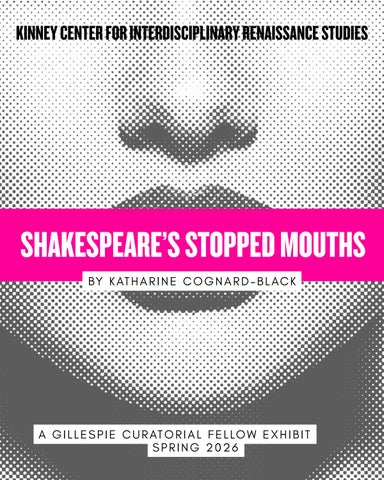
“Shakespeare’s Stopped Mouths” explores this phrase across three plays: Much Ado About Nothing, Henry V, and Titus Andronicus. In each play, after this phrase is uttered, a woman is silenced in ways that are intimately entangled with the structural politics of the play’s dramatic genre. In broad terms, comedies consider the politics of marriage and social union, histories examine the making of the nation, and tragedies interrogate revenge and its consequences.
For these plays, silencing women, whether through marriage, politics, or violence, drives the central action and reflects early modern concerns about female speech, sexuality, and social order. This exhibition interrogates mouthstopping as a means of enforcing the silencing and obedience of women ’ s bodies.


In the biblical tradition, we glimpse the intersection of gender politics, cruelty, and potential violence. Thomas Wilson’s A Christian Dictionary (1622) defines words and phrases through the biblical passages associated with them, and to “stop the Mouth” is defined as: “To put to silence, or to make dumbe, through astonishment of Gods workes.” To arrive at this definition, Wilson cites Job 5:16: “Iniquity shall stop her mouth.” Here “iniquity,” or wickedness, is personified as a woman and God’s power stops her mouth. This entangled metaphor of women ’ s mouths, wickedness, and mouth-stopping appears again in a definition of “Covering,” which indicates that mouth-stopping is explicitly entrenched in marital politics. The first definition refers to “The husband,” called the “Covering of his Wife,” because his duties are to “protect” her and “ govern ” her. The second definition is “Stopping, or making dumbe and silent,” citing Proverbs 10:6: “Iniquity shall cover the mouth of the wicked.” Read together, these definitions demonstrate a parallel relationship between the Christian understanding of God stopping the mouth of wickedness and husbands stopping the mouths of their wives.
In the final act of Henry V (Gillespie Collection, The Works of Mr. William Shakespear, 1709) King Henry and his soon-to-be queen, Princess Katherine of France, navigate the language barrier between English and French predicated on the performance of wooing. Henry attempts to kiss her, but when she explains that it is not the French fashion for ladies to kiss before they are married, he proclaims that he will “stop” Katherine’s “mouth.” Here, mouth-stopping through a kiss is emblematic of King Henry’s extensive violence: a violence of warfare, sexual control, and political subjugation.

A Short Dictionary English & French, with Another French & English (1685), compiled by Guy Miège, offers cross-lingual definitions of mouth-stopping in the seventeenth century; he defines “To stop his mouth” as “lui fermer la bouche.” The word “bouche” or mouth is inherently feminine, using the feminine “la.” This tension continues in Miège’s later examples of uses of the word “tongue.” Two examples include: “To hold his tongue” and “Her tongue runs, ” revealing an assumption of women ’ s tongues as unruly. In Henry V, Katherine’s mouth-stopping is as much about controlling her mouth with a kiss as it is about assimilating her French tongue.
There are also a number of instances in which mouth-stopping refers to bodily violence that renders someone incapable of speech. In Titus Andronicus (Gillespie Collection, Second Folio, 1632), the mouth of Lavinia, Titus’ daughter, is physically stopped when she is brutalized and ravished by Titus’ enemies Chiron and Demetrius. Chiron menaces, “Nay then, I’ll stop your mouth” before dragging her off stage to rape her. Following the rape, they cut out her tongue and sever her hands, a brutal literalization of the period’s impulse to silence and contain the female body. Her forced voicelessness transforms her into a figure through which male authority asserts control, revealing how sexual violence and the suppression of speech operate together within the play’s logic of power.