BY ABBI ANDREWS

![]()


BY ABBI ANDREWS

Printed plays and travel narratives from the seventeenth century are a space where questions of sovereignty, religion, and identity are dramatized through staged encounters between Europeans and the people they sought to subjugate. The texts you see here are not simply a reflection of colonial appetite. Rather, they actively participate in its making, shaping how audiences understand the empire and their place in it. This exhibit explores the methods by which adaptation, genre, and performance shape colonial imagination, asking: How do fictionalized narratives of submission and conversion shape the stories we tell about indigenous people? What does it mean for the upcoming generation of indigenous students to inherit this archive?

Read through the lens of indigenous representation, The Tempest (Gillespie Collection, Second Folio, 1632), invites viewers to reconsider the contested voice of Caliban. His claim, “This island’s mine, by Sycorax my mother” is an early example of colonial dispossession. Here, Caliban resists the reductive framing of him as merely monstrous or subhuman, although artistic depictions of his character insist otherwise. Caliban advocates for himself, asserting not only territorial belonging but ancestral continuity, positioning himself as both heir and steward of the island prior to Prospero’s arrival. His memory of teaching Prospero “all the qualities o ’ th’ isle” underscores a transfer of ecological knowledge that Prospero subsequently sullies and weaponizes against him, mirroring colonial dynamics in which indigenous expertise is exploited and then erased.

John Dryden and William Davenant’s The Tempest, or The Enchanted Island (Gillespie Collection, 1690) portrays a softened, Reformation-era retelling of The Tempest, that emphasizes Ariel and Caliban’s subjugation. Ariel defends her independence and questions the “Mortal” (Prospero) in holding her servitude. However, she later contradicts this self-defense, claiming, “And our own power has our subjection wrought!” In taking responsibility for her own captivity, Dryden and Davenant’s Ariel models a dramatic version of vanishing indigenous culture and existence, as Ariel curses the magic of her own people.


English playwrights Francis Beaumont and John Fletcher capture contemporary events of their era in The Island Princess (1679), a play centering the colonization and religious conversion of the people of Sidore, a fictional country that mimics the East Indies. In this play, a native woman Quisara, who was previously shown to be strong-willed and described by the white colonizers as “brave,” renounces her religion to marry the Portuguese Armusia, upholding herself as Christ-like and virtuous in the ways that would appeal to English audiences of the Restoration era. Quisara’s conversion narrative plays into the popular “white savior” trope, where the idyllic indigenous woman is redeemed by a Christian man.

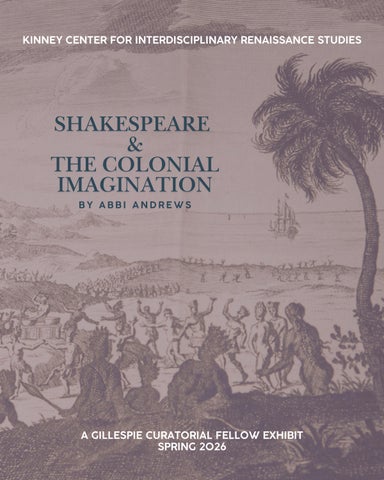
Thomas Gage’s Nouvelle Relation, Contenant Les Voyages de Thomas Gage dans la Nouvelle-Espagne (1699) includes an image that portrays a group of indigenous people of the Yucatan peninsula celebrating with music and dance. According to Gage’s account, they are participating in a sort of worship, and this illustration theatricalizes that spectacle for readers, portraying indigenous people as stereotypically unclothed and adorned with headpieces. Gage presents his travels as eyewitness truth, yet the depictions of indigenous life mirror the imaginative spectacle of the theatrical texts on display. Viewed together, we can see how stage and travel narrative collaborated, and how fiction and “fact” reinforced one another in the construction of imperial fantasy that persisted into the early 19 century and beyond. th

Abbi Andrews is a sophomore double-majoring in English and Theater with a minor in Education. Their academic interests include indigenous identities, and art, as well as Renaissance and Romantic literatures. Abbi is pursuing questions of indigeneity, decolonization, and multicultural performances of Shakespeare across time.
The Gillespie Curatorial Fellowship in Shakespeare and the Book offers an opportunity for advanced undergraduate and graduate students to work with one of the most important private Shakespeare collections in America. Fellows learn all aspects of curatorial practice from developing research questions, to creating exhibition materials, and collaborating with scholars and librarians in order to produce a special exhibit that tells new stories and forges new directions in the study of Shakespeare and the book.
Learn more about the Gillespie Curatorial Fellowship and the Gillespie Collection by visiting: www.umass.edu/renaissance
The Kinney Center for Interdisciplinary Renaissance Studies advances research in the early modern humanities. Our mission is to support and promote interdisciplinary scholarship and public-facing humanities programming with the goal of exploring connections between the early modern world (c. 1400-1700) and our own.
The Kinney Center for Interdisciplinary Renaissance Studies and the University of Massachusetts Amherst are grateful to the Gillespie Family for their generosity in supporting this visionary fellowship.