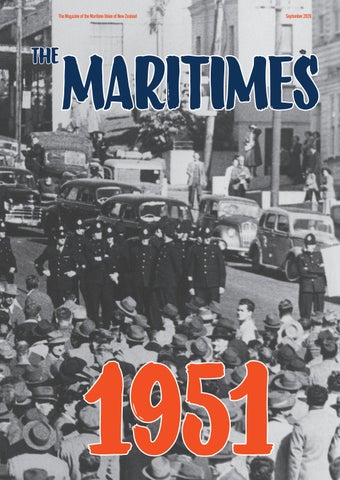
The Magazine of the Maritime Union of New Zealand
The
September 2026
MaritimES
1951
War on the Wharves (WOTW) Angelo Dymock and Sean Windon visit Port of Auckland, March 2026
2
NATIONAL REPORT
BY CARL FINDLAY NATIONAL SECRETARY
The maritime industry in Aotearoa stands at a critical crossroads. We are operating in an industry and wider environment defined by global conflict, supply chain disruption, and a crisis in our maritime workforce. The stability of our industry is being undermined by those who view shipping and port operations merely as lines on a balance sheet. But for the members of the Maritime Union of New Zealand, these are not just industries, they are our livelihoods, our communities, and our heritage.
75 Years Since 1951 Lockout
This year, we have marked a milestone that is at the heart of the history of the New Zealand workers’ movement: the 75th anniversary of the 1951 Waterfront Lockout.
For 151 days, the ruling class launched a calculated, statesponsored offensive against organised waterfront labour. As MUNZ veteran Mick Williams reminds us, the 1951 lockout was not a failure of negotiation, it was an act of open class war. The then-government used emergency regulations to smash the Waterside Workers’ Union, deploying the military to the wharves and making it a crime to provide food to the children of locked-out workers. They sought to break the back of the most powerful section of the working class – maritime workers. While they succeeded in the short term, they failed to extinguish the spirit of maritime solidarity. The Maritime Union is the direct descendant of these staunch and principled maritime workers. As we prepare for commemorations in Lyttelton, Wellington, and Auckland, we look back in resolve. The tactics of 1951 have modern parallels in the “lawfare” used by companies today to circumvent collective agreements. We learn from the struggles of the past to maintain the goals of maritime workers for the last century and longer – a safe workplace, good wages, job security and a say in the future of our industry.
Justice for Paritūtū
The struggle for worker justice is not always fought at the picket line. For decades, the workers and residents of Paritūtū in New Plymouth have lived with the toxic legacy of the IWD plant. The production of 2,4,5-T, a component of Agent Orange, has left a trail of severe illness that the state has been too slow to acknowledge.
Former MUNZ wharfie Andrew Gibbs has been steadfast in his long fight for “Justice for Paritūtū.” MUNZ is backing his call for full recognition and compensation for the maritime workers and their families who suffered from exposure to these lethal chemicals during the handling and transport of materials. This is a health and safety issue of the highest order. We cannot allow corporate entities to wash their hands of the human cost of their activity.
Holcim Dispute
On 8 July 2026, the Employment Relations Authority delivered its final decision in our legal battle against Holcim over the loss of the MV Buffalo crew’s jobs. The Authority ruled that Holcim had broken the law and breached the collective agreement. The company failed to consult the union openly and honestly about its sudden decision to switch to road and rail transport for its cement. Instead, it kept workers in the dark and rushed the consultation process over the Christmas period. Although the Authority found that Holcim had acted unlawfully, it decided that it was too late to make the temporary injunction preventing the dismissals permanent. Because the MV Buffalo had already been sold and had left New Zealand, the ship could not be brought back. This means the job losses cannot be reversed. However, the court battle was not in vain. At the time of writing we are finalising a settlement package that includes compensation for affected members. Holcim are struggling to deliver cement on land transport – let’s see whether they may change their tune on coastal shipping.
3
Moana Chief
The recent withdrawal of the MV Moana Chief – the last New Zealandflagged, Kiwi-crewed container ship operating on the domestic coast – shows the vulnerability of New Zealand’s maritime industry and supply chains. Under section 198 of the Maritime Transport Act 1994, foreign-flagged vessels operating under temporary exemptions undercut local operators through low wages and lax labour standards. MUNZ is lobbying the Government for immediate legislative reform to restore the New Zealand shipping industry as a key transport mode. Protecting domestic coastal shipping requires a level playing field in which local carriers are not squeezed out by flag-of-convenience operators. However, MUNZ have been in talks with new operators coming into the coastal shipping space and look forward to an announcement of new vessels and jobs for MUNZ seafarers in the near future.
Training Our Own
Our domestic maritime workforce has been pushed to the brink by neglect and the short-sightedness of successive governments. But we are finally seeing the fruits of our persistent lobbying. The recent announcement by Associate Transport Minister James Meager on dedicated funding to expand training berths for Kiwi seafarers through the Coastal Shipping Resilience Fund is a hardwon victory.
4
But funding is only the first step. We need a structural shift. We cannot rely on the market to train the next generation of seafarers. MUNZ is calling for a mandatory ratio of trainees on all vessels operating in New Zealand waters. We are currently working with industry partners and training institutions to ensure that this new funding translates into real jobs for young New Zealanders, ensuring that the skills and traditions of our trade are passed to a new generation.
Our Port – Kept Public
In a major victory for maritime workers and the wider Christchurch community, Christchurch City Holdings Limited (CCHL) announced on 30 July 2026 it had formally rejected the Tōnui Consortium’s unsolicited proposal, involving DP World, to lease operations at Lyttelton Port Company (LPC). This decision aligns with the Christchurch City Council’s 2026/2027 Letter of Expectation, which explicitly opposes leasing the port and supports retaining a directly employed workforce. This decision is a win for workers and the broader community who rely on a publicly owned port. However, we remain deeply concerned about any future privatisation attempts, unmanaged port expansion, and the ongoing lack of genuine, meaningful consultation with both frontline workers and mana whenua.
While declining the lease is significant, both MUNZ and the Rail & Maritime Transport Union (RMTU) emphasise that serious concerns persist regarding leadership culture, board oversight and management models at LPC. Operational decisions have long sidelined workforce expertise in favour of top-down management. Following a large public rally outside the CCHL offices on 31 July 2026, our two unions are demanding inclusive, transparent governance that respects frontline safety and includes meaningful consultation with local rūnanga.
Enrol to vote
With major industrial, safety and infrastructure issues facing our nation, ensuring every working person is registered to vote is critical to the future of trade unionism and public services across Aotearoa New Zealand. Decisions made at the ballot box directly affect workers’ rights, health and safety legislation, and protections for coastal shipping. MUNZ urges all members, whānau and supporters to ensure their details on the electoral roll are current. Enrolling or updating your details takes only a few minutes online at vote.nz
In Closing
The challenges we have faced as a Union in 2026 are significant, but our history shows that we are at our strongest when we are under pressure. Whether it is honouring the legacy of the 1951 veterans, fighting for New Zealand crews, or demanding safety in the Cook Strait, our power lies in our collective voice. Stay safe, stay united, and stay focused on the struggle.
NATIONAL OFFICIALS National Secretary Carl Findlay 021 760 887 carl.findlay@munz.org.nz
Contents National Report...........................................................3 1951: 151 Days Locked Out........................................6 Lyttelton remembers ‘The Big Blue’............................8 Memories of 1951: Tommy Gregory.........................10 MV Buffalo................................................................11 Workers’ Rights..........................................................12 Coastal Shipping..................................................14–16 Freight resilience........................................................18 Our Port, Our Future................................................20 Sacrificing Paritūtū.....................................................22 $8.3m Victory for Seafarer Training..........................26 People over Profit.......................................................28 ITF: Vega and Oceanmaster...............................30–31 Maritime youth organise at ITF Roundtable.............32 Health and Safety................................................34–35 Political: Alliance and Labour..............................36–37 Taranaki Hosts a Resounding Interport Success.......40 Obituaries............................................................42–45 Paritūtū Addendum...................................................46
National President Josh Greer \ 027 348 2692 josh.greer@munz.org.nz National Assistant Secretary Fiona Mansell 022 302 3010 fiona.mansell@munz.org.nz National Vice President Gerard Loader 021 128 6236 gerard.loader@munz.org.nz
NATIONAL OFFICE Level One, Waterside House, 220 Willis Street Wellington PO Box 27004 Wellington 6141
The Maritimes is the official magazine of the Maritime Union of New Zealand ISSN 1176-3418
Telephone (04) 3850792 www.munz.org.nz
Editor and Communications Officer Victor Billot 0224791786 Email victor.billot@munz.org.nz
Office Manager Ramesh Pathmanathan ramesh@munz.org.nz
Authorised by Carl Findlay, 220 Willis Street, Wellington
Senior Admin. Albert Williams albert.williams@munz.org.nz
Contacts Local 13 Auckland – Whangarei – Mt Maunganui – Gisborne Grant Williams 021 457 170 Secretary grant.williams@munz.org.nz Hector Thorpe 027 777 7162 President hector.thorpe@munz.org.nz Russell Mayn 021 760 886 Business Agent russell.mayn@munz.org.nz Graham McKean 021 960 164 Organiser graham.mckean@munz.org.nz Joe Gallagher 021 193 8132 Maritime Negotiator joe.gallagher@munz.org.nz Napier Greg Primrose Secretary New Plymouth Josef Zaloum Secretary
021 028 23167 greg.primrose@munz.org.nz 022 062 9049
Wellington Fiona Mansell Secretary Nelson Paul Stewart Lyttelton – Timaru Local 43 Gerard Loader Secretary
022 302 3010 fiona.mansell@munz.org.nz 022 612 0503 paul.munznelson@gmail.com 021 128 6236 gerard.loader@munz.org.nz
Port Chalmers – Dunedin Local 10 Josh Greer 027 348 2692 Secretary josh.greer@munz.org.nz Bluff Ray Fife Secretary Grahame McLaren ITF Inspector
027 4475317 ray.fife@munz.org.nz 021 292 1782 mclaren_grahame@itf.org.uk
5
BY VICTOR BILLOT
The 1951 Waterfront Lockout remains a landmark of New Zealand history. For 151 days, waterfront workers and their allies resisted sustained attacks from Sid Holland’s right-wing National Government, employers, the police, and the establishment media. During the dispute, the Government deployed the armed forces to work the wharves and passed draconian “emergency legislation” that effectively outlawed freedom of speech. It even became illegal to provide food to the children of locked-out workers. Police suppressed peaceful demonstrations with baton charges, a compliant media poured contempt on the “wharfies,” and authorities conducted midnight raids on workers’ homes. The struggle was further complicated by internal friction. The leadership of the Federation of Labour (FOL) viewed the watersiders as a threat to their own power and worked against them, while the Labour Party famously refused to take sides. Largely isolated, the watersiders resisted with incredible tenacity, but the opposing forces eventually proved too strong. After five months, the battle ended. The legacy of 1951 endured. Genuine unions gradually reasserted themselves on the waterfront, and many veterans of the lockout went on to become pivotal leaders across the broader New Zealand trade union movement.
Origins of the Conflict
Post-World War II, the Waterfront Workers’ Union (WWU) was the country’s most militant and influential union. Despite being smaller than some counterparts, its industrial leverage and progressive politics were unmatched.
6
The union was more than just a workplace entity; it was a community, boasting sports teams, bands, and even a debating club. While affiliated with the Labour Party, the WWU was a vocal critic of the party’s rightward shift in its final years of government, particularly regarding compulsory arbitration and conscription. The 1949 election returned a National Government to power for the first time in 14 years, led by Sid Holland. Meanwhile, the FOL was dominated by its President, Fintan Patrick Walsh – a complex, authoritarian figure who frequently clashed with WWU leaders Jock Barnes and Toby Hill. In 1950, the WWU led a walkout of militant unions from the FOL to form the alternative Trade Union Congress. While their grievances were valid, this split would leave the watersiders dangerously exposed in 1951. The final straw came in early 1951. While the Arbitration Court granted a general 15% wage increase to most workers to combat post-war inflation, the Waterfront Commission offered the watersiders only 9%. Facing dangerous conditions— handling everything from freezer carcasses to toxic lampblack—the union stood its ground. On February 13, 1951, they refused to work overtime beyond a 40-hour week. Two days later, they were locked out.
151 Days of Resistance
By February 21, Prime Minister Sid Holland declared a state of emergency, later claiming the nation was “at war.” Despite Walsh’s opposition, rankand-file seamen, miners, and freezing workers struck in solidarity. The crackdown was absolute. The Government de-registered the unions, seized their funds, and used inexperienced servicemen to work the ports.
Around 22,000 workers were involved at the height of the dispute. While local relief committees scrambled to feed families, the political establishment remained hostile. Labour leader Walter Nash’s refusal to take a side – stating he was “neither for the watersiders nor against them” – became a symbol of the political isolation the workers faced. Violence escalated in May and June. On “Bloody Friday” (June 1), police brutally batoned a peaceful march of 1,000 men and women on Auckland’s Queen Street. Despite the state-sponsored violence and “Red Hysteria” fuelled by Cold War tensions, the families of the locked-out workers held firm, supported by clandestine printing presses and women’s auxiliaries.
Aftermath and Legacy
The dispute ended in a tactical defeat. Many workers were blacklisted, and “scab” unions were established by employers to replace the WWU. However, the long-term spirit of the movement could not be broken. Over time, genuine unionists regained control of the waterfront, eventually re-forming a national union. As noted by historian Anna Green, the lockout was less about profitability—shipping companies were seeing record profits—and more about a deliberate attempt to destroy union leadership and regain absolute control over the wharves. Today, the lessons of 1951 remain vital. It serves as a reminder that without struggle, there is no progress. As veteran Tommy Gregory put it: “You must be in the Union. It’s strength. The bigger the stronger.”
151 DAYS LOCKED OUT
Photo credit by Victor Billot
1951
7
1951
Lyttelton remembers ‘The Big Blue’ 8
1951
On May Day, Friday 1 May 2026, the Maritime Union of New Zealand and friends gathered in Lyttelton to mark the historic 1951 Waterfront Lockout. To commemorate the courage of those who refused to be broken, MUNZ hosted its 75th anniversary event at the historic Loons Hall. A central feature of the night was the official release of Wrecker Songs, a new album supported by MUNZ and recorded by Lyttelton-based singersongwriter Adam McGrath and The Eastern. The sold-out evening brought together union members and national and international guests, with speeches, live performances from the new album and a rock-androll social celebration. Officials from the Maritime Union of Australia were invited to honour the enduring transTasman bond forged in 1951, when Australian watersiders and seafarers provided vital support to locked-out New Zealand workers.
As McGrath says, “Wrecker Songs started like all good things should start, over a beer in the union hall standing behind Jordan Luck! A conversation with Lyttelton MUNZ Secretary Gary Horan about why and how records got made became an idea about what they could do once out in the world, what they could be; about how folk records had to reach beyond the internal maladies that are the usual fodder for singer-songwriters, further into the world in which they inhabit.” “My dad joined the merchant navy as a young teenager and spent his life between pubs and construction sites at sea. Also, the work we’ve done for unions over the years suggested there were songs to find within the scope of the Maritime Union and the Seafarers’ and Watersiders’ unions that preceded it.
The songs run the gamut from fight songs to lonesome songs, drinking songs, unemployment songs and the little shared experiences of women within and close to the Maritime Union movement. With the world seemingly on fire, the rise of fascism, a New Zealand government in the pocket of the moneyed, unemployment on the march and people as isolated from each other as they’ve ever been, it’s important to roll our sleeves up and get busy working our row with as much empathy, solidarity and history in our packs as we can.”
9
1951
Memories of ’51: A Conversation with Tommy Gregory BY VICTOR BILLOT
10
Talking with the late Tommy Gregory in 2011 was a privilege. One of the last surviving veterans of the lockout, he remained mentally sharp and fiercely committed to his working-class convictions. Tommy joined the Wellington waterfront in 1949. Back then, getting on the wharf required a rigorous nomination process. “It was real hard work,” he recalled. “No mechanization. Everything was moved by wheelbarrows. In 1949, the cranes were still hydraulic.” When the lockout began, Tommy was a young father living in a tworoom shared flat. He remembered New Zealand shifting into what felt like a martial law regime. “It was a real police state. We couldn’t get our story across at all.” Tommy worked in the “underground,” distributing illegal leaflets. When asked sixty years later where he got them from, he remained tight-lipped with a wink: “I can’t say. It’s still secret. MI5 were trying to find out.” He recalled being locked in an office by a manager and having his house searched by police for “subversive” literature. Tommy’s most poignant memories were of the social toll. He recalled the heartbreak of seeing a community turn on the “wharfies” who had previously been so charitable. “I was very disappointed... the wharfies used to do a lot for Wellington, gave money to the children... but when the dispute came, the people turned on us.” Though he eventually returned to the waterfront and later the sea, the scars of 1951 remained. “We should have known when we was beat,” he admitted, reflecting on the broken marriages and lost homes. Yet, his final message to the next generation was one of solidarity: “The country’s never been in worse shape... You must be in the Union.”
COASTAL SHIPPING
MV Buffalo The long-running battle over the coastal cement ship MV Buffalo finally concluded with a settlement in August 2026. For nearly a year and a half, crew members stood against multinational corporate giant Holcim and its anti-New Zealand shipping agenda. The dispute kicked off in early 2025 when Holcim announced plans to retire the MV Buffalo, which had spent years hauling bulk cement from Timaru to ports across the country. Instead of keeping Kiwi seafarers on the job, Holcim teamed up with NovaAlgoma Cement Carriers (NACC) to bring in a foreign-flagged vessel, the NACC Vega. The plan was simple: get rid of the New Zealand crew and run domestic routes using vulnerable international workers on a fraction of our pay and conditions. To pull this off, Holcim asked the government for an exemption under s.198 of the Maritime Transport Act, using a legal loophole to bypass domestic coastal shipping. MUNZ fought back immediately and demanded the government back local workers. In December 2025, the Associate Minister of Transport James Meager officially rejected the Holcim application. The Minister’s decision upheld the principle that coastal cargo should be carried by New Zealand ships whenever suitable vessels are available. The NACC Vega was no longer an option. Furious that their cheap-crewing scheme had failed, Holcim management hit back with what they referred to as the “nuclear option”.
The company pulled out of coastal shipping altogether and dumped 15,000 tonnes of bulk cement onto roads and rail every month. Shifting that cargo into more than 500 extra heavy diesel trucks every month clogged and damaged highways, created safety hazards, and poured emissions into the atmosphere. It also made a joke of Holcim’s public relations spin about “green transport” and clean supply chains. With assistance from the Maritime Union of Australia (MUA), the Seafarers International Union in Canada, and the International Transport Workers’ Federation (ITF), MUNZ took the fight to Holcim’s global HQ in Switzerland. When Holcim handed redundancy notices to all 32 crew members right before Christmas, MUNZ took the company straight to the Employment Relations Authority. The Authority stepped in and ordered a halt to the redundancies, later ruling that Holcim had broken its collective agreement and failed its legal duty to act fairly and honestly with workers. A final confidential settlement was signed by Holcim, MUNZ and crew members in August 2026. Holcim have meanwhile struggled to shift their cement, and it is entirely possible they may have to return to shipping in the future. In the meantime, local management have badly damaged their reputation and credibility.
11
WORKERS’ RIGHTS
Anti-worker Government has got to go! The Government is changing employment law, and once again workers are losing ground. In 2026, the National-ACT-New Zealand First Coalition Government has pushed through major changes that give employers more power and workers fewer protections. Politicians like Christopher Luxon call it “flexibility.” For us, it means weaker job security, fewer rights when things go wrong, and more pressure on collective bargaining.
12
WORKERS’ RIGHTS Health and safety changes put us at risk
The Health and Safety at Work Amendment Act 2026 has been passed and comes into force on 1 April 2027. These laws weaken safety duties and push some hazards down the list. For maritime workers, that is no small issue. Ports and ships are dangerous workplaces. We work around heavy machinery, moving cargo, vehicles, fatigue, shift work and constant commercial pressure. Contracting-out can add another layer of risk, with different employers and crews working side by side. Health and safety rules are not “red tape” when lives are on the line. Workers need strong safety laws, trained union health and safety reps, and the confidence to speak up without putting their jobs at risk.
Leave rights are next
The Employment Leave Act 2026 has also been passed, although most of it will not come into force until August 2028. It will replace the Holidays Act. Under the new system, leave will be based mainly on “standard hours”. Extra and casual hours will instead attract a 12.5 per cent leave payment. Workers with irregular hours could lose real paid time off and that the system could encourage more insecure work. This will affect many maritime workers!
Fewer rights when you are treated unfairly
The law also makes it harder for workers to get proper remedies when an employer acts unjustifiably. If a worker’s behaviour contributed to the problem, compensation can be cut, in some cases by 100 per cent. If serious misconduct is found, there may be no remedy at all. Employers get more room to move, while workers carry more of the risk. These changes follow earlier attacks on workers’ rights, including laws allowing pay deductions during partial strikes and major changes to pay equity. None of this is happening by accident. Piece by piece, the plan is to shift power away from workers and towards employers. The answer is the same as it has always been: strong unions, strong collective agreements, strong health and safety, and workers standing together in our Union, MUNZ.
Health and safety rules are not “red tape” when lives are on the line.
Easier to treat workers as contractors
The Employment Relations Amendment Act 2026 came into force on 21 February. It introduced a new test for deciding when someone can be treated as a contractor instead of an employee. That matters because contractors miss out on many basic employment rights. The law also scrapped the rule that new workers covered by a collective agreement start on those collective terms for their first 30 days. Employers can now put new workers straight onto individual agreements. That weakens the role of collective agreements and makes it easier to divide workers from the start.
13
COASTAL SHIPPING
Moana Chief
14
The MV Moana Chief was withdrawn from service in July 2026. This was the end of Pacifica Shipping’s coastal run and took out the last dedicated New Zealand-flagged container service on our coast. Sent overseas for mandatory drydocking in Asia with no replacement lined up, the vessel’s withdrawal meant redundancy for the crew and severed New Zealand’s only domestically crewed container link. For the crew onboard, the shutdown followed a consultation process where management said it couldn’t find a viable commercial path forward under current market conditions. Beyond the immediate loss of Kiwi crew, retiring the ship cuts away essential sea-time and entrylevel training pathways for the next generation of young mariners looking to make a career on our coast. This event was part of the long attrition caused by the broken rules that leave domestic shipping running on an uneven playing field.
Pacifica previously brought on the Takutai Chief in 2022 under the government’s Coastal Shipping Resilience Fund to run a two-vessel schedule. But once that co-investment dried up and freight markets shifted, Swire withdrew the Takutai Chief in August 2024, leaving the Moana Chief to battle it out solo. The biggest thorn in the side of domestic shipping remains Section 198 of the Maritime Transport Act 1994. Under the current setup, international container lines can scoop up domestic cargo while making transit calls around New Zealand ports. These foreign-flagged ships run on international crew wage structures well below local industry baselines, heavily undercutting operators that employ Kiwi seafarers, comply with domestic standards, and pay local taxes.
To make matters worse, statefunded freight handlers like KiwiRail have routed domestic cargo onto international lines instead of backing New Zealand coastal shipping. The Maritime Union of New Zealand is continuing to build pressure. National meetings have backed an ongoing battle for legislative reform of Section 198 to secure proper cabotage protections so local cargo stays on Kiwi-crewed ships, and to rebuild New Zealand coastal shipping and training for seafarers. Losing the Moana Chief is a heavy hit, but the push to rebuild our domestic shipping goes on. MUNZ continues to enforce collective agreement protections while working with emerging domestic players to explore fresh coastal options. The job now is to keep our membership united, call out unfair competition, and fight for a coastal fleet crewed by New Zealand seafarers.
15
COASTAL SHIPPING
A seafarer writes on the future of New Zealand Coastal Shipping BY VICTORIA ALE
Victoria Ale was the Navigation Officer on the MV Moana Chief. The 34-year-old Aucklander began her maritime career as a Stewardess in the offshore industry and retrained as an officer at the Manukau Institute of Technology. She is the first person of Pasifika heritage to hold such a position in the New Zealand shipping industry.
16
What is happening to New Zealand’s maritime industry affects every person in this country, whether they realise it or not. The ship I served on as Navigation Officer, the MV Moana Chief, was the last New Zealand flagged and crewed container ship in our coastal trade. It was removed from service in July 2026. This is a devastating blow for our maritime industry. But it is not too late to change the path we are on. Decisions made by successive governments have contributed to the decline of New Zealand’s shipping capability, weakening our nation’s economic resilience and security. Most New Zealanders rarely consider the journey taken by the products we use every day. The food on supermarket shelves, the fuel that powers our vehicles, the construction materials used to build our homes, and the clothing, furniture, and vehicles sold throughout the country all have one thing in common. They must be transported.
COASTAL SHIPPING As an island nation, New Zealand has always depended on shipping. Like many nations across the Pacific and elsewhere in the world, our prosperity has been built on maritime trade. For generations, ships have connected our communities, supported our economy, and enabled the movement of goods both around our coastline and across international waters. What many people do not realise is that New Zealand was once a significant maritime nation itself, operating a fleet of New Zealandowned and New Zealand-crewed vessels that carried cargo throughout the country and around the world. Our shipping companies provided employment for thousands of skilled New Zealand seafarers and played a vital role in maintaining the country’s economic resilience and security. Today, that industry has largely disappeared. The list of New Zealand shipping companies that once operated proudly under the New Zealand flag is long. Yet despite their contributions to our economy and national infrastructure, many no longer exist or have ceased operations. Their decline was not caused by a single event, but by a series of policy decisions, regulatory changes, and a lack of long-term strategic support for the maritime sector.
The result is a chain reaction that has brought New Zealand coastal shipping to a critical point where we are dependent on foreign-owned vessels and international operators to move essential goods around our own country. Companies such as the Union Steam Ship Company, the Northern Steam Ship Company, the New Zealand Shipping Company and the South Pacific Line were once part of New Zealand’s proud maritime heritage. Today they are gone. More recently we have lost New Zealand-crewed oil tankers operated by Silver Fern shipping, cement vessels operated by Holcim, and now the Moana Chief, the New Zealand flagged and crewed container ship that I work on as Navigation Officer. What does that loss mean for the future of our nation? Government policies have led to this situation. They turned their backs on the laws and protections that were designed to safeguard New Zealand’s self-reliance, independence, and the maritime workforce that helped build this nation. The open coast policy in the 1990s with its changes to Section 198 of the Maritime Transport Act have led to loopholes and exemptions, where international vessels have been allowed to undertake coastal shipping operations that were once and should still be reserved for domestic shipping.
As more coastal freight is carried by overseas vessels exploiting low-cost labour, employment opportunities for New Zealand seafarers have declined, local maritime skills have diminished, and investment in New Zealand shipping has stagnated. This is not simply an industry issue. It is a national resilience issue. A country surrounded by ocean should not be dependent on foreign shipping interests for the movement of essential goods between its own ports. The decline of New Zealand’s coastal shipping fleet has weakened our ability to respond to emergencies, disrupted career pathways for future generations of seafarers, and reduced our control over a critical part of our transport infrastructure. Meanwhile international shipping companies contribute nothing back into the local economy via taxes or crew wages. If New Zealand is serious about strengthening supply chain security, reducing transport emissions, and rebuilding domestic capability, then restoring the framework that prioritises New Zealand crewed and flagged vessels is vital. Without immediate action, the decline of our maritime industry risks leaving New Zealand dependent on foreign operators while the skills, knowledge, and experience of New Zealand seafarers disappear. We cannot wait any longer.
17
FREIGHT RESILIENCE Contents How would NZ’s vital freight system handle a big earthquake? CÉCILE L’HERMITTE, SENIOR LECTURER IN LOGISTICS AND SUPPLY CHAIN MANAGEMENT, UNIVERSITY OF WAIKATO
When we think of a major earthquake striking Aotearoa New Zealand, our minds first turn to collapsed buildings and the immediate toll on human lives. Few of us might ponder what happens in the days and weeks that follow, when supermarkets need restocking, fuel stations need replenishing and businesses need to keep goods moving around the country. One of the most critical links in the supply chain is the Cook Strait ferry network. It bridges State Highway 1 and New Zealand’s main rail corridor, carrying more than 500 trucks a day and 5.5 million tonnes of freight each year. Yet this system is reliant on just four roll-on, roll-off ferries operated by Interislander and Bluebridge’s StraitNZ. Our newly published research explored a disaster scenario in which Wellington and Picton’s ferry terminals are put out of action for three months, along with several ports, fuel facilities and parts of the road and rail networks. Such disruption might simply appear an unavoidable consequence of the earthquake. But our findings suggest many of the biggest transport problems would stem not from the disaster itself, but from policy decisions made years earlier.
18
Our scenario centres on a magnitude 8.5 earthquake and tsunami generated by the Hikurangi Subduction Zone – New Zealand’s largest and most active fault – which damages infrastructure across the lower North Island and upper South Island. Scientists have calculated a roughly one-in-four probability of such an event occurring within the next 50 years.
How NZ’s freight network breaks down
We found the ferry terminals present a vulnerability, with participants describing them as ageing infrastructure not built to modern resilience standards. If knocked out, freight operators would immediately need to find other ways of moving goods between the islands. But the alternatives are far more limited than they first appear. Although air freight could move urgent goods, such as medicines and high-value products, it is expensive, has limited capacity and already faces shortages of pilots, engineers and specialised ground staff. That would leave coastal shipping carrying much of the burden. Yet it too has limited spare capacity.
There are not enough vessels, containers, refrigerated equipment and trained personnel to suddenly accommodate a large increase in demand. That challenge has been compounded by the recent closure of Pacifica’s domestic service. The remaining ports would also come under pressure. Vessels and containers would be redirected to a smaller number of available locations, while existing labour shortages would make it difficult to expand capacity quickly. Trucks collecting and delivering freight would add further congestion.
Road networks would face similar pressures. Alternative routes would be longer, creating delays and increasing demand for trucks and drivers, worsening existing workforce shortages. Many roads would also carry more heavy vehicles than they were designed for, increasing wear and tear and maintenance needs. The disruption would extend well beyond transport itself. Fuel pumps depend on electricity. Truck drivers rely on electronic payment systems to fill up. Freight operators need telecommunications to coordinate deliveries and share information. If these systems failed after a disaster, the disruption would quickly cascade through the freight network.
Contents
Can NZ avert a disaster after a disaster?
While the earthquake is what exposes many of these vulnerabilities, they often are not what creates them. Take ports. Congestion on the country’s docks after a disaster may seem inevitable.
But it would also reflect years of under-investment or lengthy approval processes that limit spare capacity. The country’s largest port, Tauranga, has spent years seeking resource consent to expand its berths, leaving it less able to absorb sudden surges in freight demand if other ports become unavailable. The same pattern can be seen elsewhere. A shortage of coastal shipping vessels can come back to uncertainty over marine fuel policy and limited support for the sector, discouraging investment in new ships. Difficulties finding enough truck drivers, port workers, or shipping and aviation personnel similarly reflect workforce shortages that existed long before the earthquake. Overall, we identified 43 constraints linked by 99 causeand-effect relationships. But they ultimately traced back to just 18 root causes spanning six broad areas of government policy.
This suggests freight resilience is not only about how quickly infrastructure can be repaired after a disaster. It also depends on the policy settings already in place. That means investing over the long term in critical infrastructure, coastal shipping, transport network redundancy and workforce development, while ensuring timely resource consent processes for infrastructure expansion. Natural disasters are costly, unavoidable and will always disrupt freight movement. But how severe that disruption becomes depends partly on choices made long before the ground starts shaking.
This article is republished from The Conversation under a Creative Commons licence. Read the original article: https://theconversation. com/how-would-nzs-vital-freight-system-handle-abig-earthquake-our-study-sounds-a-warning-288266
19
KEEP OUR PORT PUBLIC
Our Port, Our Future: Solidarity Defeats DP World at Lyttelton Port
20
KEEP OUR PORT PUBLIC When Dubai Government-owned global corporate giant DP World attempted an operational takeover of Lyttelton Port, they underestimated the strength and resolve of port workers and the wider Canterbury community. Through industrial vigilance, proactive council lobbying, and international solidarity across Australasia, maritime workers forced Christchurch City Holdings Limited (CCHL) to shut the door on the privatisation push. In June 2026, Lyttelton port workers uncovered an unsolicited bid to strip operational control from Lyttelton Port Company (LPC). Submitted to CCHL (the commercial investment arm of the Christchurch City Council), the proposal came from the newly formed “Tōnui” consortium, pairing DP World with three local Papatipu Rūnanga: Te Hapū o Ngāti Wheke, Te Ngāi Tūāhuriri, and Te Taumutu. The bid dangled $243 million in upfront proceeds alongside promises of private capital investment. Despite corporate PR promoting the scheme as an innovative partnership, MUNZ immediately identified it as a backdoor privatisation deal designed to lease out port operations and extract private profit from a strategic, publicly owned asset. MUNZ leadership wasted no time explaining DP World’s brutal international track record. In the United Kingdom, DP World subsidiary P&O Ferries triggered worldwide condemnation after summarily firing 800 seafarers with zero notice and replacing them with cheap agency labour.
Across the Tasman in Australia, the company has mounted relentless attacks on waterfront conditions while paying virtually zero corporate income tax over eight years, despite raking in roughly A$4.5 billion in revenue. Furthermore, DP World has aggressively pushed unchecked AI and robotics across its global terminals to eliminate unionised stevedoring jobs. This grim global record prompted Paddy Crumlin, President of the International Transport Workers’ Federation (ITF), to sound a stark warning: “If DP World gets into New Zealand, do you think it will be any different?” ITF Regional Secretary Scott McDine and Maritime Union of Australia (MUA) National Secretary Jake Field pledged their full transTasman backing, confirming that Australian dockers stood shoulderto-shoulder with MUNZ to ensure Lyttelton stayed in public hands. MUNZ National Secretary Carl Findlay condemned the takeover scheme, warning that private terminal monopolies inevitably hike supply-chain fees on local businesses, strip public wealth, and degrade safety standards. At the local level, MUNZ Lyttelton Branch Secretary Gerard Loader stressed that retaining a 100% publicly owned and operated port was vital for frontline workers, safety, and the regional economy. MUNZ leaders engaged directly with mana whenua and local rūnanga, maintaining mutual respect while sharing serious concerns over port governance and environmental safeguards for Whakaraupō.
A major factor in turning the tide was union engagement in Christchurch local body elections. By campaigning to elect councillors committed to protecting public assets, unions secured a strict anti-privatisation mandate in the Council’s formal Letter of Expectation (LOE) to CCHL. Faced with unified workforce opposition and strong public pushback, CCHL formally rejected the Tōnui consortium’s proposal in late July 2026, confirming it failed to meet the threshold for detailed consideration. While external corporate raiders have been turned away, MUNZ members are keeping their guard firmly up. The victory follows years of industrial friction at LPC, including legal challenges over management’s unilateral container terminal restructures, attempts to de-unionise supervisory roles, and ongoing disputes over safety standards. MUNZ also continues to scrutinise LPC’s proposed major reclamation project at Te Awaparahi Bay, challenging flawed freight forecasts and potential automation risks. Lyttelton Port was built by generations of working people, and MUNZ will continue to stand firm on the wharf to defend working conditions, hold management accountable, and ensure Canterbury’s primary gateway remains in public hands.
21
INVESTIGATIVE REPORT
Ivor Watkins Dow Ltd Paritutu Plant, 1985
SACRIFICING PARITŪTŪ: A Chemical War on Our Waterfront 22
INVESTIGATIVE REPORT
The jagged silhouette of Paritūtū Rock looms over the Port of New Plymouth. For the families who lived in its shadow and the watersiders who worked the docks in the 1960s, Paritūtū is the site of what Andrew Gibbs calls a sacrificed community – and a decades-long betrayal of the working class. From 1960 to 1987, the Ivon Watkins then Ivon Watkins-Dow (IWD) chemical plant at Paritūtū produced the herbicides 2,4,5-T and 2,4-D. Both were components of the defoliants used by the US military to strip the jungles of Vietnam during the war and extensively used in New Zealand to clear scrub and weeds. Earlier production processes created higher levels of contaminants like 2,3,7,8-TCDD, or dioxin. At lower levels TCDD dioxin impacts reproductive (offspring) and immune systems and it is a potent carcinogen. For twenty-five years, Andrew Gibbs (Gibbo) – a port worker, and former President of the MUNZ New Plymouth Branch – has waged a relentless campaign to expose the effects of this chemical on historic residents and port workers. Gibbs’s message is clear. Officials didn’t just ignore the poisoning of Paritūtū, they actively covered it up. This is an issue of worker and public safety denied, avoidance of liability, failure of corporate accountability, and a ‘genetic bubble’ of health defects still impacting the children and grandchildren, some who were exposed in the 1960s. Gibbs also points to the relevance of silenced Paritūtū exposure and reproductive data to those also impacted in Vietnam, Cambodia and Laos. In 2012 the IOM (who advise US Congress on defoliants) expressed concern at the loss of these ‘valuable results’ to ‘the scientific community’.
The narrative pushed by the Ministry of Health for years is that dioxin exposure was not sufficient to warrant the ESR recommended targeted health investigation. Gibbs claims the data runs against this strategic PR narrative, placing port workers at the heart of the danger zone. Exposure for some watersiders was two-fold – both occupational and environmental.
Port Workers in the Plume
Port Taranaki was the gateway for the raw materials entering the plant and the chemical products leaving the then Harbours Board owned site. In the 1960s, before containers and modern health and safety regulations, watersiders handled toxic cargoes manually. Gibbs cites testimony from former watersider the late Norm Quinlan, a World War Two veteran and union stalwart. Quinlan described how drums containing liquid chemicals would break during unloading in the ship’s hold. Workers got covered. Norm Quinlan was present at the release of the serum dioxin report and held strong concerns over impacts on residents and watersiders and their families. The danger didn’t stop when the shift ended. After sewers were destroyed, the IWD plant disposed of its liquid chemical waste through soak ponds then an open drain that ran through Centennial Park, and down the access track to Back Beach. This was a popular spot for port workers and other local families to play, gather kai moana, swim, surf and relax. Watersiders were wading through a chemical soup. They were breathing it in their homes, as aerial emissions from the plant drifted over
the residential streets of Paritūtū and Moturoa. “Two watersiders, Ernie and Roly, had the highest [dioxin] elevations in the 50-64 year age group,” Gibbs notes in his correspondence. Both had exposures higher than US Vietnam Veterans and mirroring those in NZ who had sprayed 2,4,5T for decades, both lived and worked in the IWD plant plume.
The Science of Silence
If the exposure was so high, why did official government reports repeatedly conclude there was no substantiated evidence of harm? In 2001, bowing to community pressure, the government commissioned a blood serum study to test residents for dioxin. Interim results in 2004 were shocking. They showed that some residents had dioxin levels in their blood comparable to Vietnamese exposed to defoliants and even higher than US veterans exposed to Agent Orange in Vietnam. Remarkably 1960s residents’ exposures exceeded the majority of IWD workers tested later in Otago and Massey University studies A Cabinet briefing notes the MoH set up a unit to manage risks – specifically the financial risk of ACC claims and compensation – rather than to assess impacts. Gibbs’s analysis of the data reveals a statistical sleight of hand. He argues after the unit was set up to manage risks Ministry of Health (MoH) officials took over the ESR serum dioxin investigation flooding it with post 1973 low exposure subjects. Heavily exposed 1960s residents were removed from time period comparisons. For residents with at least three years exposure in the dirty pre 1969 period 96% of their dioxin increase was isolated as ‘long term’. The effect was to obscure high 1960s exposures and use fabricated evidence of long-term exposures to minimise backdating to 1987 instead of higher earlier exposures 23
INVESTIGATIVE REPORT so lowering the average exposure results, allowing the government to claim that while levels were elevated, they weren’t catastrophic. So after first reporting Vietnam comparable dioxin exposures, at the later release of the revised Part II study officials announced, the new focus would be on the IWD workers. Recently released files confirm after TV3 broadcast concerns about the serum dioxin report, officials decided identifying further ‘errors’ was unnecessary. The lead investigator refused an official request to review an incorrectly grouped result, instead the ESR and Ministry of Health spent nearly $50,000 on lawyers to silence TV3 with media complaints. Two further reviews were instructed without the contested years of residence and one other review of the extracted data. The review of extracted data suggested revisiting the timing of exposures 4 times. Actual data groupings in the ESR report were not reviewed. These reviews did not review the (evidenced) specific claim raised at Select Committee by local MP Harry Duynhoven (son of watersider the late Tony Duynhoven) that moving particular individuals with a high test and a high level of exposure into a different era altered the averages over the study. Officials have not yet replied to 2014 community allegations evidenced with anonymised data, or allegations sent in the NZF 2017 letter to the Health Minister, or the related 2023 media question. Anonymised serum dioxin data was accidentally left open online when two dishonest errata were added into the 2005 report. One corrected 20 of 76 errors and the second 2 of 4 incorrect groupings. 24
The most heart-breaking aspect of this involves the next generations. From the mid-1960s, Hyacinth Henderson, Matron at Westown Maternity Hospital, began noticing a spike in birth defects. At the same time animal studies from the USA were linking both 2,4,5-T and 2,4-D to birth defects and stillbirths following maternal exposures. In 1969 media reports on birth defects emerged in Vietnam. The New Zealand Government’s 1969 budget introduced a direct subsidy on agrichemicals like 2,4,5T. The US embassy notified New Zealand officials of proposed US restrictions after findings of adverse impacts in animal studies. Military use of 2,4,5-T in Vietnam promptly ceased. Paritūtū clusters posed another potential problem to use of subsidised herbicides and over 1969 to 1981 of approximately 20,965 square kilometres – around 8% of the NZ landmass was cleared.
Three decades later
A 2002 report (1965-72) identified a cluster of three neural tube defects in the Paritūtū community when only one was expected (note 8 of 28 original NTD cases were lost to follow up). But subsequent government reports in 2010 calculated the rate of defects like the NTD Anencephaly based on the population of the entire New Plymouth district (approx. 40,000 people). By spreading the cluster over a large, unexposed population, the 7.5x expected statistically significant Paritūtū Anencephaly cluster disappeared. The timeline matches perfectly. Peak dioxin emissions occurred in the mid-late 1960s. The spike in birth defects followed immediately after. In 1970, death certificates confirm
a spike in female stillbirths. The government’s 2008 health plan offered only annual check-ups for the exposed generation and avoided investigation of hereditary effects on their children and grandchildren. A waterside led scoping study of mid 1960s residents within 500 metres of IWD found one in 4 females born 1962-72 were either stillborn or suffered early neonatal deaths. This does not include three watersider miscarriages (two were severely malformed twins.)
The “Lost” Report
In several purges key files, and the record of destroyed files, were destroyed and health officials claimed records from the 1960s were gone. In 2024, a confidential 1996 report by Groundwater Technology, conducted for DowElanco, was “rediscovered.” The 1996 report misfiled for nearly 30 years by then site owners the Taranaki Regional Council confirmed soils were heavily contaminated. 20 years after use of the late 1960s to 1975 western liquid waste soak pond ceased, phenoxy herbicide concentrations in soil were up to 5,521 ppm and related chlorophenols up to 1806 ppm. Although groundwater was contaminated beneath earlier 1960s northern soak ponds in Centennial Park that discharged down the access track to Back Beach these soils were not tested. Historic residents had still used the beach access path, one even told the TRC of plunging into quicksand in late 1969 or early 1970, and of her and her companions subsequent three decades of ill health (Witness 25; TRC 2001) This revelation has cast a dark shadow over current attempts to clean up the site. In 2022, the IWD plant was finally demolished. Dow and its partners are now conducting remediation testing Gibbs accuses them of greenwashing. In late 2024, the remediation team began testing in
INVESTIGATIVE REPORT ‘Zone 1’, a grassed area historically known to be the least contaminated part of the site. They avoided the known hotspots on the western boundary (and in Centennial Park) where liquid waste ponds used to sit. “They’ve gone straight to an area where contamination was low, which makes for a good soundbite for them, but it doesn’t really look at the core problem,” Gibbs told Radio New Zealand.
The Genetic Bubble
This tragedy at Paritūtū (and also in Asia) is not just about impacted adults – it is about those yet to be born. Gibbs describes a ‘genetic bubble’ moving through generations. He points to families of residents and port workers with uninvestigated health issues in children and grandchildren, now into the third and fourth generations. Current government support is limited to the 2008 Dioxin Health Service (that cost $448,291.58 to consult on and design) which offers a free annual wellness check to those who lived or worked in the area between 1962 and 1987. Unlike New Zealand’s Vietnam Veterans, this service offers no compensation and no support for the children of residents or workers who may have inherited epigenetic impacts from dioxin or other contaminants. The Accident Compensation Corporation (ACC) provides a convenient shield for the corporations. In New Zealand, you cannot sue an employer for workplace injury and you must go through ACC.
But for gradual process injuries like chemical poisoning, the burden of proof is on the worker to prove a direct link. With the government sticking to its PR narrative that the link is unsubstantiated, port workers are left with no recourse.
What Needs to be Done?
Gibbs has outlined a set of demands to rectify what he calls decades of deceit. First and foremost, he is calling for an official admission from the Ministry of Health that the 2005 ESR Serum Study was manipulated and that media were dishonestly silenced. Gibbs insists still misrepresented and falsified data must be corrected and peak 1960s exposures followed by the later much lower exposures be reported accurately. Beyond correcting the record, the Maritime Union is backing Gibbs’ call for an independent inquiry. MUNZ are supporting his call that an independent working group be convened to investigate political interference and revisit still uninvestigated intergenerational health impacts, with a specific focus on the port workers and the 1960s Paritūtū. The appropriate authorities must also address devastating historic releases from the then Harbour Board owned site. Finally, Gibbs says the days of the taxpayer footing the bill for corporate negligence must end, calling for Dow (now Corteva) and German supplier Boehringer to be held financially liable. The men and women who lived in Paritūtū and worked the wharves in the 1960s built the wealth of the nation. They handled the cargo that the country needed. In return, they were poisoned.
Outspoken 1960s Dow US Chairman C.A. Gerstacker was often quoted on Asia Pacific expansion as saying, “He dreamed of an Island, where multi-national business could operate beholden to no Nation or Society.” It suited the Governments of both New Zealand and the USA in assisting multinationals by denying intergenerational impacts from military use in Asia. The story of Paritūtū is a story of a sacrificed community – workingclass families treated as collateral damage for the sake of profit.
See page 46 for Glossary and Sources
“The story of Paritūtū is a story of a sacrificed community, where workingclass families were treated as collateral damage for the sake of profit.”
25
TRAINING
$8.3m Victory for Seafarer Training
“For MUNZ members, this addresses one of the most persistent bottlenecks in the sector, the training berth crisis.”
26
The Maritime Union of New Zealand has secured a significant win for the future of our industry with the Government’s announcement of $8.3 million in dedicated funding to expand training berths for Kiwi seafarers. Announced by Associate Transport Minister James Meager through the Coastal Shipping Resilience Fund, this investment is a critical step toward rebuilding a domestic maritime workforce that has been pushed to the brink by decades of neglect and deregulation. The funding is designed to cover the core costs that often prevent operators from taking on new recruits, including trainee wages, course fees, and travel expenses. For MUNZ members, this addresses one of the most persistent bottlenecks in the sector, the training berth crisis. MUNZ National Secretary Carl Findlay says that the lack of available berths for trainees to gain their required sea time has served as a “brick wall” for young New Zealanders.
“New Zealand has plenty of people keen to work in the maritime industry, but the lack of available training berths has been a barrier we couldn’t get past,” Mr. Findlay says. “By funding these berths, the Government has recognized that you cannot have a shipping industry without seafarers to crew the ships”.
Securing the Blue Highway
The urgency of this investment is highlighted by workforce statistics from the MUNZ database. Currently, there are fewer than 160 able-bodied (AB) seafarers working in New Zealand, and their average age is 53.5 years. More than 32 percent of the workforce is aged 60 or older, while a mere 2.5 percent are under 30. This demographic crisis was made worse in 2022 by the closure of the Marsden Point refinery and the decommissioning of the coastal tankers MT Kokako and MT Matuku. These ships provided many of the remaining non-ferry training berths in the country. The Union has long campaigned for a resilient “Blue Highway” as a matter of national security. As seen during the aftermath of Cyclone Gabrielle, coastal shipping becomes a critical lifeline when land transport links fail. Relying on international shipping giants who have frequently abandoned New Zealand services in favour of larger global profits, has left the country’s supply chain vulnerable. This $8.3 million allocation signals a long-overdue shift back toward supporting sovereign maritime capability and high-skill careers for New Zealanders. MUNZ is now preparing to work with domestic shipping operators to ensure this funding translates into real jobs and a sustainable maritime sector that can support New Zealand through future crises.
WAR THE WHARVES ON
10
T H FiIGGHT N 26 0 2 R E B O T C O 7 SATURDAY 1
AUCKLAND BOXING ASSOCIATION, 1 NGAHURA STREET, EDEN TERRACE
eman Broth or e sh
d oo rh
Lon g
DOORS OPEN 5PM, FIRST FIGHT 6PM 21.4022’n 157.7394’W
p
F
ro
mT
he B otto
m
U
27
AUTOMATION
People over Profit – maritime workers unite to protect jobs and incomes
28
Hundreds of delegates from over 60 countries gathered in Lisbon, Portugal, in November 2025 for the “People Over Profit: AntiAutomation Conference.” At the heart of the summit was the signing of the “Lisbon Summit Resolution,” a document that formally established the Global Maritime Alliance. For the Maritime Union of New Zealand (MUNZ), represented by National Secretary Carl Findlay, the message sent from Lisbon to port boardrooms in New Zealand was clear: automation cannot and will not be used as a method to undermine jobs.
A Spark from the States
The momentum for this global front was forged on the picket lines of the U.S. East and Gulf Coasts. The International Longshoremen’s Association (ILA) strike of 2024, which paralysed 36 ports to secure protections against automation, proved that job-killing policies can be halted when workers stand together.
The new Global Maritime Alliance was inspired by the ILA’s successful strike action in the United States in 2024, which secured a contract protecting all workers from automation. The resolution now extends that principle worldwide, pledging coordinated global strike action against any company that pursues automation at the expense of its workforce. The stakes for New Zealand wharfies are immediate and concrete. In our own backyard, the automation buzzword hides what would be devastation for working class communities. At Lyttelton Port Company (LPC), CEO Graeme Sumner has already signalled an $850 million expansion heavily focused on automated cranes and landside operations. Sumner’s own conservative estimates suggest a workforce reduction from 290 to approximately 140 people. Meanwhile, Napier Port is moving forward with a $20 million investment in a fleet of driverless trucks, scheduled to begin arriving from China in 2026. These are not efficiencies, they are existential threats. The union has already seen what happens when management ignores worker expertise in favour of expensive “black box” technology. The $65 million failure of the automated straddle carrier project at the Port of Auckland stands as a world-leading cautionary tale, a “total debacle” that was only scuttled after MUNZ and international allies proved it was unfit for purpose.
Innovation vs. Erasure
Predictably, the corporate press has attempted to paint the Global Maritime Alliance as “Luddites” standing in the way of the future. The union’s response is sharp and focused: this is not a fight against a computer chip, but a fight against a business model that treats workers as a liability to be liquidated.
AUTOMATION
“The global alliance is not opposed to technology, but to its use as a weapon to eliminate workers,” Findlay says. “As was made clear in Lisbon, we are not against innovation, we are against its use to erase workers from the map.” The distinction is critical. MUNZ has long advocated for smarter ports and investments in safety and fatigue management, green energy, and better tools that empower the person behind the controls. But when innovation means replacing a high-paid, skilled Kiwi worker with a machine to funnel dividends to shareholders, the union calls it by its real name: an attack on workers.
A Message of Solidarity
As the unemployment rate rises and the cost-of-living crisis bites, the push for job-killing automation is seen by the union as a further attack of the social licence under which ports operate. Many of our ports are majority-owned by local councils. They are public assets that should serve the community, not displace it. “We have to ask: will the CEOs and Boards pushing these schemes be automated out of their own jobs?” Findlay says. “If not, why is it only working people who are expected to sacrifice their futures for the benefit of highly paid management and shareholders?”
The Lisbon Resolution represents a turning point. For the first time, a port company in New Zealand considering “job-destructive” automation must factor in more than just the cost of the robots. They must now factor in the possibility of a global strike. The message to port companies in New Zealand and around the world is simple: People Over Profits. The line has been drawn in the sand at Lisbon, and MUNZ is ready to defend it.
“The stakes for New Zealand wharfies are immediate and concrete.” 29
ITF
The Troubling Saga of the Vega
The vessel Vega, formerly the Interislander ferry Aratere, arrived in Nelson in April. This follows a period of nearly four months where the ship has been anchored in Tasman Bay after being sold by KiwiRail to the United Arab Emiratesbased company Jahaj Solutions for recycling in India. During this time, the vessel was reflagged to Saint Kitts and Nevis, a recognised flag of convenience, while awaiting import consent from Indian authorities under the Basel Convention. Reports from crew members onboard describe a worsening welfare situation that requires immediate attention. As of 4 April, communications indicated an urgent need for food and drinking water for the Indian crew members who have been on the vessel since October.
Furthermore, allegations have surfaced that the captain is withholding funds intended for internet and data for personal use, forcing the crew to pay for their own connectivity at their own expense. Crew have described the captain’s behaviour as uncooperative and inappropriate, creating serious difficulties for those still on the ship. The financial exploitation of these seafarers remains a primary concern for MUNZ and the ITF. Officials have viewed contracts showing that able seafarers were being paid a basic wage of US$206 per month, which is far below the International Labour Organization minimum of US$690 that took effect on 1 January 2026. In addition to these low wages, crew members were recently pressured into signing new sixmonth contracts while stranded in New Zealand waters, a move that complicates their eventual repatriation. MUNZ maintains that KiwiRail, as a State-Owned Enterprise, retains a duty of care for the vessel and its crew because it initiated the sale into this flag of convenience arrangement. National Secretary Carl Findlay has stated that the situation on the Vega is a stark example of how international seafarers are treated when local standards are bypassed. The union has formally notified Maritime NZ of these latest developments and continues to push for an independent welfare check and a full verification of payment records to ensure the crew is being treated fairly.
“The situation on the Vega is a stark example of how international seafarers are treated when local standards are bypassed.” 30
ITF
Oceanmaster In the maritime industry, “company Seafarer policy” is often used as a shield to hide poor conditions. Recently, in Solidarity Wellington Harbour, the crew of the
BY GRAHAME MCLAREN ITF INSPECTOR NEW ZEALAND
“The maritime community will always find a way to look out for its own.”
bunker barge Kokako proved that no amount of corporate deviousness can stifle the spirit of seafaring solidarity. The vessel in question, Oceanmaster is managed by the notoriously antiITF Oceanstar Management Inc. of Athens. It arrived in Wellington in December to take on bunkers at anchor. We had already been alerted by our Dutch affiliates that the master had strict instructions to deny all access to the ITF. Knowing the gangway would be barred, I contacted Peter Torrance, a MUNZ member, ITF representative, and crewman on the Kokako. What followed went well beyond the call of duty. The Kokako crew chipped in to buy a massive haul of goodies, supplemented by a care package from the local Seafarers Centre.
When the Kokako pulled alongside the Oceanmaster, the reception from the bridge was predictably icy. The Captain sent down a formal document stating that “no goods were to be exchanged” between vessels. The Kokako’s Chief Officer refused to sign the document. Defying the spirit of the Captain’s order, the gifts, along with a stack of ITF contact cards, were passed up to the Oceanmaster crew, who were visibly thrilled by the gesture. While the crew appeared genuinely happy during their chat with Peter, a darker reality simmered beneath the surface. When asked about the union, the crew’s demeanour shifted instantly. The crew members exchanged furtive glances, then whispered to Peter: “No, no unions.” Despite the company’s claims, the numbers tell a different story. While an AB’s wage was quoted at US$1,400 per month with a meager 1GB of free internet, our Dutch affiliates have confirmed that actual wages on board sit well below ILO minimums. The ITF exists to ensure that no seafarer is left isolated. Following this encounter, an official complaint was lodged with Port State Control (PSC) regarding the ILO minimum wage breaches. Furthermore, we have joined our Dutch affiliates in demanding that Oceanstar Management install an ITF Collective Bargaining Agreement (CBA) across their fleet. I cannot praise the crew of the Kokako enough. Their actions were a brilliant display of solidarity toward our international seafaring brothers. They proved that even when a company tries to lock the door, the maritime community will always find a way to look out for its own.
31
ITF
Maritime youth organise at ITF Roundtable
32
BY MAREE GRIFFITHS MUNZ NATIONAL YOUTH CO-REPRESENTATIVE
In September 2025, fellow youth representative Nathan Natano and I had the privilege of representing the Maritime Union of New Zealand at the ITF Maritime Roundtable in Limassol, Cyprus. The four-day conference brought together 178 delegates, including dockers, seafarers, and unionists from 64 countries, to share experiences and deepen our collective solidarity. The conference was opened by Alexis Vafaedis, the Cypriot Minister for Transport, who set the tone by stating that while change is inevitable, we must be the ones to shape it. He highlighted three major transitions transforming maritime work: the green environmental transition, digitalisation, and the urgent need for training and diversity to ensure no worker is left behind. Nick Loridan, the ITF youth chair and representative for Belgium’s BTB ABVV young dockworkers,
shared his story of rising from a casual worker to a union leader. He encouraged everyone to invest in young workers to help our generation become the next wave of leaders, a message that struck a personal chord regarding the importance of youth leadership.
Equality and Respect
One of the most powerful discussions focused on the experiences of women in the maritime industry. Comrades shared confronting examples of inequality, ranging from sexual harassment to a lack of safe onboard facilities and outdated hiring practices. However, we also heard inspiring stories of union action. Brazil’s SINDMAR has created a gender equality scorecard to hold companies accountable for fair treatment. The message was clear: equality is union business. When we fight for respect for women, we strengthen the entire movement. As one speaker noted, wellness is not a privilege; it is a right.
ITF
Technology and Workers’ Rights
As technology reshapes shipping and ports, the discussion turned to the influence of automation and artificial intelligence. Delegates raised concerns about how companies collect and profit from data created by workers – information that should belong to the workers themselves. This emerging issue of data rights is a global focus. Just as unions once fought for fair pay and safety, we must now fight for control over our data to ensure technology serves people rather than corporations.
Mental Health and Union Care
The wellbeing of maritime workers was a significant topic. Long hours, isolation, and fatigue continue to take a toll, but unions are responding by negotiating mental health clauses into collective agreements.
These include guaranteed rest hours, access to counselling, and practical steps that protect both livelihoods and lives. We spent time in workshops developing ways for delegates to make a difference in their workplaces. It is encouraging to see mental health treated as a core part of workers’ rights rather than a secondary issue.
Youth Engagement
The discussions on youth engagement were a personal highlight. We explored creative ways to bring young members into the movement through training, mentorship, and community-focused organising. Connecting with youth from around the world to hear their achievements was incredibly inspiring. It served as a reminder that the future of the union depends on how we empower the next generation.
Another strong theme was the use of digital platforms to organise. The ITF’s ISU Exposed campaign, which called out a fake union undermining seafarers’ rights, demonstrated the power of online solidarity. Social media and technology must be utilised as tools for us to move forward together. By the end of the week, one truth stood out: the future of maritime work will be defined by who holds the power, corporations or workers. The ITF and unions like MUNZ are adamant that power must stay with the working people. I want to thank the Wellington branch and the National Executive for the opportunity to attend. The experience was informative, motivating, and a reminder that our struggles and solutions are shared globally. Solidarity is our anchor in a changing world.
33
HEALTH AND SAFETY
Dismissal of Gibson Appeal a Major Win for Workers’ Safety 34
The Maritime Union of New Zealand (MUNZ) has welcomed the High Court’s decision to dismiss the appeal of former Ports of Auckland Chief Executive Tony Gibson, calling the ruling a major victory for workers. The High Court upheld Gibson’s earlier conviction under the Health and Safety at Work Act, which resulted in a $130,000 fine and an order to pay $60,000 in costs. The prosecution followed the death of 31-year-old stevedore Pala’amo Kalati, who was killed by a falling container at the port in August 2020. Maritime Union of New Zealand National Secretary Carl Findlay says that while the legal outcome is a crucial step forward for workplace safety, the human cost must be remembered.
“At the heart of this case is an entirely preventable loss of life.” “This verdict is a vindication for workers who have long warned about systemic safety failures on our waterfronts, but it does not bring back a lost workmate, father, and friend.” MUNZ commends industry regulator Maritime New Zealand for its commitment to pursuing this prosecution. The court’s findings confirmed that Gibson had the knowledge, influence, and resources to address critical safety gaps at the port yet failed to exercise his due diligence to do so. Mr Findlay says that MUNZ will now pursue the introduction of corporate manslaughter laws in New Zealand. “When executive failures directly result in a worker’s death, senior managers and directors must face the very real outcome of criminal liability and imprisonment.”
“The court’s findings confirmed Gibson had the knowledge, influence, and resources to address critical safety gaps at the port yet failed to exercise his due diligence to do so.”
HEALTH AND SAFETY
Furthermore, the wharf was not cordoned off until 06:22. MUNZ New Plymouth Secretary Andrew Gibbs says this was the third phosphine-related incident at the port since 2014. “From our end, it seemed there was a lack of comprehension among Port T staff,” Gibbs says, highlighting that workers were not notified and no alarms were sounded, leading some to approach the vessel unaware of the danger. Gibbs also expressed concern that the port’s response may have been downplayed to protect other commercial interests.
Lack of Safety Oversight
Emergency Response Stalls at Port Taranaki
On the morning of 23 October 2025, the grain vessel Union Taylor became the site of a hazardous chemical fire at Port Taranaki’s Moturoa berth. The incident occurred during the removal of aluminium phosphide fumigant sleeves from the cargo holds. While Port Taranaki officials initially suggested the fire was caused by a “damp drum” warming the sleeves, investigations revealed that active chemical material was exposed to water on the deck, triggering a violent reaction and the release of toxic phosphine gas. The emergency response was extensive, involving three crews from the New Plymouth station, one from New Plymouth West, one from Ōakura, and four support vehicles. Hato Hone St John assessed eight people at the scene for potential exposure, though no one required transportation to the hospital. Operations on the wharf were halted for several hours, eventually resuming at 0900 hours. For the Maritime Union of New Zealand (MUNZ), the event exposed critical systemic failures. Stevedores reported hearing a “cannon-like” explosion around 04:50, yet Fire and Emergency NZ (FENZ) was not notified until 05:35, a delay of 45 minutes.
The lack of personal protective equipment (PPE) for the ship’s crew was a major point of contention. Early footage showed crew members attempting to manage the fire without breathing apparatus (BA). MUNZ National Secretary Carl Findlay says the images were disturbing, noting that the crew initially tried to extinguish the fire by sealing the burning chemical in a drum with sand, a move that caused the drum to burst due to gas pressure. Findlay says that the union struggled to obtain clear answers from the port following the event.
Investigation and Findings
A Maritime New Zealand inspection later confirmed that there was no emergency response plan in place for the fumigant removal, and no prior communication had occurred with other site operators regarding the risks. An improvement notice was subsequently issued to the fumigation contractor, Envirofume Ltd. For the Union, the Union Taylor fire is a warning that safety protocols and communication must be prioritised over operations to prevent a future tragedy.
35
POLITICAL
From left: MUNZ National Vice President Gerard Loader, MUNZ National President Josh Greer, MUNZ Assistant National Secretary Fiona Mansell, Alliance Party Leader and MUNZ Communications Officer Victor Billot, and MUNZ National Secretary Carl Findlay.
MUNZ Affiliates to Alliance Party
36
In an unprecedented advance for the political left in New Zealand, the Alliance Party has officially welcomed the formal affiliation of the Maritime Union of New Zealand (MUNZ). The historic decision, formalised by the MUNZ National Council on 3 June in Wellington, unites one of the country’s most iconic and effective trade unions with the Alliance Party. Alliance Party Leader Victor Billot described the affiliation as a massive step forward for working-class politics in New Zealand. Mr Billot is also the long-standing Communications Officer for the Maritime Union of New Zealand. “The affiliation of the Maritime Union to the Alliance is a game changer for the 2026 election and going forward, for advancing an uncompromising working-class voice in New Zealand politics.” “MUNZ has a proud, unbroken history, and this step aligns perfectly with the Alliance’s constitutional objectives of the democratic socialist principles of democracy, equality, and social ownership.” Mr Billot says the Alliance will be campaigning in 2026 on economic resilience, infrastructure and KiwiWorks, a 21st-century Ministry of Works, all focused on supporting working people and their families. He says the Alliance will also prioritise revitalising New Zealand shipping and rail, and keeping ports and infrastructure in public ownership. “This affiliation is an acknowledgement of the MMP environment, and the Alliance is committed to working with other opposition parties to remove the Coalition Government.” The Maritime Union will maintain its long-standing affiliation to the New Zealand Labour Party.
POLITICAL
Our Economic Lifeline New Zealand relies entirely on sea freight for survival, yet we have no national ports plan and no strategic shipping fleet of our own.
Unbalanced Funding Domestic coastal shipping receives zero transport budget funding, while road freight gets billions. This forces cargo onto roads, causing congestion and safety risks, and pushing our emissions higher.
Exploiting the System Foreign ships carry most of our domestic sea freight. They are completely exempt from New Zealand taxes, emissions regulations, and fair wage requirements. Promoting New Zealand shipping at the 2026 Labour Party Conference. From left: MUNZ National Secretary Carl Findlay, MUNZ Wellington Branch President Marian Lesslie, and MUNZ Assistant National Secretary and Wellington Branch Secretary Fiona Mansell.
Labour Backs New Shipping Policy
A Major Security Risk Global conflicts, pandemics, or trade disputes could see foreign ships vanish overnight, leaving our ports empty, shelves bare, and industries shut down.
The Solution The next Labour-led government will build a New Zealand-flagged coastal fleet. This ensures crews earn local wages, companies pay local taxes, and our ports serve national interests first.
The Benefits Investing in our own supply chain means greater economic resilience, fewer trucks on the road, lower emissions, cheaper transport costs, and more local jobs.
37
MUNZ OFFICIAL MERCHANDISE
MUNZ OFFICIAL SIGNET RING & PENDANT Exclusive official jewellery for Maritime Union of New Zealand members
SIGNET RING
PENDANT
MUNZ OFFICIAL SIGNET RING
MUNZ OFFICIAL PENDANT
CUSTOM ENGRAVING
Available in Sterling Silver or 9ct Yellow Gold. Select your ring size in US or UK sizing. Sizes larger than Size 13 (US) / Z+1 (UK) incur an additional up-sizing metal and labour fee.
Available in Sterling Silver or 9ct Yellow Gold. Supplied as pendant only; chain not included. Includes a heavy-duty integral bail suitable for standard chains.
Optional custom engraving costs $65 per item. Maximum of 8 characters. Inside the ring band or on the back of the pendant.
DOWNLOAD THE ORDER FORM Complete your member details, select your jewellery and metal option, and provide ring-sizing and engraving information where applicable.
https://munz.org.nz/ring-pendant-form Specifications and ordering details are provided on the form. 38
Scan to download the current order form
MUA and MUNZ united at the MUNZ June 2026 National Council. From left: Gerard Loader, Josh Greer, Warren Smith, Fiona Mansell, Carl Findlay, Jake Field, George Gakis and Ian Bray.
MUNZ Local 10 Port Chalmers Dunedin supporting our firefighters, October 2025
39
INTERPORT 2026
Taranaki Hosts a Resounding Success
REPORTS FROM BRADLEY CLIFFORD AND ANNETTE MCCAULEY
The Maritime Union of New Zealand (MUNZ) Interport Sports Tournament returned this year, hosted with great hospitality by the New Plymouth branch. With the backdrop of Port Taranaki and the Fitzroy Golf Club, members gathered for a week of competition, connection, and community. The golf tournament saw the New Plymouth team continue their formidable winning streak, securing the trophy once again on their home turf. Meanwhile, the Wellington contingent, fielding a spirited team of seven, dominated the water. The fishing competition, launched from Port Taranaki, proved to be a highlight despite challenging weather conditions. Wellington’s five-man fishing crew proudly took home the team trophy.
40
Individual honours went to Chris Hand (Wellington), who swept the prizes for Best Fisherman and Largest Fish with an impressive 10kg snapper. In the spirit of the tournament, the infamous "booby prize" for seasickness was awarded to Ray Munce who nonetheless took it in his stride. While port activity meant the Lyttelton representation was lighter than usual this year, those who made the trip certainly made their presence felt. Beyond the competition, the event remains a vital touchstone for our union. During a beautiful spread at the Fitzroy Golf Club, Ray Fife and Russell Mayn spoke passionately about the importance of keeping this unique tournament alive for future generations. The weather may have limited us to a half-day of fishing on Monday, but the haul was still varied, including snapper, gurnard, trevally, and a skipjack tuna.
When the wind kept us off the water, the action moved to the New Plymouth Working Men’s Club for Tuesday night’s pool and darts tournament. The room was filled with great banter as Matthew Reid and “Mr. Monkey” secured first place in darts, and Dion Topp brought the crowd to their feet with the night’s only 180. We wish to extend our sincere thanks to the men and women who supported the raffles; these contributions allowed the women in attendance to enjoy a lovely dinner at Gusto Restaurant. A special thank you goes to Sharon Christensen for her invaluable assistance in organising. As we look ahead, the torch passes to the South Island. If you want to help Wellington (or your own local branch) take the top spot next year, start practising now! We look forward to seeing everyone at the 2027 Interport in Lyttelton.
Official Results Golf Team Trophy: New Plymouth Fishing Team Trophy: Wellington Largest Fish: Chris Hand (10kg Snapper) Best Fisherman: Chris Hand Unluckiest Fisherman: Ray Munce Darts Champion: Matthew Reid & “Mr. Monkey” Highest Darts Score Dion Topp (180)
INTERPORT
INTERPORT 2026
41
Charlie Pollard
OBITUARIES
CHARLIE POLLARD
Charlie went to sea shortly after the 1951 waterfront lockout, shipping out at age 16 on the scow Coronation. Shaped by the industrial struggles of his youth and the rebellious spirit of the era, Charlie remained a loyal and active rank-and-file member of the Seamen’s Union, and later MUNZ, throughout his life. Even in retirement, he served as a proud member of the Veteran’s Executive. Known as a true oldschool gentleman with a consistent sense of humour, Charlie’s lifetime of militancy for better conditions is sincerely acknowledged. Charlie passed in December 2025. We extend our condolences to his wife, Dawn, and his family. – Hector Thorpe
Bob Thorpe
BOB THORPE
PAT LUMBER
42
The union was profoundly saddened by the passing of Bob Thorpe while aboard his vessel in December 2025. A Manchester native who emigrated to New Zealand, Bob was a seafarer’s seafarer and a unionist’s unionist. He served as National Vice President of the former New Zealand Seafarers’ Union and was an active delegate in the offshore industry. Bob was respected for his vast knowledge and unwavering commitment to international solidarity and labour justice. A devoted family man, he is survived by his wife, Kaye, and his children and grandchildren. – Mick Williams
Pat Lumber
A retired MUNZ Auckland member and Chief Cook, Pat Lumber was a long-serving union executive who began his career on the Maori ferry. Beyond the galley, Pat was a gifted artist and a natural storyteller who vividly captured life at sea. He served on the Cooks and Stewards Union Executive from 1977 to 1989 and played a significant role in early Māori rights protests. Pat was widely respected for his calm strength and negotiating skills. Our thoughts are with his family, friends, and shipmates. – Mick Williams
Terry Blake
Terry Blake was an old school, shipboard battler whose contributions to maritime conditions are still enjoyed by the youth of today. Serving most recently on the MV Buffalo, Terry fought for his shipmates through some of the toughest times in maritime history, whether from the messroom or the picket line. He will be remembered as one of the best “salty yarn storytellers” on the coast. Our condolences go out to Terry’s whānau and friends. – Mick Williams
Jimmy Donovan
The MUNZ Veterans acknowledge the passing of Jimmy Donovan, a proud MUA official and former MUA Veterans President. A lifelong member of the Communist Party of Australia, Jimmy was a strategic and kind leader who stood shoulder to shoulder with the Liverpool Dockers and played a pivotal role during the Patrick lockout. His legacy of solidarity and sharp wit reached far beyond the waterfront. Rest in power, comrade. – Mick Williams
Peter ‘Pommie’ Payne
OBITUARIES Robert Gray
MUNZ Veterans extend our deepest condolences to Ann Gray and the Gray family on the passing of Robert Gray, brother of the late Charlie Gray, in March 2026. Robert (Toby), a former crew member of the Wahine, passed away yesterday at 6:30pm and is now at peace. Robert’s ashes were scattered at the Wahine Memorial in Eastbourne. This is a fitting and meaningful place of rest, given his connection to the Wahine and its history. Rest in peace, Robert. You will not be forgotten. – Mick Williams
Roger Wilson
Roger Wilson, a proud MUA veteran and former Victorian Assistant Branch Secretary of the SUA, passed away after a courageous battle with illness. Described as a genuine socialist and working-class hero, Roger fought tirelessly for workers and was feared by the bosses while remaining humble and committed to his class. We extend our deepest sympathies to his partner, Fran, his children, Bianca and Michael, and his wider family and comrades. – Mick Williams
It is with deep regret that the MUNZ Veterans acknowledge the passing of our old shipmate, Peter Payne, better known to many as “Pommie Peter,” to distinguish him from our other Peter Payne, “Kiwi Peter.” Our deepest condolences go to Peter’s family and to everyone who knew him and had the privilege of sailing alongside him. Peter first went to sea on the Home Boats before joining the Kiwi coast in the early 1970s. A staunch union man, he was one of the last true characters of the New Zealand coast. Never one to shy away from a drink or two, he always had a story to tell, a yarn to spin, and memories to share. When his seafaring days were finally over and he had “swallowed the anchor,” Peter made his home in New Plymouth. Peter was a true character of the coast, a good shipmate, a loyal friend, and one of those rare people who left a lasting impression on everyone who sailed with him. – Mick Williams
TERRY BLAKE
PETER PAYNE
Eric Dunne
As the Maritimes goes to print we received the sad news from Local 13 of the passing of Eric Dunne. Eric was a longstanding stalwart of the Union, a life member of MUNZ Local 13, and in recent years was active in the Veterans. A full obituary will follow in the next edition of the Maritimes.
“Fair winds and following seas.”
43
OBITUARY
Henry Couch
The Maritime Union remembers long standing Lyttelton watersider, respected Rāpaki kaumātua and customary fishing rights advocate Henry Couch, who died aged 77 in November 2025. Henry was a long-serving leader within Te Hapū o Ngāti Wheke at Rāpaki and played an important role in protecting customary fishing rights and the marine environment of Whakaraupō/Lyttelton Harbour. In 1998, Henry Couch and Rāpaki leader Wiremu (Bill) Gillies became New Zealand’s first tangata tiaki responsible for managing customary fisheries. They were instrumental in establishing the Rāpaki Mātaitai Reserve, a pioneering development in the recognition and practical exercise of Māori customary fishing rights. Henry continued to serve as a Tangata Tiaki/Kaitiaki for Whakaraupō over many years, helping safeguard customary food gathering and the relationship between Ngāi Tahu and the harbour. The Maritime Union extends its condolences to Henry’s whānau, Te Hapū o Ngāti Wheke and the wider Rāpaki and Ngāi Tahu communities.
44
Bruce Malcolm
We’re here today for Bruce Anthony Malcolm, Bureau number 166. My name is Phil Adams, I am the former National President of the Maritime Union of New Zealand and former Branch Secretary for the Port Chalmers Branch. Before that I was an official and member of the Waterfront Workers Union. I worked alongside Bruce for many years and he was a good friend to me and our Union. Many of you might have known Bruce as ‘Pud’ or ‘The Mirror’ – a nickname he earned because his catchphrase was always, “I’ll look into it.” But I can honestly say, in all the years I knew him, I never called him either (to his face). Bruce started on the waterfront in 1957 and retired for medical reasons in 1997, marking a 40-year career. During his time on the waterfront, Bruce served in various roles for the branch. This culminated in him being elected to the local union executive in 1964. Then, in 1969, he was elected President of the Port Chalmers waterfront workers’ union branch, a role he held until 1979. After his presidency, he took on the full-time role of Secretary/ Treasurer and Walking Delegate for the branch, a position he held until his forced retirement in 1997. While serving as Secretary/ Treasurer, Bruce also took on the position of National Executive Member for our National Union from 1978 to 1982. In 1982, he was elected National President of the Waterside Workers of New Zealand, a role he held until 1995. Bruce was highly regarded as National President. This position saw him travelling to many overseas conferences, and the experience he gained was crucial in keeping our union up-to-date with the waterfront industry worldwide. Bruce provided strong, intelligent leadership in his position. His door was always open to members, not just for work issues.
OBITUARY
Bruce also had a great ability to help sort out problems outside the wharf area, particularly when dealing with lawyers, insurance companies, and medical issues for our members. During his time as Secretary, Bruce saw port reform arrive. This decimated our numbers and severely tested the strength of the union. Those lucky enough to get a job had to watch mates they had worked and played with lose theirs. In a small town like Port Chalmers, this caused many good friendships, between those who got a job and those who lost one, to be severely stretched. This was a tough time for Bruce. He was the person the members came to for answers. I can categorically say we were very lucky to have him as our secretary at that time. I very much doubt anyone could have handled that situation the way he did. The sad part about port reform was that the employers told us those lucky enough to get a job would have that job for life. Unfortunately, this was wrong. Our branch continued to see members lose their jobs through redundancies. And like Bruce, when I took over the secretary’s job, the worst situation
was going through a redundancy round and seeing good men go down the road. Having to take over as secretary when Bruce retired was a daunting prospect. But watching and learning from him over the years, and knowing that if I had a problem he was only a phone call away, made the transition so much easier. Even right up to my own retirement, I would ring 472 8755 and ask Bruce for advice or about some historical matter, and he would always come up with the answer I needed. One thing Bruce did teach me was the way to approach management, particularly at the port company. This helped me a lot in dealing with issues for our members at Port Otago. Bruce built up a very good rapport with senior management over the years at Port Otago. This helped us deal with the various issues our members faced. In fact, I texted Geoff Plunket to tell him of Bruce’s passing, and his text back read: “Bruce was a pillar of the community and played a key role on the waterfront – it is always sad to lose someone who has contributed so much.”
Bruce was also instrumental in getting our branch to donate to various charities around the province. This included a substantial donation to Dunedin Hospital to help purchase the first MRI scanner, as well as many other local charities. It was these sorts of things that a lot of people, who were quick to criticise wharfies, failed to see. And at the forefront of getting our branch to donate to these charities, was Bruce. Finally, I thank Bruce for the day he picked me up in his car. I had just been made redundant from the Union Company in Port Chalmers, and he asked me what I was going to do. I told him we were considering moving to Christchurch. He said, “Have you considered the wharf ?” I said no, not really, but I told him we would rather stay in Port. He gave me an address and told me what to write. A month later, I was on the wharf. And although the Union Company was an excellent place to work, I can tell you the waterfront surpassed that. I spent 46 happy years on the wharf. And the man I have to thank for that is Bruce. Rest in peace, Bruce.
45
Site and Industry Terms
PARITŪTŪ ADDENDUM Sources
Glossary
Primary Research and Reports
Chemical and Medical Terms
• “Silencing Paritutu” (Published in Crime, Law and Social Change, 2023) • ESR Serum Study 2005 (Institute of Environmental Science and Research) • Groundwater Technology Report 1996 (Conducted for DowElanco) • Correspondence of Andrew Gibbs (President of the MUNZ New Plymouth Branch)
Media
• RNZ Reports (2023–2024) • “Let Us Spray” (2006 TV3 Documentary). Available via Internet Archive: https://archive.org/details/ LetUsSpray2006TV3 • “Derby Dioxin - Chemical Time Bomb” (4 Corners, 2013). Investigative programme on poisoned APB workers. • “The Militant” (2005) • “The People vs. Agent Orange” (Documentary film). Available via Amazon Prime Video: https://www.amazon.com/People-vsAgent-Orange/dp/B095X9Z6Y7 • “Records of property but not people: a history of Fawkner’s dioxin crisis” (Published in Overland Literary Journal)
Regional Context and Industry Mapping
• Australian Pesticides Map (Data on Union Carbide, 2,4,5-T, and 2,4-D production at Rhodes/Homebush Bay, 1949–1986). • “The poison that got away” (Report on Union Carbide dioxin risks in Sydney’s waterways).
46
• 2,4,5-T & 2,4-D: Two specific herbicides (weed killers) produced at the Paritūtū plant. When combined, these chemicals were the primary ingredients in “Agent Orange,” the defoliant used during the Vietnam War. • Dioxin (2,3,7,8-TCDD): A highly toxic byproduct created during the manufacture of herbicides. It is a known carcinogen (cancer-causing substance) that also damages the immune system and interferes with reproduction. • Defoliant: A chemical spray used to make leaves fall off plants, typically used in warfare to remove forest cover or in agriculture to clear scrub. • Epigenetic / Intergenerational Impacts: Health effects that are passed down from parents to their children and grandchildren. This creates what local advocates call a “Genetic Bubble,” where birth defects or illnesses appear in generations who were never directly exposed to the chemicals themselves. • Neural Tube Defects (NTD): Serious birth defects of the brain and spine, such as Anencephaly. Clusters of these defects were noted in the Paritūtū community following peak chemical emissions. • Serum Dioxin Study: A scientific investigation that tests human blood (serum) to measure the concentration of dioxin in the body.
• IWD (Ivon Watkins-Dow): The chemical company that operated the plant at Paritūtū from 1960 to 1987. • The Plume: The path of smoke, dust, or gases released into the air by the chemical plant, which drifted over nearby residential streets and the port. • Remediation: The process of cleaning up or “remedying” a contaminated site to make it safe for future use. • Soak Ponds: Open areas or pits used by the plant to dispose of liquid chemical waste, allowing it to “soak” into the ground.
Legal and Administrative Terms • ACC (Accident Compensation Corporation): New Zealand’s no-fault insurance scheme for injuries. Because of ACC, workers generally cannot sue their employers for injuries, but they must meet a high “burden of proof ” to receive cover for chemical poisoning. • Greenwashing: A term used to describe a company’s attempt to make its actions seem more environmentally friendly or responsible than they actually are. • Statistical Sleight of Hand: A phrase used to describe how data was allegedly manipulated – such as diluting high-exposure results from a small group with low-exposure results from a much larger area – to make a health crisis look less severe.
Enrol. Vote. Be heard. vote.nz
0800 36 76 56
47
SHP-030-ENG