The
Maritimes Issue 8 • December 2004
Christmas Special
Magazine of the Maritime Union of New Zealand
ISSN 1176-3418
Free Trade special report • Auckland dispute settled New era in stevedore safety • Dave Morgan profile Methyl bromide • Self-loading • Book reviews • Port roundups 1
Human factor missing from free trade theories by Trevor Hanson General Secretary The international maritime industry has always been a weather vane for workers the world over – we are usually the first to experience technological, economic and social change. Buzzwords like globalization are nothing new for us – seafarers and waterfront workers have always been international in outlook due to the industry we work in. The shipping industry was globalized after the Second World War with the introduction of ‘Flag of Convenience’ shipping. Over the century seafarers and waterfront workers organized to ensure job security, safety, decent pay and better conditions. None of these things were ‘hand outs’ by generous employers, they were won by active unionism on the job. The last generation has seen the balance of power swing towards big business interests. We now face what could be a decisive time in our future. New Zealand is rapidly becoming part of an international system of ‘free trade’ deals which will have an enormous impact on us all.
Changes in the maritime industry The maritime industry is at the sharp end of changes towards a ‘one world’ economy. Shipping companies have always called the tune to the extent they direct where cargo is to be loaded or unloaded. The large shipping companies do not care how or where cargo comes from their one concern is to get off the coast to their next destination. Shippers are increasingly planning for the least number of port calls they can make with bigger vessels. Here in New Zealand, we are witnessing the beginnings of large volumes of cargo being diverted from road to rail: the Fonterra accumulation and distribution point in Hamilton is the first example. Toll Logistics are signing up long term contracts, and it is obvious that P&O are intending on all of their cargo going through either Auckland or Tauranga. 2
This is not a surprise, because at the Government-chaired meeting of the maritime industry earlier in 2004, P&O made it clear that the time had come for ‘rationalization’ of New Zealand ports. Globally, the trend is for logistic companies to control the transport chain from point of origin to delivery: transporting, loading, unloading, delivering or couriering all under the one operator. China is becoming the engine room of world manufacturing, and the moves by the Chinese Government to acquire huge tonnages of ships are being felt worldwide – and are one of the reasons the New Zealand log export market is in such bad shape. The Chinese foray has created huge shortages of vessels, in particular bulk vessels. The ramifications of their booming exports (especially into America), are huge both on the economies and on the transport systems of receiving countries. On the USA West Coast, the twin ports of LA and Long Beach are congested to the point of being unmanageable with 20,000 truck movements a day. One of the main reasons security checks are not being carried out at these ports is because it is rumoured at least 10,000 of the truck drivers are illegal Mexican workers.
Free trade in workers? The “free” movement of labour between countries is escalating at a very fast rate, driven by global capitalist competition. Short-term, casual labour from impoverished Third World nations is used to undermine wages and conditions. The sad thing is that the overseas workers are blamed for the problem – but the blame should be laid on the system that creates the problem. Even workers in countries like Mexico, the Philippines and Korea are being displaced as global corporations cut deals with dictatorships to gain access to cheap labour supplies. The next step is cheap labour supplies being moved into other countries, such as New Zealand, in order to fix ‘labour shortages.’ The Maritime Union is concerned by the push by our Government for free trade deals. We are concerned about the treat-
ment of workers in the countries we will be in free trade deals with – countries where workers’ rights and human rights are trampled on, where wages and conditions are appalling, and where Unions are often attacked or illegal. We are concerned at the possibility of those countries importing guest labour into New Zealand. I am not convinced that the present low rates of unemployment are correct and I am of the view they may be artificially engineered to provide employers an opportunity to bring in overseas casual labour. The ‘guest workers’ are only here for a limited time before they are shipped off home. They will have little ability to organize to improve their conditions or speak out against exploitation. Just look at the conditions aboard the Flag of Convenience ships in New Zealand waters - and imagine those conditions becoming established in the rest of the New Zealand economy. Casualization as we know it now will seem like a small problem in this new scenario.
The case of Thailand Thailand has been one of our first free trade deals. A Thai delegation who visited New Zealand recently included former sweat shop employee Sripai Nonsee. She was adamant that any free trade agreement with New Zealand would not benefit Thai workers. She claimed that all that would transpire from extra trade with New Zealand was more workers employed at 77 cents per hour working in atrocious conditions. Sadly it seems that while workers in countries like Thailand are actively fighting against free trade ripoffs, workers in New Zealand seem to be somewhat complacent. I have been disturbed by the sudden rush of Government announcements about low unemployment and labour shortages at the same time as law changes are making it easy to import overseas workers. It is doubly disappointing when you consider how many of our workers are still long-term casuals. From our Union point of view we
need to remain extremely alert to any attempt by employers to bring in skilled labour under the guise of a shortage. Where is the motivation for employers to train and retain highly skilled workers in New Zealand, when they can grab trained workers from overseas? Of course, the skilled workers from overseas are often desperately needed in their own countries - but that is just part of the cynical and brutal free market system. I am less than convinced by some of the replies we have had from politicians on this matter. Many seem to think the Immigration Department will control the flow of workers into New Zealand. However changes to the ‘Occupational Shortages List’ and the way shortterm labour is brought into the country show they are out of touch. The Maritime Union will continue campaigning against “free trade in workers.” The Green Party are the only group in Parliament that is attacking Government policy on this matter, and the CTU is also arguing against free trade. There are powerful interests pushing for free trade deals – and those interests do not have the wellbeing of New Zealand or any workers at heart.
Looking forward and looking back With the New Year fast approaching, we can look back over a mixed year. New Zealand seafarers were given an extremely disappointing answer to cabotage, considering the current Government prior to its election promised reinstatement of cabotage. However it appears there will be some changes to Section 198 of the Maritime Transport Act which favours Coastal Shipping, with the possibility of a tax on foreign carried Coastal Cargo to be investigated. The offshore agreements between us and the Maritime Union of Australia have been very good in providing jobs. The Casualization dispute at Ports of Auckland was an outstanding success, and the support we received was overwhelming. This shows how much the issue is
biting all workers world wide. Toll has caused some problems, but although some of our members got forced out of the industry, the initial plan of removing all the caterers failed. The ruling from the Employment Court was a good one, considering previous restructuring cases had gone in favour of employers.
Port Security The Port Security issue took up a huge amount of time and effort and although we are likely to still be under attack, the employers and the Government are well aware of our stance. Our present position is firm: no searches at Level One of cars or bags by Security Guards. If you are asked by a Security Guard to allow a search of your car or bag, request a customs or police officer: this policy was reaffirmed at our recent National Executive meeting. Our National Executive meeting was attended by two MUA officials Rick Newlyn and Jimmy Boyle, and we intend to officially establish the Tasman Maritime Federation early 2005. The benefits of the federation will be huge – we are already close allies on both sides of the Tasman, and we will be able to deal with joint problems that much better. ITF co-ordinator Kathy Whelan works very closely with her ITF counterparts in Australia and increasingly our two national offices are working together on common issues, and our rank and file members both sides are developing close ties. This is what international solidarity is all about and I think the current developments show the way forward. This could be seen as “workers’ globalization.” The New Year will present its own problems, some old and some new, but I am sure that we will face them together with solidarity and resolve as maritime unionists always have. I wish all members and friends of the Maritime Union and their families a happy and merry festive season.
‘The Maritimes’ is the official magazine of the Maritime Union of New Zealand. All correspondence to: ‘The Maritimes’, PO Box 27004, Wellington, New Zealand. Email victor.billot@munz.org.nz
‘The Maritimes’
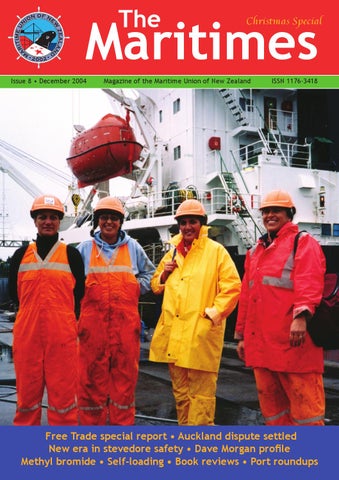
Edition 8, December 2004 Contents Trevor Hanson Report................ 2 Phil Adams Report..................... 4 Auckland dispute settled............ 5 New era in safety .................... 5 Methyl Bromide....................... 6 Anti-racism march.................... 6 Union education....................... 6 Vice President’s Report.... .......... 7 Dave Morgan Profile .................. 8 ITF Report.............................. 10 Matty Purcell Profile.................. 10 Kees Marges Profile................... 11 Free Trade Special Report........... 12 Port Roundups......................... 14 Book Reviews.......................... 20 Letters.................................. 22 Notices.................................. 23 The Back Page......................... 24 ‘The Maritimes’ is the official national magazine of the Maritime Union of New Zealand, published quarterly. ISSN 1176-3418 National Office: PO Box 27004 Wellington New Zealand Telephone 04 3850 792 Fax 04 3848 766 Email: trevor.hanson@muno.org.nz Web: www.munz.org.nz Edited and designed by Victor Billot Email: victor.billot@munz.org.nz Editorial Board: Trevor Hanson, Phil Adams and Joe Fleetwood Thanks to the photographers including Harry Holland, Russell Mayn, Paul Singleton, Terry Ryan, Kathy Whelan, Shane Parker, Melbourne Indymedia, and other anonymous contributors. Thanks to the ITF, ‘Transport International’ and the New Zealand Council of Trade Unions for material. Cover photo: Tolls casual wharfies at Mount Maunganui 2004, from left, Eleah Heke, Laura Mihaere, Bub Marsh and Catherine Haerewa (photo by Phil Spanswick)
Deadline for all Port reports, submissions, photos and letters: 5 February 2005 for next edition 3
Maritime Union ready for a new year and new challenges By Phil Adams National President As another year comes to a close, we can say as a Union we have kept our direction in 2004 and look forward to keeping on course for the New Year. As President, I attended our November National Executive meeting where we discussed the pressing issues facing us.
Dave Morgan elected life member It is fitting to note the Maritime Union elected Dave Morgan to life membership in recognition of his outstanding contribution to maritime workers and the Union movement. Dave’s recent retirement will leave a huge gap in our ranks, but he will never be far from the scene, and we trust we can draw on his extensive knowledge and experience in the future as a kaumatua and elder of the Maritime Union.
South Island Meeting The National Executive of the Union also heard a report from the South Island Secretaries’ meeting. This meeting brought together all ports in the South Island in Timaru in September to discuss various issues facing us, including the South Island Organizer. Although all agreed that such a role would be useful, the meeting concluded
that a person at National Office to assist the General Secretary would be more useful, and we are investigating this new proposal.
International Scene Our Union continues to build links with the Maritime Union of Australia which will serve us well in future years. The key to our future survival is by uniting across the seas and borders with other unions to forge a global approach to common problems. My view is that while an outward focus is vital for an internationalist union such as ourselves, we need to also put more effort into looking after our own backyard. Some of our smaller ports have struggled with declining workforces, yellow unions, aggressive employers and other problems. We need to make sure that all ports are holding regular Union meetings and have the support of the Union nationally. This is something that I think will require our attention in the New Year.
Interport The Interport Tournament is to be held in my home port of Port Chalmers in February 2005 and this central event of the social calendar has kept our local organizing committee busy.
Contact the Maritime Union National Office Telephone: 04 3850 792 Fax: 04 3848 766 Address: PO Box 27004, Wellington Office administrator: Valentina Goray Email: val.goray@muno.org.nz General Secretary: Trevor Hanson Direct dial: 04 801 7614 Mobile: 0274 453 532 Email: trevor.hanson@muno.org.nz National President: Phil Adams Direct dial: 03 4728 052 Mobile: 0274 377 601 Email: phil.adams@munz.org.nz
4
National Vice President: Joe Fleetwood Mobile: 021 364 649 Email: seajoe666nz@hotmail.com Assistant General Secretary: Terry Ryan Mobile: 021 186 6643 Email: terry@munz.org.nz ITF Inspectorate: Kathy Whelan Direct dial: 04 801 7613 Mobile: 021 666 405 Email: kathy.whelan@muno.org.nz Communications Officer: Victor Billot Mobile: 021 482 219 Email: victor.billot@munz.org.nz
We look forward to seeing maritime unionists from around the country joining together for social purposes as well as industrial purposes.
Political Front Next year is an election year and the Maritime Union will support a Labourled Government. However we would also like to see some of the smaller left-wing and environmental parties gain representation and keep them on the straight and narrow. Under the MMP voting system, this will mean that we can ensure a Labour Government listens to working people – we are their core support and they need to be reminded of this. The concern is, after slow progress with matters such as improved holidays and union education, we could be entering on an extremely insecure path with free trade agreements. The Union philosophy of ‘Touch One, Touch All’ must also apply to our political strategy. It is a concern many workers in countries like Australia and the United States listen to the right-wing, me-first mentality of George W. Bush and John Howard, and vote against their own interests. Tax cuts are the carrot which many workers think give them a fatter wallet. They do – but you can kiss goodbye to public health, education and social welfare. By working together in the Union with our collective attitude we have made huge gains in the last hundred years. Many of those gains are under serious threat. We must not lose the equality and fairness that previous generations fought for – we must leave behind something better for the next generation coming after us. On that serious note, we should also enjoy what we have and make the most of it at this time of year. Best wishes to all Maritime Union members throughout New Zealand for the Christmas and New Year Period, take care and we will see you at your local Union meetings in 2005.
Ports of Auckland settle
The new arrest harness system demonstrated at Ports of Auckland (photo by Russell Mayn)
New era in stevedore safety comes to Auckland NZL Stevedoring (formerly P&O Ports) embarked on a formal training programme for stevedores in the Port of Auckland in November. Local 13 Secretary Russell Mayn says the main concern for stevedores working conventional cargo and containers outside of the main container terminals in Auckland has been how to come up with a safety system preventing falls from containers when loading and discharging cargo using ships’ gear. NZL in conjunction with an Australian company have devised a system based around arrest harnesses along with a selection of anchoring devices that are purpose built for stevedores onboard a vessel. This system offers the stevedore varying options on how to attach a safety harness to a container or other anchor points while working a vessel along with different options on safety lines. The Local 13 officials observed this training programme in conjunction with NZL workers in a practical demonstration. “While we did not have the chance to participate in the training, what we observed was very impressive and the feedback from our members who took part in the training was nothing but positive.”
Local 13 Health and Safety Officer Bob Riwai says every worker in the stevedoring industry has the right to go to work in a safe environment and return to his family at the end of the day. “These new safety systems must be adopted by all companies not only in Auckland but throughout New Zealand.” Russell Mayn says “as a union we can no longer turn a blind eye to the hazards of working at heights without the proper safety equipment.” The Local 13 executive will be making the compulsory use of safety harnesses when working at heights a priority for all Auckland stevedoring companies.
The Ports of Auckland dispute was settled on Wednesday 1 December 2004 with waterfront workers making good progress on job security, wages and conditions. Maritime Union Local 13 President Denis Carlisle says the result comes after ten long, hard months of negotiation. 240 Maritime Union members took four days of strike action in September that brought the country’s largest port to a standstill. The settlement means 240 stevedoring and maintainance workers receive a 3% wage increase for next year and a 4% increase in 2006. The 3% increase is backdated to 1 February 2004 and applies to all permanents, part-time Guaranteed Wage Earners (GWEs) and casuals. The central issue of permanent jobs was also addressed, as casualization was one of the major causes of the September strike action. Mr Carlisle says a career path structure has been put in place with a click over clause for GWEs. Every six months a formula will be used to establish whether new fulltime jobs are needed. GWE’s will be first in line for permanent jobs based on merit and service, with a Maritime Union official and rank and file representative sitting in on the selection process, although the final decision is the employers. Up to 50% of the GWE positions will be filled from the casual pool. Mr Carlisle says substantial hourly rate increases have been achieved for GWE and casual staff as well. He says he hopes other ports will follow Auckland in gaining a similar process to ensure a permanent workforce and roll back casualization.
5
Ferry failures unacceptable, says Union The Maritime Union says that hand steering should be mandatory on Cook Strait ferries after the automatic steering failed onboard the ferry ‘Aratere.’ The Maritime Safety Authority reported the ‘Aratere’ was within half a minute of a serious incident or possible grounding on the evening of Wednesday 29 September 2004, at the dangerous entrance to the Tory Channel at the top of the South Island. Crew aboard the ferry were unhappy the MSA said the ‘Aratere’ could go back to automatic steering once an internal investigation is carried out by owners, Toll Shipping. Maritime Union Wellington Seafarers Secretary Mike Williams says an independent inquiry into the equipment failure is required. He says an initial MSA decision to require the ‘Aratere’ be hand steered until the fault was identified was correct. “For four decades all ferries on the Cook Strait have been hand steered in harbour limits and it is paramount that Toll employs quartermasters to steer the vessel in harbour limits.” He says this is made doubly important due to the difficult nature of the crossing, and the experience of previous maritime disasters including the ‘Wahine’ (1968) and the ‘Mikhail Lermontov’ (1986). The ‘Aratere’ has had a history of electrical problems since her maiden voyage from Spain in 1999. “These incidents have included power failures, engine problems and other technical problems, and the Maritime Union stance on the matter is that a proper investigation and precautions now are far more preferable than waiting for a worse case scenario to occur.”
6
Maritime Union backs calls for Methyl Bromide inquiry The Maritime Union is supporting calls for an inquiry into the toxic gas Methyl Bromide, used as a timber fumigant in New Zealand ports. A group of Nelson widows called for the inquiry in November after six former port workers contracted the rare and fatal motor neurone disease, which has already led to the deaths of five. Maritime Union General Secretary Trevor Hanson says that waterfront workers have concerns about the gas as they work in confined spaces with it. One incident that occurred in 1999 led to workers being hospitalized after exposure to the gas. Mr Hanson says that the Nelson Medical Officer of Health and Occupational Safety and Health (OSH) should investigate whether the cases of motor neurone disease are linked to Methyl Bromide poisoning.
The Maritime Union says that precautionary blood testing of workers is another useful step, but the Union would like workers to have the ability to self-test toxicity levels when they are working with fumigated timber. Concerns about methyl bromide leaching from timber loaded onto ships also had to be addressed by independent tests. Mr Hanson says he agrees with reported comments by Port Nelson environmental consultative committee member Rachel Reese that the Government should fund a multi-agency investigation into the use of Methyl Bromide. “Methyl Bromide is a toxic gas and we are concerned about anecdotal evidence that in the past there has been a too relaxed attitude towards its use around workers.”
10,000 Canadian dockers threatened with sack in security row Port workers in Canada could get the sack if they refuse to go along with intrusive new security checks that are part of the Canadian government’s new transport security measures. Around 10,000 dockworkers in the Canadian ports would be required to have their fingerprints and photographs taken under the proposal. The measures, which are being planned on the back of the International Ship and Port Facility Security (ISPS) Code, would also involve extensive background checks. These include Canadian police and security intelligence services checks for known or past associations and criminal records. In addition, financial checks would be carried out in order to determine if a worker was prone to being blackmailed or bribed.
The Canadian government has stated that information would be shared with other foreign intelligence agencies. If a worker refused to undergo security clearance, they would lose their job. ITF Dockers Section Secretary Kees Marges says this is a wake-up call for port workers’ unions across the world. “They should be alert to the consequences for unions and port workers of the misuse of the ISPS Code.” The ITF’s safety and security campaign, launched last month, aims to protect transport workers from excessive security legislation, which is frequently being used to undermine workers’ rights. http://www.itf.org.uk/english/newsonline/ october/canada.htm
Vice President’s Report by Joe Fleetwood Vice President On behalf of the Maritime Union of New Zealand, Assistant General Secretary Terry Ryan and I recently attended two important Union events across the Tasman. These were the Maritime Union of Australia National Council meeting and the CFMEU Mining and Energy Division Conference. I have reported on these for members in this edition of ‘the Maritimes.’
MUA National Council Meeting 2-5 November 2004 Sydney Secretary Robert Coombs opened the Council on the morning of Tuesday 2 November 2004. Raylene Jefferson took all officials through the training of union membership and the collection of all branch fees and finances. She gave a presentation on new member and payment processes, exemptions and suspensions, reinstatement and resignations, and cancellation processes, all designed to simplify the branch collection of all fees. Assistant National Secretary Rick Newlyn and National Office Training Officer Eddie Seymour presented a template for Enterprise Bargaining Agreements which will prove valuable
for all branch negotiating teams, and keep every one of us on an even keel for the future. MUNZ have already adopted the Local 13 template at our Toll All Ports meeting in Auckland mid-year, so we seem to be on the right track – if we stick to it. MUA National Industrial Officer Bill Giddins presented “How to run a grievance” in a Part A/Part B paperback, which contained much valuable information: objectives, outcomes, common elements, types of grievances, initiating steps and much more. This paperback will be available from National Office. MUA National Secretary Paddy Crumlin passed on fraternal greetings from the MUA to the Maritime Union of New Zealand, and extended an open invitation for us to attend any MUA National Councils. He stressed the need to have a strong bond and to be collective in our struggles, and to take the Tasman Maritime Federation forward. His report covered major activities over the last six months. This included the national approach, branch and membership responsibility, accountability, strong financial management, growth of the union, maintaining a militant focus on strategies, and setting realistic goals.
At the MUA Council Meeting, from left, Veteran’s Association representative Billy Bodenham, MUA National Secretary Paddy Crumlin, MUA Assistant Secretary Mick Doleman and MUNZ Vice President Joe Fleetwood (photo by Terry Ryan)
Deputy National Secretary Jim Tannock covered membership responsibility and Assistant National Secretary Rick Newlyn covered branch responsibility and strategic team work. Assistant National Secretary Mike Doleman covered growth. Bernie Farrell of Unite reported on the organizing of Sydney Harbour Ferries, supported by Mick Doleman. MUA Veterans Association National Secretary Bill Bodenham always delivers a no-holds-barred report, and is never shy in reminding us all of our commitment to the trade union movement and the class struggles of today. He talked of the solidarity between the MUA and the ILWU veterans of USA and Canada, and is looking forward to meeting the MUNZ vets. MUA veterans are currently in most big ports and they have provided us with the direction and militancy we have today: thanks, comrades. A MUA Womens report was delivered by Karen Leavy and Sue Virago, and ITF Secretary Dean Summers gave a full report on ID cards. National events supported by the MUA include the Cole Royal Commission and aftermath, South Coast miners, Chennai dock workers, European directive for dock workers, Seoul dock workers’ meetings, ports of convenience, and GN terminals. The follow up solidarity conference from Newcastle 2002 will be held in Los Angeles 22-26 May 2005. Countries attending will include New Zealand, Australia, Papua New Guinea, East Timor, South Korea, Japan, South Africa, Vanuatu, Singapore and the United Kingdom. MUA veteran members and MUA women will also be represented. Comrades, as you can tell, it was a full-on few days. Thanks to the Maritime Union of Australia from the Maritime Union of New Zealand for the invitation, hospitality and solidarity. We must prepare for the class struggles ahead of us, and lay a solid foundation for the generations to follow. As they say on the other side of the Tasman – MUA, here to stay. Merry Christmas and a Happy New Year – Touch one, touch all. 7
Dave Morgan addresses the National Executive of the Maritime Union of New Zealand, Wellington, November 2004 (photo by Kathy Whelan)
Dave Morgan: maritime unionist and working class leader Maritime unionist and working-class leader Dave Morgan retired from the Maritime Union in November 2004 after nearly five decades as a seaman and unionist. He has the unique distinction of being the only person elected to life membership of both the Maritime Union of New Zealand, and the Maritime Union of Australia. His first experience of seafaring life was joining the BHP coastal vessel Iron Monarch in his home port of Adelaide, in 1957. Dave says he was just out of school and aged sixteen. He quickly became involved in the Seaman’s Union of Australia where he gained a ‘working class political education.’
Political education The Communist Party of Australia had a strong presence in the Union, and was very influential in working class circles at that time. “The debates that took place in the messroom were absolutely riveting.” Dave joined the Party at age eighteen, and was elected Union delegate on his second ship. He describes some of the outstanding Union leaders of the time as Elliott V. Elliott of the Seaman’s Union, and Jim Healy of the Watersiders. Dave arrived in New Zealand on Christmas Eve 1963 and started work in Wellington. 8
He approached the Union where Wellington Secretary Les Barber “got me a start with the Union Company Whare gang who worked on the waterfront.” “We tied ships up and worked the old Lyttelton-Wellington service on arrival until the wharfies came down and finished discharge.” After gaining his AB’s certificate, Dave shipped out on the Canterbury Shipping Co vessel ‘Breeze.’ He says in the late 1960’s the New Zealand Seaman’s Union was emerging from what some called the tyrannical leadership – “it was certainly autocratic” – of Fintan Patrick Walsh, who died in 1963 after 36 years as Union President.
Stormy times “The times were reasonably stormy and there were some divisions - people who had been suppressed grasped at the new democracy.” In 1968, Wellington seamen realized that the aircraft carrier ‘USS America’ was en route to Wellington from Vietnam – carrying 5000 troops for an R’n’R break. As a protest against the war, seamen refused to man the tugs that were to ferry the troops ashore. Dave says he believes they did a great service to Wellington through their actions. “We got knocked off the R’n’R list. Just look at King’s Cross in Sydney, preVietnam War – it was a lovely place, but after becoming an R’n’R destination it
became an open sewer.” Dave was elected President of the Seamans Union in 1973, after serving as an official in the Lyttelton Branch. (Bill Martin had served as President for 9 years following the death of Walsh.) He says that one of the big public issues of the 1970s were the effects of the political strikes on the rail ferries. “For all of the rep we gained, the Seaman’s Union rarely held the ferries up on our own issues, and we would often actually agree to sail during disputes carrying passengers, passengers cars, pantechs or perishables.” Dave says the Railways management changed things when they insisted the ships would not sail unless they carried all of their freight.
Direct action “We did take direct action on all sorts of issues – on the apartheid and Vietnam war issues we were second to none.” He says the Union always had a 24hour stoppage on the anniversary day of the Sharpesville Massacre. “We changed that when we had an exiled South African trade unionist from the South African Congress of Trade Unions visit – we all worked and put a day’s pay in to help them, and no one defaulted – every member put in.” The other big political issue of the time was the threat of nuclear war. In 1976, seamen, wharfies and harbour workers in the Wellington Waterfront Unions Committee took NZFOL policy into the workplace and into history when they refused to assist the nuclear armed and powered ‘USS Truxton’ in Wellington Harbour and refused to work while the ship remained in Wellington. “The group was lead by some very fine Unionists including Wellington Secretary of the Seaman’s Union Jimmy Woods, Wellington Secretary of the Watersiders Jimmy Milne and Secretary of the Harbourboard Employees Union Ralph Gerdelan.” “I was and remain proud to have been associated with them in the leadership of this dispute – the resolution against nuclear warships came from the rank and file members of the Unions, all of which had adopted FOL policy in collective decisions of their Unions.” He says the stopping of the ‘USS Truxton’ had a great impact on the Western Alliance. “I was always a politically motivated Unionist, as were many seamen. They always had a class consciousness, although it has faded somewhat now.” He says the Union still had to deliver the ‘industrial goods’ and Seamens’ legendary solidarity became a “tough kernel” in the Union movement.
The sale of the Shipping Corporation under the Fourth Labour Government was a major blow, and the political swing to the right was continued by the National Government in 1991. “The Employment Contracts Act was designed to get rid of our type of Union but it didn’t do that.” He says that the early 1990s were a period when industrial action was taken aboard the rail ferries on industrial issues in order to protect our jobs and conditions. “Our roster was protected for the first year of the ECA as a result of a successful national strike affecting the rail ferries.” During the strike Dave flew to Picton and addressed a public meeting of 300–400 irate passengers stranded by the strike and debated Cabinet member Doug Kidd MP on the impact of the ECA. He wryly notes that the meeting had been organized by people who volubly protested that the strike interfered with a section of State Highway 1 which the ferries constituted in the ‘Iron Bridge’ concept. ”I never heard them protest when this section of State Highway 1 was sold to American interests.” The Seafarers’ Union also played a role in the Trade Union Federation (TUF), which brought together a number of smaller and in some cases more militant unions, and Dave was the Founding President of that organization. The TUF and the NZCTU merged in the late 1990s. The amalgamation of the Seafarers’ and Waterfront Unions was a major event in the last couple of years, as well as the formation of the Tasman Maritime Federation. There is no room for standing still, however. “It’s got to grow and diversify inside the wharf gates, and in the immediate future there has got to be amalgamation with the RMTU, which will be an essential task for survival inside the wharf gates, and indeed for all transport workers.” He says that despite some Government effort to bring order to the transport industry, monopoly capitalism is also working to control the system. “In order to maintain their working conditions, workers need to monopolize their own control of the workplace.” Following the amalgamation, Dave served as Joint National President of the Maritime Union during the transition period, before stepping down at the end of 2003. He spent 2004 working part-time with the Union assisting in efforts to set up a veterans’ association.
He also continued his long standing involvement with the ITF (International Transport Workers’ Federation.) For many years he has been the Seafarers’ representative on the Fair Practices Committee of the ITF, along with other roles. Politically speaking, his views have remained consistent. A former member of the New Zealand Communist Party, he left after opposing what he describes as “some lemming like policy” at a stopwork meeting in the early 1970s. “There was a parting of the ways.” However, Dave says he still takes a “class based” view of the world. “I consider myself a revolutionary, and if I moved the socialist revolution along a couple of inches then I would consider myself a successful person.” The future for working people in New Zealand is linked to developments in globalization and free trade. He says he agrees with the current focus on free trade issues by the Maritime Union and the ‘Maritimes’ magazine. “The maritime industry was the first globalized industry, with the associated problems now coming ashore through free trade deals.” “The leader of ASEAN (a trade group of Asian countries) says that labour has been put in the too hard basket, and this time it is going to be on the table and stay there until resolved.” Workers will find out what that means in short order, he says. It would be a good idea for maritime workers to pay attention to the closing words of one of New Zealand’s most experienced trade union leaders on the threat of free trade and globalization. “We are going to have a rather swift and massive decline in living standards for many workers, unless there is resistance – and there must be resistance.”
Maritime workers join Anti-Racism Rally By Rachael Goddard (0207 MUNZ) and Steve Ryder (1492 MUNZ)
On Saturday 23 October, nearly 3000 people attended the march against racism in Wellington. The march was held to oppose a rally by neo-Nazi political group, the National Front. The organizing skills of Maritime Union members saw us being asked to marshal the event in cooperation with the police, and this was achieved without incident. Marchers proceeded in an orderly fashion from Te Papa and arrived at Parliament to greet members of the National Front, who were immediately made aware of our presence. Speakers of different nationalities gave an insight into the inner workings of National Front, and how people in different ethnic communities within New Zealand are faced with racism every day. One highlight of the speakers was their respect for the tangata whenua, and the struggles they have endured since the colonization of New Zealand. Eventually the National Front members retreated across the road from Parliament to the law school – where they were surrounded by police for their own protection.
Union education for 2005 underway The Maritime Union has been contracted to provide Employment Relations Education to maritime workers. Seminars are to be delivered in 2005 in all ports, with Auckland and Wellington having two Seminars with a funding package of $23,749. A one day North Island and a one day South Island conference on ‘The Waterfront Industry and its Future Economic Development’ will be held (funding package of $15,894.) A one day North Island and South Island Conference on ‘Women in the Waterfront Industry’ (funding package of $15,894). The waterfront industry and women’s conferences will include the Rail and Maritime Union as well. The two trainers are Maritime Union officials Fred Salelea and Phil Spanswick. More trainers will need to be identified to build the Union’s education and training capability. 9
ITF News The ‘Tasman Trader’ and the Dockers Clause by Kathy Whelan
The Tasman Trader is a German owned, Tuvaluan flagged general cargo carrier trading New Zealand/Asia on charter to Tasman Orient. It was reported in the last edition of the Maritimes how the Maritime Union was alerted to crew taking the hatch pontoons off, and unhooking them on the wharf. The Maritime Union attempted to stop the practice, but as the vessel was worked by yellow unions in some of her New Zealand ports of call, our ability to do so was limited. The vessel is covered by an ITF agreement so the matter was referred to me. ITF agreements contain a Dockers Clause which prevent crews from doing dockers work. On occasions there is agreement between the ITF dockers union and the seafarers for seafarers to do certain work, where there is little alternative. In this case, because of the yellow unions’ involvement, a payment is to be made to the crew. I discovered that the crew had not been paid for opening and closing of the pontoons, nor for clearing dunnage from discharged holds, and immediately put in a claim for backpay from January of this year to present for the crew. I also spent time on board the ship over a two day period educating the Tuvaluan crew on their rights and responsibilities under the ITF agreement by which they are covered. A system was put into place to record the hours crew work doing “dockers’ work” which will entitle them to an extra payment. We will track the ship in its New Zealand ports of call to ensure this agreement is complied with and crew receive a payment.
ITF Co-ordinator Kathy Whelan with Tuvaluan crew onboard the ‘Tasman Trader’
ITF Profile: Matty Purcell In this edition of the Maritimes, ITF News and Views profiles ITF Assistant Coordinator for Australia, Matty Purcell. “I started on the Melbourne waterfront in 1989 as a wharfie with Strang Stevedores then later worked with Strang/Patricks, Australian Stevedores and eventually the evil ones – Patricks. I was a multi skilled wharfie, which involved working as a clerk as well. In 1994 I became a member of the Patrick’s shop committee, and in early 1995 I stood for Melbourne Branch Assistant Secretary and was elected as an official of the branch. In early 1996 I was asked to work as part time inspector for the ITF and thus my association commenced with the ITF. For the next three years I was half/ half, that is ITF inspector and branch official. I was offered a full time position in 1999 as ITF inspector in the Port of Melbourne and I accepted that position.
continued next page
10
As ITF inspector I’m responsible for the ports of Melbourne, Geelong, Portland and Westernport in Victoria, and various ports in Tasmania and South Australia. Earlier this year I was appointed as Assistant Co-ordinator for Australia. In Melbourne we have been able to develop a strong volunteer and supporter base for the ITF which has been of great assistance to our unique cause we all have in the work of the ITF. In this respect we have had a great relationship with our fellow Kiwis with cross training of delegates from this port, and having our trans-Tasman mates spending time in Melbourne and the outports. We have had Joe Fleetwood here as well as Finlay McIntosh (formerly New Zealand Seafarers Union) who is now with the ITF Actions Unit for one of our weeks of action. More recently we have had Carl Findlay from Auckland Maritime Union doing some ITF training during his stay in Melbourne. The relationship between New Zealand ITF co-ordinator Kathy Whelan and the Melbourne inspectorate and volunteer base has been one of mutual respect and good networking in regards to follow ups on problem vessels. The most significant point in my time in Melbourne was no doubt the Patrick’s dispute and the support we received from our fellow brothers and sisters in the ITF. This will be enshrined in our memories forever. We now face another attack by the conservatives and we will have to fight them with a more militant approach than ever before. My father, Matt, started on the Melbourne waterfront in 1948 and at one stage I had three brothers working with me in Melbourne on the wharves – Richard, Marty and Mick, there are now only two of us left, myself and Marty. Seasons greetings to all Maritime Union of New Zealand members from the Melbourne Branch of the MUA.”
Kees Marges Kees Marges retired from his position as Dockers Secretary at the International Transport Workers’ Federation (ITF) in November 2004. After spending more than eleven years based in London and travelling home to the Netherlands, he is moving back to Rotterdam. Many New Zealand maritime workers will have met or heard Kees speak when he visited New Zealand ports in 2001. We asked him to share some of his thoughts about his work with the ITF, and the future of transport unions around the world. Kees started working for the ITF on 1 July 1993, after a long union history. “I started working for the seafarers union on 1 April 1968 as the youngest ever union official for that union.” Kees went to the Vervoersbond FNV (Transport Union FNV) in 1977 and started working in the road and urban transport area. In 1979 he moved to the port section of the Union and by 1980 was national dockers section secretary, working as chief negotiator. The port was not a new area for him, as he grew up in the Port of Rotterdam, which was his playing ground as a child (obviously before the days of port security.) Before becoming a seafarer he also worked in the Port. Kees says the issues faced by waterfront workers today are on two different levels: inside the trade union movement and in the outside world. He says that trade union leaders need to understand the importance of international trade union work and cooperation/solidarity, while at the same time respecting differences in trade union tradition and attitudes. There must be recognition of the importance of the need to modernise and where necessary restructure Unions in order to be able to fight the attacks on workers and their unions, he says.
“Many unions still don’t understand that internationalization and globalization of management, ownership and policies on the side of the Big Business, requires an international and global trade union structure and policies and personal involvement.” The Australian and New Zealand maritime unions did understand the need for new structures and an international approach, and could be seen as examples of the way forward. Kees says the biggest external threat to Unions is the attack on organised labour that aims to reduce labour costs to a low as possible level in the interest of ‘shareholder value.’ “Sometimes this is made possible or even encouraged because of a lack of organisation of our own response, or by a too traditional and thus predictable reaction from trade unions.” The way this attack is organized differs from region to region, from country to country and from port to port but also from time to time, he says. “This means that there is no standard trade union reaction or a blue print for trade union policies all over the world, each union needs to develop its own policy, thus national policies and international support.” Kees says unions must learn to effectively ‘read the mind’ of employers in order to stay one step ahead. When asked what one of his most memorable port visits has been over his long career, Kees comes up with a surprising answer. “One of my most unusual port visits was Port Chalmers and Dunedin, usually we don’t get to visit small and remote ports like this. “Coming originally from Rotterdam, there is no port further away from my own port than Port Chalmers.” “Even better, I met a bunch of nice guys, good trade unionists who are proud to be a docker and trade unionist as we say in Rotterdam. “ “I have said this many times to other people and not only for this occasion because you ask me!”
11
12
13
Port Roundup: Whangarei by Steve Murray
Auckland Seafarers delegates at Fullers, Master Lester Sowerby and Jacqueline McLeod of Customer Services (photo by Victor Billot)
Port Roundup:
Auckland Seafarers by Garry Parsloe
Branch Executive There have been two vacancies created on the Branch Executive with Heidi Mills our Customer Services Delegate/Branch Executive Member at Fullers resigning to seek other employment opportunities and Adam Edwards, one of our Seafarers Executive, who has also moved on to find work outside our industry. Jacqueline McLeod is our new Executive member at Fullers and we have opened nominations for the vacant Seafarers Executive position.
Port Security On 1 November 2004 a Maritime Union member was joining the ‘Rotoiti’ at Bledisloe Wharf when the gatekeeper demanded to search his bags before he would allow him entry onto the wharf. The Seafarer refused to allow the gatekeeper to look in his bags and asked that he call Customs as it was their role to
14
search bags, not gatekeepers. This turned into a standoff as the gatekeeper would not ring customs and the Seafarer would not allow the gatekeeper to search his bags. The Seafarer was left standing at the gate, no Customs meant no access to his vessel. I made a call to Local 13 Secretary Russell Mayn who gave assistance by ringing Port Security. We then made contact with the two Customs Officers who were on board the ‘Rotoiti’ giving the vessel a clearance. These two officers then went to the wharf gate and searched the Seafarers’ bag, thereby giving him access to his vessel. The Customs Officers were very unhappy with the gatekeeper for not calling them in and made their displeasure known to all the gatekeepers. If a worker refuses to allow the gatekeeper to search his bag (as he must) and requests a Customs Officer then it is the gatekeepers’ duty to call the Customs and not just leave the worker standing at the gate. I want to thank all those involved in this issue as we must stick to MUNZ policies and not succumb to lazy practices just for convenience’s sake. There is to be another Port Security meeting in Auckland in December and we will be making our position clear again at that meeting. Maritime Union members on the ‘Milburn Carrier 2’, from left: IR Rory Devine, IR Arthur Amis, Chief IR Roger MooreCarter, IR John Jeffrey (photo by Victor Billot)
Greetings from Whangarei. The weather up north has been great. It’s a pity the same can’t be said for shipping – quiet is the only word for it. So with no work and a buoyant job market we are once again losing our experienced casuals. Kudos to the management team of Northland Stevedoring Services Limited for getting a new safety induction course up and running in consultation with the Union. These new faces on the wharfside need more than just to be shown which end of the ship their hatch is: safety is everybody’s problem. At time of writing this, the big news is that Ports of Auckland wants to take a nearly 20% stake in Northland Port Corporation leaving the Northland Regional Council a controlling 52.4% shareholding, with no further plans to sell more shares, but who knows. The sale to Ports of Auckland is not a given as ratepayers have a month from 12 November to have their say. A large dry goods store is being built at Marsden Point and progressing quite rapidly. This will mean that some of our staple cargos like Tri-board and veneer will be moved from Whangarei to Marsden Point sooner than first thought. We believe the rush is to get Marsden Point paying for itself while the downturn in the log trade continues. Most of the men are not looking forward to the extra travel of approximately 50 kilometres per day or the drop in conditions, as the only amenities are portacoms at the present moment. Plenty for us to work on. We recently lost a long time union man and delegate, Brian Allen, to a long battle against cancer. His experience, skills and determination will be sorely missed in the workforce and at our meetings. Our thoughts and best wishes go out to his family. Port Whangarei wishes all our brothers and sisters around the country a very Merry Christmas and a safe and happy New Year.
Port Roundup: Auckland Local 13
by Denis Carlisle Local 13 has been extremely busy of late with the day to day disputes that crop up in the port and with the Port Company Collective Employment Agreement negotiations. We would like to take this opportunity to thank all the Branches and Locals that sent in letters of support backing the September strike action in the Port. The response both locally and internationally was overwhelming and gave the members a real boost on the picket line. It was great to see our comrades from the MUA fly over and join us on the picket, this is real demonstration of the Trans Tasman Federation working to its full potential. One of the core issues that face every port is the casualization problem. All the union is asking for is a fair go and a career path for these workers. Achieving this is not an easy goal, but hopefully we will be in a position to take an agreement to ratification soon that addresses some of the problems this temporary work force faces. The click over clause that provides for movement from part-time through to permanent fulltime stevedoring is a real breakthrough, and should now become an industry standard in one form or another. The picket was one of the best organized and manned that we have experienced in Auckland for a long time, and acknowledgement for this must go to the membership and the delegates. There is no substitute for a united union with a passion to establish acceptable working conditions. Much of the official’s time has been spent on these negotiations over the past months and the patience that the rest of the port has shown is appreciated. The response to the 2005 Interport to be held in Port Chalmers has been good, and everyone is looking forward to travelling down South and sampling the fishing, golfing and the odd Speight’s. Recently the elections for the Local 13 executive and Vice President were held in Auckland and congratulations to all the successful candidates – the quality of the candidates was exceptional. The year seems to have flown by and on behalf of Local 13 I would like to wish all members of the Maritime Union of New Zealand a Merry Christmas and a happy and safe New Year.
Port Roundup:
Wellington Waterfront by John Whiting Changing work patterns in our Port are having both positive and negative effects on members. The loss of two Trans-Tasman container ships and the consolidating of all container R + D movements into the Port Company terminal area have resulted in a considerable loss of hours available to our members employed by Capital City Stevedores. Their group of permanent part-timers has reduced with 3 or 4 resignations and a couple transferring to new positions with the Port Company. We have actively promoted inter-company cross-hire by the Port Company to assist the Capital City workers and this is working well when the peaks and troughs of shipping allow. The situation at the Wellington Port Company (CentrePort) is brighter now that the Maersk North American service and the MSC Europe service calls have bedded in and are reflected in a 23% increase in containers handled for the year to end of June. Also brighter is our relationship with the Port Co. following the departure of the previous CEO and the HR and operational management. These departures took place after our and RMTU members’ 48 hour stoppage and picket in July 2003 which resulted in a satisfactory settlement of the CEA through to October 2004. The new CEO and management have stated they want an upfront/no hidden agendas relationship with us and to date are staying on that course. The company has hired 8 new workers on a permanent part-time basis and 4 existing P/P/TS have moved onto 40 hour guarantees. The marshalling work for Tasman Orient ships (70/80 calls per year) is now worked on a 8 hour on/16 hour off shift basis which we believe is a positive move in reducing the amount of 12 hour shifts with their recognised detrimental effects on the workforce. Negotiations are now well advanced towards a renewal of the CentrePort collective agreement and we are confident of being in a report-back position in the near future. Also we are currently well under way with renegotiating the Pacifica Wellington Stevedoring agreement and anticipate finalising this document positively in the near future.
The Pacifica Wellington/Lyttelton service operates on a very “steady state” basis and attracts a large amount of transhipment cargoes both south and north bound. The Golden Bay silo workers CEA has been settled for a 12 month term. The Wellington Port Cold Stores collective agreement has been settled for one year term with wage rate gains. This group of our members include some employed on a seasonal basis and we have been successful in arranging for the laid-off members to get casual stevedoring work with the Wellington Port Company. In closing, we congratulate Port Chalmers Branch on your resolute position in determining to keep Port Otago free of anti-union elements of whatever ilk.
Port Roundup: New Plymouth by Shane Parker The Port remains busy both in Stevedoring and Offshore. The Port company is buying more and more buildings in the area, and one of the most recent is the old Breakwater Hotel which for generations of Watersiders was the “local.” It is now the Port companies’ social hall and the Seamans’ Rest has moved from inside the Port gates to behind it. There are many tales to be told about the antics which went on in this Pub and many out of port wharfies entertained there – we hope to hold our old timers’ day there in January which will bring out even more stories. We loaded our first export coal shipment to Australia recently, it is barged up from Westport and stored here. The Southern Tiare has been calling here often and taking small parcels of fertilizer around the country which seems to work well. It’s good to see coastal shipping being used instead of rail or road.
The old Breakwater Hotel in New Plymouth, now the Port Company’s Social Hall
15
Port Roundup: Napier by Bill Connelly
Around and about The port is reasonably quiet at the moment approaching the festive season, but will hopefully after the New Year start to improve. From information received it looks as though both squash and fruit could come online a bit earlier, thanks to the very good weather we have had over the last couple of months.
Price increases on rental accommodation For only the second time since 1993 the Branch Executive has addressed the cost of maintaining and refurbishing the accommodation in both Australia and New Zealand. Last time prices were increased was on 1 January 2000. After nearly two months of examining the proposed budget for both properties the Branch Executive recommended to the membership the following price increases effective from 1 January 2005.
NZ Accommodation – Ohope Maritime Union members and their immediate families from other ports: Current Rental $200 per week Increased rental $250 per week Deposit $75 for all bookings (Non-refundable if cancelled and we cannot find a replacement) Members should be aware that the holiday accommodation at Ohope Beach is now at a premium, because of the sale of the front two units. We still own unit number 3 and bookings can be made through the Napier Branch, by contacting the Secretary (contact details page 23.) Vacancies at the moment, commencing on a weekly basis from Sunday, are as follows: 30 January, 27 February, 27 March, 3 April, 10 April 2005
Australia Accommodation – Gold Coast Apartment Maritime Union members and their immediate families from other ports: Current Rental $250 per week Increased rental $300 per week This is proving to be a most popular destination for all members throughout the country. Booking are usually for a two week period commencing on a Saturday, but 16
can be shortened or extended, subject to availability. Please note that the confirmation period for bookings is now six months, which means that members nationally can now book six months in advance. Vacancies for the next six months are as follows: 15–29 January, 29 January–12 February, 12–26 February, 9–16 April (One Week), 7–21 May 2005. Deposit $75 for all bookings (Non-refundable if cancelled and we cannot find a replacement) Members who have already booked for next year, be it in New Zealand or Australia, will be written to and advised of the increases effective from 1 January 2005 and asked if they still wish to retain their booking. The deposits already paid for any 2005 bookings will not attract the deposit increase. For further information please contact the Secretary (contact details on page 23.)
Annual General Meeting We recently held our Annual General Meeting where it was decided to forego the Annual Election of Officers until the end of March 2005, when hopefully the port will be reasonably busy and attract a maximum voting return from the membership.
Dave Morgan The membership were informed of the retirement of Dave Morgan from the industry and instructed the Secretary to write him a letter of thanks for his contribution and commitment to the maritime industry, and also for his personal input into the establishment of the Maritime Union of New Zealand. The membership was unanimous in their praise for Dave’s input over many years to the industry at large. The membership also moved, seconded and carried unanimously that in appreciation from the Napier Branch he and his family be offered the opportunity to stay at the Ohope Unit or the Gold Coast Apartment rent free.
Vertical Tandem Lifting of Containers (VTL) This problem will just not go away and the ILWU, along with their Canadian brothers, are resisting the push by the Container Cartels to introduce the practice world-wide. Members should be aware that the Maritime Union of New Zealand still has a national policy condemning the use of VTL as an unsafe work practice. The policy says VTL should not be carried out in any port in New Zealand unless Part 49 of Maritime Rules covering Ships’ Lifting Appliances and the
draft guidelines and recommendations developed by ICHCA are followed. I ask all members to abide by this policy, otherwise this practice has the potential for one or more of our members to be seriously injured or killed. On that happy note there is not much more to report, except to wish all members around the country the best wishes for Christmas and a prosperous New Year in 2005.
Port Roundup: Gisborne by Dein Ferris Summer has well and truly arrived here in Gisborne, and with it a few changes. Firstly our manager Mr Warrick Ingoe has decided to call it a day at the ripe old age of close to fifty five. A lot of you older members will remember Warrick from the Commission days when he started as a kid fresh from school and he has been there in the industry ever since. In terms of managers Warrick would be classified right at the top, Gisborne Stevedores men will miss him. I have a feeling he may turn up around the place as a supercargo. All the best Wally. Southern Cross can’t be quite broke yet as they have recently employed three more men as permanents. They will have eighteen months to be trained in all skills which when achieved will lighten the load on the current members. Six years after making the staff of Port Gisborne (now Eastland Port) redundant and hiring Adsteam to operate its tug and lines services, the wheel has turned and all of this operation is back under the Port’s umbrella. Isn’t the world amazing. One really does wonder – remember the Jody F saga. A new manager Mr Dave Milner takes over operations 1 December. Dave was an agent for many years and prior to this was involved in shipping through his previous employment. He is well known to most of us employed at the Port and in my view will slot into his new role capably. We can hear the squash growing – hopefully it will be a good season. Merry Christmas and Happy New Year.
Port Roundup: Port Chalmers Local 10 by Phil Adams Greetings from the South. As we move into the holiday period, those of our members lucky enough to have a break with their families over the Christmas period are looking forward to it. We can reflect on another busy year in our port, and especially the terminal.
New equipment The terminal has just received one of three new straddles, which will be welcomed by all as the work for the existing fleet is full on. This new equipment should mean a more reliable service. Also on the Port Company’s agenda is the purchase of a third crane from China – bringing us up to three cranes. It is hoped to have it in operation in the next couple of years. Shipping calls in the terminal are up on the last year, which is a good sign for the future.
Around the port Port Chalmers Cargo Services has been relatively busy with logs, fish, fertilizer and cement. They are looking at increasing their workforce, which is another good sign. We believe Toll may be interested in seeking work in our Port, and we will watch with interest. It is hoped that our negotiations with Southern Cross will happen soon. The Port Company is employing new workers as the busy season is on us. Members in the sheds are busy, although morale here is not good due to management problems that we hope to address positively.
Port Security Port security is still a major issue. Our branch has steadfastly stuck to the national policy of not allowing bag or car boot searches. One advantage we have here is that security is carried out by our members. The Company has also introduced a drug and alcohol policy – this does not mean random searches as rumoured.
Delegates The numbers of delegates in the terminal is encouraging, with 16 members
putting their names forward for becoming delegates. Training will take place in order to get us back to the stage where delegates have control of the job, and serve the members accordingly. We have had a good response for trainee ITF delegates as well. Training will be given to all delegates, with tasks including checking crews’ wages, looking into crew complaints, and safety inspections on ships.
Union Shout On 10 December the Union Shout takes place and will be attended by our retired members. This is an excellent time for past and present members to mix and talk about times old and new on the waterfront, and for current members to host those who gained the conditions we enjoy today through blood, sweat and tears.
National Executive I recently attended our National Executive meeting. Former National President Dave Morgan was awarded life membership of the Union and I will be joined by all members in thanking Dave for his work on behalf of maritime unionists, and wishing him a good retirement. There was also a report from the South Island Secretaries’ meeting. A closer association between all southern ports can only benefit us.
Interport The sports tourney is coming along well and numbers attending seem well up on last time. Members from our port will find out soon whether they can attend given the large number who have entered locally. All the venues and fishing boats have been booked and we are all looking forward to the week.
On the mend Walter Meehan and Bob McIntosh are two of our retired members who are recovering from stays in hospital, and Ike Amas has also had some health problems recently. We wish them all a speedy recovery, also current members Trevor Hawkins and Dave Middleditch.
Amalgamation This is still on the agenda although interest has waned. It is hoped a meeting of all parties before Christmas may proceed matters.
Kids Party The Annual Kids’ Party will take place soon, an important day given the
large number of young members with families. It is rumoured that Father Christmas will be in attendance, arriving by Tank.
Holiday Unit The Queenstown Unit continues to be well patronised – all inquiries to Iain Quarrell on 03 4727 216 or Phil Adams 03 4728 052.
Auckland Dispute Our Auckland comrades have settled on their Port Company agreement and have made significant gains for casuals to move through into permanent jobs, a process we have had in place in Port Chalmers for the last five years. Our branch commends Auckland for sticking up for what they believed in, with the result due to good leadership and a collective approach.
AGM We had around sixty members attend our Annual General Meeting. The branch is in good shape with executive positions hotly contested. As I have stressed in earlier Maritimes, meetings are the cornerstone of every branch. Each branch around the country should be having regular meetings to remain effective. The Annual Meeting voted in favour of increasing our Union fees from the start of the next financial year. This keeps our branch in a position to support and train our members for the future benefit of the branch. It is timely to look back on a year that has seen Mainland try to poke its head back in only to be sent packing. Branch numbers have increased as we are the dominant Union in the Port through our reputation – that we have the ability to fight for what we believe is right, and we do this through collectivism. Leadership is important and we are fortunate to have in our Branch many years of experience, but we must continue to operate collectively to ensure we have the respect of Management. When individuals decide to wander into the Managers’ office to discuss conditions, it seriously weakens us. The fact is wages and conditions were not given to us out of the goodness of the bosses’ heart, they were won through a collective, united front. With strong officials and informed active members we can achieve good results even in the current times. Our branch wishes all members and friends of the Union a Merry Christmas and Happy New Year. 17
Port Roundup: Lyttelton Local 43 by Les Wells Lyttelton! Canterbury, the home of the Ranfurly Shield, National N.P.C. Champs. In reporting from here one of the most positive things that has happened is the signing of a thirteen year contract between Lyttelton Port Company and Solid Energy. This should give us a bit more security in this area; although we don’t have a lot of members in this area it is still positive for those that are there! Most companies are still in talks or waiting to start. The Combined Unions in the Port (RMTU, MUNZ, Foreman Stevedores) took the Lyttelton Port Company to the Employment Court over the interpretation of our PRP clause in the contract. We believed we had a very strong case in our favour. After our lawyer’s presentation I believed we had an even better case for winning it, but it goes to show you that I am about as good at picking winners at the races as I was with this case – we lost. This has put us back a few steps, but we have just had to go ahead and try and resolve the problems with the Port Company. There is a problem trying to get Stevedoring Services of America Management around the table to start talks with the men in the port. With Toll we are nearing the end of talks. There has been some concern expressed about the wording in the contract from National Office, the wording was satisfactory for BHP but not when you are dealing with Toll. The men at Pacifica have made major changes to their roster to give the Company the savings they were seeking. This has put a lot of stress on them in the workplace, which we are trying to work through. We have a four month trial period which will get us over the Xmas period then we will sit down and revisit things in the New Year. We at Lyttelton would like to send to everyone Seasons Greetings and a very Happy and Prosperous New Year.
18
Port Roundup: Local 21 By Phil Mansor I take this opportunity of extending to all members, their families and to all whom we love and cherish a safe holiday season and best wishes for a Merry Christmas and Happy New Year. We also wish that we may be able to see some positive steps being made towards global peace throughout the year ahead.
International scene However, in view of the re-election of Geo. Dubya in the U.S of A, the unjustified war in Iraq and continuing unrest in the Middle East, global peace appears to be a rather forlorn hope. Let us make it quite clear – not only do we condemn the acts of terrorism by any extremist groups, but we also condemn the foreign policy of leading Western democratic countries – as well as the Palestinian situation as led by the “thuggish” Israeli government. Good, bad or indifferent, the least we should be able to expect from Western democratic governments is a little bit of honesty in foreign policy. To hell with their insulting platitudes, half-truths and downright lies. Despite their usual sanctimonious excuses, we know the people who are hit the hardest are innocent civilians including many women and children.
Bakers Union In the previous issue of ‘Maritimes’ we reported on the almost unanimous decision by members of the Central Bakers Union to form themselves into a separate union and to have discussions with the Maritime Union on the status of an associate or local group. The Central Bakers Union appear to favour a Federation type of an association rather than full amalgamation into the one nationwide union. Of course, prior to the Labour Relations Act of 1987, all local Watersider Unions were in a Federation. This Act stated that unless each local union had a minimum number of members, it would be de-registered. This was the catalyst for all local Watersider Unions to form themselves into the one National Union. The Central Bakers Union have forwarded their resignation to the New Zealand Bakers Union. However, the NZ Bakers Union,
under secretary Ian McGovern of Auckland, is raising peripheral matters – delaying progress on the decision of members in the Central Region to register as an independent union. Mr McGovern and his committee are feebly blowing against gale force winds.
Merry Christmas In wishing you a Merry Christmas, we realise that we should include the message of Him of “Peace on Earth to Men of Goodwill.” To many of us, Christmas is usually enjoyed in pieces, instead of in peace. If the coming festive season is causing you to rush around and man the panic stations, just stop! Of course, we know that when you do stop, you’ll start thinking of those near and dear and if you have children, you will be doing your best to ensure them the happiest of Christmases. Enjoy our traditions and customs, but don’t let them kill you – just remember why we celebrate Christmas. All the rushing around is only a means to an end – a happy Christmas full of joy, contentment and peace. To celebrate the birthday of Our Lord happily with our families and to share this happiness with all those whom we love and cherish. Most of our preparations are done because they are traditional, but how traditional are they? The Christmas tree is a lovely custom originally from Germany, but no one knows how or when it began there. Some say St. Boniface went from England in the 8th century to convert the German heathens. He cut down a sacred oak tree, and offered to them a young fir tree in its place, as a symbol of the new faith he preached. Christmas trees became popular in England about 1840, just as New Zealand became a colony, so, really, it is not a very ancient tradition at all. There is nothing to say it has to be a pine tree – why not make your own tradition with a bough of Pohutukawa! Our very own Christmas tree would be beautiful and with its scarlet flowers would need very little extra adornment. If a number of families used the Pohutukawa for several years as a Christmas tree, there soon would be New Zealand traditions and legends about them. All these things are only a means to an end, not an end in themselves. Don’t be like the shop assistant of many years ago who coined the classic remark: “Sorry, no more Christmas cards left – only religious ones.” We wish you a happy Christmas and a safe holiday season.
Port Roundup: Bluff by Ray Fife Shipping activity has slowed down over the past few months and this has seen Owen Services close down their Bluff Office. The two full time workers were offered employment in other ports but my understanding is that they decided to take redundancy. If the log trade starts up in Bluff again it will be interesting to see who takes over and what sort of set up is put in place, nationally there is a general down turn in logs and it could be quite some time before there is a recovery.
Political As our Branch is affiliated to the Labour Party we were able to attend the selection meeting to pick the next candidate to represent Labour at the elections next year. Our union and most other unions at the gathering supported Leslie Soper, a centre left candidate who got the floor vote and also the vote of a local union rep who was voted onto the selection panel by the floor. We were very disappointed when we found out that a centre right candidate got the nod by the selection panel; we believe that Labour Party National Officials who were on the selection panel held the balance of power and used their vote to have a moderate candidate. Wayne Harpur has a lot of work ahead of him to win the support that is required to retain what was a safe Labour seat.
South Island Meeting Delegates from throughout the South Island gathered in Timaru in September to discuss a National Executive resolution on whether there is a need for a South Island Organiser. The meeting endorsed a Conference decision to employ an Organiser, and this was referred to the National Executive meeting in early November. It was decided that a cost analysis would be carried out before a final decision is made. The meeting in Timaru was very worthwhile, it was good to talk about issues that reflect on our ports, and we were able to set some guidelines on issues such as interport travel.
Past Members’ Function We held our annual get together on 4 November with a very good turn out of approximately 60 ex -Watersiders. All those who attended spoke on the need to retain such a event, and all reiterated that the time they spent working on the wharf was the best part of their working life. The comradeship shown and life long friendships made is testament to the nature of waterfront workers.
Interport Sports We have 10 eager sports enthusiasts who are looking forward to what we hope will be an excellent tournament in Port Chalmers. It is good to see that we have a couple of younger people entering for the first time, which bodes well for the future of the tournament. Finally of behalf of the Officers, Executive and Members of our Branch I would like to wish every member of this Union a very merry Christmas and prosperous New Year. Touch one, Touch all
Port Roundup: Timaru by Kevin Forde Timaru hosted the South Island Secretaries’ Meeting on 21-22 September at the Grosvenor Hotel, with all Southern Ports represented. The meeting was informative with contributions from all present and a report back was made to the National Executive meeting in November. At Timaru Cargo Services we have been working phosphate and fish and cross hiring to the Port Company. On the social front, Timaru has a contingent preparing for Interport 2005 at Port Chalmers including Kevin Ansell, Bill Ryan, Tony Townsend, Graham Thin, Kevin Forde and Alastair Ferguson.
Port Roundup:
Mt Maunganui Tauranga by Phil Spanswick
From left, John Hines, Harry Keil and Tony Milne at the Bluff Past Members function, November 2004 (photo by Harry Holland)
From left, Neil O’Rourke, John Reid and Ray Fife at the Bluff Past members Function (photo by Harry Holland)
As a result of Robbie Diamond’s fatal accident, the Mt Maunganui Tauranga Branch (with the help of Fi Brown from the Engineers Union and the local CTU), have put together a Cultural Protocol for Sudden Death in the Workplace. This outlines the role of the employer, the Union, Fire Brigade, the Police, OSH and the Coroner, and the cultural steps which must/should be followed in the event of a sudden death. Any branches who would like a copy, please contact our office. With the continuing downturn in the export of logs, more redundancies are taking place and more Casuals are leaving the wharf and looking for alternative employment. The Rail and Maritime Transport Union and ourselves have initiated bargaining for a Composite Collective Agreement for Owens Cargo company. We expect the negotiations to be drawn over to next year. The Toll negotiations are still moving along, as with Tauranga Stevedoring. Merry Christmas and a Happy New Year. 19
Book Reviews
The Big Blue: Snapshots of the 1951 Waterfront Lockout Edited by David Grant (published by Canterbury University Press in association with the Trade Union History Project) The last few years have seen a renewed interest in the 1951 waterfront lockout, and a number of new books have been published on the dispute and the historical issues surrounding it. These have included the memoirs of Jock Barnes, published in 1998, and
Anna Green’s ‘British Capital, Antipodean Labour’, a study of work on the New Zealand waterfront in the first part of the twentieth century. ‘The Big Blue’ is the most recent addition to this growing collection of high quality material about unionism on the New Zealand waterfront. The book is a collection of edited speeches and essays taken from a 2001 seminar in Wellington on the 50th anniversary of the lockout. Contributors include those who were directly involved in the dispute, such as unionists Bill ‘Pincher’ Martin, Bill Andersen, Dick Scott, and Ted Thompson, and Australian unionists Harry Black, Alwyn Allport and Alistair Couper, who provide an international perspective. Family members of locked out workers and supporters such as Rona Bailey, playwright Renee, and former Alliance Party MP Sandra Lee give some personal views of the effect of the dispute on the wider waterfront community. A final group of contributions come from those who have studied aspects of the dispute and its aftermath. These include trade unionists including Maritime Union Wellington Waterfront Secretary John Whiting, Chris Kenny, and Ken Douglas. There are also contributions from some of New Zealand’s leading historians, writers and social researchers – Redmer Yska, Par Walsh, Melanie Nolan, Kathryn Parsons, Jock Phillips, Anna Green, Judith Fyfe, Bruce Brown
Illustrations from an underground pamphlet, published in support of watersiders and other unionists in the 1951 lockout
20
and the late Noel Woods. The book contains many interesting photographs and illustrations, including some of the clandestine cartoons drawn by left-wing artists Len Gale and the late Max Bollinger. Editor David Grant notes in his introduction the huge impact of the dispute, which at its peak affected 22 000 workers in a population of just over one million. The lockout had a major ongoing effect on the trade union movement and left wing of New Zealand politics. As the majority of contributions here are taken from speeches, they are generally short, readable and often include a personal element. Some of the broad topics covered include the propaganda war, the role of women in the dispute, the contributions of other unions including seamen, the political and economic background of the times, and the development of the waterfront since the 1950s. A useful chronology of events, contributors’ notes and information on the Trade Union History Project are also included. ‘The Big Blue’ is a fascinating read, and a highly worthwhile addition to the social history of New Zealand workers – all maritime unionists should have a copy, as the lessons of history are still relevant today. (Review by Victor Billot)
Book reviews
Dick Scott – A Radical Writer’s Life By Dick Scott (Published by Reed, rrp $39.95) The autobiography of New Zealand writer Dick Scott provides a fascinating view of New Zealand in the twentieth century, and contains much of interest for maritime unionists. Scott was born in 1923 to a Palmerston North farming family, and following the Second World War, worked as a journalist, sharemilker and (briefly) as a seagull on the Wellington waterfront. He got the job of editor of the ‘Transport Worker’, the newspaper of the Waterfront Workers’ Union, and soon found himself in the thick of the 1951 waterfront lockout. Scott is wellknown as the author of ‘151 Days’, the original history of the 1951 waterfront lockout first published by the ‘deregistered’ Waterfront Workers’ Union in 1952. Several chapters of this autobiography detail his involvement in the union movement of the post-war period, and provide a personal perspective of the events surrounding the 1951 lockout. The dispute pitted the National Government, shipowners and establishment against the wharfies, but also split the union and labour movement down the middle. The wharfies were part of the Trade Union Congress (TUC), made up of smaller militant blue collar unions. In the days of compulsory union membership and arbitration, the Federation of Labour (FOL) was a more conservative group of the bigger unions
that actively worked against the unions involved in the lockout. The leader of the FOL Fintan Patrick Walsh was also President of the Seaman’s Union. A former militant and communist, Walsh evolved into a powerful autocratic personality who controlled the union movement through fear tactics. Walsh used his influence against the wharfies, despite the fact many seamen in his own Union actively supported the locked out workers. The Labour Party opposition under Walter Nash fudged on the issue, with Nash famously declaring he was “neither for nor against the watersiders.” Scott says in retrospect wharfies leader Jock Barnes made a mistake in not admitting defeat earlier, in what had become an impossible struggle. But he also describes the police state approach of Sid Holland’s National Government in chilling detail – the closest New Zealand has come to fascism, where freedom of speech, freedom of association and basic legal rights were suspended under ‘Emergency Regulations’ aimed at smashing organized workers. Scott was involved in the production of the underground leaflets and posters that were circulated around the country: his home was raided by police searching for illegal material (none was found!) In the early days of the Cold War, the wharfies were attacked as agents of Moscow, but in reality, only a small number of their leaders were Communist.
At the time Dick Scott was an underground member of the Communist Party, and following the dispute he went on to work for the Communist newspaper the ‘People’s Voice’. He soon became disillusioned with the Party leadership and their uncritical support of the USSR, and walked away, but kept his left-wing views. Since that time, most of Scott’s political energies have been focussed on historical writing, and he has authored a number of popular books, some of which have become common textbooks in schools and universities. ‘Ask That Mountain’ is the story of the Taranaki Maori community of Parihaka in the nineteenth century, and their non-violent resistance under the leadership of the pacifist Te Whiti to colonial land grabs. ‘Seven Lives on Salt River ‘ is another of his wellknown accounts of New Zealand history. Scott also worked as a publisher and edited a wide range of magazines and newsletters, including New Zealand’s first wine magazine. His autobiography gives an interesting view of a wide range of New Zealanders that the author met over his varied life and career, in a way that shows how our society has changed. Maori villagers, Dalmatian winegrowers, artists, writers, politicians, waterfront unionists and Communist activists all make an appearance in one of the most compelling New Zealand autobiographies I have read. (Review by Victor Billot)
Lyttelton watersiders vote at a meeting, February 1951
21
The Eureka Spirit
Tara Naysmith and the Dayshift Boys provide a stirring welcome to the CFMEU Conference
by Joe Fleetwood Maritime Union of New Zealand Assistant General Secretary Terry Ryan and I were invited to attend the CFMEU Mining/Energy Division National Convention held from 31 October – 1 November 2004 in Australia. The CFMEU are one of Australia’s largest and most militant Unions, with a proud history, covering workers in the construction, forestry, mining and energy sectors. They also have a close relationship with the Maritime Union of Australia. The theme of the convention was to “Remember, Never Forget the Fighting Spirit of Eureka.” One of the Union symbols is the famous ‘Southern Cross’ flag, four white stars and a white cross on a blue flag, that was used in the Eureka rebellion.
In 1854, the miners of the Ballarat Goldfields rebelled against British colonial oppression. Some 20-odd miners were killed by colonial troops. The miners came from many countries to work the goldfields but came together under the Eureka flag. The lesson is here we should never forget the past, and always have the same attitude of solidarity in the present struggles of indigenous people and working class around the world. On the Monday morning of the Convention the lights went out, and Australian country singer Tara Naysmith was led into the hall by the Miner’s day-shift in full rig. Amongst the lit up headlamps, helmets, and safety gear alight, Tara sang the famous song, “Working Man.” CFMEU National President Tony
Maher opened the Conference by thanking Tara, and welcoming all delegates and observers, before introducing a video on the Eureka Rebellion and struggles. Australian Labor Party Leader Mark Latham gave a keynote speech, stressing the need for partnership with unions, collectivism, collective bargaining, and the need to get rid of Australian Workers Agreements (individual contracts). He also stressed the importance of quality family time, and the need to train and invest in skilled labour. He said they were already gearing up for 2007 elections, and will win. Tony Maher delivered a review of the past four years, and talked on the new direction of the Union, both nationally and internationally. Topics covered included the need to preserve our environment, and rid Australia of the John Howard government and much more. The CFMEU have committed resources to prosecuting employers that don’t fulfil their health and safety requirements on the job. General Secretary Bruce Watson spoke on organizing the future, and then made a presentation to union members Gary and Jacque Barnes. The Barnes’ were one of 16 families sacked for being union members at the Blair Atholl Mine. Both spoke of the persecution committed on themselves and family by the scabby rubbish who thrive in today’s capitalist society. Their battle took unlimited faith and courage throughout the six and a half year dispute. All are now employed in one way or another, and all deserve triple gold medals for unwavering commitment to the class struggle. Guest speaker Maritime Union of Australia National Secretary Paddy Crumlin addressed us on topics including the AUSC Coal, the Superfund, Maritime Workers’ Credit Union, and the West Health Fund. He concluded with a very heartfelt speech on collectivism, militancy, and the need for solidarity in the face of unscrupulous attacks on working class wages and conditions. Most importantly – never forget who we are, or where we have come from. All the best, Comrades, on behalf of the MUNZ: keep up the ‘fighting Eureka’ spirit. Touch one, touch all. CFMEU website http://www.cfmeu.com.au/
The ‘Southern Cross’ flag from the Eureka Stockade – a workers flag
22
Eureka Stockade website: http://en.wikipedia.org/wiki/Eureka_ Stockade
Letters Who will you vote for? I have voted Labour all my life but as a unionist I find it hard to understand the policies of this Labour Government. They talk of free trade and nil unemployment, but at what cost. Over 75% of New Zealand’s assets are now owned by foreign companies and with that millions of dollars now head overseas. With the up and coming free trade agreements with China and Cambodia I wonder how good the unemployment figures will look in 12 months time? I wonder whether at the next election I will reserve my decision on whether to vote Labour, a party for which I have voted for all my life, or maybe another party who are a bit more caring and understanding of the country I call home. Steve Ryder (1492 MUNZ, Wellington Seafarers Branch)
Labour shortages suspicious (The following letter was sent to the Department of Labour by its author – Editor.)
As a qualified tradesman and a long serving member of the labour movement in New Zealand, it is with some suspicion that I watch the list for labour shortages grow within New Zealand. The union movement and the Government have both realized for some time now that part of the way forward for working people in New Zealand is to increase the skill level of the population in this country. Has there been any consideration given to using adult apprentice schemes to fill some of these shortages, as I am sure that this could provide a much wanted skill boost in a very short period of time? It is possible that on a number of construction sites in New Zealand mature semi-skilled workers would consider the opportunity to take on trades if the package was on a fair and reasonable basis.
Some of the shortages in the list appear to be phantoms, as the companies who employ personnel in these categories in the industry we represent assure us they have no problems with attracting new workers. This seems to be because the working conditions in this industry are acceptable to current New Zealand residents. It seems that the industries that are struggling are possibly the ones who are still advocating working conditions that were introduced under the Employment Contracts Act. The trade and skill sectors we represent are mechanics, fitters, diesel mechanics, auto electricians, electricians, plumbers, carpenters, fitter welders, crane drivers, heavy machine operators and skilled cargo workers and planners. There is also a great number of young students who remain at school for longer periods because they do not have access to apprenticeships in the majority of the trades listed in the additions to the latest list of shortages I have received. I am sure with the right processes in place the majority of this list could be reduced in a short time frame. The Labour led Government has achieved a greater number of apprenticeships and industry trainees since it was elected, but perhaps the next step is for employers to take a bold step and become involved in working within New Zealand based skill development programmes. We are also of the opinion that if New Zealand institutions and workplaces take the option of the easy fix by importing these skills we will have as a country missed out on one of the greatest opportunities available for up skilling labour in the last ten to fifteen years. It may be appropriate to survey the pay rates and conditions on offer in the areas where these shortages exist and match them with existing unskilled employment, this may provide for many workers the incentive to take action and increase their skill base, or it may paint a different picture where what is being identified is a push to import a cheaper workforce. Russell Mayn (Secretary /Treasurer, MUNZ Local 13)
Regional Contacts Whangarei Mobile: 021 855 121 Fax: 09 459 4972 Address: PO Box 397, Whangarei Auckland Seafarers Phone: 09 3032 562 Fax: 09 3790 766 Mobile: 021 326 261 Address: PO Box 1840, Auckland Email: garry.parsloe@munz.org.nz Auckland Local 13 Phone: 09 3034 652 Fax: 09 3096 851 Mobile: 021 760 887 Address: PO Box 2645, Auckland Email: local13@munz.org.nz Mount Maunganui Phone: 07 5755 668 Fax: 07 5759 043 Mobile: 025 782 308 Address: PO Box 5121, Mt. Maunganui Email: phil.spanswick@munz.org.nz Gisborne Local 38 Mobile: 025 6499 697 Address: 5 Murphy Road,Gisborne Email: dein.ferris@munz.org.nz New Plymouth Phone: 06 7589 728 Fax: 06 7513 646 Mobile: 027 2755458 Address: PO Box 659, New Plymouth Email: shane.parker@munz.org.nz Napier Phone/Fax: Mobile: Address: Email:
06 8358 622 025 2174 289 PO Box 70, Napier bill.connelly@munz.org.nz
Wellington Seafarers Phone: 04 3859 288 Fax: 04 3848 766 Mobile: 021 481 242 Address: PO Box 27004, Wellington Email: mike.williams@muno.org.nz Wellington Waterfront Phone: 04 8017 619 Fax: 04 3848 766 Mobile: 021 606 379 Address: PO Box 2773, Wellington Email: john.whiting@muno.org.nz Wellington Stores and Warehouse Local 21 Phone: 04 3859 520 Fax: 04 3848 766 Address: PO Box 27004, Wellington Nelson Phone/Fax: 03 548 7778 Address: PO Box 5016, Nelson Lyttelton Local 43 Phone: 03 3288 306 Fax: 03 3288 798 Mobile: 0274 329 620 Address: PO Box 29, Lyttelton Email: lwwu@xtra.co.nz Timaru Phone/Fax: 03 6843 364 Mobile: 021 2991 091 Address: PO Box 813, Timaru Port Chalmers Dunedin Local 10 Phone: 03 4728 052 Fax: 03 4727 492 Mobile: 027 437 7601 Address: PO Box 44, Port Chalmers Email: phil.adams@munz.org.nz Bluff Phone/Fax: Mobile: Address: Email:
03 2128 189 027 4475 317 PO Box 5, Bluff ray.fife@munz.org.nz
23
24