The Issue 29 • Autumn 2010
Maritimes
www.munz.org.nz
Magazine of the Maritime Union of New Zealand
ISSN 1176-3418
The Maritimes | Autumn 2010 | 1
LIVING WAGE
Living wage campaign on the streets
Living wage campaign at the 2010 Big Day Out, Auckland, collects 3500 signatures
For more info http://www.unite.org.nz/livingwage 2 | The Maritimes | Autumn 2010
The Campaign for a Living Wage is going all out for 300 000 signatures on their petition. At the Pasifika Festival in Auckland in March, an awesome 9,250 signatures were collected in one day. The petition is being organized by UNITE Union and is supported by other unions including the Maritime Union of New Zealand. The petition is asking for a national referendum to raise the minimum wage in steps over the next three years. There should be an immediate rise to $15 per hour and further increases until the minimum wage reaches 66% (two thirds) of the average hourly earnings in New Zealand. Lifting the minimum wage will give a massive boost to low income workers struggling with poverty wages. This is one thing every MUNZ member should help out with as a union member. We sent a copy of the petition to every member of MUNZ last year. Now we’re asking every member to get another 10 signatures. It’s easy – just take the form round family, friends and workmates, and get them to sign. Send the petition form back FreePost to the address on it. If you don’t get 10 signatures, don’t worry – send it back anyway, even 1 signature counts! (But more is better of course.) UNITE campaign organizer Joe Carolan says the campaign is having great success but there is limited time left to get the full 300 000 signatures required. Joe says the campaign is picking up big numbers recently but has to do even better. Let’s make sure MUNZ punches above its weight and help the Living Wage petition hits the 300 000 signatures it needs to get a national referendum to indicate whether we want a living wage in New Zealand. www.munz.org.nz
EDITORIAL
The lights are on, but nobody is home
Edition 29, Autumn 2010
Contents Campaign for a Living Wage Editorial and contents General Secretary’s report Update from National President Ports of Auckland outsourcing Methyl Bromide News Boron Lockout MUA Youth Conference Skin cancer case National shipping shame ITF International Reports ITF ship inspections Interport 2010 Port Roundups Fishing Industry Letters Branch Contacts
2 3 4 6 7 8 10 12 14 16 17 18 23 26 32 42 43 43
No to outsourcing at Ports of Auckland page 7
ITF check on crews, ships page 23
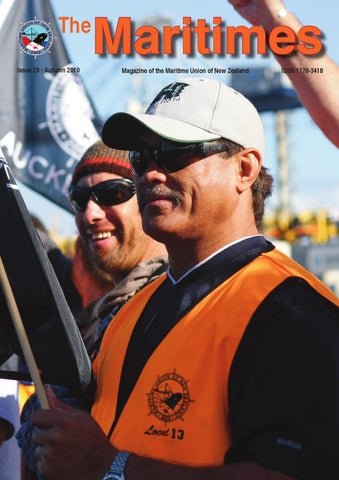
‘The Maritimes’ is published quarterly by the Maritime Union of New Zealand. ISSN 1176-3418 National Office: PO Box 27004 Wellington New Zealand Telephone: 04 3850 792 Fax: 04 3848 766 Email: joe.fleetwood@munz.org.nz Web: www.munz.org.nz Editor: Victor Billot Mobile: 021 482219 Fax: 09 9251125 Email: victor.billot@munz.org.nz Mail: PO Box 339, Dunedin New Zealand Editorial Board: Joe Fleetwood, Phil Adams, Garry Parsloe and Ray Fife Deadline for all Port reports, submissions, photos and letters: 1 May 2010 for next edition Cover photo: MUNZ Local 13 members rallying for secure jobs and no outsourcing at Ports of Auckland, Sunday 14 March 2010 (photo by John Darroch) For more on-line photos, see www.flickr.com/maritimeunion Thanks to our photographers, including John Darroch, Alex Hague, Terry Ryan, Bill Connelly, Stu Crawford, Grahame MacLaren, Luke Appleby, Harry Holland, Tania Kahui, Mike Regan and others
Contact the Maritime Union National Office Telephone: 04 3850 792 Fax: 04 3848 766 Address: PO Box 27004, Wellington Office administrator: Ramesh Pathmanathan Email: ramesh@munz.org.nz General Secretary: Joe Fleetwood Direct dial: 04 8017 614 Mobile: 021 364649 Email: joe.fleetwood@munz.org.nz National President: Phil Adams Direct dial: 03 4728 052 Mobile: 0274 377601 Email: phil.adams@munz.org.nz National Vice President: Garry Parsloe Direct dial: 09 3032 562 Mobile: 021 326261 Email: garry.parsloe@munz.org.nz Assistant General Secretary: Ray Fife Direct dial: 03 2128189 Mobile: 0274 475317 Email: ray.fife@munz.org.nz ITF Inspector: Grahame MacLaren Direct dial: 04 8017 613 Mobile: 021 2921782 Email: maclaren_graham@itf.org.uk Communications Officer: Victor Billot Mobile: 021 482219 Fax: 09 9251125 Address: PO Box 339, Dunedin Email: victor.billot@munz.org.nz
www.munz.org.nz
by Victor Billot We have a Government who seem to think a port is something you drink in the evening to go with your cigar. That’s the impression you get when you observe their offhand approach to New Zealand’s maritime transport infrastructure. New Zealand ports are in the firing line these days. Finance sector analysts want to sell ports off. Port company execs say we have too many ports. The shipping conglomerates and big New Zealand operators like Fonterra and Pike River Coal play ports off against each other. That’s not even taking into account the withdrawal of support for coastal shipping and the continued casualization of secure jobs. Meanwhile, the Government is in snooze mode. John Key’s only acknowledgement of ports has been to rabbit on about “party central” on Queens Wharf for the Rugby World Cup. The Minister of Transport Stephen Joyce has officially declared it is the season of the siesta as far as ports go, saying that the future of ports will be shaped by “natural market forces.” Sounds great. However, when it comes to subsidizing road transport, the Government is printing free money for the trucking companies. Never mind road congestion, peak oil, and global warming. Just build more roads and bigger roads and put more trucks and bigger trucks on them – all subsidized by the taxpayer. It has also been pointed out that while the National Government has canned SeaChange and any kind of support for coastal shipping, they have handed out grants to develop aquaculture. No problem with aquaculture but if it is good enough to assist them, what about the maritime industry? The punchline is that by relying on National’s “natural market forces” we might be looking at a New Zealand hub port across the other side of the ditch. If New Zealand ports don’t get their act together, we could just become a side show to Australia, with minor Kiwi ports having to send exports over to Sydney, Melbourne or Brisbane for hubbing. Farfetched? This prospect is now being openly talked about in the maritime industry by business, unions and commentators. While John Key is hamming it up with “party central”, New Zealand’s main hub port could soon have kangaroos jumping around the perimeter fence. Decades of poor planning and lack of foresight have created the situation, but now we are approaching crunch time, the nation’s leaders are out to lunch. When it comes to ports, this is a Government where the lights are on but nobody is home. The Maritime Union is promoting the “KiwiPort” concept which would involve a national, strategic ports plan. Rather than leaving things to chance and hoping for the best, we have to plan for the future. Public ownership of ports is a must and any rationalization of ports must be done in a way that does not disadvantage smaller regional centres. Ports should be operated for the public interest, as a vital part of our transport infrastructure, working together rather than against each other. The current “competition” is simply an enormous waste of resources and effort that only benefits shipping multinationals and a few self-interested market players. In other words, we need a rational, planned system. New Zealand can’t afford to get its ports wrong. Someone better put a call through to party central and tell the Prime Minister.
The Maritimes | Autumn 2010 | 3
GENERAL SECRETARY’S REPORT
Conference decisions put in action National officials visit ports A letter was sent on 1 December 2009 from National Office requesting all branch secretaries to discuss this issue with their local executives then take it to their stop work meeting for discussion. All national officials have made themselves available to attend branch or executive meetings throughout New Zealand to explain these changes and answer any questions. We are just a phone call away. Could I make the point that there is no use complaining that no national official visited the port a year down the track? If you want us there to discuss these changes, get in touch now.
Union rules and structure
“By being part of strategic union alliances we contribute our help and solidarity to other workers, and when we face a dispute we can count on their help”
4 | The Maritimes | Autumn 2010
by Joe Fleetwood General Secretary The Maritime Union Triennial Conference held late last year passed a range of remits. These reflect the democratic decision of the union members. The officials and executive of the Union are now bound to put in place those decisions which are now union policy. This isn’t an option. Those decisions of the Conference must be, and will be, implemented. In other words – time to walk the talk. The Union committee of management made up of the four national officials is reviewing a number of areas of action. We are working on our Union financial plan and budget, in conjunction with the Finance Committee, made up of some representatives from the branches and national officials, appointed by the Conference.
Union finances One action point is to move to percentage based union fees, as per remit 9 that was endorsed and carried at our Conference. This means one union, one fee, with each member’s union fee based on a percentage of their earnings. This is a fair system, a national system and a modern system that will take us forward and eliminate a lot of confusion and inequity.
Union rules are currently under review as they need to reflect what our Union needs now. The previous rules served to see us through the transition period following our amalgamation in 2002. As we evolve we need to ensure that our rules are updated. Union structure is another important area. We need to ensure branch elections do not conflict with national elections and the timing is right. We also need to put in place a training and education program.
National bargaining The Union is moving to bring our national bargaining in line by ensuring up to date national agreements with national employers, and also provide national templates that provide an industry standard for wages, terms and conditions. This is part of moving towards a nationally based co-ordinated and effective union.
Strategic Alliances A priority is the building of strategic alliances with other unions. By being part of these alliances we contribute our help and solidarity to other workers and when we face a dispute we can count on their help. As most members know, our Union is affiliated to the New Zealand Council of Trade Unions (CTU) and the International Transport Workers Federation (ITF). However the Maritime Union is also part of a number of other alliances that have been formed in our industry.
www.munz.org.nz
GENERAL SECRETARY’S REPORT We have just started the ball rolling on a strategic alliance with the RMTU. Why? A key goal is returning all waterfront workers back to ITF affiliated unions (MUNZ and RMTU). This will be done through a national campaign targeting yellow/scab associations and non union labour. By working together with a set of principles and guidelines we can be more effective. This plan was discussed and endorsed at the December 2009 telephone conference call of the National Executive of our Union. 2009 was a busy year with the formation of the Trans Tasman Oil and Gas Offshore Alliance. This alliance is between unions working in the Australian and New Zealand offshore industry in oil and gas. It involves MUNZ and the EPMU from New Zealand, and the Maritime Union of Australia and the Australian Workers Union on the other side of the Tasman. The offshore industry is a major employer of our members and will grow in importance in the future. Another broader alliance is the Trans Tasman Transport Union Federation. On the Australian side this features some heavy hitting unions and on our side of the Tasman we have signed up the EPMU, the RMTU, the National Distribution Union (NDU) and of course MUNZ. One other big union initiative we are part of is the Mining and Maritime International, two areas of unionism that have remained internationally strong and militant. We count amongst these grouping unions in America, Canada, Africa, Europe and Oceania. These groupings allow us to build international support for each others struggles. Just as big business operates globally, unions must operate globally too. International Solidarity is very important to MUNZ and we must forge our relationships with all like minded Unions.
Gas Tankers Garry Parsloe and I along with the Merchant Service Guild (MSG), Aviation and Marine Engineers Union (AMEU), and the CTU, have had on going discussions with Ocean Gas one of the owners of gas tankers working the New Zealand coast. The Unions have laid claim to one vessel with a dedicated New Zealand crew. We are waiting to here back in the New Year from a second owner Liquid Gas on a meeting to discuss a New Zealand dedicated crew on one of the nine gas ships currently trading in the Pacific.
Offshore M.O.U Agreement I have been dealing with Christy Cain and Mick Doleman of the MUA in negotiations with the Offshore Employers in Australia. The majority have agreed to sign the new memorandum of understanding between unions and the employers about the transfer of labour across the Tasman for Offshore and Blue Water vessels. “The development of our understanding and our effectiveness as trade unionists and working class fighters cannot be separated from our everyday activity in the defence and advancement of the working people’s interests. So our understanding and education cannot be divorced from our day to day practical work.”
Contributions welcome. All members are welcome to send in contributions to The Maritimes. We need photos, letters, articles, comments and anything else you can think of. If there is something you’d like to see in The Maritimes, send it to the Editor: Mail PO Box 27004, Wellington, New Zealand Email victor.billot@munz.org.nz Fax (09) 9251125
www.munz.org.nz
The Maritimes | Autumn 2010 | 5
NATIONAL PRESIDENT REPORT
Maritime strategy a priority for NZ
by Phil Adams National President We are well into 2010 and as usual some things have not changed. As soon as we deal with one employer determined to cook up some mad scheme and drag us into it, another one comes along. Many of the issues that we face are coming to a head so our advice would be to keep your wits about you and watch this space.
Ports and maritime strategy The Maritime Union has been calling on the Government to provide some leadership in the ports and maritime area. The current Minister of Transport Stephen Joyce has advocated a let the market decide approach for key areas of our transport infrastructure. But many voices in the industry have not been so happy with this “hands off” attitude. The Maritime Union was heavily involved in setting up a meeting between the Minister and local representatives in Timaru in December 2009 to discuss the situation at the Port of Timaru. The decision by Fonterra to pull out with no warning has had a major impact on the port. The point was made to the Minister that regional economies would be damaged if this situation was allowed to continue. The consequences of a major market player making decisions entirely based on its self-interest could be repeated on a much larger scale with the process of port rationalization in New Zealand.
6 | The Maritimes | Autumn 2010
Retiring Pacifica CEO Rod Grout recently noted that the hub port for New Zealand could end up in Australia, unless New Zealand had some kind of plan for the future of its ports. This view was repeated in a study by Auckland Regional Holdings, owners of the Ports of Auckland, in late 2009. The Maritime Union is advocating a ports plan at the very least, and has put out the concept of “KiwiPort” where New Zealand ports are integrated and work together under a long term plan under public ownership. It was also interesting to note recent comments in the Shipping Gazette pointing out how the Government seems to have very flexible approach to supporting industry when it feels like it. After dumping the Sea Change strategy, and indeed any support for maritime transport whatsoever, they have decided to back the aquaculture industry with financial assistance for its development. No problem there – aquaculture is a growth industry – but where’s the consistency? New Zealand is a maritime nation, yet it appears the current Government is asleep at the wheel.
Political situation The Maritime Union will be continuing to work hard in the political field on all the issues that face us, casualization, unemployment, workers conditions, health and safety, ACC, no privatization, yellow associations and all the other areas where a right wing anti-worker National Government will be on the attack. There is an old saying that stands true today as in the past: “No politics is bosses’ politics.” The Maritime Union will be advocating hard for workers’ rights and we all have a role to play.
Minimum Wage There is growing pressure for a serious rise in the minimum wage. The rise to $12.75 per hour is seen as inadequate at best. Every worker must have the right to earn a reasonable living. The current petition by the UNITE union calling for an immediate rise to $15 per hour has gathered substantial support. Labour, Greens and Alliance are all supporting a rise to this level in different time frames. A rise in the minimum wage would be one of the best ways to improve the lot of struggling families, unlike tax cuts which mainly benefit high income earners.
Social Many branches have some form of social activity for members, ranging from picnic and family days, Christmas parties, and Old Timers functions. The annual Interport sports tournament is a long standing tradition of the Union, held this year in New Plymouth. The importance of these events cannot be underestimated. All members should support them as they provide a great opportunity to remind ourselves that life is not just about work. Thank you to all the officials, rank and file members and sponsors whose hard work makes it all a reality.
Methyl Bromide The perennial issue of the use of Methyl Bromide gas as a fumigant in New Zealand ports has once again come to public attention. The gas is meant to be phased out under international agreements, as it damages the ozone layer. But there are vested interests in keeping it in use in New Zealand as long as possible, due to log exports to some countries. These log exports of course come before the safety of workers. Studies so far have found no link between methyl bromide and motor neuron disease, the illness that claimed the lives of several Port Nelson workers in recent years. However that does not prove conclusively there is no link. Now more research is being done at the University of Canterbury and very early results show that methyl bromide does react with a protective chemical found in human cells. More research is needed. Just as importantly, any maritime workers who have to deal with methyl bromide should ensure they comply with all health and safety measures, and report any bad practices or incidents with the gas. The Maritime Union continues to press for the immediate end to methyl bromide use. It’s on the way out anyway, so why risk it. One final thing – we have made it clear that if any links between methyl bromide and health problems of any kind are identified in future research, employers and the Government can expect to be held accountable.
www.munz.org.nz
NEWS Photo by John Darroch
Maritime Union opposes outsourcing in Auckland The Maritime Union of New Zealand says outsourcing at Ports of Auckland cannot replace a skilled in-house workforce. Maritime Union Auckland Branch Local 13 President Garry Parsloe says any moves to contract out work by port management would meet strong resistance. Ports of Auckland Managing Director Jens Madsen has claimed in media interviews that outsourcing parts of Ports of Auckland’s workforce was being driven by the need to handle peak demand. But Mr Parsloe says the workforce currently employed by the Port Company is one of the most flexible workforces in New Zealand. “Maritime Union members at Ports of Auckland work 24/7 in all weather. They undertake highly skilled duties operating heavy equipment in a challenging environment.”
www.munz.org.nz
He says the focus of management should be on maintaining its current workforce at a level where it can service its customers. Mr Parsloe says Mr Madsen’s claims that outsourcing was common practice overseas neglected to take into account that it was also a common source of major industrial conflict between management and workers. Maritime workers around the world were fighting outsourcing and job insecurity tooth and nail. “We have no doubt outsourcing will be used to reduce the terms and conditions that our members receive under the terms and conditions of the Collective Employment Agreement recently negotiated in good faith with the Company.” He says workers feel that they have been deceived by the Port Company management following major redundancies in 2009.
Mr Parsloe says managers were warned at the time that they would be left understaffed. He says the current agreement contains the flexibility to meet the “peaks and troughs” of shipping. “The outsourcing concept from the Ports of Auckland management is about trying to cover a lack of skilled, permanent staff. If it is such a good idea, why not outsource the managers?” Mr Parsloe says during the global economic downturn, the hard work of maritime workers saw an increased profit of $4.6 million for the Ports of Auckland. The profit from the Port Company is returned to the people of Auckland through the Auckland Regional Council and has contributed over $200 million in the past five years.
The Maritimes | Autumn 2010 | 7
METHYL BROMIDE
New methyl bromide research Professor Ian Shaw
by Victor Billot A leading New Zealand scientist is spearheading new research into methyl bromide, the gas used in many New Zealand ports to fumigate logs. Four port workers in Nelson died of degenerative motor neuron disease (MND) between 2002 and 2004 and there have been ongoing concerns that methyl bromide was a common factor. A report from the Nelson Medical Officer of Health Ed Kiddle found no link. But Professor Ian Shaw of Canterbury University disagrees with Kiddle’s conclusion because Kiddle used the population of Nelson to determine the incidence on MND. Shaw thinks that since all of the cases were Nelson port workers that using the port population gives a much more meaningful result.
8 | The Maritimes | Autumn 2010
Using Kiddle’s method the MND incidence is close to that in the rest of the world, but using Shaw’s method suggests that the port incidence is many hundreds of times greater. Shaw and his PhD student Amila Bulathsinghala have carried out experiments that show a reaction when mixing methyl bromide with glutathione, a protective chemical found in human cells. They believe the motor neuron cases probably had a common factor, with methyl bromide exposure being a contributory cause of the illness. Motor neuron disease is rare, occurring in around 1.2 people out of every 100 000 on a worldwide scale. That is why the number of motor neuron deaths of port workers in Nelson has caused concern. In a small population like Port Nelson we would expect only a single case in many years, but four port workers died of MND in two years in Nelson, says Shaw. Professor Shaw is a toxicologist with a research background in motor neuron disease. He is supervising a small research team and says the study will be expanding in scope as other academic colleagues in other New Zealand universities have joined the research efforts, which are focussed on causes of motor neuron disease. In a recent interview with the Maritimes magazine, he stressed the study was in very early stages and the initial findings did not mean that methyl bromide was a cause of motor neuron disease. But he suspects that methyl bromide could be a factor and future research will look more closely at methyl bromide’s effects on human cells.
Government– industry link questioned The Maritime Union has attacked comments by the group Stakeholders in Methyl Bromide Reduction (STIMBR) which downplays valid concerns about the use of the poison gas. Maritime Union of New Zealand General Secretary Joe Fleetwood has condemned a statement from STIMBR (1 February 2010) entitled “Gas links with disease unfounded” that asserts there is no proof that methyl bromide is connected with motor neuron disease. Mr Fleetwood says there is no proof as yet, but important new research into the health hazards of methyl bromide has detected possible links and there has been criticism of past investigations. “On the one hand STIMBR is claiming no one knows what causes motor neuron disease, yet the very reason that further research is being done is due to possible links. “As responsible employers they should be encouraging any new findings that build on current limited knowledge. STIMBR also quote outdated research in their public statement.” STIMBR is made up of businesses that have a direct financial interest in the use of methyl bromide, but until recently had Government representation and financial contributions. Mr Fleetwood says he is very concerned that the Government has until recently been officially represented on what was clearly a partisan organization that appeared motivated by the interests of private businesses, and which had no representation of maritime workers. “STIMBR is not an industry group, it’s an employers group. What Government agencies were doing involved with STIMBR is a major concern.” In the October 2009 STIMBR newsletter, it was noted that government departments had advised they would no longer be members of STIMBR but would seek observer status due to perceived conflict of interest and “will be discussed further by the management committee.” The same newsletter lists as its first item under “Specific areas of progress” the achievement of “Protecting methyl bromide use”, which seems an odd area of progress for a group whose name is “Stakeholders in Methyl Bromide Reduction”. Are they protecting the use of Methyl Bromide – or reducing the use of Methyl Bromide? www.munz.org.nz
METHYL BROMIDE
Maritime Union of New Zealand officials, from left, Mike Clark, Joe Fleetwood and Glenn Wylie join with Green Party MP Sue Kedgely (centre) and Steffan Browning of Soil and Health (right, black jacket) and anti-methyl bromide protestors at the Port of Wellington, Friday 12 March 2010 (photo by Mike Regan courtesy of RMTU)
WE SAY: Can the Gas Methyl bromide needs to go. The fumigant is on its way out anyway, under an international agreement called the Montreal Protocol, because it damages the ozone layer of the atmosphere. But in “clean green New Zealand” the fumigation industry which profits from methyl bromide seems to be dictating the rules of the game. The best way to encourage the prompt development of alternative pest control technology is to ban methyl bromide. New research on methyl bromide gas at the University of Canterbury is welcome news to workers. It’s great that our researchers and academics are on the case. Nowhere near enough is known about methyl bromide’s long term effect on humans to give it the benefit of the doubt. The Maritime Union has argued for several years that methyl bromide use should be stopped, along with the Council of Trade Unions and the Green Party.
www.munz.org.nz
Early reports of a possible link between methyl bromide and nerve damage, while not surprising, should make it clear that use of methyl bromide must be immediately stopped while further research is carried out. Why did the Government and its responsible agencies did not act to have methyl bromide thoroughly investigated when these concerns were raised in the past? Is it because it is out of sight, out of mind? Would more action be taken if methyl bromide was being used to fumigate the basement of Parliament Buildings perhaps? If there is any suggestion that lack of safeguards by employers or state agencies has resulted in preventable harm, then legal action is the obvious course of action. In the meantime, let’s can the gas. Methyl bromide needs to go.
“New research has shown a reaction when mixing methyl bromide with a protective chemical found in human cells”
The Maritimes | Autumn 2010 | 9
NEWS
New Zealand maritime workers back MUA in offshore industry
The Maritime Union of New Zealand has congratulated the Maritime Union of Australia (MUA) in its successful and ongoing campaign in improving wages and conditions in the offshore industry. Maritime Union of New Zealand General Secretary Joe Fleetwood says offshore maritime workers are working in a tough and unforgiving environment and all workers benefit from strong unions like the MUA leading the way forward. He says the recent media attack from the Australian Institute of Marine and Power Engineers (AIMPE) on the MUA’s offshore strategy has blown the credibility of the AIMPE. The AIMPE is an affiliate of the International Transport Workers Federation, and the Maritime Union of New Zealand will be seeking an explanation of their leadership’s public statements attacking a fellow maritime union for doing their job.
Timaru Port Network Search and meets with Minister Surveillance Bill of Transport by Sam Huggard Representatives of the Timaru Port Network met on Thursday 10 December 2009 with the Minister of Transport Stephen Joyce in Timaru to discuss the future of the Port of Timaru. The Port Network includes representatives of the South Canterbury Chamber of Commerce, Aoraki Development Trust, Timaru District Council, South Canterbury Federated Farmers and Maritime Union of New Zealand, an unusual grouping that shows the strength of concern. Maritime Union General Secretary Joe Fleetwood attended along with former General Secretary Trevor Hanson and communications officer Victor Billot who had set up the original public meeting of the Timaru community in October. This meeting called for dialogue between the Timaru community and port users, and the Government. The point was made to the Minister that the Port played a vital role to the South Canterbury economy, and the impact of Fonterra’s decision to withdraw much of its cargo from the port this year could not be underestimated. The issue of KiwiRail, who was now moving much of that cargo long distance to Lyttelton, and the effect of Government investment and subsidy on different transport modes, was also discussed. For more information see http://portoftimaru.com/
10 | The Maritimes | Autumn 2010
National Distribution Union
Critics of the new Search and Surveillance Bill are warning of a massive increase in state powers to spy on New Zealanders, and say the proposed law changes need to be stopped. The bill gives more state agencies the power to tap into personal conversations, hack into computers and install hidden cameras. Instead of just the police and the intelligence agencies having these rights, all sorts of other agencies like Inland Revenue, the Reserve Bank, the Ministry of Agriculture and Fisheries, and even the Pork Industry Board would have new rights of surveillance. Last year NDU Express reported that a police informant had been caught prying into NDU and other unions’ affairs for over 10 years (the Maritime Union was one of these). Community groups including unions and environmentalists have criticised the bill, but it’s not just campaigners that are concerned. The Law Society and the Chief Justice have also spoken out against it, and corporate lawyers Chapman Tripp have called it “an extraordinarily wide proposal, of unprecedented invasiveness.” For more information see www.october15thsolidarity.info/surveillance
The AIMPE leadership need to figure out whether they are representing workers or representing employers, says Mr Fleetwood. Mr Fleetwood sayd the ongoing attacks on the MUA in the big business owned Australian media are to be expected and need to be countered by getting the real story out through working class communities. “Any group of workers that is successfully organized and achieving good results are regarded as a threat to the vast profits corporate owners and managers are grabbing. So all the flak the MUA are getting is a sign you are making good progress.”
For more information see www.mua.org.au
1951 dispute inspires award winning folk album Wellington singer-songwriter Chris Prowse won the 2009 Tui for Best Folk Album of the year with ‘Trouble On The Waterfront’. Prowse conceived, wrote and produced the record, an innovative musical chronicle of Auckland’s 1951 waterfront dispute inspired by David Grant’s book ‘The Big Blue’. The album is a collaboration of New Zealand singers, musicians and well known broadcasters who have come together like actors in a film to explore the events of the historic and bitter dispute through the medium of contemporary song. On his website, Prowse describes the 155day 1951 waterfront dispute as an epoch in New Zealand history. “Not only was it a struggle between the left and the right, between the various forces within the union movement, but also it was a struggle that raised serious questions about the importance of civil liberties in a democracy during times of internal conflict. Trouble on the Waterfront explores that time through the medium of contemporary song.” Chris and his band played a well-received show at the 2009 Maritime Union conference in Wellington. To listen and buy check out: http://www.amplifier.co.nz/artist/52096/chris-prowse.html
www.munz.org.nz
POLITICAL NEWS
New ACC law “harsh and unfair”
Former maritime leader appointed Alliance spokesperson The Alliance Party has announced its new spokesperson for employment relations, transport and fisheries as former waterfront and maritime leader Trevor Hanson. Mr Hanson retired at the end of 2009 from his position as General Secretary of the Maritime Union of New Zealand, and previous to that General Secretary of the Waterfront Workers Union. He says that working class people in New Zealand have been under attack and have seen their share of wealth shrink even though they’re working harder and longer. “Some of the issues that need immediate attention include casualization and unemployment which are causing serious problems for working people and their families.” Mr Hanson says he is also concerned about contracting out and wants to make sure all registered unions operate independently of employers, which he believes does not always happen despite this being the law. He says it is vital there is a strong left-wing voice in New Zealand politics to promote a secure society. Mr Hanson says the transport industry is heading in the wrong direction and there needs to be a stronger emphasis on shipping and rail, for environmental, economic and social reasons. He says there is also a need to protect New Zealand’s fishing stocks which had been damaged by overfishing, and to ensure use of unionized local labour in the fishing industry to create well paid local jobs. “We need to get in their and start actively fighting for our rights, rather than allowing New Zealand to drift further down the path of unconstrained greed and social breakdown.” For more information see www.alliance.org.nz
A new ACC law passed by the Government in February will make it harder for injured workers to get the help they need to recover from work place accidents, says the ACC Futures Coalition. The ACC Futures Coalition is made up of unions, professional associations and health organizations, including the Maritime Union. Spokesperson for the ACC Futures Coalition Hazel Armstrong says New Zealand workers are now worse off than their Australian counterparts if they suffer hearing loss. “While it is important for Government to contain costs, our accident compensation scheme is substantially more efficient and our levies are lower than Australian schemes run across their country.” She says the ACC scheme is not in crisis, and the changes are too harsh. She says the Government has embedded changes to the law that will make it easier for the ACC scheme administrators to push people out of the scheme without regard to their previous earnings and whether or not they can return to full time work. “These changes will make the scheme more attractive to the Australian insurance companies who want to profit from managing our accident scheme.” For more information see http://accfutures.org.nz/
CTU opposes youth rates Bill The Council of Trade Unions says the Government should not support Roger Douglas’s youth minimum wage rates Bill because it is discriminatory and will do nothing to ease unemployment. CTU President Helen Kelly says the minimum wage in this country is already low and expecting any group to work for less than $12.75 per hour is grossly unfair. “There is also no reason why two people doing the same job should be paid different rates simply because of an age difference. The removal of youth rates in 2008 was a major step forward in improving human rights for this age group and in improving their standard of living.” Ms Kelly says returning to a youth rate will drive young workers into poverty and will have serious implications on the health and wellbeing of our working youth.” For more information see www.union.org.nz
Crackdown on “Loan Sharks” will protect vulnerable Protecting out most vulnerable New Zealanders and their families is at the heart of a campaign to crackdown on Loan Sharks, says Labour MP Carol Beaumont and Spokesperson for Consumer Affairs. She’s introducing a private members bill to Parliament to do that. The Credit Reform (Responsible Lending) Bill, will if passed prevents lenders (loan sharks) from charging excessive interest rates and will ensure that they are more responsible when lending money. “Times have never been better for loan sharks. Unemployment is at record levels and more families are struggling to make ends meet. For most the economic recovery has yet to find its way to their pockets. The reality for many Kiwis is that losing a job coupled to rising food costs can often leave with a loan shark as the only alternative”, says Ms Beaumont. Loan sharks lend out money at obscene rates, without checking to see whether the borrower will be able to meet the repayment requirements. Increasing numbers of people are pawning items like bikes and children’s toys to borrow funds to be able to pay the bills, she says. “In some cases people are borrowing to pay off interest and then incurring much higher interest as a result, leaving them in more trouble than they were in the first place. For those unfortunate enough to be trapped in this ever restricting spiral of debt, the consequences can be severe.” Ms Beaumont says this Bill is “necessary but not a complete fix.” “To get to the root of the problem we need to ensure that the public is better educated about budgeting and financial matters. We need to address the inadequacy of incomes by making sure that the minimum wage provides you enough to live on.” For more information see www.labour.org.nz
www.munz.org.nz
The Maritimes | Autumn 2010 | 11
INTERNATIONAL
Rio Tinto’s attack on working families in Boron: Mining and maritime unions fight back
At 7 am on 31 January 2010, the Rio Tinto corporation locked out nearly 600 ILWU members at the company’s Borax mine and plant in Boron, California. Rio Tinto is a foreign-owned, mega mining conglomerate that’s trying to force a concessionary contract ultimatum onto working families and communities in California’s High Desert. Rio Tinto’s ultimatum includes: • The power to convert full-time jobs, whenever management wants, into parttime positions with little or no benefits. • Authority to reduce employee pay, any time the company wants, regardless of the contract wage rates and without any right of workers to file a grievance. • The ability to outsource all jobs, any time it wants, to contractors and temp agencies that pay low wages and provide little or no benefits, without any right to file a worker grievance. • If Rio Tinto violates any state or federal labor laws, which it has already done, workers would be required to pay for the company’s legal penalties, fines, damages and even attorney fees. • The unlawful discrimination against military personnel by denying them seniority credit for military service if they’ve served in the Armed Forces for less than one year or for more than four years, which constitutes a violation of federal law (USERRA). Also among the company’s demands is the elimination of the Veteran’s Day holiday starting in 2011. 12 | The Maritimes | Autumn 2010
• The removal of scores of workers from the union contract and power to declare entire sections of the plant to be ‘nonunion’ areas where employees could be fired at any time, for any reason, or for no reason at all. • The ability at any time to change shifts, hours and work assignments, and impose mandatory overtime, with no scheduled days-off or regular shifts, making life impossible for families. •Require workers to give up their Constitutional and legal right as Americans to go to court if the foreignowned company discriminates based on race, sex, age, disability, military status or religion, or if it violates any other state or federal laws. • Under the Rio Tinto lockout contract, all legal rights would be transferred from American courts to a private arbitrator, which the company gets to pick in at least half the cases. • Authority to eliminate long term disability coverage for any new employee, which protects workers - and provides economic security to families - when an employee is injured and can’t work. • The drastic reduction of retirement benefits for current employees, and the total elimination of pension benefits for new employees who would only get a small 401(k) contribution. Rio Tinto has a long and ugly history of disrespecting workers and communities here in the US and around the world.
Our brothers and sisters in Australia’s Hunter Valley are facing the same kind of outrageous demands that families are facing in Boron. Rio Tinto is currently being sued in US Federal Court for mistreating the community and environment in Papua New Guinea. In 2009, Rio Tinto made almost $5 billion in profits, despite a world-wide recession. Several years ago, the company paid nearly $40 billion for Alcan - a decision that left Rio Tinto heavily in debt. The company is now trying to climb out of debt by driving down the working conditions of their employees. The International Executive Board of the ILWU condemned Rio Tinto’s lockout of Local 30 members. They are urging all unions, community groups, environmental organizations and others who care about working families to lend whatever support they can to achieve a resounding victory over this greedy and abusive employer. “Workers in Boron are fighting to save good jobs and help our communities in the high desert, but they’re really standing up for all workers in America who are sick of seeing good jobs destroyed or turned into ‘junk jobs’ without decent health care and retirement,” says Angie Holland-Young, a 17-year, award-winning employee with a perfect attendance record.
For more information see: www.boraxminers.com www.ilwu.org
www.munz.org.nz
INTERNATIONAL
Update: Rio Tinto withdraws demands
Maritime Union of New Zealand General Secretary Joe Fleetwood addresses locked out miners in Boron, California, as part of a delegation from the Mining and Maritime meeting (photo courtesy MUA)
Statement by Mining and Maritime Unions, Palmdale, California, 16–17 February 2010 on disputes with Rio Tinto and Grupo Mexico/Government of Mexico We, leaders of mining and maritime unions representing workers from Canada, the United States, Australia, South Africa and New Zealand meeting in Palmdale, California on 16 – 17 February, express our serious concern with the violation of workers’ rights in Boron, California by Rio Tinto and in Mexico by Grupo Mexico backed by the Government of Mexico. On 11 February 2010 a Mexican court, without a full examination of evidence, ruled the termination of the collective bargaining agreement between Grupo Mexico and Section 65 of the National Union of Mine, Metallurgical, Steel and Allied Workers of Mexico (Los Mineros). The court has ruled that 1,200 workers, members of Los Mineros Section 65, are to be dismissed, a strike they initiated in July 2007 is terminated and that the union’s collective bargaining agreement with Grupo Mexico is extinguished. The dispute between Grupo Mexico and Los Mineros is a long-standing one. The Mexican government has allied itself with Grupo Mexico in a more than four-year www.munz.org.nz
campaign of repression and abuses of power to eliminate the Los Mineros union, which is that country’s strongest independent union led by Napoleon Gomez Urrutia. Rio Tinto, a multinational mining giant that many of us have done battle with in the past, locked out nearly 600 members of the ILWU Local 30 at its borax mine and plant in Boron, California. This mega mining conglomerate is trying to force an extremely concessionary contract ultimatum down the throats of Local 30 members and their families. Rio Tinto has a long and disgusting history with respect to their mistreatment of workers, communities and the environment around the world. The company is currently being sued in U.S. Federal Court because of its treatment of the community and environment in Papua, New Guinea. We intend to escalate the campaigns in defence of workers at Rio Tinto and Grupo Mexico immediately, dramatically and strategically to make them global battles. We will not cease until these workers receive fair treatment. Statement issued on behalf of the mining and maritime unions coordinating committee by Maritime Union of Australia, Construction, Forestry, Mining and Energy Union (Australia), SATAWU (South Africa), National Union of Mineworkers (South Africa), CEPPWAWU (South Africa), International Longshore Workers Association (Locals 1422 and 1526), , International Longshore and Warehouse Union, Maritime Union of New Zealand, International Metalworkers Federation, International Chemical, Energy, Mine and General Workers Union.
Workers at Rio Tinto’s borax mine in California’s Mojave Desert scored an important victory on 5 March when company officials suddenly and unconditionally agreed to withdraw a series of illegal demands that figured prominently in the employer’s unlawful lockout against nearly 600 employees. Rio Tinto’s withdrawal of the illegal demands came after union members filed charges against the company with federal officials at the National Labor Relations Board (NLRB). Workers allege that the employer committed a host of serious labor law violations, including a series of unlawful demands and ultimatums that led to the illegal lockout. “Today’s action by the company constitutes an implicit admission of illegal behavior that won’t protect Rio Tinto from past violations or future liabilities arising from their illegal ongoing lockout,” said ILWU spokesperson Craig Merrilees.
Signed Mick Doleman, MUA Dean Summers, MUA/ITF Jo White, MUA Andy Triplett, USW Scott Mullins, USW Ken Neumann, USW Stephen Hunt, USW Adam Lee, USW Manny Armenta, USW Ray Familathe, ILWU Willie Adams, ILWU Kenny Riley. ILA Mike D. Payne, ILA Andrew Vickers, CFMEU Garry Parsloe, MUNZ Joe Fleetwood, MUNZ Bob Ashton, ILWU-Canada Sikhumbuzo Phakathi, CEPPWAWU Joe Drexler, ICEM Ismail Asland, Mineworkers Union of Turkey Kenan Dikbiyik, Mineworkers Union of Turkey Oupa Komane, NUM Robert Mashego, SATAWU Kristyne Peter, IMF Eleanor Morton, ILWU Lewis Wright, ILWU Russ Bargmann, ILWU Rob Remar, ILWU Wes Furtado, ILWU Alberto Bonilla, ILWU Local 13 Gary Harvey, ILWU Local 20 Rudy Domane, ILWU Local 20
The Maritimes | Autumn 2010 | 13
UNION YOUTH
MUA young maritime workers conference 1–3 December 2009 Brisbane, Australia
by Peter Torrance Maritime Union of New Zealand youth delegate It was a great privilege for me to represent MUNZ at this conference, which was hosted by the South Queensland Branch of the Maritime Union of Australia. On Monday 30 November, before the Conference opened, the branch hosted a BBQ where we got to meet other delegates, followed by a session of lawn bowls which was a nice relaxing start to a busy few days. After registration the following morning, Tuesday 1 December, there was a welcome to Australia blessing by Uncle Des Sandy, followed by the opening of the Conference by the hosting Branch Secretary Mick Carr. The theme of the Conference was “to know the past and to own the future.” There was a strong focus on struggles of the past and how that has shaped us into what we are today. There was a welcome video presentation by MUA National Secretary Paddy Crumlin followed by a welcome from Assistant National Secretary Mick Doleman.
14 | The Maritimes | Autumn 2010
There was a presentation from the National Young Maritime Workers Committee, “Who you are, what you do, why are you in the Union.” There was a strong emphasis on making unions work for youth and young people under 35, and the need for a strategy to encourage these young workers into the union movement. Support and delegate contacts, website details, emails, Facebook, txt messaging, are all ways to encourage youth to participate. After the morning break there were workshops on the expectations and hopes of the Conference, followed by a presentation by Mick Doleman on “My Money” with the Maritime Mining and Power Credit Union. The afternoon session was a presentation by Australia ITF coordinator Dean Summers on Flag of Convenience shipping (FOC) and Ports of Convenience (POC) campaigns and how as members we can be part of it. This was followed by Gordon Horn and Jim Steele on the veterans and the role they play. After tea we heard from Sharon McNeil of Maritime Super, and Megan Young of Union Shopper with the discounts this service offered to union members.
The day rounded off with a report back from the delegation sent to Cuba earlier in the year and a report on the Cuban Five Campaign. Speakers were Mick Carr, Mich-Elle Myers, Mick Firmin and Paul McAleer. That night we were hosted for dinner at the Plough Inn Tavern in Southbank, Brisbane. The next day, Wednesday 2 December, was another full day. We started with a DVD presentation on international solidarity and power in the Union. This was followed by an ITF global network delegate report. We then had a report on the Birmingham Six and Guildford Four. This was by members of MOJO (the Miscarriages of Justice Organization) Paddy Hill, Gerry Conlon and John McManus. They were imprisoned for bombings they never did. Once released from prison they started this organization to help wrongly imprisoned people around the world. After morning tea, Mick Doleman, Ian Bray and Warren Smith spoke on the history of the Hungry Mile. This street was so named because wharfies would congregate hoping to attract a ticket from the boss to work for the day. This was in the days of the Great Depression. They also gave us a rundown on the battles that shaped the Union and what it is today.
www.munz.org.nz
UNION YOUTH
Strachan Crang (left, holding banner) of the EPMU with Peter Torrance of MUNZ (right, holding banner) representing New Zealand at the MUA youth conference
Paul McAleer also spoke on the ITF Youth Taskforce. After lunch we heard from the officials including Mich-Elle Myers on the principles of organizing national campaigns, Onshore Diving, TT Line and Oil and Gas Alliance, followed by workshops on organizing. Mick Doleman spoke on supporting White Ribbon Day to stop violence against women, and then Mich-Elle Myers, Cara Morris and Janet Morris on how to recruit and protect women in the Union. We then had an indigenous report by Patrick Neliman followed by the Timor APHEDA project report by Hayden Foster, and a Tas Bull DVD and raffle launch with Dave Schleibs.
Thursday 3 December Adam McArthur opened the day’s proceedings with a drug and alcohol report followed by my fellow Kiwi Strachan Crang, national industry organizer for the Aviation sector of the EPMU. Strachan spoke on organizing using social networking sites such as Facebook and toting.
www.munz.org.nz
Next up was Rod Hodgson from Maurice Blackburn lawyers on compensation issues for dockers and seafarers such as asbestos and dust related diseases. Many of us are aware of these horrible diseases and the grief it has caused numerous families. Ian Bray gave an introduction to delegates’ roles in the workplace. This was followed by a web presentation by Raelene Jefferson on youth delegates, who then led some group sessions on the MUA youth web page and our expectations of what we want from the page. After lunch we revisited the day one expectations of the Conference, resolutions of the Conference, and nominations for the 2010 youth committee. The Conference then closed with a DVD of the previous days hosted by Ian Bray and Mick Carr. I’d like to thank MUNZ for the opportunity to attend the Conference and also the South Queensland branch of the MUA for hosting the event. Thanks to all the speakers, officials, delegates and rank and filers who made it so successful. I would hope in the future we could host a similar event in New Zealand to educate our youth unionists.
“There was a strong emphasis on making unions work for youth and young people under 35, and the need for a strategy to encourage these young workers into the union movement”
The Maritimes | Autumn 2010 | 15
HEALTH AND SAFETY
Successful skin cancer claim by worker by Craig Harrison Local 13 Stevedore Robert Powley, a union member of MUNZ Local 13, has won a fight against his employer Ports of Auckland over a skin cancer claim that the company contested. The injury was not the usual you hear a lot of in the work place, like the strains, sprains and broken bones. But you would certainly rate the injury as being amongst one of the worst you could expect to get. The injury sustained by Rob was attributed to long term exposure to sun. The injury sustained by Rob was a Lentigo Maligna on his right ear, translated in real terms, skin cancer. How did all this happen? Well early in 2009 Rob was at home and his good wife was cutting his hair the day before his birthday. She noticed what looked like black grease smudged on his ear and made comment on it. Not thinking much about it, Rob was later the same day around at a mate’s place who also made comment about his ear. On returning home Rob investigated more and thought that what ever it was, it needed looking at. On returning to work and more thought about the ear, Rob sought treatment at the clinic the company sends its workers to. On initial diagnosis the doctor on the 6 February 2009 put it down as a “Rash other specific skin eruption “. It was then that Rob told the attending doctor and nurse that he was going to claim it as a work place injury. This was when it started to get interesting. Firstly, the doctor and nurse were unwilling to complete the claim as a work injury but after much protest and a debate on Rob’s account the paper work was completed. It was at this stage that Rob was referred to a dermatologist, Dr Wishart. Rob then started the paper trail involved in such matters and on 9 March 2009, he filled in a “Gradual Process Claim Employee Questionnaire”. It was after this Rob was referred to Doctor Fion Larsen (specialising in MOHS, micrographic skin cancer surgery) and it was on the 13 March 2009 that they did the biopsy on the lesions. It was after this appointment that Rob got a letter from AON, the workplace provider for Ports of Auckland who are an accredited provider under ACC, that he attend a meeting with a specialist appointed by the company. So on 19 March Rob went to see the specialist, Mr David Ruttenburg.
Rob said the meeting lasted a couple of hours with examination and a thorough question and answer session. Rob was up for it and went prepared. Basically it was his life history being questioned and his time on the Waterfront since starting in 1968. It was on 27 March that Rob got the report back from the biopsy and he made arrangements to get the melanoma removed. Up until this stage the company, through AON, had rejected his claim. So Rob had to fund the surgery and associated treatment himself, not to mention the time off work and resultant sick-pay. The cost of treatment wasn’t cheap with the bill totalling $6000.
You could imagine the predicament if all of a sudden you had to find this. The kick in the guts was on the 9 April. The company sought to get an extension to the time leading up to the dispute hearing for the claim. It is worth noting that on 24 February in Dr Wisharts own words “Rob has a sun induced Lentigo Maligna on his right ear and should undergo surgery”. On the 16 April Rob received a letter from AON saying that they were not accepting the injury as a workplace claim. It was then that the ball started to roll for Rob; he wasn’t going to accept this so the fight was on. It wasn’t until 23 April that Rob received a letter to arrange a dispute hearing on 4 August. Image licensed under Creative Commons BY 2.0 http://www.flickr.com/photos/hamed/2615553710
16 | The Maritimes | Autumn 2010
It was at this that Justice Orange ruled in favour of Rob Powley and in his words “Quashed the position of Ports of Auckland”. In a side note it was interesting to see Ports of Auckland quote a report from waterfront reform stating that watersiders averaged only twenty seven hours a week on the job. Having read the associated reports with this claim I can’t help feel that the company continues to put the health of its balance sheet before the health of the workers who contribute to the profits it makes. It is worth noting that the workers at Ports of Auckland have sun exposure recorded in the workplace register. It was blokes like Rob who sat on the health and safety committees over the years who we can thank for such a comprehensive register. The company’s undoing is that while they might have it in their register they have effectively done nothing over the years; they should have educated and monitored the workforce. They are supposed to do so under the Health and Safety Act, including providing the right gear and protection for the job. It was a great day when Rob walked into the mess room and announced his victory over the company. As I write this article Rob has received the monies that are owed to him. I remember the day that Rob started the claim. The shift manager at the time laughed at him and said he didn’t have a chance. But as always Rob stood his ground and fought to prosecute his claim, to have the skin cancer recognised as a work place injury. This is not only a good result for Rob but also for all maritime workers exposed to the sun over the years with no or little protection. Throughout the article I have made reference to the dates to give the reader an idea of the time involved in relation to the company responding and how drawn out it was for Rob, as if being diagnosed with skin cancer wasn’t enough. In closing I would like to thank Rob for telling his story so all workers might benefit from his fight to get this injury recognised. My hope is now that MUNZ look to form some sort of national register highlighting all the gradual harm injuries suffered by the members in our industry so that we could establish a reference point to argue the case for recognition. Perhaps in the future a more detailed account of this case could be written for the members.
(Reprinted from the Port News, December 2009)
www.munz.org.nz
VIEWPOINT Photo by Alex Hague
National Shipping Shame By Hector Thorpe MUNZ 3111 The National government was elected on the back of promised tax cuts for all. This was a politically good strategy which appealed to many voters. Those on the higher wage bracket currently benefit from this policy while many of their lower paid supporters watch as their day to day living costs increase.
National transport policy National introduced their road funding policy as a means to stimulate New Zealand’s freight transportation network. Domestic shipping naturally expected to be part of a co-ordinated and balanced freight transport system as it adds value in cost, integration, road traffic congestion, environmental responsiveness, safety and regional economic development, as acknowledged by Labour in their 2007 Sea Freight Development Fund as part of the Sea Change Strategy.
www.munz.org.nz
National shock However National shocked the maritime industry when without consultation they excluded coastal shipping from their freight transport network. This action effectively makes road and rail companies competitors to coastal shipping. National then subsidised these competitors to the tune of $2 billion for roads while increasing the allowable freight loads for trucks, plus $400 million was allocated to Ontrack. Shipping was further snubbed when they withdrew the Sea Freight Development Fund which was set to revitalise the industry after years of government neglect.
National strikes again
National out Given Nationals past and present shipping policies it’s a credit to the Kiwi ship operators and maritime unions that a local shipping industry still exists, particularly as local ship owners have tried to recoup their losses sustained from these policies from MUNZ. But maybe both organisations now have something in common, an awareness that under National the final chapter could mean foreign ship owners finally wrestling complete control of shipping leaving them free to dictate the terms of our coastal trade and ports. Therefore to survive we all need rid of this National led government.
You may recall the previous National government passed the Maritime Transport Act 1994 which removed cabotage. Cabotage restricts foreign ships operating domestically as its designed to protect the local infrastructure. All our major trading partners retained cabotage. Foreign ship owners received further government assistance when they were exempt from tax charges imposed on New Zealand ship operators. As predicted these policies were responsible for destroying most of New Zealand’s coastal shipping.
The Maritimes | Autumn 2010 | 17
ITF Other issues that were noted were the assaults on contract workers in Mumbai by Maesrk subcontractors, the Rio Tinto lock out of 600 workers in Boron, California, and the sacking of 1300 Mexican miners along with a mine explosion that lead to 63 deaths.
Mexico
Members of the Offshore Task Force are seen here wearing their bloody T-Shirts, symbolising the violence committed against members of the TDWU in Mumbai by employees of Thakur.
ITF Offshore Taskforce Group Mumbai, India, 22–24 February 2010 by Mike Clark, Wellington Seafarers’ Secretary and Joe Fleetwood, General Secretary Ancient yet modern, Mumbai is India in microcosm. Once a sultry tropical archipelago of seven islands today it’s a teeming metropolis, the commercial hub of an old civilisation seeking to find its place in the new world. Forty percent of India’s taxes come from this city alone and half of India’s international trade passes through its splendid natural harbour. Nearly 13 million people live here, all existing cheek by cheek in soaring skyscrapers and sprawling slums. They come from diverse ethnic backgrounds and speak over a dozen tongues, add in colour and texture to the great Mumbai melting pot. The ITF Offshore Task Force Group met in the Triton Hotel in Mumbai with approximately thirty-four delegates from the Asia Pacific Region. They gathered under the chairmanship of Norrie McVicar of the ITF, and vice chairs MUA deputy national secretary Mick Doleman and ITF Asia Regional Secretary Mahendra Sharma. The Offshore OTFG (Offshore Task Force Group) was formed in 1997 to enhance wages and conditions and health and safety to protect the country nationals in this industry.
18 | The Maritimes | Autumn 2010
The Task Force now operates in 18 countries. There were traditional greetings and presentation of bouquets to leaders and also the lighting of the peace flame. The meeting opened with a presentation by Mick Doleman on the MUA - AWU Alliance and coverage of Trans Tasman Alliance. MUA, AWU, MUNZ and EPMU ensure union labour supplies coverage. We had an agreement in place for these workers. Now Maersk has reneged on the agreement. They touched on the problems facing Timor-Leste and the need to get these issues on the Government radar. Also the need to communicate with the Australian Government on Papua New Guinea and its massive LNG prospects under investigation by global companies such as Exxon Mobil, Santos Petrofina and Nippon Oil. 15,000 to 18,000 workers are required for the industry but the problem is only 30% will be local labour. The Northern Territory Government agreed to a joint training centre in conjunction with Australian Maritime College, Pacific Island Australian Maritime College, and Pacific Island Australian Aid Training.
Enrique Lozano spoke on human rights abuses in Offshore Oil and Gas and the Mining Sector. Investigative journalist Ana Lillia Perez has authored a report for the ITF about labour exploitation “Campeche Basin: Paradigm of Labour Exploitation” (available from http://www.itfglobal.org/ press-area/index.cfm/pressdetail/3886). She has a new book coming out on this issue which is about the exploitation of Mexican nationals in their own Government owned industry where health and safety and the right to belong to a trade union are virtually nonexistent. This a must read for anyone who has an interest in the rights of working class people trying to make a decent living for themselves and their families. The Union will be purchasing copies of the book whose author is in hiding due to threats on her life.
Timor Leste Rigoberto Monteiro gave an update on happenings in that country, where 10 trainees are now trained and 15 more going to Jakarta, hopefully another 50 in the pipeline with support from Government. A minibus has now been purchased with the $25,000 donated by affiliates of ITF. The Seafarers mini van fund has money left over that will hopefully be able to be used for maintenance.
India It was noted that Indian companies were exploiting seafarers in the offshore industry. Currently cases are before the courts in India. These Seafarers are currently only getting quarter of wages of their counterparts in other countries.
Offshore Diving Agreement Divers trying to work under individual contracts. This is not a good thing as their people would come under contract law and in a dispute if they withdrew their labour they would be open to suing, also they would undermine genuine union members conditions.
www.munz.org.nz
ITF Norway A large number of vessels on the first national register are being replaced by FOC vessels thus displacing Norwegian labour. Between 2008 - 2009, 64 offshore related vessels have been reflagged. The concern is that in the future there will no longer be any Norwegian flagged vessels in Norwegian waters and no Norwegian seafarers on board these vessels. The Norwegian Seafarers’ Union believes the only way to prevent social dumping is to demand Norwegian wages and conditions on these vessels. The NSU acknowledges that shipping is a globalised industry but believe Norwegian workers have a right to compete for jobs servicing the petrochemical industry based on Norwegian wages and conditions. The Norwegian ship owners are unwilling to stop this unfair competition.
FOC Campaign Review There was a report on the Global Terminals India (GTI) Campaign. GTI is 70% owned by Maersk. This is an ongoing campaign following a number of assaults on members of the Transport and Dock Workers Union (TDWU). Members were attacked by company supervisors including one in front of his family. The workers were employed by a contractor SC Thakur, one of a number of non-union contractors. The company claimed that the attacks were the result of a drunken quarrel, but the ITF Commission has received an independent report which shows that this is untrue. A draft motion demanding an end to violence and intimidation of union members has been drafted.
Port of Tauranga The OTFG meeting endorsed the position of New Zealand unions at the Port of Tauranga, New Zealand, in their campaign for secure jobs. MUNZ representative Joe Fleetwood put a motion that was endorsed by delegates with the OTFG Chair to write to the Port of Tauranga CEO. This is only a brief summary of the discussions that took place. But it’s clear that many of the problems we face are global ones, although they are not as bad in New Zealand as some countries where workers are stripped of their legitimate rights to earning decent wages and conditions. I would like this opportunity to thank the Indian Seafarers’ Union, especially Abdulgani Y Serang for his and his fellow members contribution in making this a very successful and informative conference and to all the other delegates for their input.
www.munz.org.nz
Trade unionist Navanath Balshiram Borhade holding up the bloodstained shirt he was wearing during the 2008 attack by company agents (photo ITF): send a solidarity message online at http://www.itfglobal.org/solidarity/solidarity-2920.cfm
Motion on violence against workers at GTI, Mumbai The ITF Offshore Task Force which met from 22–24 February 2010 in Mumbai: Notes with extreme concern the continuing brutal violence against workers employed by contractors operating at GTI (Gateway Terminal India) as they struggle to exert their legitimate rights to freedom of association and collective bargaining. Also expresses serious concerns that despite intense negotiations between the ITF (International Transport Workers Federation) and APM Terminals and its parent company AP Møller-Maersk to settle the issue since the first attacks took place in 2007, further violent assaults by contractors are said to have been perpetrated in October 2009. Demands: that Maersk’s subsidiary GTI does the only responsible thing and sever all relations with contractors Thakur Infra Projects (formerly SC Thakur) and MS Casby Logistics with immediate effect. Resolves: to participate in the public campaign to ensure that APM Terminals and GTI, engage only those contractors which recognise the TDWU as the legitimate union to conclude collective bargaining agreements. Further resolves: to support the TDWU and its union members working at GTI terminal through all lawful, financial and industrial means available, in their struggle to exercise their basic trade union and human rights. Calls upon: ITF affiliates to make representations to AP Moller – Maersk to demonstrate our deep concern with regard to their behaviour in regard to the GTI business in Mumbai. The OTFG confirm and fully support all actions around the GTI Campaign.
Solidarity with MUNZ and RMTU At the ITF Offshore Taskforce Group meet in Mumbai between 22–24 February 2010 our meeting was made aware of a developing dispute in New Zealand port of Tauranga. The dispute centres on the allocation on Dockers’ work from the legitimate unions the MUNZ and RMTU, both affiliates of the ITF, to a Yellow bosses’ union. This is a serious development and can’t be allowed to succeed and comes at a time when the docker rights to handle cargo is under attack via use of ships crews to load and unload cargo without skills and training. Comrade Joe Fleetwood General Secretary of MUNZ briefed the meeting on the importance and dangers of this dispute and indicated the two unions will take all measures available to win this struggle. It was resolved: • That affiliates at the OTFG pledge full support to our brother and sisters of MUNZ and RMTU in their dispute with the Port of Tauranga • The Chairman is authorised to write to the CEO of the Port of Tauranga expressing our support of the MUNZ and RMTU and call on them to withdraw back to the status quo. • The OTFG members stand by to act on advice from our New Zealand affiliates to assist where ever needed.
The Maritimes | Autumn 2010 | 19
ITF
New Zealand Country Report to ITF Asia–Pacific Section Meeting, Mumbai, India
http://www.flickr.com/photos/vorn/484889025 http://creativecommons.org/licenses/by-nc/2.0/
by Garry Parsloe New Zealand ITF convenor MUNZ National Vice President Brothers, Sisters, Comrades, In New Zealand we have just completed our first year of a right wing National Government after 9 years of a supposedly worker friendly Labour Government. In their 9 years the Labour Government did deliver, where they removed some of the most draconian aspects of the anti worker industrial relations policies of the National Government. Labour also delivered where they doubled the minimum wage, policies around working for families and giving workers an extra weeks annual leave. What they did not do is give us the right to strike or cabotage. The present Government has not attacked us fully yet as they have been pre-occupied with the global economic crisis, but now that the crisis is over they have started by attacking workers accident compensation (ACC) and we will need to fight back to protect our ACC provisions. What encapsulates it for me, in my other role as a President of the Council of Trade Unions in Auckland, and chairing those meetings and when opening up for reports on disputes, every union was on its feet reporting on theirs. Recent disputes included:
20 | The Maritimes | Autumn 2010
1. National Distribution Union - Bus drivers striking to obtain $14.00 an hour wage. 2. Engineering, Printing and Manufacturing Union – employers contracting out of their members’ jobs. 3. Dairy Workers Union – members locked out for joining a union. 4. Teacher Unions – nil wage increase. 5. Service and Food Workers Union Healthy Hospitals campaign, contractors not passing on government funded wage increases. 6. Corrections Association – prison wardens being made redundant. 7. Engineering, Printing and Manufacturing Union – Miners striking on the West Coast of New Zealand. So, on a Thursday we are on pickets with the SFWU Union over healthy hospitals, on the Friday we are on pickets with the EPMU Union over contracting out and on the Saturday on pickets with the CANZ Union over redundancies. So it seems to me that the employers and manufacturers have instructed all employers to take the unions on. What’s happening is that we are not able to concentrate on any one dispute. The Trade Union movement is divided and running around with all kinds of disputes and is therefore unable to spend quality time fighting their own disputes and we need to organise better around these issues.
Lastly I would like to talk about Regional and International Solidarity. Whilst at our MUNZ Triennial Conference last month we received a call from Robert Patchett from the Melbourne Branch of the Maritime Union of Australia, through our good friend Dave Schleibs who was at our Conference, asking for assistance over a MSC vessel that had sailed out of Melbourne with the seafarers lashing the last couple of bays that had been loaded just before sailing. The vessel arrived in Auckland and we took 3 or 4 hours out of the vessel when we refused to work it. We met with the Captain who initially was a bit cheeky but when we produced Ray Familathe, National Vice President from the ILWU, who was in New Zealand attending our Conference, the Captain started sweating and then started panicking. Finally we secured an apology in writing, a recognition in writing that Seafarers don’t do Dockers’ work, an assurance that it won’t happen again in writing and an assurance that those Seafarers who did the lashings would be paid double time for that work. So that is regional and international Solidarity at work: Maritime Union of Australia, Maritime Union of New Zealand and the International Longshore and Warehouse Union working together in that victory. Thank you. www.munz.org.nz
ITF
International Transport Workers Federation Asia–Pacific Section Meeting 4–5 December 2009, Mumbai, India by Garry Parsloe National Vice President On 4–5 December 2009 General Secretary Joe Fleetwood and I attended the ITF Asia Pacific section meeting in Mumbai, India. The meetings opening session speakers were: 1. Mr. P.M. Mohd Haneef, Welcome note. 2. Mr. Mahendra Sharma, ITF Asia/Pacific Regional Secretary 3. Mr. Frank Leys, ITF Dockers’ section Secretary 4. Mr. S.R. Kulkarni, ITF Asia/Pacific Dockers’ section Chair. 5. Mr. Paddy Crumlin, ITF Dockers’ section Chair. In this opening session Paddy Crumlin stated that there is no campaign that will deliver unless the Dockers’ section is there driving the campaign. It was stressed that the timing of this conference is most important. It was taking place at a time when the drastic worsening of the financial crisis of September/October 2008 and recent financial crisis created by non-payment of debts to the financial institutions by Dubai World, which have led to massive job losses and painful cuts in wages of millions of workers worldwide. After morning smoko Frank Leys gave an up-date on the Maersk–Mumbai dispute. Frank expanded on all the violence and intimidation that is being directed at these workers. In this section Paddy Crumlin acknowledged the massive input of MUNZ into the Patricks Dispute. He expanded on the dispute especially the excellent fight around the Columbus Canada, and how we as an international Trade Union movement turned the vessel away from West Coast of America. We sent the vessel back to where it sailed from with the cargo loaded by scabs and had that cargo unloaded and reloaded with union dockers. At the end of the above session we carried the following resolution in support of those workers at GTI, Mumbai.
Resolution on violence against workers at GTI, Mumbai The ITF Asia Pacific Dockers’ Conference which was held on 4-5 December 2009 in Mumbai: • Notes with extreme concern the continuing brutal violence against workers employed by contractors operating at GTI (Gateway Terminal India) as they struggle to exert their legitimate rights to freedom of association and collective bargaining. Also expresses serious concerns that despite intense negotiations between the ITF (International Transport Workers Federation) and APM Terminals and its parent company AP Moller-Maersk to settle the issue since the first attacks took place in 2007, further violent assaults by contractors have been perpetrated in October 2009. • Demands that Maersk’s subsidiary, GTI do the only responsible thing and sever all relations with contractors like, Thakur Infra Projects (formerly SC Thakur), with immediate effect. • Resolves to launch a public campaign to ensure that APM Terminals and GTI engage only those contractors which recognise the TDWU as the legitimate union and conclude collective agreements without further delay. • Further resolves to stand by and support the TDWU and its union members working at GTI terminal through all legal means available, in their struggle to exercise their basic trade union and human rights. After lunch on day one we had the country reports where MUNZ and New Zealand issues were reported on. In my country report I reported on the political situation in New Zealand and on issues facing our union and other unions affiliated to the Council of Trade Unions. Mick Doleman gave the Australian Country report where he addressed issues facing the Maritime Union of Australia and other Transport Unions in Australia. After the Country reports the Chairman closed day one.
Day two Day two opened with the Indian Unions giving reports on current disputes in India. After the reports on disputes we had a Country report from the Thailand representative.
www.munz.org.nz
He spoke of the difficulty of organising workers in Thailand and expanded on the opposition from employers against organising workers into unions. Frank Leys then gave a presentation under the heading “ITF and Young Transport Workers.” He stated that we must work hard to organise young workers and to do this we must make ourselves available and have the energy to involve ourselves in issues that young workers relate to. After morning smoko we had another presentation from Frank Leys under the heading “Container Traffic”. Frank addressed the current downturn in container traffic. It seems that there is not a country in the world that is not suffering with the downturn. The following motion was discussed and adopted:
Resolution on Container Cargo Safety The ITF Dockers’ Section Meeting which was held on 17 November 2009 in London: • Resolved to urgently set up a working group within the ITF for establishing international safety standards for container cargo transportation, which is made up of representatives of the related ITF sections such as Road Transport Section, Dockers’ Section and Seafarers’ Section. • The working group will hold its first meeting by the ITF 43rd Congress in Mexico. • The working group will report the result of the meeting to the Congress and propose the Congress that the issue of container cargo safety be addressed throughout the ITF. (Submitted by the National Federation of Dockworkers’ Unions of Japan Zenkoku Kowan.) There was a session before lunch on the ITF data base. This was a very informative session with a lot of input from all the unions. After lunch we went into workshops under the heading “Key issues for Dockers’ Unions in the Region” and “Way ahead for the Dockers’ section in the region.” This session took up all of the afternoon and concluded the meeting.
The Maritimes | Autumn 2010 | 21
ITF
ITF
International Transport Federation Meeting London, 16–20 November 2009 by Garry Parsloe National Vice President
Dockers’ Section Committee On the 16 November 2009 the Dockers’ section meeting was held in the ITF Building, London. The meeting opened with a report on the problems in Mumbai, India where workers are being bashed for trying to join unions. Paddy Crumlin started with giving a brief overview on the situation in Mumbai with Maersk which had been going on for two years. He explained that Maersk had hired a number of contractors to provide dock trucking at its GTI port in Mumbai. For over two years the drivers had been trying to join unions, only to be met by violence and intimidation from contractors. The process had been very long and tiring and he thanked the ITF Maersk Committee for their hard work. He emphasized the importance of securing a legitimate agreement and not to forget the hard work of the brave workers in Mumbai. He also said that succeeding was the only option and that we needed to show APM and the rest of the world what the ITF stands for and is capable of. We next addressed the Minutes of the previous meeting where I had the opportunity to report again on our dispute with the Ports of Tauranga. I explained why the RMTU did not want the Port becoming a Port of convenience but that we have agreed to some degree to work together in a joint campaign in the Port of Tauranga. Whilst there is no agreement with the RMTU to take the Port Company on they have agreed to develop a campaign to target Zespri seasonal Kiwi fruit contracts by all lawful means. Both unions, RMTU and MUNZ, state that New Zealand port employers who actively engage in fostering and supporting non union/yellow union associations will be held accountable nationally and internationally to ensure that dockers’ work in New Zealand is done by members of bona fide ITF Affiliated trade union dock workers. I also reported on our current dispute in Timaru and concluded by stating that we could need assistance and support from the ITF in both Tauranga and Timaru. There was a long discussion around the ITF Mapping Programme and the Port of Convenience Campaign. The above concluded day one.
22 | The Maritimes | Autumn 2010
Day two opened with Paddy Crumlin giving an update on the Mumbai situation. The above was followed by a discussion on attendance at the International Safety Panel meeting that was set down for 27 November 2009. The next session was on Health and Safety, Certification and Training. There was a lengthy session on Container Safety with speakers talking about container stacking and the stowing of containers. After lunch we went into the Flag of Convenience Campaign and discussed how best to progress the campaign. The meeting carried a resolution committing continued support for the Flag of Convenience campaign.
Resolution of support for Tauranga maritime workers In the last session I had the opportunity to again give a report to the Dockers’ section on our problems in Tauranga. After my presentation the Committee carried the joint MUNZ/RMTU resolution on the Port of Tauranga which reads: “The New Zealand Dockers’ affiliate’s joint report highlights the issue of non union dockworkers in New Zealand (currently confined to the smaller general cargo operations) increasing dockers’ work market share to the disadvantage of traditional dockworkers affiliated to the ITF and states that this situation is unacceptable. “The Dockers meeting; Notes that the recent actions by “Zespri” a New Zealand kiwifruit exporter in awarding a stevedoring contract to a non union/ yellow union company is condemned by this meeting. “Pledges support to the RMTU and MUNZ to take joint action agreed between the Unions to ensure that Dockworkers work is returned to ITF affiliated unionized Dockworkers’ in the Port of Tauranga, New Zealand. “Affirms that New Zealand Port employers who actively engage in fostering and supporting non union/ yellow union associations will be held accountable nationally and internationally to ensure that dockers’ work in New Zealand is done by members of bona fide ITF affiliated trade union dockworkers.” After some further discussion on disputes in other countries the meeting was closed for the day.
Fair Practices Committee Section On 19 November 2009, we held the Fair Practices Committee Section. There was a presentation then debate on total crew costs and wage increases for Seafarers covered by ITF Agreements which took up all of the morning. In the afternoon we addressed Fishing Industry matters, TCC 2 Year Special Agreement Draft Guidelines, Welfare Funds, Union Membership Fees, the Inspectorate Audit, the Seafarers Section Committee report and the Dockers Section meeting report. The Dockers Section report contained the MUNZ/RMTU resolution on Tauranga which was endorsed along with the Section Report. On the 20 November 2009 we had the second day of the Fair Practices Committee Section. The meeting addressed the IBF Agreement and fully discussed the content of the memorandum of agreement and the accompanying addenda. This debate went on for most of the day as every speaker seemed to have a different slant on what direction the Bargaining Forum should head. After a long and hot debate we finally reached a point of agreement. Overall the ITF meeting itself was informative and productive.
www.munz.org.nz
ITFITF
None shall pass:
ITF South Australian FOC Offensive 1–10 February 2010 by Grahame MacLaren New Zealand ITF Inspector Wellington based MUNZ activist Ray Cook and I were invited by Australian ITF Coordinator Dean Summers to participate in the second half of this ten day offensive against flag of convenience (FOC) vessels from 4–10 February 2010, the offensive being split into two 5 day periods. The offensive’s main aim was to target vessels coming in to South Australia to export last season’s bumper grain crops. Although grain vessels were the main focus, it was also the intention to blitz all FOC vessels and sub-standard shipping in the region during the period. As the motto on our t-shirts proclaimed: “None Shall Pass” Assistant Australian ITF Coordinator Matt Purcell led the team that comprised myself, Ray Cook and 17 other ITF contacts and volunteers from around Australia including six from Victoria, two from Tasmania, two from Western Australia and seven from South Australia. Assistance was also received from MUA stevedoring members at various terminals and ports. The five days prior to our arrival saw twelve vessels already inspected with a variety of problems checked out and mostly resolved. These included an ITF agreement being signed for one ship, a US$18,000 back pay for one Captain, and two Indonesian Seafarers repatriated after being well over their contract periods having done a two year stint on board.
www.munz.org.nz
Another vessel, the Hong Kong flagged “Mount Owen”, was visited in the port of Ceduna. The vessel was loading fertiliser bound for Auckland. The crew were happy to see the ITF, citing problems with payments on board. They were demanding these payments be met or the vessel would not sail. After some negotiation they agreed to sail to Auckland where the matter would be followed up. Several days later on arrival in Auckland, MUNZ Local 13 walking delegate Dave Phillips and Local 13 exec member Craig Harrison attended the vessel and witnessed a back pay of US$9,208. They also oversaw the repatriation of three crew members who were over their contract periods. This was a good example of networking between our two countries. Ray and I began our activities with the ITF offensive on the afternoon of 4 February and during our stint a further twelve vessel visits took place in ports around SA including Port Pirie, Wallaroo, Port Lincoln and Port Adelaide where a variety of problems were again uncovered. These included a US$45,000 back pay claim, a vessel under arrest in Port Adelaide whose crew were being denied shore leave, a vessel where the European officers were covered by an ITF agreement but the Tongan ratings on board were not, and were only receiving wages near ILO minimums, and the Hong Kong flagged vessel “Tien Hau” whose story became the lead item on the Channel Seven news that night.
It turned out that there was little or no food on board and the Chinese crew were so hungry they had resorted to catching crabs from the stern of the vessel for food. Ray Cook was interviewed by Channel Seven and gave a great account of the situation on board. Due to our intervention $8,500 worth of food was eventually put on board with every last box examined by Ray to ensure the quality was top notch. This vessel was also the subject of a US$50,000 back pay claim which we were assured would be paid at the vessels next port of Sydney. During our time with the ITF team several education sessions were held at the Port Adelaide MUA branch office. Other topics were the expectations of and for ITF volunteers in Australia and New Zealand, the implications and requirements of the ISPS (International Ship and Port Security) code, the importance of the media and how best to use it. Everyone involved found the exercise a great success and a valuable experience, and all were keen to make it a regular event around Australia and New Zealand. We certainly made our presence felt with the ship owners attempting to hide from the ITF, and the media attention we received was second to none. To have the headline news story on South Australia’s main TV station was nothing short of a coup. On behalf of Ray and myself, I would like to thank Dean Summers, Matt Purcell and all the Australian volunteers for the opportunity to participate in this event. The Maritimes | Autumn 2010 | 23
ITF
Hakula (Tongan flagged): “This vessel has Ukrainian Officers on ITF rates with Vships and they are covered by the appropriate agreement. The Tongan ratings do not have such coverage and are basically receiving ILO minimum rates. A point of interest is that the Tongan 1st Mate is receiving ITF wages and not being paid like his fellow countrymen. The managers of the vessel, INCO Shipping Australia, claim the vessel is not an FOC but in fact the Tongan Flag is considered an FOC. Therefore the vessel was subject to several press releases and scrutiny from the Shipping Inquiry in Canberra. The vessel will now be hounded throughout Australia and New Zealand until such time as they cover the Tongan ratings with an ITF approved Agreement.”
ITF delegation meet with the Master of the “Hakula” 24 | The Maritimes | Autumn 2010
www.munz.org.nz
ITF
Red Sea (Hong Kong flagged): “This was a vessel chartered by ABB and they were particularly nervous with a big contingent of ITF visitors to the vessel. The vessel was covered by our Hong Kong Affiliates MNOG/HKSU and after a very long wait we were able to secure paperwork that suggested the vessel was in compliance. Once again we used our touring caterer, Ray Cook, to check the Galley and stores and he gave them an overwhelming voice of approval. The master was very open about things and was critical of some HKG operators with holding wages and taking money from them at the end of their contracts by way of commissions.”
Inspecting the Athena, a Portuguese flagged, 1948 built cruise vessel (refitted in 1984). ITF Report: “Although extremely ancient the vessel seemed reasonably comfortable for passengers and crew alike, but there were a few problems. The crew payments for part December and January had not yet been processed and we had an issue regarding the crew’s gym access and recreational needs . . . we arranged to come back to solve these.” www.munz.org.nz
The Maritimes | Autumn 2010 | 25
INTERPORT 2010
Interport Sports
New Plymouth, 7–10 February 2010 by Terry Ryan
Fred Salalea of Auckland Local 13 (left) with Maritime Union General Secretary Joe Fleetwood (photo by Terry Ryan)
Port Taranaki, this year’s Interport host, is the only deep water sea port on New Zealand’s western seaboard, 373 kilometres south from Auckland and 357 kilometres north from Wellington. The port was established in 1875. In 1881 work began on a breakwater to provide safe anchorage from the Tasman Sea. Today Port Taranaki is well sheltered by two breakwaters which extend from either end of a naturally curved bay. The Port is situated in Taranaki’s main centre, New Plymouth, a modern city of 55,000 people. The Taranaki region boosts 105,000 residents with the dominant landmark being Mt Taranaki/Mt Egmont, and is one of the world’s premier dairying regions. It is also the only area in New Zealand where commercial quantities of oil and gas have been discovered and since the beginnings of major offshore oil exploration in the 1960’s has been a provider of related maritime, support and heavy lift services, along with jobs for MUNZ members. This scenic region of the North Island is lorded over by the snow capped Mt Taranaki/Mt Egmont and a great place for the sports men and sports women of MUNZ to meet and contest the 55th Interport tournament. A very successful tournament was held in New Plymouth due to the organisation of Bob Surrey and his committee. The 56th Interport Sports Tournament will be held in Port Chalmers on 14 February 2011.See you there.
Dave Mora (left) receives his prize from Harry Mayn (photo by Terry Ryan)
26 | The Maritimes | Autumn 2010
www.munz.org.nz
INTERPORT 2010
Fishing Fishing got away to a bad start when one of the boats broke down. The local officials finally sorted it out at midnight by convincing local charter operator, Happy Chaddy, to take the remainder of the fishermen on out on his Welsh lifeboat “Rescue III”. Interesting day - lifted craypots to score half a dozen crayfish as a bonus, tall tales from the jovial skipper, Chaddy, and a new member for the Veterans Association as John (Ian) Dow, an ex bosun and seafarer who had sailed with Mike Clark and Glen Wylie and happened to be the deckhand on the “Rescue III” was signed up. No bait was a feature until a few trawls landed a dozen large Kahawai. As sea shanties rang out from the “Rescue III’s” microphone and feasting on crayfish cooked by Mark Larkin, MUNZ New Plymouth Branch President, a few gurnard were plucked from the ocean. Sadly this enjoyable fun boat with 10 fishers on board was too slow to go deep water to the rich fishing grounds where the big woofers were waiting. However rough seas on the Wednesday saw the Rescue III the only boat to put out to sea. The rough ride was worthwhile as Wellington’s Glen Wylie fluked a decent snapper before running back to Chaddy’s for a few warming rums. The three faster boats working deep sea harvested the most fish aboard the “Sporty” with skipper Kev, “Lahiana” Peter, and “Keeper” Bas making for a most enjoyable week. Every year the fishermen have a prize for the tallest tale. This year was a close call with Steve Conroy saying to Joe Raymond “I’m having no luck, I’ll put on my Parramatta Eels hat”. Believe it or not he then caught an eel! Even this story was beaten by Ray Munce entering his room, picking up the soap on his towel and straight into the shower. Ripping off the wrapping of the soap he thought it was a funny colour, so after a little rub he picked up the wrapper to see not Palmolive but Whittakers. (The other boys ate their welcome gift of chocolate rather than showering with it.)
Fred Salalea of Auckland Local 13 (left) with Maritime Union General Secretary Joe Fleetwood (photo by Terry Ryan)
Some of the crew of “Rescue III”, from left, Doug Phillips, Trevor Hanson, Dianne Babbington, Mark Larkin, Mike Clark and Glen Wylie (photo by Terry Ryan)
Fishing Results
Largest Gurnard: Trevor Hawkins (Joe 90), Port Otago
Pacifica Trophy
Largest Tarakahi: Andrew Shaw (Forrest Gump), Port Otago
Largest Snapper: Glen Wylie, Wellington
Port News Cup Largest fish: Andrew Shaw, Port Otago, 11.46kg Groper
www.munz.org.nz
Largest John Dory: Andrew Shaw, Port Otago Largest Kahawai: Clive Giles, Port Otago
Largest Blue Cod: Dianne Babbington, Port Otago
Unluckiest Fisherman: Dave Mora, Auckland, Kingfish (illegal by 3cm.)
Largest Red Cod: Jeff Hindle, Port Otago
The fishing group is most appreciative of the generous Hunting and Fishing sponsorship.
Largest Tuna: Fred Salelea, Auckland, 4.655kg
Suggestion: Maybe if Steve Conroy wanted to catch a big fish he should have donned a Cronulla Shark’s hat! The Maritimes | Autumn 2010 | 27
INTERPORT 2010
Golf Results Interport Cup – 54 Hole Nett 1st D. Manu, New Plymouth 2nd B. Masters, New Plymouth Rare Cup – 54 Hole Gross 1st S. Campbell, Auckland 2nd B. Williams, Tauranga Flett Black Memorial – 54 Hole Par 1st G. Hindley, New Plymouth 2nd G. Butler, Port Chalmers George Waller Memorial – 54 Hole Stableford 1st N. Stokell, New Plymouth 2nd D. Belsham, Auckland Crockett & Lewis Cup – 18 Hole Stableford 1st B. Johns, New Plymouth 2nd B. Souter, Lyttelton Golfers recovering after a hard day on the links (photo by Terry Ryan)
Bill Brown Memorial: Best Nett Outside Main Trophies K. Loredo, Lyttelton Norm Fisher Memorial: Best Gross Any Day J. Behrent, Auckland KereKere Canoe: 36 Hole Gross Nett Teams 1st Auckland S. Campbell, C. Waretini, J. Behrent, A. Peke, D. Belsham, A. Slade 2nd Port Chalmers G. Waugh, C. McWilliam, G. Butler, F. Adams, G. Donaldson, R. Richan Tarera Cup Winners: 4 Ball Best Ball 1st S. Koote, New Plymouth 2nd J. Presland, Tauranga Wellington Cup: Runners Up 4 Ball Best Ball 1st T. Brown, Tauranga 2nd D. Brown, Tauranga Tom Heenan Memorial Trophy: B. Surrey, New Plymouth
Trevor Hawkins (left) of Port Otago receives his prize from Harry Mayn (photo by Terry Ryan)
Golf
The golf was played at the Fitzroy Golf Club, a genuine links course, with panoramic views of the North Taranaki coastline, New Plymouth city and Mt Taranaki/Mt Egmont. A challenging course of 4977 metres with a par of 68 and easy walking undulations and slopes. Ten ports contested the golf. Timaru was a welcome addition to the 56 contestants. Auckland was down and out after two days of competition for the KereKere Canoe, before a spectacular recovery saw them leap into the lead and secure the win.
28 | The Maritimes | Autumn 2010
To illustrate the comeback Auckland were 14 shots off the pace after the first day and won by 12 – a 26 shot turnaround. None played better than Arthur Peke who was a big mover with a nett 63, while a prominent Otago stalwart blew up with a 90. Mike Myers won the most honest golf trophy, however George Ward feels robbed. For 40 years he has never broken 100 and this year he carded a 99 and was chopped 2 shots and probably lost the most honest trophy on the basis of it. The caterers at the Fitzroy Club were like the members – first class and very accommodating – even put Lion Red on tap during the tournament for the Northerners’ convenience.
Credit Union Cup: Ladies 18 Hole Stableford 1st V. John, New Plymouth 2nd T. Hemopo, Dunedin Visitors Trophy: 18 Hole Stableford S. Koote, New Plymouth Most Honest Golf M. Myers, Auckland Artie Pitrcher Visitors Trophy: Best Nett G. Graham Ray Dobson Memorial: Best Gross Visitors P. Austin, Timaru
www.munz.org.nz
INTERPORT 2010
Indoor Sports Indoor sports were contested at the New Plymouth Workingmens’ Club and demonstrated the strength of the South Island in indoor sports. 24 contestants entered into the darts drawn pairs with many enjoyable and memorable moments as the field was whittled down through best of three 501 games.
Indoor Sports Results Winners: Dave Thorpe (Lyttelton) and Raewyn Napier (Pt Chalmers)
Auckland athletes preparing for competition (photo by Terry Ryan)
Runners Up: Brian Collins (Lyttelton) and Dennis Sewell (Lyttelton) Highest Score: Mike Myers, Onehunga - 138 Four competitors from Lyttelton dominated the pool competition with Dave Thorpe and Dennis Sewell emerging as winners of their respective semifinals over Jeremy Wilson and Dave Beckett. The final was a close tussle and just like the flick of a coin could have gone either way. Finally Dave Thorpe was to emerge as the winner. Lyttelton Port Company provided all four of the semi-finalists.
Jeff Hindle takes aim in the darts competition (photo by Terry Ryan)
More Maritime Union photos online at www.flickr.com/maritimeunion
www.munz.org.nz
The Maritimes | Autumn 2010 | 29
PORT ROUNDUPS
Maritime Union online www.munz.org.nz
At the Auckland Seafarers’ 2009 Old Timers Function, from left MUNZ General Secretary Joe Fleetwood, National Vice President Garry Parsloe and Wellington Seafarers Branch Secretary Mike Clark
Auckland Seafarers by Garry Parsloe
Old Timers’ Christmas Party On 18 December 2009 we held the Old Timers’ Christmas Party at the Maritime Club in Anzac Avenue, Auckland. I addressed the Old Timers on behalf of the Auckland Branch Executive, pointing out that the Old Timers hold a special place in the union as we would not be enjoying the conditions we enjoy today but for their struggles in the past. This was further confirmed when I read all the faxes from the ships wishing all the Old Timers all the best on their day. Past Executive members in attendance were Pat Lumber (ex National Executive member of both the Cooks’ and Stewards’ Union and the New Zealand Seafarers’ Union), Alex McDonald (ex President Auckland Seamen’s Branch and also long standing member of the Seafarers’ National Executive) and Gerard Hill (ex Auckland Branch Assistant Secretary of the New Zealand Seafarers’ Union.)
30 | The Maritimes | Autumn 2010
As well as welcoming past Executive members, I acknowledged the excellent relationship that the Auckland Seafarers’ Branch has with Local 13, thanked recently retired Local 13 President Denis Carlisle who had put in an apology as he could not be in attendance, and also thanked Local 13 Secretary Russell Mayn, the incoming Vice President Carl Findlay and the rest of the Local 13 Executive. Other MUNZ Officials present were General Secretary Joe Fleetwood and Wellington Seafarers’ Secretary Mike Clark. It was great to have Officials from other unions in attendance, especially SFWU Northern Secretary Jill Ovens and AWUNZ Secretary Ray Bianchi. There were members from other ports and we made mention of Ray Murdock from Tauranga, Terry Blake from Waihi, Byron Cummings from Napier and John Broughton from Tauranga. We had four members of Parliament at the party, Darien Fenton, Carol Beaumont, Jacinda Ardern and Lyn Pillay. The first speaker was Gerard Hill who gave an address on the History of the Maritime Unions, the Trade Union Movement both past and present and then concluded by stating how important it was to work hard to re-elect a Labour led Government. The second speaker was Joe Fleetwood and it was great to see the incoming General Secretary taking time out of his heavy schedule to attend our party.
The third speaker was Russell Mayn who stated that it was great to see that we finally have Local 13 and Auckland Seafarers into one Branch. This bodes well for the future. The next four speakers were the Members of Parliament Darien Fenton, Carol Beaumont, Jacinda Ardern, and Lyn Pillay. They all gave good presentations stating that the Old Timers’ parties were great occasions and they were happy to attend and share in the festivities. The final speaker was Ray Bianchi. Ray spoke about how seafaring creates unity and solidarity and never leaves the blood. The food as usual was excellent thanks to Donny Hooper and Jimmy MacNeil. As always it was an excellent day out for all the Old Timers’ and on behalf of the Auckland Branch Executive I want to thank all those individuals and ships crews for their donations which made the Old Timers’ Party the success that it was. See you all next time which will be 17 December 2010.
www.munz.org.nz
PORT ROUNDUPS
Lyttelton by Les Wells
National officials visit On 4 March Lyttelton Branch was host to the four National Officials. This request was made from Lyttelton to the National Office for a National Officer to attend a Special Stopwork meeting to discuss going from a flat rate Union fee to a percentage rate. After some heated debate there are still some who are reluctant to do this. It has been worked out that we must pay the percentage rate as directed by the Triennial Conference. It will be how we set it up to satisfy all members.
Port merger At Auckland Labour Party fundraiser, from left: Labour MP Carol Beaumont, MUNZ National Vice President Garry Parsloe, former Cooks and Stewards/Seaman’s Union official Gerry Hill and Labour MP Jacinda Ardern
There has been a lot of reports in the paper talking about the merger between Ports of Lyttelton and Port Otago (Port Chalmers). This seems all go at the moment. I would like to think this would be beneficial to both branches.
C3 We have lost two men from C3, as they have taken an early retirement package. They will have the ability to come back as B-graders. We wish them both the very best in their semi-retirement.
Pacifica With Rod Grout departing from his position it will be very interesting to see what direction they take. The Union would like to wish Rod all the very best in the future although we have had some arguments over the years, Rod was always a supporter of union labour.
LSS LSS is going through a lean time at the moment ship wise so we hope it picks up in the future. Lyttelton yacht races: The Noelex 22 championships were held in Lyttelton harbour on Saturday 30 January – Monday 1 February. Nine races were held over the three day period and of those nine races, eight were won by none other than some of our very own cargo handlers, pictured on far left, Tristin Joel (skipper) and second from left Barry Ornsby (crew) on Tristins vessel (Hard Core Pawn). Well done on this outstanding achievement, they now have the title of New Zealand National Champs (photo supplied by Ken Camp, Naval Point Club, Lyttelton)
www.munz.org.nz
The Maritimes | Autumn 2010 | 31
PORT ROUNDUPS
Auckland Local 13 by Russell Mayn Talk about starting the year with a bang, there are more issues going on in the port than at a Local 13 executive meeting and that is saying something. Following the announcement by the Port Company that it is investigating outsourcing (contracting out), there is a totally different mood in the port. The Company has been very careful to say that it is only an investigation and no decision has been made. Many of our members are skeptical about this statement, and I share their sentiments. The provocative move by the Company to proceed with employing fixed term employees has only added fuel to the fire. Coincidentally, the expiry date of the fixed term appointments is just around the time when the decision on contracting out is due. The more that comes out, the more we have to ask ourselves what is the real agenda of management here. After reading speech notes from Ports of Auckland CEO Jens Madsen’s recent presentation to the 4th International Asia 2010 Conference in Sydney, it has set a number of alarm bells ringing. The following are some selected excerpts from his presentation: “Variable costs, including labour, will also come under increased and ongoing scrutiny, with new, more flexible models needed for ports to remain competitive.” “We responded quickly with a major cost reduction exercise and a project to consolidate our two separate terminal operations into one - and we’re on track to deliver a minimum of $5 million of operational savings this financial year.” “Looking back, the recession gave impetus to our decision-making and strengthened our spine when it came to pushing these changes through.” “Our focus on lifting productivity must and will intensify. Sure we were doing this before the recession, but we have become more hard-nosed and will continue to raise the bar.” “We have cut costs and achieved efficiency gains - the recession has had substantial positive impact.”
32 | The Maritimes | Autumn 2010
From experience, we all know that more flexible labour models always means reduced terms and conditions for workers. I also find the comments on the recession interesting. The response from global leaders was to pour billions of dollars into the world economy to support employment and avoid the downward spiral of unemployment and then depression. During a recession, downsizing only compounds the problem. The social cost to workers and their families is significant and I do not subscribe to the view that any recession could have a substantial positive impact. This at best would be an opportunist approach. Our industry is already highly casualized, and this issue is a priority for the Union nationally. Casualization feeds on itself. In the destructively competitive environment we work in, as soon as one company increases its component of casualization, so must its competitors, and the race to the bottom begins. The Port Company Collective Agreement in Auckland has always focused on promoting fulltime employment, and we understand the challenges that every stevedoring company faces with “peaks and troughs”. The agreement in Auckland makes provision for these “peaks and troughs” by way of the classification of Axis Ancillary Stevedores. Simply put, these stevedores are only guaranteed three shifts per week and the trade off for this classification is a career path to permanency through the “click over clause”. The “click over clause” reviews the hours that Axis Ancillary workers complete and calculates the number of full time equivalents this corresponds to over six months. Currently the Port Company is well below its numbers in this classification, but nevertheless is claiming that they cannot service their customers because of an extraordinary increase in volumes and volatility. Local 13 refutes these claims and opposes any move from the Port Company to contract out stevedoring jobs in the Port of Auckland. The drive for contracting out is simply another step to further casualisation and past experience has shown a reduction in terms and conditions always follows.
If I was a having a punt, the next claim from the Company will be that it cannot compete with the price of the contractors and the permanent workforce employed by the Company will be asked to reduce terms and conditions to remain in employment. The Company has said that it will not be making any redundancies if it proceeds with outsourcing, the concern is what happens down the track. It was only last year that over thirty stevedores in the port were made redundant. The reason from the Company at the time was that the recession was hitting hard and forecasts were for reduced cargo volumes. One could sympathise with the doubts that the members of Local 13 have as to the real reasons for fixed term employees and whether a decision has already been made on contracting out. These are valid concerns when they know there is plenty of work in the port and ample opportunity for new permanent employees in the stevedoring operation. One could also be extremely suspicious of the $5 million savings target. Many of the costs involved in stevedoring are constant, fuel, electricity, rates and so forth are not subject to negotiation. The cost of maintenance and the purchase of new equipment also remain fairly constant. The one component that sticks out is the cost of labour and it seems to me all the signals point to labour being the target. Industrial battles and the struggle to protect workers terms and condition is not unfamiliar ground for the Maritime Union of New Zealand. Already pledges of solidarity from around New Zealand have poured into the Union offices in Auckland as Local 13 prepares to protect the terms and conditions they have negotiated. It is worthy to note that the Collective Agreement between the Ports Company and Local 13 was only signed off in June 2009. One off the most common quotes I hear on a daily basis from our members is that the ink has hardly dried on the paper and they are back looking for a second bite of the cherry. It certainly is going to make for an interesting negotiation next time around. Local 13 acknowledge and thank all the Branches/Locals for their support.
www.munz.org.nz
PORT ROUNDUPS
Maritime Union members watch as thousands of runners pass by the Ports of Auckland at the Round the Bays fun run, and use the opportunity to spread the message against outsourcing at the Ports of Auckland, Sunday 14 March 2010 (photo by John Darroch)
Auckland maritime workers make their way to the Ports of Auckland to rally against outsourcing and promote their cause at the Round the Bays fun run, Sunday 14 March 2010 (photo by John Darroch) www.munz.org.nz
The Maritimes | Autumn 2010 | 33
PORT ROUNDUPS
A plane flies overhead towing a big red banner across the Auckland skyline, getting the message across to 70,000 participants and spectators in the Round the Bays fun run, Sunday 14 March 2010 (photo by John Darroch)
Keep your port in public hands – Ports of Auckland, Sunday 14 March 2010 (photo by John Darroch)
34 | The Maritimes | Autumn 2010
www.munz.org.nz
PORT ROUNDUPS
Auckland Walking Delegate Report by Dave Phillips Maritime Walking Delegate, MUNZ Local 13 Greetings Comrades. It has been busy times coming to grips with my new role as Maritime Walking Delegate Local 13. I have put together a schedule of time slots for visiting messrooms and ships and hope everyone is becoming satisfied with the presence. My main focus is to build confidence in your union, put a face to it, to make the branch the contact point for all issues surrounding your employment that you are not happy with and to ensure when you call you get represented. It also assists the other officials by freeing them up to get on with the business of running our branch. C3 delegates and I are involved in discussions with their management to resolve outstanding issues around operational, contractual and health and safety. We are hoping to get a result on most of these issues. We also managed to secure salvage rates on the Fesco Vladimar which had a huge spill of fuel down below. I would also like to congratulate Henry Neenee, Dave Clarke, Andy Nathan and Trent Gunther on their recent appointment to job delegates unopposed. Axis Pack are unhappy at their management in the way they are handling Gary Haddon who had a slight turn but was cleared by a heart specialist to return immediately to full duties. This wasn’t good enough for the company who wanted to impose their will by sending Gary to their own doctor. Naturally Gary refused and has been suspended on pay, and we are seeking a remedy in the Employment Authority. Rail and Shuttle members are obviously very concerned about having job security leading into the future with the Port Company looking at contracting out their entire operation, making all of these members positions redundant. I am visiting Axis Engineering on a regular basis to keep the membership informed as to what is unfolding in respect to the Port Company. At Wallace Stevedoring, there are no issues outstanding with the membership. It must be a great place to work. It is great to call in and brief the members there over a cuppa as to what is happening portwide and just shoot the breeze.
www.munz.org.nz
ASCO members are pleased with the visits and we have managed to sort through payment issues for statutory days for B-register members and a few other issues. Recently Craig Harrison and I undertook an ITF inspection on the Mt Owen berthed at Freyberg on the request of our Australian comrades as the crew were owed a significant amount of back wages and leave. There was also a problem with repatriation. Some of the crew were months over their contract and the shipping company was refusing to send them home stating there were no reliefs for them. I am pleased to report that we secured all overdue payments and had those due home repatriated. It was a pleasure to assist our Australian comrades and demonstrate to shipping companies that they will be held to account when trying to exploit the people they employ. The ITF have contacts worldwide, there is no place to hide. With Garry tied up internationally, I have become involved with Fullers who love to summon their employees to disciplinary hearings for everything that goes wrong operationally. Rather than discuss problems with employees to see what can be done to resolve these incidents, they insist on investigating with a rider, threat of either disciplinary action or dismissal. It seems a bit of a strange way to achieve buy in and productivity at the coalface. The Ports of Auckland. Well what can I say, yet again they have put our members in the firing line without even a thought of the effort the membership puts in on their behalf. It is very hard to hold back on what I would really like to put to paper but all I can say is I am not surprised on the current attack by this company. History has shown they are never satisfied with what they achieve at the table and always embark on undermining the terms and conditions in the port. Obviously the hollow principles from Compass only apply when they are dealing with themselves. Our union officials are very pleased with the discipline and solidarity which is being demonstrated by the membership at Fergusson Terminal. We know you have had enough. The branch is throwing everything it has at this to defend your rights in the workplace. We can assure Axis Shuttle you are not on the fringes of this dispute. You are as important as every member under attack. Just remember: if in doubt, get me out!
Dave Phillips
Auckland Local 13 Picnic Day 2010 Golf Results Best Gross: Mick Dengelo - 70 Runner Up: Chic Waretini- 74 Best Nett: Steve Hoani – 64 Runner up: Cameron Arbuckle – 65 Best Stableford: Wayne Doubleday – 40 Runner Up: Garry Watson – 40 Nearest the Pin: Hole 9: Bryan Metcalfe Nearest the Pin: Hole 14: Bob Soloman Nearest the Pin: Hole 15: Taira Te Rito Longest Drive 0 – 16 handicap: Aubrey Slade Longest Drive 17 – 36 handicap: Harry Mayn Best Women’s Stableford: Bryan Metcalfe Holes in Two: Danny Belsham, Bob Soloman, Chic Waretini, Bryan Stacey
The Maritimes | Autumn 2010 | 35
PORT ROUNDUPS
Port Chalmers Dunedin by Phil Adams Greetings from the South. Things have been particularly busy in the Terminal. The arrival of a new M/T stacker side loader should relieve some of the pressure of our depot work with wash, PT rail repair etc. The two new high straddles are now performing and saving on unnecessary moves. The drivers tell me these are certainly a lot higher but with the arrival of another side loader a lot of pressure will now be alleviated. Now that those who took voluntary redundancy have left, the place has been busy than ever, culminating into two cargo handlers moving into control. Congratulations to David Middleditch and Roger Crawford. The Port Chalmers’ Cargo Services lads are relatively quiet at the moment, with fish, logs and out of port work keeping them active.
Merger The feeling around our port is the merger with Lyttelton will probably go ahead, which may put some jobs in jeopardy. Both the Lyttelton branch and ourselves will be watching this whole process with interest.
Queenstown Unit The unit continues to prove popular and at our last meeting it was agreed to upgrade the furniture and also put some money aside to contest a possible survey problem. Our Union will be involved should any meeting be held in regard to this. If any member around the country is interested in using the unit, call Alan Middleditch on 03 4728753 or Ian Quarrell on 03 4727216
Sickness Two members recovering from illness at the moment are Peter Sharples and Noel Currie. We wish them well as they recuperate.
Negotiations At our meeting in February, it was decided to set up a remit committee comprising two executive members, along with Andrew Jennings, Steve Smith and a member from the sheds. Members are reminded that the cutoff for remits is 19 March and remits should be dropped off at the Secretary’s office before then.
36 | The Maritimes | Autumn 2010
Former Branch President Bruce Malcolm receives his branch life membership from National President Phil Adams at the Port Chalmers Dunedin Branch 2009 Christmas Party. Other recipients of the award included two veterans of the 1951 lockout Walter Meehan and Gordon (Buck) Forgie, along with former branch officials Davey Dick and Ray Sinclair (photo by Stu Crawford).
Our agreement expires in early July and with the Secretary overseas for the month of June and it was hoped to start negotiations early. If this is not possible, negotiations will start about the second week of July and hopefully completed shortly after. Our negotiating team will consist of Phil Adams, Graeme Wall, Ian Quarrell and Stu Crawford.
Deaths of two prominent members
Drug testing after an accident regardless of its seriousness is proving a contentious issue at the moment. All our members are asking for is consistency.
Two prominent retired members of the branch, Colin William Smith and James Victor Campbell recently passed away. Colin was a colorful member of the Union and never short of a word. He served on our executive for some years as a dedicated member of the Union and was a competent operator. Colin was well known to a lot of older retired wharfies around New Zealand including Veterans’ secretary Terry Ryan. James Victor Campbell passed away recently. He was another competent worker and loyal member, and was prominent in first aid and St. John. His contribution to waterfront first aid was part of our excellent team of first aiders in an industry that was deemed to have high accident workplaces. We send our condolences to the families of these two gentlemen.
Auckland and Timaru situation
Sports Tourney
Clothing The Secretary has caps and beanies available and the polo shirts when they become available.
Drug testing
Our branch is watching the situation with contracting out in Auckland closely as this could have significant effects around the other terminals. Auckland need to take a strong stance through strong leadership and a united workforce for them to succeed. The Auckland members have our total support in their struggles. The Timaru situation with ISO working alongside RMTU members is a problem with neighboring ports such as Lyttelton and Port Chalmers watching closely. With this in mind our national officials will be working with the RMTU leadership on a strategic alliance to make sure that New Zealand ports are worked by bonafide union members.
Our team are slowly trickling back from New Plymouth. All agreed it was a great tourney with Andrew Shaw prominent in the fishing. Our golf team led to the last day but finished second. Next year the tourney will be held in Port Chalmers and preparations have begun already. With the expiry of the terminal agreement this year, the Branch needs to stay united to take on the challenges negotiations will bring. Remember to attend your branch meetings as they are the cornerstone of our Union. You will be kept up to date and have the opportunity to contribute to debate and decisions. United we stand, divided we fall. www.munz.org.nz
PORT ROUNDUPS
Napier by Bill Connelly
Around and about Tourist vessels are a constant feature over the summer months, the same as last year, but with one difference. Last year on 6 January 2009, we had three alongside on the same day, but this year only two on any one day. The Dutch tourist vessel the Volendam was recently in the port and had to be accommodated at the container berth, while the container vessel Lambert Schulte was shifted to the log berth to continue working, strange but true. We are just about ready to kick off the busiest part of the year with squash and fruit added to the mix. This again will create a shortage of skilled personnel, but somehow we seem to manage to get through, although it is not getting any easier. The $47 million reclamation and new wharf have been completed, opened in November 2009 and has already been utilised to load logs and squash.
Napier MUNZ Branch members Amy Gattsche and Kevin Pearce at the branch Christmas Function at the Cosmopolitan Club, 2 December 2009 (photo by Bill Connelly)
C3 (formerly Toll Logistics New Zealand Ltd): Their current Collective Agreement expires on 31 December 2010.
Hawke’s Bay Stevedoring Services Limited: Our members employed by this company have been in continual employment on a regular basis and their idle time content is minimal. Their current Collective Agreement has been rolled over for six months, until the end of February 2010.
Kelcold Limited: Their agreement expires on the 1 December 2010.
Xmas Function: This was a huge success with a lot of the older retired ex members showing up and enjoying a few beers with some of their old workmates and a few of our newer members. It was good to see that some of the Kelcold members managed to attend and they were welcomed by one and all.
Year in Review: 2009 was as we all know the year of recession and a necessity for cutbacks and trimming costs and profits to a minimum, although the Port Companies around the country seem to be doing alright, judging from their distribution of profits to their respective shareholders.
www.munz.org.nz
Port of Napier, January 2010 (photo by Bill Connelly)
The Hawke’s Bay Regional Council now owns 100% of the shares in the Port of Napier, having purchased the small percentage formerly owned by the Manawatu and Wanganui District Councils. The two stevedoring companies operating in the port, Hawke’s Bay Stevedoring Services and C3 have found the going tough this year, but both seem to have come through without too much harm and hopefully 2010 will be kinder to them, as we hope it will.
Not a very auspicious year, but we look forward to 2010 with the hope that the global situation will improve and the talk of recession will become a thing of the past and hopefully part of our history. The Officers, Executive and members of the Napier Branch hope all members and their families, throughout the country, had a great Christmas break and wish you all the best for 2010.
The Maritimes | Autumn 2010 | 37
PORT ROUNDUPS
Wellington Seafarers by Mike Clark Welcome to the New Year and another busy one ahead of us. Hopefully those of us lucky enough to have had a break over the festive season will be refreshed and back into the swing of things by the time this issue goes to print. The year ahead will be a difficult one for our Union, with seafarers’ unemployment being a huge concern for us. On the stevedoring side the threat of contracting out in Auckland, restructuring in the Port of Wellington and job losses in other ports around the country will feature strongly with the National Executive along with many other issues that confront us on a daily basis. To all members have a great 2010, stay safe and above all stay involved.
KiwiRail The branch has a number of issues with Kiwirail at the moment which are now in the hands of our legal team. This is disheartening in as much as minor indiscretions seem to escalate to a level where they cannot be remedied amicably and therefore have to go to a higher level which is very time consuming. Arahura is rumored to be going to dry dock earlier than previously scheduled so as any information comes to hand it will be passed on to the delegates on the vessels. The company is still waiting on prices for the Aratere’s lengthening which will then be have to put to the Board of Directors to consider whether funding is available.
Strait Shipping As reported in the last journal, this company is holding its own in a competitive market. The Kent is still on the market with a replacement vessel not forthcoming until the company has something concrete on the table from container shippers that will justify the purchase of another vessel. The company has indicated the Kent’s crew will be absorbed into the company’s two other vessels.
NIWA This company has indicated they will be laying up the Tangaroa for three months later in 2010, probably July–September. This will be to install a DP (dynamic positioning) system which will give the vessel more options. Also on the agenda with this company is a review of the drug and alcohol policy.
38 | The Maritimes | Autumn 2010
Offshore Unfortunately there is no good news to report work wise with the Kan Tan III and the two Farstad supply boats now being delayed by up to three months due to unforeseen breakdown problems in Australia. We are waiting with bated breath for the EBA to be settled as our database is growing daily. One bit of good news is a multi purpose vessel operating out of Nelson is due here late January and picking up a full New Zealand crew mid February.
Branch Picnic This was held on Sunday 24 January at Days Bay. In spite of a few previous days of bad weather the organizers relied on the forecast and their own prior experience and went ahead. In spite of a few clouds in the morning the weather turned out great. The staunch few who turned out with their children ended up having a great time with a bouncy castle for the kids along with tennis, cricket, softball and races. A huge thank you to Tania Kahui and husband Bevan, also to Bradley Clifford, for all their hard work in organizing this event. Also thanks to the Interislander who sponsored fruit drinks and lollies for the kids as they have done in the past. On a more serious note, these events are not cheap to organize and if there is not more support for events such as these they may be in jeopardy and not continue. Perhaps if we advertised free drinks we would need a bigger venue. This event is a maritime tradition going back decades and many current members can remember attending as children. To those who turned up to support the event, thank you for continuing that tradition.
Asbestos on Pacific Ariki by Mike Clark Wellington Seafarers’ Secretary It has recently come to my attention that an assessment by Swires Australia for hazardous materials onboard the offshore supply vessel MV Pacific Ariki was found to contain asbestos products which were subsequently removed. This vessel operated out of New Plymouth, New Zealand, between October 1986 and October 1997. If any past or current member has been engaged on this vessel either while it was in New Zealand or Australia, please contact either Joe Fleetwood or Mike Clark if you have any concerns regarding health issues and we will take it up on your behalf with Swires Pacific Management in Australia.
Wellington Waterfront by John Whiting
Port Company - CentrePort Our Branch together with the local RMTU Branch have been engaged in intensive negotiations for the greater part of 2009 with the Wellington Port Company around proposals to implement work place changes designed to assist with reduced income from a falloff in the number of boxes handled. At the start of November 2009 the Company advised us that they wished to enter a formal consultation process around implementing some half dozen work practice changes from an original wish list of 50 items. We believed the formal consultation process would put us in a legal straitjacket and advised the Company that we intended to continue to negotiate with them in good faith as we had for many months. Negotiations continued well into December, finally reaching a position where a proposal has been drafted for consideration by the membership. Included are not only changes to work practices but also retirement provisions for long serving employees with full replacements and other considerations that recognise negotiated change is a two way street. At the time of writing we are convening a full meeting of the cargo workforce to consider these proposals.
Higgans Tow services This Company bought out a previous operator providing the discharge and load of road trucks using the Interisland Lines Cook Strait ferry services. The buyout included the existing employees, many of whom joined the Maritime Union. The Union initiated bargaining for a collective agreement and lengthy negotiations have resulted in a new agreement being achieved that provides all the clauses and protections that we expect in a Union document, and while not reaching large financial gains, provides a solid platform for future improvements. This collective will be reported to the members at both Wellington and Picton ASAP to seek their endorsement.
www.munz.org.nz
PORT ROUNDUPS
Wellington Branch members showing their solidarity for lLWU borax miners locked out in California by their employer Rio Tinto (photo by Grahame MacLaren)
Bergen Resolution crew, standing from left Duncan Ryan, Dean Bradshaw, Alf Boyle, Gilbert Muir, Joe Thompson, Fraser Barlow, Fred Hennings, Francois Nakhla, Ruka Rarere, front two, Vinne Lee and Mike Will (thanks to Ruka for supplying the photo) www.munz.org.nz
The Maritimes | Autumn 2010 | 39
PORT ROUNDUPS
Touch rugby at the Picnic Day
Baby Nate tired from the full on day Left: Turtle Mowbray at the Picnic Day Right: Picnic Day co-organizer Bradley Clifford gets some batting advice from General Secretary Joe Fleetwood
Wellington Picnic Day and BBQ 2010 by Tania Kahui Kia Ora Kotoe Katoa comrades, First off I would like to introduce myself, my name is Tania Kahui and I am a MUNZ delegate on the Arahura. Also last year at the CTU women’s conference I was appointed by the CTU Runanga as the Maori Women’s representative for the CTU Women’s Council. This position will be very challenging for me, and I believe that the Maritime Union and I will benefit from my new knowledge. I am married to Bevin Kahui and we have four teenaged children and an eight year old son. We moved our whanau from Taranaki five years ago to give our children more opportunities in Wellington.
40 | The Maritimes | Autumn 2010
In my experience whanau is very precious and being a part of MUNZ we have similarities. We may go through day to day struggles but we will fight to the bitter end to stay together. About four years ago, Joe Fleetwood approached me and asked if I would like to help Bradley Clifford from the Wellington Waterfront organize a Family BBQ, I was more than happy to help out a fellow comrade. On Sunday 24 January 2010 we had our Family BBQ day at Days Bay in Eastbourne Wellington. That morning was not very promising, the weather was cold and wet with a few light winds here and there. I drove over to Seatoun and had a look at Eastbourne and the weather was beautiful, so we decided to go ahead no matter what. We didn’t have a huge turnout like the last few years. I think people thought that the weather was not at its best in Days Bay “comrades” – Eastbourne has its own weather forecast, out there it was hot and sunny all day. We had lots of entertainment for our children, a Bouncy Castle, Running Races, Touch Rugby, Cricket, Tennis, T-Ball, Soccer and Board games.
It was really good to have our General Secretary Joe Fleetwood and our Wellington Branch Secretary Mike Clark and also our Wellington Waterfront Secretary John Whiting present at our Family BBQ. It’s is always great to see these very busy comrades being able to put some time aside to attend functions like this. Comrades we need your support next year by you enjoying a free relaxing Family BBQ day, so that our families can meet other families. Remember our children are our next future, we need them to understand what Unions mean and what good they will do for their future. Last but not least I want to say thank you to MUNZ, Wellington Waterfront (RMTU), Ports of Wellington, and Interislander for their kind donations that made this day possible. Also I want to acknowledge a very special comrade Bradley Clifford. Every year Bradley puts 100 percent into our family BBQ. What makes Bradley special he is a bachelor with no children and he goes all out to make this a very successful day. Thank you Bradley.
www.munz.org.nz
PORT ROUNDUPS
Bluff by Ray Fife The New Year has now kicked in and with it the true agenda of the National Government is starting to surface. Starting with the cut backs with ACC entitlements, the Government is now looking at proposals to change the Holidays Act that could mean thousands of workers facing cuts to sick and annual leave entitlements. No doubt we will see changes to the Employment Relations Act sometime through the year, any changes will only be bad news to workers. The lousy 25 cents per hour increase to the minimum wage will be wiped out if the proposed increase to GST is implemented. The government says that they will adjust the tax rates to offset the increase but those on the high income bracket will be the only ones to benefit. The rich will get richer, while the poor will get poorer.
SouthPort The port has been reasonably busy since the New Year. Increases in log exports and container movements have contributed to this. Southland log exports have increased on the back of demand from the resurgent Asian economies, the market improvement has been driven by growth in the Chinese economy. The port has seen between 10,000 and 15,000 cubic metres of radiata and douglas fir logs shipped out each month. Milk powder production is on the increase. The opening of Fonterra’s fourth dryer in Southland means that milk production can now double. The Edendale plant is now the single biggest milk plant in the world. The Edendale site will account for 20% of Fonterra’s annual production. It is estimated that total annual production would mean 15,000 shipping containers per year and that there is a strong possibility that the plant will expand further.
Interport Our members who attended the Interport Sports in New Plymouth enjoyed catching up with fellow comrades from throughout New Zealand and would like to thank the New Plymouth branch for a well run tournament.
Derek Fowler Our condolences to the family of Derek Fowler who passed away in January this year. Derek had a long battle with cancer that saw him leave the industry last year because of his illness. He was a very colourful person, was well known around the pubs for his escapades and had a personality that attracted attention. Rest in peace Derek. www.munz.org.nz
Health and safety: Korean fishing vessel crewman wearing “protective gear” on the Bluff waterfront, February 2010. The question is, if workers are using plastic bags in place of eye goggles and masks, how effective is enforcement of health and safety by Government agencies and port authorities in New Zealand?
Gisborne by Dein Ferris Well the pumpkin season has arrived. Our first shipment went out before New Year, 31 December 2009 to be precise. This was a first. To date we have we have loaded five vessels, with a plywood thrown in, so work has been steady. We have had a health check done, eyes, ears and breathing. We all passed, but some of us old fellas are going deaf (ask the wife). We are also having an assessment done as per company policy on our crane and winch skills, which should be interesting for those of us who have been around a while. The weather has been somewhat different to our normal summers, not cold but wetter than normal. We had a bit of a flood last week but so far it does not appear to have affected squash plantings as much as could have been expected. We could do with more sunshine though. Logs are still pouring out through the Port. Still, we’ve seen them come and go on numerous occasions. Four of us slipped into Napier and loaded Pan Pac pulp. Really good experience for our guys who have not done this before or driven gantry cranes. Another skill notched up (won’t get paid anymore though.)
Tauranga Mount Maunganui by Eddie Cook We are currently in negotiations with C3, Wilson Parking, Comvita and UCL. The branch recently made a small profit for the first time in a while. Membership is increasing and things are slowly picking up. We are currently involved in a mediation with ISL and the results of this will be interesting.
The Maritimes | Autumn 2010 | 41
FISHING INDUSTRY
Industry off-shored by Martin Gibson Gisborne Herald Gisborne fisherman Daren Coulston does not care about the $70-worth of wine that former Minister of Fisheries Phil Heatley resigned over. He is more concerned about the $700 million in lost tax revenue that should have been paid by Kiwi fishing crews working in New Zealand waters. “Instead, they have stood by as fishing companies employed foreign crews and let them off the hook tax-free for the last 23 years.” Mr Coulston is rallying New Zealanders to ask why the Government allows the export of 16,000 fishing jobs when they could be filled by some of the 168,000 unemployed Kiwis. Over 2000 visas are issued to foreign fishermen to work in New Zealand waters, on about 35 vessels up to 110 metres in length, and they will catch about 250,000 tonnes of fish this year, says Mr Coulston. “They pay no tax, no PAYE, no ACC levies, and they are not bound by the Health and Safety in Employment Act.” The Seafood Industry Council, which represents the interests of quota holders – including the “big eight” fishing companies that use foreign crews and vessels – claims on its website that “there is a shortage of New Zealanders to crew all vessels fishing in New Zealand waters, so the use of charter vessels and their crew helps meet this shortage”. Mr Coulston disputes this. “We have the capacity and ability to catch our own fish – officially the jobs can go to foreign workers only when there are no New Zealanders to do the jobs.”
42 | The Maritimes | Autumn 2010
Despite Sealord being half-owned by Maori interests, including East Coast tribes, there are no Maori in the senior management of Sealord and no apparent succession plan to get them there, says Mr Coulston. “Meanwhile, Maori fishers who want to work are unemployed while foreign crews catch Treaty settlement fish. “The 1986 and 1992 Treaty of Waitangi settlements were finalised in the Maori Fisheries Act 2004 and the korero was about ‘Maori in the business and activity of fishing’.” Today assets have passed to 50 of 56 iwi, which addresses the “business”, but the “activity” of fishing seems to be going backward, he says. “Sealord has cashed up its NZ-flagged deep-sea factory vessels, replaced them with Russian vessels and crews, then closed factories and sacked the workers. “It just doesn’t look consistent with the intention of the MFA 2004.” This action by New Zealand companies and inaction by the Government amounts to a betrayal of those who gave their lives fighting for the sovereignty, integrity and pride of this country and its waters, says Mr Coulston. “Members of the RSA and Grey Power are right behind us. “You try to fish in Japanese or Russian waters – it’s just not possible, yet we have opened the doors for them to fish in ours.” Mr Coulston is under no illusions about the David vs Goliath scrap he is picking. “It’s a billion-dollar industry, and I guess if we annoy them too much they will aim some of that resource at shutting us down.
“We are just trying to achieve greater benefits to Kiwis from the NZ Exclusive economic zone’s deep-sea fishing resources, and return some integrity to the system. “No other developed nation allows 100 percent foreign crews to fish their exclusive economic zone and the average Kiwi finds it disgusting. Hopefully, more New Zealanders will be motivated to go online and support us at www.nzfishing. net.nz.” He does not expect rapid action from the Government. National’s Minister of Fisheries Phil Heatley responded to an inquiry about the situation by saying such action might increase costs and impact local consumers. “I do not consider that government intervention to reduce access for the FCV (foreign charter vessel) fleet is consistent with the wider goal of maximising economic benefits and reducing the regulatory costs of doing business,” Mr Heatley said. New Zealand quota owners “drycharter” vessels with no crew on them. They are required to prove there are no New Zealanders to fill positions but Mr Coulston is dubious this constitutes proof of a lack of local labour. “Why then have fishing skills not been on the Long-Term Skill Shortage List or the Immediate Skill Shortage List since 1986 when the quota system came in? “If we don’t promote succession in those skills we will be trapped by default into using foreign crews. This is totally preventable – for us it is imperative to keep fishing skills in New Zealand for the benefit of Kiwis and the New Zealand economy. “We are questioning how hard they try to find New Zealand workers. We put an advertisement on Trade Me and got 700 applications in one month.” A vessel crewed by New Zealanders will pay around $4 million a year in wages, whereas a foreign crew will pay about $1 million – this adds up to an incredible loss from our economy and communities, says Mr Coulston. “If you factor in that this has been going on since 1986 when the Quota Management System came in, that’s about $2.5 billion that did not enter New Zealand’s economy – $700 million in taxes the government didn’t get.” Since 2006 foreign crew should be paid the minimum wage. “The wages don’t really touch New Zealand though, and are remitted into the foreign bank account of the agent – it’s all at arms-length and there’s no way of knowing what the people are actually paid.
www.munz.org.nz
BRANCH CONTACTS “A few big companies are getting cheap labour under dubious pretences, and it makes you wonder whether IRD is collecting all the tax it is due.” Fish is headed, gutted and frozen at sea then unloaded, packed into containers in New Zealand and shipped overseas for further processing, labelled as “Product of New Zealand”. Despite the label, the main thing exported is jobs, says Mr Coulston. “For every job at sea there are seven more on the land – this means that if there are 2000 foreign workers fishing in New Zealand waters, there are more than 14,000 jobs that could be done by New Zealanders on New Zealand soil in the processing, service and supply industries where they would pay tax and ACC levies instead of lining up for dole payments.” “What we’re seeing is 16,000 jobs ending up somewhere else at the same time as New Zealand has 168,000 people out of work. This is compounded by the fact that those who do have jobs here have to pay the taxes that pay the benefits. It makes you wonder what they did on the Job Summit last year when there were all these jobs under their noses.” Neither the chairman of Ngati Porou Seafoods and former Sealord director Whaimutu Dewes nor Te Ohu Kaimoana chairman Ngahiwi Tomoana responded to requests for comment on their use of foreign workers to catch Maori-owned quota. (Originally published in The Gisborne Herald, 6 March 2010, reproduced with permission)
Letters On 28 October 2009 I was at the Triennial Conference of the Maritime Union in Wellington. Denis Carlisle, Trevor Hanson, Terry Ryan and I were awarded life membership of the union. I received my award for fifty years of continuous service in the union. I joined the union on 11 May 1959, I first went into office as an official by winning a byelection for Vice President of the Dunedin branch in 1969 and again in 1970. When another by-election came along for the Lyttleton Secretary I won that. That was the biggest learning curve in my life, going through the de-registration. I was given some great assistance by fellas like Prisky and the Fitzgerald brothers to name a couple. After the union was re-registered I stood for office in Dunedin but was defeated by George McLeod. The membership stayed with the status quo which in hindsight was the right thing to do. Since then I have only been out of office for eight years. I have been part of all major disputes and held the position of National Councillor, Assistant Secretary twice, and National Vice President for eight years. I was defeated in 2002 and then re-elected Auckland President of the Seafarers branch, a position I have held for the last four years. This is why my peers awarded me this membership. I feel humbled for being recognized in this way and will cherish it for the rest of my natural days. I thanked some people personally but not everyone I should have so I will do this now, Tommy Curphey, the late Wally Vale, Garry Parsloe and Terry Adams. There are a lot more people I would like to thank but they will know who they are. In my twilight years I am still enjoying my work and I hope to be able to serve the Maritime Union and the rank and file when I can. John O’Neill
www.facebook.com/maritimeunion www.munz.org.nz
Whangarei Mobile: 021 855121 Fax: 09 459 4972 Address: PO Box 397, Whangarei Email: smurrayz@hotmail.com Auckland Seafarers Phone: 09 3032 562 Fax: 09 3790 766 Mobile: 021 326261 Address: PO Box 1840, Auckland Email: garry.parsloe@munz.org.nz Auckland Local 13 Phone: 09 3034 652 Fax: 09 3096 851 Mobile: 021 760887 Address: PO Box 2645, Auckland Email: russell.mayn@munz.org.nz Mount Maunganui Phone: 07 5755 668 Fax: 07 5759 043 Mobile: 0274 782308 Address: PO Box 5121, Mt. Maunganui Email: eddie.cook@munz.org.nz Gisborne Local 38 Mobile: 025 6499697 Address: 5 Murphy Road, Gisborne Email: ferris1@xtra.co.nz New Plymouth Mobile: 021 479269 Address: PO Box 659, New Plymouth Email: mark.larkin@munz.org.nz Napier Phone/Fax: Mobile: Address: Email:
06 8358 622 027 6175441 PO Box 70, Napier bill.connelly@munz.org.nz
Wellington Seafarers Phone: 04 3859 288 Fax: 04 3848 766 Mobile: 0274 538222 Address: PO Box 27004, Wellington Email: mike.clark@munz.org.nz Wellington Waterfront Phone: 04 8017 619 Fax: 04 3848 766 Mobile: 021 606379 Address: PO Box 2773, Wellington Email: john.whiting@munz.org.nz Wellington Stores and Warehouse Local 21 Phone: 04 3859 520 Fax: 04 3848 766 Address: PO Box 27004, Wellington Nelson Fax: Mobile: Address:
03 5472104 027 6222691 PO Box 5016, Nelson
Lyttelton Local 43 Phone: 03 3288 306 Fax: 03 3288 798 Mobile: 0274 329620 Address: PO Box 29, Lyttelton Email: les.wells@munz.org.nz Timaru Phone/Fax: 03 6843 364 Mobile: 021 2991091 Address: PO Box 813, Timaru Port Chalmers Dunedin Local 10 Phone: 03 4728 052 Fax: 03 4727 492 Mobile: 0274 377601 Address: PO Box 44, Port Chalmers Email: phil.adams@munz.org.nz Bluff Phone/Fax: Mobile: Address: Email:
03 2128 189 027 4475317 PO Box 5, Bluff ray.fife@munz.org.nz The Maritimes | Autumn 2010 | 43
44 | The Maritimes | Autumn 2010
www.munz.org.nz