The Issue 21 • April 2008
Maritimes Magazine of the Maritime Union of New Zealand
ISSN 1176-3418
VICTORY AT NAPIER www.munz.org.nz
The Maritimes | April 2008 | 1
Thank you! The Maritime Union of New Zealand would like to thank our members, friends, family and whanau, and supporters, who gave their solidarity and support to our Napier Branch members at the December 2007 dispute at the Port of Napier. Delegations came from throughout New Zealand to assist at the picket. Special thanks are also extended to the Maritime Union of Australia, International Transport Workers’ Federation and its German affiliates, the Council of Trade Unions, and the Rail and Maritime Transport Union. This special edition of the Maritimes provides in depth coverage of the dispute and the successful outcome for our members. Further coverage can be obtained online at our campaign website www.portofnapier.info photos at www.flickr.com/maritimeunion and videos at www.youtube.com/maritimeunionnz “Touch One, Touch All.”
2 | The Maritimes | April 2008
www.munz.org.nz
EDITORIAL
Bringing on the new generation by Victor Billot Maritimes Editor
Edition 21, April 2008
Contents Editorial and contents General Secretary’s report Update from National President Port of Napier dispute Port of Lyttelton sale threat News A casual’s view 1951 lockout revisited 18 years of deregulation Targetzone ‘Get it right the first time’ Free Trade with China CTU Report Methyl bromide under fire International news Free Osanloo ITF Local contacts Napier dispute photo special Port roundups Interport 2008 Letters Around and about
3 4 5 6 10 11 12 13 14 16 17 18 19 20 21 22 23 23 24 30 44 46 47
Port of Napier dispute page 6
Interport 2008 page 35
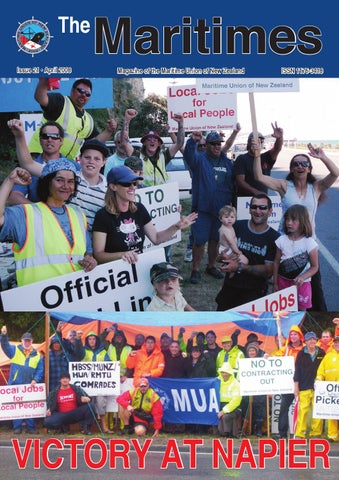
‘The Maritimes’ is published quarterly by the Maritime Union of New Zealand. ISSN 1176-3418 National Office: PO Box 27004 Wellington New Zealand Telephone: 04 3850 792 Fax: 04 3848 766 Email: trevor.hanson@muno.org.nz Web: www.munz.org.nz Editor: Victor Billot Mobile: 021 482219 Fax: 09 9251125 Email: victor.billot@munz.org.nz Mail: PO Box 339, Dunedin New Zealand Editorial Board: Trevor Hanson, Phil Adams, Garry Parsloe and Russell Mayn Deadline for all Port reports, submissions, photos and letters: 1 June 2008 for next edition Cover photo (top) Napier Maritime Union members, friends and family on the community picket, Sunday 16 December 2007 Cover photo (bottom) MUA delegation is farewelled, Wednesday 19 December 2007 For more online photos, see www.flickr.com/maritimeunion Thanks to our photographers, including Alf Boyle, Bill Connelly, Luke Appleby, Jim Strickland, Paul White, Jaimie Neill, Garry Carter, Terry Ryan, Joe Fleetwood, Barry Jackson, Victor Billot and many others
Contact the Maritime Union National Office Telephone: 04 3850 792 Fax: 04 3848 766 Address: PO Box 27004, Wellington Office administrator: Ramesh Pathmanathan Email: ramesh@muno.org.nz General Secretary: Trevor Hanson Direct dial: 04 8017 614 Mobile: 021 390585 Email: trevor.hanson@muno.org.nz National President: Phil Adams Direct dial: 03 4728 052 Mobile: 0274 377601 Email: phil.adams@munz.org.nz National Vice President: Garry Parsloe Direct dial: 09 3032 562 Mobile: 021 326261 Email: garry.parsloe@munz.org.nz Assistant General Secretary: Russell Mayn Direct dial: 09 3034 652 Mobile: 021 760886 Email: russell@munz.org.nz ITF Inspectorate: Kathy Whelan Direct dial: 04 8017 613 Mobile: 021 666405 Email: kathy.whelan@muno.org.nz Communications Officer: Victor Billot Mobile: 021 482219 Fax: 09 9251125 Address: PO Box 339, Dunedin Email: victor.billot@munz.org.nz
www.munz.org.nz
Welcome to the “21st” edition of the Maritimes. We’ve now been publishing for five years, since just after the founding of the Maritime Union of New Zealand. To mark this special occasion, we have a bumper 48 page edition of the magazine to commemorate the Union struggle at the Port of Napier. There are times when you see a Union working at its best, and the Port of Napier dispute in December 2007 was one of those times. There is no doubt that maritime workers and many other workers have taken some hard knocks over the last period of New Zealand (and world) history. But rather than lie down and accept what is dished out – casualization, de-unionization, dangerous conditions, attacks on wages and conditions – our Union has fought back. We haven’t always won what we wanted, but we have managed to have some control over our jobs and lives, which is what the Union is all about. The Port of Napier dispute was a high point in our struggle to keep secure local jobs on the New Zealand waterfront. Despite the dispute being stressful and difficult for all involved, some good things have come out of the situation. During the dispute, many members from different ports had a chance to meet other maritime workers from around the country (and from overseas). For example, we have a number of contributions to this edition of the Maritimes from rank and file members who have not previously been involved. This is exactly what we need: workers sharing information and debating through our magazine. The united mood is one that we need to build on. One suggestion is that we need to bring down one or two rank and file members (both permanent and casual) from each branch to our executive meetings in Wellington as observers, to learn more about the organization of our Union. To keep numbers at a reasonable level, we could select several ports for each meeting. Most importantly, we need to concentrate on bringing through young people who have come into the maritime industry. It is no secret that many of our members have many years of experience on both the waterfront and at sea. Within the next ten years, many of these senior members will be retiring from the industry, taking their knowledge with them (although we hope they will become involved in the new Veterans’ Association). Due to the hard hits the industry took in the 1980s and 1990s, we have a relatively small middle-age group of members in their forties and fifties. More young people are entering the industry now, many of whom have no idea about unionism or the values behind it. They have grown up in an environment where short-term self-interest is the attitude that has been promoted in society and economy. The Maritime Union is a well-resourced Union that needs to invest in building up the youth of the Union for the future. If we are serious about “looking to the future”, we need to get young people involved in running the Union. Along with organizing, strong political and industrial militancy, and democratic rank and file structures, this is the most important task that lies ahead. The younger members I met at Napier have the motivation, they are keen to learn, keen to get involved, all they need some is encouragement, direction and help. We can sit around and think about it, or we can get the ball rolling now. As a Union we have a responsibility to develop our younger members into the working class leaders of tomorrow.
The Maritimes | April 2008 | 3
COMMENT
International solidarity behind success
by Trevor Hanson General Secretary
Napier dispute The Maritime Union ended 2007 on a good note with our success in defending secure jobs at the Port of Napier. This edition of the Maritimes features coverage of the dispute. Although there are far too many individuals to thank for their support and assistance during this dispute, it is important to note the following organizations in particular. The MUA, the CTU, The ITF, RMTU, local unions, our officials, other branches, and not least our Napier membership, with a special note of thanks for our casual members who made the effort and did the hours on our picket.
The role that German unions played in supporting us through their involvement in shipping companies was a decisive one and made this dispute into a truly global one. The power of international solidarity came through. We certainly can’t begin to count the many different ways a huge number of people came together to help us when our backs were against the wall. The Maritime Union came out of this dispute with a result and please accept this as a personal thank you for any part, large or small, you may have played in this dispute. We believe that the successful resolution of this dispute has had many benefits as a Union. The message has gone out loud and clear through the maritime industry that maritime workers will not accept attacks on their livelihood. It has also brought our Napier members much closer together, and served to bring together workers from different unions, different employers, different parts of the industry, different ports and different status as permanents or casuals. If it was the intention of management to divide and rule our workforce, then they have achieved the exact opposite – a united, motivated and union-aware workforce.
Free Trade
“The message has gone out loud and clear through the maritime industry that maritime workers will not accept attacks on their livelihood”
4 | The Maritimes | April 2008
However, on a number of other “big picture” issues, the Union has concerns. The free trade issue is one that we feel the Union movement in New Zealand has not been strong enough in questioning and resisting. Free trade agreements are being signed with China, and also other countries around the Pacific Rim. While these are sold to the public as having great potential in trading our agricultural products to new markets, the downsides have been completely ignored. Free trade deals are the Rogernomics and Ruthenasia of the 21st century – they take control away from elected Governments and democratic structures, and put control in the hands of unaccountable corporations and faceless bureaucrats. They could result in casual, short-term labour being imported across borders to cater for so-called “labour shortages”. This would depress wages and conditions, and would be used to attack unionized local workers. This has happened overseas. The Maritime Union will continue to press for answers on what free trade deals really mean for workers.
FPSOs and the offshore industry The Maritime Union continues to push for the use of properly trained maritime crews in the offshore industry. There is currently some international disagreement about the classification of FPSOs (Floating Production, Storage and Offloading vessels). FPSOs are a type of floating tank system used by the offshore oil and gas industry. They are designed to take all of the oil or gas produced from a nearby platforms, process it, and store it until the oil or gas can be offloaded onto waiting tankers, or sent through a pipeline. The issue we have come up against is regulations that allow non-seafarers to operate these vessels. Some smart person has decided FPSOs are not independently powered, so they are not a ship and don’t have to abide by maritime regulations. Our view: if it looks like a ship, acts like a ship and operates like a ship, it is a ship. In a maritime emergency, only trained and skilled seafarers have the abilities to ensure a good outcome. The potential for loss of life and environmental devastation is serious. With the growth in the offshore industry in New Zealand, and the potential for greater use of these vessels in the dangerous waters of the Southern Ocean, the Maritime Union will continue to press for the use of properly trained and qualified crews.
Whaling The Maritime Union has spoken up again about the continued Japanese whaling presence in the Southern Ocean. We all know how the earliest European settlers in New Zealand were whalers and sealers, as well as the Maori who worked on board these vessels. Many of our members are probably the descendants of these larger than life characters. However, in those times, life was a struggle for survival, and people didn’t take into account the long-term damage caused by exploitation of these natural resources. Now times are different. We live in a modern technological society and there is no excuse to continue wiping out harmless creatures for simple greed. While whaling is not as big of an issue as global warming or peak oil, it is a high profile reminder of the damage that has been done to the world’s oceans by unrestrained capitalism. The Union has noted that exploitation of natural resources goes hand in hand with exploitation of workers in this industry. The whales themselves are intelligent warm-blooded mammals, more like humans than fish. It is time whaling ended for good. www.munz.org.nz
COMMENT
Trans Tasman unity an impressive force
by Phil Adams National President
Napier dispute First up, congratulations are due to all those who took part in the successful Port of Napier dispute, and also to all of those who assisted the Union, both in New Zealand and overseas. This issue of the Maritimes features a special report on the dispute. I was impressed with the level of commitment and attitude of those members who I met in Napier during the dispute.
Election year 2008 is election year. There is no room for complacency amongst members. Many ports have enjoyed busy times and growth in recent years, but the danger is we expect these things to continue. It is worth while considering the possibility of a double-whammy. Consider the possibility of a National Party being elected Government at the same time as New Zealand enters an economic recession. The last time this occurred was in 1991. After the disappointments of port reform and the right-wing politics of the Fourth Labour Government, the incoming National Government embarked on a massive attack against workers. The goal was to redistribute wealth upwards and reduce the working class to the situation and attitudes of the nineteenth century – divided, fearful and “in their place”. It is fair to say in some ways we have never recovered all the lost ground, despite three terms of a relatively moderate Labour coalition Government. www.munz.org.nz
Casualization is now an ingrained part of the New Zealand workforce. Levels of union membership, while making small progress, have not returned to anything like the level they once were. Wage rates in New Zealand reflect an economy where even during periods of growth, workers are undervalued and overworked. We have seen some good results in our industry as the economy has gone through a “boom period” in the last few years. Obviously these good results are also the result of union membership. However, in our unstable world economy every “boom” will be followed by “bust.” We are seeing the first signs of this now with the problems in the global finance sector, which will soon begin to flow on to the productive economy. The answer to this challenge is simple. We must continue to build an active and strong Maritime Union in the workplace, extend our coverage, and increase our effectiveness. As part of our broader responsibility, we need to have a Union political strategy that seeks to influence the Government, both by supporting pro-worker parties and policies at election time, and engaging with governments on an ongoing basis to promote the wellbeing and interests of our members and the working class in general.
In April, the Maritime Union of Australia will be hosting their conference in Sydney, which will be followed by the international Mining and Maritime Conference. Our Union will be sending a number of representatives both officials and rank and file members to the conferences.
Interport On behalf of the national Union, congratulations to all those members who took part in Interport 2008, held this year in our northernmost port Whangarei from February 10 to February 14. A special thanks is due to the Council of Sport, Local 13 and Whangarei Branch, and all those members who work behind the scenes to set up this event, which is no small task. The friendly competition and social gathering of the annual Interport Sports Tournament is a high point of the Union calendar and we recommend those who have not given it a go to check it out next year.
Triton dispute MUNZ was able to assist in a small way with the Triton dispute in Australia in January. We sent two of our officials, National Vice President and Auckland Seafarers’ Secretary Garry Parsloe, and Wellington Seafarers’ Secretary Joe Fleetwood, to Darwin to offer the support of New Zealand maritime unionists to the crew. A group of 11 sacked crew members had been staging industrial action since the Triton returned to Darwin from a routine patrol late in December. The crew held an onboard protest and refused to leave the 98-metre armed vessel, which is leased by the Australian Customs Service to detain suspected illegal fishermen. Management from the shipping company Gardline, the Maritime Union of Australia and the Australian Institute of Marine and Power Engineers reached an agreement after two days of intense negotiations in Sydney. The entire crew has been offered fulltime employment. The Trans Tasman Federation is in good heart.
“I was impressed with the level of commitment and attitude of those members who I met in Napier during the dispute”
The Maritimes | April 2008 | 5
PORT OF NAPIER DISPUTE
Napier Branch members, Maritime Union of New Zealand, at the Port of Napier picket Saturday 15 December 2007. From left, George Haenga, Maurice Hampton, Andrew MacLean, Tuk Uriarau, Jim Strickland (Partly Obscured), Lance Crawford, Derek Newton, Alan Burke, Garry Richards, Brendon Morris, and Wayne Elers
Port of Napier dispute 15–21 December 2007 by Victor Billot From Saturday 15 December to Friday 21 December 2007, members of the Maritime Union of New Zealand fought to protect jobs at the Port of Napier. The dispute in Napier began when management of the Port of Napier changed stevedoring arrangements in the port in late 2007. According to the Port of Napier website, Hawke’s Bay Regional Council own 92% of the Port’s shares, with the remaining 8% held by horizons.mw (formerly Manawatu Wanganui Regional Council). The Port is thus publicly owned and operated, presumably in the interests of the community who owns it. 6 | The Maritimes | April 2008
However, you wouldn’t know this by the manner in which it is operated. The Port is run essentially as a private business, with the only goal being a return to shareholders, in the typical corporate style. Social responsibility to the local community – the promotion of good work practices, secure jobs and conditions – went out the window. Late in 2007, Port of Napier announced it had a new “preferred stevedore” for container work, ISO. This move put in jeopardy 25 permanent and 60 casual jobs at Hawke’s Bay Stevedoring Services, the unionized stevedoring company that does container stevedoring at the Port.
It is no coincidence that ISO is the main anti-union stevedore in New Zealand. Carter Holt Harvey tried to use ISO (or Mainland, which was the name they operated under at the time) as their battering ram to try to deunionize the waterfront in the South Island in the late 1990s and early this decade. The goal of promoting ISO as the “preferred stevedore” in the Port of Napier sent a direct message. ISO operates an in-house “yellow union” that has no affiliation with any other union or organized workers. Their inhouse “union” is a legal creature set up as a device to claim they are unionized. The use of contracting out to de-unionize workplaces is not a new or an original strategy.
It’s driven by the need for profit. Less pay and less security for workers often means more profit for the owners (and bigger bonuses for managers). The negative effects on workplace morale, skills and health and safety don’t come into the equation in today’s short-term thinking. Problems are left for future generations to fix. Today’s breed of CEO flies from one job to the next. Their decisions and the effect on the workplace and local community have a lasting effect, long after they have moved on to fresh pastures. All that is regarded as important is the profit to the shareholder (and of course their own bonuses). The Port of Napier wanted genuine unions out of the Port. www.munz.org.nz
PORT OF NAPIER DISPUTE To achieve this aim, they struck just before Christmas. This is a time when most families are already under financial and time stress. Again, no coincidence. The plan was to attack when workers were at their most vulnerable. However, both permanent and casual workers, members of the Maritime Union and the Rail and Maritime Transport Union, stood fast. This is their story.
Saturday 15 December: the picket starts Over 100 maritime workers gathered outside the gates from 6am on Saturday 15 December. 65 maritime workers arrived in Napier from other ports and ships to support their fellow workers, all members of the Maritime Union of New Zealand. The goal was to make the Port Company give shipping companies the option to use whatever stevedore they choose - not just the “preferred stevedore” of Port of Napier management - thus ensuring some job security for union workers in the port. National officials were all present: General Secretary Trevor Hanson from Wellington, President Phil Adams from Port Chalmers, National Vice President Garry Parsloe and Assistant General Secretary Russell Mayn from Auckland. They addressed the picket and met with local workers. Union lawyer Simon Mitchell briefed the picket on the legal situation and our rights and responsibilities. The picket operated around the clock, with workers taking shifts, just as if they were on the job. A delegation of five Australian maritime workers flew in from Australia in a solidarity action by the Maritime Union of Australia. Victoria Branch Deputy Secretary Dave Schleibs was joined by rank and file members Steve Husband and Joe Deakin from Sydney, and Joe Carr and Paul Petersen from Brisbane. Local Labour Party MP Russell Fairbrother also came down to the picket along with friends and family of the picketers.
The picket had a dramatic start when a small bus carrying ISO scab workforce approaches the picket line. It was hailed down by a senior police officer, but the driver refused to stop, and the police officer was forced aside. The bus drove off into the port at high speed. Police have said that the driver was reprimanded, although they later denied anything untoward had occurred in a statement to the media. The Maritime Union caught the incident on video and it can be viewed along with other video footage at: http://www.youtube.com/ user/MaritimeUnionNZ When the empty scab bus came back through the picket lines, the police insisted it travel slowly and stop so officials could approach the vehicle and discuss the situation with the driver and ISO manager. The response they received was muted. Other trucks and service vehicles entering the port stopped for a moment to hear about the situation and take a leaflet from picketers. Joe Fleetwood and John Whiting from Wellington played a key role on the ground with the picket, maintaining discipline and organization, and giving a few quiet but hard words to the scab managers and herders (drivers) who crossed the picket line. Wellington seafarers and watersiders were present in solid numbers along with members from Whangarei, Auckland, Mount Maunganui Tauranga, Gisborne and New Plymouth. The dispute is already attracting strong interest from the media. Both TV channels turned up to film footage and radio stations have been calling in.
Maritime Union member Jaimie Neill of Tauranga on the picket line, Saturday 15 December 2007
“65 maritime workers arrived in Napier from other ports and ships to support their fellow workers, all members of the Maritime Union of New Zealand”
“The Great Wall”: Sunday 16 December On Sunday the picket settled down into something of a routine. Large numbers of union members were booked into three local hotels, and joined the picket line on shifts with the locals. The picket was large with a positive vibe, including a group who looked after the Northern Gates, and a small group outside a side gate.
[continued on next page]
www.munz.org.nz
The Maritimes | April 2008 | 7
PORT OF NAPIER DISPUTE
Inter–Union unity, from left, Mapu McMillan, Yohann Reti, Joe Nahora, Napier Rail and Maritime Transport Union Secretary Dave Mardon, and Greg Keen
He enjoyed his work, which included container lashing, and signed up to the Union on the first day of work “for protection of my rights”. Two other young members from Tauranga were Whetu Matthews (27) and John Pouwhare. Whetu is on the Womens’ Executive for the Union at the Mount Maunganui branch. She got involved after she went on a course run by MUNZ women’s reps Janita Barton and Rachel Goddard. She said she had come down for “the experience of the picket and to support our brothers in Napier”. Carrying out tally work, ship planning and casual work, she described work on the waterfront as “difficult and hard”, but said that a large number of the workers at the Port of Tauranga were women. “Even the crews say there is a lot of women.” Many of her family members work in the port.
Tuesday 18 December: Pressure builds [continued from previous page]
The award for most enthusiastic picketer went to Deano from Wellington, whose roadside presence generated a serious number of toot toots from passing traffic. Beautiful sunny weather means that things were getting hot by the middle of the day. More scabs ventured into the port inside buses. They didn’t look very happy at the spirited response and direct comments from the large picket line that awaited them. The Labourstart website in London has made us one of their email campaigns. Hundreds of unionists worldwide had already signed the email petition, which sent an automatic note to the Port of Napier CEO asking him to respect secure jobs at the Port. A special campaign website has also been set up at www.portofnapier. info, featuring news and images from the picket. Picketers were told by police they could no longer remain on the grassy area on the seaward side of Breakwater Road. This land apparently belongs to the Port Company and rail infrastructure company Ontrack. Despite its size and the fact that the land is used for nothing in particular, and is several hundred metres from the port gates, it seemed that the Port Company was determined to show just who is in charge of the grass. To bring the situation to a new level of humour, contractors arrive with a fluoro plastic fence which they erect along the roadside to keep picketers from straying onto the precious grass. The situation verged between odd – with policemen helping contractors set up the “Great Wall” – to increasingly ludicrous, when the fence was extended across the top of the beach and public walkway.
8 | The Maritimes | April 2008
This blocked access to fishermen and joggers, but did not seem to have much impact on the picketers, except to provide a place to hang our signs. In response, the picketer’s Tent City moved to the other side of the road. The picket remained, and started to attract more attention as it now has a “Great Wall” as well. A full page advertisement had been appearing in the local newspaper putting the Union case. The Port Company answered with a smaller advertisement. Another full page advertisement appeared for the Union. The heavy traffic along Breakwater Road meant that the profile of the picket was becoming very high in the local community. The “night shift” featured a smaller but hardy group of local and out of town workers, many of whom were younger and casual workers.
Monday 17 December: community campaigning Monday morning started off with the picket featuring on a live phone in interview on National Radio’s Morning Report. Branch President Barry Crawford and I went down to the local photocopying centre to get thousands of leaflets printed off for distribution to the local community. Friends and family members distributed the leaflets over the next couple of days throughout the Napier area. During the week I spoke to a few of the younger MUNZ members on the picket line. Jaimie Neill (18) was one of the youngest members, employed at NZL in Tauranga. He had been working on the waterfront for 13 months after leaving high school.
Meanwhile, on Tuesday 18 December, the pressure on the Port Company continued to build. Back at the hotel, the phones were being worked. National officials were in touch with contacts throughout the maritime industry and union movement. MUA official Dave Schleibs was on his mobile phone, ringing around MUA branches back in Australia and collecting substantial solidarity donations. The picket started to get food dropped off by local people at all hours. The rules on the picket line were strict: no alcohol and no drugs. A person who showed up with beers for the picketers during the evening was told politely that no alcohol was permitted. Discipline was all important. Back in town, some of those who had finished their shift on the picket relax at local pub Rosie O’Grady’s, where the proprietor puts up a union sign in the window. Local unionists who drop in on the picket included Service and Food Workers Union organizer Thomas O’Neill, a local Alliance Party activist, who came down with his wife Mary. The big event of the day was the Rail and Maritime Transport Union (RMTU) members are forced by court injunctions to return back to work. The RMTU members had held firm for several days and are applauded for their stand as they are escorted through the Maritime Union picket line. They continue to support the picket.
Wednesday 19 December: “Canberra Express” leaves port After a hard few days in the hot sun, the weather broke on Wednesday 19 December and the rain came in heavy. www.munz.org.nz
PORT OF NAPIER DISPUTE However the tide was turning for the picketers. Workers on the Maritime Union picket line at the Port of Napier were told early this morning that tens of thousands of dollars of solidarity donations were flooding in from around the world. A hardship fund was being set up to look after the workers, many of whom are casual workers, as they face a tough Christmas. The relief was palpable and the news provided a boost after a few hard days. Shipping was beginning to dry up. The Port of Napier was starting to look like a very unusual port - a port without any ships. Vessels were beginning to bypass the port to avoid the disruption. After sitting idle at the port, the container vessel “Canberra Express” left at approximately 11pm on Wednesday with no cargo discharged. This was a major development in the dispute and a victory for local workers. Maritime Union General Secretary Trevor Hanson explained to the media: “The ship wasn’t worked. Ships are now going past Napier and will continue to go past Napier, until agreement is reached that no jobs will be lost”. Following massive international support from global transport Unions, the ship owner had decided to take the vessel to Australia without it being worked in the Port of Napier, due to the escalating industrial situation.
Thursday 20 December: some departures and some arrivals Four of the Australian delegates returned home on Thursday 20 December. It was hard to believe it was only a few days until Christmas. The picket gathers round in the marquee and there were some emotional and heartfelt speeches from the Australian comrades who are given a rousing sendoff. Mediation between company management and the national officials of the Union continued today with the local Department of Labour serving as the venue. New Zealand Council of Trade Unions President Helen Kelly arrived in Napier to assist with the mediation. The picket received a boost with the visit of MUA Western Australia member Mick Canning, who showed up on the picket line with his wife while visiting New Zealand. He brought with him a signed flag from the WA branch of the MUA, which gave another boost to the picket line, reminding them they were not alone. The flag was a hit and was paraded around the picket. Mick also had some copies of the MUA Western Australia newspaper Rank and File, which he distributed. Later on in the evening, the Golden Bay berthed at the Port of Napier, and MUNZ seafarers from the vessel joined the picket line as well. www.munz.org.nz
Maritime Union national officials arrive with good news at the picket line, Friday 21 December: the dispute is over
A third group arrived, four young activists who drove up from Wellington, to join the picket. Despite a muddy backdrop to the picket, this didn’t stop members and friends from enjoying some good food (boilups and fish and chips). That evening there was a surprise as a sizeable earthquake rocked the city. The earthquake was centered near Gisborne, further up the east coast, where it caused considerable damage. In Napier, despite a loud shaking rumble, the only damage was to our nerves.
The picket was taken off the gates immediately. Workers worked around the clock over the weekend to clear the backlog of work before Christmas. The tens of thousands of dollars of donations that flowed in were distributed to the casual members who stood on the picket line despite no money coming into their families just before Christmas. Members celebrated with a impromptu party at Rosie O’Grady’s, and the out of towners started leaving. The Napier dispute is over – for now.
Friday 21 December: Victory Back at the temporary Union HQ, the phone lines were running hot as national officials make and receive calls. The message became clear: shipping companies were frustrated by what they saw as a dispute created by the port company that disrupted their business. They agree that they were happy with using a unionized stevedore in Napier, and the feedback they were getting from international maritime unions was strong. The national officials went back into mediation. After final discussions, a solution was reached. The port company would allow shippers coming into the Port of Napier to nominate their preferred stevedore, despite the port company maintaining their “preferred” (non-union) stevedore. In return, the Union agreed to tidy up some work practices around the port. Officials went down to the picket line around 3pm to break the good news. There were scenes of happiness but the mood is more one of relief. The effect of the worry and insecurity about their future on the workers was plain to see.
“The Hawke’s Bay Regional Council-owned Port of Napier has a responsibility to the local community and should operate in the public interest”
The Maritimes | April 2008 | 9
KEEP OUR PORT PUBLIC
Photo by http://www.flickr.com/photos/flissphil/39468849/ Licensed under Creative Commons http://creativecommons.org/licenses/by/2.0/deed.en
Port of Lyttelton back in sale gun The Keep Our Port Public (KOPP) coalition has “noted with alarm” Christchurch City Council’s commercial arm has been buying up shares in the Lyttelton Port Company (LPC) and has passed the significant mark of 75% ownership. This shareholding gives Christchurch City Holdings Ltd (CCHL) considerable power, according to Keep Our Port Public spokesperson Murray Horton. According to the City Council’s own website, under the Companies Act a 75% shareholding enables a shareholder to control any special resolution of the company. “While there are limited occasions when special resolutions are needed, they are always to do with major transactions or issues and in these circumstances CCHL and the Council need to be certain that their substantial shareholding can be used effectively.” In 2006, the City Council via CCHL moved to buy 100% of Lyttelton Port Company’s shares and then sell 50% of it to Hutchison Port Holdings Ltd of Hong Kong. By law they needed to get 90% of the shares to force the other 10% to be compulsorily acquired. Public opposition (of which KOPP was a leading part) made that unlikely. KOPP was set up in 2006 and is supported by a number of organizations, including the Maritime Union, Rail and Maritime Transport Union, Green Party, Alliance Party and Campaign against the foreign control of Aotearoa (CAFCA), as well as individuals.
10 | The Maritimes | April 2008
KOPP says CCHL have lowered their target to 75%, whereby a ‘scheme of arrangement’, often a merger, can be done with the consent of 75% of the shareholders, without requiring the agreement of the remaining shareholders. Of course, in 2006, the City Council’s plan was thwarted by Port of Otago buying a blocking stake in LPC, which left CCHL just short of the magic 75%. “Hutchison took its bat and ball and went elsewhere,” says KOPP spokesperson Murray Horton. “Now that, two years later, CCHL has reached the 75% ownership mark, the question to ask is: what is going on behind the scenes? Is there another would be transnational buyer waiting in the wings to snap up LPC? If so, who is it?” Mr Horton says the processes are now in place to enable the City Council via CCHL to sell our publicly owned port company. The public of Christchurch, the owners, are entitled to answers from the City Council and CCHL. KOPP has called upon those Councillors and Community Board members who signed the Public Ownership Pledge during the 2007 local body election campaign to give this issue their highest priority. (See http://canterbury.cyberplace.co.nz/ community/CAFCA/publications/Miscellaneous/pop.html) As to why selling LPC into private ownership, whether foreign or New Zealand, is a bad thing, KOPP refers to the April 2006 joint statement by a number of local Ministers and Government MPs:
“We have serious concerns about both the process and the potential outcome of the proposed sale into the private sector of the majority shareholding in the operational arm of the Lyttelton Port Company. “In holding these serious concerns we also believe that the current competitive situation and price gouging actions of New Zealand Ports is unsustainable in the longer term. “The current situation, which is a direct result of the so-called ‘Shipping Reforms’ of the 1990s, leaves all New Zealand Ports vulnerable to the whims of the Shipping Companies. “These reforms have also resulted in New Zealand Ports competing against each other, and often price gouging in order to attract business. This pricing regime is not sustainable, which will mean that some of our Ports will fold. “One alternative to this current unsustainable situation is indeed that proposed by Christchurch Holdings. Their proposal could possibly give Lyttelton a competitive advantage over other New Zealand Ports and could strength Lyttelton Port. But it may be at the cost of current employment security and involves the loss of a public asset. “A stronger and more competitive Lyttelton Port, with protected employment security, could be achieved in another way; by much closer collaboration between New Zealand Ports. “New Zealand Port companies need to get a strong message that they cannot continue to compete if they want to survive. Port reform needs to move to another stage where New Zealand Ports collaborate to compete internationally. So – we have two messages: “The first is that that we cannot continue as we are and expect all New Zealand Ports to survive. We have to collaborate to compete internationally. The second message is the sale of the operational arm of the Lyttelton Port Company is not the only option or the best option, and therefore it should not be supported. It is the sale of a strategic asset and it should be kept in public ownership in New Zealand.”
For more information, see the KOPP website at www.keepourportpublic.org
www.munz.org.nz
NEWS
Gangway Rail and ferry incidents buyback gets in Lyttelton thumbs up cause concern Unions on the Lyttelton waterfront are asking Maritime New Zealand to tighten up inspection of gangways after two recent incidents in the port. On Sunday 13 January, soon after the container ship Rui Yun He had tied up at Cashin Quay in the Port of Lyttelton, a gangway broke away at the turntable pivot point which attaches it to the vessel. A foreman stevedore and three cargo handlers were ascending the gangway at the time. Fortunately the safety net was already in place and it held. It was rigged from the ship to the outside of the gangway and the gangway was prevented from crashing to the wharf. Safety nets are not designed for that purpose, but in this case a potentially serious accident was averted. The accident is under investigation, but the Union understands the pivot pin fractured. Being on an older ship and in view of the constant twisting forces such a key point is subjected to, it appears likely metal fatigue and/or corrosion caused the failure. This is the second such incident at this port in less than six months. On 31 August 2007, the MSC Clorinda’s gangway broke away because of the same type of failure. The gangway began to break away as two men ascended it and slipped further as they stepped onto the ship. Again, the net was already in place and the gangway did not fall. Maritime Union Lyttelton Branch Secretary Les Wells and Rail and Maritime Transport Union Organizer Brian Cronin have written to Maritime New Zealand urging that “gangway pivot pins be urgently inspected on all vessels operating on the New Zealand coast . . . [and] regular inspection of this gear becomes a routine part of ships surveys from now on”. The Union’s say failure to act on these near misses could lead to serious injury or loss of life on the New Zealand waterfront.
www.munz.org.nz
The Maritime Union says Government plans to bring rail and ferries back under public ownership would be a major step forward for New Zealand. Maritime Union General Secretary Trevor Hanson says the move is long overdue and is required to bring New Zealand’s transport infrastructure up to world standards. “We need an integrated transport system in New Zealand that has a substantial public-owned component for security and stability.” Mr Hanson says deregulation has led to huge damage to rail and shipping. “For example, we have had massive growth in fuel- inefficient, congestion-creating road transport, whereas low impact modes such as shipping and rail have been let to run down.” He says both rail and shipping are the transport of the future in a world where climate change and peak oil were massive threats. Mr Hanson says more direction is needed in the transport industry and public ownership of key infrastructure would make this possible. He says the next step should be a national ports policy that brings ports under public ownership and makes them work co-operatively for the national interest. “An efficient transport and logistics sector is essential for New Zealand as a trading nation, and leaving it to the market and private interests has been a failure.” Mr Hanson criticized negative comments from the National Party MP Bill English on public ownership and “feather-bedding”. “Bill English knows nothing about the transport sector apart from being driven around in the back of a taxpayer-paid limousine, and the only feather-bedding that has gone on in transport is for the corporate predators who National sold off our assets to at bargain basement prices.” “Mr English should try to lash some loose cargo on a Cook Strait ferry in a gale before he casts aspersions on New Zealand seafarers.” He says the legacy of the 1990s National Government policies in transport was a failed system, attacks on workers pay and conditions, and worst of all, death and injury through the rundown of health and safety practices.
Maritime Union calls for urgent action on whaling and overfishing The Maritime Union of New Zealand says the situation around the Japanese whaling fleet in the Southern Ocean could be a turning point in the battle against the exploitation of the marine environment. Maritime Union General Secretary Trevor Hanson says he believes an opportunity has arisen where the international reaction against whaling could create pressure for change in protecting the wider marine environment. “The sad fact is that one of the only ways to protect marine life is the type of direct action we have seen, which has brought the attention of the world to focus on the whaling issue.” Mr Hanson says the Government could send a frigate to observe events, as a signal of the extreme concern and disappointment of the New Zealand people. “We have allowed the slaughter of whales right up to the point of extinction. Now we have realized the terrible mistake and we must try to protect this species and all other marine species that have been devastated by overfishing.” Mr Hanson says the Maritime Union has for some years been pointing out the links between overfishing and exploitation of fishing crews, and has previously spoken out against whaling. He says the Union would like to see far stronger regulation and controls on a national and international level to protect marine life and fishing and maritime workers from rampant exploitation. “The situation is one where the abuses occur out of sight and out of mind, driven by a stripmining mentality that is only interested in short-term profits.” Mr Hanson says Southern Ocean and Antarctic waters are in our backyard, and as a nation we have a responsibility to protect the marine environment for future generations.
The Maritimes | April 2008 | 11
NAPIER DISPUTE
A casual’s viewpoint on the Port of Napier dispute by Luke Appleby Union number 2402 I’ve worked as a casual stevedore at Port of Napier for 4 seasons now, since I was 19. When I returned from overseas in December 2007, I was looking forward to the security of a job which I know and I have been trained in. I get along well with the people who know this job inside out. The mates I have made in my waterside career are one of the reasons I keep coming back. Another is a fair wage for an often dangerous job. However, when I first got back I found out the Port Company had decided to give container stevedoring work to a anti-union stevedore called ISO. This company has caused many problems for maritime workers in New Zealand over the last few years. We have had pickets against them throughout New Zealand. They have an inhouse union but it is not a proper union, and is not recognized by any genuine union in New Zealand. This situation could have affected up to 100 union workers, permanent and casual, at the Port of Napier. So the Maritime Union swung into action to defend union jobs. When I heard the news about the Port of Napier picket action, I wondered whether there would be work any of us at the most important time of year. Most of our members have families. A lot of them have served for many years, just to be told they were out, and the cheaper labour was in at the drop of a hardhat. I thought that decision by the Port Company was so selfish and irresponsible. However, after a week of round the clock pickets, including ships turning away from the port, we got a situation where the unionized stevedore is still in the port, and it looks like our jobs are safe for now. One of the things to come out of the dispute was a lot of discussion about casualisation, which our Union is opposed to – as many of our members are casual and for most of them it is not a good thing. As a casual, you can typically end up working as much as a permanent would anyway, sometimes 60 plus hours a week if there is a lot on.
12 | The Maritimes | April 2008
This usually includes graveyard shifts, dangerous situations, altered sleeping patterns and loss of daylight hours to get things done. MUNZ member Doug Boyd, who may be the longest serving casual stevedore in New Zealand at 19 years, believes that the industrial action taken was a success because “it was a national picket and was supported by Australia”. In his career he has never seen a picket, and hopes to never see one again because “it puts too much stress on people”. When asked how he feels about Port of Napier he said, “I resent anybody who puts peoples jobs on the line”. Another member affected by casualisation is 49-year-old casual stevedore Liz Leader. She says she believes work is too casualised at the Port of Napier, with no guarantee of a permanent job.
“I know people who work down there who do their jobs well – they are available at any time, day or night – and are passed over. I know I’ll never get a permanent job there.” The support received from the overseas and national union branches was really integral to the success of the picket. We had great support, especially from the Maritime Union of Australia, the Rail and Maritime Transport Union, and the International Transport Workers Federation (ITF). The local community figured out what it was all about and were very supportive. From everyone at Hawkes Bay Stevedoring Services, thank you.
Luke Appleby is now studying journalism in Wellington.
Port of Napier workers Liz Leader and Pete Jarman, December 2007
www.munz.org.nz
1951 LOCKOUT
Maritime Union welcomes release of secret papers
Tommy Gregory, ex freezing worker, wharfie and retired seafarer, with his ‘51 loyalty card
SIS lifts lid on 1951’s dark days by Martin Kay Tommy Gregory and Les McCahon were handing out pro-wharfie pamphlets to factory workers when they came up against the repressive powers in force during the 1951 waterfront dispute. Confronted by an irate factory owner in Thorndon, Wellington, the pair were arrested and Mr Gregory’s Kelburn home was searched by police looking for subversive material supporting locked-out Waterside Workers’ Union members. Fifty-seven years later, the cloak-anddagger Security Intelligence Service is declassifying its files on the dispute, lifting the lid on one of the most controversial periods in New Zealand history. Prime Minister Helen Clark, who is responsible for the SIS, said the files held a “unique record”. They would be preserved by Archives NZ and made available to the public. The waterfront dispute files were chosen as the first significant release under a new policy because the period was often cited by people making requests under the Privacy and Official Information acts. The 151-day dispute, at the height of the Cold War, was marked by sweeping emergency powers invoked by the National Government, including a ban on financial or other help to locked-out workers and their families. Severe restrictions on freedom of speech – including bans on the type of material Mr Gregory was distributing – were also in force, as were 1930s laws to prevent riots during the Great Depression. www.munz.org.nz
These laws were policed by the Special Branch till the SIS was formed in 1956. Mr Gregory – who had the charges against him dropped – said the restrictions were repressive, even if their enforcement in his case was slightly farcical. “The policeman charged us, and a couple of things he had wrong. He said to me, ‘Where do you live’, and I said, ‘37 Moana Rd, Kelburn’, and he said, `No, you don’t, you live in Petone, that’s what’s on your driver’s licence’. “Well, I didn’t have a driver’s licence, did I? It was my Petone Working Men’s Club card.” Mr Gregory said though few of those involved in the dispute were still alive – including his friend Mr McCahon – he was glad the SIS files would be revealed to throw light on the actions of authorities. “It was terrible. You couldn’t buy me a drink in the pub - you’d be arrested - and you couldn’t converse with anybody.” But the dispute also forged strong bonds among the locked-out workers, symbolised by the card held by Mr Gregory, which reads: “Stood Loyal Right Through”. Historian Jock Phillips said the files would provide valuable information about an era when civil liberties were crushed.
This story first appeared in the DominionPost newspaper on Tuesday 4 March 2008 and is reproduced with permission
The Maritime Union of New Zealand has welcomed the release of secret SIS papers on the 1951 waterfront lockout to Archives New Zealand. The 1951 waterfront lockout was the most significant industrial event in living memory in New Zealand. The Maritime Union still counts veterans of the 1951 dispute amongst its retired members. Maritime Union General Secretary Trevor Hanson says the content of the papers would speak for themselves. He says the 151-day dispute was a lockout, not a strike. “The fact of the matter is that the workers were locked out of their jobs by a National Government who wanted to destroy the most progressive and militant group within the New Zealand working class.” The 1951 lockout was looked back on now as a time of shame when basic principles of free speech and freedom of association were overturned by a right-wing government. “It is no exaggeration to say that the socalled emergency regulations at the time swung close to fascism and a police state.” The stress and hardship placed on families during the lockout were extreme. It was made illegal for anyone to supply food to the children of a waterfront worker. People’s lives were destroyed. The large quantity of research and publications on the 1951 dispute has noted the extreme nature of the State’s actions against its own citizens. The waterfront unionists and rank and file seafarers stood side by side in the dispute, along with thousands of other workers around the country. Many of these maritime workers had recently served in the Second World War against fascism but were turned on in their own country. The National Government’s goal of smashing the waterfront union ultimately failed. The waterfront workers slowly rebuilt their unions, got rid of the scabs who had been brought into replace them, and over time managed to win back good wages and conditions. The main lesson to draw from history was that the National Party had never been a friend of working people – something that working people need to remember in 2008.
The Maritimes | April 2008 | 13
FEATURE
18 years of deregulation: 18 years as a casual
Paul White
by Paul White Union number 1847, Local 13 George Haenga is a man of remarkable character. He has a simple plan: to one day secure himself a permanent job as a stevedore for Hawke’s Bay Stevedoring. I met George on the picket line at the Port of Napier in December 2007, where stevedores from all over New Zealand and Australia gathered in a protest against the Port Company and the cheap labour they employed from outside of Napier to do George’s job. What is remarkable is that George has been a casual worker for 18 years. It appeared at the time that his hopes of ever becoming a permanent worker, and enjoying the basic freedoms associated with permanent work, may have been dashed forever. There were several other colleagues on the picket line I met who were long term casuals. Another worker, Yohann Reti, has 15 years’ experience as a casual worker. It is an uncanny coincidence, but George’s 18 years’ work as a casual cover the same length of time as the introduction of deregulation of the stevedoring industry (known sometimes as “port reform”) in 1989.
New Zealand has grown up since then and realised that deregulation hasn’t delivered the perfect economy it was supposed to. For example, what was the cause of leaking homes? Do you have the same confidence in taxi drivers as you used to prior to deregulation? Do you know where the ingredients of your bread originated from? All these issues reflect the lack of regulation we have in New Zealand today. In fact, some industry sectors have now realised that to improve quality and enhance safety standards it was necessary to regulate. Forestry introduced stricter guidelines for training to reduce their accident and fatality rate over the past 20 years, but also developed a higher skill level which results in a quality end product. The transport industry introduced regulations to improve the safety of other road users and compensate for the selling off of our railways. The results there were the same, fewer accidents, more professionals, better service and higher wages. New Zealand is an export dependant country, with our dairy and produce goods shipped to markets all over the world. New Zealand is also unique in that we are so far from our markets, and shipping is a key part of our supply chain. We need a service that is second to none for that reason. The question is: will that happen under deregulation? In my opinion, it will not. As long as our most talented and experienced people continue to leave the industry, the standard of service our farmers can expect in the very near future will decline to the point where our skill shortage will adversely affect our ability to maintain an acceptable standard of service. Cheap is not always the best way to go. The reason why port companies will continue to experience industrial action is because deregulation has allowed them to push beyond the boundaries of social justice and community spirited values. I met a local from Napier fishing on the beach 50 metres from our picket line. I was interested in the fishing and curious about his knowledge of what was happening in his towns port.
After gaining the local knowledge about fishing in the area, he asked me to explain why there was a picket line. I replied by asking him what he knew about the port. His knowledge was extensive. He knew the company was a very profitable business and an important part of the Napier economy. He then spoke with a sense of pride and respect when he told me he has watched the operational arm from the lookout directly above the port, and was amazed at the speed and efficiency of the cranes and machines while they worked. Obviously he was disturbed when I explained all the Napier men and women stevedores had been laid off to make way for an out-of-town gang. He was an electrician and worked for a local company and they relied on the port to keep them in work. When I explained the latest ruling by the courts and the judge’s reservations about the technical expertise of the outsiders to conduct their operations in a safe manner, he understood the implications. His company reps that entered the site under those circumstances were at far greater risk than previously.
What would a regulated industry look like for us? Our workplaces will become safer. Professionalism will become the norm, not the exception. We would design our own codes of practice. Every ticket would carry mandatory hours served, for example 1000 hours for lashers plus oral or written test. We get representation on the ITO for our industry. The ITO is the body responsible for the standards in industry. We need changes to the Health and Safety Act relating to compliance with codes of practice, so it reads “a code of practice is mandatory”. All this requires is the removal of one word and that word is “not”. All trainees would complete their training and hours before moving up the ladder, ensuring they get the best training possible. This encourages employers to promote the casual staff already in the industry and provides a career path for staff. Regulation would lead to a quality finished product.
Continued next page
14 | The Maritimes | April 2008
www.munz.org.nz
FEATURE Continued from previous page
Professor Stenger of Auckland University and formerly of Penn State University is a leading authority in logistics. He says, “New Zealand must work towards processing our raw materials instead of exporting them”. By adding quality to our service we are in effect increasing the real value of our end product and market forces will drive up our wages. This is a net result of regulation. It will keep our best people in New Zealand. We will need all the experience we can get to train and assess our people. Our service to our exporters or crane rates will match or better international standards, providing New Zealand with the world class supply chain it desperately needs.
What do we need to do? I suggest we start lobbying the government for regulation. If we sit back and watch, nothing will change. If you don’t ask, you don’t get. We need to start debating regulation through this forum, the Maritimes magazine, and at our branches. I am a rank and file member. I am not an executive member and hold no union title other than my union number 1846 and Learning Rep NZCTU 2007. This will add to our national body’s mana and give them direction. It will also provide them with the support they need to be successful. Write in and challenge these ideas. Write in and support them. But most of all write in and respond. We need to begin a nationwide campaign for regulation in our industry similar to that of the seafarers’ campaign for coastal shipping. We encourage dialogue with stakeholders in the industry to allow them to contribute.
Summary The economy, the political environment and the time are right to make this happen. The opportunity may never present itself again for another 20 years. Read Bert Roth’s history book “Wharfie” and you will see fortune and famine comes every 20 years for wharfies. I love my family, I love my community and I love New Zealand. I am making a stand for our industry. I am making a stand for my country, my community and my family.
www.munz.org.nz
Zaran Elers, Port of Napier, Monday 17 December 2007
I stand up and speak for the George Haengas and Yohann Retis of this country. Michael Joseph Savage was born into poverty and hardship. He had the courage to go where no one had been before. You can be the one who makes the difference. MUNZ has a saying “Ask not what your union can do for you, but ask what you can do for your union”. This moment in time has arrived for all rank and file. Speak out for regulation. To stay silent only empowers the employers. Tomorrow the sun will rise, and it will create new beginnings – it will bathe us in hope and we will shine in its glory. No reira mihi mihi atu ki a koutou katoa kia kaha ake ake ake.
My name is Paul White, I have been a stevedore for 6 years. I am of Ngati Whatua descent. If you would like to contact me my email address is paulwhite84@gmail.com
“MUNZ has a saying ‘Ask not what your union can do for you, but ask what you can do for your union’. This moment in time has arrived for all rank and file”
The Maritimes | April 2008 | 15
TARGETZONE
Container controller and swing lift operator Mike Ching (left) is a supporter of the Targetzone visual aid, and is pictured here with Targetzone inventor and Maritime Union member Roger Bain (right)
Targetzone targets “straddle neck” Maritime Union member Roger Bain has invented a new product to make life easier for straddle drivers, the “Targetzone.” An ex-straddle driver from Lyttelton, Roger says the task of dropping a container may look easy, but in fact is made difficult by factors such as rain, glare, darkness, reflection, over height gear and soft top containers. The Targetzone was developed by Roger as an aid to loading Swinglift Trailers with a Straddle Carrier. The line of vision from the Straddle Cab to the twistlocks on a Swinglift is impaired by the Swinglift arm, and the Targetzone assists the straddle driver in locating the twistlock first time. The Targetzone is hard wearing and features an arm that is fluroescent and reflective. The arm sits out at 90 degrees from the twistlock. He says while working as a straddle driver, he experienced the difficulty in lining up containers. 16 | The Maritimes | April 2008
“As you bring the container down, you lose sight of the twistlock.” The Targetzone highlights the small twistlock pins on the container. This takes away much of the guesswork involved and means less stress on the body and mind of the operator. Trials held over a period of several months have shown loading time is reduced slightly. There is also a decreased risk of damage to the Swinglift. Roger says the Lyttelton Port Company purchased thirty sets to give away to local swing lift operators as a goodwill gesture. The response from fellow union members has been positive. “There has only been positive feedback from the 150 straddle drivers that work for LPC, even management could see the benefits.” Straddle drivers have commented that they are easy to see and line up with in any type of weather conditions.
“The guys here have given a brilliant response. Some of the guys here reckon they should be compulsory.” Roger says one problem encountered was truck drivers would fail to use them at critical times. “The main problem at the moment is that transport managers and truck drivers, in fact anyone who doesn’t drive a straddle, don’t take into consideration what the poor straddle driver goes through to accomplish his or her job in loading of containers onto road transport trailers.” Behind the story of the Targetzone is the story of Roger’s personal experience of health issues, which gave him the motivation and inspiration to come up with his invention. Roger says he has been working in Lyttelton for around 13 years, and for the Lyttelton Port Company for about eight years.
He trained as a straddle driver about five years ago, but is now a lines supervisor in the marine department. Roger experienced a major health incident in 2004. Due to injuries, he had been taken off straddle work on doctor’s orders. He went to see a chiropractor. Three days later, the 39-year old suffered a stroke. Roger subsequently went to ACC with a claim for medical misadventure, spent six weeks in a wheelchair, and went through rehab. He says the reason why he invented the Targetzone was to help straddle drivers: “I don’t want them to go through the same thing”. “Straddle drivers are going through contorting their necks, you need to give the driver a visual aid.” The Targetzone has featured as a hot new safety product in a recent edition of Safeguard magazine. Roger believes there is a huge potential for the Targetzone in the container transport industry. He says there could also be potential uses with RTGs and RMGs. Roger has filed a PCT application to protect his IP (intellectual property.) He says the Targetzone is simply a visual aid. “Why do we have to wear high-viz vests, what are cats’ eyes down the highway for, why do trucks and cars have wing mirrors? They all are visual aids.” For more information about Targetzones, or if you have any suggestions or feedback, contact Roger Bain on 0276409405 or 033764156 (home) or email targetzones@xtra.co.nz
www.munz.org.nz
OPINION
“Get it right the first time” By Patrick Honan Union number 0055 I was reading in the newspaper of companies that have been found in breach of employment law regulations. It appears that these large companies, with all their financial resources, seem to fail in bargaining processes. They make basic mistakes in a field where professional advice is required. I also hear people say that the employment law regulations don’t give workers enough to bargain with. The Employment Contracts Act (1991) and the Health and Safety in Employment Act (1992) introduced by the then National Government were massive blows to the Union movement. This gave workers an option: to belong to a union, or take an individual contract. Some of the companies in disputes I hear about include Air New Zealand or Spotless Catering, where the companies were found to have broken good faith bargaining process by unlawful lockouts. Unions also have had disputes sent back from the Employment Court, as they had not gone through mediation. Over time, amendments have been made to employment regulations, and one of these was to facilitate bargaining. If parties had difficulties in collective bargaining, they could seek outside help, where there was no formal process in place. Parties can approach the Employment Relations Authority under Section 50 of the Employment Relations Act for assistance in resolving difficulties. I note this also when looking back at implied terms – these are terms that have become customary and cannot be changed unless employees agree.
For example, in the case of the New Zealand Merchant Guild versus New Zealand Rail, it was argued there should be a separate mess room for the officers. This has to be a well established custom that the courts will take on a case by case basis. This was overturned as the Union argued that this was an act of separatism, and it was not seen as helping promote good working relations. The lesson here is to remember that it is easy to give away a condition, but in most cases you will never get it back. Careful thought is needed in areas of interests or conditions in any collective contract that a union has bargaining for. That is why the role of Branch Secretary is of great importance. Branch officials deserve the unified support of the rank and file membership. They are our voice to the employer on issues, and work through the ratification of the rank and file membership. This job is sometimes not given the recognition it deserves. But like any work place it comes down to results. To date I look at the Rotoiti dispute where the manning loss was a blow. But looking at what was negotiated by the branch secretary and delegates, they did well to have gained redundancy. Stopping the same company putting a replacement ship to do the same run was great work with the tools they had. Sure, it would have been great to have a replacement vessel, but let us ask ourselves honestly why we lost her. The way I see it, it was no fault of the officials. Unless you can understand the maze that is called the Employment Relations Act, it would be hard to comment on what should have been done.
www.munz.org.nz
The best gains I have seen have been through union involvement in partnership with other unions and political representatives who can see we need coastal shipping and training put in place. The positive changes I have seen have all been through a Labour-led Government. These are not just my preferences. One only has to take the time and look at the freedom of association, good faith bargaining, procedural fairness, holidays legislation and health and safety. Most of these changes made between 1999 and 2004. In 1990, Labour Prime Minister Mike Moore was in power for two months, and the Employment Equity Act was passed just before the election. The National Party repealed this act clearing the way for the ‘mother of budgets’ and the attacks on workers and beneficiaries. So let’s keep it going the way we have been. I believe there is a great future with low unemployment, for seafarers, Labour’s introduction of the modern apprenticeship training schemes in 2001 will help us continue deck boy training. It’s up to us younger members to use the tools that are out there, and look for ways to keep moving in one direction: solidarity, honesty and commitment. I started out as deck cargo from Niue to Fiji with my mum at six months old, getting my morning tub in a braising pan on the ‘Tofua’ by Fred Annabel and Vic Botica. My dad was a steward for a short time and we flew from Fiji to Whenuapai air base. I am currently a cook on the coast and doing a Law degree at Waikato University in employment law and dispute resolutions. This is where I feel I can do my little bit for what we have to protect, not just for us but for tomorrow.
We want your stuff. The Maritimes needs your photos, letters, reports, news, views and opinions. It’s your magazine! If there is something you’d like to see in the Maritimes, send it to the Editor: Mail PO Box 27004, Wellington, New Zealand Email victor.billot @munz.org.nz Fax (09) 9251125
The Maritimes | April 2008 | 17
FREE TRADE
Trading poverty with China: the free trade agenda by Sue Bradford MP Green Party spokesperson on trade New Zealand has been in a helter skelter race for the last five years to be the first country in the world to sign free trade agreement with China. That agreement is now about to be signed in a few weeks, without anyone in the public having seen it yet. So, before it does get signed, it’s probably time we stopped to look at some of the risks to our workers. The Ministry of Foreign Affairs and Trade, which negotiates free trade agreements on our behalf, is required to include focus on provisions on labour standards. In fact it says: “This government believes that to reach that goal [of improved living standards], economic and trade agreements need to be crafted in a way which promotes decent work.”1 However, the Ministry has been slow to raise labour standards in negotiations with China, with Amnesty suggesting the Government is scared to risk losing the deal by offending China.2 It is likely that if there is a reference to labour standards in the free trade agreement when the public finally gets to see it that it will be a voluntary commitment in a non-binding side protocol, rather than a binding rule in the main agreement.
It matters for workers All of this matters for workers because a free trade agreement means now, more than ever, New Zealanders will be competing with Chinese companies do the same job. And the competition won’t be fair because Chinese companies will be able to pay their workers very low wages, often work them twice as many hours per week, and bypass many of the health and safety protections that New Zealanders take for granted. A free trade agreement is likely to make it easier for more Chinese-made products that could have been made in New Zealand to come into the country. It is likely to allow more jobs that could have been done by New Zealanders to be done by Chinese workers, either overseas, or by bringing those workers over here. It’s likely to allow more large business investments, both from New Zealand and China, to head overseas where costs are cheaper and profits higher. I say “likely” because we do not actually know what is in this agreement.
18 | The Maritimes | April 2008
Despite the fact that it affects all New Zealanders it is being negotiated in secret and no one knows what it contains. And we are unlikely to know until after the Prime Minister signs it in April.
New Zealand – will we be better off? So, if Chinese workers and New Zealand workers are both going to suffer, at least the New Zealand economy will be better off, right? Warning: here comes a lot of statistics that free trade supporters will never tell you. The latest statistics from our Overseas Merchandise Trade show that last year we exported $2.0 billion dollars worth of stuff to China. But we imported $5.6 billion dollars worth of stuff.3 That’s a total trade deficit of $3.6 billion with China alone (our trade deficit with the rest of the world tells a similar story) – up by over $0.6 billion from the year before. Research4 from 2006 shows that the benefits to the New Zealand economy for every $1m of imports that we replace with Kiwi made goods are: • The creation of 11.16 jobs • Government income tax revenue increases by $117,214 • In total an additional $1 million of value added manufacturing results in $2.16 million of initial value plus downstream value added. In other words, by producing in New Zealand those goods we currently import from China, we could create 62,000 jobs, have $655 million more in taxes to spend on things like health and education and improve our economy as a whole by over $11 billion. Yet a free trade agreement with China will mean we import more Chinese stuff, not less. So you can start doing that calculation in reverse. Another way to look at it, rather than the amount of dollars changing hands would be to look at the amount of stuff moving across borders. Despite a decade of aggressive free trade policies between 1997 and 2007, the amount of cargo that was loaded on ships or planes leaving New Zealand only increased from 21 million tonnes to 23 million tonnes – an increase of 11.3%. Meanwhile, the amount of cargo that arrived in New Zealand increased from 12 million tonnes to 18 million tonnes; an increase of 58%.5
Much of this cargo consists of things we could have made for ourselves in our own communities. We could have used coastal shipping to move them from one town to another, rather than importing them. Now we buy them from China on the credit card and hope, despite all evidence, that one day things will change and we’ll be able to pay back the debt.
Surplus into deficit Until 1989 we had a trade surplus with China. Then Labour and National started down the road to free trade and the surplus turned into a deficit. The Green Party is one of the few voices in parliament consistently opposed to free trade agreements with China or any other country. We do this because it would hamstring our hardworking New Zealand-based manufacturers and result in further jobs, especially manufacturing and seafaring jobs, going overseas. It is grossly unfair to New Zealand enterprises and workers to be forced to compete with China-based export manufacturers who are heavily government-subsidised and do not meet basic standards of justice and sustainability with regard labour conditions and pay rates, human rights and environmental protection. Free trade has a proven record of environmental destruction and social injustice. We need to replace free trade with fair trade. Footnotes Ministry of Foreign Affairs and Trade, Framework for Integrating Labour Issues into Free Trade Agreements http://www.mfat.govt.nz/Trade-and-Economic-Relations/ NZ-and-the-WTO/Trade-Issues/0-labour-framework.php 1.
Epoch Times, Amnesty: NZ too scared to push rights with China, Oct 15, 2007 http://www.bilaterals.org/article.php3?id_article=9978 2.
3. Statistics New Zealand - Overseas Merchandise Trade: December 2007 http://www.stats.govt.nz/products-and-services/hot-off-thepress/overseas-merchandise-trade/overseas-merchandisetrade-dec07-hotp.htm
Business and Economic Research Limited (BERL) Report to the Industry Capability Network, Manufacturing Scenarios and Multipliers, Prepared by Dr Ganesh Nana, June 2006 BERL ref #4486. 4.
Statistics New Zealand - Overseas Cargo Statistics: June 2007 http://www.stats.govt.nz/products-and-services/hot-off-thepress/overseas-cargo/overseas-cargo-statistics-year-endjun-07-hotp.htm 5.
www.munz.org.nz
PUBLIC SERVICE
Putting a role to the term “Public Servant” will be important this election year
by Helen Kelly CTU President When the inevitable point scoring debate about the size of the public service takes place during this year’s election campaign, it will be important for us to think about who these public servants are and whether we want a society where these services are maintained, or whether we want one without them, or where we have to pay for them privately. This year I have had many interactions with public servants in both my work and private life and to date, I have appreciated them all. My child’s teachers are right back to work showing a commitment that continues to impress and make me grateful. The health care professionals working with other members of my family continue to show expert skills and high levels of service (despite all the stories I hear about our local hospital). During the holiday break I have walked in a National Park and appreciated the paths and facilities maintained by public servants. I have fished in our seas and I value that fisheries officers ensure there are still fish left to catch. I have family that have applied for student loans and had top service from public servants. They will have an equally good educational experience when university starts later this month. www.munz.org.nz
IRD have been very helpful with my KiwiSaver enquires and made it easy for me to make up my mind to join. The police have been very helpful and professional on two occasions – unfortunate to have to need them, but when you do, you are glad they are there! I have enjoyed the great public service we have in this country right down to hearing the weather will be fine for another day, driving on the Wellington roads and enjoying the huge collection of preserved New Zealand historical records in the Turnbull Library. Public servants are playing an important and beneficial role in my daily goings on. The beauty of all this is that I am not privileged to have these services, they are provided by everyone through tax for everyone, regardless of wealth and status. And I want good people in these jobs! As President of the CTU, the policy work that is underway in the various government departments is also interesting and essential. Developing policy and plans to improve economic growth which is sustainable, including environmentally, is work which is vitally important to all New Zealanders, including workers. The work by lawyers and policy analysts at the Department of Labour on improving health and safety monitoring and enforcement has involved extensive consultation with unions and business and the new enforcement strategy will be extremely welcome. The Climate Change Leadership Forum bought together an amazing range of expertise (farmers, energy generators, scientists, Maori leaders, business and union representatives) to work jointly on the challenges New Zealand faces in this area. The public servants working with that group are driving the work forward with information, facilitation and policy advice. And what about a few facts? Yes, government spending is up by around $20 billion since 1999, but private sector spending is up by $35 billion. There are more core public servants, but they still comprise just 3 percent of the workforce – up from 2.2 percent in 1999. In a recent interview, employers group EMA Northern’s Alasdair Thompson made light of the important roles carried out by the public service.
He said the work was easy and that public servants were unaccountable, overpaid and of “stuff all value”. Yet a quick look at his organisation’s website reveals no fewer than 10 press releases in the last six months congratulating work that has been created by public servants. Work ranging from both policy and planning (roads in Auckland) to implementation (quicker customs processing). Mr Thompson can’t have it both ways, and neither can we. Workers benefit hugely from good public services. Without them, life becomes extremely difficult. It was pleasing then to hear an alternative business view when the head of Business New Zealand spoke publicly recently to thank Wellington public servants for the excellent way they work with Business NZ on very important policy issues. We all know about countries where health and education are privatized, where groups like police are paid so little and corruption becomes a necessary method of survival. We have all watched countries where forests are cut uncontrollably, pollution grows daily, economic investment and growth is minimal or the society has huge inequalities. We know from our experience in the 1990s that cuts to public services drove up inequality and that New Zealand had a sustained period of low or no economic growth. Why any modern organization would continue to build a myth that public services are of low value is beyond me. So, putting a role to the title this year will test those that want to cut our public services. For more information, see http://www.union.org.nz
The Maritimes | April 2008 | 19
METHYL BROMIDE
Methyl bromide use on Wellington wharves under fire
Photo by http://www.flickr.com/photos/jimmediaart/ Licensed under http://creativecommons.org/licenses/by-nc-sa/2.0/deed.en
The assessments are continuing and we will be working with those involved with methyl bromide to ensure that reasonable steps are being taken to reduce the risk of harm during fumigations.” The Environmental Risk Management Authority is also planning to investigate after concerns were raised. An ERMA spokesperson says reassessment of the gas was a priority and work was expected to start in the middle of the year. Public consultations were to be included in the study. The major international concern about methyl bromide was its effect on ozone depletion. Other countries were already looking at alternatives and the chemical’s use as a soil fumigant had already been banned in New Zealand, according to ERMA. Green MP Sue Kedgley has called for a halt to methyl bromide fumigation at the port, saying she had been trying to find out more about its use for a year, but was stonewalled.
Fumigation in Nelson Fumigation of logs using methyl bromide on the Wellington waterfront has come under fire from environmental activists. Methyl bromide is an odourless, colourless gas used to fumigate goods at ports and kill pests. When sawn timber and logs are fumigated with methyl bromide, they are covered with airtight tarpaulins. The gas is pumped underneath the covers and left to work. Soil and Health Association spokesman Steffan Browning told media he was appalled that methyl bromide was being used to treat logs on the waterfront, close to Westpac Stadium, Wellington railway station and cruise ships.
20 | The Maritimes | April 2008
Maritime Union waterfront branch secretary John Whiting said that though the gas had been used as a cargo fumigant for decades, it was now being used a lot more on log exports to meet the requirements of the country they were being exported to. It was not a huge issue with the workers but “we’re concerned in a general way”, and people who worked near the fumigated log stacks were worried. The Labour Department says that methyl bromide’s reputation as a highly poisonous substance was well known and that practical steps were required to protect people in areas where it was used. “The department has been conducting site assessments at CentrePort.
The use of methyl bromide in Nelson and Picton has been a hot topic. The Environment Court wants the Nelson City Council to look at tightening up rules allowing methyl bromide fumigations in the city. The court says that while the council has strengthened rules at Port Nelson, the same stringent rules do not apply throughout the city, where fumigations can occur much closer to residential areas. The deaths of six Nelson waterfront workers from motor neuron disease, five of them between 2002 and 2005, sparked controversy.
Many locals and family members believe the disease is linked to methyl bromide gas exposure. Official inquiries concluded there was no link and that fumigation could be carried out safely with a low risk of exposure. But in 2007, Canterbury University toxicologist Professor Ian Shaw said Nelson’s port population suffered a rate of motor neuron disease 25 times the international average. Motor neuron disease is rare, with only two people in every 100,000 developing it internationally. Based on an estimated Port Nelson working population of 200, the motor neuron rate was 50 per 100,000, said Professor Shaw, who is planning to carry out an investigation looking closely at the work history, genetic makeup, health history and exposure of affected workers.
Gas capture system Fumigation company Genera has said it plans to have a gas capture system for timber fumigations at the port of Nelson in place for the timber fumigation season starting next summer. Campaigners Against Toxic Sprays (CATS) spokeswoman Rachel Reese said that if Genera introduced the capture technology, it would be a major step towards protecting the health and safety of port workers and people living near the port. “CATS remains extremely concerned that direct release continues at other locations around New Zealand, and also that the opportunity for direct release is still provided for in the Nelson Air Plan.”
www.munz.org.nz
INTERNATIONAL NEWS
Iraqi transport workers want repeal of anti-union laws
Julio Cesar Zamora Alvarez, the newly-elected STEPQ General Secretary
Guatemalan dockers stick with Union Workers in the Guatemalan port of Quetzal have resoundingly endorsed an ITFaffiliated dockers’ union. The union has been struggling to win justice for its president Pedro Zamora, who was shot dead in January 2007. Until his death Zamora had fiercely opposed plans to privatise the port. The union, Sindicato de Trabajadores de Empresa Portuaria Quetzal (STEPQ), won an election on 26 October, renewing its right to represent workers in the port. Under the Guatemalan labour code and union statutes, elections to vote in a new union executive committee and consultative council must take place every two years. Julio Cesar Zamora Alvarez, brother of Pedro Zamora, was voted in as new General Secretary by 80 per cent of members. According to STEPQ, this endorsement will enable the union to continue working on a number of issues, including the struggle against the privatisation of the port and the fight for justice for Zamora. Oscar Giovanni Gonzalez Donado, STEPQ Secretary says the election result is good news. “STEPQ will continue to defend workers rights, their personal security and the security of their families. The election was very important because it took place after Pedro Zamora’s murder; it was the first time in the union’s history that as many as 90 per cent of affiliates voted. This shows that workers want the union to be stronger.” For more information, view: http://www.itfglobal.org/campaigns/zamora.cfm
www.munz.org.nz
A delegation of Iraqi transport workers visited the UK in February to call for international solidarity with Iraqi trade unionists who are facing the brunt of antiunion laws. The delegation, representing civil aviation, dockers’, railway, road transport and communications workers’ unions, which was hosted by the Trades Union Confederation, met with a number of key union respresentatives, including those from UK transport trade unions and the ITF. Their aim was to press for trade union solidarity with Iraqi unions. They are battling against legislation brought in during the Saddam Hussein regime, which imposes restrictions on trade union activities. The decree, which continues to be implemented today, changes the status of workers to state employees and bans union organisation rights in the public sector. All transport workers are considered to be public sector workers. The delegates also outlined the plight of Iraqi trade unionists to Ann Clwyd MP, the UK Prime Minister’s Special Envoy to Iraq, during a meeting with her on 20 February. They urged her to help repeal the anti-union legislation and called on her to assist in bringing about the removal of foreign troops in Iraq. According to the delegation, this is a move that would be favoured by most Iraqis. President of the All Ports Workers’ Union Turki Lazm Jbara said: “The law does not allow us to collect subscriptions from members or to have bank accounts. So we have to pay out of our own pockets if we organise anything.” Slafa Mahmood Mohammed, a member of the Baghdad Railway Workers’ Union Committee, representing women added: “It’s not easy because the law has changed the status of many workers to state officials. Unions are only allowed in the private sector. That’s why it’s hard to get people to join a union.” The ITF, the first global union federation to have built up a relationship with the Iraqi unions, has pledged its support in their struggle to exercise fully their trade union rights. For more information, see http://www.itf-global.org
© International Labour Organization/M.Crozet
Seafarers’ ID card gains new momentum A growing number of countries have already ratified the International Labour Organization (ILO) Seafarers’ ID card Convention – or will do so in the near future. The international Convention came into force in February 2005. It creates the first global system of biometric identification for secure identity documents for the estimated 1.2 million seafarers in the world. The Convention requires all ILO member States to recognize the Seafarer Identity Document (SID). This allows seafarers’ admission to their territories for temporary shore leave without visas. Following the September 11, 2001, attacks in New York and Washington D.C., the United Kingdom and the United States did not allow seafarers from several countries, including Indonesia, to go on shore leave in their seaports. Last December, Indonesia ratified the convention. This allows seafarers to have shore leave at seaports. This means that they can go to hospitals for medical treatment, mail letters to their families back home and report on any piracy and smuggling activities to the authorities. The new identity document for seafarers allows for the use of a biometric template to turn two fingerprints of a seafarer into an internationally standardized bar code on the document. The Indonesian government will soon issue the first new biometric identity cards for more than 120,000 Indonesian seafarers working on vessels flying both Indonesian and foreign flags. Besides Indonesia, Nigeria and Pakistan who have ratified the Convention and have begun issuing SIDs, the ILO has so far registered ratifications from 13 countries with more in the pipeline. For more information, see http://www.ilo.org
The Maritimes | April 2008 | 21
ITF
Free Osanloo:
New Zealand transport workers lead Iranian embassy protest in Wellington
ITF protest outside Iranian Embassy, Wellington, 6 March 2008
New Zealand transport workers protested outside the Iranian Embassy in Wellington on Thursday 6 March 2008 as part of an international day of action by the International Transport Workers’ Federation (ITF) for the freedom of Iranian unionist and bus driver Mansour Osanloo. ITF New Zealand Convenor Wayne Butson says the protest is important, and given New Zealand’s trading links with Iran, would have an impact. He says Mansour Osanloo is currently detained in the notorious Evin prison in Teheran. The bus driver helped to create ‘Sherkat-e Vahed’ an independent trade union, representing 17,000 bus workers in Iran’s capital city, Tehran. Osanloo and his fellow workers led protests that increased bus workers’ pay by fifty dollars a month, persuaded employers to provide work clothes, and got casual workers signed to two-year contracts. They argued for forty-dollar childcare allowances to be paid to women workers. Mr Butson says Osanloo has been threatened, attacked and now imprisoned for five years for fighting for basic workers rights. 22 | The Maritimes | April 2008
Article 26 of the Iranian constitution recognises the right of all citizens of the Islamic republic to participate in party politics, Union organisations and other types of associations. It is on this constitutional basis that Osanloo and others decided to revive their Union to defend the rights of the workers of Tehran’s public transport system. The Iranian Government is acting in defiance to the country’s constitution, says Mr Butson. “There are reports that workers who have refused to resign from the Union have not been paid overtime and have not had their years of service recognised.” New Zealand unions affiliated to the ITF include the Rail and Maritime Transport Union, the Maritime Union of New Zealand, the Aviation and Marine Engineers Association, the Engineering, Printing and Manufacturing Union, the National Distribution Union, and the New Zealand Merchant Service Guild. The Council of Trade Unions has also backed the campaign. “Mansour Osanloo was sentenced to five years jail for standing up for basic worker rights in Iran.
His case is just one example of a repressive approach to union activity in Iran, and it is an unacceptable breach of human rights for worker representatives to be intimidated and detained in this way,” CTU president Helen Kelly says. “Unions are the foundation of civil society and must be free to organise for better conditions at work and speak up for the rights of working people, and we condemn the treatment of worker representatives by the Iranian government.” “We express our solidarity with Mr Osanloo and the workers of Iran, and join with the ITF in calling for his release, and for an independent trade union movement in Iran.” Solidarity actions, including demonstrations, will also be held at Iranian embassies, in cities, railway stations and at border crossings in Austria, Australia, Belgium, Canada, Ethiopia, Cote de Ivoire, France, Germany, India, Indonesia, Italy, Japan, Korea, Lithuania, Luxembourg, Mali, The Netherlands, New Zealand, Norway, Peru, Spain, South Africa, Switzerland, Thailand and Turkey.
Other countries are planning activities. The International Transport Workers’ Federation (ITF) is made up of 681 unions representing 4,500,000 transport workers in 148 countries. It is one of several Global Union Federations allied with the International Trade Union Confederation (ITUC).
For more information, see http://www.freeosanloo.org
www.munz.org.nz
LOCAL CONTACTS
ITF co-ordinators from around the globe met in London in February 2008
Exploitation on Koyu Maru by Kathy Whelan New Zealand ITF co-ordinator As the Maritimes goes to print, the ITF NZ Inspectorate has received the following plea for help. 50 Filipino fishermen joined the three Taiwanese-owned fishing vessels Koyu Maru 1, 2 and 3. They have a 3 year contract, salaries of US$40 per month, from which costs for seaboots, gear and food are deducted. There is no provision for payment for share of the catch. They had been out in the fishing ground for 11 months and had come into Suva for bunkers when they fled to the Seafarers Mission for help. The Mission contacted the New Zealand ITF Coordinator Kathy Whelan for assistance. Other than the issue of unpaid wages they complain of mistreatment and substandard food (being fed canned food passed its use by date).
Tracing the owner of the vessels is difficult and the manning agents who engaged them are not contactable. The vessel has recently changed ownership and the new owner is unknown. The uniqueness of the ITF is its strong international network. We are networking with the ITF Offices in Taiwan and the Philippines to track down the owner and manning agents, and the Seafarers’ Mission in Fiji is assisting the men whilst we do this. This is the fishing industry where anything goes and just when you think it can’t get any worse, it does. It is difficult to imagine how desperate these men are to accept employment for three years on a monthly salary of US$40, from which deductions for safety gear, food and toiletries were made, but to be abused and then ripped off is beyond comprehension.
Pressure grows on the Ariake
Whangarei Mobile: 021 855121 Fax: 09 459 4972 Address: PO Box 397, Whangarei Email: smurrayz@hotmail.com Auckland Seafarers Phone: 09 3032 562 Fax: 09 3790 766 Mobile: 021 326261 Address: PO Box 1840, Auckland Email: garry.parsloe@munz.org.nz
ITF New Zealand co-ordinator Kathy Whelan says the vessel Ariake has come under the attention of the ITF. The ITF and the Maritime Union of New Zealand have expressed their strong concerns that the Ariake is trading extensively on our coast and trans Tasman without an ITF Agreement. Ms Whelan says “The ITF and the Maritime Union want to ensure that all seafarers are covered by an international agreement to ensure not only their employment conditions are maintained at an acceptable internationally agreed level, and their health, welfare, social and human rights are also protected.” This is particularly important to us when a vessel such as the Ariake spends so much of its time working in the New Zealand environment, she says. The ITF special agreement, negotiated by representatives of shipowners and the ITF, provides the solution. Maritime Union Port Chalmers Branch Vice-President Ian Quarrell met with the Master of the Ariake in Port Chalmers on 13 February to deliver a letter expressing the concern of the Maritime Union and ITF.
Auckland Local 13 Phone: 09 3034 652 Fax: 09 3096 851 Mobile: 021 760887 Address: PO Box 2645, Auckland Email: local13@munz.org.nz Mount Maunganui Phone: 07 5755 668 Fax: 07 5759 043 Mobile: 0274 782308 Address: PO Box 5121, Mt. Maunganui Email: phil.spanswick@munz.org.nz Gisborne Local 38 Mobile: 025 6499697 Address: 5 Murphy Road,Gisborne Email: dein.ferris@munz.org.nz New Plymouth Mobile: 021 479269 Address: PO Box 659, New Plymouth Email: rpcnz3@yahoo.co.nz Napier Phone/Fax: Mobile: Address: Email:
Wellington Seafarers Phone: 04 3859 288 Fax: 04 3848 766 Mobile: 021 364649 Address: PO Box 27004, Wellington Email: joe.fleetwood@muno.org.nz Wellington Waterfront Phone: 04 8017 619 Fax: 04 3848 766 Mobile: 021 606379 Address: PO Box 2773, Wellington Email: john.whiting@muno.org.nz Wellington Stores and Warehouse Local 21 Phone: 04 3859 520 Fax: 04 3848 766 Address: PO Box 27004, Wellington Nelson Fax: Mobile: Address: Email:
03 5472104 027 6222691 PO Box 5016, Nelson bill.lewis@paradise.net.nz
Lyttelton Local 43 Phone: 03 3288 306 Fax: 03 3288 798 Mobile: 0274 329620 Address: PO Box 29, Lyttelton Email: lwwu@xtra.co.nz Timaru Phone/Fax: 03 6843 364 Mobile: 021 2991091 Address: PO Box 813, Timaru Port Chalmers Dunedin Local 10 Phone: 03 4728 052 Fax: 03 4727 492 Mobile: 0274 377601 Address: PO Box 44, Port Chalmers Email: phil.adams@munz.org.nz Bluff Phone/Fax: Mobile: Address: Email:
www.munz.org.nz
06 8358 622 027 6175441 PO Box 70, Napier bill.connelly@munz.org.nz
03 2128 189 027 4475317 PO Box 5, Bluff ray.fife@munz.org.nz The Maritimes | April 2008 | 23
Napier dispute Workers at the Ports of Napier picket, 15–21 December, 2007
Photos by Alf Boyle, Bill Connelly, Luke Appleby, Jim Strickland, Paul White, Jaimie Neill, Garry Carter, Victor Billot To view the full set online, visit www.flickr.com/maritimeunion
Supporting the picket: Service and Food Workers Union Hawke’s Bay organizer Thomas O’Neill with Maritime Union of Australia delegates Joe Carr, Paul Petersen and Dave Schleibs
Music on the picket line: Napier member Bruce Wakefield on guitar
Supporting the picket: Wellington supporters Katrina Tamaira (left), Neil Roberts, Urs Signer, and Grace Millar (right)
Supporting the picket: Vidar Krogsettr and Frank McCleland
24 | The Maritimes | April 2008
www.munz.org.nz
MUA Western Australia branch member Mick Canning (centre, blue shirt) visited the picket with a signed flag and solidarity greetings from his branch
Keeping locals in work www.munz.org.nz
The Maritimes | April 2008 | 25
Delegates from branches throughout the North Island attended the Napier picket
Maritime Union youth on the all night shift 26 | The Maritimes | April 2008
www.munz.org.nz
Local 13 on the Napier picket line. Back row from left: Dave Phillips, Fred Salele’a, R. Morgan, Paul White, P. Welsh, Aubrey Slade, H. Wynyard, Sam Pene, D. Mika. Front row from left: Grant Williams, Daniel Huhu, Hans Ivanov
Crew from the Golden Bay join the Napier picket and meet the locals; from left: Pat Honan, Greg Carncross, Lyon Crawford, Dean Roberts, Archie Hawkins, Yohann Reti, Greg Keen www.munz.org.nz
The Maritimes | April 2008 | 27
Napier MUNZ member Robbie Williams
MUA delegate Joe Deakin prepares to return home, with fellow MUA delegate Steve Husband looking on in the background (left)
Local 13 Vice President Dave Phillipps addresses the picket line Joe Fleetwood and Alf Boyle celebrating a good result
Leroy Tipene, Eddie Cook and Darren Shelford of Tauranga Napier members Jim Strickland, Len Williams and Dick Rewi on the North Gate
28 | The Maritimes | April 2008
www.munz.org.nz
Local 13: don’t hurt our workers
Mike Shakespeare of Wellington Seafarers Branch with the message of the day
Taking care of business on the North Gate
Maritime Union Napier Branch President Barry Crawford makes a point on the picket line
Auckland delegation
Wellington Branch Maritime Union members on the Napier picket; from left: Nigel Wallace, Kenny Walsh, John Smith and John Baker
www.munz.org.nz
The Maritimes | April 2008 | 29
PORT ROUNDUPS made inroads into other tonnage that is owned and/or operated by Gardline. I will not expand on the full settlement as it will be reported fully in the Maritime Union of Australia Journal. To conclude, it was a great feeling, standing alongside our Australian comrades on the picket line and listening to the report on this great victory.
Triton 11, February 2008
For more information: http://www.mua.org.au/news/general/triton11.html
Auckland Seafarers Old Timers’ Christmas Party
Auckland Seafarers by Garry Parsloe Auckland Seafarers’ Secretary National Vice President
“The Triton 11” As soon as our Union received word that the Maritime Union of Australia was in dispute in Darwin, the Union sent Joe Fleetwood and myself to join our Australian comrades on the Darwin Wharf. The company Gardline was trying to use the disgraced Howard Government’s Workchoices Industrial Relations Laws to dump the Australian unionised crew off the Customs’ ship, ‘Triton’. Workchoices is dead legislation thrown out by the Australian people as unjust and unfair. The UK multinational, Gardline, was trying to ride on the coat tails of this dead law. The eleven Seafarers who refused to vacate the vessel and the Maritime Union of Australia were not having any part of this attack on these workers’ jobs. This was another dispute where an out of control employer was trying to sack union workers and replace them with cheaper non-union workers, all in the pursuit of the dollar. Never mind that these unionists on the Triton were highly skilled and fully qualified,
30 | The Maritimes | April 2008
and never mind the damage to these workers’ families, the employer was moving ahead in an effort to shovel more dollars into his pocket. The crew of the Triton was backing up and refusing to come off the vessel, and along with their Union were determined to resolve this issue and maintain MUA Union members up the gangway onboard this vessel. We arrived on the picket on Friday 1 February 2008 and immediately joined a band of supporters that was absolutely focused on the issue and there to ensure that their comrades were supported in this most important struggle. This dispute was very much like our recent dispute with the Ports of Napier. Sack trained and skilled union labour and replace with unskilled and untrained labour all in the pursuit of the dollar, and just like we stood firm and secured a victory in Napier, the same had to be achieved in Darwin. Just as the MUA had sent delegates to stand on the picket line with us in Napier we were bringing solidarity and support to the MUA picket in Darwin. This was the Trans Tasman Federation at work the way it should be. Over the Friday and Saturday, officials of the Maritime Union of Australia met with the Company in an effort to resolve the issue. Over what must have been a long protracted negotiation, the MUA officials secured all the jobs back for their members and
On 14 December 2007, we held the Old Timers’ Xmas Party at the Maritime Club in Anzac Avenue, Auckland. I addressed the Old Timers on behalf of the Auckland Branch Executive, pointing out that the Old Timers hold a special place in the Union, as we would not be enjoying the conditions we enjoy today but for their struggles in the past. This was further confirmed when I read all the faxes from the ships wishing all the Old Timers all the best on their day. Old Timers from other Ports were welcomed to the party, with a special reference to Jack Mahoney from Lyttleton, Joe Moore, who came over from Australia, and Tommy Cavanagh, who had come all the way from Liverpool. Also important to mention is Michael Halloran, who was always known as the Bucko’s Delegate. Owing to most of the Executive being at sea, there was only the Branch Secretary and Sean Kelleher from the Branch Executive there to represent the Branch. There were current members from out-ofport present: Jimmy Rosser (Tauranga) and Duncan Montgomery (Port Chalmers), just to mention a couple who were mingling with the Old Timers and sharing stories of the past. Past Executive members in attendance were ex-Auckland Branch Assistant Secretary of the New Zealand Seafarers Union Gerard Hill, and Alex McDonald, the exPresident Auckland Seafarers’ Branch and also a long time National Councillor of the New Zealand Seafarers’ Union. As well as welcoming all the Old Timers, I acknowledged the excellent relationship that the Auckland Seafarers’ Branch has with Local 13, thanked Local 13 President Denis Carlisle, who had put in an apology, as he could not be in attendance, and also thanked Local 13 Secretary Russell Mayn, and the rest of the Local 13 Executive. Officials from other Unions that were present at the party were Secretary of the Amalgamated Workers Union of New Zealand Ray Bianchi, National Secretary of the AMEA, George Ryde, and AMEA Organizer Derek Craig. Also in attendance was Chairman of the Auckland Regional Council, Mike Lee. www.munz.org.nz
PORT ROUNDUPS The first speaker was Gerard Hill who gave an address on the history of the Maritime Unions, the Trade Union Movement both past and present, and then concluded by stating how important it was to work hard to re-elect a Labour-led Government. Before introducing the second speaker, I stated that whilst we had a proud history in the Seafarers’ Union, we are just as proud of our new union of Dockers and Seafarers who have come together to form the Maritime Union of New Zealand. The second speaker was Ray Bianchi, Secretary of the Amalgamated Workers’ Union of New Zealand. As usual, Ray’s speech was very colourful, with references to his earlier days at sea. Ray went on to talk about a range of events within the Trade Union Movement. The last invited speaker was Mike Lee, Chairman of the Auckland Regional Council. Mike emphasized the importance of the Ports of Auckland’s economy, and that he was not going to let it turn into apartments or football stadiums. He went on to say that the docks were for ships, their cargos and all the associated jobs in the Maritime Industry that go with a working waterfront. This was great to hear and Mike was thanked for his presentation. The food as usual was excellent, thanks to Donny Hooper and Paul Gradiska. As always, it was an excellent day out for all the Old Timers and on behalf of the Auckland Branch Executive, I want to thank all those individuals and ships crews for their donations which made the Old Timers party the success that it was. See you all next time which will be on the 12 December 2008.
At the Auckland Oldtimers Function, December 2007; from left: AMEA Assistant Secretary Derek Craig, former Seafarers Union Auckland Assistant Secretary Gerard Hill, Maritime Union Auckland Seafarers Branch Secretary Garry Parsloe, AMEA Secretary George Ryde, and AWUNZ Secretary Ray Bianchi
Auckland Regional Council Chair Mike Lee addresses the Auckland Old Timers’ Function, December 2007
www.munz.org.nz
The Maritimes | April 2008 | 31
PORT ROUNDUPS
New Zealand Council of Trade Unions Union Leaders Forum by Garry Parsloe Auckland Seafarers’ Secretary National Vice-President
Day One On 18–19 February 2008, MUNZ Assistant General Secretary Russell Mayn and I attended the NZCTU Leaders’ Forum in Rotorua. NZCTU President Helen Kelly opened the Forum by addressing the purpose of the Conference. The Forum Co-ordinator Bronwynn Maxwell then briefed the delegates on the ground rules for the Forum and asked “what are the union’s expectations and how do we achieve them?” Helen Kelly then presented her paper, which was headed “Worker representation by New Zealand Unions: Where are we?” Helen stated that only 21 percent of workers in New Zealand benefit directly from union membership and participation. Nevertheless, all workers benefit significantly from union political campaigns, e.g. paid parental leave, the minimum wage, four weeks’ annual leave and climate change, as well as outcomes of collective bargaining in many cases. 61% of employees covered by collective bargaining are in workplaces employing over 500. These collective agreements account for only 3-6% of the total of collective agreements. 69% of collectives have fewer than 50 employees. In 2007, 61% of public sector employees were on a collective agreement compared with only 9% of private sector employees. There are over 126,000 enterprises in New Zealand with one or more workers, that is, approximately 123,500 enterprises do not have any collective agreements. Helen spoke at length on the future CTU strategy, collective bargaining, gaining traction, 32 | The Maritimes | April 2008
joining unions, union membership, union representation, minimum codes, time to rethink the models we work from, and what steps to take forward. NZCTU Secretary Carol Beaumont then addressed the Forum under the heading of “Building and Sustaining Union Power”. Carole stated that the explicit goal of the NZCTU and its affiliates has been to rebuild the union movement. Carol went on to say that there are 80,000 more workers in unions than in 1999 but 78% of wage and salary earners are still not in unions. Union density in the private sector is 13%, in the public sector 68%. Union membership is highly concentrated in the public and community services, manufacturing and transport, and in the storage and communication sectors. Carol further stated that whilst we are maintaining our existing sites, it is essential to our survival that we continue to grow these unionised work sites whilst at the same time working hard on getting workers into unions on sites that are mostly un-unionised. The NZCTU experience is there are individuals seeking to join a union where there is no union with coverage or where the union with possible coverage has decided not to accept those individuals’ memberships. The NZCTU is proposing the establishment of an organisation called “Unions NZ”, which could provide a form of membership that could be a transition phase to traditional union membership with the appropriate affiliate. Carol then spent some time talking about the ageing workforce in some industries, industry/sector organizing, union education and international links. She concluded by addressing the targets that are needed to extend union coverage and the best ways to build the union movement. The next speaker was CTU Maori Vice President Sharon Clair, who spoke on social partnerships, Maori education, Maori unemployment levels, Maori average incomes, Maori economic development and Maori customary rights.
After the speeches, the Forum had a discussion on the ideas that were presented by all of the above speakers. The last speaker before lunch was Secretary of the Australian Council of Trade Unions, Jeff Lawrence. Jeff stated that whilst they have achieved a change of government in Australia, there is still a lot of work ahead for all Australian Unions. The challenge now is to make sure that the Australian work choice legislation is buried and replaced with legislation that is more worker friendly. Jeff went on to talk about the “Your Rights at Work”campaign and how important it was to fight for it. Jeff spent some time reflecting on the campaign and highlighted the strategy and activities that were applied to ensure a change of government so as to restore fair industrial legislation and other workers rights. Jeff concluded by stating that the union movement in Australia was going to keep “your rights at work” campaign alive. After lunch on day one we had an open session to discuss the ideas that had been presented and identify some of the barriers in moving forward. Prior to afternoon smoko we broke up into workshops to discuss the barriers against moving forward, finding the solutions and areas of cooperation within industry/sector groups. After afternoon smoko, there was a report back session on the above issues before we closed day one.
Day Two Day two opened with a recap of day one, reflections and additions. The next session was about the CTU relationship with the Runanga of the CTU. In August 2006, the NAC entered into an agreement with the Runanga, which now governs the relationship between these two parts of the CTU. The agreement creates obligations for all parties aimed at strengthening relationships and building strong Maori union activism and leadership within the union movement. Its primary purpose is to strengthen the capacity of Maori unionists to participate
and contribute to the development, sustainability and unity of the CTU and in doing so strengthen the CTU and the union movement for the benefit of all workers. After morning smoko we entered into a session under the heading of “Outline CTU Political Strategy”. Sid Keepa from the CTU Runanga spoke on where the Runanga and the Maori Party sat at the run up to the general election. The next speaker in this session was Sam Huggard from the CTU. Sam gave an overview on setting the scene, organizing issues and how important it was to get out and vote. Sam expanded on issues of organizing around the lead up to the general elections, e.g. the development of an information hub, campaign materials, websites, enrolment through a phone campaign, CTU election leaflet/posters and a policy development campaign. The next speaker was Forum Co-coordinator Bronwynn Maxwell. Bronwynn outlined the planning strategy that the CTU has been putting in place in the build up to the general elections. After lunch on day two we went into an open report back session on how the CTU and unions should plan around an election strategy. Delegates addressed CTU responsibility, voter education especially young voters, training for campaign co-coordinators, union’s responsibility, database resources, and media advertising. The NAC priorities are to: 1. encourage workers to enrol. 2. encourage workers to vote. 3. promote policies that will improve workers conditions. 4. encourage voters to support CTU policies. In the last session on day two, there was a discussion around Local Affiliates’ Council representation and structures, the political campaign and the need for a unity fund to function in the best interest of all unions. After the session above, the Chair closed what was a fullon but productive Forum.
www.munz.org.nz
PORT ROUNDUPS
Lyttelton by Les Wells Lyttelton is very quiet at the moment, but things will change as we go into talks with the Port Company starting on 18 February. We have put aside 30 days to try to get the agreement settled before the expiry date of the current contract. It would be very nice if this could happen. One of the major problems we have had in the Port is the pins being sheared off on two gangways. On vessels we have been very lucky in so far as we do insist upon gangways being rigged properly from ship to offside of gangway. On both occasions this has stopped the gangway from falling to the wharf. Our members are telling me they will not accept a box gangway net. When crews are made to rig it the way the Union says it should be rigged, the crew claim they don’t have same problems in other Ports. Let me say that if these gangways had been boxed, then we would have had serous injury if not death when these gangways went. We hope to have Pacifica Contract settled in the next two to three weeks, if all goes well. C3 have lost a major company calling to this Port, which we believe was not helped by LPC keeping one of the vessels at anchor while there was a cruise ship on the berth. LSS are still here working their vessels. One of the good things to happen is that they are being cross-hired by other companies in the Port so hopefully this will provide them with more work in the future. LPC have just put another 15 men through the NZQA course in cargo-handling. Congratulations to those men. They are also in the process of putting together two new straddle carriers, with two more arriving on 20 February to replace the older straddles.
www.munz.org.nz
Over a five month period 15 Lyttelton cargo handlers have completed 19 unit standards to obtain the National Certificate in Cargo Handling. Units included driving in a port environment, Health and Safety, securing break bulk cargo and cargo handling. Many new skills were learnt and in some cases a lot of fun was had. Congratulations to our successful trainees: Warren Adams, Glen Arthurs, Mike Coe, Graeme Densem, Bill Evans, Jason James, Phil Jones, Chris Lester, Mark Pearson, Mark Ramsay, Trevor Sampson, Julian Stewart, Tom Thompson, Kerry Walker, and Rodney Young
Timaru by Kevin Forde There has been steady work here with fertilizer and containers, some cross-hiring and out-of-port transfers to Bluff and Dunedin. We’ve seen some wage rises recently with the upgrade of various agreements. The big event will be the 2009 Interport to be held in Timaru. It’s going to be big and as soon as some of the guys get back we will get things underway. Entry forms will be sent out. We are looking at another Old Timers Do later in the year. Congratulations to the Napier branch and all those who supported their dispute for a good result.
Mount Maunganui Tauranga by Phil Spanswick We had a successful Sports Day on 4 February 2008 and the Mount team that went to the Interport sports thoroughly enjoyed themselves. We are currently preparing for International Workers Day which will take place on 26 April 2008. We are considering entering into negotiations with C3 for a Multi Union Collective Agreement (MUCA). We are calling for claims for the renewal of the NZL Collective Agreement. The negotiations at Quality Marshalling are still continuing. We are disappointed with the decision in the C3 Drug and Alcohol case and we await the decision of the leave to appeal. We understand the Department of Labour has finalised their investigation into casualisation; however, the report has yet to be publicised.
The Maritimes | April 2008 | 33
PORT ROUNDUPS
Wellington Seafarers by Joe Fleetwood
Napier Dispute
Wellington Seafarers Branch President Mike Clarke and Branch Secretary Joe Fleetwood aboard the Apache Chief with Maritime Union members, January 2008
Maritime Union members aboard the Rockwater2, January 2008
I would like to take this time out to commend all the MUNZ members that stood solid on the picket lines in Napier. Members from all the North Island Ports represented their branches to let Port of Napier CEO Garth Cowie know that he cannot treat workers the way he thought he could, and would have if it wasn’t for the united front of the maritime workers of the world. Along with others, I was very proud to be the picket captain and work closely with the local branch members and families organizing. They showed an immense amount of courage and discipline standing on the front line day, night, rain, hail and sun, taking the struggle head on with no intention of taking a backward step. There were a few heated moments but discipline is what got us through, kia kaha members. We should also mention the important role our international comrades played in this monumental victory. Our brother union, the MUA, sent members to stand side by side with us all on the picket line, MUA branches sent in donations, and one can never forget the great work done by the ITF and never will. Many thanks for those donations received from individuals and vessels around the coast. The support of the local people was important in the winning of this dispute, and it must be remembered that this is not the end so we need to organize and be disciplined in, on and around our work place. Special thanks must go out to the families, wives and children from MUNZ, RMTU, CANZ, and other CTU affiliates that supported their partners on the picket line. We must not forget the support we received from the working class and the trade union movement of New Zealand. On a personal note, I would like to thank the Wellington members that attended. You make me proud to be the Branch Secretary in the way you were all disciplined and dedicated to winning our dispute. United we stand, divided you will crawl.
NIWA NIWA is still ticking over as usual, and the Multi Collective Agreement is due to be renegotiated in the middle of this year. Notice will be sent to the vessel calling for remits. 34 | The Maritimes | April 2008
www.munz.org.nz
PORT ROUNDUPS Strait Shipping Both Seafarers’ and Terminal/Stevedore collectives seem to be rolling on with the usual grievances that are to be expected.
Offshore The offshore seems to be slowing up, with most vessels are coming to the end of their contracts with little chance to renew, which will mean a lot of unemployed seafarers. Any MUNZ members that join an Australian-manned vessel will pay into the ships rolling fund unless the ship board meeting states other wise. Branch President Mike Clark and I met with Bruce McNicol of Tidewater and Andy Neville of Swires NZ to lock in the longawaited trainee positions in the offshore. It looks very likely that they will be engaged under the Australian training module, so if the vessels leave New Zealand waters they can continue their training.
Toll It looks like the Maritime Toll Council will meet late February to try to iron out some out standing issues, if possible. Arahura is due in Singapore late April 2008 – we are currently in talks about the Arahura Run and Dry dock agreement. The Toll collective will be renegotiated in the last quarter of this year. Aratere and Kaitaki may or may not survey this year.
Political front Alliance Party Co-Leader Victor Billot attended our joint Wellington stopwork meeting on Monday 11 February and spoke to members on the Alliance Party and its pro-working class policies. We are pleased to see the Alliance supporting cabotage, public ownership of ports, and considering a public-owned shipping operator in the maritime sector, plus a strong stance against casualization and free trade endangering jobs and conditions. The Wellington Branch voted a donation of $1000 to the Alliance Party to continue its campaign on these issues.
Union clothing The Wellington Branch has short sleeved dress shirts and long sleeved denim shirts and caps all with Union and Branch logo for sale at cheap prices. Contact the Branch for more info.
Branch elections Nominations for the Wellington Seafarers Branch elections open at 9am 24 March and close on 14 April. Voting opens on 18 April and will close on 16 May. Ballot papers will be mailed to all eligible members. MUNZ national returning officer John Whiting will act as returning officer and scrutineers will be elected at the April stopwork meeting. www.munz.org.nz
Triton crew with the ‘Eureka flag’ the Southern Cross
Gardline dispute / Triton 11 Victory The Maritime Union of New Zealand was notified in January 2008 that MUA members aboard the customs vessel Triton 11 in Darwin, Australia, were in a battle to save their jobs from an employer attack. The crew members were employed by multinational company Gardline who intended to replace the Australian crew aboard this large and armed customs vessel with overseas crew in an attempt to undermine wages and conditions and deunionize the vessel. The Maritime Union of New Zealand sent two representatives, Garry Parsloe, and Joe Fleetwood. Our quick response was appreciated, just as the support of the MUA in the recent Napier dispute by sending a delegation of five was appreciated by us. The background to the dispute was the employer Gardline, who had secured a contract with the previous Howard Government in Australia, had the clear goal of dumping the highly skilled and experienced Australian crew aboard and replacing them with non-vetted non-union labour at reduced rates of pay and conditions. Australian seafarers hold the highest customs security clearances that seafarers need. The 11 MUA crew members stood firm for seven days and refused to leave the vessel, insisting the employer negotiate a good faith agreement with the union crew.
The dispute was similar to the Napier dispute, where the goal was to replace union labour to increase profits no matter what the cost in other areas. The determination of the crew was clear to see, and the end result was a good win with full reinstatement of the union crew, a fleet agreement covering three vessels, and other increments. Apparently Australian Home Affairs Minister Bob Debus has asked for a review of government contracts involving the British-based shipping company Gardline. MUA officials and rank and file must be congratulated on their discipline, and the massive support that flowed in from the International Transport Federation and other unions was also a major factor in the successful resolution to the dispute.
The Maritimes | April 2008 | 35
PORT ROUNDUPS
East Timor Maritime Workers build their Union by Joe Fleetwood Wellington Seafarers Secretary I was invited to attend the Maritime and Transport Union of Timor Leste (UMTTL) 2nd National Congress, held on the 21–23 February 2008. I attended along with comrades from the Maritime Union of Australia, IE Norway, ETU Australia, KPI Indonesia, International Transport Workers Federation, and also 110 local delegates and union members. The Offshore Task Force Group (OTFG) has been heavily involved in helping to organize the KSTL National Trade Union Centre on all levels of workers’ civil rights. The Congress was opened by the Secretary of State for Natural Resources, Alfredo Pires.
36 | The Maritimes | April 2008
His input was of much significance, welcoming the engagement in dialogue with the UMTTL, KSTL, ITF-OTFG, and the Timor Development and Coordinating Committee. He declared the need to engage East Timor workers in their Oil and Gas Industry, introduce new regulations that provide industry training, Seafarers and Stevedores, and also changes to legislation that provide for inclusion, not exclusion. Alfredo Pires told a story about his mother. When she was living in Australia and working in the clothing industry, she was hurt and her employer refused to provide medical treatment. She contacted her union and all was sorted.
Alfredo also spoke on the need to belong to a union because they protect you and fight for workers’ rights. The OTFG, headed by ITF Chair Norrie McVicar and Mick Doleman of the MUA, attended meetings with governments in Timor, expressing the need for them to engage in meaningful dialogue, stressing the importance in recognizing the trade union movement in this country and not to dismiss them, as the ex-Prime Minister Alkatiri did at a meeting with us. This trip was a direct look at what the occupation and fallout has done for this country. I would estimate the majority of the country live in poverty, with 50% of the Timorese people living on 55 cents per day, if that.
I don’t know what the other 50% live on, with no infrastructure to provide a light at the end of the tunnel. This country’s rich oil and gas resources have been exploited by foreign governments and fat cat multinationals at the expense of the Timorese people, with no social accountability or responsibility to the Timorese people. Conference elections were held and National Secretary Paulino da Costa was re-elected along with Deputy National Secretary Alex from Aviation. A standing mandate that the Treasury position be held by a Women member was also passed.
[continued next page]
www.munz.org.nz
PORT ROUNDUPS
Bluff by Ray Fife The Christmas/New year period is now over with all in the Port settling back into their normal routine.
The Port Company
At the East Timor Congress. Back row, from left: M. Davis (ITF New Zealand), Alan Paton (ETU Australia), Joe Fleetwood (MUNZ), Norrie McVicar (ITF UK), Mick Killick (MUA). Front row from left: unknown, East Timor Secretary of State Alfredo Pires, KPI President Hanaafi, Mick Doleman (MUA)
[continued from previous page]
It was brought to our attention that National Secretary Paulino was struggling to organize the workers due to continual repairs of his transport, so the International stumped up US$2100 to buy the Union a motorbike. This was greatly appreciated by the UMTTL. I would like to thank the officials of the UMTTL, KSTL and rank and file members of the Timor Trade Union Movement for their hospitality and great comradeship. Brothers and sisters of Timor, Viva Timor Leste Viva (long live east Timor long live).
Key points from the Congress 1. Union fees to be $0.50 per month for a 12 month period and to keep on top of union dues payments. 2. Renegotiate all Perkins shipping and aviation collectives to standardize all transport sectors in Timor. 3. Endeavour to deliver basic union and OHS training to all union members and encourage them to be more active in their union. 4. Continue the education process for union officials, including computer and language skills. 5. The need to secure career paths at the end of all training. 6. Opportunities to organize in areas such as Platforms, FPSO, drilling rigs, ports, supply boats and base, LNG plant and refinery. 7. Continue to grow the current 440-strong membership. 8. Contributions from international unions for purchasing the new union motor bike, a total of US$2100 made up of IE Norway US$1650, MUNZ Wellington Branch US$300, KPI US$150. 9. The ITF and MUA jointly funded MUA National Organizer Mick Killick to spend a two year period in East Timor to help develop the East Timor Union.
www.munz.org.nz
South Port has reported a 20% fall in profit to $870,000 for the six months to 31 December, 2007. The Port has also suffered a 4% decrease in throughput to 1.05 million tonnes for the half-year. The cargo decrease was mainly attributable to lower levels of processed forestry and fertiliser. Sawn timber and medium density fibreboard tonnages diminished as a consequence of more expensive ocean freight rates and a continuing high New Zealand dollar. Fertiliser volumes were down due to the lower sheep and beef farming returns. The Port is eyeing several medium-to-longer-term business opportunities. These include servicing work related to oil and gas seismic activity in the Great South Basin.
Napier Dispute Congratulations must go to all those who were involved in bringing about the successful outcome to the dispute in Napier. The scab company ISO will try to get into all areas of our work if given half the chance, with the support of Port companies, such as Port of Napier, which have little regard to the local workforce. We have no choice but to fight for our very existence. Our Union was resolute in what we had to do, and the support given from unions throughout New Zealand and overseas was a major factor in the successful outcome.
Superannuation From 1 April 2008, employers are required to make compulsory contributions to KiwiSaver on behalf of employees who contribute to KiwiSaver. The initial contribution level is 1% of gross salary or wages from 1 April 2008, rising to 4% from April 2011. Any casual member who has joined our KiwiSaver Scheme will now receive the 1% compulsory employer contributions from the 1st April. This, along with the Government grant of $1,000 on an employee’s initial entry into KiwiSaver, and a tax credit for employees that matches their contributions into a KiwiSaver scheme to a maximum of $20.00 each week (some $1,040 each year), makes the KiwiSaver scheme very attractive to all members. This is especially true for casual members who were not in any super scheme before.
Interport Those of our members who participated in the Interport Sports Tournament reported back that it was a well run event, and that they enjoyed the chance to catch up with old mates from throughout New Zealand. Alan Lindsay was first in the Stableford over three days and Tom Morgan was third. Thanks to all who made it a another successful tournament. On the sporting front, congratulations also to members Andrew Morgan for making the Southland Maori senior rugby team, and Tyson Irwin who made it into the Colts team.
Departures Our Branch farewelled two members recently. Keith Tangney decided it was time to try something else after 27 years on the wharf, and Joel Whaitiri is going to try his luck in Australia. Best wishes to both.
The Maritimes | April 2008 | 37
PORT ROUNDUPS Members who have recently left the industry: Southern Cross Stevedoring Limited (SCS) Napier Branch Two members from Southern Cross Stevedoring Napier, formerly Hawke’s Bay Stevedoring Services Limited, have left the industry recently and are seeking new horizons. They are:
Craig Astwood
Brendon Morris Bill Connelly on the Port of Napier picket, Saturday 15 December 2007
Napier by Bill Connelly
Around and about It has been a very busy couple of months for the Branch and we are still in the throes of catching up after the unfortunate events which occurred before Christmas 2007. Although we certainly won the battle over the Port of Napier, my only thoughts are the war has just begun. I know that we put a half page spread in the local paper, thanking all those members and people who travelled many miles to assist and man the picket for over a week and, I might add, twenty-four hours a day. It shows what a Union is all about and the members from Whangarei, Auckland, Mount Maunganui, Gisborne, New Plymouth and Wellington can take a bow and a sincere vote of thanks from the members of the Napier Branch. The National Officers and our Communication Officer, Victor Billot, should also take a bow, because without their presence and their knowledge of our industry, we could have not won this battle. It was a lesson learned, one that we will remember and take forward into the future. With the increasing possibility of a National-led Government for the first time in many years, it has us all concerned both locally and nationally. 38 | The Maritimes | April 2008
We have already started a campaign for our local Member of Parliament, Russell Fairbrother, who proved on the picket line and in the selection process that he will be a force to be reckoned with when it comes to the vote in the Napier Electorate. Our local Labour Affiliates Council is right behind Russell and I urge other members to get involved and try to retain some of the gains we have achieved under a Labour-led Government for the past nine years.
Kelcold Negotiations have seen an agreement reached and we have a Collective Agreement in place until October 2008.
Gold Coast accommodation in Australia This apartment has been sold and the monies placed into Branch funds to facilitate the Napier Branch’s survival well into the twenty-first century. The Branch would like to thank all those members that used the apartment over the years; your continued support enabled us to keep the apartment up to the four-and-a-half star standard it so richly deserved. For your information we purchased the apartment in 1993, and during that time it has been totally re-painted and re-carpeted three times, totally refurbished once, and the major appliances have also been replaced twice.
Craig joined the Napier Branch on 1 November 1974, having been employed as a shipwright for many year with the then Port Employers’ Association. With the employment of Waterfront Workers on a permanent basis in the early 1970s, it was inevitable that the wharfies, shipwrights and tally clerks, would all become as one, in the not too distant future. Sure enough it came to fruition under the Waterfront Industry Commission and we have been a cohesive unit ever since. Craig or “Spot”, as some of us affectionately know him, never has a lot to say, but when he does, most, if not all of us listen. I do not know exactly when Craig started as a shipwright, but it appears that he is also one of our longest serving members. Craig left on 17 February 2008.
Unlike Craig, Brendon is a relative youngster in the industry. He was employed in a permanent position with the company on 2 September 2002, after serving a particularly long apprenticeship, having been a casual and guaranteed wage earner since 1990. Brendon’s photograph appeared in the last issue of the Maritimes‚ when he and Nathan Owen attended the last National Executive Meeting to give an employees’ perspective on the impending dispute with the Port of Napier. Brendon is migrating to Australia with his family and we wish him all the best in his future endeavours. He, like Craig, will be missed. Brendon, although still on the Napier register, will be leaving on the 30 March 2008. The Officers, Executive and all members of the Napier Branch wish both Craig and Brendon all the best for the future endeavours and to Brendon we say Bon Voyage – New Zealand’s loss is Australia’s gain.
www.munz.org.nz
PORT ROUNDUPS
Napier Dispute by Alan Burke Vice-President, Napier Branch, Maritime Union As readers will know, the attempt by the CEO and lackeys at the Port of Napier to divide and conquer the union work force and undermine credible conditions came to a head in December and has now been resolved. I would like to acknowledge the contribution of so many for their role in our stand against Port of Napier in December. Firstly, we would like to thank the Tolls C3 crew, most of whom are casual. They gave up their last job before Christmas to another outfit so they could stand beside HBSS on the picket. A great gesture. At 6am on the first day, workmates from outside ports poured in. There were waterfront workers and seafarers from all North Island ports. Wellington members were young, energetic and very vocal. Whangarei’s members drove eight hours, stood in direct sun for ten hours, and then drove back to work, with their sole luxury rotating for rest on the back seat of the car. All other North Island branches arrived in style. Great stuff guys and ladies! The Aussies arrived bold and brash as we would expect. Six men from three ports marched the length of the picket shaking every hand, their banners flying as they handed out hats and tee shirts. Such great ambassadors and a great contribution. From our casuals, an awesome turnout and at last there was a feeling of equity and being part of a Union. Support from our National Office followed. Two toots to all those who brought whanau for support and food. Liz and others, who took over in the kitchen, and Stuart who muscled in when he could with daily boil ups.
Special acknowledgement to Robbie, Alby, Slim, Stuart, Kyle and others who have left the industry but remembered their brothers and stood on the picket. Also to Deano and the team, who manned up the central island and made the most noise, and those at the northern gate, in full sun with no shelter. Russell Fairbrother, Labour MP, provided support, advice and donations and portaloo hire from his local office, a valued contribution. RMTU workers who individually sacrificed wages: they understood the issue and the bigger picture. The five old timers Dick, Frankie, Vidar, Derek, Ian and Joe, who came back to support todays workers. To all other old timers, where were you? The Service and Food Workers’ Union turned up on four days offering advice and support and collected some appreciated donations.
www.munz.org.nz
Two arrived from the Central Amalgamated Workers’ Union, and four young activists came from Wellington, and the Seafarers Centre. To those “everywhere guys”, Dave, Alf and Wayne who multi-tasked: thanks to you, and all those who did the graveyards. Thanks to our National Officers, great job and thanks for integrating with the foot soldiers. Thanks for food donations from Bevan, Leanne, Stu, Watson family, Labour Party, Liz and Pete, Sharon, Liz and Claire. Music from Marama, Toots, Bruce and Ricky. Website contributions from Liz and Angela. Deano and Andrew for morale boosts, and all the woman on the picket. Local fisherman, local Maori health workers, Eddie Wilson’s sister, the pikelet lady, the fish and chip ladies, Henry Hill School, Demon energy drinks and Buddy’s daughter for food. Pamphlet delivery, thanks to Eugene’s son, who delivered 1,100 flyers, and those who targeted the town.
And the pod of whales on day two, who rolled and blew their spouts just offshore. If ever there was an omen, that was it. Best banner: Regional Council, you’ve got a monster. Finally, thanks to CTU President Helen Kelly, our Executive and the shipping companies for getting us back to work again. The issue has not been a complete accomplishment, as the perpetrators of our situation still hold their jobs and will continue to follow their own agendas. They showed no concern at all for the families they were going to hang out to dry. Their machinery is more important to them. Noticably absent from the picket to save local jobs was the Tory MP whose office is so close. Had the decent hard working and loyal Kiwis been screwing the Port Company instead of vice versa, I’m sure he would have been down grandstanding and up for a photo shoot. My apologies to any one I may have overlooked.
The Maritimes | April 2008 | 39
PORT ROUNDUPS ITF Recently we had some ITF work on the vessel Ariake. As our ITF rep Phil Adams was away on holiday, Iain Quarrell stepped in and did an excellent job. As earlier reported we hope to have Kathy Whelan down to train those interested in the very useful work of the ITF.
Negotiations
Port Chalmers branch members at the Port Chalmers Retired Members’ Function and Christmas Shout December 2007: Andy Bootten, Nic Abernethy, Glenn Clarkson, Albie Patton, Mike Clarke, Paul Connell, Tim Camp, Don Sexton, Jeff Hindle
Port Chalmers Dunedin by Phil Adams Welcome to 2008. This year being our year for a new agreement for the terminal means a challenging year for all members who work for Port Otago. Our golden summer continues with glorious weather, although this has had an effect on our dairy and meat exports through drought.
Port Company The container terminal is going through a very busy time with 3rd shifts the norm and an average of three a week. Transships are a major acquisition for the terminal, but this is causing a headache for room in the place. One good thing is that the new cargo handlers are getting trained in straddle driving, which can only benefit everyone.
40 | The Maritimes | April 2008
The company is still hoping to man particularly Maersk 4100s with three cranes while they are here, but as yet this has not happened, mainly due to the lack of numbers. With this in mind, our Branch is pursuing the engagement of some local lads who have worked here before, but this is being met with resistance by some managers so far.
Port Chalmers Cargo Services The lads at Port Chalmers Cargo Services are busy at the moment with cement, fish, logs and fertilizer, and also out-ofport transfers. It is good to see Dennis Lobb back after his mishap. Unfortuanately, we were all very saddened with the loss of Noel Currie’s daughter Deidre in the USA recently. Noel who works for PC Cargo Services has our thoughts with him at this difficult time. With Southern Cross more settled now, a round of negotiations can take place to address issues.
Sports Tourney All the members have made it back from the Sports Tourney in Whangarei. Congratulations must go to Dianne Babbington, who gained a major prize in fishing. Our golf team was narrowly beaten. Winky Waugh has now started preparations and fundraising for next years’ tournament which will be held in Timaru. Hopefully with Kevin Forde of Timaru being a keen bowls player, this could be added on as an event.
MUA Conference Four members from our Branch will attend the Maritime Union of Australia Conference in Sydney in early April. Mike Lysaght, Ian Quarrell, Paul Napier and Albie Patton will represent the Branch. This should be an excellent learning experience for them and all should benefit. Phil Adams will be joint chairing a session as National President at the Mining and Maritime Conference the following week. This meetings are of vital importance given the global response to our plight in Napier recently.
As our agreement ran out for the terminal and sheds on 28 February 2008, negotiations are underway in earnest with our team comprising of Phil Adams, David Dick, Ian Quarrell and Graham Wright. We also have Victor Billot as minute-taker, as it is important that everything is recorded accurately. We believe these negotiations will not be easy as, while we all see the Company as being very buoyant at the moment, they tell us that, due to the competitive nature of the port industry, they are just holding their own. Remits from our members have been well constructed and for those who need explanation, our negotiators will be able to assist. It has been useful to have Graham Wright as part of the team, given the importance of the sheds to Port Otago. Hopefully through these negotiations we can look at a complete overhaul of the shed agreement. The negotiations are to be undertaken by our Union with the RMTU, and input from national officials if required.
Sheds The sheds are continually busy although with drought conditions things have slowed up a bit. With Fonterra building a $200 million processing plant in Southland, and Port Otago being the likely export point, the future looks good for all those who work at the sheds.
Drug and alcohol Recently we have had incidents of inconsistency with the Drug and Alcohol policy implemented by the Company, where various non-injury incidents have taken place with no drug and alcohol testing taking place. www.munz.org.nz
PORT ROUNDUPS As a result of this, it was moved at our last meeting that no testing take place until there is some consistency. A letter was sent to management which seemed to cause a bit of a shake-up on this issue. Time will tell whether it has any effect.
Elections In April we will be asking for nominations for positions in our Branch, including President, Secretary/Treasurer, Vice-President, five executive members and two trustees. Those who wish to represent their Union in one of these positions should consider the possibility, always realizing that putting your name forward you must be prepared to do it for the right reasons. Also this year there are some more elections taking place that will have a major effect on us should current polls be accurate. History has shown us that National has never been a friend of unions and in particular our Union. Once in they will look after big business and this will be at the expense of workers. John Key has already indicated he favours lower wages for workers. I for one am a major critic of this current government in many fields but as far as a workers government goes, next to the Alliance Party, workers do not have an option – either support Labour or allow a National Government in that will attack wages and conditions and also carry out more privatizations, which will include ports. One thing is for sure in the run up to the elections our branch will be politically active and hopefully so will our members.
Queenstown Unit Anyone wishing to take advantage of this wonderful asset get in touch with Alan Middleditch, Ian Quarrell or Steve Smith. If you are from outside our port, you can get hold of Ian on 034727216 or our office on 034728052. The unit is available for booking in May, June, September and October 2008.
Picnic day
Being a union member
Holcim Cement
After fighting off the port companies attempt to do away with picnic day, this year’s event was held at Long Beach Domain on the last weekend of January. It was well attended and a beautiful day. All who attended stated it was a great day for members to socialize, although this year there was a wee bit of carnage with Paul Wilson now off work and another hurt while playing cricket. This day has a historic flavour about it and should never be lost.
Recently we had a major accident in Dunedin where a railway overbridge was taken out by the end of a container flap that had come loose. The bridge had historic significance to Dunedin. One individual involved who worked for Southfreight, a Port Otago subsidary, immediately contacted us to try to join the Union, and was politely told where to go. This is an example of people who know the strength of our Union but only take advantage of it when in trouble.
Before Christmas our Branch negotiated and ratified the Holcim Cement agreement and all were happy with the result. Although only a small part of the Union the lads are a great bunch to represent and enjoy good wages and conditions at Holcim.
Sick leave
Rambo leaving
Good to see Cyril McWilliam back after a knee operation and also Sean Duffy after a prolonged absence with a shoulder injury. As earlier noted Dennis Lobb is back after his accident. Also congratulations to Mike Clarke.
The end of March sees long standing member Geoff Glendinning retire from Port Otago after over 25 years here. Geoff, or Rambo as he is known, has been a good and reliable member who is never frightened to state his case. He will be missed as a competent operator. Over the last couple of years, Geoff’s daughter has come down with a major illness which involved treatment in Auckland. This has been a major factor in Geoff leaving. We wish him all the best in his future endeavours and all extend our best wishes to his daughter. When we eventually have our retirement shout for about eight ex-members who have left over the last couple of years, it will be time to thank them all for their efforts as members of our Union.
Sailing the Seven Seas Recently a well-known shift manager sailed from Port Chalmers on the cruise vessel Statendam for a seven day trip to Australia. As the vessel passed a ship working at the multivessel berth, it was reported that he was still actively advising lashers and hatchmen on the vessel what to do.
Horse John Davis and Phil Adams’ former horse Ohoka Jasper was sold to the USA last year and has now won seven races over there, leaving us scratching our heads as to why we sold him. Our other trotter, Born on the Tyne, broke through for his first win recently and with the price he paid I suspect the entire crew of the Arahura backed it. It was hot favourite.
T-shirts and jackets We still have t-shirts, beanies and caps for sale with our local logo on them. We are also taking orders for jackets and those who have already bought jackets are impressed with them. Contact Ian Quarrell or the Secretary if you wish to purchase one at a subsidized price.
www.munz.org.nz
Super Fund The trustees and fund managers will address what is happening for the good of all members. At the last meeting it was agreed the Super Fund will contact Port Otago to sort out when a person can join the fund. At the moment a six-month wait is occurring which hopefully will change so that individuals are able to join straight away.
Napier Our Branch was pleased with the result at Napier prior to Christmas. However, it makes us nervous this sort of thing is happening, and I am sure if a National Government was in, the result would have been worse in relation to our right to picket. To all whom attended the picket and with a special mention of the work done by Garry Parsloe and Russell Mayn – congratulations.
Meetings It is good to see the numbers attending stopwork meetings and the debate that takes place. Remember, this is the platform to be heard, so attend if you can. That’s about it from the sunny south. As I stated, this year is going to be a testing time, not only for our Union but for all unions in New Zealand. So attend your Union meetings, bring up the issues and remember always to be proud to be a member of our great Union. You can play your part by standing for election in the Union and remember to make use of our officials. They are: President: David Dick Secretary: Phil Adams Vice-President: Ian Quarrell Executive: Jeff Duncan, Paul Napier, Pete Dungey, Robert McIntosh, Andrew Jennings and Graham Wright (representing the sheds).
The Maritimes | April 2008 | 41
PORT ROUNDUPS
First picket by Tracy Foster Wellington Branch
At Napier Picket, front row from left, Dean Pukeroa–Keig, Garry Carter, Norm Quinn, Bradley Clifford, Danny Curtis (front), Eddie Cook (back), Tracy Foster, Len Monk
Wellington Waterfront by John Whiting
Napier Dispute Our Branch Members identified with, and were deeply concerned by, the plans of the Napier Port Company to replace bonafide Union labour with ISO workers for container ship stevedoring work. Following the National Executive decision to take on this struggle with all available resources, we had an excellent response from our members wanting to support their Union in Napier. The contingent representing our Branch with pride comprised of Garry Carter, Bradley Clifford, Danny Curtis, Oliver Edge, Tracy Foster, Dean Keig, Len Monk, Norm Quinn, Nigel Wallace and John Whiting. To be part of the unity and solidarity of purpose that was evident at the Napier picket was an experience to be valued and never forgotten by both those who have participated before and those who were fronting for the first time. The successful outcome of the dispute rested on our ability, through our international affiliations, to stop shipping to and from Napier. The key to this ability was the physical presence of the picket, 24/7 from 6 am Saturday to 4 pm Friday, on the front doorstep of the Port of Napier.
42 | The Maritimes | April 2008
A magnificent effort! CEO Cowie’s statements regarding “a 2 hour picket” and “rent a mob” display his misreading of this Union and our members readiness to take on the struggle. What is also evident is that we are able to take on challenges such as the Napier dispute, not only because we have the collective will to do so, but because we have the organisational structure and financial resources put in place by farsighted members and officials in the past for just such events. These strengths and abilities will be carefully noted by all players in our industry.
I have been a member of the Maritime Union since 2001. I started onboard the Interisland Line as a cabin attendant, and I later moved across to Capital City Stevedores Limited. I am currently a casual watersider at the Port of Wellington. Recently I experienced my first picket in Hawke’s Bay in support of our Napier members’ jobs, due to the attack by the Port Company. Being a little unsure to start with, I was soon put at ease by the welcoming nature of my peers and fellow picketers. I witnessed unity, leadership, discipline and determination over long periods of time. Standing alongside younger members and those who have been loyal for many years, it was great to share and learn of others experiences and how we have faced up to changes over the years. When our fellow comrades from Australia arrived to stand with us, I was amazed. They were not only only seen, but heard by all, and it was a great boost. “Touch One, Touch All.” Now I understand the Union’s solidarity with our trans-Tasman buddies and those further afield. The standard of organization within and surrounding the picket was impressive. The rosters, the catering, through to the accommodation, ensured we were always fresh and ready to go. Through persistence and discipline the outcome for our Napier members was everything we had hoped for. Having now played an active role in my first major industrial dispute, I feel confident to play my part for the Union in the future. Thank you to all.
Retirement: Bob Morete Bob, who is one of the few remaining pre1989 members still working permanently at the Wellington Port, has retired after 41 years industry service. Members gathered to farewell Bob and to salute his loyalty to the Union and to his mates, and to acknowledge his outstanding abilities as a heavy machine operator and crane driver. Bob’s farewell speech noted that “in the old days the members went to the Union; unfortunately, today, some run to the Company”. He urged the younger members to stay united and support each other and the Union. Bob, we thank you and wish you all the best for the future.
www.munz.org.nz
PORT ROUNDUPS
Gisborne
Auckland Local 13
by Dein Ferris
by Russell Mayn
The Port is two months into the new year and the squash season is well and truly underway. This year we have had fewer ships but have loaded bigger tonnages. We have also followed the ship to Napier on the odd occasion to complete loading and have been back to Bluff as well (yes the weather was fine, think it went back to normal when we left). It has been a very good growing season so far, so hopefully squash will continue through March into April, followed by an increased tonnage of kiwifruit. We need it as our staple diet of product from the mill has slowed considerably, only one ship so far this year. On a brighter note the company is purchasing two new forklifts, so things can’t be too bad. There are also moves afoot to source more out-of-port work for the guys during our quieter periods, which keeps the wolf from the door. The new entrance road to the port is taking shape. We hope they complete it soon as the old road is in a shocking state. In fact we have issued the Port with hazard notices regarding dust and traffic movements through our work area. They have taken some action but there still appears to be different rules for some. We continue onward.
The main focus for Local 13 moving into 2008 is to re-negotiate the expired Collective Employment Agreements. At present we have every agreement in the Port up for renewal so there is a bit to do. It will not be a surprise to most of our readers that we have different views from the employers on what is a reasonable settlement. We believe that agreements in New Zealand are not keeping pace with the price of having to live and raise a family. The problem not only Local 13 but our whole industry faces is how to raise the income and conditions for maritime workers and still hold onto shipping companies. Since any form of regulation was removed from the waterfront and from the New Zealand coast as a whole, we have struggled to keep pace with the real cost of living in New Zealand. The price of housing is the single most item that is rapidly moving out of the reach for most workers. Where there once was an expectation to own your own house. I believe for most young New Zealanders this is now a fading dream. The competition within the stevedoring sector is rampant, with contracts moving on a regular basis not only within Ports but from Port to Port. This in turn has created a excess of investment in Port infrastructures within New Zealand and only added to the race for reduced contract prices which impacts on the remuneration paid the our members.
Port of Napier Recently every branch/local has been involved in a large dispute in Napier that was again motivated by a wish to reduce stevedoring conditions and further casualise the industry. This attack from the Port of Napier was defended by MUNZ, and industrial action was taken by the members affected in the Port. With the support of the NZCTU, RMTU and all New Zealand local affiliates, an international campaign to protect Unionised Dockers traditional work was organised. The ITF and the MUA played a critical role in this international support, along with all the ITF family. I would like to take the opportunity to thank all the Unions and communitybased organisations that assisted us in preserving employment for the dockers who work at the Port of Napier. To maintain a secure future for maritime workers we must have a well-balanced and effective national structure that is intrinsically linked to an international model. There is no other option worth considering. www.munz.org.nz
Mining and Maritime To expand on this, we are affiliated to the International Transport Workers’ Federation and work very closely with the Maritime Union of Australia through the Trans Tasman Federation. In April 2008 the Mining and Maritime Conference will be convened and this, in my opinion, is the best platform for MUNZ to participate in a global meeting of all struggle-based unions. This is an ideal platform to formulate campaigns that are in essence practical and to commit to international union support to further the rights and conditions of the membership that all the international unions present represent. The work undertaken by the International Committee responsible for convening the Mining and Maritime Conference is appreciated.
Interport In February the Interport Sports was hosted in Whangarei. This is a unique sporting event that is held annually and involves fishing, golf and indoor Sports. The week was a very successful tournament with participants from all over New Zealand and this year was a milestone with a participant from the MUA being involved in the fishing. A great time was had by all and now that we have a Veterans’ Association up and running I believe that this tournament will only grow in strength. Next year the tournament will be held in Timaru and I hope to see all the old faces and some new ones there to compete in and enjoy the week’s festivities. A change to the traditional programme was trialed at Whangarei where the Indoor Sports was run at night after the days fishing and golf. This proved to be a very successful initiative and the pool, darts and snookers attracted the biggest field for some time. Congratulations to all successful competitors, especially the Auckland team for successfully defending the Keri Keri Canoe team’s golf trophy. 2008 looks to be another very busy year for Local 13 and hopefully in the next issue of Maritimes I will be able to report on a successful formation of the Northern Region. Although agreed in principle, there is a large amount of work to be progressed before the Region is up and running. This along with the outstanding agreements is a priority for Local 13. “Touch One, Touch All.”
The Maritimes | April 2008 | 43
INTERPORT 2008
Interport: 10–14 February 2008, Whangarei
Mike Myers and Russell Mayn present the Indoor Bowls Award to Dave (Spanky) Frew, Port Chalmers
Bill White (Auckland), winner of the 8 ball pool pairs with Winky Waugh (Port Chalmers)
Jeff Hindle (Port Chalmers) surveys Whangarei Heads
Boat delegate Harry Mayn cleaning fish
Kevin Ansell (Timaru) receives award from Ray Munce
Diane Babbington receives Pacifica Cup Trophy
44 | The Maritimes | April 2008
www.munz.org.nz
INTERPORT 2008
Interport 2008 Golf Results Interport Cup 54 Hole Nett 1st D. Manu (New Plymouth) 2nd N. Rowlands (New Plymouth) 3rd B. Souter (Lyttleton)
Rare Cup 54 Hole Gross 1st S. Campbell (Auckland) 2nd G. Donaldson (Port Chalmers) 3rd B. Williams (Mt Maunganui)
Flettblack Memorial 54 Hole Par 1st G. Waugh (Port Chalmers) 2nd S. Whitehead (Whangarei) 3rd D. Belsham (Auckland)
George Waller Memorial 54 Hole Stableford
1st G. Bliss (Auckland) 2nd B. White (Auckland) 3rd T. Morgan (Bluff)
Crockett Lewis 1 8 Hole Stableford Monday 1st B. Metcalfe (Auckland) M. Hill (Mt Maunganui) N. Stokell (New Plymouth)
Credit Union Cup Ladies C. Donaldson R. Millar
Tareha Cup Winners Ball Best Ball J. Anderson (Whangarei) S. Whitehead N. Stokell (New Plymouth) J. Young
Wellington Cup Best Ball Runners up S. Campbell (Auckland) B. Johns (New Plymouth)
Bill Brown Best Nett Any Day 1st A. Lindsay (Bluff) 2nd B. Cross (Mt Maunganui) 3rd J. Mullans (Port Chalmers)
Visitors Cup and Non Handicap 1st D. Johnson (Whangarei) 2nd J. Baker (Auckland) 3rd G. Hindley (New Plymouth)
Keri Keri Canoe
1st Auckland 2nd equal New Plymouth Port Chalmers
Gross Visitors
Paul Pou (Bluff) Russell Byford (Wellington)
Tom Henan Best Sportsman P. Johnson (Whangarei) A. Slade (Auckland)
Norm Fisher Memorial Best Gross Any Day
Fred Salelea lands one of his three double headers
Jim Behrent (Auckland)
Most Golf 1. George Ward (Wellington) 2. Warren Lawry (Auckland)
Interport 2008 Fishing Results The Pacifica Cup trophy and the Port News Cup were both won by Dianne Babbington of Port Chalmers.
Interport 2008 Indoor Sports Snooker winners
Ray Munce (Auckland) with leading snapper, day one
8 ball winners
Snapper:
Dianne Babbington, Fred Salelea, Ray Munce.
John Dory:
Trevor Hawkins (Port Chalmers) Kevin Ansell (Timaru)
Mike Myers and Dave Neil
Bill White and Winky Waugh
Trevelly:
F. Salelea (Local 13) B. Skyme (MUA)
Snooker runners up
8 ball runners up
Kahawai:
Fred Salelea (Local 13) G.Taylor (Port Chalmers)
Sam Pene and Russell Mayn
Darts winners Dave Frew and Bob Skyme
Darts runners up Brett Williams and James Mullan
Brett Williams and James Mullan
Indoor bowls winners Dave Frew and Bob Skyme
Indoor bowls runners up
There were no daily prizes this year due to high costs of running event.
Thanks to Terry Ryan and Russell Mayn for supplying photos and results for Interport 2008.
Troy St John and Grant Bliss
www.munz.org.nz
The Maritimes | April 2008 | 45
LETTERS All the best Dear Brothers, It is with some sadness that I tender my resignation from MUNZ, but, as the years have gone past, the old body is not what it used to be, so the Doctor decided I had had enough. I joined the New Zealand Seamans’ Union in 1961, and except for a spell ashore from 1967 to 1972, I have been a member of the Union. I have seen many changes over the years, ie. better accommodation, fewer working hours, more leave etc. Unfortunately, everything comes at a price with fewer ships, less camaraderie due to becoming company men, as you don’t get to meet as many shipmates. However, it does give more security to the members which is required in these moneydriven times. I wish to thank all the officials and members for the many happy years I have enjoyed on the coast and wish them all the best in the struggle ahead. Kind regards Wilbert Johnson Maritime Union number 0805
Kaitiaki On behalf of the chief cook Kaitaiki Paul Shipp (4271) and Kaitiaki union delegate Tony Mowbray, we would like to applaud the Napier members for their united stance.
Congratulations
Triton 11
Firstly, may I congratulate you on a first class publication, things have come a long way since the old Port News, it is really informative in keeping everyone up to date with events as they take place. Secondly, congratulations to the people involved in setting up the website, surfing through, and seeing some old faces brought back loads of memories. Looking at the photos of recent confrontations brings to mind the old adage that nothing changes, just time. May I through your columns also add my personal congratulations to Terry Ryan on his election as a Life Member. It is well deserved as Terry’s contribution to the union movement is known throughout the industry. In 1988 Terry and I represented our branches at the Labour Party Conference in Dunedin, and it was a pleasure to be in his company, more so when I introduced him to Haggis and single Malts. In his acceptance speech, Terry remarked how Ted Thompson had influenced him. I can share that statement, as living in Paraparaumu, I had Ted on my doorstep when needed. Once again congratulations Terry. May you continue to pass on your vast accumulation of knowledge to the benefit of all workers. Remain Brothers In Arms.
On behalf of the Wellington Seafarers’ Branch of the Maritime Union of New Zealand, we would like to congratulate the Maritime Union of Australia on their massive victory in securing a fleet agreement for the three vessels that are currently engaged with Gardline. On a personal note, I was proud to stand side by side with the MUA rank and file, and members of the trade union movement of Australia who provided unwavering support whilst under direct attack by one of many multinational employers that are trying to smash the working class all in the name of profits. This was a great victory for the MUA, and leads the way for the working class of Australia. It will send a clear message to all the multinationals out there, they won’t break organized labour. Dare to struggle – Dare to win. If you don’t fight you lose. Unity in Struggle. Joe Fleetwood Seafarers Secretary (Wellington) Maritime Union of New Zealand
Omniport Moment September 14, 2005 Napier Branch Vice President Alan Burke submitted the following poem on behalf of an anonymous Napier casual. Although written in 2005, Alan reckons that many will identify with the timeless message.
A decision was made, from the bosses up top That Omniport stevedoring will shut down and stop September 14, 2005 a day to remember, which ended all smiles A deal was made, to buy them out Southern Cross stevedores had the biggest account HB Stevedores is where they will be Twenty nine perms and seven gee wees Fertilizer, pulp and timber ships too Delores and Cosco’s are waiting for you The changes made, the deal is done HB Stevedores we are all one To the Omni casuals, from the start to end Not even a hand shake nor a golden pen Omniport management, shareholders and staff Incompetent decisions, that’s all they are I’ve said my piece It remains a shock Kia kaha casuals Cause casuals, they rock
Billy Powell Life Member New Zealand Waterfront Workers Union
Far Grip Please pass on our congratulations to the dock workers of Napier on the successful settlement of this attack on organized labour by the management of the Port of Napier and the rogue stevedore company. In Unity Bill Lewis MUNZ Delegate Werner Cohrs MUA Delegate on behalf of MUA/MUNZ crew members, Far Grip
46 | The Maritimes | April 2008
www.munz.org.nz
AROUND AND ABOUT
From the archives: New Zealand Seafarers’ Union Conference 1992 (Photo courtesy of Barry Jackson, Maritime Union number 0004)
Hair today - gone tomorrow In January 2007, Chief Cook Barry McDowell decided to grow his hair to raise funds for Canteen, the organization for young people living with cancer. Barry went 10 months without a hair cut. His employer, Strait Shipping, donated $1200 to his fundraising effort and on the day the hairy locks were shaved off (in a mall in New Plymouth), the mall patrons donated a further $1200.
www.munz.org.nz
A grand total of $2400 was raised for Canteen from Barry’s efforts. Apparently his wife never warmed to Barry’s curly locks and is very pleased they are gone. Congratulations, Barry.
The Maritimes | April 2008 | 47
Port of Napier, December 2007
48 | The Maritimes | April 2008
www.munz.org.nz