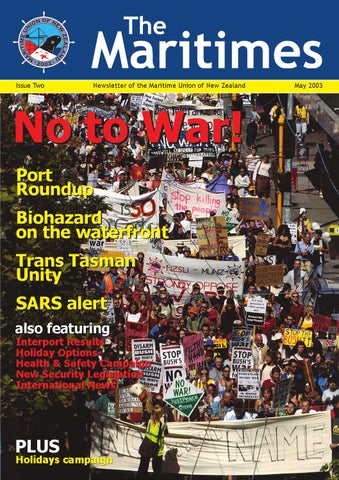
Issue Two
Newsletter of the Maritime Union of New Zealand
May 2003
No to War! Port Roundup Biohazard on the waterfront Trans Tasman Unity SARS alert also featuring
Interport Results Holiday Options Health & Safety Campaign New Security Legislation International News
PLUS
Holidays campaign
1
Everyday problems of seafarers and wharfies are common to one another by Trevor Hanson General Secretary Since the first copy of the Maritimes I have been encouraging our members to become active in supplying material to our national union magazine. We have not got the financial resources that the likes of the MUA have to produce their magazine, but we have got the people available to help out. It would be a good idea for each branch to have a core group who focuses on supplying reports and photos for the Maritimes. We will only get back what we put in, so let’s put it together. As we move forward in our amalgamation process we are finding our everyday industrial problems are common to one and other.
Changes to Health and Safety laws, the new Port Security measures, and changes to the Land Transport Act will affect all members whether at sea or on shore. These issues require careful monitoring and input in order that we get the best deal
Port Security
We have reported to all branches our concerns over developments in port security. We have stated to the Government that all our members must be considered ‘secure’ when the new laws come into effect in 2004. Our other aim is for a register of bona fide Seafarers and Waterfront Workers to be kept by a Government agency. We are concerned about the forthcoming changes, especially in light of the reports from our fellow unions overseas.
The most recent information was obtained by Kathy Whelan at an ITF inspectors meeting in Cyprus. She contacted us to enquire what stage we were at with our Government, so she could report back on our behalf to the ITF meeting the next day. She was told that the Canadian Government had gone for full vetting of wharf labour, which included: names of relatives, how much they have in the bank, and even the make and model of the vehicles they owned. Both Dave and myself feel that our Government will not go that far, but these days you can never be entirely sure where things are heading. If the changes made are not to our liking we will have to take a principled position in order to protect ourselves.
Port security has to take maritime workers interests into account by Dave Morgan Joint National President The Maritime Safety Authority has been given the job of overseeing the new international requirements for maritime security. This will encompass security at New Zealand ports as well as on ships on international voyages, and foreign flagged ships entering New Zealand ports. Director of Maritime Safety Russell Kilvington says the MSA will move quickly to recruit a small number of specialist staff, establish the national Ports and Ship Security Committee, and begin consultation with port and shipping companies. 2
Associate Minister of Transport Harry Duynhoven has said the Government wants a co-ordinated approach to the new requirements which will build on existing border security systems. The new requirements have been developed by the International Maritime Organization, and are set out in an International Code for Ship and Port Security. The new Maritime Security Bill will put this into New Zealand law. The Maritime Union has more than a passing interest in this and we will watch developments closely, to ensure the protection of members rights and Union participation in the process.
Health & Safety
The Health and Safety In Employment Act comes into effect on 5 May 2003. At the date of writing, we do not have an agreement with a single shipowner in regards to the new laws and worker participation. The employers are all relying on the ISM code – which while reasonably effective, falls short of worker entitlements and participation under the new laws. We would have to agree that the ISM Code was an ‘agreed system’ to replace the provisions of the new Act. We don’t agree to this, and we will settle for nothing short of elected Health and Safety representatives with access to training.
Health and Safety
All members should have received the Health and Safety information with our first Maritimes mailout, and your branch should be getting job delegates ready for the new system. Health and Safety officer Bob Stephenson (Auckland) and Phil Spanswick from the Mount are in the process of becoming recognised trainers, and will assist us nationally with job delegate training. The CTU is fully geared up with the ambition of 10,000 job delegates nationally.
Vertical Tandem Lifting
We have requested all branches to write a standard letter to all employers regarding Vertical Tandem Lifting. This details the official position of the Maritime Safety Authority, which allows up to three containers to be lifted vertically. The conditions attached to the practice of tandem lifting are strict. We have made it clear that any employer who permits tandem lifting outside the guidelines and causes injury to any of our members will have complaints laid against them with the police.
Trans Tasman Unity
One of the highlights of the recent Transport Workers Conference in Auckland was the meeting of the Tasman Maritime Federation. The meeting moved us closer to formalising a structure for the Federation. The election of officers of the TMF will take place at our June meeting.
War in Iraq
The War in Iraq has entered another phase as I write. It appears the atrocities against the people of the region will continue. Fighting will continue, and the region will become more destabilized.It’s an ill wind that blows nobody any good. The wharfies in the port of Basra have benefited greatly – they are on US$0.25 per day (their employer is the same one who locked out the West Coast USA longshoremen in the ILWU.) The British Occupying Authority says the rate of US$0.25 is too much and will cause inflation in the Iraq economy. Pax Americana? How much more of it can we take?
We believe tandem lifting is a dangerous practice. Although the ICHCA draft guidelines allow limited loading, it won’t be long before we are faced by overloads.
‘The Maritimes’ Edition 2, May 2003
Our European brothers and sisters are facing new laws which open up ports to competition, self loading and the probability of crews loading and unloading cargo. The end result may be ports of convenience, with cheap casual labour working with cheap foreign crews discharging and loading. I have no doubt that there will be attempts to use foreign crew here – it happens occasionally now, but we always stop it. DO NOT let it happen in your port – stop it immediately! Dave Morgan and myself were recently asked by the CTU to attend a meeting with the GAT negotiators. We were asked to look at provisions in respect to Maritime Cargo Handling Services, which our Government has on the table for negotiation. I have asked Minister of Labour Margaret Wilson for an explanation of the clause on Cargo Handling.
Contents Trevor Hanson Report................ 2 Dave Morgan Report.................. 2 Biosecurity............................. 4 Port Security........................... 5 Ocean Bounty.......................... 6 Gold Coast Apartment................ 7 Delegates’ Training................... 7 Trans Tasman Unity................... 9 Women’s Rights Conference......... 10 SARS .................................... 11 Health and Safety Campaign........ 12 Maritime Union Online............... 13 Holidays Campaign.................... 14 ITF News and Views................... 15 War Special............................ 16 South Island Meetings................ 18 Port Roundups......................... 20 Changing the system................. 27 Interport Sports Results.............. 28 Union Clothing......................... 30 Letters.................................. 31 Regional Contacts..................... 31 The Back Page......................... 32
Kinleith Strike
‘The Maritimes’ is the official national newsletter of the Maritime Union of New Zealand.
European ports
During the course of the Transport Conference in Auckland, the Management Committee discussed the strike by pulp and paper workers at Tokoroa. They are on indefinite strike fighting Carter Holt Harvey and need our support and assistance. The workers at Kinleith have always been a cogent well-organized group in their unions, on the job, in the Trade Union Movement and in their Community. They have in the past assisted the NZSU in our struggles and have always respected our Union. The Committee note that the workers’ Union is in full support, maintaining a level of comfort for the Strikers and their families. More is needed if they are to be successful. The Maritime Union have made an immediate donation of $5000 for the Kinleith Strikers from the NZSU Fighting Fund.
National Office: PO Box 27004 Wellington New Zealand Telephone 04 3850 792 Fax 04 3848 766 Email: nationaloffice@munz.org.nz Web: www.munz.org.nz Edited and designed by Victor Billot Email: victor.billot@munz.org.nz Editorial Board: Trevor Hanson and Dave Morgan Thanks to the photographers including Harry Holland, Rachael Goddard, Shane Parker, Joe Fleetwood, Kathy Whelan and Trevor Hanson. Thanks to Andy Ball for design advice.
3
Biosecurity Hazards The Maritime Union last month instructed all members not to work cargoes suspected of containing biosecurity risks. Biosecurity hazards pose a threat to our agriculture, horticulture and forestry industries, and New Zealand jobs. Maritime Union General Secretary Trevor Hanson says he has serious concerns about the control of biosecurity hazards after talking to union members in ports around the country. There had been anecdotal reports of flying insects escaping from holds and lizards being kicked overboard. Workers had not always reported incidents, and MAF had not always taken care of the situation immediately. Mr Hanson says a stronger and more coordinated approach was needed by Government and port companies to protect New Zealand’s economic wellbeing. A key part of such a strategy would be to extend the “See, Contain and Report’’ method of managing biosecurity threats. One possible approach would be to give on the job delegates the right to post biosecurity hazard notices and stop work on unsafe jobs, as they will for health and safety hazards under new legislation. Mr Hanson says some Australian ports have waterfront workers who specifically check incoming shipping for biosecurity hazards. Waterfront workers are the first line of defence against biosecurity hazards such as exotic animals and insects. To find out how you can help protect New Zealand and your jobs from biosecurity threats, check out: www.protectnz.org.nz For reporting any suspected exotic pest, call the MAF hotline: 0800 80 99 66
4
MAF and Maritime Union working together to “Protect New Zealand” When the Maritime Union went public with our concerns about biosecurity on 4 April, the Ministry of Agriculture and Forestry (MAF) quickly got in touch with the Union to see how we could work together on biosecurity hazards. They have supplied us with “See, Contain and Report” booklets for all members, and we have included one of these with this mailout of the Maritimes. The booklet explains how to identify and deal with common biosecurity hazards, and is ideal for all those working in and around New Zealand ports. Copies of the booklet have also been circulated to branches. MAF spokesperson Adrienne Tollemache says MAF agrees that stopping biosecurity threats is a shared responsibility. MAF are working on putting a nationwide Biosecurity Strategy into place as Government policy from July onwards. Ms Tollemache says this means New Zealand will have a stronger, co-ordinated approach to biosecurity issues in the future by defining “who does what when” more clearly.
MAF has also completed a major review of the ways biosecurity risks around sea containers are handled. The Maritime Union is having input into the Sea Container Review and changes to MAF’s requirements for port clearance. Proposed changes – known as the import health standard – would see MAF entering into a programme of training and accreditation for people who hold responsibility for the unloading of cargo from containers. Maritime Union General Secretary Trevor Hanson is following this potential change closely. MAF is promoting the ‘Protect New Zealand’ awareness programme that encourages everyone who suspects they have found a biosecurity threat to follow three simple steps: ‘See – Contain - Report’. To find out more you can visit the Protect New Zealand website at www. protectnz.org.nz or check out the enclosed bright orange booklet. MAF is keen to remind all waterfront and maritime workers that it operates an 0800 emergency hotline for reporting any suspected exotic pest at any time – the number is 0800 80 99 66.
War in the Middle East, ‘terrorist’ threats and growing international instability have all recently impacted on New Zealand maritime industries. Ports around New Zealand are upgrading security arrangements, Government legislation is in the pipeline and more is yet to come. Wharfies and seafarers both work on the front line where New Zealand and the rest of the world meet in our ports and shipping vessels. Port Security is becoming a hot topic for workers in these industries. The Maritime Union and the Rail and Maritime Union have been working with the Council of Trade Unions to deal with the New Zealand government and employers on these issues. The goal is to deal with port security on a national basis, rather than on a port by port way, where competitive pressures could undermine a secure arrangement. Vetting of waterfront workers and the purchase of new x-ray machines
Any worker with a previous conviction that falls into a list of 20 nominated crimes (seen as a category of ‘terrorism’) will not be allowed to work inside the wharf gates. The Maritime Union has been working to ensure three main outcomes in New Zealand. One, that all our Union members are deemed ‘secure’ at the date where any port security legislation becomes effective. Two, that a register of all bona fide waterfront workers and seafarers in our Union be held by the Maritime Safety Authority. Three, that a three way body with representation from employees, employers and the MSA is set up to deal with any problems. This is why we have recently sent out letters to all members asking them to update their details for us. If any member has not completed their new Maritime Union membership form they should do so, or get in
“The Government wants to ensure a co-ordinated approach to implementing the new requirements and to build on existing border security systems,” says Mr Duynhoven. The new requirements have been developed by the International Maritime Organization and are set out in the International Code for Ship and Port Security. A Maritime Security Bill will be introduced this year to put the changes into law. The International Maritime Organization (IMO) has amended the International Convention for the Safety of Life at Sea, 1974 (SOLAS) to include new anti-terrorism and security measures. SOLAS requirements covered by the Maritime Security Bill will include security levels for ships and ports, provision of security-related information and establishing a system of controls to ensure security measures are implemented.
for container inspection are just two areas which could impact on workers. The Maritime Union has met with Associate Transport Minister Harry Duynhoven who has the job of improving New Zealand port security. In the meantime, a number of commercial companies are trying to get involved in the port security business. Multi million dollar x-ray machines are under consideration in New Zealand ports for container checking. New Zealand Customs are investigating the machines for the Government. Much of the pressure for security is coming from the United States. The American Government has introduced heavy handed methods in their efforts to beef up security. In the United States, longshoremen are now checked back 7 years.
touch with the National Office. Members who do not will not be able to be put on this list, nor will they receive membership cards and up to date Union information. Harry Duynhoven announced last month the Maritime Safety Authority will be responsible for getting port and ship security up to speed with international requirements. The “anti-terrorism” measures aim to protect international shipping and come into force on 1 July 2004. Mr Duynhoven says the first priority for the MSA will be to work closely with port and shipping companies to identify security risks. The Government will also establish a national port and ship security committee, chaired by the Maritime Safety Authority and including the Customs Service, Police and other agencies.
New Zealand has also implemented United States requests that manifests of cargo bound for the USA be provided to their Customs Service 24 hours before loading. These security measures may protect New Zealand trade and security in the short term. In the long term the causes of terrorism must be addressed – such as poverty and oppression of vast numbers of the world’s peoples. International treaties, laws and security cannot replace getting at the root of the problems. Unions must work internationally to promote the strength, wellbeing and solidarity of working people everywhere.
5
Tasman Maritime Federation in action aboard the ‘Ocean Bounty’ By Billy Lewis (003 NC) Following a historic agreement between the Maritime Union of Australia and the Maritime Union of New Zealand, a Kiwi crew was engaged on the “Ocean Bounty.” The semi-submersible drilling rig is now crewed 50/50. The co-operation has resulted in a new opportunity for Maritime Union members from both sides of the Tasman. The members are proud to be employed under an inter-union agreement. We appreciate the efforts of officials and rank and file members which have contributed to making it one of the finest results coming from the Tasman Maritime Federation. Regular monthly meetings are held with all members attending, including the Chief Steward. A rolling fund is supported by the members, which makes donations to worthy causes in both New Zealand and Australia If an industrial dispute occurs, there is the facility to make a donation. The delegate system is alive and well with most issues settled at shipboard level. An example of this is changing cabins when third parties come on board as extra passengers. Current issues of pay disparity on allowances and tax have been taken up by B. Thorpe. These are on their way to be resolved. The union is aware of the union coverage for catering staff in New Zealand. Thought has been put into this in order to align this under a Maritime Union contract.
6
Our union membership is developing positive relationships with similar organisations such as the MUA and ITF. These relationships are important to the union to gain international unity in the event of a major dispute, and access to employment for members. Other key contacts in the Pacific Rim include the ILWU and All Japan Seafarers’ Union. The catalyst for these recent advances has been the amalgamation, as well as the Mining and Maritime Global Solidarity Conference held in Newcastle last September. The “Ocean Bounty” work practices have been put in place by the original Australian crew, and are to be commended as they have ensured priority is given to essential elements of the rigs operations. Work on the rig covers a range of activities, including the loading of cement, barytes and gel, and the maintenance of bulk tank systems and valves. A helicopter operation covers fire team loading, unloading passengers, freight, landing and departure. Safety checks on 190 fire extinguishers are carried out together with any repairs. Weekly and monthly checks on lifeboats, engine checks, stores and equipment, the maintenance of toilets, sandblasting small fittings for pipework and small vents and the like are all part of the job. The motor room requires a log to be kept twice daily, and for the engineer to be assisted when required. Being in charge of the rig anchor winches means you must be trained up, and this is usually the mates job. Overall, there is a small efficient, well-trained and organised crew on the rig, a fact that is recognised by management. The Union is working well with the engineers who are part of the enterprise bargaining agreement.
News briefs Tandem lifting under spotlight
The Maritime Union of New Zealand has requested all branches to forward a standard letter to all employers regarding Vertical Tandem Lifting. The Union believes tandem lifting is a dangerous practice. The letter outlines the official position of the Maritime Safety Authority, which allows up to three containers to be lifted vertically. But the conditions attached to the practice of tandem lifting are strict. General Secretary Trevor Hanson says “any employer whom permits tandem lifting outside the guidelines and causes injury to any of our members will have complaints laid against them with the police.”
International Workers Day
International Workers’ Day is being celebrated around the world on May 3. Wellington members are involved in a march at 12 noon that leaves from Glover Park and meets for a rally at Civic Square at 12.30. There will be music and a number of speakers (including MC Mike Williams of the Wellington Seafarers branch.)
Search for sailors abandoned
18 sailors are believed drowned after their Taiwanese fishing boat sank in a Tasman sea storm in April. An extensive air and sea search was launched for the 32m Lih Fa after its captain sent a distress message during the storm 800km west of New Zealand.
Filipino dockers in large scale strike
A major strike has occurred in the Philippines where dockworkers walked off the job on April 23. The workers are demanding a wage increase to keep up with increases in the cost of living. The Samahan ng Manggagawa sa Pantalan (Association of Dockworkers) expects 900 workers will join the strike. The stevedores, forklift and crane operators, dockhandlers and wingsmen are demanding a 35% increase in their wages. According to Union President Jake Azores the management offer of a 9% increase is not even enough to buy half a kilo of rice. The daily wage of company workers at the pier is only P273 a day (approximately NZ$9.40) The workers also fear widespread dismissals because of the plan of Philippine Government to privatize ports. A message of support from the Maritime Union of New Zealand has been sent to the strikers. General Secretary Trevor Hanson says that all workers seem to be under attack by global shippers and port companies.
Jody F Millennium Report Out
The Maritime Safety Authority has released its report on the February 7, 2002 stranding of the Jody F Millennium at Gisborne. Port Gisborne, the ports pilot and the captain of the Korean log carrier have all been criticized in the report. The MSA says the ship grounded because surge conditions meant it could not stay in port. The report notes Port Gisborne failed to check whether its advertised channel depths were correct. The ships owners are taking Port Gisborne, Adsteam Port Services Ltd and the Gisborne District Council to court, claiming more than $23 million in damages. The claims are denied.
Gold Coast Apartment The Auckland Branch Local 13 have an apartment on the Gold Coast (Australia) which is available for all members of the Maritime Union of New Zealand. It is a spacious, self-contained twobedroom unit 100 metres from Miami Beach. The unit has an ensuite to the main bedroom, fully equipped kitchen and laundry with fridge, dishwasher, microwave, washing machine and dryer. Colour television is connected to Foxtel, underground secured parking and a private balcony overlooking pool, spa and tropical gardens. A booking fee of $50 is required when confirmed, and rental is $250 AUS per week per family. Occupancy is based on two week periods from Saturday to Saturday, additional days can be granted depending on vacancies.
The apartment is available at present from 3 May to 17 May, 14 June to 28 June, 28 June to July 12, July 26 to August 2. The rest of the year is booked out. For more information contact: Bob Stephenson Telephone 09 303 4652 Mobile 021 760 887 Fax 09 309 6851
Delegate Training One of the tools the Employment Relations Act 2002 gave us was union education in the form of EREL (Employment Relations Education Leave). The Maritime Union has developed five delegate training modules which have been approved by the Department of Labour. Seven seminars were run last year with all delegates receiving paid education leave to attend. The seminars were delivered by Union educator Chris McDonald assisted by Bob Stephenson. Delegates who attended said they gained a better understanding of union structure, the political and legal environment, and the importance and role of the delegate. Delegates said they found the chance to meet others in the same area useful, and all felt the seminars were well-run and beneficial. We have successfully gained funding for these courses for 2003 from the
Employment Relations Service. This will enable us to deliver more seminars throughout New Zealand. Remember attendance is limited so book early by contacting your local union branch (seafarer members are eligible as well.) The following are indicative dates for the Delegates Seminars: Auckland (contact Bob Stephenson) May 14, June 11, July 9, August 6, September 10 Lyttelton (contact Les Wells) May 20, September 2 Port Chalmers (contact Phil Adams) July 1 Wellington (contact John Whiting) June 24 Mount Maunganui (contact Phil Spanswick) August 12
7
News briefs News briefs Kinleith workers hold out
European port workers fight “ports of convenience” European port workers’ resistance to a major reform package is gathering momentum as its full implications become clear. More than 20,000 port workers across Europe took part in protest against the European Union’s proposed ‘ports directive’ in January. The actions drew attention to the risks of the planned liberalisation of the EU port industry. This would introduce more competition between all sorts of port service providers, including stevedoring companies and tug pilots. This type of liberalisation threatens jobs and safety by allowing shipping lines to employ cheap, unqualified and non-union labour, according to the ITF. Port workers from Finland, Denmark, Germany, Sweden, the Netherlands, Belgium, France, Spain, Portugal and the UK were joined in their protests by fellow workers in Cyprus and Malta, both of which are in line for EU membership, and Norway, which has close links with the EU. A recent case in Germany underlines the dangers of the kind of market deregulation the directive is proposing. In January German police detained 10 Polish crane drivers who had recently boarded a Panamanian flagged ship in Bremen. The Japanese owned and managed self discharger Basic Arrow was carrying iron ore from Narvik. The police found that the Poles, all of whom work for a Polish company, were falsely described on the crew manifest as seafarers, although the intention was clearly to use them to discharge cargo. All had entered Germany on tourist visas and were quickly deported. More info at: www.itf.org.uk/ports/campaign/ilwu/index. htm
8
More than 250 workers from the Kinleith pulp and paper mill near Tokoroa have been on strike since March 7 at the time of printing. They are fighting their employer Carter Holt over attempts to attack employment conditions under the guise of making the mill “internationally competitive.” CHH wants to force production workers to fight fires, clean up chemical spills, and rescue each other in emergencies. This would enable it to disband its in-house professional fire brigade and cut “emergency response” service costs. The company also wants to eliminate overtime payments and a system linking pay rises with skill levels. This week CHH announced that it had tripled its first-quarter profit and would do “whatever it takes” to win the dispute. It’s profit for the first quarter of 2003 was $NZ51 million. Carter Holt Harvey’s former chief executive, Chris Liddell, received a 23% pay rise last year, bringing his annual salary to $1.17 million, before he moved on to greener pastures.
Tai Ping grounding leads to MSA court action
The release of a Hong Kong report in April into the grounding of the Tai Ping at Bluff follows news South Port will be prosecuted by the Maritime Safety Authority over the incident. The MSA is taking legal action under the Maritime Transport Act, which means its draft report on the will not become available until after any legal proceedings take place. The Hong Kong Marine Department investigated the accident as the Tai Ping was Hong Kong registered. The Hong Kong inquiry found the bridge team on board the bulk carrier Tai Ping, including the pilot, did not make full use of the ship’s radars in the moments leading up to its grounding in Bluff Harbour in October. The inquiry found a fast moving fog caused visibility to suddenly deteriorate prior to the accident. South Port says it will defend the prosecution action.
CTU Calls for More Action On Hazardous Substances
“Many New Zealand workers suffer unnecessarily from the harmful effects of hazardous substances because their employers disregard minimum standards,” says CTU health and safety co-ordinator Greg Lloyd. A Ministerial Inquiry has been hearing submissions about hazardous chemicals in the workplace. The CTU says minimum standards should to be more stringently enforced by OSH. “OSH conservatively estimates that 400 people die every year as a result of work and many of those deaths are the result of exposure to hazardous substances,” says Mr Lloyd. “The top priority should be the health and well-being of workers.”
Dust never sleeps
Residents will be compensated after a cloud of clinker dust settled over Lyttelton in April. The dust was blown from the ship Ace Bridge as it was being unloaded, and rain caused the dust to harden on homes and cars. An eyewitness says the eastern side of the town had been coated in the white dust.
No casual attitude in labour study
The Maritime Union has contributed some of the information we have gathered over the years to a new academic study. Massey University Albany is carrying out a Labour Market study looking at the effects of casualization. Research manager Eva McLaren says evidence suggests ‘non-standard’ work practices can have negative effects on those in less secure jobs. Hopefully this study will contribute to more official recognition of the effects of casualization.
Maritime Unions Building Trans Tasman Unity by Terry Ryan The second meeting of the Tasman Maritime Federation was held in Auckland on the 31 March 2003. The meeting was attended by the delegates from the Maritime Union of Australia and the Maritime Union of New Zealand. The Maritime Union of New Zealand was represented by Dave Morgan (Chair), Mike Williams, Gary Parsloe, Slim Ford, Terry Ryan, Les Wells and Russell Mayn. Mick Cotterel, Rick Newlyn, Robert Coombs, Paddy Crumlin, Mick Doleman, Jim Tannock and Eddie Seymore attended on behalf of the Maritime Union of Australia. Dave Morgan chaired the meeting of national officials.
Miners’ Union
Paddy Crumlin says he has spoken to the Miners union in regard to establishing a research unit. This unit would be a resource for the Federation, which could tie into ITF activity. Development of a co-ordinated approach with other ITF affiliates will reinforce the position of the Federation.
Australian Maritime Unions
Paddy Crumlin says the Australian Maritime Unions had expressed interest in joining the TMF in a loose federation based on a set of principles. It was felt this was positive given that the purpose of lobbying the officer unions would be included.
The results from the elections for the Maritime Union of Australia will be declared in early July.
Calendar for MUNZ officials
A suggestion was made to the delegates that at the next election meeting for the Maritime Union of New Zealand officials, a 12-month calendar with agendas should be made.
Maritime security measures
Paddy Crumlin reported on the IMO’s comprehensive maritime security measures and our Governments being contracted to the “safety of life at sea” provisions. Mr Crumlin says the MUA can devote resources to develop a report and develop a strategy. This was endorsed at the meeting.
TMF structure
Delegates agreed there was a need to formalise the structure of the TMF. The structure would be formalised at the next meeting to ensure the TMF is recognised as an ongoing organisation with strategic objectives, research and training. Funding for the TMF also needs to be discussed. It was decided to hold the next meeting in Australia as the last two had been held here in New Zealand. The next meeting will be held in Sydney on 11-12 June 2003. The agenda will cover structure of the TMF, election of officers, the rules, and Pacific Rim issues.
MUA Election Results
Joint off-shore crew arrangements
International
South Africa, Japan, Korea and ILWU on the West Coast USA had shown interest in some form of link up to the TMF. This was an opportunity for international activity and leadership by the TMF and should be picked up.
ILWU Meeting
An ILWU meeting will be held in May this year. Paddy Crumlin will be attending and it was suggested that a representative from the Maritime Union of New Zealand also attend.
Mike Williams told the meeting of the excellent work carried out by the rank and file in the joint off-shore crew arrange-
ments. This related to the Ocean Bounty, Polar Duke and Swires tenders and the New Zealanders working on the Australian coast.
Joint Training Seminar
A date is to be set for a joint training seminar between the MUA and MUNZ.
9
ITF conference supports women’s rights bers in Union activity. It was resolved by delegates to promote 8 March as an annual International Women’s Day, and 25 November to become actively known as ‘Elimination of Violence against Women Day.’ Rachael says the delegates thank the members for giving them the opportunity to learn techniques of how to overcome the issues that face women. “This is some thing greatly needed in all trade unions if we want to evolve as a stronger force into the future.”
Women unionists from Australia, Fiji, Papua New Guinea and New Zealand attended the ITF FNV ‘Workshop for Women’ Conference in Sydney from 10–13 March. The Maritime Union of New Zealand was represented by seafarer member Rachael Goddard and wharfie member Carleen Parker. Rachael Goddard says the conference put women’s issues under the spotlight. “Many delegates were unaware of the extent that common issues exist in our countries and collective agreements throughout the transport industry” she says. Issues women face in the workforce include job ‘flexibility’ and security, health and safety, equal pay, working hours, access to child care, maternity leave, casualisation, harassment and discrimination. The issues were narrowed down to four main target areas: 1. Equal Opportunity 2. Violence and Sexual Harassment 3. Family rights 4. Organising women
10
Prior to amalgamation, the New Zealand Seafarers’ Union in 2001 averaged 16.62% female membership and in 2002 that rose to 18.10%. “To address the issues concerning women we need to realize that womens issues are union issues.” Women have different methods to men in the way they approach things. This can give Unions a more resourceful and diverse structure and balance, and this will build the Union. “For this to happen I believe we need to encourage women to come forward and become activists” says Rachael. “We need to ensure women take part in union decisions and policies.” One way to develop this is to form womens committees within transport unions in New Zealand, which can work with womens groups in the industry globally. Women and men both need to become part of the struggle towards changing the perception of men and women in their respective unions. Education and training for women needs to be a priority, along with more involvement of women mem-
Waterfront workers will not work vessels unless certified ‘SARS free’ The Maritime Union has told its members not to start work on any inbound vessel unless it has been declared ‘SARS free’ by medical authorities. Maritime Union General Secretary Trevor Hanson says New Zealand waterfront workers and seafarers are in the front line with threats such as Severe Acute Respiratory Syndrome (SARS). He says vessels were arriving in New Zealand daily from areas where SARS has been most common, including Hong Kong, Singapore and Taiwan. All ships masters are required to notify New Zealand public health authorities of any notifiable disease on board at the first New Zealand port of call, including SARS. Mr Hanson says the incubation period of SARS and the confined nature of ships could be a dangerous situation. He says union branches in New Zealand ports discussed the issue at a national meeting. The policy to not work ships unless cleared was intended to ensure the safety of union members as well as the wellbeing of New Zealand.
Questions and Answers about SARS (Severe Acute Respiratory Syndrome) What is SARS? SARS stands for Severe Acute Respiratory Syndrome. SARS is the term being used to describe a pneumonialike illness. Which countries have had cases of SARS? At this point in time, most cases have originated in Hong Kong and China . Altogether cases have been reported in 13 countries spanning four continents, however the status of individual countries continues to change daily. In New Zealand a small number of people have been investigated for possible SARS, however, there have been no reported cases.
SARS. What should people do if they think they have SARS? If a person has mild symptoms, and is not having any problems with breathing, the best thing to do would be to telephone their General Practitioner for advice. The local public health unit will also be able to provide advice over the telephone. If a person is having difficulty breathing an ambulance should be called immediately to take them to hospital. How infectious is SARS? Our information to date suggests that during the incubation period (two to 10 days) and early stages (one to two days) of the illness the risk of infecting other people is very low. People are most infectious when they become visibly ill with SARS (ie, show all symptoms).
SARS SARS Information from the Ministry of Health Website: www.moh.govt.nz/sars Freephone: 0800 0800 80
What are the symptoms of SARS? SARS causes a high fever (greater than 38°C) and respiratory symptoms such as cough, shortness of breath and difficulty breathing. Other less common symptoms include headache, muscular stiffness, loss of appetite, unexplained tiredness, confusion, rash and diarrhoea.
What is the difference between SARS and other respiratory illnesses like “the flu”? Many of the symptoms of SARS and other respiratory illnesses like “the flu” are similar, although SARS is likely to be more severe. The World Health Organization states that a case of SARS must have a high fever (greater than 38°C) AND one or more of the following respiratory symptoms: cough, shortness of breath, difficulty breathing AND must have travelled to one of the affected countries in the 10 days prior to becoming unwell or had close contact with a confirmed case of SARS in the ten days prior to becoming unwell. How does SARS spread? Almost all reported cases of SARS have occurred in close contacts (such as family members or health care workers) of cases. There is no evidence so far that SARS can be spread by casual contact. A close contact is someone who has cared for, lived with or had direct contact with the respiratory secretions and body fluids of someone with
What is the risk of catching SARS from someone who has no symptoms? You are not likely to get SARS from someone who does not have any obvious symptoms, such as coughs and fever. The risks of infection are minimal during the incubation period (two to 10 days before you get sick) and the early stages of the illness. What happens to people if they get SARS? Ninety percent of people are unwell for six to seven days with an illness which resembles influenza, and then they recover completely. About 10 percent of cases have a more serious illness and may require hospital treatment. It is in this small group of cases where deaths are occurring. Most deaths have occurred in people over 40 who have existing conditions, such as diabetes and heart disease. What is the risk of catching SARS from colleagues in the workplace? Most cases of SARS have been transmitted by close contact with a person who already has SARS. Close contact means handling or being exposed to body secretions (nasal mucus, urine, faeces) from someone with SARS. What are the 13 countries where cases have been reported? These are the countries where the most cases are occurring and where there is ongoing transmission of cases: Canada, mainland China, Special Administrative Region of Hong Kong, Singapore, Hanoi in Vietnam.
11
Health & Safety Campaign New Zealand’s workplace health and safety laws have been strengthened, but all Union members need to know about the changes for it to have an impact. When changes to the Health and Safety law comes into force on May 5, Union members will have the opportunity to make a difference in health and safety. Unions are running a national campaign to get members involved. Last year OSH investigated 74 workplace deaths – the highest number for 10 years. Union members rate health and safety as one of the most important union issues. When workers are involved, through their unions in health and safety, death, accident and illness statistics dramatically improve.
The First Steps Developing effective worker participation systems and electing Health and Safety reps are the first steps to healthy and safe workplaces. All employers are required to provide the opportunity for workers to participate. Small Workplaces (Less Than 30 Workers) Unless a worker requests a worker participation system the employer is not required to set one up. This does not prevent workers requesting a system.
Campaign Goals • electing 10,000 workplace Health and Safety reps in 2003 • ensuring the reps are trained and supported • developing worker effective participation systems at every workplace • making our workplaces healthier and safer Making the Health and Safety Law Work Our workplace Health and Safety law is changing. The new law supports elected health and safety representatives and ‘worker participation’ in health and safety. Worker participation is about workers getting active in workplace health and safety. The Maritime Union is developing worker participation systems with employers. Workplaces will elect Health and Safety reps to represent all workers. Health and safety reps will be trained to carry out their role. The new law requires all employers to provide reasonable opportunities for workers to participate effectively in workplace Health and Safety. 12
• •
Does the system include at least 2 days a year Union Health and Safety training? Does it include a review?
Large Workplaces (30 or more workers) On workplaces of large employers worker participation systems must be developed with worker (and union) participation. Workers should meet with their Union to start to develop a suitable system and identify Health and Safety reps. Where there is more than one union, unions must co-operate. Non-union workers must be included. The system should be agreed with the employer and Health and Safety rep election held. The Health and Safety reps can be booked in for union training to support them in the role. Existing Health and Safety systems You can agree with the employer to retain an existing system. But – check the Worker Participation checklist and don’t agree to anything less. If you can’t agree a system with the employer within 6 months, the default system in the Health and Safety in Employment Act (including Health and Safety reps) automatically becomes the system. Contact your union organiser for more information.
The Union will help to decide on an appropriate system and to identify Health and Safety reps. A system can be as simple as having elected, trained reps. Worker Participation System Checklist • Are there enough Health and Safety reps for each work area and shift to ensure all workers are represented? • Are the functions of the rep included? • Is the union fully involved? • Does the rep have the time and resources to do the job effectively?
Electing Health and Safety Reps It’s important to get reps elected and trained so they can get on with the job. Talk to your union organiser about Health and Safety rep elections and developing a system. The goal of the union campaign is to elect 10,000 Health and Safety reps. The more trained elected reps there are the better chance we have of healthy and safe workplaces.
Rank and File at Work by Joe Fleetwood
(Wellington Seafarers Branch)
We work hard with our officials campaigning for new jobs at sea and on the wharves, never forgetting about the retention of jobs and conditions that were fought for by previous and past old timers. It is up to us, the new breed, to keep hold of them. It is time we all look at ourselves because times will only get tougher if we let them. Now is the time to work together more than ever – nothing was ever given to us by our employers, we only have each other to rely on. It’s time to say “what can I do for the Union?” not “what is the Union doing for me?” One hour per week if possible at the Union rooms is better than a day crawling at the company office. We are the union, rank and file and officials are one. Work for the ITF may not secure us jobs at sea or on the wharves, but if we don’t help our maritime comrades we will be the so called Third World workers of the Maritime Industry, battling for wages and conditions. We have done ITF inspections on
ships with up to 12 different nationalities in one crew, a tactic designed to divide the workers. Rank and file inspectors work tirelessly in all ports helping our ITF Coordinator Kathy Whelan. If you are interested in seeing first hand how people shouldn’t live and how they shouldn’t be treated contact Kathy. Life is about helping each other, workers of the world have to be united – but only the workers can make it happen. Volunteer ITF Inspectors give their time for nothing, so any one who wishes to volunteer should know that. It appears that some of our members haven’t heard that there is a war happening. Some of us still remember our great union always lead from the front. I have heard members remark that we are the last trade union bastion, so now is the time to lead the trade union movement. More attendance is needed by all members on peace rallies and marches, contact your port officials for information on when rallies, marches and meetings are going to take place. One hour of our time it all it takes to show your condemnation of the killing of innocent women, men and children.
Union website online The new Maritime Union website has gone online at www.munz.org.nz This site will undergo development in the next few months to update and improve its features including union news, membership information and our campaigns. If members have any good ideas about what they would like to see on the website they can send an email to webmaster@munz.org.nz Every edition of the Maritimes we will feature some useful websites that members with access to the internet can look up. This issue we have listed some websites where you can find out news and current events. Most of the media we see day to day is owned and operated by big business, and strangely enough doesn’t give workers a fair go. Here are some websites which you may find interesting: New Zealand CTU union website www.union.org.nz New Zealand Aotearoa Indymedia www.indymedia.org.nz Scoop New Zealand news site www.scoop.co.nz Stuff mainstream news site www.stuff.co.nz Union and labour news site www.labourstart.org International union news www.global-unions.org BBC News Website (UK) www.bbc.co.uk Guardian newspaper (UK) www.guardian.co.uk ZMag alternative media (USA) www.zmag.org
The ‘Purbeck’ is due to enter the Cook Strait trade shortly as part of the Interisland line, with Maritime Union crew and agreements.
Google – one of the top search engines www.google.com
13
Holiday changes needed to help casual workers The Government first legislated for minimum holidays in 1873 when it ruled that women in factories were entitled to 4 public holidays per year – Christmas, New Year, Good Friday and Easter Monday. The first entitlement to a minimum of two weeks annual leave for all workers was enacted in 1944 under the First Labour Government. In 1974 Norman Kirk’s Government increased the minimum annual leave entitlement to three weeks. Thirty years later, many workers are only being given the minimum annual leave entitlement, while other workers are able to negotiate better annual leave entitlements – sometimes based on length of service. For many salaried workers, and most managers, four weeks annual leave has become the norm. A current Union campaign is trying to get four weeks leave as the minimum by supporting changes to the Holidays Act.
To the Transport and Industrial Relations Select Committee Submission on the Holidays Bill and the Holidays (Four Weeks Annual Leave) Amendment Bill From Name Address
Casual Workers need holidays too
Although the Maritime Union agrees four weeks annual leave will assist many New Zealand workers, we feel the new Holidays Bill does not take into account a serious problem in our industry. Many of our members are casual workers who are used to serve the peaks and troughs of the shipping industry. A casual worker is an ‘on call’ standby worker who lacks many of the benefits of permanent employment. Our casual members can work up to 200 days for either one employer or a mixture of employers at the same port. Regular casual workers get no prorata sick leave. They do not qualify for a lieu day when working a Public Holiday because of the wording in the Bill. It is not possible for a regular casual worker to meet the requirements
of the Bill. A regular casual worker has no entitlement to bereavement leave. The 6% pay as you go payment paid to regular casuals as holiday payment is not sufficient for a regular casual to provide a holiday for himself or family. In conclusion, many casual employees in our industry are dependant on this work as a sole income. Many have served loyally for periods of up to 10 years waiting for permanent employment in the industry. In most cases these workers would like to be able to take part in the social festivities at times of Public Holidays. But they are compelled to work for two reasons: (1) they need the money (2) some employers take great delight in forgetting to ring up casual workers who don’t ‘fit in’ with their requests!
Cut or photocopy this form
and have your say! I want the Holidays Amendment Bill to take regular casual workers rights into account. Regular casual workers can work up to 150 days a year or more. It is vital they receive recognition – New Zealand needs:
NOTE: Submissions must be in by 30 May 2003.
Cut out or photocopy this form, and post (no stamp required) to: The Secretary, Transport & Industrial Relations Select Committee, Parliament Buildings, WELLINGTON.
14
• • • •
Pro-rata sick leave for regular casual workers Pro-rata bereavement leave for regular casual workers A lieu day in exchange for a worked public holiday for regular casual workers When a regular casual worker has accrued 24 days work, he or she should receive one eight-hour holiday pay payment
(signed)
ITF News Kathy Whelan ITF Coordinator for New Zealand Reported recently from Bluff is the case of the fishermen on the South African registered vessel “South Princess.” Brought to the ITFs attention by ex member Graham Adamson from Bluff, 15 South African crew members walked off the vessel with their gear because of low wages. Their contract had expired and they wanted new terms and conditions negotiated. Ray Fife took the matter up and ensured the crew were accommodated ashore. They were eventually repatriated to South Africa in the face of the company’s refusal to renegotiate their contract. This is another example of this rogue industry where anything goes. All credit to the crew members for taking a stand which, as reported in Ray’s article on page 25, could cost them dearly.
One of the things that struck me was that in this environment of rigid safety and security measures it is vital that the parties work together, and the ITF is taking an initiative in this respect. One of the highlights for me was listening to and meeting the Hon. Peter Morris who chaired the International Commission of Shipping Inquiry into Ship Safety – an Australian politician for 26 years who has an extensive background and knowledge on transport and a passion for a safe and fair international shipping industry. The Cyprus meeting was followed
Back pay and repatriation
International meeting
Since the last Maritimes it has been a busy time on the ITF front – mainly with meetings. All 120 ITF Coordinators and Inspectors from around the world, together with a large contingent from the ITF Secretariat from London, attended a week-long seminar in Cyprus to review our past campaigns and develop strategies forward. The agenda that covered such topics as Port Security and Seafarers Rights, campaigns, performance, technology, legal strategies and media communications, and a panel discussion on Collaboration for Mutual Gain. This included a large delegation of representatives from The Cyprus Shipping Association, Ports Authority, Columbia Ship management, Cyprus Shipping Registry and various manning agencies.
We are currently investigating and assisting the family in gaining some form of compensation under Ukrainian labour laws. In the ‘it would be amusing if it wasn’t so serious corner’: Joe Fleetwood inspected the vessel “Marine Phoenix” in Wellington early in March, she has a crew of 20, made up of Russian and Ukrainian Officers and Bulgarian and Indian ratings. Joe asked the Master what type of cargo the ship was carrying, to which the Master replied he didn’t know. Further questioning resulted in the same answer. It turned out he was carrying fruit. Quite astounding at a time when the industry internationally is addressing the issue of security of ships and ports.
by an ACTU/NZCTU/ITF meeting in Auckland which is reported by Garry Parsloe on page 20. Other activity in the New Zealand Inspectorate has also included :
Fishing Industry
Referral of a case from the Christchurch Coroner of the death (from natural causes) of a Ukrainian fisherman in terms of compensation available to the family. This case highlights the total lack of coverage for foreign workers in the Fishing Industry which carry over to the Flag of Convenience system. Once again the New Zealand agents/charterers, whilst reaping the benefits of cheap, foreign labour, use the system to remove themselves from any obligation to workers who have little or no contractual or legal protection.
The Cable Layer “Guardian Pacific” is berthed in Auckland on stand by for fibre optic work in the Asia/Pacific rim, she has a crew of 51 – British Officers and Fijian Ratings. A Fijian steward approached the ITF on a wages issue and we obtained him a back pay of US$1,085. One of his fellow crew members (also Fijian) took exception to the fact that he came to the ITF and at 12:30 one morning woke him up and invited him out on deck to fight. Fortunately the Steward left the ship and slept on the streets until he could make contact with the ITF the next morning. With only one week of his contract to go we got him repatriated to Fiji as was his wish and the Master and company are dealing with the perpetrator of the incident. Some pressure put on the owners of a cargo vessel “Asian Cherry” by the New Zealand Inspectorate resulted in the Japanese Union negotiating an agreement to cover the crew. Inspections continue and our network in the Asia/Pacific region strengthens daily.
15
WAR SPECIAL The Maritimes War Special The War in Iraq is ‘over’ as we take the Maritimes to print. However the Maritime Union of New Zealand feels it is important to do our part in informing our members and all New Zealand workers about the true nature of this war. Waterfront workers and seafarers in New Zealand (and Australia) have always been strong, politically-aware and active unions which get involved in the important issues of the day. Despite the ‘spin’ we get from the mainstream media which features flag waving marines and grateful locals, the true picture is somewhat different. Two questions to ponder over. After standing on one of our many picket lines over the years, do you trust what the career-minded politicians and the big business owned media poodles have to say on anything important? And secondly, who really thinks that the world cop AKA George W. Bush would travel halfway around the world to free the suffering millions out of the goodness of his heart? The US Government is more right wing, more aggressive and more antiworker than ever. Luckily they have not had too much luck dealing with our American brothers and sisters in the ILWU. The Council of Trade Unions in both Australia and New Zealand have made a stand against war as a solution to the worlds problems. The Maritime Union of New Zealand as well as our Australian comrades also condemn war. We support a peaceful process to contain and disarm so called ‘rogue’ nations through the United Nations. Wars like this will increase the threat of terrorism against us, not reduce it. Read on to find out some of the less known news about the war. 16
SSA awarded Iraq port contract One development in the war on Iraq is how big business interests are being given lucrative deals to go into Iraq. Stevedoring Services of America (SSA) have got the job of managing the port of Umm Qasr. Closer to home they are known as the former owner of New Zealand Stevedores who went into liquidation in 1998, leaving wharfies $15 million out of pocket for redundancies. SSA then setup Southern Cross Stevedoring. Compensation for the wharfies is still being pursued through the High Court. SSA have also got on the wrong side of wharfies in their home country. The International Longshore and Warehouse Union (ILWU) in America have named SSA a ‘union busting’ firm. ILWU spokesman Steve Stallone was quoted in the San Francisco Chronicle during industrial action last year as saying “It’s ideological with these people. They are ideologically anti-union and anti-ILWU.” Philip Mattera of the Americanbased Corporate Research Project reports the U.S. Agency for International Development announcing SSA being awarded a $4.8 million contract to manage the seaport. According to Mattera, “SSA has never worked in a war zone, but it has been in the middle of another kind of struggle: the battle between labour and management in the West Coast ports of the United States.” Seattle based SSA is the largest marine terminal operator in the USA. In February, SSA was one of four companies cited by Washington State for requiring longshore workers to remain on the job as much as 17 hours straight without adequate rest time. Further information: http://www.goodjobsfirst.org/crp/ extra_32503.htm
WAR SPECIAL ILWU members attacked by police 9 ILWU members shot with concussion grenades and wooden bullets, 5 hospitalised, union leader dragged from car, thrown on pavement, handcuffed and imprisoned as police disperse anti-war protest. The Maritime Union of New Zealand has joined the International Transport Workers’ Federation, and its affiliates worldwide to condemn a paramilitary attack on a peace protest in the Port of Oakland, California last week. On April 7 peace activists assembled outside the port to demonstrate against American President Lines and Stevedoring Services of America, and their role in the US led invasion of Iraq. Port workers, members of the International Longshore and Warehouse Union (ILWU), stood by awaiting word from an independent arbitrator on whether it was safe to work while the protest was underway. According to eyewitness accounts police in full riot gear and gas masks opened fire with pepper spray, stun grenades and wooden projectiles on the crowd without provocation. This was despite protestors retreating on request. Most were wounded in the back. Police also fired into a group of longshore workers standing to one side, waiting for the call to go to work. Five workers were hospitalised, one requiring surgery. When ILWU Local 10 agent Jack Heyman went to inform police that his members had been shot and he was instructing them to leave the area, he was dragged from his car, thrown onto the pavement, handcuffed and imprisoned for 14 hours. Trent Willis, ILWU, responded by declaring his members would walk off the job. “They shot my guys. We’re not going to work today,” Willis said. “The
cops had no reason to open up on them.” Stevedoring Services of America recently came under scrutiny when it was awarded a $4.8 million contract to manage the Umm Qasr seaport in Iraq, and American President Lines receives millions of taxpayer dollars every year for shipping military cargo through the Department of Defence Maritime Security Program.
If we are against brutal dictators, why are we bankrolling them? American political writer Noam Chomsky says in a recent interview, “we all agree that Iraqis would be better off without Hussein.” “Just as their subjects would have been better off without Ceausescu (Rumania), Suharto (Indonesia), Marcos (Philippines), Duvalier (Haiti), Mobutu (Zaire) — quite a long list.” All the above were supported by the American Government, just as they [once] supported Saddam Hussein. All were overthrown, from within. “There’s every reason to believe that Saddam would have gone the same way if the US hadn’t insisted on devastating the civilian society, strengthening the tyrant, and compelling people to rely on him for survival,” says Chomsky. The main effect of the decade of economic sanctions was to strengthen Saddam Hussein by weakening the Iraqi people. Another dictatorship supported by American money is Pakistan. Pakistan recently signed an agreement with the United States to cancel a US$1 billion debt shortly after Pakistani dictator Pervez Musharraf threw his weight behind the ‘war on terror,’ according to Reuters. Pakistan has received US$3 billion in aid from the USA since the beginning of the ‘war on terror.’
17
Timaru meeting, Tuesday 25 February
Lyttelton Branch Maritime Union members at the Wednesday 26 February meeting
South Island Meetings General Secretary Trevor Hanson and Joint National President Dave Morgan visited South Island ports in February to talk to members about the continuing amalgamation process and issues facing the Union. Meetings were held in Bluff, Port Chalmers, Timaru and Lyttelton. Dave Morgan and Trevor Hanson provided a report to members on the progress of setting up the new union, increasing the unity between waterfront and seafarer members, and some of the common problems faced by all members. Future meetings are planned for northern ports.
South Port
Members of the Port Chalmers Executive check out Maritimes Edition 1 hot off the press
Port Timaru
Timaru branch members meet with national officials, Tuesday 25 February
Timaru members enjoy some southern sunshine after meeting with national officials, Tuesday 25 February
18
ILWU lessons from lockout With a new six-year contract in place, the ILWU has drawn lessons from its 2002 battle with employers, according to those close to the heart of the struggle. Former ILWU officials and labour activists Peter Olney and David Arian spoke earlier in the year at the University of California about the experiences and conclusions drawn from last years port lockout. The negotiations between the ILWU and the employers group, the Pacific Maritime Association, were fundamentally different from previous negotiations, says Arian. “This contract was the first contract where maritime capital was no longer the dominant force in determining the outcome.” “We were negotiating with the West Coast Waterfront Coalition . . . all the retailers headed by Walmart” he says. The PMA tried to use the port lockout to smash the union financially, and after the lockout ended, the PMA took the ILWU to court, claiming that workers were on a go slow. The ILWU won the case with evidence that the workers had kept production at the normal level. A contract was eventually signed after months of struggle. “Big battles and social conflicts like the lockout on the West Coast last fall are great instructors,” Olney says. He called the negotiations a “wakeup call”, with the ILWU learning it needed to form stronger alliances. The ILWU developed an attitude that separated themselves from other workers, Arian said. “Our membership as a result of the lockout . . . learned a valuable lesson – that you’re never untouchable and you can’t win by yourself,” Arian said. “We reaffiliated with the AFL-CIO, we never really needed anybody else’s help before.”
News briefs MSA investigate holed tanker
The MSA are investigating why a damaged oil tanker was taken into Marsden Point last month. The ballast tanks of the 13-yearold Capella Voyager took on several thousand tonnes of water after its hull split in rough seas. The double-hulled supertanker was carrying 108,000 tonnes of oil from the Persian Gulf. An MSA spokesperson says the hull was apparently damaged while the 80,000 tonne tanker was entering the port in six metre swells. The cargo had been unloaded and it would not leave the port until the MSA was satisfied with the repairs. The incident has increased calls for New Zealand’s maritime safety rules to be tightened. In January, the MSA asked the International Maritime Organisation to declare the coastline from Cape Brett to Bream Head a compulsory no-go zone for ships over 45m in length. The MSA is reviewing the safety performance of New Zealand’s ports following the groundings of the Jody F Millennium at Gisborne and the Tai Ping at Bluff last year.
Workers stop and remember the dead
Union members from Kaitaia to Bluff stopped on April 28 to remember the dead. A memorial was erected in Dunedin, other cities held marches and in Wellington the trains stopped for one minute while rail workers paid their respects. These events mark International Workers Memorial Day. The ILO estimates that each year over two million people are killed by work - far more than those killed by war, famine or AIDS. In New Zealand, OSH investigated 74 work-related deaths last year, which is the largest number for a decade. Hundreds of others die each year of occupational illness. In Dunedin on Monday 28 April CTU President Ross Wilson launched a campaign aimed at maximising the opportunities in new health and safety law to turn around our workplace toll of death, injury and illness. On May 5 new workplace health and safety laws come into effect.
Spirit of Enterprise, Lyttelton, February 2003
19
Port Roundup:
Auckland Seafarers by Garry Parsloe The recent ACTUNZCTU-ITF Regional Transport Conference was held in Auckland from 31 March to 1 April 2003. Delegates from the Australian Council of Trade Unions (ACTU), New Zealand Council of Trade Unions (CTU), Maritime Union of New Zealand, Maritime Union of Australia (MUA) and the International Transport Federation attended the conference. The conference was opened by MUA National Secretary Paddy Crumlin. An overview of the problems faced by both the Maritime and Aviation industry was presented. Issues such as Cabotage and Flags of Convenience were discussed. NZCTU Secretary Paul Goulter welcomed the overseas guests before addressing issues of Closer Economic Relations (CER), the alliance of Air New Zealand and Qantas, Port and Shipping Security and maritime industry issues. Mr Goulter went on to talk about the Four Weeks Annual Leave campaign, the Health and Safety campaign and the need to grow unionism in New Zealand. His address concluded with the Carter Holt Harvey dispute and the war in Iraq. ACTU President Sharon Burrows addressed the conference by firstly condemning the American war of aggression against Iraq. Ms Burrow said she was pleased with the New Zealand government’s position regarding the Iraq war. She talked about the importance of moving the ITF forward and the importance of keeping up global solidarity. Simon De Baux of the ITF, spoke on the supply of labour into the Maritime industry, the development of the Tasman Maritime Federation and other ITF matters. Nigel Mouat, representing the Ministry of Transport, addressed the conference on Aviation and Transport
Sector issues. Mr Mouat spoke on Privatisation, Cabotage, GATS, WTO issues, the importance of trade and services to New Zealand. Maritime Union Joint National President Dave Morgan questioned Mr Mouat on IMO, GATS and Maritime issues. General Secretary Trevor Hanson, supported Dave Morgan particularly on the issue of seamen being asked to do dockers work. George Ryde of the Aviation and Marine Engineers addressed the conference on the topic of “Open Skies.” He spoke on the open skies between Australia and New Zealand, and on the broader global developments and implications of September 11, the Iraq invasion, and the recent bombing in Bali. Mr Ryde discussed the financial state of the Aviation industry and how the industry fits into the economy of the country the airline resides in. Wayne Butson from the Rail and Maritime Transport Union spoke on Privatisation. The privatisation of Rail and the effect on unions and workers within the industry was outlined. Mr Butson said that the workforce within rail has gone from approximately 20,000 workers to under 5,000. He concluded with a report on the “Take Back the Track Campaign.” Dave Morgan addressed the conference on Cabotage. Mr Morgan spoke on the importance to protect unionism in the region and the impact of the 1991 Employment Contracts Act on Cabotage. Before the ECA came into force, foreign vessels could only trade on the New Zealand coast when a New Zealand-manned vessel was not available. Foreign seafarers received New Zealand seafarers rates of pay whilst in that coastal trade. Under the current legislation, this arrangement no longer exists. Section 198 of the Act and the opening up of the whole New Zealand coast were other issues raised. Mike Ingpen of the SPOCTU, Johanna Brem of the FAAA and Paddy Crumlin from the Maritime Union of Australia addressed the conference on Flags of Convenience/Aviation and Shipping during the afternoon of the first day of the conference.
Mr Crumlin’s presentation was about the ability to bargain with foreign shipowners and foreign standards of labour, and how this impacts on the Australian and New Zealand economies. An open discussion period was held later in the afternoon. The conference heard presentations from Mike Dolman of the Maritime Union of Australia, John Allen of the Transport Workers of Australia and Lynda White of the Australian Services Union. Paul Swain, Minister of Transport addressed the conference on “Transporting New Zealand to the top half of the OECD.” Issues presented included the minimum wage, paid parental leave, changes to OSH laws and the re-nationalised ACC. The New Zealand Transport Strategy was presented together with Coastal Shipping. It was also announced the response to the recent Shipping Industry Review will be out by the middle of the year. After the Minister’s address, the Chairman opened up the floor for questions. Mike Dolman (MUA), Joe Fleetwood (MUNZ), Dave Morgan, (MUNZ), Tim Edge (Australian Factory Workers Union), Sharon Burrow (ACTU) and Jim Kelly (RMTU) all put questions to the Minister. The first day closed at 5.30pm A meeting was held of the Tasman Maritime Federation in the early evening. Members heard from Paddy Crumlin of the MUA on recent developments and the need for a TMF strategy. Day two of the conference was chaired by Assistant General Secretary of the Maritime Union of New Zealand, Terry Ryan. The second day opened with an address on “ITF Womens Education” from Suzan Virago, Maritime Union of Australia Women’s Officer. Richard Watts (ACTU) spoke on “Unions at Work.” Getting the union message out through more involvement of union delegates was raised. Funding for training and ongoing training for delegates were other issues presented. Paul Goulter addressed the con-
Port News
20
ference on organising, the low union membership within the workforce, trade unions existing within the economy and a mapping out of future strategies. Lynda White (Australian Services Union) gave a report on some recent industrial disputes in Australia. RMTU General Secretary Wayne Butson gave a report on how the union had tried to get Sulphur Point workers into the union. The Rail and Maritime Transport Union currently have 100 members from the 700 workers at the Port of Tauranga. Mr Butson said the RMTU hopes to improve this and concluded that the union will achieve a growth in membership as collective agreements are settled to improve workers conditions. After Mr Butson’s presentation the floor was opened up for questions. Jim Tannock and Mike Dolman from the Maritime Union of Australia spoke of the need for union officials to be trained. Mike Dolman gave an overview of the Patrick’s dispute. Bill Andersen of the National Distribution Union addressed the conference on Union Coverage and Union Unity. Dave Morgan joined in the debate by addressing the Yellow Union issue and the need to have legislation that assists unions. Simon De Baux (ITF) spoke on the ITF Global Solidarity Program. Problems of trying to organise in the Pacific Islands were raised. He concluded with a report on an ITF dispute in North Korea and the excellent result. Paul Goulter gave a report on the current Carter Holt Harvey dispute at Kinleith. The conference delegates then broke into sectors of Aviation, Maritime and Rail. Each sector heard a report from a delegate. The Maritime sector heard a report from Tony Martin of the Maritime Safety Authority on issues of global terrorism, Maritime Security, September 11, the appointment of Ship Security Officers, control over Foreign Vessels and the Maritime Security Bill. The Maritime sector then held discussions on each of the issues raised at the conference concerning the maritime industry. Each sector was brought back
together as a group after the lunch break. A discussion and endorsement was held. The conference provided an excellent opportunity for communicating the issues and problems with the industry. Congratulations are due to the organisers, the ACTU, the NZCTU and the ITF for putting the conference together.
The visit of the Australian delegates to the Auckland branch Local 13 continues the build the Tasman Maritime Federation between the Maritime Union of New Zealand and the Maritime Union of Australia. It was suggested the joint council consider Eddie for the next meeting. Lyttelton Branch becomes Local The Auckland members congratulate fellow Lyttelton members who became the second branch to conform with policy adopted at the Triennial Conference. SWM Meeting Susan Leuchars, the WISF Director and Trustee Chairman David Young addressed a large attendance on the fund’s future at the recent SWM meeting held on 14 April 2003. Kinleith Strike Fund The branch recently elected to donate $2000 to the relief fund of the striking Kinleith workers in their struggle with Carter Holt Harvey. The branch also sent a delegation to assist the picket at the Carter Holt Harvey head office.
Port News Port Roundup: Auckland Local 13 by Terry Ryan MUA delegates visit Auckland Branch Local 13: The Maritime Union of Australia’s delegation to the International Transport Federation (ITF), New Zealand Council of Trade Unions (NZCTU) and the Australian Council of Trade Unions (ACTU) Regional Transport Conference held in Auckland recently, took the opportunity to visit Auckland Branch Local 13. A presentation was given by MUA Training Officer Eddie Seymour to Local 13 members, Auckland Seafarers Branch Secretary Gary Parsloe and Kathy Whelan of the ITF. Jim Tannock presented a paper on the long term strategy to combat casualisation. Rick Newlyn provided an update on the Toll negotiations. The presentations were followed by refreshments and a short tour in the Seafarers Mission bus.
50th InterPort Sports Tournament 2004 The 50th Inter-Port Sports Tournament will be held from the 9-12 February 2004 in Gisborne. Auckland will host the event with Gisborne as the sub-host. Early indications shows interest is high with record entries. A souvenir publication and programme is to be published by the Auckland hosts to mark the 50th InterPort event. Memorabilia, stories, articles and photos of the previous 49 Inter-Port events would be greatly appreciated from members for the publication. These may be sent to PO Box 2645, Auckland. Waterfront Annual Reunion The big day out where past and present members mix and mingle, swap yarns, recall fond memories, dance and generally have a great time, will be held this year on: Sunday 15 June, 2003 Pt Chevalier RSA, 1136 Great North Road, Pt Chevalier
21
Port Roundup: Mt. Maunganui by Phil Spanswick We are currently working through our claims endorsement meetings for the renegotiation of the P & O, Toll Logistics, Quality Marshalling and Ballance AgriNutrients Collective Agreements, with P & O negotiations starting on 15 April. We are still battling away with the Owens Collective Agreement, and hopefully a resolution is around the corner. We have just signed off the Champion Flour Mills Collective Agreement. There have been a couple of disputes on the wharf regarding tandem lifting and the number of butting up tractors on the wharf – we are currently working our way through the issues. We are holding a meeting on 29 April for all of Kaimai‘s workers who contributed to the Kaimai fighting Fund, to decide on the Fund’s future in the light of ongoing Court action. Our casual members are concerned about whether the Holidays Bill, now before a select committee, would apply to them. At their request our Branch will be putting forward submissions to the select committee to ensure that the proposed Act will be of benefit to Casual Workers, not only on the wharf but throughout New Zealand’s workforce. We had a good turnout for our latest delegates’ seminar on ‘Organising the Workplace’, which was held on the 17 March and run by Chris McDonald. Our delegates are enjoying the seminars and are putting the benefits of their training into place on the worksite. We are currently electing our Health and Safety delegates and plan to have a full team on board by the 5 May, when the legislation kicks in. In terms of training for the Health and Safety delegates, we would prefer to use our own trainers if funding is available, if not then we will use the ACC/CTU trainers, even though we
may have to share the course with delegates from other industries or we may be able to persuade the ACC/ CTU just to do a seminar for our own Health and Safety delegates. That’s all from the surf capital of New Zealand.
Port Roundup: New Plymouth by Shane Parker The Port of New Plymouth remains busy with plenty of containers, meat, fertilizer and logs
leaving the area. With the drought condition prevailing there has been a drop of in the manufacture of dairy products. A farewell was held for Don Shaw otherwise known as The Gannet. Don retired after 44 years in the industry, firstly in Bluff and then here. A great send off was held with people from all parts of the industry and the night was topped off by a special gift from another South Islander Gary (Castro) Calder who presented Don with a nest complete with ostrich egg and all the trimmings. A great way to finish a long career - characters like these two are what makes the industry. A long night was had by many.
Port Roundup: Gisborne by Dein Ferris The squash season is drawing to conclusion. Gisborne Stevedoring Services has handled the bulk of the shipping that has arrived in the Port since the beginning of the year. To date thirty plus vessels have been loaded with squash. Other products include pumpkins destined for the Japanese market. The five regular trade ships Nisho Iwai vessels have carried wood products from the local mill. Port Gisborne Ltd has been sold by its major shareholder the District Council to another of the Council’s enterprises Eastland Energy Trust. The forest quotas predicted through the Port failed to eventuate leaving the loan commitment not met resulting in a quick sale. The port has been renamed Eastland Port Ltd. Port Gisborne Ltd is still facing litigation over the standing of the Jody F Millennium. The MSA report on this incident is out and was released on April 8. Eastcoast Pulp Products (woodchip and bundled pulp logs) recently closed the doors and is now on the market. Among reasons cited for the closure are the availability and high cost of wood in the area and the new Port levy of $2.50 per tonne on all products loaded. The local agreement has been negotiated successfully and in good faith.
Port News
22
Don Shaw’s egg-cellent sendoff present
Port Roundup: Napier by Bill Connelly Around and about: The port is very busy at the moment with the continual loading of Hawkes Bay’s major seasonal exports, which at this time are mainly fruit and squash. Members who have recently left the industry: Norman Braid recently retired from Hawkes Bay Stevedoring Services Limited, but is still actively involved in the industry working in a casual capacity. Ohope Beach accommodation in New Zealand: Members should be aware that the holiday accommodation at Ohope Beach is now at a premium, because of the sale of the front two units. We still own unit number 3 and bookings can be made through the Napier Branch, by contacting the Secretary either at the Union Office, his home or on his mobile telephone number. Those of you who have stayed at Ohope will be pleased to hear that we have just purchased a new queensize bed for the master bedroom.
Companies operating within the Port of Napier have attended various seminars on the changes and the repercussions they will bring to us all. All three seminars by OSH, ACC and the CTU gave an insight into the changes, their ability for enforcement and the rights of Employers and Employees. The CTU will be running a twoday seminar in Hawkes Bay to educate the Health and Safety representatives in the various aspects of the changes. With the introduction of the changes to the Health and Safety in Employment Act soon to become law one has to ask the question: what ever happened to the August 2000 final draft on the “ Code of Practice for Health and Safety in Port Operations“? It is widely known that the Union was the main advocate of this proposed piece of legislation becoming a legally binding document, and has been since the initial meeting in June of 1996.
The three Stevedoring Companies, the Port of Napier, members of the RMTU and our membership consider this to be an unsafe work practice. Members should be aware that at the last National Executive meeting of the New Zealand Waterfront Workers’ Union, Napier moved a motion condemning the use of Vertical Tandem Lifting by some ports as being an unsafe work practice. I also moved that it should not be carried out in any port in New Zealand unless Part 49 of Maritime Rules covering Ships’ Lifting Appliances, and the draft guidelines and recommendations developed by ICHCA, are followed. This motion was carried unanimously by all ports, so once again one has to ask the question why is it being carried out in some ports and not others? I would ask all members to abide by the motion passed by the National Executive. This practice if allowed to continue has the potential for one or more of our members to get seriously injured
Port News Gold Coast accommodation in Australia: This is proving to be a most popular destination for all members throughout the country. Please note that the confirmation period for bookings is now SIX MONTHS, which put quite simply means that members nationally can now book six months in advance. Members from other ports who have used the property recently have come from Port Chalmers, Auckland and also Melbourne and Brisbane. Changes to the Health & Safety in Employment Act: The changes that come into effect on 5 May 2003 are a welcome change to the rights of all workers that expect a certain level of health and safety in their respective work places. I and the Health and Safety Representatives from all three Stevedoring
Vertical Tandem Lifting of Containers (VTL): Recently the Napier Branch was notified of an incident at another port where a supposed trial of Vertical Tandem Lifting of Containers was carried out. As I understand, photographs were taken of containers being discharged three high and e-mails were sent around the country stating that the Union and the Maritime Safety Authority had sanctioned the trial. Of course the obvious happened and a verbal request was made to do the same in our port. The answer was an emphatic NO from all parties concerned.
‘The Maritimes’ is the official newsletter of the Maritime Union of New Zealand. All correspondence to: ‘The Maritimes’, PO Box 27004, Wellington, New Zealand. Email victor.billot@munz.org.nz Deadline for all Port reports, submissions, photos and letters: July 11 2003.
23
Port Roundup: Bluff by Ray Fife Mainland Protest Recently the members had another visit from Mainland who were working a log
vessel. A protest was quickly organised and despite the busy day at the port, the branch mustered 30 protesters including local fish factory workers. There was a high police presence at the protest. Approximately 30 police escorted the Mainland workers through the wharf gates. As the protests continue, the police continue to arrive in numbers. It is thought that the police do not wish to have a “Lyttelton” incident. Members feel frustrated with Mainland’s continued presence in the port. Mainland are now working freely in other ports and members wish to have the issue resolved locally. Workers will continue to fight for their jobs.
The crew wanted this done before the vessel headed to a different place to fish. The crew said “they only made NZ$40 per day plus a bonus of $4.50 per tonne.” The ship apparently unloaded $13 million dollars worth of fish when it docked recently in Bluff for repairs. One crewman said “they were treated as stupid slaves, made to work injured and subjected to snide remarks by greedy managers.” The company would not agree to a new contract and the crew refused to board the vessel. With no option, the company arranged flights back to South Africa for the crew members. The crew were happy to go home but felt they were returning jobless to the unemployment plagued city of Cape Town. The plight of these workers is like many other workers at sea. The workers were prepared to make a stand even though it probably cost them their jobs. The workers said “ they hope to get legal aide once they get home.”
Port Roundup:
Wellington Waterfront by John Whiting We are in negotiations with Centre Port for a new terminal agreement , coupled with negotiations for Central Stevedores who have become parties to the Centre Port agreement. At this stage Central Stevedores have agreed to employ some casuals as permanent part timers , but the company is very clear that Central Stevedores will be sold to a unknown buyer. We have completed the Capital City port schedule with some gains and some casuals stepping up to B register. We have served notice on Pacifica and are waiting for dates for negotiations. The Cool Store collective is running along with no problems, and we recently assisted one of members with a employment problem and came out with an successful outcome. I note with some dismay that Ken Harris chose to use the Shipping Gazette to throw doubts on our Unions comments on Biosecurity The facts are that our members are on the job 24 hours a day, 7 days a week – and are therefore in the position to observe these threats to our health and economy.
Port News Crew members walk off job on South African vessel 15 crew members recently walked off the job on a registered fishing vessel. The crew believed its contract with the company had expired and wanted to negotiate new terms.
Annual Golf Picnic Day The branch’s annual golf picnic day was held recently in Invercargill. The day was extremely windy with 9 out of the 18 holes were closed. This was due to the high risk of limbs falling from trees. The windy day made for some interesting golf, and with the assistance of a few ales while playing, everyone still managed to enjoy themselves.
Bluff branch Maritime Union with Trevor Hanson and Dave Morgan, February 24, 2003
24
Port Roundup: Port Chalmers by Phil Adams Port Chalmers is experiencing a time where work is literally coming out of our ears. The new ‘4100’ vessels are calling every week with over 1000 moves. Port Chalmers Cargo Services are busy with the activity of logs, fish and fertiliser coming through the port. The container terminal is extremely busy putting added stress and fatigue onto the already understaffed workforce. An increase in numbers is currently being addressed. The training of new entrants to the industry takes time and often results in long hours for members in skilled positions. With an increase in numbers it is hoped a roster can be developed to enable people to plan and take time off. The branch officials, along with the port company are working solidly towards a roster but numbers play a big part. The reason this has been brought about is due to the increased workload at the port. This puts a strain on staff, space and machinery. The service provided to ships however cannot be questioned. The branch officials thank the men for the excellent effort during this period and hope that with a roster-type system all the long hours and extra days will be a thing of the past.
Amalgamation The Amalgamation is well accepted in port and it is pleasing to note a member of the seafarers attended our last stop-work meeting. Elections Elections for the local positions take place in May. It is hoped the current office holders will stand and those wishing to play a part in the running of the branch will also put their names forward. Delegate Training There have been two delegate training courses recently and the branch was impressed with the number of young members wishing to attend. This augers well for the future. Those who have attended say they have learnt a lot from Chris McDonald (tutor).
Sports Tournament Port Chalmers members who attended the sport tournament at Lyttelton recently came home full of praise for the event run by the Lyttelton branch. The tournament resulted in Port Chalmers winning the prestigious “Golf Canoe” for the teams event, together with darts and pool. The winning team members were: Team Event: Winky Waugh, Cyril McWilliam, Noel Currie, Rick Richan and Darryl Smythe. Darts and Pool: Ross Abernethy, Nick Abernethy and Ron Te Moananui. The sports members are currently fund raising for next year’s event to be held in Gisborne. Port Chalmers will hold the event in 2005. New Horse John Davis and Phil Adams have a new horse. It is called Nautilus France and should be racing at the end of April. The National Secretary’s wallet may get a pounding as it did when Warrior Mac raced.
Port News Early Retirement Programme There has been some response to the early retirement programme from men who wish to exit the industry. The unfortunate part is the calibre of the men wishing to leave. Rex Hill, Bill Brown and Len Hannah have all served the branch well over the years. It is with some sadness to know that in the next couple of years these members will exit the industry. The industry can ill afford to lose these people as they have made significant contributions to the branch throughout the years. The decision is theirs and is respected.
Holiday Home The holiday home in Queenstown continues to receive good support. As a result of the first Maritimes, enquiries have been received from some North Island ports for use of the first class facility. For enquiries, contact Phil Adams 03 4728 052 or Ian Quarrell on 03 4727 216. [Continued next page]
Other Branch News Bruce Campbell The members are down one man at the moment, Bruce Campbell. Bruce is recovering from his broken heel, injured on the Pacifica vessel. He is recovering at home studying the horses. His own horse Sumtime had a win recently and has no doubt cheered him up during his recovery. Port Chalmers, April 2003
25
Super Fund The Super fund continues to cause concern among members. It is, however, satisfying to see the trustees taking every effort to ensure that member’s money is protected and well looked after. The latest move by the trustees should see the fund take a lesser impact. The super fund is a retirement fund envied by many. The future of the Union The comments made by the writer in the last issue were seen as controversial but it was felt the comments had to be said. The union now needs to concentrate on looking after its members at home. It must be seen to be active and representing the rank and file in the new amalgamated union. Young people are joining the union, particularly here in Port Chalmers. To ensure this continues, educational resources are needed to educate the new members about the union. A major push by the national body is needed to make this happen. This will be a step to secure the future of the union. The union can then be handed over to the young members with the knowledge that they have been well trained and have the ability to continue the proud traditions of the Maritime Union of New Zealand.
26
Port Roundup: Nelson by Brian Callaghan The busy season is now underway at Nelson with apples pallatised and containers amongst the freight, keeping the port busy. Biosecurity has also hit the news with a find of an Argentinian ant. The ant was also found at the Port two years ago. Eradication steps have been taken and are in place. Strait Shipping’s ship “Suilven” on the Nelson-Wellington run is being well-supported. Freight, passengers and cars are proving popular. Major changes around the Wakefield Quay area have seen commercial properties selling above valuations. One apartment block is almost finished with two more in the planning stage. A local Nelson magazine “Port Focus” has been started by Jack Boote and team.
Seafarers Retirement Fund Kathy Whelan resigned as Secretary to the Trustees of the Seafarers Retirement Fund on 1 April. Kathy Whelan has been involved in the daily administration of the fund for 31 years, 17 of those as Secretary to Trustees, and prior to then had the privilege of working with those responsible for setting up the scheme. She says she enjoyed her involvement in the fund immensely. It was a very hard and long thought out decision to terminate her involvement in the fund’s daily operation but her primary job as ITF New Zealand Coordinator has impacted to such a degree there was no choice. However, she was a member of the fund and would continue take an active interest in it. Kathy wished to thank the membership, Trustees, consultants, investment managers and administrators for their friendship and support over the years and wished them well for the future and assured them she would be available indefinitely to assist in the transition process. David Scott has been appointed Secretary to the Trustees.
Changing the system by Rachael Goddard I attended the Australian Maritime Unionist Socialist Activities Association and Socialist Party of Aotearoa Conference held 18 – 20 February 2003, at St. George Basin, Australia. This conference was a great education for the twenty comrades that attended from around Australia and New Zealand. Part of educating ourselves towards building a strong, militant and democratic union was to ask your self at the end of the seminar “what do you intend to do differently after the seminar than before the seminar?” Some thing I intend to do differently is to think objectively when making decisions instead of subjectively, which is easier to do. Objective thinking includes seeking and working back from the facts, knowing enemies and allies, planning and using correct strategies and tactics. We need to analyse the environment which we operate in and at no time we should let our enemies prove us ineffective. We need to identify coming mistakes as well as mistakes made in the past. Before making a commitment of structure there must be a willingness to work together first and find common ground (some thing that should be noted for the Maritime Union of New Zealand.) Also noted was the need for unions to play a part in the peace movement, and the serious need for campaigning: because if we are not campaigning how are we going to grow? Before the ECA unionism was around 60% and it is currently around 22%. FOC (Flag of Convenience) ships
are operating here and unions are just focused on agreements after agreements in order to stay alive. We need to improve our positions to stay on top of the corporations and the politicians. We should aim to make the minority accountable, by exposing discrimination and getting law changes. This requires education. For workers every education is a struggle and every struggle is an education, and we need to study how to make ourselves more effective. We need to communicate with younger members by teaching them strategies and tactics, union history, theory and practise. We also need to promote ourselves to the general public.
More members have to play an active role for this to happen. For this we need to understand what we are and distinguish the environment around us because the free market is here for the meantime. Global Capitalism is dominant in our world today, but it has not always existed. It came after the feudal system, and before that the slave system and
previous primitive communal system, and one day the current system will change too. Most Socialists would agree we need the majority on side to get the changes. To cope with global capitalism immediately, we must steer our Governments towards introducing worker friendly policies. But without a global democracy of socialism we can never evolve to a sustainable system. Emphasis must be put on telling our governments of what we need. This is a struggle that we as unions need to embrace in order for government to cease curtailing organisations, like us that are helping the working class majority. The Seminar has had an immediate gain in the setup of a Tasman Shipping Campaign. Any members willing to take part in this campaign with the ultimate goal of obtaining jobs on the coast of both countries will be appreciated. There will be a March from Port Kembla and Sydney from South to North to remember the 5th Anniversary Patrick’s Dispute and to forward the Shipping Campaign in April. On behalf of my fellow Kiwis I would like to thank the Wellington Branch for the nominations, the Maritime Union of Australia for the Training School facilities, the Workers Institute of Scientific Socialism, the Maritime Unionist Socialist Activities Association of Australia and the Socialist Party of Aotearoa for the opportunity. [Kiwi Delegation: Bill Andersen, Mike Williams, Joe Fleetwood, Rachael Goddard.] WORKERS OF THE WORLD MUST UNITE!
27
Interport Sports Results
by Terry Ryan Competitors from 9 ports contested for the various Interport trophies available in golf, fishing and indoor sports (snooker, 8 ball, darts and indoor bowls.) All adjudged the event another outstanding success. Several events leading up to the tournament showed just how keen some contestants were to see competition underway. For example, Steve Conroy was first to arrive at the Auckland airport – so early, in fact, that he was there one day early for his flight. On day one, Doug Phillips knocked loudly on the doors of Terry Ryan and Trevor Hanson, waking up those on either side. There he was, fully booted and spurred saying the wake up calls had failed to eventuate. Then as they were getting dressed, Trevor opened one eye, glanced at his watch and informed Doug that it was only 1.55am. The vans would not be leaving for at least another 3 hours! The high expectations were justified once it began and thanks are due to Les Wells and the Lyttelton members in general, with a special mention to Henry Couch and Ron Fogalele in particular. Their organising committee of Kevin Laredo (golf), Tommy Smith (fishing) and Brian Tallott (indoor sports) ensured a well run and enjoyable tournament.
Highlights around the tournament included Les Wells turning up to put his 14kg salmon in the fishermens’ faces, Dave “Kareoke” Phillips revealing hidden talents, but probably the most unusual was to see Dianne Babbington jumping off the back of the boat “Rampage” to swim with the Hector Dolphins, who seemed to enjoy the experience as much as she did. Des Tanoa from Mt Maunganui went over the side of the “Navigator” at Motunau, returning with a bag full of paua. The indoor sports at the Lyttelton Club saw friendly but spirited competition combined with conviviality of the highest nature. This group is the best kept secret and deserves more entrants. Competitors in the indoor sports showed, while entries were small, that they had a large capacity for enjoying themselves. Among some outstanding performances was Ron “Chiefy” Te Moananui achieving the possible 180 in darts. He also took the overall title for points earned over the 4 disciplines (with 22 points) from Warren Smith of Lyttelton (20 points). In the darts, pool, snooker and indoor bowls, drawn pairs were played on a round robin basis with singles on the 2 lift system. The golf was held at Waimairi Beach Course as it was in 1996. This is one of the few golf course in New Zealand owned by its members. It is considered a tough course but was tamed in style by the team from Port Chalmers who won the Kerekere Canoe. The trophy was presented by the grand-daughter of the person the trophy is named after, Lorna Kerekere, now resident in Christchurch. Rod Grout, managing director of Pacifica Shipping noted when presenting the Pacifica Cup that the winner, Steve Conroy, had become the first dual winner, having won the first competi-
Lyttelton, February 9-13 2003 28
tion for the cup 10 years ago. He invited Steve to keep the trophy saying the company would replace it with a new one next year. Next year the Interport Sports Tournament will be held in Gisborne. It will be the 50th Anniversary of the Interport competition and places will be at a premium. Enter early or you may miss out. As it is the 50th, we are looking at publishing a booklet to record the past 50 years of the competition. Anyone with historical data or stories, please contact Terry Ryan, at terry@munz.org.nz
Golf Interport Cup 1st N Rowlands, New Plymouth 2nd B Surrie, New Plymouth 3rd R Richan, Port Chalmers Chapman Plate 54 hole nett G Waugh, Port Chalmers T Tuwhakaraina, Mt Maunganui W Rininui, Mt Maunganui Rare Cup 54 hole gross S Campbell, Auckland L Campbell, Mt Maunganui A Lindsay, Bluff Flett Black Men 54 hole par R Cooksley, New Plymouth L Clark, Port Chalmers J Young, New Plymouth Geo. Waller 54 hole stb/fd 1st R Foster Lyttelton 2nd J Smith, Mount Maunganui 3rd F Fayle, Lyttelton Visitors Senior 54 hole nett D Johnston, Whangarei P Pou, Bluff S Hooper, Onehunga Crocket & Lewis Cup 18 hole Stb/fd R Fogalele, Lyttelton
Interport Sports Results S Whitehead, Whangarei D Belsham, Auckland Junior 54 hole nett P Hanson, Lyttelton B Ryford, Wellington B Brown, Mt Maunganui Kerekere Canoe 36 hole team competition 1st Port Chalmers C McWilliam, D Smyth, N Currie, G Waugh, R Richan, L Clark 2 Mt Maunganui L Campbell, T Brown, B Keno, J Smith, W Ririnui, T Tuwhakarina nd
3rd New Plymouth N Rowland, D Manu, R Cooksley, B Surrey, J Young, G Hindley Credit Union Cup (Ladies) 18 hole 1st S Lee, Port Chalmers 2nd D Babbington, Auckland 3rd N Dobson, Whangarei Norm Fisher Gross J Behrent, Auckland Bill Brown Memorial Nett A Peke, Auckland Tom Heenan Cup for Sportmanship K Laredo, Lyttelton Most Honest Golfer Chris Kenney, Wellington
Indoor Sports Darts Pairs Winners: Warren Smith, Lyttelton Barbara Kay, Lyttelton Pairs Runners up: Kevin Lester, Lyttelton, Ross Abernethy, Port Chalmers Singles Winner: Ron Te Moananui, Port Chalmers Singles Runner up: Warren Smith, Lyttelton Pool Pairs Winners: Jim“Tad” Mayhew, Lyttelton Warren Smith, Lyttelton Pairs Runners Up: Adie Guest, Lyttelton Nic Abernethy, Port Chalmers Snooker Pairs Winners: Brian “Bushy” Tallott, Lyttelton Jim”“Tad” Mayhew, Lyttelton Pairs Runners Up: Ron Te Moananui, Port Chalmers Ross Abernethy, Port Chalmers Singles Winner: Sam Pene, Auckland Singles Runner Up: Ross Abernethy, Port Chalmers Indoor Bowls Pairs Winners: Jim Mayhew, Lyttelton Barbara Kay, Lyttelton Pairs Runners Up: Nic Abernethy, Port Chalmers Kevin Lester, Lyttelton Singles Winners: Jim Mayhew, Lyttelton Ross Abernethy, Port Chalmers
Fishing
Only 3 varieties counted for the competition, although numerous other fish were caught. The categories for the competition were Trumpeter, Blue Cod and Groper. In the Dive Section, Crayfish was the only category. The overall results were as follows: Pacifica Cup Biggest Trumpeter Steve Conroy, Auckland (7.4kg) Biggest Groper Keith Miller, Auckland (7.6kg) Biggest Blue Cod Bill Ryan, Timaru (2.5kg) Dive Section, Largest Crayfish Gary Cox, Lyttelton Top Port over 4 days Auckland Daily prizes where competition fish were caught Day 1 Groper – Nev Adams, Lyttelton (6.17kg) Blue Cod – Dave Dick, Port Chalmers Day 2 Groper – Keith Miller, Auckland Blue Cod – Dianne Babbington, Auckland Day 3 Blue Cod – Terry Ryan, Auckland Day 4 Blue Cod – Bill Ryan, Timaru Trumpeter – Joe Raymond, Auckland Crayfish – Gary Cox, Lyttelton
Lyttelton, February 9-13 2003 29
Clothing The Maritime Union of New Zealand is planning to put together and offer a range of clothing for members such as fleeces, beanies, tee-shirts and caps. We need to know from members whether YOU are interested in having your own union clothing range. Before any order is placed we need to meet the manufacturer’s minimum quantity required eg 100 items. This is another reason why we need to know if you are interested so we can estimate potential numbers. The range will be screenprinted or embroidered with the official Maritime Union of New Zealand logo, and will be quality wear, suitable for on and off the job. The clothing range will be made in New Zealand by unionised companies. There is a form below for members to complete and return to us. This will let us know your interest in the clothing, which items, what size and quantity. It is NOT an order form – you are not making any purchases, you are just assisting us in helping the union to decide whether to proceed. We will get back in touch with you later when we have seen the response from members. If not enough members are interested, then we won’t proceed with the clothing range. Thanks!
To the Maritime Union of New Zealand, I would like to register my interest in the Union clothing range. Name Address
Member number if known Email
Cut out or photocopy this form, and post to: Victor Billot Maritime Union of New Zealand PO Box 27 004 Wellington NEW ZEALAND 30
Beanie Polyester, Navy with colour embroidered logo on front Approx. $19
Cap – brushed cotton with colour embroidered logo Approx. $26.50 Womens Polar Fleece Polyester Navy with embroidered colour logo on front Approx. $130
Polo shirts Available White and Navy With colour embroidered MUNZ logo Sizes S, M, L, XL, 2XL, 3XL Unisex) Approx. $29.50 Mens Polar Fleece Polyester Navy with embroidered colour logo on front Approx. $135
T-shirts Available White and Navy Cotton All with colour MUNZ logo on front or back Sizes S, M, L, XL, 2XL, 3XL Unisex Approx. $24 per unit
Cut or photocopy this form
Registration of Interest
I am interested in the following items: Men’s fleece........................Quantity................... Size............... Women’s fleece....................Quantity................... Size............... Men’s sleeveless fleece...........Quantity................... Size............... Women’s sleeveless fleece.......Quantity................... Size............... Cap...................................Quantity................... Size............... Beanie...............................Quantity................... Size............... T-Shirt (Men’s)......................Quantity................... Size............... T-Shirt (Women’s)..................Quantity................... Size............... Polo Shirt...........................Quantity................... Size............... Rainjacket..........................Quantity................... Size............... I understand this is not an order form – just a registration of interest. The Maritime Union will contact you when we have received information back from members about what clothes they want.
I agree the information provided may be held by the Maritime Union of New Zealand to assist the planning of the Union clothing range.
(signed)
The Ballad of ‘51: Book review by Victor Billot Wellington writer Bill Sewell died in January, shortly after completing his fifth collection of poems ‘The Ballad of ‘51’. The book deals with the 1951 waterfront lockout and its effects. The poems are clear, perceptive and sometimes satirical, and give a strong picture of the time and atmosphere of the Lockout. They are accompanied by carefully selected black and white photographs and cartoons from the era. Bill Sewell writes in his introduction “ . . . these poems make no attempt to be even-handed. While they recognize that the wharfies were no angels, they place the blame for the crisis squarely where the bulk of it belongs: with the National Government, the employers, and the economic forces they represented, who were only too happy to exacerbate matters in order to assert their interests.” This book would serve as an excellent read for older wharfies, as well as a worthwhile introduction to the events for younger readers.
Letters Many thanks for forwarding on to me the first issue of the Maritimes, I must say I really appreciated it having been in the industry all of my working life and still take an interest in my old little way. I can still recall joining the Seamans Union over 56 years ago after working ashore for a while, after having a disagreement over conditions on the SS Mahana we decided to stay in NZ if you know what I mean. It was in 1949 that I joined the Waterside Workers Union after my wife felt I should stay ashore for a while, and of course the rest is history. I find it really hard to swallow what has happened over the years to think of all the vessels that were flying our ensign and it took over 2200 watersiders to man the Wellington waterfront when I joined. One realises one cannot stop progress but I feel a little bit of loyalty to ones fellow worker wouldn’t go amiss and a little principle shown now and again would work wonders. So with that I would like to wish our new union the Maritime Union of New Zealand every success in the coming years. In comradeship Tom Gregory Retired Member NZ Seamans Union
Contact the Maritime Union National Office Telephone: 04 3850 792 Fax: 04 3848 766 Address: PO Box 27004, Wellington Email: nationaloffice@munz.org.nz General Secretary: Trevor Hanson Mobile: 025 453 532 Email: trevor.hanson@munz.org.nz Joint National President: Dave Morgan Mobile: 021 441 013 Email: dave.morgan@munz.org.nz
Joint National President: Les Wells Mobile: 0274 329 620 Email: les.wells@munz.org.nz ITF Inspectorate: Kathy Whelan Mobile: 021 666 405 Email: kathy.whelan@munz.org.nz The Maritime Union of New Zealand is affiliated to the International Transport Workers’ Federation.
Regional Contacts Whangarei Mobile: 021 855 121 Fax: 09 4351 453 Address: PO Box 397, Whangarei Email: danny.schick@munz.org.nz Auckland (Seafarers) Phone: 09 3032 562 Fax: 09 3790 766 Mobile: 021 326 261 Address: PO Box 1840, Auckland Email: garry.parsloe@munz.org.nz Auckland (Local 13) Phone: 09 3034 652 Fax: 09 3096 851 Mobile: 021 760 887 Address: PO Box 2645, Auckland Email: shona@munz.org.nz Mount Maunganui Phone: 07 5755 668 Fax: 07 5759 043 Mobile: 025 782 308 Address: PO Box 5121, Mt. Maunganui Email: phil.spanswick@munz.org.nz Gisborne Phone: Mobile: Address: Email:
06 8676 438 025 6499 697 23 Bloomfield Rd, RD1, Gisborne dein.ferris@munz.org.nz
New Plymouth Phone: 06 7589 728 Fax: 06 7513 646 Mobile: 0274 127 854 Address: PO Box 659, New Plymouth Email: shane.parker@munz.org.nz Napier Phone/Fax: Mobile: Address: Email:
06 8358 622 025 2174 289 PO Box 70, Napier bill.connelly@munz.org.nz
Wellington (Seafarers) Phone: 04 3859 288 Fax: 04 3848 766 Mobile: 021 481 242 Address: PO Box 27004, Wellington Email: mike.williams@munz.org.nz Wellington (Waterfront) Phone: 04 3859 288 Fax: 04 3848 766 Address: PO Box 2773, Wellington Email: john.whiting@munz.org.nz Nelson Phone/Fax: 03 5446 886 Mobile: 025 844 148 Address: PO Box 5016, Nelson Lyttelton Phone: 03 3288 306 Fax: 03 3288 798 Mobile: 0274 329 620 Address: PO Box 29, Lyttelton Email: les.wells@munz.org.nz Timaru Phone/Fax: 03 6843 364 Mobile: 021 2991 091 Address: PO Box 813, Timaru Port Chalmers (Dunedin) Phone: 03 4728 052 Fax: 03 4727 492 Mobile: 027 437 7601 Address: PO Box 44, Port Chalmers Email: phil.adams@munz.org.nz Bluff Phone/Fax: Mobile: Address: Email:
03 2128 189 0274 475 317 PO Box 5, Bluff ray.fife@munz.org.nz
31
32