Maritimes The
Issue 17 • March 2007
Magazine of the Maritime Union of New Zealand
ISSN 1176-3418
Learning Reps – building your skills on the job
Interport 2007 • Violence against dock workers • Port roundups
www.munz.org.nz
The Maritimes | March 2007 | 1
LEARNING REPS
Learning Reps welcome and long overdue, say First Reps by Sam Huggard “It was excellent. Really good. This should have been in the workplace years ago.” So says Harry Holland, a stevedore in Bluff and a Maritime Union member, who was one of twelve workers in the rail, maritime and port industries who came together in Auckland in December 2006 for the first training session for new Learning Reps. The Learning Rep is a new representative role, elected by workers to help them to get the training they need. It is an initiative of the Council of Trade Unions, funded through the Tertiary Education Commission as part of the Skill NZ programme involving the TEC, the NZCTU, Business NZ and the Industry Training Federation. Learning Reps Educator Oksana Zinenko said that there had been earlier seminars for union officials and delegates which discussed the
programme, but this month’s training was the first full session with future Reps. Harry Holland said it would be a great help on his worksite. “We’ve got a guy here leaving our worksite soon, after 30 years in the industry. He’s got a lot of experience in machine operation, but has been offered no qualifications. If Learning Reps had been up and running 10 years ago he might have had some really good qualifications behind him and be able to front up to a new employer with that information.” “This is going to be a real benefit to the workers,” he said. “I’ve spoken to them about it already – and they were all keen to know about what we were going to be doing. The young fellahs are lining up already – they want to take their learning further. I’m really looking forward to it,” he said. Oksana Zinenko said that the Reps had all talked about the
“It was excellent. Really good. This should have been in the workplace years ago” 22 || The The Maritimes Maritimes || March March 2007 2007
need for the initiative on their worksites. “Many of the Reps said that they had been waiting for something like this to happen for their worksite. They were interested in what training and qualifications were available in their industries, and how they could support their co-workers’ career development.” The Reps learned about the history of the project, the role of the Rep, how Reps benefit workers and employers, identifying learning opportunities outside the workplace and workers’ literacy needs – including analyzing any barriers to good workplace literacy. “Health and safety is an important aspect of this, being able to understand instructions and work manuals, and so the programme looks at how Learning Reps can ensure that workers’ literacy needs are being met,” Zinenko said. The course has a distance learning component, with a number of projects that the Reps will complete between now and March when they come back for a final day of the course. Their project work includes looking at enablers and barriers to learning, interviewing other workers about their learning needs, researching qualifications and external learning opportunities, and creating workplace learning agreements. The CTU provides full distance support while trainees are completing their work over the next four months, Zinenko said. The next workshop is planned for February, where new Learning Reps from a range of industries will come together in Wellington to take part in the training. And the last word goes to Harry Holland again, who, when asked about his advice for future learning reps, had no hesitation with his response. “I’d say step up to the plate and do it. It’s a real buzz for our workforce to see this happening.”
This article originally appeared in the CTU newsletter the Unionist, 15 December 2006.
Learning Reps are go
Formal training for Learning Reps began on 29 November, with 12 representatives from MUNZ and RMTU unions taking part in the two day workshop. The workshop covered not only the purpose and goals of the project but some of the skills and knowledge that will help Learning Reps carry out their role. Introductory training has been held in the past, with over 100 potential reps attending but now the project is moving into a more formal stage. Once Learning Reps have completed the training and have been assessed they can achieve 12 credits for their NZQA record of learning and receive the NZCTU certificate. Often these credits can be transferred to other work related qualifications. The training programme is based on the principles of adult education and covers the importance of literacy and building a learning culture in the workplace. The November 2006 Triennial Conference of the Maritime Union sent a clear message to speakers from the Learning Reps project – “No more talk – let’s do it!” Two speakers from the floor made rousing comments on the dumbing down of workplace education in many ports, and the importance of learning that goes beyond “instruction”, and helps workers to grow in ways that support their involvement with family and community as well as work. Support for Learning Reps was unanimous, and was followed up by a call from General Secretary Trevor Hanson for workplace meetings to ensure that learning reps were elected in time for the first round of training sessions. The same level of support has been expressed by the Rail and Maritime Union whose newly elected Learning Reps also attended training. For more information: http://learningreps.org.nz/
www.munz.org.nz www.munz.org.nz
EDITORIAL
From the Editor’s Desk Edition 17, March 2007
Contents Learning Representatives General Secretary’s Report National President’s Report News Amalgamation update Letters ITF Seafarers Section Waterfront still dangerous CTU Update ITF News Union History Interport 2007 Port Roundups Obituaries Reviews The Back Page
2 4 5 6 7 8 9 10 12 13 14 16 18 30 31 32
‘The Maritimes’ is published quarterly by the Maritime Union of New Zealand.
Amalgamation update page 7
Interport 2007
page 16
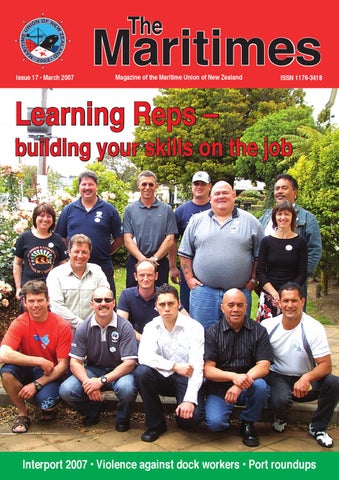
ISSN 1176-3418 National Office: PO Box 27004 Wellington New Zealand Telephone 04 3850 792 Fax 04 3848 766 Email: trevor.hanson@muno.org.nz Web: www.munz.org.nz Editor: Victor Billot Mobile: 021 482219 Email: victor.billot@munz.org.nz Editorial Board: Trevor Hanson, Phil Adams, Garry Parsloe and Russell Mayn Deadline for all Port reports, submissions, photos and letters: 7 June 2007 for next edition Cover photos: Learning reps course in Wellington, December 2006 with members of MUNZ and the RMTU (photo courtesy of the CTU) Thanks to our photographers: Terry Ryan, Harry Holland, Gil Holland, Kathy Whelan, Bill Connelly, Garry Parsloe, Alan Phillips, John Whiting, Lin Sauer, Sam Pene and others
Contact the Maritime Union National Office Telephone: 04 3850 792 Fax: 04 3848 766 Address: PO Box 27004, Wellington Office administrator: Valentina Goray Email: val.goray@muno.org.nz General Secretary: Trevor Hanson Direct dial: 04 8017 614 Mobile: 021 390585 Email: trevor.hanson@muno.org.nz National President: Phil Adams Direct dial: 03 4728 052 Mobile: 0274 377601 Email: phil.adams@munz.org.nz National Vice President: Garry Parsloe Direct dial: 09 3032 562 Mobile: 021 326261 Email: garry.parsloe@munz.org.nz Assistant General Secretary: Russell Mayn Direct dial: 09 3034 652 Mobile: 021 760886 Email: russell@munz.org.nz ITF Inspectorate: Kathy Whelan Direct dial: 04 8017 613 Mobile: 021 666405 Email: kathy.whelan@muno.org.nz Communications Officer: Victor Billot Mobile: 021 482219 Fax: 03 4730 114 Address: PO Box 339, Dunedin Email: victor.billot@munz.org.nz
www.munz.org.nz
Unions are the organizations in which workers unite to gain more power. In a capitalist society, there is always an imbalance of power. An individual worker is relatively powerless compared to a large company. “Fairness” does not come into it. If a company can get away with paying a worker less, they’ll pay them less. The profit of the company comes first. As workers, we have to sell our labour to earn a living. A few workers with in-demand skills can get a high price for their work as individuals; as can managers who act as the “boss” in the workplace. However the majority of workers need to act collectively through a Union to ensure they can get the best deal possible in wages and conditions of work – under the current system. This brings us to a question about what are Unions for? Is the role of Unions to just act as negotiating agents with employers? There has been the idea pushed by some that Unions should be in “partnership” with the employer. The problem with this view is that it does not reflect reality. It certainly doesn’t reflect reality in the global maritime industry. There is another view that we are in a “participatory capitalist” society where workers now have it good, sharing in the prosperity. Why upset the applecart? The key point here is that while many maritime workers enjoy excellent superannuation schemes, and in some cases relatively good wages and conditions, the pressure is always on. Those conditions were won by long term collective struggle by workers who had an eye to the future. As we know many workers are burdened with low wages, insecure casual jobs and dangerous and poor conditions – many of whom are non-unionized. As long as there are workers in this situation, the Union movement has a very long way to go. If workers in the modern world start thinking they are riding in the same limousine as the boss, then their illusion will not last long before being rudely shattered. The Maritime Union and the former unions who made it up were always very clear about being a rank and file, militant, democratic, and “struggle based”. This means being aware of our history, our industry and the reality of the profit-driven world we live in. It also means getting involved in the wider world of politics and social activism, standing up for justice, equality and peace. Of course, being a “struggle based” union doesn’t mean going off the deep end. Any militant union has to choose its battles very carefully. There has to be a realistic view of what is achievable and what is just tough talk. Because the tough talk has to be backed up with the ability to walk the talk. There is always going to be a tension about what is the right level of action. There is always going to be tension about how closely the Union works with or allies itself with political parties and other organizations. But the key thing is that the Union has to be sure about where it is going. Is the Union just another kind of business, a kind of specialized employment lawyer? Or is the Union an organization for social change in and out of the workplace – for building up our confidence and abilities so we can help create a better society for working people? The Maritime Union must be a social change organization. That is its history. I believe this is where our future lies.
The Maritimes | March 2007 | 3
COMMENT
New challenges for 2007 by Trevor Hanson General Secretary
Port outlook 2007 will continue to see changes in our industry. There is continued uncertainty about “port rationalization”. Over the last few years there has been extensive talk in the industry about how there will be a reduction in the number or size of many current ports. This will work in with “hubbing” where smaller ports will act as feeders to the big ports. Last year we saw the first steps in this direction. The attempted buyout of the Port of Lyttelton by a global operator failed. There have been proposed mergers of Auckland and Tauranga, and talk of greater integration of Lyttelton and Port Chalmers. Unfortunately these decisions are being driven by the wrong motivations as once again the short-term profits of port shareholders come before port users, maritime workers, and the public interest. Ports should be operated as infrastructure, not as operations for short-term and short-sighted interests. Our ports are a vital part of our export-driven island economy. In the past, maritime workers have been attacked for taking industrial action to protect our rights. Yet the threat to our national interest from bungled corporate deals, such as in Lyttelton, is allowed to continue. The only solution is a national ports strategy that integrates and modernizes our port system as required.
Instead of the waste of duplication and self-defeating competition between ports, the focus could then go on ensuring the true economic efficiency of ports. This of course would have to require legislation and ports operating under some form of public ownership and regulation. The Maritime Union would have to be a part of such a plan, as it could be the opportunity to introduce a register of maritime workers. The enforcement of health and safety, and the creation of secure jobs with career paths and training opportunities, could be given a boost and thus would improve conditions for workers and improve productivity and efficiency (a win win situation for all parties.)
Maritime New Zealand The Wellington branches held a meeting with Maritime New Zealand, formerly the Maritime Safety Authority, on 15 December 2006. This was a new initiative and we were pleased with the approach from Bruce Maroc and his team from Maritime New Zealand who took the time to come along and discuss key issues, and follow up our concerns. Some of the key issues covered included training for seafarers – including quality and regulation – and health and safety issues regarding seafarers and waterfront workers on the job. A similar meeting is planned for Auckland. We see this as a positive move from Maritime New Zealand and look forward to our future progress.
“The only solution is a national ports strategy that integrates and modernizes our port system as required”
4 | The Maritimes | March 2007
Safety on the waterfront The death of a Russian seaman in December 2006 in Tauranga, and the death of a Melbourne docker and MUA member in January 2007, reminds us that we have to be constantly on guard for our safety and the safety of other workers on the job. Both incidents occurred during the working of vessels. On the safety front, the Maritime Union has been following the Picton barge case. Two men died when their trucks tipped off a barge in Picton Harbour during loading in August 2005. A Maritime New Zealand report in 2006 identified driver inattention was one of five “active failures” which led to the accident. But in February 2007, the Blenheim coroner Mr Peter Radich cleared the two men of fault. Mr Radich says he could not accept many of the findings in the Maritime New Zealand report, including that the accident was not foreseeable or that driver inattention played any part in the accident. Mr Radich’s report into the incident warns that unless workplace safety laws are improved, more people could die needlessly. The Maritime Union agrees.
Learning Representatives Maritime Union members have been some of the first to be part of the Learning Reps programme run by the Council of Trade Unions (CTU), as you can read on page 2. Learning Reps are elected by employees to help them get ahead with learning at work. They can advise co-workers on opportunities for learning, work with management on company training plans and promote training that will build a career for workers. It’s kind of like a special delegate who looks after training and education. We encourage all our branches and members to get involved.
www.munz.org.nz
COMMENT
Unity is the best way to get our way by Phil Adams National President
Murder of waterfront leader The Maritime Union of New Zealand has joined Unions around the world in demanding action after the murder of the leader of the Dockers Union in Guatemala. After months of harrassment and intimidation, Pedro Zamora was shot 100 times by several assassins as he took his children to a hospital appointment at his home port. It is presumed that the murder was carried out by a right wing death squad acting on orders. This type of thing is an example of what still goes on in many countries of the world and it must be stamped out. The International Transport Workers Federation has sent a large delegation to Guatemala to meet with the Government, Union and workers, as well as the family of Mr Zamora, to get some action and bring those responsible to justice. This event brings it home to us how in many ways we are very lucky in New Zealand, and there is no excuse for us not to be involved in the Union. If trade unionists and workers in other countries are jailed, beaten up, and murdered for being in a Union, then it is our responsibility to do what we can to assist and make the most of our freedoms. More information can be found in the story on page 6 of the Maritimes.
The issues have been coming up for a long time. Overseas crews were being underpaid and mistreated, often working in poor and dangerous conditions. Not only is it unacceptable for any worker to be treated like this in New Zealand waters, it also has an effect on our jobs and conditions. We know that if poor conditions become the norm it undercuts New Zealand terms and conditions and thus it is in both our interests as New Zealand maritime workers and the interests of overseas crews to have good conditions in New Zealand waters.
Interport 2007 The 2007 Interport Sports Tournament at Bluff was a success with members travelling from around New Zealand to take part in golf and fishing. This annual event is well worth the effort to get along to and has been a traditional part of the calendar for many years. The next Interport will be held in Whangarei and planning is already underway.
Induction Pack At last year’s Conference it was requested that the Union put together an “induction pack” to give to new members of the Union. These packs are now being produced and are being offered to branches at cost price. They include a short history of the Union and Union promo material to encourage new members to get involved and educate them on what the Union is about.
Branches have a responsibility to promote the Union, and in todays environment unless we educate and encourage our new members then the future of the Union is threatened with apathy. We hope all branches will take advantage of this offer.
A collective approach The other concern is that with free trade agreements and flag of convenience vessels is that there is always pressure to drag things down to the lowest common denominator. Unless we keep active and alert on the job, the next step down the line will be for overseas crews to be doing waterfront and stores work including self-loading and self-handling of vessels and more casualization of jobs. This is not being alarmist as the same thing is happening around the world, especially in the privatized ports owned by global corporations. As members know, all of these problems are part of the same situation. Maritime workers have to continually be vigilant to protect our hard won jobs and conditions. The best way of doing this is to work together and have a collective approach. Take an active part in your Union, attend stopwork meetings and use the delegate system to keep control of the job. The moment individuals start trying to bypass the Union and deal with the boss themselves is the moment we are in trouble.
Overseas Crews issue part of bigger picture After years of problems, the Maritime Union was pleased to see some action on overseas fishing crews as we had been banging on the Government’s door for a long time to get things sorted. However there were more problems on the fishing vessel Aleksandr Kseonofonotov in Dunedin late last year with the usual issues of fees being extracted from crews wages and other rubbish. There are some people running the New Zealand fishing industry who are making a lot of money and who seem to have no conscience. Because the problems are out of sight and out of mind for most New Zealanders, some fishing bosses think they can get away with it, but times are changing with the new regulations. However regulations are not enough as we have found, and the Maritime Union intends to follow up and demand that regulations are enforced. www.munz.org.nz
“Maritime workers have to be continually vigilant to protect our hard won jobs and conditions”
The Maritimes | March 2007 | 5
NEWS sent to intimidate him, reportedly at the orders of the port company. At the time of his murder Pedro Zamora was continuing to negotiate on behalf of his members over the future of the port.
“Serious concerns” over investigation
The bullet riddled car at the scene of the murder
Death on the
waterfront
Assassins gun down union leader in cold blood Transport unions around the world have expressed outrage over the execution-style murder of Pedro Zamora, Pedro Zamora General Secretary of the Guatemalan STEPQ dockers’ union on 15 January 2007. He was shot 20 times by multiple assailants who ambushed him as he collected his sons from a hospital appointment. After firing 100 shots one walked up to the wounded Zamora and shot him at point blank range in the face – in front of his children, one of whom, three year old Angel, was wounded in the attack. Zamora had taken his children to the hospital located within the port. The attackers were waiting for him as he left the port. Zamora’s last act had been to push the children to the floor to try and protect them. ITF General Secretary David Cockroft said: “This is an outrage, pure and simple. It could not have been a more dirty and cowardly attack. It’s a filthy little act that makes the blood of any decent person boil. 6 | The Maritimes | March 2007
The Guatemalan government will never be forgiven if it doesn’t investigate and then bring the murderers to justice.” “The government and police are under the spotlight on this one. We and the international community will not allow them to let this case slip conveniently away the way they have too many times in the past.“ “The people who carried out this brutal attack must be found, along with the people who ordered it – no matter who they are and how high up they work.” The paramilitary style of this murder, including the use of the ‘tiro de gracia’, the shot in the face long favoured by right wing death squads and their for-hire thugs, should give the authorities a few pointers to where to begin looking.” “Pedro was one of our own, a valued member of the ITF as well as a family man and leader of his trade union. We will grieve for him alongside his family, friends and colleagues, but we will not forget that it does not end here.” Pedro Zamora had known he was being followed for several months, in response to his role in defending workers’ jobs at Quetzal, while police were also
A high-level trade union delegation to Guatemala has expressed serious concerns about the investigation into the murder. The ITF delegation aimed to gather information on the circumstances of Zamora’s murder and look into the safety of other Union members, whose lives had been threatened. In addition it sought the reinstatement of nine workers, dismissed for participating in trade union activities. The first victory in the campaign was announced on 16 February with the reinstatement of the nine sacked workers whose jobs Zamora had been fighting to save. The ITF confirmed that the men, all members of the STEPQ union, are back at work at Puerto Quetzal. ITF General Secretary David Cockroft says: “This reinstatement couldn’t have happened without an order from the very top, and we know that it can only have come as a result of the pressure applied by trade unions and human rights organisations worldwide. One of our rightful demands has been met.”
“The others – that the killers and those who gave them their orders be prosecuted, and the violent persecution of trade unionists cease – are still on the table. No matter how much some senior people in Guatemala would like us to shut up and go away, that’s not what we’ll be doing until justice is done.” During their visit, ITF delegates met with Zamora’s family as well as with the authorities in charge of the investigation. In a follow-up report, the group expressed serious concerns regarding the investigation. These included the inability of the police to secure the crime scene and the failure of the police to take witness statements. The delegation also questioned the fact that only one line of investigation was being pursued – that of a domestic family quarrel, despite evidence of threats to Zamora’s life in the context of his work with the union.
Two more murders The ITF has condemned the murder of two more Guatemalan trade unionists, shortly after the return of a delegation from the country to demand justice for port union activist Pedro Zamora. Walter Aníbal Ixcaquic Mendoza and Norma Sente de Ixcaquic, members of the Frente Nacional de Vendedores de Guatemala, were murdered on 6 February. For more information and to send a protest email to the Guatemalan Government, go to: http://www.itfglobal.org/solidarity/pedrozamora.cfm
“He was shot 20 times by multiple assailants who ambushed him as he collected his sons from a hospital appointment”
www.munz.org.nz
NEWS
History in the making Historian David Grant is coming to the end of his history of the New Zealand Seamen/Seafarers’ Union history. All of the material will be off to the publishers, Canterbury University Press, in March. While he has a goodly number of photographs and other illustrative material for the book he is keen to find more. If past or present members of the union are prepared to share any photographs, cartoons or drawings with him for potential inclusion in the book please could they either contact him at: 94 Northland Rd, Northland Rd Wellington Email david.grant@xtra.co.nz Telephone (04)4756006 or contact Victor Billot at the Maritimes Magazine. All material sent will be carefully looked after and returned to the owner as soon as the publishing process is finished which will be later this year. The more detail about each illustration that can be included the better. All illustrations included in the book will be acknowledged to the lender below the accompanying caption.
MUNZ and RMTU negotiating teams meet on 7 February in Wellington
Moving on up Reaching the next level in amalgamation talks The Maritime Union of New Zealand (MUNZ) and the Rail and Maritime Transport Union (RMTU) have announced an ‘agreement in principle’ to form a major new transport union. A joint negotiating team has outlined a process for the formation of the new amalgamated Union that will cover both maritime workers in ports and on vessels, rail and other transport industry workers. Further negotiations will now take place on the final structure of the new Union, with the final proposal to be voted on by all members of the RMTU and MUNZ. RMTU National Secretary Wayne Butson says both parties agree that much work has yet to be done on finalizing the rules and structures of the new Union and to resolving any outstanding issues. MUNZ General Secretary Trevor Hanson says both parties have agreed to establish a process to further the establishment of the new Union and have committed to a timetable agreed by both parties.
www.munz.org.nz
The new Union would bring together all workers in New Zealand ports in one Union, and would have a major influence on the logistics chain by uniting workers in different areas of the land transport sector.
A combined union would be in a better position Both officials say a combined union would be better positioned to compete in the modern transnational-dominated transport industry. “The amalgamation would mean one union inside the port gates, meaning a strong collective organisation on the waterfront,” they said. “It would link workers in the entire transport chain from shipping, to ports, to rail and land transport. It would have greater critical mass and this would provide a boost to the services available to members.” Mr Hanson added that the need for change was clear in light of the global market-driven consolidation and rationalisation pressures facing the local waterfront industry.
“For the past 16 years, both unions have been the targets of these market forces,” he said. “In many instances, the employers have agreed under pressure to major cuts, signed agreements and then come straight back to the unions and demanded cuts that fit in to their new shipping contracts. “The results that are socalled ’productivity gains’ can be translated to workers working under extreme stress. This has been made worse through casualisation, where workers are employed as and when required on the end of cell phones.” If the unification proposal proves successful, a name for the new union would be finalised at its inaugural conference.
The Maritimes | March 2007 | 7
LETTERS
Brian Prisk On 15 January 2007 I attended Brian Prisk’s funeral in Lyttleton. Brian and I had been friends since 1969 when we first sailed on the Holmwood together. Brian was OS at the time. Like all young men in the sixties he was cheeky, but a lovable cheeky. He was very aware of Trade Union and political issues. A few years later after being elected to Council, he was overwhelmed by the work that officials actually did. Still being a larrikin, he would talk about anything but the issue. Sadly after being at sea for thirty years, Brian decided to go ashore and start up his own business – the Rat & Roach Bar in Lyttleton. After only a few years into it he was diagnosed with cancer and told he would only have a few months to live. Brian being the fellow he was fought on courageously beating the odds by eighteen months, not giving up till 24 hours before he passed away. I will miss Brian but it was a pleasure and an honour to be at his funeral and say a few words. There will never be another seaman or ex-seamans funeral that will fill the church and the surroundings like he did.
Are you a member of MUNZ? Regarding a point made in a previous issue – Company employment and the Contract Act have been (as expected by companies) like a cancer eating into and eroding our Union, fortunately at the moment we appear to have it in recession and Union membership in general is increasing throughout New Zealand. But vigilance is required. When you hear of members dealing direct with companies and not first going through the Union, when in the past non-union labour has sailed on Cook Strait, then the question needs to be constantly asked – a simple question one would not have needed in the Seaman’s Union days, but egoes need not get bruised. MC2 members will always ask “Are you in the Union?” – and make no apologies for doing so. The question should not be taken as an insult but rather answered with pride as we would have in the Seaman’s Union.
Arthur Amis
John O’Neill Union No 1225 President Auckland Seafarers Branch Maritime Union of New Zealand
“MC2 members will always ask ‘Are you in the Union?’ – and make no apologies for doing so”
8 | The Maritimes | March 2007
The loss of the Rotoiti The loss of the Rotoiti is a huge blow to not only those seafarers who lost their jobs on the ship but to the wider Union. Her departure as the last New Zealand crewed ship trading in the Tasman amounts to a dismissal of our claim for the right of our members to work ships carrying New Zealand cargo. She follows other New Zealand manned ships, which have left the trade in recent years including the Sydney and Wellington Express, the Tasman Enterprise and Venture, Rotorua and Rotoma etc. My concern has been that there was no prolonged, targeted dispute around any of these ships as they left (notwithstanding the courageous action finally taken by those in support of (and by) the Rotoiti crew). Of course there is no certainty that such a fight back would have saved any of these ships. But what is certain is that as each one of these ships left the trade our ability to fight for the rest became weaker and weaker as our numbers dwindled and the remaining members wages and conditions began to stand out. It was then only a matter of time before foreign shipowners in the trade found the presence of the remaining New Zealand Seafarers intolerable and targeted them for “redundancy” . The same process of ship loss has been occurring on the New Zealand coast for many years and the question now is – will it end in the same way as the Tasman? Maersk shipping now appear to be establishing some sort of permanent coastal operation within the confines of the Maritime and Immigration Acts and therefore with the approval of the Labour Government. They have strong political and commercial leverage in New Zealand as one of our largest providers of shipping services.
The oil companies have long contemplated using a similar schedule of foreign import tankers to service the output of the Marsden Point Refinery to consumers. It is obvious that the “fight” to retain any of our jobs in the Tasman trade was well and truly over by the time the Rotoiti departed. We are now down to around a dozen New Zealand crewed ships on the coast (some of which are owned by cargo owners), offshore work both here and in Australia and some tugs and barges. It is impossible to predict how secure these jobs are (especially if a National led government is elected). If shipowners with foreign crews such as Maersk are able to establish a cheap reliable coastal service to shippers then obviously some if not all of these jobs are at risk. It is clear that as a national union we have to do far more to have any chance of saving the New Zealand ships that remain. Any potential ship loss needs to be met with a militant almost mongrel campaign of the intensity and scale waged (for example) by this union against wharf scab labour. Anything less will see us left with the mere crumbs of a once great industry.
Yours in unity, P. Harvey
www.munz.org.nz
NEWS
“Paddy Crumlin . . . spoke on the need to assist in the training for Ratings” Maritime Union Wellington Seafarers Secretary Joe Fleetwood, RMT National Secretary Steve Todd, Maritime Union Auckland Seafarers Secretary Garry Parsloe and ITF rep Simon des Baux at the Sydney ITF Conference, November 2006
ITF Seafarers Section Meeting by Garry Parsloe National Vice President The ITF Seafarers’ section met in Sydney from 20–23 November 2006. The first day was set aside to discuss the retention of skills for ratings.
ITF Seafarers’ Section International Ratings Forum Name of body: ITF Seafarers’ Section International Ratings Forum. Aim: To encourage the involvement and participation, in the discussions and activities of the ITF Seafarers’ Section, of Ratings Unions. Membership: The forum is for ITF affiliates representing Ratings. To achieve the aim of the Forum it is desirable that affiliates ensure their representatives have the necessary experience and expertise. Structure: The Forum will report its activities to the ITF Seafarers’ Section Committee. The appointment of office holders and the rules of procedure will be submitted to the Section Committee for endorsement. The ITF will provide the Secretariat to support the Forum.
The Forum will meet regularly and where possible prior to the ITF Seafarers’ Section Conference and meetings of the Fair Practices Committee (FPC). Financial assistance may be provided by the ITF on a caseby-case basis in order to ensure the widest possible opportunities for participation. The Forum will work in English only. Terms of Reference: The Forum will discuss items proposed by the participating unions of relevance to Ratings’ unions and their members and provide appropriate recommendations and input into the ITF Seafarers’ Section Committee and the FPC.
Asia/Pacific Seafarers’ Regional Committee Day two was the Asia/Pacific Seafarers’ Regional Committee. Paddy Crumlin addressed the Forum. He spoke on the need to assist in the training for Ratings and that this financial assistance is a pressing and important issue.
www.munz.org.nz
With the shortfall of Ratings and the need to develop this issue, we must work hard and start sooner than later. We need to have dialogue with Governments, Unions and Employers to achieve this. The JSU informed the Forum that they have just developed a Training School with a dormitory for Trainees and Cadets. This is financed by training levies and union dues. The Indian Delegation stated that it should be mandatory to put at least one trainee onboard every National flag vessel. Joan Bainbridge raised issues regarding the Fatigue Campaign, Ship Security and onboard work practices. Peter Morris, ex Australian Labour Transport spokesperson, addressed the Forum. He spoke of his long association with the ITF. He spoke further on the Flag of Convenience Campaign, the shortage of Officers and Engineers in the Maritime Industry, the ratification of ILO Conventions and the lack of skilled Seafarers. Paddy Crumlin summed up day two by expanding on all the attacks from the Australian Government on Australian workers.
Paddy moved a resolution of support for organized labour within Australia from this Forum. This was carried by acclamation.
Seafarers’ Section Committee task force on the retention of Maritime skills Day three was the Seafarers’ Section Committee task force on the retention of Maritime skills. We spent most of the morning discussing the proposed Campaign of Action to secure and protect jobs for Ratings. We then went into a long debate around Ratings upskilling and improving their skills to the level where they can perform Junior Officers duties as and when required. This is called vertical flexibility. On the afternoon of day three we continued the debate on vertical flexibility. The debate for obvious reasons was very heated before we finally resolved that the question of vertical flexibility was for various reasons just not a runner. The later part of day three was dedicated to discussing the guidelines for an overall ITF Cabotage Policy. The Maritimes | March 2007 | 9
NEWS Reports at the time said the man had been helping to position a container loaded by the facility’s shore-based luffing crane. The court was told only the previous week health and safety representatives had recommended dockers be equipped with harnesses for work above a certain height over open holds.
Concerns ignored by company
Waterfront is still a dangerous place to work by Dale Crisp in Melbourne Recent deaths on either side of the Tasman during routine cargo-handling operations have thrown the spotlight back on safety in the workplace and beg the question: why is this still happening in the modern world? The unfortunate demise of a Russian seaman in what by all reports was a particularly grisly accident on board Tasman Orient Line’s chartered Tasman Resolution in Tauranga in January 2007 was quickly followed by the loss of a Melbourne docker, crushed by a load of steel on Austral Asia Line’s Cape Conway. Particularly regrettable about the latter is that it seems the incident was very similar to another on board fleetmate Cape Donington in Port Adelaide last year, and it’s also the second death at the now DP World, formerly P&O Ports, Appleton Dock facility in recent years. In the latest fatality Peter Ross, 56, was killed instantly when, during discharge, a pack of tubular steel caught on the ship’s hatch-coaming before swinging out of control and crushing him against the side of the ship as he tripped trying to escape. Tragically his death came at the end of his last shift before he was due to go on leave with his family to Perth. 10 | The Maritimes | March 2007
No checks required In last year’s accident, a bundle of steel was being discharged from AAL’s Cape Donington when, Safe Work South Australia and local police reported, 58-yearold Patrick employee Dean Robinson was crushed when the load moved suddenly after becoming snagged. At the time Maritime Union of Australia secretary Paddy Crumlin said dockers were the only workers in Australia “that have to walk into a floating factory each shift”. “No checks are required to ensure it is a safe workplace before the job starts. And few foreign ships conform to Australian safety standards. It’s a complete unknown. We need a safety code and we need it in place in every Australian port,” Mr Crumlin said. The Donington death occurred just days after P&O Ports in Melbourne had been fined half a million dollars – the secondlargest fine in Victorian workplace regulation history – over the death of a stevedore at Appleton Dock in 2005. The Victorian County Court handed down the penalty after hearing that the docker had been crushed between containers before falling into the hold of Chief Container Service’s Kiribati Chief.
Judge Jeanette Morrish said the company had been aware its workplace safety guidelines were being breached at the dock but had ignored concerns raised by staff. Ms Morrish said it was not enough that the company had written policies available, they needed to ensure they were being enforced. “A worker is dead,” Ms Morrish said. “There is no point in having safety procedures if they are not explained to employees and if they are not enforced.” P&O Ports pleaded guilty to failing to provide and maintaining a safe work environment. Judge Morrish said she took into account the company’s relatively good 15O-year history, but prior convictions for workplace safety breaches heard in the Industrial Relations Commission in Sydney in 2000, and in Melbourne Magistrates Court in 2003, were aggravating features. The company later said it was working strenuously to upgrade its safety regime. However, the recent Cape Conway death was at the same facility, and the nature of the incident, at first glance, seems identical to that which occurred on Cape Donington. It’s probably a fatuous comment, but there’s clearly room for improvement. Now the MUA will extend its campaign for a national safety code to the international arena. The union says that while it has the support of stevedoring companies for a national code, there is no government support. “We’re sick of raising our concerns about the lack of proper safety standards in the unique national industry,” Mr Crumlin said last week. “Lives are being lost at a greater rate than ever before but the Federal Government refuses to do anything. “We’ve been prepared to work with all stakeholders in the industry for a safe working code and have made constant appeals in recent years. But nothing has been done. We are again urgently calling on both federal and state governments to put politics and rhetoric aside, pull their finger out and address this life and death matter. Otherwise we’ll be doing something about it.” The Union took the usual opportunity to swipe at federal industrial relations legislation, saying the laws under work choices were designed to take away workers’ rights to protect themselves on the job. “Work choices isn’t just about destroying decent working conditions in this country it’s also clearly about undermining safety www.munz.org.nz
NEWS in critical national industries like ours,” Mr Crumlin claimed. “Union involvement in workplace safety training is barred under work choices. This is an appalling disgrace and amounts to gross negligence resulting in workers and their families paying the ultimate price.” Mr Crumlin, who also chairs the dockers’ section of the International Transport Workers Federation, will be taking union concerns over unsafe stowage and an internationally enforceable safety code to its next world forum. Coincidentally, something similar is happening in the UK where the Transport and General Workers Union has called on the British Government and other unions to overhaul the system that governs the nation’s port safety. The TGWU recently resigned from the port safety body PSSL, claiming it is an “employer-dominated dictatorship”. According to local reports T&G national organiser Graham Stevenson has written to the Government as well as affiliated unions calling for a new structure to be implemented. Decisions regarding the interest of skills and safety should be made by all stakeholders but, in the case of PSSL, Mr Stevenson claims decisions are being made by just one stakeholder, the port executives. “It is not appropriate for an employerdominated dictatorship to claim regulatory responsibilities for safety,” Mr Stevenson said. “We believe that PSSL working as a skills body is making it up as it goes along, leading to a fundamental problem.” According to Lloyd’s List PSSL’s stated purpose is to “work with its subscribers, helping to raise health, safety and skills standards in United Kingdom ports”. In practice this involves bringing together the elements of its national committee made up of port employers, government bodies and trade unions. The T&G, however, says this is not happening. “PSSL is self-regulated and decisions are being made by the chief executives of the major ports and harbour authorities which PSSL seems to enforce,” Mr Stevenson claimed. Unlike the main container ports, which have a strong framework in place, the T&G is concerned that there are still “jungles elsewhere that are not being attended to”; their main concern is with casual labour that union officials claim is poorly trained and unregulated – a claim regularly made in Australia and New Zealand. The PSSL told Lloyd’s List it would be “addressing the union’s concerns with each of our stakeholder partners as a matter of urgency”. Surely there’s urgency in this part of the world, too: while accidents will always happen, waterfront deaths belong in the past.
Auckland unionists supporting the Australian Day of Action, 28 November 2006
Australian Day of Action
Wharfies DVD released
by Garry Parsloe
Wharfies, The Watersiders of Port Chalmers, is a portrait of what it was like working the waterfront under conventional shipping. It looks at the impact of containerization and the layoffs that increasing mechanization brought about. Also discussed is the 1951 lockout and the role of the strong unionism on the waterfront in bringing about decent working conditions. Wharfies is a colourful tale of camaraderie and characters told by those that lived it. The project received a welcome boost in the zero hour by the discovery of vintage colour footage from 1956 and 1969 shot in Port Chalmers including some very special shots of activities on the docks. Hours of searching the Port Chalmers Maritime Museum and local residents collections produced over 50 photographs that illustrate the interviews. Wharfies was produced by Pete Gorman, a graduate in Digital Media, and commissioned by the Port Chalmers Maritime Museum as an exercise in oral/video history. The project has been assisted by contributions from the Maritime Union and from Port Otago.
On the 28 November 2006, CTU Unions Auckland supported the Australian Day of Action by handing out leaflets of support outside the Britomart Railway Station and the Ferry Buildings from 7am to 9am. It was pleasing to receive so much support from all those workers on their way to work. There was a good understanding by everyone that workers in Australia need all our support and assistance to fight back against their current draconian legislation. For more information, see article on page 21 of this issue of the Maritimes.
Copies of the DVD are available from the Port Chalmers Maritime Museum via mail for $25 Port Chalmers Regional Maritime Museum, Beach Street, Port Chalmers 9023, New Zealand Phone/fax 03 4728233 Email: pcmuseum@xtra.co.nz or via the website www.pcmuseum.co.nz
This article is reproduced from the New Zealand Shipping Gazette with the kind permission of the Gazette and author. www.munz.org.nz
The Maritimes | March 2007 | 11
CTU
Maritime Union links with the Trade Union History Project
CTU Update by Ross Wilson CTU President The union movement has had a busy year, and top on everyone’s list of crucial moments for us as a movement has to be the distribution workers who successfully stood up to the aggressive bullying of their employer in September this year. Progressive Enterprises were heavy handed since the beginning of the negotiations – and they threw all their might at the workers in an effort to starve them out. There was no question that when the company took on the NDU and EPMU workers in Auckland, Palmerston North and Christchurch, they took all of us on. We had to win, and we did, and as a union movement, we can feel proud that we have rebuilt our strength and confidence to the point where we get the overwhelming response we did from unions to our call for solidarity and financial support. The locked out workers were significantly boosted by the huge support from the public, and the hard work of many unions in directly supporting them. I want to acknowledge the solidarity of your union to the distribution workers – the donations, the pledge of an hour’s pay a week and coordination of international support through transport unions was fantastic. Campaigning is an important part of our political work, and last month we were pleased to see Parliament throw out National’s 90 Days bill, in what was a clear union win for working people. 12 | The Maritimes | March 2007
Campaigning by unions over several months, including lobbying MPs, rallies in Auckland, Wellington, Christchurch and Dunedin, leafleting at flea markets, postcard campaigns and a campaign website all helped to beat the bill. Members of your union made time to meet with MPs, in particular from New Zealand First, and it was pleasing to see that party, and the Maori Party, come out against the Bill in November. Only the 5 MPs from ACT and United Future joined the National caucus in voting for the Bill to continue. These two major campaigning efforts took place against the backdrop of an already busy union movement – our work in political advocacy, worker education, industry and sector organising, campaigning and economic development, continues actively as ever. We are also looking forward to taking part in the review of casual work that New Zealand First’s Peter Brown announced at your conference recently. As you well know, many workers are reliant on insecure casual work, and this is an unsatisfactory situation that needs to be addressed. For more information www.union.org.nz
By Kathy Whelan As reported in the last Maritimes, the Wellington Retired Seamen’s Committee wound up and donated the residue of funds to good causes. $1,000 went to each to the two Wellington Hospices (Te Omanga and Marry Potter) and $760 went to the Trade Union History project. The Committee made this donation as a mark of respect for the work done by the Trade Union History Project and their valuable effort to the movement to ensure that the stories of workers, nationally and internationally, are told and not forgotten and we thank them for ensuring that the generations ahead know what struggles went before them. Our retired members have such a rich history and made a huge input into working class struggle and conditions, and in recognition of the role they have played in the movement we would like the TUHP to put this money towards a specific trade union history project – such as the centenary of the Federation of Labour. The Trade Union History Project has acknowledged the donation as follows :
Dear Kathy Many thanks for your letter of 31 January and the enclosed cheque. What a wonderful gesture of donation! I felt I needed to respond straight away and to thank those responsible for making the decision to select the TUHP as the favoured recipient of the residue funds from the Fund. Our committee meets later in the month and will have pleasure in reporting to them on our wind fall. I am sure they will wish to respond as a committee to members of the Seafarers union in due course. Kind regards Colin Hicks – Treasurer The Maritime Union echoes the sentiments of the Wellington Retired Seamen’s Committee in congratulating and supporting the work of the TUHP and encourage all members to support it by way of membership and/or donations. For further information on the Trade Union History Project, or to join, go to their website www.tuhp.org.nz or write to them at PO Box 27-425, Wellington, New Zealand
“Many workers are reliant on insecure casual work, and this is an unsatisfactory situation that needs to be addressed”
www.munz.org.nz
ITF
Ukrainian fishermen write to the Maritimes
Ruslan Orlenko and Eduard Drozdov, two of the crew of fishing vessel ‘Alexsandr Ksenofonotov’
Overseas crew decision shows New Zealand on right course, says ITF by Kathy Whelan The International Transport Workers’ Federation (ITF) and Maritime Union of New Zealand has welcomed the legal victory of a group of overseas crew members in a determination of the Employment Relations Authority. 49 Ukrainian crew members on the Aleksandr Ksenofonotov refused to leave the fishing vessel in Dunedin at the end of their employment agreement in November 2006, arguing that deductions made to their pay were not lawful. A recent decision from the Employment Relations Authority backed the crew, determining that deductions for air fares, accommodation, meals, visa fees and medical insurance by their employer were not legal. ITF New Zealand co-ordinator Kathy Whelan says the decision was a sign that the rights of overseas crews were being taken seriously.
“In the past we have seen overseas crew members treated poorly, and this decision shows that we are on the right course in ensuring fair treatment of all workers in New Zealand waters.” Ms Whelan says new regulations coming into force this year would raise standards in the industry and clamp down on rogue operators. She says although progress has taken a long time, the ITF was positive about the way the issue had been taken on board by the Government. “The light has been shone on some dark places recently and we are confident that poor practices are on the way out in this industry.” Ms Whelan says the issues of deductions from the pay of overseas crew had been an ongoing problem. She says that because many overseas workers in the fishing industry were employed in their country of origin, and worked off the New Zealand coast, it had proved very difficult to monitor conditions of employment.
www.munz.org.nz
“The ITF have been involved in assisting many crew members in similar situations, and we firmly believe that any worker in New Zealand is entitled to the full protection of New Zealand law.” The International Transport Workers’ Federation (ITF) is an international trade union federation of transport workers’ unions, including the Maritime Union of New Zealand. 681 unions representing 4,500,000 transport workers in 148 countries are members of the ITF. It is one of several Global Federation Unions allied with the International Trade Union Confederation (ITUC). The ITF has identified the exploitation of fishing industry workers as a major international area of concern.
While nautical science and technology has many new achievements, sea trade remains very dangerous and heavy work in our day. Many seafarers work in very severe conditions and they feel intense pressure from their employer. Often foreign seafarers do not know where to look for help and they do not speak the English language. Under existing conditions the aid and support that seafarers find in the ITF is very important. When my crew and I were in need of help we found it in the ITF. The work of the ITF is truly significant. Members of our crew and I thank all inspectors of the ITF and especially Kathy Whelan very much.
Ruslan Orlenko and Eduard Drozdov for crew of fishing vessel ‘Alexsandr Ksenofonotov’
“Under existing conditions the aid and support that seafarers find in the ITF is very important”
The Maritimes | March 2007 | 13
UNION HISTORY The ‘Dominion Monarch’ anchored off Napier with lighters alongside
Lightering – a look back by John Whiting James Patrick O’Boyle, 93 year old waterfront veteran, recently graced the MUNZ Wellington annual “Past and Present” function and amazed us with the depth and details of his memory. James started on the Napier waterfront in 1938, prior to the opening of the first breakwater wharf and when Napier’s import and export cargoes were transhipped by lighter to and from the ships anchored in the roadstead. His memories of this work of long ago have opened a window to the past and it seems well worthwhile to look back and relive some details of
a type of work that was commonplace for those who toiled in several New Zealand ports up until the early 1940s. It also gives us the opportunity to recall and record what would be the worst loss of life in a single accident in New Zealand’s waterfront history. Hawke’s Bay and the East Coast area were served by lighters for over seventy years, mainly at Napier but also at Gisborne and the small outports of Wairoa, Waikokopu, and Tokomaru Bay. Over those years thousands of tons of frozen meat, wool, and other primary products were manually handled into the lighters which were then either towed or sailed self-
powered out to the overseas ships where the cargo was lifted aboard by the ship’s gear, and stowed down below by the local wharfies who were conveyed out in the morning and home at night in small launches. This method of travel had a tragic outcome on the night of 28 December 1932 when Fenwick & Co’s launch “Doris” was returning 31 watersiders from a hard days work in the freezer holds of the “Port Brisbane”. In the darkness at the entrance of Napier’s inner harbour the powered lighter “Tu Atu” collided with the launch and the heavily clad men were thrown into the water by the impact.
Despite desperate rescue attempts ten men were drowned. The men who died were W Andrews, R C Aplin, A Boyd, E Cooper, H Johnson, T Kitt, N Low, J H E Medcalf, J H Wilson, and J Woods. Even after all these years we can feel the starkness of this tragedy on the port community and especially on the bereaved families. The Napier watersiders took an immediate decision to no longer use the launches and only travel out and back in the powered lighters. Once the Napier breakwater harbour wharves were opened in 1940 - the first overseas ship to load cargo alongside was the “Sydney Star” on 8 June 1940 – the era of the lighter drew to a close. The New Zealand Government bought the “Tu Atu” and eight non-powered lighters for the use of the New Zealand Navy in World War ll and all craft were moved to Auckland. Hopefully these few lines give a snapshot of an era long gone but once a daily reality for the watersiders and lighter crews of those days. Sources: S D Waters - “Richardsons of Napier”, 1959. H K Stevenson – “Port and People – Century at the Port of Napier”, 1977. Gavin Maclean – “Richardsons of Napier”, 1989.
The ‘Rangitiki’ at Napier Willy Mallard, Jock Ryder and James Patrick O’ Boyle at the Wellington ‘Past and Present’ Function, 2006 14 | The Maritimes | March 2007
www.munz.org.nz
UNION HISTORY
Images of the past Thye following images were supplied by retired seaman Alan Phillips of Whangamata (far right in the photo below.) We hope to print more of Alan’s photos in the future. The Maritimes welcomes any contributions, whether written or pictures, by all current and retired members of the Union, and friends of the Union, which can be sent to: ‘The Maritimes’, c/o Maritime Union of New Zealand, PO Box 27004, Wellington, New Zealand.
Crew of MV Kaitawa, Napier, 31 October 1950 (left to right) Vic Granger, Graham Gribben, Mick Squires, Chick Harland, Brenn O’Niel (bosun), Jack Rooke, Ian James, Colin Hayes, Alan Phillips
MV Kawatiri, Trial Bay Prison, South of Coffs Harbour, 28 September 1953 Dick Winsor, Tom (steward), Joe (2nd cook), Joe Urban, Graham Gribben
www.munz.org.nz
The Maritimes | March 2007 | 15
INTERPORT
Interport 2007
Tuesday night BBQ, New Eagle Hotel
Bluff, New Zealand
Tony Townsend competing for Timaru Branch
16 | The Maritimes | March 2007
Golfers Terry Osborne. Kevin Laredo, George Ward, and Norman Irwin
www.munz.org.nz
INTERPORT
Trophy for Monday Stableford, awarded to Bob Surrey
Winners of the Kere Kere Canoe, Auckland, left to right C. Waretine, A.Peke, S. Campbell, J. Behrent, J.Hakaria and D. Belsham
Trophy for runner up 4 ball best ball awarded to Graham Butler and Graham Donaldson
Dave Dick, Harry Mayn, Muncie, and Len Hannah check out the wharf at Stewart Island
Russell Mayn and Winky Waugh admire Terry Ryan’s Local 13 League Shirt
Fisherman Clive Giles dreams of the one that got away www.munz.org.nz
The Maritimes | March 2007 | 17
PORT ROUNDUPS He went on to say that the docks were for ships, their cargos and all the associated jobs in the Maritime Industry that go with a working waterfront. This was great to hear and Mike was thanked for his presentation. Special thanks must go to the cooks, Kevin Dixon and Graham Reynolds for the excellent spread that they put on. As always it was an excellent day out for all the Old Timers and on behalf of the Auckland Branch Executive I want to thank all those individuals and ships crews for their donations which made the Old Timers party the success that it was. See you all next time which will be on 14 December 2007.
Dave Morgan, Garry Parsloe, Mike Lee and Mario O’Merovic at the Auckland Old Timers Party
Auckland Seafarers by Garry Parsloe
Old Timers Party We held the Auckland Branch Old Timers Xmas Party at the Maritime Club in Beach Road on 15 December 2006. The Auckland Secretary welcomed all the Old Timers to their Social and thanked them for their past struggles which have helped preserve the Union in the good condition that it is in (not a lot of ships but those that we have are on the best of wages and conditions.) The Secretary then read faxes from the vessels which among other things wished all the Old Timers the best on this very special day. The ships faxes were indicative of the high regard that the Old Timers are held in by the membership. Old Timers from other Ports were welcomed to the Party with a special reference to Kenny Tyson and Jack Mahoney both from Lyttleton and Tommy Cavanagh who came all the way from Liverpool.
18 | The Maritimes | March 2007
Owing to most of the current Executive being at sea, there was only the Branch Secretary and Brian Ford from the Branch Executive there to represent the Branch. Members from other Ports were Duncan Montgomery from Dunedin, Peter (Potter) Astin from Lyttleton, Red Campbell and Tony Littlewood from Wellington, John Broughton, Jimmy Rosser and Terry Blake all from Tauranga. Past Executive members in attendance were Dave Morgan, ex President of both the Seamen’s Union and the Seafarers Union as well as ex Joint President of the Maritime Union of New Zealand, Gerard Hill ex Auckland Branch Assistant Secretary New Zealand Seafarers Union, Alex McDonald ex President Auckland Branch and long time National Councillor of the New Zealand Seafarers Union. As well as welcoming all the Old Timers, I acknowledged the excellent relationship that the Auckland Seafarers Branch has with Local 13, and thanked Denis Carlisle who had put in an apology as he could not be in attendance. I also thanked Russell Mayn who was in attendance along with Gordon Kopu from the Local 13 Executive.
Officials from other Unions who attended were Ray Bianchi (AWUNZ), Linda Holt (PSA), George Ryde (AMEA), and Derek Craig (AMEA). We acknowledged Ray Bianchi’s massive imput into the Trade Union Movement along with Linda Holt’s tireless effort in all the work she does for CTU Unions Auckland. The first invited speaker was Gerard Hill. Gerard spoke on all the past struggles and those struggles that we are still faced with. He concluded by stating that he was confident that we would as always prove to deliver the best for our membership. The second invited speaker was Dave Morgan. Dave gave an excellent address to the Old Timers referring to past experiences and events. The Old Timers acknowledged the massive input that Dave had put into not only the Maritime Industry but the whole Trade Union Movement. The last invited speaker was Mike Lee, Chairman of the Auckland Regional Council. Mike emphasized the importance of the Ports of Auckland for our local economy, and that he was not going to let it turn into apartments or Football Stadiums.
Sea Tow on Australian Coast by Garry Parsloe National Vice President On 3 January 2007 I went to Sydney to meet with the Maritime Union of Australia to discuss the involvement of SeaTow on the Australian Coast. Along with myself at the meeting were MUA Assistant National Secretary Rick Newlyn, MUA Branch Secretary Western Australia Chris Cain, and Peter Dunlop Director of Sea-Tow New Zealand. The discussion centered around what was Sea-Tow’s intention regarding working around the North West Australian Coast and elsewhere in Australia. After lengthy discussions it was agreed that Sea-Tow would write to the MUA outlining their intentions regarding contracts in Australia so the MUA can consider their position. The issues in question are wage rates, employer contracts and crewing. I will report on the outcome of the above as events unfold.
www.munz.org.nz
PORT ROUNDUPS
Interport 2007 Bluff Golf results Interport Cup 54 Hole Nett 1st R. Fife (Bluff ) 2nd P. Waddel (Bluff) 3rd A. Peke (Auckland) Chapman Plate 54 Hole Nett Runner Up D. Manu (New Plymouth) Rare Cup 54 Hole Gross 1st C. Waretini (Auckland) 2nd T. St John (Lyttelton) 3rd B. Williams (Mt Maunganui) “After a number of very good years as Bosun on the MV Golden Bay, Beastie was farewelled in a good fashion. We all wish him the very best in his retirement. On behalf of the crew, MV Golden Bay, November 2006”
Peter Robinson (The Beast) by Garry Parsloe Peter Robinson has called it a day and gone into a well earned retirement. Now not many of us know who Peter Robinson is but we all know who “The Beast” is. Now where did Peter get that name from?
Flett Black Memorial 54 Hole Par 1st B. Johns (New Plymouth) 2nd D. Belsham (Auckland) 3rd C. Ruatahi (Bluff)
For those of you who remember the parties that were held at Peter’s house in Islington Street, Ponsonby, they went on for days on end and if you use your imagination you can start to get an idea of how the name came to stick. I remember ringing Peter around 1990 and asked him to join the Golden Bay. Peter at that time was on leave off the Jebson Southland. Peter said that he did not want to relieve in the Golden Bay, he wanted to rejoin the Jebson Southland but as there
was no-one on the corner (the pick-up) and we were stuck he agreed to a two week relief. Well here we are 17 years later and he is retiring out of the Industry and from the Golden Bay. Not a bad relief Peter, 17 years. Peter, you were one of this industry’s real characters and the Auckland Seafarers Branch Executive and Membership wish you a well earned retirement.
George Waller Memorial 54 Hole Stableford 1st G. Waugh (Port Chalmers) 2nd R. Ashford (Mt Maunganui) Crockett Lewis – 18 hole Stableford Monday 1st B. Surrey (New Plymouth) 2nd J. Behrent (Auckland) 3rd N. Rowlands (New Plymouth) Norm Fisher – Best gross any day 1st L. Campbell (Mt Maunganui) Tareha Cup – 4 ball best ball 1st A. Lindsay and D. Manu Wallington Cup – runner up 4 ball best ball G. Donaldson and G. Butler Bill Brown – best nett anyday 1st B. Keno (Mt Maunganui) Kere Kere Canoe 1st Auckland 2nd Bluff Visitors Cup – 18 hole Stableford 1st J. Ashkettle (Wellington) 2nd G. Butler (Port Chalmers) 3rd R. Bryford (Wellington) Credit Union Cup – Ladies 1st V. Johns 2nd C. Donaldson Tom Heenan Trophy – sportsmanship T. Osborne (Bluff) Most Golf M. Hill (Mt Maunganui)
Kenny Tyson, Dave Morgan, Peter (Potter) Astin, Garry Parsloe and Jack Mahoney at the Auckland Old Timers Party
www.munz.org.nz
The Maritimes | March 2007 | 19
PORT ROUNDUPS Important Notice: Union fees – overseas members The Branch would like to remind members of the Maritime Union of New Zealand working in Australia about the payment of union fees. If members have picked up a job through the Union in conjunction with the New Zealand employer, union fees and SRF will be deducted by the employer. If any MUNZ members sail in the Australian blue water fleet, they must make manual payment of union fees and check their payslips to ensure that superannuation fund deductions are coming out. Members must produce receipt of payment of Union fees to the delegate on joining every vessel every trip. Any questions please contact the Branch Secretary.
The Maritime Union of New Zealand meets with Maritime New Zealand at a special Wellington seminar, 15 December 2006
Wellington Seafarers
Dates have finally been set for contract talks 13–14 February in Nelson.
by Joe Fleetwood
Offshore
Toll We are finally in contract talks, they are going slowly but we are hopeful about reaching a settlement. However one can never rule out 14 days strike notice.
Strait Shipping The branch will initiate bargaining mid April to renew the Strait Shipping agreement. All crews will have ship board meetings to sort out remits for the new agreement. After many meetings, emails, phone calls, and visits to Picton, the Wellington branch has initiated bargaining for a collective contract on behalf of the Terminal and Stevedore employees, and we are awaiting a reply back from the company. Also we have reached a memorandum of understanding for the loading and discharging of the vessel Kent which is running between Wellington, Picton, and now Napier.
20 | The Maritimes | March 2007
NIWA
After a few months of negotiations, the branch has settled a three year Multi Party Collective Employment Agreement for the New Zealand offshore oil and gas industry. Gains have been made in all areas of the contract including wages and conditions. In New Plymouth we currently have the Pacific Chieftain, Pacific Runner, Pacific Wrangler and Pacific Titan with a crew change in mid February with a 50/50 crewing arrangement, also Far Grip, and also the Rockwater 2 a big multi purpose vessel. By the second quarter of this year we should see the arrival of more vessels on the New Zealand coast.
New Business I would like to thank the Western Australia Branch of the MUA for inviting me to speak live on Fremantle Radio on 4 February 2007 on issues including the repercussions the Employment Contract Act had on the working class of New Zealand, and health and safety concerns in the maritime industry.
Maritime New Zealand Wellington Seminar This meeting on 15 December 2006 was attended by MNZ Deputy Director Bruce Maroc, and his team members Kenny Crawford and Lynn Irving. This meeting was sought after by the branch executive because of the many concerns of our members pertaining to the rules and regulations to attaining an AB Certificate. We believe there should be stricter scrutiny of the sea time that is produced to Maritime New Zealand for verification. There is also a need to reintroduce AB refresher courses, and many questions were asked about STCW95 requirements and endorsement. Web lashings have been a major concern for crews in extreme weather conditions. The question of stability of one of the vessels trading on the Cook Strait came up, the carriage of LPG on rail wagons adjacent to self contained motor running refrigeration units in the rail deck is a concern for the crew, as are outstanding Health and Safety issues on the wharves.
The branch has received a reply to many of our questions to the Maritime New Zealand team, but would like to make reference to the requirements of an AB Certificate. The requirements to obtain the certificate are quite clear – 36 months at sea as deck rating, with at least 9 months on non-fishing vessels of 100 gross tonnes or more. We believe there is a current review under way of Maritime Rule 31A which could reduce the latter seagoing time from 9 months to 3 months. We believe if Maritime New Zealand reduces from 9 months to 3 months, the next step will be to reduce the 36 months sea service. We would see this as another attack on New Zealand seafarers and the final demise of qualified New Zealand seafarers working the New Zealand coast.
www.munz.org.nz
PORT ROUNDUPS Crowd at the 2006 National Day of Protest against John Howard’s IR laws, broadcast live from the MCG (photo courtesy ACTU)
Fill the “G” – Your Rights in the Workplace By Mike Shakespeare, MUNZ 1490 I was fortunate to be able to attend the week of action against the Howard Government’s repressive Industrial Relations Laws in Melbourne, along with Wellington Seafarers President Mike Clark, and a delegation from Auckland Local 13 consisting of President Denis Carlisle, Vice President Dave Phillipps and Cecil Walker, an up and coming activist. This part of the campaign to oust the Howard Government is called Your Rights At Work! So the call was for all workers, concerned citizens and families to attend a rally at the Melbourne Cricket Ground affectionately known by the locals as the “G”. We heard speeches by ACTU Secretary Greg Combet and leader of the Labor Party Kim Beazley rallying against these unjust laws, that impose hor-
rendous fines on the families of those who transgress the “bosses” law, the rally was done in good humour with entertainment from comedians – and also featuring Jimmy Barnes throughout the day, with his song Working Class Man concluding the ceremonies at the “G”. It was an amazing sight to watch the sea of humanity stretching into the distance as we marched to Federation Square for more speeches and entertainment, the streets were clogged with people coming together for the common good and only asking for a “Fair Go” in the work place. The Trams, Buses and Railways operated free thanks to our comrades in the respective Unions – but when the lines from the bigger working class suburbs have broken down on this particular day you know
www.munz.org.nz
the “Bosses” are never far away. Workers could have been fired just for attending the rally ! We made our way back to the MUA Union rooms where General Secretary Paddy Crumlin was to dedicate the unnamed Auditorium to two stalwarts of the Union, Jeff Swain and Bert Nolan, for their many years of service not only in the Union but outside in the wider community as well. We had the privilege of hearing a very humble man reply on behalf of Bert (who was ill) in one of the most moving speeches I have heard. One of the other highlights was a public rally in the newly named Jeff Swain and Bert Nolan Auditorium, organized by the Spirit of Eureka Stockade Committee about the social injustices going on in Australia at the moment. These injustices mirror New Zealand 15 odd years ago – it’s an eerie feeling, but the Australians face far harsher penalties than we had under the Employment Contract Act. The Eureka Stockade is synonymous with one of the first actions taken by miners against oppressive British colonial rule. The miners came from all nationalities but were united under the Eureka Flag in the struggle for the common good. As a consequence of the colonial rulers actions, many miners were killed. There were various speakers, in particular one of the descendants of the original Diggers as they are called. I would like to thank our hosts the Victorian Branch MUA for the invitation and the outstanding hospitality and friendship offered to us by the brothers and sisters of the MUA and the other Unions that we had the honor of standing shoulder to shoulder with in the “Your Rights in the Workplace are worth fighting For” Campaign.
Mt Maunganui Tauranga by Phil Spanswick Greetings from the sunny surf capital of New Zealand. 2006 has been a tough year with numerous changes taking place on the waterfront, with work being lost or contracts changing hands, which have resulted in changes to the number of men employed at Tauranga Stevedoring, Toll Owens and NZL. We don’t see much improvement in 2007 but we will all soldier on. The Branch’s Sports Day was held on Monday 5 February with the sports being, Golf, Fishing, Bowls and for the first time Table Tennis, followed by prize-giving at the Seafarers Centre. Many thanks to Russ Hawkins, Merv Hill, Vincent Haerewa and Len Butler who organised the above sports and to the Mount Credit Union for their sponsorship; thank you Dave and Ken. There were two retirements during 2006 at Toll so a big farewell to Eric Hughes and Peter Smit. The Mount team flew to Bluff for the 2007 Interport Sports Tournaments in mid February. We are currently in discussions with NZL who have ‘won’ the Kiwifruit contract from ISO over issues with the Kiwifruit operation. Negotiations will be starting this month with Toll Owens over the Stevedoring Collective Agreement. Despite our claims being presented in October 2006! So I guess we will be having an interesting 2007.
For more information, see the Australian Council of Trade Unions website www.actu.asn.au
The Maritimes | March 2007 | 21
PORT ROUNDUPS On a personal note I wish to thank Roy, Dennis and Alan for their contributions to the Executive and their local input into Branch affairs. Inputs from members like them have made my job that much easier to handle, when our backs have been somewhat to the wall, which has happened a lot lately. Alan, Dennis and Roy will not be lost to the Branch entirely as I understand they are coming back as preferred casual members on a “B” Register.
Maritime Union members Bob Te Maro and Basil Pomana assist with cargo operations as the Kent arrives with 16 wine vats for Nobilo’s Vineyard, Hawkes Bay (photo by Bill Connelly)
Allan Kirk
Napier by Bill Connelly
Around and about: The port is entering its busy period for 2007 and all of our members are working long hours, with some of them begging the question “what is idle time”. There has not been much of that of late and this is likely to continue for a few months yet.
Members who have recently left the industry: Southern Cross Stevedoring Limited (SCS) – Napier Branch: Six members from Southern Cross Stevedoring – Napier Branch, formerly Hawkes Bay Stevedoring Services Limited, have elected to take a voluntary severance package, which was offered by the Company after protracted negotiations for a restructuring document for working under the Container Cranes, operated by the Port of Napier. They are as follows:
Alan Burke: Alan is currently Vice-President of the Branch, a position he has held for many years since Port Reform in 1989. Alan is also the local Labour Electorate Committee member 22 | The Maritimes | March 2007
for the Branch and has always taken a keen interest in all things Union and the Labour Party. On a personal note Alan has served the Branch well since his arrival on the Napier register on 15 December 1975. Always a keen tramper and sportsman, he represented the Branch in many an Inter-Port Sports tournament, in his younger days of course, but always gave of his best and nearly always had the Napier Branch to the fore with his athletic prowess. I will remember Alan in the way that he made younger members of the Branch feel welcome and his encouragement to them to take part in the day to day running of the Union and its affairs. One cannot remember the exploits of Alan without mentioning his contribution to the First-Aid movement and his continuing dedication to keeping his workmates safe, but if the necessity arose Alan was always first on the scene with his trusty first-aid box.
Dennis Williams Dennis, like his brother Rod, who recently retired, has always been to the forefront of standing up for his workmates rights and none more so than the recent restructuring process we have just completed.
He has been on the Management Committee of SCS for many years and has always acquitted himself well, much to the annoyance at times of the local management, but I might add to the benefit of his workmates. He has been an active member of the Union and like Alan represented the Napier Branch in athletics at Inter-Port Sport events in his younger days and like Alan also was a dedicated first-aider. Dennis is now actively involved in pursuing a career in golf, which he enjoys and was always to the forefront of the annual “Hackers and Knackers” tournament. Dennis joined the Napier Branch on 6 May 1974.
Roy Smith Roy, or my affectionate name for him is “Roy the Boy”, will long be remembered for his contribution to the Union as an active Executive member for many, many years, so far back that to tell you that might give away his age. Roy retired from the Executive Committee two years ago, but his contribution will long be remembered for his intuitive and knowledgeable input into the monthly meetings and his quick wit and memory. Roy joined the Branch on the 6 December 1971.
Allan joined the Branch on 15 December 1975 and although quiet and unassuming would always be there if you needed him as a workmate or a friend. Alas we will not see Alan again under the hook again unless the truck driving job he now has brings him inside the wharf gates. His decision I understand had a lot to do with his family and the social aspects he would once again have upon his retirement. Enjoy Allan, you deserve it mate.
Les Dempsey Les joined the Napier register on 14 September 1970 and although like the previous member was at times quiet and unassuming was never afraid to speak out at injustices and always supported his workmates and the Union in their endeavours to make Napier a better place to work. Sadly many years ago Les suffered a horrific injury to his foot, when it was inadvertently run over by a forklift. Many a man would have said that’s enough, but not Les. He came back after a protracted absence, which included all the rehabilitative processes and set about getting his life and work back in order. Les I understand will not be showing his face down here again as he said he wants to enjoy his retirement with his wife and family. We wish you well Les and if anyone deserves a well earned retirement it is you.
www.munz.org.nz
PORT ROUNDUPS Brian White Brian joined the Napier Branch on 14 February 1990 as an employee of McKay Shipping Limited and more recent years Omniport Napier Limited. With the demise of Omniport in September 2005, Brian elected to transfer to SCS under the same terms and conditions as their permanent staff. Brian has always been interested in the Union and has always been keen to express an opinion if he thought it would improve the lot of him and his workmates, something he contributed right up to the day he left. Brian also served on the Executive Committee during his earlier years in the industry and was instrumental in achieving many of the better conditions his workmates enjoyed, while on the negotiating committee of Omniport Napier Limited. I doubt if we will see Brian down on the wharf again, unless it has anything to do with landscaping. Brian is enrolled at the Eastern Institute of Technology. Good luck Brian and we will know where to come when our gardens start to look a bit tired. Just a passing note to these six men, without whom the Napier Branch would not have been the place it was and they made the difference. Their services will long be remembered – certainly missing, but definitely not forgotten. The Officers, Executive and members of the Branch say thank you fellows for a job well done.
Strait Shipping As most of you are aware the Strait Shipping vessel the “Kent” is now on a regular run between Nelson and Napier. I recently travelled to Wellington and along with Joe Fleetwood attended a meeting on the vessel to iron out manning problems encountered on her first trip to Napier. To cut a long story short the manning was agreed and the Napier Branch members will work in a composite gang, when discharging the lower deck along with their counterparts from the Seafarer’s section aboard the vessel.
Presentation of NZQA certificates in cargo handling to Maritime Union members at Lyttelton. 15 MUNZ and RMTU members received the certificates, and in the spirit of friendy competition Branch Secretary Les Wells would like it known that they achieved this in five months as opposed to three years in Port Chalmers
The top deck will be discharged as normal under the Port of Napier container cranes. A significant move was the agreement to engage a certified hatchman, should the necessity arise, when the vessel is carrying general cargo. All parties agreed that this was a prerequisite for health and safety under the current OSH legislation.
Kelcold Negotiations are well under way for a new Collective Agreement for the workers employed at Kelcold Limited in Hastings. Hopefully we can get an early agreement and some sort of stability in the workforce, which has over the years changed significantly. Their contract expired on the 6 October 2006.
Ohope Beach accommodation in New Zealand The Ohope property is currently under contract for sale, but the possession date is not until 13 April 2007, so we still have a few vacancies. Members who may be interested should contact the Secretary either at the Union Office, his home or on his mobile telephone number.
Gold Coast accommodation in Australia This is proving to be a most popular destination for all members throughout the country.
www.munz.org.nz
Please note that the confirmation period for bookings is now SIX MONTHS, which put quite simply means that members nationally can now book six months in advance. Members from other ports who have used the property recently have come from Port Chalmers, Auckland and Australia. The only remaining vacancies for 2007 are: 5 May to 19 May 2007 (Two Weeks)
Lyttelton by Les Wells 2007 and we are still here, it must piss some bosses off. I have been reading our Maritimes journal that was put out in December. When I read through it I get quite a good feeling, for example what the Union has done for some of the unfortunates that work around our Coast and for some of our local workers. I think we as a Union have done ourselves proud in the support we gave the NDU and Engineers Union in their fight against Progressive last year. Around port at the moment one of the concerns is how do we organize the extra week’s holiday that comes into effect this year, as we will certainly be applying to the companies for it.
Also all the foreign fishermen we have helped out through out the year – I had the personal experience of seeing how the employer was treating them. I am of the belief that if we help one more Ukrainian fisherman, Trevor will get Ukrainian citizenship. On a more serious note I would like to congratulate Kathy Whelan on her article on Prisky, as all will know by now Brian lost his battle with cancer on 12 January 2007. I would like to dwell for a moment on the courage Brian showed along the way as he handled his illness. He planned everything from the funeral service to the coffin he made. I think you only had to look at the number of people that attended the celebration of his life to see how many people he had some impact on over his life. May he rest in peace. I have been asked by the family of Brian to extend their thanks to all those who sent cards and well wishes to Brian during his illness. They would also like to thank all those who came to the celebration of his life and say it was very special to see how many people Brian had touched in his life.
The Maritimes | March 2007 | 23
PORT ROUNDUPS Clothing The branch has recently purchased caps, beanies and polo shirts with the Port Chalmers Local 10 logo on the front. Caps and beanies are $12 each and polo shirts around $40. These are proving popular so be in quick.
Sheds Recently we have had success in gaining substantial back pay for the lads who do the annualized hours in the shed. The lads around at the sheds seem to be settling down since the rumbles of earlier and this augers well for the future.
Illness Guests and staff at the joint launch of the Wharfies and Frozen Meat Trade exhibition, Port Chalmers Regional Maritime Museum, 15 February 2007. Back row (from left) Lawrence Forgie (former President, Port Chalmers Waterfront Union), Geoff Plunket (CEO Port Otago), Ian Farquhar (maritime historian), Karl Tamati (Maritime Union member), middle row, Pete Gorman (documentary filmmaker), Ian Quarrell (Maritime Union Port Chalmers Dunedin Branch Vice President), Peter Cole (Maritime Museum director), front row, Ian Wards (Exhibition curator), Alby Patton (Maritime Union member), Victor Billot (Maritimes magazine Editor) (photo by Julie Howard)
Members who are ill at the moment include Noel Currie, Grant Booth, Alistair Kemp and Neville Scoles. The branch wishes them a speedy recovery.
Local elections
Port Chalmers Dunedin by Phil Adams
Port Otago Things are getting busier and busier down here particularly in the Terminal with regular ship visits and the big ones in the weekend the members down here are working to their capacity. Third Shifts are regularly worked and some are working long days. Although we hear about the economy slowing it does not seem to be happening down here. The Port Company have just taken on 15 new “B’s” and are looking at taking on a further 10. The B’s are on a three day guarantee. The Union has negotiated with the company to allow these lads a guarantee of 5 days for 6 months and this has been well received by them. All have joined our Union which is a reflection of our reputation, but we must not be complacent and always strive to represent our members to the best of our ability. 24 | The Maritimes | March 2007
Port Chalmers Cargo Services
Australian Conference
Port Chalmers Cargo Services have been reasonably busy with logs and fish, and recently the port company had them work the chip ship. We hope this is the start of a good relationship between them in the future given the uncertainty with Southern Cross Stevedores. Speaking of PCCS, one of the characters down here who worked for them, Harry Cotton (Elliot Ness), has retired and recently got married in Taupo. Harry was well known not only in our port, but in ports around the South Island and his humour and ability to upset bosses was wellknown. Harry was a character and will be missed around the job – all the best for your retirement Harry. Also with PPCS, Noel Currie continues to recuperate after his hip operation, only trouble is I can’t find him and wish he would get in contact with us. Recently a runner broke while the lads at PCCS were working a log ship, causing logs to spill onto the deck. This incident brings home the dangerous nature of our industry. Thankfully no one was injured.
At our last stopwork meeting a resolution was put and carried that the Branch set up an account with some financial input from the branch to send a group of interested delegates to the MUA Conference and Mining and Maritime Conference in Sydney in April 2008. We are looking at around five or six delegates. This experience will help both the individuals and the branch to keep our Union in the forefront of the Maritime area.
Shift manager After interviews for the job of the shift manager in the terminal, member Merv Scoles succeeded in becoming the new shift manager. Congratulations to Merv who has been an executive member over the years and has always represented the Union well.
Sports Tourney A group from our Branch travelled to the Sports Tourney in Bluff during February. Winky led the team of golfers and fishermen and all enjoyed their time in Bluff, with the special camaraderie and socializing that goes with this event.
Over the next couple of months, elections for our branch officers will take place. President, Vice President, Secretary/Treasurer, and five positions on the Executive, plus two trustees, will be up for election. Those considering a future in leading the branch should seriously look at being nominated. Returning officer is the infamous Cyril Todd. Those looking at standing should be attending our stop work meetings as these are the forums to have your say, and if you think you can put something back into the branch in the form of an official position then get nominated.
Negotiations With the Terminal Agreement in its last year, it is time members started looking at remits for the negotiations. Written remits will now be accepted by the Secretary and once the cut off date is reached, the member who wrote the remit will meet with the negotiators to explain the remit. We already have some in the office.
Super Scheme The Super Scheme is still very popular and all the new B’s are lining up to join. www.munz.org.nz
PORT ROUNDUPS A problem has arisen over the six month’s before joining, this we believe is more of a misunderstanding between the parties and will be sorted out to everyone’s satisfaction by the time the Maritimes goes to print.
Wharfie’s exhibition and DVD The Port Chalmers Maritime Museum has created a DVD based on our Union in Port Chalmers. They have interviewed various retired and current members and by all reports state it is very well done. The Port Chalmers branch made a financial contribution towards the making of the DVD. I hope they did not interview Todd as he would have told them definitely what he thought or something like that.
Amalgamation As this magazine goes to print, the two parties have met and released a statement saying we have agreement in principle to amalgamating our Unions. The process will include a vote by all members and a road show to be conducted this year. The process will take time and at local branch meetings much debate will take place before the i’s are dotted and the t’s are crossed. Being a democratic Union a vote by members will decide the outcome of this important decision to bring our Union’s into one.
Unit report The Queenstown Unit is still proving to be popular and those from outside the port interested in booking the Unit can call Ian Quarrell on 034727216, Alan Middleditch on 034728753 or Phil Adams on 034728052.
Political report At our stopwork meeting, we now have a slot for a political report, which can include reports from most political parties. I know the editor of the Maritimes and President of a major political party gives an excellent report at each meeting.
Training With the Port Company now very low on skilled personnel, local member Alan Middleditch has taken on the job of fulltime trainer for a period of 6-8 weeks. This should help us out a lot as we are lacking in enough skilled people especially in the straddle driving area.
Alternative Hours The trial continues until the next meeting in early March. It appears there are some for and some against. As the trial continues, various meetings are taking place to try and either improve on the system in place, or create a new one, such as a roster of some sort, as recent weekends have seen some members working Third Shifts all weekend for three weekends which can put on a strain on health and home life. There is no quick fix but the Union are working with management towards a system that is acceptable to all.
Horse Ohoka Jasper continues to make good progress from his surprising ligament problem and is set down to hopefully race in mid March which should please all those who have followed him over the years. Our ITF rep in Wellington is still keen to take up ownership of a horse and to this end we are still looking for a champion or one that will just get to the races. That completes our branch report. By the time you read this, we will have had our meeting on alternative hours and hopefully made a decision in the best interests of all. We need to ensure this does not cause any problems inside the Union as we are a strong collective unit and must support one another into the future as we owe this to those who came before us.
www.munz.org.nz
Timaru by Kevin Forde Recent shipping has included the usual phosphate and logs, with a lot of out of port work for members, Timaru Cargo Services in Bluff and Turnbulls in Lyttelton, with crosshires to the port company. Unfortunately Mainland have been in the port as well. On the social side, local stevedores attended a Christmas Party held at the Port Company. Six members are travelling to Bluff for the Interport in February, all fishermen, and we look forward to catching up with members from around the country.
New Plymouth by Ryan Cox In early December 2006 New Plymouth had windmill components arrive at the port, keeping us busy along with some offshore projects. The New Year brought us more offshore work in the way of Rockwater 2, also a couple of bulk ships. We are also happy to welcome two new members, Allen Davey (Harris) and Andy Matuku, who are both receiving their training.
Maritime Union Branch and Local Contacts Whangarei Mobile: 021 855121 Fax: 09 459 4972 Address: PO Box 397, Whangarei Auckland Seafarers Phone: 09 3032 562 Fax: 09 3790 766 Mobile: 021 326261 Address: PO Box 1840, Auckland Email: garry.parsloe@munz.org.nz Auckland Local 13 Phone: 09 3034 652 Fax: 09 3096 851 Mobile: 021 760887 Address: PO Box 2645, Auckland Email: local13@munz.org.nz Mount Maunganui Phone: 07 5755 668 Fax: 07 5759 043 Mobile: 0274 782308 Address: PO Box 5121, Mt. Maunganui Email: phil.spanswick@munz.org.nz Gisborne Local 38 Mobile: 025 6499697 Address: 5 Murphy Road,Gisborne Email: dein.ferris@munz.org.nz New Plymouth Mobile: 021479269 Address: PO Box 659, New Plymouth Email: rpcnz3@yahoo.co.nz Napier Phone/Fax: Mobile: Address: Email:
06 8358 622 027 6175441 PO Box 70, Napier bill.connelly@munz.org.nz
Wellington Seafarers Phone: 04 3859 288 Fax: 04 3848 766 Mobile: 021 481242 Address: PO Box 27004, Wellington Email: joe.fleetwood@muno.org.nz Wellington Waterfront Phone: 04 8017 619 Fax: 04 3848 766 Mobile: 021 606379 Address: PO Box 2773, Wellington Email: john.whiting@muno.org.nz Wellington Stores and Warehouse Local 21 Phone: 04 3859 520 Fax: 04 3848 766 Address: PO Box 27004, Wellington Nelson Phone/Fax: 03 548 7778 Address: PO Box 5016, Nelson Lyttelton Local 43 Phone: 03 3288 306 Fax: 03 3288 798 Mobile: 0274 329620 Address: PO Box 29, Lyttelton Email: lwwu@xtra.co.nz Timaru Phone/Fax: 03 6843 364 Mobile: 021 2991091 Address: PO Box 813, Timaru Port Chalmers Dunedin Local 10 Phone: 03 4728 052 Fax: 03 4727 492 Mobile: 0274 377601 Address: PO Box 44, Port Chalmers Email: phil.adams@munz.org.nz Bluff Phone/Fax: Mobile: Address: Email:
03 2128 189 027 4475317 PO Box 5, Bluff ray.fife@munz.org.nz The Maritimes | March 2007 | 25
PORT ROUNDUPS
Auckland Local 13 by Russell Mayn Santa came at Christmas but left no new Coastal Shipping services manned by New Zealand Seafarers or an answer to the problems that we face in the Conventional Stevedoring sector throughout the country. I can understand why because at the South Pole Santa has the luxury of a pool of Elves he can call on to get the job done, no problems with one company of Elves undercutting another and putting them out in the snow, no problems with being replaced by workers from the North pole because they work for a cheaper rate, it all seems so simple just get the toys out on time. All this just means that we are faced with the same challenges as last year and we will respond as always, no surrender until we get back what belongs to us as Maritime workers. At sea our members work in dangerous and arduous conditions away from home and their families. On the waterfront our members work 24 over 7 again in dangerous conditions and separated from their families because of the schedule shipping companies require. Shipping companies are hard task masters, we don’t mind that in reality the majority of our member relish the challenge, all they ask in return is some form of stability from these companies so that they can provide for their families. At present I see few companies where this is happening and in the end I am sure that New Zealand will suffer in the long term because of the manipulation that is rampart in our Industry. As a Union we negotiate Collective Employment Agreement with our employers, sure some of the conditions we are happy with but there are some conditions we disagree with but the point is we sign off on these agreements and so does the employer.
26 | The Maritimes | March 2007
We now see a new trend entering the workplace “Company Policies and Procedures” these are not negotiated but in reality are just a way of imposing a company wish list on workers. I believe that these “Company Policies” are in direct conflict with the founding principles of the Employment Relations Act. Unions are not allowed to negotiate conditions contained in these policies because the contents of these policies are separated from the Collective Agreements. If an employer has the ability to impose conditions contained within a “Company Policy” that affect the working conditions and rights that employees are governed by then this is wrong. As a Union that throughout its history has always fought against injustice we have no option but to rally and fight against companies who take this option as an easy fix. The areas where these policies are appearing are predominately in Drug and Alcohol procedures. I have said it before and will say it again the Maritime Union is firmly behind the programme of “Not at Work Mate” but we also believe that what people do in their own time away from the workplace is their own business. It is a pity that companies don’t expend the same resources and effort on concentrating on the cause which I may suggest could be extremely arduous working hours over an extended period of time. To be fair there are many employers we deal with who have a very responsible attitude towards this issue and history will show that they were pioneers. The breaking news is that following the last meeting with the Rail and Maritime Union there is agreement in principle to continue work to form a new amalgamated Union. A lot of work still remains but I am confident that if the final structure is acceptable to both parties we will all be part of a stronger more effective Union.
Interport 2007: darts finalists (back row) Mike Myers and Sam Pene (Auckland), (front row) Peter Fincher and Fred Ryan (Bluff)
Amalgamations are always a challenge but when they make sense and create solidarity the winners will be the members. Accurate information is essential throughout this process and I am sure that all the negotiators are more than willing to answer any questions Branches/Locals have regarding the amalgamation. Congratulations to the Bluff Branch on hosting the 2007 Interport Sports, the tournament was one of the best I have attended. Hats off to the organisers Ray Fife and his executive, the Fisherman’s due at the Bluff was outstanding and coming from a “JAFFA” that is high praise. As always the tournament was fiercely competitive but always the spirit of comradeship is utmost in everyone’s mind. 2008 will see everyone at Whangarei and I can recommend this as a must to Fishermen, Golfers and Indoor Sports competitors. In closing I hope 2007 brings health and prosperity to all past and present members “Touch One Touch All”.
www.munz.org.nz
PORT ROUNDUPS
Wellington Waterfront by John Whiting
Branch elections The following members were elected to represent the Branch: President – Dave Winton Vice-President – Bradley Clifford Secretary/Treasurer – John Whiting Executive Committee – Robert Hocking, Terry Matthews, Len Monk, Robbie Phillips The readiness of several of our younger members to put their hands up and become involved is acknowledged and is vital to our future and they need to know they have the full backing of the membership.
“Past and Present” Function Our annual MUNZ Wellington social was enjoyed by a big crowd including many retired members. James Patrick O’Boyle at 93 years of age was the oldest present (see separate article elsewhere in this journal).
Centreport Settlement Following negotiations over a three month span, the CentrePort multi-union collective agreement has been settled for a two year term applying from October 2006. Wage increases and improvements in conditions were endorsed by a combined MUNZ/ RMTU stopwork meeting. We now move on to negotiations for a phased/early retirement agreement and a structured training scheme for new employees.
Strait Shipping – Shoreside Several visits to Picton by Joe Fleetwood and myself to consult with our members employed by Strait Shipping in their shoreside operations – passenger services and freight handling – have resulted in plans for a collective agreement. We have served an initiation of bargaining notice on Strait Shipping and anticipate getting round the table to negotiate a deal acceptable to these workers.
Capital City Stevedores restructuring The drawn-out restructuring process put in place by the Southern Cross group has finally hit home at Wellington with six members leaving under severance. This leaves a permanent part-time workforce of eight. The collective agreement covering this group of our members has been renewed and up-dated for a three year term.
Dave Douch, Pat McGurk, Tony Law, Davy Laws and Wellington Waterfront Branch President Dave Winton at the Wellington Past and Present Function
MUNZ/RMTU Amalgamation The recent success of the respective negotiating teams assisted by facilitators Paddy Crumlin and Paul Goulter in reaching agreement in principle to proceed with the amalgamation is good news indeed. With further detailed work to do and a plebiscite of the respective memberships for final approval, this decision will ensure the new union’s status and effectiveness for all our members in the years ahead.
Alan Harkess, Russell Alexander, Duncan McKeown, John Johnson, Paul Saggers (AKA Staggers/The Pirate) and Joe Fleetwood at the Wellington Past and Present Function
Interport 2007: Fishermen Howie Ruinui (Auckland), Chris Barrett (Bluff), and Ray Munce (Auckland) www.munz.org.nz
The Maritimes | March 2007 | 27
PORT ROUNDUPS
Bluff by Ray Fife
Interport 2007: Keen for some kina? (photo by Gil Holland)
Interport 2007: Chic Waretine tees up (photo by Gil Holland)
The port over the Christmas and New Year period has been quieter than usual. The high exchange rate has seen some exporters cut back, this in conjunction with a national economic slowdown. The port was dealt a massive blow when Bright Wood sawmilling company announced that it would close its Otautau mill with the loss of 99 jobs. The mill produced sawn timber for the US housing market, with large quantities exported through the port of Bluff to destinations in the US. The mill is a family owned company based in Oregon and bought the mill in 1996 to supply lumber for windows and doors on the US market. There was no warning that the mill was to shut down, the staff were left reeling when the announcement was made. To make matters worse the workers are not unionised and will only be paid their leave entitlements when the company closes. It is a classic case of overseas companies buying into New Zealand and then leaving without any thought to the cost to the workers they lay off. At the time of writing the mill announced that they are looking for another operator to buy the plant and were to keep some staff on until a buyer was found but warned trading conditions were such that they would need vision and access to a sizable working capital.
Interport Sports Tournament A very successful tournament was held in Bluff from the 11–15 February. All competitors and partners who travelled down enjoyed our southern hospitality, with many making comments to that affect. The fisherman were able to get the 4 days of fishing in even though it was not pleasant at times, along with an overnight stay at Stewart Island.
The fishermans BBQ at the Eagle Hotel in Bluff was a roaring success with 120 odd people attending. No wonder when there were Oysters, Kina’s, Paua, Salmon, Mussels and Blue cod available, the entertainment was excellent and everyone mixed which made the evening into what it was. The only problem was that there were a lot of tired competitors with sore heads the next morning, particularly some fishermen who no sooner had got to bed then it was time to get up and go fishing again. The golfers enjoyed 4 days of golf on what some described as the best course they had played golf on for quite some time. Congratulations to all winners and there must be winners, but the main focus on this tournament is to get together to enjoy the camaraderie, the social functions and to compete in a way so that everyone is a winner. The tournament is about workers within our industry getting together once a year to enjoy each others company, who wins is not really relevant. Special thanks goes to all those who helped to organise and run the tournament. Also thanks to all the sponsors. The next Interport is to be held in Whangarei, so I will see you there.
Picnic Day Golf The members who attended the picnic day golf savoured a day where the golf was played under excellent conditions. Harry Holland who drove the refreshment cart was kept very busy and by the end of 18 holes most were feeling the effects of what he was handing out. Participating is the main theme to this day and is proven when the only trophy for the day is given to the non golfer who played the most shots. This year Keith Tangney is the lucky recipient.
Interport 2007: oldest competitors former National Vice President D. Phillips and F. Ryan (photo by Sam Pene)
28 | The Maritimes | March 2007
www.munz.org.nz
UNION HISTORY
What it was like to be a watersider by B. A Malcolm, former President, New Zealand Waterfront Workers’ Union The following speech was given at the opening of the ‘Wharfies’ exhibition at the Port Chlamers Maritime Museum, 15 February 2007.
Firstly, perhaps this is a fitting time to classify today as a tribute in recognition of all those who have worked on the Port Chalmers Wharves since wharf work began. I became a watersider in 1957 and remained a watersider for forty vears. I had left secondary school (against my parents wishes), where I was hoping to become a lawyer, when the 1951 Lockout commenced. Probably during my 40 years as a watersider I became a ‘bush lawyer’. I served my apprenticeship in the engineering trade at the Hillside Workshops. After being selected to row for New Zealand and then nominated for the Olympic Games, I made a decision to quit the engineering trade and become a watersider. Watersiders were not looked at with any respect for many years following the 1951 lockout. However, my father was heavily involved in this dispute and I really knew and understood better than most the corruption behind it all. Many watersiders throughout New Zealand were returned servicemen and were promised to be looked after when they returned from overseas. In 1950 most workers were granted three pence per hour wage increase – that was for all except watersiders – and this three pence was basically the spark that ignited the bomb that had been set up against watersiders generally. There were two hundred and twenty six members in the Port Chalmers union when I was accepted into the ranks. A lot of the members were real hard men in many ways. They had been badly affected; firstly by war time experiences then the lockout and the long hours of work. One really wondered what he had come into after a couple of weeks and thought was it possible to remain in this environment. Some jobs allocated were exacting and demanding – other positions on work areas were get stuck in and get the job done; and of course really straight forward. Watersiders in those days scrubbed and painted ships in both dry docks – cleaned out oil tanks and bilges – interior decorated all coastal ships and large oil tankers – overhauled all the ships rigging and
www.munz.org.nz
chain lockers – crewed ships at times to Dunedin and even out of the harbour whilst compasses were being reset. Ships were loaded with frozen lamb, mutton, beef and venison, cheese, milk powder, casein and tallow. Powder boats were unloaded at the export wharf and then at night the powder boats had to anchor about a mile and a half down the harbour by the old powder magazine. Port Chalmers watersiders travelled to Dunedin and Ravensbourne to work on all types of ships. During the year 1965 the Port Chalmers union developed the inter-port transfer arrangement – they were the pathfinders in this concept. The wool stores on the old export wharf were worked by watersiders and that was a great experience.
Bruce Malcolm speaks at the opening of the ‘Wharfies’ exhibition, Port Chalmers Maritime Museum, 15 February 2007
Some members were engaged as fitters mates, engineers assistants, boilermakers assistants by the Union Company and Stevenson & Cook. Although looked at sideways, watersiders in my early days were always ready in times of need to assist the citizens of the Town in many ways, race meetings were held in the hall to raise funds for charities – Queen Carnivals were organized by the Union – and the original Rugby Club rooms at Watson Park was built by watersiders in 1951. The swimming pool was dug out and money raised to set it up, and later on half the closing in costs of the pool was made by watersiders. Countless thousands of dollars was given to the Otago Southland Cancer Society for the Scanner Machine – half of the Mammography Machine was donated by the watersiders plus the overseas travel, schooling etc. of the operator.
All members of the Union at that stage, through their efforts over many years, were made Life Members of the Cancer Society. The Leper Man benefited from watersiders annually, likewise the Roxburgh Health Camp, the local schools, and pensioners for their firewood. The Abbotsford disaster appeal was subscribed heavily to by watersiders throughout the country and many other disasters and charitable institutions received monies from time to time. So what was it like to be a watersider? One was educated in many ways beyond belief – everyone had a nickname – and fellow workers in many instances would give the shirt off their back to assist one another. Sick members in my early days were cast aside by the employers and it was most gratifying with effort, this situation was rectified and the Union assisted the sick members and bereaved personnel beyond belief. Watersiders in 1970 negotiated a Superannuation Fund entitlement. In 1975 this fund was taken away from the Insurance Company and is still conducted jointly by the employees and employers in a most successful business venture in all facets. Many retired watersiders enjoy the fruits of their labour today through this particular fund. The introduction of mechanization followed by palletization then containerization along with Ports reform witnessed the demise of many watersiders. I learnt the hard way on many occasions but never forgot. The encouragement I received to progress up the ladder to the top was unreal. The countries I went to – Malaysia, USA, Canada, Japan, Australia – was an awesome experience and will never be forgotten. The meat diversion in 1967 was a horrifying experience and the building of the new export wharf was a saviour as I saw it. The introduction of the log trade and the arrival of the Columbus Line ships were probably sights beyond belief. The container port fight on who was to get what was a great and lasting experience. One could write a book on watersider experience, however, a lot of this would probably not be believed. It was fantastic to be a watersider, I am proud to have been one and though many experiences were damned hard and indeed exacting I would gladly do it all again.
The Maritimes | March 2007 | 29
OBITUARIES
Obituary: Brian Prisk (1950 - 2007) Eulogy by Dave Morgan My name is Dave Morgan, I was formerly the president of the Seafarers Union and latterly Joint President of the Maritime Union. I am pleased that the Wellington Seafarers Branch of the Maritime Union has funded my being here and extends the condolences from the Secretary Joe Fleetwood who had responsibilities he could not avoid today. Both the Wellington and Auckland Seafarers Branches of the Maritime Union are directly represented here today by John O’ Neill, Branch President from Auckland, and Mike Clark, Wellington Branch President, and I am pleased that the Maritime Union in this way see the passing of Brian Prisk as a significant event.
30 | The Maritimes | March 2007
To his sisters Ruth and Jean, his brother Jimmy, to his son Liam, and Jan, Liam’s mother we offer our sincere condolences. There are many in this gathering more able, I might even say more deserving of eulogising this man than I. People who have cared for and comforted him in recent times, people who have been life-long friends and who have loved him and experienced this warm hearted and generous man. It seems impossible that we are here gathered to grieve our loss of a person who never asked for anything for himself except to be taken as he was. Those of us who did are the richer for it. It seems in retrospect his persona was larger than life. Certainly his epic struggle against the disease that killed him – his brave demeanor and fortitude was real and the manner in which he coped with the inevitability of his imminent death - gave us cause for thought about the man we thought we knew.
I think the definitive description of Brian came from my colleague and friend Kathy Whelan, who loved Brian as a dear friend – and he her – she wrote in the Maritime Union Journal about her long time friend and described him as being synonymous with Lyttelton. She was right; you could not separate the two. Brian never did, he was always loyal to Lyttelton and never left it. Born and bred in Lyttelton he grew up in its environs, its traditions and with its working class values, which he fervently upheld. He shipped out from Lyttelton as a deck boy in 1966 (one of the traditions!) As his seagoing career developed he became a National Council member of the Seafarers Union – an organisation which he also loved and loyally served – he represented the seafarers of Lyttelton at the Council table and in Union affairs without fear or favour. He always made a contribution and the rest of us were never in doubt about where the Lyttelton Branch stood. In terms of a career path Brian actually broke the mould. The tradition was, until modern times, that the young working class Lyttelton males went to sea, then after 5 years or so got married, came ashore and went to work as a Watersider or in the Harbour Board. Brian came ashore later than most as a result of yet another downturn in an industry which suffered more than its share of political ignorance and avarice, went into business and made a roaring success of it. Those of us who knew him in the late sixties and early seventies, when the Lyttelton Buckos were making a stir in the anti-Vietnam war movement in Christchurch, as a very active group of political campaigners, would not have – could not have – put him into the role of successful businessman and Lyttelton bar owner of the future. Although, in hindsight of course, the signs were there. It was a thoughtful youth that housed the man. The Lyttelton Buckos – what can I say about the Lyttelton Buckos, they were a most ebullient group of young workers who forged political links with
student groups through the Progressive Youth Movement, recently formed at that time; Brian was one of the leaders of the group. He developed a smart, pragmatic and inclusive style of leadership. The Buckos were a fearless bunch who loved the activity that went with the politics of the day, they were all at different levels of political understanding and it’s true to say some just loved the buzz of demonstrations and the antiestablishment views which prevailed. With Brian it was different, whilst he was never far away from the action; he learnt early it was best to avoid arrests that occurred through the sometimes violent confrontations that took place during the years of opposition to the war. This was a lead that all observed and although they participated fully in the anti-war and anti-apartheid movements and often provided security on demonstrations in Christchurch, none were arrested. The episode with the motorcycle gang, now secure in Lyttelton’s folk lore, is a case in point. Whilst there was a large streak of lout in all of us in those days, underneath it all Brian took the issues very seriously, these were the strengths of character that were to emerge in the man at a later age and help him in his Union work, his commercial enterprise but more importantly, in his life. His relationship with his son Liam was the most important thing in his life in the last decade. It will not be easy for Liam in the days and months ahead but he can be secure in the knowledge that he had his entire father, something not many experience in outwardly better circumstances. He grew into a man Brian was very proud to call his son. To Liam we offer our support and deepest condolences as we do to all who loved and were close to Brian and those who were simply friends, with this open, honest, dependable, unassuming, generous, political and loving man. Collectively here today we say farewell to; Brian Prisk – a Seaman from Lyttelton. www.munz.org.nz
REVIEWS
Book reviews
Obituary: Rose Gleason (formerly Stephen) The Maritime Union marks the life of Rose Gleason who was the founding member of the Seamen’s Women’s Auxiliary in Lyttelton in the 1960s and died in Lyttelton on 13 January 2007. Fellow Women’s Auxiliary member Pam Taylor contributed the following memories. In the early 1960s, Rose and Stevie Stephen formed a committee to provide Christmas parties for seamen’s children. These parties usually started with a trip on the tug then up to the Lion’s Club for fruit salad, ice cream, entertainment and presents. Later the Christmas parties gave way to picnics which were such great events, and included a memorable occasion where we took the kids on a bus trip to Ashley Gorge where pirates jumped out of the trees and frightened the living daylights out of the kids. When sober the pirates had buried a treasure chest, and as the day wore on and the level of sobriety among them slipped, it took some hours for them to remember where they had buried it. Neptune came out of the sea at Rapaki and many a fun time was held at Quail Island. At one of the Christmas parties it was suggested that something should be done for retired seamen. And so began the Old Timers Parties which kicked off with a
get together in the bottom bar of the British Hotel then moved to the Lion’s Club. These were a great time for sharing in comradeship and many a yarn was spun. Our funding came from serving seamen, ships bars, hotels, Lyttelton businesses and raffles and as one party finished we started planning the next. Rose was at the forefront of this activity and organization who had a great compassion, personality and energy and it was with great pride at the 1995 Party that she cut the cake to celebrate 29 years of Old Timers Christmas Parties. Unfortunately due to a downturn in the Shipping Industry these parties no longer take place. Rose was a loving wife, mother and grandmother and friend who was loved by all who met her, her personality was infectious, she was a caring, compassionate yet tenacious woman, a strong supporter of the maritime industry and the Union which her first husband was and son currently is a loyal member of. She was an inspiration to all who knew her and formed many life long friendships – seafarers of the Maritime Union and their families thank you for your loyalty and dedication to the wives, mothers, sisters, daughters, girlfriends, partners, grown up children and of course the Old Timers of the Seamen’s Union. Rest dear friend, you have earned it.
www.munz.org.nz
Words at Work: an annotated bibliography of New Zealand trade union literature Compiled by Paul Corliss (published by Canterbury University Press) Shipping Out – A merchant sailor’s tale by Gerry Evans (published by Sarah Bennett Books) Former New Zealand Seaman’s Union Secretary Gerry Evans writes about his early years in the UK Merchant Navy in this colourful and readable memoir. From early days as a 15-year old fisherman in his home town of Aberstywyth to his experiences in Asia, Africa and America sailing under the “Red Duster” this story will appeal to many of the old hands who had similar experiences before ending up in New Zealand or Australia as wharfies or seamen. The book has a lot of tales about some of the hard cases who the author worked alongside on tankers and freighters. As the author notes the industry has changed beyond recognition with flag of convenience ships with Third World crews having largely replaced crews from developed countries such as the UK or New Zealand. Recommended for all those who enjoy maritime or nautical topics, working class history, or just a good read. –VB
This book is a collection of notes and information on a wide range of New Zealand trade union and political publications put together by former Lyttelton RMTU organizer Paul Corliss. For anyone interested in the history of Unions it’s an invaluable guide. According to the editor, it should be read in conjunction with Bert Roth’s New Zealand Trade Unions: a bibliography, last published in 1977, which it seeks to complement and bring up to date. (The late Bert Roth was a wellknown writer on trade union matters, and was the author of ‘Wharfie’, the history of the Auckland Branch of the Waterfront Workers’ Union.) A number of the old publications of the wharfies and seafarers unions are mentioned in Words at Work including illustrations, and it’s good to see the Maritimes magazine gets a mention as well. –VB
The Maritimes | March 2007 | 31
32 | The Maritimes | March 2007
www.munz.org.nz
Maritime Union of New Zealand Interport 2007 Golfers 11–15 February 2007, Bluff, New Zealand