The
Maritimes Issue 13 • March/April 2006
Magazine of the Maritime Union of New Zealand
We are the Union!
ISSN 1176-3418
1
European dockers take their message to the European Parliament, 16 January 2006
Victory for European dockers
Maritime workers all around the world are fighting to protect their jobs. We can learn from what is happening in other parts of the world – because in today’s global economy, what happens elsewhere will soon happen here. The Maritime Union says a major Union victory in Europe for job security for port workers is a turning of the tide in the Maritime Industry. The European Parliament voted overwhelmingly on 18 January 2006 to throw out a plan to extend corporate control over European ports. On 16 January, 6000 dockers from 16 European countries mounted a strong protest against the plan in Strasbourg, France, in defence of jobs, working conditions, health and safety, and the quality of port services. Dockworkers from Australia, Malta, the USA, UK and elsewhere were with their European comrades in the public gallery when the plan was voted down. “I was impressed,” said Sydney wharfie Bob Lee. “I think we knew the outcome before we went there but we didn’t think it would be totally rejected so overwhelmingly.” “You’d hope this means it won’t rear its ugly head again but no doubt it will. We still have to be vigilant.” British politician Stephen Hughes said self handling was ludicrous. “It would create a health and safety nightmare. Opening pilot services to tender at the lowest price is ludicrous.” “In my area of Teeside, with its major chemical industries, it would expose the entire population to danger.” Maritime Union General Secretary Trevor Hanson says it is a victory gained by an active campaign by workers. “New Zealand maritime workers need to understand how the European battle affects us,” he says. “New Zealand workers should learn from this experience.” An attempt to introduce a similar plan in Europe was defeated in 2003. Self-handling is where crews, often on flag of convenience ships, are used to load cargo, instead of local port workers. The free trade deals that are being negotiated by New Zealand and other countries could lead to low-cost labour being moved between countries. This could lead to attacks on wages and conditions, with exploited overseas workers replacing local labour. Casual and non-unionized jobs would replace permanent jobs. Attempts by shipowners to force their crews to self-load need to be fought –whenever they happen. (Thanks to www.mua.org.au and www.pp2stop. org for pics and info.)
2
Turn of the tide in Maritime Industry by Trevor Hanson General Secretary The maritime industry has seen some dramatic developments over the last few months. In New Zealand, we have watched the shipping lines jostling for position around the ports. The Maersk takeover of P&O has not been as upsetting as predicted and the arrival of Hamburg Sud filling in some of the gaps has leveled the playing field.
Port globalization arrives in New Zealand The globalization of ports has arrived in New Zealand in its fullblown form, with international port operator Hutchison buying into Ports of Lyttelton. This enormous company is a tentacle of a much larger Hong Kong based organization. At this stage the announcement has just been made and the impact on jobs and operations is unclear. It would not be at all surprising if other transnationals in the global port industry now move to buy up other ports. There is a simple logic at work. Capitalism has reached a level where larger and larger global operators now battle for international control, and using every method available to maximize profit, which is of course their only goal. The only way in which we can respond is to keep ourselves informed and maintain a proactive stance and militant defence of jobs and conditions against any attacks. Work has already taken a hit in the secondary ports with the loss of palletized meat (and some other cargos). Although containerization still puts the cargo over the wharf, the loss of manning in handling palletized meat is substantial. Apparently, the previous importers of palletized meat on the west and east coast of the USA are entirely unhappy about the loss of the service because it suited them and it was cheaper.
I understand it was the New Zealand freezing companies that drove the decision. Eventually we may see the re-emergence of this valuable trade.
Southern Cross Stevedores As I write this the Maritime Union has been notified by Southern Cross Stevedores of their intention to restructure their New Zealand operations, and Terry Ryan and I have met with the company on this issue. We are not aware of the company’s proposals at this stage but we are under no illusion of the downturn in the companies’ cargo contracts, which is common to all conventional stevedoring companies in New Zealand. The components of this downturn are of course an increasing move towards containerization, the beginnings of an economic downturn, and many industry players chasing less and less cargo. The other major player Toll is also sending signals of rationalization in some ports. Another area that has really hurt our conventional members is the drying up of the log trade. Certainly there have been log exports but over the past five years they have been reduced to what could only be described as a fraction. My view is that we are at the end of that cycle now, and there will be an upturn on the log volumes of previous years. We are sailing into dangerous waters, but the only response at this time is to act as a national union uniting all maritime workers for our mutual benefit. The old saying “United we stand, divided we fall” is worth remembering.
Drug and alcohol policy The Maritime Union has been working towards a national drug and alcohol policy that we can introduce to our workplaces. The goal is to protect our members and also ensure that they are working in a safe environment. The approach we have in mind is one that seeks to assist those with a drug and alcohol problem towards recovery and a return to work.
‘The Maritimes’ Edition 13, March 2006
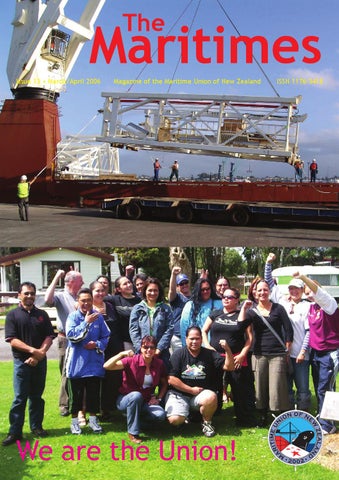
Contents European dockers protest........... 3 Trevor Hanson Report................ 3 Phil Adams’ Report.................... 5 Drug & alcohol policy................ 6 Overseas labour in the fishing industry ................................ 6 Is the flag of convenience system coming ashore?........................ 7 Bottom trawling....................... 8 China visit.............................. 12 MUNZ Women’s Seminars............ 10 Training & Education report......... 11 Union History.......................... 12 Vice President’s Report.............. 15 Interport 2006......................... 18 Free Trade............................. 19 Port Roundups......................... 20 CTU Report............................. 20 Letters.................................. 30 Obituaries.............................. 30 China Connection..................... 31 Branch Contacts....................... 31 The Back Page......................... 32 ‘The Maritimes’ is the official national magazine of the Maritime Union of New Zealand, published quarterly. ISSN 1176-3418 National Office: PO Box 27004 Wellington New Zealand Telephone 04 3850 792 Fax 04 3848 766 Email: trevor.hanson@muno.org.nz Web: www.munz.org.nz Edited and designed by Victor Billot Email: victor.billot@munz.org.nz Editorial Board: Trevor Hanson, Phil Adams and Joe Fleetwood Thanks to the photographers including Fred Salelea, Shane Parker, Joe Fleetwood, Malcolm Pullman (Greenpeace), Alan Middleditch, Barry Gibbs, Winky Waugh, Garry Parsloe, Ray Fife, Harry Holland, Odette Shaw, and others. Front cover photos: (top) Large clip on rig being discharged at Port Taranaki recently for the offshore (photo by Shane Parker) (bottom) Maritime Union members at the recent training Women on the Waterfront course at Willowhaven, Ngongotaha
[continued on page 4]
3
[Trevor Hanson report continued from page 2]
This must be balanced of course with the right of workers to work in a safe environment. The issue is one that has been causing problems in many industries, and ours is one of those industries. The Maritime Union of New Zealand has approached the Maritime Union of Australia, to consult with them, and to develop our own policy that draws on the successful work they have done in this area. We have taken this document to employers as the basis for negotiations to develop a national standard in the industry that works for everyone. By using this proactive approach, we aim to avoid the kind of gross infringement of privacy and civil rights that come with random searching and other Big Brother style methods. This heavy-handed approach is wide open to abuse and does little to solve the underlying problems that are behind drug and alcohol abuse. As members have pointed out, there also needs to be a long hard look at stress and fatigue in our industry. The effect of shift-work, irregular hours, and insecure casual jobs, needs to be addressed as these problems often create the stress and fatigue that lie behind drug and alcohol problems in the workplace.
European dockers’ victory The Maritime Union has been closely watching developments on the waterfront in Europe. Dockers in Europe recently defeated a plan called the “ports directive.”
This was a plan to turn over the control of European ports to private corporations who want to casualize the dock workers and create what are known as “Ports of Convenience.” Ports of Convenience are ports where casualized labour forces are moved around between countries, and where ship crews are made to work their own cargoes – the practice known as “self loading” or “self handling”. The dockers fought back and the “directive” was thrown out of the European Parliament. This issue relates to us directly as we are under the same type of pressure in New Zealand.
Free Trade lies behind attacks on jobs The European “ports directive” was part of a broad push by big business and their political allies to force “free trade” policies on the population. One of the bizarre effects of proposed free trade laws would mean that a company from a poor country in Eastern Europe operating in the UK, for example, would not be liable under UK health and safety laws. Even though they were working in the UK, the company could operate under inferior health and safety laws from their “home” country. This is why free trade is really the “flag of convenience” system coming ashore. It is a global race to the bottom to maximize corporate profit whatever the consequences.
Contact the Maritime Union National Office Telephone: 04 3850 792 Fax: 04 3848 766 Address: PO Box 27004, Wellington Office administrator: Valentina Goray Email: val.goray@muno.org.nz General Secretary: Trevor Hanson Direct dial: 04 801 7614 Mobile: 021 390585 Email: trevor.hanson@muno.org.nz National President: Phil Adams Direct dial: 03 4728 052 Mobile: 0274 377601 Email: phil.adams@munz.org.nz
4
National Vice President: Joe Fleetwood Mobile: 021 364649 Email: joe.fleetwood@muno.org.nz Assistant General Secretary: Terry Ryan Mobile: 021 1866643 Email: terry@munz.org.nz ITF Inspectorate: Kathy Whelan Direct dial: 04 801 7613 Mobile: 021 666405 Email: kathy.whelan@muno.org.nz Communications Officer: Victor Billot Mobile: 021 482219 Email: victor.billot@munz.org.nz
It must be remembered that only a year ago the International Transport Federation was warning us that if they lost the battle in Europe, it would only take six months for the same thing to happen in the Pacific Rim countries. We really do owe the European Maritime Unions a huge vote of thanks. The same push for “free trade” policies is going on in New Zealand. The Maritime Union has been trying to get a straight answer to our question – will free trade deals mean that casual short-term labour can be moved into and out of New Zealand by employers? Could overseas employers import overseas workers and legally exploit them under Third World employment conditions within New Zealand? No one seems to want to talk about it. The Union movement has a responsibility to demand the facts, not to accept the propaganda, from the Government and its agencies. Free trade is not just about selling sheep carcasses overseas. The free trade system is Rogernomics and Ruthenasia on the international level. It is an unjust, unsustainable and undemocratic plan that is being sneaked past the people without proper debate or examination. But at the same time, workers around the globe are extending their support and solidarity to each other in the fight for a better world. Not everyone is accepting the free trade plan. The recent election of left-wing Governments in Latin America show the tide is turning. Countries such as Brazil, Chile, Argentina, Venezuela and Bolivia have moved away from the free market, free trade model towards policies that benefit the majority of the people. This is a heartening development and it shows the way forward for us as well.
Effective unionism by Phil Adams National President The Maritime Union of New Zealand has been busy building its local and international connections lately. Representatives of the Union have attended union meetings overseas to find out what is happening around the world. Maritime Union Assistant General Secretary Terry Ryan has recently attended a meeting of Unions in the Asia/ Pacific region to discuss the problem of “Ports of Convenience”. This is the system where jobs are casualized and ships’ crews are made to unload their own cargoes (self-loading) which is a direct attack on the jobs, wages and conditions of maritime workers. Maritime Union Vice President Joe Fleetwood has attended a meeting of the International Labour Organization in Europe where rules governing seafarers work worldwide are being tightened up and brought under an ILO Convention. We have seen a number of attacks around the world on maritime and transport workers who are joined internationally under the ITF – the global grouping of all transport unions. In recent months we have seen heavy handed tactics used on ferry workers both in Ireland and Corsica, off the coast of France. Workers on these ferries both took direct action to defend their jobs. In Teheran, the capital of Iran, hundreds of members of the recently formed bus drivers’ union have been attacked by security forces operating in collusion with employers.
An international effort is underway to protect the rights of these workers and their families, and the Maritime Union has added to the pressure being placed on the Iranian Government to stop its anti-worker approach.
Amalgamation The two sets of national officials from the Maritime Union of New Zealand and the Rail and Maritime Transport Union are due to meet in April to recommence amalgamation talks. Paul Goulter (currently with the Australian CTU) and MUA National Secretary Paddy Crumlin will be in attendance. Hopefully with their input positive progress can be achieved. Locally we have seen good pressure on keeping up wages and conditions. The Maritime Union extended its support to the meatworkers at the Taylor Preston plant in Wellington who had unionized and went on strike in February to improve their poor wages and conditions. The Green Party have a bill in Parliament to raise the minimum wage to $12 an hour which the Union movement and many others are supporting. Low paid workers are also getting organized in the fast food industry and other low paid service industries, especially in the Auckland area, and we should all get behind them in their battle for a fair go.
Southern Cross restructure The Maritime Union of New Zealand has started negotiations with Southern Cross Stevedores as the business plans to restructure its operations. The Maritime Union is working to ensure that any negative effects of the restructure on Union members are as small as possible. Further information will be provided through Union branches as negotiations continue. Southern Cross Stevedores own stevedores in all main ports in New Zealand. These include: Northland Stevedoring Services Limited (Whangarei) Southern Cross Stevedores Limited (Auckland) Tauranga Stevedoring Services New Plymouth Stevedoring Services Limited Gisborne Stevedoring Services Limited Hawkes Bay Stevedoring Services Limited Capital City Stevedores Limited (Wellington) Stevedoring Services (Nelson) Limited Lyttelton Stevedoring Services Timaru Cargo Services Port Chalmers Cargo Services Southland Stevedoring Services Limited (Bluff)
‘The Maritimes’ is the official magazine of the Maritime Union of New Zealand. All correspondence to: ‘The Maritimes’, PO Box 27004, Wellington, New Zealand. Email victor.billot@munz.org.nz Deadline for all Port reports, submissions, photos and letters: 5 May 2006 for next edition 5
Overseas labour clampdown for fishing industry Union develops drug and alcohol The Maritime Union has begun negotiations with some employers on a national drug and alcohol policy. The policy has been prepared by the Union, and is based on the successful Australian model that has been used by the Maritime Union of Australia. Auckland Branch Local 13 Secretary Russell Mayn, who has worked on the policy, says it has a number of key purposes. These include the promotion of a healthy lifestyle, an informed workforce, and a responsible attitude towards alcohol. The policy is aimed at helping workers with drug and alcohol problems, and encourages employees to “self identify” if they think they have a problem. The need for privacy and confidentiality is also a key part of the policy. Russell Mayn says the policy continues the current Union stance on random testing – it’s unacceptable. ”With our policy, workers will only be drug tested for reasonable causes such as post-accident or incident.” He says the drug and alcohol policy will be a national one, covering all employers, and providing a clear and fair procedure where employees know where they stand. ”The policy is about solving the problem, not finding scapegoats.” He says that the policy will protect the rights of workers to work in a safe environment, while making sure those who need help get it. Maritime unions have been in the forefront of developing a response to drug and alcohol problems in the workplace, with the ILWU on the west coast of North America having a very successful programme to assist workers with drug and alcohol problems.
6
The rules for overseas labour working in the fishing industry are being tightened to ensure local jobs, pay and working conditions are not undermined. The Government announced a review of the process for employing overseas fishery workers shortly before Christmas. Minister of Immigration David Cunliffe has met with representatives of the Maritime Union and the CTU to involve unions in the process. Mr Cunliffe says while overseas crews are necessary for the industry, more needs to be done to lift pay and employment conditions, and ensure that employers are clear on their responsibilities and can be held accountable for any breaches. He has asked Department of Labour officials to report back by April 2006 on the situation in the industry. The current rules are meant to ensure foreigners do not take the jobs of locals, that foreign fishers are here for a genuine purpose, and that minimum employment conditions are met, he says. In the meantime, he is insisting on closer scrutiny of any applications to bring in overseas labour. The Maritime Union has welcomed the changes. Maritime Union General Secretary Trevor Hanson says the Union was not opposed to overseas workers, but was strongly opposed to companies operating in New Zealand using overseas labour to attack wages and conditions. ”What we were seeing was a push to introduce low-wage labour in the New Zealand fishing industry, and we are pleased to see the Government has moved towards a more responsible system.”
Mr Hanson says the Maritime Union has worked with the CTU to outline workers’ concerns to the Government. He says the situation seems to be changing all the time. ”We have noticed that some New Zealand fishery companies are now advertising for local workers in what seems to be a more serious way.” The use of overseas labour is becoming increasingly common internationally. The “free trade” system being promoted as the capitalist solution for developing countries means that the use of short-term, casualized workers is being encouraged across national borders – as long as it is of benefit to business. The Maritime Union is warning that attempts to undermine wages and conditions through the exploitation of overseas workers within New Zealand, or within New Zealand waters, is unacceptable.
Is the flag of convenience system coming ashore? by Trevor Hanson General Secretary The problems caused by the importing of short-term workers from overseas was discussed at a recent meeting between Unions and the Government. The meeting was convened at the CTU on Wednesday 22 February, and was attended by NDU, UNITE, CLAW (Clothing Workers), Nurses Organization, Amalgamated Workers Union, Carpenters, Meat Workers, ASTE (tertiary staff), the Maritime Union, and the International Transport Workers Federation. The unions gave a report of the effects on their members as a result of the introduction of short term labour, and other immigration measures, to fill the perceived or real shortages in the New Zealand labour market. There was a concern at increasing abuse of the system by employers who are advertising jobs at minimum and below-market rates. These employers are then making application to the Department of Labour (DOL) to bring in overseas workers because they are not getting local applicants. I was amazed at how widespread the damage is, and I was concerned that Unions have not yet fully grasped the implications of this process. Under an agreement between the Government and the CTU, the DOL is required to provide the relevant industry unions with all requests from employers to bring overseas workers in to fill labour shortages. The Union is then supposed to respond to the DOL either supporting or rejecting the application on its own industry knowledge. It is obvious the system is not working properly. There has been the odd success – for example, the meat workers were in danger of some rogue employers bringing in slaughtermen but with the assistance of the CTU stopped it. The other area of common problems is that after a Union had supplied a response to the DOL, they never were informed if the application had been granted or not. The Maritime Union opposed the original proposals for this system, as it was clear that immigration authorities would end up rubber stamping the applications as fast as they got them.
This is now happening, with the Government unfortunately continuing on down the free trade track. “Free trade” in workers is being discussed at the World Trade Organization. The CTU presented some papers on the issue and noted that cross border labour is on the increase globally. There are some obvious shortages in some areas, including the fruit industry. The recent shipjumping incidents by overseas fishing crews are largely driven by the conditions and wages they receive on fishing vessels. The flow on effect to New Zealand workers is extremely dangerous as more employers seek to exploit cheap imported labour to increase their profits. Department of Labour official Stephan Dunstan presented the Government’s position to the meeting. He spoke on economic liberalization and globalization, all topics Maritime workers are very aware of. He focused very much on “approval in principle” requests from employers, something the Maritime Union has been keeping a close eye on to ensure that waterfront and ship work is protected. The main concern of those present were that Unions were being bypassed and not being notified to employers’ requests for foreign labour. Others pointed out that even when they were asked to respond, they were never notified of the outcome. The DOL accepted there were problems, and that was one of the reasons for the meeting. At the moment we have 20,000 irregular workers in NZ (which is another word for overstayers), and 82,500 workers have work permits. I asked if studies had been done overseas on the effect of cross border labour on permanent workers within the receiving country. His response was that studies showed there was no significant effect on the permanent workforce. My reply was that the effect on an economy with 20 million workers may not be heavy, but New Zealand has a workforce of approximately 1.4 million which is much easier to damage. I raised the issue of foreign fishermen and the present application for sixty imported workers, which the Maritime Union had questioned.
The DOL has offices in countries supplying labour, and that is where the problems should be sorted out. Foreign workers should be presented with an agreement from the importing New Zealand company, noting the wages and conditions. It should also clearly specify the market rate of pay in New Zealand dollars they will receive whilst fishing in New Zealand waters. The Minister of Immigration David Cunliffe arrived at this stage and addressed the meeting, telling the meeting the Government position was to ensure that the Government and the CTU work together on immigration and ensure that New Zealand workers are protected. He also said he was going to fix the problems in the fishing industry. I noted the country of origin should be the starting point, and that no foreign fisherman should be encumbered by having to pay a “fee” to buy the job, then paying his own air ticket, and ending up in debt either to the labour agency or the fishing company. My view is the Department of Labour at the country of origin should ensure that this does not happen, and an agreed New Zealand dollar market rate for working in New Zealand waters should be signed prior to the foreign fishermen leaving their country of origin. Furthermore, to ensure the future of the industry, when a fishing company requests a number of foreign fishermen, they take on a percentage of that number of New Zealand trainees. In conclusion, I am extremely concerned with the current immigration system, and its potential to be used to pit worker against worker. It may lead to flag of convenience conditions taking hold onshore. It’s not too hard to work out what happens if one meat plant utilizes cheap foreign labour, the meat plant just down the road does the same. The driving force behind this process is the development of the free trade ideology, that has gone beyond free trade in goods and services, to free trade in workers. We are going to have to be extremely careful and in some cases we might have to take on a fight, in order to turn back an attack on jobs, wages and conditions.
For more information: http://www.union.org.nz/campaigns/Gats.html
7
Dubai or not Dubai –
Bush in trouble over ports deal
12 June 2005, West Norfolk Ridge, international waters of the Tasman Sea: Crewmen on the New Zealand bottom trawler Waipori dump a large piece of ‘Paragorgia’ coral dredged from the deep sea in their net (Photo © Greenpeace/Malcolm Pullman)
Bottom trawling off limits in third of NZ waters The New Zealand Government is proposing to close off a third of New Zealand’s Exclusive Economic Zone (EEZ) to bottom trawling. Fisheries Minister Jim Anderton announced in February that a draft agreement had been reached with deepwater fishing companies. This will close about 1.2 million square kilometres of the EEZ to bottom trawling – an area extending from sub-Antarctic waters to the sub-tropical Kermadec region. The move follows strong pressure from environmentalists who have campaigned against bottom trawling – and in 2005 the Maritime Union added its concerns to the debate. But Greenpeace New Zealand says the areas involved did not seem to represent all the vulnerable areas at risk from bottom trawling. “While 30% of our EEZ sounds like an impressive proposed closure, the areas do not seem to represent all the vulnerable areas at risk from bottom trawling. We know, for example, that some of these areas are too deep to bottom trawl and others have already been fished out,” says Greenpeace oceans campaigner Carmen Gravatt “The devil is in the detail.” Ms Gravatt raised the issue of international waters where, she said, no rules applied.
8
There was insufficient information to select particular areas without knowing the impact of leaving other vulnerable areas open to bottom trawling, she said. “The only effective measure is a temporary ban on bottom trawling in international waters while the research is carried out and the RFMO negotiations are underway,” she said. Mr Anderton said the areas involved in the draft agreement lay across a range of depths, and covered a range of habitats that broadly represented this country’s offshore waters. The public would be consulted on the New Zealand proposal and he hoped to have regulations ready by October. “It is a bold move, and indicates their foresight and willingness to work with the Government in looking after New Zealand’s marine ecosystems and habitats.” Mr Anderton said that when the area was added to deepwater locations already closed, 42 per cent of seamounts in New Zealand waters would be protected - the largest single marine protection measure ever proposed within a nation’s EEZ. He said New Zealand would support a global moratorium on bottom trawling, but only if it had sufficient international backing to make it a practical option. For more information: http://www.greenpeace.org.nz
A row has broken out over a proposed deal to put American ports in the hands of Dubai Ports World. US President George W Bush says he will veto any attempt to blocking the deal which would give the Arab company control of six of the largest east coast ports. Lawmakers from the Republican and Democratic parties say the deal will make the US vulnerable to terrorism. The ports are currently run by British based P&O, which has agreed a US$6.8 billion takeover by Dubai Ports. The Bush administration says that counterterrorism experts had checked the deal and found there was no danger to national security. ”It would send a terrible signal to friends and allies not to let this transaction go through,” Mr Bush said. But it appears Bush has bought into a fight with his own team. Opponents of the deal include senior Republican politicians including chairman of the Homeland Security Committee Congressman Pete King and Senator Bill Frist, the majority leader in the Senate. Critics claim the deal would increase the risk of terrorism, as the United Arab Emirates was the home of two of the hijackers involved in the 11 September 2001 attacks in New York. The ILWU says that the real issue is lack of funding for maritime security. ”The controversy over this particular contract detracts from what is the real concern of dockworkers and millions of Americans who live in close proximity to our nation’s ports: the lack of real improvements in port security since the terrorist attacks of September 11, 2001”, says ILWU International President James Spinosa. The massive Teamsters Union says in United Arab Emirates (UAE), unions are outlawed. In 1997, Dubai agreed to train Australian mercenaries to be strikebreakers in the infamous Patricks Dispute. According to the Australian port workers’ unions, “Dubai is a free trade zone and an industrial free-for-all. Foreign workers predominate and trade unions are outlawed. Deportation awaits those who dare to organize.”
On the web Learning Reps at work Learning Reps are elected by employees to help them get ahead with learning at work. They can advise co-workers on opportunities for learning, work with management on company training plans and, most important, promote training that will build a career for workers. Learning Reps are trained to undertake the role with no cost to the Rep. Usually there is a workplace agreement which sets out how the Rep will undertake their duties and what part the employer will play in helping. For more information: http://www.learningreps.org.nz
Workplace Injury Advocacy Service Are you a union member? Have you suffered an injury that affects your ability to work? Do you need help to access ACC?
For more information: http://www.worksafereps.org.nz/campaigns/ workplace_injury_advocacy
LabourStart workers’ news LabourStart is an online news service maintained by a global network of volunteers which aims to serve the international trade union movement by collecting and disseminating information — and by assisting unions in campaigning and other ways. Its features include daily labour news links in 17 languages and a news syndication service used by more than 630 trade union websites. News is collected from mainstream, trade union, and alternative news sources by a network of nearly 350 volunteer correspondents based on every continent. LabourStart has been involved in online campaigning for several years but moved up a gear with the launch in July 2002 of the ActNOW campaigning system. Tens of thousands of trade unionists have participated in its various online campaigns and more than 31,480 are currently subscribed to its mailing list. They receive weekly mailings, usually on Thursdays. For more information: LabourStart news at http://www.labourstart.org LabourStart online radio at http://radio.labourstart.org LabourStart online TV at http://www.labourstart.org/tv
Port of Lyttelton should be held in local ownership The two Unions representing port workers in New Zealand have opposed a proposed deal that would see the Port of Lyttelton pass into effective control of multinational corporate Hutchison. The Rail and Maritime Transport Union (RMTU) and the Maritime Union of New Zealand (MUNZ) support local control of the port. Maritime Union of New Zealand General Secretary Trevor Hanson says the takeover by multinational Hutchison has the potential to destabilize the maritime industry in New Zealand. “Hutchison could use their international clout to give business advantages for Lyttelton that other ports don’t have.” He says this could mean the closure of other South Island ports, with a devastating effect on jobs and the revenues that currently benefit local communities through local ownership of ports. Mr Hanson says there is the threat of casual, short-term overseas labour being introduced once New Zealand signs up to the free trade deal with China. “We are concerned that a global operator like this, based in Hong Kong, will find a way to introduce overseas labour through free trade agreements.” Rail and Maritime Transport Union General Secretary Wayne Butson says the sell-off puts a vital piece of New Zealand infrastructure into overseas control, with serious repercussions for the New Zealand economy. “The potential is there for the port to be completely privatised some time down the track.” He says the deal is short-sighted, and will further place New Zealand’s export trade outside New Zealand control. The Unions say their concerns are widespread in the wider maritime indus-
try.
The two Unions are proposing that the Christchurch City Council through its business arm CCHL purchase the Port of Lyttelton outright. This would keep ownership, control and revenue with the local community and the people of New Zealand. A complicated deal proposed by the Christchurch City Council would see operations at the port taken over by a multinational port operator, Hutchison Port Holdings. The Christchurch City Council is undertaking a two stage process to stitch together a joint venture with Hutchison Port Holdings. It launched a takeover bid in February 2006 for Lyttelton Port as the first step. The council’s investment arm, Christchurch City Holdings Ltd (CCHL), holds a 69 per cent shareholding in LPC, and aims to take over the company and delist it from the stock exchange. The closing date of their $2.10 share offer is Monday 10 April 2006. CCHL would then retain control of the Port of Lyttelton with a 50.1% shareholding, appointing four of the seven directors. But the deal sees a new operating company set up that would manage port operations. Hutchison would hold a majority 50.1% shareholding and appoint a majority of the directors. CCHL stands to gain around $41 million from the sale of its shares to Hutchison. Hutchison is the world’s main port operator, with involvement in 242 berths in 41 ports and 20 countries, and a 2004 turnover of $US3.5 billion.
9
Maritime Union members at the Ngongotaha training seminar
MUNZ Women’s Seminars by Rachael Goddard Wellington Seafarers’ Branch The Maritime Union of New Zealand has had a huge success for working women in the Maritime industry with our inaugural Women’s Seminars. It has taken a lot of time and effort to kick start, but our first two sets of two day seminars were held on 15–16 November at the Wellington RSA and 21– 22 November at Willow Haven at Ngongotaha. Our very own education program gave thirty MUNZ women the chance to be educated and take an active participation in examining the barriers for women working on the waterfront, including identifying reasons why some employers do not have women working on the waterfront. It has launched strengths for encouraging more women onto the waterfront and provide them with the knowledge and skills to enable them to develop strategies for increasing involvement in their workplace, through health and safety committees, branch committees and as health and safety reps. The women also identified the importance of working with other women to identify problem solving processes and help resolve workplace issues. Our women also looked at the global issues facing us in the industry. This includes globalisation, FOC’s, the loss of Cabotage and the development of “Ports of Convenience.”
10
Janita Barton and I were co-facilitators and used our experiences at conferences overseas to help with the seminar. As part of an active learning session on 15 November, all the members at our Wellington Seminar joined other MUNZ members, our National Executive, Maritime Union of Australia (MUA) National Officials and other New Zealand based unions and activists and went to the Protest held at the Australian Embassy in support of our brothers and sisters across the Tasman. Australian workers are facing an attack from the Howard Government which has introduced anti-worker industrial laws. Afterwards our women had the chance to talk to MUA General Secretary Paddy Crumlin about issues at work including isolation and segregation, equal opportunities, pay parity and paid parental leave in our collective agreements for both men and women that is better than legislation. Women also had the chance to discuss these issues with Maxine Gay, a long time woman activist with the New Zealand trade union movement, whose father was a Merchant Seaman and mother a clothing worker. It was remarkable how similar Paddy and Maxine’s responses were. It became apparent we need to look at education on the job for our members and for union officials on women’s issues.
We need to break down the cultures of ignorance so that men and women can work together to fight the boss as one – as Paddy said “Sexism is the bosses’ tool to divide us” and Maxine said “Women and men have to work together and anything other than that can only lead to destruction.” Maxine and Paddy also talked about the fact that if we don’t work for emancipation, especially in our male dominated industry, then we simply become “reactive” unions rather than proactive, progressive unions. MUA Assistant National Secretary Rick Newlyn and MUA Industrial Officer Joanne White also joined in on our Wellington Seminar giving us a run down on what women in the MUA are up to, before we watched the LA Mining and Maritime Conference on DVD. Women set similar tasks for the future at both of our seminars, and we have to commemorate MUNZ women in the Mount Maunganui Tauranga Branch for achieving their first task set. We now have two women elected on the executive of Tauranga Branch, Catherine Haerewa and Whetu Matthews. That in itself is an historic moment. Also at Willowhaven, in remembrance of November 25, International Day for Elimination of Violence against Women, MUNZ women wore white ribbons after reading the letter sent from our ITF Asia/Pacific regional women’s co-ordinator Nishi Kapahi. The women in these seminars quickly became eager to be active in many areas of their union MUNZ and the ITF that we are all proud to belong to. We would all like to give great thanks to Phil Spanswick and the steering committee that help set the foundations for this programme to happen. Thanks also go out to our wonderful National Educator Fred Salele’a who has not only brought about his own understanding of discrimination, being a Pacific Islander, but has helped give women the tools to educate other women. We love you Fred! Janita Barton and I are thankful for having the opportunity to contribute together as Watersider and Seafarer to the content of our planned sessions. We also gained experience of how to deliver education and training to other workers, by getting the chance to cofacilitate the seminars. We have around 180 Women in our union, and we have 150 more women to get into training and education, but a growing foundation has been set with a strong network for continual development. As Maxine Gay said – “it is a Marathon, not a Sprint.”
Women’s Training MUNZ Education moves forward The year 2005 saw the Maritime Union of New Zealand Education Programme deliver two MUNZ Women’s seminars with great success. Thank you for your enthusiastic active participation in our Inaugural Women’s seminars held both in Wellington and Ngongotaha. The role played by everyone involved has ensured the future voice of women in the maritime industry and the union movement. First of all we would like to congratulate our MUNZ women in the Port of Tauranga Branch for achieving their first task set. We now have two elected women on the executive of Tauranga Branch, Catherine Haerewa and Whetu Mathews. That is a historic moment. Congratulations once again and remember that we are all here to support each other. There were five tasks set at the Wellington and Ngongotaha seminars which were:
Wellington 1. Getting more women involved. 2. Networking with other course members (calls/texts/emails). 3. More about union networking/researching. 4. Attend stop work meetings to keep involved and informed. 5. Form a women’s committee; get women on the executive (national)
Ngongotaha 1. Elect two women executives. 2. Networking. 3. Recruitment. 4. Women’s branch/National committee. 5. Further education. From the seminars we developed a network of contacts for members in their regions: Janita Barton (Auckland), Catherine Haerewa (Tauranga), Rachael Goddard, Fiona Daniels, Vicky Maloney and Zoe Atkinson from Wellington, and Polly Clayton (Lyttelton). The timetable for the 2006 MUNZ Education Programme is now being put together with the Women’s programme set to run early March and then a second later on in the year. A flyer will follow with date/time and venue for the first 2006 seminars for those who missed out on the opportunity to attend last year. We are looking into the possibilities of having a MUNZ women’s national conference late in 2006. We would welcome any form of recommendations for future seminars, workshops and conferences to help further educate the women in our union. These recommendations can be forwarded to: Janita Barton janitab@slingshot.co.nz Rachael Goddard rachgoddard@yahoo. co.nz Fred Salelea salelea@xtra.co.nz
by Fred Salelea MUNZ Trainer
On 22 December the last of our delegate training courses for 2005 was delivered in Port Chalmers. Thanks to Phil Adams and his members, along with Auckland and Wellington who were in attendance for helping us complete this final course for the year 2005. Nelson also had their first MUNZ delegate training course for the branch, many thanks to Bill Lewis and his efforts helping us get this course together. We will look forward to increasing the interest from the branch members to attend our next delegate session. I would like to thank all the branches that contributed with their efforts in making our 2004-2005 education programme a success and for the support of our education steering committee: Phil Spanswick, Trevor Hanson, Joe Fleetwood, Phil Adams and Russell Mayn. With further support from our local branches, we can improve and build on what we have achieved, by giving our members every opportunity to attend delegate education training in 2006 from which our future leaders within our workplace will extend themselves through the rank and file. Our 2006 programme will kick off in March with 18 delegate training courses to be delivered at local branches throughout the country. We are also running in conjunction with ACC/CTU a number of in-house regional Health and Safety rep training courses, the first of them starting off in Christchurch and Wellington 21-24 March 2006. For more information regarding any of these courses or expression of interest in attending contact your local branch, or: Contact Fred Salelea: mobile 0212291432 or email fred.salelea@munz.org.nz
Maritime Union members at their December 2005 training course
11
Crew of USSCo SS Manuka – date unknown (courtesy of Regional Maritime Museum, Port Chalmers)
Early Days in the Union The Maritimes publish an initial instalment from Chapter 2 of the forthcoming history of the New Zealand Seafarers Union, by historian David Grant.
by David Grant Until the early 1870s there was no organization in New Zealand to represent seafarers and try to improve their lot. Men on sailing ships were “on their own.” Protests over working or living conditions and/or rates of pay meant dismissal. There were always plenty of others to pursue the ‘romantic’ life of a sailor on the high seas – or escape from an even more miserable shore-based lifelong term unemployment, an unhappy marriage, a criminal past or sometimes all three. Sailing ship seamen were transient by nature, living vicariously day-to-day, working hard on board ship, playing hard on shore, little concerned about what the morrow might bring. Most were fiercely independent. They did collaborate to protect their interests on-board but there was never consideration of a more formal uniontype body. Ship owners and their captains held all the trump cards. They hired and fired. Their word was absolute. Steamships however, brought a different culture. Workforces became more stable and the development and growth of large enterprises in New Zealand
12
such as the Union and Northern Steamship Companies led to a more formal and bureaucratic employment environment. Steamship companies introduced uniforms for their officers, standard dress for the seamen, and their own rules of conduct. But the essential lifestyle of seafarers did not change. The work was just as hard, (even harder, as we have seen, in the stokeholds for firemen and coal trimmers) living conditions poor, diets rudimentary, and the ever-present dangers of sickness, injury and death remained. But pay, working conditions, food and accommodation came no longer to be negotiated between the ship’s master and his crew but between the ship owners and men chosen to represent the crew. There was much that the men could not change in their lives as seafarers. But rates of pay and hours of work were, in theory at least, negotiable and this was what the earliest Seamen’s Union concentrated on for the benefit of their members. Prior to 1880, industrial disputes beyond argument and resolution – invariably in the employers’ favour – had been sporadic. In 1866, Wellingtonbased firemen attempted to stop others from working on coastal steamers for £3 a month, which was £1 below the going rate.
The picket degenerated into a scuffle and four of the protesting firemen were arrested for assault and jailed for three months. In November 1872, a Seamen’s Mutual Benefit and Protection Society was formed, but by the following year it removed the name ‘Protection’ in favour of ‘Improvement’, ditched all questions of relationships with employers and concentrated its activities solely on sickness and retirement benefits for seamen who were laid off, impecunious or who had been suffering long periods of unemployment. It was totally self-funding, collecting funds from working seamen to be distributed to the less fortunate among their workmates and families in times of need. This organisation went into abeyance during 1873 but various forms of such altruism re-emerged over succeeding years. Collective self-help was an essential concomitant for seafarers and their families to be able to survive. There were periodic disputes through the early 1870s as steamships slowly replaced sail as the main mode of transportation. In October 1873, an ad hoc gathering of seafarers in Wellington formed a collective to try to persuade employers to pay ordinary seamen £8 a month and restrict work to 12 hours a day. When the owners refused to talk, the men withdrew their labour. This worked. In January 1874, the seamen won their £8 having formed a union – the first New Zealand Seamen’s Union – in the interim. It helped that the economy was buoyant at the time and there were more jobs than labour available. A similar group of seamen in Lyttelton formed a second branch of the Union, winning the same pay rates. But the venture was short-lived. Within a year both unions had ceased to function as growing economic recession had forced many seafarers to try to find work on land – and there had been no union formed in Auckland, the colony’s biggest and busiest port. This led the New Zealand Herald on 31 October 1875 to call for the formation of a Seamen’s Union to handle the complaints from large numbers of seamen, firemen, cooks and stewards to counteract the ‘systematic measure in which experienced and competent men were being underbidden and ousted from their situations on board vessels trading from Auckland by incompetent persons who are willing to work for lower wages’. This was a hopeful appeal. With a surfeit of available labour employers began cutting costs to preserve, and in some cases increase profit margins.
The more rapacious of the ship owners took on those who were prepared to work for the lowest rates irrespective of skill and experience. In some cases wages went as low as £5 per month with no restriction on manning levels on boats or on how many hours the men were expected to work every day. At this time seamen could be articled for any number of months but the captain could discharge them at any time, for any reason and had unlimited power to work the men for an unlimited number of hours of any given day. One consequence of this was an increase in nautical accidents with shipwrecks causing loss of life to crew and passengers alike. There were sporadic industrial disputes all of which were resolved in the employers’ favour. In March 1876, for example, there was a firemen’s strike on Union and New Zealand Steamship Companies’ ships in Wellington and Auckland. With no union support, the men were simply laid off and a new, inexperienced crew hired. In January 1879 the crew of the steamer Argyle struck for £7 a month followed by those on Rowena when it berthed in Auckland soon after. The men were simply replaced at the existing £6 wage. Soon after, in June, in a more common scenario, the Union Company reduced wages of firemen on their coastal ships from ten pounds to nine pounds a month, and the trimmers’ wages in proportion, the new scale to be uniform with a new scale on Union Company steamers sailing out of Sydney and Melbourne. Economic recession was always the excuse. The first hint that the repressive power that ship-owners and their captains had over the men under their employ was about to change occurred in March 1880 when Australian seaman and unionist Robert Sangster arrived in New Zealand. New Zealand’s primary trade at this time was with Australia and seamen union leaders in that country were concerned that deteriorating conditions on New Zealand ships could be a threat to their conditions, and they felt a fraternal concern to assist their mates across the Tasman. Sangster was an executive member of the Federated Seamen’s Union in Australia, and president of its Victorian Branch, which had been formed a few years earlier. The Australian union had sent him to New Zealand with the specific purpose to help local seamen form (or in the case
View of Port Chalmers about the same time as the founding of the Seamen’s Union. The main trunk railway is in the foreground, and the Presbyterian Church at left (courtesy of Regional Maritime Museum, Port Chalmers)
of Wellington and Lyttelton reform) port unions and to encourage them to amalgamate into a permanent national organization with branch status in the Australian body. After a slow start (only six people attended his first meeting at Lyttelton on 5 August 1880) Sangster attracted larger audiences and by the end of that month branches of a ‘New Zealand Independent Branch of the Federated Seamen’s Union of Australia’ had been formed with head office in Port Chalmers and sub-branches in Wellington and Auckland. (It became the Federated Seamen’s Union of New Zealand in 1885.) The message that Sangster repeated was that Australian seamen having beaten competition from ‘cheap labour’ (Chinese-manned) ships on their own coast, they were keen for New Zealand seamen to have the same protection – and they were sure that the New Zealanders wanted it for themselves. He also encouraged local seamen to push harder for ‘fair wages’ and an eight-hour working day. At Port Chalmers, 30 local seamen enrolled in the new union. Its first president was George Dodds, a local chemist. News of its success travelled ahead of Sangster’s itinerary. A subsequent meeting in Wellington’s Athenaeum, chaired by the mayor William Hutchison led to a second union committee being formed with 30 men signing up. At the first meeting of this union, just three days later, 75 seamen attended and formed a union committee to meet every week. Hutchison became Wellington’s first president and Chas Hendry its secretary.
That these unions were able to be established more easily, and with more influence than in the past was due to the passing of a Trade Unions Act in 1878 which for the first time allowed New Zealand workers to establish a framework within which their organisations could operate, with legal protection, in return for the cost of registration. The setting up of the Wellington union was timely because long-serving lumpers (dock workers) there were on strike as other, hitherto unemployed labourers were being offered this work at a reduced rate of 10d an hour compared with the accepted rate of one shilling. The strike lasted for eight days with no joy for the original men who had no union to bat for them. Now unemployed, many subsequently joined the new Seamen’s Union. The stated object of The New Zealand Independent Branch of the Seamen’s Union of Victoria was that all classes of seamen-officers, carpenters, firemen, stokers, coal-trimmers, cooks, stewards and deckhands were eligible to become members and will ”maintain such wages as shall from time to time be fixed as the fair equivalent for their labour, as also for the general protection of the rights and interests of seamen, their well-doing socially and morally.”
This excerpt will be continued in the next issue of the Maritimes.
13
Seafarer Identity by Joe Fleetwood When in Geneva for the International Labour Organization (ILO) meeting on the Seafarers Bill of Rights, I attended a short meeting about the Seafarers Identity Document (SID). The SID comes under ILO convention 185.Four countries have ratified this convention so far (Jordan, France, Nigeria and Hungary). Brazil, Honduras, Norway, the Republic of Korea, and Pakistan have all implemented the convention and should have ratified the convention by the end of 2006. All Pakistani seafarers now have a SID card.There will be no microchip technology in the card. The SID will mean that seafarers will get shore leave in all countries that ratify Convention 185.
The document has been based around the USA but they have not ratified it. Even US citizens aboard US-flagged ships have been denied shore leave in US ports because of private berths and US security regulations. Up to 10,000 seafarers a day are coming ashore in the USA if they can get permission, with a total of 100,000 border crossings a day. The USA wants the card to have a microchip, but anyone with the same scanning technology can then read the card from three feet away. Some Governments are trying to get seafarers to contribute to the cost of the SID, but we are resisting this. The ILO’s Seafarers’ Identity Documents Convention (2003) (No. 185) is the first international seafarers identification system. It’s based on the fingerprint and is required to work internationally. In March 2004, the ILO adopted a single international standard for the SID.
© International Labour Organization/ J.
Taylor Preston strike gets results The Taylor Preston meat company was forced to stop processing at its Wellington plant for three days in February, as freezing workers went on strike over pay and conditions. The strike concluded with an offer being made to workers. Workers placed a large notice in the Dominion Post newspaper explaining their plight and asking the public to support their case, and signed by 14 workers from the plant. The freezing workers at Taylor Preston were being paid substantially less than workers at other New Zealand freezing works, who get between 20 and 50 percent more in their pockets. In many cases workers at Taylor Preston’s plant were on the minimum wage of $9.50 per hour. The Meat Workers and Related Trades Union, says the Taylor Preston workers were pushed too far. Union organizer Roger Middlemass
14
says the workers ran out of patience and goodwill after getting knocked back on requests for higher pay and better conditions, and after a series of incidents in which Taylor Preston management tried to block union involvement. One indication of the small mindedness of the company is its refusal to supply anything but boiling water for the workers’ meal and tea breaks. He says only management get free milk, tea, coffee, Milo and sugar. “We’re talking about people who work day after day, and at all hours of the day, on continuous process lines that never stop – in freezers, in heat, in blood, guts and filth.” “Compare this with the life enjoyed by the four millionaires who own the works, including the Taylor family – they’re worth $57 million, according to the National Business Review – but they can’t afford to provide a bit of milk and sugar.”
Maritime standards under threat? by Joe Fleetwood In early December 2005, the Maritime Union was notified by Maritime New Zealand (formerly the Maritime Safety Authority), of proposed maritime rule changes. We saw the proposals as downgrading the qualifications of experienced Integrated Ratings (IRs) and Able Bodied Seafarers (ABs), and lowering standards in the industry. One proposal that a person who has performed three months service in the previous ten years being made a qualified deck hand is a bad one. The Maritime Union put in full submissions in writing to Maritime New Zealand and the Minister of Transport Safety Harry Duynhoven. We have received a written answer from the Minister who has replied in what we believe is a very satisfactory manner. Although Maritime New Zealand has at this stage not made a decision on the proposed rule change, it is clear from this reply that any qualified deck hands will only be allowed entry to ships of less than 45m or 500 gross registered tonnage that operates within the 12 mile New Zealand inshore limit. The Minister has provided an assurance that the proposed changes do not provide for Qualified Deckhands qualification to be recognized or considered as an Able Seaman (AB) or Integrated Rating (IR), or to be equivalent to higher qualifications, nor do they allow for a QDH to be able to carry out the duties of these persons. We have already been confronted with the situation onboard one of our vessels, where an individual who held a minimum fishing ticket told the employers and captain that because of the state of the fishing industry, that he would work for free as long as it took to get New Zealand maritime qualifications. This subsequently turned into an industrial dispute that was quickly put to rest. It is not the responsibility or fault of the new recruits trying to get into the industry, the problem lies at the official level. The Maritime Union is following up this issue to make sure we get a satisfactory conclusion.
Seafarers win a Global Bill of Rights by Joe Fleetwood The International Labor Organisation (ILO) overwhelmingly adopted a new Maritime Labour Convention protecting the 1.2 million seafarers employed in the global shipping industry in Geneva, Switzerland, on 23 February 2006. Better known as the Seafarers’ Bill of Rights, the new convention brings together 38 existing ILO conventions and 30 recommendations. I attended the convention as part of the New Zealand delegation. The convention will provide seafarers with a bill of rights, that includes decent working conditions and covers areas such as health and safety, working hours and recruitment. The convention was adopted by the 314 registered delegates from 106 member states with only four abstentions. The convention will have an impact on Flag of Convenience shipping, and the exploitation of seafarers who suffer from lack of shore leave, bad food and no wages. The effects of globalization and deregulation have meant a downward spiral of conditions for seafarers. There is a need for social security for seafarers, with training, health care, and the right to organize. Without seafarers, half the world would freeze and the other half would starve.
Maritime Session at the ILO, and Australian seafarers’ delegate, welcomed the outcome. “The extraordinary interest and support for the new Bill of Rights for seafarers reflects both the apalling lack of rights for ships’ crew and the terrible exploitation they are all too often subjected to,” he said. “The strong vote reflects a worldwide determination to now provide enforceable labour standards. It is a watershed in the shipping industry.” The bill has the support of unions, governments and shipowners represented at the ILO with both the International Transport Workers’ Federation and the International Shipping Federation issuing joint media releases. Mr Crumlin said it was a credit to all governments to accept the challenge. “It is clear from statements made by all three groups that the ILO standards are now as essential as other safety and environmental standards to the future of the international shipping industry,” he said. The Seafarers’ Bill of Rights will bring together 60-plus existing conventions and require ships of a certain size to carry a labour certificate. Ships will also be subject to portstate control inspections. For more information: http://www.ilo.org/public/english/bureau/ inf/event/maritime/index.htm
The convention will be accepted as the ‘fourth pillar’ of the international regulatory system for the global maritime industry, along with the safety (SOLAS), training (STCW), and pollution (MARPOL) conventions of the International Maritime Organization (IMO). ILO Director General Juan Somavia said the convention had made maritime labour history. It’s the result of five years of negotiation between international governments, shipowners’ and seafarers’ organisations. Maritime Union of Australia National Secretary Paddy Crumlin, Vice Chairperson of the Workers’ Group,
Seafarer reps at the Geneva Convention: From left, National Secretary Seafarers Section of the UK RMT Union Stevie Todd, General Secretary of the ITF David Cockroft, and Maritime Union of New Zealand Vice President Joe Fleetwood.
New Zealand delegation to the ILO Maritime Convention, from left: Roger Brown (Ministry of Transport), Tony Martin (Ministry of Transport), Paul Nicholas (New Zealand Shipping Federation), John Mansell (Maritime New Zealand), Paul Mackay (Business New Zealand), Helen McAra (Merchant Service Guild), and Joe Fleetwood (Maritime Union of New Zealand).
Closing session of the Maritime Session of the International Labour Conference, Geneva, 23 February 2006 (Photo © International Labour Organization/M.Crozet)
15
Interport 2006
Mount Maunganui 12–16 February 2006
16
17
Youth rates hits Parliament
Striking McDonalds workers, Queen Street, February 2006 (photo courtesy of Simon Oosterman, Unite)
Supersize My Pay The Pizza Hut and KFC national call center, the first Burger King stores and the first Wellington fast food store, joined the SuperSizeMyPay.Com month of industrial action in February 2006. SuperSizeMyPay.Com campaign co-ordinator Simon Oosterman said that the actions were a part of an escalating month of industrial action in the fast food industry leading up to the ‘BigPayOut.co.nz’ demonstration and free concert on Saturday 18 March. “In central Auckland, 60 call center workers, who take delivery orders for KFC and Pizza Hut nationwide, went on strike. The striking workers called on customers who were ordering pizzas on the 0800 83 83 83 number to say a message of support, and kept the strike to an hour to minimise disruption to customers,” he said. The call center workers, who are a part of the SuperSizeMyPay.Com campaign, but who have a different contract to the fast food stores, are asking for a training rate of $11 and $12.50 after 3 months as well as a 50% discount on Restaurant Brands food. “In west Auckland, workers from two fast food stores became the first ever striking Burger King workers in New Zealand.
The workers took action despite a memo sent from their head office falsely claiming that they would be fired if they took industrial action.” In true ‘westie’ style, the strikers and supporters drove from store to store, revving and beeping and spreading the strikes to two west Auckland KFC stores. In Porirua, Wellington, one of the highest volume KFC stores in New Zealand was closed when the entire crew walked off the job. The workers were joined by 20 of their non-rostered workmates and 50 supporters, including a brass band and local city councillors. Fast food workers from McDonalds, Burger King, Restaurant Brands (KFC, Pizza Hut, Starbucks) and Wendy’s are calling on their companies to give them the SuperSizeMyPay.Com campaign demands of a $12 minimum wage, an end to youth rates and secure hours. (Wendy’s and Starbucks do not pay youth rates.) The workers are also calling on the government to legislate these demands for all low paid and minimum wage workers in Aotearoa/New Zealand.
For more information visit: http://www.SuperSizeMyPay.Com
Green MP Sue Bradford has successfully introduced a bill to Parliament to abolish youth rates for 16 and 17 year old workers. The Minimum Wage (Abolition of Age Discrimination) Amendment Bill has successfully gone through its first reading to the select committee stage. It now goes to a Select Committee for submissions from the public and for consideration by Parliament. Labour and United Future both supported the Bill going through its first reading to the select committee stage for further debate. However, Labour and United Future have not guaranteed their support at future stages of the Bill’s passage. Lobbying of MPs is still required to ensure increasing the minimum wage payable to 16 and 17 year old workers to the “adult” rate. Maori Party Co-Leader Pita Sharples has also publicly endorsed the Bill and promised his Party’s support. Minimum pay rates in Aotearoa New Zealand are already very low – currently $7.60 an hour for 16 and 17 year olds (rising to $8.20 in March) and $9.50 an hour (rising to $10.25) for those 18 plus. There is no rational explanation for why a 16 or 17 year old performing identical work to an 18 year old should be paid less for the same job. Teachers and principals are concerned that students have to work too many hours for too little pay just to support themselves and/or their families, to the detriment of their studies. Ms Bradford says there is no necessary or direct correlation between raising wages for the lowest paid workers and the loss of jobs. Over the last six years there has been a 36% increase in minimum wages at the same time as we have had record low unemployment. “Many employers quietly acknowledge that they only pay the youth minimum – or just above it – because they can get away with it, not because they can’t afford to pay the adult minimum wage.” In 2004 a Treasury working paper found that a 41% increase in the minimum wage for 16 and 17 year olds over two years had no adverse effects on youth employment rates – in fact, hours of work increased compared to other age groups. To support the Bill, check out http://www.greens.org.nz/campaigns/
18
“Free Trade”, Cabotage and Solidarity by Mike Williams There is no such thing as free trade. The idea of free trade came from European colonialists and US imperialists who saw nothing wrong with slave trade. The term is still nothing more than a smoke screen for the freedom of powerful nations and corporations to plunder the human and natural resources of the rest of the world. Lesser players such as New Zealand also get in on the act where they can. Our current Labour government is trumpeting its recent free trade deals with China and Thailand, where child and slave labour is common practice. And now it’s negotiating with Malaysia which refuses to ratify two ILO conventions, protecting the freedom of association and the right to organise, and forbidding discrimination in employment including those on the grounds of gender and race. Malaysia even denounces the abolition of forced labour. So how can conventional trade between the people of New Zealand and the people of Asia be free, fair or morally justifiable? Added to this, these free trade deals will be detrimental to the New Zealand economy by ruining our fragile and declining industrial base which cannot compete with cheap imported goods. Manufacturing workers will be the hardest hit, but distribution workers, including maritime workers will be hit as well. We’ll have to guard against a very real threat, which is one of the hidden parts of the free trade agenda: the movement of large numbers of workers from Third World countries into developed countries as “guest labour”. We are seeing it already on New Zealand fishing boats. The wages and conditions have been driven down so low that no New Zealander could suffer them or even afford to work on them. The employers bleat to the government that they can’t find employees here, so the government gives them permission to import desperate and cheap labour from elsewhere.
The workers’ antidote to this socalled free trade is cabotage and international solidarity. Cabotage is the protection of work for the workers of a particular country or region. It includes the right of New Zealand seafarers to work on ships carrying cargo or passengers around the New Zealand coast and the right to share (for example with Australian seafarers) the work on ships carrying New Zealand imports and exports. Cabotage would not only benefit New Zealand seafarers, it would bolster the NZ economy by being an impediment to the open slather importation of cheap junk flooding the country like a drug causing us to become ever more addicted to the sickness of consumerism. Cabotage would aid national security. We are an island state with unlimited entry points. Illegal immigration including the trafficking of domestic slaves and sex workers, drug smuggling and so on cannot be policed by the forces of the state alone. The best line of defence is NZ workers on board ships sailing in NZ waters. In the same way, the best protection against the introduction of alien insects, animals and other organisms, which could ruin our ecological stability, is the implementation of cabotage. We are vulnerable to the introduction of pests which are abundant on the dirty insecure and unchecked containers arriving on foreign ships – especially those flying flags of convenience. Keith Locke, a long time friend of the union movement and now Green MP, spoke about how MUNZ might use the issue of cabotage and biosecurity to gain leverage with the general population to effect changes to government policy. Biosecurity is a highly-charged public issue especially after the GE fiasco in which the government went completely against the wishes of the people. Any campaign by the union which has the public behind it is going to make an impact. It is crucial that the struggle for the environment becomes an integral part of our strategy. There are fine precedents for this.
The best example is the maritime unions’ stand against nuclear warships in the 70’s and 80’s. Long before public protest had reached massive proportions, these unions had been campaigning and taking industrial action against the visit of nukes. And at the height of the protests in the early 80’s port workers and ferry crews struck. With America breathing hard down the government’s neck, the issue became a national crisis which quickly culminated in a snap election in which the Muldoon government was ejected from office by a landslide. The second part of a workers’ antidote to the effects of free trade is international solidarity. Imperialism, and capitalism in general, owes its survival thus far to cheap labour and accessible markets. Self-determination and independence of any kind by any country, culture or group of people is an anathema to it. America can go to war anywhere in the world to smash down barriers to its control of human and natural resources, but it can’t defeat global workers’ solidarity quite so easily. NZ and Australian seafarers are not looking at trying to kick the Filipino, Chinese or Russian seafarers off the ships of the world, instead we are trying to help the unions in these respective countries gain strength and achieve better wages and conditions for the workers in these places. One day, we’ll rely on their solidarity and support for our cabotage and other forms of self-determination and independence in this part of the world. Our international solidarity work should be strengthened through direct links with other unions around the world and at the same time through the International Transport Workers Federation, ITF, network.
19
Council of Trade Port Roundup: Unions Update New Plymouth by Ross Wilson CTU President Last year was a busy year for unions, with the launch of the Fair Share in 05 campaign in February, the general election in September, and our work building the union movement at a number of different levels. Following the election of another Labour led government (albeit with somewhat more complex governing arrangements) one thing the union movement was agreed upon was that it is no longer enough to just be politically active every three years around an election cycle. We need to build on the healthy dose of union activism that the general election brought last year by finding ways for union members to become involved across political issues and campaigns, as well as industrial ones. This year, and over the coming years, we are continuing our work of making sure union members have the opportunity to meet face to face with Ministers and other MPs. As your Auckland Seafarers Branch Secretary reported in Maritimes last year, the Auckland CTU Local Affiliates Council held a ‘Meet the MPs’ session in July last year, and agreed to make these a regular event – and any other regions did this as well. The CTU is also holding regional union-government forums, following on from very successful forums in recent years where senior government ministers including the Prime Minister fronted up to talk directly with union members. The first of these took place in Palmerston North on 7 March and more are planned. Whether it’s through these regional forums, or through less formal, local activities such as the ‘Meet the MPs’ sessions, I’d encourage you to seek out opportunities for that face-to-face contact with politicians. It is also important however that we complement our work with government with a union wide coordinated campaign in 2006 to lift wages, including the minimum and youth wages. That New Zealand is a low wage economy is now widely accepted. Wages movements have taken some time to catch up after 5 years of strong economic growth, and unions must lead the campaign for better wages, working
20
Port Roundup: Timaru
by Shane Parker Port Taranaki is busy at the moment with the first of three major offshore drilling programmes trying to find gas to replace the fast running out Maui field. This has created increased work for seafarers and watersiders with a large clip on rig discharged recently and now drilling at the Maui tower. A major contract to export Greymouth coal from Port Taranaki looks likely, with up to 100,000 Mt of coal being stored at the port and sent out on 60,000 Mt lots. It is yet to be seen if it will create many jobs in our area of work. There are also concerns about the dust problem with storing this much coal outside. The new Maersk rotation is due to start soon with 2 ship calls on every weekend. Don’t ships call on week days? On the down side were the last visits by conventional meat ships which have been calling here since the early 1990s. Meat companies seem slow to learn that soon as the meat is going in containers the rates will go up. These ships were also good for training our new members as they came with both union purchase gear and cranes. We recently had our old-timers’ day which was a great success with a mixing of past and present members, wharfies, harbour workers and seamen. Wiremu Ratana recently retired and will be sorely missed by the members.
by Kevin Forde There has not been a lot of work lately, although the Port Company has been doing some cross-hiring. Maersk has dropped their Monday service but Hamburg Sud will be starting their new fortnightly service from March. We had a good turnout for the Christmas Party in November, around 130 old timers and current members attended Robbies Bar in Latta Street. Local members attended the recent interport in Mount Maunganui, early reports indicate Alastair Ferguson got the cup for the biggest fish. We are currently awaiting the news like everyone else with regards to Southern Cross operations.
Loading drill pipes at New Plymouth (photo by Shane Parker)
Port Roundup: Nelson by Bill Lewis
Training Courses In September 2005 our stevedores attended a health and safety course at long last, to keep us in line with training nationally in this important area of workplace safety and alongside the code of practice for health and safety in port operations. A delegates’ course was held in December 2005 and attended by cabin staff, stevedores and seafarers. The course was run in Nelson by Fred Salelea and gave an insight into trade union history, industrial relations and the valuable role delegates play on our organization. All of us were impressed by Fred’s presentation and another course can be arranged when members indicate their interest.
Employment At present all seafarers who ship out of this port have employment with a majority working offshore in New Zealand and Australia with the rest employed by Toll and Strait Shipping. The groundwork put in by officials on both sides of the Tasman is to be commended, in stitching together a Tasman agreement which provides Union labour to fill shortages on the other side of the Tasman on a trip by trip basis. Our members applaud this arrangement and will work to further strengthen ties with the MUA through our MUNZ officials.
Stevedores Southern Cross Stevedores are going through a consultative process as per the Collective Agreement to find ways of reducing costs. They ask for ideas on what savings can be made from our members. The competition on the waterfront has brought the current situation about. Meetings are now taking place on the national level – and a bright red line has been drawn under no concessions on hourly rate or conditions of employment.
Strait Shipping We welcome the introduction of a RoRo cargo passenger vessel due to commence service on Cook Strait in March. This will provide additional job opportunities for our members. The Cook Strait run is our unofficial cabotage trade and is the only trade to show an increased tonnage in our coastal trade.
Erosion of Civil Liberties The erosion of civil liberties is tied in with anti-terrorism measures, globalization and right wing legislation. It is intended to hamper the freedom of individuals and trade unionists from effectively exercising their rights and conditions, that have been hard won over many years. The right to picket and organize freely by workers was the only effective resistance against erosion of conditions. With globalization, the ability of companies to introduce guest labour simply by requesting required numbers to immigration authorities will mean that New Zealand workers will be replaced in order to maximize company profit. Air New Zealand is taking advantage of the current climate to try and force engineers to accept drastic pay cuts or relocate their jobs overseas. New Zealand cannot afford to lose hundreds of skilled professionals and still expect to have a first world economy. This move will no doubt be followed by other companies and lead to a rapid decline in living standards for all. There needs to be a rethink over the sale of the Port of Lyttelton to Hutchison, the Hong Kong based multinational company. If a global corporation can see the value of a bargain deal, we should be able to see the value of retaining our family silver, and ensure the profits remain with the local community. If this proposal proceeds, our Union will need to reach out internationally to other Unions to ensure we work together from a position of strength when dealing with this global operator.
Port Roundup: Gisborne Local 10
by Dein Ferris The squash season has as predicted got off to an extremely slow start due to the floods the area experienced prior to Christmas. Hopefully normality will resume as the season goes on. The Port has had two small Cruise ships call in for a few hours recently, with another couple expected before their summer season closes. Kiwifruit is on the agenda with the prospect of part shipments being sent over a five or six month period. Dependant on the outcome of a meeting to be held and the ability of our company to get the contract, it’s something to look forward to. Funny things you read: in our local paper there was an article by the Japanese owner of the local mill JNL (who supplies our plywood) expressing concerns about the Port and the local Council and the way they operate. He said they may consider locating a new mill in Wairoa and send that product through Napier. Eastland Infrastructure, the body who run the port for the council, responded by saying they had installed new navigational aids, trained three pilots and other staff. (The funny bit is the old Port company had three pilots, trained staff and didn’t seem to have any sinking ships, so didn’t need all the navigational aids these people do.) Mind you having cruise vessels, albeit small ones, changes the ball game no doubt. One hopes they put as much effort into attracting new trade, while ensuring existing trade is retained. Good luck to all those involved with the Southern Cross restructuring.
Obituary Bernie May passed away in January 2006. He shipped out in the James Cook and was later ship’s watchman in Nelson until ill health ended this. Farewell Bernie.
21
Port Roundup:
Auckland Seafarers by Garry Parsloe On 16 December 2005 we held the Old Timers’ party at the Maritime Club in Beach Road, Auckland. I addressed the Old Timers on behalf of the Auckland Branch Executive, pointing out that the Old Timers hold a special place in the Union, as we would not be enjoying the conditions we enjoy today, but for their struggles in the past. This was further confirmed when I read all the faxes from the ships wishing all the Old Timers all the best on their day. Old Timers and current Members from other Ports were welcomed to the party with special reference to Jack Mahoney (Lyttelton), Duncan Montgomery (Port Chalmers), John Broughton and Jimmy Rosser (Mount Maunganui) and we also need to mention Michael Halloran who was always known as the Bucko’s Delegate. I then acknowledged those Old Timers who had come over from Australia to celebrate this occasion: Lofty Rathbone, Kenny Akast and Tommy Cavanagh. Current Executive Members representing the Auckland Branch Executive were Brian Ford, Sean Kelleher and Patrick Honan. Past Executive Members in attendance were former National President New Zealand Cooks and Stewards Union Fred Annabell, former National Executive member of both the Cooks and Stewards Union and the New Zealand Seafarers Union Pat Lumber, former Auckland Branch Assistant Secretary Gerard Hill, and Alex McDonald who is former President of the Auckland Seafarers Branch and also long standing on the National Executive. Also in attendance was National Assistant Secretary of the Maritime Union of New Zealand Terry Ryan, and Denis Carlisle (President, Local 13) and Russell Mayn (Secretary, Local 13.) Officials from other Unions that were present at the party were Secretary of the Amalgamated Workers Union of New Zealand Ray Bianchi, PSA Executive member Linda Holt, National Secretary of the AMEA George Ryde and Assistant Secretary of the AMEA Derek Craig. Chairman of the Auckland Regional Council Mike Lee also attended. The first speaker was Gerard Hill
22
Chris McDonald, Tommy Bergin and Jimmy Rosser enjoying themselves at the Old Timers’ Party
Gerard Hill and Garry Parsloe at speech time at the Old Timers’ Party
Terry Ryan and Garry Parsloe addressing the Old Timers’ Party
who gave an address on the history of Maritime Unions. Before introducing the second speaker, I stated that whilst we had a proud history in the Seafarers Union, we are just as proud of our new Union of Dockers and Seafarers who have come together to form the Maritime Union of New Zealand. I went on to talk about the relationships with Denis Carlisle and Russell Mayn in the Auckland Branch which has been great and thanks to Denis and Russell for all the support. Thanks comrades. I was then proud to introduce the second speaker, Terry Ryan. Terry spoke on the coming together of Seafarers and Dockers into the Maritime Union of New Zealand, and what a positive move that has been in the struggle to promote Maritime workers’
rights and enhance their conditions of employment. After the speakers I thanked those responsible for the presentation of Agnes Murphy which will be kept on show in the Union Rooms. I reminded those present of the next Waterfront Reunion – noon until 6pm on the 11 June 2006 at the Point Chevalier RSA. The food as usual was excellent, thanks to Patrick Honan and Donny Hooper. So once again it was a great turnout with all the Old Timers having an excellent day out. See you all next time which will be on 15 December 2006.
Port Roundup: Wellington Waterfront by John Whiting
Impact of Shipping Changes The good news noted in the last issue regarding ANL resuming their Wellington calls with the ANL “Yarrunga” has not lasted and this ship is changing to an Australia/Northern Ports rotation. We understand that ANL will slot charter on the MSC Trans Tasman service. The removal of the “Yarrunga” will have a severe impact on our members working at Capital City Stevedores and their future is currently under the microscope with the consultation process between the Maritime Union and Southern Cross Stevedores. The current shakeout resulting from the Maersk buyout of P&O Nedlloyd has also impacted on us with the end of the fortnightly call by Maersk, and this will affect the hours available to our members working for the Wellington Port Company.
New Container Cranes The ship carrying the components of the two new Leibherr container cranes arrives in Wellington on 25 February. The rigging contractors who will assemble the new cranes have already speedily demolished the “C” crane which has served the port since 1972. On completion of the new machines a further old timer is earmarked for the razor blade industry!
Farewell Dave Tobin We recently farewelled Dave Tobin who during his 14 years membership has given loyal leadership input at our branch level and who has played an active role in the turbulent period he has been with us. Dave has left to return to the metalworking trade, and he goes with the best wishes of our members.
Vale Bill McCarron On a sadder note we were shocked to learn of the sudden death of Bill McCarron, a former long serving activist, executive member and one time Branch President. Bill had taken early retirement in the year 2000 to pursue a long cherished desire to farm his own piece of New Zealand. He had the satisfaction of seeing his dream materialize, but sadly died at 59 years of age. Bill’s funeral was held in the Wairarapa country town of Martinborough and was attended by a large number of past and present members to support his family and pay their last respects.
Maritime Union members and friends at the recent Wellington races
Toll workers reinstated by Mike Shakespeare On Friday 6 January 2006, Byron Pierce, Barry Millington and I were asked to attend a meeting with Toll General Manager Passenger Services Martin Weekes and Passenger Services Delivery Manager Ray Woolf so they could inform the Union as to their intentions with Fixed Term Contract members. We were informed that due to an unforeseen downturn in passenger numbers, they had too many stewards, so it was their intention to terminate the Fixed Term Agreements halfway through the term. They claimed they could do this under clause 23.2 of the Aratere Purbeck Fast Ferry agreement and that letters would be going out later that day. Byron Pierce told Mr Weekes and Mr Woolf to hold off sending the letters until we had a chance to discuss the issues and we would respond to them later in the day. We decided to contact our lawyers to determine the lawfulness of the company’s actions over the terminations, and were given a legal opinion that the company was in the wrong. In consultation with our lawyers, a letter was sent to Toll stating that we would be seeking urgency in the Employment Court resolving this issue if this anti-working class attack on our members proceeded. The battlefield shifted to mediation on 19 January where an offer was made of 2 weeks more work for those members who had 6 weeks left, and 5 weeks more work for those members who had 14 weeks left. The offer was taken back to the vessels where it was rejected and it was moved that the full term of the agreements was expected to be fulfilled. It was communicated to the employers by letter that our members remained ready and willing to work to the completion of their Fixed Term agreement. On Wednesday 25 January the company was considering reinstatement for the affected members. On Thursday 26 January, Mike Williams and Barry Millington attended a meeting were they informed the company that not only was legal action underway, but industrial action was not out of the question either. Later that day the employers informed the Union they would be reinstating the members who had their Fixed Term Agreements terminated.
23
Port Roundup: Wellington Seafarers by Mike Williams
Clamour for “the Region” During the last half of this year there has been a bit of a rank and file seafarer uprising of members from New Plymouth and Nelson. Their claims have not been against anyone but rather for more democracy within the union. Earlier this year the secretary of the Wellington Branch received a ‘Notice of Motion for Consideration’ from crew members of the Arahura. It read “A number of crew members on Arahura (both IRs and Catering) are dissatisfied with the present situation whereby we are unable to vote for the Branch Executive who administer our industrial affairs. We request consideration for the following : For voting purposes we wish to be able to vote for the branch where we ship out, not the branch in which we live.” Signed by members (1313, 18943, 1442) The issue was clear. These members, and many others from outside the Wellington area, work on the Cook Strait ferries and yet they have no official say in matters concerning their conditions of employment and other things in the Wellington Branch, whose responsibility it is to cover ferryrelated matters. Since then there has been a flood of phone calls, reports, letters, shipboard meetings and discussions at stop work meetings to get the matter rectified. As a solution, a positive proposal was put forward by a steering committee of representatives from Nelson, New Plymouth and Wellington to include the formation of a Central Region. It would mean some rule changes within MUNZ to which there has been some resistance from the National Executive.
24
But as one member stated at one of the stop work meetings, “Rules are made for wise men to interpret and for fools to hide behind.” This comment came after Wellington Secretary, Mike Williams had been personally attacked for promoting the wishes of the rank and file - shooting the messenger. However, this small internal scuffle is behind us now and the proposal to form a regional structure to involve both seafarers and wharfies in the region from New Plymouth, Wellington and Nelson is back on course. The members welcome constructive suggestions from the national officials and from other branches. In the meantime the stop work meetings in Wellington, New Plymouth and Nelson have unanimously voted their confidence in the steering committee and their continuing work to get the region proposal finished.
Amalgamation We, in Wellington, are delighted that the MUNZ-RMTU amalgamation talks are under way again. The joining together of the two unions has been unanimously endorsed by stop work meetings here, and we look forward to the moment when the ‘Heads of Agreement’ are completed and brought back to the rank and file. We are encouraged by the willing involvement of Paddy Crumlin, National Secretary of the Maritime Union of Australia and the able mediation of Kiwi unionist, Paul Goulter, who is currently working for the ACTU in Australia. If the exercise succeeds our numbers will be doubled, significantly increasing our strength at a time when the shipowners are also merging and expanding. As former president, Dave Morgan, has said: the strategic advantage of having only one union within the wharf gates cannot be underestimated. Our biggest employer, Toll, is operating ships, stevedoring and rail. It is crucial, now, that we have one union which is also covering these jobs. Increasingly these groups of workers are working together anyway. For example the new ferry, the Challenger, is capable of carrying all kinds of cargo with bow and stern doors to maximise roll on roll off, and space on deck for containers and just about any other kind of cargo.
On top of this it can carry as many as 1600 passengers. In future we will continue to see huge changes to wharf and ship operations. We cannot afford any longer to be fragmented into separate organisations according to outmoded trade classifications. There will always be teething problems with amalgamation, as there have been with the Seamen’s–Cooks and Stewards and the Seafarers’–Watersiders amalgamations, but we should not let this put us off. As long as there is rank and file democracy within the new union structure, we have nothing to fear. Our biggest safeguard in going into the amalgamation is that it has already begun in practice with workers from the two unions sharing work and in some cases sharing port agreements. It is not something which is being manufactured from the top down. It is very much a natural merging of two groups of workers at the rank and file level. From a seafarer’s perspective, it is important that under the new amalgamated structure the seafarers’, wharfies’ and rail workers’ sections each have their own national advisory councils – not separate or autonomous from the union as a whole, but set up to advise the union and take action on national issues which are specific to the respective sections. This should in no way undermine the unity and strength of the union as a whole. The strengths of a centralised, national leadership have to be maintained (involving representatives from the three sections) together with the strengths of localised initiative (also involving the three sections). This could be facilitated by genuine rank and file participation at national conferences and by holding regular stop-work meetings in the ports.
Offshore There is a lot of new work in the offshore, off the Taranaki coast in the oil and gas industry at the moment, with the arrival of a number of new vessels. These are the Pacific Titan, Orient Explorer, Pacific Runner and Rock Water II. On top of this there is an increasing number of members working short term on the Australian oil and gas fields under the rules of the Maritime Federation and the resolution from the Western Australian Offshore Conference (MUAMUNZ).
A highlight of negotiations recently was the successful claim for $120 per day for hardlying payment due to the lack of suitable accommodation aboard the ROV Supplier. The ship’s crew deserve a round of congratulations for this. Finally a hard lying payment has been brought up to a reasonable level. The contract round is almost complete and will go back for endorsement soon. Thanks are due to Arthur Whittaker, Bob Thorpe and Pat O’Connor.
Toll Negotiations are continuing with Toll combining two contracts into one, which will mean, among other things, the same service allowance and short hand pay across all the company’s ships. On top of this, talks are still ongoing for a 10% wage increase, a roster of seven days on - seven off for walk-ons and an increase in manning for the fleet to cover extra workload. A recent victory: Once again it was the threat of industrial action to have a group of fixed-termers reinstated to their rightful place of work that proved to be the key factor in the battle, complemented by the legal and political activities.
Strait Shipping The new contract with Strait Shipping has been ratified. We have agreed on a 5% wage increase this year and a 6% increase next year, inclusive of annual leave and superannuation, backdated to June 17, 2005. This is an important agreement which will provide a solid platform from which to spring in the future, especially considering the new passenger vessel which will arrive soon. Thanks to the assistance in the negotiations by Taffy Hicks, Keith Rowe, Rachael Goddard and Ruka Rarere who all fully endorsed it and presented it to the ships who gave it unanimous approval.
NIWA NIWA has agreed to a 5% increase this year and another 5% next year which includes a 1% service payment. This was a long and difficult battle and the crews and rank and file assessors, Eddy Fox and Dave Chapman, deserve congratulations for sticking solid all the way through. The agreement was helped by the presence of two other unions, the Merchant Service Guild and the Marine Engineers Association.
A response to the “Region” From the National Officials of the Maritime Union The national officials of the Maritime Union have responded to comments made in the Wellington Seafarers’ Branch report in this issue of the Maritimes. While members have the right to express their views, the National Officials have serious concerns about Wellington Seafarers’ Secretary Mike Williams’ comments in his report regarding the proposed “region.” Our concerns are based on the following facts. The attempt to set up a new “region” structure outside the rules of the Maritime Union is not “back on track” as reported. Any “region” set up outside the rules of the Maritime Union – without the authority of the National Executive of the Maritime Union – is illegitimate. The National Executive is the final decision making body of the Maritime Union, where each branch is represented by their democratically elected local officials, as well as the four democratically elected national officials of the Maritime Union. The Wellington Seafarers Secretary talks of a “rank and file seafarer uprising” against the rules of the Maritime Union. There are no seafarers or wharfies in the Maritime Union: we are all maritime workers. This was the reason for our amalgamation agreed to by both former unions – we are now a united body with democratic structures for all maritime workers. We note that this is exactly the same situation with the MUA – we are all maritime workers. The national officials are concerned at the attempt to encourage division on the basis of what end of the gangway a maritime worker is on – and also the insinuation that the national officials do not represent the “rank and file.” The national officials of the Maritime Union are directly elected by the rank and file members every three years. The quote from an unknown person regarding the rules of the Maritime Union “being for fools to hide behind” is both offensive and incorrect. The rules of the Maritime Union were agreed at the time of amalgama-
tion, including by the Wellington Seafarers Branch. The rules are specifically set up to ensure the democratic functioning of the Union for all maritime workers, and to prevent hijacking of the Union by small factions. In a democratic organization like the Maritime Union, rules can be changed by remit at the Triennial Conference of the Union if a majority support a change. Under the current rules of the Maritime Union, any regional structure set up for whatever reasons does not and cannot replace the branch structure of the Maritime Union. Our understanding of the situation is as follows. The Wellington Seafarers Branch, as is their right, formed a sub-committee on regionalization, and put together a document over this matter. At our National Executive meeting in November 2005, the National Executive asked whether the document was in existence and Mike Williams produced the document for the National Executive to read. He explained that the document was to go to the Wellington Seafarers meeting for endorsement and to come back to the National Executive for agreement. In the view of the National Executive of the Union, the contents of the document contained serious breaches of our rules. A central point of concern was that the document proposed abolishing the positions of an elected Branch President or a Vice President. Further, it proposed any Branch member who stood for a national position could not stand for a position in the Branch. It also proposed that a National Official of the Union from the region could attend a regional executive meeting by invitation only as an observer. The document also invited the two branches concerned to join the proposed new structure which of course would mean they would wind up. This proposal would obviously centralize power around one individual official. This was completely unacceptable to the National Executive of the Maritime Union and contrary to the rules of our organization. On the matter of amalgamation, all present at the National Executive meeting were aware MUA Secretary Paddy Crumlin’s offer to facilitate amalgamation talks between MUNZ and the RMTU is on the basis of two (not three) sections: a Rail Section and a Maritime Section.
[continued on page 26]
25
[continued from previous page]
The Wellington Branch sub committee was asked to come back to the National Executive with its proposals. 12 weeks have passed, but at the time of writing we have received nothing. In conclusion: It is the view of the National Officials of the Maritime Union that this matter needs to be resolved through discussions with the Wellington Branch Officials, and the National Officials and National Executive. We find it disappointing that an internal debate that should take place within the Maritime Union has been pushed into the public view through the Union magazine. The effects on the unity and credibility of the Maritime Union are serious. However, our view is that we are duty bound to answer the direct attack on the Maritime Union rules and democratic structures. Trevor Hanson (General Secretary) Terry Ryan (Assistant General Secretary) Phil Adams (National President) Joe Fleetwood (National Vice President)
Port Roundup: Port Chalmers Local 10 by Phil Adams Greetings from the deep south. With Christmas and New Year behind us we are now in the busy season, particularly in the terminal. Long days and more shipping is keeping everyone busy. With the takeover of P&O by Maersk now taking effect big changes are taking place and stretching our resources somewhat. Since just before Christmas 10 new “B’s” (fulltime) have been taken on and they along with the other fulltime Bs are on 5 day weeks for six months starting from 1 January 2006. With the 10 new B’s, 10 existing Bs will be made up to cadets and the Union is very pleased to see these lads moving through the ranks to full five day workers. One pleasing aspect is the interest in the Union culminating in just on 80 members attending our last stopwork meeting. It is disappointing to hear that some branches rarely have stopwork meetings these days. We believe they are the cornerstone of the Union and members here believe they are a great way of expressing their viewpoint and long may they continue.
The port company are eagerly awaiting the arrival of the new crane due about 23 February. Local member Alan Middleditch was lucky enough to be sent to China to observe in particular the construction of the cab for the comfort of the driver while driving. We include Alan’s report later on. The positive atmosphere in the terminal is unfortunately not being reflected with the performance of Southern Cross Stevedores. The American owners have been here and due to the performance of the last few years major changes are going to be taking place. The local Southern Cross made up of ten permanent workers has performed well over the years and the branch hope and expect there will be no adverse effect on the local company. We cannot afford to have them up and leave as this will make way for the likes of Mainland. But we believe this Union’s stance against Mainland should see its future secure.
Retirements Recently we had two retirements with Stu Neill (Brains) and Gary Tappin. The irony of it is they are brothers in law. Both have been good members and will be missed. Gary was a returning officer for the branch and Stuey served for a time on the executive and also for a long stint on the sick benefits committee. Both regularly attended stopwork meetings and our stopwork meetings won’t quite be the same without Stuey
At the Christmas Shout, Port Chalmers WIC Bureau, December 2005
26
who whether right or wrong always provided good debate. Both were part of the highly successful early retirement programme, and we wish them all the best for a long and healthy retirement. The two next to retire will be Clive Giles and Colin Perriman.
Sports Tourney A group of about 14 set off for the Tourney in the Mount, some driving, some flying and some hitching lifts on Pacifica vessels. At the time of writing no results have come through but everyone is thoroughly enjoying the tourney.
Picnic Day Picnic Day this year was held in glorious conditions at the Karitane Fishing Club and a good attendance ensured a successful day. Thanks to “Tank” Lysaght, Bryan Berryman, Barry Gibbs and others for making it a successful event. It is good that with so many younger members the social side of the Union is taking off. This was lacking during the difficult times of the early and mid 1990s, and we are back to a great atmosphere.
The branch has put forward a resolution to this and are currently awaiting a reply, but should it be negative, then most of the long suffering staff will no doubt leave.
Drug and alcohol Currently the national union are producing a drug and alcohol policy based on the Australian version. We are under constant pressure to submit to random testing. As a result we told members at the recent stopwork meeting that if they have a problem with alcohol or drugs they should tell an official in total discretion and we will help the individual.
The Annual Retired Members Union Shout This was another outstanding day where current wharfies mixed with retired members. A good time was had by all and it was especially good to see the numbers of retired members who turned up, in particular Walter (Ginger) Meehan and Gordon (Buck) Forgie.
These two went through the 1951 lockout and were given a great ovation when introduced to the crowd. Both the President and the Secretary spoke of the need to ensure these events continue as a thank you to the retired members who through their blood, sweat and tears made the Union what it is today.
Horse Our current horse Ohoka Jasper has just returned from a well-earned spell and hopefully he can carry on the form he showed before Christmas. I am currently trying to interest Kathy Whelan and Trevor Hanson in a very fast horse that we have been offered. They have seen it run on an email I sent them, and we will be able to save on shoes as well. Finally as we face the Southern Cross problem, please be guided by your national officials as they know the past practices of this company, and hopefully will see all the jobs returned and a future all can look forward to.
Queenstown Unit The Queenstown Unit is proving very popular at the moment with most of 2006 full. At present we are looking for a fairer way of allowing more people to take advantage of it than the regulars who use it, although any system will be fair to ensure that everyone can enjoy it. Enquiries to Ian Quarrell 03 4727216 or Phil Adams 03 4728 052
Cruise Season At the moment the cruise season is in full swing with around 40 visits by ships. Although good for the local economy, many of the vessels have to use the container terminal due to their draft, which can be a hassle in the terminal especially when a container ship is in.
Ron Scoles and Les “Beachy” Hudson at the Port Chalmers Christmas Shout, December 2005
Warehousing Currently the branch are negotiating to try and keep long serving and long suffering staff at the Port Otago warehouse leaving due to inept management and the wage structure. These lads (and Janis) play an integral part in keeping Port Otago to the fore in shipping Fonterra products out of the port, but due to the management and low wages, staff turnover has been high.
At the Port Chalmers Christmas function, from left, Alistair Brensell and Steven Smith
27
Port Roundup: Auckland Local 13
by Russell Mayn I hope the New Year finds all members and their families well. In Auckland we find ourselves concentrating on the conventional port and the challenges faced by the workers in this area.
Job Security Changes in the way cargo is being moved on a global basis is impacting on the volumes being shipped. The shipping and stevedoring companies are reacting to these changes and this means the stevedores undertaking this work are being restructured again. It seems that this is now becoming an annual event and for the workers in the conventional Port, stability is a long forgotten word. The strain that these changes place on workers and their families is often glossed over far too readily by the companies and I believe it is time both parties, the Union and the Employers came to an agreement to stabilise the future of stevedoring conventional cargo. The skills required to safely load and discharge these vessels are developed over a number of years and the pattern of employers moving to part-time and casual labour will in the long term have a detrimental effect on the industry. The industry itself can be a feast or a famine by nature, and there has to be a realization from shipping companies that maintaining a highly skilled and efficient workforce comes at a cost. The continual movement of shipping contracts from one company to another is often done under the umbrella of customer expectations and a better service. I believe the reality is that this is being used as a cover to constantly drive the contract prices down. Whilst this is a favourable outcome for the ship owners it is destroying the future of the long term prospect of workers in the Maritime industry.
Picnic Day Changing the subject, Picnic Day in Auckland is still celebrated every year
28
and is one of the historic events held dear by membership in Local 13. This year was no different than past years with the membership enjoying bowls, golf and a family day at Point Erin Pools. My thanks to the members involved in organising these events and making them a success. While on the subject of tradition I have just returned from the 2006 Interport Sports Tournament. This was a very enjoyable week where golf and fishing was contested. Our thanks to the Tauranga Branch for all the work they put in making this happen in such a professional manner.
International On the international scene a lot has been happening, one of the most important events was the European Dockers’ fight against Ports of Convenience. The fight taken by our comrades in Europe to maintain the rights of Dockers is one we must support. On the 16 January, 6000 Dockers protested against corporate control of European Ports and the use of seafarers to self load. Following these protests the European Parliament voted down this proposal.
New permanents In the container terminals at Auckland there has been a new intake of permanent fulltime stevedores and I would like to take this opportunity in congratulating these workers. They were all part of the dispute that centered around casualization in the Port, and through their actions helped introduced the “Click over Clause” into the Collective Employment Agreement. “Touch one, touch all”
Port Roundup:
Mt Maunganui Tauranga by Phil Spanswick The Mount Maunganui Tauranga Branch held its AGM on 21 November 2005 with all officers reelected. However, since the AGM Branch President Terrance Tai has resigned and moved to Melbourne and Tony Gibbons is the Branch Acting President. Terrance’s input as President will be sorely missed as he was a keen advocate for all members of the Union whether they were permanents or casuals. Merv Hill, Russell Hawkins and Steve Penn have been organising the Interport Sports Tournament which is being held at the time of writing this report. The Branch Annual Sports Day was held on 23 January with golf, fishing and bowls being the sports, with Mark Te Kani winning the Sportsman of the Day Trophy and Blue Ferguson winning the PCTL (Harry Tawa) Trophy for the biggest snapper of the day. The hot topic at the moment is Drugs and Alcohol policies with a number of Companies entering into discussion/negotiations with the Union on the subject. A number of our women members attended the ‘Involving Women in the Waterfront Industry’ seminar on 21–22 November 2005 at Ngongotaha and a great time was had by all. Kelvin Rush from the RMTU has been seconded for 12 months to organise a Trucking Campaign and is based in our office. We anticipate an eventful 2006 with further rationalization on the Waterfront and more consolidation of Port, Shipping and Stevedoring Companies both nationally and internationally.
Port Roundup: Bluff by Ray Fife
“Grebe Arrow” Gear Failure On 10 November 2005 two gangs commenced loading 24 tonne lifts of metal on to the vessel “Grebe Arrow” at the Tiwai wharf. The Grebe Arrow is a fifth generation, nine year old gear bulk vessel and is a fairly regular visitor to Bluff. It is a fully maintained, clean and tidy vessel and we have never had any major problems in the past. At about 1.30 am the crane driver picked up a lift of metal and proceeded to lower it down the ship’s hold, when suddenly the hoist failed and the lift free fell to the bottom of the hatch. Ten lifts of metal had already been loaded. The lift partly crashed onto that cargo, tipped over and crashed onto the deck spewing its load over the hatch with the lifting head coming to rest on its side and the hoist wires strewn all over the hatch. There were 2 men below who luckily noticed something was wrong and were able to run to a corner of the hatch as the load crashed around them. The gantry head came to rest about 3 to 4 metres from the men who were lucky not to have been injured or worse as there are 1056 ingots to a 24 tonne lift each weighing 22 kg. A lot of these were thrown about the hatch from the force of hitting the deck. All loading was stopped, an inspector called in to check the gear, find what caused the incident and work was not to
Bluff Interport Team, from left, T.Osborne, P.Waddel, R.Fife, P.Pou and N.Irwin
recommence with the second gang until it was established what had caused the failure. Gear bulk also suspended all operations on their fifth generation ships around the world until the cause of the incident was found. It was eventually established that the gear box in the lifting head failed and a new type of gear box is to be put in all fifth generation vessels. Once the changes were made to the second gantry we were able to work the ship with one gang.
Southport Accident A Southport worker was unloading a pack of medium density fibreboard (MDF) from a railway wagon at South Ports Island Harbour cargo depot when one fell out, hitting him on the head and landing on his legs.
He was taken to Southland Hospital with serious leg injuries where he underwent surgery. The accident occurred as the man was opening a curtain on a railway wagon. It appeared the pack of MDF shifted during transport from the manufacturer, the pack weighing 740 kilograms fell on to his right leg. Labour Department inspectors are investigating the incident. At the time of writing the man has undergone numerous operations on his leg with concern that he may lose it.
Bereavement Our deepest condolences to Bobby McGee (and family), whose wife died in a car accident on the Bluff Highway on Friday 3 February 2006.
Aftermath of gear failure on the “Grebe Arrow” (photo by Harry Holland)
29
Obituaries
up to him as a truly great leader – even after his ‘retirement’ (Never retired from the struggle). But all too quickly he has become an icon of the past. It is up to us, now, to keep this heroic past alive and use the memory of Bill, this icon, this bright beacon, to light the way. Kia kaha!
Willie John McCarron by Chris Kenny
Bill Bodenham by Mike Williams Wellington Seafarers’ Secretary
I would like to express my sincerest condolences to Bill’s family, MUA comrades and friends. I would also like to express my absolute solidarity with the Australian working class who Bill so passionately believed in and fought for. The many of us in New Zealand who got to know him well thought of Bill as a bright beacon which was always there beaming across the Tasman Sea. He was a man with a just vision, which we always turned to. We thought of him as belonging to the future, with a strong involvement in the struggles of the past. This was because he always had a clear line of attack, whether it was against the boss or in clearing away confusion in our own thinking. When he participated in our seminars, organised by the Socialist Party of Aotearoa, and MUSSA, we were always recharged by the abundance of his wisdom. We knew him as a man who never bent this way or that in the pursuit of personal power. His humour made you listen. An outstanding Marxist, he could articulate rank and file militancy and the political will of the oppressed, which always gave us hope for the future. He fought like a brother, alongside you, which is why we can understand why so many Australian workers looked
30
I am here to represent myself, my family and members of the Wellington branch of the Maritime Union of New Zealand, friends and workmates who cannot be here to celebrate the life of Willie John McCarron, to pay individual and collective respect, to support his family on this sad occasion, and to wish him a fond farewell. Willie was a well respected member of the Wellington branch of the Union. He was a proud Scotsman, growing up in Glasgow and learning his trade as a carpenter before moving to New Zealand in the 1970s. He started work on the Wellington waterfront where his unassuming personality and good humour made him a popular workmate – one who could laugh at life and could be relied upon in any event. He was a strong supporter of Union culture as a ship’s delegate. He also served on the Union’s executive committee for many years. He was an affable man with many positive qualities including a keen intellect as well as a great sense of humour. He was extremely proud of his wife and family and loved them dearly. He cared about his friends and was always the perfect host. He loved and cared about his farm and the animals on it. Willie was a real success story from the slums of Glasgow to God’s own. It is with a keen sense of loss that we recognize the good fellowship and contribution made by Willie John to the Wellington Waterside Union. He will be sadly missed by his family, friends and workmates – our recollections of him will always be most pleasant. Farewell from all your friends Willie John and may you rest in peace.
Letters Tangaroa replies While recently reading the December 2005 issue of The Maritimes on board the RV Tangaroa I came across a letter from D. Murray of Nelson. In this letter Mr Murray claims that crew on the RV Tangaroa are contributing to unemployment in the industry by not taking paid leave and that one person “spoken to” has 169 days leave up his sleeve. The crew were surprised and later angered by these allegations so the leave book was inspected and not one MUNZ member (Tangaroa has 100% MUNZ membership) had more than one third of this amount. Trip duration can sometimes exceed fifty days for voyages such as this year’s Antarctic trip and we need leave to cover this if it is your trip off but leave balances are rarely over sixty days. Mr Murray’s unknown friend with all that leave certainly does not work on the RV Tangaroa; had he been here the company would be encouraging him to take it off, they do not like leave balances like that as it is an unpaid debt on their books. Perhaps Mr Murray’s time would be better spent dealing with facts rather than fiction.
P. Healey Bosun, RV Tangaroa
A Roving Highlander I joined the Highland Rover on 26 September 2005. The crew was made up of one kiwi (that’s me) and the other IRs were Aussies, Karl Williams, Matt Freston, and Simon Hoogarward. All good guys. The trip down was not too good as the weather was bad. It is great to sail with young people who have good trade union principles, it is a pity that some of our members can’t sail with these people and get a better understanding on how unions work (no back stabbing officials). They try to solve ship’s problems onboard gladly, accept responsibility for their own problems, have a clear understanding of what the union expects of them and are happy to assist in any way possible. It’s good to see young lads so keen, I am over the moon to sail with them. Duncan Murray
Regional Contacts Whangarei Mobile: 021 855121 Fax: 09 459 4972 Address: PO Box 397, Whangarei Auckland Seafarers Phone: 09 3032 562 Fax: 09 3790 766 Mobile: 021 326261 Address: PO Box 1840, Auckland Email: garry.parsloe@munz.org.nz Auckland Local 13 Phone: 09 3034 652 Fax: 09 3096 851 Mobile: 021 760887 Address: PO Box 2645, Auckland Email: local13@munz.org.nz Mount Maunganui Phone: 07 5755 668 Fax: 07 5759 043 Mobile: 0274 782308 Address: PO Box 5121, Mt. Maunganui Email: phil.spanswick@munz.org.nz
Cranes at the ZPMC factory, Shanghai, China (photo by Alan Middleditch)
The China Connection by Alan MIddleditch Port Chalmers Branch I visited the ZPMC port machinery factory in China for two weeks in early 2006. The purpose of the visit was to assess the cab, controls and other areas used by operations staff, and also to get information useful to driver training. Travel there and back was excellent via Singapore but I had to rush to get my connection back in Changi Airport due to delays – this was caused by the large number of travellers in and out of Shanghai (about 4 million) for Chinese New Year holidays. The crane factory is situated on an island in the Yangtze River delta. It is about five kilometres long by one kilometre wide and is one of a number of factories used by ZPMC. There are about 40 container cranes standing with an equal number under construction but not erected. Some of these cranes are about twice as big as ours. Cranes are assembled on the wharf side by large floating cranes some of which can lift 2,200 tonnes. There is a huge staff. It is like the rest of Shanghai, an interesting blend of the ultramodern and the primitive. I saw through the ever present smog at least 100 ships of all sizes in the river, some at anchor, some moving.
There were at least 20 dredges working. Unsurprisingly, there were no fishing boats as the water is full of debris and is the colour of milky tea. All equipment is delivered to the island by barge or ferry but a tunnel is being planned. Our crane which has just been loaded on to the ship is mostly complete and operational but needs some tune up and tidying work. I was able to drive the crane for a short time during testing and it seemed powerful, fast and smooth in operation. This crane if far more complex than our 25 year old present cranes and we hope for a good increase in loading rates. Some new features include: 60 tonne lift capacity (70 tonne with hook), can lift 2 20’ containers, semi automatic ability, 4 TV cameras, 2 VDUs in cab, boom up/down from driver’s cab or wharf, can shift crane along wharf from wharf level control, full body harness for driver, rotating driver’s seat and controls, state of the art German made control levers (similar to straddle controls), funnel fume air filter and automatic fault indication for driver. I observed several cranes being moved around the factory and on to barges and ships and I am confident that the crane will be placed on to our wharf in a very short time after arrival of the delivery ship.
Gisborne Local 38 Mobile: 025 6499697 Address: 5 Murphy Road,Gisborne Email: dein.ferris@munz.org.nz New Plymouth Phone: 06 7589 728 Fax: 06 7513 646 Mobile: 027 2755458 Address: PO Box 659, New Plymouth Email: shane.parker@munz.org.nz Napier Phone/Fax: Mobile: Address: Email:
06 8358 622 027 6175441 PO Box 70, Napier bill.connelly@munz.org.nz
Wellington Seafarers Phone: 04 3859 288 Fax: 04 3848 766 Mobile: 021 481242 Address: PO Box 27004, Wellington Email: mike.williams@muno.org.nz Wellington Waterfront Phone: 04 8017 619 Fax: 04 3848 766 Mobile: 021 606379 Address: PO Box 2773, Wellington Email: john.whiting@muno.org.nz Wellington Stores and Warehouse Local 21 Phone: 04 3859520 Fax: 04 3848 766 Address: PO Box 27004, Wellington Nelson Phone/Fax: 03 548 7778 Address: PO Box 5016, Nelson Lyttelton Local 43 Phone: 03 3288 306 Fax: 03 3288 798 Mobile: 0274 329620 Address: PO Box 29, Lyttelton Email: lwwu@xtra.co.nz Timaru Phone/Fax: 03 6843 364 Mobile: 021 2991091 Address: PO Box 813, Timaru Port Chalmers Dunedin Local 10 Phone: 03 4728 052 Fax: 03 4727 492 Mobile: 0274 377601 Address: PO Box 44, Port Chalmers Email: phil.adams@munz.org.nz Bluff Phone/Fax: Mobile: Address: Email:
03 2128 189 027 4475317 PO Box 5, Bluff ray.fife@munz.org.nz
31
32