VOLUME 34 - AUGUST 2026
The Maritime Worker Te Whanganui-a-Tara NEWSLETTER OF THE WELLINGTON BRANCH OF THE MARITIME UNION OF NEW ZEALAND
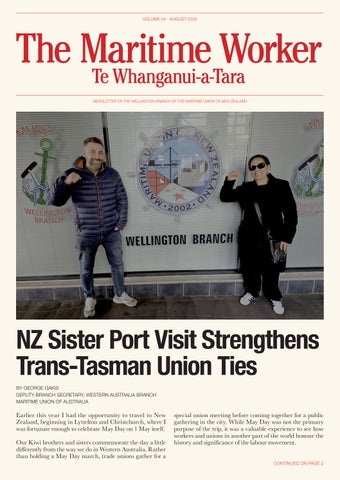
NZ Sister Port Visit Strengthens Trans-Tasman Union Ties BY GEORGE GAKIS DEPUTY BRANCH SECRETARY, WESTERN AUSTRALIA BRANCH MARITIME UNION OF AUSTRALIA
Earlier this year I had the opportunity to travel to New Zealand, beginning in Lyttelton and Christchurch, where I was fortunate enough to celebrate May Day on 1 May itself. Our Kiwi brothers and sisters commemorate the day a little differently from the way we do in Western Australia. Rather than holding a May Day march, trade unions gather for a
special union meeting before coming together for a public gathering in the city. While May Day was not the primary purpose of the trip, it was a valuable experience to see how workers and unions in another part of the world honour the history and significance of the labour movement. CONTINUED ON PAGE 2
CONTINUED FROM PAGE 1
The main focus of the visit was attending events commemorating the 1951 Lyttelton Waterfront Lockout, one of the most significant industrial disputes in New Zealand’s history. The dispute lasted 151 days and saw waterside workers locked out in a bitter confrontation that shaped New Zealand’s union movement for generations. The commemorations were both moving and impressive. Descendants of workers involved in the dispute were present alongside local community members whose families still remember the hardship and sacrifices that resulted from the lockout. Stories were shared about the determination and resilience shown by waterside workers and their families during a period when many endured severe financial and social hardship in defence of their rights and union principles. As part of the festivities, I was fortunate to hear Adam McGrath perform. Adam has built a strong following through his Irish folk and country-inspired music, much of which draws heavily on working-class and union themes. His recent success saw him reach number one on the New Zealand album charts. I cou ld n’t r ecom mend h i s music highly enough, with On the Beach and Stand Up Fight Back being two standout tracks in my view, from his latest album – Wrecker.
FROM CHRISTCHURCH TO WELLINGTON Following Christchurch, I travelled to Wellington where I was fortunate enough to sit in as an observer at the Maritime Union of New Zealand (MUNZ) National Council meeting. I was also given the opportunity to address the Council and provide a report on developments within the offshore oil and gas industry in Australia. Importantly, while in Wellington I spent time with MUNZ Assistant National Secretary and Wellington Branch Secretary Fiona Mansell.
For those who may not know, the WA Branch has had a Sister Port arrangement with the Wellington Branch for some years. This relationship has proven invaluable, and Wellington remains our primary point of contact whenever assistance is required with crewing vessels operating between our two countries. Some of the discussions I had with Fiona included the demand for seafarers in both Australia and NZ and how we can work better together in assisting each other. We also discussed whether additional Kiwi crew may be required to work in Australian waters. At this stage we are tracking well, and given the industry is picking up in mid-to-late 2027 there may be a need to call upon them again then. A key focus of our conversations was ensuring that both unions continue working together to protect employment opportunities for each of our respective members first and foremost. I would like to sincerely thank MUNZ National Secretary Carl Findlay, National President Josh Greer, and Fiona Mansell. Not only did they extend the invitation for us to visit New Zealand, but they welcomed us with open arms and demonstrated the solidarity that exists between our organisations. MUNZ leaders are strong supporters of the MUA and remain committed to strengthening the relationship between our unions. The visit reinforced the importance of maintaining strong international union relationships and highlighted the many common challenges faced by maritime workers across our region. We look forward to welcoming our Kiwi comrades to Western Australia later this year and continuing to build on the strong partnership between our two unions.
THE VISIT REINFORCED THE IMPORTANCE OF MAINTAINING STRONG INTERNATIONAL UNION RELATIONSHIPS.
The Strait Shipping NZ Picton and Wellington Terminals Collective Employment Agreement was ratified on 5 August. Pictured are some of our Picton members. I would like to acknowledge our new delegate Marina Lambert who is showing huge potential in organising and communicating with her members in Picton. Thanks to Paul Stewart for his support and input during these negotiations. We all worked well together as a team and got the business done.
MUA and MUNZ united at the MUNZ June 2026 National Council. From left: Gerard Loader, Josh Greer, Warren Smith, Fiona Mansell, Carl Findlay, Jake Field, George Gakis and Ian Bray.
Wāhine Collective Power Network Launch BY FIONA MANSELL
On Wednesday 29 July Annette McCauley and I attended an important event for all wāhine in Tāmaki Makaurau and Aotearoa. The launch of the Wāhine Collective Power Network was both a celebration and a public declaration that the members of this group are committed to building longterm collective power for wāhine in the city. The wāhine who spoke and shared their stories on the evening spoke with grace, strength, power and conviction. They brought their authenticity and lived experience to this launch. They set the tone for the relational power that has been built over the past eight months, and the power was visible throughout the entire meeting. I was super impressed by how well organised the event was. It was run by all the facilitators, scribes, committee members, and everyone who helped with logistics and setup. We were warmly welcomed and instantly felt at home.
Towards the end of the event, we heard from wāhine leaders working in and alongside our public health system and Te Ohu Tāmaki Health and Care. Later that evening we stood in solidarity with Health and Care Support Workers and all healthcare professionals, calling for pay equity, improved working conditions, and recognition of the vital work they do for our communities and whānau, alongside more than 1,200 community members from across the Te Ohu Tāmaki alliance and the wider public. I was proud to see one of our younger members, Renee Nepia, a Local 13 co-chair and proud MUNZ member, represent our union on stage before a strong crowd of 1,200. It was a great evening, with both events drawing a good turnout.
VICTORY AT LYTTELTON: WORKERS AND COMMUNITY CRUSH PRIVATISATION PUSH In a massive victory for port workers and the Christchurch community, Christchurch City Holdings Limited (CCHL) has confirmed it will not progress an unsolicited proposal to privatise operations at the Port of Lyttelton. The proposal from the ‘Tōnui’ consortium – made up of Dubai-based multinational DP World and three local rūnanga – would have seen operations at the South Island’s largest port handed over to a multinational operator under a long-term lease. The Maritime Union of New Zealand (MUNZ) and Rail and Maritime Transport Union (RMTU) have welcomed the decision, which followed weeks of intense campaigning by port unions, community groups, and local residents. MUNZ Lyttelton Branch Secretary Gerard Loader says the rejection of the bid is a major win for the workforce and the wider Canterbury region. “This proposal was privatisation by stealth. Handing over day-to-day operations to a global port operator like DP World would have put profits ahead of our community, our workers, and our supply chain,” Mr Loader says. “Our members, along with the community and local representatives, sent a very clear message: our port is not for sale, and it is not for lease.” “We have absolute respect for our local rūnanga, but partnering with a global corporate giant known for aggressive anti-worker practices was the wrong path. “This decision protects local jobs, protects health and safety, and ensures that the wealth generated by our port stays right here in Christchurch.”
CTU Komiti Pasifika Biennial Fono 2026 BY TERESA THORPE
The purpose of the lalaga/weaving Kaupapa within the Our Strength Komiti Pasifika Biennial Fono is to bring our communities together around shared values, cultural knowledge, advocacy, and the power of our collective voice. Lalaga reminds us that every strand has a place and that strength is created when we are connected. In the same way, our communities are strengthened when we stand up for what matters, organise together with purpose, and take part in decisions that affect our families and future generations. Voting is one important way we advocate for our people: our vote counts, and when we participate, we help ensure Pasifika voices are seen, heard, valued, and represented. This Kaupapa honours our heritage while encouraging our communities to be active, informed, and confident in shaping the future we want for our families, our communities, and the generations to come.
PAY EQUITY, VOTING AND ADVOCACY The pay gap experienced by Māori and Pasif ika communities is more than a workplace issue; it is a community wellbeing issue. When our people are underpaid, undervalued, or held back from fair opportunities, the impacts are felt across families, churches, villages, workplaces, and future generations.
Voting and advocacy are ways we can respond collectively by supporting leaders, policies, and systems that promote fair pay, pay transparency, safe workplaces, and pathways into leadership. Just as lalaga brings many strands together to create strength, our voices, votes, and actions can be woven together to challenge inequity and push for a future where Māori and Pasifika workers are valued fairly for their contributions. A reported 35% pay gap between Māori and Pasifika women and their Pākehā counterparts is neither good nor fair.
LEGACY OF THE POLYNESIAN PANTHERS This was one of my favourite presentations, and to get to meet them was a privilege. They were funny. They are amazing people and they began their journey at 16 or 17. As teenagers they saw something wrong and they made a difference. Did they suffer? Yes. It wasn’t an easy ride; they faced many challenges, even from within their own community, but they had faith that what they were doing was right. The Polynesian Panthers are a reminder to all of us that advocacy is not new for our communities. Their work provides practical examples of what collective action can look like when people organise around justice, dignity, and community wellbeing. CONTINUED ON PAGE 7
CONTINUED FROM PAGE 6
• They challenged the Dawn Raids and spoke out against racism, discrimination, and unfair policies that were targeting Pacific families. • They supported families through legal advice, tenancy advocacy, and action against unlawful evictions. • They created homework centres and shared political education so young people and communities could understand their rights. • They organised food co-operatives, community events, and practical support for families experiencing hardship. • They used peaceful protest, public meetings, and community organising to push for safer housing, fair treatment, and respect for Pacific and Māori communities. These examples connect directly to current advocacy. Today, our communities continue to organise for fair pay, safe workplaces, education, housing, health, representation, and policies that protect our families. Voting is one way to continue this legacy: it helps us support decisions and leadership that reflect our needs, our values, and our communities.
I would like to acknowledge and thank the MUNZ Wellington Branch for the opportunity to be in this space, to share in this Kaupapa, and to stand together in support of our Pasifika communities. We appreciate the chance to contribute, connect, learn, and continue weaving our voices together for advocacy, equity, and collective strength. As I close, I reflect on how fortunate I am to be a member of MUNZ. That privilege reminds me that our strength does not lie in standing alone, but in standing together. We must continue to support other unions who are fighting for the livelihoods of their members, their whānau, and their communities. Whether it is for fair pay, safe workplaces, dignity, or representation, their struggle is our struggle. When we stand in solidarity, we become stronger, our voices become louder, and our collective power grows. Just as in lalaga, every strand matters. Together, we weave a stronger future for all working people.
The Fight for Kiwi Seafaring: Holcim Broke the Law Over MV Buffalo Job Cuts The Employment Relations Authority (ERA) has delivered a clear verdict against Holcim, ruling the company broke the law and breached our collective agreement when it moved to cut 32 Kiwi seafaring jobs off the Timaru-based cement ship MV Buffalo.
The company decided to dump an extra 15,000 tonnes of cement onto our highways each month, adding more than 500 truck trips alongside rail and piecemeal barge runs, before quietly selling the Buffalo off to China right before New Year.
The trouble kicked off when Holcim tried to replace the MV Buffalo with the Panamanian-f lagged NACC Vega, an overseas vessel operated by NovaAlgoma and crewed by low-paid international workers on inferior conditions.
The Maritime Union of New Zealand (MUNZ) took Holcim to the ERA, securing an urgent pre-Christmas injunction that stopped the layoffs in their tracks. In its full decision, the Authority criticised the company for keeping the crew in the dark and running a sham consultation over the holiday shutdown.
That scheme fell flat when Associate Transport Minister James Meager enforced New Zealand maritime rules and turned down the company’s bid for a coastal shipping exemption. Instead of sitting down with the union to work out a genuine solution for the local crew, Holcim pulled a road freight bluff.
Because the ship had already been sold and sailed away, the Authority could not force Holcim to keep the vessel on the run, meaning the redundancies will go ahead. However, taking this fight to the wire made a difference on the ground. Our legal stand kept crew members on full pay while the case was argued, and
MUNZ is now working to ensure every member gets what they are owed. The dispute also drew solid backing from abroad. When Holcim refused to sign a commercial deal for a replacement ship run under New Zealand union terms, international transport unions at an ITF meeting in the Netherlands passed a formal resolution to put pressure directly on Holcim’s headquarters in Switzerland. While Holcim struggles to service its customers by road in an embarrassing display of corporate bungling, MUNZ is keeping the pressure on. This fight has always been about more than just one ship. It is about stopping multinational companies from undercutting local conditions, keeping maritime skills in New Zealand, and demanding that cargo moving along our coast stays in the hands of skilled Kiwi seafarers.
MV MOANA CHIEF WITHDRAWAL FROM SERVICE
The recent withdrawal of the MV Moana Chief, the last New Zealand-flagged, Kiwicrewed container ship operating on the domestic coast, shows the vulnerability of New Zealand’s maritime industry and supply chains. Under section 198 of the Maritime Transport Act 1994, foreign-flagged vessels operating under temporary exemptions continue to undercut local operators through low wages and lax labour standards. MUNZ is lobbying the Government for immediate legislative reform to restore the New Zealand shipping industry to its rightful place as a key transport mode. Protecting domestic coastal shipping requires a level playing field in which local carriers are not squeezed out by flag-of-convenience operators. A resilient island nation demands an active New Zealand-flagged merchant fleet crewed by trained New Zealand seafarers.
NZCTU Out at Work Rainbow Voices BY JACOB CALVERT
Kia ora, comrades. Early in July, I was given the opportunity to attend the NZCTU Out at Work Rainbow Voices Conference. As an openly gay seafarer, I jumped at the chance because I believe this is an area in which MUNZ can improve. I would like to extend a huge thank you to the Wellington Branch for helping MUNZ representatives attend the conference. The topics discussed included trust and democracy, the Reimagining Aotearoa Together campaign, rainbow issues in Aotearoa, youth participation in unions, and intersectionality within the rainbow community. Many of these subjects affect not only the queer community but the wider union movement as a whole. Our f irst speaker was Rachel Mackintosh, Vice-President of the NZCTU. Rachel spoke about what democracy is, its many failings, and what it should aspire to be.
We all know what it feels like to be let down by a government we did not vote for. That feeling has become commonplace since the last election. Broken trust and shattered promises are also deeply felt within the rainbow community. The narrative of acceptance appears to be shifting towards hostility over aspects of ourselves that we cannot change. A quote from the miniseries Tip Toe sums this up well: “But they tricked us, didn’t they? They just waited. Oh, they let us all come out. So now we’re standing in the open, ready for them to shoot us down … I used to walk into a room and just go, ‘Ta-da!’ Now I tiptoe, just in case.” This leads to one of the main points from Rachel’s presentation: our own “tiptoe stories.” How often do we have to tiptoe around our co-workers, friends, or even our families? We tiptoe around who we
are, who we want to be, and who we are meant to be. It also raises an important question for all of us: How many members feel they have to tiptoe around you? Our second speaker was Melissa Ansell-Bridges, Secretary of the NZCTU, who spoke about the Reimagining Aotearoa Together campaign. We had some valuable discussions about what we want the future of Aotearoa to look like and where our communities fit within that future. We also discussed the importance of continuing to place pressure on those in power. The previous Labour Government moved too slowly on several key initiatives during its six years in office. Working people now have less economic power than they did in the 1980s, and our purchasing power is far weaker than it should be. CONTINUED ON PAGE 11
CONTINUED FROM PAGE 10
A change of government alone will not solve these problems. The union movement must continue organising, campaigning, and demanding better outcomes for working people. We then heard from a political panel featuring Green Party MPs Dr Lawrence Xu-Nan and Ricardo Menéndez March. This was a particularly interesting session, as we discussed many of the political issues currently facing the rainbow community in Aotearoa New Zealand. These issues are not exclusive to rainbow communities. They affect people throughout the country. The current Government has angered and alienated many different groups and communities. We need to come together, acknowledge our differences, and refuse to allow those differences to divide us. When we are united, we are strong and capable of creating meaningful change. This brings to mind a quote from the Disney film A Bug’s Life: “You let one ant stand up to us, then they all might stand up! Those puny little ants outnumber us a hundred to one, and if they ever figure that out, there goes our way of life!” Many of the issues we face when dealing with companies and governments are not simply about pay or limited budgets. They are also about keeping workers in their place—divided and too busy fighting among themselves to realise what we can achieve when we stand together. Xavier Walsh, Co-convenor of the Stand Up NZCTU Under 35 Network, spoke next about youth engagement in unions. As we know, it can be difficult to encourage young people to become active members of MUNZ. However, the question should not simply be: How do we attract young workers? Instead, we should ask: What kind of union movement are we building that young
workers would want to join, participate in, and help improve? Why would young people want to be actively involved in a union that they feel represents only part of who they are—especially when their main interaction with the union is seeing a deduction on their payslip? How can we change this perception and show young workers the value of belonging to and participating in their union? Over the past few years, the Wellington Branch has made great progress in this area. The support we have received from our branch leadership to establish a rainbow committee has helped us move towards genuine representation for all MUNZ members. However, there is still a long way to go. We then heard from a panel discussing intersectionality within the rainbow community. Intersectionality is a framework that helps explain how different aspects of a person’s identity— such as race, gender, class, sexual orientation, and disability—interact to create overlapping experiences of discrimination, disadvantage, or privilege. This can be a sensitive and challenging topic, and discussions can sometimes descend into arguments about whose hardship or discrimination is worse. However, it is important to remember that everyone faces their own challenges and may experience discrimination in different ways. None of us can be defined by just one aspect of who we are. By being open to discussing and learning about the experiences of others, we often discover that our identities and experiences overlap. In many cases, we have far more in common than we initially realised. The final panel explored what it means to be takatāpui and how unions can better support takatāpui members.
The speakers described takatāpui as an identity that brings together Māori, queer, cultural, and spiritual experiences. For many, embracing the term is part of reconnecting with their culture, decolonising their lives, and finding a sense of belonging and pride. A key message was that our struggles are connected. Māori liberation cannot happen without the liberation of queer, transgender, disabled, working-class, and other marginalised communities. We can support takatāpui members by challenging discrimination while also creating space for their voices to be heard. Takatāpui must be recognised as an important and distinct part of Aotearoa’s LGBTTQIA+ communities. The message was clear: listen, create space, challenge discrimination, and use your influence to uplift others. Overall, I am extremely grateful to have had the opportunity to attend the Rainbow Voices Conference and to hear from such a wide range of speakers and union members. I came away with a much greater understanding of the challenges facing rainbow, takatāpui, and other marginalised workers, as well as the important role unions can play in creating meaningful change. The conference reminded me that genuine representation requires more than words. It requires us to listen, challenge discrimination, create space for different voices, and ensure all members feel valued and able to participate. There is still plenty of work ahead of us, but I returned from the conference feeling hopeful about the future of MUNZ. By continuing to learn, working toget her, a nd suppor t i ng t he involvement of all our members, I believe we can build a stronger, more inclusive union that truly represents everyone.
WHEN WE ARE UNITED, WE ARE STRONG AND CAPABLE OF CREATING MEANINGFUL CHANGE.
MUNZ AFFILIATES TO ALLIANCE PARTY
From left: MUNZ National Vice President Gerard Loader, MUNZ National President Josh Greer, MUNZ Assistant National Secretary Fiona Mansell, Alliance Party Leader and MUNZ Communications Officer Victor Billot, and MUNZ National Secretary Carl Findlay
In an unprecedented advance for the political left in New Zealand, the Alliance Party has officially welcomed the formal affiliation of the Maritime Union of New Zealand (MUNZ).
Mr Billot says the Alliance will be campaigning in 2026 on economic resilience, infrastructure and KiwiWorks, a 21st-century Ministry of Works, all focused on supporting working people and their families.
The historic decision, formalised by the MUNZ National Council on 3 June in Wellington, unites one of the country’s most iconic and effective trade unions with the Alliance Party.
He says the Alliance will also prioritise revitalising New Zealand shipping and rail, and keeping ports and infrastructure in public ownership.
Alliance Party Leader Victor Billot described the affiliation as a massive step forward for working-class politics in New Zealand. Mr Billot is also the long-standing Communications Officer for the Maritime Union of New Zealand.
“This affiliation is an acknowledgement of the MMP environment, and the Alliance is committed to working with other opposition parties to remove the Coalition Government.”
“The affiliation of the Maritime Union to the Alliance is a game changer for the 2026 election and going forward, for advancing an uncompromising working-class voice in New Zealand politics.”
The Maritime Union will maintain its long-standing affiliation to the New Zealand Labour Party.
“MUNZ has a proud, unbroken history, and this step aligns perfectly with the Alliance’s constitutional objectives of the democratic socialist principles of democracy, equality, and social ownership.”
LABOUR PARTY BACKS NEW SHIPPING POLICY
Promoting New Zealand shipping at the 2026 Labour Party Conference. From left: MUNZ National Secretary Carl Findlay, MUNZ Wellington Branch President Marian Lesslie, and MUNZ Assistant National Secretary and Wellington Branch Secretary Fiona Mansell
OUR ECONOMIC LIFELINE
A MAJOR SECURITY RISK
New Zealand relies entirely on sea freight for survival, yet we have no national ports plan and no strategic shipping fleet of our own.
Global conflicts, pandemics, or trade disputes could see foreign ships vanish overnight, leaving our ports empty, shelves bare, and industries shut down.
UNBALANCED FUNDING
THE SOLUTION
Domestic coastal shipping receives zero transport budget funding, while road freight gets billions. This forces cargo onto roads, causing congestion and safety risks, and pushing our emissions higher.
The next Labour-led government will build a New Zealand-flagged coastal fleet. This ensures crews earn local wages, companies pay local taxes, and our ports serve national interests first.
EXPLOITING THE SYSTEM
THE BENEFITS
Foreign ships carry most of our domestic sea freight. They are completely exempt from New Zealand taxes, emissions regulations, and fair wage requirements.
Investing in our own supply chain means greater economic resilience, fewer trucks on the road, lower emissions, cheaper transport costs, and more local jobs.
OCEANMASTER – SEAFARER SOLIDARITY
BY GRAHAME MCLAREN ITF INSPECTOR NEW ZEALAND
In the maritime industry, “company policy” is often used as a shield to hide poor conditions. Recently, in Wellington Harbour, the crew of the bunker barge Kokako proved that no amount of corporate deviousness can stifle the spirit of seafaring solidarity. The vessel in question, Oceanmaster, is managed by the notoriously anti-ITF Oceanstar Management Inc. of Athens. It arrived in Wellington in December to take on bunkers at anchor. We had already been alerted by our Dutch affiliates that the master had strict instructions to deny all access to the ITF. Knowing the gangway would be barred, I contacted Peter Torrance, a MUNZ member, ITF representative, and crewman on the Kokako. What followed went well beyond the call of duty. The Kokako crew chipped in to buy a massive haul of goodies, supplemented by a care package from the local Seafarers Centre. When the Kokako pulled alongside the Oceanmaster, the reception from the bridge was predictably icy. The captain sent down a formal document stating that “no goods were to be exchanged” between vessels. The Kokako’s Chief Officer refused to sign the document.
Defying the spirit of the captain’s order, the gifts, along with a stack of ITF contact cards, were passed up to the Oceanmaster crew, who were visibly thrilled by the gesture. While the crew appeared genuinely happy during their chat with Peter, a darker reality simmered beneath the surface. When asked about the union, the crew’s demeanour shifted instantly. The crew members exchanged furtive glances, then whispered to Peter: “No, no unions.” Despite the company’s claims, the numbers tell a different story. While an AB’s wage was quoted at US$1,400 per month with a meagre 1 GB of free internet, our Dutch affiliates have confirmed that actual wages on board sit well below ILO minimums. The ITF exists to ensure that no seafarer is left isolated. Following this encounter, an official complaint was lodged with Port State Control (PSC) regarding the ILO minimum wage breaches. Furthermore, we have joined our Dutch affiliates in demanding that Oceanstar Management install an ITF Collective Bargaining Agreement (CBA) across their fleet. I cannot praise the crew of the Kokako enough. Their actions were a brilliant display of solidarity toward our international seafaring brothers. They proved that even when a company tries to lock the door, the maritime community will always find a way to look out for its own.
MUNZ women representing our union at the WIMDOI 2026 Conference in Rotorua. WIMDOI stands for Women in Male-Dominated Occupations and Industries.
Aboard the Kaiarahi
LEADING IN CAMPAIGNS TRAINING BY EILISH WHEELER CABIN ATTENDANT AND MUNZ DELEGATE
We learned how to connect to people and build a community by talking face to face, that we are better together not only in our union but all unions when we come together.
On Tuesday 12th of August, I attended the Leading in Campaigns Delegate Training along with several other MUNZ members. I highly recommend anybody taking part in this as it was amazing to listen to and learn from others.
We spoke about the issues we all face and what causes these issues and how to start making a plan to change these to make a better outcome for the working people and how to go about getting more people to join the union movement.
There was a lot of learning and listening amongst ourselves and Workers First Union who attended with us. Hearing about what they are struggling with, helped validate our feelings in that we could relate to a lot of the issues happening to all of us right now.
It was very empowering and lights a fire to fight for better together. I’d like to thank the Wellington Branch for letting me attend and giving me this opportunity, I will be using what i have learned today in the future for upcoming and new members that come onboard.
MUNZ Welcomes Decision to Keep Interislander Operations in Public Hands The Maritime Union of New Zealand (MUNZ) has welcomed an announcement confirming that the operation of the Interislander ferry service will remain in public hands. Maritime Union National Secretary Carl Findlay says the decision represents basic common sense for the country’s transport network. “This is critical economic infrastructure that must be managed in New Zealand’s interests, not in the interests of an offshore multinational,” says Mr Findlay.
Aboard the Tangaroa
“Minister for Rail Winston Peters has made it clear that these assets should work for Kiwis. That this outcome has been salvaged from the pro-privatisation cancellation fiasco created by Nicola Willis shows what a steady hand and a sensible approach can achieve.” “We look forward to ensuring our members’ role in achieving this outcome and supporting KiwiRail’s business turnaround is fully recognised in our upcoming negotiations with KiwiRail next month,” Mr Findlay says.
Enrol. Vote. Be heard. vote.nz
0800 36 76 56
SHP-030-ENG
National Office Contacts Telephone Mail Address Physical address
04 385 0792 PO Box 27004, Wellington Level One, Waterside House, 220 Willis Street, Wellington
Carl Findlay National Secretary
021 760 887 carl.findlay@munz.org.nz
Josh Greer National President
027 348 2692 josh.greer@munz.org.nz
Fiona Mansell Assistant National Secretary
021 573 244 fiona.mansell@munz.org.nz
Gerard Loader National Vice President
021 128 6236 gerard.loader@munz.org.nz
Ramesh Pathmanathan Office Manager
021 260 4895 ramesh@munz.org.nz
Albert Williams Senior Admin Support
021 973 561 albert.williams@munz.org.nz
Grahame McLaren ITF Inspector
021 292 1782 mclaren_grahame@itf.org.uk
Victor Billot Communications Officer
022 479 1786 victor.billot@munz.org.nz
Wellington Branch Contacts Mail address: Physical address:
PO Box 286, Wellington 6140 Shed 21, 28 Waterloo Quay Unit 1.05, Wellington 6140
Fiona Mansell Secretary
04 385 9288 | 021 573 244 fiona.mansell@munz.org.nz
Marian Lesslie 027 458 3823 President mazza1901@windowslive.com Paul Baggott Vice-President
027 688 8002 paulsown@hotmail.com
Bradley Clifford Ports – Executive
021 176 5928 bradleyclifford@msn.com
Jason Penny Ports – Executive
021 537 287 jaypndawhare@gmail.com
Les Taylor Executive
021 084 58585 taylorles2719@gmail.com
Andy Joyce Executive
022 410 1457 andyatalice89@hotmail.com
Quintin Kerr Executive
021 460 934 qpkerr@gmail.com
Lynette Payne Executive Megan Rush-Reed Women’s Representative Executive
027 2222 101 megz.rushreed@gmail.com
Maree Griffiths Youth Representative Executive
022 0 0796 834 mareerata.griffiths@gmail.com
Mick Williams Veterans
AUTHORISED BY CARL FINDLAY, 220 WILLIS STREET, WELLINGTON
027 355 9080 awaywiththeferries@hotmail.com
022 309 8959 Mickwilliams10@gmail.com
WWW.MUNZWELLINGTON.NZ