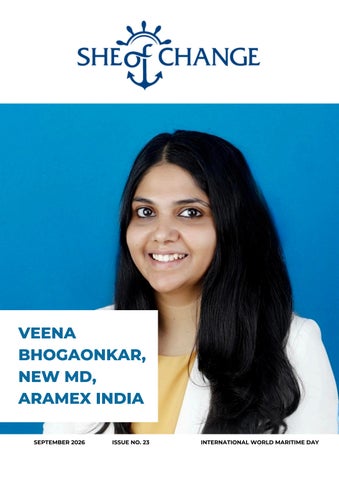
VEENA BHOGAONKAR, NEW MD, ARAMEX INDIA SEPTEMBER 2026
ISSUE NO. 23
INTERNATIONAL WORLD MARITIME DAY
FROM THE FOUNDER World Maritime Day has always been more than a date on the maritime calendar. It is an opportunity to pause, reflect on how far our industry has come, and ask a more important question: what are we going to do differently next? This year’s International Maritime Organization theme, “From Policy to Practice: Powering Maritime Excellence,” speaks directly to the moment our industry finds itself in. Maritime has never lacked ambition. We have regulations, conventions, strategies, targets and commitments. But the real measure of progress is not what we write, announce or promise. It is what happens on the ship, in the port, in the boardroom, in the classroom and in the everyday experiences of the people who make this industry work. And that is where women and inclusion matter. For years, we have spoken about
She of Change | Issue 23
bringing more women into maritime. Today, that conversation must evolve. It is no longer enough to ask how many women have entered the industry. We must ask: Are they being given meaningful opportunities? Are they being heard? Are they progressing? Are they leading? And are we changing the systems and cultures that determine who gets to stay, succeed and shape the future? Policy becomes practice when a woman cadet steps confidently onto her first vessel because she knows she belongs there. It becomes practice when a shipping company provides PPE that actually fits her, when a seafarer can access
meaningful wellbeing support, and when harassment is challenged rather than normalised. It becomes practice when a young professional is sponsored for a leadership opportunity, when an experienced leader consciously makes space for the next generation, and when organisations measure progress not simply by recruitment numbers but by retention, advancement and representation in decision-making. It becomes practice when technology, decarbonisation and innovation open new doors rather than creating new barriers. And it becomes practice when we stop treating diversity as an initiative sitting alongside the business and recognise it as part of how a highperforming maritime industry must operate. That is what I see in this edition of She of Change. Across these pages are women seafarers finding their voices, leaders challenging assumptions, cadets
She of Change | Issue 23
imagining new futures, professionals working on decarbonisation and sustainability, and people across shipping, ports, logistics, education and maritime services who are quietly — and sometimes very loudly! — changing what is possible. Some stories are about overcoming barriers. Others are about leadership, innovation, motherhood, technology, sustainability and ambition. Together, they tell a bigger story: change is no longer an abstract idea in maritime. It is being built by people, one decision, one opportunity and one courageous step at a time. This is also why She of Change exists. We created this platform not simply to celebrate women, but to make their journeys visible, connect their experiences, challenge the assumptions that hold people back, and inspire action. As we mark World Maritime Day 2026, I hope this edition reminds us that excellence and inclusion are not competing ambitions. They strengthen each other.
The maritime industry we want tomorrow will not be created by policy alone. It will be created by the choices we make today — by leaders who act, organisations that invest, mentors who open doors, allies who speak up, educators who expand horizons, and women who continue to step forward and claim their space. So let us move beyond celebrating change. LET US PRACTISE IT. Because the future of maritime will not simply belong to those who can navigate change. It will belong to those who are willing to CREATE IT. With purpose, courage and optimism,
Founder, Maritime SheEO and She of Change magazine
She of Change | Issue 23
FROM THE EDITOR Dear Friends, This edition of She of Change is a special issue to commemorate World Maritime Day. It highlights accomplished women maritime professionals who have demonstrated remarkable courage and determination while navigating industry obstacles and establishing themselves as capable contenders for senior leadership roles. Our cover story features Veena Bhogaonkar, the newly appointed Managing Director of Aramex India, who shares her compelling professional journey and key leadership insights. Many organizations, institutions, and companies are actively championing and promoting women seafarers through comprehensive diversity and inclusion initiatives. We present reports from select organizations whose mentoring, educational support, and professional development programs for women
She of Change | Issue 23
seafarers and cadets have driven meaningful progress within the Maritime Industry. This edition further incorporates reports that assess sustainability initiatives within the shipping sector, and firsthand accounts from women seafarers who have completed the Seaspan LEADS Program, which has strengthened their leadership capabilities and confidence. Our signature columns, including Impostor Syndrome Effect, Sea Stories, and other engaging articles offering practical guidance and motivation, are featured in this issue. Before signing off I would like to wish all shipping professionals a Happy World Maritime Day.
Loretta Fernandes Editor of She of Change
Table of Contents 8 14
SEVEN YEARS IN, AND THE BEST ONE IS STILL AHEAD Cover Story
WOMAN AT THE HELM Veena Bhogaonkar
27
BUILDING THE RIGHT ENVIRONMENT AT SEA
30
SHE SAILS AGAINST THE TIDE
31 34 37 39 41
Fleet Management Limited
Dr. Shobha K V.
The Imposter Syndrome Effect
YOU BELONG AT THE HELM: PRESENTING WITH CONFIDENCE IN SENIOR CIRCLES Mônica Zionede Hall
IN PARTNERSHIP WITH CHANGE MOL Maritime (India) Pvt. Ltd.
NAVIGATING WAVES: MOTHERHOOD, RESILIENCE, & COLOMBIAN LEADERSHIP Laura Juliana Urrego Franco
EMPOWERING WOMEN TO SHAPE THE FUTURE OF MARITIME Seaspan
WHEN “CONCERN” BECOMES A CEILING FOR WOMEN IN MARITIME Dr. Akanksha Batura Pai
6
44 47 50 54 58 61 64 74 78 87
CHARTING THE DIGITAL HORIZON: TRANSFORMING SEAFARER EXCELLENCE AND OPERATIONAL SAFETY VR Maritime Services
WOMEN AT THE HELM: DRIVING SUSTAINABLE MARITIME LOGISTICS & GREEN PORT DEVELOPMENT Dr. Shobha K V.
ONCE BARRED FROM THE SEA, NOW SHAPING IT: WHERE IMU-KOLKATA KNOWS NO GENDERED HORIZONS Sustainable Horizons
THE WAY TO WIN IS TO SHARE TO SCALE Sofia Fürstenberg Stott
IS THE SCRUBBER ECO-FRIENDLY ENOUGH FOR THE FUTURE? Thadisha Dilmini Jayamaha
CHARTING HER COURSE: NIHARIKA SHARMA - EARLY CAREER AT SEA International Maritime Institute
STORIES FROM FUTURE LEADERS Seaspan LEADs Program
MARITIME REGULATION IN LATIN AMERICA Maria Cecilia
LEADING BEYOND THE HORIZON Chief Officer Deniz Arslan Bayrakdar
FROM CONVERSATION TO ACTION: BUILDING A GLOBAL COMMUNITY FOR CHANGE IN PORTS Women in Ports
7
Seven Years In, and the Best One Is Still Ahead Maritime SheEO Conference 2026 · 22nd October · JW Marriott Sahar, Mumbai
Seven editions. And seven times, the maritime industry's most tenacious, most brilliant, most unapologetically ambitious women have walked into a venue in Mumbai and refused to leave without having said something that mattered. The 7th Maritime SheEO Conference is scheduled for 22nd October 2026 at JW Marriott Sahar. This year the theme cuts right to the chase: She Owns. She Builds. She Invests. Ownership. Building. Investment. Three words that describe what the women of this industry have been doing all along, often without the recognition, often without the platform, and always with the conviction that the
She of Change | Issue 23
8
work matters. This conference exists to say that we see it, celebrate it, and we are going to keep making space for it.
A Day Built Around Real Conversations The Leaders Forum opens with five keynotes from some of the most respected voices in global maritime, before moving into the heart of the day, curated panels on ownership, leadership, investment, and what it means to build something lasting in an industry that is changing at speed. A Dedicated Woman in Ports’ panel brings focus to the operational backbone of global trade. A bilateral fireside conversation offers a global lens on where the industry is headed and what it will take to get there. The SheEO Rapid Fire Round closes the afternoon fast, candid, and is always the session that people quote about long after the day is over.
She of Change | Issue 23
9
The Students Take the Stage Running in parallel is a full program for maritime students and early career professionals; one that has grown into one of the most energetic parts of the entire day. It begins with the Student Debate Finals. Teams from maritime institutes across India and beyond spend weeks competing in online rounds, and the grand finale happens live on the Maritime SheEO stage. It is competitive and has produced some genuinely remarkable arguments from young people poised to reshape this industry. After the debate, the Ultimate Maritime Quiz tests speed and knowledge in equal measure. Then comes the Gear Challenge, a timed PPE race that is safety awareness dressed up as pure competitive chaos, and one of the funniest fifteen minutes of the day. The student program closes with an early-career panel, where professionals a few years into their careers speak with the kind of candour that tends to inspire young people long after the conference is over.
She of Change | Issue 23
10
AnchorCon: Where Maritime Law Gets Its Moment The afternoon brings AnchorCon, a dedicated legal and compliance forum that tackles the issues keeping maritime lawyers up at night. Shadow fleets, Secondary sanctions, The legal and commercial implications of the IMO Net-Zero Framework. These are the conversations that shape how the industry operates, and they deserve a serious forum and AnchorCon provides exactly that.
The Awards: Twenty-One Reasons to Believe in This Industry The evening belongs to the Maritime SheEO Awards 2026. Twenty-one categories. Companies that have done the hard work of building truly inclusive workplaces. The rising seafarer making waves in her first years at sea. The entrepreneur who launched something from scratch and made it count. The builder who inherited something and made it stronger. The CXO who leads with vision and without apology. The man who used his influence to lift the women around him. The educator in a maritime institution who is changing what the next generation believes is possible for them.
She of Change | Issue 23
11
More Than Just a Day of Panels Between the sessions, something equally important happens. The well-placed breaks are not simple fillers. They are where a seafarer from Mumbai ends up in conversation with a port executive from Norway. Where someone pitching her startup finds the right ear. A student, who sat nervously through the morning's events, now finds herself being mentored over lunch by someone she had previously only seen on a conference brochure. The Power Lunch presents an hour of food and meaningful conversations and exceptional networking opportunities. For those who want to go deeper, three workshops run through the day in a dedicated breakout space, which is smaller, more intimate, and designed for focused learning that a packed auditorium simply cannot offer. And running through the venue alongside all of this are the partner booths, each one a window into what different organizations are actually doing on diversity, such as the programs, the people, and their work. Walk through them, and you will leave with a clearer picture of where the industry is moving and who is moving it.
She of Change | Issue 23
12
See You in Mumbai The Maritime SheEO Conference has never been just an event on a calendar. It is proof, renewed every year, that this industry is capable of being better, and that the people willing to push for that are showing up in greater numbers, with greater conviction, each time. October 22nd is fast approaching. Make sure you register in advance, nominate someone who deserves the recognition, and come prepared to be a part of something that will outlast the day itself. 22nd October 2026 at JW Marriott Sahar, Mumbai. Register at maritimesheeo.com Partner with us: events@maritimesheeo.com
She of Change | Issue 23
13
Veena Bhogaonkar, Managing Director, Aramex, India
WOMAN AT THE HELM
She of Change | Issue 23
In this interview, we speak with Veena Bhogaonkar, the new Managing Director of India Operations at Aramex, a leading logistics company. Veena shares insights from her extensive logistics career, discussing the challenges she has faced as a woman in the sector. She highlights how her leadership skills, work ethics and integrity have aided her professional growth and current role, offering perspectives on the challenges and opportunities she has encountered. Please read on to learn more about this very interesting interview with Veena.
Congratulations on your new position as Managing Director of Aramex, India. What does taking on the role at this stage of your journey mean to you on a personal level? Thank you. I am a firm believer in the philosophy, “Don’t hesitate to take the next step due to fear of the unknown.”Personally, this role means taking on a new challenge at the right stage of my career— one that gives me an opportunity to grow, learn
15
and diversify my experience further. Every new role comes with a certain amount of uncertainty, but I have always looked at that uncertainty as an opportunity rather than something to be afraid of. Taking on the responsibility of leading Aramex India is both exciting and humbling. It gives me the opportunity to bring together the experiences I have gained across operations, technology, people management and transformation, while also learning from a new set of challenges. For me, leadership is not about reaching a destination. It is about continuously taking on larger challenges, creating value for the organisation and, importantly, creating opportunities for the people around you to grow along the way.
Your career has spanned logistics, supply-chain management, and business transformation. Which experiences or turning points have most shaped the leader you are today? One of the biggest influences on my leadership journey has been the opportunity to work across different regions and very different industries— from IT in South India to logistics in Los Angeles and subsequently logistics in Mumbai. Each experience exposed me to different cultures, working styles, business environments and, most importantly, different kinds of people. That diversity of experience has given me a much broader perspective, particularly when it comes to people and DEI. In logistics, you work with an incredibly diverse workforce. You could be interacting with ground operations teams, loaders and sorters on one end of the spectrum, and seasoned HODs who have spent 20-plus years mastering their functions on the other. You learn very
She of Change | Issue 23
16
quickly that titles and designations matter far less than how you treat people and how you show up every day. Over time, I realised that the things that truly help you build credibility are your work ethic, empathy and integrity. You may have the technology, processes and strategy, but at the end of the day, it is people who make an organisation work. Those experiences have shaped my leadership style into one that is peopleoriented but also very focused on accountability and results.
When you began your career, did you imagine yourself one day leading the India operations of a global logistics company? What changed along the way? It wouldn’t be true if I said I did not imagine it! Dream BIG and believe in myself has always been one of my affirmations, so becoming a leader was always something I aspired to. What changed along the way was not necessarily the ambition, but my understanding of what leadership really means. I learnt to look at the bigger picture rather than getting consumed by individual challenges. I learnt not to let failures affect me for too long and, more importantly, to treat them as learning opportunities. I also learnt the true meaning of teamwork. As you progress in your career, you realise that success is never an individual achievement. Your ability to bring people together, trust your team, develop people and make decisions collectively becomes just as important as your own technical expertise. And then there is logistics itself. It is a field where no two days are the same. There are constantly changing customer expectations, operational challenges,
She of Change | Issue 23
17
market dynamics and new technologies. That unpredictability is actually what keeps me going. There is always something new to solve, improve or build.
As you step into this new role, what are your most important priorities for Aramex India? My priorities are centred around three broad areas—customers, people and transformation. First and foremost, I want us to remain extremely close to our customers and continuously understand how their needs are evolving. The logistics industry is changing rapidly, and customer expectations around speed, visibility, reliability and flexibility are only increasing. We need to remain agile enough to respond to those expectations while continuing to build trust. The second priority is our people. I strongly believe that the strength of any organisation is its people, and our responsibility as leaders is to create an environment where people can perform, grow and take ownership. I want to continue building a culture where people feel empowered to make decisions, challenge the status quo and contribute ideas. The third is transformation—using technology, data and process innovation to improve productivity and operational excellence. But transformation should never be technology for technology’s sake. It has to translate into a better customer experience, stronger operations and better tools for our people. Ultimately, my focus will be on building an organisation that is people-centric, customer-preferred and process- and technology-backed.
She of Change | Issue 23
18
Logistics is being transformed by technology, changing customer expectations and increasingly complex global supply chains. Where do you see the greatest opportunities for innovation? Coming from an engineering background, I see tremendous value in technology and strongly support technology-led enhancements in logistics. We have already made significant progress in areas such as end-to-end visibility, tracking, automation and data-driven decision making. But I believe there is still a lot of room for innovation. One area is deeper integration with government systems, which can simplify processes, reduce manual intervention and make movement of goods more seamless. Cargo handling is another area where automation and technology can create significant operational efficiencies. I also see a lot of opportunity around sustainability—from eco-friendly packaging and smarter route planning to more efficient logistics and warehousing. The future of logistics cannot only be about moving faster; it has to be about moving smarter and more responsibly. The real opportunity is to bring technology, data and human expertise together. Technology should make our operations more intelligent and efficient, while allowing our people to focus on higher-value activities such as problem-solving, innovation and customer relationships.
She of Change | Issue 23
19
You have considerable experience in operational excellence and technology-led transformation. How do you ensure that transformation remains people-centred and does not become only about systems and processes? For me, technology-led transformation is ultimately about enabling people to perform better. When we introduce technology or transform a process, the objective should be to improve productivity, remove inefficiencies and simplify the work our people do. If we can automate repetitive tasks or provide better information and tools, our teams can spend more time on growth, innovation, customer engagement and problem-solving. The “people aspect” can never be replaced. In fact, I believe it is one of the greatest strengths of our organisation At Aramex, we do not look at transformation as something that impacts people; we look at it as something that enables people. Change can sometimes create apprehension, so it is important that leaders communicate the “why” behind the change, involve teams in the journey and ensure that people have the skills and confidence to use new tools and processes. So the vision remains very clear for me: to continue to be a people-centric, customer-preferred and process- and technology-backed organisation.
The movement of goods by sea, air and land is deeply interconnected. On World Maritime Day, what would you like people to understand about the role logistics plays in keeping global trade moving?
She of Change | Issue 23
20
Logistics is the invisible infrastructure that keeps global trade moving. Whether a product travels by sea, air, road or through a combination of all three, there is an intricate ecosystem working behind the scenes to make that movement possible. As someone who has worked across logistics and supply chains, I have seen how interconnected these modes of transport really are. A delay at one point can have a ripple effect across the entire supply chain. That is why coordination, visibility and agility are so important. Maritime transport carries a significant share of global trade, while road and air networks connect that global movement to businesses and consumers. The future of logistics will therefore increasingly be about integrating these different modes rather than looking at them in isolation. On World Maritime Day, I would also like people to recognise the thousands of people working behind the movement of goods—from seafarers and port workers to logistics teams, drivers, warehouse personnel and supply-chain professionals. Global trade may look seamless to the end customer, but it takes an enormous amount of collaboration to make it so.
She of Change | Issue 23
21
Sustainability is becoming central to both maritime and logistics operations. What practical changes do you believe the logistics industry must prioritise over the next few years? Sustainability needs to move from being a strategy document to something that is embedded in everyday operations. There are several practical areas where logistics companies can make a difference. Route optimisation and better load planning can help reduce unnecessary movement and fuel consumption. Warehouses can become more energy efficient, and companies can increasingly explore renewable energy wherever feasible. Packaging is another important area. We need to think about how we can reduce material usage, increase recyclability and move towards more environmentally responsible packaging solutions. At the same time, sustainability should not be looked at only from an environmental perspective. It is also about creating sustainable businesses and workplaces—improving resource efficiency, investing in people and building systems that can withstand future disruptions. The industry has an opportunity to use technology and data to measure our impact much more effectively. What gets measured can be improved, and I believe that is where the next phase of sustainable logistics will come from.
Logistics and supply-chain leadership have traditionally been male-dominated. Have there been occasions when you felt you had to prove yourself differently as a woman, and how did you navigate them?
She of Change | Issue 23
22
I have always been a BIG cheerleader for women in operations. While I agree that the diversity ratio has not yet reached the balance we would like to see in logistics, it is changing rapidly as there is greater awareness and understanding of the business benefits of diversity. When it comes to bias, I think it is also about perspective. For a long time, perhaps the awareness and exposure to logistics as a career option was lacking, and that may have delayed more women from entering the industry. That is changing now. Personally, I have always believed that if you have the necessary qualifications, the passion to build supply-chain solutions, the ability to analyse problems and the willingness to work hard, gender should never become the deciding criterion. I have also learnt that you cannot spend too much time trying to prove yourself. Your work, your consistency and your ability to deliver eventually speak louder than any perception or bias. And perhaps the most important thing is to create the environment where the next generation of women does not feel that they have to prove themselves differently at all.
What can organisations do to move beyond statements on gender diversity and create genuine pathways for women to reach operational and executive leadership positions? The first step is to move from intent to action. Organisations need to look at the entire talent pipeline—not just hiring women, but ensuring that women
She of Change | Issue 23
23
have access to meaningful roles, operational exposure, mentoring, sponsorship and opportunities to take on larger responsibilities. In logistics particularly, we need to make operational careers more accessible and attractive to women. That means looking at workplace infrastructure, safety, flexibility, shift structures and career progression, but it also means challenging some of the assumptions around what roles women can or cannot do. Leadership development is another important piece. Women need access to the same stretch assignments, business-critical projects and decision-making opportunities that create future leaders. Finally, organisations need accountability. Diversity cannot remain a standalone HR initiative. Business leaders need to own it, measure progress and ask themselves whether they are actually creating a pipeline of diverse leaders. When women see other women progressing into operational and executive roles, it creates a very powerful cycle of possibility.
What qualities do you look for when identifying and developing future leaders within an organisation? Other than the non-negotiable factors that I look for—integrity and agility—I believe it is important to evaluate a person's passion, hunger for growth and ability to make independent decisions. Technical knowledge is important, but leadership potential goes beyond functional expertise. I look for people who are curious, willing to learn and
She of Change | Issue 23
24
comfortable taking ownership. I also value people who can handle ambiguity. In logistics, you cannot always wait for perfect information before making a decision. Things move quickly, and leaders need the confidence to assess a situation, make a call and take responsibility for the outcome. And finally, I look at how people treat others. You can be an excellent individual performer, but leadership is ultimately about bringing people along with you.
What advice would you give to young women who want to build careers in logistics, supply chains and global trade—but may not yet see enough women at the top? My advice would be: do not wait to see someone who looks like you before you believe you belong there. The industry is changing, and there are more opportunities today than there were when many of us started our careers. But young women should also be willing to step outside their comfort zones and take on operational roles, challenging assignments and opportunities that may initially seem unfamiliar. Build strong functional expertise, stay curious about technology and understand the business beyond your immediate role. And do not underestimate the importance of relationships. Build your network, find mentors and, equally importantly, become a mentor to someone else as you progress. There will be setbacks. There will be moments when you question yourself. Do not let those moments define your journey. Dream BIG, back yourself and be willing to take the next step even when the path ahead is not completely clear. The fact that there may not be enough women at the top today is not a reason to stop—it is a reason to keep going.
She of Change | Issue 23
25
SPECIAL SEGMENT! What is one leadership lesson you had to learn the hard way? Delegation, I used to feel I could be available for finalizing tasks but as I grew through different profiles, I realised the importance of this!
Who has had the greatest influence on your professional journey? All the women leaders who broke the barriers! What keeps you grounded during demanding periods? Gratitude for what I have achieved and focus on next steps!
What is one assumption about women leaders that you would like to change? To call them “Woman leaders”, it should not be addressed as an exception!
Complete the sentence: “A SheEO is a woman who has power to Dream BIG and resilience to chase those BIG dreams”
She of Change | Issue 23
26
Building the Right Environment at Sea
Fleet Management is proud to serve as the Diversity Sponsor of Maritime SheEO, supporting a platform that shares its commitment to widening opportunity, strengthening inclusion and enabling more women to build rewarding maritime careers. At Fleet, diversity and inclusion form part of the Encompass sustainability strategy, particularly its Safeguarding People and Working Together pillars, while supporting UN Sustainable Development Goals 5, 8 and 10.
Building the Right Environment at Sea
She of Change | Issue 23
27
Fleet Management’s focuses closely on the everyday experiences of women onboard. The organisation provides gender sensitisation training for all seafarers sailing with female officers, promotes equal pay for equal work and targets zero confirmed cases of discrimination or harassment. Practical interventions strengthen this commitment. Women-specific Personal Protective Equipment kit, including specially designed protective footwear, addresses physical requirements that conventional equipment often miss meeting. Fleet also gives female officers direct access to wellbeing managers, dedicated counsellors and in-house clinical psychologists, including pre-joining briefings and 24/7 support when required. Peer support groups create an additional space for women to share experiences, challenges and successes within a supportive environment. Bespoke medical lockers onboard further address women-specific requirements, demonstrating how meaningful inclusion often depends on getting practical details right.
Creating Opportunity, Voice and Belonging Fleet also recognises that visibility and a sense of community can help women see maritime as a long-term career. The Voices from the Sea series amplifies the experiences of women seafarers across different career stages. Cadets and experienced officers share their perspectives on responsibility, professional development and life at sea, giving
She of Change | Issue 23
28
aspiring seafarers relatable examples of women building careers onboard. Fleet's Human Rights Policy reinforces this environment by covering employees, directors, officers, seafarers and contractors, while policies addressing equal opportunity, non-discrimination and non-harassment strengthen the wider framework around inclusion. The organisation's Women's Network extends that support ashore by creating opportunities for women to connect, exchange experiences and support one another's personal and professional development. These efforts continue to show progress. In 2025, targeted support and stronger visibility contributed to a 30% increase in women seafarers.
Progress Through Collective Action No organisation can achieve meaningful industry-wide change alone. Fleet's initiatives demonstrate that improving women's representation at sea requires action across the entire career experience. Shipowners, ship managers, training institutes, seafarers and industry partners must therefore work collectively to remove barriers, strengthen support systems and create equitable opportunities for career progression. Real progress means creating an industry where women can enter with confidence, work with dignity, advance on merit and build lasting careers at sea and ashore.
She of Change | Issue 23
29
Poetry & Prose Submission
She Sails Against The Tide Dr.Shobha K V. Head Commercial Operations, HHL Global Logistics, Bangalore She stepped into a place where the waves weren’t made for her, Where each hurdle quietly said, “You don’t fit here.” Endless days, far-off lands, and quiet struggles, She brought her hopes forward in spaces once only for men. She met rejection, unfair treatment, and disbelief. Still, she found the courage to rise. People doubted her words and challenged her power. But each hardship revealed her strongest self. She faced prejudice, silence, and fear, yet kept moving forward. Each challenge only strengthened her resolve. Now she leads with courage and freedom. She isn’t waiting for permission in the shipping world— she’s building a future where women steer the course.
She of Change | Issue 23
30
The Imposter Syndrome Effect
You Belong at the Helm: Presenting with Confidence in Senior Circles Mônica Zionede Hall Founder and CEO of FELIZ Consulting
From Policy to Practice World Maritime Day 2026 invites us to move from policy to practice, turning commitments into action. This applies not only to regulation and innovation, but also to how we show up as leaders. For many professionals, particularly those entering spaces where they
She of Change | Issue 23
31
remain under represented, the gap between policy and practice can feel personal. Opportunities exist on paper, but stepping into rooms full of senior decision-makers can trigger selfdoubt, hesitation, and the familiar weight of impostor syndrome.
What Impostor Syndrome Looks Like in Senior Spaces Impostor syndrome, persistent selfdoubt despite evidence of competence, does not disappear with a promotion.
IT OFTEN INTENSIFIES WHEN VISIBILITY INCREASES. In meetings with senior colleagues, it can show up as delaying contributions until others have spoken, overpreparing excessively to avoid being caught off guard, dismissing praise or attributing success to luck, and avoiding questions for fear of appearing uninformed.
How to Present Yourself in Rooms Full of Senior Folks Presenting with confidence in senior circles is not about pretending to have all the answers. It is about shifting how you frame your presence. First, reframe the room. Senior people are not there to judge you; they are there to solve problems. Your perspective is valuable precisely because it is different. Remind yourself: you were invited for a reason. Second, speak early, even briefly. Waiting until you are certain often means waiting too long. A simple observation or question early in a meeting establishes presence and reduces the pressure of a "perfect" contribution later.
These behaviours are not signs of inadequacy. They are responses to high-stakes environments where the margin for error feels small, and where being one of the few from a particular background can make mistakes feel magnified.
She of Change | Issue 23
32
Third, own your expertise without over-explaining. State what you know clearly and concisely. If you do not know something, say so honestly and offer to follow up.
CREDIBILITY COMES FROM CANDOUR, NOT OMNISCIENCE. Fourth, prepare, but do not overprepare. Know your key points. Leave room to listen and adapt. Over-preparation can reinforce the fear that you must be flawless. Finally, accept that discomfort is normal. Growth and discomfort are linked. Feeling uncertain does not mean you are unprepared; it means you are stretching.
individualresponsibility. Senior leaders in the room also shape the dynamic. Psychologically safe environments, where questions are welcomed, mistakes are treated as learning, and diverse voices are actively invited, allow everyone to contribute more openly. Leaders can signal safety by inviting junior perspectives directly, responding to questions with curiosity rather than dismissal, and acknowledging contributions visibly.
From Policy to Practice: Your Seat Is Already There The maritime industry has made strides, but women still represent only about 1% of seafarers and under 19% of the broader workforce surveyed. Representation is growing, but belonging must be cultivated. On this World Maritime Day, the message is clear. You do not need to earn belonging through perfection. You belong because you are becoming. And sometimes, belonging begins when you choose to speak, even with uncertainty, and when senior leaders choose to listen.
Creating Environments That Enable Confidence Confidence is not solely an
She of Change | Issue 23
Take your seat. Your voice belongs at the helm.
33
In Partnership with Change
Established in 1995, MOL Maritime (India) Pvt. Ltd., the exclusive seafarer recruitment arm of Mitsui O.S.K. Lines (MOL) in India for DRY, LNG, and LPG vessels has played an important role in supporting MOL's global maritime operations through the recruitment, training, and development of Indian seafarers. On 1st December 2025, we celebrated a significant milestone, marking 30 years of MOL Maritime (India) Pvt. Ltd. and three decades of MOL's presence in India. Our journey has been one of remarkable growth and transformation. We began with no Indian officers or ratings in our fleet. Today, we have a strong workforce of seafarers serving onboard MOL vessels at any given time, reflecting our unwavering commitment to excellence in the maritime industry.
She of Change | Issue 23
34
seafaring within MOL.
A major step forward in our diversity and inclusion journey came in 2024 with the launch of our Woman Cadet Induction Program. This initiative was created to encourage and support the participation of women in the maritime profession and has continued to gain momentum with the successful induction of Women Officers into our fleet. We take immense pride in the achievements of our first Woman Officer, who today serves as a Third Mate on one of our LPG vessels. In addition, we currently have more than four Women Officers active in our LPG fleet. Several Women Cadets inducted under this program are pursuing B.Tech Marine Engineering and B.Sc. Nautical Science courses and will join our vessels upon completion of their studies. At present, we have 40 Women Cadets who have been selected to join the future of women in
She of Change | Issue 23
Looking ahead, our vision is clear: to steadily increase the number of women officers within the MOL seafarer pool and move towards achieving meaningful gender balance among our seafaring officers in the years to come. Their contributions will not only strengthen our workforce but also serve as an inspiration for future generations aspiring to a career at sea. In 2025, MOL began supporting Maritime SheEO and its various initiatives, including participating with an MOL exhibition booth at the event venue. Capt. Animesh Hore, Associate Executive Officer, delivered the keynote address on Day 1, while Capt. Naomi Matsushita, General Manager GMRD, represented MOL as a speaker on Day 2. Since then, the partnership between MOL and Maritime SheEO has continued to flourish, driven by a shared commitment to fostering a more diverse, inclusive, and forwardlooking maritime industry. Building on this momentum, MOL subsequently hosted the first MOL Women Seafarers Conference 2025 in India with representation of Women
35
Seafarers in MOL across the globe, further reinforcing its dedication to empowering women in the maritime sector. As we celebrate our achievements and milestones, we remain committed to fostering talent, promoting inclusivity, and shaping the future of the maritime industry through opportunities for all. MOL is honored to continue its partnership with Maritime SheEO as a “Gold Partner” in 2026, and we look forward to deepening our collaboration to advance diversity, inclusion, and opportunities for women across the maritime industry.
She of Change | Issue 23
36
Community Submission
Navigating Waves: Motherhood, Resilience, & Colombian Leadership Laura Juliana Urrego Franco
Stepping into the maritime industry as a female Colombian Merchant Marine Officer meant entering a world where I constantly had to prove my competence. In an environment historically dominated by men, every challenge became fuel to study harder, train continuously, and earn my place through technical excellence and unwavering dedication. Breaking stereotypes at sea was only the beginning. The true test of resilience came with combining my demanding career with motherhood. Being a mother while navigating the professional demands of maritime safety, port compliance,
She of Change | Issue 23
37
and operational leadership taught me an invaluable lesson: adaptability and courage are essential principles both at sea and in life. My passion for our oceans led me to take another bold step. Alongside my husband, Camilo Andrés Toledo Díaz—a dedicated Officer in the Colombian National Navy's Marine Corps—we founded SEA&PORT. Born from our shared devotion to Colombia’s maritime development, our company specializes in providing top-tier maritime supplies and technical solutions. SEA&PORT is more than a business venture; it is a bridge to empower the maritime community, foster innovation, and demonstrate that Colombian talent can create new pathways in our global industry. My journey proves that women in maritime do not have to choose between technical ambitions, leadership roles, or family life. We can be officers, entrepreneurs, and mothers—shaping the future of the maritime sector with every wave we conquer. To every woman striving to make her mark: the ocean is vast enough for all our dreams, and our voices deserve to be heard.
She of Change | Issue 23
38
Empowering Women to Shape the Future of Maritime The maritime industry is undergoing a period of significant transformation. As the industry grows and workforce demographics shift, creating opportunities for women to contribute and lead has never been more important. At Seaspan, we believe that building a more sustainable maritime industry means investing not only in our vessels and operations, but also in our people.
A key part of that commitment is fostering a diverse and inclusive environment where women can thrive, both ashore and at sea. Maritime has traditionally been a male-dominated sector, but meaningful change is taking root across the industry. Seaspan is continuing to invest in programs that support female seafarers and help expand opportunities for the next generation of maritime professionals. These initiatives are designed to strengthen pathways into the industry, create pathways for development, and ensure that talented women have the support they need to build long and successful careers.
She of Change | Issue 23
39
Our female seafarer bursary program is aimed at reducing barriers for aspiring maritime professionals by supporting access to education and training, reinforcing our commitment to developing diverse talent and strengthening the future of the industry. Once within Seaspan, the Leads Program supports leadership development and professional growth by connecting participants with learning, mentorship, and opportunities to build confidence and capability as they grow into our next generation of leadership. As we look to the future, we recognize that innovation and sustainability depend on diverse perspectives.
Women bring invaluable experience, insight, and leadership that strengthen teams, improve decisionmaking, and help organizations
She of Change | Issue 23
navigate change. By encouraging greater participation and advancement of women across maritime professions, we can build a stronger, more resilient industry. Progress is not achieved by any one organization alone. It requires collaboration, mentorship, and a shared commitment to creating opportunities that help create practical pathways for women to explore, enter, and advance in maritime careers. Together, we can help ensure that maritime remains an industry where talent, ambition, and leadership are recognized regardless of gender, and where women are empowered to help shape the future of our sector.
40
Community Submission
When “Concern” Becomes a Ceiling for Women in Maritime By Dr. Akanksha Batura Pai Executive Director, Sinoda Shipping Agency Pte Ltd IMO Goodwill Maritime Ambassador Emerita
A few days ago, I read a thoughtful blog by Mr. Peter Rouch, the Secretary General of Mission To Seafarers, which was published in July. It discusses the assumptions that women continue to face in the maritime sector. Peter shared the experience of a young female seafarer who was told by a pilot that, after five years at sea without children, she had “missed sixty monthly opportunities to fulfill her proper destiny in life as a mother.” What was said to her was shocking.
She of Change | Issue 23
41
Sometimes these comments are framed as advice. Sometimes as concern. Sometimes even as humour. But words from people in positions of influence carry weight. There have been occasions when I have gone home and thought about a comment for days. I have questioned my life decisions, my priorities and even how seriously I am perceived as a woman in maritime. And, almost every time, I found real solace only after speaking to another woman. Sometimes, it takes a woman who is experienced, secure in herself, and familiar with these pressures to say:
THERE IS NOTHING WRONG WITH YOUR AMBITION. YOU DO NOT NEED TO APOLOGISE FOR THE CHOICES YOU HAVE MADE. YOUR JOURNEY DOES NOT HAVE TO RESEMBLE ANYBODY ELSE’S.
That reassurance has mattered more than many people may realise. This is why we need more visible, accessible and outspoken women in leadership—not simply for
She of Change | Issue 23
representation, but because women leaders can provide a form of reassurance, sponsorship and understanding that may otherwise be missing. Of course, this cannot remain the responsibility of women alone. Many men have supported, mentored and opened doors for me, and meaningful change requires men to be part of the conversation. But allyship must go beyond saying that women are welcome. It means examining how we speak to younger professionals. It means challenging inappropriate comments, even when no woman is present. It
42
means recommending women for meaningful opportunities, not merely inviting them to improve the appearance of diversity. It means sharing access, sponsoring talent and creating genuine succession. It may also mean established leaders recognising when it is time to make space for the next generation rather than holding indefinitely onto every appointment, platform and position of influence. Culture may change one conversation at a time—but it also changes through every recommendation, appointment, handover and courageous decision to share power. On that note, I hope more women and men from our industry will attend the upcoming Maritime SheEO Conference in India. Gatherings such as these are not mere networking events. They create the rooms in which relationships are formed, ideas are exchanged, confidence is strengthened—and, sometimes, someone speaks your name when you are not there. And that can change the course of a career, and at times, a lifetime.
She of Change | Issue 23
43
VR MARITIME SERVICES Charting the Digital Horizon: Transforming Seafarer Excellence and Operational Safety
The maritime industry stands at a critical crossroads, caught between the traditions of global shipping and the rapid wave of digital transformation. At VR Maritime Services Private Limited (VRM), Capt. Sanjay Prashar recognizes that driving meaningful change in this evolving landscape requires more than just
She of Change | Issue 23
44
adapting to new technologies—it demands a fundamental shift in how we train, support, and manage the most valuable asset: Our SEAFARERS. At the core of our vision is the belief that traditional classroom training is no longer sufficient for modern maritime complexities. VR Maritime Services is pioneering the integration of Virtual Reality (VR) and Extended Reality (XR) simulators into crew training protocols. By placing mariners in highly realistic, risk-free digital environments, we allow them to practice complex manoeuvres, engine room troubleshooting, and emergency responses. This immersive approach drastically reduces human error, shortens the training lifecycle, and ensures that our crew steps onto physical vessels with unprecedented confidence and situational awareness. VRM is revolutionizing maritime training through immersive technology. Beyond technical proficiency, true industry transformation requires a deep commitment to human factors. The isolation and high-pressure environments of modern seafaring demand robust mental health support systems. We have launched comprehensive Crew Wellbeing Initiatives that utilize digital connectivity to bridge the gap between ship and shore. Through 24/7 tele-counselling access, proactive stress-management workshops, and digital wellness tracking, we are actively shifting the industry paradigm from reactive healthcare to proactive psychological resilience. A supported crew is a safe and efficient crew. VRM is championing seafarer welfare and mental resilience. Decarbonization and efficiency are no longer optional goals; they are immediate regulatory and ethical
She of Change | Issue 23
45
imperatives. VR Maritime Services leverages advanced Data Analytics and Market Intelligence tools to optimize crew performance and vessel operations. By analysing real-time and dynamic metrics, we provide ship owners with actionable insights that drives data-centric operational efficiency and streamline their operations. The future of shipping belongs to those who view challenges as catalysts for innovation. Through our focus on cutting-edge training technologies, holistic human resource management, and data-driven operations, VRM is not just navigating the changing tides but actively shaping them. Capt. Sanjay Prashar is creating a sustainable future anchored in innovation and will always remain dedicated to fostering a safer and smarter maritime ecosystem for generations to come.
She of Change | Issue 23
46
Community Submission
Women at the Helm: Driving Sustainable Maritime Logistics & Green Port Development By Dr. Shobha K V. Head Commercial operations, HHL GLOBAL PVT LTD, Bangalore
The maritime sector now includes people, innovation, and sustainability in addition to ships, ports, and cargo. Women are becoming influential leaders as international trade changes to address environmental issues. They bring new insights, teamwork, and a strong dedication to creating a more sustainable marine future. Their increasing presence is changing an industry that was formerly thought to be dominated by men, demonstrating that vision, knowledge, and purpose are the driving forces behind leadership. Today, maritime logistics revolves around sustainability. The sector is embracing
She of Change | Issue 23
47
a future where environmental responsibility and economic prosperity go hand in hand, from cutting carbon emissions and preventing marine pollution to implementing clean technology and creating green ports. Women are playing an important part in this shift by driving efforts that encourage sustainable operations, regulatory compliance, and innovative logistical solutions. Women in ports, shipping companies, logistics enterprises, and maritime institutions are making significant contributions as executives, engineers, environmental specialists, legal professionals, researchers, and entrepreneurs. They are influencing regulations, deploying green technologies, and urging companies to embrace ethical business practices that conserve our seas while increasing operational efficiency. Green ports are the future of marine development. These ports are establishing new benchmarks for sustainable trade by incorporating renewable energy systems, smart infrastructure, digital technology, efficient trash management, and lowemission operations.
She of Change | Issue 23
Women executives are actively contributing to these developments by fostering innovation, encouraging stakeholder engagement, and ensuring that environmental sustainability remains at the heart of business choices. Technology is also creating new opportunities. Artificial intelligence, automation, blockchain, smart logistics, and digital documentation are transforming maritime operations. These innovations are opening doors for more women to lead in areas where strategic thinking, technical expertise, and problem-solving are essential. As the industry becomes more knowledge-driven, diversity is emerging as a competitive advantage, Gender equality is still a long way off, though. Leadership, technical responsibilities, and decision-making
48
positions continue to provide challenges for women. Governments, academic institutions, maritime associations, and business executives must work together to close this disparity. Investing in education, skill development, mentoring, and inclusive workplace environments will enable more women to pursue fulfilling professions and encourage the next generation of maritime professionals. The future of maritime logistics hinges on inclusive leadership in addition to technological innovation. Women are proving that cooperation, resiliency, and a common goal for a better future lead to sustainable success. Their contributions include building robust supply chains that facilitate international trade, safeguarding maritime habitats, and boosting enterprises thereby also fostering creativity and stronger decision-making. One thing is certain as we move forward: empowering women in the maritime industry is about realizing the industry's full potential, not just about attaining gender equality. Change is sparked by every woman who boards a ship, runs a port, oversees a logistics network, or influences maritime policy. Together, they are guiding the marine industry towards a more intelligent, greener, inclusive, and really sustainable future.
She of Change | Issue 23
49
Once Barred from the Sea, Now Shaping It: Where IMUKolkata Knows No Gendered Horizons
For generations, women in the maritime domain have had to navigate not only the challenges of the sea, but also the expectations and prejudices placed upon them on land. Although commercial maritime trade dates back to around 3000 BCE, for much of its history the sea remained a world dominated by men. The massive oceans were assumed to be run by rugged and masculine sailors while women were constrained by ingrained societal notions of femininity. The bigotry was so profound that some women who sought to experience life at sea had to disguise themselves as men and assume false identities simply to step aboard a vessel.
She of Change | Issue 23
50
Today, that image bears no resemblance to the maritime world we see around us. Generation after generation, women have not only challenged these assumptions by entering the industry, but have also excelled and risen to positions of leadership. From women once disguising themselves as men and concealing their identities to set sail, women can now stand openly on the bridge and work in the engine room. This change is equally evident in the maritime education sector, especially at Indian Maritime University - Kolkata Campus, where women are increasingly breaking persistent stereotypical misconceptions. IMU’s contribution extends beyond producing India’s first-ever female marine engineer; it continues to shape a new generation of women. That promise is already being translated into action, with IMU-Kolkata’s women cadets making their presence felt on international platforms.
Cadet Divya receiving her certificate at the DMET-MERI Alumni Singapore 2026 Technical Meet by Kapil Berry, BD Director at DNV
Cadets Didrika DuƩa and Ananya Huddar felicitated at the DMET-MERI Alumni Singapore 2025 Technical Meet
Cadet Divya has represented IMU-Kolkata at the DMET-MERI Alumni Singapore 2026 Technical Meet, presenting her work on “Automation Paradox in MASS.” Her abstract and technical paper, “Navigating the Future: Integrating Artificial Intelligence and Advanced Simulation,” has also been selected for the 31st International Maritime Lecturers’ Association (IMLA) Conference in France, while
She of Change | Issue 23
51
her work on “Digitalization and Autonomous Shipping (MASS)” has been selected for the 6th International Maritime Scientific Conference (MARRED 2026) in Georgia, both scheduled for October 2026. This innovative spirit is also shared by Cadets Ananya Huddar and Didrika Dutta, who participated in the DMET-MERI Alumni Singapore 2025 Technical Meet, presenting their work on “Thermo-Catalytic Pyrolysis as a Sustainable Solution for Converting Marine Plastic Waste into Fuel.” Cadet Richa Shukla has also earned international recognition for her work with her paper, “Role of Engine Simulators in the STCW Convention,” selected for presentation at the 31st IMLA Conference in France.
Winner and 1st runners-up of the IMO Mock Technical Paper Presentation (I-ESKIMO) - Cadet Divya (left) and Cadet Kanika Chakraborty (right)
Even at the national level, our cadets have continued to distinguish themselves. Cadet Divya secured First Prize at the IMO Mock Technical Paper Presentation IESKIMO 2025 for her paper, “Meeting IMO Standards with Hybrid FRP Manufacturing: The Synergy of Elium Resin, VARTM, and UV-Cured Pultrusion for Sustainable Shipbuilding,” while Cadet Kanika Chakraborty emerged as First Runner-Up for her paper on “HTW – Mental Health and Well-being of Seafarers.” Cadet Richa Shukla had her paper, “AI-Driven Optimization in Digital Shipyards for Enhanced Efficiency and Sustainability,” published in the 5th edition of the DOSTAS International Maritime Seminar 2026, held in Kochi. She also presented papers on “Health and Well-being of Seafarers” and “Maritime Cybersecurity” at
She of Change | Issue 23
52
the Indian National Shipowners’ Association (INSA), alongside Cadet Divya, who presented “Ship Design and Structural Innovations for a Sustainable Maritime Future: An Integrated Technological Framework for the Next Generation of Green Vessels.” Beyond technical innovation, the cadets of IMU-Kolkata have also distinguished themselves through academic excellence. Cadet Bipanshika Bezbaruah was conferred the prestigious “Women Excelling in the Maritime Sector” award on the occasion of the International Day for Women in Maritime 2026, for securing the highest aggregate among lady cadets of her batch (2023-2027) across all Maritime Training Institutes (MTIs) in India.
Cadet Bipanshika Bezbaruah receiving the "Women Excelling in Maritime Sector Award" by Additional Director General of Shipping Shri Sushil Mansing Khopde, IPS
These achievements are more than individual milestones; they reflect an ever-developing maritime landscape along with growing opportunities available to women within this field.
The sea may have once been considered a man’s world, but the women of IMUKolkata are redefining who gets to shape its future. Compiled by Cadet Bipanshika Bezbaruah, B.Tech (Marine Engg)
She of Change | Issue 23
53
Sustainable Horizons
The way to win is to share to scale Sofia Fürstenberg Stott Partner, Future Maritime
In my last column for Maritime SheEO, I want to give you something that sticks. In my experience, sustainability has become a topic that makes people quietly roll their eyes, sigh and turn the other way. It is as if, sustainability is not
She of Change | Issue 23
54
strategic, not promising, and not urgent enough to be prioritised right now. I can’t tell how often, in my many conversations with leading decision-makers in
cut payload down to as little as 10% to prevent running aground. European chemical manufacturers have faced extreme supply shortfalls and delivery delays, as a consequence.
the industry, I have heard the phrase: “we have to follow the rules, and we will follow the rules, but we can’t do much more than that.” It is a conundrum to me, that senior leaders in this industry are not able to see the strategic importance of sustainability. Sustainability is not compliance. Compliance is compliance. This is the first thing we need to rectify. Sustainability is not a document to show that the company is in line with environmental regulations. We are part of the ecosystem that is Earth. Human impact is now so large, that we can no longer predict environmental or social outcomes. I can give you one example: This summer, barge transport on the river Rhine has been severely disrupted due to historically low water levels, caused by prolonged heatwaves and lack of rainfall. Operating barges have been forced to
She of Change | Issue 23
The decision makers of the shipping industry have to understand, that climate resilience is critically important, and that the planet we all live on, is no longer behaving in expected ways. I can give you another example. Warmer oceans are causing whales to look for food elsewhere. Their migration patterns are changing. Currently, global shipping traffic overlaps with about 90% of the range of migrating routes of blue whales, fin,
55
humpback, and sperm whales. On average, a whale is hit by a ship every 20 minute. What happens to a ship that has been found to kill the last sperm whale? What is the cost of that? Is there any insurance that would cover? I don’t want to paint this in all dark colours. In fact, sustainability perspectives hold a lot of promise for business development and innovation. However, and here is a crux; it is not the first one to the top who wins. It is the one who find models that can be shared and scaled, that does. Are you interested to learn more? You know where to find me.
She of Change | Issue 23
56
Community Submission
Is the Scrubber Eco-Friendly Enough for the Future? by Thadisha Dilmini Jayamaha
When the ships burn marine fuels containing sulphur, the sulphur oxides (SOx) emission takes place. Historically ships had the ability to use heavy fuel oil which could contain sulphur up to 3.5% (m/m) leading to a significant SOx emission. As this SOx emission has adverse effects, the IMO has introduced the Global Sulphur Cap in MARPOL Annex VI. Since, 1st of January 2020, the maximum sulphur content of marine fuel used outside of emission control areas is 0.5% (m/m). In the emission control areas, the sulphur limit is 0.1% (m/m). In order to reduce the sulphur emission, ships looked forward to some remedies. Some switched from high sulphur fuel oil to very low sulphur fuel oil and marine gas oil. Some started to use alternative fuels such as
She of Change | Issue 23
58
LNG. For some vessels, exhaust gas cleaning systems were introduced. Among these measures, many shipowners turned to exhaust gas cleaning system (Scrubbers) as a costeffective solution. Even though scrubbers effectively reduce emission of SOx from ship exhaust gases, an important question remains: are scrubbers truly an eco-friendly method? A scrubber is installed in the ship’s exhaust line to remove SOx and particulate matters. Therefore, a vessel can continue using high sulphur fuel oil while complying with the sulphur emission limits. There are three types of scrubbers: Open loop, closed loop and hybrid scrubbers. The open loop scrubbers use sea water to wash exhaust gases and discharge the treated wash water back into the sea.
atmosphere. But, scrubbers have attracted criticism for their potential impact on marine eco- systems. Open loop scrubbers release wash water that contains sulfur compounds, heavy metals, soot particles, and various other contaminants directly into the ocean, effectively transferring atmospheric pollution into the marine ecosystem instead of eliminating it. Some countries have restricted or banned the discharge of scrubber wash water taking into account the impact on marine biodiversity. Even though the closed loop system prevents the direct discharge into the sea, the produced sludge which contains captured pollutants must be properly stored, transported and treated ashore. Improper handling could create additional environment risks.
The closed loop scrubbers recirculate freshwater mixed with alkaline chemicals, with waste collected and disposed of ashore. Hybrid scrubbers can operate in both open loop and closed loop modes based on local regulations and operational requirements. Scrubbers contribute in a positive way towards the protection of the
She of Change | Issue 23
59
Scrubbers require high-capacity pumps, monitoring systems and treatment systems that consume electrical power. This additional energy demand increases fuel consumption slightly resulting in additional carbon dioxide emissions. This scrubber technology does not address greenhouse gas emission. Ships equipped with scrubbers often continue to burn heavy fuel oil with substantial carbon emissions. Nowadays, global maritime industry shifts its focus toward decarbonization. Scrubbers alone cannot achieve long term climate objectives. Scrubbers are neither entirely eco-friendly nor are they detrimental to the environment. They represent a compromise between regulatory compliance, economy and environmental protection. As a transitional technology, the scrubber is an important step towards cleaner shipping, yet they do not represent the ultimate solution.
She of Change | Issue 23
60
Charting Her Course: Niharika Sharma - Early Career at Sea
For Niharika Sharma, choosing a career in the maritime industry was a conscious decision to step beyond her comfort zone. Drawn by the unique combination of adventure, responsibility and continuous learning, she was inspired by the opportunity to see different parts of the world while building a meaningful professional career. But it was not simply the prospect of travel that attracted her. Niharika was equally drawn to the demands of life at sea; the discipline, teamwork and technical knowledge it requires, and the ability to remain calm and make responsible decisions in challenging situations.
She of Change | Issue 23
61
An alumna of the International Maritime Institute’s (IMI) Diploma in Nautical Sciences programme, August 2023 batch, Niharika entered her training with a clear ambition: to develop the knowledge, discipline and resilience needed to succeed in a demanding profession. That determination was evident early in her development as a cadet. A Top 10 performer in the Directorate General of Shipping examinations, Niharika combined academic achievement with the practical understanding required to prepare for life at sea. At IMI, her preparation extended beyond technical knowledge. Through practical training, drills and structured learning, she developed an understanding of safety, teamwork, communication and procedures - skills that would later become part of her everyday responsibilities onboard.
THE REAL TEST CAME WHEN NIHARIKA STEPPED ONBOARD A VESSEL MANAGED BY FLEET MANAGEMENT LIMITED. Suddenly, the concepts and scenarios she had encountered during her training were no longer classroom exercises. Participating in drills, supporting deck operations and carrying out responsibilities under the supervision of senior officers brought a new perspective to everything she had learned. “The training at IMI gave me a strong foundation,” she says. “Working at sea is not only about technical knowledge. It is also about having the right attitude, being adaptable, respecting your seniors and colleagues, and being willing to learn every day.“
She of Change | Issue 23
62
As she settled into life onboard, Niharika approached each unfamiliar task as an opportunity to improve. By observing experienced officers, asking questions, accepting feedback and taking responsibility for her work, she gradually transformed the uncertainty of a new cadet into growing professional confidence. Entering a traditionally male-dominated profession brought its own expectations. Yet Niharika had chosen this path knowing that it would challenge her. Rather than allowing gender or unfamiliar surroundings to define what she could achieve, she focused on strengthening her knowledge, improving her skills and consistently demonstrating professionalism and discipline. With every challenge, she became more resilient and increasingly confident in her abilities. Her experience so far highlights the importance of preparation before a cadet ever steps onboard. The technical foundation, practical exposure and discipline developed during her time at IMI gave Niharika the tools to make a confident transition from training to the realities of life at sea, while her onboard experience challenged her to apply and strengthen those skills in practice. Today, as she begins to establish herself as a maritime professional with Fleet Management Limited, Niharika continues to build on the lessons that have shaped her so far: stay observant, keep learning, accept feedback and never stop improving. For young women considering a career in maritime, her message is one born from experience: gender should never define the limits of ambition. The industry demands commitment, capability and resilience and for those willing to develop them, the opportunities are there to be earned. Niharika’s story is still being written. But from a high-performing IMI cadet to a young professional building confidence and capability at sea, she is already demonstrating what can happen when ambition is matched with preparation and when every challenge is treated as an opportunity to grow.
She of Change | Issue 23
63
Stories from Future Leaders Seaspan LEADs Program
In this edition of She of Change, which is dedicated to the observance of World Maritime Day, we collated stories from some of our participants in the Seaspan LEADs Program - A Program for seafarers to help them upskill and be better leaders tomorrow. In this segment, many share their insights and aspirations concerning their career as a seafarer. Through their reflections, they highlights the unique challenges and opportunities that come with a career at sea and also expresses their hopes that more women in this traditionally male-dominated field will chose a career at sea.
She of Change | Issue 23
64
Seaspan LEADs
Learning From Every Voyage 4/Off Aaditi
I chose the maritime industry because I wanted a career that would challenge me and help me grow. My experience so far has been exciting and full of learning. Life at sea has taught me discipline, teamwork, responsibility, and how to handle challenges with confidence. My personal brand statement is: “Learning from every voyage, growing with every challenge.” My goal is to grow into a skilled and successful maritime professional, take on greater responsibilities, and build a strong career at sea. I also hope to encourage more young women to choose the maritime industry.
More Than a Uniform: Inspiring the Next Wave of Women at Sea ECDT Kiara Casaberde
When people see a woman in a boiler suit or seafarer's uniform, they often notice the uniform before they notice the person wearing it. What they don’t see are the long hours, the responsibility, the constant learning, and the determination it
She of Change | Issue 23
65
Seaspan LEADs
takes to build a career at sea. Behind every uniform is a woman with dreams, and the courage to step into that profession. One of the most meaningful moments in my journey came when I joined my first vessel. Stepping on board for the first time was both intimidating and exciting. Everything was new. The environment, the routines, the responsibilities, and the expectations. As one of the women onboard, I knew I would have to earn trust through my actions, not just my words. At first it was so hard but that experience became the foundation of my growth, teaching me resilience, confidence, and the importance of taking the initiative whenever there was an opportunity to lead.
The Essence of Leadership at Sea DCDT Uditi Jinger
When I joined my first ship as a deck cadet, I believed leadership meant giving orders and being in charge, however my experience at sea completely changed that understanding. As a cadet, I spent most of my time observing, learning, and making
She of Change | Issue 23
66
Seaspan LEADs mistakes. There were days when I felt nervous because everything was new—the routines, the responsibilities, and the expectations. What made the biggest difference was not strict instructions but the officers and crew who dedicated their time to teach me patiently for which I am very grateful. They corrected my mistakes without making me feel incapable and encouraged me to ask questions instead of staying silent. One moment that stayed with me was when I was given the responsibility for a task on deck. Although I felt uncertain, the officer placed his trust in me, provided guidance, and supported me throughout the process of completing it. That trust gave me confidence. It made me realise that leadership is not about showing authority; it is about helping someone else grow. Working at sea also taught me the importance of teamwork. Every person on board, regardless of rank contributes to the safe operation of the vessel. A good leader listens, communicates clearly, respects every crew member, and leads by example. Today, as I continue my journey in the maritime industry, I want to become the kind of leader who supports others the way I was supported. If I can make even one junior cadet feel confident, valued, and eager to learn, I know I am leading in the right way. Leadership at sea is not measured by rank—it is measured by the positive impact you leave on the people around you.
Beyond The Role DCDT Komal Rathore On my first voyage, I was shy to ask questions due to my fear of making mistakes. However, I came to realize that asking questions helps me learn and work safely. This realization boosted my confidence to speak up whenever I was certain. Before joining the ship, I used to think that leadership is about the rank.
She of Change | Issue 23
67
Seaspan LEADs
Throughout my voyage, I discovered that good leadership revolves around helping others. Whenever I faced challenges in understanding a task, my senior officers explained it to me with patience and guidance. This experience motivated and inspired me to be a supportive officer in the future.
No one in my family is from the maritime field, so choosing this career took courage. Many people only see the uniform, adventure and good life, but do not see the responsibility that goes with the job, the hard work, and sacrifices. I am proud to be a woman seafarer, and my family is also proud that I chose this profession. I am also proud to represent women in the maritime industry. I hope to inspire more girls to be brave. The change I want to see in maritime is that more and more girls should join the maritime industry, I hope one day the number of men and women at sea is almost equal, and that everyone is treated with the same respect. I also believe there should be more strict action against harassment so that every seafarer feels safe and confident at work. My thinking is that people should remember that being a good seafarer is not just about skill or rank, it is also about being a good human being. helping others and treating everyone with kindness and respect. I want to be a part of that positive change. A Letter to the Next generation of Women Seafarers Dear Future Women Seafarers, If you have a dream of working at sea, don't be afraid to follow it. If I can do it, you can also do it. Be confident, even if everything is new at first. There will
She of Change | Issue 23
68
Seaspan LEADs
be challenges, but please don't give up. Believe in your strength and keep moving forward. I was fortunate to have supportive female officers onboard who encouraged me and helped me learn. They inspired me to be more confident. You too be confident, stay disciplined, work with courage and also support other women. Make your family proud !
The Moment I Found My Voice at Sea 3/O Shivani Mourya
As I embarked on my first ship, the first three months went really well. The people around me were supportive, and I felt welcomed. However, things changed after there was a crew change.
Along with the new crew came different attitudes and perspectives. It became almost a daily routine to hear comments such as, "This job belongs to men," "Girls these days have taken over men's jobs," “Women should not be in this profession”. I was also asked hurtful questions like, "Why are you so greedy for money? You could have chosen a job ashore. All the men here will be distracted because of you." These remarks were painful and disheartening. At first, I chose to remain silent, but with every comment, the hurt kept building inside me.
She of Change | Issue 23
69
Seaspan LEADs
One day, I finally found the courage to speak out. One of the crew members said that if I had been his daughter, he would never have allowed me to join the Merchant Navy. I politely replied that not everyone has the privilege of having a supportive and financially secure father like his daughter does. I told him that times are changing, and so is the maritime industry. My father believes in me, trusts my abilities, and supports my dreams—and that is what truly matters to me. On that day, he realised that his words had deeply hurt me, and that continuing with such comments could only make the situation worse. As a result, from that point forward, he ceased making those comments. That experience taught me that finding my voice is not about arguing or proving someone wrong. It is about standing up for yourself with confidence, dignity, and respect. I learned that leadership begins with the courage to speak up not only for yourself but also for those who may one day face the same challenges. Today, I carry that lesson with me every time I step on board, I maintain my boundaries, I respect every rank and I believe that true leadership creates an environment where everyone is respected for their competence, not judged by their gender.
One Relentless Pursuit To Excellence 2/O Pertunia Banda
Being the only female onboard a containership, in an industry known as male dominated was not easy. Every step seemed guided, every decision, questioned. Every task came with someone asking, ‘Do you need help?’,
She of Change | Issue 23
70
Seaspan LEADs
‘Are you okay?’. While the questions were often well intentioned, they reminded me that people saw my gender before they saw my ability. These moments changed me. I opened up and started talking. Is it because I am a female, are you doubting my capabilities? It was an uncomfortable question to ask but it changed the narrative and finally I was seen as a competent and professional officer who earned the trust and respect of all onboard. Life at sea teaches you to lead with integrity, confidence, and humility. It is about taking responsibility, making sound decisions, and standing firmly behind them. I remember one occasion when my superior made a calm, decisive call during a high-density traffic situation. His professionalism earned the respect and trust of everyone onboard, reinforcing the kind of leader I aspired to become. As seafarers we are often recognized for the ranks and the stripes on our shoulders. We are often seen as living the best life, earning in international currency and travelling the world… we are more than what you see. Behind every voyage are sacrifices—birthdays, anniversaries, graduations, and precious family moments missed while serving at sea. Yet we continue to play our part in contributing to global trade and keeping the economy steady. The change we advocate for is to ensure that women are acknowledged for their competence and not just their gender. I want future generations to step onboard knowing they belong, succeed in everything they do and excel every step of the way. Currently I am engaged in mentoring young female seafarers; encouraging them not to merely seek employment but thrive for leadership roles. I also motivate the younger generation of upcoming seafarers to be disciplined at a young age and to be groomed for excellence, courage and confidence to carry the task on board with outmost care. My journey at sea shaped me to be the woman I am today. Every obstacle, criticism, challenge helped me achieve certain skills. From a shy girl to one that has a voice, confidence, courage, resilience and integrity. To every young woman dreaming of a career at sea know that you belong, keep learning, work hard and never be afraid to shine out and use your voice. The challenges you are facing are preparing you for your great future.
She of Change | Issue 23
71
Seaspan LEADs
To the Girl Standing at the Gangway DCDT Sanjana Kumari
I still remember the exact feeling standing at the foot of the gangway before joining my first ship. Looking up at that huge wall of steel with a heavy bag on my shoulder, the only thought in my head was: Can I actually do this? When I first boarded, I felt like I had to work twice as hard to prove myself— first because I was a new cadet, and second because I was a woman in a job mostly done by men. I tried so hard not to show any weakness. I thought if I asked for help or admitted I was struggling, people would think women don't belong on ships. One afternoon, while cargo operations were underway, I assisted the Bosun by helping him arrange the ropes. I was determined not to appear weak. The Bosun noticed my efforts, walked over and took hold of a section of the line, and demonstrated a simple technique using leverage. It took half the effort and worked way better. He did not judge me or look down on me; he just showed me how to do it smarter. That was a big wake-up call for me. I realized that seamanship isn't about brute force or doing everything alone. It is about technique, learning from the crew, and working as a team. I was stressing myself out trying to prove something that did not even need proving. What I learned from this is that you do not need to act tough or hide your doubts to be a good seafarer. Real confidence comes from being willing to learn, asking questions when you don't know something, and trusting your training.
She of Change | Issue 23
72
Seaspan LEADs
I really think the maritime industry needs to focus more on proper mentorship instead of making new cadets feel like they have to figure everything out on their own. When seniors share their knowledge openly and create a safe environment to ask questions, everyone on board stays safer. To any young woman preparing to embark on her first voyage: do not allow selfdoubt to hold you back. You need not change your identity to belong in this environment. Trust yourself, work hard, ask questions when you need to, and remember that you earned your place on that deck just like everyone else.
She of Change | Issue 23
73
Community Submission
Maritime Regulation in Latin America Maria Cecilia, Discente de Direito UniRio / Internacionalista
Maritime transport and port operations are fundamental vectors for Latin America's integration into the global economy. According to ECLAC data, container movement in the region shows continuous growth, driven by large port complexes that concentrate long-haul routes and perform transshipment operations to compensate for draft limitations in smaller terminals. To balance the attraction of private capital with the safeguarding of sovereignty, States adopt regulatory frameworks with profound differences in comparative law.
She of Change | Issue 23
74
In port governance, models oscillate between civil and militarized management. Panama consolidated civil decentralization through Law No. 56 of 2008, under which the State retains ownership of the conceded assets and the Maritime Authority acts as the supervisor, leaving the financial risk of dredging exclusively to concessionaires. Vessel registration under its flag is governed by Law No. 57 of 2008. Conversely, Mexico migrated toward militarized centralization, transferring control of ports and waterways to the Secretariat of the Navy (SEMAR). Under the Law of Navigation and Maritime Commerce, local authorities exercise police power. The country implemented the digital Maritime Single Window platform in 2025, optimizing inspection times by 40%, and incorporated IMO decarbonization requirements through the MRV system, preparing for the emissions trading system (ETS) planned for 2026.
2025), eased the bareboat chartering of foreign vessels for fleet expansion, replacement, or experimental routes, offering incentives for sustainable propulsion. Chile, via Law No. 21,774 of 2025, authorizes foreign vessels for cargoes exceeding 3,000 tons through public bidding and allows temporary leasing. Peru promotes reforms to deregulate restrictions on foreign chartering, aiming to boost its cabotage volumes. Meanwhile, Mexico imposes strict reservation, permitting foreign vessels temporarily for up to two years only if there is a manifest shortage in the national fleet, requiring subsequent domestic registration.
Regional cabotage historically adopts market protectionism for national flags, which raises domestic logistical costs. To mitigate this, reforms with varying degrees of openness have emerged. Brazil, through the "BR do Mar" law (with regulations in effect in
She of Change | Issue 23
75
In the sphere of public international law, harmonization remains fragmented. Although the South American doctrine of the "patrimonial sea" inspired the 200nautical-mile Exclusive Economic Zone of UNCLOS (1982), Colombia signed the treaty but chose not to ratify it. The Colombian rationale aims to safeguard historical rights in the San Andrés Archipelago and its maritime borders against international rulings, preferring to regulate boundaries through bilateral treaties. This asymmetry generates geopolitical friction and hinders integrated safety and environmental policies.
In conclusion, maritime regulation in the region reflects the coexistence of liberal reforms and national security doctrines. While there are advancements toward controlled flexibility in cabotage, regional integration faces barriers due to fragmented port governance and selective adherence to UNCLOS. Logistical efficiency therefore depends on future reciprocal legal harmonization among nations.
She of Change | Issue 23
76
SheEO Stories
Leading Beyond the Horizon Chief Officer Deniz Arslan Bayrakdar on Command, Responsibility and Creating Change at Sea
My name is Deniz, and I am a Chief Officer from Türkiye. To be honest, I did not grow up in a seafaring family; the maritime world was a complete mystery to me. I stumbled upon it almost by accident while looking through university options. What truly caught my attention wasn’t just the idea of the sea, but the sheer challenge of it. I’ve always known that a predictable, nine-to-five career was not for me. I wanted something that would push my boundaries, force me to adapt, and keep me learning every single day. The more I discovered about life at sea, the more I realized: this is where I belong. Looking back, what started as a chance discovery ended up defining my entire journey.
She of Change | Issue 23
78
What do you remember most clearly about your first voyage? My most vivid memory is crossing the Atlantic as a cadet during the 00:0004:00 watch. Standing on the bridge in complete darkness, surrounded by nothing but sea and sky, was a turning point for me. That crossing taught me more than navigation ever could.
unforgettable. Changing companies was another turning point; it pushed me out of my comfort zone, exposed me to different standards, and accelerated my growth. More recently, supervising my first cargo operation and tool box meeting as a Chief Officer gave me a whole new perspective on leadership.
It taught me that solitude and loneliness are not the same thing. Life at sea forces you to become comfortable with your own company and to appreciate the routines that keep you grounded, whether it is reading a book, exercising, or simply watching the horizon.
What have been the most important milestones in your journey from cadet to Chief Officer? While every promotion is important, rank alone does not define progress for me. Some of my biggest milestones weren't tied to certificates or titles; they were the moments I realized I was transitioning from a student into a professional seafarer. The first time I stood a navigational watch entirely on my own was one of those moments—the sudden weight of total responsibility was
She of Change | Issue 23
What does leadership mean to you aboard a vessel? For me, leadership always starts with people. Asking a crew member, 'How are you?' is never just a polite formality onboard; fatigue, stress, or personal issues back home can directly jeopardize both their wellbeing and the vessel's safety. Early in my career, I realized that
79
people can carry heavy burdens that aren't immediately visible to others. That realization deeply shaped my perspective on management. At the same time, a vessel cannot run on empathy alone—it requires strict standards and decisive actions. There are moments to sit back and listen, and there are critical moments when you must step up, make the hard call, and accept full responsibility for it. Ultimately, good leadership is about mastering that delicate balance.
were expected to have all the answers. Experience quickly taught me that nobody has all the answers, especially at sea. Some of my greatest lessons came from high-pressure situations where I was not entirely certain of the right move, yet still had to make a decisive call and own the outcome. Those experiences taught me that leadership is not about maintaining a false sense of confidence; it’s about remaining calm, gathering input when necessary, making the best choice with the information available, and standing behind it. Ultimately, rank gives you authority—but trust still has to be earned.
Can you share a challenging situation at sea? To be honest, a challenging situation at sea is rarely a single dramatic event. It is the reality of every contract. During my career, I have dealt with safety incidents, equipment failures, high-pressure cargo operations etc. How would you describe your leadership style? I would describe my leadership style as calm, fair, and approachable, but unwavering when it comes to standards and responsibility. Earlier in my career, I believed that good leaders
She of Change | Issue 23
What all of those situations had in common was the immense responsibility that came with them. On every voyage, you are constantly balancing multiple high-stakes factors at the same time: the safety of the
80
crew, the protection of the environment against pollution, the security of the vessel, and the commercial demands of the operation. Leadership isn't just about deciding whether to pause an operation. It is about what comes afterwards: keeping people calm, reassessing the risks, finding a solution, and safely getting the ship back on track. At sea, you cannot walk away from a problem and leave it for someone else; you carry it until it is fully resolved.
backgrounds. Traveling the world has taught me that while human beings are fundamentally very similar, the way we communicate, react to pressure, and express concerns can vary greatly. Because of that, I never assume everyone will communicate exactly the same way. I also make one standard very clear to my team: if something goes wrong, tell me early. Most operational mistakes can be corrected, but hiding them creates much bigger consequences. People are far more willing to speak up when they know they will be treated fairly and listened to without judgment.
Have you ever felt you had to prove yourself because you are a woman? Yes, especially early in my career. There were times when I felt I had to work harder to earn the same level of trust that some of my colleagues seemed to receive automatically.
How do you build trust within a multicultural crew? Trust always starts with listening and consistency. One of the things I enjoy most about this profession is the opportunity to work with people from so many different cultures and
She of Change | Issue 23
I realized quite early that I wasn't going to change people's minds through arguments, so I focused on my competence and let my work speak for itself. One of the most meaningful things anyone has ever said to me onboard was: "I was wrong about you."
81
Real progress rarely happens through arguments. It happens when people stop seeing your gender first and start seeing your work.
What qualities do women bring to leadership at sea? I don't believe good leadership is defined by gender. The best leaders I’ve ever worked with, both men and women, always shared the exact same core qualities: integrity, consistency, humility, empathy, and the ability to remain calm under intense pressure. What diversity truly brings to a crew is a richer variety of experience and perspective, which ultimately makes the entire team stronger. At the end of the day, I don't want to be remembered simply as a good 'female' Chief Officer. I just want to be remembered as a good leader, good seafarer.
What motivated you to join Seaspan LEADS? I wanted to develop myself beyond the technical side of my profession. At sea, we spend years learning how to operate ships, manage cargo, navigate risks, and perform under pressure. Much of our attention is naturally
She of Change | Issue 23
focused on the operational side of the job. LEADS gave me the rare opportunity to step back and reflect on something we don't always make time for onboard: why we lead the way we do. Learning from women with very different backgrounds and experiences challenged some of my assumptions and encouraged me to think more deliberately about the kind of leader I want to become.
Has the programme changed the way you view yourself as a leader? It did not change who I am, but it certainly made me more conscious of how I lead. One of the most valuable lessons for me was realizing that there isn't a single personality type that defines an effective leader. The programme reinforced something I now believe strongly: authenticity is not a weakness. You can remain true
82
to yourself, recognize both your strengths and your weaknesses, and still continue to grow as a leader.
Which lesson from Seaspan LEADS stayed with you most? The session on personal branding stayed with me the most. It forced me to ask myself a question I had never seriously considered before: "What kind of leader do I want people to remember?" Until then, I had spent most of my career focused on developing technical competence, making good decisions, and doing my job well. The session challenged me to think beyond that. I realized that while people may not remember every operation or decision, they often remember how they were treated and how they felt working with you. I also admired the way Sanjam created an environment where everyone felt comfortable speaking openly. It was a powerful reminder that leadership is not only about decisions. It is also about creating an environment where people feel respected, heard, and comfortable speaking up.
She of Change | Issue 23
What practical changes should shipping companies make? Equal opportunity has to mean more than recruitment numbers. People should be evaluated according to the same professional standards and given the same opportunities to gain experience, take responsibility, develop their skills, and progress in their careers. I also believe mentorship can make a significant difference, particularly during the first years at sea. Do you aspire to command a vessel one day? Absolutely. Becoming a Master is one of my goals. What attracts me is not the title itself, but the responsibility that comes with it. When things go wrong, the Master is ultimately accountable, and there is no one else
83
onboard to pass that responsibility to. I want to reach that position when I know I am ready for the responsibility, not simply because I have reached the next rank.
anywhere else. Learn your job well, stay curious, take responsibility, and give people a reason to trust your competence. Focus on your performance rather than other people's assumptions. At the end of the day, the sea doesn't care whether you are a man or a woman. It cares whether you are prepared, responsible, and capable of doing the job. One word that describes life at sea? Perspective. The sea has a way of stripping life back to the essentials. It reminds you what matters, what doesn't, and how much there is still to learn.
What would you say to a young woman who dreams of working at sea? I would tell her to fully understand what this profession demands. Life at sea can be difficult. There is isolation, fatigue, responsibility, and moments when you will question yourself. At the same time, it can give you a level of independence, resilience, and perspective that is difficult to find
She of Change | Issue 23
One thing you never sail without? Curiosity. It brought me into this profession in the first place, and it is still what keeps every voyage, every crew, and every challenge interesting to me.’’ What does the word command mean to you? Responsibility, not power. You can delegate tasks, but you can never delegate accountability. To me, command means that when things go wrong, you don't waste time looking for someone to blame. You focus on the solution and accept responsibility for the outcome. That is why
84
command has never been about authority to me. It has always been about responsibility.
“I am a She of Change because…” I am a She of Change because I believe real change happens through what we do every day. I don't want to change people's minds through words. I want my work, my decisions, and the way I lead to speak for themselves. If someone who once doubted whether a woman could do this job eventually thinks, "I was wrong," then a perception has changed. And if the next woman who steps onboard is met with a little more trust and a little less doubt because of that experience, then that change goes beyond me. I also believe change is cumulative. Every woman who enters this profession, performs her job well, and challenges assumptions through her actions makes the path a little easier for the next one. For me, being a She of Change is not about being the exception. It is about helping make it normal for women to belong here.
She of Change | Issue 23
85
From Conversation to Action: Building a Global Community for Change in Ports By Raj Kehal, Founder & CEO, Women in Ports
Women in Ports began with an observation: women remain significantly underrepresented across the ports sector, particularly in operational, technical and senior leadership roles. But the more conversations we had with people working across ports, the clearer something else became. This was not simply a women’s issue to be solved by women. It was an industry-wide challenge, and progress would depend on bringing the ports community together. We are building a global community connecting women and men, ports, terminal operators, educators and industry leaders around a shared ambition: to improve access, strengthen career pathways and create more opportunities for women to enter, develop and lead.
She of Change | Issue 23
87
Our work is organised around five areas — Innovation, Research & Analysis, Advocacy, Knowledge and Future Ports — with a focus on practical action, shared learning and better evidence. One area the sector needs to improve is measurement. We still do not measure enough, or consistently enough, to understand where women enter the workforce, where they progress, where they leave and why. Without that picture, it is difficult to know which interventions are working. Our research will help build a clearer evidence base so ports can make better-informed decisions and track progress over time. Behind this work is a team with different sector experience. Chief Operating Officer Sarah Robinson is a Chartered Civil Engineer with more than 25 years’ experience. Naomi Vanderstockt, our Global Head of Knowledge, is a Master Mariner who spent almost 14 years at sea and leads our Knowledge Hub and Global Academy. Emma Mark, our Schools & Industry Lead and founder of EJB Maritime, brings almost 16 years of experience alongside expertise in workplace culture, SASH prevention and psychological safety. I spent a decade at the Port of London Authority before founding Women in Ports. For those already working in ports, our Global Academy, Knowledge Hub and Friday Series make professional development, knowledge and networks more accessible across regions and career stages. Women in Ports is global by design because many workforce challenges facing ports are shared. By measuring better, starting earlier and learning from one another, we can make progress based on evidence rather than assumption. Our approach is simple: collaboration, not competition.
She of Change | Issue 23
88
ISSUE NO.23
www.maritimesheeo.com