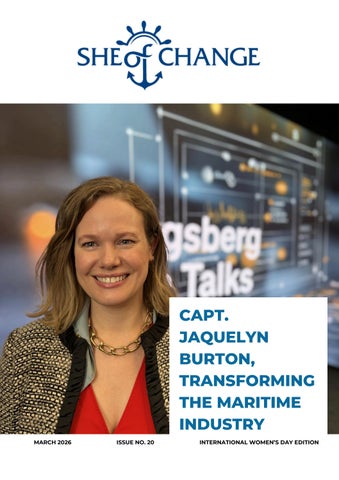
She of Change - Issue 20 - Jaquelyn Burton - Maritime SheEO
Dear Readers and SheEOs,
As we come together to celebrate International Women’s Day, it’s a perfect moment to reflect on our journey and the remarkable contributions of women within the shipping and allied industries. While we often see various rankings that highlight the top women in shipping, it’s essential to remember that each one of us is a winner in our own right.
We ALL need to be acknowledged as each and every one of us has contributed in a positive way to the success of our industry.
In the world of shipping, our strength lies not just in individual achievements but in our shared experiences and collective support. Each woman brings her unique talents, perspectives, and resilience to the table, creating a rich tapestry that significantly enhances our industry.
It is this diversity that drives
innovation and fosters an environment where creativity can flourish.
Let’s take this opportunity to celebrate one another, recognizing that every woman’s journey is unique.
The paths we’ve carved, the challenges we’ve faced, and the victories we’ve achieved both big and small contribute to our shared success. It is crucial to support and uplift our peers, ensuring that every voice is heard and valued.
I encourage each of you to take a moment to acknowledge not only your accomplishments but also the contributions of those around you.
We also have a great campaign going on in March 2026, which encourages women to reach for leadership roles. To borrow and paraphrase a few lyrics from Miley Cyrus’s popular song “The Climb”, it’s not about how fast you get there, or what's waiting on the other side, it’s about putting yourself out there - the climb.
Happy International Women’s Day! Let us celebrate the uniqueness of every woman and the powerful impact we have in our industry.
With respect and admiration,
Founder, Maritime SheEO and She of Change magazine
I encourage you to take the climb, and do the clumb with your fellow women colleagues.
FROMTHE EDITOR
This Women’s Day edition is dedicated to all the courageous and fearless women out there who are effecting change in the maritime world and shaping it’s future.
Our cover page features Capt. Jacquelyn Burton, VP at Kongsberg Maritime who tells us about her work in navigation systems, her perception of mentorship, leadership and much more.
Seaspan, which launched a LEADS Program in 2025, specifically for their women seafarers, is also covered.
Furthermore, we are excited to introduce 5 new permanent columns for the year – Legal Lighthouse, Sustainable Horizons, Daughters of Legacy, The Imposter Syndrome Effect, and Digital Currents. I am sure you will find them interesting and engaging.
This issue also highlights a descriptive report on the recently concluded Maritime SheEO Conference in
Mumbai. The recipients of the various awards presented at the conference also share their stories and insights, providing thought-provoking content. Be sure to explore them.
"SheEOs: We Climb Together" an International Women’s Day photo campaign, curated by Maritime SheEO, is featured, with tips on how you can participate online. Please take a moment to read it.
I conclude by extending my warmest wishes to all women on this joyous Women’s Day! Your dedication, resilience, and elegance allow you to radiate even more brightly.
Seaspan is fostering a more inclusive future within the maritime sector, empowering young women seafarers to assume leadership positions and progress in their careers through its LEADS program and various initiatives specifically designed for women.
Continue reading to discover more about this.
rce is a with world
g ecognizing the unique challenges faced by women at sea, Seaspan has taken meaningful steps to foster an inclusive and supportive environment.
The company’s commitment to diversity extends beyond its own workforce, as representatives actively visit schools to offer career guidance to young women.
By sharing inspiring stories of female seafarers who have excelled in their profession and pre-selecting cadets for placement at partner training institutions, Seaspan helps ensure a smooth transition from education to employment, strengthening the pipeline of talented women entering the maritime sector.
A cornerstone of this commitment is the provision of dedicated female shore-based contacts who serve as trusted liaisons for female seafarers. This network ensures that women on board Seaspan vessels have a safe and comfortable channel for discussing personal matters, seeking advice, and accessing support whenever needed.
In 2025, Seaspan launched its LEADS Program, a leadership development initiative specifically designed to help seafaring women advance their careers. The program is a testament to Seaspan’s broader commitment to building an equitable workplace, where diverse leadership can flourish both onboard and ashore.
LEADS features a structured curriculum that includes interactive workshops, coaching sessions, and practical assignments. Through these activities, participants develop essential skills in communication, personal branding, bias awareness, network development, and work-life balance critical competencies for women navigating leadership roles in a traditionally male-dominated industry.
Program is the newly established Female Seafarer tive empowers aspiring women to pursue rewarding ng financial assistance to selected female cadets. The y p tuition and course-related fees for approved maritime programs at recognized institutes, helping to remove financial barriers and encourage more women to join the ranks of professional seafarers.
Seaspan eagerly anticipates watching these cadets progress through their training and embark on successful careers at sea, becoming valued members of the Seaspan family.
Through these interconnected initiatives, Seaspan is shaping a more inclusive future for maritime, empowering women to lead, succeed, and inspire others both at sea and on shore.
Yours is our first story in 2026! What events have already happened so far this year and what goals have you set for yourself that we can look forward to?
This year has already been both intense and deeply meaningful. At the end of last year, I stepped into the role of Vice President of Bridge Systems at Kongsberg Maritime, with responsibility for navigation systems, onboard autonomy, advanced navigation such as collision avoidance, and connectivity and telecommunications.
A major focus for this year has been building the right team to shape the future of maritime bridge technology and human–machine collaboration.
Alongside this, I welcomed my second child in February ’25 and have continued working toward completing my PhD, which I hope to finish within the next year. In many ways, this year feels like one of laying foundations professionally and personally for what comes next.
incomplete information and real consequences how has time at sea shaped the way you think about leadership, risk, and responsibility?
s often —what made you realise the impact a single conversation or example can have on someone’s trajectory?
MENTORS
HELPED ME
REFRAME THOSE EXPERIENCES,
REMINDING ME THAT HOSTILITY IS OFTEN ROOTED IN SOMEONE ELSE’S FRUSTRATION OR UNREALISED AMBITION, RATHER THAN IN YOUR OWN SHORTCOMINGS.
the next generation, how do you balance giving guidance with allowing people the space to make mistakes and develop their own command style?
One of the most important things I have learned about guidance is that the value is in receiving, reflecting, and sometimes politely rejecting it. Advice is not instruction, and it is certainly not control, nor a shift in responsibility for outcomes.
Whatever perspectives are offered, it is ultimately up to the other person to decide what is relevant to their situation, what fits their values, and what they want to take forward or leave behind. They know their context better than I ever could.
What these experiences reinforced for me is that mentorship does not always look like guidance. Sometimes it is advocacy. Sometimes it is context. Sometimes it is reassurance. In an industry where hierarchies are strong and visibility is uneven; a single conversation or example can quietly alter the direction of someone’s career.
When someone comes to me and asks for guidance, I share my experience and reflections that are filtered through my personal experiences, biases, education, culture and feelings as one possible lens to look at the way I interpreted their situation, it is certainly not a right and wrong answer that exists for most situations.
As someone who actively mentors
The person that can best evaluate if the advice has value and resonates to
others because they are dependent thinkers, to ment, expertise, and o the table. Giving them t the absence of leadership xpression of trust. “Trust but been one piece of advice made popular by President ave followed since I was a cadet.
When technology is developed far from the vessel, what do you believe designers and engineers most often overlook about realworld offshore operations?
One of the most common mistakes I see is an overvaluation of individual technologies or systems, without looking at how operations actually work as a whole. Offshore operations are not a collection of isolated tools; they are sociotechnical systems, where people continuously adapt, coordinate, and compensate to keep things running safely.
n that atically ations, and pp ook compelling in isolation, but when not thoughtfully introduced when placed into real operations they can dilute situational awareness rather than enhance it. Information ends up in the wrong place, at the wrong time, or in volumes that are simply not usable.
The same pattern appears with alarms: when everything is treated as important, operators are flooded, and true priorities become harder to see. This is why time in real operational contexts matters so much.
Watching people work how they move, communicate, and make decisions under pressure reveals the gap between how work is imagined and how it is actually done. I would argue that designers, engineers, and regulators alike benefit from spending more time offshore. Many challenges become far clearer when you see operations in context rather than through specifications or assumptions.
Looking ahead, how do you hope your leadership, mentorship, and work in technology will influence not just individual careers, but the
culture of offshore operations as a whole?
I hope we become more willing to look critically at whether the regulations and systems that govern the industry are actually operating as intended, and if they will not be outgrown in the future.
Over time, many well‐intentioned requirements have created unintended consequences, and I am not convinced that all of them serve operational safety at sea in the way we assume they do. This is a complex conversation, but it is one we need to have.
What I want to contribute to is change that creates space for seafarers to work with technology that supports them, rather than technology they are constantly forced to adapt to.
introduced without enough consideration for how iotechnical system of a vessel.
g, so think it has frequently been used to compensate for poor sociotechnical operation design. When things go wrong, the burden often falls on the seafarer: increasing workloads, multiple systems, extensive reporting, inspections, and documentation often all at once. The assumption becomes that if we train people enough, mistakes will disappear.
That, to me, is a cultural issue. If we want safer and more effective operations in the ocean space, we need to move away from blaming individuals and toward designing systems and the operations they support that genuinely work with the people who rely on them.
That is the future I want to help shape.
SheEOs:WeClimbTogether
Tenaz Cardoz, Marketing Consultant & Community Manager, Maritime SheEO
This International Women’s Day, the world is rallying around a powerful call: “Rights. Justice. Action. For ALL Women and Girls.”
Led globally by UN Women, the 2026 theme urges us to move beyond celebration and focus on dismantling structural barriers. discriminatory laws, weak protections, exclusionary systems, and harmful norms that limit opportunity.
As Marketing Manager at Maritime SheEO, I wanted our community to respond in a way that felt visible, collective, and action-driven.
That is how this year’s campaign was born: SheEOs: We Climb Together
The concept is simple, yet deliberate. Participants take a photograph of themselves standing on stairs. The staircase represents leadership pathways, career progression, access to opportunity, policy reform, and the consistent effort required to create equitable systems.
Every step symbolises progress. Every landing marks advancement. Every upward movement reflects shared responsibility.
Why stairs? Because progress requires momentum. and helping each other climb up is important.
Today, women and allies across organisations, vessels, campuses, and communities are sharing their staircase images with one unified message: SheEOs: We Climb Together.
Participation is straightforward:
Take a photo on stairs at your workplace, on campus, at a site, onboard a vessel, or anywhere authentic to you.
Add the text: “SheEOs: We Climb Together.”
Post it today, 8 March 2026.
Use the hashtags:
#ForAllWomenAndGirls
#SheEOsWeClimbTogether
#IWD2026
Tag Maritime SheEO and follow our social media channels.
For companies, this is an opportunity to activate internally and demonstrate visible support for gender equity. A leadership team staircase photo. A collage of women across departments. Individual employee participation. Each version contributes to a larger visual narrative.
When timelines fill with staircase
images across sectors and regions, the message becomes unmistakable: progress upwards is collective.
In industries where gender gaps remain pronounced, visibility matters. Representation matters. Structural commitment matters even more. International Women’s Day 2026 calls for deliberate action, and action becomes powerful when it is shared.
As someone who believes deeply in the power of community storytelling, I encourage you, whether you are an individual professional, a student, a leader, or an organisation, to take part today.
Stand on the steps. Share your image. Use your voice. Amplify others.
I also encourage you to visit our social media pages and engage with the broader movement. Support fellow participants. Celebrate the stories. Keep the momentum going beyond today.
Every step forward strengthens the path.
And every step carries greater impact when we climb together.
Anup Deosthalee, Secretary, Exim Integrated Club (EIC)
The idea was casually during one of the routine EIC committee discussions. Anand Paranjape, Founder of the Exim Integrated Club, spoke about how blood banks were constantly in short supply and how employees across the logistics sector often wished to donate, but rarely found the time. “If they cannot reach the blood bank… what if the blood bank could reach them?” he said.
Committee members Pradeep Oak and Somnath Joshi were the first to lean forward, almost together. “We will lead this,” they said without hesitation. Soon, the team identified an ambulance-style Blood Donation Van capable of accommodating two donors at a time. It was inspected from every angle of safety, hygiene, medical staff, equipment backup, and storage conditions.
The city’s unpredictable congestion meant that even a noble initiative could
hort. So, the une in the y supply y wn peak hours and narrow lanes.
The planning evolved into a structured movement. The city was divided into five zones. Each road received a leader. And the responsibility of stitching everything together with day-wise schedules, route maps, timing windows, coordination calls, and confirmations was taken up by Pradeep Chavan.
Behind all this, another crucial pillar worked silently yet powerfully. Shreya Rokade. She handled every piece of back-office coordination that kept the campaign running smoothly, with no loose ends. Her steady planning and follow-ups made the frontline execution look effortless.
The next step was communicating with the logistics industry across Pune. EIC reached out to logistics offices, transport hubs, warehouses, CHAs, freight forwarders, and supply chain companies. The message spread rapidly. The response was warm and encouraging.
Then came the final meeting, the night before the drive. There was a mixture of nervousness and excitement. “Time to execute,” someone said softly.
The next morning, as the Blood Donation Van rolled out on its first route, the team watched their work unfold. Leaders were already stationed at designated spots. Donors waited with smiles. Office staff adjusted schedules to accommodate colleagues.
The van kept moving from one office to another, one hub to the next.
By the end of the drive, it wasn’t just about the units collected, but about the unity created.
After that, Softlink Mumbai, inspired by Pune’s success, requested the Blood Donation Van for their annual establishment day celebration. They wanted their entire team to celebrate by giving back.
The Blood Donation Drive on Wheels became a living example of what happens when logistics meets humanity.
Legal Lighthouse
War Risk and Insurance Clauses in Charter Parties – How it effects shipowners in a geo political war like scenario
Catherine Baddeley Partner, Preston Turnbull LLP, London
Geopolitical tensions and conflicts seem set to shape 2026 and be a key concern for the shipping industry.
Direct conflicts, such as the Russia / Ukraine war, pose a potential physical threat to shipping in the Black Sea and beyond, and will likely continue to give rise to further disputes under war risks charter clauses and insurance.
The start of the year saw the threat of the US seizing control of Greenland, sovereign territory of Denmark, a
ch rred, this mination of rely used war cancellation clause, and factual disputes over whether what has occurred amounts to an “outbreak of war” or a mere “military operation”.
Unlike most war risks clauses, war cancellation clauses often do not require there to be any impact on the performance of the vessel in order to be triggered, meaning it is a nuclear option for a party who is keen to terminate a charter agreement early.
In addition to direct conflicts, there is increased awareness of hybrid warfare taking place within what has been termed “the Grey Zone” – the place between war and peace, below the level of direct conflict. This has particular risks for shipping. It is one of the top 10 industries facing cyberattacks, which target critical infrastructure such as vessels and ports, often carried out by criminal gangs linked to state actors.
We are seeing reports of aggressive activities in our seas including cable cutting, anchor dragging and other acts of sabotage. The dark fleet is increasingly being viewed as a Grey
Zone activity with reports suggesting that sanctions evasion is being organised at state level. The risks associated with such activities could lead to disputes under war risks clauses and safe port warranties.
In respect of CONWARTIME 2025, the wide definition of “War Risks” include acts of hostility and malicious damage, which on the face of it, is wide enough to include some Grey Zone activity.
Under time charterparties, owners are obliged to follow employment orders with utmost dispatch, including orders as to route and destination, unless they have a lawful reason to refuse.
With today’s fast paced news cycle and trouble flaring up quickly in multiple locations, owners are well advised to ensure contractual trading limits are clear and reflect their risk appetite, and review the adequacy of any clauses which provide them with a lawful reason to refuse orders or which provide their counterparty with a right to terminate.
Sustainable Horizons
Always Choose to See
Sofia Fürstenberg Stott Founder and Co-Partner of Fürstenberg Maritime Advisory (FMA)
Have you ever heard of the “unknown knowns”? In business strategy, we often speak of “known unknowns” and “unknown unknowns”: things we know we don’t know, and things we don’t realise we don’t know. But what about the things that are known yet we choose not to see?
In an ambiguous and volatile world, there is much to worry about, to be angry or sad about. And yet, across the
maritime industry, there are people who wake up every day determined to make the world a better place. I feel that community around me.
To bridge the knowledge gap, I have used every opportunity to engage around a topic that is both fundamentally important and deeply complex. The stories and reflections I have shared grounded in operational experience or scientific analysis have largely focused on sustainability.
Yet I have come to realise that, on average, our industry still underestimates its importance. Consider a few examples: The unusual and persistent drought affecting the Panama Canal in 2023–2024 materially disrupted one of the world’s most critical trade routes. Beyond its social and environmental consequences, it is believed to have driven freight rates up by 20–40%. Decades of increasingly severe weather, more frequent hurricanes and typhoons, stronger storms, rogue waves, and greater exposure of coastal infrastructure, have pushed marine insurers to raise
premiums. accounts fo total losses
Since Volkswagen’s Dieselgate scandal in 2015, which reportedly cost $34 billion, greenwashing has grown more sophisticated. Between 2019 and 2024, the oil and gas sector recorded the highest share of documented greenwashing incidents.
I’ve lost count of how often a client has told me they care deeply about the environment, as long as sustainability makes business sense. With political leaders denying planetary health, one might argue that it makes less sense than ever. My response is simple: that view is ill-informed.
With a few encouraging exceptions, much of the maritime industry remains unaware of how sustainability directly affects enterprise risk. Strategy is too often built without fully engaging with known facts. The insight exists, it is simply not being sought.
This can change. With curiosity and empathy, our industry can rediscover these unknown knowns and take meaningful action toward genuine sustainability impact.
Ascot & Fitch Insurance Brokers LLC is proud to play a role in supporting the maritime industry with innovative insurance and risk management solutions.
Our company was established in 2016, since then we have worked diligently to ensure that maritime companies, including shipowners, operators, and managers, have access to customized policies that address their unique risk profiles.
Our team of experts specializes in offering tailored marine insurance solutions, including hull and machinery coverage, marine liability insurance, and cargo insurance, ensuring that businesses in the maritime sector are equipped to handle the evolving risks in a volatile industry. Our role in this dynamic sector is to be a trusted partner, helping our clients navigate everything from traditional risks to emerging challenges such as cybersecurity threats in maritime operations.
Furthermore, Ascot & Fitch is deeply committed to sustainability and diversity. As the maritime industry continues to adapt to regulatory changes and environmental standards, we help companies align with global sustainability efforts by providing green insurance products and advising eco-friendly business practices. Additionally, Ascot & Fitch champions diversity within our own workforce, supporting women in leadership roles and fostering an inclusive environment that reflects the progressive changes we wish to see in the industry.
We are excited to continue supporting the growth of the maritime sector
through solutions that not only protect businesses but also drive positive change within the industry.
Ascot & Fitch Key Industry Contributors.
Ascot & Fitch – Leaders in Marine Insurance Solutions
Since 2016, Ascot & Fitch Insurance Brokers LLC has played a key role in shaping the future of risk management for the marine sector. With a deep understanding of the challenges faced by shipowners, operators and maritime businesses, we provide tailored insurance policies and strategic risk management services that empower our clients to thrive in a constantly evolving industry.
t & Fitch th lies in f whom is g p ny's vision and mission in different ways:
Founder & CEO Maha Rahiman: An experienced leader with over 30 years of experience in the insurance sector. Maha has led Ascot and Fitch in pioneering new, tailored risk solutions and eco-friendly insurance products, changing the way the industry approaches sustainability and cyber risks.
Head of Marine Insurance - Fatima D' Mello: Leading the marine insurance division, Fatima brings invaluable expertise in hull and machinery coverage, marine liability and cargo insurance, ensuring that clients' assets are comprehensively protected.
Risk Management SpecialistSangeeta Gopal: With a focus on regulatory compliance and business continuity, Sangeeta guides maritime businesses through complex risk scenarios, helping them build resilience in the face of growing market demands.
Our Expertise & Services:
Marine Insurance Solutions: Tailored coverage for hull and machinery, marine liability, and cargo, addressing traditional and emerging risks, including cybersecurity and environmental regulations.
Risk Management Consulting: Offering strategic advice on regulatory compliance, business continuity, and sustainable operations, ensuring long-term success in a volatile market.
Green Insurance Products: Helping maritime businesses reduce their carbon footprint and align with global sustainability standards through innovative eco-friendly insurance solutions.
Employee Benefits:
Comprehensive plans including group medical, life insurance, and workmen’s compensation, designed to meet regulatory requirements and enhance workforce wellbeing.
tch continue to be leaders in adopting innovative nique challenges of the maritime industry, including g nd climate change.
Sustainability: We are committed to helping maritime businesses reduce environmental impact with green policies that comply with international sustainability frameworks.
Leadership: Ascot & Fitch promotes diversity and inclusion, promotes women into leadership roles and supports a more equitable and progressive maritime industry.
FromaSmallVillageto LeadingaMaritimeTeam
Dipti Khanvilkar, Assistant General Manager – Business Development & Marketing, JM
My journey into the maritime world began far away from the ocean in a small village in Ratnagiri, where educational facilities were limited. I moved to Mumbai at a young age to study, staying with relatives and learning early what independence and determination truly mean. Those beginnings shaped my attitude toward challenges: whatever the situation, I must find a way through it.
Entering the shipping industry as a young woman with an MBA in marketing, I stepped into a male-dominated environment where I felt I had to prove myself constantly. There were days when people doubted my capability simply because
Baxi
I did not come from an operational or seafaring background. But I focused on learning fast, staying consistent, and building trust through my work.
One experience that shaped me deeply was during a particularly hectic week when we were handling multiple medical cases simultaneously, along with ongoing crew change operations. A vessel at one port reported a seafarer with severe chest pain who required immediate evacuation. At another port, a crew member needed urgent hospitalisation after an onboard injury. Our team had to arrange emergency support while ensuring immigration and documentation were managed without delay.
From the Head Office, I coordinated each step, including guiding the port teams, arranging ambulances, keeping hospitals on standby, updating masters and ship managers, and ensuring authorities cleared the cases quickly. Every minute mattered, and every call brought a new decision. In the middle of this chaos, I get a call from the client’s head office,
“Madam,
we feel safe because you are coordinating this.”
Those words still stay with me.
Today, I lead the husbandry team at J M Baxi, handling more than 15,000 crew changes annually along with medical evacuations, spare coordination, and high-pressure situations that demand accuracy and empathy.
From humble beginnings to leading a core desk at J M Baxi, every step has strengthened my ambition. I aim to keep improving, keep learning, and keep moving forward. I remain grateful to all those who trusted my abilities and supported my growth.
DaughtersofMaritimeLegacy
with Ayesha Katgara
Daughters of Maritime Legacy shines a light on a long-overlooked shift in family-run maritime businesses where daughters are rightful inheritors of knowledge, responsibility, and vision.
For generations, maritime legacies were almost automatically passed from father to son; today, more daughters are stepping into these roles as capable leaders shaping the future of the industry. This series captures the powerful, personal stories behind that transition—of trust, mentorship, and continuity— showing why the rise of daughters in maritime leadership is not just progress, but a redefinition of legacy itself.
edition of Daughters of Maritime Legacy, we begin Katgara, a soon to-be fifth-generation leader at a company whose name is synonymous with Indian story. Her entry into the business marks a defining moment, not only as the first daughter of the family to join the company, but as the first woman from the Katgara lineage to step into leadership within Jeena & Co.
Growing up around Jeena & Co., what did the idea of “legacy” mean to you before you formally joined the business, and how has that meaning changed now that you are actively shaping it?
Having practically grown up at Jeena, I have witnessed firsthand the fantastic evolution of our company into the future-ready business it is today. This legacy has, of course, deeply shaped my vision. I have seen my family keeping the trust of our clients intact to keep up with the legacy.
Transparency, reliability, and innovation are deeply embedded in our ethos, they are at the core of my approach too. I have learned to value and nurture relationships, not just with our customers, but also with our partners and my colleagues, who are the driving force of our success.
relationship with him been like since joining the business, and how has it evolved at work?
Throughout my working career, my father has always been my best friend. It has been a great journey working with him at Jeena.
His guidance has helped me understand the nuances of decisionmaking in complex, high-stakes environments, while also grounding me in the values that have sustained Jeena for more than a century.
WHAT REALLY HELPS IN OUR RELATIONSHIP IS MUTUAL RESPECT AND AN ABILITY TO HAVE AN OPEN CONVERSATION.
What has your working
In what ways do you think your leadership style differs from previous generations, and how do you balance honoring the
company’s heritage while bringing it to your own perspective?
While our fourth generation focused on preserving credibility, trust and legacy; we - the fifth generation focus more on risks, growth and digital relevance.
Our focus was always on seeing Jeena as a future-led company and thus worked upon transformation that the industry demands today- be it technological, sustainable or according to the shifting global trade dynamics. By honoring the foundation laid by previous generations and complementing it with innovation and long-term thinking, we aim to futureproof Jeena while staying true to its core purpose.
is growing recognition that leadership effectiveness is defined by capability, not gender.
I was conscious that my presence would be viewed through multiple lenses - gender, lineage, and leadership readiness.
RATHER THAN ALLOWING THESE PERCEPTIONS TO DEFINE MY ROLE, I FOCUSED ON BUILDING
CREDIBILITY THROUGH EXECUTION.
Over time, meaningful engagement and results helped shift conversations from who I was to what I could contribute.
How has your experience challenged or reinforced the perception of this industry being male-dominated?
Maritime is often perceived as a maledominated industry, and in many ways, that perception still holds true, particularly at senior leadership levels. My experience has reinforced that reality, but it has also challenged it.
While the environment can be traditional, it is also evolving, and there
What do you say to a maledirector who is planning to hand over the reins to someone? Both daughters and sons bring different perspectives to the table. What truly matters is who is best equipped to carry the business forward.
When given equal opportunity, mentorship, and trust, daughters are just as capable of leading, transforming, and sustaining legacy businesses.
ThemBetter
Dr. Jo Stanley, Lloyd’s Register Foundation Heritage Centre, Rewriting Women International Maritime History
As a historian of gender in the maritime world, I've been hearing and sharing women's sea stories with delight since the 1980s. And I've taught autobiographical techniques.
So excuse me, but you might like to glance at a few pointers I've picked up. They could enrich your process and delight your readers if you share your story widely, as I hope you will.
e doing readers a favour, giving them a gift. Tell it uth has a lovely way of shining through and making g politely reticent isn't energising for you or for them. y g y ays a good way of engaging people. Give details, as you would in a novel. ‘Paint a picture’ to help readers see vividly.
3. Do speak about others you know – in other maritime roles and other countries. Show contrast, context, and examples. That will help your readers feel less lonely too.
4. No story is too short (but some can be too long for their purpose, so draft freely at stage one. Organise tightly at stage two.) Don’t hesitate about whether you are ‘doing it right.’ Draft it and send it. You’ll find editors are allies who really enjoy guiding you.
5. Feel free to be critical. Talking about your pain points is a way of implicitly making recommendations for changes in the industry. Go for it, for others’ sake.
Beyond SheEO.
If you want to go on, please know that writing fiction matters, not only autobiography. Why? Because your readers can engage even more deeply. They can let themselves freely identify with you because it’s ‘only pretend.’ Good recent examples include:
Engineer Nyari Nain’s Anchor My heart (Harper Collins, 2000) https://www seaandjob com/inconversation-with-sea-and-job-nyari-nain-gives-aglimpse-of-her-passion-for-writing-and-herprofessional-life/. It’s about a marine engineer. Writer Chloe Moss’s Corrina Corrina is about sexual abuse at sea (Nick Hern Books, 2022) https://www.dramaonlinelibrary.com/playtextoverview?docid=do-9781784607197&tocid=do9781784607197-div-00000004
In this narrative, Aishwarya Gupta Pilankar, Managing Director, Nautical Marine Management Services Pvt. Ltd. recounts her journey of entering the maritime industry and expresses her firm conviction that the inclusion of women in this sector will only occur if women "take on the roles of stewards within institutions."
Continue reading to discover more about this.
me industry, n decisionomen in , pp , and occasionally on panels, but very few in positions where policies, systems, and long-term direction were being shaped. Over time, I realized that real inclusion in maritime would not come from visibility alone. It would come from women becoming stewards of institutions.
My own journey with Nautical Marine Management Services has been deeply shaped by this belief. From the beginning, I was less interested in building a company that simply grows, and more focused on building an organization that can be trusted. In shipping and crewing, trust is not a slogan. It is built through systems, discipline, and the courage to do the right thing even when it is inconvenient or expensive.
As a woman leader in a traditionally male-dominated sector, I learned early that credibility is earned in quiet ways. It is earned through audit trails that stand up to scrutiny, through processes that protect seafarers when nobody is watching, and through a culture where safety and welfare are not treated as compliance items, but
as responsibilities.
Seafarer welfare has always been at the center of my work. Behind every deployment is a human being, and behind every seafarer is a family that depends on the industry to behave responsibly. Over the years, I have seen how gaps in systems lead to real human suffering, whether it is delayed medical care, abandonment, wage disputes, or the long and painful struggle families face to get justice. These are not abstract policy issues. They are lived realities.
This is why I believe women’s leadership in maritime matters so deeply. Women tend to bring a longterm, systems-oriented view to institutions. They ask different questions.
, on hat extend the next
In my work with industry bodies and international forums, I have consistently advocated for stronger structures around governance, compliance, and seafarer protection, not as activism, but as institutionbuilding.
True empowerment in maritime is not about placing a few women in visible positions. It is about redesigning how organizations think, decide, and take responsibility.
It is about ensuring that women are present in operational leadership, policy discussions, and strategic roles where the future of the sector is actually shaped.
I firmly believe that the next phase of growth for Indian maritime will not come only from more ships or more numbers. It will come from better systems, stronger institutions, and a deeper commitment to the people who make this industry work.
If women can help the sector move in that direction, then our contribution will not just be symbolic. It will be transformational.
The Effect
Your Seat at the Table Isn’t Waiting for You to Be Perfect
Mônica Zionede Hall Founder and CEO of FELIZ Consulting
This International Women’s Day, as we celebrate the monumental achievements of women everywhere, let us also honour the quiet, inner journey of growth that makes those achievements possible.
For many accomplished women, a quiet question persists: What if they discover I don’t really belong here? We mistake one wrong comment, one
imperfect decision, for proof that we are all impostors.
In 1978, psychologists Pauline Clance and Suzanne Imes gave this feeling a name, discovering that many successful women attribute their achievements to luck instead of skill.
Impostor syndrome is not a character defect. It is a mental pattern common in individuals who are deeply passionate about their work. Feeling this way does not imply you lack qualifications. It frequently indicates that you are improving.
Growth Feels Uncomfortable Before It Feels Powerful
Every phase of development starts with doubt. Learning takes us to areas where our confidence has not yet aligned with our skills. For many women, this unease is intensified by the pressure to appear flawless.
Yet neuroscience shows the brain creates new connections through attempts and mistakes. Errors are not failures; they are the way the brain restructures itself for expertise.
Discomfort is not a signal to withdraw. It is a prompt to grow.
The Power of “Yet”: Turning Doubt into Possibility
One small word can change everything: yet.
“I don’t know how” becomes “I don’t know how yet. ”Brain studies reveal that learning-focused minds become more active after mistakes. They lean in. Progress does not require perfection. It requires courage.
Learning to Own Your Wins
Confidence is not built through flawlessness, but through recognition. Owning your wins is not ego. It is evidence. Every achievement is proof that you are capable of learning, adapting, and rising.
Psychological Safety Creates Real Confidence
True confidence grows where people feel safe to speak, question, and learn. When we feel safe enough to be honest and imperfect, creativity rises and the pressure to perform flawlessly falls. Perfection does not create belonging. Participation does.
Your Invitation Awaits
Your seat at the table is not waiting for you to be finished and perfect. It is waiting for you to be present.
Not flawless. Not fearless, but willing.
This International Women’s Day, let’s make a collective commitment: to celebrate not just our triumphs, but our tries. To champion environments where women feel safe to grow. And to remember that impostor syndrome often means you are stepping into your next level.
You do not need to earn belonging through perfection.
You belong because you are becoming.
Your seat is already there. Take it.
I am taking mine, as Mônica Zionede Hall, mother, wife, coach, coffee and pickleball obsessed; and a woman passionately learning to navigate impostor syndrome and coming out stronger.
By Tracey Lee Shearer, Managing Director, EQ8 Recruit
The moment that changed everything for me began with a simple request. “Tracey, can you find us a woman for this role?”
Two hundred people applied. Only three were women. None were the right fit. It would have been easy to call it a pipeline problem, but it was not. It was a visibility problem. A planning problem. A reminder that in many maritime
disciplines, women make up a small proportion of the talent pool, and if we only look for them after a vacancy opens, we are already too late.
That realisation shifted something in me. I understood that the issue was not the absence of women. It was the absence of live, evolving insight into where they are, what they want, how their careers are moving and when they might be ready.
Our industry still relies on static databases that freeze people in time. A woman who registered her CV years ago may have changed countries, disciplines or ambitions, but the data will not show it.
This is when the idea of moving from pipeline to pulse took shape for me. A pipeline is static. A pulse is alive. Every workforce has one. Without it, women remain unseen until the moment they are urgently needed.
The Women in Maritime search became the catalyst for a not-forprofit initiative I have since begun building. Its purpose is simple. To create a living picture of where women in maritime are, how they are progressing and how the industry can understand their journeys long before
a vacancy appears. It is a way of listening earlier and planning with more care.
When we replace assumptions with insight, we stop scrambling for women at the last moment and start creating pathways that recognise their potential long before they apply.
Because visibility is not just data. It is how opportunity begins.
Ocean,MyNextChapter
By Takshita Patel, AMET University
I’m a girl in my final year, with dreams of oceans drawing near, yet stuck in assignments every day a boring tide I cannot sway.
But still I wait for that shining trip, for the thrill of stepping onto a ship, where winds will chase away my fears and salt will wash these difficult years.
I miss my mom and her gentle ways, her hand that soothed my hectic days, the soft, sweet pat upon my head that sent all storms in me to bed.
I miss my friends who stood so true, who saw my flaws yet never withdrew, who stayed beside me come what may their quiet strength my guiding ray.
Home feels distant, far apart, a tender ache inside my heart, for home was her love, her light, the warmth that made the world feel right.
I score the highest, still feel lone, success can’t fill what’s overgrown, yet this is what the journey takes the sleepless nights, the brave mistakes.
For to be an officer strong and wise I must endure, I must arise. And yes I’m ready, through and through, to chase my dreams across the blue.
In a world where conferences often blur into one another, the 6th edition of the Maritime SheEO Conference stood out not by being louder, but by being more intentional. Held from 28th to 30th October 2025 in Mumbai, Maritime SheEO evolved this year into a three-day global summit, signalling growth in scale and maturity in purpose.
What started years ago as a focused platform for women in maritime has steadily changed into something far more expansive: a space where students and CEOs, seafarers and policymakers, lawyers and technologists, entrepreneurs and regulators come together to confront the future of an industry that moves 90 percent of world trade, yet still struggles to reflect the diversity of the world it serves.
From One Day to Three Days
Hosted across JW Marriott Mumbai Sahar and NESCO Goregaon, the 2025 edition brought together over 500 in-person delegates from 77 countries. The gender ratio itself told a quiet but powerful story: an almost equal 47:53 female-to-male participation in an industry where women remain significantly underrepresented.
Supported by the Ministry of Shipping, Ports & Waterways, the International Maritime Organization (IMO), and the International Chamber of Shipping (ICS), the conference unfolded across three distinct themes: Believe, Lead, and Anchor, each representing a stage in both individual and industry transformation.
Rather than compressing ambition into a single day, Maritime SheEO chose to slow down, to deepen conversations, and to allow different voices the space they deserve.
Day 1 - Believe: Where Careers and Confidence Took Shape
Day 1 was dedicated to belief in careers, in potential, and in the next generation. Designed as a student and early-career-focused day, the atmosphere was charged with curiosity and possibility.
A highlight was the Student Debate Competition, sponsored by Fleet Management, which brought together teams from AMET, IMU, IMI, and HIMT. Hosted by Capt. Arvind Shankar, the debate showcased knowledge and courage, where young voices confidently engaged with industry realities. The jury, comprising Birgit Liodden, Jagmeet Makkar, and Aishwarya Pilankar, brought a global perspective to the evaluation, while IMU emerged as the winning team to resounding applause.
Equally engaging were the Maritime Quiz, the Elevator Pitch challenge, and the mentorship zones, which transformed the venue into something closer to a living campus than a conference hall. These sessions were not about polished success stories; they were about building confidence, learning to speak up, and understanding that careers in maritime do not follow a single route.
Day 2 - Lead: Where Strategy Met Responsibility
Day 2 marked the flagship leadership day, and the shift in energy was unmistakable. Registrations surged, halls filled quickly, and conversations became sharper, more strategic, more global.
With parallel sessions running across multiple halls and workshops filling the breakout room, the day reflected the complexity of modern maritime leadership. Panels explored boardroom diversity, recruitment without bias, augmented intelligence, sustainability across the value chain, and the real pressures faced by today’s CEOs.
The day also brought together personal SheEO Stories, where Capt. Naomi Matsushita and Capt. Albe Zachariah shared their lived experiences of life at sea. These were stories of resilience, solitude, leadership, and survival. When seafarers from the audience joined in to share their own journeys, the hall responded with a standing ovation. Belief, it turned out, is contagious.
Interactive Menti polls added texture to these discussions. One revealed that participants rated the diversity of maritime boardrooms at just 4.2 out of 10. Another showed a strong consensus that empowerment must come before innovation. Sustainability polls revealed an honest tension: while delegates overwhelmingly believe sustainability is essential, many acknowledged that profitability still drives whether action follows.
Alongside these conversations, Day 2 also served as a platform for several important launches that reinforced Maritime SheEO’s commitment to turning dialogue into action. The day saw the introduction of the ODeX–HDFC–Visa Commercial Credit Card, a first-of-its-kind financial solution designed specifically for customs brokers and freight forwarders to ease cash-flow pressures and support operational agility. The PowHer Up collaboration with YES Bank was also spotlighted, expanding access to tailored banking tools and entrepreneurial support for women-led enterprises.
Adding a deeply human dimension was the launch of Ocean Sheroes, a children’s book authored by Sanjam Sahi Gupta, which brings the stories of eight inspiring women from the maritime world to young readers, planting early seeds of representation, aspiration, and confidence.
The day also saw the launch of WIMA India, introduced by Sanjam Sahi Gupta, Jimi John (WISTA India), Saleha Shaikh (Founder, WIMA India), and Dr. Jose Matheickal (IMO). Video messages from international leaders Ms. Mariana and Ms. Merle reinforced the sense that India’s maritime gender movement is now part of a global network.
The introduction of the YES Forum, led by Danae Bezantakou, Meera Kumar, and Sanjam Gupta, added another layer, creating space for emerging women leaders to access mentorship, global networks, and collaboration beyond borders.
A defining moment was the launch of the Indian Women at Sea: A 2025 Study of States, Socio-Economics, and Shipping Pathways, led by Maritime SheEO in partnership with VR Maritime. Launched on stage by Capt. Sanjay Parashar, CEO of VR Maritime, the report drew on over 800 responses from women across MTIs, RPSL companies, and multiple Indian states, offering rare, evidence-based insight into training access, safety perceptions, socioeconomic barriers, and career progression. More than a research milestone, the launch signalled a growing shift toward data-led policymaking and industry reform.
Together, these launches reflected SheEO’s belief that meaningful change is enabled not only through conversation but through practical tools, inclusive systems, and powerful storytelling.
Recognising Excellence, Celebrating Progress Day 2 reached its crescendo with the Maritime SheEO Awards 2025, followed by the AnchorCon Legal Awards. Together, they celebrated companies and individuals advancing diversity, sustainability, education, leadership, and legal excellence across the maritime ecosystem.
WINNER SPOTLIGHT
KC Abigail Chin-Sood Winner of SheEO Seafarer Rising Star Award 2026
I am KC Abigail Chin-Sood, a merchant mariner holding the rank of Second Officer under Wallem Ship Management, sailing on tanker vessels engaged in international trade. Our operations involve loading and discharging crude oil and petroleum products across various parts of the world.
As a Second Officer, I am primarily
responsible for passage planning, ensuring safe and compliant navigation in accordance with international regulations. I also carry multiple onboard roles, including Cyber Security Officer, Medical Officer, and Safety Officer.
Alongside my seafaring career, I create content that documents my journey at sea. My goal is to provide a realistic glimpse into life onboard and to break stereotypes surrounding women in the maritime industry. While social media policies and platform restrictions have limited some aspects of content creation, I continue to push forward with the intention of reaching a wider audience, especially aspiring female seafarers, by showing that a career in maritime is both possible and empowering.
I also actively collaborate with maritime-related brands and have been invited to serve as a resource speaker at Philippine-based maritime schools, training centers, and industry events.
Which accomplishments or experiences at sea do you think helped you earn the Rising Star Award?
My consistent visibility and authenticity on social media played a major role in earning this recognition. Over the years, I have collaborated with various maritime brands as a content creator and as a learner. These collaborations allowed me to gain deeper industry insights, which became the foundation of the stories and messages I share online. Through this platform, I was able to reach audiences I never imagined connecting with.
How does winning this award influence or inspire your work going forward? Winning this award has inspired me to push my boundaries even further, never to limit myself, and to believe that there is still so much more I can achieve both at sea and ashore.
Moving forward, I am now considering taking a breather from sailing to explore shore-based opportunities, allowing me to expand my impact within the maritime industry in new and meaningful ways.
WINNER SPOTLIGHT
Dr. Joana-Eugenia Bakouni Winner of SheEO Leader of the Year 2026
I work at the intersection of maritime HR, learning, and organisational psychology. In practice, that means designing learning systems, peopledevelopment interventions, and leadership programmes that help those working in high-risk, highresponsibility roles operate in ways that are not only compliant with our regulatory frameworks, but humane, psychologically safe, and sustainable. At Maersk Training, I am responsible for our maritime learning portfolio, from strategy and design to how it is delivered globally. Alongside my industry work, I also teach at the postgraduate level on topics around HR, DEI, and Adult Learning in various academic institutions.
Real capability is built over time, through practice. We tend as an industry to rely heavily on technology, but I believe we must invest just as seriously in people. And that’s the impact I aim to create. Making maritime organisations safer, more inclusive, and more resilient by putting people at the center of how we design work and learning.
Which leadership contributions this year do you believe led to you being named Leader of the Year?
This year, much of my leadership was about turning big ideas into real systems that organisations can actually use. At Maersk Training, I led two major strategic initiatives: the development of our digital competency management system and the design of a structured alternative-fuels training framework to support the industry’s transition to new energy sources. Both projects required bringing together technology, regulation, and the human element, and they were made
possible by our strong culture of proactive engagement and constant care, where people are encouraged to speak up, challenge assumptions, thus making sure that the solutions we provide today, prepare the workforce of tomorrow.
In my academic work, a major contribution was redesigning our MSc in Maritime Operations offered through Lloyd’s Maritime Academy, in partnership with Middlesex University. I led the curriculum overhaul to ensure it reflects how the industry is actually changing, from decarbonisation and digitalisation to humanfactor risks, leadership, and sustainability.
At the same time, I continued to push for conversations around psychological safety, inclusion, and mental health to be treated as part of operational excellence, not separate from it.
How does winning this award influence or inspire your work going forward? It is, of course, deeply meaningful to be recognised, but for me the real value of the award is the platform it gives. Maritime HR and people-centred leadership still have too few voices in the industry, and we need more of them if we want real, sustainable change. This award reminds me to stay grounded, curious, and always remember where I am coming from. Going forward, I really wish it inspires more people from unconventional backgrounds to know that their voice has a place in maritime.
WINNER SPOTLIGHT
Ana Clara Nascimento Winner of SheEO to Watch Out For 2026
I am a lawyer who has built my entire career in the maritime sector, starting as a legal intern at a law firm in Brazil and gradually expanding my practice
into the offshore and oil and gas industries while serving as in-house counsel. Understanding how vessels operate, how offshore structures are built, and how complex cross-border operations come together from legal, commercial, and technical perspectives is what made me fall in love with this industry.
The impact I aim to create, however, goes beyond legal solutions. Early in my career, I became aware of how the lack of female role models can subtly influence professional trajectories. Becoming part of communities such as Maritime SheEO and WISTA helped reshape my own path and reinforced my desire to contribute to a more inclusive, supportive industry.
What recent achievements or milestones do you think made you stand out as a ‘SheEO to Watch Out For’?
I have been engaged in gender‐equality initiatives for more than a decade, always driven by a desire to learn from and stand alongside people I admire. Serving on the Executive Committee of WISTA Brazil for many years in my early twenties gave me a strong sense of belonging and responsibility toward the community. Through those years, I helped strengthen member engagement, welcomed new associates, supported educational events.
The more engaged I became, the more doors opened for me. I became the first Brazilian selected for the Maritime SheEO Leadership Accelerator with an IMOsponsored scholarship. I was subsequently invited to speak at Brazilian universities about legal careers and maritime law Along the way, I was ranked by Chambers and Partners in the Shipping practice area at the age of 29.
Building on these experiences, I was shortlisted for three consecutive years as a Maritime SheEO Ambassador representing Brazil, and mentor in the Mentorship Program; and more recently, I had the privilege of speaking at Anchorcon (part of the Maritime SheEO Conference) in Mumbai, India.
How does winning this award influence or inspire your work going forward? Winning this award is a reminder that staying true to your values is worth it. Today, I am grateful for those choices, and this recognition serves as fuel to keep planting seeds knowing that lasting impact takes time to fully emerge.
WINNER SPOTLIGHT
Capt. Sanjay Prashar Winner of Champion of Diversity 2026
My wife Sonika and I started a Merchant Navy Awareness campaign in the year 2020 for girls based in rural Himachal Pradesh. Educated girls from poverty-stricken families who were keen to bring prosperity to their home were guided for a career in the Merchant Navy.
We started going to Panchayat level meetings, holding special sessions in colleges and met many parents too. Fortunately, TS Rahaman joined us, and in the year 2022, we witnessed the first batch of Girls GP Rating and CCMC. The achievements of the DNS Girl cadets positively influenced the GP Rating and CCMC as well.
The biggest challenge was persuading parents, relatives, and the entire village, as they had previously encountered negative instances of illegal agents cheating poor families seeking new GP jobs. News channels tended to focus more on unfavorable reports regarding Merchant Navy employment instead of highlighting credible career opportunities at sea.
Nevertheless, a positive aspect was that female candidates placed their trust in us, and their commitment to learning English through our specialized classes in the villages significantly benefited them.
Many young girls appeared for the GP Rating/ CCMC/ IMU CET and quite a few of them passed the exams. We arranged their travel to Mumbai which was about 2000 Kms away from the hilly state of North India’s "Himachal Pradesh " . I made all the travel arrangements for these young girls to reach Mumbai and return home safely.
The next challenge was the course fees. Thanks to MUI, NUSI & DG Shipping, who assisted us by sponsoring ₹1.5 Lakh scholarship, covered 60% of the course fees. Also, a few well-known Companies gave us sponsorship letters. Today these young women have done more than 2 tenures at sea and are earning well. They are planning their own houses, and their parents are seeing the eradication of poverty from their lives. The positive aspect is that hundreds of girls from Himachal Pradesh are now applying for jobs in the Merchant Navy.
News Channels in Himachal Pradesh are now covering success stories of these gutsy women Seafarers who face storms at sea and are now a role model for rural India. We have moved Women Empowerment at Sea from employment on Cruise Ships to Cargo Ships. We aim to have new recruitment of 1000 Indian Women Seafarers every year on Cargo Ships from the year 2026 onwards.
What efforts at sea — onboard or operationally — do you feel contributed to you being named a Champion of Diversity?
My wife and I met and convinced all our Ship Owners to accept gender diversity. We worked closely with them to create safe and respectable workplace onboard ships Our Indian office has a staff of 202 and 45% are women
Our Joint Managing Director Kavita Bane visits Ships, visits Ship Owners and takes the lead to handle Seafarers issues impacting Recruitment and Placement. She has lead to the success in many complex crewing operations especially when Seafarers Grievances demand high level of professionalism from the office.
Many women office staff who work with us have been able to purchase their own houses and remain financially strong. Also they are great mothers and proud daughters of their parents.
How does winning this award influence or inspire your work going forward?
To be acknowledged by Maritime SheEO means the world has a sharp eye for those who work miles away from big cities. Listening to the global success stories on your platform have greatly influenced us. Your work inspires us with new ideas to empower the women workforce in the Maritime sector. You lead by example and we follow you.
WINNER SPOTLIGHT
Katie MacIntosh Winner of SheEO To Watch
Out For
2026
After 14 years offshore in operations, rebuilding a career onshore, and now shaping a new path into ocean environmental advocacy and exploration, I know how powerful it is to have someone support your journey, champion your development, and remind you of the possibilities and pathways you can’t yet see.
Being a Mentor through the Maritime SheEO program has been one of the most enriching dimensions of my career. Providing women with the tools, confidence, and frameworks to navigate an industry that hasn’t always been designed with us in mind. Using my voice, network, and influence to create opportunities that may not have existed otherwise is a powerful experience.
What does receiving the ‘SheEO to Watch Out For’ Award mean to you? Although I couldn’t attend the conference this year, receiving the award is something I hold with enormous gratitude. It represents the responsibility we carry to actively shape our own future, and a celebration of women rising into positions of leadership in a globally male-dominated industry.
How does winning this award influence or inspire your work going forward? The award is a reminder of the long-term impact we can have when we choose to elevate others. I’m deeply committed to continuing this work, championing emerging talent, amplifying women’s leadership, and contributing to a maritime industry that reflects the diversity, ingenuity, and ambition of the next generation.
Day 3 - Anchor: Law, Accountability, and the Hard Conversations
For the first time in its history, Maritime SheEO introduced AnchorCon, its dedicated legal conference. Held at NESCO Goregaon, the shift in setting mirrored the shift in tone. This was governance territory.
AnchorCon addressed the legal realities shaping modern shipping: international contracts, sanctions, ESG mandates, cyberbullying, criminalisation of seafarers, ship recycling, and regulatory compliance. The presence of senior legal experts, consular representatives, and government leadership brought depth and urgency to these discussions.
A standout session along with the Director General of Shipping, India, examined cyberbullying and social stalking of women seafarers, a topic that resonated far beyond legal frameworks. The panel drew strong engagement, not through sensationalism, but through clarity, recognising digital safety as an industry responsibility, not an individual burden.
By anchoring inclusion within law and policy, AnchorCon made a clear statement: progress without accountability is temporary.
More Than a Conference
As the conference reached its climax, one thing was clear: Maritime SheEO is no longer just an annual event. It is an ecosystem. From students discovering confidence, to CEOs confronting complexity, to researchers shaping evidence, to lawyers redefining accountability, the 2025 edition demonstrated what happens when an industry chooses to listen to its people.
As International Women’s Day arrives, Maritime SheEO stands as a reminder that meaningful change does not arrive through slogans alone. It is built, session by session, story by story, data point by data point, by those willing to believe, lead, and anchor progress where it matters most.
Ididn’tmeantogoto sea…
In maritime, safety is often measured in procedures and protocols. But what if its real foundation is laid long before a ship leaves port, in the courage to invite new voices into the room and the willingness to truly hear them?
JCJ Consulting was built on this belief. Led by Managing Director, Jillian Carson-Jackson, JCJ has spent nearly a decade proving that inclusion, voice and visibility don’t just strengthen maritime operations, they transform them.
Across risk, digitalisation, training and advocacy, JCJ shows a simple truth: when you focus on respect, in an organisation where people are centred, safety comes naturally. An inclusive, psychologically safe workplace creates the foundations for success.
opportunity, one person at a time.
Jillian’s own journey began with a twist. “I didn’t mean to go to sea,” she often says, a line that resonates with many who stumbled into maritime and found a calling that shaped their lives. Her career spans seafaring, including buoy tending and icebreaking, search and rescue, vessel traffic services, training and regulatory work shaping international standards. Today, she leads a consultancy trusted by ports, training providers and regulators for its maritime data expertise, training capability, inclusive approach and quiet, steady influence. This is an influence that is focused on shifting culture one conversation, one
JCJ treats seafarers, VTS professionals and shore-based teams as experts whose voices matter. Wellbeing, respect and inclusion are not separate from safety; they are conditions that allow it to exist.
This belief is visible in practical, human ways: opening doors to events and professional development opportunities, supporting mentoring and visible leadership, and building pathways for operational personnel to be all they can.
These actions build confidence, capability and leadership, particularly for women and underrepresented professionals, who often carry the weight of being “the first” or “the only”.
m level, shaping structures that underpin maritime J Consulting team facilitates structured risk waterways, bringing pilots, VTS operators, shipowners g g dentify hazards and agree on realistic mitigation strategies. Learning is built from the ground up, through task analysis, curriculum design and discovery-based delivery, which reflects the real pressures, decisions and complexities of maritime work.
In partnership with training providers, JCJ delivers internationally aligned courses using hybrid and online models, cloud-based simulators and bespoke scenarios. The JCJ Consulting approach demonstrates that high-consequence skills can be developed digitally without losing the human connection that makes learning meaningful.
In an industry where visibility is sometimes mistaken for victory, JCJ holds to a quieter truth: real change happens when values shape every decision, partnership, workshop and training activity. Inclusion, safety and high professional standards guide how JCJ works every day, with intent and respect for the people who keep maritime moving.
JCJ Consulting continues to walk alongside the people and organisations who want maritime work to be safer, more inclusive and quietly stronger. It proves that the courage to listen, and the commitment to act. For JCJ Consulting, compassion, integrity, diversity and inclusion are the compass points that guide the industry safely into the future.
with Tejaswini Manjunath
Approach AI the Way You Approach Life
I came across a story by Ragini Das, the Head of Google for Startups-India that stayed with me. She said that adopting AI is no different from building anything meaningful in life, whether it is a family, a culture, habits, or a career. They demand intention, effort, and consistency.
This is essentially true for logistics and forwarding companies.
AI does not magically fix broken operations. It is important to find a way to incorporate it with existing operations and workflows.
Much like life itself, the grass is not greener elsewhere. It is greener where there is vested interest.
I have spent the last few years working closely with AI implementations across logistics and supply chain
nsistent dopt AI to cost to , q y
Others quietly step back after months of effort. The difference, in most cases, has little to do with the technology itself and everything to do with organisational readiness for AI.
Over time, I have come to rely on a few principles that are key in operational environments.
1. Clarity is key. Without a clear business objective, AI becomes an expensive exercise.
2. Data foundations matter. AI is only as strong as the processes and data beneath it. In logistics inconsistent data is driven by variations caused by customer, lane, and partner. If not done well, this endeavor multiplies risk. Always.
3. Pragmatism is imperative. Small, controlled pilots are always better and outperform large-scale rollouts, particularly in large systems like TMS and RMS. Testing in controlled scope and environments allows teams to learn, measure impact, and build confidence in the system before
scaling. Fail fast and fail forward is a good approach.
4. Experience also matters. There is a meaningful difference between advising on AI and implementing it within live operational systems. Leaders benefit most from guidance shaped by real-world deployments, where exceptions, human judgment, and system limitations become known quickly.
5. Education is no longer optional. There is no middle ground with AI today. Invest time to learn enough to differentiate the possibility and know what to apply where.
6. AI adoption is a journey. It requires patience, realistic timelines, and strong change management.
Before committing significant capital
Make sure your answers are clear. Preparation is a must before investing.
By Manisha Thaker, Vice President – Trialliance Global Solutions, EXIM faculty Corporate Trainer
It was an absolute joy and privilege to host the Maritime SheEO Quiz Contest 2025, one of the most vibrant and interactive segments of the Maritime SheEO Conference this year. Standing on stage and witnessing a room full of enthusiastic maritime professionals, students, and global delegates was truly an energizing experience filled with learning, laughter, and lively competition.
The set of quiz questions were curated by the Maritime SheEO team and ambassadors, the true masterminds behind the contest, led by the dynamic
Capt. Ivana Kulkarni. The questions were fun and also intellectually enriching.
The quiz was conducted live, where participants accessed it on their mobile phones, and the leaderboard lit up the stage screen adding an interactive and high-energy touch to the competition. The quiz, designed in a “Fastest Finger First” format, kept everyone on the edge of their seats. With a time limit on each of the 24 thought-provoking questions, the excitement in the room was palpable.
It was delightful to watch participants with quick minds and faster fingers racing against time to answer, while others smiled, cheered, and buckled up to bounce back stronger in the next round. The leaderboard kept buzzing with changing scores, lighting up in colours, emojis, and creating waves of laughter, anticipation, and cheerful competition.
What made the contest even more special was the diversity in the audience: Merchant Navy students, maritime professionals, industry leaders, visitors, and delegates from across the globe, all united by their love for the maritime world.
As the contest unfolded, I could feel the pulse of the room, eyes focused on the screen, minds racing to recall the right answers, and fingers poised to be the fastest on Menti! Watching the leaderboard shift after each question was absolutely thrilling.
Hosting this contest reminded me of how powerful collective learning can be when passion meets purpose. It wasn’t just about who answered the fastest; it was about celebrating maritime brilliance, leadership, and inclusion across generations and geographies.
I extend my heartfelt gratitude to Maritime SheEO and Founder, Ms. Sanjam Sahi Gupta, for curating such an empowering platform that celebrates knowledge, inclusivity, and leadership in the maritime world.