to reach our seafarers Maritime Newsletter
In this issue
Issue 47 - September 2012
2.
Company News
4.
100 years after the Titanic, we're still not unsinkable
6.
Safety First
9.
Marine Fuel Regulations
10.
Refreshing Tips For The Officers On Watch At Bridge
13.
Testing Your Condition
14.
A Short History of the Port of Piraeus Part 2
>>Editorial Nothing could have highlighted the significance of safety and safe practices onboard better than the eerie coincidence of the accident of the cruse ship Costa Concordia with the centenary anniversary of the sinking of the Titanic. As discussed in the relevant article in our 2page Titanic section, no matter how advanced our technology may be, vessels are still not unsinkable and they are, in fact, far from becoming so. Good practice onboard is simply irreplaceable. So, in this issue, you will find some reminders on good navigation, along with various environmental news and updates, covering issues such as stress levels of whales caused by shipping traffic and regulations on Marine Fuel. For the crew onboard the vessels there are again some tips on keeping fit as well as some very good guidelines on food hygiene. Enjoy reading! J.R.Haygood Editor
>>Company News
July 2012 saw the delivery of the VLCC M/T KALYMNOS (299k DWT) to her new owning company "Docal Shipping Ltd". She followed her sister vessel M/T CERIGO (299k DWT) that was delivered in November 2011 to her owning company "Bellavista Investment Corporation". Both vessels have come under the commercial and technical management of Marine Trust Ltd. We would like to wish to both vessels and their crews, fair winds and following seas.
Disclaimer: The contents provided herewith are for general information purposes only and are not intended to replace or otherwise contradict the detailed instructions and procedures issued by the owners, managers, flag, etc. The articles presented and the views expressed in this bulletin do not necessarily reflect those of the publishers.
Editor: John R. Haygood Email: contact@wavelength.gr Readers are welcomed to send any comments, questions or feedback they may have at comment@wavelength.gr Design-Production: www.paradox.com.gr
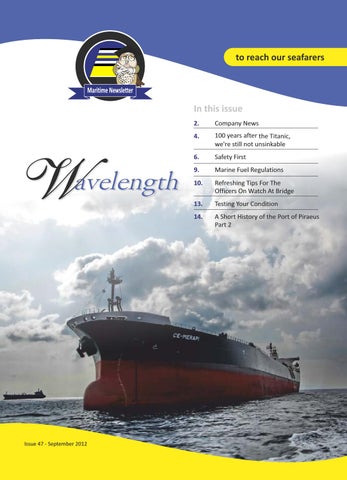
The cover page photo of M/T CE-Merapi is courtesy of Mr Alexandros Chadiaris (Marine Trust, Supply Dept.)
2
Wavelength - Issue 47 - September 2012
Australia to create world's largest marine reserve
Exxon Valdez has been Sold for Scrap Twenty three years after causing the largest environment disaster in US history (until the Deep Water Horizon accident in 2010) the infamous 'Exxon Valdez' is being scrapped. Built in 1986, the vessel became a household name three years later, when in 24 March 1989 it ran aground on Bligh Reef, in Alaska, spilling 37,000 tones of crude oil. It is estimated that the accident caused $15bn in damages and Exxon Mobil Corp. (XOM) the largest US oil company, is still facing litigation from the spill. The clean-up alone took 3 years and cost $3.86 billion. Now an ore carrier called the 'Oriental Nicety', it was sold to Global Marketing Systems Inc., the world's largest cash buyer of ships for demolition, on 16 March 2012 for about $16 million.
In July 1990, following the repairs on the vessel, she was renamed 'Exxon Mediterranean'. She was renamed again in 1993 to 'S/R Mediterranean' but remained under Exxon's SeaRiver Maritime, before being again renamed as 'Mediterranean'. In 2008 she was sold to Hong Kong Bloom Shipping, renamed 'Dong Fang Ocean' and converted to an ore carrier, before finally being sold in 2011 to Best Oasis (subsidiary of Priya Blue Industries) and renamed 'Oriental Nicety'. Although it is often sited as one of the worst spills and environmental disasters, it actually does not rank in the top 20 or even top 30 worst spills on record, according to the statistics by the International Tanker Owners Pollution Federation.
Australia says it will create the world's largest network of marine parks ahead of the Rio+20 summit. The reserves will cover 3.1 million sq km of ocean, including the Coral Sea. Restrictions will be placed on fishing and oil and gas exploration in the protected zone covering more than a third of Australia's waters. The announcement was made by Environment Minister Tony Burke, ahead of the Earth Summit in Brazil. "It's time for the world to turn a corner on protection of our oceans, " Mr Burke said. "And Australia today is leading that next step." Australia timed its announcement to coincide with the run-up to the Rio+20 Earth Summit - a global gathering of leaders from more than 130 nations to discuss protecting key parts of the environment, including the ocean. Ocean parks Last year, the Australian government announced plans to protect the marine life in the Coral Sea - an area of nearly 1 million sq km. The sea - off the Queensland coast in northeastern Australia - is home to sharks and tuna, isolated tropical reefs and deep sea canyons. It is also the resting place of three US navy ships sunk in the Battle of the Coral Sea in 1942. The network of marine reserve will also include the Great Barrier Reef, a UNESCO World Heritage site. The plan will see the numbers of marine reserves off the Australian coast increased from 27 to 60. "What we've done is effectively create a national parks estate in the ocean,'' Mr Burke told Australian media. http://www.bbc.co.uk/news/world-asia-18437040
Whales 'stressed by ocean noise'
North Atlantic right whales (Eubalaena glacialis) roam up and down the east coast of North America, coming to the Bay of Fundy typically in late summer to feed.
By Richard Black Environment correspondent, BBC News
Quiet period
Noise from ships stresses whales nearby, researchers have shown. Ships' propellers emit sound in the same frequency range that some whales use for communicating, and previous studies have shown the whales change their calling patterns in noisy places. Now, researchers have measured stress and found they rose with the density of shipping. The species studied in the Bay of Fundy in Canada, the North Atlantic right whale, is listed as endangered. Dr Rosalind Rolland of the New England Aquarium in Boston, US, who led the new study, said the population was now up to an estimated 490 individuals from about 350 a decade ago.
Following the al-Qaeda attacks on New York and Washington DC on 11 September 2001, ship traffic in the bay dropped off. Whale researchers registered a 6 decibel (dB) fall in the intensity of underwater noise, with the change particularly pronounced at frequencies below 150Hz. Fortuitously, another team had just begun a five-year project to gather and examine faeces from the right whales. "We were working on different boats, we knew the different studies were going on without any real interaction," Dr Rolland told BBC News. "And it was only when I was preparing for a workshop on ocean noise and stress in 2009 that I realised we had this data and analysed it this way - it was just one of those opportunistic things.�
Faeces gathered during the 2001 period of light shipping showed a significantly lower level of hormones which are associated with stress, than in subsequent summers when marine traffic returned to normal levels. "This is the first time that anyone has documented any physiological effect� said Dr Rolland. "Past studies have shown they alter their vocalisation pattern in a noisy environment just like we would in a cocktail party, but this is the first time the stress has been documented physiologically." Precisely how much it matters to the animals is unclear. But ocean noise has risen substantially in recent decades along with the growth in global shipping. One analysis showed that the north-eastern Pacific is 1012dB louder now than in the 1960s. The research team would now like to establish a study that could relate stress hormones to ocean noise in a range of locations. http://www.bbc.co.uk/news/scienceenvironment-16926005?print=true
Wavelength - Issue 47 - September 2012
3
100 years after the Titanic,
we're still not unsinkable Following the latest headlines in the Coast Concordia case that new lawsuits filed are alleging design flaws, Henry Petroski commented on the 100 years anniversary of the sinking of the Titanic and the unfortunate accident of the Costa Concordia that coincided with the anniversary. Below is a summary of his article published on Washington Post's column “Outlook”: “On the 100th anniversary of the Titanic's sinking, it's worth remembering that safety is and always will be relative. We can't simply blame the engineers when things go wrong because, no matter how well they plan, things don't always go according to plan. By Henry Petroski (professor of civil engineering and history at Duke University (NC, USA) writing for the column “Outlook”, in the Washington Post) The Titanic is a great example. The ship's owner, the White Star Line, convinced themselves and potential passengers that the new vessel was “unsinkable,” but no good engineer should have agreed. The Titanic, like all designs, was a compromise. Conflicts between those who design large technological systems and those who pay for them are resolved by negotiation, a process that doesn't guarantee safety. Thomas Andrews, the Titanic's designer who went down with the ship, wanted bigger bulkheads and more lifeboats. But White Star wouldn't provide them – bulkheads restrict passenger movement. The Titanic did have the then-legally required number of lifeboats, but Andrews knew that it was far too few. One row of lifeboats was even removed before sailing to preserve one deck's view.
Had the Titanic not sunk, competing steamship lines may have wanted to one-up White Star by building still larger ships with fewer lifeboats and bulkheads. The sinking provided a wake-up call that fundamentally changed maritime regulation. Overall safety was improved by tragedy. Today, cruise ships larger than the Titanic have safety and navigation features that were not available to the Titanic's designers. Yet the Costa Concordia, the vessel that ran aground in January off the coast of Italy, had vulnerabilities that modern technology couldn't eliminate. The hull could still be ripped apart by a collision. Everything, even a steel hull, has its breaking point. On the Concordia, it appears that Captain Francesco Schettino could have been emboldened by the very safety features that were supposed to protect his passengers. Schettino sailed a more dangerous course than was advisable, exposing his ship to greater-than-expected risks. Schettino's decision to drop anchor only made the problem worse, as did a 45-minute delay in deploying lifeboats. Foreseeing such undesirable events [like the Titanic and the Concordia] is what engineers are expected to do. However, design trade-offs leave technological systems open to failings once predicted, but later forgotten. Companies selling a product play down its vulnerability and emphasize its robustness. But for human operators in control of a supposedly infallible system, complacency and overconfidence can take over, and caution may be thrown to the wind. Schettino allegedly 'wasnt wearing his glasses before the Concordia went down and couldn't read the radar clearly. No ship can be saved from a carefree captain.”
The full article can be found here: http://www.washingtonpost.com/opinions/ 100-years-after-the-titanic-were-still-not-unsinkable/2012/04/06/gIQAwXqyzS_story.html
4
Wavelength - Issue 47 - September 2012
Titanic Being Eaten by Destructive Bacteria A new bacterium isolated from the Titanic wreck is accelerating the wreck's disintegration into a pile of dust. By Rossella Lorenzi A rust stain may be all that will remain of the RMS Titanic in 15 to 20 years, according to new research into the submerged ocean liner wreck.
While potentially dangerous to underwater metal structures like shipwrecks, as well as offshore oil and gas pipelines, the newly discovered bacterium could also offer positive applications for industry. "The new species of bacteria plays a significant part in the recycling of iron structures in deep ocean. It could be useful in the disposal of old naval and merchant ships and oil rigs," said lead researcher Henrietta Mann, at Dalhousie University, Halifax, Canada.
Working at a depth of over two miles, a neverbefore-seen bacterial species is devouring the hull of the so-called "unsinkable ship" on the Atlantic seabed where it sank on April 15, 1912, killing 1,517 people. Named Halomonas titanicae, the bacterium was isolated from samples of so-called rusticles present on the wreck: dark orange structures that look like icicles but are made of rust. Removed from the hull using the articulated arm of the Mir 2 robotic submersible, the rusticles were transferred to plastic collection bags and transported aseptically to the surface to be analyzed. Using DNA technology, the researchers discovered that the rusticles were formed by a combination of 27 different strains of bacteria. Among the bacteria feasting on the Titanic, there was a brand new member of the salt-loving Halomonas genus. Able to adhere to steel surfaces, the new species has led to the formation of knob-like mounds of corrosion. Covered with such rust mounds, the wreck of the Titanic is at risk of disintegrating into dust, as the porous rusticles eventually dissolve into fine powder.
5,000 Artefacts Auctioned on Titanic's 100 Anniversary Over 5,000 artefacts recovered from the site of the wreck of the Titanic where made available at an auction run by Guernsey's auctioning house, on 15 April 2012, exactly 100 years after the sinking of the vessel. The items were salvaged by RMS Titanic Inc., a division of Premier Exhibitions, the company responsible for uncovering the artefacts after undergoing some seven expeditions 2.5 miles under the surface of the sea.
http://news.discovery.com/history/titanicbacteria-rust-wreck.html
The collection includes video footage of the ship and recovery effort, the salvage rights to the wreck, as well as more than 5,500 artefacts recovered from the wreck. The artefacts consist of fine china, silverware, clothing, 100 items of jewellery and other personal belongings of the passengers, decorative items from the boat, and even a 17 ton section of the Titanic's hull, measuring approximately 7 meters high by 9 meters wide. Valued at $189 million, the artefacts will be sold off as a single collection to a single bidder, as per the instructions of the United States District Court. The company is looking for an institution or private buyer to maintain the entire collection and make it available to the public, so that future generations can appreciate the historical value. While Titanic memorabilia has been auctioned over the years, this was the first time items retrieved from the bottom of the ocean will ever be sold. Although initially the auction was scheduled for 11 April, it was then pushed back to 15 April. However, several months later, the winner of the bid has yet to be announced.
Wavelength - Issue 47 - September 2012
5
>>safety first Message from the DPA: This edition's Safety First!! has been totally dedicated to your deck machinery and mooring equipment (wires, winches, anchor chains and windlasses). The importance of adhering to safety procedures and maintaining such gear in good condition cannot be overstressed. Wires keep the ship in her position when used in a mooring capacity, lift equipment, spares, hoses, and cargo in their heaving capacity, and contribute significantly to the ship's safety and emergency response when used for lifeboat falls, fire wires, etc. All round they are an integral part of the ship's operation, however also pose an inherent safety risk for personnel if they break, which shows how important they are in your everyday life. As you have probably heard, the fatalities and injuries during lifeboat drills are disturbingly common in recent years, and these are mainly attributed to fault or misuse of wires. Please follow the rough guidelines provided herein, but most of all the instructions already issued in your procedures, planned maintenance systems, and operation manuals. Your safety depends on it in more ways than one! Wishing you safe seas. Anthony Lambros / Q&S Manager – DPA I welcome your comments, suggestions or feedback on the contents of this column (Safety First!) at comment@wavelength.gr
Title: Rusted wire proved fatal Source: Tradewinds article dated 24/11/11
An Indonesian crewman died in a fall from a cruiseship in New Zealand after a rusted lifeboat cable snapped. The 29-year-old plunged into the sea at Lyttelton while greasing the wires of the boat on the 61,000-gt Volendam (built 1999), operated by Holland America, an accident report said. Another crewman also fell from the boat, but survived after clinging to a bucket. Both men were wearing heavy clothing, overalls and boots, but no lifejackets. The boat was left hanging from the ship by one cable.
The Transport Accident Investigation Commission (TAIC) said the wire was "heavily corroded". Ten other wires near the same lifeboat on the Volendam were found to be corroded and needed replacing. The design of the lifeboat davits meant it was difficult to apply a protective coating of grease to the wire, and to check it had been greased properly, the report said. TAIC made three urgent safety recommendations, including telling the davit's makers to alert all its customers about the problem and what should be inspected, and advising it should also look at redesigning the davit.
TRUST (Ten Really Useful Safety Tips) WIRE ROPES l A wire rope is only as good as its weakest part, just like a chain is only as good as its weakest link. Unless an inspection covers the entire length of the wire, a thorough inspection has not been made. l Wire ropes in a marine environment require frequent and thorough lubrication to prevent corrosion; otherwise premature failure of the wire ropes cannot be prevented.
l In relation with the article of this issue regarding the rusted wire of the lifeboat that snapped, when selecting a securing point for a safety harness, consideration should be given to its vulnerability in the event of other catastrophic failures. l In relation with the article of this issue regarding the rusted wire of the lifeboat that snapped, a personal buoyancy device should always be worn when working outside of a ship's rail.
l The correct lubrication status of a wire
rope should be maintained at all times. l Wire ropes can move violently and suddenly as they unwind from a reel and also when they are disconnected. Personnel working with or removing wire ropes from systems must also be alert to the potential for injury from broken wire ends.
6
l The nature of a wire rope is such that there will always be residual energy stored when working with it. This introduces a range of potential safety issues including manual handling and unexpected release of energy.
Wavelength - Issue 47 - September 2012
l As a wire rope ages, broken wires can start to appear, usually as a result of constant fatigue. These can be broken off to prevent them damaging the rest of the wire rope and indeed to prevent injury to handlers. It is usually best to bend them from side to side with pliers (not cutting through the wire) until they break off in the valleys between the outer strands of the wire rope. l When damage is identified on a wire rope, the position and details of this damage should be recorded in the relevant form. l Adequate job hazard analysis can prevent injuries and save lives, but only if the procedures that result therein, are then followed by the crew.
>>safety first
Safety Bulletin 12-01
Title: Operation of hydraulic equipment / windlass / winches Source: Company records – Technical dept. Circular e-mail dated 30.12.11 and circular letter no 145 As there have been a couple of relevant damage cases on fleet vessels, we would like to take this opportunity to reiterate the importance of operating and maintaining hydraulic equipment and hydraulic oil according to manufacturers' recommendations. 1.Overloading of a windlass can lead to serious damages of the hydraulic motors: -hydraulic motor shaft seizure (in the case of low pressure vane hydraulic motor) -hydraulic motor explosion (in the case of high pressure radial piston motor) A damaged motor may lead to anchor & anchor chain loss, chain locker, spurling pipe, bitter end damage and serious injuries to the personnel operating the windlass. 2.Chain wheel lifting load Ensure that the sea depth of anchoring position is such that the chain wheel lifting load will not be exceeded. Please refer to the below table which calculates the weight of the free hanging anchor and chain for various sea depths (1) 3.Shock load on the anchor windlass Refer for example to Fukushima's warning (operational manual page 17): "When big shock load or continuous abnormal tension is applied to the winch serious damage will occur in mechanical parts and hydraulic equipment" despite the fact that the hydraulic equipment are protected with safety valves. 4.Greasing of bearings, bushings, gear teeth, clutch gears and hydraulic pump chain coupling. Greasing ensures smooth operation and reduces the load on hydraulic motor & pump. Check that all grease nipples are in good condition (without rust or covered with paint). Damaged grease nipples to be replaced. Turn the shaft slowly & without any load to the winch /windlass when greasing pedestal bearings. Ensure that grease passages are not blocked. Grease patiently and check that grease oozes out between shafts, pins & bearings
3 most common causes of malfunctions: - air mixed in the oil - magnetic filter dirty - oil leakage through safety valve6. Air extraction / purging to be carried out before operating the windlass through the air plugs fitted on hydraulic motor & control valve. Careful air purging is required after any overhauling, dismantling or filter cleaning. Air in the hydraulic system can cause serious damage to valves, motors & pumps. 7. Hydraulic Oil Cleanliness THIS IS THE SINGLE MOST IMPORTANT FACTOR FOR THE PROPER OPERATION OF ANY HYDRAULIC SYSTEM. Return filters & suction strainers to be cleaned and cartridges replaced according to PMS. Particles found in magnetic filters & strainers to be carefully examined by Senior Engineers as they can give an early warning of an impending failure.
(1)
8.Hydraulic oil water contamination. Hydraulic oil of the fwd power pack to be examined for water contamination after encountering bad weather. Water ingress into the hydraulic tank of the power pack in forecastle may occur through the air vent of hydraulic oil tank. Water contamination can cause serious damage to hydraulic pumps and motors. Following simple tests to be carried out prior starting the hydraulic system: - oil level to be checked - visual test to confirm that the oil is transparent - hissing sound test to detect any water contamination - viscosity test using the inclined ruler of the lub oil test kit
9.Hydraulic oil operating temperature / viscosity Idle operation of the hydraulic pump is required before heaving the anchor so that the hydraulic oil will reach the specified viscosity according to instruction manual. Idle operation from 30 mins to 60 mins may be required in winter time. Please refer to this viscosity/ temperature diagram for VISGA 100. (2)
(2)
-Recommended minimum oil temperature: 40 degrees C -Recommended maximum oil temperature: 60 degrees C
5. Causes of malfunctions. Referring to hydraulic equipment troubleshooting guides we note the
Wavelength - Issue 47 - September 2012
7
Accumulating 'microplastic' threat to shores Browne, an ecologist now based at the University of California, Santa Barbara. "This really led us to the idea of what sorts of plastic are there and where did they come from.”
27 January 2012 By Mark Kinver Environment reporter, BBC News Microscopic plastic debris from washing clothes is accumulating in the marine environment and could be entering the food chain, a study has warned. Researchers traced the "microplastic" back to synthetic clothes, which released up to 1,900 tiny fibers per garment every time they were washed. Earlier research showed plastic smaller than 1mm were being eaten by animals and getting into the food chain. The findings appeared in the journal Environmental Science and Technology.
"Once the plastics had been eaten, it transferred from [the animals'] stomachs to their circulation system and actually accumulated in their cells," he told BBC News. In order to identify how widespread the presence of microplastic was on shorelines, the team took samples from 18 beaches around the globe, including the UK, India and Singapore. "We found that there was no sample from around the world that did not contain pieces of microplastic.” Dr Browne added: "Most of the plastic seemed to be fibrous. "When we looked at the different types of polymers we were finding, that polyester, acrylic and polyamides (nylon) were the major ones that we were finding.”
"We found exactly the same proportion of plastics," Dr Browne revealed, which led the team to conclude that their suspicions had been correct. As a result, Dr Browne and his colleague Professor Richard Thompson from the University of Plymouth, UK carried out a number of experiments to see what fibers were contained in the water discharge from washing machines. "We were quite surprised. Some polyester garments released more than 1,900 fibers per garment, per wash," Dr Browne observed. "It may not sound like an awful lot, but if that is from a single item from a single wash, it shows how things can build up. “It suggests to us that a large proportion of the fibers we were finding in the environment, in the strongest evidence yet, was derived from the sewerage as a consequence from washing clothes." h t t p : / / w w w. b b c . c o . u k / n e w s / s c i e n c e environment-16709045?print=true
Wavelength - Issue 47 - September 2012
solutions to pg..15
8
In order to test the idea that sewerage discharges were the source of the plastic discharges, the team worked with a local authority in New South Wales, Australia.
Two men were out golfing. As one was ready to take his shot, a funeral procession drove by the golf course. The man stopped what he was doing, put down his club, and took off his hat and placed it over his heart. His partner was moved by this and said, "That's the nicest thing I've even seen you do!" The man looked back at him and said, "Well, that's the least I could do after 20 years of marriage..."
Sudokou
Joke
“Research we had done before... showed that when we looked at all the bits of plastic in the environment, about 80% was made up from smaller bits of plastic," said co-author Mark
Dr Browne, a member of the US-based research network National Center for Ecological Analysis and Synthesis, said the tiny plastic was a concern because evidence showed that it was making its way into the food chain.
The data also showed that the concentration of microplastic was greatest in areas near large urban centres.
>Technical
Marine Fuel Regulations In the last few years, both international and national legal requirements regarding the exhaust emissions of Main Engines, Diesel Generators and Aux. Boilers have become much stricter. The target is to reduce nitric oxides (NOx) and sulphur oxides (SOx). In this respect the following regulations apply:
MARPOL Annex VI for ships with diesel engines over 130KW. From 1st January 2012, the Global maximum allowed sulfur content in marine fuels is 3.5%. Stricter regulations apply in Sulfur Emission Control areas (SECAs) or ECAs (for both NOx & SOx) which are: - Baltic Sea (SOx entered into force in 2005) - North Sea (SOx, 2005/2006) - North American ECA, including most East and West Cost of US and Canadian Cost (NOx & SOx, will enter into force in August 2012). - US Caribbean ECA (NOx & SOx, will enter into force in January 2014)
The maximum allowed sulfur content in SECAs-ECAs is 1% and will be reduced to 0.1% in 2015. In addition, there are Tier I, II, III standards for controlling NOx emissions with the most stringent controls on Tier III engines i.e. those installed on or after 1 January 2016 operating in ECAs.
Tier I Tier II Tier III
NOx limit 17 g/KWh 14.4 g/KWh .4 g/KWh
Date(on or after) 01/01/2000 01/01/2011 01/01/2016
The following table summarizes the SOx & NOx Regulations Date 01/01/2012 2015 2016 2020 or 2025
Sulfur limit (% m/m) ECA Global 1.0 % 3.5% 0.1 % 3.5 % 0.1 % 3.5 % 0.1% 0.5%
NOx Tier II Tier II Tier III for ECAs ?
Ships must switch over to LSFO when entering in ECAs, the Main Engine, Diesel Generators and Aux. Boilers.
Another regulation that came into force is the EU regulation 2005/33, according to which ships must use Ultra Low Sulfur MGO at a EU berth (or anchorage in some ports) with maximum sulfur content 0.1%. In most vessels, technical modifications with Class approvals were carried out in order to comply. Ships must switch over to ULSMGO the Diesel Generators and Aux. boilers at a EU port / berth.
CARB (California Air Resources Board) new fuel requirements for California waters and 24 nautical miles of the California Baseline since 01/12/2011.
Fuel Effective Requirement Date Phase I
Phase II
Percent Sulfur Content Limit
July 1, 2009
Marine gas oil (DMA) at or below 1.5% sulfur; or Marine diesel oil (DMB) at or below 0.5% sulfur August 1,2012 Marine gas oil (DMA) at or below 1.0% sulfur; or Marine diesel oil (DMB) at or below 0.5% sulfur January 1,2014 Marine gas oil (DMA) or marine diesel oil (DMB) at or below 0.1% sulfur.
The ships must switch over to MGO (DMA or BMB) Main Engine, Diesel Generators and Aux. Boilers. In conclusion, special attention is required to use the correct fuel in order to comply with these requirements. Correct entries in log books are essential and following the machinery maker's recommendations for the correct way of switching over fuels. The following table summarizes the regulations that are currently in force. Date 1st Jan.12 until 2014-'15
Sulfur limit (%) 3.5 1.0 0.1 1.5(to change to 1.0 after 1/8/12) 0.5
Grade Operating area All grades Globally All grades SECAs (North & Baltic Sea) LSMGO EU ports/berths MGO(DMA) California waters and 24NM of the California baseline MDO(DMB) California waters and 24NM of the California baseline References: MEPC.176(58) EPA-420-F-10-015 EPA-420-F-11-024 DIRECTIVE 2005/33/EC MAN DIESEL “Legal Regulations Shipping” HHI-TC006
Wavelength - Issue 47 - September 2012
9
Accidents cau Several accidents in the shipping industry are caused due to late detection or failure to detect small vessels, poor standards of lookout, infringement of collision regulations and fatigue. A study on “Bridge Watch keeping Safety” was based on 652 collision and grounding cases over a 10 year period. This study highlighted the following:
>Marine Operations REFRESHING TIPS FOR THE OFFICERS ON WATCH AT BRIDGE Never forget the following important Rules of thumb. From 8 to 12 miles: in this range you must plot all the targets in order to find out if risk of collision or close quarters situation is existing. From 4 to 8 miles: in this range is your or other vessels action area. Less than 4 miles: in this range you are in close quarters situation (in the open sea, you must have no vessel within the range of 4 miles)
What you must do in any situation (1) (2) (3) (4)
(5)
Take many compass, radar and visual bearings in order to find out if a Risk of Collision or close quarters situation exists. Find out which is the give way or stand-on vessel. If you are the stand-on vessel then: Stand-on with caution, maintaining your course and speed, keep taking bearings to make sure that the give way vessel gives way. If you are the give way vessel then: If there is plenty sea-room, make an early and bold alteration towards the give way vessel, give him plenty sea-room. If there is not a lot of sea-room stop your vessel and let him pass. If a give way vessel is standing on, then sound 5 or more short and rapid blasts with the ships whistle or flash your masthead light / altis lamp rapidly 5 or more times and call the give way vessel on the VHF. If you do not get any response then: Before you come in a close quarter situation, make a bold alteration away from this vessel (you never know, it could be a pirate vessel).
!!!Never alter your course towards the other vessel!!! THE MASTERS ARE ENCOURAGED TO CONDUCT SAFETY MEETINGS, DISCUSSING THE ABOVE TOPICS AND ARE REMINDED ALWAYS TO FOLLOW THE INSTRUCTIONS CONTAINED IN THEIR NAVIGATIONAL MANUALS AND BRIDGE PROCEDURES GUIDE
10
Wavelength - Issue 47 - September 2012
– Two thirds of all the vessels involved in collisions were not keeping a proper lookout. – A third of all the accidents that occurred at night involved a sole watch keeper on the bridge.
$16m solar boat sails into record books By Stina Backer May 23, 2012 For 585 days, Swiss adventurer Raphael Domjan braved storms, pirates and cloudy skies in an attempt to circumnavigate the globe on a boat propelled by nothing but sun beams. The boat, christened "Turanor" after a word meaning "power of the sun" in JRR Tolkein's "Lord of the Rings" trilogy, is Domjan's brainchild. As heavy as a whale and 30 meters long, it's adorned with enough photovoltaic panels to cover two tennis courts. After eight years of fundraising, 64,000 hours of construction, and 19 months at sea, the "Turanor" made history on May 6, when it cruised into Port Hercules, Monaco, completing the first ever roundthe-world journey by a solar-powered vessel. From the coast of Miami to the shores of Mumbai, Domjan and his four-man crew visited 28 countries on a voyage designed to showcase the practical applications of solar energy.
>Marine Operations
used due to poor Bridge Watch keeping. – A third of all groundings involved a fatigued officer alone on the bridge at night. Furthermore the study revealed that 55% of the accidents took place at night and 67% took place in good visibility. The most common factors in all the collisions were the poor lookout and the poor use of radar. Also, the 67% of the collisions were with fishing vessels. This highlights the need for watch keepers to keep an especially good lookout for smaller vessels. Even when fishing vessels were seen, very often the action to avoid
collision was not taken in sufficient time by the OOW. On 19% of the vessels involved in collisions, OOW's were completely unaware of the other vessel until the collision or in some cases even after the collision. OOW's on 73% of the vessels involved in collisions potentially contravened rules 7(b) or 7(c). Root cause analysis of some recent accidents has revealed various underlying causes for poor lookout such as OOW doing paper work, listening to loud music, doing chart corrections and in one case sleeping!
A sense of self-satisfaction is detected where the OOW feels that
“it won't happen to me”. With the advancement of technology and increasing automation, with regard to radar and ARPA, bridge watch keeping practices have accordingly changed with OOW's now placing more reliance on radar and ARPA to maintain a lookout and to assess the risk of collision. Despite improvements in technology and increased training a majority of the accidents continue to occur due to a failure of the bridge team in following
simple principles of bridge watch keeping and violating the collision regulations. Authorities are now so alarmed with these failures that they have started prosecuting Masters and OOW's for infringing collision regulations and for poor watch keeping practices. It is finally up to the officers and the Master to ensure that bridge watch keeping is carried out diligently and with the seriousness it deserves. A proper lookout must be maintained with particular attention given to the collision regulations at all times.
"The aim of this journey was to show the world that this technology is not science fiction, it is very real and it can help us change how we do things now rather than in the future," said Domjan. On numerous occasions the boat had to endure winds of up to 100km/hour as it was rocked by storms off the Australian and Vietnamese coasts. "We faced some really rough weather, but the boat always operated well during those times, even better than we expected," he said. In fact, Domjan says that the most serious threat came not from Mother Nature, but from fellow man. While crossing the Gulf of Aden, Domjan faced little choice but to recruit six French soldiers for protection against the pirates. “Normally ships speed up to 15 or 20 knots when crossing this area but we couldn't go faster than five knots," said Domjan. Indeed, one of "Turanor's" comparative limitations is its snail-like pace. It has a maximum speed less than that of a large oil-tanker, just 7.5 knots (14 kilometers an hour).
Fortunately for Domjan and his crew, no pirates attempted to confront the muscle-bound French commandos or the unusual looking boat. It would have certainly made a rare and impressive bounty. The $16 million vessel not only boasts 536 square-meters of shiny photovoltaic panels, but also the world's largest rechargeable lithium battery – capable of storing enough power to allow the "Turanor" to travel for five full days without sunlight. "Most people think that if the sun doesn't shine the boat wouldn't work, but it is impossible to
sail for one year and only have good weather. The beauty is that you will never [be left with] nothing from the sun, he is always giving us energy. Not once did we run out of power," boasted Domjan. The ship's captain has reason to be proud. Having completed the 50,000km journey, the "Turanor" returns with five Guinness World Records to its name: Longest solar journey; first solar circumnavigation; fastest solar crossing of the South China Sea; fastest solar crossing of the Atlantic and - no surprises here – a record for the world's largest solar-powered boat. Domjan concedes that that the "Turanor" and its crew have little competition in these categories, but hopes this won't be the case for long. "I really hope our journey will make people realize the sheer power of solar energy and that it can be used efficiently for long-haul travel," he said.
Wavelength - Issue 47 - September 2012
11
>Manning, Hea Food Safety Food provides us with energy and keeps us healthy, but it can also make us sick. To keep ourselves healthily, we should apply basic food safety and hygiene rules. Attention to food and food handling is every seafarers' responsibility. Eat healthily and handle food safely. Negligence may have serious consequences, but with some care, problems may be prevented.
3. Safety points Safety points: - Make sure the load is within your lifting capacity! - Bend your knees and keep your back straight! - Keep your arms close to your body! - Carry the load close to your body! - Always wear safety gloves, safety shoes and winterclothes when entering a freezer!
4. In the Galley 1. Receiving provisions Nowadays production, processing, distribution and storage of food is subject to strict rules and control mechanisms. Most provisions arrive alongside in good condition. However quality has to be checked, especially of fresh food (meat, fish, vegetables, fruit, eggs and diary products) Everybody may be involved in bringing the provisions onboard. Check the goods in the truck or alongside the ship, it is often too late once they are loaded onboard. - All goods must be traceable! Original supplier, dates, conditions etc..., if not trusted refuse it! - Do not accept goods if the temperature is not correct, if the expiry date is too close to consumption, or if packages are open, deformed or damaged. - Stow everything safely, so it can't fall or break when the weather is bad. - Use the F.I.F.O. principle for storing, (First In = First Out). - Never put food on the deck, but on gratings!
2. Respect the cold chain UNLOAD and STORE frozen and chilled products first. a) Cold rooms - Temperature should be between 2 - 8° Celsius! Reduce humidity! - Keep the door closed, do not stay long in the room! -Cold stores above 7°C should be refused. - Keep apples, pears, grapefruit, oranges etc. in a box that permits evaporation, and remove spoiled ones immediately. - Check vegetables and remove spoiled leaves immediately. b) Deep-freezers - If food is showing signs of ice formation, then refuse the goods! - Wrap frozen goods to prevent freezer burn! - The freezer should always operate at -18°Celsius or below.
- Avoid contact between raw foods and cooked or ready to eat food. - To prevent cross contamination, do not prepare cooked food on surfaces or with equipment which have previously been used for raw meat, raw fish and vegetables. - Clean the galley regularly, and clean and disinfect equipment, knives, boards and counters regularly to reduce the risk of cross contamination. - Do not use towels or aprons for long. Replace and clean them frequently or use disposables! - Make sure food handlers' clothes are clean, pay special attention to hair, hands and nail hygiene! Do not wear jewelry! Report gastro-enteritis!
5. Wash hands! With soap and hot running water and dry them with a single-use towel or air dryer: - Before eating! - Before handling food! - After handling raw food and eggs! - After using the toilet! - After blowing your nose!
6. Water! - There is no guarantee that water onboard a ship is fresh and safe to use. - Water has to be properly maintained to minimize health risks (contamination, micro-organisms), etc. - Pay attention to taps at dead ends or taps that are infrequently used. Flush thoroughly and regularly. Control the source of the water and the use of hoses !
7. Buffets - Do NOT expose high risk food longer than two hours at temperatures in the danger-zone: 5°C 63°C! - Put leftovers in the fridge as soon as possible and consume the leftovers the next day! - Keep hot dishes hot on the buffet! - Do not add fresh food to dishes that have already been exposed for two hours at room temperatures! - Keep cold dishes in the fridge until just before opening the buff et, and place them on crushed ice to help maintain the same temperature.
If you have any concerns about food safety, report it! It is in the interest of all that food onboard is handled safely!
>Manning, Hea 12
Wavelength - Issue 47 - September 2012
alth & Welfare Testing Your Condition Before starting fitness training, it is important to determine the level of training required. Four categories have been determined: 1. Untrained: never trained and/or above 50 years of age 2. Beginner: periodic training during the last year 3. Advanced: trains 1 - 2 times per week 4. Sportsman: trains 3 - 4 times per week
Measuring your heart beat The heart rate at rest is a general indicator of a person's physical condition. But also during training, measuring the heartbeat is important in order to maintain the appropriate level of exercise. Heart rate at rest Age 20-29 30-39 40-49 50+
weak 86+ 86+ 90+ 90+
medium 70-85 72-85 74-89 76-89
good 60-69 64-71 66-73 68-75
excellent 61 or less 63 or less 65 or less 67 or less
The Maximum Heart Rate (MHR) determines the level of training you should aim for. It is easy to calculate: 220 minus your age in years, e.g. for somebody aged 45: MHR = 220 - age = 220 - 45 years = 175 heartbeats per minute For a useful training session, the heartbeat has to be above the “training threshold” of 60% of MHR. In our example, the “training threshold” for a 45 year old is 175 x 60% = 105 beats per minute.
The step test To measure aerobic endurance (stamina), we can use a Step test which eventually is on board. Before starting this test, measure your heartbeat at rest, sit down for five minutes and measure the heart rate per minute. Compare the result to Table 1; if your heartbeat is in the “weak” category, don't do the test. Maintain normal breathing during the test. Stand about 30 cm away from the step The step should be between 20 and 30 cm high Place your hands on your hips Keep your head and back straight Step up and down: left foot up, right foot up, left foot down, right foot down… Continue this exercise as fast as you can for three minutes. After the test, sit down for 30 seconds and measure the heartbeat again. Read the results in Table 2. Heart rate after 30 seconds weak 102+ 102+ 106+ 106+
medium 85-101 87-101 89-105 91-105
good 75-84 79-86 81-88 83-90
To measure strength, several tests can be used. PUSH UPS (upper body strength).
Untrained Stand 60 cm away from a wall and face the wall. Stand with your feet slightly apart. Keep your back straight, chest out and stomach pulled in. Place your hands fl at on the wall at shoulder level with fingers pointing upwards. Bend your elbows and breathe in. Keep back and legs straight while bending. Touch the wall with your nose and hold this position for a short while. Breathe out as you push your arms away from the wall. Read the results in table 1.
Beginner
How to measure your heart rate
Age 20-29 30-39 40-49 50+
STRENGTH
excellent 74 or less 78 or less 80 or less 82 or less
Kneel down and place your hands on the floor with your fingers pointing forwards and head in a straight line with your back. Keep your knees directly under your hips and your hands under your shoulders. Bend your elbows while breathing in. Touch the floor with your nose and hold this position for a short while. Breathe out as you push up again. Read the results in table 1.
Advanced Lay down on your stomach with your elbows bent. Place your hands fl at on the fl oor directly under your shoulders with your knees slightly apart. Bend your knees and hook your feet together. Breathe out while pushing up with your arms. Hold this position for a short while and breathe out as soon as you bend your arms again. Touch the floor with your chest. Keep your head and back in a straight line during the exercise! Read the results in table 1.
Sportsmen Lay down on your stomach. Place your feet slightly apart and your hands directly under your shoulders. Your hands should be flat on the floor. Push up on hands and toes. Breathe in as you lower your chest to the floor again. Hold this position a short while and breathe out as you push up again. Read the results in table 1. TABLE 1 Level Untrained: Push up against the wall Beginners: 1/2 push ups Advanced: 3/4 push ups Sporters: full push up
weak
medium
good
1-5 1-5 1-5
6-10 6-10 6-10
11-19 11-19 11-19
excellent 20+ 20+ 20+
alth & Welfare Wavelength - Issue 47 - September 2012
13
A Short History of the Port of Piraeus
Part 2
From the Middle Ages till Today Following the destruction of Piraeus in 85AD by the invading Romans, the city and port never recovered and the population numbers dropped dramatically. The final blow came in 395AD with the invasion of the Goths under Alaric I, after which the city practically ceased to exist.
by John R Haygood During the Byzantine period the cultural, political and economic centre of the Eastern Roman empire was moved from Rome to the city of Constantinople at Bosporus, and so Piraeus lost its importance as a centre of trade and commerce. Consequently, the port fell in disuse, and was only rarely used by the Byzantine fleet, or by pirates. The port comes again into some use during the Frankish rule that followed the fall of Constantinople, in 1204, to the army of the Fourth Crusade. The dominant maritime force of the time were the Venetians, who also participated in the crusading army, and in time the ancient name of 'Piraeus' was forgotten and replaced by the Venetian (Italian) name of 'Porto Leone' (Lion's Port), because of the marble statue of a lion standing at the entrance of the port. It also became known as 'Porto Draco' by the Franks. Following the fall of Constantinople to the Ottomans (1453) and the end of the Byzantine Empire, the port became known as 'Aslan Liman' (Turkish for 'Lion's Port') but still the port and the city around it remained mostly deserted. Apart from the monastery
14
of Saint Spyridon that was established in 1590, and a customs house, the area failed to attract inhabitants and the port was only used sporadically. In 1792 there was an unsuccessful attempt to re-establish a town at Piraeus by bringing population from the island of Hydra, and then again in 1825 with people from the island of Psara. It was only after 1829 that permanent settlements were re-established, mostly by farmers and fishermen. However, with the formation of the Modern Greek state following the Greek War of Independence against the Ottoman Empire (1821-1832) and with the proclamation of Athens as the capital city, in 1832, the port acquired renewed significance. The location of the port next to the new capital city, along with its natural geographical advantages quickly turned Piraeus into the leading port of Greece. The subsequent industrial development of the area around the port in the 1860s, along with the completion of the Athens-Piraeus railway in 1869, and most importantly, with the completion of the Corinth Canal in 1893, further increased the port's importance. During the same period the port's facilities were expanded by building additional piers and quay-ways, permanent dry-docks, warehouses, and new buildings to house administrative centers, eventually allowing the port to accommodate about 2,500 vessel and 1,5 million tones of cargo per annum. In the early 1920s, the city of Piraeus saw a great demographic explosion, when large numbers of Greek refuges arrived from Asia Minor, following the Greco-Turkish War
Wavelength - Issue 47 - September 2012
“
“ From all the lands everything enters
(1919-1922). Moreover, the establishment of the Port Committee in the 1911 and the Piraeus Port Authority in 1930, played a decisive role in the development of the city and the port. However, the city's and the port's development were abruptly halted by WWII, during which, repeated bombings destroyed most of the port and raised much of the city to the ground. After the end of the war, the Piraeus Port Authority begun to repair and rebuild the port and its facilities, and it took about 5 years for the port to return to its pre-war normality.
It was not until 1955 that projects for developing the port began again and it was only after 1982 that any serious plans for expansion and technological modernization took place. During these years the quay-ways were greatly expanded (more than 4,500m constructed), storage spaces, sheds and passenger stations added, creation of the Perama Repair base, and most importantly, construction of a modern container terminal. Mirroring the expansion of the port, the city of Piraeus grew into the third largest municipality of Greece, a multi-cultural metropolis in its own right and a bustling maritime centre, that despite its proximity to Athens, has maintained it's distinct character and individuality.
Quotes Computers are like Old Testament gods; lots of rules and no mercy. Joseph Campbell [Joseph John Campbell (March 26, 1904 – October 30, 1987) was an American mythologist, writer and lecturer, best known for his work in comparative mythology and comparative religion. His work is vast, covering many aspects of the human experience. His philosophy is often summarized by his phrase: "Follow your bliss."]
“It is in justice that the ordering of society is centered.” Aristotle [Aristotle (Ancient Greek: Ἀριστοτέλης, Aristotélēs) (384 BC – 322 BC)[1] was a Greek philosopher and polymath, a student of Plato and teacher of Alexander the Great. His writings cover many subjects, including physics, metaphysics, poetry, theater, music, logic, rhetoric, linguistics, politics, government, ethics, biology, and zoology. Together with Plato and Socrates (Plato's teacher), Aristotle is one of the most important founding figures in Western philosophy. Aristotle's writings were the first to create a comprehensive system of Western philosophy, encompassing morality, aesthetics, logic, science, politics, and metaphysics.]
Jokes Have you ever noticed that anybody driving slower than you is an idiot, and anyone going faster than you is a maniac? George Carlin
The photographer for a national magazine was assigned to get photos of an enormous forest fire. Smoke at the scene was too thick to get any good shots, so he frantically called his home office to hire a plane.
[George Denis Patrick Carlin (May 12, 1937 – June 22, 2008) was an American standup comedian, social critic, satirist, actor and writer/author, who won five Grammy Awards for his comedy albums.]
"It will be waiting for you at the airport!" he was assured by his editor.
I believe that the very purpose of life is to be happy. From the very core of our being, we desire contentment. In my own limited experience I have found that the more we care for the happiness of others, the greater is our own sense of well-being. Dalai Lama [Dalai Lama (Tenzin Gyatso, born 1935). Traditionally, the Dalai Lama is thought of as the latest reincarnation of a series of spiritual leaders who have chosen to be reborn in order to enlighten others. For certain periods between the 17th century and 1959, the Dalai Lamas sometimes directed the Tibetan government, which administered portions of Tibet from Lhasa.
As soon as he got to the small, rural airport, sure enough, a plane was warming up near the runway. He jumped in with his equipment and yelled, "Let's go! Let's go!" The pilot swung the plane into the wind and soon they were in the air. "Fly over the north side of the fire," said the photographer, "and make three or four low level passes." "Why?" asked the pilot. "Because I'm going to take pictures! I'm a photographer, and photographers take pictures!" said the photographer with great exasperation and impatience. After a long pause the pilot said, "You mean you're not the instructor?"
While taxiing at London Gatwick, the crew of a US Air flight departing for Ft. Lauderdale made a wrong turn and came nose to nose with a United 727. An irate female ground controller lashed out at the US Air crew, screaming: "US Air 2771, where the hell are you going! I told you to turn right onto Charlie taxiway! You turned right on Delta! Stop right there.
solutions When my husband and I arrived at an automobile dealership to pick up our car, we were told the keys had been locked in it. We went to the service department and found a mechanic working feverishly to unlock the driver's side door. As I watched from the passenger side, I instinctively tried the door handle and discovered that it was unlocked. 'Hey,' I announced to the technician, 'it's open!' His reply, 'I know. I already got that side.'
I know it's difficult for you to tell the difference between 'C' and 'D', but get it right!" Continuing her rage to the embarrassed crew, she was now shouting hysterically: "God! Now you've screwed everything up! It'll take forever to sort this out! You stay right there and don't move till I tell you to! You can expect progressive taxi instructions in about half an hour, and I want you to go exactly where I tell you, when I tell you, and how I tell you! You got that, US Air 2771?" "Yes ma'am," the humbled crew responded. Naturally, the ground control communications frequency fell terribly silent after the verbal bashing of US Air 2771. Nobody wanted to chance engaging the irate ground controller in her current state of mind. Tension in every cockpit out in Gatwick was definitely running high. Just then an unknown pilot broke the silence and keyed his microphone, asking: "Wasn't I married to you once?"
Wavelength - Issue 47 - September 2012
15
Paris and Tokyo MoUs will hold joint CIC on Fire Safety Systems Launching of concentrated inspection campaign on Fire Safety Systems starting 1 September 2012 by Paris Mou and Tokyo MoU on Port State Control The 43 Maritime Authorities of the Paris and the Tokyo Memoranda of Understanding (MoU) on Port State Control will launch a joint Concentrated Inspection Campaign (CIC) with the purpose to ensure compliance with SOLAS Chapter II-2/ Construction - fire protection, fire detection and fire extinction arrangements on board ships. This inspection campaign will be held for three months, commencing from 1 September 2012 and ending on 30 November 2012.