W
Year 2010, Volume 5, Issue
37
avelength The CENTROFIN Newsletter
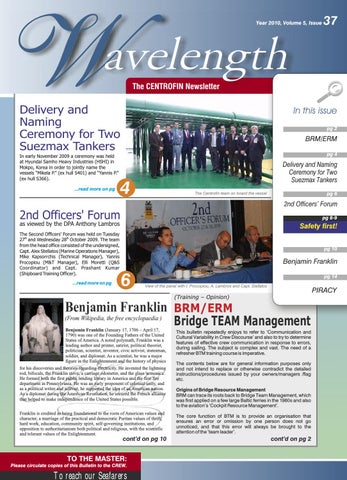
Delivery and Naming Ceremony for Two Suezmax Tankers
In early November 2009 a ceremony was held at Hyundai Samho Heavy Industries (HSHI) in Mokpo, Korea in order to jointly name the vessels “Mikela P.” (ex hull S401) and “Yannis P.” (ex hull S366). ...read more on pg
In this issue pg 2
BRM/ERM pg 4
Delivery and Naming Ceremony for Two Suezmax Tankers
4
The Centrofin team on board the vessel
pg 6
2nd Officers' Forum
2nd Officers' Forum
pg 8-9
as viewed by the DPA Anthony Lambros The Second Officers' Forum was held on Tuesday 27th and Wednesday 28th October 2009. The team from the head office consisted of the undersigned, Capt. Alex Stellatos (Marine Operations Manager), Mike Kapsorrchis (Technical Manager), Yannis Procopiou (M&T Manager), Elli Moretti (Q&S Coordinator) and Capt. Prashant Kumar (Shipboard Training Officer). ...read more on pg
Safety first! pg 10
Benjamin Franklin
6
pg 14 View of the panel with I. Procopiou, A. Lambros and Capt. Stellatos
PIRACY
(Training – Opinion)
Benjamin Franklin BRM/ERM (From Wikipedia, the free encyclopaedia ) Benjamin Franklin (January 17, 1706 – April 17, 1790) was one of the Founding Fathers of the United States of America. A noted polymath, Franklin was a leading author and printer, satirist, political theorist, politician, scientist, inventor, civic activist, statesman, soldier, and diplomat. As a scientist, he was a major figure in the Enlightenment and the history of physics for his discoveries and theories regarding electricity. He invented the lightning rod, bifocals, the Franklin stove, a carriage odometer, and the glass 'armonica'. He formed both the first public lending library in America and the first fire department in Pennsylvania. He was an early proponent of colonial unity, and as a political writer and activist, he supported the idea of an American nation. As a diplomat during the American Revolution, he secured the French alliance that helped to make independence of the United States possible. Franklin is credited as being foundational to the roots of American values and character, a marriage of the practical and democratic Puritan values of thrift, hard work, education, community spirit, self-governing institutions, and opposition to authoritarianism both political and religious, with the scientific and tolerant values of the Enlightenment.
cont'd on pg 10
TO THE MASTER: Please circulate copies of this Bulletin to the CREW.
To reach our Seafarers
Bridge TEAM Management This bulletin repeatedly enjoys to refer to 'Communication and Cultural Variability in Crew Discourse' and also to try to determine features of effective crew communication in response to errors, during sailing. The subject is complex and vast. The need of a refresher BTM training course is imperative. The contents below are for general information purposes only and not intend to replace or otherwise contradict the detailed instructions/procedures issued by your owners/managers /flag etc. Origins of Bridge Resource Management BRM can trace its roots back to Bridge Team Management, which was first applied on a few large Baltic ferries in the 1980s and also to the aviation's 'Cockpit Resource Management'. The core function of BTM is to provide an organisation that ensures an error or omission by one person does not go unnoticed, and that this error will always be brought to the attention of the 'team leader'.
cont'd on pg 2
from pg 1
Bridge TEAM Management (Training – Opinion)
BRM/ERM Bridge Team Management – a practical guide, by Captain A J Swift, was first published by The Nautical Institute in 1993. Since then, BTM has been developed in to BRM to reflect the wider circle of resources which are informed and affected by human factors. BRM training is now offered by many nautical colleges, though many shipping companies elect to run bespoke in-house training for their crews.
Guidance on Bridge Resource Management No specific advice is provided on BRM. However guidance on 'Performing the Navigational Watch' is contained in MGN 315(M) with emphasis on pilotage. This instructs the officer of the navigational watch to inter alia:
Continue to be responsible for the safe navigation of the vessel despite the presence of a pilot on board
reduce the human error. In addition to performing their individual tasks, crewmembers are expected to support each other by monitoring the situation as well as each other's performance and to intervene if a problem is detected. However, failures to do so are not infrequent. Accidents' reviewing and analysis have identified monitoring / challenging errors or lack of assertiveness. At times, seafarers (officers) fail in this critical crew function either because they did not notice a problem, or because they did not succeed in communicating their concerns to the other person(s) on the bridge, the engine room, the cargo control room or elsewhere onboard. Therefore, to our humble opinion, an effective BTM & Simulator Training course is to have been so designed as to provide the guide-lines for identifying the effective communication strategies, among crewmembers (including pilots etc), and thus have them used to mitigate errors or problems.
the relational component. This is particularly true in situations in which we place demands at our listeners, for instance when we want them to change their behaviour (action). In these situations we want our listeners not only to understand our intentions but we also want them to act accordingly. How speakers can best assure listener(s) cooperation varies with their relationship. Seniors (superiors), by virtue of their social status (rank, in our case) may be (are) licensed to give direct commands to their Juniors (subordinates). If subordinates reverted to the same linguistic strategy, superiors may perceive them as threatening and may refuse compliance. To avoid this kind of confrontation, subordinates are likely to use more polite and as such more indirect ways of communicating. However, by being indirect subordinates run the risk of being misunderstood or of not being heard !
/ M R B
If in any doubt as to the pilot's actions or intentions, seek clarification from the pilot; if doubt still exists, they should notify the master immediately and take whatever action is necessary until the master arrives
More comprehensive advice on BRM has been provided by the Australian Maritime Safety Authority in its Marine Notices 9/2006 and 7/2009. For example, Marine Notice 7/2009 states:
“The master and the bridge team should remember that they are always responsible for, and are in charge of the safe navigation of the ship, even when navigating with a pilot …” also:
“…pilots expect masters and watchkeepers to participate fully in the navigation of their ship during pilotage. The master and the deck officers must continue to monitor the safe passage of the ship, critically appraise the pilot's advice and incorporate the pilot fully into the bridge team in a mutually supportive manner to ensure efficient and safe navigation. All BRM procedures still apply when a pilot boards the ship, and the bridge team should conduct a pre-passage briefing, together with the pilot to ensure a shared view of the intended passage prior to its execution”.
The essential thrust of BRM is to promote teamwork among seafarers and thus to
What does effective communication entail in this context?
One may be inclined to postulate (assume) that crew members ought to be very assertive in their intervention, i.e., they should be explicit about what needs to be done and they should explicitly 'direct' the other crew member to take the corrective action.
The demand for explicit and direct communication, however, under estimates the important role that social considerations play in interactions. In plain language: Would a junior officer be assertive to his intervention to the Master or possibly to the Pilot?
Experts have pointed-out that every utterance (expression-remark-declaration) has two components: >the referential (relating to references or in the form of a reference), which makes some predication about the world, and >the relational (involving or expressing a relationship), by which we signal something about our social relationship to the listener.
Communication is not just a matter of what we say; it is also how we say it that determines the received message. Moreover, whether or not we are successful in our communication depends critically on the extent to which we can accommodate both the referential and
There is thus a tension between informative communication and socially successful ways of communicating. We suggest that effective communication seeks to optimise informativeness and social appropriateness. How this can be achieved in crew discourse (a serious and length speech or piece of writing about a topic) may vary as a function of five variables: (1) The status of the speaker relative to the status of the addressee (2) The risk inherent in the situation (problem) (3) The degree of 'face threat' involved in challenging an error (4) Culture –specific norms for interacting with superiors and subordinates, and (5) The gender of the speaker (not often). Various analyses of crew discourse found that captains were more direct in addressing officers than officers were in addressing captains. However, for both crew positions communications were most direct during problem and emergency situations than during normal sailing segments. In addition to risk there is a feeling that captains' communications would be sensitive to the degree to which an error implied a threat to the professional 'face' of a crewmember. If others have made an obvious error, calling it to their attention may involve a direct challenge to their status, judgment of skill. We have witnessed certain examples between European & Asian crews.
- pg 3 According to politeness theories, in situations like these, speakers will seek to protect their addressee's face and use more indirect speech as compared to situations that are less face-threatening. Moreover -- with today's multinational, multi-language and multi-faith crews – norms that define polite and socially appropriate behaviour vary across cultures and are found to foster distinct conversational styles and attitudes toward leadership. These findings suggest that captains (& pilots) from different cultures may also favour distinct communication strategies. There are many ways in which a captain can ensure the safety of his ship whilst the SecondOfficer has the 'con', while the vessel is sailing in a busy and confine TSS, nearing a channelbuoy. He could either take some action himself or could ask the OOW to take a particular goalconsistent action. We categorise the former as a 'speaker-centred' communication and the latter as an 'other-centred' communication or request.
Instead speakers inquire about the addressee's willingness to take the action. 5. Preferences: I think it would be wise to turn left (or right) Preferences statements are indirect requests insofar as speakers do not overtly make a request but rather express their or a third party's preference for a particular course of action. 6. Hints: That turn in 3 cables looks mean Hints, i.e., problem or goal statements, are the least direct from a request. Speakers do not specify any course of action; rather they point to a problem or remind of a previously established goal. 7. Self-Directives: I am going to get a clearance to deviate around his buoy 8. Permission Seeking Questions: You want me to ask for clearance to deviate around the next buoy?
At times officers' problem and goal statements direct the captains' attention to some objective event that requires correction, but leave the decision of what to do to the captain. While hints are certainly task-relevant communications, they entail the risk that captains will ignore them. Captains are less likely to act of officers suggestions when they are indirect rather than direct communications. This is not to say that hints are necessarily ineffective. Instead, training could identify possible follow-up strategies that officers could (or should) use if the captain does not respond adequately at the request. Or training could instruct captains to be more sensitive to indirect communication strategies of junior crew members A rather different approach to training would entail a shift away from the status-quo to alternative models of crew communication if one were to ask captains and officers to rate effectiveness of various communication strategies. Possibly captains and officers could favour communication strategies that appealed to the crew concept than to any particular status-based model. Common to this strategy is that it addresses a problem without disrupting the team context. Like commands it explicitly states what should be done. But unlike commands it does not rely on status differences to assure compliance referring instead to the crew members; shared responsibility for coping with problem situations.
M R E / An example of a 'speaker-centred' communication is: Second officer, I am going to talk to VTS and request a deviation. I take the 'con'.
Requesting the 2/O to act, on the other hand, could be done by saying: 'Let's go around this buoy. What are your intentions? Both types of communication could vary in the extent to which speakers are direct and explicit about what action to take and who is to do it.
Classes of Communication Strategies (with examples)
1. Commands: Turn 30 degrees right Commands are the most direct form of request – they leave little doubt about what action a speaker wants his addressee to perform.
2. Crew Obligation Statements: I think we need to deviate right, about now
3. Crew Suggestions: Let's go around the next buoy; shall we? Crew Obligation Statements and Crew Suggestions are less direct than Commands insofar as they do not explicitly refer to the addressee as the one who is to take the action. Moreover, Crew Suggestions are less forceful than either Commands or Crew Obligation Statements because they simply propose, rather than assert a particular corrective action. Commands & Crew Obligation Statements, in contrast, are more binding, the former by demanding adherence and the latter by appealing to an existing obligation.
4.Queries: Which direction would you like to deviate to? Queries, the fourth request type, neither call for nor assert a particular corrective action.
Implications For Training
During an appropriate BTM/Simulator training course (with the largest number of crew present) certain cross-cultural variabilities in the communication strategies should be examined, analysed, agreed and accepted. Training could address the advantages and disadvantages of captains and officers preferred strategies, i.e., of commands and hints respectively.
For example: captains' commands may lead to complacency by the officer. In commanding action, captains put considerable pressure on officers to comply. Consequently officers might not verify the appropriateness of the requested action, or they might find it difficult to challenge the captain's judgment. This may especially be a danger when commands are not supported by problem or goal statements. Since these supportive statements (problem, emergency) shift the motivation for the command away, from the captains' status to some objective necessity, they may facilitate input by junior crew members.
Likewise there are advantages and disadvantages associated with hints, officers' main strategy for requesting captain action.
This kind of training, moreover, would not seek to 'up-grade' officers to a captain-like communication style but rather to get both captains and officers attuned to communication strategies that are supportive of TEAM WORK !
Related accidents (Compliments MAIB)
Skagern / Samskip Courier -On 7 June 2006, the general cargo ship Skagern and the container ship Samskip Courier collided in the Humber estuary in dense fog.
cont'd on pg 12
Delivery and Naming Ceremony for Two Suezmax Tankers ...from pg1
This event marked the completion of a long term relationship with Hyundai Samho which started in 2006 and has resulted in the successful delivery of six suezmax tankers. The delivery of the final vessel was in January 2010. Both ships have already commenced trading alongside their sister vessels in the spot market. All of these technologically advanced 158,000 dwt tankers were built by one of the leading yards in the world (HSHI) under the supervision of Centrofin technical staff, namely Mr. I. Vakkas (Site Manager) along with Superintendents Ch. Chatzigiaksoglou, S. Papadopoulos, S. Tsaltas and S. Palaiologos.
The stand from which the delegates watched the ceremony
Even though these are sister vessels, the “Mikela P.” has the added distinction of being the only suezmax tanker included in the publication “Significant Ships of 2009” by the Royal Institution of Naval Architects in the United Kingdom. The ceremony was well attended by a large number of delegates. The Hyundai delegation was led by Mr. Moo-Soo Hwang (President and CEO of HSHI) and Mr. D.Y. Han (Senior Executive Vice President of HHI). Centrofin was represented by members of its management including Mssrs. D. Procopiou, A. Lambros, I. Pantos, I. Procopiou and K. Lionis.
- pg 5 -
Commemorative photo before the ceremony
Ms. M. Procopiou acted as Godmother for the M/T “Mikela P.”, while Ms. I. Harakoglou sponsored M/T “Yannis P.”. In his speech, Mr. Procopiou praised the efforts of the shipyard personnel and supervision team in delivering top quality vessels, especially in these difficult times. The ceremony ended with the traditional champagne breaking and ribbon cutting on the bridge, followed by a tour on board led by the Master (Capt. G. Georgiou) and a luncheon hosted by the Builder.
Ribbon cutting in the wheelhouse
Capt. Georgiou sounds the vessel's horn
We wish for these vessels the calmest of seas and the greatest success in their voyages!
Capt. Georgiou is flanked by the two Godmothers
Just after the champagne breaking
The Master and Chief Engineer with the Godmothers
Group photo with all the delegates
The speakers at the end of the forum
nd
2 Officers' forum as viewed by the DPA Anthony Lambros External speakers were also arranged from Attendance was very encouraging with a Greece and Manila as follows: total of 54 officers and 8 petty officers attending. All four of our manning sources - Gabriel Dovles from TQC speaking (Philippines, India, Ukraine and Greece) a b o u t R i s k A s s e s s m e n t a n d were represented. We worked on the Environmental Management previous year's model, however on the
second day two parallel sessions were ran by Capt. Stellatos and Mike Kapsorrachis, so that each of the deck and engine side could go into more specialized discussions. I believe that this choice was justified.
- Capt. Giardino Lintag from IDESS Maritime Centre speaking about correct filling of Oil Record Book - Mr. Michalis Sigalas from Lloyds Register speaking about the new ILO Maritime Convention - Dra. Fe Bacunagan from S.M.Lazo Clinic speaking about health and dietary issues.
Mrs Andaya with Elli Moreti, A. Lambros and M. Kapsorrachis at the party
Old friends at the party - Cmdr. N.A.Iliopoulos with Capt. and Mrs Andaya
Capt. Stellatos with Capt. Andaya, Capt. Macaraeg and CE Saban Capt. Stellatos and A. Lambros take questions at the end of the second day
Elli Moretti delivering her presentation on incidents
The engineers focused on techncial matters during the second day
Chief Officer Clarito raising a question
Four nationalities of officer coexist in harmony
- pg 7 The CENMAR staff showed their numbers at the farewell party
Capt. Stellatos addressing the Forum
On the afternoon of the second day we dedicated more time to listening to our officers. It took some time to get everyone fired up, but once they got started there was no stopping them! We were faced with a variety of issues: some were easy to address, some difficult, some unexpected and others very sensitive, however all of them were equally important. I believe that this year's event was a success, and if I want to measure this success I will start from here. It is vital for us to listen to our seafarers and understand their needs. Our aim has always been to maintain our own pool of seafarers, and in order to do this we need to be close to them. We honestly tried our best to understand and respond to every question, and I hope we at least managed to get this message across.
On the evening of the second day we all got together at the hotel's night club for a party hosted by CENMAR. For us it was a wonderful opportunity to get to know our officers better in a more relaxed atmosphere. I believe it was good fun for all and it went into the small hours, with everyone taking to the dance floor at the end.
We thank all participants and speakers for two excellent and constructive days.
I would also like to express my sincere personal appreciation (and my apologies in advance if I have omitted someone) for all those that brought forward their proposals, questions and, why not, complaints, In short, I consider this event to be a namely: success and feel that the participation from our seafarers is gradually increasing. At the Captains Andaya, Montilla and Macaraeg end of the forum we ran an evaluation Chief Engineers Bhaumik, Enriquez and questionnaire, and judging by the response Andaya we believe that we are moving towards the Chief Officers Clarito, Saban and Krushch right direction. Lets all work together to Second Mates Cadavos and Montevirgen make the 2010 Forum an even better event, but most importantly to improve our daily We look forward to seeing everyone again activities from year to year. in the autumn of 2010 !
A. Lambros
Capt. Macaraeg, I. Procopiou, Capt. Rigas and Capt. Andaya at the party
Capt. Macaraeg, I. Procopiou, Capt. Rigas, A. Lambros and Capt. Andaya at the party
> A. Lambros joining the 'Ukrainian corner' at the party
Safety First !! Message from the DPA: A Culture of Good Housekeeping on Deck Our focus for my message this time one: Safe Navigation. Out of all the activities that are conducted on board, there is nothing more important that navigating the vessel. The Master and the Officers of the Watch (OOW) during their bridge watch carry the greatest responsibility. The company wishes to make this clear to all seafarers: Safe Navigation should always be the first and paramount consideration for all. There are various reference documents and books on board the vessel that adequately cover requirements, so I will only address in brief some of the points that commonly lead to accidents. In short, please ensure that: 1. charts on board are checked before sailing and are adequate, appropriate and updated, and passage is planned, approved and communicated in accordance with all necessary requirements (including under keel clearance, squat, tides, etc). 2. the minimum watch composition is always adhered to, vigilance and alertness is maintained at all times, and the Master is notified well in advance of nay hazardous situation occurring. The OOW should not hesitate to make use of the engines and steering. 3. communications with the pilot are clear and understandable, pilot exchange card is used and always remember that the ultimate responsibility for the control of the vessel lies with the OOW or Master, not the pilot. 4. all navigational equipment are kept operational and instructions contained in the company's Navigational Operations Manual, in forms and circulars, as well as in industry publications such as Bridge Procedures Guide and COLREGS are strictly followed. Most of all, I wish to emphasize the need for teamwork on the bridge. The bridge staff from the lookout or helmsman up to the OOW must continuously work as a Team and complement each other. Clear assignment of duties and clear communications and instructions are necessary to achieve the desired result. Finally, please remember that in all situations, the Marine Operations dept is available to provide support and guidance. Anthony Lambros / Q&S Manager DPA I welcome your comments, suggestions or feedback on the contents of this column (Safety First!) at q&s@centrofin.gr
All ships move in a seaway and in fact, ship structures, machinery and equipment on deck are vulnerable to the effects of weather and sea conditions. A culture of good housekeeping is needed to ensure safe and efficient operation of a ship and reflects the standards of “GOOD SEAMANSHIP� that exist on board. Therefore, it is the responsibility of all officers and crew to ensure that good housekeeping is not being neglected or overlooked. If it is, it can possibly lead to personal injury, pollution, damage to cargo, financial loss and even damage to vessel. Good housekeeping involves day to day management of activities to identify potential hazards and provide solutions so that the vessel remains in a safe condition at all times. Here are the following points that will help us refresh our mindset towards good housekeeping on deck:
Oil Spill Containments - The manifold drip trays must be kept clean and free of any residues as far as practicable - Inspect drain valves and make sure that they are not clogged, do not leak and close fully at all times.
- Clean any excessive grease within containments. Report any hydraulic oil leaks immediately.
Oil Spill Equipment - Oil spill gear and equipment should be easily accessible and ready for immediate use at all times. - Store equipment in mobile bins on deck and make sure they are sealed or fully protected. Remember that if water penetrated into the bins then some equipment may become unusable. - Regularly inspect oil spill equipment.
Walkways - All loose objects and obstructions must be removed or secured.
- pg 9 Safety Bulletin 10-01
Source: CHEVRON Safety Bulletin, February 2010, Volume 72 - In order to provide safest possible passage on main deck, walkways (Bow access) must have all chains or wires put in place.
Deck Machinery and Winches - Due to exposure from wind, rain and sea water, everything on deck is subject to wear due to corrosion. Covering machinery on deck with canvas will prolong its life and reduce maintenance.
Open Decks - Observe tidiness or cleanliness of working areas, immediately clean up any slippery surface. - Ensure access to safety equipment on deck is free of obstacles.
Watertight Seals and Valves - Manholes, hatches and watertight doors must be maintained in good condition and kept closed when not being used. - Valves and air vents must be functioning properly and not jammed. - Check condition of rubber seals, avoid painting it and replace if damaged - Check condition of thread for corrosion to ensure they seal plugs tightly at mooring winches save-alls and fuel vents containments.
- Winches, foundation plates and mountings should be checked for signs of stress or corrosion. Proper handling and maintenance is the key for effective operation of machinery. Check hydraulic lines and piping systems on deck for potential leaks. - Mooring ropes fail because of excessive stress, cuts from sharp objects, exposure to sunlight which degrades the synthetic fiber and poor storage.
Deck Store Rooms - Boxes, cases, packages, drums and containers must be always stowed / lashed along with good seaman practices. - Paints, solvents, cargo & bunker samples must be properly sealed and stored on shelves and lashed. - Garbage stowage bins cleaned and secured.
A well-painted ship presents an attractive appearance and gives clear impression that observance of good seamanship is being carried out on board. Good housekeeping is a team effort. By working together any fault or deficiencies will be detected and rectified earlier. It requires an attitude of constant vigilance, safety awareness and good seamanship. Do not wait for bad weather. Keep things secure and shipshape at all times.
Benjamin Franklin (From Wikipedia, the free encyclopaedia ) after his death, countless cultural references. Benjamin Franklin was born on Milk Street, in Boston, Massachusetts, on January 17, 1706 and baptized at Old South Meeting House. He was the son of Josiah Franklin, a tallow chandler and soap- and candlemaker, and his second wife, Abiah Folger. Josiah had 17 children;
(Portrait by Joseph Siffred Duplessis).
from pg 1 In the words of Henry Steele Commager, "In Franklin could be merged the virtues of Puritanism without its defects, the illumination of the Enlightenment without its heat." To Walter Isaacson, this makes Franklin, "the most accomplished American of his age and the most influential in inventing the type of society America would become." Franklin became a newspaper editor, printer, and merchant in Philadelphia, becoming very wealthy writing and publishing Poor Richard's Almanack and The Pennsylvania Gazette. Franklin was interested in science and technology, and gained international renown for his famous experiments. He played a major role in establishing the University of Pennsylvania and was elected the first president of the American Philosophical Society. Franklin became a national hero in America when he spearheaded the effort to have Parliament repeal the unpopular Stamp Act. An accomplished diplomat, he was widely admired among the French as American minister to Paris and was a major figure in the development of positive Franco-American relations. From 1775 to 1776, Franklin was the Postmaster General under the Continental Congress and from 1785 to 1788, the President of the Supreme Executive Council of Pennsylvania. Toward the end of his life, he became one of the most prominent abolitionists. His colourful life and legacy of scientific and political achievement, and status as one of America's most influential Founding Fathers, have seen Franklin honoured on coinage and money; warships; the names of many towns, counties, educational institutions, namesakes, and companies; and more than two centuries
Benjamin was the fifteenth child and youngest son. Josiah wanted Ben to attend school with the clergy but only had enough money to send him to school for two years. He attended Boston Latin School but did not graduate; he continued his education through voracious reading. Although "his parents talked of the church as a career" for Franklin, his schooling ended when he was ten. He then worked for his father for a time and at 12 he became an apprentice to his brother James, a printer, who taught Ben the printing trade. When Ben was 15, James founded The New-England Courant, which was the first truly independent newspaper in the colonies. When denied the chance to write a letter to the paper for publication, Franklin adopted the pseudonym of "Mrs. Silence Dogood", a middle-aged widow. "Mrs. Dogood's� letters were published, and became a subject of conversation around town. Neither James nor the Courant's readers were aware of the ruse, and James was unhappy with Ben when he discovered the popular correspondent was his younger brother. Franklin left his apprenticeship without permission, and in so doing became a fugitive. At age 17, Franklin ran away to Philadelphia, Pennsylvania, seeking a new start in a new city. When he first arrived he worked in several printer shops around town. However, he was not satisfied by the immediate prospects. After a few months, while working in a printing house, Franklin was convinced by Pennsylvania Governor Sir William Keith to go to London, ostensibly to acquire the equipment necessary for establishing another newspaper in Philadelphia. Finding Keith's promises of backing a newspaper to be empty, Franklin worked as a typesetter in a printer's shop in what is now the Church of St Bartholomew-the-Great in the Smithfield area of
London. Following this, he returned to Philadelphia in 1726 with the help of Thomas Denham, a merchant who employed Franklin as clerk, shopkeeper, and bookkeeper in his business. In 1727, Benjamin Franklin, then 21, created the Junto, a group of "like minded aspiring artisans and tradesmen who hoped to improve themselves while they improved their community." The Junto was a discussion group for issues of the day; it subsequently gave rise to many organizations in Philadelphia. Reading was a great pastime of the Junto, but books were rare and expensive. The members created a library, initially assembled from their own books. This did not suffice, however. Franklin then conceived the idea of a subscription library, which would pool the funds of the members to buy books for all to read. This was the birth of the Library Company of Philadelphia: its charter was composed by Franklin in 1731. In 1732, Franklin hired the first American librarian, Louis Timothee.) Originally, the books were kept in the homes of the first librarians, but in 1739 the collection was moved to the second floor of the State House of Pennsylvania, now known as Independence Hall. In 1791, a new building was built specifically for the library. The Library Company is now a great scholarly and research library with 500,000 rare books, pamphlets, and broadsides, more than 160,000 manuscripts, and 75,000 graphic items. Upon Denham's death, Franklin returned to his former trade. By 1730, Franklin had set up a printing house of his own and had contrived to become the publisher of a newspaper called The Pennsylvania Gazette. The Gazette gave Franklin a forum for agitation about a variety of local reforms and initiatives through printed essays and observations. Over time, his commentary, and his adroit cultivation of a positive image as an industrious and intellectual young man, earned him a great deal of social respect.
- pg 11 -
from pg 3
Bridge TEAM Management (Training – Opinion)
BRM/ERM Both vessels had experienced pilots on board at the time of the accident. The report highlighted the failure to apply long established collision avoidance methods by the masters and pilots; poor pilot / master relationships; the masters' over reliance on the pilots and poor interaction and communications among the bridge teams. Sea Express 1 / Alaska Rainbow -On 3 February 2007, the high speed ferry Sea Express 1 and the general cargo vessel Alaska Rainbow collided on the River Mersey in thick fog. The collision holed the starboard hull of the ferry, causing her to list and trim significantly. One of the report's conclusions was that: the Alaska Rainbow pilot was not proactive in requiring support, and neither the master nor the OOW was proactive in providing support to the pilot, thereby unnecessarily increasing the pilot's workload. Audacity / Leonis -On 14 April 2007, the product tanker Audacity was involved in a collision with the general cargo ship Leonis, in very poor visibility, in the precautionary area at the entrance to the River Humber. Both vessels sustained damage to their bows. The report's conclusions included that: the pilots and bridge teams, on both vessels, did not make a full assessment of the risk of collision and that communications were poor.
Sea Mithril -On 18 February 2008, the UK registered cargo vessel Sea Mithril grounded in the River Trent on three occasions. A river pilot was embarked and dense fog had reduced visibility to about 20m. The report highlighted that: the master was unable to maintain a command overview of the vessel's passage. The master relied totally on the pilot for the safe navigation of his vessel. Communication and co-ordination between the master and pilot prior to the groundings were poor. The pilot was not supported by the bridge organisation, which became dysfunctional after restricted visibility was encountered. Flaws in the bridge organisation and available support were not identified by the master or the pilot. Sichem Melbourne On 25 February 2008 the product carrier, Sichem Melbourne, sustained damage and damaged mooring structures as she departed her berth at Crouton Oil Refinery on the River Thames estuary. The report found that there was an inadequate exchange of information between the master and pilot before commencing unmooring operations and that the interaction and communications between members of the bridge team were poor.
varies depending on the characteristics of the VTS area. In most areas, it would be expected that a VTS Traffic Organisation Service (TOS) would notify vessels of other traffic that had the potential to affect their passage, and check they were aware of an approaching vessel's presence. Some TOS will monitor a vessel's progress against a radar reference line or similar track mark in order to provide the master or pilot with details of the vessel's distance from the centre of the channel or fairway. Other TOS monitor the speed of vessels passing locations which are vulnerable to high wash or the effects of interaction area. Although the primary responsibility for monitoring the actions of a pilot falls to a vessel's master and bridge team, the VTS organisation offers another potential barrier to erroneous behaviour, and is one that should be explored.
Pollution.
VTS
Finally, we all recognize that mistakes can be made. Provided, however, that there has been a genuine mistake leading to an accidental discharge of persistent oil, within the MARPOL Annex I, the case can be defended, withholding that the crew has not disobeyed any pollution regulations and later sought to cover the tracks by falsifying contemporaneous documents, as the ORB.
In practice the role of VTS authorities in monitoring the safe passage of vessels
We have written, in the previous issues,
Perspective
from Latin perspicere (to see through) in the graphic arts, such as drawing, is an approximate representation, on a flat surface (such as paper), of an image as it is seen by the eye
One day, the father of a very wealthy family took his son on a trip to the country with the express purpose of showing him how poor people live. They spent a couple of days and nights on the farm of what would be considered a very poor
family. On their return from their trip, the father asked his son, "How was the trip?" "It was great, Dad." "Did you see how poor people live?" the father asked. "Oh yeah, " said the son. "So , tell me , what did you learn from the trip?" asked the father. The son answered: "I saw that we have one dog and they had four. We have a pool that reaches to the middle of
- pg 13 about the identification of hazards, the 'error tolerance', the 'just culture' and the problems related to the spoken maritime English (“thinking in English” & “meaning over grammar”), together with our concerns over race, culture and language differences.
HUMOUR :)
Finally (Compliments NTSB) Officers should be provided principles of Bridge Resource and emphasize correct and information management, role planning.
A large two-engine train was crossing America. After they had gone some distance one of the engines broke down. "No problem," the engineer thought, and carried on at half power.
with recurrent training in the Management which encourage unambiguous communication, responsibility, and contingency
Comments are welcomed. ONE. TWO.
Give people more than they expect and do it cheerfully. Marry a man/woman you love to talk to. As you get older, their conversational skills will be as important as any other. THREE. Don't believe all you hear, spend all you have or sleep all you want. FOUR. When you say, 'I love you,' mean it. FIVE. When you say, 'I'm sorry,' look the person in the eye. SIX. Be engaged at least six months before you get married. SEVEN. Believe in love at first sight. EIGHT. Never laugh at anyone's dreams. People who don't have dreams don't have much. NINE. Love deeply and passionately. You might get hurt but it's the only way to live life completely. TEN.. In disagreements, fight fairly. No name calling. ELEVEN. Don't judge people by their relatives. TWELVE. Talk slowly but think quickly. THIRTEEN. When someone asks you a question you don't want to answer, smile and ask, 'Why do you want to know?' FOURTEEN. Remember that great love and great achievements involve great risk. FIFTEEN. Say 'bless you' when you hear someone sneeze. SIXTEEN. When you lose, don't lose the lesson. SEVENTEEN. Remember the three R's: Respect for self; Respect for others; and Responsibility for all your actions. EIGHTEEN. Don't let a little dispute injure a great friendship. NINETEEN. When you realize you've made a mistake, take immediate steps to correct it. TWENTY. Smile when picking up the phone. The caller will hear it in your voice TWENTY- ONE. Spend some time alone.
(Compliments BOW WAVE)
Farther on down the line, the second engine broke down, and the train slowed to a dead stop. The engineer decided he should inform the passengers about why the train had stopped, and made the following announcement: "Ladies and gentlemen, I have some good news and some bad news. The bad news is that both engines have failed, and we will be stuck here for some time. The good news is that you decided to take the train and not fly." An atheist was walking through the woods. 'What majestic trees! 'What powerful rivers! 'What beautiful animals! He said to himself. As he was walking alongside the river, he heard a rustling in the bushes behind him. He turned to look. He saw a 7-foot grizzly bear charge towards him. He ran as fast as he could up the path. He looked over his shoulder and saw that the bear was closing in on him. He looked over his shoulder again and the bear was even closer. He tripped and fell on the ground. He rolled over to pick himself up but saw that the bear was right on top of him, reaching for him with his left paw and raising his right paw to strike him... At that instant the Atheist cried out, 'Oh My God!' Time Stopped. The bear froze. The forest was silent. As a bright light shone upon the man, a voice came out of the sky.
our garden and they have a creek that has no end. We have imported lanterns in our garden and they have the stars at night. Our patio reaches to the front yard and they have the whole horizon. We have a small piece of land to live on and they have fields that go beyond our sight. We have servants who serve us, but they serve others. We buy our food, but they grow theirs. We have walls around our property to protect us; they have friends to protect them."
The boy's father was speechless.. Then his son added, "Thanks Dad for showing me how poor we are." Isn't perspective a wonderful thing? Makes you wonder what would happen if we all gave thanks for everything we have, instead of worrying about what we don't have. Appreciate every single thing you have, especially your friends! "Life is too short and friends are too few."
'You deny My existence for all these years, teach others I don't exist and even credit creation to cosmic accident.' 'Do you expect Me to help you out of this predicament? Am I to count you as a believer?' The atheist looked directly into the light, 'It would be hypocritical of me to suddenly ask You to treat me as a Christian now, but perhaps you could make the BEAR a Christian?' 'Very well,' said the voice. The light went out. The sounds of the forest resumed. And the bear dropped his right paw, brought both paws together, bowed his head and spoke: 'For what I am about to receive, may the Lord make me truly thankful, Amen.'
PIRACY (Compliments Cargo Letter 462 – Jan 2010)
***Pirates Even Have A Stock Market - But This Is How Lloyd's of London Began! .....
***More Pirate Attacks -- More Violent.....
As in dysfunctional Somalia, a high-functioning financial sector: a "stock market" to fund the seagoing pirates! In Somalia, which is without a central government to speak of and where very little functions beyond an Islamic resistance and individual warlords' fiefdoms, a robust "stock market" has emerged in the city of Haradheere for "investors" in the seagoing pirate "industry" to raise money & supplies for kidnappers in exchange for a share of the bounty once a ransom is paid. According to a Dec. Reuters dispatch, 72 "companies" are listed on the exchange; enabling "venture capital" to fund greater piracy traffic and more sophisticated looting. There even seems to be a financial "bubble" at work, in that since the "exchange" opened, pirates' ransoms have doubled to about US$4M per ship.
As a total of 406 incidents of piracy & armed robbery were reported in the 2009 to the Int'l Maritime Bureau's Piracy Reporting Centre, 39% more than the prior year. More than half involved pirates from Somalia. The last time piracy figures crossed 400 incidents was in 2003. 2009 is also the 3rd consecutive year the number of reported incidents has increased with 239 in 2006, 263 in 2007, and 293 in 2008. The report states that worldwide in 2009, 153 vessels were boarded, 49 vessels were hijacked, and there were 84 attempted attacks & 120 vessels fired upon -- compared to 46 ships fired upon in 2008. "The level of violence towards the crew has increased along with the number of crew injuries," the centre said. A total of 1,052 crew were taken hostage, 68 were injured and eight killed. Total incidents attributed to the Somali pirates in 2009 stands at 217 with 47 vessels hijacked and 867 crew taken hostage. The prior year, 111 vessels were targeted by Somali pirates resulting in 42 hijackings. 2009 has however seen a significant shift in the area of attacks off Somalia. While 2008 attacks were predominantly focused in the Gulf of Aden, 2009 has witnessed more vessels also being targeted along the East Coast of Somalia. Since Oct., increased activity has been observed in the Indian Ocean with 33 incidents reported, including 13 hijackings. IMB also said 28 incidents were reported for Nigeria in 2009. The Nigerian attacks are however much more violent in nature than Somalia.
***Piracy Ransom Price Inflation ..... as Somali pirates released Greek supertanker M/T Maran Centaurus, the European Union Maritime Security Centre & Athens-based ship owners Maran Tankers Management said Jan. 18. Various news reports claimed the pirates had received a record ransom of US$9M -- US$7M in cash dropped on the deck of the vessel and a US$2M cash transfer, while other reports said the payoff was on the order of US$5.5M. A year ago ship owners are believed to have paid about US$3M to secure the release of the Saudi tanker M/T Sirius Star, a record to that time.
PIRACY
***This Would End Quickly -- If The Attacks Were Upon Airliners ..... As the Hong Kong Shipowners' Assn. (HKSOA) has called for governments to throw out the current response to pirates menacing ships off the Horn of Africa, accusing the int'l community of tolerating piracy instead of eliminating attacks. This approach was sending out the message that piracy carries little risk for generous reward, the association said in a statement. More than 1,500 seafarers have been taken hostage for ransom, often for months at a time, said the HKSOA, despite significant measures shipowners have taken to defend their crews. The HKSOA has demanded a more robust approach from the international community. This is a stance that will resonate across the shipping industry that is becoming increasingly frustrated with pirates who seem able to operate with impunity. Military patrols in the Gulf of Aden have prevented many attacks but the pirates have simply moved far out to sea. The HKSOA questions why mother ships that ferry smaller & faster skiffs deep into
C.
M
AGEMENT I N AN
IN
CE
- pg 15-
NTROF
QUOTATIONS
( To be continued on the next issue W35)
Leading for Safety Crown Copyright - www.mcga.gov.uk
Confidence and Authority 1 Instill respect and command authority The ability to instill respect from, and command authority over, the crew is probably the first thing that comes to mind when people think of leadership. In many ways it happens on its own when you get everything else right. Leaders get respect and command authority when crews believe that you:
* Are willing to exercise the power vested in your position * Possess the necessary knowledge and competence * Understand their situation and care about their welfare * Are able to communicate clearly * Are prepared to act confidently and decisively. Why is it important? Without authority and respect it is difficult for leaders to influence the behaviour of their crews, including safety-related behaviour. Crews may establish their own individual or group values, attitudes and behaviours, or else follow other de-facto leaders lower down in the hierarchy. This can lead to poor compliance with standards and excessive risk-taking. Research shows that some Masters feel that their authority is being undermined by increasing governance from shore-based managers under ISM (e.g. through the Designated Person Ashore requirements). Also, some Masters feel that the increase in the volume of management standards and procedures is undermining their authority. These areas are important to address.
“ Commanding respect is a combination of having the rightknowledge,
skill andattitude,
M
AGEMENT I N AN
C.
CENTRO-NEWS
NTROF
IN
W
avelength
The Articles written and the Views expressed in this bulletin do not necessarily reflect those of CENTROFIN and/or its members. Queries to: wavelength@centrofin.gr Disclaimer. The contents provided herewith are for general information purposes only; not intended to replace or otherwise contradict the detailed instructions/procedures issued by the owners/managers, flag etc. Editor: Cmdr Nicholas A. ILIOPOULOS - Master Mariner - Human Resources Tel. +30.6944.941 333. Email: ilioship@yahoo.com.sg Comments. This editor welcomes readers' responses to all articles & Editorials. Design-Production: www.paradox.com.gr Tel.+30.210.6560 574
CE
where attitude is self regulated�