W
Volume 3, Issue 24, October 2007
To r Sea each far ou er r s
avelength centrofin@centrofin.gr
CENTRO-NEWS
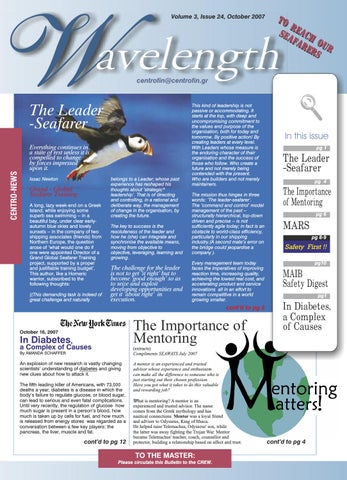
The Leader -Seafarer Everything continues in a state of rest unless it is compelled to change by forces impressed upon it. Issac Newton
Grand - Global Seafarer Training A long, lazy week-end on a Greek Island, while enjoying some superb sea swimming -- in a beautiful bay, under clear earlyautumn blue skies and lovely sunsets -- in the company of two shipping associates (friends) from Northern Europe, the question arose of 'what would one do if one were appointed Director of a Grand Global Seafarer Training project, supported by a proper and justifiable training budget'. This author, like a Homeric warrior, subscribed to the following thoughts: ((This demanding task is indeed of great challenge and naturally
belongs to a Leader; whose past experience has reshaped his thoughts about 'strategic* leadership'. That is of directing and controlling, in a rational and deliberate way, the management of change in the organisation, by creating the future. The key to success is the resoluteness of the leader and how he (she) can integrate and synchronise the available means, moving from objective to objective, leveraging, learning and growing.
The challenge for the leader is not to get 'it right' but to become 'good enough' so as to seize and exploit developing opportunities and get it 'about right' in execution.
This kind of leadership is not passive or accommodating. It starts at the top, with deep and uncompromising commitment to the values and purpose of the organisation, both for today and tomorrow. By positive action! By creating leaders at every level. With Leaders whose measure is the enduring character of their organisation and the success of those who follow. Who create a future and not merely being contended with the present. Who are builders and not merely maintainers. The mission thus hinges in three words: 'The leader-seafarer'. The 'command and control' model management of the past -structurally hierarchical, top-down driven and precise -- is not sufficiently agile today; in fact is an obstacle to world-class efficiency, particularly in our shipping industry.(A second mate's error on the bridge could jeopardise a company ). Every management team today faces the imperatives of improving reaction time, increasing quality, achieving the lowest real cost, and accelerating product and service innovations all in an effort to remain competitive in a world growing smaller.
cont'd to pg 2
In Diabetes,
The Importance of Mentoring
By AMANDA SCHAFFER
(extracts) Compliments SEAWAYS July 2007
October 16, 2007
a Complex of Causes
An explosion of new research is vastly changing scientists' understanding of diabetes and giving new clues about how to attack it. The fifth leading killer of Americans, with 73,000 deaths a year, diabetes is a disease in which the body's failure to regulate glucose, or blood sugar, can lead to serious and even fatal complications. Until very recently, the regulation of glucose how much sugar is present in a person's blood, how much is taken up by cells for fuel, and how much is released from energy stores was regarded as a conversation between a few key players: the pancreas, the liver, muscle and fat.
cont'd to pg 12
In this issue pg 1
The Leader -Seafarer pg 4
The Importance of Mentoring pg 6
MARS pg 8-9
Safety First !! pg10
MAIB Safety Digest pg1
In Diabetes, a Complex of Causes
A mentor is an experienced and trusted advisor whose experience and enthusiasm can make all the difference to someone who is just starting out their chosen profession. Have you got what it takes to do this valuable and rewarding job? What is mentoring? A mentor is an experienced and trusted advisor. The name comes from the Greek mythology and has nautical connections. Mentor was a loyal friend and adviser to Odysseus, King of Ithaca. He helped raise Telemachus, Odysseus' son, while the latter was away fighting the Trojan War. Mentor became Telemachus' teacher, coach, counsellor and protector, building a relationship based on affect and trust.
TO THE MASTER: Please circulate this Bulletin to the CREW.
cont'd to pg 4
The Leader-Seafarer cont'd from pg 1
To cope with this rapidly changing environment, executives of that sort are focusing on the need of a clear organisational Vision and Mission, on the empowerment of the workforce (seafarers and shore staff alike), on effective teaming, on organisational learning, on process (versus functional) orientation and on measurements that capture the true 'system wide' effects of decisions. The new management challenge confronts not only health and profits but also endeavours to reduce costs by improving operating expenses. The new challenging management format is unique:
We are to learn and to teach each other. Not through speeches written by public relations firms but rather by frank and open discussions about the real problems we all face as leaders (of the various crew departments). By the powerful way of being reminded of the importance of Values, Responsibility, Accountability and of the moral Courage it takes to lead, motivate and inspire in totally new markets and with totally new and different technologies.
Ship Owing / Managing Companies are (should be) teaching and coaching its seafaring force the role of Values in a large organisation, whilst transforming itself into a 'Learning Society'. As one thinks of the difficult issues of strategy - to which one is aware of - of the role of Vision, of how we build Teams, of how we develop Leaders, and of all the other tactical issues that face us today, one's experiences should form a lens, through which all can see, focus and understand the organisation better.
This vision will inspire the Director to lead the organisation to greatness. The Director's effectiveness as leader is, sometimes, not so much in what he does, as in to how he influences others what to do. Developing seafarers to distribute leadership throughout the Group is the essence of empowerment. Empowerment is an unfortunate word, because leadership is not about power and authority. Our people are empowered. We give them everything they need to do their jobs. But this is only the beginning. Empowerment is not simply about having the tools to do the job. Empowerment is about responsibility - both responsibility delegated and responsibility accepted. Empowered subordinates accept responsibility for themselves, for their team, and for their contributions to the organisation. From that sense of shared responsibility come selfconfidence, motivation, and commitment. Leader development investing in people is about creating that kind of empowerment; people that think and act responsibly. Learning must truly become lifelong, not merely episodic. Leaders must practice something called 'leadership-legacy-behaviour': growing their successors. The developing of leaders strengthens the ability of the Group to win today and tomorrow; as well as to remain an 'Employer of Choice'. Developing leaders is a bottom-line behaviour. To attack this issue and realise the potential of their people, top performing organisations are making a renewed commitment to leader development, understanding that the enormous changes going on around us demand continual renewal of our human resources. However, this is not an easy concept to put into practice: management systems tend to be about control and rewards, and it is hard to measure return on your investment in leader development. Leadership is tough, hard work because it challenges our traditional view of people as liabilities versus people as assets. The leader development (in most of the manuals) is based on three elements: + Education and Training + On-the-job experience + Self development.
Education & Training. This is the formal element. The 'institutional training'. The essential character of it is time dedicated to structured and focused learning facilities by professional teachers (usually and mostly the Maritime Academies). This kind of learning is especially efficient for updating skills, establishing a theoretical grounding in a subject area, introducing new skills, and facilitating the transition to a new job. This is an organisation's most powerful leader development message because it so obviously reflects investment. The choice of schooling is of paramount importance.
- pg 3 The shift to the 'knowledge society' puts this person in the centre. In doing so, it raises new challenges, new issues, and quite unprecedented questions about the knowledge-society's representative, The Educated Person - Seafarer. (The proud seafarer). This person will have to be able to appreciate other cultures and traditions; the philosophers and religions; the arts and literature; science and technology; services and economics, in a global world. One must become a 'citizen of the world', in Vision, Horizon and Information. But one will also have to draw nourishment from one's local roots, and in return, enrich and nourish one's own local culture. The educated seafarer will therefore have to understand two cultures that of the 'intellectual', who focuses on the words and ideas, and that of the 'manager' (leader), who focuses on people and work, as per the writings of the management guru Peter F. Drucker (1909 - 2005).
On-the-job-Experience. The experimental element reflects the value of learning on the job. Every job experience is a learning experience, and those experiences can be either relatively random or structured. Most organisations attempt to identify high-potential leaders early in their careers and may go so far as to manage their job progression and institutional training carefully, grooming them for ever-greater responsibility.
Self-Development This is a responsibility shared by the organisation and the individual. Self development may be as simple as a structured reading programme; it may include taking courses to qualify for a new skill or educational level; it could encompass private research (not often); or it could take any number of other directions. The common threads are that it is self-initiated and directed and that it is focused toward some tangible development goal. This has proved to be a useful way of keeping leader development in a broad perspective, it is more complex than simply providing schooling. To make on-the-job-experience and self-development as effective as possible, every leader must play a role in developing his/her subordinates; by counselling, coaching and mentoring all the seafarers; by especially being involved to two levels down; and again with most of the emphasis to one level down (Captain, Chief Engineer and Superintendents). Guidance provides feedback, suggesting goals, defining expectations; giving structure to these two elements, especially the selfdevelopment.
The Human Element. It is self evident that the most vital factor, an asset of immeasurable value, is the human resources employed on ships and in onshore maritime related activities. One could not imagine the existence of the shipping industry without its valuable workforce. The key message is that the image of the maritime profession ought to be improved and enhanced. This is not to persuade someone to join or work efficiently in a profession that is not generally respected. Therefore the seafarer recruitment and retainment doctrine and mandate should try to: Improve the image and re-establish the status of the maritime profession Improve its popularity and develop momentum Promote the positive aspects: Academic STATUS Secure professional development Conditions of work Remuneration Embody Knowledge.
> > > > >
Knowledge is not impersonal, like money. Knowledge does not reside in a book, a databank, a software programme; they contain only information. Knowledge is always embodied in a person; carried by a person; created, augmented, or improved by a person; applied by a person; taught and passed by a person; used or misused by a person.
Is this enough? To our opinion maritime schools should also concentrate on pure quantitive skills and more interpersonal coursework. On Teamwork and on paying more attention to 'soft' skills, like listening to colleagues. Seafarers joining vessels need not to come in being just gurus in navigation or engineering. What is important is that they also know how to analyse issues and communicate recommendations. By possessing the ability to write and speak clearly and persuasively, after having attended courses on communication and team-building; and on how to coach and mentor their juniors. After have being taught of how to plan a career, including of how to cope with 'stressors' like job loss and ageing. After having had their minds stretched and having come to realise that a career is a long-range project. Further more of how to assist and maintain the company's Global Code of Conduct while safeguarding its reputation. By keeping one's hands-on; by getting them dirty while delivering the results; the devil is in the details and in the process. By later producing more leaders and not more followers. Though easier said than done, to our opinion, it is possible and not inevitable. Workshops should provide above curricula. What are the issues in question? They are social, economical and environmental. What do our clients/customers & citizens expect from us? A socially responsible shipping industry, that is also efficient and competitive. An industry that has integrated seafaring and shore side expertise, that promotes matters of maritime R&D, science and technology. The mandate to 'develop and implement the corporate learning strategy', to my opinion, will have to depend on the aforementioned principles and naturally on the Top Management's commitment and approval - concurrently to the Company's Procedures, Processes and the Code of Conduct This is the duty, pledge and obligation of the Director, Grand-Global Seafarer Training)). This after all was a most enjoyable week-end. Comments are welcome. Ed.
(*Strategic: from the Greek word strategy/strategos=generalship/general)
cont'd from pg 1 We all need mentors, even if we are not as fortunate as Telemachus. Thinking back to your own days as a trainee or junior officer, you probably sailed with some people who were good teachers, gave you encouragement and guidance, let you try things out for yourself, congratulated you when you got things right, and encouraged and advised you on how to do better next time if things went a bit wrong. You probably also met people who took no interest in your training, did not explain things clearly, gave you very little chance to try things out for your self and shouted at you when you made mistakes. Does that sound familiar? Not everyone is very good or very bad; most are in the mid-range, somewhere. The important thing is that we can all be better mentors if we try harder.
3.- Briefing. Brief the trainee well before hand: tell him the outcome you expect and any particular dangers to look out for. Help them to plan and let them ask questions. Getting the briefing right is very important. It allows you to stand back and observe later, without having to say, 'By the way I forgot to warn you about….'. It is not the technology and operational factors that need to be taken into account. Relevant topics include delegation, motivation and communication. Videotel's The Culture Gap - The Challenge of Intercultural Effectiveness in the Management Services is one publication that will give an understanding that the message you give through your 'cultural filter' may be very different from the message received through that of the trainee.
The worldwide population of seafarers serving on internationally trading merchant ships today is estimated to be in the order of 466.000 officers and 721.000 ratings.
4.- Carrying out the project or procedure. Let them carry out the work without unnecessary interference. This part calls for courage and steady nerves on the part of the mentor. You will often want to interfere, but please don't - it will make the learning process much less effective. Of course, if there is danger to the ship, people, cargo or the environment you may need to step in to prevent any serious problem. But try not to unless it really is necessary.
Mentoring basic steps. The key steps in mentoring or coaching follow. There are ways that suitable publications and modern technology can help with the process. I will use a bridge watchkeeping example as an illustration: 1.- Identify the gaps in the trainee's knowledge and skills. Don't just take the junior officer's paper certificates and service records at face value. Discuss experiences and priorities with him/her. Get an idea of their attitude and confidence (or over confidence). As you are likely to be busy, it is a good idea to get the junior officer/trainee to read books as the Institute's Bridge Watchkeeping: A Practical Guide and Bridge Team Management. It will save you time and allow you to focus your discussions on important points. When it comes to the Rules of the Road at Sea, there is no need for the senior officer mentoring a junior on the bridge to carry out a full oral examination. There are training aids to help. For example Videotel has a collision avoidance package designed to do that as a first step before it deals with more hazardous encounters. I recall the master questioning me before leaving me on the bridge alone for the first time at the age of 19. He ended by saying: 'Whatever you need to use, don't hesitate: the wheel, the horn and the engines; it is just like driving a car. He than added, 'If you are in any doubt, call me'. 2.- Choose a suitable project or procedure. Don't just delegate easy jobs. Nothing can be more frustrating - or less useful and rewarding - than being allowed to keep bridge watches in mid-ocean when there is no traffic or coastal features to deal with, and then being sidelined into keeping a lookout when it gets interesting. I still remember my great feeling of achievement when the master allowed me, as second mate, to pilot the ship into berth in Borneo when no pilot was available. Allowing a junior officer to take the lead during a challenging part of the voyage can be rewarding.
5.- Appraisal or de-briefing. Afterwards, talk through with the trainee how things went, what he has learned from the experience, and how he could do it better next time. This is probably the most valuable part of the process. Encouraging those who are a bit unsure of themselves is relatively easy. Cautioning those who think things are easy is more difficult. Some junior officers think that the new technology provides all the answers and that near-misses are exciting. Changing their attitude is a real challenge. 6.- What next? Discuss with the trainee what the next step in their development should be. If it did not go well, perhaps try a similar exercise again. If it went well, then try something more difficult next time. The Nautical Institute's revised publication on Command has an appendix on mentoring, which ends with the following advice to those taking over command: ¨ People learn from you all the time, by the example you set ¨ People learn from their own mistakes ¨ Don't blame people if they 'screw up' ¨ The person, who never made a mistake, never learned anything. The Nautical Institute is encouraging mentoring. Captain Len Holder MPhil, FNI Chairman, Videotel Marine International
Crisis
in Pleasure A recent survey reports that reading for pleasure is way down in America and down in Europe, among every group - old and young, wealthy and poor, educated and uneducated, men and women. The survey also indicates that people who read for pleasure are many times more likely, than those who don't, to visit museums and attend musical performances, almost three times as likely to perform volunteer and charity work, and almost twice as likely to attend sporting events. Readers, in other words, are active, while non readers - more than half the population - have settled into apathy. There is a basic social divide between those for whom life is an accrual of fresh experience and knowledge, and those for whom maturity is a process of mental atrophy. The shift toward the latter category is frightening. Reading is not an active expression like writing, but is not a passive experience either. It requires effort, concentration and attention. In exchange it offers stimulation and the fruit of thought and feeling. Kafka said,
“A book must be an ice axe to break the seas frozen inside our soul”.
Knowledge is Vital. But Knowledge is Nothing without Understanding. (Compliments The WSJ)
- pg 5 USD$ 100 bill to get high-tech face lift
Reading The metaphoric quality of writing - the fact that so much can be expressed through the rearrangement of 26 shapes on a piece of paper - is as exciting as the idea of a complete genetic code made up of four bases: man's work on a par with nature's. Discerning the patterns of those arrangements is the essence of civilisation. The electronic media, on the other hand, tend to be torpid. Despite the existence of good television, fine writing on the Internet and video games that test logic, the electronic media by and large invite inert reception. One selects channels, but then the information comes out processed. Most people use television as a means of turning their minds off, not on. Many readers watch television without peril; but for those for whom television replaces reading, the consequences are far reaching. When spending the day with a TV or a computer or video screen loneliness comes followed by depression. That's why the latter is on the rise. Conversely, literally reading is an entry into a dialogue; a book can be a friend, talking not at you, but to you. That the rate of depression is going up as the rate of reading is going down is no happenstance.
You are what you read. If you read nothing, then your mind withers, and your ideals lose their vitality and sway. So the crisis in reading is a crisis in national politics.
After six decades in which the venerable 'greenback' never changed its look, the US currency has undergone a slew of makeovers. The most amazing is yet to come. A new security thread has been approved for the $100 bill, the Associated Press has learned, and the change will cause double-takes.
$
The role of literature is to illuminate, to strengthen, to explain why some aspect of life is moving or beautiful, or terrible or sad or important or insignificant for people who might otherwise not understand so much or so well. Reading is experience, but it also enriches other experience. Even more immediate that the crises in health and politics brought on by the decline of reading is the crisis in national education.
The new look is part of an effort to thwart counterfeiters who are armed with evermore sophisticated computers, scanners and colour copiers. The C-note, with features the likeness of Benjamin Franklin, is the most frequent target of counterfeiters operating outside the United States. The operation of the new security thread looks like something straight out of the Hogwarts School of Witchcraft and Wizardry. This magic, however, relies on innovations produced from decades of development.
People need to be taught not only how, but also why to read. The struggle is not to make people read more, but to make them want to read more. Reading is harder than watching television or playing video games. One thinking of the Epicurean mandate to exchange easier for more difficult pleasures predicates on the understanding that those more difficult pleasures are more rewarding.
It combines micro-printing with tiny lenses 650,000 for a single $100 bill. The lenses magnify the micro-printing in a truly remarkable way. Move the bill side to side and the image appears to move up and down. Move the bill up and down and the image appears to move from side to side. 'It is a really complex optical structure on a microscopic scale and it makes for a very compelling high security device'.
“The service of philosophy, of speculative culture, towards the human spirit is to rouse, to startle it to a life of sharp and eager observation‌ for art comes to you professing frankly to give nothing but the highest quality to your moments as they passâ€? by Walter Pater.
The redesign of the $100 is about onethird of the way complete. This bill is expected to go into circulation late next year, 2008.
(Extracts IHT July 17, 2007)
oAfter marriage, husband and wife become two sides of a coin; they just can't face each other, but still they stay together oI don't worry about terrorism. I was married for two years oFirst lady (proudly): My husband is an angel! Second lady: You are lucky; mine is still alive
Our Joke
(compliments AP)
Can 8 eights make a total 1,000?
MARS
200743 Inadvertent Lifeboat Hook Release
200746
Compiled from 13th session of the IMO Sub-committee on Flag State Implementation
Near Misses In Deep Water Route It is regularly observed by our shore radar that small and medium sized vessels with drafts of less than seven metres continue, wrongly, to use the deep water (DW) route that is established along the outer approaches to a port. This route is exclusively meant for very large vessels drawing up to 17.8 metres and is clearly marked on all relevant large scale navigational charts. Further, we recently observed a near collision on our radar due to failure to observe COLREGS on the part of a small vessel 'A' (blue sketch) that was navigating on an easterly heading in the DW route. Vessel 'B' (brown) was on her stbd side, steering a northerly course and there was risk of collision with 'A'. However, 'A' did not take any action despite clearly being the give-way vessel, perhaps due to the mistaken notion that as she was following a DW route, she had right of way. When 'B' took unilateral evasive action by going full round to stbd, we measured a CPA of 0.2 nm, which could have been less due to radar limitations and the long range. We also see with alarming regularity, that northbound coastal vessels (yellow) crossing the DW route take no action to avoid impeding deep draft vessels (red) that can navigate only within the DW channel. These cannot reduce their speed below a certain minimum when inbound due to tight limits of their tidal windows. Editor's Note: 1. A survey published by the Nautical Institute in July 2003 revealed an alarming tendency among ships' officers to believe, mistakenly, that when following a traffic lane or even a deep water route, they would expect a crossing vessel on their stbd side to give way. Masters and Trainers have to ensure this misunderstanding is eliminated. 2. COLREGS Rule 18(d)(i) states: 'Any vessel other that a vessel not under command or a vessel restricted in her ability to manoeuvre shall, if the circumstances of the case admit, avoid impending the safe passage of a vessel constrained by her draft, exhibiting the signals in Rule 28'. 3. In MARS 200732, a vessel was reportedly fined by the coastguard for exceeding the size limit for the use of an inshore traffic lane in the North Sea. It can be expected that ships violating DW routes may also be similarly penalised, and the navigation officer may face further interrogation by the PSC, the Flag State authorities and the government that issued his certificate of competence/licence.
200748 Incorrectly Stowed Liferaft Recently, while acting as a warranty surveyor, I observed an incorrectly secured liferaft. It was located on the main deck aft about three metres above the waterline, and I believe it is secured this way to prevent heavy weather from releasing it. I could easily identify a more appropriate location in the vicinity. Editor's Note: This liferaft would never float free after sinking. Launched manually, it would need time consuming unravelling of the covers or the cutting of the webbing straps.
During the lifeboat drill, the crew had difficulty resetting the lifeboat's on-load release hooks. The forward hook opened spontaneously when the lifeboat had been hoisted just clear of the water. The forward end of the lifeboat fell to the water but it was undamaged and there were no injuries to the crew. The lifeboat was eventually recovered after it had been lowered back to the water and the hooks correctly reset. Root cause / contributory factors 1. Inadequate understanding and/or improper operation of the lifeboat hook on-load release system and resetting procedure 2. The forward hook had not been correctly reset 3. The design of the on-load release system allowed the operating handles to be moved to the reset position and locked when the hook locking mechanisms were not fully engaged 4. The crew could not clearly observe when the hook locking mechanisms were fully and correctly reset 5. There had been similar incidents in the past which had neither been properly investigated nor followed up with effective actions. Editor's Note: Failure to take appropriate action and recurrence of the same unsafe incident may well put the ISM Code certificates, the ship's Safety Management Certificate (SMC) and the company's Document of Compliance (DOC) in jeopardy.
- pg 7 -
Abused Workers Fight Back by Slacking Off
Ms
(Yahoo News / by Jeanna Bryner / LiveScience.com / October 8, 2007)
Employees toiling under an abusive supervisor often rebel quietly and indirectly by slacking off on the job and handing in sloppy work. Researchers at Florida State University surveyed more than 180 employees from a wide variety of professions, asking whether they had endured a history of abuse from their bosses, and then asking a slew of workplace performance questions. Employees with difficult bosses checked out in the following ways:
> > > > >
30 percent slowed down or purposely made errors, compared with 6 percent of those not reporting abuse. 27 percent purposely hid from the boss, compared with 4 percent of those not abused. 33 percent confessed to not putting in maximum effort, compared with 9 percent of those not abused. 29 percent took sick time off even when not ill, compared with 4 percent of those not abused. 25 percent took more or longer breaks, compared with 7 percent of those not abused.
Whether the abusive boss causes apathetic employees or vice versa is not known. However, it is clear that employee-employer relations are at one of the lowest points in history, researcher Wayne Hochwarter said. Employees who did not have a belligerent boss were three times more likely to proactively fix problems and approach their supervisors with ideas to help the company, according to the new study, which Hochwarter and Samantha Engelhardt plan to submit for publication to a research journal. Behind the office doors Employees say that abuse from bosses includes putdowns in front of others, ignored e-mails and other correspondence and being berated. Hochwarter and his colleagues conducted another survey in 2006, in which they polled about 700 people in a variety of professions about supervisor treatment, finding:
> 31 percent reported their supervisor gave them the "silent treatment" in the past year.
> 37 percent reported their supervisor failed to give credit when due. > 39 percent noted their supervisor failed to keep promises. > 27 percent noted their supervisor made negative comments about them to other employees or managers.
> 24 percent reported their supervisor invaded their privacy. > 23 percent indicated their supervisor blamed others to cover up mistakes or to minimize embarrassment.
Trust and communication Both studies, Hochwarter says, bring to the forefront the damaging interactions between employees and
(or Miss or Mrs) ?
(Adapted from 'The Guardian / 29.06.07)
T
here is no legal definition of the word 'Ms'. It was a title invented by US feminists, adopted by the women's movement in 1971, which later crossed over to Britain. The whole point of the word was to give women a title that makes their autonomy central, not to highlight their relationship or of absence of relationship, to a man. Actually Ms is meant to be the female equivalent to Mr a title that says nothing about a person's marital status. No doubt many divorced women do use the title Ms and for good reason. Ms neatly sidesteps the question of whether or not a lady is married. Which mature woman would want to return to Miss, a title that you give to a child? It certainly doesn't follow, though, that the term refers only to divorced women. A quick survey around lady friends (and men) uncovered that most of the under 30 had never even heard the title Ms. An English chief executive lady-friend noted: “One becomes a Ms as opposed to a Miss on one's first day as a professional. And as for the choice of Mrs I am not someone who subscribes to the idea of assuming your husband's identity rather than your own”.
T
he title Ms was first invented by accident back in 1961 by the American civil rights activist Sheila Michaels. A typing error on a radical newsletter her flatmate received in the post gave her the idea, in a couple of hours. Tops. Michael's Ms brainwave did not take roots as quickly as she hoped “ It was terribly frustrating, because no one wanted to listen about it. There was no feminist movement in 1961”. It took ten years for Ms to get a wider hearing. In 1971 a friend of the American feminist Gloria Steinem heard Michaels use the term in a radio interview and suggested she uses the name as a title for a new national feminist magazine. In the same year, New York congresswoman Bella Abzug introduced legislation into Congress that said women did not have to disclose their marital status on federal forms. In 1971 the first issue of the Ms magazine appeared on newsstands. Miss and Mrs are marks of the old world. Choose Ms and you become an adult woman in charge of your whole life. (And very rightly so, adds this editor with his congratulations and best wishes though for the first and the only exception to the rule: 'the Greeks have no word for it').
managers that can get played out on a daily basis. "It calls to light this caustic relationship that management and supervisors are often having these days [with employees]," Hochwarter told LiveScience. Hochwarter suggested that basic civility, including a commitment to active communication, could resolve many workplace problems. "If organizations would simply spend much more time addressing issues that relate to trust and communication, then a lot of this would get resolved," Hochwarter said. (Contributed by A. Lambros) ------------------------------------------------------------------------------------------------------------------ABUSE: Use badly or wrongly; treat cruelly or violently; deceive; oppress; libel; defame; speak to in an insulting and offensive way; neglect; exploit; manipulate; conspire against; lie to; misuse; molest; batter; harm; injure; call names; take advantage of; swear; (and many other to be avoided / stay away from) ANTONYM: Protect; compliment; defend; cherish; guard; keep; care of; save from harm; watch over; safeguard; look after; shield; shelter; (and many other to be put into practice and apply in our every day life)
Safety First !! TRUST
(Ten Really Useful Safety Tips)
Lifting and Hoisting Always . . .
1. Check your PPE (especially helmets, safety shoes, safety gloves), make sure it is in good condition and USE IT. 2. Make sure that you and your colleagues have had SUFFICIENT REST before commencing any work.
Case Study: Fatality while trying to repair the ship's elevator Vessel:
Aframax tanker built in 2005 Source: Australian Transport Safety Bureau Abstract: In January 2007 the vessel's crew attempted to repair an elevator fault without implementing the appropriate safeguards.
with sufficiently detailed and unambiguous safety guidance. 2. The ship's safety management system risk minimising strategies, including the permit to work system and the risk assessment process, The Electrical Technician stepped into WERE NOT IMPLEMENTED before the the elevator shaft and the second deck Electrical Technician started working. elevator landing doors were allowed to close behind him. When the doors 3. The Electrical Technician, the closed, the landing door safety circuit Second Engineer and the Third was completed. The elevator control Engineer were either not aware of, or system then reset itself and, shortly did not consider, all of the hazards afterwards, the elevator responded to a associated with working in the ship's landing call. The elevator car moved elevator shaft. upwards until its movement was o b s t r u c t e d b y t h e E l e c t r i c a l 4. The ship's crew were not supplied Technician. with sufficient guidance or instruction that would have assisted them in The resultant damage to the elevator determining which tasks required a car allowed the car doors to open formal risk assessment. slightly, causing the elevator to stop. The incident was fully investigated and 5. Appropriate safeguards were not put from the evidence available, the in place to ensure that the elevator car following findings were made with could not inadvertently move while the respect to the accident: Electrical Technician was working in the elevator shaft. Findings / Contributing factors:
The full report can be found at: http://www.atsb.gov.au/publications/in 1. The ship's elevator instruction vestigation_reports/2007/MAIR/pdf/ma manuals DID NOT PROVIDE the crew ir235_001.pdf
3. Plan your work in advance, carry out a risk assessment of the work in hand, inform your superiors and obtain permit. Always check the instructions in the Fleet Instructions Manual Chapter B. 4. Supervise the work throughout from the beginning to the end, and report to your superiors upon successful completion. 5. Ensure that lifting equipment (cranes, derricks, chain blocks, etc) are routinely maintained and tested in accordance with prescribed instructions in order to ensure proper and safe operation. 6. Check that cables and wires are tight and properly secure prior to commencing heaving. 7. Conspicuously identify the working area in order for ship's staff to be alert and if necessary seal them off. At night illuminate well. Warn others not to pass in the area where they may find themselves under gear being lifted. 8. Ensure that Heavy gear is NEVER left suspended in mid air irrespective of how “safe� one may think it appears. 9. Beware of heavy gear when it is suspended. Swinging creates momentum which is a multiple of the weight of the equipment. Stay well clear of the path of suspended gear and do not attempt to manually handle it. 10. Secure and collect any loose gear, cables, wires or other unused tools once the job has been completed. Close and latch as appropriate any hatch openings and restore to previous condition.
- pg 9 OUR OWN TRACK RECORD
How do we measure up?
Every year & every quarter we record a number of important data regarding the performance of our vessels. The general categories of data which we collect are: - Contact incidents (collisions, groundings, dock contacts) - Personnel Injuries - Pollution incidents - Spills on deck - D&A testing - Near misses - Port State Control performance - Vetting inspection performance - Crew / Manning performance As part of our effort to continually improve, we monitor all these and compare our present against our past. For the benefit and knowledge of all our seafarers, we will address one point at a time in this column.
In order to make a meaningful comparison, Contact Incidents are measured as a factor of port calls (with all port calls and all cases accounted for). This figure has been decreasing over the years from 0.885% in 1998 to 0.235% in 2005 and finally to zero such incidents being reported in 2006:
Case Study: Flash fire of mast riser gases during loading of crude oil Vessel: Suezmax tanker built in 2002 Source: Company's records
Abstract: During loading at Novorossiysk Sheskharis Terminal in January 2007 there was a sudden lightning in the vicinity over the ship's mast riser. This lightning apparently created an accumulated electrical charge which in turn caused ignition of the gases being vented from the mast riser, thus resulting in a spontaneous flash fire over the mast riser. The reaction of the Master and crew was swift and in accordance with their training and emergency response procedures: loading was suspended immediately, thus enabling them to isolate the mast riser and extinguish the flare. The entire incident from ignition to extinguishing lasted for about one two minutes. There was no damage to the vessel, the cargo, the environment or to human life. An apparently identical incident took place at the exact same time with the tanker vessel berthed and loading at a nearby berth. The Port State Control Inspector requested that the classification society inspects the vessel. The class surveyor inspected the mast riser, cargo venting system & the inert gas system and found all in order. There was no damage of any kind noted. The Flame screen of the mast riser was inspected closely and found in good condition
Based on the successful outcome of the classification surveyor's report and a follow up visit by the Port State Control, the loading operation was resumed and the vessel sailed thereafter without any further event. Findings / Contributing factors: The investigation indicated that the vessel was not hit by direct lightning. Direct-stroke lightning can severely damage objects in its path as a result of heat energy and associated mechanical forces, as well as by direct ignition of flammable materials. The mast riser gases fire appears to have occurred due to indirect lightning currents. The abrupt change in the electrical field caused by lightning can cause secondary sparking at locations relatively remote from the direct stroke. In line with the above, it was concluded that the primary cause of the incident was the failure on the part of the terminal to take the necessary actions (i.e. suspend loading) on weather warnings received and to convey such weather reports to the Master. Nevertheless, the following were also identified as factors of importance for which preventive actions should be taken to ensure such an even does not occur again in future:
1. Mast riser isolation valve: A modification was conducted so that an additional remotely operated isolation valve was installed on the mast riser. Even though the specific incident was handled properly even without such a valve, it was agreed that the provision for remote operation will greatly enhance the crew's ability to respond and will also contribute to ensuring the safety of staff on board. 2. Updating or ship/shore checklist: The ship/shore safety checklist was revised and a separate checkpoint was included requiring the terminal explicitly to convey weather information, forecasts and warnings for approaching thunderstorm, lightning promptly to the Master of the vessel. 3. Drills: The ship/shore drills schedule was updated to include a scenario covering the vessel being struck by lightning. 4. Circulation: The details of the incident were circulated around all vessels, so that the entire fleet was made aware of said preventive actions. A copy of the full report can be obtained by contacting the company's Q&S department.
Lessons NOT Learned
MAIB SAFETY Lessons from Marine Accident Reports Introduction Again, a mixed-bag of cases in this edition of the Safety Digest, reminding us all that danger lurks in many different places. People who remain alert and aware of the risks are the most likely to avoid trouble. Please use all these articles to think about the problems others have encountered, and how you can ensure that they don't happen to you. Case 4 is an account of the death of a motorman while working on deck. This is one of a number of accidents MAIB has investigated recently, where engine room or catering staff have been killed or injured while undertaking a seaman's tasks. If you are using non-deck ratings to assist in mooring and other seamanship evolutions, think carefully about their lack of training and awareness. Extra briefing and supervision is essential to ensure the safety of all concerned. A large number of merchant vessel accidents we investigate could have been avoided if only people had fully utilised the tools they were given. In nearly all recent cases of collisions and groundings at night or in restricted visibility, the lookout had been stood down by the officer of the watch, in contravention of STCW and, frequently, company standing orders. In most collisions and groundings, electronic aids such as ARPA, CPA and TCPA alarms, waypoint alarms and depth alarms had not been used. It is complacent to believe that you don't need such support; we all make mistakes sometimes, these safety barriers will prevent your simple error becoming a disaster. Stephen Meyer Chief Inspector of Marine Accidents July 2006
Contents 1. Radar Lookout So Important - p10 2. Problems Compounded! - p12 3. Engineer's Nose Wins! - p15 4. Fatal Accident While Recovering a Gangway - p17 5. Family in Hit and Run Scare - p19 6. A Grounding in the Basics - p22 7. A Dare Too Far - p23 8. Just Because it Isn't Leaking, Doesn't Mean it is Right - p24 9. Language Difficulties - p27 10. Transferring Equipment at Sea Causes Head Injury - p29 11. Protect Yourself From the Sun - p31 12. Mandatory Tests Are Not a Guarantee - p32 13. Fatigue and Distraction Lead to Malacca Strait Collision - p34 14. Tug in Trouble - p38 15. Splash!! Freefall Lifeboat has a Mind of its Own - p42 16. Inadequate Protection - p46 17. With the Best of Intentions ‌ - p52 18. A Continuous Navigational Watch Must Be Kept - p54 19. Capsize - a Question of Stability - p56 20. Collision and Sinking While Pair Trawling - p60 21. Water in the Bilges So What? - p62 22. Rapid Capsize Causes Loss of Life - p64
Introduction by Dr. Phil Anderson BA (Hons.), D.Prof., MEWI, AMAE, FNI I am honoured and delighted to have been invited to provide this Introduction to the MAIB Safety Digest 2/2006. As the immediate past President of the Nautical Institute, the leading international professional body for qualified mariners and others in control of seagoing ships, I am privileged to visit many of our branches around the world. In various contexts it is quite amazing just how frequently the MAIB Safety Digest reports are referred to during these visits and during debate generally with our international membership. Without doubt the MAIB Safety Digest is regarded internationally as one of the most authoritative reference sources for learning lessons from the mistakes of others with regard to marine accidents. There would appear to be many synergies between the goals of the MAIB and those of the Nautical Institute - both organisations are committed to reducing marine accidents and generally making ships safer. The incident reports in this issue of the Safety Digest, along with their respective analyses, yet again make for disturbing reading. With the benefit of hindsight we can say, with a high degree of certainty, that every single one of these incidents could and should have been prevented. The same old issues continue to raise their ugly heads: fatigue, insufficient crew, inadequately trained crew, failure to follow correct procedures, failure to manage situations, failure to contingency plan for emergency situations and failure to maintain ship and equipment. Virtually all these failures stem from a lack of leadership and belief in safety management from the top of the company. At the Nautical Institute we have just launched our next five-year strategic plan which has been produced after extensive consultation with our membership to identify the key issues which need to be addressed. I do not think it is a coincidence that the issues we will be tackling reflect very closely those issues which are causing concern to the MAIB. The Institute will be seeking, in cooperation with other organisations, solutions to the following main issues:
m Competence and core skills m Manning levels m Stress and fatigue m Leadership and management skills m Codes of practices Readers who would like more detail about the Nautical Institute and how our strategic plan aims to address these issues are invited to visit our website at www.nautinst.org Changing my Nautical Institute hat now for my ISM Consultants hat, I would invite readers to try a little experiment when you read these accident and incident reports. My own belief is that accidents or incidents cannot be investigated or analysed in isolation from the requirements of the ISM Code.
- pg 11 -
DIGEST Nr 2/2006 Although the MAIB does not get involved in blame or litigation, other organisations do! While the Law is still in its infancy with regard to considering the implications of the ISM Code and, specifically, the relevance of the Safety Management System (SMS), I am in little doubt that the bench mark against which the various legal tests will be measured will be the ISM Code. I believe the Courts, (Civil and Criminal), Prosecutors, Arbitrators, Lawyers and Insurers will look at issues of causation in any particular incident and will then examine very closely the SMS to identify points of contact. There will be three main questions in mind: 1. How was the SMS set up and structured? i.e. the procedures, manuals, checklists etc will be examined - including procedures for training, familiarisation and recruitment etc.; 2. How well were these procedures implemented in practice? This will include reviewing internal audits, reports of accidents, hazardous occurrences and nonconformities, as well as minutes of safety committee meetings, Masters' reviews, Company reviews and other relevant contemporary evidence such as details of any risk assessment undertaken, STCW hours of work/hour of rest records, passage plans, checklists, maintenance records or whatever other records may be of relevance. 3. To what extent did a failure of the SMS contribute to the accident/incident under consideration? This will become evident when reviewing the evidence collected from the investigation of the incident with the requirements of the SMS. When you read the reports try and keep in mind an idea of the contents of the ISM Code and consider, for each incident the following questions: Do you think the incident was a result of a non-compliance with some specific section of the ISM Code? Which specific section(s) of the Code did you identify? To what extent was the accident a result of a failure of a typical SMS? What failures of a SMS can you identify? What procedures should have been in place in the SMS which might have helped prevent the particular incident from happening? What could be done by way of corrective action to tighten up the SMS to ensure that the chances of the incident being repeated are reduced to a minimum? I would encourage all readers, including the MAIB Inspectors, to consider utilising this simple methodology in their analysis of incidents which will help to bring the ISM Code, and the SMS, alive and more relevant in the way we look at and manage safety on board our ships. Although, of course, a preferred option would be to prevent the accidents and incidents occurring in the first place!
8 8 8 8 8
Dr P. Anderson Dr. Anderson is the immediate Past President of the Nautical Institute and regarded internationally as a leading authority on the ISM Code. Dr. Anderson commenced a seagoing career in 1969 as cadet with the Bibby Line of Liverpool. He remained with the Bibby Line throughout his seagoing career, serving on board general cargo vessels, bulk carriers, OBOs, liquid gas carriers and container vessels. He came ashore in 1980, after obtaining a Class 1 Master Mariners' Certificate, taking up a career as P&I Claims Executive with Sunderland P&I Association. In 1987, he transferred to North of England P&I Association, in a similar capacity and was appointed to a unique new position in the P&I Industry in 1991 as Liaison and Training Executive responsible for all education, training and loss prevention initiatives. From 1998 he was Manager in charge of Risk Management and Loss Prevention and was appointed Director of North Insurance Management Ltd. He was awarded the degree of Doctor of Professional Studies from the National Centre for Work Based Learning Partnerships at Middlesex University in 2003 in respect of a major research project into the implementation of the ISM Code 'Managing safety on board ships'. In January 2005 he established ConsultISM Ltd., a specialist consultancy company providing advice to the shipping and marine industries, and as court expert witness, in the ISM Code details can be found on the company website www.consultism.co.uk . He is Member of the Expert Witness Institute and Practicing Associate of the Academy of Experts. In addition, he undertakes some academic work teaching in a number of universities. He has also written a number of technical and legal text books including: 'ISM Code A practical Guide to the Legal and Insurance Implications'; 'A seafarers guide to ISM' and 'What have the World Cup and ISM got in common' ; Lead Author 'Cracking the Code'; and his latest work, 'The Mariners Role in Collecting Evidence in Light of ISM'.
cont'd from pg 1
In Diabetes,
a Complex of Causes Now, however, the party is proving to be much louder and more complex than anyone had shown before. New research suggests that a hormone from the skeleton, of all places, may influence how the body handles sugar. Mounting evidence also demonstrates that signals from the immune system, the brain and the gut play critical roles in controlling glucose and lipid metabolism. (The findings are mainly relevant to Type 2 diabetes, the more common kind, which comes on in adulthood.) Focusing on the cross-talk between more different organs, cells and molecules represents a “very important change in our paradigm” for understanding how the body handles glucose, said Dr. C. Ronald Kahn, a diabetes researcher and professor at Harvard Medical School. The defining feature of diabetes is elevated blood sugar. But the reasons for abnormal sugar seem to “differ tremendously from person to person,” said Dr. Robert A. Rizza, a professor at the Mayo Clinic
“For the first time,” he went on, “we see that the skeleton is actually an endocrine organ,” producing
hormones that act outside of bone. In previous work, Dr. Karsenty had shown that leptin, a hormone produced by fat, is an important regulator of bone metabolism. In this work, he tested the idea that the conversation was a two-way street.
“We hypothesized that if fat regulates bone, bone in essence must regulate fat,” he said. Working with mice, he found that a previously known substance called osteocalcin, which is produced by bone, acted by signalling fat cells as well as the pancreas. The net effect is to improve how mice secrete and handle insulin, the hormone that helps the body move glucose from the bloodstream into cells of the muscle and liver, where it can be used for energy or stored for future use. Insulin is also important in regulating lipids. In Type 2 diabetes, patients' bodies no longer heed the hormone's directives. Their cells are insulin-resistant, and blood glucose levels surge. Eventually, production of insulin in the pancreas declines as well. Dr. Karsenty found that in mice prone to Type 2 diabetes, an increase in osteocalcin addressed the twin problems of insulin resistance and low insulin production. That is, it made the mice more sensitive to insulin and it increased their insulin production, thus bringing their blood sugar down. As a bonus, it also made obese mice less fat.
College of Medicine. Understanding exactly what signals are involved, he said, raises the hope of “providing the right care for each person each day, rather than giving everyone the same drug.” Last summer, researchers at Columbia University Medical Centre published startling results showing that a hormone released from bone may help regulate blood glucose. When the lead researcher, Dr. Gerard Karsenty, first described the findings at a conference, the assembled scientists “were
overwhelmed by the potential implications,” said Dr. Saul Malozowski,
senior adviser for endocrine physiology research at the National Institute of Diabetes and Digestive and Kidney Diseases, who was not involved in the research.
“It was coming from left field. People thought, 'Oof, this is really new.'
!! 8+8+8+88+888= 1,000 !!
If osteocalcin works similarly in humans, it could turn out to be a “unique new treatment” for Type 2 diabetes, Dr. Malozowski said. (Most current diabetes drugs either raise insulin production or improve insulin sensitivity, but not both. Drugs that increase production tend to make insulin resistance worse.)
doing?'” said Dr. Jerrold M. Olefsky of the University of California, San Diego, School of Medicine. Scientists have long suspected that inflammation was somehow related to insulin resistance, which precedes nearly all cases of Type 2 diabetes. In the early 1900s, diabetics were sometimes given high doses of aspirin, which is an antiinflammatory, Dr. Olefsky said. Only in the past few years has research into the relationship of obesity, inflammation and insulin resistance become “really hot,” said Dr. Alan R. Saltiel, director of the Life Sciences Institute at the University of Michigan. Many researchers agree that obesity is accompanied by a state of chronic, low-grade inflammation in which some immune cells are activated, and that that may be a primary cause of insulin resistance. They also agree that the main type of cell responsible for the inflammation is the macrophage, Dr. Saltiel said. But major questions remain, he said:
“Why are these macrophages attracted to fat, liver and muscle in the first place? What are they doing? What are they secreting? What other immune cells are in there?” New research also suggests that “not all macrophages are created equal,” added Dr. Saltiel. There appear to be “good ones and bad ones” competing in fat tissue, with potentially large consequences for inflammation and diabetes. Meanwhile, the promise of anti-inflammatory compounds as treatment continues to attract attention. “Certain cellular anti-
A deficiency in osteocalcin could also turn out to be a cause of Type 2 diabetes, Dr. Karsenty said. Another recent suspect in glucose regulation is the immune system. In 2003, researchers from two laboratories found that fat tissue from obese mice contained an abnormally large number of macrophages, immune cells that contribute to inflammation.
inflammatory proteins may now be important new targets for drug discovery for diabetes treatment,”
The finding piqued the curiosity of researchers. “I remember reading the paper and thinking: 'Wow, look at all those
macrophage inflammatory pathway, that's good for insulin resistance and diabetes. But it might not be so good for your susceptibility to infections.”
macrophages. What are they
Dr. Olefsky said. But damping down the immune system is also potentially risky, he noted, adding: “If you're inhibiting the
- pg 13-
A major goal is to develop a drug that quashes only the specific component of macrophage inflammation that leads to insulin resistance, without causing other side effects. One class of current medications, called thiazolidinediones, may work in part by reducing inflammation, which may in turn improve insulin sensitivity. But an example from this class, the drug Avandia, was also found to increase the risk of heart attacks. Another participant in the glucose conversation is the brain. Its role has long been suspected. More than a century ago, the French physiologist Claude Bernard suggested that the brain was important in blood sugar regulation. He punctured the brains of experimental animals in specific areas and managed to derange their blood sugar metabolism, making them diabetic. But for years, virtually no one followed up on this finding, said Dr. Kahn, of Harvard. People thought about glucose as a critical fuel for the brain, Dr. Kahn said, but did not explore the brain's role in glucose regulation. Only recently, with more advanced laboratory techniques, has this role been definitively established and expanded upon. Today's genetic techniques, said Dr. Rizza, at the Mayo Clinic, are what have “really
driven the process.”
For instance, once scientists developed the ability to manipulate mice so that they lacked particular receptors in specific tissues, they could show that mice without insulin receptors in the brain could not regulate glucose properly and went on to develop diabetes, said Dr. Kahn, whose laboratory published this groundbreaking work in 2000. Other researchers have shown that free fatty acids, as well as the hormone leptin, produced by fat tissue, signal directly to a part of the brain called the hypothalamus, which also regulates appetite, temperature and sex drive. And several recent papers suggest that direct signalling by glucose itself to neurons in the hypothalamus is also crucial to normal blood sugar regulation in mice.
“If the brain is getting the message that you have adequate amounts of these hormones and nutrients, it will constrain glucose production by the liver and keep blood glucose relatively low,” said Dr. Michael W. Schwartz, a professor at the University of Washington. But if the brain senses inadequate amounts, he continued, it will “activate responses that cause
the liver to make more glucose, and new evidence suggests that this contributes to diabetes and impaired glucose metabolism.”
The brain, therefore, appears to be listening to and weighing and making sense of a chorus of signals from insulin, leptin, free fatty acids and glucose itself. In response, it appears to send signals to liver and muscle cells by way of several nerves, though additional mechanisms are probably involved.
English Idioms §To be a Daniel come to judgment. To show judgment and wisdom beyond one's years. Shakespeare, 'The Merchant of Venice'. §Opening Pandora's Box. Accepting dangerous present which will bring every conceivable ill upon one's head. From the Greek myth which relates how Pandora, the first woman ever made, was given a box by the gods whose contents when released would afflict the human race ever after. Only hope remained in the box. Open up a can of worms.
§Platonic love. Pure love between men and women in which there is no sexuality. The phrase occurs at the end of the symposium when Plato refers to the non-sexual love that Socrates felt for young men (his students). §Achilles' heel. The one and only weakness, but a fatal one. From the legend of Achilles whose body, was immersed by his nurse in the river Styx to make him invulnerable (the Iliad of Homer). A chink in someone's armour. To have feet of clay.
The gut also seems to chime in, said Dr. Rizza, adding that for him, this aspect of sugar regulation came as
“the biggest gee whiz of all.” “Food comes in through the gut, so of course you should look there” for molecules involved in glucose regulation, he said. “But few people realized this until very recently.” Hormones from the small intestine called incretins turn out to talk directly with the brain and pancreas in ways that help reduce blood sugar and cause animals and people to eat less and lose weight, Dr. Rizza said. Numerous molecules that mimic incretins or prevent them from being degraded are in clinical trials. Two such drugs have been approved by the Food and Drug Administration: Byetta, an incretin mimic, from Amylin Pharmaceuticals and Eli Lilly; and Januvia, from Merck, which inhibits the destruction of the incretin GLP1. (Dr. Rizza is an adviser to Merck but says all consulting fees go to the Mayo Clinic for education and research.) Still, it can be hard to predict how different drugs will interact in the body. And many promising candidates will turn out to have side effects chattering helpfully with one organ, but problematically with another.
“The picture is becoming more and more complicated,” Dr. Saltiel said. “And let's face it, it was pretty complicated before.” To Mary-Anne and other friends & colleagues: Talk to your Doctor. Ed.
§To cut the Gordian knot. To take decisive action in order to gain one's ends. There was an ancient legend that the first person to untie the Gordian knot would gain the empire of Asia. Many had failed to unravel the knot, but Alexander the Great solved the problem by cutting the knot with his sword, and then went on to win all Asia. §A Pyrrhic victory. An apparent victory which in fact is no victory at all. The phrase comes from the victory at Asculum in 279 BCE which cost him many of his best men. After the battle, King Pyrrhus remarked: 'One more such victory and we are finished'.
§The Hippocratic Oath. The code of medical ethics contained in the writings of the Greek physician Hippocrates, the father of medicine. The principal requirements of the oath are that the physician/doctor should act with absolute integrity towards his/her patient, and respect the confidentiality of a consultation. §Rome was not built in a day. Nothing of value has ever been achieved without great effort. §Jacob's ladder. A very steep ladder, flight of steps or staircase; also a rope ladder with wooden rungs used by sailors to climb up and down the side of a ship. From the Bible 'the ladder seen by Jacob leading up to heaven.
Topic:
Change (in general terms)
Kinds of Attitudes About Change
Relief in Change
1. Early innovators (2,6%), run with new ideas 2. Early adaptors (13.4%), influenced by above para 1 but initiators 3. Slow Majority (34%), the herd followers 4. Reluctant Majority (34%) 5. Antagonistic (16%), they will never change
There is a certain relief in change, even though it be from bad to worse; as I have found in travelling in a stage coach, that it is often a comfort to shift one's position and be bruised in a new place. Washington Irving
Principles for Change A.People must have reasons for change 1. They must see the value to them of the change 2. The plan must be understood by them 3. They must be involved in the process
B.People must be prepared for change, don't just drop it on them. Introduce the ideas/changes months ahead of time C.People must be involved in the process of change. If people are involved in the planning stage, they'll be involved in the implementation. Therefore, don't do too much for them D.People must be exposed to models of change 1. Tapes and books (Men listen to tapes, women read) 2. Evaluative experiences (experience is worthless unless you evaluate it) 3. Educational conferences and seminars 4. Expose them to infectious people
Self Change Everybody thinks of changing Humanity and Nobody thinks of changing Himself. Leon Tolstoy.
Small Minority Behavioural studies show that if 2% of a homogeneous group are strongly dedicated to a given cause, that small minority can eventually move the whole
Speed Limit In 1886, Karl Benz drove his first automobile through the streets on Munich, Germany. He named his car the 'Mercedes Benz', after his daughter, Mercedes. The machine angered the citizens, because it was noisy and scared the children and horses. Pressured by the citizens, the local officials immediately established a speed limit for 'horseless carriages' of 3.5 miles per hour in the city limits and 7 mph outside. Benz knew he could never develop a market for his car and compete against horses if he had to creep along at those speeds, so he invited the
mayor of the town for a ride. The mayor accepted. Benz then arranged for a milkman to park his horses and wagon on a certain street and, as Benz and the mayor drove by, to whip up his pld horse and pass them and as he did so to give the German equivalent of the Bronx cheer. The plan worked. The mayor was furious and demanded that Benz overtake the milk wagon. Benz apologised but said that because of the ridiculous speed limit he was not permitted to go any faster. Very soon after that the law was changed.
Stages of Change a. Resistance to change b. Tolerant to change c. Embrace the change
Statistics Did you know that it was not until 1850 that our world reached the one billion mark? By 1930 we reached two billion. It took only thirty more years for the world's population to reach three billion. We have now arrived around to seven billion. Until 1800 the top speed was twenty miles an hour as people travelled on horse back. With the arrival of the railroad train, almost overnight we jumped to 100 mph. By 1952 the first passenger jet airplane could travel 500 mph. By 1979 the Concorde cruised at more than 1,200 mph. But even back in 1961 the astronauts were orbiting the earth at 16,000 miles per hour.
Crows no bird brains Crows, famous for using tools, have even more impressive brains than previously thought, displaying an intelligence that may have been crucial to human evolution.
Seven New Caledonian crows retrieved an unreachable snack with a stick, which first had to be obtained using a shorter stick.
This 'metatool' use requires levels of intelligence and reasoning only seen before in humans and great apes. It may have allowed humans to use simple stone tools to fashion more complex ones.
The new evidence shows a level of understanding similar to that of chimpanzees and orangutans.
University of Auckland scientists placed a meat treat out of the crows' reach in a 15 cm-deep hole. Nearby were two 'toolboxes' with vertical bars through which the birds could insert bills, but not their heads.
A stick long enough to fish the meat from the hole was in one toolbox, but to far behind the bars for the crow to reach. The other toolbox contained a stone in the same position. In front of the boxes lay a stick, too short to extract the meat, but capable of reaching the long stick. All seven crows worked out how to get the long stick and extract the meat.
M
Be Not Angry
It is not best to swap horses while crossing the stream. Abraham Lincoln
Be not angry that you cannot make others as you wish them to be, since you cannot make yourself as you wish to be. Thomas Kempis
The Eagle's Head
The Elevator
While visiting the U.S. after World War II, Winston Churchill was aboad a train bound for Missouri with President Harry Truman. They were in a special car which had the presidential seal hung on the wall. Truman noticed Churchill studying the seal and he pointed out that he had changed it so that the eagle on the seal was turned toward the olive branch instead of the arrows.
A man from the back mountains found himself one day in a large city, for the first time standing outside an elevator. He watched as an old, haggard woman hobble on and the doors closed. A few minutes later the doors opened and a young, attractive woman marched smartly off. The father hollered to his youngest son, 'Billy, go get mother'.
QUOTATIONS
!
“Why not put the eagles head on a swivel”' suggested Churchill. That way you could turn it to the right or the left, depending on what occasion warranted”.
Willingness to Grow Openness is essentially the willingness to grow, a distaste for ruts, eagerly standing on top-toe for a better view of what tomorrow brings. A man once bought a new radio, brought it home, placed it on the refrigerator, plugged it in, turned it on, tuned it to his favour radio station (like 'Classic FM-London' for this Ed) and then he pulled all the knobs off!! He had already tuned in all he ever wanted or expected to listen to.
! ! ! !
Some marriages are 'rutted' and rather dreary because either or both partners have yielded to the tyranny of the inevitable, “what has been will still be”. Stay open to newness. Stay open to change.
! ! ! !
Managers vs Leaders Administer Ask how and when Focus on systems Do things right Maintain Rely on control Have a short term perspective Accept the status quo Have eye on the bottom line Imitate Emulate the classic good soldier Copy
Innovate Ask what and why Focus on people Do the right things Develop Inspire trust Have a longer term perspective Challenge the status quo Have an eye on the horizon Originate Are their own person Show originality
By Warren Bennis (1989) And by this editor: 'You set the tone'.
C.
Swapping Horses Mid Stream
AGEMENT I N AN
IN
CE
NTROF
! ! ! ! ! !
The person who is worthy of being a leader will never complain of the stupidity of his helpers, of the ingratitude of mankind, or of the non-appreciation of the public. These things are all part of the great game of life, and to meet them and not go down before them in discouragement and defeat is the final proof of power. Never underestimate Nature, as Humans could pay with their lives. Again and again: Respect the Elements. In a new position: Listen Absorb Reflect (Respond) Many (people) owe the grandeur of their lives to their tremendous difficulties I'd rather change my mind and succeed than have my own way and fail. Nature, when she adds difficulties, adds brains. Any apology that doesn't accompany change is an insult. You can tell the character of the (person) by the choice made under pressure. As of the best leader, the people do not notice their existence. The next best, the people honour and praise. The next people fear; and the next, the people hate. Lao Tzu, 604-531 BCE. (What do you think Lao Tzu meant by his quote?) Our strategy for the future is to make sure there is a future. Knowledge always grows like a tree, slow and on fertile ground. The more you become educated the more equal you become. Loose lips sink ships. Spoken words and lost opportunities can't be recalled. Action without Vision is a Nightmare
Hope is not a Method
OCIMF TMSA Guidelines : Element 7 Management of Change
> > > > >
ensure that the documentation supporting a change includes the reason for the change define the level of authority (minimum competency) required for the approval of change provide clear understanding of the safety and environmental implications of a change ensure that all changes comply with regulations, industry standards and original equipment design specifications ensure that there is an appropriate procedure in place for staff handover and familiarisation, both ashore and onboard the vessels
> >
Third party services Ship operators should ensure that third parties working on their behalf perform in a manner that is compatible with their own policies and procedures, and consistent with the TMSA guidelines. This requirement should cover both vessels that are contracted in and personnel contracted to undertake maintenance, inspections or repair work. Vessel acquisitions The management system should include provisions for the entry of new vessels and new types of vessel into fleet management.
Articles written in this bulletin do not necessarily reflect the views or policies of CENTROFIN. DISCLAIMER. The contents provided herewith are for general information purposes only; not intended to replace or otherwise contradict the detailed instructions issued by the owners, flag etc.
NTROF AGEMENT I N AN
C.
CENTRO-NEWS
>
IN
W
avelength
>
include provision for issuing work permits before any work is carried out, or any changes are made to equipment ensure that the potential consequences of a change are identified, together with any necessary mitigation measures, and that results are communicated to those affected by the change ensure that changes not carried out within the proposed timescale are reviewed and revalidated before they are completed identify any training needs arising from changes to equipment or procedures ensure that appropriate drawings, procedures and other technical documents are updated following any change or modification.
M
Change management The change management systems used by ship operators should
>
CE
Main Objective. Establish procedures for evaluating and managing changes to operations, procedures, ship's equipment or personnel to ensure that safety and environmental standards are not comprised. Changes to equipment, personnel, operating conditions or procedures, or introduction of third party contractors or a new vessel can increase the risk of an incident. Element 7 defines the basis for a coherent system for managing both temporary and permanent changes.
(extract)
Comments? The Wavelength welcomes readers' responses to all articles and editorials. Editor: Cmdr Nicholas A. Iliopoulos Staff Captain - Human Resources Manager Tel: +30.210 8983.305 Fax: +30.210 8983.231 E-mail: ilioship@yahoo.com.sg www.wavelength.info.ms/ Design-Production: www.paradox.com.gr Tel: +30.210 6560.832