W
Volume 2, Issue 19, April 2006
To r Sea each far ou er r s
avelength centrofin@centrofin.gr
Tanker Management Incompetence & Self Assessment vs
Negligence
(TMSA)
CENTRO-NEWS
The management and the operation of the vessels, within a culture of safety and environmental excellence, were formalised with the introduction of the International Safety Management (ISM) code. The Oil Companies International Marine Forum (OCIMF) has been in the forefront of the drive to have implemented a common vessel-inspection process through the Ship Inspection Report Exchange (SIRE) system. We all are aware of our 'vetting' inspections and reports. Now a new programme, which has already been prepared and implemented by our company, is shortly coming into force by all tanker-vessels. It is OCIMF's TMSA and a tool designed to assist ship operators in measuring and improving their management systems. This programme encourages tanker operators to assess their safety-management system against listed Key Performance Indicators (KPI) and indicates the best practices.
We continue in this issue the second part of the paper delivered by Max Cross and Harry Hisrt of INCE & co at the 15th LSM Annual Ship Management conference last October 12, 2005.Many of our readers enjoyed the first part on issue 18. Ed. A SPOTLIGHT ON KEY RISKS Case Study 2: The Star Sea [2001] 1 Lloyd's Rep.389 Decision of the House of Lords. Star Sea sailed form Corinto, Nicaragua bound for Zeebrugge laden with a cargo of fruit and coffee. Two days into the voyage a fire broke out in the engine room following an accidental flash black whilst using an oxy-acetylene torch. Efforts to put out the fire using extinguishers failed, and 2.5 hours later the master decided to use the CO2 system.
In this issue pg2-5
Incompetence vs Negligence pg6
Hippocrates pg8
Spontaneous Combustion Hazards pg10
cont'd to pg 2
The ageing brain pg14
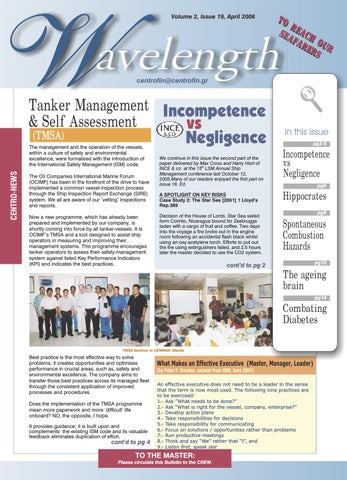
Combating Diabetes TMSA Seminar in CENMAR/ Manila
Best practice is the most effective way to solve problems; it creates opportunities and optimises performance in crucial areas, such as, safety and environmental excellence. The company aims to transfer those best practices across its managed fleet through the consistent application of improved processes and procedures. Does the implementation of the TMSA programme mean more paperwork and more 'difficult' life onboard? NO, the opposite, I hope. It provides guidance; it is built upon and complements the existing ISM code and its valuable feedback eliminates duplication of effort.
cont'd to pg 4
What Makes an Effective Executive (Master, Manager, Leader) (by Peter F. Drucker, excerpt from HBR, June 2004) An effective executive does not need to be a leader in the sense that the term is now most used. The following nine practices are to be exercised: 1.- Ask ”What needs to be done?” 2.- Ask “What is right for the vessel, company, enterprise?” 3.- Develop action plans 4.- Take responsibilities for decisions 5.- Take responsibility for communicating 6.- Focus on solutions / opportunities rather than problems 7.- Run productive meetings 8.- Think and say “We” rather that “I”, and 9.- Listen first, speak last
TO THE MASTER: Please circulate this Bulletin to the CREW.
Incompetence vs cont'd from pg 1 The engine room could not be properly sealed however, because the funnel dampers were in a defective condition and could not be fully closed, and at this time the master selected to use only 50% of the available CO2. The master and crew thought the CO2 had put the fire out but during the evening it quickly spread to the accommodation and by the time the ship was towed into Balboa the ship was gutted. Her owners claimed for a constructive total loss. Were the underwriters liable? At first instance Mr. Justice Tuckey said no. He attributed the failure, to use the CO2 earlier and to only use 50% when it was used, to the incompetence of the master; that the master was ignorant of what was required for the successful use of the CO2 system. He held that this disabling want of knowledge on the part of the master rendered the ship unseaworthy. He also decided that the owners were privy to these matters; that they had knowingly sent the ship to sea in an unseaworthy condition. The owners' knowledge in this case was “blind-eye knowledge” Now you ask what is “blind-eye knowledge”? The expression was first used by Lord Denning in the Eurysthenes a 1976 Court of Appeal case where he said: “To disentitle the shipowner, he must, I think, have knowledge not only of the facts constituting the unseaworthiness, but also knowledge that those facts rendered the ship unseaworthy, that is, not reasonably fit to encounter the ordinary perils of the sea. And, when I speak of knowledge; I mean not only positive knowledge, but also the sort of knowledge expressed in the phrase "turning a blind eye". If a man, suspicious of the truth, turns a blind eye to it, and refrains from inquiry - so that he should not know it for certain - then he is to be regarded as knowing the truth. This "turning a blind eye" is far more blameworthy than mere negligence. Negligence in not knowing the truth is not equivalent to knowledge of it.” The Star Sea was one of 3 ships managed by the same company; the other 2 ships were the Centaurus and the Kastora. The directors of the management company were the beneficial owners of all 3 ships although the registered legal owners were single ship companies. During the previous year both the Centaurus and the Kastora had suffered engine room fires and
- pg 2 -
both were constructive total losses. In the case of the Centaurus her Korean officers decided not to use the CO2 system in the extraordinary belief that doing so would damage the engine. In the case of the Kastora her Korean officers used the CO2 system within 30 minutes of the fire starting but it was not effective because the funnel dampers had been left open. Following these fires the owners changed over to Greek officers. The Greek master of the Star Sea had been with the managers for over 11 years with a good record of service, but no steps were taken to check his knowledge of the right way to use the CO2 system. Although superintendents regularly visited the ship no instructions were given and no steps
2. Who Cares about Crimes at Sea? 2.1 Criminalisation v Real Crimes When thinking of 'criminalisation' one need look no further than the Prestige. This is a well known and extreme example of a case where public authorities have been desperate to shift blame and find a scapegoat. There is a real danger that if supposedly developed nations can treat an experienced master with a previously unblemished record in this way (imprisonment for 83 days, 3m Euros bail and tough bail conditions on release) then this will deter good quality individuals in taking on a Shipping career, deter Masters
Negligence were taken to check the operational condition of the funnel dampers. The underwriters argued that the steps the owners had taken to ensure there was no repetition of such disastrous engine room fires were completely inadequate; that these checks should have been made. Mr. Justice Tuckey agreed. The owners' failure to take such steps amounted to blind-eye knowledge. The owners appealed. Could they recover from the underwriters? The Court of Appeal said yes, and their decision was upheld by the House of Lords. The master was incompetent and the ship therefore unseaworthy but on the facts the owners could not be said to have blind-eye knowledge, and hence they could not be said to have knowingly sent the ship to sea in this unseaworthy condition. In the Court of Appeal Lord Justice Leggatt said: “what the defendant underwriters had to establish was a suspicion or realisation in the mind of at least one of the relevant individuals that Star Sea was unseaworthy in one of the relevant aspects and a decision not to check whether that was so for fear of having certain knowledge about it.”
from seeking refuge (for fear of hostilities) and enquiries may never reveal the true cause of an incident for Masters may fear self incrimination. None of this can be good for the Shipping industry, nor for the man on the street who relies upon quality seafarers safely driving those crucial goods & energy carriers to deliver our every day needs in a safe and timely manner. There are, however, occasions where crew may be legitimately pursued by the prosecution in a particular jurisdiction due to their conduct. This conduct may be specifically related to their work as a seafarer or it may be conduct constituting a crime such as theft or murder. Below are some cases which demonstrate cases of 'criminalisation' and also some reports of 'real' crimes at sea. Clearly the concepts will, on occasion, overlap.
And as Lord Hobhouse said in the House of Lords:
2.2 Criminalisation: Aegean Sea - La Coruna, Spain - 03.12.92 On 3 December 1992, the Aegean Sea grounded in heavy weather whilst approaching the harbour in La Coruna, Spain. The ship broke in two and a fire on board raged for about 24 hours. Significant pollution ensued along the Galician coastline. As a result of criminal proceedings commenced in La Coruna against the Master and Pilot in charge of the ship's entry into the port, the Court held, in April 1996 (and upheld in June 1997), that the Master and Pilot were each equally liable for criminal negligence. The Pilot and Master were each fined approximately £1,120. It is worth noting that the period between the incident date and final judgment was 4.5 years.
“the evidence did not on the correct view of the law sustain the finding of privity. The defence under s.39.(5) therefore fails.”
2.3 Criminalisation: Nissos Amorgos Maracaibo Channel, Venezuela - 28.02.97 On 28 February 1997, the Greek flagged oil
and continued at p 378: “..it was simply not open to the Judge to make a finding that any of the individuals “suspected” or “believed” that the master was incompetent, lacking the basic knowledge on how to utilize CO2……Negligence there may have been in failing to ensure that the master was instructed, but “suspicion” in the minds of any of the relevant individuals that an incompetent master might be being used was simply not established.”
- pg 3 -
tanker, Nissos Amorgos grounded whilst passing through the Maracaibo channel (gulf of Venezuela). At the time she was carrying roughly 75,000 tonnes of Venezuelan crude oil and the grounding resulted in approximately 3,600 tonnes being spilled. As a result of criminal proceedings in the local Venezuelan court of Cabimas, the Master (who maintained that the damage to the cargo tanks which had led to the oil spill was substantially caused by the Republic of Venezuela's negligence) was sentenced (in absentia) in May 2000 to one year, 4 months in prison. The Master appealed to the Criminal Court of Appeal, Maracaibo which, in September 2000, decided to send the file to the Supreme Court (Sala PoliticoAdministrativo). It would appear that this annuls the original ruling by the court of Cabimas. The Supreme Court then decided to send the file on the criminal action against the Master to the Criminal Court of Appeal which has not yet rendered its decision. There is further uncertainty, however, as the 1971 Fund's local lawyers have advised that in accordance with Venezuelan law the criminal action against the Master is time barred. Under Venezuelan law a final sentence is supposed to be delivered within four and half years from the date of the criminal act. Again, this case highlights that, in certain jurisdictions, an individual who is the subject of criminal proceedings cannot necessarily expect a swift resolution to the proceedings. Even where a judgment is handed down, this does not always imply legal certainty. Lengthy appeal procedures and (in this case) the possibility that a first instance judgment may be annulled must be considered and, even where these procedures achieve a positive result for the seafarer, the delay will inevitably prolong the agony of "not knowing". 2.4 Criminalisation: Prestige- La Coruna, Spain - 13.11.02 The Prestige loaded with 77,000 metric tonnes of fuel oil took a list off the coast of Spain, in gale force winter Atlantic conditions, on 13 November 2002. Captain Mangouras when faced with the most perilous and frightening moment of his career (42 years experience on tankers) chose to stay on board and battle, in atrocious weather conditions, in order to save all his crew from injury and loss of life. Against all the odds (vessel listing as much as 25° degrees on the starboard side) Captain Mangouras managed to evacuate without injury all of the crew. Captain Mangouras and two other officers elected to stay on board. They corrected the list and stabilised the vessel stopping loss of oil that was spilling from the Butterworth Covers onto the deck. Weather conditions became so bad that due to the heavy rolling of the vessel and breaking seas over the deck it took 20 minutes to make his way forward with two officers to try and connect a towline from attending tugs.
Incompetence vs Negligence cont'd from pg 3 This was only possible by taking a dangerous route along the port side of the main deck grasping onto the ship's side railing for safety. Captain Mangouras worked all night without rest in order to do all he could to attempt to make fast the tug. After tireless attempts to make fast the tow and enduring the frustration of the tow lines continually parting, the tow line was successfully connected at mid-day on the 14 November. Fearing for the safety of the three remaining on board, ship and environment and knowing (from 30 years as Captain on tankers) what was best for his vessel, the Master begged for a place of refuge. Smit Salvage (salvors retained by Prestige) also requested a place of refuge. Both these requests were refused by the Spanish Authorities. Had refuge been granted, the Prestige could have been safely tucked away in Corcubion Harbour within 6 hours (i.e. 1800 hours on 14 November), there would have been minimal and localised pollution in Spain, the vessel would have been saved and the coastline of France spared. Instead the authorities ordered the Prestige to proceed into the Atlantic in winter gale force weather. Some 6 days following the initial incident the Prestige broke into two on 19 November 2002 and sank with the loss of ship and substantial pollution along many hundreds of kilometres of coastline. On the evening of the 15 November the Master and the two other officers were evacuated from the vessel. On his evacuation at 18.00hrs on 15 November (the Master had chosen to stay on board in order to try and save the ship and minimise pollution), the Master was immediately handcuffed and arrested. Although the Master had not slept properly for over 48 hours he was subsequently interviewed for 6 hours until 2am on 16 November. After harsh treatment at the police station and imprisonment there for 2 days he was transferred to jail where he remained for 83 days. It was only upon bail of €3m that he was released, under strict conditions
including the obligation to remain in Spain and report to a local police station every morning (including weekends). The daily reporting condition was reduced to weekly on 27 April 2004. In November 2004 the Master was allowed to return home to Greece for a period of 3 months. Whilst he has since been allowed to return to Greece on a permanent basis, he must still, however, report to the local police station every 15 days. One might well question the level of bail which is higher than that requested for the US millionaire accused of murder, Phil Spector and Michael Jackson, a multimillionaire accused of child sexual abuse (who incidentally was given permission to travel from the U.S. to Europe, whilst Captain Mangouras was only recently allowed to leave Spain to reside in his home in Europe, namely Greece, until trial). The “investigative” stage of the criminal proceedings show no sign of drawing to a close and the allegations against the Master of disobedience and deliberate pollution carry a maximum prison sentence of 10 years. For a man aged 70, who many in Spain, as well as abroad, view as a hero, time is running out. 2.5 Criminalisation: Tasman Spirit - Karachi, Pakistan-27.07.03 The Maltese flagged tanker Tasman Spirit grounded at the entrance to Karachi Port, Pakistan on 27 July 2003. The vessel was carrying 67,800 tonnes of Iranian crude oil loaded at Kharg Island and also had 440 tonnes of heavy fuel oil in aft bunker tanks. The vessel broke up spilling about 34,000 tonnes of crude and all the Greek crew on duty were detained (Master, Chief Officer, Chief Engineer, Second Officer, Second and Third Engineer and the Helmsman) as well as the Salvage Master (who only attended after the vessel broke up!). The “Karachi 8” were detained for almost 9 months and were only released after intense political pressure and continued lobbying by many international organisations as well as the Greek Government and European Union.
2.6 'Real' Crimes at Sea - Case Studies There have been various examples in recent years of seafarers who have been prosecuted under English criminal law and who have been subject to the criminal law procedures. Defendant: Adam Cowell: The defendant was found to have forged certificates as an Efficient Deck Hand, and for Proficiency in Survival Craft and Rescue Craft, and as a result to have sailed in a position for which he was not qualified. He pleaded guilty to two offences of making false instruments and one offence of obtaining pecuniary gain under the Forgery and Counterfeiting Act 1981. He also pleaded guilty to five Specimen charges of sailing in a position for which he was unqualified, with another nineteen of the same offences being taken into consideration. The defendant was sentenced on 14 October 2004. The Court considered a custodial sentence but, in light of the defendant's previous good character and guilty plea, restricted the penalty to one of community service, imposing the maximum community service order (240 hours) without any reduction for mitigating circumstances. Vessel: Dutch Aquamarine: On 9 October 2003 the Dutch flagged chemical tanker, Dutch Aquamarine ( 4671 grt) collided with the (1009 grt) vessel Ash, running into the stern of the smaller vessel. The damage sustained by the Ash was such that she sank quickly, bow first, resulting in the death of the Master of the Ash. The Second Officer of the Dutch Aquamarine was the officer on watch at the time of the collision, and the MCA's Director of Operations stated that his standard of watch keeping “fell so far below the level required that this collision was inevitable.” Although the Second Officer pleaded guilty to a breach of the MSA 95 (endangering his vessel) he was also found guilty of manslaughter and was sentenced to 12 months imprisonment. Defendant: Neville George Young. At a court hearing on 9 June 2003, Young was convicted on 4 charges of possessing and using forged qualifications and sailing as a senior officer on a British Ship without holding a valid Certificate of Competence.
Tanker Management & Self Assessment (TMSA)
cont'd from pg 1
Its responsibility and the distribution of the data lies exclusively with the ship operator. Once your vessel achieves its high standards, of being 'well-maintained' and 'well-managed', to the satisfaction of the oil-companies, then, even some of the vetting inspections will be reduced in number and be carriedout in larger in-between time-intervals. In plain speaking some of the work load is shifted to the operator and its managementleadership-& accountability skills.
There is in existence a training programme for the companies' personnel, both ashore staff and sea senior officers. Already some training courses have been carried-out in Athens & Manila, with positive results. And thus all of us will become better “documented-professional”. Smooth seas.
- pg 4 -
CENMAR's Christmas Party
He was sentenced to 9 months imprisonment and fined £500 for sailing as an unqualified Officer. His Honour Judge Brown said: “Forgery is a very serious offence and this act could have put other seafarers' lives at risk. Only a custodial sentence is justified”. Having noted the mitigating facts, however, Judge Brown suspended the sentences for 2 years and ordered that they run concurrently. Defendant: Jerzy Pawluk, Chief Officer of MV Roustel. On 27 January 2000 the defendant was convicted of conduct endangering ships, structures or individuals. He had admitted to drinking on watch, and leaving the bridge to go to bed. The watchkeeping alarm was disabled and the ship was set on a landward course. The defendant was sentenced to 12 months imprisonment.
3. UNCLOS 82 and MARPOL - Sufficient Protection? 3.1 UNCLOS Under Art 230 of the Montego Bay Convention (UNCLOS 1982), foreign owners causing pollution outside territorial waters are only liable to fines. The article provides as follows: “Article 230 Monetary penalties and the observance of recognized rights of the accused 1. Monetary penalties only may be imposed with respect to violations of national laws and regulations or applicable international rules and standards for the prevention, reduction and control of pollution of the marine environment, committed by foreign vessels beyond the territorial sea. 2. Monetary penalties only may be imposed with respect to violations of national laws and regulations or applicable international rules and standards for the prevention, reduction and control of pollution of the marine environment, committed by foreign vessels in the territorial sea, except in the case of a wilful and serious act of pollution in the territorial sea. 3. In the conduct of proceedings in respect of such violations committed by a foreign vessel
which may result in the imposition of penalties, recognized rights of the accused shall be observed.”
This undoubtedly allowed for fruitful discussions and prevented the Vessel from being detained.
3.2 MARPOL There is an important defence to a charge of a breach of MARPOL under Annex I Regulation 11(b) (and the corresponding defence under Annex II Regulation 6(b)).
The Suez Canal, considered to be the shipping gateway of the world, was only shut for 3 days. Lightering of cargo was carried out in this period and numerous dredgers and 12 tugs assisted in refloating of the vessel promptly enabling the Suez Canal to be reopened with minimum disruption and minimising the prospects of claims against the owners.
The defence provides that there should be no criminal liability for pollution resulting from damage to a ship or its equipment “except if the owner or master acted either with intent to cause damage, or recklessly and with knowledge that damage would probably result.” This defence therefore provides that no offence is committed if the discharge occurs without the intent or recklessness of the owner or master. An explanation for why owners/master alone were mentioned in MARPOL may be simply that they alone were envisaged by the draftsman as prospective defendants. On a literal interpretation, however, the defence could provide a defence not only to owner and master but also to any other potential defendant, regardless of their conduct. 3.3 Lessons to be learnt - Case Study: Tropic Brilliance The Tropic Brilliance case demonstrates how decisions made at an early stage can have long term implications. The Tropic Brilliance grounded in the Suez Canal and blocked the Canal on 6 November 2004. After receiving instructions we were on-site within 24 hours (whilst the vessel was still blocking the canal) and assisted the Master on board. Key objectives included safety of the crew, the environment, the ship, liaising with local authorities to arrange refloating of the vessel which was hard aground and the reopening of the canal. Being on board, it was possible to negotiate directly with lightering vessels and deal with the Suez Canal Authority (S.C.A.) under pressure. This removed the focus away from the Master and the owners representatives, minimising conflict and contact between the local authorities and the crew.
There were serious threats of arrests of the crew of the Tropic Brilliance which came from soldiers and police accompanying the chairman of the S.C.A. who boarded to pressure the Master to refloat the vessel so the Canal could re-open. At this point some 180 ships were waiting at both ends of the canal these ships could only transit the canal once the Tropic Brilliance had refloated. Experience of dealing with senior and angry authorities under stress was a crucial factor in preventing any criminal actions whatsoever.
4. Understanding the risks key issues for Shipowners / Crew In the current climate, it is essential to manage exposure to criminalisation. If this exposure is not properly managed the consequences could be dire and include the risk of severe penalties (custodial as well as monetary) for crew, owners and managers. Further, there is a real danger of damage to a shipowner/manager's reputation (and knock on effect on shares). This would not only impact the company's bottom line (and likelihood of future viability in today's competitive market) but also the morale of its employees. Max Cross, Partner and Harry Hirst, Solicitor and Master Mariner Both of Ince & Co, Hong Kong Note: The information and opinions which this paper contains are not intended to be a comprehensive study, nor to provide legal advice and should not be treated as a substitute for specific advice concerning individual situations.
December 2005
CFC The first CFC Outreach activity to Bosun M. Pulido (who had suffered a figure injury whilst onboard)
- pg 5 -
Hippocrates The Father of Medicine (c 460 c 377 BCE) He was born in the Greek Island of Cos, in the Dodecanese and studied under his father, a physician. He traveled for some time, perhaps studying in Athens and returned to practice, teach and write in his birthplace. He is perhaps history's most famous physician for rejecting superstition in favour of scientific observation, for classifying disease and for creating a set of moral and professional standards for physicians. He also gave the world the Hippocratic Oath, a code of ethics for physicians, which is still taken by graduates at many modern medical schools. While the oath cannot be credited directly to him, however, undoubtedly represents his ideas and principles. Hippocrates believed that the goal of medicine should be to build the patient's strength through appropriate diet and hygienic measures, resorting to treatment that is more drastic only when the symptoms showed this to be necessary. This was in contrast to the contemporary Conidian School, which stressed detailed diagnosis and classification diseases to the point of ignoring the patient. Of the large collection of writings that derived from the Coin school, only a few are generally ascribed to Hippocrates himself, although his influence is felt throughout. Of these, The Aphorisms, summing up his observations and deductions, and Airs, Waters and Places, which recognized a link between environment and disease, are considered the most important.** The Hippocratic Oath: a literal translation The Greeks call their country EΛΛΑΣ the rest of the world call it GREECE. What is right or what is wrong? In the ancient times the Greeks were called Hellenes from Hellen, the son of DEUCALION and PYRRA, their legendary ancenstors. The name was descended to the modern Greeks and their sovereign was not 'King of Greece', but 'King of the Hellenes'. After the abolition of the monarchy in 1973 a 'Hellenic Republic' was instituted. It was the Romans who called it Graecia which, among the inhabitants themselves, referred only to Epirus (a province of Hellas like Macedonia, Attica, Thrace, Corinth etc). Hellenic. Is the common dialect of the Greek writers after the age of Alexander the Great. It was based on ATTIC. Hellenistic. The term denotes Greek culture and art. (Brewer's Dictionary of Phrase & Fable 17 edition)
1. I swear by Apollo Physician, and by Asclepius, and by Hygeia, and by Panaceia and by all gods and goddesses, making them witnesses, to fulfil, according to my ability and judgement. 2. To regard my teacher in this art equal to my parents; and to share my livelihood in common with him, and, if he is in need, to make a contribution; and to judge his progeny equal to my brothers of the male line; and to teach this art if they require to learn, without fee or covenant; 3. To make a contribution of instruction, and lecture, and all the other learning, to my sons, and to those of my teacher, and to pupils who have signed the covenant and sworn to obey the physician's law, but to none other. 4. I will use dietary regimes to help the sick according to my ability and judgement and to refrain from harm and injustice. 5. I will not give to anyone a deadly drug though asked, nor will I suggest a plan of such a kind. Similarly I will not give a woman a destructive pessary. 6.
But in a pure and holy way I will guard my life and my art.
7. But I will not cut, not even sufferers from stone, but I will give place to workmen who engage in this practice. 8. Into whatsoever houses I enter, I will go in to help the sick, being without all intentional injustice and corruption, and all the rest and especially without "works of Aphrodite" upon the bodies both of women and men, both of free and slaves. 9. Whatsoever in the course of attending the sick I see or hear (or even when not attending the sick), concerning the life of men, which ought never to be published outside, I will keep silent, considering such things as unutterable. 10. Now if I fulfil this oath and do not violate it, may I reap, in my life and art, glory among all men for all time; but if I transgress and swear falsely, the opposite of these things. ** (NOTE. Is it not today our most important concern the environment and the various new diseases; from HIV to bird flu?)
- pg 6 -
money The following is the text of a letter sent to a bank by a 96-year-old woman. The bank manager thought it amusing enough to have it published in the “New York Times”. It may, or may not, be apocryphal, but it meets the sentiments of your editor.
To whom it may concern: I am writing to thank you for bouncing my cheque, with which I endeavoured to pay my plumber last month. By my calculations, three nanoseconds must have elapsed between his depositing the check and the arrival in my account of the funds needed to honour it. I refer of course, to the automatic monthly transfer of funds from my modest savings account, an arrangement, which, I admit, has been in place for only thirty-one years. You are to be commended for seizing that brief window of
Koala
What is a koala? The koala is a small bear-like, tree-dwelling, herbivorous marsupial which averages about 9kg (20lb) in weight. Its fur is thick and usually ash grey with a tinge of brown in places.
The koala gets its name from an ancient Aboriginal word meaning "no drink" because it receives over 90% of its hydration from the Eucalyptus leaves (also known as gum leaves) it eats, and only drinks when ill or times when there is not enough moisture in the leaves. ie during droughts etc. The koala is the only mammal, other than the Greater Glider and Ringtail Possum, which can survive on a diet of eucalyptus leaves. Habitat & Diet 'Habitat' refers to the types of bush land that koalas like to live in. They are found in a range of habitats, from coastal islands and tall eucalypt forests to low woodlands inland. Koalas today are found in Queensland , New South Wales , Victoria and South Australia . Their range extends from the Atherton Tableland west of Cairns in Qld to islands off the coast of Victoria and South Australia in the south, and west to central and western Qld, NSW and Victoria. Koalas live in societies, just like humans, so they need to be able to come into contact with other koalas. It is because of this they need to have areas of suitable eucalypt forest which are large enough to support a healthy koala population and to allow for expansion by maturing young koalas. Koalas are highly territorial and in stable breeding groups, individual members of koala society maintain their own "home range" areas. Eucalyptus leaves are very fibrous and low in nutrition, and to most animals are extremely poisonous. To cope with such a diet, nature has equipped koalas with
matters opportunity, and for debiting my account by way of penalty for the inconvenience caused to your bank. My thankfulness springs from the manner in which this incident has caused me to rethink my errant financial ways. I noticed that whereas I personally attend to your telephone calls and letters, when I try to contact you I am confronted by the impersonal, overcharging, faceless prerecorded entity, which your bank has recently become. From now on, I, like you choose only to deal with a flesh-and-blood person. My mortgage and loan repayments will therefore and hereafter no longer be automatic, but will arrive at your bank, by cheque, addressed personally and confidentially to an employee at your bank whom you must nominate. Be aware that it is an offense under the Postal Act for any other person to open such an envelope. Please find attached an Application Contact Status form, which I require your
specialised adaptations. A very slow metabolic rate allows koalas to retain food within their digestive system for a relatively long period of time, maximising the amount of energy able to be extracted. At the same time, this slow metabolic rate minimises energy requirements and they will sleep for up to 18 hours per day in order to conserve energy. Each koala eats approximately 200 to 500 grams of leaves per day. The teeth are adapted to deal with for this. The sharp front incisors nip the leaves from the branches and the molars(back teeth) are shaped to allow the koala to cut and shear the leaves rather than just crush them. A gap between the incisors and the molars, called a 'diastema', allows the tongue to move the mass of leaves around the mouth efficiently. Koalas have a thick woolly fur which protects them from both high and low temperatures.It also acts like a 'raincoat' to repel moisture when it rains. The fur varies in colour from light grey to brown, with patches of white on the chest and neck, inside arms and legs and inside the ears. Mature males are recognisable by the brown 'scent gland' in the centre of their white chest. The fur on the koala's bottom is densely packed to provide a 'cushion' for the hard branches it sits on, and has a 'speckled' appearance which makes koalas hard to spot from the ground. An adult male koala can weigh between 8 and 14 kilograms and a female between 6 and 11 kilograms, with the heavier animals coming from the southern areas where they have adapted to the colder climate by an increase in body weight and thicker fur. In the safety of their home trees, koalas assume a wide variety of sitting and sleeping postures, and they will move around the tree during the day and night to catch the sun or the breezes. On hot days it is common to see them with limbs dangling in an effort to keep cool, and during colder times, curled up in a ball to conserve body heat. The breeding season for koalas runs roughly from September to March. This is a time of increased activity, and sound levels increase as males bellow more frequently. This is also when the young from the previous year are weaning from their mothers. Some estimates for the average life-span of an adult wild male koala are ten years, but the average survival rate for a dispersing sub-adult male living near a highway or a housing estate is closer to two or three years.
chosen employee to complete. I am sorry it runs to eight pages, but in order that I know as much about him or her as your bank knows about me, there is no alternative. Please note that all copies of his her medical history must countersigned by a Notary Public, and the mandatory details of his/her financial situation (income, debts, assets and liabilities) must be accompanied by documented proof. In due course, I will issue your employee a PIN number, which he/she must quote in dealings with me. I regret that it cannot be shorter than 28 digits but, again, I modeled it on the number of button presses required of me to access my account balance on your phone bank service. As they say, imitations is the sincerest form of flattery. Please allow me to level the playing field even further. When you call me, you will now have a menu of options on my new voice mail system to choose from. Please press the buttons as follows: 1. To make an appointment to see me 2. To query a missing payment 3. To transfer the call to my drawing room
- pg 7 -
in case I am there 4. To transfer the call to my bedroom in case I am sleeping 5. To transfer the call to my bathroom in case I am attending to nature 6. To transfer the call to my mobile phone if I am not at home 7. To leave a message on my computer, a password to access my computer is required. Such passwords will be communicated to your Authorised Contact at a later time and date as is comfortable to me 8. To return to the main menu and to listen to options 1 through 7 over again 9. To speak to my pet Labrador who is in charge of litter To make a general complaint or inquiry, press buttons as indicated above. The contact will then be put on hold, pending the attention of my automated answering machine service. While this may, on occasion, involve a lengthy wait, uplifting music will play for the duration of the call. Regrettably, but again following your example, I must also levy an establishment fee of Euro 30 to cover the setting up of this new arrangement. Please credit my account on each occasion. (Signed) Your Humble Client
forgiveness “To err is human; to forgive is divine and our policy is to do neither”. This paraphrasing sign hangs behind the desk of a typically tough Coast Guard major. Amusing? Yes. Intimidating? May be. But what is our own policy to forgiveness. We certainly know plenty about what it is to err, but what about forgiving? What does forgiveness imply, and should we be interested in promoting this virtue for our colleagues, friends and for ourselves? Let's read what the experts have to say: “”Forgiveness Defined Forgiveness entails a series of changes that occur within an individual who has been offended or hurt in some way by another person. When individuals forgive, their thoughts and actions toward the transgressor
become more positive (e.g., more peaceful or compassionate) and less negative (e.g., less wrathful or avoidant). In addition, forgiveness cannot be coerced, but must be freely chosen by the one who was wronged. Forgiveness is distinguished from condoning, excusing, reconciling, and forgetting: When someone condones or excuses, he or she realises there was no unfairness. If, for example, Jack takes Mary's car to drive an injured child to the hospital, Mary, on realizing what had happened, would not forgive Jack, but excused him under the circumstances. Reconciliation involves two people coming together again in mutual trust, whereas forgiveness is one person's choice to abandon resentment and offer beneficence in the face of unfairness. One can forgive without reconciling. When one forgives, he or she rarely forgets the event. People tend to recall traumatic events, but on forgiving, a person may remember in new ways-not continuing to harbour the deeply held anger.
Enabling and Inhibiting Factors Forgiving those who have wronged us belongs in the "more easily said than done" category. Consider your own forgiveness history. Whom have you forgiven? And what seemed unforgivable? Research on forgiveness has identified several conditions or factors that make forgiveness more or less likely: * People tend to be more likely to forgive when the offence took place within a close, satisfying relationship * Forgiveness is related to the character strength of empathy. Individuals are better able to forgive when they can empathize with the offender * The relationship between forgiveness and justice is complex. Traditionally, researchers have suggested that a strong belief in justice can be a barrier to forgiveness. However, experts have recently demonstrated that individuals are actually more likely to forgive when they are first primed to think about justice. The researchers hypothesise that whereas a "retributive" (eye-for-an-eye) sense of justice may be a barrier to forgiveness, a broader, more "pro-social" sense of justice may promote forgiveness
SPONTANEOUS COMBUSTION HAZARDS Spontaneous Combustion: The self-ignition or apparent selfignition, and burning of any mass; often of highly flammable materials, such as a pile of rugs. As part of our ongoing seafarers' awareness efforts on fires onboard oil-tankers, we would like to remind you of the dangers of the spontaneous combustion. Fires of that kind are known to have taken place in the Engine Room, the Paint Store, the Anti-pollution Equipment Store, the Galley and even inside a crew cabin. A number of common materials such as linseed oil, alkyd enamel resins, oil/thinners, drying oils etc can ignite spontaneously under certain circumstances. Some products which may contain these ingredients include Metal Shield, Auto Guard, and Wood Oil and others. Spontaneous combustion can occur when towels, rags, filters, paint scrapings, steel wool, masking and other materials wetted or saturated with these products are not handled or disposed of properly. Saturated rags, filters and other materials can combust spontaneously when the oils or resins generate enough heat through auto-oxidation to exceed the ignition temperature of the rags or the other materials. Spontaneous combustion can begin without any flame, spark, outside heat or other ignition source. Saturated rags, filters and other materials contaminated with the coating material should NOT be disposed of in regular waste containers. The most of the fires come from spontaneous combustion of thinners'-soaked-cleaning-rags stored in a plastic container
- pg 8 -
(bucket), at the end of the day. DON'T DO IT!!! Organic liquids react with oxygen in the air to generate heat. This is an extremely slow process and is not a problem if the heat is dissipated. Unfortunately, the pile of rags inside the plastic storage bucket usually prevents the dissipation of heat which is generated over a period of hours. Once the ignition temperature for the solvent (thinners) is reached, the solvent and the rags ignite and the bucket is set alight. To dispose of these materials properly, thoroughly wet the contaminated materials with water and place them loosely inside a separate, sealed metal container, obviously marked “DANGER”. Ask your Chief Engineer / Chief Mate where this sealed metal container has to be stored till properly disposed of ashore, at the next port. You should always consult the label of the product you are using to identify the products that may present a spontaneous combustion hazard. It is the responsibility of each seafarer, all the way to the Master and Chief Engineer, to independently ascertain that the practices are legal, appropriate and constitute soundproduct stewardship. This information is general in nature and is not intended to address site or product-specific issues. It is not intended also to define or create legal rights or obligations. Dear Master, you are kindly requested to address this serious subject in your next 'Safety Meeting' with the Crew. Thank you. Ed.
Forgiveness does not change the past, but it does enlarge the future.
Forgiveness Interventions In a recent meta-analysis, it was reviewed the effectiveness of nine empirical studies of forgiveness interventions. They found that the existing interventions could be grouped into three primary categories: (1) decision-based interventions, (2) processbased individual interventions, and (3) process-based group interventions.
* We are better able to forgive when we do not blame the offender for the act ("It was an accident"). In contrast, we are less likely to forgive acts that were intentionally committed-especially if they have severe consequences * A tendency to ruminate makes forgiveness much less likely * We are more likely to forgive as we age. Young children tend to be the least willing to forgive, and older adults are the most willing * As you would expect, apologies help. We are more likely to forgive if we receive an apology from the transgressor
Decision based interventions tend to emphasise a defining moment when an individual chooses to forgive. Forgiveness is a decision that is made: "I choose to forgive him" or "I will no longer allow my anger to eat away at me."
Forgiving Ourselves Can one forgive oneself? Of course, since one can hate oneself and overcome self-hatred. What hope would there be for wisdom otherwise? Or for happiness? Or for peace? We must forgive ourselves for being merely what we are. And also forgive ourselves-when we can do so without injustice-for feeling hatred or pain or anger so strong that we cannot forgive. Fortunate are the merciful, who fight without hatred or hate without remorse!
In contrast, process-based interventions emphasise forgiveness that is a gradual process taking time and sustained effort. A cognitive decision to forgive is one part of a longer journey. Individuals may decide they want to "let go" but then struggle with continued anger or resentment.
TRAVEL HEALTH TIPS
Interestingly, interventions that emphasised the process of forgiveness tended to be more effective than cognitive, decision-based interventions. And among the process-based interventions reviewed, the one-on-one interventions were more effective than the groupbased interventions.
The following Travel Tips are recommended to be performed, at regular interval, throughout long journeys:
i
i i i i i i i i
Slightly tilt your head from one side to the other; bring your ear to your shoulder. Repeat 10 times on each side Clasp your hands together behind your head. Push your head back into your hands and hold for 5 seconds. Repeat 4 times Keeping your arms by your sides, circle your shoulders back then forward. Repeat 10 times Push your bottom back in the seat. Lift one buttock. Repeat 3 times each side Push the small of your back into the sea and arch forwards. Repeat 4 times Press knees and thighs together. Tighten buttock muscles and hold for 5 seconds. Repeat 4 times Trace out the letters of the alphabet with your foot to help keep the circulation going. Do not slouch. Sit well back in your seat and place a pillow or jumper in the small of your back to support the natural curves of your spine Stand up every hour or so to ease low backpressure. Try some simple stretching exercises, as recommended above, too. (Source: Australian Physiotherapy Association)
A Process Model of Forgiveness Developmental psychologists provide a process model of forgiveness that could be applied to forgiveness interventions with individuals or groups. 1. Acknowledge your emotions. Whether you are angry, hurt, ashamed, or embarrassed (or some combination of the above), acknowledge your emotional reaction to the wrongdoing. 2. Go beyond identifying the person who hurt you and articulate the specific behaviours that upset or hurt you. 3. Make the choice to forgive. 4. Explain to yourself why you made the decision to forgive. Your reasons can be as practical as wanting to be free of the anger so that you can concentrate better at work. 5. Attempt to "walk in the shoes" of the other person. Consider that person's vulnerabilities. 6. Make a commitment to not pass along the pain you have endured-even to the person who hurt you in the first place. 7. Decide instead to offer the world mercy and goodwill. At this stage, you may wish to reconcile with the other person (but that's not necessary). 8. Reflect on how it feels to let go of a grudge. Find meaning in the suffering you experienced and overcame. 9. Discover the paradox of forgiveness: As you give the gift of forgiveness to others, you receive the gift of peace.”” (Adapted from the 'Authentic Happiness Coaching' Newsletter by Ben Dean Ph.D.)
FOOD -- GLORIOUS FOOD In 1896, Captain F.J Thompson was an apprentice onboard the AETHELBERHT, a 810 ton iron barque built in 1876 at Harrington, UK. “”There were no refrigerators or ice boxes in the average ship and consequently fresh meat and vegetables were only available for three or four days after sailing. Salt beef and salt port were carried in harness casks, oak brass-bound casks in which the meat was salted down… 'Harriet Lane' (tinned meat) was served twice a week… Bread was a scarce commodity… The chief stand-by was the hard tack, usually Liverpool pantiles (large biscuits with 52 holes in them) chief component being bran; they were so hard that only very good teeth could tackle them…the great trouble was they frequently became moldy and full of weevils. One pound of butter and one pound of marmalade were served out to each man weekly; no mustard, pickles, pepper, milk or jam were provided…One youth…I knew on his first voyage would sit down with a spoon and eat his pound of marmalade, neat, the day it was supplied. Although the victualling was of such inferior quality the cooking was probably worse and justified the old sailor's adage: God sends food and the devil the cooks.”” (Oh the times, Oh the manners! Cicero )
- pg 9 -
The ageing
brain
STATUTORY ALERT EMERGENCY FIRE PUMPS TARGETED BY PORT STATE CONTROL OFFICERS. Port State Control Officers (PSCOs) are known to target the ship's emergency fire pump during inspections, and they can require evidence that the pump is operable while the vessel is in any operational condition. Failure to meet the required standard can result in the vessel being subject to PSC detention. While it is the flag administration's responsibility to ensure that onboard arrangements are satisfactory, owners/operators are advised to check that the pump works under all operating conditions, including those at anchor, in ballast and when loaded and pulling away from the quay. The SOLAS standard requires that emergency fire pumps operate when a single casualty, such as a fire or switchboard failure, renders the main fire pumps in one compartment inoperable in the engine room, for example. The pump must be operable in any condition of list or trim, including light ship condition. The standard will not have been met if a vessel uses one of the main fire pumps to prime its emergency pump system. The USCG has identified that there is an increasing trend towards bulk-carriers being unable to operate their emergency fire pumps in certain conditions typically in light ship condition at anchor while awaiting to load. This problem is however, not confined to bulkers only. The best way to avoid detention would be to test the emergency fire pump prior to any port state activity. Any failure to provide pressure noted should be reported to the operator, at once.
A
t what point does an ageing mind become a liability and not an asset? The answer depends on what the mind is asked to do. If the task requires a wealth of knowledge and experience, then the elders have it. If the job needs sharp and fast thinking, youth triumphs.
T
he inherent differences between people mean that a quick-witted 60year-old can outperform a slow-minded 25-year-old in tasks at which youth should prevail. But in general, from the age 20, you can see a decline in a person's raw mental agility recalling a list of objects into classes and replacing words with numbers (or vice versa). The speed of reaction slows, too. However, in the real world, the acquisition of knowledge will obscure the consequences of age-related decline. Performance in many jobs depends on how much you know and how well you know it, both of which increase well into your 60s.
K
nowledge tends to decline sharply after 65, but that may be the consequence of retirement rather than its cause.
A
s the brain grows older, it undergoes complex and poorly understood changes from the biochemical, to the molecular, structural and functional that lead it to shrink. The brains of those aged 40 and older decrease in volume and weight by 5% every ten years.
T
his shrinkage, though universal, affects people's mental performance in very different ways. Similarly, other changes in the brain such as the
Intercultural Over the last thirty odd years, we have gained a tremendous experience with our mixed multinational / multicultural crews. We consider that good management and leadership are the most important two parametres onboard a vessel today, apart from the handling of stacks and stacks of paperwork and reports, enough to sink a ship. The problems that might arise from time to time are due to misunderstanding the intentions, the attitude, the actions and the “body language” of one another. We will attempt to underline below some 'DOs' and 'DON'Ts' from a collection of notes. Some points may be more relevant or less relevant than others; the choice is yours. Communicating with Others 1. Determine the true purpose of your message 2. Consider the perception of your listener 3. Use the appropriate channel of delivery 4. Obtain feedback to check for mutual understanding
- pg 10 -
5. Keep your remarks focused on the incident 6. Don't make remarks such as “You should know that” 7. Don't express anger to a person in public 8. Always, ask for an explanation 9. In private, make it clear why you are angry 10. If possible, give the person a way out 11. Listen to the silence and pauses of the person Correcting and Reprimanding 1. Do not go straight to the point. Talk about something pleasant first 2. In delivering your correction, be as diplomatic as possible 3. Do not use a harsh tone of voice nor an insulting manner 4. Do not correct nor reprimand him in public 5. After a correction and reprimand has been made, follow up with an inquiry about some personal concern of the person corrected
gradual decrease in the supply of oxygen and sugar
(Extracts from leave some peoples' memories unaffected, while others are searching for their glasses. The Economist Feb 18, 2006) uch wisdom about the ageing brain has
M
recently been overturned. It was thought, for example, that the loss of neurons led to forgetfulness, culminating in Alzheimer's disease. Researchers now blame the loss of synapses connections between neurons. It had been thought that new brain cells grew only in young children, and that thereafter every bump on the head or glass of wine led to a loss of intelligence. Recent work has shown that, given intellectual stimulation, new neurons will grow in adults' brains. No single mechanism adequately explains why brains age. One theory blames oxidatative stress, caused by the onslaught of nasty molecules known as free radicals. Another identifies the influx of calcium into the brain cells. Brain ageing could be caused by changes in the way genes are expressed; or dysfunction among the neuron's motochondria, which provides cells with energy.
mental workouts, such as crosswords older people with a history of complex mental activity are less likely to suffer mental decline. But the best protection is to have been born with a big brain.
IS THIS SAFETY CULTURE?
W
orryingly for some, evidence is emerging that high stress levels contribute to intellectual clumsiness. Chemical transmitters known as glucocorticoids increase blood pressure and damage the hippocampus, the area vital to learning and memory. Recently, young people with high blood pressure have been shown to be just as susceptible to mental decline as elderly people are. Researchers think that raised stress levels help cope with the emergency but, over days and weeks, prevent them from learning new information and remembering. “When you are in a fire, you concentrate on where the exit is, not‌what the woman next to you is wearing.â€? What can be done to promote healthy ageing? You can lower your blood pressure, perhaps through physical exercise, and
Differences Resolving Conflicts and Problems Between Two Parties 1. Call both parties involved to a private place and have a dialogue with them 2. Listen to both parties and learn, if possible, the entire truth 3. Give acceptable advice and solution to both parties 4. Ask the offender to apologise and the offended party to accept the apology 5. Let the two parties shake hands and renew their friendship Relationship with the Crew 1. Threat him with consideration, consistency, firmness and justice 2. Keep him happy and contended no matter what the circumstances are 3. Visit him in his workplace or quarters in a fatherly fashion once in a while to inquire after his well-being 4. Be his confidant and adviser regarding his personal
problems 5. Lend a helping hand when needed 6. Keep your office or cabin open any time to him when he has complaints / problems Motivating your Crew 1. Delegate responsibilities properly 2. Provide challenging yet realistic work goals 3. Maintain a moderate amount of work pressure 4. Encourage participation in decision making and goal setting 5. Encourage the use of a creative problem solving process to solve unstructured problems 6. Provide immediate and timely feedback on his task performance 7. Provide the coaching, training, instruction, resources and support needed to get the job done 8. Set a Good Example
- pg 11 -
EVIDENCE In legal terms evidence, meaning testimony in proof or disproof of something, has a wide variety of classifications, as follows: >Circumstantial evidence: that based on relevant facts and circumstances to the fact in issue >Conclusive evidence: that which establishes proof beyond doubt >Derivative evidence: that which derives its force from some other source >Direct evidence: evidence of a fact in issue, that of an eyewitness >Documentary evidence: evidence supplied in written documents >Extrinsic evidence: that regarding the meaning of a document not found in the document itself >Hearsay evidence: that which is heard from another but not known to be true >Indirect evidence: evidence of a fact that then implies the fact at issue >Oral evidence: that made by witnesses in court >Original evidence: that which has an independent probative force of its own >Parole evidence: oral evidence >Prima facie evidence: That which seems likely unless it can be explained away >Primary evidence: original documentary evidence >Real evidence: that supplied by material objects produced for the inspection of the court >Secondary evidence: evidence other than original evidence, e.g. oral evidence of the contents of a lost document
Whatever name we give it above, legal disputes involving the vessel are amongst the many risks inherent in our business of owning / managing / operating ships. Owners' success in these disputes may depend almost entirely on the availability of contemporaneous evidence from the vessel. When clear and methodical records are produced by the owners then the judges a/o arbitrators will infer that the vessel is operated in a 'seamanlike' manner and are more likely to come to a decision in favour of the shipowner. In your library on-board there is a 'thin' booklet called the "Mariner's Role in Collecting Evidence". Published by the Nautical Institute is among the 'Loss Prevention Guides' of the NoE/P&I. It is worth it going through.
Trouble at the Wheel. There are a worrying number of incidents in which ships are afflicted by steering problems, causing both serious casualties and near misses. In the latter case a laden aframax tanker came within a few metres of embedding itself in an ancient palace as her steering gear failed
by Professor Amartya Sen of Harvard University
Principal Voices Resisting Insecurity and Unfreedom Question: What are the root causes of poverty across the globe, and what solutions would you put in place to address this? In particular, to what extent is eradication of poverty dependent as much on the promotion of basic human freedoms as on grass-roots economic growth? A.Sen: On September 11, 2001, more people died from AIDS than from terrorist attacks, including the barbarities that committed on that day. On a more normal day, many more people
around the world die from illnesses like AIDS, which can be prevented, cured of effectively managed. These facts do not reduce the nastiness of terrorism or the urgency of confronting and defeating it, but they do also point to the importance of keeping in mind the vastly large number of human lives that are threatened by preventable but unprevented ailments. The demands of human security include a balanced view of tragedies that are the result of terrible omissions as well as dreadful commissions. Since security is often considered only in the context of military challenges and violent deeds, it is necessary to emphasise the massive toll of human neglect. An adequate concept of human security in the contemporary world must include at least the following distinct
“ILO” Adopts sweeping new charter for maritime sector (The New Maritime Labour Convention will Guarantee “Quality Shipping” Worldwide) The International Labour Organisation has overwhelmingly adopted a comprehensive new labour standard for the world's maritime sector, in what ILO Director-General Mr Juan Somavia called a landmark development in the 'world of work'. The convention (94th Maritime Session) took place in Geneva between February 7 23, 2006.
Votes: For: 314 Against: 0 Abstentions: 4. There were delegates from over 100 countries representing seafarers, shipowners and governments. “We have made maritime labour history today” Mr Somavia. “We have adopted a Convention that spans continents and oceans, providing a comprehensive labour charter for the world's 1.2 million or more seafarers and addressing the evolving realities and needs of a sector that handles 90 per cent of the world's trade”. “What's more we have established
a socioeconomic floor to global competition in the maritime sector. This initiative can also provide the impetus and support for similarly innovative and balanced approaches to addressing the need to make globalisation fair in other sectors of the world work”. The new convention clearly sets out, in plain language, a seafarers' “bill of rights” while allowing a sufficient degree of national discretion to deliver those rights with transparency and accountability. The convention also contains provisions allowing it to keep in step with the needs of
- pg 12 -
the industry, help secure universal application and enforcement, and also help to meet the demand for quality shipping, which is crucial to the global economy. Entry into force: 12 months after its ratification by 30 ILO member states with a total share of at least 33 per cent of the world gross tonnage. The convention is designed to encourage compliance, by ships' operators and owners, and to strengthen the enforcement of standards at all levels, including complaint procedures for
when passing through he Turkish straits at Istanbul. The Turkish Authorities have urged vessels making the transits through the straits to ensure that the steering gear is fully functioning and properly tested. The other day there were accounts of two separate casualties in the Suez canal, one involving pollution and delays, and another where the vessel had sustained both bow and stern damage as she lay broadside across the waterway. In both the potential for colossal economic damage with the waterway closed was substantial. In both 'technical difficulties', which is a layman's definition of steering gear problems, were experienced. It was only last year that the Suez Canal Authorities warned that they would be forced o tale a hard line with ships which experienced steering gear problems in the waterway, as a defensive
elements: (1) a clear focus of human lives (this would contrast, for example, with the technocratic notion of “national security” the favoured interpretation of “security” in the military context); (2) an appreciation of the role of society and social arrangements in making human lives more secure in a constructive way (avoiding a socially detached view of individual human predicament); and (3) a fuller understanding of the coverage of human rights, which have to include not just political freedom and personal liberties (important as they are), but also societal concern with food, medical attention, basic education, and other elementary ingredients of human lives.
seafarers, the supervision of conditions onboard and the flag states' jurisdiction and control over their ships. It sets minimum requirements for seafarers to work on a ship, the conditions of employment, hours of work and rest, accommodation, recreational facilities, food and catering, medical care, health, welfare and social security protection. The new convention consolidates and updates 68 existing ILO Maritime conventions and recommendations adopted since 1920. It aims to become the “fourth pillar” of the international maritime regulatory regime, at the side of the three key IMO Conventions, namely, SOLAS, STCW and MARPOL.
measure against the sheer numbers of incidents which were causing damage and delay. In one notable incident, which closed the waterway for several days, a large laden tanker came within an ace of breaking in half as she lay straddled across the waterway, sagging dangerously. Similar steering gear problems have been blamed for both grounding and collisions in the Baltic waters. The steering gear, long recognized as among the ship's essential equipment, has to be utterly reliable. It has largely been so over the years. The equipment almost until recently, has not been over-complicated, and thus necessarily duplicated. There have been, however, suggestions that cost-cutting shipbuilders might have been reducing the size of rudders too close to the minimum safe area for the size, of some ships.
A good starting point for the analysis of development is the basic recognition that human freedom, in the broadest sense, is both (1) the primary objective, and (2) the principal means of development. The former is an evaluative claim and includes appreciation of the principle that the assessment of development cannot be divorced from the lives that people can lead and the real freedoms that they enjoy. Development can scarcely be seen merely in terms of enhance-ment of inanimate objects of conve-nience, such as GNP (or in personal incomes), or industrialization, or technological advance, or social modernization.
The sheer number of incidents involving steering gear suggests that some investigation should be taken into consideration. It might be that the equipment itself is being blamed unjustly, either because of the mistake of inexperienced or poor helmsmen with the ship in hand-steering, or human errors involving the controls of steering equipment. It goes without saying that the steering of a ship needs to be precise and reliable, notably so in confined waters. There is just too much in stake. (Caution: Attention should be exercised during the Maintenance Plan implementation and additional checks should be carried out prior entering confined waters, canals, channels, ports etc. The operation of the steering gear, for both the bridge and the engine room personnel should be of primary importance during the initial familiarization stage onboard, when first joining. Ed.)
These are of course, valuable often crucially important accomplishments, but their value must depend on what they do to the lives and freedoms of the people involved. We have reason to focus on reducing the unfreedoms and insecurities of various kinds that plague human lives. Freedom is not only the ultimate end of development, it is also a crucially effective means. The acknowledge-ment can be based on empirical analysis of the consequences of and interconnections between freedoms of distinct kinds, an on the evidence that freedoms of different types typically help to sustain each other.
What a person has the actual capability to achieve is influenced by economic opportunities, political liberties, social facilities, and the enabling conditions of good health, basic education, and the encouragement and cultivation of initiatives. These opportunities are, to a great extent, mutually complementary, and tend to reinforce the reach and use of one another. We do need an integrated understanding of human freedom and security. (Principal Voices is an international project aimed at stimulating discussion on some of the more compelling challenges confronting our world today. www.time.com/principalvoices TIME in association with SHELL)
We had been together for three years, and in all that time she did not once give me any cause for complaint. They were happy years, and I was very fond of her. So it was a sad, sad day, that day when we parted and another man took my place. She had so many rare qualities…She was not only very beautiful, she was most elegant too. She never showed any sign of jealousy, and her ears were closed to gossip. She used to have no secrets from me. She never bored me. She knew the value of silence too, and that made her a good listener. Naturally, she also had her weak points, but these were negligible in comparison with her good ones. She used, perhaps, to be too fond of cosmetics, but the choice of them was always left to me with the result that her appearance always used to be what I wanted to be. I knew that she had to depend on a man, and I was glad and proud to be the one. She used to depend on me for everything, for she had no initiative at all, but I liked the situation because it made me feel important taking care of her. And whenever I wanted her to do anything, she would carry it without argument.
SHE
She was rather highly-strung, and at times, and in certain circumstances, she would become agitated and nervous. I know there were people who did not like this trait in her, and critised her for it. I didn't mind it myself because I knew the way to soothe her and make her calm again. On the other hand, I would often keep her awake all night long and on these occasions she never use to grumble or make a fuss. So there were other people who envied me because of her, and I did not blame them. But happiness always has an end. We parted and another man took my place. As is often the case, he was my best friend. He still is in fact. I have no hard feelings for him. After all, can one imagine a ship without a captain? By Commander “D” c 1967
- pg 13 -
COMBATING DIABETES
Health Spine- chilling: Desktop culture fuels backache You might not have reached 40, but are already experiencing a tingling sensation down your spine. Then you have company: Lower back pain is on the rise. Studies have shown that lay-off due to back pain is higher than other lifestyle diseases such as cancer and cardiac problems. There is lack of sympathy for this illness as compared to others. The desktop culture is primarily responsible for lower back pain. People are sitting in front of computers for longer hours than before. Mostly, they slouch and this poor posture puts pain on the back. Poorly-designed work stations and badly-constructed chairs contribute to a sore back. Most work stations have been designed keeping the average male size in mind. But in the last years women have joined the workforce.
A LIFE LONG DISEASE
(by Fe Almogela-Bacungan, MD, Vice President/Medical Director SM LAZO Medical Clinic, Manila). Diabetes is a metabolic, endocrine disorder characterised by above normal glucose (sugar) level in the body. It is an incurable disease but there are ways to control it and make you live a long and productive life. Globally, it is one of the top ten causes of death. Its prevalence has been constantly arising. Victims are getting younger every year, many are unaware they have it. WHO reports 177 million people worldwide are already afflicted and predicts that by the year 2025 the figure will increase by 300 million. Types: Type I: Insulin dependent (IDDM), juvenile on set Type II: Non-insulin dependent (NIDDM), adult onset
> >
Risk Factors: Family history Age (those over 40 years old are more susceptible) Obesity (20% heavier that the ideal weight) Inactive, sedentary life
> > > >
High fat, high salt diet Stress
Early signs / Symptoms Abnormal excessive thirst Frequent copious urination especially at night Frequent hunger Sudden unexplained weight loss Slow healing cuts, bruises, infections Alternating, clear and blurred vision Unexplained weakness and excessive exhaustion genial itching / impotence Tingling and numbness of the feet
Diagnosis Fasting blood sugar is still the most commonly used method A single abnormally high reading doesn't make one a diabetic. Another higher than normal reading in different occasions is needed ! Other available diagnostic technique! s are oral glucose
!
Father's Day. A day devoted to
devised in 1910 in Spokane, Washington, USA as a counterpart to Mother's Day. It has not yet won the popularity of the older festival, but more assertive fathers are now demanding greeting cards, presents and displays of affection from partners and offsprings.
!
!
!
Complications Partial or nearly complete unconsciousness (coma). In type I IDDM patient may develop Ketoacidosis due to physical causes such as infection and surgery emotional stress causing hyperglycemia to persist even with insulin therapy. In type II NIDDM patient may go into a comatose state due to dehydration secondary to diuresis (frequent urination) and insufficient fluid intake, dialysis, difficulty in breathing, changes in sensory common to both types at this stage. Atherosclerosis (hardening of the arteries) may lead to coronary artery disease and stroke. This occurs earlier in diabetic patients. High LDL (bad), HDL (good) Cholesterol ratio has been implicated as one of the causes. Diabetic Retinopathy. A common disease of blindness among diabetics. This is the result of
World Wide Corporation Study On Owning Two Cows (modified)
The answer is No. What is your
on the third Sunday in June. It was
! !
Economics of
question?
fathers in the annual calendar, falling
tolerance and haemoglobin A1C test
> > > > > > > > >
:)
Our Joke:
> >
OLD STYLE TRADITIONAL ECONOMICS You have two cows. You sell one and buy a bull. You herd multiplies and the economy grows. You retire on the income. CHINESE ECONOMICS You have two cows. You have 300 people milking them. You claim full employment, high bovine productivity and arrest anyone reporting the actual numbers. INDIAN ECONOMICS You have two cows. You worship them. PAKISTANI ECONOMICS You do not have any cows. You claim
- pg 14 -
that the Indian cows belong to you. You ask the US for financial aid, China for military aid, Britain for warplanes, Italy for machines, Germany for technology, France for submarines, Switzerland for loans, Russia for drugs and Japan for equipment. You buy the cows with all this and claim exploitation by the world. AMERICAN ECONOMICS You have two cows. You sell one and force the other to produce the milk of four cows. You profess surprise when the cow drops dead. You put the blame on some nation with a cow-camp; naturally, that nation will be a danger to humankind. You wage war to save the world and grab the cows. FRENCH ECONOMICS You have two cows. You go on strike because you want three cows.
M
!
!
Diabetic foot ulcers are associated with neuropathy. Poor oxygen supply leads to nerve injury. Patient may not immediately recognise that something is wrong with his foot leading to delay in management. Infection is accelerated due to diminished blood supply sometimes causing gangrene formation which requires amputation. Diabetic neuropathy presents with numbness
pain and weakness in the arms, legs, hands and feet. It is usually bilateral. This is brought about by poor oxygen delivery to the nerves as a result of the damage to the blood vessels.
!
!
Prevention of Complications Diet plays a vital role in managing this disease.The total ideal weight must be determined first. An allocation for carbohydrates, fats, protein is thus made. It is best to consult a dietitian so that the blood glucose may not become too low or too high. Eat low Fat, high fibre foods. Prefer boiling, broiling and grilling to frying and stewing. Observe calorie limits. Avoid simple carbohydrates or table sugar and fruits because they raise blood sugar quickly. Fruits must be eaten as dessert after meals. Choose complex carbohydrates found in grains, potatoes, beans, peas because they raise the blood sugar slower. Exercise is important and may aid in the reduction of medication requirements since physical activity greatly helps in the lowering
! ! ! ! ! !
!
of the blood sugar. Moderate intensity exercise of 30 minutes, five days a week is necessary. Achieve ideal weight Quit smoking Proper food care Regular visits to your personal doctor Regular blood test, urine test and eye check up Type I requires insulin injection, administration varies from physician to physician and depends on the needs of the patient Type II is treated with oral hypoglycemics. Combination therapy is common. Insulin maybe necessary if oral preparations are not effective on maintaining normal blood sugar levels.
DIABETES IS A LONG LIFE DISEASE BUT THE GOOD NEWS IS ITS COMPLICATIONS ARE PREVENTABLE. THE EARLIER YOU START TO BE CONSCIOUS OF YOUR FOOD INTAKE, PHYSICAL ACTIVITIES AND LIFESTYLE THE EASIER YOU CAN STAY AWAY FROM ITS COMPLICATIONS.
the world in simple terms GERMAN ECONOMICS You have two cows. You reengineer them so that they live 100 years, eat once a month and milk themselves. BRITISH ECONOMICS You have two cows. They are both mad and xenophobic. ITALIAN ECONOMICS You have two cows. You do not know where they are; may are watching one of the many private channels. You break for lunch. SWISS ECONOMICS You have 5,000 cows, none of which belongs to you. You charge others for storing. JAPANESE ECONOMICS You have two cows. You redesign them so that they are one/tenth the size of an ordinary cow and produce twenty times the milk. You then create cute cartoon cow image called COWKIMON and market them worldwide. RUSSIAN ECONOMICS You have two cows. You count them and
learn you have five cows. You count them again and learn you have 42 cows. You count again and learn you have 17 cows. You give up counting and open a bottle of vodka. PHILIPPINE ECONOMICS You have only one cow. Therefore, the government claims there is a shortage of cows. The government asks grants from other countries so the country can produce more cows. The other countries oblige. The government divides the grants among themselves, and blames the opposition for corruption. The people stage People Power 42. The government is overthrown. Then is back to the single cow. (The above names are fictitious and in no way related to anyone country of our.. foolish and abused planet. Ed.).
- pg 15 -
C.
swelling and leakage of fluid into the retina due to elevated sugar and hypertension. Diabetic nephropathy rarely presents early symptoms and occurs when the cells and blood vessels of the kidneys are damaged and fail to filter our body's waste products. The build up of these waste products eventually leads to renal failure even end stage renal disease.
M AGE ENT I N AN
IN
CE
NTROF
QUOTATIONS Women laugh more at something somebody else says, while men provoke laughter. There is more to happiness than financial security. Heaven can wait. You can be miserable in paradise. The secret of happiness is to like the life you have. Every man is in certain respects like all other men, like some other men, like no other man. Absence makes the heart grow fonder. Dionysus has 'drowned' more men than Poseidon. We find no real satisfaction or happiness in life without obstacles to conquer and goals to achieve. {Water is}the only drink for a wise man. Justice is the constant and perpetual will to allot to every man his due. The weak can never forgive. Forgiveness is the attribute of the strong. Treat the other man's faith gently; it is all he has to believe with. His mind was created for his own thoughts, not yours or mine. Forgiveness is almost a selfish act because of its immense benefits to the one who forgives. The goal of life is living in agreement with nature. Justice consists not in being neutral between right and wrong, but in finding out the right and upholding it, wherever found, against the wrong. Never argue with those you don't respect Man is the only animal capable of directed and purposeful evolution; he makes tools (by Alfred Russel Wallace co-discoverer with Charles Darwin of the evolution theory)
Avian Influenza (or) “BIRD FLU”
Avian Influenza is a contagious disease of animals caused by viruses that normally infect only birds and, less commonly, pigs. Avian viruses are highly species-specific, but have crossed, on rare occasions, the species barrier to infect humans.
The role of the migratory birds in the spread of highly pathogenic an influenza is not fully understood. Wild waterfowl are considered the natural reservoir of all avian viruses. They have probably carried those viruses, with no apparent harm, for centuries. Considerable circumstantial evidence suggest that migratory birds can introduce low pathogenic H5 and H7 viruses to poultry flocks, which then mutate to the highly pathogenic and the recent events make it likely that some migratory birds are now directly spreading the H5N1 virus in its highly pathogenic form. Further spread to new areas is expected. The current outbreaks which began in SE Asia in mid 2003 are the largest and the most severe on record.
avi
The widespread persistence to H5N1 in poultry populations poses two main risks for human health. -The first is the risk of direct infection when the virus passes from poul try to humans, resulting in very severe disease and death to huma ns. Unlike the normal seasonal influenza, where infection cau ses only mild respiratory symptoms in most people, the disease caused by the H5N1 follows an unusually aggressive clinical course, with rapid deterioration and high fatality. Primary viral pneumonia and multi organ failure are common. In the present outbreak, more than half of those infested with the virus have died. Most cases have occurred in previously healthy children and young adults. -A second risk, of even greater concern, is that the virus if given enough opportunities will change into a form that is highly infectious for human and will spread easily from person to person. Such a change could mark the start of a global outbreak (a pandemic) Direct contact with infected poultry, or surfaces and objects contaminated by their faeces, is presently considered the main route of human infection. To date, most human cases have occurred in rural or peri-urban areas where many households keep small poultry flocks, which often roam freely, sometimes entering homes or sharing outdoor areas where children play. As infested birds shed large quantities of virus in their faeces opportunities of exposure to infested droppings or to environments contaminated by the virus are abundant under such conditions. Moreover, because many households in Asia depend on poultry for income and food, many families sell or slaughter
Does the virus spread easily from birds to human? No. Though more than 100 human cases (as of to date) have occurred in the current outbreak, this is a small number compared with the huge number of birds affected and the numerous associated opportunities for human exposure, especially in areas where backyard flocks are common. It is not presently understood why some people, and not others, become infected following similar exposures. (Extracts from the W.H.O. web site) (Note to the Master. Kindly ensure that your Catering Dept follow above recommendations during the food preparation. Thank you. Ed.)
Articles written in this bulletin do not necessarily reflect the views or policies of CENTROFIN. DISCLAIMER. The contents provided herewith are for general information purposes only; not intended to replace or otherwise contradict the detailed instructions issued by the owners, flag etc.
NTROF AGEMENT I N AN
C.
CENTRO-NEWS
Avian influenza is not transmitted through cooked food. To date, no evidence indicates that anyone has become infected following the consumption of properly cooked poultry or poultry products, even when these foods were contaminated with the H5N1 virus.
IN
Wavelength
Is it safe to eat poultry and poultry products? Yes, though certain precautions should be followed in countries currently experiencing outbreaks. In areas free of the disease, poultry and its products can be prepared and consumed as usual (following good hygienic practices and proper cooking). In areas experiencing outbreaks, poultry and its products can also be safely consumed provided these items are properly cooked and properly handled during food preparation. The H5N1 virus is sensitive to heat. Normal temperatures used for cooking (70C in all parts of the food) will kill the virus. Consumers need to be sure that all parts of the poultry are fully cooked (no 'pink' parts) and that eggs, too, are properly cooked (no 'runny' yolks). Consumers should also be aware of the risk of cross-contamination. Juices from raw poultry and its products should never be allowed, during food preparation, to touch or mix with items eaten raw. When handling raw poultry products, persons involved in food prepar ation should wash their hands thoroughly and clean and disinfec t surfaces in contact with the poultry products. Soap and hot water are sufficient for this purpose. In areas experiencing outbreaks in poultry, raw eggs should not be used in foods that will not be further heattrea ted as, for example by cook ing or baking.
M
Influenza A virus has 16 H-subtypes and 9 N-subtypes. Only viruses of the H5 and H7 subtypes are known to cause the highly pathogenic form of the disease.
and consume birds when signs of illness appear in a flock. Exposure is considered most likely during slaughter, defeathering, butchering and preparation of poultry for cooking.
CE
In domestic poultry, infection with avian influenza viruses causes two main forms of disease, distinguished by low and high extremes of virulence. The socalled “low pathogenic” form commonly causes only mild symptoms (ruffled feathers, a drop in egg production) and may easily go undetected. The “highly pathogenic” form is far more dramatic. It spreads very rapidly through poultry flocks, causes disease affecting multiple internal organs and has a mortality that can approach 100% often within 48 hours.
Editor: Cmdr Nicholas A. Iliopoulos Staff Captain - Human Resources Manager Tel: +30.210 8983.305 Fax: +30.210 8983.231 E-mail: ilioship@yahoo.com.sg IT Support: Einber Tee Design-Production: www.paradox.com.gr Tel: +30.210 6560.832