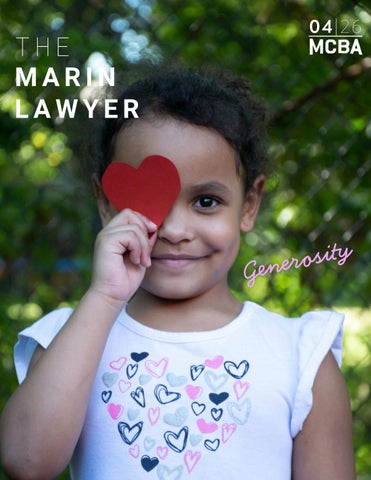
T H E
M A R I N
L A W Y E R


![]()
T H E
M A R I N
L A W Y E R


Lead Editors: Kristine Fowler Cirby & Neusha N. Ghaedi
Creative Director: Aariel Nigam
2026 Officers
President: Thomas M. McInerney
President-Elect: Neusha N. Ghaedi
Treasurer: Robyn B Christo
Secretary: Nestor Schnasse
Past President: Kristine Fowler Cirby
5 Year Past President: Thomas S Brown
Board of Directors
2026
Ingrid L Carbone
Marisa R Chaves
Christine O'Hanlon
Roni D. Pomerantz
Marrianne S. Taleghani
2027
Sarah B Anker
Paul Burglin
Emily Harrington
R. Wesley Pratt
Adrea S. Tencer
2028
Cole A Benbow
Laura E McMahon
Brett K. Rhodes
Dennis E. Simmons
Nicole L. Tiger
Interim Executive Director
Kerry Enright
Membership & Events Manager
Denise Belli
Client Relations Chair
David M Zeff


The Marin Lawyer is published by The Marin County Bar Association 101 Lucas Valley Road, Suite 326 San Rafael, CA 94903 (415) 499-1314 info@marinbar org marinbar org


5 | Editor’s Introduction
KRISTINE FOWLER CIRBY & NEUSHA GHAEDI
6 | 2026 President’s Message
THOMAS M. MCINERNEY
9 | Immigration Topics Affecting Today’s Immigrant Community MOISES JRADE
11 | MCBA Welcomes New Leadership at Annual Installation Dinner
MARIN COUNTY BAR ASSOCIATION
13 | Beyond the Billable: Justice Within Reach for Marin County Lawyers
NEUSHA GHAEDI & ALEXANDRA
PAPANTONIADIS
18 | Non-Profit Spotlight: North Marin Community Services
MARIN COUNTY BAR ASSOCIATION
21 | Communication is a Choice CHRISTINE O’HANLON
23 | Year in Review: Significant Developments in California Real Property Law
MIKAYLA RATTO
24 | Speed Up Your Document Returns: Consent to Electronic Service
MARIN COUNTY BAR ASSOCIATION
26 | Bay Area Women Lawyers’ Network Retreat Highlights Courage, Leadership, and Community
KRISTINE FOWLER CIRBY
29 | C.A.R.E. Court, Marin County’s Little Gem CHRISTINE O’HANLON
32 | Judge's Profile: Get to Know a Judge: Hon. Stephen Freccero KRISTINE FOWLER CIRBY
37 | MCBA Member Profile: Emily Harrington MARIN COUNTY BAR ASSOCIATION


Kristine Fowler Cirby & Neusha Ghaedi
Spring feels like the right season to celebrate generosity, and this issue of Marin Lawyer is full of it.
This spirit of giving back is beautifully reflected in our leadership. MCBA President Tom McInerney has made pro bono a cornerstone of his 2026 priorities, calling on every bar member to contribute five hours of pro bono work this year. We are grateful for his commitment to our community and hope this issue helps fuel that momentum.
When Neusha and I began pulling together articles for this edition, we were struck by how many members of our bar community quietly give their time, skill, and care to clients who could not otherwise access justice. Pro bono work is rarely loud. It happens in courthouse hallways, over phone calls squeezed between billable hours, and in the steady commitment of attorneys who believe that the law should serve everyone not just those who can afford it.
The articles in this issue shine a light on that work If you are looking for ways to get involved, our article Beyond the Billable highlights several legal nonprofit organizations actively seeking pro bono assistance. We also feature a wonderful piece on North Marin Community Services, a nonprofit providing food distribution, childcare programs, rental assistance, and access to legal services through its many community partnerships.
We are pleased to include a Get to Know a Judge profile with Presiding Judge the Honorable Stephen Freccero a great opportunity to learn more about the person leading our local bench as well as a Director's Spotlight on Emily Harrington of Maier Law Group.
If you missed our recent General Meetings, we have you covered. Christine O'Hanlon offers a recap of Alexandra Siroka's presentation, The Mindful Advocate: Aligning Advocacy with Values in Legal Practice, and Moises Jrade has summarized his January presentation on Current Topics Impacting the Immigrant Community. Rounding out this issue are pieces on CARE Court and the Bay Area Women Lawyers Network (BAWLN) retreat
As always, thank you for reading and a sincere thank you to every contributor who made this issue possible.
With gratitude,
Kristine Fowler Cirby & Neusha Gaedi


Neusha Ghaedi is a Partner at DeMartini, Walker, & Ghaedi LLP, where she has successfully litigated many cases since joining the firm in 2017. Neusha’s clientele ranges from Marin County’s largest property managers and real estate developers to individual property owners and trustees on a wide variety of legal matters pertaining ctions, property management, trust litigation, residential properties
Kristine “Kris” Fowler Cirby is a Marin County family law attorney with over 34 years of experience representing families through divorce, custody, domestic violence, and more Before opening her own firm, she spent 20 years at a local legal nonprofit advocating for underrepresented families, work that
commitment to access to justice and her community Kris is the Immediate Past President of the Marin County Bar Association She also serves on the Rally Family Visitation Services advisory board, and on the Community Violence Solutions Board of Directors
Thomas M. McInerney
It is my great honor to serve as your 2026 President of the Marin County Bar Association. We have a number of initiatives we plan to pursue this year, so please stay tuned. Here, I wanted to recap some comments I made at our very successful February 2026 Installation Dinner.
On the front page of the MCBA’s newly designed website is the mission statement of our organization, which provides: “To involve, encourage and support Bar Association members, to serve as a liaison to the Marin County courts, and to educate the community and enhance access to legal services.”
These are all things we’re committed to doing this year and in the years ahead. We will continue to expand our program offerings and build community among the legal community here in our wonderful county of Marin. Stay tuned on this.
But I’d like to take a moment to focus on the last portion of that mission statement enhancing access to legal services.
I also want to acknowledge what is occurring more broadly in our country. We have masked federal agents murdering citizens for engaging in constitutionally-protected conduct and violating the Fourth Amendment rights of migrants and American citizens, including by conducting unlawful searches in homes without court-issued warrants. We have government officials engaging


in blatant corruption with very little pushback from Congress or courts. Federal officials are engaging in some of the most vile and racist behavior we have not seen since at least Reconstruction.
How should we as lawyers respond? I understand the feeling of helplessness when doomscrolling on social media. By ourselves, we may have a sense of powerlessness in our ability, individually, to stand up for what is right and stop this conduct by our elected officials and government, and it’s only when we come together, as a community and as a nation, can this behavior be stopped.
But what can we each do, today, tonight?
Tonight I’d like to challenge each and every lawyer in this room to take a step to stand up for our community and commit that in 2026 you will provide 5 hours of pro bono legal services to under-represented communities and organizations serving those in need. 5 hours. That’s it. We have a host of organizations in this county in need of legal support, and hundreds if not more struggling in need of legal services.


If you’re willing to accept this 5-hour challenge, MCBA will provide you with a list of community organizations in need of pro bono legal services. While it would be great if we could all commit to more than 5 hours in a year, a 5-hour commitment this year is something to which each of us should be able to commit. If you’re already involved in a nonprofit or other organization aimed at serving a community in need, then providing just 5 hours of volunteer service a year would be a great opportunity for you to satisfy your 5-hour pledge.
Will your 5-hours of pro bono legal services stop the oppression, corruption, and racism that we’re witnessing? No, of course not, not by itself. But as Robert Kennedy (Senior, the prophet, not his demented son) said in South Africa in 1966, each time a person stands up for an ideal or acts to improve the lives of others, they send forth a tiny ripple of hope, and these ripples, when they cross, create a current capable of sweeping down the mightiest walls of oppression.
Tonight, will you join us? Can I have a show of hands here tonight of those willing to commit to providing 5 hours of volunteer time to help those in need in our community?
Thank you for your support for this initiative, and for the Marin County Bar Association
Tom McInerney

Thomas (Tom) McInerney has extensive employment litigation experience in complex litigation matters, with an emphasis on class actions, multi-plaintiff cases, and trade secret and other complex business disputes He has tried to verdict several cases in both state and federal courts, and represents clients in a
wide-range of fields, including technology, financial services, insurance, construction, energy/utility, healthcare, transportation and logistics, and personal services
Tom also is a board member of the Marin County Bar Association For eight years Tom served as an elected official in Marin County, including two terms as Mayor of the Town of San Anselmo, as a board member of the Transportation Authority of Marin, and as chair of both the Central Marin Police Authority Council and the Ross Valley Fire Board
THIRSTY THURSDAYS
Thursday, April 9th 5:00 PM - 6:30 PM Farmshop
GENERAL MEMBERSHIP MEETING (VIRTUAL)
Monday, April 27 th 12:00 PM - 1:00 PM
Embracing the Responsible Use of AI in the Legal Profession
GENERAL MEMBERSHIP MEETING (IN PERSON)
Wednesday, April 22nd 11:30 AM - 1:15 PM
MCBA Hosts Assembly Candidate Forum
ESTATE PLANNING, TRUST AND PROBATE & PROBATE LITIGATION SECTIONS MEETING (IN PERSON)
Wednesday, May 27th 12:00 PM - 1:00 PM
Update with the Marin County Probate Department

Moises Jrade, Immigration Justice Staff Attorney of Legal Aid of Marin.
On January 28, 2026, the Marin County Bar Association (MCBA) hosted its first general membership meeting for 2026, where the undersigned, an Immigration Justice Staff Attorney of Legal Aid of Marin presented on the topic of immigration topics affecting today's immigrant community.
The topics discussed were much needed, given the unfortunate situations experienced by the immigrant community, their immediate relatives, extended family, friends, and, to a lesser extent, all other community members, including U.S. citizens and legal permanent residents. These are particularly difficult times for immigrant communities and undocumented community members, who are experiencing uncertainty, fear, and chaos due to revised or new immigration policies, laws, and enforcement actions taken by ICE agents and other immigration officers. Some of these actions are unlawful and can cause significant harm to the communities affected.
The first topic discussed was a Know Your Rights presentation intended to educate immigrants about their constitutional rights, as well as any pro bono volunteer lawyers who may take on immigration cases. Understanding these rights is vital to any immigrant community. The discussion also focused on what to do and say and what not to do or say when approached by an ICE
The next topic addressed was Federal Administration Policy Changes. These changes appear designed to severely narrow or end access to legal remedies such as Asylum for refugees leaving their home countries due to persecution and arriving in the United States seeking protections under international and U.S. laws previously enacted by Congress and signed by past presidents.
Recent policy changes include unlawfully using the Expedited Removal (ER) process to fast-track deportations for asylum seekers, even after they applied for Asylum before U.S. Citizenship and Immigration Services (USCIS) or were placed in removal proceedings before an Immigration Judge. The government is unlawfully expanding expedited removal against people who entered the United States on temporary parole status or valid U.S. visas, such as tourist or religious visas effectively attempting to retroactively apply the process against immigrants who were previously legally admitted or paroled. However,

The discussion also addressed immigrants in defensive Asylum proceedings appearing before an Immigration Judge with pending Asylum applications, or those who filed under affirmative asylum proceedings before USCIS. In these cases, the Department of Homeland Security (DHS) sought to unlawfully dismiss proceedings and place asylum seekers under expedited removal processes that, pursuant to existing U.S. law, do not apply to them. ICE agents would appear at Immigration Courthouses and request that DHS attorneys seek dismissal of removal proceedings, then wait for asylum seekers to leave the Courthouse now without pending asylum protection and detain them for expedited removal.
Under expedited removal, only when an individual expresses a fear of returning to their home country are they sent before an asylum officer for a "credible fear" interview. The officer determines whether the individual's fear and harm make them eligible for Asylum. If the officer finds they lack eligibility, the individual is referred to Immigration Court, and the defensive Asylum process begins again.
country is to request additional time from the Court to determine whether the particular ACA applies and whether the individual qualifies for an exception meaning they can present evidence of likely persecution or torture in the proposed third country. Individuals facing removal to a third country under an ACA have a right to gather evidence proving they are likely to be persecuted or tortured there.

Lastly, the discussion focused on unlawful removals to third countries under Asylum Cooperative Agreements (ACAs) with countries the U.S. government has deemed safe, but which are not the home countries of the individuals being removed. At any hearing, the DHS attorney may ask the Judge to deny an existing Asylum application, arguing the respondent can be removed to a third country under an ACA. These agreements are being applied to Spanishspeaking countries for individuals who entered the United States on or after November 19, 2019. ACAs do not apply to unaccompanied children.
The appropriate legal response to DHS' attempt to remove an undocumented immigrant to a third
Legal Aid of Marin’s Executive Director, Laura McMahon, discussed the organization’s expansion to provide immigration legal services to marginalized Marin community members. Attorneys interested in future pro bono opportunities with Legal Aid of Marin’s immigration program should complete this web form on the organization’s website.

Moises Jrade joins LAM as its first Immigration Justice Staff Attorney, bringing six years of immigration law experience at an Oakland private firm and a long career in Florida spanning private practice, the Attorney General's Child Support Enforcement Division, the Miami- Dade
State's Attorney's Office, and the Department of Children and Families. Licensed with the Florida Bar since 1996, Moises and his wife, an East Bay artist, have a son completing a UCLA PhD in Theoretical Mathematics

The Marin County Bar Association gathered at the Mill Valley Community Center on the evening of February 11, 2026, for its annual Installation Dinner, a celebration of new leadership, professional fellowship, and a renewed commitment to serving the community. The event marked the formal installation of incoming President Tom McInerney and the full Board of Directors, all of whom were sworn in by the Honorable Judge Andrew Sweet.
In his inaugural remarks as president, McInerney wasted no time in setting the tone for his term. He spoke with passion and purpose about one of the legal profession’s most cherished obligations: the duty to provide legal services to those who cannot afford them. McInerney made clear that expanding access to justice would be a defining priority of his presidency.
Turning his words into action, McInerney issued a direct challenge to the attorneys assembled in the room. He asked every lawyer present to rai their hand and pledge to complete at least five hours of pro bono work over the course of the year a modest but meaningful commitment that, multiplied across the membership, could make a significant difference in the lives of underserved Marin County residents.
The evening also served as an opportunity to invest in the future of the legal profession. Members generously raised money for the MCBA Scholarship Fund, which provides financial assistance to law students with ties to Marin County. The fundraising effort reflected

The moment resonated with those in attendance, drawing a strong show of hands and setting a collaborative spirit for the evening ahead.
tuition costs, and that the next generation of Marin attorneys reflects the diversity and dedication of the community they will serve.

Neusha Ghaedi & Alexandra Papantoniadis
Each day, members of the MCBA serve clients with dedication and professionalism. Yet some of the most meaningful contributions we make happen beyond traditional client representation. Throughout our community, individuals and families face legal challenges without guidance, and our time, knowledge, and experience can make a lasting difference.
From assisting self-represented litigants and staffing legal clinics to participating in community court initiatives, there are numerous ways to strengthen access to justice in Marin County.
Volunteering not only benefits those we serve directly but also reinforces public trust in the legal system, strengthens our professional community, and reflects the highest ideals of our profession, which thereby ripples through our community in positive ways.
Listed below are several local programs and initiatives where you can get involved, along with brief descriptions and contact information for each:
Children of the Rainforest
Children of the Rainforest began 15 years ago when founder Jack Allen traveled deep into Bolivia’s Beni River region and witnessed the devastating effects of limited access to medical care, clean water, and education in remote Indigenous communities. After meeting a mother who had lost several children to preventable causes, he committed to helping ensure families would have access to emergency medical support and basic resources. Jack works to deliver supplies and install clean water systems in villages along the river. His effort grew into what the organization is today.
Today, the organization partners with the Mosetén and Tsimané communities in the Pilón Lajas Biosphere Reserve to advance access to clean water, health, education, and sustainable development. Through collaboration between Bolivian and American communities, such as Marin. It promotes cultural exchange, skillsharing, and long-term solutions that strengthen and preserve Indigenous life in the Amazon.
Children of the Rainforest is seeking assistance from a volunteer litigation attorney regarding an ongoing name-use dispute with another nonprofit organization. Despite prior efforts to resolve the matter, the issue remains unresolved and may have resulted in substantially misdirected charitable donations.
This nonprofit’s primary objective is to secure clear legal protection of its name and prevent similar risks to other small charitable organizations. A volunteer attorney with litigation experience would provide meaningful support to help the organization move toward resolution in this active case and, in turn, help the Indigenous people maintain their sustainable way of life while moving forward as leaders in the future.
For information on how you can get involved, contact Children of the Rainforest here.
The MCLL was established in 1891 and offers free public access to legal information not only to attorneys but also to the local community. MCLL collaborates with the MCBA to offer free 20minute consultations with an attorney to those individuals who cannot afford private legal services. Volunteer attorneys provide information, direction, and referrals when appropriate. Lawyers are needed to answer questions in: Family Law, General Civil Law, Estate Planning & Probate, Employment Law, Landlord-Tenant Law, Personal Injury Law, and Civil Appellate. The Zoom virtual platform will allow you to volunteer from your home or office. There is no lawyer-client relationship. Your time is covered by the Law Library's malpractice insurance. Attorneys are needed for the upcoming clinics through the end of the year.
Please consider donating up to two hours of Pro Bono services from the comfort of your home or office to advise patrons through Zoom.
For information on how you can get involved, contact lawlibmc@sonic.net or sign up here.
Volunteers are needed to assist local landlords and tenants in resolving unlawful detainer cases before proceeding to trial.
Unlawful detainer cases involve a landlord filing a legal eviction action against a tenant who remains in possession of a property without the legal right to be there, and these cases
sometimes go to trial. With the help of volunteer attorneys, these unlawful detainers have a significantly higher settlement rate due to the Mandatory Settlement Conferences. You can directly help keep tenants from becoming homeless, save costs for homeowners, and save resources and time for the court by volunteering on Thursday afternoons.
Please contact Legal Aid of Marin to volunteer, (415) 492-0230
Volunteers with experience in family law are needed to meet with parties for interdisciplinary settlement conferences regarding custody and visitation issues, prior to trial. At Bench Bar Settlement Conferences, the panel assists families in reaching an agreement on the division of property and spousal support These two panels are a critical service that can reduce court caseloads and provide families with more timely resolutions.
Volunteering for the settlement panel allows you to share your expertise while supporting families as they navigate what is likely already a difficult situation. If you have experience in family law or are qualified as a Judge Pro Tem, you can volunteer to be a panelist.
For information on how you can get involved, contact cathi.larson@marin.courts.ca.gov
On the first three Tuesdays every month at 1:30pm, attorneys can volunteer to assist family law self-represented litigants move their case forward, or resolve the case in its entirety. Family law and the necessary forms are complicated and the volunteers explain the process and forms to the litigants. You can volunteer by clicking here.
Each Thursday starting at 9:00 AM, two volunteer attorneys assist self-represented litigants by helping them explore resolution options before their cases are heard. Volunteers need just two or more years of experience as a licensed attorney or mediator, a commitment to neutrality, and a willingness to give back to the community. Whether you can volunteer once or regularly, your participation makes a meaningful difference in people's lives and supports access to justice in Marin County. Sign up here.
The SF/Marin Referral Service has a mission to provide affordable legal representation, to educate those who need legal assistance about their rights, and to better identify trends in who is most in need of access to legal assistance within the current justice system. Attorneys who volunteer their time to the SF/Marin Referral Service can volunteer as pro bono or low bono.
For information on how you can get involved, call (415) 989-1616 or (415) 782-8985, email lris@sfbar.org, or visit www.sfbar.org/lris/
Volunteers are needed to provide affordable legal advice and representation in family law matters. Services include assistance with cases surrounding domestic violence, restraining orders, divorce, paternity, child custody and visitation, child and spousal support, guardianship, name changes, and emancipation. Fees charged for these cases are based on income.
For information on how you can get involved, contact info@faclc.org.
You can call (415) 492 9230 or visit the Family and Children’s Law Center website.
Previously known as Whistlestop, this nonprofit organization has served as Marin County’s central resource hub for older adults and individuals with disabilities for over 70 years. The organization provides essential services to seniors and other vulnerable community members to help them remain active and supported, including transportation, meals, classes, and guidance. Much of Vivalon’s work is made possible through private donations and the dedication of volunteers. Vivalon needs attorneys specializing in estate planning who are interested in educating their members and assisting individuals with their estates. Your involvement can help ensure these essential services continue to reach those who depend on them

For information on how you can get involved, contact Paige Pedri: ppedri@vivalon.org.
Canal Alliance’s mission is to end the cycle of poverty affecting Latino immigrants and their families by working to eliminate the obstacles that stand in the way of their advancement. Canal Alliance works to assist immigrant families with needs such as securing basic necessities and obtaining citizenship. Canal Alliance is currently at capacity for volunteers with legal expertise; this means however, if you wish to volunteer your time in the future, you can apply.
Find more information and apply to become a future volunteer here.
Reach out to Legal Aid for more information about how you can participate in assisting those in our community facing immigration issues.
Marin County Superior Court is excited to soon offer a training program for attorneys interested in serving their community by serving as a judge for the day and helping to resolve ongoing cases from the judge’s seat. Service as a judge pro-tem is both a professional distinction and a significant form of public service, and provides the opportunity for you to support Marin County judges.
To serve as a judge pro tem, attorneys are required to meet mandatory education and training requirements described in the California Rules of Court, Rules 2.812, 2.815, and Code of Civil Procedure section 116 240 In addition, attorneys must complete an application with the court and provide certification of completion of all required education and training, including 10 years of licensure as an attorney.

If you’re ready to get involved, reach out to any of the organizations above or contact the MCBA for additional local volunteer opportunities. You can find more ways to serve the community with or without your lawyer cap here:
San Rafael Immigration Legal Aid & Pro Bono Services, Justia Community Resource Guide, Marin Health & Human Services
“What you do makes a difference, and you have to decide what kind of difference you want to make.”
-Jane Goodall
Volunteering isn’t just altruistic; it strengthens trust and connects attorneys with the community in meaningful ways. Whether it’s at a clinic, a courtroom, a library, or a community event, your time has a lasting impact.
Spread the word, and share this information with your peers, friends, and family. Many of these organizations offer opportunities for all to offer their talents to help those in need within our community.


Neusha Ghaedi is a Partner at DeMartini, Walker, & Ghaedi LLP, where she has successfully litigated many cases since joining the firm in 2017 Neusha’s clientele ranges from Marin County’s largest property managers and real estate developers to individual property owners and trustees on a wide variety of legal matters pertaining ctions, property management, trust litigation, residential properties
Alexandra Papantoniadis is a Legal Secretary for DeMartini Walker and Ghaedi She supports the attorneys by assisting in drafting and reviewing documents, notarizing documents, and communicating with clients, along with various administrative tasks She enjoys working with her incredible team at DWG and is passionate about helping people Alexandra is interested in furthering her career in the law field and is hoping to soon earn her paralegal certification

North Marin Community Services
For over five decades, North Marin Community Services (NMCS) has stood alongside individuals and families navigating Marin County’s most complex challenges. Rooted in the community since 1972, NMCS empowers youth, adults, and families to achieve well-being, growth, and success. As the anchor human services nonprofit in North Marin, we provide vital resources, educational opportunities, and economic support through an integrated model that moves people from crisis to stability and long-term opportunity.
Since our founding, North Marin Community Services has positively impacted more than 200,000 people. Today, as a women-led organization, our team of 73 staff members and 339 volunteers brings deep expertise and lived experience to serve our community. More than half of our staff are bilingual and bicultural, enabling us to serve Marin’s diverse communities with cultural humility and responsiveness.
This past year, 13,765 individuals accessed NMCS services. Of those, 5,264 received direct support and 8,501 were reached through outreach and engagement. Participants include children, low-income families, older adults, immigrants, single parents, and service workers. Because need is not concentrated in one location, NMCS implements outreach and services throughout Marin at our two centers located at 680 Wilson Ave., Novato, California 94947, and 1907 Novato Blvd., Novato, California 94947; on Novato Unified, Shoreline Unified, and Lagunitas School District campuses; at the Novato Teen Clinic in partnership with Marin Community Clinics; in West Marin; and remotely. 99% of those served directly reside in low-income households.
Marin County is often celebrated for its prosperity, yet it has one of the highest levels of
income inequality in California and the nation.
More than one-third of Marin households do not earn enough to meet basic needs. About sixty percent of renters in Novato spend more than a third of their income on housing, leaving families vulnerable to unexpected challenges.
At NMCS, we recognize that legal stability is foundational to economic and family stability. Housing insecurity, domestic violence, immigration concerns, public benefits access, and consumer issues often require legal expertise beyond the scope of traditional social services. That is why our legal partnerships are essential to our mission.
We collaborate with respected legal organizations, including Legal Aid of Marin, Canal Alliance, Center for Domestic Peace, the County of Marin Victim Witness Assistance Program, the Office of the Public Defender, Social Justice Collaborative, and other partners. Through warm referrals, coordinated case management, and integrated advocacy, we help families address legal barriers that threaten their housing, safety, or livelihood.
For a survivor of domestic violence, access to restraining orders and victim advocacy can mean the difference between continued harm and safety. For an immigrant family, trusted legal guidance can determine whether they remain together or face separation. For a tenant navigating eviction, timely legal intervention can prevent homelessness and its cascading consequences. By working alongside attorneys and legal advocates, NMCS strengthens the safety net that protects under-resourced community members from falling deeper into crisis.
Our Case Management and Housing team distributes emergency rental and direct assistance while providing bilingual case management. Our Mental Health and Wellness team of 19 professionals delivers traumainformed care in schools and clinics, as well as through telehealth. Our Child Development programs offer affordable early education and after-school enrichment. Our Food Pantry, transitioning to a Community Market model in partnership with San Francisco-Marin Food Bank, provides access to nutritious food and serves as a gateway to wraparound services.
Grounded in a three-year Theory of Change and Results-Based Accountability framework, we measure outcomes from housing retention to improvements in youth mental health and school engagement. Our diversified budget, 4-Star Charity Navigator rating, and Platinum Seal of Transparency reflect strong stewardship made possible by dedicated staff, volunteers, and community partners.
Legal professionals understand that poverty, discrimination, and limited access to healthcare and education are closely connected to justice outcomes. We invite members of the Marin legal community to stand with us. Through collaboration, policy advocacy, and philanthropy, your partnership expands access to justice and opportunity for families too often unseen behind Marin’s prosperity narrative.
A strong community is one where legal protection, economic opportunity, and human dignity are accessible to all. Together, we can help ensure that under-resourced families in North Marin remain housed, safe, and able to thrive.

MCBA LEADERSHIP CIRCLE MCBA LEADERSHIP CIRCLE

Peter Kleinbrodt Peter Kleinbrodt
Freitas Law Firm Freitas Law Firm
Terrel J. Mason, Esq.
Law Offices of Terrel J. Mason
Thomas M. McInerney
Thomas M. McInerney
Ogletree Deakins
Ogletree Deakins
Christine O’Hanlon, Marin County Chief Deputy Public Defender
February's MCBA’s General Meeting delivered a very interesting and practical MCLE program called, “The Mindful Advocate: Aligning Advocacy with Values in Legal Practice,” led by Alejandra Siroka from Language Alchemy. I found this MCLE applicable to the courtroom and every other place in my life where I communicate.
Trigger Alert: I will be sharing my humanity with you, which may be tiresome, boring, reactivating, and cause emotional distress.
This training asked participants to look at their communication styles and to look when we were in litigation communication mode outside of the courtroom. I am a career public defender and courtroom litigator. I can say honestly, I do slip into courtroom communication when I am not in court, and likely a lot more than I am aware Yes, I am human. While this may be profoundly human to fall into courtroom speak when not in court, it usually is not productive and even detrimental to relationships when used outside the courtroom (and unfortunately, sometimes it is unproductive even in the courtroom) and is likely quite unpleasant for the recipients of courtroom communication.
Alejandra Siroka distinguished courtroom communication and authentic communication. Authentic communication is communication that aligns with our values, such as integrity, honesty, and kindness. Courtroom communication is communication that involves analyzing facts instead of acknowledging feelings and others’ experiences. This is a nice way of describing courtroom communication. Courtroom communication involves taking an adversarial and suspicious point of view, questioning everything said, looking for faults, exploiting weakness, and looking for any inconsistency in what is said to convince yourself and others you are right. Being right in the courtroom is a win, a ruling in your client’s favor, or a win at trial. Out of the courtroom being right is usually a booby prize that costs us our relationships, affinity, and connection with the people in our lives.

Applying Alejandra Siroka’s distinction for courtroom communication, I can see during a disagreement with my partner, I was not acknowledging his feelings and I was not seeing his point of view. If I am really being truthful, I was unwilling to see his point of view. Instead, I was more committed to being right by looking for inconsistencies and by cross examining him with very poignant questions, in the end a firstclass jerk. And why? To be right about whatever trip I was on because I was tired, crabby, and overwhelmed from work.
Alejandra Siroka’s training had us reorient ourselves toward communication as a choice. The good news is that communication is a choice. The bad news is that communication is a choice. In other words, we all have a say over what we say. Ms. Siroka teaches this simple (but maybe not easy when things are heated) mindful exercise to reorient your frame of mind from courtroom communication to authentic communication. You basically take a breath and look and accept where you are, notice what state you are in, notice who is in the conversation, notice if you are making the person an enemy, and ask yourself is the same approach as my last interaction in court necessary. In other words, is courtroom communication necessary or effective in my conversation with family, friends, and colleagues right now? Probably not. Then, you present yourself with the choice of using courtroom communication or authentic communication.

Choosing to use authentic communication that is aligned with our values, over caustic courtroom communication, takes discipline. Alejandra Siroka said, “Communication cannot be taught. It must be practiced.” Knowing the less productive thoughts racing through in my head during a heated situation and having the discipline to eventually use authentic communication sometimes seems impossible. But in the case out of court, the fourth or fifth choice way of saying something is the better choice when it is a choice of authentic communication aligned with my values.

Christine O’Hanlon is lifetime California resident growing up in Vallejo, California She earned her bachelor’s degree in psychology from University of California, Santa Cruz Ms O’Hanlon attended and graduated with a J D from California Western School of Law in San Diego Since
he Bar in 1996, Ms O’Hanlon has specialized ndigent individuals. She started her career in juvenile court in San Diego. In 1997, she returned to Northern California and worked in the Juvenile Division in the Solano County Public Defender’s Office In January of 1999, Ms O’Hanlon joined the Marin County Public Defender’s Office w

Mikayla Ratto
Each year, the Marin County Bar Association continues its long-standing tradition of presenting its highly regarded “Year in Review” program, a staple event that has brought together many of Marin’s top attorneys for many years. This presentation remains a trusted and valued resource for practitioners and anyone interested in staying current on the ever-evolving landscape of California real property laws.
This year’s program once again delivered a comprehensive and highly informative overview of key legal developments. Esteemed speakers covered a wide range of topics, including Finance Mortgage Loans & Foreclosures, Easements, Boundaries, and Inverse Condemnation, Real Estate Sales & Brokerage, Common Interest Developments, Land Use, Construction, and Landlord/Tenant law.
As reflected in the scope of presentations, the
Beyond its educational value, the event continues to serve as an important opportunity for attendees, both legal professionals and those simply interested in real property topics, to connect, exchange ideas, and strengthen professional relationships.
Be sure to keep an eye out for next year’s program, an invaluable event for anyone interested in California real property topics.


Mikayla Ratto is an associate attorney at DeMartini Walker & Ghaedi LLP, where she does both litigation and transactional work Mikayla has over 10 years of practical experience in business transactions and real estate matters Having grown up in a household of entrepreneurs and property
has a unique perspective and experience to advise clients on a wide range of legal matters
Marin County Bar Association
The Marin County Superior Court Clerk’s Office is pleased to announce that, with the implementation of its new case management system, it now has significantly enhanced capabilities for returning filed documents to parties electronically. This means faster turnaround on filings, often nearly instantaneous, compared to traditional mail delivery or arranging a runner to pick up copies.
However, under the California Rules of Court, the Court may only serve documents electronically to parties who have consented to electronic service. Until that consent is on file, the Clerk’s Office must rely on traditional mail to return documents, which takes longer and can delay workflow. Once a party consents, the Court updates that party’s profile in the case management system, and all documents going forward are returned electronically.
There are two simple ways to opt in to electronic service:
File Judicial Council Form EFS-005-CV.
This is the formal consent form for electronic
By consenting to electronic service, you can expect:
Faster document delivery.
Receive returned documents almost instantly rather than waiting days for documents to arrive in the mail.
Cost savings.
Eliminate the expense of sending a runner to pick up copies.
Streamlined workflow.
Documents arrive directly in your inbox, making it easier to track filings and keep your case files up to date.
Take Action Today ’


Interested in Sponsorship? Contact Kerry Enright
Kristine Fowler Cirby
Whether attending for the first time or returning, participants at the 7th Annual Bay Area Women Lawyers’ Network (BAWLN) Retreat tend to leave recharged, inspired, and better connected. Held February 6–8, 2026, at the Silverado Resort in Napa and organized by a coalition of Bay Area bar associations’ executive directors, the retreat brought together women lawyers from across the region for three days of substantive MCLE programming, meaningful mentorship, and the kind of community that sustains a legal career for the long haul.
The retreat opened Friday afternoon with “Fear Less: The Women Who Inspire Us,” led by Lori Andrus of Andrus Anderson LLP. Drawing from her own professional journey, Andrus spoke candidly about leadership, courage, and the colleagues who push us to take risks we might not otherwise take, setting a tone of openness and authenticity that carried through the entire

Suzanne Bolanos (Ret.) and Justice Maria Rivera (Ret.) of ADR Services, Inc., Judge Lori E. Pegg of the Santa Clara County Superior Court, and former Immigration Judge Florence Chamberlin. The panel addressed the mounting pressures on judicial independence and the shared responsibility, for lawyers and judges alike, to safeguard the integrity of the legal system.
Friday evening closed with a group dinner, a lively opportunity to meet fellow attendees and begin building the connections that would deepen over the days ahead.
Saturday’s programming was outstanding from start to finish “Female Legends in the Bay Area” featured Doris Cheng of Walkup, Melodia, Kelly & Schoenberger, Judge Joni Hiramoto of the Contra Costa County Superior Court, Geri Green of ADR Services, Inc., and Drucilla Ramey, Dean Emerita of Golden Gate University School of Law, sharing candid reflections on long careers Their message: longevity in this profession is not about perfection, it is about adaptability, community, and a sense of humor.
Two morning sessions addressed the business and technology side of practice “Social Media and Marketing: Your Firm and Yourself”, with Lex Hamilton of The Hamilton Law Firm, Terry Leoni of Leoni Law, and Cynthia Chandler, covered building an authentic professional presence ethically, with particular emphasis on consistent LinkedIn engagement Lorena Campozano of LexisNexis then led “AI Efficiency and Ethics in the Modern Law Practice,” focusing on responsible implementation and how AI can support, rather than supplant, professional judgment.
The afternoon panel, “Women in Leadership and Rainmaking,” was a standout. Monica Burneikis of Burneikis Law, Debra Bogaards of ADR Services, Inc., and Tiega Varlack of Varlack Legal Services, moderated by Megan Burns of Mirador Law, spoke candidly about what it takes to build a practice, the confidence, the hustle, and the reality of navigating systemic barriers that remain stubbornly present.
Saturday afternoon offered a few hours of free time before attendees reconvened at the home of Judge Victoria Woods (Ret.) of ADR Services, Inc. for charcuterie and a wine tasting featuring bottles from two local, women-led wineries: Hafner Vineyard and La Sirena Wine. Smaller curated dinner groups then spread out across downtown Napa, informal evenings that proved just as memorable as the sessions themselves.
Sunday brought two sessions that left a lasting impression. “Civility: Balancing Advocacy, Ethics, and Professionalism” featured Judge Noël Wise of the U.S. District Court for the Northern District of California, Judge Nancy Fineman of the San Mateo County Superior Court, and attorney Mary Catherine Wiederhold, moderated by Judge Monica Wiley of San Francisco Unified Family Court. Panelists challenged the notion that civility undermines zealous advocacy, offering real-world examples of how incivility harms clients, and reinforcing the message that civility is both an ethical obligation and a professional asset.
The retreat closed with one of its most energizing sessions: “The Sh*t They Say, And Ways to Respond.” Mika Domingo of Domingo Law Group, Nana Knight of Knight Law, and Judge Vedica Puri (Ret.) of ADR Services, Inc., moderated by Angelina Austin of Kazan, McClain, Satterley & Greenwood, tackled the biased remarks and condescending behaviors women
encounter in legal spaces and offered practical strategies for responding with confidence and

of Marin put it simply: “The conference was just fabulous!”
Now in its seventh year, the BAWLN Retreat has firmly established itself as one of the premier professional development events for women lawyers in the Bay Area, a gathering that combines high-quality MCLE programming with authentic community. The Bay Area Women Lawyers’ Network has built something genuinely special, and if you have not yet attended, the 8th Annual Retreat belongs on your calendar.

Kristine “Kris” Fowler Cirby is a Marin County family law attorney with over 34 years of experience representing families through divorce, custody, domestic violence, and more Before opening her own firm, she spent 20 years at a local legal nonprofit advocating for underrepresented families, work that
commitment to access to justice and her community. Kris is the Immediate Past President of the Marin County Bar Association She also serves on the Rally Family Visitation Services advisory board, and on the Community Violence Solutions Board of Directors

The Lawyers in the Library community service program is a collaboration between the Marin County Law Library and the Marin County Bar Association. Lawyers in the Library offers free 20-minute consultations with an attorney for individuals who cannot afford private legal services
Due to COVID-19, the program meetings take place via Zoom. Please sign up for a time to help today.
Thank you for supporting this important community service program.


Christine O’Hanlon, Marin County Chief Deputy Public Defender
C.A.R.E. stands for “Community Assistance, Recovery, and Empowerment,” which is a newer mental health court arising from legislation that established court ordered mental health treatment for people suffering from schizophrenia who need a push toward treatment, but are not at the point where they require involuntary hospitalization. The legislation was introduced as SB-1338 and is now codified in Welfare and Institutions Code sections 5970-5987. Through the collaboration of the Marin County Superior Court, Behavioral Health and Recovery Services (BHRS) division of Health and Human Services, County Counsel, and the Public Defender, Marin County’s own CARE Court launched on December 1, 2024. Currently, Marin CARE Court has 37 participants.

In CARE Court, participants receive an individualized client driven treatment plan. The clients participate in the creation of their treatment plans and can agree to various terms. When the client refuses to agree to treatment terms, the court has the authority to order participation in treatment terms. Each treatment plan is designed to provide immediate access to mental health treatment, housing, and other social services with team support. The primary goal of each treatment plan is the client’s stabilization in the community. The clients access services to prevent or stop chronic homelessness, repeated involuntary hospitalizations and revolving door criminal incarceration.
Clients have regular court appearances where the judge receives updates from the CARE Team about each client’s progress. The CARE Team consists of a social worker, a psychologist from Behavioral Health and Recovery Services, the client’s attorney, County Counsel, and the Judge.
The judge plays an integral role in the participant’s treatment by engaging the participant at each court appearance. The judge has a back-and-forth dialogue with each client where the judge checks up on the client’s progress, asks how the client is doing, and gives the client individualized words of encourage-ment. Other members of the CARE Team weigh in.
The Honorable Mark A. Talamantes was first judge assigned to sit for CARE Court, and currently the Honorable James Schurz is assigned. Although the court has no authority to arrest participants for failing to appear, the clients make their court appearances, which is surprising given how many criminal court participants fail to appear, even with the threat of jail for not attending court. The participants appear in court voluntarily. Having so much support from a team and from a judge, who is an important member of the community, seems to accomplish greater participation and less resistance to treatment.
A person qualifies for CARE Court if the following criteria are met:
1. Over the age of 18, who is;
2. Currently experiencing a serious mental disorder of schizophrenia spectrum disorder, other psychotic disorder, or bipolar 1 disorder with psychotic disorder.
3. Is not clinically stable in an ongoing voluntary treatment plan.
4. Participation in a CARE Court Plan or Agreement is the least restrictive means to ensure a person’s recovery and stability.
5. It is likely the person would benefit from participation in a CARE plan or agreement.
And at least one of the following is true:
1. The person is unlikely to survive safely in the community without supervision, and the person’s condition is substantially deteriorating.
2. The person is in need of services and support in order to prevent a relapse or deterioration that would be likely to result in grave disability or serious harm to the person or others.
To get someone into the CARE Court, the process is much more flexible than other legal
avenues to achieve court mandated mental health treatment. A family member, a person living with the person, a first responder, treatment providers, Health and Human Services, and even the potential CARE Court participant can file a petition with the Court, which can expedite the client’s participation in badly needed treatment. A CARE Court intervention may prevent or reduce the risk of criminal behavior, involuntary hospitalization, or loss of housing. In addition to supporting the client, the client’s family is supported by CARE Court’s intervention.

Deputy Public Defender Carol Farrer, who is appointed as defense counsel for most of the CARE Court participants says, the CARE Team “relentlessly” engages the clients. She says, “CARE Court keeps trying.” CARE Court expects clients to resist and deny their mental health diagnosis, and the team expects the clients will resist offers of treatment, even if accepting treatment means having housing, being released from jail, or avoiding hospitalization. The CARE Team accepts that resistance and lack of insight are part of the process. The CARE Team does not expect perfect compliance and knows there will be slip ups and setbacks. This does not deter the CARE Team’s commitment to the clients’ receiving services. The CARE Team does not give up.
Some disability rights groups have been critical of this court claiming that CARE has not reached enough people and is a waste of money. There are complaints that too many resources are expended on individual people, and the results are not cost effective. Everyone had high expectations that CARE Court petitions would come in droves, and California would get mentally ill people out of jail and off the streets, thus reducing crime and homelessness. There was more of trickle than a flood of petitions. In some counties, there are not enough services or infrastructure to provide what CARE promised. Other complaints were that the first version of CARE was too limited by accepting only people with schizophrenic spectrum disorder while there are other mental health diagnoses that are equally debilitating. As of January 1, 2026, the legislature expanded CARE criteria to allow people with a bipolar disorder into CARE Court.
Despite criticisms, the Marin CARE Court’s relentlessness has paid off for the participants. Many of the participants have had some criminal court intersections. Some participants were estranged from their families. Some were unable to maintain housing, much less even dream of stable employment. For the 30 or so participants in Marin, CARE Court has transformed their lives in a meaningful way. There are Marin CARE Court Clients who are housed, cooperating with mental health treatment, staying away from drugs and alcohol, reuniting with their families. Some people who were written off as lost causes, now have jobs. And, yes, it did take substantial resources directed at each individual person to deliver these results. Perhaps, this aggressive and intensive resource approach is what it takes for people with severe mental illness to remain stable enough to maintain housing, avoid involuntary hospitalization, and id i i l l i l ti M i CARE C t


Kristine Fowler Cirby
Judge Stephen Freccero has served as a Judge of the Marin County Superior Court since January 2016, bringing decades of public service and trial experience to the bench. Prior to his judicial appointment, Judge Freccero spent many years as an Assistant United States Attorney, where he prosecuted complex federal criminal cases involving public corruption, civil rights, and violent crime. He was also part of the prosecution team in the Unabomber case, an experience that shaped his appreciation for careful preparation, collaboration, and the gravity of the justice system’s role in cases of profound public consequence.
Known for his calm demeanor, intellectual rigor, and deep respect for the rule of law, Judge Freccero is widely regarded as fair, thoughtful, and exceptionally prepared. He places a high value on civility and professionalism and is committed to ensuring that every litigant who appears before him is treated with dignity and respect. His career reflects a sustained dedication to public service and to fostering trust and confidence in the courts.

Now that you know a little about his impressive background, let’s get to the fun part! Here are some lighthearted questions to help you get to know Judge Freccero beyond the bench.
What is your guilty pleasure snack during long trials or hearings?
More coffee.
What is your favorite place in Marin (or your community) to spend a Saturday morning?
Corte Madera Creek
What book are you currently reading?
Rereading “The Leopard” by Lampedus [Giuseppe Tomasi di Lampedusa], one of my favorites
If you weren’t a judge, what career would you choose in an alternate universe? Gardener.
If you had to listen to one music genre all week, what would it be?
I am not familiar with music genres. I would simply pick either Bob Dylan or Leonard Cohen.
If you could invite someone from history to dinner, who would it be?
Dante Alighieri [medieval Italian poet best known for The Divine Comedy]

Kristine “Kris” Fowler Cirby is a Marin County family law attorney with over 34 years of experience representing families through divorce, custody, domestic violence, and more Before opening her own firm, she spent 20 years at a local legal nonprofit advocating


Vanessa Aguilar
Brayton Purcell LLP
Elena M, Ahern
Jessica L. Alys Brayton Purcell LLP
Mariela Anguiano Brayton Purcell LLP
Lisa M. Bertain
Paul Herbert
Caitlin Donnelly West Foster
Rob Gall
Michele S. Garlit Brayton Purcell LLP
Zachary P. Gaver
Marin County Public Defender's Office
Carla V. Gomez
Marin County Public Defender’s Office
ADR
Barristers
Business
Construction
Criminal
Diversity
Employment Labor
Estate Planning Probate
Zachary R. Griggy
Charlotte C Halifax Marin County Public Defender's Office
Scott F. Handelman
Clea Hendricks Brayton Purcell LLP
Evan Hoffman Brayton Purcell LLP
Moises Jrade Legal Aid of Marin
Holden L. Keijer Thompson, Welch, Soroko & Gilbert LLP
Brian A. Lambert Marin County Counsel's Office
Fanelisa Leconte
Annie Llombart
Portabella Andersen Tax LLC
Mentoring Grp
Family Law
Intellectual Property Litigation
Probate Litigation Real Property Tax
Jaime Madrigal
Brayton Purcell LLP
Thomas O. McGrath
Hildebrand McLeod & Nelson
Leah McMorris Brayton Purcell LLP
Derick Morgan Marin County Public Defender's Office
Robert Nadler
Henry Nicholson
Sarah G. Nusinow
Kaye Moser Hierbaum Ford LLP
Grecia M. Perez Brayton Purcell LLP
Robert N. Phillips Reed Smith LLP
Andrea L. Pierotti Porter Pierotti Law LLP
Raniele Reyes
Bryan M. Kreft Law Office
Judith Rooke
Renee Sayles Atkinson, Andelson, Loya, Ruud & Romo
Sharan K. Sekhon Lasher Holzapfel Sperry & Ebberson PLLC
Christina C. Skubic Brayton Purcell LLP
Juanita Tirado Montes Brayton Purcell LLP
Douglas B. Twillman

If you are a current 2025 MCBA member, you can use the listserv to query your colleagues on legal updates, ask for recommendations for experts, share Court administrative processes, and use the platform to expand legal knowledge. To maintain engagement and sign-ups, we don't use the listserv for advertising, campaigning, or for public discourse To join the listserv Sign Up HERE Start using the listserv and email your message to current subscribed MCBA Members at mcba@groupvine.com or send to these specific practice

THERE ARE MANY EXCELLENT REASONS TO BECOME A MEMBER OF MCBA! HERE ARE JUST A FEW:
Build relationships with fellow attorneys and other professionals.
In collaboration with our sections, we offer many CLE programs, covering topical and timely issues.
MCBA, with The Marin County Law Library, offers free legal consultations through our Lawyers in the Library program.
MCBA supports financially disadvantaged students pursuing a law school degree and all high schools participating in Mock Trial.
MCBA’s website and monthly Marin Lawyer newsletter deliver updates on events, court notices, timely legal articles, and legal community news.
MCBA membership provides access to an exclusive community of attorneys and other legal professionals. Explore your leadership potential through board and committee involvement.
Renewal is even easier with our auto-renewal service.
Special offers from select partners.
Emily Harrington
Marin County Bar Association
Tell us about your current professional practice?
I am an employment lawyer at Maier Law Group, where my practice focuses on advising employers on HR matters and serving as a neutral factfinder in workplace investigations. I completed the Association of Workplace Investigators (AWI) Training Institute and am a AWI Certificate Holder (AWI-CH). I especially enjoy my investigations practice because it allows me to draw on my natural empathy for all sides to a dispute, as well as provide participants with the dignity and respect of feeling heard. In my advice and counsel practice, I also advise employers on all aspects of California and federal employment law, including hiring, termination, worker classifications, equal opportunity, compliance, anti-harassment and discrimination, retaliation, wage and hour, and leaves of absence laws.
What is your academic and professional background?
I earned my B.A. in Political Science from U.C. Berkeley and my law degree from Duke University School of law, where I served as Editor in Chief of the Duke Law & Technology Review and was a member of the Wrongful Convictions clinic.

Emily Harrington
I started my legal career as a litigation associate at Cooley LLP, where I worked on a wide variety of complex commercial litigation matters and represented clients before regulatory agencies. I then changed tracks, taking an in-house job at a non-profit organization (St. Vincent de Paul Society of Marin, which serves the homeless population in Marin County). As in-house counsel, I advised the agency on employment and compliance matters and oversaw the Human Resources functions of the organization. That experience gave me a unique perspective to draw upon when advising clients.
Tell us more about your decision to study law and how you decided to choose the path of employment law and workplace investigations?
I grew up in a family of teachers and artists. I was the “black sheep” who decided to pursue law, which was a profession viewed somewhat askance by my family (they thought: where is the joy in that?). I was drawn to study law because I loved the idea of being able to advocate for someone who did not have the tools or resources to advocate for themself (I originally thought I would work in public interest law).
My path to employment law was somewhat circuitous: I began my career as a litigation associate at a large (“Big Law”) firm, working on securities litigation and regulatory investigations. I found that the adversarial nature of litigation did not suit my personality or bring me fulfillment. However, the regulatory investigations I conducted at the firm were fascinating: they sparked my curiosity and creativity. After a short period working in-house for a non-profit, I found Maier Law Group and fell in love with the people and the work that we do.
At MLG, we proactively advise employers on how to create healthy and happy workplaces. We also conduct workplace investigations and these harken back to the regulatory investigations I conducted at the Big Law firm. Conducting investigations allows me to lean into my natural curiosity and empathy, listen to all sides of a story, and then deliver findings to the employer that enables them to make sound decisions about the issue at hand. I believe our work helps employers bring meaningful, positive change to their organizations. It’s an amazing feeling to be proud of the work that you do. At MLG, I have finally found a practice that truly sparks joy for me.
What is the best piece of advice you have ever received that has helped you in your success?
“Progress not perfection.” I believe that when we focus on incremental growth, instead of ever-elusive perfection, we learn and grow from our mistakes, instead of chasing an impossible standard.
What inspired you to join the MCBA Board of Directors?
The MCBA plays a meaningful role in supporting local attorneys at every stage of their careers from new lawyers looking for guidance to seasoned practitioners navigating a changing legal landscape. I joined MCBA in part to benefit from these diverse perspectives, but also to build relationships with lawyers outside my practice area and with differing amounts of experience. Serving on the Board felt like an opportunity to give back, strengthen those support systems, and help ensure the organization remains inclusive and forward-thinking.
I also see the Bar as an important bridge for newer attorneys and those evolving in their careers I benefited from mentors and colleagues here, and I believe we have a responsibility to create space for connection, support, and practical learning.
What do you enjoy doing outside of work?
Outside of work, I am a mother to 4-month baby girl (Isabella), who is the light of my life! I am also a devoted dog-mom to my 10-year-old pup, Pickles. I enjoy playing tennis through Play Tennis Marin and I occasionally play for USTA teams too. I also love to cook, and in another lifetime, I would have gone to culinary school (maybe someday!).
Right now, my focus is on learning to navigate the challenge of working full-time, while having a baby. Raising an infant while also working in a demanding practice, has required clarity around priorities, boundaries, and efficiency. I am very fortunate to have an incredibly devoted husband and parents (“my village”) who are supporting me during this chapter. Fortunately, I work for a firm that makes work-life balance a reality, and not just empty words.
What book have you read in the past 12 months that you enjoyed? I really enjoyed “Let Them” by Mel Robbins.
Favorite restaurant(s) in Marin?
Sol Food, Pico, Sushi Ran, Picante!


Thomas M. McInerney
President
Ogletree Deakins


Robyn B. Christo
Treasurer
Epstein Holtzapple Christo LLP


Neusha Ghaedi
President-Elect
DeMartini, Walker, & Ghaedi LLP
Contact Kerry Enright
Kristine Fowler Cirby
Past President
Law Office of Kristine Fowler
Cirby
Nestor R. Schnasse
Secretary
Shnasse Law

Kerry Enright
Interim Executive Director
Marin County Bar Association

Thomas S. Brown
5-Year Past President
SSL Law Firm LLP
David M. Zeff
Client Relations Chair
Law Offices of David M. Zeff


Marisa R. Chaves 2026 Director Hanson Crawford Crum Family Law Group
Roni D Pomerantz 2026 Director California Department of Justice


Ingrid L. Carbone 2026 Director Carbone Family Law


Sarah B. Anker 2027 Director County of Marin

Emily Harrington 2027 Director Maier Law Group

Cole A. Benbow 2028 Director Hanson Bridgett LLP


Brett K. Rhodes 2028 Director County of Marin


Christine O‘Hanlon 2026 Director Marin County Public Defender’s Office
Nicole L. Tiger 2028 Director Ragghianti Freitas LLP
Marrianne S Taleghani 2026 Director Compass
Adrea Tencer 2027 Director ADZ Law, LLP
R Wesley Pratt 2027 Director County of Marin
Paul Burglin 2027 Director Burglin Law Office, P C
Laura E. McMahon 2028 Director Legal Aid of Marin
Dennis E. Simmons 2028 Director The Simmons Law Firm
To involve, encourage, and support Bar Association members, to serve as a liaison to the Marin County Courts, to educate the community and enhance access to legal services.