





















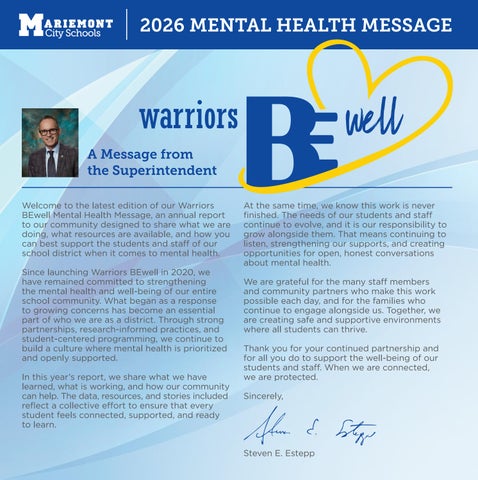































Welcome to the latest edition of our Warriors BEwell Mental Health Message, an annual report to our community designed to share what we are doing, what resources are available, and how you can best support the students and staff of our school district when it comes to mental health.

















At the same time, we know this work is never finished. The needs of our students and staff continue to evolve, and it is our responsibility to grow alongside them. That means continuing to listen, strengthening our supports, and creating opportunities for open, honest conversations about mental health.











Since launching Warriors BEwell in 2020, we have remained committed to strengthening the mental health and well-being of our entire school community. What began as a response to growing concerns has become an essential part of who we are as a district. Through strong partnerships, research-informed practices, and student-centered programming, we continue to build a culture where mental health is prioritized and openly supported.




We are grateful for the many staff members and community partners who make this work possible each day, and for the families who continue to engage alongside us. Together, we are creating safe and supportive environments where all students can thrive.


In this year’s report, we share what we have learned, what is working, and how our community can help. The data, resources, and stories included reflect a collective effort to ensure that every student feels connected, supported, and ready to learn.








Thank you for your continued partnership and for all you do to support the well-being of our students and staff. When we are connected, we are protected.
Sincerely,


Steven E. Estepp

TALK OPENLY ABOUT STRESS AND EMOTIONS
Our data shows that students who feel they have at least one trusted adult to talk to are significantly more resilient.
ENCOURAGE INCLUSION
Help your student look for those on the “fringe.” Who might be feeling unseen? Teach them to reach out and include others. Connected is protected.
TREAT MENTAL HEALTH AS PHYSICAL HEALTH
Stability at home starts with the basics:
Digital Sunset: Dock all devices in a common area 60 minutes before bed to support restorative sleep.
Caffeine Check: Replace energy drinks or soda with water, especially in the afternoon, to reduce anxiety-like symptoms and jitteriness.
Routine Matters: Maintain consistent mealtimes and sleep schedules to provide the rhythm students need to feel secure.
ATTENDANCE MATTERS
Missing a day of school here and there may not seem like much, but absences add up!
WHEN A STUDENT MISSES 2 DAYS A MONTH:
They will miss 16 DAYS a year.
That’s 30 HOURS of missed math instruction over the school year for an elementary student.
That’s 60 HOURS of missed reading and writing instruction over the school year for an elementary student.
They will miss over 1 YEAR of school by graduation.
SHARE YOUR VOICE
Mariemont City Schools is seeking parent feedback on support areas to ensure its student wellness and mental health programming are effectively meeting the community’s evolving needs. Please consider scanning the QR Code to take a short survey.
Supporting student wellness takes more than one program or initiative. It is a comprehensive, districtwide effort that spans every grade level and touches each part of the school day.
The programs and supports listed below reflect our commitment to meeting students where they are, building skills for lifelong well-being, and creating a culture where every student feels connected, supported, and valued. From daily classroom practices to peer leadership opportunities and prevention-focused resources, each plays an important role in helping our students thrive.
MINDFULNESS AND SELF-REGULATION
• MindPeace Rooms in all school buildings
• Mindful moments to start the day for elementary students
• Movement breaks for elementary students
• Pet therapy dog weekly visits for elementary students
PEER SUPPORT/STUDENT LEADERSHIP
PREVENTION PROGRAMS
• Sources of Strength for junior high and high school students
• Student Ambassadors in all school buildings
• Rox Group for 10th grade girls
• Kindness committees for elementary students
• Signs of Suicide
• Social-emotional skill building
• Sources of Strength
• Mental health therapists
• At least one school counselor in all school buildings
“One thing that makes me feel supported through Mariemont High School is the school counselors. These counselors have helped me through scheduling issues, emotional days, and even testing, and have made this school a better place.”
– MHS student
“I think a friendly and welcoming social environment is the best way to help students feel supported at school. When I work with other students who are kind and welcoming, it helps me feel comfortable and confident at school and gives me the motivation to push through what is expected of me.”
– MHS student




“Something that makes me feel supported at school is the teachers and counselor are very kind and caring.”




– MJHS student



“I’d say the biggest factor that makes me feel supported at school is Mariemont’s community. The rapport I can build with teachers and students allows me to feel comfortable asking questions, sharing ideas, and motivated to do my best with the help of the people around me.”

– MHS student
“My friends make me feel supported. When I see them in the hallway or at lunch and tell them things have happened for me that I’m excited about, they always match my energy and make me feel supported.”
– MJHS student


“At school, I feel a lot of support mostly from my friends and my groups. But what definitely provides me the most support is teachers and staff. They’re always there for everyone. They make school feel like a safe place all the time.”

– MJHS student
















INSIGHTS BENCHMARK (GRADES 5-12)




Surveys and assessments in grades 5–12 help us understand how students are developing important life skills such as managing emotions, building relationships, and making responsible decisions. These tools also provide feedback on school climate, including students’ sense of safety, connection, and overall learning environment.

96.6% of students feel safe at school









93.2% of students feel that teachers care about them



Across these assessments, students share perspectives on their experiences, behaviors, and the factors that support their well-being. Together, this information provides a meaningful “pulse check” on student wellness and helps us identify where students feel supported and where additional resources may be needed.
PREVENTION FIRST DATA (GRADES 7-12)








85% of students feel that kids care about them





All results are used to guide support and improve programs, not for grading or evaluation, and some portions are anonymous.
75.9% of students get an average of 7-9 hours of sleep


SCHOOL CLIMATE DATA
21.5% of students said their emotions cause problems in their life at school






















66.4% of students can identify a trusted adult at school
84.2% of students have a trusted friend
54.5% of students reported feeling anxious some or more of the time in the past 30 days
77% of students say they feel like they belong at school
87.7% of students say they can pull themselves out of a bad mood sometimes, often, or a lot of the time
THANK