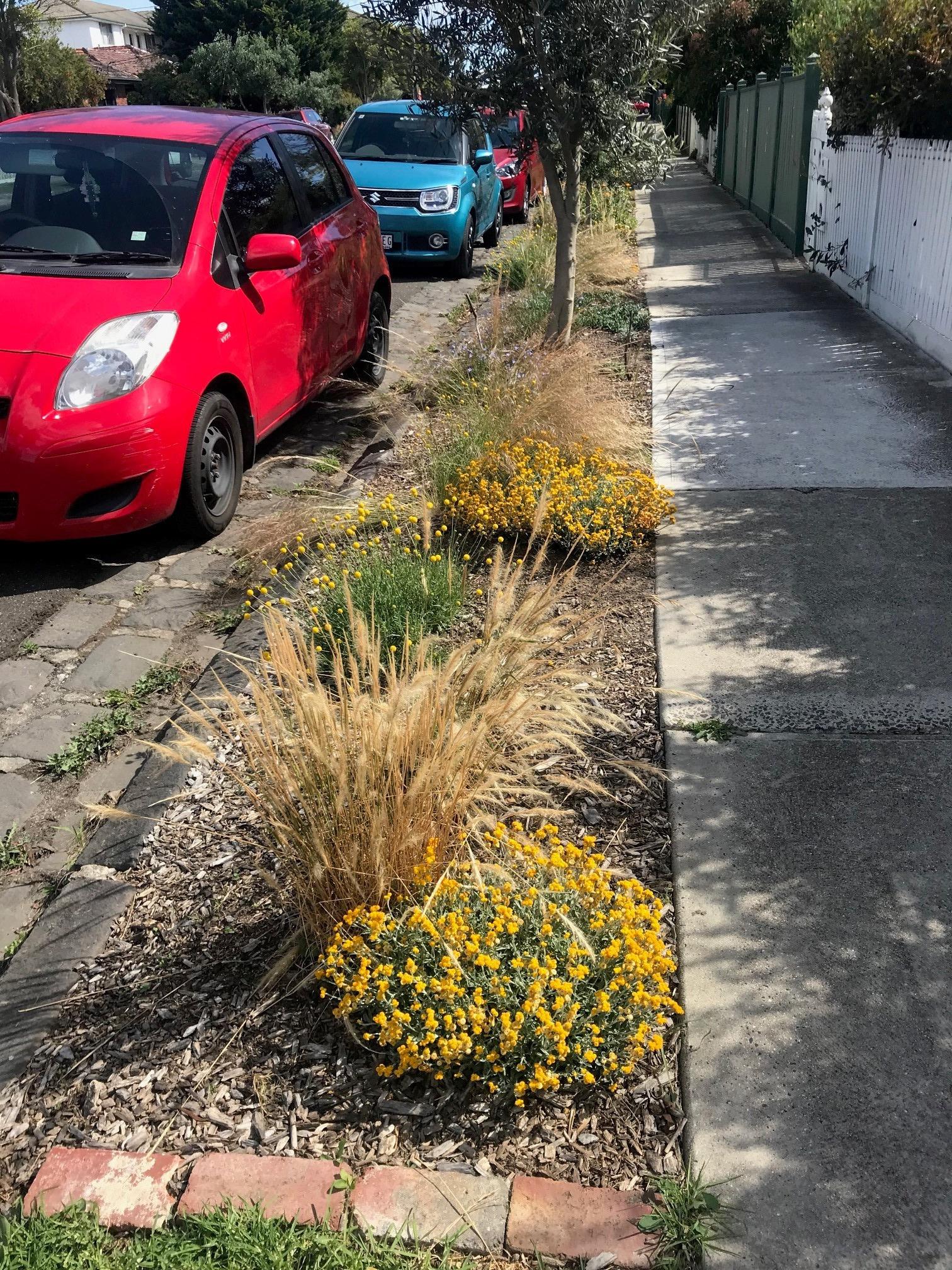

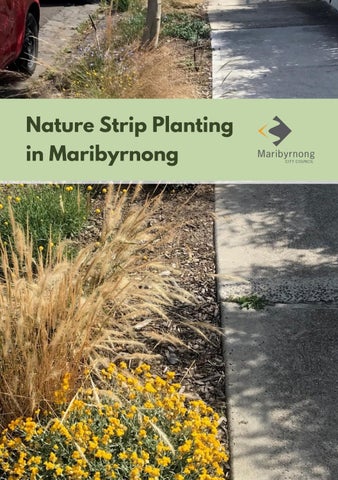
Transform your nature strip into a thriving, low-maintenance garden
Why plant your nature strip?
Nature strips play an important role in shaping the look and feel of our streets. Increasing vegetation helps cool urban areas, improves streetscapes and creates more welcoming neighbourhoods.
Traditional grass lawns offer limited environmental benefits. Replacing them with suitable plants can create vibrant, resilient habitats for both people and wildlife.
Things to consider before planting your nature strip

Scan the QR code to view Maribyrnong’s Nature Strip Guidelines
It is important to adhere to clearance restrictions set in the planting guidelines. There is a mandatory 50cm clearance required between the footpath and planting area on all sides of the nature strip.
Your safety and the safety of those around you is extremely important. Before you begin works on your naturestrip, visit Before You Dig to confirm the presence of any services located within your nature strip. When undertaking gardening work, ensure to wear appropriate protective gear and keep pedestrian areas clear of obstructions.
This booklet provides a list of indigenous plants suitable for nature strip planting in the City of Maribyrnong. It also includes a small selection of native and exotic alternatives that meet nature strip planting guidelines.

Before you get stuck into creating your nature strip garden, there are a few things you need to consider.
It’s important to ensure your plants are getting plenty of water in the first few months until they are fully established. After this, most indigenous and native plants are reasonably self-sufficient and can withstand drier periods.
In the City of Maribyrnong, the best time to plant is between May to August, which gives the plants time to establish and take advantage of the rainier weather during colder months.
Once your nature strip is weed free, turn over your soil with a shovel to loosen it up. This helps young plant roots easily establish while giving you the chance to remove any rocks or debris from the soil.
We recommend removing 50mm of turf and topsoil prior to composting and planting your nature strip. You can also place biodegradable weed matting after removal, to reduce weed growth or the return of the turf.
Excavation and cultivation are only permitted by hand, using small hand tools such as gardening spades.
The following is a list of approved plants which are great for planting in the City of Maribyrnong, as they naturally occur in the area.
Size: 10-30cm height x 1-2m width
Description: Spreading perennial shrub. Grows quickly and is very resilient. Best suited to well drained soils and is salt tolerant. Suits full sun or semi-shade. Flowers for most of the year, peaking in November to February.
Size: Prostrate
Description: Dense perennial herb that grows to form mats through its node roots. Kidneyshaped to round shaped leaves. Prefers moist to well-drained soils. Suits semi-shade to full shade.
Size: Prostrate x 1-2m width
Description: Spreading perennial sub-shrub. Succulent, cylindrical leaves which sometimes may be yellow or red tinged. Grows pink and white daisy-like flowers between October to February. Can grow in most soils and full sun. Tolerated saline conditions.
Size: 30cm height x 1.2m width
Description: A wiry sprawling shrub which has triangular grey-green leaves. Grows red berries in the spring and summer. Tolerates dry soils, rocky and disturbed sites. Prefers full sun to semi-shade.
Size: 1m height x 0.5-1m width
Description: Can grow low-spreading or upright. Bluish-green narrow, succulent leaves with yellow or red berries growing between September to April. An adaptable shrub which can grow in poor soils and tolerate dryness and some salinity. Suits full sun to semi-shade.
Size: Prostrate x 1-2.5m width
Description: Open trailing or densely matting perennial herb. Grey-green trifoliate leaves. Grows red-pink pea flowers from August to September. Requires well drained soils. Suits full sun to semi-shade.
Size: 10cm height x 2-4m width
Description: Dense, matting groundcover. Dark green, linear leaves with serrated edges. Grows white flowers during warmer months of the year. Prefers moist soils, can grow in well-draining, drier soils once established. Suits full sun to semi-shade.
Make sure to give your nature strip a good watering once a week during hot and dry weather periods. Always ensure to follow local water restrictions.
Size: 15-30cm height x 30-60cm width
Description: Perennial herb that grows spreading to upright. Cotton hairs prevalent at base of plant and under flowerhead. Yellow to white flowerheads growing from October to December. Needs welldrained soils. Requires full sun.
Size: 0.3-1m height x 20-50cm width
Description: Upright perennial herb. Distinctive by its silvery-grey leaves and bright yellow oblong flowerheads. Prefers well drained or low-lying clay and loamy soils. Can tolerate dry periods once established. Suits areas of full sun or semi-shade.
Size: Prostrate – 30cm height x 1-2m width
Description: Spreading to erect perennial herb. Silver-grey leave and stems and bright yellow flower clusters. Flowers throughout the year, peaking in September to December. Requires well-drained soils and full sun.
Size: 15-60cm height x 0.5m-1m width
Description: Perennial herb with 1 stem producing several flowers. Basal blue to olive leaves, with a singular, globular yellow flowerhead. Requires shallow, well drained to moist sandy to clay soils. Prefers full sun to semi-shade.
Size: 30-80cm height x 0.5-1.5m width
Description: A dense to open tufted perennial.
Erect blue-green leaves with blue to purple flowers with yellow anthers growing on long spikes above the foliage. Prefers dry, well drained soils and full sun to semi-shade.
Size: 10-15cm height x 20-50cm width
Description: Perennial herb. Narrow, bright green foliage and white to mauve daisies. Flowers in June to October. Prefers very well drained soil, tolerates dry periods once established. Requires full sun.
Size: 30-60cm height x 0.3-1m width
Description: Perennial herb. Pairs of rounded, hairy leaves on base and stem. Produces pink flowers with purple to crimson veins between October to February. Requires well drained soils, tolerates dry soils once established. Prefers full sun to semi-shade.
Size: 30-70cm height x 30m width
Description: Upright, tufted perennial herb. Dark green, long, slim leaves at base. Showy, bright yellow daisy flowerheads that bloom between October to February. Requires well-drained soils. Prefers full sun to semi-shade.
Size: 20-60cm height x 20-50cm width
Description: Upright, tufted annual herb. White, wooly stems and long, narrow basal leaves. Globular, bright yellow flowerheads above foliage. Flowers grow from June to December. Requires heavy, moist soils. Prefers full sun to semi-shade.
Size: 15-50cm height x 15cm width
Description: Upright and branching perennial herb. Scattered, narrow pale to dark green foliage. Single, pale to bright blue and white flowers. Flowers peak during October to March. Prefers moist to well-drained soils. Full sun required.
Ensure that your nature strip is weed-free before planting your new plants into the soil! Removing the full plant along with its roots will ensure that the weeds don’t grow back.

Regular pruning of plants can not only maintain their shape and height but also encourage new and fuller growth! Ensure to keep on top of plant maintenance to adhere to nature strip planting guidelines.
Silky Blue-grass (Dicanthium sericeum)
Size: Up to 80cm height x 10-40cm width
Description: Upright perennial clump. Flat, bluetinged leaves and soft, silky grass seed heads. Requires well drained, heavy clay soils and full sun. Notes: Responds well to summer watering and hard pruning. Highly ornamental when growing due to its silky blue-grey appearance.
Long-hair Plume-grass (Dichelachne crinita)
Size: 0.5-1m height
Description: Flat or in-rolled blue-green leaves. Seedheads are spike-like with long, thread-like seeds which can curl. Seed between October to March. Require well-drained soils. Prefer full sun to semi-shade.
Grass (Microlaena stipoides)
Size: Highly variable; up to 1m height x 60cm width
Description: Spare, tufted perennial grass with stems that gracefully arch. Rough to smooth flat leaves, seedheads grow in a drooping formation giving the plant its name. Grows best in welldrained soils with regular watering. Prefers full sun to semi-shade.
Size: 0.5m-1.2 height x 0.5-1.5m width
Description: Large, coarse densely tufted tussock. Foliage rough and dull green.
Note: Due to the plant’s variable height, it may need regular pruning and maintenance to adhere to height guidelines
Size: 0.3-1m height x 20-60cm width
Description: Upright or sprawling perennial tussock. Stems can become red, with flat and limp green-blue foliage. Seedheads are a golden-brown colour and grow in clusters at the end of the plant stems. Can grow in most soils which aren’t too dry, not too shaded and don’t stay too wet. Prefers full sun to semi-shade.
These plants are approved plants that aren’t indigenous to Maribyrnong, but are good alternative options to indigenous plants if they don’t fit your nature strip garden vision.
Plant name Form Locality Planting notes
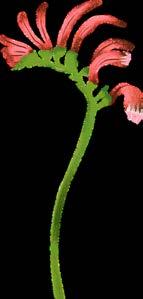
Dwarf Kangaroo Paw (Anigozanthus
‘Pink Joey’) Small flowering shrub
Native to Australia
Cut-leaf Daisy
(Brachyscome multifida)
Flowering herb Native to Victoria
Milky Beauty Heads (Calocephalus lacteus)
Flowering herb Native to Victoria
In general, the species grows best in well-draining soils and full sun. Kangaroo paws tend to go into dormancy during the colder months, where it's important to not overwater the plants.
A useful border plant and ground cover, also suitable for rockeries or containers. Produces pale purple daisies all year round. Prefers dry, well-draining soils and full sun to semishade.
A great ground cover that produces white flowerheads during warmer months of the year. Requires well-draining sandy-loam soils and full sun. Works well in rockeries. Requires pruning during dormant seasons.
Clustered Everlasting (Chrysocephalum semipapposum)
Purple Coral Pea (Hardenbergia violacea)
Flowering herb
Native to Victoria
Blue Fescue (Festuca glauca)
Flowering Climber
Native to Victoria
Grevillea ‘Poorinda Royal Mantle’
Grass
Exotic; Native to Europe
A hardy ground cover that produces clusters of bright yellow flowers for majority of the year. Prefers well-drained soils and full sun. Works well as a natural weed suppressant. Great for planting in containers and rockeries.
Useful as a ground cover, also trails along walls and fences well. Produces purple pea flowers during winter and spring.
Adaptable to most soils, prefers sunny areas which will usually provide better flowering results.
A small, ornamental grass with blue-green foliage. Prefers well-drained soil and full sun.
Flowering ground cover
Native to Australia
Mondo Grass (Ophiopogon japonicas)
Grass
Exotic; Native to Asia
An attractive ground cover with showy flowers. Requires well-draining soil, clay loam or sand. Enjoys full sun to semishade. Watering less required once established.
Useful as a border plant. Requires well-draining soil. Prefers full sun to semi-shade.
Lamb’s Ear (Stachys byzantine)
Ground cover Exotic; Native to the Middle East
Sand Coprosma (Coprosma acerosa)
Ground cover
Exotic; Native to New Zealand
A hardy and fast spreading ground cover with silver grey foliage, flower heads require pruning after flowering. Prefers welldrained soils and full sun to semi-shade.
A low-maintenance plant that works well as a ground cover. Grows best in full sun and sandy, well-draining soils.
Small-leaved Cotoneaster (Cotoneaster microphylla)
Creeping Juniper (Juniperus horizontalis)
Small shrub
Exotic; Native to Asia
Ground cover
Exotic; Native to Northern America
Evergreen shrub that can grow up to 1 metre tall. Requires well-draining soils and prefers full sun to semishade.
A low-growing plant, used as a ground cover due to its sprawling nature. Requires rocky or sandy soils and thrives in full sun.
Silver Nugget (Leucophyta brownii)
Flowering shrub
Native to Australia
A small shrub with silvery foliage and creamy-white flowers. Flowers in spring and summer. Requires little water once established. Prefers well-drained soils and full sun to semi-shade.
Climber A plant that can grow along a surface, even growing upright along trees, walls or fences.
Ground Cover A dense plant that grows low along the ground, creating a mat-like form.
Exotic A plant that is not native to Australia.
Full sun Receives more than 6 hours of sunlight throughout the day.
Herb A vascular plant that does not grow a woody stem.
Indigenous A plant that is native to the City of Maribyrnong
Native A plant that is native to Victoria or Australia, but not specifically to the City of Maribyrnong.
Perennial A plant whose life span extends over several years.
Prostrate Lying flat on the ground.
Ornamental A decorative plant.
Semi-shade Receives 4-5 hours of direct sunlight a day, or consistent spots of sunlight throughout the day.
Shrub A woody plant that does not have a single trunk and grows smaller than a tree.
Tree A woody plant, usually with a single stem and more than 8m high.
Carle, Annabel (Vic Flora)
Berry Saltbush (Atriplex semibaccata)
Rounded Noon-flower (Disphyma crassifolium)
Jansen, Loraine (Vic Flora)
Kidney Weed (Dichondra repens)
Ruby Saltbush (Enchylaena tomentosa)
Spreading Flax-lily (Dianella admixta)
Showy Podelepis (Podolepis jacoides)
Blair, Neil (Vic Flora)
Nodding Saltbush (Einada nutans)
Carle, Geoff (Vic Flora)
Running Postman (Kennedia prostrata)
Goods, Graham and Maree (Vic Flora)
Creeping Boobialla (Myoporum parvifolium)
Lobe-seed Daisy (Brachyscome dentate)
Lemon Beauty-heads (Calocephalus citreus)
Cleland Paton, David (Vic Flora)
Common Everlasting (Chrysocephalum apiculatum)
Krzysztof Ziarnek, Kenraiz (Vic Flora)
Austral Stork’s Bill (Pelargonium australe)
Theknightofwildflowers (iNaturalist)
Golden Billy-buttons (Pycnosorus chrysanthus)
Dunn, Illma (Vic Flora)
Tufted Bluebell (Wahlenbergia communis)
Ellura Sanctuary (Vic Flora)
Minnie Daisy (Minuria leptophylla)
Nicholson, Kym (Vic Flora)
Silky Blue-grass (Dichanthium sericeum)
Burdett, Ayesha (Vic Flora)
Long-hair Plume-grass (Dichelachne crinita)
Swan, Elspeth (Vic Flora)
Weeping Grass (Microlaena stipoides)
Messina, Andre (Vic Flora)
Common Tussock-grass (Poa labillardierei)
gjh2os (iNaturalist)
Common Billy Buttons (Craspedi variabilis)
Rudkin, Lydia Jean (Vic Flora)
Kangaroo Grass (Themeda triandra)
My Smart Garden | mysmartgarden.org.au
Before You Dig Australia | byda.com.au
Newport Lakes Native Nursery | facebook.com/NewportLakesNativeNursery
Westgate Biodiversity | westgatebiodiversity.org.au
Iramoo Grassland Centre & Nursery at Victoria University
Plants of Melbourne’s Western Plains: a Gardeners Guide to the Original Flora
iNaturalist | inaturalist.org
VicFlora | vicflora.rbg.vic.gov.au
Flora of Melbourne: A Guide to Indigenous Plants of the Greater Melbourne Area
Contact information
For further information on Maribyrnong’s Nature Strip Guidelines, please contact Council’s Recreation and Open Space Team
Ph: (03) 9688 0200
Email: ros@maribyrnong.vic.gov.au
Use this checklist to make sure you have prepared your nature strip for planting and that you have followed all nature strip planting guidelines.
I have read Maribyrnong’s Nature Strip Planting Guidelines
I am wearing correct protective gear to undertake gardening work, including gloves, sun protection and enclosed footwear
Walkways around my nature strip are clear of obstructions for accessibility purposes
I have visited Before You Dig Australia to ensure there are no utility lines passing through my nature strip
I have removed the top 50mm of turf and soil before planting or composting
I have left a 50cm clearance around the base of the nature strip tree trunk
I have left a 50cm setback around the border of the nature strip for clearance
I have considered that safe and suitable access to the footpath is provided outside of the mandatory setbacks