Welcome to the Business and Economy in Qatar e-guide of our 95th issue of the everevolving Marhaba. This issue marks Marhaba’s 32nd anniversary. However, it has also been one of our most challenging editions due to the ongoing Middle East crisis. Our team has worked diligently, both in print and online, to provide the most accurate and up-to-date information, though the situation remains fluid.
Through the challenges of print media, the pandemic, and the current Middle East crisis, Marhaba has stood the test of time, and 32 years on, it remains Qatar’s premier information guide for tourists, visitors, and residents.
While the business and economy sector has been impacted by the ongoing regional crisis, most businesses have returned to their offices, ensuring Qatar's economy continues to push through and thriveat this challenging time.
In this e-guide, our Interesting Reads include a milestone in Qatar’s banking sector in The World Bank Group Opens in Qatar, as well as a new initiative to strengthen labour force protections and employee rights in New Committee to Oversee End-of-Service Benefits and Employee Contributions.
There is plenty more to explore in this e-guide and across our full collection of 10 free e-guides, covering everything from events and activities to shopping, education, hospitality, dining, event planning, and business and economy. You can also visit marhaba.qa for the latest news, along with food, staycation, and car reviews, plus events and entertainment options.
Whether you're reading this e-guide from Qatar or abroad, we hope you find it insightful. Don’t forget to follow us on social media and subscribe to our free weekly newsletter, we look forward to connecting with you.
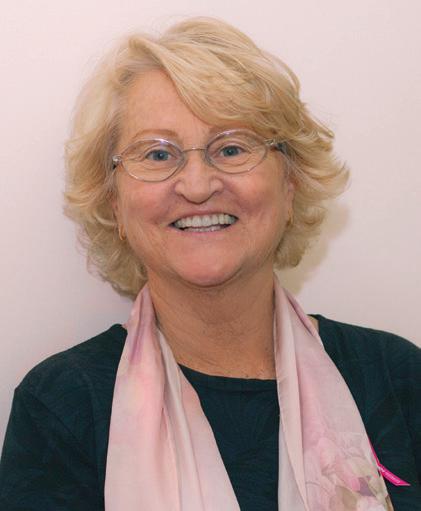
Hilary Bainbridge Founder and Managing Editor
Banking and Finance
• Useful Numbers: Banks and Exchange Houses
• The Banking Network • Currency • The Banking Sector
• Qatar Central Bank • Qatar Credit Bureau
• Loans, Bank Charges and Interest Rates • Accounts
• Islamic Finance • Financial Services and Insurance
• Anti-Money Laundering/Combating the Financing of Terrorism
Feature – The World Bank Group Opens in Qatar
In January 2026, the World Bank Group (WBG) officially opened its new office in Doha and signed a Memorandum of Understanding (MoU) with the Qatar Fund for Development (QFFD).
Economy
• Economic Growth and Gross Domestic Product (GDP)
• Trade Surplus • The Budget
• Inflation and Cost of Living • Employment
Commerce Useful Numbers
Investment and Trade
• Overview • Incentives • Investment Regulations
• Choosing a Business Structure
• Company Structures • Commercial Registration
• Export and Import • Taxation • Intellectual Property
• Regulatory Bodies and Government-owned Entities
• Qatar Investment Authority • Qatar Financial Centre
• Qatar Stock Exchange • Real Estate
• Developers and Real Estate Agents Selling Property
The Hydrocarbon Industry
Business and Economy Business and Economy
Infrastructure in Qatar
Founder & Managing Editor
Hilar y Bainbridge
Editorial
Sarah Palmer (Editor)
Ola Diab (Deputy Editor)
Terr y Sutcliffe
Adver tising
Howard Bainbridge
Marrian Magtira
Retail Sales
Ayen Molina
Online/Digital
Patrisha Manzon
Char lotte Wright
Juggy Gill
Isra Mubarak
Design and Ar twor k
Dick Tamayo
Mar Principe
Marhaba endeavours to quote accurate information and updates each of its sections ever y issue. However, the company accepts no responsibility or liability for any false, inaccurate, inappropriate or incomplete information presented, whether in print, on the website, or on social media channels.
Dana Public Relations PO Box 3797, Doha, Qatar Tel (+974) 4465 0083, 4465 5533
General Information
marhaba@marhaba.com.qa
Follow us
At Park Hyat t Doha, experience understated luxur y in the hear t of Msheireb Downtown.
Enjoy spacious rooms and suites, world-class dining at Anis Café, Opus Restaurant, and Sora Roof top, along with moments of relaxation at The Spa and Salon.
IS PERSONAL
+974 4009 1234 | reservations.phdoha@hyatt com
See also our maps Al Khor and the Northeast Coast
See also our maps Al Wakra, Mesaieed and the Southeast Coast
See our detailed
map of the area south of Doha MAP of AL WAKRA
Banking and Finance
Bank Telephone Website
Ahlibank
4420 5222 ahlibank.com.qa
AlRayan Bank # 4425 3333 alrayan.com
Arab Bank Qatar 4438 7777 arabbank.com.qa
Banco Santander ¥ bancosantander.es/en
Bank of China ¥ 4447 3699 bankofchina.com/qa
Bank Saderat Iran 4441 4646 bsi.com.qa
BNP Paribas 4453 7115 mea.bnpparibas.com
Commercial Bank of Qatar 4449 0000 cbq.qa
Doha Bank 4445 6000 qa.dohabank.com
Dukhan Bank * 800 8555 dukhanbank.com
HSBC 4442 4722 hsbc.com.qa
Lesha Bank § 4448 3333 leshabank.com
Mashreq Bank 4408 3333 mashreqbank.com/qatar
Qatar Development Bank 4430 0000 qdb.qa
Qatar International Islamic Bank 4484 0000 qiib.com.qa
Qatar Islamic Bank 4402 0888 qib.com.qa
Qatar National Bank 4440 7777 qnb.com
QInvest 4405 6666 qinvest.com
Standard Chartered Bank 4465 8555 sc.com/qa
United Bank Limited 4444 1314 ubldirect.com
* Was Barwa Bank; merged with International Bank of Qatar in 2019
# Masraf Al Rayan merged with Al Khalij Commercial Bank in 2021; name changed in 2024
Al Jazeera Exchange 4449 2800 aljazeeraexchangeqatar.com
Al Mana Exchange 4442 4226 almanaexchange.com
Al Sadd Exchange 4432 3335/6 alsaddexchange.com
Arabian Exchange 4443 8300, arabianex.com
Gulf Exchange 4438 3222 gulfexchange.com.qa
Travelex Qatar 4498 1181, travelex.qa
Unimoni Qatar 4436 5252, unimoni.qa
Western Union 4453 7777 westernunion.com/qa
Bank branches and ATMs can be found extensively across the country. Visitors can usually access funds in their home accounts by using their cards here, with some ATMs allowing the withdrawal of USD and Euro – check for commission or exchange rate fees. Major credit cards are widely accepted. Exchange houses provide remittance services and foreign exchange, and are licensed by Qatar Central Bank (QCB). There are no exchange control regulations, but movement of money in and out of local accounts is monitored and a declaration of origin for large cash deposits may be required. Cash transactions above QAR50,000 are prohibited. The GCCNET system is a single ATM network linking all GCC point of sale switches – in Qatar this is NAPS (National ATM & POS Switch).
Branch opening hours: Generally Sunday – Thursday 7:30 am – 1 pm. Many banks have extended branch operations, particularly at malls; check the bank's website for timings and locations of branches and ATMs.
Digital branches and services: HSBC Msheireb Downtown Digital branch • QIB Video Banking via the QIB mobile app • Virtual assistants: Dukhan Bank (Rashid), Qatar Islamic Bank (Zaki)
Fawran instant payment service: Fast, secure payments to individuals via Qatari mobile number or alias name.
Global digital wallet services: Apple Pay, Google Pay and Samsung Pay are available and accepted in Qatar. Himyan: QCB's first national prepaid card, accepted at all ATMs, POS and online stores; Apple Pay was introduced to cardholders in June 2025, and to merchants via Qatar payment company Dibsy in July 2025.
PayPal: Goods and Services only – Friends and Family is not available.
Qatar Mobile Payment (QMP) system: Regulated by QCB, the nationwide system allows for instant, 24/7 digital wallet transactions on smartphones. The system supports 'multiple wallets per mobile number', allowing users to open two digital wallets with different payment service providers using the same mobile number. No minimum balance is required. Participants: Ahli Bank • AlRayan Bank • Arab Bank • Commercial Bank of Qatar
• Doha Bank • Dukhan Bank • HSBC • iPay (Vodafone Qatar) • Ooredoo Money • Qatar Islamic Bank
• Qatar International Islamic Bank • Qatar National Bank
The Ministry of Commerce and Industry mandates all commercial outlets in the country must provide an electronic payment service to customers without additional charges, nor impose charges for the use of debit/credit cards.
Currency
The unit of currency is the Qatari Riyal (QAR), divided into 100 Dirhams (Dh), issued by Qatar Central Bank (QCB). It is pegged to the US dollar at a fixed exchange rate of USD1 = QAR3.64.
The fifth series of notes were introduced in 2020, with a new QAR200 joining the QAR1, QAR5, QAR10, QAR50, QAR100 and QAR500 notes. The old notes ceased to be legal tender on 31 December 2021, although the public can change the old notes at QCB for another 10 years. Banknotes incorporate security threads, as well as special features for recognition by the blind and visually impaired. The QAR500 note has a holographic security thread, the first in the Middle East to do so. Coins remained unchanged at Dh5, Dh10, Dh25 and Dh50.
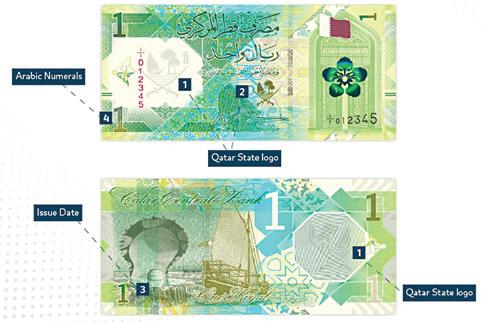
The QAR1 note was changed in July 2025 (pictured) to align with laws regarding the official state emblem, Arabic numerals and date of issuance. The old QAR1 notes will remain in circulation. Changes to the other notes will be made at a later date, according to QCB.
Qatar, Saudi Arabia, Kuwait and Bahrain support the creation of a Gulf Monetary Union; the UAE and Oman have withdrawn entry. The GCC Supreme Council in 2008 approved the Monetary Union Agreement and the Statute of the Monetary Council. The Gulf Monetary Council headquarters opened in Riyadh in 2013 with monetary union proposed later that year. Qatar, Kuwait, Bahrain and Saudi Arabia subsequently agreed to establish a unified central bank with currency pegged to the USD. There has been no further action since 2013.
The Banking Sector
Overseen by Qatar Central Bank (QCB), the sector comprises local, regional, foreign and Islamic banks. State-owned Qatar Development Bank provides financing to SMEs, while QInvest focuses on investment banking, asset management and investing its own capital.
Barwa Bank and International Bank of Qatar (IBQ) signed a final agreement in 2018 to merge the two banks, the first in Qatar's banking history, to create a Sharia-compliant financial institution. The legal merger was completed in 2019, trading as Barwa Bank, with IBQ products converted to Shariacompliant equivalents. Barwa changed its name to Dukhan Bank in 2020.
In 2020 negotiations began for merger between Masraf Al Rayan and Al Khalij Commercial Bank (al khaliji). Masraf Al Rayan was previously involved as a third bank in the merger between Barwa Bank and IBQ. Masraf Al Rayan and al khaliji's merger agreement in 2021 was completed later that year. al khaliji's business was absorbed into Masraf Al Rayan's, with the latter becoming the remaining legal entity operating in accordance with Islamic Sharia principles. Masraf Al Rayan changed its name to AlRayan Bank in November 2024.
The Cabinet has approved resolutions allowing a non-Qatari investor to own up to 100% of the capital in AlRayan Bank, Commercial Bank of Qatar, Doha Bank, Qatar Islamic Bank, Qatar National Bank, and Qatar International Islamic Bank. The banking sector's legal framework adopts international standards alongside local regulations, overseen primarily by QCB, the Qatar Financial Centre (QFC) Regulatory Authority, and the Qatar Financial Markets Authority (QFMA).
Key international bank legislation and standards include Basel III Standards, International Financial Reporting Standards (IFRS 9), Financial Action Task Force (FATF) Recommendations, and Islamic Financial Standards (IFSB).
Qatar Central Bank (QCB)
Under Law No 13 of 2012 Qatar Central Bank and the Regulation of Financial Services, QCB is deemed an autonomous corporate body, with a capital of QAR50 bn and under the direct control of The Amir. It is headed by a governor appointed by The Amir, and primary goals include financial stability, supporting developmental activities and strengthening the national economy. The law covers banks, insurance companies, exchange houses, Qatar Exchange and QFC-registered entities. Amiri Decision No 65 of 2021 appointed HE Sheikh Bandar bin Mohammed bin Saoud Al Thani as Governor of QCB. qcb.qa
Under Law No 13 of 2012, the Financial Stability and Risk Monitoring Committee shall study existing and future risks related to all banking, financial, insurance and stock market activities. The panel works closely with the Ministry of Finance to frame general policies.
The law provides strict penalties for anyone accepting deposits from the public without a valid licence from the banking regulator – violators can face a jail term of up to five years and/or a fine of up to QAR5 mn. Refusing to accept the legal tender of Qatar incurs a jail term of three years and/or a fine of up to QAR5 mn, while issuing forged currency means 10 years in jail and/or a fine of QAR10 mn. Manipulating accounts incurs a prison term of up to three years and/or a fine of up to QAR200,000.
The Qatar Renminbi Centre opened in 2015, increasing financial connectivity between China, Southwest Asia and the MENA region. The centre provides access to China’s onshore RMB and foreign exchange markets to local financial institutions, facilitating trade with Chinese companies. qatarrmbcentre.com
Third Financial Sector Strategic Plan: Issued in 2023 to create a financial and capital market that leads the region in innovation, efficiency and investor protection and positions Qatar to unlock its full economic potential in line with its National Vision 2030. The strategy is based on four fundamental pillars: banking, insurance, digital finance ecosystem, and capital markets. These pillars support five cross-cutting themes: governance and regulatory oversight; Islamic finance; digital innovation and advanced technologies; environmental, social, institutional governance (ESG) and sustainability; and talent and capabilities.
ESG and Sustainability Strategy for the Financial Sector: Issued in 2024 to strengthen the financial system’s capacity to support national sustainability visions and goals. There are three pillars: financial sector climate, environmental and social risk management; capital mobilisation towards sustainable finance; and embedding ESG and sustainability as part of QCB’s internal operations.
The Sustainable Finance Framework was released in April 2025, which applies to all banks operating in Qatar and establishes principles of sustainable finance in accordance with international practices to promote responsible investment and lending.
Sustainability Reporting Framework: In line with the above, this was issued in December 2025 and is effective from January 2026. The Sustainability Reporting Framework for financial institutions is in accordance with International Sustainability Standards Board (ISSB) standards. The standards require disclosures across four core pillars: governance, strategy, risk management, and metrics and targets.
Buy Now Pay Later (BNPL): QCB gave the first licence for the BNPL service to PayLater in March 2025, one of the five approved companies in the first cohort of submitted applications in April 2024.
BNPL is a short term interest free credit facility, allowing the customer – a Qatari resident aged 18 and above – to split the transaction amount into instalments to be repaid over a maximum of 12 months, via a merchant's online and offline store, or a BNPL Provider's digital platform that aggregates multiple merchants.
The BNPL regulations apply to any provider operating in Qatar set up under the Ministry of Commerce and Industry, Qatar Financial Centre, Qatar Science and Technology Park or any other free zone authority/commercial licensing entity, but not banks or finance companies licensed by QCB.
Fintech regulations: Noting the increasing growth and popularity of fintech, QCB has launched the Regulatory Sandbox and the Express Sandbox. Registration opened in January 2025, inviting fintech companies, startups, and innovators in the financial sector to test technological solutions in a regulated and secure environment under the supervision of QCB. sandbox.qcb.gov.qa
QCB launched the National Fintech Strategy 2023 to 'support and reinforce a diversified economy and investments in Qatar based on financial technology and technological innovation,' according to the QCB Governor. There are four pillars to boost Qatar's economic growth:
• Establishing infrastructure eg advanced regulatory rules and electronic platforms to develop financial technology.
• Prioritising innovation and financial technology sector growth, especially Islamic financial technology and sustainable development, as well as insurance technology.
• Empowering companies and enhancing their performance by using financial technology solutions and making the State of Qatar a financial technology hub.
• Providing a smooth mechanism and support for the transition towards cash-less transactions.
This strategy will add to the number of initiatives already in place to support the fintech sector, such as electronic wallets, instant payments and transfers, and the first local prepaid electronic payment card (Himyan).
In 2024, QCB issued its Cloud Computing Regulations, seeking to regulate the use of cloud computing in the financial sector, protect financial data, and promote digitisation and innovation, while in September the Artificial Intelligence (AI) Guideline was issued, to regulate the use of Al within the financial sector, increase customer satisfaction and reduce costs.
Qatar Credit Bureau
Bad loans have been reduced since the Bureau started operations in 2011. The centre cannot grant credit facilities to individuals nor impose restrictions on banks. The Bureau provides analytical data and supports banks’ use of advanced techniques in risk management, as well
as support sustainable growth of credit in Qatar. It provides banks with information on customers' total exposure in the market and the loans they hold, enabling banks to choose prospective customers. cb.gov.qa
Loans, Bank Charges and Interest Rates
Loans: Under QCB rules, the default period for a substandard loan is three months or more, for a doubtful loan six months, and a bad loan nine months. Banks have to closely monitor loan disbursement and forward reports on customer creditworthiness to QCB. There is also a duty to track and follow defaulting customers and seek resolution – if this fails, they will take legal action. Non-payment of loans could lead to a travel ban for Qatar and possibly the GCC.
QCB has imposed ceilings on the amounts a bank can lend as a personal loan to citizens and expatriates. Banks cannot lend more than QAR400,000 to an expatriate, over a maximum repayment period of 48 months, against a max 50% of total monthly salary, and at a max 6.5% interest rate. For Qatari citizens there is a max loan of QAR2 mn over a max 72 months. Banks cannot use post-dated cheques for the loan value.
Mortgages: New rules were introduced by QCB in July 2023, to be applied by Qatari banks and subsidiaries within the country. Branches and subsidiaries of Qatari banks outside the State of Qatar should comply with the instructions and conditions of the host regulatory authorities as long as the collaterals and financed properties are outside the country.
There are three categories:
• Ready and under construction residential properties for individuals, whose repayment sources are linked to the client's own sources, salary or any other non-real estate sources:
ø For Qataris, properties up to QAR6 mn –maximum loan-to-value (LTV) of 80% and max tenure of 30 years; above QAR6 mn – max LTV 75%, max tenure 30 years.
ø For residents, for properties up to QAR6 mn –max LTV 75%, max tenure 25 years; above QAR6 mn max LTV 70%, max tenure 25 years.
• Financing ready properties for individuals and companies for investment and commercial purposes, with the repayment depending mainly on real estate revenues:
ø For Qatari citizens and companies, which Qatari partners own not less than 51%, for property value up to QAR10 mn – max LTV 75%, max tenure 25 years; over QAR10mn – max LTV 70%, max tenure 25 years.
ø For residents (individuals or companies), for property value up to QAR10 mn – max LTV 70%, max tenure 25 years; over QAR10 mn – max LTV 65%, max tenure 25 years.
ø For non-residents, property value up to QAR10 mn – max LTV 60%, max tenure 20 years; over QAR10 mn – max LTV 60%, max tenure 15 years.
• Financing real estate under construction for investment and commercial purposes with the repayment depending on the property revenues in whole or in part:
ø For Qatari citizens and companies, which Qatari partners own not less than 51% – max LTV 60%, max tenure 20 years.
ø Foreigners (residents and non-resident) – max LTV 50%, max tenure 15 years.
QCB rules for granting mortgages for salary customers states the debt burden ratio should not exceed 75% of the total salary for Qataris, and 50% for expatriates. If the customer obtains permanent residence in Qatar as a result of owning the property, the mortgage providers can extend the tenure to be similar to that of residents.
The amendments also state that for underconstruction property financing, the grace period, if granted, should not exceed three years and be within the overall tenure, with regular interest payments during this period on a monthly or quarterly basis.
Documents usually required: Valuation Report from an approved real estate agent • Salary assignment letter if the home loan is the first facility with the bank • ID card for Qataris or passport and valid residence card for expatriates • Copy of the Title Deed and map • Building insurance cover. Discuss provision for life assurance against any loan amount taken and consider updating your will.
Credit cards: Max 12% annual interest rate and usually only issued when customers transfer their salary or have an adequate deposit at the bank.
Interest rates: Announced by QCB on overnight deposit and loan transactions between QCB and local banks via the Qatar Money Market Rate Standing Facility, a monetary instrument through which local banks can request access to loan and deposit facilities with QCB at daily interest rates. QCB and Bloomberg jointly launched the first Qatar interbank offer rate (QIBOR) fixing in 2012 – the interest rate charged by banks in Qatar for interbank transactions.
Given the fixed parity between the Qatari riyal (QAR) and the US dollar (USD), QCB short term interest rates policies are subordinated to the fixed
exchange rate policy, making QCB overnight interest rates closely related to its USD counterpart, the Fed Funds Rate. As of January 2026, the QCB Deposit Rate rate is 3.85%, the Lending Rate is 4.35%, and the Repo Rate is 4.10%.
Accounts
Standard bank facilities: Debit/credit cards, standing orders, money transfers, personal loans, vehicle loans, and mortgages on current and savings accounts (including joint accounts). Some accounts offer longer terms, higher interest and the option to save in USD, GBP and Euro.
Telephone and internet banking services and apps offer additional options, and some services like ordering a cheque book can be done via the bank's ATM network. For premium clients, a customer relations officer may be able to visit you at home or work to assist with banking requirements.
The Wage Protection Scheme (WPS) is an electronic salary transfer system that ensures workers are paid as per their employment agreement, initiated by the Ministry of Labour and QCB. Employees therefore need a local bank account in order to receive their wages from the employer.
International bank account number (IBAN):
Adopted in 2014 as a standard for identifying and numbering all bank accounts in Qatar. The system applies to all accounts in banks operating in the country, and can be found on bank statements or online in account details. The existing account number is not replaced; additional characters appear in front of the account number to form a 29‑character IBAN. All incoming and outgoing transfers to and from banks and financial institutions must use IBAN.
Opening an account: Documents usually required:
• A valid residence permit or work visa. A worker’s dependants (eg spouse and family) can open an account but may require his permission as he is their sponsor (check with the individual bank).
• Valid passport.
• For current accounts, a letter from the employer/ sponsor confirming the total monthly salary, with the company’s official stamp. You may have to transfer your salary to the new account.
• Some banks may ask to see your tenancy agreement to establish your residential address.
• Take copies of these documents, along with identity photographs. Ask for photocopies of any documents signed.
Closing an account: Start closing bank accounts 30 45 days before your last salary payment, and
ensure your accounts have sufficient credit to cover loan and credit card payments (including any cancellation fees), as well as any utility bills or traffic violation fines.
In most situations, all outstanding bank loans and credit card balances must be paid off before you leave Qatar. Any end of service benefit payments will be withheld until the loans are cleared – you will then be given a signed and stamped clearance letter to give to your employer/sponsor for payment of the gratuity. Leaving the country without paying off your loans could incur a fine or prison term if you wish to re enter. Note that banks usually close accounts if it remains inactive. Seek clarification from your bank and legal/HR representative in advance.
Cheques: A chequebook can be issued with a current account. They are not widely accepted for instant payment; post‑dated cheques are commonly used for house rental payments. The onus of responsibility is on the bank not to encash cheques before the designated date. Issuing a cheque without the necessary funds is a serious criminal offence and the bank or creditor may notify the police, leading to possible prosecution. Punishment for a bounced cheque due to insufficient funds can be severe: jail terms of between three months and three years, and/ or fines of between QAR3,000 and QAR10,000.
The Capital Security Department records all cases electronically to speed up the process.
The Qatar Credit Bureau lists individuals and companies who have issued at least one bounced cheque. Banks are not obligated to issue a new chequebook to these customers unless the amount has been settled and their name removed.
Credit cards: Available with all the usual privileges, with the credit limit determined by the cardholder's salary or savings balance. Family members may also be eligible for a card. Check at the time of applying for issuance and renewal fees, conversion charges, and payment options.
Since 2014 all card transactions made using the magnetic stripe (magstripe) inside and outside of Qatar will be declined. However, as certain countries (eg the US, India and the Philippines) still use the magstripe for transactions, customers should activate their card before travelling.
Offshore banking: Offshore banking can be a secure anchor for an expat's finances while out of their home country. Check with local banks for availability of international bank accounts in USD, GBP, or Euro.
Complaints: Unresolved consumer complaints can be made online to QCB's Consumer Protection Department. qcb.gov.qa
Islamic Finance
There are a number of Islamic banks in Qatar, the largest of which is Qatar Islamic Bank. Lesha Bank, regulated by the QFC Regulatory Authority, is the first independent, Sharia compliant investment bank.
Banks were required by QCB to separate their Islamic and conventional lending operations in 2011. Islamic banking by other conventional banks is barred from Qatar's market. QCB took this action due to certain supervisory and monetary issues, namely that holding both Islamic and non-Islamic deposits incurs different risks and reporting methods.
Law No 13 of 2012 requires that Islamic banks must have a Sharia board with at least three qualified members approved by the shareholders. Neither they nor members of their family may be employed or hold shares in the entity.
Institutions and services must abide by regulations set out in the holy Quran and Sharia (Islamic Law). Charging riba (interest) is haram (forbidden). Islamic banks charge fees for services and engage in profit sharing, enabling them to offer comparable facilities to those of conventional banks. Under a mudharabah (profit sharing) contract, the rabbul maal (owner of the money) authorises the bank to invest funds as per Sharia to make justifiable returns. Other concepts of Islamic banking include wadiah (safekeeping), musharakah (joint venture), and ijarah (leasing). Bai (saving) is halal (allowed).
Financial Services and Insurance
QCB has overall control, regulatory responsibility and supervisory powers for all financial services providers in Qatar, including banks, Islamic financial institutions, insurance and reinsurance companies and other financial institutions. The provision of any financial service or the conduct of any financial activity or business (including insurance and reinsurance) is prohibited unless a licence is granted by QCB. Financial services are provided by entities registered with the Qatar Financial Centre (QFC). Insurance products are widely available from local and international companies (see Living in Qatar).
Under Law No 13 of 2012 QCB and the Regulation of Financial Services, only local insurance providers are permitted to underwrite any kind of risk against properties in Qatar. Decision No 1 of 2016
provides instructions related to licensing, regulation and controls, risk management, accounting, and other requirements. Decision No 7 of 2019 has further instructions for licensing, organising and supervising the services of supporting insurance providers. It set out the competencies and expertise, the nature of the work, areas of responsibility and functions, and the establishment of professional and ethical codes of conduct.
QCB continues to regulate and develop the insurance market under the National Fintech Strategy 2023.
Anti-Money Laundering/Combating the Financing of Terrorism (AML/CFT)
Qatar is a founding member of the Middle East and North Africa Financial Action Task Force (MENAFATF), and also a member of the Financial Action Task Force (FATF).
Law No 20 of 2019 on Combating Money Laundering and Terrorism Financing replaced Law No 4 of 2010, with implementing regulations following shortly after. The law is in accordance with the latest standards adopted by major international organisations including FATF, highlighting Qatar's regional role in setting standards in its legal and regulatory framework for AML/CFT. The QFC AML/ CFT regulations are also governed by Law No 20 of 2019 and enforced by the QFC Regulatory Authority through the AML/CFT Rules 2019 (for general firms) and AML/CFT (general insurance) Rules 2019.
The Qatar Financial Information Unit (QFIU) is a government regulatory agency responsible for financial intelligence efforts to combat money laundering and financing terrorism. Banks, investment companies, insurers and other financial institutions must report suspicious financial transactions, which are analysed by the QFIU and disseminated to law enforcement authorities for further investigation and action. qfiu.gov.qa
The QFIU is part of the National Anti-Money Laundering and Terrorist Financing Committee (NAMLC), which works closely with financial regulators and other authorities in Qatar, alongside international bodies, to ensure the effective implementation of Law No 20 of 2019, as well as other legislation. The NAMLC is chaired by the Deputy Governor of QCB. namlc.gov.qa
In 2023, the FATF report on Qatar’s initiatives for anti-money laundering claimed that Qatar has made substantive improvements to its system to combat money laundering and terrorism financing and its technical compliance with FATF requirements is strong. m
In The World Bank Group Opens in Qatar
By Sarah Palmer
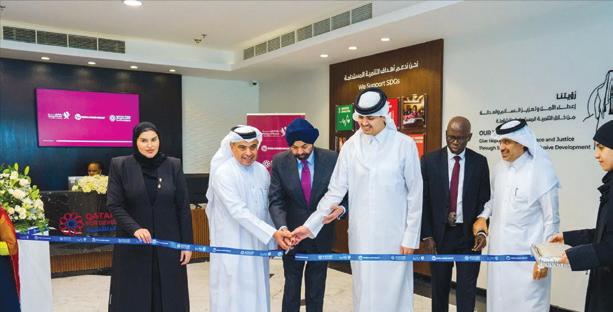
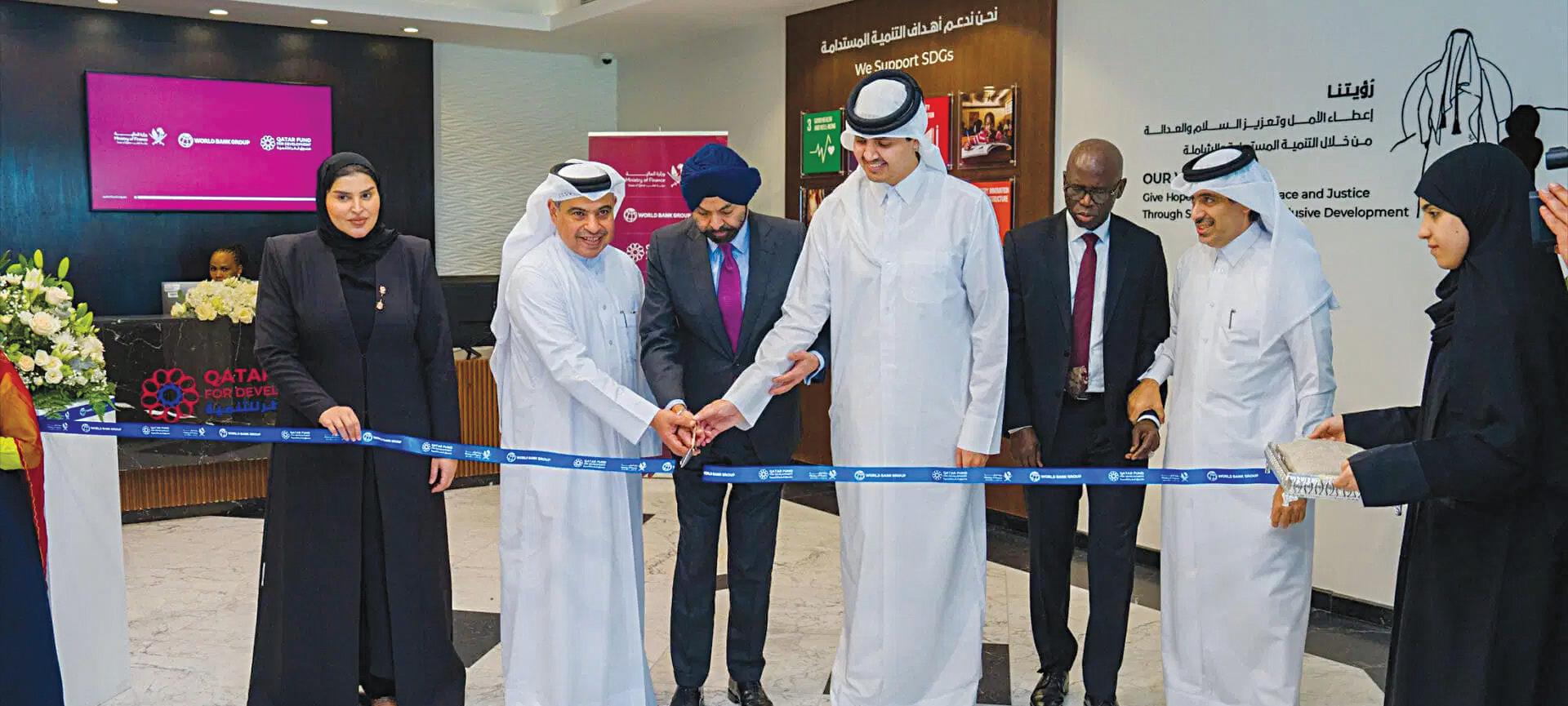
January 2026, the World Bank Group (WBG) officially opened its new office in Doha and signed a Memorandum of Understanding (MoU) with the Qatar Fund for Development (QFFD).
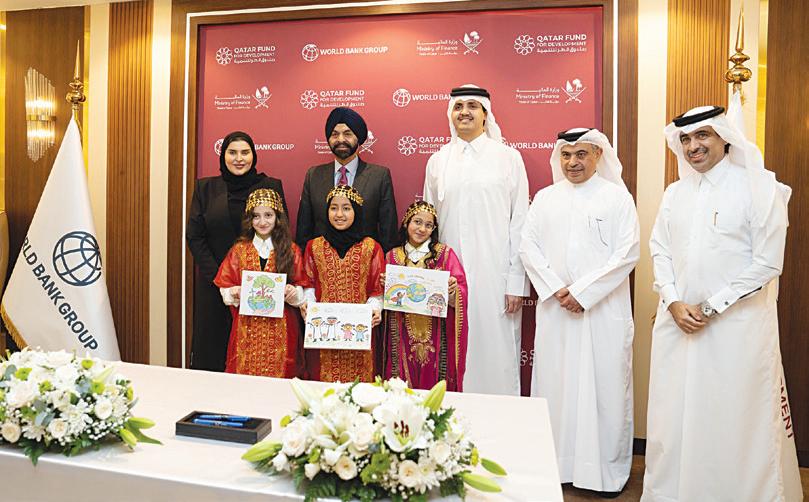
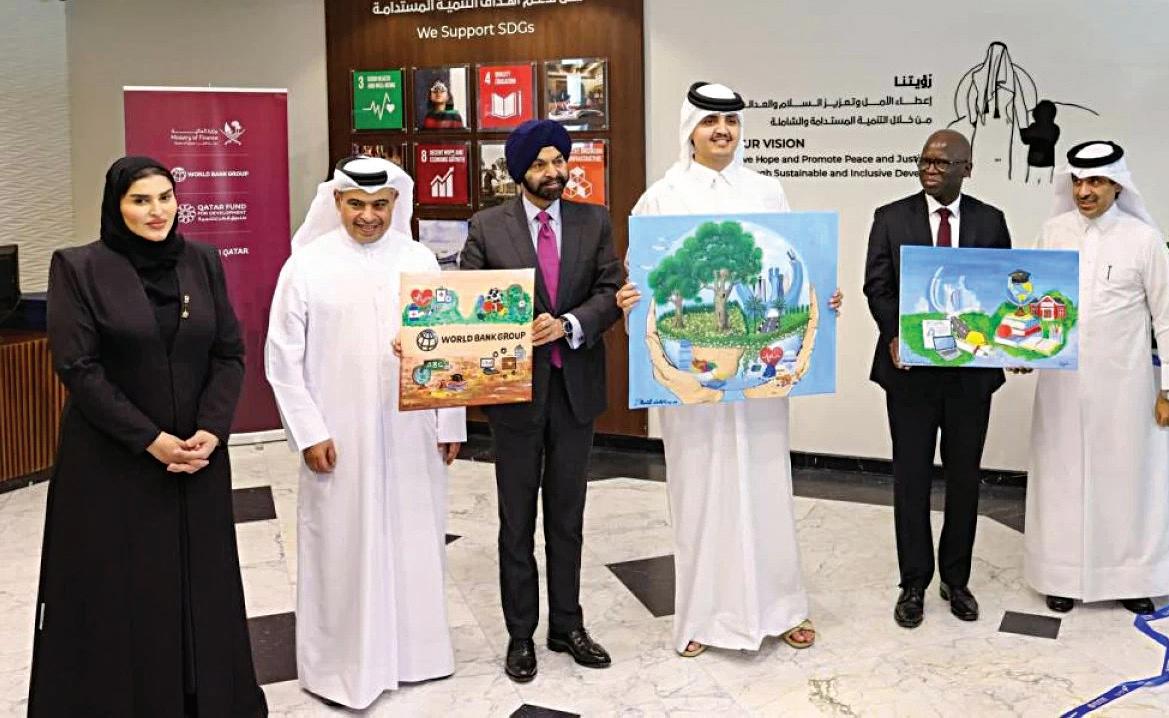
The agreement was signed during an official ceremony in Doha attended by HE Ali bin Ahmed Al Kuwari, Minister of Finance, HE Maryam bint Ali bin Nasser Al Misnad, Minister of State for International Cooperation, Ajay Banga, President of the World Bank Group, and HE Sheikh Thani bin Hamad Al Thani, Chairperson of QFFD.
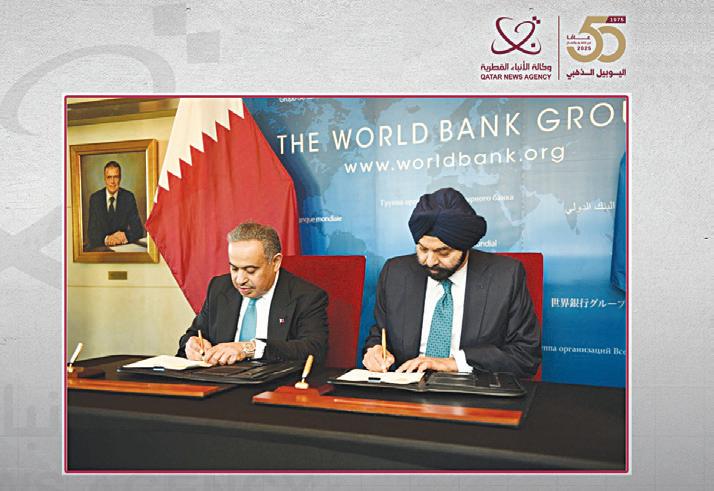
The Ministry of Finance (MOF) and the WBG had signed the agreement for the new office on the sidelines of the Annual Meetings of the International Monetary Fund (IMF) and the WBG, held in Washington, DC, in October 2025 (right).
The new office is at the QFFD's headquarters in Al Dafna and is in cooperation with the MOF. It will strengthen the WBG’s engagement with Qatar’s public and private sectors, support Qatar National Vision 2030, and will be a platform to encourage Qatar's investment in emerging markets across the region and worldwide.
'Our partnership with the Qatar Fund for Development is aligned with the strategic priorities and the integrated capabilities. The partnership will help drive job creation and economic opportunity in regions where employment is critical to long-term stability.'
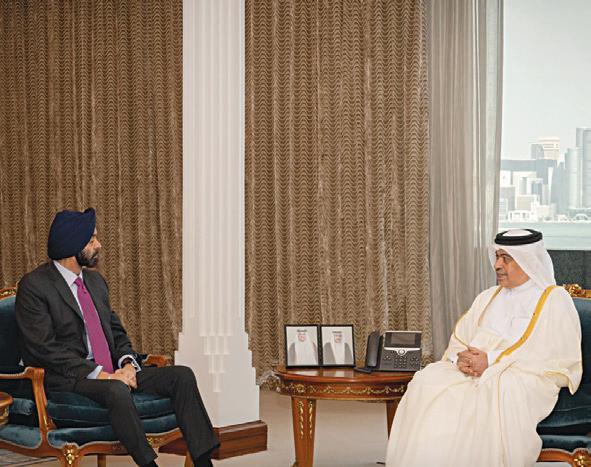
– Ajay Banga, World Bank Group President (pictured, left)
'Relations between Qatar and the World Bank had seen significant growth in recent years. The opening of the office in Qatar is a qualitative step that would expand cooperation. The strategies and visions of the World Bank and Qatar are aligned.'
– HE Ali bin Ahmed Al Kuwari, Minister of Finance (pictured, right)
'This milestone reflects the State of Qatar’s long-standing commitment to strengthening partnerships with leading international financial institutions and accelerating the implementation of sustainable development programmes, in line with the goals of Qatar National Vision 2030.' – Fahad Hamad Al Sulaiti, Director General at QFFD
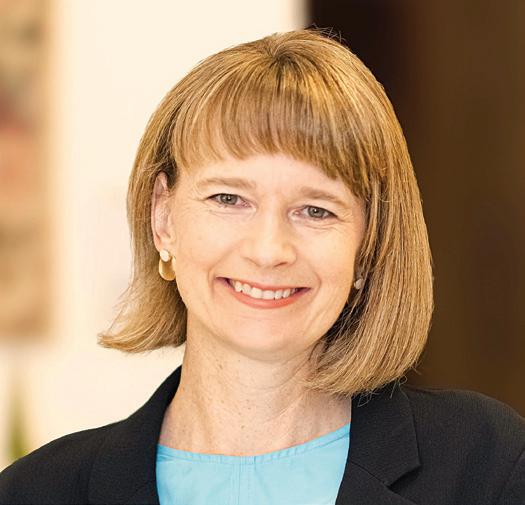
Holly Welborn Benner, World Bank Group Country Manager for Qatar, has over 20 years experience promoting development solutions for countries facing complex transition and reform-related challenges.
The establishment of the World Bank office in Qatar provides an advanced platform for the exchange of technical and financial expertise with institutions and multilateral organisations. There will be opportunities to share knowledge, and a focus on capacity building and training for young Qatari professionals in finance and development.
The Qatar office will operate under Country Manager Holly Welborn Benner for the WBG, including the International Bank for Reconstruction and Development (IBRD), the International Development Association (IDA), the International Finance Corporation (IFC), and the Multilateral Investment Guarantee Agency (MIGA), allowing for closer coordination on development projects, risk mitigation and private investment.
The multi-pillar approach is central to Qatar’s development strategy, according to Rwodah Ibrahim Al Naimi, Director of Investments at QFFD: 'This is the first World Bank Group office opening in Doha, and it’s not limited to just one group. IFC, MIGA and other collaborators are all represented, which allows for deeper cooperation both internationally and nationally.'
Working together to benefit others
The partnership reflects a shared commitment to advancing innovative financing for development, supporting reconstruction, recovery, and job creation across the Middle East, Sub-Saharan Africa, and fragile and conflict-affected contexts. By mobilising public and private sector instruments, the collaboration will focus on unlocking opportunities in priority sectors for long-term resilience, stability, and inclusive growth, including human capital, energy and mining, agribusiness, and digital development.
The WBG's vision is to create a world free of poverty on a livable planet and is one of the largest sources of funding and knowledge for developing countries. It provides assistance in more than 100 countries, to improve lives by creating jobs, strengthen economic growth, and confront the most urgent global development challenges.
Under the MoU, the WBG and the QFFD will explore collaboration in support of countries aligned with global development priorities, including efforts to expand access to electricity for 300 mn people in Sub-Saharan Africa through the M-300 initiative, and to improve the livelihoods of up to 250 mn smallholder farmers globally through the WBG's AgriConnect platform.
According to Al Naimi, the collaboration is designed to unlock private sector participation where capital is hardest to mobilise: 'We are focusing on enhancing private sector involvement in the most fragile contexts, where capital is limited. By combining public funding from QFFD with World Bank instruments such as guarantees, we can create more sustainable investment, support small and medium enterprises and generate jobs.'
The World Bank is one of the leading sources of research and data about Qatar, currently highlighting three primary areas: Economic Diversification, Digital Transformation, and Climate and Sustainability.
The Qatar Fund for Development was established in 2002 to enhance global education, health and economic development through humanitarian aid, concessional loans, and grants aligned with Qatar 2030 National Vision.
For more information, visit worldbank.org, miga.org, ifc.org and qatarfund.org.qa
New Committee to Oversee End-of-Service Benefits and Employee Contributions
By Sarah Palmer
Prime Minister’s Decree No 34 of 2025 announced that a specialised committee has been proposed to manage end-of-service bonus benefits and other contributions, for both the public and private sectors. This will shift the traditional lump sum gratuity to a modern, investment-based savings scheme.
The establishment of the committee does not change the current calculation of gratuity, which is usually a minimum of three weeks' basic salary per year of service. However, it provides the regulatory groundwork for a transition to where these funds are actively managed and potentially grown through dedicated investment vehicles.
Under Article 1, a committee will design and oversee an investment-based savings system that encourages voluntary participation by Qatari citizens and residents.
The committee will be chaired by a representative of the Ministry of Finance, with a Vice-Chair from Qatar Central Bank. Representatives from other entities include: Office of the Prime Minister • General Secretariat of the Council of Ministers • Ministry of Finance • Ministry of Commerce and Industry • Ministry of Labour • Civil Service and Government Development Bureau • National Planning Council • QatarEnergy • Qatar Investment Authority • Qatar Financial Centre • Qatar Chamber of Commerce and Industry.
There will also be three experts in savings systems and investment mechanisms, and implementation will be appointed by the Minister of Finance.
Committee responsibilities
As per Article 2, the committee is responsible for proposing an investment-based savings system for employees' funds, applicable to both citizens and residents who choose to participate. After approval by the Council of Ministers, the committee will oversee the implementation and supervision of the system. The system will be based on investing end-of-service benefits and any additional voluntary contributions for non-Qatari employees, to encourage citizens and residents to invest their savings, attract skilled expatriate talent, and promote long-term workforce retention.
The committee will have a number of mandates:
* Proposing rules and standards for a voluntary savings programme for Qatari citizens, without affecting any existing employment or retirement benefits.
* Coordinating with relevant government and nongovernment entities to develop the necessary regulations, mechanisms, and implementation frameworks, in compliance with applicable laws.
* Conducting a comprehensive inventory of all state employees and workers covered by the system, and determining the total expected endof-service benefits.
* Defining the scope of applicability for different employee categories.
* Developing public awareness strategies to explain the benefits and objectives of the system and encourage participation.
* Implementing and monitoring the system once approval is given by the Council of Ministers.
* Entering into contracts with qualified investment entities to manage the programme with the appropriate safeguards and professional support.
* Proposing further guarantees to protect end-ofservice benefits and other contributions.
* Conducting periodic evaluations of the system and addressing any obstructions to its effectiveness.
Article 10 states that all relevant authorities must implement the provisions of the Decision within their own jurisdictions.
This decision is part of a larger initiative regarding the labour force and employee rights, but should not be confused with Cabinet Decision No 34 of 2025, which amended the executive regulations of the Civil Human Resources Law regarding employee allowances and leave in the public sector. m
Economic Growth and Gross Domestic Product (GDP)
Qatar's real GDP growth is projected at 2.9% in 2025 and 6.1% in 2026, according to the International Monetary Fund (IMF) in its World Economic Outlook in December 2025. This growth is attributed to the North Field expansion, which will significantly boost liquefied natural gas (LNG) output and exports.
The current account balance is expected to be 10.8% in 2025 and 10.2% in 2026, and headline inflation projected to be 0.1% and 2.6%.
This growth shows the state’s strong trajectory towards sustainable development and economic diversification, in alignment with the Third National Development Strategy (NDS3). imf.org
According to the National Planning Council (NPC), in Q3 2025 the economy maintained growth with real GDP up 2.9% year-on-year (YoY), driven primarily by non-hydrocarbon activities. Real GDP estimates for Q3 2025 stood at QAR186.1 bn, compared with QAR180.9 bn YoY. Non-hydrocarbon activities was 65.5% of real GDP, with value added reaching QAR121.9 bn, a YoY increase of 4.4%. This aligns with the objectives of the Third National Development Strategy (NDS3) and Qatar National Vision 2030 (QNV2030). npc.qa
Export, Import and Trade Surplus
According to the NPC, Qatar's merchandise trade balance showed a surplus of QAR14.1 bn in December 2025, a decrease of QAR4.3 bn (23.6%) YoY. However, there was an increase of approximately QAR1.6 bn (13 %) compared with November 2025 (month-on-month/MoM).
The total value of merchandise exports (including exports of goods of domestic origin and re-exports) amounted to around QAR26.9 bn, a 13.7% YoY decrease, but recorded a MoM increase of 9.9%. China was the principal destination for exports (19.4%), followed by India (14.0%) and South Korea (7.7%). Imports were around QAR12.8 bn, a YoY increase of 0.6%, and a m-o-m 6.7% increase. China was the principal destination for imports (18.8%), followed by the US (13.5%) and Italy (7.5%).
The Budget
sustainability, promote economic growth, improve spending efficiency and attract investments, in line with Qatar National Vision 2030.
The total expected revenues for the 2026 fiscal year of QAR199 bn is based on QAR155 bn from oil and gas revenues and QAR44 bn from non-oil revenues). This reflects an improvement in oil revenues and continued growth in non-oil revenues, and is based on an average oil price of USD55 per barrel, to enhance financial flexibility and ensure spending stability.
The 2026 budget expenditure of QAR220.8 bn includes QAR69.5 bn for salaries and wages, QAR81.5 bn for current expenditures, QAR7 bn for minor capital expenditures and QAR62.8 bn for major capital expenditures.
The education sector is allocated QAR21.8 bn while the health sector receives QAR25.4 bn, up from QAR22 bn in 2025. This reflects the continued commitment to developing human capital and improving the quality of public services. The municipality and environment sector is allocated QAR22.2 bn, the sports sector QAR7.6 bn, commercial affairs QAR4.1 bn, transportation QAR4.1 bn, communications QAR3.8 bn and social services QAR2.8 bn.
The expected deficit for 2026 of QAR21.8 bn will be covered through the use of local and external debt instruments in accordance with financing requirements and developments in debt markets.
Inflation and Cost of Living
The Consumer Price Index (CPI) in Qatar recorded 112.39 points in December 2025, an increase of 1.44% MoM, and a rise of 1.95% YoY. CPI is used in Qatar as a specific index to measure inflation acros 12 main groups of consumer goods, covering 737 goods and services. The IMF states that Qatar's inflation is expected to remain among the lowest within the GCC and Arab world, settling at around 2% over the medium term.
Employment
The World Bank states Qatar has one of the lowest percentages of unemployed people, declining from 0.81% in 1991 to 0.1% in 2025. Qatar has been a member of the International Labour Organization (ILO) since 1972 and has ratified six conventions including five of the fundamental conventions.
The State Budget for 2026 was announced in December 2025, which projects total revenue of QAR199 bn, a growth of 1.0% compared to the total revenues of the 2025 budget. HE Ali bin Ahmed Al Kuwari, the Minister of Finance, stated that the new budget reflects the State’s balanced financial approach that aims to ensure financial m
In 2018, Qatar and the ILO started the first phase of a technical cooperation programme (TCP) to carry out extensive labour reforms with Phase 2 from 2021 to 2024. Phase 3 will run from 2024 to 2028 and aligns with NDS3 and QNV2030
Commerce
Qatar is a member of the World Trade Organisation and its trade policies create a competitive international trading market. The government supports the growth and success of businesses in a bid to diversify the economy. Qatar is a member of the Gulf Cooperation Council (GCC), which also includes Bahrain, Kuwait, Oman, Saudi Arabia and the United Arab Emirates. Following the ending of the blockade in 2021, Qatar has resumed trade with Saudi Arabia, the UAE, Bahrain and Egypt, and has continued to strengthen relations with a number of other countries such as Turkey, Oman, Kuwait, India, China, the UK and the US.
Embassies can provide valuable information on commercial activities and can connect you with their business council/chamber of commerce – see the Discovering Qatar section for contact details. Translation services can be found in Day-to-Day Qatar in the Living in Qatar section.
Strengthening Bilateral Ties Between Australia and Qatar
AQBA was launched in September 2024 by the Australian community and business leaders in Qatar, connecting two leading nations through networking opportunities, educational resources, and exclusive benefits. By strengthening bilateral and trade relations, AQBA works to support the long-term economic vision of each country.
Membership Benefits:
Access to the Australian business community in Qatar
Access to a wide range of networking events
Exclusive membership discounts
To register your interest, please contact secretary@aqba.qa
Investment and Trade
Qatar has one of the fastest growing global economies thanks to the world's third largest concentration of natural gas reserves. Legal liberalisation, economic diversification and an expanding economy provide many investment opportunities for non-Qataris. Investors have unrivalled world connectivity via Hamad Port, the world's largest greenfield seaport, and the world’s best airport, airline and air cargo carrier. Profits can be repatriated as can proceeds of sale and capital on liquidation. Major investment sectors are hydrocarbons, education, and financial and legal services, alongside ICT, sport, leisure and healthcare.
Under Qatar National Vision 2030 (QNV2030), several initiatives have been launched to diversify the economy and attract foreign direct investment. The Third National Development Strategy (NDS3) unveiled in 2024 states that Qatar is aiming for a 4% growth in non-hydrocarbon gross domestic product (GDP). As noted by the Investment Promotion Agency Qatar (IPA Qatar), the State ranks among the world’s top destinations for foreign direct investment (FDI), due to strong economic and investment momentum. There are even more opportunities due to the Ministry of Commerce and Industry reducing fees by up to 90% for certain services.
Incentives
The government welcomes foreign participation in joint ventures, with a number of incentives:
• A developed infrastructure and ICT network.
• Easy access to world markets with good sea, land and air connections.
• Natural gas, electricity, water and petroleum at subsidised rates.
• Land for development in the Industrial Area near Doha for nominal fees – companies can submit a request to the Ministry of Municipality for a lease contract of a plot under the Doha, Al Khor, Al Thakhira and Al Shamal Municipalities.
• Loans available from Qatar Development Bank.
• Fixed parity between the Qatari riyal and US dollar (USD1 = QAR3.64).
• No customs duty on the import of plant machinery; exemption from export duty.
• Five-year renewable tax holidays (based on government approval).
• No income tax on the salaries of expatriates.
• Tax on the profits of foreign-owned stakes in Qatari companies applied at a flat rate of 10%.
• Employment and immigration rules enabling the import of skilled and unskilled labour.
Investment Regulations
There are primarily two regulatory jurisdictions for foreign investors seeking to conduct commercial business in Qatar: the regulations of the State of Qatar, and the rules and regulations of the Qatar Financial Centre (discussed in more detail below).
The free zones are designed to encourage certain bespoke investment vehicles to bring their businesses to the region. However, non-Qatari investors may only invest in Qatar in accordance with Foreign Investment Law No 1 of 2019:
• According to the new law, foreign investors are permitted to hold more than 49% in commercial companies with special permission from the
Minister of Commerce and Industry (MoCI) (subject to some prohibitions set out below). Under the former law such increased ownership was limited to those businesses operating in a specific set of sectors.
• Non-Qatari investors are prohibited from being appointed as commercial agents under Commercial Agencies Law No 8 of 2002, but the former prohibition preventing foreigners from investing in real estate businesses has been removed under the new Foreign Investment Law. Approval from the Council of Ministers is required for foreign investment in banking and insurance.
• Foreign capital is protected against expropriation (the State may acquire assets for public benefit on a non-discriminatory basis, provided the full economic value is paid for the asset).
• Subject to Ministerial approval, a foreign company performing a specific contract in Qatar may set up a branch office if the project facilitates the performance of a public service or utility.
• A non-Qatari company operating in Qatar under a Qatari government concession to extract, exploit or manage the State's national resources is exempt from the Foreign Investment Law. In practice this covers all large oil and gas companies.
• A company formed by a non-Qatari entity with the government or a government entity ('Article 207 Company') may be subject to special rules and exemptions from the Commercial Companies Law No 11 of 2015.
• All international companies securing mega infrastructure development work must share at least 30% of the contract with local entities.
• Law No 7 of 1987 governs the practice of commercial activity by GCC citizens in Qatar, amended under Law No 6 of 2017. GCC citizens as individuals or legal personalities can practise retail and wholesale trade in Qatar. However, the GCC citizen engaging in the activity must be
directly responsible for it. Retail business must be via direct sale to customers in a shop, and those in wholesale trading are required to import and export the goods.
• Law No 12 of 2020 regulating the partnership between the public and the private sector is as per one of the following regulations: Allocation of land through a rental or usage licence, for development by the private sector; build-operatetransfer (BOT); build-transfer-operate (BTO); build-own-operate-transfer (BOOT); operations and maintenance (OM); or any other form adopted by the Prime Minister, upon the proposal of the relevant minister. The government or other administration may, on its own initiative or at the suggestion of the private sector, identify a project for its implementation through partnership.
Choosing A Business Structure
To conduct business in Qatar on a regular basis, foreign investors must establish or register a legal presence from the following options:
• Incorporating as a company under the Commercial Companies Law which allows full access to Qatar's market and to work on an unlimited number of projects. A Qatari partner is required to own 51% of the capital of the company, except in the circumstances mentioned above. Various exemptions are available to attract foreign capital.
• Obtaining a licence for a branch office or trade representation office which does not require a Qatari partner. The licence for a branch is granted in respect of a specific project for a government client. The existence of the branch office is dependent on the duration of a particular project: once the project is completed, the branch office must close unless it has secured additional qualifying projects. Branch offices are only permitted to perform a specific contract and may not engage in general commercial activities with the larger local market. The branch will be fully taxable unless granted a special exemption. Trade representation offices are only permitted to market goods and services; they are not permitted to engage in commercial activities.
• Under Law No 7 of 2017 companies in GCC states can establish companies in Qatar, subject to having had a commercial registration in one of the GCC states for at least three years, and be fully owned and managed by a GCC citizen
• There is a separate regime for establishing an entity in the Qatar Financial Centre (QFC) – see further in this section for more information.
• The Qatar Science and Technology Park (qstp.qa), a free zone in Education City, allows companies to engage in research and development, again with full foreign ownership.
• The Qatar Free Zones (qfz.gov.qa) accept applications from international investors in key sectors, at these locations:
ø Ras Bufontas adjacent to Hamad International Airport – a technology and manufacturing hub for businesses requiring international connectivity.
ø Umm AlHoul adjoining Hamad Port, south of Al Wakra – offers easy access to the water for maritime and logistics companies, and is a gateway for imports and exports. The maritime cluster Marsa is able to support a range of marine activities.
• The Cabinet has added some areas to the Free Zones Law, including Msheireb Downtown Doha, where Media City, established under Law No 13 of 2019, will focus on managing and developing media activities.
• Under Ministerial Decision No 242 of 2016, the MoCI will grant licences for small home businesses conducting certain commercial activities like sewing, events services, electronic services, business services, cosmetic activities and food activities. A single licence is issued per activity, with an annual fee, and cannot involve direct public sales from the residence. A further 48 activities were announced in 2024, bringing the total to 63. Apply through the MoCI Single Window portal at moci.gov.qa
Company Structures
According to the Commercial Companies Law No 11 of 2015, the following structures are permitted:
• Limited liability companies (LLCs) – subject to the Foreign Investment Law, can be established by a single person owning the entire share capital (previously the minimum number of shareholders was two). This replaces the single person company under the old companies law. Shareholders can determine the share capital of an LLC (previously the minimum share capital was QAR200,000 divided into equal shares).
• Appointing a commercial agent means a nonQatari company does not establish a presence in Qatar; instead a 100% owned Qatari entity or Qatari national is appointed as an agent to market the relevant goods and services. Commercial agencies must be exclusive and registered in order to be afforded the protections provided under the Commercial Agents Law No 8 of 2002; non-registered distributorships are subject to the Commercial Law No 27 of 2006.
• Article 207 company – a shareholding company where the Qatari government, a government owned entity or a public corporation must own 51% of the shares, unless the Council of Ministers consents otherwise. Certain provisions of the Commercial Companies Law are excluded from the company’s Articles of Association.
• General partnership – joint partners administer the affairs of the company, and trustee partners contribute to the company's capital.
• Simple limited partnership – a local entity formed by two or more Qataris.
• Limited partnership with shares – formed by joint partners, liable for the debts, or trustee partners, whose liability is limited to the share value.
• Unincorporated joint venture – formed by two or more people pursuant to specific contractual arrangements. The unincorporated joint venture does not have a separate legal personality distinct from its partners.
• Joint stock company (public or private) – the capital is divided into shares with a minimum of five shareholders. Permissible foreign share ownership depends on the type of company and is subject to Qatar Financial Markets Authority approval.
• Holding company – incorporated as a joint stock or limited liability company. The holding company must hold at least 51% of the shares in each of the companies under its control.
Commercial Registration (CR)
Virtually all companies use a government liaison officer or facilitator to assist with establishment formalities. Under Qatar Commercial Registration Law No 25 of 2005, companies must be approved or registered by one or more of the following entities: Ministry of Commerce and Industry (MoCI); Qatar Chamber; Ministry of Municipality; Ministry of Interior; Importers' Register/ Contractors' Register; and QFC Authority (where appropriate). Visit moci.gov.qa for details.
Amendments were made under Law No 20 of 2014 to expedite registration procedures, followed by Decisions 30 and 31 of 2019:
• The MoCI must respond to the applicant's request for registration on the same day.
• Reasons must be given for rejected applications. The Minister must accept or reject an appeal of the Ministry's decision within 15 days.
• Incorporated branches must be in the exact name of the principal company, and are not considered separate legal entities.
• Amendments have also been made to penalties for those operating commercial premises without a CR, misusing the CR, and providing false/ wrong documents.
• Renewals, trade name changes and other modifications are online services only at investor.sw.gov.qa
Export and Import
According to the National Planning Council, total exports in December 2025 was QAR26.9 bn and imports was QAR12.8 bn, with China the principal destination for both. There are no duties on exports. See Economy in this section for more details.
Import tariffs
Importers of goods into Qatar must sign up to the Importers' Register and be approved by Qatar Chamber (QC). Customs duty and legalisation fees are levied on all commercial shipments, irrespective of its value. All goods imported into Qatar are subject to customs duties, based on a percentage value of goods (usually 5%), or on a 'per unit' basis. Effective from 2021, incoming parcels and personal shipments with a cost, insurance and freight (CIF) value exceeding QAR1,000 is liable to 5% customs duties.
Customs duty tariffs fall under these categories:
• Personal effects and household items, imports of charitable organisations and returned goods, diplomatic and military exemptions, merchandise for free zones and duty-free shops – Exempt. Goods in transit may be accepted at designated stations without duty.
• General cargo, eg clothing, perfumes, cars, electronic appliances and devices – 5%
• Steel – 20%
• Urea and ammonia – 30%
• Cigarettes, tobacco and its derivatives – 100% or QAR1,000 per 10,000 cigarettes, whichever is higher
Businesses that import, produce or store/stockpile excise goods must comply with Law No 25 of 2018 on Excise Tax. Goods subject to Excise Tax:
• Tobacco products, energy drinks, special goods – 100%
• Carbonated drinks (non-flavoured aerated water excluded) – 50%
In accordance with the Gulf Cooperation Council (GCC) Customs Union, more than 800 goods are exempted from customs duties, alongside exemptions granted to certain bodies and persons under Customs Law No 40 of 2004. There are
fees for the attestation of the Certificate of Origin (from QC) and a tariff for the attestation of the Commercial Invoice, based on shipment value. Qatar implemented the World ATA Carnet Council in 2018, an international customs system with nearly 80 member countries, permitting the dutyfree and tax-free temporary import and export of goods for up to one year.
Through the Authorised Economic Operator launched in 2019, the General Authority of Customs (GAC) develops partnership and cooperation with the private sector by granting customs benefits and facilities to companies involved in the supply chain in international trade, as per the World Customs Organisation Framework of Standards to Secure and Facilitate Trade.
Import regulations
All commercial shipments are examined by GAC prior to clearance. The Qatar Electronic Customs Clearance Single Window (Al Nadeeb) is the one-stop e-government system to facilitate international trade. customs.gov.qa
Regulations were introduced in 2013 to prevent fake products from entering the market. All general goods must have non-removable marking of their place of manufacture to be eligible for customs clearance. This applies to both air and sea freight. The import of vehicle tyres, spare parts and electrical home appliances has to be based on a 'certificate of conformity' issued by the authority concerned. All general cargo for customs clearance must be backed by an original commercial invoice on the shipper’s letterhead, with stamp and signature. They also require attestation by QC. The packing list of each consignment must have the number of pieces, weight and volume.
All importers must obtain an HS Code, the international system for classifying traded products, linked to the trader's Commercial Registration and import licence. Following Amiri Decree No 98 of 2024, the Integrated GCC Customs Tariff was implemented on 1 January 2025. The new tariff system comprises 12-digit tariff codes (previously 8 digits), to classify products for purposes like determining the customs duty rate, non-tariff barriers, and statistics.
There is now a direct electronic integration between Al Nadeeb and the Digital TIR Carnet Service of the International Road Transport Union in association with QC. This enables the exchange of data related to the road transport of goods governed by the International Road Transport Convention, for a smoother flow of shipments through land ports by enhancing tracking accuracy and increasing transparency and control.
In September 2025, the GAC launched the Customs Documents system to automate archiving and create a unified central database for customs documents. The system uses artificial intelligence (AI) to analyse document content to enhance work efficiency and facilitate access to information, while also ensuring data protection and confidentiality.
Points of entry
Imports and exports transit via Hamad/Doha/ Mesaieed/Ruwais Ports, Hamad International Airport, Ras Laffan and the Salwa Overland Terminal.
Regulations for individuals and travellers
The GAC has specific exemptions and declaration requirements regarding luggage, personal belongings, gifts, household items, and the transfer of money or valuables across borders.
As per Law No 20 of 2019 on Anti-Money Laundering and Terrorism Financing, any person entering or leaving Qatar and in possession of any currency, bearer negotiable instruments, or precious metals or stones, equivalent to or exceeding QAR50,000 (or its equivalent in foreign currencies), must complete a declaration form, and provide any other information as requested.
Banned imports include alcohol, pork and e-cigarettes. The import of pets is allowed, although certain breeds are not permitted.
Taxation
There are no personal taxes or statutory deductions from salaries in Qatar. Under Law No 24 of 2018 on Income Tax ('the New Tax Law') and its executive regulations, companies must pay tax on all profits at a flat rate of 10%. This is on all corporate income from sources in Qatar, whether the entity has a physical presence in Qatar or not. The share of the profits due to a Qatari or GCC partner is exempt from tax.
Tax exemption applies for certain activities, and companies listed on the Qatar Stock Exchange are also exempt, but companies must pay a 2.5% contribution to charitable and cultural activities. Taxpayers need to register with the Public Revenue and Taxes Department. Auditors must be a firm based in Qatar and registered with the MoCI or approved by the QFC. Services are offered by the General Tax Authority (GTA) via the Dhareeba portal.
GCC members agreed to introduce VAT in 2018. The Qatar Value Added Tax (VAT) Law and Excise Tax Law and Executive Regulations was approved in 2017, based on the unified GCC agreement. To date, only the Excise Tax has been implemented.
Council of Ministers Resolution No 2 of 2026 gives the executive regulations for Law No 22 of 2024 which enacted the OECD Pillar Two standards in Qatar. There is a 15% Domestic Minimum Top-up Tax and an Income Inclusion Rule for multinational enterprises with global revenues over EUR750 mn, for fiscal years from 1 January 2025, across all jurisdictions, including the Qatar Financial Centre, Qatar Free Zones Authority, Qatar Science & Technology Park and Media City. gta.gov.qa
Intellectual Property
Under Law No 9 of 2002, a trademark registration is valid for 10 years from the date of filing the application, renewable for further consecutive periods of 10 years. The court may be ordered to cancel a trademark registration if the owner fails to use it in Qatar within five consecutive years from the date of the registration.
Copyright Law No 7 of 2002 gives protection to authors of original literary and artistic works. Protected works include books, lectures, musical works, photographic works and computer software. The economic rights of the author/owner are protected during the lifetime of the author/owner, and for 50 years after his death.
Patent Law No 30 of 2006 provides for the registration of inventions and foreign patents at the Qatar Patent Office; implementing regulations were issued by the Minister of Commerce and Industry under Decision No 153 of 2018.
Qatar announced its accession to the Patent Cooperation Treaty in 2011. The Law of Trademarks in the GCC Countries was promulgated under Law No 7 of 2014, and in the same year Qatar signed a cooperation agreement with the World Intellectual Property Organisation (WIPO) to jointly improve services. There is an electronic trademark registration service on the MoCI website to expedite submissions and preserve IP rights.
Law No 10 of 2020 on the protection of industrial designs was issued to offer more comprehensive protection for designs, once the implementing regulations are issued, as previously protection was sought by publishing cautionary notices in Qatari newspapers.
Qatar acceded to the Madrid Protocol in 2024 and is the 115th Member of the Madrid System, a practical and efficient solution for protecting trademarks worldwide. This brings the total number of countries in which it is possible to secure trademark protection via a single application to 131. The Madrid Protocol came into force in 2024 and allows for the centralised filing of trademark applications across multiple
countries. Entities in Qatar can seek protection via one application in one language (English, French or Spanish). Trademark holders in any other Madrid System Member can seek overseas protection of their trademark in Qatar, while holders of existing international trademark registrations will be able to expand its geographical scope to include Qatar. Trademark holders in Bahrain, Oman, Qatar, and the UAE can now use the Madrid System.
Regulatory Bodies and Government Entities
Investment and Trade Court A4
The court was established under Law No 21 of 2021, specialising in investment and trade issues and increasing the pace of resolving commercial disputes. Work commenced in 2022 using a stateof-the-art electronic system, offering a range of services from registration to case management, scheduling hearings and other related procedures, up to the issuance of preliminary and appeal rulings. The court consists of primary and appellate circuits, and a circuit in the Court of Cassation that specialises in examining appeals against rulings issued by the court. A cooperation agreement was signed with WIPO in September 2025 to enhance the court's role in protecting IP rights and resolving disputes. itc.sjc.gov.qa
Investment Promotion Agency Qatar (IPA Qatar) A4
Custodian of the Invest Qatar brand, IPA Qatar was launched in 2019 and is registered at the Qatar Financial Centre (QFC). The agency provides investment solutions in Qatar, attracting foreign direct investment in the country’s priority sectors. The Startup Qatar Investment Program, provided by Qatar Development Bank, aims to attract tech startups to establish or expand operations in Qatar, with funding and incentives. The Invest Qatar Gateway is the first digital platform for investors in Qatar providing information on partners, business opportunities and resources. invest.qa, startupqatar.qa
Ministry of Commerce and Industry (MoCI) A4
Creates commercial policy for both private and public sectors to boost regional and international trade relations and support business development. A number of services are available on the Single Window to attract local and foreign investments, and the AI assistant Saif can help with queries. In line with Law No 1 of 2020 on the Unified Economic Register, the Qatar Business Map Portal was launched, with comprehensive information related to commercial establishments.There is a new dedicated digital platform under the PublicPrivate Partnership (PPP) Programme, to highlight investment opportunities and projects available to the private sector.
The MoCI signed a 25-year concession agreement with the Qatari Economic Zones Company (Manateq) in January 2025 to manage the Small and Medium Industries Zone, with fees subsequently reduced in February. In September 2025, the MoCI and the Ministry of Transportation announced that companies engaged in shipping can consolidate land, sea, and air freight activities into one commercial registry. moci.gov.qa, investor.sw.gov.qa, businessmap.moci.gov.qa, manateq.qa
Ministry of Finance (MOF) C4
Prepares the State Budget and proposes objectives and tools of financial policy in line with Qatar National Vision 2030. Its Tahfeez programme enhances local services and products to strengthen the private sector. The General Authority of Customs monitors the import of goods, and the e-services of the Unified Website of State Procurement include tenders and company registration. In 2024, the Center for Fourth Industrial Revolution (C4IR Qatar) was launched, part of the World Economic Forum's C4IR Network and a step towards enhancing technological innovation in Qatar. mof.gov.qa, customs.gov.qa, monaqasat.mof.gov.qa, c4ir.qa/home
Ministry of Justice (MOJ) C4
Records legal actions and documents, registers and protects IP rights, and reviews draft contracts and agreements in accordance with the law. There is a real estate registration/authentication office at the QFC for QFC entities. moj.gov.qa
Ministry of Municipality C4
The Foras investment portal promotes PPPs for environmental, service and sustainability projects. The Ministry's e-services cover shops and establishments on commercial streets, agriculture and real estate. mme.gov.qa
Qatar Chamber (QC) D4
Provides services and support to local and international businesses, including QFC-licensed firms, like certificates of origin (COO) for import/ export and ATA Carnet, acting as liaison for international business delegations, and providing training courses. QC became a member of the International Federation of Freight Forwarders Associations (FIATA) in 2023. The Qatar International Center for Conciliation & Arbitration (QICCA), established in 2006 as part of QC, acts as an efficient and swift mechanism to settle disputes between Qatari enterprises, or between national companies and foreign counterparts. qatarchamber.com, qicca.org
Qatar Development Bank (QDB) D4
Has an active role in the economic and industrial development of Qatar in the private sector by
promoting and financing SMEs. The bank is 100% owned by the State of Qatar and provides a wide range of financial and advisory products, such as funding, incubation, and support services. qdb.qa
Qatar Financial Markets Authority (QFMA) C4
An independent regulatory authority supervising the financial markets and firms authorised to conduct activities related to securities in or from Qatar, and empowered to exercise regulatory oversight and enforcement over the capital markets. QFMA was granted full membership of the International Organisation of Securities Commissions in 2013. In 2023 QFMA launched the Single Window E-Portal so companies deal with just one entity, without separately involving QFMA, MoCI, Qatar Stock Exchange (QSE), and EDAA (formerly Qatar Cental Securities Depository Committee). qfma.org.qa
Qatar Science and Technology Park (QSTP) C2
A facility for international technology companies in Qatar, and an incubator of start-up technology businesses, offering premises, services and support programmes. The free zone at Qatar Foundation's Education City allows foreign companies to set up 100%-owned businesses in Qatar free of tax and duties. qstp.org.qa
Qatar Investment Authority (QIA)
The QIA A4 was established in 2005 as the sovereign wealth fund to grow and diversify Qatar's economy. The QIA reports to the Supreme Council for Economic Affairs and Investments (SCAEI), the highest decision-making body concerning economy, energy, and investment of the State. The SCAEI approves the QIA's investment policy and oversees the QIA's performance.
The QIA has two main objectives: to support the local economy; and provide liquidity when required to stabilise the local economy, supporting local economic development by investing in companies that fill market gaps. The QIA has approximately USD557 bn in assets under management according to Sovereign Wealth Institute (SWFI) (February 2026), which positions QIA as the ninth largest sovereign wealth fund globally within the SWFI rankings. Although the fund does not publish its holdings, direct investments are made in real estate, healthcare, retail/consumer, technology/ media/telecoms, finance and industry. Following a restructure in 2016, USD100 bn of investments in local companies were placed in a new unit, Qatar Investments (known as QIA internationally).
The QIA is a founding member of the One Planet Sovereign Wealth Fund Working Group, helping to produce a framework in 2018 to integrate climate change analysis into investment decisions.
Further to this, in 2020 the QIA embarked on a revised strategy promoting sustainability, with no new investments in fossil fuels. Amiri Decision No 34 of 2023 reorganised the QIA, highlighting its mandate, primary roles and responsibilities, and strategic objectives. An enhanced governance framework enables effective oversight, aligned with international best practices.
The Active Asset Management Initiative was established in 2024, alongside QIA's first venture capital (VC) Fund of Funds, a USD1 bn investment in startups and venture capital (VC) funds. This has already anchored 12 major venture capital (VC) firms and was extended in February 2026 by an additional USD2 bn. qia.qa
QIA Portfolio (unconfirmed): 52 Champs-Elysées, Adecoagro, Agricultural Bank of China, Asia Square Tower 1, Banyan Tree, Barclays PLC, Barwa Bank, Brookfield Property Partners, Canary Wharf Group, Claridge's/The Berkeley/The Connaught hotels, Coveo, Credit Suisse Group AG, Deutsche Bank AG, El Corte Ingles SA, Empire State Realty Trust, Fahrenheit, Glencore PLC, Grupo Santander Brasil, Harrods, Hassad Food, Heathrow Airport Holdings, Hochtief, Iberdrola SA, ISAGEN, Ivanhoe Mines, J Sainsbury PLC, Janus Henderson Group, Kahramaa, Kardium Inc, Lagardère, Le Brantano!, Le Tanneur, Lifestyle International Holdings Ltd, London Shard Tower, London Stock Exchange, LVMH, Masraf Al Rayan, Monumental Sports & Entertainment, Mowasalat, National Grid PLC, One Ocean Port Vell, Ooredoo, Oryx Midstream Services (Oryx), Pavilion, PsiQuantum, Pulkovo Airport, Qatar Exchange, Qatar Islamic Bank, Qatar International Islamic Bank, Qatar National Bank, Reliance Retail Ventures, Rosneft PJSC, Royal Dutch Shell, Sauber Holding, Siemens, Societe Fonciere Lyonnaise SA, The Bürgenstock Selection, Total SA, Turkuvaz, Valentino Fashion Group SpA, Vente-Privée, Vivendi, Volkswagen AG, Xstrata PLC.
Qatari Diar Real Estate Investment Company
Ongoing projects include Lusail City, Simaisma, and Qatar Railways Development Company overseeing the Qatar Rail Development Programme (Doha Metro,the Long Distance Rail, Lusail Tram), as well as Chelsea Barracks and Chancery Rosewood in the UK. qataridiar.com
Qatar Financial Centre (QFC)
The QFC A3/4 was established to attract international financial institutions and firms to establish business operations in a 'best-in-class' international environment.
Firms need to be incorporated or registered by the QFC Companies Registration Office,
licensed by the QFC Authority, and for regulated activities, authorised by the QFCRA. Advantages of establishment in the QFC include:
• A separate legal, regulatory, tax and business environment.
• 100% foreign ownership, 100% repatriation of profits, and 10% corporate tax on locally sourced profits.
• A double taxation avoidance agreement network with more than 80 countries.
The QFC has over 4,000 registered firms, with more than 300 new companies registering during Web Summit Qatar 2026 and another 2,300 firms submitting applications (February 2026). Companies comprise investment and private banking entities, and (re)insurance and asset management firms (each of which is regulated); and consultancy service providers, law firms and financial services recruitment firms (which are non-regulated).
The QFC takes a major step in diversifying key economic sectors eg digital, financial services, sports, and media. An attractive incentives programme for multinational companies offers free offices, highly-competitive tax incentives, seed capital to cover five years of operating expenses in return for a 10-year commitment, and a dedicated Relationship Manager once registered.
The application fee to conduct non-regulated activities in the QFC was cut by 90% in 2025, except for the activities of Single Family Offices, making entry easier for startups, SMEs and global companies to Qatar’s dynamic market.
The QFC Digital Assets Lab is the inaugural programme under the QFC Innovation Dome, powered by Qatar Central Bank (QCB). The Lab is a collaborative environment for start-ups, businesses and researchers, contributing to the growth of the digital economy and the adoption of emerging technologies across various sectors.
The QFC Digital Assets Framework 2024 was launched in line with the Third Financial Sector Strategy issued by QCB. The framework establishes the legal and regulatory foundation for digital assets, including the process of tokenisation, legal recognition of property rights in tokens and their underlying assets, custody arrangements, transfer, and exchange. The framework also provides for the legal recognition of smart contracts.
The QFC Metaverse was unveiled in February 2025, an initiative under the QFC Innovation Dome. Building on the success of the Digital Assets Lab, the project will reshape Qatar’s financial landscape through Web3 technology and will provide QFC
firms with a virtual space to showcase their achievements, interact with global partners, and explore business opportunities.
The QFC celebrated its 20th anniversary in January 2026, unveiling a new brand identity, to reflect a more modern and forward-looking positioning, and a new Grow With Confidence campaign. Mansoor Rashid Al Khater was announced as the new CEO. Additionally, the QFC relocated its headquarters to Lusail City, Qatar's modern smart city, to enhance operational efficiency, improve client service, and be closer to key institutions. qfc.qa
The Qatar Financial Centre (QFC) Authority, the commercial arm of the QFC, leads the expansion of Qatar's financial services sector and develops relationships with the wider financial community. The QFCA's strategy focuses on the creation of a global business hub for three core markets – Asset Management, Reinsurance and Captive Insurance.
The QFCRA is the independent regulatory body of the QFC, overseeing all firms conducting financial services in or from the QFC, as a combined banking, insurance and markets regulator. In 2012, the Qatar Central Bank (QCB) Governor became the chairperson of QFCRA establishing a single financial regime, comprising QFCRA, Qatar Financial Markets Authority (QFMA), Qatar Stock Exchange (QSE), QCB, and the Supreme Judicial Council. qfcra.com
The Qatar International Court and Dispute Resolution Centre (QICDRC), established under QFC Law No 2 of 2009, consists of the QFC Civil and Commercial Court (First Instance and Appellate Divisions) and the QFC Regulatory Tribunal. The Court resolves civil and commercial disputes while the Tribunal hears appeals raised against decisions of the QFCA, the QFCRA and other QFC institutions. There is a purpose built Alternative Dispute Resolution (ADR) centre.
Under Laws No 14 and 15 passed in 2021, the QICDRC's jurisdiction was expanded to include the Qatar Free Zones and the Qatar Free Zones Authority, as well as matters referred to the Court or Regulatory Tribunal by any law in the State. A new practice direction on small claims, No 1 of 2022, substantially shortens the time to reach a judgment and offers a quick and efficient legal dispute resolution mechanism.
An additional practice guide was issued in 2023, providing standard directions and notes for proceedings, with a framework of procedures for litigants or their legal representatives during pleadings. In June 2025, the QICDRC issued an updated set of Rules and Procedures applicable before both the QFC Civil and Commercial Court
and the QFC Regulatory Tribunal, to modernise its judicial processes and enhance access to justice.
In a recent judgment, the Appellate Division of the QICDRC held that it is not permissible for two non-QFC entities to 'opt in' to the jurisdiction of the Court, ie they cannot choose the QICDRC as the court to resolve disputes. However, under Law No 2 of 2017, the Civil and Commercial Arbitration Law, non-QFC parties can designate the QICDRC to act as the curial court in an arbitration, to manage the arbitral process, decide on interim measures, etc. qicdrc.com.qa
Qatar Stock Exchange (QSE)
QSE C4 was created in 2009 between Qatar Holding (88%) and NYSE Euronext (12%) as the successor to Doha Securities Market; Qatar Holding purchased NYSE Euronext's stake in 2013. In 2012, regulatory authority passed to QCB from QFMA. A Memorandum of Understanding was signed with the Investment Promotion Agency in 2021 to boost the attractiveness of Qatar as an investment destination.
Trading in treasury bills began in 2011 and in 2012 the Venture Market for SMEs was launched. In 2016 QSE joined the Sustainable Stock Exchanges Initiative of the United Nations (SSEI). QSE migrated to a new trading system, Millennium, in 2023, part of an agreement signed with the London Stock Exchange (LSEG) in 2022. The system allows QSE to use LSEG's financial markets technology products to oversee trading, market data, analysis and surveillance.
There are 54 listed companies on the main market and 1 on the venture market, and 7 brokerage firms (February 2026). While QFC companies are subject to separate rules and regulations, the listing and trading of shares in QFC companies still fall under the purview of QCB, QFMA and QSE.
Residents, expats and individual companies who want to trade must open an account with a brokerage firm, who will act as an intermediary for transactions and provide a National Investor Number. Investors can trade from a bank account in Qatar or in the country of residence. EDAA (Qatar CSD) is licensed by QFMA to provide safekeeping, clearing and settlement of securities and other financial instruments listed on QE.
A Code of Market Conduct was issued in April 2025 by QFMA regarding prohibited practices and transactions to reduce risks and provide market confidence. New offering and listing, and mergers and acquisitions rules were issued in December 2025 to attract foreign investment. qe.com.qa, qcsd.gov.qa
Real Estate
Under Law No 5 of 1963, only Qataris were able to own freehold estates. Law No 14 of 1964 established a system of registering legal instruments that affect land title.
Ownership was amended under Law No 16 of 2018 on the regulation of non-Qatari ownership and utilisation of real estate, implemented in March 2019, whereby non-Qataris may own and use properties in Qatar 'in many areas according to conditions, regulations and procedures, which shall be determined by a decision of the Cabinet based on the proposal of the Committee for the Regulation of Ownership and Use of Non-Qatari Property'.
The real estate non-Qatari individuals and companies are allowed to invest in includes offices, shops, units and villas in residential complexes, and real estate development of land in specified areas, and is not limited to apartments and residential units. Cabinet Resolution No 28 of 2020 confirmed the areas in which non-Qataris may own and benefit from real estate, and the terms, conditions, benefits and procedures for their ownership and use of them. This encompasses the right to free ownership of residential units inside residential complexes and shops inside malls.
Amiri Decision No 28 of 2023 established the Real Estate Regulatory Authority (Aqarat), responsible for the governance and regulation of the sector. Law No 5 of 2024 the New Real Estate Registration Law was then issued to improve
citizens’ access to real estate services, introducing electronic registration for the first time. This law is the first of its kind since Law No 14 of 1964 and deals with enhancing real estate registration services, part of an initiative to align laws and regulations with Qatar National Vision 2030.
The law aims to improve real estate services provided to the public, including registration, record-keeping, document generation, processing applications for the registration of unregistered properties, objection processing, adjudication of ownership rights of unregistered properties and those expropriated for public benefit, and updating real estate registry data. Digital copies, procedures, requests and electronic transactions now have the same legal validity as paper originals. This eases transactions and procedures to benefit both individuals and legal entities such as companies.
In January 2026, Minister of Justice and Minister of State for Cabinet Affairs HE Ibrahim bin Ali Al Mohannadi issued a new decision to regulate offplan sales, mandating the Real Estate Registration Department to issue preliminary title deeds for each unit. This regulation, in coordination with the Real Estate Regulatory Authority (Aqarat), aims to protect buyer rights, enhance market transparency, and enforce strict licensing for developers.
The Ministry of Justice is the one-stop-shop for all transactions regarding non-Qatari ownership of real estate, and for more information regarding laws and regulations. moj.gov.qa m
Freehold developments Non-Qataris can own and use freehold property in nine areas:
• Al Qassar (administrative area 60) • Al Dafna (admin area 61) • Onaiza (admin area 63)
• West Bay (Legtaifiya) (66) • The Pearl Island (66) • Lusail (69) • Al Khraij (69) • Jabal Theyleeb (69)
• Al Khor Resort (74)
Leasehold developments Non-Qataris can use real estate property for 99 years in 16 areas:
• Msheireb (13) • Fereej Abdelaziz (14) • Doha Al Jadeeda (15) • New Al Ghanim (16)
• Al Refaa and Old Al Hitmi (17) • Aslata (18) • Fereej Bin Mahmoud (22 and 23) • Rawdat Al Khail (24)
• Mansoura and Fereej Bin Dirham (25) • Najma (26) • Umm Ghuwailina (27) • Al Khulaifat (28)
• Al Sadd (38) • Al Mirqab Al Jadeed and Fereej Al Nasr (39) • Doha International Airport area (48)
Owners of property worth more than QAR730,000 are eligible for a residency permit for the duration of ownership. Owners of property worth more than QAR3.65 mn will receive the same benefits as permanent residents regarding healthcare, education, and investment. In both instances, the residence period in Qatar cannot be less than 90 days a year (continuously or intermittently). Once approved, owners can then sponsor family members for residency as dependents.
For information regarding mortgages, see Banking and Finance in this section.
Developers and agents selling property (for letting agents see Day-to-Day Qatar in Living in Qatar)
Cushman & Wakefield 4483 7388 Just Real Estate 4491 3333 New Methods 4410 8000 United Development Company 800 6222
Law No 22 of 2017 regulates the activities of real estate brokers, overseen by the Ministry of Justice. and covers licensing criteria, application process, and the scope of brokerage operations. Search for licensed real estate agents in Qatar online at propertyfinder.qa and saakin.qa
The Hydrocarbon Industry
Qatar has the world's third largest proven natural gas reserve, much of it located in the world’s largest natural gas field, the offshore North Field, and is one of the largest gas producers and exporters.
The State continues to focus on the energy sector as an important source of national revenue by increasing natural gas production levels. This has positioned Qatar as one of the largest producers and exporters of LNG and with one of the highest per capita incomes in the world. This is due in part to the completion of Phase 1 of Qatargas' North Field gas development in 1991, leading to exports of LNG. The North Field Expansion Project – the industry's and the world's largest ever LNG project – will boost production and revenues even further. Many projects are joint ventures (JV) between state–owned QatarEnergy (QE) and international entities. Under Qatarisation, JV industries and government departments aim to place Qatari nationals in senior management positions, an initiative that has been embraced by the hydrocarbon sector.
Qatar was a member of OPEC for nearly 60 years until 2019. HE Saad Sherida Al Kaabi, Minister of State for Energy Affairs and President and CEO of QE, stated at the time that Qatar’s exit from OPEC was 'not political' and that the withdrawal decision was Qatar’s desire to focus its efforts on plans to develop and increase its natural gas production. Qatar is the first Gulf country to leave OPEC.
Speaking at the opening of the 21st International Conference & Exhibition on Liquefied Natural Gas (LNG2026) in Doha in February 2026, HE Al Kaabi stated that QE will become the world's largest exporter of LNG, chemical fertilisers, and helium gas. He added that Qatar's LNG industry is witnessing unprecedented expansion, with ongoing megaprojects to increase production capacity. This expansion is expected to contribute approximately 40% of new global LNG supplies over the next decade.
Qatar's Energy Companies
QatarEnergy (QE)
Formerly known as Qatar Petroleum (QP), the company rebranded in late 2021 to reflect its new vision of adapting its direction and strategic objectives. The integrated national oil corporation is responsible for the sustainable development of Qatar’s oil and gas resources. QE is also spearheading the energy and industry sector’s Strategic Qatarisation Plan to maximise the employment of Qatari nationals.
The first well, Dukhan 1, was drilled in 1939. In 1949, the first crude exports began and the first offshore concessions were granted. In 1960, Idd Al Shargi and Maydan Mahzam fields were discovered. The largest offshore field, Bul Hanine, was discovered in 1970 and came onstream in 1972.
QE’s activities encompass the entire oil and gas value chain locally, regionally, and internationally, and include the exploration, refining, production, marketing and sales of oil and gas, LNG, natural gas liquids (NGL), gas-to-liquids (GTL) products, refined products, petrochemicals, fertilisers, steel and aluminium. Operations are onshore at Doha, Dukhan, Mesaieed and Ras Laffan Industrial Cities, and offshore at Halul Island, offshore production stations, drilling platforms, and the North Field.
QE has signed Exploration and Production Sharing Agreements and Development and Production Sharing Agreements with major international oil and gas companies, including Elf Aquitaine/Total, Anadarko Qatar, Maersk Oil Qatar, Occidental Petroleum Qatar, Qatar Petroleum Development, Talisman Energy Qatar, GDF Suez, China National Offshore Oil Corp and Qatar Shell.
Ongoing projects
• The Barzan Gas Project to develop approximately 1.9 bn cubic feet per day (cfpd) of North Field wellhead gas, and 1.4 bn cfpd of sales gas for the domestic market in addition to associated condensate ethane, liquefied petroleum gas (LPG) and sulfur.
• Redevelopment of the Bul Hanine offshore oil field to prolong the field’s life by countering production decline and doubling oil production.
• The USD6 bn Ras Laffan Petrochemical Complex owned by QE (70%) and Chevron Phillips Chemical (30%). The project's ethane cracker will have a capacity of 2.1 mn tons per annum (MTPA) of ethylene, one of the largest in the Middle East, and two high density polyethylene (HDPE) trains with a combined 1.7 MTPA.
• The North Field Expansion, the world's largest LNG project. The project is split into North Field
East (NFE) with four trains and North Field South (NFS) with another two trains. This will increase LNG production capacity from 77 MTPA to 126 MTPA. The third project, North Field West (NFW), will enable it to increase to 142 MTPA by 2030.
• A world-scale urea production complex in Mesaieed Industrial City (MIC). The project will build three ammonia production lines to supply feedstock to four urea production trains. This will double production to 12.4 MTPA by 2030 and make Qatar the world's largest urea exporter.
• The Dukhan Solar Power Plant with a production capacity of 2,000 megawatts (MW). This will more than double Qatar’s PV solar power production capacity to about 4,000 MW, around 30% of Qatar’s total electrical power production capacity. The project joins two solar power projects in Ras Laffan and Mesaieed Industrial Cities inaugurated in April 2025, with a total production capacity of 875 MW.
• The Blue Ammonia Plant in MIC, the largest of its kind in the world, part of Qatar's strategy to produce low carbon ammonia to reduce CO2 emissions. The production unit has a capacity of 1.2 MTPA, with an additional unit for CO2 injection and storage. Production is expected to begin in Q2 2026.
• A salt production plant in Um Al Houl. QE signed a JV agreement with Mesaieed Petrochemical Holding Company (40%), Qatar Industrial Manufacturing Co (30%) and Türkiye's Atlas Yatirim Planlama (30%) in 2024 to build the plant, to be operated by Qatar Petrochemical Co and Qatar Vinyl Co. This is the first such facility in the Middle East and will meet both industrial and food-grade salt needs.
QatarEnergy’s Industrial Cities Directorate
Developed and operated according to international standards for the sector, with a focus on health and safety and sustainable development practices.
Dukhan Concession Area (DCA) is 80 km west of Doha and produces about 180,000 barrels per day (bpd) of oil. Crude oil is exported through the terminal operations department at Mesaieed and also supplied to the QE Refinery, while condensates are sent to the QE Refinery in Mesaieed.
Mesaieed Industrial City (MIC), 40 km south of Doha, is a hub for petrochemicals, chemical fertilisers, oil refining and metallurgical plants. Key industries: Qatar Aluminium Co • Qatar Chemical Co • Qatar Fertiliser Co • Qatar Fuel Additives Co • Qatar Petrochemical Co • Qatar Steel • Qatar Vinyl Co • QE Mesaieed Refinery
Ras Laffan Industrial City (RLIC) is 80 km from Doha on the northeast coast, established in 1996 and now one of the world's fastest-growing industrial cities. Key industries: Al Khaleej Gas • Dolphin Energy Ltd • Erhama Bin Jaber Al Jalahma Shipyard • Laffan Refinery 1 & 2 • Pearl GTL and Oryx GTL • QatarEnergy LNG • Qatar Power • Ras Girtas Power and Ras Laffan Power • Ras Laffan Helium • Ras Laffan Olefins Co
Al Kharsaah Solar PV Power Plant (KSPP)
Located 80 km west of Doha, it is the first in Qatar and one of the region's largest, with a total capacity of 800 MW. The plant covers 10 sq km with more than 1.8 mn solar panels using tracking technology. Robotic arms and treated water clean the solar panels at night to boost production efficiency. KSPP is owned by a JV between affiliates of QatarEnergy Renewable Solutions, Marubeni and TotalEnergies. it can supply 10% of the country's peak power consumption and will avoid 26 mn tons of CO2 emissions during its lifetime. qatarenergy.qa
Mesaieed Petrochemical Holding Co QPSC (MPHC)
MPHC is a subsidiary of QE and holds 49% of the issued share capital of each of Qatar Chemical Company Limited (Q-Chem) and Qatar Chemical Company II Limited (Q-Chem II), and 55.2% of Qatar Vinyl Company Ltd SC (QVC).
North Oil Company (NOC)
A JV to operate and further develop the Al Shaheen oil field between QE (70%) and TotalEnergies (30%).
The oil field is in Qatari waters 80 km north of Ras Laffan with 33 platforms and more than 300 wells, producing around 300,000 bpd from Qatar’s largest offshore oil field and one of the largest offshore oil fields in the world. noc.qa
ORYX GTL Ltd
Established in 2003 to develop, construct, and operate Qatar’s first GTL plant, converting natural gas into GTL products like diesel, naphtha, and LPG. ORYX GTL is a 51:49 JV between QE and Sasol Middle East & India, manufacturing more than 32,400 bpd of high specification GTL diesel, naphtha and LPG. The naphtha is exported from Ras Laffan and marketed by Qatar International Petroleum Marketing Co (Tasweeq). oryxgtl.com.qa
Qatar Chemical Co Ltd (Q-Chem)
Owned by MPHC (49%), Chevron Phillips Chemical International Qatar Holdings LLC (49%), and QE (2%). The Q-Chem facility produces high- and medium-density polyethylene (HDPE/MDPE), 1-hexene and other products, using technology provided by Chevron Phillips Chemical. The Q-Chem complex in MIC has a polyethylene production
capacity of 453,000 MTPA and 1‑hexene capacity of 47,000 MTPA. The adjacent Q Chem II facility produces 350,000 MTPA of HDPE. Ras Laffan Olefins Company Ltd, owned by Q Chem II, Qatofin and QE, produces 1.3 MTPA of ethylene cracker and is operated by Q‑Chem II. qchem.com.qa
QatarEnergy LNG
Established in 1984 as Qatargas, the company rebranded in 2023 to QatarEnergy LNG, and is the largest LNG producer in the world with 14 production trains. QatarEnergy LNG delivers cargos to more than 30 countries and is a leading exporter of natural gas, helium, condensate and associated products. QatarEnergy LNG also operates the Jetty Boil Off Gas facility, Al Khaleej Gas, Barzan Gas, Ras Laffan Helium, the two Laffan Refineries and the Ras Laffan Terminal. qatarenergylng.qa
Qatar Fertiliser Co (QAFCO)
QAFCO produces ammonia and urea and is the world’s largest single site exporter of urea. Established in 1969 to diversify Qatar's economy using its vast natural gas reserves, QAFCO is a subsidiary of Industries Qatar (IQ), which is majority owned by QE. The six plants produce approximately 3.8 MTPA of ammonia, 5.6 MTPA of urea, and melamine and urea formaldehyde condensate (UFC 85) through its subsidiaries. qafco.com
Qatar Fuel Additives Co Ltd (QAFAC)
The company is owned by QE (50%) and IQ (50%). and primarily manufactures methanol and methyl tertiary butyl ether (MTBE). The plant can produce approximately 1 MTPA of methanol and 610,000 tonnes of MTBE. qafac.com.qa
Qatar Fuel Co (WOQOD) QPSC
WOQOD is responsible for the storage and sale of diesel, gasoline, and aviation fuel (Jet A1) within Qatar with distribution depots in Mesaimeer and Ras Laffan. The company operates service stations with Sidra convenience stores, auto care centres, the vehicle inspection service Fahes, and LPG in its Shafaf cylinders. woqod.com.qa
Qatar Petrochemical Co (QAPCO)
Established in 1974 as a JV between IQ (80%) and TotalEnergies (20%), QAPCO is one of the largest manufacturers of low density polyethylene (LDPE) in the region. JVs include Qatar Vinyl Co, Qatofin Co Ltd, and Qatar Plastic Products Co. QAPCO main facilities consist of an ethylene cracker with a production capacity of up to 830,000 MTPA, three LDPE plants producing over 795,000 MTPA, a sulfur plant producing 70,000 MTPA, and LPG and hydrogenated pyrolysis gasoline as by products. qapco.com
Qatar Plastic and Wooden Products Co (QPPC)
Established in 1998 and owned by QAPCO and Qatar Industrial Manufacturing Co, specialising in flexible packaging and wood plastic composite materials. Around 90% of products are sold domestically. qppc.net
Ras Laffan Power Co Ltd QPSC (RLPC)
Established in 2001 as the first independent power and water plant in Qatar, owned by Nebras Energy (80%), QE (10%), and Gulf Investment Corporation of Kuwait (10%). The facility produces 756 MW per hour of electricity and 40 mn gallons per day of desalinated water. rlpc.net
International Companies
Major oil companies operate in Qatar primarily through JVs with QE on LNG and upstream projects.
Chevron: Primarily operates in Qatar through its JV Chevron Phillips Chemical (CPChem), on the Ras Laffan Petrochemicals Project, Q Chem and Q Chem II, and Ras Laffan Olefins Company. cpchem.com
ConocoPhillips: JVs include QE LNG N(3), NFE and NFS. Other interests include the Global Water Sustainability Center and the Kulluna health and safety campaign with Hamad Medical Corporation. conocophillips.com
Eni: A strategic partner in NFE, and signed a 27 year agreement with QE in 2023 to supply up to 1.5 bn cubic metres of LNG per year to Italy, expected to begin in 2026. eni.com
ExxonMobil: Prominent in Qatar's LNG value chain, with interests in 9 of the 14 LNG trains and 27 of the world’s largest LNG ships. The company is a partner with QE on the NFE and Barzan Gas projects, the South Hook terminal in Wales, and the Golden Pass LNG export facility in the US. Community initiatives include ExxonMobil Research Qatar and the Qatar University ExxonMobil Teachers Academy. exxonmobil.com.qa
Sasol: A 49% shareholder with QE in ORYX GTL, which uses Sasol proprietary GTL technology to convert natural gas into liquid fuel and chemical products. sasol.com
Shell: Projects include the world’s largest GTL plant Pearl Gas to Liquids (GTL), Qatargas 4 LNG, shipping and maritime services for Qatargas Transport Company (Nakilat), and the Qatar Shell Research and Technology Centre. shell.qa
TotalEnergies: Present in Qatar since 1936, and is a partner on NFE and NFS, Al Khalij and Al Shaheen fields, Al Kharsaah Solar PV, and the QataREEF coral restoration project at the TotalEnergies Research Center Qatar. totalenergies.qa m
Infrastructure in Qatar
Qatar National Vision
As one of the world’s fastest-growing economies, Qatar recognises the importance of diversification and sustainability. It also acknowledges the challenges of a rapidly-increasing population, further industrialisation, and the resultant need for an ever-expanding infrastructure.
To manage these challenges effectively, Qatar National Vision (QNV) 2030 was first published in 2008. It defines the nation’s medium-to-long-term objectives and creates a framework for sustainable national strategies. The four pillars – Human, Social, Economic and Environmental Development –have clearly defined individual long-term outcomes yet important inter-relationships.
Under QNV 2030, all new projects should provide a high standard of living for future generations, with investments in education, research, healthcare, transport and industry, to enable Qatar to sustain its own development by 2030. Plans include an integrated transport system, a major overhaul of roads and highways, drainage and sewage, and the renovation of downtown Doha.
Three national development strategies have each built on its predecessor, setting measurable objectives aligned with QNV 2030. The Third National Development Strategy 2024–2030 (NDS3) is the final phase. Programmes include Infrastructure projects, sustainable economic growth, and the Qatar Digital Government initiative.
Economic Strategy
Qatar’s economic development aims to create and sustain a competitive and diversified economy capable of meeting the needs of, and securing a high standard of living for, its population now and in the future. The economy has historically been significantly boosted by growth in the hydrocarbons industries. However the government is diversifying economic development elsewhere.
Spending on infrastructural projects continues to be a focus in the State Budget for 2026, announced in December 2025. The 2026 budget expenditure of QAR220.8 bn covers all sectors to develop human capital and improve the quality of public services. Read more about the 2026 State Budget in Economy, in this section.
Conferences and Exhibitions
Annual business conferences and exhibitions include Project Qatar, Build Your House Exhibition, QITCOM, Cityscape Qatar, Arab Future Cities Summit, AgriteQ, and Qatar Sustainability
Week
The Qatar National Convention Centre (QNCC), a member of Qatar Foundation (QF) and located in Education City, opened in 2011 and employs environmental and sustainability best practices including LEED gold certification. Designed by Arata Isozaki, the award-winning venue has a 40,000 sq m exhibition space, a conference hall for 3,800 delegates and a 2,300-seat theatre.
The Doha Exhibition and Convention Center (DECC) opened in 2015 in Al Dafna, with a state-of-the-art exhibition hall, modular wall system, and high-tech meeting and conference rooms. The venue has five exhibition halls, which can be combined into one hall thanks to a unique wall partition system. The 18-metre high ceiling is supported by a revolutionary cantilever roof and is pillar-free.
Spectacular Buildings
Dramatic changes to Doha’s skyline have seen glass and concrete towers built with materials imported from all over the world.
The population has increased from nearly 1.7 mn in 2010 to over 3 mn in 2026, with people mainly living in and around Doha. The original 20,000 population of Doha lived and worked in single or two-storey structures on the narrow streets of a small town on the southern shore of Doha Bay.
In the 1970s, as the country changed from fishing and pearl diving to oil production and export, the decision was taken to reshape Doha Bay, extend the waterfront and expand the town area by reclaiming land. The area now known as Al Dafna (or West Bay) was dredged from the sea and the first building was the iconic Sheraton hotel.
Demand for town centre real estate is strong, with more luxurious living and working environments. The traditional small-windowed, courtyard dwellings reflect the limitations of building materials and technology at the time. Now developments in glass technology and energy-efficient, eco-friendly air conditioning allow Qatar to build green.
Proposed Sharq Crossing
Developments to Infrastructure
Qatar continues to undertake projects to satisfy Qatar National Vision 2030, good news for local and international businesses.
The public-private partnership (PPP) law, approved in 2019, supports projects connected to QNV 2030 across a variety of sectors, including healthcare, education, sports, real estate and infrastructure. Qatar signed its first PPP contract for the Simaisma Project in May 2025.
Sustainable practices and green building standards are being adopted, with efforts like the Global Sustainability Assessment System (GSAS) developed by the Gulf Organisation for Research & Development (GORD) overseeing sustainable construction. GSAS has been incorporated into Qatar Construction Specifications and it is mandatory for all private and public sector projects to get GSAS certification.
GORD, a subsidiary of Qatari Diar Real Estate Investment Company, has also developed the GCC region's first-ever Sustainable Construction Code (SCC), a flexible, multifaceted approach with both prescriptive and performance-based assessments. The SCC is a simplified version of GSAS to ensure ease of adoption and enforceability across all Gulf countries. gsas.gord.qa
To protect workers, labourers, delivery drivers and security personnel, Ministerial Decision No 17 of 2021 prohibits outdoor work under direct sunlight from 10 am to 3:30 pm between 1 June and 15 September. The employer must provide free, cool drinking water, shaded rest areas, appropriate clothing, and mandatory annual health check-ups.
Public Works Authority
The Public Works Authority (Ashghal) was established in 2004 for the planning, design, procurement, construction, delivery, and asset management of all infrastructure projects and public buildings in Qatar. Ashghal strives to incorporate sustainability and environmental protection in its projects, as per QNV 2030. Three construction material recycling zones process waste materials like asphalt, concrete, and demolition waste, instead of sending it to landfill.
A five-year plan was announced in May 2025, worth more than QAR81 bn. Projects include the development of citizens' lands, construction of government buildings in the health, education and sports sectors, and the draining and reuse of rainwater for irrigation and cooling purposes. Some projects will be under the PPP system, like the development of areas for more than 5,500 residents with improved road networks, sewage systems, and street lighting. ashghal.gov.qa
Nebras Energy
in January 2026, the Qatar Electricity & Water Company (QEWC) rebranded as Nebras Energy to modernise the company’s identity. Nebras Energy will maintain QEWC’s existing operations while continuing to develop new ventures locally and abroad, supported by a portfolio of joint ventures and its international investment arm, Nebras Power.
Its total operational capacity is 10.6 GW (6.3 GW net) of electricity and a total water desalination capacity of 541 mn gallons per day. Key Initiatives include diversification into renewables and wasteto-energy, employing a long-term strategy to meet rising national demand, and implementing the Qatar National Renewable Energy Strategy (QNRES) to achieve deliverables under QNV2030 and NDS3 nebrasenergy.qa
Kahramaa
The Qatar General Electricity and Water Corporation, known as Kahramaa, is the sole transmission and distribution system owner and operator for the electricity and water sector in Qatar, constructing new power stations and desalination plants to meet growing demand. The corporation leads conservation efforts under its national programme, Tarsheed, which promotes the efficient use of water and electricity to support QNV2030. km.qa
Selected Megaprojects in Qatar
For oil and gas related projects, see The Hydrocarbon Industry in this section.
FIFA World Cup Qatar 2022TM Legacy Mode
The Supreme Committee for Delivery and Legacy signed stakeholder agreements with Qatar Rail, Ashghal, Kahramaa, Aspire Zone Federation and Qatari Diar to deliver the event infrastructure. The eight stadia were designed by the world's leading architects, with sustainability an integral part. All eight achieved a minimum four-star rating under under GSAS for design and build. More than 80% of waste from the stadiums, some 2,000 tonnes, was recycled or composted during the event.
Much of the State Budget previously went to stadium construction and infrastructure. Expenditure is now for fulfilling legacy plans to create community hubs around the stadia. Many remain in use, hosting events and sports clubs.
Qatar Rail
Following its establishment in 2011, Qatar Railways Company (Qatar Rail) is leading large rail projects to meet the demands of Qatar’s dynamic and growing population. The company is responsible for the design, construction,
commissioning, operation and maintenance of the entire network and systems.
The state-of-the-art railway network currently consists of Doha Metro and Lusail Tram. The Doha Metro has three lines with connections to major commercial and residential areas. In central Doha, the Metro network is mainly underground, while at the outskirts it is at ground level or elevated. The main interchange is at Msheireb Downtown Doha. The Lusail Tram is an integrated transportation system serving Lusail City, designed to travel on streets. There are two interchange stations allowing passengers to access the Doha Metro. See Getting Around Qatar in the Discovering Qatar section for more information.
The Qatar-Saudi High-Speed Link, announced in December 2025, is a 785-km, 300+ km per hour passenger rail project connecting Doha and Riyadh, with stops in Dammam and Hofuf, and linking Hamad International Airport with King Salman International Airport. The travel time between Doha and Riyadh will be just two hours and potentially carry 10 mn passengers annually to boost trade and regional tourism. The six-year project will be the first cross-border line in the region and is part of a Gulf Cooperation Council (GCC) rail network to connect Qatar, Saudi Arabia, Bahrain, Kuwait, the UAE, and Oman. corp.qr.com.qa
West Bay Beaches and Al Safliya Island Development Project (below) Qatar Tourism (QT), Ashghal, the Ministry of Commerce and Industry (MoCI), and Invest Qatar are collaborating on a project to develop five beachfront plots in West Bay and connect them to Al Safliya Island. The project is part of QT's Asset Masterplan, a strategic initiative to transform Qatar into a world-class tourist destination, and is structured under a Public Private Partnership (PPP) model as a Design, Build, Finance, Operate, Maintain, and Transfer (DBFOMT) scheme. Planned features include ecotourism initiatives, leisure spaces, dining, and recreational facilities.
The Expression of Interest (EOI) process was announced in May 2025, open to regional and international developers and operators with a proven track record in delivering large-scale hospitality and leisure projects. RFP Stage 1 proposals closed in November, with pre-qualified companies then invited to participate in Stage 2.
Simaisma Project
HE Sheikh Mohammed bin Abdulrahman bin Jassim Al Thani, Prime Minister and Minister of Foreign Affairs, launched the Simaisma Project in 2024. The QAR20 bn initiative is led by the Ministry of Municipality in collaboration with Qatari Diar Real Estate Investment Company and covers 8 mn sq m with 7 km of beachfront on Qatar’s eastern coastline.
The project is part of a continuing effort to diversify Qatar's economy and attract foreign investors, offering different investment opportunities for the private sector. There are 16 zones available for development over four distinct zones. There will be luxury resorts and hotels, a yacht marina, restaurants and shops. A key attraction is the 650,000 sq m Land of Legends theme park, bigger than Magic Kingdom at Walt Disney World. In May 2025, Qatari Diar signed an agreement with Dar Global to develop a world-class 18-hole Trump International Golf Course, a Trump Golf Clubhouse, and an exclusive collection of Trump-branded luxury villas.
The project will rely on sustainable construction and operation, incorporating cutting-edge smart systems and innovative technologies while prioritising the use of locally recycled materials. qataridiar.com
Sharq Crossing
Al Sharq newspaper reported in September 2025 that the Public Works Authority (Ashghal) had awarded a USD2 bn PPP contract to an international consortium led by Acciona, with project partners including local firm Al Jaber Group and management consultant company Bechtel.
Initially known as the Doha Bay Crossing, the project was first announced in 2011 but later shelved due to economic factors. The original master plan was developed by internationally renowned architect Santiago Calatrava and connects Hamad International Airport, West Bay/ Al Dafna, Katara Cultural Village, and Lusail City via a 12 km multi-mode crossing connecting the various areas, three bridges (each between 600 and 1,310 m long), and an 8-km network of submerged tunnels linking the bridges under Doha Bay. Navigation across town will be easy thanks to a dual three-lane highway, people-mover track, and dedicated cycling paths and walkways. m