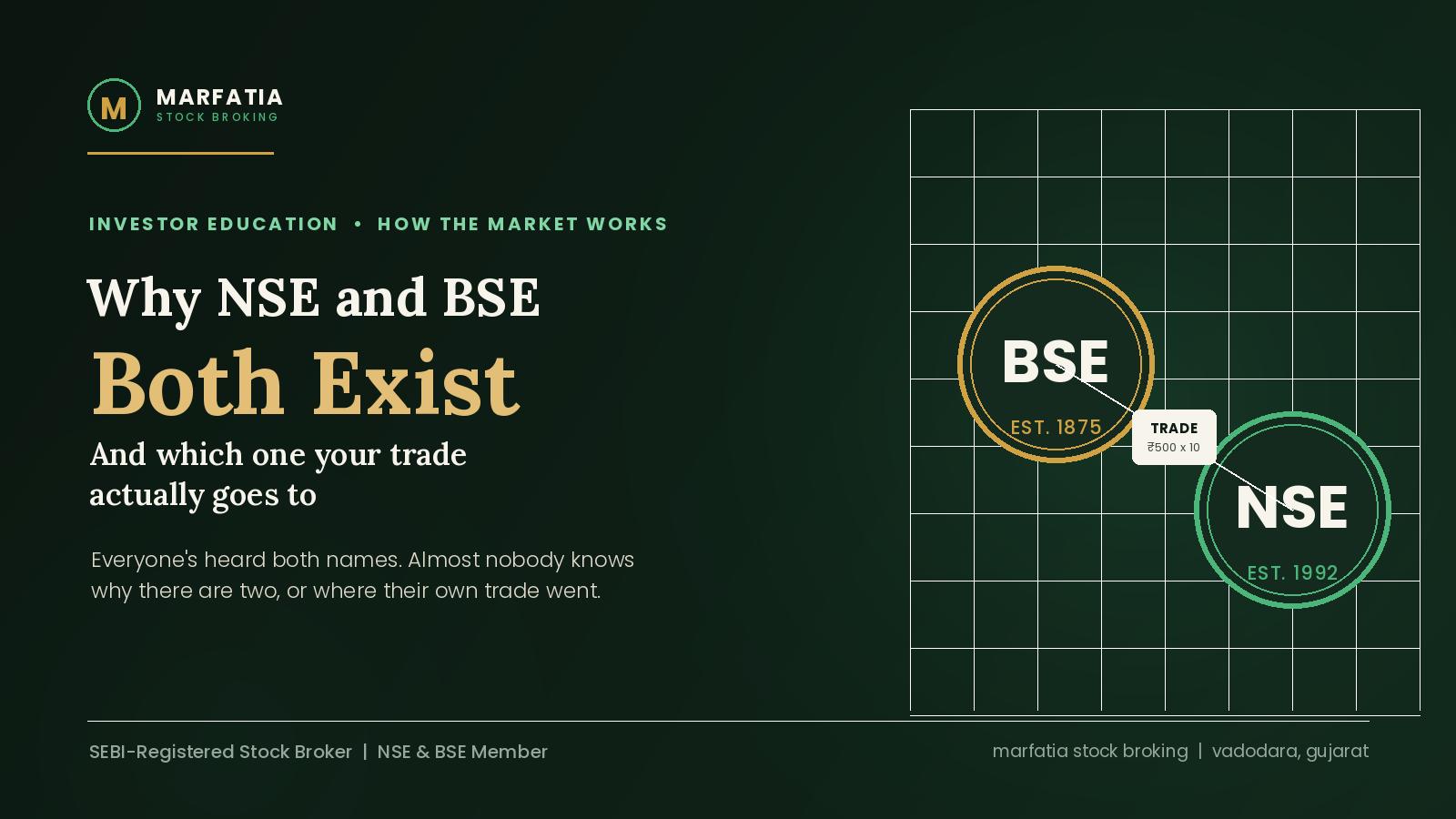
Why NSE and BSE Both Exist — And Which One Your Trade Actually Goes To
Every Indian investor has heard both names, and almost none can say why there are two, or which one their own money actually passes through. Here is the story of India's two stock exchanges — and the honest answer to where your last trade really went.
Introduction
“The Sensex is up.” “The Nifty hit a new high.” Every Indian investor has heard both phrases, which quietly means every Indian investor has heard of both BSE and NSE — the two exchanges behind those two numbers. And yet ask most people why there are two stock exchanges at all, or which one their own last trade actually went through, and you will usually get a shrug.
It is a perfectly reasonable gap to have, because nobody ever explains it plainly. So here is the plain version: why both exchanges exist, how they differ, and — the question with the genuinely surprising answer — which one your trade actually goes to when you tap “buy.”
Two Exchanges, One Country
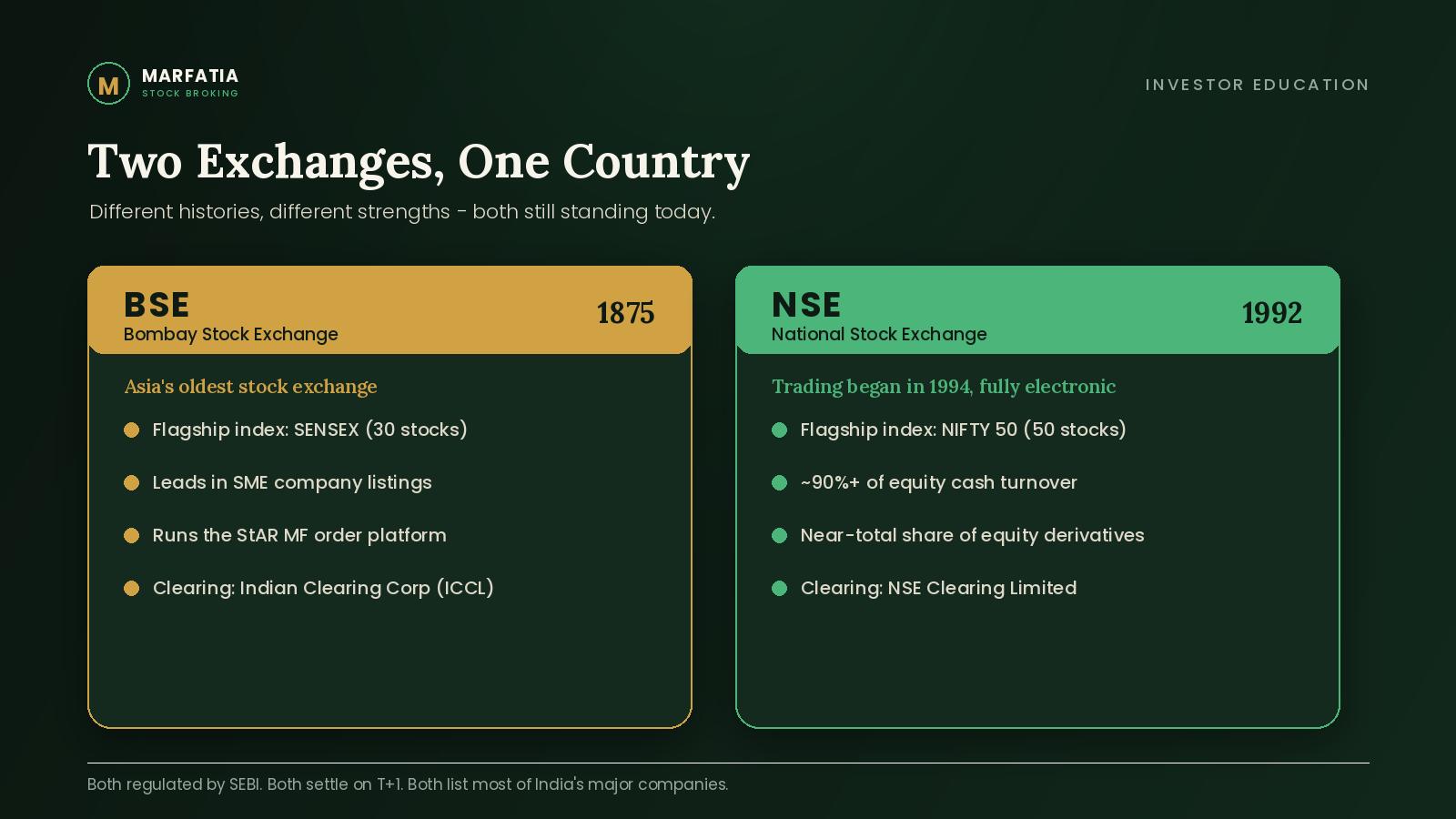
A stock exchange is simply a regulated marketplace where buyers and sellers of shares meet, and India has run with two of them for decades. The BSE (Bombay Stock Exchange) is the elder of the pair — founded in 1875, it is Asia's oldest stock exchange, older than many countries' entire modern financial systems. The NSE (National Stock Exchange) is far younger, founded in 1992 and operational from 1994, built from the outset as a fully electronic exchange.
That age gap explains a lot of what followed. BSE carries the heritage and the iconic Sensex — its 30-stock benchmark index. NSE arrived later with modern technology and grew rapidly on the back of it, building the Nifty 50, its own 50-stock benchmark. Today, both are regulated by SEBI, both settle trades on the same T+1 cycle, and both list most of India's major companies — which is precisely why the natural question is: if they overlap so much, why do investors need both?
Why Both Still Exist
The honest answer is that they no longer compete on equal footing across the board — they have settled into different strengths, and both remain genuinely useful for different reasons.
Two exchanges, one country: BSE and NSE, side by side.
NSE has become the dominant venue for mainstream trading: it commands roughly 90% or more of equity cash market turnover and close to the entirety of equity derivatives trading, making it the practical default for most retail and institutional activity. BSE, meanwhile, has carved out real strength elsewhere — it leads decisively in SME company listings and runs the StAR MF platform, a major channel through which mutual fund orders are placed across India. BSE also lists thousands of smaller companies that never list on NSE at all, so for those stocks, BSE isn't an alternative — it is the only venue.
What Actually Differs Between Them
Strip away the history and the numbers, and the practical differences come down to a handful of things worth knowing.
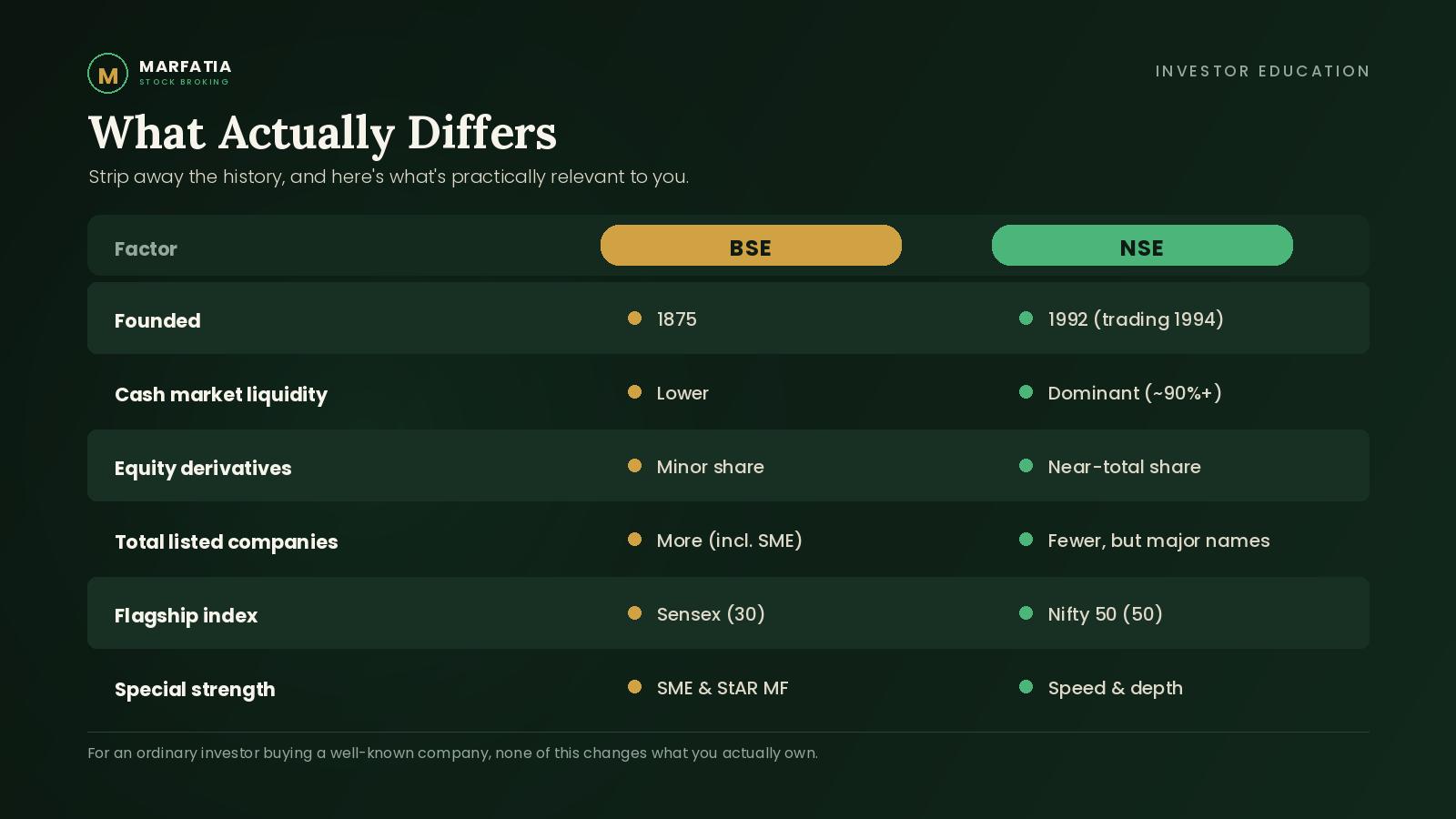
BSE and NSE, compared on what actually matters to an investor.
Liquidity is the biggest one: NSE's larger volumes generally mean tighter spreads and faster fills for widely-traded stocks. Listed companies tell the opposite story — BSE lists far more companies in total, largely because of its deep SME segment. Each has its own flagship index — Sensex on BSE, Nifty 50 on NSE — and its own clearing corporation working behind the scenes to guarantee trades. For an ordinary investor buying a large, well-known company, none of this changes what you actually own — a share is the same share, regulated the same way, wherever it trades.
Which One Does Your Trade Actually Go To?
Here, finally, is the question with the answer most people never learn. For a company listed on both exchanges — the case for the vast majority of well-known stocks — your broker's system decides, trade by trade, typically routing to whichever exchange offers the better price and depth at that exact instant. In practice, that usually means NSE, simply because it usually has the deeper order book.
But you are rarely locked in. Because a company's shares are fungible once they sit in your demat account, you can often buy on one exchange and sell on the other for the very same holding — the depository doesn't care which exchange a trade happened on, only that it settled correctly. For a dual-listed stock, the price on both exchanges is almost always nearly identical, generally within a few paise, because arbitrage traders close any meaningful gap within seconds. So the honest answer to “which exchange did my trade go to?” is: almost certainly NSE, unless you traded a BSE-only company — but it rarely matters which one, because your ownership, your rights, and your protections are identical either way.
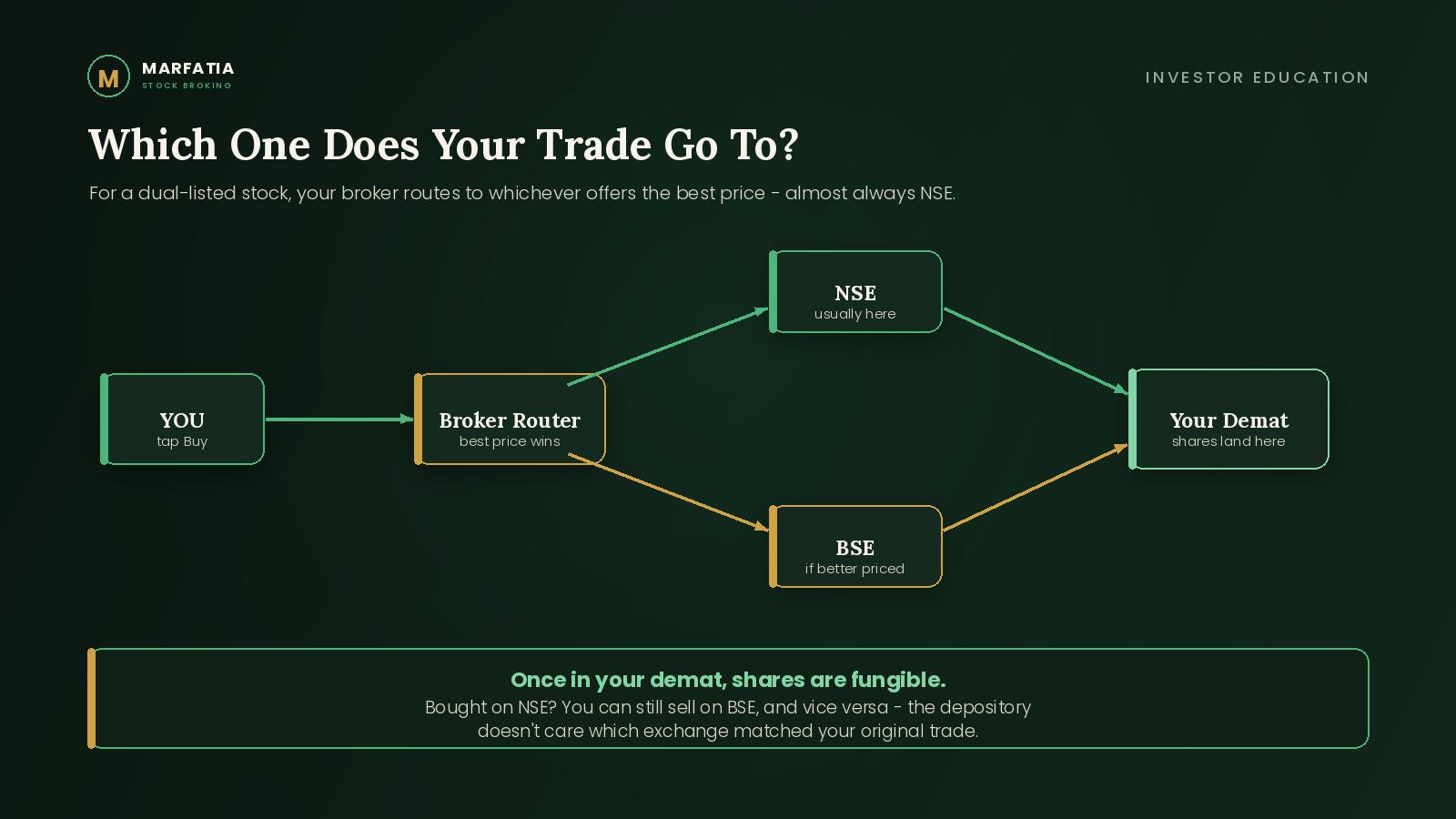
Bought on one exchange, sold on the other — the shares don't care, and neither should you.
Theonethingworthremembering
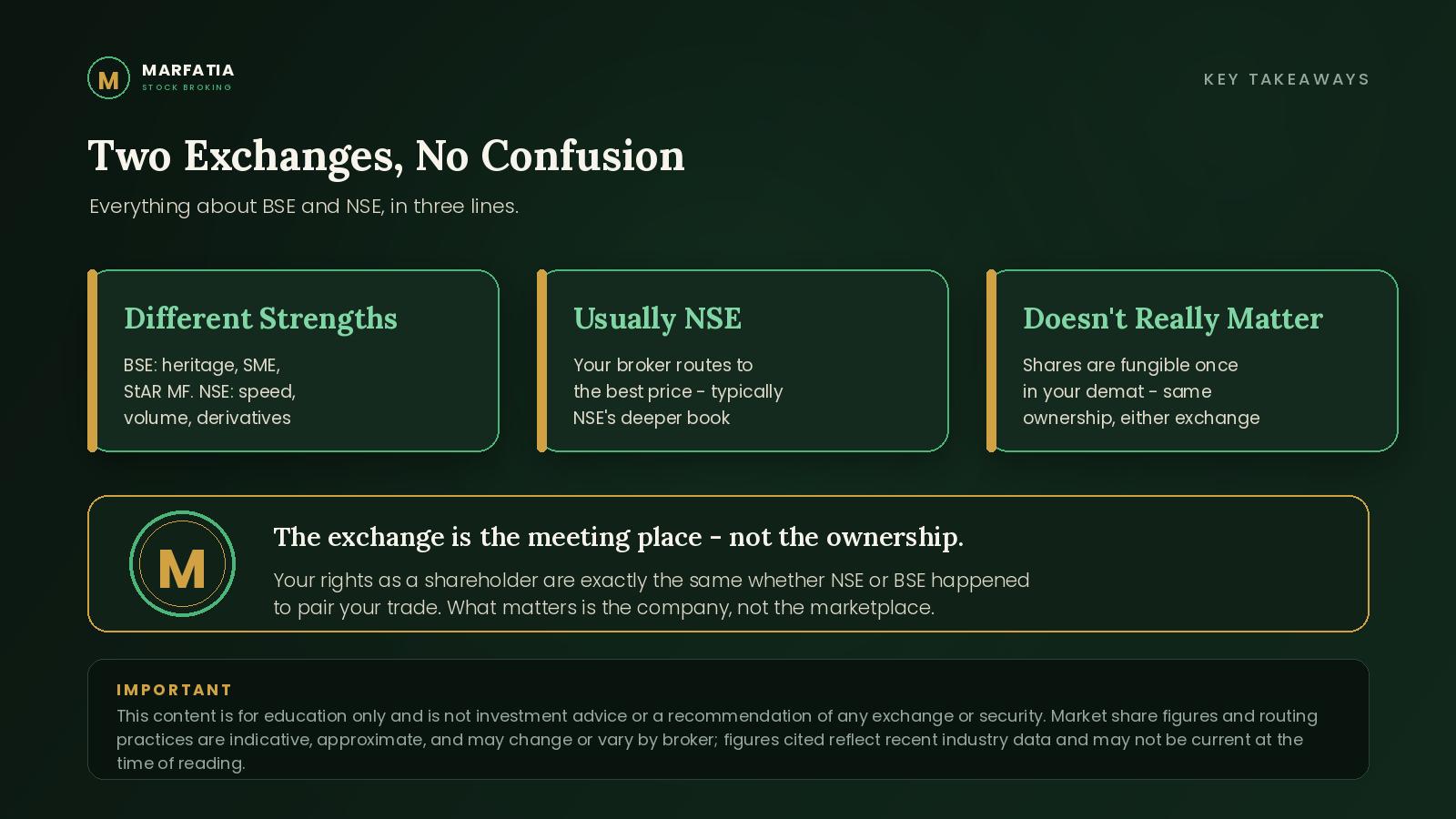
A share is a share, regardless of which exchange matched your order. The exchange is the meeting place, not the ownership — your rights as a shareholder are exactly the same whether NSE or BSE happened to pair your trade.
Frequently Asked Questions
WhydoesIndiahavetwostockexchanges?
BSE and NSE developed at different times — BSE in 1875, NSE in 1992 — and have settled into different strengths. NSE dominates mainstream cash and derivatives trading volume; BSE leads in SME listings and mutual fund order routing through its StAR MF platform. Both remain useful, so both continue to operate.
Whichexchangedoesmystocktradeactuallyexecuteon?
For a stock listed on both exchanges, your broker's system typically routes to whichever offers the better price and liquidity at that moment — in practice, this is usually NSE, given its deeper order books for most large stocks.
DoesitmatterwhichexchangeIbuyorsellon?
For most well-known, dual-listed stocks, it rarely matters. Prices are nearly identical across both, and once shares are in your demat account they are fungible — you can typically sell on either exchange regardless of where you originally bought.
WhatisthedifferencebetweentheSensexandtheNifty50?
The Sensex is BSE's benchmark index, tracking 30 major companies. The Nifty 50 is NSE's benchmark index, tracking 50 major companies. Both are widely used as a shorthand for “how the market is doing,” though they track different, overlapping baskets of stocks.
AreBSEandNSEequallysafe?
Yes. Both are regulated by SEBI, both operate their own clearing corporation to guarantee trade settlement, and both follow the same T+1 settlement cycle. The difference between them is liquidity and specialisation, not safety.
A Final Word
BSE and NSE are not rivals fighting over the same ground so much as two institutions that found different ground to stand on — one carrying 150 years of history and a deep small-company ecosystem, the other built for speed and now carrying the bulk of the country's daily trading volume. Both are healthy, both are regulated, and both quietly do their job every single trading day.
For your own trades, the honest takeaway is reassuring in its simplicity: you don't need to choose an exchange, and in almost every case, you don't need to worry about which one your order found its way to. What matters is the company you bought into, not the
marketplace that matched your order. As always, this is general education, not investment advice — consult a SEBI-registered professional for guidance suited to your own situation.
AboutMarfatiaStockBroking
Marfatia Stock Broking Pvt. Ltd. is a SEBI-registered stockbroker and depository participant — a member of the NSE and BSE — headquartered in Vadodara, Gujarat, serving investors since 1994. We believe understanding the market's plumbing builds real investor confidence. “We Don’t Guide, We Share. We Don’t Compete, We Lead.”
IMPORTANT—STATUTORYDISCLAIMER
Investments in the securities market are subject to market risks. Read all the related documents carefully before investing. This article is for educational and informational purposes only and does not constitute investment advice or a recommendation of any security, exchange, or trading venue. Market share figures, index compositions, and order-routing practices are indicative, may change over time, and can vary by broker and instrument; figures cited reflect approximate, recent industry data and are not guaranteed to be current at the time of reading. Please consult a SEBI-registered professional before making any investment decision.