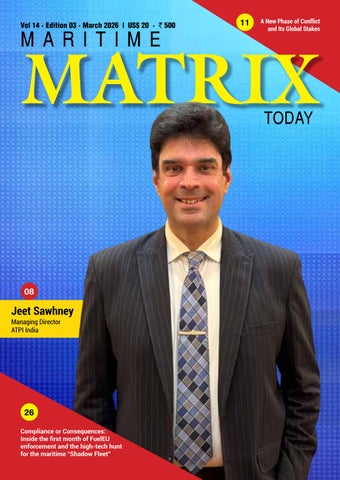
MARITIME MATRIX


![]()


A New Phase of Conflict and Its Global Stakes
11 15 28 20 31 22

Maritime Leaders Converge at IME(I) Annual Technical Seminar and Dinner 2026
Industrial Corridors Transform India’s Logistics Landscape as Key Projects Near Full Capacity
Loss prevention in challenging times
Maritime Ambitions Take Centre Stage: India’s Renewed Push to Elevate the Blue Economy
26
Disclaimer
Compliance or Consequences: Inside the first month of FuelEU enforcement and...
Waterways Expansion: 20 New National Waterways to Rebalance India’s Cargo Transport
A Life at Sea: Reflections on a Lifetime in the Maritime Profession
Traditional Financial Reporting Challenges in a Data-Driven World
The Maritime Union of India (MUI) Women’s Wing Engages Community Through...
All advertisements in this magazine are placed with no liability accepted by the publisher for the material content therein. No responsibility is accepted by the publisher for omission or error or non-insertion of any advertisements. All advertisements and material in this magazine are subjected to approval by the publisher and are not necessary the opinion of the publisher. No liability is accepted for advertisements that are placed or any information that might be criminally connected. All information is checked to the best of our knowledge and is reliant upon the material submitted not being in contravention of all relevant laws and regulations and within the provisions of the Trade Practices Act.
Reproduction Prohibited
Maritime Matrix Today will not be responsible for the views expressed by contributors in their personal capacity. All rights reserved. Reproduction in part or whole without the permission of the Editor is prohibited.
Readers are recommended
To make appropriate enquiries before sending money, incurring expenses or entering into any commitment in relation to any advertisement published in this publication. Maritime Matrix Today does not vouch for any claims made by the Advertisers of Products and Services. The Printer, Publisher, Editor and Owner of Maritime Matrix Today shall not be held liable for any consequences, in the event such claims are not honoured by the Advertisers.
RNI: MAHENG/2013/50159
Published by Marex Media Pvt Ltd C-209, Morya House, New Link Road, Andheri West, Mumbai 400058 Email: info@marexmedia.com
by
• Seaspan technology continues to be a leader in the industry, setting high environmental goals
• Our fleet of Dual Fuel Vessels with Membrane & Type B Tanks sets us up for a strong future
• MAN ‘ME-GI Mark 2’ Main engines, a step further than present generation of main engines
• The ‘EGR (Exhaust Gas Recirculation)’ as well as ‘SCR (Selective Catalytic Reactors)” as means to bring down NOx emissions to Tier III levels

• COPES Company e-learning training platform completed from the comfort of your home
• Gender friendly accommodation facilities
• Female Engagement Champions across offices worldwide
• Quality growth
• Low LTIF & High retention
• Wages in top Quartile, and consistent operational excellence

As 2026 unfolds, the global maritime landscape is defined by a paradox: while international waters grow increasingly fragmented, India is steadily consolidating its position as a rising maritime power. A renewed focus on maritime heritage, the expansion of inland logistics, and the onset of stringent green regulations such as FuelEU Maritime together signal a decisive “blue shift” in India’s strategic outlook.
India is no longer treating its coastline and river systems as passive assets. The operationalization of 20 new National Waterways including the ₹12,000-crore NW-5 project in Odisha marks a structural transformation of the country’s logistics network. By connecting mineralrich regions such as Talcher with major ports like Paradip and Dhamra, the initiative targets India’s long-standing “logistics tax,” reducing the high cost of freight movement that has constrained export competitiveness.
This effort is reinforced by the expansion of industrial corridors. The newly announced East Coast Industrial Corridor node at Durgapur highlights a shift toward integrated multimodal logistics, where rail, industrial clusters, and inland waterways operate in tandem. The broader objective is to raise the share of inland and coastal shipping from 6% to 12% by 2047, an outcome that strengthens both economic efficiency and supplychain resilience.
Yet these domestic developments are unfolding amid growing volatility in global trade routes.Rising geopolitical tensions around the Strait of Hormuz—through which nearly one-fifth of the world’s oil passes, underscores the vulnerability of energy supply routes that are critical to
India’s economy. For a country that imports over 80% of its crude oil, stability in this corridor is not merely a strategic concern but an economic imperative.
In response, India is advancing a strategy of Atmanirbhar (self-reliant) shipping. The ₹10,000-crore Container Manufacturing Assistance Scheme aims to strengthen domestic shipping capacity and reduce dependence on external carriers. In an era of contested sea lanes, control over maritime logistics has become a strategic necessity.
At the same time, the enforcement of FuelEU Maritime regulations signals a global transition toward lowcarbon shipping. With the 2% reduction in greenhousegas intensity now in force, the “polluter pays” principle is increasingly shaping maritime economics. For India, this transition presents an opportunity to leapfrog traditional infrastructure by investing in green hydrogen hubs near ports and hybrid-electric vessels for inland waterways.
Even the renewed emphasis on maritime heritage from the restoration of ancient ports such as Lothal—serves a strategic purpose. It reconnects modern policy with India’s long seafaring history, reinforcing the narrative of a nation rediscovering its maritime identity.Taken together, these initiatives reflect more than isolated reforms.
Kamal Chadha Group CEO kamal@marexmedia.com
Shirish Kirtane
HOD Graphics shirish@marexmedia.com
Radhika Vakharia CEO & Editor radhika@marexmedia.com
Santosh Nivalkar Sr. Graphic Designer santosh@marexmedia.com
Delphine Estibeiro Editorial Coordinator delphine@marexmedia.com
Manish Malve
Graphic Designer manish@marexmedia.com
Jagdamba Pandey Manager, Business and Promotion jagdamba@marexmedia.com
Bhavna Pimpale Coordinator bhavna@marexmedia.com

With nearly three decades of experience across airlines, technology, and travel services, Jeet Sawhney, Managing Director of ATPI India, has built a career defined by scale, resilience, and leadership in complex travel ecosystems. From senior roles at KLM Air France, VFS, Sabre, and Tripjack, to steering ATPI India today, his journey reflects both operational expertise and a commitment to sustainability, education, and thoughtful application of technology.
Jeet Sawhney Managing Director
In an in-depth conversation with Delphine Estibeiro of Marex Media, Mr Sawhney shared his vision for ATPI India—covering priorities from streamlining travel in India’s complex market to embedding sustainability, strengthening risk management, and building a legacy of trust and care. His insights reveal how ATPI India is aligning global objectives with local realities, leveraging integrated technology strategies, and delivering measurable gains for clients and partners.
My first priority is building on the foundations of ATPI India in a way that allows us to evolve, not just scale. India is a complex, high-pressure travel environment, and for too long the industry has relied on people compensating for fragmented systems and inconsistent processes. That isn’t sustainable for clients, travellers, or teams.
So, the focus has been on getting the fundamentals right: modernising how travel programmes are operated, aligning technology and service so they actually work together locally, and making sure our teams are set up to support clients confidently when conditions change. This isn’t about deploying more tools; it’s about creating a more resilient, predictable operating model that clients can trust.
Equally important is investing in people and leadership. Technology can remove friction, but it’s our people who create confidence, especially in moments that matter. My goal is for ATPI India to be known as a partner that combines modern technology infrastructure with deep local expertise and genuine care by helping clients move from managing travel reactively to using it as a strategic enabler for their business.
For us, it is about modernising the foundations of corporate travel so programmes work intelligently at a global level, while remaining practical and reliable on the ground in India. That means preserving what has always differentiated ATPI and Direct Travel: experienced local teams, responsive service, and a deep understanding of how travel actually operates day to day.
India is not a one-size-fits-all market. Fare dynamics, lowcost carrier ecosystems, visa dependencies, tax structures, and frequent last-minute changes require systems and teams that can adapt quickly. We address this through a dual online booking tool (OBT) strategy that blends global governance with local optimisation.
Global OBTs provide multinational clients with consistency, visibility, and auditability for international travel. At the same time, our India-specific OBT is designed around local content,
GST compliance, LCC ancillaries, and operational workflows unique to the Indian market. Both are fully integrated with GDS platforms and aligned to corporate travel policies, ensuring data integrity across programmes.
This approach drives higher adoption, greater operational flexibility, and stronger cost outcomes for clients. It also allows us to deliver globally aligned programmes without compromising on the responsiveness and local expertise that Indian corporates expect.
Our technology strategy is centred on integration and execution, not standalone tools. At the core is ATPI Travel Hub, a single, integrated command centre that brings bookings, policy, approvals, duty of care, and analytics into one secure environment, giving clients greater visibility and control across their travel programmes.
AI-driven analytics provide real-time insight into spend, emissions, and policy compliance, while integrated traveller tracking and alerting strengthen duty of care through live location visibility and risk notifications. ATPI eProfile securely manages traveller data in one place, reducing errors and improving the end-to-end travel experience.
Overall, our focus is on using AI and integrated platforms to improve traveller safety, operational efficiency, and programme performance, rather than adding complexity.
Sustainability is a strategic requirement, not an optional initiative. At ATPI India, we embed sustainability through data-driven platforms like ATPI Analytics and ATPI Halo, which give organisations clear visibility into the carbon footprint of their travel by route, traveller, and travel type. This insight enables informed decision-making without compromising operational needs. This data-led approach supports ESG reporting, responsible supplier selection, and long-term sustainability goals.
A strong recent example is our work with PayPal India. The client was managing high volumes of offline bookings, which led to compliance gaps, fragmented reporting, and limited confidence in management information.
We implemented a customised, India-specific online booking solution, supported by targeted implementation and training programmes and streamlined approval workflows. The focus was on relevance, accuracy, and ease of use to drive genuine
adoption. As a result, online adoption increased from 60% to 90%, enabling automated policy enforcement, improved realtime management information, faster approvals, and higher traveller productivity. Compliance improved significantly, restoring confidence across finance, travel, and leadership stakeholders.
Supporting large, complex events and global travel programmes requires a proactive approach to risk and operations. We have strengthened real-time traveller tracking combined with International SOS API integration, giving our teams continuous risk intelligence and immediate access to emergency support. This enables earlier intervention, clearer decision-making, and stronger duty of care across multimarket programmes.
Operationally, all 24x7 support is delivered in-house through our World Support Centre in Mumbai, where highly trained specialists act quickly to rebook flights, arrange alternatives, and secure inventory during disruptions. For senior leadership and mission-critical travel, we provide VVIP white-glove handling with end-to-end journey monitoring, ensuring continuity, safety, and confidence even in highpressure situations.
The legacy I hope to leave at ATPI India is a business that is trusted for doing the fundamentals exceptionally well while being ready for what comes next. I want ATPI India to be known as a partner that modernised the foundations of corporate travel without losing the human judgment, care, and accountability that clients and travellers depend on.
For our clients, the message is simple: travel should feel easier, more predictable, and more supportive over time. Our role is to reduce complexity, bring clarity through data and technology, and stand behind our programmes when conditions change. We measure success not by how much technology we deploy, but by how confidently our clients can operate and how well their travellers are supported.
For our partners, my message is one of long-term collaboration. We believe the future of corporate travel will be built through open ecosystems, shared standards, and a commitment to service excellence. When technology, people, and partnerships are aligned, everyone wins and that’s the kind of legacy worth building.

In late February–March 2026 , a significant escalation occurred in the longstanding geopolitical tensions between Iran and Israel , involving direct military action by the United States and Israel against Iran’s territory and military targets . This confrontation quickly triggered retaliatory strikes from Tehran, extending across the Persian Gulf, the broader Arabian Sea, and potentially into neighbouring regions. Unlike the previous, more latent phases of hostilities (often characterized by proxy engagements, diplomatic tussles, and limited military engagements), this current escalation that is sometimes described in the media and policy analysis as the 2026 Strait of Hormuz crisis has spilled into a full-blown security crisis , reverberating far beyond the immediate theatres of conflict.
The maritime sector and global logistics networks are at the epicenter of these repercussions because they hinge on predictable, secure passage through a handful of strategic choke points , above all the Strait of Hormuz . The disruptions emerging here intersect directly with energy markets, freight operations, insurance markets, and global supply chains .
Strategic Chokepoints in Global Shipping
The Strait of Hormuz sits at the crossroads of global energy supply and maritime trade. It links the Persian Gulf with the Gulf of Oman and the Arabian Sea , serving as the main outlet for petroleum and liquefied natural gas (LNG) shipments from Gulf producers. Before the conflict’s escalation, roughly 20% of the world’s crude oil and a significant share of LNG trade passed through this narrow waterway daily.
Other critical maritime corridors—like the Suez Canal and Red Sea —already faced heightened risks from earlier regional tensions, including Houthi militant attacks in previous years. These corridors collectively handle an enormous proportion of container, bulk, and energy trade connecting Asia, Europe, Africa, and the Americas.
Since 28 February 2026 , coordinated U.S. and Israeli strikes against Iranian military infrastructure prompted a swift Iranian response that has included:
• Missile and drone attacks against U.S. military bases and allied positions across the Gulf.
• Warnings issued by the Islamic Revolutionary Guard Corps (IRGC) effectively prohibiting neutral commercial vessel transits through certain parts of the Strait of Hormuz.
• Reports of missile strikes and maritime skirmishes targeting commercial vessels and tankers.
This has created an unprecedented security environment for merchant shipping , complicating routine navigation and prompting insurance and risk responses unprecedented in recent times.
Maritime and Logistics Disruptions
Sharp Drop in Strait of Hormuz Transits - Despite no formal legal closure of the strait, warnings from Iranian forces and military risk have led many shipping lines and carriers to avoid or sharply scale back transits. Vessel monitoring data indicate traffic reductions by significant margins (reports suggest drops of over 70% in some segments). Governments and maritime authorities have raised security threat levels in the strait and adjacent waters to the highest alerts. Even where passage is not formally barred, perceived risk—military warnings, potential for missile engagements, and naval operations— has effectively discouraged commercial traffic .
Insurance Market Shock and War Risk Coverage - One of the most pronounced immediate effects has been in the maritime insurance sector. Large war-risk insurance providers have withdrawn coverage for certain parts of the Gulf and adjusted high-risk zone boundaries. War risk surcharges on containers and tankers have soared as carriers price in the rising threat. In practical terms, this means that any vessel passing through or close to the conflict zones now faces a significant premium , sometimes several times higher than in peaceful conditions. These costs are typically passed on to shippers, exporters, and ultimately customers.
Comparative war-risk insurance premium indices across major maritime regions, highlighting the sharp escalation in costs for vessels transiting the Persian Gulf and the Strait of Hormuz during the US–Iran–Israel conflict.

Shipping Reroutes and Transit Times - With the Gulf and Strait of Hormuz fraught with risk, many carriers are rerouting vessels around the Cape of Good Hope. This circumvents the Gulf, Red Sea, and Suez Canal routes in favor of southern Africa. The result is extended transit times , often adding 10–20 days for Asia-Europe and Asia-North America trade lanes.
The implications of rerouting are profound because:
• Bunker fuel consumption increases , raising costs for freight carriers.
• Vessel capacity is effectively reduced , since ships are at sea longer and make fewer voyages per year.
• Port schedules and slot planning across major hub ports are disrupted , exacerbating congestion and delays.
This kind of systemic slowdown has cascading effects throughout global logistics networks, especially for industries relying on tight schedules (e.g., retail, automotive, electronics).
Port Operations and Regional Disruptions - Certain ports in the Middle East have already reported temporary suspensions of operations or partial closures due to security concerns. Backlogs and congestion as vessels wait for sea lanes to reopen or for alternative routing decisions. Even ports that remain technically open are struggling with delays in tug operations, pilotage, and crew change
Fuel and Energy Markets - The maritime disruption has immediate knock-on effects for energy prices .The loss of efficient crude and LNG export capacity forces markets
to adjust to reduced flows. Even anticipatory price spikes lead to higher energy costs worldwide, affecting industrial and consumer markets. Since maritime transport is itself a major consumer of fuel, higher bunker prices feed back into freight charges , creating a cost spiral.
Cost Pressures on Freight and Supply Chains - Beyond energy, the logistics sector broadly is feeling cost inflation. Increased freight rates due to rerouted ships and reduced available capacity is worrying. War risk and insurance surcharges levied on cargo exports, raising the cost baseline for global trade is significant. Longer transit times can disrupt just-in-time delivery systems, important for sectors like manufacturing and high-tech goods. For exporting nations, especially those heavily dependent on Middle Eastern trade routes, the cost increases are consequential. Companies may find it harder to compete on price if logistics costs become a structural disadvantage.
Sectoral Supply Chain Impact - The knock-on effects extend into specific sectors:
• Automotive longer wait times for parts sourced internationally, especially from Asia.
• Electronics and semiconductors time-sensitive components may miss critical production windows.
• Pharmaceuticals and perishables supply strain risks shortages in certain regions.
• Commodities and foodstuffs delays or higher shipping costs can impact global food security and inflation.
Regional and National Exporters Facing Rising RiskCountries with strong export engagements via the Gulf are already registering concerns. Indian exporters, for instance, note higher freight rates, longer delivery times, and insurance cost spikes. Delays affect trade documents, letters of credit, and cash flows. These pressures may feed into larger macroeconomic issues like currency instability and inflationary pressure in economies that rely on imported freight inputs.
The unfolding conflict between the United States, Iran, and Israel has moved quickly from a regional geopolitical confrontation into a global logistics and maritime security challenge . The disruption of the Strait of Hormuz, combined with rising insurance costs, rerouted shipping, and stressed supply chains, illustrates just how central maritime routes are to the modern global economy. This crisis is a stark reminder that geopolitics and trade are tightly interlinked. When a vital shipping corridor becomes a conflict zone, the effects radiate outwards—

touching energy markets, international freight, exporter profitability, and the cost of goods for consumers around the world. For businesses, governments, and international organizations, the immediate priority is risk mitigation
and adaptive logistics planning. But in the longer term, this conflict may reshape global shipping routes, insurance markets, and logistical strategies for years to come.


Mumbai’s maritime fraternity came together in a remarkable display of knowledge, collaboration, and professional camaraderie at the Annual Technical Seminar and Dinner 2026 hosted by the Institute of Marine Engineers (India) Mumbai Branch. Held on 27th February 2026 at the MCA Club, BKC, Mumbai , the prestigious event was organised jointly with the Navi Mumbai and Gujarat Chapters and brought together distinguished leaders from across the maritime and shipping industry.
The gathering served as a dynamic platform for maritime professionals, regulators, technology providers, and ship operators to exchange ideas and discuss the evolving landscape of the global shipping sector. With participation from senior officials of the Directorate General of Shipping and leading industry organisations, the seminar underscored the growing importance of innovation, regulatory alignment, and collaborative progress in maritime operations.
A highlight of the seminar was the engaging panel discussion titled “Compliance Without Complexity: How Smart Performance Monitoring Is Changing the Shipping Industry.” The discussion explored how emerging digital tools and intelligent monitoring systems are reshaping operational efficiency and regulatory compliance within the maritime sector.
The panel brought together experts from globally recognised maritime organisations including StormGeo, Danelec, The Great Eastern Shipping Company, Shipping Corporation of India and Anglo-Eastern Maritime Services. Their insights provided valuable perspectives on the role of data-driven technologies in improving vessel performance, ensuring sustainability, and simplifying complex compliance frameworks.
The seminar was presided over by Shri Kaushik Seal, President of IME(I) , in the presence of Shri Sanjeev V. Mehra, Honorary Chairman of IME(I) Mumbai Branch and Managing Director of Kenmark Tech Solutions . Addressing the gathering, Shri Sanjeev V. Mehra highlighted the importance of stronger collaboration between regulators, technology innovators, and ship operators to build transparent and efficient compliance
systems that support the industry’s growth. The programme was seamlessly anchored by Ms. Archana Sangal, who served as the Master of Ceremony and guided the audience through an informative and well-structured agenda.
Technical presentations during the seminar covered a broad spectrum of developments shaping India’s maritime sector, including the five new maritime Acts passed in Parliament , advancements in ship recycling , shipbuilding initiatives , and financial assistance schemes designed to strengthen the shipbuilding industry.
The seminar featured an impressive line-up of eminent speakers and industry specialists who shared their expertise and perspectives. These included:
* Shri Pradeep Sudhakar K., Chief Ship Surveyor and Joint Director General (Technical)
* Shri Ash Mohomad, Deputy Director General of Shipping
* Ms. Ritu Chaudhri, Director, Enmarol Petroleum India Private Limited
* Shri Gopikrishna Chockalingam, Engineer & Ship Surveyorcum-Deputy Director General (Tech.)
* Shri Ankur Anal, Junior Ship Surveyor-cum-ADG (Tech.), DG Shipping
* Mr. Petter Andersen, Vice President Shipping, StormGeo
* Mr. Antoni Therattil, General Manager (Operations) –MENA & APAC, StormGeo
* Mr. Espen Martinsen, Chief Commercial Officer, StormGeo
* Mr. Ankeet Shetty, Sales Manager, Danelec, a GTT Group Company
* Mr. Sudipto Mukherjee, Assistant Vice President – Head Technical, The Great Eastern Shipping Co. Ltd.
* Mr. Anupam Gangrade, Senior Manager – Sustainability and Performance Services, Anglo-Eastern Maritime Services
* Shri Shishir Kumar, General Manager (OS), Shipping Corporation of India Ltd.
Their presentations provided deep insights into regulatory developments, operational performance optimisation,

sustainability initiatives, and digital transformation within the maritime ecosystem.
The occasion also celebrated excellence within the marine engineering community. The prestigious Omkanath & Chunni Wazir Awards were presented to Mr. Naresh Nanda, Senior Fellow Member of IME(I) in recognition of his outstanding contributions to the academic field.
A significant milestone of the event was the signing of a Memorandum of Understanding (MoU) between IME(I) and the Indian Maritime University, Navi Mumbai Campus , aimed at conducting practical training programmes for IGF students. The MoU signing ceremony took place in the presence of:
* Dr. Malini V Shankar (IAS), Vice Chancellor, IMU
* Capt. Mihir Chandra, Director, IMU Navi Mumbai Campus
* Shri Kaushik Seal, President, IME(I)
* Shri Vivek Diwakar Prasad, Hon. General Secretary, IME(I)
* Shri Mohan Singh Pal, Director, MET, IME(I)
This collaboration reflects a shared commitment to strengthening maritime education and enhancing practical training opportunities for the next generation of marine engineers. The event witnessed active participation from office bearers of IME(I), including Shri Vivek Diwakar Prasad, Honorary General Secretary IME(I); Shri Chitta Dash, Chairman, Navi Mumbai Chapter; Shri Puru Bakshi, Treasurer, Gujarat Chapter; Shri Sunayan Sanatani, Honorary Secretary, IME(I) Mumbai Branch; Shri Lokanath Tripathi, Treasurer, IME(I) Mumbai Branch; and Executive Committee Members Shri P. Lakshman, Shri Bikram Jena, Ms. Sonali Banerjee and Capt. Dr. Bhaskar Bhandarkar (Retd.). The seminar concluded with a vote of thanks delivered by Shri Sunayan Sanatani, followed
by the presentation of mementoes to the Guests of Honour and speakers in appreciation of their valuable contributions.
Following the technical sessions, the celebrations continued with a gala Annual Dinner and Get-Together , jointly hosted by the Mumbai Branch along with the Navi Mumbai and Gujarat Chapters of IME(I). The evening offered a relaxed setting for industry leaders and professionals to connect, exchange perspectives, and strengthen professional relationships.
Mr. Sanjeev V Mehra, Chairman of the IME(I) Mumbai Branch , warmly welcomed the distinguished guests, office bearers, Executive Committee Members and representatives of the Governing Council of IME(I). In his address, he expressed appreciation for the enthusiastic participation and emphasised the importance of continued collaboration within the maritime community.
The event was graced by several eminent dignitaries including Shri Shyam Jagannathan, Director General of Shipping; Capt. B. K. Tyagi, Chairman and Managing Director of the Shipping Corporation of India Ltd.; Ms. Monica Ommundsen Nagelgaard, Consul General of Norway; and Shri P. K. Mishra, Managing Director of the Indian Register of Shipping.
The IME(I) Annual Dinner provided an ideal platform for marine engineers, policymakers, and maritime leaders to celebrate the achievements of the industry while reinforcing their shared commitment to its future growth. Marked by lively conversations, professional networking, and a spirit of unity, the evening concluded on a high note, leaving participants inspired and optimistic about the future of the maritime sector.
-MMT


Medlog has inaugurated its first integrated logistics park in Saudi Arabia, marking a significant milestone in the company’s Middle East expansion strategy. The new facility is designed to enhance supply chain efficiency, improve cargo handling capabilities, and support growing trade volumes across the region.
Strategically located to serve key industrial and consumption hubs, the logistics park offers a full suite of services, including warehousing, container storage, distribution, and value-added logistics solutions. The development aligns with Saudi Arabia’s broader efforts to strengthen its position as a regional logistics hub connecting Asia, Europe, and Africa.

Medlog stated that the project will enable faster cargo movement, greater supply chain resilience, and improved connectivity for regional and international customers. The opening
reflects increasing investment in integrated logistics infrastructure across the Middle East, driven by rising trade flows, e-commerce growth, and regional economic diversification initiatives.
Despite ongoing regional tensions, Emirates SkyCargo has expanded its operations in India with the launch of new dedicated freighter services to Mumbai and Ahmedabad this month. The move underscores the airline’s continued confidence in India’s export-driven growth and its strategic importance within global supply chains.
The additional services are designed to support India’s fast-growing manufacturing sector and booming e-commerce industry, providing increased cargo capacity and more reliable connectivity to key international markets. According to the airline, the new freighter flights will enable faster movement of high-value goods, including electronics, pharmaceuticals, textiles, and perishables.

India remains one of Emirates SkyCargo’s largest markets globally, and the expansion aligns with rising demand from exporters seeking resilient logistics solutions amid geopolitical uncertainty. The airline said it will continue to
monitor market conditions while investing in capacity that strengthens trade links between India and the rest of the world.
In a move aimed at accelerating the adoption of electric vehicles in the logistics sector, the Government of India has extended customs duty exemptions on key lithium-ion battery components until 2028. The decision is expected to lower input costs for electric vehicle manufacturers and logistics companies, supporting the wider rollout of electric delivery fleets across the country.The exemption covers critical components
used in the assembly of lithium-ion batteries, which account for a significant portion of an electric vehicle’s total cost. By easing import duties, policymakers aim to make electric delivery vans, two-wheelers, and three-wheelers more affordable for last-mile logistics operators.Industry stakeholders say the extension provides long-term policy certainty, encouraging investment in electric fleets and domestic battery

assembly. The move aligns with India’s broader push toward green logistics, reduced fuel dependence, and lower carbon emissions. As e-commerce and urban deliveries continue to expand, cheaper electric fleets are expected to play a key role in making logistics cleaner and more cost-efficient.
While global attention remains fixed on the Middle East, India’s domestic maritime infrastructure is registering record-breaking progress. Vizhinjam International Seaport in Kerala, developed by the Adani Group, has emerged as a major global transshipment hub. In January 2026, the port handled its highest-ever volume of 1.23 lakh TEUs, earning it the 83rd rank among container ports worldwide.The port’s momentum is set to accelerate

further with Phase 2 expansion, which began in late January 2026. Backed by an investment of ₹16,000 crore, the
Several new IMO (International Maritime Organization) regulations became mandatory this year, fundamentally changing how ships operate:
Electronic Inclinometers: All new container ships and bulk carriers (>3,000 GT) must now have electronic inclinometers to record “roll motion”—a
move to prevent the increasing trend of containers falling overboard.
Mandatory Reporting: Any lost containers at sea must now be reported immediately to coastal states via a new mandatory framework.
PFOS Ban: The use of firefighting foams containing PFOS is now strictly
expansion will more than double berth length to 2,000 metres.Meanwhile, Paradip Port in Odisha has received central approval for a ₹797 crore green hydrogen jetty to export green ammonia and hydrogen. Separately, V.O. Chidambaranar Port has partnered with Tata Motors to deploy 40 green hydrogenpowered trucks, marking India’s first large-scale realworld trial in port logistics.
prohibited on all new ships due to environmental toxicity.
Harassment Protocols: In a major win for seafarer welfare, STCW training now includes mandatory modules on recognizing and reporting sexual harassment and assault.

India’s ambitious push to modernise its logistics and industrial infrastructure is reaching a critical milestone, with major projects along its flagship industrial corridors nearing full operational capacity. Developments such as the Integrated Multi-Modal Logistics Hub (IMLH) in Haryana and the Delhi-Mumbai Expressway are expected to reduce transit times between major commercial hubs by nearly 50 percent, significantly reshaping the country’s supply chain efficiency.
At the heart of this transformation is the Integrated MultiModal Logistics Hub, strategically located near key industrial clusters in northern India. Designed as a single-window logistics ecosystem, the hub integrates road, rail, and warehousing infrastructure, enabling seamless movement of goods across regions. Once fully operational, the facility is expected to handle millions of tonnes of cargo annually, easing congestion at traditional logistics choke points and lowering overall transportation costs for businesses.
The IMLH is closely aligned with India’s broader industrial corridor strategy, which aims to create globally competitive manufacturing zones supported by world-class infrastructure. By co-locating logistics, warehousing, and value-added services such as packaging and cold storage, the hub is expected to attract manufacturers, third-party logistics providers, and e-commerce companies looking to optimise distribution networks. Complementing this development is the DelhiMumbai Expressway, one of the country’s most significant infrastructure projects to date. Spanning more than 1,300 kilometres, the expressway connects Delhi with Mumbai , cutting travel time between the two cities from nearly 24 hours to around 12 hours for freight vehicles. For logistics operators, this reduction translates into faster deliveries, lower fuel consumption, and improved asset utilisation.
The expressway’s impact goes beyond speed. Its accesscontrolled design, modern safety features, and dedicated

service roads are expected to improve reliability and reduce accident-related disruptions. For time-sensitive sectors such as automotive components, pharmaceuticals, electronics, and fast-moving consumer goods, these gains are critical in meeting tighter delivery schedules and maintaining inventory efficiency. Together, the IMLH and the Delhi-Mumbai Expressway form a powerful backbone for industrial corridors such as the Delhi–Mumbai Industrial Corridor (DMIC). These corridors are designed to link manufacturing centres with ports, airports, and consumption markets, creating an integrated production and distribution ecosystem. As transit times fall, companies can adopt hub-and-spoke models more effectively, consolidate warehousing, and reduce dependence on high inventory buffers.
E-commerce is among the biggest beneficiaries of these developments. With online retail continuing to expand rapidly across urban and semi-urban markets, faster and more predictable logistics routes are essential. Shorter transit times allow e-commerce firms to offer next-day or even same-day deliveries across wider geographies, improving customer satisfaction while controlling costs. Logistics hubs like the IMLH also support the growth of fulfilment centres closer to consumption zones, further enhancing delivery speed. Manufacturing exports are another area poised for significant gains. Improved connectivity between inland industrial clusters and western ports reduces lead times for exports and imports, strengthening India’s competitiveness in global supply chains. Export-oriented manufacturers can move goods more quickly to ports, while imported raw materials and components reach factories with fewer delays. This efficiency is particularly important as companies diversify supply chains and seek reliable alternatives in Asia.
The economic spillover effects are also substantial. Infrastructure projects of this scale generate employment during construction and create long-term jobs in logistics, warehousing, and ancillary services once operational. Improved connectivity is expected to boost investment in industrial parks, special economic zones, and urban centres along the corridor, contributing to balanced regional development. However, challenges remain. Ensuring last-mile connectivity from expressways and logistics hubs to smaller industrial units is critical to fully realising the benefits. Coordination between central and state agencies, timely completion of feeder roads, and effective land-use planning will determine how quickly businesses can leverage the new infrastructure. Environmental sustainability and community integration are also key considerations as industrial activity intensifies along these corridors.
Despite these challenges, the nearing completion of projects like the IMLH in Haryana and the DelhiMumbai Expressway marks a turning point for India’s logistics ecosystem. By cutting transit times nearly in half and creating integrated, multi-modal networks, these industrial corridor initiatives are laying the foundation for faster trade, stronger manufacturing growth, and a more resilient economy. As operations scale up, their real impact will be measured in how efficiently goods move across the country and how effectively India positions itself in global commerce.
-MMT

Shipping benefits from a structured response to the overlapping challenges brought by accelerating digitalisation, data-driven best practice, new fuels and emissions reporting, writes Capt. Aniruddha (Andy) Desai, Loss Prevention Director – Middle East, India & Africa, NorthStandard.
The recent International Maritime Organization pause on work to implement a Net Zero Framework (NZF) on emissions from ships underlines the key role regulatory scheduling plays in global shipping.
But, whether the one year postponement of a decision on the NZF foreshadows an indefinite delay or offers a breathing space to iron out practical challenges, it demonstrates once more that maritime regulators do not operate in a vacuum.
An IMO 2029 deadline for new ships to install a new type of ‘S-100’ electronic chart provides a different example of the need for owner circumspection on what regulators have in mind. This schedule relies on the completion of work by other standards bodies and ECDIS suppliers, for example, before full S-100 functionality can ‘go live’.
Both cases show that the finer points of regulation are not the only things on the move. As it shifts towards a new generation of marine fuels, shipping is also accelerating
Loss Prevention Director
Middle East, India & Africa, NorthStandard.
its use of digital tools, machine learning and AI in ways that transform planning, operations and reporting on the bridge and in the engine room. Both developments involve new procedures which also create the risk of crew skill gaps that can be hard to track.
Similarly, if better connectivity delivers clear benefits for fleet optimisation – as well as for crew welfare - it also increases a ship’s exposure to cyberattack risks.
While NorthStandard is not a training provider, it is a stakeholder committed to ensuring the preparedness and vigilance of Members and their crew in sustaining safety, environmental responsibility, security and operational effectiveness. The club draws on its experience of handling over 3,500 loss prevention enquiries each year across all major ship types to advise and support the response of Members to pain points in a fast-changing maritime world.
Against an unpredictable geopolitical backdrop, for example, NorthStandard’s ‘GlobeView’ maritime intelligence platform is seeing sharply increased use by Members as a tool offering immediate insights that help them navigate potential threats and plan voyages with greater confidence. GlobeView also offers seafarers key
information to mitigate risk on approaching a specific port.
Providing comprehensive information is also key to NorthStandard’s response to new fuels. The club offers web alerts, articles, briefings, podcasts and webinars to help Members navigate decarbonisation and understand its impact on contracts, charterparties, risk and liability.
Easy access to Analytics and AI
In addition, NorthStandard has worked with fuels analyst VPS to develop the one-of-a-kind Fuel Insights marine fuel quality platform. This offers Members actionable insights on bunkering fuels based on proprietary live data from VPS on availability and characteristics including various off-spec parameters in ports worldwide. NorthStandard is also partnering with BetterSea in promoting its digital FuelEU pooling platform.
Where advancing digitalisation is concerned, the club has brought several solutions to market to help Members meet the challenges of working with new technologies and procedures. Especially impactful has been its ECDIS Training Assessment (ETA) online tool, developed by NorthStandard’s Loss Prevention team with the UK Hydrographic Office to address concerns over usage of current ECDIS technology.
Already, around 7,000 deck officers have taken the multiple-choice format ETA, which identifies weaknesses or gaps in ECDIS skills by telling users not only when, but why they have given a wrong answer and allows them to undertake further learning on personal or company devices. Anonymised at the user level, consolidated ETA data generates fleet-wide reports to help owners identify areas that require targeted training.
NorthStandard has also partnered with SureNav to offer Members a 15% discount on a package of five remote navigational audits to assist bridge team management.
In another development which supports shipowners in identifying areas for training focus, NorthStandard was the first P&I club to work with Orca AI to deliver real time alerting and predictive insights for watchkeeper based on AI. Enhancing their ability to safely navigate through congested waters and challenging weather conditions, the Orca AI solution offers transparency on any safety gaps in fleet operations.
The capabilities of AI are also at the core of ShipIn FleetVision™, which monitors and analyses CCTV images in real time to detect and alert fleet managers of unexpected
on-board events, operational anomalies and machinery concerns that can undermine safety and efficiency.
Human conversations
While geopolitics, decarbonisation and digitalisation continue to drive change across the maritime industry, it is critical to recognise that ‘best practice’ also remains a human endeavour that requires attention to individual tasks.
NorthStandard and its Members continuously engage in broad-based discussions on the human behaviours which can compromise safety, for example where overly complex procedures invite unauthorised workarounds. Conversations on near miss reporting cultures can also prove fruitful, to establish whether seafarers are creating unnecessary reports or feel overly discouraged from critical reporting.
In support, NorthStandard’s enhanced pre-employment medical examination (PEME) helps uphold the crew health, wellbeing and fitness for duty that underpin best practice, while demonstrably reducing preventable illness claims. Its Loss Prevention services include a free and confidential Safety Culture Organisational Assessment (SCORA) to help Members evaluate their safety capacity.
Service delivery is also sensitive to the location of its Members and the vessels they own and/or operate. In the Middle East, India and Africa (MEIA), as elsewhere, Members are supported through published guidance, but also by its regional team. The Club’s MEIA membership represents approximately 10% of its gross mutual tonnage. To support this considerable market, the local team comprises over 30 members of staff including nine underwriting staff, eight lawyers, four mariners and Loss Prevention executives.
Current areas of focus in the region include container fires, electric vehicles, mooring, ‘CAN test’ training to identify liquefaction, and navigation issues arising from interactions between pilots and bridge teams.
In November 2025, NorthStandard presented a comprehensive “Safety Management 2.0” workshop in Dubai, attracting Members from Dubai, Abu Dhabi, Saudi Arabia and Qatar, addressing topics of special concern to its MEIA Members.
MMT

In a defining moment for India’s maritime sector, Shri Sarbananda Sonowal , Union Minister of Ports, Shipping & Waterways, recently inaugurated the VOC Maritime Heritage Museum at VOC Port in Tuticorin, Tamil Nadu, alongside laying the foundation stones for infrastructure and sustainability projects totaling over ₹1,500 crore. This landmark event not only celebrated India’s rich maritime legacy but also underscored the government’s renewed focus on modernising ports, integrating green technologies, and catalysing the maritime economy as a key engine for national growth.
The inauguration of the maritime museum is a significant cultural and historical milestone. Designed to preserve and showcase India’s centuries-old maritime traditions and the legacy of freedom fighter V.O. Chidambaranar, the museum aims to deepen public understanding of the nation’s sea-faring past while promoting tourism and community engagement.By bringing Indian maritime history to life, the government is fostering a sense of pride and awareness among citizens,especially younger generations about the country’s historic and strategic relationship with the oceans.
But this cultural celebration is only one facet of a broader government strategy. The museum launch was paired with announcements of transformative port infrastructure projects designed to future-proof India’s logistics ecosystem and position the country as a global maritime leader.
At the heart of these developments is a comprehensive push to modernise VOC Port into a next-generation maritime hub. The investment package unveiled at the event includes enhancements across multiple dimensions:
• Enhanced Connectivity: Upgrades to rail and road links will improve cargo evacuation and reduce bottlenecks in hinterland logistics, linking the port more seamlessly with industrial centres and economic corridors.
• Power and Energy Modernisation: In addition to conventional power infrastructure, the port will see integration of solar, wind, and battery storage systems, underscoring the ministry’s commitment to sustainable operations.
• Green Hydrogen and Renewable Energy: VOC Port is advancing renewable technologies, including onsite green hydrogen production facilities thus making it one of the first Indian ports to adopt such initiatives at scale. This aligns with wider national goals to decarbonise logistics and foster energy security.
• Digital Innovation and Security: Investments in digital twin systems—digital replicas of physical infrastructure for real-time monitoring—and advanced anti-drone systems reflect a forward-looking approach to port security and operational efficiency.
The focus on VOC Port is a mirror of larger, sustained efforts by the Ministry of Ports, Shipping & Waterways (MoPSW) to transform India’s maritime landscape. These initiatives flow naturally from flagship policies such as the Sagarmala Programme and Maritime Vision 2047, which envisage India as a globally competitive maritime hub driven by green technology, seamless logistics and port-led industrial growth. Under the Sagarmala Programme, the government has identified hundreds of port modernisation and connectivity projects worth several lakh crores, with many already completed or underway. These include development of multi-modal logistics parks, inland connectivity by rail and road, and upgrades to existing berth capacity and cargo handling infrastructure.
Moreover, legislative reforms such as the Indian Ports Bill, 2025 have recently streamlined regulatory frameworks, replacing colonial-era laws with modern, investor-friendly statutes designed to enhance transparency, environmental compliance, and operational efficiency. The spotlight on VOC Port is part of a larger tapestry of maritime growth across India’s coastline. Recent developments at other major ports further illustrate Delhi’s strategic emphasis:
• Paradip Port has been approved for development as a green-energy cargo hub, complete with dedicated infrastructure for handling hydrogen and ammonia cargos, signalling India’s push toward clean fuels in shipping.
• Vizhinjam International Seaport, through state and central government cooperation, is advancing a ₹2,000 crore logistics master plan to enhance connectivity, cold chain facilities and inland freight movement.
• National initiatives at ports such as Visakhapatnam Port Authority have also introduced AI-based surveillance, smart cranes and digital workforce systems, demonstrating the MoPSW’s emphasis on digitalisation and modern operations.
All of these efforts have significant socio-economic implications. Port modernisation boosts the blue economy, the sustainable use of ocean resources for economic growth and improved livelihoods by creating jobs, facilitating exports, and attracting ancillary industries. Expansion of cargo handling and logistics enhances India’s competitiveness in global supply chains,making Indian ports preferred destinations for foreign traders. The development of green energy infrastructure and digital platforms also catalyses high-skill employment opportunities, positioning India at the forefront of sustainable maritime innovation.
The VOC Museum and the ₹1,500 crore project launch reflect more than isolated upgrades. They represent India’s overarching commitment to harnessing the full potential of its maritime domain. Through strategic investments, policy reforms, and technological adoption,the Ministry of Ports, Shipping & Waterways is orchestrating a transformation that will elevate India’s maritime sector into a catalyst for national growth, sustainability, and global leadership.
-MMT
In early 2026, the maritime industry woke up to the sound of a very real alarm clock. For years, decarbonization had been framed as a horizon issue— something to plan for, pilot around, and talk about at conferences. Then March arrived, and with it the first mandatory reporting deadline under FuelEU Maritime. Suddenly, the conversation shifted from ambition to arithmetic, from pledges to penalties. For shipowners calling at EU ports, this was Regulatory Enforcement Day that felt like a cold shower.
FuelEU Maritime is the shipping sector’s most concrete climate mandate yet. Unlike earlier efficiency schemes that focused on design indexes or operational ratings, this regulation targets what truly matters: the greenhouse gas (GHG) intensity of the energy burned on board. As of the first reporting cycle in March 2026, vessels above 5,000 gross tons calling at ports in the European Union must demonstrate a 2% reduction in lifecycle GHG intensity compared with a fossil fuel baseline. On paper, 2% doesn’t sound dramatic. In practice, it forces hard choices. Operators can no longer rely on incremental operational tweaks alone. Speed optimization, weather routing, and hull cleaning help, but they rarely deliver a guaranteed, auditable 2% cut across an entire year. The regulation’s structure makes this clear: FuelEU is designed to push fuel switching and energy-system change, not just better seamanship.
For compliance teams, March 2026 was the first real stress test. Fuel consumption data had to be reconciled with emissions factors, port call records, and voyage histories. Any gaps in monitoring systems, miscalibrated flow meters, missing bunker delivery notes, inconsistent fuel declarations that suddenly translated into regulatory risk. And unlike voluntary schemes, this one comes with a bill attached. FuelEU Maritime introduces a simple but unforgiving principle: miss the target, pay the penalty. Ships that exceed the allowed GHG intensity face financial sanctions scaled to the amount of non-compliant energy used. Over time, these penalties escalate, turning what might feel like a tolerable cost in 2026 into a serious balance-sheet issue by the end of the decade.
If FuelEU Maritime was the cold shower, enforcement was the ice bucket. Almost immediately after the first reporting deadline, European authorities signaled they would not tolerate creative compliance or outright evasion. The spotlight has fallen especially hard on the so-called “shadow fleet”: aging tankers operating through opaque ownership structures, often flagged outside traditional registries, and frequently accused of manipulating AIS signals or paperwork. These vessels have long existed in the gray zones of sanctions enforcement. Now, environmental compliance has given authorities a powerful new lever.
In a highly publicized move this winter, Belgian authorities detained a tanker linked to Russian oil exports, citing false documentation and failure to meet environmental reporting requirements. The message was unmistakable: climate regulation can and will be used as an enforcement tool. For vessels already skating on thin legal ice, FuelEU compliance failures provide a clean, technocratic justification for detention. This marks a shift in how maritime regulation functions geopolitically. Environmental rules are no longer siloed from sanctions or safety enforcement. They are becoming part of a unified compliance web, one that is increasingly difficult for shadow operators to evade.
What makes this crackdown different from earlier enforcement waves is the technology behind it. Port state control inspectors are no longer relying solely on onboard inspections and paperwork. They are cross-checking fuel declarations against satellite AIS data, voyage patterns, and even machine-learning models trained to detect anomalous consumption profiles. A tanker claiming low-carbon fuel use while following a suspicious trading pattern raises red flags instantly. Inconsistencies that once took months to uncover can now be identified before a vessel even reaches berth. FuelEU’s reporting framework, combined with existing MRV data streams, has effectively digitized enforcement. For compliant operators, this is good news. The playing field is finally leveling. For those accustomed to operating in regulatory blind spots, it is a rude awakening.

Against this enforcement backdrop, the fuel transition narrative is sharpening. Liquefied natural gas (LNG) still dominates the orderbook for alternative-fuel vessels, particularly in large container and cruise segments. Its advantages—mature supply chains, proven engines, and lower local emissions—remain compelling. But LNG’s climate credentials are increasingly questioned, especially under lifecycle accounting that includes methane slip. FuelEU Maritime doesn’t ban LNG, but it limits how far it can carry an operator toward future targets. As reduction requirements ratchet up toward 2030 and beyond, LNG risks becoming a compliance bridge to nowhere.
Enter methanol.E-methanol, produced from renewable electricity and captured CO₂, has emerged as the most pragmatic compliance fuel of the moment. It is liquid at ambient temperature, easier to store than LNG, and compatible with relatively straightforward engine modifications. Crucially, under FuelEU’s well-to-wake methodology, green methanol delivers a dramatic GHG intensity reduction. As of early 2026, more than 450 methanol-capable vessels are either in operation or on order. Many are “ready-to-wear” designs that are delivered today running on conventional methanol or fuel oil, but fully prepared to switch to e-methanol as supply ramps up. This surge is not accidental. It is being actively pulled by cargo owners through initiatives like the Zero Maritime Fuel Buyers Alliance , a coalition of major brands committed to aggregating demand for zeroemission maritime fuels. Members such as Amazon and Nike are using long-term offtake commitments to de-risk fuel production projects—and, by extension, shipowners’ compliance strategies.
What the first month of FuelEU enforcement has made clear is this: compliance is no longer a back-office function. It is a strategic choice that influences fleet design, chartering decisions, and customer relationships. Early adopters—those who invested in alternativefuel readiness, robust data systems, and transparent reporting—have discovered a quiet advantage. Their compliance costs are predictable. Their vessels face fewer inspection delays. Their conversations with regulators and charterers are calmer, more collaborative. Late movers, by contrast, are scrambling. Some are paying penalties while waiting for fuel availability. Others are exploring pooling mechanisms allowed under FuelEU, where over-compliant vessels can offset under-performers within a fleet.
March 2026 will be remembered as the moment green shipping stopped being theoretical in Europe. FuelEU Maritime has proven that climate regulation can be both technically detailed and politically enforced. It has also shown how environmental policy can intersect with geopolitics, trade, and security in unexpected ways.
The cold shower is over. The industry is awake. The question now is not whether shipping will decarbonize under regulatory pressure, but who will do it deliberately and who will be dragged there by inspectors, invoices, and detention orders. In the era of FuelEU enforcement, compliance is no longer optional, and consequences are no longer abstract.
-MMT

India is embarking on a major overhaul of its freight transport system with plans to develop 20 National Waterways, a strategic move aimed at shifting cargo away from expensive, congested roads toward cheaper and more sustainable inland and coastal shipping. The initiative reflects a growing recognition that rivers and coastal routes that were long underutilised can play a decisive role in lowering logistics costs, reducing emissions, and improving overall supply-chain efficiency.
At present, road transport carries close to 60 percent of India’s freight, contributing to high logistics costs estimated at 13–14 percent of GDP, well above global averages. Heavy dependence on trucks has also led to chronic congestion, rising fuel consumption, and increased environmental stress. By contrast, water-based transport is significantly more cost-effective and energy-efficient, particularly for bulk and long-haul cargo. The expansion of National Waterways is therefore positioned as a structural reform rather than a standalone infrastructure project.

The development programme is being steered by the Inland Waterways Authority of India , which is responsible for planning, regulation, and infrastructure creation across inland waterways. Under the current roadmap, the authority is prioritising 20 waterways that show the strongest potential for commercial cargo movement, based on factors such as navigable depth, proximity to industrial clusters, and linkage with ports, rail, and road networks.
The waterways identified for development or accelerated operationalisation span multiple regions of the country, ensuring geographic balance and regional inclusion. These include:
1. National Waterway-1 – Ganga–Bhagirathi–Hooghly river system
2. National Waterway-2 – Brahmaputra River
3. National Waterway-3 – West Coast Canal and connected canals (Kerala)
4. National Waterway-4 – East Coast Canal, Godavari–Krishna river system
5. National Waterway-5 – Brahmani–Kharsua–Dhamra rivers
6. National Waterway-6 – Aai River (Assam)
7. National Waterway-7 – Ajay River (West Bengal)
8. National Waterway-8 – Alappuzha–Changanassery Canal (Kerala)
9. National Waterway-9 – Alappuzha–Athirampuza Canal (Kerala)
10. National Waterway-10 – Amba River (Maharashtra)
11. National Waterway-16 – Barak River (Assam)
12. National Waterway-27 – Cumberjua River (Goa)
13. National Waterway-28 – Dabhol Creek–Vashishti River (Maharashtra)
14. National Waterway-31 – Dhansiri River (Assam)
15. National Waterway-40 – Ghaghra River
16. National Waterway-44 – Ichamati River (West Bengal)
17. National Waterway-57 – Kopili River (Assam)
18. National Waterway-68 – Mandovi River (Goa)
19. National Waterway-86 – Rupnarayan River (West Bengal)
20. National Waterway-97 – Sundarbans inland waterways (West Bengal)
Together, these waterways cover major river systems, coastal stretches, and canal networks, many of which historically supported trade but gradually fell out of use due to neglect and the rise of road transport.One of the strongest arguments for waterways expansion is cost efficiency. Inland and coastal shipping can be 30–50 percent cheaper than road transport and around 20 percent cheaper than rail for bulk commodities. Barges can move large volumes of cargo—such as coal, iron ore, cement, fertilisers, food grains, and steel—with fewer fuel inputs per tonne-kilometre.Environmental benefits are equally significant. Water transport emits far less carbon dioxide and particulate matter compared to trucking. With India pursuing ambitious climate targets and cleaner growth pathways, waterways provide a ready-made solution that combines economic and environmental objectives. Reduced truck traffic also helps cut accident rates and lowers maintenance pressure on highways.
The expansion of National Waterways is expected to directly benefit India’s manufacturing and agricultural sectors. Industries located near rivers or ports will gain access to a reliable, low-cost mode of transport for both raw materials and finished goods. Export-oriented manufacturers stand to gain from faster and cheaper movement of cargo to ports, improving turnaround times and global competitiveness.For agriculture, waterways can play a critical role in moving food grains, fertilisers, and agri-inputs in bulk, particularly across eastern and northeastern India. Regions that are currently logisticsconstrained due to limited rail and road density could see improved market access and reduced post-harvest losses.
National Waterway-5 (Odisha) has been placed on a fast track, with major works underway to link the Mahanadi, Brahmani, Matai rivers, and the East Coast Canal with industrial zones and ports, which could transform freight movement in eastern India.
While waterways offer clear advantages, their success depends heavily on integration with other transport modes. The government’s broader multimodal logistics strategy
aims to connect waterways with rail corridors, highways, ports, and logistics parks. Under this model, long-distance freight can move via rivers or coastal routes, with road and rail handling first- and last-mile connectivity.o support this, investments are being planned in river terminals, roll-on/roll-off facilities, mechanised cargo handling systems, and digital traffic management tools. Dredging and river training works will be critical to ensure yearround navigability, especially on rivers affected by seasonal variations.
Despite its promise, waterways development faces challenges. Maintaining navigable depth, ensuring reliable schedules, attracting private operators, and balancing ecological concerns are all complex tasks. River ecosystems support livelihoods and biodiversity, making sustainable planning essential. Stakeholder consultation and environmentally responsible dredging will be crucial to long-term success.Private sector participation will also determine scale and efficiency. While public funding can build core infrastructure, commercial viability depends on cargo volumes, predictable operations, and competitive pricing. Policy incentives, long-term concessions, and regulatory clarity are expected to play a key role in attracting investment.
India’s 2026-27 Union Budget gave a significant boost to inland waterways, unveiling plans to operationalise around 20 new National Waterways as part of efforts to reduce logistics costs and expand cargo movement via rivers and coastal routes. These waterways aim to strengthen multimodal connectivity and improve freight transport efficiency, particularly for bulk goods like minerals and agricultural products.
The plan to develop 20 National Waterways signals a fundamental shift in how India views freight transport. Rather than relying overwhelmingly on roads, the country is moving toward a more balanced, resilient, and sustainable logistics mix. If executed effectively, this expansion could lower logistics costs, ease congestion, cut emissions, and unlock new economic opportunities along river and coastal corridors.As freight demand grows alongside economic expansion, India’s waterways—once central to trade—are poised to reclaim their relevance, carrying not just cargo, but the promise of a more efficient and futureready logistics system. -MMT

eceiving a Kashti Ratna-Lifetime Achievement Award at the Global Crewing and Training Summit 2026 in Delhi is both a humbling and deeply meaningful moment. Such recognition is never solely about one individual; it represents the collective journey of mentors, colleagues, family members, and countless others who contribute to a life’s work. For anyone who has spent decades in the maritime profession, the path is shaped not only by experience and responsibility but also by the people who make the voyage worthwhile.
Looking back over more than five decades in the maritime industry, what stands out most is not merely the passage of time or the positions held, but the values that the sea instills— discipline, resilience, learning, and respect for teamwork. A life at sea is unlike any other profession. It demands dedication, adaptability, and above all, responsibility for both vessel and crew.
The beginning of this journey can often be traced to the influence of those who guide us early in life. For me, the person who played that defining role was my late brother, Shri B. L. Mehta. It was through his encouragement and belief in my potential that I first entered this profession. His guidance shaped my early decisions, and the principles he lived by remained my compass throughout my career. Though he is no longer with us, his inspiration continues to guide my life and work.
My sailing career spanned more than fifty years, during which I progressed from junior ranks to the position of Master Mariner. Over the course of these decades, I had the privilege of commanding vessels across international waters and serving on a variety of ships, including gas carriers, bulk carriers, tankers, and general cargo vessels. More than thirty of those years were spent in command, carrying the responsibility not only for the ship but also for the safety and welfare of everyone on board.
The sea, however, teaches lessons that extend far beyond navigation and technical expertise. It instills leadership, discipline, and a deep sense of accountability. Every voyage presents challenges that test judgment and resilience, and every crew becomes a team bound by trust and shared responsibility.
Even after retiring from active sea service, my connection with the maritime profession continued for nearly two decades ashore. During this time, I had the opportunity to contribute to maritime training, safety management, and the development of professional competency among Indian seafarers. Mentoring young cadets and officers, guiding them through examinations,
- Capt. Daljeet Mehta
and preparing them for the demands of life at sea became one of the most rewarding chapters of my professional journey.
Seeing many of these young officers grow into Masters, Chief Engineers, and senior leaders in the global fleet has been immensely gratifying. Their achievements represent the true measure of success in a career dedicated not only to sailing but also to nurturing the next generation of maritime professionals.
Behind every maritime career, however, lies a foundation of family support. Long voyages, extended absences, and the unpredictable nature of life at sea place great demands on loved ones. My deepest gratitude goes to my wife, Prem, whose strength, patience, and unwavering support made those years possible. She stood by me through long sailings and professional responsibilities, offering constant encouragement.
I am equally grateful to my children, Dr. Gaurav and Dr. Deepti, whose understanding and pride in my profession gave me motivation throughout my career. Their support made every challenge worthwhile and every achievement more meaningful. Over the years, I also had the privilege of working with many shipping companies, maritime institutions, colleagues, and crew members. Each ship became a place of learning, and every seafarer contributed lessons in teamwork, professionalism, and resilience.
If there is one lesson the sea teaches above all others, it is that leadership is not defined by authority but by accountability. Success is not measured by titles or ranks but by the impact one leaves on people and the profession. While positions may command respect, it is character that truly earns trust.
As the maritime sector continues to grow and evolve, the future will depend greatly on the dedication and capability of its people. Seafarers remain the backbone of the global shipping industry, and investing in their development will always be essential.
Looking back, if my journey has contributed even in a small way to safer ships, stronger leadership, and better-prepared officers, then I consider my life at sea to have been truly fulfilling. A lifetime in the maritime profession is not simply a career—it is a calling shaped by commitment, service, and the enduring spirit of those who sail the world’s oceans.

According to a report by McKinsey, finance teams spend nearly 70% of their time collecting and organizing data rather than analyzing it. This statistic highlights a challenge that many organizations continue to face today. Financial reporting is essential for understanding business performance, yet the way reports are often prepared has not evolved at the same pace as the volume of data businesses now generate.
Financial reports help companies track revenue, expenses, profitability, and overall financial health. They are also critical for regulatory compliance, investor communication, and internal decision making. However, the traditional processes used
to create these reports can be slow and complex, especially as organizations grow larger and operate across multiple systems.
One of the biggest difficulties with traditional financial reporting is the amount of manual work involved. Financial data usually exists across many different systems such as accounting software, enterprise resource planning platforms, operational databases, and spreadsheets maintained by different teams.
Finance professionals often need to gather information from these systems and combine it
into a single report. This process typically involves copying data into spreadsheets, verifying numbers, and resolving inconsistencies between different sources.
Because each system stores data in its own format, the consolidation process can take significant time. Teams may spend days reconciling numbers before the report is ready to be shared with leadership. This effort leaves less time for deeper analysis, which is often the most valuable part of financial reporting.
Traditional reporting usually follows fixed cycles such as monthly or quarterly reporting. While this approach works well for compliance and historical reviews, it can create delays in accessing important insights.
Business conditions can change quickly due to market shifts, supply chain disruptions, or changing customer demand. If financial reports only reflect past periods, decision makers may not have the information they need to respond quickly to new developments.
Many executives today expect faster visibility into business performance. They want to understand trends as they emerge rather than waiting until the end of the reporting cycle. Traditional reporting systems are not always designed to provide this level of responsiveness.
The amount of financial data generated by modern organizations has grown significantly. Companies now operate across multiple regions, currencies, and regulatory environments. Each department or business unit contributes its own data, which must eventually be consolidated into company-wide reports.
Managing this complexity through traditional tools can become challenging. Finance teams must ensure consistency across systems, apply the correct accounting standards, and maintain compliance with regulations in different jurisdictions.
In addition, financial reporting is no longer limited to accounting figures alone. Organizations increasingly
combine financial information with operational metrics, performance indicators, and market data to gain deeper insights into business performance.
Handling these different types of data requires processes that can manage large and diverse datasets effectively. Traditional reporting workflows, which often rely heavily on spreadsheets, may struggle to keep pace with this growing complexity.
Manual processes also introduce the risk of mistakes. Spreadsheet errors, incorrect formulas, and version control issues can affect the accuracy of financial reports. Even small discrepancies may require additional time to investigate and correct.
Because financial reports are used for strategic decisions, investor communication, and regulatory filings, accuracy is critical. When reporting processes involve many manual steps, maintaining consistent data quality becomes more difficult.
Financial reporting remains a fundamental part of how organizations evaluate performance and communicate results. However, the growing scale of data and the speed of modern business operations are prompting many companies to reconsider how financial information is managed.
Improving reporting workflows, integrating data sources more effectively, and reducing manual effort can help finance teams focus more on analysis and strategic insights. As organizations continue to adapt to a more data-driven environment, financial reporting practices will likely continue to evolve to support faster and more informed decision making.
The Author

Vishrut Srivastava Managing Director Yodaplus Technologies Pvt Ltd vishrut@yodaplus.com
The Women’s Wing of The Maritime Union of India (MUI) continues to strengthen its commitment to empowering women within the maritime community through impactful initiatives and meaningful engagement. In recent weeks, the organization successfully conducted two significant events that highlighted awareness, empowerment, and community bonding—a Financial Literacy Webinar on 28th February 2026 and a vibrant celebration of International Women’s Day on 8th March 2026.
Both events witnessed enthusiastic participation from maritime professionals, seafarers’ spouses, and women associated with the maritime industry. With more than 200 participants attending the financial literacy webinar and a lively gathering for the Women’s Day celebration, the initiatives reflected the growing influence and active role of the MUI Women’s Wing in supporting and uplifting women connected to the maritime sector.
Both the events were conducted under the guidance of Capt. Savio Ramos- General Secretary-MUI and Dr. Deepti Mankad-Head Womens Wing-MUI ,alongwith the Advisory and Executive Committee Members of MUI.
Financial awareness and independence are crucial aspects of empowerment, particularly for families in the maritime profession where seafarers often spend long periods away from home. Recognizing this need, the MUI Women’s Wing organized an insightful Financial Literacy Webinar on 28th February 2026.
The webinar attracted over 200 participants from across India, including seafarers’ wives, women maritime professionals, and members of the maritime community. The online format allowed participants from different regions to connect, learn, and interact with experts without geographical limitations.The session was conducted by Ms. Kanan Vora -Vice President,Happyness factory and moderated by Dr. Nupur Rajvanshi-Financial Expert and Maritime Professional.
The session focused on helping women understand essential financial concepts and practical strategies to manage personal and family finances effectively. Topics discussed included budgeting, savings, investment planning, financial security, and risk management.For many participants, this webinar served as an important step toward gaining financial confidence. Seafarers’ families often handle financial responsibilities independently due to the nature of maritime employment, and the webinar addressed these challenges by providing clear guidance and actionable advice.
Experts emphasized the importance of systematic financial planning and long-term savings. Participants were introduced to the basics of investment instruments such as mutual funds, insurance plans, retirement funds, and emergency savings. Special attention was given to the importance of protecting family finances through proper financial planning.The interactive nature of the webinar made it particularly engaging. Participants actively asked questions, shared personal experiences, and discussed financial challenges faced by maritime families. The experts responded with practical solutions and simplified explanations, making complex financial topics easy to understand.
Beyond financial knowledge, the webinar also reinforced the importance of community support among women in the maritime sector. Participants connected with each other, exchanged ideas, and formed networks that can


continue beyond the event.For seafarers’ spouses, such initiatives provide a platform to interact with others who share similar experiences and challenges. Life in a maritime family often requires resilience, adaptability, and independence, and the webinar highlighted how knowledge and collaboration can strengthen these qualities.
The MUI Women’s Wing emphasized that financial literacy is not just about money management but also about building confidence and self-reliance. By empowering women with knowledge and practical skills, the organization aims to create a more secure and informed maritime community.
Following the success of the webinar, the MUI Women’s Wing organized a joyful celebration of International Women’s Day on 8th March 2026. The event brought together maritime professionals, seafarers’ wives, and members of the maritime fraternity for a day filled with celebration, appreciation, and camaraderie.International Women’s Day is celebrated globally to recognize the achievements of women and to promote gender equality and empowerment. For the maritime community, it also serves as an opportunity to acknowledge the strength and dedication of women who contribute both directly and indirectly to the maritime industry.
The celebration was marked by enthusiasm, positivity, and a strong sense of unity. Women from different backgrounds within the maritime sector came together to celebrate their achievements and support one another.
The event highlighted the invaluable role played by women in the maritime ecosystem. While many women serve as professionals within the maritime industry, others play a crucial role in supporting seafarers and managing families during long periods of separation.Seafarers’ spouses often take on multiple responsibilities while their partners are at sea—managing households, raising children, and making important decisions independently. Their resilience and dedication are essential to the stability of maritime families.
During the celebration, participants shared stories, experiences, and inspiring messages about the challenges and rewards of life connected to the sea. These conversations created a powerful sense of solidarity and mutual appreciation.The program also included engaging activities and interactive sessions that added a festive spirit to the occasion. Participants enjoyed networking and fun activities that strengthened the sense of community among attendees.

One of the key objectives of the Women’s Day celebration was to inspire women to pursue their aspirations and contribute actively to the maritime sector. Speakers at the event encouraged women to continue developing their skills, expanding their knowledge, and supporting one another in both personal and professional journeys.The maritime industry has traditionally been male-dominated, but the participation and leadership of women are steadily increasing. Initiatives such as those organized by the MUI Women’s Wing help create opportunities for women to connect, grow, and lead.
The event also reinforced the importance of recognizing the contributions of women not only within workplaces but also within families and communities. The celebration served as a reminder that empowerment begins with appreciation and support.
Both the Financial Literacy Webinar and the International Women’s Day celebration reflect the broader mission of the Maritime Union of India’s Women’s Wing—to strengthen the maritime family by empowering women with knowledge, support, and opportunities for growth. These initiatives demonstrate that community-focused programs can have a lasting impact on individuals and families. By providing education, encouragement, and a platform for interaction, the Women’s Wing continues to create meaningful change within the maritime community. The overwhelming response to the webinar and the enthusiastic participation in the Women’s Day celebration highlight the growing importance of such initiatives. Women in the maritime sector are eager to learn, connect, and contribute, and the MUI Women’s Wing is playing a vital role in facilitating this journey.
The success of these recent events has further motivated the MUI Women’s Wing to continue organizing programs that support and empower women associated with the maritime profession. Future initiatives are expected to focus on skill development, health awareness, personal growth, and community engagement.


GAC Shipping (India) Private Limited Main office
GAC House, P.B. No. 515, Subramanian Road, Willingdon Island, Cochin 682 003, India
E: india@gac.com | T: +91 484 266 8372
CIN: U63090KL1983PTC003733


